
Executive Summary
Lewis Machine & Tool Company, operating under the trade name LMT Defense, has navigated a defined trajectory within the small arms manufacturing sector over the past four decades. Established in 1980, the firm initially operated as a component machinist and Original Equipment Manufacturer (OEM) supplier for government agencies and established firearms manufacturers. Through iterative mechanical engineering, specifically the development and patenting of the Monolithic Rail Platform (MRP) and the Modular Ambidextrous Rifle System (MARS), LMT transitioned from a sub-tier parts supplier into a prime contractor for conventional allied militaries and Tier 1 special operations units.
Today, LMT Defense occupies a niche position in the global defense supply chain. Its main market consists of professional end-users, especially defense ministries and elite tactical units, who need system modularity, thermal stability and long-term durability of the lifecycle. The company’s recent strategic initiatives, such as the foray into sound suppressors via the LMT Advanced Technologies division and the long-term licensing agreement with Northrop Grumman for manufacturing the 7.62mm Bushmaster Chain Gun, demonstrate a deliberate shift toward advanced capability platforms, remote weapon systems (RWS), and autonomous defense applications. This report covers the evolution of LMT Defense, its engineering processes, procurement footprint, quality control processes and future market trajectory.
1. Corporate Origins and Operational Footprint
1.1 Founding and Early Component Manufacturing
In 1980, Karl R. Lewis founded the Lewis Machine & Tool Company in Milan, Illinois.1 The company was founded as a contract machining company in a very small space in a local automotive shop.2 LMT’s business model in the early years was not to build complete rifles for the commercial firearms market, but instead to focus solely on the precision fabrication of critical firearm components and assemblies for the United States military, law enforcement agencies and larger prime contractors.2
During the 1980s and 1990s, LMT built its operational foundation by executing direct military supply contracts. For example, the firm previously manufactured forged FN FAL receivers for Illinois-based DS Arms, demonstrating an early capability in complex metallurgical fabrication1. The company’s adherence to the Berry Amendment—a statutory requirement ensuring 100% domestic sourcing and production—positioned it favorably for U.S. Department of Defense (DoD) procurement4. LMT’s focus on supply chain execution and quality control was validated by multiple U.S. Army recognitions in the early 1990s, including an award for contractor excellence (1991–1992) and a U.S. Army Material Command award for value engineering (1994) that optimized production efficiencies2.
It is necessary for industry analysts to distinguish the modern LMT Defense from a similarly named historical entity. Lewis Machine Tool Co., a California-based machine tool kit manufacturer that operated from 1935 to 1957, sold raw castings and semi-finished kits for shapers, mills, and bandsaws to hobbyists and school shop programs6. Despite the identical nomenclature, this vintage California operation shares no corporate lineage, intellectual property, or affiliation with the modern armaments firm founded by Karl Lewis in 19806.
1.2 Transition to Complete Weapon Systems
By 1986, LMT initiated the production of complete small arms for overseas sales, marking a strategic pivot from a specialized parts supplier to an integrated systems manufacturer1. This transition required capitalization in Computer Numerical Control (CNC) machining and engineering personnel. While the firm continued to supply standard M16 and M4 components to the U.S. government—and notably became one of the foremost suppliers of the M203 40mm grenade launcher—the development of proprietary rifle systems became its primary growth vector1. The product line was explicitly developed for government and professional end-users, with commercial retail sales functioning as a secondary revenue stream8.
1.3 Corporate Relocation and Structural Expansion
In 2019, anticipating the manufacturing demands of impending large-scale international contracts, LMT Defense relocated its headquarters and manufacturing operations from its historic base in Milan, Illinois, to a newly constructed facility in Eldridge, Iowa1. This relocation consolidated three separate operational phases under a single roof. The Eldridge facility is more than twice the size of the previous plant, allowing for the integration of dozens of new CNC machines and the accommodation of a workforce exceeding 120 employees3.
The move to Iowa catalyzed a broader corporate restructuring. In 2020, Karl Lewis established LMT Advanced Technologies (LMT AT) as a distinct division focused on suppressors and specialized tactical solutions5. Operating out of the same Eldridge footprint, LMT AT was structured as a continuous feedback loop—sized to handle large government contracts while maintaining the operational agility to iterate designs rapidly based on direct input from military partners, commercial dealers, and end-users5.
2. Core Product Architecture and Technological Evolution
LMT Defense’s market position is anchored by specific patented technologies that address mechanical vulnerabilities inherent in traditional AR-15 and AR-10 platform architectures. The firm’s engineering philosophy prioritizes system accuracy, reliability under sustained thermal stress, and field-level modularity7.
2.1 The Monolithic Rail Platform (MRP)
The defining technological development in LMT’s history is the Monolithic Rail Platform (MRP), introduced at the 2004 SHOT Show and secured under U.S. Patent US8234808B2 (issued in 2012, active until 2026)2. The MRP was developed in direct response to requirements from U.S. Special Operations Forces, who experienced zero-retention issues with traditional two-piece upper receiver and handguard designs during sustained, high-volume fire4.
In traditional M16/M4 architectures, the handguard is a separate component attached to the upper receiver via a threaded barrel nut. Under sustained automatic fire, barrel threads can reach temperatures between 400 and 500 degrees Fahrenheit. This thermal stress alters the tensile strength of the aluminum receiver threads, leading to inconsistent tension and a subsequent shift in the weapon’s point of impact11. Furthermore, mounting heavy optical devices and laser aiming modules on non-integral handguards introduces flex, degrading alignment11.
The MRP resolves these thermodynamic and structural vulnerabilities. It is machined from a single, eight-pound solid billet of 7075-T6 aerospace-grade forged aluminum, which is milled down over five hours of CNC machining to a final weight of approximately 1.47 pounds for the Close Quarter Battle (CQB) variant2. The MRP eliminates the traditional barrel nut attachment, substituting a single 7075-T6 forging, where two lateral bolts clamp the proprietary barrel extension. This configuration isolates the optical rail from thermal shifts and barrel whip, effectively eliminating 13 separate parts associated with standard handguard attachment and ensuring the barrel remains entirely free-floating2.
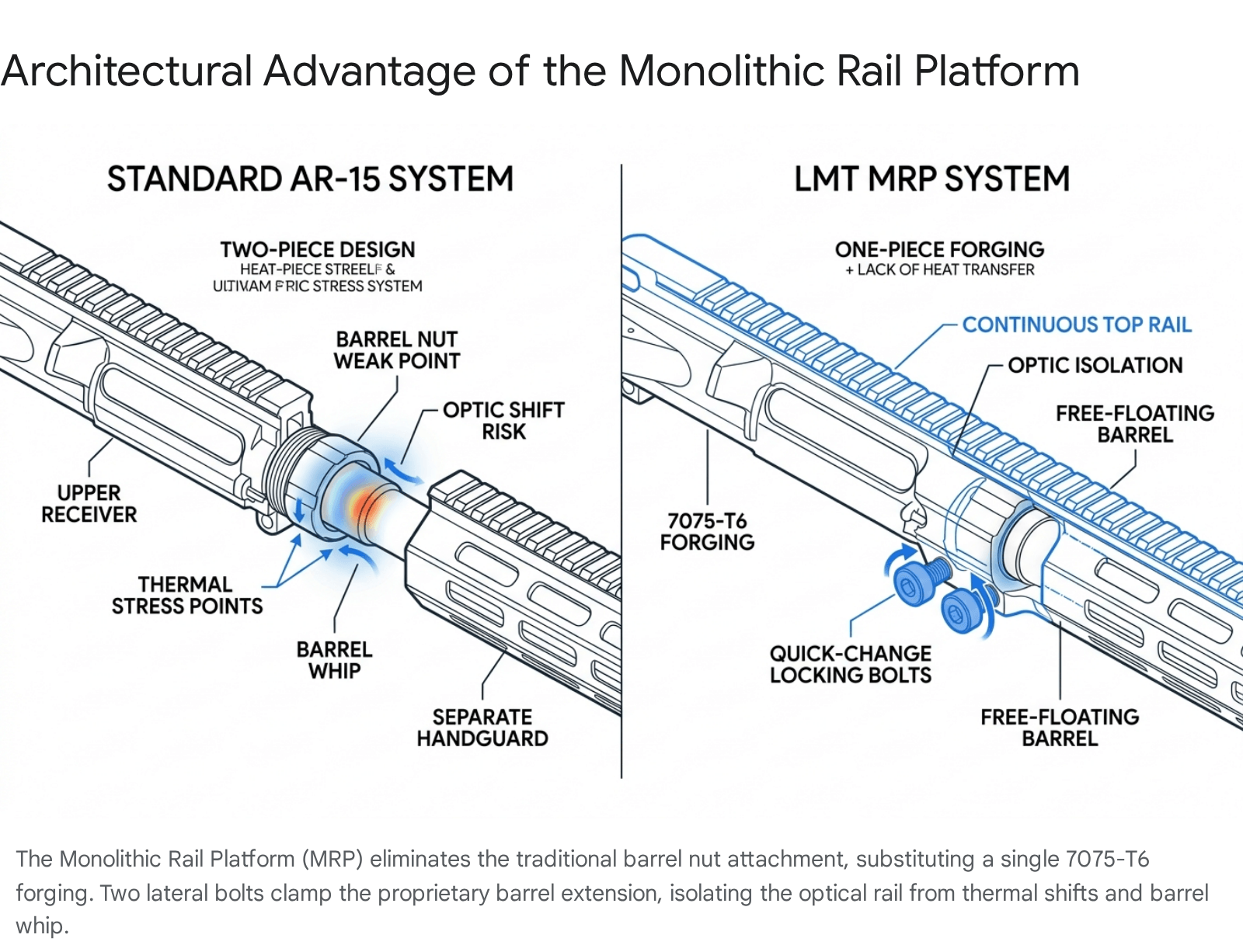
The rail grooves are numbered in white for repeatable accessory indexing, optimizing compatibility with night vision devices11. The proprietary coupling mechanism allows an operator to extract the barrel in the field and swap it for a different length or caliber within minutes, requiring only a standard Torx wrench8. The system supports a broad spectrum of chamberings, including 5.56x45mm, 5.45x39mm, 6.8x43mm, 7.62x39mm, .204 Ruger, .300 Blackout, and 350 Legend13. Barrel length accommodations range from 10.5 inches up to 20 inches, depending on whether the CQB or Rifle length chassis is utilized6. In 2012, LMT evolved this concept further with the LM8 platform, which utilizes removable rail segments to provide a smaller, lighter overall profile compared to the full quad-rail MRP6.
2.2 Modular Ambidextrous Rifle System (MARS)
Building upon the MRP’s architecture, LMT introduced the Modular Ambidextrous Rifle System (MARS) to the market2. The MARS platform pairs the monolithic upper receiver with a fully ambidextrous lower receiver, facilitating seamless manipulation for both right- and left-handed operators, as well as enabling off-shoulder firing in confined environments2. The MARS system features mirrored controls for the bolt catch/release, magazine release, and safety selector2.
The platform is segmented into two primary chassis sizes:
- MARS-L (Light): Chambered primarily in 5.56x45mm NATO and .300 Blackout, catering to standard infantry, patrol, and CQB requirements9. Commercial variants of the MARS-L frequently retail near $2,701, reflecting the premium positioning of the brand16.
- MARS-H (Heavy) / MWS (Modular Weapon System): Originally introduced in 2009 as the LM308MWS, the heavy chassis accommodates full-power cartridges including 7.62x51mm NATO, 6.5mm Creedmoor, .243 Winchester, .260 Remington, 7mm-08 Remington, and .338 Federal1. The MARS-H allows a unit to transition a single lower receiver from a short-barreled automatic battle rifle to a semi-automatic precision designated marksman rifle simply by swapping the upper assembly9.
LMT offers the MARS series in both traditional direct gas impingement (DI) and short-stroke gas piston operating systems8. Piston conversion kits are available, providing cleaner and cooler internal receiver operation, which is highly advantageous for units employing continuous suppressed fire6.
2.3 Internal Mechanics: The Enhanced Bolt Carrier Group (BCG)
While external modularity defines LMT’s marketing posture, the firm’s internal component engineering differentiates the platform mechanically. LMT designs and manufactures a proprietary Enhanced Bolt Carrier Group, which alters the timing of the weapon’s operating cycle1.
Standard AR-15 patterns face synchronization challenges when barrel lengths are reduced from the original 20-inch specification to 14.5-inch or 10.5-inch carbine lengths. Shorter gas systems increase port pressure and reduce the time the bolt remains locked, resulting in premature extraction while the brass cartridge casing is still expanded against the chamber walls1.
LMT modified the geometry of the bolt carrier by lengthening the cam path. This mechanical adjustment increases “dwell time”—delaying the moment the bolt rotates and unlocks. The delay affords the chamber pressure additional time to drop, allowing the brass casing to contract before extraction begins11. Furthermore, material was added to the front of the carrier, and the bolt features a redesigned extractor intended to improve the extraction of stubborn cartridges under adverse environmental conditions1. The firm also utilizes angled gas ports on the barrel to minimize port erosion under high-pressure firing schedules2.
2.4 Support Weapons: M203 Grenade Launchers and Acoustic Suppressors
LMT has functioned as a principal supplier of M203 40mm grenade launchers to the U.S. military and allied nations for over 35 years8. Recognizing the transition of modern infantry rifles toward free-floating rail systems, LMT re-engineered the legacy M203—which historically required direct attachment to the host weapon’s barrel—to mount directly onto Picatinny and M-LOK lower handguards9.
The company produces launchers in multiple configurations, including 9-inch and 12-inch barrels, standalone pistol-configured launchers known as the “Shorty 40,” and specialized 37mm flare launchers for law enforcement and disaster relief, which retail commercially for approximately $1,5169. LMT secured a $17 million firm-fixed-price contract to supply M203/M203A2 launchers and spare parts to the U.S. Army with an estimated completion date of September 18, 202518. The firm also developed proprietary sights for these systems, including the LMP391A leaf sight specifically designed for the New Zealand Defence Force9.
In the acoustic signature reduction sector, LMT AT developed the Virtual Baffle System (VBS) and the ION series of suppressors5. Initiated in 2020 by a U.S. government requirement for a belt-fed machine gun suppressor (the LINK30 project), LMT AT engineered low-back-pressure designs9. Low-back-pressure technology prevents toxic gas blowback into the operator’s face and mitigates the accelerated cyclic rate that traditional suppressors induce on the host weapon11. LMT AT also collaborated with the Lawrence Livermore National Laboratory to develop suppressor technology for highly specialized platforms, such as the Confined Space Weapon (CSW)—a discrete system chambered in .300 Blackout with an overall length of 24 inches13.
3. Buyer Ecosystem and Defense Contract Acquisitions
LMT Defense’s buyer ecosystem is heavily skewed toward institutional defense procurement. While the firm offers its systems to the commercial and law enforcement markets, its design and production cycles are explicitly driven by international military solicitations.
3.1 Domestic Procurement: United States Special Operations Command (USSOCOM)
The most commercially and tactically significant domestic procurement for LMT in recent years is the Medium Range Gas Gun – Assault (MRGG-A) contract, awarded by USSOCOM on August 22, 202519. The indefinite-delivery/indefinite-quantity contract features a maximum ceiling of $92 million and an ordering period extending to August 14, 203520.
The MRGG program was established to replace the aging Mk 17 SCAR-H and other legacy 7.62x51mm platforms within the Special Operations Forces inventory, addressing a capability gap identified in the 2018 National Defense Strategy regarding overmatch against near-peer adversaries at extended ranges19. The program was bifurcated into a Sniper support variant (MRGG-S, awarded to Geissele Automatics and type-classified as the Mk 1 Mod 0) and an Assault variant (MRGG-A)19.
LMT secured the MRGG-A requirement with a modified variant of its MARS-H platform, officially type-classified as the Mk 2419. The Mk 24 features a 14.5-inch stainless steel barrel with a 1:8 twist, select-fire capabilities, and is primarily chambered in 6.5mm Creedmoor20. SOCOM testing established that the 6.5mm Creedmoor offers significantly flatter trajectories, less wind drift, and superior terminal ballistics beyond 800 meters compared to the legacy 7.62x51mm NATO round19.
LMT’s Monolithic Rail Platform was a decisive factor in the award. Because SOCOM operators frequently deploy alongside partner forces who may not have access to 6.5mm Creedmoor ammunition, the Mk 24 allows the operator to extract the 6.5mm barrel and insert a 7.62x51mm barrel within 60 seconds in the field21. The system operates with the footprint of an M4 carbine but delivers the long-range lethality of an M110 sniper rifle21. Fielding of the Mk 24 is slated to begin in fiscal year 202619.
3.2 Global Defense Acquisitions
LMT Defense has leveraged its U.S. pedigree to secure standard-issue and specialized contracts across NATO and allied defense ministries in over 45 countries9.
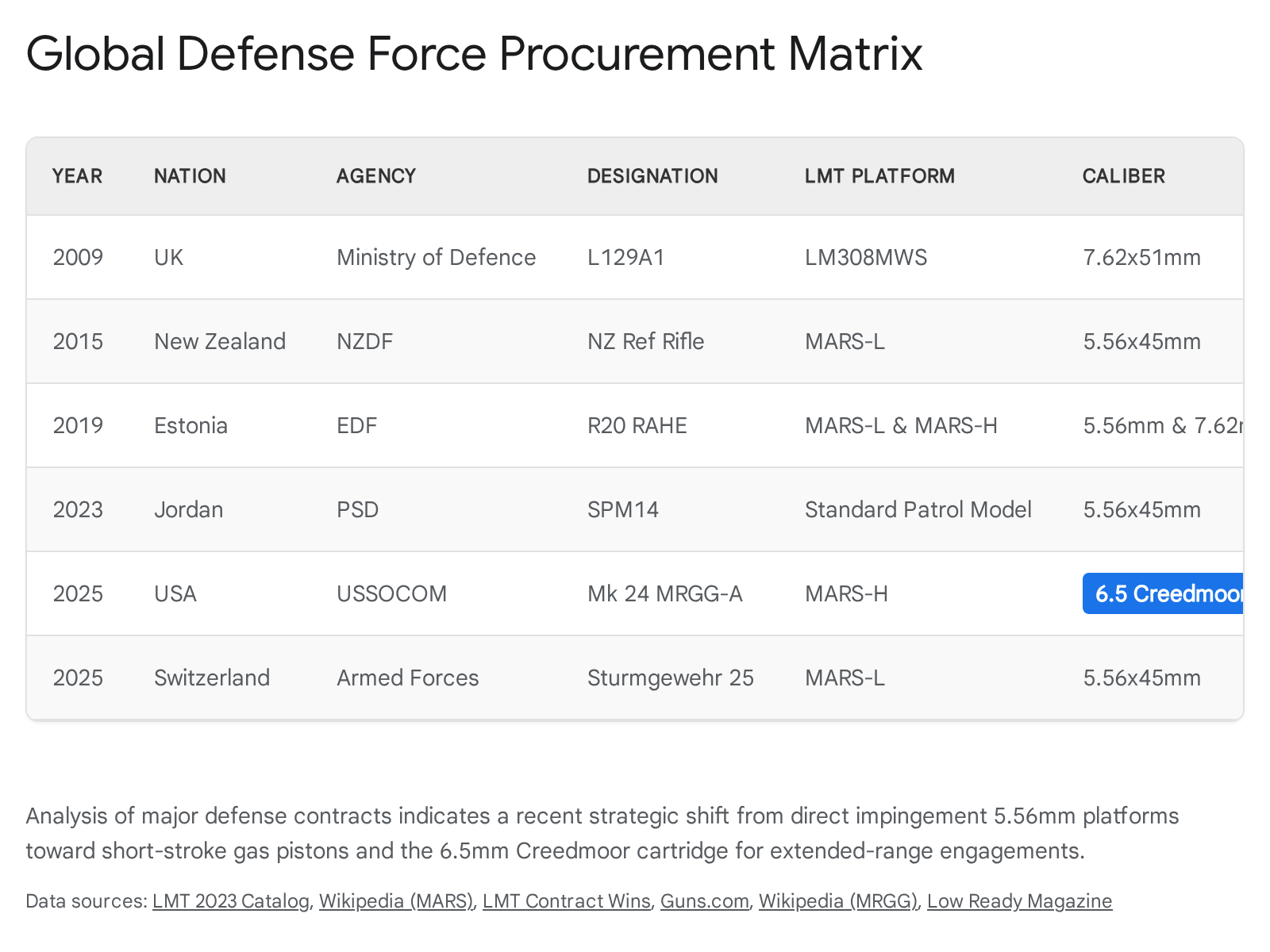
LMT’s international expansion accelerated in 2009 when the UK Ministry of Defence required an urgent operational capability for a designated marksman rifle in Afghanistan1. The resulting $30 million deal saw the LM308MWS designated as the L129A1 “Sharpshooter,” allowing squads to accurately engage targets out to 800 meters1. Recently, the Royal Marines updated this capability by adopting the L129A2 variant in 6.5mm Creedmoor15.
In August 2015, the New Zealand Ministry of Defence selected LMT to replace the Steyr AUG bullpup, investing $59 million (NZD) in 9,040 MARS-L rifles3. Four years later, LMT won a highly competitive $22 million tender to supply the Estonian Defence Forces (EDF) with 16,000 rifles, defeating 13 other manufacturers3. The Estonian evaluation matrix heavily penalized standard platforms, weighting a live-fire shooting test at 10%, guaranteed lifecycle shots at 20%, useful life at 30%, and price at 40%26. The resulting weapon, the R20 RAHE, utilizes a short-stroke gas piston system to enhance reliability in sub-zero Baltic conditions, featuring custom European-style triggers and bayonet lugs14.
Demonstrating sustained international momentum, LMT secured a contract in February 2025 to supply the Swiss Armed Forces with the Sturmgewehr 25 and the STGW 20, facilitated by European distributor SWISSLOXX AG14. Furthermore, in 2023, the Jordanian Public Security Directorate contracted LMT for 2,700 units of the SPM14 to modernize their internal security capabilities16.
4. Quality Control, Warranty Execution, and Industry Reputation
LMT Defense positions its products under the corporate motto “Because Failure is Not an Option,” maintaining ISO 9001:2015 certification and adhering to rigorous Mil-Spec manufacturing standards8. All components, including the cold-hammer-forged chrome-moly vanadium steel barrels, undergo high-pressure testing (HPT) and magnetic particle inspection (MPI), as well as cryogenic treatment to extend barrel life8. The factory standard requires a weapon to hold a 1.5-inch mean spread with standard lead-core ammunition prior to shipment6.
Despite these protocols, the scale of mass military procurement inevitably exposes supply chain vulnerabilities, which LMT has had to navigate publicly.
4.1 Case Study: The New Zealand Firing Pin Remediation
In September 2018, reports emerged from the New Zealand Defence Force that a subset of their 9,040 MARS-L rifles were experiencing critical component breakages during high-volume training15. Specifically, 130 rifles exhibited cracks around the bolt, and a small number of firing pins broke under cyclic stress15.
LMT immediately conducted a metallurgical analysis alongside the NZDF29. The investigation traced the failure to a specific subcontractor responsible for the heat-treating process, which had improperly tempered a batch of firing pins, rendering them excessively brittle29. While the failure rate was statistically minute—affecting less than one-tenth of one percent of the supplied firing pins—the incident carried severe reputational risks for a company competing against established European conglomerates29.
LMT’s response was decisive: invoking its warranty, the company voluntarily replaced the firing pins in all 9,040 rifles in the NZDF inventory out of an abundance of caution, along with the sporadically affected carriers and selector switches15. From an industry analysis perspective, this event highlights the inherent risks of outsourcing localized metallurgical processes, while simultaneously reinforcing LMT’s reputation for superlative post-sale warranty support. The prompt remediation satisfied NZDF leadership, though isolated segments of the commercial market have occasionally cited past issues with tight lug tolerances causing chambering difficulties, illustrating the dual-edged nature of public defense contracts29.
4.2 Armory Automation: The RuBee Weapon Shot Counter
To mitigate future mechanical failures and transition militaries from reactive maintenance to proactive prognostic health management, LMT integrated advanced telemetry into its hardware. During the Estonian EDF procurement, LMT partnered with Visible Assets, Inc. to install RuBee wireless Weapon Shot Counter (WSC) tags directly into the ergonomic pistol grips of the R20 RAHE rifles18.
Unlike commercial Radio Frequency Identification (RFID) systems, the RuBee network operates on low-frequency magnetic fields. This technology offers distinct tactical advantages: it is entirely secure from electronic eavesdropping (no tempest risk), it is HERO (Hazards of Electromagnetic Radiation to Ordnance) safe, and its signal is not blocked by human bodies or the high steel content typical of military armories26.
The RuBee WSC tag features a custom waveform analyzer chip that achieves 98% to 100% accuracy in counting fired rounds, boasting an optional 20-year battery life26. When an Estonian soldier returns a weapon to the armory, the Allegro 20/20 software automatically reads the tag, updates the weapon’s lifetime round count, and alerts armorers of required maintenance intervals before a breakage occurs in the field26. Furthermore, the system provides 99.9% accurate covert exit/entry detection for enhanced armory perimeter security, effectively digitizing the entire chain of custody26.
5. Strategic Outlook and Future Trajectory
As of 2026, LMT Defense is navigating a defense sector defined by two divergent trends: the modernization of individual infantry lethality through optimized calibers, and the automation of battlefield platforms via remote weapon stations. LMT has strategically positioned itself to capture market share in both domains.
5.1 Macro-Market Alignment and Caliber Evolution
The broader market for specialized munitions hardware is expanding steadily. Industry data projects the global grenade launcher market will grow from $1.83 billion in 2025 to $2.39 billion by 2030, representing a Compound Annual Growth Rate (CAGR) of 5.4%31. This growth is driven by the demand for advanced weapon systems, multi-ammunition versatility, and integration with remote weapon stations27. LMT’s existing $17 million M203 contract provides a stable baseline to capture future growth in this specific segment18.
Concurrently, the global special operations community is actively phasing out legacy 5.56x45mm and 7.62x51mm NATO cartridges. The $92 million USSOCOM MRGG-A contract and the UK Royal Marines’ adoption of the L129A2 represent a watershed moment for the 6.5mm Creedmoor15. Because the Monolithic Rail Platform allows for user-level barrel and caliber swaps, allied nations can procure MARS-H lower receivers and gradually transition their arsenals from 7.62mm stockpiles to 6.5mm Creedmoor over the next decade simply by purchasing new barrel assemblies11. This modularity represents immense fiscal savings for defense budgets and provides logistical flexibility for deployed units, positioning LMT advantageously for future upgrade solicitations.
5.2 Autonomous Defense Integration: The Northrop Grumman Alliance
In October 2025, LMT Defense announced a profound strategic pivot, entering into a formal, long-term licensing agreement with aerospace and defense prime Northrop Grumman Corporation28. Under this agreement, LMT will manufacture, distribute, and support the 7.62x51mm Bushmaster Chain Gun at its Eldridge, Iowa facility14.
This initiative represents a significant expansion of LMT’s industrial capabilities. The Bushmaster Chain Gun is not an infantry weapon; it is an electrically driven, externally powered system capable of 600 rounds-per-minute sustained fire, utilizing an automatic malfunction clearing mechanism for absolute reliability14.
The strategic rationale for this partnership is driven by the explosive growth in the Counter-Unmanned Aircraft Systems (C-UAS) and Unmanned Ground Vehicle (UGV) sectors32. Modern military modernization priorities dictate the integration of AI-driven, automated turrets on vehicles, maritime vessels, and static defense installations to track and neutralize drone swarms and asymmetric threats35. Small-caliber chain guns are the optimal kinetic effector for these remote weapon systems31.
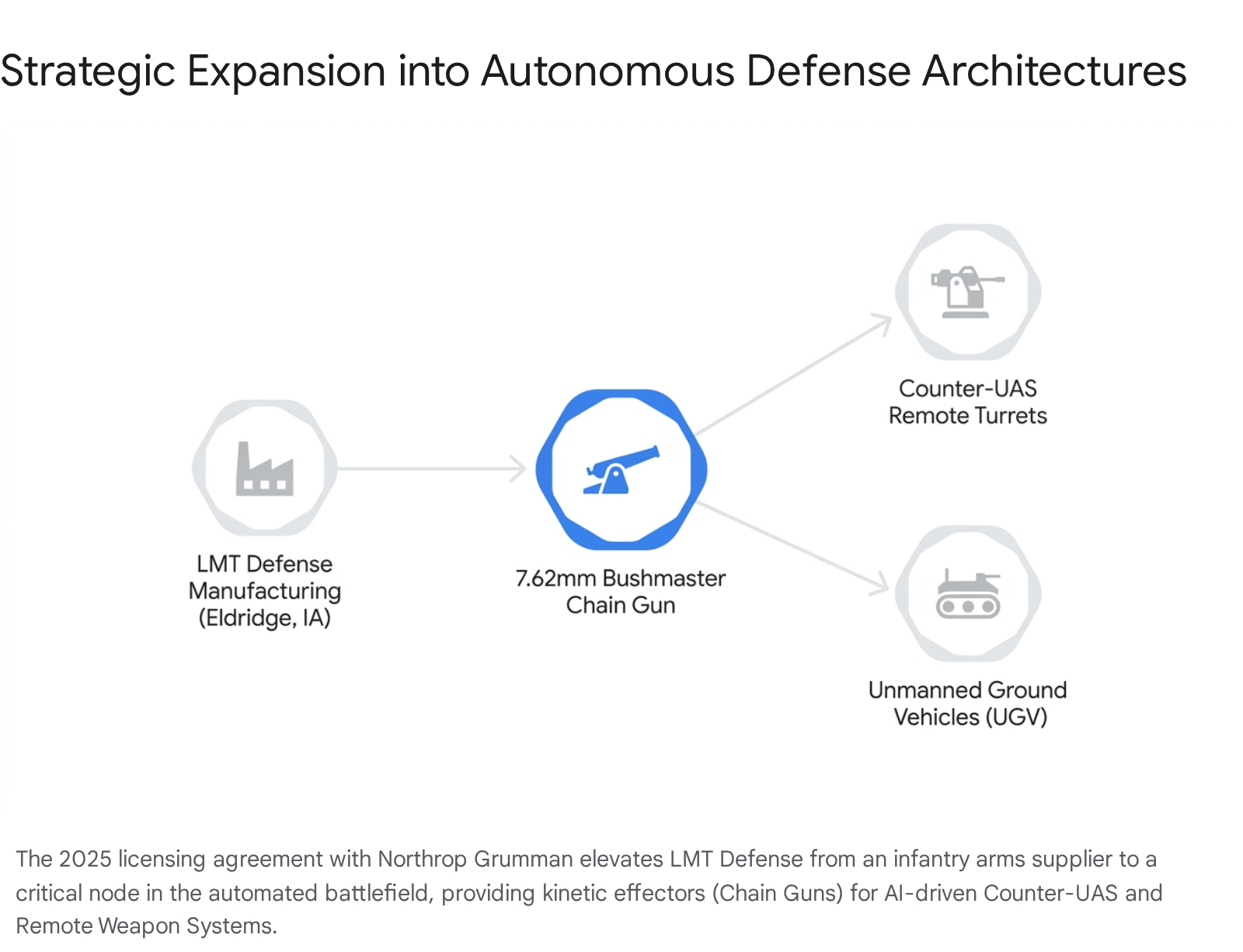
By securing the rights to manufacture the 7.62mm Chain Gun, LMT transitions from solely equipping the individual warfighter to arming the automated battlefield, capturing revenue in the rapidly expanding autonomous defense technology sector28.
Conclusion
LMT Defense has executed a measured, highly technical ascent within the small arms industry. By prioritizing engineering-intensive, IP-protected platforms over the volatile civilian consumer market—most notably through the Monolithic Rail Platform and the MARS chassis—the company established a formidable presence in defense procurement.
The firm’s historical trajectory demonstrates a consistent ability to identify and solve specific mechanical vulnerabilities that plague military operators, from thermal shifts in optic rails to premature bolt unlocking during the extraction cycle. While the reality of mass manufacturing has presented challenges, LMT’s aggressive warranty execution and integration of proactive maintenance technologies like RuBee shot counters have insulated its reputation among institutional buyers.
Strategically, LMT is well-positioned for the coming decade. The USSOCOM MRGG-A contract secures its footprint at the forefront of the global transition to the 6.5mm Creedmoor cartridge, leveraging the innate modularity of its MRP system. Concurrently, the Northrop Grumman Bushmaster Chain Gun alliance provides LMT with a lucrative vector into the automated and unmanned systems market. Through these initiatives, LMT Defense has successfully transitioned from a specialized parts fabricator into a diversified kinetic systems provider capable of arming both the individual warfighter and the automated tactical networks of the future.
Please share the link on Facebook, Forums, with colleagues, etc. Your support is much appreciated and if you have any feedback, please email us in**@*********ps.com. If you’d like to request a report or order a reprint, please click here for the corresponding page to open in new tab.
Sources Used
- Lewis Machine & Tool Company – Wikipedia, https://en.wikipedia.org/wiki/Lewis_Machine_%26_Tool_Company
- Lewis Machine & Tool Company – Grokipedia, https://grokipedia.com/page/Lewis_Machine_&_Tool_Company
- LMT Opens New Plant, Confirms Large Military Contract – Guns.com, https://www.guns.com/news/2019/05/23/lmt-opens-new-plant-confirms-large-military-contract
- Our Story – LMT Defense, https://lmtdefense.com/our-story/
- LMT Advanced Technologies | Suppressors in Iowa – Boise Gun Club, https://boisegunclub.com/iowa/directory/lmt-at-ia
- Lewis Machine Tool Co. Vintage Shaper and Mill Identification – Industrial Monitor Direct, https://industrialmonitordirect.com/blogs/knowledgebase/lewis-machine-tool-co-vintage-shaper-and-mill-identification
- Our Story – LMT Advanced Technologies, https://lmt-at.com/our-story/
- Lewis Machine & Tool CQB 16 – SWAT Survival | Weapons | Tactics, https://www.swatmag.com/article/lewis-machine-tool-cqb-16/
- LMT 2023 Catalog, https://lmtdefense.com/wp-content/uploads/2024/09/LMT-2023Catalog-pkg-2-sm.pdf
- US8234808B2 – Monolithic rail platform and bolt assemblies for a firearm – Google Patents, https://patents.google.com/patent/US8234808B2/en
- Lewis Machine & Tool Monolithic Rail Platform – Police Magazine, https://www.policemag.com/articles/lewis-machine-amp-tool-monolithic-rail-platform
- LMT Defense | Home, https://lmtdefense.com/
- CELBRATING 40 Years! – LMT Defense, https://lmtdefense.com/wp-content/uploads/documents/2020-Catalog-Digital.pdf
- LMT® Defense Signs License Agreement, https://lmtdefense.com/?dir=asc&order=price
- LMT Modular Ambidextrous Rifle System – Wikipedia, https://en.wikipedia.org/wiki/LMT_Modular_Ambidextrous_Rifle_System
- Shop 50 LMT DEFENSE Products | Brownells, https://www.brownells.com/brands/lmt-defense/
- LMT Defense Parts – Boss Firearms Company, https://bossfirearms.com/lmt-defense-parts/
- Contract Wins – LMT Defense, https://lmtdefense.com/contract-wins/
- Mid-Range Gas Gun – Wikipedia, https://en.wikipedia.org/wiki/Mid-Range_Gas_Gun
- SOCOM procures 6.5 Creedmoor carbine from LMT Defense – Lowready Magazine, https://lowreadymagazine.com/en/articles/socom-6-5-creedmoor-en
- Not ‘just a gun’: New SOCOM rifle allows barrel swapping and cartridge changes, https://www.militarytimes.com/news/your-military/2026/06/01/not-just-a-gun-new-socom-rifle-allows-barrel-swapping-and-cartridge-changes/
- LMT Wins USSOCOM 6.5 Creedmoor Rifle Contract (MRGG-A) – Sourcehere, https://sourcehere.com/resource/39141
- The U.S. Special Operations Command has a new assault rifle, the LMT Defense MRGG-A in 6.5 Creedmoor % – Zona Militar, https://www.zona-militar.com/en/2025/09/15/the-u-s-special-operations-command-has-a-new-assault-rifle-the-lmt-defense-mrgg-a-in-6-5-creedmoor/
- lmt awarded ussocom medium range gas gun-assault (mrrg-a) contract, https://lmt-at.com/lmt-awarded-ussocom-mrgg-a-contract/
- Estonia procures new rifles for its Defence Forces – Kaitseministeerium, https://www.kaitseministeerium.ee/en/news/estonia-procures-new-rifles-its-defence-forces
- Lewis Machine & Tool and Visible Assets, Inc. Awarded a €22 Million Estonian Defense Forces Contract For 16,000 Automatic Weapons With Integrated RuBee Wireless Weapon Shot Counters. – PR Newswire, https://www.prnewswire.com/news-releases/lewis-machine–tool-and-visible-assets-inc-awarded-a-22-million-estonian-defense-forces-contract-for-16-000-automatic-weapons-with-integrated-rubee-wireless-weapon-shot-counters-300851500.html
- News – LMT Defense, https://lmtdefense.com/news/
- LMT® Defense Signs License Agreement, https://lmtdefense.com/uncategorized/lmt-defense-signs-license-agreement/
- LMT Warranties Components with New Zealand Defense Forces MARS-L, https://www.thefirearmblog.com/blog/2018/09/25/lmt-replaces-components-under-warranty-with-new-zealand-defense-forces/
- Press Releases – Visible Assets, Inc., https://www.ru-bee.com/PresReleases/index.html
- Grenade Launchers Market Size, Share & Forecast to 2030 – Research and Markets, https://www.researchandmarkets.com/report/grenade-launcher-market
- Grenade Launchers Market Size, Share and Global-2026, https://www.thebusinessresearchcompany.com/report/grenade-launchers-global-market-report
- LMT Defense Signs License Agreement with Northrop Grumman for 7.62mm Bushmaster Chain Gun – Soldier Systems, https://soldiersystems.net/page/179/
- Chain Gun Archives – LMT Defense, https://lmtdefense.com/tag/chain-gun/
- Countering the UAS Threat: A Comprehensive Review of National C-UAS Programs, https://cuashub.com/wp-content/uploads/2024/12/MarketReport25_V7.pdf
- 2019 Armament Systems Forum – DTIC, https://apps.dtic.mil/sti/tr/pdf/AD1078292.pdf