Executive Summary
The strategic environment has seen a shift toward the cognitive domain, where the manipulation of information serves as a mechanism to subdue an adversary. The People’s Republic of China (PRC) has integrated cognitive warfare into its military doctrine, targeting the Republic of China (Taiwan) through sustained foreign information manipulation and interference (FIMI). The objective is to fracture societal cohesion, degrade trust in democratic institutions, and erode the population’s will to resist. In response, Taiwan has cultivated an adaptive, multi-dimensional defense posture that integrates civil society, government administration, and national security infrastructure.
This report provides an interdisciplinary analysis—synthesizing military strategy, national intelligence collection, and psychological assessment—of Taiwan’s societal defense architecture, codified as the “POWER” model. Developed by researchers at Doublethink Lab and international election specialists, the POWER model defines a framework that is Purpose-driven, Organic, Whole-society, Evolving, and Remit-bound1. The analysis investigates the specific mechanisms of this model, ranging from governmental protocols like the “2-2-2 principle” to grassroots open-source intelligence operations targeting coordinated inauthentic behavior. Furthermore, the report assesses how the PRC has adapted to Taiwan’s defenses, shifting from easily detectable content farms to decentralized “resonator” networks, leveraging artificial intelligence for synthetic media, and exploiting demographic vulnerabilities through short-form video algorithms and local infrastructure lures.
1. The Strategic Framework of Cognitive Warfare
To evaluate Taiwan’s defensive posture, it is necessary to establish the operational doctrine of the adversary. From a military and intelligence perspective, the People’s Liberation Army (PLA) views the cognitive domain as a distinct battlespace, equal in strategic importance to land, sea, air, space, and cyber domains2. Chinese military strategists assert that future conflicts will be “wars of cognition” aimed at achieving supremacy over human perception2.
1.1 Systems Destruction and the Human Node
The cornerstone of current PLA doctrine is “systems destruction warfare,” an operational concept that seeks to paralyze an enemy’s operational system rather than annihilate its physical forces3. Within this doctrine, the human mind is identified as a critical node. By targeting cognitive processing, the adversary aims to induce mental disarray, alter decision-making paradigms, and sever the psychological linkage between the civilian population, the military, and the state’s leadership3. The ultimate strategic objective is to incapacitate and dismantle vital functions, wherein the target population is manipulated into capitulation or internal fragmentation before kinetic hostilities commence3. This involves the application of targeted messages to gain a positional advantage in the cognitive domain, effectively making the mind of every citizen a battleground3.
1.2 Psychological Objectives and Target Demographics
Psychological assessments of PRC influence operations indicate that they rarely aim to definitively convince the populace of a single verifiable lie. Instead, the strategy relies on the proliferation of contradictory narratives to exhaust the population’s cognitive bandwidth, fostering cynicism, apathy, and political alienation5. Intelligence analysts point out that the main target of information manipulation in Taiwan is the approximately 20 percent of the population that considers itself politically neutral7. This demographic is often undecided on whether to support military resistance or advocate for surrender in the event of an invasion7.
A primary psychological tactic deployed against this cohort is the promotion of “America Skepticism” (疑美論)7. This involves systematically degrading trust in international alliances by promoting narratives that portray foreign partners as unreliable or motivated solely by economic extraction. Specific narratives include claims that the United States intends to “hollow out” Taiwan’s semiconductor industry by forcing companies like Taiwan Semiconductor Manufacturing Company (TSMC) to build factories abroad, or that the U.S. would ultimately refuse to send troops to aid Taiwan during a conflict5. By exploiting existing domestic grievances—such as food safety controversies, vaccine procurement debates, and energy policy—the adversary widens the partisan divide and weakens the psychological resolve to maintain political autonomy9.
1.3 Asymmetric Military Defense and Civil Integration
Recognizing the conventional superiority of the PLA, Taiwan’s military analysts have advocated for an asymmetric strategy known as the Overall Defense Concept (ODC)12. This doctrine transitions the military from a posture based on concentration and fixed defenses to one relying on dispersal, mobility, and denial12. The objective is to deny the PLA the air and sea superiority required for a triphibious invasion by deploying a large quantity of mobile, accurate, and lethal systems12.
However, military deterrence is intrinsically linked to societal resilience. To prevent the psychological collapse sought by adversary cognitive operations, Taiwan has initiated an “All-Out National Defense” realignment plan14. This involves a structural shift in force posture, including the reinstatement of a one-year mandatory military service term, significant wage increases for conscripts, and an overhaul of the reserve system to function as a territorial garrison force capable of urban and rural defense14. Drawing lessons from the 2022 Russian invasion of Ukraine, Taiwanese strategists recognize that demonstrating a credible, society-wide will to fight is a necessary component to counter the adversary’s narrative of inevitable unification15.
2. The Taiwan POWER Model: Definition and Components
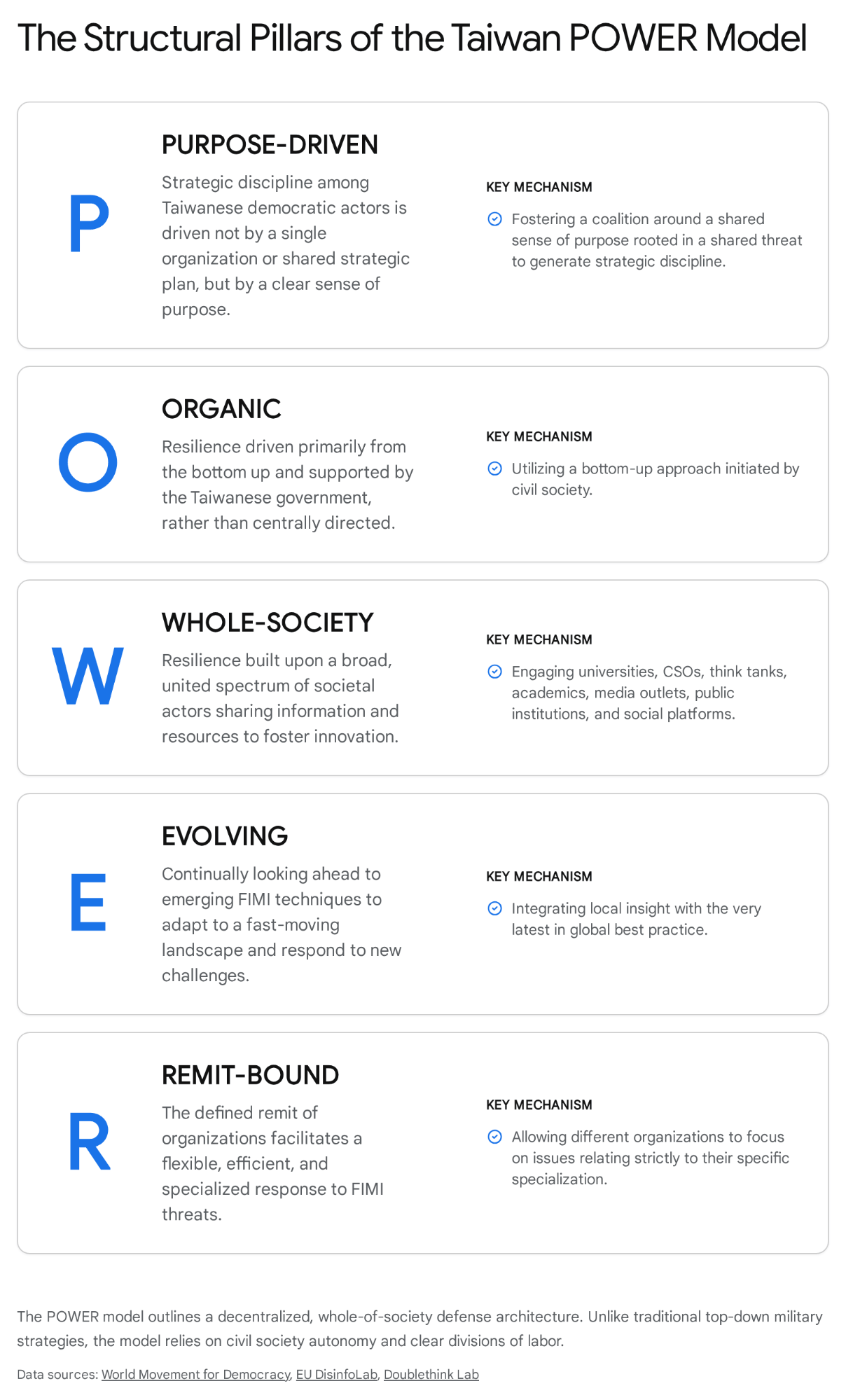
In the face of sustained cognitive warfare, Taiwan has developed a decentralized defense mechanism. Researchers at Doublethink Lab, in collaboration with election integrity experts, categorized the core components of this societal defense under the acronym “POWER”1. The model does not represent a top-down, rigidly commanded military strategy; rather, it describes the emergent properties of a resilient democratic society under continuous threat17.
2.1 Purpose-Driven
Strategic discipline among Taiwanese democratic actors is not coordinated by a central authority or a singular strategic plan, but is instead unified by a clear, shared sense of purpose18. The existential nature of the threat generates intrinsic motivation across disparate sectors. During the 2024 national elections, despite lacking a formal hierarchical command structure to direct civil society, various independent organizations synchronized their operations18. They shared an underlying objective: safeguarding the integrity of the electoral process from external interference. This shared purpose functions as the strategic adhesive that compensates for the lack of centralized command, allowing universities, media outlets, and non-governmental organizations to align their efforts1.
2.2 Organic
Taiwan’s resilience is fundamentally bottom-up, originating from the grassroots level1. The roots of this organic development trace back to historical civil movements, such as the 2014 Sunflower Student Movement, which mobilized a generation of civic-minded technologists and activists20. Communities like “g0v” (gov-zero) foster decentralized technological solutions to public challenges, enabling citizens to actively participate in democratic oversight22. Because the response architecture is organic, it possesses a high degree of agility; civil society entities can identify anomalous information patterns and deploy countermeasures rapidly23.
2.3 Whole-Society
The model integrates a broad spectrum of actors, extending beyond the military and intelligence communities to include educational institutions, civil society organizations, independent fact-checkers, media outlets, and technology platforms1.
However, intelligence assessments identify vulnerabilities within this framework. The integration is not absolute. Certain traditional and local nodes, such as neighborhood representatives (borough wardens) and local temple networks, remain susceptible to PRC influence18. These local entities are targeted through subsidized tourism and cultural exchange programs, functioning as conduits for United Front work that bypass the digital resilience of the urban centers16.
2.4 Evolving
Adversary tactics are not static; therefore, defensive mechanisms must adapt. The evolving characteristic of the POWER model reflects Taiwan’s capacity to integrate global best practices and rapidly upgrade its technological defenses18. As threat actors transition from rudimentary bot swarms to AI-driven influence operations, Taiwanese civil society updates its detection frameworks. This includes transitioning from manual fact-checking to deploying machine-learning algorithms that analyze coordinated inauthentic behavior across multiple platforms19.
2.5 Remit-Bound
To maximize efficiency and minimize resource overlap, the organizations operating within the POWER framework maintain strict, self-imposed remits17. The ecosystem operates via a division of labor, allowing highly specialized units to execute discrete tasks without competing for identical funding streams or jurisdictional authority.
| Operational Remit | Core Function | Key Organizations and Mechanisms |
| Verification & Fact-Checking | Investigating individual claims, verifying statistical accuracy, and publishing corrections to combat immediate viral falsehoods. | Taiwan FactCheck Center, MyGoPen, Fake News Cleaner22. |
| Attribution & Digital Forensics | Tracing the origin of disinformation campaigns, mapping server domains, and analyzing coordinated inauthentic behavior networks. | Doublethink Lab, Taiwan Information Environment Research Center (IORG)19. |
| Crowdsourced Verification | Enabling the general public to submit suspicious content via encrypted messaging apps to scale detection capabilities. | Cofacts LINE chatbot, g0v civic tech community22. |
| Strategic Communication | Translating technical intelligence into accessible media literacy materials, podcasts, and civil defense guides for the public. | Watchout, various educational NGOs22. |
| Algorithmic Detection | Utilizing artificial intelligence to monitor natural language patterns and expose systemic bias in generative models. | Taiwan AI Labs (Infodemic platform)19. |
3. Execution and Methodologies of Information Resilience
The theoretical framework of the POWER model translates into tangible defensive operations executed concurrently by civil society, government bodies, and technology sectors.
3.1 The State’s Role: Psychological Defense and the 2-2-2 Principle
While civil society focuses on attribution and fact-checking, the Taiwanese government has adapted its communication strategy to counter the psychological impact of cognitive warfare. Recognizing that authoritarian actors utilize “memetic engineering” to spread disinformation faster than traditional bureaucratic press releases can counter it, the state adopted agile communication protocols26.
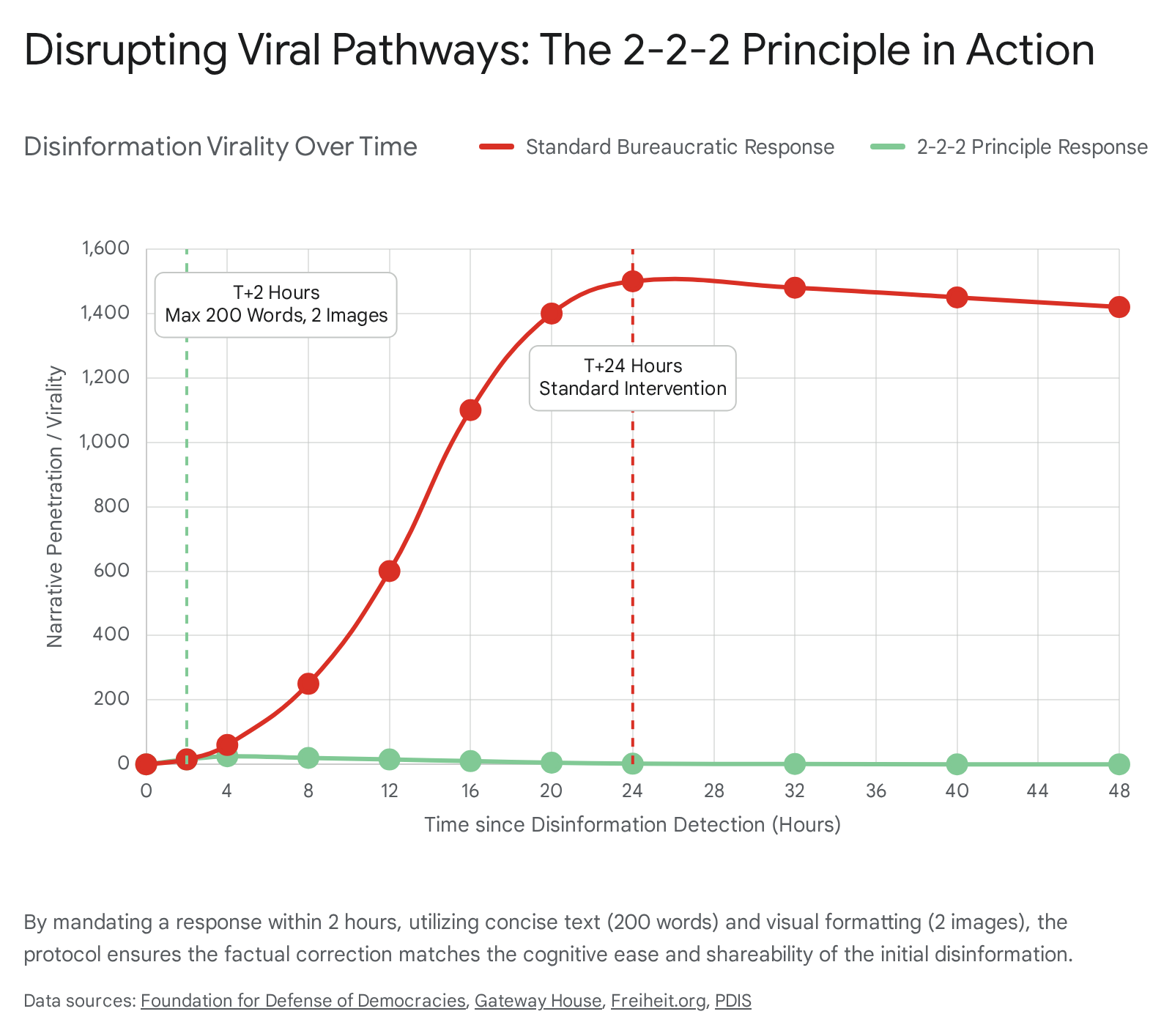
The most prominent protocol is the “2-2-2 principle” instituted by the Executive Yuan23. This mandate requires that upon the detection of a significant disinformation narrative, the relevant government ministry must issue a clarification within two hours, utilizing no more than 200 words, accompanied by two images23.
From a psychological perspective, this protocol is effective. Disinformation thrives on cognitive ease; it is designed to be rapidly consumed and shared without critical reflection26. Lengthy, text-heavy governmental rebuttals increase cognitive load. By restricting the response to 200 words and relying on visual processing, the government matches the cognitive ease of the adversary’s attack. Furthermore, the protocol frequently employs the tactic of “humor over rumor”26. By wrapping factual corrections in culturally resonant memes, the state incentivizes organic sharing by the public, effectively co-opting the virality mechanisms that usually favor disinformation26.
3.2 Digital Intelligence and Open-Source Forensic Investigations
Non-governmental intelligence analysis forms the vanguard of the detection protocol. Organizations utilizing the DISARM (Disinformation Analysis and Risk Management) framework conduct deep forensic investigations to uncover adversary Tactics, Techniques, and Procedures (TTPs)31.
Intelligence operations have unmasked complex infrastructures utilized by PRC actors. For example, open-source intelligence investigations into the “Borderless Group” revealed a sophisticated network utilizing 549 inauthentic accounts created between July 2023 and February 2026 on the Threads platform32. This network engaged in large-scale coordinated inauthentic behavior to drive traffic to 1,217 inauthentic news domains32. By tracking registration proxy services and historical domain registrations, civil society analysts exposed how the adversary used bulk-created assets, programmatic ad-tech, and plagiarized content to pollute the Taiwanese information environment32.
Furthermore, analysts monitor data leaks to anticipate adversary capabilities. The analysis of the “GoLaxy documents”—internal files from a company spun off from the Institute of Computing Technology at the Chinese Academy of Sciences—revealed PRC efforts to deploy AI-driven influence operations34. Civil society analysts also track cross-border narrative manipulation, such as the deployment of suspicious Facebook accounts targeting Malaysian media following comments by Japanese Prime Minister Sanae Takaichi regarding a Taiwan contingency, illustrating the regional scope of PRC operations36.
3.3 Technological Integration and Algorithmic Countermeasures
To manage the volume of FIMI, Taiwan integrates human intelligence with artificial intelligence. Crowdsourcing platforms allow ordinary citizens to submit suspicious messages for verification, extending the detection network into encrypted, private communication channels22.
At the analytical level, researchers employ human-AI collaboration models utilizing open-source tools to process datasets of social media interactions and identify linguistic anomalies that indicate mainland Chinese origins19. Organizations like Taiwan AI Labs deploy AI-driven platforms to detect anomalous patterns and have begun identifying biases in commercial Large Language Models (LLMs)19. Testing revealed that certain PRC-developed LLMs (e.g., Deepseek-R1) embedded PRC-aligned propaganda in 23.3 percent of their responses to geopolitically sensitive queries19.
4. Adversary Countermeasures and Tactical Evolution
The PRC’s intelligence and psychological warfare apparatus is adaptive. As the Taiwan POWER model successfully degraded the efficacy of early-generation influence operations (such as automated bot swarms and massive content farms), the adversary shifted its tactics. Military and national intelligence analysts have identified four primary evolutionary shifts in the PRC’s cognitive warfare strategy.
4.1 The Transition to Decentralized Resonators
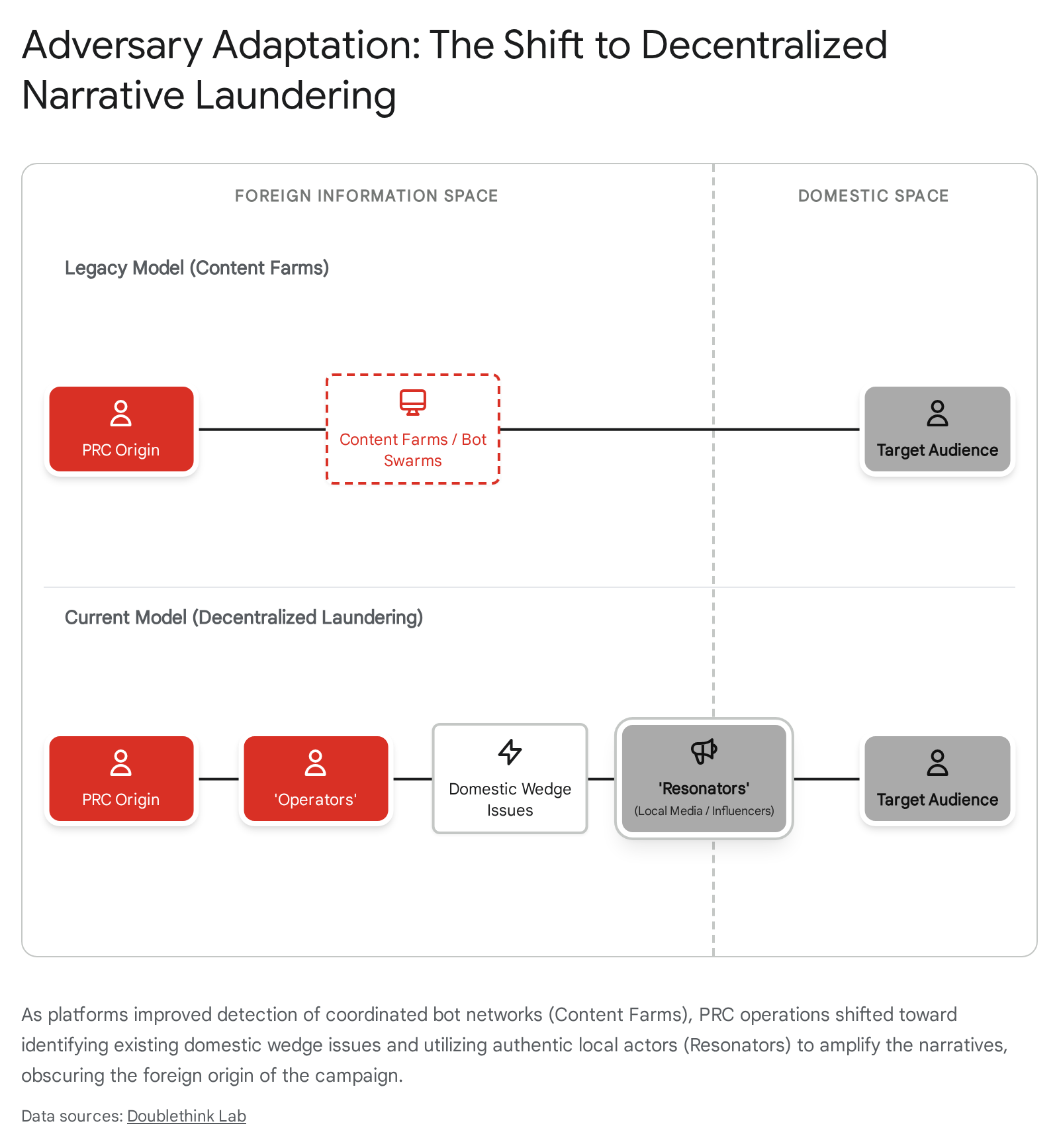
Platform crackdowns on coordinated inauthentic behavior degraded the effectiveness of overt PRC content farms9. In response, adversary operations have shifted toward a decentralized amplification model. Instead of generating detectable fabricated content, PRC actors increasingly operate as “operators” who identify pre-existing domestic controversies in Taiwan—such as industrial policies or local crime events—and amplify them9.
Crucially, the strategy relies on “resonators”—authentic domestic actors such as traditional Taiwanese media outlets, anonymous political fan pages, local influencers, and politicians9. By injecting narratives into the feeds of these resonators, the adversary launders the information. Once a narrative is adopted by a domestic resonator, it spreads organically, completely bypassing algorithms designed to detect foreign bots9.
Intelligence indicates the use of algorithmic coercion to cultivate these resonators. Research into WeChat influencers operating in Taiwan revealed directives requiring apolitical content creators (e.g., lifestyle or commerce influencers) to dedicate 10 percent of their feed to pro-unification content to ensure their profiles remain algorithmically optimized and monetizable11. This leverages economic self-interest to inject propaganda into non-political digital spaces.
4.2 Synthetic Media and Artificial Intelligence
The integration of generative AI has altered the economics and detection parameters of FIMI19. Threat actors increasingly utilize “spamouflage” tactics, embedding propaganda within high volumes of benign, human-interest content to evade detection19.
During the 2024 Taiwanese elections, intelligence analysts observed a marked increase in the deployment of AI-generated assets5. The adversary utilized audio deepfakes to impersonate political candidates, attempting to generate scandals immediately prior to voting23. Additionally, the use of virtual news anchors with AI-generated voices allowed the adversary to produce localized audio-visual propaganda at a fraction of the traditional cost, obscuring the geographic and linguistic origin of the content5. AI tools are also utilized to generate minute variations in text and posting schedules across thousands of bot accounts, breaking the identical patterns that earlier generation detection algorithms relied upon19.
4.3 Algorithmic Manipulation and Platform Exploitation
Psychological warfare requires the precise targeting of cognitive vulnerabilities. Recent audience research into the impact of short-form video platforms, specifically TikTok, reveals how algorithmically driven content consumption correlates with shifts in strategic attitudes among Taiwanese youth6.
Psychological profiling indicates that active TikTok users display stronger correlations with narratives promoted by PRC United Front work39. Heavy utilization of the platform correlates independently with higher levels of dissatisfaction regarding Taiwan’s domestic governance, lower confidence in democratic institutions, and elevated skepticism regarding United States military and diplomatic support39. Furthermore, active usage increases the statistical likelihood of users aligning with viewpoints that favor stabilization via appeasement, demonstrating that sustained exposure to fragmented, algorithmically curated environments creates a receptive cognitive landscape for authoritarian narratives39.
4.4 Physical Gray Zone Infrastructure as Cognitive Coercion
Adversary tactics are not confined to the digital information space; they manifest in the physical gray zone to achieve cognitive objectives. The PRC targets geographically and economically vulnerable nodes, such as the outlying island of Kinmen, utilizing infrastructure projects as psychological weapons40.
The PRC’s promotion of the “Four New Links” program (water, electricity, natural gas, and physical bridges) alongside the development of the Xiamen Xiang’an Airport, is framed publicly as economic development40. However, military and intelligence analysis identifies these projects as mechanisms for cognitive coercion40. By fostering deep physical and economic integration with the mainland, the PRC aims to conceptually isolate Kinmen from the Taiwanese mainland, attempting to convince the local population that their economic survival is intrinsically linked to Beijing rather than Taipei40. This localized infrastructure strategy is designed to fracture the whole-society resilience model by creating pockets of the population whose immediate material interests conflict with the broader national defense posture40.
Conclusion
Taiwan’s position on the frontlines of the PRC’s cognitive and system destruction warfare has necessitated the rapid evolution of societal defense mechanisms. The POWER model—Purpose-driven, Organic, Whole-society, Evolving, and Remit-bound—illustrates that effective deterrence in the information domain cannot rely solely on classified intelligence operations or rigid military hierarchies1. Instead, resilience requires a decentralized, agile ecosystem where civil society organizations, technologists, and government entities operate within specialized remits bound by a shared existential purpose1. The implementation of policies such as the 2-2-2 principle demonstrates an understanding of the psychological mechanics of disinformation, fighting cognitive manipulation with cognitive ease26.
However, the threat landscape is not static. Adversary operations have adapted to these defenses by abandoning easily identifiable content farms in favor of exploiting domestic resonators, utilizing generative AI to mask coordinated behavior, and algorithmically targeting demographic vulnerabilities9. Furthermore, physical infrastructure investments in gray zones like Kinmen reveal that cognitive warfare encompasses economic and spatial coercion aimed at fracturing national identity40. Ultimately, the analysis indicates that information resilience is not an end-state to be achieved, but a continuous cycle of adaptation, requiring constant technological innovation and the perpetual reinforcement of civic trust.
Master Summary Table
| Operational Dimension | Counter-Cognitive Strategy (The POWER Model) | Adversary Countermeasure & Evolution |
| Organizational Structure | Purpose-Driven & Organic: Grassroots civic tech networks (e.g., g0v) act autonomously based on a shared perception of an existential threat, rather than waiting for central command directives1. | Exploiting Democratic Nuance: Utilizing algorithmic optimization quotas on platforms like WeChat to force authentic, apolitical influencers to inject pro-unification narratives into non-political feeds11. |
| Operational Scope | Whole-Society & Remit-Bound: A strict division of labor across academia, fact-checkers, and digital forensics NGOs minimizes redundancy while ensuring thorough narrative monitoring17. | Targeting Local Nodes: Bypassing urban digital resilience by directly targeting susceptible local neighborhood wardens and temple networks through subsidized mainland tourism and United Front programs16. |
| Government Response | The 2-2-2 Principle: Combating disinformation by enforcing a 2-hour response window, utilizing maximum 200 words and 2 images. Employs “humor over rumor” to exploit cognitive ease23. | Decentralized Resonators: Abandoning overt bot farms in favor of laundering narratives through domestic politicians and media, removing the foreign origin signature and bypassing state fact-checks9. |
| Technological Defense | Evolving AI Forensics: Deploying machine-learning systems (e.g., Infodemic, CKIP Tagger) to map coordinated inauthentic behavior, exposing threat networks like the Borderless Group19. | Synthetic Media & Spamouflage: Upgrading operations with high-quality audio deepfakes, AI-generated anchors, and LLMs trained to embed propaganda seamlessly into benign content5. |
| Societal Psychology | All-Out National Defense: Enhancing the will to fight by reforming the military reserve system, modernizing asymmetric tactics, and drawing territorial defense lessons from the Ukraine conflict14. | Algorithmic & Gray Zone Coercion: Fostering “America Skepticism” via short-form video algorithms to degrade morale, while using physical infrastructure lures (e.g., in Kinmen) to fracture national identity39. |
Please share the link on Facebook, Forums, with colleagues, etc. Your support is much appreciated and if you have any feedback, please email us in**@*********ps.com. If you’d like to request a report or order a reprint, please click here for the corresponding page to open in new tab.
Sources Used
- Taiwan POWER: A Model for Foreign Information Manipulation & Interference Resilience, https://www.movedemocracy.org/taiwan-power-a-model-for-foreign-information-manipulation-interference-resilience
- Assessing “Cognitive Warfare”, https://www.irregularwarfare.org/assessing-cognitive-warfare/
- Taiwan’s Multidomain Cognitive War – Marine Corps University, https://www.usmcu.edu/Outreach/Marine-Corps-University-Press/Expeditions-with-MCUP-digital-journal/Taiwans-Multidomain-Cognitive-War/
- Law Against Law: Taiwan’s Response to China’s ‘Hidden Front’ – 遠景基金會, https://www.pf.org.tw/tw/pfch/13-11272.html
- Artificial Multiverse: Foreign Information Manipulation and Interference in Taiwan’s 2024 National Elections | Doublethink Lab – Medium, https://medium.com/doublethinklab/artificial-multiverse-foreign-information-manipulation-and-interference-in-taiwans-2024-national-f3e22ac95fe7
- The Impact of TikTok on Taiwanese Youth and PRC perceptions: A 2025 TikTok User Study — Summary version | Doublethink Lab – Medium, https://medium.com/doublethinklab/the-impact-of-tiktok-on-taiwanese-youth-and-prc-perceptions-a-2025-tiktok-user-study-summary-968eab50a0b5
- Chinese Cognitive Operations Might Impact Taiwan’s Will To Resist – T2COM G2 – Army.mil, https://oe.t2com.army.mil/product/chinese-cognitive-operations-might-impact-taiwans-will-to-resist/
- The Challenges Taiwan Faces in Cognitive Warfare and Its Impact on US–Taiwan Relations, https://www.airuniversity.af.edu/JIPA/Display/Article/4171199/the-challenges-taiwan-faces-in-cognitive-warfare-and-its-impact-on-ustaiwan-rel/
- 2022 Taiwan Election: Foreign Influence Observation Report | Doublethink Lab – Medium, https://medium.com/doublethinklab/2022-taiwan-election-foreign-influence-observation-report-89951af668f1
- COVID and Cognitive Warfare in Taiwan – PMC, https://pmc.ncbi.nlm.nih.gov/articles/PMC9692172/
- How Taiwan Should Combat China’s Information War – Journal of Democracy, https://www.journalofdemocracy.org/online-exclusive/how-taiwan-should-combat-chinas-information-war/
- Taiwan’s Theory of the Fight – War on the Rocks, https://warontherocks.com/taiwans-theory-of-the-fight/
- The “Taiwan Model” for Self-Defense, https://globaltaiwan.org/2020/04/the-taiwan-model-for-self-defense/
- President Tsai announces military force realignment plan-News releases-News & activities, https://english.president.gov.tw/News/6417
- (U) Taiwan Lessons Learned from the Russia-Ukraine War – CNA.org., https://www.cna.org/reports/2024/12/Taiwan-Lessons-Learned-from-the-Russia-Ukraine-War.pdf
- 47. Countering FIMI and Election Interference in Taiwan: Ben Graham Jones (“Taiwan P.O.W.E.R”) – Ghost Island Media, https://ghostisland.media/en/shows/taiwan-take/countering-fimi-taiwan-ben-graham-jones/
- Disinfo Update 20/08/2024 – EU DisinfoLab, https://www.disinfo.eu/disinfo-update-20-08-2024/
- Taiwan POWER: A Model for Resilience to Foreign Information Manipulation & Interference | Doublethink Lab – Medium, https://medium.com/doublethinklab/taiwan-power-a-model-for-resilience-to-foreign-information-manipulation-interference-70ea81f859b7
- On the Front Line of Foreign Influence: Enhancing Taiwan’s Information Resilience, https://globaltaiwan.org/2026/02/enhancing-taiwans-information-resilience/
- Taiwan: democratic David in 21st century east Asia – Frontiers, https://www.frontiersin.org/journals/political-science/articles/10.3389/fpos.2025.1631545/full
- Taiwan: democratic David in 21st century east Asia – Frontiers, https://www.frontiersin.org/journals/political-science/articles/10.3389/fpos.2025.1631545/pdf
- Ten things Taiwan can teach Canada about bolstering democratic resilience – The Macdonald-Laurier Institute, https://macdonaldlaurier.ca/wp-content/uploads/2024/02/20240214_4-Dissecting-Taiwans-decentralized-network-Lee_COMMENTARY.pdf
- Learning from Taiwan to Counter China’s Disinformation – Gateway House, https://www.gatewayhouse.in/learning-from-taiwan-to-counter-chinas-disinformation-2/
- STRONGER TOGETHER – National Endowment for Democracy, https://www.ned.org/wp-content/uploads/2024/11/NED_Stronger-Together-Report.pdf
- Stronger Together: Coalitions as a Catalyst for Information Integrity, https://www.ned.org/stronger-together-coalitions-as-a-catalyst-for-information-integrity/
- Taiwan: COGOV: Rebalancing Juggling Balls of Democracy against Disinformation, https://www.freiheit.org/de/cogov-rebalancing-juggling-balls-democracy-against-disinformation
- Beyond the Menu of Options: A Taxonomy for Information Security Strategies, https://smallwarsjournal.com/2026/03/16/beyond-the-menu-of-options-a-taxonomy-for-information-security-strategies/
- “The use of the Digital Fence system is a crucial part of Taiwan’s current epidemic prevention measures.” – A conversation with Audrey Tang, April 2020, https://www.frstrategie.org/sites/default/files/documents/publications/autres/2020/Interview%20Audrey%20Tang.pdf
- Pro-Russian Forces Wield AI To Undermine Pro-Ukraine Coalition – FDD, https://www.fdd.org/analysis/2025/09/22/pro-russian-forces-wield-ai-to-undermine-pro-ukraine-coalition/
- COGOV: Rebalancing Juggling Balls of Democracy against Disinformation, https://pdis.nat.gov.tw/en/blog/%E5%8D%94%E5%8A%9B%E5%B0%8D%E6%8A%97%E4%B8%8D%E5%AF%A6%E8%A8%8A%E6%81%AF-%E6%B0%91%E4%B8%BB%E5%BD%A9%E7%90%83%E5%86%8D%E5%BA%A6%E9%A3%9B%E8%88%9E/
- D2.4 – Coding/Classification Document – de-conspirator, https://deconspirator.eu/wp-content/uploads/2025/10/WM_D2_4.pdf
- Assessing the Borderless Group’s Activity on Threads | by Doublethink Lab – Medium, https://medium.com/doublethinklab/assessing-the-borderless-groups-activity-on-threads-69257a44ca82
- Is Canada Ready for How Beijing Operates?, https://www.asiapacific.ca/sites/default/files/Ttcat%20APFC%2020May2026_0.pdf
- The Rise of AI in PRC Influence Operations: Nine Takeaways from the GoLaxy Documents | by Doublethink Lab – Medium, https://medium.com/doublethinklab/the-rise-of-ai-in-prc-influence-operations-nine-takeaways-from-the-golaxy-documents-2d6617a753e5
- China’s Influence Machine Is No Longer Just Propaganda – CommonWealth Magazine, https://english.cw.com.tw/article/article.action?id=4815
- Examining Suspected Inauthentic Amplification in Malaysian Media Ecosystems: A Facebook-Based Analysis of Japan–China Tensions Following Sanae Takaichi’s Taiwan Remarks | by Doublethink Lab – Medium, https://medium.com/doublethinklab/tracking-suspicious-facebook-accounts-after-takaichis-taiwan-remarks-c1265553cded
- Expert Warns China’s Increasing Campaign to Split Democratic Allies | JAPAN Forward, https://japan-forward.com/expert-warns-chinas-increasing-campaign-to-split-democratic-allies/
- Inauthentic Accounts Impersonate Taiwanese to Attack Political Party | by Doublethink Lab, https://medium.com/doublethinklab/inauthentic-accounts-impersonate-taiwanese-to-attack-political-party-c7d04d5e1e13
- Where is TikTok Scrolling Us To? – The Cognitive Reshaping of Taiwan’s Democratic Politics through Active TikTok Use | Doublethink Lab – Medium, https://medium.com/doublethinklab/where-is-tiktok-scrolling-us-to-ca15e728e7f3
- Countering Cognitive Warfare: Taiwan’s Defense Against Party Influence in Kinmen, https://globaltaiwan.org/2024/07/countering-cognitive-warfare-taiwans-defense-against-party-influence-in-kinmen/
- Targeting Taiwan – FDD, https://www.fdd.org/analysis/2024/10/04/targeting-taiwan/