Executive Summary
The Russian doctrine of reflexive control constitutes a specialized framework designed to manipulate an adversary’s decision-making architecture. Originating in Soviet mathematical psychology and cybernetics during the 1960s, the concept centers on conveying specifically prepared information to a target, thereby inclining the adversary to voluntarily make a predetermined decision that serves the initiator’s strategic objectives. This strategy operates at the intersection of military operational art, national intelligence, and cognitive psychology, requiring precise modeling of the target’s internal cognitive filters, biases, and doctrinal assumptions.
This report provides a detailed analysis of the reflexive control framework. The analysis delineates the theoretical origins of the doctrine, tracing its evolution from Vladimir Lefebvre’s reflexive game theory and algebraic behavioral modeling to its contemporary integration into Russian non-linear warfare and the Gerasimov Doctrine. The cognitive mechanics underpinning the strategy are examined, detailing how reflexive control targets bounded rationality and exploits systemic heuristics. Operations specifically weaponize cognitive biases—such as confirmation bias, anchoring, the affect heuristic, and reactive devaluation—to induce predictable systemic errors in adversary intelligence processing and command structures.
Operationally, the report categorizes the practical execution of reflexive control through the taxonomy established by Russian military theorists, notably Colonel S.A. Komov’s eleven stratagems, alongside modern adaptations involving cyber disruption and artificial intelligence. Empirical application is analyzed through the lens of the Russo-Ukrainian conflict, identifying distinct phase-based concentrations of effort designed to shape cognitive and physical battlefields. Furthermore, the strategic implications for target states, particularly the induction of political paralysis, self-deterrence, and alliance fragmentation, are evaluated within the context of democratic vulnerabilities.
Mitigation strategies and countermeasures are outlined to address the structural and cognitive vulnerabilities exploited by this doctrine. Because reflexive control is fundamentally reliant on the target remaining unaware of the manipulation, it remains a fragile operational construct once exposed. Mitigation necessitates integrating emotional cue analysis within open-source intelligence, deploying cognitive forcing strategies to counter heuristic reliance, and implementing strategic intelligence disclosure to disrupt the adversary’s informational algorithms.
1. Theoretical Foundations and Evolution
1.1 Definitional Framework and Epistemological Context
Reflexive control is formally defined as a process by which one actor transmits the reasons or bases for making decisions to another actor1. The objective is to engineer the informational environment such that the target voluntarily selects a course of action that is disadvantageous to themselves but highly beneficial to the initiating party2. Within this framework, control is achieved not through direct coercion or kinetic force, but by shaping the opponent’s cognitive map, encompassing their model of reality, overarching goals, and perceived options6. Timothy Thomas, a prominent Western analyst of the doctrine, emphasizes that reflexive control differs fundamentally from Western concepts of perception management. While Western doctrines typically treat the adversary as an autonomous subject whose perceptions require management through strategic communication, Russian reflexive control treats the adversary as an object within a system whose decision-making output can be programmed2. The doctrine seeks to control the “reflex” of the opponent, meaning the specific process of imitating the enemy’s reasoning to predict and manipulate their behavior2.
This paradigm difference is rooted in an epistemological divergence between Western and Russian strategic cultures. Western democratic institutions generally operate on an empirical epistemology, valuing objective, verifiable truth based on Kantian rationalism4. Conversely, Russian cognitive warfare doctrine frequently utilizes an approach that places a strong focus on holistic wisdom and ideological coherence, allowing for the strategic deployment of an “epistemic siege”9. By flooding the information ecosystem with contradictory narratives, the initiating state exploits Western epistemological presuppositions, seeking to induce nihilism regarding the existence of objective truth and thereby paralyzing consensus-based decision-making4.
1.2 Historical Origins and Cybernetic Roots
The conceptual development of reflexive control began in the Soviet Union during the 1960s, pioneered by mathematical psychologist Vladimir Lefebvre2. Lefebvre formalized the term in 1965 and elaborated upon it in his 1967 book Conflicting Structures6. Lefebvre developed reflexive game theory, which diverged from standard Western rational choice theory and standard game theory by eliminating the assumption of a static equilibrium or perfect rational actors6. Instead, reflexive games incorporate hierarchical levels of reflection, wherein actors model not only the objective outcomes but also the opponent’s model of themselves and the situation6.

Lefebvre formalized this dynamic through algebraic representations and subsystems that model the controller’s actions, the target’s decisions, and the target’s decision unit. This approach utilizes polynomial equations for decision elements, such as , where components reflect true states, self-perceptions, and projected influences3. A foundational element of this theory is the “rank of reflection,” which quantifies the cognitive depth of the modeling process without requiring closed feedback loops6. An actor operating at a higher rank of reflection possesses a more accurate model of the adversary’s decision-making framework than the adversary possesses of the actor6. This asymmetry allows the controlling party to input data variables, such as tailored disinformation or simulated threats, that alter the opponent’s utility assessments and strategic calculations2. Theorists further divide these calculations into a twofold model: a constructive or creative approach designed to lead the adversary into making desired decisions, and a destructive approach intended to weaken and disrupt the adversary’s cognitive processes13. Economic applications of this theory demonstrate that modeling reflexive behavior in Stackelberg duopoly markets allows agents to identify equilibria based on differing ranks of reflection, further validating the utility of the theory in competitive environments12.Lefebvre formalized this dynamic through algebraic representations and subsystems that model the controller’s actions, the target’s decisions, and the target’s decision unit. This approach utilizes polynomial equations for decision elements, such as , where components reflect true states, self-perceptions, and projected influences3. A foundational element of this theory is the “rank of reflection,” which quantifies the cognitive depth of the modeling process without requiring closed feedback loops6. An actor operating at a higher rank of reflection possesses a more accurate model of the adversary’s decision-making framework than the adversary possesses of the actor6. This asymmetry allows the controlling party to input data variables, such as tailored disinformation or simulated threats, that alter the opponent’s utility assessments and strategic calculations2. Theorists further divide these calculations into a twofold model: a constructive or creative approach designed to lead the adversary into making desired decisions, and a destructive approach intended to weaken and disrupt the adversary’s cognitive processes13. Economic applications of this theory demonstrate that modeling reflexive behavior in Stackelberg duopoly markets allows agents to identify equilibria based on differing ranks of reflection, further validating the utility of the theory in competitive environments12.
1.3 Complex Adaptive Systems and Military Integration
The Soviet military apparatus integrated these cybernetic principles into its strategic doctrine, recognizing that military engagements and geopolitical competitions function as Complex Adaptive Systems (CAS)15. Reflexivity means there is no independent variable; external stimuli interact with the open system, making it inherently unpredictable16. The application of reflexive control in a CAS consists of building an understanding of the adversary’s perception, determining their goals, introducing a solution algorithm to influence interactions, and establishing a feedback loop17. This process bears similarities to John Boyd’s OODA (Observe, Orient, Decide, Act) loop, as both find their origins in cybernetics and seek to disrupt adversary decision cycles, though reflexive control focuses more heavily on the predetermination of the adversary’s choice rather than mere speed17.
Theoretical refinement continued through the late 20th century, merging with traditional concepts of Maskirovka (military deception and camouflage). While Maskirovka primarily concerns disguising one’s own intentions and capabilities, reflexive control represents a broader epistemological process intended to actively program the adversary’s strategic response5. One notable historical example of this integration was the disinformation campaign executed by Soviet secret services during the Cold War to create an exaggerated impression of Soviet nuclear capabilities, thereby manipulating American strategic calculations1. Conversely, Soviet theorists also studied American actions through this lens, with many viewing the US Strategic Defense Initiative (SDI) as a classic application of reflexive control designed to exhaust Soviet economic resources1.
2. The Cognitive and Psychological Mechanics
2.1 Bounded Rationality and the Decision Filter
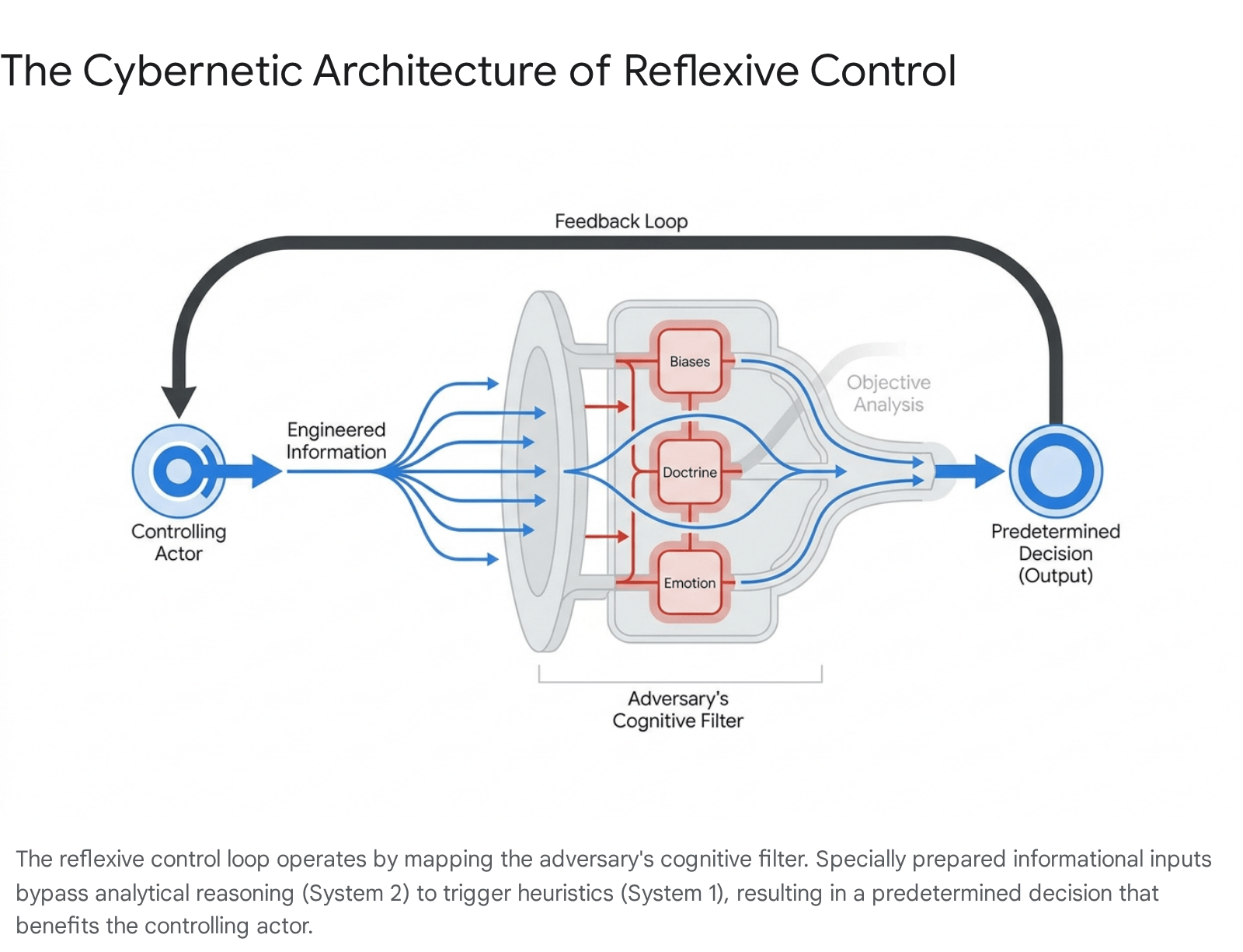
The efficacy of reflexive control relies on the limitations of human cognition, operating within the boundaries of bounded rationality. Decision-makers do not analyze all available information objectively; rather, they process incoming data through a conceptual “filter”2. This filter assists in separating necessary from useless information and is constructed from a stable set of concepts, knowledge, historical experiences, ideological beliefs, and moral stereotypes2. The primary tactical objective of a reflexive control operation is to identify the weakest link within the target’s filter and exploit it to inject specially prepared data that will alter the foundational parameters of the decision-making process4.
When operating under conditions of high stress, time constraints, or information overload, the human brain transitions from analytical, deliberate processing to rapid, intuitive processing. Under conditions of information overload—where the human brain cannot possibly sort through all factual, opinionated, and propaganda-based information under tight time constraints—analysts are forced to rely on subconscious mental shortcuts, which reflexive operations deliberately exploit19. This vulnerability is compounded by cognitive processing limits; the human brain’s strict storage capacity of roughly three terabytes is easily overwhelmed by the 2.5 quintillion bytes of data produced globally each day, guaranteeing a reliance on heuristics during periods of information saturation19. Dual Process Theory categorizes these systems, developed by psychologists Amos Tversky and Daniel Kahneman, as System 2 and System 1 thinking, respectively20. Reflexive control predominantly targets System 1, which represents the reflexive, automatic, and emotionally driven neurological pathways. By supplying high volumes of contradictory information, the initiating actor induces cognitive overload, forcing the target to abandon rigorous logical analysis and rely heavily on heuristics, which prioritize speed over accuracy1.
2.2 Exploitation of Specific Cognitive Biases
Cognitive biases serve as the primary vectors for reflexive control operations. Because these biases represent predictable, systematic deviations from rationality in judgment, they provide a reliable mechanism for external manipulation by intelligence and military apparatuses19. The doctrine maps the target’s internal reality and selectively triggers the following biases to ensure the adversary inadvertently makes decisions favoring the initiator.
| Cognitive Bias | Psychological Definition | Operational Exploitation in Reflexive Control |
| Confirmation Bias | The tendency to prioritize data that supports preexisting beliefs while dismissing contradictory evidence23. | Feeding the adversary information that aligns with their doctrinal expectations or political prejudices, ensuring deceptive data is accepted without critical scrutiny18. |
| Anchoring Bias | The phenomenon where initial information disproportionately influences subsequent judgments20. | Strategically leaking an initial false parameter to anchor the adversary’s analytical baseline, skewing all subsequent intelligence assessments24. |
| Affect Heuristic | A mental shortcut wherein current emotions influence decision-making9. | Engineering content designed to trigger profound emotional responses, creating a cognitive-emotional conflict that degrades objective risk assessment16. |
| Availability Heuristic | Estimating the frequency of an event based on how easily examples can be recalled5. | Saturating the information environment with highly vivid, emotionally charged narratives to artificially inflate the perceived probability of a specific threat5. |
| Outcome Bias | Judging a decision by its eventual outcome instead of the quality of the decision at the time it was made21. | Manipulating localized outcomes to validate poor strategic decisions made by the adversary, discouraging necessary doctrinal corrections4. |
| Mirror-Imaging | Assuming the adversary shares one’s own strategic logic, values, and constraints19. | Presenting actions that appear rational according to the target’s internal logic, masking the fundamentally different strategic calculations of the initiating state. This frequently exploits U.S. and Western analysts who falsely assume that Russian officials share their same perspective and self-interests19. |
| Effort Justification | Attributing greater value to an outcome if significant effort was expended achieving it21. | Forcing the adversary to commit massive resources to a false objective, relying on their reluctance to abandon the sunk cost26. |
| Reactive Devaluation | Devaluing proposals solely because they purportedly originated with an adversary1. | Presenting legitimate off-ramps or data through adversarial channels, knowing the target will automatically dismiss them to their own detriment1. |
| Law of the Instrument | Over-reliance on familiar tools or methods while ignoring alternative approaches1. | Exploiting a target’s reliance on traditional kinetic military responses by operating entirely within the cognitive gray zone21. |
2.3 Emotional Cues and Affective Intelligence
Beyond standard cognitive biases, contemporary reflexive control relies heavily on emotional cues to bypass analytical reasoning. Research highlights that emotions possess a substantial impact on political decision-making at both the group and individual levels8. By interweaving emotional cues, insinuation, and distorted truths, the controlling actor creates a framework that influences political decision-makers and voters beyond simple deception8. The generation of weaponized hope or profound fear alters the neurobiological processing of information, rendering fact-checking ineffective because the target’s affective intelligence has already validated the manipulated narrative based on emotional resonance rather than empirical accuracy4.
3. Operationalization and Methods of Conduct
3.1 The Taxonomy of Reflexive Stratagems
The theoretical frameworks of Lefebvre were operationalized for military application by Soviet and later Russian theorists. In 1995, Major General M.D. Ionov redefined reflexive control specifically for the military as a method to manipulate an opponent’s decision-making so that they voluntarily take actions leading to their own defeat28. The most notable codification was provided by Colonel S.A. Komov in 1997, who outlined eleven specific stratagems or mechanisms through which reflexive control is executed to manipulate an adversary’s command structure1. As military infrastructure transitioned into the digital age, Russian theorist Colonel S. Leonenko expanded this taxonomy to include technical reconnaissance assets, introducing the mechanism of Disruption to apply reflexive control against computer networks28.
| Stratagem | Operational Definition | Intended Cognitive Effect |
| Distraction | Creating a real or perceived threat to vital but secondary positions (flanks, rear, peripheral interests) during preparations for military action1. | Forces the misallocation of analytical focus and military resources away from the primary objective1. |
| Overload | Supplying the adversary with massive volumes of self-contradictory information1. | Induces analytical paralysis; forces reliance on heuristics rather than rigorous intelligence synthesis1. |
| Paralysis | Creating the illusion of pinpointed threats to highly vulnerable locations or vital national interests1. | Induces self-deterrence; prevents the adversary from taking decisive offensive or defensive action1. |
| Exhaustion | Forcing the target to expend significant economic, political, or military resources on unproductive activities1. | Degrades the target’s operational capacity and logistical endurance prior to main engagements1. |
| Deception | Provoking the redeployment of forces to a threatened area based on false preparatory signals1. | Creates localized superiority for the controlling actor by shifting enemy defenses1. |
| Splitting | Convincing the adversary that they must act against the interests of their allies or coalition partners1. | Fractures alliance cohesion; isolates individual state actors to be managed separately1. |
| Appeasement | Lowering vigilance by presenting offensive preparations as routine training or benign activities1. | Eliminates early warning triggers; relies on the target’s confirmation bias toward peace1. |
| Intimidation | Projecting the appearance of invincible superiority or unacceptable escalatory risk (e.g., nuclear signaling)1. | Induces psychological defeatism; triggers the affect heuristic (fear) to override strategic logic1. |
| Provocation | Imposing an unfavorable scenario that forces a hasty, poorly calculated reaction1. | Disrupts the target’s planned timeline; forces reactive rather than proactive decision-making1. |
| Suggestion | Distributing tailored material that influences the target legally, morally, or ideologically1. | Alters the foundational parameters of the target’s cognitive filter; frames the conflict on the controller’s terms1. |
| Pressure | Discrediting the target government or command structure in the eyes of its own population or subordinates1. | Eviscerates institutional trust; forces the command structure to focus on internal stability rather than external threats1. |
| Disruption | Applying reflexive influence against computers and digital technical reconnaissance assets31. | Blinds the adversary technologically, forcing reliance on incomplete or corrupted data for situational awareness32. |
3.2 The Gerasimov Doctrine and Information Confrontation (IPb)
In contemporary strategic thought, reflexive control is embedded within the broader concepts of Information Confrontation (IPb) and the framework often referred to in the West as the Gerasimov Doctrine, published in 20142. The doctrine posits that the boundaries between states of war and peace have blurred, with non-military means frequently exceeding the power of weapons in their effectiveness5. Reflexive control is applied continuously across Phase Zero operations, representing the daily competition in the gray zone prior to declared hostilities15.
By conceptualizing the information environment as a tool for actively shaping adversary decision-making rather than merely an operational context, the doctrine seeks to achieve strategic effects without the application of kinetic force15. It aims to alter how populations interpret global events to gain incremental progress while avoiding attribution tactics25. It is notable that Russian strategy differs conceptually from Chinese cognitive warfare; while China favors an integrative Information Confrontation System encompassing psychological, network, and electronic systems attacks25, Russia emphasizes perception manipulation control rooted in historical Maskirovka and reflexive modeling17.
3.3 The Digital Amplifier: Cyber Operations and Artificial Intelligence
The efficacy of reflexive control requires high-fidelity intelligence regarding the target’s doctrine, internal factions, and psychological pressure points1. The modern digital domain has exponentially increased the capacity to gather this intelligence and deliver tailored inputs. Operations now leverage artificial intelligence and data mining to construct precise behavioral profiles of targets, utilizing botnets on platforms like Telegram and X to create an artificial consensus that isolates targeted demographics18.
Generative AI facilitates the production of culturally nuanced, high-volume disinformation that mimics domestic actors, creating an ecosystem characterized by speed and scale34. This automated infrastructure allows the controlling actor to execute the mechanisms of Overload and Pressure at a magnitude previously unattainable, effectively weaponizing the target population’s confirmation bias and accelerating societal polarization16.
4. Empirical Case Studies and Strategic Applications
4.1 The Russo-Ukrainian War: Phase-Based Execution
The practical application of these mechanisms is evident in the strategic sequencing observed prior to and during the 2022 invasion of Ukraine. Analysis identifies four distinct Concentrations of Effort (COEs) designed to systematically dismantle Ukrainian and Western decision-making architectures32.
| Concentration of Effort (COE) | Temporal Phase | Reflexive Mechanisms Deployed | Operational Execution and Effect |
| COE 1: Shaping the Cognitive Dimension | Pre-War (2021-2022) | Suggestion, Division, Deterrence32 | State media spread false narratives discrediting leadership; historical essays aimed to fracture domestic cohesion; cyber defacements induced deterrence. Attempts to shape civilian attitudes largely failed due to local resilience32. |
| COE 2: Shaping the Physical Dimension | Pre-War (2021-2022) | Pacification, Distraction32 | Massive troop build-ups presented as routine exercises (Pacification); visible naval maneuvers in the Black Sea anchored Ukrainian command attention away from Kyiv toward the Donbas and South-East (Distraction)32. |
| COE 3: Reducing Combat Effectiveness | War (Initial Phase) | Disruption32 | Cyberattacks on the Viasat KA-SAT satellite ground station and deployment of HermeticWiper malware (also known as FoxBlade) blinded technical reconnaissance assets, forcing reliance on localized data and paralyzing unified C228. The disruptive effects on communications were only later mitigated by the provision of the Starlink network28. |
| COE 4: Limiting the Conventional Phase | War (Initial Phase) | Aggregation of previous COEs32 | Designed to leverage cognitive and physical shaping for rapid regime change. The operational design adhered to reflexive control principles, but tactical execution failed because Ukrainian troops stood firm, forcing the Russian military into an extended battlefield process rather than achieving a quick capitulation28. |
These operations mirrored tactics utilized during the 2014 annexation of Crimea, where Russia employed reflexive control to disguise the presence of forces and publicly deny involvement. This denial and deception operation dissuaded the West from military intervention by projecting the campaign as a response to NATO expansion, achieving a strategic fait accompli17.
4.2 The Maritime Domain and Shadow Operations
Reflexive control operations extend beyond terrestrial borders, heavily influencing the maritime domain. Utilizing asymmetric coercion, Russia leverages fleets of shadow tankers possessing plausible deniability to facilitate drone incursions against Western alliances36. These flyovers near critical infrastructure and military installations are designed not merely for reconnaissance, but as instruments of cognitive warfare intended to assess collective deterrence limits, alter NATO decision-making, and induce strategic miscalculations under the guise of ambiguous threats; notably, there were at least 39 drone-related incidents between September 2025 and October 2025, and suspected incidents continuing into June 202637. Furthermore, intelligence agencies identify ongoing espionage operations targeting underwater infrastructure such as internet cables and energy plants, maintaining pressure in the gray zone where conventional retribution is difficult to justify30.
4.3 Democratic Elections and Societal Polarization
Democratic societies represent highly permissive environments for reflexive control operations. Because these societies rely on open information ecosystems, they are structurally vulnerable to cognitive warfare targeting internal political processes33. Russian reflexive control operations are actively deployed not only domestically and in neighboring nations such as Finland, Estonia, Latvia, Lithuania, and Poland, but increasingly across NATO countries including the United States, Germany, France, Great Britain, and Canada29. The objective is rarely isolated to electing a specific political candidate, but rather to apply the mechanism of Pressure to fundamentally undermine the legitimacy of the democratic process and decision-making system30.
By infiltrating groups across the entire political spectrum through micro-targeted botnets and troll farms, the controlling actor creates the illusion of deep-seated societal division16. This internal destabilization ensures that the target state remains internally focused, expending resources on domestic crises and political gridlock rather than projecting power externally or supporting allied nations16. This aligns closely with the reflexive strategy of Splitting, where varying risk appetites and domestic political constraints of individual allied states are exploited to fracture coalition cohesion24.
5. Countermeasures and Cognitive Defense Strategies
Despite its theoretical sophistication, reflexive control is an inherently fragile operational construct. Its success is entirely predicated on the target remaining unaware that their foundational premises are the result of external manipulation11. Once the manipulation is identified and the target is made aware of the underlying mechanisms, the reflexive control loop is severed29. Consequently, effective countermeasures require a multidimensional approach spanning individual cognitive debiasing, advanced intelligence analysis, and broad societal resilience.
5.1 Cognitive Debiasing and Individual Resilience
Because reflexive control exploits heuristic thinking, defensive strategies must focus on cognitive debiasing within command structures and policymaking bodies9. Decision-makers must implement cognitive forcing strategies—protocols that artificially slow down the analytical process, forcing a shift from intuitive System 1 processing to analytical System 2 thinking4. Institutionalizing “red-teaming,” where independent analysts systematically challenge the foundational assumptions of a prevailing narrative, is crucial to expose potential anchoring or confirmation biases. Furthermore, guided reflection and continuous feedback loops on past strategic decisions are necessary to highlight instances where mirror-imaging or outcome bias influenced judgment19. Leaders must be educated on the nature of reflexive control to recognize when their own emotional responses are being artificially triggered to force premature decision-making16.
5.2 Upgrading Open-Source Intelligence (OSINT)
Traditional counter-disinformation efforts have relied heavily on fact-checking and debunking via open-source intelligence (OSINT). However, pure rationality often fails to overcome deeply entrenched emotional biases, rendering standard fact-checking insufficient against advanced reflexive control18. OSINT methodologies must be augmented with affective intelligence frameworks18. The volume of open-source information processed in modern conflict makes this critical; for instance, Ukrainian Deputy Defense Minister Hanna Maliar noted that between 2021 and 2023, 80% of all intelligence obtained and processed by Ukrainian forces was derived from open sources27. Analysts must map not only the factual inaccuracies of a narrative but also the specific emotional triggers—such as historical trauma or existential fear—the narrative is designed to activate9. By diagnosing the intended emotional manipulation, intelligence agencies can better predict the behavioral output the adversary is attempting to engineer. Additionally, intelligence must continuously model the adversary’s “rank of reflection” to anticipate the specific data inputs they will use to exploit identified vulnerabilities11.
5.3 Strategic Intelligence Disclosure and Prebunking
To counter the mechanisms of Provocation and Suggestion, states must adopt proactive information postures that eliminate the adversary’s element of surprise. Strategic disclosure involves declassifying and publicly releasing intelligence regarding the adversary’s impending reflexive control operations39. If a target population or command structure is warned in advance that a specific narrative or false-flag event will occur, the subsequent information loses its cognitive impact19. This is complemented by prebunking, which involves inoculating a population against specific manipulation techniques before they are deployed. By educating audiences on how they will be targeted—explaining the mechanics of algorithmic amplification, deepfakes, and emotional manipulation—societies develop a cognitive immunity that severely disrupts the attacker’s operational timeline16.
5.4 Institutional Resilience and the Whole-of-Society Approach
Reflexive control thrives in environments characterized by low institutional trust, corruption, and fractured societal cohesion34. Therefore, national security extends beyond the military domain into civil administration. Initiatives such as the NATO Building Integrity (BI) program are critical in establishing efficient institutions that uphold transparency and accountability37. By fostering transparent governance, states reduce the domestic friction that reflexive control operations leverage to execute the mechanism of Pressure4.
Countering hybrid threats requires the synchronization of military, civilian, and private sector assets under a whole-of-society paradigm41. Societal resilience—defined as the capacity for resistance, continuity management, and adaptation—must be continuously cultivated42. When a society possesses a high degree of digital literacy, coordinates across institutions, and trusts its core structures, the filter through which adversarial information must pass becomes highly resistant to external alteration22.
6. Conclusion
The Russian doctrine of reflexive control represents a profound evolution in the conduct of cognitive and information warfare. By treating the adversary’s decision-making apparatus as a programmable system governed by bounded rationality and psychological heuristics, the doctrine seeks to achieve strategic victories without the prerequisite of kinetic superiority. Rooted in cybernetics and mathematical modeling, it targets the foundational filter through which intelligence and reality are perceived, effectively substituting the target’s motivations with those of the controlling actor.
Operationally, the execution relies on a diverse taxonomy of stratagems—ranging from distraction and overload to intimidation and technological disruption. As demonstrated in contemporary applications, these mechanisms are highly adaptable across Phase Zero competition and active conventional conflict. Furthermore, the proliferation of digital infrastructure, social media algorithms, and artificial intelligence has served as a massive force multiplier, allowing for the precise, automated exploitation of societal and institutional fault lines at an unprecedented scale.
However, the efficacy of reflexive control is inextricably linked to its imperceptibility. It is a sophisticated but delicate structure that crumbles when exposed to rigorous analytical scrutiny and widespread awareness. Consequently, defense against this doctrine requires a paradigm shift away from traditional, reactive fact-checking. Countermeasures must prioritize the cultivation of cognitive resilience, the integration of emotional cue analysis into intelligence frameworks, proactive prebunking, and the fortification of institutional integrity. By understanding and neutralizing the psychological mechanisms of manipulation, target states can sever the reflexive loop, thereby restoring autonomy to their strategic decision-making processes.
Master Summary Table
| Operational Mechanism | Definition & Tactical Execution | Primary Cognitive Target / Bias | Intended Strategic Effect | Countermeasure Strategy |
| Overload & Disruption | Saturating the environment with contradictory data; cyber attacks on C2 systems1. | System 1 processing; Availability Heuristic20. | Analytical paralysis; reliance on intuition over logic1. | Cognitive forcing strategies; redundant communications5. |
| Intimidation & Paralysis | Projecting invincible superiority; creating illusions of pinpoint threats1. | Affect Heuristic (Fear); Loss Aversion1. | Self-deterrence; delay of decisive action1. | Emotional cue analysis in OSINT; rigorous red-teaming8. |
| Appeasement & Deception | Disguising offensive maneuvers as routine exercises; projecting false postures1. | Confirmation Bias; Anchoring Bias; Effort Justification21. | Misallocation of forces; destruction of early warning capabilities1. | Strategic intelligence disclosure; discarding historical anchors6. |
| Splitting & Pressure | Discrediting leadership; feeding divergent narratives to alliance members1. | In-group/Out-group bias; Epistemological siege4. | Institutional distrust; alliance fragmentation; political paralysis1. | NATO Building Integrity (BI); whole-of-society resilience37. |
| Provocation & Suggestion | Imposing unfavorable scenarios; tailored ideological influence operations1. | Outcome Bias; Mirror-Imaging; Reactive Devaluation19. | Hasty, reactive decision-making; acceptance of adversary’s framing1. | Prebunking; guided analytical reflection; debiasing training23. |
Please share the link on Facebook, Forums, with colleagues, etc. Your support is much appreciated and if you have any feedback, please email us in**@*********ps.com. If you’d like to request a report or order a reprint, please click here for the corresponding page to open in new tab.
Sources Used
- Reflexive control – Wikipedia, https://en.wikipedia.org/wiki/Reflexive_control
- Reflexive Control | Militaire Spectator, https://militairespectator.nl/artikelen/reflexive-control
- COGNITIVE APPROACH TO MODELING REFLEXIVE CONTROL IN SOCIO-ECONOMIC SYSTEMS – Procon Ltd., https://procon.bg/system/files/22.04_Shemayev.pdf
- Russia’s Reflexive Control Theory and the Military – ResearchGate, https://www.researchgate.net/publication/248945659_Russia’s_Reflexive_Control_Theory_and_the_Military
- Reflexive Control – Militaire Spectator, https://militairespectator.nl/sites/default/files/teksten/bestanden/Militaire%20Spectator%206-2018%20Kamphuis.pdf
- Reflexive control – Grokipedia, https://grokipedia.com/page/Reflexive_control
- Reflexive Control, Perception Management & The MAP – Cornell blogs, https://blogs.cornell.edu/moralaccounting/2021/05/02/reflexive-control-perception-management-the-map/
- The Need for Emotional Cues Analysis in OSINT in Countering Reflexive Control Information Warfare Campaigns: A Critical Review and Reconceptual, https://isij.eu/system/files/2024-11/5514_OSINT_reflexive_control.pdf
- Reflexive Control: Influencing Strategic Behavior – USAWC Press, https://press.armywarcollege.edu/cgi/viewcontent.cgi?article=3262&context=parameters
- Russian Multi-Domain Strategy against NATO: information confrontation and U.S. forward-deployed nuclear weapons in Europe – Center for Global Security Research, https://cgsr.llnl.gov/sites/cgsr/files/2024-08/4Feb_IPb_against_NATO_nuclear_posture.pdf
- One Move Ahead — Diagnosing and Countering Russian Reflexive Control – R Discovery, https://discovery.researcher.life/article/one-move-ahead-diagnosing-and-countering-russian-reflexive-control/f56e4e1e06013e00abb9eff4947b012f
- Game-theoretic analysis of Stackelberg oligopoly with arbitrary rank reflexive behavior of agents – Emerald Publishing, https://www.emerald.com/k/article/46/06/1052/273610/Game-theoretic-analysis-of-Stackelberg-oligopoly
- How to respond to the challenge of reflexive control? – Russian Military and Security Research Group, https://rusmilsec.blog/2023/12/12/how-to-respond-to-the-challenge-of-reflexive-control/
- Reflexive games: Transformation of awareness structure | Request PDF – ResearchGate, https://www.researchgate.net/publication/225517318_Reflexive_games_Transformation_of_awareness_structure
- “Reflexive Control” is a Russian military strategy that involves the use of false informational and psychological manipulation against enemies to manipulate their beliefs and behavior to incite self-destructive actions. : r/armenia – Reddit, https://www.reddit.com/r/armenia/comments/1bi7fwd/reflexive_control_is_a_russian_military_strategy/
- How You Can Fight Russia’s Plans to Troll Americans During Campaign 2020 | RAND, https://www.rand.org/pubs/commentary/2020/07/how-you-can-fight-russias-plans-to-troll-americans.html
- Disinformation and Reflexive Control: The New Cold War, https://georgetownsecuritystudiesreview.org/2017/02/01/disinformation-and-reflexive-control-the-new-cold-war/
- Reflexive Control in Cognitive Warfare | by SIMKRA – Medium, https://medium.com/@simone.kraus/reflexive-control-in-cognitive-warfare-9bd4e04c2ec5
- Cognitive Biases and Reflexive Control – eGrove, https://egrove.olemiss.edu/cgi/viewcontent.cgi?article=1729&context=hon_thesis
- What Is Cognitive Bias? Types & Examples – Simply Psychology, https://www.simplypsychology.org/cognitive-bias.html
- List of cognitive biases – Wikipedia, https://en.wikipedia.org/wiki/List_of_cognitive_biases
- “Cognitive Biases and Reflexive Control” by Natalie Minton – eGrove, https://egrove.olemiss.edu/hon_thesis/729/
- Believing in Overcoming Cognitive Biases – AMA Journal of Ethics, https://journalofethics.ama-assn.org/article/believing-overcoming-cognitive-biases/2020-09
- Russian Reflexive Control Campaigns Targeting Political Realignment of Ukraine’s Democratic Allies: Critical Review and Conceptualization, https://isij.eu/system/files/download-count/2024-11/5519_political_realignment.pdf
- Cognitive Warfare The Fight for Gray Matter in the Digital Gray Zone – NDU Press, https://ndupress.ndu.edu/Media/News/News-Article-View/Article/3853187/cognitive-warfare-the-fight-for-gray-matter-in-the-digital-gray-zone/
- Russia’s Renewed Military Thinking: Non-Linear Warfare and Reflexive Control – The Web site cannot be found, https://www.files.ethz.ch/isn/195099/rp_121.pdf
- Secret Intelligence and Public Diplomacy in the Ukraine War – ResearchGate, https://www.researchgate.net/publication/362453552_Secret_Intelligence_and_Public_Diplomacy_in_the_Ukraine_War
- Reflexive Control in the Russo-Ukraine war | Militaire Spectator, https://militairespectator.nl/artikelen/reflexive-control-russo-ukraine-war
- Russ sian Re eflexiv ve Con trol – à www.publications.gc.ca, https://publications.gc.ca/collections/collection_2019/rddc-drdc/D68-3-182-2018-eng.pdf
- Countering Russian hybrid warfare | Clingendael, https://www.clingendael.org/publication/countering-russian-hybrid-warfare
- Timothy Thomas – NATO StratCom, https://stratcomcoe.org/cuploads/pfiles/timothy_thomas.pdf
- Russia’s Hostile Measures: Combating Russian Gray Zone Aggression Against NATO in the Contact, Blunt, and Surge Layers of Co – RAND, https://www.rand.org/content/dam/rand/pubs/research_reports/RR2500/RR2539/RAND_RR2539.pdf
- Assessing “Cognitive Warfare”, https://www.irregularwarfare.org/assessing-cognitive-warfare/
- Reflexive Control: Russian AI and Hybrid Warfare – EPIS Thinktank, https://epis-thinktank.com/publications/reflexive-control-russian-ai-and-hybrid-warfare
- Disinformation Countermeasures and Artificial Intelligence – Frontiers, https://public-pages-files-2025.frontiersin.org/research-topics/58930/pdf
- Russia’s Drone Machinations: Reflexive Control and Cognitive Warfare in the Maritime Domain, https://centerformaritimestrategy.org/publications/russias-drone-machinations-reflexive-control-and-cognitive-warfare-in-the-maritime-domain/
- Building Integrity and Reducing Corruption in Defence: A Compendium of Best Practices, Volume II – NATO, https://www.nato.int/content/dam/nato/webready/documents/building-integrity/bi-reducing-corruption-vII-en.pdf
- INTERNATIONAL DISINFORMATION – OAPEN Library, https://library.oapen.org/bitstream/handle/20.500.12657/99085/9789004715769_webready_content_text.pdf?sequence=1&isAllowed=y
- media-framing-analysis.md – Hack23/riksdagsmonitor – GitHub, https://github.com/Hack23/riksdagsmonitor/blob/main/analysis/templates/media-framing-analysis.md
- WORK BY THE FORUM AGAINST DISINFORMATION CAMPAIGNS 2024 INITIATIVES – Departamento de Seguridad Nacional, https://www.dsn.gob.es/sites/default/files/2025-07/Disinformation%20Campaigns%202024%20Initiatives.pdf
- Comprehensive Security Approach in Response to Russian Hybrid Warfare – Air University, https://www.airuniversity.af.edu/portals/10/ssq/documents/volume-15_issue-3/elonheimo.pdf
- Best Practices in the whole-of-society approach in countering hybrid threats – GlobalNET Platform, https://globalnetplatform.org/es/system/files/expo_stu2021653632_en.pdf