Introduction to Next-Generation Kinetic Protection and Operator Survivability
The paradigm of individual ballistic protection within military and law enforcement operational environments is undergoing a profound and necessary transformation. For decades, the design of hard body armor systems was dictated by a rigid, often zero-sum compromise between ballistic efficacy and human performance. Achieving reliable protection against high-velocity, armor-piercing, and steel-core rifle ammunition inherently required the deployment of highly dense, monolithic plates. These legacy systems imposed a severe biomechanical and physiological tax on the operator, directly degrading tactical endurance, altering spatiotemporal kinematics, and contributing to chronic musculoskeletal degradation over the course of a career.1
However, the convergence of advanced materials science, biomimetic structural engineering, and modernized regulatory threat profiles has catalyzed the development of a new echelon of ballistic defense. The impending implementation of the National Institute of Justice (NIJ) Standard 0101.07, alongside its associated standalone threat specification document NIJ 0123.00, formally addresses the realities of the modern ballistic landscape.3 Foremost among the regulatory updates is the introduction of the NIJ RF2 protection level. Designed specifically as an intermediate rifle rating, RF2 targets the 5.56x45mm M855 steel penetrator—a highly prevalent threat that previously fell into an ambiguous regulatory gap between legacy Level III and Level IV categorizations.5
Meeting the stringent RF2 parameters without encumbering the tactical operator has driven rapid and highly sophisticated advancements in composite material sciences. The emergence of 60/40 hybrid ballistic ceramics—specifically incorporating specific molar ratios of Silicon Carbide (SiC) and Boron Carbide (B4C)—represents a watershed achievement in dynamic kinetic energy dissipation and overarching system weight reduction.7 When these advanced ceramic formulations are engineered into interlocking, tessellated tile matrices and paired with Ultra-High-Molecular-Weight Polyethylene (UHMWPE) backing architectures, the resulting systems offer multi-axial flexibility and highly localized fracture containment.9
The culmination of these applied sciences is the production of ultra-lightweight, sub-3-pound hard armor plates that comply with the RF2 mandate.7 This drastic reduction in mass fundamentally alters the operational calculus for the end-user. By minimizing the moment of inertia on the torso, these advanced systems preserve functional mobility, drastically mitigate the metabolic cost of load carriage, and safeguard the long-term structural health of the vertebral column.13 This comprehensive review conducts a meticulous technical and tactical analysis of the latest NIJ 0101.07 RF2 compliant body armor systems, exploring the thermodynamic and microstructural properties of hybrid ceramics, evaluating the mechanical engineering of flexible tile matrices, and quantifying the direct physiological impact of ultra-lightweight load carriage on human performance during high-risk kinetic engagements.
The NIJ 0101.07 Standard and the Evolution of the Kinetic Threat Profile
The National Institute of Justice (NIJ) Standard 0101.07 marks the most comprehensive revision to United States body armor testing methodologies since the publication of the preceding Standard 0101.06 in 2008.3 The fundamental structural change in this iteration is the purposeful decoupling of the testing methodologies from the specific ballistic threat profiles. The complex performance requirements, environmental conditioning protocols, and laboratory practices are maintained within the core NIJ 0101.07 document. Conversely, the specific test projectiles, reference velocities, and ammunition mass requirements have been transitioned to a standalone specification document, identified as NIJ Standard 0123.00.3
This modularity represents a highly strategic administrative shift. It allows regulatory bodies and the NIJ Compliance Testing Program (CTP) to dynamically update threat profiles in response to emerging street-level ammunition trends without requiring a complete, multi-year overhaul of the foundational laboratory testing protocols.16 Furthermore, unlike previous iterations, NIJ Standard 0101.07 directly references a suite of standardized test methods and laboratory practices published by ASTM International, ensuring harmonization across military, federal, and local law enforcement testing facilities.3
Nomenclature Reclassification and the RF2 Specification
The legacy Roman numeral system utilized in previous standards (Level IIA, Level II, Level IIIA, Level III, and Level IV) has been abandoned in favor of a more intuitive and descriptive alphanumeric classification system. This new schema explicitly divides threats into Handgun (HG) and Rifle (RF) tiers.18 The handgun tiers are designated as HG1 and HG2, effectively replacing Level II and Level IIIA, respectively. The rifle tiers represent a more complex restructuring, designated as RF1, RF2, and RF3.19
The RF2 level was engineered to bridge a critical vulnerability gap that persisted within the 0101.06 standard. Under the legacy system, a Level III plate was solely required to defeat 7.62x51mm M80 Ball ammunition.21 However, the 5.56x45mm M855 “Green Tip” round, which features a 61.8-grain bullet with a hardened mild steel penetrator core, possesses the velocity, sectional density, and metallurgical composition to consistently perforate purely polyethylene-based Level III armor.5 Consequently, the body armor industry unofficially adopted the “Level III+” or “Level III Plus” moniker to designate proprietary plates capable of stopping the M855 penetrator, leading to severe regulatory ambiguity and procurement confusion.5
The NIJ 0101.07 RF2 standard formally codifies this operational requirement. To achieve RF2 compliance, a hard armor plate must successfully defeat all threats designated in the lower RF1 tier, in addition to defeating the M855 penetrator at highly specific reference velocities.3
| Protection Level | Test Threat Designation | Ammunition Specifications | Reference Velocity |
| NIJ RF1 | 7.62x51mm M80 Ball NATO | 149 +0/-3 grain, FMJ Steel Jacket | 2,780 ft/s (847 m/s) |
| NIJ RF1 | 7.62x39mm MSC (Type 56) | 120.5 grain, Mild Steel Core | 2,400 ft/s (732 m/s) |
| NIJ RF1 | 5.56x45mm M193 | 56 +0/-2 grain, Lead Core | 3,250 ft/s (990 m/s) |
| NIJ RF2 | 5.56x45mm M855 | 61.8 ± 1.5 grain, Steel Penetrator | 3,115 ft/s (950 m/s) |
| NIJ RF3 | .30-06 Springfield M2 AP | 165.7 +0/-7 grain, Armor Piercing | 2,880 ft/s (878 m/s) |
Table 1: NIJ 0101.07 Rifle Threat Profile as specified in the standalone NIJ 0123.00 specification document.6 Note that achieving the RF2 classification strictly requires the defeat of all listed RF1 test threats in addition to the M855.
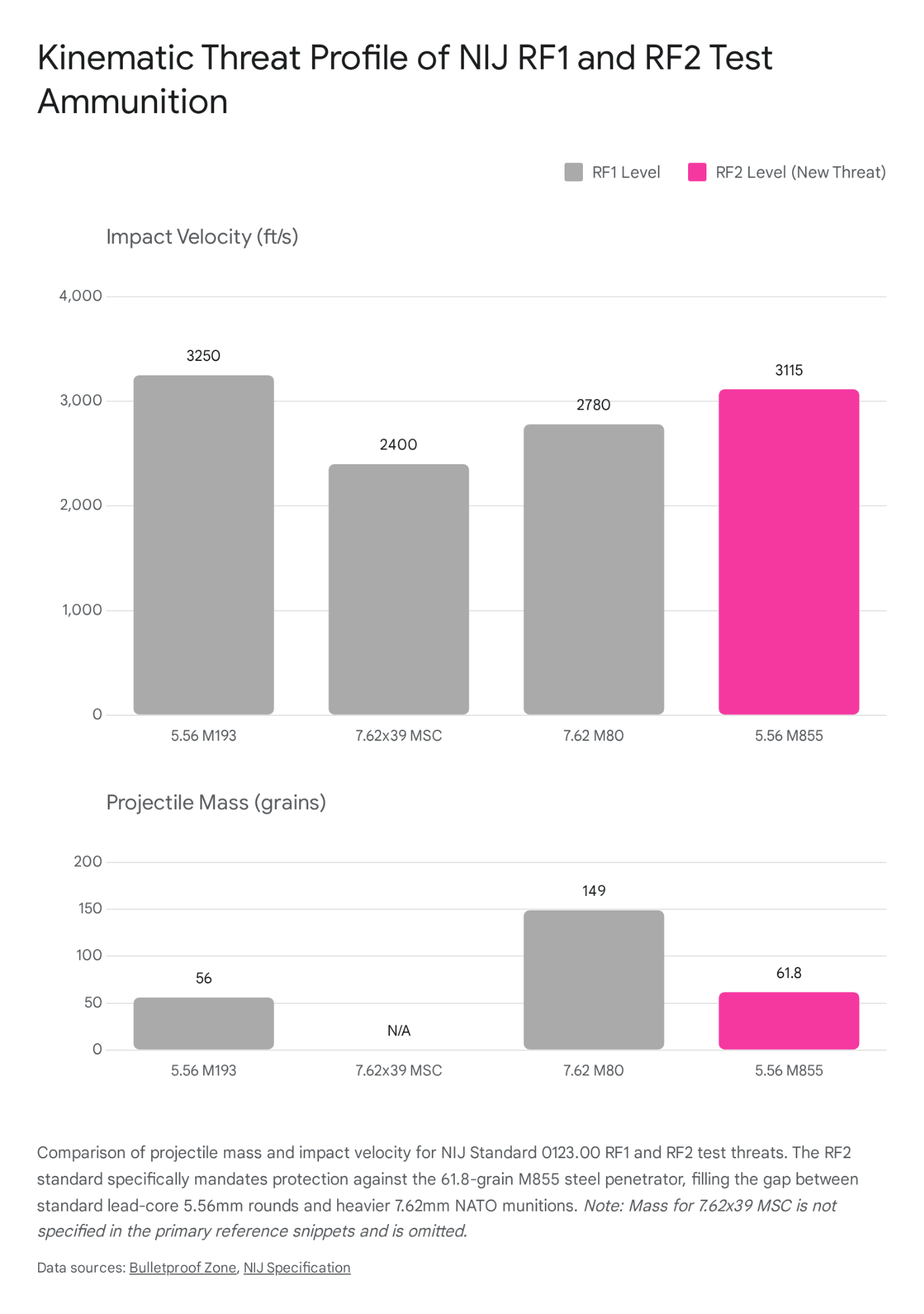
The inclusion of the 7.62x39mm Mild Steel Core (MSC) Type 56 round further complicates the engineering requirements. Due to the high degree of global variability in the manufacturing consistency of these specific rounds, NIJ Standard 0123.00 explicitly specifies a factory round (Type 56 from Factory 31) and includes stringent audit procedures (detailed in Appendix A of the document) to assess ammunition lots for suitability until mathematically validated surrogate rounds become commercially available.3 Furthermore, recent addenda to the standard have refined mass constraints, such as standardizing the 7.62x51mm M80 Ball NATO ammunition to a precise 149 +0/-3 grain mass.3
Advanced Perforation-Backface Deformation (P-BFD) Methodologies
The physiological survivability of a high-velocity ballistic impact is not solely dictated by the armor’s ability to prevent absolute projectile perforation. The kinetic energy that is successfully arrested by the strike face is subsequently transferred through the armor’s backing composite and into the operator’s thoracic cavity. This energy transfer, quantitatively measured as Backface Deformation (BFD), can cause lethal blunt force trauma to internal organs, resulting in catastrophic internal hemorrhaging or cardiac contusion even if the bullet is halted.21
NIJ 0101.07 retains the strict 44.00 millimeter maximum limit for backface signature across all defined threat levels, ensuring consistency in physiological survivability baselines.23 However, the testing methodology has been critically updated to account for the physical geometry of modern, anatomically conforming plates. Previous iterations of the standard tested both planar (flat) and nonplanar (curved) plates using similar central impact criteria. The 0101.07 standard rectifies this by mandating an additional P-BFD testing location specifically targeting the “crown” of curved hard armor plates.3
The crown is defined geometrically as the location of the highest point of the strike face when the plate lies horizontally on a flat surface, representing the exact intersection of multiple different curvatures.3 This apex represents a structural vulnerability. During the manufacturing process—specifically the high-pressure consolidation of composite backings—the curvature introduces immense internal tensile stresses at the crown. Impacting this specific location forces the armor to prove its structural integrity at its most geographically isolated and stressed point, ensuring that manufacturers do not sacrifice localized ballistic protection to achieve a highly ergonomic, multi-curve fit.3 In addition to these changes, the 0101.07 standard introduces significant improvements to the test methods for armor specifically designed for female officers, incorporating new clay appliques to accurately assess the complex geometries required for female body armor.3
The Material Science of 60/40 Hybrid Ballistic Ceramics
To meet the rigorous, multi-threat specifications of the RF2 standard while drastically reducing overarching mass, armor manufacturers have been forced to pivot away from legacy monolithic Alumina Oxide (Al2O3) systems. While highly cost-effective and capable of defeating lead-core threats, alumina’s high density inherently results in excessively heavy plates when scaled to defeat the steel penetrators of the M855 and the MSC.25 The current vanguard of ballistic strike-face technology relies on advanced covalent ceramics, specifically utilizing hybrid matrices such as the 60/40 Silicon Carbide (SiC) and Boron Carbide (B4C) composite architecture.7 This precise stoichiometric ratio exploits the unique crystallographic and mechanical properties of both materials to maximize kinetic energy dissipation while aggressively minimizing specific density.
The Dichotomy of Absolute Hardness and Fracture Toughness
The operational mechanics of ceramic armor rely on the principle of projectile disruption. Upon high-velocity impact, the extreme hardness of the ceramic strike face serves to blunt, shatter, or erode the ogive (nose) of the incoming projectile.28 This mechanism effectively increases the projectile’s cross-sectional area, fundamentally diminishing its penetrative efficacy by distributing the kinetic energy over a wider surface area.29 To achieve this against hardened steel cores, the strike face must possess a hardness exceeding that of the penetrator, typically requiring a Vickers Hardness (HV) of at least 20 GPa.26
Boron Carbide (B4C) satisfies this requirement, ranking as the third hardest material known to materials science. It possesses an extraordinarily low density (approximately 2.55 g/cm3) and an exceptionally high elastic modulus.30 However, monolithic B4C exhibits a critical crystallographic vulnerability: under the hyper-velocity shockwaves generated by high-energy rifle impacts, B4C undergoes localized, stress-induced amorphization.26 The organized crystalline lattice collapses into an amorphous, glass-like phase at the impact epicenter, leading to sudden, catastrophic brittle failure and a sharp reduction in ballistic efficiency against high-energy armor-piercing penetrators.26
Conversely, Silicon Carbide (SiC) possesses a slightly higher mass density (3.12 g/cm3) and a marginally lower absolute hardness than B4C, but it exhibits vastly superior fracture toughness (averaging between 3.0 and 4.0 MPa·m1/2) and exceptional damage tolerance.26 Crucially, SiC strongly resists the amorphization mechanism under extreme strain rates, maintaining its structural integrity deeper into the temporal window of the ballistic event.26
The 60/40 SiC-B4C Synergy and Advanced Densification
By synthesizing a hybrid composite—typically via advanced reaction-bonding or pressureless melt infiltration techniques—materials engineers achieve a ceramic strike face that transcends the inherent limitations of its constituent parts. The 60/40 ratio (60% Silicon Carbide to 40% Boron Carbide, either by volume or molar percentage) creates a highly complex multiphase microstructure that optimizes both mass and kinetic resistance.8
| Ceramic Material Type | Specific Density (g/cm3) | Vickers Hardness (HV) | Fracture Toughness (MPa√m) | Elastic Modulus (GPa) | Minimum Viable Plate Thickness (mm) |
| Monolithic Alumina (Al2O3) | ~3.80 | ~1500 – 1800 | 3.5 – 4.5 | ~300 – 350 | > 8.0 |
| Monolithic SiC | 3.12 ± 0.03 | > 2200 | 3.0 – 4.0 | 400 – 420 | 5.5 |
| Monolithic B4C | 2.55 ± 0.04 | > 2550 | 3.0 – 5.0 | 400 – 420 | 6.0 |
| 60/40 Hybrid (SiC/B4C) | 2.83 ± 0.04 | > 2300 | 3.0 – 4.5 | 380 – 400 | 2.5 |
Table 2: Comparative mechanical and physical properties of standard monolithic armor ceramics against the advanced 60/40 hybrid composite, demonstrating the hybrid’s optimization of density, hardness, and thickness profiles.7
The functional superiorities of the 60/40 hybrid matrix manifest through several distinct physical mechanisms during a kinetic engagement:
- Optimized Density for Ultra-Lightweight Systems: The hybridization yields an ultra-low specific density of approximately 2.83 g/cm3.7 When combined with advanced powder engineering and uniform particle distribution, this permits the manufacturing of ceramic strike faces as thin as 2.5 mm.7 This thickness reduction is instrumental in creating the ultra-lightweight systems capable of defeating the high-velocity M193 and the steel-cored M855 without encumbering the operator.7
- Tribochemical Energy Dissipation: During the high-speed sliding and immense frictional forces generated as the projectile core grinds against the ceramic, the SiC component within the 60/40 matrix undergoes a localized tribochemical reaction. The extreme heat and pressure catalyze the formation of a nanometer-thick Silicon Dioxide (SiO2) film.32 This transient layer serves as a dynamic energy sink and a protective tribological barrier, lubricating the immediate fracture zone and shielding the underlying B4C grains from premature catastrophic fragmentation.32
- Crack Propagation Arrest and Intergranular Fracture: In a pure monolithic ceramic, a ballistic impact initiates rapid transgranular fracture, where the shockwave drives cracks straight through the internal crystal grains, causing large-scale structural failure.26 In the 60/40 hybrid, the differing acoustic impedances and elastic moduli between the SiC matrix and the embedded B4C particulates force the kinetic shockwave to scatter. The microstructural phase boundaries deflect crack propagation, actively transitioning the failure mechanism from transgranular to intergranular fracture (cracks tracing around the grains).26 This highly tortuous crack path vastly increases the amount of kinetic energy absorbed by the plate before localized structural collapse occurs.26
The incorporation of transient liquid-phase sintering agents, advanced poly(methyl methacrylate) pore-forming techniques, and varying concentrations of yttrium oxide (Y2O3) or aluminum nitride (AlN) during the high-temperature manufacturing of these composites further refines the grain boundary chemistry to maximize structural integrity.26
Once synthesized, these ultra-thin hybrid strike faces must be permanently bonded to high-performance composite backings to function as armor. This backing typically consists of tension-loaded Ultra-High-Molecular-Weight Polyethylene (UHMWPE) or highly advanced para-aramid fabrics suspended in a specialized dicyclopentadiene (DCPD) or epoxy matrix.5 The severe acoustic impedance mismatch between the hyper-rigid ceramic strike face and the viscoelastic UHMWPE or aramid backing ensures that the residual kinetic shockwave is dispersed laterally across the plate.36 This structural dynamic not only arrests the projectile but effectively traps the ceramic spall and the pulverized bullet fragments within the polymer matrix, ensuring safety for the operator.28
Anatomically Conforming Protection: Interlocking Ceramic Tile Matrices
While the advanced compositional formulation of 60/40 hybrid ceramics resolves the inherent dilemma of balancing extreme hardness against mass, the physical geometry of the strike face largely dictates the armor’s ergonomic functionality and multi-hit endurance. Traditional hard armor systems utilize a monolithic strike face—a single, continuous curved sheet of ceramic. While these are relatively cost-effective to manufacture in standard profiles, monolithic plates are inherently rigid and suffer from widespread radial cracking upon high-velocity impact. A single strike can propagate micro-fractures across large swaths of the plate, severely degrading its ability to withstand subsequent localized impacts in a multi-hit scenario.38
To achieve unparalleled flexibility and anatomical conformity without sacrificing RF2 ballistic integrity, mechanical engineers have developed advanced interlocking ceramic tile matrices (frequently referred to as mosaic armor, tessellated ceramic elements, or functionally oriented material tiles).9
Matrix Architecture and Biomimetic Engineering
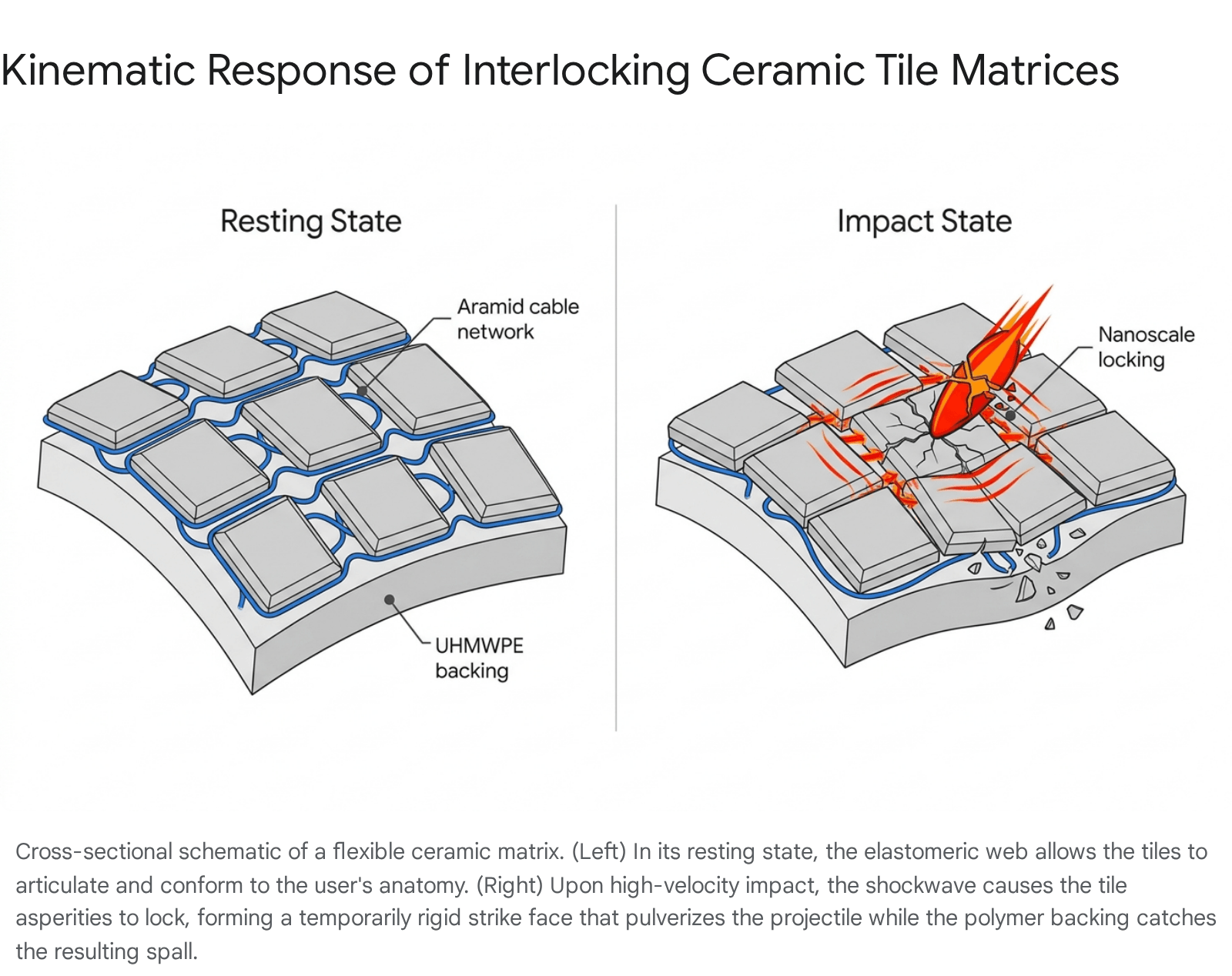
In an interlocking matrix system, the ceramic strike face is not a continuous sheet, but is instead composed of hundreds of individual, optimally shaped pellets or tiles (which may be hexagonal, spherical, cylindrical, or angle-cut).29 These discrete elements are arranged in tightly packed arrays, highly mimicking the microscopic structure of natural armors found in biology, such as nacre (mother-of-pearl).9
The paramount engineering challenge of a mosaic system is preventing the individual tiles from separating, rotating, or sliding past one another under the extreme shear forces of a ballistic impact. This vulnerability is mitigated through two highly sophisticated primary design features:
- Nanoscale Asperities and Surface Friction: The individual ceramic tiles within the matrix are engineered with nanometer-sized asperities (intentional, microscopic surface roughness) on their interlocking edge faces.9 Under resting or ambulatory conditions, the matrix remains pliable. However, when subjected to the sudden, immense compressive force of a rifle strike, these asperities instantly lock together. This shear-thickening, jam-locking mechanism forces the individual tiles to immediately act as a unified, hyper-rigid monolithic surface at the exact millisecond of impact, maximizing the stopping force required to shatter the penetrator.9
- Bio-Mimetic Tendon-Reinforced (BTR) Webs: The ceramic tiles are encapsulated within a highly advanced, flexible support structure. This architecture often involves a high-strength aramid (such as Kevlar) or UHMWPE cable network embedded deeply within an elastomeric matrix, such as specialized polyurethane, polycarbonate, or specialized foam formulations.10 This intricate cable web acts analogously to biological tendons, holding the ceramic tiles in precise, tight geometric alignment while permitting the overall armor plate to twist, bend, and flex synergistically with the dynamic movements of the operator’s torso.29
Multi-Hit Efficacy, Deflection, and Localized Containment
The mosaic design offers a profound tactical advantage in multi-hit survivability paradigms. When a traditional monolithic plate is struck by a rifle round, microscopic fractures inevitably radiate outward from the impact epicenter, systematically weakening the entire structural continuum of the plate. In a tile matrix configuration, catastrophic fracture is inherently contained solely to the single tile (and immediately adjacent tiles) that absorbed the direct kinetic strike.39
The surrounding elastomeric matrix absorbs the transverse shockwave, effectively preventing the propagation of cracks into the broader surrounding ceramic array.29 Consequently, the armor maintains nearly 100% of its ballistic integrity across the vast majority of the plate surface, allowing it to withstand six or more independent, spatially separated RF2-level strikes without catastrophic failure.23
Furthermore, certain matrix designs utilize specific tile geometries—such as angle-cut cylinders—to maximize ballistic deflection. The inclined boundary surfaces of the individual pellets induce highly asymmetric forces on the incoming projectile upon impact. This geometric disruption effectively rotates the bullet off its primary longitudinal axis, rapidly stripping its penetrative kinetic energy and forcing it to yaw into the dense UHMWPE backing.29
The Biomechanical and Tactical Impact of Sub-3 Pound Armor
The aggressive integration of 60/40 hybrid ceramics and UHMWPE composite backing architectures has successfully driven the mass of RF2-compliant, standard 10×12-inch armor plates to unprecedented lows. Commercially viable plates, such as those utilizing proprietary Amorphoid-UHMWPE composites, now weigh as little as 3.45 lbs.41 Other iterations utilizing pure, ultra-thin hybrid ceramics and optimized matrix backings are aggressively pushing this boundary down to approximately 3.0 lbs or less per plate.7
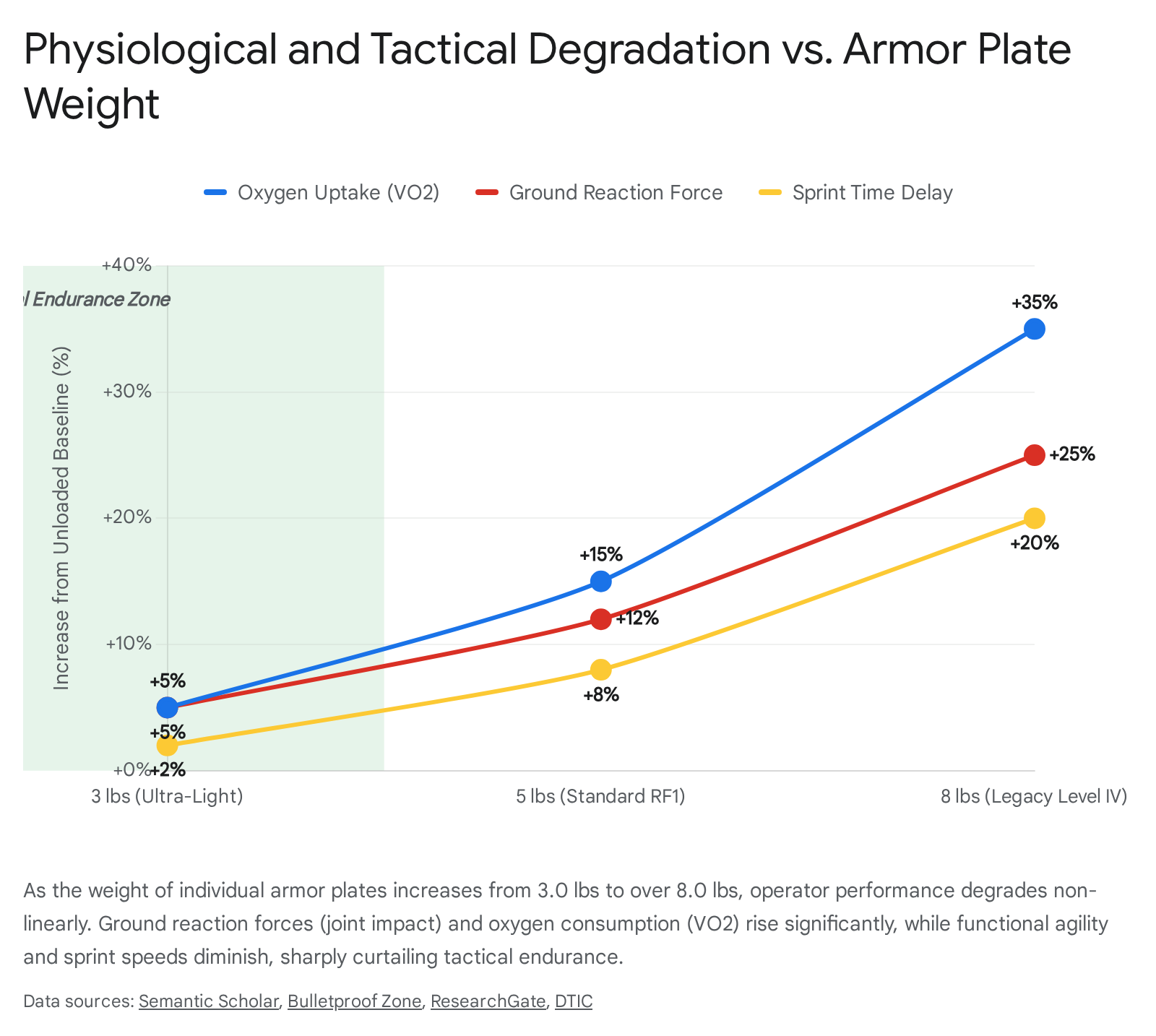
To accurately grasp the profound tactical significance of these sub-3 pound plates, one must evaluate the physiological degradation consistently caused by traditional load carriage systems. Standard Level IV or heavy Level III steel/ceramic hybrid plates routinely weigh between 7.0 and 9.5 pounds each.12 When an operator combines a front plate, a rear plate, side plates, a loaded plate carrier, hydration bladders, spare ammunition, and communication gear, the tactical operator’s external load frequently exceeds 25 to 30 pounds on the upper torso alone.1
Alteration of Gait and Amplification of Ground Reaction Forces
Carrying dense, heavy armor plates drastically and immediately alters the wearer’s spatiotemporal kinematics. The sudden addition of substantial mass to the anterior and posterior planes of the torso radically shifts the body’s natural center of gravity. To compensate for this shift and maintain an upright balance, the wearer naturally—often subconsciously—adopts an exaggerated posterior pelvic tilt alongside an increased lumbar lordosis (an excessive inward curvature of the lower spine).1
Rigorous biomechanical analyses of soldiers and law enforcement officers navigating simulated tactical scenarios demonstrate that traditional armor loads cause significant, quantifiable deviations in fundamental human gait. With heavy armor configurations, subjects consistently exhibit wider strides to maintain lateral stability, prolonged stance times to manage weight transfer, and noticeably decreased swing times during the stride phase.14
Critically, the musculoskeletal system is forced to absorb significantly higher Ground Reaction Forces (GRF) during the heel strike phase of both walking and running. Similarly, the calf and thigh musculature must generate substantially higher push-off forces during the toe-off phase to propel the added mass forward.14 Every single footfall sends a magnified kinetic shockwave upward through the skeletal structure. Over the course of a standard 12-hour patrol, or during a prolonged mobile field force deployment involving hours of standing and tactical movement, this continuous amplified impact translates to severe neuromuscular fatigue. Muscular endurance plummets rapidly; clinical electromyography (EMG) studies indicate that the median frequency of lumbar muscle contractions declines by nearly 45% to 49% when heavily armored, signaling acute and systemic physiological exhaustion.47
Preservation of Long-Term Musculoskeletal Health
The physiological consequences of heavy load carriage extend far beyond the parameters of acute fatigue; they present a profound, career-altering occupational health hazard. Epidemiological studies indicate that between 42% and 60% of active-duty law enforcement officers experience severe lower back pain annually, with heavy equipment loads consistently identified as the primary catalyst.1
The exaggerated lumbar lordosis induced by traditional 7-to-9 pound plates places severe, asymmetrical compressive stress on the intervertebral discs (specifically targeting the L4-L5 and L5-S1 junctions) and the posterior facet joints of the spine.1 Simultaneously, the increased Ground Reaction Forces travel upward through the kinetic chain during movement, significantly increasing the required dynamic torque on the knee flexors and extensors. Clinical dynamometer testing has shown that wearing heavy body armor causes an approximate 158 N increase in box drop peak GRF and a reduction of approximately 10 N·m in the maximum isometric strength of the knee flexors.13 Over a 15 to 20-year career, this constant micro-trauma accelerates severe disc degeneration, osteoarthritis, and debilitating chronic neuropathy.
Transitioning an operator to sub-3 pound RF2 plates mathematically removes 8 to 12 pounds of static, upper-body deadweight (when accounting for the combined mass of both front and rear plates). This substantial mass reduction linearly correlates with decreased spinal compression and allows the body to restore the operator’s natural anatomical posture. By realigning the center of gravity centrally over the hips rather than cantilevered anterior to the chest, ultra-lightweight plates passively mitigate the biomechanical triggers of chronic back pain, preserving the physical longevity of the operator.
Tactical Mobility and Functional Movement in Kinetic Engagements
In close-quarters kinetic engagements, operator survivability is heavily dictated by speed, lateral agility, and the physical capacity to rapidly transition through asymmetrical environments (e.g., executing emergency vehicle egress, vaulting structural barriers, moving rapidly between bounding cover). The addition of heavy armor severely restricts these critical life-saving capabilities. Clinical evaluations utilizing the standardized Functional Movement Screen (FMS) and the Star Excursion Balance Test (SEBT) conclusively demonstrate that when equipment loads cross a threshold of 4.8 to 5.3 kg (10.5 to 11.6 lbs), operators begin to exhibit statistically significant impairments in dynamic balance, shoulder mobility, and rotary stability.49
Quantitative performance metrics highlight this degradation. Heavy body armor configurations consistently increase the time required to complete 5-meter tactical sprints, severely hinder the physical execution of victim-drag maneuvers, and reduce absolute mechanical power output during vertical jumps by up to 16%.15 For instance, testing has revealed that officers wearing an external load of approximately 7.65 kg (16.8 lbs) saw their simulated vehicle exit and sprint times increase from 1.67 seconds (unloaded) to 1.95 seconds (loaded), a statistically significant delay in a life-or-death scenario.15 In separate physical task testing, heavy body armor configurations reduced female officers’ hang time by 63% and reduced male officers’ pull-up capacity by 61%, while stair-stepping capability decreased by 16% across both genders.51
Furthermore, the metabolic heat generated by carrying dense, insulating plates drastically escalates sweat loss. This leads to accelerated dehydration, rapid cardiovascular drift, and a measurable spike in the wearer’s Rating of Perceived Exertion (RPE).51 Studies confirm that subjects walking at even a slow or moderate pace while wearing heavy armor exhibit significantly greater increases in oxygen uptake (VO2), heart rate, and blood lactate levels compared to unloaded baselines.51 As the core temperature and resting heart rate climb into upper aerobic zones simply from carrying the equipment, cognitive processing, situational decision-making, and complex physical reaction times all face severe degradation.53
By outfitting tactical operators with ultra-lightweight, sub-3-pound RF2 plates, agencies functionally unburden the tactical athlete. The sub-3 pound threshold keeps the cumulative weight of the plate carrier system well below the 4.8 kg FMS degradation breakpoint identified in physiological literature. Consequently, the operator retains near-unloaded physiological baselines. Time-to-target during emergency vehicle egress remains optimized, explosive anaerobic power is preserved for vaulting and grappling, and the onset of metabolic exhaustion is significantly delayed. During prolonged civil unrest scenarios or mobile field force deployments—where personnel may be required to maintain a physical posture for 12 to 16 hours continuously—this preservation of musculoskeletal endurance dictates the overall operational tempo and minimizes the potential for physical exhaustion.54
Conclusion
The transition to the NIJ 0101.07 standard and the formal implementation of the RF2 protection level represents a necessary and long-overdue recalibration of body armor specifications. By aligning testing protocols with the lethal reality of the 5.56x45mm M855 penetrator, the standard ensures that personnel are protected against the most prevalent rifle threats deployed in modern kinetic environments. However, attempting to fulfill these stringent new ballistic requirements using legacy monolithic alumina or pure steel composites would inherently compromise the physical effectiveness and long-term health of the personnel the armor is designed to protect.
The application of 60/40 hybrid ceramics—meticulously leveraging the extreme absolute hardness of Boron Carbide and the superior fracture toughness of Silicon Carbide—has effectively resolved this complex engineering paradox. When engineered into bio-mimetic, interlocking tile matrices, these advanced composites yield anatomically conforming strike faces that isolate fracture propagation and rapidly dissipate immense kinetic energy through complex tribochemical and intergranular mechanical processes.
The resulting ultra-lightweight, sub-3-pound hard armor plates are not merely a comfort-enhancing luxury; they are a fundamental tactical asset. By significantly reducing Ground Reaction Forces, mitigating destructive lumbar lordosis, preserving functional agility, and keeping the operator’s load profile safely below critical biomechanical degradation thresholds, these systems ensure that tactical mobility and cognitive endurance are preserved during high-risk engagements. Ultimately, the synthesis of advanced materials science with human biomechanics ensures that modern military and law enforcement operators are optimally equipped to survive both the acute kinetic impact of a rifle threat and the long-term physiological attrition inherent to the profession.
Please share the link on Facebook, Forums, with colleagues, etc. Your support is much appreciated and if you have any feedback, please email us in**@*********ps.com. If you’d like to request a report or order a reprint, please click here for the corresponding page to open in new tab.
Sources Used
- Bulletproof Vest and Utility Belt Causing Pain in Law Enforcement – Spine Spot Chiropractic, accessed May 10, 2026, https://www.roaringforkchiropractor.com/rfv-chiropractor-blog/1373944-bulletproof-vest-and-utility-belt-causing-pain-in-law-enforcement-how-chiropractic-can-help
- Lightweight, ergonomic body armor | Dyneema®, accessed May 10, 2026, https://www.dyneema.com/sectors/law-enforcement-and-military/lightweight-comfort-equals-survivability
- Ballistic Resistance of Body Armor, NIJ Standard 0101.07 – National Institute of Justice, accessed May 10, 2026, https://nij.ojp.gov/topics/equipment-and-technology/ballistic-resistance-body-armor-nij-standard-010107
- Ballistic Resistance of Body Armor NIJ Standard 0101.07 – Office of Justice Programs, accessed May 10, 2026, https://www.ojp.gov/pdffiles1/nij/307346.pdf
- Level III+ Body Armor – RMA Armament, accessed May 10, 2026, https://rmadefense.com/product-category/body-armor/level-iii-plus-body-armor/
- Understanding the New NIJ 0101.07 Body Armor Standard, accessed May 10, 2026, https://premierbodyarmor.com/blogs/pba/nij-standard-0101-07
- Body Armor Innovation Award 2026: Applications Close with 17 Groundbreaking Entries, accessed May 10, 2026, https://www.bodyarmornews.com/body-armor-innovation-award-2026-applications-close-with-17-groundbreaking-entries/
- October 2025 Bulletin – Nurol Teknoloji, accessed May 10, 2026, https://www.nurolteknoloji.com/bulletins/bulletin-october-2025
- Nacre-like ceramic/polymer laminated composite for use in body-armor applications, accessed May 10, 2026, https://www.aimspress.com/article/id/598
- Flexing In The Line Of Fire: Lightweight, Flexible Body Armor For The Force Of The Future, accessed May 10, 2026, https://bodyarmornews.com/flexing-line-fire-lightweight-flexible-body-armor-force-future/
- Page 3 – The Ultimate Source for Body Armor And Bullet Proof Vests, accessed May 10, 2026, https://bodyarmornews.com/page/3/?attachment_id
- Lightweight Body Armor Plates – RMA Armament, accessed May 10, 2026, https://rmadefense.com/lightweight-body-armor-plates/
- the effects of body armor on lower back and knee biomechanics during basic and military inspired tasks – UKnowledge – University of Kentucky, accessed May 10, 2026, https://uknowledge.uky.edu/cbme_etds/24/
- Understanding the Physiological, Biomechanical, and Performance Effects of Body Armor Use – DTIC, accessed May 10, 2026, https://apps.dtic.mil/sti/tr/pdf/ADA504354.pdf
- Impact of police body armour and equipment on mobility | Request PDF – ResearchGate, accessed May 10, 2026, https://www.researchgate.net/publication/236738716_Impact_of_police_body_armour_and_equipment_on_mobility
- Specification for NIJ Ballistic Protection Levels and Associated Test Threats, NIJ Standard 0123.00 | National Institute of Justice, accessed May 10, 2026, https://nij.ojp.gov/topics/equipment-and-technology/specification-nij-ballistic-protection-levels-and-associated-test-threats-nij-standard-012300
- Advancing Ballistic Resistance of Body Armor: A Comprehensive Guide to NIJ Standard 0101.07 and NIJ Standard 0123.00 – IntelAlytic, accessed May 10, 2026, https://intelalytic.com/insights/nij-010107-vs-012300
- Explanation of NIJ standard 0101.07 | What’s new? | PGD Article, accessed May 10, 2026, https://protectiongroupdenmark.com/blog/explanation-of-nij-standard-0101-07/
- Body Armor Levels Explained: NIJ 0101.06 & 0101.07 Guide – Bulletproof Zone, accessed May 10, 2026, https://bulletproofzone.com/blogs/bullet-proof-blog/understanding-body-armor-levels
- Understanding NIJ Levels: A Simple Guide for First-Time Armor Buyers – RTS Tactical, accessed May 10, 2026, https://www.rtstactical.com/blogs/educational/understanding-nij-levels-a-simple-guide-for-first-time-armor-buyers
- NIJ Standard 0101.07: HG1, HG2, RF1, RF2, RF3 Explained – Bulletproof Zone, accessed May 10, 2026, https://bulletproofzone.com/blogs/bullet-proof-blog/nij-standard-0101-07-new-body-armor-levels
- What the New NIJ Certification Levels of Body Armor Mean for Your Agency, accessed May 10, 2026, https://www.highcomarmor.com/new-nij-101-07-certification-levels/
- Hyperion Armor – NIJ RF2 (Level III+) – Strike Industries, accessed May 10, 2026, https://www.strikeindustries.com/harf2-a.html
- Hard Body Armor Levels Interpreted, accessed May 10, 2026, https://bodyarmornews.com/hard-body-armor-levels-interpreted/
- Chapter: 5 Lightweight Protective Materials: Ceramics, Polymers, and Metals – National Academies of Sciences, Engineering, and Medicine, accessed May 10, 2026, https://www.nationalacademies.org/read/13157/chapter/7
- Silicon Carbide Ceramics for Armor Applications: A Review of Sintering Methods and Additive Systems – PMC, accessed May 10, 2026, https://pmc.ncbi.nlm.nih.gov/articles/PMC13075016/
- Strategic Breakthrough: NT Cera Unveils the World’s Thinnest …, accessed May 10, 2026, https://www.bodyarmornews.com/nt-cera-unveils-the-worlds-thinnest-ballistic-ceramic/
- High-End Body Armor Plates and Systems – Adept Armor, accessed May 10, 2026, https://www.ade.pt/body-armor/
- US7490539B2 – Lightweight composite armor – Google Patents, accessed May 10, 2026, https://patents.google.com/patent/US7490539B2/en
- personal armor – Nt Cera, accessed May 10, 2026, https://www.ntcera.com/products/personal-armor
- Impact and Ballistic Response of Hybridized Thermoplastic Laminates – DTIC, accessed May 10, 2026, https://apps.dtic.mil/sti/pdfs/ADA538498.pdf
- Microfracture and Limited Tribochemical Wear of Silicon Carbide During High-Speed Sliding in Cryogenic Environment | Request PDF – ResearchGate, accessed May 10, 2026, https://www.researchgate.net/publication/215530261_Microfracture_and_Limited_Tribochemical_Wear_of_Silicon_Carbide_During_High-Speed_Sliding_in_Cryogenic_Environment
- SiC-Si composite part fabrication via SiC powder binder jetting additive manufacturing and molten-Si infiltration | Request PDF – ResearchGate, accessed May 10, 2026, https://www.researchgate.net/publication/354201228_SiC-Si_composite_part_fabrication_via_SiC_powder_binder_jetting_additive_manufacturing_and_molten-Si_infiltration
- Silicon Carbide Ceramics for Armor Applications: A Review of Sintering Methods and Additive Systems – MDPI, accessed May 10, 2026, https://www.mdpi.com/1420-3049/31/7/1185
- Multi-Layer Fabric Composites Combined with Non-Newtonian Shear Thickening in Ballistic Protection—Hybrid Numerical Methods and Ballistic Tests – MDPI, accessed May 10, 2026, https://www.mdpi.com/2073-4360/15/17/3584
- (PDF) Hybride Composite Armour Systems with Advanced Ceramics and Ultra-High Molecular Weight Polyethylene (UHMWPE) Fibres – ResearchGate, accessed May 10, 2026, https://www.researchgate.net/publication/303144886_Hybride_composite_armour_systems_with_advanced_ceramics_and_ultra-high_molecular_weight_polyethylene_UHMWPE_fibres
- Impact of adhesive layer properties on ceramic multi-layered ballistic armour systems – TNO (Publications), accessed May 10, 2026, https://publications.tno.nl/publication/34644447/iudkWRNn/jull-2025-impact.pdf
- Lightweight structures for ballistic protection – UNITBV, accessed May 10, 2026, https://unitbv.ro/documente/cercetare/doctorat-postdoctorat/sustinere-teza/2025/Octavian_JIT%C4%82RA%C8%98U/Rezumat_ENG.pdf
- From Raw Materials to Personal Protection: Decoding the Art of Hard Armor, accessed May 10, 2026, https://bodyarmornews.com/hard-armor-manufacturing/
- Deep Springs Technology’s Flexible Body Armor, presented at SOCOM TALOS. – YouTube, accessed May 10, 2026, https://www.youtube.com/watch?v=NaPT3l7V_xY
- In a Class of its Own: The Adept Armor Thunder, the Lightest Level 3 …, accessed May 10, 2026, https://soldiersystems.net/2023/07/25/in-a-class-of-its-own-the-adept-armor-thunder-the-lightest-level-3-body-armor-plate/
- Ballistic Armor Update: 2024 – Police and Security News, accessed May 10, 2026, https://policeandsecuritynews.com/2024/08/01/ballistic-armor-update-2024/
- Level 3 vs Level 4 Plates: 2026 Protection Comparison – Bulletproof Zone, accessed May 10, 2026, https://bulletproofzone.com/blogs/bullet-proof-blog/level-3-vs-4-plates-comparing-protection-levels
- Comparing the Effects of Different Body Armor Systems on the Occupational Performance of Police Officers – Semantic Scholar, accessed May 10, 2026, https://pdfs.semanticscholar.org/5e36/9c7c400c1f35b875eca23e67517685cb539a.pdf
- Best Body Armor Setup : r/armedsocialists – Reddit, accessed May 10, 2026, https://www.reddit.com/r/armedsocialists/comments/1np2ulv/best_body_armor_setup/
- Elastic textile-based wearable modulation of musculoskeletal load: A comprehensive review of passive exosuits and resistance clothing – PMC, accessed May 10, 2026, https://pmc.ncbi.nlm.nih.gov/articles/PMC11894418/
- Influence of Wearing Ballistic Vests on Physical Performance of Danish Police Officers: A Cross-Over Study – PMC, accessed May 10, 2026, https://pmc.ncbi.nlm.nih.gov/articles/PMC7961692/
- Protective Gear Negatively Impacts Police Officer Mobility, Stability, and Power Generation, accessed May 10, 2026, https://www.mdpi.com/2411-5142/10/3/344
- The Influence of Body Armor on Balance and Movement Quality – PMC, accessed May 10, 2026, https://pmc.ncbi.nlm.nih.gov/articles/PMC6033495/
- The impact of occupational load carriage on the mobility of the tactical police officer | Request PDF – ResearchGate, accessed May 10, 2026, https://www.researchgate.net/publication/260945124_The_impact_of_occupational_load_carriage_on_the_mobility_of_the_tactical_police_officer
- Impact of Body Armor on Physical Work Performance. | National Technical Reports Library, accessed May 10, 2026, https://ntrl.ntis.gov/NTRL/dashboard/searchResults/titleDetail/PB2008108710.xhtml
- THESIS ANALYSIS OF BODY ARMOR FIT AND COMFORT USING 3D BODY SCANNING – Mountain Scholar, accessed May 10, 2026, https://mountainscholar.org/bitstreams/c8b4729d-0e4d-4777-9e3e-a9c7077df6d3/download
- The impact of body armor on physical performance of law enforcement personnel: a systematic review – PMC, accessed May 10, 2026, https://pmc.ncbi.nlm.nih.gov/articles/PMC5434519/
- Impact of Body Armor on Physical Work Performance – Uniformed Services University, accessed May 10, 2026, https://www.usuhs.edu/research/centers/tsnrp/research/funded-study/65422