
1. Executive Summary
The character of modern conflict has expanded beyond the physical domains of land, sea, air, and space, migrating into the cognitive dimension. Cognitive warfare represents the operationalization of neurosciences, behavioral psychology, and information technology to target the human mind. The objective of these operations is not merely to control the flow of information or alter what a target population thinks, but to degrade and manipulate how they perceive reality, process information, and execute decisions.
Analysis of current open-source intelligence (OSINT), psychological research, and military doctrine indicates that cognitive vulnerabilities are not uniform across a population. Susceptibility to information operations (IO), psychological operations (PSYOPS), and digital manipulation is heavily stratified by generational cohorts. Each age group—Baby Boomers, Generation X, Millennials (Gen Y), and Generation Z—presents a distinct psychological profile shaped by developmental exposure to technology, baseline digital literacy, and neurocognitive aging processes.
Offensive actors, including state and non-state entities, deploy precision-guided narrative warfare and agentic artificial intelligence (AI) to exploit these distinct generational fault lines. Defensive postures—often categorized under cognitive security (COGSEC)—require demographically tailored interventions. These range from structural algorithmic friction for older adults to active inoculation and lateral reading training for digital natives. This report details the specific psychological mechanisms, offensive exploitation vectors, and defensive requirements for each primary age group.
2. Theoretical Framework of Cognitive Warfare
Cognitive warfare represents a structural shift from industrial-era attrition and information-age connectivity dominance to the direct targeting of human neurocognitive processes1.
2.1 Doctrinal Evolution
The explicit conceptualization of cognitive warfare within Western military thought originated as an analytical tool. In 1996, a thesis by Dahl at the United States Air University presented cognitive warfare within the framework of command and control warfare (C2W), emphasizing the integrated use of psychological, electronic, deceptive, and physical operations to compel adversaries by stressing their decision-making processes3. The concept evolved significantly with the advent of Web 2.0. By 2017, the Director of the Defense Intelligence Agency, Lt. Gen. Stewart, characterized “Fifth Generation Warfare” explicitly as cognitive warfare, defining it as the struggle to win the information and decision space before or during a conflict4.
Currently, organizations such as NATO’s Allied Command Transformation (ACT) frame cognitive warfare as an unconventional hybrid threat where the human mind is the primary battlespace. It is executed continuously, below the threshold of armed conflict, utilizing disinformation and confrontational rhetoric to fracture societal cohesion and erode a target nation’s collective will to resist3.
2.2 The Brain as a Battlespace
Traditional PSYOPS aim to shape perceptions to support specific command objectives7. Cognitive warfare extends beyond this by targeting the biological substrates of human cognition. Machine systems now interact directly with human neurocognitive processes, manipulating sensory integration, selective attention, memory encoding, emotional prioritization, and social identity formation1. The goal is to induce cognitive overload, emotional manipulation, narrative shaping, and behavioral priming, ultimately degrading the adversary’s ability to reason effectively and act coherently2.
3. Offensive Information Operations: Methodologies and Mechanisms
Modern offensive operations rely on the integration of Social and Cultural Intelligence (SOCINT) to build accurate psychological profiles of target audiences8. The proliferation of agentic AI (aAI) has accelerated this capability, allowing adversaries to aggregate psychometric indicators, behavioral histories, linguistic patterns, and biometric signals to execute predictive cognitive targeting1.
3.1 The Median Voter Theorem in Information Operations
Military and political analysts apply the Median Voter Theorem to cognitive warfare targeting. In polarized environments, the extremes of a population are ideologically locked and resistant to persuasion. Consequently, adversaries focus their computational propaganda on the politically disengaged, uncertain, or less ideologically committed center4. By flooding the information space with content that induces doubt, emphasizes the costs of conflict, or highlights fabricated institutional failures, hostile actors aim to shift the public’s median opinion, thereby altering national policy without direct kinetic engagement4.
3.2 Emotion Baseline Sensemaking and Control (EBSC)
Advanced cognitive attacks utilize EBSC protocols. This involves using Large Language Models (LLMs) to scan open digital sources (social media, forums, video-sharing sites) to conduct real-time social-sentiment analysis10. Adversaries map the emotional state distribution of a population (e.g., joy, fear, anger, hope) and identify specific triggers. Generative AI systems are then deployed to produce synthetic media—ranging from text-based articles to audio deepfakes—designed to positively or negatively reconfigure collective emotions10.
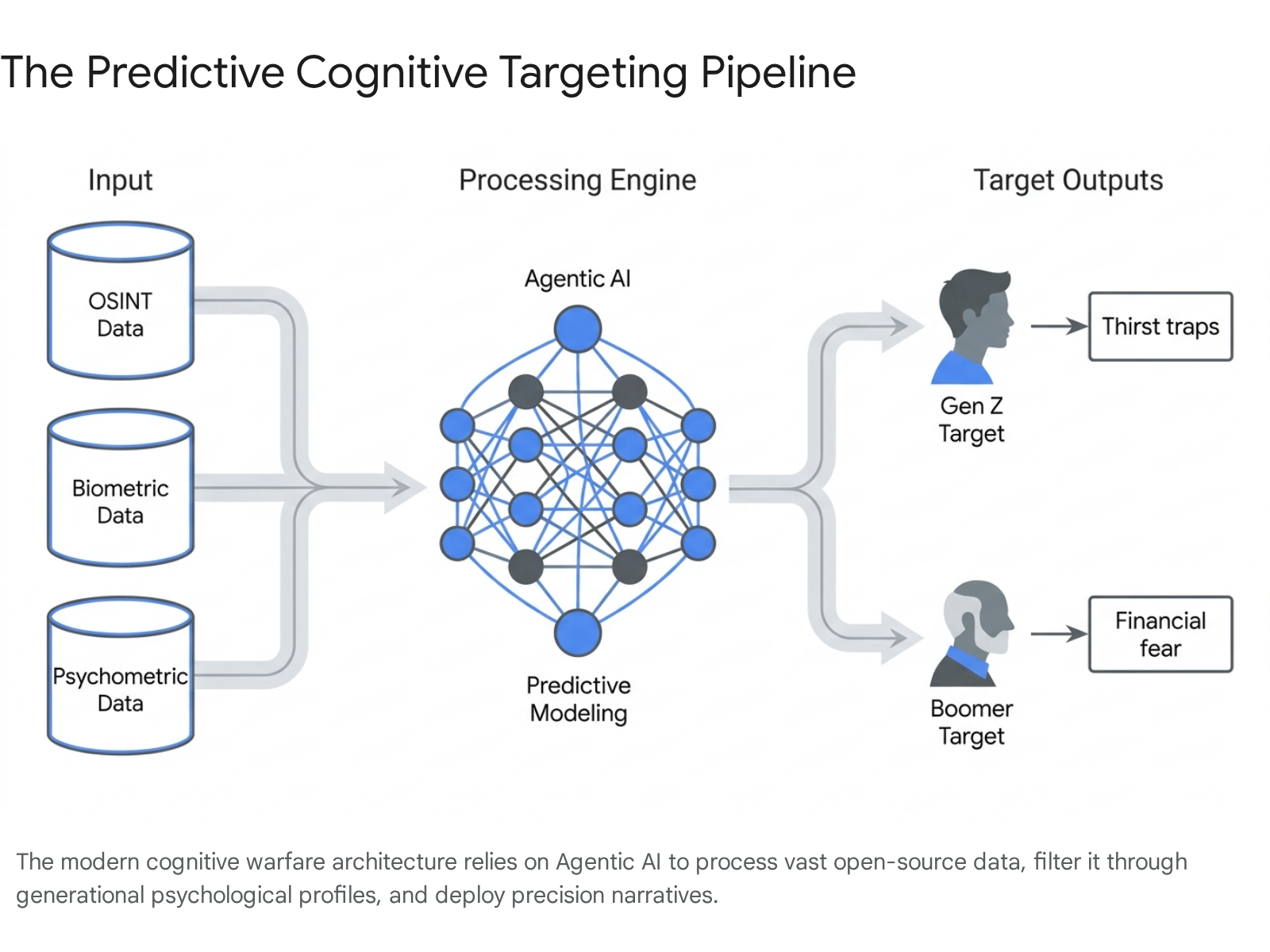
4. Generational Cognitive Profiles and Vulnerabilities
The efficacy of a cognitive attack depends on exploiting the specific psychological pressure points of the target audience. Demographic cohorts exhibit distinct media consumption habits, cognitive processing paradigms, and baseline digital literacies.
4.1 Baby Boomers (1946–1964): Neurological Attrition and Algorithmic Exploitation
Baby Boomers present an exploitable profile in the digital domain. Research indicates that individuals over the age of 65 are responsible for sharing significantly more fake news and disinformation than younger cohorts, even when controlling for variables such as political ideology and baseline social media usage12. During the 2016 US election, users over 65 shared seven times more fake news than users aged 18 to 2912.
Cognitive Mechanisms and Vulnerabilities: The vulnerability of older adults to cognitive warfare is driven by specific age-related shifts in neural processing. While semantic memory (accumulated worldly knowledge and vocabulary) remains intact or improves with age, episodic memory (the ability to recall the specific context or source of information) exhibits measurable decline14. This creates a critical vulnerability: older adults frequently experience source amnesia. When exposed to a piece of disinformation that is subsequently debunked, the factual correction quickly fades from episodic memory, while the original false claim remains fluent and familiar. Due to the “illusory truth effect,” repeated exposure to a false narrative makes it feel true simply because it is easily processed by the brain15.
Furthermore, older adults are characterized as “digital refugees.” Having migrated to digital platforms late in life, many lack the requisite digital literacy to differentiate between organic content, sponsored advertisements, and manipulated media14. Social isolation and loneliness, prevalent in this demographic, act as threat multipliers. Isolated individuals frequently utilize social media to satisfy unmet needs for connection, rendering them susceptible to identity-motivated thinking, echo chambers, and long-term psychological grooming by hostile actors19. Deteriorating cardiovascular health and clinical depression are also correlated with a higher rate of cognitive decline, increasing susceptibility to online financial scams and political manipulation12.
Offensive Targeting Tactics: Adversaries optimize tactics for the architecture of text-based and established network platforms (e.g., Facebook, WhatsApp). By seeding narratives that exploit financial insecurity, fear of social change, and nostalgia, threat actors induce older adults to act as unwitting vectors of “organic reach,” amplifying disinformation through peer-to-peer sharing networks14.
4.2 Generation X (1965–1980): Pragmatic Skepticism and the Effort Penalty
Generation X occupies a transitional space between analog and digital ecosystems. As a cohort, they exhibit cautious, pragmatic behavior online, driven by an awareness of privacy risks and a desire to avoid online polarization.
Cognitive Mechanisms and Vulnerabilities: Generation X generally approaches digital information with skepticism. However, this skepticism is frequently offset by cognitive fatigue and an unwillingness to expend the effort required for rigorous verification. Research on social media behaviors indicates that Generation X users often fall into a “laziness and assumption” category regarding fact-checking. Rather than conducting lateral reading or verifying sources, they tend to rely on gut instinct or the perceived trustworthiness of the individual who shared the post24.
According to the Elaboration Likelihood Model (ELM), individuals process persuasive messages through either a central route (deep cognitive engagement) or a peripheral route (reliance on surface-level cues)25. Due to information overload, Generation X frequently defaults to the peripheral route. Furthermore, Cognitive Dissonance Theory highlights that this cohort experiences psychological discomfort when confronted with information that challenges their pragmatic worldview26. Offensive operations targeting Generation X frequently exploit this dissonance by framing disinformation within familiar, traditional media aesthetics, thereby bypassing their initial skepticism.
Strengths and Mitigation Factors: Generation X limits its attack surface through active avoidance. They are significantly less likely to share political news or engage in high-demand interactions (such as commenting on polarizing topics) due to concerns about their digital footprint and a strong aversion to online conflict24. This behavioral self-regulation limits their role as active vectors in the organic reach of disinformation.
4.3 Millennials (Gen Y) (1981–1996): The Digital Illusion and Emotional Exploitation
Millennials were the first generation to reach adulthood during the proliferation of ubiquitous internet access and Web 2.0. However, their status as digital natives has fostered an overconfidence in their ability to navigate the cognitive battlespace—a vulnerability termed the “digital illusion”27.
Cognitive Mechanisms and Vulnerabilities: Despite their digital fluency, data indicates that approximately 70% of Millennials rarely verify the authenticity of online identities, exposing them to advanced social engineering, phishing, and emotional deception27. Nearly 45% of Millennials are comfortable sharing sensitive personal information online, expanding their attack surface for cyber-enabled IO27. This cohort places a high premium on social validation, authenticity, and peer consensus. In times of social crisis, Millennials actively seek out digital content to self-regulate emotions and define their social identity29.
Offensive Targeting Tactics: Offensive operations target Millennials by exploiting their reliance on identity politics and social justice frameworks. By weaponizing their conscience and desire for authenticity, adversaries manipulate Millennials into amplifying polarizing content. Their overconfidence in their digital literacy leads them to dismiss warnings of manipulation, assuming they are immune to tactics they believe only affect older or less educated populations27.
4.4 Generation Z (1997–2012): Algorithmic Dependency and Memetic Vulnerability
Generation Z has been entirely socialized within a fragmented, algorithmically driven media landscape26. Despite high technological fluency, large-scale empirical studies, including the Misinformation Susceptibility Test (MIST) administered to over 66,242 individuals across 24 countries, indicate that Generation Z is highly susceptible to disinformation, scoring lower in veracity discernment than older generations33.
Cognitive Mechanisms and Vulnerabilities: The primary vector for cognitive attacks against Generation Z is short-form, user-generated video content (e.g., TikTok, Instagram Reels). The structural design of these platforms actively discourages analytical reading and deep cognitive engagement. Consequently, Gen Z is conditioned to process information via peripheral routes based on aesthetic appeal, emotional resonance, and influencer credibility25.
Generation Z relies heavily on parasocial relationships with influencers for news and worldview formation. Adolescence and early adulthood involve heightened social sensitivity and active identity exploration, which cognitive hackers manipulate using algorithmic filter bubbles33.
Offensive Targeting Tactics: Adversaries exploit this cohort by utilizing conversational AI, audio deepfakes (e.g., replicating voices of popular influencers like MrBeast), and co-opted influencers to disseminate propaganda11. Furthermore, cognitive warfare against Gen Z frequently employs memetic engineering and gamified language, bypassing traditional analytical defenses by presenting geopolitical disinformation as entertainment, humor, or social activism38.
Hostile state actors specifically target Gen Z to fracture societal cohesion. Campaigns have successfully aligned geopolitical objectives with domestic social justice movements to incite digital and physical mobilization against established democratic institutions39. For example, OSINT tracking the 2023 Israel-Hamas conflict highlighted how operations on TikTok amplified the “Bin Laden letter to America” trend, attempting to manipulate Gen Z into rejecting Western geopolitical narratives and historic paradigms39.
Additionally, military recruiters and state intelligence organs increasingly use “thirst traps”—sexually suggestive social media posts by uniformed personnel (e.g., the U.S. Army’s use of influencers with hundreds of thousands of followers)—to bypass logical recruitment barriers and directly engage Gen Z’s psychosexual vulnerabilities42.
5. Defensive Postures: Cognitive Security (COGSEC) and Resilience
Defending against cognitive warfare requires the establishment of Cognitive Security (COGSEC)—the capability to protect human cognitive processes and decision-making from adversarial manipulation17. Because vulnerabilities are generationally distinct, countermeasures must be calibrated to the target demographic. A uniform approach to media literacy is ineffective.
5.1 Prebunking and Psychological Inoculation
Prebunking, based on inoculation theory, involves preemptively exposing individuals to a weakened form of manipulation to build cognitive resistance against future attacks43. This method includes a forewarning of impending manipulation and a preemptive refutation of the tactic. Inoculations can be issue-based (targeting a specific false narrative) or technique-based (teaching the recognition of logical fallacies or emotional manipulation)44.
Generational Application: Prebunking is highly effective for Generation Z and Millennials. Gamified inoculation tools and digital media literacy programs deployed in youth-oriented platforms train these cohorts to recognize logical fallacies and algorithmic biases33. However, prebunking must be applied cautiously to Baby Boomers. Due to deficits in source memory, exposing older adults to weakened falsehoods can backfire; they may forget the refutation but retain the false claim, thereby increasing their susceptibility over time15.
5.2 Lateral Reading and Critical Ignoring
Fact-checking after exposure (debunking) is difficult due to the persistence of false beliefs. COGSEC protocols increasingly emphasize proactive verification and attention management.
- Lateral Reading: This technique requires users to leave a suspect information source and open new tabs to verify the credibility of the claim via independent, authoritative sources46. While effective, it demands high cognitive effort. It is an optimal training objective for Millennials and Gen Z, provided they can be incentivized to overcome the frictionless design of their preferred apps.
- Critical Ignoring: Given the information overload inherent in the digital battlespace, citizens must be trained in “critical ignoring.” This involves self-nudging (removing manipulative environments from one’s digital ecosystem), ignoring provocative actors (“do not feed the trolls”), and actively choosing where to allocate limited attentional resources47. This strategy aligns well with the pragmatic, privacy-conscious nature of Generation X, who naturally gravitate toward digital avoidance24.
5.3 Structural and Algorithmic Countermeasures
Individual cognitive defenses frequently fail under fatigue, emotional stress, or algorithmic saturation. Therefore, structural interventions are a necessary component of COGSEC.
- Accuracy Nudges: Prompting users to consider the accuracy of a headline before sharing disrupts the automatic, heuristic-driven sharing behaviors prevalent among older adults and highly partisan individuals17.
- Friction by Design: Platforms must introduce artificial friction (e.g., “read before sharing” prompts, rate limits on forwarding messages) to slow the viral spread of disinformation. This is particularly vital for protecting Baby Boomers, whose susceptibility increases proportionally with the speed and volume of information15.
- Mental Health and Psychosocial Support (MHPSS): Military doctrine increasingly views mental health care not as a secondary humanitarian concern, but as a core component of civil defense. Treating isolation, anxiety, and digital fatigue acts as psychological armor, reducing the efficacy of enemy cognitive operations. For older adults, mitigating loneliness prevents the early cognitive decline often exploited by hostile actors, while for younger demographics, providing structural support offsets digital fatigue and the lack of traditional authority structures in online environments20.
6. Conclusion
The transition to cognitive warfare necessitates a reassessment of national security, intelligence, and psychological operations. Adversaries have mapped the neurocognitive topographies of global populations, exploiting specific generational traits—from the source amnesia of Baby Boomers to the algorithmic dependency of Generation Z—to erode societal resilience from within.
To counter this, a multidimensional Cognitive Security posture must be adopted. Offensive military and intelligence operations must integrate advanced OSINT and psychological profiling to accurately target the median voter in adversary populations. Defensively, institutions must abandon monolithic media literacy campaigns in favor of tailored interventions. Protecting the cognitive domain requires harmonizing structural platform regulations, AI-driven threat detection, and the cultivation of specific mental habits calibrated to the unique developmental and neurological realities of each generation.
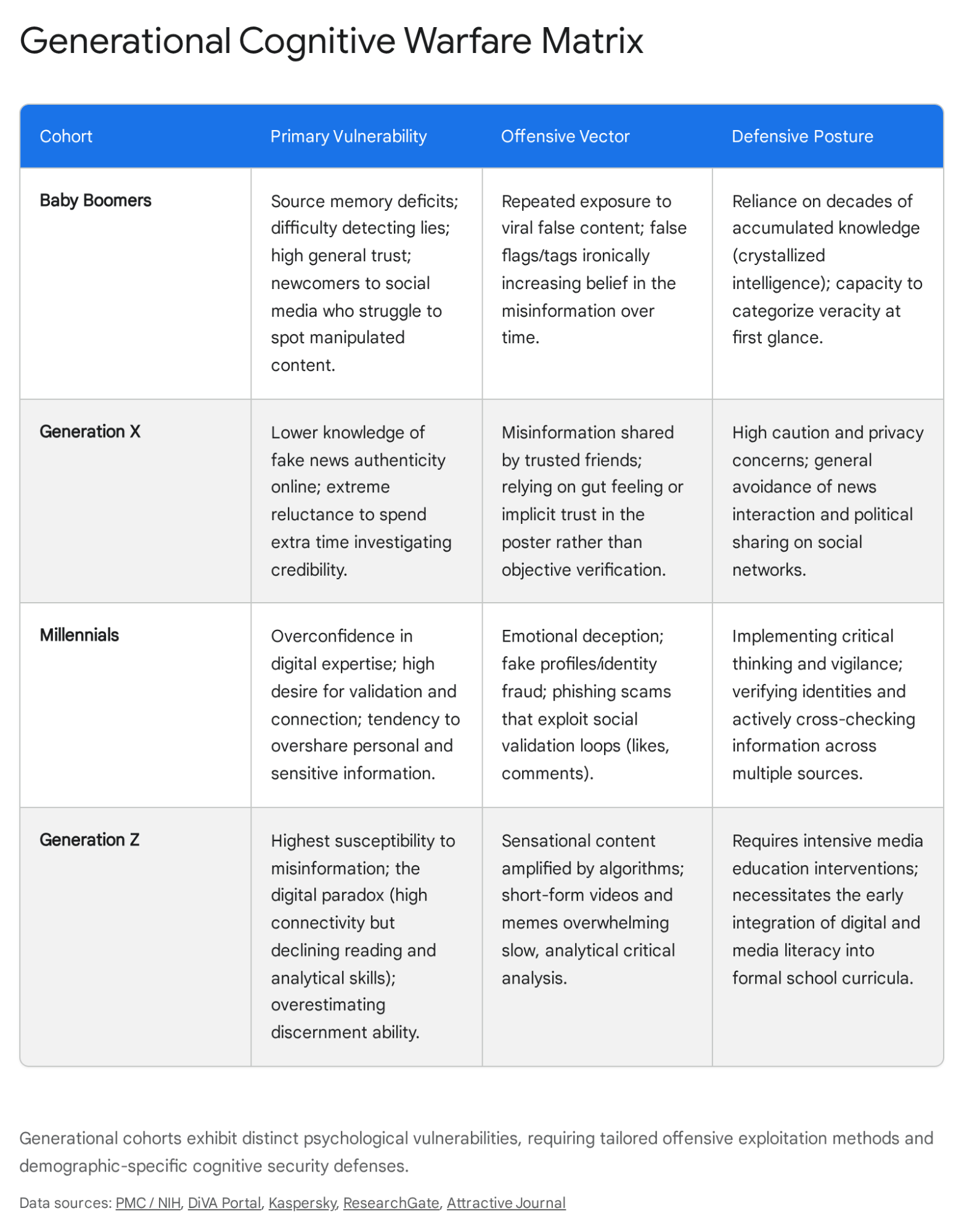
Master Summary Table: Generational Cognitive Warfare Profiles
| Generational Cohort | Primary Information Environment | Core Psychological Vulnerabilities | Primary Offensive Exploitation Vectors | Optimal Defensive Interventions (COGSEC) |
| Baby Boomers (1946–1964) | Facebook, WhatsApp, Traditional Broadcast Media | Decline in episodic memory (source amnesia); reliance on familiarity heuristics; digital illiteracy; social isolation. | Financial/political scams; high-volume repetition of fake news to induce the “illusory truth effect”; exploitation of fear. | Structural platform friction; accuracy nudges; algorithmic downranking; avoid repetitive prebunking. |
| Generation X (1965–1980) | Mixed (Traditional, Web 1.0, Facebook) | Cognitive dissonance; reliance on gut instinct over verification; cognitive fatigue; laziness heuristic. | Exploitation of cynical pragmatism; framing disinformation within traditional, authoritative aesthetics. | Targeted digital literacy; promoting “critical ignoring” and self-nudging strategies. |
| Millennials (1981–1996) | Twitter/X, Instagram, Web 2.0 | “Digital illusion” (overconfidence in digital savvy); need for social validation; emotional regulation via media. | Spear-phishing; identity-motivated propaganda; emotional baiting during life crises; weaponization of conscience. | Lateral reading training; awareness campaigns on identity-theft and social engineering. |
| Generation Z (1997–2012) | TikTok, Instagram Reels, Short-form Video | Diminished analytical reading stamina; algorithmic dependency; reliance on parasocial influencer relationships. | Memetic warfare; gamified propaganda; psychosexual recruitment (“thirst traps”); co-optation of social justice issues. | Active prebunking (inoculation); algorithmic literacy training; peer-validated fact-checking protocols. |
Please share the link on Facebook, Forums, with colleagues, etc. Your support is much appreciated and if you have any feedback, please email us in**@*********ps.com. If you’d like to request a report or order a reprint, please click here for the corresponding page to open in new tab.
Sources Used
- Autonomous Narrative Warfare: Engaging Agentic AI Within the Cognitive Battlespace – HSToday, https://www.hstoday.us/subject-matter-areas/narrative-strategy/autonomous-narrative-warfare-engaging-agentic-ai-within-the-cognitive-battlespace/
- Cognitive Warfare and the Changing Character of Engagement: A Neurostrategic Perspective – Institute for National Strategic Studies, https://inss.ndu.edu/news/Article/4455563/cognitive-warfare-and-the-changing-character-of-engagement-a-neurostrategic-per/
- Definitional ambiguity in cognitive warfare: a critical and systematic conceptual review through ideal-type analysis – Frontiers, https://www.frontiersin.org/journals/big-data/articles/10.3389/fdata.2026.1762571/full
- Cognitive Warfare: Targeting the Soldier to Shape the Strategy – Army University Press, https://www.armyupress.army.mil/Journals/NCO-Journal/Archives/2026/March/Cognitive-Warfare/
- The Tiktok Problem – A Study on Cognitive Warfare | Psychological defence agency, https://mpf.se/psychological-defence-agency/publications/archive/2026-02-12-the-tiktok-problem—a-study-on-cognitive-warfare
- How China’s Cognitive Warfare Works: A Frontline Perspective of Taiwan’s Anti-Disinformation Wars | Journal of Global Security Studies | Oxford Academic, https://academic.oup.com/jogss/article/7/4/ogac016/6647447
- PSYOPs: The Symbiosis of Strategic Intelligence and Psychological Influence in Modern Conflict, https://www.intelligenceinfo.org/en/psyops-the-symbiosis-of-strategic-intelligence-and-psychological-influence/
- The U.S. Army’s Bold New Approach to Psychological Operations and Cognitive Warfare, https://www.swcs.mil/Special-Warfare-Journal/Article/4503500/the-us-armys-bold-new-approach-to-psychological-operations-and-cognitive-warfare/
- Cognitive Warfare – NATO Innovation Hub, https://innovationhub-act.org/wp-content/uploads/2023/12/Cognitive-Warfare.pdf
- Emotionally based strategic communications as a new tool in defensive cognitive warfare – PMC, https://pmc.ncbi.nlm.nih.gov/articles/PMC12920201/
- Jihadist Organisation Use of Cognitive Warfare in the Artificial Intelligence Age: An Evolving Hybrid Threat for European Security, https://eugovlab.com/jihadist-organisation-use-of-cognitive-warfare-in-the-artificial-intelligence-age-an-evolving-hybrid-threat-for-european-security/
- Older adults share more political misinformation. Here’s why | CU Boulder Today, https://www.colorado.edu/today/2025/11/05/older-adults-share-more-political-misinformation-heres-why
- AI-driven disinformation: policy recommendations for democratic resilience – PMC, https://pmc.ncbi.nlm.nih.gov/articles/PMC12351547/
- What Is The Internet Doing To Boomers’ Brains? – Marcellus Investment Managers, https://marcellus.in/story/what-is-the-internet-doing-to-boomers-brains/
- Aging in an Era of Fake News – PMC – NIH, https://pmc.ncbi.nlm.nih.gov/articles/PMC7505057/
- Aging and Misinformation Susceptibility – Scholarship @ Claremont, https://scholarship.claremont.edu/cgi/viewcontent.cgi?article=1000&context=cclura_2025
- Cognitive Security in the Information Age: Psychological Strategies for Countering Democratic Erosion | Request PDF – ResearchGate, https://www.researchgate.net/publication/399734857_Cognitive_Security_in_the_Information_Age_Psychological_Strategies_for_Countering_Democratic_Erosion
- Behavioral Outcomes of Human Cognitive Security within an Integrative Modeling Framework – arXiv, https://arxiv.org/pdf/2603.01355
- The enduring echoes of juvenile bullying: the role of self-esteem and loneliness in the relationship between bullying and social media addiction across generations X, Y, Z – PMC, https://pmc.ncbi.nlm.nih.gov/articles/PMC11327061/
- The Hidden Truth About Online Scams Targeting Seniors with Ebony White (NCOA) – YouTube Music, https://music.youtube.com/podcast/nvR8t8lvtmM
- Mental Health as an Armour in Cognitive Warfare: Preparing to Endure, https://icds.ee/en/mental-health-as-an-armour-in-cognitive-warfare-preparing-to-endure/
- Latest Issue – Asian Communication Research, https://acr.comm.or.kr/_common/do.php?a=current&b=42&bidx=4422&aidx=49250
- Why Do People Share Disinformation On Social Media? – CREST Research, https://crestresearch.ac.uk/resources/disinformation-on-social-media/
- Sharing is caring? A qualitative study exploring how Swedish Generation X-ers relate to fake news on Facebook.docx – DiVA portal, https://www.diva-portal.org/smash/get/diva2:1577090/FULLTEXT01.pdf
- A Practical Exploration of Generational Perceptions of Green Marketing and Recycling – SCIENTIA MORALITAS, https://scientiamoralitas.com/index.php/sm/article/download/302/204
- Generational Differences: The Levels and Determinants of News Media Trust in China, https://www.mdpi.com/2673-5172/6/3/109
- The digital illusion: millennials and online safety risks | Kaspersky official blog, https://www.kaspersky.com/blog/the-digital-illusion/53137/
- View of ‘No, auntie, that’s false’: Challenges and resources of female baby boomers dealing with fake news on Facebook | First Monday, https://firstmonday.org/ojs/index.php/fm/article/view/12678/10818
- Weapons of Mass Disruption: Social Media, Messaging and the Influencing of Public Emotions | INSS, https://www.inss.org.il/publication/social-media-feelings/
- Individual (Non) Resilience of University Students to Digital Media Manipulation after COVID-19 (Case Study of Slovak Initiatives) – PMC, https://pmc.ncbi.nlm.nih.gov/articles/PMC9863440/
- Weaponization of Conscience in Cybercrime and Online Fraud: A Novel Systems Theory, https://www.researchgate.net/publication/381263369_Weaponization_of_Conscience_in_Cybercrime_and_Online_Fraud_A_Novel_Systems_Theory
- Generation Z and Hoaxes: The Challenges of Media Education in the Digital Native Era – CV. Creative Tugu Pena, https://attractivejournal.com/index.php/aj/article/download/1742/1555
- Understanding Susceptibility to Misinformation in Young Adulthood – OSF, https://osf.io/download/b2f6m
- (PDF) Profiling Misinformation Susceptibility – ResearchGate, https://www.researchgate.net/publication/384279728_Profiling_Misinformation_Susceptibility
- Impact of YouTube User‐Generated Content on News Dissemination and Youth Information Reception – PMC, https://pmc.ncbi.nlm.nih.gov/articles/PMC12399985/
- Unveiling the Influence of Misinformation and Deceptive AI-Generated Content on Gen Z: A Comprehensive Study – Advances in Consumer Research, https://acr-journal.com/article/download/pdf/1049/
- Teens Are ‘Digital Natives,’ But More Susceptible to Online Conspiracies Than Adults, https://www.edweek.org/teens-are-digital-natives-but-more-susceptible-to-online-conspiracies-than-adults/2023/08
- Psychological Warfare – RAND, https://www.rand.org/topics/psychological-warfare.html
- Hamas–Israel: TikTok And The Relevance Of The Cognitive Warfare Domain, https://tdhj.org/blog/post/hamas-israel-tiktok-war/
- Narratives of War: Ukrainian Memetic Warfare on Twitter | Request PDF – ResearchGate, https://www.researchgate.net/publication/391423652_Narratives_of_War_Ukrainian_Memetic_Warfare_on_Twitter
- Bin Laden’s “Letter to America”: TikTok and Information Warfare, https://www.internationalaffairs.org.au/australianoutlook/bin-ladens-letter-to-america-tiktok-and-information-warfare/
- Military Personnel Target Gen Z Recruits with Lurid Social Media Tactics – Project Censored, https://www.projectcensored.org/military-target-gen-z-social-media-tactics/
- Cognitive Warfare Is Exploiting Polarization, Both in Nations and Companies, https://www.asisonline.org/security-management-magazine/articles/2026/04/cognitive-warfare/
- Countering Misinformation: Evidence, Knowledge Gaps, and Implications of Current Interventions: European Psychologist – Hogrefe eContent, https://econtent.hogrefe.com/doi/10.1027/1016-9040/a000492
- Susceptibility to online misinformation: A systematic meta-analysis of demographic and psychological factors | PNAS, https://www.pnas.org/doi/10.1073/pnas.2409329121
- Civic Online Reasoning Across the Curriculum: Developing and Testing the Efficacy of Digital Literacy Lessons – ResearchGate, https://www.researchgate.net/publication/371387800_Civic_Online_Reasoning_Across_the_Curriculum_Developing_and_Testing_the_Efficacy_of_Digital_Literacy_Lessons
- Critical Ignoring as a Core Competence for Digital Citizens | Request PDF – ResearchGate, https://www.researchgate.net/publication/365237303_Critical_Ignoring_as_a_Core_Competence_for_Digital_Citizens