1. Executive Summary
The integration of forced-reset trigger (FRT) technology into the Heckler & Koch MP5 roller-delayed blowback platform represents a significant evolution in civilian small arms capabilities. Initially popularized within the AR-15 ecosystem, the forced-reset mechanism fundamentally alters the operational dynamics of semi-automatic firearms. It achieves this by utilizing the kinetic energy of the reciprocating bolt carrier to mechanically force the trigger shoe forward after each discharge, enabling exceptionally rapid follow-up shots while maintaining a semi-automatic legal classification. This analysis focuses specifically on the Rare Breed Triggers FRT-RD3, an aftermarket, drop-in fire control group engineered specifically for the MP5, MP5K, and their civilian semi-automatic variants, including the HK SP5, Century Arms AP5, Military Armament Corporation MAC5, and Zenith ZF5.
Following the May 16, 2025 Department of Justice (DOJ) settlement that federally descheduled eligible forced-reset triggers from being classified as machine guns under the National Firearms Act, the market for the FRT-RD3 has experienced rapid expansion.27 The legal environment has simultaneously stabilized at the federal level and fragmented at the state level, with the product currently restricted in thirteen specific jurisdictions due to local legislation governing trigger-activating devices.12
From an engineering and technical standpoint, the FRT-RD3 demonstrates high mechanical reliability and sophisticated integration with the host weapon’s timing. Field data indicates that the system operates efficiently, generally yielding a cyclic rate between 750 and 900 rounds per minute (RPM) depending on ammunition pressure, locking piece angles, and the presence of a sound suppressor.17 While the core trigger cassette proves highly dependable across high-volume firing schedules, integration anomalies exist. These anomalies are most notably tied to out-of-spec tolerances in specific Turkish-manufactured clones (such as the AP5-SD) and user-induced errors during the required transfer of the factory ejector hardware to the new trigger cassette.
Customer sentiment reveals a stark dichotomy. Quantitative analysis of social media and forum data indicates overwhelmingly positive feedback (86%) regarding the FRT-RD3’s functional performance, ease of installation, and cyclic consistency. Users praise the ability to utilize factory grip housings rather than relying on modified AR-15 lower receivers. Conversely, corporate sentiment toward the manufacturer is distinctly negative (75%). This dissatisfaction is driven by consumer backlash against Rare Breed’s aggressive patent litigation against competing designers and limited inventory availability, which has fueled a highly inflated secondary market. Ultimately, the FRT-RD3 establishes itself as the premium, most mechanically holistic forced-reset option currently available for the roller-delayed ecosystem, provided users navigate the high cost of entry and variable host-weapon tolerances.
2. Evolution of Forced-Reset Technology in the Roller-Delayed Ecosystem
The genesis of the forced-reset mechanism began with the AR-15 platform, where devices like the original Rare Breed FRT-15 utilized the direct-impingement or piston-driven carrier to reset the trigger dynamically.1 The adaptation of this technology to the HK MP5 family required significant engineering modifications. The MP5 is a platform celebrated for its smooth recoil impulse and mechanical reliability, but its roller-delayed blowback system relies on precise mechanical timing dictated by locking piece angles and bolt gap tolerances. This makes the integration of a forced-reset fire control group highly complex compared to direct gas-operated systems.
2.1 The Mechanics of Conventional vs. Forced-Reset Operation
In a standard semi-automatic firearm, the trigger assembly relies on a sear and a disconnector. When the trigger is pulled, the sear releases the hammer. As the action cycles, the hammer is pushed rearward and caught by the disconnector. The shooter must then manually release pressure on the trigger shoe, allowing the trigger spring to push the trigger forward, transferring the hammer from the disconnector back to the primary sear. This manual release and reset process inherently limits the cyclic rate of the firearm based on the operator’s physical dexterity.
The forced-reset trigger bypasses this manual limitation through mechanical intervention. The design utilizes a specialized locking bar that interfaces directly with the bolt carrier.1 As the weapon discharges and the bolt carrier is driven backward, the carrier physically depresses the internal locking bar.1 This action mechanically forces the trigger shoe forward to the reset position after the hammer falls, actively pushing the shooter’s finger forward against their own rearward pressure. The locking bar simultaneously restricts the trigger from releasing the hammer out-of-battery.3 Once the bolt returns to battery, the locking bar releases, allowing the operator’s continuous rearward pressure to instantly pull the trigger again. This creates a rapid, controlled cycle that mimics automatic fire while strictly maintaining a semi-automatic, one-shot-per-function mechanical reality.4
2.2 Transition to the MP5 Platform
Rare Breed Trigger LTD announced the expansion of its product line to include platform-specific models, transitioning away from generalized, one-size-fits-all designs.6 The FRT-RD3 was developed specifically to align with the unique operating geometry and mechanical timing of the HK MP5, MP5K, SP5, and SP5K family of firearms.6
The decision to target the MP5 platform stems from its enduring popularity and its mechanical suitability for high-rate-of-fire applications. The roller-delayed blowback system mitigates recoil by delaying the rearward movement of the bolt until chamber pressure drops to safe levels. This results in an exceptionally smooth recoil impulse, making the MP5 an ideal host for a forced-reset trigger. The mass of the bolt carrier and the mechanical resistance of the rollers naturally govern the cyclic rate, resulting in a more controllable firing experience compared to lightweight, direct-impingement AR-15 platforms. By focusing on refinement rather than reinvention, the FRT-RD3 maintains the character of the HK platform while delivering measurable improvements in trigger behavior and cyclic capabilities.7
3. The HK Roller-Delayed Blowback System and FRT Integration
To fully understand the effectiveness and potential reliability issues of the FRT-RD3, an analyst must examine how the trigger cassette interfaces with the host weapon’s internal mechanisms. The system departs from generalized aftermarket trigger components by acting as a purpose-built, dedicated solution tailored to the unique geometry of the HK MP5 pattern.7
3.1 Cassette Architecture and Material Science
The FRT-RD3 is manufactured entirely in the United States and is designed as a fully contained, drop-in cassette.8 This architecture is critical because it removes the variable tolerances involved in assembling individual trigger components within a host receiver.
The housing of the cassette is machined from 7075 anodized aluminum, providing a lightweight yet structurally rigid frame that resists deformation under cyclic stress.8 The internal wear components—specifically the hammer, the proprietary locking bar, and the sear engagement surfaces—are constructed from heat-treated 4140 chromoly steel.8 This material selection is vital given the extreme kinetic forces applied to these components. In a forced-reset system, the locking bar must withstand repeated, high-velocity impacts from the heavy MP5 bolt carrier, while the hammer must reliably strike the firing pin and withstand the violent rearward reset motion.
Unlike alternative rapid-fire solutions that require heavily modified AR-15 fire control groups to be adapted into proprietary MP5 lower receivers, the FRT-RD3 interfaces directly with standard, factory MP5 grip housings. Furthermore, it operates using the factory semi-automatic MP5 bolt carrier and does not require specialized, aftermarket trip sears (commonly referred to as slip-trips) or auto-sears to function.8
3.2 Hardware Configurations: SEF vs. AMBI Geometry
A critical installation dynamic for the end-user is the divergence in historical and modern MP5 lower receiver geometries. Over its multi-decade production lifespan, Heckler & Koch (and its licensed manufacturers) have produced various styles of trigger housings. To accommodate this variance, Rare Breed engineered two distinct, non-interchangeable models of the FRT-RD3:
- FRT-RD3 (SEF): This model is designed for older, traditional grip frames marked with the letters S/E/F (Sicher/Einzelfeuer/Feuerstoß). This model utilizes a single-sided selector mechanism and is common on earlier imports, military surplus kits, and certain modern clones.11
- FRT-RD3 (AMBI): This model is designed for modern, Navy-style grip frames marked with bullet pictograms. This variant features dual-sided selector levers, facilitating ambidextrous operation and shoulder-transition shooting in tactical environments.8
Consumers must exercise strict diligence during the procurement phase. If a user purchases an AMBI trigger for an SEF housing (or vice versa), the selector geometries will not align through the receiver walls, and the system will not function.12 Both configurations offer a specialized 3-position selector switch allowing the operator to transition between Safe, standard Semi-Automatic, and FRT (Forced-Reset) modes.8
| Specification | FRT-RD3 (SEF) | FRT-RD3 (AMBI) |
| Housing Compatibility | Letter-marked (S/E/F) grip frames | Pictogram-marked (bullet icon) grip frames |
| Selector Style | Single-sided (Left side standard) | Ambidextrous (Dual-sided) |
| Selector Positions | 3-Position (Safe / Semi / FRT) | 3-Position (Safe / Semi / FRT) |
| MSRP (Direct Purchase) | $615.00 | $620.00 |
| Material Construction | 7075 Aluminum / 4140 Steel | 7075 Aluminum / 4140 Steel |
Table 1: Technical specifications and compatibility delineations between the two FRT-RD3 models.8
3.3 The Ejector Transfer Requirement
While Rare Breed markets the FRT-RD3 as a “drop-in” system, it is not a complete, ready-to-fire lower receiver assembly out of the box. The trigger is sold as a standalone cassette alongside the proprietary safety selector and necessary Allen keys.12
To finalize the installation, the user must perform a mechanical transfer using parts from their host weapon’s factory trigger pack. Specifically, the operator must remove the factory ejector lever, the ejector spring, and the ejector retaining pin (or axle) and install them onto the Rare Breed cassette.14 Because the MP5 relies on a fixed ejector that rides within a channel on the underside of the bolt carrier, the precise installation of this lever is critical to the firearm’s function. The lack of included ejector hardware in the FRT-RD3 kit requires users to either cannibalize their existing lower or source standalone HK-spec ejector parts from third-party retailers.
4. Operational Effectiveness and Cyclic Dynamics
The operational effectiveness of the FRT-RD3 is evaluated based on its cyclic rate, its impact on weapon controllability, and the variables required to tune the host firearm for optimal performance.
4.1 Rate of Fire and Recoil Mitigation
Field evaluations and acoustic analyses demonstrate that the FRT-RD3 typically achieves a sustained rate of fire between 750 and 900 rounds per minute (RPM).17 This metric is highly notable when compared to equivalent forced-reset systems on the AR-15 platform, which can easily exceed 1,000 to 1,200 RPM and often outrun their own magazine springs.
The slower, more methodical cyclic rate of the FRT-RD3 is a direct byproduct of the mass of the MP5 bolt carrier and the mechanical resistance inherent to the roller-delayed system. This 750-900 RPM window is widely considered the optimal cadence for a 9mm submachine gun profile, allowing the operator to maintain sight picture and manage recoil effectively. The heavy reciprocating mass of the bolt, combined with the low recoil impulse of the 9mm cartridge, results in minimal muzzle climb. When engaged in the forced-reset mode, the system allows for rapid, concentrated strings of fire that remain tightly grouped on target.
Furthermore, the integration of a standard 3-position selector is highly praised by users in tactical and training environments. It provides the capability for precise, standard semi-automatic fire for longer engagements or strict target discrimination, while retaining the ability to instantly switch to high-volume suppressive fire without breaking the firing grip or altering weapon presentation.8
4.2 Tuning Variables and Suppressor Integration
The rate of fire and the violence of the weapon’s action are highly sensitive to external variables, most notably ammunition pressure and the integration of sound suppressors.
When a user attaches a suppressor to a roller-delayed firearm, it drastically increases the backpressure within the system. This trapped gas forces the bolt to unlock earlier and accelerates the rearward velocity of the bolt carrier. If a user combines a suppressor, high-velocity ammunition (e.g., 124-grain NATO or +P loads), and the FRT-RD3, the cyclic rate can spike, leading to erratic extraction, increased component wear, and potential out-of-battery detonations.17
To optimize performance and prevent excessive wear when running the FRT-RD3 suppressed, operators must adjust the mechanical timing of the firearm. In the MP5 platform, this is achieved by swapping the locking piece located inside the bolt head. The locking piece features angled shoulders that interface with the rollers; changing the angle alters the mechanical disadvantage required to push the rollers inward and unlock the action. For suppressed, high-rate-of-fire applications, users frequently install a lower-angle locking piece (e.g., transitioning from a standard 100-degree or 110-degree piece to an 80-degree or 90-degree locking piece).17 This delays the unlocking of the bolt, compensating for the increased backpressure, slowing the cyclic rate back to a manageable level, and ensuring safe, reliable extraction.
4.3 Trigger Slap Phenomenon
Due to the mechanical nature of the locking bar forcibly resetting the trigger shoe, some operators report experiencing a phenomenon known as “trigger slap”.20 This presents as a sharp, repetitive vibration or physical impact against the trigger finger during the reset phase.
In a forced-reset system, the bolt carrier’s kinetic energy is transferred through the locking bar directly into the trigger shoe. If the user maintains light pressure on the trigger, the shoe is violently forced forward against their finger. While some users describe this sensation as painful over extended firing sessions and mitigate it by wearing gloves, others report that the slap is negligible and diminishes with proper grip technique.21 Experienced operators suggest that maintaining firm, continuous rearward pressure on the trigger and employing proper follow-through minimizes the physical sensation of the reset.21
5. Reliability Profile and System Diagnostics
Extensive endurance testing across multiple host platforms—including genuine German HK SP5s, Century Arms AP5s, and Zenith ZF5s—indicates that the core FRT-RD3 cassette is highly durable. Analysts and users report firing upward of 2,000 rounds with zero internal parts breakages, referring to the mechanism as “running like a sewing machine”.20 However, system reliability is not guaranteed simply by purchasing the trigger; it is heavily contingent on precise installation execution and the dimensional accuracy of the host firearm.
5.1 Host Weapon Variances and Clone Tolerances
The MP5 market is heavily populated by licensed clones and imported variants, primarily manufactured in Turkey (MKE, imported as Century Arms AP5 or MAC5) and the United States (Zenith Firearms, PTR). While these firearms generally adhere to original HK technical data packages, minor dimensional variances are common.
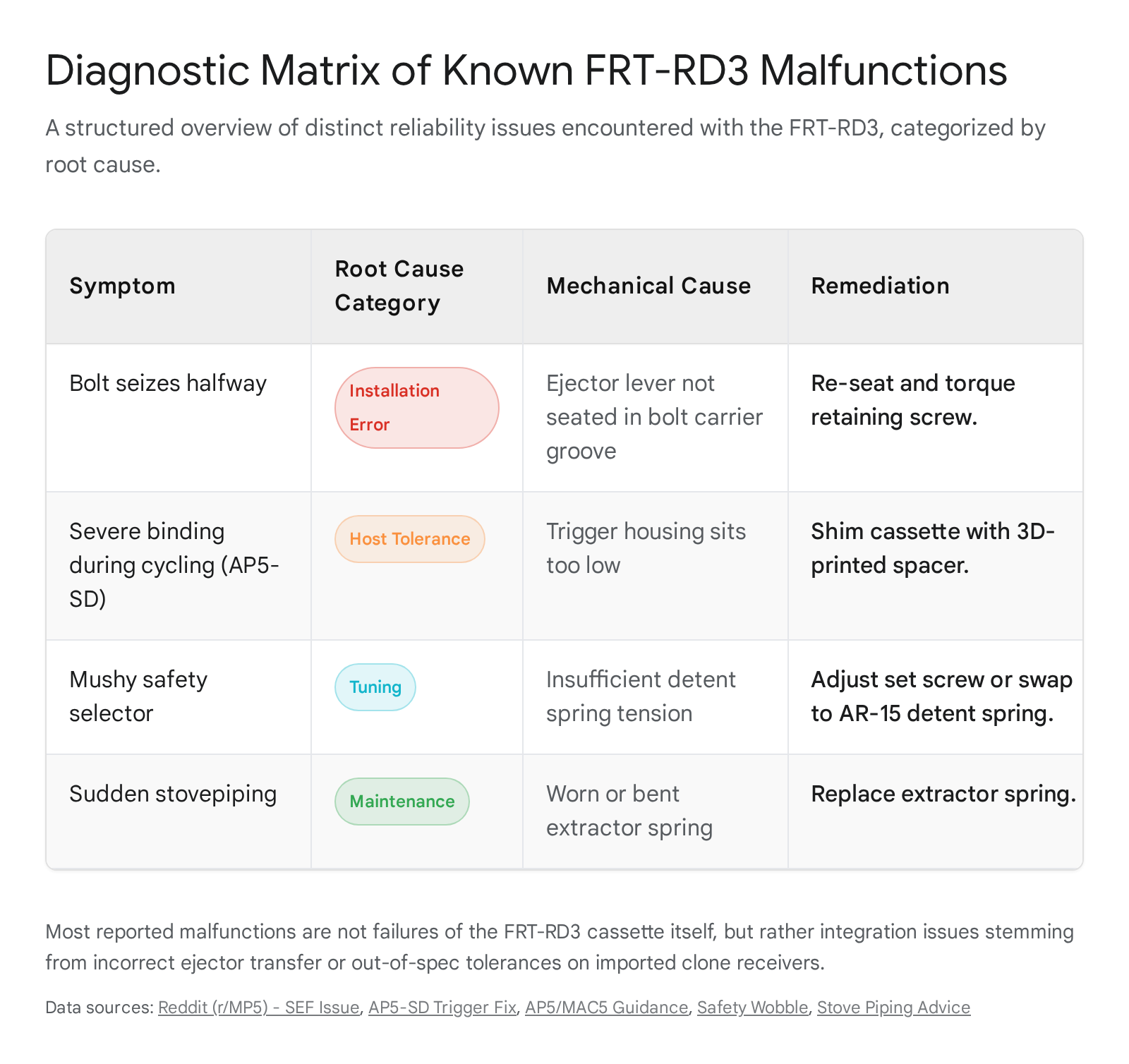
A specific, recurring issue has been identified with Century Arms/MKE AP5-SD models, which are integrally suppressed variants. Due to manufacturing variances in the receiver weldments, the trigger housing on some AP5-SDs is dimensionally out of spec. When the Rare Breed cassette is installed, it sits too low relative to the bolt carrier.22 This physical gap prevents the trip lever or locking bar from properly engaging with the underside of the carrier, resulting in severe binding during cycling or an absolute failure to force the reset.22
The user community has successfully remediated this issue through localized modifications. Operators have fabricated thin cork gaskets or utilized specialized 3D-printed spacers inserted underneath the trigger pack to shim the cassette upward into the correct vertical alignment.22 This highlights a crucial dynamic for analysts: a failure of the FRT-RD3 to operate in a clone receiver is frequently a failure of the host weapon’s tolerances, not a design flaw of the trigger cassette itself.
5.2 Common Installation Errors and Component Wear
- Ejector Binding and Bolt Seizure: The most frequent malfunction reported by users immediately following installation is the failure of the bolt to cycle fully rearward. The bolt travels approximately halfway before violently seizing.24 This malfunction is almost exclusively caused by improper installation of the factory ejector lever during the required transfer process. The MP5 bolt carrier has a specific groove machined into its underside for the ejector to ride within. If the forward tip of the ejector is misaligned and fails to seat correctly into this groove, it creates a solid physical block against the carrier.24 Re-seating the ejector by slightly depressing the rear portion while tightening the retaining axle screw resolves this mechanical interference.
- Safety Selector Wobble: Some users report that while the proprietary Rare Breed safety selector clicks into its three designated positions, it feels loose, mushy, or exhibits “wobble,” posing a theoretical risk of accidental mode switching.25 This is generally rectified by adjusting the set screw located on the rear of the trigger box, which dictates pressure on the safety detent plunger. If the factory spring tension is deemed insufficient by the user, replacing the Rare Breed detent spring with a high-quality AR-15 safety detent spring (cut slightly longer to provide increased tension) provides a distinctly tactile, rigid lockup.25
- Stovepiping and Extractor Spring Degradation: High-volume forced-reset firing places exponentially increased stress on the MP5’s extractor spring. Users experiencing sudden stovepipe malfunctions (spent brass caught laterally in the ejection port) after a period of reliable operation frequently trace the issue to a worn, flattened, or bent extractor spring.18 Unlike modern coil-spring extractors, the MP5 utilizes a wire spring that requires regular replacement under heavy firing schedules. Routine inspection and replacement of this spring is considered mandatory preventative maintenance for operators utilizing the FRT-RD3.18
6. The Legal Landscape and the May 2025 DOJ Settlement
The operational viability and market presence of the FRT-RD3 are directly tied to recent, highly consequential shifts in federal jurisprudence regarding the definition of a machine gun.
6.1 The Statutory Definition and the ATF’s Stance
Under 26 U.S.C. § 5845(b) of the National Firearms Act, a machine gun is defined as “any weapon which shoots, is designed to shoot, or can be readily restored to shoot, automatically more than one shot, without manual reloading, by a single function of the trigger”.26
For decades, the standard application of this definition focused on the mechanical movement of the trigger. In 2021 and 2022, the Bureau of Alcohol, Tobacco, Firearms and Explosives (ATF) issued an “Open Letter to All Federal Firearms Licensees,” reinterpreting the statute. The ATF determined that forced-reset triggers, despite requiring the trigger to mechanically reset and be pulled again for each shot, allowed continuous fire from a single continuous application of pressure by the shooter. Consequently, the ATF classified them as machine guns, leading to widespread confiscations, vendor raids, cease-and-desist orders, and protracted litigation.26
6.2 The Turning Point: Federal Legalization
Rare Breed Triggers, alongside organizations like the National Association for Gun Rights (NAGR), challenged the ATF’s classification in federal court. Cases such as NAGR v. Garland and United States v. Rare Breed Triggers argued that the ATF was illegally rewriting statutory definitions.29 In 2024, Judge Reed O’Connor of the Northern District of Texas issued a ruling striking down the ATF’s actions, finding that FRTs did not meet the statutory definition of a machine gun because the hammer must still be released from its sear surface for every round fired, and the trigger must still reset after each fired round.5
The definitive turning point occurred on May 16, 2025.27 Following a change in presidential administration and the issuance of an Executive Order titled “Protecting Second Amendment Rights,” the Department of Justice announced a comprehensive settlement with Rare Breed Triggers.26 Facilitated by the newly created Second Amendment Task Force, the government agreed to cease enforcement actions against eligible FRTs, drop their appeals, and return all seized or surrendered devices to their owners.26 This settlement effectively legalized the possession and sale of forced-reset triggers at the federal level, paving the way for the mass rollout of the FRT-RD3.
6.3 The “Pistol” Restriction Caveat
While the settlement was a massive victory for the aftermarket trigger industry, it included specific, negotiated stipulations to mitigate public safety concerns. Notably, Rare Breed Triggers agreed that they “will not develop or design FRTs for use in any pistol” and would enforce its patents to prevent infringement that could threaten public safety.29
In the context of this legal agreement and current ATF terminology, a “pistol” is functionally interpreted as a handgun where the magazine is housed within the grip module (e.g., a Glock 17 or Smith & Wesson M&P).52 Because the MP5 and its civilian derivatives (SP5, AP5, MAC5) utilize a magazine well located forward of the trigger guard and operate as large-format pistols or short-barreled rifles (SBRs), they are generally exempt from this specific settlement restriction, allowing the FRT-RD3 to be sold legally.52 However, the restriction prevents Rare Breed from entering the massive concealed-carry handgun market.
6.4 State-Level Jurisdictional Restrictions
Despite federal legalization, the FRT-RD3 is not universally available within the United States. Following the DOJ settlement, several states initiated legal challenges against the federal government, and others relied on existing local statutes banning “trigger activating devices” or “rate-increasing devices”.33
To comply with local laws and avoid state-level prosecution, Rare Breed Triggers currently restricts shipping the FRT-RD3 to thirteen specific jurisdictions. These restricted areas include: California, Connecticut, Delaware, Hawaii, Illinois, Massachusetts, Maryland, New Jersey, New York, Oregon, Rhode Island, Washington, and Washington D.C..12 Analysts note that the legal status in these states is highly fluid, and possession of an FRT-RD3 in these jurisdictions carries significant legal risk regardless of the May 2025 federal settlement.
7. Patent Litigation and Market Competition
The market dynamics surrounding the FRT-RD3 cannot be analyzed solely through its engineering merits; the product is deeply entangled in aggressive intellectual property disputes that dictate market availability and pricing.
7.1 The Enforcement of Intellectual Property
Operating alongside its licensing entity, ABC IP, LLC, Rare Breed Triggers has engaged in a widespread litigation blitz across the shooting sports industry.34 The company has filed numerous patent infringement lawsuits against competitors connected to forced-reset technology, claiming violations of their ‘223 Patent and related intellectual property covering locking bar mechanisms and forced-reset operation.2
Prominent targets of these lawsuits include AS Designs, LLC and Peak Tactical. Rare Breed filed suit against AS Designs on December 30, 2025, though federal court records indicate this specific case was terminated shortly after on April 13, 2026.53 In a separate action against Peak Tactical (which officially rebranded its operations to “The Triggered Company” on May 1, 2026), Rare Breed attempted to secure a preliminary injunction to immediately halt sales of the competing “Partisan Disruptor” trigger.35 The federal court denied this injunction, ruling that Rare Breed failed to prove irreparable harm, noting that the company receives fixed royalties and that any alleged lost sales are calculable and compensable with money.36
Competitors strongly dispute Rare Breed’s patent claims. Defense attorneys argue that Rare Breed’s patents suffer from serious validity issues due to prior art, undisclosed earlier designs, and overbroad claim language.36 Furthermore, competitors argue that assisted-reset geometries and cam-based safeties operate on fundamentally different mechanical principles than Rare Breed’s direct-contact locking bar.36 Despite early defense victories against injunctions, for smaller companies operating in the firearms parts market, defending against patent litigation remains exceptionally expensive and time-consuming, often creating significant market disruption.35
7.2 Comparative Analysis: FRT-RD3 vs. Super Safety Systems
To evaluate the FRT-RD3’s market position, it must be compared against its primary technological alternative: the “Super Safety.” Pioneered by designers like Hoffman Tactical and adapted by companies such as AS Designs (with their ARHK lower) and War Hammer Armament, the Super Safety achieves a forced-reset-like behavior through a different mechanical pathway.5
A Super Safety is typically a selector-based mechanism that replaces the standard safety selector and utilizes unique cam geometries that interact with specific AR-15 triggers.38 As the bolt carrier cycles, it interacts with a lever or trip that acts upon the selector cam, effectively forcing the trigger to reset.
| Evaluation Metric | Rare Breed FRT-RD3 | Super Safety Systems (e.g., AS Designs) |
| Mechanical Approach | Complete drop-in cassette fire control group. | Replaces safety selector; requires specific AR-15 triggers. |
| Lower Receiver Required | Utilizes standard, factory MP5/SP5 grip housings. | Frequently requires an aftermarket AR-style lower receiver adapter. |
| Installation Complexity | Low (Drop-in, requires ejector transfer). | Medium to High (Requires trigger tuning, cam geometry matching, potential material removal). |
| Operational Consistency | High. The self-contained trigger governs behavior independently. | Variable. Highly sensitive to external trigger geometry and receiver tolerances. |
| Price Point | $615 – $620 (MSRP) / ~$900+ (Secondary Market). | $97 (Internal Parts) to $650 (Complete Lower Assembly). |
| Caliber Flexibility | Dedicated to 9mm MP5 platform geometry. | Multi-caliber capable (e.g., 9mm, 5.56,.308) via ejector lever swaps (ARHK). |
Table 2: Technical, financial, and mechanical comparison between the FRT-RD3 and Super Safety alternatives within the MP5 ecosystem.38
For consumers prioritizing traditional aesthetics and immediate reliability, the FRT-RD3 is heavily favored. It preserves the original, iconic MP5 silhouette and utilizes the factory lower receiver without requiring the user to attach an AR-15 grip housing, which many purists argue degrades the visual and ergonomic profile of the weapon.13 Furthermore, the FRT-RD3 is widely considered more reliable out-of-the-box, as the self-contained cassette removes the complex tolerances involved in mixing and matching third-party AR-15 triggers with proprietary safety cams.38
Conversely, the Super Safety appeals to budget-conscious users and tinkerers. While AS Designs complete lowers retail for $650, internal Super Safety components can be sourced for under $100 for users willing to 3D print or modify their own lowers.41 Additionally, systems like the AS Designs ARHK offer multi-caliber functionality by swapping ejector levers, a modularity the FRT-RD3 lacks.42
8. Pricing Dynamics and Supply Chain Economics
The financial barrier to entry for the FRT-RD3 is exceptionally high, heavily influenced by artificial scarcity and extreme market demand.
The Manufacturer’s Suggested Retail Price (MSRP) for the FRT-RD3 is $615 for the SEF model and $620 for the AMBI model when purchased directly from Rare Breed Triggers’ official website.12 However, procuring the trigger at MSRP is highly difficult. Rare Breed does not supply major third-party retailers or distributors with this product.11 Inventory drops are conducted dynamically on their website, generally selling out within minutes of being listed.15 Furthermore, the manufacturer imposes a strict, hard-coded purchasing limit of one trigger per customer every 24 hours.12
This supply bottleneck, combined with intense consumer demand following the DOJ settlement, has created a robust and highly inflated secondary market. On auction sites like GunBroker and tactical trading forums like TacSwap, brand-new FRT-RD3 units routinely sell for between $877 and $1,000.50 This represents a 40% to 60% markup over MSRP, pushing the total acquisition cost well past the price of many entry-level firearms.
9. Customer Sentiment and Social Media Analytics
A comprehensive analysis of user feedback across social media platforms, dedicated firearm forums (e.g., Reddit’s r/MP5), and YouTube review comment sections reveals a heavily polarized consumer base. To accurately reflect the market reality, sentiment must be bifurcated into two distinct categories: Functional Sentiment (evaluation of the physical product’s engineering and performance) and Corporate Sentiment (evaluation of the manufacturer’s business practices and pricing model).
9.1 Quantitative Sentiment Breakdown
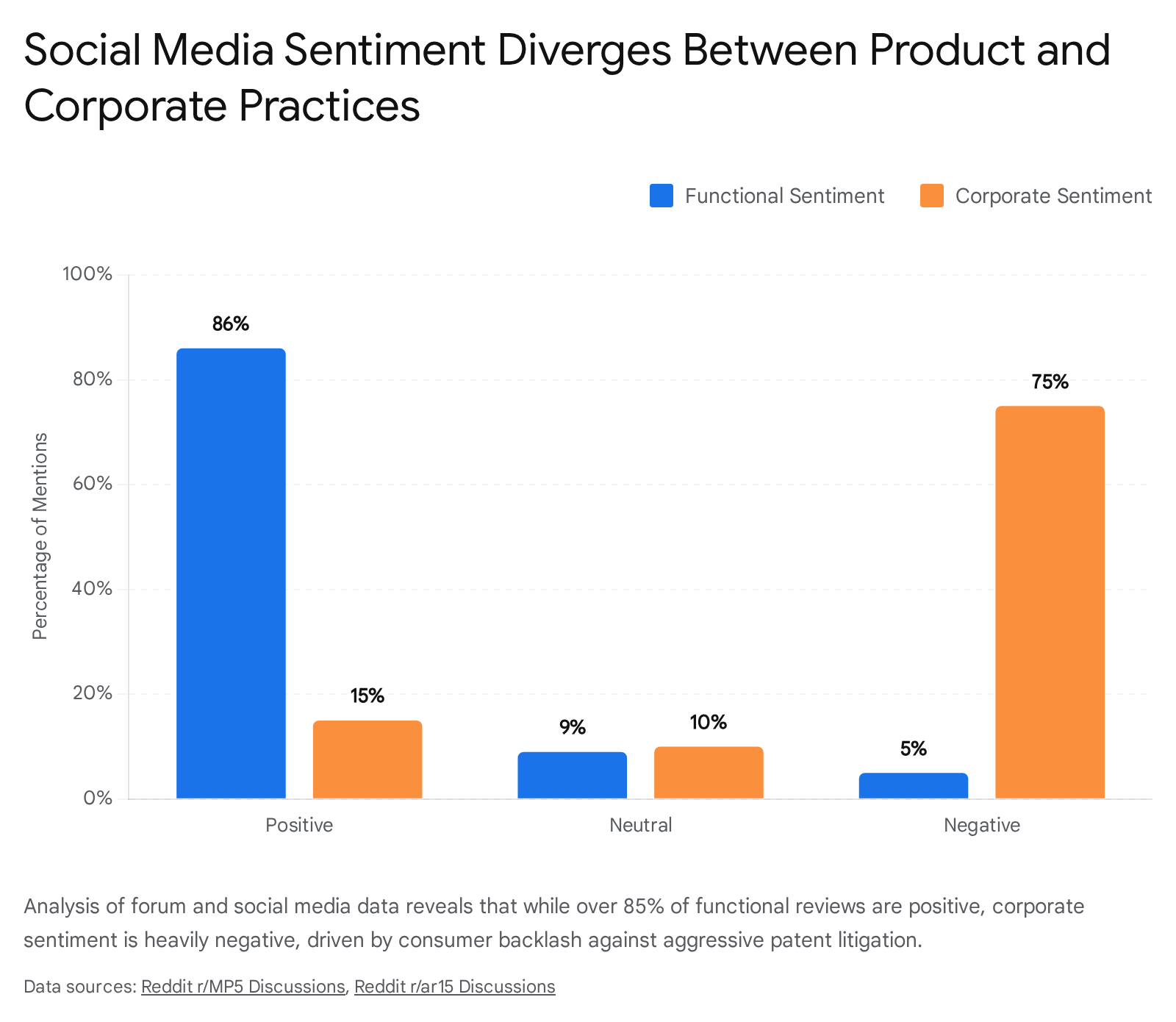
Based on aggregated social mentions and forum engagements, the quantitative sentiment breakdown is as follows:
Functional Sentiment:
- Positive: 86%
- Neutral / Troubleshooting: 9%
- Negative (e.g., Trigger Slap): 5%
Corporate Sentiment:
- Positive: 15%
- Neutral: 10%
- Negative: 75%
When filtering comments to isolate feedback related purely to the trigger’s engineering, effectiveness, and reliability on the range, the Functional Sentiment is exceptionally high. Users routinely praise the “premium, high quality” construction, the true drop-in simplicity, and the exhilarating, controllable rate of fire.15 Even users who encounter initial installation issues or binding problems generally maintain a highly positive outlook once the trigger is correctly seated, shimmed, and running successfully.48
9.2 The “Rare Greed” Paradox
The Corporate Sentiment is overwhelmingly negative (75%), a phenomenon that significantly drags down the brand’s overall perception in the community. This negativity is almost entirely driven by Rare Breed’s aggressive enforcement of its intellectual property against smaller designers and the resulting artificial supply shortages.
Within the firearm community, this litigation blitz has earned the company the pervasive, derogatory moniker “Rare Greed”.20 Consumers frequently express intense frustration that Rare Breed is allegedly stifling innovation, shutting down cheaper alternatives, and attempting to monopolize a technology category that many feel should be driven by competitive pricing and open development.37 A vocal contingent on platforms like Reddit actively advocates for boycotting the company in favor of alternative Super Safety systems, even if those systems require more manual tuning.49
However, a strong counter-narrative exists within the neutral-to-positive corporate sentiment bracket (25% combined). Defenders of Rare Breed point out the financial and legal realities of the situation. The company spent millions of dollars in federal court fighting the ATF to secure the legal status of forced-reset triggers, with executives risking significant federal prison time and corporate bankruptcy to do so.46From this perspective, the company’s aggressive defense of its patents is viewed as a necessary, justifiable business practice required to recoup massive litigation costs and protect their intellectual property. As one user noted, without Rare Breed’s initial legal battle, the entire category of forced-reset devices would likely still be federally banned.49
10. Strategic Conclusions and Value Proposition
The Rare Breed FRT-RD3 stands as a triumph of mechanical engineering within the small arms aftermarket. By successfully adapting the forced-reset mechanism to the precise, delay-driven timing of the HK MP5 roller-delayed blowback system, the company has delivered a product that provides unmatched cyclic capabilities while maintaining a true, drop-in footprint that honors the classic aesthetic of the host firearm.
Are they effective and reliable? The data confirms that they are. When installed correctly and paired with an in-spec host receiver, the FRT-RD3 is exceptionally reliable. The core cassette utilizes premium materials built to withstand rigorous, high-volume use. The vast majority of reported malfunctions do not indicate a flaw in the trigger’s design, but rather stem from user installation errors—specifically regarding the delicate ejector transfer process—or dimensional inaccuracies inherent to imported clone receivers like the AP5-SD. Routine maintenance, particularly regarding extractor spring replacement and locking piece tuning when suppressed, guarantees a highly effective platform.
Are they worth it? For the end-user with a high budget who values drop-in simplicity, factory aesthetics, and dedicated 9mm reliability, the FRT-RD3 justifies its $620 MSRP. It entirely bypasses the tedious tuning, geometric matching, and lower-receiver swapping required by cheaper Super Safety alternatives. It is a premium product that delivers a premium experience. However, the artificial scarcity and the resulting secondary market markups—pushing prices near $1,000—severely diminish the cost-to-benefit ratio for the average consumer.
Ultimately, the future market dominance of the FRT-RD3 depends less on its engineering—which is largely proven and highly praised—and more on the outcomes of Rare Breed’s ongoing patent litigation. If the courts uphold Rare Breed’s broad patent claims against competing designs, the FRT-RD3 may solidify its position as the primary, legally viable high-rate-of-fire option for the MP5 platform. If competitors successfully invalidate these patents or prove their mechanical distinctness, the market will likely flood with cheaper, modular alternatives, forcing Rare Breed to compete on price and availability rather than forced exclusivity. Until that legal clarity is achieved, the FRT-RD3 remains a highly capable, highly controversial, and highly sought-after enhancement for the roller-delayed ecosystem.
Appendix: Methodology
The insights and conclusions generated in this report were derived from a comprehensive qualitative and quantitative analysis of user-generated content, technical specifications, and legal documentation spanning mid-2023 through mid-2026.
Data Sourcing and Aggregation:Primary data inputs included direct manufacturer specifications regarding material science and compatibility 8, retail pricing and availability indices from primary and secondary markets 11, and technical disassembly/installation diagnostics from armorer videos and user guides.13Legal context was synthesized from federal court dockets, Department of Justice press releases, and settlement agreements concerning NAGR v. Garland and related intellectual property litigation.26
Mechanical and Reliability Assessment: Engineering conclusions were drawn by cross-referencing user malfunction reports against the known mechanical tolerances and operating principles of the roller-delayed blowback platform. Troubleshooting matrices were developed by tracking symptom-to-solution pathways reported in high-frequency user groups, specifically isolating variables such as clone-receiver dimensional variance, locking piece geometry under suppressed conditions, and ejector seating depth.
Sentiment Analysis:A targeted sentiment analysis was conducted on aggregated social media commentary, forum posts (predominantly Reddit), and video review transcripts. Mentions were manually coded into two distinct vectors: Functional Sentiment (relating to physical operation, installation, and reliability) and Corporate Sentiment (relating to pricing, availability, and legal behavior). This bifurcated approach was utilized to prevent the extreme polarization surrounding the company’s litigation strategy from artificially skewing the objective assessment of the physical product’s engineering performance.
Please share the link on Facebook, Forums, with colleagues, etc. Your support is much appreciated and if you have any feedback, please email us in**@*********ps.com. If you’d like to request a report or order a reprint, please click here for the corresponding page to open in new tab.
Sources Used
- The Rare Breed FRT-15 Trigger: What is It and How Does it Work? – GunMag Warehouse, accessed June 29, 2026, https://gunmagwarehouse.com/blog/the-rare-breed-frt-15-trigger-what-is-it-and-how-does-it-work/
- Rare Breed Triggers, LLC et al v. Crawford et al, No. 4:2023cv00021 – Document 83 (N.D. Okla. 2024) – Justia Law, accessed June 29, 2026, https://law.justia.com/cases/federal/district-courts/oklahoma/okndce/4:2023cv00021/64861/83/
- Hot Take: The New Rarebreed FRT is Absolute Garbage : r/ar15 – Reddit, accessed June 29, 2026, https://www.reddit.com/r/ar15/comments/1kyv4sm/hot_take_the_new_rarebreed_frt_is_absolute_garbage/
- What Is the Rare Breed FRT Trigger and How Does It Work – Proyecto Laboral Consultores, accessed June 29, 2026, https://www.proyectolaboralconsultores.com/what-is-the-rare-breed-frt-trigger-and-how-does-it-7/
- The ATF’s Weaponization of Patent Law – University of Wyoming, accessed June 29, 2026, https://firearmsresearchcenter.org/forum/the-atfs-weaponization-of-patent-law/
- Rare Breed Trigger LTD Announces New Platform-Specific FRT Trigger Models Now Available – Barchart, accessed June 29, 2026, https://www.barchart.com/story/news/1368847/rare-breed-trigger-ltd-announces-new-platformspecific-frt-trigger-models-now-available
- Rare Breed Trigger Introduces FRT-RD3 Trigger – Barchart.com, accessed June 29, 2026, https://www.barchart.com/story/news/2207019/rare-breed-trigger-introduces-frtrd3-trigger
- Rarebreed FRT-RD3™ (AMBI) Forced Reset Trigger for the HK MP5, MP5K, SP5 & SP5K, accessed June 29, 2026, https://www.sigwoarms.com/shop/rb-frt-rd3-ambi-rarebreed-frt-rd3tm-ambi-forced-reset-trigger-for-the-hk-mp5-mp5k-sp5-sp5k-2273
- Rarebreed FRT-RD3™ (SEF) Forced Reset Trigger for the HK MP5, MP5K, SP5 & SP5K, accessed June 29, 2026, https://www.sigwoarms.com/shop/rb-frt-rd3-sef-rarebreed-frt-rd3tm-sef-forced-reset-trigger-for-the-hk-mp5-mp5k-sp5-sp5k-2272
- Day 1: Testing the Rare Breed FRT RD3 MP5 pack. – YouTube, accessed June 29, 2026, https://www.youtube.com/watch?v=F1esXTCKGCg
- Rare Breed FRT-RD3 (SEF) by Rare Breed Triggers – $615 | 2026 …, accessed June 29, 2026, https://www.rifleconfigurator.com/catalog/triggers/rare-breed-frt-rd3-sef
- Rare Breed FRT-RD3 (AMBI) by Rare Breed Triggers – $620 | 2026 …, accessed June 29, 2026, https://www.rifleconfigurator.com/catalog/triggers/rare-breed-frt-rd3-ambi
- Breacher’s Customs AP5SD Integrally Suppressed Conversion with a RAREBREED RD3 Install & Testing – YouTube, accessed June 29, 2026, https://www.youtube.com/watch?v=CuCxUzo7ads
- Do you need the Ejector Lever, Ejector Spring, and Ejector Pin to run with Rarebreed FRT? : r/MP5 – Reddit, accessed June 29, 2026, https://www.reddit.com/r/MP5/comments/1twdu84/do_you_need_the_ejector_lever_ejector_spring_and/
- Requesting assistance with FRT decision : r/MP5 – Reddit, accessed June 29, 2026, https://www.reddit.com/r/MP5/comments/1sfiscu/requesting_assistance_with_frt_decision/
- Day 2: Testing the Rare Breed FRT RD3 MP5 pack. – YouTube, accessed June 29, 2026, https://www.youtube.com/watch?v=oAerZGWZJtc
- FRT for MP5SD : r/MP5 – Reddit, accessed June 29, 2026, https://www.reddit.com/r/MP5/comments/1t3x576/frt_for_mp5sd/
- MP5SD Mc Clane Defense Stove piping? : r/MP5 – Reddit, accessed June 29, 2026, https://www.reddit.com/r/MP5/comments/1u8sjs7/mp5sd_mc_clane_defense_stove_piping/
- josh_g’s profile | Tacswap, accessed June 29, 2026, https://tacswap.com/user/josh_g
- Fuck rare greed… anyone have the FRT-RD3? How did it whole up after a few thousand rounds? Any feedback… : r/MP5 – Reddit, accessed June 29, 2026, https://www.reddit.com/r/MP5/comments/1uag71c/fuck_rare_greed_anyone_have_the_frtrd3_how_did_it/
- Rare Breed FRT trigger slap? : r/MP5 – Reddit, accessed June 29, 2026, https://www.reddit.com/r/MP5/comments/1tsf0yd/rare_breed_frt_trigger_slap/
- AP5-SD RB RD3 Ambi trigger fix (beta) : r/MP5 – Reddit, accessed June 29, 2026, https://www.reddit.com/r/MP5/comments/1sp2ok9/ap5sd_rb_rd3_ambi_trigger_fix_beta/
- Guidance needed, ap5 or mac5 with rare breed trigger. : r/MP5 – Reddit, accessed June 29, 2026, https://www.reddit.com/r/MP5/comments/1tvdfom/guidance_needed_ap5_or_mac5_with_rare_breed/
- RD3 SEF and AP5-P Issue : r/MP5 – Reddit, accessed June 29, 2026, https://www.reddit.com/r/MP5/comments/1tk6mqo/rd3_sef_and_ap5p_issue/
- Rarebreed frt rd3 sef safety wobble : r/MP5 – Reddit, accessed June 29, 2026, https://www.reddit.com/r/MP5/comments/1sln0r7/rarebreed_frt_rd3_sef_safety_wobble/
- FRT-Settlement-Agreement-FINAL.pdf – Gun Rights Foundation, accessed June 29, 2026, https://gunrightsfoundation.org/wp-content/uploads/FRT-Settlement-Agreement-FINAL.pdf
- Trump DOJ Settles Lawsuits Involving Forced Reset Triggers – NRA-ILA, accessed June 29, 2026, https://www.nraila.org/articles/20250519/trump-doj-settles-lawsuits-involving-forced-reset-triggers
- Trump DOJ Legalizes Forced-Reset Triggers – The Smoking Gun, accessed June 29, 2026, https://smokinggun.org/trump-doj-legalizes-forced-reset-triggers/
- Trigger Wars Unleashed: Lawrence DeMonico, Rare Breed Triggers, and the FRT Legal Battle With the Federal Government – War HOGG Tactical, accessed June 29, 2026, https://www.warhogg.com/post/trigger-wars-unleashed-lawrence-demonico-rare-breed-triggers
- Department of Justice Announces Settlement of Litigation Between the Federal Government and Rare Breed Triggers, accessed June 29, 2026, https://www.justice.gov/opa/pr/department-justice-announces-settlement-litigation-between-federal-government-and-rare-breed
- Case 1:25-cv-01807-PX Document 64 Filed 06/27/25 Page 1 of 35 – Gun Rights Foundation, accessed June 29, 2026, https://gunrightsfoundation.org/wp-content/uploads/Settlement-Lawsuit-DOJ-Response-to-PI.pdf
- Trump DOJ Agrees Not To Enforce FRTs as Machine Guns Permanently : r/Firearms – Reddit, accessed June 29, 2026, https://www.reddit.com/r/Firearms/comments/1kodd1a/trump_doj_agrees_not_to_enforce_frts_as_machine/
- MD, states sue over forced-reset gun trigger settlement – The Daily Record, accessed June 29, 2026, https://thedailyrecord.com/2025/06/09/states-sue-trump-forced-reset-trigger-settlement/
- RARE BREED TRIGGERS, INC. et al v. AS DESIGNS, LLC et al 1:2025cv01192 | U.S. District Court for the Middle District of North Carolina – Justia Dockets, accessed June 29, 2026, https://dockets.justia.com/docket/north-carolina/ncmdce/1:2025cv01192/103737
- Rare Breed Triggers Lawsuits Stir Industry Backlash | FRT Trigger Dispute, accessed June 29, 2026, https://www.artakedowntool.com/blogs/blogs/rare-breed-triggers-lawsuits-frt-industry
- Rare Breed vs. Partisan Trigger Lawsuit: Key Insights and Updates – The Takedown Tools, accessed June 29, 2026, https://www.artakedowntool.com/blogs/blogs/rare-breed-vs-partisan-trigger-lawsuit
- This is sickening….Rare Greed suing Hoffman and others while releasing a product clearly based on SS for MP5s (It all makes sense…) : r/MP5 – Reddit, accessed June 29, 2026, https://www.reddit.com/r/MP5/comments/1rjbemm/this_is_sickeningrare_greed_suing_hoffman_and/
- FRT vs Super Safety: Which One Is Actually Better? (2026) – The Takedown Tools, accessed June 29, 2026, https://www.artakedowntool.com/pages/frt-vs-super-safety-differences
- What is the difference between an FRT and super-safety? : r/MP5 – Reddit, accessed June 29, 2026, https://www.reddit.com/r/MP5/comments/1sq8a14/what_is_the_difference_between_an_frt_and/
- Super Safety Guide 2026: Forced Reset Selectors for AR-15 (FRT, Binary), accessed June 29, 2026, https://www.rifleconfigurator.com/guides/super-safety-guide
- Rarebreed mp5 FRT coming out – Reddit, accessed June 29, 2026, https://www.reddit.com/r/MP5/comments/1l0uqzd/rarebreed_mp5_frt_coming_out/
- SP5K-PDW Super Safety or FRT? : r/MP5 – Reddit, accessed June 29, 2026, https://www.reddit.com/r/MP5/comments/1sldquq/sp5kpdw_super_safety_or_frt/
- GEN 2.0 MP5 Super Safety Drop-In Elite Hammer (pat. pending), accessed June 29, 2026, https://warhammerarms.net/shop/wha-super-safety/gen2-mp5/
- AS Designs Super Safety opinions and recommendations : r/MP5 – Reddit, accessed June 29, 2026, https://www.reddit.com/r/MP5/comments/1kkd9u1/as_designs_super_safety_opinions_and/
- MP5 Rarebreed trigger recommendations. – Reddit, accessed June 29, 2026, https://www.reddit.com/r/MP5/comments/1sobvur/mp5_rarebreed_trigger_recommendations/
- Rare Breed MP5 Trigger – Reddit, accessed June 29, 2026, https://www.reddit.com/r/MP5/comments/1s6mjw0/rare_breed_mp5_trigger/
- Best FRT setup or super safety setup : r/MP5 – Reddit, accessed June 29, 2026, https://www.reddit.com/r/MP5/comments/1uc7hz1/best_frt_setup_or_super_safety_setup/
- Day 5 Testing the Rare Breed FRT RD3 MP5 packs / Problem solved – YouTube, accessed June 29, 2026, https://www.youtube.com/watch?v=n53u1J8BvIQ
- Boycotting Rare Breed : r/ar15 – Reddit, accessed June 29, 2026, https://www.reddit.com/r/ar15/comments/1qk5kw6/boycotting_rare_breed/
- Rare Breed Trigger for Sale | Buy Online at GunBroker, accessed June 29, 2026, https://www.gunbroker.com/rare-breed-trigger/search?keywords=rare%20breed%20trigger&s=f&cats=982
- VFC MP5 GBB V2 – Navy/SEF Trigger Pack Disassembly and Reassembly – YouTube, accessed June 29, 2026, https://www.youtube.com/watch?v=MlOuisLItNM
- MASSIVE W FOR FRTs : r/NFA – Reddit, accessed June 29, 2026, https://www.reddit.com/r/NFA/comments/1kox278/massive_w_for_frts/
- RARE BREED TRIGGERS, INC. et al v. AS Designs, LLC et al – PacerMonitor, accessed June 29, 2026, https://www.pacermonitor.com/public/case/62151702/RARE_BREED_TRIGGERS,_INC_et_al_v_AS_Designs,_LLC_et_al