
1. Executive Summary
As the United States approaches the July 4th, 2026 Semiquincentennial (America250) celebrations, the domestic homeland security enterprise and law enforcement tactical communities face a highly complex, multi-vector threat environment. This intelligence estimate, prepared for the law enforcement, military, and defense industry professionals utilizing blog.roninsgrips.com, assesses the strategic operating environment, adversary tactical shifts, and necessary procurement and readiness adaptations required to secure the homeland during this critical window.
The convergence of the 250th anniversary of the nation’s independence with the ongoing 2026 FIFA World Cup has exponentially expanded the target surface, placing unprecedented operational strain on federal, state, local, tribal, and territorial (SLTT) law enforcement agencies.1 Current intelligence indicates that while highly coordinated, foreign-directed attacks remain a persistent secondary concern, the primary and most acute kinetic threat originates from lone offenders, decentralized domestic violent extremist (DVE) cells, and geographically distributed conspiratorial networks.1
Recent interdictions demonstrate an alarming evolution in the tactical capabilities of domestic actors. The disruption of a highly sophisticated, multi-state plot targeting the June 2026 Ultimate Fighting Championship (UFC) Freedom 250 event at the White House highlighted a transition toward hybrid warfare tactics.1 Threat actors are increasingly leveraging encrypted communications, 3D printing technology for decentralized arms manufacturing, night vision optics, and unmanned aircraft systems (UAS) to engineer multi-modal attacks designed to maximize casualties through complex crowd manipulation.1
Furthermore, the ideological polarization surrounding the America250 events has galvanized various anti-authoritarian and extremist factions, resulting in the planned mobilization of heavily armed protest groups in major metropolitan centers, most notably Philadelphia.6 This dynamic presents severe operational challenges for tactical response teams operating under restrictive rules of engagement (ROE) in dense urban environments. This estimate provides an analytical breakdown of the current threat baseline, tactical shifts in adversarial operations, small arms and hardware procurement implications, physical and cyber vulnerabilities, and actionable preparedness directives.
2. Strategic Operating Environment and Threat Designations
The assessment of the current threat posture requires an analysis of official advisories, special event security designations, and the underlying resource strain placed upon the national security apparatus. The operational tempo for tactical teams and protective details has reached levels unseen since the post-9/11 security reorganizations.
Currently, the Department of Homeland Security (DHS) National Terrorism Advisory System (NTAS) does not feature an active, nationwide alert bulletin.7 The most recent bulletin expired in September 2025.7 However, the absence of an active NTAS alert must not be interpreted as a diminished threat environment. Rather, it reflects the localized, decentralized, and rapidly shifting nature of the current intelligence picture, where specific regional threats have superseded broad, national-level directives. The strategic environment is heavily defined by the sheer volume and global visibility of high-profile events occurring simultaneously.
The multiyear “America250” initiative encompasses over 1,200 synchronized grassroots gatherings operating under the “America’s Block Party” umbrella, with flagship events concentrated in Washington D.C., Philadelphia, Boston, New York, and Los Angeles.2 Concurrently, the United States is hosting the FIFA World Cup, utilizing stadiums and transit infrastructures across more than twenty states.8 DHS has designated all 78 World Cup matches with a Special Event Assessment Rating (SEAR) of Level 1 or 2.8 A SEAR 1 rating designates an event of significant national or international importance that requires extensive federal interagency support, explicitly including the deployment of explosive detection canine teams, advanced venue screening, field intelligence units, and tactical operations support.9 This volume of high-security requirements represents a 240% increase in similarly rated events compared to a standard operational year, severely taxing the supply chains for specialized tactical equipment and personnel.8
| Security Designation Category | Description of Security Posture and Tactical Requirements | Historical/Current Examples |
| National Security Special Event (NSSE) | Highest federal security classification; United States Secret Service (USSS) assumes lead command. Mandates strict identity verification, magnetometers, deployment of counter-sniper teams, and prolonged airspace closures. | 2026 July 4th National Mall Fireworks.10 |
| SEAR Level 1 | Events of national/international importance requiring extensive federal interagency capability support, specialized tactical units, and dedicated intelligence fusion cells. | FIFA World Cup Matches; Super Bowl.8 |
| SEAR Level 2 | Significant events requiring targeted federal interagency support, coordination teams, and supplemental physical security infrastructure. | Regional America250 flagship events; Select World Cup team base camps.8 |
| City of Concern | Analytical designation by the National Counterterrorism Center (NCTC) noting severe operational pressure, intersecting threat vectors, and the necessity for elevated readiness postures. | Philadelphia (July 4th weekend, 2026).2 |
In Washington D.C., the July 4th fireworks display on the National Mall has been designated an NSSE for the first time in history.10 This designation fundamentally alters the jurisdictional command structure, placing the Secret Service at the helm of the security design and requiring massive localized procurement of physical barricades, screening technology, and armored platforms. The practical implications for the public and the operational reality for law enforcement include airport-style security checkpoints, long processing queues, and the highly visible deployment of military-grade hardware. Currently, the capital is being secured by 5,000 National Guard troops alongside federal agents and local police, utilizing Mine-Resistant Ambush Protected (MRAP) vehicles, BearCat armored tactical SWAT units, FBI diving boats, and mobile communication command centers.10 Furthermore, commercial aviation operations at Ronald Reagan Washington National Airport will face extended suspensions—from noon on July 4th through the following day—to secure the airspace against aerial incursions.10
The strategic environment is further complicated by the political climate and the presence of a highly visible executive branch. President Donald Trump has actively integrated the America250 kickoff into a campaign-style platform, hosting heavily publicized events on the National Mall featuring stealth bomber flyovers and military bands.10 Security analysts describe the current executive as both an accelerant and a target of political violence, necessitating an adaptable and highly robust protective model from the Secret Service.10 Observers have drawn distinct historical parallels to the 1976 U.S. Bicentennial, which occurred amid deep national cynicism following the Watergate scandal and the Vietnam War, and just ten months after two assassination attempts on then-President Gerald Ford.10 Similarly, the 2026 celebrations follow multiple recent assassination attempts and intense political polarization, exacerbating the potential for ideologically motivated violence.10
3. Evolution of Domestic Violent Extremist (DVE) Tactics and Weaponry
The operational tactics and weapon systems deployed by domestic violent extremists have undergone a pronounced shift over the past year. Historically, domestic extremist actions surrounding political grievances or immigration policies primarily resulted in property damage, vandalism, or isolated, low-level physical altercations.12 Recent joint intelligence bulletins distributed by the FBI and DHS indicate a definitive escalation toward pre-planned, lethal kinetic violence directed at government personnel, law enforcement officers, and critical infrastructure.12
This evolution is starkly evidenced by recent targeted attacks on Immigration and Customs Enforcement (ICE) facilities. In a prominent incident in Dallas, Texas, an extremist identified as Joshua Jahn conducted detailed, methodical prior surveillance of a facility to map the operational patterns and physical locations of ICE personnel.12 Jahn subsequently secured an elevated rooftop vantage point and directed sustained gunfire at transport vehicles and the facility’s interior, resulting in the deaths of two detainees—one at the scene and another who succumbed to injuries six days later—and the critical wounding of a third, before taking his own life.12 A subsequent July 4th attack at the Prairieland Detention Center in Alvarado, Texas, involved an attacker firing on a local law enforcement officer from a concealed, fortified position.12
These incidents represent a critical shift in adversary methodology and small arms deployment. The use of pre-attack surveillance to identify physical vulnerabilities, the exploitation of elevated sniper positions, and the deliberate targeting of human life indicates a professionalization of domestic extremist cells. Threat actors are studying the physical layouts of target zones, identifying egress choke points, and calculating the most effective engagement angles to maximize casualties and hinder the response capabilities of tactical teams. This necessitates a corresponding shift in law enforcement procurement, specifically emphasizing counter-sniper capabilities, advanced thermal and night vision optics, and specialized situational awareness tools previously reserved for military special operations forces.
Furthermore, the threat landscape is increasingly dominated by the “lone offender” or highly insular small group model.1 These actors are often radicalized via decentralized online networks, consuming propaganda ranging from foreign terrorist organizations to domestic anti-government ideologies.1 Because these individuals operate outside of established organizational hierarchies, they generate a minimal digital and financial footprint, making preemptive interdiction via traditional intelligence streams exceptionally difficult.
The primary mechanism of attack for lone offenders remains the use of easily accessible weapons, including common firearms and vehicles utilized for crowd ramming.1 Vehicle ramming remains a highly attractive method due to its simplicity, requiring no specialized tactical training or access to illicit procurement networks, while offering the potential for catastrophic kinetic effects in dense, unbarricaded pedestrian zones surrounding major event perimeters.1
4. Case Study Analysis: The Washington D.C. Kinetic Threat Profile
Washington D.C. remains the epicenter for both physical and ideological targeting. As noted by Darren B. Cox, the assistant director in charge of the FBI’s Washington Field Office, the city operates as a “target-rich environment” on a standard operational day.10 The infusion of America250 events has exponentially magnified this dynamic. Analyzing recent kinetic interdictions provides critical insight into the operational capabilities, procurement networks, and intentions of threat actors preparing to strike during the July 4th window.
4.1 The White House Correspondents’ Dinner Incident
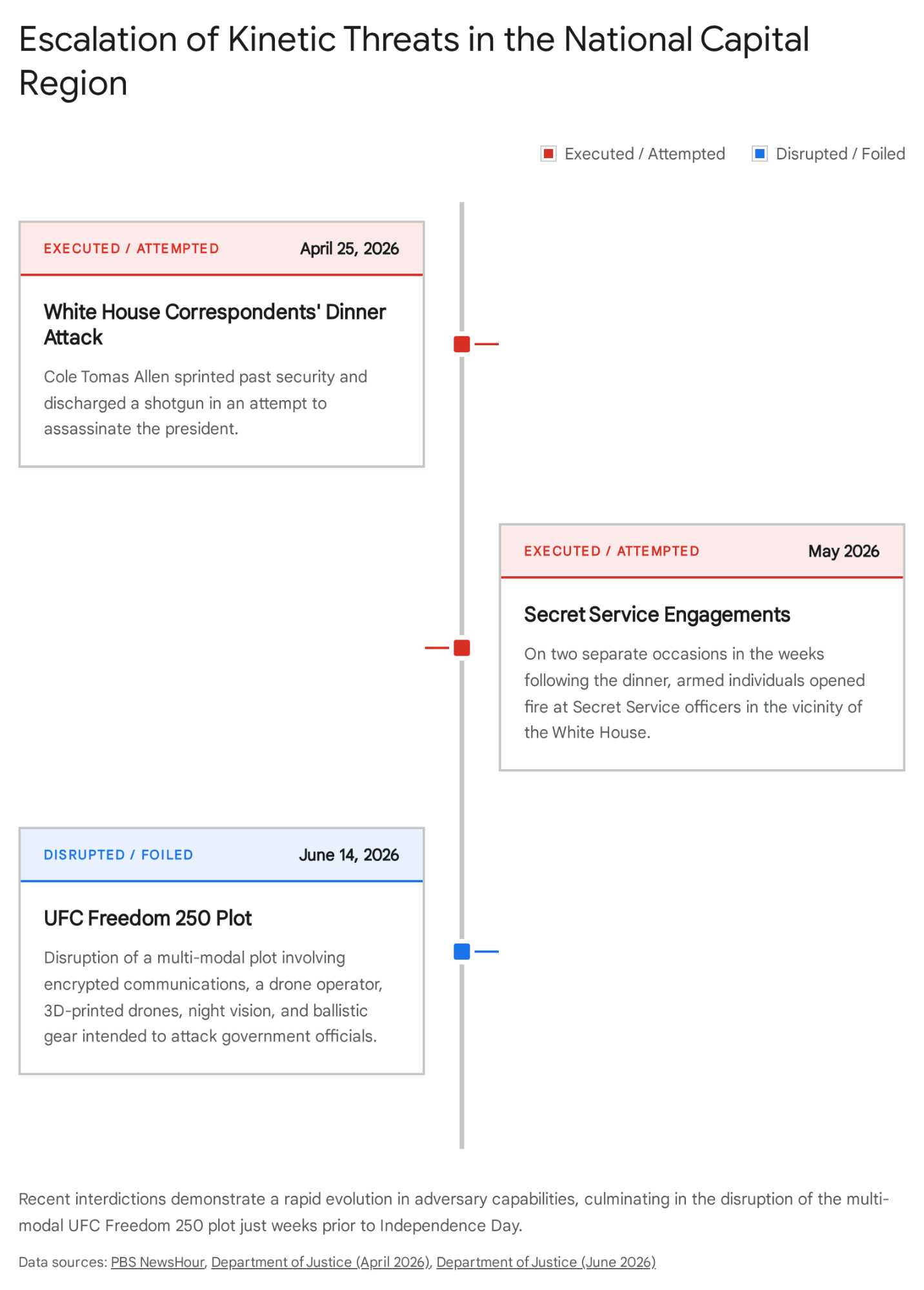
On April 25, 2026, a 31-year-old individual identified as Cole Tomas Allen transported a shotgun and ammunition across state lines from Torrance, California, to Washington D.C., attempting to assassinate the President at the Washington Hilton during the White House Correspondents’ Association Dinner.10 Allen managed to bypass outer security perimeters before being intercepted and apprehended by law enforcement officers.10 He is currently being held in custody without bond and faces multiple federal charges, including the attempted assassination of the President.3613
This incident underscores the persistent vulnerability of soft perimeters and the willingness of actors to aggressively engage heavily fortified targets. Allen’s profile—a suspect holding a master’s degree in computer science acting on deep-seated, manifesto-driven political grievances—illustrates the difficulty of relying on traditional demographic profiling for threat assessment.14 The attack, while linear and employing a conventional shotgun, highlighted the speed at which an individual can transition from ideological radicalization to kinetic action, traveling transcontinentally to execute an assault.11 The selection of a shotgun, a weapon characterized by devastating close-range kinetic energy but limited long-range precision, indicates an intent to force a close-quarters engagement within the confines of the event perimeter.
4.2 The UFC Freedom 250 Multi-State Hybrid Plot
The most significant intelligence indicator leading into the July 4th weekend is the disrupted plot targeting the UFC Freedom 250 event held on the White House South Lawn on June 14, 2026. This highly controversial event—which featured MMA fighters walking out from the Oval Office to music performed by the Marine Band in front of an estimated 4,300 attendees and broadcast to 34 million viewers globally—represented an unprecedented security challenge.16 The plot against it, dismantled through a fast-moving interagency operation, represents a quantum leap in domestic terrorist capabilities, shifting from the linear lone-actor model to a decentralized, multi-modal cell structure.1
The network was geographically distributed across multiple time zones, illustrating a high degree of operational security and logistical compartmentalization. Alexander Iniguez Mercado, a 20-year-old operating out of Chicago, Illinois, functioned as the network administrator, utilizing the end-to-end encrypted messaging application Signal to recruit and coordinate the cell.5 Mercado actively attempted to delete digital footprints and obstruct justice when contacted by federal agents.5 In St. Joseph, Missouri, 28-year-old Jordan Rincker managed the financial logistics, utilizing peer-to-peer payment platforms like CashApp to disburse funds, including providing travel money for Bryan Omar Roa in California to transport a designated “drone operator” to the capital.4
The hardware procurement and bartering methods utilized by the cell are of particular interest to law enforcement procurement and small arms analysts. During an in-person meeting in Omaha, Nebraska, 31-year-old Abraham Hermosillo Alvarez provided Rincker with a highly sophisticated cache of tactical and manufacturing equipment.4 This cache included a 3D printer, specialized 3D printing filament, night vision goggles, ballistic plates, a face shield, binoculars, a wire checker, and a minicomputer.4 This equipment was specifically intended for the decentralized, domestic manufacture of unmanned aerial vehicles (UAVs) and explosive payloads.4
In exchange for this advanced manufacturing and tactical capability, Rincker supplied Alvarez with a single 12-gauge pump-action shotgun.4 A fifth conspirator, William Lee Spartacus Falkner, was arrested in Washington State in connection with procuring the explosive-laden drones.18
| Conspirator | Geographic Node | Operational Role and Technical Capability within Cell |
| Alexander Iniguez Mercado | Chicago, IL | Communications Admin (Signal); Recruitment; Obstruction of Justice/Digital Evasion.5 |
| Jordan Rincker | St. Joseph, MO | Financial Logistics (CashApp); Weapons procurement; Cross-country facilitation.4 |
| Abraham Hermosillo Alvarez | Omaha, NE | Hardware manufacturing; Supplied 3D printers, NVGs, ballistic armor, and minicomputers.4 |
| Bryan Omar Roa | Calimesa, CA | Transportation logistics specifically designated for UAS operators.4 |
| William Lee S. Falkner | Tacoma, WA | Procurement and assembly of explosive-laden UAS platforms.18 |
4.3 Tactical Procurement Implications of the UFC Plot
The exchange of a standard 12-gauge shotgun for advanced 3D printing tech, night vision optics, and ballistic armor highlights a critical shift in the domestic black market. Threat actors are moving away from traditional arms trafficking toward localized hybrid manufacturing. By utilizing 3D printers and minicomputers, cells can construct weaponized drones and potentially illicit firearm components (such as auto-sears or “ghost gun” frames) completely bypassing federal National Instant Criminal Background Check System (NICS) monitoring and Bureau of Alcohol, Tobacco, Firearms and Explosives (ATF) oversight. The inclusion of night vision goggles and ballistic plates demonstrates an intent to operate in low-light environments and actively withstand law enforcement return fire, elevating the required response threshold for municipal SWAT units.
The tactical design of the UFC plot is the most concerning element for July 4th planners. The cell did not intend to execute a standard active shooter scenario. Instead, they engineered a multi-stage attack specifically designed for crowd manipulation and secondary engagement.1 The primary phase involved flying explosive-laden drones over the venue to detonate above the audience, triggering mass panic and forcing an uncontrolled evacuation.1 The secondary phase involved strategically positioned snipers lying in wait to engage the fleeing crowd as they bottlenecked into designated evacuation routes and kill zones.1
This methodology—using a primary aerial explosive to drive a crowd into a secondary kinetic kill zone—is a hallmark of advanced foreign insurgencies and sophisticated terrorist organizations. Its adoption by a domestic cell indicates a severe escalation in threat complexity. The fact that the target was a highly secured event on the White House grounds attended by the President demonstrates that threat actors are no longer deterred by maximum security perimeters, provided they can leverage asymmetric technology like drones to breach the airspace vertically.1
5. The Unmanned Aircraft Systems (UAS) Threat Vector and C-UAS Operations
The UFC Freedom 250 plot crystallized the reality that the proliferation of commercial and custom-manufactured Unmanned Aircraft Systems (UAS) is now a primary national security threat vector. The barrier to entry for weaponizing the national airspace has collapsed entirely. Threat actors no longer require sophisticated aerospace engineering backgrounds; the ability to manufacture drone components using consumer-grade 3D printers and open-source schematics, as demonstrated by the Alvarez/Rincker network, allows isolated cells to generate organic air support.4
In response to this rapidly evolving threat, the legal and operational framework for Counter-UAS (C-UAS) has undergone a fundamental and highly lucrative restructuring just in time for the 250th anniversary. The C-UAS market has exploded, with the United States projected to spend over $4 billion on counter-drone systems in 2026 alone.19 In December 2025, the FY26 National Defense Authorization Act (NDAA) was signed into law, featuring the critical SAFER SKIES Act.20 Historically, the authority to deploy kinetic or electronic countermeasures against airborne drones was tightly restricted to a narrow cohort of federal agencies, primarily the Departments of Homeland Security, Justice, and Defense, heavily constraining local response capabilities.20
The SAFER SKIES Act fundamentally alters this paradigm by extending explicit C-UAS authority to State, Local, Tribal, and Territorial (SLTT) law enforcement agencies, as well as correctional facilities.20 SLTT agencies that have undergone mandatory federal certification programs overseen by the Attorney General are now authorized to detect, track, seize, disable, or destroy drones that pose a credible threat to large public venues, stadiums, critical infrastructure, and high-risk public spaces.20 This legislative shift is backed by substantial capital, including a $500 million grant program administered by FEMA to fully fund the acquisition of detection equipment for local jurisdictions, transforming counter-UAS from a military niche into a standard municipal SWAT capability.19
For organizations tracking law enforcement procurement and optics, this represents a massive shift. C-UAS platforms require advanced technological integration, heavily relying on specialized optics, thermal imaging, and radar systems to establish airspace intelligence.22 Modern systems do not merely jam radio frequencies blindly; they utilize kinematic tracking and optical sensors to distinguish between benign commercial drone activity and malicious, erratic incursions.22
However, the rapid deployment of C-UAS technology across thousands of local jurisdictions creates severe airspace deconfliction challenges for the July 4th weekend. During the America250 and World Cup events, the airspace will be densely populated with authorized UAS platforms, including law enforcement surveillance drones providing overwatch, broadcast media equipment, and emergency medical delivery systems.23 The integration of new SLTT mitigation capabilities requires flawless interagency communication. Unauthorized or uncoordinated deployment of C-UAS electronic jamming technology by a local agency could inadvertently sever the control links of federal surveillance assets or disrupt critical medical evacuations.23
Consequently, the Federal Aviation Administration (FAA) has implemented Special Unmanned Aircraft Flight Restrictions (Special UAFRs) defining the horizontal limits, altitude ceilings, and continuous activation periods for secured airspace around fixed facilities and event perimeters.24 SLTT agencies operating newly acquired C-UAS technology must maintain robust incident reporting workflows and strict deconfliction protocols with local Air Traffic Control to manage the airspace safely without inducing friendly-fire incidents within the electronic spectrum.23
6. Cyber-Physical Convergence and Operational Technology (OT) Vulnerabilities
The physical security posture evaluated by tactical planners is inextricably linked to the integrity of the underlying digital infrastructure. As physical security perimeters harden, threat actors invariably pivot to cyber vectors to achieve disruptive kinetic effects. The Cybersecurity and Infrastructure Security Agency (CISA) has issued extensive guidance regarding the unique cyber vulnerabilities present during the convergence of the World Cup and America250 celebrations, emphasizing the risk to critical infrastructure.25
Cyber threat intelligence analysts at Flashpoint assess that financially motivated actors, primarily sophisticated ransomware syndicates, represent a critical threat to municipal stability during the holiday weekend.2 Ransomware operators historically escalate their campaigns during major U.S. holidays, deliberately exploiting periods when corporate and municipal IT security staffing is running at historical minimums.2
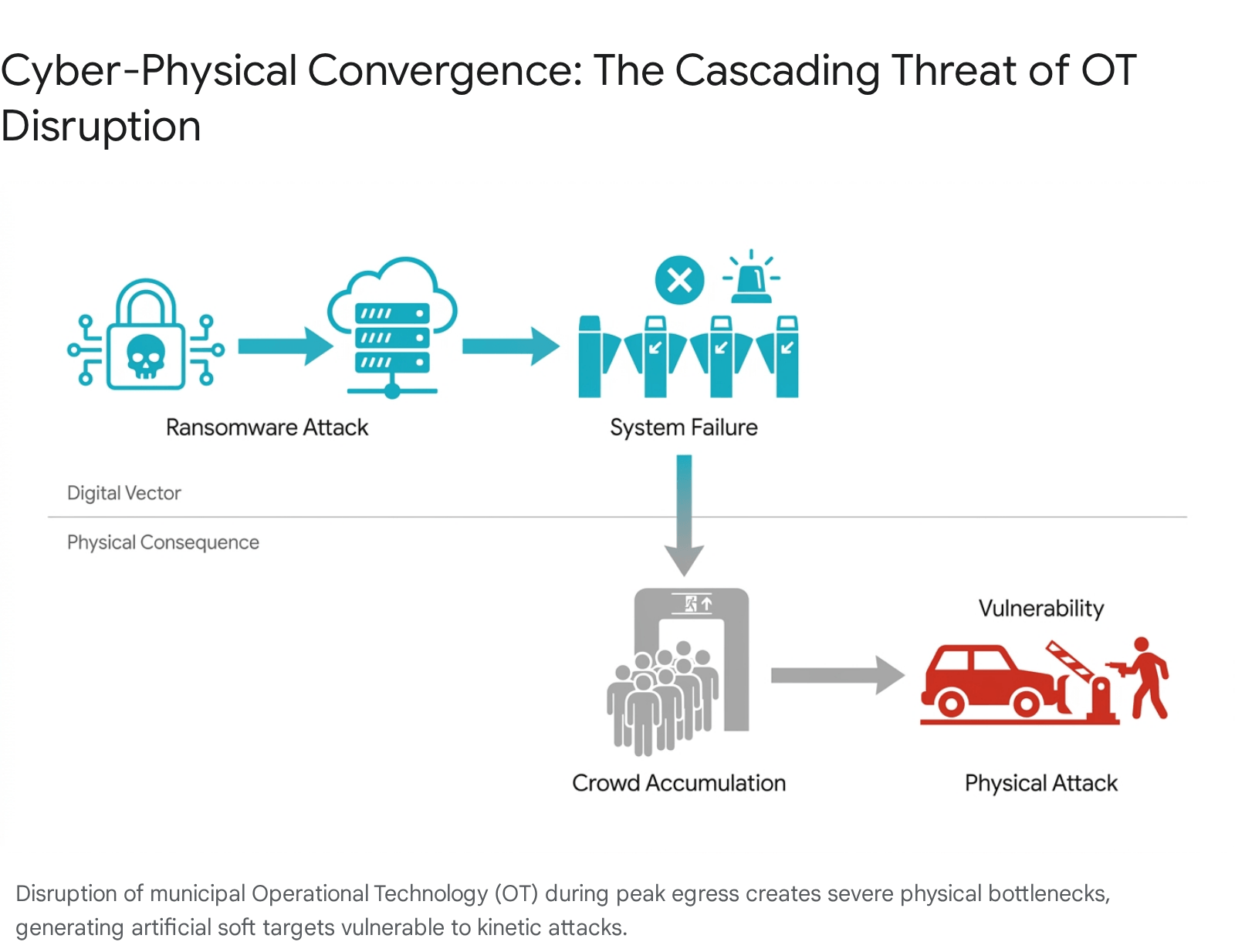
The primary concern for physical security planners is the targeted disruption of Operational Technology (OT). Unlike Information Technology (IT), which manages data, OT manages physical processes in the real world. A successful ransomware deployment targeting a host city’s regional rail signaling system, automated transit ticketing application programming interfaces (APIs), or municipal traffic control grids could induce immediate logistical paralysis.2 Secondary targets include municipal water treatment facilities, local power grids, and emergency response (911) computer-aided dispatch systems in primary host cities.2
If a cyberattack successfully disables the transit infrastructure immediately following a World Cup match or a massive July 4th fireworks display on the National Mall, the resulting operational failure creates a cascading physical security crisis. Tens of thousands of attendees will be trapped in dense pedestrian egress zones, unable to disperse effectively.6 This scenario artificially generates a highly concentrated soft target environment, creating an ideal setting for a secondary physical attack via vehicle ramming, lone-offender active shooters, or drone-dropped explosives.1
Beyond catastrophic infrastructure disruption, cyber adversaries are utilizing the decentralized nature of the “America’s Block Party” initiative to execute localized data harvesting and fraud. With over 1,200 grassroots events utilizing independent, localized event applications, the software supply chain is highly fragmented and poorly secured.2 Threat actors are highly likely to deploy spoofed public Wi-Fi networks in high-density tourist areas to harvest biometric profiles, financial credentials, and personal data from unsuspecting attendees.6
Furthermore, hacktivist collectives seeking global visibility present a significant, persistent risk to public communication systems. Analysts assess an elevated risk of adversaries compromising internet-connected digital billboards, stadium jumbotrons, and public notification systems.6 These platforms can be exploited to broadcast anti-authoritarian propaganda, anti-war messaging, explicit content, or fabricated emergency alerts designed to incite mass panic.6 To mitigate this vector, CISA strongly advises implementing offline fail-safes, strict access controls, and multi-factor authentication (MFA) across all public-facing display infrastructure.2
7. Ideological Protest Dynamics, Small Arms Carry, and Armed Mobilization
While Washington D.C. remains the focal point for federal protective operations and national attention, the National Counterterrorism Center (NCTC) has officially designated Philadelphia, Pennsylvania, as a “city of concern”.2 This specific designation stems from the extreme operational pressure generated by the convergence of America250 events, ongoing FIFA World Cup matches within the city limits, and the coordinated mobilization of massive ideological protests.2
The primary driver of the protest dynamic is a broad, anti-authoritarian coalition organizing what is assessed to be the largest mobilization of military veterans in decades.6 The protest march, scheduled to coincide directly with July 4th celebrations in Philadelphia, is being organized by a coalition including the Fayetteville Resistance Coalition, the Women’s March, and Veterans Against Fascism (VAF).6 VAF operates as an anti-fascist grassroots non-profit organization utilizing open-source intelligence (OSINT) to monitor extremist activity, explicitly aimed at opposing far-right groups, neo-Nazi organizations, and what they perceive as the erosion of democratic norms within the United States.28 Their organizational rhetoric specifically positions them in opposition to President Donald Trump and elements of the radicalized veteran community associated with the events of January 6, 2021.28
Open-source intelligence and chatter analysis collected by Flashpoint indicate a highly sensitive tactical variable: while the official organizers have not issued any calls for violence and the march is designed as a peaceful demonstration, a significant contingent of attendees intend to exercise their legal license to carry firearms during the march.6 The presence of heavily armed demonstrators operating within the boundaries of state law fundamentally alters the law enforcement calculus and presents a severe challenge for tactical operators.
For law enforcement SWAT and crowd-control units, distinguishing between a legally armed citizen participating in a demonstration and an active threat actor in a chaotic, high-density urban environment requires extraordinary discipline and advanced optical surveillance. It drastically reduces the margin for error and requires highly drilled de-escalation protocols. The widespread presence of AR/AK platform rifles, plate carriers, and advanced optics among civilian protest groups further complicates threat recognition, blurring the visual lines between lawful assembly and paramilitary mobilization.
The intelligence assessment dictates that while the primary VAF demonstration will likely remain peaceful, the risk of localized, rapid-onset clashes remains exceptionally high.6 Counter-protesters, political agitators, or unaffiliated violent extremists may attempt to infiltrate the march to incite violence or provoke an armed response from the attendees or police. Mass arrests remain a high probability if segments of the crowd engage in civil disobedience, block critical transit arteries necessary for World Cup logistics, or deviate into unauthorized federal security zones.6 The situation in Philadelphia represents a pressure cooker where constitutional rights to armed assembly directly intersect with maximum-security international event perimeters.
8. Infrastructure Strain and Peripheral Soft Target Vulnerabilities
The core physical vulnerability across all host cities during this heightened operational period is the concept of the “soft target.” While primary venues—such as the White House South Lawn, Lumen Field in Seattle, or the World Cup stadiums in Houston and Philadelphia—are fortified with hard perimeters, magnetometers, explosive detection canines, and extensive interagency support, the surrounding geographic areas are fundamentally exposed.1
The geographic footprint of risk is not confined to the stadium footprint; it encompasses the entire logistical tail required to move hundreds of thousands of people into and out of the host cities. Analysts and law enforcement veterans stress that the highest risk zones are the peripheral gathering points: fan fest zones, public waterfronts, pedestrian bridges, transit stops, rideshare queuing areas, parking lots, and adjacent restaurant districts.1 These locations inherently lack comprehensive access control, screening mechanisms, and structural barricades, representing high-density, target-rich environments for lone offenders utilizing vehicle rammings or small arms fire.1
The overlapping schedule of the America250 fireworks displays—which spread risk across thousands of localized events—and the concentrated global attention of the World Cup matches means that these soft targets will experience sustained, overlapping waves of crowd density rather than distinct peaks and valleys.1 This distributed physical strain guarantees that local law enforcement will be stretched to historical operational limits. Departments will be forced to pull patrol officers from standard municipal response duties to manage traffic control, crowd flow, and fixed-post security, thereby inherently increasing the response times for emergency incidents occurring outside the immediate event perimeters.1
9. Required Interventions and Procurement Directives
The transition from a strategic threat assessment to tactical operational readiness requires the immediate implementation of specific, high-impact preparedness actions. Based on the analysis of recent foiled hybrid plots and the guidance of law enforcement subject matter experts, SLTT agencies and private-sector security operators must execute the following directives and adjust procurement strategies prior to the July 4th weekend:
1. Reassessment, Hardening, and Mapping of Soft Target Perimeters Agencies must expand their defensive mapping far beyond the primary venue. Security planners must map the organic movement of crowds, identifying precisely where attendees gather, park, eat, and wait for transit.1 Private-sector partners, including hospitality staff, restaurant management, and civilian venue security, must be integrated into the intelligence loop immediately, as they serve as the frontline sensors for detecting pre-attack surveillance and behavioral anomalies.1
2. Multi-Method Attack Red-Teaming and Tactical Adjustments Standard active shooter protocols are dangerously insufficient for the current threat environment. Agencies must conduct rapid tabletop exercises and full-scale simulations of multi-modal attacks, specifically focusing on the “drone-driven evacuation into a sniper kill zone” tactic observed in the UFC plot.1 Infrastructure reviews must confirm that crowd bottlenecks, access roads, and emergency evacuation routes are not vulnerable to secondary exploitation by vehicle ramming or elevated shooters.1 Tactical units must ensure they have procured the necessary optics and counter-sniper capabilities to rapidly identify and neutralize elevated threats in complex urban terrain.
3. Implementation of Redundant, Real-Time Interagency Communications The unprecedented volume of interagency coordination required necessitates communication systems that extend far beyond standard localized radio traffic. Police, fire, EMS, emergency management, federal partners, transit authorities, and hospital networks must possess the digital infrastructure and capability to dynamically share closed routes, crowd movements, cyber threat alerts, and active kinetic threat data in real-time without encountering interoperability failures.1
4. Authorization, Procurement, and Deployment of C-UAS Protocols Jurisdictions possessing SAFER SKIES Act-authorized C-UAS technology must establish rigid and clear chains of command. Protocols must explicitly define which specific personnel hold the legal and tactical authority to jam or kinetically disable a drone, how field units without C-UAS gear should react to an unauthorized incursion, and the required deconfliction communication with the FAA to prevent interference with authorized operational flights.1 Agencies still lacking C-UAS capabilities must leverage FEMA grant programs rapidly to procure detection technology, prioritizing systems that integrate seamlessly with existing optical surveillance networks.
5. Pre-Approval of Crisis Public Messaging and Cyber Contingencies In the event of a kinetic attack or severe cyber disruption affecting public transit, the rapid dissemination of accurate public information is critical to preventing deadly crowd crush scenarios. Agencies must draft and pre-approve multilingual messaging templates for specific contingencies, including shelter-in-place orders, active assailant alerts, evacuation routing, transit disruptions, and the rapid correction of online misinformation.1 Pre-establishing the personnel authorized to publish these alerts after standard operating hours ensures that life-saving directions outpace the spread of panic and rumor.1 Furthermore, cybersecurity contingencies must be elevated to the primary planning conversation, ensuring that critical 911 dispatch, hospital networks, and traffic control systems are resilient against holiday-weekend ransomware deployments.1
The domestic homeland security landscape leading into America’s 250th anniversary demands hyper-vigilance and an evolution in tactical readiness. The democratization of lethal technology—from 3D-printed weapon components to weaponized consumer drones—coupled with deep ideological polarization and an unprecedented concentration of global sporting and historical events, has produced a uniquely volatile environment. Success relies entirely on the seamless integration of intelligence, the hardening of peripheral soft targets, the rapid adoption of advanced counter-UAS capabilities, and the decentralized response capabilities of highly trained local law enforcement.
Appendix: Analytical Framework and Data Sources
This intelligence estimate was developed utilizing open-source intelligence (OSINT), official government advisories, and specialized industry threat assessments compiled prior to July 1, 2026. Data synthesis was performed by cross-referencing tactical incident reports with strategic federal security classifications to provide actionable intelligence for the tactical, law enforcement, and small arms industry professionals utilizing blog.roninsgrips.com.
- Threat Categorization & Event Designations: Assessments of the operational pressure, event scale, and federal resource allocation were derived from the Department of Homeland Security (DHS) National Terrorism Advisory System (NTAS) public archives 7, CISA operational readiness reports for the FIFA World Cup 8, and DHS Special Event Assessment Rating (SEAR) frameworks.9
- Incident Case Studies and Tactical Analysis: Tactical analysis of domestic extremism, specifically the multi-state UFC Freedom 250 hybrid plot and the White House Correspondents’ Dinner shooting, utilized public indictments, Department of Justice (DOJ) press releases, and statements from federal law enforcement leadership.4
- Cyber-Physical Convergence & Ideological Threat Vectors: Evaluations of holiday ransomware risks, operational technology (OT) vulnerabilities, and the ideological protest dynamics in Philadelphia were informed by private-sector threat intelligence briefings provided by the Flashpoint Intel Team 2 and specific organizational declarations from protest coalitions.27
- Counter-UAS Legislation and Hardware Operations: Analysis of the rapidly evolving drone threat and the expansion of mitigation authorities relied on the text and operational analysis of the FY26 National Defense Authorization Act, the SAFER SKIES Act, and Federal Aviation Administration (FAA) public rules regarding Special UAFRs.19
- Operational Readiness and Procurement: Actionable preparedness recommendations and considerations for tactical equipment procurement were adapted from law enforcement subject matter experts and public safety industry assessments.1
Please share the link on Facebook, Forums, with colleagues, etc. Your support is much appreciated and if you have any feedback, please email us in**@*********ps.com. If you’d like to request a report or order a reprint, please click here for the corresponding page to open in new tab.
Sources Used
- White House Attack Foiled: Public Safety Prep for July 4th and World …, accessed July 1, 2026, https://genasys.com/blog/white-house-attack-foiled-public-safety-prep-for-july-4-and-world-cup-terrorism-risks/
- America250 Fourth of July Threat Assessment, accessed July 1, 2026, https://flashpoint.io/blog/america250-fourth-of-july-threat-assessment/
- Homeland Threat Assessment 2025, accessed July 1, 2026, https://www.dhs.gov/sites/default/files/2024-10/24_0930_ia_24-320-ia-publication-2025-hta-final-30sep24-508.pdf
- Second Missouri Man Charged in Plot to Kill Government Officials During Ultimate Fighting Championship White House Event, accessed July 1, 2026, https://www.justice.gov/usao-wdmo/pr/second-missouri-man-charged-plot-kill-government-officials-during-ultimate-fighting
- Chicago man accused of running Signal group used to plan alleged UFC White House attack plot, accessed July 1, 2026, https://www.cbsnews.com/chicago/news/white-house-ufc-event-attack-plot-chicago-man-charged/
- America250 Fourth of July Threat Assessment – Security Boulevard, accessed July 1, 2026, https://securityboulevard.com/2026/06/america250-fourth-of-july-threat-assessment/
- National Terrorism Advisory System | Homeland Security, accessed July 1, 2026, https://www.dhs.gov/national-terrorism-advisory-system
- Preparing for the World Stage – CISA, accessed July 1, 2026, https://www.cisa.gov/news-events/news/preparing-world-stage
- Special Event Assessment Rating (SEAR) Events Fact Sheet – Homeland Security, accessed July 1, 2026, https://www.dhs.gov/sites/default/files/publications/19_0905_ops_sear-fact-sheet.pdf
- America 250 brings extraordinary security challenge to Washington …, accessed July 1, 2026, https://www.pbs.org/newshour/nation/america-250-brings-extraordinary-security-challenge-to-washington
- 2026 White House Correspondents’ Dinner shooting – Wikipedia, accessed July 1, 2026, https://en.wikipedia.org/wiki/2026_White_House_Correspondents%27_Dinner_shooting
- DHS and FBI warn about attacks on ICE facilities by “domestic violent extremists”, accessed July 1, 2026, https://www.cbsnews.com/news/dhs-fbi-warn-attacks-ice-domestic-violent-extremists/
- Suspect in White House Correspondents’ Dinner Shooting Charged with Attempt to Assassinate the President | United States Department of Justice, accessed July 1, 2026, https://www.justice.gov/opa/pr/suspect-white-house-correspondents-dinner-shooting-charged-attempt-assassinate-president
- White House Correspondents Dinner Shooting Suspect in Plea Deal Talks | Cole Tomas Allen Update, accessed July 1, 2026, https://www.youtube.com/watch?v=dT3uMlCwmXQ
- White House Correspondents’ Dinner attack suspect is tutor and computer programmer from California | PBS News, accessed July 1, 2026, https://www.pbs.org/newshour/politics/white-house-correspondents-dinner-attack-suspect-is-tutor-and-computer-programmer-from-california
- UFC Freedom 250 – Wikipedia, accessed July 1, 2026, https://en.wikipedia.org/wiki/UFC_Freedom_250
- UFC Freedom 250: How many people watched Trump’s event worldwide? White House card shatters previous records, accessed July 1, 2026, https://www.hindustantimes.com/sports/us-sports/ufc-freedom-250-how-many-people-watched-trumps-event-worldwide-white-house-card-shatters-previous-records-101782494737511.html
- Office of Public Affairs | FBI Arrests Two More Men in Washington …, accessed July 1, 2026, https://www.justice.gov/opa/pr/fbi-arrests-two-more-men-washington-and-missouri-connection-planned-attack-government
- Counter-UAS Explained: What CUAS Means and Who Can Deploy It | Airsight, accessed July 1, 2026, https://www.airsight.com/blog/counter-uas-cuas-explained
- SAFER SKIES Act Expands Domestic Counter-Drone Authority | Woods Rogers, accessed July 1, 2026, https://www.woodsrogers.com/insights/publications/safer-skies-act-expands-domestic-counter-drone-authority
- SAFER SKIES Act Explained: Counter-Drone Authority for Law Enforcement | Airsight, accessed July 1, 2026, https://www.airsight.com/blog/safer-skies-act-counter-drone-law-enforcement
- Advanced Security Technology Solutions to Counter Drone-Related Threats, accessed July 1, 2026, https://surveillancesecure.com/advanced-security-technology-solutions-to-counter-drone-related-threats/
- SAFER SKIES Act Gives States Power to Block Drone Risks | Phelps, accessed July 1, 2026, https://www.phelps.com/insights/safer-skies-act-gives-states-power-to-block-drone-risks.html
- Designation-Restrict the Operation of Unmanned Aircraft in Close Proximity to a Fixed Site Facility – Federal Register, accessed July 1, 2026, https://www.federalregister.gov/documents/2026/05/06/2026-08943/designation-restrict-the-operation-of-unmanned-aircraft-in-close-proximity-to-a-fixed-site-facility
- CISA Highlights Vital Resources to Help Event Attendees Stay Safe, accessed July 1, 2026, https://www.cisa.gov/news-events/news/cisa-highlights-vital-resources-help-event-attendees-stay-safe
- News from CISA/DHS – IFCPP, accessed July 1, 2026, https://www.ifcpp.org/widget/news/13640814
- Veterans Against Fascism – Action Network, accessed July 1, 2026, https://actionnetwork.org/groups/veterans-against-fascism-2
- Veterans Fighting Fascism, accessed July 1, 2026, https://www.veteransfightingfascism.org/
- Veterans Fighting Fascism (Task Force Butler Institute) – Influence Watch, accessed July 1, 2026, https://www.influencewatch.org/non-profit/veterans-fighting-fascism-task-force-butler-institute/
- Celebrating and Safeguarding America’s 250th Anniversary Webinar – CISA, accessed July 1, 2026, https://www.cisa.gov/news-events/events/celebrating-and-safeguarding-americas-250th-anniversary-webinar
- Big Events in 2026: Security Classifications – Domestic Preparedness, accessed July 1, 2026, https://domesticpreparedness.com/articles/big-events-in-2026-security-classifications/
- Two Inland Empire Men, Three Others Arrested and Charged in Plot to Kill Government Officials, Others Attending White House UFC Event – Department of Justice, accessed July 1, 2026, https://www.justice.gov/usao-cdca/pr/two-inland-empire-men-three-others-arrested-and-charged-plot-kill-government-officials
- Volunteer Opportunities, Events, and Petitions Near Me · Fayetteville Resistance Coalition on Mobilize, accessed July 1, 2026, https://www.mobilize.us/fayettevilleresistancecoalition/
- Ronin’s Grips | Firearms Analytics & Intelligence Reports | Connecticut – Boise Gun Club, accessed July 1, 2026, https://boisegunclub.com/connecticut/directory/blog-20
- Ronin’s Grips Analytics – Ronin’s Grips, accessed July 1, 2026, https://blog.roninsgrips.com/
- White House Correspondents’ Dinner shooting: Suspect back in court – YouTube, accessed July 1, 2026, https://www.youtube.com/shorts/Qf6q0wj50rM