Prepared for: blog.roninsgrips.com Date of Assessment: July 1, 2026 Subject: Intersection of the September 2026 Threat Environment and Local Law Enforcement Intelligence Degradation
1. Executive Summary
As the United States approaches the 25th anniversary of the September 11, 2001, terrorist attacks in September 2026, the domestic security apparatus faces an increasingly complex, decentralized, and multi-vector threat environment. The convergence of resurgent Foreign Terrorist Organizations (FTOs), highly active Domestic Violent Extremists (DVEs), and advanced nation-state cyber actors creates a risk landscape that is simultaneously global in origin and highly localized in execution. Simultaneously, the operational capacity of the domestic intelligence architecture—specifically the localized “early warning” networks established in the immediate post-9/11 era—has been compromised.
A protracted, multi-year staffing crisis within local law enforcement agencies has forced municipal and state executives to systematically reallocate personnel from specialized intelligence, counterterrorism, and investigative units back to primary reactive patrol functions. This ongoing workforce attrition, characterized by spikes in resignations among mid-career personnel and a wave of senior retirements, has precipitated a loss of institutional memory and tacit community knowledge. The degradation of local intelligence capabilities directly and negatively impacts the efficacy of federal joint operations, notably the Federal Bureau of Investigation’s (FBI) Joint Terrorism Task Forces (JTTFs) and the Department of Homeland Security’s (DHS) state-level fusion centers.
Consequently, as adversarial tactics shift toward localized, opportunistic attacks with compressed radicalization timelines, the national security apparatus is experiencing a widening visibility gap at the municipal level. The loss of human intelligence (HUMINT) and pre-incident behavioral monitoring at the street level severely elevates the probability of undetected extremist mobilization in the months leading up to the September 2026 milestone.
2. Strategic Threat Environment: The September 2026 Horizon
The current threat matrix is defined by a distinct shift away from singular, highly coordinated, mass-casualty aviation or infrastructure plots toward decentralized, rapid-mobilization violence. This tactical evolution is occurring against the backdrop of highly symbolic temporal milestones, large-scale public events, and heightened geopolitical friction.
2.1. The 25th Anniversary of 9/11 as an Operational Catalyst
Anniversaries of major historical events routinely serve as catalysts for extremist mobilization, acting as focal points for both adversarial propaganda and operational planning. The 25th anniversary of the 9/11 attacks in September 2026 represents a generational milestone of significant symbolic weight. For FTOs, it offers an opportunity to demonstrate enduring relevance, ideological resilience, and operational capability despite a quarter-century of Western counterterrorism pressure.1 For DVEs, the anniversary serves as a highly visible, emotionally charged backdrop against which to project anti-government, accelerationist, or ethnically motivated violence.
The demographic reality of the United States has shifted significantly since the attacks; an estimated 100 million Americans alive today—representing roughly one-third of the U.S. population—have no lived memory of September 11, 2001.3 This demographic shift has necessitated extensive educational and commemorative campaigns by organizations such as the 9/11 Memorial & Museum, aiming to educate younger generations on the consequences of terrorism.3 The legislative branch has also elevated the profile of the anniversary, with the bipartisan House passage of H.R. 1993, the 25th Anniversary of 9/11 Commemorative Coin Act, championed by Rep. Mike Lawler, which directs proceeds to the National 9/11 Memorial & Museum.4
High-profile commemorative events will serve as natural focal points for security protocols. The George W. Bush Presidential Center is hosting a major retrospective featuring the 43rd President, former Secretary of State Condoleezza Rice, and Chairman of the Joint Chiefs of Staff General Dan Caine.5 Simultaneously, organizations like the Soufan Center are convening the Global Summit on Terrorism and Political Violence in New York City on the eve of the anniversary, gathering senior policymakers and security leaders.1 While these events are highly secured, their media prominence elevates the baseline threat for all critical infrastructure, federal buildings, and mass gatherings nationwide during the late summer and early autumn of 2026, as adversaries seek to counter-program these memorials with acts of violence.
2.2. The FTO Resurgence and the “New Terrorist Playbook”
The strategic posture of traditional FTOs, including al-Qaeda and the Islamic State (ISIS), has evolved significantly. Intelligence assessments indicate that these networks are experiencing a global resurgence, adapting their operational models to bypass traditional border security and signals intelligence (SIGINT) nets.6 The Trump administration’s May 6, 2026, National Counterterrorism Strategy outlines a multi-faceted threat landscape, prioritizing the disruption of cartels and narco-terrorist networks, global jihadist organizations (including al-Qaeda and ISIS), and violent left-wing extremists. The strategy underscores a pivot to address threats within the Western Hemisphere while maintaining pressure on foreign terrorist organizations capable of executing external operations.
The tactical methodology of these groups has transitioned to what the National Counterterrorism Center (NCTC) Director Joe Kent has termed the “new terrorist playbook”.6 Rather than prioritizing spectacular, multi-year plots reminiscent of 2001, FTOs are increasingly inspiring followers to execute localized attacks on targets of opportunity.6 Director Kent noted that the decentralized and barbaric nature of the October 7, 2023, attacks in Israel has served as a tactical template.7 NCTC assessments confirm verified intelligence corroborating al-Qaeda’s presence and planning across U.S. cities, with a specific focus on smaller cells or individual operatives taking action against accessible targets.7
This decentralized approach is heavily reliant on exploiting digital platforms and artificial intelligence. FTOs are leveraging digital ecosystems to radicalize, train, and fundraise remotely, allowing them to inspire domestic violence without their core operatives ever stepping foot on U.S. soil.6 The case of Ammaad Akhtar, who was arrested for attempting to provide material support to ISIS after unknowingly expressing support for jihad to an online undercover officer, illustrates the speed and accessibility of modern digital radicalization.6 Furthermore, terrorists are increasingly utilizing generative artificial intelligence to streamline propaganda creation and operational planning, prompting legislative responses such as the Generative AI Terrorism Risk Assessment Act.6
The threat is compounded by documented vulnerabilities in the immigration and vetting apparatus. The House Committee on Homeland Security’s December 2025 “Terror Threat Snapshot” highlighted systemic vetting failures, noting that an estimated 2 to 2.7 million individuals entered the U.S. from countries lacking reliable documentation after undergoing minimal vetting.6 Department of Homeland Security Office of Inspector General (OIG) reports from 2022 and 2024 revealed that DHS faced significant obstacles in screening evacuees, resulting in a fragmented process for identifying derogatory information.6 These vulnerabilities have materialized into physical threats, as evidenced by the arrest of Afghan national Rahmanullah Lakanwal for ambushing and shooting two U.S. National Guardsmen near the White House, and the charging of two other Afghan nationals in connection with an ISIS-inspired plot targeting Election Day 2024.6
2.3. Domestic Violent Extremism (DVE) and Accelerated Radicalization
While FTOs present a resurgent external threat, domestic terrorism remains one of the most persistent, complex, and lethal threats to the homeland.6 The FBI’s National Security Branch Operations Director Michael Glasheen reported that the Bureau currently has over 1,700 active domestic terrorism investigations underway.6 The DVE landscape is highly fractured and ideologically diverse, encompassing racially or ethnically motivated violent extremists, anti-government and anti-authority extremists, and single-issue actors.
A defining characteristic of the modern DVE threat is the compression of the radicalization timeline. Radicalization occurs frequently in online environments, accelerated by social media algorithms and encrypted messaging applications that increase the speed and accessibility of violent extremist content.6 Individuals transition from passive consumption of extremist propaganda to operational mobilization in a fraction of the time observed in previous decades. The greatest terrorism threat to the homeland is posed by lone offenders and small groups of individuals who commit acts of violence motivated by a range of ideological beliefs and personal grievances, looking to attack soft targets with easily accessible weapons.9
There is a documented, alarming increase in attacks explicitly targeting federal law enforcement personnel and facilities. For example, a shooting at a U.S. Immigration and Customs Enforcement (ICE) facility in Dallas resulted in multiple casualties, with the shooter leaving behind ammunition marked with the phrase “ANTI-ICE”.6 This ambient hostility complicates federal investigations and heightens the physical risk to agents operating in the field. Arrests of specific extremist factions have also risen sharply; for instance, arrests of Antifa members increased by 171 percent in the past year.6
The geopolitical shockwaves of international conflicts have also severely impacted the domestic landscape. The post-October 7 environment has seen a sharp, sustained escalation in antisemitic and religiously motivated violence targeting communities worldwide.6 This includes incidents such as the ISIS-inspired attack on Hanukkah celebrations in Sydney, Australia, which resulted in 15 deaths, and the domestic arrest of Mahmoud Amin Ya’qub Al-Muhtadi in Louisiana for alleged involvement in the Hamas-led terrorist attacks.6 These overlapping ideological drivers ensure a constant, elevated threat to religious institutions, cultural centers, and public gatherings.
2.4. Nation-State Cyber Pre-Positioning: Volt Typhoon and Salt Typhoon
While FTOs and DVEs primarily pursue kinetic violence and psychological terror, nation-state actors present a systemic threat to the operational technology (OT) and information technology (IT) networks governing U.S. critical infrastructure. Advanced Persistent Threat (APT) groups linked to the People’s Republic of China (PRC)—specifically actors identified as Volt Typhoon and Salt Typhoon—have fundamentally altered their operational mandates, transitioning from traditional cyber espionage and intellectual property theft to strategic pre-positioning.11
Assessments from the Office of the Director of National Intelligence (ODNI), CISA, the NSA, and the FBI indicate that these PRC-linked actors are deliberately embedding themselves within the hardware and software that control critical infrastructure.12 The objective is not immediate financial gain or data exfiltration, but rather to establish deep, persistent access that would enable them to disrupt lifeline societal functions—such as water purification, telecommunications, transportation, and energy distribution—at a time of their choosing, likely corresponding with a geopolitical crisis or military conflict in the Indo-Pacific.12
The scope of this infiltration is extensive. Microsoft revealed that Volt Typhoon had achieved the kind of persistent access necessary to disrupt essential services.13 CISA detailed incidents where Volt Typhoon maintained unauthorized access to the OT network of the Littleton Electric Light & Water Departments, a small public utility in Massachusetts, for nearly a year.15 The attackers mapped the energy grid’s layout and OT operating procedures, gathering intelligence crucial for planning future attacks targeting physical infrastructure.15 This is not an isolated incident; Check Point Research documented a 75 percent year-over-year increase in cyberattacks on U.S. utilities, totaling 1,162 attacks, while the North American Electric Reliability Corporation warned of rapidly growing susceptibility points on the digital grid.15
Concurrently, the Salt Typhoon group has executed sophisticated espionage campaigns against U.S. telecommunications carriers, exploiting vulnerabilities in backbone infrastructure to establish long-term, covert access to sensitive communications systems.12 The evolution of other state-aligned actors, such as Russia-aligned hacktivists transitioning into groups capable of targeting OT and IoT environments, further complicates the cyber threat model.16
The structural challenge of defending against these APTs is immense. Approximately 50 to 85 percent of U.S. critical infrastructure is privately owned or operated by municipal entities that often lack the resources to defend against nation-state cyber capabilities.15 While CISA is the primary federal agency specifically tasked with defending civilian systems from cyber threats, maintaining real-time visibility into these distributed domains 13, the localized nature of these utility networks requires a coordinated ground-level response. Should a coordinated cyber-physical attack occur, local law enforcement and emergency services would face the catastrophic dual burden of managing widespread civil unrest and panic while operating with degraded communications, power, and logistical infrastructure.14
2.5. Resource Saturation: The FIFA World Cup 2026
Compounding the baseline threat environment is the substantial operational strain imposed by the FIFA World Cup 2026, hosted jointly by the United States, Canada, and Mexico. Kicking off in the summer preceding the 9/11 anniversary, the tournament represents the largest and most complex sporting event in U.S. history, attracting millions of international and domestic fans.18
Securing an event of this magnitude requires extensive interagency coordination and the deployment of substantial security overlays to protect stadiums, fan zones, transit hubs, and commercial corridors across multiple major metropolitan host cities.19 The event presents a highly attractive target profile for both FTOs seeking international media attention and DVEs attempting to exploit mass gatherings. The DHS, FBI, TSA, and the State Department’s Diplomatic Security Service (DSS) have established expansive security protocols, deploying advanced threat response capabilities and international coordination mechanisms, with leadership from figures such as DHS Secretary Markwayne Mullin emphasizing a secure experience for the millions attending.1818
Specific security measures include the enforcement of Department of Transportation Temporary Flight Restrictions (TFRs) and the deployment of counter-unmanned aircraft systems (c-UAS) and robotic ground assets (“robodogs”) to mitigate the physical hazards posed by unauthorized drone activity near matches and fan fests.20 FBI Special Agents in Charge from Seattle (Karen Valaas) and Dallas (Joe Rothrock) have publicly highlighted the authorization to use technical capabilities to detect, assess, and mitigate drone threats.20 Furthermore, the DHS World Cup Commission, comprising private industry experts, is advising the White House Task Force on security coordination.22
However, the reality of securing these venues requires significant deployments of local law enforcement personnel. Officers must be pulled from regular duties to staff traffic control, crowd management, and perimeter security. This operational saturation draws resources away from routine investigative and intelligence functions across the host regions for an extended period, creating temporal vulnerabilities that adversaries can exploit.
3. The Local Law Enforcement Workforce Crisis
The foundational layer of the United States’ domestic intelligence architecture is local law enforcement. State, local, tribal, and territorial (SLTT) police agencies act as the primary sensors in the homeland security network, providing the baseline situational awareness necessary to identify anomalous behavior indicative of terrorist mobilization. However, this foundational layer has experienced severe, sustained erosion since 2020, resulting in a systemic contraction of operational capacity.
3.1. Statistical Dimensions of Attrition and the Hiring Paradox
Data compiled through extensive national surveys by the Police Executive Research Forum (PERF) reveals a notable and structural contraction in the law enforcement workforce over the past six years.23 While hiring rates have shown signs of a rebound in the most recent statistical cycles, the sheer volume and velocity of resignations and retirements have fundamentally altered the demographic composition and total capacity of police departments nationwide.
The data indicates a compound crisis. Initially, hirings dropped precipitously by 19.4 percent from 2019 to 2020.23 Concurrently, retirements increased by 33.5 percent over the same period, extracting a large cohort of highly experienced senior personnel.23 As the decade progressed, resignations among mid-career officers increased substantially, rising 55.9 percent from 2019 to 2022.23 This indicates deep dissatisfaction, burnout, and institutional strain among the very professionals usually tasked with complex investigations.
The net result of these converging trends is a chronic staffing deficit. Total sworn staffing decreased by 5.4 percent from January 2020 to January 2023.23 Despite responding agencies reporting a 17.6 percent increase in hirings in 2025 compared to 2024, and overall hirings increasing 39.5 percent from the 2020 low point, the recovery has been insufficient to close the gap.23 As of January 1, 2025, overall sworn staffing numbers were still 5.2 percent lower than they were on January 1, 2020.27 Law enforcement agencies are losing officers faster than the academies can recruit, vet, and train their replacements.25
Data indicates a notable 55.9% spike in resignations and a 33.5% spike in retirements during the peak crisis years, leaving agencies bleeding experience faster than they can replace it, despite a subsequent 39.5% rebound in hiring efforts.
Table 1: Law Enforcement Workforce Fluctuation Metrics (Selected Metrics, Base Year 2019/2020)
| Metric Category | Trend Observation | Impact Indicator | Source Data |
| Total Sworn Staffing | 5.4% decrease from Jan 2020 to Jan 2023; remaining ~5.2% below 2020 levels by Jan 2025. | Net negative capacity. Agencies operating chronically understaffed despite hiring pushes. | 23 |
| Resignations | Rose 55.9% from 2019 to 2022. Remained elevated through 2024. | Severe loss of mid-career officers; disruption of succession pipelines and task force commitments. | 23 |
| Retirements | Increased 33.5% in 2020; secondary peaks in 2021 and 2022. | Sudden, unmitigated extraction of senior leadership, tacit knowledge, and seasoned investigators. | 23 |
| Hirings | Dropped 19.4% in 2020; rebounded 39.5% by 2024. | Influx of inexperienced personnel requiring heavy supervision, unable to immediately fill complex intelligence roles. | 23 |
3.2. Geographic, Jurisdictional, and Financial Disparities
The impact of this attrition is not uniform across the country. PERF data indicates that staffing at agencies in the Midwest and West decreased more than the overall national average, as did staffing at large agencies employing more than 500 officers.24 In large agencies, sworn staffing slightly increased during 2023, but remained more than 5 percent below where it was in January 2020.26 Conversely, retirements were extremely elevated in small agencies, showing a 136 percent increase over 2019 levels during peak attrition years.26
The financial burden of attempting to stabilize the workforce is substantial. Local police agencies face a threefold challenge: attrition resulting from budget crises and retirements, greater skill requirements restricting the applicant pool, and an expanding scope of duties requiring officers with a greater breadth of skills.29 This is evidenced by the high demand for federal assistance; a recent appropriation of $1 billion to the federal Office of Community Oriented Policing Services (COPS) to help stabilize law enforcement positions resulted in over 7,000 applications requesting more than $8 billion to support nearly 40,000 sworn-officer positions.28 Frequent departures lead to significant expenses related to recruiting, hiring, and training new personnel, diverting municipal funds that could otherwise be spent on advanced intelligence technologies or specialized training.30
4. The Reallocation Cascade and Specialized Unit Dissolution
The operational mandate of any municipal police department is the maintenance of public order and rapid response to emergency calls for service (911 response). Patrol divisions are the foundation of public safety operations. When total sworn staffing drops below critical minimum thresholds, agency executives are forced into a state of continuous operational triage. To maintain minimum staffing levels in the patrol division, commanders universally adopt a strategy of reallocating personnel from specialized, proactive units back to uniform patrol.31
4.1. The Dissolution of Proactive Intelligence Capacity
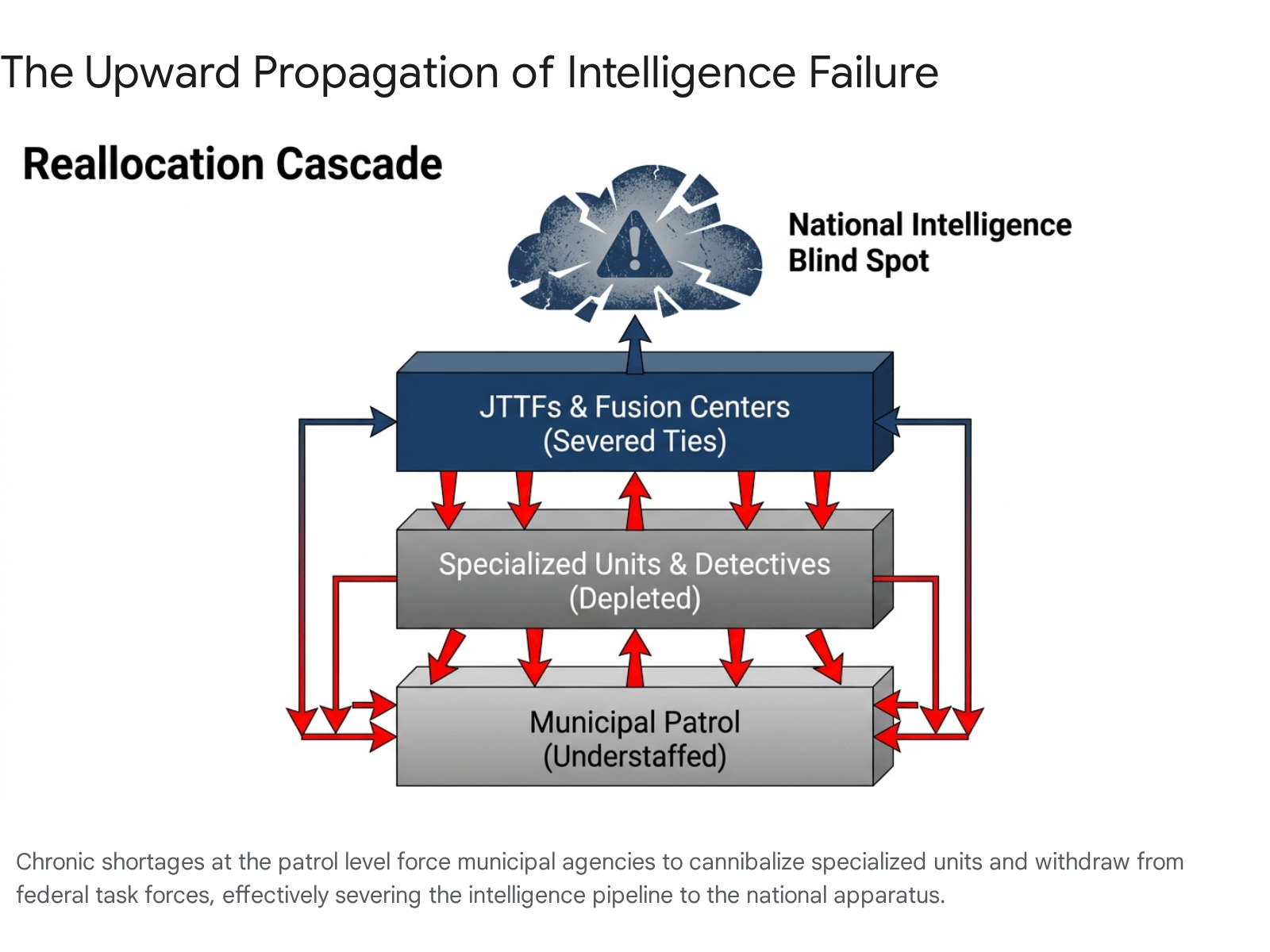
This phenomenon, termed the “reallocation cascade,” systematically dismantles a department’s investigative, intelligence-gathering, and community-policing capabilities. Across the country, major metropolitan agencies have disbanded or severely reduced specialized units to feed the continuous demand of the patrol schedule.
The scope of this reallocation is broad. In Phoenix, Arizona, the police department announced the reassignment of more than 100 officers from specialty assignments back to the patrol division to address critical shortages.34 Similarly, in Seattle, Washington, the police chief reassigned 100 officers to patrol to improve response times, explicitly stating that the move was necessary to avoid relying on overtime-funded emphasis patrols to address emerging crime issues.35 In Austin, Texas, facing a deficit of over 300 vacant sworn officer roles citywide, the department reassigned 72 officers from specialized units back to patrol to cover vacancies in the downtown sector.36
The impact extends deeply into investigative functions. The Baltimore Police Department notably disbanded district detective units responsible for investigating burglaries, reassigning 35 detectives to address shortages in patrol divisions.37 Baltimore police media relations Chief T.J. Smith noted the move was driven by “the necessity behind patrol staffing,” while City Council Public Safety Committee Chairman Brandon Scott acknowledged that patrol was “severely understaffed”.37 While department leadership argued that patrol officers would now handle these investigations, the reality is that complex case follow-ups are rarely successfully completed between emergency radio calls.
In New Orleans, an Office of Inspector General report sharply criticized the police department’s staffing model, noting that sworn officers assigned to specialized units, task forces, and district investigative units reduced the district’s capacity to answer calls for service.31 The report concluded that NOPD lacked 82 officer/detective positions needed to fully support centralized investigative functions, highlighting the intractable tension between maintaining a proactive investigative posture and answering the 911 board.31
4.2. Shifting from Proactive Disruption to Reactive Patrol
The withdrawal of personnel from narcotics task forces, gang units, human trafficking operations, and dedicated intelligence squads has an immediate, detrimental effect on domestic counterterrorism. The Austintown Police in Ohio, facing budget cuts, pulled officers back from both the Mahoning County Drug Task Force and the Mahoning County Human Trafficking Task Force to maintain adequate patrol staffing.38 The Missouri State Highway Patrol similarly suspended its participation in an ATF task force due to staffing constraints.39
Terrorism financing and operational logistics frequently intersect with traditional criminal enterprises, including organized retail theft, narcotics trafficking, and document fraud. When the specialized units that monitor these criminal ecosystems are dissolved or depleted, the peripheral intelligence that might expose a terror cell is never collected. The reallocation cascade ensures that police departments transition from a proactive posture—capable of identifying pre-incident indicators and disrupting plots—to a strictly reactive posture, responding only after a crime or attack has been committed. The use of specialized units significantly impacts patrol, but pulling officers from those units leaves a void in the intelligence collection apparatus.32
5. The Institutional Memory Deficit and the Experience Gap
The mathematical reduction in headcount is only one dimension of the policing crisis. A compounding and enduring vulnerability arises from the qualitative degradation of the workforce. The exodus of senior officers via retirement, combined with the mass resignation of mid-career personnel, has created an acute “experience gap” across the profession.33
5.1. Erosion of Tacit Knowledge and Community Intelligence
In intelligence and investigative contexts, “institutional memory” is not merely the archiving of digital reports; it is the accumulation of tacit knowledge, contextual understanding, and human relationships built over decades of continuous engagement.44 A veteran detective possesses a highly nuanced understanding of the local baseline—the normal rhythms of a specific neighborhood, the key community influencers, the historical rivalries between local factions, and the behavioral anomalies that warrant further scrutiny.
When an investigator with twenty years of experience retires and is replaced by a recent academy graduate, the agency loses years of localized intelligence.49 Research indicates that police organizations do not just forget information; they lose the connections and shared understanding that make that information useful.48 Newer officers, while perhaps more proficient in contemporary digital forensics, lack the cognitive maps necessary to contextualize disparate pieces of information.50 They are less likely to recognize when a routine arrest for fraudulent documentation or a seemingly random act of vandalism is actually a precursor to organized extremist violence. As one intelligence analysis platform noted, without institutional memory, a detective might fail to recognize that current call data records resemble the communication patterns of a network dismantled five years prior.46
Furthermore, community policing relies heavily on trust cultivated through long-term, consistent engagement.51 High turnover frequently severs these relationships.30 Confidential informants, community leaders, and local business owners are significantly less likely to share sensitive information—such as suspicions about a local individual undergoing rapid radicalization—with unfamiliar, transient patrol officers. The loss of institutional memory directly equates to a loss of human intelligence (HUMINT) at the street level.
5.2. The Paradox of Professionalization and Bureaucratic Vulnerabilities
The experience gap is exacerbated by what researchers studying investigative units have termed the “paradox of professionalization”.41 As policing has evolved to incorporate more stringent oversight, complex digital evidence requirements (e.g., managing terabytes of body-worn camera footage, executing cellular data extractions), and rigorous case management standards, the administrative burden on investigators has grown substantially.
In departments attempting to maintain strict investigative standards with depleted and less-experienced staffs, procedural requirements absorb disproportionate amounts of time and cognitive bandwidth.41 This dynamic has been extensively documented in the UK, where the College of Policing’s Professionalising Investigation Programme (PIP) is experienced by detectives as an administrative weight that diverts time from active inquiry, accelerates burnout, and reduces the role’s appeal.41
The U.S. domestic intelligence architecture mirrors this strain. Junior detectives, lacking the efficiency born of experience and operating without the mentorship of departed veterans, are easily overwhelmed by the sheer volume of digital data and procedural checklists. Consequently, investigations are frequently conducted in a perfunctory manner to clear caseloads, rather than with the deep, analytical rigor required to uncover complex terror networks or sophisticated lone-wolf preparations.41 Crucial operational dots remain unconnected because investigators lack the time, experience, and supervisory support to look beyond the immediate, superficial parameters of a localized crime.40
Furthermore, at the command level, fragmented workflows and a reliance on informal institutional memory for evidence management transform from a lab-level issue into a severe organizational liability, where doubt easily beats proof in court and compromised investigations drastically damage public trust.44
5.3. Leadership Turnover and Institutional Betrayal
The crisis of memory extends to the command level. Studies indicate that a vast majority of law enforcement agencies (nearly 74%) anticipate experiencing a large turnover in management personnel over the next three to five years, yet less than half (45.8%) have incorporated succession planning into their strategic frameworks, and over 90% lack formal mentoring policies.54 This leadership vacuum exacerbates what organizational psychologists term “institutional betrayal trauma,” where communication gaps and inconsistent leadership decisions accumulate until officers feel dismissed, leading to further attrition and a collapse of morale.49 The failure to transfer knowledge via formal mentoring ensures that the experience gap will persist well into the 2030s, leaving the U.S. vulnerable during a highly volatile geopolitical era.54
6. Degradation of the National Counterterrorism Architecture
The vulnerabilities created at the local level do not remain contained; they propagate upward, degrading the national counterterrorism architecture. Following the intelligence failures of 9/11, the federal government restructured its approach to domestic security around the philosophy of intelligence fusion—the systematic sharing of information between federal, state, and local entities. This system is entirely dependent on the continuous inflow of high-quality, granular data from local police.
6.1. The Attrition of Joint Terrorism Task Forces (JTTFs)
The FBI’s Joint Terrorism Task Forces (JTTFs) act as the primary operational mechanism for domestic counterterrorism investigations. Originating in 1980 in New York City with a small team of NYPD officers and FBI agents, the concept expanded rapidly post-9/11 to 104 regional task forces located at every FBI field office and many resident agencies, comprising roughly 280 locations.56 The National Joint Terrorism Task Force (NJTTF), established in 2002 at the National Counterterrorism Center (NCTC), manages this burgeoning program, which includes over 4,000 task force members from over 600 state and local agencies and 50 federal agencies.58
The strength of the JTTF model relies explicitly on local Task Force Officers (TFOs). Local police provide the JTTF with direct access to municipal records, local informant networks, and geographical expertise that federal agents typically lack.59 An FBI Supervisory Special Agent in Kansas City noted that local officers bring vital experience in standard patrol, knowledge of the city layout, and established interrogation skills.59 Federal agents are often transient, rotating through field offices, whereas local TFOs possess the deep institutional memory of their specific jurisdiction.
However, the local staffing crisis is systematically eroding the JTTF network. As municipal chiefs and sheriffs struggle to fill patrol shifts, they are increasingly forced to recall their highly trained officers from federal task forces.38 A local detective assigned to a JTTF represents a significant investment of municipal resources; when that detective is pulled back to handle routine city homicides or patrol duties, the JTTF loses its localized human intelligence pipeline.
6.2. Political and Fiscal Withdrawals from Federal Task Forces
Furthermore, the withdrawal of local officers from JTTFs is not solely driven by staffing metrics; it is increasingly influenced by political friction and concerns over civil liberties. The city of Portland, Oregon, serves as a prime example of this vulnerability. Despite apologies and assurances from the U.S. Attorney for Oregon, Billy Williams, regarding past FBI surveillance practices, the Portland City Council voted to withdraw its police officers from the JTTF.64
Commissioners Jo Ann Hardesty and Chloe Eudaly, heavily lobbied by civil liberties organizations such as the ACLU and the Brennan Center for Justice, argued that the JTTF operated under a veil of secrecy that precluded civilian oversight and potentially violated state laws requiring reasonable suspicion for surveillance.64 Mayor Ted Wheeler argued that “values alone cannot protect the safety of the community,” yet the council ultimately severed the tie, removing two Portland Police officers whose positions were funded by federal grants.66 Other cities, including Oakland, California, have taken similar steps to cut ties with JTTFs.69
Regardless of the motivation—whether fiscal necessity, severe patrol shortages, or political mandate regarding oversight—the result is identical: the federal counterterrorism apparatus goes blind in that jurisdiction. Without local TFOs, the FBI’s ability to swiftly investigate localized threats, assess the validity of incoming tips, and monitor the pre-incident behaviors of decentralized lone offenders is severely compromised.
6.3. Fusion Center Vulnerabilities and Analytic Turnover
Complementing the operational role of JTTFs are the network of state and major urban area fusion centers. Established with federal backing and outlined in the 2006 Department of Justice and DHS “Fusion Center Guidelines,” these centers are designed to serve as the primary conduits for threat information sharing between the federal government and SLTT partners.70 Fusion centers analyze Suspicious Activity Reports (SARs), monitor open-source intelligence, and distribute intelligence products downward to local patrol officers while feeding trend data upward to the DHS Office of Intelligence and Analysis (I&A) and the FBI.71
However, the efficacy of fusion centers is highly dependent on consistent staffing, secure funding streams, and established inter-personal relationships. Audits and assessments of the National Network of Fusion Centers by the Government Accountability Office (GAO) and congressional committees have repeatedly highlighted vulnerabilities related to high personnel turnover.72 In some instances, 42 percent of fusion center directors were new to their positions in a single year, with an average tenure of only 2.5 years.77 This short tenure fails to account for the time required to obtain high-level security clearances or to acclimate to leadership duties, resulting in chronic leadership instability.77
Furthermore, fusion centers rely heavily on state administrative agencies for grant funding distribution, as they do not receive direct, dedicated operational funding from DHS.72 When state budgets contract, or when federal DHS grant funding caps the number of Intelligence Officers (IOs) deployed to the field, fusion centers are forced to prioritize and reassign personnel, often losing their “real-time connection” to federal databases.77
This rapid turnover among directors and analysts, mirroring the broader attrition in law enforcement, destroys the connective tissue of intelligence sharing. Trust is paramount in interagency environments; state regulators, local police chiefs, and private sector utility operators are highly hesitant to share sensitive, raw intelligence with a constantly rotating cast of fusion center personnel.76 Furthermore, the loss of experienced analysts within these centers means that subtle patterns in SAR data—such as coordinated purchasing of dual-use materials across multiple jurisdictions or the mapping of vulnerabilities along the border—may go entirely unrecognized.78
6.4. The Expanding Intelligence Blind Spot
The ultimate consequence of localized attrition, political withdrawal from task forces, and fusion center amnesia is the creation of unmonitored intelligence blind spots across the homeland. The modern adversary—whether an ISIS-inspired lone wolf, a domestic accelerationist cell, or a PRC-linked cyber actor preparing the battlespace—relies heavily on operating within the “gray zone” of pre-incident behavior.6 They purchase legal firearms, conduct surveillance on soft targets, probe utility firewalls, and engage in online radicalization that flirts with the edges of protected First Amendment speech.
Federal agencies operating under foreign intelligence mandates, such as the NSA or the CIA, are legally and practically constrained from monitoring this localized, domestic behavior. The post-9/11 domestic security system was designed under the assumption that an experienced local detective, a vigilant school resource officer, or a highly trained intelligence analyst at a fusion center would intercept these behavioral anomalies, document them via a SAR, and escalate them to the JTTF for federal investigation.61
With patrol forces hollowed out, detectives returning to uniform, and local agencies withdrawing from JTTFs, the mechanism for identifying pre-incident indicators is critically impaired.61 The overwhelming “noise” of routine violent crime, which understaffed departments struggle to manage, drowns out the subtle “signals” of terrorist mobilization. In a paradigm where attackers increasingly favor targets of opportunity and require little sophisticated planning or external funding, the failure to intercept them at the local, community level significantly increases the likelihood of an adversary’s operational success. The Brennan Center for Justice has noted that the lack of consistency and oversight in local counterterrorism programs causes critical information to fall through the cracks, a vulnerability clearly demonstrated by the Boston Marathon bombing where critical data was lost in a din of irrelevant information.79
7. Strategic Outlook and Intelligence Gaps
The domestic threat landscape leading into the September 2026 timeframe is characterized by an exceptionally high degree of volatility. The combination of the 25th anniversary of 9/11 serving as a symbolic catalyst, the impending resource saturation of the FIFA World Cup, the resurgence of FTOs promoting a decentralized, target-of-opportunity playbook, the persistence of rapidly radicalizing DVE networks, and the strategic pre-positioning of PRC cyber actors creates a threat environment of notable complexity.
The operational defense against this threat matrix is structurally unsound. The continuous, unmitigated attrition within state and local law enforcement has resulted in a severe loss of institutional memory and community trust. Federal counterterrorism elements, increasingly severed from their local intelligence pipelines due to JTTF withdrawals, specialized unit dissolution, and fusion center turnover, lack the granular situational awareness necessary to disrupt lone offenders and localized cells prior to mobilization.
Several critical intelligence gaps remain unresolved:
- Visibility into DVE Mobilization: With local intelligence units disbanded or understaffed, identifying the transition from online radicalization to physical mobilization among domestic extremists relies entirely on retroactive, post-incident investigations rather than proactive disruption. The loss of community informant networks means localized behavioral shifts go unreported.
- Attribution in Cyber-Physical Incidents: In the event of a localized critical infrastructure failure (e.g., a municipal water facility malfunction or power grid disruption), the lack of experienced local investigators and trusted fusion center liaisons will delay the initial assessment of whether the event is an accident, a routine criminal act, or a nation-state (Volt Typhoon) disruption, thereby slowing the deployment of federal cyber response teams.
- Soft Target Vulnerability: As municipal police resources are heavily diverted to secure high-profile events like the World Cup and official 9/11 commemorative sites in major urban centers, peripheral soft targets (suburban shopping centers, local religious institutions, regional transit hubs) are left acutely vulnerable. The “new terrorist playbook” specifically exploits these minimally secured targets of opportunity.
Unless systemic, well-funded interventions are implemented immediately to rebuild local intelligence capacities, retain veteran investigators through aggressive succession planning, and politically restabilize the JTTF network, the national security apparatus will continue to operate with a severe, localized blind spot during one of the highest-risk periods of the post-9/11 era.
Appendix: Methodology and Data Sources
Methodology: This intelligence estimate was developed using a structured analytic approach designed to synthesize disparate data streams regarding both the adversarial threat environment and domestic defensive capabilities. The analysis applied a vulnerability-threat-consequence matrix to evaluate how specific weaknesses in law enforcement human capital intersect with current adversary tactics.
The assessment deliberately focused on identifying second- and third-order effects of police attrition. Rather than viewing workforce reduction as purely an administrative, budgetary, or response-time issue, the methodology treated human capital as a critical intelligence sensor network. By applying historical case studies of intelligence fusion (JTTFs and Fusion Centers) and analyzing the tactical requirements of the “new terrorist playbook,” the analysis identified specific failure points in the pre-incident detection cycle.
Data Sources: Information synthesized in this report was derived from the following core sources and assessments:
- Threat Assessments & Congressional Testimony:
- Department of Homeland Security (DHS) Homeland Threat Assessments (HTA) regarding nation-state cyber positioning and domestic extremism.11
- House Committee on Homeland Security “Terror Threat Snapshot” and Worldwide Threats hearing testimony from the NCTC, FBI, and DHS regarding FTO resurgence, DVE case volumes, and the “new terrorist playbook”.6
- Office of the Director of National Intelligence (ODNI) and CISA advisories on PRC-linked Advanced Persistent Threats (Volt Typhoon/Salt Typhoon) and infrastructure infiltration.12
- Law Enforcement Attrition Data:
- Quantitative survey data on police staffing, hirings, resignations, and retirements published by the Police Executive Research Forum (PERF) from 2019 through 2025.23
- Departmental audits, press reporting, and public statements regarding the reallocation of specialized units to patrol functions in major U.S. municipalities, including Baltimore, Phoenix, Seattle, Austin, and New Orleans.31
- Intelligence Architecture & Operations:
- Federal Bureau of Investigation (FBI) historical overviews, podcasts, and operational data regarding Joint Terrorism Task Forces (JTTFs).9
- Government Accountability Office (GAO) and Congressional reports detailing Fusion Center operations, funding, border intelligence products, and personnel turnover.70
- Academic, policy, and psychological research regarding the qualitative impacts of the “experience gap,” the paradox of professionalization, institutional betrayal, and the loss of institutional memory in policing.28
- Documentation of municipal withdrawals from JTTFs and civil liberties concerns.64
- Event Security Planning:
- Federal Emergency Management Agency (FEMA), TSA, and Diplomatic Security Service (DSS) preparations, legislative actions, and threat parameters for the 9/11 25th Anniversary and the FIFA World Cup 2026.1
Please share the link on Facebook, Forums, with colleagues, etc. Your support is much appreciated and if you have any feedback, please email us in**@*********ps.com. If you’d like to request a report or order a reprint, please click here for the corresponding page to open in new tab.
Sources Used
- Global Summit on Terrorism and Political Violence – The Soufan Center, accessed July 1, 2026, https://thesoufancenter.org/events/global-summit-on-terrorism-and-political-violence/
- New U.S. Counterterrorism Strategy Continues Focus on Jihadist Groups | Alhurra, accessed July 1, 2026, https://alhurra.com/en/20102
- News Release: 9/11 Memorial & Museum Launches New Campaign to Educate and Inspire, accessed July 1, 2026, https://www.911memorial.org/news-release-911-memorial-museum-launches-new-campaign-educate-and-inspire
- Lawler Celebrates House Passage of 25th Anniversary of 9/11 Commemorative Coin Act, accessed July 1, 2026, https://lawler.house.gov/news/documentsingle.aspx?DocumentID=5943
- A Legacy of Service: America at the 25th Anniversary of 9/11 | Bush Center, accessed July 1, 2026, https://www.bushcenter.org/events-and-exhibits/a-legacy-of-service-america-at-the-25th-anniversary-of-9-11
- House Homeland Unveils Updated “Terror Threat Snapshot” Assessment After Annual Worldwide Threats Hearing, accessed July 1, 2026, https://homeland.house.gov/2025/12/19/threat-snapshot-house-homeland-unveils-updated-terror-threat-snapshot-assessment-after-annual-worldwide-threats-hearing/
- Decreasing Counterterrorism Funding Amid Rising Terrorist Chatter: A Risk Not Worth Taking – HSToday, accessed July 1, 2026, https://www.hstoday.us/subject-matter-areas/counterterrorism/decreasing-counterterrorism-funding-amid-rising-terrorist-chatter-a-risk-not-worth-taking/
- Rep. Pfluger Sounds the Alarm During Annual Worldwide Threats Hearing, accessed July 1, 2026, https://pfluger.house.gov/news/documentsingle.aspx?DocumentID=2700
- Federal Bureau of Investigation Department of Homeland Security Strategic Intelligence Assessment and Data on Domestic Terrorism – FBI, accessed July 1, 2026, https://www.fbi.gov/file-repository/fbi-dhs-domestic-terrorism-strategic-report.pdf
- Federal Bureau of Investigation Department of Homeland Security Strategic Intelligence Assessment and Data on Domestic Terrorism, accessed July 1, 2026, https://www.dhs.gov/sites/default/files/2022-10/22_1025_strategic-intelligence-assessment-data-domestic-terrorism.pdf
- Homeland Threat Assessment 2025, accessed July 1, 2026, https://www.dhs.gov/sites/default/files/2024-10/24_0930_ia_24-320-ia-publication-2025-hta-final-30sep24-508.pdf
- China Threat Overview and Advisories – CISA, accessed July 1, 2026, https://www.cisa.gov/topics/cyber-threats-and-advisories/nation-state-cyber-actors/china
- FDD’s Ma warns weakening CISA could undermine US cyber resilience amid rising critical infrastructure threats, accessed July 1, 2026, https://industrialcyber.co/cisa/fdds-ma-warns-weakening-cisa-could-undermine-u-s-cyber-resilience-amid-rising-critical-infrastructure-threats/
- Are attackers already embedded in U.S. critical infrastructure networks? – IBM, accessed July 1, 2026, https://www.ibm.com/think/insights/are-attackers-already-embedded-in-us-critical-infrastructure-networks
- Securing U.S. Critical Infrastructure against Evolving Cyber Threats | Strategic Technologies Blog | CSIS, accessed July 1, 2026, https://www.csis.org/blogs/strategic-technologies-blog/securing-us-critical-infrastructure-against-evolving-cyber
- The Escalating Cyber Risk Landscape in Regional Conflicts & Strategic Actions for 2026, accessed July 1, 2026, https://blog.eclecticiq.com/the-escalating-cyber-risk-landscape-in-regional-conflicts-strategic-actions-for-2026
- Volt Typhoon’s long shadow – The International Institute for Strategic Studies, accessed July 1, 2026, https://www.iiss.org/online-analysis/cyber-power-matrix/2026/01/volt-typhoons-long-shadow/
- TSA delivers unmatched security, efficiency for FIFA World Cup 2026, accessed July 1, 2026, https://www.tsa.gov/news/press/releases/2026/06/10/tsa-delivers-unmatched-security-efficiency-for-fifa-world-cup-2026
- FIFA World Cup 2026™: Be Prepared and Stay Safe – Ready.gov, accessed July 1, 2026, https://www.ready.gov/fifa-world-cup-2026
- FBI, DHS emphasize no-drone zones as World Cup kicks off | FedScoop, accessed July 1, 2026, https://fedscoop.com/dhs-fbi-fifa-world-cup-counter-uas-robodogs/
- Diplomatic Security Service—A Critical Link for FIFA World Cup 2026™ Security – United States Department of State, accessed July 1, 2026, https://www.state.gov/diplomatic-security-service-a-critical-link-for-fifa-world-cup-2026-security
- World Cup 2026 Commission | Homeland Security, accessed July 1, 2026, https://www.dhs.gov/world-cup-commission
- PERF national survey shows police staffing rebounds to its 2022 …, accessed July 1, 2026, https://www.policeforum.org/trending23may26
- PERF survey shows steady staffing decrease over the past two years, accessed July 1, 2026, https://www.policeforum.org/workforcemarch2022
- New PERF survey shows police agencies are losing officers faster than they can hire new ones, accessed July 1, 2026, https://www.policeforum.org/staffing2023
- New PERF survey shows police agencies have turned a corner with staffing challenges, accessed July 1, 2026, https://www.policeforum.org/staffing2024
- PERF survey shows police staffing increased slightly in 2024 but still lower than 2019, accessed July 1, 2026, https://www.policeforum.org/trending5jul25
- Law Enforcement Officers: Observations on Recruitment and Retention at the Federal, Tribal, State, and Local Levels | U.S. GAO, accessed July 1, 2026, https://www.gao.gov/products/gao-26-108495
- Improving Police Recruitment and Retention – RAND, accessed July 1, 2026, https://www.rand.org/pubs/research_briefs/RB9546.html
- Addressing Police Turnover: Challenges, Strategies, and Future Research Directions | Published in RTI Press, accessed July 1, 2026, https://rtipress.scholasticahq.com/article/132453-addressing-police-turnover-challenges-strategies-and-future-research-directions
- New Orleans Police Department Staffing and Deployment: Meeting the Need of Citizen Calls for Service with Existing Resources, accessed July 1, 2026, https://nolaoig.gov/wp-content/uploads/2023/03/OIG-FINAL-report-NOPD-Staffing-and-Deployment-140528.pdf
- Baltimore Police Department Staffing Plan – PowerDMS, accessed July 1, 2026, https://public.powerdms.com/BALTIMOREMD/documents/652754
- The State of Modern American Policing – National Law Enforcement Administration, accessed July 1, 2026, https://nleausa.org/the-state-of-modern-american-policing/
- Phoenix PD reassigning 108 officers to patrol amidst staffing shortage – 12News, accessed July 1, 2026, https://www.12news.com/article/news/local/valley/phoenix-police-reallocates-resources-to-address-staffing-shortage-feb-2022/75-8b6d6e60-4466-444a-bff1-7ee834aa7048
- New Seattle police chief reassigning 100 cops to patrol to improve response times – Police1, accessed July 1, 2026, https://www.police1.com/chiefs-sheriffs/articles/new-seattle-police-chief-reassigning-100-cops-to-patrol-to-improve-response-times-KwNNs16wiDmGUukO/
- APD Faces Downtown Staffing Crisis Amid Citywide Officer Shortage – YouTube, accessed July 1, 2026, https://www.youtube.com/watch?v=FWayos3CMSk
- Baltimore Police Restructure Burglary Detectives To Patrol – WBAL Radio, accessed July 1, 2026, https://www.wbal.com/baltimore-police-restructure-burglary-detectives-to-patrol
- Austintown police prioritize staffing with levy funds | News, Sports, Jobs – The Vindicator, accessed July 1, 2026, https://www.vindy.com/news/local-news/2025/11/austintown-police-prioritize-staffing-with-levy-funds/
- Some Missouri police cut ties with ATF sue to new gun law | AP News, accessed July 1, 2026, https://apnews.com/article/mo-state-wire-michael-brown-laws-gun-politics-police-0b82a41e6fe4fb5b5382cba420f686fd
- Policing Productivity Review (accessible) – GOV.UK, accessed July 1, 2026, https://www.gov.uk/government/publications/policing-productivity-review/policing-productivity-review-accessible
- Full article: Caseloads, culture, and capacity: rethinking investigative policing, accessed July 1, 2026, https://www.tandfonline.com/doi/full/10.1080/10439463.2025.2573903
- COUNCILMEMBER CHRIS CATE CITY OF SAN DIEGO SIXTH DISTRICT MEMORANDUM, accessed July 1, 2026, https://www.sandiego.gov/sites/default/files/2016safetypriority.pdf
- Law Enforcement Solutions By the Field, For the Field: Collaborative Reform Fourth Annual Review – Agency Portal, accessed July 1, 2026, https://portal.cops.usdoj.gov/resourcecenter/content.ashx/cops-p458-pub.pdf
- Evidence Management Blind Spots: What Law Enforcement Command Staff Can’t Afford to Risk – Cellebrite, accessed July 1, 2026, https://cellebrite.com/en/blog/law-enforcement-command-evidence-management-challenge/
- The Evolution of Intelligence Fusion: From Silos to Unified Operations – BlackScore, accessed July 1, 2026, https://www.blackscore.ai/blog/evolution-of-intelligence-fusion.html
- Why Institutional Memory Is the New Strategic Asset for Intelligence Agencies – Innefu Labs, accessed July 1, 2026, https://innefu.com/why-institutional-memory-is-the-new-strategic-asset-for-intelligence-agencies/
- Why Institutional Memory Matters in Long-running Criminal Investigations – Innefu Labs, accessed July 1, 2026, https://innefu.com/why-institutional-memory-matters-in-long-running-criminal-investigations/
- Full article: Operation Kairos: entropy and the temporality of organised policing, accessed July 1, 2026, https://www.tandfonline.com/doi/full/10.1080/30679125.2025.2607612
- IACP 2025 Quick Take: Fixing institutional betrayal in policing – Police1, accessed July 1, 2026, https://www.police1.com/health-wellness/iacp-2025-quick-take-fixing-institutional-betrayal-in-policing
- Futures Orientation in Police Decision-Making Practices: The Promise of a Modified Canadian Model | FBI: Law Enforcement Bulletin, accessed July 1, 2026, https://leb.fbi.gov/articles/featured-articles/futures-orientation-in-police-decision-making-practices-the-promise-of-a-modified-canadian-model
- Relational continuity in community policing: Insights from a human-centred design perspective – Oxford Academic, accessed July 1, 2026, https://academic.oup.com/policing/article/doi/10.1093/police/paad038/7214006
- Addressing police turnover: Challenges, strategies, and future research directions, accessed July 1, 2026, https://www.rti.org/rti-press-publication/addressing-police-turnover-challenges-strategies-future-research-directions
- Closing the rookie experience gap: What every shift can do to boost officer safety – Police1, accessed July 1, 2026, https://www.police1.com/what-cops-want/closing-the-rookie-experience-gap-what-every-shift-can-do-to-boost-officer-safety
- Succession Planning – FDLE, accessed July 1, 2026, https://www.fdle.state.fl.us/getContentAsset/44aac86e-5e00-43aa-bdd3-b4dd38ced358/73aabf56-e6e5-4330-95a3-5f2a270a1d2b/Kandalec-Donald-paper.pdf?language=en
- The Importance of Knowledge Transfer | Texas Police Trainers, accessed July 1, 2026, https://helloskip.com/b/texas-police-trainers/blog/the-importance-of-knowledge-transfer
- FBI New Orleans Recognizes 45th Anniversary of the Joint Terrorism Task Force, accessed July 1, 2026, https://www.fbi.gov/contact-us/field-offices/neworleans/news/fbi-new-orleans-recognizes-45th-anniversary-of-the-joint-terrorism-task-force
- Protecting Your Community from Terrorism, Volume 1: Strategies for Local Law Enforcement – Agency Portal, accessed July 1, 2026, https://portal.cops.usdoj.gov/resourcecenter/content.ashx/cops-w0359-pub.pdf
- National Joint Terrorism Task Force – FBI, accessed July 1, 2026, https://www.fbi.gov/news/stories/2008/august/njttf_081908
- Inside the FBI Podcast: Joint Terrorism Task Forces | Federal Bureau of Investigation, accessed July 1, 2026, https://www.fbi.gov/video-repository/inside-the-fbi-podcast-joint-terrorism-task-forces.mp4/view
- – POLICE AS FIRST PREVENTERS: LOCAL STRATEGIES IN THE WAR ON TERROR, accessed July 1, 2026, https://www.govinfo.gov/content/pkg/CHRG-109hhrg35627/html/CHRG-109hhrg35627.htm
- Best Practices for Local Law Enforcement in Counterterrorism: Enhancing Interagency Communication & Developing Modern Information Sharing Systems, accessed July 1, 2026, https://digitalcommons.newhaven.edu/cgi/viewcontent.cgi?article=1269&context=masterstheses
- The Department of Justice’s Terrorism Task Forces, accessed July 1, 2026, https://oig.justice.gov/sites/default/files/reports/I-2005-007.pdf
- Strategic Change and the Joint Terrorism Task Force: Ideas and Recommendations – DTIC, accessed July 1, 2026, https://apps.dtic.mil/sti/tr/pdf/ADA477108.pdf
- FAQ on withdrawing from the Joint Terrorism Task Force | Portland.gov, accessed July 1, 2026, https://www.portland.gov/hardesty/news/2019/2/1/faq-withdrawing-joint-terrorism-task-force
- Portland Pulling Officers Out of Anti-Terror Task Force; Dispute Over Security Clearance, accessed July 1, 2026, https://www.police1.com/terrorism/articles/portland-pulling-officers-out-of-anti-terror-task-force-dispute-over-security-clearance-Lf43UCHdxNWwY87k/
- Portland Leaves the Joint Terrorism Task Force Again, Becoming Second U.S. City to Cut Ties – Willamette Week, accessed July 1, 2026, https://www.wweek.com/news/city/2019/02/13/portland-leaves-the-joint-terrorism-task-force-again-becoming-second-city-to-cut-ties/
- Portland Commissioners Grill FBI, DOJ Over Terrorism Task Force – OPB, accessed July 1, 2026, https://www.opb.org/news/article/portland-joint-terrorism-task-force-fbi-doj/
- Keeping Portland out of the Joint Terrorism Task Force – ACLU of Oregon, accessed July 1, 2026, https://www.aclu-or.org/news/keeping-portland-out-joint-terrorism-task-force-0/
- Trump Counterterrorism Strategy Expands Administration’s War on Progressives | Truthout, accessed July 1, 2026, https://truthout.org/articles/trump-counterterrorism-strategy-expands-administrations-war-on-progressives/
- Considerations for Fusion Center and Emergency Operations Center Coordination – FEMA, accessed July 1, 2026, https://www.fema.gov/sites/default/files/2020-07/considerations-fusion-center-emergency-operations-center-coordination.pdf
- FUSION CENTERS? – ACLU, accessed July 1, 2026, https://assets.aclu.org/live/uploads/publications/fusioncenter_20071212.pdf
- GAO-15-155, INFORMATION SHARING: DHS Is Assessing Fusion Center Capabilities and Results, but Needs to More Accurately Account f, accessed July 1, 2026, https://www.gao.gov/assets/gao-15-155.pdf
- FY21 Fusion Centers Assessment Summary of Findings – National Archives, accessed July 1, 2026, https://www.archives.gov/files/isoo/oversight-groups/sltps-pac/2021-fusion-centers-assessment-summary-of-findings.pdf
- 2018 National Network of Fusion Centers Final Report – Homeland Security, accessed July 1, 2026, https://www.dhs.gov/sites/default/files/publications/2018_national_network_of_fusion_centers_final_report.pdf
- 2012 National Network of Fusion Centers Final Report – Homeland Security, accessed July 1, 2026, https://www.dhs.gov/sites/default/files/publications/2012%20National%20Network%20of%20Fusion%20Centers%20Final%20Report.pdf
- Fusion Centers and State Energy Stakeholders: Pathways to Robust Threat Information Sharing – NARUC, accessed July 1, 2026, https://pubs.naruc.org/pub/E65B4300-A1FC-132C-70A5-7D0BD2B2778C
- ADVANCING THE HOMELAND SECURITY INFORMATION SHARING ENVIRONMENT: A REVIEW OF THE NATIONAL NETWORK OF FUSION CENTERS, accessed July 1, 2026, https://nsarchive.gwu.edu/sites/default/files/documents/4311642/House-Homeland-Security-Committee-Advancing-the.pdf
- Federal Agencies Are Sharing Border and Terrorism Information with Local and Tribal Law Enforcement Agencies, but Additional Efforts Are Needed, accessed July 1, 2026, https://www.gao.gov/assets/a299804.html
- New Report: Police Intelligence Gathering Lacks Standards, Threatens National Security and Civil Liberties | Brennan Center for Justice, accessed July 1, 2026, https://www.brennancenter.org/our-work/analysis-opinion/new-report-police-intelligence-gathering-lacks-standards-threatens
- Homeland Threat Assessment, accessed July 1, 2026, https://www.dhs.gov/publication/homeland-threat-assessment
- Police and National Security: American Local Law Enforcement and Counter-Terrorism after 9/11 – Scholarship Archive, accessed July 1, 2026, https://scholarship.law.columbia.edu/cgi/viewcontent.cgi?article=2563&context=faculty_scholarship
- Overview: FBI’s Joint Terrorism Task Force – ACLU of Colorado, accessed July 1, 2026, https://www.aclu-co.org/overview-fbis-joint-terrorism-task-force/
- ACLU asks Denver to withdraw from JTTF – ACLU of Colorado, accessed July 1, 2026, https://www.aclu-co.org/aclu-asks-denver-withdraw-jttf/
- BRENNAN CENTER FOR JUSTICE – Stanford Law School, accessed July 1, 2026, https://law.stanford.edu/wp-content/uploads/2020/06/Report_NationalSecurity_LocalPolice.pdf
- Marking the 25th Anniversary | National September 11 Memorial & Museum, accessed July 1, 2026, https://www.911memorial.org/marking-25th-anniversary
- Honoring the 25th Anniversary of 9/11: Balancing National Security and Civil Liberties in Post-9/11 America – Macomb Community College, accessed July 1, 2026, https://events.macomb.edu/event/honoring-the-25th-anniversary-of-911-balancing-national-security-and-civil-liberties-in-post-911-america