1. Executive Summary
This Senior Defense Intelligence Analyst situation report (SITREP) synthesizes and evaluates the operational, diplomatic, and strategic developments in the Russia-Ukraine theater of operations for the reporting period spanning Saturday, July 18, through Friday, July 24, 2026. The intelligence picture over these seven days reveals a theater defined by a stark bifurcation in military modalities. Along the eastern ground line of contact, the conflict remains fundamentally characterized by a high-attrition, positional stalemate. Russian mechanized and infantry forces have culminated in their capacity to achieve operationally significant breakthroughs, yielding marginal territorial gains measured in single-digit square miles over multi-week periods. Conversely, the strategic momentum has emphatically shifted to the deep-rear areas, driven by a highly dynamic, exponentially expanding Ukrainian asymmetric deep-strike campaign within the Russian Federation’s interior.
The defining strategic vector of this reporting period is the culmination of Ukraine’s 40-day deep-strike campaign, which has reached an unprecedented scale and complexity. Utilizing domestically engineered, low-cost, low-observable unmanned aerial vehicles (UAVs), Ukrainian forces executed a massive 400-drone coordinated raid targeting the greater Moscow region. This campaign has systematically shifted its focus from energy infrastructure to dual-use civilian logistics networks, most notably degrading the warehousing capacity of Wildberries, roughly equivalent to Russia’s version of Amazon. Intelligence assessments confirm that these civilian logistics nodes have been co-opted as critical conduits for the illicit importation and distribution of sanctioned electronic components and military-grade drone navigation equipment. The disruption of between 7% and 15% of Wildberries’ total logistical capacity 12 imposes immediate supply chain bottlenecks on the Russian defense industrial base while forcing the redistribution of elite Russian air defense assets away from the frontline. Russia has concurrently attempted to degrade Ukrainian UAV development by kinetically targeting domestic drone demonstration sites.
Simultaneously, the maritime domain in the Black Sea has witnessed a severe escalation, signaling a concerted Russian effort to enforce a de facto blockade through asymmetric naval and aerial drone strikes against third-party commercial shipping. The attack on the Liberian-flagged liquefied petroleum gas (LPG) tanker Gas Lisbon immediately adjacent to Romanian territorial waters represents a dangerous spillover of hostilities. This posture directly threatens NATO’s eastern flank and severely complicates Ukraine’s energy import logistics at a highly vulnerable juncture, given the prior destruction of up to 90% of Ukraine’s domestic thermal power generation capacity.
Internally, both belligerents are navigating extreme structural pressures that are forcing significant command and doctrinal adaptations. In Kyiv, a severe intra-governmental schism regarding the pace of technological integration and mobilization doctrine resulted in a sweeping overhaul of the Armed Forces’ high command. The appointment of Major General Mykhailo Drapaty as Commander-in-Chief and Major General Ihor Skybyuk as Chief of the General Staff represents a decisive institutional victory for proponents of asymmetric drone warfare, signaling an end to legacy Soviet attrition doctrines. Concurrently in Moscow, the Kremlin is clandestinely preparing for a highly sensitive, politically fraught autumn mobilization of 500,000 personnel. This measure is a direct necessity born of severe contract recruitment shortfalls and staggering casualty projections exceeding 196,000 for the 2026 calendar year. These compounding factors—unsustainable manpower attrition, ballistic missile expenditure rates exceeding domestic production, and the vulnerability of rear-echelon logistics—indicate that Russian force generation and industrial capacity are operating at absolute maximum tolerances, masking deep systemic fragilities beneath a veneer of macroeconomic stability.
2. Detailed Operational and Diplomatic Developments
Bilateral Interactions & Diplomatic Posture
Diplomatic engagement between the Russian Federation and Ukraine remains non-existent, paralyzed by mutually exclusive strategic objectives and a shared perception that the conflict’s outcome will be dictated exclusively by battlefield realities and domestic endurance. Ukrainian President Volodymyr Zelensky has continued to rhetorically reiterate a commitment to peace negotiation frameworks, specifically those aligned with United States oversight and security guarantees.3 However, intelligence analysis indicates that this messaging is strategically calibrated to sustain Western diplomatic cohesion and ensure the uninterrupted flow of military aid, rather than signaling an immediate readiness for territorial or political concessions.3 From the Russian perspective, the Kremlin continues to rebuff genuine diplomatic overtures.
A highly consequential diplomatic and economic development materialized on July 23, 2026, when the European Union officially adopted its 21st package of sanctions against the Russian Federation.5 Initially proposed by the European Commission in early June, this comprehensive sanctions regime is specifically engineered to aggressively target Russian financial services, cryptocurrency exchanges utilized for sanctions evasion, the broader energy sector, and the military-industrial complex.5 Furthermore, the package includes parallel amendments enforcing sanctions against Belarus.7 This indicates a unified, refined European approach to sealing trans-shipment loopholes that Moscow has historically exploited to sustain its defense industrial base. The focus on cryptocurrency entities represents a growing recognition of the decentralized financial mechanisms Russia utilizes to bypass traditional banking sanctions to procure high-tech military components.
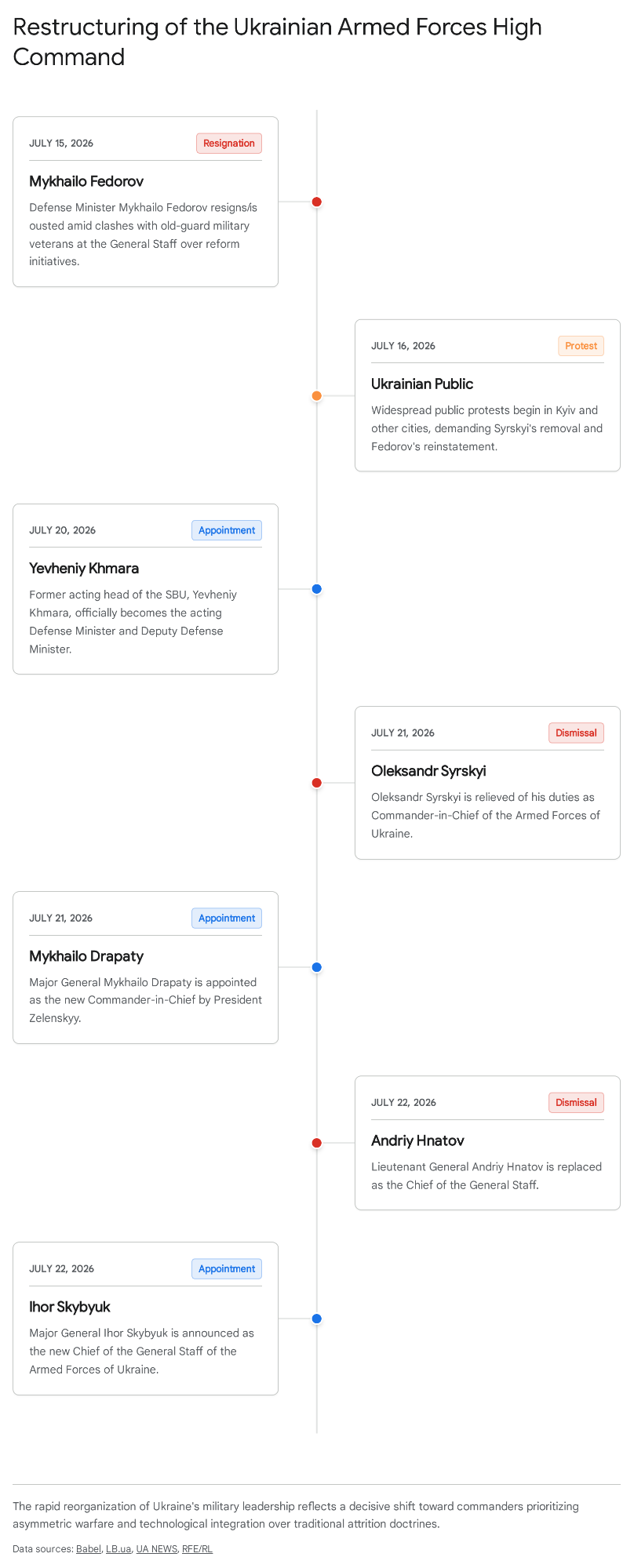
The most significant political shift of the reporting period occurred internally within the Ukrainian government, culminating in a total reconstitution of the Armed Forces’ apex leadership. The catalyst for this upheaval was the resignation of Defense Minister Mykhailo Fedorov on July 15.10 Fedorov, a 35-year-old technologically focused reformer, had been a prominent advocate for rapid technological integration, asymmetric drone warfare, and sweeping defense procurement reform.11 His departure triggered widespread, sustained public protests in Kyiv and other major urban centers, with demonstrators demanding the reinstatement of Fedorov and the removal of the military old guard.10
Fedorov’s resignation exposed a systemic, irreconcilable conflict with former Commander-in-Chief General Oleksandr Syrskyi.10 Fedorov publicly accused Syrskyi of blocking vital Defense Ministry initiatives, impeding necessary structural reforms, and adhering rigidly to traditional military structures and contracting procedures with defense manufacturers.10 President Zelensky subsequently confirmed the “systemic” nature of this command friction.10 Recognizing the unsustainability of this divide and the operational imperative to institutionalize technological innovation, Zelensky executed a sweeping purge of the old guard.
General Syrskyi was dismissed and replaced by Major General Mykhailo Drapaty, the former commander of the Joint Forces of the Armed Forces of Ukraine.10 Subsequently, on July 22, Major General Ihor Skybyuk—an experienced combat officer who previously commanded the 80th Separate Airborne Assault Brigade during the successful liberation of Izyum in the Kharkiv offensive—was elevated to Chief of the General Staff, replacing Lieutenant General Andriy Hnatov.10 Former acting head of the SBU Yevheniy Khmara was officially appointed acting Defense Minister to facilitate this transition.10
This command realignment fundamentally reorients the Ukrainian Armed Forces toward the asymmetric warfare doctrines championed by Fedorov. The new command team is explicitly mandated to overhaul the mobilization process (which Zelensky termed the absolute priority), integrate and develop advanced cyber forces, rapidly expand the corps system of the army, train incoming soldiers in modern technical warfare, and sustain the momentum of the long-range deep-strike campaign.10
Frontline Combat Updates
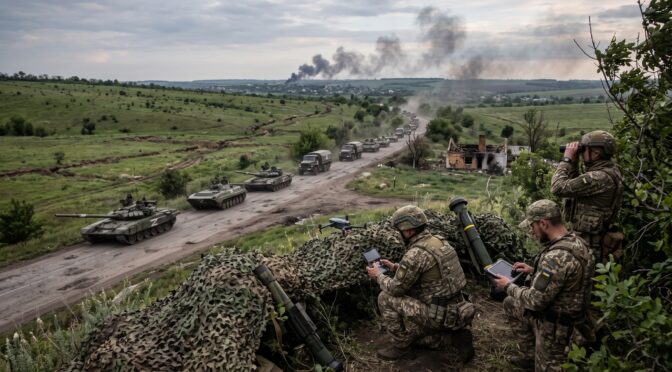
The terrestrial theater of operations is characterized by extreme friction, heavy casualties, and a near-total lack of operational mobility. Russian forces have fundamentally culminated in their capacity to execute deep, mechanized penetrations, transitioning entirely to squad- and platoon-level infantry assaults (often referred to colloquially as “meat assaults”) supported by overwhelming indirect fire and the mass deployment of glide bombs.
The primary vector of Russian offensive operations has shifted toward the Kostyantynivka direction. This shift follows a series of operational failures during the Spring-Summer 2026 offensive, where mechanized assaults along the Lyman and Slovyansk axes failed to achieve any significant operational breakthroughs.15 Minor, tactically insignificant advances were recorded by Russian units in the Kostyantynivka sector on July 22.14
Conversely, Ukrainian forces continue to execute localized tactical counter-attacks to disrupt Russian offensive staging areas and degrade localized command structures. On July 20 and 21, Ukrainian elements achieved confirmed advances in the Oleksandrivka direction and within northern Kharkiv Oblast, successfully pushing back Russian forward operating lines and mitigating the immediate artillery and drone threat to the civilian population of Kharkiv city.16 Despite these localized fluctuations, the front remained largely static on July 18, July 23, and July 24, with neither side registering confirmed territorial gains on those dates.3
An analysis of net territorial changes over the past year underscores the strategic immobility of the conflict. The following table delineates the confirmed net territorial gains by Russian forces, demonstrating a negligible rate of advance despite enormous resource and personnel expenditure. Note: Discrepancies exist in OSINT reporting regarding precise square mileage; both DeepState and Institute for the Study of War (ISW) figures are provided where they diverge.
| Reporting Period | Net Territorial Gain (Russian Forces) | Percentage of Total Ukrainian Territory | Strategic Context & Discrepancies |
| May 26 – June 23, 2026 | 12 square miles | < 0.01% | Heavy fighting along the Slovyansk and Lyman axes resulted in stalled Russian momentum. 19 |
| June 23 – July 21, 2026 | 10 to 15 square miles | < 0.01% | DeepState OSINT group reports a 15 sq mile gain; ISW data indicates a 10 sq mile gain. Focus shifted toward Kostyantynivka. 19 |
| July 14 – July 21, 2026 | 4 square miles | < 0.01% | Minimal tactical adjustments. Concurrently, Ukraine retains a 4 sq mile foothold in Kursk and Belgorod regions inside Russia. 19 |
| July 22, 2025 – July 21, 2026 | 1,089 to 1,103 square miles | ~0.5% | Total annual gain equates to an area slightly smaller than the U.S. state of Rhode Island. 19 |
(Data derived from DeepState OSINT group and Institute for the Study of War assessments.19 Total Ukrainian territory at 1991 independence: 233,062 square miles.19)
According to ISW estimates, over the first five months of 2026, Russian forces captured 15.6 times less territory than during the equivalent period in the previous year.20 This statistical reality has reportedly forced the Russian expert community and leadership to fundamentally revise their core assessments of the war’s trajectory, quietly abandoning the destruction of the Ukrainian state as a viable or expected primary outcome of the military operation.20
The 40-Day Deep-Strike Campaign & Maritime Security
The defining operational characteristic of the current phase of the war is Ukraine’s highly systematic, long-range deep-strike campaign. Now in its 40th day of intensified execution, this campaign has deliberately pivoted from exclusively targeting energy generation—which previously knocked out an estimated 20% to 40% of Russian refining capacity, forcing the Russian government to subsidize diesel imports 16—to systematically dismantling Russia’s military-civilian logistics networks.
Between July 18 and July 24, Ukrainian forces executed a sophisticated interdiction campaign against the warehousing infrastructure of Wildberries, Russia’s largest e-commerce provider. Operating as the Russian equivalent of Amazon, Wildberries has become a critical vulnerability in the Kremlin’s wartime economy. Intelligence indicates that these vast “civilian” logistics centers have been co-opted as primary transit hubs for the importation and distribution of dual-use electronic components, microchips evading Western sanctions, and navigation equipment critical for the domestic production of Russian tactical drones and missiles.21 Ukrainian President Zelensky explicitly stated that the operation targeted these transit routes for sanctioned electronics.21
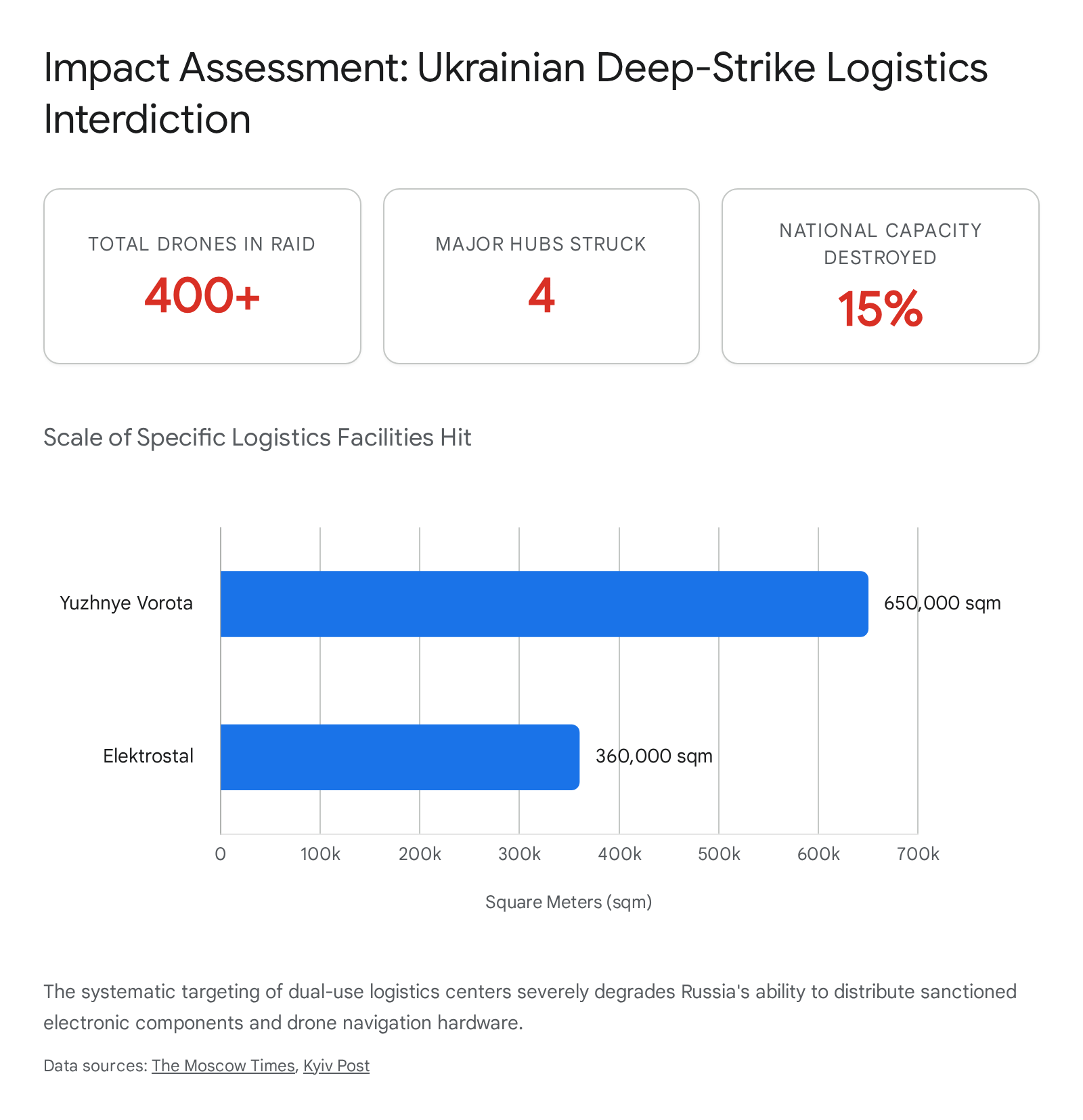
Over the past week, Ukrainian forces successfully struck at least 10 Wildberries warehouses across the Russian Federation and occupied territories.18 The most devastating of these occurred overnight on July 17-18, targeting facilities in Tambov (475 kilometers southeast of Moscow) and Elektrostal (Moscow region).17 The strike on the Elektrostal facility—a massive distribution hub spanning over 360,000 square meters and employing over 8,000 people—triggered a catastrophic fire that disrupted between 7% and 15% of the company’s total logistical capacity.12 The incident resulted in at least 8 fatalities and 62 injuries across the two hubs, causing massive disruptions to thousands of third-party sellers and generating significant civil unrest among Russian business owners who lost millions of rubles in merchandise and voiced their despair on social media.18 Ukrainian forces struck two additional Wildberries facilities overnight on July 21-22.14
This campaign escalated dramatically on the night of July 19-20, when Ukraine launched a massive, highly coordinated raid utilizing more than 400 unmanned aerial vehicles targeting the greater Moscow region.1 While Russian air defenses, according to Moscow Mayor Sergei Sobyanin, intercepted 85 drones on final approach, the swarm successfully overwhelmed regional layered defense networks.1 Drones impacted the massive Koledino Wildberries logistics center near Podolsk, an oil depot in Podolsk’s Lvovsky district, and the Yuzhnye Vorota industrial park near Domodedovo—a massive distribution hub spanning more than 650,000 square meters.1 Collateral damage included a drone striking a residential apartment building in Domodedovo, resulting in blast injuries to six individuals.1 The sheer volume of this attack forces the Russian Ministry of Defense to face a critical dilemma: they must now disperse and reallocate already over-stretched, high-tier air defense systems (such as the S-400 and Pantsir-S1) away from the Ukrainian frontline to protect deep-interior commercial logistics nodes, thereby exposing forward operating bases to Ukrainian tactical aviation.17
In parallel with the deep-strike campaign, the Black Sea has witnessed a dangerous intensification of maritime interdiction, with Russian forces adopting increasingly aggressive tactics to disrupt Ukrainian commercial shipping and enforce a de facto blockade. On July 21, the Liberian-flagged LPG tanker Gas Lisbon, carrying over 3,790 tonnes of highly combustible propane from Alexandria, Egypt, to the Ukrainian port of Reni, was struck by an unidentified naval drone.22 The attack occurred approximately 26 to 40 kilometers (20 nautical miles) off the coast of Romania, crucially outside Romanian territorial waters but well within its exclusive economic zone and operational purview.22 An explosion onboard severely injured three of the 17 crew members—resulting in severe burns covering 10-15% of their body surface and heavy hemorrhage—forcing the total evacuation of the vessel by the Romanian Agency for Saving Human Life at Sea (ARSVOM).22
This strike is part of a broader pattern of indiscriminate targeting of third-party commercial vessels by Russian assets. Preceding this event, on July 19, Russian forces struck the Guinea-Bissau-flagged Golden Leo, a commercial vessel loaded with corn departing Ukrainian waters, resulting in 10 fatalities among the crew.23 Furthermore, on July 17, a Russian drone impacted the Marshall Islands-flagged bulk carrier Venturo while docked in Odesa.24 The targeting of propane shipments is particularly insidious; with Ukraine having lost an estimated 80% of its thermal capacity as of September 2024 and 90% by May 2025 due to previous Russian strikes 19, imported liquefied gas is a vital lifeline for sustaining basic civilian infrastructure, grid stability, and industrial capacity.
Role of Third-Party Countries
The spillover of hostilities into the Black Sea and adjacent airspaces has drawn immediate responses from third-party nations, increasing the risk of miscalculation involving NATO member states. Following the attack on the Gas Lisbon, Romanian President Nicușor Dan explicitly attributed the strike to the Russian Federation’s illegal war of aggression.22
Romanian airspace has experienced repeated incursions, culminating on July 24 when a Romanian F-16 fighter jet intercepted and successfully shot down an unidentified drone operating deep within sovereign Romanian airspace.25 The interception occurred near Padina in Buzău County, approximately 114 kilometers from the Ukrainian border, representing a massive penetration into NATO territory.25 This kinetic engagement sets a significant precedent for air policing rules of engagement along the alliance’s eastern flank. It strictly follows a severe antecedent in May 2026, when a Russian drone crashed into a residential apartment building in the southeastern Romanian city of Galați, causing civilian casualties and prompting Bucharest to expel the Russian consul general in Constanța, a move which Russia retaliated against by closing the Romanian Consulate in St. Petersburg.25
Simultaneously, the diplomatic fallout from maritime attacks has extended globally. India officially summoned the Russian envoy in New Delhi to protest the fatal attack on the Golden Leo, underscoring growing international frustration among BRICS-adjacent nations with Russia’s destabilization of global food and energy supply chains and threats to international mariners.22
Military and financial aid mechanisms continue to evolve in response to these threats. The following table summarizes recent key multilateral actions and third-party involvement in the operational theater:
| Country/Entity | Action / Support Mechanism | Strategic Impact |
| European Union | Adoption of the 21st Sanctions Package (July 23, 2026). 5 | Targets Russian energy, financial services, crypto-evasion, and Belarus trans-shipment nodes, aiming to starve the Russian military-industrial complex of capital and high-tech components. 7 |
| Romania (NATO) | Deployment of F-16s; deep-inland interception/shootdown of a drone near Padina. Evacuation of Gas Lisbon crew. 1825 | Demonstrates NATO’s willingness to kinetically defend eastern flank airspace while maintaining robust maritime rescue operations in the contested Black Sea. |
| United States | First combat deployment of the Merops drone interception system in Kuwait. 26 | Validates advanced Counter-UAS technology tested extensively in Ukraine, reflecting the symbiotic relationship between Ukrainian battlefield testing and Western defense procurement. |
| India | Diplomatic reprimand; summoned Russian envoy over maritime fatalities in the Black Sea. 22 | Signals eroding patience among non-aligned nations regarding Russia’s reckless disruption of global maritime trade and food security. |
3. Drone Warfare and Unmanned Systems
Tactical & Strategic Deployments
The Russia-Ukraine conflict has fully transitioned into the first industrialized drone war in human history, characterized by rapid iteration, massive scale, and integration across all echelons of combat. For Ukraine, unmanned systems are no longer merely tactical assets for ISR or localized artillery spotting; they constitute the primary strategic delivery mechanism for achieving operational parity against a numerically superior adversary.
The successful penetration of the 400-drone swarm into the Moscow region demonstrates a sophisticated mastery of swarm logic, waypoint navigation, and electronic warfare (EW) evasion.1 To achieve this, Ukrainian operators employ complex, non-linear flight paths, utilizing terrain masking and coordinated time-on-target strikes to overwhelm radar horizons and exhaust the ready-ammunition of Russian short-range air defense (SHORAD) systems like the Pantsir-S1. Ukrainian President Zelensky recently noted to US officials that Ukraine’s drone range will eventually reach 10,000 kilometers by 2027, highlighting a relentless development pipeline.27
The efficacy of Ukrainian naval and aerial strikes in the Black Sea and Sea of Azov has generated a severe secondary effect on Russian force posture. Verified intelligence indicates that the Russian Ministry of Defense has been compelled to divert highly trained, elite drone operator units away from the eastern frontline, reassigning them to rear-echelon areas to defend critical energy and agricultural logistics nodes against Ukrainian asymmetric attacks.17 This involuntary redeployment degraded Russia’s tactical reconnaissance capabilities along the line of contact, directly contributing to the stalled momentum in the Lyman and Slovyansk sectors.
Technical Profile of Systems
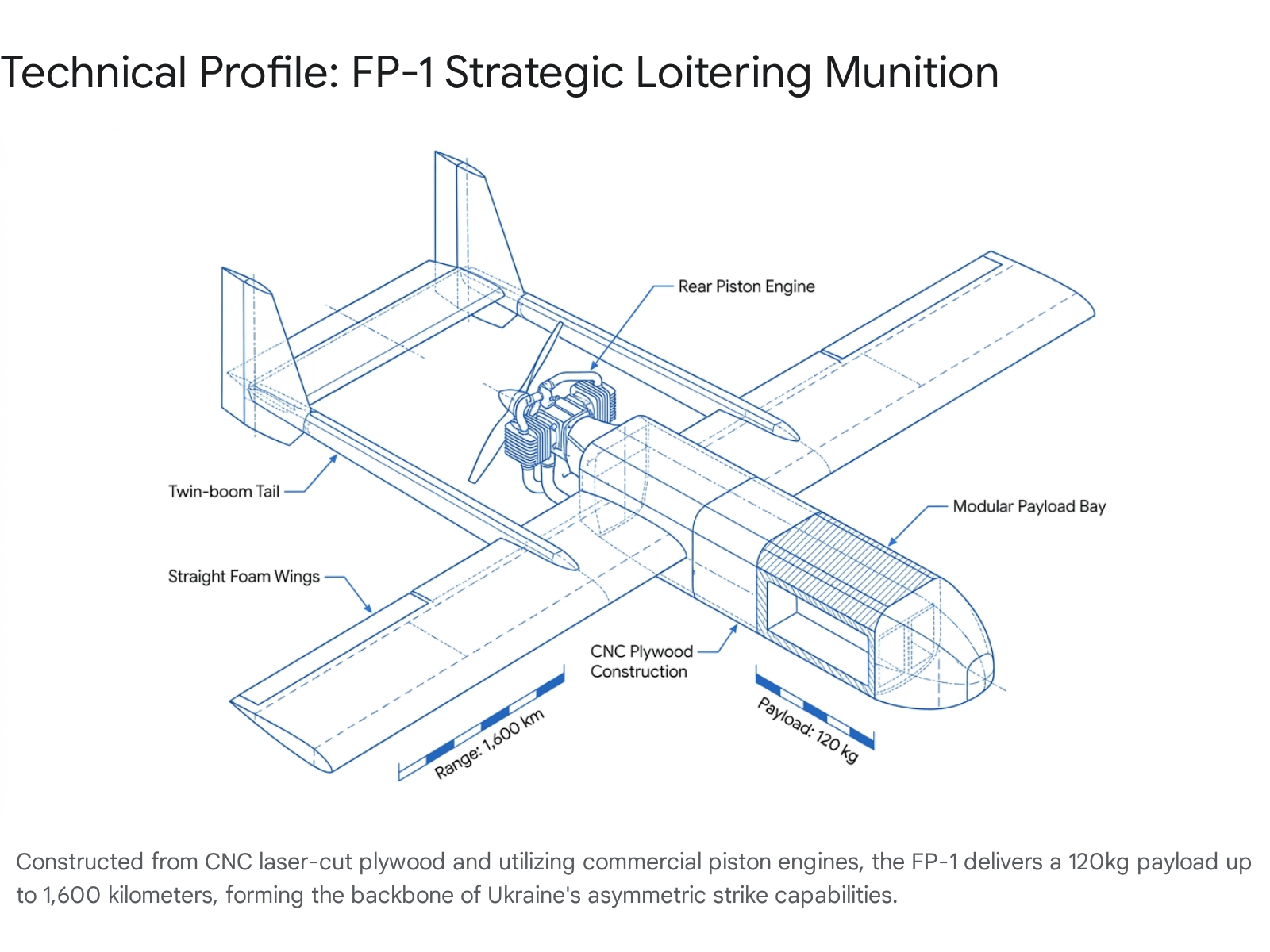
The cornerstone of Ukraine’s strategic strike capability is the FP-1 long-range loitering munition, developed and manufactured by the domestic defense technology firm Fire Point LLC.28 Introduced in late 2024 and heavily deployed throughout 2025 and 2026, the FP-1 is estimated to account for approximately 60% of all Ukrainian deep strikes against Russian interior targets.28
The FP-1 exemplifies the doctrine of “affordable mass.” With a unit cost of approximately $55,000 (with some reports citing a range of €47,000–$58,000), it is designed for rapid, scalable production.28 The airframe utilizes a twin-boom layout with a 6-meter wingspan, constructed primarily from CNC laser-cut plywood and foam wings wrapped in fiberglass or carbon fiber, utilizing simple slot-and-fastener joints.28 This non-metallic construction significantly reduces its radar cross-section (RCS). Propulsion is provided by a commercial off-the-shelf (COTS) two-cylinder piston engine, allowing for a flight endurance of 7 to 12 hours depending on payload.28 Crucially, the FP-1 utilizes an autonomous navigation suite combining an Inertial Navigation System (INS) with a GNSS system specifically designed to be highly resistant to Russian electronic warfare jamming.28 The system is ground-launched, negating the need for vulnerable airfield infrastructure.30
Fire Point has also advanced its capabilities into ballistic missile development. The FP-7 (200km range, 150kg payload, currently in mass production) and the FP-9 (up to 855km range, 800kg payload, completing testing) utilize composite materials to reduce weight while directly cloning the aerodynamic profiles of Russia’s 48N6 surface-to-air missile.28 This cloning provides a proven aerodynamic shell capable of speeds up to 2,200 m/s.28
In the realm of counter-UAS (C-UAS), the United States military recently achieved a milestone by successfully deploying the Merops drone interception system in combat for the first time in Kuwait, destroying an Iranian “Shahed”-type attack drone.26 Developed under the U.S. “Project Eagle” initiative, the Merops system consists of a radar, ground control station, and an AI-driven interceptor drone capable of speeds exceeding 175 mph. It destroys targets via kinetic collision or proximity detonation.26 The deployment in the Middle East directly follows extensive combat testing in Ukraine, where the system was utilized to destroy over 1,000 Russian Shahed drones, leading to its subsequent procurement by several Eastern European nations.26
Below is a detailed technical profile of prominent unmanned and missile systems heavily utilized or newly deployed in the current operational period:
| System Name | Origin | Range | Payload | Role & Capabilities |
| FP-1 | Ukraine (Fire Point) | Up to 1,600 km 28 | 60 – 120 kg (modular high-explosive) 28 | Strategic deep-strike loitering munition. Plywood airframe, EW-resistant INS/GNSS, ground-launched, twin-boom. 28 |
| FP-2 | Ukraine (Fire Point) | 40 – 200 km 28 | Up to 105 kg 28 | Mid-range tactical strike munition. Utilized for frontline infrastructure targeting (e.g., Vasylivka). 28 |
| FP-7 / FP-9 | Ukraine (Fire Point) | 200 km / Up to 855 km 28 | 150 kg / Up to 800 kg 28 | Precision ballistic missiles. Composite materials, CEP of 14m/20m. Cloned 48N6 aerodynamics. FP-7 in mass production. 28 |
| Bulava | Ukraine / Czech Republic (UAC) | Up to 60 km 31 | 3.6 kg (thermobaric) 31 | Tactical kamikaze drone. Autonomous combat missions with ground control stations and repeaters. 31 |
| TerMIT | Ukraine | Up to 20 km 31 | Up to 300 kg 31 | Unmanned Ground Vehicle (UGV) capable of 10 km/h. Logistics support and frontline heavy weapon platform (e.g., mounting heavy machine guns). 31 |
| Merops | United States | Interceptor 26 | Kinetic collision / Proximity Detonation 26 | C-UAS Interceptor drone. AI-guided, >175 mph. Extensively tested in Ukraine (>1000 kills), recently deployed in Middle East. 26 |
Targeting Priorities & Countermeasures
Russian targeting priorities during this reporting period have relied heavily on sheer volume to saturate Ukrainian air defenses, aiming to exhaust Western-supplied interceptors. Overnight on July 24, Russian forces launched 180 drones and five Kh-59/69 guided missiles against Ukrainian targets.18 Earlier in the week, overnight on July 21-22, Russia launched 216 drones, alongside one Iskander-M ballistic missile and three Kh-59/69 cruise missiles.14 On July 18, Russia launched 90 drones, two Iskander-M missiles, two Onyx anti-ship missiles, and three Kh-59/69 cruise missiles.17 The persistent use of Shahed-type loitering munitions remains a staple of Russian operational design, intended to terrorize civilian populations and force the expenditure of highly valuable surface-to-air missiles.
Concurrently, Russia has actively sought to disrupt Ukraine’s domestic technology development. On July 24, a Russian precision strike targeted a privately operated military training site in the Bucha district near Kyiv, which was reportedly hosting a demonstration of Ukrainian unmanned aerial vehicles and defense technologies. The attack resulted in 10 fatalities and approximately 100 injuries, highlighting a concerted effort to eliminate Ukrainian engineering and operating personnel at the source.
However, U.S. officials have raised significant concerns regarding the rapid depletion of interceptor stockpiles. The defense industrial base is struggling to replenish precision-guided munitions at the rate they are being consumed in both the Ukrainian and Middle Eastern theaters.26 This underscores the critical importance of low-cost, AI-driven interceptors like the Merops system, which offer a sustainable cost-per-kill ratio against mass-produced loitering munitions.26
4. Resource Utilization, Constraints, and Sustainability
Manpower Dynamics, Logistics, and Industrial Capacity
The Russian Federation is currently grappling with severe constraints in both manpower regeneration and industrial output, forcing the Kremlin to implement highly risky political and logistical maneuvers. According to Andriy Kovalenko, head of Ukraine’s Center for Countering Disinformation, Russian military command is actively preparing a mass mobilization of 500,000 personnel scheduled for autumn 2026.32
This impending mobilization is a direct consequence of a failing contract recruitment system and unsustainable battlefield attrition. Updates from Ukraine’s Foreign Intelligence Service (SZRU) indicate that Russia drastically failed to meet its mid-2026 recruitment targets, securing only 195,000 of the 204,500 required military contracts.32 The Kremlin continues to exert legal pressure on Russian migrants, coercing them into military service under the threat of deportation to offset these shortfalls.16 Concurrently, Russian forces are suffering immense personnel degradation. The SZRU projects 196,700 total losses for the 2026 calendar year, comprising approximately 115,300 “irretrievable” fatalities or severe casualties, and 80,400 injured.32 On a single day (July 23, 2026), the Ukrainian Ministry of Defense reported total Russian daily military losses of 1,410 personnel, pushing the aggregate total personnel losses since the beginning of the invasion to approximately 1,436,100, alongside the destruction of 1,652 UAVs and 76 artillery systems.33
To contextualize the scale of this attrition, historical casualty estimates from various intelligence apparatuses highlight the staggering human cost of this conflict. Estimates of Russian casualties include figures of 400,000 killed or injured (Trump estimate, Dec 2024); 700,000 killed (Trump estimate, Jan 2025); and 400,000 killed or injured (CSIS, June 2025).19 Ukrainian casualties are also immense, with estimates ranging from 100,000 killed (Zelensky, April 2025) to 500,000-600,000 total military casualties (CSIS, Jan 2026; RFE/RL, Feb 2026; Netherlands Military Intelligence, April 2026).19 Both nations are suffering severe demographic strain; nearly 9.6 million Ukrainians (22% of the pre-invasion population) remain displaced, including 5.9 million international refugees.19
The operational blueprint for the 500,000 mobilized Russian personnel reveals a dual-track strategy born of desperation. A portion of the conscripts will be funneled directly to the eastern front within two weeks of mobilization to serve as emergency replacements—essentially serving as infantry to “plug holes” in the defense.32 The remainder will undergo a marginally longer, one-month training pipeline intended to generate a force capable of opening a new offensive front, likely designed to stretch Ukrainian reserves thin ahead of the harsh winter combat season.32 According to Kovalenko, Russian officials, including First Deputy Chief of Staff Sergei Kiriyenko and Chief of the General Staff Valery Gerasimov, have assured the Russian leadership that this mobilization effort will secure a military advantage.32
Ukrainian Military Intelligence (HUR) officer Andriy Chernyak assesses that Russia possesses adequate physical infrastructure—sufficient existing training grounds and centers—to process this massive influx.32 However, the Kremlin has deliberately suppressed public discussion of this mobilization, denying its existence to mitigate domestic political fallout ahead of the autumn State Duma elections, prioritizing regime stability over military transparency.4 The Kremlin appears to be actively setting conditions and preparing for potential civil unrest resulting from this mobilization.14
On the industrial front, Russia’s capacity to produce advanced munitions is failing to pace its expenditure rates. An ISW analysis confirmed that in July 2026 alone, Russian forces launched more ballistic missiles against Ukraine than the Russian defense industrial base produces in a standard month.34 Most notably, Russia consumed up to two-thirds of its entire planned annual production of the advanced Zircon hypersonic missile system in just the month of July.34 Russian President Vladimir Putin is concurrently attempting to downplay Russia’s economic problems, despite ongoing fuel shortage crises and broader economic decline.14 The Russian Central Bank slightly lowered its key interest rate for the fifth time in 2026 in an attempt to portray the economy as stable, aligning with Kremlin messaging.18
The following table contextualizes the resource utilization and constraints currently faced by both militaries:
| Resource / Sector | Current Status & Statistics | Strategic Implication |
| Manpower Generation | 195k contracts signed out of 204.5k target (mid-2026). 32 | Contract system failure necessitates a highly unpopular 500,000-man forced mobilization in autumn. 32 |
| Casualty Projections | 196,700 projected total losses for 2026 (115.3k irretrievable). 32 | Current offensive tempo is structurally unsustainable without immediate mass conscription to replace “meat assaults.” |
| Advanced Munitions | July ballistic missile usage exceeded monthly production. 2/3 of annual Zircon production fired in one month. 34 | Rapid depletion of strategic reserves; forces reliance on cheaper, less accurate munitions and Iranian/North Korean drones. |
| Logistics & Warehousing | 10 Wildberries hubs struck; 7% to 15% of national capacity disrupted. 182 | Severe bottlenecks in the distribution of sanctioned microchips and drone components hidden within civilian e-commerce. 21 |
| Energy & Fuel | 20% to 40% of Russian refining capacity knocked out by prior strikes. 19 | The Russian government is undertaking costly efforts to mitigate losses by subsidizing diesel imports, further draining state coffers. 16 |
Strategic Sustainability Projection
The trajectory of the conflict suggests that both nations are approaching critical thresholds of sustainability, albeit in different domains. Russia is experiencing acute, compounding failures in high-end industrial output (evidenced by missile expenditure rates outstripping production 34) and voluntary force generation (evidenced by the looming 500k mobilization 32). However, Russia maintains an asymmetric advantage in its willingness to absorb catastrophic casualties and its ability to weaponize terror against civilian shipping, energy infrastructure, and logistics.
Ukraine’s sustainability relies entirely on maintaining the technological edge provided by systems like the FP-1 and expanding its deep-strike capabilities to systematically dismantle the Russian war machine from within. The restructuring of the General Staff under Major General Skybyuk and Commander-in-Chief Drapaty indicates a total, uncompromising commitment to this doctrine.10 If Ukraine can continue to bypass traditional Russian military logistics and sever the grey-market lifelines running through commercial entities like Wildberries, it can induce localized economic and logistical paralysis in Russia, compensating for its quantitative disadvantages on the static frontline. The upcoming winter season, coupled with the state of Ukraine’s severely degraded thermal power generation 19, will test the resilience of the Ukrainian civilian populace and the efficacy of Western energy and defense support mechanisms.
5. Chronological Timeline of Key Events
- July 17 (Preceding window context): Mykolaiv Oblast Military Administration Head Vitaly Kim resigns.17 A Russian drone strikes the Venturo bulk carrier in Odesa.24 Overnight into July 18, Ukrainian forces strike two Wildberries logistics facilities (Elektrostal and Tambov), disrupting a significant portion of their national capacity and igniting massive fires.17
- July 18: Neither side makes confirmed frontline advances.17 Russia launches 90 drones, 2 Iskander-M ballistic missiles, 2 Onyx anti-ship missiles, and 3 Kh-59/69 cruise missiles against Ukraine.17 Intelligence reveals Russian plans to mobilize 500,000 personnel by autumn, with plans to immediately deploy conscripts to the eastern front.32
- July 19: Russian forces strike the Guinea-Bissau-flagged Golden Leo commercial vessel leaving a Ukrainian port loaded with corn, killing 10 people and prompting international condemnation.23
- July 20: Ukrainian forces execute a massive, coordinated 400-drone raid against the Moscow region.1 The strikes hit the Koledino Wildberries center, an oil depot in Podolsk, and the Yuzhnye Vorota industrial park (a 650,000 sqm hub).1 Yevheniy Khmara is appointed acting Defense Minister in Ukraine.10
- July 21: The Liberian-flagged LPG tanker Gas Lisbon, carrying propane to Reni, is struck by an unidentified naval drone off the coast of Romania.22 Three crew members are severely injured and 17 evacuated by Romanian ARSVOM forces.22 Ukrainian forces advance in the Oleksandrivka direction and northern Kharkiv Oblast.16 Russia launches 216 drones and four missiles.14
- July 22: President Zelensky officially appoints Major General Ihor Skybyuk as Chief of the General Staff, replacing Andriy Hnatov, signaling a total overhaul of the military command toward technological integration.10 Russian forces register minor tactical advances in the Kostyantynivka direction.14 Ukraine strikes two additional Wildberries facilities.14
- July 23: The European Union officially adopts its 21st package of sanctions targeting Russian energy, finance, crypto sectors, and Belarusian trans-shipment nodes.5 Neither Ukrainian nor Russian forces make confirmed advances on the ground.3 The Ukrainian Ministry of Defense reports 1,410 Russian daily casualties.33
- July 24: A Romanian F-16 fighter jet intercepts and shoots down an unidentified drone 114km deep inside sovereign Romanian airspace near Padina.25 Russian forces strike a drone demonstration site in the Bucha district near Kyiv, resulting in 10 deaths and approximately 100 injuries. Ukraine continues its long-range strike campaign against energy and logistics.18 Russia launches 180 drones and five Kh-59/69 guided missiles.18 Frontlines remain static.18
Please share the link on Facebook, Forums, with colleagues, etc. Your support is much appreciated and if you have any feedback, please email us in**@*********ps.com. If you’d like to request a report or order a reprint, please click here for the corresponding page to open in new tab.
Sources Used
- Ukraine’s Massive 400-Drone Raid Hits Moscow Region Logistics Network, Fuel Sites – Kyiv Post, accessed July 25, 2026, https://www.kyivpost.com/post/80644
- What We Know About the Aftermath of Ukraine’s Wildberries Drone …, accessed July 25, 2026, https://www.themoscowtimes.com/2026/07/20/what-we-know-about-the-aftermath-of-ukraines-wildberries-drone-strikes-a93285
- ISW Russian Offensive Campaign Assessment, July 23, 2026 – Kyiv Post, accessed July 25, 2026, https://www.kyivpost.com/post/80950
- mobilization – Kyiv Post, accessed July 25, 2026, https://www.kyivpost.com/topic/mobilization
- War against Ukraine: 21st package of sanctions hits Russian energy, financial services and crypto, accessed July 25, 2026, https://euneighbourseast.eu/news/latest-news/war-against-ukraine-21st-package-of-sanctions-hits-russian-energy-financial-services-and-crypto/
- China slaps export controls on 14 EU entities in retaliation for Russia-related sanctions, accessed July 25, 2026, https://apnews.com/article/china-eu-sanctions-russia-export-control-war-cfb75918077b268eb76b0f19c1673511
- European Union Adopts 21st Package against Russia & Parallel Sanctions on Belarus, accessed July 25, 2026, https://www.mayerbrown.com/en/insights/publications/2026/07/european-union-adopts-21st-package-against-russia-and-parallel-sanctions-on-belarus
- 21st package of sanctions: EU hits Russian energy, financial services and crypto hard, accessed July 25, 2026, https://www.consilium.europa.eu/en/press/press-releases/2026/07/23/21st-package-of-sanctions-eu-hits-russian-energy-financial-services-and-crypto-hard/
- EU Agrees 21st Sanctions Package Against Russia, accessed July 25, 2026, https://www.themoscowtimes.com/2026/07/23/eu-agrees-21st-sanctions-package-against-russia-a93317
- Ihor Skybyuk will be the new Chief of the General Staff of the Armed Forces of Ukraine, accessed July 25, 2026, https://babel.ua/en/news/128757-ihor-skybyuk-will-be-the-new-chief-of-the-general-staff-of-the-armed-forces-of-ukraine
- Zelenskyy Appoints New Chief Of General Staff, Latest Shakeup Of Ukraine’s Military Leadership – Radio Free Europe, accessed July 25, 2026, https://www.rferl.org/a/ukraine-military-personnel-shuffle-general-war-russia-zelenskyy/33809831.html
- Ihor Skybyuk appointed new chief of the General Staff – LB.ua, accessed July 25, 2026, https://en.lb.ua/news/2026/07/22/38862_ihor_skybyuk_appointed_new_chief.html
- Zelenskyy announced the appointment of Skibuk as Chief of the General Staff | UA.NEWS, accessed July 25, 2026, https://ua.news/en/ukraine/zelenskii-ogolosiv-pro-priznachennia-nachalnikom-genshtabu-skibiuka
- ISW Russian Offensive Campaign Assessment, July 22, 2026, accessed July 25, 2026, https://www.kyivpost.com/post/80870
- Active Conflicts & News Megathread June 15, 2026 : r/CredibleDefense – Reddit, accessed July 25, 2026, https://www.reddit.com/r/CredibleDefense/comments/1u6c7u2/active_conflicts_news_megathread_june_15_2026/
- ISW Russian Offensive Campaign Assessment, July 21, 2026 – Kyiv Post, accessed July 25, 2026, https://www.kyivpost.com/post/80795
- ISW Russian Offensive Campaign Assessment, July 18, 2026 – Kyiv Post, accessed July 25, 2026, https://www.kyivpost.com/post/80595
- ISW Russian Offensive Campaign Assessment, July 24, 2026, accessed July 25, 2026, https://www.kyivpost.com/post/81031
- The Russia-Ukraine War Report Card, July 22, 2026, accessed July 25, 2026, https://www.russiamatters.org/news/russia-ukraine-war-report-card/russia-ukraine-war-report-card-july-22-2026
- A Bitter Consensus: How Russia’s Experts Moved From Default Victory to Totalitarian Consolidation – International Centre for Defence and Security, accessed July 25, 2026, https://icds.ee/en/a-bitter-consensus-how-russias-experts-moved-from-default-victory-to-totalitarian-consolidation/
- Ukraine launched a drone strike on a Wildberries warehouse, disrupting Russian e-commerce logistics., accessed July 25, 2026, https://moneyandbanking.co.th/en/2026/257396/
- Romania says ship heading to Ukraine struck off its coast – Ground News, accessed July 25, 2026, https://ground.news/article/romania-says-ship-heading-to-ukraine-struck-off-its-coast_78df87
- Off the coast of Romania, an unknown drone attacked a gas tanker heading to a port in the Odesa region. Three crew members were injured – Бабель, accessed July 25, 2026, https://babel.ua/en/news/128724-off-the-coast-of-romania-an-unknown-drone-attacked-a-gas-tanker-heading-to-a-port-in-the-odesa-region-three-crew-members-were-injured
- Gas tanker headed to Ukraine attacked near Romania, accessed July 25, 2026, https://newsukraine.rbc.ua/news/gas-tanker-headed-to-ukraine-attacked-near-1784630312.html
- Romanian F-16 Downs Unidentified Drone During Russian Strike on …, accessed July 25, 2026, https://www.kyivpost.com/post/80977
- The U.S. shot down a Shahed for the first time using the Merops system, which was tested in Ukraine – UA.NEWS, accessed July 25, 2026, https://ua.news/en/world/ssha-vpershe-zbili-shakhed-sistemoiu-merops-iaku-viprobuvali-v-ukrayini
- US Downs Shahed with Ukraine-Tested Merops Drone – Kyiv Post, accessed July 25, 2026, https://www.kyivpost.com/post/81038
- Fire Point – Grokipedia, accessed July 25, 2026, https://grokipedia.com/page/Fire_Point
- Fire Point FP-1 – Wikipedia, accessed July 25, 2026, https://en.wikipedia.org/wiki/Fire_Point_FP-1
- FP-1 – Bavovna AI, accessed July 25, 2026, https://bavovna.ai/uav/fp-1/
- It can fly up to 1600 km: Ukraine presents FP-1 attack drone, accessed July 25, 2026, https://militarnyi.com/en/news/it-can-fly-up-to-1600-km-ukraine-presents-fp-1-attack-drone/
- Russia Plans to Mobilize 500,000 Personnel by Autumn, Prepares …, accessed July 25, 2026, https://www.kyivpost.com/post/80585
- accessed July 25, 2026, https://mod.gov.ua/en/news/total-russian-combat-losses-in-ukraine-as-of-july-24-2026#:~:text=Total%20russian%20military%20losses%20on,UAVs%2C%20and%2076%20artillery%20systems.&text=Personnel%3A,100%20(%2B1%20410)%20persons.
- In July, Russia launched more ballistic missiles at Ukraine than it produces in a month – ISW, accessed July 25, 2026, https://unn.ua/en/news/in-july-russia-launched-more-ballistic-missiles-at-ukraine-than-it-produces-in-a-month-isw