
Executive Summary (BLUF)
The landscape of law enforcement patrol rifle optics has reached a critical inflection point. Driven by evolving threat matrices, active shooter response protocols, and the paramount need for liability mitigation through positive target identification (PID), agencies are increasingly transitioning away from standard non-magnified reflex sights. The current debate dominating department procurement cycles centers on two primary optical architectures: the Low Power Variable Optic (LPVO) and the Red Dot Sight combined with a flip-to-side Magnifier (RDS+Mag).
This exhaustive technical white paper analyzes the biomechanical, optical, and operational trade-offs between these two systems, specifically focusing on engagements under 50 yards—the statistical envelope for the vast majority of law enforcement lethal force encounters. Empirical data indicates that while the RDS+Mag configuration retains a measurable speed advantage in close-quarters target acquisition due to the absence of geometric eye-box constraints, the LPVO offers unparalleled versatility, superior glass clarity, and critical threat-assessment capabilities at extended ranges.
However, the integration of either system introduces complex secondary variables. Procurement officers and command staff must account for the ergonomic impact of mount height over bore (e.g., the industry shift toward 1.93-inch and 2.26-inch optical centerlines), the bio-mechanical realities of parallax shift under stress, and the lifecycle logistics of battery dependence versus etched reticle fail-safes. Furthermore, localized procurement frameworks, such as the Michigan Department of Technology, Management & Budget (DTMB) extended purchasing programs, dictate the fiscal realities of these acquisitions. Ultimately, the selection of a primary optic cannot be generalized; it requires a granular analysis of departmental operational environments, training budgets, and baseline officer proficiency.
1.0 The Evolution of Law Enforcement Patrol Rifle Optics
1.1 Historical Context and the Shift to Advanced Optics
The modern law enforcement patrol rifle has evolved significantly from the early adoptions of surplus military hardware. Historically, the integration of the AR-15 platform into squad cars relied heavily on iron sights or rudimentary, early-generation red dot sights. However, as the law enforcement mission profile has expanded to include lone-officer active shooter interdiction, perimeter security, and complex urban overwatch, the optical requirements have evolved correspondingly. The 2018 International Association of Chiefs of Police (IACP) National Law Enforcement Policy Center Active Shooter Model Policy definitively states that an officer may determine immediate tactical intervention is necessary and reasonable to stop a threat, without waiting for special weapons and tactics (SWAT) teams or backup.1 This doctrinal shift requires the first responding officer to possess precision firepower capabilities that far exceed standard unmagnified sight pictures.
The objective is no longer simply to place rounds on a center-mass silhouette. The contemporary objective is to rapidly acquire a target, definitively identify the presence of a lethal threat versus a non-threat, and deliver surgically precise fire in environments heavily populated by innocent bystanders. Distinguishing between a dark-colored cellular device and a compact semi-automatic firearm at 75 yards is an optical challenge that naked-eye vision and non-magnified red dots cannot reliably solve.2
1.2 The Modern Engagement Envelope
Data surrounding law enforcement rifle deployments indicates a distinct, dual-threat reality that drives optic selection. The vast majority of reactive, sudden-onset lethal force encounters occur at extreme close quarters, frequently under the 50-yard threshold and often inside structures at distances under 15 yards. Conversely, proactive deployments—such as establishing a containment perimeter around a barricaded suspect, providing overwatch during a critical incident, or rural patrolling—frequently require officers to monitor locations from distances of 50 to 300 yards.
This dichotomy creates a profound technological paradox for departmental quartermasters and procurement divisions. An optic must be inherently fast, possessing an extremely forgiving viewing angle for close-quarters battle (CQB) at 5 yards, yet it must simultaneously be capable of providing high-resolution magnification at 100 yards for reconnaissance and precision engagements. The defense and law enforcement industry has answered this paradox with two primary solutions: pairing a fast 1x reflex sight with a mechanical 3x to 5x magnifier, or engineering a variable scope that attempts to bridge the gap from a true 1x magnification up to 6x, 8x, or even 10x within a single unified aluminum tube.4
1.3 Ballistic Considerations and Caliber Integration
Optic selection cannot be decoupled from the ballistic realities of the patrol rifle’s chambering. While the 5.56x45mm NATO cartridge remains the universal standard, maintaining the terminal velocity required to induce hydrostatic shock and secondary cavitation often requires precise shot placement when barrel lengths are reduced to 10.5 or 11.5 inches for vehicle egress and maneuverability. Furthermore, exploratory adoptions of alternative calibers, such as the 6.8mm Remington Special Purpose Cartridge (SPC), highlight the need for optics capable of facilitating longer-range engagements. A 6.8 SPC projectile fired from a 16-inch barrel can maintain supersonic speeds out to approximately 825 yards, offering a flat trajectory that demands a magnified optic to fully exploit.1 Whether utilizing the traditional 5.56mm or adopting intermediate barrier-blind calibers, the optical sighting system must complement the weapon’s maximum effective range while prioritizing immediate short-range survivability.
2.0 Technical Architecture and Optical Physics
To accurately assess the operational capabilities of Low Power Variable Optics compared to Red Dot and Magnifier systems, command staff must first deconstruct the physics that govern their operation. The fundamental differences in how these sights generate an aiming point dictate their respective strengths, limitations, and failure points in the field.
2.1 Low Power Variable Optics (LPVO) Mechanics
An LPVO is a traditional telescopic sight engineered specifically to offer a minimum magnification of true 1x (or a marginal fractional approximation, such as 1.05x). The internal architecture consists of an objective lens that gathers ambient light, a complex erector tube assembly that houses the magnification lenses and the reticle, and an ocular lens assembly equipped with a diopter ring that focuses the image specifically to the biological irregularities of the individual shooter’s eye.7
The reticle within a duty-grade LPVO is physically etched onto a glass element within the erector tube. This structural design provides a critical law enforcement advantage: a mechanical fail-safe aiming point. Even in the event of total catastrophic battery failure, crushed electronic internal circuitry, or severe electromagnetic interference, the black etched reticle remains persistently visible and ballistically accurate during all daylight hours.5 When the optic’s electronic illumination is activated, a centralized dot or the entire reticle structure glows, attempting to mimic the rapid-acquisition capabilities of a traditional red dot sight.
LPVOs are further categorized by the internal placement of their focal planes, a distinction that fundamentally alters how the optic is utilized by an officer:
- First Focal Plane (FFP): The reticle is located in front of the magnification lenses. As the user rotates the magnification ring to increase zoom, the reticle scales in size proportionally with the target image. This engineering ensures that any Bullet Drop Compensator (BDC) or ranging hash marks remain mathematically accurate at all magnification levels.10 This is critical for officers who may need to take a precision shot at 200 yards using an intermediate magnification setting (e.g., 4x on an 8x scope).
- Second Focal Plane (SFP): The reticle is located behind the magnification lenses. Consequently, the reticle remains a constant size to the shooter’s eye regardless of the magnification setting chosen. Because the reticle does not scale with the target, the BDC and ranging marks are only ballistically accurate at one specific magnification setting—almost universally the absolute maximum magnification.12 SFP optics are generally preferred by officers who intend to leave the optic at 1x for patrol, only dialing to maximum magnification for specific, calculated distance shots.
2.2 Holographic and Reflex Sights (RDS) Mechanics
The terms “Red Dot Sight” and “Holographic Weapon Sight” are frequently used interchangeably in casual police discourse, but they represent entirely different optical technologies, each with unique logistical and tactical implications.
Reflex (Red Dot) Sights, such as the Aimpoint Micro T2 or the Sig Sauer Romeo series, utilize a high-efficiency Light Emitting Diode (LED) that projects a concentrated beam of light onto a specially coated, slightly angled objective lens. This lens reflects the specific wavelength of the LED back to the shooter’s eye while simultaneously allowing ambient environmental light to pass through. The absolute simplicity of this solid-state design results in exceptional battery life—often measured in years of continuous, always-on operation. The Aimpoint T2, for example, is rated for up to 50,000 continuous hours on a single CR2032 battery.15 This allows the optic to be left in a constant state of readiness in the patrol vehicle rack.
Holographic Weapon Sights (HWS), pioneered by EOTech and represented by models such as the EXPS3-0, do not reflect an LED. Instead, they utilize a sophisticated laser diode to illuminate a holographic film embedded within the viewing window. The reticle is a pre-recorded three-dimensional hologram. This unique technology provides an incredibly clear reticle that appears to float precisely on the target plane, virtually eliminating the optical illusion of parallax error. However, driving a laser architecture requires significantly more electrical power, limiting the battery life to approximately 1,000 continuous hours on a single CR123 battery.15
When a modular magnifier (such as the EOTech G33 3x, G43 3x, or G45 5x) is flipped into place behind an RDS or HWS, it optically enlarges the entire sight picture, including the target and the reticle. Crucially, holographic sights interact uniquely with magnifiers compared to standard reflex sights. While the target is magnified 3x or 5x, the central 1 Minute of Angle (MOA) aiming dot of an EOTech does not appear to increase in size relative to the target, preserving extreme precision.17 Conversely, in a traditional LED red dot, a 2 MOA dot magnified 3x covers roughly 6 inches of the target at 100 yards, which can obscure the fine details necessary for surgical hostage rescue engagements.
2.3 The Physics of Exit Pupil and Eye Box Volume
The fundamental mechanical limitation of the LPVO compared to the RDS is defined by rigid optical physics, specifically the interconnected concepts of exit pupil and eye relief.
Eye relief is defined as the specific, linear distance from the rear ocular lens to the cornea of the shooter’s eye where the full field of view (FOV) is visible. If the eye is positioned too close to or too far from this optimal distance, the visual image shrinks and is surrounded by a thick, obscuring black ring—a phenomenon commonly referred to as scope shadow.19
The exit pupil is the diameter of the cylindrical column of light exiting the rear of the optic. The formula for calculating the exit pupil is standard mathematical division: the Objective Lens Diameter is divided by the Magnification Level. For example, a standard law enforcement 1-6x24mm LPVO set to 6x magnification produces an exit pupil of exactly 4 millimeters (24 divided by 6 equals 4). When the same optic is dialed down to 1x, the mathematical exit pupil expands to 24 millimeters.
In order for the shooter to perceive the image, the biological pupil of the human eye—which dilates between 2 to 3 millimeters in bright sunlight and up to 7 millimeters in near-total darkness—must be physically positioned entirely inside this exit pupil column of light.20 This three-dimensional geometric space—defined longitudinally along the Z-axis by the eye relief and laterally along the X and Y axes by the exit pupil—is known as the “eye box.”
Red dot and holographic sights, lacking internal magnification erector tubes, project light parallel to the shooter’s visual axis. They possess virtually infinite eye relief and no functional exit pupil constraint at 1x magnification. As long as the officer can physically see the glass window from any angle, they can see the dot and effectively engage the target.22
3.0 Ergonomic Trade-Offs and Biomechanical Integration
The physical and architectural characteristics of an optic heavily dictate how an officer interacts with the patrol rifle under stress. During the extreme bio-mechanical stress of a lethal force encounter, sympathetic nervous system arousal degrades fine motor skills, induces auditory exclusion, and severely alters visual processing (often manifesting as tunnel vision). The optical system must compensate for, rather than exacerbate, these physiological realities.
3.1 Eye-Box Constraints and Head Placement Forgiveness
Because LPVOs are constrained by the rigid physical boundaries of the eye box described in the previous section, they require a consistent, highly repeatable cheek-to-stock weld from the shooter. If an officer is forced to return fire from an unconventional, asymmetric position—such as underneath a patrol vehicle engine block, around a tight urban barricade, or while wearing a bulky chemical, biological, radiological, and nuclear (CBRN) gas mask or heavy ballistic helmet—aligning the eye perfectly behind the center axis of the LPVO can be exceptionally challenging. If the eye shifts even slightly outside the 4-millimeter exit pupil column, the sight picture disappears entirely into black scope shadow, rendering the rifle momentarily useless.21
Conversely, the unlimited eye box of an unmagnified red dot sight allows for highly forgiving head placement.21 An officer can have half their face lifted off the stock to clear a gas mask filter, and if the red dot is visible anywhere in the corner of the optic window, the projectile will reliably strike where the dot rests.
When a magnifier is introduced into the RDS system, it suddenly adopts an eye box constraint similar to a traditional scope. For example, the EOTech G33 magnifier features a tight eye relief of 2.2 inches, while the larger G45 5x magnifier offers 2.5 inches of eye relief.25 This requires the officer to carefully establish proper head placement when magnified. However, because the magnifier is mounted on a mechanical flip-to-side hinge, it is primarily engaged during static, deliberate precision shots where the officer has the luxury of time to establish a proper cheek weld. During a dynamic room entry or a sudden, close-range ambush, the magnifier is simply slapped away, instantly reverting the system to an unconstrained, highly forgiving 1x reflex sight.3
3.2 Parallax Deviation and Point of Impact Shift
Parallax error is defined as a displacement in the apparent position of the reticle relative to the target when the shooter’s eye moves off the exact optical centerline of the sight. While reflex sight manufacturers frequently market their duty optics as entirely “parallax-free,” independent technical engineering evaluations reveal this is a physical impossibility.
A rigorous, comparative engineering study of optic parallax conducted by Green Eye Tactical demonstrated that point-of-impact (POI) shifts occur in nearly all optical systems when the shooter’s head is misaligned. According to the data, holographic sights like the EOTech 516 exhibited the lowest overall parallax deviation, though they showed slightly more sensitivity to horizontal head movement than vertical head movement. Traditional LED red dots and variable power LPVOs exhibited varying, and sometimes significant, degrees of POI shift.28
At CQB distances under 50 yards, this parallax deviation is generally measured in small fractions of an inch and is entirely negligible for center-mass engagements. However, at extended distances, severe head misalignment behind certain LPVOs or lower-tier red dots can result in a devastating miss on a precision target. The data indicated that certain LPVO models, specifically noting the Vortex Razor series in the study, exhibited a parallax deviation that more than doubled when the target distance was increased from 25 yards out to 50 yards.28 Training programs must emphasize the vital importance of proper optical centering and structural cheek weld, regardless of the platform chosen, to mitigate this optical phenomenon.
3.3 Mount Height Over Bore: The 1.93 to 2.26-Inch Paradigm
The height at which the primary optic is mounted relative to the rifle’s central bore axis has undergone a radical evolutionary shift in modern tactical and law enforcement doctrine. Historically, optics were mounted at an “absolute co-witness” height (approximately 1.42 inches above the rail) or a “lower third co-witness” height (1.57 inches) to align perfectly with standard folding iron sights.29
In recent years, the industry has widely adopted “heads-up” shooting postures, facilitated by significantly taller mounting systems ranging from 1.93 inches up to 2.26 inches. This trend has been heavily popularized by specialized systems like the Unity Tactical FAST series and Scalarworks LEAP mounts.29
The biomechanical and tactical advantages of these taller mounts for law enforcement are significant:
- Cervical Spine Posture: A 2.26-inch or 2.05-inch mount allows the officer to maintain a completely neutral, upright cervical spine posture, bringing the optic up to the eye rather than aggressively crushing the face and neck down to the stock. This preserves vital peripheral vision, enhances oxygen intake, and drastically improves situational awareness in chaotic environments.33
- Equipment Clearance: Taller mounts effortlessly clear bulky over-the-ear communication headsets, CBRN gas masks, and the thick, restrictive collars of heavy level IV tactical entry vests.
- Night Vision Compatibility: A 2.26-inch centerline is highly conducive to passive aiming through helmet-mounted night vision goggles, allowing the officer to look directly through the optic without the night vision tubes colliding with the rifle stock.35
However, this ergonomic benefit comes with a severe ballistic trade-off that requires intensive training to overcome. Increasing the Height Over Bore (HOB) exacerbates the mechanical offset at close ranges. If an optic is mounted 2.26 inches above the barrel, a shot taken at 5 yards will impact nearly two and a half inches lower than the point of aim. For law enforcement, a failure to account for this mechanical offset during a close-quarters precision shot—such as shooting through a narrow gap in a vehicle window or attempting a precise central nervous system incapacitation on a hostage taker—can result in a catastrophic miss.32 Rigorous departmental training on strict hold-overs is absolutely mandatory when authorizing these modern mount heights.
4.0 Time-on-Target Analysis: Engagements Under 50 Yards
The primary argument against adopting LPVOs for general patrol deployment revolves around the perception of degraded speed during close-quarters battle. To accurately quantify this, we must examine empirical time-trial data comparing a Red Dot + Magnifier system directly against a premium LPVO.
4.1 Empirical Data from Speed Drills (2-2-2 and 1-Reload-1)
Standardized, independent testing conducted by industry analysts at Pro Gun Millennial measured the performance differences between a Red Dot + Magnifier (with the magnifier flipped away for 1x use) and an LPVO dialed to 1x. To balance the requirement of speed against the absolute necessity of accuracy, time penalties (+1 second) were mathematically added to the raw score for any missed shots.24
The “2-2-2 Drill” is designed to assess target transition speed across a horizontal plane, requiring the shooter to engage three equally spaced targets with two rounds each from a standing position.
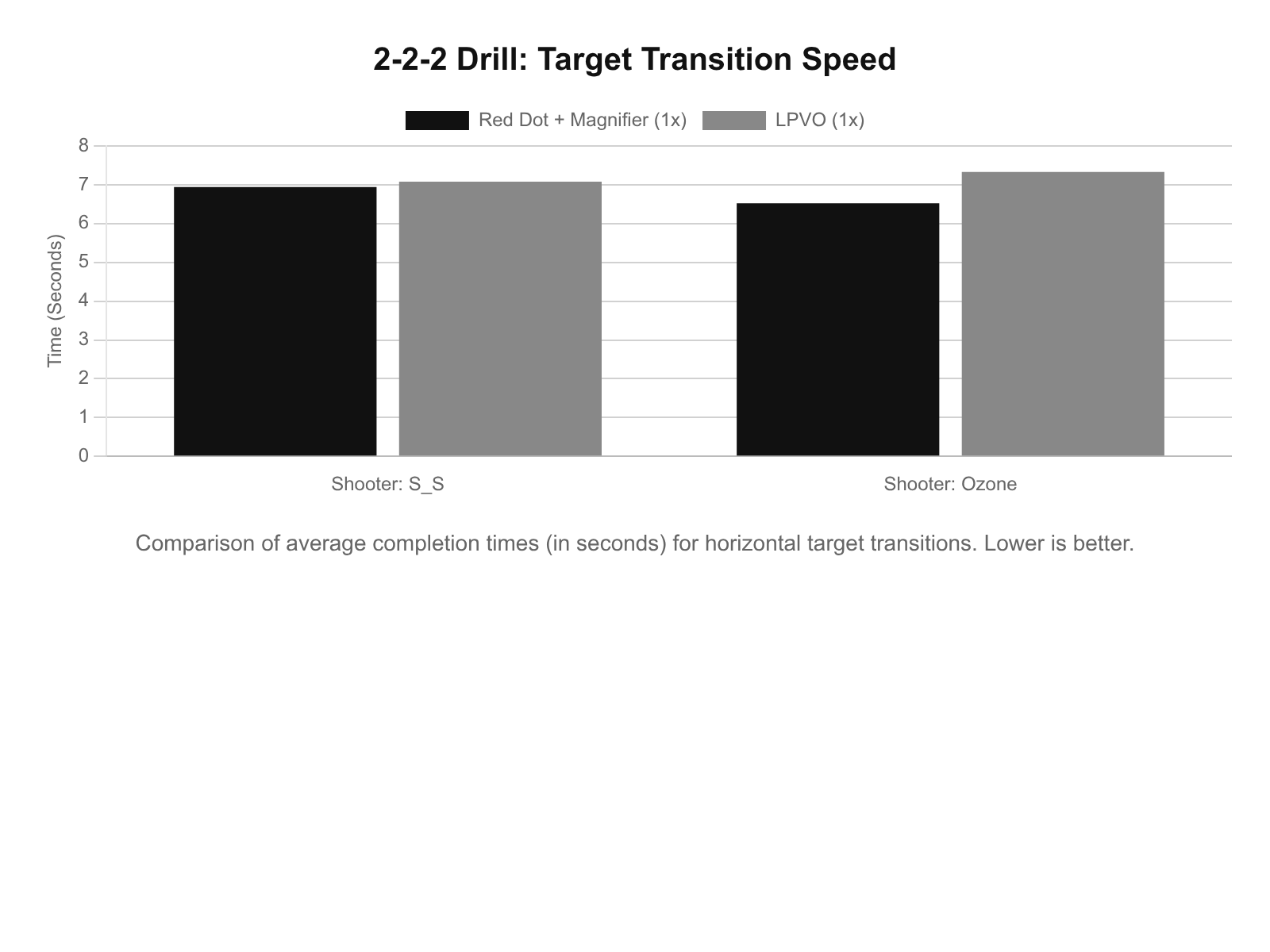
The data above reveals a consistent advantage for the Red Dot system during horizontal target transitions.
To further isolate the specific ergonomic penalty of the LPVO’s eye box, testers utilized the “1-Reload-1 Drill” at 25 yards. This drill assesses the optic’s dimensional forgiveness. After firing one round, the shooter must completely break their cheek weld to perform a mechanical magazine reload, and then must rapidly re-acquire the eye box under extreme time pressure to fire the second round.
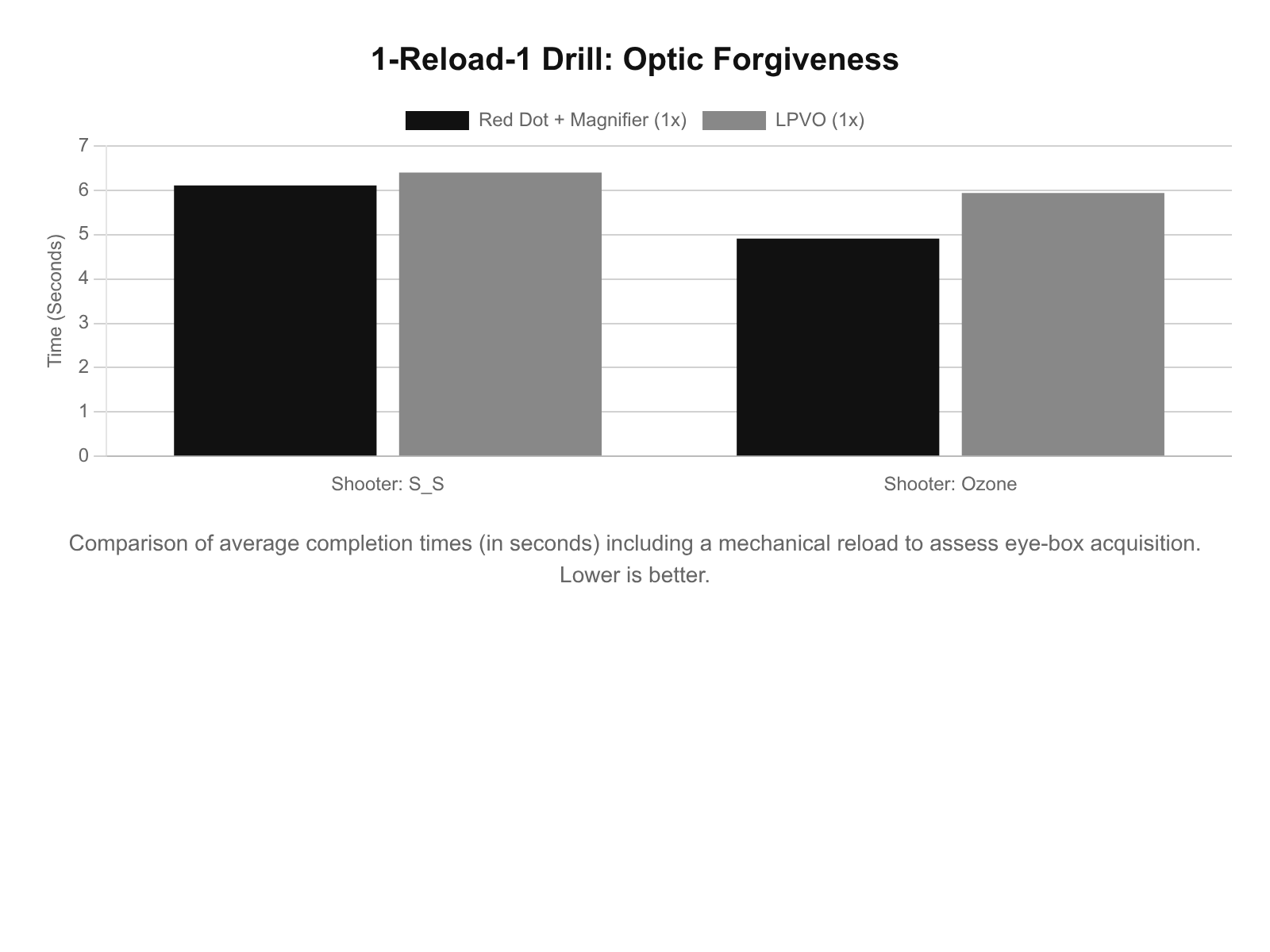
Analysis of this empirical data demonstrates a persistent, quantifiable speed advantage for the Red Dot system across all users. More critically, in the reload drill—which forces the user to rapidly re-establish optical alignment from scratch—the RDS was between 5% and 17% faster.24 This data directly validates the primary ergonomic hypothesis: the complete lack of an exit pupil constraint allows the officer’s visual cortex to process information and command the trigger break fractions of a second sooner. In a sudden, close-quarters gunfight under 50 yards, these fractions of a second represent a distinct and vital tactical advantage.
4.2 Transitional Engagements (Near-Far Metrics)
Law enforcement lethal force engagements are rarely static events. An officer may be forced to engage an immediate threat at 3 yards, then instantly pivot to address a secondary, elevated threat at 50 or 100 yards down a street or hallway. The “Near-Far Drill” explicitly tested this capability by requiring the shooter to engage a near target at 3 yards, manually activate their magnification system (by physically flipping the magnifier module or cranking the LPVO magnification throw lever), and then immediately engage a 50-yard target.
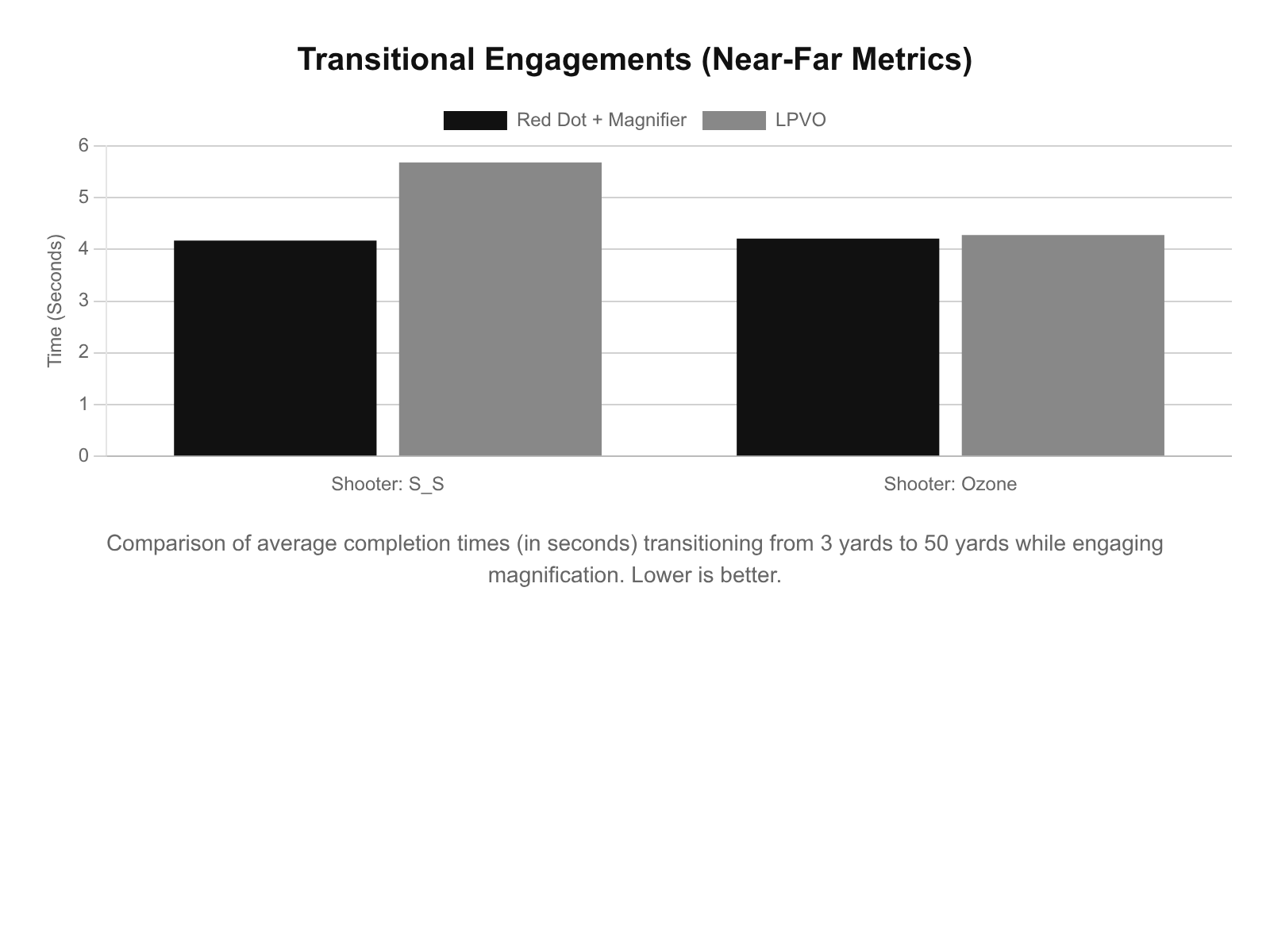
The data extracted here heavily favors the modular, macroscopic design of the flip-to-side magnifier system.24 Slapping a spring-loaded magnifier mount into place is an aggressive, gross-motor movement that requires almost zero cognitive bandwidth or fine motor control. In contrast, rotating the magnification ring on an LPVO—even when equipped with an extended, aftermarket “cat tail” throw lever—remains a fine-motor manipulation. Furthermore, because high-quality variable scopes are heavily gas-purged with nitrogen or argon and feature stiff internal o-rings to maintain waterproofing, the rotational throw is inherently resistant and slower, frequently requiring the officer to momentarily alter their firing grip to generate enough torque.8
4.3 Weapon Light Splash and Reticle Bloom Mitigation
At CQB distances, low-light operations introduce a highly complex optical variable: the defeat of photonic barriers. When an officer activates a modern, high-lumen (1,000+ lumen) or high-candela (50,000+ candela) weapon-mounted light inside a dark, confined space, the intense beam violently splashes and reflects against white walls, doors, or vehicle panels.
If a red dot sight’s brightness is not manually adjusted to a high setting prior to entry, the reticle may completely “wash out” against the brightly illuminated background, rendering the sight useless. Conversely, if the red dot is turned up to its maximum setting in anticipation of weapon light splash, the dot may “bloom” or starburst dramatically, obstructing the target entirely. Holographic sights manage this blooming effect exceptionally well due to the laser transmission method.18
However, LPVOs offer a distinct, insurmountable advantage in this specific scenario: the black etched reticle provides persistent, non-electronic contrast. Even if the electronic illumination is washed out entirely by the weapon light, the physical, etched crosshairs remain starkly visible as a black silhouette against the brightly illuminated target, ensuring the officer never loses their precise point of aim regardless of photonic interference.
5.0 Threat Identification and Liability Mitigation
While pure speed under 50 yards is paramount for officer survival, law enforcement agencies face immense civil and criminal liability regarding the legal justification of lethal force. The optic must serve not merely as an aiming device, but as a critical intelligence-gathering tool to satisfy the standard of objective reasonableness.
5.1 Positive Target Identification (PID) Capabilities
The most profound administrative justification for outfitting a patrol rifle with an LPVO is the massive enhancement of Positive Target Identification (PID). At distances of 50 to 75 yards, distinguishing whether a non-compliant suspect is holding a dark-colored cellular device, a wallet, or a compact semi-automatic pistol is virtually impossible with the naked eye or a 1x red dot sight.
An LPVO dialed to 6x or 8x magnification effectively turns the patrol rifle into a high-resolution surveillance platform.2 An officer holding perimeter security can clearly assess the subject’s hands, read vehicle license plates, or identify specific individuals within a chaotic crowd. If the individual is determined to be unarmed, the magnification prevents a catastrophic use-of-force error and subsequent civil litigation. If the individual is armed, the magnification allows the officer to confidently and accurately articulate the nature of the threat in their subsequent use-of-force report.
While a 3x or 5x magnifier placed behind a red dot provides some PID enhancement, the edge-to-edge optical clarity, light transmission, and superior continuous magnification range of a dedicated, multi-coated LPVO are vastly superior for extended reconnaissance and intelligence gathering.7
5.2 Ranging, Bullet Drop Compensation (BDC), and 68 MOA Geometry
When engagements inevitably stretch beyond the 100-yard mark, the physics of intermediate cartridges dictate that the bullet will experience parabolic drop and significant wind drift.
LPVOs handle trajectory compensation through complex, glass-etched BDC reticles. These reticles feature specific, numbered stadia lines corresponding to precise yardages (e.g., 200, 300, 400, 500 yards) that are factory-calibrated for a specific ammunition load (such as a 55-grain M193 or 62-grain M855 5.56mm projectile).11 By placing the appropriate hash mark directly on the target, the officer guarantees a hit without needing to calculate math or manually dial elevation turrets under fire. Furthermore, the horizontal width of these hash marks is often calibrated to precisely correspond to the 18-inch average width of adult human shoulders, allowing the officer to rapidly estimate the range of an unknown target.
Holographic sights, such as the widely issued EOTech EXPS series, utilize a distinct approach to ranging. The standard EOTech “-0” reticle consists of a 1 MOA central aiming dot surrounded by a large 68 MOA ring.16 This is not merely a rapid-acquisition tool designed to draw the eye; it contains embedded, highly practical ranging geometry specifically designed for human-sized targets.
For a standard 5.56mm patrol rifle load, the geometric breakdown is as follows:
- The center 1 MOA dot serves as the primary zero point (typically utilizing a 50-yard zero, which intersects again at 200 yards).
- The absolute bottom edge of the 68 MOA ring serves as the exact point of impact for mechanical offset hold-overs at extreme close range (7 yards).
- The entire 68 MOA ring mathematically equates to the height of an average 5-foot-9-inch male standing at exactly 100 yards.8
If a suspect fills the ring from top to bottom, the officer instantly knows the range is 100 yards. While the EOTech reticle is an ingenious, rapid-processing tool for CQB hold-overs and intermediate ranging, it lacks the surgical, multi-distance precision of an LPVO’s dedicated, numerically scaled BDC array at extended distances.
6.0 Law Enforcement Procurement and Deployment Strategy
Optic selection cannot be driven solely by theoretical range performance or ballistic capability. Procurement officers must rigorously analyze long-term budgetary constraints, logistical burdens, state-level purchasing frameworks, and departmental deployment policies.
6.1 Lifecycle Costs, Durability, and Battery Logistics
The initial capital expenditure for purchasing optics represents only a fraction of the true total cost of ownership. The ongoing logistical burden of battery management is a critical factor for quartermasters.
- Red Dot Sights: Top-tier RDS platforms, exemplified by the Aimpoint T2, are renowned for their ruggedness and 5-year constant-on battery life. This essentially eliminates battery management from the individual officer’s daily routine; armorers can simply cycle in fresh batteries during annual or bi-annual department qualifications.15
- Holographic Sights: EOTech HWS units run on high-drain CR123 batteries with a limited 1,000-hour lifespan. To preserve power, they require internal auto-shutoff circuits. This necessitates that the officer manually push a button to activate the optic upon deploying the rifle from the vehicle rack—a critical, fine-motor step that can be forgotten under the extreme stress of a sudden ambush.41
- LPVOs: Quality LPVOs utilize standard CR2032 coin cells or readily available AA batteries.11 Because the internal LED illumination must be extremely powerful to be “daylight bright,” battery drain is rapid if left activated. However, as previously established, the persistent etched reticle renders a dead battery a tactical inconvenience rather than a catastrophic system failure.9
6.2 The Michigan DTMB Procurement Case Study (Contract 240000002212)
Analyzing the current municipal procurement landscape provides valuable insight into how major law enforcement agencies are sourcing and funding this advanced hardware. The State of Michigan’s Department of Technology, Management & Budget (DTMB) manages massive, multi-million dollar cooperative purchasing agreements that are fully accessible to the Michigan State Police (MSP) and local municipalities via the MiDEAL extended purchasing program.42
Recent contract data illustrates the massive scale of these optical and firearm integrations. Request for Proposal (RFP) #171-240000002212 for “Ammunition, Firearms and Related Law Enforcement Equipment” resulted in highly lucrative dual awards to Vance Outdoors, Inc. (totaling $1,306,966.00) and Kiesler Police Supply, Inc. (totaling $2,092,165.00), with the contracts active through August 2026.44 Through these centralized, state-level contracts, regional agencies within Michigan—such as the Berrien County Sheriff’s Office or the Oakland County Sheriff’s Office—can bypass complex individual bidding processes. Utilizing platforms like the Oakland County MITN Purchasing Group, these departments can leverage the state’s massive buying power to procure advanced optics, magnifiers, and patrol rifles at significant bulk discounts, ranging from 10% to 53.8% off commercial MSRP.45
These sophisticated acquisitions must also align perfectly with strict internal carry policies. For instance, Michigan State Police Official Order 001-016 strictly mandates that patrol rifles are carried in vehicles in a specific, standardized readiness state: chamber empty, bolt closed, dust cover closed, safety on, and a magazine loaded with exactly 28 rounds inserted firmly into the well.50 An optic that requires complex button-pushes to activate (like certain auto-shutoff holographic sights) adds an additional cognitive step to an already multi-stage weapon deployment protocol. A “shake-awake” red dot, an always-on Aimpoint, or a standard unpowered LPVO crosshair removes this potential failure point, aligning the hardware with the operational policy. The integration of advanced equipment is further supported by external funding mechanisms, such as the Spirit of Blue Foundation grant which successfully provided highly advanced LMT CQB10-MARS-LA tactical rifles to the MSP Emergency Support Team.51
6.3 Departmental Policies, NTOA Standards, and Training Integration
The National Tactical Officers Association (NTOA) conducts rigorous, independent testing of law enforcement equipment to guide departmental procurement. To achieve an NTOA “Gold” rating, an optical system must score above a 4.5 average across 13 distinct, grueling criteria, including ease-of-use, durability, and practical design.52 Agencies frequently rely on these NTOA certifications to justify sole-source procurement requests to city councils or to satisfy strict federal grant funding requirements.53
However, successfully equipping a department with LPVOs requires a massive paradigm shift in training doctrine. As noted by field instructors, moving an officer from an RDS to an LPVO is not a seamless transition. Officers must be trained extensively on establishing a consistent eye box, manipulating the magnification throw lever rapidly under stress, and properly utilizing the ocular diopter adjustment to focus the reticle to their individual ocular prescription.7 Many forward-thinking agencies mandate specific, multi-day transition courses before an officer is authorized to carry a magnified optic on duty.55 If a department lacks the budget for extended range time, additional ammunition, and advanced instruction, outfitting standard patrol officers with complex LPVOs may actually yield diminishing returns compared to the intuitive, point-and-shoot simplicity of a standard red dot sight.
7.0 Comparative Market Matrix
To facilitate clear, data-driven procurement decision-making for command staff, the following matrices present comparative technical specifications of the leading, duty-grade optical systems currently dominating the law enforcement market.
7.1 Duty-Grade LPVO Specifications: Trijicon vs. Vortex
The Vortex Razor HD Gen II-E 1-6×24 and the Trijicon VCOG 1-8×28 represent the current apex of commercial, duty-rated law enforcement variable optics.
| Specification | Vortex Razor HD Gen II-E 1-6×24 | Trijicon VCOG 1-8×28 |
| Magnification Range | 1x to 6x | 1x to 8x |
| Objective Lens | 24mm | 28mm |
| Focal Plane | Second Focal Plane (SFP) | First Focal Plane (FFP) |
| Reticle Type | JM-1 BDC, VMR-2 (Wire/Etched) | MRAD / MOA Segmented Circle |
| Eye Relief | 4.0 inches | 4.0 – 3.9 inches |
| Exit Pupil (at 1x / max) | 24.0mm / 4.0mm | 11.8mm / 3.5mm |
| Field of View (100 yds) | 115.2 ft (1x) – 20.5 ft (6x) | 109.2 ft (1x) – 13.1 ft (8x) |
| Battery Type | CR2032 | Single AA (Lithium or Alkaline) |
| Weight | 21.5 oz (without mount) | 31.5 oz (with integrated mount) |
| Adjustment | 150 MOA Max Elevation/Windage | 35 MRAD Max Elevation/Windage |
| Mount Interface | 30mm Tube (requires separate mount) | Integrated Picatinny Thumbscrew/Larue |
| Source Documentation | 12 | 11 |
Analytical Insight: The Vortex Razor is highly lauded by tacticians for its incredibly thin housing that creates a “disappearing bezel” effect at 1x magnification, providing an exceptionally wide 115.2 ft field of view that closely mimics the situational awareness of a red dot sight.13 However, the Trijicon VCOG offers a distinct logistical advantage by integrating the 7075-T6 aluminum mounting hardware directly into the optic’s housing, creating a virtually indestructible, unified platform that runs on readily available AA batteries for up to 633 hours—a significant supply-chain advantage for municipal quartermasters.10
7.2 Duty-Grade CQB Systems: Aimpoint vs. EOTech + Magnifiers
For dedicated close-quarters systems, the Aimpoint Micro T2 and EOTech EXPS3-0 dominate the law enforcement contract space, supported by modular magnifiers.
| Specification | Aimpoint Micro T-2 | EOTech EXPS3-0 | EOTech G45 Magnifier |
| Technology | LED Reflex Projection | Laser Holographic Film | Optical Prism System |
| Magnification | 1x | 1x | 5x Fixed |
| Reticle | 2 MOA Red Dot | 1 MOA Dot w/ 68 MOA Ring | N/A (Magnifies primary optic) |
| Battery Life | 50,000 Hours (Constant On) | 1,000 Hours (Auto-Shutoff) | N/A |
| Power Source | CR2032 | CR123 | N/A |
| Weight | 4.97 oz (with standard mount) | 11.2 oz (with integrated mount) | 12.8 oz (with STS mount) |
| Eye Relief | Unlimited | Unlimited | 2.5 inches |
| Field of View | Tube limited | Window limited (very wide) | 7.3 degrees |
| Dimensions (L x W x H) | N/A (Highly Compact) | 3.8″ x 2.3″ x 2.9″ | 3.9″ x 2.3″ x 3.3″ |
| Source Data | 15 | 15 | 26 |
Analytical Insight: The EOTech EXPS3-0, when paired directly with the G45 (5x) magnifier, creates a highly potent, adaptable hybrid system. The holographic reticle scales perfectly under the 5x magnification, and the large rectangular window provides unparalleled situational awareness.18 However, this entire system combined weighs exactly 24 ounces (11.2 oz + 12.8 oz)—making it heavier than the Vortex Razor LPVO without a mount. The Aimpoint T2 offers an uncompromising reduction in weight and infinite, reliable battery life but sacrifices the complex ranging geometry of the EOTech’s holographic ring.15
8.0 Strategic Recommendations for Command Staff
The empirical time-trial data, bio-mechanical optical physics, and complex procurement realities evaluated in this comprehensive report indicate that there is no singular “correct” optic for all law enforcement patrol rifles. The optimal optical choice is entirely dictated by the department’s specific operational environment, budget, and resource allocation.
8.1 Urban Density and CQB Dominance (Recommendation: RDS + Magnifier)
For municipal agencies operating primarily in dense urban environments, frequently clearing inside structures, or focusing heavily on high-risk warrant execution, the Red Dot Sight paired with a flip-to-side magnifier remains the optimal solution. The empirical time-on-target data unequivocally demonstrates that the unlimited eye box of a 1x reflex or holographic sight minimizes cognitive load and maximizes absolute speed at distances under 50 yards.24 Furthermore, the ability to physically flip the magnifier away strips away all eye relief constraints, allowing officers to fire rapidly from compromised barricade positions or while wearing heavy structural entry gear.
8.2 Rural Patrolling and Perimeter Security (Recommendation: LPVO)
For county sheriffs, state police agencies (such as the MSP), and departments covering varied topographies or long stretches of highway, the LPVO provides an unmatched, force-multiplying capability upgrade. The ability to dial an optic to 6x or 8x completely transforms the patrol rifle into a critical intelligence-gathering asset.2 The severe liability protection offered by Positive Target Identification (PID) at 100+ yards cannot be overstated in today’s legal climate. While there is a slight, fractional degradation in raw speed at 5 yards compared to an RDS, intensive, structured training can effectively bridge this gap. The physical fail-safe of the etched reticle ensures that an officer will never be left with a dead, un-aimable optic during a critical, life-threatening incident.8
8.3 The Hybrid Piggyback Paradigm
A third, highly specialized paradigm is rapidly emerging among elite units: equipping a premium LPVO with a miniaturized red dot sight (MRDS) mounted at a 45-degree offset or “piggybacked” directly on top of the scope ring.63 Systems utilizing specialized hardware, such as the Unity Tactical FAST LPVO mount equipped with an MRDS Top Ring, place a small red dot directly above the primary optic.31 This setup completely eliminates the LPVO’s CQB speed disadvantage. The officer maintains a heads-up posture to utilize the red dot for immediate 0-25 yard sudden threats, and simply drops their cheek to the stock to utilize the LPVO for distant engagements or high-resolution surveillance.65 While this maximizes capability and solves the paradox of range versus speed, it significantly increases the cost per unit, the training complexity, and the overall physical weight of the weapon system.
Appendix: Methodology & Data Sources
This white paper was synthesized using rigorous Open-Source Intelligence (OSINT) gathering techniques, aggregating technical engineering specifications, empirical field-test data, and departmental procurement frameworks.
Data parameters included:
- Biomechanical Testing: Comparative time-trial data evaluating optic speed in multi-target and reload scenarios.
- Optical Engineering: Exit pupil mathematics, parallax deviation studies, and focal plane architecture.
- Government Procurement: Deep-dive review of the State of Michigan DTMB centralized purchasing structures, specific contract awards (Contract No. 240000002212), and localized law enforcement policy directives.
- Manufacturer Specifications: Aggregation of proprietary dimensions, weights, and electrical lifespans from Trijicon, Vortex, EOTech, Aimpoint, Unity Tactical, and Scalarworks.
Ronin’s Grips Analytics provides custom, agency-specific data on this topic. Contact us to commission a tailored report for your department.
Please share the link on Facebook, Forums, with colleagues, etc. Your support is much appreciated and if you have any feedback, please email us in**@*********ps.com. If you’d like to request a report or order a reprint, please click here for the corresponding page to open in new tab.
Sources Used
- Making your rifle patrol ready: The latest accessories from SHOT Show 2025 – Police1, accessed March 22, 2026, https://www.police1.com/shot-show/making-your-rifle-patrol-ready-the-latest-accessories-from-shot-show-2025
- Making Sense of Magnified Optics on a Tactical Carbine Part 1, accessed March 22, 2026, https://vortexoptics.com/blog/making-sense-of-magnified-optics-on-a-tactical-carbine-part-1.html
- LPVOs are the next evolution of the patrol rifle – American Police Beat Magazine, accessed March 22, 2026, https://apbweb.com/2025/06/lpvos-are-the-next-evolution-of-the-patrol-rifle/
- [Optic Battle] Red Dot with Magnifier vs. Prism vs. LPVO – Pew Pew Tactical, accessed March 22, 2026, https://www.pewpewtactical.com/red-dot-magnifier-prism-lpvo/
- Optics Test: LPVO vs Red Dot Sights – AmmoMan School of Guns Blog, accessed March 22, 2026, https://www.ammoman.com/blog/optics-test-lpvo-vs-red-dot-sights/
- Guide to LPVOs for Law Enforcement – The Primary Source On PrimaryArms.com, accessed March 22, 2026, https://blog.primaryarms.com/guide/guide-to-lpvo-what-you-need-to-know/
- Mastering the LPVO: Part 1 – Low-Power Variable Optic Buyer’s Guide | RECOIL OFFGRID, accessed March 22, 2026, https://www.offgridweb.com/gear/lpvo-buyers-guide/
- LPVO vs. Magnifiers: What Works Best? – Recoil Magazine, accessed March 22, 2026, https://www.recoilweb.com/grudge-match-lpvo-vs-magnifiers-163374.html
- Red Dot & Magnifier Vs LPVO – The Firearm Blog, accessed March 22, 2026, https://www.thefirearmblog.com/blog/red-dot-magnifier-vs-lpvo-44822308
- Crunching a bit on LPVO’s, Razor vs. VCOG | Primary & Secondary Forum, accessed March 22, 2026, https://primaryandsecondary.com/forum/index.php?threads/crunching-a-bit-on-lpvos-razor-vs-vcog.4526/
- VCOG® – Trijicon, accessed March 22, 2026, https://www.trijicon.com/uploads/product-uploads/product-downloads/2020_Trijicon_VCOG.pdf
- Vortex Razor HD Gen II-E 1-6×24 Riflescope, accessed March 22, 2026, https://vortexoptics.com/razor-hd-gen-2-e-1-6×24-riflescope+reticle-VMR-2~MRAD
- Vortex Razor HD Gen II-E 1-6×24 Riflescope, accessed March 22, 2026, https://vortexoptics.com/razor-hd-gen-2-e-1-6×24-riflescope.html
- Razor HD Gen II 1-6×24 – Vortex Optics, accessed March 22, 2026, https://vortexoptics.com/razor-hd-gen-ii-1-6×24-jm-1-bdc.html
- EOTECH EXPS3-0 vs. Aimpoint T-2 – T.REX ARMS, accessed March 22, 2026, https://help.trex-arms.com/hc/en-us/articles/360048974474-EOTECH-EXPS3-0-vs-Aimpoint-T-2
- Model EXPS3™ HWS – EOTECH, accessed March 22, 2026, https://www.eotechinc.com/products/eotech-hws-exps3
- What magnifier g45, g33, or g43 : r/ar15 – Reddit, accessed March 22, 2026, https://www.reddit.com/r/ar15/comments/17bg4ss/what_magnifier_g45_g33_or_g43/
- Red Dots vs Holographic Sights: What’s Best For You?, accessed March 22, 2026, https://www.pewpewtactical.com/red-dots-vs-holographic-sights/
- Ready Room | LPVO vs. Red Dot + Magnifier – YouTube, accessed March 22, 2026, https://www.youtube.com/watch?v=m3L4P0I8VwM
- “This Scope Has a Terrible Eye Box.” A Guide to LPVO Setup – Sun and Shadow, accessed March 22, 2026, https://www.sunnshadow.com/post/this-scope-has-a-terrible-eye-box-a-guide-to-lpvo-setup
- LPVO eye relief/eye box : r/ar15 – Reddit, accessed March 22, 2026, https://www.reddit.com/r/ar15/comments/nw4qfe/lpvo_eye_reliefeye_box/
- LPVO vs. Red Dot: Which is Best? – Warne Scope Mounts, accessed March 22, 2026, https://warnescopemounts.com/blog/lpvo-vs-red-dot-which-is-best/
- LPVO vs Holographic Sights for AR – GUNNR Optics, accessed March 22, 2026, https://gogunnr.com/blogs/news/lpvo-vs-holographic-sights-for-ar
- Red Dots + Magnifier vs LPVO – Pro-Gun Millennial, accessed March 22, 2026, https://progunmillennial.com/2020/07/10/red-dots-magnifier-vs-lpvo/
- Best Red Dot Magnifier: Complete 2026 Guide & Reviews – Scopes Field, accessed March 22, 2026, https://scopesfield.com/best-red-dot-magnifier/
- Best EOTech Magnifier: G33 vs G43 vs G45 – Defense Distributors, accessed March 22, 2026, https://defensedistributors.com/blog/best-eotech-magnifier-g33-vs-g43-vs-g45/
- Model G45™ Magnifier – EOTECH, accessed March 22, 2026, https://www.eotechinc.com/products/eotech-magnifier-g45
- Comparative Study of Red Dot Sight Parallax – Green Eye Tactical, accessed March 22, 2026, https://www.greeneyetactical.com/2017/07/27/comparative-study-of-red-dot-sight-parallax/
- Scalarworks LEAP/01 – Aimpoint Micro T-2 Mount, accessed March 22, 2026, https://scalarworks.com/shop/quick-detach-mounts/leap-01/comment-page-201/?attribute_color=BLACK&attribute_height=1.93%22&attribute_package=Aimpoint+CompM5
- Honest discussion, are unity mounts too tall or does height over bore not really matter? Just bought one mainly due to neck pain issues but wondering what everyone actually thinks : r/ar15 – Reddit, accessed March 22, 2026, https://www.reddit.com/r/ar15/comments/yk34gp/honest_discussion_are_unity_mounts_too_tall_or/
- FAST™ LPVO – UNITY Tactical, accessed March 22, 2026, https://unitytactical.com/product/fast-lpvo/
- Height Over Bore Reference : r/ar15 – Reddit, accessed March 22, 2026, https://www.reddit.com/r/ar15/comments/10a8n86/height_over_bore_reference/
- Unity Tactical FAST – LPVO Mount – 30mm – 2.05 Centerline – Black – Primary Arms, accessed March 22, 2026, https://www.primaryarms.com/unity-tactical-fast-lpvo-mount-30mm-2-05-centerline-black
- Review: Unity FAST LPVO Mount – The Armory Life, accessed March 22, 2026, https://www.thearmorylife.com/unity-fast-lpvo-mount-review/
- What Optic Height Should I Go With? – T.REX ARMS, accessed March 22, 2026, https://help.trex-arms.com/hc/en-us/articles/360055726234-What-Optic-Height-Should-I-Go-With
- LPVO vs. Holographic Sight for AR-15 Home Defense – CVLIFE, accessed March 22, 2026, https://www.cvlife.com/blogs/news/lpvo-vs-holographic-sight-for-ar-15-home-defense
- They’re telling me to zero my LPVO at 50 yards for BDC accuracy right? : r/ar15 – Reddit, accessed March 22, 2026, https://www.reddit.com/r/ar15/comments/1po6k2k/theyre_telling_me_to_zero_my_lpvo_at_50_yards_for/
- LPVO or EOTech : r/ar15 – Reddit, accessed March 22, 2026, https://www.reddit.com/r/ar15/comments/swwjfl/lpvo_or_eotech/
- POTD: Understanding EOTech’s 68 MOA Ring Reticle | thefirearmblog.com, accessed March 22, 2026, https://www.thefirearmblog.com/blog/2020/02/25/potd-eotech-68-moa-ring-reticle/
- What is the preferred Patrol Rifle Optic? : r/AskLE – Reddit, accessed March 22, 2026, https://www.reddit.com/r/AskLE/comments/1rsbze1/what_is_the_preferred_patrol_rifle_optic/
- EOTECH EXPS3 vs Aimpoint Micro T2. Please argue down below so I may watch : r/kac – Reddit, accessed March 22, 2026, https://www.reddit.com/r/kac/comments/wvjplo/eotech_exps3_vs_aimpoint_micro_t2_please_argue/
- DTMB – Law Enforcement Purchasing – State of Michigan, accessed March 22, 2026, https://www.michigan.gov/dtmb/procurement/mideal-extended-purchasing-program/law-enforcement-purchasing
- Contract List – DTMB – State of Michigan, accessed March 22, 2026, https://www.michigan.gov/dtmb/procurement/contractconnect/contract-list
- Ammunition and Weapons – DTMB – State of Michigan, accessed March 22, 2026, https://www.michigan.gov/dtmb/procurement/mideal-extended-purchasing-program/mideal-contract-search/categories/folder-1/ammunition
- Notice of Intent to Award for RFP #240000002212 – HigherGov, accessed March 22, 2026, https://www.highergov.com/sl/contract-opportunity/mi-notice-of-intent-to-award-for-rfp-24000-31511376/
- Award Letter & Synopsis – State of Michigan, accessed March 22, 2026, https://www.michigan.gov/dtmb/-/media/Project/Websites/dtmb/Procurement/Bid-Proposal-Documents/240000002212-Ammunition-Firearms-Related-Law-Enforcement-Supply/Award-Letter-and-Synopsis—RFP-240000002212.pdf?rev=98313a73dd80440ea0b4cc91a34fb977&hash=297DAF26512BB5C0D3C75883AB0F47EB
- Purchasing | Berrien County, MI, accessed March 22, 2026, https://www.berriencounty.org/173/Purchasing
- Open Bid Solicitations | Oakland County, MI, accessed March 22, 2026, https://www.oakgov.com/government/purchasing/bidder-registration/bid-solicitation-public-search
- Bidnet Registration | Oakland County, MI, accessed March 22, 2026, https://www.oakgov.com/government/purchasing/bidder-registration
- 001-016, accessed March 22, 2026, https://public.powerdms.com/a2gov/documents/7783
- Spirit of Blue Buys LMT Rifles for Michigan State Police | An Official Journal Of The NRA, accessed March 22, 2026, https://www.shootingillustrated.com/content/spirit-of-blue-buys-lmt-rifles-for-michigan-state-police/
- NTOA | Primary Arms Recommendations, accessed March 22, 2026, https://www.primaryarms.com/ntoa
- Tactical Response and Operations Standard – National Tactical Officers Association, accessed March 22, 2026, https://ntoa.org/pdf/swatstandards.pdf
- NTOA TROS 2023, accessed March 22, 2026, https://ntoa.org/pdf/TROS.pdf
- Let’s discuss LPVO vs Red dot + Magnifier combo : r/ar15 – Reddit, accessed March 22, 2026, https://www.reddit.com/r/ar15/comments/mmc2o0/lets_discuss_lpvo_vs_red_dot_magnifier_combo/
- accessed December 31, 1969, https://vortexoptics.com/vortex-razor-hd-gen-2-e-1-6×24-riflescope.html
- Razor HD Gen II-E 1-6×24 – MK Machining, accessed March 22, 2026, https://www.mkmachining.com/product/razor-hd-gen-ii-e-1-6×24/
- Trijicon VCOG ® 1-8×28 Riflescope – SCO, accessed March 22, 2026, https://www.trijicon.com/products/details/vc18-c-2400012
- Trijicon VCOG® 1-8×28 LED Riflescope- MRAD, accessed March 22, 2026, https://www.trijicon.com/products/details/vc18-c-2400003
- VCOG® Riflescope – Trijicon, accessed March 22, 2026, https://www.trijicon.com/uploads/page_content/PML1006-1_Rev(2)_VCOG_Manual_10-23-2018.pdf
- r/ar15 on Reddit: VCOG users out there …. Eye-Relief truly the SAME across the magnification range? (ATACR content too ..), accessed March 22, 2026, https://www.reddit.com/r/ar15/comments/1mf2gav/vcog_users_out_there_eyerelief_truly_the_same/
- Magnifier Battle – Aimpoint (3xmag-1) vs EOTech (G33/G43/G45) – Thin Line Defense CO, accessed March 22, 2026, https://thinlinedefenseco.com/magnifier-battle-aimpoint-3xmag-1-vs-eotech-g33-g43-g45/
- LPVO with side mount irons or Red dot with magnifier ? Trying to decide what to get for my ADM 13.7. : r/ar15 – Reddit, accessed March 22, 2026, https://www.reddit.com/r/ar15/comments/x4hw3y/lpvo_with_side_mount_irons_or_red_dot_with/
- Red Dot or LPVO? – Scalarworks Leap and Kick Mounts – GunsAmerica, accessed March 22, 2026, https://gunsamerica.com/digest/scalarworks-leap-and-kick-mounts/
- There’s no point to an lpvo with a red dot… change my mind. : r/ar15 – Reddit, accessed March 22, 2026, https://www.reddit.com/r/ar15/comments/1gh7mn7/theres_no_point_to_an_lpvo_with_a_red_dot_change/