
Introduction: The Tactical Imperative
As we observe the tactical landscape in 2026, the modern law enforcement patrol rifle has evolved from a supplementary specialized weapon into a primary, foundational life-saving tool that operates within a highly dynamic, legally unforgiving environment. For the readers of blog.roninsgrips.com, the intersection of advanced small arms optics and tactical application is a continuous study in compromises and capabilities. Historically, the evolution of optics on patrol rifles has closely mirrored broader shifts in both tactical doctrine and the realities of modern threat engagements. In the early 2000s, the paradigm shifted drastically from traditional iron sights to the widespread adoption of single-plane, unmagnified red dot sights.1 Optics such as the Aimpoint Patrol Rifle Optic (PRO) became the ubiquitous standard, offering robust, duty-grade durability, immense battery lifespans reaching 30,000 hours, and unparalleled speed in close-quarters battle (CQB).1
However, as the complexity of law enforcement responses evolved to include sprawling perimeter containments, active shooter interdiction in massive commercial complexes, and precision hostage rescue in suburban environments, the inherent limitations of unmagnified optics became glaringly apparent. An unmagnified red dot sight excels at engagement distances under 50 yards but struggles profoundly to provide the visual acuity required for Positive Target Identification (PID) at extended suburban ranges.1 In the realm of civilian law enforcement, the ability to clearly see a silhouette is entirely secondary to the ability to definitively identify the target and whatever might be in their hands. The legal standard for the use of deadly force requires an immediate, articulable threat to life or great bodily harm. At 100 yards, distinguishing between a suspect holding a metallic cellular phone and a compact firearm is nearly impossible with the naked eye or a 1x red dot. Magnified optics bridge this critical gap, allowing officers to observe, identify, and make crucial shoot/no-shoot decisions at standoff distances, serving as both a sighting system and an intelligence-gathering tool.1
By the early 2020s, the industry experienced a massive explosion in the popularity of Low Power Variable Optics (LPVOs).4 The LPVO promised a theoretical “do-it-all” solution for the patrol rifle, offering a true 1x magnification setting for close-quarters engagements alongside the ability to manually dial up to 6x, 8x, or even 10x for precision engagements and threat assessment.5 Yet, as the operational realities of deploying these variable systems set in over the past several years, end-users noted that physically manipulating magnification rings under the adrenaline dump of a lethal force encounter was cumbersome. Furthermore, the physical footprint of high-end LPVOs added significant weight and bulk to the weapon platform.5
As of 2026, tactical doctrine among progressive law enforcement agencies and elite units has firmly shifted toward dual-optic and multi-reticle setups. Agencies are increasingly seeking optical systems that provide instantaneous, heads-up transitions between magnified target discrimination and unmagnified close-quarters speed, completely eliminating the necessity of manually manipulating a zoom ring or throw lever during an evolving gunfight.1 This evolution has initiated a fierce technical debate within the professional tactical community: whether to equip patrol rifles with a modern, high-end LPVO paired with a secondary offset red dot, or to return to the mechanical simplicity of a fixed-power prism optic—specifically the Trijicon ACOG—paired with a top-mounted, “piggybacked” enclosed red dot like the Trijicon RCR.1 This comprehensive report provides an exhaustive analysis of both optical ecosystems, evaluating them strictly across the metrics of optical engineering, mechanical offset, ballistic trajectories, night vision integration, and overall operational utility in complex suburban and urban law enforcement environments.
The Operational Environment: Parameters of Law Enforcement Engagements
To accurately evaluate the utility of any sighting system, one must first define the parameters of the environment in which it will be deployed. Unlike military infantry operations, which often involve squad-level suppressive fire, belt-fed machine guns, and maneuver tactics across vast open terrain, law enforcement engagements are highly precise, legally scrutinized events that demand absolute accountability for every single round fired.9 The operational environment for a patrol rifle spans a massive spectrum of distances, lighting conditions, and spatial constraints.11
An officer may be tasked with clearing a cramped residential interior with engagement distances of merely 5 to 10 yards, requiring rapid target acquisition, situational awareness, and extreme speed.12 Hours later, that same officer may be deployed to hold a containment perimeter on an armed barricaded suspect, requiring observation and potential precision fire across a 200 to 300-yard suburban street.12 The optic mounted to their rifle must excel in both scenarios without requiring administrative modifications in the field.
Transitional Lighting and Environmental Stress
Urban and suburban environments are characterized by chaotic, unpredictable, and highly transitional lighting conditions.11 Officers frequently move from the blinding glare of direct midday sunlight into dimly lit residential interiors. Conversely, they routinely operate in the dead of night, utilizing the intense photonic barrier of a high-lumen weapon-mounted light to pierce through ambient darkness. The chosen optic must possess an illumination system capable of powering through intense backlighting without “blooming” or washing out the reticle, while simultaneously offering settings dim enough to prevent blinding the user’s natural night vision in completely dark environments.13 A reticle that is lost in the shadows or washed out by a white-light splash represents a catastrophic failure of the sighting system.
The Spatial Constraints of Improvised Cover
Law enforcement officers frequently utilize patrol vehicles, concrete barricades, engine blocks, and structural corners for ballistic cover. Shooting from these awkward, non-traditional, and improvised positions introduces the complex phenomenon of “height over bore” or mechanical offset.9 When utilizing dual-optic setups that place a secondary aiming point extremely high above the rifle’s barrel, officers face the very real and immediate danger of having a clear optical line of sight to the threat through their optic, while the muzzle of their rifle is completely obstructed by the hood of their patrol vehicle or the edge of a concrete wall.16 The physical geometric realities of these complex urban environments strictly dictate which optical setups succeed, which require advanced training to mitigate, and which pose inherent liabilities to the operator and the public.
The LPVO Ecosystem: Variable Power Dominance, Mechanics, and Limitations
The Low Power Variable Optic (LPVO) represents a marvel of modern optical engineering, initially born from the demands of the three-gun competition circuit and military designated marksman programs, and subsequently refined for law enforcement applications.4 The LPVO is designed to offer the 1x capabilities of a standard red dot and the magnification of a precision scope in a single, streamlined main tube. Optics such as the Nightforce ATACR 1-8x24mm and the Vortex Razor HD Gen III 1-10x24mm currently define the upper echelon of this category for duty use, offering unparalleled optical clarity, ruggedized construction, and versatile reticles.17
Optical Engineering, Eye Box, and Field of View
High-end, duty-grade LPVOs typically utilize a robust 34mm main tube constructed from aircraft-grade aluminum and a 24mm objective lens.19 This architecture is critical for maximizing internal adjustment ranges and ensuring light transmission. The Nightforce ATACR 1-8×24, for example, provides a massive Field of View (FOV) at its 1x magnification setting, measuring 96.1 feet at 100 yards.19 This exceptionally wide FOV at 1x allows an officer to leave the optic on low power during routine patrols, building searches, or traffic stops, offering tremendous flexibility and peripheral situational awareness.3 When dialed up to 8x magnification, the FOV naturally constricts to 13.1 feet at 100 yards, focusing the user’s vision entirely on the isolated target.19
A crucial metric for the usability of any magnified optic under extreme physiological stress is the exit pupil—the diameter of the shaft of light transmitted from the rear ocular lens to the shooter’s eye. During a lethal force encounter, the human body undergoes a massive sympathetic nervous system response; adrenaline floods the bloodstream, fine motor skills degrade, and the pupils dilate significantly. If the optic’s exit pupil is smaller than the shooter’s dilated pupil, the optic becomes incredibly unforgiving, resulting in “scope shadow” or a complete loss of the sight picture if the shooter’s head is not perfectly aligned.17
The exit pupil is calculated by dividing the objective lens diameter by the magnification. On the ATACR 1-8×24, the exit pupil is a generous 11.3mm at 1x magnification, making it relatively easy to acquire a sight picture from unconventional positions.19 However, when dialed up to 8x maximum magnification, the exit pupil constricts tightly to a mere 3.2mm.19 This tight optical corridor demands near-perfect head placement and strict adherence to the optic’s optimal 3.7-inch eye relief to avoid scope shadow.19 In a static prone position, this is easily managed; dynamically engaging moving targets from behind the cramped confines of a vehicle engine block, however, makes this 3.2mm exit pupil a significant liability.
The Focal Plane Dilemma: FFP vs. SFP Architecture
A central and highly debated consideration within LPVO implementation is the choice between First Focal Plane (FFP) and Second Focal Plane (SFP) reticle architectures. This mechanical distinction dictates how the reticle behaves as the user adjusts the magnification ring.22
In an FFP rifle scope, the reticle is placed in front of the magnification erector lenses. Consequently, the reticle visually scales in size relative to the target as magnification is adjusted.22 If the user zooms in, the target gets larger, and the reticle gets proportionally larger. This engineering ensures that the ballistic holdover marks (subtensions) remain mathematically accurate at any and all magnification settings.22 This makes FFP systems vastly superior for precision engagements, unknown distance shooting, and dynamic situations where the officer might be firing at an intermediate magnification (e.g., 4x on a 1-8x scope).23 High-end optics like the Nightforce ATACR 1-8×24 F1 and the Vortex Razor HD Gen III 1-10×24 FFP utilize this architecture, often featuring complex, data-rich reticles like the FC-DMx or EBR-9.19
However, the severe drawback of FFP in a wide-ratio 1-8x or 1-10x optic is that at the 1x setting, the reticle shrinks so significantly that the complex ballistic holdovers become virtually invisible, collapsing into a tiny central speck.23 Without blindingly bright illumination, this tiny reticle can be incredibly difficult to rapidly pick up against complex, cluttered urban backgrounds, potentially costing an officer critical fractions of a second during a fast-moving threat engagement.23 FFP 1-10x scopes on 5.56mm patrol rifles are frequently criticized as a “crappy compromise” because they try to be both a red dot and a sniper scope, occasionally failing to excel at either in extreme conditions.24
Conversely, an SFP scope places the reticle behind the magnification lenses.22 This ensures that the reticle maintains a static, bold size regardless of the magnification setting.22 At 1x, the reticle is large, bold, and easily visible, perfectly mimicking a traditional red dot sight for faster CQB acquisition and simplifying the visual data presented to the shooter under stress.23 The Sig Sauer TANGO6T 1-6×24, available in SFP configurations, is an excellent example of this philosophy.26 Furthermore, SFP LPVOs generally feature far superior daylight-bright illumination systems compared to FFP variants, enhancing their utility in close-quarters transitional lighting where red dot brightness is paramount.24
The defining trade-off for SFP is that the ballistic holdovers (BDC) are only mathematically accurate at one specific magnification setting—almost always the absolute maximum power.27 If an officer engages a target at 300 yards while the scope is set to 4x, the holdover marks will be completely incorrect, requiring the user to either always shoot at distance on maximum power or perform rapid, complex mental math conversions under fire.24 Ultimately, deploying a standalone LPVO forces a law enforcement agency to make a distinct compromise: prioritize unmagnified CQB speed and visibility (SFP) or prioritize mid-to-long-range precision consistency (FFP).23
The Weight, Cost, and Complexity Penalty of LPVOs
Despite their optical brilliance, the primary inhibitors to the widespread adoption of LPVOs on standard patrol rifles are severe penalties in weight, cost, and operational complexity.5 Law enforcement rifles are carried far more than they are fired; they must be slung for hours on perimeters, manipulated with one hand while managing K9 units or suspects, and maneuvered through tight doorways.
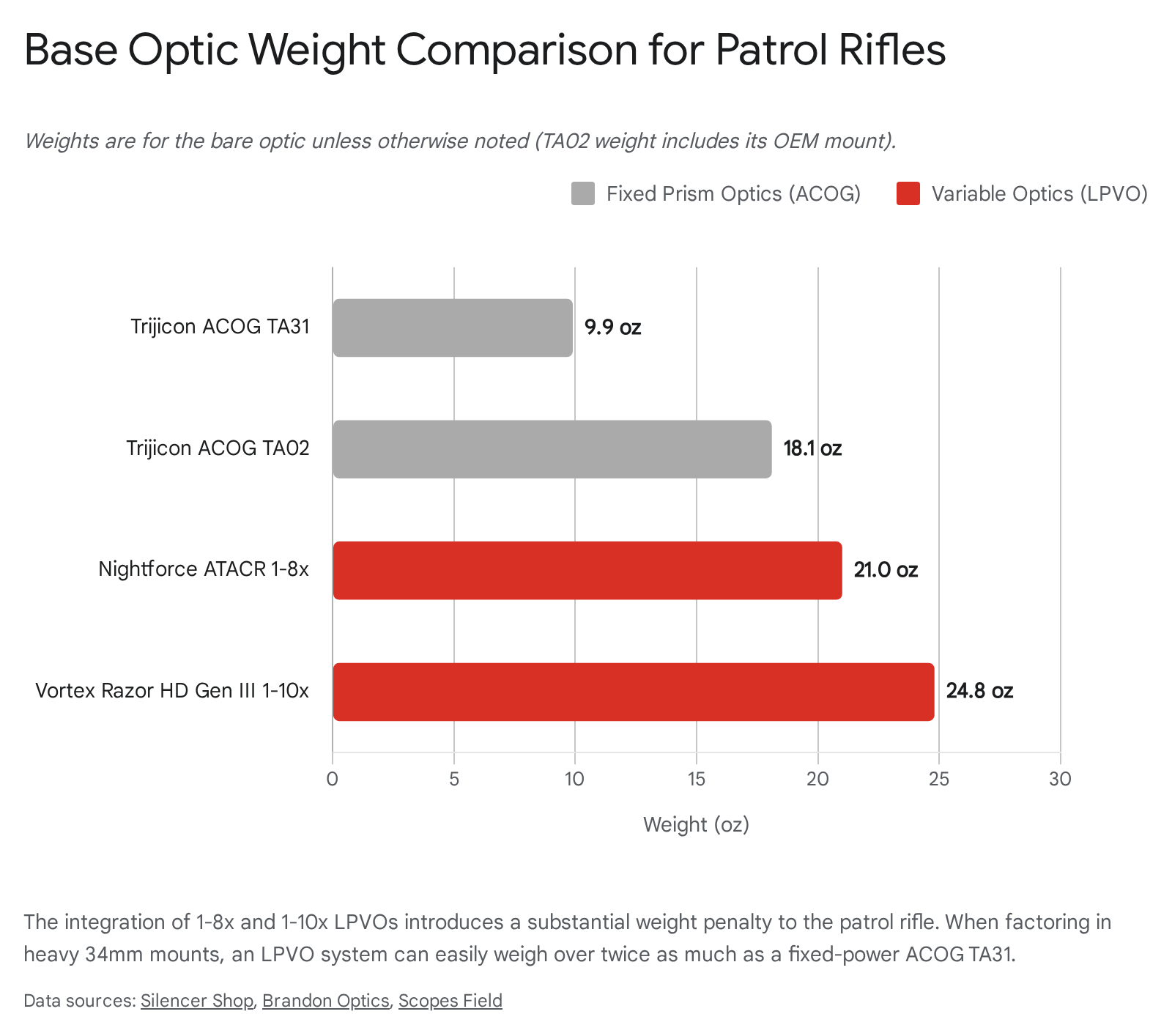
A duty-grade LPVO like the Vortex Razor Gen III 1-10x or Nightforce ATACR 1-8x weighs between 21.0 and 24.8 ounces bare.18 When paired with a robust 34mm cantilever mount (such as a Geissele Super Precision or Badger Ordnance Condition One, which can weigh an additional 5 to 7 ounces), the optical payload quickly approaches or exceeds two full pounds.19 When added to a rifle that already features a loaded 30-round magazine, a suppressor, an infrared aiming laser, and a high-lumen flashlight, the rifle’s balance shifts drastically forward and top-heavy, accelerating operator fatigue.10 Adding an offset red dot sight to the LPVO to bypass the magnification switching problem pushes the total system weight even higher.10
The financial burden is equally steep. A duty-quality LPVO and mount combination from a top-tier manufacturer is going to start at approximately $2,500 and escalate from there.5 Compared to an Aimpoint PRO or EOTech paired with a flip-to-side magnifier priced around $1,100, outfitting a 50-officer department with LPVOs represents a massive budgetary hurdle.5 Finally, the physical act of manipulating a power throw lever to adjust magnification during an evolving gunfight introduces an administrative task that directly competes with the officer’s situational awareness, trigger control, and communication.6 An officer transitioning from a street perimeter to an immediate residential entry must remember to dial the scope back down to 1x; failure to do so results in aiming a 6x or 8x scope at a threat standing three feet away, a potentially fatal user error.
The Fixed-Power Resurgence: The ACOG and Piggyback Red Dot Combination
In direct response to the excessive weight, bulk, and operational complexity of variable power scopes, tactical end-users in 2026 have catalyzed a massive resurgence of fixed-power prism optics—specifically the Trijicon Advanced Combat Optical Gunsight (ACOG)—paired with a top-mounted, closed-emitter mini red dot sight.1 This “dual-optic” approach elegantly solves the magnification switching issue by allowing the officer to maintain a high-quality magnified view through the main tube for observation, and simply shift their gaze slightly upward to acquire a true 1x red dot for immediate close-quarters threats.1
The Shift from Fiber Optic to LED Illumination (TA31 vs. TA02)
The classic, iconic Trijicon ACOG—specifically the TA31 series—is a 4x32mm optic famous for its bomb-proof durability and its dual-illumination system.31 The TA31 relies entirely on a passive illumination system: a tritium phosphor lamp provides a glowing reticle in total darkness, while a fiber-optic tube traversing the top of the optic gathers ambient daylight to illuminate the reticle during the day.13 The TA31 is incredibly light at 9.9 ounces (without mount), compact at 5.8 inches in length, and boasts a massive, best-in-class field of view of 36.8 feet at 100 yards.31
However, despite decades of combat provenance, the TA31’s passive illumination system is fundamentally flawed for modern law enforcement applications characterized by transitional lighting.34 The fiber optic is a slave to the ambient light immediately surrounding the optic, not the light on the target. If an officer is standing in a dark, unlit interior room looking out into a brightly sunlit street, the fiber optic gathers no ambient light, leaving the reticle pitch black and difficult to quickly locate against the bright exterior background.14 Conversely, in direct, blinding desert sunlight, the fiber optic gathers far too much light, causing the reticle to flare brilliantly and “bloom.” This blooming obscures the target and destroys precision capabilities—a flaw that historically required military and police users to tape over the fiber optic tube with electrical tape or cut sections of bicycle inner tubes to manually regulate the brightness.14
To rectify this critical flaw, the modern dual-optic patrol rifle predominantly utilizes the Trijicon ACOG TA02 (4×32 LED).34 The TA02 architecture completely eschews the fiber optic light-gathering tube and the degrading tritium lamps, utilizing instead a standard, universally available AA battery to power an active LED-illuminated reticle (available in crosshair, chevron, or horseshoe dot variations).33 This provides the officer with precise, user-adjustable active brightness control across six distinct settings.35 The LED system entirely solves the transitional lighting washout problem, allowing the officer to manually set a blindingly bright reticle for daytime use or a dim setting for NVG use, completely decoupled from the ambient environment.31 A single lithium AA battery powers the unit for upwards of 12,000 hours on a usable setting.35
While the TA02 is heavier than the TA31—weighing 18.1 ounces when equipped with its OEM mount and battery—it remains significantly lighter, shorter, and less obtrusive than an equivalent LPVO setup.34 Importantly for the dual-optic doctrine, the TA02 features dedicated mounting bosses optimally positioned on the top and rear of the optic housing, specifically designed to accept a secondary optic plate without relying on bulky aftermarket tube rings.38 The mechanical simplicity of the fixed prism scope cannot be overstated: there are no internal erector tubes to shift, no magnification rings to freeze in sub-zero temperatures, and no complex ocular adjustments required.32 The optic is practically indestructible under standard duty conditions.32
The Enclosed Emitter Revolution: Trijicon RCR Integration
A fixed 4x optic is a liability inside a 10-foot hallway. The ACOG relies on the Bindon Aiming Concept (BAC)—a technique where the shooter keeps both eyes open, superimposing the illuminated magnified reticle over the unmagnified view of the non-dominant eye—for close-range shooting.32 However, BAC induces parallax distortion and eye strain, requires extensive training to master, and yields inconsistent results compared to a true 1x optic under dynamic stress.32 Therefore, a secondary red dot is mandatory.
The secondary optic in this 2026 setup is typically an enclosed emitter mini red dot sight. While the open-emitter Trijicon RMR Type 2 has long been the gold standard for pistol and piggyback roles, open emitters are inherently susceptible to environmental malfunction.6 If water, mud, snow, or lint falls into the emitter diode pocket of an open red dot, the reticle will distort or disappear entirely, rendering the backup sight useless.
The current standard is the Trijicon RCR (Ruggedized Closed Reflex).41 Constructed from 7075-T6 aluminum and hard-coat anodized, the RCR is a completely sealed, enclosed-emitter optic that withstands direct blunt force impacts, immersion, and the harshest environments.41 Crucially, Trijicon engineered the RCR to utilize the exact same patented deck height and mounting bolt footprint as the legacy RMR, allowing it to mount directly to existing ACOG adapter plates without the need for complex, proprietary dovetails.41 Powered by a top-loaded CR2032 battery offering six years of continuous operation, the RCR provides true-color light transmission and highly tactile, ruggedized adjustment buttons for windage and elevation.41
Mounting the RCR to the TA02 is a precise mechanical process. Operators utilize a specialized adapter plate that indexes into the ACOG’s mounting bosses, secured with screws torqued strictly to 14-16 inch-pounds.38 Two tiny indexing set screws are hand-tightened until they merely touch the main body of the ACOG, preventing the plate from tilting forward under blunt trauma without lifting the plate and inducing elevation zeroing issues.39 Once secured, the RCR provides an instantaneous, indestructible 1x aiming solution that perfectly complements the ACOG’s fixed 4x magnification.1
Direct Optical Architecture Comparison
The tactical decision between these disparate optical systems is often illuminated by a direct, side-by-side comparison of their physical dimensions, weight, and optical specifications.
| Feature / Metric | Nightforce ATACR 1-8×24 F1 (LPVO) | Trijicon ACOG TA02 4×32 LED (Fixed Prism) |
| Magnification Capability | 1x to 8x Variable | 4x Fixed |
| Weight | 21.0 oz (Bare optic, no mount) | 18.1 oz (Includes OEM mount & battery) |
| Overall Length | 10.1 inches | 6.0 inches |
| Tube / Objective Architecture | 34mm Main Tube / 24mm Objective Lens | Fixed Prism Housing / 32mm Objective Lens |
| Eye Relief | 3.7 inches | 1.5 inches |
| Exit Pupil Diameter | 11.3mm (at 1x) narrowing to 3.2mm (at 8x) | 8.0mm (Consistent) |
| Field of View (FOV) | 96.1 ft (1x) to 13.1 ft (8x) at 100 yds | 36.8 ft at 100 yds |
| Illumination Source | Daylight Visible LED / NV Compatible | Daylight Visible LED / NV Compatible |
This data indicates that while the LPVO offers unparalleled magnification range and highly generous eye relief, the ACOG provides superior exit pupil consistency (a static 8.0mm vs the LPVO’s restrictive 3.2mm at maximum magnification) and a highly compact, lightweight footprint.17 The ACOG’s primary physical drawback is its exceedingly short 1.5-inch eye relief, which forces the shooter into a much tighter cheek weld, positioning their eye intimately close to the ocular lens.31
Mechanical Offset and Ballistic Trajectory: The Height Over Bore Dilemma
The most significant tactical controversy surrounding the ACOG/RCR piggyback setup—and indeed any dual-optic arrangement that stacks sights vertically—is the extreme mechanical offset, commonly referred to within the industry as “Height Over Bore” (HOB).16 Standard AR-15 iron sights or a traditional absolute/lower 1/3 co-witness red dot sight sit approximately 2.6 to 2.8 inches above the absolute centerline of the barrel.9 This baseline offset is accounted for in standard law enforcement training.
However, when an RCR red dot is stacked directly on top of an ACOG TA02, the optical centerline of the secondary red dot is pushed vertically to an extreme height of approximately 4.25 to 4.55 inches above the bore.43 This severe height over bore dramatically and dangerously alters the relationship between the officer’s Point of Aim (POA) and the bullet’s Point of Impact (POI) at close ranges. In a CQB environment (5 to 15 yards), if an officer utilizing the piggybacked dot aims directly at the center of a suspect’s cranial vault (a precision hostage-taker shot), the bullet will impact roughly 4.5 inches lower than the dot—potentially striking the suspect’s jaw or neck, or missing the critical central nervous system entirely.44 Therefore, utilizing a piggybacked red dot requires an officer to undergo rigorous, repetitive live-fire training to memorize severe hold-overs—aiming artificially and uncomfortably high—during extreme close-quarters engagements.44
Zeroing Strategies for Extreme HOB Dynamics
Because the red dot sits so high above the barrel, the bullet must be fired at a relatively steep upward angle to intersect the optical line of sight at the chosen zero distance.43 If an officer attempts to zero a piggybacked dot at a traditional law enforcement distance of 25 yards, the steep angle of departure required to meet the dot at 25 yards will cause the bullet to continue climbing rapidly into the distance. Ballistic data indicates that a 25-yard zero with a 4.5-inch HOB results in a massive, unmanageable maximum ordinate (the highest point of the bullet’s trajectory). With a 25-yard zero, the bullet will impact approximately 27 inches high at 300 yards.44 This extreme parabolic arc makes the secondary dot virtually useless for anything other than point-blank distances.44
To mitigate this ballistic disaster, tactical analysts and firearms instructors strongly advocate zeroing piggybacked red dots at extended distances, specifically 50, 80, or 100 yards.39 Stretching the zero distance flattens the trajectory curve significantly.44 For instance, calculating standard M193 55-grain 5.56mm ammunition with a 4.25-inch HOB zeroed at 75 yards results in a highly workable trajectory: the maximum ordinate is only ~2 inches high at 160 yards, a second natural zero occurs around 230 yards, and the POI is only about 4 inches low at 300 yards.44 By stretching the zero distance to 75 or 100 yards, the officer ensures the red dot remains a ballistically valid aiming tool out to 200+ yards, though they must still aggressively manage their manual hold-overs for any shots taken inside of 25 yards.43
The Barricade and Vehicle Hood Hazard
Beyond pure trajectory, the extreme HOB introduces severe operational liabilities when an officer is shooting from behind cover or concealment.16 An officer engaging a threat over the hood of a patrol vehicle must be acutely aware that while their high-mounted red dot sees a perfectly clear path to the target, the actual barrel of the weapon is nearly five inches lower.15
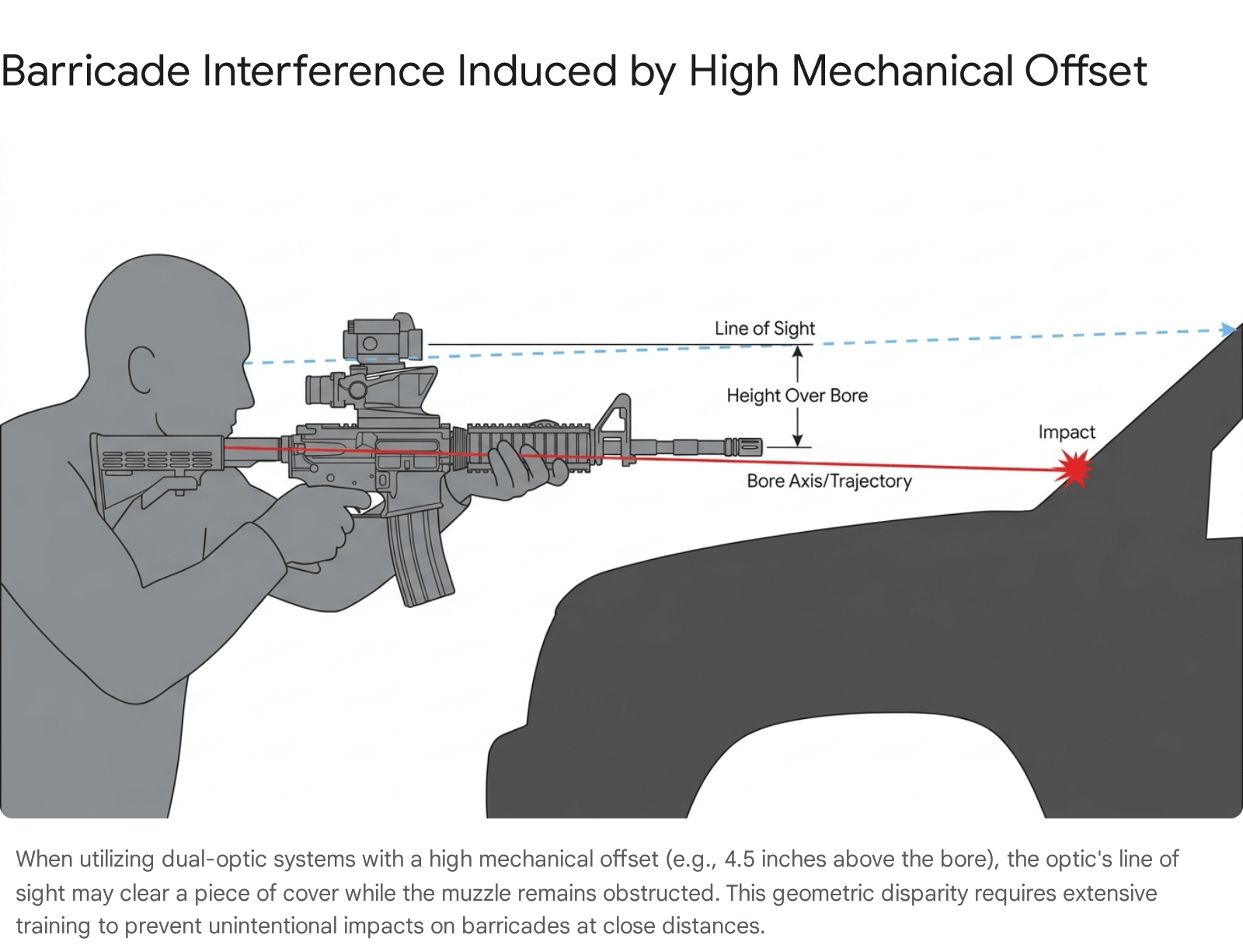
In high-stress, rapid-fire scenarios where the officer’s cognitive bandwidth is saturated by the threat, this geometric discrepancy frequently leads to officers inadvertently shooting the hood of their own vehicle, or striking the very concrete barricade they are utilizing for cover.15 This can lead to potentially disastrous fragmentation, spalling, or ricochet dynamics that endanger the officer and bystanders. While advanced digital optic-integrated displays are currently being developed to project “loop-hole” and barricade clearance zones directly into the user’s field of view via HUDs, in 2026, mitigation of this hazard still relies almost entirely on disciplined, repetitive physical training to ensure the officer manually checks bore clearance before pressing the trigger.15
Mounting Ecosystems: Piggyback (12 O’clock) vs. Offset (45-Degree) Geometries
When integrating a secondary red dot—whether supplementing a massive 1-10x LPVO or a fixed 4x ACOG—officers and armorers must choose exactly how to physically orient the secondary optic relative to the primary tube. The two dominant architectural geometries are the 12 o’clock “piggyback” position and the 45-degree offset position.7 The modular mounting ecosystem in 2026 is dominated by manufacturers producing highly rigid, multifaceted solutions designed to accommodate both geometries.
The 45-Degree Offset Optic Architecture
Offset mounts, such as the widely utilized Arisaka Defense Offset Optic Mount or the specialized J-Arm accessories integrated into the Badger Ordnance Condition One Modular Mount (COMM), position the secondary red dot sight at a 35-degree or 45-degree downward angle alongside the primary optic’s main tube.29
The operational utility of this setup is driven by rotational mechanics. To transition from the primary magnified optic to the offset red dot, the shooter rapidly rolls the rifle slightly inward along its longitudinal axis, bringing the dot directly into their dominant eye’s line of sight.
The primary advantage of the offset geometry is biomechanical stability. It allows the shooter to maintain a tight, consistent, and heavily anchored cheek weld on the rifle stock during the transition from magnification to 1x.7 Maintaining a firm cheek weld provides vastly superior recoil control and significantly reduces split times during rapid strings of CQB fire, as the body acts as a better shock absorber for the weapon.50 Furthermore, the offset dot generally sits much closer to the traditional bore axis (featuring a lower HOB), which drastically reduces the severity of those problematic close-quarters hold-overs compared to a piggybacked dot.7
However, the disadvantages are substantial for patrol use. Offset optics are inherently unidirectional. A red dot offset to the right side of the weapon is exceptionally difficult—if not impossible under stress—to use if the officer must transition the rifle to their non-dominant left shoulder to slice a corner or fire from weak-side cover.7 Offset optics also physically protrude laterally from the weapon, increasing the width of the rifle and escalating the risk of snagging on duty gear, steering wheels, vehicle interiors, or slings.53
The 12 O’clock Piggyback Optic Architecture
Piggyback mounting solutions place the mini red dot directly on top of the primary optic at the 12 o’clock position. For the ACOG TA02, this is achieved natively and seamlessly via the built-in mounting bosses that accept a top plate.38 For LPVOs, achieving this geometry requires specialized ring caps. Products such as the Reptilia ROF (Ring Optic Front) or the top rings designed for the Unity Tactical FAST and Badger Ordnance COMM systems replace the standard front scope ring of the mount with a direct mounting plate for the red dot.25
The operational utility of this setup requires vertical movement. To transition to the piggybacked dot, the shooter lifts their head up from a traditional cheek weld to a higher, “heads-up” chin weld.14
The advantages of the piggyback configuration are tailored to modern tactical realities. Foremost, the setup is completely ambidextrous. Left-handed or right-handed, firing from either the strong or weak shoulder, the dot remains perfectly centered over the rifle.7 The heads-up, upright posture afforded by the tall dot reduces neck strain during extended periods of observation and vastly improves the officer’s peripheral vision, situational awareness, and mobility while moving through structures.46
The disadvantages are the inverse of the offset mount. The aforementioned extreme height over bore severely complicates close-quarters ballistics, and the physical loss of a firm, anchored cheek weld can degrade recoil management, causing the rifle to bounce more dynamically under rapid fire, potentially slowing down consecutive accurate shots.50
Night Vision Integration and Passive Aiming Dominance
Law enforcement SWAT teams, specialized patrol units, and rural task forces are increasingly equipped with dual-tube Night Vision Goggles (NVGs). When operating under NVGs in zero-light environments, an officer has two primary methods for aiming their rifle: Active aiming, which utilizes a rifle-mounted infrared (IR) laser to project a beam onto the target, and Passive aiming, which involves looking directly through the weapon’s optic while wearing the NVGs to avoid emitting any detectable IR light that could reveal their position to threats equipped with their own night vision capabilities.53
The Failings of the LPVO under NODs (Night Observation Devices)
Passive aiming directly through an LPVO is notoriously difficult, bordering on functionally obsolete.57 Even high-end optics struggle with light transmission when paired directly with image intensifier tubes.58 More critically, the physical dimensions of the LPVO create geometric nightmares. The LPVO’s highly unforgiving eye box and its strict 3.7-inch eye relief requirements make it nearly impossible to rapidly align the protruding NVG tube perfectly behind the scope.17 As tactical users frequently note regarding passive aiming with LPVOs, standard shooting positions become instantly cumbersome; the NVG tubes physically crash into the rifle stock or the optic body itself, entirely destroying the sight picture and breaking the seal of the goggles.53 While some LPVOs feature NV-compatible illumination settings, physically getting the goggle behind the glass under the stress of a gunfight is a severe liability.
The Dominance of the High-Mount Piggyback Red Dot
The 12 o’clock piggybacked red dot, particularly robust closed emitters like the Trijicon RCR or Aimpoint T-2, represents the absolute apex of passive aiming capability.7 Because the piggyback dot sits at an extreme height (often 3.2 to 4.5 inches above the rail), it physically clears the stock and the primary optic body entirely. This allows the officer to maintain a straight, upright, heads-up posture.8 The NVG tube can simply be brought into the spatial void behind the red dot window without requiring the officer to contort their neck, break their natural posture, or crash the expensive goggles into the rifle.7
Conversely, attempting to passively aim through a 45-degree offset dot is widely considered highly inefficient and ergonomically punishing. Rolling the rifle pushes the optic horizontally, immediately interfering with the dual-tube binocular vision geometry of modern NVGs.53 Therefore, for agencies where night vision operations are a standard requirement, the 12 o’clock piggyback geometry is considered mandatory, largely overriding the recoil-control and low HOB benefits of the 45-degree offset mount.7 The high dot allows for a completely unobstructed, passive sight picture in total darkness.
Biomechanics, Weight Distribution, and Operator Fatigue
The human factors and biomechanics involved in carrying a patrol rifle for a 10 to 12-hour shift cannot be overstated when analyzing optical selections. By 2026, a fully equipped duty rifle—featuring a modern suppressor, a high-lumen white light, a heavy IR laser aiming module at the front rail, a loaded 30-round magazine, and a padded sling—routinely weighs between 10.5 and 12.5 pounds.30 Adding a heavy LPVO configuration to the top receiver drastically shifts the weapon’s center of gravity, altering the balance and maneuverability of the weapon.10 The rifle becomes top-heavy and front-heavy, requiring immense shoulder and forearm strength to keep the weapon presented at the low-ready during prolonged searches.
The fixed-power ACOG configuration offers a significant, tangible biomechanical advantage by returning balance to the platform. By shedding nearly half a pound compared to an LPVO setup 31, the TA02 and RCR combination drastically reduces muscle fatigue in the officer’s non-dominant supporting arm during prolonged low-ready holds, extended building searches, or when holding suspects at gunpoint while awaiting backup.60
Furthermore, the mechanical simplicity of a fixed prism scope eliminates moving parts entirely. In the ACOG ecosystem, there are no internal erector tubes subjected to the violent reciprocal recoil of the bolt carrier group, no magnification rings to seize up from mud or debris, and nothing requiring fine motor manipulation under the catastrophic, heart-pounding stress of a lethal force encounter.32 The officer possesses immediate 1x red dot capability and immediate 4x magnified capability simultaneously, governed entirely by the instinctual vertical movement of their eye.39 This reduction in cognitive load—removing the requirement to ask “what magnification am I currently on?”—is a massive tactical advantage for law enforcement officers who must simultaneously manage communications, suspect commands, and their surrounding environment.
Pricing and Availability of the ACG & RCR Optics
Based on current market listings, the average street price for the Trijicon RCR is typically between $675 and $700, while the standard 4×32 Trijicon ACOG models generally average between $1,150 and $1,250, depending on the exact reticle and mount configuration.
Here are five active listings from your specified vendors that are priced at or below these market averages:
- $655.99 – GrabAGun: Trijicon RCR Closed Emitter Red Dot Sight (3.25 MOA)
- $699.99 – Primary Arms: Trijicon RCR Enclosed Red Dot Sight (3.25 MOA)
- $699.99 – MidwayUSA: Trijicon RCR Enclosed Red Dot Sight (3.25 MOA)
- $1,140.99 – GrabAGun: Trijicon ACOG 4x32mm Rifle Scope with Dual Illuminated Red Dot Reticle
- $1,143.99 – GrabAGun: Trijicon ACOG 4x32mm Rifle Scope with Dual Illuminated Green Horseshoe/Dot Reticle
Conclusion
The evolution of law enforcement patrol rifle optics from single, unmagnified red dots to sophisticated dual-optic setups is a direct reflection of the increasingly complex, heavily scrutinized requirements of the modern operational environment. The absolute legal and moral requirement to clearly identify threats and distinguish between lethal weapons and benign objects at extended distances mandates magnification, while the violent reality of sudden, close-quarters engagements dictates the absolute necessity for instantaneous, unmagnified target acquisition.1
The Low Power Variable Optic (LPVO), specifically top-tier models like the Nightforce ATACR 1-8x and Vortex Razor Gen III 1-10x, remains an exceptionally capable tool, offering unmatched optical versatility and precision at extended distances.17 However, its overall utility on standard patrol rifles is hindered by significant weight penalties, the ergonomic difficulty of adjusting magnification under extreme stress, and severe, borderline fatal limitations regarding passive night vision aiming.5 The internal debate between First Focal Plane (FFP) and Second Focal Plane (SFP) configurations further forces agencies to compromise, choosing between sacrificing CQB reticle visibility or sacrificing accurate precision holdovers.22
In 2026, the tactical consensus among forward-thinking law enforcement entities heavily favors a return to fixed-power prism optics, specifically the LED-illuminated Trijicon ACOG TA02, paired with a piggybacked, closed-emitter red dot like the Trijicon RCR.1 This dual-optic system provides indestructible, combat-proven durability, entirely solves the transitional lighting failures of legacy fiber-optic ACOGs by utilizing an adjustable LED, saves critical ounces in overall weapon weight, and offers vastly superior integration with modern night vision and gas masks via a heads-up, 12 o’clock mounting geometry.1
However, the adoption of the ACOG/RCR piggyback system is not without significant liabilities that demand immense respect. The extreme 4.5-inch Height Over Bore introduces radical ballistic disparities at close ranges.43 Agencies transitioning to this setup must completely overhaul their zeroing protocols—shifting completely away from legacy 25-yard zeros toward 50- or 100-yard zeros to tame the bullet’s maximum ordinate—and implement rigorous, repetitive live-fire training regimens focused entirely on mechanical offset awareness to prevent catastrophic barricade strikes during vehicle or structural engagements.15
Ultimately, there is no single optical solution devoid of compromise. The modern law enforcement agency must carefully weigh its environmental topography, its budgetary constraints, and its institutional training capabilities. For rural environments characterized by vast open spaces demanding extreme precision, the FFP LPVO remains highly relevant and potent. Yet, for the complex, fast-paced, and spatially constrained realities of suburban and urban policing, the fixed-power optic paired with a vertically stacked, enclosed red dot represents the most resilient, rapid, and tactically sound paradigm available today.
Note: Vendor Sources listed are not an endorsement of any given vendor. It is our software reporting a product page given the direction to list products that are between the minimum and average sales price when last scanned.
Please share the link on Facebook, Forums, with colleagues, etc. Your support is much appreciated and if you have any feedback, please email us in**@*********ps.com. If you’d like to request a report or order a reprint, please click here for the corresponding page to open in new tab.
Source Used
- New optic system combines magnification, red dot – Police1, accessed June 26, 2026, https://www.police1.com/police-products/tactical/optics/speed-vs-precision-how-to-bridge-the-gap
- Aimpoint Patrol Rifle Optic Overview & Install – YouTube, accessed June 26, 2026, https://www.youtube.com/watch?v=QbRgwlnwUf0
- Equipping your patrol rifle with low-powered variable optics – American Police Beat, accessed June 26, 2026, https://apbweb.com/2023/04/equipping-your-patrol-rifle-with-low-powered-variable-optics/
- With the popularity of LPVO, fixed power scopes (e.g. ACOG), and Recce, do you expect to see a shift toward 4-12x magnification? : r/tacticalgear – Reddit, accessed June 26, 2026, https://www.reddit.com/r/tacticalgear/comments/rst212/with_the_popularity_of_lpvo_fixed_power_scopes_eg/
- LPVOs are the next evolution of the patrol rifle – American Police Beat Magazine, accessed June 26, 2026, https://apbweb.com/2025/06/lpvos-are-the-next-evolution-of-the-patrol-rifle/
- Best Offset Red Dots: The Secondary Optic for AR-15, Duty & Competition – Scopes Field, accessed June 26, 2026, https://scopesfield.com/best-offset-red-dot/
- LPVO Mount Without Losing Co-Witness: The 2026 Guide to Rapid Transitions, accessed June 26, 2026, https://accufirescope.com/blogs/news/lpvo-mount-without-losing-co-witness-the-2026-guide-to-rapid-transitions
- Does anyone run a top dot in this configuration? What are the advantages? – Reddit, accessed June 26, 2026, https://www.reddit.com/r/tacticalgear/comments/15j43y6/does_anyone_run_a_top_dot_in_this_configuration/
- Weapons Training Unit Material – PARS – Los Angeles County Sheriff’s Department, accessed June 26, 2026, https://pars.lasd.org/Viewer/Manuals/GeneratePDF/14537?reportIndex=1
- Recce Patrolling III: The Recce Rifle & Weapons – Swift | Silent | Deadly, accessed June 26, 2026, https://www.swiftsilentdeadly.com/blog/recce-patrolling-iii-recce-rifle-weapons
- brownells.com, accessed June 26, 2026, https://www.brownells.com/UserDocs/Miscellaneous/69OPTICACCESSORIESp265_281.pdf
- Design me a patrol rifle optic : r/QualityTacticalGear – Reddit, accessed June 26, 2026, https://www.reddit.com/r/QualityTacticalGear/comments/1thvjal/design_me_a_patrol_rifle_optic/
- 2025 CATALOG – Trijicon, accessed June 26, 2026, https://www.trijicon.com/uploads/page_content/PML4034_Rev%2814%29_Trijicon_Catalog_2025.pdf
- People who have run both, whats your opinion on LED vs Tritium/fiber ACOGs? – Reddit, accessed June 26, 2026, https://www.reddit.com/r/ar15/comments/10m3vr2/people_who_have_run_both_whats_your_opinion_on/
- A DISPLAY SYSTEM FOR A VIEWING OPTIC – European Patent Office – EP 4220069 A1, accessed June 26, 2026, https://data.epo.org/publication-server/rest/v1.0/publication-dates/20230802/patents/EP4220069NWA1/document.pdf
- WO2020150603A1 – Viewing optic with round counter system – Google Patents, accessed June 26, 2026, https://patents.google.com/patent/WO2020150603A1/en
- Nightforce ATACR – 1-8x24mm F1 – T.REX ARMS, accessed June 26, 2026, https://www.trex-arms.com/store/nightforce-atacr-1-8x24mm-f1-1135745
- Elcan SpecterDR 1.5x/6x 5.56/7.62 BDC Black/FDE Scopes w/Flip Covers, Integral A.R.M.S. Picatinny Mount – Brandon Optics, accessed June 26, 2026, https://www.brandonoptics.com/Elcan-SpecterDR-15x6x-556762-BDC-BlackFDE-Scopes-wFlip-Covers-Integral-ARMS-Picatinny-Mount-_p_3768.html
- Nightforce ATACR 1-8x24MM F1 | FC-DMx Reticle – Silencer Shop, accessed June 26, 2026, https://www.silencershop.com/nightforce-atacr-1-8x24mm-f1-fc-dmx-reticle.html
- Best High-End Rifle Scope: These Are 2026’s Ultimate Hunting Optics for Quality & Power, accessed June 26, 2026, https://www.targettamers.com/best-high-end-rifle-scopes/
- Nightforce ATACR 1-8×24 F1 Front Focal FC-DM Reticle – Sport Optics, accessed June 26, 2026, https://www.sportoptics.com/nightforce-rifle-scopes-c597.html
- Rifle Scopes: First Focal Plane vs. Second Focal Plane – Outdoorsmans, accessed June 26, 2026, https://outdoorsmans.com/blogs/rifle-scopes/riflescopes-first-focal-plane-vs-second-focal-plane
- First Focal Plane Vs Second Focal Plane? | MDT – MDT USA, accessed June 26, 2026, https://mdttac.com/blogs/read/first-focal-plane-vs-second-focal-plane
- what focal plane is best for an lpvo : r/tacticalgear – Reddit, accessed June 26, 2026, https://www.reddit.com/r/tacticalgear/comments/zvqhpn/what_focal_plane_is_best_for_an_lpvo/
- Nightforce ATACR 1-8×24 F1 .1 Mil-Radian NVD PTL FC-DMX Riflescope C653, accessed June 26, 2026, https://www.eurooptic.com/nightforce-atacr-1-8×24-f1-1-mil-radian-nvd-ptl-fc-dmx-c653
- 9 Best LPVO Scopes: Low, Mid & High Power, accessed June 26, 2026, https://www.pewpewtactical.com/best-lpvo/
- First Focal Plane vs Second Focal Plane: Which Do You Choose? – 80 Percent Arms, accessed June 26, 2026, https://www.80percentarms.com/blog/first-focal-plane-vs-second-focal-plane-which-do-you-choose/
- Best LPVO and AR-15 Scope Mounts 2026 – Rifle Configurator, accessed June 26, 2026, https://www.rifleconfigurator.com/guides/best-lpvo-scope-mounts
- Badger Ordnance Condition One J Arm – 45 Degree, 1.70″ Height | Rooftop Defense, accessed June 26, 2026, https://www.rooftopdefense.com/product/badger-ordnance-condition-one-j-arm/
- Discussion: What is your rifle weight? And what do you think the ideal weight is? – Reddit, accessed June 26, 2026, https://www.reddit.com/r/ar15/comments/18milnc/discussion_what_is_your_rifle_weight_and_what_do/
- Trijicon ACOG®, accessed June 26, 2026, https://www.trijicon.com/uploads/product-uploads/product-downloads/PML4036-1_Rev%283%29_ACOG_Family_Spec_Sheet_single.pdf
- Advanced Combat Optical Gunsight – Grokipedia, accessed June 26, 2026, https://grokipedia.com/page/Advanced_Combat_Optical_Gunsight
- ACOG® – Trijicon, accessed June 26, 2026, https://www.trijicon.com/uploads/product-uploads/product-downloads/2020_Trijicon_ACOG.pdf
- Best AR-15 ACOG Scopes Review: Tactical to Budget Picks, accessed June 26, 2026, https://scopesfield.com/best-ar-15-acog-scopes/
- Trijicon’s LED ACOG combines durability, function and new features – Police1, accessed June 26, 2026, https://www.police1.com/police-products/firearms/accessories/articles/trijicons-led-acog-combines-durability-function-and-new-features-shVhqv6hddNf6Q7i/
- Tactical Handyman – ACOG Fiber Optic Fix | Jerking the Trigger, accessed June 26, 2026, https://jerkingthetrigger.com/2010/03/16/tactical-handyman-acog-fiber-optic-fix/
- Can anyone give me their opinion on the TA02 ACOG? : r/ar15 – Reddit, accessed June 26, 2026, https://www.reddit.com/r/ar15/comments/12dc6uk/can_anyone_give_me_their_opinion_on_the_ta02_acog/
- Trijicon® Mounts & Accessories Guide, accessed June 26, 2026, https://www.trijicon.com/uploads/page_content/PML4103_Rev(0)_Trijicon_Mounts__Accessories_Guide.pdf
- Trijicon ACOG RMR Mounts Overview – T.REX ARMS, accessed June 26, 2026, https://www.trex-arms.com/videos/trijicon-acog-rmr-mounts-overview-646
- ACOG Vs LPVO for a 16” battle rifle? : r/AR10 – Reddit, accessed June 26, 2026, https://www.reddit.com/r/AR10/comments/10d7vnk/acog_vs_lpvo_for_a_16_battle_rifle/
- Trijicon RCR™, accessed June 26, 2026, https://www.trijicon.com/uploads/product-uploads/product-downloads/PML4096_Rev%281%29_RCR_Spec_Sheet_web.pdf
- Trijicon RCR™, accessed June 26, 2026, https://www.trijicon.com/uploads/page_content/PML1059-1_Rev(0)_RCR_Manual.pdf
- What are y’all zeroing your piggyback red dots to and why : r/ar15 – Reddit, accessed June 26, 2026, https://www.reddit.com/r/ar15/comments/1e7itft/what_are_yall_zeroing_your_piggyback_red_dots_to/
- RMR on top of ACOG : r/ar15 – Reddit, accessed June 26, 2026, https://www.reddit.com/r/ar15/comments/1bb10y1/rmr_on_top_of_acog/
- Red dot sight and LPVO combination – Grokipedia, accessed June 26, 2026, https://grokipedia.com/page/Red_dot_sight_and_LPVO_combination
- Before / After : RMR Piggyback : r/ar15 – Reddit, accessed June 26, 2026, https://www.reddit.com/r/ar15/comments/xdf9bq/before_after_rmr_piggyback/
- Shotdrop | New drops. No misses., accessed June 26, 2026, https://goshotdrop.com/
- Offset Mount: How It Can Help Your Accuracy – Milspec Retail, accessed June 26, 2026, https://milspecretail.com/accessories/offset-mounts-how-they-can-help-your-accuracy/
- PMM Cowgirl Mount for Badger COMM – Parker Mountain Machine, accessed June 26, 2026, https://www.parkermountainmachine.com/product/badger-mount/
- ACOG (TA02/Red dot) or Elcan Specter 1x/4x? general purpose, SHTF, priority is 100-300m with a handful <100m and infrequently >300m : r/tacticalgear – Reddit, accessed June 26, 2026, https://www.reddit.com/r/tacticalgear/comments/12hpj7v/acog_ta02red_dot_or_elcan_specter_1x4x_general/
- RMR on top or canted? : r/tacticalgear – Reddit, accessed June 26, 2026, https://www.reddit.com/r/tacticalgear/comments/12cnfi9/rmr_on_top_or_canted/
- Thoughts on piggyback red dot? : r/Firearms – Reddit, accessed June 26, 2026, https://www.reddit.com/r/Firearms/comments/1eeng61/thoughts_on_piggyback_red_dot/
- Night Shooters who run LPVO’s: TOP MOUNT your Piggyback Red Dot, or OFFSET? : r/NightVision – Reddit, accessed June 26, 2026, https://www.reddit.com/r/NightVision/comments/1nurgp9/night_shooters_who_run_lpvos_top_mount_your/
- Top dot higher than gas prices : r/ar15 – Reddit, accessed June 26, 2026, https://www.reddit.com/r/ar15/comments/1sra1hp/top_dot_higher_than_gas_prices/
- Best Offset Red Dot Mounts 2026 (45-Degree + LPVO Wing), accessed June 26, 2026, https://www.rifleconfigurator.com/guides/best-offset-red-dot-mounts
- Piggyback Sight Solutions | Red Dot Adapters – KOENG, accessed June 26, 2026, https://koeng.co/product-category/category/piggyback-sight-solutions/
- Any one else like running a LVPO passively? : r/NightVision – Reddit, accessed June 26, 2026, https://www.reddit.com/r/NightVision/comments/ukuckn/any_one_else_like_running_a_lvpo_passively/
- Passive aiming with LPVOs… Am I missing something? : r/NightVision – Reddit, accessed June 26, 2026, https://www.reddit.com/r/NightVision/comments/1aethk6/passive_aiming_with_lpvos_am_i_missing_something/
- Passive Aiming A Piggyback RDS on LPVO – Is it Hard? : r/NightVision – Reddit, accessed June 26, 2026, https://www.reddit.com/r/NightVision/comments/u9368w/passive_aiming_a_piggyback_rds_on_lpvo_is_it_hard/
- LPVO or Acog..? Discuss- : r/ar15 – Reddit, accessed June 26, 2026, https://www.reddit.com/r/ar15/comments/1ikzgl2/lpvo_or_acog_discuss/