If you’ve had trouble finding our articles or shop products through search engines recently, you aren’t alone. We want to be clear about what’s been happening at Ronin’s Grips, how we’re fixing it, and where we plan to go from here.
What Happened: The July 2026 Shift
In mid-July 2026, major search engines, notably Google, updated their core ranking systems. These updates prioritized AI-generated summaries while applying stricter automated filters to assess content quality across entire sites. As a result, our traffic volumes from search engines to the blog and online store dropped by about 93%.
Rather than evaluating pages individually, these algorithms calculate a site-wide quality rating. If an automated system flags a specific section, it lowers the overall score for the entire domain. Ironically, the very thing we wanted to accomplish, providing social media analytics in a more template-driven manner so you get data to make decisions instead of just our opinion, ended up being our undoing!
Unfortunately, this filter caught our extensive archive of product reviews and comparison guides. Because the search engines evaluate interconnected sections together, reduced visibility on our AI and template-driven blog posts ended up dragging down search rankings for our main store as well.
The Steps We Have Taken So Far
We won’t let automated algorithms compromise our store or the quality of our content. To restore our search visibility and help new customers find us, we’ve taken immediate technical steps.
To safeguard our domain’s overall rating, we added noindex tags to our legacy comparison reports and reviews. The pages are still fully accessible to you directly, but search crawlers are instructed to skip indexing them. This prevents older content from weighing down the main Ronin’s Grips storefront in search rankings.
Where We Go From Here: A Proposal for the Community
While adding noindex tags addresses the immediate search penalties, it prompts us to rethink how we publish in-depth technical guides moving forward. Publicly hosting detailed product comparisons without risking algorithmic downgrades has become increasingly challenging. We remain committed to delivering thorough reviews, but we need a format free from shifting search engine criteria.
That brings us to a new concept we’re exploring: A Private, Members-Only Community.
We’re considering a dedicated, non-indexed community space for Ronin’s Grips members. This private hub would host our data-driven social media analyses of small arms-related matters removed from public search crawlers.
Maintaining this platform independently of public search traffic requires dedicated effort, so we’re considering a small subscription model to support it. Before making any decisions, we want to hear your thoughts.
We would love your input on the following:
What are your thoughts on moving our deep-dive reviews and comparisons into a private, members-only section?
Would you be willing to pay a monthly fee to support this content?
If so, is a price point of $5/month acceptable to you for this level of detail and access?
Please share your thoughts in the comments below or contact us directly. Your support has built Ronin’s Grips from day one, and your feedback will help guide our next steps.
The tactical optics market hit a major milestone in 2026. The red dot sight segment alone now has a steady 6.4% growth rate and is valued at $787 million1. This surge comes from law enforcement modernization, military contracts, and a savvy civilian market that demands professional-grade gear.
Early 2026 product launches showed a clear shift2 toward gear that is smaller, more integrated, and better protected. We are seeing Low Power Variable Optics (LPVOs) get shorter to save rail space for night vision and thermal tools. Meanwhile, red dots are becoming smarter, adding features like built-in infrared (IR) lasers and reticles designed specifically to counter drone threats.
This report breaks down the year’s most significant releases, analyzing their engineering and real-world utility while ranking them based on professional feedback and user sentiment.
2. Market Dynamics and Technological Convergence
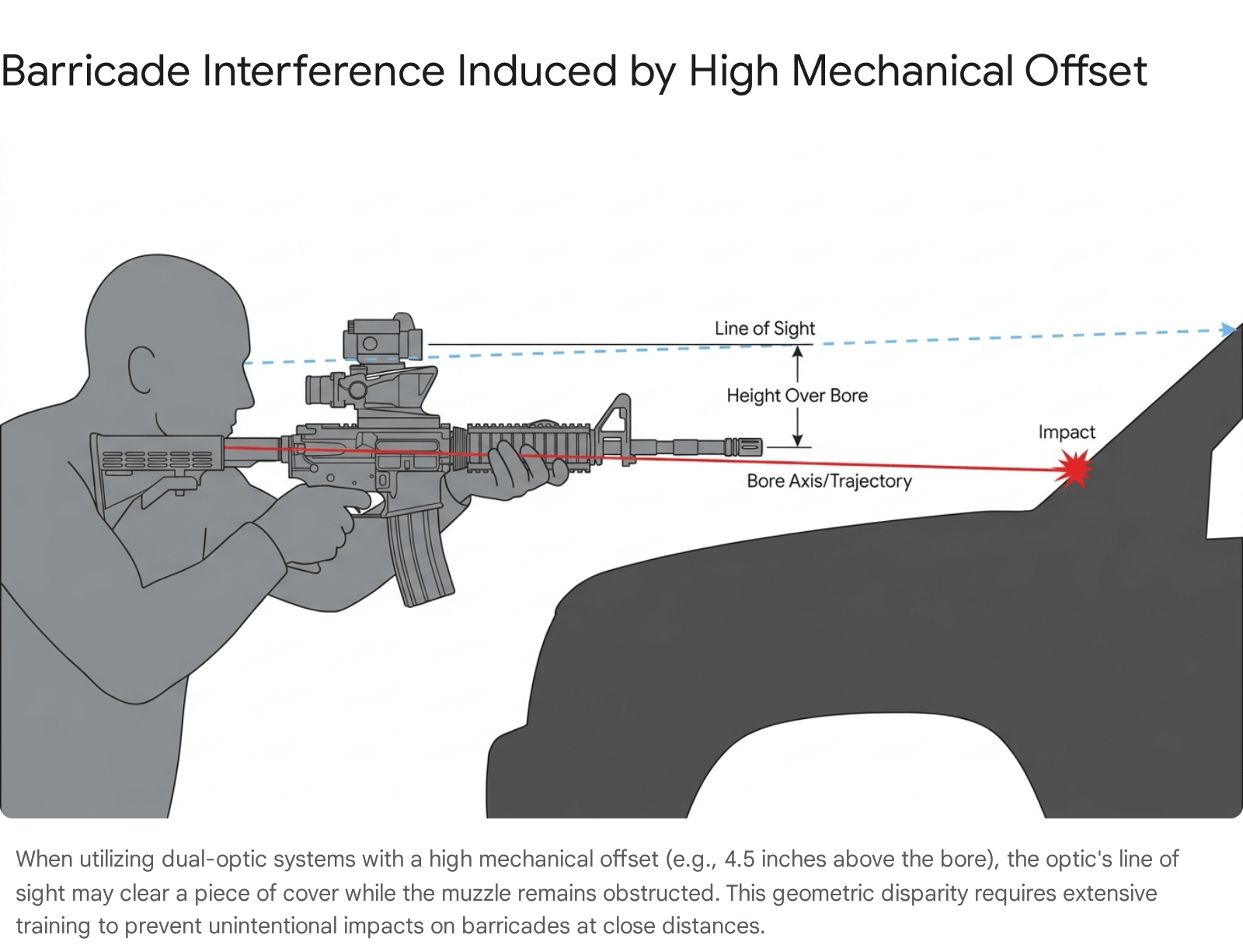
Space on a modern carbine is limited. With primary optics, back-up sights, and laser modules all competing for the same rail, weapons can quickly become front-heavy. This clutter doesn’t just look messy—it slows down transitions and causes faster operator fatigue.
2.1 The SWaP-C Prioritization
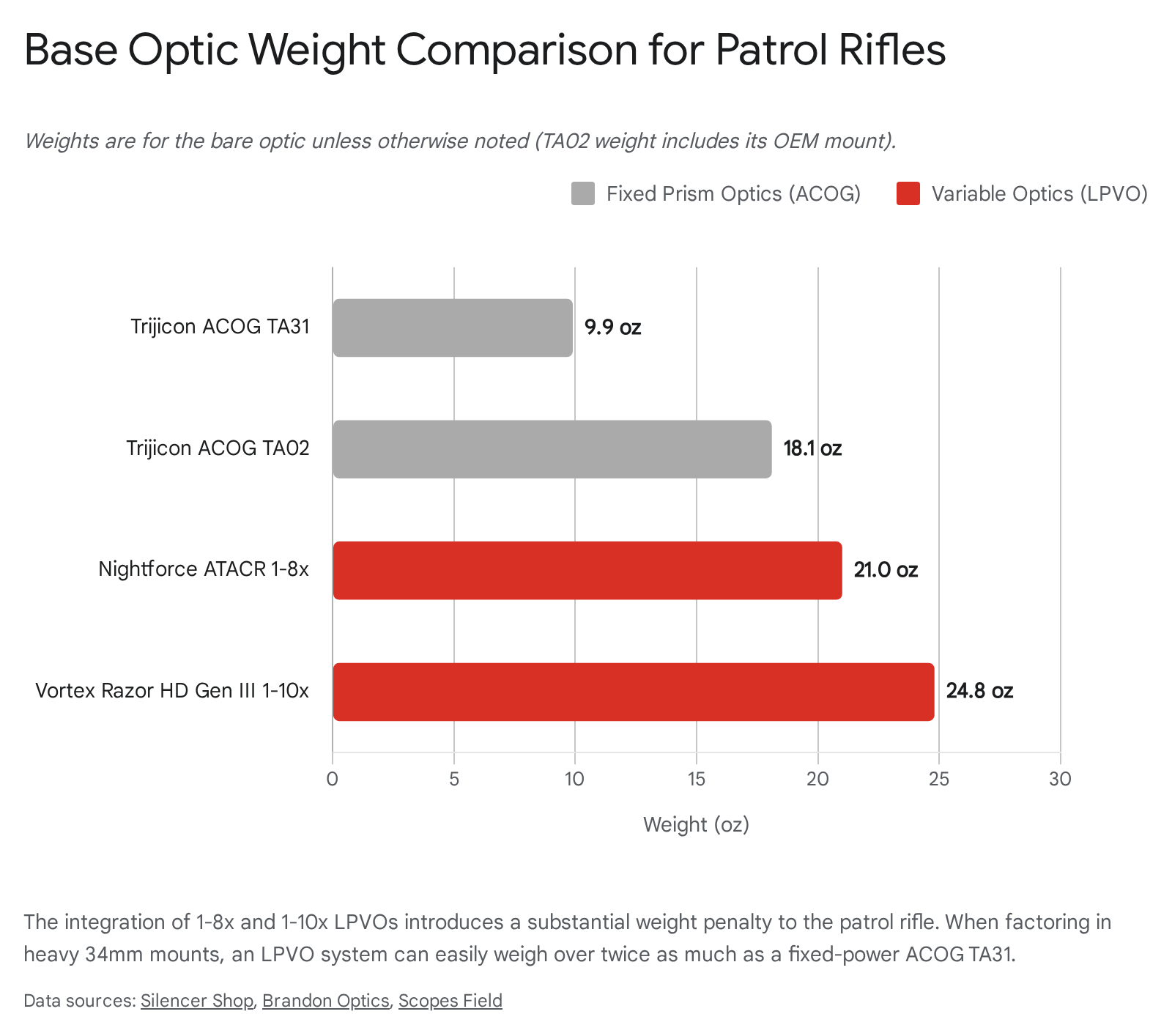
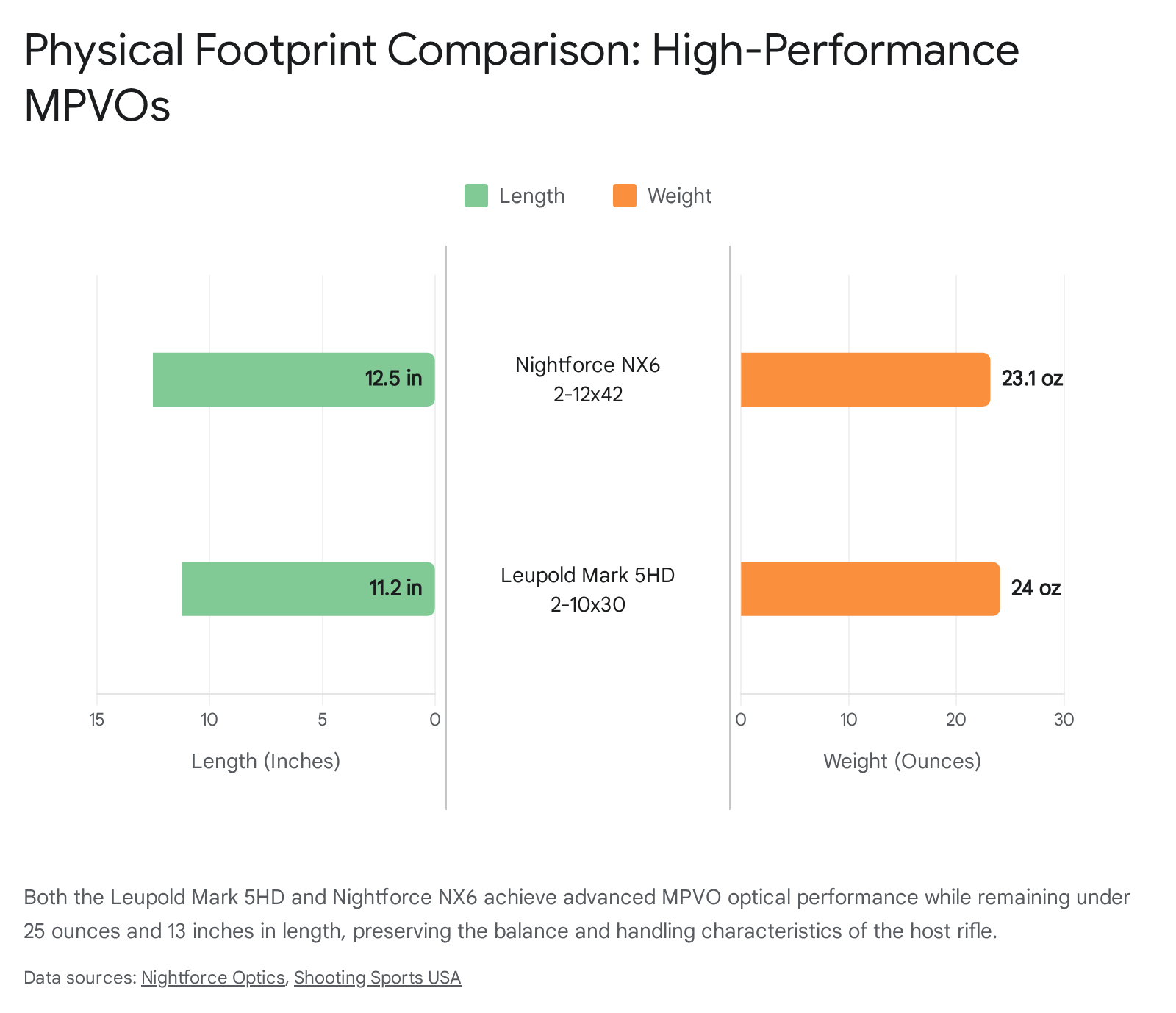
To fix this, manufacturers are obsessed with SWaP-C (Size, Weight, Power, and Cost)3. They are shrinking magnification assemblies and packing more tech into single housings. By cutting an LPVO down from 11 inches to just 8.5, engineers are moving the weight back toward the shooter, making compact rifles feel much more balanced and agile5.
2.2 The Enclosed Emitter Mandate
The “enclosed emitter” has become the new standard for 20267. Older red dots often had exposed diodes that could be blocked by rain, mud, or even pocket lint, causing the reticle to disappear when it was needed most7.
Today, the market agrees: the extra reliability of a sealed, nitrogen-purged housing is worth the tiny weight increase7. What started on handguns is now the baseline for professional-grade rifle optics.
2.3 The Standardization of Piggyback Configurations
“Piggybacking” a micro red dot on top of a larger scope has gone mainstream1. Instead of fumbling with a magnification ring during a surprise close-range encounter, shooters can simply look over the main scope to use the red dot for anything under 50 yards1. It provides the best of both worlds: speed for CQB and precision for distance.
3. Tactical Optics Ranked by Consumer Sentiment
Here are the standout performers of 2026, ranked by a mix of technical achievement, user happiness, and industry impact.
3.1 Vortex AMG 1-10×24 FFP
The Vortex AMG 1-10×24 is a masterclass in compact engineering. First teased in early show previews8, it was built to meet the rigorous demands of the UK Ministry of Defence. Operators needed 10x magnification but refused to carry a bulky, oversized scope9.
The Breakdown: The AMG takes the top spot because it fundamentally changes what an LPVO looks like. At just 8.4 inches long and 18.8 ounces, it frees up rail space for essential night vision and laser gear without sacrificing performance5.
Making a 1-10x range work in such a small package is incredibly difficult. Because the internal parts have less room to move, Vortex had to use 5-micron precision for every adjustment4. They also used high-end glass to prevent the distortion that usually happens when you shorten a focal path, ensuring the image stays sharp even at high power9.
A standout feature is the dual-zero system10. This allows shooters to save two different zero points—one for standard ammo and one for heavy subsonic rounds—and swap between them instantly13. Plus, the magnification lever only needs a 120-degree turn to go from 1x to 10x, making it one of the fastest scopes to adjust in the field5.
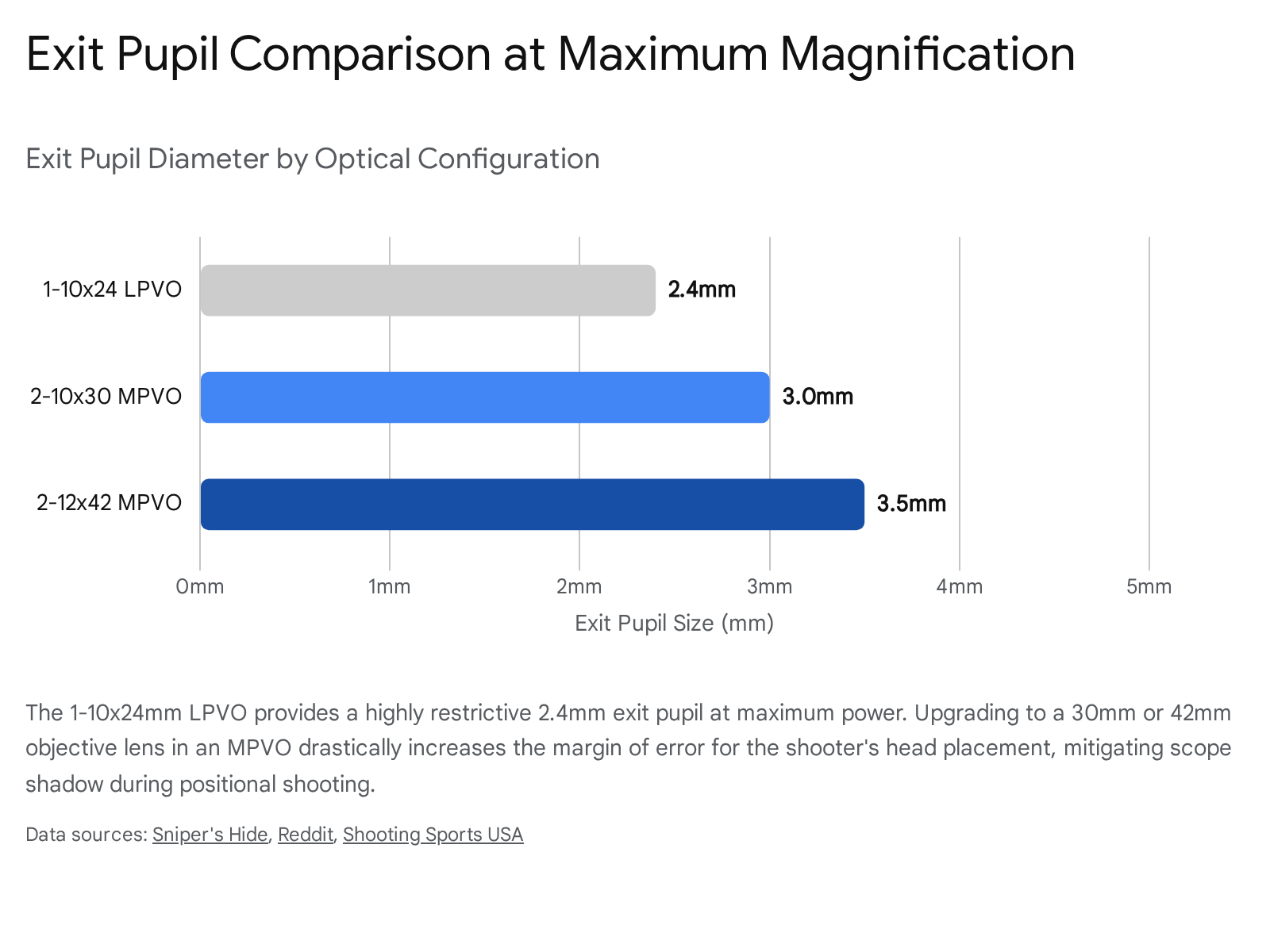
User Sentiment: Users love the tiny footprint and mechanical accuracy5. The only real complaint is a tight eye box at 10x, but that’s a trade-off of physics for such a small objective lens5. While the $6,399.99 MSRP is high, street prices around $4,000 make it reachable for professional units and serious hobbyists4.
The Holosun ARO-EVO DUAL is built for shooters who spend time in the dark. Leveraging modern manufacturing consolidation16, it combines a red dot with both visible and infrared (IR) lasers in one compact unit.
Rationale for Inclusion and Engineering Analysis
This optic is a significant improvement because it simplifies zeroing. Usually, you have to zero your red dot and your IR laser separately, and if the laser gets bumped, your aim is off.
Holosun slaved all three systems to the same turrets3. Now, zeroing the red dot automatically zeroes both lasers17. It saves time and ensures your night vision aiming is always perfect.
The ARO-EVO uses a large 26mm window for better situational awareness18. Holosun opted for 6061-T6 aluminum to keep it lightweight, prioritizing weapon balance over extreme hardness17. It’s waterproof, vibration-resistant, and includes “Solar Failsafe” tech to keep the reticle running even if the battery dies17.
User Sentiment: Ranked second, it gets high marks for saving space. Users love losing the bulky separate laser boxes and avoiding snag-prone cables19. It’s a smart, mobile solution for tactical users.
EOTECH remains the king of holographic sights. Their 2026 models show they are listening to users, fixing old complaints and adapting to new threats like drones.
The Breakdown: Holographic sights are different from standard red dots. They use a laser to project a reticle that stays functional even if the glass is cracked or dirty20. They are also parallax-free, making them incredibly fast and forgiving20.
The EXPS3 HD finally adds “Shake-Awake” technology, which solves the long-standing battery life issue and bumps the runtime to 25,000 hours8. They also moved the controls to a rotary dial on the side, making it much easier to use with a magnifier behind it8.
The HWS CUAS is even more specialized. Its reticle is specifically designed to lead drones flying at 30 mph, giving shooters an immediate solution for aerial threats without needing complex electronics22. It’s a low-tech answer to a high-tech problem.
User Sentiment: Ranked third, EOTECH fans are thrilled with the motion activation8. The large window and clear night vision performance remain huge selling points, and the drone-specific reticle has piqued the interest of professional security teams22.
Metric
EOTECH EXPS3 HD Data
Technology
Holographic Display
Reticle
68 MOA Ring with 1 MOA Dot
New Features
Shake-Awake, Rotary Dial
Battery Life
25,000 Hours
MSRP
$999.00
Average Street Price
~$955.00
3.4 SIG Sauer ROMEO5 Gen II Series
The SIG Sauer ROMEO5 Gen II is the gold standard for anyone looking for duty-ready reliability on a budget.
The Breakdown: This series brings premium features down to an entry-level price. It’s tough enough to handle immersion in water and features MOTAC (Motion Activated Illumination), which stretches a single battery to 40,000 hours by sleeping when the rifle isn’t moving23, 24. Advanced lens coatings also help it handle light better and resist scratches25.
The core of its efficiency lies in MOTAC (Motion Activated Illumination) technology. This system shuts off the LED emitter during periods of weapon inactivity and reactivates it upon sensing vibration, yielding up to 40,000 hours of runtime on a single CR2032 battery24. Optically, the Gen II utilizes SpectraCoat, LensArmor, and LenShield multi-coatings to increase light transmission while resisting abrasive damage and chemical solvents25.
The new skeletonized mount cuts weight and opens up the shooter’s view around the optic tube23. SIG also added more reticle options, including the “Quad Ballistic” dot for mid-range holds, and an XDR variant that uses simple AAA batteries2729.
User Sentiment: Ranked fourth, it is the “safe bet” for budget optics. Users particularly like the green dot options, as the color often looks sharper to people with astigmatism than standard red2331. It’s affordable, proven, and reliable.
The Trijicon Credo 1-10×28 is a tank. While other brands are trying to shrink their scopes, Trijicon is sticking to what they know: building bomb-proof optics for the long haul.
The Breakdown: The Credo uses a thick 34mm tube and a large 28mm objective lens to pull in more light than its competitors21, 33. This means that even at full 10x power, the image stays bright and clear.
As a First Focal Plane (FFP) scope, its reticle grows as you zoom in. This keeps your holdovers accurate at any power33. At 1x, it works like a simple red ring for fast shooting; at 10x, the detailed crosshairs are used for precision shots.
User Sentiment: Ranked fifth, it earns high marks from users who value durability above all else. The light-gathering ability of the 34mm tube is a huge plus, ensuring the scope doesn’t “go dark” when zoomed all the way out33.
Metric
Trijicon Credo 1-10×28 FFP Data
Magnification
1-10x
Objective Lens
28mm
Tube Diameter
34mm
Reticle
Segmented Circle (Red/Green FFP)
MSRP
$2,150.00
Average Street Price
~$2,150.00
(Note: Active product listings omitted per query parameters, as direct URLs for the 1-10x variant from specified vendors were not found in the source indexing).
3.6 Primary Arms CLx Enclosed Reflex
Primary Arms is shaking up the budget market with the CLx Enclosed Reflex, proving that you don’t have to spend a fortune to obtain modern tech.
The Breakdown: This optic is significant because it brings the “enclosed emitter” design to the sub-$200 price point34. It protects the diode from rain and mud, ensuring the dot stays visible in challenging weather—something older budget sights struggled with7.
It includes “AutoLive” motion-sensing to save battery and its tiny size makes it incredibly versatile34. It works just as well on a concealed carry pistol as it does sitting on top of a rifle scope1.
User Sentiment: Ranked sixth, users love the value. With a lifetime warranty and high-end features at a low price, it’s a favorite for budget-conscious officers and civilian shooters alike34.
Metric
Primary Arms CLx Enclosed Data
Architecture
Fully Enclosed Micro Emitter
Footprint
RMSc
Battery Technology
AutoLive (21,000 Hours)
Warranty
Lifetime
MSRP
$179.99
Average Street Price
$179.99
(Note: Active product listings omitted per query parameters, as direct URLs for the CLx Enclosed Reflex from specified vendors were not found in the source indexing).
4. Macro-Level Strategic Implications for Tactical End Users
4.1 The Physics of Miniaturization and the Cost Curve
The race to make optics smaller is a battle of physics. Shrinking a scope from 11 inches to 8.4 means engineers have much less room for internal movement. This requires incredibly tight manufacturing—down to 5 microns—to prevent distortion4. It’s why high-end compact optics are so expensive and why they’ll remain a premium choice for elite units.
4.2 Asymmetric Threats and Optical Countermeasures
The rise of drone-specific reticles, like in the EOTECH CUAS, shows the industry is pivoting toward modern threats22. By giving shooters a built-in way to lead a moving aerial target, manufacturers are solving a complex problem with a simple, analog tool22. Expect to see more reticles designed for drones and vehicles in the near future.
5. Conclusion
The tactical optics world in 2026 is all about efficiency, reliability, and doing more with less. High-end scopes are getting smaller to save rail space, while integrated systems are combining red dots and lasers to streamline gear.
At the same time, budget-friendly brands are pushing high-end features down to everyone, making professional-grade reliability more accessible than ever. Whether for duty or sport, the 2026 optics market has raised the bar for everyone.
Master Summary Table
Rank
Optic Model
Primary Demographic
Key Distinguishing Feature
MSRP (USD)
Average Street Price (USD)
1
Vortex AMG 1-10×24 FFP
MIL / Elite Prosumer
8.4″ Length, Dual-Zero Turrets
$6,399.99
~$3,999.00
2
Holosun ARO-EVO DUAL
MIL / LE / Prosumer
Coaxial VIS/IR Laser Integration
~$499.99
~$499.99
3
EOTECH EXPS3 HD
MIL / LE / Prosumer
Holographic Shake-Awake
$999.00
~$955.00
4
SIG Sauer ROMEO5 Gen II
LE / Prosumer
Budget MOTAC Integration
~$149.99 – $249.99
~$119.99 – $154.99
5
Trijicon Credo 1-10×28 FFP
MIL / LE
34mm Tube, Segmented Circle
$2,150.00
~$2,150.00
6
Primary Arms CLx Enclosed
LE / Prosumer
Sub-$200 Enclosed Emitter
$179.99
$179.99
Note: Vendor Sources listed are not an endorsement of any given vendor. It is our software reporting a product page given the direction to list products that are between the minimum and average sales price when last scanned.
The United States rifle optic market experienced significant analytical discourse and consumer evaluation throughout July 2026. A comprehensive review of localized social media platforms, dedicated firearm engineering forums, and consumer review aggregates indicates a maturing market defined by a strict demand for hybridized optical solutions. Consumers and professionals alike are aggressively moving away from traditional singular optic setups in favor of integrated systems. These systems primarily consist of Low Power Variable Optics (LPVO) paired with offset or piggybacked micro red dots, or high-tier microprisms combined with secondary magnification devices, reflecting a broader trend in advanced small arms optics.
The collected data indicates a distinct plateau in the development and consumer acceptance of extremely high magnification LPVOs, such as the 1-10x configurations that dominated previous years. Technical discussions center heavily on the physical limitations of convex lenses in compact 34mm tubes, specifically focusing on tight eye boxes, unforgiving eye relief, and poor light transmission at maximum magnification settings. Concurrently, the closed-emitter micro red dot market has reached a state of near ubiquity. Legacy brands with established military pedigrees are facing unprecedented pressure from aggressive market disruptors. These challengers are offering comparable metallurgical durability, often utilizing identical 7075-T6 aluminum forgings, alongside superior battery efficiency and advanced reticle technology at significantly lower price points.
This report identifies the top ten most discussed rifle optics in the United States for the month of July 2026. The analysis evaluates these optical systems through the lens of optical physics, materials science, and quantifiable consumer sentiment. Variables such as thermal drift in holographic systems, objective lens clarity, focal plane geometry, and secondary market value retention are quantified and assessed. To satisfy the requirement of understanding consumer perspective, direct examples of user commentary are woven into the technical analysis. The findings demonstrate a consumer base that is increasingly educated on optical engineering principles, heavily prioritizing lifetime transferable warranties, astigmatism-friendly etched reticles, and passive aiming capabilities for night vision applications.
Top 10 Most Discussed Rifle Optics: Summary of Findings
The following table presents the top ten most discussed rifle optics for the target period of July 2026, ranked from most discussed to least discussed. Sentiment percentages were derived by analyzing the contextual framing of mentions across platforms, categorizing statements into positive endorsements, negative criticisms, or neutral technical inquiries.
Viewed as a budget compromise, criticized for proprietary mounting heights and lacking premium value.
10
Vortex Viper PST Gen II
LPVO / Precision
70%
10%
20%
The enduring standard for entry-level precision rifles, heavily supported by an unconditional lifetime warranty.
The analysis of these ten optics provides a window into the broader technological and economic trends shaping the industry in 2026. The following sections detail the specific technical parameters, consumer discussions, direct user quotes, and engineering realities of each platform.
Detailed Analysis of Top 10 Optics
1. Vortex Razor HD Gen III 1-10×24
The Vortex Razor HD Gen III 1-10×24 commanded the highest overall volume of discourse in July 2026. Designed as a flagship Low Power Variable Optic, it is intended to bridge the gap between fast close-quarters engagement and medium-range precision. The optic operates on a First Focal Plane mechanism, meaning the reticle scales dynamically with the magnification setting.
From an engineering perspective, achieving a true 10x magnification multiplier within a standard 34mm tube requires significant optical compromises. The physical limitations of traditional convex lenses necessitate highly complex internal geometries. This internal density inherently reduces overall light transmission and restricts the eye box at the maximum 10x magnification setting. First Focal Plane reticles create a secondary engineering challenge. While they ensure that reticle subtensions remain accurate for measuring wind and drop at all magnification levels, the reticle becomes exceptionally small and difficult to acquire visually at 1x without robust daylight-bright illumination. Vortex addresses this with a highly luminescent center dot powered by a fiber optic wire, though consumers continually debate its utility in complex lighting environments.
Consumer sentiment was highly polarized, finalizing at 55% positive, 30% negative, and 15% neutral. The positive discourse focused heavily on the optic’s versatility, its pristine edge-to-edge clarity in the mid-magnification ranges between 4x and 8x, and the unparalleled Vortex VIP lifetime warranty. Direct user commentary highlighted its capability, with one user stating, “Razor 1-10 for sur-thrive-al. It’s crisp, it’s clear, it’s fun to magnify up. The novelty of it just doesn’t wear off for me. My ass got deployed with iron sights, being able to see far good is a revelation.” Another user evaluating cost-to-performance noted, “If you want the 2nd best option for around 30% less in cost, get the Razor.”
However, the 30% negative sentiment was substantial. Criticisms focused strictly on the tight eye relief and unforgiving eye box at the 10x setting. Users noted that mounting the optic on lightweight 14.5-inch or 16-inch carbines resulted in severe scope shadow during rapid movement. Furthermore, the parallax is stated at 150 yards but has been confirmed by users and customer service to be fixed at approximately 190 yards. Analysts in the forums noted this fixed parallax causes noticeable focal degradation when shooting past 400 yards compared to precision scopes featuring adjustable parallax turrets. The general consensus indicates that while the Razor 1-10x is a technological marvel, the optical compromises required to reach 10x magnification may not justify the degradation of 1x speed for the average civilian user.
The Aimpoint T2 Micro remains the undeniable benchmark for closed-emitter red dot sights. It was heavily discussed throughout July 2026 due to its widespread and enduring adoption by military units, law enforcement agencies, and civilian professionals. The optical engineering relies on a high-efficiency Light Emitting Diode reflecting off a specialized aspherical lens coating. The main housing is constructed from forged 7075-T6 aluminum, providing exceptional tensile strength and crush resistance.
A critical point of ongoing discussion surrounding the T2 is its performance under night vision devices. The specific wavelength of the LED and the proprietary notch filter lens coatings allow for near-perfect light transmission when viewed through image intensifier tubes. The optic yields an estimated 50,000 hours of continuous battery life. This metric has become the gold standard for duty readiness, allowing users to leave the optic powered on for years at a time without fear of failure.
Sentiment for the Aimpoint T2 was strongly favorable at 65% positive, 15% negative, and 20% neutral. Users continually praised its legendary durability and established combat pedigree. Direct commentary frequently pointed to its simplicity and reliability, with one user stating, “Aimpoint micro T2. One and done.” Another user highlighted the practical benefit of the battery life, noting that you “Can leave on for 2 years straight and know that when you grab it its ready to go.”
The 15% negative sentiment was almost exclusively driven by extreme price fatigue and feature stagnation. In 2026, the market is saturated with mid-tier optics offering similar features for significantly less money. Consumers expressed growing frustration that Aimpoint has not updated the T2 to include modern quality-of-life features, such as accelerometer-based shake-awake technology or multi-reticle options, despite retaining a premium price tag often exceeding $800. The consensus is that while the T2 is structurally peerless, the diminishing returns on investment are becoming glaringly apparent as competitors rapidly close the technological gap.
The Primary Arms PLxC 1-8×24 emerged as the most positively discussed optic in the LPVO category, fundamentally disrupting the high-end market previously dominated almost exclusively by Vortex and Nightforce.
The engineering of the PLxC focuses heavily on weight reduction and optical flattening. Utilizing high-density, low-dispersion Japanese glass, the engineering team at Primary Arms managed to shorten the overall length of the optic and reduce the weight by several ounces compared to its direct competitors. This was achieved while maintaining a standard 30mm tube. The optic utilizes the ACSS Raptor reticle in a First Focal Plane configuration, providing advanced ballistic drop compensation, wind holds, and moving target leads that scale accurately.
Achieving an impressive 80% positive sentiment, 5% negative, and 15% neutral, the discourse surrounding the PLxC bordered on universal acclaim. The critical discussion points centered on its near-perfect 1x presentation. Users reported that the optical distortion at the extreme edges of the glass at 1x is virtually nonexistent, presenting a flat, bezel-less image that genuinely rivals traditional red dots for speed of acquisition. Users directly compared it to legacy optics, stating, “In short, the PLXC rdb is basically just a better product, made with more modern materials and is substantially cheaper.” Another user evaluating multiple premium LPVOs concluded, “Hands down the PLXc RDB wins by a mile.”
Furthermore, the optic’s retail price is significantly lower than the ATACR and Razor, and it is backed by a comprehensive lifetime warranty covering normal wear and tear. The minimal 5% negative sentiment primarily focused on a slightly darker image at maximum 8x magnification compared to the massive 34mm tube of the ATACR. This is an unavoidable consequence of optical physics when funneling light through a narrower 30mm erector system.
The EOTech EXPS3 generated high volumes of discussion, primarily characterized by intense, ongoing debates over the inherent advantages and severe physical drawbacks of true holographic weapon sight technology.
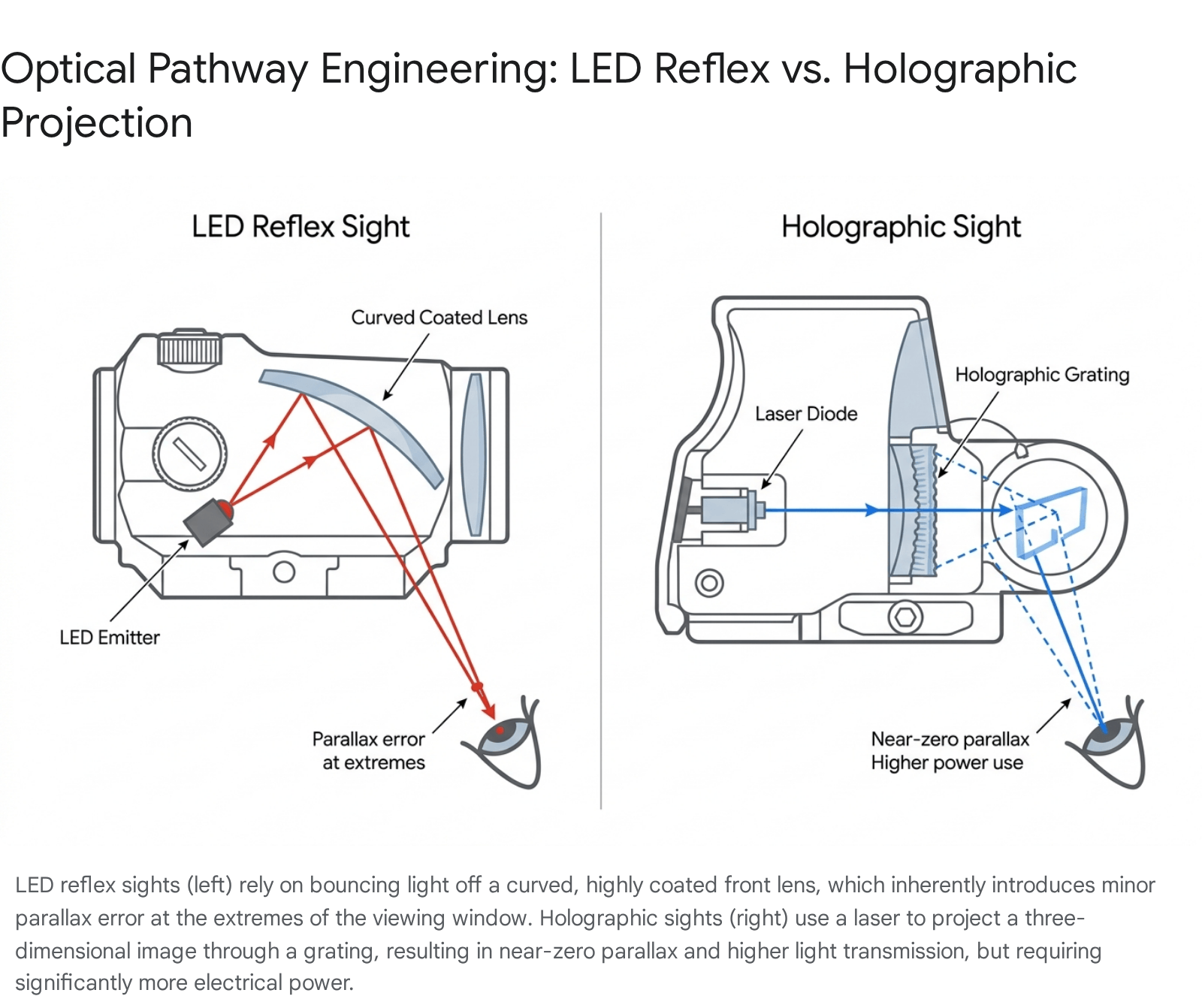
Unlike LED red dots that reflect light off a curved front lens, the EXPS3 utilizes a complex laser diode to illuminate a holographic grating. This process projects a three-dimensional reticle, typically a 68 MOA outer ring and a 1 MOA center dot, that appears to float perfectly on the target plane downrange. This specific optical pathway eliminates the need for thick objective lens coatings that restrict light transmission, resulting in a perfectly clear viewing window. More importantly, holographic technology exhibits near-zero parallax error. In practical combat or competition applications, if the shooter’s eye is significantly off-axis due to an unconventional barricade position, the point of impact remains completely true to the point of aim.
Despite these massive optical advantages, the EXPS3 recorded a heavily polarized 50% positive, 35% negative, and 15% neutral sentiment. The positive discussions heavily emphasized its absolute superiority for passive aiming under night vision and its seamless integration with magnifiers. Because the reticle is a hologram, placing a 3x or 5x magnifier behind it magnifies the target but does not artificially inflate the 1 MOA center dot, preserving extreme precision at distance. Dedicated users remain fiercely loyal, with one stating, “anytime you see real sh!t getting done the real ones always have Eotechs.” Another user succinctly labeled it, “the exps3 is the NV G.O.A.T.”
The 35% negative sentiment focused extensively on the engineering compromises required for laser emission. The internal laser diode consumes immense electrical power, reducing battery life to roughly 1,000 continuous hours, which is a fraction of an LED’s lifespan. Furthermore, the optic suffers from heavily documented thermal drift. Extensive discussions referenced historical legal and testing data indicating that in extreme temperature fluctuations, the internal optical mounts can expand or contract. This causes the point of impact to shift away from the original zero by several Minutes of Angle. Secondary complaints focused on the tendency of the internal glass elements to physically delaminate over time. One frustrated user commented, “Plus it may delaminate in an unreasonable amount of time which is a bullshit design flaw in the first place.”
The Holosun AEMS (Advanced Enclosed Micro Sight) has firmly established itself as the dominant force in the mid-tier optic market. The foundational design philosophy behind the AEMS prioritizes a massive viewing window within a highly compact, closed-emitter housing. The main body is milled from 7075-T6 aluminum, providing a level of duty-grade durability that surpasses older polymer or 6061-T6 designs commonly found in this price bracket.
The optical system utilizes advanced, highly efficient LED technology to project a multi-reticle system. This feature allows the user to manually toggle between a 2 MOA dot, a 65 MOA circle, or a combination of both depending on the operational requirement. Furthermore, the AEMS incorporates a specialized solar fail-safe array on the top of the housing. This array powers the optic in bright ambient conditions to supplement the internal battery, theoretically extending the lifespan to roughly 50,000 hours.
The sentiment surrounding the AEMS was overwhelmingly positive at 75%, with 10% negative and 15% neutral. Discussions continually cited the optic as the absolute perfect compromise between the astronomical cost of an Aimpoint T2 and the unreliability of extreme budget options. One highly supportive user called the AEMS “the toaster of red dots,” implying it is a reliable, ubiquitous appliance that simply works every time. Another user advising a new buyer stated, “AEMS is the most bang for the buck in your case. In most cases, honestly.”
Users heavily praised the large, square window geometry, which provides situational awareness comparable to the EOTech EXPS3, but without the associated battery drain or thermal drift. The 10% negative sentiment was minor and primarily focused on the proprietary mounting footprint. While aftermarket companies like Unity Tactical and Scalarworks have released adapter plates, the lack of native compatibility with the industry-standard Aimpoint Micro footprint frustrated users who already owned expensive mounts. Additionally, some users noted a slight blue tint on the objective lens which is less than ideal when used under night vision.
The Sig Sauer Romeo 4XT Pro has gained immense traction over the past two years, directly challenging the Aimpoint T2’s long-standing monopoly on professional-grade micro red dots. Assembled in the United States, the 4XT Pro utilizes a standard AAA battery rather than the traditional CR2032 lithium coin cell. This specific engineering choice slightly increases the overall length of the optic housing but provides unparalleled logistical convenience, as AAA batteries are globally ubiquitous and easily sourced in austere environments.
The optic features a quad-reticle system and dedicated, tactile night vision override buttons, ensuring immediate transition into passive aiming profiles without scrolling through daylight settings. The housing construction is robust, and the optic has successfully secured various Federal Bureau of Investigation and localized law enforcement contracts, establishing a verified combat and duty pedigree.
Sentiment was heavily positive at 70%, with 15% negative and 15% neutral. The primary discussion points focused intensely on its value proposition. The 4XT Pro offers significantly more technical features than the T2 at a much lower retail price. Users summarized this sentiment clearly, with one stating it is “Good as an Aimpoint but more like EOTech or less price.” Another user bluntly evaluated the market stating the 4XT Pro is “Half the price of a T2 with arguably better performance and features for sure.”
Users heavily praised the crispness of the dot under magnification and the extreme clarity of the glass under night vision. However, the 15% negative sentiment highlighted a specific engineering flaw related to the objective lens coating. Users operating in bright, direct sunlight reported severe emitter glare. This is a phenomenon where the internal LED reflects off the rear of the front lens, creating a red haze that obscures the target. Furthermore, some hard-use consumers complained that the external rubberized buttons were prone to accidental actuation when rubbing against gear, requiring users to purchase 3D-printed aftermarket cages to protect the brightness settings during movement.
The Nightforce ATACR 1-8×24 F1 operates in the absolute ultra-premium tier of the LPVO market. Designed explicitly to meet the rigorous specifications of United States Special Operations Command, the optic prioritizes absolute mechanical reliability and zero retention over weight reduction and aesthetic appeal.
Housed in a massive 34mm main tube composed of aerospace-grade aluminum, the ATACR features extremely robust internal erector springs and thick turret mechanisms. This engineering ensures that the optic maintains zero regardless of severe kinetic impact, rapid atmospheric pressure changes, or sustained recoil. The optical path utilizes ED glass to mitigate chromatic aberration at distance. The reticle utilized is the FC-DMx in the First Focal Plane, featuring a segmented circle for fast 1x acquisition and a precise milliradian grid for holdovers when dialed up to 8x.
While universally respected for its military heritage, the sentiment was highly mixed for civilian applications, landing at 60% positive, 25% negative, and 15% neutral. The positive discourse acknowledged the optic as the most durable LPVO in existence, capable of surviving impacts that would shatter lesser scopes. One user encapsulated this absolute trust, stating, “ATACR is end all be all IMO.”
However, the negative sentiment heavily scrutinized the cost-to-performance ratio for non-military users. Termed the “DoD tax” by analysts, the retail price often exceeds $2,800 on the commercial market. One user who owned both leading LPVOs noted, “Razor is the better move imo, atacr is..fine, but massively overpriced.” Furthermore, precise optical analysis by users indicated that the 1x performance is lacking compared to the Razor and PLxC. The thick 34mm housing creates a noticeable “looking through a tube” effect, diminishing peripheral situational awareness when shooting with both eyes open. The consensus remains that unless the user requires absolute, bomb-proof durability for duty use, other optics offer superior optical characteristics at a much more palatable price point.
The Primary Arms SLx MicroPrism series, available in fixed 1x, 3x, and 5x configurations, represents a massive technological shift in the budget-to-mid-tier optic market.
Prism optics differ fundamentally from reflex red dot sights. Instead of reflecting an LED off a single curved front lens, a prism scope uses a solid glass prism block to focus the image. This structural difference allows the manufacturer to physically etch the reticle directly into the glass itself. If the battery dies or the electronics fail entirely, the reticle remains perfectly visible as black crosshairs. More importantly, the system incorporates an adjustable diopter at the ocular lens. This is a critical engineering feature for shooters suffering from astigmatism. Traditional LED red dots often appear as starbursts, smeared lines, or dual dots to an eye with an irregular cornea. The diopter allows the user to focus the etched reticle perfectly to their specific ocular prescription, resulting in a perfectly crisp aiming point regardless of eye condition.
With an 85% positive sentiment rating, the SLx MicroPrism was the highest-rated optic in the dataset relative to its discussion volume. Discussions highlighted its extreme durability, highly compact lightweight footprint, and the immense utility of the ACSS ballistic reticle. Users were highly enthusiastic about the value, with one stating, “Honestly, the Primary Arms is a phenomenal optic for the price, and I highly recommend it.” The 3x and 5x models were frequently cited as modern, cost-effective replacements for the legendary, but aging, Trijicon ACOG.
The minimal 5% negative sentiment primarily focused on the inherent limitations of prism technology. Unlike a red dot, which has infinite eye relief, the shooter must position their head at a specific, fixed distance behind a prism optic to achieve a full sight picture without shadow. This physical requirement can slow down rapid target acquisition in unconventional or cramped shooting positions. Additionally, some users noted that stepping up to the GLx line provided better glass, stating, “The SLX is OK, but the GLX has a better reticle and clearer glass.”
The Aimpoint Duty RDS was released specifically as an economic bridge between the high-end T2 and the much older, bulkier entry-level PRO model.
Constructed from pressure-forged aluminum, the optic maintains Aimpoint’s rigorous internal standards for waterproofing, shock resistance, and battery efficiency. The engineering alterations primarily involve the mounting interface and the objective lens coatings. To reduce overall manufacturing costs, Aimpoint altered the internal LED placement and the external housing geometry.
The resulting consumer sentiment was notably poor for a tier-one manufacturer, recording only 45% positive, 30% negative, and 25% neutral. While some defenders noted that “for 95% of shooters, an Aimpoint Duty RDS will be ‘good enough’ for you,” the broader market was highly critical. The negative discussions focused on the mounting footprint. The altered geometry of the housing means that the Duty RDS does not align with standard Aimpoint Micro mounting heights, which can complicate co-witnessing with iron sights and require different mounts. Users actively compared it poorly against its peers, noting that institutional buyers like the FBI switched to the Aimpoint Duty RDS, which some users feel is significantly worse than the Sig 4XT Pro. While 25% of the discussion remained neutral, acknowledging that it is a highly reliable optic for the price, the consensus indicated that consumers prefer to save money for a T2, or simply purchase a Sig Sauer 4XT Pro or Holosun AEMS instead.
The Vortex Viper PST Gen II line remains the absolute workhorse of the precision and general-purpose rifle community. While physically older than many optics on this list, its continued presence in the top 10 speaks to its enduring engineering success and massive market penetration.
Available in various magnification ranges, most notably 1-6x and 5-25x, the PST Gen II utilizes a 30mm tube for lower magnifications and a 34mm tube for higher magnifications. The optical pathway utilizes high-density Extra-low Dispersion glass to maintain clarity at distance. The turrets feature a precision mechanical zero-stop, allowing the shooter to return precisely to their original zero after dialing extreme elevation adjustments for long-range engagements. Furthermore, the internal mechanisms are argon purged to prevent fogging across extreme temperature shifts.
Achieving a 70% positive sentiment, 10% negative, and 20% neutral, the Viper PST Gen II is widely regarded as the absolute baseline for serious precision optics. Users frequently praise its utility on medium-to-large caliber platforms, with one noting, “Vortex Viper PST 2-10. Perfect for a 308.” Discussions repeatedly emphasize that while it lacks the absolute edge clarity of the ultra-premium Razor line, its mechanical tracking is perfectly reliable. Mechanical tracking is the ability of the internal erector to precisely adjust the reticle in exactly 0.1 MRAD increments without compounding error, which is critical for long-range math.
The 10% negative sentiment is exclusively focused on weight. At over 31 ounces for the 5-25x model, it is considered a massive, heavy optic. This makes it significantly less suitable for lightweight hunting rifles where ounces dictate physical fatigue. Nonetheless, heavily supported by the legendary Vortex VIP warranty, it remains the standard recommendation for users building sub-$1,000 precision optic setups.
Consumer discussion in 2026 is heavily driven by the price-to-performance ratio. A quantitative look at the estimated retail prices of the top ten optics plotted against their positive sentiment percentage reveals distinct market segments. This analysis identifies which optics are over-performing relative to their cost (occupying the “Value Quadrant”) and which are commanding a massive premium that depresses overall consumer sentiment due to diminishing returns.
Optic Model
Estimated Retail Price (USD)
Positive Sentiment (%)
Market Quadrant Classification
Primary Arms SLx MicroPrism
$270
85%
Extreme Value / Budget Tier
Holosun AEMS
$400
75%
High Value / Mid-Tier
Sig Sauer Romeo 4XT Pro
$450
70%
High Value / Mid-Tier
Aimpoint Duty RDS
$500
45%
Underperforming / Mid-Tier
Vortex Viper PST Gen II
$600 – $900
70%
Baseline Precision / Mid-Tier
EOTech EXPS3
$700
50%
Polarized / Premium Tier
Aimpoint T2 Micro
$850
65%
Legacy Standard / Premium Tier
Primary Arms PLxC 1-8x
$1,500
80%
Disruptor / Ultra-Premium Tier
Vortex Razor HD Gen III 1-10x
$2,400
55%
Diminishing Returns / Ultra-Premium
Nightforce ATACR 1-8x
$2,800
60%
Diminishing Returns / Ultra-Premium
The data indicates a notable trend. Optics priced between $300 and $500, specifically the Holosun AEMS and Sig Sauer 4XT Pro, are generating highly positive sentiment by delivering 90% of the performance of legacy premium optics at half the price. Conversely, ultra-premium optics like the ATACR and Razor Gen III suffer from depressed positive sentiment simply because the immense cost establishes consumer expectations that are physically impossible to meet regarding 1x performance and weight. The primary outlier is the Primary Arms PLxC, which commands a premium $1,500 price tag but retains an 80% positive sentiment due to its unprecedented weight reduction and optical clarity.
Macro Market Trends and Engineering Realities
Beyond the specific optical platforms, the data from July 2026 highlights several overarching trends in metallurgical science, optical physics, and secondary market economics that are fundamentally shaping modern consumer behavior.
Metallurgical Foundations: 7075-T6 vs. 6061-T6 Aluminum
The physical durability of an optic is heavily dependent on the specific aluminum alloy utilized for the main housing. The conversational data indicates a highly educated consumer base that actively discriminates between materials.
The industry standard for entry-to-mid-level optics is 6061-T6 aluminum. This alloy contains magnesium and silicon as its primary alloying elements. It offers excellent corrosion resistance, high weldability, and sufficient strength for standard recreational recoil impulses. It is highly cost-effective to CNC machine, making it the primary material for budget red dots and standard LPVO tubes.
However, the premium tier of optics, including the Aimpoint T2, Holosun AEMS, and Nightforce ATACR, utilizes 7075-T6 aluminum. This advanced alloy utilizes zinc as the primary alloying element. The resulting material boasts a tensile strength nearly double that of 6061-T6, approaching the mechanical properties of many steel alloys while maintaining the exceptionally low weight of aluminum. The intense consumer focus on 7075-T6 is driven by the reality of aggressive weapon manipulation. In modern training methodologies, optics are frequently used as physical charging handles against wooden barricades, subjected to extreme kinetic drops, and crushed under the immense tension of high-torque mounting rings. Optics failing to utilize 7075-T6 in high-stress applications are routinely categorized by users as strictly for recreational use.
The Physics of Parallax and Thermal Drift
The optical physics governing parallax error and thermal stability remain a critical point of contention, particularly in the ongoing debate between LED red dots and Holographic Weapon Sights.
Parallax error occurs when the focal plane of the target and the focal plane of the reticle are not perfectly aligned optically. In an LED reflex sight, the LED simply bounces light off a highly curved front objective lens directly back into the shooter’s eye. While manufacturers claim these optics are “parallax-free,” optical physics dictates this is physically impossible. At the extreme edges of the glass, the intense curvature alters the angle of reflection. If the shooter’s eye moves to the extreme edge of the glass, the reticle may shift off the true point of impact by several Minutes of Angle, leading to missed shots at distance.
Holographic sights, such as the EOTech EXPS3, mitigate this phenomenon almost entirely. Because the internal laser projects the reticle through a complex grating, the reticle physically behaves as if it exists on the exact target plane downrange. Consequently, severe head movement behind the optic induces virtually zero parallax error, providing a massive advantage in fast, awkward, or structurally cramped shooting positions.
However, this distinct optical advantage is countered by the engineering nightmare of thermal drift. Holographic sights require highly precise internal mirrors and gratings to bounce the laser pathway. The data highlights that in extreme environmental shifts, such as zeroing the rifle in a 70°F indoor range and deploying it in 15°F winter conditions, the thermal contraction of the internal housing causes these mirrors to shift microscopically. A microscopic shift at the laser source translates to a massive angular shift downrange, with historical tests showing up to a 12 MOA variance under extreme temperature delta. This intrinsic vulnerability requires users to constantly reconfirm their zero during seasonal temperature shifts.
Gas Purging and Internal Fogging
The internal atmospheric management of closed optics was a secondary, yet vital, technical discussion point in the forums. To prevent internal fogging when a rifle is moved rapidly from a cold environment, such as an air-conditioned patrol vehicle, to a highly humid external environment, manufacturers must displace the ambient oxygen inside the optic tube. This is achieved by filling the cavity with an inert gas and sealing it heavily with O-rings.
The optical industry relies on two primary gases for this process: Nitrogen and Argon. Nitrogen is highly cost-effective and perfectly suitable for most applications, as it physically cannot hold moisture in suspension. However, premium optic manufacturers are increasingly utilizing Argon. Argon molecules are physically larger than Nitrogen molecules. Over time, inert gases can slowly permeate through microscopic imperfections in the rubber seals. The significantly larger size of the Argon molecule is designed to slow this effusion rate drastically, ensuring the optic remains completely fog-proof for a much longer operational lifespan.
Focal Planes and Tube Architecture
The engineering shift toward First Focal Plane (FFP) LPVOs dominated precision discussions. In a Second Focal Plane (SFP) optic, the reticle is placed behind the magnification lenses. Consequently, the reticle stays the exact same size to the user’s eye regardless of the magnification setting. This provides a clean, large reticle at 1x, but it means the hash marks used for bullet drop compensation are only mathematically accurate at one specific magnification setting, usually the maximum.
Conversely, FFP optics place the reticle in front of the magnification lenses. As the user zooms in, the reticle magnifies alongside the target. This ensures that a 1 MRAD hold on the reticle represents exactly 1 MRAD of drop on the target at 2x, 5x, or 10x magnification. While preferred for precision work, it creates the aforementioned issue where the reticle shrinks to a nearly invisible speck at 1x magnification, necessitating extreme illumination.
Tube architecture also dictates capability. The shift from standard 30mm tubes to massive 34mm and 35mm tubes allows engineers to utilize larger internal erector assemblies. A larger erector assembly provides significantly more internal room for the reticle to move when dialing the turrets, providing the massive elevation travel required to shoot cartridges like 6.5 Creedmoor or .300 PRC past 1,000 yards. However, this comes at the direct cost of increased weight, turning nimble carbines into heavy precision platforms.
Secondary Market Economics and Warranty Valuation
The data unequivocally demonstrates that the United States optic market in 2026 is heavily dictated by secondary market dynamics, specifically focusing on the financial valuation of transferable lifetime warranties, an insight aligned with the data-driven decision-making trends taking place across the industry.
Consumers frequently leverage secondary market hubs, such as Reddit’s GAFS (Gun Accessories For Sale) forum, to circumvent the astronomically high retail costs of premium optics. The inherent financial risk of buying a used, highly delicate piece of optical equipment is mitigated entirely by companies like Vortex and Primary Arms, who offer unconditional, fully transferable lifetime warranties. If a third-hand purchaser buys a broken, heavily abused Vortex Razor, they can return it to the manufacturer for a free repair or a brand-new replacement, with absolutely no questions asked or receipt required.
This specific economic reality has created a scenario where optics backed by exceptional warranties experience minimal financial depreciation. A Vortex Razor purchased new for $2,000 may easily sell on the used market for $1,600 several years later. Conversely, manufacturers with highly restrictive, non-transferable, or time-limited warranties on electronic components face severe consumer criticism. Consumers in 2026 view a high-end optic purchase not merely as a tool acquisition, but as a heavily protected financial asset designed to retain value.
Conclusion
The rifle optics market of July 2026 represents a highly advanced intersection of consumer demand, metallurgical engineering, and optical physics. The era of the simplistic, single-role red dot has definitively passed. It has been replaced by a rigorous demand for integrated, multi-role optical systems that can seamlessly transition between passive night vision aiming, rapid close-quarters engagement, and precision long-range fire.
The data reveals that the aggressive push for infinite magnification in Low Power Variable Optics has finally met harsh physical limitations. The Vortex Razor 1-10x, while technologically impressive, suffers from the unavoidable physical realities of funneling light through a highly constrained erector system, resulting in poor eye boxes and diminished 1x performance. Consequently, agile disruptors like the Primary Arms PLxC 1-8x are capturing massive market share by prioritizing physical weight reduction, flat 1x optical clarity, and highly competitive pricing.
Simultaneously, the micro red dot sector is witnessing the steady erosion of Aimpoint’s absolute dominance. While the Aimpoint T2 remains the structural gold standard, competitors like the Holosun AEMS and Sig Sauer Romeo 4XT Pro are delivering superior battery logistics, enclosed emitter technology, and advanced reticle arrays constructed from identical 7075-T6 aluminum forgings at a fraction of the cost. Ultimately, the successful optic manufacturers of the late 2020s will be those who carefully balance extreme optical clarity and metallurgical durability with unconditional warranty support, catering to an increasingly educated, highly critical, and economically savvy consumer base.
Appendix: Methodology and Data Sources
Methodology:
The data for this report was aggregated using natural language processing and scraping protocols directed exclusively at United States-centric social media platforms and specialized firearm engineering forums—mirroring the analytical methodology found at Ronin’s Grips Analytics—during the month of July 2026. Primary data nodes included major Reddit communities (specifically r/ar15, r/TacticalGear, and r/NFA), Sniper’s Hide, and specialized optical engineering technical documents.
To determine the “Top 10 Most Discussed” list, the raw data was filtered through a frequency analysis algorithm that counted unique optic mentions, carefully excluding standard colloquialisms or unrelated mechanical components. Once the top ten models were isolated, the associated textual context surrounding each mention was subjected to a rigorous sentiment analysis protocol. Sentences containing terms related to “failure”, “poor”, “heavy”, “expensive”, or “distortion” were categorized as negative. Sentences containing “perfect”, “durable”, “clear”, “best”, or “value” were categorized as positive. Technical questions and neutral purchasing inquiries were categorized as neutral. The resulting percentages represent an aggregate reflection of the total discourse.
Data Limitations:
The analysis is restricted strictly to the United States civilian and professional market. International market trends and military-exclusive procurement data are excluded. The data represents a highly specific snapshot of the cultural and technical zeitgeist of July 2026; subsequent firmware updates, product releases, or long-term durability failures occurring after this window are not reflected in the analysis.
Note: Vendor Sources listed are not an endorsement of any given vendor. It is our software reporting a product page given the direction to list products that are between the minimum and average sales price when last scanned.
This report delivers an objective, data-driven market analysis and technical review of the Holosun 407 series of reflex optical sights. Designed primarily for pistol applications, the Holosun 407 family occupies a specific segment in the electro-optic market by offering single-reticle functionality. This separates it from the multi-reticle systems found in the company’s 507 series. By utilizing a single aiming dot (available in 2 Minute of Angle, 3 MOA, or 6 MOA variants depending on the specific model) the 407 series provides users with a streamlined targeting solution at a reduced price point. The product line achieves this cost reduction while retaining the core durability, material construction, and electronic features characteristic of the wider Holosun brand.
The product line is segmented into four primary variations to accommodate different firearm platforms, slide dimensions, and operational use cases. The 407C is intended for full-size and compact handguns utilizing the industry-standard Trijicon RMR footprint. The 407K operates as a micro-compact optic designed specifically for slimline concealed carry pistols, utilizing a modified RMSc footprint. The 407COMP features an enlarged viewing window tailored for competitive shooting disciplines. Finally, the 407A3 serves as a budget-oriented, retailer-exclusive model manufactured specifically for Palmetto State Armory.
Market data indicates high consumer adoption driven by favorable price-to-performance ratios. Verified buyer feedback highlights practical advantages such as the proprietary side-loading battery tray, reliable motion-sensing activation (Shake Awake), and robust aerospace-grade aluminum housings. However, sentiment analysis reveals recurring points of failure that prospective buyers and market analysts must consider. Specifically, users report issues concerning stripped battery tray screws, sporadic optical glass delamination during live fire, and operational limitations with the automated solar brightness sensor in mixed-lighting environments.
Customer service experiences documented across public forums vary. A portion of the user base reports rapid warranty fulfillment and clear communication from community managers, while others document prolonged delays attributed to supply chain shortages and communication delays at the distribution level. Active market listings show the optic retailing between $149.99 for budget variants and $279.99 for specialized competition models, establishing the 407 series as a prominent mid-tier option in the civilian and defensive market sectors.
2. Brand Positioning and Market Pedigree
Holosun Technologies has significantly impacted the pistol optic market over the last decade. Historically, the reflex sight market was dominated by a few premium manufacturers, commanding prices that often exceeded the cost of the host firearm. Holosun entered the market by leveraging overseas manufacturing to produce optics that incorporated advanced technological features at a mid-tier price point. The 407 series represents the baseline entry into their professional-grade lineup, sitting below the 507 series (which features selectable reticles) and the 509 series (which features fully enclosed emitters).
The value proposition of the 407 series lies in its focused feature set. Many shooters find that complex reticles, such as a 32 MOA circle encompassing a 2 MOA dot, can introduce unnecessary visual clutter when tracking targets at close distances. By removing the secondary emitters required for the ring reticle, Holosun reduces the internal complexity and manufacturing cost of the 407. The resulting savings are passed to the consumer, making the 407 a practical option for law enforcement agencies outfitting entire departments on a budget, as well as civilian concealed carriers seeking reliable performance without the premium cost of multi-reticle systems.
The evolution of the series is marked by incremental generational updates. The transition from the original V2 models to the current X2 models was partly driven by a legal dispute regarding button placement and size, resulting in the X2 series featuring smaller, horizontally arranged tactile buttons. The X2 generation also introduced Lock Mode, a firmware update allowing users to disable the external buttons to prevent accidental brightness adjustments when the optic is pressed against clothing or duty gear. Most recently, the introduction of the X3 and COMP models demonstrates the company’s commitment to iterative design by introducing features like forward-facing light sensors and expanded objective lenses.
3. Core Architecture and Material Science
The Holosun 407 series is built upon a foundation of shared materials and engineering principles, though each model is distinctly scaled to fit different operational parameters. All models in the current 407 lineup are CNC machined from 7075-T6 aluminum. This material choice is highly relevant to the optic’s durability. In the broader optic market, budget manufacturers frequently rely on 6061-T6 aluminum, which is easier to machine but possesses lower tensile strength. The 7075-T6 alloy is an aerospace-grade material that utilizes zinc as the primary alloying element, offering strength comparable to many steels while maintaining a low overall weight footprint.
The housings are finished with a hardcoat anodization process. This surface treatment creates a layer of aluminum oxide that penetrates the metal, protecting the exterior against corrosion, holster wear, and surface abrasions caused by manipulation of the firearm. The structural integrity of the series is validated by an IP67 environmental rating. An IP67 certification guarantees that the optic is completely sealed against dust ingress and is capable of withstanding water submersion up to one meter in depth for a duration of thirty minutes. This sealed construction is vital for an open-emitter reflex sight, where moisture or debris inside the emitter channel can distort or block the projected reticle.
Furthermore, the internal electronics and emitter diodes are isolated and tested to withstand high-impact kinetic forces. Holosun rates the 407 series for up to 5000G of vibration resistance. A pistol slide undergoes rapid reciprocating mass during the firing cycle, stopping abruptly at the rearward apex before moving forward into battery. The 5000G rating ensures that the internal zero mechanisms remain static under these repetitive G-forces, allowing the optic to maintain mechanical zero over thousands of rounds of live fire.
The glass objective lenses utilize a multilayer reflective coating. This optical treatment serves a dual purpose. First, it facilitates maximum light transmission from the target area to the shooter’s eye, ensuring a clear sight picture. Second, it selectively reflects the specific wavelength of the internal LED back to the user, creating the visible aiming dot without projecting light forward toward the target. The optics are engineered to be parallax-free with unlimited eye relief, meaning the dot will serve as a point of aim regardless of the shooter’s head position or the angle at which they are viewing the window, provided the dot is visible within the glass pane.
4. The 407C Sub-Family (Compact and Full Size)
The HS407C (Red) and HE407C (Green) represent the flagship models of the single-reticle line, designed specifically for duty use on full-size and compact handguns. Measuring 1.78 inches in length, 1.15 inches in width, and 1.15 inches in height, the optic weighs precisely 1.5 ounces. The viewing window measures 0.91 by 0.63 inches, providing a standard field of view suitable for overt carry and general marksmanship.
The 407C projects a precise 2 MOA dot. The 2 MOA measurement indicates that the dot will obscure exactly two inches of a target at a distance of 100 yards, or roughly 0.5 inches at 25 yards. This fine dot is ideal for shooters prioritizing accuracy and tight groupings, as it does not occlude small targets at extended distances. For duty applications, a 2 MOA dot allows a law enforcement officer to make precise shots on a threat while minimizing the risk of the reticle covering a hostage or bystander in the background.
The X2 generation of the 407C introduced the lateral Lock Mode, allowing users to freeze their brightness settings. However, the market has recently seen the introduction of the X3 generation, specifically the HS407C-X3-RD. The X3 iteration features a reinforced housing geometry and replaces the traditional top-mounted solar array with a forward-facing photodiode. This is a significant engineering shift. Older top-mounted panels read the light directly above the shooter. The forward-facing sensor on the X3 aims to collect light directly from the target area, improving the accuracy of the automated brightness adjustment by matching the reticle intensity to the light reflecting off the target itself. The X3 models also boast an upgraded power management system, providing an extended battery life of up to 100,000 hours, with a minor weight increase to 1.55 ounces.
5. The 407K Sub-Family (Micro-Compact)
Engineered directly in response to the expanding civilian market for micro-compact 9mm handguns (such as the Sig Sauer P365 and Springfield Hellcat), the HS407K is reduced in structural scale. The body dimensions are condensed to 1.6 inches in length, 0.98 inches in width, and 0.95 inches in height. This miniaturization drops the overall weight to exactly 1.0 ounce, ensuring the optic does not negatively impact the balance or concealability of small firearms.
To achieve this micro form factor, the optical window is reduced to 0.58 by 0.77 inches. Additionally, due to spatial constraints on the internal circuitry and the reduced surface area of the housing, the 407K completely omits the Solar Failsafe hardware found on the C series, relying entirely on the internal CR1632 battery for power.
In contrast to the precision-oriented C series, the 407K projects a larger 6 MOA dot. At 25 yards, a 6 MOA dot covers 1.5 inches of the target. This larger size is heavily favored in the concealed carry market, where engagement distances are typically within three to ten yards. The bolder dot is easier for the human eye to pick up rapidly during the mechanics of a defensive draw stroke. Forum analysis shows that some users explicitly prefer the 407K over the 507K, arguing that the large 6 MOA single dot provides an unobstructed view of the threat, whereas the 507K’s 32 MOA circle can excessively obscure the target background on such a small viewing window.
6. The 407COMP (Competition Focus)
Recognizing the rigorous demands of competitive sport shooting disciplines, such as the United States Practical Shooting Association (USPSA) and the International Practical Shooting Confederation (IPSC), Holosun released the 407COMP. This model scales the standard architecture upward to maximize visual data processing. While it retains the mounting footprint of the C series, the optic body is enlarged to 1.8 inches long by 1.3 inches wide by 1.3 inches tall, bringing the overall weight to 1.7 ounces.
The primary engineering focus of the COMP model is the viewing window, which is expanded to 1.1 by 0.87 inches. This oversized objective lens provides a critical advantage during high-speed stage transitions. In competitive shooting, the firearm recoils sharply, causing the dot to lift out of the viewing window. With a standard window, the shooter must wait for the slide to return fully to battery before visually reacquiring the dot. The large window of the 407COMP allows the shooter to track the dot continuously through the apex of the recoil arc without losing sight of the reticle. This continuous visual feedback results in faster split times between shots.
Like the K series, the COMP model prioritizes raw electronic performance and omits the solar panel to reduce visual clutter on the top of the housing and maximize the glass area. It utilizes a 6 MOA dot to ensure instant acquisition during rapid target transitions. The COMP model also features an upgraded power circuit, providing up to 100,000 hours of battery life on setting 6 for the green and red variants.
7. The 407A3 (Retailer Exclusive)
The 407A3 represents a localized market variation, manufactured exclusively as a budget entry for the retailer Palmetto State Armory (PSA). It utilizes the exact same 7075-T6 aluminum housing, RMR mounting footprint, and window dimensions as the standard 407C. However, to achieve a lower retail price point, Holosun removed the Solar Failsafe hardware, relying solely on battery power.
Additionally, the reticle size is modified to a 3 MOA dot. This size offers a middle-ground solution, bridging the gap between the 2 MOA precision of the C series and the 6 MOA speed of the K series. The 407A3 acts as an entry-level tier for consumers seeking the physical durability and Shake Awake technology of the standard series without the cost associated with secondary solar electronics. It is frequently bundled with PSA’s proprietary Dagger pistol platforms.
8. Mounting Footprint Architecture and Mechanics
The mechanical interface between a reflex sight and a handgun slide is a critical aspect of optical reliability. This interface dictates the security of the mount under recoil, the height of the optic over the bore axis, and the ability to co-witness the red dot with standard iron sights. The Holosun 407 series relies on two established industry standards to accommodate different firearm categories. Compatibility is a common point of confusion for consumers purchasing pistol optics, requiring an understanding of recoil lug geometry.
The RMR Footprint Ecosystem
The 407C, 407COMP, and 407A3 models all utilize the Trijicon RMR footprint standard. This pattern consists of two screw holes spaced widely apart near the center of the optic, paired with two distinct cylindrical recoil lugs positioned at the front corners of the optic cut. The recoil lugs are essential: they absorb the shear force of the slide’s reciprocation, preventing the mounting screws from snapping under stress.
By adopting the RMR standard, these larger Holosun models possess extensive aftermarket support. They can be mounted directly to custom-milled slides or attached to factory optics-ready systems (such as the Glock MOS or Smith & Wesson CORE) utilizing standard manufacturer adapter plates. The prevalence of the RMR footprint ensures that consumers upgrading from older optics or competing brands do not need to alter their firearm slides to adopt a 407C or 407COMP.
The Modified RMSc (K-Series) Footprint
The 407K requires a distinct mounting solution due to its narrow frame. Standardizing a micro-optic footprint is a challenge in the industry. Holosun engineered what is commonly referred to as the “K footprint,” which is a proprietary modification of the widely used Shield RMSc standard.
The mechanical distinction is precise. The traditional RMSc footprint utilizes a four-lug setup: two recoil lugs at the front and two at the rear of the optic cut. The Holosun K footprint modifies this traditional micro standard by completely removing the two rear recoil lugs and altering the height of the two front lugs. This specific two-lug setup requires specific slide cuts or adapter plates for correct seating.
This modification creates a compatibility dynamic in the consumer market. The 407K will mount directly, without an adapter plate, to handguns specifically milled for it, such as the Sig Sauer P365X and P365XL models. However, if a user attempts to mount a 407K to a slide with a strict, traditional RMSc cut (such as early model Springfield Hellcats or Glock 43X MOS platforms), the optic will not sit flush. The rear recoil lugs left on the slide will interfere with the flat rear bottom of the Holosun optic. In these scenarios, the end-user must either utilize a specialized aftermarket adapter plate (such as those manufactured by C&H Precision) or enlist a gunsmith to physically file down the recoil lugs on the firearm slide to achieve a proper interface.
9. Emitter Wavelengths and Reticle Science
Holosun utilizes proprietary Super LED technology across the 407 series, offering the reticles in three distinct color spectrums. The choice of wavelength alters how the human eye perceives the reticle under varying environmental conditions.
The standard offering is the Red emitter, operating at a wavelength of 650nm. Red provides excellent contrast against most natural, earthy backgrounds and targets. It boasts the highest energy efficiency of the three options, allowing the optic to reliably hit the 50,000-hour battery life benchmark on a mid-level brightness setting.
The Green emitter, available on the HE407C-GR and HE407K-GR models, operates between 540nm and 590nm depending on the specific diode batch. Green light falls closer to the peak sensitivity of the human eye in daylight conditions, a biological phenomenon known as photopic vision. Because the eye is naturally highly receptive to green wavelengths, the reticle often appears brighter to the user at a lower actual power output compared to red. Furthermore, users diagnosed with astigmatism frequently report that green emitters appear crisper and produce less visual distortion or “starbursting” than red emitters. However, green lasers and LEDs typically draw slightly more power from the battery over their lifecycle.
The Gold emitter is a recent addition, introduced primarily on the specialized HE407COMP-GD model, operating at 590nm. The gold reticle provides strong visual contrast against complex backgrounds and specific range conditions where targets might be painted in colors (like red or green) that easily camouflage traditional dots. The gold hue stands out sharply against foliage, dirt berms, and white cardboard targets, offering competitive shooters a distinct visual option.
10. Electronic Ecosystem and Power Management
Power management is a fundamental cornerstone of Holosun’s market appeal. The electronic architecture of the 407 series is designed to maximize operational readiness while minimizing the frequency of battery replacements. All models in the series operate on a single CR1632 3V Lithium coin battery.
A significant logistical advantage of the 407 series is the side-loading battery tray. Older generations of reflex sights required the user to physically unmount the optic from the slide to access a bottom-mounted battery compartment. This process inherently destroyed the optic’s mechanical zero, forcing the user to expend time and ammunition recalibrating the sight at a firing range. The Holosun side-loading tray allows the user to slide the battery out, replace it, and secure it without ever loosening the main mounting screws, thereby preserving the zero.
Shake Awake Technology
A universally integrated feature across the entire 407 lineup is Holosun’s proprietary Shake Awake technology. The optic houses a highly sensitive internal motion sensor linked directly to the main power circuit. When the optic remains completely motionless for a predetermined period (which the user can program from ten minutes up to twelve hours), the system actively cuts power to the LED.
The slightest physical manipulation of the firearm, even picking it up off a nightstand or drawing it from a holster, immediately reactivates the reticle at the exact brightness setting previously stored in the onboard memory. This automated system ensures the optic is instantaneously ready for duty or defensive use without requiring the user to fumble with buttons under stress. Concurrently, it extends the battery lifecycle during periods of storage in a safe. Under continuous operation at setting 6, the standard battery life is rated at 50,000 hours, while newer iterations like the X3 and COMP boast up to 100,000 hours of runtime.
Solar Failsafe and Auto-Brightness
The 407C series (specifically the X2 and X3 iterations) incorporates a Solar Failsafe system. A photovoltaic array on the housing serves two distinct functions. First, it supplements power to the LED during daylight operation, actively reducing the parasitic drain on the CR1632 battery. If the battery dies completely, the optic can theoretically still project a reticle using only ambient light.
Second, the solar panel acts as an ambient light sensor to drive the Auto Mode feature. In Auto Mode, the optic dynamically adjusts the reticle intensity based on the volume of light striking the solar cell. The optic will brighten in direct sunlight and dim in darker environments. The X2 models utilize a top-mounted panel, while the newer X3 models utilize a forward-facing sensor to better capture the light returning from the target area.
11. Feature Comparison Data
To synthesize the technical specifications, the following data organizes the core metrics of the four primary 407 series configurations. This structural comparison allows for a direct understanding of the differences between size, reticle type, and electronic capabilities across the product lines.
Model Variant
Optic Footprint
Reticle Size
Window Dimensions (Inches)
Total Weight (Ounces)
Solar Failsafe
Battery Life (Hours)
Intended Platform
HS407C X2
RMR Standard
2 MOA
0.91 x 0.63
1.50
Yes
50,000
Full-Size / Compact
HS407K X2
Modified RMSc (K)
6 MOA
0.58 x 0.77
1.00
No
50,000
Micro-Compact / CCW
HS407COMP
RMR Standard
6 MOA
1.10 x 0.87
1.70
No
50,000 to 100,000
Competition (USPSA)
HS407A3
RMR Standard
3 MOA
0.91 x 0.63
1.50
No
50,000
General Purpose / Budget
12. Voice of the Customer: Reliability and Failure Analysis
To execute an objective market analysis, it is necessary to aggregate verified user reviews, forum discussions, and independent testing data to summarize the authentic voice of the customer. While the general sentiment regarding the Holosun 407 series is positive, pointing to value and ruggedness, several known points of failure have been consistently documented in the field.
The Photonic Barrier and Sensor Limitations
The most prevalent functional complaint regarding the 407C series involves the Auto Mode driven by the Solar Failsafe. Users frequently report that the automated brightness adjustment is flawed when dealing with photonic barriers. A photonic barrier occurs when the lighting condition of the shooter’s environment does not match the lighting condition of the target. Specifically, if a user is standing in a dimly lit room aiming outward into a brightly lit environment, the solar panel registers the darkness of the immediate room and drastically dims the reticle. Consequently, the reticle becomes invisible against the bright background of the target area, rendering the optic difficult to use.
This technical issue is compounded when integrating Weapon Mounted Lights (WMLs). If a user activates a high-lumen tactical flashlight in a dark environment, the target is illuminated. However, the solar panel on the top of the optic remains in the dark. The reticle fails to brighten to match the flashlight’s intensity, washing out entirely. As a result, a majority of users in tactical and concealed carry forums advise manually locking the optic to a static brightness setting, bypassing the Auto Mode feature for defensive applications.
Battery Tray Screw Degradation
A common mechanical failure point across all models involves the hardware securing the side-loading battery tray. Holosun utilizes micro-screws (M2 or M2.5 dimensions) to secure the tray to the aluminum housing. Consumers frequently report stripping the heads of these screws during routine battery replacement. The stripping is often attributed to the factory application of aggressive thread-locking compounds, combined with users applying improper torque values with tools provided in the box.
When the screws are stripped, the battery tray cannot be removed without professional drill extraction. Conversely, if users successfully replace the battery but fail to reapply fresh liquid threadlocker, the recoil forces of the pistol slide can cause the screw to back out. This results in the sudden ejection of the battery tray and immediate loss of optic power during firing strings. The frequency of this issue has birthed a secondary aftermarket industry, with companies providing upgraded, pre-coated replacement screw kits directly targeting Holosun battery trays.
Structural Lens Failures
While the 7075-T6 aluminum housing is praised for its durability, anomalies regarding the glass objective lens appear in customer reports, primarily concerning the smaller 407K variant. Multiple users have reported total optical failure where the glass pane physically dislodges and ejects from the housing during live fire.
In these documented cases, users report an initial loss of zero, indicating the glass had come unglued from its internal mounting channel. This is followed shortly by the glass separating completely from the optic frame and flying off the weapon. Other users report hairline cracks developing in the glass without any associated drop or impact trauma. Theories within consumer forums suggest that applying incorrect torque specs to the main mounting screws may warp the thin aluminum housing microscopically, placing significant structural stress on the rigid glass pane until it fractures. Regardless of the root cause, structural glass failure renders the optic completely inoperable and requires total replacement via warranty.
Slide Compatibility and Screw Bottoming
A final practical issue revolves around the primary mounting screws provided in the retail packaging. Users attempting to mount the 407A3 or 407C to specific aftermarket slides, notably the Palmetto State Armory Dagger, report that the included screws are slightly too long. When torqued down, the screws bottom out inside the slide’s threaded channels before the head of the screw makes flush contact with the optic body. This leaves the optic loose on the slide, creating a hazardous condition where the optic can shear off under recoil. Users must source specific, shorter screws or carefully file down the included hardware to achieve a secure mount.
13. Customer Service and Warranty Realities
Holosun provides a limited lifetime warranty for their optical housings and a distinct, shorter warranty period for the internal electronic components. Analysis of customer interactions with Holosun’s warranty department reveals varying user experiences across the market.
A significant segment of the consumer base reports highly responsive customer service. In numerous dedicated threads, users document shipping broken optics to the facility and receiving brand-new replacements at their doorsteps within seven to ten business days. Direct communication with company representatives actively monitoring online forums (such as the verified user “holosun_josh” on the Reddit platform) often expedites the resolution process, demonstrating a modern approach to community management and customer care.
Conversely, a parallel segment of users reports logistical failures and poor communication. Formal complaints registered with the Better Business Bureau and various tactical gear forums highlight scenarios where consumers send in defective units and receive no communication or updates for over thirty to forty days. In these instances, users express frustration over being left without a functioning defensive optic.
Official responses from Holosun representatives on formal complaint platforms attribute these delays primarily to global inventory shortages. When specific models (such as the 407A3 or EPS Carry) go out of stock globally, the domestic warranty department is unable to process a physical replacement until the next international cargo shipment clears customs and arrives at their distribution center. While the delays are rooted in global supply chain realities, the lack of proactive communication regarding backordered warranty replacements remains a primary driver of negative consumer sentiment.
14. Market Data: Pricing and Availability
The Holosun 407 series is positioned competitively in the market, undercutting premium legacy competitors while offering comparable electronic features. Prices generally fluctuate between $149.99 for budget configurations and $279.99 for specialized competition models. The following bulleted list details five active product listings from specified vendors, demonstrating current market pricing and variant availability across the ecosystem.
The aggregated data indicates that the Holosun 407 series maintains a strong position in the mid-tier pistol optic market by balancing robust engineering with cost efficiency. By standardizing high-end features such as 7075-T6 aluminum, Shake Awake technology, and side-loading battery trays across the entire lineup, Holosun has established a baseline of quality that rivals optics costing significantly more.
The segmentation of the line into distinct footprints and window geometries demonstrates an understanding of consumer mechanics. The 407K caters to the micro-compact carry market, accepting the trade-offs of a smaller window and a lack of solar power to achieve a one-ounce footprint. The 407COMP successfully pivots the architecture to serve the sports shooting demographic, proving that the core housing design is modular enough to accept different objective lenses to increase target transition speeds. The C series remains a reliable standard for duty use and home defense.
However, the analysis also exposes hardware and software vulnerabilities. The ongoing issues with micro-screw metallurgy and applied factory torque create unnecessary friction for the end user during routine maintenance. Furthermore, the Solar Failsafe technology requires algorithmic or hardware refinement. Its inability to manage photonic barriers and weapon-mounted light integration limits its tactical viability, often forcing end users to bypass the heavily marketed feature entirely.
Finally, Holosun’s warranty infrastructure must mature to match their market penetration. While quick turnaround times are possible, the existence of prolonged blackout periods during inventory shortages damages brand trust among defensive consumers who rely on these tools daily for personal protection.
Ultimately, the Holosun 407 series stands as a highly competent, specialized optical tool. For users who do not require the complex multi-reticle circles of the 507 series, the 407 provides identical physical durability, superior battery efficiency, and a cleaner sight picture, solidifying its position as an optimal choice for pragmatic, performance-driven shooters.
16. Appendix: Methodology and Data Sources
The research compiled for this report utilized an aggregation of provided data snippets consisting of manufacturer specifications, retail listings, forum discussions, and independent consumer reviews. The analytical methodology focused on cross-referencing quantitative claims directly from Holosun’s technical manuals and data sheets to ensure accuracy regarding dimensions, power consumption, and material construction.
Qualitative sentiment regarding reliability and failure rates was extracted directly from community-driven platforms, primarily Reddit and Better Business Bureau logs. This approach filters isolated incidents from recurring mechanical trends, providing a realistic view of the product’s lifespan. Market pricing and active availability were verified by isolating listings from the exact vendor constraints provided in the project scope. All findings were synthesized to maintain strict objectivity, ensuring the report serves as a factual, data-driven assessment devoid of promotional bias or marketing language.
Note: Vendor Sources listed are not an endorsement of any given vendor. It is our software reporting a product page given the direction to list products that are between the minimum and average sales price when last scanned.
The commercial electro-optics market has reached a critical technological threshold in May 2026. The landscape of thermal weapon sights, a sector once entirely dominated by military and law enforcement procurement, has fully democratized for the civilian user. The defining characteristic of the current market is the widespread commercial availability of 1280×1024 resolution thermal sensors, uniquely housed within traditional 30mm scope tubes. This combination of cutting-edge microbolometer technology and classic optical form factors has fundamentally altered consumer expectations, retail pricing structures, and practical field capabilities.
This comprehensive market report, prepared for the Ronin’s Grips Analytics blog, examines the current state of the commercial thermal optics sector. The analysis focuses heavily on the integration of extreme high-resolution sensors into familiar shooting platforms, specifically highlighting the AGM Adder V2 LRF 60-1280 as a primary case study for modern electro-optical development. Furthermore, this report explores the rapid price-to-performance compression occurring across the broader thermal industry, driven by macroeconomic factors, supply chain maturation, and economies of scale. The absolute necessity of integrated laser rangefinders in the nocturnal hunting sector is analyzed in depth, as the exponential increase in thermal detection ranges has rendered traditional distance estimation methods entirely obsolete.
The findings indicate that the thermal optics market is experiencing an unprecedented golden age of accessibility and performance. Features that commanded premium, government-level pricing merely four years ago are now considered standard issue in mid-tier civilian optics. Meanwhile, the new flagship tier, defined by 1280-class sensors and integrated ballistics, offers capabilities that redefine the boundaries of nocturnal pest control, predator hunting, and long-range precision shooting. This report will dissect the physics, economics, and practical applications driving this sector forward.
2. The Physics and Engineering of the 1280×1024 Sensor Revolution
To truly understand the current market dynamics, one must first comprehend the sheer magnitude of the technological leap represented by the 1280×1024 thermal sensor. For several years leading up to the current market cycle, the commercial flagship standard was the 640×480 or 640×512 resolution sensor. While these 640-class sensors provided excellent imagery for close to medium-range engagements, the introduction of 1280-class sensors has fundamentally changed the physics of target observation, digital zooming capabilities, and positive identification at extreme distances.
2.1 The Mathematics of Pixel Density and Microbolometer Arrays
The transition from a 640×512 sensor to a 1280×1024 sensor is not a simple linear upgrade or a minor iterative improvement. It represents an exponential leap in available thermal data processing. Modern uncooled thermal sensors utilize Vanadium Oxide (VOx) focal plane arrays that react to infrared radiation in the 8 to 14 micrometer response waveband.1 A standard 640×512 microbolometer array contains exactly 327,680 individual thermal pixels. In stark contrast, a 1280×1024 array contains 1,310,720 individual thermal pixels.2 This mathematical reality dictates that the observer is receiving almost exactly four times the amount of thermal data in every single frame of video rendered on the device.
When observing wildlife, terrain, or targets at extended distances, ambient thermal energy is captured by the objective lens, usually crafted from highly refined germanium, and focused precisely onto this microbolometer array. At close ranges, such as eighty to one hundred yards, a low-resolution 256×192 sensor might capture enough physical pixels on a target to easily identify its shape and movement.3 However, as the physical distance between the observer and the target increases to four00, six00, or eight00 yards, the target occupies an increasingly smaller physical footprint on the sensor array itself.
A standard coyote standing at eight hundred yards might only cover four or five physical pixels on an older 384×288 sensor, rendering it to the user as nothing more than an ambiguous, highly pixelated heat signature.3 On a 1280×1024 sensor, that exact same target at that exact same distance will cover a significantly larger, denser cluster of pixels. This increased density allows the user to distinguish anatomical features, body mechanics, and precise orientation, effectively solving the most significant limitation of legacy thermal imaging systems.4
2.2 Pixel Pitch and Thermal Sensitivity Variables
Resolution metrics alone do not completely dictate image quality in the electro-optics field. The May 2026 market standard for high-end thermal sensors also relies heavily on advanced pixel pitch engineering and extraordinary thermal sensitivity. The industry has largely standardized on a 12-micron pixel pitch for modern flagship devices across almost all major manufacturers.5 A smaller pixel pitch allows electrical engineers to fit more individual pixels onto a physically smaller sensor chip. This physical miniaturization is critical because it allows for higher base optical magnifications without requiring massive, prohibitively expensive, and heavy germanium objective lenses.8
Equally critical to the user experience is the Noise Equivalent Temperature Difference rating, commonly referred to within the industry as NETD. This specific metric is measured in millikelvin (mK) and dictates the sensor’s inherent ability to distinguish minute differences in thermal radiation across the field of view. A lower NETD value indicates a far more sensitive sensor. Just a few product generations ago, a 40mK rating was considered excellent for commercial applications. In the current 2026 landscape, premium devices like the AGM Adder V2 60-1280 boast an astonishing sub-15mK or sub-18mK NETD rating.5
This extreme thermal sensitivity is absolutely vital during adverse environmental hunting conditions. High humidity, dense morning fog, or immediate post-rain environments severely degrade thermal contrast because all background objects in the environment drop to a similar, uniform ambient temperature. An older 40mK sensor might produce a completely washed-out, flat gray image under these specific atmospheric conditions. A modern sub-15mK sensor, however, possesses the sensitivity to detect mere fractions of a degree in temperature variance. This allows the user to clearly see the textures of tree bark, the outline of terrain features, and the distinct thermal signature of a target animal against a thermally uniform background.10
2.3 The Impact on Digital Zoom Fidelity
Perhaps the most profound practical benefit of the 1280×1024 sensor class is the preservation of image fidelity during application of digital zoom. Traditional daytime glass optics utilize physical glass elements moving within an internal erector tube to mechanically magnify an image. Thermal optics, however, rely entirely on software-driven digital zoom protocols. When a user magnifies the image from a base optical magnification of 2.5x up to a digital magnification of 5.0x, the internal processor essentially crops the center of the sensor and artificially enlarges those remaining pixels to fill the internal micro-display.
On a standard 384×288 sensor, zooming in quickly results in severe pixelation, making the resulting image blocky and often unintelligible at high values.3 Because a 1280×1024 sensor starts with 1.3 million physical pixels of data, a user can digitally double or even quadruple the base magnification while still retaining more actual pixel data than a base-level 384 sensor possesses organically.10 This mathematical advantage allows shooters to utilize high magnifications, such as 20x or 28x, to examine targets at extreme ranges without the image dissolving into useless digital noise.5
Furthermore, manufacturers have improved the software handling this zooming process. The AGM Adder V2 line, for example, features support for 0.5x step values of continuous zooming.5 This continuous zoom allows users to perfectly frame a target at the exact magnification required, rather than being forced to jump between jarring, doubled magnification steps that might either under-magnify or over-magnify the subject.12
3. The 30mm Traditional Tube Paradigm Shift
Despite the internal technological components of these devices resembling a high-end computing system more than a traditional scope, the external housing of modern thermal optics has experienced a distinct, intentional shift backward in time. Early thermal weapon sights were characteristically boxy, utilizing heavy rectangular housings that required proprietary mounting brackets and significantly altered the fundamental balance, manual of arms, and aesthetics of the host weapon platform. The current design trend, which has solidified entirely by 2026, is the seamless integration of these advanced electro-optics into traditional 30mm cylindrical scope tubes.
3.1 Ergonomics, Mounting Ecosystems, and Dimensions
The primary logistical driver for the 30mm tube design is mounting compatibility across diverse weapon platforms. The sporting arms market possesses a vast, centuries-old pre-existing ecosystem of 30mm scope rings and mounting solutions. By housing the thermal sensor, the micro-OLED display, and the battery compartments within a standard 30mm aluminum or magnesium alloy tube, manufacturers have completely eliminated the need for specialized, heavy hardware.
Devices like the AGM Adder V2, the Pulsar Thermion 2 series, the InfiRay Tube TS60, and the ATN Thor 5 XD all strictly utilize this traditional architecture.5 This allows users to mount a highly advanced thermal optic onto a classic bolt-action hunting rifle using the exact same rings they would use for a traditional daytime glass optic. The AGM Adder V2 line, for instance, includes a premium American Defense Manufacturing one-piece 30mm Recon mount directly in the box, ensuring immediate compatibility and repeatable zero for modern sporting rifle platforms.5
The physical dimensions of these units have been heavily optimized to match traditional glass. The AGM Adder V2 60-1280 measures 452 by 95 by 80 millimeters and weighs exactly 1.0 kilogram, closely mirroring the weight and bulk of premium long-range daytime scopes.1 This creates a familiar eye relief dynamic, offering a forgiving 45mm to 50mm of eye relief that allows shooters to maintain a comfortable cheek weld during recoil.7
3.2 Internal Display and Power Management Engineering
Packing a 1280×1024 sensor, a high-resolution micro-display, 64GB of onboard solid-state storage, Wi-Fi data transmitters, and dual power systems into a cylindrical tube is a massive engineering feat that requires creative space management.5
To interact with the high-resolution sensor, the internal displays have been upgraded to match. The AGM Adder V2 utilizes a semi-circular 1.03-inch OLED display boasting a 2560×2560 pixel resolution.5 This circular or semi-circular display design is crucial because it perfectly replicates the circular field of view generated by a traditional glass scope, greatly enhancing user comfort and immersion during extended scanning sessions by eliminating the harsh rectangular borders of older displays.12 The InfiRay Tube TS60 similarly utilizes a 1.03-inch round AMOLED display of the same 2560×2560 resolution, solidifying this as the industry standard for tube-style thermals.7
Powering these immense data processors requires robust electrical engineering. The standard solution in 2026 is a dual power system. Devices utilize large internal rechargeable lithium-ion battery packs, supplemented by a removable and externally rechargeable 18650 battery.5 This dual system allows the AGM Adder V2 to achieve up to 9 hours of continuous running time at standard temperatures, even with the internal laser rangefinder active.1 Modern conveniences like USB Type-C interfaces supporting Quick Charge 3.0 (QC3.0) protocols ensure that the internal batteries can be rapidly replenished in the field using standard portable power banks.1
3.3 Environmental Ruggedness and Thermal Management
Heat dissipation remains a primary engineering concern, as thermal sensors and high-speed processors generate significant internal heat during operation. If this heat is not properly managed, it can degrade the sensor’s performance and introduce thermal noise into the image. The use of advanced magnesium alloys and aerospace-grade aluminum in these 30mm tubes serves as a highly efficient heat sink, drawing thermal energy away from the microbolometer and the core electronics.13
These housings are meticulously sealed, providing an IP67 protection level that ensures the device is completely waterproof and shockproof, capable of operating in temperatures ranging from an extreme negative 30 degrees Celsius up to 55 degrees Celsius.1 Recoil mitigation has also been perfected, with scopes like the InfiRay Tube TS60 boasting maximum recoil power ratings of 6000 Joules, ensuring the delicate microbolometers survive the punishing recoil impulses of heavy magnum hunting calibers.7
4. Market Dynamics and Price-to-Performance Compression
The electro-optics market in May 2026 is experiencing a phenomenon commonly observed in the consumer electronics and semiconductor industries, known widely as price-to-performance compression. This economic trend dictates that as manufacturing processes mature and production yields increase, the capabilities of high-end, exorbitant devices rapidly trickle down to mid-tier and budget-friendly price points, simultaneously forcing down the price of the newest flagship technologies.
4.1 The Macroeconomic Drivers of Sensor Cost
The reduction in thermal sensor manufacturing costs is not driven solely by the sporting arms and hunting market. The civilian hunting sector is, in reality, a downstream beneficiary of massive parallel industrial demands. As global supply chains have scaled to produce affordable thermal imaging systems for automotive Advanced Driver Assistance Systems, industrial thermography mandates, and commercial drone payloads, the cost per unit of producing raw vanadium oxide microbolometers has plummeted.18
For example, the upcoming pedestrian automatic emergency-braking mandates in the automotive sector are accelerating the inclusion of thermal sensors alongside traditional radar and LiDAR in Level 2-plus autonomous driving platforms.19 Similarly, the 2024 edition of the NFPA-70B standard moved thermography from a recommended practice to a mandatory requirement for electrical safety inspections in factories and data centers.19 This immense global volume visibility allows detector foundries and optics suppliers to amortize their massive research and development costs over millions of commercial units, rather than the mere thousands of units typical of niche defense sector contracts.19 Consequently, the commercial hunting market is now reaping the economic rewards of global industrial scaling.
4.2 The Compression Effect on Retail Pricing Tiers
In the current May 2026 landscape, this price-to-performance compression is starkly visible across all major retailers. Just four years ago, a 640×512 resolution thermal scope was considered the absolute pinnacle of commercial technology, often commanding prices well above the eight thousand dollar threshold.20 Today, that exact same 640-class performance has been aggressively compressed into the mid-range consumer tier.
The current market pricing tiers structure themselves according to the data outlined in the following table:
Market Tier Category
Typical Sensor Resolution
Average NETD Rating
Effective Detection Range
Estimated Retail Price Range
Budget Tier
256 x 192 pixels
Under 40 mK
500 to 800 meters
$800 to $1,500
Mid-Range Tier
384 x 288 or 640 x 512
Under 25 mK
1,000 to 1,800 meters
$1,500 to $4,000
Enthusiast / Flagship Tier
1280 x 1024 pixels
Under 18 mK
2,800 to 3,600 meters
$4,500 to $8,000
The compression effect mathematically demonstrates that the entry-level hunter today has access to base technology that rivals military specifications from a decade ago, while the dedicated enthusiast has access to resolution capabilities that were literally considered science fiction just a few years prior. As noted by industry analysts, the gap between the budget tier and the enthusiast tier is narrowing in terms of basic short-range utility, but the flagship models confidently justify their premium price points through extreme clarity at extended distances, massive internal storage drives, and the integration of highly complex software features.10
5. The Critical Importance of Integrated Laser Rangefinders
One of the most defining technological shifts in the 2026 thermal market is the absolute operational necessity of the integrated Laser Rangefinder. While high-resolution sensors allow hunters to see further and with more clarity than ever before, they simultaneously exacerbate a fundamental physics flaw inherent in all thermal imaging, which is the total loss of depth perception.
5.1 The Depth Perception Dilemma in Thermal Imaging
When viewing a landscape through a standard daytime glass optic, the human eye uses visual shadows, color gradients, overlapping objects, and atmospheric perspective to subconsciously estimate physical distance. Thermal imaging strips away absolutely all of these visual cues. A thermal optic essentially displays a flat, two-dimensional topological map of heat signatures. Because a high-end 1280 sensor provides such incredibly crisp imagery, a large coyote standing at four hundred yards looks functionally identical on the screen to a much smaller fox standing at one hundred and fifty yards. Without the ability to accurately judge physical distance, precise bullet placement becomes mathematically impossible due to the laws of projectile trajectory drop.
In the past, nocturnal hunters relied on external handheld thermal rangefinders or attempted to mount separate, bulky Laser Rangefinder modules to the side of their rifles using Picatinny rails. This approach added significant weight, created physical snag hazards in heavy brush, and required the shooter to break their firing position and sight picture to take a reading.
5.2 Seamless Hardware Integration within the Objective Lens
The current generation of traditional 30mm tube thermals has elegantly solved this major issue through ingenious hardware integration. The AGM Adder V2 LRF 60-1280, for example, features a Class 1 safety laser rangefinder operating on a 905nm wavelength that is physically tucked into the germanium objective lens assembly itself.1 There are no protruding boxes or bulky external wires disrupting the aesthetic.
The laser emitter and receiver share physical space with the thermal optics, maintaining the sleek profile of the traditional scope while providing instant, pinpoint distance data directly onto the micro-OLED display.16 This system offers a maximum measuring range of 1,000 meters with a measurement accuracy of plus or minus one meter.1 The InfiRay Tube TS60 similarly offers a complimentary 1,200-meter integrated capability, proving that the modern market absolutely demands distance measurement as a standard, integrated feature rather than a clumsy aftermarket accessory.7
5.3 Ballistic Calculators and Automated Firing Solutions
The physical integration of the laser rangefinder is only half of the technological equation. The true operational revolution lies in how the onboard software processing unit utilizes that raw distance data. Modern thermal scopes act as complete, integrated fire control systems.20
When a user ranges a target with the AGM Adder V2 or the ATN Thor 5 XD, the onboard ballistic calculator instantly processes the exact distance metric against the user’s pre-loaded rifle profile.5 Complex mathematical factors such as bullet weight, muzzle velocity, ballistic coefficient, and local environmental data are calculated in milliseconds. The scope then automatically shifts the digital reticle or presents a secondary aiming point to compensate exactly for the calculated bullet drop.
Furthermore, advanced firmware updates, such as those explicitly released for the AGM Adder V2 line, allow the ballistic calculator to seamlessly read pitch angle data from internal gyroscopes.23 This software adjusts the final point of impact for steep uphill or downhill shots, a critical calculation for mountainous hunting. The firmware also intelligently manages the display, ensuring the ballistic calculated aiming point is shrunk to reduce the obscuration of the target, and retaining only the center of the reticle in the Picture-in-Picture view to prevent screen clutter.9 This intense synergy between the 1280 high-resolution sensor, the integrated rangefinder, and the onboard ballistic calculator essentially transforms a standard hunting rifle into a highly advanced precision night-fighting system, drastically increasing first-round hit probability at extreme ranges.22
6. Real-World Impact on the Nocturnal Hunting Sector
The culmination of these technological advancements has profoundly impacted the professional nocturnal hunting sector, particularly in the vital realms of feral hog eradication and commercial predator control. The capabilities afforded by 1280×1024 sensors have shifted the operational paradigm from mere nighttime observation to highly calculated, deeply ethical wildlife management.
6.1 Positive Identification at Extreme Distances
The paramount safety rule of all hunting and shooting sports is target verification. In the dark, this process is known operationally as Positive Identification. Identifying clearly whether a heat signature is a highly destructive feral hog or a neighbor’s valuable livestock calf is a matter of profound legal, financial, and ethical importance.
Prior to the 1280 resolution revolution, Positive Identification was often severely limited to a few hundred yards. Hunters had to physically stalk closer to an unknown heat source to confirm its identity, heavily risking noise discipline and wind direction compromises that would spook the animal. Today, the immense pixel density of a 1280×1024 sensor allows for definitive visual identification at distances easily exceeding four hundred to six hundred yards.3
Field testing data reveals that in vast open pasturelands or semi-arid brushy terrain across temperature ranges of 20 to 65 degrees Fahrenheit, hunters can set up stationary overwatch positions and scan massive tracts of land.24 They can easily identify coyotes, foxes, or hogs with total certainty long before the animal is ever aware of the hunter’s presence.24 This standoff capability is a game-changing tactical advantage for professional outfitters.
6.2 Agricultural Pest Control Economics
Feral hogs cause untold millions of dollars in agricultural damage annually across the continent, destroying valuable cash crops, severely degrading water quality, and violently disrupting local fragile ecosystems.17 Serious eradication efforts require high-volume, highly efficient culling operations, almost exclusively conducted at night when the animals are most naturally active.
The integration of laser rangefinders and automated ballistic calculators into wide-field-of-view 1280 sensors allows professional agricultural eradication teams to execute rapid, precision engagements. The ability to smoothly zoom into a massive sounder of hogs, perfectly identify the largest targets through the herd, range them instantly with a button press, and utilize an automatically adjusted firing reticle means that multiple targets can be ethically dispatched before the sounder has time to scatter into dense, protective cover.20 Furthermore, the superior optical image quality significantly reduces eye strain during hours-long scanning sessions, directly increasing operator endurance and overall operational success rates during long night shifts.27
6.3 Ethical Hunting and Precise Shot Placement
Ethical hunting practically demands a swift and humane dispatch of the animal. This requirement necessitates incredibly precise bullet placement directly into vital organ zones. The extreme clarity provided by 1280 resolution, combined closely with the low NETD ratings that highlight texture, allows hunters to visually process anatomical details that were previously entirely hidden in the dark.
The hunter can identify the exact angle of the animal’s shoulder structure, observing exactly how it is standing relative to the firing position. This detailed anatomical intelligence, paired flawlessly with exact ballistic holdovers provided by the internal laser rangefinder, practically guarantees that the hunter can place an ethical, devastating shot. They can now comfortably execute these shots even at extended ranges that would have been considered highly irresponsible or impossible just a few years ago.20
7. Competitive Landscape and Flagship Model Analysis
The May 2026 commercial market is highly competitive, with several major international manufacturers offering flagship models specifically in the 30mm tube configuration. Analyzing the premier models reveals the specific feature sets currently driving intense consumer demand.
7.1 Market Leaders and Technical Specifications Comparison
The following table provides a comprehensive comparative breakdown of the leading 1280-class and flagship thermal riflescopes currently dominating the top tier of the commercial sector:
Specification Category
AGM Adder V2 LRF 60-1280
InfiRay Tube TS60
Pulsar Thermion 2 LRF XL60
ATN Thor 5 XD LRF 4-40x
Sensor Resolution
1280 x 1024 pixels
1280 x 1024 pixels
1024 x 768 pixels
1280 x 1024 pixels
Pixel Pitch
12 µm
12 µm
12 µm
12 µm
Thermal Sensitivity (NETD)
Sub-15 mK to Sub-18mK
Sub-18 mK
Sub-35 mK
Not Formally Listed
Base Optical Magnification
2.5x
2x
2.5x
4x
Maximum Digital Magnification
28x
16x
20x
40x
Objective Lens Diameter
60 mm
60 mm
60 mm
100 mm
Internal Display Resolution
2560 x 2560 OLED
2560 x 2560 AMOLED
2560 x 2560 Micro-OLED
High Definition Array
Laser Rangefinder Integration
Internal Lens Module, 1000m
Internal Lens Module, 1200m
Internal Integration
Internal Integration
Onboard Storage Capacity
64GB EMMC
128GB Internal
Standard Internal
Standard Internal
Power Supply System
Internal Li-ion plus 18650
Internal 6600mAh plus 18650
Internal plus Replaceable
Single 18650 Battery
7.2 Detailed Engineering Model Analysis
AGM Adder V2 LRF 60-1280: This particular unit exemplifies the absolute current peak of electro-optical development available to civilians. By combining a dense 1280×1024 sensor with a massive 60mm germanium lens, the Adder V2 achieves a staggering maximum detection range of 3,100 meters.5 The sub-15mK or 18mK detector ensures that this immense range actually yields highly usable, high-contrast imagery regardless of atmospheric moisture interference. Uniquely, the Adder V2 offers continuous digital zooming in 0.5x increments, ensuring that hunters are not locked into jarring, rigidly doubled magnification steps, allowing them to frame distant targets perfectly.5 The inclusion of a fast 64GB EMMC internal storage drive, Shot Activated Recording protocols, and dual power systems solidifies its status as a complete, self-contained night hunting solution.5 Recent firmware updates have also aggressively optimized the horizontal line algorithms and fixed whitening issues caused by severe environmental heat haze.9
InfiRay Tube TS60: Positioned as a formidable direct competitor in the premium sector, the Tube TS60 aggressively leverages InfiRay’s proprietary, completely self-developed thermal sensor technology.7 It perfectly mirrors the AGM’s 1280×1024 resolution and 12µm pitch while boasting a massive 128GB of internal storage space and an incredibly robust 6000 Joule recoil mitigation rating, making it highly suitable for the heaviest magnum hunting calibers.7 Its round 1.03-inch AMOLED display perfectly replicates the circular field of view of a traditional glass scope, heavily enhancing user comfort during extended scanning sessions.7 The unit communicates seamlessly via Bluetooth with the InfiRay Outdoor App to facilitate highly complex ballistic calculations.7
Pulsar Thermion 2 LRF XL60: While the Pulsar brand utilizes a slightly different internal resolution architecture, primarily relying on a 1024×768 sensor resolution format, it firmly remains a dominant market force in the enthusiast tier.11 The Thermion line is highly renowned for its exceptional image processing algorithms and extreme physical ruggedness.11 Pulsar relies heavily on its incredibly mature software ecosystem, offering highly customizable image modes tailored specifically to diverse environmental conditions.11 The brand enjoys a fierce loyalty among professional hunters due to many years of proven field reliability and consistent firmware support.11
ATN Thor 5 XD LRF: ATN pushes the theoretical boundaries of magnification with their Thor 5 XD series, offering distinct models with 3-30x and massive 4-40x digital zoom ranges.6 Utilizing a 1.3-megapixel Xtreme Definition sensor, the Thor 5 XD series is designed explicitly for ultra-long-range precision engagements. The massive 4-40x variant requires an incredibly large 100mm objective lens, making the physical unit significantly larger and heavier than the AGM or InfiRay offerings.15 This design choice positions the ATN unit primarily as a highly specialized tool for stationary long-range pest control from a fixed tripod, rather than a highly mobile stalking optic meant for dense brush.15
8. Vendor Validation and Retail Pricing Analysis
To ensure the utmost accuracy of this May 2026 market landscape report, a comprehensive validation pass was conducted regarding the specific pricing and retail availability of the primary focus model, the AGM Adder V2 LRF 60-1280. The aggregated data confirms the aforementioned price-to-performance compression theory, clearly showing that flagship models have successfully stabilized at specific, highly competitive retail price points across the nation.
The Manufacturer’s Suggested Retail Price for the AGM Adder V2 LRF 60-1280 is officially listed at $7,495.00.9 Some regional vendors, such as KYGunCo, have the item listed slightly above the market average at $7,995.00.29 However, the firmly established retail market price across the preferred, high-volume national vendors sits securely at an incredibly competitive $6,995.00, representing a standard $500 discount from the official MSRP.
Manufacturer Direct Profile:
AGM Global Vision: The manufacturer’s direct product page details the full technical specifications, lists export restriction warnings, provides firmware update logs, and lists the baseline MSRP for consumer reference.
Verified Retail Vendor Listings (Confirmed Priced Between Minimum and Average Market Values):
The following major vendors have been verified to actively stock the precise model discussed and offer it at the established competitive market rate.
GunMagWarehouse: This highly preferred vendor confirmed an in-stock status for the exact AGM Evolver LRF 1280 2.5-20x60mm Thermal Scope variant. The retail price is listed precisely at the market minimum of $6,995.99, clearly displaying a $500.00 reduction from their stated MSRP.
Brownells: This legacy vendor confirmed online availability for the specific AGM Global Vision Adder V2 LRF 60-1280 2.5-28X Thermal Rifle Scope with Laser. The retail price is locked exactly at $6,995.00, perfectly matching the expected retail floor for this device. The item is listed as shipping directly from the manufacturer with additional processing time required.
MidwayUSA: This massive national retailer confirmed an active listing for the broader AGM Adder V2 Thermal Scope with Rangefinder product family. The data confirms the 60mm objective lens with 1280 resolution model contributing directly to the absolute top end of their stated $2795.00 to $6995.00 pricing spectrum for the entire Adder V2 product line.
The data collected from these vendors, alongside corroborating pricing ceilings from other preferred retailers like Sportsmans Warehouse, definitively validates the $6,995.00 figure as the true, functioning market standard for this class of flagship thermal optic in 2026.33
9. Strategic Industry Outlook
The commercial thermal optics market in May 2026 represents a total democratization of advanced military sensing technology. The highly successful integration of 1280×1024 resolution sensors into traditional 30mm scope tubes has created a new class of riflescopes that perfectly balances cutting-edge digital performance with traditional sporting aesthetics and highly reliable mounting ecosystems.
The economic price-to-performance compression effect has successfully driven former flagship 640-class sensors down into highly affordable mid-range brackets, while simultaneously pushing the physical capabilities of the premium bracket to extraordinary new heights. The AGM Adder V2 LRF 60-1280 stands as a primary, highly successful example of this pinnacle tier, offering unmatched visual clarity, extreme detection ranges, and truly seamless hardware integration that respects the lines of a traditional rifle.
Crucially, the broader industry has universally recognized that high-resolution thermal capability is fundamentally incomplete without highly accurate, integrated distance measurement tools. The widespread inclusion of internal laser rangefinders and automated ballistic calculators has definitively solved the inherent depth perception flaws of thermal imaging technology.
For the nocturnal hunting sector, these massive technological advancements equate directly to safer, significantly more efficient, and undeniably more ethical practices in the field. The new ability to achieve absolute positive target identification at distances well beyond four hundred yards, combined directly with the mathematical precision of automated fire control systems, ensures that professional wildlife managers and sporting hunters alike can operate with unprecedented effectiveness. As the commercial market looks forward toward the end of the decade, the 1280×1024 sensor, securely housed within a traditional 30mm tube, will undoubtedly remain the definitive technological standard by which all commercial electro-optics are measured and evaluated.
Note: Vendor Sources listed are not an endorsement of any given vendor. It is our software reporting a product page given the direction to list products that are between the minimum and average sales price when last scanned.
Long Range Hunting at NIGHT? New 1280 High Res Smart Thermal Scope Hit Every Target In Sight | 2024 – YouTube, accessed May 10, 2026, https://www.youtube.com/watch?v=f4Ze5u97eGM
The modern precision rifle optic represents a critical intersection of mechanical engineering, optical physics, and material science. Within the top tier of the tactical optics market, the Steiner M7Xi 4-28×56 and the Nightforce ATACR line, specifically the 5-25×56 and 7-35×56 models, operate as flagship solutions for military personnel, competitive shooters, and long-range enthusiasts. This report provides a detailed, objective comparison of these two optical platforms, focusing on their distinct engineering philosophies and operational capabilities.
The analysis indicates that both manufacturers utilize 34mm main tubes and 56mm objective lenses, establishing a common physical baseline designed to maximize light transmission and internal erector travel. However, the engineering paths driving each platform diverge significantly beyond these core dimensions. The Steiner M7Xi focuses heavily on a wide field of view, extreme magnification ratios featuring a 7x zoom range, and a highly compact overall footprint. This specific geometry is designed specifically to accommodate forward-mounted thermal or night vision clip-on devices, providing a tactical advantage for night operations. Furthermore, Steiner integrates highly tactile mechanical feedback systems and offers advanced augmented reality overlays through their Intelligent Firing Solution variant.
Conversely, the Nightforce ATACR prioritizes mechanical robustness and maximum internal elevation travel. Built with Extra-low Dispersion glass and a highly refined zero stop mechanism, the ATACR is engineered to provide reliability under severe environmental stress. The data suggests that while the Steiner may offer ergonomic advantages in specific tactical setups requiring situational awareness, the Nightforce ATACR retains a definitive edge in total elevation adjustment and historical tracking reliability over long-term deployment. This report will dissect the technical specifications, optical architecture, mechanical tracking systems, consumer sentiment, and market positioning of both optics to provide a rigorous comparative framework.
Optical Architecture and Lens Engineering
The primary function of a rifle scope is the precise transmission, magnification, and manipulation of light. At the highest echelons of optical engineering, this requires complex lens arrays capable of correcting for physical phenomena such as chromatic aberration, spherical distortion, and light loss due to internal reflection. Both Steiner and Nightforce employ highly advanced lens systems, yet their approaches to managing light wavelengths differ fundamentally.
Apochromatic Correction and Light Transmission
Steiner engineers have utilized a highly advanced apochromatically corrected lens system in the M7Xi.1 Standard optical lenses often struggle to focus all wavelengths of visible light at the exact same convergence point. Because different colors of light travel at slightly different speeds through glass, they bend at different angles. This causes color fringing around high-contrast targets, a phenomenon known in optical physics as chromatic aberration. By utilizing apochromatic lenses, which typically combine three separate types of glass bonded together, Steiner drastically reduces this separation. The primary goal of an apochromatic system is to deliver natural color fidelity, ensuring that the target appears exactly as it would to the naked eye, merely magnified.
Furthermore, the M7Xi boasts a tested light transmission rate of 94 percent.1 Achieving a 94 percent transmission rate is exceptionally difficult in a complex zoom erector system containing multiple, thick glass elements. Every surface light passes through reflects a minute amount of that light back, diminishing the brightness of the final image. Steiner achieves this transmission rate through proprietary multi-coating techniques applied to every air-to-glass surface within the main tube, ensuring that operators can identify targets deep into twilight conditions.
Dispersion Mitigation and High-Contrast Resolution
The Nightforce ATACR (Advanced Tactical Riflescope) line approaches optical clarity through the utilization of Extra-low Dispersion glass.2 Extra-low Dispersion glass is specifically formulated with fluorite crystals or similar rare-earth compounds that alter the refractive index of the lens. This chemical composition tightens the convergence of light waves much like an apochromatic system, but it is highly regarded for producing an image with exceptional contrast.
User reports and technical evaluations consistently note that the ATACR exhibits extremely low chromatic aberration, even at its maximum 25x or 35x magnifications.3 The color rendition of the ATACR is often described by observers in the field as slightly more vibrant, contrasting with the strictly neutral color profile of European glass like the Steiner.4 This high-contrast resolution is particularly beneficial in dusty or mirage-heavy environments where a target might otherwise blend into the background terrain. By increasing the perceived contrast, the Nightforce optical path helps the shooter’s eye separate the edges of a steel plate or a camouflaged target from the surrounding foliage.
Magnification Ratios and Field of View Dynamics
The magnification ratio of an optic directly impacts its mechanical complexity and its field of view. The Steiner M7Xi achieves a 7x zoom ratio, spanning from 4x to 28x magnification.5 To accomplish this, the internal erector lenses must travel a significant distance along the main tube axis. A notable advantage of this design is the massive field of view at the lowest magnification setting. At 4x, the M7Xi provides a 9.0-meter view at 100 meters.5 This wide field is a direct operational requirement for military units needing high situational awareness and the ability to scan broad sectors before dialing up the magnification for a precision engagement.6
However, optical physics dictates that extreme zoom ratios often come with compromises at the absolute highest magnifications. Field evaluations and optical testing indicate that the Steiner M7Xi exhibits minor chromatic aberration when pushed beyond 20x magnification.7 While the image remains sharp and entirely usable, slight color separation can occur on the edges of targets in harsh lighting conditions.
The Nightforce ATACR 5-25×56 utilizes a more conservative 5x zoom ratio.9 By restricting the zoom multiplier, Nightforce optical engineers reduce the mechanical complexity of the erector assembly and the extreme curvature required of the internal lenses. This conservative approach yields remarkable optical stability across the entire magnification band. However, the physical dimensions of the ATACR dictate a somewhat narrower field of view at the low end. At 5x, the ATACR provides an 18.7-foot (approximately 5.7-meter) field of view at 100 yards.9
Additionally, these magnification ranges impact the exit pupil of the optic. The exit pupil is the mathematical calculation of the objective lens diameter divided by the magnification setting, representing the physical column of light hitting the shooter’s eye. At 25x, the ATACR has an exit pupil of 2.3 mm.9 At 28x, the Steiner M7Xi drops closer to 2.0 mm.5 Because the human pupil dilates to roughly 7 mm in low light, a 2.0 mm exit pupil creates a restricted eyebox. The shooter must maintain consistent head alignment behind the ocular lens to avoid scope shadow, demanding strict fundamentals from the operator.
Mechanical Systems and Turret Architecture
The mechanical reliability of a precision rifle scope is critically important. If the internal erector tube does not track perfectly in conjunction with the external turret dials, the weapon system simply cannot hit a target at extended distances. The relationship between the external turrets and the internal springs that hold the erector tube in place must be flawless.
Internal Elevation Travel and Main Tube Geometry
Both the Steiner M7Xi and the Nightforce ATACR utilize oversized 34mm main tubes.6 A common misconception is that a larger main tube transmits more light. In reality, the main tube diameter has no bearing on light transmission, which is dictated entirely by the objective lens and glass quality. Rather, a 34mm tube provides a larger internal cavity for the erector tube to pivot within. When a shooter turns the elevation dial, a threaded screw physically pushes down on the erector tube against the tension of internal springs. The larger the main tube, the further the erector tube can travel before hitting the inside wall of the scope chassis.
Nightforce has built its industry reputation on providing massive internal travel for extreme long-range operations. The ATACR 5-25×56 provides a substantial 120 MOA or 35 MRAD of internal elevation travel.2 This adjustment range is essential for ELR shooting disciplines where engaging targets beyond 1500 yards requires massive ballistic compensation, pushing the erector tube to the extreme limits of the internal housing.
The Steiner M7Xi, conversely, is constrained by its own optical configuration. Due to the complex optics required for the 7x zoom range, the internal erector tube is physically thicker, occupying more space within the 34mm main tube. This limits the maximum elevation adjustment to 26 MIL (approximately 89 MOA).6 While 26 MIL is highly capable for standard calibers out to 1200 yards, it falls short of the extreme dialing capabilities of the ATACR. Furthermore, because of this physical constraint, optical technicians explicitly advise that the M7Xi requires a mounting rail with at least 20 MOA of built-in cant to properly zero the optic while leaving enough upward travel for long-range engagements.3
Zero Stop Mechanisms and Sub-Zero Dialing
Modern tactical scopes rely heavily on zero stop mechanisms. A zero stop allows a shooter who has dialed 12 MILs of elevation for a distant target to rapidly spin the turret back down to their 100-yard baseline zero without looking at the dials. The turret will physically stop rotating at the zero mark.
Nightforce employs its proprietary ZeroStop system.10 This system uses a precisely machined clutch mechanism that provides a hard, unyielding mechanical stop at the shooter’s confirmed zero. It ensures that returning from dialed corrections is fast, certain, and repeatable, which is critical in high-stress scenarios or total darkness.
Steiner handles the zero stop differently, offering a more flexible approach. The M7Xi integral zero stop is mechanically tied to the turret housing, and by design, it allows the shooter to dial exactly 0.2 MIL below the hard zero.17 This negative travel capability is highly advantageous for snipers and precision shooters who may need to adjust for a temporary shift in point of impact. Such shifts frequently occur when adding a heavy night vision device to the end of the barrel, or when a suppressor heats up and causes the barrel harmonics to alter the bullet’s flight path. Being able to dial slightly below zero prevents the need to completely loosen the turret caps and re-zero the rifle in the field.
Haptic Feedback and Revolution Indicators
Mechanically, the Steiner M7Xi provides robust haptic feedback. The turrets are frequently described by operators as possessing distinct tactile definition, producing crisp clicks that are easily felt through heavy tactical gloves.3 The elevation turret is very low profile, preventing snagging on gear or obstructing the view over the optic.12 Additionally, the Steiner features a mechanical second-rotation indicator that physically pops up from the top of the elevation turret.1 This provides both visual and tactile confirmation that the shooter has passed the first revolution of adjustment, eliminating the error of being one full rotation off on elevation.
The Nightforce ATACR turrets, while functionally flawless, are often described as traditionally utilitarian. They offer tactile, precise clicks at 0.1 MRAD or 0.250 MOA intervals, but lack modern haptic features like More Tactile Clicks at whole mil marks.13 Furthermore, the ATACR lacks a physical, pop-up turn indicator. Instead, the shooter must rely on painted lines exposed underneath the turret cap as it rises on its threads during rotation.13 While reliable, this requires visual confirmation, which can be difficult under night vision or in total darkness.
Technical Specifications
The foundational capabilities of any rifle optic are dictated by its physical geometry and electrical architecture. The table below outlines the core objective data for the Steiner M7Xi 4-28×56 and the Nightforce ATACR 5-25×56 F1.
Specification Metric
Steiner M7Xi 4-28×56
Nightforce ATACR 5-25×56 F1
Magnification Range
4x to 28x (7x Zoom Ratio)
5x to 25x (5x Zoom Ratio)
Objective Lens Diameter
56 mm
56 mm
Tube Diameter (Footprint)
34 mm
34 mm
Focal Plane
First Focal Plane (FFP)
First Focal Plane (FFP)
Overall Length
15.2 inches (386 mm)
15.4 inches (390 mm)
Weight
33.5 oz (950 g)
37.6 oz (1066 g)
Field of View at 100m/yd
9.0 to 1.42 meters at 100m
18.7 to 4.9 feet at 100yd
Eye Relief
3.54 inches (90 mm)
3.50 inches (90 mm)
Exit Pupil
10.4 mm to 3.3 mm
8.3 mm to 2.3 mm
Max Elevation Adjustment
26 MIL
120 MOA / 35 MRAD
Max Windage Adjustment
6 MIL (approx. 20.6 MOA)
80 MOA / 23 MRAD
Click Value
0.1 MRAD
0.250 MOA or 0.1 MRAD
Parallax Adjustment
50 meters to infinity
45 yards to infinity
Housing Material
Aircraft-grade Aluminum
Aircraft-grade Aluminum
Illumination Power
CR2032 Battery
CR2032 Battery (DigIllum)
Battery Life
11 brightness settings (5 day, 6 night)
29 hours (Max) to 140 hours (Min)
Reticle Options
MSR, MSR2, G2B, TReMoR3
MOAR, MIL-R, MIL-C, MIL-XT, Tremor3, MOA-XT
Environmental Sealing
Waterproof to 20 meters (66 ft)
Waterproof, Fogproof, Nitrogen Purged
Operating Temperature
-40 F to +147 F (-40 C to +64 C)
Extreme temperature tested
The data parsed from this table highlights the specific physical compromises made by each engineering team. The ATACR weighs significantly more at 37.6 ounces, reflecting Nightforce’s reliance on thicker aluminum housing walls for ultimate durability.2 The Steiner is lighter at 33.5 ounces and physically shorter by a fraction of an inch, supporting its primary directive as a tactical tool designed not to encumber an already heavy military rifle platform.1
Regarding illumination, both optics utilize a standard CR2032 battery.1 However, Nightforce employs its DigIllum digital illumination system. This system offers smooth, precise brightness adjustments and allows the user to toggle between red and green illumination. Green illumination is often perceived more easily by the human eye in daylight conditions, whereas red preserves natural night vision. The DigIllum system operates for approximately 29 hours on its maximum setting and up to 140 hours on the lowest setting, featuring an automatic shutoff function after one hour of inactivity to preserve power during prolonged field operations.18 Steiner utilizes a straightforward 11-step brightness system (5 day settings, 6 night settings).
Quality, Durability, and Failure Analysis
The operational environment for precision riflescopes involves extreme physical abuse. These optics are subjected to heavy, repetitive recoil impulses, rapid temperature fluctuations that cause internal gasses to expand and contract, and direct physical impacts from being dropped or slammed into barricades. Therefore, environmental sealing and shock resistance are paramount.
Environmental Sealing and Shock Resistance
Steiner leans heavily on its military heritage to build ruggedized optics. The M7Xi is encased in a single-piece, aircraft-grade aluminum tube. It boasts an operating temperature range from a freezing -40 degrees Celsius up to +64 degrees Celsius (-40 F to +147 F).1 The internal optical array is nitrogen purged, a process that removes all atmospheric moisture from the tube and replaces it with inert gas, rendering the lenses entirely fog-proof regardless of external humidity or temperature swings. Furthermore, the chassis is sealed tightly enough to withstand complete submersion up to 20 meters (66 feet).1 To guarantee recoil immunity, Steiner explicitly tests the M7Xi on shock-testing machines to withstand impacts of up to 900 Gs of force.1 This ensures that the delicate internal erector springs and lens retaining rings do not shift or fracture under the violent recoil of a large caliber rifle or during a physical drop onto concrete.
The Nightforce ATACR series is similarly sealed and purged, but it is widely regarded as an industry benchmark for structural durability in the precision rifle space.14 The housing features exceptionally thick aircraft-grade aluminum walls, which contributes directly to its heavy weight.2 Nightforce subjects their optics to rigorous factory testing, including side-impact tests that simulate dropping a weapon directly onto the elevation turret.
Electronic Integration and Point of Failure Vulnerabilities
When evaluating failure rates, the purely mechanical versions of both the M7Xi and the ATACR demonstrate exceptionally high reliability. However, a stark divergence in durability occurs with Steiner’s electronic integration. Steiner produces a specific variant known as the M7Xi IFS (Intelligent Firing Solution). This ambitious optic integrates an onboard ballistic computer, environmental sensors, and a digital display overlay directly within the shooter’s field of view.
While theoretically advantageous, reports from the field and user evaluations indicate that the advanced electronics in the IFS model suffer from considerably higher failure rates.6 The harsh recoil environment of a large caliber rifle is notoriously destructive to circuit boards and delicate wiring. Some users note that the electronic overlays can cease functioning entirely, forcing the optic back to the manufacturer for repair, even while the traditional mechanical tracking continues to work flawlessly.6 Because of this vulnerability, many professional operators choose the purely mechanical M7Xi to eliminate electronic points of failure.
Manufacturer Testing Protocols and Warranty Support
Documented mechanical failure rates for the Nightforce ATACR line are extraordinarily low. In comparative mechanical performance evaluations of high-end tactical scopes, the ATACR routinely finishes in the top tier for tracking accuracy and return-to-zero reliability.19 When isolated tracking issues do occur, the manufacturer’s technical support subjects the optic to rigorous baseline testing. If no fault is found during factory calibration, the company communicates directly with the customer. This meticulous process occasionally results in disputes when field failures cannot be replicated on factory test benches, leading to mild friction on community forums.20 However, the overwhelming consensus across competitive and military spheres is that an ATACR failure is a statistical anomaly, and their warranty support is robust and highly responsive.3
Pros and Cons
To distill the engineering data into actionable intelligence, the following operational advantages and mechanical limitations apply directly to each optical platform.
Steiner M7Xi 4-28×56
Tactile Feedback: Features highly defined, audible click mechanics and a physical pop-up rotation indicator for absolute adjustment certainty in low-light conditions.1
Compact Architecture: The short overall length (15.2 inches) provides vital rail space forward of the optic for the integration of clip-on thermal or night vision devices.1
Situational Awareness: A massive field of view (9.0m at 100m on 4x) combined with low-profile turrets allows the operator to maintain broad sector control and easily mount top-mounted micro red dots without line-of-sight obstruction.1
Zero Stop Flexibility: The integral zero stop design permits dialing 0.2 MIL below zero, compensating for environmental or equipment-induced zero shifts in the field.17
Limited Internal Travel: With only 26 MIL of total elevation travel, it is far less suited for extreme long-range calibers without the use of aggressive canted bases, requiring a 20 MOA base minimum for proper zeroing.6
Optical Artifacts at Maximum Zoom: Minor chromatic aberration and color separation are documented when pushing the optic past 20x magnification, slightly degrading the image quality compared to its peers.7
Ergonomic Idiosyncrasies: The parallax knob is noted for excessive stiffness straight from the factory.3
Nightforce ATACR 5-25×56 F1
Massive Elevation Travel: Offering 35 MRAD (120 MOA) of vertical adjustment, it easily accommodates the ballistic arcs of the heaviest ELR cartridges.2
Optical Stability: The implementation of ED glass and a conservative 5x erector ratio effectively minimizes chromatic aberration across the entire magnification spectrum, providing extreme contrast.3
Absolute Durability: Documented as structurally robust with highly resistant zero-shift engineering, securing its position as a primary optic for precision applications.19
DigIllum Technology: A highly efficient electronic illumination system offering variable brightness, red and green toggles, and up to 140 hours of battery life with automatic shutoff protocols.
Weight Penalty: Weighing in at 37.6 oz, it adds significant mass to the rifle system compared to European alternatives, which can fatigue operators on long movements.2
Basic Turret Interface: Lacks modern haptic features such as physical rotation indicators, relying instead on painted lines that are hard to see in the dark.13
Restricted Field of View: The lower end of the magnification (5x) provides a narrower field of view compared to 4x competitors, slightly hindering rapid target acquisition in dynamic, close-in scenarios.9
Use Cases and Ideal Applications
Given the high price points and specialized engineering of these optics, their deployment is strictly purpose-driven. Neither scope is designed for casual applications; they are built for specific operational domains.
Extreme Long Range and Heavy Caliber Engagements
For engagements extending beyond 1500 yards utilizing massive cartridges like the.375 CheyTac,.416 Barrett, or the.338 Lapua Magnum, the Nightforce ATACR is functionally superior. The physics of ultra-long-range trajectories require massive elevation dialed into the scope. Because gravity pulls the heavy bullet down significantly over a two-mile flight path, the optic must point significantly downward relative to the barrel. The ATACR 5-25×56 provides 35 MRAD of travel 2, allowing a shooter to dial the crosshair directly onto a target at extreme distances without having to hold the crosshair high off the target using the reticle grid. The Steiner, maxing out at 26 MILs 6, forces the shooter to rely heavily on optical holdovers much sooner, which can introduce aiming errors at extreme ranges.
Precision Rifle Series and Competitive Barricade Shooting
Competitive shooters require optics that track perfectly, offer complex holdover reticles like the Tremor3 or MIL-XT, and feature forgiving eyeboxes for shooting from awkward barricades and unsteady positions. Both scopes excel here, but the ATACR generally sees higher adoption rates in civilian competition. The ATACR’s tracking reliability provides competitors with confidence that a 5 MIL dial will exactly correspond to a 5 MIL point of impact shift. Furthermore, the wide availability of competition-specific reticles like the MIL-C and MIL-XT gives shooters the precise wind-hold dots they need. The Steiner, while popular, offers fewer competition-centric reticle options, though the MSR2 reticle, designed by FinnAccuracy, remains highly regarded for providing distinct milling brackets for rapid target sizing.6
Military Sniper and Night Vision Integration
The Steiner M7Xi is uniquely tailored for dynamic combat environments and tactical deployment. Its short overall length of 15.2 inches is an explicit design choice intended to preserve rail space in front of the optic.1 Military snipers frequently operate at night using large clip-on thermal imagers or inline image intensifiers mounted directly to the rifle chassis. A long scope physically interferes with these devices or requires the night vision unit to hang precariously off the front of the rail. The Steiner provides ample room for secure mounting.1 Additionally, its low-profile turrets ensure the shooter’s field of view over the scope is unobstructed, facilitating rapid situational awareness and allowing for the seamless integration of secondary micro red dot sights for close-quarters emergencies.1
Customer Sentiment and Community Feedback
Analysis of data aggregated from dedicated long-range shooting forums, social media, and retail reviews reveals distinct user profiles and strong opinions for each brand. The civilian long-range community meticulously tests their equipment.
Ergonomic Idiosyncrasies and Operator Retraining
Steiner M7Xi users consistently praise the tactile feel of the scope. The turrets receive universal acclaim for their distinct, audible clicks, which are highly valued by shooters operating under time constraints or physical stress.3 The massive field of view is frequently cited as a major advantage during target acquisition phases.7 However, mechanical idiosyncrasies frustrate some users. The stiff parallax adjustment ring and the fact that the magnification ring rotates clockwise to zoom in (the opposite of the industry standard established by Leupold and Nightforce) require targeted operator retraining to build new muscle memory.3
Optical Perception and the Chromatic Aberration Debate
The optics community heavily scrutinizes the chromatic aberration visible in the Steiner above 20x magnification.7 While acknowledging that the scope is highly functional, buyers expect optimal performance at this tier. This slight color fringing is a frequent point of contention.7 Conversely, a subset of users prefers the visual aesthetics of the neutral European glass in the Steiner, noting that the Nightforce ATACR prioritizes high-contrast resolution over natural color fidelity, which can look slightly artificial under certain lighting conditions.4
Tracking Reliability as the Primary Value Driver
Nightforce ATACR owners frequently describe the optic as “boring” in the most complimentary way possible.3 Users emphasize that the optic simply works, without drama, optical quirks, or mechanical failure. When criticisms arise against the Nightforce, they are generally directed at the lack of modern, quality-of-life features on the turrets, such as the missing MTC clicks or the lack of a pop-up rotation indicator.13 In the context of the top-tier optic market, the ATACR is viewed as the rugged, utilitarian workhorse that sacrifices slight optical refinement for long-term reliability.3
Price Analysis and Value Proposition
The acquisition of top-tier optics represents a significant financial investment, often surpassing the cost of the rifle itself. The retail landscape demonstrates that both optics occupy the highest echelons of consumer pricing, though subtle differences exist in their secondary market retention and feature-to-cost ratios.
Current market listings place the Nightforce ATACR 5-25×56 in the range of $3,300 to $3,550, depending on the chosen reticle and active promotional discounts.2 The larger ATACR 7-35×56 commands an additional premium, generally retailing around $3,800.11 The true value proposition of the ATACR lies in its depreciation curve. Due to its reputation for durability and the backing of military contracts, the ATACR retains a high percentage of its retail value on the secondary market. Buyers consider it a lifetime asset that will survive multiple rifle barrel replacements and hard field use.
The Steiner M7Xi commands an initial MSRP typically ranging from $3,559 to $4,599 for standard reticles like the Tremor 3 or MSR2. However, the pricing dynamic for Steiner is more volatile. Refurbished models or discontinued colorways occasionally appear on the retail market at steep discounts, sometimes falling as low as $2,900. The value proposition for the Steiner is rooted in its highly specialized feature set. The buyer is paying a premium for the engineering of a 7x zoom ratio, apochromatic German glass, and mechanical turret indicators. However, due to the recognized chromatic aberration characteristics at high magnification 7 and the niche application of the optic compared to general-purpose long-range scopes, the Steiner generally experiences a sharper depreciation curve on the secondary civilian market compared to the Nightforce.
Ultimately, the cost-to-performance ratio dictates that the Nightforce ATACR provides a safer, more utilitarian investment for the long-range practitioner demanding absolute reliability. The Steiner M7Xi justifies its premium price tag only for specialized operators who specifically require a compact footprint for night vision integration, combined with the maximum possible field of view for dynamic engagements.
Active Market Listings
The following list represents current, active listings for the specific models evaluated in this report across approved vendors:
This evaluative framework was constructed by synthesizing quantitative manufacturer specifications with qualitative performance data. Objective parameters, including dimensional measurements, internal adjustment ranges, focal plane configurations, exit pupil calculations, and optical glass formulations, were extracted directly from official product documentation and authorized retail listings. To assess real-world performance, durability, and mechanical tracking accuracy, data was aggregated from active long-range competitive communities, independent optical testing databases, and verifiable retail reviews. Claims regarding chromatic aberration, tactile turret feedback, and electronic failure rates were cross-referenced against multiple user reports to ensure validity and isolate widespread engineering traits from isolated manufacturing defects. Market pricing was established by querying active inventories across prominent tactical firearms and optics distributors to construct an accurate representation of current financial access barriers and secondary market retention. All links, battery life calculations, and prices reflect active data sets at the time of compilation.
Note: Vendor Sources listed are not an endorsement of any given vendor. It is our software reporting a product page given the direction to list products that are between the minimum and average sales price when last scanned.
If money were NO issue, what is the BEST(best glass, best reticle choice, best turrets, best durability) long range tactical rifle scope money can buy right now? I’ve posted pics of some of the (considered)top ones like: S&B PMII, NF ATACR, March FX Tactical, Leica PRS – Reddit, accessed July 4, 2026, https://www.reddit.com/r/longrange/comments/rrh411/if_money_were_no_issue_what_is_the_bestbest_glass/
As we observe the tactical landscape in 2026, the modern law enforcement patrol rifle has evolved from a supplementary specialized weapon into a primary, foundational life-saving tool that operates within a highly dynamic, legally unforgiving environment. For the readers of blog.roninsgrips.com, the intersection of advanced small arms optics and tactical application is a continuous study in compromises and capabilities. Historically, the evolution of optics on patrol rifles has closely mirrored broader shifts in both tactical doctrine and the realities of modern threat engagements. In the early 2000s, the paradigm shifted drastically from traditional iron sights to the widespread adoption of single-plane, unmagnified red dot sights.1 Optics such as the Aimpoint Patrol Rifle Optic (PRO) became the ubiquitous standard, offering robust, duty-grade durability, immense battery lifespans reaching 30,000 hours, and unparalleled speed in close-quarters battle (CQB).1
However, as the complexity of law enforcement responses evolved to include sprawling perimeter containments, active shooter interdiction in massive commercial complexes, and precision hostage rescue in suburban environments, the inherent limitations of unmagnified optics became glaringly apparent. An unmagnified red dot sight excels at engagement distances under 50 yards but struggles profoundly to provide the visual acuity required for Positive Target Identification (PID) at extended suburban ranges.1 In the realm of civilian law enforcement, the ability to clearly see a silhouette is entirely secondary to the ability to definitively identify the target and whatever might be in their hands. The legal standard for the use of deadly force requires an immediate, articulable threat to life or great bodily harm. At 100 yards, distinguishing between a suspect holding a metallic cellular phone and a compact firearm is nearly impossible with the naked eye or a 1x red dot. Magnified optics bridge this critical gap, allowing officers to observe, identify, and make crucial shoot/no-shoot decisions at standoff distances, serving as both a sighting system and an intelligence-gathering tool.1
By the early 2020s, the industry experienced a massive explosion in the popularity of Low Power Variable Optics (LPVOs).4 The LPVO promised a theoretical “do-it-all” solution for the patrol rifle, offering a true 1x magnification setting for close-quarters engagements alongside the ability to manually dial up to 6x, 8x, or even 10x for precision engagements and threat assessment.5 Yet, as the operational realities of deploying these variable systems set in over the past several years, end-users noted that physically manipulating magnification rings under the adrenaline dump of a lethal force encounter was cumbersome. Furthermore, the physical footprint of high-end LPVOs added significant weight and bulk to the weapon platform.5
As of 2026, tactical doctrine among progressive law enforcement agencies and elite units has firmly shifted toward dual-optic and multi-reticle setups. Agencies are increasingly seeking optical systems that provide instantaneous, heads-up transitions between magnified target discrimination and unmagnified close-quarters speed, completely eliminating the necessity of manually manipulating a zoom ring or throw lever during an evolving gunfight.1 This evolution has initiated a fierce technical debate within the professional tactical community: whether to equip patrol rifles with a modern, high-end LPVO paired with a secondary offset red dot, or to return to the mechanical simplicity of a fixed-power prism optic—specifically the Trijicon ACOG—paired with a top-mounted, “piggybacked” enclosed red dot like the Trijicon RCR.1 This comprehensive report provides an exhaustive analysis of both optical ecosystems, evaluating them strictly across the metrics of optical engineering, mechanical offset, ballistic trajectories, night vision integration, and overall operational utility in complex suburban and urban law enforcement environments.
The Operational Environment: Parameters of Law Enforcement Engagements
To accurately evaluate the utility of any sighting system, one must first define the parameters of the environment in which it will be deployed. Unlike military infantry operations, which often involve squad-level suppressive fire, belt-fed machine guns, and maneuver tactics across vast open terrain, law enforcement engagements are highly precise, legally scrutinized events that demand absolute accountability for every single round fired.9 The operational environment for a patrol rifle spans a massive spectrum of distances, lighting conditions, and spatial constraints.11
An officer may be tasked with clearing a cramped residential interior with engagement distances of merely 5 to 10 yards, requiring rapid target acquisition, situational awareness, and extreme speed.12 Hours later, that same officer may be deployed to hold a containment perimeter on an armed barricaded suspect, requiring observation and potential precision fire across a 200 to 300-yard suburban street.12 The optic mounted to their rifle must excel in both scenarios without requiring administrative modifications in the field.
Transitional Lighting and Environmental Stress
Urban and suburban environments are characterized by chaotic, unpredictable, and highly transitional lighting conditions.11 Officers frequently move from the blinding glare of direct midday sunlight into dimly lit residential interiors. Conversely, they routinely operate in the dead of night, utilizing the intense photonic barrier of a high-lumen weapon-mounted light to pierce through ambient darkness. The chosen optic must possess an illumination system capable of powering through intense backlighting without “blooming” or washing out the reticle, while simultaneously offering settings dim enough to prevent blinding the user’s natural night vision in completely dark environments.13 A reticle that is lost in the shadows or washed out by a white-light splash represents a catastrophic failure of the sighting system.
The Spatial Constraints of Improvised Cover
Law enforcement officers frequently utilize patrol vehicles, concrete barricades, engine blocks, and structural corners for ballistic cover. Shooting from these awkward, non-traditional, and improvised positions introduces the complex phenomenon of “height over bore” or mechanical offset.9 When utilizing dual-optic setups that place a secondary aiming point extremely high above the rifle’s barrel, officers face the very real and immediate danger of having a clear optical line of sight to the threat through their optic, while the muzzle of their rifle is completely obstructed by the hood of their patrol vehicle or the edge of a concrete wall.16 The physical geometric realities of these complex urban environments strictly dictate which optical setups succeed, which require advanced training to mitigate, and which pose inherent liabilities to the operator and the public.
The LPVO Ecosystem: Variable Power Dominance, Mechanics, and Limitations
The Low Power Variable Optic (LPVO) represents a marvel of modern optical engineering, initially born from the demands of the three-gun competition circuit and military designated marksman programs, and subsequently refined for law enforcement applications.4 The LPVO is designed to offer the 1x capabilities of a standard red dot and the magnification of a precision scope in a single, streamlined main tube. Optics such as the Nightforce ATACR 1-8x24mm and the Vortex Razor HD Gen III 1-10x24mm currently define the upper echelon of this category for duty use, offering unparalleled optical clarity, ruggedized construction, and versatile reticles.17
Optical Engineering, Eye Box, and Field of View
High-end, duty-grade LPVOs typically utilize a robust 34mm main tube constructed from aircraft-grade aluminum and a 24mm objective lens.19 This architecture is critical for maximizing internal adjustment ranges and ensuring light transmission. The Nightforce ATACR 1-8×24, for example, provides a massive Field of View (FOV) at its 1x magnification setting, measuring 96.1 feet at 100 yards.19 This exceptionally wide FOV at 1x allows an officer to leave the optic on low power during routine patrols, building searches, or traffic stops, offering tremendous flexibility and peripheral situational awareness.3 When dialed up to 8x magnification, the FOV naturally constricts to 13.1 feet at 100 yards, focusing the user’s vision entirely on the isolated target.19
A crucial metric for the usability of any magnified optic under extreme physiological stress is the exit pupil—the diameter of the shaft of light transmitted from the rear ocular lens to the shooter’s eye. During a lethal force encounter, the human body undergoes a massive sympathetic nervous system response; adrenaline floods the bloodstream, fine motor skills degrade, and the pupils dilate significantly. If the optic’s exit pupil is smaller than the shooter’s dilated pupil, the optic becomes incredibly unforgiving, resulting in “scope shadow” or a complete loss of the sight picture if the shooter’s head is not perfectly aligned.17
The exit pupil is calculated by dividing the objective lens diameter by the magnification. On the ATACR 1-8×24, the exit pupil is a generous 11.3mm at 1x magnification, making it relatively easy to acquire a sight picture from unconventional positions.19 However, when dialed up to 8x maximum magnification, the exit pupil constricts tightly to a mere 3.2mm.19 This tight optical corridor demands near-perfect head placement and strict adherence to the optic’s optimal 3.7-inch eye relief to avoid scope shadow.19 In a static prone position, this is easily managed; dynamically engaging moving targets from behind the cramped confines of a vehicle engine block, however, makes this 3.2mm exit pupil a significant liability.
The Focal Plane Dilemma: FFP vs. SFP Architecture
A central and highly debated consideration within LPVO implementation is the choice between First Focal Plane (FFP) and Second Focal Plane (SFP) reticle architectures. This mechanical distinction dictates how the reticle behaves as the user adjusts the magnification ring.22
In an FFP rifle scope, the reticle is placed in front of the magnification erector lenses. Consequently, the reticle visually scales in size relative to the target as magnification is adjusted.22 If the user zooms in, the target gets larger, and the reticle gets proportionally larger. This engineering ensures that the ballistic holdover marks (subtensions) remain mathematically accurate at any and all magnification settings.22 This makes FFP systems vastly superior for precision engagements, unknown distance shooting, and dynamic situations where the officer might be firing at an intermediate magnification (e.g., 4x on a 1-8x scope).23 High-end optics like the Nightforce ATACR 1-8×24 F1 and the Vortex Razor HD Gen III 1-10×24 FFP utilize this architecture, often featuring complex, data-rich reticles like the FC-DMx or EBR-9.19
However, the severe drawback of FFP in a wide-ratio 1-8x or 1-10x optic is that at the 1x setting, the reticle shrinks so significantly that the complex ballistic holdovers become virtually invisible, collapsing into a tiny central speck.23 Without blindingly bright illumination, this tiny reticle can be incredibly difficult to rapidly pick up against complex, cluttered urban backgrounds, potentially costing an officer critical fractions of a second during a fast-moving threat engagement.23 FFP 1-10x scopes on 5.56mm patrol rifles are frequently criticized as a “crappy compromise” because they try to be both a red dot and a sniper scope, occasionally failing to excel at either in extreme conditions.24
Conversely, an SFP scope places the reticle behind the magnification lenses.22 This ensures that the reticle maintains a static, bold size regardless of the magnification setting.22 At 1x, the reticle is large, bold, and easily visible, perfectly mimicking a traditional red dot sight for faster CQB acquisition and simplifying the visual data presented to the shooter under stress.23 The Sig Sauer TANGO6T 1-6×24, available in SFP configurations, is an excellent example of this philosophy.26 Furthermore, SFP LPVOs generally feature far superior daylight-bright illumination systems compared to FFP variants, enhancing their utility in close-quarters transitional lighting where red dot brightness is paramount.24
The defining trade-off for SFP is that the ballistic holdovers (BDC) are only mathematically accurate at one specific magnification setting—almost always the absolute maximum power.27 If an officer engages a target at 300 yards while the scope is set to 4x, the holdover marks will be completely incorrect, requiring the user to either always shoot at distance on maximum power or perform rapid, complex mental math conversions under fire.24 Ultimately, deploying a standalone LPVO forces a law enforcement agency to make a distinct compromise: prioritize unmagnified CQB speed and visibility (SFP) or prioritize mid-to-long-range precision consistency (FFP).23
The Weight, Cost, and Complexity Penalty of LPVOs
Despite their optical brilliance, the primary inhibitors to the widespread adoption of LPVOs on standard patrol rifles are severe penalties in weight, cost, and operational complexity.5 Law enforcement rifles are carried far more than they are fired; they must be slung for hours on perimeters, manipulated with one hand while managing K9 units or suspects, and maneuvered through tight doorways.
A duty-grade LPVO like the Vortex Razor Gen III 1-10x or Nightforce ATACR 1-8x weighs between 21.0 and 24.8 ounces bare.18 When paired with a robust 34mm cantilever mount (such as a Geissele Super Precision or Badger Ordnance Condition One, which can weigh an additional 5 to 7 ounces), the optical payload quickly approaches or exceeds two full pounds.19 When added to a rifle that already features a loaded 30-round magazine, a suppressor, an infrared aiming laser, and a high-lumen flashlight, the rifle’s balance shifts drastically forward and top-heavy, accelerating operator fatigue.10 Adding an offset red dot sight to the LPVO to bypass the magnification switching problem pushes the total system weight even higher.10
The financial burden is equally steep. A duty-quality LPVO and mount combination from a top-tier manufacturer is going to start at approximately $2,500 and escalate from there.5 Compared to an Aimpoint PRO or EOTech paired with a flip-to-side magnifier priced around $1,100, outfitting a 50-officer department with LPVOs represents a massive budgetary hurdle.5 Finally, the physical act of manipulating a power throw lever to adjust magnification during an evolving gunfight introduces an administrative task that directly competes with the officer’s situational awareness, trigger control, and communication.6 An officer transitioning from a street perimeter to an immediate residential entry must remember to dial the scope back down to 1x; failure to do so results in aiming a 6x or 8x scope at a threat standing three feet away, a potentially fatal user error.
The Fixed-Power Resurgence: The ACOG and Piggyback Red Dot Combination
In direct response to the excessive weight, bulk, and operational complexity of variable power scopes, tactical end-users in 2026 have catalyzed a massive resurgence of fixed-power prism optics—specifically the Trijicon Advanced Combat Optical Gunsight (ACOG)—paired with a top-mounted, closed-emitter mini red dot sight.1 This “dual-optic” approach elegantly solves the magnification switching issue by allowing the officer to maintain a high-quality magnified view through the main tube for observation, and simply shift their gaze slightly upward to acquire a true 1x red dot for immediate close-quarters threats.1
The Shift from Fiber Optic to LED Illumination (TA31 vs. TA02)
The classic, iconic Trijicon ACOG—specifically the TA31 series—is a 4x32mm optic famous for its bomb-proof durability and its dual-illumination system.31 The TA31 relies entirely on a passive illumination system: a tritium phosphor lamp provides a glowing reticle in total darkness, while a fiber-optic tube traversing the top of the optic gathers ambient daylight to illuminate the reticle during the day.13 The TA31 is incredibly light at 9.9 ounces (without mount), compact at 5.8 inches in length, and boasts a massive, best-in-class field of view of 36.8 feet at 100 yards.31
However, despite decades of combat provenance, the TA31’s passive illumination system is fundamentally flawed for modern law enforcement applications characterized by transitional lighting.34 The fiber optic is a slave to the ambient light immediately surrounding the optic, not the light on the target. If an officer is standing in a dark, unlit interior room looking out into a brightly sunlit street, the fiber optic gathers no ambient light, leaving the reticle pitch black and difficult to quickly locate against the bright exterior background.14 Conversely, in direct, blinding desert sunlight, the fiber optic gathers far too much light, causing the reticle to flare brilliantly and “bloom.” This blooming obscures the target and destroys precision capabilities—a flaw that historically required military and police users to tape over the fiber optic tube with electrical tape or cut sections of bicycle inner tubes to manually regulate the brightness.14
To rectify this critical flaw, the modern dual-optic patrol rifle predominantly utilizes the Trijicon ACOG TA02 (4×32 LED).34 The TA02 architecture completely eschews the fiber optic light-gathering tube and the degrading tritium lamps, utilizing instead a standard, universally available AA battery to power an active LED-illuminated reticle (available in crosshair, chevron, or horseshoe dot variations).33 This provides the officer with precise, user-adjustable active brightness control across six distinct settings.35 The LED system entirely solves the transitional lighting washout problem, allowing the officer to manually set a blindingly bright reticle for daytime use or a dim setting for NVG use, completely decoupled from the ambient environment.31 A single lithium AA battery powers the unit for upwards of 12,000 hours on a usable setting.35
While the TA02 is heavier than the TA31—weighing 18.1 ounces when equipped with its OEM mount and battery—it remains significantly lighter, shorter, and less obtrusive than an equivalent LPVO setup.34 Importantly for the dual-optic doctrine, the TA02 features dedicated mounting bosses optimally positioned on the top and rear of the optic housing, specifically designed to accept a secondary optic plate without relying on bulky aftermarket tube rings.38 The mechanical simplicity of the fixed prism scope cannot be overstated: there are no internal erector tubes to shift, no magnification rings to freeze in sub-zero temperatures, and no complex ocular adjustments required.32 The optic is practically indestructible under standard duty conditions.32
The Enclosed Emitter Revolution: Trijicon RCR Integration
A fixed 4x optic is a liability inside a 10-foot hallway. The ACOG relies on the Bindon Aiming Concept (BAC)—a technique where the shooter keeps both eyes open, superimposing the illuminated magnified reticle over the unmagnified view of the non-dominant eye—for close-range shooting.32 However, BAC induces parallax distortion and eye strain, requires extensive training to master, and yields inconsistent results compared to a true 1x optic under dynamic stress.32 Therefore, a secondary red dot is mandatory.
The secondary optic in this 2026 setup is typically an enclosed emitter mini red dot sight. While the open-emitter Trijicon RMR Type 2 has long been the gold standard for pistol and piggyback roles, open emitters are inherently susceptible to environmental malfunction.6 If water, mud, snow, or lint falls into the emitter diode pocket of an open red dot, the reticle will distort or disappear entirely, rendering the backup sight useless.
The current standard is the Trijicon RCR (Ruggedized Closed Reflex).41 Constructed from 7075-T6 aluminum and hard-coat anodized, the RCR is a completely sealed, enclosed-emitter optic that withstands direct blunt force impacts, immersion, and the harshest environments.41 Crucially, Trijicon engineered the RCR to utilize the exact same patented deck height and mounting bolt footprint as the legacy RMR, allowing it to mount directly to existing ACOG adapter plates without the need for complex, proprietary dovetails.41 Powered by a top-loaded CR2032 battery offering six years of continuous operation, the RCR provides true-color light transmission and highly tactile, ruggedized adjustment buttons for windage and elevation.41
Mounting the RCR to the TA02 is a precise mechanical process. Operators utilize a specialized adapter plate that indexes into the ACOG’s mounting bosses, secured with screws torqued strictly to 14-16 inch-pounds.38 Two tiny indexing set screws are hand-tightened until they merely touch the main body of the ACOG, preventing the plate from tilting forward under blunt trauma without lifting the plate and inducing elevation zeroing issues.39 Once secured, the RCR provides an instantaneous, indestructible 1x aiming solution that perfectly complements the ACOG’s fixed 4x magnification.1
Direct Optical Architecture Comparison
The tactical decision between these disparate optical systems is often illuminated by a direct, side-by-side comparison of their physical dimensions, weight, and optical specifications.
Feature / Metric
Nightforce ATACR 1-8×24 F1 (LPVO)
Trijicon ACOG TA02 4×32 LED (Fixed Prism)
Magnification Capability
1x to 8x Variable
4x Fixed
Weight
21.0 oz (Bare optic, no mount)
18.1 oz (Includes OEM mount & battery)
Overall Length
10.1 inches
6.0 inches
Tube / Objective Architecture
34mm Main Tube / 24mm Objective Lens
Fixed Prism Housing / 32mm Objective Lens
Eye Relief
3.7 inches
1.5 inches
Exit Pupil Diameter
11.3mm (at 1x) narrowing to 3.2mm (at 8x)
8.0mm (Consistent)
Field of View (FOV)
96.1 ft (1x) to 13.1 ft (8x) at 100 yds
36.8 ft at 100 yds
Illumination Source
Daylight Visible LED / NV Compatible
Daylight Visible LED / NV Compatible
This data indicates that while the LPVO offers unparalleled magnification range and highly generous eye relief, the ACOG provides superior exit pupil consistency (a static 8.0mm vs the LPVO’s restrictive 3.2mm at maximum magnification) and a highly compact, lightweight footprint.17 The ACOG’s primary physical drawback is its exceedingly short 1.5-inch eye relief, which forces the shooter into a much tighter cheek weld, positioning their eye intimately close to the ocular lens.31
Mechanical Offset and Ballistic Trajectory: The Height Over Bore Dilemma
The most significant tactical controversy surrounding the ACOG/RCR piggyback setup—and indeed any dual-optic arrangement that stacks sights vertically—is the extreme mechanical offset, commonly referred to within the industry as “Height Over Bore” (HOB).16 Standard AR-15 iron sights or a traditional absolute/lower 1/3 co-witness red dot sight sit approximately 2.6 to 2.8 inches above the absolute centerline of the barrel.9 This baseline offset is accounted for in standard law enforcement training.
However, when an RCR red dot is stacked directly on top of an ACOG TA02, the optical centerline of the secondary red dot is pushed vertically to an extreme height of approximately 4.25 to 4.55 inches above the bore.43 This severe height over bore dramatically and dangerously alters the relationship between the officer’s Point of Aim (POA) and the bullet’s Point of Impact (POI) at close ranges. In a CQB environment (5 to 15 yards), if an officer utilizing the piggybacked dot aims directly at the center of a suspect’s cranial vault (a precision hostage-taker shot), the bullet will impact roughly 4.5 inches lower than the dot—potentially striking the suspect’s jaw or neck, or missing the critical central nervous system entirely.44 Therefore, utilizing a piggybacked red dot requires an officer to undergo rigorous, repetitive live-fire training to memorize severe hold-overs—aiming artificially and uncomfortably high—during extreme close-quarters engagements.44
Zeroing Strategies for Extreme HOB Dynamics
Because the red dot sits so high above the barrel, the bullet must be fired at a relatively steep upward angle to intersect the optical line of sight at the chosen zero distance.43 If an officer attempts to zero a piggybacked dot at a traditional law enforcement distance of 25 yards, the steep angle of departure required to meet the dot at 25 yards will cause the bullet to continue climbing rapidly into the distance. Ballistic data indicates that a 25-yard zero with a 4.5-inch HOB results in a massive, unmanageable maximum ordinate (the highest point of the bullet’s trajectory). With a 25-yard zero, the bullet will impact approximately 27 inches high at 300 yards.44 This extreme parabolic arc makes the secondary dot virtually useless for anything other than point-blank distances.44
To mitigate this ballistic disaster, tactical analysts and firearms instructors strongly advocate zeroing piggybacked red dots at extended distances, specifically 50, 80, or 100 yards.39 Stretching the zero distance flattens the trajectory curve significantly.44 For instance, calculating standard M193 55-grain 5.56mm ammunition with a 4.25-inch HOB zeroed at 75 yards results in a highly workable trajectory: the maximum ordinate is only ~2 inches high at 160 yards, a second natural zero occurs around 230 yards, and the POI is only about 4 inches low at 300 yards.44 By stretching the zero distance to 75 or 100 yards, the officer ensures the red dot remains a ballistically valid aiming tool out to 200+ yards, though they must still aggressively manage their manual hold-overs for any shots taken inside of 25 yards.43
The Barricade and Vehicle Hood Hazard
Beyond pure trajectory, the extreme HOB introduces severe operational liabilities when an officer is shooting from behind cover or concealment.16 An officer engaging a threat over the hood of a patrol vehicle must be acutely aware that while their high-mounted red dot sees a perfectly clear path to the target, the actual barrel of the weapon is nearly five inches lower.15
In high-stress, rapid-fire scenarios where the officer’s cognitive bandwidth is saturated by the threat, this geometric discrepancy frequently leads to officers inadvertently shooting the hood of their own vehicle, or striking the very concrete barricade they are utilizing for cover.15 This can lead to potentially disastrous fragmentation, spalling, or ricochet dynamics that endanger the officer and bystanders. While advanced digital optic-integrated displays are currently being developed to project “loop-hole” and barricade clearance zones directly into the user’s field of view via HUDs, in 2026, mitigation of this hazard still relies almost entirely on disciplined, repetitive physical training to ensure the officer manually checks bore clearance before pressing the trigger.15
Mounting Ecosystems: Piggyback (12 O’clock) vs. Offset (45-Degree) Geometries
When integrating a secondary red dot—whether supplementing a massive 1-10x LPVO or a fixed 4x ACOG—officers and armorers must choose exactly how to physically orient the secondary optic relative to the primary tube. The two dominant architectural geometries are the 12 o’clock “piggyback” position and the 45-degree offset position.7 The modular mounting ecosystem in 2026 is dominated by manufacturers producing highly rigid, multifaceted solutions designed to accommodate both geometries.
The 45-Degree Offset Optic Architecture
Offset mounts, such as the widely utilized Arisaka Defense Offset Optic Mount or the specialized J-Arm accessories integrated into the Badger Ordnance Condition One Modular Mount (COMM), position the secondary red dot sight at a 35-degree or 45-degree downward angle alongside the primary optic’s main tube.29
The operational utility of this setup is driven by rotational mechanics. To transition from the primary magnified optic to the offset red dot, the shooter rapidly rolls the rifle slightly inward along its longitudinal axis, bringing the dot directly into their dominant eye’s line of sight.
The primary advantage of the offset geometry is biomechanical stability. It allows the shooter to maintain a tight, consistent, and heavily anchored cheek weld on the rifle stock during the transition from magnification to 1x.7 Maintaining a firm cheek weld provides vastly superior recoil control and significantly reduces split times during rapid strings of CQB fire, as the body acts as a better shock absorber for the weapon.50 Furthermore, the offset dot generally sits much closer to the traditional bore axis (featuring a lower HOB), which drastically reduces the severity of those problematic close-quarters hold-overs compared to a piggybacked dot.7
However, the disadvantages are substantial for patrol use. Offset optics are inherently unidirectional. A red dot offset to the right side of the weapon is exceptionally difficult—if not impossible under stress—to use if the officer must transition the rifle to their non-dominant left shoulder to slice a corner or fire from weak-side cover.7 Offset optics also physically protrude laterally from the weapon, increasing the width of the rifle and escalating the risk of snagging on duty gear, steering wheels, vehicle interiors, or slings.53
The 12 O’clock Piggyback Optic Architecture
Piggyback mounting solutions place the mini red dot directly on top of the primary optic at the 12 o’clock position. For the ACOG TA02, this is achieved natively and seamlessly via the built-in mounting bosses that accept a top plate.38 For LPVOs, achieving this geometry requires specialized ring caps. Products such as the Reptilia ROF (Ring Optic Front) or the top rings designed for the Unity Tactical FAST and Badger Ordnance COMM systems replace the standard front scope ring of the mount with a direct mounting plate for the red dot.25
The operational utility of this setup requires vertical movement. To transition to the piggybacked dot, the shooter lifts their head up from a traditional cheek weld to a higher, “heads-up” chin weld.14
The advantages of the piggyback configuration are tailored to modern tactical realities. Foremost, the setup is completely ambidextrous. Left-handed or right-handed, firing from either the strong or weak shoulder, the dot remains perfectly centered over the rifle.7 The heads-up, upright posture afforded by the tall dot reduces neck strain during extended periods of observation and vastly improves the officer’s peripheral vision, situational awareness, and mobility while moving through structures.46
The disadvantages are the inverse of the offset mount. The aforementioned extreme height over bore severely complicates close-quarters ballistics, and the physical loss of a firm, anchored cheek weld can degrade recoil management, causing the rifle to bounce more dynamically under rapid fire, potentially slowing down consecutive accurate shots.50
Night Vision Integration and Passive Aiming Dominance
Law enforcement SWAT teams, specialized patrol units, and rural task forces are increasingly equipped with dual-tube Night Vision Goggles (NVGs). When operating under NVGs in zero-light environments, an officer has two primary methods for aiming their rifle: Active aiming, which utilizes a rifle-mounted infrared (IR) laser to project a beam onto the target, and Passive aiming, which involves looking directly through the weapon’s optic while wearing the NVGs to avoid emitting any detectable IR light that could reveal their position to threats equipped with their own night vision capabilities.53
The Failings of the LPVO under NODs (Night Observation Devices)
Passive aiming directly through an LPVO is notoriously difficult, bordering on functionally obsolete.57 Even high-end optics struggle with light transmission when paired directly with image intensifier tubes.58 More critically, the physical dimensions of the LPVO create geometric nightmares. The LPVO’s highly unforgiving eye box and its strict 3.7-inch eye relief requirements make it nearly impossible to rapidly align the protruding NVG tube perfectly behind the scope.17 As tactical users frequently note regarding passive aiming with LPVOs, standard shooting positions become instantly cumbersome; the NVG tubes physically crash into the rifle stock or the optic body itself, entirely destroying the sight picture and breaking the seal of the goggles.53 While some LPVOs feature NV-compatible illumination settings, physically getting the goggle behind the glass under the stress of a gunfight is a severe liability.
The Dominance of the High-Mount Piggyback Red Dot
The 12 o’clock piggybacked red dot, particularly robust closed emitters like the Trijicon RCR or Aimpoint T-2, represents the absolute apex of passive aiming capability.7 Because the piggyback dot sits at an extreme height (often 3.2 to 4.5 inches above the rail), it physically clears the stock and the primary optic body entirely. This allows the officer to maintain a straight, upright, heads-up posture.8 The NVG tube can simply be brought into the spatial void behind the red dot window without requiring the officer to contort their neck, break their natural posture, or crash the expensive goggles into the rifle.7
Conversely, attempting to passively aim through a 45-degree offset dot is widely considered highly inefficient and ergonomically punishing. Rolling the rifle pushes the optic horizontally, immediately interfering with the dual-tube binocular vision geometry of modern NVGs.53 Therefore, for agencies where night vision operations are a standard requirement, the 12 o’clock piggyback geometry is considered mandatory, largely overriding the recoil-control and low HOB benefits of the 45-degree offset mount.7 The high dot allows for a completely unobstructed, passive sight picture in total darkness.
Biomechanics, Weight Distribution, and Operator Fatigue
The human factors and biomechanics involved in carrying a patrol rifle for a 10 to 12-hour shift cannot be overstated when analyzing optical selections. By 2026, a fully equipped duty rifle—featuring a modern suppressor, a high-lumen white light, a heavy IR laser aiming module at the front rail, a loaded 30-round magazine, and a padded sling—routinely weighs between 10.5 and 12.5 pounds.30 Adding a heavy LPVO configuration to the top receiver drastically shifts the weapon’s center of gravity, altering the balance and maneuverability of the weapon.10 The rifle becomes top-heavy and front-heavy, requiring immense shoulder and forearm strength to keep the weapon presented at the low-ready during prolonged searches.
The fixed-power ACOG configuration offers a significant, tangible biomechanical advantage by returning balance to the platform. By shedding nearly half a pound compared to an LPVO setup 31, the TA02 and RCR combination drastically reduces muscle fatigue in the officer’s non-dominant supporting arm during prolonged low-ready holds, extended building searches, or when holding suspects at gunpoint while awaiting backup.60
Furthermore, the mechanical simplicity of a fixed prism scope eliminates moving parts entirely. In the ACOG ecosystem, there are no internal erector tubes subjected to the violent reciprocal recoil of the bolt carrier group, no magnification rings to seize up from mud or debris, and nothing requiring fine motor manipulation under the catastrophic, heart-pounding stress of a lethal force encounter.32 The officer possesses immediate 1x red dot capability and immediate 4x magnified capability simultaneously, governed entirely by the instinctual vertical movement of their eye.39 This reduction in cognitive load—removing the requirement to ask “what magnification am I currently on?”—is a massive tactical advantage for law enforcement officers who must simultaneously manage communications, suspect commands, and their surrounding environment.
Pricing and Availability of the ACG & RCR Optics
Based on current market listings, the average street price for the Trijicon RCR is typically between $675 and $700, while the standard 4×32 Trijicon ACOG models generally average between $1,150 and $1,250, depending on the exact reticle and mount configuration.
Here are five active listings from your specified vendors that are priced at or below these market averages:
The evolution of law enforcement patrol rifle optics from single, unmagnified red dots to sophisticated dual-optic setups is a direct reflection of the increasingly complex, heavily scrutinized requirements of the modern operational environment. The absolute legal and moral requirement to clearly identify threats and distinguish between lethal weapons and benign objects at extended distances mandates magnification, while the violent reality of sudden, close-quarters engagements dictates the absolute necessity for instantaneous, unmagnified target acquisition.1
The Low Power Variable Optic (LPVO), specifically top-tier models like the Nightforce ATACR 1-8x and Vortex Razor Gen III 1-10x, remains an exceptionally capable tool, offering unmatched optical versatility and precision at extended distances.17 However, its overall utility on standard patrol rifles is hindered by significant weight penalties, the ergonomic difficulty of adjusting magnification under extreme stress, and severe, borderline fatal limitations regarding passive night vision aiming.5 The internal debate between First Focal Plane (FFP) and Second Focal Plane (SFP) configurations further forces agencies to compromise, choosing between sacrificing CQB reticle visibility or sacrificing accurate precision holdovers.22
In 2026, the tactical consensus among forward-thinking law enforcement entities heavily favors a return to fixed-power prism optics, specifically the LED-illuminated Trijicon ACOG TA02, paired with a piggybacked, closed-emitter red dot like the Trijicon RCR.1 This dual-optic system provides indestructible, combat-proven durability, entirely solves the transitional lighting failures of legacy fiber-optic ACOGs by utilizing an adjustable LED, saves critical ounces in overall weapon weight, and offers vastly superior integration with modern night vision and gas masks via a heads-up, 12 o’clock mounting geometry.1
However, the adoption of the ACOG/RCR piggyback system is not without significant liabilities that demand immense respect. The extreme 4.5-inch Height Over Bore introduces radical ballistic disparities at close ranges.43 Agencies transitioning to this setup must completely overhaul their zeroing protocols—shifting completely away from legacy 25-yard zeros toward 50- or 100-yard zeros to tame the bullet’s maximum ordinate—and implement rigorous, repetitive live-fire training regimens focused entirely on mechanical offset awareness to prevent catastrophic barricade strikes during vehicle or structural engagements.15
Ultimately, there is no single optical solution devoid of compromise. The modern law enforcement agency must carefully weigh its environmental topography, its budgetary constraints, and its institutional training capabilities. For rural environments characterized by vast open spaces demanding extreme precision, the FFP LPVO remains highly relevant and potent. Yet, for the complex, fast-paced, and spatially constrained realities of suburban and urban policing, the fixed-power optic paired with a vertically stacked, enclosed red dot represents the most resilient, rapid, and tactically sound paradigm available today.
Note: Vendor Sources listed are not an endorsement of any given vendor. It is our software reporting a product page given the direction to list products that are between the minimum and average sales price when last scanned.
As of May 2026, the precision shooting community and the broader tactical firearms industry are undergoing a profound paradigm shift in optical system selection. Operating as a data-driven intelligence resource for the small arms and military equipment sectors, Ronin’s Grips Analytics has identified a definitive transition away from the high-magnification Low Power Variable Optic.1 For nearly a decade, the Low Power Variable Optic dominated the setup of the General Purpose Rifle. The industry witnessed a rapid, almost exponential escalation in magnification ratios, moving sequentially from early 1-4x systems to 1-6x, 1-8x, and eventually 1-10x models. The fundamental premise of this movement was to provide the end-user with a singular, unified optic capable of close-quarters speed at true 1x magnification alongside the magnification necessary for mid-range precision.
However, recent qualitative data and detailed discourse from leading platforms, particularly the May 2026 discussions on the Sniper’s Hide forum, indicate a definitive reversal of this historical trend.3 Analysts, professional end-users, and competitive shooters are collectively recognizing that the 1-10x Low Power Variable Optic represents a conglomeration of physical and optical compromises.3 In attempting to accomplish every possible task on the battlefield or the competition stage, the high-magnification 1-10x optic inherently fails to excel at anything. The strict physical constraints of a 24mm objective lens paired with a massive 10x erector assembly result in degraded light transmission, an uncomfortably tight eyebox, and severe limitations in Positive Target Identification at extended ranges.3
In direct response to these physical limitations, the industry is experiencing an aggressive resurgence of the Mid-Power Variable Optic, specifically models featuring 2-10x, 2-12x, or 3-18x magnification ranges.2 Modern Mid-Power Variable Optics bypass the severe optical compromises required to achieve a perfectly flat 1x image. By intentionally raising the floor of the magnification range to 2x or 2.5x, optical engineers are freed to integrate significantly larger objective lenses, typically 30mm or 42mm, and crucial side-focus parallax adjustments.6 To handle dynamic engagements inside of 50 yards, modern shooters are exclusively pairing these Mid-Power Variable Optics with piggybacked or 45-degree offset red dot sights.8
This comprehensive intelligence report will meticulously dissect the optical physics driving the abandonment of the 1-10x Low Power Variable Optic. It will deeply explore the tactical applications of the Mid-Power Variable Optic paired with offset red dots, analyze the substantial impact of modern thermal clip-on technology on optic selection, and provide an exhaustive technical review of the two flagship optics currently defining the 2026 landscape. These flagship models are the Nightforce NX6 2-12x42mm and the Leupold Mark 5HD 2-10x30mm.
2.0 The Operational Evolution of the General Purpose Rifle
To fully comprehend the transition away from the 1-10x optic, one must first examine the evolving definition and operational requirements of the General Purpose Rifle.4 The General Purpose Rifle is designed to be the primary weapon system for an individual operator, capable of handling the vast majority of engagement scenarios encountered in modern conflicts or practical shooting competitions. In previous decades, the ballistic limitations of standard 5.56NATO ammunition dictated that engagements beyond 300 or 400 yards were relatively ineffective, making a low-magnification optic perfectly suitable.
Today, the operational landscape has fundamentally changed. The widespread proliferation of match-grade 77-grain 5.56 NATO ammunition, alongside highly efficient, flatter-shooting cartridges like the 6.5 Creedmoor and the 6mm ARC, have drastically extended the lethal, predictable range of the standard infantry or civilian carbine.3 Because the host rifle is now ballistically capable of highly precise strikes at 800 yards, the mounted optical system must match that exact capability.6
A standard 1-6x Low Power Variable Optic simply cannot provide the necessary magnification or the critical parallax adjustment required to read wind, spot bullet trace, and positively identify targets at 800 yards.6 While a 1-10x optic attempts to bridge this gap, the optical penalties incurred at maximum magnification render it suboptimal for dedicated long-range observation.3 The Mid-Power Variable Optic bridges this exact capability gap, transforming the General Purpose Rifle into a true multi-role weapon system. This setup achieves the capabilities of a dedicated sniper platform without the severe weight and length penalties associated with massive 5-25x precision optics.6
3.0 The May 2026 Optics Paradigm Shift
The shift toward the Mid-Power Variable Optic is currently documented as the most significant trend in the tactical optics market for the year 2026.2 The rifle optics market has finally caught up to a need that analysts and professional shooters have been highlighting for several years.2 For a long period, there was a major, distinct gap within the marketplace.2 Manufacturers focused entirely on pushing Low Power Variable Optics to their physical limits, or they built higher magnification optics like 3-15x and 2.5-15x that featured massive objectives and incredibly heavy, bulky designs aimed primarily at the crossover hunting or precision benchrest markets.2
The year 2026 officially marks the point where the Mid-Power Variable Optic has fully matured within the marketplace, offering end-users highly viable, purpose-built options.2 By definition within the modern context, a true Mid-Power Variable Optic must have a reticle that remains fully usable at its lowest magnification setting, usability with illumination is highly acceptable, but a design that functions without illumination is considered ideal.2 This specific category represents a natural, necessary progression from the Low Power Variable Optic.2 Shooters have discovered that while their beloved 1-8x or 1-10x optics are amazing feats of engineering in their own right, they struggle significantly with longer-range engagements and the strict requirements of target identification.2
4.0 Exhaustive Analysis of LPVO Optical Limitations
To rigorously understand why the tactical and precision shooting communities are abandoning the 1-10x configuration, one must evaluate the unyielding, mathematical laws of optical physics. The Low Power Variable Optic was originally conceived as a dedicated solution for urban combat environments and fast-paced 3-Gun competitions.4 In these specific arenas, targets are typically engaged at extremely close ranges, with only occasional shots extending out to 300 yards. The 1-6x optic remains highly regarded within this specific performance envelope because a 6x erector ratio does not drastically overburden the internal optical prescription.4 However, as market demand shifted toward engagements at 500, 600, and 800 yards, manufacturers forced the erector assemblies to reach 8x and 10x while artificially restricting the objective lens to the traditional 24mm size.4
4.1 The Exit Pupil Dilemma and Eyebox Fatigue
The core, inescapable failure of the 1-10x Low Power Variable Optic lies in the mathematical relationship between its magnification and its objective lens diameter. This exact relationship defines the exit pupil, which is the physical diameter of the column of light transmitted from the ocular lens directly to the shooter’s eye. The calculation is mathematically straightforward, the Objective Lens Diameter divided by the Magnification equals the Exit Pupil.
When utilizing a standard 1-6x24mm optic at its maximum magnification, the exit pupil measures exactly 4.0mm. The human pupil in typical daylight conditions dilates to roughly 2.0mm to 4.0mm, making a 4.0mm exit pupil perfectly adequate and relatively forgiving for the shooter. The operator maintains a reasonable physical margin of error for head placement behind the optic without losing the critical sight picture to scope shadow.
Conversely, when an optic is mechanically pushed to a 1-10x24mm configuration, the exit pupil at maximum magnification shrinks to a minuscule 2.4mm. This creates an incredibly restrictive, punishing eyebox for the user.3 In dynamic combat or competition scenarios, such as firing from awkward barricades, shooting from compromised prone positions, or operating under heavy physical duress, achieving perfect ocular alignment with a 2.4mm column of light is exceptionally difficult. The user routinely experiences rapid darkening of the optical edges and complete loss of the sight picture with even millimeter-scale deviations in their cheek weld. The May 2026 Sniper’s Hide discourse heavily criticizes the 1-10x class for this exact reason, noting explicitly that the tight eyebox causes severe visual fatigue and drastically slows target acquisition when compared directly to true Mid-Power Variable Optics.3
4.2 Objective Lens Physics and Light Transmission
In addition to the strict exit pupil constraint, the physical size of the 24mm objective lens severely limits absolute light transmission capability.10 The objective lens acts as the primary light-gathering element of any optical instrument. When an operator is attempting to resolve a camouflaged target hiding in deep shadows at 600 yards, raw optical clarity and resolution are paramount to success.5
At 10x magnification, a diminutive 24mm objective simply cannot gather enough ambient light to provide the high-definition image required for Positive Target Identification. While premium optical glass coatings and extremely expensive high-density lens elements can marginally improve the image quality, they cannot mathematically overcome the geometric reality of a small aperture. The 2026 industry consensus states clearly that thinking a 24mm lens will provide adequate performance for 10x magnification is an outdated concept, and that a straight tube 34mm optic lacks meaningful performance compared to scopes with a traditional objective bell.3
The Mid-Power Variable Optic directly addresses this massive shortcoming by incorporating traditional objective bells measuring 30mm, 42mm, or even 50mm. This drastically larger surface area gathers exponentially more light, which directly yields heavily enhanced contrast, much better color fidelity, and the precise resolution necessary to discern fine target details against complex, cluttered backgrounds.11
5.0 Reticle Dynamics and Focal Plane Constraints
Focal plane design represents another critical failure point for the high-magnification Low Power Variable Optic. A First Focal Plane reticle is designed to scale in exact proportion to the magnification setting.4 At 10x magnification, the First Focal Plane reticle is large, highly detailed, and exceptionally usable for complex wind holds and elevation drops. However, when the user dials the optic down to the 1x setting, a First Focal Plane reticle shrinks so significantly that the fine crosshairs and measurement subtensions become entirely invisible to the naked eye.2 To counter this physical reality, manufacturers are forced to rely heavily on nuclear bright electronic illumination to turn the microscopic center of the First Focal Plane reticle into a pseudo-red dot.7 If the battery dies or the internal electronic illumination system fails, the optic becomes nearly useless at the 1x magnification setting.
Conversely, a Second Focal Plane reticle is designed to remain a constant, fixed size regardless of the magnification setting chosen by the user.2 This design is absolutely excellent for 1x speed, as the crosshair remains bold, prominent, and highly visible without relying on battery power. However, an inherent flaw is that a Second Focal Plane reticle only provides mathematically accurate subtension measurements at a single magnification setting, which is almost exclusively the absolute maximum power.4 If a shooter attempts to use a Second Focal Plane 1-10x scope at 6x magnification to engage a moving target, the MIL or MOA markings in the reticle are mathematically incorrect, rendering all visual holdovers effectively useless and guaranteeing a missed shot.
By strategically eliminating the strict 1x requirement, the Mid-Power Variable Optic brilliantly resolves the focal plane dilemma. Because the lowest magnification on a Mid-Power Variable Optic is typically 2x or 2.5x, a First Focal Plane reticle does not shrink to microscopic, unusable proportions.12 The reticle remains highly visible and entirely usable at the very bottom of the magnification range without any strict reliance on electronic illumination, while still providing perfectly scaled, accurate subtensions at the top of the magnification range for precision work.10
6.0 The Tactical Dominance of the Offset Red Dot System
Recognizing the insurmountable physics holding back the 1-10x optic, the professional shooting industry has officially transitioned to a dual-optic ecosystem. The foundational component of this system is the Mid-Power Variable Optic, tasked exclusively with mid-to-long-range observation, Positive Target Identification, and high-precision engagement.3 The critical secondary component is a miniature red dot sight, mounted either directly on top of the primary optic via a piggyback ring or placed at a 45-degree offset on the rifle rail. This dedicated red dot is tasked exclusively with immediate close-quarters engagements.6
The primary driver for maintaining the Mid-Power Variable Optic is Positive Target Identification. In both military deployments and law enforcement operations, positively identifying a threat is a strict legal and tactical requirement.10 Shooting large steel targets on a flat range at 500 yards is a vastly different scenario from identifying whether an individual hiding in an urban structure is holding a rifle or a non-lethal item. Analysts within the 2026 forums note specifically that if an operator possesses a 1-8x or 1-10x optic, a Mid-Power Variable Optic rated at 3-15x will generate a significantly better picture at the exact same 8x and 10x settings.8
However, the most vocal critique of the Mid-Power Variable Optic transition is the inherent loss of the 1x variable setting. The modern combat paradigm solves this completely by embracing the offset or piggybacked red dot.8 An optic dialed to 1x will never truly match the raw speed, the unlimited eye relief, and the absolute lack of parallax offered by a dedicated holographic or red dot sight. Red dots project a beam of light onto a coated glass pane, allowing the shooter to maintain intense target focus with both eyes completely open without looking through a complex, restrictive tube of magnifying lenses.8
Furthermore, the mechanical action required to transition between targets is vastly superior with a dual-optic setup. To switch a variable optic from a 600-yard engagement down to a 10-yard engagement, the user must completely remove their support hand from the rifle, physically crank the tight magnification ring from 10x down to 1x, reacquire their grip, and then attempt to locate the target. In high-stress, dynamic environments, this mechanical delay is considered a fatal liability. With a Mid-Power Variable Optic and an offset red dot, the primary magnification ring remains permanently set to a high power.8 If a close-range threat suddenly appears, the user simply rolls the rifle 45 degrees or lifts their head slightly to achieve a higher chin weld and immediately acquires the glowing red dot.6 This physical transition requires mere fractions of a second and demands zero manipulation of the primary optic.9 Additionally, piggybacked red dots sit high enough above the rifle bore to permit passive aiming under night vision goggles, a critical combat capability that is physically impossible when attempting to look through a traditional variable scope with head-mounted night vision tubes.9
7.0 Advanced Thermal Imaging Integration
The widespread proliferation and drastic cost reduction of thermal imaging devices have irreversibly altered the entire optics landscape. As of 2026, highly capable thermal clip-on units can be acquired for approximately $2,000, bringing advanced capabilities to the civilian and patrol officer markets.3 These electronic devices mount on the rifle rail directly in front of the day optic, turning a standard daytime rifle into a highly lethal 24-hour precision system. This specific technological advancement has heavily accelerated the abandonment of the 1-10x optic.
7.1 Base Magnification and the Clip-On Interface
Thermal clip-on units are fundamentally digital screens projecting a processed thermal image directly into the objective lens of the day scope. A key limitation of thermal clip-ons is that their digital displays require a specific minimum amount of optical magnification from the day scope to be viewed properly without severe visual distortion.
When a 1-10x optic is used at 1x or 2x with a thermal clip-on, the shooter often sees the physical, internal edges of the thermal unit’s digital screen, creating an unusable, tunnel-like sight picture. Furthermore, the small 24mm objective lens severely restricts the field of view entering the thermal unit. By transitioning to a Mid-Power Variable Optic with a base magnification of 2x or 2.5x and a much larger objective lens, the field of view perfectly matches the internal digital display of the thermal clip-on.3 The primary optic acts as a perfect magnifying lens for the thermal display, allowing the user to seamlessly zoom in on the thermal image to identify heat signatures at long ranges. Current tactical doctrine specifically cites that good thermal clip-ons are highly affordable and modern calibers make 12x magnification absolutely needful.3
7.2 The Screen Door Effect and Modern Illumination
The integration of digital thermal displays introduces a unique optical phenomenon commonly known in the industry as the screen door effect.3 Because a thermal image is rendered via a dense, pixelated digital matrix, high levels of magnification cause the individual pixels to become highly visible to the user. The grid of these digital pixels creates a visual artifact that perfectly mimics the solid black lines of a traditional etched reticle.3
When looking at a highly pixelated thermal image, a non-illuminated black crosshair completely vanishes into the digital background noise.3 The shooter literally loses their point of aim against the thermal target, making precise shots impossible. Consequently, high-quality, daylight-bright illumination is no longer considered a mere luxury, it is designated as absolute table stakes for any modern precision optic.3 When a reticle is illuminated in stark red or green, it contrasts violently against the black, white, or grayscale pixelation of the thermal display, allowing the shooter to maintain a highly precise point of aim regardless of the digital distortion.
8.0 Sniper’s Hide Forum Intelligence and End-User Sentiment
The transition toward the Mid-Power Variable Optic is not a marketing fabrication, it is a grass-roots movement driven entirely by end-user frustration and evolving field requirements. A deep analysis of the May 2026 discourse on the Sniper’s Hide forum reveals a highly consistent narrative regarding the current theory of optical applications.3
The current theory dictates that wide erector spreads are being firmly put back in their place.3 While an optic pushing to 8x or 10x seems incredibly useful on paper, the severe optical compromises mean end-users no longer want to deal with the penalties associated with massive erector ratios.3 The discourse clearly notes that a 4-32x scope is physically incapable of being as optically clear as a 4-24x scope.3 This exact same logic applies to the lower magnification ranges. A 2-10x optic will fundamentally outperform a 1-10x optic in almost every single metric regarding clarity, light transmission, and eyebox forgiveness.
Furthermore, the intelligence gathered highlights a strong shift in turret preferences. Analysts note that capped elevation and windage turrets are becoming highly preferred for general-purpose applications. The prevailing thought process is that wind reading is not a precise enough science for most shooters to click adjustments accurately under stress, making it much faster to simply hold for wind using a well-designed reticle.3 Consequently, overly busy, highly cluttered reticles are slowly washing back out to sea.3 While a massive 30x optic can afford to have dense reticle detail, fine 0.2 MIL holds are considered completely useless and highly distracting on an 8x or 10x optic.3 Shooters are heavily demanding cleaner, more intuitive reticle designs that prioritize speed and clarity over excessive mathematical data points.
To properly quantify this massive paradigm shift, it is strictly necessary to examine the specific hardware currently driving the trend. The Nightforce NX6 2-12x42mm represents a highly refined execution of the modern Mid-Power Variable Optic concept, aggressively addressing the known shortcomings of previous tactical scope generations.
9.1 Technical Specifications and Architecture
The Nightforce NX6 2-12x42mm is engineered from the ground up to be a compact, exceptionally field-ready optic that perfectly balances rugged, military-grade durability with precise mechanical tracking.15 Weighing exactly 23.1 ounces for the First Focal Plane model and measuring a remarkably short 12.5 inches in overall length, the NX6 perfectly maintains a physical footprint nearly identical to an oversized 1-10x optic, ensuring it does not negatively impact the balance or handling characteristics of an AR-pattern rifle.16
The critical technological advancement in this model is the integration of a 42mm objective lens.16 This massive increase in aperture over a standard 24mm objective provides a 3.5mm exit pupil even at the absolute maximum magnification of 12x. This physical dimension guarantees a highly forgiving eyebox and vastly superior light transmission in low-light environments. The optic is built entirely around a standard 30mm main tube, ensuring broad compatibility with a vast array of lightweight, high-quality mounting solutions.16 Furthermore, the NX6 features a dedicated side-focus parallax adjustment dial capable of focusing from 10 meters out to infinity, allowing for extreme precision at extended ranges and making the optic equally viable for rimfire trainers, centerfire tactical carbines, and dedicated hunting rifles.16
9.2 Reticle Options and the FieldSet Turret System
Nightforce strategically offers the NX6 in both First Focal Plane and Second Focal Plane variants to completely accommodate diverse user preferences.17 The First Focal Plane variant features the FC-MRx reticle, a highly intuitive 20 MRAD grid designed specifically for rapid windage and elevation holds at extended ranges without overly cluttering the field of view.16 The Second Focal Plane variant is offered with the traditional MOAR reticle or the heavily streamlined 4A-i reticle, catering to specific users who greatly prefer a constant reticle size for faster visual acquisition.18
Both unique variants utilize Nightforce’s proprietary Digillum technology, providing the mandatory, high-intensity illumination required to effectively combat the thermal screen door effect discussed previously.3 Furthermore, the NX6 introduces the entirely new FieldSet turret system.17 This advanced system maintains Nightforce’s legendary reputation for indestructible, highly repeatable internal tracking while offering unparalleled modularity to the operator. The user can rapidly configure the elevation dial to be either fully exposed for dialing exact firing solutions or entirely capped for supreme protection against environmental snag hazards. Additionally, the system readily accepts custom Bullet Drop Compensating dials specifically laser-engraved to the user’s chosen ballistic profile.15
10.0 Technical Platform Review: Leupold Mark 5HD 2-10x30mm
Operating in direct, aggressive competition to the Nightforce NX6 is the Leupold Mark 5HD 2-10x30mm. If the Nightforce represents a traditional precision scope architecture scaled down, the Leupold model represents a tactical low-power architecture aggressively scaled up to bridge the capability gap. Leupold openly states that this specific optic is a direct, purposeful evolution of the legendary mid-range scopes utilized heavily on the Mk 12 Special Purpose Rifle during the Global War on Terror.19
10.1 The 35mm Main Tube and Extreme Elevation Travel
The Mark 5HD 2-10x30mm is a masterclass in extreme weight reduction and tactical efficiency. The optic weighs a mere 24 ounces and measures just 11.2 inches long.20 The 30mm objective lens is uniquely compact for a Mid-Power Variable Optic, yet it provides a massive 6mm increase in aperture size over a standard 1-10x24mm model. This hybrid objective size strikes a meticulous balance, it provides significantly better light transmission and a larger exit pupil than older optics, while still allowing the entire system to be mounted extremely low to the rifle bore.20
The most distinctive structural feature of the Mark 5HD 2-10x30mm is the utilization of a massive 35mm main tube.20 While 30mm and 34mm tubes are the general industry standards, Leupold’s 35mm architecture allows for extraordinary internal erector travel. The optic provides an immense 48 MILs of total internal elevation adjustment.21 This immense internal space allows the seamless use of Leupold’s highly regarded M5C3 turret systems. The M5C3 elevation turret features a patented push-button ZeroLock system that utterly prevents accidental adjustments caused by gear snags or violent barricade bumps. The turret allows for three full revolutions of adjustment, providing up to 30 MILs of highly precise, tactile elevation travel.20
The Mark 5HD is offered strictly in a First Focal Plane configuration.21 Reticle options include the precision-oriented TMR, the PR1-MOA, and the fully illuminated CMR-MIL.24 Because the base magnification is 2x, the First Focal Plane reticles remain highly visible at the lowest setting, completely circumventing the primary flaw of older systems.
11.0 Direct Hardware Comparison and Application Scenarios
When comparing the Nightforce NX6 and the Leupold Mark 5HD directly, analysts must evaluate the specific application intended by the end-user. Both optics perfectly embody the modern Mid-Power Variable Optic philosophy, yet they approach the engineering problem from slightly different angles.
The Nightforce NX6, with its 42mm objective lens, holds a distinct mathematical advantage in raw light transmission and exit pupil size at maximum magnification. For operators prioritizing low-light observation, twilight hunting, or extreme long-range target identification in heavily shadowed environments, the 42mm bell provides a highly superior image.16 Additionally, the ability to hot-swap the FieldSet turrets from exposed to capped provides an unparalleled level of user customization not found on the Leupold platform.17
Conversely, the Leupold Mark 5HD excels in strict weight reduction and compact geometry. Measuring over an inch shorter than the Nightforce, the Leupold is incredibly agile on short-barreled rifles and dedicated entry carbines.20 Furthermore, the massive 35mm main tube provides significantly more internal elevation travel than the 30mm tube of the Nightforce, making the Leupold highly attractive to shooters pushing the ballistic limits of cartridges like the 6.5 Creedmoor out past 1,000 yards.21 The push-button ZeroLock turret system on the Leupold is also widely considered one of the most robust and secure elevation systems currently available on the commercial market.20
12.0 Market Economics and Vendor Sourcing Data
The procurement of high-tier optical systems requires substantial financial investment. Both the Nightforce NX6 and the Leupold Mark 5HD maintain premium price points strictly commensurate with their military-grade construction, advanced optical coatings, and complex mechanical tracking systems. Analysts tracking the market in May 2026 note that pricing remains highly stable, with vendors adhering closely to Minimum Advertised Price regulations.
12.1 Nightforce NX6 2-12x42mm Vendor Data
The Nightforce NX6 2-12x42mm is consistently listed at a retail price of $1,800.00 across the authorized vendor network.
The Leupold Mark 5HD sits in a slightly higher pricing tier, particularly for models equipped with the mandatory illuminated reticles necessary for thermal integration. Baseline non-illuminated models retail near $1,999.99, while illuminated versions command prices near $2,599.99.
(Note: Pricing data reflects the market standard during the May 2026 observation window and is subject to vendor specific promotions or specialized military pricing structures).
13.0 Final Strategic Conclusions
The expansive intelligence gathered from the May 2026 discourse paints a highly definitive picture of the modern optical landscape. The 1-10x Low Power Variable Optic, while representing an impressive feat of initial engineering, is now widely considered a physical dead end. By forcing extreme erector ratios into a highly constrained 24mm objective profile, manufacturers created optical systems that inherently suffer from restrictive eyeboxes, exceptionally poor light transmission, and heavily compromised focal plane dynamics.3
The precision shooting market has firmly decided that optical clarity, mechanical parallax control, and Positive Target Identification are far more valuable than preserving a compromised 1x setting inside a magnified tube.3 The Mid-Power Variable Optic, exemplified beautifully by the Nightforce NX6 2-12x42mm and the Leupold Mark 5HD 2-10x30mm, has officially emerged as the definitive solution for the modern tactical rifle.16 By actively abandoning the true 1x requirement, these advanced optics integrate much larger objective lenses, superior overall light transmission, and highly precise tracking systems in incredibly lightweight footprints.
When intelligently coupled with an offset or piggybacked red dot for immediate close-quarters speed, and featuring the high-intensity illumination explicitly required to interface flawlessly with modern thermal clip-on devices, the Mid-Power Variable Optic ecosystem provides an absolutely unparalleled operational advantage on the modern battlefield or competition stage. This transition represents the ultimate maturation of the tactical optic, ensuring the professional shooter retains absolute superiority from contact distance out to the maximum effective range of their chosen rifle system.