1. Executive Summary
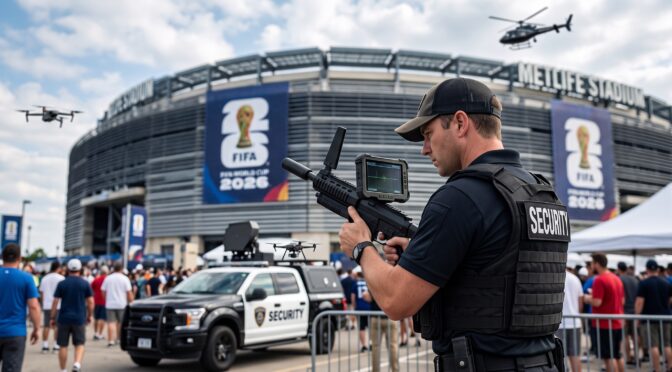
The summer of 2026 represents a critical inflection point for domestic airspace security in the United States. As the nation hosts the FIFA World Cup across 11 metropolitan hubs, the lower airspace surrounding these international events has transformed into a primary operational theater for testing the integration of civil and military Counter-Unmanned Aircraft Systems (C-UAS). The rapid proliferation of low-cost, highly capable commercial drones has inverted traditional security paradigms. Historical models relying on physical perimeter defense have been rendered insufficient, replaced by the necessity for dynamic electromagnetic spectrum defense and continuous aerial surveillance. This transition addresses an evolving asymmetric drone threat matrix characterized by the democratization of aerial reconnaissance, unauthorized payload delivery, and the potential for kinetic disruption by both negligent civilian operators and hostile actors.
This report evaluates the operational posture of state-level public safety agencies, with a specific analytical focus on the Texas Department of Public Safety (DPS), in mitigating low-altitude threats during high-profile events. Backed by federal funding mechanisms, including a targeted grant program administered by the Federal Emergency Management Agency (FEMA), and empowered by expanded legal frameworks such as the Safer Skies Act embedded in the Fiscal Year 2026 National Defense Authorization Act (NDAA), state and local law enforcement agencies now possess expanded authority to detect, track, and mitigate uncooperative drones.
However, the rapid scaling of these technological capabilities has exposed logistical and bureaucratic friction points, notably a backlog in mandatory federal training certifications required for electronic warfare deployment. Through an analysis of multi-agency coordination efforts led by the Department of Homeland Security (DHS), the Federal Bureau of Investigation (FBI), and the Department of Defense’s Joint Interagency Task Force 401 (JIATF-401), this report details the hardware specifications, legislative authorities, and tactical doctrines shaping the defense of the homeland’s lower airspace. The findings indicate that while initial detection and mitigation efforts have yielded operational successes, the long-term viability of domestic airspace sovereignty relies on the permanent integration of civil-military detection architectures and the decentralization of mitigation training.
2. The Economics of Asymmetric Airspace Warfare
The defining characteristic of modern conflict and contemporary domestic security is the economic inversion of airspace control, driven largely by the mass production and commercial availability of Unmanned Aerial Systems (UAS). In previous decades, controlling airspace required multi-million-dollar interceptor aircraft, advanced surface-to-air missile systems, and massive radar arrays.1 Today, a commercially modified quadcopter or a loitering munition costing as little as $500 can bypass traditional ground-level perimeters, enabling non-state actors, criminal organizations, extremist groups, and lone operators to project power asymmetrically.1
Traditional defense procurement has historically relied on high unit costs and limited production runs, creating a rigid technological ecosystem. The introduction of inexpensive, scalable drone platforms has repeatedly demonstrated the capacity to destroy or disable critical assets worth millions of dollars, fundamentally altering the cost-exchange ratio in favor of the attacker.1 This shift is not confined to active combat zones; the technological diffusion of these capabilities is rapidly expanding the operational capacity of domestic threat actors. Strategic investments, such as the March 2026 capital injection by Japan’s Terra Drone Corporation into Ukrainian drone manufacturing, illustrate the rapid global proliferation and commercialization of technologies initially developed for asymmetric military applications.1 For domestic law enforcement, this economic inversion dictates a new guiding principle: agencies must develop and field low-cost, scalable electromagnetic countermeasures to reliably defeat low-cost aerial threats.
3. The 2026 Asymmetric Drone Threat Matrix
Security details operating in 2026 are increasingly forced to manage a highly complex airspace environment, encountering drones utilized for a diverse spectrum of unauthorized and potentially hostile activities. The threshold for aerial disruption has lowered significantly, presenting public safety agencies with continuous operational challenges across multiple domains.
Vectors of Aerial Disruption
The primary vectors of unauthorized drone activity include:
- Surveillance and Reconnaissance: Persistent overflight is frequently utilized to map physical security vulnerabilities, capture unauthorized high-resolution imagery, and probe the electronic defenses of critical infrastructure, VIP holding areas, and event venues.2
- Contraband and Payload Delivery: Drones serve as a primary logistical tool for transnational criminal organizations and local illicit networks. These platforms routinely bypass physical barriers to deliver contraband, weapons, and narcotics into correctional facilities, or to transport illicit substances across international borders.4
- Airspace Obstruction and Resource Drain: The mere presence of an unauthorized drone can force the immediate grounding of emergency medical helicopters, firefighting aircraft, and commercial aviation operations.2 The resulting disruption forces costly operational pauses and diverts critical law enforcement resources to verify the nature of the threat.
- Kinetic Effects and Sabotage: While historically less common in domestic civilian environments, the global proliferation of drones modified to drop improvised explosives or initiate kinetic strikes presents a severe, low-cost threat to densely populated areas and critical utility infrastructure.1
Categorizing Operator Intent
The most complex variable in the 2026 threat matrix is identifying operator intent in real-time. The White House FIFA World Cup Task Force has categorized the threat landscape into two primary operational profiles, fundamentally distinguishing between ignorance and malice.6
| Actor Classification | Primary Motivation | Operational Signature | Security Challenge |
| Negligent Operators | Photography, social media content creation, curiosity, commercial surveying. | Unencrypted RF data links, standard commercial airframes, hovering near points of interest, broadcasting Remote ID. | High frequency of incursions; creates a resource drain on law enforcement required to investigate and clear non-lethal threats. |
| Hostile Actors | Coercion, sabotage, payload delivery, terror operations, transnational smuggling. | Dark launches, tethered operation (eliminating RF emissions), modified payloads, aggressive or evasive flight paths. | Low margin of error; requires immediate, legally authorized kinetic or electronic mitigation to prevent mass casualty events or critical breaches. |
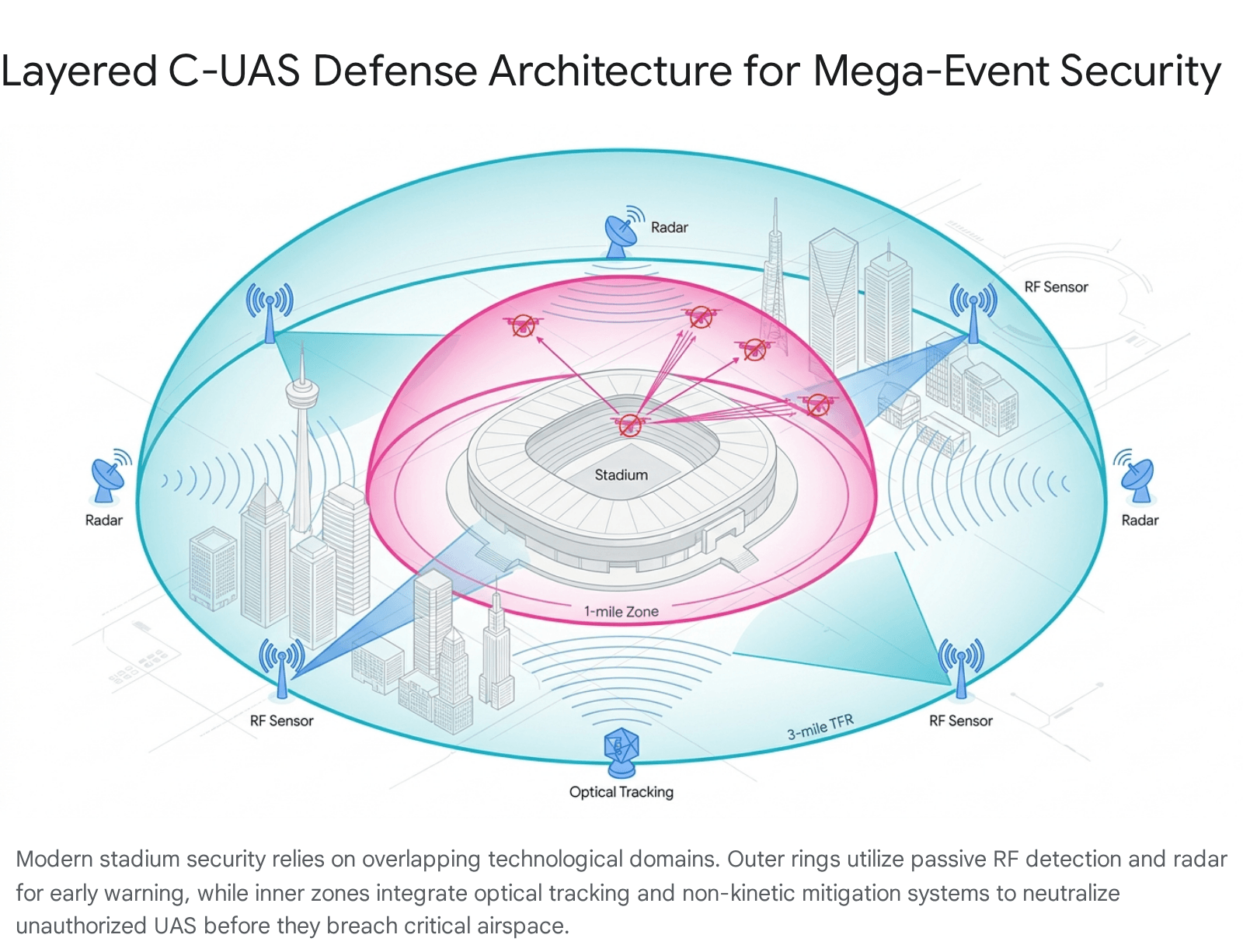
Because low-altitude airspace monitoring systems must initially classify any unidentified radar track or radio frequency anomaly as a potential threat, rapid identification remains the critical pivot point in airspace management.6 A failure to swiftly distinguish a civilian photographer from a hostile payload delivery risks either a disproportionate use of force or a severe security breach. Law enforcement officials have noted that even when a drone pilot is simply attempting to shoot overhead video, their presence distracts officers from monitoring the ground for other potential threats.7
4. Commercial and Civil Aviation Vulnerabilities
The implications of this democratized airspace access extend far beyond fixed-site security, posing acute risks to the national airspace system and commercial aviation. The Federal Aviation Administration (FAA) currently receives more than 100 reports of drone sightings in close proximity to airports every month, indicating a sustained and rising operational hazard.7
In late June 2026, the vulnerability of the commercial aviation sector was highlighted by a series of near-miss incidents in the highly congested airspace of the Northeast corridor. A JetBlue aircraft reportedly collided with a drone while crossing the coastline at an altitude of approximately 3,000 feet above sea level during its approach to JFK International Airport in New York.7 While the pilot landed the aircraft safely and subsequent inspections revealed no structural damage, the incident underscored the risks of low-altitude incursions.7 Within hours of the reported collision, a helicopter pilot in the same region reported a close encounter with a remote-controlled aircraft near JFK.7 Earlier that week, on June 26, a United Airlines flight crew traveling from Key West, Florida, reported a near-miss encounter with an unmanned aircraft system while on arrival at Newark Liberty International Airport.7
Operating drones in the vicinity of manned aircraft and commercial airports remains strictly illegal, with unauthorized operators subject to federal fines and potential criminal prosecution, including incarceration.7 However, the persistence of these incidents demonstrates the limitations of purely regulatory deterrence, driving the demand for active technological mitigation systems across the civil aviation sector.
5. Legislative Modernization and Airspace Sovereignty
The domestic deployment of C-UAS technology has historically been constrained by a complex web of federal wiretapping laws, the Computer Fraud and Abuse Act, and strict FAA regulations that classified the electronic interdiction of a drone as the destruction of an aircraft. State, county, city, and tribal law enforcement agencies were largely relegated to an “observe and report” posture, severely limiting their ability to intervene in real-time, even when a drone posed an imminent threat to public safety.4 This regulatory friction left primary authority over airspace and counter-drone operations entirely to federal departments, creating operational delays in rapidly unfolding scenarios.4 This framework was systematically modernized ahead of the 2026 World Cup through strategic executive directives and broad legislative reforms.
Executive Order 14305: Restoring American Airspace Sovereignty
Signed by President Donald Trump on June 6, 2025, Executive Order 14305 explicitly recognized that the weaponization of drones by criminals, terrorists, and hostile foreign actors necessitated immediate action to ensure American airspace sovereignty.8 The directive highlighted the use of UAS by drug cartels to smuggle fentanyl across borders, the delivery of contraband into prisons, and the endangerment of mass gatherings.5
The executive order mandated that executive departments utilize all existing federal authorities to deploy equipment capable of detecting, tracking, and identifying drones and their command signals.9 Crucially, it directed the Attorney General and the Secretary of Homeland Security to ensure that federal grant programs permit state, local, tribal, and territorial (SLTT) agencies to access funding for the acquisition of UAS detection and tracking technologies.9
The Safer Skies Act and the FY2026 NDAA
While Executive Order 14305 catalyzed the deployment of detection capabilities, the Safer Skies Act, enacted in December 2025 as a provision within the Fiscal Year 2026 National Defense Authorization Act (NDAA), altered the mitigation landscape.10 The legislation established a workable framework to bring definition and accountability to counter-UAS operations, granting limited, conditional authority to trained and certified SLTT law enforcement and correctional officers to take active mitigation measures.4
This authority permits officers to seize, disable, or destroy drones that pose a credible threat, provided the action occurs within specifically designated environments:
- Large-scale public gatherings and venues, including stadiums, concerts, and political events.
- Critical infrastructure sites, such as energy facilities, water treatment plants, and transportation hubs.
- Correctional facilities, addressing the escalating crisis of drone-delivered contraband.
- Protected public spaces explicitly designated as high-risk by authorized agencies.10
To prevent technological fragmentation, minimize interference with the national airspace, and ensure compliance with federal communications laws, the Safer Skies Act dictates that agencies may only deploy C-UAS mitigation systems that appear on a jointly maintained federal list of authorized technologies.10 This list is collaboratively developed by the Department of Justice (DOJ), the Department of Homeland Security (DHS), the Department of Defense (DoD), the Department of Transportation (DOT), the Federal Communications Commission (FCC), and the National Telecommunications and Information Administration (NTIA).10 The legislation provided a 180-day implementation window for federal agencies to publish regulations governing SLTT authority, establish training certification standards, define approved mitigation technologies, and build compliance mechanisms.10 Furthermore, strict oversight is mandated; mitigation actions require SLTT agencies to establish robust incident reporting workflows, ensuring the DOJ and DHS are notified within 48 hours of any electronic or kinetic interdiction.13
6. The Financial Architecture of Domestic Defense
To operationalize the authorities granted by the Safer Skies Act and support the directives of Executive Order 14305, the federal government initiated substantial financial allocations into domestic defense infrastructure. The centerpiece of this effort is a $500 million counter-UAS grant program funded through the One Big Beautiful Bill Act, signed into law by President Trump in July 2025 (Pub. L. No. 119-21).
The Federal Emergency Management Agency (FEMA) executed an expedited non-disaster grant award process, deploying the first $250 million tranche in December 2025.15 This funding was targeted at the jurisdictions burdened with securing international events, specifically the 2026 FIFA World Cup and the concurrent America250 national celebrations.17 The remaining $250 million is scheduled for distribution in Fiscal Year 2027, expanding eligibility to all 56 state and territorial administrative agencies to build broader national capabilities.17
FEMA structured the allocations based on a rigid risk-tier system. The distributions prioritized the 11 states directly or indirectly hosting FIFA World Cup matches and the National Capital Region (NCR), as these locations host events designated with a Special Event Assessment Rating (SEAR) of 1 or 2.17 The allocations combined baseline statutory minimums with competitive funds based on the SEAR risk level and the anticipated effectiveness of proposed defense projects.17
| Risk Tier | State / Jurisdiction | FY 2026 Allocation (USD) | Primary Strategic Justification |
| Tier 1 | California | $34,591,628 | Multiple World Cup Host Cities (Los Angeles, San Francisco) |
| Tier 1 | Texas | $30,276,431 | Multiple World Cup Host Cities (Dallas, Houston) |
| Tier 1 | District of Columbia (NCR) | $28,266,328 | America250 National Events & Capital Security |
| Tier 1 | Florida | $23,636,511 | World Cup Host City (Miami) |
| Tier 1 | New Jersey | $21,764,005 | World Cup Host City (New York/New Jersey) |
| Tier 1 | Georgia | $20,284,936 | World Cup Host City (Atlanta) |
| Tier 1 | New York | $17,731,725 | World Cup Host City & Major Transit Hubs |
| Tier 1 | Kansas | $5,341,058 | World Cup Host City (Kansas City) |
| Tier 2 | Massachusetts | $21,891,527 | World Cup Host City (Boston) |
| Tier 2 | Washington | $19,504,506 | World Cup Host City (Seattle) |
| Tier 2 | Missouri | $14,240,568 | World Cup Border Jurisdiction Support |
| Tier 2 | Pennsylvania | $12,470,777 | World Cup Host City (Philadelphia) |
Data sourced from FEMA C-UAS Grant Program Award Announcement (FY 2026). 18
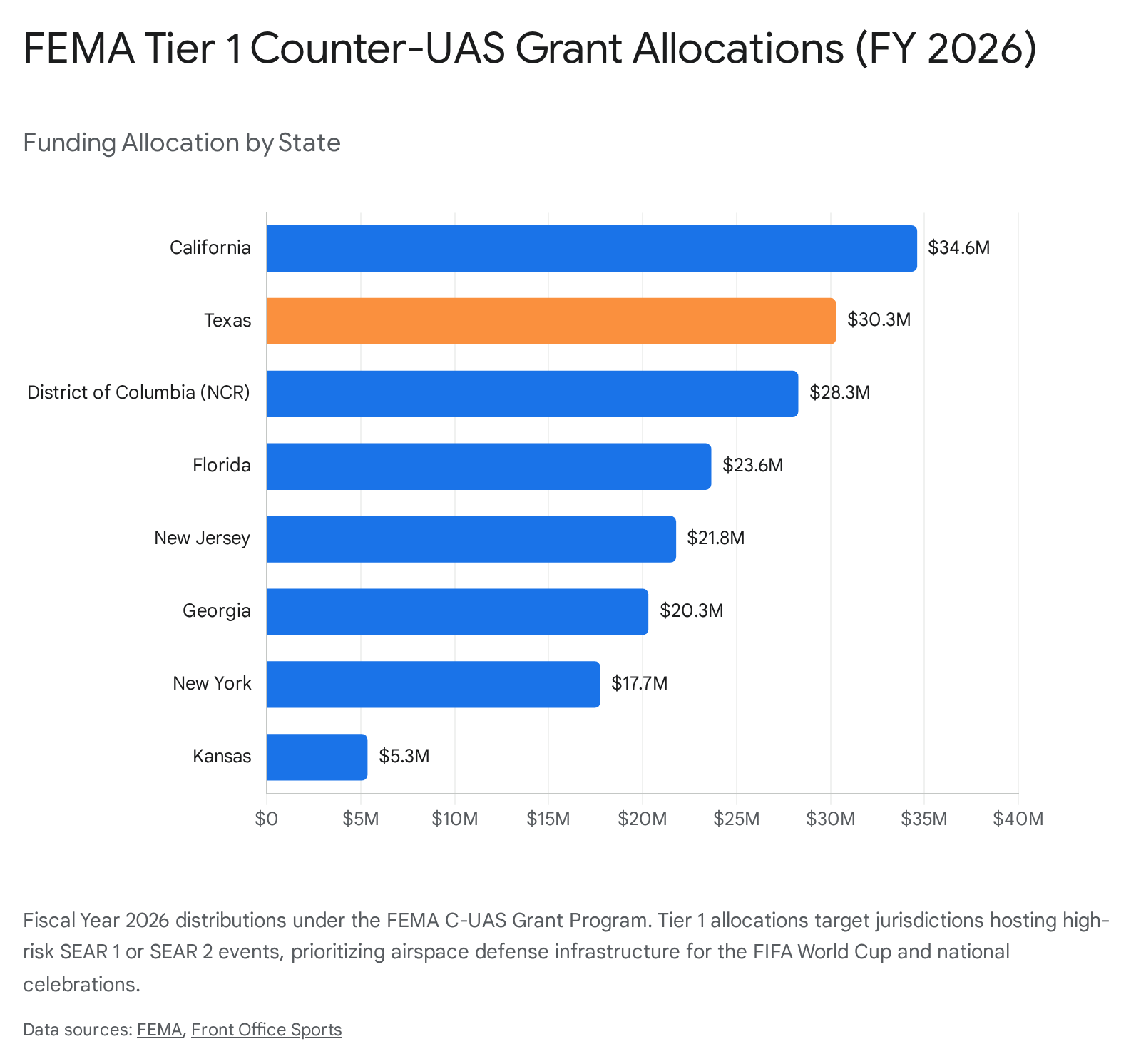
The influx of capital enabled populated states like Texas, which secured over $30 million, to transition from a reactive security posture to a proactive, technology-driven airspace defense model.18
7. Multi-Agency Coordination and the White House Task Force
The 2026 World Cup operates as a significant real-world application of the United States’ low-altitude defense architecture.6 Securing an event of this magnitude—encompassing 78 matches across 11 cities over 40 days—requires a multi-agency coalition integrating the FAA, the Transportation Security Administration (TSA), DHS, local law enforcement, and military intelligence elements.6
This extensive coordination effort is directed by the White House FIFA World Cup Task Force, led by Executive Director Andrew Giuliani.6 Appointed in May 2025, Giuliani’s mandate involves coordinating airspace security not only for the matches themselves but for every fan festival in each host city, utilizing the legal framework established by the Safer Skies Act.6
The scale of the operation represents a substantial increase in federal defensive capabilities. In 2025, federal officials possessed the logistical capacity to provide Super Bowl-level DHS SEAR protection to only five major events annually.6 For the 2026 World Cup, security planners scaled operations to cover over 150 different venues and events with counter-UAS technology.6 This rapid expansion required the DOJ to deputize approximately 60 state and local law enforcement officers, authorizing them to operate drone-mitigation technologies alongside federal partners like Customs and Border Protection and the Federal Protective Service.6
The implementation of this strategy faced logistical hurdles, including two separate government shutdowns totaling 119 days, which temporarily delayed DHS from distributing essential C-UAS funds to designated host cities.6 Despite these delays, the integration of federal and local assets was executed, prioritizing a zero-tolerance policy for both hobbyists and hostile actors near stadium infrastructure.6
8. Military Integration: Joint Interagency Task Force 401
Recognizing that local police departments cannot independently manage military-grade aerial threats, the Department of Defense integrated its Joint Interagency Task Force 401 (JIATF-401) into domestic security planning. Directed by Army Brig. Gen. Matt Ross, JIATF-401 serves as the central conduit for transferring operational lessons learned from overseas counter-drone operations to domestic law enforcement.19
JIATF-401 committed over $100 million to enhance C-UAS capabilities for the World Cup, focusing primarily on fielding mobile counter-drone technologies to protect stadiums and adjacent fan zones.20 The task force’s strategic priority is ensuring that the detect-track-defeat doctrine—utilized successfully in asymmetric conflict zones in Ukraine and the Middle East—is adapted safely and effectively for domestic mass gatherings.20 Furthermore, JIATF-401 recently announced site selections for a directed-energy counter-drone pilot program. This initiative explores the domestic integration of high-energy lasers and high-powered microwave systems to disrupt adversarial drones while minimizing collateral risks to civilian infrastructure and passenger aircraft.45 This builds upon a strategic alliance formalized in February 2026 between the FBI and the Army to establish permanent, integrated capabilities across the federal government.46
This collaboration extended to direct tactical engagement. Leaders from JIATF-401 regularly convened with the FBI and local law enforcement officials in host cities like Los Angeles and Kansas City to review security architectures.19 These operations demonstrated a synchronized approach to counter-drone efforts, emphasizing shared situational awareness and integrated command structures across military, federal, and local elements.22 Brig. Gen. Ross noted that effective homeland defense relies heavily on providing realistic training and strengthening interagency coordination, acknowledging that major national security events require high levels of integration across the entire federal government and local public safety partners.19
9. Airspace Management and TFR Enforcement
To provide a clear, unambiguous legal framework for airspace enforcement during the tournament, the FAA established Temporary Flight Restrictions (TFRs) around all World Cup venues. These designated “No Drone Zones” strictly prohibit unauthorized aircraft and drone operations below 3,000 feet and within roughly a 3- to 3.5-nautical-mile radius of qualifying stadiums on match days.18 Additionally, specific buffer restrictions prohibit unauthorized drone operations within a 1-nautical-mile radius and up to 1,000 feet above ground level at designated World Cup fan-event locations.18
The enforcement of these TFRs is strict. Even experienced remote pilots possessing standard airspace authorizations are barred from operating during active TFR windows.18 To manage the anticipated volume of infractions, the FAA activated the Drone Expedited and Targeted Enforcement Response (DETER) initiative, designed to accelerate the identification and legal processing of drone violations.18 Violators face immediate confiscation of their aircraft by the FBI using specialized mitigation tools, civil penalties reaching up to $75,000 per violation, and potential federal criminal fines up to $100,000, accompanied by arrest.18
The restrictions also impact manned aviation. Due to exceptionally busy skies, the FAA utilized Traffic Management Initiatives (TMI). Pilots of private aircraft are required to file mandatory flight plans between 6 and 24 hours prior to departure, ensuring that air traffic control can anticipate and manage demand.18 Furthermore, Ground Delay Programs (GDP) enforce departure windows, and routine Visual Flight Rules (VFR) advisory services within host city terminal radar approach controls are provided only on a workload-permitting basis, effectively clearing the airspace of unnecessary clutter to prioritize security monitoring.18
10. The Certification Bottleneck: The FBI NCUTC
Despite the allocation of advanced hardware, legal authorities, and interagency coordination, the federal response encountered a bureaucratic bottleneck mid-tournament. While the Safer Skies Act authorizes SLTT officers to mitigate threats, it mandates that only personnel who have completed specialized certification at the FBI’s National Counter-UAS Training Center (NCUTC) in Huntsville, Alabama, may utilize electronic warfare mitigation tools.6
By late June 2026, DHS Secretary Markwayne Mullin testified before the House Homeland Security Committee regarding the state of drone security readiness. He made a striking admission that the administration was “a little behind” on counter-drone measures, identifying drones as his “biggest concern”.18 He noted that unauthorized drones continued to regularly breach restricted airspace around high-profile venues, ranging from nuisance flights to more serious incursions.18
The core issue driving this delay was identified as the FBI schoolhouse. Demand for seats at the NCUTC vastly outpaced the facility’s training capacity.25 Because the FEMA grant rules stipulate that agencies can only purchase mitigation equipment if their personnel are enrolled in or have completed this specific FBI training, the capacity limits of a single facility artificially constrained the national deployment rate of kinetic and electronic defenses.25 Secretary Mullin described a scenario where the DHS wanted to route its own funding into the FBI’s training center to expand capacity, acknowledging that the certification requirement had become a choke point on the one component that the rest of the security apparatus could not route around.25
11. State-Level Deployment: Texas DPS Case Study
As a primary host state featuring major World Cup matches in Dallas (Arlington) and Houston, the State of Texas presents a detailed case study in state-level airspace defense modernization. Drawing from its $30.2 million Tier 1 allocation, the Texas Department of Public Safety (DPS) utilized approximately $3.2 million to acquire and field advanced drone mitigation technologies.18
Under the leadership of DPS Director Colonel Freeman F. Martin and Chief Pilot of Aircraft Operations Stacy Holland, the agency implemented a multi-layered strategy encompassing aerial interdiction support, ground-based mitigation, and public intelligence gathering.26 Recognizing the substantial logistical demands placed on public safety and critical infrastructure protection, Col. Martin affirmed the agency’s commitment to utilizing every available resource to safeguard the skies above key venues, asserting that DPS would act against threats putting public safety at risk.26
The acquired drone mitigation system is designed for both stationary and mobile deployments, allowing DPS operators to monitor airspace from fixed locations at the stadiums or dynamically while on the move.26 The technology utilizes advanced detection methods, including radio-frequency monitoring and federally mandated remote identification signals, to track unmanned aircraft in real-time.26 To support the legal and tactical deployment of this hardware, DPS operators completed the requisite specialized counter-UAS training conducted by the FBI, focusing on lawful mitigation operations and coordinated responses.26
Complementing its technological acquisitions, DPS amplified its human intelligence gathering capabilities through the iWatchTexas program. Anticipating millions of domestic and international visitors, the agency actively promoted the mobile application to crowd-source anomaly detection.27 By lowering the friction for citizens to quickly and anonymously report suspicious behavior—such as strangers inquiring about stadium security features, anomalous social media posts regarding sabotage, or attempts to obtain sensitive facility information—DPS integrated community awareness as the outermost layer of its defense architecture.27
12. Airborne Counter-UAS (ACUS) Integration
Texas DPS is standardizing tactical aviation modernization, becoming the first law enforcement agency to deploy an aircraft-mounted drone detection system. By integrating Airborne Counter Unmanned Aircraft Systems (ACUS) onto its rotary-wing fleet, DPS addressed the risk of mid-air collisions between police helicopters and uncooperative drones.29
Developed by Davenport Aviation, ACUS is engineered specifically for public safety and law enforcement aviation units.30 The system integrates directly with the mission systems of the Airbus H125/AS350 platforms, delivering operational advantages that ground-based sensors cannot replicate.31 In dense urban environments, ground-based RF sensors often suffer from line-of-sight obstructions created by high-rise buildings and stadium infrastructure. By elevating the sensor package, ACUS provides unobstructed, 360-degree real-time awareness of nearby drone activity, displaying visual alerts within the pilot’s mission display.30
Through advanced RF interception, ACUS not only identifies the unauthorized drone but pinpoints the exact terrestrial coordinates of the pilot on the ground.29 This capability allows airborne tactical flight officers to vector ground units directly to the suspect for apprehension, reducing the time required to neutralize a threat.29
The deployment of ACUS was catalyzed by near-miss incidents, notably the July 2025 Kerrville flood rescue operations where a drone strike forced a search and rescue helicopter to make an emergency landing, grounding equipment during a catastrophic event.33 Currently, the ACUS platform is utilized strictly for detection, tracking, and situational awareness; no direct electronic or kinetic interdiction actions are initiated from the helicopter, mitigating the risk of collateral damage over populated areas.29
However, the future operational roadmap points toward more direct airborne interdiction capabilities. In early 2026, Davenport Aviation successfully completed its “First Shot” validation campaign for “Virtus,” a modular weapon system for the H125/AS350 platform.35 The company plans to integrate Virtus with ACUS to field a purpose-built drone “hunter-killer” platform, pairing the Virtus modular weapon and sensor mounts with ACUS detection capabilities to locate, track, and—when authorized and lawful—engage hostile unmanned threats directly from the air.36
13. Ground-Based Sensor Fusion and Command & Control
Before a drone can be mitigated, it must be successfully isolated from the heavy background noise of an urban electromagnetic environment. Defense systems must track the physical flight path of the UAV while simultaneously locating the pilot’s control station.37
Leading platforms, such as those developed by Dedrone, utilize sensor fusion to achieve this clarity. By combining RF scanners, radar arrays, and optical tracking cameras into a centralized Command and Control (C2) interface, systems like DedroneCityWide and DedroneFixedSite provide multi-layered situational awareness.2 These systems rely heavily on Artificial Intelligence (AI) and Machine Learning (ML) to continuously and autonomously interrogate the airspace.2
The identification phase operates on two critical axes: differentiating friend from foe, and identifying the specific drone model.37 By reading RF fingerprints and remote identification serial numbers, the AI engines can rapidly verify authorized broadcasts—such as approved media drones or law enforcement UAS—preventing wasted responses and operator fatigue.2 The system only elevates high-probability, unverified targets to human operators for action, streamlining the decision-making process required to authorize mitigation.2
14. Tactical Electronic Warfare and Mitigation Platforms
Once a hostile drone is identified and SLTT officers confirm authorization under the Safer Skies Act, non-kinetic electronic warfare becomes the primary method of disruption. The transition from heavy, vehicle-mounted systems to man-portable dismounted units allows security personnel to maneuver dynamically through dense stadium concourses and fan zones.
Australian-American defense contractor DroneShield provided heavily utilized platforms during the World Cup, notably deployed by the Kansas City Police Department operating alongside FBI counter-drone teams.21 Backed by $14 million in federal funding, operations in Kansas City employed a detect-track-defeat doctrine, utilizing DroneShield’s detection sensors and signal-jamming equipment to secure the no-fly zones.21
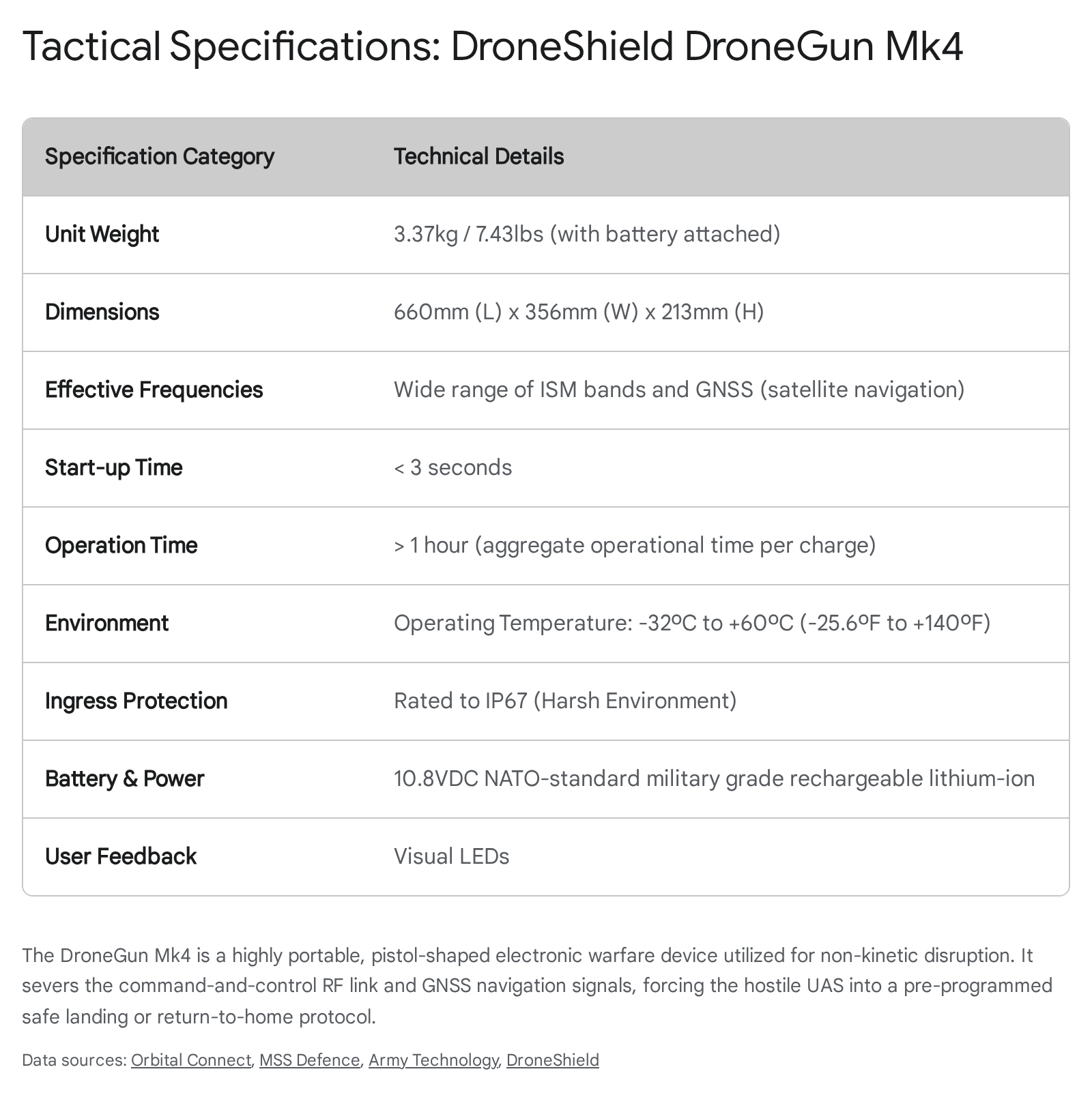
The DroneGun Mk4 represents the leading edge of tactical mitigation. Operating across a wide range of Industrial, Scientific, and Medical (ISM) bands, as well as Global Navigation Satellite System (GNSS) frequencies, the 3.37kg, pistol-shaped device effectively blinds the targeted drone.39 By overwhelming the receiver with targeted RF noise, the jammer severs the live video feed (FPV) transmitting back to the operator and disrupts the command-and-control link.42 This electronic intervention typically forces the drone’s onboard flight controller to initiate emergency protocols, resulting in an immediate vertical descent or a return-to-home trajectory, thereby neutralizing the immediate threat without the collateral risks associated with kinetic ballistics in a crowded environment.6
To augment this mitigation capability, dismounted officers utilize the RfPatrol Mk2, an 800-gram wearable passive detection device.43 This non-emitting sensor alerts patrolling officers to the presence of drone control signals via visual, haptic, and audible feedback, effectively turning every individual officer on patrol into an early-warning mobile radar node, further extending the situational awareness of the command center.43
15. Early Operational Outcomes of the 2026 World Cup
The scaled security apparatus deployed for the 2026 FIFA World Cup has functioned under sustained pressure, providing a real-world validation of the layered defense doctrine. By late June 2026, federal and local agencies had seized more than 300 unauthorized drones operating near stadiums and associated tournament venues.6 In localized operations, such as Kansas City, early reports indicated that out of 22 drones detected in no-fly zones, 16 were successfully seized, resulting in at least five federal criminal citations and arrests.21
While a seizure count of this magnitude might initially appear to signal an escalating security crisis, a closer analysis reveals a functional airspace management strategy. The high volume of detections and confiscations indicates that low-altitude airspace security systems are working with demonstrable effectiveness.6 Despite hundreds of reported drone incursions around tournament venues, there have been zero publicly reported security incidents involving unauthorized drones causing physical harm to spectators or disrupting match play.6 Drones are being detected, their operators located, and the aircraft confiscated before they can escalate into severe safety concerns.6
This operational success indicates that the primary challenge for law enforcement has shifted. The core question is no longer whether authorities can reliably detect and stop unauthorized drones, but rather how to rapidly determine the intent behind the incursion, effectively separating the negligent hobbyist from the malicious actor in real-time.6
16. Strategic Outlook for Tactical Aviation and Law Enforcement
The integration of advanced C-UAS capabilities during the summer of 2026 serves as a permanent catalyst for the modernization of domestic law enforcement. The temporary defense infrastructures constructed around World Cup stadiums will form the baseline for permanent protective postures around critical infrastructure, commercial airports, and correctional facilities.12
With the Safer Skies Act granting enduring legal authority, and federal grants establishing the requisite hardware foundations, state agencies like the Texas DPS are uniquely positioned to continuously project authority into the lower airspace. However, the institutional friction encountered with the FBI NCUTC training backlog highlights the fragility of relying on centralized federal chokepoints to empower decentralized state-level security.18 To sustain this capability, the federal government must expand training certifications and streamline the approval processes for emerging mitigation technologies.
The economic and tactical advantages of drone technology guarantee that the asymmetric threat matrix will continue to evolve rapidly. Maintaining airspace sovereignty in this environment will require law enforcement aviation units and ground-based tactical teams to permanently integrate electromagnetic spectrum defense, continuous AI-driven sensor fusion, and rapid, localized mitigation capabilities as standard operational protocol.
Appendix: Methodology and Data Sources
The insights and analytical conclusions presented in this report were derived from a detailed review of cross-domain intelligence materials, legislative texts, federal grant documentation, and open-source reporting from the defense, aviation, and public safety sectors.
Analytical Approach: The methodology relied on qualitative synthesis and technical correlation to assess the current state of Counter-UAS integration in domestic law enforcement during the 2026 operational timeframe.
- Legislative and Policy Review: Federal mandates, specifically Executive Order 14305 and the Safer Skies Act provisions within the FY2026 NDAA, were analyzed to establish the legal boundaries, jurisdictional constraints, and authorities governing state-level drone mitigation operations.
- Financial Mapping: Federal funding distributions, primarily the $250 million FEMA C-UAS Grant Program, were evaluated to understand the scale of infrastructure investment, the prioritization of Risk Tier 1 jurisdictions ahead of the FIFA World Cup, and the financial catalysts enabling state-level procurement.
- Technical Specification Analysis: Open-source capabilities of dominant C-UAS hardware providers—specifically DroneShield (DroneGun Mk4, RfPatrol), Dedrone (sensor fusion C2), and Davenport Aviation (ACUS)—were cross-referenced against the operational requirements of law enforcement agencies to evaluate the tactical efficacy of electromagnetic spectrum defense and airborne detection.
- Operational Synthesis: Real-world incident data, including FAA reporting on airspace incursions near major airports, Congressional testimonies regarding training bottlenecks, and operational summaries from World Cup host cities (e.g., Texas DPS deployments and Kansas City multi-agency task forces), were synthesized to bridge the gap between theoretical defense architecture and practical field execution.
This multi-faceted approach ensures the analysis remains firmly grounded in documented hardware specifications, verified funding streams, and confirmed legislative frameworks currently shaping the 2026 security environment.
Please share the link on Facebook, Forums, with colleagues, etc. Your support is much appreciated and if you have any feedback, please email us in**@*********ps.com. If you’d like to request a report or order a reprint, please click here for the corresponding page to open in new tab.
Sources Used
- The New Economics of War: Cheap Drones, Asymmetric Threats, and the Democratization of Destruction – Global Security Review, accessed July 1, 2026, https://globalsecurityreview.com/the-new-economics-of-war-cheap-drones-asymmetric-threats-and-the-democratization-of-destruction/
- White paper: Counter-Drone: The Comprehensive Guide to Counter-UAS/C-UAS/CUAS – Dedrone, accessed July 1, 2026, https://www.dedrone.com/white-papers/counter-uas
- The New Airspace Risk: What Security Teams Need to Know About Drone Threats in 2026, accessed July 1, 2026, https://www.droneshield.com/blog/the-new-airspace-risk-what-security-teams-need-to-know-about-drone-threats-2026
- New drone authorities for local law enforcement: Turning power into preparedness, accessed July 1, 2026, https://www.route-fifty.com/emerging-tech/2026/05/new-drone-authorities-local-law-enforcement-turning-power-preparedness/413810/
- Restoring American Airspace Sovereignty – Federal Register, accessed July 1, 2026, https://www.federalregister.gov/documents/2025/06/11/2025-10803/restoring-american-airspace-sovereignty
- World Cup drone seizures – DRONELIFE, accessed July 1, 2026, https://dronelife.com/2026/06/29/world-cup-drone-seizures-airspace-security/
- Drone Reports Near US Airports Reflect Rising Issue for Critical Infrastructure, accessed July 1, 2026, https://www.asisonline.org/security-management-magazine/latest-news/today-in-security/2026/june/drone-jetblue-jfk-collision-droneshield-2026-report/
- Executive Order: Restoring American Airspace Sovereignty (Donald Trump, 2025), accessed July 1, 2026, https://ballotpedia.org/Executive_Order:_Restoring_American_Airspace_Sovereignty_(Donald_Trump,_2025)
- Trump Administration Issues Executive Orders to Boost American Drone Industry and Secure US Airspace | Insights | Greenberg Traurig LLP, accessed July 1, 2026, https://www.gtlaw.com/en/insights/2025/8/trump-administration-issues-executive-orders-to-boost-american-drone-industry-and-secure-us-airspace
- The SAFER SKIES Act Explained: cUAS Authority for State and Local Public Safety | UVT, accessed July 1, 2026, https://www.uvt.us/blog/blog-3/the-safer-skies-act-explained-cuas-authority-for-state-and-local-public-safety-72
- Around the Commercial Drone Industry: Program Testing, FIFA World Cup, Amusement Park Restrictions, accessed July 1, 2026, https://www.commercialuavnews.com/program-testing-fifa-world-cup-amusement-park-restrictions
- SAFER SKIES Act Explained: Counter-Drone Authority for Law Enforcement | Airsight, accessed July 1, 2026, https://www.airsight.com/blog/safer-skies-act-counter-drone-law-enforcement
- Counter-UAS Explained: What CUAS Means and Who Can Deploy It | Airsight, accessed July 1, 2026, https://www.airsight.com/blog/counter-uas-cuas-explained
- SAFER SKIES Act Gives States Power to Block Drone Risks | Phelps, accessed July 1, 2026, https://www.phelps.com/insights/safer-skies-act-gives-states-power-to-block-drone-risks.html
- Department of Homeland Security Launches New Office to Advance Drone and Counter-Drone Technologies, accessed July 1, 2026, https://www.dhs.gov/news/2026/01/12/department-homeland-security-launches-new-office-advance-drone-and-counter-drone
- Counter Unmanned Aircraft Systems Grant Program | FEMA.gov, accessed July 1, 2026, https://www.fema.gov/grants/preparedness/counter-unmanned-aircraft-systems-grant-program
- CUAS Award Announcement Information Bulletin – FEMA, accessed July 1, 2026, https://www.fema.gov/sites/default/files/documents/fema_gpd_ib_549_cuas-award-announcement_122025.pdf
- Trump Administration: World Cup Is ‘Behind’ on Drone Security, accessed July 1, 2026, https://frontofficesports.com/world-cup-security-funding-dhs-drone-airspace-fema-grant-markwayne-mullin/
- U.S. Army, FBI expand counter-drone training ahead of 2026 World Cup, accessed July 1, 2026, https://uasmagazine.com/articles/us-army-fbi-expand-counter-drone-training-ahead-of-2026-world-cup
- JIATF-401 Leaders Visit Kansas City 2026 FIFA World Cup Stadium [Image 4 of 4] – DVIDS, accessed July 1, 2026, https://www.dvidshub.net/image/9699414/jiatf-401-leaders-visit-kansas-city-2026-fifa-world-cup-stadium
- Counter-UAS Operations at the World Cup: A Template for Layered …, accessed July 1, 2026, https://smallwarsjournal.com/2026/06/23/counter-uas-operations-at-the-world-cup-a-template-for-layered-airspace-defense/
- JIATF-401 Strengthens Counter-UAS Partnership Through Training – DVIDS, accessed July 1, 2026, https://www.dvidshub.net/news/568902/jiatf-401-strengthens-counter-uas-partnership-through-training
- War Department Leaders Observe Kansas City’s Counter-Drone Preparations Ahead of World Cup, accessed July 1, 2026, https://www.war.gov/News/News-Stories/Article/Article/4511924/war-department-leaders-observe-kansas-citys-counter-drone-preparations-ahead-of/
- DPS Reminds Drone Operators to Follow FAA Restrictions Ahead of 2026 FIFA World Cup, accessed July 1, 2026, https://www.dps.texas.gov/news/dps-reminds-drone-operators-follow-faa-restrictions-ahead-2026-fifa-world-cup
- DHS Wants To Fund The FBI’s Counter-Drone School Because It’s …, accessed July 1, 2026, https://dronexl.co/2026/06/29/dhs-fbi-counter-drone-school-full-world-cup/
- DPS Secures Drone Mitigation Technology Ahead of 2026 FIFA …, accessed July 1, 2026, https://www.dps.texas.gov/news/dps-secures-drone-mitigation-technology-ahead-2026-fifa-world-cup
- DPS Advises Public to Download iWatchTexas Ahead of 2026 FIFA World Cup, accessed July 1, 2026, https://www.dps.texas.gov/news/dps-advises-public-download-iwatchtexas-ahead-2026-fifa-world-cup
- Millions expected in Houston for FIFA World Cup, DPS urges fans to download this app for emergencies, accessed July 1, 2026, https://www.click2houston.com/news/local/2026/06/03/millions-expected-in-houston-for-fifa-world-cup-dps-urges-fans-to-download-this-app-for-emergencies/
- DPS Deploys First in the Nation Drone Detection System | Department of Public Safety, accessed July 1, 2026, https://www.dps.texas.gov/news/dps-deploys-first-nation-drone-detection-system
- Texas DPS adopts Davenport Aviation’s new ACUS drone detection system – Police1, accessed July 1, 2026, https://www.police1.com/police-products/Police-Drones/texas-dps-adopts-davenport-aviations-new-acus-drone-detection-system
- ACUS Airborne Counter-UAS System – Davenport Aviation, accessed July 1, 2026, https://www.davenportaviation.com/acus/
- Davenport Aviation: Rapid Procurement of Aerospace Solutions, accessed July 1, 2026, https://www.davenportaviation.com/
- Texas DPS Deploys Nation’s First Helicopter-Mounted Drone Detection System, accessed July 1, 2026, https://dronexl.co/2025/10/17/texas-dps-helicopter-mounted-drone-detection/
- Texas DPS helicopters can now detect drones and operators | FOX 7 Austin, accessed July 1, 2026, https://www.fox7austin.com/news/texas-dps-helicopters-can-now-detect-drones-operators
- Press Releases Archives – Davenport Aviation, accessed July 1, 2026, https://www.davenportaviation.com/category/press-releases/
- Virtus: The World’s First Modular Weapon System for the H125/AS350 – Davenport Aviation, accessed July 1, 2026, https://www.davenportaviation.com/davenport-aviation-unveils-virtus/
- White paper: Countering UAS Threats – Dedrone, accessed July 1, 2026, https://www.dedrone.com/white-papers/countering-uas-threats
- Dedrone: Counter-Drone Defense Solutions & Systems, accessed July 1, 2026, https://www.dedrone.com/
- DroneShield DroneGun Mk4 Ultra-Portable Handheld Countermeasure, accessed July 1, 2026, https://store.orbitalconnect.com/droneshield-dronegun-mk4-ultra-portable-handheld-countermeasure/
- DroneGun Mk4 Electronic Detection | Droneshield | MSS Defence, accessed July 1, 2026, https://mssdefence.com/product/droneshield-dronegun-mk4/
- DroneGun Mk4 Counter-Unmanned Aircraft System (C-UAS), USA – Army Technology, accessed July 1, 2026, https://www.army-technology.com/projects/dronegun-mk4-unmanned-us/
- DroneGun Mk4 American Handheld C-UAV – ODIN, accessed July 1, 2026, https://odin.t2com.army.mil/WEG/Asset/27dfa203a51310439c7b8346555a0dfa
- Dismounted Counter-UAS System Products – DroneShield, accessed July 1, 2026, https://www.droneshield.com/products-dismounted
- DroneShield Combined Brochure-Compressed | PDF – Scribd, accessed July 1, 2026, https://www.scribd.com/document/760566799/DroneShield-Combined-Brochure-compressed
- Site Selections Announced for Directed-Energy Counter-Drone Program – War.gov, accessed July 1, 2026, https://www.war.gov/News/News-Stories/Article/Article/4479463/site-selections-announced-for-directed-energy-counter-drone-program/
- A Look at the Technology Powering World Cup Security Operations, accessed July 1, 2026, https://govciomedia.com/a-look-at-the-technology-powering-world-cup-security-operations/