Executive Summary
The character of modern warfare is undergoing a profound and irreversible tectonic shift, driven primarily by the rapid proliferation of artificial intelligence (AI) and autonomous systems. Recent conflicts spanning from the steppes of Eastern Europe to the highly contested littorals of the Middle East have demonstrated a strategic reality: mass, attritable unmanned architecture, coordinated by sophisticated orchestration software, is rapidly eclipsing the battlefield dominance of exquisite, heavily manned legacy platforms. Recognizing this strategic inflection point, the United States Department of War—recently rebranded by executive order to reflect a philosophical pivot toward proactive lethality—has initiated the most profound reorganization of military acquisition, force design, and command structure in modern history.
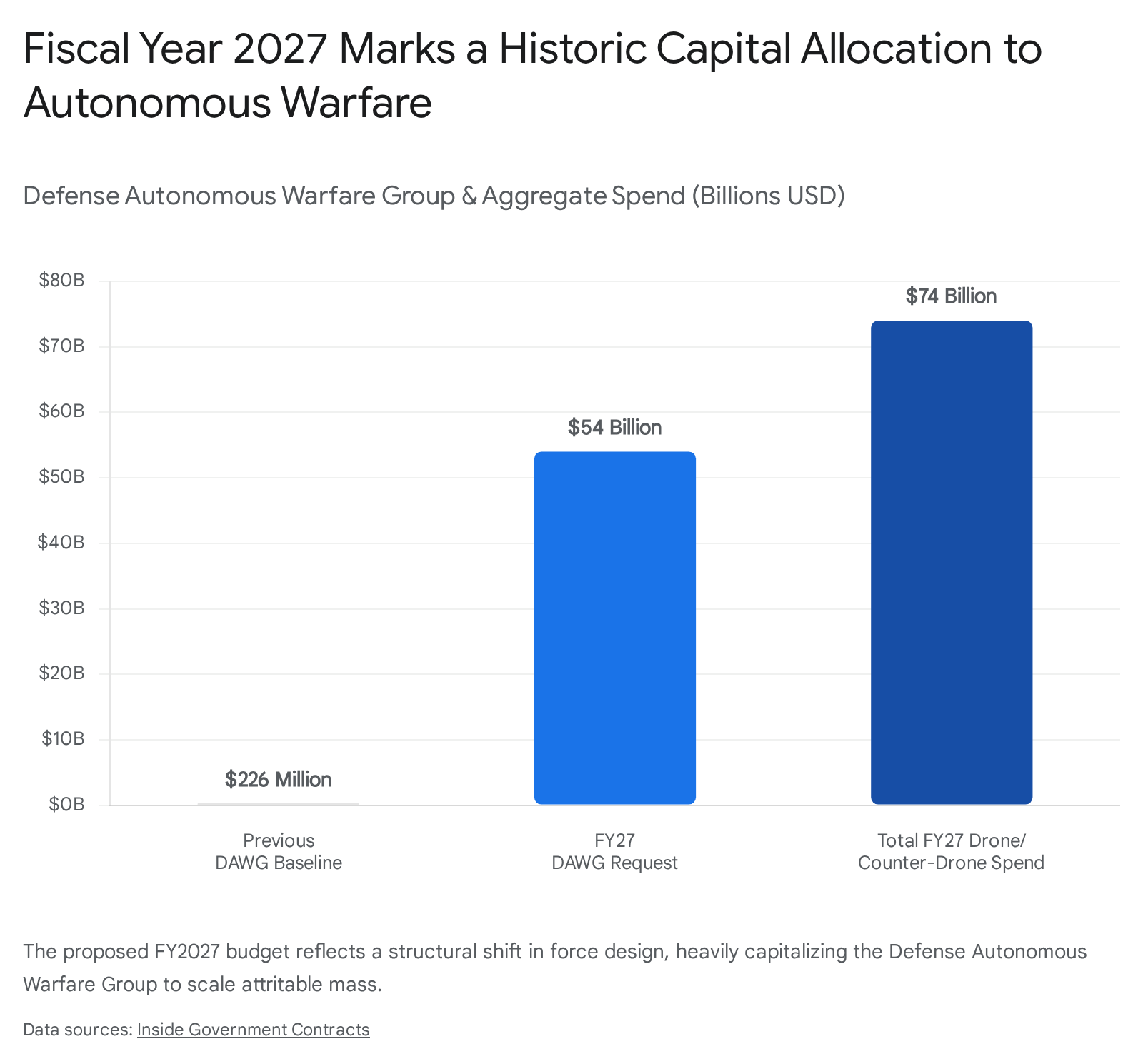
In the summer of 2026, Secretary of War Pete Hegseth mandated the creation of the Direct Reporting Portfolio Manager for Unmanned Systems (DRPM-UxS), a centralized and highly empowered “drone czar” reporting directly to Deputy Secretary of War Stephen Feinberg. This office consolidates the development, procurement, fielding, and sustainment of nearly all Department-wide autonomous systems. The DRPM-UxS portfolio spans unmanned aerial systems (UAS) groups 1 through 3, unmanned surface vessels (USVs), unmanned ground vehicles (UGVs), and the underlying AI and swarming software that dictates their operational capability. Simultaneously, the Trump administration has requested a staggering $54.6 billion for the Defense Autonomous Warfare Group (DAWG) for Fiscal Year 2027, signaling an intent to establish a permanent sub-unified command for autonomous warfare that will institutionalize these capabilities across the joint force.
This research report provides an exhaustive, strategic-level analysis of these structural realignments. It evaluates the operational impact of centralizing drone and AI programs, analyzing the critical symbiotic relationship between hardware procurement under the DRPM-UxS and the software-defined kill chain managed by the Chief Digital and Artificial Intelligence Office (CDAO) and the Undersecretary of War for Research and Engineering (USD(R&E)). Furthermore, the analysis assesses the profound geopolitical implications for United States power projection, weighing the operational advantages of rapid technological scaling against the immense bureaucratic resistance anticipated from the traditional military branches. Ultimately, the success of this sweeping, enterprise-wide initiative will depend not merely on historic budgetary allocations, but on relentless executive backing, the resolution of deep-seated doctrinal friction, and the rigorous alignment of commercial AI development with military necessity.
1. The Strategic Imperative for Autonomous Overmatch
For several decades following the end of the Cold War, the United States maintained global military overmatch through a paradigm of technological exclusivity. This approach favored the procurement of highly advanced, heavily manned, and prohibitively expensive platforms, such as fifth-generation stealth fighters, nuclear-powered aircraft carriers, and exquisite mechanized armor. However, the battlefield realities of the mid-2020s have ruthlessly exposed the vulnerabilities of this traditional model. The democratization of precision guidance, the hyper-commercialization of drone technology, and the advent of generative and predictive artificial intelligence have fundamentally compressed the kill chain and redefined the concept of operational mass. In a peer-to-peer conflict, relying solely on multi-million-dollar platforms against an adversary capable of deploying tens of thousands of cheap, lethal, and autonomous effectors is a mathematically untenable strategy.
The strategic urgency to master this new domain has permeated the highest echelons of the United States government, resulting in both organizational and profound semantic shifts. In September 2025, President Donald J. Trump signed an executive order restoring the “Department of War” designation as a secondary, public-facing title for the Department of Defense.1 This semantic alteration was explicitly designed to shift the bureaucratic culture away from passive administration and toward proactive lethality and offensive capability.1 The President stated that the historical transition to the Department of Defense coincided with a “woke” culture that degraded military effectiveness, noting that the United States had not decisively won a major conflict since the original name was retired after World War II.1 Secretary of War Pete Hegseth concurred with this assessment, officially adopting the title and asserting that the rebranding is fundamentally about “restoring” a warfighting ethos where “words matter”.1 This psychological and semantic shift—evidenced by the rapid transformation of digital infrastructure to the war.gov domain—serves as the foundational backdrop for the administration’s aggressive restructuring of autonomous capabilities.1
The physical manifestation of this aggressive new strategic posture is the realization that the drone itself—whether aerial, ground-based, or maritime—is no longer the true locus of military capability. Instead, the software that orchestrates these systems constitutes the weapon.6 Historically, unmanned platforms have been rigidly tethered to human operators via continuous radio-frequency communication links.6 In the highly contested electronic warfare (EW) environments anticipated in the Indo-Pacific or Eastern Europe, these links are easily severed, rendering remote-controlled platforms completely inert.6 Genuine military autonomy, therefore, requires sophisticated software capable of localized navigation, target identification, and terminal engagement without a human-in-the-loop, allowing the system to operate autonomously beneath the threshold of active EW disruption.6 The Department of War recognizes that future power projection relies on rapidly fielding these algorithmic capabilities at a scale that overwhelms adversary defensive architectures.
2. The Genesis of the DRPM-UxS: Centralizing the Autonomous Arsenal
To overcome the historically fragmented, service-centric approach to developing unmanned systems, Secretary Hegseth issued a comprehensive memorandum on June 29, 2026, establishing the Direct Reporting Portfolio Manager for Unmanned Systems (DRPM-UxS).7 This powerful new office is designed to serve as the “single joint integrator” for the Department’s autonomous assets, effectively tearing acquisition authority away from the individual military branches—the Army, Navy, and Air Force—to ensure cross-domain synchronization and rapid fielding.7
The directive authority granted to the DRPM-UxS is virtually unprecedented in its breadth and scope. The office, whose director is yet to be named, reports directly to Deputy Secretary of War Stephen Feinberg, placing it at the absolute apex of the Pentagon’s civilian leadership structure.7 The drone czar assumes directive control over the development, procurement, fielding, logistical support, and sustainment for nearly all major categories of autonomous warfare.10 This centralization is designed to eliminate redundant research and development efforts across the services, enforce joint technical standards, and mandate open architecture requirements so that distinct systems can communicate seamlessly on the battlefield.10
The DRPM-UxS is explicitly granted directive precedence in all acquisition matters regarding the execution of unmanned systems (UxS) programs, positioning the office second only to the Secretary and Deputy Secretary of War in this specific technological domain.10 Furthermore, the drone czar possesses the unique authority to task personnel and place organizations from other Department components under its direct operational control when necessary to achieve overall system synchronization.10
To effectively map the scope of this new command structure, it is necessary to delineate precisely what falls under the drone czar’s purview versus what remains under traditional service control.
| Portfolio Category | DRPM-UxS Centralized Authority | Service-Retained Authority (Exclusions) | Strategic Rationale for Division |
| Aerial Systems (UAS) | UAS Groups 1 through 3 (micro-drones to medium-sized tactical assets); swarming software. 10 | Major Defense Acquisition Programs (MDAPs); Collaborative Combat Aircraft (CCA); MQ-25 Stingray; MQ-4C Triton. 7 | Exquisite, highly capitalized airframes that follow strict statutory MDAP approval processes remain with the Air Force and Navy to avoid disrupting mature, multi-billion-dollar programs. |
| Surface Systems (USVs) | All small to mid-sized unmanned surface vessels. 10 | Medium Unmanned Surface Vessel (MUSV) program. 7 | The Navy retains control over its primary, large-scale autonomous surface logistics and sensor node, which is tightly integrated into current fleet architecture. |
| Ground Systems (UGVs) | All autonomous and unmanned ground vehicles. 10 | None explicitly noted. | Ground robotics are largely viewed as attritable tactical assets, highly suitable for rapid commercial iteration and centralized procurement. |
| Underwater Systems (UUVs) | Joint coordination required. 7 | Submarine DRPM (Vice Adm. Robert Gaucher) retains primary control over undersea assets. 7 | Undersea warfare relies on highly classified acoustic signatures and proprietary submarine integration, necessitating specialized naval oversight. |
| Counter-UAS & Logistics | Counter-unmanned systems; UxS logistical support; unmanned system marketplaces. 10 | None explicitly noted. | Defensive architectures (C-UAS) must be standardized across all branches to ensure unified base defense and spectrum management. |
As detailed in the structural mapping above, the portfolio’s boundaries are drawn with calculated strategic intent. The DRPM-UxS authority purposefully stops short of Major Defense Acquisition Programs (MDAPs)—the heavily capitalized, exquisite platforms that already follow a separate, rigidly codified approval process set in federal law.7 By leaving the exquisite, multi-million-dollar platforms with the services, the Department minimizes existential threats to traditional branch identities and avoids disrupting programs that are decades in the making. Concurrently, by centralizing the “attritable” tier—the low-cost, high-volume drones that actually dictate modern maneuver warfare—the DRPM-UxS is insulated from the risk-averse, slow-moving procurement cultures that have historically stifled rapid innovation.
To operationalize this expansive mandate, several existing interagency and defense entities are being repositioned directly underneath the DRPM-UxS umbrella. The Defense Autonomous Warfare Group (DAWG)—an entity established after the Pentagon dissolved the struggling Biden-era Replicator initiative in 2025 due to technical and procurement roadblocks—becomes a subordinate deputy office. DAWG continues to serve as the Department’s primary institutional engine for mass-producing cheap unmanned systems. Additionally, to address counter-drone measures, Hegseth directed the disestablishment of the Army-led Joint Counter-small Unmanned Aircraft Systems Office (JCO) in favor of establishing a new Joint Interagency Task Force 401 (JIATF-401) directly under the drone czar’s purview.13 General James Mingus, Vice Chief of Staff of the Army, had previously advocated for this type of task force to have a “colorless pot of money” and rapid acquisition authorities to bypass standard 20-year procurement cycles.10 Under the DRPM-UxS, JIATF-401’s mandate broadens from countering small aerial drones to countering unmanned threats across every operational domain—air, land, and sea.7 The inclusion of JIATF-401 indicates that the Department views offensive swarming and defensive counter-swarming as two sides of the exact same technological coin, requiring unified oversight.13
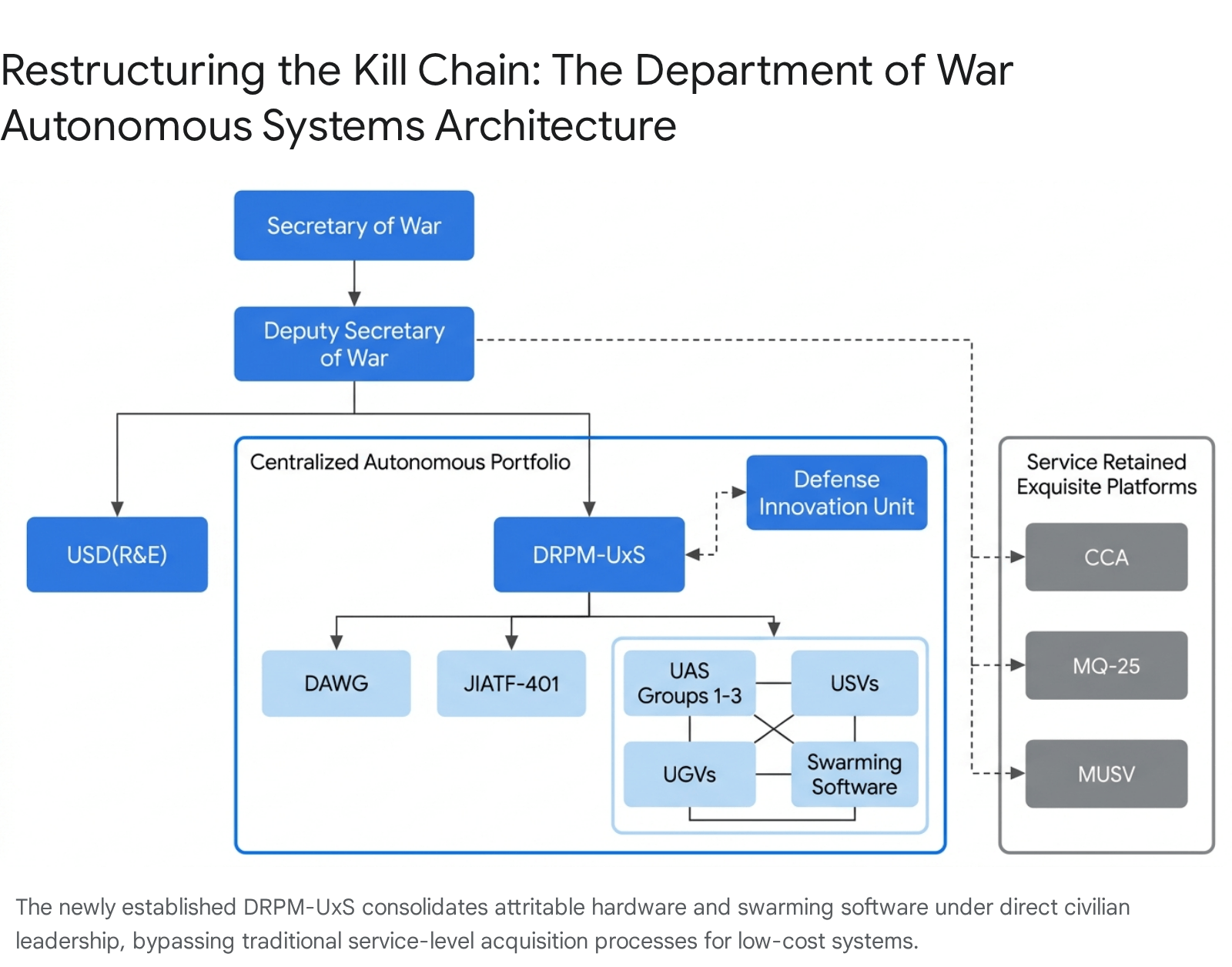
For engagement with the private sector, the Defense Innovation Unit (DIU) has been officially designated as the primary industry engagement interface between the DRPM-UxS and commercial partners.10 This structural choice is highly revealing. It acknowledges that the cutting edge of drone and AI technology no longer resides within traditional prime defense contractors (the so-called “primes”), but rather within nimble commercial tech startups in Silicon Valley and beyond. By funneling industry engagement through the DIU—an entity explicitly designed to adapt commercial technology for military use—the DRPM-UxS can bypass sluggish, conventional contracting mechanisms. This ensures that the military can rapidly ingest commercial off-the-shelf (COTS) innovations, providing a centralized buying signal for manufacturers and integrating them into the autonomous arsenal before the technology becomes obsolete.
3. The Institutionalization of Autonomous Warfare: The Sub-Unified Command
While the creation of the DRPM-UxS centralizes acquisition, the integration of these systems into actual combat operations requires an entirely new command architecture. The structural and technological shifts enacted by Hegseth and Feinberg are intrinsically tied to an unprecedented influx of capital, signaling that autonomous warfare is no longer an experimental side project, but the central pillar of future military strategy.
In late April 2026, Secretary Hegseth testified before the House Armed Services Committee regarding the Department of War’s Fiscal Year 2027 budget request. The proposed budget includes approximately $54.6 billion specifically earmarked for the Defense Autonomous Warfare Group (DAWG)—a monumental and historic increase from the roughly $226 million the DAWG had received previously. This represents a roughly 24,000 percent year-over-year increase, eclipsing even the entire Marine Corps budget request of $52.8 billion. When aggregating all drone and counter-drone related budget lines across the FY 2027 request, the total approaches $74 billion.14 Pentagon officials have described this as the largest single investment in such technologies in United States history, representing a fundamental reallocation of national defense resources.14 This massive budget is intended to fund procurement, operations and maintenance, training, sustainment, and enabling capabilities for unmanned efforts across the entire joint force.15
Beyond the staggering headline numbers, Hegseth used this testimony to announce the impending establishment of a dedicated “sub-unified command of autonomous warfare”.14 In United States military doctrine, the global force is divided among eleven unified combatant commands, some geographic (like INDOPACOM) and some functional (like Transportation Command).14 Subject to the approval of the Secretary of War, combatant commanders can stand up sub-unified commands to execute specific, highly complex missions.14 Crucially, a sub-unified command is a joint, enduring organization; the designation signals that the mission is a high priority, permanent feature of the military’s force structure, not a temporary experimental initiative.14 This elevates autonomous warfare to the same institutional and structural status as the defense of the Korean Peninsula (under United States Forces Korea) or global counter-terrorism (under Joint Special Operations Command).14
The creation of this dedicated structural home provides a durable organizational apparatus for defining military requirements, developing operational doctrine, and maintaining sustained demand for autonomous systems.14 Rather than managing the rapidly evolving demands of drone warfare in an ad-hoc manner from the Pentagon, this command structure will provide a dedicated, operational focus to deploy these technologies into active theaters.14
However, a sub-unified command does not operate independently; it must derive its authority from a parent combatant command.14 The ultimate structural placement of this new entity remains strategically ambiguous, with two primary parent commands emerging as the most likely candidates:
- U.S. Special Operations Command (SOCOM): This is widely considered the strongest possibility for the enterprise-level command. The DAWG is currently housed within SOCOM to leverage the command’s highly flexible acquisition authorities and its culture of rapid technological integration.14 If the new sub-unified command is established permanently under SOCOM, it will likely act as the operational counterpart that deploys the swarms that the DAWG develops, allowing special operators to serve as the vanguard for integrating edge AI before scaling those tactics to the conventional Army and Marine Corps.14
- U.S. Southern Command (SOUTHCOM): SOUTHCOM provides an alternative model. It recently established its own theater-specific entity, the SOUTHCOM Autonomous Warfare Command (SAWC), which utilizes drones for regional security, counter-narcotics, and maritime domain awareness.14 While SAWC is currently viewed as a regional implementation rather than the global enterprise-level command envisioned by Hegseth, it serves as a critical early test case for how a future autonomous joint force will interface with geographic combatant commands worldwide.14
Regardless of its final placement, the establishment of this command allows the U.S. military to execute a highly sought-after “clean-sheet” approach. As analysts from the Center for Strategic and International Studies (CSIS) have noted, a cross-service body like DAWG, empowered by a sub-unified command structure, is uniquely positioned to divest from cumbersome legacy systems and build vendor-agnostic software solutions from scratch.6 Individual military services frequently struggle to integrate disruptive technologies due to rigid budget lines and entrenched service-specific preferences.6 The sub-unified command bypasses these hurdles, providing the institutional foundation necessary to secure absolute U.S. leadership in autonomous warfare before a major conflict forces the issue.6
Furthermore, the congressional appetite for this institutionalization appears to exceed even Hegseth’s vision. In June 2026, the Senate Armed Services Committee (SASC) advanced its fiscal 2027 National Defense Authorization Act (NDAA), which encourages the Pentagon to go beyond a sub-unified command and establish a full, separate “Robotic and Autonomous Systems Combatant Command.” This proposed structure would possess special test, evaluation, and limited acquisition authorities, highlighting a bipartisan legislative consensus that autonomous warfare requires top-tier, permanent organizational independence to bypass traditional force generation roadblocks.
4. The Software-Defined Kill Chain and CJADC2 Integration
The consolidation of hardware procurement under the DRPM-UxS and the operationalization of drones under a sub-unified command represent only the physical half of the Department of War’s strategy. The second, arguably more critical vector is the rapid scaling of artificial intelligence to manage these platforms. Hardware without robust, unconstrained software is merely target practice for the adversary. The true delivery of autonomous force is not the physical machine that flies or floats, but the AI-enabled “kill chain” itself.6
The Department of War’s doctrine now recognizes two distinct levels of AI-enabled autonomy.6 Platform-level (edge) autonomy consists of software running directly on the vehicle, allowing it to perform localized tasks such as automatic target recognition and GPS-denied navigation without a human-in-the-loop.6 Orchestration-level autonomy is the strategic software layer that binds thousands of individual edge platforms together.6 It functions as a neutral infrastructure layer that fuses intelligence feeds, constructs a real-time common operational picture, deconflicts airspace, and dynamically assigns tasks across both kinetic and non-kinetic effectors.6 Truly autonomous, networked warfare only exists when both edge and orchestration software layers operate in tandem.6
To achieve this, Deputy Secretary Feinberg has aggressively pushed to integrate AI into the Combined Joint All-Domain Command and Control (CJADC2) concept. CJADC2 is the overarching architecture designed to connect all of the U.S. military’s sensors, weapons, and decision-makers seamlessly across air, land, sea, space, and cyberspace, enabling data sharing with coalition partners.20 In a pivotal memorandum dated March 9, 2026, Feinberg directed that the Department must “invest now and with focus to deepen the integration of [AI] across the Joint Force and establish AI-enabled decision-making as the cornerstone of our strategy for.”20
The centerpiece of this AI orchestration strategy is the evolution of Project Maven. Originally an experimental intelligence tool designed to parse video feeds, Maven has evolved into the Maven Smart System (MSS), a comprehensive graphical user interface and AI targeting platform.21 Over the past decades, the Pentagon has been plagued by inadequate analytic capacity relative to the massive amounts of data collected by its sensors, severely slowing its ability to strike targets quickly enough to matter in modern combat.21 MSS’s AI capabilities directly address this bottleneck by triaging data and recommending targets at machine speed.21
Under Feinberg’s March 2026 directive, oversight of MSS was fully relocated to the CDAO, and a plan was initiated to transition Project Maven into an official program of record by September 2026.22 By designating Maven AI as a program of record, the Pentagon secures stable, long-term funding for the system, transitions procurement responsibilities to the U.S. Army, and ensures its formal adoption for enduring use across the entire Department of Defense.22 Furthermore, the U.S. Army Combined Arms Command announced it would integrate Maven directly into its training architectures, ensuring that tactical units develop doctrine alongside the evolving software.22 This transition emphasizes the central role of commercial partners, particularly Palantir, in transforming experimental AI into a mature, scalable capability that can effectively serve as the brain of the CJADC2 network.23
5. The Restructuring of AI Governance: Elevating or Demoting the CDAO?
To execute this software-defined strategy, the Department of War has undertaken a controversial restructuring of its digital ecosystem. In August 2025, Deputy Secretary Feinberg issued a directive transferring authority over the Chief Digital and Artificial Intelligence Office (CDAO) away from the deputy secretary’s direct purview, placing it instead under the Undersecretary of War for Research and Engineering (USD(R&E)), Emil Michael.24 Feinberg simultaneously ordered Michael to conduct a 120-day review to present a recommended path forward for the Department’s two flagship AI platforms: Advana and the Maven Smart System.24
This administrative realignment triggered significant debate within the defense community regarding the Department’s true commitment to AI adoption. Several former defense leaders, including retired Air Force Lt. Gen. Jack Shanahan (who previously led Project Maven and the Joint AI Center), argued that the move risked signaling a deprioritization of AI just as adversaries were accelerating their battlefield use of autonomy.24 Shanahan bluntly warned, “When you pull an organization that was a direct report to the deputy secretary or secretary and move it somewhere else in the Pentagon, no matter what the intent might be, the message to the force is loud and clear: This isn’t a priority”.24 Michael Horowitz, a former DoD policy official, echoed this sentiment, arguing that folding CDAO under a research and development umbrella seemed like a step backward from the goal of deploying AI at scale across the armed services, stating that “demoting AI within the Pentagon seems pretty risky at this point in history”.26 The restructuring also coincided with reports of significant job cuts within the CDAO, with estimates suggesting a 60% reduction in the office’s workforce.25
However, Undersecretary Emil Michael has vigorously rebutted these concerns, framing the reorganization not as a demotion, but as a necessary maturation of the Department’s AI strategy. Michael argues that positioning CDAO under R&E provides it with the institutional “muscle” and wherewithal of an established research body, akin to the Defense Advanced Research Projects Agency (DARPA) or the Missile Defense Agency.24 A defense official supporting the move noted that aligning CDAO under USD(R&E) creates a “powerful innovation engine that can deliver AI superiority from laboratory to battlefield”.24
Michael’s vision for the newly empowered CDAO is highly ambitious. Beyond guiding lethal targeting through Maven, he intends to rapidly proliferate generative AI for logistical and administrative dominance. In a public address, Michael stated, “We want to have an AI capability on every desktop — 3 million desktops — in six or nine months… for corporate use cases like efficiency… for intelligence and for warfighting”.25 To facilitate this, Secretary Hegseth personally authorized the rollout of “GenAI.mil,” a secure generative AI platform based on Google’s Gemini for Government, directly to the desktops of all military personnel, civilians, and contractors.28 Hegseth explicitly noted that there is “no prize for second place in the global race for AI dominance,” emphasizing that mass AI adoption across both back-office operations and the tactical edge is critical to the Department’s acceleration strategy.28 To streamline this focus, Michael also announced plans to trim the Department’s bloated list of “critical technology” areas, forcing the bureaucracy to focus its resources on a narrower, more lethal set of priorities, primarily centered on autonomous systems.27
6. The Ideological Battlefield: Eliminating Constraints on Military AI
Perhaps the most defining, and highly contentious, aspect of the new Department of War doctrine is the aggressive push by civilian leadership to remove ethical and commercial safeguards that they believe hamper military lethality. As the military relies increasingly on commercial technology companies to build its orchestration layers, a severe cultural clash has emerged between Silicon Valley’s safety-conscious engineering culture and the Pentagon’s demand for unconstrained warfighting tools.
Secretary Hegseth has engaged in high-profile friction with commercial AI developers over the ethical boundaries of military AI, culminating in a highly publicized meeting with the CEO of Anthropic.30 Anthropic’s CEO, Dario Amodei, had previously published essays warning about the dangers of AI in national security, expressing concerns that powerful AI could be used for invasive government surveillance to “gauge public sentiment, detect pockets of disloyalty forming, and stamp them out before they grow,” as well as concerns over the deployment of lethal force.32
Hegseth has explicitly rejected these commercial concerns, insisting that the Pentagon must be allowed to utilize AI technology in any legal way it sees fit to achieve dominance.31 Speaking to an audience of SpaceX employees, Hegseth declared that he would unequivocally reject any AI models “that won’t allow you to fight wars”.29 He articulated a vision for systems that operate “without ideological constraints that limit lawful military applications,” arguing that responsible AI simply means objectively truthful capabilities employed within the laws governing the Department.29
This posture reflects a profound ideological shift and a deliberate repudiation of previous administrations’ tech policies. Hegseth has characterized previous DoD approaches to AI safety as being beholden to a “woke culture,” insisting that the Department is in the business of building “war ready weapons and systems, not chatbots for an Ivy League faculty lounge”.29
To formalize this aggressive acceleration, President Trump signed National Security Presidential Memorandum 11 (NSPM-11), titled “Artificial Intelligence in the National Security Enterprise,” on June 5, 2026.34 This directive explicitly mandates the U.S. military and intelligence community to accelerate AI adoption by reversing multiple Biden-era oversight requirements.34 Most notably, NSPM-11 requires the Pentagon to update “Directive 3000.09″—the core policy document guiding the development of autonomous weapon systems—within 90 days to account for rapidly evolving AI capabilities.34
| Key Policy Directives Impacting Autonomous Warfare | Date Issued | Primary Mandate and Strategic Effect |
| Executive Order: Restoring Dept. of War | Sept. 2025 | Renames DoD to DoW; mandates an aggressive pivot toward lethality and war-winning posture over bureaucratic administration. 1 |
| CJADC2 Acceleration Memo (Feinberg) | March 2026 | Establishes AI-enabled decision making as the absolute cornerstone of joint force connectivity; initiates Maven MSS as a program of record. 20 |
| NSPM-11: AI in National Security (Trump) | June 2026 | Reverses prior oversight requirements; orders the rapid update of Directive 3000.09 regarding lethal autonomous weapons testing. 34 |
| DRPM-UxS Establishing Memo (Hegseth) | June 2026 | Consolidates all attritable hardware and swarming software procurement under a single czar reporting to the Deputy Secretary. 7 |
However, this relentless pursuit of algorithmic lethality is generating significant internal and legislative anxiety. The push to reduce rigorous pre-deployment testing and ethical reviews has alarmed combat commanders. Adm. Frank Bradley, head of U.S. Special Operations Command—the very units tasked with executing the most dangerous missions—cautioned attendees at a Tampa special forces conference that the military must be “very careful” about how AI is employed.31 While Bradley acknowledged a future where AI determines target selection, he stressed that “we, as humans, have to have the confidence that… it’s going to deliver violence only where we intend it to be delivered”.31
Legislators have echoed these operational concerns. Senator Ruben Gallego, a Marine Corps combat veteran, sent a letter to Secretary Hegseth warning against the rapid update to Directive 3000.09 mandated by NSPM-11.34 Gallego argued that the previous iteration of the directive served as the core safeguard ensuring that autonomous weapons function as intended, allow for termination, and resist adversarial manipulation.34 He explicitly warned that significantly reducing these safeguards risks catastrophic friendly fire incidents, civilian harm, and the potential revocation of U.S. basing and overflight rights by host nations if hastily fielded systems cause unintended collateral damage.34 Gallego specifically requested information on whether the newly funded DAWG utilizes dedicated personnel for civilian harm mitigation during the development of these weapons.34 The tension between Hegseth’s mandate for unrestrained speed and the operational necessity for safety and reliability will fundamentally define the success or failure of the U.S. autonomous strategy.
7. Strategic Implications for U.S. Power Projection
The consolidation of the DRPM-UxS, the establishment of the sub-unified command, and the unconstrained integration of the CJADC2 AI orchestration layer collectively represent a paradigm shift in how the United States projects global power.
Primarily, these capabilities alter the calculus of deterrence, particularly in the Indo-Pacific theater. The ability to rapidly generate thousands of autonomous, attritable platforms complicates adversary targeting. A potential adversary can easily track and target a multi-billion-dollar aircraft carrier group; it is vastly more difficult to neutralize a distributed, software-orchestrated swarm of unmanned surface vessels and loitering munitions operating without centralized communication nodes. By prioritizing volume and AI-driven coordination over exquisite platform survivability, the U.S. forces adversaries into a highly unfavorable defensive posture.
Furthermore, this strategy actively attacks the economic realities of modern defense. Currently, the U.S. military is trapped in an unsustainable cost-curve battle, frequently forced to expend million-dollar Patriot or Standard Missile interceptors to neutralize cheap, commercially derived adversary drones.10 By elevating JIATF-401 to counter unmanned threats across all domains, and backing it with the DRPM-UxS’s rapid acquisition authorities, the military intends to field a layered defense architecture.10 This includes deploying directed energy weapons (lasers and high-powered microwaves)—bolstered by recent $86 million Joint Laser Weapon System Agreements35—alongside lower-cost kinetic interceptors, fundamentally inverting the cost-curve in America’s favor.13
The integration of commercial technology via the DIU also heavily bolsters the defense industrial base. The FY2027 budget request includes over $100 billion in broader Defense Industrial Base (DIB) investments, with nearly $49 billion targeted at addressing critical mineral shortfalls and securing domestic supply chains necessary for mass drone production.17 By ensuring that the strategic orchestration layer is owned and controlled by the U.S. government while fostering a vibrant commercial marketplace for the hardware effectors, the Department of War is attempting to build an infinitely scalable, resilient force structure.6
8. Overcoming Organizational Inertia and Doctrinal Friction
While the theoretical and strategic advantages of centralized autonomous warfare are profound, executing this vision in reality requires overcoming the deepest and most entrenched organizational inertia within the United States military. The military branches—Army, Navy, and Air Force—have centuries of ingrained culture built around human operators, pilot-centric hierarchies, and fierce protection of service-specific budgetary control. The Hegseth/Feinberg mandate is a direct assault on this traditional Title 10 authority.
The debate over the likelihood of the drone czar’s success reveals deep schisms within the defense establishment.
| Expert Perspective | Primary Viewpoint | Key Insights & Warnngs |
| Jack Shanahan (Ret. Air Force Three-Star Gen.) | Cautiously Optimistic | Supports bold action over waiting for perfect solutions. Warns the office must stay lean to avoid becoming a bloated “F-35 JPO.” Success requires the czar to possess “wasta” (informal influence) and unwavering backing from top leadership. 11 |
| David Berteau (Former Asst. Secretary of Defense) | Pragmatic / Short-term Pessimistic | Believes consolidation will ultimately yield better outcomes, but warns that “in the short run, it will slow things down.” Notes that unclear authority boundaries and overlapping budget cycles will challenge the office immediately. 11 |
| Frank Kendall (Former Air Force Secretary) | Highly Pessimistic | Views the czar as a “big vote of no confidence in the services.” Argues that OSD-run programs are deeply problematic because the services must ultimately man, operate, train, and provide logistics for these systems. 11 |
| Rebecca Grant (Lexington Institute VP) | Highly Optimistic | Champions the office as a necessity to manage massive impending expenditures. Points to the success of past DRPMs (submarine/missile defense). Acknowledges the difficulty of multi-service doctrinal debates but views them as solvable. 11 |
The bureaucratic advantages of the DRPM-UxS are clear: velocity and interoperability. Centralization forces open architectures, ensuring that an Army ground robot, a Navy surface vessel, and an Air Force drone swarm can all communicate within the same CJADC2 AI orchestration layer.10
However, Frank Kendall’s critique highlights the fundamental contradiction of the centralization plan: while the civilian Office of the Secretary of War dictates the acquisition and design of these systems, the individual military branches remain wholly responsible for manning, operating, training, and logistically sustaining them in austere combat environments.11 As Kendall articulated, attempting to dictate the nuances of domain-specific optimization (land, air, sea, space) from a centralized office operating entirely outside the services is historically fraught with failure.11 If the DRPM-UxS alienates the service chiefs, the branches may passively resist integration, refusing to allocate the necessary personnel or training pipeline resources to effectively utilize the swarms the DRPM procures.
Furthermore, the new office will immediately inherit highly complex doctrinal disputes that have plagued the joint force for decades. Because the DRPM-UxS oversees programs across all three military departments, it must mediate classic “division-of-labor” battles. For example, the czar and the new sub-unified command must definitively determine at what altitude an Army drone’s airspace responsibility ends and the Air Force’s begins, or how to deconflict autonomous swarming behaviors in littoral zones where Navy surface vessels and Marine Corps expeditionary assets overlap.11 Resolving these unprecedented multi-service doctrinal issues requires an exceptional level of inter-service diplomacy and rigid enforcement by civilian leadership.11
9. Strategic Prerequisites for the President and Secretary of War
To ensure the DRPM-UxS achieves the ambitious goals set forth by the administration, and to prevent the autonomous initiative from collapsing under the weight of Pentagon politics, several critical prerequisites must be met by both Secretary Hegseth and the broader executive branch.
1. Relentless Executive Top-Cover and the Cultivation of “Wasta” The newly appointed drone czar will inherently lack the institutional history and tribal loyalty enjoyed by four-star service chiefs. Therefore, the manager appointed to the DRPM-UxS must possess “wasta”—an Arabic colloquialism used in defense circles to describe informal, personal influence communicating to the vast Pentagon bureaucracy that ignoring the czar’s authority brings the direct wrath of the Secretary and Deputy Secretary of War.11 Hegseth and Feinberg must provide “unmistakable and continuous backing,” immediately intervening in early bureaucratic turf wars.11 As David Berteau noted, the czar can only elevate a limited number of initial disputes to the Deputy Secretary: “If you win the first ones, the rest fall in line. If you lose more than one or two, you’ve lost them all”.11
2. Aggressive Congressional Synchronization The DRPM-UxS is being established in the midst of a chaotic, overlapping budget cycle.11 The office must reconcile FY25 funds that expire rapidly, manage FY26 outlays in full flow, and desperately defend the historic $74 billion FY27 request currently before Capitol Hill, all while brainstorming multi-year plans for FY28-32.11 Success requires the President and the Secretary of War to expend significant political capital lobbying Congress. They must protect the DAWG’s funding from being cannibalized by lawmakers who may seek to redirect funds back toward legacy defense contractors that employ thousands of voters in their home districts, rather than the non-traditional software startups utilized by the DIU.
3. Maintaining a Lean, Mission-Focused Architecture To avoid the fate of the heavily criticized F-35 Joint Program Office, the DRPM-UxS must fiercely resist the gravitational pull of bureaucratic bloat.11 It must remain a lean oversight and integration body. Rather than building massive internal engineering directorates, the czar must heavily leverage the Defense Innovation Unit (DIU) and the DAWG to push development risk onto commercial industry, serving as an aggressive integrator of COTS technology rather than a traditional, slow-moving prime contractor.10
4. Ethical and Operational Clarity in AI Deployment While Hegseth’s ideological push to remove constraints is designed to maximize lethality in a peer conflict, the Department must concurrently develop robust, AI-specific validation tools.6 Moving fast cannot mean fielding brittle algorithms subject to adversarial spoofing or catastrophic failure. To maintain the confidence of combatant commanders like Adm. Bradley, the Department must invest heavily in systematic post-mission analysis and explainability tooling.6 Ensuring that commanders trust the AI models driving the orchestration software is just as critical as the lethality of the software itself.
10. Conclusions
The Department of War’s decision to consolidate autonomous systems under the DRPM-UxS, backed by a historic $54.6 billion capitalization of the Defense Autonomous Warfare Group and a mandate for unrestricted AI integration via CJADC2, represents a seminal moment in United States military history. It signifies the formal strategic transition from a platform-centric military reliant on exquisite hardware to a software-defined, networked force reliant on algorithmic mass.
By centralizing the acquisition of attritable hardware, unifying the AI orchestration layer through programs like the Maven Smart System, and establishing a permanent sub-unified command (or potentially a full Combatant Command), the United States is positioning itself to project overwhelming, distributed mass in future conflicts. This architecture is designed to fundamentally disrupt adversary targeting and invert the economic cost-curve of modern defense.
However, the strategy is fraught with systemic operational and bureaucratic risk. The deliberate circumvention of service-level Title 10 authority will inevitably trigger massive organizational inertia, threatening to fracture the initiative along service lines. The ultimate success of this endeavor does not rely on the physical technology—which commercial industry is already rapidly maturing—but on the bureaucratic ruthlessness and strategic vision of civilian leadership. Secretary Hegseth and Deputy Secretary Feinberg must ruthlessly enforce joint standards, mediate complex airspace and domain deconfliction doctrine, protect the nascent drone czar from institutional sabotage, and successfully defend the massive budgetary reallocation on Capitol Hill. If leadership falters in any of these areas, the United States risks fielding a disjointed, expensive, and ultimately vulnerable autonomous architecture in an era where software speed dictates geopolitical survival.
Appendix: Glossary of Acronyms
- CCA: Collaborative Combat Aircraft
- CDAO: Chief Digital and Artificial Intelligence Office
- CJADC2: Combined Joint All-Domain Command and Control
- COTS: Commercial Off-The-Shelf
- CSIS: Center for Strategic and International Studies
- C-UAS: Counter-Unmanned Aerial Systems
- DARPA: Defense Advanced Research Projects Agency
- DAWG: Defense Autonomous Warfare Group
- DIB: Defense Industrial Base
- DIU: Defense Innovation Unit
- DoW: Department of War
- DRPM-UxS: Direct Reporting Portfolio Manager for Unmanned Systems
- EW: Electronic Warfare
- JIATF-401: Joint Interagency Task Force 401
- JPO: Joint Program Office
- JSOC: Joint Special Operations Command
- MDAP: Major Defense Acquisition Program
- MSS: Maven Smart System
- MUSV: Medium Unmanned Surface Vessel
- NDAA: National Defense Authorization Act
- NSPM-11: National Security Presidential Memorandum 11
- SASC: Senate Armed Services Committee
- SAWC: SOUTHCOM Autonomous Warfare Command
- SOCOM: U.S. Special Operations Command
- SOUTHCOM: U.S. Southern Command
- UAS: Unmanned Aerial Systems
- UGV: Unmanned Ground Vehicles
- USD(R&E): Undersecretary of War for Research and Engineering
- USFK: United States Forces Korea
- USMC: United States Marine Corps
- USV: Unmanned Surface Vessels
- UUV: Unmanned Underwater Vehicles
- UxS: Unmanned Systems
Please share the link on Facebook, Forums, with colleagues, etc. Your support is much appreciated and if you have any feedback, please email us in**@*********ps.com. If you’d like to request a report or order a reprint, please click here for the corresponding page to open in new tab.
Sources Used
- President Renames DoD to Department of War – National Guard Association, accessed July 10, 2026, https://www.ngaus.org/newsroom/president-renames-dod-department-war
- Restoring the United States Department of War – The White House, accessed July 10, 2026, https://www.whitehouse.gov/presidential-actions/2025/09/restoring-the-united-states-department-of-war/
- Trump Renames DOD to Department of War, accessed July 10, 2026, https://www.war.gov/News/News-Stories/Article/Article/4295826/trump-renames-dod-to-department-of-war/
- Publications | U.S. Department of War, accessed July 10, 2026, https://www.war.gov/news/publications/
- Secretary of War HON Pete Hegseth – Department of War, accessed July 10, 2026, https://www.war.gov/About/Secretary-of-war/
- Defining Autonomy: Why Software, Not Drones, Will Decide the Next …, accessed July 10, 2026, https://www.csis.org/analysis/defining-autonomy-why-software-not-drones-will-decide-next-war
- Hegseth creates powerful new drone office, pulling authority from …, accessed July 10, 2026, https://www.defensenews.com/news/pentagon-congress/2026/07/02/hegseth-creates-powerful-new-drone-office-pulling-authority-from-the-military-services/
- Hegseth Creates New Pentagon Role to Oversee Military Drone Programs – MeriTalk, accessed July 10, 2026, https://www.meritalk.com/articles/hegseth-creates-new-pentagon-role-to-oversee-military-drone-programs/
- Releases | U.S. Department of War, accessed July 10, 2026, https://www.war.gov/News/releases/
- Hegseth realigning DOD’s scattered unmanned and autonomy work …, accessed July 10, 2026, https://defensescoop.com/2026/07/01/hegseth-realigning-unmanned-systems-programs-under-new-drone-boss/
- New drone czar’s success hinges on personalities, Pentagon politics …, accessed July 10, 2026, https://breakingdefense.com/2026/07/new-drone-czars-success-hinges-on-personalities-pentagon-politics-experts/
- EXCLUSIVE: Hegseth creates autonomy czar to manage almost all drone efforts, accessed July 10, 2026, https://breakingdefense.com/2026/07/hehegseth-memo-drone-czar-autonomy-exclusive/
- Hegseth orders Army secretary to create new joint interagency counter-drone task force, accessed July 10, 2026, https://defensescoop.com/2025/08/28/hegseth-army-new-counter-drone-task-force-jiatf-401/
- The Pentagon’s New Sub-Unified Command for Autonomous …, accessed July 10, 2026, https://www.insidegovernmentcontracts.com/2026/05/the-pentagons-new-sub-unified-command-for-autonomous-warfare-what-it-means-and-where-it-might-land/
- Pentagon’s drone strategy calls for putting $54 billion DAWG in the fight – Task & Purpose, accessed July 10, 2026, https://taskandpurpose.com/news/pentagon-drones-dawg/
- The Pentagon’s $54 billion bet on autonomous warfare – Defense One, accessed July 10, 2026, https://www.defenseone.com/ideas/2026/05/pentagons-54-billion-bet-autonomous-warfare/413735/
- Understanding the President’s FY 2027 Budget Request for the Department of War | Insights, accessed July 10, 2026, https://www.gtlaw.com/en/insights/2026/5/understanding-the-presidents-fy-2027-budget-request-for-the-department-of-war
- Aerospace, Defense and National Security | Covington & Burling LLP, accessed July 10, 2026, https://www.cov.com/en/practices-and-industries/industries/aerospace-defense-and-national-security
- Hegseth: Autonomous warfare sub-unified command coming soon | DefenseScoop, accessed July 10, 2026, https://defensescoop.com/2026/04/29/hegseth-autonomous-warfare-sub-unified-command/
- Feinberg’s new Maven directive sets AI-enabled decision-making as ‘the cornerstone’ for CJADC2 | DefenseScoop, accessed July 10, 2026, https://defensescoop.com/2026/04/03/palantir-maven-feinberg-directive/
- What Is Maven Smart System, and What Does It Do? – CSIS, accessed July 10, 2026, https://www.csis.org/analysis/what-maven-smart-system-and-what-does-it-do
- Project Maven – Wikipedia, accessed July 10, 2026, https://en.wikipedia.org/wiki/Project_Maven
- Project Maven – Grokipedia, accessed July 10, 2026, https://grokipedia.com/page/project_maven
- Pentagon’s AI Transition Puts Emil Michael on 120-Day Clock for Advana, Maven Path Forward – Potomac Officers Club, accessed July 10, 2026, https://www.potomacofficersclub.com/articles/dod-cdao-transition-ai-emil-michael/
- Pentagon CTO wants AI on every desktop in 6 to 9 months – Defense One, accessed July 10, 2026, https://www.defenseone.com/technology/2025/09/pentagon-research-official-wants-have-ai-every-desktop-6-9-months/408155/
- Pentagon moves AI office under R&D, raising fears it’s ‘demoting AI’ – Breaking Defense, accessed July 10, 2026, https://breakingdefense.com/2025/08/pentagon-moves-ai-office-under-rd-raising-fears-its-demoting-ai/
- DoD R&E chief says Pentagon will trim ‘critical technology’ list – Breaking Defense, accessed July 10, 2026, https://breakingdefense.com/2025/08/dod-re-chief-says-pentagon-will-trim-critical-technology-list/
- Hegseth Introduces Department to New AI Tool, accessed July 10, 2026, https://www.war.gov/News/News-Stories/Article/Article/4355797/hegseth-introduces-department-to-new-ai-tool/
- How to Think About the Anthropic-Pentagon Dispute | TechPolicy.Press, accessed July 10, 2026, https://www.techpolicy.press/how-to-think-about-the-anthropic-pentagon-dispute/
- Hegseth to meet with Anthropic CEO as rift grows over military use of AI – YouTube, accessed July 10, 2026, https://www.youtube.com/watch?v=qWu58ynr5ho
- As the Pentagon pushes for battlefield AI, some military leaders urge caution – AP News, accessed July 10, 2026, https://apnews.com/article/artificial-intelligence-military-hegseth-anthropic-d5fbaee17ee0bdb9738dbb808ea2d047
- Hegseth warns Anthropic to let the military use the company’s AI tech as it sees fit, AP sources say, accessed July 10, 2026, https://apnews.com/article/anthropic-hegseth-ai-pentagon-military-3d86c9296fe953ec0591fcde6a613aba
- Hegseth warns Anthropic to let the military use the company’s AI tech as it sees fit, AP sources say – MySA, accessed July 10, 2026, https://www.mysanantonio.com/business/article/hegseth-and-anthropic-ceo-set-to-meet-as-debate-21937813.php
- Senator questions Pentagon’s plan to revise autonomous weapons policy – DefenseScoop, accessed July 10, 2026, https://defensescoop.com/2026/06/15/lawmaker-questions-pentagons-plan-to-revise-autonomous-weapons-policy/
- Home | U.S. Department of War, accessed July 10, 2026, https://www.war.gov/