1. Executive Summary
During the operational period of June 28 through July 4, 2026, tactical law enforcement units and Special Weapons and Tactics (SWAT) teams at the federal, state, and local levels executed multiple high-risk operations. Deployment data for this period indicates a reliance on specialized tactical units to resolve civilian encounters, execute high-risk search and arrest warrants, and stabilize critical incidents in populated environments. The operational tempo remained steady throughout the week, with geographic clustering of tactical activations observed in the Southeastern United States (notably Georgia and Florida) and the West Coast (California and Washington).
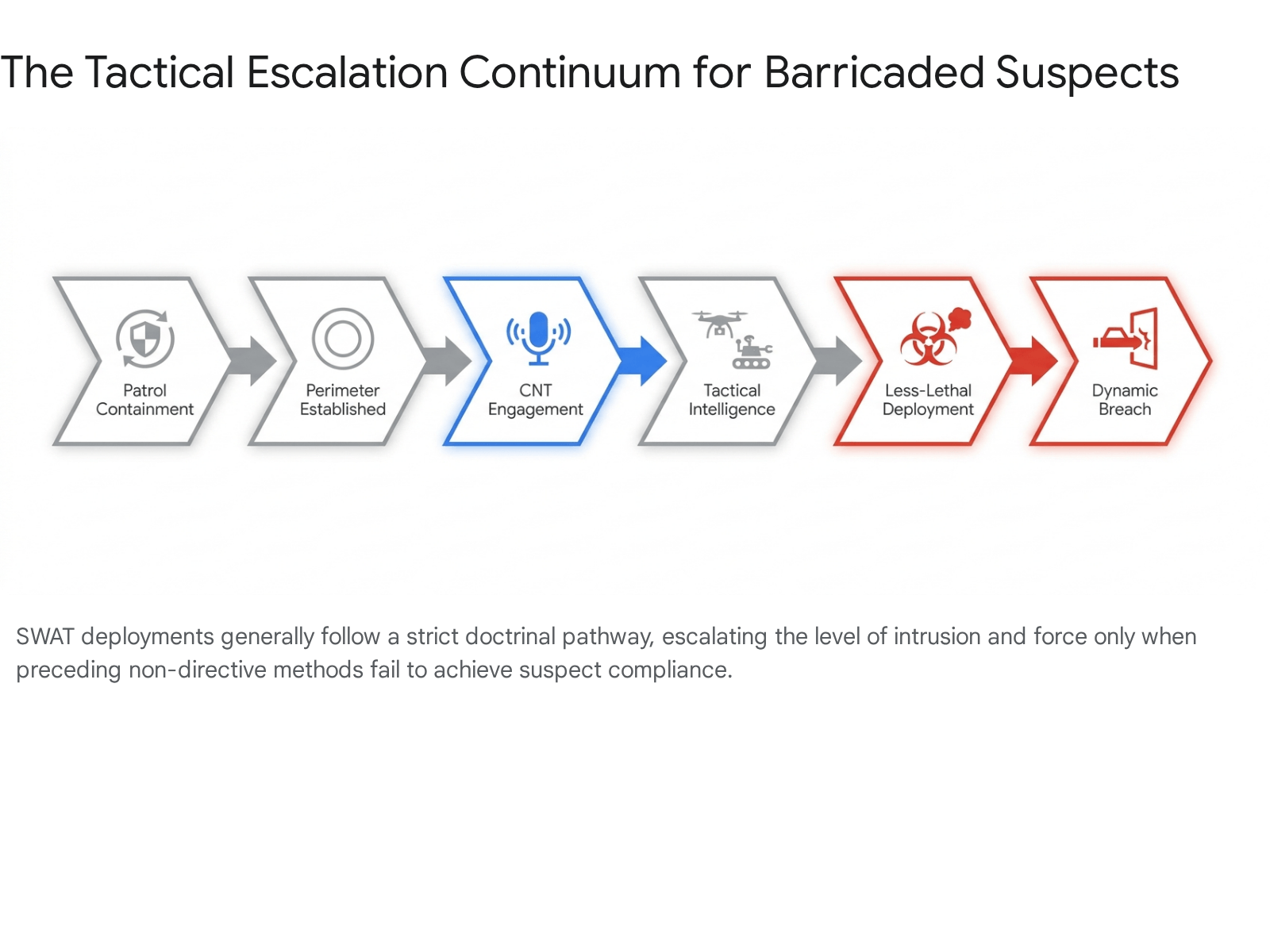
An analysis of the week’s tactical engagements reveals a systemic adherence to de-escalation doctrines across responding agencies. In the majority of barricaded suspect scenarios, tactical commanders prioritized the establishment of inner and outer perimeters, followed by extended deployments of Crisis Negotiation Teams (CNT).1 Kinetic interventions—such as the deployment of chemical irritants, the utilization of canine units (K9), and dynamic structural breaching—were largely withheld and utilized as secondary or tertiary options after non-directive communication protocols had failed to achieve compliance.
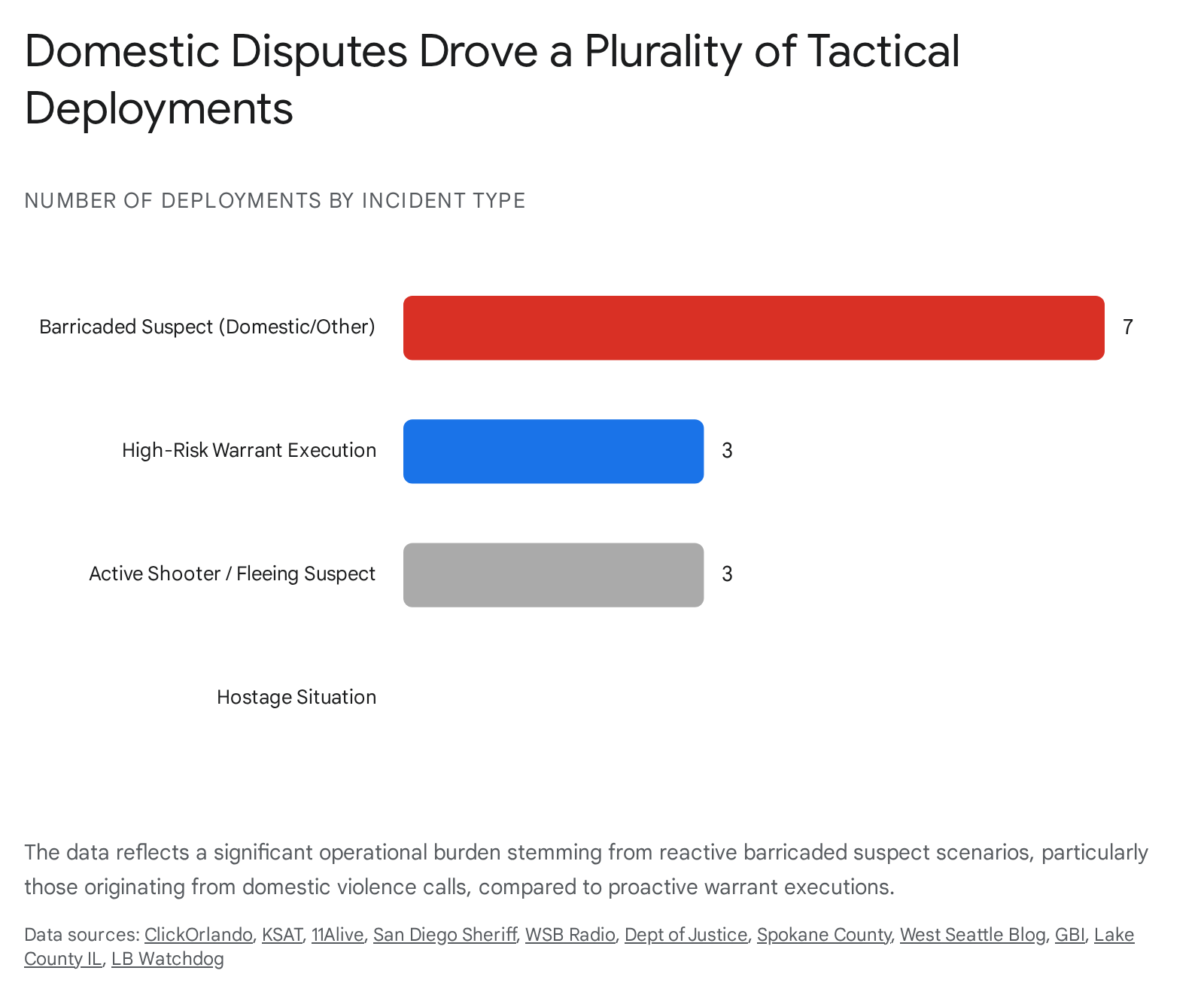
The most resource-intensive operations of the week involved synchronized task forces executing federal and state indictments targeting drug trafficking organizations in Minnesota and Illinois.3 These proactive operations required the simultaneous deployment of multiple regional SWAT teams to mitigate the inherent risks associated with armed criminal networks.5 Conversely, the most frequent catalyst for localized, reactive SWAT deployments remained domestic violence incidents that escalated into armed barricade situations.7
| Operational Catalyst | Geographic Density | Primary Tactical Resolution | Operator Casualty Rate |
| Domestic Violence / Barricade | High (GA, FL, CA) | Protracted Negotiation / Containment | 0% |
| High-Risk Warrant Service | Medium (MN, GA, IL) | Simultaneous Dynamic Breach | 0% |
| Active Shooter / Fleeing Suspect | Low (WA, CA, TX) | Air-to-Ground Coordination / K9 | 0% |
| Hostage Rescue | Zero instances reported | N/A | 0% |
The week concluded with zero reported fatalities among tactical operators. However, the psychological and physical hazards intrinsic to the profession were underscored by a self-inflicted suspect fatality during a standoff in Pickens County, Georgia 9, and the internal arrest of an active-duty SWAT deputy for family violence in Bexar County, Texas.10 The following report details the operational parameters, tactical resolutions, and doctrinal lessons derived from the week’s deployments.
2. Strategic Overview and Macro-Level Trends
The tactical landscape for the designated period highlights several trends in how specialized units are utilized to bridge the gap between standard patrol capabilities and high-threat environments. By analyzing the aggregate data from multiple municipal, county, and federal agencies, clear operational patterns emerge regarding resource allocation and force application.
2.1 The Preeminence of the Barricaded Suspect Scenario
The barricaded suspect scenario represents the most statistically significant trigger for SWAT deployment during this reporting period. In jurisdictions ranging from Winter Garden, Florida, to Long Beach, California, suspects utilizing structures or vehicles for hard cover dictated the operational response and heavily taxed local logistical frameworks. A recurring pattern in these incidents is the genesis of the standoff: domestic violence disputes. When subjects of domestic violence investigations realize law enforcement is present, a subset choose to barricade themselves, effectively converting a standard patrol response into a tactical siege.7
The standard operating procedure observed across multiple agencies involves a rigid timeline of escalation. Initial responding patrol units focus entirely on containment, isolating the structure to prevent suspect egress and establishing a secure perimeter to protect civilians.2 Once the perimeter is established, the tactical pause allows for the integration of specialized assets, including armored rescue vehicles, crisis negotiators, and tactical medics.12 This shift from immediate patrol action to a methodical tactical siege reflects a broader paradigm shift in policing, wherein time is utilized as a primary tool to de-escalate crisis states and reduce the likelihood of officer-involved shootings.7
2.2 Multi-Agency Synchronization in High-Risk Warrant Executions
While barricaded suspects represent a reactive deployment model, the execution of search and arrest warrants targeting established criminal syndicates requires proactive tactical superiority.5 The operations conducted by task forces in Minneapolis, Minnesota, and Lake County, Illinois, demonstrate the substantial logistical requirements for such endeavors.3 Federal agencies, including the Drug Enforcement Administration (DEA) and the Federal Bureau of Investigation (FBI), routinely partner with local and state SWAT elements to simultaneously breach multiple target locations.5
The simultaneous breach is a critical tactical doctrine. By coordinating multi-team breaches at the exact same hour across varied geographical points, law enforcement achieves the element of surprise across the entire network.5 This synchronization disrupts the adversary’s command and control, reducing the probability of sustained firefights and maximizing evidence preservation.6
2.3 The Integration of Specialized Technologies and Non-Lethal Modalities
The strategic calculus of modern SWAT commanders heavily relies on distance, environmental manipulation, and intermediate force options. When time and verbal negotiations fail to yield compliance, commanders authorize the escalating use of force multipliers designed to degrade the suspect’s operational capability without resorting to lethal firearms.
Unmanned Aerial Systems (UAS), ground-based robotics, and specialized pole cameras are increasingly deployed to gather interior intelligence.9 These tools allow operators to clear potential threat areas—such as doorways and narrow hallways—without exposing a human operator to gunfire.9 This reliance on technology reflects a doctrinal commitment to minimizing operator risk while maximizing the probability of a peaceful suspect apprehension.
3. Incident Synopses and Tactical Review (By Date and Geography)
The following subsections provide a chronological review of tactical deployments reported during the operational window. Each event is analyzed to extract actionable intelligence regarding tactical decision-making, logistical execution, and inter-agency coordination.
3.1 Operations on June 28, 2026
Winter Garden, Florida (Orange County Sheriff’s Office) During the late evening hours of Saturday into the early morning of Sunday, June 28, deputies from the Orange County Sheriff’s Office responded to a domestic assault call in the 1100 block of Partlow Drive.7 Upon arrival, patrol elements encountered a male suspect in his 30s who refused commands to exit the residence, initiating a formal standoff.7 Recognizing the volatility of the encounter, patrol supervisors requested the deployment of the local SWAT team.7 The tactical element established a secure inner perimeter, locking down the residential street.7 Following containment and negotiation, the SWAT team successfully took the man into custody without the discharge of firearms or any reported injuries.7
Tactical Lessons Learned: The successful resolution of the Partlow Drive incident highlights the fundamental tactical principle that time is a primary de-escalation tool. By maintaining a static perimeter and avoiding a rushed dynamic entry into an unknown structural layout, negotiators were granted the operational space required to secure a non-violent surrender.
San Antonio, Texas (San Antonio Police Department) In San Antonio, Texas, local police units engaged suspects linked to an ongoing, localized crime spree involving multiple vehicle break-ins.11 As law enforcement closed in, the suspects retreated into a residence on the city’s West Side, barricading the entryways and refusing to surrender.11 The San Antonio Police Department (SAPD) SWAT team was subsequently deployed, initiating a standoff that stretched for nearly six hours.11 The deployment required significant cordoning of the residential neighborhood, impacting local civilian movement but ensuring no crossfire risks existed.11 The suspects were ultimately apprehended after the tactical pause.
Tactical Lessons Learned: Property crimes can escalate into high-threat tactical scenarios if suspects perceive the structural advantage of a residential barricade as their only means of avoiding capture. Patrol units must be trained to seamlessly transition control of a scene to tactical units when suspects transition from mobile flight to static defense.
3.2 Operations on June 29, 2026
Henry County, Georgia (Henry County Police Department) A significant tactical response converged on a residence off East Atlanta Road, near Great Oaks Branch, in Henry County, Georgia.13 Upon arrival, law enforcement encountered a suspect who had barricaded themselves within the home and was actively refusing to comply with commands to surrender.2 The Henry County Police Department issued emergency traffic alerts, formally closing East Atlanta Road to all civilian traffic.2 SWAT units and crisis negotiators surrounded the property, with audio surveillance from the perimeter indicating negotiators attempting to communicate with the suspect over public address systems.13 The multi-hour tactical standoff concluded peacefully in the afternoon, with the suspect surrendering to the specialized units.14
Tactical Lessons Learned: The utilization of wide-area traffic control and public emergency alerts is critical for securing the outer perimeter during a residential standoff. By denying access to the area, the tactical commander ensured that civilians were kept clear of potential ballistic trajectories, allowing operators to focus on the structural threat.
3.3 Operations on June 30, 2026
Minneapolis, Minnesota (Federal Task Force – DEA/FBI) A federal investigation into two drug trafficking organizations—the “Family Mob” and “G Block” gangs—culminated in sweeping federal indictments on Tuesday morning.15 The gangs were reportedly responsible for enforcing open-air drug markets near Lake Street and Park Avenue.6 To dismantle this network, agents and officers, including multiple SWAT teams from the FBI, DEA, Minneapolis Police Department, and Hennepin County Sheriff’s Office, executed a series of synchronized, high-risk arrest and search warrants.5 The tactical operations resulted in the secure arrest of 12 armed defendants and the seizure of firearms and narcotics, disrupting the criminal networks without any reported law enforcement casualties.4
Tactical Lessons Learned: Territorial street gangs utilizing firearms to protect illicit distribution hubs present a lethal risk during warrant service. The deployment of multiple SWAT teams ensures that tactical operators outnumber and outgun the target subjects at every point of friction, providing a psychological deterrent to armed resistance.
Spring Valley, California (San Diego County Sheriff’s Department) Deputies from the Rancho San Diego Sheriff’s Station responded to the 9000 block of Mac Lane regarding reports of an armed man, identified as 34-year-old Julian Lewis, threatening a neighbor with a firearm.1 Upon arrival, patrol deputies observed the armed suspect retreat into his residence. Initial de-escalation attempts failed, and Lewis refused to exit the house.1 Given the confirmed presence of a firearm, the Sheriff’s Special Enforcement Detail (SED/SWAT) and the Special Response Team (SRT) were activated and deployed to the perimeter.1 After approximately 90 minutes of tactical positioning and structured communication, the suspect complied with commands to surrender and was taken into custody without incident.1
Tactical Lessons Learned: The rapid transition from patrol engagement to tactical containment is vital when an active firearm is confirmed. The prompt arrival of SED/SWAT established a substantial tactical presence that likely deterred the suspect from re-engaging the neighbors or attempting a violent breakout.
San Diego, California (San Diego Police Department & Sheriff’s Office) During a morning abatement detail on June 30, San Diego Police officers contacted a known parolee at large who had a no-bail warrant. The suspect fled, leading to a foot pursuit near the San Diego River where an officer-involved shooting occurred. The suspect fled into the dense brush of the riverbed, prompting a response including SDPD SWAT, aerial support, and K9 units. Following an hours-long standoff where the Emergency Negotiation Team attempted to secure a peaceful surrender, the suspect was ultimately apprehended with the deployment of a police K9.
Tactical Lessons Learned: Open-air and densely vegetated environments present profound containment challenges compared to structural barricades. Tactical commanders must rely heavily on aerial thermal imaging to pinpoint the suspect’s exact location, while utilizing K9 units to safely flush out the subject and facilitate apprehension.
Cobb County, Georgia (Cobb County Police Department) Patrol officers responded to the Stratford Ridge Apartments on Delk Road following reports of shots fired in the area.16 Upon arrival, they located a 19-year-old male victim suffering from a fatal gunshot wound inside a vehicle.17 Given the recency of the shooting and the high-density environment of the apartment complex, the Cobb County SWAT team was deployed to conduct a systematic sweep and clear specific apartment units in search of the armed perpetrators.18 The SWAT team cleared the immediate scene, ensuring no active shooters remained hidden within the complex.16 Subsequent investigative work led to the identification and arrest of two suspects.19
Tactical Lessons Learned: In post-shooting scenarios within multi-family dwellings, SWAT teams act as heavily armored search assets. Their primary function transitions from suspect negotiation to methodical, room-by-room deliberate clearance, ensuring the environment is sterile for forensic investigators and medical personnel.
Forsyth County, Georgia (Forsyth County Sheriff’s Office) A domestic dispute escalated into a gunfire event at a residence off Kelly Mill Road in Forsyth County.8 The armed suspect barricaded himself inside the home and discharged a weapon, endangering the lives of civilians and responding deputies. The Forsyth County Sheriff’s Office established an immediate perimeter and issued a formal shelter-in-place order for the surrounding neighborhood.20 A large law enforcement response converged to lock down the area.8 Following an intense standoff, tactical units successfully captured the suspect.21
Tactical Lessons Learned: The deployment of a civilian shelter-in-place order through digital alerts and public address systems is a critical administrative tool that complements the physical tactical perimeter. It reduces the variables operators must monitor by clearing the streets of bystanders.
Long Beach, California (Long Beach Police Department) In the early morning hours, Long Beach Police responded to a Sinclair gas station on Long Beach Boulevard after a woman fled into the business seeking help. She reported being assaulted by a male suspect riding with her, initiating an hours-long tactical standoff when the suspect barricaded himself inside a vehicle at the station. The area was cordoned off and SWAT assets were deployed. Following protracted negotiations, officers safely took the suspect into custody at approximately 2:30 a.m. without further incident or injury.22
Tactical Lessons Learned: Securing a vehicle barricade in a highly combustible environment (a commercial gas station) requires extreme tactical discipline. Operators must carefully manage sightlines and avoid the deployment of any kinetic munitions or flashbangs that could inadvertently ignite fuel vapors.
3.4 Operations on July 1, 2026
White Center, Washington (King County Sheriff’s Office) During the afternoon, King County Sheriff’s Office (KCSO) deputies responded to reports of a reckless shooting in the 10000 block of 16th Ave SW.23 Arriving investigators located nine 9mm shell casings at the scene.23 A dual-domain tactical response was initiated. KCSO deployed “Guardian One”—the agency’s airborne helicopter asset—to track the fleeing suspect from the air, while KCSO SWAT officers mobilized on the ground to conduct the high-risk apprehension.23 Utilizing the overhead intelligence and vectoring provided by Guardian One, SWAT officers were directed precisely to the suspect’s location, resulting in a successful arrest.23
Tactical Lessons Learned: Air-to-ground integration is an invaluable force multiplier for tactical teams pursuing armed suspects in urban environments. Airborne assets negate the suspect’s ability to utilize geographical concealment, allowing the ground-based tactical teams to approach the target with total situational awareness.
Long Beach, California (Long Beach Police Department) Long Beach Police Department (LBPD) officers responded to reports of an armed 17-year-old male inside a vehicle. The suspect had allegedly attempted to force a female victim back into the car, and the fleeing victim explicitly reported observing a rifle inside the vehicle.24 Arriving patrol officers successfully contained the suspect’s vehicle, preventing his escape.24 When the suspect proved uncooperative and refused to exit, the LBPD SWAT Team, crisis negotiators, and K9 units were activated.12 After approximately three hours of measured negotiation, the juvenile suspect surrendered peacefully and was safely taken into custody.12 Operators subsequently recovered a rifle from the vehicle.24
Tactical Lessons Learned: Mobile barricades present unique containment challenges. The structural integrity of a vehicle is significantly lower than a residence, offering less ballistic protection to both the suspect and the officers. Pinning the vehicle with armored assets ensures total containment, allowing negotiators the critical time necessary to secure a surrender.
Bexar County, Texas (Internal Arrest) A member of the Bexar County Sheriff’s Office (BCSO) SWAT team, Deputy Jose Lars Alba, was arrested on charges of family violence.10 The investigation was initiated when medical staff at a local San Antonio hospital treated his fiancé for neck redness and bruising, subsequently notifying law enforcement.10 The individual was arrested, booked into the Bexar County Adult Detention Center on a Class A misdemeanor charge of causing bodily injury to a family member, and subsequently bonded out.10
Tactical Lessons Learned: Tactical operators are subjected to extreme levels of chronic stress, hyper-vigilance, and repeated trauma exposure. This incident underscores the necessity for proactive psychological evaluations and internal wellness programs for specialized units to ensure operational integrity.
3.5 Operations on July 2, 2026
Lake County, Illinois (Lake County Sheriff’s Office / ICAC) Detectives from the Lake County Sheriff’s Office developed probable cause indicating that 26-year-old Steven Cardenas was illegally downloading child sexual abuse material.25 Having secured a search warrant for his residence on Broadway Avenue in North Chicago, the Sheriff’s SWAT team, alongside the Internet Crimes Against Children (ICAC) Task Force and the Illinois Attorney General’s Office, deployed to execute the warrant.26
Upon arrival, the suspect’s 56-year-old mother obstructed the entry, actively refusing repeated instructions to open the door despite being presented with a valid judicial warrant.27 Due to the high risk of digital evidence destruction, the SWAT operators were forced to dynamically breach the front door to gain entry.3 The structural breach allowed investigators to secure the premises and seize electronic devices before data could be wiped.25 Forensic analysis subsequently revealed over 1,000 videos of child exploitation.3
Tactical Lessons Learned: The execution of search warrants involving digital contraband presents a unique temporal challenge. Suspects possessing illicit digital archives frequently employ rapid-wiping software or physical destruction methods. When met with obstruction at the threshold, the tactical commander recognized that the threshold of exigency was met, and the SWAT element transitioned to a dynamic breach to preserve evidence.
Atlanta, Georgia (Atlanta Police Department) The Atlanta Police Department SWAT team executed a search warrant at the Radius West Midtown Apartments on Bishop Street NW during the late afternoon hours.28 The operation required a significant tactical footprint, shutting down the immediate roadway and establishing a wide perimeter around the complex.29 Following the entry and clearance, tactical units escorted three handcuffed individuals out of the structure.30 Authorities maintained operational security regarding the specific details of the underlying investigation, confirming only that it was an active search warrant execution.28
Tactical Lessons Learned: High-rise and dense apartment environments complicate tactical deployments due to the sheer volume of innocent bystanders separated from the target unit only by interior drywall. Establishing a secure perimeter in these environments requires significant personnel to secure all vertical escape routes, including stairwells and elevators, before the breach can safely commence.
Pickens County, Georgia (Cherokee County SWAT / GBI) The Georgia Bureau of Investigation (GBI) and the Pickens County Sheriff’s Office (PCSO) were investigating a recent shooting death.9 The homicide investigation led authorities to 48-year-old Mark Little at a residence on Hobson Road in Jasper, Georgia.9 On the evening of July 2, the Cherokee County Sheriff’s Office (CCSO) SWAT team established a perimeter around Little’s home and attempted negotiations for approximately two hours.9
To minimize the severe risk of an ambush upon entry, law enforcement deployed specialized video surveillance technology to gain an interior view of the structure prior to initiating a physical breach.9 The interior video feed revealed what appeared to be a body inside the home.9 SWAT operators subsequently made a systematic, deliberate entry and confirmed that the suspect had died from an apparent self-inflicted gunshot wound.9
Tactical Lessons Learned: The utilization of tactical robotics and throw-cameras is a vital risk-mitigation strategy for modern SWAT teams. By visually clearing the interior space remotely, the tactical commander verified the status of the threat before committing human operators to a structural clearance.
3.6 Operations on July 4, 2026
Villa Rica, Georgia (Villa Rica Police Department) On July 4, patrol officers and SWAT elements responded to an active residential standoff.31 Law enforcement established a perimeter to contain the suspect and secure the surrounding neighborhood.31
Tactical Lessons Learned: Holiday weekends often present complex staffing and deployment challenges for tactical units. Maintaining rapid response capabilities during high-volume periods requires careful operational planning and inter-agency resource sharing to ensure sufficient personnel are available for sustained standoffs.
4. Doctrinal Implications and Future Readiness
The aggregation of deployment data from the June 28 – July 4, 2026 reporting period provides an authoritative view into the current state of specialized tactical law enforcement across the United States.
| Tactical Strategy | Deployment Frequency | Primary Objective | Risk to Operator |
| Contain & Negotiate | Very High | De-escalation / Peaceful Surrender | Low |
| Technological Reconnaissance | High | Intelligence Gathering (UAS, Robotics) | Low |
| Less-Lethal (Gas/K9) | Medium | Environmental Degradation / Compliance | Moderate |
| Dynamic Breach | Low | Rapid Evidence Preservation / Rescue | High |
The data demonstrates a distinct operational pivot away from immediate, dynamic entries toward deliberate, intelligence-driven containment. In almost every barricaded suspect scenario reviewed in this period, the operational clock was extended intentionally.7 Tactical commanders are exhibiting a high tolerance for protracted standoffs—ranging from three hours in Long Beach to longer durations in task force operations—provided the suspect is successfully isolated from the public and contained within a static perimeter.11
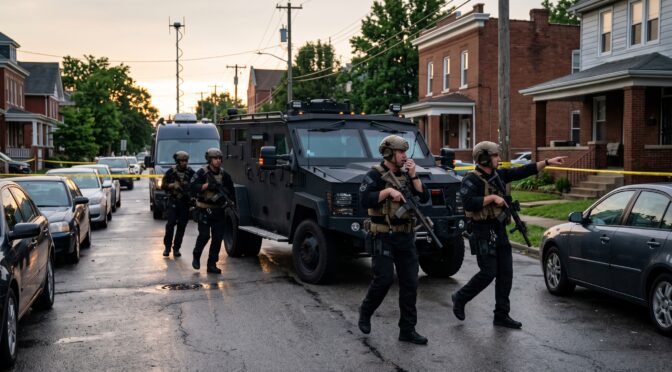
This strategy is heavily dependent on the deployment of robust physical assets. The armored rescue vehicle serves as a mobile bunker, allowing operators to position themselves close to the crisis point while remaining shielded from small-arms fire. This operational pause removes the urgency to neutralize the threat immediately.
Future tactical readiness will require continued investment in non-kinetic assets—including robotics, advanced chemical delivery systems, and comprehensive negotiator training—alongside rigorous mental health and wellness support for operators deployed into these high-stress, high-consequence environments.
Appendix: Data Collection and Analytical Framework
The intelligence and operational data utilized in this SITREP were acquired through the aggregation of Open Source Intelligence (OSINT) and authorized media releases from respective law enforcement agencies covering the operational period of June 28 through July 4, 2026. Data sources include official press releases from the Georgia Bureau of Investigation, the Drug Enforcement Administration, the U.S. Attorney’s Office, and localized public information dispatches from municipal police departments and county sheriff’s offices across multiple states. The raw data was filtered temporally to ensure adherence to the specified week and geospatially to capture U.S. domestic operations. The synthesized analysis applies standard tactical doctrinal frameworks—such as perimeter control, the force continuum, and intelligence preparation of the battlefield—to interpret the raw incident data and extract actionable operational lessons.
Please share the link on Facebook, Forums, with colleagues, etc. Your support is much appreciated and if you have any feedback, please email us in**@*********ps.com. If you’d like to request a report or order a reprint, please click here for the corresponding page to open in new tab.
Sources Used
- SWAT Standoff – Spring Valley | News Release | San Diego County …, accessed July 4, 2026, https://www.sdsheriff.gov/Home/Components/News/News/4291/514
- SWAT standoff shuts down East Atlanta Road, accessed July 4, 2026, https://www.fox5atlanta.com/video/fmc-dis10sszknka87g1
- Another Persistent Sheriff’s Investigation Leads to Arrest in Child …, accessed July 4, 2026, https://www.lakecountyil.gov/CivicAlerts.asp?AID=4746
- Members and Associates of Two Minnesota Drug Trafficking Organizations Indicted and Arrested – DEA.gov, accessed July 4, 2026, https://www.dea.gov/press-releases/2026/06/30/members-and-associates-two-minnesota-drug-trafficking-organizations
- Members and Associates of Two Minnesota Drug Trafficking Organizations Indicted and Arrested, accessed July 4, 2026, https://www.justice.gov/usao-mn/pr/members-and-associates-two-minnesota-drug-trafficking-organizations-indicted-and
- 25 Charged In Gang-Related Drug Trafficking Operations Across Minneapolis: Feds – Patch, accessed July 4, 2026, https://patch.com/minnesota/minneapolis/25-charged-gang-related-drug-trafficking-operations-across-minneapolis-feds
- Man taken into custody after overnight SWAT standoff in Winter Garden, deputies say, accessed July 4, 2026, https://www.clickorlando.com/news/local/2026/06/28/scene-cleared-suspect-in-custody-after-early-morning-swat-scene-in-winter-garden/
- Armed suspect barricaded inside Forsyth County home, accessed July 4, 2026, https://www.fox5atlanta.com/video/fmc-vmh3vm6j3h1f2o7t
- GBI Investigates Death in Pickens County, GA, accessed July 4, 2026, https://gbi.georgia.gov/press-releases/2026-07-03/gbi-investigates-death-pickens-county-ga
- Records: BCSO deputy accused of injuring family member released on bond, accessed July 4, 2026, https://www.ksat.com/news/local/2026/07/01/records-bcso-deputy-accused-of-injuring-family-member-released-on-bond/
- A standoff stretching nearly six hours now is over on San Antonio’s West Side. – KSAT, accessed July 4, 2026, https://www.ksat.com/video/news/2025/06/26/a-standoff-stretching-nearly-six-hours-now-is-over-on-san-antonios-west-side/
- Teen arrested after 3-hour SWAT standoff in North Long Beach, accessed July 4, 2026, https://lbwatchdog.com/teen-arrested-after-3-hour-swat-standoff-in-north-long-beach/
- Suspect surrenders in SWAT situation at residential address in Henry County, police say, accessed July 4, 2026, https://www.11alive.com/article/news/local/swat-situation-henry-county-home/85-bfd6f3d7-050c-4186-a238-6f6aba85090a
- Update: SWAT standoff ends with suspect in custody – FOX 5 Atlanta, accessed July 4, 2026, https://www.fox5atlanta.com/video/fmc-qn03caiywjpb21o1
- Minneapolis drug trafficking gangs: 24 people face federal charges, accessed July 4, 2026, https://www.fox9.com/news/minnesota-drug-trafficking-organizations-doj-charges-june-30-2026
- Man seriously injured in shooting at Cobb County apartment complex, accessed July 4, 2026, https://www.11alive.com/article/news/crime/man-seriously-injured-shooting-cobb-county-apartment-complex/85-97845899-4e44-46a3-8b21-b6a96e53df07
- Two charged after 19-year-old killed at Cobb apartments, accessed July 4, 2026, https://www.fox5atlanta.com/news/two-charged-after-19-year-old-killed-cobb-apartments
- SWAT standoff following shooting in Cobb County – YouTube, accessed July 4, 2026, https://www.youtube.com/watch?v=Ynp1YYQm6O0
- 2 charged with murder after driver shot, crashes into Cobb apartment building, accessed July 4, 2026, https://www.wsbtv.com/news/local/two-suspects-charged-with-felony-murder-cobb-county-apartment-shooting/V4L7QSGBD5E7NPQK2E4Y3QYTHM/
- 2 in custody after armed standoff in Forsyth County – 95.5 WSB, accessed July 4, 2026, https://www.wsbradio.com/news/local/armed-standoff-prompts-shelter-in-place-order-forsyth-county/MX4TRQ5BEVFHVN4Z3BDLOFSQ2Y/
- Target, suspect arrested after standoff in Forsyth County, accessed July 4, 2026, https://www.youtube.com/watch?v=ELJ6j_AEQSA
- SWAT Arrest Ends Hours-Long Standoff At Long Beach Gas Station – YouTube, accessed July 4, 2026, https://www.youtube.com/shorts/EiLgQw8zIbs
- UPDATE: Helicopter over White Center after gunfire; suspect arrested, accessed July 4, 2026, https://westseattleblog.com/2026/07/about-the-helicopter-over-white-center/
- LBPD Blotter – July 1, 2026 – City of Long Beach, accessed July 4, 2026, https://www.longbeach.gov/police/news/lbpd-blotter-july-1-2026/
- Sheriff’s Office News – Lake County, Illinois, accessed July 4, 2026, https://www.lakecountyil.gov/m/newsflash?cat=5
- Another Persistent Sheriff’s Investigation Leads to Arrest in Child Sexual Abuse Material Case, accessed July 4, 2026, https://www.lakecountyil.gov/CivicAlerts.aspx?AID=4746
- News Flash – Lake County, Illinois, accessed July 4, 2026, https://www.lakecountyil.gov/m/newsflash
- 3 in handcuffs at active scene where police conducted search …, accessed July 4, 2026, https://www.11alive.com/article/news/local/scene-west-midtown-police-bishop-street-nw/85-6acab7f8-9562-442e-baa4-8086adad1a4b
- 3 in handcuffs at active scene where police conducted search warrant in West Midtown, accessed July 4, 2026, https://www.youtube.com/watch?v=jcGcuWav2Wo
- 3 arrested after SWAT situation ends in West Midtown, accessed July 4, 2026, https://www.11alive.com/video/news/local/3-arrested-after-swat-situation-ends-in-west-midtown/85-b26243c9-23cd-4b20-b521-513f198ad8cf
- SWAT responds to Villa Rica standoff, accessed July 4, 2026, https://www.youtube.com/watch?v=XZfj9QjEP9U
- U.S. Marshals Capture Missouri Fugitive Following Del Valle Barricade, accessed July 4, 2026, https://www.usmarshals.gov/news/press-release/us-marshals-capture-missouri-fugitive-following-del-valle-barricade