1. Executive Summary
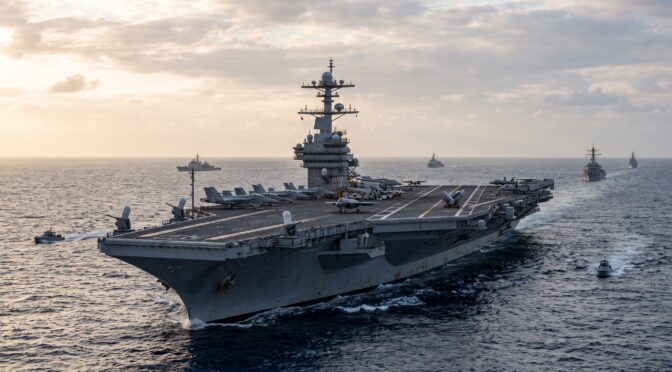
Since the conclusion of the Second World War, the aircraft carrier has served as the primary instrument of American global power projection. For decades, the carrier strike group operated with relative impunity, serving as a sovereign, mobile airfield capable of delivering overwhelming kinetic force across the globe. However, the maturation of precision long-range fires, artificial intelligence, and autonomous unmanned systems has fundamentally altered the maritime strategic environment. Adversarial anti-access/area-denial (A2/AD) architectures, combined with the proliferation of low-cost, attritable drone swarms, have introduced unprecedented vulnerabilities to large surface combatants. This paradigm shift has prompted vigorous debate regarding the potential obsolescence of the carrier strike group, forcing military planners to reevaluate the mechanisms of naval deterrence.
A rigorous analysis of current threat vectors, wargame simulations, and evolving defensive technologies indicates that while the traditional conception of the aircraft carrier as an invulnerable, independent striking force is outdated and strategically dangerous, the hull form itself is not obsolete. Instead, the projection of American maritime power is undergoing a necessary structural evolution. The cost-exchange crisis observed in recent littoral conflicts demonstrates the mathematical impossibility of defeating high-volume, low-cost drone swarms with finite, multi-million-dollar kinetic interceptors. Consequently, the aircraft carrier must transition from operating as a standalone offensive spearhead into a highly defended, mobile command-and-control node deeply integrated within a distributed network, often referred to as a “kill web.”
To ensure survivability and lethality, naval force design is rapidly pivoting toward hybrid architectures. This involves deepening the defensive magazine through the deployment of ship-powered directed energy weapons and reusable interceptors, while simultaneously projecting “affordable mass” through the deployment of thousands of attritable autonomous systems. This report provides an in-depth analysis of the specific threats rendering legacy carrier operations highly vulnerable, the integration of airborne and subsea drone warfare into maritime strategy, and the critical strategic recalibration required to maintain maritime dominance in the coming decades.
2. The Deteriorating Survivability of the Carrier Strike Group and A2/AD Architectures
The strategic calculus governing carrier deployment has been severely disrupted by the democratization of precision strike capabilities and the sheer scale of adversarial missile production. The foundational vulnerability of the aircraft carrier lies in its massive physical, thermal, and electromagnetic signature, making it susceptible to detection and targeting over vast geographic distances.
The Carrier Killer Missile Architecture
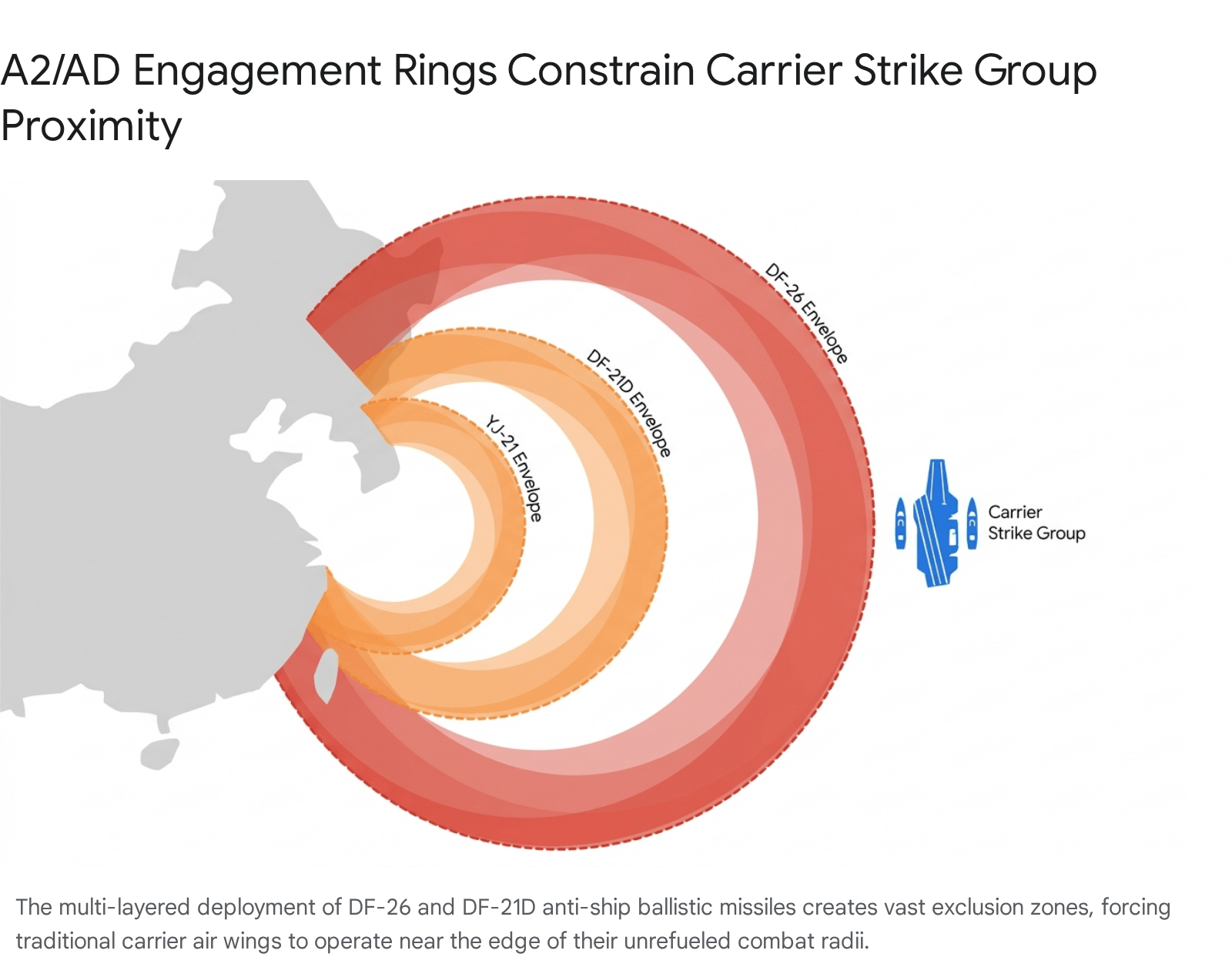
Peer competitors have constructed a multi-layered, overlapping anti-ship missile architecture specifically engineered to push American carrier strike groups beyond their effective operational ranges.1 This network is defined by land-based and sea-based ballistic and hypersonic systems capable of penetrating advanced Aegis air and missile defense systems.
| System Designation | Classification | Estimated Range | Terminal Speed | Launch Platform | Primary Target Profile |
| DF-26 (“Guam Express”) | Intermediate-Range Ballistic Missile (IRBM) | 4,000–4,500 km | Mach 10–18 | Road-mobile TEL | Carriers, large surface vessels, land infrastructure |
| DF-21D (CSS-5 Mod 5) | Anti-Ship Ballistic Missile (ASBM) | 1,500–1,800 km | Mach 10+ | Road-mobile TEL | Carrier Strike Groups |
| YJ-21 / YJ-20 | Hypersonic Anti-Ship Missile | 1,000–1,500 km | Mach 10+ | Shipborne VLS (Type 055 Cruiser) | Carrier Strike Groups, large surface combatants |
The DF-21D represents the world’s first land-based anti-ship ballistic missile explicitly designed to target moving naval assets.1 Utilizing inertial navigation updated by satellite and terminal radar or electro-optical guidance, the DF-21D integrates over-the-horizon targeting cued by a multi-source network of satellites, maritime patrol aircraft, submarines, and surface vessel radar tracks.1 Its conventional maneuvering reentry vehicle allows for terminal trajectory corrections against targets moving at speeds up to thirty knots, posing a severe threat to maneuvering aircraft carriers.1
The DF-26 extends this sea-denial capability even further, introducing intermediate-range threats that can reach as far as Guam, the Philippine Sea, and parts of the Indian Ocean.1 Capable of carrying either conventional or nuclear payloads, the DF-26 utilizes multi-warhead capabilities to saturate shipborne point defenses.1 Furthermore, the YJ-21 represents a particularly acute threat due to its integration directly into the surface fleet, specifically on the Type 055 cruiser.1 Its ship-launched capability and hypersonic terminal velocity compress the defensive intercept window from minutes to mere seconds, forcing carriers to operate at extreme standoff distances that degrade the unrefueled combat radius of their embarked air wings.1
Wargaming Outcomes and Industrial Attrition
The vulnerability of large surface combatants to these precision fires is starkly outlined in simulation data. In a series of twenty-four wargame iterations conducted by the Center for Strategic and International Studies (CSIS) simulating a conflict in the Taiwan Strait, the outcomes for legacy naval platforms were highly attritional.2 The simulations consistently projected the loss of two American aircraft carriers and between nine to twenty major surface ships, alongside the loss of 200 to 500 combat aircraft, within the opening weeks of the conflict.2
The strategic shock of these projected losses is magnified by a stark asymmetry in industrial reconstitution capabilities. While the wargames anticipate severe losses for adversarial forces—including the loss of ninety percent of the opposing amphibious fleet and fifty-two other major warships—the capacity to recover differs dramatically.2 The opposing force benefits from a vastly more productive commercial shipbuilding program, operating thirteen primary naval shipyards that provide a robust foundation for rapid wartime recovery.2
Conversely, the timeline to rebuild a lost American supercarrier is estimated to be “essentially never” due to severe industrial base atrophy, and the replacement of other major surface combatants would require decades.2 The U.S. Navy’s current fleet model struggles to scale; as of May 2026, the fleet sits at 291 ships, with the Congressional Budget Office estimating a drop to 283 ships by 2027.3 Relying on exquisite, capital-intensive platforms that cannot be rapidly replaced constitutes a critical strategic vulnerability.
3. The Magazine Depth Dilemma and the Cost-Exchange Crisis
While hypersonic and ballistic missiles represent the high-end threat to carrier strike groups, the proliferation of cheap unmanned aerial systems introduces the secondary, highly attritional threat of swarm saturation. A mathematical reality known as “magazine depth” strictly governs modern naval defense.4 The defensive capability of a surface action group is ultimately finite, constrained by the physical number of launch cells available.
The Limitations of the Vertical Launch System
An Arleigh Burke-class guided-missile destroyer, which serves as the primary escort vessel of the carrier strike group, typically fields 90 to 96 Mk 41 vertical launch system (VLS) cells, while Ticonderoga-class cruisers field 122 cells.4 Because these cells must be divided among offensive land-attack cruise missiles, anti-submarine rockets, and layered air defense interceptors, a ship facing a massive, coordinated drone swarm risks running out of ammunition before it runs out of targets.4 Even close-in weapon systems, such as defensive cannons capable of firing thousands of rounds per minute, can run dry in a matter of seconds when engaged in sustained defensive operations.5
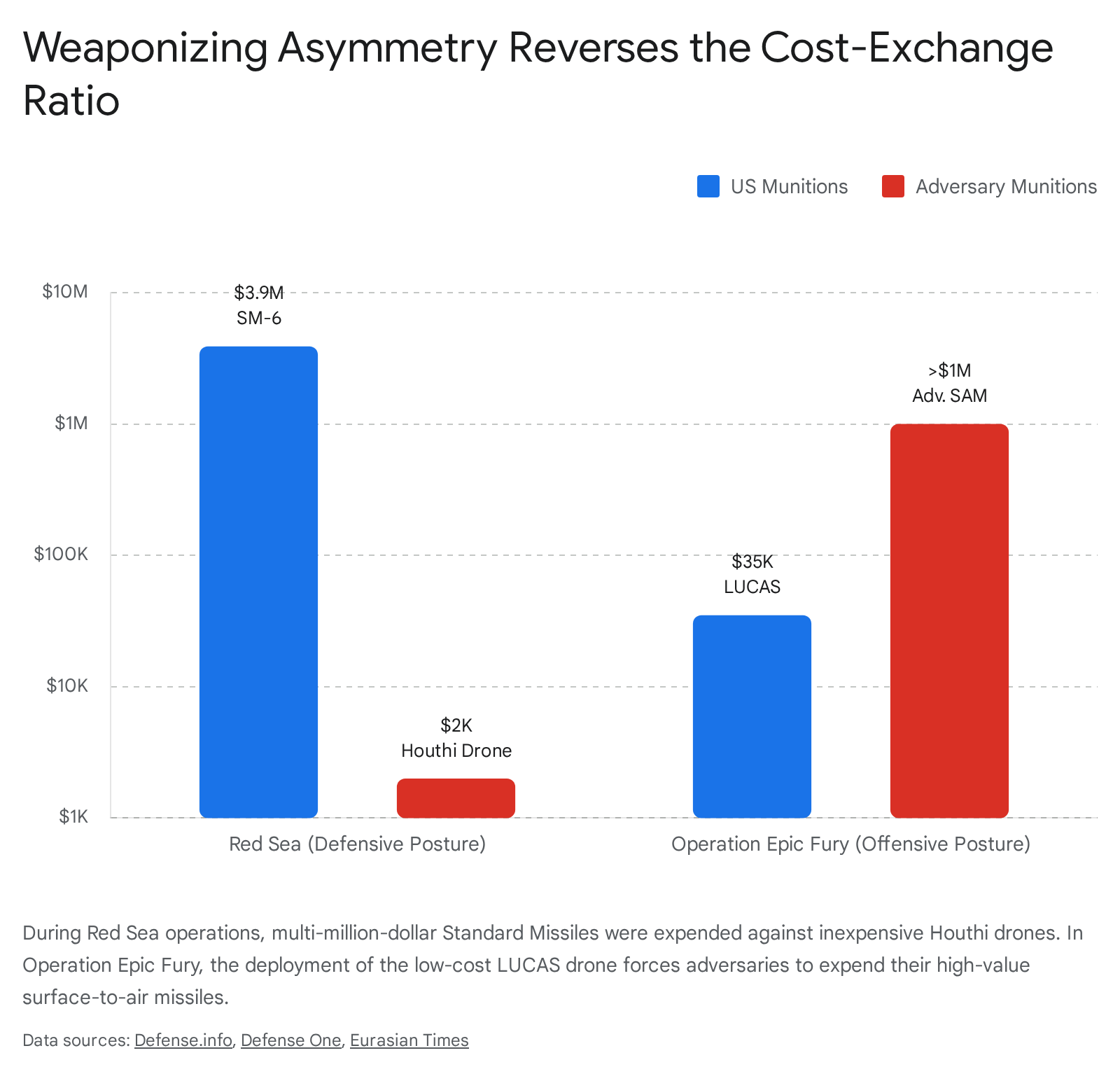
This dynamic creates a deeply unsustainable cost-exchange ratio. During the defense of commercial shipping in the Red Sea, naval forces utilized highly advanced interceptors to neutralize one-way attack drones.6 Aegis destroyers successfully intercepted threats, but they relied on multi-million-dollar interceptors to shoot down drones costing as little as $2,000.6
The Economics of the Linear Kill Chain
The operational architecture of early Red Sea defense was a ship-centric, linear defensive kill chain. Due to the uncertainty of the threat environment and the immediate need to protect human lives and capital assets, commanders often defaulted to the most capable interceptors available. The specific interceptors fired by the Navy included the Standard Missile-2 (SM-2) at approximately $2 million per unit, the Standard Missile-6 (SM-6) at $3.9 million per unit, and the Standard Missile-3 (SM-3), which costs between $9.7 million and $27.9 million per variant.6
While tactically successful in defending the fleet in the short term, this linear kill chain threatens to rapidly bankrupt finite munitions stockpiles, exposing the carrier to follow-on attacks from heavier anti-ship cruise and ballistic missiles.6 Because high-end interceptors require years to manufacture due to complex supply chains and limited solid rocket motor production capacity, the military found itself tactically winning individual engagements but strategically losing depth.6
4. The Autonomous Swarm and Algorithmic Warfare
The threat to the aircraft carrier increasingly features the integration of autonomous swarming logic. The rapid commercialization of drone technology has erased the historical barrier to entry for precision strike capabilities, allowing both peer competitors and non-state actors to challenge naval supremacy.7
Algorithmic Swarm Coordination and AI Integration
Adversarial strategists are explicitly developing tactics designed to saturate carrier strike groups with swarms of multi-mission unmanned aerial vehicles. Recent publications from Chinese military researchers detail the development of artificial intelligence algorithms—such as the HG-STR system—designed to allow fixed-wing drone swarms to operate autonomously in highly jammed, communication-denied environments.8 In simulations, these advanced swarms construct dynamic battlefield graphs that treat jamming sources, terrain features, and targets as interconnected nodes, allowing the swarm to adapt its tactics and make inferences without human intervention, reportedly achieving a 100 percent kill rate in simulation environments.8
While simulation success does not guarantee real-world battlefield performance, the strategic implication is profound. Future operators may only need to set broad mission objectives, while AI systems execute the specific tactical maneuvers.8 This shifts the burden of defense onto the carrier strike group, forcing defenders to counter hundreds of independently reasoning drones.
Leader-Follower Swarm Architectures
Detailed attack profiles propose utilizing sophisticated “leader-follower” swarming modes to maximize the probability of penetrating Aegis defenses.9 In this architecture, a designated scout missile or high-altitude drone relays targeting data to a massive, low-flying swarm of subsonic stealth missiles and cheap decoy drones.9 The swarm operates collaboratively, dynamically adjusting its flight paths based on the data provided by the leader.9
If the leader is intercepted by the carrier’s combat air patrol or the escorting destroyers, the swarm is programmed to dynamically reassign the leader role to another surviving node, ensuring the continuous saturation of radar tracking systems.9 The objective is to deplete defense ammunition and overwhelm the combat system’s processing capabilities, thereby leaving the carrier exposed to subsequent salvos.9
5. Subsea Drone Warfare and the Loss of Sanctuary
The maritime domain is concurrently undergoing a revolution beneath the waves through the deployment of unmanned underwater vehicles (UUVs) and unmanned surface vessels (USVs). These autonomous systems have fundamentally altered the geography of naval risk, erasing the traditional distinction between contested blue water and safe littoral harbors.
Shattering the Safe Harbor Assumption
Historically, naval doctrine assumed that ports and highly defended coastal waters offered sanctuary for major surface combatants to rearm and undergo maintenance. The development of subsea drones has shattered this assumption. In a paradigm-shifting operation on December 15, 2025, Ukrainian forces utilized a “Sub Sea Baby” underwater drone to bypass port defenses and strike an Improved Kilo-class submarine at the Russian naval base in Novorossiysk.10
The ability of a low-cost, semi-autonomous underwater vehicle to navigate harbor defenses and inflict a constructive total loss on a $400 million stealth submarine underscores a severe, persistent threat to American carriers during littoral transits.12 Subsea drones possess a naturally low acoustic and visual signature, making them inherently difficult to detect, forcing naval forces to maintain continuous anti-submarine warfare screening even in ostensibly secure waters.13
The Rise of Unmanned Surface Vessels as Strike Platforms
Lessons derived from the Black Sea demonstrate that smaller surface drones can also effectively execute deep strikes.14 Unmanned surface vessels initially deployed as simple one-way kamikaze boats have rapidly evolved. For example, Ukraine has modified USVs to carry and launch aerial drones, effectively creating autonomous micro-carriers that extend the reach of aerial strikes.10
Furthermore, these platforms have been integrated with anti-aircraft missiles to counter airborne threats. Ukrainian forces utilized Magura V5 vessels to destroy Russian helicopters at sea, proving that relatively inexpensive unmanned boats can successfully threaten much more valuable manned aircraft.10 Due to constant advancements in operational range and satellite communications, USVs can launch payloads entirely out of the reach of shore-based surveillance systems, denying sea control to traditional naval fleets.10
6. Revolutionizing Carrier Defense: Deepening the Magazine
To ensure survival against swarm saturation and hypersonic threats, naval architecture is shifting away from an exclusive reliance on expensive, limited-quantity kinetic interceptors. The defensive evolution focuses on creating an “infinite magazine” through the integration of directed energy weapons and fielding lower-cost, reusable interception systems.
Directed Energy Weapons: The Infinite Magazine
The most significant advancement in carrier point defense is the operational fielding of high-energy laser systems. While earlier naval lasers required permanent integration into a ship’s hull, modern systems have achieved modularity.15
The AeroVironment LOCUST Laser Weapon System represents a critical breakthrough. Tested aboard the Nimitz-class aircraft carrier USS George H.W. Bush in October 2025, the LOCUST is a palletized, 20 to 35-kilowatt-class High Energy Laser.16 The system’s roll-on, roll-off capability allows the Navy to quickly load the system onto a ship via forklift and initiate operations immediately, without complex ship modifications.17
Crucially, when deployed on a ship, the LOCUST system can draw directly from the nuclear carrier’s electrical grid, marrying an essentially unlimited power source with an infinite directed energy magazine.17 The cost per engagement is reduced from millions of dollars to the mere cost of the electricity required to generate the beam.18 During its deployment on the USS George H.W. Bush, the system demonstrated a 100 percent kill rate, neutralizing 17 consecutive target drones.16 By deploying systems like LOCUST and the High-Energy Laser with Integrated Optical-Dazzler and Surveillance (HELIOS), carriers and escorts can neutralize Group 1 to 3 drones efficiently.19
Next-Generation Kinetic Interceptors
To bridge the gap between directed energy and multi-million-dollar Standard Missiles, the Navy is procuring advanced, low-cost kinetic interceptors.
The Anduril Roadrunner-M is a jet-powered, loitering interceptor drone costing in the low hundreds of thousands of dollars.20 If a threat is identified, the Roadrunner-M engages; if no threat materializes, it can return to its base station for reuse.20 Similarly, Raytheon’s Coyote interceptors provide persistent counter-swarm capabilities. In a major milestone, the USS Bainbridge became the first U.S. Navy destroyer to operationally deploy Coyote interceptor launchers during NATO’s Neptune Strike exercise in July 2025.21
To handle advanced ballistic threats more efficiently, the Navy is integrating the Army’s Patriot PAC-3 Missile Segment Enhancement (MSE) into the Mk 41 VLS.22 Valued at approximately $5.3 million per unit, the PAC-3 MSE’s highly agile hit-to-kill capability provides an optimized defense against maneuvering ballistic targets in the terminal phase.23 The Navy has requested 405 PAC-3 MSE missiles in its fiscal year 2027 budget, signaling a major commitment to diversifying its defensive arsenal.22
| Defensive System Category | System Designation | Estimated Cost Per Engagement | Primary Threat Target | Reusability / Magazine Depth |
| Directed Energy (Laser) | LOCUST P-HEL | < $10 (Electricity Cost) | Group 1-3 Drones, Swarms | Infinite (Ship Powered) |
| Loitering Interceptor | Coyote / Roadrunner-M | Low hundreds of thousands | Kamikaze Drones, Swarms | Reusable if unexploded |
| Point Defense Interceptor | ESSM (Evolved Sea Sparrow) | ~$1M – $2M | Anti-Ship Cruise Missiles | Finite (Quad-packed in VLS) |
| Ballistic Interceptor | PAC-3 MSE | ~$5.3M | Terminal Ballistic Missiles | Finite (Single packed in VLS) |
| High-End Interceptor | SM-3 / SM-6 | $3.9M – $27.9M | Exo-atmospheric / Long-Range | Finite (Single packed in VLS) |
Non-Kinetic Electronic Warfare
Defensive architectures are also being hardened through advanced electronic warfare. The Surface Electronic Warfare Improvement Program (SEWIP) Block 3 equips Aegis destroyers with active electronic attack capabilities across a wide frequency range.25 Utilizing an Active Electronically Scanned Array (AESA), SEWIP Block 3 can disrupt the guidance systems of incoming missiles, spoof targeting radars, and sever the command links of drone swarms.25
7. The Offensive Evolution: Precise Mass and the Kill Web
The ultimate defense of the aircraft carrier lies in a robust, distributed offense. Legacy naval strategy relied on a linear kill chain wherein a single expensive platform was responsible for sensing, tracking, and prosecuting targets.6 The new paradigm relies on a highly distributed “kill web” and the doctrine of “affordable mass”—the ability to replace combat losses as fast as they are likely to occur.3
The Weaponization of Asymmetry and the LUCAS Drone
Precise mass is defined as the intersection of commercial manufacturing, advancements in artificial intelligence, and precision guidance technology, enabling actors to generate strike capabilities at lower costs and overwhelming scale.3
This adaptation culminated in the development of the Low-cost Unmanned Combat Attack System (LUCAS). Developed by SpektreWorks and reverse-engineered from the Iranian Shahed-136, the military leveraged rapid prototyping tools to field the system in months. The resulting LUCAS drone costs approximately $35,000—a fraction of the cost of traditional cruise missiles like the $2.5 million Tomahawk—while maintaining a 500-mile range and modular payload capacity.
Flipping the Cost Equation: Operation Epic Fury
The strategic value of affordable mass was validated during Operation Epic Fury, a campaign initiated on February 28, 2026, targeting Iranian military infrastructure. Central Command deployed waves of LUCAS drones launched from various platforms, fundamentally inverting the cost equation that plagued earlier Red Sea operations.
Rather than using multi-million-dollar interceptors to shoot down cheap drones, the U.S. launched swarms of $35,000 LUCAS drones to force the adversary to activate their air defense networks and expend highly expensive surface-to-air missiles. Once the adversary’s defense nodes were exposed and depleted of ammunition by the attritable drone wave, high-end U.S. stealth aircraft and cruise missiles exploited the gaps to destroy the infrastructure.6
Scaling Affordable Mass: The Drone Dominance Initiative
To sustain this strategy long-term, the Department of Defense is scaling up its domestic industrial ecosystem. Under the Drone Dominance Initiative, the Pentagon is issuing massive demand signals to non-traditional manufacturers, placing initial orders for 30,000 small, one-way attack drones at an expected initial cost of $5,000 per unit, with the goal of reducing the unit price to $2,000.6 The objective is to scale production to hundreds of thousands of units by 2027, establishing an industrial base capable of sustaining affordable mass.6
8. Manned-Unmanned Teaming (MUM-T) and the Future Air Wing
If the aircraft carrier is to remain relevant in heavily contested environments, its embarked air wing must undergo a radical transformation. The integration of Manned-Unmanned Teaming (MUM-T) is the cornerstone of this evolution.26
The MQ-25 Stingray and Range Extension
The primary limitation of modern carrier strike fighters is their relatively short unrefueled combat radius, which forces the carrier to operate perilously close to A2/AD threat rings. The MQ-25 Stingray is explicitly designed to address this vulnerability. As the world’s first operational, carrier-based unmanned aircraft, its primary mission is aerial refueling.26
By offloading the tanking mission from crewed Super Hornets, the MQ-25 frees up fighter inventory for dedicated strike missions and significantly extends the effective operational range of the air wing.26 Operating seamlessly with state-of-the-art sensors, the Stingray serves as the critical pathfinder for integrating autonomous systems into the carrier deck, laying the foundation for the Navy’s goal of achieving a sixty percent or more uncrewed carrier air wing.27
Collaborative Combat Aircraft
Building upon the MQ-25, future carrier air wings will incorporate Collaborative Combat Aircraft (CCAs).3 These uncrewed drones are designed to operate alongside crewed fighter jets at a significantly lower cost. CCAs will launch from the carrier to act as loyal wingmen, flying ahead of crewed fighters to provide early warning sensing, conduct electronic warfare, and deliver weapons deep within contested airspace.3 By substituting expensive manned platforms with attritable CCAs for the most dangerous missions, the carrier can project power without risking irreplaceable human capital.
9. Force Structure, Shipbuilding, and Fleet Design Strategies
The transition to a fleet architecture defined by affordable mass requires a fundamental overhaul of defense procurement and maritime force structure.
The MUSV Marketplace and Distributed Lethality
To distribute lethality away from the carrier deck and overcome shipyard backlogs, the Navy is fielding Medium Unmanned Surface Vessels (MUSVs) as collaborative combat nodes.3 By eliminating human accommodations, these autonomous ships drastically reduce construction costs.3
Because autonomous ships lack human support infrastructure, their simplified hulls can be constructed using modular techniques at smaller shipyards and commercial yacht builders.3 For example, the DARPA-developed Defiant (USX-1) MUSV, measuring 180 feet and weighing 240 metric tons, costs approximately $25 million for the core hull and is designed for extended voyages without any crew.3 Expanding naval construction into the 86 active smaller shipyards bypasses the severe delays plaguing major shipyards.3
The Hedge Strategy and Unmanned Undersea Vehicles
The rigid structure of the Carrier Strike Group is yielding to a more flexible organizational doctrine. The Chief of Naval Operations’ “Hedge Strategy” recognizes that finite carrier inventories cannot meet all global demands simultaneously.28
By scaling up the use of MUSVs and Unmanned Undersea Vehicles (UUVs), combatant commanders can assemble customized formations to execute specific missions without requiring the presence of a supercarrier.28 In June 2026, the USS Theodore Roosevelt Carrier Strike Group deployed alongside the Seahawk MUSV, transitioning these platforms from experimental prototypes into active, operational fleet assets.28
Furthermore, the undersea domain is being bolstered by platforms like the Boeing Orca Extra Large Uncrewed Undersea Vehicle (XLUUV).29 The Orca, operating with a diesel-electric hybrid propulsion system, boasts a 12,000-kilometer range and enables months-long missions, providing unprecedented undersea autonomy.29
10. Strategic Conclusions
Have military drones rendered America’s aircraft carriers obsolete? The empirical evidence suggests that they have not rendered the hull form obsolete, but they have permanently invalidated the traditional doctrinal mindset that views the carrier as an independent, invulnerable fortress. Traditional thinking that relies exclusively on finite, multi-million-dollar interceptors to defend against saturation attacks, or expects carriers to operate unmolested inside established anti-access/area-denial threat rings, is now entirely outdated.
The projection of American maritime power with a carrier is not an illusion; it is undergoing a metamorphosis. To survive, the aircraft carrier must evolve from a frontline brawler into the central nervous system of a highly distributed kill web. By offloading risk to attritable autonomous systems, utilizing collaborative combat vessels to distribute missile magazines, and protecting the carrier deck with ship-powered directed energy weapons, the carrier strike group can maintain its strategic relevance. Future naval dominance will rely on “affordable mass” and the sheer volume, speed, and connectivity of the uncrewed swarm it commands.
11. Appendix: Methodology and Data Sources
The analysis provided in this report synthesizes a broad spectrum of open-source intelligence, strategic defense directives, wargame data, and procurement documents to assess the survivability and evolution of the U.S. aircraft carrier in the modern threat environment.
The evaluation of adversarial Anti-Access/Area Denial capabilities relied on technical specifications regarding the ranges, terminal velocities, and launch platforms of the DF-21D, DF-26, and YJ-21 missile systems.1 The strategic implications of these capabilities were contextualized using the outcomes of wargame iterations conducted by the Center for Strategic and International Studies (CSIS), which provided vital data on projected asset attrition and the severe industrial constraints surrounding the reconstitution of major surface combatants.2
The assessment of the “cost-exchange” crisis and the shift toward “affordable mass” was informed by operational data from recent combat deployments. This included the financial disparities observed during Red Sea defensive operations and the subsequent offensive deployment of the Low-cost Unmanned Combat Attack System (LUCAS) during Operation Epic Fury. Advancements in directed energy weapons and non-kinetic defenses were evaluated based on the live-fire testing of the AeroVironment LOCUST system aboard the USS George H.W. Bush, the outfitting of the USS Bainbridge with Coyote interceptors, and the integration parameters of the SEWIP Block 3 and PAC-3 MSE.15 The structural shift in naval procurement toward attritable, autonomous systems was analyzed through current initiatives, including the Drone Dominance Initiative and the operational deployment of the Seahawk MUSV.6
Please share the link on Facebook, Forums, with colleagues, etc. Your support is much appreciated and if you have any feedback, please email us in**@*********ps.com. If you’d like to request a report or order a reprint, please click here for the corresponding page to open in new tab.
Sources Used
- China’s Anti-Ship Ballistic Missiles: DF-21D, DF-26 & YJ-21 Carrier …, accessed July 5, 2026, https://thedefensewatch.com/naval-maritime/naval-strategy-maritime-security/chinas-carrier-killer-arsenal/
- So What? Reassessing the Military Implications of Chinese Control …, accessed July 5, 2026, https://tnsr.org/2025/06/so-what-reassessing-the-military-implications-of-chinese-control-of-taiwan/
- The Navy Needs Precise Mass and Here Is How to Get There, accessed July 5, 2026, https://warontherocks.com/the-navy-needs-precise-mass-and-here-is-how-to-get-there/
- How Aircraft Carriers Are Defended – Military Machine, accessed July 5, 2026, https://militarymachine.com/how-aircraft-carriers-are-defended
- Can a single destroyer really handle thousands of drones attacking at once, or would it stand no chance against such a swarm? – Quora, accessed July 5, 2026, https://www.quora.com/Can-a-single-destroyer-really-handle-thousands-of-drones-attacking-at-once-or-would-it-stand-no-chance-against-such-a-swarm
- From Red Sea Defense to Epic Fury: How the U.S. Flipped the …, accessed July 5, 2026, https://defense.info/re-shaping-defense-security/2026/03/from-red-sea-defense-to-epic-fury-how-the-u-s-flipped-the-drone-cost-equation/
- The Navy and Marine Corps Need to Prepare for the Swarm of the Future – War on the Rocks, accessed July 5, 2026, https://warontherocks.com/the-navy-and-marine-corps-must-plan-for-the-swarm-of-the-future/
- Chinese Scientists Unveil Drone Swarm Algorithm Claiming 100% Kill Rate – Ground News, accessed July 5, 2026, https://ground.news/daily-briefing/chinese-scientists-unveil-drone-swarm-algorithm-claiming-100-kill-rate
- China’s plan to swarm US carriers from 3,000km away – Asia Times, accessed July 5, 2026, https://asiatimes.com/2026/06/chinas-plan-to-swarm-us-carriers-from-3000km-away/
- Ukraine is launching strike-drones from everything – including Black Sea robo-boats, accessed July 5, 2026, https://www.defensenews.com/global/europe/2026/07/01/ukraine-is-launching-strike-drones-from-everything-including-black-sea-robo-boats/
- Ukraine strikes Russian submarine with ‘Sub Sea Baby’ drone – Naval News, accessed July 5, 2026, https://www.navalnews.com/naval-news/2025/12/ukraine-strikes-russian-submarine-with-sub-sea-baby-drone/
- Ukraine’s ‘Sub Sea Baby’ Drones Burn Russia’s $400 Million Submarine: How SBU Flipped Naval Warfare? – YouTube, accessed July 5, 2026, https://www.youtube.com/watch?v=cq6tFpwUN-I
- Autonomous Vehicles in Support of Naval Operations (2005) – National Academies of Sciences, Engineering, and Medicine, accessed July 5, 2026, https://www.nationalacademies.org/read/11379/chapter/7
- Maritime Domain Lessons from Russia-Ukraine | Conflict in Focus – CSIS, accessed July 5, 2026, https://www.csis.org/analysis/maritime-domain-lessons-russia-ukraine-conflict-focus
- LOCUST laser weapon scores 100% kill rate in US Navy trials – New Atlas, accessed July 5, 2026, https://newatlas.com/military/aerovironment-locust-laser-weapon-us-navy-trials/
- Why aircraft carriers are the best (and worst) place for laser weapons – Military Times, accessed July 5, 2026, https://www.militarytimes.com/industry/techwatch/2026/04/28/why-aircraft-carriers-are-the-best-and-worst-place-for-laser-weapons/
- AV Successfully Demonstrates LOCUST Laser Weapon System …, accessed July 5, 2026, https://www.avinc.com/2026/04/21/av-successfully-demonstrates-locust-laser-weapon-system-aboard-uss-george-h-w-bush/
- GOVERNMENT PERSPECTIVE: Directed Energy in Air Base Defense Can Save the Arsenal, accessed July 5, 2026, https://www.nationaldefensemagazine.org/articles/2025/8/11/government-perspective-directed-energy-in-air-base-defense-can-save-the-arsenal
- US Navy Deploys Its HELIOS High-Energy Laser System In Operation Fury Against Iran | News18 – YouTube, accessed July 5, 2026, https://www.youtube.com/watch?v=tYuAFf0pAKY
- Roadrunner Reusable Anti-Air Interceptor Breaks Cover – TWZ, accessed July 5, 2026, https://www.twz.com/roadrunner-reusable-anti-air-interceptor-breaks-cover
- Naval Defense Revolution: USS Bainbridge Becomes First Destroyer Armed with Advanced Counter-Drone Systems – Americans for a Stronger Navy, accessed July 5, 2026, https://strongernavy.org/naval-defense-revolution-uss-bainbridge-becomes-first-destroyer-armed-with-advanced-counter-drone-systems/
- Patriot PAC-3 Missiles To Arm Navy Arleigh Burke Class Destroyers – TWZ, accessed July 5, 2026, https://www.twz.com/land/patriot-pac-3-missiles-to-arm-navy-arleigh-burke-class-destroyers
- ‘Cheap’ Patriot Interceptor Costing Under $1 Million Now Being Sought By Army – TWZ, accessed July 5, 2026, https://www.twz.com/land/cheap-patriot-interceptor-costing-under-1-million-now-being-sought-by-army
- U.S. Navy Orders 405 Patriot Missiles for Ships, accessed July 5, 2026, https://militarnyi.com/en/news/u-s-navy-orders-405-patriot-missiles-for-ships/
- American Destroyer Packed New Electronic Warfare System During Black Sea Mission, accessed July 5, 2026, https://www.twz.com/19012/american-destroyer-packed-new-electronic-warfare-system-during-black-sea-mission
- Unmanned Carrier Aviation – MQ-25 – NAVAIR, accessed July 5, 2026, https://www.navair.navy.mil/product/Unmanned-Carrier-Aviation
- MQ-25 Stingray Demonstrator Goes Aboard USS Nimitz For 250th U.S. Anniversary Celebrations – TWZ, accessed July 5, 2026, https://www.twz.com/air/mq-25-stingray-demonstrator-goes-aboard-uss-nimitz-for-250th-u-s-anniversary-celebrations
- A Navy carrier is about to deploy with a robot ship. Could it change …, accessed July 5, 2026, https://breakingdefense.com/2026/06/navy-carrier-theodore-roosevelt-drone-seahawk-deployment/
- XLUUV – Boeing, accessed July 5, 2026, https://www.boeing.com/defense/autonomous-and-unmanned-systems/xluuv
- US Navy’s 12,000km Autonomous Submarine Drone: The Orca XLUUV – YouTube, accessed July 5, 2026, https://www.youtube.com/watch?v=UPf9VAZBADQ