1. Executive Summary
The maritime battlespace is undergoing a profound structural evolution, driven by a growing reliance on the physical infrastructure that underpins the global digital and energy economies. As geopolitical competition intensifies, the world’s oceans are no longer viewed merely as transit mediums for surface fleets or volumetric spaces for submarine stealth. They are now recognized as host to vital, highly vulnerable static assets situated on the ocean floor. This reality has catalyzed a critical doctrinal debate among naval strategists regarding whether subsea and seabed warfare should be classified as identical warfighting domains, or whether they demand distinct tactical, operational, and strategic frameworks.
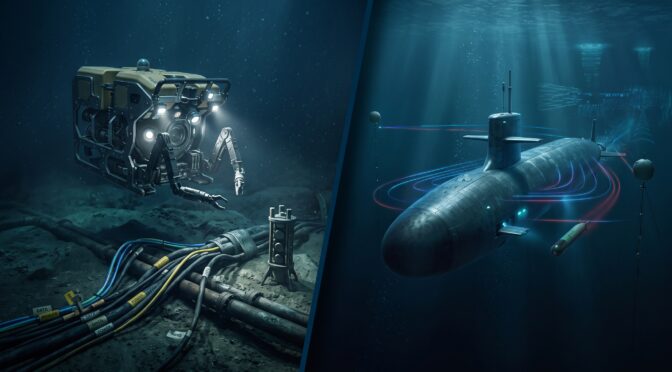
The analysis indicates that while subsea (or undersea) warfare and seabed warfare share a contiguous physical environment, they must be viewed as distinct but deeply interconnected strategic disciplines. Undersea Warfare (USW) is primarily volumetric, encompassing the entire water column from the surface to the ocean floor. It is traditionally maneuver-centric, focusing on Anti-Submarine Warfare (ASW), Mine Warfare (MIW), and the denial or control of maritime transit corridors.1 Seabed Warfare (SSW), conversely, is benthic and infrastructure-centric. It refers to military and conflict activities conducted explicitly on, within, or beneath the seabed, focusing on the protection, exploitation, or destruction of fixed critical undersea infrastructure (CUI), such as telecommunications cables, energy pipelines, and bottom-moored sensor networks.3
This divergence in operational focus dictates entirely different strategic approaches. Defensive SSW strategies must grapple with the sheer scale and immobility of infrastructure that spans international waters, navigating complex public-private ownership dynamics and ambiguous legal jurisdictions under the United Nations Convention on the Law of the Sea (UNCLOS).5 Offensive SSW strategies leverage grey zone tactics, utilizing plausible deniability, shadow fleets, and low-cost sabotage to inflict high-impact economic and informational disruptions without crossing the threshold of conventional armed conflict.5 Furthermore, strategic foresight initiatives highlight the potential for the seabed to serve as a platform for pre-positioned, bottom-moored conventional strike weapons.8
Central to both the differentiation and the execution of these strategies is the rapid proliferation of uncrewed underwater vehicles (UUVs). Advances in deep-sea robotics, autonomous navigation, and specialized sensors are effectively opening the deep ocean to sustained military operations.9 Militaries are racing to deploy Remotely Operated Vehicles (ROVs), Autonomous Underwater Vehicles (AUVs), and Large Displacement Unmanned Underwater Vehicles (LDUUVs) to achieve presence and lethality at extreme depths.11
This report delivers a detailed assessment of the subsea and seabed warfare domains. It explores the physical, legal, and doctrinal distinctions between the two, evaluates current offensive and defensive strategies employed by major global powers, and provides an in-depth examination of the technological capabilities—specifically military drones and uncrewed architecture—that are actively reshaping the balance of power in the deep ocean.
2. Conceptual Divergence: Volumetric versus Benthic Domains
To formulate effective naval strategy, doctrine must accurately reflect the physical, environmental, and operational realities of the specific battlespace. Historically, naval strategy has treated the environment beneath the ocean surface as a single, homogenous domain. However, the maturation of deep-ocean technologies, coupled with the proliferation of seabed infrastructure, necessitates a rigid doctrinal distinction between Subsea/Undersea Warfare (USW) and Seabed Warfare (SSW). Operating in the water column requires entirely different platforms, sensors, and physical considerations than operating on the ocean floor.
The Volumetric Nature of Undersea Warfare (USW)
Undersea Warfare is an expansive, multi-domain extension of traditional naval operations aimed at achieving control over the underwater battlespace.1 It encompasses the entirety of the water column, extending from just below the sea surface down to the ocean floor. USW is fundamentally dynamic, maneuver-oriented, and centered on the prosecution of mobile targets. Its core mission sets include Anti-Submarine Warfare (ASW), offensive and defensive Mine Warfare (MIW), covert intelligence, surveillance, and reconnaissance (ISR), and the insertion of Special Operations Forces (SOF).2
In USW, the primary tactical objective is the detection, tracking, and neutralization of mobile adversarial platforms—chiefly crewed submarines, UUVs, and surface combatants. The physical properties of the water column govern USW tactics and sensor deployment. Strategists and hydrographers must meticulously account for environmental variables such as temperature gradients, thermoclines, salinity variations, and atmospheric pressure.1 These variables create specific propagation paths for acoustic waves. For instance, direct path propagation connects two points via the shortest route without reflection, offering low attenuation, while surface ducts trap acoustic waves near the surface due to atmospheric heating and wind agitation.1
Because water-column properties vary with time, the environment introduces continuous fluctuations and uncertainty in predicting acoustic propagation.13 Success in USW, therefore, relies heavily on acoustic superiority, passive and active sonar analysis, hydrodynamic stealth, and the ability to maneuver fluidly through these shifting thermal layers to gain a tactical advantage over moving targets.13 It is an environment defined by movement, acoustic detection, and counter-detection.
The Benthic Focus of Seabed Warfare (SSW)
Seabed Warfare is an emerging, distinct subset of maritime operations focused strictly on the benthic zone—the ecological region at the lowest level of a body of water, including the sediment surface and some sub-surface layers.3 SSW involves operations conducted explicitly on, within, or anchored to the seabed.3
While USW focuses on denying freedom of maneuver to enemy vessels, SSW focuses on the manipulation, protection, exploitation, or destruction of static infrastructure and resources. The defining characteristic of SSW is geographic fixedness. Critical infrastructure, such as submarine communication cables (which carry the vast majority of intercontinental data traffic) and offshore energy pipelines, cannot be maneuvered to avoid an incoming threat.3 Consequently, SSW operations involve highly localized, precision interventions at extreme depths—often thousands of meters below the surface.
At these depths, immense hydrostatic pressure, zero ambient light, and complex topography render traditional USW tactics and fast-attack platforms largely ineffective.9 SSW includes the deployment of bottom-moored sensor grids, deep-ocean logistics caches, and specialized surveying equipment.8 The engineering requirements for SSW platforms prioritize extreme depth tolerance, precise station-keeping, physical manipulation capabilities via robotic arms, and high-resolution optical or synthetic aperture sonar (SAS) sensors, rather than the acoustic stealth and high-speed transit required for traditional USW.16
| Strategic Characteristic | Undersea Warfare (USW) | Seabed Warfare (SSW) |
| Operational Domain | Volumetric (The entire Water Column) | Benthic (The solid Ocean Floor) |
| Primary Targets | Mobile platforms (Submarines, uncrewed systems, surface combatants) | Static infrastructure (Fiber-optic cables, pipelines, sensor grids) |
| Key Tactical Objectives | Freedom of maneuver, Acoustic Stealth, Area Denial | Precision Intervention, Infrastructure Sabotage, Static Emplacement |
| Primary Effectors | Fast Attack Submarines (SSNs), Torpedoes, ASW Aircraft | Deep-sea ROVs, specialized surveying AUVs, seabed tractors, divers |
| Environmental Challenges | Acoustic propagation variables (thermoclines, surface ducts, salinity) | Extreme hydrostatic pressure, physical topography, complete optical opacity |
3. The Legal and Jurisdictional Framework of the Deep Ocean
A rigorous strategic assessment of SSW must account for the legal friction inherent in international maritime law, predominantly governed by the United Nations Convention on the Law of the Sea (UNCLOS). The legal architecture governing the seabed differs significantly from the legal status of the water column, and the resulting jurisdictional seams create exploitable loopholes for adversarial state actors.
The Ambiguity of the Exclusive Economic Zone (EEZ)
The most contentious legal battleground for seabed operations is the Exclusive Economic Zone (EEZ). The EEZ, extending up to 200 nautical miles from a state’s coastal baseline, grants coastal states sovereign rights over the exploration, exploitation, conservation, and management of natural resources, both living and non-living, within the water column and on the seabed.6 If specific geological conditions are met, this jurisdiction can be formally extended up to 350 nautical miles over the extended continental shelf, subject to the Commission on the Limits of the Continental Shelf.18
However, UNCLOS explicitly establishes the EEZ as a sui generis zone. It is neither fully sovereign territorial water nor is it the high seas.6 While the coastal state controls the economic resources and wind energy production 19, all other international states retain the standard communication freedoms, including the freedom of navigation, overflight, and the critical right to lay submarine cables and pipelines.6
Crucially, military activities within a foreign EEZ are not prima facie prohibited by UNCLOS, provided such activities do not constitute a “threat or use of force” against the coastal state, as codified in Article 301.6 This provision creates a vast legal gray area for the deployment of uncrewed underwater systems, the staging of loitering munitions, and the execution of deep-ocean hydrographic mapping.
Marine Scientific Research vs. Military Data Collection
A specific vulnerability within UNCLOS involves the collection of marine data. Under Article 247, UNCLOS emphasizes the exclusive jurisdiction of the coastal state over Marine Scientific Research (MSR) in its EEZ and on its continental shelf.20 States must obtain either express or implied consent from the coastal state to conduct MSR.
However, international legal interpretation clearly distinguishes MSR from military marine data collection and hydrographic surveys. Activities undertaken to support the accomplishment of strategic and tactical military objectives—such as evaluating the strength of potential adversaries, tracking underwater threats, or enhancing undersea warfare technologies by analyzing the acoustic properties of a specific foreign trench—are largely governed by the high seas freedom of navigation.21 These military data collection activities are therefore legally exempt from coastal state jurisdiction in the EEZ.21 This legally protected space includes any covert activities intended to evaluate the strength, intentions, and vulnerabilities of potential adversaries, or to promote the navigational safety of a state’s own underwater platforms.22
Adversarial navies routinely leverage this legal distinction. Specialized oceanographic survey ships frequently collect bathymetric data in coastal regions worldwide under the guise of military survey exemptions or broad high-seas freedoms.20 The data collected by these state-sponsored vessels is used exclusively to map the world’s coastlines, optimize future submarine operations, and identify vulnerabilities in the seabed topography that could be exploited in a future SSW contingency.20 States normally do not share this military strategy data with the coastal state, rendering the coastal state legally powerless to stop detailed mapping of its own economic zone.22
This fractured legal architecture complicates the defense of seabed infrastructure. Because undersea cables traverse international waters and foreign EEZs, and are predominantly owned by private transnational corporations, establishing clear national jurisdiction for military response or law enforcement intervention during an act of sabotage is exceedingly difficult and politically sensitive.5
4. The Strategic Geography of Critical Undersea Infrastructure (CUI)
The urgency propelling the formalization of seabed warfare doctrine is the exponential growth, utter indispensability, and sheer physical vulnerability of Critical Undersea Infrastructure (CUI). The global economy is structurally dependent on a vast, submerged network of fiber-optic communication cables, power interconnectors, and oil and gas pipelines.
The Backbone of Global Stability
Submarine communication cables are the physical manifestation of the internet. They carry an estimated 97% of all international data traffic.3 This volume encompasses trillions of dollars in daily financial transactions, vital diplomatic communications, and encrypted military data.3 The increasing reliance on cloud computing has further entrenched the importance of these subsea data corridors. Simultaneously, offshore energy facilities, deep-water pipelines, and emerging seabed technologies play a central role in global energy security and economic stability.3 For context regarding this dependency, an estimated 99% of the United Kingdom’s digital communications with the outside world rely entirely on this undersea cable network, underscoring the catastrophic potential of a coordinated disruption.44
From a strategic perspective, CUI represents a severe systemic vulnerability due to a highly unfavorable cost-exchange ratio for the defending force. The infrastructure is sprawling, remote, and geographically fixed, making comprehensive, absolute protection across millions of miles of ocean floor physically impossible.5 The landing points where these cables transition onshore also remain highly vulnerable and often unguarded.5
Public-Private Friction and the Intelligence Gap
Further complicating the strategic defense picture is the fragmented nature of CUI ownership and operation. The vast majority of undersea cables and energy pipelines are financed, built, operated, and maintained by private technology consortiums and commercial energy firms.5 Historically, these private entities prioritized financial efficiency, rapid deployment, and operational profit margins over costly, military-grade security redundancies. The specialized repair vessels required to maintain this network are designed purely for peacetime operations and are in limited supply globally.5
When anomalous activity or sabotage occurs on the seabed, it is invariably the private operators who first detect disruptions in data flow or drops in pipeline pressure. This reality creates a critical lag in the intelligence cycle. Private entities must alert national authorities, who then face the bureaucratic hurdle of coordinating across disjointed civil departments (e.g., energy ministries versus telecommunications regulators) before a navy or coast guard can mount an armed military response.5 By the time a sovereign military force is mobilized, the adversarial actor has often departed the operational theater.
5. Offensive Strategies and Asymmetric Seabed Operations
Offensive seabed warfare aims to exploit the vulnerabilities of CUI and the physical opacity of the deep ocean to achieve strategic coercion, intelligence collection, or systemic economic disruption. Major adversarial powers increasingly view the seabed not as a neutral sanctuary, but as an active front for hybrid warfare, grey zone aggression, and advanced power projection.
Hybrid Warfare and “Grey Zone” Sabotage
The most immediate offensive SSW threat manifests in “grey zone” operations—coercive statecraft that falls below the threshold of conventional armed conflict. Grey zone operations are designed to paralyze a target state’s decision-making apparatus through operational ambiguity.7 Because establishing formal legal attribution for a deep-sea incident requires extremely high rule-of-law evidentiary standards, state actors utilize proxy forces, civilian-flagged research vessels, and unaccountable “shadow fleets” to conduct sabotage with a veneer of plausible deniability.5
A potent example of this asymmetric strategy is the deliberate severing of telecommunications infrastructure using crude commercial maritime equipment. On November 17, 2024, the C-Lion 1 submarine telecommunications cable linking Finland and Germany, and the BCS East-West Interlink connecting Sweden and Lithuania, were severed within the Swedish EEZ.7 Naval intelligence tracked the commercial vessel Yi Peng 3, noting that it dropped anchor and continued sailing with its anchor dragging directly across the known cable corridors.7
Given the precise maritime navigation required to cross these specific, charted corridors, and the basic mechanical nature of ship anchor winches, naval strategists assess these acts not as maritime accidents, but as deliberate, low-tech sabotage that highlights a traditional “sea blindness” in Western security postures.7 Notably, these incidents occurred on the exact day that allied restrictions on long-range missile use (ATACMS) were lifted in a parallel terrestrial conflict, highlighting how low-cost seabed sabotage is utilized as a geopolitical signaling tool.7 The asymmetry lies in the fact that a simple dragged anchor compels defending nations to divert multi-million-dollar naval assets to investigate and deter further damage, threatening to overstretch a fleet’s standing capacity.5
Advanced Doctrinal Threats: Russia and China
Beyond low-tech grey zone sabotage, peer competitors are fielding highly sophisticated offensive seabed capabilities. Russian military doctrine formally designates the destruction of undersea infrastructure and corresponding land targets as part of a multi-domain “Strategic Operation for the Destruction of Critically Important Targets” (SODCIT).5 The objective of SODCIT is to heavily damage Western economic stability and public morale.
To execute this, Russia utilizes deeply secretive units, notably the Main Directorate of Deep-Sea Research (GUGI—also known as military unit 40056) and specialized naval Spetsnaz units.21 GUGI’s main tasks include seabed warfare and deep-sea operations, utilizing a fleet of specialized nuclear-powered submarines to act as motherships for deep-diving midget platforms.21 These assets are designed for installing equipment to intercept underwater telecommunications, mapping vulnerabilities, or placing explosive charges to destroy underwater infrastructure at extreme depths.21
Concurrently, the People’s Republic of China (PRC) is aggressively pursuing maritime domain awareness from the surface down through the water column and into the seabed.23 China operates the world’s largest organizational system for acquiring dual-use technology and fields the world’s largest research and survey fleet.23 This fleet conducts relentless bathymetric analysis and mapping of the global ocean floor. This data is critical for guiding future submarine operations, enhancing undersea warfare algorithms, and laying the groundwork for forward-deployed seabed warfare assets.23 Furthermore, the PRC has begun to prioritize mine warfare, maintaining a comprehensive sea mine program and training extensively in minelaying, heavily increasing the risk to coastal state infrastructure.23
Forward-Looking Offensive Concepts: Bottom-Moored Effectors
Strategic wargaming and conceptual development suggest offensive SSW will soon evolve beyond intelligence tapping and infrastructure sabotage to include the pre-positioning of lethal kinetic effectors. Concepts explored by the U.S. Navy’s Chief of Naval Operations (CNO) Strategic Studies Group (SSG) between 1998 and 2016 consistently recognized the necessity of accounting for effects originating from the deep ocean floor.14
Within the body of SSG concepts were detailed proposals for bottom-moored weapons and towed payload modules.15 One concept explored by the United States in the 1990s envisioned a large strike module, towed by an attack submarine, carrying over 250 Tomahawk cruise missiles.8 Further proposals, such as DARPA’s “Upward Falling Payload” concept, envisioned deploying uncrewed, distributed systems that lie dormant on the deep-ocean floor in special containers for years before being remotely activated to rise to the surface and execute a mission.8
Another CNO SSG proposal detailed “effector payload modules” consisting of Mk-41 Vertical Launch System (VLS) canisters directly moored to the seafloor and deployed covertly by surface vessels.8 For a nation like the PRC, which currently faces a numeric disadvantage in highly advanced, noise-reduced nuclear attack submarines compared to its adversaries, deploying bottom-moored conventional strike modules via commercial state-owned enterprise (SOE) ships prior to hostilities offers a highly attractive, asymmetric method of exponentially increasing undersea fires capacity.8 While the international Seabed Arms Control Treaty prohibits the placement of nuclear weapons on the seabed, it imposes zero limitations on the deployment of conventional precision-guided capabilities.8
6. Defensive Strategies, Alliance Posturing, and the 3R Framework
In response to the escalating threat matrix, allied navies and international coalitions are rapidly formulating dedicated defensive SSW doctrines. Protecting millions of miles of CUI is a task that categorically exceeds the operational capacity of any single navy, necessitating a networked, multinational, and technologically innovative approach.
The “Recognize, Respond, Resilience” (3R) Framework
Effective defensive SSW policy requires a structured, lifecycle framework to manage the vast scope of the mission. Defense analysts and naval strategists advocate for the adoption of the “3R” cycle: Recognize, Respond, and Resilience.25 This framework provides a conceptual baseline for early warning, proportional response, and long-term redundancy to counter hybrid threats against CUI in the Euro-Atlantic and Indo-Pacific.25
- Recognize (Build Awareness and Attribution): The foundation of defense is persistent maritime domain awareness. Navies must develop the capacity to autonomously monitor, detect, classify, and track anomalous activities on the seabed and in the corresponding water column.26 This involves deploying fixed acoustic sensor grids, transoceanic surveillance networks, and uncrewed systems to establish a constant baseline of normal commercial activity. By establishing this baseline, AI-driven data fusion systems can flag deviations—such as a vessel loitering unnecessarily over a pipeline or deactivating its Automatic Identification System (AIS)—that indicate intelligence gathering or sabotage preparations.5
- Respond (Enable Timely and Lawful Action): Once a threat is recognized, naval and coast guard forces must possess the specialized assets to intervene quickly. This requires a shift from relying solely on slow-moving, high-value crewed submarines to utilizing rapidly deployable deep-sea ROVs and AUVs. These robotic systems must be capable of reaching the incident site, gathering forensic evidence to enable rapid legal attribution, and, if necessary, neutralizing the threat.25
- Resilience (Build Redundancy and Rapid Recovery): Accepting that some CUI will inevitably be damaged in a conflict or through grey zone sabotage, strategic resilience involves building redundant cable networks, stockpiling specialized commercial repair vessels, and forging tight operational integration with the private sector.5 A resilient network can absorb localized damage without suffering catastrophic systemic failure.
NATO and Coalition Posturing
NATO has aggressively reorganized its maritime command structure to address the SSW threat. Recognizing that the alliance’s conventional deterrence relies heavily on secure sea lines of communication and digital connectivity, allies agreed at the 2023 NATO Vilnius summit to establish the Maritime Centre for the Security of Critical Underwater Infrastructure within its Allied Maritime Command (MARCOM).27
To counter Russian hybrid operations and “deny the deniability” of adversarial shadow fleets, NATO is expanding its surveillance sensors “from the seabed to outer space,” fusing satellite imagery with underwater acoustic data.5 NATO’s Critical Undersea Infrastructure Network serves to streamline engagement between national authorities, military bodies, and private industry operators.5 To operationalize these capabilities, in January 2025, Baltic Sea allies launched the Baltic Sentry initiative, a tactical patrol adaptation deploying a mix of crewed and uncrewed assets from the Standing NATO Maritime Group 1 and Standing NATO Mine Countermeasure Group 1 to deter sabotage through visible presence without overstretching military capacity.5 Furthermore, NATO’s recent commitment to allocate 1.5% of its 5% defense spending benchmark specifically to the protection of critical infrastructure ensures that the 3R framework can be adequately financed.25
National Doctrinal Shifts: France and the United Kingdom
Individual member states are also rapidly adapting their sovereign postures. In 2022, the French Ministry of the Armed Forces published a dedicated Ministerial Seabed Warfare Strategy. Recognizing that three-quarters of the global seabed is at a depth of more than 3,000 meters, France defined a strategic ambition to operate down to 6,000 meters—a depth that allows access to 97% of the global ocean floor.29 The French doctrine is built on a clear triptyque: “connaître, surveiller, agir” (to know, to monitor, to act).30 This whole-of-government approach focuses on rapid innovation in deep-sea technologies to autonomously detect threats and safeguard the integrity of French submarine installations.26
A major evolution in defensive SSW operations is the procurement of dedicated surface vessels optimized explicitly for deep-sea intervention, moving away from relying on combatant destroyers. A leading example is the United Kingdom’s acquisition of Multi-Role Ocean Surveillance (MROSS) ships for the Royal Fleet Auxiliary (RFA). In 2023, the UK Ministry of Defence acquired a commercial platform supply vessel (the MV Topaz Tangaroa) for £70 million and rapidly converted it into a military MROSS vessel named RFA Proteus.31
Boasting a 6,000-tonne displacement, a massive 1,000-square-meter cargo deck, and a specialized moon pool for launching robot submersibles, the RFA Proteus acts as a dedicated mothership for autonomous systems.32 Crewed by 26 RFA sailors and 60 Royal Navy undersea warfare specialists, vessels like the Proteus provide a persistent, highly capable platform for monitoring CUI, shadowing adversary intelligence ships (such as the Russian vessel Yantar), and conducting physical interventions on the seabed without tying up premium nuclear attack submarines.32
7. The Proliferation of Military Uncrewed Systems
The defining technological variable in modern subsea and seabed warfare is the aggressive integration of uncrewed underwater vehicles (UUVs). The extreme physiological hazards, immense hydrostatic pressure, and exorbitant engineering costs associated with placing human crews in the deep ocean make robotics not just an asymmetric advantage, but an absolute operational necessity for SSW. Uncrewed systems are fundamentally transforming fleet architectures by extending sensor reach, increasing payload capacity, and introducing attritable mass into the formerly exquisite undersea domain.
Categorization of the Robotic Fleet
The military drone ecosystem in the undersea domain is broadly categorized by the degree of autonomy and physical displacement:
- Remotely Operated Vehicles (ROVs): ROVs are heavily utilized in SSW. They are tethered to a surface mothership (like the RFA Proteus), receiving continuous power and high-bandwidth operator commands via a physical cable.9 They are essential for deep-sea interventions that require heavy lifting, precise physical manipulation (via integrated robotic ‘grippers’ or actuators), or real-time high-definition video feeds.9 However, their absolute reliance on a tether severely limits their operational radius and makes the mothership highly vulnerable to surface detection.
- Autonomous Underwater Vehicles (AUVs): AUVs are untethered, freely navigating systems that operate according to pre-programmed logic or onboard artificial intelligence. Due to advancements in battery density, AUVs are utilized for wide-area, deep-sea hydrographic surveys, persistent intelligence gathering, payload transportation, and vital mine countermeasure (MCM) operations.9
- Large Displacement Unmanned Underwater Vehicles (LDUUVs) and Extra-Large (XLUUVs): These are massive, pier-launched autonomous submarines designed for ultra-long-endurance, trans-oceanic missions.10 They represent the vanguard of offensive and defensive USW/SSW capabilities, capable of carrying highly modular payloads ranging from advanced optical sensor arrays to kinetic effectors.10
National Advancements in Deep-Sea Robotics
France: Sovereign Capability at 6000 Meters
To fulfill its doctrinal requirement to operate at 6000 meters, the French defense procurement agency (DGA) initiated a “crash program” to equip the French Navy with advanced robotic capacities.30 The DGA contracted Exail, a leader in underwater robotics, to supply a new generation of AUVs based on the architecture of the Ulyx drone (co-developed with the French national institute Ifremer).11
Weighing 3,000 kilograms, measuring 4.5 meters in length, and capable of operating at depths up to 6,000 meters, this dual-use AUV represents a critical sovereign capability.11 It will execute reconnaissance and surveillance missions directly on the seabed and inspect sensitive infrastructure such as submarine cables, providing the French Navy with unparalleled autonomous reach into the benthic zone.11
The United States: LDUUVs and Crewed-Uncrewed Teaming
The U.S. Navy is pursuing a comprehensive “hybrid fleet” model, prioritizing the rapid development of LDUUVs to operate in highly contested environments, particularly the anti-access/area-denial (A2/AD) zones of the Indo-Pacific.38 The Navy’s Program Office for Advanced Undersea Systems (PMS 394), in partnership with the Defense Innovation Unit (DIU), has heavily invested in identifying commercial technologies for transformative SSW and USW effects, awarding prototype agreements to vendors such as Anduril Industries, Oceaneering International, and Kongsberg Discovery.10
The flagship platform of the U.S. Navy’s uncrewed effort is the Boeing Orca XLUUV. Based on the Echo Voyager platform, the Orca is a strategic game-changer. It measures 15.5 meters in its standard configuration but can be extended by an additional 10.4 meters with an optional modular payload section, increasing its capacity to an 8-tonne payload within a 70-cubic-meter cargo bay.12 Utilizing a hybrid diesel-generator and lithium-ion battery propulsion system, the Orca boasts an autonomous range of approximately 12,000 kilometers.12 It can depart from a friendly port, navigate to a contested destination, loiter in theater for months without human intervention, deploy sophisticated minefields or smaller drones in shallow coastal waters, and return autonomously.12
Simultaneously, the U.S. is advancing crewed-uncrewed teaming architectures. Platforms like Lockheed Martin’s Lamprey—a Multi-Mission Autonomous Undersea Vehicle (MMAUV)—are designed to physically latch onto crewed submarines, hitching a ride into a theater of operations.39 Once deployed from the host submarine, the Lamprey executes independent missions such as localized undersea surveillance, electronic disruption, deploying decoys, or executing seabed operations, drastically extending the operational reach of the host vessel while keeping the human crew out of lethal weapon ranges.40
Complementing these national efforts, strategic alliances are expanding their uncrewed SSW frameworks into the Indo-Pacific. Under the AUKUS Pillar II advanced capabilities agreement, the United States, the United Kingdom, and Australia have prioritized subsea and seabed warfare to protect critical infrastructure. On May 30, 2026, the AUKUS partners announced their first Pillar II Signature Project, which focuses on jointly developing cutting-edge payloads and enabling systems for uncrewed undersea vehicles (UUVs). This project, with deliveries scheduled to begin in 2027, is intended to significantly enhance the partners’ abilities to deploy cutting-edge surveillance, reconnaissance, and strike capabilities, cementing coalition superiority in contested littoral and deep-water environments.
| Platform System | Nation / Contractor | Classification | Technical Specifications | Primary Strategic Role |
| Exail (Ulyx architecture) | France (Exail / DGA) | AUV | 3,000 kg, 4.5m length. Max depth: 6,000 meters. | Deep-sea sovereign surveillance, CUI inspection, high-resolution bathymetric mapping.11 |
| Orca XLUUV | USA (Boeing / Navy PMS 394) | LDUUV / XLUUV | Up to 25.9m length, 8-tonne modular payload, 12,000 km range. | Autonomous mine laying, long-range persistent ISR, multi-layered strike operations.12 |
| Lamprey | USA (Lockheed Martin) | MMAUV | Submarine-deployable (latching mechanism). | Crewed-uncrewed teaming, electronic disruption, decoys, localized ISR.40 |
8. Cross-Domain Integration and Command & Control
While it is necessary to conceptually separate Undersea Warfare and Seabed Warfare to ensure precise platform development and tactical planning, the ultimate execution of naval strategy requires their total integration within a broader, cross-domain warfighting architecture. The deep ocean is no longer an isolated theater; it is a critical node in a heavily networked, joint all-domain operational environment.
To truly “own” the benthic domain, a naval force must maintain an unbroken, resilient chain of data flow from the seabed to space.5 An acoustic anomaly or physical disturbance detected by a 6000-meter deep AUV must be seamlessly transmitted upward to a loitering UUV in the water column. This relay UUV must then surface to burst-transmit the intelligence to a Low Earth Orbit (LEO) satellite, which routes the data to a multinational Maritime Operations Center (such as NATO’s MARCOM).5
At the operational center, initiatives like the U.S. Navy’s Project AMMO (Automatic Target Recognition using Machine Learning Operations) fuse this deep-sea acoustic signature with open-source AIS shipping data and space-based optical imagery to rapidly identify a hostile shadow-fleet vessel loitering above the infrastructure.42 This represents a complete “factory-to-seabed” intelligence, surveillance, and reconnaissance (ISR) capability.43 In June 2025, NATO’s Task Force X demonstrated elements of this integration, successfully streaming live feeds from uncrewed ISR assets to build a common operating picture of seabed threats in real-time.5
However, this reliance on networked data flow elevates the paramount importance of Electromagnetic Maneuver Warfare (EMMW) and cyber resilience in the maritime domain.1 If an adversary successfully jams the satellite uplink or disrupts the acoustic communications between the deep-sea AUV and the surface MROSS mothership, the tactical advantage of the seabed sensors is instantly negated. Therefore, modern SSW doctrine demands that naval forces utilize systems like the AN/UYQ-100 Undersea Warfare Decision Support System (USW-DSS). Systems like the USW-DSS enable networked anti-submarine forces to collaboratively plan and maintain a common tactical picture, ensuring decentralized decision-making continuity even if higher-level network links are temporarily compromised.1
9. Strategic Conclusions for Future Fleet Architecture
The weaponization of the ocean floor and the exposed vulnerability of global economic arteries necessitate a fundamental reassessment of naval force structure, legal posturing, and strategic resource allocation. The findings of this analysis dictate several immediate imperatives for maritime planners:
First, the rigid doctrinal distinction between USW and SSW must be formalized and reflected in procurement. Procuring platforms strictly optimized for the maneuver-centric, volumetric environment of USW (such as highly acoustic-stealthy nuclear submarines) yields rapidly diminishing returns when tasked with the static, benthic, and high-pressure requirements of SSW. Navies must divest from legacy concepts and invest aggressively in specialized, deep-diving robotic effectors and the dedicated surface motherships (such as the MROSS vessels) required to deploy and support them.
Second, the defense of Critical Undersea Infrastructure cannot remain the exclusive, reactive purview of military forces. Because the infrastructure is overwhelmingly owned by private entities, strategic resilience demands unprecedented public-private data fusion. Governments must mandate security standards for commercial cables, aggressively fund the stockpiling of repair capabilities, and establish frictionless communication channels between corporate network operators and naval intelligence centers. The time delta between a private firm detecting a cable fault and a naval vessel deploying to the coordinates must be reduced to near-zero.
Third, the integration of autonomous systems is no longer a future-force concept, but an urgent operational necessity. Crewed submarines are too few in number, too expensive to operate, and too strategically valuable to risk in routine constabulary patrols over localized cable corridors, or to expose to dense, shallow-water A2/AD minefields. Large displacement and extra-large UUVs must immediately assume the burden of persistent surveillance and high-risk kinetic operations. The side that successfully networks the most robust, AI-enabled fleet of autonomous submersibles will secure undeniable strategic dominance over both the contested water column and the vulnerable seabed below.
Appendix: Analytical Framework and Methodology
The research, synthesis, and strategic forecasting underpinning this report rely on a structured, qualitative analysis of prevailing naval doctrines, technological procurement records, and strategic policy announcements spanning major global maritime powers (principally the United States, NATO, France, the United Kingdom, the Russian Federation, and the People’s Republic of China).
The analytical methodology evaluates the maritime battlespace through a strict structural lens, isolating the physical and operational variables that govern the water column (volumetric dynamics, acoustic propagation, thermoclines) versus the ocean floor (benthic staticity, extreme hydrostatic pressure, infrastructural fixedness).
Data integration prioritizes official strategic publications (such as the French Ministry of Armed Forces 2022 Seabed Warfare Strategy), documented defense procurement announcements (such as the Defense Innovation Unit and Naval Sea Systems Command contracts for LDUUVs), international legal frameworks (UNCLOS), and verifiable geopolitical incidents (e.g., the C-Lion 1 cable disruption). The synthesis extracts second- and third-order operational implications—such as the asymmetric cost-exchange ratios of defending commercial infrastructure with military assets and the exploitation of legal gray zones—to form a comprehensive, objective assessment of modern deep-ocean maritime strategy.
Please share the link on Facebook, Forums, with colleagues, etc. Your support is much appreciated and if you have any feedback, please email us in**@*********ps.com. If you’d like to request a report or order a reprint, please click here for the corresponding page to open in new tab.
Sources Used
- Remote Undersea Surveillance – Insights Paper – Defence Science and Technology, accessed July 4, 2026, https://www.dst.defence.gov.au/sites/default/files/events/documents/Insights%20Paper%20-%20Remote%20Undersea%20Surveillance%20F1.pdf
- COMMANDER’S INTENT 4.0, accessed July 4, 2026, https://www.csp.navy.mil/Portals/2/documents/about/commandersintent4.0.pdf
- Seabed warfare – Wikipedia, accessed July 4, 2026, https://en.wikipedia.org/wiki/Seabed_warfare
- Subsea and Seabed Warfare | Sea Power Centre, accessed July 4, 2026, https://seapower.navy.gov.au/subsea-and-seabed-warfare
- Deterring Russia Beneath the Waves: Securing NATO’s Critical …, accessed July 4, 2026, https://warontherocks.com/deterring-russia-beneath-the-waves-securing-natos-critical-undersea-infrastructure/
- Resolving Conflicts Regarding Unattributed Rights and Jurisdiction in the Exclusive Economic Zone (Part III) – Cambridge University Press & Assessment, accessed July 4, 2026, https://www.cambridge.org/core/books/finding-a-balance-in-the-exclusive-economic-zone/resolving-conflicts-regarding-unattributed-rights-and-jurisdiction-in-the-exclusive-economic-zone/BADE3E605137630FAEE81EC50A93907F
- Seabed Warfare – Völkerrechtsblog, accessed July 4, 2026, https://voelkerrechtsblog.org/seabed-warfare/
- No Sanctuary: – The PLA’s Kinetic Threat to the Homeland – The Marathon Initiative, accessed July 4, 2026, https://themarathoninitiative.org/wp-content/uploads/2023/12/TMI-No-Sanctuary-Kim-Colby-FINAL.pdf
- Seabed Warfare – Saab, accessed July 4, 2026, https://www.saab.com/markets/denmark/editorial-articles/seabed-warfare
- U.S. Navy Selects Vendors for Unmanned Undersea Vehicle Program – Defense Innovation Unit, accessed July 4, 2026, https://www.diu.mil/latest/u-s-navy-selects-vendors-for-unmanned-undersea-vehicle-program
- Exail to develop the French Navy’s ultra-deepwater AUV, accessed July 4, 2026, https://www.exail.com/news/exail-selected-by-french-defense-procurement-agency-to-develop-the-french-navys-ultra-deepwater-auv
- US Navy’s 12,000km Autonomous Submarine Drone: The Orca XLUUV – YouTube, accessed July 4, 2026, https://www.youtube.com/watch?v=UPf9VAZBADQ
- Littoral undersea warfare in 2025 – DTIC, accessed July 4, 2026, https://apps.dtic.mil/sti/pdfs/AD1028425.pdf
- The Deep Ocean: Seabed Warfare and the Defense of Undersea Infrastructure, Pt. 1, accessed July 4, 2026, https://cimsec.org/the-deep-ocean-seabed-warfare-and-the-defense-of-undersea-infrastructure-pt-1/
- seabed | Center for International Maritime Security, accessed July 4, 2026, https://cimsec.org/tag/seabed/
- Unmanned underwater vehicle – Wikipedia, accessed July 4, 2026, https://en.wikipedia.org/wiki/Unmanned_underwater_vehicle
- US Navy’s Replicator Initiative and Underwater Optical Sensors – Voyis, accessed July 4, 2026, https://voyis.com/us-navys-replicator-initiative-and-underwater-optical-sensors/
- Seabed Safety, Security, and Stewardship: Future Implications for U.S. Coast Guard Strategy, Policy, and Operations – RAND, accessed July 4, 2026, https://www.rand.org/content/dam/rand/pubs/research_reports/RRA3000/RRA3019-3/RAND_RRA3019-3.pdf
- Naval War College Review. Volume 62, Number, 3, Summer 2009 – DTIC, accessed July 4, 2026, https://apps.dtic.mil/sti/tr/pdf/ADA631903.pdf
- Military Activities in the EEZ – Andrew Erickson, accessed July 4, 2026, http://www.andrewerickson.com/wp-content/uploads/2017/09/China-Maritime-Study-7_Military-Activities-in-EEZ-U.S.-China-Dialogue_Dutton_201012.pdf
- Military Activities in the Exclusive Economic Zone: East Asia Focus – U.S. Naval War College Digital Commons, accessed July 4, 2026, https://digital-commons.usnwc.edu/cgi/viewcontent.cgi?article=1010&context=ils
- Reassessing Coastal State Rights and Jurisdiction under UNCLOS: Legal Implications of Unmanned Intelligence, Surveillance, and R – ePrints Soton – University of Southampton, accessed July 4, 2026, https://eprints.soton.ac.uk/509145/1/Final_thesis_submission.pdf
- Andrew S. Erickson Statement for the Record, accessed July 4, 2026, https://www.uscc.gov/sites/default/files/2026-03/Andrew_Erickson_Statement_for_the_Record.pdf
- 2023 – CRITICAL MARITIME INFRASTRUCTURE – REPORT – FRIDBERTSSON – 032 STC, accessed July 4, 2026, https://www.nato-pa.int/document/2023-critical-maritime-infrastructure-report-fridbertsson-032-stc
- Seabed Warfare – CIWAG Policy No.2 – U.S. Naval War College …, accessed July 4, 2026, https://digital-commons.usnwc.edu/cgi/viewcontent.cgi?article=1000&context=ciwag-policy-papers
- www.maritimeindia.org “SEABED WARFARE” STRATEGY OF FRANCE: LESSONS FOR INDIA Soham Agarwal Introduction Seeking to achieve, accessed July 4, 2026, https://maritimeindia.org/wp-content/uploads/2024/08/Seabed-Warfare-Strategy-of-France-Lessons-for-India-16-Aug-24.pdf
- NATO’s Role in Protecting Critical Undersea Infrastructure – CSIS, accessed July 4, 2026, https://www.csis.org/analysis/natos-role-protecting-critical-undersea-infrastructure
- NATO expands its engagement on critical undersea infrastructure in the Mediterranean, accessed July 4, 2026, https://www.nato.int/en/news-and-events/articles/news/2025/11/21/nato-expands-its-engagement-on-critical-undersea-infrastructure-in-the-mediterranean
- France’s Deep Dive into seabed warfare – The International Institute for Strategic Studies, accessed July 4, 2026, https://www.iiss.org/online-analysis/military-balance/2022/02/frances-deep-dive-into-seabed-warfare/
- Rapport d’études de la 1ère session maritime méditerranéenne Quelle politique de la France pour les fonds marins en Méditerranée – Institut FMES, accessed July 4, 2026, https://fmes-france.org/wp-content/uploads/2024/06/rapport-detudes-1ere-s2m_quelle-politique-de-la-france-sur-les-fonds-marins-en-mediterranee_version-finale-imprimerie.docx.pdf
- Multi-Role Ocean Surveillance Ship – Wikipedia, accessed July 4, 2026, https://en.wikipedia.org/wiki/Multi-Role_Ocean_Surveillance_Ship
- RFA Proteus Underwater Surveillance Vessel, UK – Naval Technology, accessed July 4, 2026, https://www.naval-technology.com/projects/rfa-proteus-underwater-surveillance-vessel-uk/
- UK protection enhanced as underwater surveillance ship enters service – Royal Navy, accessed July 4, 2026, https://www.royalnavy.mod.uk/news/2023/october/10/20231010-uk-protection-enhanced-as-underwater-surveillance-ship-enters-service
- RFA Proteus – Wikipedia, accessed July 4, 2026, https://en.wikipedia.org/wiki/RFA_Proteus
- AUV for Defense Applications – Exail, accessed July 4, 2026, https://www.exail.com/product-range/autonomous-underwater-vehicles-for-defense-applications
- Seabed warfare – Ministère des Armées, accessed July 4, 2026, http://www.defense.gouv.fr/en/seabed-warfare
- French Navy orders underwater drones for deep-sea surveillance – Defense News, accessed July 4, 2026, https://www.defensenews.com/global/europe/2024/10/03/french-navy-orders-underwater-drones-for-deep-sea-surveillance/
- Navy, DIU tap 3 vendors to build large underwater drones | DefenseScoop, accessed July 4, 2026, https://defensescoop.com/2024/02/08/diu-lduuv-vendors-anduril-kongsberg-oceaneering-international/
- Undersea Warfare | Lockheed Martin, accessed July 4, 2026, https://www.lockheedmartin.com/en-us/capabilities/undersea-warfare.html
- The Underwater Drone That Latches Onto Ships And Launches UAVs – YouTube, accessed July 4, 2026, https://www.youtube.com/watch?v=KVZQRlUSe94
- The Future of Autonomous Undersea Warfare – YouTube, accessed July 4, 2026, https://www.youtube.com/watch?v=XiSLQbi_DZs
- Navy to test automated target recognition capabilities for undersea warfare | DefenseScoop, accessed July 4, 2026, https://defensescoop.com/2024/08/13/navy-automated-target-recognition-undersea-warfare-toee/
- Defense Science Board 1998 Summer Study. Joint Operations Superiority in the 21st Century: Integrating Capabilities Underwriting – DTIC, accessed July 4, 2026, https://apps.dtic.mil/sti/tr/pdf/ADA433762.pdf
- From space to seabed | Policy Exchange, accessed July 4, 2026, https://policyexchange.org.uk/wp-content/uploads/From-space-to-seabed.pdf