1. Executive Summary
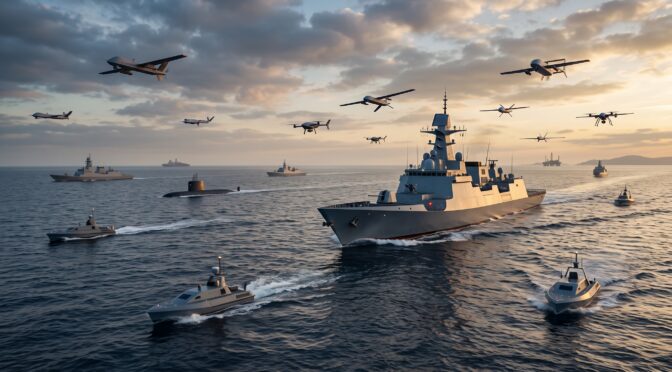
The character of naval warfare is undergoing a foundational and irreversible transformation, driven by the rapid proliferation of uncrewed systems, artificial intelligence, autonomous navigation, and mesh-networked communications. Traditional naval strategy, which has been dominated for over a century by the deployment of exquisite, high-signature capital ships, is increasingly challenged by the democratization of sea denial capabilities. Small, attritable, and highly lethal uncrewed aerial systems (UAS), uncrewed surface vessels (USVs), and extra-large uncrewed undersea vehicles (XLUUVs) are fundamentally altering the calculus of maritime power projection, forcing a paradigm shift away from platform-centric operations toward payload-centric, distributed maritime architectures.
This research report examines the strategic, operational, and tactical implications of military drones on contemporary naval warfare. It analyzes the collapse of traditional cost-exchange ratios, as evidenced by recent high-intensity engagements in the Red Sea and the Black Sea. In these theaters, non-state actors and states operating without traditional blue-water navies have successfully challenged advanced carrier strike groups, disrupted vital sea lines of communication, and sunk high-value, heavily armed warships. The analysis further explores the resurgence of the historical Jeune École naval theory, updated for the twenty-first century, wherein swarms of inexpensive, autonomous systems neutralize the advantages of centralized, multi-billion-dollar maritime platforms.
Furthermore, this document evaluates emerging operational concepts designed to counter peer adversaries, most notably the U.S. Indo-Pacific Command’s (INDOPACOM) “Hellscape” strategy. This doctrine is designed to leverage massive, multi-domain drone swarms to deter amphibious invasions and complicate adversary decision-making. The report critically assesses the resulting crisis in fleet magazine depth, the severe logistical vulnerabilities of the current fleet architecture regarding at-sea reloading, and the urgent, existential necessity for advanced Counter-UAS (C-UAS) technologies, including Directed Energy Weapons (DEW) and High-Power Microwave (HPM) systems. Strategists must immediately discard outdated assumptions regarding uncontested logistics, the presumed invulnerability of carrier strike groups, and the economic sustainability of kinetic interception. The future of naval warfare requires pivoting urgently toward dispersed, economically viable, and highly attritable force structures capable of operating in saturated, unmanned environments.
2. The Theoretical Underpinnings of Modern Naval Warfare
To understand the magnitude of the disruption caused by uncrewed maritime systems, it is necessary to contextualize the current strategic environment within the historical frameworks of naval theory. The tension between concentrated fleet power and distributed asymmetric threat is not new; however, modern technology has radically altered the balance between the two.
2.1 The Legacy of Mahanian Doctrine and the Capital Ship
For more than a century, global naval strategy has been heavily influenced by the theories of Alfred Thayer Mahan, whose concept of the concentrated battlefleet shaped the naval arms races of the twentieth century. In the Mahanian paradigm, command of the sea is achieved through the decisive engagement and destruction of the enemy’s main fleet by a concentrated force of capital ships.1 This doctrine relies on the assumption that platforms requiring massive capital investment, highly trained crews, and sophisticated, overlapping defensive layers can survive in contested environments long enough to project power ashore or secure vital global chokepoints.
Historically, the strategic value of these capital ship forces has constantly been weighed against the vulnerability of the positions they are ordered to occupy.2 In modern contested environments, specifically those shaped by advanced Anti-Access/Area Denial (A2/AD) networks, the multi-domain threat landscape has expanded exponentially. Precision-guided weapons, hypersonic anti-ship ballistic missiles, and now, autonomous drone swarms, have made the operating environments of the littorals and constrained seas exceptionally hazardous for high-signature vessels.3 The U.S. Navy and other advanced maritime forces are currently plagued by problems inherent to this model, including the high cost of procuring sufficient numbers of capital ships, the slow reform of legacy fleet structures, and the immense logistical pressures of maintaining complex platforms in forward-deployed postures.3
2.2 The Resurgence and Validation of the Jeune École
In the late nineteenth century, a competing strategic framework emerged in France, known as the Jeune École (Young School), championed by theorists such as Admiral Théophile Aube. This doctrine posited that a weaker naval power could defeat a fleet of superior, heavily armored capital ships by utilizing large numbers of small, fast, and heavily armed vessels—specifically, the newly invented torpedo boats.4 The Jeune École sought to deny control of maritime expanses through dispersed, asymmetric attacks, rather than seeking decisive fleet-on-fleet engagements.6 It enabled the mobilization of widely dispersed small shipyards along the coasts, appealing to budget decision-makers as a highly cost-effective solution for generating outsized strategic effects.4
While the original Jeune École was ultimately limited by the technological constraints of the era—primarily the poor sea-keeping, limited operational range, and lack of over-the-horizon targeting capabilities of early torpedo boats—the core philosophy has been violently validated by the advent of modern drone warfare.4 Today’s autonomous systems effectively eliminate the geographical and endurance limitations of their historical predecessors. Uncrewed vessels can now loiter for months at sea, coordinate complex maneuvers via resilient mesh networks, and deliver catastrophic explosive payloads with pinpoint accuracy.8
The contemporary iteration of the Jeune École asserts that massed, inexpensive, and autonomous kinetic effectors can overwhelm the sophisticated radar and kinetic defensive systems of legacy platforms.5 Wargames and classified defense analyses increasingly describe capital ships, including advanced aircraft carriers, as highly vulnerable to multi-domain attacks that combine cyber operations, electronic warfare, and saturated drone swarms.11 Consequently, strategists must recognize that a strategy reliant solely on exquisite, concentrated assets is fundamentally brittle against an adversary capable of producing and deploying attritable uncrewed systems at a massive industrial scale. The legacy of the Jeune École also deeply influenced Soviet naval thought, which envisioned a three-dimensional, composite war utilizing aircraft, surface ships, and submarines in synergy to negate the advantages of Western capital ships.12 Today, the drone serves as the ultimate realization of this asymmetric, multi-dimensional threat.
3. The Democratization of Sea Denial and Asymmetric Economics
The proliferation of uncrewed systems has effectively democratized sea denial. Historically, denying an adversary access to the sea required the maintenance of a sophisticated submarine force, extensive naval aviation, and complex mine-laying operations. Today, non-state actors and smaller nations can exert strategic influence over critical maritime chokepoints using commercial off-the-shelf technology adapted for lethal purposes.
3.1 The Collapse of the Cost-Exchange Ratio
The most urgent crisis facing modern naval strategists is the inversion of the cost-exchange ratio in maritime air and surface defense. Historically, the economic burden of an attack rested heavily on the aggressor, who had to risk expensive aircraft, submarines, or surface combatants to threaten a defending fleet. Today, the proliferation of low-cost manufacturing and accessible guidance technologies has shifted this economic burden entirely to the defender.
Events in the Red Sea and the Bab al-Mandeb strait provide a stark, ongoing operational laboratory for this dynamic. Since October 2023, Houthi forces have launched hundreds of aerial threats, anti-ship ballistic missiles, and uncrewed surface vessels at commercial shipping and U.S. Navy coalition warships.13 Between October 2023 and March 2025 alone, the Houthis targeted U.S. warships more than 170 times and commercial vessels 145 times.15 While the coalition has achieved remarkable tactical success in thwarting these attacks, protecting both commercial shipping and supporting allied air defense networks, the strategic economics of the engagement are deeply unfavorable.13
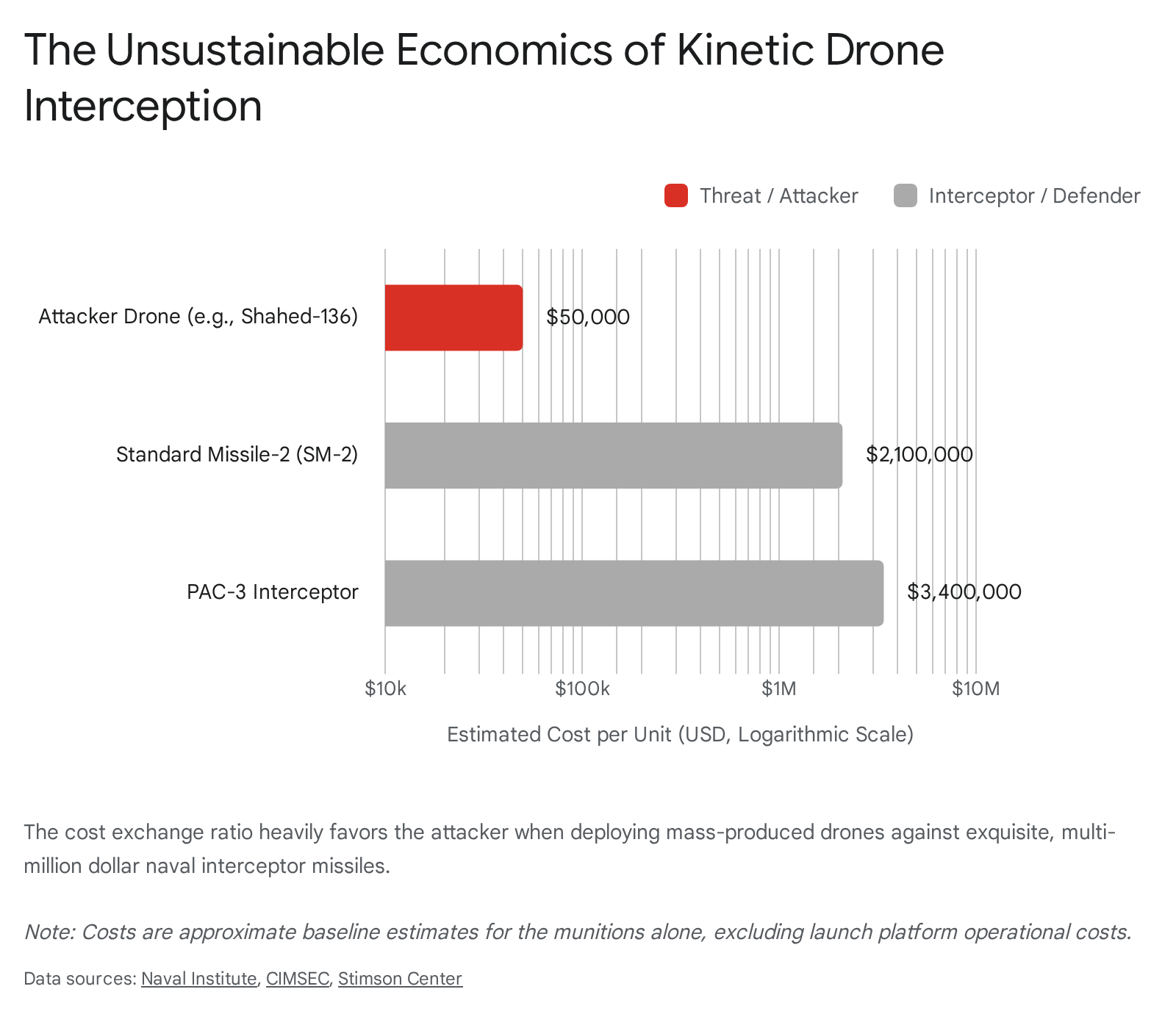
The Department of Defense revealed that the U.S. military has expended upwards of $1 billion as part of its efforts to protect vessels in the Red Sea.15 The Navy utilizes advanced kinetic weapons—primarily sophisticated surface-to-air missiles like the Standard Missile 2 (SM-2), the SM-6, and PAC-3 interceptors—to defeat incoming threats.13 The procurement costs for these defensive interceptors are immense. Current U.S. weapons systems are designed to be launched from expensive, fragile platforms, with Long Range Anti-Ship Missiles (LRASMs) costing approximately $3.4 million each, JASSM-ERs costing $3.3 million, and PAC-3 interceptors costing $3.4 million.15 The Navy’s broader air defense missiles range from several hundred thousand dollars to a few million dollars per unit.13
In stark contrast, the highly capable, mass-produced drones utilized by adversaries operate as consumable munitions with near-zero operating costs. Iranian-made drones deployed by the Houthis can cost as little as $50,000, with some variants estimated at just a few thousand dollars.13 This highly asymmetric “cost exchange ratio” lays bare the vulnerability of modern militaries to asymmetric warfare.15 While defense analysts correctly point out that cost exchange ratios are an insufficient measure of the real cost of operational considerations—given that defensive missiles must provide exceptional maneuverability and precision guidance to protect multi-billion dollar assets and human lives—the current paradigm is mathematically unsustainable.13 Firing million-dollar interceptors at mass-produced, expendable drones heavily strains the U.S. defense industrial base, which struggles to replenish the complex interceptor inventory at the pace it is being consumed.
3.2 The Eradication of Maritime Sanctuary
A direct corollary to the democratization of sea denial is the total eradication of maritime sanctuary. Long-range autonomous systems have extended the threat envelope far beyond the traditional contested littorals, transforming formerly secure rear areas and transit lanes into active combat zones. Both Ukraine and Russia have pivoted toward massive reliance on drones for surveillance, electronic warfare, and long-range precision strikes, effectively creating an unmanned “kill zone” extending 15 to 40 kilometers deep where no traditional troops or vehicles can move without facing immediate attack.15
Furthermore, the range of these autonomous systems continues to expand. Nations are planning to produce millions of drones annually, ranging from small quadcopters to fixed-wing assets boasting operational ranges of up to 3,000 kilometers.15 China is currently mass-producing long-range drones, such as the Sunflower—an improved, highly capable iteration of the Iranian Shahed-136—which features a 2,000-kilometer range and vertical launch capabilities.15
Most alarmingly for naval strategists, adversaries have demonstrated the ability to launch long-range drones and cruise missiles directly from standard commercial shipping containers.15 This containerized strike capability renders traditional threat identification algorithms and visual identification methods obsolete. The systems are virtually indistinguishable from normal maritime cargo until the moment of launch. A hostile state or well-funded non-state actor can thereby transport strategic strike assets globally without the need for specialized, easily tracked naval platforms, effectively turning any commercial cargo vessel into a potential node for strategic sea denial or land attack.15
4. The Proliferation and Specialization of Uncrewed Maritime Systems (UMS)
The rapid, wartime iteration of uncrewed systems has led to the development of highly distinct classes of maritime drones tailored for specific operational domains. Strategists must possess a nuanced understanding of the technical capabilities, operational histories, and developmental trajectories of these systems to effectively design future fleet architectures.
4.1 Uncrewed Surface Vessels (USVs): The Vanguard of Asymmetric Strike
The most profound and historically significant impact of Uncrewed Surface Vessels has been demonstrated in the Black Sea theater. Ukraine, a nation operating without a traditional capital-ship navy, has effectively neutralized significant portions of the Russian Black Sea Fleet using domestically produced, highly innovative USVs.8 This operational success has driven a rapid, iterative development cycle in USV technology globally.
4.1.1 The Ukrainian USV Ecosystem
Ukraine’s Defense Intelligence (GUR) and the Security Service of Ukraine (SBU) have fielded a vast, rapidly evolving array of USVs, transitioning quickly from improvised explosive boats to purpose-built, multi-role platforms capable of carrying air defense missiles and deploying smaller tactical drones.8
| System Name | Dimensions | Speed & Range | Payload / Armament | Operational Characteristics |
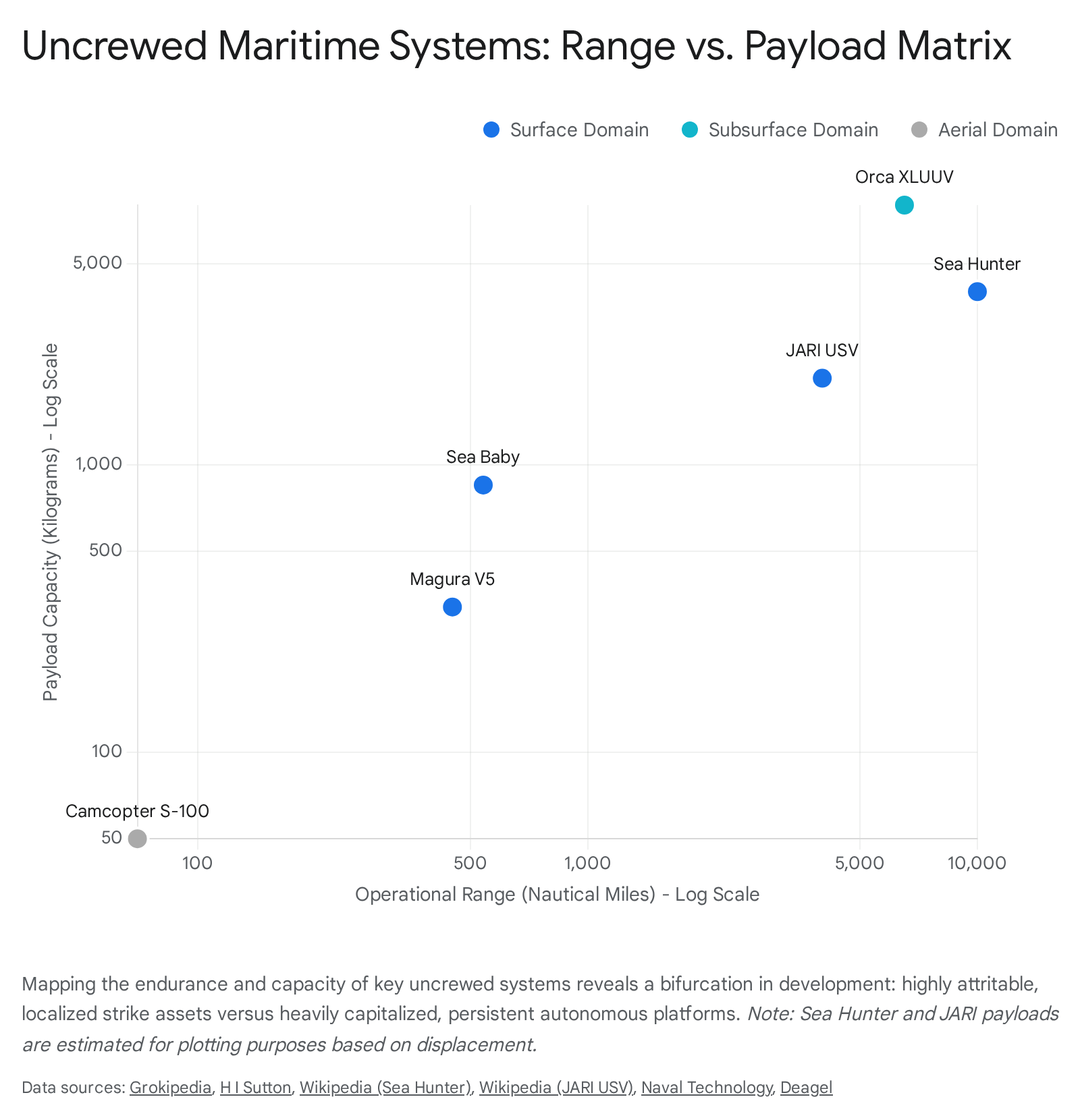
| Magura V5 8 | Length: 5.5m Width: 1.5m | 42 knots max 450 nm (833 km) | 320 kg explosive charge | Primary GUR strike asset. Utilizes mesh radio/SATCOM. Features waterjet propulsion and a low 0.5m profile. Responsible for sinking multiple high-value Russian warships. |
| Sea Baby 8 | Length: 6.0m Width: 2.0m | 49 knots max 540 nm (1,000 km) | 850 kg payload | Operated by SBU. Famously used in the Kerch Bridge attack. Can be fitted with RPV-16 thermobaric rocket launchers for direct attack or defense suppression during ramming runs. |
| Magura V7 8 | Length: 7.5m | Extended range | 2x AIM-9L Sidewinder Missiles | Configured as a “FrankenSAM” air-defense USV. Features a reshaped bow for superior sea-keeping in harsh winter environments. |
| Katran X1 8 | Length: 8.0m Width: 2.3m | 56 knots max 650 nm (1,200 km) | 4x 10″ FPV drones, ‘Osa’ strike drones | A miniature drone-carrier designed for precision strikes using deployed aerial FPVs against enemy ships and surfaced submarines. |
| Stalker 5.0 8 | Length: 5.0m Width: 1.2m | 40 knots max 350-600 km | 150 kg payload | A highly cost-effective platform (unit cost ~$60,000). Used for patrol, reconnaissance, and shallow-water logistics transport. |
| Mamai 8 | Compact planing hull | 60 knots max Long-range | Heavy impact-fuzed warhead | Operated by SBU. Features a high-speed hull for deep strikes. Used successfully to inflict severe damage on the landing ship Olenegorsky Gornyak. |
The evolution of these systems—from the basic Magura V1, which was essentially a cut-down 6-meter fishing boat, to the Katran X1, which functions as a multi-domain drone-carrier—demonstrates a crucial operational shift from single-use kamikaze tactics to reusable, multi-role platforms.8 The integration of air-defense missiles into these small surface craft is a particularly disruptive development. Systems equipped with the “Sea Dragon” improvised air-defense setup, carrying R-73 or AIM-9L Sidewinder missiles (such as the Magura W6, V6, V7, and Sea Wolf variants), create a self-defending surface threat that significantly complicates adversary interdiction efforts by rotary-wing aircraft and coastal patrol planes.8 Furthermore, Ukraine has pioneered the development of weaponized autonomous underwater vehicles (AUVs) such as the Toloka family (TLK-150 and TLK-1000) and the Marichka. The Marichka, a 6-meter, metal-hulled AUV with an X-form rudder, boasts a range of 1,000 kilometers and costs roughly $433,000, bringing strategic undersea strike capabilities to non-traditional maritime actors.8
4.1.2 Heavy and Medium USVs: The United States and Chinese Approaches
While Ukraine focuses on small, highly attritable systems tailored for the constrained geography of the Black Sea, major naval powers are developing Medium and Large Uncrewed Surface Vessels (MDUSV/LUSV) designed for persistent autonomous presence, anti-submarine warfare (ASW), and distributed lethality across vast oceanic expanses.
The U.S. Navy’s Sea Hunter and Seahawk: Developed originally as part of the Defense Advanced Research Projects Agency (DARPA) Anti-Submarine Warfare Continuous Trail Unmanned Vessel (ACTUV) program, the Sea Hunter is a 132-foot (40-meter) trimaran displacing 145 tons at full load.10 The vessel represents a massive leap in autonomous endurance, capable of operating for 30 to 90 days at sea without human maintenance, resupply, or intervention.10 Powered by twin diesel engines, it possesses a transoceanic cruising range of 10,000 nautical miles at 12 knots, allowing deployments from San Diego to Guam on a single fueling.10 Designed primarily for ASW—specifically the persistent, long-duration tracking of quiet diesel-electric submarines—these platforms act as highly capable, distributed sensor nodes for manned ships. By projecting an operational view far beyond the horizon, they support maritime domain awareness while entirely removing human personnel from high-risk environments.20
China’s JARI USV: In contrast to the U.S. focus on sensor-heavy, unarmed prototypes, the People’s Liberation Army Navy (PLAN) has prioritized multi-mission lethality in a compact uncrewed hull. The JARI USV, developed by the China Shipbuilding Industry Corporation (CSIC), is a 58-meter (190.3 ft), 420-500 ton uncrewed warship capable of reaching sprint speeds of 42 knots via waterjet propulsion, with a formidable endurance range of 4,000 nautical miles.24 Unlike the purely sensor-focused baseline Sea Hunter, the JARI is heavily and diversely armed. It features a 4-to-12 cell Vertical Launching System (VLS), lightweight torpedo tubes, a remote weapon station, and air defense missiles such as the HQ-10 point defense system.25 Its sensor suite is equally robust, incorporating an active phased array radar, electro-optic systems, and sonar.25 Crucially, the JARI’s architecture supports autonomous navigation, swarm operations, cooperative target tracking, and coordinated fire missions.24 The integration of comprehensive air defense, ASW, and anti-surface capabilities into a relatively small, autonomous platform signifies China’s strategic intent to mass-produce heavily armed sensor-shooters capable of saturating contested waters and complicating allied targeting algorithms.26
4.2 Extra-Large Uncrewed Undersea Vehicles (XLUUVs)
The undersea domain, historically the exclusive preserve of highly trained crews operating multi-billion-dollar nuclear-powered submarines, is being fundamentally disrupted by the introduction of XLUUVs. These platforms offer extreme endurance, exceptional stealth, and substantial payload capacity without the complex life-support constraints and safety margins required for crewed submarines.
The Boeing Orca XLUUV (U.S. Navy): The Orca is an 85-foot (26-meter), 85-ton autonomous submarine featuring a hybrid diesel-electric power plant.27 Its defining strategic characteristic is its unprecedented undersea autonomy, delivering extreme endurance that enables month-long, long-range missions covering up to 6,500 nautical miles without resupply.9 Crucially, the Orca requires minimal human intervention and can be launched, operated, and recovered pier-side without the logistical burden of a dedicated manned mother ship.27
The Orca features a transformative, modular 33-foot (10-meter) payload bay capable of carrying up to 8 tons of mission equipment, allowing for rapid role changes across the undersea battlespace.9 The strategic applications for such a vessel are vast:
- Offensive Mining and Mine Countermeasures (MCM): XLUUVs can clandestinely lay complex, smart minefields deep within adversary A2/AD zones, or autonomously locate and neutralize underwater mines, keeping manned vessels far from harm’s way.27
- Seabed Warfare: The endurance and stealth of the Orca make it an ideal, cost-effective platform for manipulating, monitoring, or protecting critical subsea infrastructure, such as vital fiber-optic data cables that transmit global financial and strategic communications.27
- Anti-Submarine Warfare (ASW): Functioning as a persistent, mobile listening post or a forward-deployed launch platform for ASW weapons, the Orca can track adversary submarines over vast distances without risking human crews.28
4.3 Aerial Maritime Drones (UAVs)
Aerial drones have transitioned from being purely overland Intelligence, Surveillance, and Reconnaissance (ISR) assets to becoming integral, networked components of naval strategy, providing persistent overwatch, communications relays, and precision targeting data across the vast maritime domain.
High-Altitude, Long-Endurance (HALE) Systems: The MQ-4C Triton, managed by the Persistent Maritime Unmanned Aircraft Systems Program Office, provides Broad Area Maritime Surveillance (BAMS) for the U.S. and allied forces.30 Operating at high altitudes with an endurance of over 30 hours and a ferry range exceeding 15,000 kilometers, a single Triton is capable of monitoring 40,000 square kilometers of ocean surface a day.32 It serves as a critical node in tracking surface contacts, seamless surveillance, and providing long-range targeting data for distributed fleets, operating as a ‘family of systems’ alongside crewed aircraft like the P-8A Poseidon.31 Similarly, the MQ-9B SeaGuardian offers global reach via satellite communications, carrying advanced maritime sensors and payloads exceeding 2,150 kg to provide real-time search and surveillance of activity both on and below the sea surface.30
Tactical Maritime Rotary UAVs: For localized shipboard deployment, systems like the Schiebel Camcopter S-100 provide immediate, highly flexible tactical ISR. The S-100 is a rotary-wing UAV powered by a 50 HP aviation engine, operating with a 50 kg payload capacity and cruising at 55 knots for over 6 hours (extendable to over 10 hours with external tanks) at ranges up to 130 km.34 These tactical systems integrate directly into a ship’s Combat Management System (CMS), providing real-time data feeds, precise delivery of guided munitions, and target coordinates without the operational footprint or risk associated with manned helicopters.36
5. The “Hellscape” Concept: Swarm Dynamics and Conventional Deterrence
The unprecedented proliferation and maturation of these uncrewed systems have directly informed highly aggressive new operational concepts aimed at deterring peer adversaries in contested theaters. The most prominent and widely discussed among these is the “Hellscape” strategy, articulated extensively by Admiral Samuel Paparo, Commander of U.S. Indo-Pacific Command (INDOPACOM), and his predecessor, Admiral John Aquilino.38
5.1 Orchestrating the Unmanned Hellscape in the Indo-Pacific
The primary strategic objective of the Hellscape concept is to decisively deny the People’s Republic of China (PRC) the operational ability to execute a short, sharp amphibious invasion of Taiwan, preventing a geopolitical fait accompli before the international community can formulate a coordinated military response.40 To achieve this formidable goal, INDOPACOM envisions transforming the Taiwan Strait into a saturated, lethally impassable environment using a massive, coordinated deployment of classified, uncrewed capabilities across the air, surface, and subsurface domains.38
Initially, the U.S. Department of Defense’s Replicator Initiative, announced in 2023, served as the primary acquisition engine for this strategy. However, after struggling with persistent technical issues, integration challenges with existing command-and-control structures, and fielding only hundreds of systems rather than the projected thousands, Replicator was dissolved in late 2025. To rectify these systemic procurement failures, the Pentagon absorbed the initiative into the newly established Defense Autonomous Warfare Group (DAWG). Functioning as the central authority for the Hellscape strategy, DAWG represents a monumental shift in institutional priority, receiving an unprecedented $54.6 billion budget request for Fiscal Year 2027. Former CIA Director David Petraeus characterized this 24,000 percent single-year funding surge as the “largest single commitment to autonomous warfare in history”.
This massive screen of autonomous drone swarms is explicitly designed to fulfill multiple overlapping tactical and strategic functions:
- Persistent Targeting and Intelligence: Networked drones fill the critical operational gap between high-altitude satellite imagery and vulnerable crewed overflights, providing persistent, real-time targeting data and intelligence, surveillance, and reconnaissance (ISR) functions to allied long-range missile batteries.39
- Saturation and Exhaustion of Adversary Defenses: By deploying tens of thousands of platforms simultaneously, the autonomous swarm intentionally exhausts Chinese air defenses and rapidly depletes their limited, expensive interceptor missile stocks, effectively flipping the asymmetric cost curve against the PRC.41
- Direct Kinetic Interdiction: Armed autonomous drones act as short-range interceptors and direct-strike platforms, physically interdicting surface warships, troop transports, and amphibious landing craft as they attempt to transit the strait.39
The anticipated scale of this strategy is unprecedented in modern military planning. Previous INDOPACOM leadership established a staggering metric of prosecuting “1,000 targets for 24 hours” to successfully blunt an invasion force of this magnitude.39
5.2 Wargaming the Swarm: Validation Across Theaters
The theoretical efficacy of autonomous swarm defense has been repeatedly validated in advanced, classified, and unclassified wargames. A seminal report by the Center for a New American Security (CNAS), authored by defense experts Stacie Pettyjohn and Molly Campbell, analyzed the defense of Taiwan by layering drone defenses across the entirety of the maritime battlespace.42 The simulation utilized a specialized reconnaissance swarm, networked via mesh communications, for wide-area ISR, passing high-fidelity coordinates to deep-strike Joint force capabilities.44 In the final 5-kilometer run to the contested landing beaches, dense layers of short-range drones directly attacked amphibious ships within visual range, creating a practically impassable kinetic barrier that inflicted severe attrition on the invasion force.42
This paradigm is not limited to the maritime confines of the Indo-Pacific; it is equally applicable to land-based and littoral deterrence in Europe. In the European theater, the German defense software company Helsing conducted wargames focused on the defense of the Baltics. In a baseline scenario lacking allied rapid engagement, simulated Russian forces overran the Lithuanian capital of Vilnius within five days. However, when the defending forces deployed a coordinated swarm of roughly 12,000 HX-2 autonomous attack drones, the dynamic was entirely reversed. The swarm halted the offensive, inflicted massive armor and personnel losses, and delayed the advance by one to two weeks—providing sufficient operational time for NATO’s main forces to mobilize and arrive.11
These rigorous simulations confirm a fundamental shift: massed, AI-enabled drones, operating via resilient mesh networks and decentralized control algorithms, are no longer mere auxiliary assets for reconnaissance or targeted strikes; they represent the primary mechanism for conventional deterrence and area denial in the twenty-first century.41
6. The Crisis of Magazine Depth and Logistical Contestation
While the Hellscape strategy relies enthusiastically on offensive drone swarms to deter adversaries, the U.S. Navy and its allies face a severe, reciprocal threat. If adversaries adopt similar swarm tactics—which China, possessing the world’s largest industrial manufacturing base and fielding advanced systems like the JARI USV, is uniquely positioned to do—defending fleets will confront an immediate and critical crisis in “magazine depth”.13
6.1 The VLS Limitation and the Economics of Exhaustion
Modern naval combatants, particularly cruisers and destroyers, rely almost exclusively on Vertical Launching Systems (VLS) for both offensive strike and layered air defense. A standard U.S. Navy Arleigh Burke-class guided-missile destroyer carries 90 to 96 VLS cells, representing a finite, hard-capped inventory of interceptors.45 In a high-intensity conflict involving massed, coordinated drone swarms and anti-ship cruise missiles, a destroyer could feasibly empty its entire defensive magazine in a matter of hours or even minutes.13
The strategic implications of this are dire. Once perfected, a saturation attack need not physically strike or sink a multi-billion-dollar aircraft carrier to achieve strategic victory; it merely needs to force the group’s escort vessels to deplete their VLS cells in self-defense. A modern warship without interceptors is effectively a mission kill—a defenseless liability that must immediately withdraw from the theater of operations to rearm, thereby ceding sea control to the adversary.13 This vulnerability is especially troubling given the so-called “Davidson Window,” the deadline by which PRC leadership has charged the People’s Liberation Army to be prepared for military action against Taiwan.46
6.2 The Tyranny of At-Sea Reloading
Historically, reloading depleted VLS cells required a warship to abandon its station and return to a secure, deep-water port equipped with specialized crane facilities.13 Given the vast, tyrannical distances of the Pacific theater, this process effectively removes the vessel from the fight for weeks at a time.13 The Navy has correctly recognized this logistical vulnerability as a critical, single point of failure in its Distributed Maritime Operations (DMO) concept.46
To mitigate this existential shortfall, the U.S. Navy has drastically accelerated efforts to develop and deploy at-sea reloading capabilities. In October 2024, the Navy achieved a significant milestone by demonstrating the Transferrable Reload At-sea Method (TRAM) aboard the Ticonderoga-class cruiser USS Chosin.48 Using a hydraulically-powered, articulating device, sailors successfully loaded an empty missile canister into the ship’s MK 41 VLS while underway alongside the dry cargo ship USNS Washington Chambers in the open ocean off the coast of San Diego.48
Despite this highly publicized breakthrough, at-sea reloading remains a deeply cumbersome, slow, and hazardous process heavily restricted by sea state, adverse weather, and operational risk.46 Handling multi-ton, highly explosive ordnance via cranes or hydraulic transfer systems between two moving ships requires relatively calm waters, often forcing vessels to retreat far away from contested zones to rearm safely.46 Therefore, while TRAM is a vital logistical capability, it cannot entirely solve the magazine depth crisis generated by cheap, attritable drone swarms in a protracted conflict. The mathematics of kinetic interception remain fundamentally misaligned with the economics of drone mass.
7. Next-Generation Counter-UAS (C-UAS) and Directed Energy Integration
To permanently resolve both the magazine depth limitation and the economically unsustainable cost-exchange ratio, naval strategists must look beyond traditional kinetic interceptors. The rapid integration and operational fielding of Directed Energy Weapons (DEW)—specifically High-Energy Lasers (HEL) and High-Power Microwave (HPM) systems—constitutes the absolute strategic imperative for future fleet survival in a drone-saturated environment.45
7.1 High-Energy Lasers (HEL): The Infinite Magazine
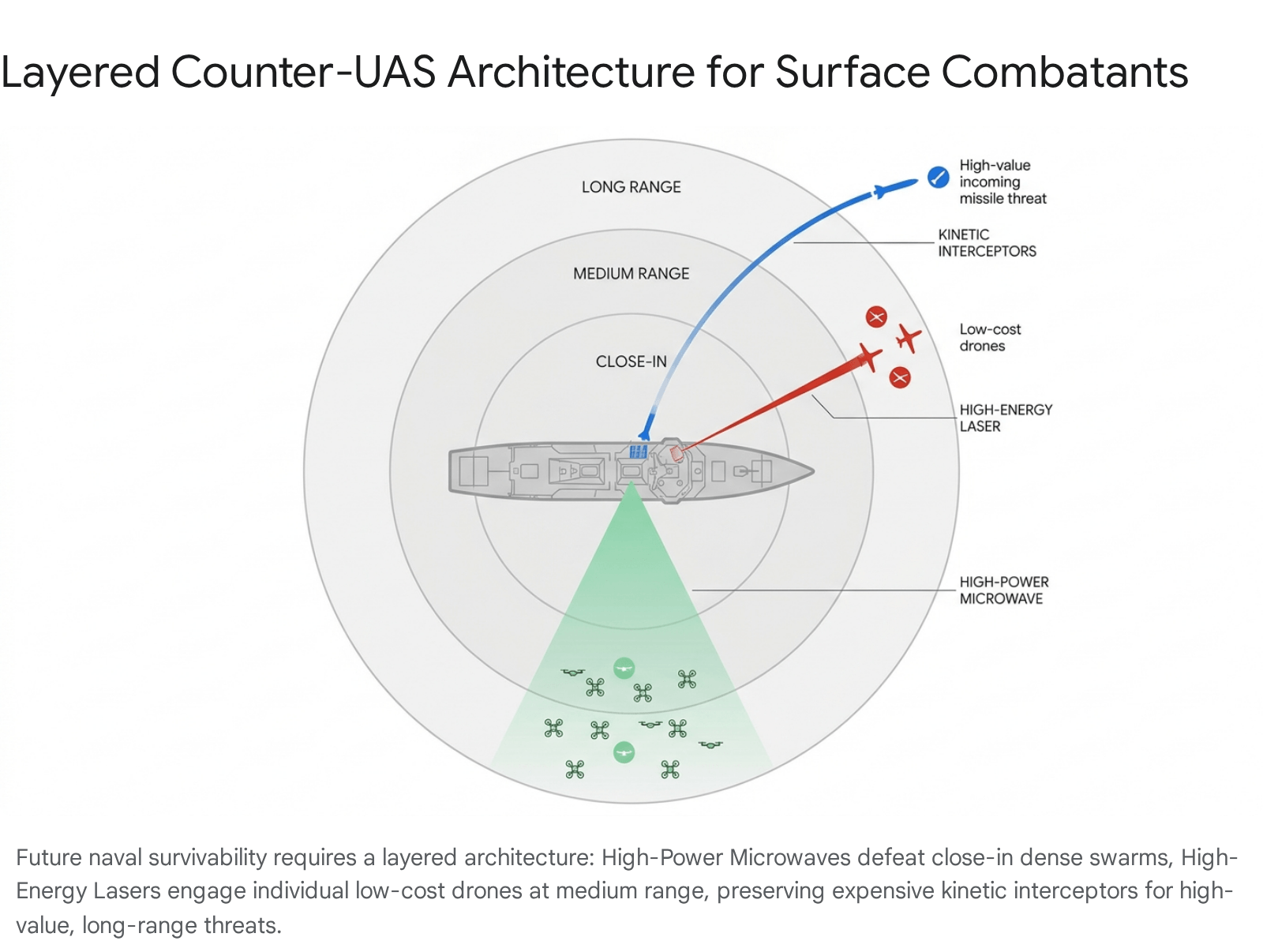
Laser weapons offer a profoundly disruptive advantage: a virtually infinite magazine depth, limited only by the electrical power generation capacity of the host vessel.51 Crucially, the cost per engagement is reduced from millions of dollars (the cost of an SM-2 or PAC-3) to the marginal cost of the diesel fuel required to generate the electricity for the laser burst—often calculated in single or double digits per shot.14
The U.S. Navy has actively tested and deployed these systems, most notably installing the HELIOS (High Energy Laser with Integrated Optical-dazzler and Surveillance) system aboard the Arleigh Burke-class destroyer USS Preble.52 Known formally as the Counter-Unmanned Air Systems High Energy Laser Weapon System (C-UAS HELWS), it provides highly precise point defense against small aerial drones and fast-attack surface craft.55 While successful in intercepting targets during testing, these systems are largely classified by the Navy as “Non-Program of Record (POR) Research & Development (R&D) assets” rather than being slated for immediate, widespread fleet integration.52 Expanding their deployment is critical, as DEWs represent the only economically viable method for systematically destroying low-end, attritable drones in a protracted, high-intensity conflict, preserving expensive kinetic interceptors for high-end threats like hypersonic glide vehicles.14
7.2 High-Power Microwave (HPM) Defenses: Defeating the Swarm
While High-Energy Lasers burn through targets individually, requiring precise tracking and “dwell time” on a single target, they can still be overwhelmed by sheer numbers. Therefore, High-Power Microwave (HPM) weapons are vital for defeating dense, synchronized swarms. HPM systems project a wide cone of intense electromagnetic energy that disrupts, scrambles, or permanently destroys the unshielded electronics, guidance systems, and flight controllers of multiple drones simultaneously, regardless of their evasive maneuvers.47
Programs such as the Tactical High Power Microwave Operational Responder (Mjölnir), THOR, and the Expeditionary Directed Energy Counter-Swarm (ExDECS) system recently received by the U.S. Marine Corps are currently under rapid development and dynamic testing.53 HPM provides a wide-area, non-kinetic defense capability that both traditional missiles and single-target lasers fundamentally lack, serving as the ultimate, indispensable fail-safe against the mass saturation tactics envisioned in Hellscape-style offensive scenarios.53
7.3 The Strategic Warning: Vulnerability in the First Island Chain
The urgency for integrating these systems is highlighted in a recent CNAS report, which starkly concludes that the United States is fundamentally unprepared to defend against present and future drone threats, having decisively lost its decades-long monopoly on precision strike.57
In a simulated wargame focusing on a U.S.-China conflict, Chinese drone swarms were deployed to systematically suppress and destroy U.S. forces operating inside the highly contested First Island Chain.58 The report warned that without deep magazines of substantially enhanced C-UAS capabilities, distributed warfighting strategies would be easily overwhelmed by massed Chinese drone attacks, potentially resulting in the catastrophic loss of a war over Taiwan.57 Consequently, counter-drone capabilities can no longer be siloed solely to dedicated, specialized air defense units; every vessel, logistical transport, and distributed unit must possess autonomous, deep-magazine self-protection capabilities to survive.60
8. Strategic Imperatives for the Future Fleet
The integration of military drones into naval warfare requires a total recalibration of strategic thinking at the highest levels of command. What was true in the twentieth century is often highly dangerous and operationally fatal in the twenty-first.
8.1 Outdated and Dangerous Paradigms
- The Invulnerability of the Concentrated Fleet: The deeply entrenched belief that a Carrier Strike Group can operate with impunity inside an adversary’s A2/AD bubble is outdated. The proliferation of stealthy XLUUVs, armed LUSVs like the JARI, and long-range containerized UAVs means that highly concentrated, expensive platforms are lucrative, easily locatable targets that can be continuously tracked and relentlessly harassed by autonomous swarms.3
- The Sufficiency of Kinetic Defense: Relying solely on sophisticated, multi-million-dollar interceptors to defend against massed, attritable threats is economic suicide. The fundamental math dictates that an adversary can bankrupt a defending fleet’s budget and exhaust its industrial base long before it successfully destroys the fleet kinetically.14
- Assuming Uncontested Logistics: Naval planners can no longer assume that deep-water ports, logistical supply ships, and at-sea reloading facilities will remain secure sanctuaries. The massive expansion of drone ranges and the inherent physical vulnerabilities of at-sea reloading methods (like TRAM) mean that logistics chains will be continuously and violently contested.15 The traditional dichotomy between the front line and the safe rear echelon has been erased.
8.2 What Strategists Must Think About Now
To survive and project power, naval strategists must pivot decisively toward a framework of distributed lethality, payload-centric design, and massed autonomy.
- Embracing the Economics of Attrition: The fleet must deliberately integrate systems designed specifically to be lost in combat. If a $50,000 uncrewed vessel forces an adversary to reveal a hidden radar position, or expend a $3 million interceptor missile to destroy it, the loss of the drone represents a massive strategic and economic victory for the attacker. The DoD’s Defense Autonomous Warfare Group (DAWG) is a vital entity driving this mindset, moving away from exquisite, irreplaceable platforms toward massed, consumable combat power. The potential elevation of DAWG to a “sub-unified command”—placing autonomous warfare in the same institutional category as the defense of the Korean Peninsula or the conduct of special operations—indicates that the Pentagon is no longer treating attritable mass as a pilot project, but as a durable, permanent branch of military doctrine with a sustained demand signal.
- Mesh Networks and Autonomous Sensor Webs: Uncrewed systems like the Sea Hunter and MQ-4C Triton must be utilized continuously to create an impenetrable, autonomous sensor web across vast oceanic expanses. This allows manned, high-value vessels to operate in strict “emission control” (EMCON) silence, relying entirely on forward-deployed, expendable drones for targeting data while remaining virtually undetected by adversary sensors.20
- Accelerating DEW Integration: The notorious “Valley of Death” in defense procurement—the bureaucratic gap between successful research and development and widespread operational fielding—must be bridged immediately for Directed Energy Weapons.14 Without high-energy lasers and high-power microwaves integrated across every surface combatant in the fleet, the magazine depth crisis cannot be mathematically resolved.
- Asymmetric Mining and Chokepoint Control: XLUUVs like the Orca completely change the calculus of sea denial. Strategists must plan for scenarios where critical maritime chokepoints (e.g., the Strait of Malacca, the Taiwan Strait, the Bab al-Mandeb) are contested not by visible surface fleets, but by autonomous, silent submarines laying smart, self-activating minefields. This severely restricts freedom of navigation without crossing the political escalation threshold of sinking ships with crewed vessels.29
9. Conclusion
Military drones across the aerial, surface, and subsurface domains have irrevocably altered the fundamental character of naval warfare. They have decisively shifted the balance of maritime power away from the concentration of exquisite, highly vulnerable capital ships and toward the massed dispersion of attritable, autonomous systems. The modern realization of the Jeune École is no longer a theoretical wargaming exercise; it is a brutal operational reality currently being demonstrated in the constrained waters of the Black and Red Seas. The collapse of the traditional cost-exchange ratio mathematically dictates that traditional, kinetic-heavy defensive postures are economically and logistically unsustainable against massed swarms.
To maintain maritime superiority in this new era, naval strategists must urgently and permanently discard outdated assumptions regarding uncontested logistical sanctuary and the supremacy of kinetic dominance. The future of naval warfare belongs exclusively to forces that can effectively integrate uncrewed systems into resilient distributed mesh networks, project overwhelming power via autonomous swarm strike, and defend against reciprocal adversary swarms using deep-magazine directed energy weapons. A failure to rapidly adapt to this drone-centric reality risks overwhelming strategic defeat at the hands of adversaries who have already mastered the brutal economics of asymmetric mass.
Appendix: Research Approach and Data Sources
This report was compiled through a rigorous qualitative synthesis and strategic analysis of defense intelligence, open-source military reporting, and peer-reviewed think-tank policy papers. The analytical framework involved categorizing raw intelligence data into core vectors of change: platform technical evolution (USV, UAV, XLUUV capabilities), macroeconomic cost-exchange ratios, logistical constraints (magazine depth and at-sea reloading), and broad doctrinal shifts (the Hellscape strategy and the modern Jeune École). Data points regarding specific system specifications, unit costs, and operational combat histories were extracted, verified, and cross-referenced to identify broader causal relationships and strategic vulnerabilities. The analysis systematically projected these contemporary findings against traditional Mahanian naval theory to isolate outdated paradigms and formulate actionable future strategic imperatives.
Primary Data Sources:
- Operational Capability and Technical Data: Detailed specifications for advanced Uncrewed Surface Vessels (Magura V5, Sea Baby, Sea Hunter, JARI USV), Extra-Large Uncrewed Undersea Vehicles (Boeing Orca, Marichka), and Uncrewed Aerial Vehicles (MQ-4C Triton, Camcopter S-100) were drawn directly from defense technology trackers, manufacturer data sheets (Boeing, Schiebel, CSIC), and specialized maritime intelligence reports.8
- Strategic & Policy Reports: In-depth analyses of swarm warfare dynamics, cost-exchange ratios, and defense readiness were synthesized from leading policy institutes, including the Center for a New American Security (CNAS), the Stimson Center, the U.S. Naval Institute (USNI), and the Center for Strategic and International Studies (CSIS).13
- Doctrinal Statements and Wargaming: Critical information regarding INDOPACOM’s “Hellscape” strategy, the transition from the Replicator Initiative to the Defense Autonomous Warfare Group (DAWG), and specific European and Pacific wargame outcomes (CNAS and Helsing) was sourced from official Department of Defense statements and defense journalism.
- Counter-UAS & Logistics: Technical and operational data on Directed Energy Weapons (HELIOS, HPM, ExDECS) and at-sea reloading methodologies (TRAM) were gathered from U.S. Navy press releases, NAVSEA documentation, and the National Defense Industrial Association (NDIA).48
Please share the link on Facebook, Forums, with colleagues, etc. Your support is much appreciated and if you have any feedback, please email us in**@*********ps.com. If you’d like to request a report or order a reprint, please click here for the corresponding page to open in new tab.
Sources Used
- The Future Faces of Irregular Warfare: Great Power Competition in the 21st Century – GovInfo, accessed July 5, 2026, https://www.govinfo.gov/content/pkg/GOVPUB-D-PURL-gpo240226/pdf/GOVPUB-D-PURL-gpo240226.pdf?ref=irregularwarfare.org
- Spring 2023 Full Issue | Naval War College Review, accessed July 5, 2026, https://digital-commons.usnwc.edu/context/nwc-review/article/8342/viewcontent/NWC_Review_Spring_2023_web.pdf
- An Analysis of the United States’ Deterrence by Denial Strategy Against China, accessed July 5, 2026, https://csis-website-prod.s3.amazonaws.com/s3fs-public/2023-02/230306_China_Event_Materials.pdf?VersionId=0t.VI41g8tcPtU0X.RbOOyyualaOQzjz
- What does the French ‘Jeune Ecole’ theory teach us to help set up a winning Hybrid Navy?, accessed July 5, 2026, https://www.naval-review.com/news-views/what-does-the-french-jeune-ecole-theory-teach-us-to-help-set-up-a-winning-hybrid-navy/
- The Drone Revolution? – Naval Gazing, accessed July 5, 2026, https://www.navalgazing.net/The-Drone-Revolution
- Sea Control and Foreign Policy – U.S. Naval War College, accessed July 5, 2026, https://usnwc.edu/_images/portals/0/News-and-Events/EMC-Workshops/Sea-Control-and-Foreign-Policy/2017_EMC_working_papers.pdf
- UK to buy drone command warships instead of new destroyers – Reddit, accessed July 5, 2026, https://www.reddit.com/r/unitedkingdom/comments/1uilfib/uk_to_buy_drone_command_warships_instead_of_new/
- Overview Of Ukrainian Maritime Drones (USVs) Of The Russo …, accessed July 5, 2026, https://www.hisutton.com/Ukrainian-USVs-Russo-Ukraine-War.html
- XLUUV – Boeing, accessed July 5, 2026, https://www.boeing.com/defense/autonomous-and-unmanned-systems/xluuv
- Sea Hunter – Wikipedia, accessed July 5, 2026, https://en.wikipedia.org/wiki/Sea_Hunter
- The HX‑2 drone could prevent the fall of Vilnius, according to conclusions of a wargame organised by Helsing – Meta-Defense, accessed July 5, 2026, https://meta-defense.fr/en/2026/05/29/hx2-drones-vilnius-wargame/
- Naval War College Review. Volume 68, Number 3, Summer 2015 – DTIC, accessed July 5, 2026, https://apps.dtic.mil/sti/tr/pdf/ADA616727.pdf
- Red Sea’s asymmetrical naval cost | The Australian Naval Institute, accessed July 5, 2026, https://navalinstitute.com.au/red-seas-asymmetrical-naval-cost/
- The Coming of Age of Directed Energy Weapons and the Red Sea Crisis, accessed July 5, 2026, https://cimsec.org/the-coming-of-age-of-directed-energy-weapons-and-the-red-sea-crisis/
- We Can’t Buy Our Way Out: It’s Time to Think Differently • Stimson …, accessed July 5, 2026, https://www.stimson.org/2025/we-cant-buy-our-way-out-drones-portable-missiles/
- Why the Drone Math Is Broken | Scaling Reliable Drone … – Vislink, accessed July 5, 2026, https://www.vislink.com/blog/the-drone-math-is-broken/
- MAGURA V5 – Wikipedia, accessed July 5, 2026, https://en.wikipedia.org/wiki/MAGURA_V5
- MAGURA V5 – Grokipedia, accessed July 5, 2026, https://grokipedia.com/page/magura_v5
- New variants of Ukraine’s SEA BABY Unmanned Surface Vessel – Future Warfare Magazine, accessed July 5, 2026, https://www.fw-mag.com/shownews/777/new-variants-of-ukraine-rsquo-s-sea-baby-unmanned-surface-vessel
- Medium Unmanned Surface Vessel (MUSV) > United States Navy > Display-FactFiles, accessed July 5, 2026, https://www.navy.mil/Resources/Fact-Files/Display-FactFiles/Article/4288073/medium-unmanned-surface-vessel-musv/
- Tales For the Silent Service – The USN Anti-Submarine Class II Unmanned Surface Vessel USV – Long Island Boating World, accessed July 5, 2026, https://liboatingworld.com/tales-for-the-silent-service-the-usn-anti-submarine-class-ii-unmanned-surface-vessel-usv/
- Sea Hunter – Grokipedia, accessed July 5, 2026, https://grokipedia.com/page/Sea_Hunter
- World’s Largest Naval Drone, The US Navy’s Sea Hunter sets world record, accessed July 5, 2026, http://www.worldrecordacademy.org/2025/6/worlds-largest-naval-drone-the-us-navy-s-sea-hunter-sets-world-record-425197
- JARI USV (Orca) – Janus Marine and Defense, accessed July 5, 2026, https://janusdefense.com/product/jari-usv-orca/
- JARI USV – Wikipedia, accessed July 5, 2026, https://en.wikipedia.org/wiki/JARI_USV
- China Builds World’s Largest Uncrewed Warship | Covert Shores, accessed July 5, 2026, https://www.hisutton.com/Chinese-JARI-USV-A.html
- Boeing Christens Second Extra-Large Orca Submarine Drone – Naval News, accessed July 5, 2026, https://www.navalnews.com/naval-news/2026/03/boeing-christens-second-extra-large-orca-submarine-drone/
- Orca XLUUV, United States of America – Naval Technology, accessed July 5, 2026, https://www.naval-technology.com/projects/orca-xluuv/
- Large unmanned undersea vehicle – Wikipedia, accessed July 5, 2026, https://en.wikipedia.org/wiki/Large_unmanned_undersea_vehicle
- Naval Projects A-Z – Latest Developments & Innovations, accessed July 5, 2026, https://www.naval-technology.com/projects-a-z/
- Running head: FUTURE UTILIZATION OF UNMANNED AERIAL – ScholarWorks, accessed July 5, 2026, https://scholarworks.calstate.edu/downloads/m039kb782
- Attack & Multirole Drones (UAVs) | TheDefenseWatch.com, accessed July 5, 2026, https://thedefensewatch.com/product-cat/attack-multirole-drones-uavs/
- Waves and Wings: A Deeper Look at Maritime UAVs, accessed July 5, 2026, https://www.nationshield.ae/index.php/home/details/research/waveswingsadeeperlookmaritimeuavs/en
- CAMCOPTER® S-100 UAS Brochure | Unmanned Systems Technology, accessed July 5, 2026, https://www.unmannedsystemstechnology.com/wp-content/uploads/2018/03/CAMCOPTER-S-100-UAS-Brochure.pdf
- UAS Schiebel Camcopter S-100 (unregistered) No & Type of Engines – GOV.UK, accessed July 5, 2026, https://assets.publishing.service.gov.uk/media/591c3891ed915d20fb000028/UAS_Schiebel_Camcopter_S-100_UAS_232_06-17.pdf
- Camcopter S-100, accessed July 5, 2026, https://www.deagel.com/Aerospace%20Forces/Camcopter/a002201
- CAMCOPTER® S-100 – Schiebel Elektronische Geräte, accessed July 5, 2026, https://schiebel.net/camcopter-s-100/
- Exploiting Offensive Use of Small Unmanned Aerial Systems (sUAS): Learning from Our Adversaries > Air University (AU) > Wild Blue Yonder, accessed July 5, 2026, https://www.airuniversity.af.edu/Wild-Blue-Yonder/Articles/Article-Display/Article/3836715/exploiting-offensive-use-of-small-unmanned-aerial-systems-suas-learning-from-ou/
- NATO needs a ‘hellscape’ defense at ‘Replicator’ speed – Atlantic Council, accessed July 5, 2026, https://www.atlanticcouncil.org/in-depth-research-reports/report/nato-needs-a-hellscape-defense-at-replicator-speed/
- Swarming drone ‘hellscape’ to deter PRC use of force against Taiwan, accessed July 5, 2026, https://ipdefenseforum.com/2024/07/swarming-drone-hellscape-to-deter-prc-use-of-force-against-taiwan/
- Rethinking Denial: The People’s Liberation Army’s Laser Systems and the Future Challenges, accessed July 5, 2026, https://innovation.army.mil/News/Article-View/Article/4029077/rethinking-denial-the-peoples-liberation-armys-laser-systems-and-the-future-cha/
- Hellscape for Taiwan | CNAS, accessed July 5, 2026, https://www.cnas.org/publications/reports/hellscape-for-taiwan
- Countering the Drone Swarm – Oct 7, 2025 – SOF News, accessed July 5, 2026, https://sof.news/drones/20251007/
- Achtung Swarm – Marine Corps University, accessed July 5, 2026, https://www.usmcu.edu/Outreach/Marine-Corps-University-Press/MCU-Journal/JAMS-vol-16-no-2/Achtung-Swarm/
- Light speed weapons? Directed energy and the future of the Australian Defence Force – AWS, accessed July 5, 2026, https://aspi.s3.ap-southeast-2.amazonaws.com/wp-content/uploads/2026/04/13120842/Light-speed-weapons.pdf
- Driving Toward Distributed Maritime Operations: Getting the Navy Out of Its VLS Hole, accessed July 5, 2026, https://cimsec.org/driving-toward-distributed-maritime-operations-getting-the-navy-out-of-its-vls-hole/
- The Enduring Role of Fires on the Modern Battlefield – CSIS, accessed July 5, 2026, https://www.csis.org/analysis/chapter-6-enduring-role-fires
- Navy Demonstrates First At-sea Reloading of Vertical Launching System, accessed July 5, 2026, https://www.navsea.navy.mil/Media/News/Article/3935575/navy-demonstrates-first-at-sea-reloading-of-vertical-launching-system/
- Navy’s Unwanted Sea Base Ship Will Test At-Sea Rearming Of Warships – TWZ, accessed July 5, 2026, https://www.twz.com/sea/navys-unwanted-sea-base-ship-will-test-at-sea-rearming-of-destroyer
- 25.4 SBIR Release 1 – NAVSEA Catapult Challenge: At-Sea Reload Technologies – Navy, accessed July 5, 2026, https://www.navysbir.com/n25_41/N254-C02.htm
- The Tactical Defense Becomes Dominant Again – NDU Press, accessed July 5, 2026, https://ndupress.ndu.edu/Media/News/News-Article-View/Article/2807244/the-tactical-defense-becomes-dominant-again/
- Containerized Variant Of Navy’s Drone-Swatting HELIOS Laser Being Pushed By Congress, accessed July 5, 2026, https://www.twz.com/news-features/containerized-variant-of-navys-drone-swatting-helios-laser-being-pushed-by-congress
- Navy HELIOS Laser Aboard USS Preble Zaps Drone In Latest Test – TWZ, accessed July 5, 2026, https://www.twz.com/news-features/navy-helios-laser-aboard-uss-preble-zaps-drone-in-latest-test
- Navy Shipboard Laser Development Issues | PDF | United States Navy | Missile – Scribd, accessed July 5, 2026, https://www.scribd.com/document/808679778/Navy-Shipboard-Lasers-Background-and-Issues-for-Congress-12-19-2024
- DEPS Newsletter 2021, accessed July 5, 2026, https://www.deps.org/DEPSpages/DEnews21.html
- DIRECTED ENERGY WEAPON SUPPLY CHAINS – National Defense Industrial Association, accessed July 5, 2026, https://www.ndia.org/-/media/ndia-eti/reports/directed-energy-weapon-supply-chains/directedenergyweaponsreportdeeti.pdf
- CNAS Report Finds U.S. Military Unprepared for Drone Threat, accessed July 5, 2026, https://www.cnas.org/press/press-release/cnas-report-finds-u-s-military-unprepared-for-drone-threat
- COUNTERING THE SWARM – Amazon S3, accessed July 5, 2026, https://s3.us-east-1.amazonaws.com/files.cnas.org/documents/Report_CUAS_Defense_Sep-2025_final.pdf
- Eyes in the Sky | CNAS, accessed July 5, 2026, https://www.cnas.org/publications/reports/eyes-in-the-sky
- Countering the Swarm: Protecting the Joint Force in the Drone Age | CNAS, accessed July 5, 2026, https://smallwarsjournal.com/2026/01/27/countering-drone-swarm-joint-force-drone-age/
- Countering Drone Threats in Warfare | PDF | Unmanned Aerial Vehicle | Radar – Scribd, accessed July 5, 2026, https://www.scribd.com/document/918973965/Report-CUAS-Defense-Sep-2025-Final
- War game exposed U.S. vulnerability to low-tech warfare | Hacker News, accessed July 5, 2026, https://news.ycombinator.com/item?id=48188506
- Aquatic Tiger: How long-range submarine drones could play a role in a Taiwan conflict, accessed July 5, 2026, https://www.atlanticcouncil.org/in-depth-research-reports/issue-brief/aquatic-tiger-how-long-range-submarine-drones-could-play-a-role-in-a-taiwan-conflict/