1. Executive Summary
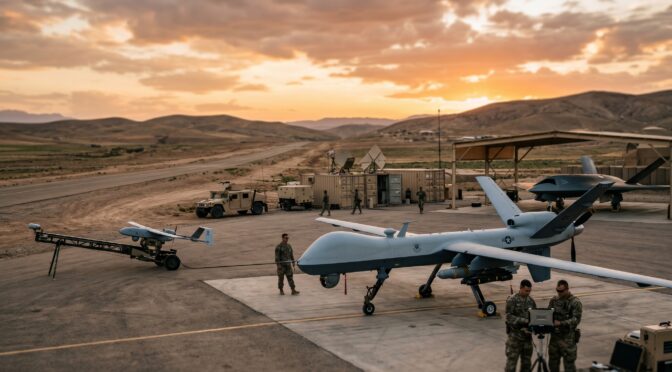
The reporting period between June 14 and June 20, 2026, was characterized by substantive advancements in the deployment, integration, and strategic utilization of uncrewed systems across all operational domains. The prevailing operational landscape is demonstrating a definitive structural shift away from the employment of drones as isolated, single-use tactical assets, moving toward their integration into multi-layered, autonomous “system-of-systems” architectures. This evolution was prominently displayed at the Eurosatory 2026 exhibition in Paris, which served as a focal point for the global defense industry to unveil platforms prioritizing structural modularity, autonomous targeting, and converged air defense capabilities. Notable hardware reveals included extra-large uncrewed underwater vehicles (XLUUVs) designed for long-range subsurface interdiction, autonomous uncrewed logistics helicopters, and mobile ground rocket systems retrofitted natively with autonomous defense interceptors to ensure localized survivability.
Kinetic engagements recorded during the trailing seven days underscore a deliberate maturation in operational doctrine among state and non-state actors alike. In the Eastern European theater, Ukrainian forces accelerated a deep-strike campaign categorized as a “logistics lockdown.” Utilizing mid-range and long-range aerial and maritime drones, Ukrainian formations systematically targeted Russian fuel infrastructure and severing supply lines extending to the Crimean Peninsula. This sustained campaign has forced Russian authorities to implement localized fuel rationing, demonstrating the strategic ripple effects and economic friction generated by persistent unmanned interdiction. Concurrently, Russian forces expanded the deployment of modernized, payload-heavy loitering munitions designed to overwhelm electronic warfare defenses and inflict material damage on Ukrainian frontline positions and civilian infrastructure.
Beyond the European continent, the rapid proliferation of uncrewed technology continues to alter the balance of asymmetric warfare. The Afghan Taliban conducted cross-border drone strikes into Pakistan, utilizing modified commercial platforms to target rival militant factions. This event marks a critical threshold in the democratization of standoff precision strike capabilities among non-state entities that historically lacked integrated air forces. In the Black Sea, Russian forces escalated maritime tensions by conducting lethal drone strikes against civilian commercial shipping vessels. Across the space domain, the prolonged orbital deployment of autonomous military spaceplanes reached a milestone as the United States’ X-37B returned to Earth, underscoring the ongoing strategic competition to master long-endurance, uncrewed orbital maneuvering and surveillance operations.31
2. Global Situation Log
The following situational log details kinetic events, political directives, and significant operational milestones recorded during the reporting period. To provide a standardized operational timeline, all events are organized strictly chronologically by date, and subsequently sorted alphabetically by the primary country or actor initiating the event.
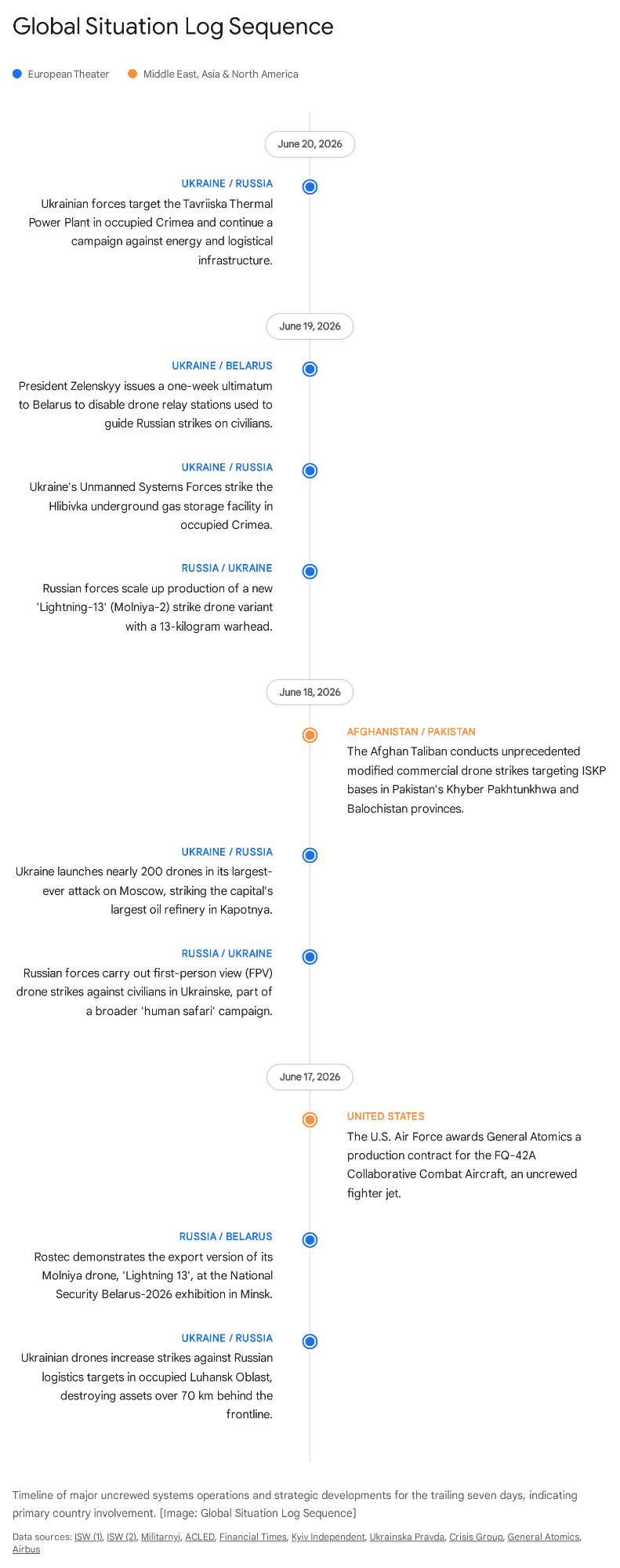
June 17, 2026
Ukraine Ukrainian Unmanned Systems Forces executed a coordinated series of deep-strike operations targeting Russian military logistics networks situated in the occupied Luhansk Oblast. Drone units successfully struck Russian fuel storage tanks and armored vehicles located beyond the Starobilsk line, functioning at an operational depth exceeding 70 kilometers from the active line of contact.1 Brigade commanders noted that the success of these deep-penetration strikes was facilitated by newly integrated, unspecified technological upgrades and enhanced communication relays.1 These modifications have materially increased the effective range and operational resilience of Ukrainian aerial platforms, allowing them to navigate and bypass heavily saturated Russian electronic warfare (EW) corridors that previously shielded rear-echelon logistics hubs.
June 18, 2026
Russia Russian forces maintained sustained pressure across the northern operational theater, focusing on the Sumy and Kharkiv regions. The Russian Ministry of Defense released imagery confirming airstrikes utilizing guided glide bombs against a bridge structure near Ulanove, located northwest of Sumy City.2 Concurrently, the Kharkiv Oblast Prosecutor’s Office reported that Russian units continue to employ first-person view (FPV) tactical drones to conduct deliberate strikes against civilian targets. An FPV drone attack in Ukrainske killed one civilian and injured another, reflecting an ongoing Russian strategy to integrate intentional civilian harm into their broader battlefield air interdiction campaigns.1 This tactic, colloquially referred to as “human safari” strikes, utilizes small tactical drones to hunt civilian infrastructure and personnel, further complicating international humanitarian law compliance and straining local emergency response resources.1
Russia / International Russian forces conducted lethal drone strikes against civilian commercial vessels navigating the Black Sea. The attack targeted two foreign-flagged ships, resulting in the death of one crew member aboard a Panamanian-flagged vessel and injuring five others, including a sailor in critical condition. A second vessel sailing under the flag of Saint Kitts and Nevis also sustained a strike, injuring three additional crew members. Ukrainian officials condemned the attacks as a form of maritime terrorism that threatens global food security and freedom of navigation.
Ukraine Ukrainian forces launched the largest coordinated drone assault on the Russian capital since the onset of the conflict, deploying an estimated 194 uncrewed aerial vehicles against Moscow and the surrounding regions.3 The primary strategic target of the strike was the Kapotnya oil refinery situated in southeastern Moscow, which supplies approximately 40 percent of the capital’s fuel requirements.3 Drones successfully penetrated the layered air defense network surrounding the facility, causing a substantial explosion that severed the roof of an oil storage tank and ignited widespread fires.3 The kinetic effects extended into residential areas, with drone debris striking high-rise apartment complexes and a nearby shopping center, resulting in 17 reported civilian injuries.3 Local residents reported a phenomenon of “black rain”—a fine drizzle leaving dark oily residue on surfaces—following the atmospheric dispersal of combusted fuel.3
In a separate operation targeting rail logistics, a Ukrainian unmanned systems regiment released visual confirmation of a successful drone strike against a Russian locomotive transporting fuel near Zhudilovo in the Bryansk Oblast, roughly 54 kilometers from the international border.2 These compounding strikes on fuel infrastructure have forced Russian authorities to implement and extend fuel rationing across the country, indicating the severe strategic friction generated by Ukraine’s uncrewed interdiction efforts.5
June 19, 2026
Afghanistan The Afghan Taliban administration executed overnight drone strikes targeting specific locations in the Khyber Pakhtunkhwa and Balochistan provinces of neighboring Pakistan.7 The Taliban claimed the strikes were aimed at militant bases operated by the Islamic State Khorasan Province (ISKP), their primary regional rival.7 The platforms utilized in the attack were commercially available drones heavily modified to carry small explosive payloads.7 Pakistan’s Ministry of Information and Broadcasting stated that its air defense forces detected and neutralized an intrusive drone near the Shinko area of the Khyber district.8 Islamabad officially rejected the Taliban’s claims regarding the targets, accusing Kabul of issuing false statements to conceal its ongoing patronization of terror organizations operating along the porous border.9
Belarus Ukrainian President Volodymyr Zelenskyy issued a formal ultimatum to Belarusian leader Alexander Lukashenko, demanding the immediate removal or deactivation of communications relay stations located along the Belarusian-Ukrainian border.10 During a joint press conference in Kyiv, Zelenskyy asserted that the relay equipment—consisting of both Russian and Belarusian hardware installed on cellular and communication towers—is actively utilized to guide Russian Shahed drone strikes against Ukrainian civilian infrastructure.10 Because there is no active frontline between Ukraine and Belarus, the Ukrainian government argues this infrastructure is used strictly to facilitate attacks on non-combatants. Ukraine granted Belarus a strict one-week deadline to dismantle the infrastructure, warning that Ukrainian forces would independently target and neutralize the relay stations if compliance was not met.10 Furthermore, Zelenskyy called for Belarus to halt the supply of refined petroleum products to the Russian military, leveraging diplomatic pressure against Minsk’s ongoing economic support of the Russian war effort.10
Russia Defense technology analysts verified the widespread deployment of a newly manufactured Russian strike drone, designated as the “Lightning-13” (a variant of the Molniya-2).2 Evidence indicates that Russian forces have significantly scaled the production and deployment of this platform, launching an estimated 1,400 high-speed jet-powered and electric drones since the beginning of the year, a stark increase compared to merely 180 recorded incidents in the entirety of 2025.14 The Lightning-13 is actively utilized by multiple Russian force groupings, including airborne brigades, engineering regiments, and special-purpose units operating across the Sever, Vostok, Zapad, Tsentr, and Dnepr sectors.13 The rapid integration of this platform highlights Russia’s industrial capacity to iterate upon inexpensive, attritable drone designs and deploy them at a scale capable of saturating theater air defenses.
June 20, 2026
Ukraine Ukraine’s Unmanned Systems Forces (USF) executed a coordinated series of strikes against strategic energy and logistical targets within the Russian-occupied Crimean Peninsula.15 Operating in the early hours, Ukrainian drone formations successfully struck the Hlibivka Underground Gas Storage facility in western Crimea (Tarkhankut Peninsula).15 This installation is highly strategic, as it regulates seasonal and daily gas consumption on the peninsula and maintains necessary pressure within the regional gas transportation system.15 Additional strikes targeted the Tavriiska Thermal Power Plant near Simferopol, where secondary explosions and substantial fires were recorded by local monitoring channels.15 The USF operations also neutralized peripheral support targets, including a Russian non-contact air defense radar station (“Repeynik”) and a diesel locomotive near Rozdolne.15 These strikes are a core component of Ukraine’s broader “logistics lockdown” program, aimed at completely isolating the Crimean Peninsula and degrading Russian supply lines.15
3. Product Developments, Platform Reveals, and Capability Upgrades
The volume of technological disclosures during the reporting period was heavily concentrated around the Eurosatory 2026 exhibition and its associated side events. The platforms unveiled signal a distinct industry consensus: future military operations require the deep integration of artificial intelligence, modular payload architectures, and converged offensive/defensive capabilities within single autonomous platforms. The following product developments are organized chronologically by their reveal date, and subsequently alphabetically by the primary originating country.
June 10, 2026
Note: While introduced prior to the primary reporting window at the ILA Berlin airshow, the following platforms were central features at Eurosatory 2026 and warrant inclusion due to their material impact on the sector.
France (Airbus) Airbus Helicopters introduced the U145, a fully uncrewed, mission-agnostic variant of the proven H145 helicopter platform.17 Scheduled for a maiden safety flight in late 2026 with an anticipated service entry in the early 2030s, the U145 eliminates the physical cockpit entirely.17 It replaces traditional flight controls with a specialized sensor suite integrating artificial intelligence designed to enable full autonomy.17 Retaining the H145’s twin Safran Arriel 2E engines and 3,800 kg maximum take-off weight (MTOW), the U145 features significant structural adaptations, including an integrated nose door with a foldable loading table to facilitate high-volume cargo supply.17 While primarily intended for logistics, the platform’s modularity supports armed scouting, crewed-uncrewed teaming, and functioning as a drone “mothership” for air-launched effects developed in partnership with European missile manufacturer MBDA.17
Concurrently, Airbus Helicopters and Quantum Systems finalized a cooperation agreement to jointly explore the integration of advanced counter-UAS (C-UAS) interceptors directly onto Airbus’ military helicopters, beginning with the multi-role H145M.18 To complement this hardware integration, Airbus Defence and Space signed a memorandum of understanding with Alta Ares to develop European air defense solutions, combining Airbus’ system integration expertise with Alta Ares’ AI-powered tactical air defense software.20
June 16, 2026
France (Origin Robotics) Following a competitive operational evaluation by the French Defence Procurement Agency (DGA), the French Armed Forces procured the BLAZE autonomous interceptor drone system developed by Latvian firm Origin Robotics.21 The BLAZE system is engineered to identify, track, and kinetically neutralize hostile uncrewed aerial vehicles.23 It holds the distinction of being the first NATO-codified autonomous interceptor equipped with a STANAG-compliant warhead module available for immediate delivery.22 Under a structured technology transfer agreement, the French defense technology integrator DSV will establish local assembly and manufacturing capabilities, reinforcing France’s sovereign counter-UAS supply chain under a domestic manufacturing label.21
Italy (IDV) At Eurosatory 2026, IDV (a Leonardo Company) debuted the CL2X Hybrid Uncrewed Light Tank. This next-generation tracked autonomous combat platform is designed to integrate seamlessly into battlefield command and control centers. To highlight the system-of-systems approach, IDV provided live interactive simulations demonstrating how localized commanders can manage an entire fleet of UGVs for anti-armor and reconnaissance engagements.
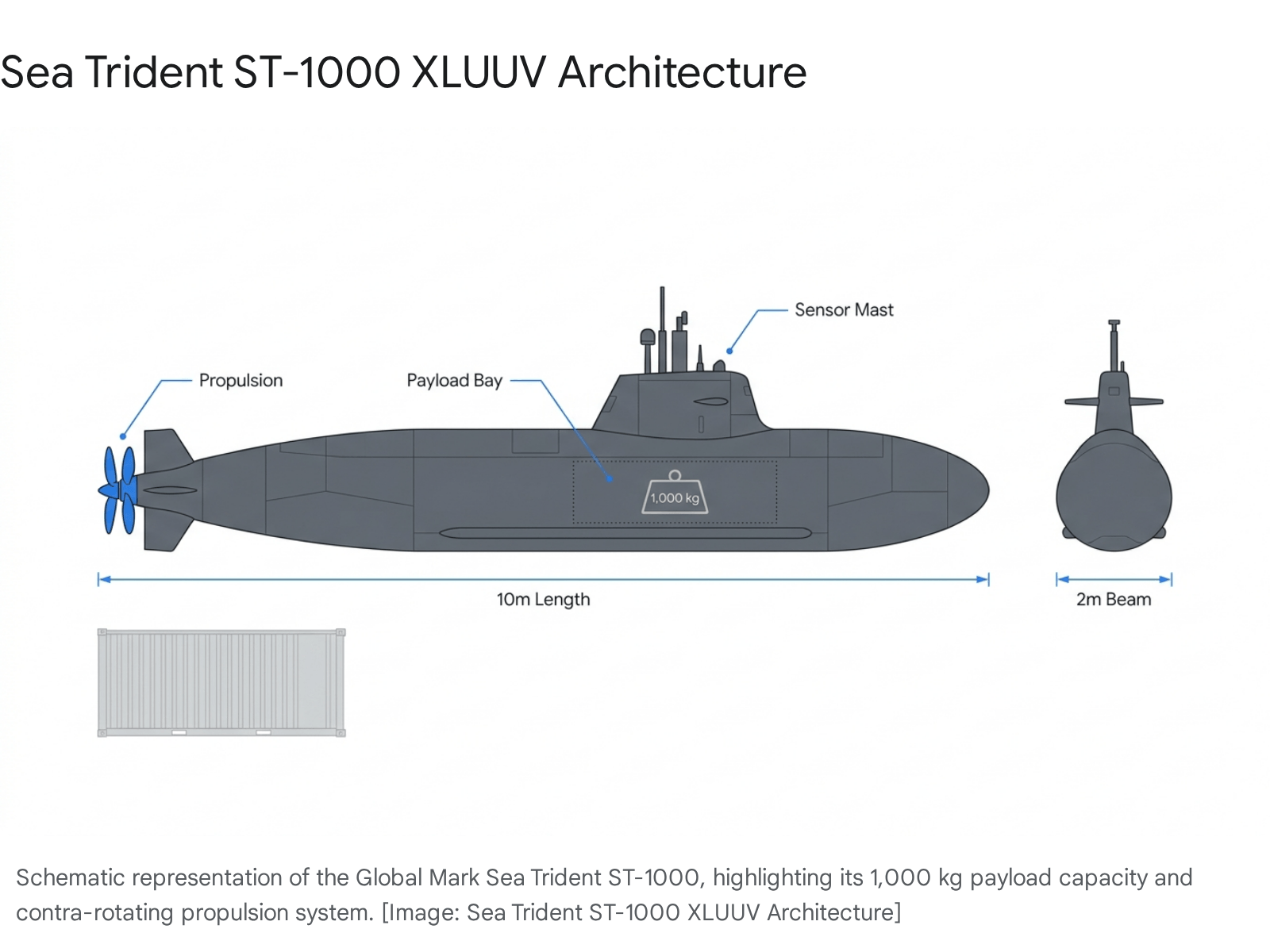
Ukraine (Global Mark) Ukrainian defense firm Global Mark unveiled the Sea Trident (ST-1000), an Extra-Large Uncrewed Underwater Vehicle (XLUUV).7 Designed to fit within a standard ISO shipping container for rapid road transport and covert deployment, the 10-tonne steel-hulled platform signifies a strategic shift in Ukrainian naval architecture from surface-level kamikaze boats to deep-water, multi-role stealth assets.7
| Specification | Details (Sea Trident ST-1000) |
| Dimensions | Length: 10m, Beam: 2m, Height: 1.5m (excluding mast) 7 |
| Displacement/Weight | 10,000 kg (10 tonnes) 7 |
| Operational Range | 2,000 nautical miles 7 |
| Operating Depth | Up to 60 meters (optimized for coastal and continental shelf operations) 7 |
| Speed | 6 knots cruising / 10 knots maximum 7 |
| Propulsion System | Contra-rotating screw (6-blade forward, 5-blade aft) 7 |
| Payload Capacity | 1,000 kg (Strike warhead or logistical delivery) 7 |
The Sea Trident features full autonomy and adaptive navigation, capable of low-observability subsurface ingress at depths of 5 meters to penetrate contested maritime areas undetected.25 Distinctly, the platform is engineered not solely for offensive strikes against capital ships or coastal infrastructure, but also to actively intercept and neutralize adversary UUVs, establishing it as a dual-use offensive and defensive asset in contested underwater domains.7
United States & China (Space Domain) The United States military’s highly classified X-37B robotic spaceplane returned to Earth after spending 908 days in orbit.31 While China’s Shenlong spaceplane continues its orbital mission, the return of the X-37B concludes a significant operational phase where aerospace analysts noted the two autonomous space drones were closely matching each other in timing and orbital sequence.28 These platforms underscore the military utility of autonomous, long-endurance orbital maneuvering vehicles capable of sustained experimentation, payload delivery, and counter-surveillance operations.30
United States (Lockheed Martin) U.S. defense contractor Lockheed Martin introduced the HIMARS FLEX, a modular evolution of the legacy M142 High Mobility Artillery Rocket System.32 The primary mechanical innovation is the transition to a dual-pod launcher configuration, effectively doubling the standard ammunition capacity.32 This resolves a critical logistical limitation of the legacy system, which required returning to a vulnerable resupply point after expending a single pod.32 The system integrates the proprietary FLEXFires autonomous ecosystem and introduces an unprecedented tactical capability: launching air defense and missile interceptors, including the Patriot PAC-3 MSE and Indirect Fire Protection Capability (IFPC) munitions, from the same highly mobile chassis.32 Despite the increased payload, the system retains its ability to be air-transported by C-130 aircraft, offering a highly mobile missile defense alternative compared to traditional, static Patriot batteries.32
United States (Ondas) U.S. autonomous systems firm Ondas launched an interconnected suite of autonomous defense systems designed under its “Autonomy at First Contact” architecture.34 The core premise of the architecture ensures that autonomous technology makes the first operational contact before human personnel are exposed to hostile environments.36
- Iron Wave: A containerized air defense module integrating unmanned ground vehicles (UGVs) and C-UAS platforms for forward-deployed forces.34
- Dual Shield: A modular, truck-mounted C-UAS solution optimized to protect maneuvering armored columns.34
- Iron Arrow: A fully autonomous interceptor targeting high-speed aerial threats (Group 2 and Group 3 UAVs). The system boasts a 15 km range, speeds exceeding 350 km/h, operates seamlessly in GPS-denied environments, and launches from a 20-cell containerized battery system.34
- LADOS: The Layered Autonomous Defense Orchestration System serves as the overarching command-and-control software. It integrates air defense, ground robotics, and disparate sensing platforms into a unified interface capable of mapping into broader military architectures.34
June 17, 2026
Russia (Rostec) The Russian defense corporation Rostec officially demonstrated the “Lightning-13” at the National Security Belarus-2026 exhibition.13 The Lightning-13 is the export and civilian designation for the combat-proven Molniya-2 loitering munition, which has seen extensive deployment in Ukraine.
| Specification | Details (Lightning-13 / Molniya-2 Variant) |
| Propulsion System | Four electric motors (replacing the original single nose engine) 2 |
| Payload Capacity | Up to 13 kg (specifically modified to carry heavy TM-62 anti-tank mines) 2 |
| Operational Range | 40 to 50 km 13 |
| Maximum Speed | 120 km/h 13 |
| Construction Materials | Inexpensive foam, plywood, plastic, and lightweight composites 13 |
| Guidance System | FPV operator control equipped with upgraded, interference-resistant command-telemetry modules to defeat EW 13 |
The structural redesign includes a top fairing that protects the electronics and warhead, materially improving aerodynamic efficiency to extend the flight range.13 However, when modified to carry the 10 kg TM-62 mine to strike hardened bunkers, operators must remove the aerodynamic fairing. This heavy load severely degrades flight capabilities, control, and maneuverability, forcing operators to launch from elevated positions like multi-story buildings.13 Despite these drawbacks, the system remains highly cost-effective, utilizing the exact same ground control stations as conventional quadcopters, thereby streamlining logistical and training burdens for Russian operators.13
United States (General Atomics) The United States Air Force officially awarded General Atomics Aeronautical Systems, Inc. (GA-ASI) a production contract for the FQ-42A Collaborative Combat Aircraft (CCA).17 This order marks the critical transition of the semi-autonomous uncrewed combat jet from the development and testing phase into active manufacturing. The FQ-42A was developed on an accelerated 15-month schedule from contract award to first flight, utilizing a modular design optimized for human-machine teaming.37 Its software architecture facilitates rapid iterative integration of new mission systems and autonomy updates without requiring structural airframe modifications, positioning it as a cornerstone of the Air Force’s next-generation loyal wingman fleet.37
4. Tactical, Operational, and Strategic Lessons Learned
The aggregation of kinetic events and product reveals during this reporting period highlights several critical shifts in how uncrewed systems dictate modern military strategy. The following lessons represent the synthesis of these observations, organized chronologically by the date of the event that best exemplifies the strategic shift, and alphabetically by the primary country involved.
June 16, 2026
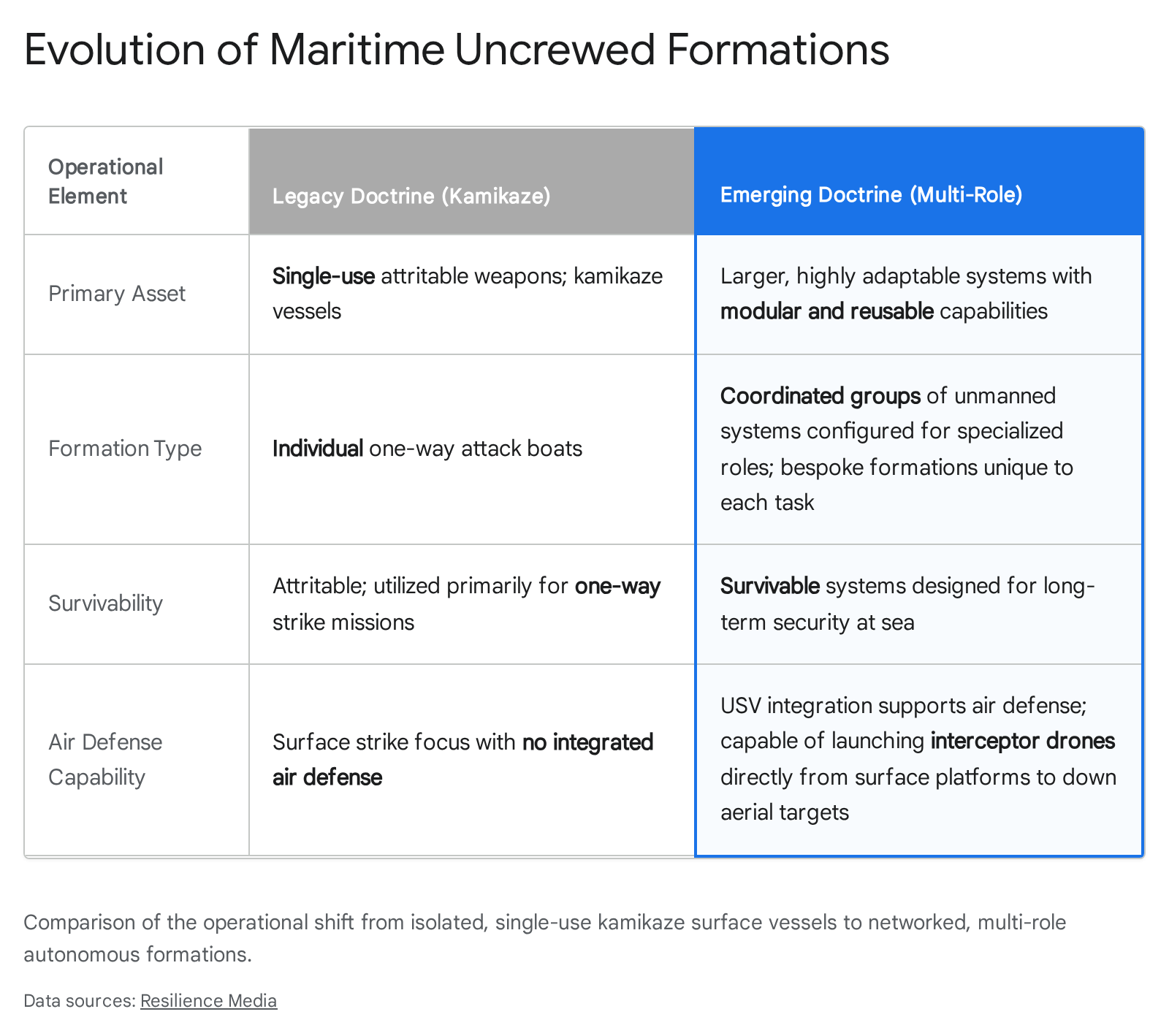
Ukraine: The Transition from Kamikaze USVs to Multi-Role Naval Formations The unveiling of the Sea Trident XLUUV and the overarching trends observed at the DIH Naval Forge forum in Kyiv indicate that maritime drone warfare is exiting its infancy.7 Early operations in the Black Sea relied heavily on attritable, single-use surface vessels (kamikaze boats) to strike stationary or slow-moving capital ships.38 However, adversary adaptations—such as layered defenses combining helicopters, fixed-wing aircraft, and loitering munitions—have degraded the efficacy of isolated USV attacks.38
In response, developers are engineering highly modular, survivable platforms intended for multi-role coordinated formations.38 Future maritime strike packages will consist of specialized drone subgroups operating in concert: one USV acting as a localized air defense node, another functioning as a launch platform for FPV drones, and a third—such as the Sea Trident—operating sub-surface to deliver heavy kinetic payloads or intercept enemy UUVs.7 This doctrinal evolution effectively blurs the traditional boundaries between naval warfare, air defense, and aerial drone operations, establishing the uncrewed surface and subsurface fleet as a comprehensive, independent combat arm capable of sustained maritime area denial.38 Furthermore, procurement models are shifting from relying on foreign hardware donations to directly funding Ukrainian manufacturers (the “Danish model”), ensuring rapid scaling based on immediate battlefield feedback.38
United States: The Convergence of Ground Strike and Autonomous Counter-UAS The proliferation of lethal, low-cost loitering munitions has created an unsustainable risk profile for highly expensive, manned legacy platforms. The partnership between Airbus Helicopters and Quantum Systems to integrate autonomous C-UAS interceptors onto the H145M helicopter underscores a critical operational reality: manned aircraft can no longer rely solely on altitude, speed, or electronic warfare to survive in drone-saturated airspace.18
Similarly, the introduction of the Lockheed Martin HIMARS FLEX demonstrates the necessity of converging offensive fires with localized air defense.32 By equipping a primary ground-strike asset natively with Patriot PAC-3 MSE interceptors, the system achieves self-contained survivability.32 This reduces the logistical and operational burden of requiring dedicated, separate air defense batteries to protect vital artillery nodes.32 The tactical lesson derived from these platform updates is that future prime assets—whether helicopters, artillery, or forward logistics hubs—must natively incorporate autonomous, hard-kill drone defense systems to remain viable and survivable on the modern battlefield.
June 18, 2026
Ukraine: Operationalizing the “Logistics Lockdown” The Ukrainian Unmanned Systems Forces’ operations against the Kapotnya refinery in Moscow and infrastructure across the Crimean Peninsula demonstrate the operationalization of a “logistics lockdown” doctrine.5 By massively expanding their “Middle Strike” drone capabilities—targeting assets located 25 to 200 kilometers behind the line of contact—Ukraine is systematically dismantling the infrastructure required to sustain frontline Russian operations.15
The targeted destruction of the Hlibivka underground gas storage facility, thermal power plants, and railway locomotives is specifically designed to isolate the Crimean Peninsula, choking the flow of fuel and lubricants necessary for armored maneuvers.15 This drone campaign has already generated severe strategic friction, forcing Russian proxy authorities to implement strict fuel rationing and voucher systems for civilians and municipal transport.6 The strategic lesson is clear: massed, relatively inexpensive mid-range drones can bypass layered air defenses to achieve strategic interdiction. This approach effectively halts an adversary’s operational momentum by starving their logistical tail, proving far more efficient than engaging their combat vanguard in direct attrition warfare.
June 19, 2026
Afghanistan: The Democratization of Precision Strike Capabilities The Afghan Taliban’s use of modified commercial drones to conduct precision strikes against ISKP targets inside Pakistan represents a significant threshold crossed in irregular warfare.7 Historically, cross-border aerial interdiction was a highly complex capability exclusive to nation-states possessing advanced, integrated air forces. The modification of low-cost, commercially available off-the-shelf (COTS) quadcopters to carry explosive payloads provides non-state actors and emerging militaries with a highly disruptive, asymmetric strike capability.7
This democratization of airpower forces regional security forces to invest heavily in extensive C-UAS infrastructure, disproportionately draining resources to counter relatively inexpensive threats.7 As these experimental capabilities inevitably become more sophisticated regarding payload capacity and guidance autonomy, the threshold for cross-border kinetic escalation will lower. This dynamic permanently alters the security calculus in volatile regions such as Central Asia and the Middle East, as non-state actors can now project localized airpower without requiring airbases or traditional aviation supply chains.
Belarus: C2 Infrastructure and Proxy Geography The diplomatic ultimatum issued by Ukraine to Belarus regarding the removal of drone communications relay stations highlights a complex geopolitical targeting dilemma unique to uncrewed warfare.10 Long-range uncrewed operations require robust Command and Control (C2) infrastructure to maintain data links and navigational fidelity over vast distances. By utilizing relay stations situated in the territory of a non-combatant proxy state (Belarus), Russian forces effectively shield their critical C2 architecture behind international borders.10 This exploits the geopolitical hesitance of an adversary to strike foreign soil and risk widening the war.
This tactic introduces severe operational friction. When proxy geography is utilized to guide lethal strikes against civilian targets, the defending nation is forced to weigh the immediate tactical necessity of neutralizing the relay against the strategic risk of triggering a broader regional conflict by striking a third party.10 The situation demonstrates that the physical footprint of uncrewed warfare extends far beyond the launch site and the terminal target, encompassing the entire geographical network of signal relays and data infrastructure, which increasingly spans across sovereign borders.
Please share the link on Facebook, Forums, with colleagues, etc. Your support is much appreciated and if you have any feedback, please email us in**@*********ps.com. If you’d like to request a report or order a reprint, please click here for the corresponding page to open in new tab.
Sources Used
- Russian Offensive Campaign Assessment, June 18, 2026 | ISW, accessed June 20, 2026, https://understandingwar.org/research/russia-ukraine/russian-offensive-campaign-assessment-june-18-2026/
- Russian Offensive Campaign Assessment, June 19, 2026 | ISW, accessed June 20, 2026, https://understandingwar.org/research/russia-ukraine/russian-offensive-campaign-assessment-june-19-2026/
- Black rain in Moscow after Ukrainian drone strike damages oil refinery, Zelenskyy says if Ukraine burns so will Moscow, accessed June 20, 2026, https://m.economictimes.com/news/new-updates/black-rain-in-moscow-after-ukrainian-drone-strike-damages-oil-refinery-zelenskyy-says-if-ukraine-burns-so-will-moscow/articleshow/131847048.cms
- What did Ukraine target in Moscow and how significant was the drone attack? | Russia | The Guardian, accessed June 20, 2026, https://www.theguardian.com/world/2026/jun/18/what-did-ukraine-target-in-moscow-and-how-significant-was-the-drone-attack
- Ukraine hits Moscow with largest-ever drone attack, accessed June 20, 2026, https://www.ft.com/content/c2514fd8-d5d8-4bde-ad64-1167638d188b?syn-25a6b1a6=1
- Ukraine targets Moscow refineries with drones, causing fuel rationing across Russia, accessed June 20, 2026, https://www.youtube.com/watch?v=Hvvhb5i0a18
- Why is the Afghan Taliban launching drone strikes in Pakistan …, accessed June 20, 2026, https://acleddata.com/expert-comment/why-afghan-taliban-launching-drone-strikes-pakistan
- Taliban Drone Was Shot Down In Khyber District, Says Pakistan, accessed June 20, 2026, https://www.afintl.com/en/202606194878
- Pakistan says it neutralized Taliban drone, accuses Afghan government of ‘patronizing terror’, accessed June 20, 2026, https://www.aa.com.tr/en/asia-pacific/pakistan-says-it-neutralized-taliban-drone-accuses-afghan-government-of-patronizing-terror-/3971762
- Zelenskyy gives Belarusian ruler a week to remove Russian drone …, accessed June 20, 2026, https://www.pravda.com.ua/eng/news/2026/06/19/8040213/
- Ukraine war briefing: Zelenskyy to Belarus – remove Russian relay stations or ‘we’ll do it’, accessed June 20, 2026, https://www.theguardian.com/world/2026/jun/20/ukraine-war-briefing-zelenskyy-to-belarus-remove-russian-relay-stations-or-well-do-it
- ‘A week will be enough’ — Zelensky issues ultimatum to Lukashenko over drone-guidance equipment – The Kyiv Independent, accessed June 20, 2026, https://kyivindependent.com/a-week-will-be-enough-zelensky-issues-ultimatum-to-lukashenko-over-drone-guidance-equipment/
- Lightning 13: Russia Develops New Version of the Molniya Strike UAV, accessed June 20, 2026, https://militarnyi.com/en/news/lightning-13-russia-new-version-molniya-uav/
- Russia Increased Use of Jet-Powered Strike Drones Eightfold and Has Launched 1,400 Units Since the Beginning of Year, accessed June 20, 2026, https://militarnyi.com/en/news/russia-jet-drones-eightfold-1400-units-2026/
- Ukrainian drones hit gas storage facility in occupied Crimea, footage …, accessed June 20, 2026, https://kyivindependent.com/ukrainian-drones-hit-gas-storage-facility-in-occupied-crimea-footage-shows-power-plant-reportedly-struck/
- Drone Attacks Spark Fires at Power Plant and Fuel Infrastructure in Occupied Crimea – Kyiv Post, accessed June 20, 2026, https://www.kyivpost.com/post/78584
- Airbus introduces the U145 | Airbus, accessed June 20, 2026, https://www.airbus.com/en/newsroom/press-releases/2026-06-airbus-introduces-uncrewed-version-of-the-h145-the-u145
- Airbus Helicopters, Quantum Systems partner on helicopter-based C …, accessed June 20, 2026, https://www.unmannedairspace.info/counter-uas-systems-and-policies/airbus-helicopters-quantum-systems-partner-on-helicopter-based-c-uas-systems/
- Airbus and Quantum Systems to cooperate on integration of counter UAS interceptors on military helicopters, accessed June 20, 2026, https://www.airbus.com/en/newsroom/press-releases/2026-06-airbus-and-quantum-systems-to-cooperate-on-integration-of-counter-uas-interceptors-on-military
- Airbus and Alta Ares sign partnership to develop Europe’s air defence solutions, accessed June 20, 2026, https://www.airbus.com/en/newsroom/press-releases/2026-06-airbus-and-alta-ares-sign-partnership-to-develop-europes-air-defence-solutions
- France Orders BLAZE Counter-Drone System at Eurosatory 2026, accessed June 20, 2026, https://www.unmannedsystemstechnology.com/2026/06/france-orders-blaze-counter-drone-system-at-eurosatory-2026/
- France orders Origin Robotics BLAZE interceptor drone system after DGA evaluation for counter-drone missions – Defence Industry Europe, accessed June 20, 2026, https://defence-industry.eu/france-orders-origin-robotics-blaze-interceptor-drone-system-after-dga-evaluation-for-counter-drone-missions/
- France to buy Latvian ‘Blaze’ drone interceptor system / Article, accessed June 20, 2026, https://eng.lsm.lv/article/society/defence/17.06.2026-france-to-buy-latvian-blaze-drone-interceptor-system.a651858/
- Eurosatory 2026: Ukraine Unveils Sea Trident Underwater Drone – YouTube, accessed June 20, 2026, https://www.youtube.com/shorts/R-s8v2Pj1oU
- Ukraine’s Massive New Underwater Drone: Sea Trident ST-1000 – YouTube, accessed June 20, 2026, https://www.youtube.com/watch?v=0aBsFuDMq38
- At Paris top defense exhibition, Ukraine unveiled 10-ton Sea Trident …, accessed June 20, 2026, https://euromaidanpress.com/2026/06/15/at-paris-top-defense-exhibition-ukraine-unveiled-10-ton-sea-trident-that-can-hunt-underwater-drones/
- Sea Trident SL-1000: New Ukrainian Underwater Drone (UUV) – Covert Shores, accessed June 20, 2026, https://www.hisutton.com/Ukraine-UUV-Sea-Trident-SL1000.html
- US military’s secretive space plane blasts off from Florida – TRT World, accessed June 20, 2026, https://www.trtworld.com/article/16442944
- US Military’s Secretive Spaceplane Launched on Possible Higher-Orbit Mission – VOA, accessed June 20, 2026, https://www.voanews.com/a/us-military-s-secretive-spaceplane-launched-on-possible-higher-orbit-mission-/7416948.html
- US military’s X-37B robot spaceplane blasts off on secret mission aboard SpaceX rocket, accessed June 20, 2026, https://www.theguardian.com/science/2023/dec/29/us-military-x-37b-robot-spaceplane-spacex-falcon-heavy-rocket-secret-mission
- US military space drone returns to Earth after 908 days in orbit | The Business Standard, accessed June 20, 2026, https://www.tbsnews.net/worldbiz/usa/us-military-space-drone-returns-earth-after-908-days-orbit-530822
- HIMARS evolves at Eurosatory 2026: Lockheed Martin unveils a …, accessed June 20, 2026, https://www.zona-militar.com/en/2026/06/19/himars-evolves-at-eurosatory-2026-lockheed-martin-unveils-a-new-version-capable-of-launching-air-defense-and-missile-interceptors/
- Lockheed Martin Unveils HIMARS FLEX With Double Firepower – RealClearDefense, accessed June 20, 2026, https://www.realcleardefense.com/2026/06/17/lockheed_martin_unveils_himars_flex_with_double_firepower_1189121.html
- Exclusive: Ondas Unveils a New Fully Autonomous Interceptor, accessed June 20, 2026, https://www.tectonicdefense.com/exclusive-ondas-unveils-a-new-fully-autonomous-interceptor/
- Ondas Launches New Autonomous Defense Systems of Systems at Eurosatory 2026 Under Its “Autonomy at First Contact” Vision – Stock Titan, accessed June 20, 2026, https://www.stocktitan.net/news/ONDS/ondas-launches-new-autonomous-defense-systems-of-systems-at-1hul6wm0m6hg.html
- Ondas Launches New Autonomous Defense Systems of Systems at Eurosatory 2026 Under Its “Autonomy at First Contact” Vision, accessed June 20, 2026, https://www.autonomyglobal.co/ondas-launches-new-autonomous-defense-systems-of-systems-at-eurosatory-2026-under-its-autonomy-at-first-contact-vision/
- U.S Air Force Awards GA-ASI Production Contract for FQ-42A CCA …, accessed June 20, 2026, https://www.ga.com/us-air-force-awards-ga-asi-production-contract-for-fq-42a-cca
- In Kyiv, naval drone developers look beyond the kamikaze era …, accessed June 20, 2026, https://resiliencemedia.co/in-kyiv-naval-drone-developers-look-beyond-the-kamikaze-era/