1. Executive Summary
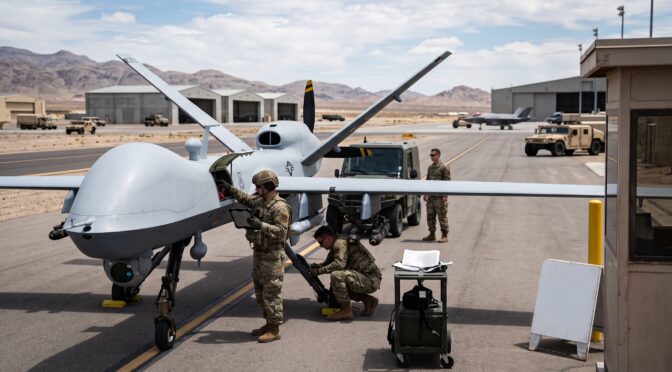
Over the trailing seven-day reporting period, the global operational environment has been characterized by a steady acceleration in the deployment, integration, and institutionalization of unmanned systems and autonomous vehicles across the air, land, sea, and space domains. The collected intelligence indicates a transition from the experimental application of uncrewed technologies to their formalized integration into multidomain combat doctrine. Both state and non-state actors are increasingly leveraging these autonomous and remotely operated systems to manipulate geopolitical chokepoints, degrade adversary logistics, and offset traditional military asymmetries with scalable alternatives.
In the air domain, mass mobilization and algorithmic saturation tactics are becoming established paradigms. The reporting period witnessed one of the largest single-day drone bombardments on historical record, alongside formalized national defense strategies aimed at training broad segments of military populations as drone operators. Furthermore, the integration of autonomous flight and targeting software into legacy kinetic systems continues to reduce the cognitive load on human operators. The introduction of man-portable directed-energy weapons and advanced counter-unmanned aircraft systems (C-UAS) at the squad level signals an evolution in localized air defense, countering the threat of loitering munitions.
In the land domain, the maturation of Unmanned Ground Vehicles (UGVs) has crossed a critical threshold of operational viability. Major international defense exhibitions and active frontline deployments confirm that ground robotics are successfully sustaining combat logistics in contested environments, conducting high-risk casualty evacuations, and executing combat engineering tasks—such as breaching concertina wire obstacles—that previously carried prohibitive human casualty rates. In response to these proven battlefield capabilities, the European and American defense industrial bases are forging joint ventures with field-tested operators to scale the production of autonomous ground platforms.
The maritime domain remains a volatile theater, with uncrewed surface vessels (USVs), unmanned underwater vehicles (UUVs), and low-cost aerial loitering munitions acting as primary vectors for grey-zone warfare and active sea denial. Kinetic engagements in critical global waterways have underscored the vulnerability of commercial shipping to asymmetric drone strikes, prompting immediate kinetic retaliations from allied naval task forces. Concurrently, allied navies are maturing their hybrid fleet architectures, pushing advanced unmanned surface and subsurface vehicles out of experimental testing and into integrated coalition operations designed to protect critical undersea infrastructure.
Finally, the space domain is witnessing an expansion of autonomous capabilities and complex proximity operations. The verified release of unidentified orbital payloads by reusable space planes highlights the growing prioritization of space domain awareness and orbital maneuverability among strategic competitors. Simultaneously, allied military space infrastructure is being fortified through procurement contracts to provide the resilient, ultra-high frequency satellite communications required to command, control, and coordinate autonomous vehicles operating across terrestrial domains. The intersection of commercial space innovation and military requirements is driving targeted acquisitions, altering how autonomous hazard avoidance and deep-space navigation are integrated into national defense architectures.
The following sections provide a detailed, strictly chronological, and alphabetically sorted analysis of the week’s noteworthy product developments, kinetic events, and the resulting tactical, operational, and strategic lessons learned from June 20 to June 27, 2026.
2. Global Situation Log: June 20, 2026
Russia
Event & Development: Ukrainian military forces launched a large-scale nighttime aerial assault against Russian territory, deploying an estimated 660 long-range attack drones. The expansive bombardment targeted a dozen distinct Russian regions, including the occupied Crimean Peninsula and surrounding strategic maritime sectors. The Russian Defense Ministry claimed its integrated air defense networks intercepted the majority of the incoming systems. However, the scale of the attack represents one of the largest single-day drone assaults since the onset of the conflict, surpassing the previous recorded high of 556 drones recorded in May 2025.1
Tactical & Operational Lessons: The operation highlights a maturation in autonomous saturation tactics. By launching hundreds of low-cost, mid-range autonomous systems simultaneously, attacking forces can deliberately overwhelm the targeting bandwidth and exhaust the interceptor stockpiles of sophisticated Integrated Air Defense Systems (IADS). This tactic creates temporary, localized corridors of uncontested airspace, allowing subsequent waves of drones or traditional precision-guided munitions to strike higher-value targets deep within the adversary’s operational rear. The defense is forced to choose between expending multi-million-dollar interceptors on cheap drones or allowing critical infrastructure to sustain heavy damage.1
Strategic Lessons: This deployment confirms a strategic shift toward the deliberate industrial and economic strangulation of the adversary. Long-range unmanned aerial vehicles are being utilized not merely for tactical battlefield support or immediate close air support, but as a surrogate strategic bomber fleet aimed at choking fuel supplies, degrading energy infrastructure, and stalling critical logistical deliveries far behind the frontline. By continuously battering oil production facilities and transportation hubs, the attacking force generates operational friction, effectively degrading the adversary’s capacity to sustain high-intensity mechanized combat operations.1
United States
Event & Development: The United States Army Reserve Innovation Command (75th USARIC), specifically the Army Applications Group, conducted live technical evaluations of advanced Counter-small Unmanned Aircraft Systems (C-sUAS) during Operation Sentinel Justice 26 at Camp Shelby, Mississippi. The technical assessments focused on integrating commercial off-the-shelf and next-generation military hardware into tactical formations. Primary systems under review included the SMASH algorithmic fire control system and the Dronebuster 4—a handheld directed-energy jammer designed to sever command links and GPS navigation.2 Concurrently, reports emerged detailing the U.S. Army’s development of specialized drones designed specifically to locate, secure, and evacuate captured enemy UAVs from the battlefield.3 Furthermore, the domestic defense industrial base saw an Arizona-based unmanned vehicle manufacturer, Crow Industries, announce a strategic pivot from space-mining robotics to the dedicated production of Unmanned Ground Vehicles (UGVs) for Army battlefield applications.4
Tactical & Operational Lessons: The deployment and rigorous testing of the Dronebuster 4 and SMASH fire control systems down to the squad level indicates a shift in force protection doctrine. C-sUAS capabilities are no longer the exclusive, specialized domain of air defense artillery units operating heavy, vehicle-mounted radars. Instead, electronic warfare capabilities and algorithmic targeting assistance are becoming standard issue for frontline infantry elements, recognizing that small loitering munitions are an omnipresent threat that must be countered at the lowest tactical echelon.2 The concurrent development of drone-retrieval systems demonstrates a tactical evolution where capturing adversary technology for reverse engineering and immediate signals intelligence (SIGINT) exploitation is formalized as a logistical and intelligence requirement.3
Strategic Lessons: The deliberate pivot of commercial robotics firms, such as Crow Industries, from civilian exploratory space sectors to defense manufacturing underscores the cascading economic effect of modern drone warfare on the domestic industrial base. The clear demand signal for scalable, autonomous ground and air systems is reorienting commercial capital and engineering talent toward military applications. This trend highlights the Pentagon’s increasing reliance on agile, non-traditional defense contractors to provide rapid prototyping and off-the-shelf solutions that bypass traditional defense procurement cycles.4
3. Global Situation Log: June 21, 2026
Russia
Event & Development: Russian forces continued their long-range strategic strike campaigns against Ukrainian military and civilian infrastructure, introducing a modified new variant of the Shahed-series strike drone. This newly observed and documented model features a specialized double warhead specifically designed to house and disperse cluster munitions over a wide geographic footprint.5
Tactical & Operational Lessons: The integration of cluster munitions into loitering autonomous drones transforms the platform from a point-target kinetic weapon into a dynamic, wide-area denial tool. This technical modification allows forces to remotely mine operational zones, interdicting enemy troop movements and contaminating logistical corridors without risking manned aviation or exposing forward ground units to counter-battery fire. By dispersing submunitions along known resupply routes or assembly areas, the attacking force forces the adversary to commit significant time and resources to explosive ordnance disposal (EOD), slowing operational tempo.5
Strategic Lessons: The technical iteration and payload adaptation of the Shahed airframe demonstrates a responsive feedback loop between frontline operational requirements and the domestic defense manufacturing base. By constantly modifying imported or licensed airframes to deliver submunitions, the military can achieve disproportionate strategic impacts. This evolution forces defending nations to constantly adapt their interception protocols, as a single drone slipping through the air defense net can effectively mine an entire logistical hub.5
Ukraine
Event & Development: Major Robert “Magyar” Brovdi, the Commander of the Ukrainian Unmanned Systems Forces (USF), articulated the progress of a phased strategy utilizing mid-range drones to systematically isolate the Russian-occupied Crimean Peninsula. The publicly acknowledged campaign focuses heavily on degrading advanced air defense systems, forcing the withdrawal of the Black Sea Fleet’s naval assets, and severing critical transportation and energy nodes supporting the region.5
Tactical & Operational Lessons: The USF’s methodology relies on a phased suppression of enemy air defenses (SEAD) using waves of low-cost, expendable drones to map radar emissions and open safe transit corridors. Once these corridors are established, subsequent waves of autonomous systems can strike deeper, high-value logistical targets such as bridges, rail hubs, and ferry crossings with greater survivability. This systematic dismantling of infrastructure aims to render the logistical sustainment of conventional ground forces on the peninsula mathematically impossible over a prolonged timeline.5
Strategic Lessons: Unmanned aerial systems are enabling forces without a traditional deep-strike bomber fleet to execute theater-level strategic isolation campaigns. By methodically dismantling the logistical arteries connecting a peninsula to the mainland—effectively executing an “island-making” strategy—an attacking force can render a fortified region strategically untenable without requiring a casualty-intensive amphibious or ground assault. The low unit cost of the mid-range drone fleet makes this type of continuous logistical bombardment economically sustainable.5
4. Global Situation Log: June 22, 2026
China
Event & Development: The Chinese experimental reusable space plane, Shenlong (“Divine Dragon”), released an unidentified object into Low Earth Orbit (LEO). Tracked closely by the U.S. Space Force under the catalog number 69673, the payload release was also independently verified by the commercial space surveillance firm LeoLabs. The Shenlong space plane, which shares operational and design characteristics with the U.S. Space Force’s X-37B, has been operating in orbit since February.7
Tactical & Operational Lessons: The release of small subsatellites—likely specialized cubesats—enables the space plane to practice complex rendezvous and proximity operations (RPO) in a microgravity environment. These orbital maneuvers are critical for the on-orbit inspection, maintenance, and potential capture or disruption of adversarial space assets. The ability to deploy a secondary payload, maneuver away, and subsequently return to observe or interact with it demonstrates a degree of autonomous orbital navigation and thruster control.8
Strategic Lessons: The operations of the Shenlong platform highlight a broader strategic imperative in Beijing to establish unrestricted orbital maneuverability and persistent space domain awareness. The dual-use nature of these proximity operations creates strategic ambiguity; the same technology, sensors, and algorithms used to repair or refuel a friendly satellite can be weaponized as a co-orbital anti-satellite (ASAT) system to blind, sabotage, or dismantle enemy communications and early-warning networks. This deployment reinforces the militarization of LEO and the necessity for competing powers to field robust, space-based monitoring capabilities.7
France / International
Event & Development: The Eurosatory 2026 defense exhibition in Paris prominently featured unmanned systems, serving as a bellwether for the future of mechanized land warfare. Over 50 different UGV manufacturers were in attendance, displaying combat-ready platforms. Ukrainian firms featured prominently, actively displaying combat-proven platforms like the state-owned Ukroboronprom RAVLYK UMP-3, which was showcased carrying Ukrainian-made anti-tank guided missiles. Concurrently, European aviation conglomerate Airbus engaged in advanced discussions with Kawasaki Heavy Industries regarding the Eurodrone project—a Medium Altitude Long Endurance (MALE) system capable of 40-hour continuous flights, targeted toward maritime monitoring requirements for nations like Japan. On the naval front, Spanish innovator Armmo officially unveiled its ARW39CAT-A armed Unmanned Surface Vehicle (USV). The 12-meter catamaran is capable of 50-knot speeds, carries a 1200 kg payload, and features a 30x113mm revolver cannon alongside accommodations for up to 20 Bandit-X interceptor drones for C-UAS operations.11
Tactical & Operational Lessons: The presence of armed UGVs and high-speed, heavily armed USVs reflects a tactical reality synthesized from recent conflicts: the modern “kill zone” extends between 15 and 50 kilometers from the line of contact, rendering manned operations in these areas highly lethal due to persistent drone surveillance and precision artillery fires. UGVs and USVs are being deployed as critical stand-in forces to absorb this kinetic risk. The Armmo USV specifically demonstrates that unmanned naval platforms are moving beyond ISR (Intelligence, Surveillance, and Reconnaissance) roles into heavily armed, autonomous fast-attack craft capable of engaging aircraft, swarms, and larger surface combatants simultaneously.12
Strategic Lessons: The European defense industrial base is undergoing a structural paradigm shift, actively absorbing years of high-attrition battlefield data to mass-produce reliable ground and sea robotics. Furthermore, the push for the Eurodrone collaboration with Japan indicates a strategic requirement among allied nations for sovereign, persistent maritime domain awareness platforms that are free from non-aligned supply chain dependencies or foreign export controls.13
Turkey / Russia
Event & Development: The Panamanian-flagged, Turkish-owned dry cargo vessel VICTRESS was struck by an unmanned aerial vehicle in the Black Sea off the coast of the Chornomorsk Port. The kinetic impact sparked a fire onboard, resulting in the death of one crew member and causing significant structural damage. Due to the severity of the blaze, the remaining crew required an emergency evacuation executed by Ukrainian Navy rescue boats. Ukrainian authorities officially attributed the strike to Russian military forces, framing it as an escalation of the ongoing conflict.15
Tactical & Operational Lessons: Commercial maritime vessels remain vulnerable targets to low-cost loitering munitions. The total lack of organic point-defense systems, electronic warfare jamming capabilities, or physical armor on civilian cargo ships allows even unsophisticated drones to achieve kinetic and thermal effects. The ensuing fire damage highlights that the secondary effects of a drone strike on a fuel-laden or cargo-heavy vessel are often more lethal than the initial explosive yield.15
Strategic Lessons: The engagement highlights the continuous threat to global food, energy, and resource supply chains transiting through contested conflict zones. Unmanned systems provide state actors with deniable, long-range instruments to enforce de facto maritime blockades and exert economic pressure through harassment. By increasing the insurance premiums and physical risk to merchant mariners, states can effectively shut down an adversary’s export economy without formally declaring a naval blockade.15
United Kingdom
Event & Development: The United Kingdom’s Ministry of Defence announced a £752 million (approximately $996 million) military assistance package tailored for Ukraine, which notably includes dedicated funding for the procurement of 150,000 autonomous drones. In a novel geopolitical maneuver, this procurement is being financed directly by utilizing the interest generated from frozen Russian state assets held in Western financial institutions. Domestically, UK Defence Minister Luke Pollard emphasized the necessity of expanding maritime uncrewed systems (MUS) as a substantial component of a future “1,000-ship navy” designed specifically to secure critical undersea infrastructure (CUI) from Russian submarine and surveillance ship activity.16
Tactical & Operational Lessons: The volume of the procurement package—150,000 individual units—starkly underscores the high attrition rate of tactical drones in modern mechanized combat. Small, first-person view (FPV) attack drones and localized reconnaissance quadcopters are now formally treated by logisticians as expendable ammunition rather than durable capital assets. In the maritime domain, deploying swarms of uncrewed surveillance vessels allows a navy to maintain persistent, overlapping sensor coverage over thousands of miles of vulnerable undersea data cables, a task impossible to achieve with a limited fleet of manned frigates.16
Strategic Lessons: Leveraging the frozen sovereign assets of an adversary to fund the mass procurement of autonomous weapon systems directed against them represents an effective mechanism of modern economic warfare. This establishes a legal and financial precedent for sustaining long-term technology acquisitions without placing a fiscal burden on domestic taxpayers. Furthermore, the UK’s commitment to a “1,000-ship navy” composed largely of autonomous vessels indicates an acknowledgement that the sheer volume required for modern sea control mandates a departure from strictly manned naval architecture.16
United States
Event & Development: Elements of the Oregon National Guard (B Company, 741st Brigade Engineer Battalion) executed a proof-of-concept test utilizing a heavy-lift drone to breach a concertina wire obstacle at the Orchard Combat Training Center. The custom-built “Mule 28” drone—manufactured by Oregon-based Lorica Technologies—carried a live, primed M1A3 Bangalore torpedo. The drone flew the 45-pound explosive charge into 25-mph winds over the target, unspooling a physical shock tube behind it to bypass potential electronic jamming, and detonated the charge to clear a designated lane.18
Internationally, the U.S. Navy’s Unmanned Surface Vessel Squadron 3, Division 32 (USVDIV-32) executed advanced autonomous operations alongside NATO allies during the BALTOPS 2026 exercise near Gdynia, Poland. The division utilized global autonomous reconnaissance crafts to support maritime domain awareness.20
Domestically, the FBI reported the seizure of over 300 unauthorized drones across 11 U.S. stadiums hosting the 2026 World Cup. This surge in domestic drone incursions is occurring against the backdrop of a significant federal C-UAS funding push, including a $3 billion DoD request and a severe certification bottleneck where 18,500 state and local agencies rely on a single federal schoolhouse that has only certified 60 personnel to date.22
Furthermore, the U.S. Air Force announced the formalization of its Collaborative Combat Aircraft (CCA) Increment 1 program, awarding production contracts to General Atomics for the FQ-42A (Dark Merlin) and Anduril for the FQ-44A (Fury). Designed to cost around $30 million per unit, these jet-powered, pilotless fighters are ordered by the hundreds to fly alongside manned fighters as missile trucks and decoys.17
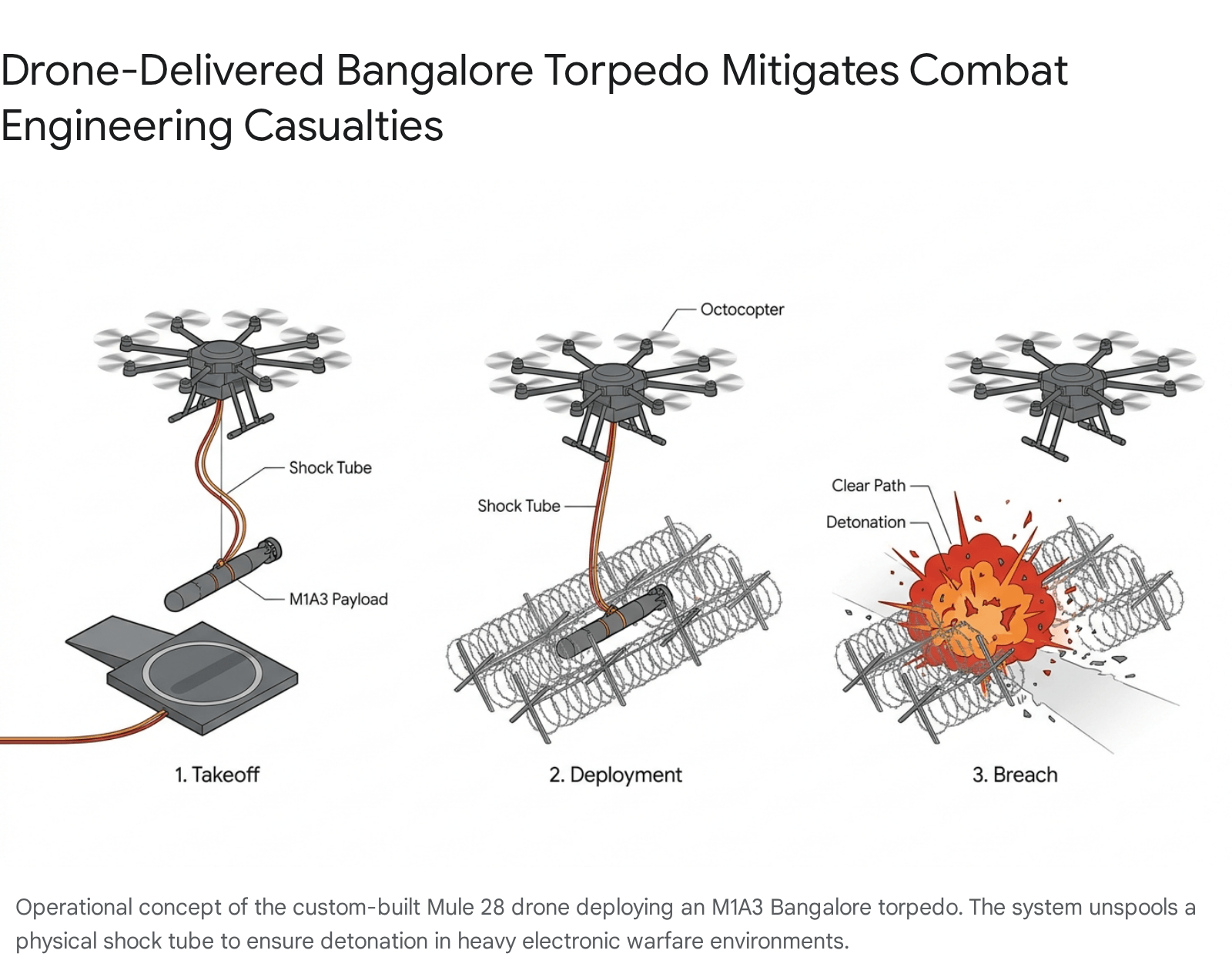
Tactical & Operational Lessons: The drone-delivered Bangalore torpedo fundamentally alters modern combat engineering doctrine. Traditionally, breaching heavily defended obstacles on foot carries a 50% casualty-planning factor. By utilizing a drone with a robust 200-pound lift capacity and a physical shock tube, engineers can clear paths with zero kinetic risk to human sappers, while ignoring electronic warfare jamming that would disable remote detonators.18 On the high seas, the successful pier-side launch and systems integration of USVs within a multi-national Baltic exercise demonstrate that the technical hurdles of operating autonomous surface vessels in congested, allied maritime environments are being resolved.21 Domestically, the sheer volume of drone incursions at public sporting events proves that existing software geofencing and passive flight restriction regulations are insufficient without active, localized, and kinetic counter-UAS enforcement.24 In the air domain, the CCA contracts confirm that manned-unmanned teaming (MUM-T) is no longer a theoretical concept but an active tactical reality, allowing fifth-generation fighters to extend their sensor and weapons range by pushing autonomous jets into hostile airspace.25
Strategic Lessons: The military’s decision to partner with a domestic, localized manufacturer (Lorica Technologies) to custom-build the Mule 28 airframe in mere weeks highlights a strategic shift away from vulnerable, foreign-dominated commercial drone supply chains. The Army is prioritizing rapid, bespoke domestic manufacturing to meet tactical needs.18 The scale of domestic drone seizures alongside the C-UAS certification bottleneck indicates an urgent requirement to federally scale counter-drone training for state and local law enforcement, as civil authorities are currently underequipped to handle the proliferation of commercial drones.23 Finally, the Air Force’s decision to purchase both the Dark Merlin and the Fury represents a deliberate strategic hedge to maintain dual warm production lines, injecting Silicon Valley agility (Anduril) into competition with legacy defense contractors (General Atomics) to drive down costs and accelerate delivery timelines.25
5. Global Situation Log: June 23, 2026
China
Event & Development: Chinese defense manufacturers publicly unveiled a new, compact man-portable anti-drone laser system designed for dismounted infantry units.17
Tactical & Operational Lessons: The successful miniaturization of directed-energy weapons (DEW) to a man-portable form factor represents a critical capability leap on the battlefield. It provides dismounted infantry squads with an organic, deep-magazine solution to counter loitering munitions and small reconnaissance swarms. By neutralizing threats at the speed of light, soldiers no longer have to rely on limited kinetic interceptors or bulky electronic warfare backpacks that can be targeted by anti-radiation missiles.17
Strategic Lessons: The widespread proliferation of portable directed-energy systems will permanently alter the cost-exchange ratio of drone warfare. If a burst of directed energy can consistently destroy a drone, the offensive advantage of swarms is mitigated. This technological pivot will force drone manufacturers back to the drawing board to develop harder-to-detect, thermally shielded, or agile autonomous systems designed specifically to bypass localized laser defenses, accelerating the cyclical arms race between unmanned platforms and directed energy.17
Russia
Event & Development: Detailed operational assessments indicated that Russian forces are increasingly leveraging Belarusian airspace, sovereign territory, and communications repeaters to route their deep-strike drone campaigns. This routing tactic is specifically aimed at bypassing Ukrainian directional air defense systems positioned along the primary eastern border.26
Tactical & Operational Lessons: Autonomous systems programmed with multi-vector waypoints can deliberately exploit the airspace of non-combatant or politically sympathetic neighboring states to outflank static, forward-facing air defense networks. This tactic forces the defending military to dilute its limited air defense umbrella across an expanded geographic perimeter, reducing the density of interceptors available to protect critical infrastructure.26
Strategic Lessons: The active weaponization of third-party sovereign airspace by proxy or diplomatic coercion complicates international rules of engagement and the laws of armed conflict. It severely tests the geopolitical boundaries of neutrality, as the defending nation is forced to weigh the military necessity of intercepting incoming threats over foreign territory against the political risk of horizontal escalation and broadening the conflict footprint.26
United States
Event & Development: The U.S. Army Armaments Center executed live-fire testing of new simultaneous weapon autonomy technology integrated directly into a Common Remotely Operated Weapon Station (CROWS) at the Aberdeen Proving Ground in Maryland. This advanced algorithmic fire control software is expressly designed to automatically detect, track, and kinetically engage small unmanned aerial systems with high precision.27 Furthermore, specialized defense firm Palladyne AI received distinct U.S. Army contracts for advanced autonomous swarm technology and the development of the Gremlin-X mini-bomber UAV.17 The Department of Defense also awarded an $8.4 billion modification contract to Lockheed Martin for extensive retrofits and upgrades to the MQ-4C Triton Unmanned Air Vehicle fleet.29 The C-UAS community also marked the passing of Erik Modisett, a federal law enforcement veteran and critical pioneer in the development of the nation’s counter-drone enterprise.30
Tactical & Operational Lessons: Integrating AI-driven fire control software onto existing legacy kinetic platforms like the CROWS drastically reduces the cognitive burden on human operators under fire. Machine-speed detection, target classification, and engagement are critical when defending against synchronized drone swarms, which operate at velocities and coordination levels that can overwhelm human reaction times and manual tracking capabilities.27 The continued investment in the MQ-4C Triton indicates that while small tactical drones are proliferating, high-altitude, long-endurance (HALE) platforms remain vital for theater-wide ISR and maritime patrol.29
Strategic Lessons: The military is aggressively pursuing a strategy of “bolt-on” autonomy—retrofitting vast fleets of legacy kinetic systems with advanced tracking algorithms to make them relevant in the drone age. The concurrent investment in offensive swarm logic (via Palladyne AI) indicates that the future of tactical engagement will be defined by algorithmic warfare, where machine-driven defensive systems directly counter machine-driven offensive swarms with minimal human intervention in the kill chain.17
6. Global Situation Log: June 24, 2026
United States
Event & Development: Space Systems Command awarded The Boeing Company a $2 billion contract for the Mobile User Objective System (MUOS) Service Life Extension program. Under the agreement, Boeing will develop, build, and deliver two new narrow-band communications satellites, scheduled for launch in the early 2030s, successfully beating out the legacy prime contractor, Lockheed Martin. This constellation operates globally in the Ultra-High Frequency (UHF) band, providing secure, space-based cellular connectivity to warfighters and autonomous systems on the move.31
Tactical & Operational Lessons: Reliable, uninterrupted UHF band communication is resistant to severe weather degradation and possesses the physical characteristics necessary to penetrate heavy jungle foliage and complex, dense urban terrain. This secure connectivity acts as the critical network required to command, control, update targeting parameters, and receive high-fidelity telemetry from advanced autonomous vehicles operating in austere or highly contested electronic environments.31
Strategic Lessons: The Space Force’s deliberate decision to inject competition into a legacy, single-vendor program underscores a broader strategic demand for supply chain resilience and continuous technical modernization. Extending the operational lifespan of the MUOS constellation through 2035 guarantees that the foundational, space-based architecture required to support terrestrial multidomain unmanned operations remains fully intact while next-generation quantum, optical, or laser communication networks are developed and matured in parallel.31
7. Global Situation Log: June 25, 2026
Germany
Event & Development: German defense technology firm ARX Robotics and Ukrainian robotics developer Roboneers officially established a new, integrated joint venture named ARX Industries. The new enterprise is specifically designed to serially manufacture the “Lynx Pro” Unmanned Ground Vehicle at an industrial scale. The venture aims to produce several thousand platforms in its first year, scaling up manufacturing capacity to tens of thousands annually in subsequent years. The production sites will be distributed across both Germany and Ukraine to ensure maximum supply chain resilience against kinetic strikes.33
Tactical & Operational Lessons: The modular Lynx Pro UGV is slated for immediate integration into high-risk frontline operations. The platform’s modularity allows a single, mass-produced chassis design to support multiple diverse combat functions—including autonomous casualty evacuation, forward tactical logistics, automated minelaying, and direct kinetic combat deployments. This simplifies field maintenance, reduces the logistical footprint of spare parts, and shortens operator training pipelines.33
Strategic Lessons: This international joint venture is an industrial response to Ukraine’s stated strategic objective of deploying 50,000 autonomous ground systems to frontline units by the end of 2026. Merging the rapid, battle-tested Ukrainian design iteration cycles with the deep industrial capacity of German manufacturing sets a template for cross-border defense procurement in Europe. This signals a permanent shift away from bespoke, low-volume robotics toward disposable, high-volume mass production.33
Iran
Event & Development: At precisely 14:10 UTC, the Islamic Revolutionary Guard Corps Navy (IRGC-N) launched a one-way attack drone that successfully struck the starboard side of the Ever Lovely, a Singapore-flagged commercial containership operated by Taiwan’s Evergreen Marine Corporation. The vessel was transiting the congested Strait of Hormuz along the southern, Omani-coast corridor. The attack caused structural damage to the bridge superstructure, though there were no reported casualties and the vessel completed its transit. The strike notably occurred on the IMO’s Day of the Seafarer, shortly after the announcement of a new voluntary Strait of Hormuz Evacuation Framework.34
Tactical & Operational Lessons: The precision strike on the specific bridge structure of a moving commercial vessel demonstrates a high level of targeting proficiency with loitering munitions. The IRGC-N utilized a low-cost, expendable drone to project kinetic power over a critical maritime chokepoint without having to commit their manned surface combatants or submarines to the engagement, thereby minimizing the risk of naval attrition.34 The geographical realities of the Strait of Hormuz, with the Omani coast directly adjacent to the Iranian mainland, provide state and non-state actors an asymmetric advantage to disrupt maritime trade without the need for traditional naval projection. The spatial relationship between the strike location and the retaliatory targets underscores the vulnerability of the transit corridors.
Strategic Lessons: The drone attack was a deliberate, calculated political maneuver by Tehran designed to assert control over the Strait of Hormuz and reject the legitimacy of internationally designated safe-transit routes along the Omani coast. By violating a temporary ceasefire agreement and striking commercial shipping, Iran continues to utilize asymmetric drone warfare as a calibrated tool for economic coercion, supply chain disruption, and diplomatic leverage against the global community.34
United States
Event & Development: Firefly Aerospace announced the strategic acquisition of Space-ng, a specialized technology company leading the field in AI-powered vision navigation and autonomous guidance systems. Space-ng’s highly sophisticated software was previously instrumental in guiding Firefly’s Blue Ghost lander to a safe touchdown on the lunar surface by autonomously performing real-time hazard avoidance. Concurrently, the White House submitted a $67.1 billion supplemental budget request to Congress for the Department of Defense, earmarking emergency funds specifically for munitions replenishment, drone procurement, and advanced autonomy programs.37
Tactical & Operational Lessons: The integration of AI-driven vision navigation is a critical capability that effectively eliminates the latency delays inherent in deep-space or highly contested electronic warfare environments. Autonomous hazard avoidance allows a vehicle (whether a lunar lander or a hypersonic cruise missile) to visually interpret its surroundings, recognize threats or terrain, and alter its trajectory instantaneously without waiting for human input or relying on easily jammed GPS signals.37
Strategic Lessons: The acquisition highlights how the commercial space sector is currently outpacing traditional defense contractors in rapidly maturing the autonomous navigation technologies required by the military. The supplemental budget request concurrently signals that the Pentagon recognizes this reality and is seeking capital to acquire, integrate, and stockpile these commercial autonomous capabilities to offset the high expenditure rates of legacy munitions in ongoing theaters of operation.38
8. Global Situation Log: June 26, 2026
France
Event & Development: KNDS France, the prominent European prime manufacturer of the Leopard tank and heavy armored vehicles, formalized a partnership with Ukrainian Unmanned Technologies (UBT) to facilitate the industrial production of ground drones for European armies. The collaboration involves integrating heavy KNDS weaponry systems directly onto the third-generation Ukrainian RAVLYK UMP-3 platform. Crucially, under the terms of the agreement, UBT is providing the physical platforms to KNDS without transferring any of their proprietary intellectual property rights.40
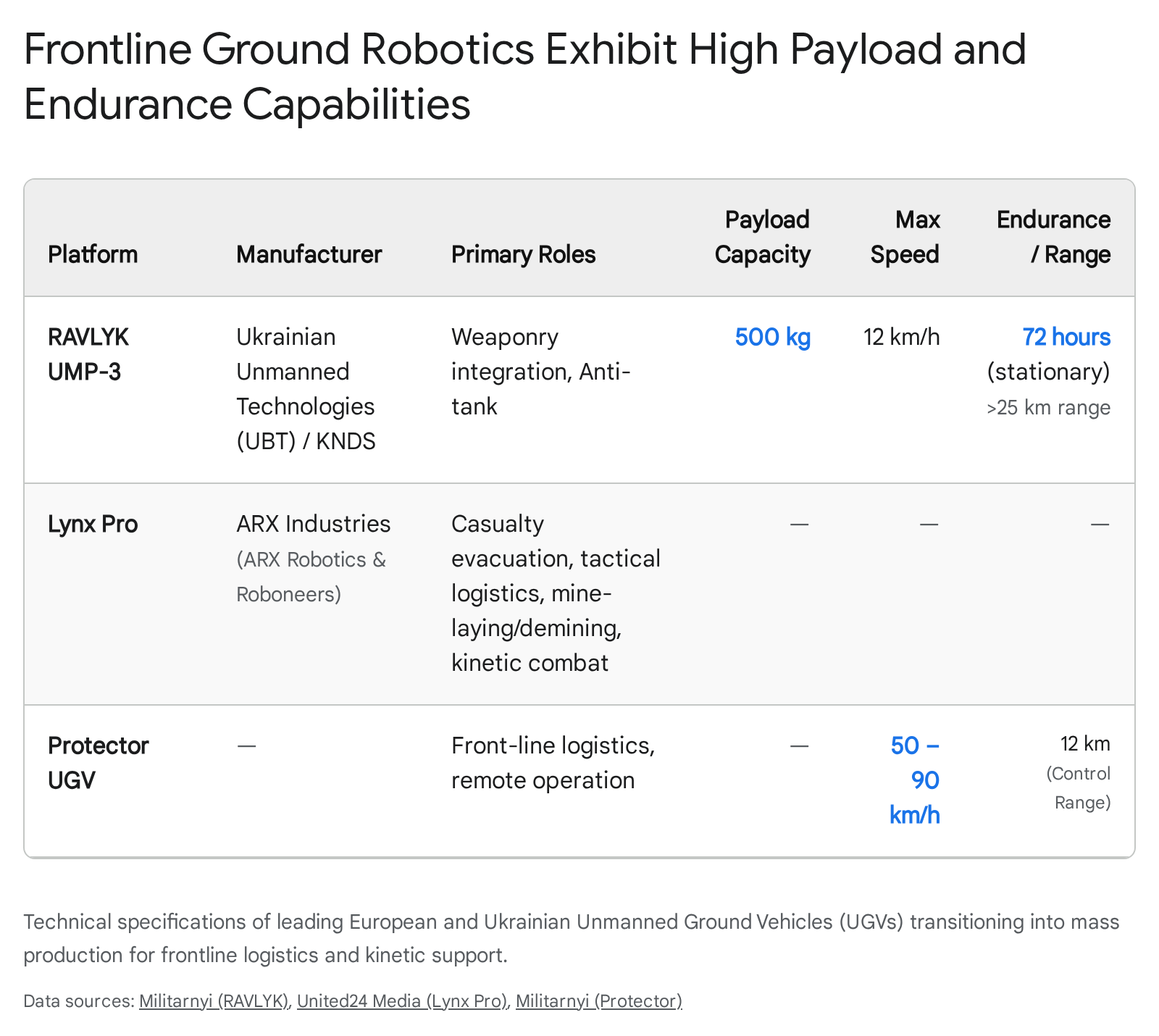
Tactical & Operational Lessons: The RAVLYK UMP-3 is a capable system featuring a 6×6 wheel configuration, a 500 kg payload capacity, a maximum speed of 12 km/h, and the ability to operate autonomously in a stationary overwatch mode for up to 72 hours with a range exceeding 25 km. By integrating heavy European anti-armor weaponry onto this agile, high-endurance platform, forces create a formidable, mobile anti-tank asset that can lay in ambush for days without exposing a human crew to enemy thermals or return fire.40
Strategic Lessons: This partnership exemplifies a pragmatic model of modern defense collaboration where IP boundaries are respected while still achieving immediate, lethal operational integration. Traditional prime defense contractors (like KNDS) are recognizing the supremacy of agile, battle-tested startups in autonomous chassis design. Rather than engaging in slow, expensive, and often inferior in-house development, primes are opting for immediate payload integration, drastically accelerating the fielding of new robotic capabilities.40
South Korea
Event & Development: The South Korean Ministry of National Defense announced a structural overhaul of its national warfare strategy. The Defense Minister declared that a planned 500,000 military personnel across all branches—army, navy, air force, and marines—will be systematically trained as “drone warriors.” The Minister stated explicitly that “all soldiers should be able to use drones like a second personal firearm.” To support this mobilization of human capital, Seoul will procure 11,000 commercial training drones by the end of 2026, scaling to 60,000 by 2029, and will fast-track the deployment of 20,000 disposable combat drones by 2030, including a domestic long-range loitering munition dubbed “K-Lucas,” conceptually derived from the Iranian Shahed-136.41
Tactical & Operational Lessons: Broad training ensures that drone operations are decentralized down to the individual infantryman, maximizing situational awareness, ISR collection, and organic precision strike capability at the lowest possible tactical echelons. The domestic development of the K-Lucas system confirms that heavy, long-range loitering munitions are now universally viewed as indispensable, cost-effective components of conventional artillery and deep-strike networks.41
Strategic Lessons: Heavily inspired by the brutal tactical realities witnessed in Ukraine and the Middle East, and severely threatened by North Korea’s expanding autonomous capabilities (recently bolstered by its tactical alliance with Russia), South Korea is fully committing to a national mass-mobilization model of drone warfare. The institutional rhetoric of the drone as a “second firearm” marks a profound doctrinal shift. It permanently elevates uncrewed systems from specialized, technical tools operated by niche units to fundamental, foundational infantry weapons expected to be wielded by every combatant on the future battlefield.41
Ukraine
Event & Development: Ukrainian Unmanned Systems Forces executed coordinated precision strikes against critical Russian radar and early warning nodes located in occupied Crimea. Targets systematically destroyed included an ST-68U radar station near Dzhankoi and an Imbir radar station near Armyansk, alongside multiple electrical substations providing crucial power to the region. Concurrently, long-range Ukrainian drones—identified as “Fire Point” systems capable of traveling 800 to 1,200 miles—continued their strategic bombardment campaign deep within Russia, striking the Kapotnya oil refinery situated merely nine miles from the Kremlin in Moscow.42
Tactical & Operational Lessons: The systematic, targeted destruction of early-warning and tracking radar stations creates localized, exploitable vulnerabilities within the adversary’s Integrated Air Defense System. Small, low-flying drones are uniquely suited for these complex SEAD (Suppression of Enemy Air Defenses) missions due to their inherently low radar cross-section and ability to loiter undetected until target emissions are definitively confirmed.46
Strategic Lessons: These deep strikes confirm a doctrinal emphasis on methodical battlespace preparation and economic attrition. By blinding the defense network, the attacking force enables the subsequent deployment of higher-value assets. Simultaneously, the successful strikes on the Kapotnya refinery utilizing ultra-long-range Fire Point drones demonstrate that geographical depth no longer affords sanctuary. Targeting the fuel market of the capital region applies immense domestic political pressure and degrades the economic engine required to sustain a war of attrition.43
United States
Event & Development: In a direct kinetic response to the Iranian drone strike on the commercial vessel Ever Lovely the previous day,(https://www.centcom.mil/MEDIA/PUBLIC-RELEASES/Article/4528341/us-strikes-iran-in-response-to-attack-on-commercial-vessel/) launched a wave of retaliatory airstrikes against multiple military targets deep within Iran. U.S. aircraft successfully struck and destroyed Iranian missile storage locations, drone storage facilities, and coastal radar sites. Domestically, the U.S. Army officially established a brand-new Space Operations Branch, consolidating all space professionals under the distinct military occupational specialty (MOS) 40D. Furthermore, the Pentagon formally validated the SkyValor system—a counter-UAS “detect and defeat” platform developed by CACI International—after rigorous testing against aerial targets at Marine Corps Air Station Yuma.36
Tactical & Operational Lessons: The swift CENTCOM strikes demonstrate the absolute tactical necessity of counter-proliferation via kinetic means. By preemptively destroying drone storage and coastal radar sites, U.S. forces actively degraded the IRGC-N’s physical capability to launch subsequent, coordinated autonomous attacks against commercial maritime traffic.36 Meanwhile, the validation of the SkyValor system provides the joint force with a validated, 24/7 automated sensing capability necessary to defend sprawling base perimeters.49 The Army’s creation of the Space Operations Branch practically acknowledges that tactical ground units are now dependent on space-based assets for the Positioning, Navigation, and Timing (PNT) required to operate autonomous systems effectively.51
Strategic Lessons: The immediate kinetic retaliation against Iranian mainland targets indicates that the United States is willing to abandon delicate diplomatic pauses to aggressively enforce freedom of navigation in critical global economic chokepoints. Violence leveraging deniable autonomous systems is now consistently being met with overwhelming, direct conventional violence.50 Concurrently, elevating space operations from a functional area to a basic Army branch institutionalizes the reality that modern multidomain warfare—and the massive swarms of autonomous drones that define it—fundamentally cannot function without a dedicated, robust, and protected military space architecture.51
9. Global Situation Log: June 27, 2026
Ukraine
Event & Development: The Protector Unmanned Ground Vehicle, domestically manufactured by Ukrainian Armor, officially began supporting active logistics missions on the most severely hazardous and heavily shelled sectors of the frontline. Deployed actively by personnel from the 429th Unmanned Systems Brigade, the Protector UGV demonstrated its robust capacity to autonomously transport nearly one metric ton of cargo—including vital ammunition, food supplies, and specialized combat equipment—in a single, contested sortie.53
Tactical & Operational Lessons: The successful deployment of heavy-lift UGVs for frontline resupply fundamentally alters the mechanics of unit sustainment in deeply contested environments. Operating at speeds up to 90 km/h with an effective remote control range of 12 kilometers, the system allows human operators to remain heavily concealed. By moving one metric ton of supplies autonomously, the brigade completely eliminates the need for vulnerable, soft-skinned logistics trucks and drastically reduces the exposure of human quartermasters to precision artillery and deadly FPV drone strikes in the highly lethal “final tactical mile” of the supply chain.53
Strategic Lessons: As ground robotics mature, they are transitioning from specialized, niche combat engineering tools to the foundational bedrock of modern military logistics. The continuous operational deployment of the Protector UGV proves that motivated domestic defense industries can design, field, and iterate heavy autonomous systems capable of surviving, navigating, and operating in the most electronically jammed and kinetically hostile environments on earth, ensuring the long-term sustainability of mechanized combat forces.53
Please share the link on Facebook, Forums, with colleagues, etc. Your support is much appreciated and if you have any feedback, please email us in**@*********ps.com. If you’d like to request a report or order a reprint, please click here for the corresponding page to open in new tab.
Sources Used
- Ukraine unleashes one of its heaviest drone bombardments of Russia, accessed June 27, 2026, https://www.wral.com/news/ap/a356e-russia-reports-one-of-the-biggest-ukrainian-drone-attacks-on-its-soil-and-annexed-crimea/
- 75th USARIC Technology Assessment Teams evaluate C-sUAS at OSJ 26, accessed June 27, 2026, https://www.army.mil/article/293438/75th_usaric_technology_assessment_teams_evaluate_c_suas_at_osj_26
- US Army Develops Drone to Search and Evacuate Captured UAVs, accessed June 27, 2026, https://militarnyi.com/en/news/us-army-develops-drone-to-search-and-evacuate-captured-uavs/
- Arizona unmanned vehicle maker pivots from space mining to Army battlefield robots, accessed June 27, 2026, https://cronkitenews.azpbs.org/2026/06/20/army-unmanned-vehicle-arizona/
- Russian Offensive Campaign Assessment, June 21, 2026 | ISW, accessed June 27, 2026, https://understandingwar.org/research/russia-ukraine/russian-offensive-campaign-assessment-june-21-2026/
- Ukraine tightens drone blockade of Russian-occupied Crimea – Atlantic Council, accessed June 27, 2026, https://www.atlanticcouncil.org/blogs/ukrainealert/ukraine-tightens-drone-blockade-of-russian-occupied-crimea/
- China’s space plane appears to have released a mystery object in orbit, accessed June 27, 2026, https://www.space.com/space-exploration/launches-spacecraft/chinas-space-plane-appears-to-have-released-a-mystery-object-in-orbit
- China’s top-secret ‘dragon’ space plane just released another …, accessed June 27, 2026, https://www.livescience.com/space/space-exploration/chinas-top-secret-dragon-space-plane-just-released-another-unidentified-object-over-earth
- Boeing X-37 – Wikipedia, accessed June 27, 2026, https://en.wikipedia.org/wiki/Boeing_X-37
- X-37B Orbital Test Vehicle Fact Sheet – Secure World Foundation, accessed June 27, 2026, https://www.swfound.org/publications-and-reports/x-37b-orbital-test-vehicle-fact-sheet
- Next Defense Boom: Autonomous Drones Emerging as a Multi-Billion-Dollar Military Technology Opportunity – PR Newswire, accessed June 27, 2026, https://www.prnewswire.com/news-releases/next-defense-boom-autonomous-drones-emerging-as-a-multi-billion-dollar-military-technology-opportunity-302807434.html
- New Armed Catamaran USV from Spain at Eurosatory 2026 – YouTube, accessed June 27, 2026, https://www.youtube.com/watch?v=07j8fo6bnqA
- Airbus, Kawasaki Heavy to Cooperate on Military Drone Development, accessed June 27, 2026, https://www.nippon.com/en/news/yjj2026062601176/
- War robots invade Eurosatory 2026 as interest grows in UGVs after use in Ukraine, accessed June 27, 2026, https://breakingdefense.com/2026/06/war-robots-invade-eurosatory-2026-as-interest-grows-in-ugvs-after-use-in-in-ukraine/
- Unmanned Aerial Vehicle Attack Against the VICTRESS Gemisi …, accessed June 27, 2026, https://kureansiklopedi.com/en/detay/unmanned-aerial-vehicle-attack-against-the-victres
- Drones Can Underpin Real-world Ops Today and 1,000-ship Navy Tomorrow – Naval News, accessed June 27, 2026, https://www.navalnews.com/event-news/cne-2026/2026/06/drones-can-underpin-real-world-ops-today-and-1000-ship-navy-tomorrow/
- Small uav headlines, accessed June 27, 2026, https://smalluavcoalition.org/uavheadlines/
- Oregon Guard Engineers Test Drone-Delivered Breach Capability …, accessed June 27, 2026, https://www.nationalguard.mil/News/Article-View/Article/4527945/oregon-guard-engineers-test-drone-delivered-breach-capability/
- Oregon engineers test drone-delivered breach capability, accessed June 27, 2026, https://www.army.mil/article-amp/293513/oregon_engineers_test_drone_delivered_breach_capability
- U.S. Navy Demonstrates Advanced Underwater Drones – RealClearDefense, accessed June 27, 2026, https://www.realcleardefense.com/2026/06/10/us_navy_demonstrates_advanced_underwater_drones_1187712.html
- USVDIV-32 Advances Unmanned Operations With NATO During BALTOPS 2026, accessed June 27, 2026, https://www.war.gov/News/News-Stories/Article/Article/4526512/usvdiv-32-advances-unmanned-operations-with-nato-during-baltops-2026/
- Counter-UAS Explained: What CUAS Means and Who Can Deploy It | Airsight, accessed June 27, 2026, https://www.airsight.com/blog/counter-uas-cuas-explained
- The Counter-UAS Certification Bottleneck, accessed June 27, 2026, https://www.lawfaremedia.org/article/the-counter-uas-certification-bottleneck
- FBI reports over 300 drone incursions during World Cup matches, accessed June 27, 2026, https://www.washingtonexaminer.com/sports/4619202/fbi-world-cup-drone-incursions/
- America’s Robot Fighters Cleared for Mass Production – MiGFlug, accessed June 27, 2026, https://migflug.com/jetflights/air-force-cca-fq-42a-fq-44a-production-contracts/
- Russian Offensive Campaign Assessment, June 23, 2026, accessed June 27, 2026, https://understandingwar.org/research/russia-ukraine/russian-offensive-campaign-assessment-june-23-2026/
- Army Armaments Center Develops New Counter-UAS Capability – War.gov, accessed June 27, 2026, https://www.war.gov/News/News-Stories/Article/Article/4525223/army-armaments-center-develops-new-counter-uas-capability/
- Army Armaments Center develops new counter-UAS capability, accessed June 27, 2026, https://www.army.mil/article/293426/army_armaments_center_develops_new_counter_uas_capability
- Contracts for June 23, 2026, accessed June 27, 2026, https://www.war.gov/News/Contracts/Contract/Article/4524437/contracts-for-june-23-2026/
- Federal Law Enforcement Veteran and Counter-Drone Pioneer Erik Modisett Dies at 50, accessed June 27, 2026, https://www.hstoday.us/industry/industry-news/federal-law-enforcement-veteran-and-counter-drone-pioneer-erik-modisett-dies-at-50/
- Boeing wins $2B Space Force contract for 2 new MUOS satellites, accessed June 27, 2026, https://breakingdefense.com/2026/06/boeing-wins-2b-space-force-contract-for-2-new-muos-satellites/
- Boeing awarded $2B deal to build next-gen comms sats for Space Force, accessed June 27, 2026, https://defensescoop.com/2026/06/24/boeing-awarded-space-force-contract-muos-satellites/
- German-Ukrainian Joint Venture ARX Industries to Build Thousands of Frontline Robots, accessed June 27, 2026, https://united24media.com/war-in-ukraine/german-ukrainian-joint-venture-arx-industries-to-build-thousands-of-frontline-robots-20192
- Drone Strike on Ever Lovely Exposes the Fiction of a Free Strait, accessed June 27, 2026, https://gcaptain.com/drone-strike-on-ever-lovely-exposes-the-fiction-of-a-free-strait/
- Iran Update Special Report, June 26, 2026 | ISW, accessed June 27, 2026, https://understandingwar.org/research/middle-east/iran-update-special-report-june-26-2026/
- US releases Iran strike video after Tehran drone hits ship in Strait of Hormuz, accessed June 27, 2026, https://indianexpress.com/article/world/us-strikes-iran-mv-ever-lovely-strait-hormuz-ceasefire-june-2026-10759767/
- Firefly Aerospace Acquires Space-ng to Advance Future of Autonomous Space Operations, accessed June 27, 2026, https://fireflyspace.com/news/firefly-aerospace-acquires-space-ng-to-advance-future-of-autonomous-space-operations/
- Trump’s budget supplemental would secure billions for munitions, emerging defense tech, accessed June 27, 2026, https://defensescoop.com/2026/06/25/trump-budget-supplemental-includes-billions-for-munitions-emerging-tech/
- Firefly Acquires Autonomous Space Ops Company, accessed June 27, 2026, https://payloadspace.com/firefly-acquires-autonomous-space-ops-company/
- Ukrainian UGV Manufacturer RAVLYK Forms Partnership With …, accessed June 27, 2026, https://militarnyi.com/en/news/ukrainian-ugv-ravlyk-partnership-leopard/
- South Korea to train half a million military personnel to become …, accessed June 27, 2026, https://www.theguardian.com/world/2026/jun/26/south-korea-drone-warriors-military-training
- Moscow oil refinery struck in Ukraine’s biggest air raid on city since start of war | Russia, accessed June 27, 2026, https://www.theguardian.com/world/2026/jun/18/moscow-oil-refinery-on-fire-ukraine-drone-stikes
- Ukraine drone strike hits Russian oil refinery, Zelenskyy says “Moscow will burn” if Putin continues war – CBS News, accessed June 27, 2026, https://www.cbsnews.com/news/ukraine-russia-war-drone-strike-moscow-oil-refinery-zelenskyy-putin/
- Russia’s 4th-largest oil refinery shuts down after Ukrainian drone strike, Reuters reports, accessed June 27, 2026, https://kyivindependent.com/russias-4th-largest-oil-refinery-shuts-down-after-ukrainian-drone-strike-reuters-reports/
- ‘Morale bombing’ Moscow is not justified, accessed June 27, 2026, https://www.theguardian.com/world/2026/jun/25/morale-bombing-moscow-is-not-justified
- Russian Offensive Campaign Assessment, June 26, 2026, accessed June 27, 2026, https://understandingwar.org/research/russia-ukraine/russian-offensive-campaign-assessment-june-26-2026/
- Inside a secretive Ukrainian team launching deep drone strikes at Russia | Connecticut Public, accessed June 27, 2026, https://www.ctpublic.org/2026-06-27/inside-a-secretive-ukrainian-team-launching-deep-drone-strikes-at-russia
- US strikes Iranian missile, drone, radar sites, accessed June 27, 2026, https://www.militarytimes.com/news/your-military/2026/06/26/us-resumes-attacks-on-iran/
- Pentagon approves long-range, autonomous counter-UAS system for use across the military after border testing | DefenseScoop, accessed June 27, 2026, https://defensescoop.com/2026/06/09/pentagon-approves-autonomous-counter-drone-system-after-border-testing/
- U.S. Strikes Iran in Response to Attack on Commercial Vessel, accessed June 27, 2026, https://www.centcom.mil/MEDIA/PUBLIC-RELEASES/Article/4528341/us-strikes-iran-in-response-to-attack-on-commercial-vessel/
- Army establishes new branch dedicated to space operations, accessed June 27, 2026, https://defensescoop.com/2026/06/26/army-establishes-new-branch-dedicated-to-space-operations/
- US strikes Iran after attack on commercial ship in Strait of Hormuz, accessed June 27, 2026, https://www.washingtonexaminer.com/policy/defense/4627326/us-strike-iran-after-attack-ship-strait-of-hormuz/
- Protector UGV Begins Supporting Front-Line Logistics – Мілітарний, accessed June 27, 2026, https://militarnyi.com/en/news/protector-ugv-begins-supporting-front-line-logistics/