
Executive Overview: The 2026 Public Safety Landscape
As the fiscal year 2026 budget cycles close across the United States, a stark reality has settled over municipal and county governance: the traditional, fully-sworn policing model is mathematically and operationally unsustainable. While national crime rates have shown statistical declines from post-pandemic peaks, the public safety apparatus remains under extreme duress, operating in an environment characterized by persistent political polarization, rapid technological advancement, and complex socio-economic challenges. The narrative of a simple “recruiting challenge” has proven to be a dangerous underestimation of the prevailing conditions. The law enforcement sector is entrenched in a generational workforce crisis categorized by a multi-pronged threat: a strained pipeline of new applicants, shifting generational career preferences, and a profound “brain drain” resulting from the accelerated departure of seasoned officers and mid-level commanders who possess irreplaceable institutional knowledge.
Simultaneously, municipal budgets are stretched to their absolute breaking points. In major metropolitan areas, personnel costs routinely consume upwards of 90 percent of police department allocations. This confluence of severe staffing deficits, plummeting retention rates, and exponentially escalating personnel expenditures has forced a structural pivot at the highest levels of municipal administration. To maintain operational readiness and fiscal solvency, agencies are increasingly adopting aggressive civilianization strategies—transitioning away from the historical over-reliance on sworn officers to a hybrid model that heavily integrates non-sworn professional staff.
This strategic forecast analyzes the financial mathematics, actuarial realities, and operational cost-benefit ratios driving the civilianization of American police departments in 2026. Furthermore, it evaluates the specific investigative, forensic, and administrative units that are most effectively transitioned to professional staff, while strictly adhering to the evidentiary chain-of-custody protocols and the rigid mandates of the Criminal Justice Information Services (CJIS) Security Policy. The transition from a paramilitary monolith to a diversified public safety corporation is no longer merely an academic proposal or a fringe progressive reform; it is a rigid fiduciary and operational mandate required to guarantee the continuity of public safety services in the twenty-first century.
The Macro-Economics of Law Enforcement Staffing
To comprehend the sheer scale of the civilianization imperative, one must first examine the macro-economic footprint of the American law enforcement apparatus. Law enforcement agencies at the state, county, and local levels represent a massive capital expenditure for taxpayers. In California alone, agencies employ more than 77,000 individuals with arrest powers, requiring an annual policing expenditure of approximately $28 billion. Despite these massive budgetary outlays, the statewide officer count in California in 2024 was 3 percent less than it was in 2019, reflecting a broader national trend of shrinking sworn capacity despite increased financial investment. California currently fields roughly 196 officers per 100,000 residents, a significant decline from the peak of 221 officers per 100,000 residents recorded in 2008.
This reduction in force size is not evenly distributed. The post-pandemic drop in sworn personnel has been heavily concentrated in large municipal agencies fielding over 100 officers, whereas sheriff’s departments have seen slight increases or stabilization over the past two decades. Regardless of agency size, the overarching fiscal reality is identical: the cost of fielding a single sworn officer has vastly outpaced standard inflation metrics.
In the City of Chicago, the proposed Police Department (CPD) budget for 2026 further illustrates this dynamic. The 2026 budget reflects a 0.1% reduction in total positions compared to 2025 (a loss of 14 positions); however, the CPD’s budget for Personnel Services alone increased by roughly $142 million. This increase is almost entirely driven by salary escalations required under collective bargaining agreements. Consequently, 91 percent of the entire CPD budget is dedicated purely to paying personnel, leaving a razor-thin margin for capital improvements, technological acquisitions, or operational innovation. When an agency dedicates over nine-tenths of its capital strictly to payroll, the central strategic question becomes whether the department is utilizing its highest-cost assets—sworn police officers—in the most efficient manner possible to protect the health and safety of the jurisdiction.
The Actuarial Burden: The Mathematics of Pension Liabilities
The most significant financial divergence between sworn officers and civilian employees—and the primary mathematical driver of civilianization—lies in the structure of retirement benefits. Local governments (cities, counties, and special districts) employ nearly all police officers and firefighters in the United States and are therefore strictly responsible for funding their personnel costs, which include two major types of long-term retirement liabilities: defined benefit pensions and Other Post-Employment Benefits (OPEB), which principally consists of retiree health insurance.
The Concept of Normal Cost and Multipliers
Actuarial science measures the ongoing cost of a pension system through the concept of “normal cost”—the present value of the benefits expected to be earned by plan members during the current year, plus an amount required to amortize any unfunded actuarial liability over a set period. Research universally indicates that the normal cost of pensions for public safety workers is routinely double that of general municipal or professional staff employees.
This massive disparity is not necessarily driven by drastically higher base benefits, but rather by the actuarial timeline of the public safety career arc. Due to the inherent physical and psychological rigors of the profession, law enforcement officers are legally and structurally permitted—and often encouraged—to retire significantly earlier than civilian counterparts. Across many jurisdictions, police officers reach full retirement eligibility at age 50, or after 20 to 25 years of credited service. Consequently, municipal pension funds are obligated to pay out benefits for a substantially longer duration, while the period of active employee and employer contribution into the fund is heavily compressed.
Actuarial valuation reports from highly resourced jurisdictions such as Arlington County and Fairfax County in Virginia demonstrate this structural premium in stark mathematical terms. In Fairfax County, recent actuarial evaluations of potential plan design changes highlighted that the proposed normal cost for the Police retirement system decreased slightly from 17.98% to 17.04% of pay under specific adjustments, and from 16.12% to 15.21% for the broader Uniformed system. By contrast, the normal cost for general employees was less than half of that burden.
Similarly, in Arlington County, the active member contribution rate required to sustain the pension fund highlights the disparity: for the year ended June 30, 2024, the active member contribution rate was 4% of pay for general employees, but 7.5% of pay for uniformed public safety employees. Furthermore, for general employees hired after January 1, 2025, who are not in a collective bargaining unit, the contribution rate drops even lower to 2.5% of base pay. Arlington County general employees also participate in a 401(a) defined contribution plan, where the county contributes an amount equal to 4.2% of base pay (or 7.5% for non-bargaining post-2025 hires), creating a highly predictable, lower-risk liability profile for the municipality compared to the open-ended defined benefit structures of the uniformed systems.
The historical inflation of pension multipliers further exacerbates this divide. In Fairfax County, the pension multiplier for uniformed personnel increased incrementally over the years—from 1.8% in FY 1997, to 2.3%, to 2.5%, and eventually to 2.8% in FY 2000. These fractional percentage increases, when applied to the highest consecutive three years of an officer’s inflated salary over a thirty-year retirement window, create astronomical unfunded liabilities.
Mortality Tables and Unfunded Liabilities
Actuaries rely on highly specific mortality tables to project these liabilities. For example, valuations frequently utilize the PUB-2010 Headcount Weighted Safety Employee Mortality Tables (differentiated by sex and set forward by specific years with fully generational mortality improvements projected using Scale MP-2018) for healthy police officer participants. These safety-specific tables predict different life expectancies and disability rates compared to general civilian populations, factoring into the elevated normal costs.
The result is a crushing burden of unfunded liabilities. In jurisdictions like Santa Ana, California, CalPERS projections dictated that the city had to pay $27.7 million in pension contributions for its safety employees in a single fiscal year. Of that massive sum, $19.3 million was allocated strictly to pay for unfunded liabilities—the benefits owed to current retirees that were not adequately funded during their working years—while only $8.4 million covered the actual normal cost for the active workforce. This dynamic means that any tax increases levied on the citizenry are immediately consumed by the ghosts of payrolls past, rather than funding current or expanded services.
Similarly, the Illinois Municipal Retirement Fund (IMRF), which covers civilian personnel in jurisdictions like the Village of West Dundee, presents a drastically different liability profile compared to the heavily burdened Police Pension Funds covering sworn personnel in the exact same municipalities. Civilian pension plans are statistically far more likely to be fully funded or possess manageable unfunded liabilities due to standard retirement ages (typically 60 to 65) and the lack of hazardous duty multipliers.
Formalizing the Total Compensation Equation


To quantify the true fiduciary impact of civilianization, financial analysts must look beyond base salaries and calculate the lifetime enterprise cost of an employee. Let represent the total employer cost for a sworn officer, and represent the total employer cost for a professional staff member. The true cost equation must account for base salary (), structural overtime (), pension normal cost multiplier (), and OPEB liability ():To quantify the true fiduciary impact of civilianization, financial analysts must look beyond base salaries and calculate the lifetime enterprise cost of an employee. Let represent the total employer cost for a sworn officer, and represent the total employer cost for a professional staff member. The true cost equation must account for base salary (), structural overtime (), pension normal cost multiplier (), and OPEB liability ():To quantify the true fiduciary impact of civilianization, financial analysts must look beyond base salaries and calculate the lifetime enterprise cost of an employee. Let represent the total employer cost for a sworn officer, and represent the total employer cost for a professional staff member. The true cost equation must account for base salary (), structural overtime (), pension normal cost multiplier (), and OPEB liability ():To quantify the true fiduciary impact of civilianization, financial analysts must look beyond base salaries and calculate the lifetime enterprise cost of an employee. Let represent the total employer cost for a sworn officer, and represent the total employer cost for a professional staff member. The true cost equation must account for base salary (), structural overtime (), pension normal cost multiplier (), and OPEB liability ():To quantify the true fiduciary impact of civilianization, financial analysts must look beyond base salaries and calculate the lifetime enterprise cost of an employee. Let represent the total employer cost for a sworn officer, and represent the total employer cost for a professional staff member. The true cost equation must account for base salary (), structural overtime (), pension normal cost multiplier (), and OPEB liability ():To quantify the true fiduciary impact of civilianization, financial analysts must look beyond base salaries and calculate the lifetime enterprise cost of an employee. Let represent the total employer cost for a sworn officer, and represent the total employer cost for a professional staff member. The true cost equation must account for base salary (), structural overtime (), pension normal cost multiplier (), and OPEB liability ():To quantify the true fiduciary impact of civilianization, financial analysts must look beyond base salaries and calculate the lifetime enterprise cost of an employee. Let represent the total employer cost for a sworn officer, and represent the total employer cost for a professional staff member. The true cost equation must account for base salary (), structural overtime (), pension normal cost multiplier (), and OPEB liability ():





Given that , and that is historically highly volatile and routinely uncapped compared to tightly controlled civilian overtime , the lifetime enterprise cost of a sworn officer exponentially outpaces that of a civilian employee.Given that , and that is historically highly volatile and routinely uncapped compared to tightly controlled civilian overtime , the lifetime enterprise cost of a sworn officer exponentially outpaces that of a civilian employee.Given that , and that is historically highly volatile and routinely uncapped compared to tightly controlled civilian overtime , the lifetime enterprise cost of a sworn officer exponentially outpaces that of a civilian employee.Given that , and that is historically highly volatile and routinely uncapped compared to tightly controlled civilian overtime , the lifetime enterprise cost of a sworn officer exponentially outpaces that of a civilian employee.
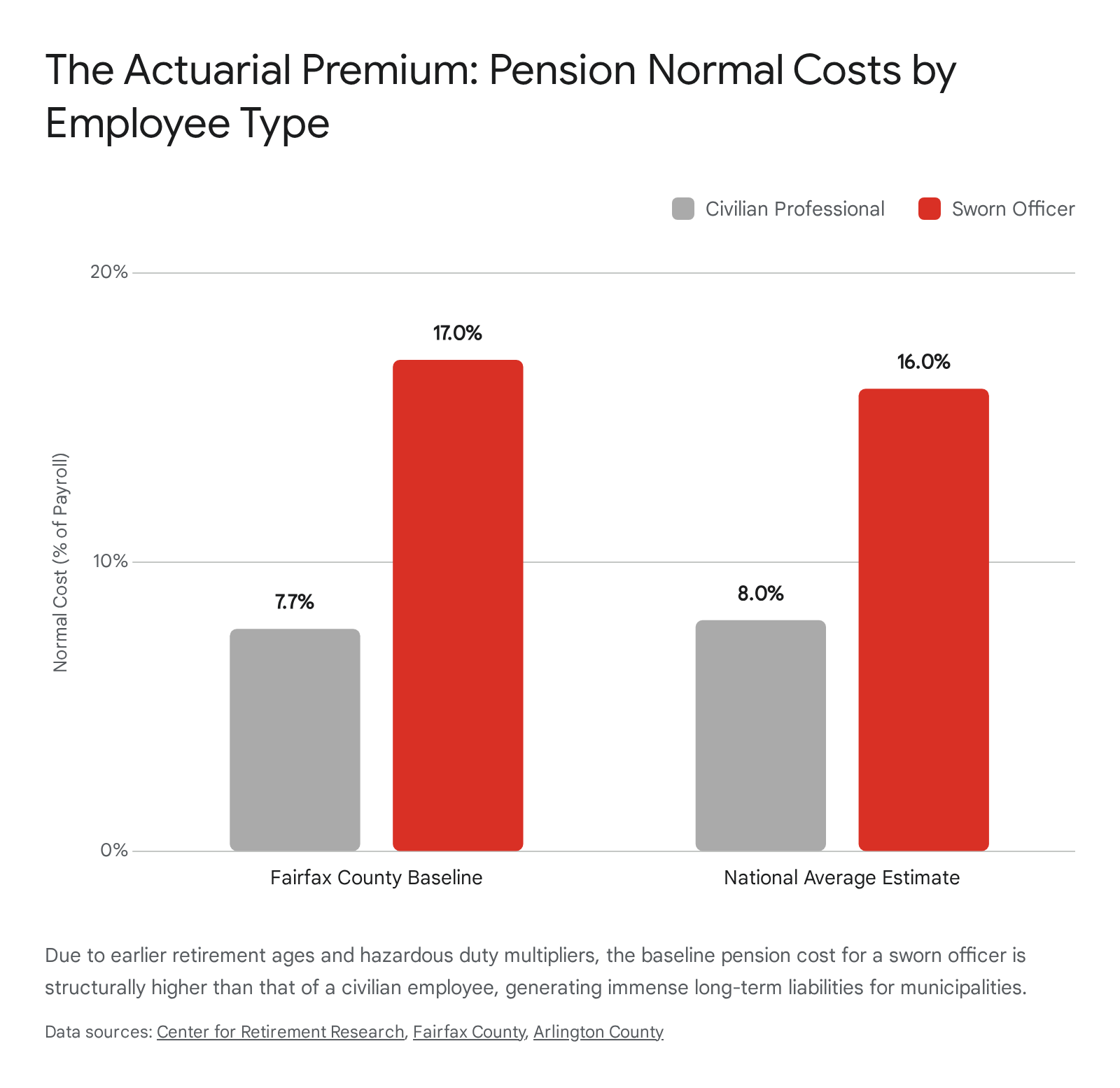
The compounding nature of this equation becomes disastrous when evaluating pension spiking. When a sworn officer earning a base salary of $74,000 logs massive amounts of overtime, inflating their final average salary to nearly $200,000, it triggers a proportional spike in their lifelong pension payout. In New York, the State Common Retirement Fund (CRF) reported pension costs of $486 per resident, the highest in the nation, driven heavily by public safety payouts anchored to inflated final-year compensation. This financial mechanism is virtually non-existent for non-sworn administrative staff, whose overtime is tightly regulated and who lack the hazardous duty multipliers that supercharge the defined benefit payout.
| Cost Component | Sworn Officer Liability Profile | Professional Staff Liability Profile |
| Academy & Onboarding | Highly expensive (6-8 months academy, psychological screening, FTO). | Minimal (Standard HR onboarding, CJIS training). |
| Overtime Expenditures | Highly volatile, contractually mandated, often uncapped. | Tightly regulated, rarely utilized for administrative tasks. |
| Pension Normal Cost | ~15% to 18% of payroll. | ~4% to 7% of payroll. |
| Retirement Age | ~50 years old / 20-25 years of service. | ~60-65 years old. |
| Post-Employment Healthcare | High utilization over a long post-retirement lifespan. | Standard utilization, transitioning to Medicare rapidly. |
Immediate Budgetary Relief: Base Compensation and the Overtime Arbitrage
Beyond the long-tail actuarial math, the immediate budgetary relief provided by civilianization is found in base compensation and overtime arbitrage. Sworn officers represent a massive upfront capital investment for any municipality. An agency must fund extensive background investigations, psychological screenings, physical fitness testing, six to eight months of highly specialized police academy training, and subsequent field training periods. Deploying an asset with this level of expensive, specialized training to process paperwork, manage digital evidence, run background checks on new hires, or manage fleet logistics is a severe misallocation of municipal capital.
In Santa Monica, for instance, the base salary for a sworn police officer ranges from $120,636 to $148,932. However, when factoring in specialized incentives like education bonuses (up to 12.8% of base pay for an advanced degree), bilingual pay, uniform allowances, and holiday pay, the total immediate compensation ranges from $141,661 to $194,227 annually. Civilian professional staff, while receiving competitive base salaries, do not trigger this cascading array of specialized law enforcement incentives.
The overtime arbitrage is equally impactful. In Baltimore, the Fraternal Order of Police and city auditors have long debated the financial drain of police overtime. The Mayor’s Office and the BPD have explicitly cited that freeing up officers from administrative roles and civilianizing the management of grant operations, forensics, and low-level investigations directly saves on structural overtime costs. By transitioning these roles, departments realign their staffing budgets, ending the practice of paying officers time-and-a-half to complete tasks that a civilian administrator could complete during standard business hours at a lower base rate.
The aggregate financial impact of these transitions is staggering. In Chicago, transitioning identified sworn positions that perform civilian functions to professional roles is projected to generate over $100 million in cumulative savings over a ten-year horizon. This financial mathematics dictates an inescapable conclusion: for every administrative desk currently occupied by a sworn officer, the municipality is paying a massive, ongoing premium for enforcement powers and liability coverages that are absolutely never utilized.
The Chicago Police Department: A 2026 Case Study in Workforce Allocation
To understand the mechanics of civilianization at scale, the Chicago Police Department (CPD) provides the premier 2026 case study. Facing immense pressure under a federal Consent Decree and significant public scrutiny regarding operational efficiency, the CPD partnered with the Matrix Consulting Group to execute a comprehensive Workforce Allocation Study. This study represents the most data-driven examination of staffing, deployment, and organizational capacity in the department’s history.
The findings were highly illuminating. The study revealed that while overall sworn staffing levels appeared ostensibly stable on paper, the workload analysis demonstrated extreme variation by geography, unit, and function. This imbalance resulted in inconsistent service levels across districts, severely constrained proactive patrol time, and critically limited supervisory capacity in high-demand zones.
The study categorized the department’s staffing methodologies into distinct frameworks to ensure uniformity. Overall, approximately 52% of personnel in the CPD are assigned based on a workload-based methodology, 23% are ratio-based, 8% are based on span of control, 8% are non-scalable, and 9% are assigned for fixed coverage. Within this vast organizational structure—where the Bureau of Patrol commands 61% of staffing and the Bureau of Detectives 16%—the Matrix study identified a massive opportunity for civilianization.
The analysis explicitly noted that the CPD was a “clear outlier” among the nation’s largest police departments regarding its over-reliance on sworn personnel for administrative duties. The study identified roughly 600 positions, spanning 170 different assignments, where sworn officers were currently performing duties that absolutely did not require sworn authority, a firearm, or law enforcement training. Specific roles identified for immediate civilianization included timekeepers (occupying 42 sworn officers), watch secretaries (98 officers), and district/area administrative support staff (85 officers).1 The methodology for identifying these roles focused on “Parallel Roles” (where civilians already serve alongside sworn officers doing identical work, proving feasibility) and “Existing Professional Fields” (where highly technical roles, like network administrators, are already established professions outside of law enforcement).
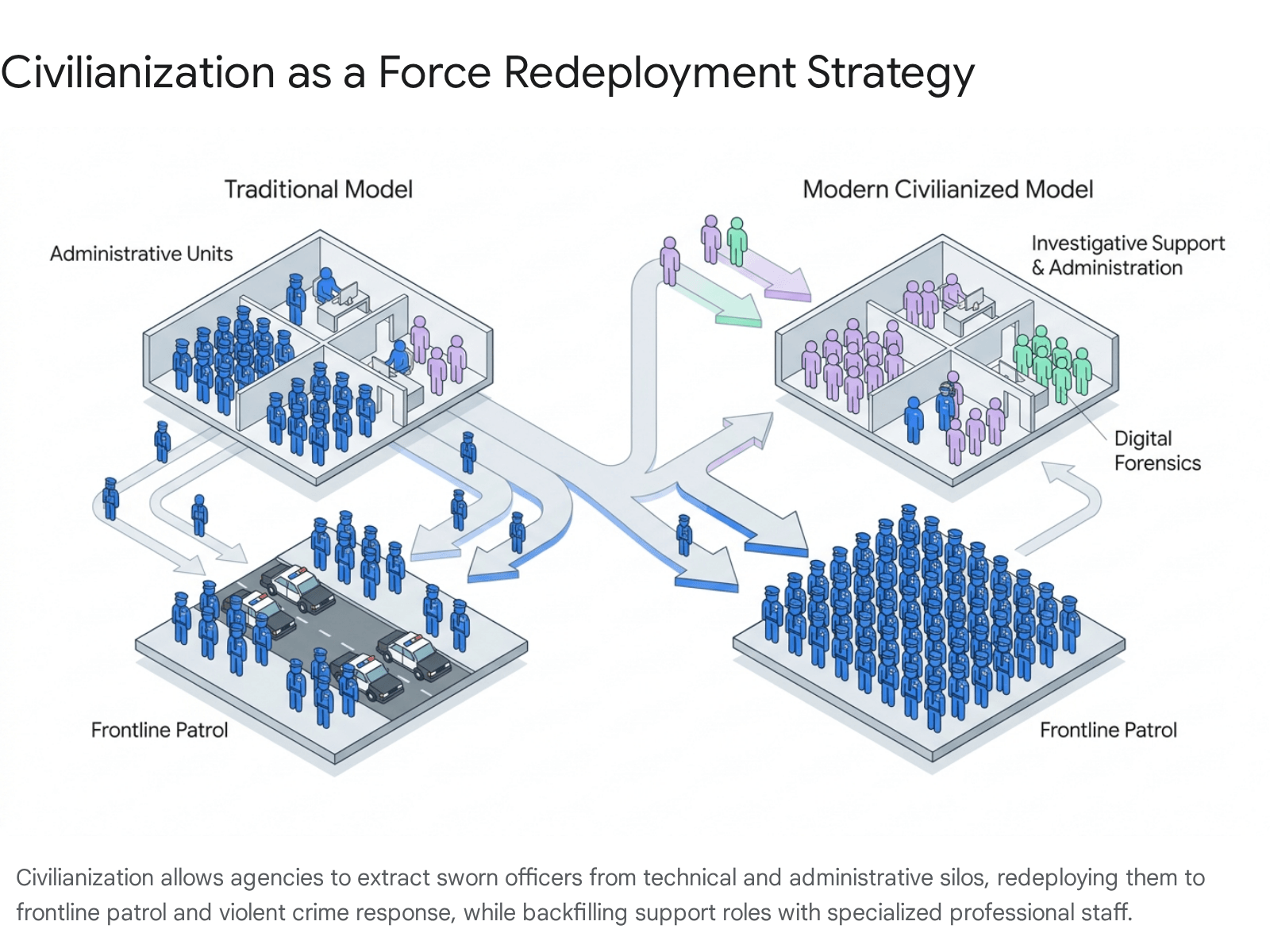
Crucially, the Matrix Consulting Group emphasized that civilianization is not a workforce reduction strategy; rather, it is a strategic redeployment mechanism intended to ensure sworn officers are assigned exclusively to areas where police authority and tactical training are mandatory. If all identified positions were successfully civilianized and the displaced officers returned to patrol and investigative duties, the CPD’s overall hiring burden would drop dramatically. While the study’s executive summary suggested an aggregate gross hiring need of approximately 400 additional civilian positions and 120 additional sworn positions 2, community watchdogs and advocates noted that the CPD’s public framing of these findings was confusing.3 In strict statistical effect, because the massive civilianization recommendations offset the sworn staffing deficits, the net staffing recommendation relative to current filled levels was an addition of only 57 sworn positions.1
The PERF Paradigm: Modernizing the “Professional Staff” Lexicon
The push for civilianization is championed heavily by the Police Executive Research Forum (PERF), which released a landmark 2024 report titled Embracing Civilianization: Integrating Professional Staff to Advance Modern Policing. One of the most critical conceptual shifts advocated by PERF is the elimination of the term “civilian” in favor of “professional staff”.
Within police culture, the term “civilian” has historically been weaponized to create a false, unhealthy dichotomy between “sworn” members and the administrative underclass, inherently undervaluing the contributions of the latter. By adopting the terminology of “professional staff,” agencies acknowledge that these individuals are highly educated, trained, and experienced professionals filling critical, specialized roles—such as crime analysts, forensic auditors, digital investigators, and community coordinators.
PERF’s research indicates that despite decades of discussing civilianization, the actual percentage of professional staff in U.S. police agencies remained essentially stagnant for twenty years. Many agencies paid mere lip service to the concept, quickly reverting to sworn-heavy models during tight budget cycles or when facing opposition from labor organizations. However, the current “triple threat” staffing crisis has forced a permanent paradigm shift.
Law enforcement agencies are now finding immense success by “going upstream” to recruit college students and recent graduates directly into professional staff roles. Departments in Baltimore and Tucson have achieved outstanding results by hiring recent college graduates as Investigative Specialists and Professional Staff Investigators, respectively. In Salt Lake City, the police department hired 16 Community Response Specialists to handle non-emergency calls, such as 911 hang-ups, found property, evidence pickup, traffic hazards, and civil disputes. These specialists underwent a rigorous six-week in-house academy followed by ten weeks of field training. During the first eleven months of their deployment, they responded to nearly 2,500 calls for service, effectively absorbing a massive volume of low-priority workload and allowing sworn officers to focus entirely on serious calls where enforcement powers were essential.
Furthermore, departments have recognized that prioritizing professional staff positions fundamentally expands the talent pool. Women, for example, show proportionally more interest in non-sworn professional staff positions than in traditional sworn officer roles, allowing agencies to diversify their workforce demographics significantly without lowering entry standards.
Targeted Unit Transitions: Where Civilianization Yields Maximum ROI
While civilianization offers broad theoretical benefits, its implementation must be highly tactical. Not all police functions can or should be transitioned. Roles requiring the application of physical force, the power of arrest, the execution of high-risk search warrants, or the management of volatile, in-progress conflicts are strictly the domain of sworn officers. Attempting to civilianize these functions invites catastrophic liability. However, specific investigative, forensic, and administrative units have proven to yield exceptional returns on investment when transitioned to professional staff.
1. Traffic and Crash Investigation Units
Motor vehicle collisions consume an exorbitant amount of municipal police resources. Recognizing that property-damage-only crashes, minor injury collisions, and abandoned vehicle recoveries rarely require law enforcement authority, progressive jurisdictions have rapidly adopted the use of Civilian Traffic Investigators (CTIs).
In North Carolina, statutory frameworks specifically authorize cities to employ civilian personnel to investigate traffic crashes. Under G.S. 160A-499.6, a city may employ these investigators provided they do not supplant or reduce the number of sworn officers. These CTIs must undergo a specialized training program designed by the North Carolina Justice Academy, followed by no less than four weeks of field training with an experienced sworn traffic investigator.
To ensure public clarity and operational safety, the statute heavily regulates their appearance: CTIs must wear uniforms that are “substantially different in color and style” from sworn law enforcement, patches must clearly identify them as investigators, and they are expressly prohibited from being issued badges. Furthermore, their vehicles cannot bear markings identifying them as police vehicles, nor can they utilize blue emergency lights; only red and amber lights are permissible. They are strictly prohibited from issuing citations, carrying firearms, or making arrests, focusing entirely on the technical investigation, evidence analysis, and the completion of collision reports.
The efficiency gains of this model are undeniable. The Burlington Police Department utilizes civilian investigators to analyze physical evidence, secure witness statements, manage accident scenes, and coordinate tow trucks, entirely removing this massive logistical burden from the patrol division. In an even more aggressive model, the New Orleans Police Department (NOPD) conducted an extensive pilot program where they contracted with a third-party vendor to respond to minor traffic accidents. Projections indicated that over the course of a year, the vendor would respond to roughly 10,000 calls for traffic accidents. This maneuver alone saved the equivalent of approximately 13 sworn officers, representing 25,000 hours of reclaimed patrol time. This transition ensures that minor accidents are processed more rapidly, dramatically improving community satisfaction with police services, while highly trained sworn officers remain continuously available for priority emergency responses.
2. Crime Scene Processing and Forensic Laboratories
The analysis of physical evidence is a rigorous scientific discipline, not a standard policing function. The Charlotte-Mecklenburg Police Department (CMPD) Crime Scene Unit and Crime Lab Division are exemplary models of successful civilianization. The Crime Lab is responsible for scientifically testing DNA, illegal drugs, blood alcohol content, firearms, latent fingerprints, arson evidence, and questioned documents. Processing these materials requires scientists with four-year science degrees or advanced degrees, combined with years of specialized laboratory training—credentials rarely found in standard police academy cohorts.
Employing sworn officers as Crime Scene Investigators (CSIs) introduces severe structural inefficiencies. Sworn CSIs have completed a police academy, hold law enforcement certifications, and are thus compensated on the elevated police officer or detective pay scale. Consequently, at most large metropolitan departments, sworn officer CSIs earn substantially more than their civilian counterparts who are performing the exact same scientific work, simply because their base pay is anchored to their law enforcement status.
Furthermore, keeping sworn officers in laboratory or crime scene processing roles permanently removes valuable tactical assets from the street. Transitioning these units to specialized professional staff not only drastically reduces baseline payroll costs but also elevates the scientific rigor and accreditation standards of the forensic output, insulating the department against aggressive defense attorneys challenging the scientific validity of the evidence.
3. Digital Forensics and Cybercrime Capabilities
As criminal enterprises increasingly migrate to the digital domain, law enforcement agencies are grappling with the extraction and analysis of massive data volumes from mobile devices, cloud environments, and encrypted networks. Traditional investigative methods—relying on manual analysis and shoe-leather detective work—are wholly inadequate for this environment.
Research indicates significant variations in the structure and capability of cybercrime investigative units across the United States. Often, digital forensic duties are assigned to sworn detectives who lack deep technical expertise, leading to massive investigative bottlenecks and compromised evidence. The most effective units integrate civilian digital forensic analysts who possess private-sector technological acumen.
These non-sworn specialists are vital for deploying AI-powered forensic tools, managing complex network investigations, and processing digital evidence at scale in real-time. For instance, a civilian digital forensics specialist’s daily responsibilities often involve collaborating closely with both local law enforcement and intelligence analysts to ensure strict chain-of-custody protocols while preparing detailed forensic reports and testifying in legal proceedings.4 By employing professional staff in these roles, agencies bypass the costly, frustrating, and often futile process of attempting to train a standard patrol officer to become a network security engineer, opting instead to hire established technical experts directly from the private sector.
4. Investigative Support and Administrative Processing
A vast underbelly of police work consists of data entry, background checks, low-level property crime follow-ups, regulatory compliance, and inter-agency coordination. These functions are prime targets for civilianization.
The Baltimore Police Department (BPD) has aggressively utilized Civilian Investigators to handle low-level crimes. This strategy effectively enlarged their overall investigative force without the astronomical cost of hiring and training new sworn detectives. By civilianizing the investigation of minor property crimes and the management of administrative grants, the BPD was able to redeploy sworn officers back to patrol operations and allow seasoned detectives to focus exclusively on homicides, non-fatal shootings, and violent felonies.
Similarly, the Philadelphia Police Department (PPD) struggled for years to meet state mandates for tracking and notifying the community regarding registered sex offenders due to a severe lack of sworn manpower. By integrating new professional staff—specifically three Police Civilian Investigators working alongside a sergeant and two sworn detectives—the PPD finally met the state requirement. These professional staff not only helped the unit adhere to state law but managed to digitize over 20,000 paper files and expand community notifications for the highest-level offenders, drastically improving the unit’s future operational efficiency.
In Arlington County, the shift toward civilianization is evident in the allocation of the fiscal year 2026 and 2027 budgets. Following the approval of Chapter 69 of the Arlington County Code, the county recognized the need for robust civilian oversight and audit capabilities. The budget included specific funding ($250,000 for 2.0 FTEs) to add additional civilian positions for the Independent Policing Auditor (IPA) and the Police Department’s Office of Professional Responsibility (OPR). Integrating professional staff into these audit and oversight roles ensures rigorous, unbiased accountability without draining sworn commanders from operational posts. At the same time, Arlington Police Chief Andy Penn sought to unfreeze 20 full-time sworn officer positions to capitalize on a surge in job applications—a surge facilitated by the operational breathing room created by strategic civilianization and enhanced starting pay.
| Operational Unit | Sworn Officer Role (Traditional Inefficiency) | Professional Staff Role (Modernized Efficiency) | Primary Strategic & Financial Benefit |
| Traffic Collisions | Sworn officer responds to all accidents, manages traffic, writes property damage reports. | Civilian Traffic Investigator (CTI): Processes minor accidents, completes reporting without arrest powers. | Saves tens of thousands of patrol hours; reduces response times for minor calls; eliminates unnecessary armed response. |
| Forensics / Crime Scene | Sworn CSI collects evidence; compensated at the highest law enforcement pay scales. | Civilian Forensic Scientist/Technician: Executes specialized scientific processing and laboratory analysis. | Lowers total compensation costs significantly; introduces specialized, advanced scientific degrees into the lab environment. |
| Digital Evidence | Sworn detective attempts to extract mobile device data with limited technical training. | Civilian Digital Forensic Analyst: Utilizes advanced AI extraction and complex network analysis tools. | Bridges the severe technical skills gap; significantly accelerates digital evidence processing and decryption. |
| Investigative Support | Sworn detective manages sex offender registry, low-level property crime, and grant audits. | Civilian Investigator: Manages regulatory files, conducts background checks, investigates misdemeanors. | Frees up highly trained detectives for violent crime; ensures statutory regulatory compliance without pulling sworn assets. |
Maintaining Chain-of-Custody and Evidentiary Integrity
The most potent argument historically leveraged against civilianization by labor unions and traditionalist commanders is the perceived risk to operational security and evidentiary integrity. The transition of unsworn personnel into forensic, evidence management, and investigative roles demands rigorous administrative architecture to ensure that the legal admissibility of evidence is never compromised in a court of law.
The Legal Mechanics of Custody
The chain of custody is the sequential documentation that meticulously accounts for the continuous possession, control, transfer, analysis, and final disposition of physical or electronic evidence. It is the foundational requirement necessary to assure a court of law that the evidence presented is authentic—that it is the exact same item seized at the crime scene and has not been tampered with, altered, or unaccounted for at any point. Failure to establish a legally sound, complete chain of custody can result in a judge excluding the evidence entirely from the trial or issuing a limiting instruction to the jury regarding how heavily to weigh the testimony, potentially dismantling a major criminal prosecution.
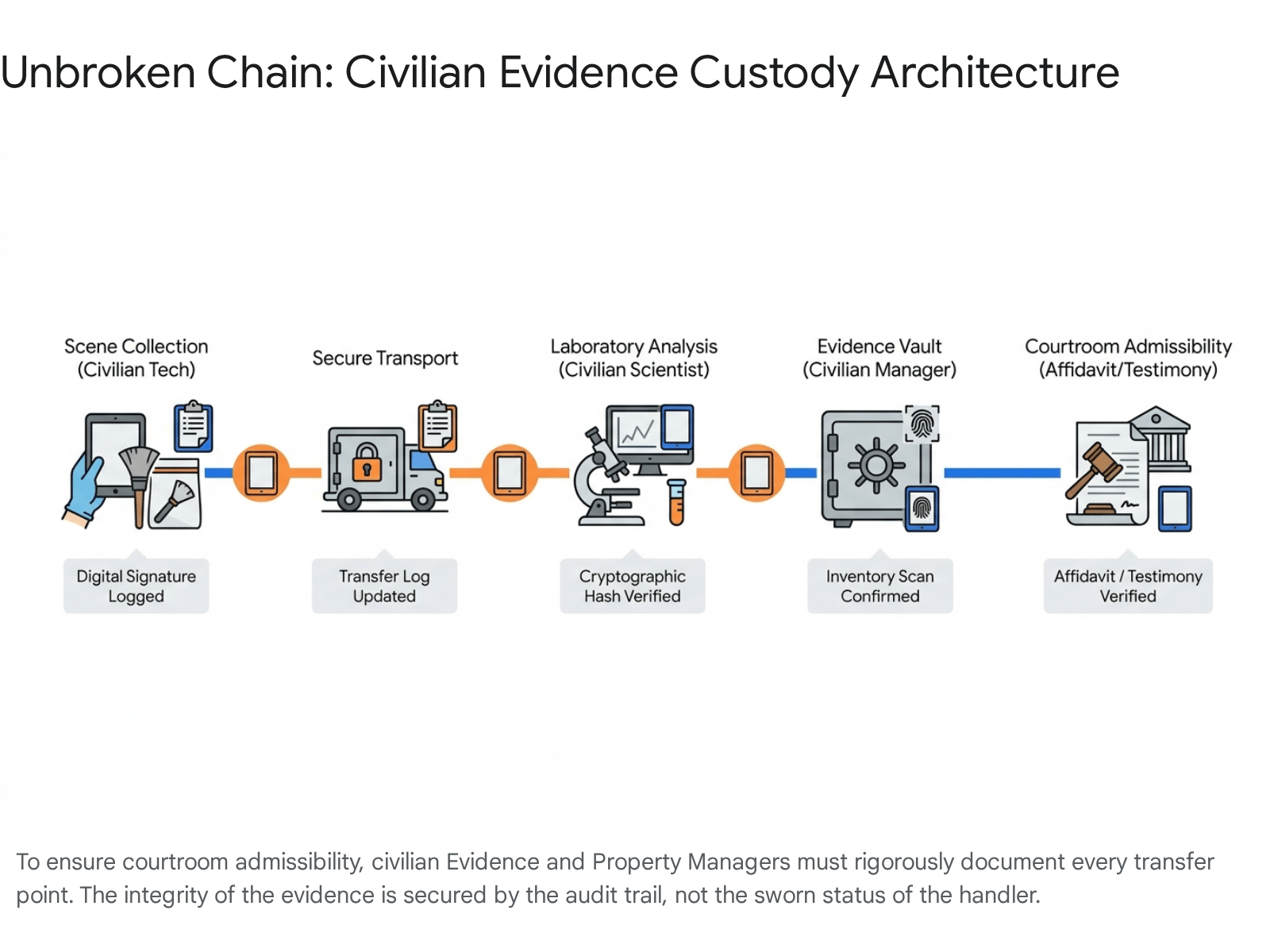
When transitioning evidence management from sworn property officers to civilian Evidence and Property Managers, agencies must implement fail-safe standard operating procedures. The core requirement is that every single transmission of evidence—from the civilian crime scene technician who collects it, to the civilian transport driver, to the civilian forensic lab scientist, and finally to the civilian manager securing it in the evidence vault—must be unequivocally documented. Each individual who takes physical custody must sign for the item, and all periods of custody must be properly accounted for and recorded. Furthermore, the agency must conduct regular audits of the evidence room to prevent discrepancies or loss, ensuring absolute accountability.
While authentication by the chain of custody is acknowledged in legal circles as a “cumbersome process,” the American legal system has established mechanisms to accommodate civilian handling seamlessly. A highly detailed, unbroken chain is technically only mandated when the evidence is not readily identifiable by its own characteristics or is highly susceptible to alteration (such as narcotics, blood, or biological fluids). The possibility that physical evidence has been contaminated does not, by itself, immediately bar that evidence from being admitted; weak links in the chain of custody generally relate to the weight of the evidence assigned by the jury, not its foundational admissibility.
To streamline the judicial process and avoid the logistical nightmare of hauling a dozen civilian lab technicians and evidence clerks into court for every minor evidentiary hearing, many jurisdictions utilize statutory workarounds known as “notice-and-demand” statutes. For example, in Texas, under Article 38.35 of the Code of Criminal Procedure, a chain of custody affidavit is explicitly admissible to establish the integrity of physical evidence without necessitating that every civilian person in the chain appear personally in court. This affidavit, sworn under oath, satisfies the court’s requirements. Similarly, North Carolina statutes (such as G.S. 8-58.20 for general evidence, and G.S. 90-95 for drugs) allow the chain of custody for items subjected to forensic testing to be established simply by producing a statement signed by each successive person in the chain, provided the State gives sufficient notice and the defense does not actively object to the procedure. Therefore, the legal system inherently supports the civilianization of forensics and evidence management, provided the police department maintains immaculate, auditable digital records.
Digital Forensics and Chain of Custody
The chain of custody for digital evidence presents unique complexities that require sophisticated technological solutions. Digital forensics specialists—frequently civilians due to the advanced technical demands—are responsible for collecting and preserving data from computers and networks. In the digital realm, establishing the chain of custody relies less on physical lockboxes and more on cryptographic hashing (creating a unique digital fingerprint of a file) and automated, immutable system logging.
Modern large police departments are increasingly relying on civilian specialists to manage this digital evidence effectively while keeping sworn officers focused on operational, street-level roles. Civilianization actively supports staffing stability in these highly technical units; professional staff generally experience much lower turnover rates than sworn officers, who are frequently subject to patrol transfers, promotional reassignments, or specialized task force deployments. This workflow continuity is crucial for digital chain of custody, providing consistent expertise and ensuring that precision is maintained so that the department remains in strict compliance with privacy laws and court mandates regarding digital discovery.
Federal Regulatory Compliance: Navigating the CJIS Security Policy
The final structural hurdle to executing aggressive civilianization is maintaining absolute compliance with the FBI’s Criminal Justice Information Services (CJIS) Security Policy. The CJIS division manages the largest massive database of criminal justice information in the world, serving as the primary source of intelligence, warrant data, and background information for all law enforcement, national security, and civil agencies. Because civilian staff—including IT contractors, 911 dispatchers, digital analysts, and administrative clerks—require continuous access to this database to perform background checks, manage records, or process digital evidence, they are subject to intense federal security mandates.
The CJIS Security Policy (v5.9.5 and its subsequent iterations) is a robust, 230-page document that draws on presidential directives, federal laws, and NIST guidance to establish strict minimum security requirements for any entity handling Criminal Justice Information (CJI). When a police department transitions a sworn role to a civilian role that involves terminal access to CJI, the civilian employee is not granted automatic trust. Compliance is mandatory, and the vetting process is exhaustive.
All civilian personnel, and even secondary actors or contractors supporting the government entity, who require unescorted access to CJI must be appropriately vetted through a national fingerprint-based background check. Procedurally, the local law enforcement agency must submit the civilian applicant’s fingerprints electronically via livescan. In Wisconsin, for example, the Department of Justice explicitly directs agencies to use the Law Enforcement Applicant (LEAP) code for fingerprint submissions for non-sworn civilian personnel in accordance with CJIS policy. This LEAP code performs a comprehensive state and national criminal history check, storing the prints in the Automated Fingerprint Identification System (AFIS).
Once the criminal history is returned, the local criminal justice agency makes the initial suitability determination. If a criminal record match occurs, the final approval or disapproval for access to the CJIS network rests with the State’s CJIS System Officer (CSO).
The Role of the ARSO and Mandatory Auditing
To manage this complex compliance environment, the local agency must appoint an Authorized Recipient Security Officer (ARSO). The ARSO serves as the primary information security contact between the local law enforcement agency and the larger state/federal apparatus. The ARSO is strictly responsible for disseminating security alerts, maintaining system configuration data, and keeping the state informed of any security vulnerabilities. Most importantly, the ARSO ensures that all civilian personnel complete mandatory Security Awareness Training before they are added to the agency’s authorized user list. Background rechecks for these civilian users are mandated at a minimum of every five years.
Furthermore, CJIS Area 5.4 mandates uncompromising auditing and accountability protocols. Every CJI-related activity executed by a civilian employee, including specific terminal logins and individual database queries, must be electronically logged and tracked. These complete audit trails must be retained for a minimum of one year. These logs are vital to the civilianization process; they provide the unbreakable digital chain of custody that holds the agency accountable, prevents unauthorized snooping or data theft by non-sworn staff, and ensures the agency can survive the rigorous verification audits conducted by the CJIS Audit Unit (CAU) and CJIS Systems Agencies (CSAs).
If a security incident does occur involving a civilian employee accessing CJI inappropriately, the agency must have an incident handling capability in place—including preparation, detection, containment, eradication, and recovery. Where follow-up involves legal action against the employee, evidence must be collected and retained conforming to the rules of evidence for that jurisdiction.
| CJIS Compliance Role | Description & Responsibility within a Civilianized Agency |
| CJIS System Officer (CSO) | State-level official responsible for final approval/disapproval of access if a civilian applicant’s background check reveals a criminal history match. |
| Authorized Recipient Security Officer (ARSO) | Local agency contact responsible for managing information security, ensuring civilian staff complete Security Awareness Training, and maintaining hardware audits. |
| FBI CJIS ISO | Federal officer responsible for maintaining the overarching Security Policy, disseminating alerts, and providing technical guidance to state CSOs. |
| Repository Manager (SIB Chief) | The designated manager having oversight responsibility for a state’s fingerprint identification services, ensuring civilian LEAP prints are processed correctly. |
While the administrative burden of onboarding, fingerprinting, training, and continuously auditing professional staff is non-trivial, it is a manageable bureaucratic necessity. The cost of establishing robust CJIS compliance protocols pales in comparison to the operational and financial devastation of utilizing $150,000-a-year sworn officers to run routine background checks.
Navigating Cultural Friction and Labor Dynamics
A strategic forecast of civilianization in 2026 must thoroughly acknowledge the internal turbulence and political friction this process inevitably generates. The transition from a homogenous sworn force to a hybridized workforce is rarely seamless. Studies consistently show that gaining the acceptance of the existing sworn officers and their collective bargaining units is often the single greatest challenge to building a successful civilianized police department.
Labor organizations, such as local lodges of the Fraternal Order of Police (FOP), frequently view aggressive civilianization as a direct, existential threat to the financial wellbeing of their members. The primary point of contention is the reduction of available overtime pools. As previously established, when administrative, forensic, and low-level investigative roles are transitioned to professional staff, the structural overtime that sworn officers historically relied upon to artificially inflate their total compensation is heavily curtailed. Consequently, unions may leverage significant political pressure to block or slow these transitions. In Baltimore, for example, the FOP Lodge #3 released a highly critical report on the “Mismanagement” of the department, citing concerns over “command accountability,” staffing assessments, and the impact of the Consent Decree on public safety operations, reflecting the deep tensions that arise during periods of structural reform and civilianization.
Furthermore, sworn officers may perceive the influx of highly educated, private-sector professional staff as a threat to their authority, capability, and institutional respect. There is deeply ingrained cultural resistance to altering the historical paramilitary nature of police agencies. Sworn personnel assigned to specialized administrative units often view their positions as hard-earned respites from the physical dangers, emotional trauma, and shift-work of street patrol. Forcibly reassigning these veteran officers back to the front lines to make room for civilian analysts can cause acute morale issues and trigger a wave of early retirements.
To mitigate this friction, executive leadership—including city managers, mayors, and police chiefs—must approach civilianization not as a hostile corporate takeover, but as a collaborative evolution of the profession. It is imperative that command staff thoroughly define the distinct and complementary roles of both sworn officers and professional staff. Sworn members must be made to understand that civilianization ultimately reduces their administrative burden, protects them from the burnout of mandatory overtime, and elevates their status by allowing them to focus exclusively on the high-stakes enforcement operations they were trained for. Success in 2026 requires ironclad political will from municipal leaders to withstand short-term labor pushback in exchange for long-term fiscal solvency and operational superiority.
Strategic Conclusions
As American law enforcement navigates the highly volatile and resource-constrained realities of 2026, the aggressive civilianization of police departments is no longer an optional progressive reform; it is an absolute mathematical and operational necessity. The “triple threat” of the workforce crisis—compounded by the crippling actuarial realities of public safety pension liabilities and the massive financial drain of structural overtime—has rendered the traditional, sworn-heavy policing model structurally insolvent.
By meticulously transitioning specific units—including traffic crash investigations, forensic laboratories, digital cybercrime analysis, and administrative oversight—to highly specialized professional staff, municipalities execute a massive arbitrage on personnel costs. This strategic transition reclaims tens of thousands of hours of sworn capacity, allowing highly trained, high-cost police officers to be redeployed to the frontline patrol and violent crime operations where their legal authority and tactical training are actually required to protect the public.
While the integration of unsworn personnel introduces complexities regarding the legal chain of custody and stringent FBI CJIS compliance, these are fundamentally administrative challenges. They can be effectively and legally managed through the implementation of rigorous audit trails, electronic logging, and the utilization of statutory workarounds like notice-and-demand affidavits. Ultimately, the survival, efficacy, and public legitimacy of the 2026 police department depend entirely on its willingness to dismantle outdated paramilitary silos and embrace a modernized, hybridized, and financially solvent public safety framework.
Please share the link on Facebook, Forums, with colleagues, etc. Your support is much appreciated and if you have any feedback, please email us in**@*********ps.com. If you’d like to request a report or order a reprint, please click here for the corresponding page to open in new tab.
Sources Used
- REPORT ON THE WORKFORCE ALLOCATION STUDY, accessed June 25, 2026, https://www.chicagopolice.org/wp-content/uploads/Workforce-Allocation-Study.pdf
- Workforce Allocation Study: Executive Summary – Chicago Police Department, accessed June 25, 2026, https://www.chicagopolice.org/wp-content/uploads/WFA-ES.pdf
- Statement on Workforce Allocation Study – Impact for Equity, accessed June 25, 2026, https://impactforequity.org/pressroom/statement-on-workforce-allocation-study/
- What are some typical daily responsibilities for a Military Civilian Digital Forensics specialist, accessed June 25, 2026, https://www.ziprecruiter.com/e/military-civilian-digital-forensics-what-are-some-typical-daily-responsibilities-for-a-military-civilian-digital-forensics-specialist