
1. Introduction: The State of the Law Enforcement Profession in 2026
The institution of American law enforcement has arrived at a profound and existential inflection point in the year 2026. Agencies across the nation are facing a confluence of unprecedented internal and external pressures that fundamentally threaten their core functional capacities, manifesting most visibly in a deepening, systemic workforce crisis. This crisis is characterized by hemorrhaging retention rates, a precipitously shrinking pipeline of qualified applicants, and the mass exodus of seasoned, mid-career professionals who represent the tactical and institutional backbone of the profession.1 While the prevailing public and political narratives often attribute this exodus to compensation disparities, intense public scrutiny, the rise of specialized oversight commissions, or the inherent physical dangers of the occupation, rigorous organizational behavior analysis reveals a far more insidious, structural catalyst. The primary driver of the current retention crisis is a profound leadership deficit—specifically, an expanding and severe disconnect between executive command structures and frontline patrol operations.2
In 2026, the law enforcement profession is grappling with the total collapse of outdated organizational structures. Traditional hierarchical models, which are essentially vestiges of the Industrial Revolution designed for rigid compliance rather than dynamic problem-solving, are comprehensively failing to accommodate the psychological, tactical, and social complexities of twenty-first-century policing.4 As an inevitable consequence of these archaic frameworks, executive leadership often becomes structurally and culturally shielded from the authentic voices and operational realities of the frontline personnel they command.5 This structural shielding has generated a cascading sequence of organizational failures that compound upon one another. These failures include the severe misalignment of Key Performance Indicators (KPIs), the suffocating expansion of administrative burdens placed upon first-line supervisors, the erosion of authentic field leadership presence, and the cultivation of a deeply risk-averse culture defined by tactical hesitation and the pervasive fear of administrative betrayal.2
The consequences of this executive-patrol divide extend far beyond internal morale surveys or localized grumbling in the precinct locker room. When executive leadership relies on socially distanced, compliance-driven management models rather than engaged, field-based leadership, the operational readiness and tactical efficacy of the entire agency are fundamentally compromised.8 Frontline officers, feeling utterly abandoned by their command staff and subjected to extreme, adversarial internal scrutiny, are experiencing unparalleled levels of burnout, moral injury, and psychological fatigue.2 This exhaustive strategic report, prepared for the readership of blog.roninsgrips.com, will deconstruct the anatomy of the command-frontline disconnect. It will explore how misaligned metrics, administrative bloat, and organizational betrayal have accelerated officer burnout and compromised tactical readiness. Furthermore, it will outline the strategic, evidence-based imperatives required to bridge this divide, restore organizational trust, and stabilize the workforce before the institutional knowledge drain becomes irreversible.
2. The Enduring Divide: Reuss-Ianni’s “Two Cultures” in the Digital Age
To accurately diagnose the current schism within modern police organizations, it is necessary to examine the foundational organizational sociology of law enforcement. In 1983, researcher Elizabeth Reuss-Ianni introduced a seminal theoretical framework known as the “Two Cultures of Policing,” positing that modern police departments are not monolithic entities with a unified ethos, but rather are deeply divided into two distinct, and often fiercely competing, cultural spheres: “Street Cop Culture” and “Management Cop Culture”.10 Over four decades later, this framework remains the most accurate diagnostic tool for understanding the 2026 retention crisis, as the divide has not only persisted but has exponentially widened.
The Taxonomy of the Two Cultures
Street Cop Culture operates exclusively at the precinct, sector, and patrol level. It is characterized by high group loyalty, an entrenched “us-versus-them” mentality developed in direct response to a perceived hostile external environment, and a heavy reliance on informal, experience-based decision-making rather than rigid procedural manuals.11 The solidarity within this street-level culture is paramount for physical and psychological survival in unpredictable, high-stress, and often violent operational environments. It is a culture built on the fundamental premise of “having each other’s six” when the system fails.2
Conversely, Management Cop Culture is rooted in the executive, administrative, and political echelons of the department. This culture is bureaucratically juxtaposed to the street level. It prioritizes rationalization, strict policy compliance, statistical performance metrics, public relations, and the delicate navigation of municipal politics.10 Reuss-Ianni observed that the loyalties of the “bosses” naturally and inevitably gravitate toward the social and political networks of municipal management—mayors, city councils, civilian oversight boards—rather than to the men and women on the street. This misalignment of loyalty causes a sharp division with grave consequences for departmental cohesion, as the two cultures pursue fundamentally different objectives.10
The Exacerbation of the Divide in the Modern Context
While Reuss-Ianni identified this phenomenon in the early 1980s, the digital transformation of policing, coupled with the socio-political upheaval of the early 2020s, has exponentially widened this divide into a chasm. The advent of pandemic-era policing normalized “socially distanced” forms of leadership, which drastically decreased the frequency of positive, organic, face-to-face interactions between frontline officers and their commanders.8 These distanced management protocols severed the few remaining relational bridges between the Street Cop and the Management Cop.
Furthermore, as individuals ascend the ranks within modern agencies, they become increasingly disconnected from street-level realities, transitioning fully into the Management Cop paradigm.9 Executives are frequently tasked with implementing sweeping reform legislation, consent decrees, and massive policy overhauls dictated by external political bodies. However, frontline officers become highly skeptical—and passively resistant—when new operational directives are authored by civilians, academics, or senior police leaders who have not actively patrolled a sector or engaged in a use-of-force incident in over a decade.5
The cultural mandate of Street Cop loyalty fundamentally clashes with the Management Cop mandate of institutional risk mitigation. When management prioritizes appeasing external political pressures or media narratives over supporting the tactical realities of the frontline, the Street Cop Culture perceives this not merely as poor management, but as a fundamental and unforgivable breach of loyalty. This perceived breach catalyzes the development of a deeply entrenched, adversarial “them” (command staff) and “us” (frontline officers) mentality, which serves as the psychological bedrock for the current retention crisis, driving officers to seek employment in agencies where the divide is less pronounced, or to leave the profession entirely.3
3. Goodhart’s Law and the Severe Misalignment of Key Performance Indicators (KPIs)
The schism between Management Cops and Street Cops is operationalized and enforced most visibly through the deployment of performance metrics. Modern police administration has been heavily influenced by data-driven management models, most notably CompStat and its various derivative systems.15 While these systems were initially designed in the 1990s to increase accountability, identify crime trends, and optimize resource allocation, their current application in many agencies serves as a textbook manifestation of Goodhart’s Law, resulting in the systemic distortion of police work.
The Mechanism of Goodhart’s Law in Modern Policing
Coined by British economist Charles Goodhart, the law stipulates a fundamental truth of organizational behavior: “When a measure becomes a target, it ceases to be a good measure”.16 This principle warns organizations of the inherent risks of relying on misaligned Key Performance Indicators (KPIs) that prioritize quantifiable, easily tracked metrics over meaningful, holistic outcomes.17
In the law enforcement context, when executive command mandates strict targets for specific, easily measurable outputs—such as the number of traffic citations issued, pedestrian stops conducted, field interview cards submitted, or arbitrary arrest quotas—these metrics become the sole focus of organizational behavior. Officers, adapting to the pressure of the Management Cop Culture and seeking to avoid punitive administrative action for “low productivity,” begin to optimize their behavior to satisfy the spreadsheet rather than to enhance public safety.16 The metric, originally intended to measure proactive police work, becomes a quota that incentivizes system gaming.
The Unintended Consequences of Rigid Metrics
This hyper-focus on quantitative targets produces severe unintended consequences that directly compromise tactical readiness and community relations. For example, focusing solely on minimizing call-response times or maximizing call clearance rates pressures frontline officers to rush complex, volatile engagements. This manufactured urgency limits the time available for crucial de-escalation protocols, thorough investigations, and meaningful community engagement, ultimately leading to unresolved issues, higher recidivism, unnecessary uses of force, and degraded public trust.17
Furthermore, misaligned KPIs are deeply demoralizing for the frontline patrol officer. When an officer’s professional worth, career trajectory, and specialized unit transfer prospects are reduced to a numerical output that lacks qualitative context, the inherent value of their public service is marginalized. The vast majority of officers enter the profession to do impactful police work—taking dangerous, violent offenders off the street, solving complex local problems, and protecting vulnerable populations. When command staff evaluates them based on a misaligned scorecard that rewards high-volume, low-impact enforcement (e.g., writing dozens of minor equipment violations) over low-volume, high-impact work (e.g., conducting a weeks-long investigation into a local narcotics distributor), it creates a profound sense of cognitive dissonance and accelerates burnout.16 The system treats officers as interchangeable variables in a data set rather than autonomous professionals exercising critical discretion.
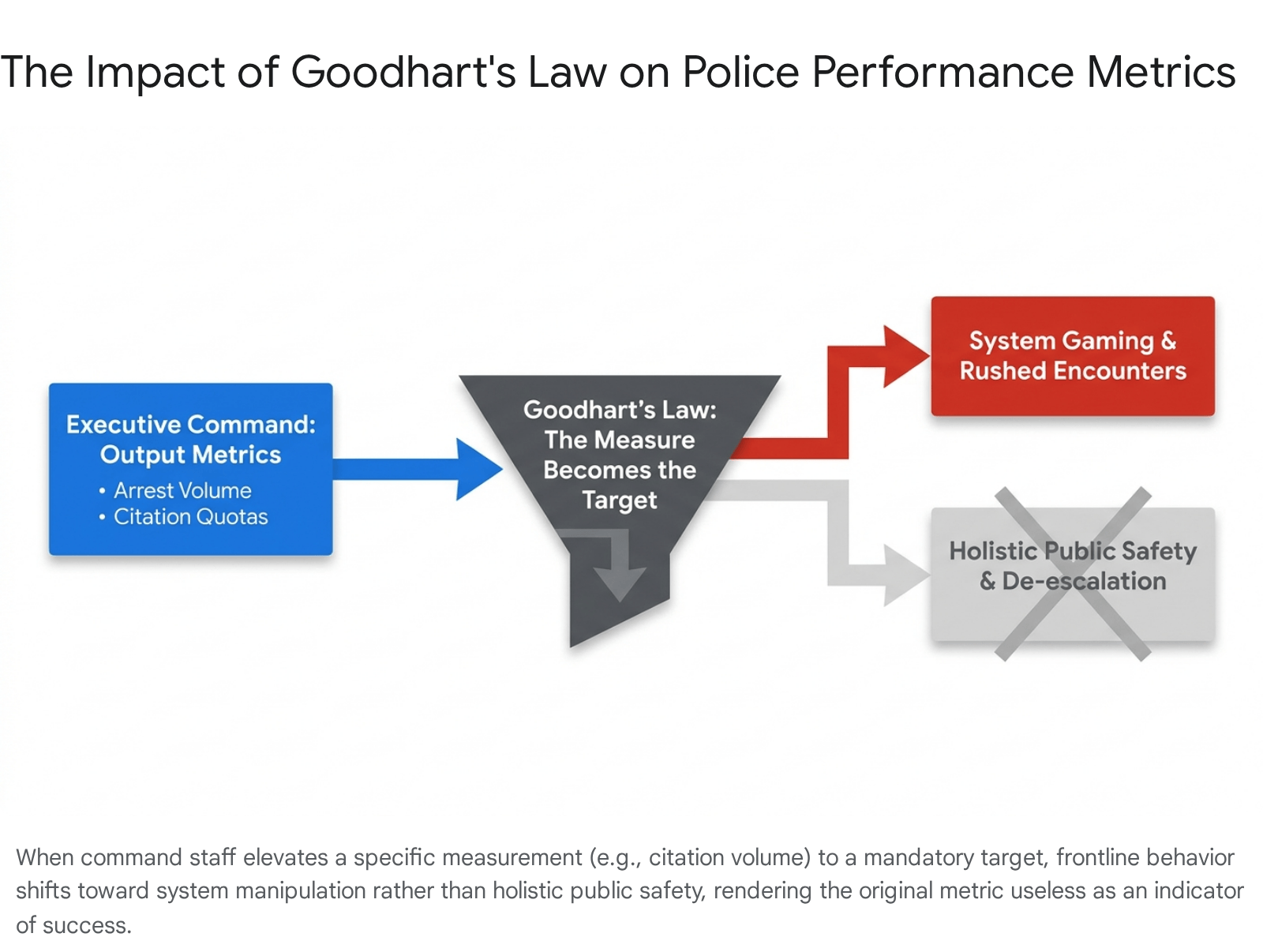
The CompStat model, while theoretically capable of supporting community policing, often devolves into a punitive forum where precinct commanders are berated over minor statistical fluctuations. This pressure flows directly down the chain of command, resulting in sergeants demanding raw numbers from their squads simply to survive the next executive briefing.15 This dynamic perfectly encapsulates the Management Cop Culture’s triumph over the Street Cop Culture’s operational reality, sacrificing long-term community trust for short-term statistical compliance.
4. The Administrative Anchor: Pulling Supervisors Off the Street
The strength, resilience, and operational discipline of any law enforcement organization rest squarely on its first-line supervisors, primarily individuals holding the rank of Sergeant. Sergeants represent the critical translation layer between executive policy formulation and street-level tactical execution. They are tasked with translating abstract directives into practical action, setting the tone during crises, modeling leadership under extreme pressure, and ensuring immediate, on-the-ground accountability.19 However, the current command-frontline disconnect is severely exacerbated by the rapidly evolving nature of the Sergeant’s role, which has been fundamentally altered by an overwhelming, systemic influx of administrative burdens.
The Paradox of Managerial Leadership at the Frontline
Academic research into the everyday practices of police supervisors reveals a striking and highly problematic paradox: while frontline supervisors define themselves and their professional responsibilities in terms of “leadership,” the actual activities they perform are overwhelmingly classified as “management work”.20 Agencies everywhere, struggling with budget constraints and civilian staffing shortages, are asking more from fewer supervisors, stretching them dangerously thin across multiple sectors. Sergeants are increasingly tasked with managing larger spans of control while juggling a crushing administrative load that acts as an anchor, physically keeping them off the street and confined to a desk inside the precinct.19 Recent data confirms the severity of this administrative bloat, revealing that more than three hours per shift—approximately 40% of the workday—gets swallowed by paperwork. Furthermore, a national survey indicated that 38% of police officers spend two to four hours per shift on administrative tasks, with another 16% spending more than half their entire shift on paperwork.
When sergeants are transformed by organizational design into administrators rather than tactical leaders, the entire organizational structure fractures at its most critical stress point. The consequences are predictable, immediate, and severe: interpersonal communication degrades, tactical oversight during complex incidents vanishes, accountability for minor infractions fades, and squad morale plummets.19 Officers in the field quickly realize that their primary leader is absent, replaced by a digital signature on a digital report.
The Body-Worn Camera Paradox and the Auditing Burden
A primary, and highly contemporary, contributor to this administrative anchor is the widespread implementation of transparency technologies, most notably Body-Worn Cameras (BWCs). While BWCs are invaluable, necessary tools for public accountability, civil liability protection, and evidence gathering, the logistical and administrative requirements surrounding data storage, management, and routine auditing are staggering and largely fall upon the shoulders of the first-line supervisor.21
Agencies, driven by the risk-mitigation imperatives of the Management Cop Culture, are frequently requiring sergeants to routinely review and audit hours of BWC footage to ensure policy compliance, check for uniform violations, and identify training needs.22 The time investment required for this oversight is massive and unsustainable. For instance, the redaction and detailed review process can consume up to one hour of administrative staff or supervisory time for every ten minutes of video recording.22 While this auditing function satisfies the risk-mitigation desires of executive command and municipal oversight bodies, it directly and unavoidably cannibalizes the time sergeants have to be physically present in the field alongside their personnel. The supervisor is effectively sidelined, auditing past behavior rather than leading current operations.
Command Presence vs. Command Being Present
The nature of law enforcement demands a strong “command presence”—projecting authority, control, and fearlessness to establish order in chaotic environments.24 However, the administrative demands placed on supervisors prevent a more vital organizational concept: command being present.
Officers consistently report in extensive national surveys that visible, engaged, and communicative leadership is directly linked to higher morale, enhanced psychological safety, and safer tactical operations.19 Officers fundamentally need to see their leadership aligned with the realities of street-level policing. When command staff and immediate supervisors remain physically and emotionally distant—relying on email directives, digital dashboards, or infrequent, highly formalized briefings—it breeds profound feelings of isolation and abandonment among the patrol force.25 The most effective strategy for improving morale within a fractured department is strong, consistent leadership engagement through regular roll call visits, authentic open-door policies, and active participation in field operations where appropriate.25 When administrative burdens prevent this engagement, the leadership vacuum on the street is quickly filled by cynicism, degraded standards, and tactical hesitation.
5. Tactical Hesitation: The Weaponization of Administrative Fear
As the physical, emotional, and cultural distance between executive command and the frontline grows, it profoundly impacts the physiological and psychological responses of officers in high-stress, volatile situations. The command disconnect manifests operationally as “tactical hesitation”—a highly dangerous phenomenon where officers delay, alter, or completely avoid necessary lawful action due to overwhelming anxiety regarding the subsequent administrative and public fallout.6
The Mechanics of Conditioned Hesitation
When a human being—including a highly trained police officer—is faced with a violent, non-compliant, or potentially lethal threat, human physiology dictates a rapid subconscious response categorized into five distinct reactions: fight, flight, freeze, posture, or submit.27 Without a doubt, fear in and of itself can cause performance failure, leading to the “freezing” response. However, in the 2026 policing environment, this paralysis is increasingly not driven by a fear for the officer’s physical safety or a lack of tactical proficiency; rather, it is a “conditioned hesitation” engineered by a hyper-critical, unsupportive administrative environment. The primary driver of this hesitation is the profound fear of litigation, relentless internal affairs investigations, public crucifixion without agency defense, and the potential loss of career, freedom, and pension.6
In an era defined by viral social media outrage and immediate public condemnation based on fragmented video clips, officers are acutely aware that any use-of-force incident—no matter how legally justified or tactically sound—will be subjected to intense, microscopic, frame-by-frame review by individuals who were not present, who have never worn a badge, and who possess the ultimate luxury of hindsight.2 When the prevailing agency culture is heavily focused on strict compliance and punitive action rather than coaching, support, and the understanding of human performance limitations under stress, officers deeply internalize this threat.
The Dilution of Battlefield Initiative
Deviating from perfectly scripted standard procedures—even when such deviation is operationally necessary to secure a rapidly escalating and chaotic scene—inevitably subjects the officer to a rigorous conduct-based analysis that dilutes critical battlefield aggressiveness and initiative.26 The result is the rise of “defensive policing.” In a defensive policing paradigm, risk avoidance supersedes proactive public safety. Officers may choose to disengage from suspicious activity, delay physical intervention until an assault is fully underway, or avoid high-crime areas entirely to minimize their statistical exposure to a use-of-force incident. This hesitation endangers the officer, their partners, and the vulnerable community members who rely on proactive intervention.
Attempting to Address the Hesitancy Through Training
Resolving tactical hesitation requires a sophisticated, multi-pronged approach. Agencies have attempted to address this through modernized training frameworks, such as the National Decision Model (NDM) utilized in the United Kingdom, or Modern Police Compliance Control Tactics (MPCCT).29 These models provide officers with structured, reality-based frameworks for force application, emphasizing continuous risk assessment, de-escalation, and simple, effective control tactics designed to gain verbal and physical compliance while upholding constitutional rights.29
However, tactical training alone is fundamentally insufficient to cure conditioned hesitation. If the hesitancy stems from political, administrative, or legal scrutiny rather than a lack of physical confidence, the solution requires a massive cultural shift at the executive level. Executive command must engage in continuous, open communication to build understanding and proactively reassure personnel that lawful, proportionate actions will be vigorously and publicly defended by the agency, regardless of the immediate political optics.28 Without this assurance, the finest tactical training in the world will be overridden by the survival instinct to avoid administrative destruction.
6. The Anatomy of Betrayal: Moral Injury in the Ranks
The fear of administrative reprisal is intimately linked to a deeper, more insidious psychological trauma currently ravaging the law enforcement profession: Organizational Betrayal. This concept represents the profound emotional and psychological devastation that occurs when an officer perceives that their agency’s leadership—the very institution that demanded their sacrifice—has abandoned them during their greatest time of need.2
Defining Organizational and Administrative Betrayal
Introduced to the psychological lexicon by researcher Jennifer Freyd, “organizational betrayal” (frequently referred to interchangeably as institutional betrayal) describes the specific wrongdoings committed by an institution against the individuals who rely upon it for support, safety, and operational backing.2 In the specific context of law enforcement, this phenomenon is often termed “administrative betrayal,” representing both deliberate acts of commission and cowardly acts of omission by superior officers, particularly the Chief Executive or Sheriff.7
While police officers are rigorously trained in the academy to endure critical incidents, extreme violence, and the chaotic, traumatic nature of the street, they are rarely equipped to survive the prolonged internal aftermath of these events.2 Following a lethal-force encounter, an in-custody death, or a highly publicized critical incident, officers are immediately subjected to extreme internal scrutiny, relentless “Monday morning quarterbacking,” and physical isolation pending the outcome of multi-jurisdictional investigations.2 This distance from co-workers and the sudden removal from the camaraderie of the profession when placed on official administrative leave serves to severely compound the trauma of the incident itself.
The Trauma of Leadership Silence
The deepest, most enduring trauma often stems not from the operational hazard or the threat to the officer’s physical life, but from the silence, distancing, or outright hostility of leadership in the immediate aftermath. When a critical incident captures national media attention, the involved officer is legally and administratively gagged, utterly lacking a public voice to defend their actions, provide context, or explain their state of mind.31 In these highly volatile moments, executive leaders are the only viable bridge between the officer and the public narrative.
When leadership courts the press, issues premature condemnations to appease political pressure, or simply remains silent in the face of rampant misinformation, they commit a profound administrative betrayal.31 In many jurisdictions, police officers feel they are subjected to the same hostile treatment and lack of understanding that Vietnam veterans faced upon their return, viewed as guilty by default by segments of the community even in the total absence of evidence.31 This perceived abandonment by command staff shatters the foundational law enforcement ethos of brotherhood, sisterhood, and “having each other’s six”.2 The failure of leaders to assert and hold a firm boundary demanding a fair, just, and impartial process inflicts severe moral injury upon the officer.31
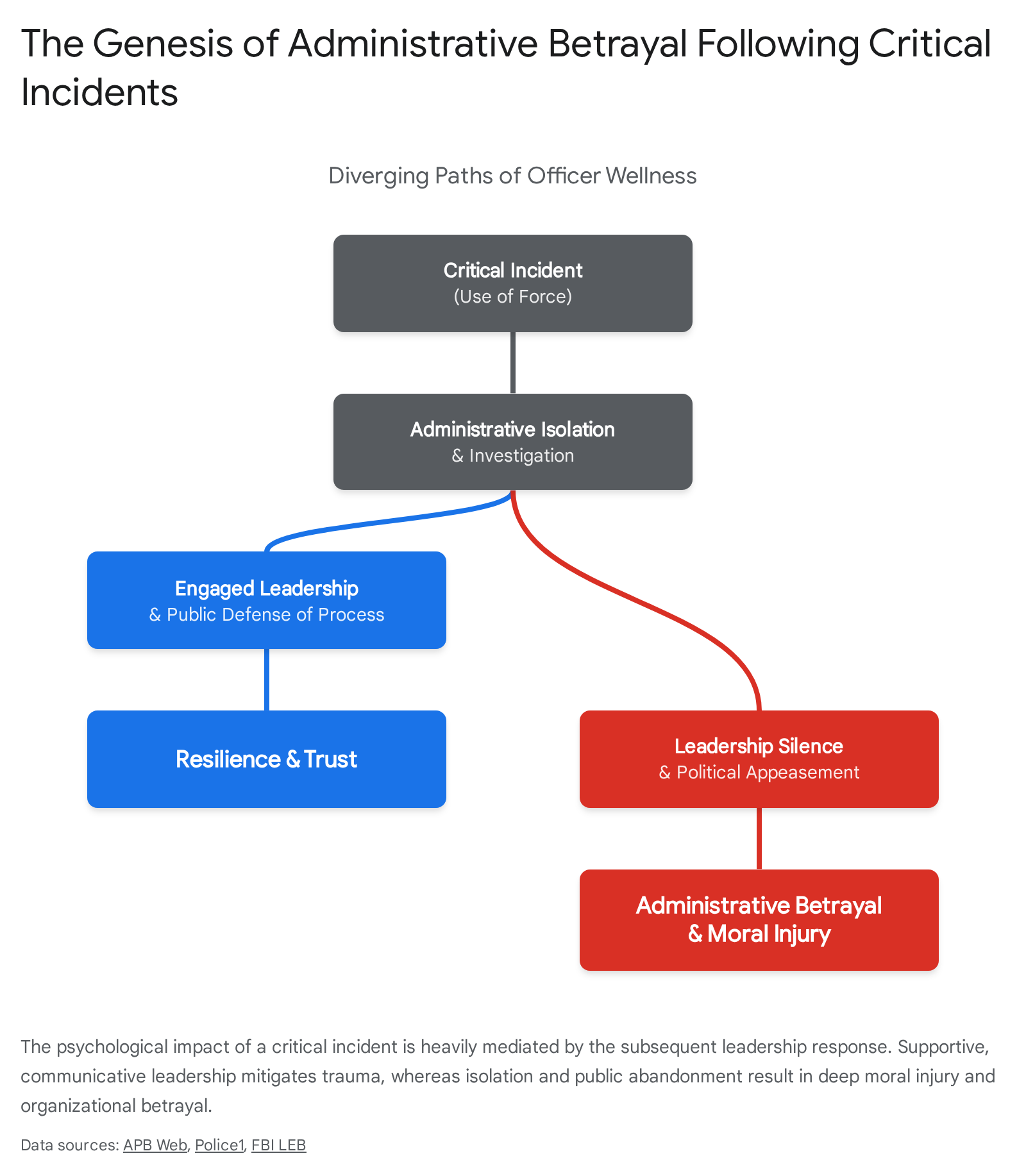
The psychological toll of this betrayal is devastating and long-lasting. Officers report that organizational betrayal leads to deep bitterness, suppressed emotions, feelings of profound hopelessness, and an erosion of trust that reverberates far beyond the individual, poisoning the culture of the entire agency.2 This moral fatigue not only accelerates burnout but directly impairs an officer’s ability to engage compassionately and patiently with the public, thereby actively undermining the very procedural justice and community policing initiatives that the executive command claims to champion.32
7. The Silent Killer: Organizational vs. Operational Stress
The cumulative, unmitigated effect of misaligned KPIs, suffocating bureaucracy, tactical hesitation, and the ever-present threat of administrative betrayal culminates in a highly toxic environment that generates massive amounts of organizational stress. While police recruits enter the academy fully expecting to face operational dangers—responding to violent incidents, navigating high-speed pursuits, managing traumatic crime scenes, and dealing with human suffering—they are wholly unprepared for the crushing stress originating from within the agency itself.33
The Dominance of Organizational Stressors
Extensive, longitudinal research conducted by experts in police psychology, such as Dr. Karen Amendola at the National Policing Institute, highlights a startling and counter-intuitive reality: organizational stressors have a significantly greater negative impact on officer health, daily performance, and long-term well-being than the operational dangers inherent to the street.33
Operational stress is generally episodic, predictable in its unpredictability, and somewhat mitigated by intense tactical training, specialized equipment, and peer support networks. When an officer survives a shootout, the trauma is acknowledged, understood, and treated. Conversely, organizational stress is insidious, ongoing, systemic, and cumulative.33 It stems from factors largely within the direct control of law enforcement leaders, yet it is rarely acknowledged or treated with the same urgency as physical trauma.
To understand the disparity, it is crucial to delineate the core components of organizational stress as identified by researchers 33:
| Stressor Category | Manifestation in the Law Enforcement Environment | Impact on Officer Wellness |
| Toxic Culture & Internal Politics | Favoritism in promotions, punitive leadership styles, and an environment that fosters mistrust and backstabbing over collaboration.2 | Erodes unit cohesion, destroys trust in the chain of command, and generates chronic anxiety regarding career stability. |
| Ineffective Supervision | A lack of clear guidance, inconsistent application of discipline (e.g., punishing one officer while ignoring another for the same infraction), or unfair treatment.33 | Breeds deep resentment, cynicism, and a feeling that the system is fundamentally rigged against the frontline worker. |
| Policy Instability | Constantly changing, reactive policies imposed from the top down without frontline input, practical consideration, or adequate training.5 | Creates “gotcha” environments where officers feel it is impossible to comply with contradictory or poorly communicated directives. |
| Workforce Management | Mandatory overtime, extended shifts causing extreme fatigue, and arbitrary shift or unit reassignments made without officer input or consideration for family life.33 | Destroys work-life balance, leads to sleep deprivation, increases the likelihood of critical errors in the field, and strains marriages. |
Because these stressors are generated by the organization itself, officers often feel completely powerless to combat them. They cannot arrest a bad policy, nor can they tactically de-escalate a toxic captain. This profound lack of control, compounded by the failure of executive leaders to acknowledge or address these internal hazards (often because the leaders themselves are the source of the stress), leads to severe psychological distress, sleep disturbances, cardiovascular issues, and eventual burnout.34 Decades of empirical data confirm that poor supervision, lack of recognition, and internal friction destroy police careers far more effectively and consistently than violent encounters on the street.33
8. The 2026 Retention Crisis: Analyzing the Hemorrhage
The convergence of these systemic failures—the cultural schism, misaligned metrics, administrative overload, tactical hesitation, moral injury, and chronic organizational stress—has precipitated a historic and potentially irreversible retention and recruitment crisis in 2026. The pipeline of new applicants remains critically strained due to generational shifts in career preferences, a strong labor market in other sectors, and a perpetually hostile socio-political climate surrounding policing.1 The nationwide impact is staggering: from 2020 to 2025, the number of police officers across the nation dropped by 5.2 percent, with smaller agencies (fewer than 50 officers) seeing a 60 percent rise in resignations compared to 2019. However, while recruitment is a challenge, the far more pressing operational threat is the sheer inability to retain experienced, seasoned officers.
The Illusion of Financial Motivation
It is a common, comforting misconception among municipal leaders, city managers, and even some police executives that officers are leaving the profession primarily for better financial compensation or sign-on bonuses in neighboring jurisdictions. While competitive pay and benefits are always relevant factors, deep qualitative data indicates a remarkably different reality: officers are leaving because of poor leadership, lack of support, and toxic organizational climates.3 Officers who desire a positive workplace culture where they feel valued, supported, and heard will actively seek employment in other agencies, or abandon the law enforcement profession entirely, to escape the pervasive sense of hopelessness generated by executive disconnect and administrative betrayal.3 They are not fleeing the danger of the job; they are fleeing their own command staff.
The Catastrophic “Brain Drain” Phenomenon
According to a comprehensive late 2024 survey conducted by the International Association of Chiefs of Police (IACP), which encompassed 1,158 agencies nationwide, the demographic reality is stark. Nearly 18% of commissioned personnel were eligible for immediate retirement, with projections indicating a rise to a staggering 24% by early 2025.46 This mass exodus represents a catastrophic “brain drain” of vital institutional knowledge.
Departments are rapidly losing the veteran officers who serve as the true cultural compass of the agency. These are the officers who act as informal leaders, mentor raw junior personnel, possess the emotional intelligence to navigate complex high-stakes incidents without resorting to force, and hold deep, irreplaceable, decades-long relationships with community members.1 As these veterans leave, those who remain are stretched far beyond their physical and mental limits to cover the staffing gaps, creating a vicious, self-perpetuating cycle of fatigue, mandatory overtime, and further resignations.1 The loss of these veterans cannot be replaced by simply pushing more recruits through a 19-week academy.36
The Autopsy vs. Preventative Medicine: Exit and Stay Interviews
Despite the severity of the turnover crisis, law enforcement agencies remain remarkably reactive rather than proactive in their workforce management strategies. They are attempting to treat a hemorrhage with a post-mortem exam. Research from the 30×30 Initiative reveals profound, systemic deficiencies in how police agencies gather and utilize employee retention data.37
Agencies generally rely on exit interviews to understand why personnel are leaving. However, exit interviews act merely as organizational autopsies—they only tell you why the patient died, they do not save the patient. The data indicates that only 22% of agencies actually use exit interview data to inform concrete policy changes, and 57% of respondents were unsure if the interviews ever led to any actionable improvements whatsoever.37 Most concerningly, 71% of agencies that fail to conduct exit interviews cite a simple lack of standardized tools or procedures as the primary barrier, indicating a massive failure of HR infrastructure within policing.37
Conversely, “stay interviews”—structured, proactive conversations with current, high-performing employees to understand why they continue to serve and what specific factors could be improved—act as preventative medicine.38 They provide proactive insights into organizational culture, satisfaction with command staff, and potential flight risks long before the officer decides to resign.39 Yet, the adoption rate of this crucial, low-cost tool is alarmingly low across the profession.
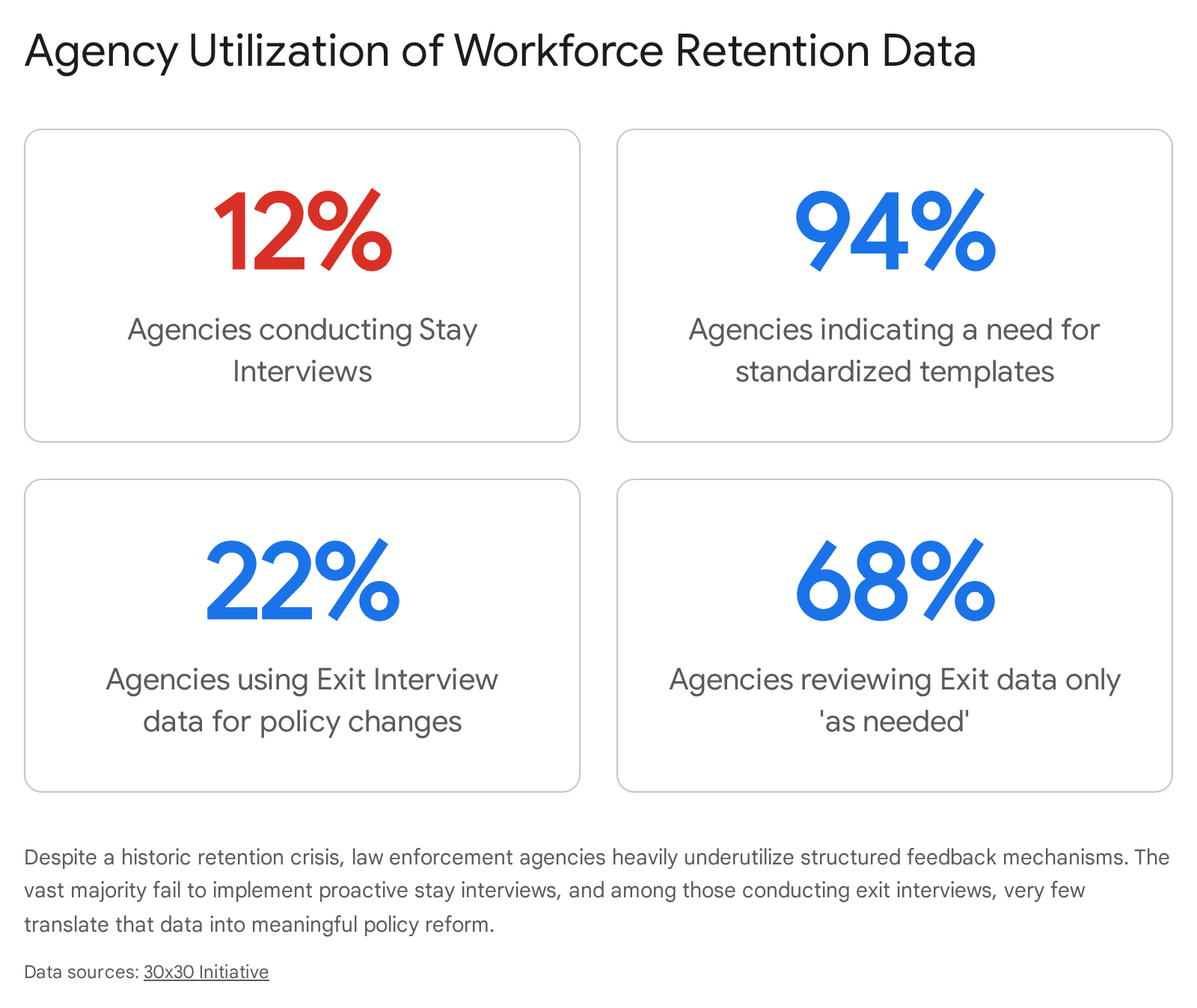
To fully grasp the magnitude of this failure in workforce intelligence gathering, consider the specific findings from the 30×30 Initiative regarding agency practices 37:
| Metric / Practice | Exit Interviews (Reactive) | Stay Interviews (Proactive) | Implication for Agency Command |
| Overall Prevalence | Widely assumed standard, yet 71% of non-participating agencies lack tools to execute them. | Only 12% of agencies conduct them. | Command is almost entirely blind to the motivations of their current workforce. |
| Data Utilization | Only 22% use data for policy changes; 68% review data only “as needed.” | 47% of the few agencies conducting them use the data to inform practices. | Even when data on toxic leadership is collected, executive command rarely acts upon it to enact systemic change. |
| Core Topics Covered | Reasons for leaving, grievances. | Perceptions of culture (79%), satisfaction with leadership (68%). | Stay interviews directly target the command disconnect, yet are ignored by 88% of the profession. |
By failing to engage in open, structured dialogue with the personnel who have not yet left, executives remain willfully blind to the internal friction driving the exodus.41 They continue to manage based on assumptions rather than data, further alienating the Street Cop Culture.
9. Strategic Imperatives: Bridging the Disconnect in 2026
The survival, efficacy, and legitimacy of law enforcement agencies in the coming decade depend entirely on the willingness of executive command to acknowledge their own complicity in the current crisis and systematically dismantle the barriers separating the Management Cop from the Street Cop. Addressing this crisis requires a fundamental paradigm shift away from bureaucracy, risk-aversion, and compliance-driven metrics toward engaged, emotionally intelligent leadership and the restoration of organizational trust.24
Redefining Leadership, Accountability, and Emotional Intelligence
Executives must fundamentally redefine what effective leadership looks like within their ranks, moving away from the authoritarian models of the past. Accountability and morale are not diametrically opposed concepts requiring a trade-off; they are deeply interconnected partners in organizational health.42 When leadership leans too heavily on punitive discipline without providing context, training, or support, it breeds resentment and tactical hesitation. Conversely, when standards slip in an attempt to buy cheap morale, organizational integrity fails. Effective supervisors utilize accountability to build structure and psychological safety, shifting their paradigm from post-incident criticism to proactive, pre-incident coaching.42
To achieve this, agencies must prioritize the rigorous assessment and continuous development of Emotional Intelligence (EQ) in their command staff and promotional candidates. The difference between adequate, bureaucratic managers and transformational, effective leaders lies precisely in their capacity to demonstrate self-awareness, regulate emotional responses, and handle complex interpersonal relationships judiciously and empathetically.24 Leaders must be trained not just in tactical deployment, ICS command, or budget management, but in the highly nuanced psychological realities of managing human beings who are operating under chronic, severe stress.
Dismantling the Administrative Anchor
To restore the vital, stabilizing presence of first-line supervisors in the field, executives must ruthlessly audit and eliminate non-essential administrative burdens. The primary operational goal must be to create supervisors who have the bandwidth to manage people, not just process paperwork.19
This requires aggressive technological and procedural innovation. If BWC auditing is consuming massive amounts of supervisory time, agencies must invest in AI-driven redaction technologies, permanently delegate administrative review to civilian professional staff, or fundamentally revise review thresholds to require manual supervisory auditing only for critical incidents, flagged encounters, or specific training interventions.22 Freeing the Sergeant from the desk is the first non-negotiable step in re-establishing a visible, supportive command presence on the street that officers can actually see and interact with.
Confronting Organizational Betrayal with Trauma-Informed Leadership
To mitigate the devastating effects of organizational betrayal and moral injury, agencies must adopt trauma-informed leadership practices. This begins with how an agency communicates during a crisis. Executive leaders must have the courage to stand as a buffer between their officers and the immediate rush to public judgment.31
While leaders absolutely cannot pre-judge an ongoing investigation or cover up genuine misconduct, they must publicly assert and vigorously defend a boundary that demands a fair, impartial, and evidence-based process for the involved officer, refusing to sacrifice their personnel for cheap political capital.31 Furthermore, internal administrative policies must be comprehensively reviewed to ensure that the necessary isolation of an officer post-incident is handled with profound psychological care. Officers must be provided with immediate, confidential access to culturally competent mental health professionals and vetted peer support teams, rather than being treated immediately as a criminal liability to the city.2 Clinical care following a critical incident must be biologically grounded and administered by providers who intimately understand the unique ethos, traditions, and risks of the law enforcement profession.44 Some agencies are finding success in utilizing trauma-informed chaplains to address the specific moral injuries resulting from these incidents.32
Institutionalizing Proactive Workforce Engagement
Finally, agencies must institutionalize continuous, structured, and protected feedback mechanisms. The implementation of Stay Interviews must transition from a niche HR concept to a standard operational procedure mandated by the Chief Executive.40 To be effective, agencies must ensure these sessions are conducted in a psychologically safe space, potentially utilizing independent officers with similar experiences to foster authentic dialogue without the fear of retaliation or judgment.40 By systematically identifying and actively solving the organizational stressors that drive burnout—whether that is a toxic middle manager, a cumbersome and redundant reporting system, or an unpredictable scheduling matrix that destroys family life—leadership demonstrates that they are not just listening, but acting.2
Furthermore, frontline officers must be given a legitimate seat at the table when creating new operational policies. The era of the ivory tower policy is over. Ensuring that the personnel who actually execute the directives on the street have direct input into their creation bridges the cultural gap, reveals unintended consequences before implementation, and signals a profound level of professional respect.5 Getting closest to the problem means empowering the people closest to the problem.
10. Conclusion
The severe, systemic disconnect between police executive command and frontline patrol operations in 2026 is not a mere failure of internal communication; it is a profound structural, cultural, and psychological crisis that threatens the very viability of the law enforcement profession in the United States. The historical divide between the Street Cop and the Management Cop, identified by Reuss-Ianni over forty years ago, has been inadvertently weaponized by a modern policing environment obsessed with misaligned statistical metrics, suffocating administrative requirements, and a defensive, risk-averse posture that routinely sacrifices frontline support for political expediency.
When the Management Cop Culture isolates itself completely from the gritty, unpredictable realities of the street, the result is exactly what the profession is currently experiencing: a workforce paralyzed by conditioned hesitation, devastated by organizational betrayal, and crushed by entirely preventable internal organizational stress. The ensuing retention crisis cannot be bought off with sign-on bonuses, relaxed grooming standards, or marginally elevated pay scales. It can only be resolved through a radical, uncompromising recommitment to authentic, courageous leadership.
Law enforcement executives must step out from behind the veil of data dashboards, endless Zoom meetings, and digital directives to re-engage with the human element of policing. By dismantling administrative anchors, aligning performance metrics with holistic public safety outcomes rather than arbitrary quotas, and acting as steadfast, vocal advocates for their personnel during crises, command staff can begin the arduous process of repairing shattered trust. Bridging this disconnect is no longer an aspirational goal for modern police administration; it is the absolute, non-negotiable prerequisite for organizational survival in the latter half of this decade.
Please share the link on Facebook, Forums, with colleagues, etc. Your support is much appreciated and if you have any feedback, please email us in**@*********ps.com. If you’d like to request a report or order a reprint, please click here for the corresponding page to open in new tab.
Sources Used
- Six Trends to Watch in American Policing in 2026, accessed June 25, 2026, https://www.policinginstitute.org/infocus/six-trends-to-watch-in-american-policing-in-2026/
- Betrayed from within – American Police Beat Magazine, accessed June 25, 2026, https://apbweb.com/2025/11/betrayed-from-within/
- Cops aren’t leaving law enforcement for money — they’re leaving because of poor leadership – Police1, accessed June 25, 2026, https://www.police1.com/chiefs-sheriffs/cops-arent-leaving-law-enforcement-for-money-theyre-leaving-because-of-poor-leadership
- The Thin Blue Line: Confronting Contemporary Leadership Challenges – McAfee Institute, accessed June 25, 2026, https://www.mcafeeinstitute.com/blog/modern-leadership-challenges-in-law-enforcement
- Understanding the Disconnect Between Police Leaders and Frontline Officers – PA Times, accessed June 25, 2026, https://patimes.org/understanding-the-disconnect-between-police-leaders-and-frontline-officers/
- Combating Conditioned Hesitation – Office of Justice Programs, accessed June 25, 2026, https://www.ojp.gov/ncjrs/virtual-library/abstracts/combating-conditioned-hesitation
- Betrayal: The Hidden Driver of PTSD for Cops – Psychology Today, accessed June 25, 2026, https://www.psychologytoday.com/us/blog/cop-doc/201806/betrayal-the-hidden-driver-of-ptsd-for-cops
- Policing the pandemic: Frontline officers’ perspectives on organisational justice – PMC, accessed June 25, 2026, https://pmc.ncbi.nlm.nih.gov/articles/PMC9629051/
- Crisis point: A wake-up call for police leaders on officers’ mental health and wellness, accessed June 25, 2026, https://www.police1.com/what-cops-want/crisis-point-a-wake-up-call-for-police-leaders-on-officers-mental-health-and-wellness
- Two Cultures of Policing: Street Cops and Management Cops – 1st Editio – Routledge, accessed June 25, 2026, https://www.routledge.com/Two-Cultures-of-Policing-Street-Cops-and-Management-Cops/Reuss-Ianni/p/book/9781560006541
- Taking stock: Toward a richer understanding of police culture, accessed June 25, 2026, https://static.spokanecity.org/documents/bcc/committees/police-leadership-advisory-committee/resources/paolini-review-of-police-culture.pdf
- response pieces to global impunity how police culture shapes use of lethal force – Digital Commons @ Georgia Law, accessed June 25, 2026, https://digitalcommons.law.uga.edu/cgi/viewcontent.cgi?article=2509&context=gjicl
- The general intervention model of policing: a narrative review of the literature – PMC, accessed June 25, 2026, https://pmc.ncbi.nlm.nih.gov/articles/PMC12320052/
- Two Cultures of Policing: Street Cops and Management Cops|Paperback – Barnes & Noble, accessed June 25, 2026, https://www.barnesandnoble.com/w/two-cultures-of-policing-elizabeth-reuss-ianni/1111371784
- Compstat and Community Policing: Are They Compatible? – COPS Office, accessed June 25, 2026, https://cops.usdoj.gov/pdf/workshops/thursday/WillisMastrofski.pdf
- What is Goodhart’s Law? – Splunk, accessed June 25, 2026, https://www.splunk.com/en_us/blog/learn/goodharts-law.html
- Avoid the Pitfalls of Goodhart’s Law: How ACT Aligns KPIs for Success, accessed June 25, 2026, https://www.acttoday.com/blog/goodharts-law-kpi-alignment-success/
- The use of metrics management systems in U.S. policing (such as CompStat) leads to increases in minor arrests, no decreases in serious crime, and substantial data manipulation (police reclassify serious crimes so they do not get counted). – Reddit, accessed June 25, 2026, https://www.reddit.com/r/science/comments/q26v07/the_use_of_metrics_management_systems_in_us/
- Lexipol Connect 2025: The frontline factor in law enforcement leadership – Police1, accessed June 25, 2026, https://www.police1.com/leadership/intel-brief-the-frontline-factor
- Revaluing management work in leadership: the frontline supervisor perspective | Policing: An International Journal – Emerald Insight, accessed June 25, 2026, https://www.emerald.com/pijpsm/article/48/4/716/1255418/Revaluing-management-work-in-leadership-the
- Police Officer Body-Worn Cameras: Assessing the Evidence – Agency Portal, accessed June 25, 2026, https://portal.cops.usdoj.gov/resourcecenter/content.ashx/cops-p289-pub.pdf
- Cost and Benefits Of Body-Worn Camera Deployments – Police Executive Research Forum (PERF), accessed June 25, 2026, https://www.policeforum.org/assets/BWCCostBenefit.pdf
- With Body Worn Cameras, NOPD is Improving Officer Transparency, Accountability, accessed June 25, 2026, https://nopdnews.com/post/april-2016/our-beat-with-body-worn-cameras,-nopd-is-improvin/
- Leadership Spotlight: Redefining Leadership Presence | FBI: Law Enforcement Bulletin, accessed June 25, 2026, https://leb.fbi.gov/spotlights/leadership-spotlight-redefining-leadership-presence
- How Police Departments Can Boost Officer Morale and Retention – CityGov, accessed June 25, 2026, https://www.citygov.com/article/how-police-departments-can-boost-officer-morale-and-retention
- Belligerent Targeting and the Invalidity of a Least Harmful Means Rule, accessed June 25, 2026, https://digital-commons.usnwc.edu/cgi/viewcontent.cgi?article=1023&context=ils
- Combating Conditioned Hesitation – Police Magazine, accessed June 25, 2026, https://www.policemag.com/articles/combating-conditioned-hesitation
- Deadly hesitancy: A three-pronged approach to resolving this officer safety issue – Police1, accessed June 25, 2026, https://www.police1.com/police-training/articles/deadly-hesitancy-a-three-pronged-approach-to-resolving-this-officer-safety-issue-ifnV1vMrbKQAeFPN/
- Modern Force Tactics for Safer Policing – UOF – Police Chief Magazine, accessed June 25, 2026, https://www.policechiefmagazine.org/modern-force-tactics-safer-policing/
- Guiding Principles On Use of Force – Police Executive Research Forum (PERF), accessed June 25, 2026, https://www.policeforum.org/assets/30%20guiding%20principles.pdf
- Administrative betrayal: Why the silence of leaders is the greatest trauma for many LEOs, accessed June 25, 2026, https://www.police1.com/what-cops-want/administrative-betrayal-why-the-silence-of-leaders-is-the-greatest-trauma-for-many-leos
- Officer Wellness Spotlight: Addressing Moral Injury Using Trauma …, accessed June 25, 2026, https://leb.fbi.gov/spotlights/officer-wellness-spotlight-addressing-moral-injury-using-trauma-informed-chaplains
- Harmful Organizational Stress in Policing: Can It Be Prevented or …, accessed June 25, 2026, https://www.policinginstitute.org/onpolicing/harmful-organizational-stress-in-policing-can-it-be-prevented-or-reduced/
- Organizational Stress and Officer Wellness – Justice Clearinghouse, accessed June 25, 2026, https://www.justiceclearinghouse.com/resource/organizational-stress-and-officer-wellness/
- Adverse Impacts of Organizational Stress on Officer Health and Wellness: Causes, Correlates, and Mitigation – National Policing Institute, accessed June 25, 2026, https://www.policinginstitute.org/projects/adverse-impacts-of-organizational-stress-on-officer-health-and-wellness-causes-correlates-and-mitigation/
- Full article: Explaining police officer intentions to leave their career field – Taylor & Francis, accessed June 25, 2026, https://www.tandfonline.com/doi/full/10.1080/0735648X.2025.2475182
- Stay & Exit Interview Survey Findings -30×30 Agencies, accessed June 25, 2026, https://30x30initiative.org/wp-content/uploads/2025/02/30×30-Exit-Stay-Interview-Findings_RETAINS_Feb-2025.pdf
- Recruitment and Retention Challenges for Pennsylvania Police, Corrections, and Prosecutors – JOINT STATE GOVERNMENT COMMISSION, accessed June 25, 2026, https://jsg.legis.state.pa.us/resources/documents/ftp/publications/2026-06-23%20Final%20Report%20(SR94)%20Recruitment%20and%20Retention%20of%20Law%20Enforcement%206.23.26.pdf
- Using Stay Interviews to Spot Red Flags and Boost Retention – SHRM, accessed June 25, 2026, https://www.shrm.org/topics-tools/flagships/hr-daily/using-stay-interviews-to-spot-red-flags-and-boost-retention
- Stay interviews for staff and officer retention | College of Policing, accessed June 25, 2026, https://www.college.police.uk/support-forces/practices/stay-interviews-staff-and-officer-retention
- Addressing police turnover: Challenges, strategies, and future research directions, accessed June 25, 2026, https://www.rti.org/rti-press-publication/addressing-police-turnover-challenges-strategies-future-research-directions
- Balancing Accountability and Morale in Policing – Command Presence Training, accessed June 25, 2026, https://www.commandpresence.net/blogs/police-leadership-accountability-and-morale
- Free Online Documents – Police Executive Research Forum (PERF), accessed June 25, 2026, https://www.policeforum.org/free-online-documents
- Behind the Badge – Peace Officers Research Association of California, accessed June 25, 2026, https://porac.org/article/behind-the-badge/
- Building a Diverse Workforce in Law Enforcement – National Policing Institute, accessed June 25, 2026, https://www.policinginstitute.org/onpolicing/building-a-diverse-workforce-in-law-enforcement/
- The State of Police Recruitment and Retention: A Continuing Concern – Lexipol, accessed June 25, 2026, https://www.lexipol.com/resources/blog/the-state-of-police-recruitment-and-retention-a-continuing-concern/