
The operational landscape of tactical law enforcement and military use-of-force paradigms has undergone a profound transformation by the year 2026. Driven by an intense confluence of geopolitical instability, heightened public and legislative scrutiny over lethal force incidents, and the rapid maturation of algorithmic fire control technologies, less-lethal capability sets have shifted from ancillary crowd-control tools to primary, frontline tactical assets. Ronin’s Grips Analytics, operating as a data-driven intelligence resource tracking small arms, optics, and law enforcement procurement 1, has identified a massive industry pivot. Analysts forecast the low-lethality ammunition market to reach nearly $3.2 billion by 2033, reflecting steady, global expansion driven by public-safety modernization.3 Within this expanding market, the 40mm launcher platform—originally derived from military high-explosive delivery systems—has evolved into a highly precise, multi-payload delivery mechanism that dominates procurement pipelines.
To provide a comprehensive operational baseline, this tactical briefing delivers an exhaustive evaluation of the 2026 less-lethal ecosystem. It focuses explicitly on the hardware evolution of 40mm systems, the terminal ballistics of kinetic and chemical irritant projectiles, and the highly specific tactical deployment parameters required for resolving barricaded suspect incidents and complex, high-risk vehicle takedowns.
1. The Strategic Shift from .68 Caliber to 40mm Heavy Platforms
Prior to examining the intricacies of 40mm systems, it is necessary to contextualize the broader less-lethal market. In recent years, the industry experienced a surge in .68 caliber and pepperball platforms, characterized by the “plug-and-play” trend of 2025.4 Manufacturers sought to provide patrol officers with highly accessible, high-capacity irritant delivery systems. For instance, the Sabre .68 Caliber long gun launcher expanded capacity to 180 rounds via an offset hopper, utilizing a large under-barrel CO2 tank to saturate targets with Major Capsaicinoids.5 Concurrently, close-quarters options like the Guard Dog Security Fireball Mini double-barreled.50 caliber pistol and the upcoming 2026 purpose-built platforms—such as the Grimburg Solstice and Pistelle Compact—attempted to optimize the less-lethal sidearm.4
However, as these .68 caliber systems proliferated, operational data revealed severe limitations in high-risk tactical environments.1 The lightweight, low-mass projectiles of pepperball systems lack the kinetic energy necessary to defeat intermediate structural barriers (such as windows or hollow-core doors) and often fail to produce sufficient pain compliance against highly motivated or chemically altered subjects. Furthermore, the 2025 plug-and-play trend created profound legal ambiguities regarding maximum allowable kinetic force limits for unrifled, air-powered platforms.4
Consequently, Special Weapons and Tactics (SWAT) units, Special Response Teams (SRT), and military Special Operations Forces (SOF) have solidified the 40mm rifled platform as the undisputed standard for critical incident resolution.1 The volumetric capacity of a 40x46mm casing permits a significantly larger chemical payload or a more precisely engineered crushable foam nose, optimizing the kinetic energy transfer to the target while adhering to strict, predictable terminal ballistics.6
2. The 2026 Evolution of 40mm Platform Hardware
The hardware architecture of 40mm less-lethal systems has bifurcated into two distinct developmental pathways: the refinement of specialized, multi-role standalone platforms, and the integration of highly advanced, computerized fire control systems that remove human error from parabolic trajectory calculations.
2.1 Specialized and Multi-Role Launchers
Historically, law enforcement relied on rudimentary single-shot 37mm gas guns or adapted 12-gauge less-lethal shotguns. By 2026, the demand for modularity, accuracy, and rapid follow-up capabilities has driven significant innovation across European and American manufacturers.3 The transition from 12-gauge systems to 40mm platforms is largely predicated on the physics of payload delivery. The 40mm rifled barrel allows for spin stabilization, which dramatically increases the accuracy potential of fired projectiles over the smoothbore aerodynamics of 12-gauge drag-stabilized bean bags.7
Domestic tactical teams heavily favor the Lewis Machine & Tool (LMT) Defense 40LMTS, manufactured exclusively for Defense Technology. This tactical single-shot launcher features a lightweight profile, an expandable Rogers Super Stoc, and an adjustable Integrated Front Grip (IFG) with a Picatinny light rail.10 To prevent lethal cross-loading, these launchers are often configured with green furniture, signifying their exclusive designation for less-lethal munitions.14 When multi-shot capability is tactically mandated—such as during riot control operations or when managing multiple aggressive subjects—the Defense Technology 1440 4-Shot Launcher is deployed. This system utilizes a unique direct-drive mechanism to advance a rotary magazine cylinder, providing tactical teams with immediate, sustained less-lethal suppression capabilities.10
European defense contractors have introduced highly specialized variants to address emerging asymmetric threats. At the EnforceTac 2026 exposition, B&T unveiled the GL-25, a heavily reinforced evolution of its GL06 platform.16 While the GL-25 maintains standard less-lethal kinetic capabilities, B&T explicitly markets the platform as a counter-drone solution. The launcher is designed to deploy the DDN-40 (Drone Defense Net 40) round, a specialized munition that mechanically ejects a hand-woven net almost instantly after launch.16 Engineered to entangle the rotors of small unmanned aerial systems (sUAS), the current DDN-40 has an effective range of 30 meters, with a 50-meter variant actively in development.16 As drones increasingly threaten military airspace and civilian infrastructure, the GL-25 highlights the expanding, multi-domain utility of the 40mm bore.
Furthermore, traditional European manufacturers are adapting historical craftsmanship to modern riot control. Verney-Carron, a French firm with over two centuries of sporting arms history, introduced a highly unusual double-barrel 40mm launcher designed specifically for French CRS riot control units.17 Utilizing a rugged, break-open design built for high-stress durability, the twin-launcher allows for two rapid, arced shots of CS gas at distances ranging from 100 to 150 meters, a capability highly sought after for managing large-scale civil unrest.17 In parallel, Heckler & Koch’s HK169 shoulder-fired grenade launcher continues to serve as the critical link between baton deployment and lethal firearms, utilizing a breech-loading, break-action barrel that accommodates kinetic projectiles, irritant rounds, and illuminating ammunition.18 Platforms like the FN 303 Less Lethal Launcher augment this space with lightweight polymer construction and 15-projectile magazines, further emphasizing the industry’s focus on payload volume and operator ergonomics.19
2.2 Standalone Modernization and Smart Fire Control Systems
The most critical technological advancement in 2026 is the integration of algorithmic fire control systems (FCS) into standalone 40mm launchers. Because 40mm less-lethal rounds operate at inherently low velocities (typically 295 to 345 feet per second), their flight path is heavily parabolic.6 At extended ranges, calculating the exact holdover under high-stress combat conditions introduces a high probability of vertical deviation. A failure to accurately estimate the parabolic drop can lead to the projectile striking the subject’s head or neck—a lethal error.
The Wilcox MINI-GL40 represents the absolute pinnacle of this ballistic modernization. Moving away from the traditional under-barrel or clip-on accessory model (such as the M203 or M320), the MINI-GL40 is a standalone 40mm grenade launcher that physically integrates the RAAM GSS M (Grenade Sighting System) fire control system into a single, cohesive combat platform.21
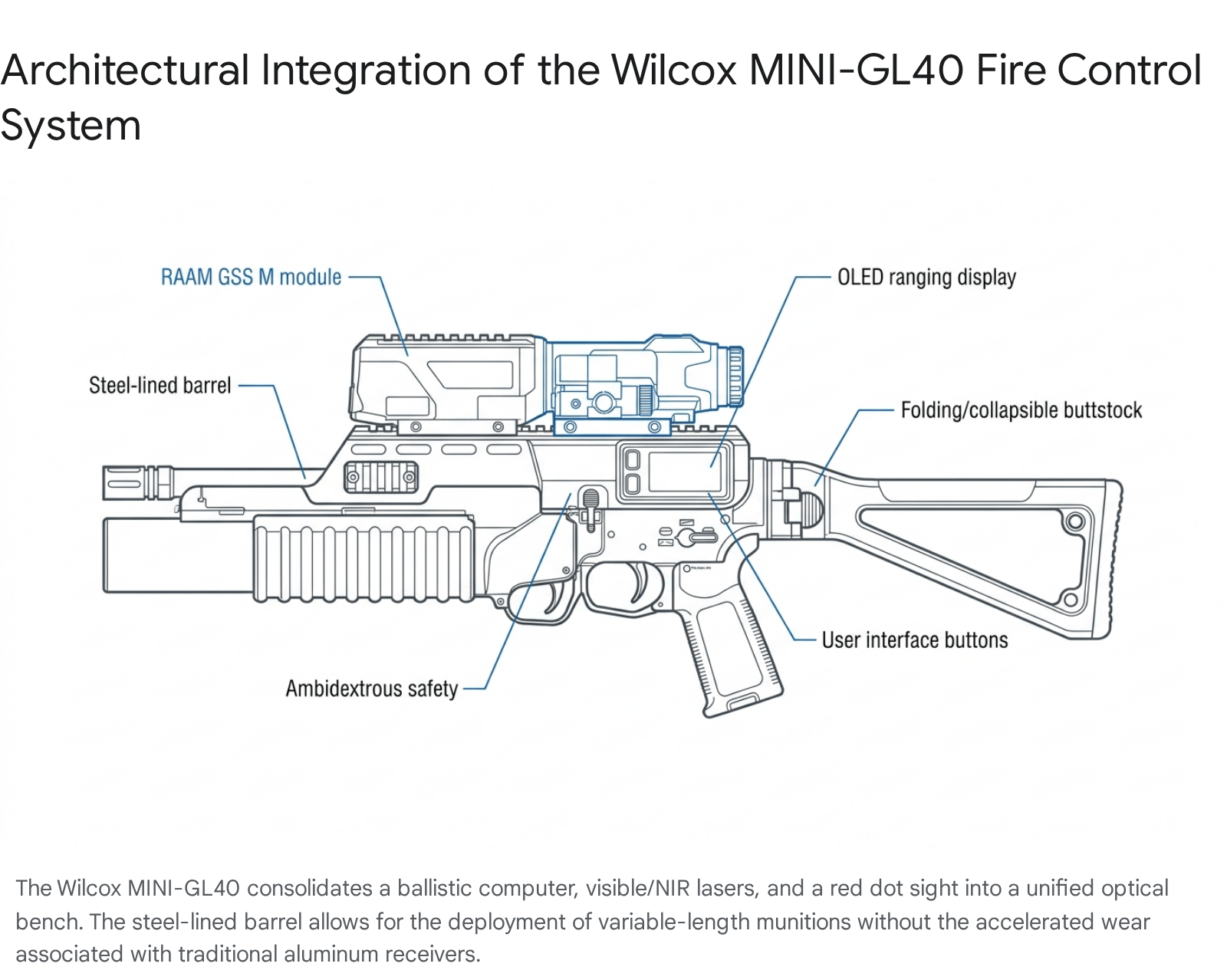
The RAAM GSS M features an on-board ballistic computer paired with an OLED ranging display.23 By utilizing a built-in laser rangefinder, the operator selects the specific ammunition type from pre-programmed ballistic tables, inputs the range with a pressure pad, and the system instantly generates a firing solution featuring automatic point-of-aim to point-of-impact (POA/POI) adjustment.22 This computational targeting completely eliminates the guesswork of holdovers. The system seamlessly consolidates a red dot sight, a visible laser, a near-infrared (NIR) aiming laser, and an NIR illuminator into a single co-aligned optical bench powered by a single AA battery.22 By retiring the accumulated stack of external accessories and separate power sources that grenadiers previously managed, the platform drastically reduces carried weight and limits potential points of failure.23
Furthermore, the physical construction of the MINI-GL40 addresses a critical metallurgical vulnerability found in legacy aluminum-barreled launchers: accelerated bore wear. The MINI-GL40 incorporates a unique steel-lined barrel engineered to withstand the repeated firing of all low-velocity 40mm rounds, including high-pressure breaching loads.22 This steel lining ensures exceptional long-term reliability and prevents the degradation of barrel rifling, which is absolutely essential for the spin-stabilization of less-lethal sponge and barricade penetrator rounds.
Other heavy weapons systems, such as the Rheinmetall Vingmate FCS 4500 and the Saab Trackfire Remote Weapon Station, offer similar algorithmic targeting but on mounted, crew-served scales. The Vingmate is designed to program airburst rounds via an infrared laser beam and is highly effective when paired with Rheinmetall’s 40mm LV CS Impulse rounds, which feature an integrated marker dye payload to safely tag offenders of interest at ranges up to 50 meters.26
Furthermore, Rheinmetall has fundamentally shifted infantry and tactical capabilities in 2026 with the introduction of the SSW40 (Squad Support Weapon 40). Billed as the world’s first automatic, magazine-loaded, shoulder-fired grenade launcher, the SSW40 features ergonomics similar to an assault rifle. Crucially, it utilizes a self-regulating recoil system to fire new 40mm Medium Velocity (MV) ammunition, which possesses a significantly flatter trajectory and increases the effective engagement range up to 900 meters, while remaining fully compatible with standard less-lethal Low Velocity (LV) payloads. For infantry and armored units, the ability to rapidly calculate precise trajectories and launch capabilities for both lethal smart programmable airburst grenades and less-lethal payloads fundamentally alters the geometry of the battlespace.28
3. Terminal Ballistics and Kinetic Munitions Engineering
The efficacy of a less-lethal kinetic system relies entirely on the precise, controlled transfer of blunt force trauma. The operational goal is to maximize pain compliance and temporary physical incapacitation while remaining strictly below the threshold of lethal skeletal fracturing or internal organ rupture. The evolution from early, unpredictable rubber batons to modern, aerodynamically engineered sponge rounds reflects a much deeper scientific understanding of terminal ballistics and human tissue response.
3.1 The eXact iMpact Sponge Round Evolution
The cornerstone of modern 40mm kinetic deployment is the eXact iMpact 6325 Sponge Round, originally derived from the US Army Research Laboratory’s XM1006 projectile design.20 Weighing 30 grams (1.06 ounces), this lightweight projectile utilizes a rigid plastic body coupled with a high-density foam (sponge) nose.20 Upon firing, the munition engages the launcher’s rifled barrel via an incorporated rifling collar, spinning the projectile to ensure a highly predictable, gyroscopically stable flight path.7
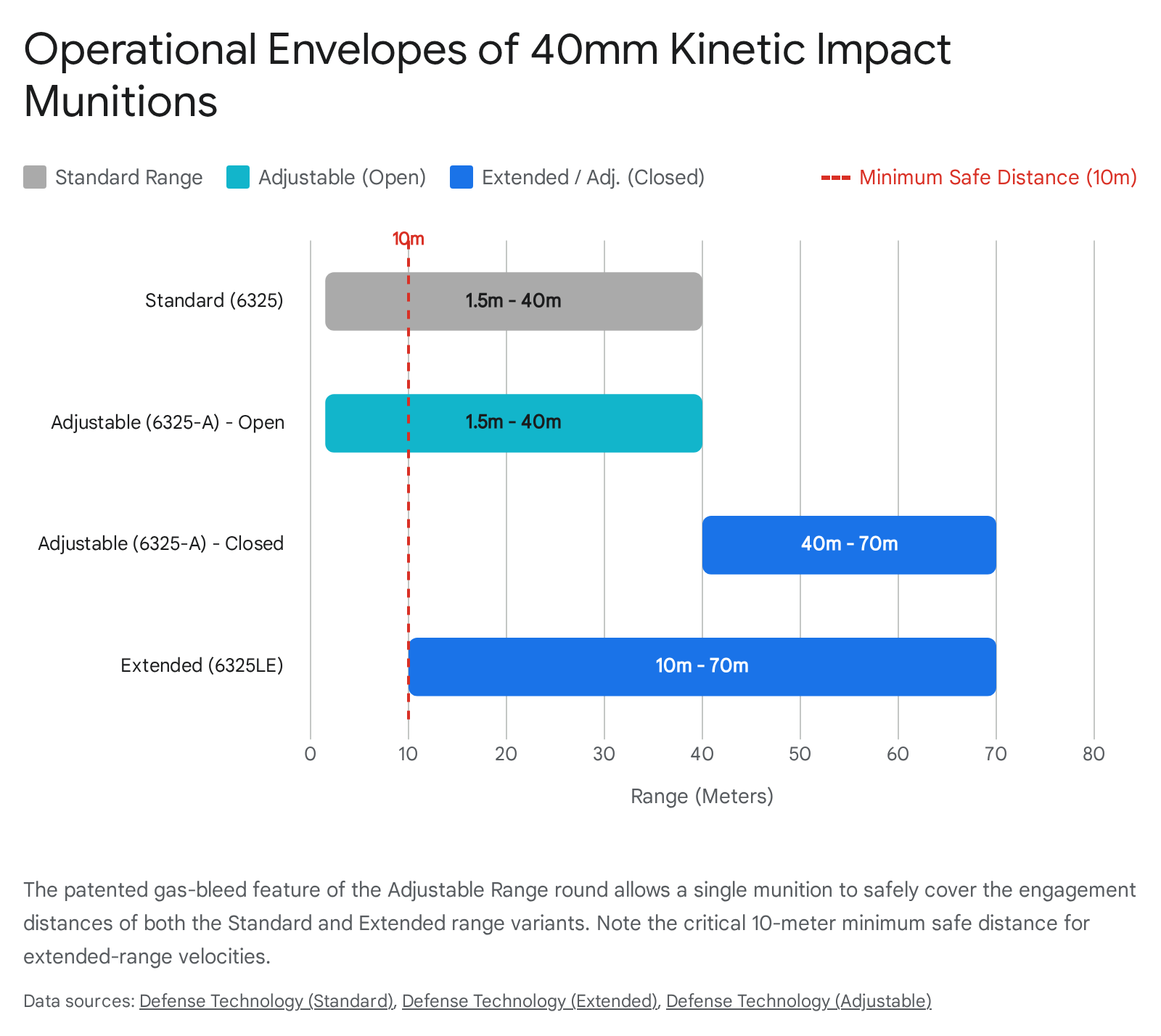
The standard eXact iMpact 6325 utilizes a smokeless powder propellant to achieve an extremely consistent muzzle velocity of approximately 345 feet per second (fps) (or 325 fps depending on specific manufacturing lot variants), delivering roughly 120 foot-pounds of kinetic energy upon impact.20 Because the round acts as a true “point-of-aim, point-of-impact” direct fire system, it provides the operator with immense confidence. The standard round possesses a strictly enforced minimum safe engagement range of 1.5 meters (5 feet) and an optimal energy transfer zone extending out to 40 meters (131 feet).20
For tactical engagements occurring at greater distances, operators utilize the 6325LE Extended Range variant. Engineered to maintain lethal-threshold kinetic energy over a longer parabolic flight, this round is explicitly intended for targets residing between 10 meters and 70 meters. Deploying the 6325LE at distances closer than 10 meters drastically elevates the energy density upon impact, pushing the blunt trauma well past the survivable limit and greatly increasing the risk of serious bodily injury or death.33
3.2 Adjustable Range Technology and Gas-Bleed Mechanics
One of the most profound logistical and tactical innovations in the munitions space is the patented gas-bleed mechanism engineered into the Defense Technology 40mm eXact iMpact Adjustable Range Round (Model 6325-A).35 Historically, operators were forced to carry separate, distinctively marked munitions for close-range and extended-range engagements. Under the extreme cognitive stress of a dynamic tactical encounter, transitioning between different payloads introduces fatal delays or, worse, risks the accidental deployment of an extended-range round at dangerously close distances.
The 6325-A mitigates this operational hazard through a unique user-adjustable patented gas-bleed feature engineered directly into the projectile’s design.35 The smokeless powder charge remains uniform across all rounds; however, the operator can manually configure the munition prior to loading it into the breech.
- Opened Position (Standard Range): The mechanism vents a specific volume of the rapidly expanding propellant gases out of the casing prior to the projectile exiting the muzzle. This bleeds off kinetic energy, lowering the velocity to safely accommodate a 1.5-meter to 40-meter engagement envelope.35
- Closed Position (Extended Range): The mechanism remains entirely sealed, utilizing the full volumetric pressure of the combusting propellant to drive the projectile at maximum velocity, optimizing the round for 40-meter to 70-meter extended engagements.35
3.3 Direct Impact Crushable Foam Delivery
To synthesize kinetic impact trauma with chemical dissemination, munitions engineers developed the 40mm Direct Impact Round. This projectile replaces the solid high-density sponge with a crushable foam nose containing a 5-gram powder payload.6 Fired at a slightly lower velocity of 295 fps, the foam nose is engineered to dissipate a significant portion of its kinetic energy upon striking the target, concurrently fracturing to release the internal powder payload directly onto the subject.6
This localized chemical cloud compounds the blunt force trauma, maximizing the potential for incapacitation through overlapping physical and physiological stressors. Law enforcement and military agencies can procure these rounds loaded with various active agents: the Model 6320 delivers 0.30 grams of OC powder, the Model 6322 delivers 3.0 grams of CS powder, while the 6323 and 6326 deliver inert training powder and green marking agents, respectively.6 The Direct Impact LE Extended Range variant also features an adjustable gas-bleed feature, bringing extreme versatility to crowd control or single-subject isolation scenarios.10
4. Chemical Payload Pathology and Barricade Penetrators
When physical space constraints, hostages, or structural barriers completely preclude direct-fire kinetic engagements, tactical teams must rely entirely on chemical agents to manipulate subject behavior. The integration of chemical payloads into 40mm projectiles allows for precise, standoff delivery into confined spaces, fundamentally altering the tactical geometry of barricaded suspect operations.
4.1 Mechanism of Action: The Ferret Projectile
The Defense Technology Ferret 40mm Round and its equivalents (such as the NonLethal Technologies MP-40BP-PCS) remain the industry standard for delivering chemical agents through intermediate structural barriers. Unlike traditional pyrotechnic gas canisters (which generate heavy smoke via combustion but pose severe, unacceptable fire hazards indoors), the Ferret is a non-burning, frangible projectile.38
Spin-stabilized by the launcher’s rifling, the Ferret achieves an effective standoff range of 50 meters, traveling at velocities between 325 fps (liquid payload) and 375 fps (powder payload).41 The projectile is ballistically engineered specifically to defeat Type III general-purpose barricades.43 According to classifications, this capability allows the projectile to reliably penetrate 3/4-inch plywood at engagement distances from 0 to 50 feet, automotive safety glass from 0 to 100 feet, and hollow-core doors or double-pane storm windows at distances up to 300 feet.43 Upon impacting and breaching the barrier, the sheer kinetic force ruptures the aerodynamic nose cone, instantaneously dispersing a small, highly localized chemical payload into the interior space without introducing an ignition source.38
4.2 Liquid vs. Powder Delivery Dynamics
Tacticians must carefully evaluate the payload carrier—liquid or powder—based on the specific environmental dynamics, ventilation systems, and dimensions of the target structure.40
Liquid Ferret rounds atomize into a fine mist instantaneously upon impact.43 Because the liquid payload is relatively small, the localized mist produces a less intense physiological effect compared to heavier chemical munitions. Liquid rounds strategically contain a red dye marker, providing the tactical team with immediate visual confirmation of shot placement and barrier penetration.40 This allows operators to iteratively scale force; by beginning with a liquid Ferret, officers are afforded ample time to evaluate whether the subject is complying before deploying higher concentrations of gas.46
Conversely, powder-filled projectiles release pulverized, dry particles of chemical agent upon rupture.43 The aerodynamic properties of these microscopic dry particles allow them to remain airborne and suspended within the HVAC currents of a structure for significantly longer durations than liquid mist.40 Consequently, powder payloads deliver a much more prolonged and severe physiological effect, making them highly efficient for dislodging deeply entrenched, combative suspects from highly confined interior areas.40
4.3 Chemical Pathology: CS vs. OC
The active agents utilized within these payloads dictate the precise physiological response of the barricaded suspect, necessitating a deep understanding of chemical pathology.
Agent CS (Orthochlorobenzalmalononitrile) is the most frequently deployed chemical compound.47 Despite its colloquial designation as “tear gas,” CS is actually a solid, yellow powder at room temperature, not a gas.48 CS operates as a potent sensory irritant and an alkylating agent.50 When the micro-particulates come into contact with moisture—such as sweat on the skin, tears in the eyes, or the mucous membranes of the respiratory tract—the compound rapidly dissolves into a painful, highly acidic liquid.50 This induces severe burning, excessive lacrimation (tearing), coughing, a choking sensation, and shortness of breath.51 The effects are heavily amplified by high ambient heat and humidity.50 Decontamination requires cool water and fresh air, while strictly avoiding oil-based salves that can trap the chemical against the skin.49
Agent OC (Oleoresin Capsicum), extracted from cayenne peppers, acts via an entirely different mechanism. OC (and its highly potent synthetic analog, PAVA) is an inflammatory agent rather than a strict irritant.47 Upon contact, OC interacts directly with TRPV1 pain receptors, inducing immediate, severe inflammation of the ocular capillaries and respiratory tract, leading to involuntary eye closure, coughing, and acute pain.50 Unlike CS, which requires bodily moisture to activate and form an acid, OC acts instantaneously upon physical contact.
| Tactical Parameter | Agent CS (Orthochlorobenzalmalononitrile) | Agent OC (Oleoresin Capsicum) |
| Pathological Classification | Sensory Irritant & Alkylating Agent | Inflammatory Agent |
| Physical State at Deployment | Solid dry powder (micro-particulate) | Oil extract (Tincture) |
| Primary Mechanism of Action | Reacts with mucosal moisture to form acidic irritant | Binds directly to TRPV1 nerve receptors causing inflammation |
| Symptom Onset Time | Within seconds of exposure (highly dependent on ambient humidity) 50 | Instantaneous upon physical contact |
| Decontamination Protocol | Cool water, fresh air (Strictly no oil-based salves) | Cool water, specialized surfactant solutions |
| Environmental Persistence | High; dry particles settle and re-aerosolize upon movement | Moderate; adheres heavily to surfaces and skin |
Table 1: Pathological and operational comparison of common chemical payload agents utilized in 40mm less-lethal delivery systems. 47
When deploying these agents into highly confined structures or vehicle cabins, operators must technically consider the Lethal Concentration Time 50 (LCt50)—the exposure dosage that is statistically lethal to 50% of the exposed population. The estimated LCt50 for Agent CS is approximately 61,000 mg-min/m3. Within the tactical community, there is a longstanding doctrinal debate regarding whether incident commanders must actively calculate LCt50 formulas prior to deployment. Competing philosophies (historically championed by tactical experts like Don Whitson and Steve Ijames) weigh the rigid mathematical safety of LCt50 formulas against the dynamic, unpredictable ventilation variables inherent to live tactical environments.
5. Tactical Deployment Doctrine: Barricaded Suspect Operations
The deployment of 40mm less-lethal systems against an entrenched, barricaded suspect is a highly orchestrated procedure governed by strict operational standards, most notably those established by the National Tactical Officers Association (NTOA) and formalized in departmental policy manuals.15 The primary objective in any barricade scenario is the preservation of human life through proactive de-escalation, utilizing time, distance, and specialized munitions to dislodge the subject with minimal lethal risk.14
5.1 NTOA Standards and The Window of Opportunity
According to the NTOA Tactical Response and Operations Standards (TROS), the successful resolution of a barricaded suspect relies on creating and exploiting a “window of opportunity”—a precise set of favorable circumstances that offer a distinct tactical advantage if acted upon swiftly and decisively.54 Because a barricaded subject has inherently established a defensive fortification, the introduction of a SWAT element must be incredibly methodical.
Tactical teams are structurally bifurcated into a Containment Team (responsible for isolation and perimeter security) and an Entry Team (responsible for emergency or deliberate resolution).55 During these operations, it is imperative that the deployment of less-lethal force is perpetually mirrored by a lethal cover element. The NTOA and allied standard bodies explicitly warn against the “mixing” of lethal and less-lethal systems within the same physical platform or by the same un-covered operator. The profound cognitive load of transitioning between mindsets under extreme combat stress can result in accidental lethal discharges.56 Thus, standard operating procedure mandates that any officer deploying a 40mm launcher must have a dedicated, designated lethal cover officer maintaining continuous overwatch.57 No officer shall simultaneously hold a lethal firearm and any less-lethal weapon system launcher.58
5.2 Anatomical Target Zoning and Legal Constraints
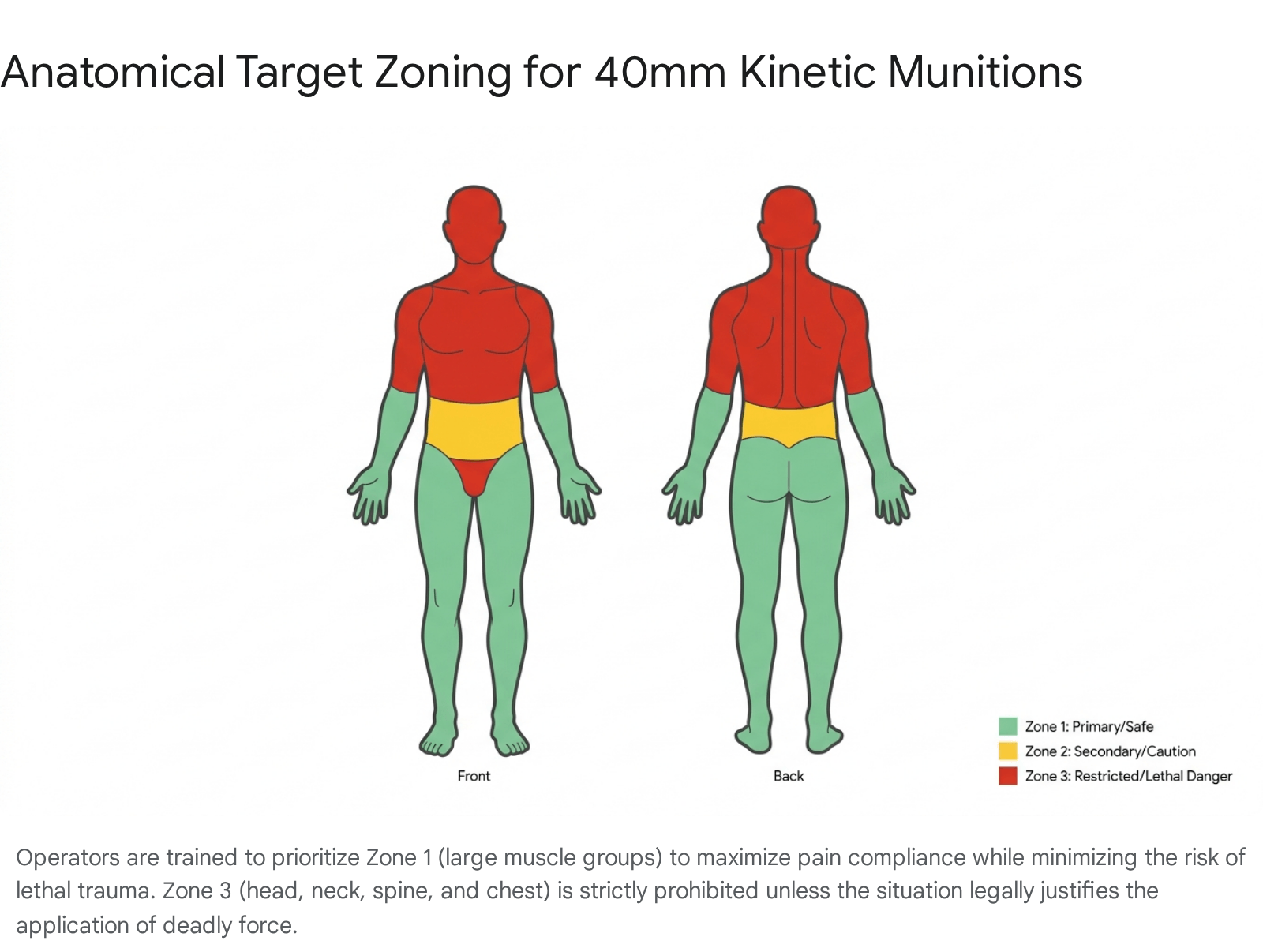
If a barricaded suspect becomes partially visible through a structural opening (e.g., a window, a breached doorway, or a fatal funnel), an operator may attempt a direct-fire kinetic engagement using an eXact iMpact sponge round. However, the anatomy of the target dictates the legality, survivability, and departmental authorization of the strike. Tactical doctrine divides the human body into three rigid primary target zones 33:
- Zone 1 (Primary): The large muscle groups, specifically the thighs, calves, buttocks, and the upper and lower arms.59 Striking these areas with a 120 ft/lb sponge round yields maximum pain compliance with minimal risk of permanent skeletal fracturing or organ damage. This is the optimal, legally protected point of aim.20
- Zone 2 (Secondary): The medium muscle groups, such as the abdominal area.59 These areas are targeted only when Zone 1 is entirely obscured or initial strikes fail to yield compliance. Striking the abdomen carries elevated risks of internal trauma and requires a higher justification of force.59
- Zone 3 (Restricted): The head, neck, spine, chest, solar plexus, and groin.59 Impacts to Zone 3 with a 40mm kinetic projectile carry the absolute highest probability of serious bodily injury, permanent paralysis, or death.59 Operators are strictly prohibited from intentionally targeting Zone 3 unless the threat matrix has escalated to a point where lethal force is explicitly and legally authorized.59
5.3 Structural Penetration and Collateral Mitigation
When direct fire is impossible due to complete structural concealment, the deployment of Ferret chemical penetrators becomes the primary tactic.38 The objective is “area saturation”—rendering the internal atmosphere highly noxious to force the suspect to evacuate the barricade into the hands of the containment team.63 In prolonged standoffs, such as a documented 19-hour barricaded suspect incident where communications remained dormant, SWAT operators initially deployed 40mm rounds through the windows to prompt a response; when that failed, they subsequently utilized an armored BearCat equipped with a breaching ram to compromise the doors for entry.64
However, firing a 40mm solid projectile through a residential barrier introduces massive operational liability regarding unseen collateral damage.65 Operators cannot reliably ascertain the exact position of the suspect or innocent hostages behind a blind wall, drawn curtain, or closed door. Therefore, operators must conduct a rigorous, real-time risk assessment.65 NTOA standards require operators to calculate the angle of incidence when firing into a window; striking the barrier at a perpendicular 90-degree angle ensures maximum penetration, while shallow angles may cause the round to dangerously deflect off the frame.45 Furthermore, if deploying a solid kinetic round for the express purpose of “window porting” (breaking the glass to prepare the structure for a subsequent chemical payload delivery), officers must account for the over-penetration of the kinetic round into the room’s interior, ensuring no occupants are inadvertently struck by the heavy sponge.66
6. Complex, High-Risk Vehicle Takedowns
A barricaded suspect contained within a stationary vehicle presents a uniquely hazardous subset of tactical operations, defined by the NTOA as a “High-Risk Vehicle Takedown”.54 Vehicles offer the suspect immediate mobility, substantial ballistic concealment against handgun rounds, and the ability to utilize the multi-ton steel chassis itself as a deadly weapon against the surrounding containment team.67
6.1 The “Rolling Barricade” Tactic for Vehicle Containment
In tactical doctrine, approaching an isolated, occupied suspect vehicle presents immense physical risks. To safely close the distance, tactical units frequently employ a “rolling barricade” technique, utilizing their own armored vehicles (e.g., BearCats) or unmarked police utility vehicles as mobile cover to advance on the suspect.67 Once in position, they use these vehicles to physically pin the suspect’s vehicle, restricting forward and reverse mobility. Even when the vehicle is successfully pinned, the suspect remains deeply entrenched within a hardened steel and glass enclosure, severely limiting the viability of standard less-lethal options and elevating the risk of a lethal crossfire.
The structural geometry of an automobile inherently shields the suspect’s Zone 1 (legs and lower torso) behind the opaque steel of the door panels and the engine block. If an operator attempts a direct-fire kinetic engagement with a 40mm sponge round, they are forced to target the suspect through the windows.60 Because the safe Zone 1 is shielded, the operator must aim at the exposed Zone 2 (arms/abdomen) or risk accidentally striking the highly restricted Zone 3 (head/neck) if the suspect shifts their posture unpredictably in the driver’s seat.59 Due to the extreme danger of inducing lethal head trauma in this confined, partially obscured space, many departmental policies explicitly prohibit the firing of 40mm kinetic munitions directly into occupied vehicles under any circumstances.60
6.2 Glass Pathology: Tempered vs. Laminated Mediums
If a less-lethal engagement through vehicle glass is authorized (either via kinetic munitions or chemical Ferret rounds), the operator must account for the extreme ballistic deviation caused by the glazing material. Vehicle glass is not uniform; it behaves via entirely different physical properties depending on its location on the chassis and its manufacturing process.69
Tempered glass is predominantly utilized in the side and rear windows of modern vehicles. Tempered glass is extensively heat-treated to induce immense internal compressive stresses.71 When this surface tension is breached by the 120 ft/lb impact of a 40mm projectile, the entire pane fails instantaneously, shattering into thousands of small, blunt granular chunks.70 While the glass is totally destroyed, it offers minimal resistance to the mass of the projectile. A 40mm Ferret or kinetic round will pass through tempered side glass with a predictable trajectory and only a marginal loss of velocity.43
Laminated glass, however, is mandated for vehicle windshields, and is increasingly utilized in modern side windows to improve sound dampening and passenger ejection safety during crashes.69 Laminated glass consists of two distinct layers of annealed glass bonded together by a flexible, highly transparent plastic interlayer (typically polyvinyl butyral, or PVB).70 When struck by a less-lethal round, the outer and inner glass layers shatter, but the highly elastic PVB interlayer stretches like a net and retains the glass shards in place.
The elasticity of laminated glass poses a severe, unpredictable problem for less-lethal ballistics. It forces the blunt projectile into a highly elastic collision, absorbing and bleeding off massive amounts of kinetic energy.70 If a 40mm kinetic round strikes a laminated windshield, the PVB layer may capture the round entirely, preventing entry. If the round does possess enough velocity to penetrate, the asymmetric drag caused by tearing through the plastic layer will induce a severe point-of-impact deviation—violently deflecting the round off its intended flight path.70 This deflection exponentially increases the risk of the projectile unintentionally striking the suspect’s head or neck inside the cabin.
6.3 Penetration Protocols for Vehicle Cabins
To circumvent the profound ballistic unpredictability of laminated windshield glass, tactical teams prioritize the deployment of 40mm Ferret chemical penetrators exclusively through the tempered side or rear windows.38
During a vehicle takedown, the interior cabin volume is exceedingly small compared to a standard residential room. The deployment of a single 40mm Ferret round (either liquid or powder) into a vehicle cabin will achieve maximum atmospheric saturation almost instantly.40 The intense, inescapable concentration of CS or OC agent within the highly confined space forces the suspect to abandon the vehicle due to acute respiratory distress and severe ocular inflammation, neutralizing the vehicle as a rolling weapon.39
If a vehicle is already structurally compromised, or the suspect has rolled the windows down to communicate, operators may elect to deploy 40mm Direct Impact crushable foam rounds targeting the suspect’s exposed extremities. The localized burst of OC powder on the suspect’s arm or shoulder provides simultaneous pain compliance and chemical irritation without the need to violently breach glass.6
To mitigate the risks of 40mm projectile deflection entirely, some agencies are transitioning to dedicated, secondary glass-breaking platforms to prepare the vehicle for chemical saturation. Systems like the PepperBall PPC Breacher utilize a smoothbore barrel to fire solid ceramic projectiles (such as the Glass Breaker-X) designed to reliably fracture automotive safety glass. To prevent catastrophic cross-loading errors under extreme stress, these dedicated breaching launchers utilize high-impact coloring to visually distinguish them from standard lethal or less-lethal platforms.
6.4 Operational Sequencing and Cover Requirements
The sequencing of a high-risk vehicle takedown is highly choreographed and fraught with peril. Because the suspect possesses the capability to quickly brandish a concealed firearm from below the dashboard or accelerate the vehicle to lethal speeds, the deployment of a 40mm less-lethal system is inherently dangerous.67
The officer designated as the 40mm Grenadier must maneuver to maintain a clear, unobstructed line of sight to the target medium, often stepping out from behind hard cover. Simultaneously, designated lethal cover officers must maintain synchronized sights on the suspect.57 If the suspect responds to the less-lethal impact by raising a firearm, the lethal cover elements must instantly neutralize the threat. The complexity of cross-talk, positioning, and the prevention of sympathetic fire (where a highly stressed lethal cover officer accidentally fires their rifle upon hearing the loud report of the 40mm launcher) requires rigorous, certified team training.55
7. Institutional Training and Legislative Compliance
The expanding capabilities of the 40mm ecosystem are inextricably linked to stringent institutional training mandates and rigorous legislative oversight. The proliferation of adjustable-range munitions and smart fire control systems requires continuous, high-fidelity education. Operators must be intimately familiar with the trajectory arcs, kinetic energy thresholds, and chemical pathology of their specific loadouts to prevent negligent lethal deployments.58
7.1 Manufacturer Certification and Academy Standards
To ensure operational proficiency, agencies mandate strict certification pathways. The Safariland Training Academy, operating through Defense Technology, remains a premier institution for domestic and international law enforcement. Their flagship 4-Day Less Lethal Course provides comprehensive, instructor-level certification covering the technical, operational, and tactical applications of OC aerosols, impact munitions, chemical agents, and distraction devices.9 This rigorous training ensures that officers understand the ballistic constraints of the 40mm platform and can effectively disseminate this knowledge to their respective departments.77 Furthermore, industry-wide symposiums such as DEFCON25 facilitate the sharing of advanced tactical concepts, legal frameworks regarding the use of force, and the latest innovations in crowd control and barricade resolution methodologies.79
7.2 Legislative Oversight and AB 481 Compliance
Beyond physical training, the deployment of 40mm systems is increasingly governed by stringent legislative transparency requirements. In jurisdictions such as California, the implementation of Assembly Bill 481 (AB 481) mandates that law enforcement agencies obtain approval from their governing bodies before funding, acquiring, or using specified “military equipment,” which explicitly includes 40mm launchers, kinetic sponge rounds, and chemical barricade penetrators.11 Departments must publicly report inventory levels, exact fiscal impacts, and specific use-case scenarios.11
This legislative framework requires agencies to meticulously document the lifespan of munitions (typically 5 years for Defense Technology rounds) and adhere strictly to localized use-of-force policies.31 For example, policies often dictate that 40mm launchers must be secured in specialized vehicle mounts and that their deployment is explicitly prohibited against crowds unless targeting a specific, violent instigator.60 The administrative burden of these weapons ensures that their deployment is highly scrutinized, reinforcing the necessity for absolute tactical precision during barricaded suspect operations and high-risk vehicle takedowns.
8. Strategic Conclusions for Procurement and Operations
As the tactical landscape moves through 2026, the overarching philosophy governing use-of-force policies is the absolute mandate for proactive de-escalation.14 Modern departmental directives explicitly emphasize the use of time, distance, communication, and structural cover to mitigate the necessity of lethal force.14
The 40mm platform is perfectly aligned with this profound doctrinal shift. Unlike Conducted Electrical Weapons (CEWs, e.g., TASERs) which are heavily restricted to highly proximate engagements (typically under 25 feet), the 40mm launcher grants tactical operators true standoff capability.19 The ability to deliver precise kinetic strikes or chemical payloads from 40 to 70 meters allows officers to maintain a massive, safe reactionary gap, preventing the suspect from rapidly closing the distance with a bladed weapon or triggering an improvised explosive device.
The 2026 iteration of the 40mm less-lethal ecosystem represents a triumph of terminal ballistics and optical engineering over legacy riot-control paradigms. By transitioning from analog, smoothbore platforms to standalone systems equipped with algorithmic fire control like the Wilcox MINI-GL40, tactical teams have drastically reduced the margin for human error in parabolic targeting. Simultaneously, the refinement of kinetic energy transfer—exemplified by adjustable gas-bleed sponge rounds and frangible chemical penetrators—provides operators with a highly scalable force matrix.
However, the efficacy of these technological marvels remains strictly bound by the laws of physics, human anatomy, and legislative oversight. Deploying these systems during barricaded suspect incidents and high-risk vehicle takedowns demands absolute adherence to NTOA protocols, a deep pathological understanding of chemical agents, and a precise calculus regarding barrier penetration. As the public and the judiciary increasingly demand non-lethal resolutions to violent crises, the mastery of the 40mm platform will remain the defining characteristic of elite, data-driven tactical units worldwide.
Please share the link on Facebook, Forums, with colleagues, etc. Your support is much appreciated and if you have any feedback, please email us in**@*********ps.com. If you’d like to request a report or order a reprint, please click here for the corresponding page to open in new tab.
Sources Used
- Ronin’s Grips | Firearms Analytics & Intelligence Reports | Connecticut – Boise Gun Club, accessed June 26, 2026, https://boisegunclub.com/connecticut/directory/blog-20
- Ronin’s Grips Analytics – Ronin’s Grips, accessed June 26, 2026, https://blog.roninsgrips.com/
- Low Lethality Ammunition Market: 10 Leading Companies — Products, Headquarters & Industry Footprint 2026 – DataHorizzon Research, accessed June 26, 2026, https://datahorizzonresearch.com/blog/low-lethality-ammunition-market-leading-companies-605
- Less Lethal enters a NEW era – are you ready? – YouTube, accessed June 26, 2026, https://www.youtube.com/watch?v=sufNKqLpwQo
- SHOT Show 2026: The Latest in Less Lethal – Athlon Outdoors, accessed June 26, 2026, https://athlonoutdoors.com/article/shot-26-less-lethal/
- 40MM DIRECT IMPACT® ROUND OC, CS, INERT & MARKING – Chemical Weapons Research Center, accessed June 26, 2026, https://www.chemicalweaponsresearch.com/munitions/direct_impact_40mm_oc/files/spec_sheet.pdf
- Defense Technology eXact iMpact 40 mm Extended Range Round – FOPConnect, accessed June 26, 2026, https://www.fopconnect.com/blog/product-directory/defense-technology-exact-impact-40-mm-extended-range-round/
- 40mm Solutions – Blue Force Gear, accessed June 26, 2026, https://blueforcegear.com/40mm
- Defense Technology, accessed June 26, 2026, https://www.defense-technology.com/
- Less Lethal – Adamson Police Products, accessed June 26, 2026, https://policeproducts.com/less-lethal/
- Military Equipment, accessed June 26, 2026, https://www.visalia.gov/DocumentCenter/View/1330/2024-AB-481-Annual-Report-PDF?bidId=
- Santa Monica Police Department – 2024 AB 481 Annual Report, accessed June 26, 2026, https://www.santamonica.gov/media/Police/Documents/AB%20481%20Annual%20Report%202024%20-%20Final.pdf
- 40mm LMT™ Tactical Single Launcher, Expandable Stock – Defense Technology, accessed June 26, 2026, https://www.defense-technology.com/product/40mm-lmt-tactical-single-launcher-expandable-stock/
- UOF Directive No 3.1 – 40mm Less-Lethal Laucher, accessed June 26, 2026, https://lapdonlinestrgeacc.blob.core.usgovcloudapi.net/lapdonlinemedia/Use_of_Force_Directive_40mm_LLL_3.1_February_2025.pdf
- Policy Manual – Greenwood, IN, accessed June 26, 2026, https://www.greenwood.in.gov/egov/documents/1631550384_98815.pdf
- B&T GL-25 Launcher & 40mm Drone Net System | EnforceTac 2026 – YouTube, accessed June 26, 2026, https://www.youtube.com/watch?v=8ki_U3vHQuM
- The Only Double-Barrel 40mm Grenade Launcher? – YouTube, accessed June 26, 2026, https://www.youtube.com/watch?v=N-g6Qlu23a4
- HK169 – Heckler & Koch, accessed June 26, 2026, https://www.heckler-koch.com/en/Products/Military%20and%20Law%20Enforcement/40%20mm%20systems/HK169
- Less-Lethal Options | Police Magazine, accessed June 26, 2026, https://www.policemag.com/articles/less-lethal-options
- 40MM eXact iMpact™ SPONGE ROUND – Defense Technology, accessed June 26, 2026, https://www.defense-technology.com/wp-content/uploads/2020/04/40mm-eXact-iMpact-Sponge-Round-6325_2022.01.06.pdf
- Wilcox Unveils MINI-GL40 Modular 40mm Grenade Fire Control System – The Firearm Blog, accessed June 26, 2026, https://www.thefirearmblog.com/blog/wilcox-unveils-mini-gl40-modular-40mm-grenade-fire-control-system-44828389
- MINI-GL40 – Wilcox Industries, accessed June 26, 2026, https://wilcoxind.com/products/combat-systems/weapon-integrated-systems/mini-gl40
- Fewer Gadgets, More Grenades: Wilcox Rethinks the 40mm Launcher | Popular Airsoft, accessed June 26, 2026, https://www.popularairsoft.com/fewer-gadgets-more-grenades-wilcox-rethinks-40mm-launcher
- THE WILCOX MINI-GL40 GRENADE LAUNCHER – YouTube, accessed June 26, 2026, https://www.youtube.com/watch?v=GbYs4LdDfjg
- Wilcox Industries Unveils the MINI-GL40: An Advanced, Modular 40mm Grenade Fire Control System, accessed June 26, 2026, https://soldiersystems.net/2026/05/15/wilcox-industries-unveils-the-mini%E2%80%91gl40-an-advanced-modular-40mm-grenade-fire-control-system/
- B092e0619-Rheinmetall-Infantry-Guide.pdf, accessed June 26, 2026, https://www.rheinmetall.com/Rheinmetall%20Group/brochure-download/Weapon-Ammmunition/B092e0619-Rheinmetall-Infantry-Guide.pdf
- Trackfire – Saab, accessed June 26, 2026, https://www.saab.com/products/trackfire-remote-weapon-station
- Rheinmetall – The Leading One-Stop-Shop for 40mm Systems, accessed June 26, 2026, https://soldiersystems.net/2019/09/12/rheinmetall-the-leading-one-stop-shop-for-40mm-systems/
- mk47 40mm | advanced grenade launcher – Colt, accessed June 26, 2026, https://www.colt.com/wp-content/uploads/2024/09/24-COLT-2263-COLLATERAL-MLE_Catalog-web-FINAL.pdf
- Military Equipment – Fountain Valley, accessed June 26, 2026, https://www.fountainvalley.gov/1462/Policy-707-Military-Equipment
- Governing Body Specific Equipment Approval – City of Santa Barbara, accessed June 26, 2026, https://santabarbaraca.gov/sites/default/files/documents/Police/Military%20Equipment%20Inventory%20Per%20Assembly%20Bill%20No.%20481/Governing%20Body%20Specific%20Equipment%20Approval.pdf
- Los Angeles Police Department Less-Lethal Weapons Instructor 8 HRS) POST #1850-30985, accessed June 26, 2026, https://lapdonlinestrgeacc.blob.core.usgovcloudapi.net/lapdonlinemedia/2022/07/Less_Lethal_Weapon_Instr_30985.pdf
- Human Effects Assessment of 40mm Nonlethal Impact Munitions – Defense Technology, accessed June 26, 2026, https://www.defense-technology.com/wp-content/uploads/2020/03/Human-Effects-NL_IM.pdf
- 40MM eXact iMpact™ EXTENDED RANGE SPONGE ROUND – Defense Technology, accessed June 26, 2026, https://www.defense-technology.com/wp-content/uploads/2020/06/40mm-eXact-iMpact-LE-Extended-Range-Sponge-Round-6325LE.pdf
- 40MM eXact iMpact™ ADJUSTABLE RANGE – Defense Technology, accessed June 26, 2026, https://www.defense-technology.com/wp-content/uploads/2020/06/40mm-eXact-iMpact-Adjustable-Range_6325-A.pdf
- eXact iMpact™ 40mm Adjustable Range Round – Defense Technology, accessed June 26, 2026, https://www.defense-technology.com/product/exact-impact-40mm-adjustable-range-round/
- 40MM EXACT IMPACT™ AND DIRECT IMPACT® ADJUSTABLE RANGE MUNITIONS – Defense Technology, accessed June 26, 2026, https://www.defense-technology.com/wp-content/uploads/2020/06/DT_40mm_Exact_iMpact_Direct_Impact_Sell_Sheet.pdf
- Ferret® 40 mm Liquid Barricade Penetrator Round, CS – Defense Technology, accessed June 26, 2026, https://www.defense-technology.com/product/ferret-40-mm-liquid-barricade-penetrator-round-cs/
- MP-40BP-PCS – BARRICADE PENETRATOR (POWDER CS) – 40mm DESCRIPTION SPECIFICATIONS SHIPPING INFORMATION – NonLethal Technologies, accessed June 26, 2026, https://www.nonlethaltechnologies.com/pdf/DS/MP-40BP-PCS.pdf
- 40MM FERRET® ROUND LIQUID / POWDER OC, CN, CS AND PRACTICE – Defense Technology, accessed June 26, 2026, https://www.defense-technology.com/wp-content/uploads/2020/07/40mm-Ferret-Round_Redesigned-01.20.pdf
- 40MM FERRET® LIQUID AND POWDER BARRICADE PENETRATOR ROUNDS – Defense Technology, accessed June 26, 2026, https://www.defense-technology.com/wp-content/uploads/2020/06/DT_40MM_Sell_Sheet.pdf
- DefTec 2260 40mm OC Liquid Barricade Penetrator Ferret Round – Arms Unlimited, accessed June 26, 2026, https://armsunlimited.com/deftec-2260-40mm-oc-liquid-barricade-penetrator-ferret-round/
- Ferret Rounds – Chemical Agent Instructor, accessed June 26, 2026, http://www.cainstructor.com/Articles/Ferret%20Rounds/Ferret%20Rounds%20Pros%20and%20Cons.html
- CDCR Military Equipment Use Policy (AB 481) – California Department of Corrections and Rehabilitation, accessed June 26, 2026, https://www.cdcr.ca.gov/ab481/
- Military Equipment – South Gate Police Department, accessed June 26, 2026, https://southgatepd.com/wp-content/uploads/2025/12/sgpd-military-equipment-policy.pdf
- TRAINING BULLETIN – OaklandCA.gov, accessed June 26, 2026, https://www.oaklandca.gov/files/assets/city/v/1/police/documents/opd-policies-and-resources/militarized-equipment-documents/attachment-m-tb-v-f.02-chemical-agents-2024.pdf
- Chemical Irritants – Lethal in Disguise, accessed June 26, 2026, https://lethalindisguise.org/crowd-control-weapons/chemical-irritants/
- REPULS Compared to OC and CS: How Effective Are Your Options? – Crotega, accessed June 26, 2026, https://www.crotega.com/repuls-compared-to-oc-and-cs/
- Non-Lethal Chemical Agents, accessed June 26, 2026, http://www.cainstructor.com/PowerPoint/Types%20of%20Agents%202002.pdf
- CHEMICAL IRRITANTS, accessed June 26, 2026, https://assets.aclu.org/live/uploads/document/Chemical_Irritants.pdf
- Riot Control Agents | Chemical Emergencies – CDC, accessed June 26, 2026, https://www.cdc.gov/chemical-emergencies/chemical-fact-sheets/riot-control-agents.html
- SAN DIEGO POLICE DEPARTMENT PROCEDURE DATE: DRAFT NUMBER: X.XX SUBJECT: MILITARY EQUIPMENT RELATED POLICY, accessed June 26, 2026, https://www.sandiego.gov/sites/default/files/ab_481_procedure_public_draft.pdf
- Report on the Sixth International Law Enforcement Forum: Minimal Force Options and Less-Lethal Technologies, accessed June 26, 2026, https://www.ojp.gov/pdffiles1/nij/grants/232755.pdf
- NTOA TROS 2023, accessed June 26, 2026, https://ntoa.org/pdf/TROS.pdf
- Tactical Response and Operations Standard – National Tactical Officers Association, accessed June 26, 2026, https://ntoa.org/pdf/swatstandards.pdf
- Planning for, Selecting, and Implementing Technology Solutions – DRU Library, accessed June 26, 2026, https://drulibrary.uoregon.edu/sites/default/files/rpds/entry/file_for_download/Guidebook_for_Less-lethal_Devices.pdf
- After Action Report – Oneida County Sheriff’s Office, accessed June 26, 2026, https://sheriff.oneidacountyny.gov/assets/OCSO_Knoxboro_Rd_AAR_122013.pdf
- 580.12 less lethal weapon systems – SACRAMENTO POLICE DEPARTMENT, accessed June 26, 2026, https://www.cityofsacramento.gov/content/dam/portal/police/Transparency/policy/GO/Section-500/GO%20580.12%20Less%20Lethal%20Weapons%20Systems_Distance%20Adjustments.pdf
- 502 – Less-Lethal Impact & Restraining Devices – Harris County Sheriff’s Office, accessed June 26, 2026, https://hcsopolicy.com/policy/502-less-lethal-impact-restraining-devices/
- 40mm Less Lethal Platform – PowerDMS, accessed June 26, 2026, https://public.powerdms.com/MESAPD/documents/1641619
- UOF Directive No. 3 September 2023 40mm LESS-LETHAL LAUNCHER PURPOSE, accessed June 26, 2026, https://lapdonlinestrgeacc.blob.core.usgovcloudapi.net/lapdonlinemedia/PUBLISHED-UOF-Directive-No-3-September-2023.pdf
- Less-Lethal-Devices.pdf, accessed June 26, 2026, https://lapdonlinestrgeacc.blob.core.usgovcloudapi.net/lapdonlinemedia/2021/05/Less-Lethal-Devices.pdf
- GJ-39 MARICOPA COUNTY SHERIFF’S OFFICE, accessed June 26, 2026, https://betamcso.org/documents/GeneralPoliciesandProcedures/GJ-39.pdf
- Resp. App. 1 EXHIBIT E There is hereby created a Police Department for the City, which shall consist of one (1) Chief of Police – Supreme Court, accessed June 26, 2026, https://www.supremecourt.gov/DocketPDF/19/19-1123/144794/20200603150430134_01565377.PDF
- 4300 – 40MM Inert Liquid Barricade, Spin Stabilized, 4.1″ Long – Combined Systems Inc, accessed June 26, 2026, https://combinedsystems.com/product/4300-40mm-inert-liquid-barricade-spin-stabilized-4-1%E2%80%B3-long/
- Recommended Standards for Tactical Operations and Response Teams – Nevada Commission on Peace Officer Standards and Training, accessed June 26, 2026, https://post.nv.gov/uploadedFiles/postnvgov/content/Training/Recommended%20SWAT%20Standards%20Document(1).pdf
- FBI — Summaries of Officers Feloniously Killed, accessed June 26, 2026, https://ucr.fbi.gov/leoka/2015/officers-feloniously-killed/leoka-felonious-summaries-2015
- PRESENT: Lemons, C.J., Goodwyn, Mims, McClanahan, and Kelsey, JJ., and Lacy and Millette, S.JJ. KAREN SLONE BRATTON, ADMINISTRA – Virginia Courts, accessed June 26, 2026, https://www.vacourts.gov/opinions/opnscvwp/1141358.pdf
- Can bulletproof glass be destroyed, or bent by a grenade? More specifically, an MK 2 … – Quora, accessed June 26, 2026, https://www.quora.com/Can-bulletproof-glass-be-destroyed-or-bent-by-a-grenade-More-specifically-an-MK-2-grenade-vs-200-mm-bulletproof-glass
- 8.4. – 1 Patrol Tactics 1 – Arizona Peace Officer Standards and Training Board, accessed June 26, 2026, https://post.az.gov/sites/default/files/2026-04/8.4.%20Patrol%20Tactics%201.pdf
- GLASS AND GLAzING MATERIALS – Anemostat, accessed June 26, 2026, https://anemostat.com/wp-content/uploads/2020/10/glazing_all.pdf
- 40MM FERRET® LIQUID AND POWDER BARRICADE PENETRATOR ROUNDS – Defense Technology, accessed June 26, 2026, https://www.defense-technology.com/wp-content/uploads/2020/06/DT_40MM_Ferret_Liquid_Powder_Sell_Sheet.pdf
- colorado – 17th Judicial District Attorney’s Office, accessed June 26, 2026, https://adamsbroomfieldda.org/userfiles/2358/files/OIS-2017-04-01-Letter-2017-06-29.pdf
- RESOLUTION OF BARRICADED SUSPECTS – National Tactical, accessed June 26, 2026, http://public.ntoa.org/AppResources/MarketingFlyers/62.pdf
- RESOLUTION OF BARRICADED SUSPECT COURSE OVERVIEW AND INSTRUCTIONAL GOALS COURSE OVERVIEW INSTRUCTIONAL GOALS, accessed June 26, 2026, http://public.ntoa.org/AppResources/CourseDetails/62.pdf
- POLICE DEPARTMENT – POLICIES AND PROCEDURES MANUAL 40mm LESS LETHAL IMPACT SYSTEM, accessed June 26, 2026, https://www.middlesexda.com/sites/g/files/vyhlif11841/f/uploads/40_mm_policy.pdf
- LESS LETHAL INSTRUCTOR PROGRAM, accessed June 26, 2026, https://ncc.nebraska.gov/sites/default/files/doc/April%2020-23%202021%20Less%20Lethal%20Instructor.pdf
- Welcome to Defense Technology® Training Academy, accessed June 26, 2026, https://defense-technology.policeoneacademy.com/
- DEFCON25 – Defense Technology, accessed June 26, 2026, https://www.defense-technology.com/defcon25/
- Alameda County Sheriff’s Office Annual Military Equipment Report and Amend Title IX, CHAPTER 9.45 OF THE GENERAL ORDIN, accessed June 26, 2026, http://www.acgov.org/board/bos_calendar/documents/DocsAgendaReg_12_05_23/PUBLIC%20PROTECTION/Set%20Matter%20Calendar/Sheriff_360244.pdf
- West Covina Police Department Annual Military Equipment Report 2023, accessed June 26, 2026, https://www.wcpd.org/wp-content/uploads/2024/10/Approved-2023-Military-Report-Only.pdf
- Portland Police Bureau, accessed June 26, 2026, https://www.portland.gov/police/divisions/documents/fy2026-ppb-annual-training-plan/download