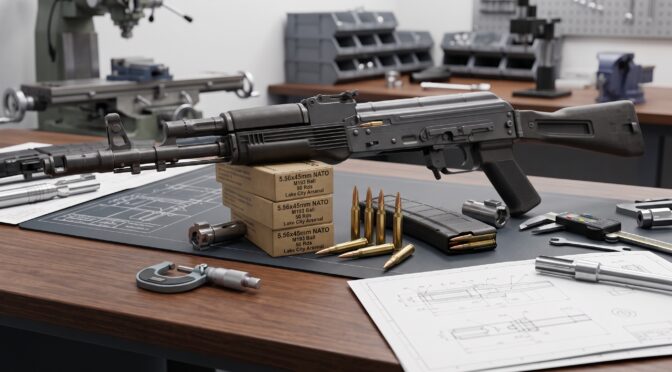
1. Executive Summary
The adaptation of the Kalashnikov (AK) platform to chamber the 5.56x45mm NATO cartridge requires specific engineering modifications to bridge Soviet-era mechanical architecture and Western ballistic specifications. Originally designed around the highly tapered 7.62x39mm and 5.45x39mm cartridges, the AK’s operating system relies on specific geometric tolerances to function consistently. Chambering the high-pressure 5.56x45mm NATO round within this action requires precision-engineered modifications across multiple subsystems. This report provides an analysis of the mechanical adaptations required to chamber the Kalashnikov platform in 5.56x45mm NATO.
The analysis focuses on three areas of mechanical interface: front trunnion reinforcement and metallurgy, bolt face geometry and extractor mechanics, and magazine feeding geometry. Furthermore, the report evaluates the dichotomy in modern 5.56 Kalashnikov design philosophies by comparing rifles utilizing proprietary “rock-and-lock” magazines, such as the FB Radom Beryl and Zastava M90, against platforms engineered with STANAG-compatible magazine adapters, such as the Palmetto State Armory (PSA) AK-556.
Data indicates that the 5.56x45mm Kalashnikov demands a reinforced pressure vessel. This structural reinforcement is achieved via 1.5mm bulged receivers, bulged front trunnions, or through the use of specific cold hammer-forged alloys to manage the pressure curve of the NATO cartridge. Bolt modifications require extractor claw undercutting and the implementation of spring-loaded firing pins to mitigate slam fires with commercial primers. Feeding geometry presents notable engineering hurdles; the physical profile of the 5.56x45mm necessitates specialized, steeply angled bullet guides and conservative feed ramp chamfering.
Operationally, empirical field data highlights a contrast between the two primary magazine interfaces. Proprietary rock-and-lock systems maintain the mechanical consistency of the baseline AK design, requiring dedicated magazines. Conversely, STANAG-compatible platforms offer cross-platform ammunition logistics but require modifications to the bolt carrier group that can impact long-term component wear and introduce narrower tolerances for magazine variance.
2. Ballistic and Geometric Considerations
To evaluate the engineering requirements of a 5.56x45mm Kalashnikov, it is necessary to analyze the ballistic and geometric differences between the NATO cartridge and the original Soviet rounds. The mechanical architecture of the AK was optimized for the 7.62x39mm M43 cartridge, which features a pronounced case taper. This taper minimizes friction during primary extraction, allowing the casing to break contact with the chamber walls immediately as the bolt rotates.
Introduced in 1974, the AK-74 was chambered for the smaller 5.45x39mm cartridge. While adopting a lighter projectile, engineers ensured the 5.45x39mm round maintained a significant body taper and a thick rim, preserving the platform’s standard extraction parameters.
The 5.56x45mm NATO possesses a straighter case profile, presenting a mechanical variance for the AK operating system. The base diameter of the 5.56x45mm case is 0.377 inches, while the 5.45x39mm features a wider base diameter of 0.394 inches. Additionally, the overall case length of the 5.56x45mm is 1.760 inches, compared to the 1.568-inch length of the 5.45x39mm.
The reduced body taper of the 5.56x45mm cartridge means the brass casing expands and adheres more uniformly to the steel chamber walls during obturation. Consequently, the straight-walled casing requires more mechanical force for primary extraction compared to tapered Soviet cartridges.
Internal ballistics and pressure curves also differ. The 5.56x45mm NATO cartridge generates maximum chamber pressures that approach 62,366 psi under EPVAT testing protocols, whereas the 5.45x39mm operates at lower pressures, averaging around 55,000 psi. The combination of projectile weight and muzzle velocity translates to a sharper pressure spike in the 5.56x45mm system. This alters the cyclical timing of the gas system and increases the structural stress placed upon the front trunnion and the locking lugs of the bolt.
3. Trunnion Reinforcement and Structural Architecture
In the stamped-receiver Kalashnikov platform, the front trunnion acts as the primary pressure vessel. It is the mechanical nexus where the cold hammer-forged barrel is pinned, the stamped sheet-metal receiver is riveted, and the bolt’s forward locking lugs rotate to seal the chamber. Because the 5.56x45mm NATO cartridge generates higher chamber pressures and distinct rearward bolt thrust forces, the front trunnion requires specific structural and metallurgical adaptations to prevent the loss of headspace over high round counts.
3.1 The Bulged Trunnion Architecture
Engineers have developed architectural solutions to handle the stresses of the 5.56x45mm cartridge, notably the utilization of a reinforced, bulged front trunnion. This design philosophy is prominently observed in the Zastava M90 and the Palmetto State Armory (PSA) AK-556.
The Zastava M90, which currently carries an average street price of approximately $1,200, traces its origins back to the Yugoslav military’s M70 platform, engineered to withstand the thermal and kinetic stress of launching rifle grenades. Yugoslav engineers increased the stamped sheet metal receiver thickness from the standard 1.0mm to 1.5mm. To accommodate this thicker steel, the front trunnion was enlarged, resulting in a distinct bulge on the sides above the magazine well. When adapted for the 5.56x45mm cartridge, the 1.5mm bulged receiver provides a highly rigid locking surface that reduces flex and stabilizes the barrel, though it results in a heavier overall weapon system.
The PSA AK-556, positioned with an average street price of roughly $1,100, adopts a hybrid structural approach; it utilizes a bulged, forged 4340 AQ steel front trunnion to manage the specific pressure curve, but pairs it with a standard 1.0mm stamped receiver. This design balances the required front-end structural reinforcement with a reduction in overall receiver weight.
3.2 The Standard Forged Trunnion Architecture
Manufacturers operating out of Europe, such as Fabryka Broni (FB) Radom in Poland and WBP, utilize a standard 1.0mm stamped receiver paired with a standard-profile forged front trunnion for their 5.56x45mm platforms. To ensure the platform handles the 5.56x45mm pressure curve without relying on the added mass of a bulged trunnion, these manufacturers rely on material science and specific metallurgy.
FB Radom utilizes a proprietary steel alloy optimized for cold hammer forging. The forging process aligns the grain structure within the steel, increasing resistance to cyclical fatigue. The FB Radom Beryl platform currently commands an average street price of approximately $1,500. WBP similarly relies on machined, forged steel trunnions, maintaining durability within a lighter 1.0mm receiver footprint, with rifles like the WBP Jack averaging around $1,200.
| Trunnion Architecture | Receiver Thickness | Front Trunnion Profile | Operational Characteristics | Exemplar Platforms |
| Yugoslav Pattern | 1.5mm | Bulged | High rigidity, limits receiver flex, handles pressure spikes; higher overall weight. | Zastava M90 |
| Hybrid Pattern | 1.0mm | Bulged | Reinforces primary locking surfaces while maintaining standard receiver weight. | PSA AK-556 |
| Standard AKM Pattern | 1.0mm | Standard Forged | Lightweight, standard handling characteristics; requires premium forging metallurgy. | FB Radom Beryl, WBP Jack |
3.3 Barrel Journal Sizing
The mechanical interface between the barrel and the front trunnion—the barrel journal—is a critical metric. Kalashnikov platforms generally utilize two standard barrel journal sizes: 22mm (typical of the 5.45x39mm AK-74) and 23mm (typical of the 7.62x39mm AKM).
For dedicated 5.56x45mm builds, the industry standard leans toward the larger 23mm journal. Components from WBP, Arsenal Bulgaria, and Palmetto State Armory are engineered to accept 23mm barrel journals. The 23mm journal provides additional material thickness at the chamber end of the barrel, enhancing the radial hoop strength required to contain the expanding gases of the 5.56x45mm pressure spike.
4. Bolt Face Geometry, Extraction Mechanics, and Firing Pin Dynamics
The bolt assembly of a 5.56x45mm Kalashnikov must smoothly strip a round from the magazine, guide it up the feed ramp, lock into the front trunnion, detonate the primer, and extract the straight-walled casing under residual pressure.
4.1 Bolt Stem Thickness and Carrier Compatibility
The physical dimensions of the bolt stem—the cylindrical rear portion of the bolt that rides inside the bolt carrier—are not uniform across 5.56 AK variants. Mixing components from different origins can result in improper lockup. There are three primary bolt stem profiles:
- Thin Stem (AK-74 Specification): Bolts manufactured by FB Radom for the Beryl utilize a “thin stem” profile, dimensionally identical to the standard Soviet 5.45x39mm AK-74 bolt stem.
- Medium Stem (WBP Specification): WBP Polish 5.56 bolts feature a proprietary “medium” stem. It is dimensionally thicker than the FB Radom 74-spec thin stem, but thinner than a standard 7.62x39mm AKM bolt stem.
- Thick Stem (AKM Specification): Some platforms, such as the Arsenal SLR-106 series, utilize an AKM pattern bolt carrier, requiring a 5.56 bolt manufactured with a thick stem matching 7.62x39mm dimensions.
4.2 Extractor Geometry
A frequent modification within the manufacturing community is the adaptation of surplus Soviet 5.45x39mm AK-74 bolts to cycle 5.56x45mm ammunition. Because the rim diameter difference between the two cartridges is minimal, a 5.56mm cartridge will physically fit onto a 5.45mm bolt face.
However, the geometric profile of the extraction groove differs. When utilizing an unmodified 5.45mm bolt for a 5.56mm build, the standard extractor claw often lacks sufficient depth to purchase fully on the NATO case rim. To adapt the bolt, the extractor claw must be relieved (undercut) from the inner face where it contacts the bolt stem. This material removal allows the extractor claw to pivot further inward under spring tension, ensuring positive primary extraction. Despite this workaround, dedicated 5.56x45mm bolts with factory-set extractor geometry are recommended for consistent operation.
4.3 Firing Pin Mass and Slam Fire Mitigation
The original AK-47, AKM, and AK-74 designs utilize a free-floating firing pin. When the bolt locks into battery, the pin travels forward under its own inertia, lightly striking the primer. Soviet military ammunition features hard primers designed to withstand these inertial strikes.
However, commercial.223 Remington and 5.56x45mm NATO ammunition often utilize softer, more sensitive primers. When a standard free-floating AK firing pin impacts a soft primer during chambering, the inertial force can ignite the compound, causing a slam fire. To mitigate this risk, premium 5.56 AK manufacturers replace the free-floating pin with a spring-loaded assembly. Manufacturers like Arsenal Bulgaria and WBP Poland manufacture bolts featuring a firing pin held securely to the rear by a coil spring, guaranteeing consistent ignition only when the hammer physically strikes the pin.
5. Magazine Feeding Geometry and Chamber Adaptations
The transition of the cartridge from the magazine into the chamber is geometrically sensitive. The lack of body taper on the 5.56x45mm cartridge requires dedicated feed ramps and precisely angled bullet guides.
5.1 Bullet Guide Geometry
The AK bullet guide is a hardened steel ramp riveted into the floor of the front trunnion. Its purpose is to strike the nose of the cartridge as it is stripped forward, elevating the projectile into the chamber. Because the 5.56x45mm cartridge has a longer overall length and a different ogive compared to Soviet rounds, a caliber-specific bullet guide is required. The 5.56 guide features a steeper ramp angle to elevate the longer, straight-walled cartridge quickly enough to avoid striking the barrel face.
The installation of the bullet guide is dictated by the internal geometry of the front trunnion:
- Round Trunnion: The interior floor is smooth and curved, matching the barrel journal. The corresponding round bullet guide features a curved base that sits flush against the trunnion floor.
- Flat Trunnion: The interior floor features a machined notch. The corresponding flat bullet guide features a squared base that drops into this notch, often presenting a stepped ramp style.
5.2 Chamber Face Chamfering
To prevent the sharp edges of the barrel face from binding the copper jacket of the projectile, manufacturers often cut a slight chamfer (a beveled edge) into the lower lip of the chamber face. This creates a secondary feed ramp directly on the barrel.
Caution is required during this alteration. If the chamfer is cut too deeply, a portion of the cartridge’s brass casing will be left unsupported when the bolt is locked into battery. Upon detonation, the brass can flow into the void, potentially resulting in a case head separation. Thus, chamber chamfering must be conservative, balancing smooth feeding with safe pressure containment.
6. The STANAG Magazine Adapter Paradigm
While traditional 5.56 Kalashnikovs utilize proprietary “rock-and-lock” magazines, an engineering movement has emerged to adapt the AK to accept standard AR-15/M16 STANAG pattern magazines. Platforms like the PSA AK-556 attempt to merge Kalashnikov mechanics with Western logistical commonality.
6.1 Mechanical Integration
The native Kalashnikov relies on a flat magwell where the magazine is rocked rearward to lock. The AR-15 utilizes a straight-insertion method into a restrictive magazine well. To bridge this gap, a STANAG magwell adapter is pinned or riveted into the stamped steel receiver. The PSA AK-556 adapter acts as a billet alloy housing that accepts the straight insertion of an AR-15 magazine. This typically introduces a dual magazine release system: a traditional AK paddle release, and an AR-style push-button release on the right-hand side of the receiver.
6.2 Bolt Override and Feed Lip Clearance
The primary engineering hurdle of the STANAG adapter system is the geometric interference between the reciprocating AK bolt carrier and the AR-15 magazine feed lips. STANAG magazines sit higher relative to the bore axis, and their feed lips are narrower than traditional AK magazines.
If an unmodified AK bolt carrier travels over an inserted STANAG magazine, the lower stripping lugs of the bolt will impact the rear feed lips. To resolve this, extensive machining is required on the moving parts. Engineers must mill relief cuts into the sides and bottom of the bolt and bolt carrier to clear the STANAG feed lips. Removing material from the lower stripping lugs reduces the bolt’s overall surface area for grabbing the cartridge rim, making the feeding system highly sensitive to magazine spring tension and follower tilt.
6.3 Last Round Bolt Hold Open (LRBHO)
STANAG-adapted AKs frequently integrate a Last Round Bolt Hold Open (LRBHO) feature. Traditional Kalashnikovs do not lock open when empty. The STANAG adapters incorporate an internal mechanical linkage that interacts with the follower of the AR-15 magazine. When the final round is fired, the follower pushes upward against an internal sear within the adapter block, catching the reciprocating bolt and locking it to the rear.
7. Operational Reliability Comparison: STANAG vs. Rock-and-Lock
Analyzing empirical field data reveals a contrast between the operation of proprietary rock-and-lock systems and the ammunition-sensitive nature of STANAG-adapted rifles.
7.1 Proprietary Systems (FB Radom Beryl, Zastava, WBP)
Rifles engineered to use proprietary 5.56 AK magazines exhibit high reliability. The FB Beryl (average street price ~$1,500) was utilized by the Polish Armed Forces as their standard service rifle. Because the receiver, bolt, trunnion, and magazine were designed synergistically, the geometric presentation of the cartridge is natively optimized. The Zastava M90 (average street price ~$1,200) exhibits similar feeding geometry, aided by an adjustable gas block that allows operators to tune the rifle’s cyclical rate.
A notable operational variable in the proprietary rock-and-lock system is the material science of the magazines. FB Radom Beryl magazines are manufactured from a rigid, translucent polycarbonate material. While lightweight, polycarbonate can become brittle in sub-zero temperatures and is prone to stress-cracking at the feed lips if dropped onto hard surfaces. Consequently, many shooters utilize Bulgarian “Circle 10” magazines, which are constructed from a thermally stable polymer and feature steel-reinforced feed lips.
7.2 STANAG Systems (PSA AK-556)
The operational reliability of STANAG-adapted AKs is more variable. The mechanical integration of an AR-15 magazine into a Kalashnikov action introduces geometric friction points. While the PSA AK-556 (average street price ~$1,100) is advertised as STANAG-compatible, optimal reliability is often heavily dependent on the geometry of specific polymer magazines, such as Magpul PMAGs. Attempting to utilize standard USGI aluminum magazines or other variants can result in the modified bolt overriding the cartridge.
Furthermore, the mechanical modifications required to clear the STANAG feed lips can impact long-term durability. Field data indicates that modified bolt lugs can experience accelerated wear where the bolt impacts the trunnion and the magazine adapter during cycling.
| Reliability Metric | Proprietary Rock-and-Lock (e.g., FB Beryl, Zastava M90) | STANAG Adapter (e.g., PSA AK-556) |
| Magazine Compatibility | High within the 5.56 AK ecosystem (FB Radom, WBP, Circle 10). | Variable (Heavily dependent on specific polymer magazine geometry). |
| Feeding Geometry | Optimized native presentation angle. | Requires bolt lug milling to clear AR feed lips, reducing stripping surface area. |
| Headspace Retention | Excellent track record utilizing military-pedigree forged components. | Variable; documented instances of accelerated bolt lug wear. |
| Operational Features | Standard AK manual of arms, typically lacks LRBHO. | Features LRBHO and AR-style push-button release. |
| Logistical Availability | Low (Magazines are proprietary and premium-priced). | High (Standard AR-15 magazines are abundant and cost-effective). |
8. Consumer Reception and Market Dynamics
The consumer reception of 5.56x45mm AK platforms fractures the commercial market into two demographics: shooters seeking logistical efficiency, and purists prioritizing native mechanical designs.
When evaluating the commercial market, average street pricing plays a significant role in consumer adoption. The current average street prices for the platforms analyzed are approximately $1,500 for the FB Radom Beryl, $1,200 for the Zastava M90, $1,200 for the WBP Jack, and $1,100 for the PSA AK-556.
A review of the eight requested vendors (Brownells, Grabagun, Global Ordnance, Midway USA, KYGunCo, Palmetto State Armory, Primary Arms, and Sportsmans Warehouse) was conducted to find up to five active product listings priced at or below these averages. Imported military-pedigree rifles (the FB Radom Beryl, Zastava M90, and WBP Jack) are typically distributed through exclusive specialty importers rather than these specific commercial retailers, yielding no results.
Active product pages for the domestic PSA AK-556 are hosted directly by the manufacturer; however, correcting for real-time inventory data, these specific models are presently out of stock. The listings with their MSRPs are as follows:
- (https://palmettostatearmory.com/psa-ak-556-forged-classic-polymer-side-folding-rifle-with-toolcraft-trunnion-bolt-and-carrier-black.html)
- (https://palmettostatearmory.com/psa-ak-556-with-psa-slr-13-5-solo-rail-m4-stock-toolcraft-trunnion-bolt-and-carrier.html)
- (https://palmettostatearmory.com/psa-ak-556-with-13-7-barrel-pin-and-weld-psa-slr-11-rail-jmac-ts-8-stock-and-jmac-flash-hider.html)
- (https://palmettostatearmory.com/psa-ak-556-with-psa-slr-13-5-solo-rail-zhukov-stock-toolcraft-trunnion-bolt-and-carrier.html)
For the pragmatic consumer, the STANAG-compatible AK represents logistical simplicity. The PSA AK-556 allows an operator invested in the AR-15 ecosystem to utilize standard magazines. The inclusion of the LRBHO mechanism and the AR-style magazine release lowers the manual-of-arms learning curve. The market presence of these platforms is often supported by comprehensive manufacturer warranties that mitigate concerns regarding component wear.
Conversely, professional end-users and collectors show a strong preference against STANAG-adapted platforms, viewing the required bolt lug modifications as a compromise to the baseline reliability of the Kalashnikov system. These consumers prefer proprietary platforms like the FB Radom Beryl or Zastava M90. While proprietary 5.56 AK magazines are costly, the consumer is rewarded with a military-pedigree weapon system engineered specifically for those tolerances.
9. Strategic Conclusions
Chambering the Kalashnikov platform in 5.56x45mm NATO demands a calculated redesign of internal geometry. The high-pressure, straight-walled characteristics of the NATO cartridge require specific front trunnion reinforcement, extractor claw tuning, spring-loaded firing pins, and precise feed ramp and bullet guide angles.
The implementation of STANAG magazine adapters appeals to consumers seeking logistical commonality but introduces mechanical vulnerabilities. Modifying the bolt lugs to clear AR-15 feed lips alters the platform’s geometric harmony, which can result in accelerated wear and magazine sensitivity. Therefore, for applications prioritizing long-term durability, the proprietary “rock-and-lock” geometry remains the optimal engineering solution.
Note: Vendor Sources listed are not an endorsement of any given vendor. It is our software reporting a product page given the direction to list products that are between the minimum and average sales price when last scanned.
Please share the link on Facebook, Forums, with colleagues, etc. Your support is much appreciated and if you have any feedback, please email us in**@*********ps.com. If you’d like to request a report or order a reprint, please click here for the corresponding page to open in new tab.
Sources Used
- 5.45 vs. 5.56: Soviet vs. NATO – Ammo.com, accessed June 28, 2026, https://ammo.com/comparison/545-vs-556
- FB RADOM Poland – AK 5.56 Complete Bolt Assembly Original Beryl/Archer, accessed June 28, 2026, https://armsofamerica.com/fb-radom-poland-ak-5-56-complete-bolt-assembly-original-beryl-archer/
- AR15 Magwell Conversion Kit – DEFINITIVE ARMS, accessed June 28, 2026, https://definitivearms.com/product/ar15-magwell-conversion-kit/
- Zastava M85NP My Oddball AK That Runs 5.56 and Uses AR Mags – Guns.com, accessed June 28, 2026, https://www.guns.com/news/reviews/zastava-m85np-my-oddball-ak-that-runs-556-and-uses-ar-mags