Executive Summary
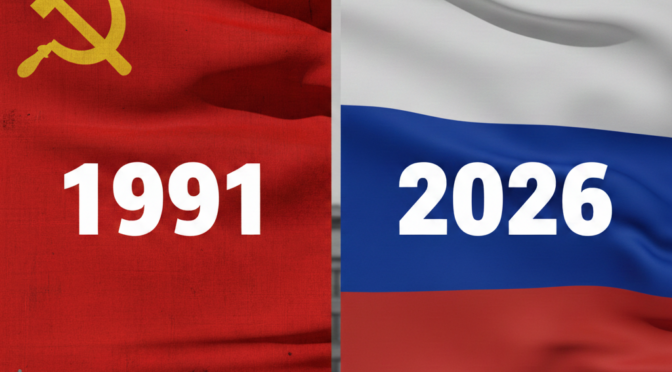
The Russian Federation enters 2026 facing a systemic crisis that bears striking parallels to the factors that precipitated the dissolution of the Soviet Union in 1991. This multidisciplinary assessment identifies a convergence of fiscal exhaustion, military overextension, and social repression that echoes the late-Soviet “Era of Stagnation.” However, significant architectural differences—most notably the transition from a bureaucratic state to a personalized digital autocracy—suggest a different terminal trajectory.
The primary parallel is the “Petrostate Trap.” Like the USSR in 1986, the 2026 Russian state is grappling with a catastrophic slump in oil and gas revenues, which fell 34 percent year-on-year in late 2025.1 The military burden has reached approximately 9 percent of GDP, far surpassing the 2 to 3 percent spent during the Soviet-Afghan War . Crucially, the current conflict in Ukraine has inflicted 1.2 million casualties as of early 2026—more than 17 times the fatalities sustained in Afghanistan.3
Key divergences include modern Russia’s resilient market structure and a central bank capable of sophisticated interventions, such as maintaining a 16 percent interest rate to combat 1990s-style inflation.2 Furthermore, the Kremlin has rejected the “Glasnost” (openness) model in favor of “Digital Autarky.” A decree effective March 1, 2026, aims for total digital isolation, trading long-term economic competitiveness for short-term regime survival . While the foundations are more precarious than at any time since 1991, the state’s advanced tools of repression may delay a systemic rupture.
Section 1: Economic Parallels—The Exhaustion of the Petrostate Model
The economic landscape of 2026 Russia is defined by a “stormy weather” climate that mirrors the final years of the Soviet economy.2 The state remains unable to decouple its fiscal health from global energy volatility, a structural defect unchanged since the 1980s.
1.1 The Fiscal Mathematics of Collapse
In the 1980s, the Soviet Union’s lifeline was severed when oil prices collapsed from 120 dollars per barrel in 1980 to 24 dollars in 1986 . By 2026, Russia finds itself in a near-identical vice. Oil and gas revenues, which historically provided half of state income, fell 34 percent year-on-year in late 2025.1 Oil production has declined for three consecutive years, reaching 512 million tonnes in 2025—its lowest level since 2009 .
The 2026 budget is under severe strain, with the finance ministry planning to curb state spending while facing a deficit that analysts suggest could be triple the official 1.6 percent target . This mirrors the 1991 consolidated deficit of 31 percent of GDP.8
| Economic Variable | Late Soviet Period (1985-1991) | Russian Federation (2025-2026) |
| Primary Export Vulnerability | 1986 Oil Price Collapse (120 dollars to 24 dollars) | 2025 Price Slump (63 dollars to 36 dollars) |
| Military Spending Burden | 15-17 percent of GNP | Estimated 9 percent or more of GDP |
| Annual Economic Growth | 4.7 percent (1980-85) to Negative (1991) | 0.6 percent (2025) to 1.1 percent (2026 est.) 3 |
| Inflationary Character | Repressed (Shortages and Black Markets) | Open (16 percent Key Interest Rate) 2 |
| Major Infrastructure Failure | Chernobyl / Armenia Earthquake 8 | Energy Siege / Heating System Failures 9 |
1.2 The Crisis of Working Capital and Non-Payment
A critical lead indicator of failure is the breakdown of internal credit. In the late Soviet period, the “shortage economy” was characterized by the inability to secure inputs . In 2026, this has manifested as a non-payment crisis. A survey by the Russian Union of Industrialists and Entrepreneurs (RSPP) found that 42 percent of respondents complained about non-payment in late 2025, up from 26 percent earlier that year.2
1.3 Fiscal Dynamics (2024-2026)
Section 2: Military Overextension—Afghanistan vs. Ukraine
The second pillar of Soviet collapse was the “military factor”—the unsustainable burden of foreign conflicts . In 2026, the war in Ukraine has evolved into a grinding attrition that dwarfs the Afghan conflict in every dimension of cost.
2.1 The Casualty Disparity
While the Soviet-Afghan War (1979-1989) shocked society with 15,000 fatalities over a decade, the current conflict has inflicted 1.2 million casualties, with deaths estimated up to 325,000 as of early 2026.3 Russia now loses as many troops in a single month in Ukraine as the USSR did in ten years in Afghanistan .
The social silence in 2026 stands in contrast to the late 1980s, when public pressure from families contributed to the withdrawal from Afghanistan.5 Analysts suggest this is the result of “draconian new legislation” and the suppression of anti-regime movements .
2.2 Material Attrition and the Soviet Legacy
In 1991, the Soviet military remained well-funded even as the economy lagged . In 2026, the Russian military is consuming the legacy of that era. Russia has lost more than 11,000 tanks and 24,000 armored vehicles since February 2022 . At current attrition rates, recoverable equipment from Soviet-era reserves will be largely exhausted by late 2026 or early 2027—coinciding with the expected fiscal crunch.1
| Military Metric | Soviet-Afghan War (1979-1989) | Russia-Ukraine War (2022-2026) |
| Total Fatalities | ~15,000 5 | ~325,000 3 |
| Total Casualties | ~35,000 5 | ~1,200,000 3 |
| Daily Attrition Rate | ~10 per day | ~1,000 per day (2025/26 average) |
| Material Source | Primary Production | Soviet Stockpile Depletion 1 |
Section 3: Political Divergences—Digital Autocracy vs. Glasnost
The most profound difference lies in the mechanism of political control. The Soviet Union fell because Mikhail Gorbachev’s reforms (Glasnost) inadvertently dismantled the fear-based structure of the state .
3.1 The Digital Gulag
In 1991, the state lost control of the media . In 2026, the Kremlin has moved toward total digital isolation. On March 1, 2026, a decree introducing centralized management of the national communications network comes into force, laying the foundation for isolating the Russian segment of the internet (RuNet) from the global network until at least 2033 . This move from “reactive” to “preemptive” control shifts the burden of security compliance onto citizens and developers.11
3.2 Personalized Power vs. Collective Nomenklatura
The Soviet Union was governed by a party whose leaders were subject to the consensus of the Politburo . The 2026 regime is highly personalized under the “President Writ Large”.13 Approximately 60 percent of contemporary elites have origins in the Soviet Nomenklatura, but they operate within a “digital bureaucracy” that allows for more granular control than their predecessors achieved .
3.3 The Evolution of Information Control
Section 4: Economic Divergences—Market Resilience vs. Command Rigidity
Modern Russia retains the flexibility of a market-based structure, which has allowed it to adapt to sanctions in ways the Soviet Union could not.
4.1 Adaptation and the Axis of Evasion
Modern Russia has adapted by turning sanctions pressure into a basis for alignment with partners like China, Iran, and North Korea.14 By 2026, Russia is sharing evasion channels to provide access to finance and logistics.14 This includes barter arrangements, settlements in local currencies, and the use of regional banks with limited Western exposure.14
4.2 The Role of the Central Bank
A critical divergence is the presence of a technically proficient Central Bank. In 1991, money was printed to support wage hikes, fueling an inflationary spiral . In early 2026, the Bank of Russia maintains an extremely high key interest rate (16 percent) to dampen inflationary expectations and manage the rouble’s devaluation .
4.3 Industrial Output Growth: 2024 vs 2025
Section 5: The Nationalities Question—Republics vs. Minorities
One of the primary causes of the 1991 dissolution was intense ethnic nationalism within the 15 Soviet republics . In 2026, the situation is characterized by a “uniformity” policy that suppresses regional identity.
While Lenin and Stalin created an empire of nations within the USSR, modern Russia is reformatting it into a nation-state centered on Slavic heritage and the Russian Orthodox Church . Since 2020, the constitution has declared Russian the language of the “state-forming nation” . However, the disproportionate use of ethnic minority troops in Ukraine has led to a surge in anti-regime moods in regions like Ingushetia and Dagestan .
Section 6: Intelligence Analysis of Regime Stability—Coups and Mutinies
A key parallel cited by analysts is the challenge to authority from within the security apparatus. The Prigozhin mutiny of 2023 is frequently compared to the August 1991 coup attempt..
The 1991 coup was an attempt by hard-liners to thwart reforms, failing because it was poorly executed and cemented anti-communist sentiment . Prigozhin’s “March for Justice” followed a similar tradition of military challenge but was distinct in its decentralized nature and personalized goals . While the 1991 coup ended the Soviet Union, the Prigozhin mutiny resulted in a further consolidation of power and the dismantling of private military autonomy.17
Section 7: Final Conclusions and Strategic Recommendations
The Russian Federation of 2026 is a state in structural decline, yet it possesses a toolkit of digital repression and an axis of evasion the Soviet Union lacked in 1991. The parallels in fiscal exhaustion and military attrition are clear, but the regime’s ability to manage consent through total information control suggests a “slower, darker” path to potential collapse rather than a sudden revolutionary moment.
Key Analytical Findings:
- Fiscal Exhaustion: The combination of tax hikes (VAT to 22 percent) and 16 percent interest rates indicates the state is reaching the limit of its ability to fund both war and social stability .
- Military Peak: Recoverable equipment reserves will be largely exhausted by late 2026, forcing a shift to hybrid and gray-zone tactics.1
- Digital Isolation: The March 1, 2026 decree represents a fundamental shift toward “digital autarky” to eliminate the perception effects of war failure .
Strategic Outlook: Western policymakers should prepare for a “desperate” Russia rather than a “resurgent” one. The risk of hybrid escalation against NATO flanks is at its highest in 2026 as the Kremlin seeks to compensate for conventional weakness.9 Monitoring the non-payment crisis and the stability of the RuNet transition will be the most critical indicators of systemic rupture in the coming year.
Section 8: Detailed Comparative Data and Formulae
8.1 Fiscal Revenue Formulas (Plain Text)
Soviet Budget Revenue (1985) = (Oil Exports at 120 dollars per barrel) + (Industrial Output) + (Alcohol Tax).
1986 Crisis Impact = (Oil Revenue drops by 70 percent) + (Alcohol Revenue drops by anti-alcohol campaign) .
Russian Budget Revenue (2026 Estimate) = (Oil Exports at 36 to 59 dollars per barrel) + (VAT at 22 percent) + (Corporate Tax at 25 percent) . 2026 Deficit Pressure = (Military Spending at 15.5 Trillion Roubles) – (34 percent drop in Oil and Gas Revenue).1
8.2 Demographic and Labor Table
| Population Segment | Soviet Union (1989) | Russia (2025/2026) |
| Total Population | 286 million | 144 to 146 million |
| Military Personnel | 3.5 to 5 million | 1.5 million Active + 3.8 million DIB |
| War Casualties | 15,000 Fatalities (Afghanistan) 5 | 1.2 million Casualties (Ukraine) 3 |
| Brain Drain | Minimal (Closed Borders) | ~1 million (Post-2022) |
| Unemployment | 1 to 2 percent (Official) | 2.4 to 2.5 percent (Labor Crunch) |
Please share the link on Facebook, Forums, with colleagues, etc. Your support is much appreciated and if you have any feedback, please email us in**@*********ps.com. If you’d like to request a report or order a reprint, please click here for the corresponding page to open in new tab.
Sources Used
- Economy of the Soviet Union – Wikipedia, accessed February 14, 2026, https://en.wikipedia.org/wiki/Economy_of_the_Soviet_Union
- Russian budget framework for 2026‒2028 foresees tax hikes and lots of red ink, accessed February 14, 2026, https://www.bofbulletin.fi/en/blogs/2025/russian-budget-framework-for-2026-2028-foresees-tax-hikes-and-lots-of-red-ink/
- The price of stability: What awaits Russia’s economy in 2026?, accessed February 14, 2026, https://nestcentre.org/the-price-of-stability-what-awaits-russias-economy-in-2026/
- Reversing the Soviet Economic Collapse, accessed February 14, 2026, https://www.brookings.edu/wp-content/uploads/1991/06/1991b_bpea_shleifer_vishny.pdf
- Russia Now Loses as Many Troops in One Month in Ukraine as the USSR Did in 10 Years in Afghanistan – UNITED24, accessed February 14, 2026, https://united24media.com/war-in-ukraine/russia-now-loses-as-many-troops-in-one-month-in-ukraine-as-the-ussr-did-in-10-years-in-afghanistan-15414
- accessed February 14, 2026, https://en.wikipedia.org/wiki/Dissolution_of_the_Soviet_Union#:~:text=The%20collapse%20of%20the%20Soviet,s%20reforms%20(particularly%20glasnost%20and
- Putin’s Plan to Save the Empire Is Destroying It. A Harvard Historian on Russia’s Fate, accessed February 14, 2026, https://united24media.com/perspectives/putins-plan-to-save-the-empire-is-destroying-it-a-harvard-historian-on-russias-fate-15130
- Russian Nationalists and Ethnic Conflicts in Southern Russia – Begin-Sadat Center for Strategic Studies, accessed February 14, 2026, https://besacenter.org/russian-nationalists-and-ethnic-conflicts-in-southern-russia/
- Russia is Losing – Time for Putin’s 2026 Hybrid Escalation | Royal United Services Institute, accessed February 14, 2026, https://my.rusi.org/resource/russia-is-losing-time-for-putins-2026-hybrid-escalation.html
- The 1991 Soviet and 1917 Bolshevik Coups Compared: Causes, Consequences, and Legality – Towson University, accessed February 14, 2026, https://wp.towson.edu/iajournal/files/2017/11/1991-AND-1917-COUPS-COMPARED-1j78rtx.pdf
- Thirty years of economic transition in the former Soviet Union: Macroeconomic dimension, accessed February 14, 2026, https://rujec.org/article/90947/
- Russian Threats to NATO’s Eastern Flank: Scenarios, Strategy, and Policy for European Security | The Belfer Center for Science and International Affairs, accessed February 14, 2026, https://www.belfercenter.org/research-analysis/russia-nato-baltics-scenarios-europe-security
- The Soviet Union and the United States – Revelations from the Russian Archives | Exhibitions – The Library of Congress, accessed February 14, 2026, https://www.loc.gov/exhibits/archives/sovi.html
- Preparing for a Fourth Year of War: Military Spending in Russia’s Budget for 2025 | SIPRI, accessed February 14, 2026, https://www.sipri.org/publications/2025/sipri-insights-peace-and-security/preparing-fourth-year-war-military-spending-russias-budget-2025
- Did Russia’s Defense-Sector Boom Peak in 2025? – The Moscow Times, accessed February 14, 2026, https://www.themoscowtimes.com/2025/12/26/did-russias-defense-sector-boom-peak-in-2025-a91555
- Prigozhin’s Ancestors: The Wagner Coup and Historical Comparisons, accessed February 14, 2026, https://oxfordpoliticalreview.com/2023/08/14/prigozhins-ancestors-the-wagner-coup-and-historical-comparisons/
- The Prigozhin Affair: A Case Study of Ambition, Power, and Miscalculations in Putin’s Russia Presented in partial fulfilment, accessed February 14, 2026, https://dspace.cuni.cz/bitstream/handle/20.500.11956/195814/120477892.pdf?sequence=1&isAllowed=y
- Preparing for a Fourth Year of War: Military Spending in Russia’s Budget for 2025 – SIPRI, accessed February 14, 2026, https://www.sipri.org/sites/default/files/2025-04/preparing_for_a_fourth_year_of_war-military_spending_in_russias_budget_for_2025_1.pdf
- The Collapse of the Soviet Union – Milestones in the History of U.S. Foreign Relations – Office of the Historian, accessed February 14, 2026, https://history.state.gov/milestones/1989-1992/collapse-soviet-union