The conflict in Ukraine has entered a systemic phase defined by the competitive exhaustion of human, industrial, and fiscal reserves. As the war of attrition moves through its fourth year, the Russian Federation faces a series of intersecting constraints that suggest a strategic culmination point by late 2026. While the Kremlin continues to project an image of military momentum and economic resilience, a granular assessment of the “burn rate” across key sectors reveals a state that is consuming its legacy Soviet capital and its future economic potential to sustain a marginal rate of territorial advance. The sustainability of this effort is no longer a matter of mere political will, but a function of physical limits in equipment refurbishment, the depletion of liquid financial reserves, and the onset of a demographic crisis that pits the frontline against the factory floor.
The Human Attrition Matrix: Casualty Rates and Recruitment Coercion
The most immediate and visible indicator of the Russian Federation’s burn rate is the staggering loss of personnel. By the first quarter of 2026, cumulative Russian casualties—encompassing those killed, wounded, and missing in action—have surpassed 1.2 million.1 This figure represents more losses than any major power has suffered in any conflict since the conclusion of World War II.1 Within 2025 alone, the Russian military recorded approximately 425,000 casualties, a testament to the intensified “meat grinder” tactics employed to seize the initiative after the 2024 offensive cycles.2
The lethality of the battlefield has scaled alongside the proliferation of drone technology and precision fires. Current estimates suggest that of the total 1.2 million casualties, approximately 315,000 to 325,000 soldiers have been killed.2 The daily average of casualties has increased every year since the 2022 invasion, with peak periods in late 2024 and throughout 2025 regularly exceeding 1,000 to 1,500 daily losses.6 These losses are not merely numerical; they represent a fundamental hollowing out of the Russian professional military. Many of these casualties have occurred among elite paratrooper units (VDV), special forces (Spetsnaz), and the junior officer corps, leading to a precipitous decline in tactical leadership and operational flexibility.7
To replenish these losses, the Russian Ministry of Defense (MoD) has been forced to adopt a recruitment model that is both economically exorbitant and increasingly coercive. The current operational tempo requires an influx of 30,000 to 40,000 new recruits per month.7 While the Kremlin reported reaching a quota of 417,000 recruits in 2025, signs of fatigue in the voluntary recruitment pool are evident.7 Signing bonuses in impoverished regions have surged to over 4 million rubles (€46,000), a sum that dwarfs average regional salaries and creates an unsustainable burden on municipal and federal budgets.2
| Casualty and Recruitment Data: Russian Federation (As of Jan 2026) | Data Point | Source |
| Cumulative Personnel Casualties (K/W/M) | 1,198,000 – 1,200,000 | 2 |
| Estimated Fatalities (KIA) | 315,000 – 325,000 | 2 |
| 2025 Annual Casualty Count | 425,000 | 2 |
| Monthly Recruitment Requirement | 30,000 – 40,000 | 7 |
| Reported 2025 Recruits | 417,000 | 7 |
| Peak Daily Casualties (Late 2024-2025) | 1,500+ | 6 |
The transition toward a “year-round” conscription system, established by presidential decree on December 29, 2025, marks a significant shift in the state’s mobilization strategy.10 Beginning January 1, 2026, conscription offices operate continuously, allowing for the year-round processing of fitness evaluations and the convening of draft boards.11 While the official goal for the 2026 draft remains 261,000 men, the infrastructure is now in place for what analysts describe as “covert mobilization”.10 Conscripts are increasingly pressured through sleep deprivation, physical abuse, and forged signatures to convert their mandatory service into combat contracts.8 Furthermore, “phantom terms” are now common, where initial one-year contracts are unilaterally extended by the MoD into indefinite service for the duration of the “Special Military Operation”.2
This high human burn rate has profound demographic and economic implications. The loss of approximately 1.5 million men—through death, injury, or flight from the country—has triggered a labor market crisis.13 Unemployment has fallen to an unnatural low of 2%, reflecting a severe labor shortage that pits the military’s need for frontline personnel against the defense industry’s requirement for skilled workers.14 The competition for able-bodied men is driving wage inflation, which in turn complicates the Central Bank’s efforts to stabilize the ruble and manage the broader war economy.15
The Industrial Ceiling: Equipment Depletion and the End of the Soviet Legacy
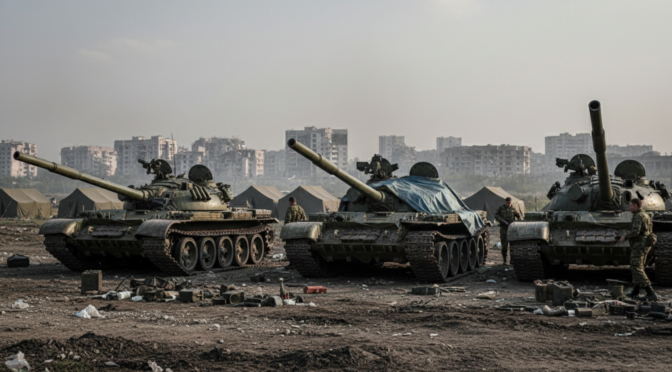
The Russian military’s ability to project power has historically relied on vast stockpiles of equipment inherited from the Soviet Union. However, the intensity of the Ukrainian conflict has rapidly depleted these reserves, bringing the Russian military-industrial base (DIB) to a critical threshold. By early 2026, Russian forces have lost over 13,800 tanks and armored vehicles, a figure that exceeds the entire pre-war active-duty tank inventory.5
The primary challenge for Moscow is the widening gap between the rate of battlefield attrition and the capacity for new production. While the primary tank manufacturer, Uralvagonzavod, has announced ambitious plans to increase T-90 production by 80 percent by 2028, these targets are largely aspirational in the 2026 timeframe.16 Internal documents suggest the factory expects to produce only 10 T-90M2 units in 2026, with the bulk of production not coming online until 2027-2029.16 In the interim, Russia is forced to rely on the refurbishment of increasingly antiquated models.
| Russian Tank Reserve Depletion (June – Oct 2025) | June 2025 Inventory | Oct 2025 Inventory | Percent Change |
| T-72A Tanks in Storage | 900 | 461 | -48.8% |
| T-72B Tanks in Storage | Unknown | 287 | N/A |
| T-62 Tanks in Storage | Unknown | 885 | N/A |
| T-54/55 Tanks in Storage | Unknown | 141 | N/A |
| Total Observable Tank Reserve | 3,106 | 2,478 | -20.2% |
This data indicates that Russia is withdrawing T-72A tanks from previously untouched depots for refurbishment and is increasingly dismantling T-64 tanks to serve as a source for spare parts.16 At current attrition rates, recoverable Soviet-era equipment is projected to be exhausted by late 2026 or early 2027.17 Once this threshold is crossed, the Russian military will no longer be able to field massed armored formations, as new production remains far below the levels required to sustain high-intensity offensive operations.
The shift in tactics observed in 2025—moving away from large-scale mechanized assaults toward small infantry teams supported by motorcycles, ATVs, and light vehicles—is a direct response to this equipment scarcity.16 While these tactics minimize high-value asset losses, they contribute to the “grinding” nature of the war, where advances are measured in tens of meters per day.1 For example, offensives in the Chasiv Yar and Kupiansk sectors throughout 2025 averaged advances of only 15 to 23 meters per day.4 At such rates, it would take Russian forces over 150 years to capture the remaining 80 percent of Ukrainian territory.6
Simultaneously, Russia has attempted to offset its conventional weaknesses by scaling up drone production and electronic warfare capabilities. The Russian military has established dedicated drone system units numbering 80,000 personnel, with plans to double this to 165,500 by the end of 2026.18 These units utilize inexpensive strike drones, such as the Molniya-2 and various FPV variants, to generate favorable battlefield effects.19 However, the effectiveness of Russian guided artillery, such as the Krasnopol munition, has declined from a 70% success rate to approximately 50% as of late 2025, due to the density of Ukrainian electronic warfare and the inability of crews to conduct reconnaissance under the threat of Ukrainian drone strikes.19
The Fiscal Rubicon: The “Pyramid Scheme” Economy and NWF Depletion
The Russian Federation’s economic sustainability is increasingly tethered to a high-risk fiscal model that economists describe as a “pyramid scheme”.20 This system relies on a closed loop where the state pays soldiers and their families massive sums, then offers exceptionally high deposit rates (often exceeding 20%) to prevent that cash from flooding the real economy and causing runaway inflation.20 Households place their cash in banks to capture these rates, and the banks then lend that money back to the state to finance further wartime payouts.20 This loop is highly sensitive to confidence shocks; any mass withdrawal of deposits or a slowdown in new inflows could cause the entire financial system to snap, leading to an outright depression.20
The state’s ability to maintain this loop is underpinned by the National Wealth Fund (NWF), which has served as the primary buffer against oil price shocks and budget deficits. However, the NWF’s liquid assets are being depleted at a record pace. Before the 2022 invasion, the fund held $113 billion in liquid assets (6.5% of GDP).21 By January 2026, this amount has shrunk to $52 billion (1.9% of GDP), a 2.5-fold decline.21
The longevity of the remaining reserves is contingent on the price of Urals crude oil. The 2026 federal budget was drafted under the assumption of an average oil price of $59 per barrel, yet actual prices in late 2025 and January 2026 have averaged between $36 and $39 per barrel.21
| Oil Price Scenarios and NWF Exhaustion (Estimated from Jan 2026) | Projected Longevity of Liquid Assets |
| Urals Crude at $59/barrel (Budget Cut-off) | 3+ Years |
| Urals Crude at $50/barrel | 2.5 Years |
| Urals Crude at $40/barrel | 1.3 Years |
| Urals Crude at $30 – $35/barrel | Exhausted by end of 2026 |
The fiscal crunch is further exacerbated by the “friendship tax” imposed by Chinese suppliers. While bilateral trade reached a record $254 billion in 2024, much of this increase reflects higher prices rather than volume.23 Critical dual-use components, such as ball bearings, have seen price markups of 87% for Russian buyers compared to other international markets.23 This extraction of wealth by China, combined with the 34% year-on-year drop in Russian oil and gas revenues recorded in late 2025, has forced the Kremlin to spike annual borrowing and hike taxes on its own citizens.9
As of January 1, 2026, the VAT rate in Russia has been increased from 20% to 22%.9 Additionally, the threshold for the “simplified” tax system has been lowered, effectively increasing the tax burden on approximately 450,000 small businesses and self-employed individuals.22 These measures signify a pivot from relying on energy windfalls to extracting resources directly from the domestic population to fund the invasion.9 This shift is not without political risk, as remote regions that have “tasted” financial stability through wartime payouts are now facing the prospect of permanent scarcity as Moscow attempts to insulate itself from the growing malaise.20
External Pillars of Sustainability: The North Korean and Chinese Lifelines
Russia’s ability to persist into 2026 is inextricably linked to the military and industrial support provided by the Democratic People’s Republic of Korea (DPRK) and the People’s Republic of China (PRC). These partnerships have transformed from opportunistic transactions into a structural lifeline for the Russian war machine.
The DPRK has become a critical supplier of both ammunition and manpower. By January 2026, a contingent of North Korean troops is permanently stationed in Russia’s Kursk region, carrying out gun and rocket artillery strikes on Ukrainian border communities.24 These forces are regularly rotated under an agreement between Moscow and Pyongyang, with approximately 3,000 soldiers having already returned to North Korea to serve as instructors, spreading modern warfare skills in drone and artillery operations to the broader DPRK military.24 Along with troops, North Korea has supplied millions of artillery shells and dozens of ballistic missiles, such as the KN-23, which accounted for approximately 30% of the Russian ballistic missiles launched in 2024.27
China, meanwhile, has become the “de facto weapons parts factory” for the Russian defense industry.29 An investigation by the London Daily Telegraph identified $10.3 billion worth of technology and advanced equipment sent by Beijing to Moscow, including CNC machine tools, microchips, and memory boards.29 Chinese companies have also provided the manufacturing equipment necessary for the production of the Oreshnik hypersonic missile and the domestic Russian drone program.29 In the domain of intelligence, Chinese reconnaissance flights have been observed over Ukrainian positions, suggesting a level of surveillance and target-sharing support that compensates for Russia’s outdated satellite capabilities.30
However, this support is not an act of alliance but of strategic interest. The PRC has significantly reduced shipments of precision machine tools in late 2025, likely in response to the threat of U.S. secondary sanctions, and has sharply hiked prices on the goods it does deliver.23 This transactional nature ensures that while Russia can continue to fight, it does so as a declining power, increasingly beholden to Beijing’s geopolitical and economic dictates.1
The 2026 Inflection: When and How the Conflict Changes
The convergence of military equipment exhaustion, fiscal reserve depletion, and recruitment challenges suggests that the Russian Federation will reach a “culmination point” in late 2026. This is not to say that the Russian military will collapse instantaneously, but rather that its ability to conduct conventional, high-intensity offensive operations will be fundamentally foreclosed by the exhaustion of its Soviet-era capital.
The Strategic “Snap”: Projections for 2026-2027
A cross-functional analysis identifies late 2026 as the timeframe for a projected “fiscal crunch” and “equipment exhaustion”.17 By this point, the Russian economy will likely have transitioned from “managed cooling” into outright stagnation, with GDP growth of 1% or lower being insufficient to offset the rising costs of the war.14 The National Wealth Fund’s liquid assets will be near zero if oil prices remain below $40, forcing the state to choose between hyperinflationary currency printing or a dramatic reduction in military expenditure.20
On the battlefield, the exhaustion of recoverable armor will force the Russian military to rely almost exclusively on “hybrid” warfare and inexpensive strike drones to maintain the illusion of offensive capability.17 The transition from mechanized warfare to infantry-centric attrition will increase the human burn rate even further, potentially forcing the Kremlin to choose between a socially destabilizing general mobilization or the acceptance of a “frozen conflict” on unfavorable terms.17
What Will Russia Do?
As the conventional military toolkit shrinks, the Kremlin is expected to pivot toward three primary strategies to preserve its gains and wait out Western resolve:
- Hybrid Escalation and Infrastructure Warfare: Russia will likely double down on the destruction of the Ukrainian energy grid and logistics. By early 2026, Ukraine had already lost 80-90% of its thermal and hydropower capacity.3 The goal is to make Ukrainian cities uninhabitable, drive new waves of refugees into Europe, and create “buffer zones” in the Kharkiv, Sumy, and Dnipropetrovsk regions through constant drone and artillery bombardment.33
- The “Abu Dhabi” Peace Gambit: Russia will engage in performative diplomacy, such as the U.S.-brokered talks in Abu Dhabi, to appear constructive while maintaining its maximalist demands.33 The strategy is to leverage political fatigue in the West—specifically targeting shifts in U.S. policy under President Trump—to secure a deal that recognizes Russian annexations, limits Ukraine’s military, and provides a “frozen” status that allows Moscow to reconstitute its forces for a future conflict (circa 2030).33
- Domestic Repression and the “Pyramid” Defense: Internally, the regime will complete its transition to a total war state. This includes the permanent abolition of public asset declarations for officials, further tax hikes on the middle class, and the systemic use of coercive recruitment tactics.8 The Kremlin will rely on its ability to isolate the Moscow and St. Petersburg elites from the war’s consequences while the “beneficiaries of the war” in the peripheral regions continue to be bought off with inflated payouts until the fiscal pyramid snaps.6
The ultimate end of the conflict is unlikely to be a conclusive battlefield victory for either side. Instead, it will resemble the conclusion of World War I—a collapse of the domestic economy and a crisis of trust that turns the system against itself.9 By late 2026, the Russian Federation will find itself at this precipice, where the costs of continuing the war outweigh the benefits of the regime’s survival. The “what they will do” is clear: they will attempt to pivot to a staging of peace to avoid the finality of economic and military exhaustion, seeking a “frozen” truce as a temporary reprieve in a longer cycle of conventional and hybrid warfare.
Image Source
The main blog image is computer generated and is not an actual location or event.
Please share the link on Facebook, Forums, with colleagues, etc. Your support is much appreciated and if you have any feedback, please email us in**@*********ps.com. If you’d like to request a report or order a reprint, please click here for the corresponding page to open in new tab.
Sources Used
- Russia’s Grinding War in Ukraine – CSIS, accessed February 8, 2026, https://www.csis.org/analysis/russias-grinding-war-ukraine
- Russia’s 1.2 million casualty toll: The human price of minimal territorial gains – Moldova 1, accessed February 8, 2026, https://moldova1.md/p/67500/russia-s-1-2-million-casualty-toll-the-human-price-of-minimal-territorial-gains
- The Russia-Ukraine War Report Card, Feb. 4, 2026, accessed February 8, 2026, https://www.russiamatters.org/news/russia-ukraine-war-report-card/russia-ukraine-war-report-card-feb-4-2026
- Russia’s Grinding War in Ukraine: Massive Losses and Tiny Gains for a Declining Power, accessed February 8, 2026, https://smallwarsjournal.com/2026/01/30/russia-ukraine-war-losses-gains-outlook/
- The Russia-Ukraine War Report Card, Jan. 28, 2026, accessed February 8, 2026, https://www.russiamatters.org/news/russia-ukraine-war-report-card/russia-ukraine-war-report-card-jan-28-2026
- Putin’s Great Disaster: Russia Can’t ‘Win’ the Ukraine War with 1.2 Million Casualties, accessed February 8, 2026, https://www.19fortyfive.com/2026/02/putins-great-disaster-russia-cant-win-the-ukraine-war-with-1-2-million-casualties/
- Russian Military Performance and Outlook – Congress.gov, accessed February 8, 2026, https://www.congress.gov/crs_external_products/IF/PDF/IF12606/IF12606.6.pdf
- Russia Needs Men to Fight in Ukraine in 2026. Where Will They Come From?, accessed February 8, 2026, https://www.themoscowtimes.com/2026/01/05/russia-needs-men-to-fight-in-ukraine-in-2026-where-will-they-come-from-a91588
- Vladimir Putin’s war machine may finally be running out of fuel – Atlantic Council, accessed February 8, 2026, https://www.atlanticcouncil.org/blogs/ukrainealert/vladimir-putins-war-machine-may-finally-be-running-out-of-fuel/
- What’s changing in Russia in 2026? Year-round conscription, higher taxes, rising utility costs, and AI surveillance – Meduza, accessed February 8, 2026, https://meduza.io/en/slides/what-s-changing-in-russia-in-2026
- Putin signs decree on year-round conscription in 2026: 261000 people to be drafted, accessed February 8, 2026, https://www.pravda.com.ua/eng/news/2025/12/29/8013893/
- Putin Signs Decree for Continuous Conscription in 2026, Draft Target Set at 261000, accessed February 8, 2026, https://united24media.com/latest-news/putin-signs-decree-for-continuous-conscription-in-2026-draft-target-set-at-261000-14635
- Rough times for the Russian economy – Bank of Finland Bulletin, accessed February 8, 2026, https://www.bofbulletin.fi/en/blogs/2026/rough-times-for-the-russian-economy/
- Why Russia’s economy is unlikely to collapse even if oil prices fall …, accessed February 8, 2026, https://www.theguardian.com/business/2026/jan/10/russia-economy-collapse-oil-prices-fall-war
- Russian Offensive Campaign Assessment, January 12, 2026 | ISW, accessed February 8, 2026, https://understandingwar.org/research/russia-ukraine/russian-offensive-campaign-assessment-january-12-2026/
- Russia outlines plan to rebuild its armored forces in preparation for large-scale war with NATO | Milwaukee Independent, accessed February 8, 2026, https://www.milwaukeeindependent.com/explainers/russia-outlines-plan-rebuild-armored-forces-preparation-large-scale-war-nato/
- Russia is Losing – Time for Putin’s 2026 Hybrid Escalation | Royal …, accessed February 8, 2026, https://my.rusi.org/resource/russia-is-losing-time-for-putins-2026-hybrid-escalation.html
- Russian war deaths are rising to unsustainable levels, says Ukraine – Al Jazeera, accessed February 8, 2026, https://www.aljazeera.com/news/2026/1/8/russian-war-fatalities-are-rising-to-unsustainable-levels-says-ukraine
- Russian Offensive Campaign Assessment, January 13, 2026 | ISW, accessed February 8, 2026, https://understandingwar.org/research/russia-ukraine/russian-offensive-campaign-assessment-january-13-2026/
- What Breaks First – Russia’s Economy or Its War? – Visegrad Insight, accessed February 8, 2026, https://visegradinsight.eu/russias-economy-event-recap/
- Russia’s National Wealth Fund Could Run Dry Within a Year, Gazprombank Analysts Warn, accessed February 8, 2026, https://united24media.com/latest-news/russias-national-wealth-fund-could-run-dry-within-a-year-analysts-warn-15475
- Russia to Tap National Wealth Fund at Record Pace as Oil and Gas …, accessed February 8, 2026, https://www.themoscowtimes.com/2026/01/16/russia-to-tap-national-wealth-fund-at-record-pace-as-oil-and-gas-revenues-slump-a91696
- China Hikes Prices on Dual-Use Goods Exports to Russia – Study – The Moscow Times, accessed February 8, 2026, https://www.themoscowtimes.com/2025/11/24/china-hikes-prices-on-dual-use-goods-exports-to-russia-study-a91227
- North Korean Soldiers Shell Ukrainian Border Areas With Artillery – Defense Intelligence, accessed February 8, 2026, https://militarnyi.com/en/news/north-korean-soldiers-shell-ukrainian-border-areas-with-artillery-defense-intelligence/
- Russia is training North Korea’s future army: 3,000 North Korean soldiers return home as war instructors – Euromaidan Press, accessed February 8, 2026, https://euromaidanpress.com/2026/02/04/russia-is-training-north-koreas-future-army-3000-north-korean-soldiers-return-home-as-war-instructors/
- North Korean troops in Russia attack Ukrainian border communities, HUR says, accessed February 8, 2026, https://kyivindependent.com/north-korean-troops-carry-out-attacks-on-ukraines-border-area-ukraines-military-intelligence-says/
- A CRINK in the Armor of Deterrence: The Axis of Upheaval in the Indo-Pacific – Small Wars Journal, accessed February 8, 2026, https://smallwarsjournal.com/2026/02/05/a-crink-in-the-armor-of-deterrence/
- Korean Peninsula Update, February 3, 2026 | ISW, accessed February 8, 2026, https://understandingwar.org/research/china-taiwan/korean-peninsula-update-february-3-2026/
- China Has Become the De Facto Weapons Parts Factory for Russia’s War in Ukraine, accessed February 8, 2026, https://www.19fortyfive.com/2026/02/china-has-become-the-de-facto-weapons-parts-factory-for-russias-war-in-ukraine/
- China in Russia and Ukraine: October 2025 | Council on Foreign Relations, accessed February 8, 2026, https://www.cfr.org/articles/china-russia-and-ukraine-october-2025
- Russia’s Economy in 2026: More War, Slower Growth and Higher Taxes, accessed February 8, 2026, https://www.themoscowtimes.com/2026/01/02/russias-economy-in-2026-more-war-slower-growth-and-higher-taxes-a91579
- Russia’s war death tally spurs European scrutiny on recruitment – The Japan Times, accessed February 8, 2026, https://www.japantimes.co.jp/news/2026/02/01/world/russia-war-deaths-recruitment/
- Ukraine war in 2026 – Three scenarios analysts see | RBC-Ukraine, accessed February 8, 2026, https://newsukraine.rbc.ua/news/ukraine-war-in-2026-three-scenarios-analysts-1769682969.html
- From trenches to tenders: the investor playbook for a possible Ukraine peace deal | Saxo, accessed February 8, 2026, https://www.home.saxo/content/articles/equities/ukrainerussiapeace-26112025
- Seven Security Scenarios on Russian War in Ukraine for 2025 – 2026: – GLOBSEC, accessed February 8, 2026, https://www.globsec.org/sites/default/files/2025-10/Seven%20Security%20Scenarios%20Ukraine%202025-2026%20WEB%20rv.pdf
- Peace negotiations in the Russo-Ukrainian war (2022–present) – Wikipedia, accessed February 8, 2026, https://en.wikipedia.org/wiki/Peace_negotiations_in_the_Russo-Ukrainian_war_(2022%E2%80%93present)
- Beneficiaries of the war versus advocates of peace: Elite …, accessed February 8, 2026, https://nestcentre.org/beneficiaries-of-the-war-versus-advocates-of-peace-elite-expectations-and-the-reality-of-war/