1. Executive Summary
During the reporting period of June 28 through July 4, 2026, the operational environment in the Russo-Ukrainian war was defined by a stark divergence between stalled Russian ground maneuver and an intensifying, highly effective Ukrainian strategic deep-strike campaign. The Russian military’s spring-summer 2026 offensive has culminated without achieving operationally significant gains. The velocity of Russian territorial acquisition has plummeted, resulting in the seizure of a mere fraction of the territory captured during the corresponding period in 2025, while sustaining record-high casualty rates.1 The Kremlin’s primary axis of advance remains fixed on Kostyantynivka in Donetsk Oblast; however, Russian forces have largely failed to consolidate enduring positions, relying instead on high-attrition infantry infiltrations that yield nominal map alterations but catalyze severe force degradation.1
Diplomatically, the reporting period witnessed a profound strategic realignment following the mid-June G7 Summit in Évian-les-Bains. The highly publicized “Anchorage Understandings”—a diplomatic framework heavily promoted by Moscow implying anticipated United States concessions regarding Ukrainian territory in Donbas stemming from an August 2025 summit in Alaska—was effectively dismantled.3 United States and European leadership signaled renewed, unified support for Ukraine’s territorial integrity, triggering visible frustration within the Russian diplomatic corps and prompting the Kremlin to issue increasingly unrealistic domestic and military deadlines to project a facade of inevitable victory.2 Concurrently, NATO institutionalized its support mechanisms by establishing a dedicated command structure to coordinate the vast majority of future military assistance.7
In direct response to the hardening battlefield geometry and the stabilization of Western support, Ukraine continued its publicly declared 40-day intermediate- and long-range strike campaign specifically targeting the foundational nodes of the Russian war economy, including petroleum refining, ballistic missile manufacturing, and satellite communications.8 Leveraging indigenous deep-strike platforms, most notably the new FP-5 “Flamingo” cruise missile, Ukrainian forces successfully degraded high-value assets up to 1,000 kilometers deep within the Russian Federation.10 This campaign has catalyzed acute secondary macroeconomic and logistical effects, forcing Russia to import refined gasoline from international partners and prompting emergency resource rationing at the front lines.2
Russia countered this operational pressure with severe, large-scale asymmetric drone and missile barrages, launching over 570 munitions on the night of July 1-2 alone, heavily targeting civilian, energy, and humanitarian infrastructure in Kyiv and broader Ukraine.1 Concurrently, Russia continues to adapt its hybrid warfare tactics, utilizing its maritime “shadow fleet” as staging platforms for drone incursions into NATO airspace, testing Western deterrence in a protracted “Phase Zero” operation.1 Ultimately, the week’s developments indicate a theater settling into a brutally attritional paradigm where deep-logistics interdiction, defense-industrial sustainability, and asymmetric technological adaptation have eclipsed traditional mechanized maneuver as the primary arbiters of strategic success.
2. Detailed Operational and Diplomatic Developments
Bilateral Interactions & Diplomatic Posture
The diplomatic landscape underwent a seismic shift this week as the geopolitical reverberations of the recent G7 Summit in Évian-les-Bains fully materialized, fundamentally altering the trajectory of potential peace negotiations. The central diplomatic narrative revolved around the collapse of the so-called “Spirit of Anchorage.” Since August 15, 2025, Russian state media, Kremlin spokespeople, and diplomatic officials have consistently utilized this term to describe perceived tacit agreements reached between United States President Donald Trump and Russian President Vladimir Putin at a bilateral summit in Alaska.12 Moscow utilized this narrative to project an eventual diplomatic victory wherein the United States would force Kyiv to accept Russian control over occupied Donbas in exchange for freezing the line of contact.3 The State Department reportedly made no transcript of the meeting with Putin, meaning the summit rested entirely on oral understandings that Moscow rapidly weaponized for informational dominance.16
However, statements from the G7 Summit unequivocally rejected this premise, signaling a robust hardening of the Western alliance’s posture. The summit, hosted by French President Emmanuel Macron, produced an “unprecedented convergence” among G7 leaders on continued support for Ukraine.17 United States leadership signaled strong skepticism regarding Russian President Vladimir Putin’s intentions, explicitly acknowledging that Russia did not desire genuine peace, and formally hinting at the abandonment of any perceived “Anchorage Understandings”.3 Ukrainian Foreign Minister Andrii Sybiha capitalized on this diplomatic shift, publicly declaring that the “Spirit of Anchorage” is “certainly dead now,” framing any peace process that structurally excludes Kyiv as fundamentally illegitimate and doomed to fail.5
The Russian diplomatic apparatus reacted with overt hostility to this realignment. Russian Foreign Minister Sergei Lavrov expressed deep frustration, accusing the United States of utilizing the Alaska summit merely as a ploy to “buy time to rearm the Kyiv regime” and demanding clarification on Washington’s shifting posture regarding its role as an impartial mediator.6 Kremlin aide Yuri Ushakov, who had previously promoted the framework, began distancing himself from the terminology entirely.13 United States Secretary of State Marco Rubio confirmed that while proposals were discussed in Alaska, no binding agreements were formalized, prompting Lavrov to label the American clarification as “inelegant”.5 President Putin later acknowledged in a carefully staged June 28 interview with Kremlin journalist Pavel Zarubin that the Alaska Summit did not result in tangible or actionable diplomatic agreements, a reality check aimed at managing domestic expectations without directly confronting the United States administration.19
The disintegration of this diplomatic off-ramp has placed significant domestic and informational pressure on the Kremlin. In an attempt to manage domestic expectations and portray an inevitable military victory despite strategic stagnation, President Putin has continued to set politically motivated, highly unrealistic deadlines for the complete seizure of Donetsk Oblast. The current Kremlin deadline is set for December 31, 2026—the fifteenth such deadline issued since the 2022 invasion.2 Because these political mandates do not align with battlefield realities, they have fostered a culture of misrepresentation within the Russian command structure, characterized by premature “flag-raising” and the submission of fabricated situational reports (often utilizing AI-altered footage) to satisfy upper-echelon expectations.1
Frontline Combat Updates
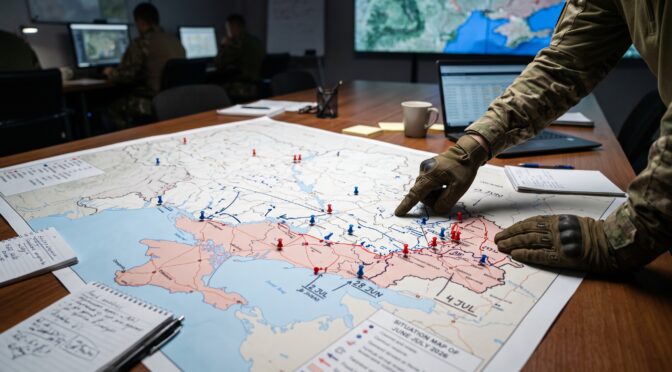
Tactical engagements across the 1,000-kilometer front were characterized by heavy Russian artillery and aerial bombardment supporting localized, dismounted infantry assaults. Mechanized maneuver has been largely abandoned in contested sectors due to ubiquitous drone surveillance, dense mining, and precision strike capabilities.2
The Northern Axis (Sumy and Kharkiv Oblasts): The operational objective of the Russian Northern Grouping of Forces remains the establishment of a defensible buffer zone to protect Belgorod Oblast and to advance within continuous tube artillery range of Kharkiv City.2 Operations in northern Sumy and Kharkiv oblasts yielded no confirmed territorial advances during the reporting period.2 Russian forces intensified cross-border infiltration attempts near Kozacha Lopan, Dekhtyarne, and Vovchansk, primarily intending to tie down Ukrainian reserves and prevent their lateral redeployment to priority sectors in Donetsk.2 Ukrainian forces maintained a robust defense in Kindrativka, Andriivka, and Ryzhivka, utilizing extensive FPV drone networks to interdict Russian movements.2
Notably, Russian frontline elements in this sector are experiencing acute fuel shortages due to targeted Ukrainian strikes on logistics hubs. To conserve limited fuel reserves for essential electrical generators, Russian forces have been forced to conduct assault logistics and resupply on foot, drastically increasing infantry exposure to Ukrainian drone strikes.1 The Russian Aerospace Forces (VKS) continued heavy reliance on FAB-500 guided glide bombs against Ukrainian positions in Krasnopillya and surrounding areas, attempting to substitute precision artillery with mass aerial bombardment.2
The Eastern Axis (Oskil River and Donetsk Oblast): The urban environs of Kostyantynivka remain the assessed Russian main effort for the spring-summer 2026 campaign, serving as the gateway to the broader Ukrainian Fortress Belt.2 By the end of June, Russian forces maintained a presence in approximately 36.98 percent of Kostyantynivka, representing 76.73 percent of their total theater-wide gains for the month.2 However, this presence consists primarily of small, isolated groups of infiltrators rather than a consolidated, continuous frontline. Ukrainian military sources indicate that defending forces significantly outnumber Russian infiltrators within the city limits.20 Despite this operational reality, President Putin held a highly publicized meeting with Chief of the General Staff Valery Gerasimov late on July 3, falsely claiming the complete seizure of Kostyantynivka.20 Intelligence assesses this claim as a cognitive warfare operation deliberately timed to influence Western media cycles during the United States July 4th holiday weekend.20
In the Kupyansk and Oskil River directions, Russian forces failed to advance. A Russian milblogger implicitly refuted Putin’s June 28 claims that Russian forces had encircled Ukrainian servicemembers in Kupyansk-Vuzlovyi, confirming that advances are severely lagging behind public statements.2 Geolocated footage confirms that Ukrainian forces have successfully cleared previous Russian infiltrators from central and eastern Kupyansk-Vuzlovyi.2
In the Pokrovsk and Novopavlivka directions, Russian forces have entirely ceased utilizing armored vehicles for assaults due to catastrophic losses from Ukrainian FPV drone swarms. Consequently, Russian commanders are attempting multi-directional infiltrations utilizing ill-equipped, dismounted infantry.2 Ukrainian forces continue to conduct successful localized counterattacks across these axes, striking Russian drone control posts near Udachne, Novooleksandrivka, and Pokrovsk to disrupt the Russian operational tempo.2
The Southern Axis (Zaporizhia and Kherson Oblasts): Operations in western Zaporizhia, specifically around Hulyaipole and Orikhiv, resulted in no Russian gains, and in some micro-sectors, slight Ukrainian advances were recorded.20 The Russian Ministry of Defense repeatedly exaggerated advances in this theater, falsely claiming the seizure of Rivne by the 394th Motorized Rifle Regiment and Lisne by the 39th Separate Motorized Rifle Brigade—settlements located up to nine kilometers behind established Ukrainian defensive lines.2 Ukrainian forces maintained tactical initiative in the deep rear, striking logistics bridges near Azovske and rendering key transit routes, such as the M-14 Rostov-Crimea highway near Novoazovsk, partially impassable.2
Table 1: Assessed Territorial Changes and Main Effort Status (June – July 2026)
| Frontline Sector | Assessed Russian Objective | June 2026 Territorial Change | Strategic Status / Dominant Tactic |
| Sumy/Kharkiv Borders | Buffer zone creation; artillery range on Kharkiv | 0 sq km (No confirmed gains) | Fixation operations; infiltration; dismounted logistics due to severe fuel constraints.2 |
| Kupyansk/Oskil | Cross Oskil River; sever Ukrainian logistics | Minor tactical fluctuations | Stagnant; Ukrainian counterattacks clearing previous Russian infiltrator gains.2 |
| Kostyantynivka | Secure Fortress Belt gateway (Main Effort) | Infiltration of ~36.98% of urban area | High-attrition urban combat; false Kremlin declarations of complete seizure.2 |
| Pokrovsk/Donetsk | Complete seizure of Donetsk Oblast | < 5 sq km (Incremental gains) | Armor deployment halted due to UAV threat; multi-axis dismounted infantry waves.2 |
| Zaporizhia (Orikhiv) | Push front out of range of land-bridge logistics | 0 sq km (Net loss in some sectors) | Positional defense; heavy Ukrainian intermediate-range logistical interdiction.2 |
The 40-Day Deep-Strike Campaign & Maritime Security
In late June, Ukrainian President Volodymyr Zelensky explicitly authorized a fixed-duration, 40-day intermediate- and long-range strike campaign against the Russian Federation.9 Described strategically as a targeted “influence operation,” the campaign aims to disrupt Russian logistics, energy processing, and defense manufacturing infrastructure to generate acute domestic economic friction and compel Moscow toward genuine peace negotiations.8 This campaign marks a doctrinal evolution, representing the first time Ukraine has publicly attached a specific operational timeframe to its deep-strike strategy, signaling a highly coordinated, sustained effort rather than isolated, opportunistic raids.9
The operational execution of this campaign has been extensive, prioritizing targets previously considered secure deep within the Russian interior. Ukrainian Unmanned Systems Forces (USF) and missile commands have targeted vital nodes up to 1,000 kilometers from the Ukrainian border. High-profile strategic strikes leading into and during this reporting period included the AVT-6 primary oil refining unit of the Lukoil-Nizhegorodnefteorgsintez Oil Refinery in Kstovo, Nizhny Novgorod Oblast (780 kilometers from the border), and the Starolikeevo Linear Production and Dispatching Station, a critical hub for transporting fuel to central Russia.1 Additional successful strikes targeted the Ufa oil facility and the Slavyansk Oil Refinery in Krasnodar Krai, where battle damage assessments confirmed the destruction of four high-capacity tanks (35,000 cubic meters) and damage to nine others.21
The campaign has also severely degraded Russian command, control, and communications (C3) infrastructure. Under the command of Major Robert “Magyar” Brovdi, the USF executed consecutive strikes against the Dubna Space Communications Center in Moscow Oblast and the “Vladimir” Central Communications Center in Gus-Khrustalny.2 These strikes disabled two of Russia’s five primary satellite communication nodes, severely degrading the Russian military’s capacity for strategic reconnaissance and battlefield coordination in Ukraine.10 Furthermore, Ukrainian forces executed a precision strike against the Titan-Barrikady ballistic missile development and production plant in Volgograd, directly degrading Russia’s capacity to manufacture launchers for Iskander-M and Topol-M systems.10
In occupied Crimea, continuous Ukrainian intermediate strikes targeting energy substations (including critical nodes in Donuzlav, Feodosiiska, and Zahidno-Krymska) and the Kerch Strait crossing have triggered a localized state of emergency.1 Operations at critical infrastructure facilities have been forcibly halted due to severe fuel shortages and rolling power outages.1
In the maritime domain, international pressure intensified as the United States allowed temporary sanctions waivers to expire in mid-June, officially reimposing strict sanctions against Russian seaborne oil exports, targeting major producers like Rosneft and Lukoil.10 Concurrently, intelligence reports indicate a dangerous escalation in Russian hybrid warfare tactics. The Russian Main Intelligence Directorate (GRU) is actively utilizing its maritime “shadow fleet” of merchant vessels operating in international waters as offshore launch platforms, recovery decks, and signal repeaters for drone incursions into NATO airspace.1 This orchestrated “Phase Zero” hybrid campaign has logged over 144 drone incursions into European airspace (including French and British military bases) between August 2024 and early 2026, designed to probe Western air defense response times and erode NATO cohesion without crossing the legal threshold of open armed conflict.1
Role of Third-Party Countries
Western allies have recognized the shifting attritional reality of the conflict and have accelerated their defense industrial integration with Kyiv, focusing less on draining finite existing stockpiles and more on directly capitalizing Ukraine’s sovereign manufacturing capacity.
At the broader alliance level, the NATO Washington Summit formalized the establishment of the NATO Security Assistance and Training for Ukraine (NSATU), a new structure designed to coordinate 80 percent of all military assistance and training provided to Kyiv, institutionalizing long-term support.7 Denmark led the strategic pivot regarding direct investment by officially announcing its 30th military support package, valued at approximately 4.4 billion Danish kroner ($672 million).24 Crucially, 1.3 billion DKK ($198.6 million) of this package is allocated via the newly established “Danish Model”.26 This mechanism directly finances Ukraine’s domestic defense industry to manufacture and procure drones, artillery systems, and ammunition internally.27 This paradigm shift bypasses Western logistical bottlenecks, stimulates the Ukrainian wartime economy, and drastically reduces delivery times to the front line compared to foreign procurement.27 The package also specifically allocates funding for long-range artillery ammunition, highlighting the operational requirement for deep-interdiction fires.27 Danish Defense Minister Jeppe Bruus visited Kyiv to finalize an impending Drone Deal with President Zelensky, further solidifying this bilateral industrial integration.28
In the United States, legislative efforts to sustain long-term aid advanced. Representative Gregory Meeks introduced the Ukraine Support Act, proposing $8 billion in military financing loans and extending the Ukraine Security Assistance Initiative (USAI) through 2027 to mitigate domestic political volatility regarding aid appropriations.29 Concurrently, the administration is finalizing a distinct $400 million USAI package to procure equipment and ammunition directly from United States defense contractors, shifting away from immediate Presidential Drawdown Authority to preserve domestic stockpiles.29
The European Union also accelerated its financial and punitive support mechanisms. The EU initiated the disbursement of a €6 billion tranche as part of a broader €90 billion support loan to immediately fortify Kyiv’s defenses.30 In direct response to the devastating July 1-2 Russian strikes on Kyiv, EU High Representative Kaja Kallas announced proposals for aggressive new sanctions specifically targeting five corporate entities and one individual involved in developing and manufacturing components for Russian Shahed and Geran drones, emphasizing that the EU will continue to raise the economic cost of the war.32
Table 2: Key Third-Party Material & Financial Support Mechanisms (Current Week)
| Providing Entity | Mechanism / Legislation | Value | Strategic Focus / Impact |
| NATO | NSATU Command Structure | N/A | Assumes coordination of 80% of all military assistance and training provided to Ukraine.7 |
| Denmark | 30th Military Aid Package (“Danish Model”) | 4.4B DKK ($672M) | Direct investment in Ukrainian sovereign arms manufacturing; long-range artillery prioritization.27 |
| United States | Ukraine Support Act (Proposed) | $8.0B (Loans) | Securing long-term USAI funding through 2027; mitigating domestic political funding delays.29 |
| United States | USAI Procurement Package | $400M | Direct procurement from the United States defense industrial base rather than presidential stockpile drawdown.29 |
| European Union | Support Loan Tranche | €6.0B | Initial disbursement from the €90B broader mechanism to fortify Kyiv’s immediate air defenses.31 |
3. Drone Warfare and Unmanned Systems
Tactical & Strategic Deployments
The volume, complexity, and lethality of drone warfare escalated dramatically during the reporting period, reflecting continuous tactical adaptation by both combatants. On the night of July 1 to 2, Russian forces conducted one of the largest single strike series of the war, launching an estimated 570 drones and missiles against Ukrainian territory.1 This massive package included 496 strike and decoy drones alongside dozens of ballistic and cruise missiles, primarily targeting Kyiv City.1 Despite Ukrainian air defenses successfully intercepting the vast majority of the threats, the sheer volume overwhelmed localized defense nodes, resulting in at least 27 civilian fatalities, over 90 injuries, and the complete destruction of a major Red Cross humanitarian warehouse containing $1.76 million in vital medical supplies.1 Beyond the warehouse, the massive July 1-2 strike directly hit over 20 buildings in Kyiv, including the relocated Donetsk Oblast Intensive Care Hospital, an ambulance station, and a scientific institute.1
The operational tempo of Russian strikes fluctuated notably in June; after intense daily barrages in May, large-scale packages (defined as over 300 munitions per launch) only occurred twice in June prior to the massive July strike.1 Intelligence assesses this operational pause was likely utilized by the Russian military command to deliberately stockpile munitions, refine targeting intelligence, and allow the integration of new technological adaptations into the strike packages to maximize saturation and overwhelm Ukrainian air defense interceptor ratios.1
Technical Profile of Systems
The technological landscape of long-range strike capabilities is rapidly evolving, driven by rapid indigenous innovation cycles. Ukraine has achieved significant strategic success with its newly deployed indigenous FP-5 “Flamingo” heavy cruise missile.10 Providing Ukraine with its most advanced sovereign deep-strike capability, the Flamingo relies on a simplified design optimized for rapid mass production.35 The system utilizes solid rocket fuel (produced via a subsidiary in Denmark) and repurposed Ivchenko AI-25 engines.35 The weapon features a massive 6,000-kilogram takeoff weight and carries a 1,150-kilogram warhead.35 Crucially, the Flamingo utilizes an unjammable inertial guidance system for the midcourse phase, transitioning to a Soviet-era infrared terminal seeker derived from the Neptune anti-ship missile to home in on thermal signatures.36 Despite operational drawbacks compared to Western systems like the Tomahawk—such as a 20 to 40-minute pre-launch preparation time—the Flamingo’s low-altitude, over-water flight profile has repeatedly defeated advanced Russian air defense networks, including the Pantsir-S1.10 This success is heavily predicated on Russia’s critical shortage of operational A-50 AWACS radar aircraft, limiting their ability to detect low-flying threats.10
Conversely, Russia is aggressively iterating on its Iranian-designed Shahed platform to outpace Ukrainian countermeasures. Russian forces are increasingly deploying Shahed-type drones equipped with jet engines in their overnight packages.1 These upgraded variants cruise at speeds of up to 500 kilometers per hour, rendering them effectively invulnerable to standard Ukrainian mobile fire groups utilizing heavy machine guns, forcing Kyiv to expend highly valuable, critically scarce surface-to-air missiles or rely on limited fighter interceptor sorties.1 Furthermore, Russian engineers have shifted the operating frequencies of Shahed drones targeting Kyiv to the 3,900–4,100 megahertz (MHz) band specifically to bypass established Ukrainian electronic warfare (EW) suppression perimeters.1
Russian forces are also rapidly deploying the VT-40 “Vanguard” fiber-optic FPV drone. By utilizing a physical spool of fiber-optic cable for data transmission rather than a radio link, the VT-40 is completely immune to electronic warfare jamming and maintains a high-quality video feed to the operator, though the physical tether inherently limits its operational range to around 30 kilometers.
Due to localized internal shortages of more sophisticated strike drones, Russian frontline units have also resorted to extreme field improvisations, such as strapping halved TM-62 anti-tank mine warheads to rudimentary Molniya fixed-wing FPV drones for tactical engagements in Kharkiv Oblast.1 Highly expendable at an estimated cost of merely $300 to $400 per unit, the Molniya relies on overwhelming swarm tactics. Notably, intelligence indicates Russia has recently deployed a fully autonomous variant of the Molniya lacking a radio control antenna entirely, relying solely on an onboard computer and camera, rendering it invisible to Ukrainian electronic warfare suppression.
Table 3: Prominent Novel Unmanned/Strike Systems (July 2026 Profile)
| System Name | Origin | Range / Speed | Payload / Role | Strategic Significance |
| FP-5 Flamingo | Ukraine | Up to 3,000 km | 1,150 kg Warhead / Heavy cruise missile | Escapes Western geopolitical use-restrictions; utilizes unjammable inertial guidance.35 |
| Jet-Engine Shahed | Russia (Iran-design) | Up to 500 km/h | Kamikaze strike drone | Evades ground-based mobile fire groups due to high velocity; forces costly SAM expenditure.1 |
| VT-40 Vanguard | Russia | 7 – 30 km | Kamikaze FPV | Utilizes a fiber-optic tether, rendering it completely immune to EW jamming. |
| Molniya (Autonomous) | Russia | 30 – 40 km | TM-62 Mine (Halved) | Extremely low cost ($300-$400); recent variants lack radio antennas, bypassing EW defenses. |
Targeting Priorities & Countermeasures
Targeting profiles between the combatants exhibit clear strategic divergence. Ukraine maintains strict adherence to degrading the Russian military-industrial base, C3 nodes, and petroleum refining infrastructure, systematically dismantling the logistics required to sustain offensive operations.2 Ukrainian forces are also prioritizing the destruction of high-value Russian air defense and radar assets, successfully destroying a Pantsir-S1 near Feodosia and an ST-68 radar, systematically blinding Russian airspace coverage over occupied Crimea.2
Meanwhile, Russia is attempting to replicate the economic strain by heavily targeting Ukrainian civilian gas stations in frontline oblasts like Kharkiv and Zaporizhia to paralyze local logistics and induce civilian panic, while continuing terror-bombardment of residential sectors and agricultural infrastructure.1 Electronic warfare remains a highly fluid domain, with both sides rapidly adjusting frequencies and integrating fiber-optic tethers or autonomous terminal guidance computers to maintain strike efficacy and bypass standard countermeasures.
4. Resource Utilization, Constraints, and Sustainability
Manpower Dynamics and Logistics
The human toll of the conflict has reached staggering proportions, fundamentally altering force generation capabilities and demographic sustainability. According to compiled open-source intelligence and data from the Center for Strategic and International Studies (CSIS), the Russian military has suffered approximately 1.4 million battlefield casualties (including up to 450,000 fatalities) since the initiation of the full-scale invasion in February 2022.38 Ukrainian forces have incurred between 525,000 and 625,000 casualties, with an estimated 125,000 to 150,000 fatalities.38
While the historical war-to-date casualty ratio hovered between 2:1 and 3:1 in favor of Ukraine, the ratio has dramatically skewed to nearly 8:1 in the first half of 2026.38 This shift reflects the severe attritional nature of Russia’s current operational doctrine, which relies heavily on unsupported, dismounted infantry infiltrations against entrenched Ukrainian positions.2 Data indicates a catastrophic decline in Russian offensive efficiency. In June 2026, Russian forces suffered 39,490 casualties (killed and wounded in action) to capture merely 30.42 square kilometers of territory.2 This translates to an unsustainable operational cost of approximately 1,298 casualties per square kilometer gained.2 By direct comparison, in June 2025, Russia seized 481.25 square kilometers while suffering 32,680 casualties, equating to 68 casualties per kilometer.2 The data demonstrates a more than 19-fold increase in the human cost of territorial acquisition year-over-year, which underscores the culminating state of the Russian offensive apparatus.
This extreme personnel drain is compromising Russia’s broader strategic posture. Ukrainian Commander-in-Chief Gen. Oleksandr Syrskyi reported that the Russian military command has been forced to scale back long-term plans to expand its strategic reserves and form new divisions; instead, newly generated forces are being immediately funneled into the theater merely to replace catastrophic frontline losses and maintain basic unit cohesion.1
Industrial Capacity and Economics
Ukraine’s precision strikes on oil infrastructure are generating severe macroeconomic friction for Moscow, creating a paradoxical energy crisis within one of the world’s premier petroleum exporters. By systematically striking primary refining units, Ukraine has plummeted Russia’s domestic gasoline production capacity.2 This has resulted in a scenario where Russian seaborne crude exports surged in June 2026 to 4.13 million barrels per day (the highest volume since early 2022) precisely because the crude cannot be refined domestically into usable fuel.2 Consequently, an excess of 133 million barrels of Russian oil is currently idling at sea on tankers accumulating off the coasts of Singapore and Egypt, as Moscow struggles to secure buyers in a saturated market.2 Gross weekly revenues from these crude exports have plummeted to $1.9 billion, the lowest figure recorded since March 2026, indicating that Russia cannot offset lower global oil prices by merely exporting unrefined supply.2
The domestic fuel shortage is so acute that Russia has been forced to import refined gasoline to sustain its civilian economy and military logistics. India dispatched at least 60,000 metric tons of refined gasoline to Russia in June, and Moscow is actively seeking to import up to 400,000 tons monthly from international partners, including Belarus.2 Concurrently, Indian imports of Russian crude surged to a record 2.70 million barrels per day.2 This dynamic indicates that Russia is effectively utilizing India as an offshore refining proxy to partially recover the capacity lost to Ukrainian drone strikes.
Table 4: Russian Materiel Attrition (June 2025 vs. June 2026)
| Asset Category | Losses (June 2025) | Losses (June 2026) | Year-on-Year Increase Factor | Strategic Implication |
| Fuel Vehicles / Tanks | 3,395 | 12,867 | 3.8x | Direct consequence of Ukrainian intermediate-range logistical interdiction and deep strikes.2 |
| Artillery Systems | 1,243 | 2,053 | 1.65x | Degradation of Russian counter-battery capabilities; forces reliance on inaccurate glide bombs.2 |
| UAVs / Drones | 4,581 | 60,849 | 13.3x | Intensive EW environment and proliferation of cheap interceptor solutions driving massive attrition.2 |
Occupational Administration and Societal Constraints
Within occupied Ukraine, the Russian administration continues to aggressively institutionalize bureaucratic control and societal militarization. The Zaporizhzhia Nuclear Power Plant (ZNPP) occupation administration launched targeted summer programs in Sevastopol designed to assimilate Ukrainian high school graduates from Enerhodar and Melitopol into Russia’s nuclear workforce, a long-term strategy to legitimize the occupation of Ukrainian nuclear infrastructure.1 Furthermore, Russian authorities completed the evacuation of the Artek International Children’s Camp in occupied Crimea, temporarily deporting Ukrainian participants to camps in Krasnodar Krai—a continuation of documented forcible transfer policies aimed at cultural eradication.1
In the educational sector, Russian Minister of Education Sergei Kravtsov announced that the proportion of compulsory military instruction within the “Fundamentals of Security and Protection of the Motherland” (OBZR) curriculum for occupied schools has been increased to 50 percent, normalizing the militarization of Ukrainian youth and preparing them for future conscription.1 Concurrently, the Federal Security Service (FSB) maintains strict internal security through violent crackdowns, as evidenced by recent arrests of civilians in Mariupol and Polohy on fabricated espionage charges, leveraging the Russian legal system for widespread lawfare against perceived dissenters, including placing Ukrainian minors on terrorist watchlists.1 The occupation administration is also weaponizing financial incentives to alter demographics; Russian federal programs, such as the “Zemsky Teacher” initiative, are paying Russian citizens up to two million rubles ($26,000) to relocate to occupied regions like Kherson and Luhansk to fill administrative and educational roles.39
Strategic Sustainability Projection
The convergence of economic strain, staggering casualties, and an inability to achieve operational breakthroughs on the battlefield is actively manifesting in Russian domestic sentiment. Yandex (Russia’s primary search engine) metrics for queries asking “when will the war end” reached a record high of 137,000 requests in late June, originating largely from Moscow and St. Petersburg—regions where the Kremlin has largely failed to defend against long-range Ukrainian strikes.1 Kremlin-linked polling data from the Public Opinion Forum (FOM) simultaneously indicated a 5 percent drop in President Putin’s approval rating (falling to 69 percent), acknowledging growing domestic discontent.1 While the Russian state remains highly resilient, authoritarian, and capable of generating combat power in the short term, the current trajectory—sacrificing strategic reserves and critical refining capacity for incremental tactical gains—is mathematically unsustainable over the long term, rendering the conflict highly sensitive to the continuation of Western financial and military underwriting of Ukrainian defense capabilities.
5. Chronological Timeline of Key Events
- June 28, 2026: Russian President Vladimir Putin addresses the United Russia Party, projecting inevitable military victory and explicitly rejecting diplomatic solutions to end the war.37 Ukrainian forces strike the Slavyansk Oil Refinery in Krasnodar Krai, destroying four high-capacity fuel tanks and damaging nine others.21
- June 29, 2026: President Putin acknowledges in an interview that the August 2025 Alaska Summit resulted in no signed agreements, signaling the collapse of the “Anchorage Understandings” following the G7 Summit.19 Ukrainian forces strike a Russian drone control point near Veselaya Lopan, Belgorod Oblast, and an ST-68 radar in occupied Feodosiya.2
- June 30, 2026: Denmark officially announces a 4.4 billion DKK ($672 million) military aid package, largely financing Ukraine’s domestic defense industry via the “Danish Model”.25 Ukrainian Unmanned Systems Forces strike the Dubna Space Communications Center near Moscow for the second time, degrading Russian satellite C3 nodes.2 Ukrainian President Zelensky publicly details the 15 failed deadlines the Kremlin has set for seizing Donetsk Oblast since 2022.2
- July 1, 2026: Russian authorities unilaterally close seven railway border crossings with Finland, Latvia, and Estonia for unspecified reasons.2 CSIS releases comprehensive data indicating Russian battlefield casualties have reached 1.4 million since the invasion began.38 The European Union begins disbursing €6 billion to strengthen Kyiv’s defenses as part of a broader support loan.30
- July 2, 2026: Russia launches a massive, 570-munition drone and missile strike against Ukraine, heavily targeting Kyiv, resulting in at least 27 civilian deaths and the destruction of a major Red Cross humanitarian warehouse.1 EU High Representative Kaja Kallas proposes new sanctions targeting entities manufacturing components for Russian Shahed and Geran drones in response to the strikes.32
- July 3, 2026: Russian President Putin prematurely claims the complete capture of Kostyantynivka in a meeting with Valery Gerasimov, a claim thoroughly refuted by battlefield evidence showing Russia controls only ~36 percent of the city via unconsolidated infiltration.20 Russian guided bombs strike a civilian residential area in Sumy, causing multiple casualties, including children.40
- July 4, 2026: Air raid sirens remain active in Sumy as Russian forces launch follow-on Shahed drone attacks toward the city while emergency services continue clearing rubble and conducting rescue operations from the July 3 guided bomb strikes.40
Please share the link on Facebook, Forums, with colleagues, etc. Your support is much appreciated and if you have any feedback, please email us in**@*********ps.com. If you’d like to request a report or order a reprint, please click here for the corresponding page to open in new tab.
Sources Used
- Russian Offensive Campaign Assessment, July 2, 2026 | ISW, accessed July 4, 2026, https://understandingwar.org/research/russia-ukraine/russian-offensive-campaign-assessment-july-2-2026/
- Russian Offensive Campaign Assessment, July 1, 2026| ISW, accessed July 4, 2026, https://understandingwar.org/research/russia-ukraine/russian-offensive-campaign-assessment-july-1-2026/
- Trump may walk away from “Anchorage understandings” – Axios, accessed July 4, 2026, https://www.pravda.com.ua/eng/news/2026/06/27/8041398/
- Russia Analytical Report, June 22–29, 2026, accessed July 4, 2026, https://www.russiamatters.org/news/russia-analytical-report/russia-analytical-report-june-22-29-2026
- Ukraine says any Anchorage understandings between Putin, Trump are ‘certainly dead now’, accessed July 4, 2026, https://www.aa.com.tr/en/russia-ukraine-war/ukraine-says-any-anchorage-understandings-between-putin-trump-are-certainly-dead-now/3980601
- Russia wants to know if Trump has shifted his stance on Ukraine war after G7, Lavrov says, accessed July 4, 2026, https://whbl.com/2026/06/24/russia-wants-to-know-if-trump-has-shifted-his-stance-on-ukraine-war-after-g7-lavrov-says/
- How NATO’s role in supporting Ukraine is growing and who within the Alliance is responsible for it, accessed July 4, 2026, https://www.eurointegration.com.ua/eng/news/2026/07/3/7240921/
- Ukraine war briefing: Zelenskyy declares 40-day Russia blitz to ‘influence the aggressor state’, accessed July 4, 2026, https://www.theguardian.com/world/2026/jun/26/ukraine-war-briefing-zelenskyy-40-day-russia-blitz
- Zelenskyy’s new war plan: Ukraine launches 40-day deep-strike campaign inside Russia, accessed July 4, 2026, https://timesofindia.indiatimes.com/defence/international/zelenskyys-new-war-plan-ukraine-launches-40-day-deep-strike-campaign-inside-russia/articleshow/132030610.cms
- Russian Offensive Campaign Assessment, June 27, 2026 | ISW, accessed July 4, 2026, https://understandingwar.org/research/russia-ukraine/russian-offensive-campaign-assessment-june-27-2026/
- Three Ukrainian FP-5 «Flamingo» cruise missiles successfully struck Russian Federal Scientific and Production Center “Titan-Barikady” in Volgograd this morning. 5 FP-5 “Flamingo” missiles were used in the attack, at least 3 of which reached and hit the target. 27.06.2026 : r/ukraine – Reddit, accessed July 4, 2026, https://www.reddit.com/r/ukraine/comments/1uh31in/three_ukrainian_fp5_flamingo_cruise_missiles/
- Alaska summit: a victory for Putin, concessions from Trump | OSW Centre for Eastern Studies, accessed July 4, 2026, https://www.osw.waw.pl/en/publikacje/analyses/2025-08-18/alaska-summit-a-victory-putin-concessions-trump
- 2025 Russia–United States summit – Wikipedia, accessed July 4, 2026, https://en.wikipedia.org/wiki/2025_Russia%E2%80%93United_States_summit
- Russia keeps citing a ‘spirit of Anchorage’ from last summer’s Trump–Putin summit, but that term exists only in Moscow’s vocabulary – Meduza, accessed July 4, 2026, https://meduza.io/en/feature/2026/02/11/russia-keeps-citing-a-spirit-of-anchorage-from-last-summer-s-trump-putin-summit-but-that-term-exists-only-in-moscow-s-vocabulary
- Russia wants to know if Trump has shifted his stance on Ukraine war after G7, Lavrov says, accessed July 4, 2026, https://kfgo.com/2026/06/24/russia-wants-to-know-if-trump-has-shifted-his-stance-on-ukraine-war-after-g7-lavrov-says/
- How the Trump-Putin summit in Alaska spawned the Kremlin’s myth of the ‘spirit of Anchorage’ — and why it collapsed, accessed July 4, 2026, https://meduza.io/en/feature/2026/07/03/how-the-trump-putin-summit-in-alaska-spawned-the-kremlin-s-myth-of-the-spirit-of-anchorage-and-why-it-collapsed
- Ukraine takes the war to Moscow: Why Kyiv unleashed its biggest attacks after G7 summit, accessed July 4, 2026, https://timesofindia.indiatimes.com/world/europe/ukraine-takes-the-war-to-moscow-why-kyiv-unleashed-its-biggest-attacks-after-g7-summit/articleshow/132114028.cms
- Axios: Trump hints at possible abandonment of Anchorage Agreements with Russia, accessed July 4, 2026, https://report.az/en/other-countries/axios-trump-hints-at-possible-abandonment-of-anchorage-agreements-with-russia
- Russian Offensive Campaign Assessment, June 29, 2026, accessed July 4, 2026, https://understandingwar.org/research/russia-ukraine/russian-offensive-campaign-assessment-june-29-2026/
- Russian Offensive Campaign Assessment, July 3, 2026 | ISW, accessed July 4, 2026, https://understandingwar.org/research/russia-ukraine/russian-offensive-campaign-assessment-july-3-2026/
- Russian Offensive Campaign Assessment, June 30, 2026 | ISW, accessed July 4, 2026, https://understandingwar.org/research/russia-ukraine/russian-offensive-campaign-assessment-june-30-2026/
- Russian Offensive Campaign Assessment, June 26, 2026 | ISW, accessed July 4, 2026, https://understandingwar.org/research/russia-ukraine/russian-offensive-campaign-assessment-june-26-2026/
- Ukraine’s 40-day missile and drone blitz heaps pressure and pain on Putin – Denver Gazette, accessed July 4, 2026, https://www.denvergazette.com/2026/07/02/ukraines-40-day-missile-and-drone-blitz-heaps-pressure-and-pain-on-putin/
- Denmark Provides New Military Aid Package to Ukraine, accessed July 4, 2026, https://nordicdefencesector.com/en/article/denmark-launches-military-support-package-for-ukraine-worth-44-billion-kronor
- Denmark launches $672 million military aid package for Ukraine, accessed July 4, 2026, https://www.internazionale.it/ultime-notizie-reuters/2026/06/30/denmark-launches-672-million-military-aid-package-for-ukraine
- Denmark to allocate nearly €600mn in military aid to Ukraine, accessed July 4, 2026, https://www.pravda.com.ua/eng/news/2026/06/30/8041821/
- Stalwart Denmark Announces 30th Military Aid Package for Ukraine – Kyiv Post, accessed July 4, 2026, https://www.kyivpost.com/post/79360
- Zelenskyy and Danish Defense Minister Discuss Impending Drone Deal and New Military Support for Ukraine – UNITED24 Media, accessed July 4, 2026, https://united24media.com/war-in-ukraine/zelenskyy-and-danish-defense-minister-discuss-impending-drone-deal-and-new-military-support-for-ukraine-20285
- US Lawmakers Advance Major Ukraine Aid Bill, Marking First Since Trump’s Return To Office, accessed July 4, 2026, https://www.rferl.org/a/33772022.html
- EU chief diplomat proposes new sanctions after Kyiv attack, accessed July 4, 2026, https://www.eurointegration.com.ua/eng/news/2026/07/2/7240811/
- European leaders condemn Russia’s latest strikes on Ukraine, reaffirm support for Kyiv, accessed July 4, 2026, https://www.aa.com.tr/en/europe/european-leaders-condemn-russias-latest-strikes-on-ukraine-reaffirm-support-for-kyiv/3984109
- New EU sanctions to target six individuals involved in production of Russian Shahed drones, accessed July 4, 2026, https://www.eurointegration.com.ua/eng/news/2026/07/2/7240849/
- Ukraine war briefing: Both sides vow to escalate fighting after Russia’s deadly Kyiv barrage, accessed July 4, 2026, https://www.theguardian.com/world/2026/jul/03/ukraine-war-briefing-both-sides-vow-to-escalate-fighting-after-russias-deadly-kyiv-barrage
- ISW Russian Offensive Campaign Assessment, July 2, 2026, accessed July 4, 2026, https://www.kyivpost.com/post/79475
- FP-5 Flamingo – Wikipedia, accessed July 4, 2026, https://en.wikipedia.org/wiki/FP-5_Flamingo
- The Flamingo FP-5 Ukraine Homemade Missile – YouTube, accessed July 4, 2026, https://www.youtube.com/watch?v=_OxyV-ifO-s&vl=en
- Russian Offensive Campaign Assessment, June 28, 2026 | ISW, accessed July 4, 2026, https://understandingwar.org/research/russia-ukraine/russian-offensive-campaign-assessment-june-28-2026/
- Russian Blood and Treasure: The Ballooning Costs of Putin’s War, accessed July 4, 2026, https://www.csis.org/analysis/russian-blood-and-treasure-ballooning-costs-putins-war
- Russian Occupation Update, July 2, 2026, accessed July 4, 2026, https://understandingwar.org/research/russia-ukraine/russian-occupation-update-july-2-2026/
- Russian Bomb Attack Kills At Least 4 In Ukraine’s Sumy As Zelenskyy Urges Greater Pressure On Moscow, accessed July 4, 2026, https://www.rferl.org/a/ukraine-russia-war-sumy-bomb-attack/33796590.html