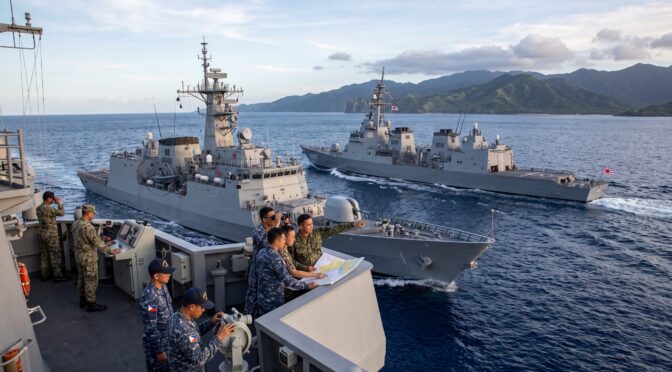
Executive Summary: The First Island Chain Flank & Shared Threat Perceptions
The strategic relationship between Japan and the Philippines has evolved from a primarily economic partnership into a robust and highly integrated defense architecture. Driven by the shared need to counter the People’s Republic of China’s (PRC) gray-zone coercion and maritime expansionism, Tokyo and Manila have aligned their defense postures across the First Island Chain (第一列島線, Dai-ichi Rettōsen). This synchronization treats the East China Sea, the Taiwan Strait, and the South China Sea—known in Manila as the West Philippine Sea (WPS)—as a single, interconnected theater of strategic competition.
For Japan, the stability of the Northern Philippines closely ties to the security of its vital sea lines of communication (SLOCs) and the territorial integrity of its Southwestern Islands (南西諸島, Nansei Shotō). As the People’s Liberation Army Navy (PLAN) shifts its doctrine from “Near Seas Defense” (近海防御, Jinhai Fangyu) to “Far Seas Protection” (远海防卫, Yuanhai Fangwei), it increasingly seeks access to the broader Pacific Ocean1. The Bashi Channel and Luzon Strait are critical deep-water chokepoints between Taiwan and Luzon2. If Beijing were to gain uncontested control over these straits, it could project naval power deep into the Philippine Sea, outflank Taiwan, and threaten the maritime trade routes that are essential to the Japanese economy1.
Japan’s 2026 Annual Defense White Paper (日本の防衛 令和8年版), released under Prime Minister Sanae Takaichi, identifies the Armed Forces of the Philippines (AFP) as a key frontline partner in the Indo-Pacific5. Through new legal frameworks and the provision of advanced equipment, Tokyo is supporting Manila’s Comprehensive Archipelagic Defense Concept (CADC). This assessment explores how Japan aims to integrate and operate alongside the Philippines to create a lethal “porcupine” defense network to deter PLA expansion2.
Part I: Legal, Institutional, & Command Frameworks for Defense Cooperation
This shift in Japan-Philippines security relations relies on a new legal and institutional architecture. This framework addresses historical constitutional limits and administrative hurdles that once hindered joint military operations and deployments.
1. The Reciprocal Access Agreement (RAA)
The cornerstone of this integration is the Japan-Philippines Reciprocal Access Agreement (相互アクセス協定 / RAA), which entered into force on September 11, 20257. The Philippines is only the third nation, after Australia and the UK, to sign such an agreement with Japan10.
The RAA streamlines administrative procedures and establishes legal jurisdiction for the Japan Self-Defense Forces (JSDF) and the AFP to deploy to each other’s territory. This pact was instrumental during the Balikatan 2026 exercises, where roughly 1,400 JSDF personnel participated in live-fire and amphibious drills in the Philippines—a significant moment for Japanese defense policy12.
2. Acquisition and Cross-Servicing Agreement (ACSA)
To support these deployments, the two nations signed the Acquisition and Cross-Servicing Agreement (物品役務相互提供協定 / ACSA) in early 20267. The ACSA allows for the reciprocal exchange of fuel, ammunition, and maintenance services during joint exercises and humanitarian missions12. By utilizing Philippine infrastructure, Japan can significantly extend its operational endurance in the South China Sea.
3. General Security of Military Information Agreement (GSOMIA)
Effective maritime domain awareness (MDA) requires secure data-sharing. In May 2026, Japan and the Philippines began formal negotiations for a General Security of Military Information Agreement (GSOMIA)7.
This pact will establish protocols to protect classified intelligence and reduce the risk of leaks17. It will allow for the rapid exchange of radar data and satellite imagery regarding Chinese naval movements across the First Island Chain18. This agreement complements a similar pact between the Philippines and the U.S., creating a trilateral intelligence-sharing network19.
4. Foreign and Defense Ministerial (2+2) Meetings & The CSP
These legal pacts are managed through Foreign and Defense Ministerial (2+2) meetings. Under Prime Minister Takaichi and President Marcos Jr., the relationship was elevated to a Comprehensive Strategic Partnership (CSP) in May 20267. The CSP ensures that both nations synchronize their procurement, operational doctrines, and regional deterrence strategies7.
Part II: Capacity Building, Equipment Transfers, & Official Security Assistance (OSA)
Japan’s support for Philippine defense has grown from symbolic gestures to substantial material aid. This includes financial grants and the transfer of advanced hardware to improve the AFP’s maritime and aerial surveillance capabilities.
1. The Legal Catalyst: Revision of the Three Principles
The scope of this assistance expanded in April 2026 when the Takaichi cabinet revised the Three Principles on Transfer of Defense Equipment and Technology6. Previously, exports were limited to non-lethal categories like rescue and surveillance6.
The revision now allows the direct export of lethal weapon systems to 17 allied nations, including the Philippines6. This change transforms Japan from a provider of surveillance gear into a supplier of comprehensive combat capabilities.
2. Official Security Assistance (OSA) Grants
To fund these transfers, Japan established the Official Security Assistance (OSA) framework in 2023. Unlike traditional aid, OSA specifically funds the militaries of partner nations15.
The Philippines was the first recipient of the OSA program. Initial grants provided ¥600 million for coastal radars26, followed by ¥1.6 billion for additional defense equipment and inflatable boats in late 202427. The Japan International Cooperation System (JICS) manages these grants.
3. Air Surveillance & Radar Interoperability
A key project in this partnership is the Horizon 2 Air Surveillance Radar System. Through a $103.5 million deal, Mitsubishi Electric Corporation (MELCO) is supplying four advanced radar systems to the Philippine Air Force (PAF)28.
- J/FPS-3ME (Fixed Radars): The PAF received three fixed active phased array radars. The J/FPS-3ME has a range of 610 kilometers and can track high-altitude targets and ballistic trajectories29. The first unit is operational in La Union, with others planned for Zamboanga, Cagayan, and Camarines Norte28.
- J/TPS-P14ME (Mobile Radar): To ensure resilience, the PAF received a mobile AESA radar in 202428. With a 400-kilometer range, this truck-mounted system allows the AFP to quickly cover sensor gaps and maintain surveillance even if fixed sites are targeted32.
These Japanese radars integrate with the PAF’s existing Israeli systems to create a comprehensive early warning network. This coverage allows the AFP to monitor aircraft operating within the Philippine Air Defense Identification Zone (PADIZ), particularly in sensitive areas like the Bashi Channel2.
4. Coastal Defense & Naval Capability Upgrades
Following the 2026 export revisions, Tokyo and Manila began negotiating the transfer of major naval and aerial platforms to address critical AFP capability gaps.
- Abukuma-class Destroyer Escorts: Japan has agreed in principle to transfer up to five Abukuma-class destroyer escorts to the Philippines starting in 202734. These ships, designed for anti-submarine warfare (ASW), will provide the Philippine Navy with a significant blue-water capability37.
- TC-90 Maritime Patrol Aircraft: Building on a previous transfer of five TC-90s, Manila is seeking five more from Japan to expand its maritime surveillance over contested waters38.
- Coast Guard Augmentation: Japan also supports the Philippine Coast Guard (PCG) through ODA loans. This includes financing for five 97-meter Teresa Magbanua-class vessels, which the Philippine Coast Guard uses to counter aggressive maneuvers in the West Philippine Sea40.
Part III: Operational Synergy & Geographic Chokepoint Defense
The integration of JSDF and AFP forces aims to secure the maritime chokepoints of the First Island Chain through tactical cooperation.
1. Luzon Strait & Bashi Channel Interdiction
The Bashi Channel is a preferred route for Chinese submarines entering the Pacific because its depth reduces the risk of detection4. To counter this, Japan and the Philippines have prioritized ASW and sensor monitoring in the Luzon Strait. By combining PAF radars, incoming Abukuma-class ships, and Japanese patrol aircraft, the alliance aims to establish a “tripwire” to track submerged vessels1.
To counter this strategic vulnerability, Japan and the Philippines have heavily prioritized Anti-Submarine Warfare (ASW) and seabed sensor monitoring in the Luzon Strait. By leveraging the overlapping coverage of PAF J/FPS-3ME radars in Northern Luzon, incoming Japanese Abukuma-class destroyers, and JMSDF P-1 and P-3C Orion maritime patrol aircraft flying from Okinawa, the bilateral alliance aims to establish a contiguous acoustic and electromagnetic tripwire across the strait1. This “mesh network” of distributed, persistent awareness is vital for prosecuting submerged PLAN contacts before they can achieve positional advantage in the Philippine Sea2.
2. The Comprehensive Archipelagic Defense Concept (CADC) & Land-Based Fires
Manila’s defense focus has shifted to the Comprehensive Archipelagic Defense Concept (CADC)9. This includes the use of shore-based anti-ship missiles by the Philippine Marine Corps (PMC) to deny access to coastal waters6.
This doctrine aligns with Japanese strategy. During the Balikatan 2026 exercises, the JGSDF deployed a Type 88 Surface-to-Ship Missile battery in Ilocos Norte14. The Type 88 has a range of up to 180 kilometers6. In a joint drill, the Japanese battery successfully struck a target ship located 75 kilometers offshore, demonstrating the ability to shut down the Luzon Strait in a crisis14.
The success of this exercise sent a strong signal to Beijing44. Furthermore, Japan is considering the export of surplus Type 88 systems to the Philippines, which would bolster Manila’s own coastal defenses and create a contiguous “denial envelope” along its western coast23.
3. Amphibious Rapid Deployment & Cybersecurity
Cooperation also extends to amphibious drills and cybersecurity. The JGSDF’s Amphibious Rapid Deployment Brigade (ARDB) frequently trains with the PMC on island-retaking and littoral maneuver43. Meanwhile, both nations are collaborating to defend digital infrastructure and communication cables through the Japan-U.S.-Philippines Cyber-Digital Dialogue20.
Simultaneously, recognizing the severe vulnerability of undersea communication cables and critical digital infrastructure in the South China Sea, Japan and the Philippines have instituted active cybersecurity cooperation. The AFP’s newly activated Cyber Command collaborates closely with Japanese cyber defense counterparts through the Japan-U.S.-Philippines Cyber-Digital Dialogue20. These joint efforts focus on defending critical industrial control systems, establishing resilient digital corridors against state-sponsored intrusions, and exploring satellite-based redundancies like Starlink to ensure command and control survivability during a conflict37.
Part IV: Multilateralizing Counter-Coercion (Trilateral & Minilateral Alignments)
Japan and the Philippines are part of a broader multilateral network designed to impose costs on maritime aggression and uphold international law.
1. U.S.-Japan-Philippines Trilateral Integration
The trilateral relationship between Washington, Tokyo, and Manila is the core of Indo-Pacific deterrence. The three nations conduct combined patrols in the Philippines’ EEZ to challenge blockade tactics and support freedom of navigation13. Coast guard exercises have also become routine9.
Additionally, the Luzon Economic Corridor initiative aims to build infrastructure connecting major ports. This corridor boosts the Philippines’ economic resilience and provides logistical support for allied operations during a crisis45.
2. The Squad & Minilateral Linkages
These bilateral pacts also serve as models for wider regional integration. The Philippines is expanding its engagement with Australia and South Korea. This collective front maintains a unified stance against maritime law violations, particularly in the South China Sea47.
5. Comparative Matrix & Operational Friction Analysis
While the strategic intent uniting Tokyo and Manila is resolute, the operationalization of the alliance faces distinct structural, financial, and mechanical frictions. The following matrix delineates the division of labor across key security domains, followed by a critical analysis of persistent operational bottlenecks.
Strategic Division of Labor Matrix
| Maritime Security Domain | Japan’s Contribution (Provision & Enablers) | Philippines’ Contribution (Geography & Execution) |
| Air / Maritime Domain Awareness | Supply of J/FPS-3ME & J/TPS-P14ME AESA radars; GSOMIA intelligence sharing; satellite imagery provision. | Geographic hosting of sensor sites (Luzon, Palawan); continuous monitoring; PADIZ enforcement. |
| Surface Patrol & Interdiction | ODA financing for 97m & 44m MRRVs; proposed transfer of Abukuma-class destroyers. | PCG frontline presence against CCG; gray-zone incident management and documentation in the WPS. |
| Littoral Strike & Sea Denial | Deployment of Type 88 SSM batteries for joint exercises; potential export of surplus ASCM systems. | CADC implementation; Coastal Defense Regiment operations; BrahMos integration and firing solutions. |
| Anti-Submarine Warfare (ASW) | Provision of TC-90 aircraft; JMSDF P-1/P-3C Orion wide-area sub-hunting patrols from Okinawa. | Intelligence cuing; integration of towed-array sonar (TASS) on offshore patrol vessels. |
| Logistics & Force Projection | Financial underwriting via OSA/ODA; ACSA cross-servicing; engineering and shipyard investments. | Provision of strategic basing access (EDCA sites, Subic Bay); troop staging areas via the RAA. |
Critical Friction Points & Absorptive Capacity
- Maintenance and Capacity: The biggest challenge for the AFP is the burden of maintaining advanced Japanese equipment. The Abukuma-class destroyers, for example, have complex gas turbine systems that the Philippine Navy currently lacks the infrastructure to support36. Without long-term technical support from Japan, these assets risk becoming unusable36.
- Budgetary Limits: While Japan’s OSA grants provide a start, the AFP’s modernization budget remains tight. Defending an archipelago of over 7,000 islands requires far more capital than is currently available for large-scale fleets and missile systems2.
- Political Sustainability: Despite easing export rules, Japan still faces domestic sensitivities regarding military operations. Every lethal equipment transfer must be carefully justified and reviewed by Japan’s National Security Council6. Sustaining this alignment will require continued political will in both Tokyo and Manila.
6. Comprehensive Bilingual Glossary
| Acronym / Japanese Term (Kanji / Rōmaji) / Filipino Term | Full English Term | Operational Definition & Strategic Significance |
| RAA (部隊間協力円滑化協定 / 相互アクセス協定, Sōgo Akusesu Kyōtei) | Reciprocal Access Agreement | A bilateral treaty establishing the legal status, jurisdiction, and administrative procedures for JSDF and AFP forces operating in each other’s territory, effectively enabling combat exercises and joint deployments. |
| OSA (政府安全保障能力強化支援, Seifu Anzen Hoshō Nōryoku Kyōka Shien) | Official Security Assistance | A Japanese grant framework designed specifically to provide defense equipment and infrastructure funding to the armed forces of allied nations, distinct from civilian ODA. |
| ACSA (物品役務相互提供協定, Buppin Ekimu Sōgo Teikyō Kyōtei) | Acquisition and Cross-Servicing Agreement | A logistics pact allowing the JSDF and AFP to share supplies, fuel, food, and services, drastically increasing the operational endurance and reach of bilateral deployments. |
| GSOMIA (軍事情報包括保護協定, Gunji Jōhō Hōkatsu Hogo Kyōtei) | General Security of Military Information Agreement | A binding intelligence-sharing treaty protecting classified military data, enabling real-time sensor-to-shooter integration and coordinated tracking of adversary forces. |
| CADC | Comprehensive Archipelagic Defense Concept | The AFP’s strategic doctrine is shifting focus from internal counter-insurgency to external territorial defense, emphasizing sea denial, coastal missiles, and multidomain awareness across the archipelago. |
| WPS | West Philippine Sea | The official Philippine designation for the eastern parts of the South China Sea that fall within the Philippines’ Exclusive Economic Zone (EEZ), the primary theater of PRC gray-zone coercion. |
| Three Principles (防衛装備移転三原則, Bōei Sōbi Iten San Gensoku) | Three Principles on Transfer of Defense Equipment and Technology | Japan’s constitutional guidelines for arms exports. The April 2026 revision authorized the export of lethal, finished weapons systems to specific allied partners, transforming Japan’s defense industrial posture. |
| JADGE (自動警戒管制組織, Jidō Keikai Kansei Soshiki) | Japan Aerospace Defense Ground Environment | Japan’s integrated air defense and radar network. The export of J/FPS-3ME radars to the Philippines effectively extends the technological architecture of JADGE into the First Island Chain. |
| Type 88 SSM (88式地対艦誘導弾, Hachihachi-shiki Chitaikan Yūdōdan) | Type 88 Surface-to-Ship Missile | A truck-mounted, sea-skimming coastal defense cruise missile (180km range) utilized by the JGSDF, demonstrated during Balikatan 2026 and is actively considered for export to the AFP. |
| ARDB (水陸機動団, Suiriku Kidōdan) | Amphibious Rapid Deployment Brigade | The JGSDF’s specialized marine infantry unit, tasked with defending and retaking remote islands, frequently conducts joint littoral maneuver operations with the Philippine Marine Corps. |
| First Island Chain (第一列島線, Dai-ichi Rettōsen) | First Island Chain | A strategic geographical concept denoting the first line of archipelagos off the East Asian continental coast, stretching from the Kuril Islands through Japan, Taiwan, and the Philippines, acting as a natural maritime barrier. |
Please share the link on Facebook, Forums, with colleagues, etc. Your support is much appreciated and if you have any feedback, please email us in**@*********ps.com. If you’d like to request a report or order a reprint, please click here for the corresponding page to open in new tab.
Sources Used
- NIDSコメンタリー 第331号 2024年6月21日 China’s Southwest Island Patrols: Freedom of Movement Through Encroachment – 防衛研究所, https://www.nids.mod.go.jp/publication/commentary/commentary331.html
- Shaping a Porcupine Defense Strategy for the Phillipines – SLDinfo.com, https://sldinfo.com/wp-content/uploads/2025/08/Shaping-a-Porcupine-Defense-Strategy-for-the-Phillipines-Print.pdf
- Northern Luzon in a Taiwan Flashpoint: The Philippines’ Place in U.S. Strategy – BearWorks – Missouri State University, https://bearworks.missouristate.edu/cgi/viewcontent.cgi?article=5208&context=theses
- Luzon Strait: Geopolitical Risk & Naval Transit Gateway – Ballast Markets, https://content.ballastmarkets.com/chokepoints/luzon-strait/
- Pamphlet, https://www.mod.go.jp/j/press/wp/wp2026/pdf/DOJ2026_Digest_EN.pdf
- Japan loosens the reins on defence exports – The International Institute for Strategic Studies, https://www.iiss.org/online-analysis/online-analysis/2026/04/japan-loosens-the-reins-on-defence-exports/
- Japan-Philippines Summit Meeting and Dinner | Ministry of Foreign Affairs of Japan, https://www.mofa.go.jp/s_sa/sea2/ph/pageite_000001_00012.html
- Are Japan Weapons Exports to Taiwan Conceivable in a Future Strait War?, https://globaltaiwan.org/2026/07/are-japan-weapons-exports-to-taiwan-conceivable-in-a-future-strait-war/
- The Philippine Defense Strategic Opportunity: Enabling Allied and Partner Innovation, https://defense.info/re-shaping-defense-security/2024/10/the-philippine-defense-strategic-opportunity-enabling-allied-and-partner-innovation/
- Signing of the Japan-Philippines Reciprocal Access Agreement, https://www.mofa.go.jp/s_sa/sea2/ph/pageite_000001_00432.html
- Japan-Philippines Relations (Archives), https://www.mofa.go.jp/region/asia-paci/philippine/archives.html
- Japan’s deepening defense ties with Philippines undermine peace and stability in Asia-Pacific – China Military, http://eng.chinamil.com.cn/2025xb/O_251451/16467509.html
- Japan–Philippines Defense Ministers’ Joint Press Statement, https://www.mod.go.jp/en/article/2026/05/c0c40bde5f7dfd22210039ff144e499272bb5a28.html
- Japan fires Type 88 anti-ship missile in Philippine exercise – Naval News, https://www.navalnews.com/naval-news/2026/05/japan-fires-type-88-anti-ship-missile-in-philippine-exercise/
- Japan–Philippines Acquisition and Cross-Servicing Agreement: Boosting Defence ties, https://idsa.in/publisher/comments/japan-philippines-acquisition-and-cross-servicing-agreement-boosting-defence-ties
- Domestic Political Conditions and the Acceleration of Japan-Philippines Security Cooperation, https://thesecuritydistillery.org/all-articles/domestic-political-conditions-and-the-acceleration-of-japan-philippines-security-cooperation
- Japan, Philippines Move Toward Intelligence Pact Amid China Concerns, https://en.tempo.co/read/2105793/japan-philippines-move-toward-intelligence-pact-amid-china-concerns
- Philippine leader’s state visit to Japan to focus on shoring up defense ties, https://www.japantimes.co.jp/news/2026/05/24/japan/politics/japan-philippines-marcos-takaichi-preview/
- EXPLAINER: What is a General Security of Military Information Agreement? – GMA Network, https://www.gmanetwork.com/news/topstories/nation/989375/security-military-information-agreement/story/
- Cybersecurity Profile 2025: The Philippines – Jackson School of International Studies, https://jsis.washington.edu/news/cybersecurity-profile-the-philippines/
- Three Principles on Transfer of Defense Equipment and Technology – Ministry of Foreign Affairs of Japan, https://www.mofa.go.jp/fp/nsp/page1we_000083.html
- Japan officially eases arms export rules – CGTN, https://news.cgtn.com/news/2026-04-21/news-1Mw1A8LRiWA/p.html
- Japan eyes sale to Manila of workhorse missile system, other equipment – Global News, https://globalnation.inquirer.net/323239/japan-eyes-sale-to-manila-of-workhorse-missile-system-other-equipment
- Outstanding Issues for Official Security Assistance (OSA) and its Strategic Utilization | List of Articles | International Information Network Analysis | SPF, https://www.spf.org/iina/en/articles/nishida_03.html
- Japan’s Official Security Assistance (OSA) – Indian Council of World Affairs, https://www.icwa.in/show_content.php?lang=1&level=3&ls_id=10210&lid=6512
- Annual Report 2024 – JICS, https://www.jics.or.jp/jics_html-e/profile/pdf/jics2024_e_print.pdf
- IP25005 | Japan’s Official Security Assistance to Southeast Asia: Limited Scope, but Real Impact – RSIS, https://rsis.edu.sg/rsis-publication/idss/ip25005-japans-official-security-assistance-to-southeast-asia-limited-scope-but-real-impact/
- Air Surveillance Radar Phase 2 Acquisition Project of the Philippine Air Force, http://www.phdefresource.com/2020/01/air-surveillance-radar-phase-2.html
- Assessment of the Philippines’ Maritime Domain Awareness Capabilities, https://www.scspi.org/en/dtfx/assessment-philippines%E2%80%99-maritime-domain-awareness-capabilities
- Discussing the Japanese J/FPS-3ME Radar of the Philippine Air Force, https://www.pitzdefanalysis.net/2023/04/discussing-japanese-jfps-3-radar-of.html
- Issues on the Air Surveillance Radar Project (Horizon 2) of the Philippine Air Force, http://maxdefense.blogspot.com/2019/05/issues-on-air-surveillance-radar.html
- Discussing the Japanese J/TPS-P14ME Mobile Radar of the Philippine Air Force, https://www.pitzdefanalysis.net/2024/06/discussing-japanese-jtps-p14me-mobile-radar-paf.html
- Philippines to order 4 long range air defense radars from Japanese company, https://www.asiapacificdefensejournal.com/2020/03/philippines-to-order-4-long-range-air.html
- (Today, July 7) Philippine Defense Minister Announces General Agreement with Japan for Transfer of 5 Abukuma-class destroyer escort : r/PhilippineMilitary – Reddit, https://www.reddit.com/r/PhilippineMilitary/comments/1upsa5d/today_july_7_philippine_defense_minister/
- Abukuma-class destroyer escort – Wikipedia, https://en.wikipedia.org/wiki/Abukuma-class_destroyer_escort
- Japan eyes first export of indigenous missile system amid closer ties with Philippines, https://www.japantimes.co.jp/news/2026/06/01/japan/japan-philippines-missiles-sales/
- SPARK by Stratbase Institute, https://adrinstitute.org/spark-by-adri/
- Philippines Seeks Five Japanese TC-90 Maritime Patrol Aircraft : r/PhilippineMilitary – Reddit, https://www.reddit.com/r/PhilippineMilitary/comments/1p7m3ya/philippines_seeks_five_japanese_tc90_maritime/
- 3 JMSDF TC-90s Transferred to the Philippine Navy, https://www.ph.emb-japan.go.jp/itpr_en/00_000509.html
- The Philippines’ Engagement with Japan: A Steady and Deepening Strategic Partnership, https://fulcrum.sg/the-philippines-engagement-with-japan-a-steady-and-deepening-strategic-partnership/
- Updates on the PAF’s Long Range Patrol Aircraft Acquisition – It looks like the P-3C Orion afterall – MaxDefense Philippines, http://maxdefense.blogspot.com/2015/05/updates-on-pafs-long-range-patrol.html
- Charting submarine routes in Southeast Asia | Cairn.info, https://shs.cairn.info/article/E_HER_176_0025?lang=en
- Philippine Marines Eye New Concept for Archipelagic Defense – Naval News, https://www.navalnews.com/naval-news/2024/08/philippine-marines-eye-new-concept-for-archipelagic-defense/
- Japan’s First Anti-Ship Missile Export? Type 88 Transfer to Philippines Could Reshape South China Sea and Taiwan War Calculus – Defence Security Asia, https://defencesecurityasia.com/en/japan-type-88-missile-philippines-export-south-china-sea-taiwan-first-island-chain/
- Diplomatic Bluebook | 3 Global Security – Ministry of Foreign Affairs of Japan, https://www.mofa.go.jp/policy/other/bluebook/2025/en_html/chapter3/c030103.html
- PH, Japan, Australia, US to hold quad exercises in WPS – Philippine, https://canadianinquirer.net/2024/04/06/ph-japan-australia-us-to-hold-quad-exercises-in-wps/
- U.S.-Philippines-Japan Trilateral Meeting | Maritime Security in the Indo-Pacific and Economic Cooperation, https://www.usphsociety.org/2025/07/14/u-s-philippines-japan-trilateral-meeting-maritime-security-in-the-indo-pacific-and-economic-cooperation/
- The Iran war should boost security cooperation by US Pacific allies like Japan, the Philippines and South Korea | Chatham House, https://www.chathamhouse.org/2026/03/iran-war-should-boost-security-cooperation-us-pacific-allies-japan-philippines-and-south
- Joint Statement on the Tenth Anniversary of the Philippines-China South China Sea Arbitral Tribunal Award | Ministry of Foreign Affairs of Japan, https://www.mofa.go.jp/press/release/pressite_000001_02511.html
- Abukuma class DE transfer : r/PhilippineMilitary – Reddit, https://www.reddit.com/r/PhilippineMilitary/comments/1p3605n/abukuma_class_de_transfer/
- Japan’s Narrow Defense Export Path – Eagle Intelligence Reports, https://eagleintelreports.com/japans-narrow-defense-export-path/