Executive Summary
Operation Epic Fury, initiated on February 28, 2026, represents the most significant escalation of military force in the Middle East in the twenty-first century. Launched by the United States in close coordination with Israel’s Operation Roaring Lion, the campaign represents a massive, sustained application of aerospace, naval, and electronic warfare power designed to fundamentally alter the geopolitical architecture of the region.1 The operation was launched with an expansive set of stated objectives that far exceed traditional counterproliferation measures. These goals include the permanent prevention of Iranian nuclear weapon acquisition, the total destruction of its ballistic missile and naval infrastructure, the eradication of its regional proxy networks, and the facilitation of internal regime change culminating in unconditional surrender to the United States and its allies.1
After nearly two weeks of intensive, high-tempo combat operations, the tactical execution of the campaign has demonstrated overwhelming American military superiority. United States and partner forces have struck more than 5,000 discrete targets across Iranian territory, severely degrading the conventional warfighting capabilities of the Islamic Revolutionary Guard Corps and the Iranian regular armed forces.6 Key Iranian naval assets have been destroyed, and the operational tempo of Iranian ballistic missile and unmanned aerial system launches has been reduced by 90 percent and 83 percent, respectively, compared to the opening hours of the conflict.6 Furthermore, the conflict has resulted in the high-profile targeted killing of Supreme Leader Ayatollah Ali Khamenei, along with the widespread destruction of Iranian military command and control nodes.4
Despite these profound and undeniable tactical successes, a rigorous strategic analysis reveals a widening chasm between battlefield effects and the attainment of the administration’s maximalist political objectives. The United States strategic apparatus appears to have made several critical misjudgments regarding the resilience of the Iranian state, the dynamics of regional escalation, and the efficacy of coercion through airpower alone. The foundational assumption that intense bombardment and the elimination of the Supreme Leader would fracture the regime and trigger a popular democratic uprising has not materialized. Instead, the strikes have catalyzed a rapid, defensive consolidation of power by hardline Islamic Revolutionary Guard Corps factions under the newly elevated Supreme Leader Mojtaba Khamenei.8
Furthermore, the assumption that Iran’s retaliatory capabilities could be rapidly neutered and geographically contained has been disproven by a sustained campaign of asymmetric strikes against United States forces and allied Gulf Arab states, effectively expanding the geographical scope of the conflict.8 The economic ramifications have also been severe, with global energy markets experiencing extreme volatility.8
This report provides an exhaustive evaluation of Operation Epic Fury, analyzing the initial military objectives, the observed battlefield outcomes, and the structural misjudgments made by military and political planners. Ultimately, the analysis addresses whether the original goals of absolute denuclearization and unconditional surrender remain feasible, concluding that the reliance on stand-off and stand-in precision strikes without the introduction of ground forces is insufficient to achieve the total capitulation of a deeply entrenched, survival-oriented theocratic state.
Contextual Framework and the Origins of Operation Epic Fury
To understand the strategic rationale behind Operation Epic Fury, it is necessary to examine the immediate historical context, specifically the failure of prior coercive diplomacy and the limitations of previous limited military strikes. The roots of the March 2026 conflict are deeply intertwined with the outcomes of Operation Midnight Hammer, a narrower military campaign executed less than a year prior.
The Legacy of Operation Midnight Hammer
In June 2025, the United States and Israel launched coordinated strikes against Iran under the designations Operation Midnight Hammer and Operation Rising Lion.2 This operation was triggered by alarming intelligence regarding Iran’s nuclear material stockpile. Following the collapse of the 2015 nuclear agreement, Iran had systematically ramped up its uranium enrichment activities. By the summer of 2025, the international community assessed that Iran had produced a stockpile of just over 440 kilograms of highly enriched uranium refined to 60 percent purity.14
Nonproliferation experts noted that achieving 60 percent purity represents the most significant technical hurdle in nuclear weaponization. From that threshold, it is a relatively easy technical step to reach the 90 percent enrichment level required for weapons-grade uranium.14 With further enrichment and conversion from gas to metal form, the 440-kilogram stockpile would theoretically be sufficient to manufacture more than ten compact nuclear warheads.14
Operation Midnight Hammer was specifically designed to address this immediate proliferation threat. The United States focused on dropping advanced bunker-busting munitions on primary nuclear sites, including the facilities at Natanz, Fordow, and Isfahan.13 Following the June 2025 strikes, United States officials claimed that all three sites sustained extremely severe damage, setting the Iranian nuclear program back by an estimated two years.13 President Donald Trump publicly declared that the bombardment had completely and totally obliterated the nuclear program.2
The Shift from Counterproliferation to Regime Change
However, subsequent intelligence and diplomatic developments revealed that the June 2025 strikes did not achieve permanent denuclearization. While the surface-level infrastructure was severely degraded, deep underground sites burrowed into mountainsides proved highly resilient. More critically, the strikes left Iran’s stockpile of highly enriched uranium largely unaccounted for, with intelligence agencies assessing that the material remained securely stored beneath the bombed facilities.2
Following Operation Midnight Hammer, diplomatic efforts to reestablish rigorous safeguards backed by the International Atomic Energy Agency failed completely.15 Nuclear talks held in Geneva in late February 2026 collapsed without producing an outcome acceptable to the United States.2 Concurrently, intelligence indicated that Iran was actively attempting to rebuild its nuclear infrastructure and was continuing to develop long-range ballistic missiles capable of threatening United States allies and interests.1
This diplomatic impasse and the realization that limited strikes could not permanently neutralize the nuclear threat precipitated a fundamental shift in United States grand strategy. The administration concluded that the Iranian regime itself, rather than just its nuclear infrastructure, was the primary threat vector. Consequently, Operation Epic Fury was conceived not as a limited counterproliferation strike, but as a comprehensive regime change operation designed to systematically degrade the Iranian government and force its total collapse.1
Strategic Objectives of the Campaign
The strategic framework of Operation Epic Fury was articulated through a series of public statements and official directives from the executive branch and the Department of Defense. The operation represents a maximalist approach to regional security, aiming to achieve what no modern president had previously attempted: the irreversible elimination of the Iranian threat through overwhelming kinetic force.6
Secretary of Defense Pete Hegseth defined the tactical mission as being laser-focused on destroying Iranian offensive missiles, missile production facilities, naval assets, and other security infrastructure to ensure the regime never acquires nuclear weapons.3 Beyond these tactical military goals, President Trump outlined four distinct strategic pillars for the campaign, alongside a definitive political end state 1:
- Absolute Denuclearization: The irreversible elimination of Iran’s uranium enrichment infrastructure, advanced nuclear research capabilities, and the complete destruction of any unaccounted-for highly enriched uranium stockpiles.1
- Conventional Military Annihilation: The total destruction of the Iranian Navy, including its surface fleet and critical submarine assets, to ensure no hostile Iranian vessel can threaten vital waterways such as the Strait of Hormuz. Furthermore, the goal included the severe degradation of Iran’s offensive missile arsenal and production capabilities.1
- Proxy Network Degradation: The severing of command, control, and logistical links between Tehran and its Axis of Resistance affiliates, specifically aiming to neutralize Hezbollah in Lebanon, the Houthis in Yemen, Hamas, and various Iran-backed militias in Iraq and Syria.1
- Regime Change and Unconditional Surrender: The ultimate political objective of the campaign is the removal of the current theocratic government. The administration sought to create overwhelming internal pressure designed to facilitate a popular uprising, leading to the collapse of the government and its unconditional surrender to United States terms.1
To underscore this final point, the President directly addressed the Iranian populace, stating that the hour of their freedom was at hand and urging them to take over their government.1 Furthermore, the administration explicitly demanded the unconditional surrender of the regime and indicated a desire to have a direct say in selecting acceptable leadership to replace the ruling clerics.4
Tactical Execution, Force Posture, and the Economics of Bombardment
To execute these expansive objectives, United States Central Command mobilized a comprehensive and historically unprecedented array of aerospace, naval, and electronic warfare assets. The operation commenced at 1:15 AM Eastern Time on February 28, 2026, marking the largest regional concentration of American military firepower in a generation.4
Deployment of Military Assets
The tactical execution required a highly synchronized, multi-domain approach utilizing stealth technology, heavy strategic bombers, advanced electronic warfare, and persistent intelligence, surveillance, and reconnaissance capabilities. The deployed assets represent the full spectrum of American power projection.21
| Asset Category | Specific Platforms Employed | Primary Operational Role |
| Strategic Bombers | B-1 Lancer, B-2 Stealth, B-52 Stratofortress | Deep penetration strikes, bunker-busting operations, and large payload delivery against hardened nuclear and command sites.21 |
| Fighter and Attack Aircraft | F-22 Stealth, F-35 Stealth, F-15, F-16, F-18, A-10 | Attaining air superiority, suppression of enemy air defenses, and dynamic precision strikes on mobile missile launchers.21 |
| Electronic Warfare & ISR | EA-18G Growler, RC-135, P-8 Poseidon, Airborne Early Warning | Radar jamming, communications interception, maritime patrol, and complex battlespace management.21 |
| Unmanned Systems | MQ-9 Reaper, LUCAS Drones | Persistent surveillance, time-sensitive targeting, and the utilization of low-cost one-way attack missions.20 |
| Air & Missile Defense | Patriot Interceptor Systems, THAAD, Counter-Drone Systems | Critical protection of regional United States installations and allied infrastructure from retaliatory ballistic and cruise missile fire.21 |
| Naval and Artillery Assets | Nuclear-Powered Aircraft Carriers, Guided-Missile Destroyers, M-142 HIMARS | Carrier-based air sorties, long-range Tomahawk land-attack cruise missile strikes, and maritime blockade enforcement in the Persian Gulf.21 |
The initial waves of the campaign prioritized the dismantling of the Iranian regime’s security apparatus. Targets included Islamic Revolutionary Guard Corps command and control facilities, integrated air defense networks, military airfields, and known ballistic missile and drone launch sites.20
The Operational Tempo and Financial Expenditure
The sheer volume of munitions expended during the opening phase of Operation Epic Fury underscores the administration’s commitment to a maximum pressure strategy. In the first 72 hours alone, United States and allied forces struck over 1,700 discrete targets inside Iranian territory.21 By the end of the first week, the target count had escalated to over 3,000, and by the end of the second week, Central Command reported that over 5,000 targets had been engaged in what officials described as the most lethal, complex, and precise aerial operation in history.4
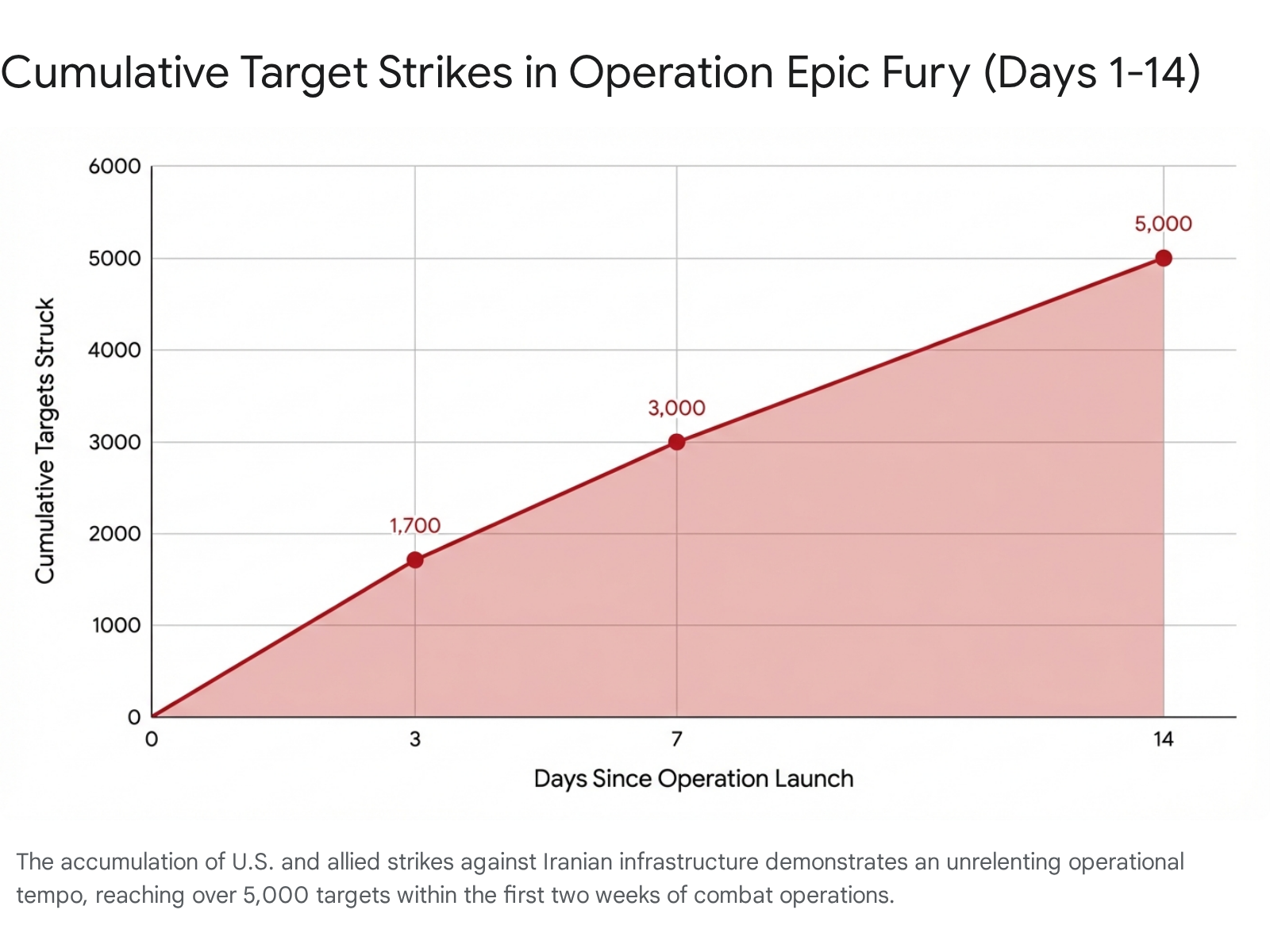
This unrelenting operational tempo has required a massive financial and logistical expenditure, raising concerns about the long-term sustainability of the campaign. Defense Department officials informed Congress that the Pentagon spent approximately 5.6 billion dollars on munitions alone during just the first two days of the conflict.23 Independent defense analysts placed the cost of the first 100 hours of the operation at 3.7 billion dollars.8
This extraordinary burn rate of highly advanced, exquisite munitions forced a rapid tactical adaptation. Early in the conflict, the United States military was forced to transition from relying heavily on expensive, long-range standoff weapons to utilizing stand-in precision-strike methods, specifically relying on cheaper Joint Direct Attack Munitions.8 While this tactical shift indicates that coalition forces had successfully degraded Iran’s integrated air defense network sufficiently to allow non-stealth aircraft to operate closer to their targets, it also highlights the unsustainable financial trajectory of a prolonged standoff campaign.8
The financial burden extends beyond the Department of Defense. The outbreak of the war caused immediate and severe volatility in global energy markets. Upon the initiation of hostilities, crude oil futures skyrocketed to more than 120 dollars per barrel, representing a nearly 50 percent jump.12 While prices subsequently settled back toward 80 dollars per barrel following public reassurances from the administration regarding the duration of the conflict, the structural risk to the global economy remains high, particularly if Iranian retaliatory strikes continue to threaten energy infrastructure in the Persian Gulf.8
Assessment of Tactical Battlefield Outcomes
Evaluated strictly through the lens of kinetic destruction, Operation Epic Fury has achieved significant tactical success. The physical degradation of Iranian conventional military infrastructure has been severe and widespread.
Central Command reports indicate that 43 Iranian naval vessels were damaged or destroyed within the first week of operations.4 Crucially, this included the destruction of a highly valued Iranian submarine, significantly reducing the regime’s ability to threaten maritime traffic in the Strait of Hormuz or lay mines in vital waterways.10 United States forces also successfully eliminated 16 Iranian minelayers near the Strait, preempting a key asymmetric naval strategy historically favored by Tehran.10
The systematic targeting of aerospace launch sites and production facilities has yielded highly tangible reductions in Iran’s ability to project force beyond its borders. According to Central Command Commander Admiral Brad Cooper, the volume of Iranian ballistic missile launches decreased by 90 percent, and drone launches fell by 83 percent compared to the first 24 hours of the conflict.6 This statistical drop suggests a severe disruption of the Islamic Revolutionary Guard Corps Aerospace Force’s command and control capabilities, as well as the destruction of physical launch platforms.
The campaign also prioritized the decapitation of senior political and military leadership. On the first day of the conflict, precision strikes successfully eliminated Supreme Leader Ayatollah Ali Khamenei within his compound in Tehran.4 Subsequent operations maintained this pressure on the leadership cadre. On March 6, approximately 50 Israeli aircraft dropped more than 100 munitions on an underground bunker within Tehran’s leadership compound, reportedly eliminating remaining senior regime figures.24 That same day, operations successfully eliminated Hossein Taeb, the former head of the Islamic Revolutionary Guard Corps Intelligence Organization.24
The Anatomy of Strategic Miscalculation
While the tactical execution of Operation Epic Fury has been highly lethal, precise, and technologically dominant, the strategic assumptions underpinning the campaign exhibit profound flaws. The administration’s approach relied on a series of hypotheses regarding Iranian domestic behavior, the dynamics of regional escalation, the limits of military coercion, and the applicability of international law. Analysis of the first two weeks of the conflict indicates that these foundational assumptions were largely incorrect.
Misjudgment 1: The Regime Cohesion Fallacy and the Succession Crisis
The most significant miscalculation of Operation Epic Fury lies in the assumption that intense external military pressure, coupled with the decapitation of the Supreme Leader, would catalyze the collapse of the Islamic Republic from within. The strategic architecture of the operation was built on the premise that the shock of the strikes would shatter the state’s internal cohesion, prompting the Iranian population to rise up and overthrow the clerical establishment.1
Historical precedent consistently demonstrates that aerial bombardment rarely induces popular uprisings against deeply entrenched authoritarian regimes. Previous attempts at coercive regime change through airpower alone have resulted in vastly different outcomes than anticipated, often leading to hardened adversary resolve or the creation of fractured, failed states.2
In Iran, the exact opposite of state collapse has occurred. The targeted assassination of Ayatollah Ali Khamenei did not lead to a vacuum of power that moderates, reformists, or civilian revolutionaries could exploit. Instead, it triggered a rapid, ruthless, and highly effective consolidation of power by the regime’s most militant and uncompromising elements. Following a brief period where a temporary leadership council assumed control of the state, the clerical and military establishment swiftly elevated Khamenei’s son, Mojtaba Khamenei, to the position of Supreme Leader.8
This succession was not a democratic or standard deliberative process. Analysts note that it was a hasty decision heavily orchestrated by the Islamic Revolutionary Guard Corps and the Ministry of Defense, completely bypassing the standard deliberation among Iranian political elites.8 Mojtaba’s rapid installation signals that the military apparatus has cemented its role as the undisputed center of gravity within the Iranian state. Experts note that this development is a direct rebuke to Washington’s ambitions, providing empirical evidence that the political dimension of the regime change strategy has already failed.9
Rather than fracturing, the regime has oriented itself entirely toward survival and confrontation. This consolidation has effectively marginalized civilian political leadership. For example, Iranian President Masoud Pezeshkian had earlier pledged that Tehran would avoid attacking neighboring states in the event of a conflict.8 However, the hardline military factions completely ignored these pledges, proceeding with retaliatory strikes across the Gulf.8 While Pezeshkian subsequently issued a rare public apology to neighboring countries affected by Iran’s actions, his inability to control the military response highlights his irrelevance in wartime decision-making.11 The internal political dynamic has shifted toward a potential military dictatorship under the auspices of the Islamic Revolutionary Guard Corps, significantly complicating any future diplomatic resolution.8
Misjudgment 2: Asymmetric Escalation and the Vulnerability of Forward Deployments
United States defense officials publicly claimed that Iranian proxy groups such as Hezbollah, Hamas, and the Houthis were broken, ineffective, or relegated to the sidelines by the intensity of the strikes.18 Concurrently, the operational planning assumed that Iran, crippled by the destruction of its domestic infrastructure, would lack the capacity or the strategic will to expand the conflict laterally against third-party nations.
Both of these assumptions were critically flawed. Faced with an existential threat and the systematic degradation of its homeland, Tehran activated its asymmetric deterrents and deliberately expanded the war zone. Hezbollah, contradicting claims of its neutralization, launched coordinated cluster bomb strikes into Israeli territory.10 More alarmingly, the Iranian military expanded the conflict to encompass Gulf Arab states hosting United States military installations, violating the sovereignty of multiple American partners.
Iran launched a sustained wave of drone and ballistic missile attacks against Kuwait, Bahrain, the United Arab Emirates, Saudi Arabia, and Oman.8 These strikes resulted in significant casualties and infrastructure damage across the region. The decision to strike these nations highlights a severe strategic vulnerability for the United States. American forward-deployed forces rely on the hospitality of regional partners who are highly susceptible to Iranian retaliation, and these host nations lack the strategic depth to absorb sustained bombardment without suffering severe domestic consequences.
The human cost of this miscalculation has been substantial, proving that the conflict is not contained within Iranian borders. Retaliatory strikes against United States installations, notably at Camp Arifjan and the Port of Shuaiba in Kuwait, resulted in the deaths of at least nine American military personnel and the wounding of approximately 150 others.27
Regional casualties have also mounted significantly as a direct result of the expanded conflict.
| Nation / Territory | Reported Casualties from Iranian Retaliation | Contextual Details |
| Lebanon | 570 killed, 1,444 injured | Casualties stemming from the broader regional escalation and Israeli counter-strikes.28 |
| Kuwait | 4 military, 5 civilian killed; 67 military, 32 civilian injured | Included strikes on military bases hosting United States personnel.28 |
| United Arab Emirates | 12 killed, 126 injured | Civilian and infrastructure targets.28 |
| Bahrain | 3 killed, 38 injured | Included drone strikes on residential areas and critical infrastructure.28 |
| Kurdistan Region (Iraq) | 29 security forces, 2 civilians killed | Included strikes on Iran-backed militias and local security elements.28 |
| Saudi Arabia | 2 killed, 12 injured | Included the deaths of foreign nationals.28 |
| Qatar | 16 to 20 injured | Targeted due to the presence of Al Udeid Air Base.28 |
| Oman | 1 killed | Expanding the conflict to the southern Gulf.28 |
| Jordan | 19 injured | Collateral impact from airspace violations.28 |
| Azerbaijan | 4 injured | Northern border spillover.28 |

Furthermore, Iran demonstrated a willingness to target critical civilian infrastructure, signaling a dangerous shift toward total war. A notable drone attack targeted a water desalination plant in Bahrain, indicating a strategy aimed at threatening the hydro-strategic backbone that sustains millions of civilians in the Gulf Arab states.8 The expansion of the target sets by both sides guarantees a prolonged and deeply destabilizing regional conflict.
Misjudgment 3: Intelligence, Air Defense Vulnerabilities, and External State Support
The operational design of Epic Fury seemingly underestimated the resilience of Iranian intelligence networks and the crucial role of external adversaries in mitigating the impact of the United States strikes. While American forces possess unmatched offensive strike capabilities, Iranian forces exploited specific vulnerabilities in the allied defensive architecture.
A notable failure occurred regarding the AN/TPY-2 radar systems, which are central to the regional ballistic missile defense umbrella. Despite their advanced sensing capabilities, these systems proved difficult to conceal in the operational environment. Iranian electronic sensors successfully geolocated these radars, enabling targeted retaliatory strikes against these critical defensive nodes.8 This vulnerability degrades the regional missile defense architecture, leaving bases and civilian populations more exposed to the remnants of the Iranian missile inventory.
Furthermore, the United States intelligence picture was complicated by direct Russian intervention. Evidence indicates that Moscow provided critical support to Tehran through data transfers regarding American force deployments and operational patterns.8 This intelligence sharing served to partially restore Iranian operational capabilities that had been severely degraded by United States strikes on indigenous command and control nodes.8 The failure to fully account for the depth of the strategic partnership between Moscow and Tehran allowed the Iranian military to maintain a degree of situational awareness despite the physical destruction of its communications infrastructure.
Misjudgment 4: The Legal, Domestic, and Diplomatic Disconnect
The diplomatic and legal strategy accompanying Operation Epic Fury has suffered from severe inconsistencies, undermining international support and domestic political consensus. The legal justification for the preemptive and sustained strikes rests on a highly contested interpretation of international law, creating friction with both allies and adversaries.
Legal scholars note a significant disconnect between state policymakers, who often operate based on realism, and international law advocates, who adhere to orthodox interpretations.32 Restrictionist legal scholars argue that the operation violates the formal binary of lawful versus unlawful use of force. They specifically reject the accumulation of events theory utilized by the United States to justify continuous strikes in the absence of an immediate, isolated tactical threat.32
Because of this legal ambiguity, the international reaction to the United States campaign has been highly fractured. Major global powers, including Russia, China, France, Italy, Spain, and Switzerland, have formally registered opposition to the military action.32 Even traditional allies have offered only nuanced or equivocal support. The United Kingdom, for instance, permitted the use of its sovereign bases for limited defensive actions against incoming Iranian missiles but actively distanced itself from what it termed unlawful United States offensive operations.32 Canada’s Prime Minister Mark Carney expressed support for the ultimate goal of denuclearization while simultaneously labeling the war an example of the failure of the international order and stating it was inconsistent with international law.32 Only a small coalition, including Australia, Ukraine, and the NATO Secretary General, offered unequivocal support for the strikes.32
Domestically, the conflict has triggered a constitutional debate regarding the authorization of military force. Members of Congress have not formally authorized a war in Iran.23 In early March, the administration filed a war powers notification with Congress regarding Operation Epic Fury.33 Democratic members of Congress, joined by several Republicans, introduced resolutions attempting to restrict the President’s war powers under the War Powers Resolution of 1973.27 However, a majority in the Senate voted down the resolution roughly along party lines.33 Legal analysts note that the administration will likely interpret the failure of Congress to restrict the campaign as tacit legislative approval for its continuation, despite the lack of a formal declaration of war.33 This domestic political friction, combined with the lack of a projected timeline or full cost estimate, introduces a significant vulnerability regarding the long-term sustainment of the operation.23
This diplomatic and domestic friction is further exacerbated by the administration’s shifting rationale for the conflict. In June 2025, following Operation Midnight Hammer, the administration explicitly claimed that the Iranian nuclear program had been completely obliterated.2 The decision to launch an exponentially larger campaign a mere eight months later, targeting the remnants of the exact same program, severely damaged the credibility of United States intelligence claims and undermined the stated necessity for preemptive war in the eyes of the international community.1
The Paradox of Unconditional Surrender and the Diplomatic Impasse
A core tenet of the United States strategy involves forcing the unconditional surrender of the Iranian regime. President Trump emphatically declared on social media and in press interviews that there would be no deal with Iran except unconditional surrender, and further demanded that a new, acceptable leadership be selected following the capitulation.4
This demand represents a fundamental misunderstanding of the adversary’s strategic calculus and political nature. The Islamic Republic is a revolutionary theocracy that views its existence not merely as a political arrangement, but as a divine mandate. For the Islamic Revolutionary Guard Corps and the ruling clerics, surrender equates to institutional and personal annihilation. When faced with an existential threat of this magnitude, survival-oriented regimes historically do not capitulate to overwhelming force. Instead, they absorb the kinetic punishment, utilize asymmetric retaliation to exact a cost on the attacker, and violently entrench their domestic control to prevent internal subversion.
The Iranian response to the demand for unconditional surrender has been predictably defiant, cementing a diplomatic impasse. President Masoud Pezeshkian publicly dismissed the demand as a dream that United States officials would take to their graves.11 Tehran’s diplomatic posture remains entirely consistent despite the bombardment. Iranian officials have stated unequivocally that there will be no surrender, no negotiations conducted while under active military bombardment, and absolutely no acceptance of an externally imposed leadership structure.9
The rapid appointment of Mojtaba Khamenei solidifies this hardline stance.8 By demanding an outcome that the adversary literally cannot accept without committing institutional suicide, the United States has locked itself into an open-ended conflict with no viable diplomatic off-ramp. As noted by military analysts referencing General David Petraeus, the failure to define a realistic, achievable end state prompts the critical strategic question that remains unanswered: how does this end?.32
While some regional actors, including Qatar, Turkey, Egypt, and Oman, have offered to mediate the conflict, the maximalist demands from Washington and the survivalist posture of Tehran render short-term diplomacy highly unlikely.35 Iran’s foreign ministry explicitly stated that the current environment is a time for the defense of the country, not for diplomacy, further closing the window for a negotiated settlement.35
Feasibility of Original Goals: A Conclusive Evaluation
Given the observed battlefield dynamics, the resilience of the Iranian state apparatus, and the profound strategic miscalculations detailed in this assessment, a rigorous evaluation of the feasibility of the original United States goals is required. The analysis indicates that while tactical degradation is achievable, the maximalist political and strategic objectives are fundamentally out of reach.
1. Absolute Denuclearization: Highly Unlikely and Potentially Counterproductive
The goal of permanently ensuring Iran never acquires a nuclear weapon strictly through aerial bombardment is fundamentally flawed. Prior to the initiation of hostilities, Iran possessed a highly advanced, geographically dispersed nuclear infrastructure and a stockpile of over 440 kilograms of highly enriched uranium.14
While Operation Epic Fury has undoubtedly destroyed surface-level infrastructure, crippled research facilities, and eliminated key scientific personnel 2, eradicating a deeply buried nuclear program from the air is a near-impossible task. The precedent set by Operation Midnight Hammer in 2025 demonstrated that even the most advanced bunker-busting munitions can cause extensive damage but cannot fully account for or guarantee the destruction of subterranean stockpiles housed at fortified sites like Natanz and Fordow.2
Furthermore, massive military strikes historically act as a catalyst for nuclear proliferation rather than a permanent deterrent. Bombing nuclear facilities without occupying the sovereign territory completely removes the oversight capabilities of the International Atomic Energy Agency. It also eliminates any remaining domestic political constraints within the targeted nation regarding weaponization. The current strikes will likely force the remnants of the Iranian nuclear program even deeper underground, heavily incentivizing the surviving regime elements to pursue a covert, accelerated weaponization program. In the eyes of the regime, a functional nuclear deterrent is now the only ultimate guarantor of its survival against future American military action.14 Absent a massive ground invasion designed to physically locate and secure all nuclear material, the objective of absolute, irreversible denuclearization remains unattainable.
2. Regime Change and Unconditional Surrender: Unattainable via Current Methods
As analyzed extensively, the objective of inducing regime change via airpower and economic pressure has categorically failed. The targeted killings and widespread infrastructure destruction have empowered the Islamic Revolutionary Guard Corps, marginalized moderate political voices, and facilitated the rise of an uncompromising leadership structure under Mojtaba Khamenei.8
The state security apparatus retains the full capacity to suppress domestic dissent. While the Iranian population may be deeply dissatisfied with theocratic rule, they are currently subjected to intense nationalistic pressure in the face of foreign bombardment. The United States strategy relies on the unproven assumption that economic collapse and infrastructure destruction will eventually break the will of both the populace and the regime. However, the Islamic Republic has demonstrated a multidecade tolerance for severe economic pain and a consistent willingness to prioritize military sustainment and regime survival over civilian welfare. The demand for unconditional surrender is a political maximalism that ensures the continuation of hostilities until one side completely exhausts its political will or material resources, an outcome that heavily favors the entrenched defender in an asymmetric conflict.
3. Degradation of Military and Proxy Capabilities: Partially Attainable but Inherently Transient
The most realistic and currently successful aspect of Operation Epic Fury is the systemic, kinetic degradation of Iran’s conventional military infrastructure. The destruction of the Iranian Navy, the decimation of integrated air defense networks, and the severe curtailment of ballistic missile and drone production represent massive tactical victories that enhance regional security in the short term.6
However, military analysis dictates that this degradation is inherently transient. While Iran cannot currently project conventional force at scale, its asymmetric capabilities remain highly dangerous. The proven ability to launch sporadic strikes against regional desalination plants or United States bases in Kuwait demonstrates that the military apparatus has not been entirely neutered.8
Furthermore, the regional proxy network, while undoubtedly suffering from disrupted communication, financial, and logistical lines to Tehran, operates with a high degree of decentralized autonomy. Hezbollah’s capacity to launch significant cluster munition barrages into Israel indicates that the Axis of Resistance retains latent, highly lethal capability despite the heavy bombardment of its primary state patron.10
Crucially, the United States objective to destroy Iran’s ability to ever rebuild its forces is a long-term endeavor that requires continuous surveillance and repeated, indefinite strikes.6 Once the acute phase of the air campaign eventually concludes, the Iranian regime, aided by external partners like Russia and potentially China, will inevitably begin a massive, clandestine reconstitution process.
Final Strategic Synthesis
Operation Epic Fury has achieved unprecedented kinetic success, systematically dismantling the visible architecture of the Iranian military state. The sheer volume of precision munitions delivered, the rapid suppression of enemy air defenses, the destruction of naval assets, and the high-value targeted killings demonstrate the unmatched lethality, reach, and technological superiority of the United States Armed Forces.
Yet, translating this overwhelming kinetic success into the desired geopolitical end states of unconditional surrender, democratic regime change, and absolute denuclearization appears fundamentally out of reach. The United States strategic apparatus critically misjudged the political resilience of the Islamic Republic, the capacity of the Islamic Revolutionary Guard Corps to ruthlessly consolidate power during a supreme crisis, and the willingness of Tehran to laterally escalate the conflict into neighboring sovereign Gulf states, thereby endangering American allies and global energy markets.
By defining strategic victory in maximalist terms, demanding the total capitulation of the regime, the administration has created a severe strategic trap. The current trajectory indicates a prolonged, highly volatile war of attrition. The United States must expend billions of dollars in exquisite precision munitions to maintain pressure on an adversary that is deeply entrenched, supported by external intelligence, and highly motivated by the absolute imperative of regime survival.
In the absence of a large-scale ground invasion, an option carrying catastrophic logistical, financial, and political implications that the administration has thus far avoided, airpower alone cannot dictate the internal political composition of the Iranian state. Furthermore, it cannot permanently erase the nuclear knowledge embedded within the Iranian scientific community.
The most likely outcome of Operation Epic Fury is not the unconditional surrender of a broken state, but the creation of a heavily degraded, hyper-militarized, and deeply hostile Iran that accelerates its pursuit of a covert nuclear deterrent as its sole means of future defense. To mitigate further regional instability, protect forward-deployed forces, and prevent a catastrophic shock to the global economy, United States policymakers must reconcile their maximalist political rhetoric with the realistic, proven limitations of military coercion. Sustainable security in the Persian Gulf cannot be achieved solely through the indefinite application of explosive force.
Please share the link on Facebook, Forums, with colleagues, etc. Your support is much appreciated and if you have any feedback, please email us in**@*********ps.com. If you’d like to request a report or order a reprint, please click here for the corresponding page to open in new tab.
Sources Used
- Operation Epic Fury and the Remnants of Iran’s Nuclear Program – CSIS, accessed March 11, 2026, https://www.csis.org/analysis/operation-epic-fury-and-remnants-irans-nuclear-program
- Twice Bombed, Still Nuclear: The Limits of Force Against Iran’s Atomic Program, accessed March 11, 2026, https://warontherocks.com/2026/02/twice-bombed-still-nuclear-the-limits-of-force-against-irans-atomic-program/
- Operation Epic Fury | U.S. Department of War, accessed March 11, 2026, https://www.war.gov/Spotlights/Operation-Epic-Fury/
- Seven days of Operation Epic Fury: US shares review of attack on Iran after first week, says ‘not slowing down’, accessed March 11, 2026, https://www.livemint.com/news/us-news/seven-days-of-operation-epic-fury-us-shares-review-of-attack-on-iran-after-first-week-says-not-slowing-down-11772862522186.html
- ‘Not slowing down’: US Central Command hits 3,000 targets in Iran as ‘Operation Epic Fury’ intensifies, accessed March 11, 2026, https://m.economictimes.com/news/international/world-news/not-slowing-down-us-central-command-hits-3000-targets-in-iran-as-operation-epic-fury-intensifies/articleshow/129195307.cms
- What is the definition of victory in Iran? There are three., accessed March 11, 2026, https://www.washingtonpost.com/opinions/2026/03/11/donald-trump-iran-war-endgame-victory/
- ‘Didn’t start war, but we’re finishing it’: US releases video of first 100 hours of Operation Epic Fury against Iran, accessed March 11, 2026, https://timesofindia.indiatimes.com/defence/international/didnt-start-war-but-were-finishing-it-us-releases-video-of-first-100-hours-of-operation-epic-fury-against-iran/articleshow/129069891.cms
- Operation Epic Fury Situation Report | Battlefield Effects and Early …, accessed March 11, 2026, https://www.hudson.org/missile-defense/operation-epic-fury-situation-report-battlefield-effects-strategic-outcomes-can-kasapoglu
- What is Trump’s endgame in Iran as the US-Israel war escalates?, accessed March 11, 2026, https://www.aljazeera.com/news/2026/3/9/what-is-the-us-endgame-in-iran-as-the-war-escalates
- Cargo ship hit by projectile in Strait of Hormuz while Iran launches fresh attacks on Middle East, accessed March 11, 2026, https://www.foxnews.com/live-news/us-iran-israel-war-latest-march-11-live-updates
- Iran rejects Trump’s demand for unconditional surrender as a ‘dream’, accessed March 11, 2026, https://www.theguardian.com/world/2026/mar/07/iran-trump-unconditional-surrender-war-masoud-pezeshkian
- Trump is betting on himself, and his cellphone, to control the Epic Fury narrative, accessed March 11, 2026, https://www.washingtonexaminer.com/news/white-house/4486610/trump-betting-on-himself-cell-phone-control-epic-fury-narrative/
- 2025 United States strikes on Iranian nuclear sites – Wikipedia, accessed March 11, 2026, https://en.wikipedia.org/wiki/2025_United_States_strikes_on_Iranian_nuclear_sites
- Attacking Iran’s nuclear programme could drive it towards a bomb, experts warn, accessed March 11, 2026, https://www.theguardian.com/world/2026/mar/04/us-israel-strikes-iran-nuclear-program-could-backfire
- The Most Significant Long-Term Consequence of the U.S. Strikes on Iran, accessed March 11, 2026, https://carnegieendowment.org/emissary/2025/06/iran-strikes-us-impacts-iaea-nuclear-weapons-monitoring
- Experts react: The US and Israel just unleashed a major attack on Iran. What’s next?, accessed March 11, 2026, https://www.atlanticcouncil.org/dispatches/experts-react-the-us-and-israel-just-unleashed-a-major-attack-on-iran-whats-next/
- America’s Unstoppable Momentum in Operation Epic Fury – The White House, accessed March 11, 2026, https://www.whitehouse.gov/articles/2026/03/americas-unstoppable-momentum-in-operation-epic-fury/
- Hegseth Says U.S. Attacks Intensify Under Epic Fury, While Iranian Responses Slow, accessed March 11, 2026, https://www.war.gov/News/News-Stories/Article/Article/4429836/hegseth-says-us-attacks-intensify-under-epic-fury-while-iranian-responses-slow/
- Background on Iran and Operation Epic Fury – Republican Policy Committee |, accessed March 11, 2026, https://republicanpolicy.house.gov/sites/evo-subsites/republicanpolicy.house.gov/files/evo-media-document/rpc-iran-operation-epic-fury-memo.pdf
- U.S. Forces Launch Operation Epic Fury – centcom, accessed March 11, 2026, https://www.centcom.mil/MEDIA/PRESS-RELEASES/Press-Release-View/Article/4418396/us-forces-launch-operation-epic-fury/
- Operation Epic Fury Fact Sheet 260303, accessed March 11, 2026, https://media.defense.gov/2026/Mar/03/2003882557/-1/-1/1/OPERATION-EPIC-FURY-FACT-SHEET-260303.PDF
- America’s Unstoppable Momentum in Operation Epic Fury, accessed March 11, 2026, https://china.usembassy-china.org.cn/americas-unstoppable-momentum-in-operation-epic-fury/
- Trump’s Iran war is estimated to cost in the billions already, with no end in sight, accessed March 11, 2026, https://www.newsfromthestates.com/article/trumps-iran-war-estimated-cost-billions-already-no-end-sight
- Escalation in the Middle East: Tracking “Operation Epic Fury” Across Military and Cyber Domains | Flashpoint, accessed March 11, 2026, https://flashpoint.io/blog/escalation-in-the-middle-east-operation-epic-fury/
- Political Commentary Category Archives – Criminal Law Library Blog, accessed March 11, 2026, https://www.criminallawlibraryblog.com/category/political-commentary/
- PM tells Iranians conditions for regime change soon to come, accessed March 11, 2026, https://www.jpost.com/israel-news/article-889536
- Iran president apologizes for attacks on neighbors, mocks Trump’s call for ‘unconditional surrender’ – Fox News, accessed March 11, 2026, https://www.foxnews.com/live-news/us-iran-israel-war-latest-march-7
- 2026 Iran war – Wikipedia, accessed March 11, 2026, https://en.wikipedia.org/wiki/2026_Iran_war
- Six US service members killed in ‘Operation Epic Fury’: CENTCOM | Responsible Statecraft, accessed March 11, 2026, https://responsiblestatecraft.org/servicemebers-killed-operation-epic-fury/
- Operations Epic Fury and Roaring Lion: 3/11/26 Update – JINSA, accessed March 11, 2026, https://jinsa.org/wp-content/uploads/2026/03/Operations-Epic-Fury-and-Roaring-Lion-03-11-26.pdf
- What They’re Saying About Operation Epic Fury—March 9, 2026, accessed March 11, 2026, https://www.unitedagainstnucleariran.com/press-releases/what-theyre-saying-about-operation-epic-fury-march-9-2026
- Operation Epic Fury: Reports of the Death of International Law are Greatly Exaggerated, accessed March 11, 2026, https://www.justsecurity.org/133579/operation-epic-fury-international-law/
- Operation Epic Fury Puts Congress and the Constitution to the Test, accessed March 11, 2026, https://www.lawfaremedia.org/article/operation-epic-fury-puts-congress-and-the-constitution-to-the-test
- Tell Me How This Ends: Six Questions That Will Shape the Outcome of the US-Israeli Operations Against Iran – Modern War Institute, accessed March 11, 2026, https://mwi.westpoint.edu/tell-me-how-this-ends-six-questions-that-will-shape-the-outcome-of-the-us-israeli-operations-against-iran/
- Iran’s president says ‘some countries’ have begun mediation efforts to end war, accessed March 11, 2026, https://www.theguardian.com/world/2026/mar/06/new-supreme-leader-anti-iran-us-propaganda-reformists