Executive Summary
The week ending March 14, 2026, represents a critical inflection point in the geopolitical, economic, and military trajectory of the Russian Federation. The operating environment has been fundamentally disrupted by external macroeconomic shocks stemming from the Middle East, which have inadvertently resuscitated the Russian defense budget and fractured the transatlantic consensus on sanctions enforcement. Concurrently, the Kremlin is navigating a stark dichotomy: projecting an aura of inevitable diplomatic and military victory abroad while implementing draconian, unprecedented internal security measures at home to preempt anticipated domestic instability.
Economically, the escalating military conflict involving the United States, Israel, and Iran has resulted in the de facto closure of the Strait of Hormuz, driving global crude oil prices to nearly $120 per barrel. In a controversial maneuver designed to stabilize domestic energy markets, the United States Treasury Department issued a temporary waiver allowing the sale of Russian oil currently stranded at sea. This decision has generated a massive financial windfall for Moscow, with projections indicating billions in additional revenue by the end of March 2026. This sudden influx of capital effectively nullifies near-term western economic containment strategies and provides the Kremlin with the necessary liquidity to sustain its hyper-militarized economy and defense industrial base indefinitely.
Diplomatically, Russian leadership is exploiting this perceived weakening of Western resolve. High-level backchannel negotiations were detected in Miami, Florida, involving representatives of the United States administration and the sanctioned Russian Direct Investment Fund (RDIF). Simultaneously, the Kremlin’s public diplomatic posture has hardened significantly, with officials declaring previous peace frameworks obsolete and demanding total Ukrainian capitulation based on “changed realities.” However, these rhetorical assertions of battlefield supremacy are directly contradicted by empirical frontline data. Russian forces have experienced a net loss of occupied territory over the past month, suffering staggering casualty rates that are estimated to have reached one million killed and wounded since the conflict’s inception.
In response to static lines and unsustainable attrition, the Russian Ministry of Defense is undertaking an industrial-scale pivot toward unmanned systems, producing an estimated 19,000 first-person view (FPV) drones daily. Despite this, the Russian defense industrial base remains highly vulnerable to an evolved Ukrainian deep-strike campaign, which has successfully integrated real-time drone reconnaissance with cruise missile strikes to decimate critical microelectronics and chemical manufacturing nodes deep within the Russian interior.
Domestically, the Russian state is exhibiting profound paranoia. The reporting period witnessed severe, state-directed internet blackouts across major metropolitan centers, including the State Duma, as authorities test a “whitelist” censorship architecture designed to permanently sever the Russian populace from the global internet. Coupled with high-level purges within the Ministry of Internal Affairs (MVD) and an accelerated campaign to fully absorb occupied Ukrainian territories through demographic engineering and financial coercion, the Kremlin is aggressively insulating its regime. As the conflict grinds onward, the Russian Federation is functioning as a fully mobilized authoritarian state, utilizing total information control to force its population to bear the indefinite costs of its strategic ambitions.
1. Strategic and Diplomatic Maneuvers in a Multipolar Context
1.1 The Miami Backchannel and the “Changed Realities” Doctrine
During the week ending March 14, 2026, the diplomatic architecture surrounding the Ukraine conflict experienced significant turbulence, driven by clandestine negotiations and a hardening of Russia’s public negotiating posture. Intelligence indicates that a high-level backchannel meeting occurred in Miami, Florida, on March 11, 2026.1 The United States delegation, comprising Special Envoy Steve Witkoff, former Senior Advisor Jared Kushner, and advisor Josh Gruenbaum, engaged directly with Kirill Dmitriev, the lead Russian negotiator and CEO of the Russian Direct Investment Fund (RDIF).1
The presence of Dmitriev is highly significant. The RDIF functions as a primary node in Russia’s sovereign wealth management and has been heavily sanctioned by Western entities since 2022. Dmitriev’s role as the chief interlocutor suggests that the Kremlin’s primary objective in these preliminary discussions centers heavily on unfreezing financial assets and dismantling the sanctions architecture, intertwined with potential security guarantees. While official readouts from the Miami meeting remain classified, the composition of the delegations implies an attempt to bypass traditional diplomatic channels to establish a transactional framework for future conflict resolution.1
However, this covert engagement stands in stark contrast to the maximalist rhetoric emanating from Moscow. Capitalizing on perceived divisions within the NATO alliance and the distraction of the Middle East crisis, the Kremlin has explicitly escalated its diplomatic demands, setting informational conditions to expand its territorial and political objectives. On March 11, Kremlin Spokesperson Dmitry Peskov declared that the “whole reality has changed” since the aborted 2022 Istanbul proposals.1 Russian state media immediately amplified this statement, interpreting it as a formal abandonment of previous, more moderate settlement frameworks. Grigory Karasin, Chairperson of the Federation Council International Affairs Committee, reinforced this hardened stance by declaring the 2022 proposals “irrelevant” and demanding that Ukraine “end this adventure”—a thinly veiled euphemism for total capitulation.1
This dual-track diplomatic strategy is a classic execution of Russian cognitive warfare. By projecting an aura of overwhelming battlefield supremacy through statements from President Vladimir Putin—who claimed in recent calls with the U.S. President that Russian forces are advancing “rather successfully”—Moscow aims to convince Western policymakers that further military assistance to Ukraine is an exercise in futility.2 The strategic calculus dictates that projecting inevitable victory, despite empirical evidence to the contrary, will accelerate a diplomatic settlement on maximalist Russian terms by demoralizing Ukraine’s international backers.
1.2 Soft Power Projection: The CIS and the Linguistic Sphere
While engaging with the West through adversarial diplomacy, the Russian Federation continues to aggressively consolidate its influence within its immediate periphery, utilizing soft power mechanisms to bind post-Soviet states closer to Moscow. On March 11, 2026, Foreign Minister Sergey Lavrov participated in the first Ministerial Conference of the International Organisation for the Russian Language.3 This new geopolitical structure, initially proposed by Kazakhstan’s President Kassym-Jomart Tokayev and formally established via an October 2023 agreement in Bishkek, is supported by Belarus, Kyrgyzstan, Tajikistan, and Uzbekistan.3
The organization’s inaugural conference, which resulted in the election of a General Secretary and the approval of foundational financial frameworks, serves a critical dual purpose for the Kremlin.3 Overtly, it is designed to maintain and promote the Russian language globally, fostering a common cultural and humanitarian space alongside existing Commonwealth of Independent States (CIS) mechanisms.4 Covertly, however, it functions as a potent institutional tether. As Russia’s economic leverage over Central Asia has been strained by wartime expenditures and sanctions, Moscow is increasingly relying on cultural, linguistic, and historical integration to prevent these republics from drifting toward Chinese economic hegemony or Western diplomatic alignment.
1.3 Framing the Narrative: Digital Threats as a Geopolitical Weapon
The Kremlin is also actively working to align the international diplomatic community with its domestic security paradigms. On March 5, 2026, the MGIMO Diplomatic Academy of the Foreign Ministry hosted its 11th ambassadorial roundtable, attended by over 100 foreign ambassadors and representatives of international organizations accredited in Russia.3 The event, centered on the theme “Ukraine Crisis. Digital Threats and International Information Security,” provided Lavrov a platform to frame Russia’s actions as a defensive response to Western hybrid warfare.3
By explicitly linking the “Ukraine crisis” with “digital threats,” the Russian Foreign Ministry is attempting to legitimize its draconian domestic internet censorship policies on the world stage. The narrative exported to sympathetic nations in the Global South posits that Western dominance of the global internet infrastructure constitutes a direct threat to national sovereignty. This diplomatic messaging is carefully synchronized with domestic actions, providing a unified ideological justification for the severing of cross-border information flows and the construction of a sovereign, isolated Russian internet architecture.
2. The Geoeconomic Pivot: Sanctions Relief and the Petro-Windfall
2.1 The Strait of Hormuz Closure and Global Energy Shocks
The most consequential strategic development for the Russian state during the week ending March 14, 2026, occurred entirely outside of its borders, originating in the volatile security environment of the Middle East. The escalating military conflict involving the United States, Israel, and Iran has resulted in the de facto closure of the Strait of Hormuz, a critical maritime chokepoint that facilitates the transit of roughly 20% of the global oil supply.5 The resulting panic in global energy markets has been profound, pushing Brent crude prices to nearly $120 a barrel—the highest level recorded since the onset of the full-scale Russian invasion of Ukraine in 2022.5
This massive supply disruption has created cascading effects throughout the global economy. The International Energy Agency (IEA) cut its global oil demand forecasts by one million barrels a day due to lower refining capacity and reduced air travel in the Middle East, yet warned that the fall in supply would far exceed this dent in demand.8 European manufacturing sectors are reporting severe input cost pressures, creating intense policy friction between the imperative of sanctions enforcement against Russia and the necessity of domestic economic stability.9
2.2 Transatlantic Fracture: European Backlash to U.S. Sanctions Waivers
In a desperate bid to soothe jittery markets and stabilize surging domestic gasoline prices—which had risen by 22% in a single month—the United States administration made a highly controversial policy pivot.7 On March 12, the U.S. Treasury Department’s Office of Foreign Assets Control (OFAC) issued a temporary license allowing the sale and delivery of Russian crude oil and petroleum products currently stranded at sea.1 U.S. Treasury Secretary Scott Bessent characterized the move as a “narrowly tailored, short-term measure” effective until April 11, 2026, arguing it would increase global supply without providing significant financial benefit to the Russian government.1
This assessment, however, proved disastrously inaccurate and triggered a severe diplomatic rupture within the Western alliance. The U.S. decision to unilaterally ease economic pressure on Moscow was met with immediate, public condemnation from European partners, who view the maneuver as a dangerous capitulation that undermines years of collective sacrifice. German Chancellor Friedrich Merz publicly rebuked the U.S. decision, stating categorically that it was “wrong to ease the sanctions” and insisting that pressure on Moscow must be increased, not relieved.10 French President Emmanuel Macron echoed this sentiment, asserting that the Middle East crisis “in no way” justifies altering the G7’s unified stance on Russian economic isolation.5 The United Kingdom’s Foreign Secretary, Yvette Cooper, accused Russia and Iran of attempting to “hijack the global economy,” demonstrating the depth of European frustration.11
2.3 The Resuscitation of the Russian Defense Budget
The combination of record-high oil prices and the temporary lifting of U.S. sanctions has provided an unexpected and massive financial lifeline to the highly vulnerable Russian war economy. Financial models and intelligence assessments indicate that the U.S. waivers have effectively rescued the Russian defense budget from impending austerity.
Russia is currently earning up to $150 million per day in extra budget revenues directly attributable to the oil price surge and the newly permitted maritime sales.1 Analysis from the Financial Times indicates that Russia has already netted between $1.3 billion and $1.9 billion in additional taxes on oil exports since the Middle East crisis escalated.1 If Russian Urals crude continues to trade at a conservative $70 to $80 per barrel—a significant premium over the previous two months’ average of roughly $52—total additional revenues are projected to reach between $3.3 billion and $4.9 billion by the end of March 2026.1
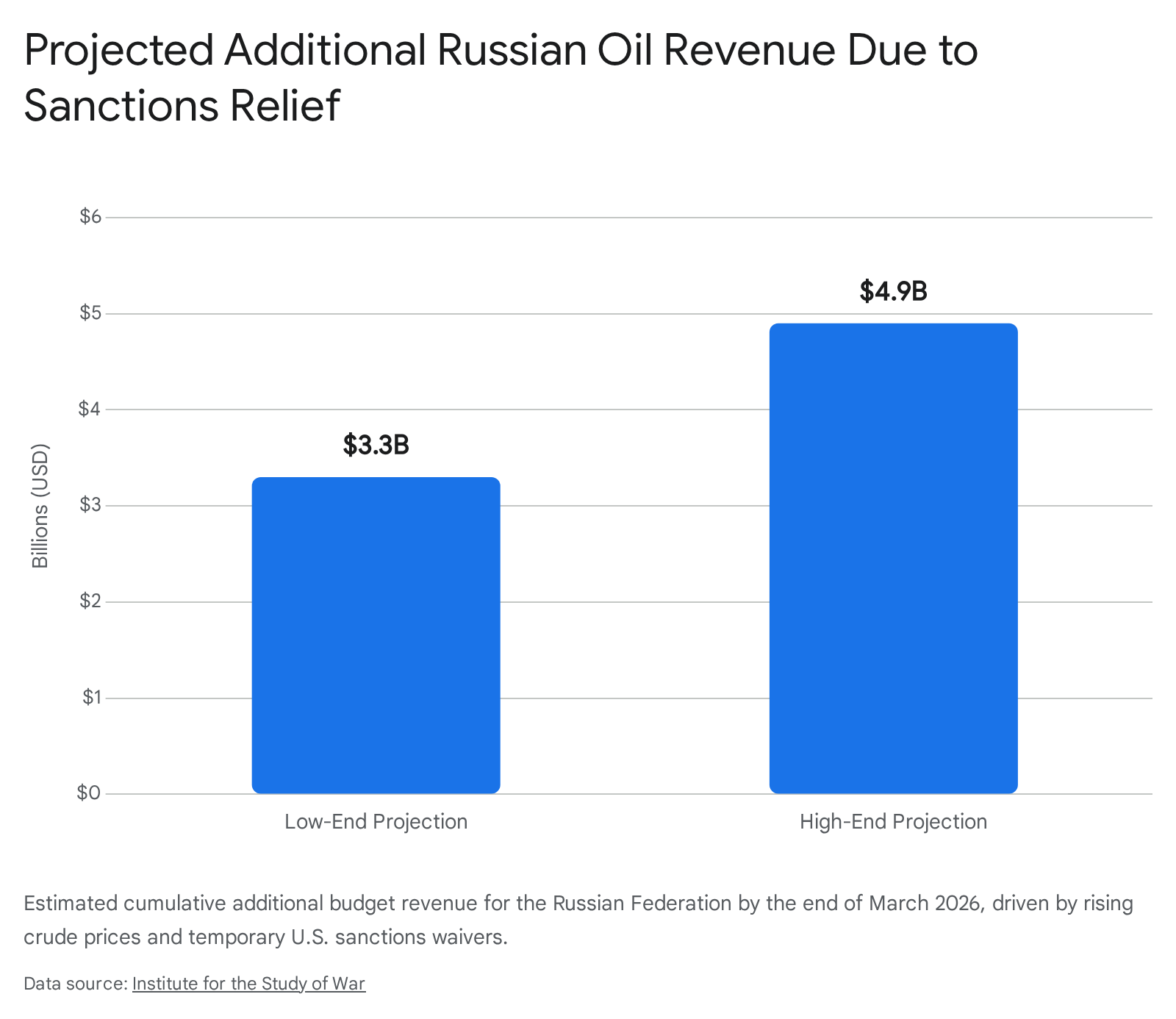
The domestic fiscal impact is staggering. Production taxes on crude oil alone could generate 590 billion rubles ($7.43 billion) if current price levels persist, nearly doubling the figures from early 2026.1 Furthermore, the Center for Research on Energy and Clean Air (CREA) found that in just two weeks of fighting between the U.S. and Iran, Russian oil revenues soared, providing Moscow with an estimated additional 6 billion euros ($6.9 billion).6
This sudden influx of petrodollars fundamentally alters the strategic timeline of the conflict. Prior to this event, Western intelligence assessments predicted that compounding macroeconomic pressures, persistent inflation, and dwindling sovereign reserve funds would force the Kremlin to make highly unpopular domestic decisions—such as massive tax hikes or severe cuts to social spending—by late 2026 or 2027.1 The U.S. sanctions relief has inadvertently financed the Russian Defense Industrial Base for the foreseeable future, nullifying years of cumulative economic pressure and allowing Moscow to sustain its military operations without risking immediate domestic economic collapse.
2.4 Internal Macroeconomic Indicators and Military Keynesianism
Internally, the Russian economy is beginning to show the expected signs of cooling after a prolonged period of military-Keynesian overheating. A March 12 report from the Central Bank of Russia’s Research and Forecasting Department noted a slight slowdown in economic activity in early 2026 compared to the peaks of late 2025.12 The acceleration of core sector output observed in the fourth quarter of 2025, which rose 3.5% on a seasonally adjusted basis, appears to have been temporary.12 The dynamics of output from traditionally less volatile consumer sectors indicate a gradual slowdown, a trend corroborated by financial flow data from the Bank of Russia’s payment systems.12
However, the Central Bank notes that the labor market is gradually normalizing, and the gap between wage growth and labor productivity is narrowing steadily.12 While GDP dynamics in the first quarter of 2026 are expected to be “much more subdued,” the massive new revenue streams from the global oil shock provide the state with the necessary capital to intervene aggressively in the domestic market.12 This liquidity allows the Kremlin to mask structural slowdowns, continue heavily subsidizing the defense sector, and maintain the civilian appeasement programs essential for regime stability.
3. Battlefield Dynamics: Attrition, Deep Strikes, and the Drone Revolution
3.1 The Reality of Territorial Stagnation vs. Rhetorical Triumphalism
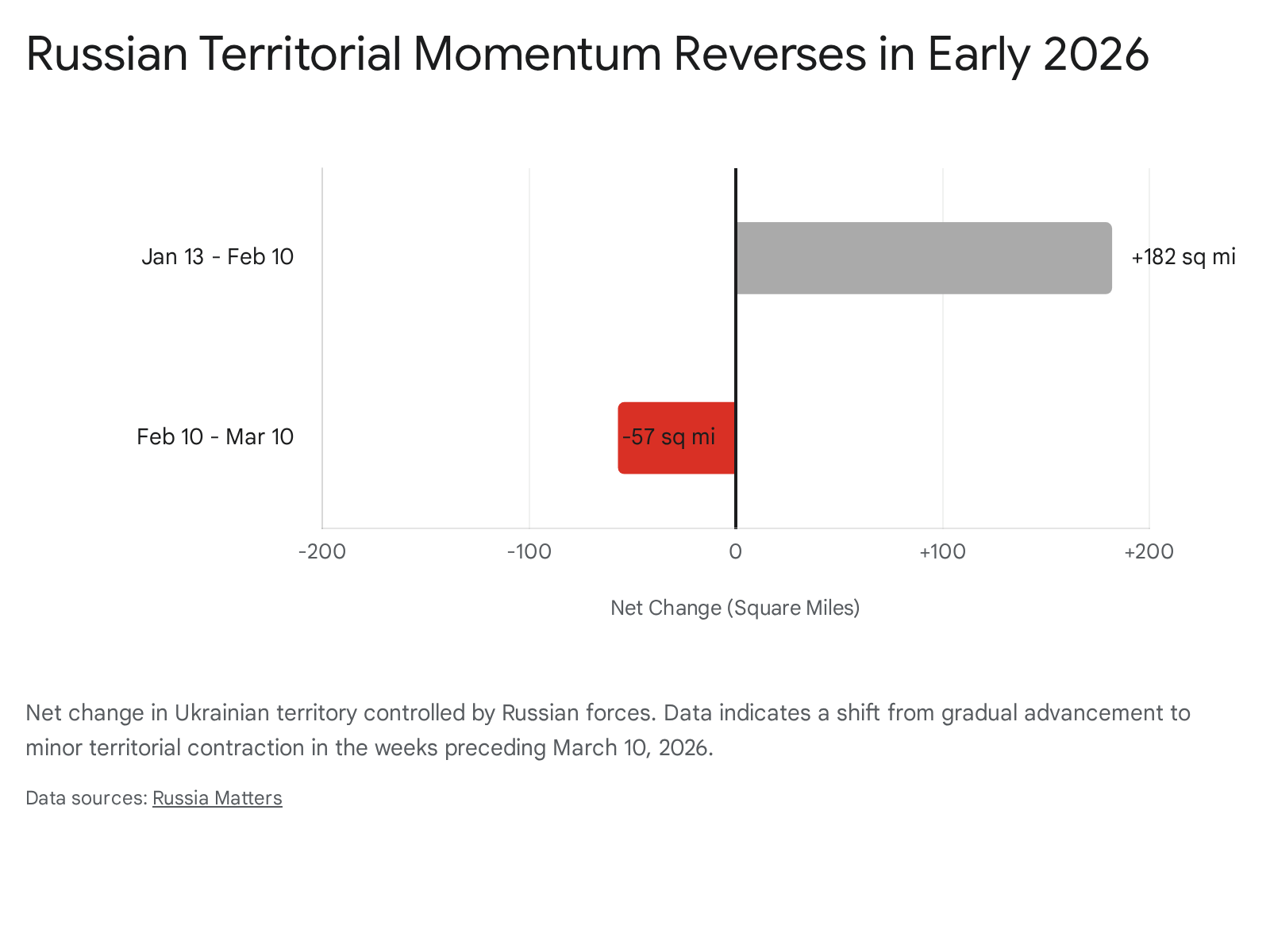
Despite the Kremlin’s triumphant diplomatic rhetoric and assertions of sweeping battlefield momentum, a rigorous analysis of the frontline reveals a reality defined by grueling attrition, operational exhaustion, and marginal territorial losses for Russian forces. Between February 10 and March 10, 2026, Russian forces suffered a net loss of 57 square miles of Ukrainian territory.2 This represents a stark and highly significant reversal from the preceding four-week period (January 13 to February 10, 2026), during which Russia gained 182 square miles.2
The contraction of Russian lines continued into the most recent tracking week (March 3 to March 10, 2026), with Russian forces losing an additional 30 square miles.2 This loss directly contradicts President Putin’s claims of successful advances made during his diplomatic engagements. Furthermore, independent intelligence assessments indicate that Ukraine currently retains control over approximately 19% of the contested Donetsk Oblast, refuting Putin’s assertion that Kyiv’s hold had shrunk to between 15% and 17%.2
The cumulative scale of the conflict remains a testament to the static nature of modern defensive warfare. Since the onset of the full-scale invasion on February 24, 2022, Russia has seized approximately 29,153 square miles—roughly 13% of Ukraine’s total landmass.2 This brings its total occupation footprint, including territory held prior to 2022, to 45,778 square miles, or 20% of the country.2 Over the past 12 months (March 2025 to March 2026), Russia captured just 1,993 square miles, yielding an average monthly gain of a mere 170 square miles.2 Meanwhile, Ukrainian forces maintain a stubborn and strategically embarrassing 4-square-mile foothold within the Russian sovereign regions of Kursk and Belgorod, an operational reality that continues to humiliate the Russian general staff and force the diversion of critical border defense assets.2
3.2 The Staggering Arithmetic of Attritional Warfare
The glacial pace of advancement has come at a horrific human and material cost, forcing a fundamental degradation of Russian tactical proficiency. According to highly-informed Western intelligence estimates shared in late February 2026, total Russian military casualties (killed and wounded) have reached the unprecedented threshold of 1,000,000 personnel.2 Corresponding Ukrainian military casualties are estimated between 250,000 and 300,000.2
The equipment attrition is equally severe. Verified Russian losses stand at an astounding 24,197 total units, encompassing over 13,913 tanks and armored vehicles, 361 aircraft, and 29 naval vessels.2 By comparison, Ukrainian forces have lost 11,554 units, including 5,650 tanks and armored vehicles.2
| Casualty and Loss Metric (As of March 2026) | Russian Federation | Ukraine |
| Estimated Military Casualties (Killed & Wounded) | ~1,000,000 2 | 250,000 – 300,000 2 |
| Civilian Fatalities | 8,000 2 | 15,954 (UN Verified) 2 |
| Total Military Equipment Units Lost | 24,197 2 | 11,554 2 |
| Tanks and Armored Vehicles Lost | 13,913 2 | 5,650 2 |
| Aircraft Lost | 361 2 | 194 2 |
This unsustainable rate of loss has forced the Russian military to largely abandon complex, combined-arms mechanized maneuver warfare. Instead, operations are characterized by mass, dismounted infantry assaults supported by overwhelming but increasingly inaccurate artillery fire. These tactics trade massive quantities of easily mobilized manpower for negligible territorial gains, placing immense strain on Russia’s force generation pipeline and domestic social cohesion.
3.3 The Ukrainian Asymmetric Deep Strike Campaign
A defining operational characteristic of the reporting period has been the highly sophisticated evolution of Ukrainian deep-strike capabilities targeting the Russian Defense Industrial Base (DIB). On March 10, 2026, Ukrainian Unmanned Systems Forces (USF) executed a strategic, paradigm-shifting strike using Storm Shadow cruise missiles against the Kremniy El microchip factory in Bryansk City.1 This facility is Russia’s second-largest producer of military microelectronics and is deeply integrated into the critical supply chains of Almaz-Antey (which produces advanced air defense systems) and the Tactical Missiles Corporation (which manufactures the Kh-59, Kh-69, Kh-101, and Kh-555 cruise missiles routinely used to bombard Ukrainian cities).1
The operational methodology of this strike represents a major technological milestone. It was the first documented instance where Ukrainian forces utilized a drone operating deep within Russian airspace to provide real-time fire correction for incoming cruise missiles.1 This synchronized capability allowed a minimal number of missiles to achieve devastating precision, critically damaging Building No. 4 and likely forcing the decommissioning of its highly specialized manufacturing workshops.1 The strike triggered severe backlash among Russian ultranationalist milbloggers, who condemned the Ministry of Defense for failing to protect a facility that produces essential high-frequency transistors for Yars, Bulava, and Topol-M Intercontinental Ballistic Missile (ICBM) systems, exposing critical vulnerabilities in Russia’s strategic air defense and electronic warfare (EW) networks.1
This attack was part of a broader, highly synchronized campaign against Russian logistics and chemical infrastructure. Overnight on March 10 to 11, Ukrainian drones struck the KuybyshevAzot chemical plant in Tolyatti (Samara Oblast), which produces nitrogen fertilizers and caprolactam, and the Metafrax chemical plant in Perm Krai.1 Concurrently, Ukrainian Security Service (SBU) drones targeted the Tikhoretsk oil pumping station in Krasnodar Krai—a vital logistics hub for southern Russia—causing multiple storage tank fires.1 In the border regions, the Atesh partisan group successfully disabled critical railway infrastructure near Stary Oskol, Belgorod Oblast, severing ammunition delivery lines to Russian units operating in the Kupyansk direction.1 This logistical sabotage forced front-line units to conduct assaults without adequate artillery support, predictably resulting in massive casualties and stalling offensive momentum.1
3.4 Force Generation and the Industrialization of Unmanned Systems
In response to the stagnation of mechanized warfare and the increasing effectiveness of Ukrainian asymmetrical strikes, the Russian military apparatus is undergoing a massive structural and industrial pivot toward drone warfare. The Russian Armed Forces are aggressively expanding their dedicated Unmanned Systems Forces (USF), aiming to reach a personnel strength of 101,000 by April 1, 2026.1
The industrial scale of this effort is profound and reflects a complete mobilization of the defense sector. Intelligence indicates that Russian defense manufacturing is currently capable of producing over 19,000 first-person view (FPV) drones every single day.1 This translates to nearly 7 million units annually, an astronomical production rate that fundamentally alters the tactical geometry and lethality of the battlefield. The influx of these systems—alongside cheap, fixed-wing cardboard and aluminum “Molniya” drones capable of carrying surprisingly large payloads over long distances—is forcing Ukrainian forces to rapidly adapt their defensive postures.1 In Dnipropetrovsk Oblast alone, Ukraine has been forced to install 42 kilometers of anti-drone netting to protect vital logistics routes from this relentless aerial saturation.1
However, the rapid scaling of drone operations has exposed critical, systemic vulnerabilities in Russian command and control architecture. In the Lyman/Slovyansk direction, localized Starlink outages have forced Russian operators to control unmanned ground vehicles (UGVs) via short-range infantry remotes rather than networked, over-the-horizon systems, severely degrading their operational efficiency and exposing operators to counter-battery fire.1 Furthermore, a critical lack of sufficient interceptor missiles in occupied Crimea has forced Russian commands to rely on ad-hoc mobile fire groups for air defense against sophisticated Ukrainian swarms, highlighting the strain on traditional anti-aircraft assets.
4. The Mechanics of Occupation and Demographic Engineering
4.1 Bureaucratic Annexation and Forced Passportization
Behind the static frontline, the Russian state is accelerating the complete administrative, economic, and demographic absorption of the occupied territories in eastern and southern Ukraine. On March 9, 2026, President Putin signed a decree making the simplified Russian passportization procedure permanent for residents of the occupied Donetsk, Luhansk, Kherson, and Zaporizhia oblasts.1
Retroactive to January 1, 2026, this decree systematically strips away the bureaucratic hurdles previously associated with naturalization.1 It eliminates the requirement for the translation of Ukrainian documents, streamlines the naturalization of children under the age of 14, and removes the traditional five-year residency requirement.1 This forced passportization is a coercive mechanism designed to eradicate Ukrainian civic identity, force compliance with occupation authorities, and legitimize the illegal annexation by creating a superficial demographic of “Russian citizens” requiring Moscow’s protection.
4.2 Financial Coercion via State-Owned Banking Monopolies
Financial coercion constitutes the second pillar of this occupation strategy. State-owned entities, primarily Sberbank and VTB, are monopolizing the financial sector in the occupied zones to enforce total dependency on the Russian ruble and the centralized financial system, effectively detaching these regions’ economies from Kyiv.
The metrics of this financial integration are staggering. Sberbank’s lending volume in the occupied regions surged by 830% in 2025 compared to late 2024, primarily driven by the issuance of 1,076 state-subsidized, low-interest (2%) mortgage agreements valued at 5.8 billion rubles ($73 million).1 Concurrently, VTB Bank expanded its client base by an explosive 660% since the start of 2025, increasing its branch network from six to 27 and its ATM network from 41 to 127.1 This monopolization allows the Russian state to profit directly from the occupation while locking residents into long-term financial contracts governed by Russian law.
4.3 Settler Initiatives and the Deportation of Ukrainian Minors
This bureaucratic and financial annexation is coupled with aggressive demographic engineering. The Russian government is actively pursuing the “Zemsky Veteran” and “Russian Village” initiatives.1 These programs offer Russian military veterans substantial incentives—including 15 acres of land, preferential mortgages, and targeted employment assistance in civil specialties—to permanently resettle in the occupied regions of the Donetsk People’s Republic (DNR) and Kherson Oblast.1 This represents a strategic, long-term effort to alter the ethnic and political demographics of the occupied territories by importing a fiercely loyal, heavily militarized settler class.
Simultaneously, the forced deportation of Ukrainian citizens continues unabated, a systemic practice definitively classified by the United Nations Independent International Commission of Inquiry (IICOI) as a crime against humanity.1 Recent documented incidents include the deportation of 19 civilians from Sopych to Bryansk Oblast in early March 2026, who were subsequently sequestered in temporary accommodation centers and forced to initiate Russian citizenship paperwork to complicate any potential repatriation efforts.1 The UN investigation confirmed the deportation or forced transfer of at least 1,205 children since 2022, 80% of whom remain unreturned to Ukraine.1 The Commission explicitly emphasized that these children are subjected to forced adoptions in at least 21 Russian regions, occurring within a highly coercive environment designed to inflict deep distress and permanently sever familial ties, fulfilling the criteria for genocidal intent through demographic erasure.1
5. Internal Security, the “Digital Iron Curtain,” and Cyber Posture
5.1 The Moscow Blackouts and the Architecture of the Whitelist Internet
Perhaps the most alarming domestic development within the Russian Federation during the week ending March 14, 2026, has been the aggressive escalation of state-directed internet censorship, effectively dropping a “digital iron curtain” over the nation’s major population centers. Since March 5, residents in central Moscow and St. Petersburg have experienced severe, persistent, and unprecedented disruptions to mobile internet services.13
The blackouts have been so comprehensive that citizens and businesses have been rendered incapable of basic digital functions—loading websites, ordering transport, or processing digital payments—forcing a reversion to outdated communication technologies, such as walkie-talkies and pagers, to conduct daily operations.14 In a highly unusual occurrence that underscores the severity of the measures, internet and mobile data were severed within the State Duma building itself for two consecutive days.13 While Duma Speaker Vyacheslav Volodin initially attributed the issue to routine technical maintenance, Kremlin Spokesperson Dmitry Peskov later confirmed the deliberate, state-mandated nature of the blackouts.13 Peskov chillingly stated that the restrictions were implemented to “ensure citizens’ safety” and would last “as long as necessary,” explicitly dismissing the massive economic disruption to businesses as a secondary concern that would be dealt with later by relevant agencies.14
Human rights organizations and technical observers assess that these widespread outages are not accidents, but rather live, operational tests of a national “whitelist” system.14 Unlike traditional internet censorship, which blocks specific prohibited sites (a blacklist methodology), a whitelist architecture fundamentally alters the nature of connectivity by blocking all internet traffic by default. Access is granted only to a strictly limited, centrally managed registry of government-approved domestic platforms, state-run marketplaces, and essential services.14 The successful implementation of a whitelist system would dramatically censor the population, effectively creating a closed, sovereign intranet entirely isolated from the global information space.
5.2 Preempting Domestic Unrest: Telegram Throttling and MVD Reshuffles
Simultaneously, the Federal Service for Supervision of Communications, Information Technology, and Mass Media (Roskomnadzor) has escalated its campaign against the encrypted messaging platform Telegram, one of the last remaining avenues for relatively unfiltered communication in Russia.16 Citing alleged failures to comply with anti-terrorism legislation, authorities initiated “gradual restrictions” on the app in February 2026, with state media reporting plans for a total, systemic blockade by April.16 This action follows the August 2025 throttling of WhatsApp calls and is intrinsically linked to the ongoing legal and political pressures against Telegram founder Pavel Durov.16
The strategic rationale behind this draconian, multi-front digital crackdown is rooted in deep regime insecurity. Intelligence analysts assess that the Kremlin is accelerating its internet censorship capabilities to preempt organized domestic backlash.17 The regime is actively insulating the information space in preparation for highly unpopular policy decisions—such as a potential new wave of forced military mobilization or severe economic rationing measures—ahead of the critical September 2026 State Duma elections.17 The Kremlin’s willingness to disrupt connectivity within its own legislative headquarters underscores a profound paranoia regarding potential elite fracturing and the unauthorized flow of information among the political class.
Reflecting this intense internal security pivot, President Putin executed a significant personnel shift within the Ministry of Internal Affairs (MVD) during the reporting period. Putin dismissed MVD First Deputy Minister Alexander Gorovoy, replacing him with Lieutenant General Andrei Kurnosenko.1 Gorovoy had served in this critical domestic security role for 15 years, making his abrupt removal a highly visible disruption of the established bureaucratic hierarchy.1 This reshuffle is interpreted as a concerted effort by Putin to purge potential complacency, refreshing the loyalist credentials of the police and internal security apparatus to ensure the MVD is entirely aligned and prepared to forcefully suppress any domestic instability arising from war fatigue or economic strain.
5.3 Cyber Operations: Offensive Maneuvers and the U.S. Policy Pause
The digital battlespace remains highly active, functioning as a critical, continuous extension of the physical conflict. The Russian state persistently leverages sophisticated cyber operations as a core component of its informatsionnoye protivoborstvo (information confrontation) doctrine.18 During the reporting period, intelligence highlighted that the Russian state-sponsored hacking collective APT28 successfully weaponized a recently patched Microsoft Office vulnerability (CVE-2026-21509) within days of its disclosure.19 Exploiting this zero-day bypass, APT28 deployed malicious payloads to steal emails and compromise networks across Central and Eastern Europe, demonstrating the persistent agility and threat level of Russian cyber-espionage units despite intense international scrutiny.19 Additionally, the pro-Russian hacktivist group NoName057 claimed responsibility for distributed denial-of-service (DDoS) attacks against Italian infrastructure, explicitly framing the action as retaliation for Rome’s continued support of Kyiv.20
However, Russia’s offensive cyber posture is increasingly being met with devastating asymmetric counter-attacks. On March 11, the General Staff of the Ukrainian Armed Forces announced that its highly coordinated offensive cyber operations throughout the previous year inflicted roughly $220 million in direct financial damages on Russia, with indirect logistical and operational losses exceeding $1.5 billion.21 These operations frequently target military communications, databases, and supply chain logistics, feeding directly into the kinetic targeting cycle that enabled strikes like the devastation of the Bryansk microchip factory.21
In a parallel development with profound global strategic implications, U.S. Defense Secretary Pete Hegseth reportedly ordered a complete pause on all United States cyber operations against Russia, explicitly including offensive actions.22 This directive, currently framed publicly as an overall reevaluation of U.S. operational posture against Moscow, aligns chronologically with the diplomatic backchanneling in Miami and the easing of global oil sanctions.1 The cessation of U.S. cyber pressure likely affords Russian security services critical breathing room to fortify their domestic digital architecture against internal threats and refocus their offensive capabilities entirely against Ukrainian and European targets, marking a significant shift in the unwritten rules of engagement in the cyberspace domain.
6. Strategic Outlook and Intelligence Assessment
The events comprising the week ending March 14, 2026, demonstrate a Russian state that is operating under a paradox of profound internal fragility and sudden, externally generated strength. The unexpected financial windfall resulting from the Middle East energy crisis has effectively bailed out the Russian war economy, rendering Western economic attrition strategies temporarily moot. Combined with the U.S. decision to ease sanctions and pause offensive cyber operations, the Kremlin has secured the operational, financial, and digital runway necessary to sustain its massive expansion of drone production and absorb the staggering, historic casualty rates required to maintain its hold on Ukrainian territory.
However, the intense, paranoid escalation of domestic internet censorship, the testing of a national whitelist, and the abrupt MVD leadership purges indicate that the Kremlin views its own population as an acute, imminent threat. The regime’s actions reveal a leadership preparing for extreme domestic stress, likely anticipating the social fracture that will accompany further mobilizations or localized economic failures. As Russia enters the spring of 2026, it operates as a fully mobilized, hyper-militarized authoritarian state, utilizing financial coercion, demographic engineering, and total information control to force both its occupied subjects and its domestic populace to bear the indefinite, escalating costs of its geopolitical ambitions. The coming months will test whether the influx of petrodollars can sufficiently mask the structural degradation of the Russian military and the fracturing of its social contract.
Please share the link on Facebook, Forums, with colleagues, etc. Your support is much appreciated and if you have any feedback, please email us in**@*********ps.com. If you’d like to request a report or order a reprint, please click here for the corresponding page to open in new tab.
Sources Used
- Russian Offensive Campaign Assessment, March 13, 2026 | ISW, accessed March 14, 2026, https://understandingwar.org/research/russia-ukraine/russian-offensive-campaign-assessment-march-13-2026/
- The Russia-Ukraine War Report Card, March 11, 2026 | Russia …, accessed March 14, 2026, https://www.russiamatters.org/news/russia-ukraine-war-report-card/russia-ukraine-war-report-card-march-11-2026
- Briefing by Foreign Ministry Spokeswoman Maria Zakharova, Moscow, March 4, 2026, accessed March 14, 2026, https://mid.ru/en/press_service/spokesman/briefings/2084103/
- Briefing by Foreign Ministry Spokeswoman Maria Zakharova …, accessed March 14, 2026, https://mid.ru/en/foreign_policy/news/2084103/
- Moscow Piles Pressure on U.S. Over Oil Sanctions, accessed March 14, 2026, https://www.themoscowtimes.com/2026/03/13/moscow-piles-pressure-on-us-over-oil-sanctions-a92215
- US temporarily eases Russian oil sanctions as Iran war drives price surge, accessed March 14, 2026, https://kyivindependent.com/us-grants-license-for-countries-to-buy-limited-russia-oil-for-30-days/
- How the Trump Administration Could Lower Energy Prices and What It Is Doing Instead, accessed March 14, 2026, https://www.americanprogress.org/article/how-the-trump-administration-could-lower-energy-prices-and-what-it-is-doing-instead/
- Middle East war creating ‘largest supply disruption in the history of oil markets’, accessed March 14, 2026, https://www.theguardian.com/business/2026/mar/12/middle-east-war-creating-largest-supply-disruption-in-the-history-of-oil-markets
- US-Russia Oil Negotiations: Market Impact & Strategy – Discovery Alert, accessed March 14, 2026, https://discoveryalert.com.au/energy-supply-chain-2026-markets-impacts/
- Trump Faces European Rebuke Over Easing Russian Oil Sanctions, accessed March 14, 2026, https://time.com/article/2026/03/13/trump-europe-russia-oil-sanctions-iran-war/
- Europe rebukes US for temporarily lifting sanctions on Russian oil, accessed March 14, 2026, https://www.theguardian.com/world/2026/mar/13/iran-war-oil-prices-russian-sanctions-lifted
- Economic activity in Russia slowed as expected at start of year – Central Bank analysts, accessed March 14, 2026, https://interfax.com/newsroom/top-stories/116581/
- Russian Offensive Campaign Assessment, March 12, 2026, accessed March 14, 2026, https://understandingwar.org/research/russia-ukraine/russian-offensive-campaign-assessment-march-12-2026/
- Unexplained Moscow internet blackouts spark fears of web censorship plan – The Guardian, accessed March 14, 2026, https://www.theguardian.com/world/2026/mar/12/russia-internet-blackouts-walkie-talkies-moscow
- Kremlin says internet restrictions in Russia will last ‘as long as necessary’ to ensure public ‘safety’ – Anadolu Ajansı, accessed March 14, 2026, https://www.aa.com.tr/en/world/kremlin-says-internet-restrictions-in-russia-will-last-as-long-as-necessary-to-ensure-public-safety/3859646
- Russia: Digital Iron Curtain Falls on Internet Freedom Protection Day | Human Rights Watch, accessed March 14, 2026, https://www.hrw.org/news/2026/03/12/russia-digital-iron-curtain-falls-on-internet-freedom-protection-day
- Putin’s Internet Crackdown Is Rooted in Weakness and a Need to Demand Greater War Sacrifices, accessed March 14, 2026, https://understandingwar.org/research/cognitive-warfare/putins-internet-crackdown-is-rooted-in-weakness-and-a-need-to-demand-greater-war-sacrifices/
- Cyberwarfare by Russia – Wikipedia, accessed March 14, 2026, https://en.wikipedia.org/wiki/Cyberwarfare_by_Russia
- Russian Hackers Weaponize Microsoft Office Bug in Just 3 Days – Dark Reading, accessed March 14, 2026, https://www.darkreading.com/cyberattacks-data-breaches/russian-hackers-weaponize-office-bug-within-days
- Inside Russian Cyber Attacks at the 2026 Winter Olympics, accessed March 14, 2026, https://cybermagazine.com/news/inside-russian-cyber-attacks-at-the-2026-winter-olympics
- Cyber Attacks Inflicted $220 mln Losses on Russia, Says Kyiv – Kyiv Post, accessed March 14, 2026, https://www.kyivpost.com/post/71711
- ‘Unusual’: Trump reverses ‘quite revolutionary’ cyber operations against Russia – YouTube, accessed March 14, 2026, https://www.youtube.com/watch?v=YngB_s17bPc