Executive Summary
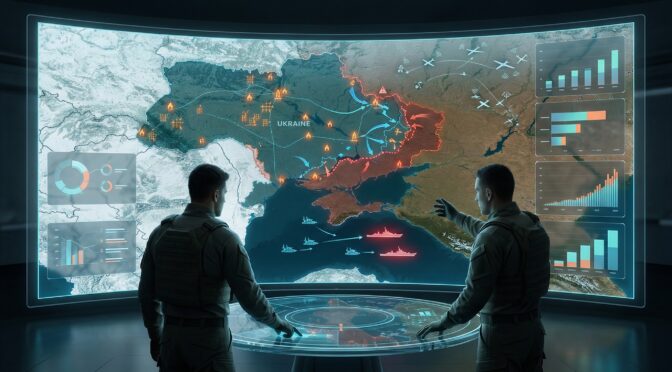
As the armed conflict between the Russian Federation and Ukraine officially crosses the threshold into its fifth year of high-intensity, conventional warfare, the strategic and operational landscape during the week ending February 28, 2026, is characterized by a violent, grinding war of attrition, escalating deep-strike asymmetric campaigns, and highly volatile, structurally fragile diplomatic maneuvering. The battlefield remains strategically static but tactically hyper-active. Russian military forces have formally initiated artillery and unmanned aerial vehicle (UAV) preparations for a projected Spring-Summer 2026 offensive, with operational vectors converging on the deeply entrenched Ukrainian “Fortress Belt” in the Donetsk Oblast. Simultaneously, the Russian aerospace forces have executed some of the most massive, coordinated strike packages of the war, deliberately targeting Ukraine’s civilian energy, water, and railway infrastructure to maximize societal friction during an unusually harsh winter. Conversely, the Ukrainian Armed Forces have demonstrated significant resilience, executing localized counter-offensive operations in the Kupyansk and southern directions that have successfully stabilized critical sectors and recaptured lost territory, refuting Kremlin narratives of inevitable Russian victory. Furthermore, Ukraine has exponentially expanded its deep-strike footprint, utilizing advanced Western munitions and domestically produced loitering munitions to strike critical logistical nodes and project power directly into the Moscow metropolitan area, forcing the disruption of Russian civil aviation.
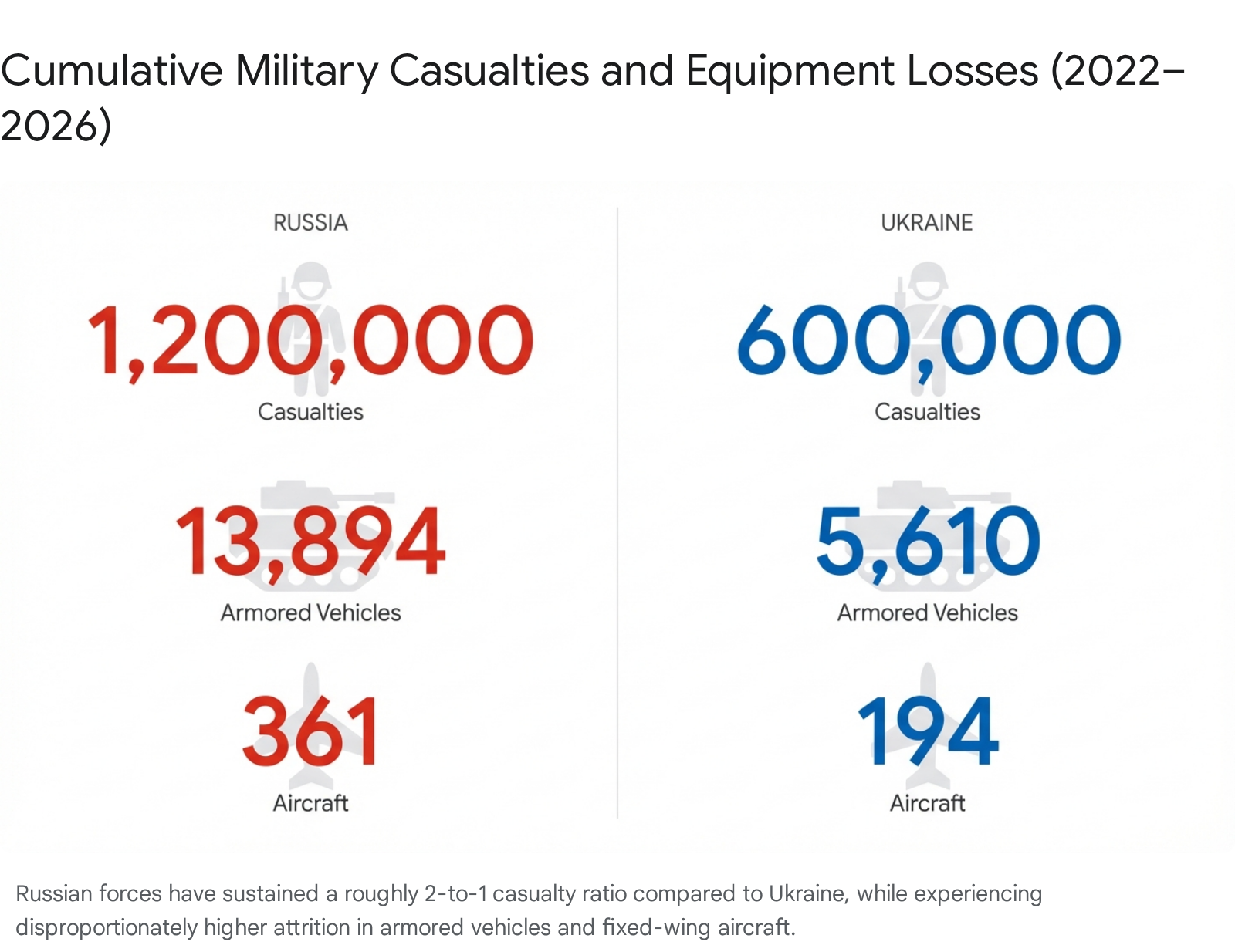
The human, demographic, and material toll of this protracted conflict has reached levels without modern precedent since the conclusion of the Second World War. Combined military casualties are currently projected to be approaching 1.8 million personnel, with the Russian military sustaining roughly 1.2 million casualties compared to Ukraine’s estimated 600,000. The extraordinary rate of mechanized and vehicular attrition has forced both belligerent nations into a state of deep reliance on international military, industrial, and economic lifelines. The Russian economy, while historically demonstrating artificial resilience due to a rapid, state-directed transition to a military-industrial footing, is currently exhibiting severe, potentially cascading structural strain. Indicators of this strain include stagnating domestic gross domestic product (GDP) growth, a punitive 20 percent central bank interest rate, and a critical, unfillable shortage of 4.8 million skilled workers across the manufacturing sector, threatening the long-term sustainability of Moscow’s entire war effort. Meanwhile, the macroeconomic survival of the Ukrainian state apparatus has been anchored by a newly approved $8.1 billion International Monetary Fund (IMF) Extended Fund Facility, which serves as the foundational component of a broader $136.5 billion international support package designed to offset catastrophic infrastructure damage and a massive, structural budget deficit.
Diplomatically, the geopolitical architecture surrounding the conflict is undergoing significant tectonic shifts. United States-mediated peace negotiations recently held in Geneva have yielded preliminary, yet highly controversial, draft frameworks. However, these bilateral and trilateral discussions are increasingly complicated by public friction between the current US administration’s aggressive push for a rapid negotiated settlement and the broader international community’s insistence on preserving Ukrainian sovereignty and territorial integrity—a divergence starkly highlighted during a recent, contested vote at the United Nations General Assembly. Within both nations, the pressure cooker of domestic politics is compounding external strategic challenges. The Kremlin has severely escalated its crackdown on the domestic information space, most notably through the deliberate throttling of the Telegram messaging network—a draconian internal security maneuver that paradoxically risks degrading Russian military command and control capabilities on the front lines. In Kyiv, the ongoing debate over the legal and logistical feasibility of holding presidential elections under the constraints of martial law continues to expose underlying political fault lines, particularly highlighting growing tension between the current wartime administration and former senior military leadership.
1. Strategic Battlefield Architecture and Tactical Evolution
1.1 Russian Offensive Operations and Shaping the Donetsk “Fortress Belt”
Strategic intelligence analysis indicates that the Russian military command has officially transitioned from winter positional holding patterns to the preliminary shaping phases of its highly anticipated Spring-Summer 2026 offensive. The operational center of gravity for the Russian Federation remains absolutely fixed on the Donetsk Oblast, specifically targeting the Ukrainian “Fortress Belt.” This belt is a deeply entrenched, heavily fortified series of interconnected cities and urban agglomerations that has served as the impenetrable backbone of Ukrainian defensive operations in the eastern theater since the initial hostilities of 2014.1 Intelligence gathered on February 26 and 27 confirms that Russian forces have initiated sustained, high-volume tube artillery bombardment of the settlement of Bilenke.1 Situated approximately 14 kilometers from the current line of contact, Bilenke serves as the immediate northeastern suburb of Kramatorsk, the northern anchor of the Fortress Belt.1 This specific artillery activity marks a significant and dangerous operational escalation; it is the first documented instance in the conflict where Russian forces have successfully advanced their tube artillery systems into firing positions capable of reliably striking Kramatorsk and its immediate suburbs.1
This intense artillery preparation in the northern sector is being systematically accompanied by a protracted Battlefield Air Interdiction (BAI) campaign targeting the southern flank of the Fortress Belt.1 Operating deep within the operational rear—roughly 20 to 100 kilometers behind the established line of contact—Russian forces are heavily and increasingly utilizing loitering munitions and first-person view (FPV) drones to interdict Ukrainian ground lines of communication (GLOCs).1 Geolocated video intelligence published on February 26 confirms precise Russian drone strikes occurring along the critical H-20 Kostyantynivka-Slovyansk highway.1 This highway functions as the primary logistical artery facilitating the movement of troops, ammunition, and medical evacuations between the fortified cities of the belt.1 Further strikes were documented against Ukrainian forces stationed in Oleksiievo-Druzhkivka, positioned at the extreme southern tip of the defensive line.1 Spatial analysis of the operational theater reveals a deliberate dual-pronged pressure system directed at the Ukrainian Fortress Belt. In the northern sector, Russian tube artillery units have established firing positions capable of striking Bilenke, effectively threatening the Kramatorsk suburban anchor. Simultaneously, the southern operational vector is characterized by persistent Battlefield Air Interdiction drone strikes concentrated along the H-20 highway, connecting Slovyansk and Kostyantynivka. This geographic distribution of kinetic activity indicates a concerted effort to isolate, interdict, and degrade the defensive line from both its northern and southern extremities prior to the commitment of massed Russian mechanized ground assault formations.
Despite these intense and resource-heavy shaping operations, the net rate of Russian territorial acquisition has markedly decelerated, indicating an operational culmination or, at minimum, severe logistical friction. Comprehensive analysis of territorial control mapping reveals that between January 27 and February 24, 2026, Russian forces managed to capture approximately 50 square miles of Ukrainian territory—an area only slightly larger than two Manhattan Islands.2 This represents a significant drop, being less than half of the 106 square miles seized during the preceding four-week period ending January 27.2 Furthermore, conflicting open-source intelligence highlights the highly fluid, contested nature of the current front lines. While specific Western analytical models suggest a net territorial loss of 33 square miles for Russia in the final week of February, granular frontline mapping from the Ukrainian DeepState open-source intelligence group indicates a marginal, contested Russian gain of 5 square miles between February 17 and 24.2 DeepState data confirms that while Russian forces advanced near more than a dozen micro-settlements, Ukrainian forces successfully executed localized counter-pushes, driving Russian units back near the settlements of Vyshneve, Verbove, Ternove, and Kalynivske.2 This overarching deceleration suggests that while Russian forces secured high-profile operational victories earlier in the year—most notably the confirmed total seizure of the heavily defended town of Pokrovsk by late January 2026—their broader offensive momentum is currently tightly constrained by overextended logistics, profound equipment losses, and stiffening, adaptive Ukrainian resistance.4
Adding a deeply concerning geopolitical dimension to the tactical battlefield is the confirmed, active integration of foreign military personnel. Intelligence reports indicate that North Korean military fighters have been officially embedded within Russian combat formations operating on the front lines.5 This unprecedented development marks a significant structural adjustment to Pyongyang’s historical force employment trends and highlights the severe, unmitigated manpower constraints currently plaguing the Russian military apparatus.5 The integration of North Korean personnel into Russian mechanized and infantry units introduces substantial, compounding challenges regarding tactical interoperability, linguistic barriers, and unified command-and-control, which may paradoxically impede the tempo and cohesion of future Russian ground assaults while signaling Moscow’s desperate reliance on rogue-state alliances.
1.2 Ukrainian Counter-Offensive Operations and Sector Stabilization
Directly refuting persistent Kremlin strategic narratives asserting that a decisive Russian battlefield victory is mathematically inevitable and that Ukraine must capitulate to maximalist demands, the Ukrainian Armed Forces have recently demonstrated localized operational superiority, achieving their most significant and sustained territorial recaptures since the overarching 2023 counteroffensive and the audacious August 2024 incursion into Russia’s Kursk Oblast.6 As the fifth year of the war commences, Ukrainian forces have proven highly capable of generating local combat power to exploit Russian overextensions.
A series of highly coordinated Ukrainian counterattacks in the Kupyansk direction, initially launched in mid-December 2025, successfully stabilized the critical defense of the town and systematically liberated at least 183 square kilometers of surrounding territory.6 Ukrainian operational commanders have successfully held and consolidated these gains throughout the entirety of February 2026, decisively defeating consecutive, massed Russian attempts to reverse the frontline alterations.6 Current battlefield dynamics and force posture assessments do not suggest that the Russian military will possess the localized combat power required to quickly regain this specific terrain in the near term.6
Simultaneously, the Ukrainian military command initiated limited, precise counterattacks in early February within the Oleksandrivka and Hulyaipole directions, spanning the highly contested Dnipropetrovsk and Zaporizhia oblasts.6 Throughout the month, these targeted operations yielded the verified liberation of approximately 200 square kilometers of territory across the Novopavlivka, Oleksandrivka, and Hulyaipole axes.6 When factoring in localized tactical losses of roughly 35 square kilometers in adjacent sectors during the same timeframe, Ukrainian forces achieved a verified net gain of 165 square kilometers across the southern theater in February.6 While military analysts assess that these localized counterattacks are unlikely to spontaneously transition into a theater-wide, strategic-level offensive capable of collapsing the Russian front, they serve a vital operational purpose. They effectively pin down Russian forces, disrupt staging areas, and force the Russian military command to urgently divert strategic reserves and logistical support away from their primary shaping efforts in the Donetsk Oblast, thereby diluting the combat power available for the anticipated Spring-Summer offensive.6
1.3 Asymmetric Deep-Strike Campaigns and Aerospace Warfare
In tandem with ground operations, the Ukrainian military has exponentially expanded and refined its deep-strike asymmetric warfare campaign, deliberately targeting Russian command, strike, and sustainment nodes located deep within the operational rear and inside the Russian Federation itself.5 On February 22, the Ukrainian Unmanned Systems Forces (USF) executed a highly sophisticated, long-range drone infiltration operation deep into sovereign Russian airspace, directing dozens of advanced loitering munitions toward the heavily defended Moscow metropolitan area.5 Russian civil and military authorities acknowledged that their integrated air defense systems were continuously engaged for several hours, publicly confirming the interception of more than 20 drones on the direct approaches to the capital.5 The psychological and immediate economic impacts of this strike were profound, forcing the emergency temporary cessation of all civil aviation operations at Moscow’s four major international transport hubs: Domodedovo, Sheremetyevo, Vnukovo, and Zhukovsky airports.5 This operation clearly demonstrates Ukraine’s growing capacity to bypass frontline gridlock and impose direct, asymmetric costs on the Russian political and economic center of gravity.
Furthermore, Ukraine’s strategic deployment of advanced Western munitions continues to systematically degrade high-value Russian operational capabilities. Throughout the final week of February, the Ukrainian General Staff reported a series of highly successful mid-range precision strikes utilizing the Army Tactical Missile System (ATACMS) against critical targets in occupied territories.6 Documented strikes definitively neutralized a Russian Uragan Multiple Launch Rocket System (MLRS) positioned near occupied Lyubymivka (roughly 26 kilometers from the frontline), a massed Russian manpower concentration near Novomykolaivka (44 kilometers from the frontline), an ammunition staging depot near Oleksandrivka (53 kilometers from the frontline), and an advanced technological equipment depot operated by the Rubikon Center for Advanced Unmanned Technologies near Vasylivka.6 Ukrainian Unmanned Systems Forces Commander Robert Brovdi further reported that Ukrainian forces successfully targeted and destroyed two highly advanced Russian Tor anti-aircraft missile systems located 45 and 95 kilometers behind the frontline in occupied Donetsk Oblast.7 This systematic counter-logistics, counter-command, and counter-air campaign represents a deliberate, methodical effort to dismantle the specific architectural nodes required to support and sustain the upcoming Russian offensive operations.
Conversely, the Russian aerospace domain strategy remains fundamentally characterized by intense, massed, asymmetric bombardment of the Ukrainian state. The Russian Federation has increasingly relied on enormous drone and missile salvos to circumvent tactical battlefield stagnation and inflict strategic, existential damage on Ukraine’s societal capacity to function.5 The night of February 25 to 26 witnessed one of the largest and most complex combined strike packages of the year, primarily targeting energy infrastructure. The Ukrainian Air Force reported the launch of a staggering 420 drones and 39 missiles in a single overnight barrage.8 This horrific event marked the fourth documented instance in the month of February 2026 alone where Russian forces launched an excess of 400 projectiles in a single night.8
The specific composition of the February 25-26 strike package indicates a deliberate, highly resourced strategy designed to overwhelm and exhaust Ukrainian integrated air defense systems through multi-vector, multi-altitude saturation.8 The volley included 11 Iskander-M ballistic and S-300 surface-to-air missiles operating in a ground-attack role, 24 Kh-101 strategic cruise missiles, two advanced Kh-69 cruise missiles, and two highly sophisticated Zirkon or Onyx anti-ship missiles repurposed for land targets.8 This was accompanied by roughly 280 Shahed-type loitering munitions, alongside Gerbera and Italmas variants.8 While Ukrainian air defense operators performed exceptionally, successfully downing 374 drones and 32 missiles, the sheer volume of the attack guaranteed penetrations.8 Five missiles and 46 drones successfully struck 32 targeted locations across the Poltava, Kyiv, Dnipropetrovsk, Chernihiv, Zaporizhia, Kharkiv, and Odesa oblasts, inflicting catastrophic damage on critical infrastructure.8
A notable, deeply concerning shift in Russian strategic targeting methodology has emerged; while energy infrastructure remains the primary objective, intelligence indicates a deliberate expansion of the target set to include vital water purification facilities and railway infrastructure.7 This expansion is likely designed to maximize civilian hardship, trigger public health crises, and sever the internal logistical movement of Ukrainian military reserves and vital international aid packages.7 Furthermore, Russian asymmetrical tactics have continued to evolve at the absolute tactical edge, highlighted by the confirmed deployment of a Russian fiber-optic first-person view (FPV) drone that reached the immediate outskirts of Kharkiv City for the first time on February 25.8 Fiber-optic drones are entirely immune to standard electronic warfare (EW) jamming, signaling an alarming extension of precision, unjammable tactical drone capabilities directly into major civilian population centers. Concurrently, Ukrainian internal security officials have formally accused Russian intelligence services of escalating a covert sabotage campaign within Ukraine’s borders, designed to degrade societal trust and destabilize the home front.7 On February 22, an improvised explosive device (IED) attack on a civilian shopping center in Lviv City resulted in one fatality and at least 25 injuries, an event the Ukrainian government directly attributes to coordinated Russian intelligence and proxy operations.7
2. The Calculus of Attrition: Casualties and Materiel Depletion
The strategic stalemate that currently defines the conflict is underpinned by an extraordinary, grinding rate of industrial and human attrition that entirely lacks modern precedent. Over the past four years, the war has devolved into a resource-intensive conflict of mutual annihilation, heavily dependent on the sheer mass of artillery, armor, and human capital.
2.1 The Human Cost of the Conflict
According to comprehensive intelligence estimates compiled by leading think tanks and Western defense officials as of late February 2026, the human cost has been catastrophic. The Russian Federation has suffered approximately 1.2 million total military casualties, a sweeping figure encompassing personnel killed in action, wounded, and missing.2 Within this massive total, expert estimates of confirmed Russian military fatalities range broadly from 230,000 to as high as 325,000.2 The scale of this loss is staggering; Western intelligence officials estimate that the Russian military absorbed 430,000 casualties in 2024 alone, followed by an additional 415,000 in 2025.2 Open-source intelligence initiatives, analyzing data verified strictly through public obituaries, cemetery expansions, and probate records, have independently confirmed the identities of over 200,000 deceased Russian soldiers, providing an absolute baseline for the death toll.2
Ukrainian military casualties, while significantly lower than their Russian counterparts, remain absolutely catastrophic for the nation’s demographic future and combat sustainability. Intelligence assessments estimate Ukrainian casualties to be between 500,000 and 600,000 personnel, including between 100,000 and 140,000 estimated fatalities.2 In a rare disclosure in February 2026, President Volodymyr Zelenskyy publicly acknowledged the death of 55,000 Ukrainian service personnel.2 While this official state figure is highly guarded and widely considered a conservative baseline, it is broadly indicative of the severe human cost borne by the defending nation.2 Consequently, the overarching casualty ratio heavily favors Ukraine, with Russian forces sustaining roughly 2 to 2.5 casualties for every single Ukrainian soldier lost in combat.9 Combined, the military casualties of both nations may currently be as high as 1.8 million and are statistically projected to reach 2 million total casualties by the spring of 2026.9 No major global power has suffered anywhere near these numbers of casualties or fatalities in any conflict since World War II.9
| Entity | Total Estimated Military Casualties (Killed, Wounded, Missing) | Estimated Fatalities |
| Russian Federation | ~1,200,000 | 230,000 – 325,000 |
| Ukraine | 500,000 – 600,000 | 100,000 – 140,000 |
| Combined Total | ~1,700,000 – 1,800,000 | 330,000 – 465,000 |
| Data synthesized from Center for Strategic and International Studies (CSIS), Wall Street Journal, The Economist, and Western intelligence estimates as of February 2026.2 |
2.2 Materiel Annihilation and Equipment Depletion
The decimation of conventional mechanized units, aviation assets, and naval power is equally profound, highlighting the industrial scale of the war. Documented photographic and videographic evidence, meticulously compiled by open-source intelligence groups like Oryx, confirms the absolute loss of 24,136 distinct pieces of Russian military equipment since the invasion began.2 This staggering total includes the destruction, abandonment, or capture of 13,894 tanks and armored fighting vehicles, the loss of 361 fixed-wing and rotary aircraft, and the sinking or severe damaging of 29 naval vessels, effectively neutralizing the Russian Black Sea Fleet as an offensive force.2
To sustain this unimaginable rate of attrition and continue prosecuting a war of this scale, Russia has heavily leveraged and expanded its domestic defense industrial base, shifting the economy onto a war footing.9 However, domestic production alone has proven insufficient. The Russian military is now critically reliant on munitions, ballistic missiles, and advanced drone technologies procured from the People’s Republic of China, the Islamic Republic of Iran, and North Korea.8
Ukraine, relying almost predominantly on vast tranches of Western military assistance and domestic innovation, has also suffered massive materiel degradation. Documented open-source data confirms the loss of 11,443 pieces of Ukrainian military equipment, including 5,610 tanks and armored vehicles, 194 aircraft, and 42 minor naval vessels.2 The sustainability of both militaries is now entirely decoupled from their pre-war stockpiles and is strictly governed by their respective industrial capacities and foreign supply chains.
To illustrate the depth of Russian armored depletion, a granular analysis of documented tank losses reveals that the Russian military has been forced to dig deep into Soviet-era strategic reserves. Out of 4,341 specifically documented tank losses, 377 are relatively modern T-72B3s, while 365 are older T-72Bs.2 More indicative of the strain, Russia has lost 154 severely outdated T-62Ms, 63 rapidly modernized T-62M Obr. 2022s, and at least 10 highly antiquated T-55A variants.2 This technological regression on the battlefield underscores the industrial impossibility of replacing modern armor at the rate it is being destroyed.
| Russian Tank Variant | Documented Losses (Destroyed, Damaged, Abandoned, Captured) |
| T-90 Series (Modern) | Data aggregated in broader AFV statistics, highly attrited |
| T-72B3 (Modernized) | 377 |
| T-72B (Legacy) | 365 |
| T-62M (Obsolete/Upgraded) | 154 |
| T-55 Series (Antiquated) | 15+ |
| Select sampling of documented Russian main battle tank losses highlighting the reliance on deeply antiquated strategic reserves. Source: Oryx.2 |
3. Geopolitical Realignments and Diplomatic Impasse
3.1 The Geneva Framework and Bilateral Friction
The diplomatic landscape during the final week of February 2026 has been characterized by intense, high-stakes, yet fundamentally friction-laden peace negotiations. On February 26 and 27, United States-mediated talks were held in Geneva, featuring senior military figures and high-ranking diplomats from both Russia and Ukraine.2 The American delegation, prominently featuring US special envoy Steve Witkoff, engaged in parallel, rigorous discussions with the Russian delegation, which was reportedly led by Kirill Dmitriev, a top negotiator and special envoy for Russian President Vladimir Putin.14 Simultaneously, Ukrainian officials, including top negotiator Rustem Umerov, engaged in intensive bilateral meetings focusing heavily on postwar reconstruction funding, long-term security architecture, and economic integration frameworks.14
Intelligence indicates that these exhaustive talks have successfully narrowed the overarching, multifaceted conflict down to two core, highly intractable issues: ironclad international guarantees of Ukraine’s postwar security architecture (preventing a future Russian re-invasion), and the administrative and sovereign control of heavily fortified, Ukrainian-held territories within the Donetsk region, which currently house approximately 190,000 civilians.2 Despite this intellectual distillation of the core issues, independent observers and intelligence analysts note that meaningful breakthroughs remain entirely elusive.4 Insider reports consistently suggest that the Kremlin remains fundamentally uninterested in genuine, equitable concessions.4 Instead, Moscow is utilizing the negotiation framework as a sophisticated “reflexive control” campaign—a psychological and diplomatic strategy designed to shape Western decision-making, stall military momentum, and freeze the conflict while Russia attempts to alter facts on the ground and rebuild its forces.4
A leaked draft of the proposed peace agreement generated during these talks has sparked significant international controversy. Analysis of the text by geopolitical experts reveals severe technical deficiencies, vague wording, and glaring inconsistencies that strongly indicate a lack of prior consultation with Ukrainian, European, and NATO military leadership.16 Furthermore, the linguistic structure and specific phrasing of the draft strongly suggest Russian origin or, at minimum, substantial Russian input prior to its presentation to the broader group.16 The draft audaciously presumes significant, binding commitments from NATO and the World Bank—entities that have not formally agreed to the roles or financial burdens outlined in the document.16 In an attempt to manage furious domestic and allied expectations, US President Donald Trump publicly clarified that the document is a “living, breathing document” rather than a final, take-it-or-leave-it offer, a sentiment echoed by US officials who emphasized its status merely as a starting point for deeper dialogue.16
Despite the fraught nature of the Geneva talks, diplomatic momentum is artificially accelerating toward direct head-of-state engagement. Following discussions between President Zelenskyy and President Trump, plans are rapidly advancing for high-level trilateral talks to take place in Abu Dhabi in early March.14 These upcoming negotiations are explicitly designed to finalize the parameters and security protocols for a potential in-person summit between President Zelenskyy and President Putin, an event that US special envoy Witkoff suggested could miraculously materialize within “the next three weeks”.2
3.2 Fractures in the International Consensus at the United Nations
The deep diplomatic tension between Washington’s aggressive pursuit of a rapid, negotiated settlement and the broader international community’s staunch stance on international law was starkly exposed on the floor of the United Nations. Marking the somber fourth anniversary of the full-scale invasion, the UN General Assembly adopted a sweeping resolution demanding an immediate, full, and unconditional ceasefire.17 The resolution, co-sponsored by Ukraine and 47 predominantly European allied nations, calls for the immediate release of all unlawfully detained persons and the safe return of all civilians forcibly deported to Russian territory, including thousands of Ukrainian children currently held in Russian “sanatoriums”.17 The measure passed decisively, with 107 nations voting in favor, 12 against, and 51 abstaining.17
However, the true geopolitical significance of the vote lay not in its passage, but in a highly unusual, last-minute intervention by the United States.19 Barely 15 minutes prior to the commencement of the vote, the US delegation initiated a controversial “motion for division,” proposing the surgical deletion of two critical paragraphs from the draft text.19 Crucially, these paragraphs explicitly affirmed Ukraine’s inviolable “sovereignty” and “territorial integrity”.19 US Deputy Permanent Representative Tammy Bruce argued before the assembly that such rigid legal language could “distract from ongoing negotiations” and limit the diplomatic avenues available to forge a durable peace.19
This parliamentary maneuver represents a profound, seismic shift in US diplomatic posture, suggesting a willingness to prioritize the facilitation of bilateral negotiations over the absolute, uncompromising guarantee of Ukrainian territorial restoration. The Ukrainian delegation vigorously opposed the US motion, warning the assembly that diluting the language would send a dangerous, appeasing signal regarding the validity of international legal norms and borders.19 The US motion ultimately failed overwhelmingly, garnering only 11 votes in favor—notably aligning the US voting bloc with Russia, Belarus, Hungary, and several Sahelian military juntas—while 69 nations voted against the deletion, and 62 abstained.19 This incident unambiguously underscores growing, public friction between the US administration and the traditional European-led coalition regarding the acceptable end-state of the conflict and the potential sacrifice of Ukrainian land for peace.
3.3 Intra-European Blackmail Operations and Sanctions Vetoes
Intra-alliance friction is further exacerbated by the opportunistic and highly disruptive maneuvering of Hungarian Prime Minister Viktor Orban within the European Union. On February 26, Orban initiated a high-stakes political pressure campaign aimed simultaneously at Brussels and Kyiv, leveraging Hungary’s status as a veto-wielding EU member state to extract sweeping concessions.20 Orban formally and publicly accused the Ukrainian government of deliberately halting the vital transit of Russian oil through the Druzhba (Friendship) pipeline.20 While Ukraine maintained that the transit disruption was a direct, unavoidable result of massive Russian missile strikes damaging critical energy infrastructure in late January, Orban utilized the incident to execute a sophisticated political blackmail operation.20
In retaliation for the pipeline disruption, Hungary—supported by the similarly aligned government of Slovakia—blocked the formal adoption of the European Union’s 20th sanctions package against the Russian Federation.20 More critically and dangerously, Orban explicitly threatened to indefinitely veto the disbursement of the highly anticipated 90 billion euro ($106 billion) Ukraine Support Loan, a vital, existential macro-financial assistance package that had been previously agreed upon by all member states.20 Four years into the all-out conflict, Hungary and Slovakia remain the only two EU nations still heavily and deliberately reliant on Russian energy imports.20 Neither nation has made serious efforts to diversify their energy portfolios, despite the existence of viable alternatives, such as the Adria oil pipeline connecting Hungary to the Adriatic Sea via Croatia.20 European intelligence analysts assess that Orban’s disruptive actions are primarily driven by domestic electoral strategies—stoking anti-Kyiv, nationalist sentiment to mobilize his political base ahead of upcoming domestic elections—while simultaneously maintaining Hungary’s highly privileged, lucrative economic relationship with Moscow.20
4. Macroeconomic Warfare, Sanctions, and Structural Resilience
4.1 Ukraine’s Financial Lifeline and Macroeconomic Projections
The survival of the Ukrainian state apparatus, the funding of its military, and the maintenance of basic civilian services remain entirely dependent on external, international financial life support. Recognizing the severe fiscal strain induced by entering the fifth year of total war, the Executive Board of the International Monetary Fund (IMF) formally approved a new 48-month Extended Fund Facility (EFF) totaling $8.1 billion for Ukraine on February 26, 2026.21 This facility authorizes the immediate disbursement of $1.5 billion directly to Kyiv and serves as the institutional and macroeconomic anchor for a monumental $136.5 billion total international support package.22 This unprecedented financial framework is engineered specifically to cover a projected, catastrophic $136.5 billion budget deficit over the next four years.14 Crucially, the deal also includes comprehensive debt relief mechanisms, extending the current moratorium on official sovereign debt servicing, providing Ukraine with vital fiscal breathing room.14
Despite the vital stabilization provided by the IMF and the broader international community, Ukraine’s economic outlook remains extraordinarily fragile, governed by what the IMF terms “cautious optimism”.24 The destruction of the industrial base and the displacement of millions of workers have hollowed out the economy. Real GDP growth for 2026 is projected to stagnate between a mere 1.8 and 2.5 percent, heavily constrained by the systemic, daily destruction of the national energy grid and localized, acute labor shortages.24 The National Bank of Ukraine previously downgraded its own 2026 GDP forecast to 1.8 percent, specifically citing the accelerating deterioration of the energy sector as the primary growth constraint.25
| Macroeconomic Indicator | 2022 (Actual – Outbreak of War) | 2025 (Estimated) | 2026 (Projected IMF) |
| Real GDP Growth | -28.8% | 1.8% – 2.2% | 1.8% – 2.5% |
| Inflation (Consumer Prices) | 20.2% | 12.7% | 6.1% (Avg) / 7.5% (YoY) |
| Unemployment Rate | 24.5% | 11.6% | 10.2% |
| Budget Deficit (% of GDP) | -10.14% | 23.6% | 19.3% |
| Public Debt (% of GDP) | 77.7% | 108.7% | 122.6% |
| International Reserves | $28.5 Billion | $57.3 Billion | $65.5 Billion |
| Data derived from official IMF Executive Board EFF projections for Ukraine, released February 26, 2026.22 |
While inflation is expected to cool significantly to an average of 6.1 percent and unemployment may decline to 10.2 percent (largely due to mobilization rather than job creation), nominal wage growth is forecast to slow dramatically from 22.6 percent to 12 percent, severely diminishing the real purchasing power of the civilian populace.24 Furthermore, the financial sustainability of the state is being heavily mortgaged against its postwar future; public debt is projected to surge to an astonishing 122.6 percent of GDP by the end of 2026, an unsustainable trajectory absent massive, permanent post-war restructuring and reparations.24
4.2 Russia’s Economic Stagnation and Critical Labor Crisis
Conversely, the Russian economy is currently navigating a highly dangerous critical inflection point, transitioning rapidly from an artificially stimulated period of military-Keynesian overheating into pronounced, structural stagnation.27 Since the initial sanctions shocks of 2022, Moscow’s pivot to a state-directed war economy drove record production in heavy industries such as steel, machinery, and chemicals, yielding an illusion of profound macroeconomic resilience.27 However, as the conflict enters its fifth year, the deep structural pressures of this military-driven growth model are becoming acute and potentially unmanageable. State development bank VEB now projects that Russian GDP growth will plummet below 1 percent in 2026, with an anticipated contraction of 0.8 percent, marking a stark and dangerous reversal from previous years of growth.27
This looming stagnation is primarily driven by an unprecedented, structural labor crisis that cannot be solved by state decree. The Russian unemployment rate has plummeted to a record low of 2.4 percent; however, intelligence economists emphasize that this metric reflects severe demographic hollowing and workforce depletion rather than genuine economic health.27 The relentless demands of military conscription, mass battlefield casualties, and the panicked emigration of hundreds of thousands of highly educated professionals have completely stripped the domestic labor market.27 The Russian Industry and Trade Ministry projects a catastrophic, systemic shortfall of 4.8 million skilled workers across high-tech, engineering, and manufacturing sectors by early 2026.27
This extreme labor scarcity has triggered a severe, destabilizing wage-price spiral across the Russian economy, as civilian factories and massive defense conglomerates fiercely compete for a shrinking pool of available personnel. Real wages have severely outpaced actual industrial productivity, forcing the Russian Central Bank to maintain a crippling key interest rate of approximately 20 percent in a desperate bid to suppress an inflation rate projected to reach 6.2 percent by year’s end.27 The prolonged high interest rate environment is completely suffocating corporate credit and expansion, leading to a projected 0.9 percent decline in domestic investment in 2026.27 Furthermore, cooling retail demand indicates that domestic consumption is finally faltering under the weight of sustained economic pressure.27 The federal budget structure reveals the immense, unbalanced toll of the conflict, with defense spending projected to consume a staggering 38 percent of total state expenditures in 2026, crowding out all other forms of civil investment.27
Having lost the vast majority of its lucrative European energy market—with the EU’s share of Russian energy exports dropping precipitously from roughly 50 percent to 4 percent—Russia has been forced to aggressively pivot to China and India.27 While this shift has maintained volume, relying on the expansion of the Power of Siberia gas pipeline and Arctic LNG projects, it has exposed Moscow to steeper price discounts dictated by Beijing and New Delhi, alongside vastly higher logistical costs, severely cutting into the state’s profit margins.27
4.3 Expansion of the International Sanctions Regime
Simultaneously, the international sanctions architecture continues to tighten, attempting to close loopholes and strangle the Russian war machine. The European Union formally extended its comprehensive sanctions regime against Russia until February 24, 2027, reinforcing its legal response to Moscow’s violations of international law.28 In a targeted move against internal repression, the EU added eight high-ranking officials from the Russian Federal Penitentiary Service and the judiciary to the sanctions list, a direct response to the inhuman and degrading treatment of political prisoners and anti-war activists within Russian penal colonies.28
The United Kingdom aggressively followed suit, announcing its largest single sanctions package to date. The UK introduced nearly 300 new measures specifically targeting critical Russian energy revenues, including oil exports, and aiming to dismantle global supply chains providing military components to the Russian armed forces.29 The UK government noted that Russian oil revenues are currently at their lowest point since 2020 due to these continued pressures.29 Concurrently, Switzerland fully implemented the remainder of the EU’s 19th sanctions package, executing sweeping prohibitions on the provision of all crypto services to Russian citizens and banning transactions involving certain ruble-backed cryptocurrencies (such as stablecoin A7A5) in an effort to close emerging avenues of digital financial evasion.30
Ukraine has also escalated its direct economic warfare, with President Zelenskyy signing decrees imposing targeted sanctions on ten private Russian transport and logistics companies.27 These entities were specifically targeted for operating within occupied territories and exploiting the hijacked infrastructure of Ukraine’s national postal service (Ukrposhta).27 The sanctioned firms were deeply involved in delivering essential goods to the Russian military, facilitating the parallel imports of dual-use electronics and drones, and operating illegal administrative centers that issued Russian passports and military draft notices to Ukrainian citizens living under occupation.27
5. Humanitarian Attrition and Infrastructure Collapse
The macroeconomic stagnation of Ukraine is intrinsically linked to the catastrophic, systematic degradation of its civilian infrastructure. The Russian Federation’s high-precision campaign against the energy grid has reached a critical culmination point, profoundly affecting the physical survivability of the civilian population during the unusually harsh winter of 2025-2026.32 Throughout January and February, near-daily Russian drone and missile barrages deliberately damaged or destroyed key components of the energy generation and transmission system across 17 distinct regions of the country.32
The cumulative degradation has left Ukraine’s entire energy system capable of meeting only 60 percent of national electricity demand.9 Consequently, millions of civilians have been reduced to relying on electricity for just a few hours per day.32 The cascading effects of these rolling power outages have paralyzed vital municipal heating and water services across the country. In the capital city of Kyiv, sequential Russian missile strikes completely disabled central heating for nearly 6,000 multi-story residential buildings during periods when temperatures routinely dropped to a lethal minus 20 degrees Celsius (minus four degrees Fahrenheit).32 Amnesty International and United Nations human rights monitoring missions unequivocally report that the sheer scale and persistence of infrastructure destruction represents a deliberate Russian strategy to subject the civilian population to extreme cruelty, freeze the population into submission, and break societal morale.33 This strategy dramatically increases the severe risk of mass hypothermia-related fatalities and sparks highly credible fears of new waves of mass displacement into Western Europe, which could further strain allied social systems and political unity.33
This engineered humanitarian crisis is further compounded by a decimated and overwhelmed healthcare system. The World Health Organization (WHO) documented a horrific 20 percent increase in direct attacks on Ukrainian healthcare facilities, ambulances, and medical workers in 2025 compared to the previous year.36 Since the beginning of the full-scale war, the WHO has verified an astonishing 2,881 distinct attacks on Ukrainian healthcare infrastructure.36 The lethal combination of direct infrastructure destruction and the collapse of the power grid has created severe gaps in medical care. Recent WHO assessments reveal that a staggering 59 percent of civilians living in frontline areas now report their health as poor or very poor.36 The stress of continuous bombardment has caused cardiovascular disease to surge dramatically, with one in four Ukrainians now experiencing dangerously high blood pressure.36 Furthermore, the mental health toll is staggering; 72 percent of surveyed individuals exhibit signs of severe depression or anxiety, yet only one in five possesses the means or ability to seek professional help in a country mobilized for total war.36
6. Domestic Political Fragility and Internal Security
6.1 The Kremlin’s Digital Crackdown and Information Control
As the domestic costs of the protracted war mount and economic pressures increase, the Kremlin has drastically escalated its suppression of internal dissent and consolidated absolute control over the domestic information space. Recognizing the existential threat posed by uncontrolled, independent information flows, the Russian government initiated a highly disruptive, nationwide throttling of the Telegram messaging application in February 2026.37 Telegram serves as the primary communication nexus for over 100 million Russians, acting as a critical, final alternative to state-controlled traditional media and propaganda networks.37
However, the throttling of Telegram represents a profound strategic risk for the Russian state, executed blindly in the pursuit of absolute regime security. Because the Kremlin has historically failed to provide secure, modern, encrypted communication equipment to its frontline forces, Telegram has evolved into the de facto command and control (C2) backbone for Russian military units operating in Ukraine.37 The artificial degradation of the network severely disrupted tactical communications on the battlefield, sparking immediate, furious backlash from the highly influential pro-war “milblogger” community.38 While Kremlin officials initially attempted to deny that frontline forces relied on the commercial app, the overwhelming evidence of operational disruption forced a rapid, embarrassing retraction of those statements.38
This incident starkly exposes a critical vulnerability within the Russian system: the Kremlin’s paranoid obsession with domestic information sovereignty is actively cannibalizing its military effectiveness in the field. The government is concurrently attempting to mandate the use of a state-controlled alternative platform, MAX, aiming to funnel citizens and military personnel into a digital environment subject to total surveillance and censorship.37
This digital crackdown is accompanied by a severe escalation in physical state repression. Human Rights Watch and United Nations Special Rapporteurs have documented an institutionalized campaign of terror targeting journalists, human rights lawyers, and anti-war activists.39 Utilizing vaguely defined counter-terrorism laws and draconian legislation prohibiting the spread of “fake news” regarding the military, the state has systematically dismantled civil society.40 For example, novelist Boris Akunin was recently sentenced to 14 years in absentia simply for voicing anti-war sentiments.40 Worryingly, UN investigations reveal the widespread and institutionalized use of torture against detainees, including disturbing evidence of punitive psychiatry, medical complicity, and state-sanctioned violence directed at marginalized groups.40 The internal political climate in Russia has devolved into a state of totalitarian mobilization, where any deviation from the state narrative is treated as an act of treason.
6.2 Ukraine’s Martial Law and the Electoral Dilemma
The domestic political environment in Ukraine is also experiencing heightened tension, driven by the prolonged, exhausting stresses of a war of survival and the complexities of constitutional governance under martial law. On February 26, the Ukrainian parliament, the Verkhovna Rada, voted to extend the implementation of martial law for the 18th consecutive time, ensuring its continuation in 90-day intervals until at least May 4, 2026.41
The extension of martial law sits at the absolute center of a growing, highly contentious domestic and international debate regarding the legitimacy and timing of national elections. President Zelenskyy’s original mandate, alongside the tenure of the current parliament elected in 2019, theoretically expired in 2024.42 However, Article 19 of Ukraine’s law “On the Legal Regime of Martial Law” explicitly forbids the holding of presidential, parliamentary, and local elections while the state remains under martial law, a constitutional provision designed to ensure the continuity of the state and military command during an existential invasion.41 Furthermore, lifting martial law to hold elections is functionally impossible; not only does the law prohibit its termination while a threat to territorial integrity exists, but the legal framework of martial law is the binding contractual mechanism that keeps roughly half of Ukraine’s armed forces in active frontline service.44
Despite these insurmountable legal, constitutional, and practical obstacles (including millions of displaced voters and soldiers in trenches), political competition is cautiously and dangerously re-emerging in Kyiv.45 The debate surrounding the feasibility of elections has transitioned from theoretical speculation to technical preparation, with a special parliamentary working group tasked with drafting legislation on holding elections under wartime conditions presenting its preliminary findings in late February.41
This political unfreezing has exposed underlying, latent fault lines within the Ukrainian leadership. Former Commander-in-Chief Valery Zaluzhny, currently serving as the Ambassador to the United Kingdom, recently issued high-profile public criticisms regarding the execution of the 2023 counteroffensive.45 This represents the first direct, public political challenge to President Zelenskyy by the highly popular former general, reigniting intense speculation about a potential future political rivalry.45 While public polling indicates that 59 percent of Ukrainians firmly believe elections should only be held after the conflict has concluded (with only 10 percent wanting them before the war ends), the relentless pressure from certain Western leaders—coupled with internal political maneuvering—threatens to unnecessarily politicize the wartime administration at a moment of supreme national peril.41
7. Strategic Forecasting and Intelligence Projections
As the conflict progresses into the spring of 2026, intelligence assessments indicate a high probability of intensified, highly lethal kinetic operations, running parallel to increasingly desperate and fraught diplomatic negotiations. The Russian military command is highly likely to conclude its artillery and drone shaping operations and launch massed, mechanized ground assaults against the Kramatorsk and Slovyansk anchors of the Donetsk Fortress Belt within the next 45 to 60 days. However, the severe structural degradation of Russian forces—evidenced by the reliance on antiquated T-55 and T-62 tanks, the integration of North Korean personnel, and the crippling shortage of domestic industrial labor—suggests that Russia lacks the capability to achieve rapid, operational-level breakthroughs. The conflict will almost certainly remain a grinding war of positional attrition, heavily dependent on artillery volumes and drone supremacy.
Ukraine’s strategic imperative over the next quarter will center entirely on surviving the engineered energy crisis while maximizing the efficacy of its deep-strike campaign. The targeted destruction of Russian logistical hubs and air defense architecture via ATACMS and long-range USF UAVs is a critical prerequisite for blunting the upcoming Russian offensive. Furthermore, Ukraine’s success in stabilizing the Kupyansk and southern fronts demonstrates that localized counter-offensives remain viable, provided Western munitions continue to flow uninterrupted and international financial support materializes.
The overall trajectory of the conflict will be heavily dictated by the shifting geopolitical stance of the United States and the resilience of the European alliance. The unprecedented attempt by the US delegation to remove language guaranteeing Ukrainian territorial integrity from the UN resolution is a clear, alarming indicator that Washington is prioritizing an expedited cessation of hostilities, potentially at the cost of Ukrainian land and long-term security. The upcoming trilateral talks in Abu Dhabi will serve as a critical stress test for the Western alliance. If the US attempts to force a settlement framework based on the deeply flawed Geneva drafts, it risks fracturing the European coalition, empowering disruptive actors like Hungary’s Viktor Orban, and perversely incentivizing the Kremlin to prolong the conflict in anticipation of further Western concessions and fatigue.
Economically, the war has become a race against systemic collapse for both belligerents. Ukraine remains wholly reliant on the steady execution of the $136.5 billion international support package to prevent sovereign default and mitigate the catastrophic civilian toll of the energy infrastructure destruction. Conversely, Russia’s military-Keynesian economic model is rapidly approaching its absolute ceiling. The convergence of a 20 percent interest rate, negative investment growth, and a 4.8 million worker deficit indicates that the Kremlin cannot sustain current rates of military production indefinitely without enacting highly destabilizing internal policies. Consequently, the severe throttling of the domestic information space and the escalation of state terror are likely preemptive measures designed to manage the inevitable domestic fallout as the true economic and human costs of the fifth year of war become impossible to conceal.
Please share the link on Facebook, Forums, with colleagues, etc. Your support is much appreciated and if you have any feedback, please email us in**@*********ps.com. If you’d like to request a report or order a reprint, please click here for the corresponding page to open in new tab.
Sources Used
- Russian Offensive Campaign Assessment, Feb. 27, 2026 | ISW, accessed February 28, 2026, https://understandingwar.org/research/russia-ukraine/russian-offensive-campaign-assessment-february-27-2026/
- The Russia-Ukraine War Report Card, Feb. 25, 2026 | Russia Matters, accessed February 28, 2026, https://www.russiamatters.org/news/russia-ukraine-war-report-card/russia-ukraine-war-report-card-feb-25-2026
- The Russia-Ukraine War Report Card, Jan. 28, 2026, accessed February 28, 2026, https://www.russiamatters.org/news/russia-ukraine-war-report-card/russia-ukraine-war-report-card-jan-28-2026
- Russian Offensive Campaign Assessment, February 25, 2026 – Institute for the Study of War, accessed February 28, 2026, https://understandingwar.org/research/russia-ukraine/russian-offensive-campaign-assessment-february-25-2026/
- Ukraine Military Situation Report | February 25 – Hudson Institute, accessed February 28, 2026, https://www.hudson.org/national-security-defense/ukraine-military-situation-report-february-25-can-kasapoglu
- Russian Offensive Campaign Assessment, February 24, 2026 | ISW, accessed February 28, 2026, https://understandingwar.org/research/russia-ukraine/russian-offensive-campaign-assessment-february-24-2026/
- Russian Offensive Campaign Assessment, February 22, 2026 – Institute for the Study of War, accessed February 28, 2026, https://understandingwar.org/research/russia-ukraine/russian-offensive-campaign-assessment-february-22-2026/
- Russian Offensive Campaign Assessment, February 26, 2026 – Institute for the Study of War, accessed February 28, 2026, https://understandingwar.org/research/russia-ukraine/russian-offensive-campaign-assessment-february-26-2026/
- Russia’s Grinding War in Ukraine – CSIS, accessed February 28, 2026, https://www.csis.org/analysis/russias-grinding-war-ukraine
- Four years later: The Russia-Ukraine war by the numbers – Northeastern Global News, accessed February 28, 2026, https://news.northeastern.edu/2026/02/23/russia-ukraine-war-four-year-anniversary/
- Four years ago, the world expected Ukraine to be crushed, but it has stood firm. So what now for Putin?, accessed February 28, 2026, https://www.theguardian.com/commentisfree/2026/feb/25/world-ukraine-vladimir-putin-geopolitical-conflict-donald-trump
- Tuesday briefing: The long and winding road of war in Ukraine, as the human cost mounts, accessed February 28, 2026, https://www.theguardian.com/world/2026/feb/24/tuesday-briefing-long-and-winding-road-of-war-in-ukraine
- Russia-Ukraine talks: All the mediation efforts, and where they stand – Al Jazeera, accessed February 28, 2026, https://www.aljazeera.com/news/2026/2/18/russia-ukraine-talks-all-the-mediation-efforts-and-where-they-stand
- Ukraine war briefing: IMF approves $8.1bn loan for Kyiv …, accessed February 28, 2026, https://www.theguardian.com/world/2026/feb/27/ukraine-war-briefing-imf-approves-81bn-loan-for-kyiv
- 2026 United States–Ukraine–Russia meetings in Geneva – Wikipedia, accessed February 28, 2026, https://en.wikipedia.org/wiki/2026_United_States%E2%80%93Ukraine%E2%80%93Russia_meetings_in_Geneva
- The Unfinished Plan for Peace in Ukraine: Provision by Provision – CSIS, accessed February 28, 2026, https://www.csis.org/analysis/unfinished-plan-peace-ukraine-provision-provision
- General Assembly Marks ‘Grim’ Fourth Anniversary of War in Ukraine, Adopts Text Calling for Ceasefire, as Eleventh Emergency Special Session Resumes | UN Meetings Coverage and Press Releases, accessed February 28, 2026, https://press.un.org/en/2026/ga12752.doc.htm
- Russian Occupation Update, February 26, 2026, accessed February 28, 2026, https://understandingwar.org/research/russia-ukraine/russian-occupation-update-february-26-2026/
- UN Resolution on Ukraine Approved Despite US Push to Water It Down – PassBlue, accessed February 28, 2026, https://passblue.com/2026/02/24/un-resolution-on-ukraine-approved-despite-us-push-to-water-it-down/
- Orban’s election campaign strategy — blackmail EU, Ukraine over Russian oil and hope for a fight, accessed February 28, 2026, https://kyivindependent.com/orbans-election-campaign-strategy-blackmail-eu-ukraine-over-russian-oil-pipeline-and-hope-for-a-fight/
- IMF approves new $8.1 billion four-year program for Ukraine, accessed February 28, 2026, https://english.nv.ua/business/new-8-1b-imf-deal-to-anchor-financial-aid-to-ukraine-50587460.html
- IMF Executive Board Approves US$8.1 Billion under an Extended Fund Facility (EFF) Arrangement for Ukraine, accessed February 28, 2026, https://www.imf.org/en/news/articles/2026/02/26/pr-26066-ukraine-imf-executive-board-approves-usd-8point1-billion-under-an-eff-arrangement
- IMF Approves $8.1B 4-Year Program for Ukraine, Releases $1.5B Immediately – Kyiv Post, accessed February 28, 2026, https://www.kyivpost.com/post/70892
- IMF sees slower but stable growth for Ukraine in 2026, accessed February 28, 2026, https://english.nv.ua/nation/imf-s-forecast-for-ukraine-s-economy-in-2026-gdp-growth-falling-inflation-and-unemployment-50587641.html
- IMF projects Ukraine’s real GDP growth at 1.8%-2.5% in 2026, accessed February 28, 2026, https://interfax.com/newsroom/top-stories/116352/
- Ukraine – IMF DataMapper, accessed February 28, 2026, https://www.imf.org/external/datamapper/profile/UKR
- Russia’s war economy slows as sanctions enter 5th year, accessed February 28, 2026, https://www.aa.com.tr/en/asia-pacific/russia-s-war-economy-slows-as-sanctions-enter-5th-year/3841981
- EU Extends Russia Sanctions Until 2027, Adds Eight Officials to List, accessed February 28, 2026, https://caspiannews.com/news-detail/eu-extends-russia-sanctions-until-2027-adds-eight-officials-to-list-2026-2-24-6/
- UK announces biggest sanctions package against Russia four years on from full-scale invasion of Ukraine – GOV.UK, accessed February 28, 2026, https://www.gov.uk/government/news/uk-announces-biggest-sanctions-package-against-russia-four-yearson-from-full-scale-invasionof-ukraine
- Switzerland Implements Remainder of EU’s 19th Sanctions Package Against Russia, accessed February 28, 2026, https://sanctionsnews.bakermckenzie.com/switzerland-implements-remainder-of-eus-19th-sanctions-package-against-russia/
- Ukraine: Federal Council implements 19th package of sanctions, accessed February 28, 2026, https://www.bafu.admin.ch/en/newnsb/O5M0QLVwbVE7A1uwQIJj-
- Energy attacks amid an unusually harsh winter are exposing Ukraine’s civilians to extreme hardship UN human rights monitors say, accessed February 28, 2026, https://ukraine.ohchr.org/en/Energy-attacks-amid-an-unusually-harsh-winter-are-exposing-Ukraine-s-civilians-to-extreme-hardship-UN-human-rights-monitors-say
- Russia’s attacks on Ukraine’s energy system – Chatham House, accessed February 28, 2026, https://www.chathamhouse.org/events/all/standard-event-research-event/russias-attacks-ukraines-energy-system
- Ukraine: New testimonies document brutal conditions for civilians amid Russian attacks on energy infrastructure – Amnesty International, accessed February 28, 2026, https://www.amnesty.org/en/latest/news/2026/02/ukraine-testimonies-brutal-conditions-civilians-russian-attacks-energy-infrastructure/
- Country Conditions: Ukraine February 2026 – USCRI, accessed February 28, 2026, https://refugees.org/country-conditions-ukraine-february-2026/
- Attacks on Ukraine’s health care increased by 20% in 2025, accessed February 28, 2026, https://ukraine.un.org/en/310610-attacks-ukraine%E2%80%99s-health-care-increased-20-2025
- What Russia’s War on Telegram Means for the West – FDD, accessed February 28, 2026, https://www.fdd.org/analysis/2026/02/23/what-russias-war-on-telegram-means-for-the-west/
- Putin’s Internet Crackdown Is Rooted in Weakness and a Need to Demand Greater War Sacrifices, accessed February 28, 2026, https://understandingwar.org/research/cognitive-warfare/putins-internet-crackdown-is-rooted-in-weakness-and-a-need-to-demand-greater-war-sacrifices/
- Russia: Crackdown on Dissent Escalates – Human Rights Watch, accessed February 28, 2026, https://www.hrw.org/news/2026/02/04/russia-crackdown-on-dissent-escalates
- Russia’s Repression Deepens – Human Rights & Public Liberties – Al Jazeera, accessed February 28, 2026, https://liberties.aljazeera.com/en/russias-repression-deepens-dissent-torture-and-legal-abuse/
- Next Ukrainian presidential election – Wikipedia, accessed February 28, 2026, https://en.wikipedia.org/wiki/Next_Ukrainian_presidential_election
- Can Ukraine Hold Elections This Year? | German Marshall Fund of the United States, accessed February 28, 2026, https://www.gmfus.org/news/can-ukraine-hold-elections-year
- Ukraine’s Presidential Elections Amid War: Political, Legal, and Security Challenges, accessed February 28, 2026, https://www.wilsoncenter.org/blog-post/ukraines-presidential-elections-amid-war-political-legal-and-security-challenges
- The West Shouldn’t Play Russia’s Game with Ukrainian Elections, accessed February 28, 2026, https://understandingwar.org/research/russia-ukraine/the-west-shouldnt-play-russias-game-with-ukrainian-elections/
- Notes From Kyiv: Is Ukraine Preparing for Elections?, accessed February 28, 2026, https://carnegieendowment.org/russia-eurasia/politika/2026/02/ukraine-elections-preparation