1. Executive Summary
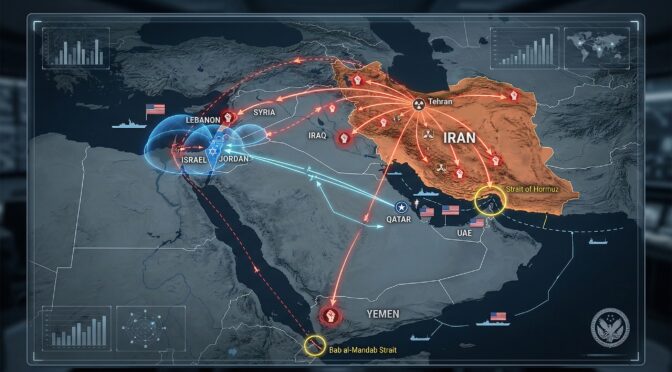
As of late February 2026, the strategic landscape in the Middle East has crossed a critical threshold, transitioning from high-intensity coercive diplomacy into direct, multi-front military confrontation. The launch of the joint United States–Israeli preemptive offensive,designated “Operation Epic Fury” by the US and “Operation Roaring Lion” by Israel,on February 28, 2026, has fundamentally altered the regional security architecture.1 This campaign, targeting Iranian nuclear infrastructure, ballistic missile production facilities, and senior leadership compounds in Tehran, Isfahan, and Qom, represents the most significant escalation since the June 2025 “12-Day War”.2 The Islamic Republic of Iran has immediately activated its regional retaliatory doctrine, initiating “Operation True Promise 4,” which has already struck US military assets, including the 5th Fleet headquarters in Bahrain and an FP-132 radar installation in Qatar, alongside widespread barrages against Israeli territory and Gulf Cooperation Council (GCC) airspace.1
The overall strategic balance is currently characterized by a profound and highly volatile asymmetry. The United States and Israel possess overwhelming conventional air superiority, precision-strike capabilities, and the most robust concentration of naval power seen in the region since the 2003 invasion of Iraq, anchored by the USS Abraham Lincoln and USS Gerald R. Ford Carrier Strike Groups.6 Conversely, Iran relies on escalation dominance through asymmetric means: a vast, reconstituted stockpile of solid-fuel medium-range ballistic missiles (MRBMs), swarming unmanned aerial vehicles (UAVs), and the capacity to disrupt global energy markets via the Strait of Hormuz.7
Iran’s capacity to sustain a prolonged war effort is severely constrained by advanced macroeconomic exhaustion. Crippling sanctions have reduced Iranian crude oil exports to below 1.39 million barrels per day (mb/d), while floating storage has swelled to over 170 million barrels, consuming approximately 20% of the nation’s oil revenue in logistical and evasion costs.10 Domestically, the regime is grappling with nationwide protests triggered by the total collapse of the rial (1.4 million per US dollar), though the Islamic Revolutionary Guard Corps (IRGC) maintains control through a highly sophisticated strategy of “containment governance”.11 Based on current consumption and attrition rates, Iran faces a critical depletion of pre-positioned solid-fuel MRBMs within 3 months, and a severe degradation of its broader military-industrial base within 6 to 12 months under sustained allied bombardment.8
The most likely trajectory is a period of Sustained Asymmetric Warfare, characterized by an extended war of attrition designed to exploit the mathematical and financial vulnerabilities of the US-Israeli air defense interceptor stockpiles.12 However, the conflict is currently plagued by severe leadership miscalculations on all sides. The United States leadership has overestimated the capacity of the Iranian public to execute regime change in a post-decapitation vacuum, dramatically underestimating the cohesive survival instincts of the 190,000-strong IRGC.14 Israeli leadership faces a mathematical impossibility regarding interceptor replacement rates relative to Iranian ballistic missile saturation tactics, creating a dangerous reliance on offensive preemption.12 Concurrently, Iranian leadership fatally underestimated the risk tolerance of Washington and Jerusalem, leading to the catastrophic failure of its deterrence doctrine and the onset of direct territorial war.7
2. Current Military Asset Comparison
The military confrontation involves fundamentally different force structures and operating philosophies. The US and Israel operate expeditionary, technologically superior, and capital-intensive militaries designed for rapid dominance and precision decapitation. Iran operates a defense-in-depth, asymmetric, and mathematically saturating force designed to offset its conventional inferiority by bankrupting the defensive capabilities of its adversaries.19
2.1 Macro-Level Force Posture and Personnel
The disparity in defense spending dictates the operational realities of the conflict. The United States operates with an annual defense budget approaching $895 billion, allowing for concurrent modernization, global basing, and the deep deployment of precision munitions across multiple theaters.21 Israel relies heavily on rapid mobilization, fielding a highly trained reserve force to augment its standing army.23 Iran, with a defense budget of approximately $15 billion, prioritizes low-cost, high-impact systems that bypass traditional conventional force-on-force engagements.21
| Metric | United States | Israel | Iran |
| Global Firepower Rank (2026) | 1st | 15th | 16th |
| Active Military Personnel | ~1,330,000 | ~169,500 | ~610,000 (inc. IRGC) |
| Reserve Personnel | ~799,500 | ~465,000 | ~350,000 (inc. Basij) |
| Estimated Defense Budget | ~$895 Billion | ~$24 Billion | ~$15 Billion |
| Strategic Doctrine | Expeditionary / Conventional Overmatch | Preemptive / Rapid Mobilization / Multi-layer Defense | Asymmetric / Attrition / Proxy Network |
| Manpower Pool (Population) | 335 Million | 9.4 Million | 88 Million |
The Iranian Armed Forces operate a dual-military structure. The Artesh (regular forces) is responsible for traditional border defense, numbering approximately 350,000 ground personnel.24 However, the center of gravity for Iranian power projection is the Islamic Revolutionary Guard Corps (IRGC), which commands an independent ground force (150,000), a naval wing specialized in asymmetric swarm tactics (20,000), an aerospace force overseeing the ballistic missile program (15,000), and the Quds Force for extraterritorial operations.24 This bifurcated structure ensures regime survival while complicating targeting for allied forces.
2.2 Aerospace and Air Defense Capabilities
Iran’s conventional air force is entirely obsolete, relying on an aging fleet of Soviet-era MiG-29s, Su-24s, and reverse-engineered F-5 airframes (such as the domestic Kowsar and Saeqeh), totaling fewer than 250 to 550 combat-capable aircraft.20 Consequently, Iran’s aerospace doctrine is almost entirely reliant on ground-based air defenses (GBAD) and offensive missile forces to contest airspace.20 Israel and the United States command total air superiority, utilizing fifth-generation stealth platforms (F-35, F-22) and strategic bombers (B-2 Spirit) capable of penetrating deep into Iranian territory with massive ordnance penetrators.4
However, the critical vulnerability for the US and Israel lies in the depletion rates of their highly advanced air defense interceptors against Iranian saturation tactics.26
| Asset Category | United States (Deployed/Available) | Israel | Iran |
| Total Combat Aircraft | >13,000 (Global) | ~600 | ~250-550 (Mostly obsolete) |
| Fifth-Generation Fighters | F-35C, F-22 (12 Deployed to Israel) | F-35I Adir | None |
| Long-Range Bombers | B-2 Spirit, B-52 | None | None |
| Primary Air Defense Systems | THAAD, Patriot (MIM-104), Aegis (SM-3/SM-6) | Arrow 2/3, David’s Sling, Iron Dome, Iron Beam | Bavar-373, S-300 (Degraded), Sayyad-3 |
| Air Defense Vulnerability | THAAD delivery gap (2023-2027); SM-3 depletion | High cost per intercept; Arrow depletion (52% used in 2025) | Heavy losses in 2024/2025; high reliance on MANPADS |
The mathematics of interception heavily favors the aggressor in this theater. Israel’s multi-tiered defense system is technologically unparalleled but financially brittle. The Arrow-2 and Arrow-3 systems provide exo-atmospheric interception against long-range ballistic missiles, David’s Sling addresses medium-range threats (100-200 km), and the Iron Dome secures the short-range perimeter.28 The strategic crisis emerges from the cost ratio: a single Arrow interceptor costs upwards of $3 million, while the Iranian offensive munitions they target (such as the Shahed series loitering munitions or older liquid-fueled missiles) range from $20,000 to $300,000.26 During the 2025 conflict, Israel expended 52% of its Arrow interceptor stockpile, requiring rapid domestic production scale-ups and heavy reliance on the US defense industrial base.32 The US is facing parallel constraints, having burned through years of Terminal High Altitude Area Defense (THAAD) and Standard Missile-3 (SM-3) production in recent engagements, with new THAAD deliveries not scheduled until April 2027.13
2.3 Ballistic Missiles, Cruise Missiles, and UAVs
Iran’s deterrence rests on the Middle East’s largest and most diverse missile arsenal.20 Prior to the June 2025 “12-Day War,” Iran possessed over 3,000 ballistic missiles.34 Following significant losses (estimated at 40-60% of its MRBM stockpile destroyed by allied strikes), Iran engaged in a massive reconstitution effort prior to the February 2026 hostilities.7 Tehran prioritized the rapid production of solid-fueled MRBMs, such as the Kheibar (2,000 km range), Sejil (1,500-2,500 km range), and the Haj Qasem (1,400 km range).35 Solid-fueled systems require vastly less launch preparation time compared to older liquid-fueled models, significantly improving their survivability against preemptive allied strikes designed to hunt launchers.7
| Capability | Iran | Israel | United States |
| Current Usable MRBM Inventory | ~1,000–1,200 (Reconstituting at 12% MoM pre-Feb 28) | Classified (Jericho series, ICBM capable) | High (Minuteman III, Trident SLBMs) |
| Short-Range/Tactical Missiles | Thousands (Largely undamaged in 2025 conflicts) | High (Rampage, LORA) | High (HIMARS, ATACMS, PrSM) |
| Cruise Missiles | High (Paveh, Hoveyzeh) | High (Delilah, Popeye Turbo) | High (Tomahawk, JASSM-ER) |
| UAV/Drone Swarm Capacity | Extremely High (Shahed series, thousands active) | High (Hermes, Heron – primarily ISR and precision strike) | High (MQ-9 Reaper, RQ-170 – stealth ISR and strike) |
| Production Resilience | High reliance on underground “missile cities” and imported Chinese precursors | Highly developed domestic defense industrial base; integrated with US | Global industrial base; currently straining on high-end interceptor production |
In January 2026, the Iranian armed forces claimed to have added 1,000 new drones to their inventories, intended to replace the assets lost during the 2025 conflict.7 Iran maintains a vast network of at least 24 missile sites, including deep underground “missile cities,” hardened silos, and tunnel bunkers in western, central, and southern Iran to protect and disperse these assets from American bunker-buster munitions.7
2.4 Naval and Maritime Asymmetric Assets
The naval theater, particularly the Strait of Hormuz, Persian Gulf, and the Red Sea, presents a distinct asymmetric challenge. The US maintains absolute blue-water naval supremacy, but the IRGC Navy utilizes a doctrine of “Smart Control” and anti-access/area denial (A2/AD).21 This involves swarm tactics utilizing hundreds of fast attack craft (FAC), the deployment of naval mines, and shore-to-sea missile batteries designed to threaten narrow chokepoints and overwhelm the Aegis combat systems of larger US vessels.9
| Naval Asset Type | United States (Deployed to CENTCOM/6th Fleet) | Iran (IRIN & IRGC Navy) |
| Aircraft Carriers | 2 (USS Abraham Lincoln, USS Gerald R. Ford) | 0 (Operates “drone carriers” e.g., Shahid Bagheri) |
| Submarines | Guided-missile submarines (SSGN), Attack subs (SSN) | 3 Kilo-class (aging), multiple domestic Fateh-class (semi-heavy/littoral) |
| Surface Combatants | Arleigh Burke-class Destroyers, Cruisers, LCS | Light Frigates, Corvettes, Fast Attack Craft (FAC) swarms |
| Maritime Strategy | Freedom of Navigation, Sea Control, Carrier Strike Projection | Anti-Access/Area Denial (A2/AD), Swarm Tactics, Mine Warfare, Coastal Defense |
The IRGC Navy’s deployment of the “Shahid Bagheri” drone carrier near Bandar Abbas and the testing of the naval “Seyed-3” surface-to-air missile demonstrate a concerted effort to build a “regional air defense umbrella” over its most advanced vessels, challenging US freedom of maneuver within the immediate littoral zones.9
2.5 Deployed United States Regional Assets (February 2026)
In response to the failure of diplomatic negotiations in Geneva and the outbreak of protests in Iran, the US initiated the largest military buildup in the region since 2003, transitioning from a deterrent posture to an active combat posture.6
- Carrier Strike Groups: Carrier Strike Group 3 (CSG-3), centered on the USS Abraham Lincoln (CVN-72) and Carrier Air Wing Nine, arrived in the Arabian Sea on January 26, 2026.6 The USS Gerald R. Ford (CVN-78), the largest warship ever constructed and utilizing the Electromagnetic Aircraft Launch System (EMALS), joined the theater in late February, creating a highly unusual and potent two-carrier deployment.6
- Combat Aircraft: The naval deployment includes squadrons of F/A-18E Super Hornets, EA-18G Growlers for electronic warfare, and F-35C Lightning IIs.6 Crucially, 12 F-22 Raptor stealth fighters were deployed directly to Ovda Airbase in southern Israel on February 24, 2026, marking the first US deployment of offensive weaponry directly on Israeli soil.6 Furthermore, F-15E Strike Eagles were relocated from RAF Lakenheath to Muwaffaq Salti Air Base in Jordan, while nine US aerial refueling tankers arrived at Ben Gurion Airport to sustain long-range bombing sorties.6
- Regional Bases and Vulnerabilities: US forces are staged across a vast network including Al Udeid Air Base (Qatar) and Ali Al Salem (Kuwait).6 However, recognizing the vulnerability of fixed infrastructure, the US Navy withdrew all vessels from its 5th Fleet base in Bahrain on February 26 to reduce vulnerability to preemptive Iranian strikes.6 This precaution proved prescient, as Iran successfully struck the 5th Fleet headquarters compound with ballistic missiles on February 28 during Operation True Promise 4.1
3. Iranian War Sustainability and Resource Depletion
Assessing Iran’s capacity to sustain a prolonged, multi-front conflict requires analyzing its macroeconomic health, the resilience of its logistical supply chains, and the attrition rates of its domestic military production against the backdrop of an intensely reinforced international sanctions regime.
3.1 Macroeconomic Exhaustion and Energy Export Collapse
Iran’s economy functions under a state of severe macroeconomic exhaustion, fundamentally sustained by a complex “shadow fleet” of oil exports designed to evade US sanctions. As of early 2026, the sustainability of this economic lifeline is failing rapidly. Crude oil loadings from Persian Gulf terminals collapsed to below 1.39 mb/d by January 2026,a stark 26% year-over-year drop.10 Deliveries to China, which traditionally purchases over 80% of Iran’s oil exports and acts as its primary geopolitical patron, fell to 1.13 mb/d.10
More critically, unsold Iranian crude stored on floating tankers has nearly tripled over the past year to more than 170 million barrels.10 The financial drain of maintaining this static fleet is catastrophic. Chartering Very Large Crude Carriers (VLCCs) under the extreme legal and insurance risks of sanctions costs upwards of $100,000 per day.10 Analysts estimate that a staggering 20% of Iran’s total oil revenue is currently consumed merely by transport, offshore storage, and evasion costs.10 Furthermore, to secure buyers, Iran is forced to sell its crude at steep discounts of $11 to $12 per barrel below standard benchmarks.10
This export collapse has precipitated massive capital flight. While the nominal value of Iran’s total exports yielded an $11 billion trade surplus in the first half of the 2025 fiscal year, nearly $15 billion in capital fled the country during the same period.38 The Central Bank of Iran holds approximately 320.7 tons of official gold reserves (ranking 20th–25th globally), but this serves only as a temporary buffer against the freefall of the national currency and cannot sustain a wartime economy indefinitely.39 The state is increasingly reliant on a $1.5 billion barter scheme, exchanging oil directly for basic goods, signaling a regression in basic macroeconomic functioning.10
3.2 Supply Chain Vulnerabilities and Munitions Depletion
Iran’s military-industrial base has proven resilient to limited strikes, utilizing deep subterranean “missile cities” to protect production lines from Israeli and US bunker-busting munitions (such as the 30,000-pound GBU-57 MOP used in the June 2025 Operation Midnight Hammer).4 Prior to the February 2026 strikes, Iran was reconstituting its ballistic missile arsenal at a rate of roughly 12% month-over-month (approximately 100 to 300 missiles per month depending on the class), aggressively leveraging domestic reverse-engineering and lighter composite materials.8
However, this production is heavily dependent on vulnerable external supply chains. The shift toward advanced solid-propellant missiles,which are vastly superior tactically because they do not require hours of fueling on vulnerable launch pads,requires the constant importation of Chinese precursors, specifically sodium perchlorate.7 Additionally, Iran has relied on Russian assistance to improve the terminal maneuverability of its reentry vehicles.7 Under a full-scale US naval blockade and secondary sanctions regime triggered by a wider war, the severance of these chemical and technological supply chains will halt advanced missile production.
3.3 Resource Depletion Timelines
Based on the intensity of the February 2026 strikes, observed operational tempo from the 2025 conflicts, and current inventories, the following depletion timelines are projected:
- 3 Months (May 2026): Depletion of Pre-positioned Strategic Assets. Iran’s currently usable inventory of 1,000–1,200 MRBMs will be rapidly depleted due to a combination of US/Israeli preemptive destruction of launchers (Operation Epic Fury) and high-volume Iranian retaliatory salvos intended to overwhelm allied defenses (Operation True Promise 4).8 Within 90 days, Iran will be forced to transition from strategic deep-strike bombardment to tactical and asymmetric swarm attacks using shorter-range systems and mass-produced UAVs.
- 6 Months (August 2026): Supply Chain Severance and Interceptor Crisis. US naval blockades and maximum-pressure secondary sanctions will begin severely restricting the influx of Chinese solid-fuel precursors, degrading Iran’s ability to manufacture new MRBMs.8 Concurrently, the US and Israel will face a critical crisis in air defense interceptors. The US is already experiencing a delivery gap for THAAD interceptors that will not be resolved until April 2027, and Israel burned through 52% of its Arrow stockpile in a mere 12 days during 2025.27 A grueling war of attrition will heavily favor Iran’s cheaper, lower-tech munitions at this juncture, forcing the US and Israel to accept higher casualty rates or transition to entirely offensive operations to eliminate launch sites.
- 12 Months (February 2027): Total Macroeconomic Exhaustion.
The physical strain on infrastructure, combined with the inability to export oil through a heavily contested Persian Gulf, will collapse the barter-based shadow economy. State revenues will plummet to near zero. The Iranian state will struggle to fund basic internal security operations, logistics for its proxy networks, and municipal services, leading to critical vulnerabilities in regime survival.
4. Domestic Stability and Regime Resilience
The US and Israeli strategy explicitly counts on the internal collapse of the Islamic Republic, with President Trump publicly urging the Iranian people to “take over” their government, framing the military strikes as their “only chance for generations”.16 However, assessing regime resilience requires distinguishing carefully between widespread public grievance and the state’s institutional capacity to violently suppress it.
4.1 Socio-Economic Triggers and Protest Dynamics
Iran entered 2026 facing the most extensive wave of popular protests since the Mahsa Amini “Woman, Life, Freedom” movement of 2022–2023, and the lethal fuel protests of November 2019.11 The primary catalyst for the late 2025/early 2026 unrest was acute economic deterioration, marked by a violent depreciation of the rial (falling from 1.07 million per USD in early November to 1.4 million by late December 2025) and accelerating, hyper-inflationary pressures.11 What began as socio-economic grievances among bazaar merchants, students, and wage earners rapidly morphed into systemic political defiance, with explicit chants targeting the Supreme Leader and questioning the fundamental legitimacy of the theocratic elite.11
Human rights monitors report significant casualties resulting from the state’s response, with thousands arrested and the use of lethal force escalating.44 The state’s governing capacity is deeply strained by macroeconomic exhaustion and “sanction fatigue,” creating a context where the leadership responds with violence because it lacks the financial resources to offer a reformist or economic horizon.11
4.2 The IRGC and “Containment Governance”
Despite the massive scale of the protests, the Iranian public currently lacks cohesive, unified leadership. Because demands from diverse groups,students, labor unions, and merchants,are not aggregated into a shared political platform, collective action remains episodic, transactional, and socially fragmented.11
The state’s internal security apparatus,anchored by the Ministry of Intelligence (MOIS), the 190,000-strong IRGC, and the Basij paramilitary forces,has evolved. Rather than oscillating between purely reformist concessions and total hardline violence, the regime has instituted a system of “containment governance”.11 Drawing lessons from the heavy-handed, internationally condemned disaster of 2019 and the prolonged normalization of defiance in 2022, the state now utilizes a highly calibrated toolkit.11 This involves selective coercion: targeted internet blackouts protecting vital state infrastructure (MOIS target decks), precision arrests, and severe death penalty threats from hardliners like Ali Khamenei, paired symmetrically with conciliatory rhetoric from figures like President Masoud Pezeshkian.11 The goal is to induce “temporal dispersion” and participant fatigue, keeping the protest intensity just below the critical threshold of a systemic rupture.11 Furthermore, the regime has shifted its rhetoric from labeling protesters as “rioters” to “terrorists,” laying the legal and psychological groundwork for unrestricted suppression.47
4.3 Regime Tolerance Under Direct War
Under the extreme physical stress of a direct territorial war (initiated February 28, 2026), public tolerance becomes highly volatile and unpredictable. Historically, external attacks can induce a “rally ’round the flag” effect, consolidating nationalist sentiment behind the government against a foreign aggressor. However, the explicit, precision targeting of leadership compounds, IRGC infrastructure, and government ministries by US and Israeli forces removes the regime’s long-cultivated aura of invincibility.1
If the state cannot provide basic services,water, electricity, fuel,due to systematic infrastructure destruction, the temporal dispersion of protests will end, replaced by desperate, existential, and violent unrest. Nevertheless, unless the allied strikes trigger sustained elite fragmentation or precipitate mass defections within the IRGC, the coercive apparatus remains highly lethal and institutionally intact.11 Supreme Leader Khamenei has prepared for decapitation scenarios, reportedly naming four potential successors for every critical military and government post, demonstrating an extreme level of paranoia and institutional hardening.49 The allied expectation that airstrikes alone will organically manifest a democratic transition represents a significant analytical leap that underestimates the entrenched survival mechanisms of the theocracy.14
5. Scenario Analysis
The outbreak of Operation Epic Fury and the retaliatory True Promise 4 necessitates the rigorous evaluation of ongoing conflict trajectories and their cascading global effects.
Scenario A: Sustained Asymmetric Warfare & Attrition (Current Trajectory)
- Likelihood: High (80% probability).
- Triggers: The US and Israel fail to completely decapitate Iranian command and control structures in the opening salvos; Iran recognizes it cannot win a conventional, symmetrical air war and shifts to its historical strength of attrition.
- Impacts (Military): Iran initiates low-cost, high-volume swarms of Shahed drones and older liquid-fuel missiles. These are intended not necessarily to destroy hardened Israeli or US infrastructure, but to force the continuous launch of billion-dollar US and Israeli interceptor stockpiles (THAAD, Arrow, Patriot), creating a crisis of munition exhaustion.26
- Impacts (Economic/Geopolitical): Iran activates the “Smart Control” doctrine in the Strait of Hormuz, using naval mines, fast attack craft, and electronic warfare to harass global shipping without fully closing the strait.21 This drives a persistent geopolitical risk premium, pushing Brent crude to $90–$120/bbl, disrupting global supply chains but deliberately stopping short of triggering a total US ground invasion.50 Argus Media reports indicate that Israel’s offshore Karish and Leviathan gas fields, along with the Haifa refinery, have already suspended operations due to the conflict, demonstrating the immediate regional energy vulnerability.52
- Sustainability Constraint: This scenario favors Iran initially due to the sheer cost asymmetry of the munitions. However, by month 6, the degradation of Iran’s domestic manufacturing base and the total collapse of its oil revenues will severely curtail its ability to fund its proxy network (Hezbollah, Houthis, Iraqi militias), forcing a degradation in operational tempo.
Scenario B: Direct Regional War & Total Infrastructure Targeting
- Likelihood: Medium (40% probability).
- Triggers: A mass-casualty event occurs on a US base (e.g., the February 28 strike on the 5th Fleet in Bahrain results in significant American deaths), or an Iranian ballistic missile penetrates Israeli air defenses and hits a major civilian population center in Tel Aviv or Jerusalem.
- Impacts (Military): The US abandons its doctrine of proportional response and engages in unrestricted targeting of Iran’s energy grid, port facilities, and remaining oil terminals. In response, Iran attempts to completely close the Strait of Hormuz and launches maximum-yield barrages at Saudi, Emirati, and Qatari energy infrastructure to internationalize the economic pain and punish US allies.52
- Impacts (Economic/Geopolitical): The total closure of the Strait of Hormuz drops Middle East oil output by approximately 65%. Global oil prices spike dramatically (projected at $150–$200/bbl), causing a massive contraction in global GDP (up to 2.4%).50
- Sustainability Constraint: Iran’s economy would instantly collapse into a localized barter system, accelerating domestic uprisings. The US military, while maintaining absolute air and naval dominance, lacks the logistical capability and domestic political mandate for a ground occupation, leading to a destroyed, deeply radicalized, and ungovernable Iranian landscape.
Scenario C: Limited Proxy Escalation & Strategic De-escalation
- Likelihood: Low (10% probability, largely nullified by recent events).
- Triggers: Mutual recognition of mutually assured economic and military exhaustion following the initial intense exchange of strikes on February 28. Oman or Qatar successfully brokers an immediate, face-saving ceasefire.
- Impacts: A return to the pre-2026 status quo of shadow warfare and cyber sabotage. Iran leverages the pause to accelerate deep-underground nuclear enrichment as the ultimate deterrent against future strikes, convinced that its conventional ballistic missile deterrence failed.
- Sustainability Constraint: Provides both sides the necessary strategic pause to replenish desperately low munition and interceptor stockpiles, delaying the conflict rather than resolving it.
6. Leadership Assessment: Overestimation and Underestimation
The rapid deterioration of the strategic landscape from intense diplomacy into direct, kinetic warfare across sovereign borders is the result of compounding miscalculations by the political and military leadership of the United States, Israel, and Iran. All three actors have demonstrated a dangerous disconnect between their public strategic doctrines and their actual demonstrated capabilities and constraints.
6.1 United States: The Illusion of Spontaneous Regime Change
President Donald Trump’s administration has explicitly stated that the ultimate objective of “Operation Epic Fury” is regime change, appealing directly to the Iranian people to overthrow their government and framing the strikes as an unprecedented opportunity.14 This reveals a critical overestimation of the Iranian opposition’s capacity and a profound underestimation of the IRGC’s institutional resilience.
Miscalculation: Washington is operating under the doctrinal fallacy that air superiority translates directly to desired domestic political outcomes. US leadership equates public grievance (evidenced by the rial collapse and recent protests) with cohesive, revolutionary capability.14 The Reality: The Iranian public lacks unified leadership, arms, and a cohesive platform. The state’s security apparatus is designed specifically to survive decapitation strikes and suppress internal dissent violently.14 By explicitly targeting the state without committing the necessary ground forces to secure a transition, the US risks destroying the country’s infrastructure while leaving the coercive machinery of the IRGC bloodied but intact. A paranoid, surviving IRGC will declare victory simply by existing, potentially closing the door on organic democratic reform.14 Furthermore, Washington underestimated Iran’s willingness to strike US bases directly, assuming the sheer mass of the US naval armada and the threat of catastrophic economic sanctions would paralyze Tehran’s decision-making.7 The belief that a “short, sharp” campaign could alter the regime without triggering a wider war reflects a failure to learn from the prolonged nature of previous Middle Eastern interventions.
6.2 Israel: The Interceptor Math and Capabilities Doctrine
Prime Minister Benjamin Netanyahu and the Israeli defense establishment operate under a trauma-informed “capabilities-based doctrine”.55 Since the strategic surprises of recent years, Israel assesses threats based not on declared intentions or diplomatic assurances, but strictly on Iran’s demonstrated capacity to produce and deploy ballistic missiles.
Miscalculation: Israel suffers from an over-reliance on technological overmatch while underestimating the raw mathematics of sustained attrition warfare. Israeli leadership believed it could manage the Iranian threat indefinitely through preemptive “mowing the grass” operations, covert sabotage, and an impenetrable, multi-layered defense shield.15 The Reality: The June 2025 war demonstrated unequivocally that Israel’s air defense architecture,while highly effective in short bursts,cannot guarantee absolute protection against sustained, massive saturation attacks.12 Israeli defense planners privately acknowledge that Iran’s rapidly expanding arsenal poses an existential threat precisely because it exhausts interceptor stockpiles.12 Firing a multi-million-dollar interceptor at a high volume of relatively cheap Iranian missiles represents an unsustainable economic and logistical curve.26 Israel overestimated its ability to replenish these interceptors quickly, heavily relying on a US defense industrial base that is currently experiencing severe delivery gaps and competing global priorities.27 This mathematical reality forced Israel’s hand into launching preemptive strikes, recognizing that a defensive posture alone would eventually fail.
6.3 Iran: Deterrence Failure and Misjudged Thresholds
Supreme Leader Ayatollah Ali Khamenei and the IRGC leadership relied on a strategy of “escalation dominance” via their Axis of Resistance proxies and the implicit threat of regional destabilization, particularly the disruption of the Strait of Hormuz and the specter of nuclear breakout.
Miscalculation: Iran systematically underestimated the risk tolerance of the current US and Israeli administrations. Tehran operated on the assumption that the threat of closing the Strait of Hormuz, unleashing Hezbollah, and inflicting US casualties would successfully deter a direct, sustained attack on sovereign Iranian territory. They believed Washington would restrain Israel to prevent a global oil shock that could derail the US domestic economy. The Reality: The February 28 strikes proved that the US and Israel were willing to cross the ultimate red line,direct, massive strikes on leadership compounds in Tehran and strategic nuclear facilities.1 Iran fatally misjudged the threshold for escalation; their continued enrichment activities, reconstitution of ballistic missile sites, and proxy harassment provided the exact justification Washington and Jerusalem needed to bypass containment and execute preventive strikes.18 Iran is now forced into a reactive posture, discovering that its deterrent umbrella was fundamentally hollow against an adversary willing to absorb significant economic and political disruptions to achieve strategic degradation. The regime must now navigate a direct war it sought to avoid, armed with an arsenal that is depleting faster than it can be replaced.
Appendix A: Methodology
This strategic assessment was synthesized using real-time open-source intelligence (OSINT), military procurement data, and geopolitical reporting current as of February 28, 2026.
- Sustainability Estimation: Economic sustainability was modeled utilizing Kpler tanker-tracking data regarding Iranian crude oil export volumes and floating storage accumulation.10 Military depletion timelines were calculated by juxtaposing known Iranian solid-fuel MRBM reconstitution rates (+12% month-over-month) against publicly disclosed US/Israeli interceptor expenditure rates and procurement delivery gaps (e.g., the CSIS analysis of THAAD and SM-3 backlogs).8
- Scenario Probability: Scenarios were weighted based on the Analysis of Competing Hypotheses (ACH) framework, factoring in the immediate real-time execution of Operations Epic Fury and True Promise 4, historical Iranian retaliatory patterns (from the 2025 conflict), and global energy market fragility indices (such as the 65% potential drop in Middle East output).8
- Data Sourcing: Asset inventories were cross-referenced from the 2026 Global Firepower Index, US Defense Intelligence Agency (DIA) assessments, and the International Institute for Strategic Studies (IISS) Military Balance.23
Appendix B: Glossary of Acronyms
- A2/AD: Anti-Access/Area Denial
- CENTCOM: United States Central Command
- CSG: Carrier Strike Group (US Navy)
- EMALS: Electromagnetic Aircraft Launch System
- FAC: Fast Attack Craft
- GBAD: Ground-Based Air Defense
- GCC: Gulf Cooperation Council
- IAD: Integrated Air Defense
- IRGC: Islamic Revolutionary Guard Corps (Sepah-e Pasdaran)
- IRGC-AF: IRGC Aerospace Force
- IRIN: Islamic Republic of Iran Navy (Regular Navy)
- JCPOA: Joint Comprehensive Plan of Action
- MOIS: Ministry of Intelligence of the Islamic Republic of Iran
- MRBM: Medium-Range Ballistic Missile
- OSINT: Open-Source Intelligence
- THAAD: Terminal High Altitude Area Defense
- UAV: Unmanned Aerial Vehicle
- VLCC: Very Large Crude Carrier
Appendix C: Glossary of Foreign Terms
- Artesh: The conventional military forces of the Islamic Republic of Iran, operating parallel to the IRGC and tasked primarily with defending Iran’s external borders.
- Basij: A volunteer paramilitary militia established in 1979, operating under the command of the IRGC. Used extensively for internal security, moral policing, and violently suppressing domestic protests.
- Axis of Resistance: An informal, Iran-led political and military coalition in the Middle East (including Hezbollah in Lebanon, the Houthis in Yemen, Hamas in Gaza, and various Iraqi militias) designed to project Iranian influence and oppose US and Israeli interests through decentralized proxy warfare.
- Velayat-e Faqih: “Guardianship of the Islamic Jurist.” The foundational political and religious doctrine of the Islamic Republic, which grants absolute and infallible political authority to the Supreme Leader (currently Ayatollah Ali Khamenei).
- Rial: The official currency of Iran, which has suffered catastrophic depreciation due to sanctions, capital flight, and economic mismanagement, driving widespread domestic unrest.
- Shahed: “Witness” or “Martyr” in Persian. The designation for a prolific series of Iranian unmanned aerial vehicles, particularly loitering munitions (kamikaze drones) used extensively in asymmetric swarm attacks to exhaust enemy air defenses.
- Khorramshahr / Kheibar / Haj Qasem: Designations for advanced, increasingly solid-fueled Iranian medium-range ballistic missiles, named after historical battles, locations, or revered military figures (e.g., Qasem Soleimani), representing the core of Iran’s strategic deterrent.
Please share the link on Facebook, Forums, with colleagues, etc. Your support is much appreciated and if you have any feedback, please email us in**@*********ps.com. If you’d like to request a report or order a reprint, please click here for the corresponding page to open in new tab.
Sources Used
- Joint US-Israel Military Offensive and Iran Retaliation – SpecialEurasia, accessed February 28, 2026, https://www.specialeurasia.com/2026/02/28/iran-israel-united-states-war/
- FACT SHEET: Everything You Need to Know About the US–Israeli …, accessed February 28, 2026, https://www.palestinechronicle.com/fact-sheet-everything-you-need-to-know-about-the-us-israeli-war-on-iran/
- № 4 (6), 2025. US Strikes on Iran: Timeline and OSINT Damage Assessment – PIR Center, accessed February 28, 2026, https://pircenter.org/en/editions/%E2%84%96-4-6-2025-us-strikes-on-iran-timeline-and-osint-damage-assessment/
- United States strikes on Iranian nuclear sites – Wikipedia, accessed February 28, 2026, https://en.wikipedia.org/wiki/United_States_strikes_on_Iranian_nuclear_sites
- Iran Attacks US Navy Base in Bahrain: Fifth Fleet Headquarters Targeted in ‘Operation Epic Fury’; Gulf Capitals on High Alert, accessed February 28, 2026, https://sundayguardianlive.com/world/iran-attacks-us-navy-base-in-bahrain-us-fifth-fleet-headquarters-targeted-in-operation-epic-fury-gulf-capitals-on-high-alert-172914/
- 2026 United States military buildup in the Middle East – Wikipedia, accessed February 28, 2026, https://en.wikipedia.org/wiki/2026_United_States_military_buildup_in_the_Middle_East
- Iran’s Evolving Missile and Drone Threat | JINSA, accessed February 28, 2026, https://jinsa.org/wp-content/uploads/2026/02/Irans-Evolving-Missile-and-Drone-Threat.pdf
- Iran-US-Israel Escalation Dynamics – Nuclear Leverage, Military …, accessed February 28, 2026, https://debuglies.com/2026/02/24/iran-us-israel-escalation-dynamics-nuclear-leverage-military-buildup-and-retaliatory-postures-february-2026/
- Iran Update, January 29, 2026, accessed February 28, 2026, https://understandingwar.org/research/middle-east/iran-update-january-29-2026/
- Tehran’s oil lifeline shows signs of strain under tightening sanctions …, accessed February 28, 2026, https://www.iranintl.com/en/202602133199
- Iran’s 2025-26 protests, resilience and political containment, accessed February 28, 2026, https://www.realinstitutoelcano.org/en/analyses/irans-2025-26-protests-resilience-and-political-containment/
- “Israel Admits Missile Shield Limits: Iran’s 5,000-Strong Ballistic Arsenal Could Overwhelm Iron Dome, Arrow and U.S. Gulf Bases”, accessed February 28, 2026, https://defencesecurityasia.com/en/israel-iran-ballistic-missile-threat-5000-missiles-iron-dome-arrow-gulf-bases-2027/
- Shallow Ramparts: Air and Missile Defenses in the June 2025 Israel-Iran War, accessed February 28, 2026, https://www.fpri.org/article/2025/10/shallow-ramparts-air-and-missile-defenses-in-the-june-2025-israel-iran-war/
- Experts react: The US and Israel just unleashed a major attack on Iran. What’s next?, accessed February 28, 2026, https://www.atlanticcouncil.org/dispatches/experts-react-the-us-and-israel-just-unleashed-a-major-attack-on-iran-whats-next/
- US superiority over Iran is obvious, the endgame is not, accessed February 28, 2026, https://www.iranintl.com/en/202602268309
- US-Israel strikes target Iranian regime | The Straits Times, accessed February 28, 2026, https://www.straitstimes.com/world/the-surprises-and-the-remaining-questions-looming-over-the-us-israeli-attack-on-iran
- How Would Iran Respond to a U.S. Attack? – CSIS, accessed February 28, 2026, https://www.csis.org/analysis/how-would-iran-respond-us-attack
- US, Israel bomb Iran: A timeline of talks and threats leading up to attacks, accessed February 28, 2026, https://www.aljazeera.com/news/2026/2/28/us-israel-bomb-iran-a-timeline-of-talks-and-threats-leading-up-to-attacks
- Iran vs Israel Military Strength Compared: Which Country is Stronger in Troops, Missiles, Tanks & Naval Power as War Escalates?, accessed February 28, 2026, https://sundayguardianlive.com/world/iran-vs-israel-war-military-strength-compared-which-country-is-stronger-in-troops-missiles-tanks-naval-power-as-war-escalates-172930/
- FACTBOX – Iran’s military power: Missiles, drones and deterrence, accessed February 28, 2026, https://www.aa.com.tr/en/middle-east/factbox-iran-s-military-power-missiles-drones-and-deterrence/3822798
- U.S. vs. Iran Military 2026 – Challenge Coin Nation, accessed February 28, 2026, https://challengecoinnation.com/blogs/news/u-s-vs-iran-military-2026
- US vs Iran: Here is a head-to-head comparison of the military assets of the two countries, accessed February 28, 2026, https://www.livemint.com/news/us-news/us-vs-iran-here-is-a-head-to-head-comparisons-of-the-military-assets-of-the-two-countries-11771570400706.html
- Israel–Iran military face-off: Who holds the edge in high-stakes showdown – numbers compared, accessed February 28, 2026, https://timesofindia.indiatimes.com/defence/international/israeliran-military-face-off-who-holds-the-edge-in-high-stakes-showdown-numbers-compared/articleshow/128882672.cms
- Iran Military Power – DIA, accessed February 28, 2026, https://www.dia.mil/portals/110/images/news/military_powers_publications/iran_military_power_lr.pdf
- Despite overwhelming US military might, Iran campaign would pose complex challenges, accessed February 28, 2026, https://www.timesofisrael.com/despite-overwhelming-military-might-us-faces-complex-challenges-in-iran-campaign/
- Israel Shores Up Air Defenses, Expected to Hit Iran Launchers Early …, accessed February 28, 2026, https://www.algemeiner.com/2026/02/27/israel-shores-up-air-defenses-expected-hit-iran-launchers-early-ease-stockpile-strain/
- No THAADs ’til 2027: Missile defense experts warn of interceptor ‘gap’, accessed February 28, 2026, https://breakingdefense.com/2025/12/no-thaads-til-2027-missile-defense-experts-warn-of-interceptor-gap/
- From Iron Dome to Iron Beam: Israel’s sky shields against Iranian missiles, accessed February 28, 2026, https://m.economictimes.com/news/defence/israels-iron-dome-to-iron-beam-inside-the-multi-layer-sky-shield-defending-against-iranian-missiles/articleshow/128844223.cms
- Israel Shores Up Air Defenses, Expected to Hit Iran Launchers Early to Ease Stockpile Strain, accessed February 28, 2026, https://jewishpostandnews.ca/uncategorized/israel-shores-up-air-defenses-expected-to-hit-iran-launchers-early-to-ease-stockpile-strain/
- Inside Israel’s Missile Shield: The Multi-Layered Defence Built to Counter Iran, accessed February 28, 2026, https://moderndiplomacy.eu/2026/02/27/inside-israels-missile-shield-the-multi-layered-defence-built-to-counter-iran/
- Eyeing future missile threats, Israel successfully completes ‘complex’ David’s Sling tests, accessed February 28, 2026, https://www.timesofisrael.com/eyeing-future-missile-threats-israel-successfully-completes-complex-davids-sling-tests/
- Iran Update, December 22, 2025 | ISW, accessed February 28, 2026, https://understandingwar.org/research/middle-east/iran-update-december-22-2025/
- The Depleting Missile Defense Interceptor Inventory – CSIS, accessed February 28, 2026, https://www.csis.org/analysis/depleting-missile-defense-interceptor-inventory
- Table of Iran’s Missile Arsenal | Iran Watch, accessed February 28, 2026, https://www.iranwatch.org/our-publications/weapon-program-background-report/table-irans-missile-arsenal
- Iran’s ballistic missile capabilities and range explained after US strike, accessed February 28, 2026, https://www.the-independent.com/news/world/middle-east/iran-attack-missiles-range-ballistic-b2929395.html
- Iran Update, February 24, 2026 | ISW, accessed February 28, 2026, https://understandingwar.org/research/middle-east/iran-update-february-24-2026/
- US Navy withdraws all vessels from Bahrain base amid rising tensions with Iran, accessed February 28, 2026, https://www.middleeastmonitor.com/20260226-us-navy-withdraws-all-vessels-from-bahrain-base-amid-rising-tensions-with-iran/
- Money is leaving Iran faster as oil income falls and uncertainty mounts, accessed February 28, 2026, https://www.iranintl.com/en/202602189530
- Is Iran’s Gold a Buffer Against the Storm? :: nournews, accessed February 28, 2026, https://nournews.ir/en/news/275385/Is-Iran%E2%80%99s-Gold-a-Buffer-Against-the-Storm
- Operation Midnight Hammer: How the US conducted surprise strikes on Iran, accessed February 28, 2026, https://breakingdefense.com/2025/06/operation-midnight-hammer-how-the-us-conducted-surprise-strikes-on-iran/
- What are Iran’s ballistic missile capabilities?, accessed February 28, 2026, https://www.straitstimes.com/world/middle-east/what-are-irans-ballistic-missile-capabilities?ref=latest
- Iran’s Conflict With Israel and the United States – Council on Foreign Relations, accessed February 28, 2026, https://www.cfr.org/global-conflict-tracker/conflict/confrontation-between-united-states-and-iran
- 2026 Iranian Protests | Cause, Events, Leaders, Crackdown, 12-Day War, Trump, Islamic Revolution, Reza Pahlavi, Shah, & Israel | Britannica, accessed February 28, 2026, https://www.britannica.com/event/2026-Iranian-Protests
- 2025–2026 Iranian protests – Wikipedia, accessed February 28, 2026, https://en.wikipedia.org/wiki/2025%E2%80%932026_Iranian_protests
- Iran: What challenges face the country in 2026? – House of Commons Library, accessed February 28, 2026, https://commonslibrary.parliament.uk/research-briefings/cbp-10456/
- The Signal in the Silence: Strategic Implications of Iran’s 2026 Internet Blackout for Cyber Threat Intelligence and Narrative Control – FalconFeeds.io, accessed February 28, 2026, https://falconfeeds.io/blogs/the-signal-in-the-silence-irans-2026-internet-blackout-cti-narrative-control
- Iran Update, January 10, 2026 | ISW, accessed February 28, 2026, https://understandingwar.org/research/middle-east/iran-update-january-10-2026/
- Scenarios for Iran’s Future and Implications for GCC Security – Stimson Center, accessed February 28, 2026, https://www.stimson.org/2026/scenarios-for-irans-future-and-implications-for-gcc-security/
- Iran Update, February 25, 2026 | ISW, accessed February 28, 2026, https://understandingwar.org/research/middle-east/iran-update-february-25-2026/
- Are the US and Iran on a collision course for war or a surprise deal? | Middle East Eye, accessed February 28, 2026, https://www.middleeasteye.net/opinion/us-iran-collision-course-war-surprise-deal
- Limited U.S. Strike on Iran: Energy Market Impact – Discovery Alert, accessed February 28, 2026, https://discoveryalert.com.au/us-strike-iran-2026-market-volatility-geopolitical-tensions/
- Israel gas fields, refinery shut after attack on Iran, accessed February 28, 2026, https://www.argusmedia.com/en/news-and-insights/latest-market-news/2794474-israel-gas-fields-refinery-shut-after-attack-on-iran
- If Trump Strikes Iran: Mapping the Oil Disruption Scenarios – CSIS, accessed February 28, 2026, https://www.csis.org/analysis/if-trump-strikes-iran-mapping-oil-disruption-scenarios
- Insights From Kroll Economics – How Geopolitical Shifts Could Reshape Global Markets, accessed February 28, 2026, https://www.kroll.com/en/publications/valuation/navigating-global-oil-market-2026-risk-scenarios
- Israel’s Strategic Consensus on Iran , and Its Risks – Stimson Center, accessed February 28, 2026, https://www.stimson.org/2026/israels-strategic-consensus-on-iran-and-its-risks/
- The Military Balance 2026 – The International Institute for Strategic Studies, accessed February 28, 2026, https://www.iiss.org/publications/the-military-balance/