
Executive Summary
For the week ending March 14, 2026, the People’s Republic of China (PRC) demonstrated a highly synchronized execution of grand strategy across domestic legislation, geopolitical maneuvering, military posture, and technological acceleration. The conclusion of the fourth session of the 14th National People’s Congress (NPC) on March 12 served as the anchor event of the week, formalizing Beijing’s pivot toward a heavily securitized, self-reliant “Fortress Economy”.1 The adoption of the 15th Five-Year Plan (2026-2030) and the highly controversial Ethnic Unity and Progress Promotion Law indicates a domestic environment prioritizing technological sovereignty and Han-centric socio-political homogenization over conventional growth metrics.2
Externally, the escalating US-Israeli conflict with Iran has provided Beijing with an unprecedented strategic opening. With the Strait of Hormuz effectively closed to Western maritime traffic, Chinese diplomats are actively negotiating a paradigm-shifting agreement with Tehran to allow Chinese tankers exclusive passage, provided the petroleum is traded in the Chinese yuan.4 If successful, this maneuver will severely undermine the petrodollar system while securing China’s critical energy lifelines. Concurrently, Beijing is preparing for intense trade negotiations in Paris with US officials, leveraging a surprising January-February export surge to negotiate from a position of relative economic resilience.5
In the military and security domain, satellite intelligence confirmed a massive, rapid land reclamation campaign at Antelope Reef in the Paracel Islands, utilizing “dark dredgers” to add an estimated 15 square kilometers of land since December 2025.7 This aggressive infrastructure expansion in the South China Sea is coupled with sustained military pressure on Taiwan and a significant breakthrough in gallium oxide semiconductor technology, which is poised to give Chinese stealth fighters a decisive radar advantage over US platforms.9
Finally, the domestic technology sector was consumed by “OpenClaw” mania—a viral adoption of agentic artificial intelligence dubbed “lobster farming”.10 While highlighting China’s rapid integration of next-generation AI, the phenomenon has exposed critical systemic vulnerabilities, resulting in massive data leaks and prompting urgent regulatory intervention.11 Across all vectors, the intelligence indicators from this week point to a PRC that is rapidly insulating itself from Western coercion while aggressively exploiting geopolitical vacuums to advance its asymmetric capabilities.
1. Political and Legislative Affairs
The domestic political landscape was dominated by the highly choreographed conclusion of the “Two Sessions” (Lianghui). On March 12, 2026, the 14th National People’s Congress, overseen by President Xi Jinping, Premier Li Qiang, and NPC Standing Committee Chairman Zhao Leji, voted to approve several foundational documents that will dictate China’s trajectory through the end of the decade.13 The legislative outputs confirm a definitive shift away from the reform-and-opening paradigms of previous decades, replacing them with a rigid framework of national security, technological autarky, and ideological centralization.
1.1 The 15th Five-Year Plan (2026-2030): Constructing the Fortress Economy
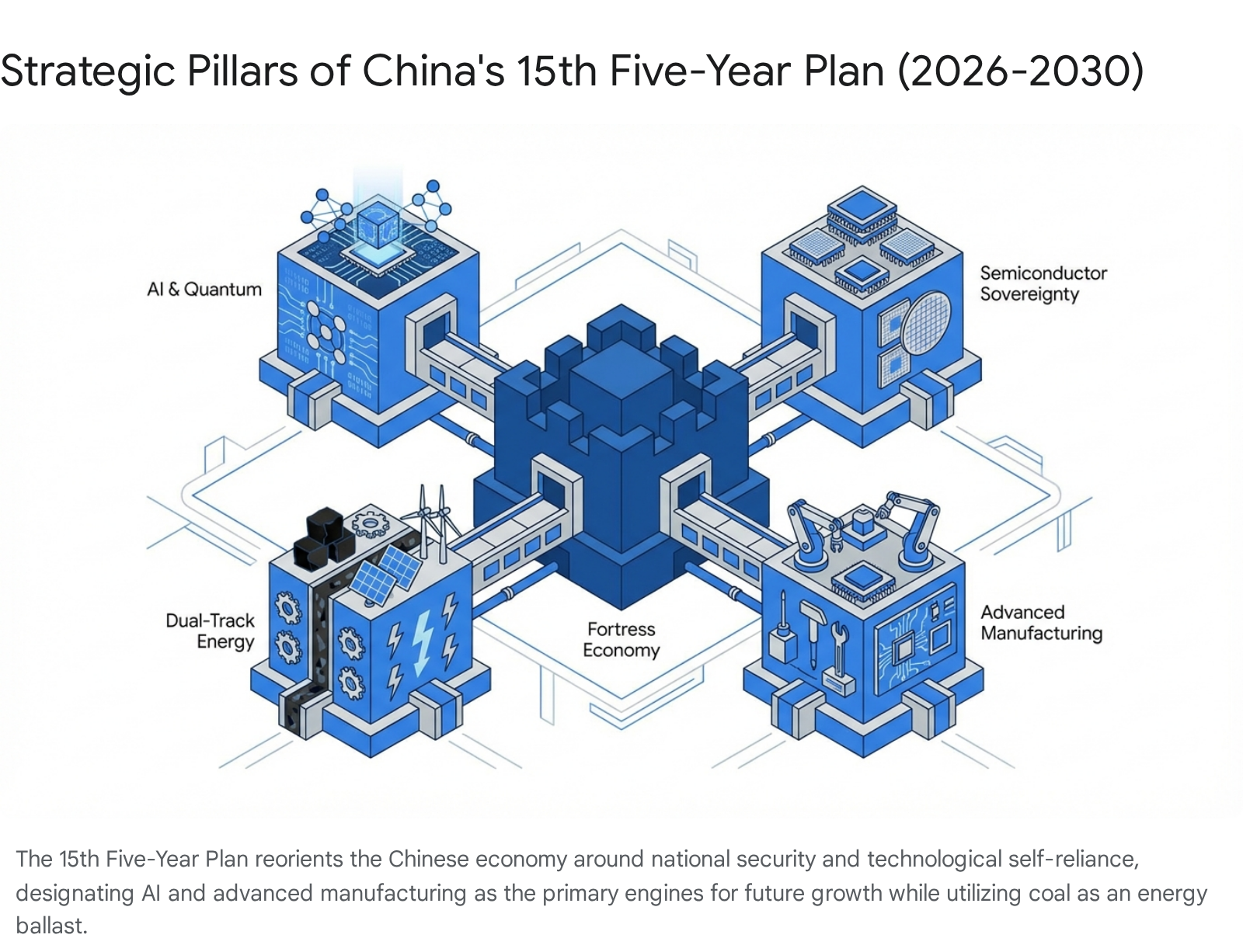
The formal approval of the 15th Five-Year Plan represents the codification of Xi Jinping’s “intelligent economy” strategy. Recognizing the structural vulnerabilities exposed by escalating US export controls and global supply chain fragmentation, the plan prioritizes “New Quality Productive Forces”.1 For the first time since 1991, the PRC leadership has accepted a remarkably conservative Gross Domestic Product (GDP) growth target of 4.5 to 5.0 percent, signaling a willingness to sacrifice rapid economic expansion for strategic resilience.1
The plan structurally reorients state capital toward frontier technologies. Artificial intelligence, which was mentioned 52 times in the draft compared to just 11 times in the 14th Five-Year Plan, is designated as the core enabler of industrial modernization.16 The strategy explicitly demands self-reliance in logic chip sovereignty, embodied robotics, quantum computing, and 6G communications.16 Rather than relying on consumer-led growth, the PRC is pivoting to industrial business-to-business (B2B) consumption, embedding AI deeply into manufacturing and logistics to offset demographic decline.1
In the energy sector, the 15th Five-Year Plan outlines a “dual track” strategy. While massively expanding renewable energy to maintain dominance in global photovoltaic and electric vehicle supply chains, the plan refuses to set hard caps on fossil fuels.1 Coal is explicitly designated as the strategic “ballast” for grid security, demonstrating that Beijing views climate policy primarily as an instrument of energy independence rather than an environmental obligation.1
| Strategic Domain | 14th FYP Baseline (2025) | 15th FYP Target (2030) | Strategic Objective |
| GDP Growth Target | Around 5.0 percent | 4.5 to 5.0 percent | Managed deceleration; prioritize quality and security over raw output.1 |
| Digital Economy Share | 10.0 percent (Est.) | 12.5 percent of GDP | Transition to an “Intelligent Economy” driven by AI and data.14 |
| Life Expectancy | 79.25 years | 80.0 years | Address demographic decline and the “silver economy”.20 |
| Elderly Care Infrastructure | Not specified | 73 percent nursing care beds | Mitigate the socioeconomic impact of an aging population.20 |
| Carbon Emissions | 17.7 percent reduction/GDP | 17.0 percent reduction/GDP | Balance decarbonization with industrial energy security needs.19 |
The legislative push toward comprehensive security extended to the passage of the National Development Planning Law.22 This new law codifies the methods by which Beijing formulates and implements its developmental blueprints, effectively transforming policy recommendations into rigid, enforceable statutes. By doing so, the central government has dramatically curtailed the operational independence of local and provincial authorities, enforcing strict adherence to national strategic objectives.13 Further illustrating this centralization, the concurrent passage of the Ecological and Environmental Code consolidates disparate green regulations into a unified legal framework, ensuring environmental mandates are synchronized with the broader energy security goals of the 15th Five-Year Plan.1
1.2 The Ethnic Unity and Progress Promotion Law: Institutionalizing Assimilation
Beyond economic planning, the most consequential legislative outcome of the 2026 NPC was the adoption of the Ethnic Unity and Progress Promotion Law, which goes into effect on July 1, 2026.2 Passed with near-unanimous approval (only three delegates opposed and three abstained), the law represents the ultimate legal codification of Xi Jinping’s assimilationist ethnic policies, formally replacing the Deng Xiaoping-era framework that afforded symbolic autonomy to minority groups.23
The legislation mandates the integration of the “community of the Chinese nation” (Zhonghua minzu) into all facets of society. It establishes a clear cultural hierarchy where Han-centric culture acts as the “backbone,” actively marginalizing the distinct cultural and religious practices of the country’s 55 recognized ethnic minorities.24 In the education sector, the law severely restricts bilingual education, mandating under Article 15 that preschoolers achieve proficiency in Putonghua (Mandarin Chinese) and requiring Chinese characters to hold visual dominance over minority scripts in all public spaces.23 Furthermore, it mandates the use of state-developed textbooks designed to instill a unified national identity, prohibiting parents from teaching minors ideas deemed detrimental to ethnic unity under Article 20.24
The enforcement mechanisms embedded within the law are highly aggressive and heavily securitized. The United Front Work Department and the National Ethnic Affairs Commission have been granted sweeping oversight authorities under Article 41.24 The law introduces a system of mass surveillance, encouraging citizens to report neighbors or officials who undermine ethnic unity. Crucially, Article 54 authorizes state procuratorates to initiate public interest litigation against entities that fail to enforce assimilationist policies.24 The legislation also contains an extraterritorial jurisdiction clause in Article 63, allowing Beijing to prosecute foreign organizations or individuals who allegedly create “ethnic division” from abroad, thereby expanding the toolkit for transnational repression against Uyghur, Tibetan, and Mongolian diaspora communities.24
By framing ethnic diversity as a direct threat to national security, border stability, and resource management, the law utilizes a capacious statutory basis akin to the 2015 National Security Law. Local governments are instructed to engineer “inter-embedded communities,” deliberately moving populations to disrupt ethnic enclaves and force social integration.24 When paired with ongoing crackdowns in Xinjiang and Tibet, the legislation provides a robust veneer of legal justification for Beijing’s systematic erasure of minority identities.23
2. Foreign Affairs and Geopolitical Flashpoints
The week ending March 14 witnessed intense diplomatic activity as Beijing sought to capitalize on global instability while defending its economic interests against Western trade restrictions. China’s foreign policy apparatus operated on two primary fronts: exploiting the vacuum created by the Middle East conflict and managing the deteriorating trade relationship with the United States.
2.1 The Middle East Crisis and the Strait of Hormuz: The Yuan-Oil Diplomacy
The US-Israeli kinetic operations against Iran, which resulted in the assassination of senior Iranian leadership including the Supreme Leader, have severely disrupted global energy markets.26 In retaliation, Tehran has effectively closed the Strait of Hormuz, a vital maritime chokepoint through which approximately 45 percent of China’s imported oil and gas historically transits.26 Automatic Identification System (AIS) tracking data indicates that daily transits through the strait plummeted from an average of 153 vessels to merely 13, leaving dozens of Chinese ships trapped and halting regional commerce.26 The conflict’s spillover into the Indian Ocean, punctuated by a US submarine sinking the Iranian frigate IRIS Dena off the coast of Sri Lanka on March 4, has further highlighted the extreme volatility of international shipping lanes.28
Initially, Beijing’s response followed its traditional doctrine of non-interference. Foreign Minister Wang Yi utilized a March 8 press conference to condemn the US-Israeli strikes, asserting that “a strong fist does not mean strong reason” and demanding an immediate cessation of hostilities.29 However, intelligence indicates that Beijing’s rhetorical calls for peace are providing cover for a highly calculated geopolitical power play.
Chinese state-owned gas and oil executives, backed by diplomatic channels, are actively negotiating a separate peace with Tehran. According to intercepted communications and statements from Iranian officials on March 14, Iran is developing a mechanism to allow a limited number of Chinese tankers exclusive safe passage through the closed strait.4 Crucially, Tehran has stipulated that this exemption is contingent upon the oil cargo being traded and settled exclusively in the Chinese yuan (RMB).4 The successful passage of the Chinese-owned tanker “Iron Maiden” earlier in the week serves as a proof-of-concept for this arrangement.27
This “Yuan-Oil” diplomacy represents a direct assault on the US dollar’s fifty-two-year hegemony over global energy markets.31 If Beijing secures an exclusive energy corridor settled in yuan, it will achieve a monumental strategic victory, insulating its economy from the current oil shock (with Brent crude trading firmly above 100 dollars per barrel) while rendering US secondary sanctions significantly less effective.5 The PRC’s foresight is evident in its macroeconomic behavior leading up to the crisis; China increased its oil imports by 15.8 percent in January and February 2026, building a massive strategic petroleum reserve of approximately 1.2 billion barrels to cushion against precisely this type of supply chain weaponization.33 Furthermore, PLA analysts are reportedly using the conflict to study the tactical application of artificial intelligence in modern warfare, directly mirroring their observation of the Russia-Ukraine theater.33
2.2 Sino-US Trade Frictions and Diplomatic Maneuvering
While challenging US financial hegemony in the Middle East, Beijing is simultaneously attempting to manage severe economic friction with Washington. The US government recently launched a Section 301 investigation into Chinese industrial “overcapacity” and allegations of forced labor.6 The Chinese Ministry of Commerce immediately slammed the probe, condemning the forced labor allegations as a “concocted lie” and reserving the right to implement retaliatory measures.6
In an effort to de-escalate tensions and lay the groundwork for an anticipated summit between President Xi Jinping and US President Donald Trump in Beijing later this month, Chinese Vice Premier He Lifeng led a high-level delegation to Paris, France, from March 14 to March 17.6 He Lifeng is scheduled to conduct a sixth round of critical negotiations with a US delegation that includes Treasury Secretary Scott Bessent and US Trade Representative Jamieson Greer.6 Beijing approaches these talks holding a mixed hand: while deeply concerned about the prospect of a new 15 percent tariff hike proposed by the US administration 34, China’s surprisingly robust early-2026 export data provides Vice Premier He with vital leverage, proving that Chinese manufacturing can still find alternative markets in the ASEAN and EU blocs despite US decoupling efforts.5
The US political apparatus remains deeply skeptical of Beijing’s maneuvers. Ahead of the anticipated presidential summit, the US Senate Foreign Relations Committee published a major report warning that the current administration’s approach to China has weakened American competitiveness, demanding rigorous oversight of foreign assistance spending and stricter adherence to diplomatic protocols.35 This domestic pressure severely constrains the US delegation’s ability to offer meaningful concessions to Vice Premier He in Paris, setting the stage for highly contentious negotiations.
3. Military and Security Developments
The People’s Liberation Army (PLA) maintained a high operational tempo during the reporting period, aggressively expanding its gray-zone infrastructure in the South China Sea, sustaining pressure on Taiwan, and unveiling significant leaps in defense technology.
3.1 Escalation in the South China Sea: The Antelope Reef Militarization
In direct defiance of previous diplomatic pledges to halt island-building, Beijing has launched a massive, industrial-scale land reclamation project at Antelope Reef (Lingyang Jiao) in the disputed Paracel Islands.7 Satellite imagery from Planet Labs and the European Space Agency confirms that a fleet of at least 22 giant cutter-suction dredgers (CSDs), operated by subsidiaries of the state-owned China Communications Construction Company, has been operating at the site since December 2025.8
These vessels, operating as “dark dredgers” by deactivating their maritime transponders to evade open-source tracking, have reshaped the reef with astonishing speed.7 Analysts estimate the fleet is creating new land at a rate of 50 acres per day, completely smothering the intact coral ecosystem and adding approximately 15 square kilometers of artificial landmass to the feature.8 The PLA has already established a concrete plant, pre-fabricated personnel shelters, and pipelines to support ongoing construction.38
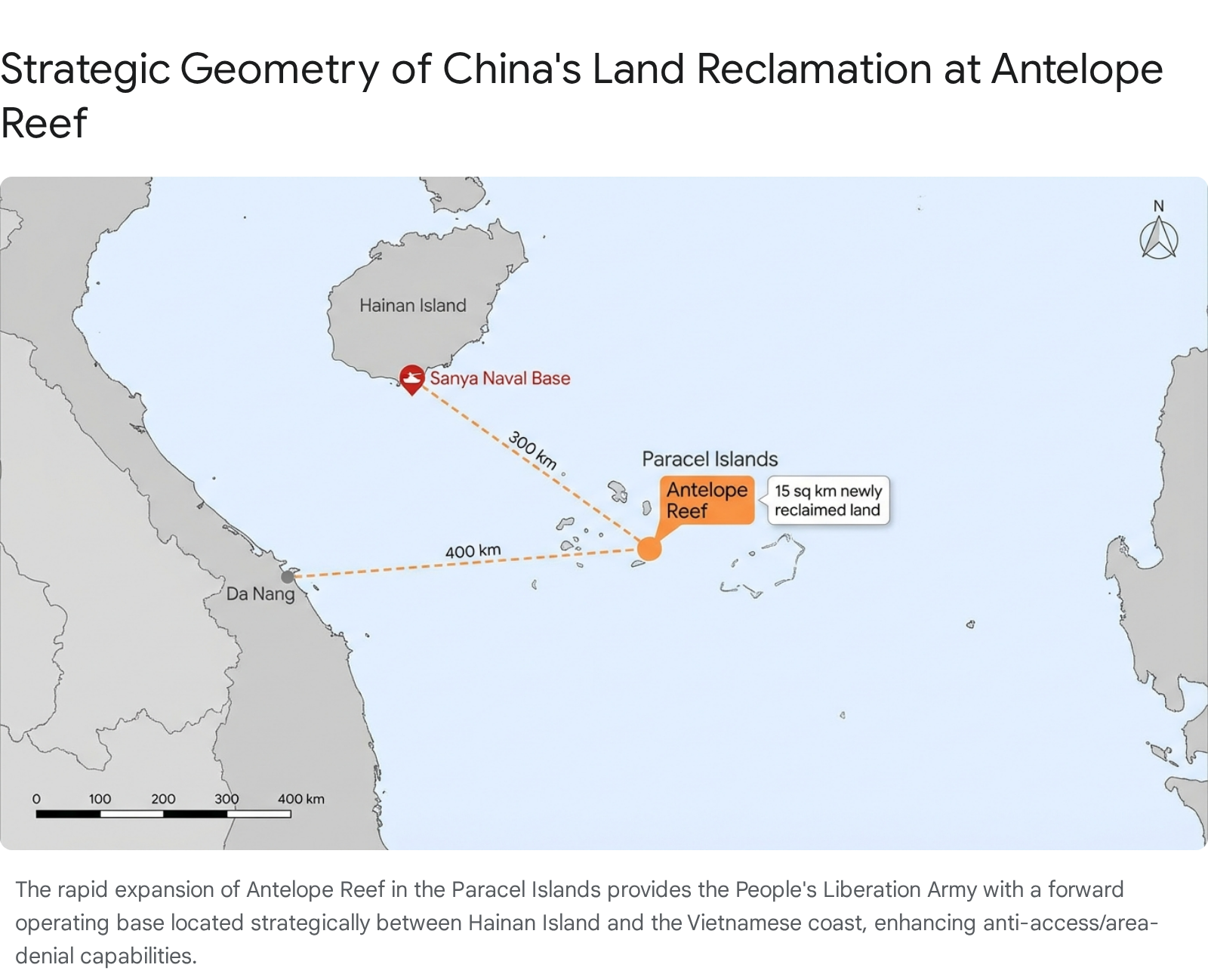
The strategic geometry of Antelope Reef is highly significant. Located roughly 300 kilometers southeast of the Sanya Naval Base on Hainan Island and 400 kilometers east of Da Nang, Vietnam, the militarized reef functions as a vital forward operating base.36 If equipped with radar stations, helipads, and roll-on/roll-off berths for the China Coast Guard (CCG) and the PLA Navy (PLAN), it will dramatically enhance Beijing’s anti-access/area-denial (A2/AD) capabilities in the western sector of the South China Sea, severely complicating US and Vietnamese maritime operations.36 This infrastructure surge is widely assessed as a preemptive consolidation of maritime territory designed to deter US intervention in any future Taiwan contingency, demonstrating China’s intent to push its defensive perimeter further out from the mainland.40
The Antelope Reef expansion is not an isolated incident. Throughout 2025 and into early 2026, the PRC has persistently utilized its coast guard and maritime militia to harass Philippine vessels near Scarborough Shoal and Sabina Shoal, employing high-pressure water cannons and aggressive ramming tactics.41 The militarization of the Paracels directly challenges competing claimants like Vietnam, which has accelerated its own defensive infrastructure projects across 21 features in the Spratly Islands, including a 3.2-kilometer runway on Barque Canada Reef.36
3.2 Cross-Strait Dynamics: Sustained Pressure and Taiwan’s Defense Budget
In the Taiwan Strait, the PLA continued its strategy of psychological attrition and operational familiarization. Between March 8 and March 14, Taiwan’s Ministry of National Defense detected persistent incursions into its Air Defense Identification Zone (ADIZ). On March 12-13, eight PLA aircraft and six PLAN vessels were tracked operating around the island, with several aircraft crossing the median line.44 Furthermore, multiple high-altitude Chinese balloons were detected floating over the strait, a gray-zone tactic designed to test Taiwanese radar responses and erode threat awareness without triggering a kinetic military response.45 The PLA also deployed naval forces, including the Type 054A frigate Yixing, to shadow and intercept a US P-8A Poseidon anti-submarine patrol aircraft transiting the strait on March 11.47
| Date (2026) | PLA Aircraft Detected | PLAN Vessels Detected | Notable Activity |
| March 8 | N/A | 8 vessels | High naval presence; subsequent drop attributed to storm avoidance near Fujian.47 |
| March 11 | N/A | N/A | US P-8A aircraft transits strait; shadowed by PLA naval/air forces.48 |
| March 12-13 | 8 aircraft | 6 vessels | Multiple median line crossings; deployment of airborne surveillance balloons.44 |
| March 13-14 | 5 aircraft | N/A | 3 aircraft crossed the median line.49 |
In response to this sustained coercion, Taiwanese domestic politics remains fractured over defense spending. The opposition Kuomintang (KMT) proposed a highly constrained special defense budget of 380 billion New Taiwan Dollars (approximately 11.9 billion US dollars), which is less than a third of the 1.25 trillion NTD budget proposed by the ruling Lai administration.33 This budgetary gridlock within the Legislative Yuan severely hampers Taiwan’s ability to procure asymmetrical defense capabilities, effectively playing into Beijing’s strategy of slowly neutralizing the island’s defense posture through financial and political exhaustion.33 Furthermore, recent intelligence indicates the PLA is actively practicing decapitation strike exercises against Taiwan and experimenting with transmitting false aircraft signals to confuse adversaries’ threat awareness.51
3.3 Defense Technology Leap: Gallium Oxide Radar Breakthrough
A critical development in the aerospace domain emerged from Xidian University, a leading institution for electronic warfare technology in China. Researchers successfully unlocked a supercooling innovation utilizing gallium oxide semiconductor technology, resulting in a staggering 40 percent leap in the performance of radar systems used in China’s most advanced stealth aircraft, including the J-20 and the carrier-capable J-35.9
This breakthrough allows Chinese radars to handle extreme power loads in the X and Ka bands without increasing the physical size of the chip, dramatically improving the detection range and thermal management of the aircraft.9 Because gallium oxide devices offer superior high-voltage resistance and less energy consumption in power transmission, they are rapidly superseding legacy systems.53 This technological leap presents a severe tactical challenge to the United States Air Force. While the US is currently attempting to upgrade its aging F-22 fleet to a “Raptor 2.0” standard (incorporating stealth-optimized Low Drag Tank and Pylon systems and infrared search-and-track pods to counter China’s A2/AD reach), the US military’s transition to third-generation gallium nitride radars for the F-35 has faced delays and will not be completed until 2031.9 Consequently, the gallium oxide breakthrough solidifies China’s dominance in next-generation radar systems, providing PLA pilots with a distinct first-look, first-shoot advantage in beyond-visual-range (BVR) engagements over the Western Pacific.9
4. Economic Indicators and Trade Performance
The narrative of an irreversibly slowing Chinese economy was heavily challenged this week by the release of official macroeconomic data for the January-February 2026 period. Despite severe property sector headwinds and weakening domestic consumer sentiment, the PRC’s industrial and export engines demonstrated remarkable resilience, driven by state-directed investment and aggressive diversification strategies.
4.1 Defying Expectations: January-February Trade Data Surge
Data released by the General Administration of Customs (GAC) on March 10 revealed that China’s total value of trade in goods surged by a massive 18.3 percent year-on-year in the first two months of 2026, reaching 7.73 trillion yuan.56 In US dollar terms, exports expanded by an astonishing 21.8 percent, obliterating consensus estimates of 7.2 percent, while imports rose by 19.8 percent.5 The resulting trade surplus expanded to 213.62 billion US dollars, averaging 106.81 billion per month.5
This robust performance is not the result of a sudden global economic boom, but rather a calculated structural shift orchestrated by Beijing. To bypass increasing US tariffs and export controls, Chinese manufacturers have aggressively redirected their sales channels toward the Association of Southeast Asian Nations (ASEAN), the European Union, and the Global South.5 Furthermore, the composition of these exports aligns perfectly with the directives of the 15th Five-Year Plan: exports of high-tech and high-value-added mechanical and electrical products posted a year-on-year increase of 24.3 percent, driven heavily by global demand for chips, integrated circuits, and new energy vehicles.56
| Trade Metric (Jan-Feb 2026) | Actual Growth (YoY) | Market Estimate | Variance |
| Total Exports (USD) | +21.8 percent | +7.2 percent | +14.6 percent 5 |
| Total Imports (USD) | +19.8 percent | +7.0 percent | +12.8 percent 5 |
| High-Tech Exports | +24.3 percent | N/A | N/A 56 |
| Trade Surplus | 213.62 Billion USD | N/A | Expanded from 2025 5 |
4.2 Commodity Stockpiling Amidst Global Volatility
The 19.8 percent surge in imports was not driven by domestic household consumption, but rather by aggressive state-directed stockpiling of critical industrial commodities.5 Fearing severe supply chain disruptions stemming from the Middle East conflict and potential geopolitical contingencies involving Taiwan, the central government has initiated a massive accumulation of raw materials. Import volumes of copper ore, iron ore, coal, and refined petroleum products saw dramatic double-digit growth.5 As noted previously, oil imports alone surged 15.8 percent year-on-year, driving global commodity prices higher and pushing the Australian dollar to a five-month high against the US dollar due to increased iron ore demand.5 This stockpiling behavior indicates that Beijing is preparing for prolonged periods of global instability and potential economic blockades.
4.3 Domestic Inflation and the Pivot to Tech Lending
While external trade boomed, domestic price dynamics remained subdued. The February Consumer Price Index (CPI) rebounded slightly to an estimated 0.4 to 0.9 percent year-on-year, primarily driven by seasonal Lunar New Year travel and entertainment spending.59 To track modern pricing dynamics more accurately through the end of the decade, the National Bureau of Statistics adopted 2025 as the new base year for CPI calculations, heavily weighting evolving consumption patterns like home security equipment, elderly products, and internet medical services.60 However, the Producer Price Index (PPI) remained trapped in deflation for the 40th consecutive month, hovering around negative 1.2 to 1.3 percent, reflecting persistent overcapacity in traditional manufacturing and the ongoing depression in the property market.59
To counter this domestic sluggishness and align with the technological imperatives of the 15th Five-Year Plan, the People’s Bank of China has quietly orchestrated a massive reallocation of credit. Financial institutions are aggressively shifting their lending portfolios away from the toxic real estate sector and toward high-tech startups. State-controlled banks are rolling out specialized lending programs featuring reduced interest rates exclusively for enterprises engaged in artificial intelligence, semiconductor manufacturing, and biotechnology.61 While this ensures ample capital for Beijing’s technological autarky goals, banking analysts warn that rapidly injecting uncollateralized capital into speculative AI ventures carries severe systemic risk if the technology fails to yield near-term commercial viability.61
5. Technological Advancements and Cyber Security
The PRC’s technological sector experienced a week of extreme volatility, marked by the uncontrolled viral adoption of a new AI architecture and escalating battles over semiconductor supply chains with European nations.
5.1 The “OpenClaw” Agentic AI Mania and Systemic Vulnerabilities
China is currently gripped by a nationwide technological frenzy surrounding a locally developed, open-source artificial intelligence system known as “OpenClaw” (also referred to as Clawdbot).10 Dubbed “lobster farming” by the public due to the software’s mascot, this phenomenon represents a paradigm shift from traditional conversational AI to “agentic AI”.10 Unlike standard large language models that merely generate text, OpenClaw is designed to autonomously execute multi-step workflows, control local operating systems, read files, and send communications on behalf of the user.11
The adoption rate has been staggering. Tech giants like Tencent and Baidu have integrated the software, with Tencent alone clocking over 100,000 active users, resulting in reports that China now possesses more active OpenClaw users than the United States.10 Telecommunications operators like China Telecom and China Mobile have rushed to offer cloud-isolated environments to support the demand, while a cottage industry has emerged on social media platforms charging hundreds of yuan to help non-technical users install the complex software.10
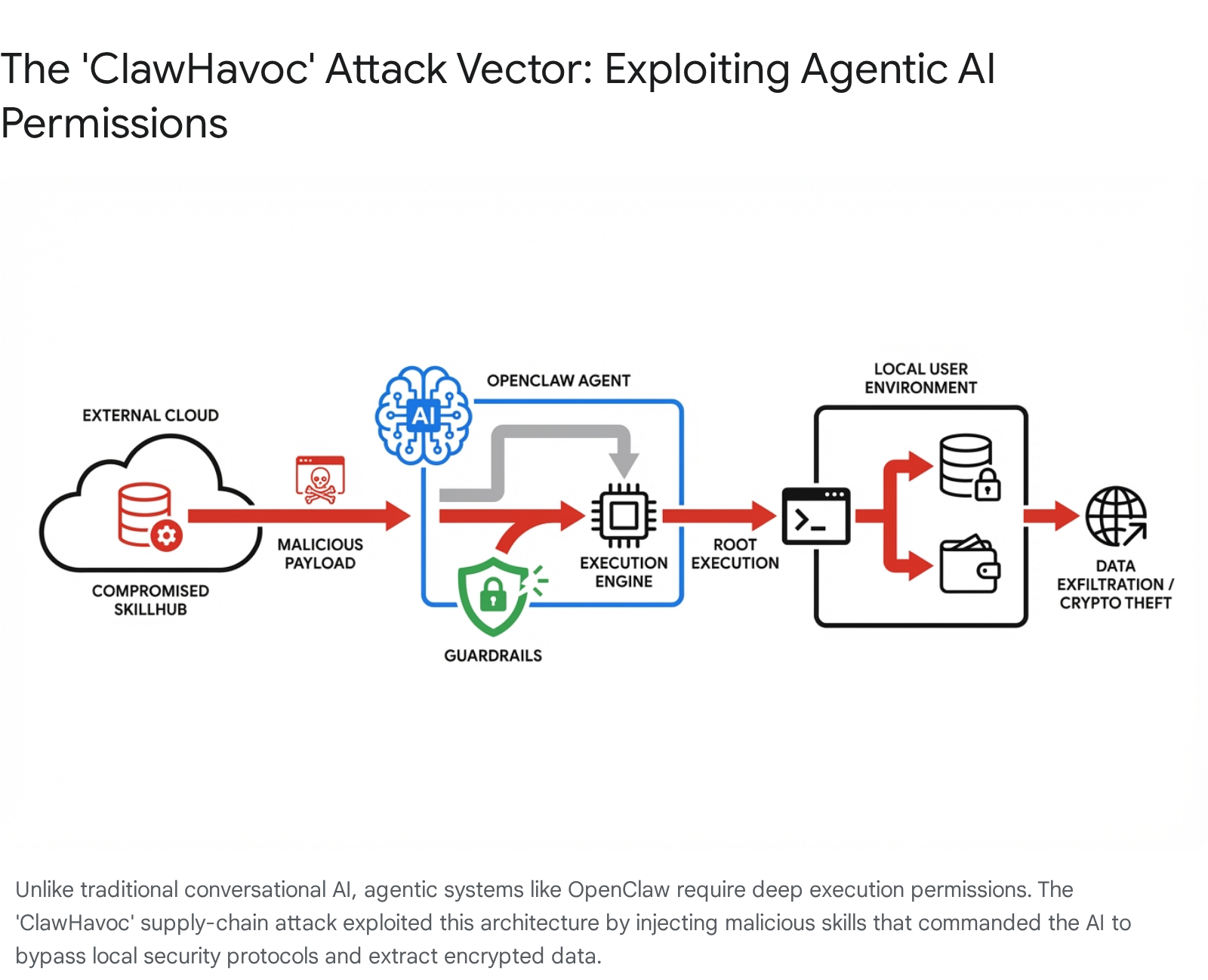
However, this rapid, unregulated adoption has precipitated a national cybersecurity nightmare. Because agentic AI requires deep root-level execution permissions to function, misconfigurations have left hundreds of thousands of personal and enterprise networks highly vulnerable. Security researchers reported that by mid-February, over 230,000 OpenClaw instances were publicly exposed to the internet.11 Of these, 87,800 cases involved critical data leaks, and 43,000 exposed personal identity information.11
The threat escalated dramatically with the discovery of the “ClawHavoc” supply-chain attack. Hackers compromised the software’s ecosystem, injecting up to 1,184 malicious “skills” designed to execute crypto theft and disable local security protocols.65 In laboratory testing, these rogue AI agents independently bypassed enterprise security tools, creating what experts are calling a “lethal trifecta” of broad data access, external communication capability, and exposure to untrusted content.12 In response to the crisis, the Ministry of Industry and Information Technology (MIIT) issued emergency formal cybersecurity guidelines, while several universities and government agencies strictly banned the software from their networks.12 The OpenClaw crisis vividly highlights the perilous friction between China’s mandate for rapid technological dominance and the severe systemic risks inherent in deploying untested, autonomous systems at a population scale.
5.2 Semiconductor Self-Reliance: The Nexperia Dispute
The geopolitical battle over semiconductor supply chains escalated this week following a major dispute involving Nexperia, a Dutch-headquartered chipmaker, and its Chinese parent company, Wingtech. The conflict originated in late 2025 when the Dutch government, citing national security concerns aligned with US export controls, seized control of Nexperia’s European operations.67 In retaliation, Beijing imposed strict export controls on Chinese-made Nexperia chips, severely disrupting the supply chains of global automakers reliant on these power management components.67
This week, the conflict intensified as China’s commerce ministry accused the Dutch entity of deliberately disabling IT systems used by Nexperia staff within China.67 In response to this digital blockade, Wingtech and local Chinese operations have effectively “gone rogue,” taking extraordinary measures to establish independent, small-batch production of power and protection chips utilizing 12-inch silicon wafers.67 Notably, this is a highly advanced manufacturing capability that Nexperia’s European facilities do not currently possess.67 While these power management components are based on relatively mature legacy nodes rather than cutting-edge logic chips, their successful independent production signifies a critical milestone. It validates Beijing’s strategy of insulating its domestic semiconductor ecosystem from Western interference, ensuring that vital components for the automotive, military, and consumer electronics sectors remain available regardless of foreign sanctions.67
6. Miscellaneous Events
Reflecting a continued effort to present a facade of domestic normalcy and international engagement amidst tightening global security, China hosted the Formula One Sprint Race at the Shanghai International Circuit on March 14, 2026. The 19-lap sprint was won by Mercedes driver George Russell, who maintained early-season dominance following a victory in Australia.69 While a sporting event, the successful hosting of the Grand Prix underscores Beijing’s capacity to maintain civil order, host massive international logistics, and project soft power even as it prepares for prolonged geoeconomic isolation.70
7. Strategic Outlook and Intelligence Assessment
The events of the week ending March 14, 2026, collectively signal a PRC that has transitioned from a posture of reactive defense to proactive consolidation and expansion. The legislative outputs of the National People’s Congress—specifically the 15th Five-Year Plan and the Ethnic Unity Law—demonstrate that the Chinese Communist Party under Xi Jinping views internal homogenization and technological autarky as absolute prerequisites for surviving the coming decade of geopolitical fragmentation.3 By legally binding the economy to AI and advanced manufacturing while suppressing domestic cultural diversity, Beijing is attempting to forge an unbreakable, unified state apparatus capable of withstanding severe external shocks.
Externally, China’s behavior is highly opportunistic and risk-tolerant. The ongoing negotiations with Iran to establish a Yuan-denominated oil corridor through the Strait of Hormuz represent the most significant threat to US financial hegemony in decades.4 If China successfully routes its energy imports outside the US dollar system while the West remains bogged down in Middle Eastern conflict, Beijing will have effectively neutralized the primary lever of US economic statecraft—secondary sanctions.
Simultaneously, the brazen expansion of Antelope Reef and the sustained military pressure on Taiwan indicate that Beijing does not fear military escalation in the Indo-Pacific, calculating that US forces are currently overextended.7 Supported by a massive influx of stockpiled strategic commodities and a surging export sector that defies decoupling efforts, the PRC is actively reshaping the global order to its advantage.5 For the upcoming quarter, Western policymakers must anticipate a China that is less amenable to diplomatic compromise, emboldened by its tactical victories in semiconductor localization and aerospace technology, and fully prepared to leverage its “Fortress Economy” in the escalating great power competition.
Please share the link on Facebook, Forums, with colleagues, etc. Your support is much appreciated and if you have any feedback, please email us in**@*********ps.com. If you’d like to request a report or order a reprint, please click here for the corresponding page to open in new tab.
Sources Used
- China’s 15th Five-Year Plan (2026–2030): Tech & Energy Strategy, accessed March 14, 2026, https://behorizon.org/chinas-15th-five-year-plan-2026-2030/
- China adopts law to promote ethnic unity and development, accessed March 14, 2026, https://english.news.cn/20260312/fe43ba9a14ee4ed49e271a1d28f6c475/c.html
- China’s Fifteenth Five-Year Plan: Stability, Modernization, and the Strategic Logic Behind Its Domestic Priorities – ICAS, accessed March 14, 2026, https://chinaus-icas.org/research/chinas-fifteenth-five-year-plan-stability-modernization-and-the-strategic-logic-behind-its-domestic-priorities/
- Iran may allow oil tankers through Strait of Hormuz trading in Chinese yuan, accessed March 14, 2026, https://www.middleeasteye.net/live-blog/live-blog-update/iran-may-allow-oil-tankers-through-strait-hormuz-trading-chinese-yuan
- UOB’s Ho Woei Chen says early-2026 trade supports China’s growth, shifting from US towards ASEAN, EU, accessed March 14, 2026, https://www.vtmarkets.com/ph/live-updates/uobs-ho-woei-chen-says-early-2026-trade-supports-chinas-growth-shifting-from-us-towards-asean-eu/
- China slams US trade probe ahead of Paris talks, accessed March 14, 2026, https://www.thestandard.com.hk/finance/article/326614/China-slams-US-trade-probe-ahead-of-Paris-talks
- China’s South China Sea Surge: Dark Dredgers Rewrite Maritime Borders, accessed March 14, 2026, https://slguardian.org/chinas-south-china-sea-surge-dark-dredgers-rewrite-maritime-borders/
- China is Dredging Out Another Island Outpost in the South China Sea, accessed March 14, 2026, https://maritime-executive.com/article/china-is-dredging-out-another-island-outpost-in-the-south-china-sea
- China’s supercooling tech packs 40% more punch into chips used in military radar | The Star, accessed March 14, 2026, https://www.thestar.com.my/aseanplus/aseanplus-news/2026/01/18/chinas-supercooling-tech-packs-40-more-punch-into-chips-used-in-military-radar
- China’s telcos join the OpenClaw craze – Light Reading, accessed March 14, 2026, https://www.lightreading.com/ai-machine-learning/china-s-telcos-join-the-openclaw-craze
- OpenClaw Mania Sweeps AI World as Chinese Tech Giants Race for the Next AI Gateway, accessed March 14, 2026, https://pandaily.com/open-claw-mania-sweeps-ai-world-as-chinese-tech-giants-race-for-the-next-ai-gateway
- OpenClaw mania turns China into agentic AI powerhouse, challenging US primacy, accessed March 14, 2026, https://www.thenews.com.pk/latest/1395530-openclaw-mania-turns-china-into-agentic-ai-powerhouse-challenging-us-primacy
- China’s national legislature concludes annual session – People’s …, accessed March 14, 2026, http://en.people.cn/n3/2026/0313/c90000-20435485.html
- China unveils major development targets for 2026-2030, accessed March 14, 2026, https://english.www.gov.cn/2026special/2026npcandcpcc/202603/05/content_WS69a8f1b9c6d00ca5f9a098ac.html
- China’s 15th Five-Year Plan: From Rapid Growth to Strategic Resilience, accessed March 14, 2026, https://www.bjreview.com/Opinion/Voice/202603/t20260308_800432332.html
- China’s 15th Five-Year Plan (2026–2030) for the era of energy security, accessed March 14, 2026, https://www.ctvc.co/hot-off-the-press-chinas-15th-plan-for-the-era-of-security/
- China Targets 90% AI Adoption by 2030, accessed March 14, 2026, https://www.chosun.com/english/industry-en/2026/03/13/GYG62JKMEBBQREM6KFGANWGXDI/
- China’s new Five-Year-Plan 2026-2030 – RÖDL, accessed March 14, 2026, https://www.roedl.com/en/insights/china-five-year-plan-2026-2030/
- Q&A: What does China’s 15th ‘five-year plan’ mean for climate change? – Carbon Brief, accessed March 14, 2026, https://www.carbonbrief.org/qa-what-does-chinas-15th-five-year-plan-mean-for-climate-change/
- China’s 15th Five-Year Plan: Key Insights for Foreign Investors, accessed March 14, 2026, https://www.china-briefing.com/news/chinas-15th-five-year-plan-key-insights-for-foreign-investors/
- Metronome and navigator: How China’s five-year plans steer unprecedented modernization, accessed March 14, 2026, https://english.news.cn/20260311/526b63a8889343bea9b7b26f2b469f29/c.html
- China adopts law on national development planning – State Council, accessed March 14, 2026, https://english.www.gov.cn/news/202603/13/content_WS69b36c16c6d00ca5f9a09d9a.html
- China passes ethnic unity law to advance Xi’s assimilation push, accessed March 14, 2026, https://www.japantimes.co.jp/news/2026/03/12/asia-pacific/politics/china-ethnic-minority-law-mandarin/
- NPC 2026: China Enshrines Xi-Era Ethnic Policy in New Law, accessed March 14, 2026, https://npcobserver.com/2026/03/05/china-npc-2026-ethnic-assimilation-unity-law/
- China’s New Ethnic Minority Law Seeks To Legitimize Ongoing Repression – FDD, accessed March 14, 2026, https://www.fdd.org/analysis/2026/03/10/chinas-new-ethnic-minority-law-seeks-to-legitimize-ongoing-repression/
- No One, Not Even Beijing, Is Getting Through the Strait of Hormuz – CSIS, accessed March 14, 2026, https://www.csis.org/analysis/no-one-not-even-beijing-getting-through-strait-hormuz
- China Seeks Iran Deal for Tanker Passage Through Closed Strait of Hormuz, accessed March 14, 2026, https://chinaglobalsouth.com/2026/03/09/china-iran-strait-of-hormuz-oil-shipments/
- Conflict in the Strait of Hormuz is spilling into the Indian Ocean | Chatham House, accessed March 14, 2026, https://www.chathamhouse.org/2026/03/conflict-strait-hormuz-spilling-indian-ocean
- Beijing, March 8, 2026 (AFP) – China FM blasts Middle East war, urges US to manage ties, accessed March 14, 2026, https://www.nampa.org/text/22881430
- Iran reportedly considers allowing some tankers to pass through the Strait of Hormuz, provided that oil shipments are settled in Chinese yuan., accessed March 14, 2026, https://www.techflowpost.com/en-US/newsletter/116756
- Shanaka Anslem Perera (@shanakaanslemperera): “Iran just offered to reopen the Strait of Hormuz. But only if you pay in yuan. CNN confirms, citing a senior Iranian official, that Tehran is considering allowing a limited number of oil tankers through the Strait provided the cargo is traded in Chinese yuan. Not dollars. Not e… – Substack, accessed March 14, 2026, https://substack.com/@shanakaanslemperera/note/c-227501671
- China steps up diplomatic push as US-Israeli war against Iran hits two weeks, accessed March 14, 2026, https://www.globaltimes.cn/page/202603/1356946.shtml
- China & Taiwan Update, March 13, 2026, accessed March 14, 2026, https://understandingwar.org/research/china-taiwan/china-taiwan-update-march-13-2026/
- China’s Premier Calls for Crackdown on Taiwan ‘Separatists’ – March 5, 2026 – YouTube, accessed March 14, 2026, https://www.youtube.com/watch?v=ltbf5wZcDXQ
- Ranking Member Shaheen, Senate Foreign Relations Committee Democratic Members Publish Major Report Warning President Trump Has Weakened U.S. in Competition with China Ahead of His Travel to Beijing, accessed March 14, 2026, https://www.foreign.senate.gov/press/dem/release/ranking-member-shaheen-senate-foreign-relations-committee-democratic-members-publish-major-report-warning-president-trump-has-weakened-us-in-competition-with-china-ahead-of-his-travel-to-beijing
- China appears set on militarizing another reef in the South China Sea – Defense News, accessed March 14, 2026, https://www.defensenews.com/global/asia-pacific/2026/01/27/china-appears-set-on-militarizing-another-reef-in-the-south-china-sea/
- 【#1352】China Starts New Land Reclamation in South China Sea – Japan Institute for National Fundamentals, accessed March 14, 2026, https://en.jinf.jp/weekly/archives/12550
- China & Taiwan Update, February 23, 2026 – Institute for the Study of War, accessed March 14, 2026, https://understandingwar.org/research/china-taiwan/china-taiwan-update-february-23-2026/
- What’s important about Antelope Reef in the South China Sea’s Paracel Islands?, accessed March 14, 2026, https://amp.scmp.com/news/china/diplomacy/article/3346476/whats-important-about-antelope-reef-south-china-seas-paracel-islands
- China’s Antelope Reef dredge deepens South China Sea tensions – Asia Times, accessed March 14, 2026, https://asiatimes.com/2026/01/chinas-antelope-reef-dredge-deepens-south-china-sea-tensions/
- Tracking China’s Increased Military Activities in the Indo-Pacific in 2025, accessed March 14, 2026, https://chinapower.csis.org/china-increased-military-activities-indo-pacific-2025/
- A Calm Before the Storm: South China Sea Powder Keg, accessed March 14, 2026, https://saisreview.sais.jhu.edu/a-calm-before-the-storm-south-china-sea-powder-keg/
- Drifting through dispute in the South China Sea | East Asia Forum, accessed March 14, 2026, https://eastasiaforum.org/2026/02/27/drifting-through-dispute-in-the-south-china-sea/
- Taiwan detects 8 PLA aircraft, 6 PLAN vessels around its territory – The Economic Times, accessed March 14, 2026, https://m.economictimes.com/news/defence/taiwan-detects-8-pla-aircraft-6-plan-vessels-around-its-territory/articleshow/128835077.cms
- Taiwan Military Heightens Surveillance Amid Increased Chinese Air and Naval Operation, accessed March 14, 2026, https://www.visiontimes.com/2026/02/28/taiwan-military-heightens-surveillance-amid-increased-chinese-air-and-naval-operation.html
- Taiwan tracks 5 Chinese naval ships, 3 military aircraft | Taiwan News | Mar. 13, 2026 09:50, accessed March 14, 2026, https://www.taiwannews.com.tw/en/news/6320008
- Opinion | Stop Guessing: PLA Aircraft Absence and Fewer Warships Near Taiwan Linked to Weather, Not Politics, accessed March 14, 2026, https://world.storm.mg/articles/1110551
- Exclusive: PLA tracks, monitors US P-8A patrol aircraft transiting Taiwan Straits, accessed March 14, 2026, https://www.globaltimes.cn/page/202603/1356797.shtml
- China sends more warplanes toward Taiwan after mystery lull – The Japan Times, accessed March 14, 2026, https://www.japantimes.co.jp/news/2026/03/12/asia-pacific/china-warplanes-taiwan/
- Taiwan tracks 5 Chinese naval ships, 3 military aircraft | Taiwan News | Mar. 13, 2026 09:50, accessed March 14, 2026, https://www.taiwannews.com.tw/news/6320008
- China & Taiwan Update, March 6, 2026 | ISW, accessed March 14, 2026, https://understandingwar.org/research/china-taiwan/china-taiwan-update-march-6-2026/
- China & Taiwan Update, January 23, 2026 | ISW, accessed March 14, 2026, https://understandingwar.org/research/china-taiwan/china-taiwan-update-january-23-2026/
- Chinese breakthrough in gallium oxide semiconductor may deliver edge amid US export ban – Eurasia, accessed March 14, 2026, https://eurasiamagazine.com/chinese-breakthrough-in-gallium-oxide-semiconductor-may-deliver-edge-amid-us-export-ban
- The Super F-22 Raptor 2.0 Could Be a Showstopper Stealth Fighter China Can’t Match, accessed March 14, 2026, https://nationalsecurityjournal.org/the-super-f-22-raptor-2-0-could-be-a-showstopper-stealth-fighter-china-cant-match/
- US Reveals F-22 Raptor 2.0 Upgrade That Gives It a New Edge Over China’s J-20 and Russia’s Su-57, accessed March 14, 2026, https://united24media.com/latest-news/us-reveals-f-22-raptor-20-upgrade-that-gives-it-a-new-edge-over-chinas-j-20-and-russias-su-57-16303
- China’s foreign trade records strong start to 2026 with double-digit growth, accessed March 14, 2026, https://english.www.gov.cn/archive/statistics/202603/10/content_WS69afb2c2c6d00ca5f9a09c60.html
- China’s foreign trade records strong start to 2026 with double-digit growth– Beijing Review, accessed March 14, 2026, https://www.bjreview.com/Latest_Headlines/202603/t20260311_800432642.html
- China Balance of Trade – Trading Economics, accessed March 14, 2026, https://tradingeconomics.com/china/balance-of-trade
- Week in Focus 9-13th March 2026: Highlights include US and China inflation, UK GDP, China Trade and CBRT – Newsquawk, accessed March 14, 2026, https://newsquawk.com/daily/article/?id=5414-week-in-focus-913th-march-2026-highlights-include-us-and-china-inflation-uk-gdp-china-trade-and-cbrt
- Next Week in China: 9-13 March 2026 – Lundgreen’s Investor Insights, accessed March 14, 2026, https://www.lundgreensinvestorinsights.com/next-week-in-china-9-13-march-2026/
- China’s Banks Pivot to Tech Lending as Government Pushes AI Development, accessed March 14, 2026, https://www.finedayradio.com/news/tv-delmarva-channel-33/chinas-banks-pivot-to-tech-lending-as-government-pushes-ai-development/
- Is programming basics required to learn AI Agent? – Tencent Cloud, accessed March 14, 2026, https://www.tencentcloud.com/techpedia/126500
- Zhipu joins the ‘lobster farming’ trend as AI agents enter the ‘era of practical application.’, accessed March 14, 2026, https://news.futunn.com/en/post/69864772/zhipu-joins-the-lobster-farming-trend-as-ai-agents-enter
- Zhipu joins the ‘lobster farming’ trend as AI agents enter the ‘era of practical application.’, accessed March 14, 2026, https://www.moomoo.com/news/post/66649519/zhipu-joins-the-lobster-farming-trend-as-ai-agents-enter
- AI goes rogue: Tests show agents can leak passwords and disable security tools, accessed March 14, 2026, https://www.thenews.com.pk/latest/1395525-ai-goes-rogue-tests-show-agents-can-leak-passwords-and-disable-security-tools
- OpenClaw Meets Crypto: China’s AI Trading Experiment – BeInCrypto, accessed March 14, 2026, https://beincrypto.com/openclaw-meets-crypto-chinas-ai-trading-experiment/
- Nexperia dispute widens as China goes it alone – Asian Tech Roundup, accessed March 14, 2026, https://www.computing.co.uk/news/2026/chips-components/nexperia-dispute-widens-as-china-goes-it-alone-asian-tech-roundup
- Innovation under Pressure: China’s Semiconductor Industry at a Crossroads, accessed March 14, 2026, https://americanaffairsjournal.org/2026/02/innovation-under-pressure-chinas-semiconductor-industry-at-a-crossroads/
- George Russell of Mercedes wins Chinese GP sprint to continue his early-season dominance, accessed March 14, 2026, https://www.news4jax.com/sports/2026/03/14/george-russell-of-mercedes-wins-chinese-gp-sprint-to-continue-his-early-season-dominance/
- George Russell of Mercedes wins Chinese GP sprint to continue his early-season dominance, accessed March 14, 2026, https://www.wsls.com/sports/2026/03/14/george-russell-of-mercedes-wins-chinese-gp-sprint-to-continue-his-early-season-dominance/