Executive Summary
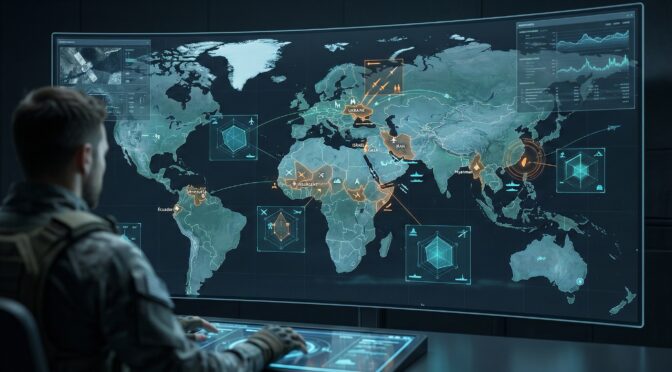
The global security environment experienced a severe, multi-theater destabilization during the week ending February 28, 2026. The defining characteristic of this period is the abrupt transition of long-simmering proxy conflicts, border disputes, and diplomatic standoffs into direct, state-on-state conventional warfare across two primary geopolitical nodes. The most critical development occurred in the Middle East, where the United States and Israel launched a massive, coordinated preemptive strike against the Islamic Republic of Iran. This operation effectively terminated the fragile diplomatic track in Geneva and sparked immediate, large-scale ballistic missile retaliation against Israeli territory and U.S. military installations across the Gulf Cooperation Council (GCC) states. This escalation represents the most significant conflict in the region in decades, immediately threatening global energy markets, spiking crude oil prices, and carrying the imminent risk of a broader regional war involving multiple proxy networks, including the Lebanese Hezbollah, the Yemeni Houthis, and Iraqi militias.
Simultaneously, the South Asian theater erupted into what Pakistani defense officials have formally declared an “open war” with the Taliban-led government in Afghanistan. Following months of escalating cross-border friction and Islamabad’s accusations of militant sanctuary, the Pakistan Air Force executed deep-penetration strikes against military targets in Kabul, Kandahar, and Paktia. This horizontal escalation highlights a complete rupture in the historically complex relationship between Islamabad and the Afghan Taliban, replacing localized border skirmishes with high-intensity aerial bombardment and mechanized ground operations. The sudden eruption of this conflict introduces severe instability into a region already grappling with extreme economic fragility and extremist proliferation, prompting urgent, though currently ineffective, mediation offers from China, Russia, and Iran.
In Eastern Europe, the Russia-Ukraine war crossed its four-year milestone. Contrary to Russian domestic messaging suggesting an inevitable victory and an imminent end to Western sanctions, Ukrainian forces executed localized but highly effective counterattacks, securing their most significant territorial gains since mid-2024. However, the staggering attrition rate-with Russian casualties estimated to have reached 1.2 million dead and wounded-underscores the brutal, grinding nature of the conflict as trilateral peace negotiations in Geneva ended in a near-breakdown. The battlefield reality reveals a Russian military struggling with severe force generation challenges, tactical overextension, and critical communications vulnerabilities.
Beyond these primary theaters, structural instability continues to metastasize in the Global South and the Indo-Pacific. In the South China Sea, the People’s Republic of China has significantly advanced its grey-zone tactics, utilizing military drones to spoof commercial and foreign military transponder signals in what analysts assess to be rehearsals for a Taiwan contingency, prompting joint maritime exercises by the US, Japan, and the Philippines. Concurrently, civil conflicts in Sudan and Myanmar reached grim milestones characterized by escalating civilian atrocities, the systematic targeting of infrastructure, and the growing influence of external actors such as Russia and the United Arab Emirates. In the Sahel, Burkina Faso has centralized military power amid surging extremist violence, while in the Caribbean, Haiti’s political deadlock threatens to undermine fragile security gains achieved by the UN-backed Gang Suppression Force. In East Asia, North Korea utilized a major party congress to explicitly signal dynastic succession.
In sum, the intelligence picture for the week ending February 28, 2026, depicts a highly volatile international system characterized by the failure of deterrence mechanisms, the collapse of diplomatic off-ramps, and the normalization of high-intensity kinetic solutions by state actors across multiple continents.
1. Middle East Theater: The US-Israel-Iran War
1.1 The Collapse of the Geneva Track and Diplomatic Prelude
The outbreak of direct, state-on-state warfare in the Middle East was preceded by the rapid and total collapse of the trilateral nuclear negotiations in Geneva between the United States, Israel, and the Islamic Republic of Iran.1 Throughout mid-to-late February 2026, U.S. President Donald Trump established a hardline negotiating posture, issuing an ultimatum that gave Iran a “10 to 15 days” window to capitulate to sweeping demands or face military intervention.3 The core U.S. demands were maximalist: the complete dismantling of Iran’s fortified nuclear facilities at Fordow, Natanz, and Esfahan; the immediate transfer of all highly enriched uranium out of the country; and a binding commitment to a permanent agreement completely devoid of the “sunset clauses” that characterized previous frameworks.1
While U.S. negotiators signaled a marginal willingness to permit token, low-level uranium enrichment strictly for medical purposes-provided Iran could verifiably prove an inability to weaponize the material-the accompanying offer of only “minimal sanctions relief” was deemed fundamentally unacceptable by Tehran.1 Iranian Foreign Minister Abbas Araghchi and other unspecified Iranian officials consistently communicated that the termination of all U.S. and United Nations Security Council (UNSC) sanctions was an absolute prerequisite for any deal, firmly refusing to destroy domestic nuclear infrastructure or export enriched material.1 Araghchi’s attempts to counter-propose alternatives-such as diluting enrichment levels or establishing a regional enrichment facility on Iranian soil-were interpreted by U.S. intelligence not as good-faith negotiations, but as classic delay tactics designed to stall an impending military strike while Iran fortified its defenses.3
During this diplomatic tightrope, internal friction regarding strategic messaging emerged within the U.S. administration. U.S. Secretary of State Marco Rubio circulated a classified memo to Middle Eastern diplomatic posts strictly rebuking unauthorized public statements that could inflame regional audiences or harden Iran’s position.5 This directive was widely interpreted as a direct reprimand of the U.S. Ambassador to Israel, Mike Huckabee, whose recent inflammatory public remarks claiming a biblical right to Middle Eastern land had caused alarm within the White House during the sensitive final days of the Kushner-Witkoff diplomatic mission.5
Concurrent with the failing diplomacy, the U.S. executed the largest regional airpower and naval buildup since the 2003 invasion of Iraq.6 The deployment included positioning the USS Gerald R. Ford carrier strike group off the coast of Haifa, Israel, alongside the USS Abraham Lincoln strike group already in the region.6 Furthermore, the U.S. Air Force surged advanced stealth capabilities, routing six additional F-22A Raptor fighter jets to RAF Lakenheath to join supporting tankers, bringing the total number of F-22s moving east to 24, with 11 already forward-deployed to Israel.7 Recognizing the imminent threat, Iran accelerated its own military readiness. Key Iranian military commanders conducted emergency inspections of naval and air defense bases, particularly the Khatam ol Anbiya Air Defense bases and the Madinah ol Munawarah Operational Base in Bandar Abbas, while conducting live-fire drills in the Strait of Hormuz.3 In a highly indicative move of impending conflict, satellite imagery revealed the complete evacuation of U.S. aircraft from Al Udeid Air Base in Qatar, leaving only a single KC-135 tanker, in anticipation of retaliatory ballistic missile strikes.7 Shortly before the strikes, the U.S. Embassy in Israel ordered the evacuation of all non-emergency personnel and their families, explicitly advising citizens to depart while commercial flights remained viable.7
1.2 “Operation Epic Fury”: The Preemptive Strike
The diplomatic deadlock culminated on Saturday, February 28, 2026, when the United States and Israel launched a massive, coordinated preemptive military assault against Iran, officially designated by the Pentagon as “Operation Epic Fury”.10 President Trump announced the commencement of “major combat operations” aimed at eliminating the “existential threat” posed by the Iranian regime’s nuclear and ballistic missile programs, explicitly warning that the U.S. intended to “raze their missile industry to the ground” and “annihilate their Navy”.11
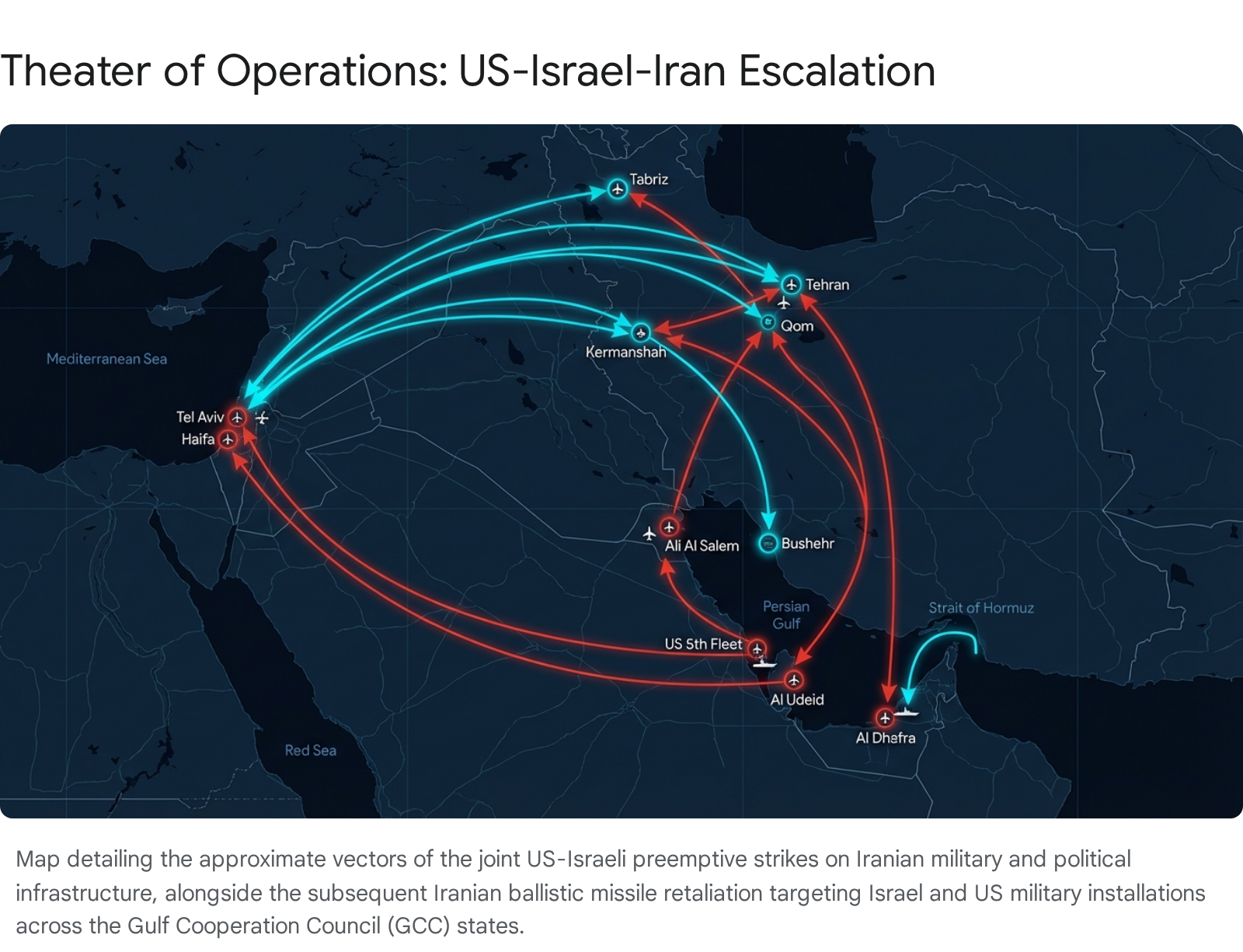
The joint US-Israeli strikes were unprecedented in scale, targeting the core of Iran’s military, nuclear, and political infrastructure across multiple provinces. Widespread explosions were confirmed in Tehran, Tabriz, Qom, Karaj, Khorramabad, Kermanshah, and Ilam, accompanied by deliberate severing of mobile phone services to disrupt Iranian command and control.12 The Israeli Defense Forces (IDF) confirmed striking hundreds of Iranian military targets, including active missile launchers situated in the western provinces.15 Iranian state media also reported strikes on the southern port city of Bushehr, raising critical alarms regarding potential damage to nuclear-related facilities located in the vicinity.14
Most notably, early waves of the assault targeted the office complex of Supreme Leader Ayatollah Ali Khamenei in central Tehran.11 This compound is long considered the operational and symbolic epicenter of the Islamic Republic’s authority. While intelligence reports indicate Khamenei had been relocated to a secure, undisclosed bunker prior to the impact (a protocol established during previous escalations in 2025), the psychological and strategic intent of the strike was a clear attempt at regime decapitation.11
The operation was accompanied by overt political warfare. President Trump publicly framed the military campaign as a catalyst for regime change, explicitly calling on the Iranian populace to “seize control of your destiny” and “take over your government,” framing the moment as a generational opportunity to topple the Islamic leadership that has ruled since 1979.11 He concurrently issued an ultimatum to the Islamic Revolutionary Guard Corps (IRGC) to lay down their arms or face “certain death”.12 Footage emerging from Tehran showed mixed domestic reactions; while significant panic ensued, some bystanders were recorded celebrating and laughing near the site of the Supreme Leader’s struck compound, referring to it as the “leader’s house”.14
The civilian toll of the preemptive strikes has been severe and immediate. Iranian state-run media (IRNA) reported that at least 40 people were killed at a girls’ school in southern Iran due to the strikes.15 Iran’s Interior Ministry condemned the attacks as severe violations of international law, declaring a national crisis and mobilizing provincial governors to maintain public order amid the bombardment.10
1.3 Iranian Retaliation: The Regionalization of the Conflict
The Islamic Republic of Iran’s response to Operation Epic Fury was rapid, fulfilling previous warnings of a “crushing” retaliation unconstrained by previous red lines.12 The Supreme National Security Council confirmed the commencement of a “decisive response,” ordering the closure of schools and universities while keeping banks operational to manage panic.10 Within hours of the initial U.S.-Israeli strikes, the IRGC launched a massive, multi-wave ballistic missile and drone barrage targeting the State of Israel.12 Explosions shook northern Israel, including the port city of Haifa, as the nation’s multi-layered air defense systems engaged incoming munitions, leading to the indefinite closure of all educational institutions, mass gatherings, and civilian airspace.16
However, the most strategically disruptive element of the Iranian retaliation was the deliberate horizontal escalation across the Arabian Peninsula. In a move that fundamentally alters the security architecture of the Middle East, Iran directly targeted sovereign GCC states hosting U.S. military installations. Iranian state media announced that “all” U.S. bases in the Middle East were now legitimate targets.13 Intelligence confirms that specific retaliatory ballistic missile strikes were directed at:
- The U.S. Navy’s Fifth Fleet headquarters in Manama, Bahrain.13
- The Al Udeid Air Base in Doha, Qatar.13
- The Ali Al Salem Air Base in Kuwait.13
- The Al Dhafra Air Base in the United Arab Emirates.13
- Unspecified U.S. military installations in Jordan.13
The defense ministries of the targeted GCC nations confirmed widespread airspace closures and air defense interceptions.12 Shrapnel from an intercepted Iranian missile over Abu Dhabi resulted in at least one civilian fatality, marking a severe escalation by bringing lethal kinetic conflict to a sub-region that historically relies on U.S. security guarantees to maintain peace and facilitate global commerce.12
1.4 Proxy Activation: The “Ring of Fire” Ignites
The outbreak of direct war triggered the immediate activation of Iran’s broader “Axis of Resistance,” plunging neighboring theaters into renewed violence. In Lebanon, the fragile ceasefire established between Israel and Hezbollah in November 2024 collapsed entirely.20 Citing intelligence that Hezbollah was utilizing underground tunnels to rearm and plan incursions, the IDF launched extensive preemptive strikes against Hezbollah infrastructure in southern Lebanon and the Beqa’a Valley.19 These operations resulted in the elimination of at least eight Hezbollah operatives, including a senior commander, and the deaths of at least 12 individuals in southern Lebanon, prompting severe protests from the Lebanese government regarding sovereignty violations.21
In Yemen, the Houthi movement seized upon the regional chaos to announce the immediate termination of their unwritten non-aggression pact with the Trump administration.25 Senior Houthi officials declared a resumption of their aggressive missile and drone campaign targeting both the Red Sea commercial shipping corridor and Israeli territory, with strikes commencing immediately.26 This effectively nullifies the temporary security gains achieved in late 2025 and directly threatens international maritime commerce once again.26
In Iraq, the threat of militia involvement materialized rapidly. Prior to the strikes, U.S. and Israeli intelligence monitored high-level meetings between Iranian operatives and allied Iraqi militias, including Kataib Hezbollah, coordinating contingency plans.17 Kataib Hezbollah had explicitly threatened the Kurdistan Regional Government (KRG) against facilitating any U.S. or Israeli attacks.1 Following the outbreak of hostilities, an alleged drone strike-unclaimed but suspected to be part of the broader US-Israeli operation-hit a Kataib Hezbollah headquarters in Iraq, killing two operatives and wounding three, further drawing the Iraqi theater into the conflagration.29 The U.S. Embassy in Qatar, UAE, and Israel subsequently issued blanket “shelter in place” orders for all diplomatic staff and American citizens.11
1.5 Macroeconomic Shocks and Energy Market Volatility
The transition to open warfare in the Persian Gulf has immediately injected profound volatility into global financial and energy markets. The primary vector of systemic economic risk is the Strait of Hormuz, a maritime chokepoint through which approximately 14 million barrels of oil per day-roughly 20% of global supply-transit to international markets.11 Historically, Iran has utilized the implicit threat of closing the strait, or harassing vessels within it, as its ultimate asymmetric economic weapon.6
Prior to the strikes, energy markets had already begun to price in a heavy geopolitical risk premium. By late February, West Texas Intermediate (WTI) crude was trading at $67.02 per barrel, with Brent crude at $72.87.31 Following the commencement of major combat operations, energy analysts at BloombergNEF and Barclays projected that oil prices could swiftly surge to between $80 and $91 per barrel, depending heavily on the duration of the conflict and the extent of kinetic damage to Iranian energy extraction and export infrastructure.32 Economic modeling suggests that an energy price shock of this magnitude could generate an additional 1.2% to 2.5% of inflationary pressure globally, fundamentally disrupting central bank interest rate trajectories and extending economic recovery timelines by 6 to 12 months.31
The broader financial markets reacted with acute stress and a rapid flight to safety. Cryptocurrencies, which trade continuously over the weekend, served as the initial barometer for global investor panic. Bitcoin (BTC) plummeted 3.1% to $63,561 immediately following the announcement of the strikes, a level unseen since early February 2026.4 Conversely, safe-haven assets saw an immediate and aggressive influx of capital. On the COMEX, gold prices surged 2% to $5,296.40 an ounce (a single-day jump of $102.20), while silver soared nearly 8% to $93.82 an ounce.36 Global stock indices, already pressured by sticky, hotter-than-expected inflation data in the U.S., slumped significantly; the Dow Jones dropped over 521 points (1%), and the Nasdaq fell 210 points.35
Furthermore, the resumption of Houthi attacks in the Red Sea threatens to reverse the recent normalization of Suez Canal traffic. Container carriers like CMA CGM SA, which had recently restarted Red Sea transits, announced they will once again divert Asia-Europe services around the Cape of Good Hope due to the “complex and uncertain international context”.30 This diversion will reintroduce severe delays, consume excess shipping capacity, and exponentially increase global freight costs, compounding the inflationary pressures generated by the crude oil spike.30
| Market Indicator | Pre-Strike Level (Late Feb) | Post-Strike Projection/Reaction | Systemic Impact |
| Brent Crude Oil | $72.87 / barrel | $80.00 – $91.00 / barrel | High risk of 1.2% – 2.5% global inflation increase. |
| Gold (COMEX) | $5,194.20 / oz | $5,296.40 / oz (+2.0%) | Massive flight to safe-haven assets. |
| Silver (COMEX) | $86.99 / oz | $93.82 / oz (+8.0%) | Extreme safe-haven demand spike. |
| Bitcoin (BTC) | ~$65,595 | $63,561 (-3.1%) | Immediate sell-off of high-risk assets. |
| Dow Jones | 49,499.18 | 48,977.90 (-1.0%) | Equity markets reacting to dual inflation/war threat. |
2. South Asia: Pakistan-Afghanistan “Open War”
2.1 Operation Ghazab lil-Haq and Aerial Engagements
The security paradigm in South Asia deteriorated drastically on February 27, 2026, when Pakistan’s Defence Minister Khawaja Asif formally declared a state of “open war” against the Taliban-led government of Afghanistan, stating that Islamabad’s “cup of patience has overflowed”.38 This declaration marked the culmination of months of escalating border skirmishes and devastating terror attacks within Pakistan, which Islamabad attributes to militant groups operating with impunity from Afghan sanctuaries.38
In a massive escalation of force, the Pakistan Air Force (PAF) launched “Operation Ghazab lil-Haq” (Righteous Fury), executing deep-penetration airstrikes and coordinated artillery barrages across multiple Afghan provinces, including the capital Kabul, Kandahar, Paktia, and Nangarhar.38 The PAF systematically targeted core Afghan military infrastructure. Intelligence confirms the destruction of the 313 Brigade headquarters, the 201 KBW Brigade headquarters, and the 205 Brigade headquarters situated in Kabul and Kandahar.43 Additional strategic targets included Taliban intelligence command centers, ammunition depots in Nangarhar, and a massive military compound adjacent to the Pul-e-Charkhi prison east of Kabul.43
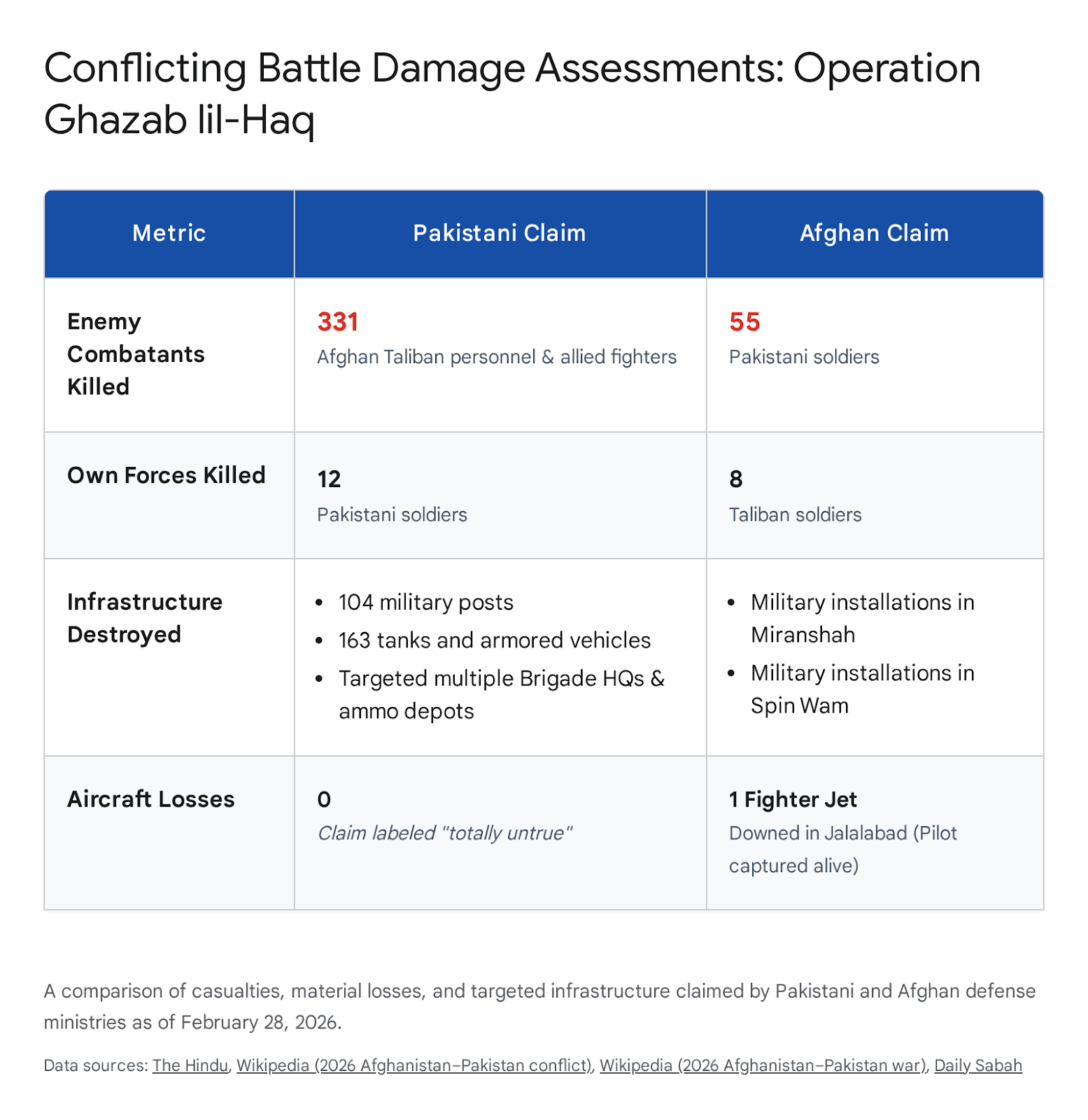
The kinetic exchange resulted in high casualties and highly conflicting narratives typical of information warfare environments. Pakistan’s Information Minister Attaullah Tarar and military spokespersons reported that the strikes killed 331 Afghan Taliban personnel and allied terrorist operatives, wounding over 500.38 The Pakistani military claimed the destruction of 104 military posts, the capture of 22 border posts, and the destruction of 163 tanks and armored vehicles across 37 locations, while acknowledging the loss of 12 of its own soldiers in the initial border clashes.38 Conversely, the Afghan Ministry of National Defense claimed to have killed 55 Pakistani soldiers and captured 19 border bases during retaliatory ground operations, codenamed Operation ‘Rad al-Zulm’, which reportedly included the use of drone strikes against Pakistani military camps in Miranshah and Spinwam.40
A critical and highly contested incident emerged on February 28 when Afghan police and military officials in Jalalabad claimed to have shot down a Pakistani fighter jet in the city’s sixth district.38 Witnesses reported hearing the jet followed by two explosions near Jalalabad airport, with residents observing a pilot ejecting and subsequently being captured alive.38 Pakistan’s Foreign Ministry vehemently denied the claim, labeling the downing of the aircraft as a complete fabrication.38
2.2 Border Dynamics and the Root Causes of War
The immediate catalyst for Pakistan’s massive aerial campaign was a severe wave of deadly terrorist attacks within its borders in early-to-mid February 2026. These included a devastating suicide bombing at a Shiite mosque in the capital city of Islamabad that killed 36 people, and an attack on a military checkpoint in Bajaur that killed 11 soldiers.42 Islamabad placed the blame squarely on the Tehrik-e-Taliban Pakistan (TTP), a militant organization closely allied with the Afghan Taliban that actively seeks to overthrow the Pakistani state.42 Following these attacks, the Pakistani government issued a formal démarche to the Afghan ambassador on February 19, explicitly warning that it would launch air operations inside Afghanistan if the Taliban did not dismantle the militant sanctuaries.43 The Afghan Taliban routinely denies these allegations, framing Pakistan’s kinetic counter-terrorism operations as unacceptable violations of sovereignty, thereby creating a self-sustaining cycle of mutual blame and retaliation.41
However, the deeper, structural driver of this conflict is the fundamentally unresolved status of the Durand Line. This 2,640-kilometer border, drawn by the British in 1893, has never been officially recognized by any Afghan government, including the current Taliban regime.40 Friction over border management is constant and highly volatile. Pakistan’s extensive fencing projects, the construction of military outposts, and fierce disputes over control of customs revenues at vital chokepoints like Torkham and Spin Boldak/Chaman create a perpetual environment of tactical confrontation.40 The economic toll of this escalation is already severe; trade has been completely halted, and hundreds of residents living near the Torkham border crossing have been forced to flee to safer areas, exacerbating an already dire humanitarian situation.45
2.3 Regional Diplomatic Interventions
The rapid descent into conventional warfare between two heavily armed states-one of which is a nuclear power-has profoundly alarmed the international community, triggering intense fears of a regional spillover that could destabilize the entirety of Central and South Asia. The United Nations Secretary-General António Guterres expressed deep concern over the escalation’s impact on civilians, demanding an immediate cessation of hostilities, while the European Union’s foreign policy chief urged urgent de-escalation.38
Regional powers have moved quickly to offer mediation, recognizing the catastrophic potential of a prolonged conflict. The Islamic Republic of Iran, despite being under intense military assault from the US and Israel simultaneously, issued a statement via Foreign Minister Abbas Araghchi expressing readiness to “facilitate dialogue” and enhance understanding between Kabul and Islamabad.38 The Russian Foreign Ministry demanded an immediate halt to cross-border attacks, urging both sides to pursue a diplomatic resolution.38 China’s Foreign Ministry announced that Beijing was “deeply concerned” and was actively talking to both sides to secure a ceasefire as quickly as possible.38 Conversely, the U.S. State Department issued a statement backing Pakistan’s “right to defend itself” against the Afghan Taliban, highlighting a complex alignment of geopolitical interests where the U.S. rhetorically supports Islamabad’s counter-terrorism narrative while simultaneously engaging in major combat operations in the Middle East.38
3. Eastern Europe: Russia-Ukraine Conflict at Year Four
3.1 Ukrainian Tactical Gains and Shifting Battlefield Dynamics
As the Russian invasion of Ukraine crossed its grim four-year anniversary on February 24, 2026, the realities on the battlefield stood in direct contradiction to Moscow’s domestic narrative that a Russian victory is both inevitable and imminent. Recent weeks have seen the Ukrainian Armed Forces (AFU) execute a series of successful, localized counterattacks, achieving their most significant territorial gains since the daring Kursk Oblast incursion in August 2024, and liberating the most territory within Ukraine itself since the comprehensive 2023 counteroffensive.48
Throughout early February 2026, Ukrainian forces launched aggressive operations in the Novopavlivka, Oleksandrivka, and Hulyaipole directions across the Dnipropetrovsk and Zaporizhia oblasts. Intelligence confirms that these efforts resulted in the liberation of approximately 200 square kilometers of territory.48 When accounting for minor Russian advances in adjacent sectors (which totaled roughly 35 square kilometers), Ukraine achieved a net territorial gain of 165 square kilometers for the month.48 Furthermore, in the highly contested Kupyansk sector (Kharkiv Oblast), Ukrainian forces successfully stabilized their control over the town following a mid-December counterattack that retook 183 square kilometers, holding these gains against repeated Russian counter-assaults.48
These Ukrainian successes have been instrumental in severing vital Russian ground lines of communication (GLOCs) and thoroughly disrupting Moscow’s preparations for a planned Spring-Summer 2026 offensive. By maintaining operational tempo, the AFU has forced Russian troops into a reactive defensive posture, preventing them from marshaling fresh reserves.48 These gains are attributed to a combination of Ukrainian tactical agility and profound Russian systemic vulnerabilities. Russian forces have continually suffered from tactical overextension, frequently utilizing small infantry infiltration units that advance much faster than their logistical supply lines can follow, leaving them highly exposed to Ukrainian counter-maneuvers.48 Additionally, Russian command and control has been severely degraded by ongoing communication failures. This degradation was exacerbated by Ukraine’s successful, coordinated efforts (in conjunction with Elon Musk) to block the illegal use of Starlink terminals by Russian forces, compounded by the Kremlin’s self-inflicted throttling of the Telegram messaging app, a platform heavily relied upon by Russian frontline units for tactical coordination.48
3.2 Russian Force Generation Crisis and Staggering Attrition
The Russian military apparatus is currently facing a severe and compounding force generation crisis. The Kremlin’s strategy of grinding, attritional warfare has exacted a catastrophic and potentially unsustainable toll on Russian personnel. According to comprehensive intelligence estimates compiled in February 2026 by Western officials, independent media outlets (such as Mediazona and the BBC), and leading think tanks, total Russian casualties (killed and wounded) have reached an estimated 1.2 million personnel since the war began.49
Of this staggering figure, the number of Russian soldiers killed in action is estimated to be between 230,000 and 430,000.49 Western intelligence indicates that the years 2024 and 2025 were particularly brutal, accounting for approximately 430,000 and 415,000 total casualties respectively.49 This immense rate of attrition has completely outpaced the Kremlin’s ability to replenish its ranks through voluntary mobilization. In January 2026, the Russian casualty rate surpassed its recruitment rate for the first time in years.48 The Russian government is increasingly struggling to finance its recruitment efforts, facing severe difficulties at both the federal and local levels to payout the massive cash incentives required to attract contract volunteers.48 Consequently, the forces currently occupying the front lines are described as severely attrited, exhausted, and worn down, heavily limiting their capacity to conduct sustained offensive operations.48
3.3 Diplomatic Stagnation and Information Warfare
Despite the shifting battlefield momentum and the immense human cost borne by both nations, the diplomatic track remains entirely deadlocked. The third round of trilateral peace negotiations, held in Geneva in late February, ended abruptly and without resolution.2 Moscow’s lead negotiator, Vladimir Medinsky, appeared visibly defeated following sessions that diplomatic sources characterized as a near-breakdown.2
A profound disconnect exists between the Kremlin’s domestic messaging and the stark reality at the negotiating table. On Russian state television, a highly coordinated effort is underway to depict President Vladimir Putin as a statesman actively and genuinely seeking peace.2 State-approved commentators have begun openly discussing optimistic “post-war” scenarios, including the imminent lifting of Western sanctions.2 Analysts assess this narrative is carefully crafted to appease a domestic audience that is increasingly weary of the four-year conflict and the massive, undeniable casualty counts.2 However, the reality of Western resolve remains firm. NATO Secretary General Mark Rutte, speaking at a commemoration ceremony in Brussels on February 24, reiterated the alliance’s unwavering support for Ukraine. Rutte emphasized that “Putin must show if he is serious about peace” and stressed that Ukraine continues to require daily deliveries of ammunition and financial aid to successfully blunt Russian aggression from the skies and hold the frontlines.50
4. Indo-Pacific: South China Sea Tensions and Myanmar Civil War
4.1 Chinese Grey-Zone Tactics and Transponder Spoofing
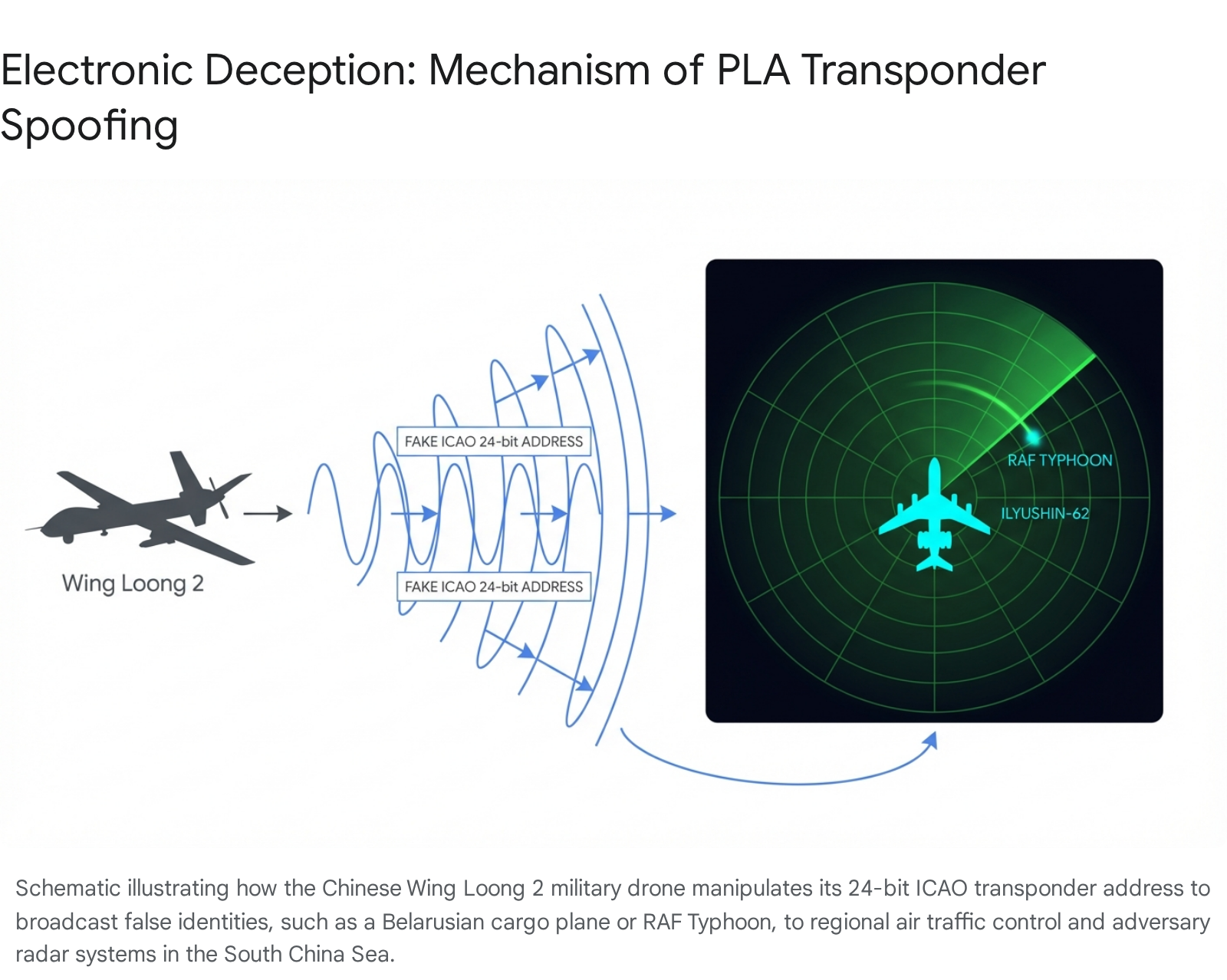
In the highly contested waters of the South China Sea, the People’s Republic of China (PRC) has significantly escalated its “grey-zone” operations, deploying advanced electronic deception tactics that military and security analysts assess as a direct rehearsal for a potential invasion of Taiwan.51 Intelligence confirms that since August 2025, a large Chinese military drone-identified as a Wing Loong 2 utilizing the call sign YILO4200-has conducted at least 23 masked flights originating from Hainan’s Qionghai Boao International Airport, a dual-use facility currently undergoing rapid expansion.51
These operations involve the drone manipulating its automatic dependent surveillance-broadcast (ADS-B) transponder to broadcast false 24-bit ICAO addresses, effectively masking its identity to appear as civilian or foreign military aircraft.51 The YILO4200 drone has been tracked successfully spoofing the identities of a sanctioned Belarusian Ilyushin-62 cargo plane, a Royal Air Force (RAF) Typhoon fighter jet, a North Korean passenger jet, and various anonymous executive jets.51 During one particularly complex flight on August 5-6, the drone rapidly switched its identity signal between four different aircraft types in a mere 20-minute span.51
The strategic objective of this transponder spoofing is the deliberate exploitation of the “kill chain” decision-making process during a high-intensity conventional conflict. By intentionally muddying the airspace picture, the People’s Liberation Army (PLA) aims to sow time-wasting confusion among enemy air traffic controllers and automated air defense systems, forcing adversaries to spend critical seconds verifying target identities before engaging.51 The flight paths of the YILO4200 have been highly provocative and strategically deliberate, flying star-shaped surveillance patterns near the disputed Paracel Islands (where China has constructed an estimated 20 military outposts), traversing the Bashi Channel (a critical naval chokepoint between Taiwan and the Philippines used to access the Pacific), and operating near U.S. and Japanese military bases in Okinawa.51
4.2 Alliance Architecture: Trilateral Maritime Exercises
In direct response to China’s expanding footprint and aggressive grey-zone tactics, the United States, Japan, and the Philippines conducted a joint maritime military exercise from February 20 to 26 in the South China Sea.53 The drills, which took place within the Philippines’ exclusive economic zone north of Luzon Island near Taiwan, involved a Philippine frigate (the Antonio Luna) and fighter jets, a Japanese Maritime Self-Defense Force P-3C patrol aircraft, and a U.S. military destroyer.53
The Philippine military explicitly stated the exercise was designed to enhance interoperability, reinforce maritime security, and improve Maritime Domain Awareness.53 The timing of the drill coincided directly with the increased Chinese drone activity and the illegal presence of Chinese navy ships in the area.53 Beijing’s Defense Ministry sharply criticized the drills, with spokesperson Zhang Xiaogang labeling the Philippines a “pure troublemaker and a peace disruptor” for co-opting non-regional countries.53 China asserted that the People’s Liberation Army Southern Theater Command conducted concurrent routine patrols to resolutely safeguard China’s territorial sovereignty.53
4.3 The Myanmar Theater: Junta Airstrikes and Russian Strategic Support
The civil war in Myanmar continues to exact a devastating toll on the civilian population five years after the February 2021 military coup. The ruling military junta, the State Security and Peace Commission (SSPC), facing a sustained and multi-front armed resistance from the National Unity Government (NUG), People’s Defence Forces (PDF), and various Ethnic Armed Organizations (EAOs), has increasingly relied on indiscriminate aerial bombardment to maintain territorial control.56 The conflict has resulted in approximately 4 million internally displaced persons and left a third of the population requiring humanitarian aid, compounded by a devastating 7.7 magnitude earthquake in March 2025.57
Throughout February 2026, the junta escalated its airstrikes, utilizing fighter jets, armed drones, paramotors, and gyrocopters to frequently target civilian infrastructure.58 Between February 4 and 17, documentation confirmed multiple attacks on healthcare facilities, bringing the staggering total number of attacks on medical infrastructure since the coup to 1,869.60 In one notable and tragic incident on February 17 in the Sagaing region, a public high school functioning as a makeshift hospital was targeted by three bombs dropped by a Myanmar military fighter jet, resulting in civilian fatalities.60 Furthermore, the junta continues to persecute the Rohingya minority, detaining over 500 Rohingya in late 2025 after intercepting their boat off the coast of Rakhine State.58
A critical factor enabling the junta’s aerial supremacy and battlefield resilience is the staunch strategic support of the Russian Federation. While China wields significant political and economic influence over both the junta and the EAOs, Russia has become Naypyidaw’s primary military benefactor.56 In early February 2026, Sergei Shoigu, Secretary of the Russian Security Council and a close confidant of Vladimir Putin, visited Myanmar.56 Shoigu became the first high-level foreign official to visit the country since the junta’s deeply flawed and exclusionary elections held in December 2025 and January 2026.56 During the visit, Shoigu praised the sham elections, criticized Western isolation narratives, and most importantly, signed a four-year military cooperation agreement.56 This agreement solidifies Russia’s vital role in supplying the intelligence, tactical advice (gleaned from the Ukraine conflict), and aviation hardware that currently sustains the junta’s brutal battlefield operations.56
5. Africa: Sudan’s 1,000 Days and the Sahel Crisis
5.1 Sudan at 1,000 Days: Frontline Shifts and Genocidal Hallmarks
In February 2026, the devastating civil war in Sudan crossed the grim milestone of 1,000 days of continuous conflict between the Sudanese Armed Forces (SAF) and the Rapid Support Forces (RSF).61 The war has precipitated the world’s worst displacement crisis, with over 11 million people displaced (including 4.5 million refugees fleeing to Chad, Ethiopia, and South Sudan) and an estimated 33.7 million people requiring urgent humanitarian assistance amid a catastrophic hunger crisis.63
Recent weeks have seen a dramatic intensification of combat characterized by shifting front lines and the deployment of advanced weaponry.61 Frontlines are highly volatile across North Darfur, North Kordofan, South Kordofan, and the Blue Nile states.62 In North Kordofan, the capital city of El Obeid remains besieged from three sides by the RSF, severely restricting civilian movement and aid delivery.61 The introduction of drone warfare has exacerbated civilian casualties; on February 17 and 18, separate drone strikes in the Kordofan region killed at least 57 people, prompting severe condemnations from the UN High Commissioner for Human Rights.61 Furthermore, the conflict threatens regional spillover, evidenced by Chad’s announcement that seven of its soldiers were killed in a confrontation with RSF elements.62
Most alarmingly, UN investigators and fact-finding missions have issued stark warnings regarding atrocities occurring in El Fasher (North Darfur). Following the RSF takeover of the city in late 2025, investigators have documented systemic acts bearing the explicit “hallmarks of genocide” directed against the Zaghawa and Fur ethnic communities.61 These atrocities include ethnically targeted summary executions, enforced disappearances, and widespread, systematic sexual violence, which UN officials have characterized as a “crisis within a crisis” threatening up to 12 million women and girls.61
Diplomatic efforts to secure a ceasefire remain largely ineffective due to the warring parties’ intransigence and the continued flow of weapons facilitated by regional sponsors, notably the United Arab Emirates and Saudi Arabia, who remain entrenched in their respective positions.63 However, the humanitarian community received a minor reprieve when an international donor conference, co-hosted by the US and the UN in Washington D.C. on February 3, secured $1.5 billion in fresh funding, including major contributions from the US ($200 million) and the UAE ($500 million).63
5.2 The Sahel Crisis: Burkina Faso’s Institutional Restructuring
The security environment in the Sahel continues to deteriorate rapidly, with Burkina Faso cementing its position as the undisputed epicenter of global extremist violence. Extremist groups, primarily the Al-Qaeda-affiliated Jama’at Nusrat al-Islam wal Muslimin (JNIM) and the Islamic State in the Greater Sahara (ISGS), operate with relative freedom across vast swaths of Burkina Faso, Mali, and Niger.65 In January and February 2026, JNIM maintained a high operational tempo in Burkina Faso’s Boucle de Mouhoun and Sahel regions, destroying critical infrastructure (such as a bridge linking Burkina Faso to Mali) and routinely overwhelming local defense units in towns like Madouba and Bani.67
In response to the deteriorating security situation and internal political paranoia, Burkina Faso’s military leader, Captain Ibrahim Traoré, implemented sweeping institutional changes in early 2026. After foiling an alleged coup plot orchestrated by a former junta leader with suspected ties to Côte d’Ivoire, Traoré reshuffled his cabinet to reward loyalists.66 Crucially, he elevated the status of the Brigade of Volunteers for the Defence of the Homeland (VDP)-a civilian militia central to the government’s counter-terrorism strategy but heavily implicated in human rights abuses-to the formal “rank of army”.67 Concurrently, the government decreed the dissolution of all political parties and ominously renamed the Ministry of Defence to the “Ministry of War and Patriotic Defence,” signaling a total militarization of the state apparatus.67
Amid this instability, the United States attempted a diplomatic rapprochement. State Department officials, including Nick Checker, visited Mali to convey respect for sovereignty and move past “policy missteps,” seeking targeted intelligence sharing with the junta-led Alliance of Sahel States (Burkina Faso, Mali, Niger).68 However, this overture is complicated by the juntas’ uninhibited hostility toward Western nations and their increasing reliance on Russian mercenary support.68
6. Caribbean: Haiti Security Crisis
6.1 Institutional Gridlock and Gang Suppression
The security and political crisis in Haiti remains highly acute. In early 2026, the United Nations Security Council unanimously adopted Resolution 2814, renewing the mandate of the United Nations Integrated Office in Haiti (BINUH) until January 31, 2027.69 The renewed mandate places a heavy emphasis on combating the rampant gang violence that has severely eroded state authority across the nation.
While the deployment of the UN-authorized Gang Suppression Force (which succeeded the Multinational Security Support mission in late 2025) has yielded fragile security gains-such as reopening key logistical roads in Port-au-Prince and the Artibonite Department, and restoring a basic state presence near the Champ de Mars-the overall environment remains highly unstable.69 The national homicide rate rose by nearly 20% in 2025.71 Complicating the security response is severe political deadlock within the Transitional Presidential Council.69 As the February 7, 2026 deadline for the Council’s mandate approaches, deep divisions persist over the transitional governance architecture required to lead the country toward newly proposed elections scheduled for early 2027.70 Civil society groups have condemned the lack of progress on security, casting doubt on the feasibility of holding safe elections under current conditions.70
7. East Asia: North Korean Succession Signaling
7.1 Dynastic Succession and Military Posturing
In East Asia, the Democratic People’s Republic of Korea (DPRK) utilized the closing stages of its Ninth Workers’ Party Congress in late February 2026 to engage in highly symbolic political theater aimed at solidifying the regime’s dynastic succession. The state-run Korean Central News Agency (KCNA) released rare imagery of Supreme Leader Kim Jong Un’s teenage daughter, Kim Ju Ae, firing a new sniper rifle at an outdoor military shooting range.74
The imagery-depicting Ju Ae peering through a scope, with a smoking barrel, and wearing a leather jacket that historically symbolizes authority within the Kim family-is assessed by intelligence analysts as a deliberate confirmation that she is receiving direct military training and is being groomed as the next in line to rule the secretive, nuclear-armed state.74 Furthermore, during the congress, Kim Jong Un’s powerful sister, Kim Yo Jong, was promoted to head the party’s general affairs department, a role akin to secretary-general, signaling a further consolidation of administrative control within the immediate Kim family.74
Interestingly, while the regime’s internal focus remains locked on securing the next generation of absolute leadership, its external military posturing showed subtle signs of restraint. The military parade commemorating the congress was notable for the complete absence of heavy military hardware, including transporter-erector-launcher vehicles used for ballistic missiles.78 This marks the first time in 13 parades that such hardware was omitted, a move South Korean intelligence assesses as a potential signal leaving room for future diplomatic engagement with the United States, even as Pyongyang tightly controls its nuclear leverage.75
Please share the link on Facebook, Forums, with colleagues, etc. Your support is much appreciated and if you have any feedback, please email us in**@*********ps.com. If you’d like to request a report or order a reprint, please click here for the corresponding page to open in new tab.
Sources Used
- Iran Update, February 26, 2026, accessed February 28, 2026, https://understandingwar.org/research/middle-east/iran-update-february-26-2026/
- February 22, 2026: Is Putin Looking for an Exit? – YouTube, accessed February 28, 2026, https://www.youtube.com/watch?v=HG8-gFISKpY
- Iran Update, February 20, 2026 | ISW, accessed February 28, 2026, https://understandingwar.org/research/middle-east/iran-update-february-20-2026/
- Trump says ‘massive’ strike against Iran underway – bitcoin plunge offers a glimpse of how markets could react, accessed February 28, 2026, https://www.morningstar.com/news/marketwatch/20260228135/trump-says-massive-strike-against-iran-underway-bitcoin-plunge-offers-a-glimpse-of-how-markets-could-react
- Marco Rubio orders US officials to stop commentary that could strain Iran talks, accessed February 28, 2026, https://www.theguardian.com/us-news/2026/feb/27/marco-rubio-iran-talks-mike-huckabee
- Iran’s Conflict With Israel and the United States – Council on Foreign Relations, accessed February 28, 2026, https://www.cfr.org/global-conflict-tracker/conflict/confrontation-between-united-states-and-iran
- U.S.–Iran Conflict Situation Update, accessed February 28, 2026, https://www.globalguardian.com/newsroom/u.s.-iran-conflict-situation-update
- Iran Update, February 24, 2026 | ISW, accessed February 28, 2026, https://understandingwar.org/research/middle-east/iran-update-february-24-2026/
- Travel Advisory Update (February 27, 2026), accessed February 28, 2026, https://il.usembassy.gov/travel-advisory-february-27-2026/
- UAE intercepts several Iranian missiles, state news agency says | Iran International, accessed February 28, 2026, https://iranintl.com/en/202602283447
- US and Israel launch a major attack on Iran and Trump urges Iranians to ‘take over your government’, accessed February 28, 2026, https://www.pbs.org/newshour/world/us-and-israel-launch-a-major-attack-on-iran-and-trump-urges-iranians-to-take-over-your-government
- Iran launches retaliatory strikes after major US-Israel attack – live – The Guardian, accessed February 28, 2026, https://www.theguardian.com/world/live/2026/feb/28/israel-attacks-iran-as-blasts-heard-in-tehran-live-updates?page=with:block-69a2ba118f08e575db5bd4af
- Live Updates: U.S. and Israel attack Iran, with Trump confirming “major combat operations”, accessed February 28, 2026, https://www.cbsnews.com/live-updates/israel-us-attack-iran-trump-says-major-combat-operations/
- Israel, United States strike Islamic Republic, targeting heart of regime, accessed February 28, 2026, https://www.iranintl.com/en/202602289915
- Iran-Israel conflict LIVE: U.S, Israel launch attacks across several Iranian cities; Iran retaliates with missiles targetting northern Israel, accessed February 28, 2026, https://www.thehindu.com/news/international/iran-israel-usa-conflict-strikes-attack-west-asia-us-trump-live-updates-february-28-2026/article70687247.ece
- Israel braces for missiles after Iran warns of ‘crushing’ retaliation against attacks – Al Arabiya, accessed February 28, 2026, https://english.alarabiya.net/News/middle-east/2026/02/28/iran-preparing-for-crushing-retaliation-against-israel-us-attacks-report
- The Latest: US and Israel attack Iran as Trump says US begins ‘major combat operations’, accessed February 28, 2026, https://www.wsls.com/news/world/2026/02/28/the-latest-israel-launches-attack-on-irans-capital/
- Bahrain says US Navy’s 5th Fleet headquarters hit in ‘missile attack’, accessed February 28, 2026, https://m.economictimes.com/news/defence/iran-israel-war-bahrain-says-us-navys-5th-fleet-headquarters-hit-in-missile-attack/articleshow/128880732.cms
- Israel attacks Iran and Hezbollah in Lebanon, imposes state of emergency, accessed February 28, 2026, https://www.pravda.com.ua/eng/news/2026/02/28/8023225/
- Lebanon’s Post-Ceasefire Rights Crisis Demands Urgent Government Action, accessed February 28, 2026, https://impactpolicies.org/news/810/lebanons-post-ceasefire-rights-crisis-demands-urgent-government-action
- Israel Army strikes Hezbollah infrastructure in south Lebanon, accessed February 28, 2026, https://www.thehindu.com/news/international/israel-army-strikes-hezbollah-infrastructure-in-south-lebanon/article70687168.ece
- Israel strikes Hezbollah sites in southern Lebanon amid ceasefire tensions – TRT World, accessed February 28, 2026, https://www.trtworld.com/article/3e7ed9f44e8f?utm_source=ee09b274f148&utm_medium=internal&utm_campaign=recommended&utm_content=inline
- Spotlight on Terrorism: Hezbollah and Lebanon (February 16-23, 2026), accessed February 28, 2026, https://www.terrorism-info.org.il/en/spotlight-on-terrorism-hezbollah-and-lebanon-february-16-23-2026/
- Israel army says striking Hezbollah infrastructure in south Lebanon, accessed February 28, 2026, https://www.arabnews.com/node/2634761/middle-east
- Yemen’s Iranian-backed Houthi rebels to resume attacks on shipping in the Red Sea corridor, 2 rebel officials tell AP, accessed February 28, 2026, https://lasvegassun.com/news/2026/feb/28/yemens-iranian-backed-houthi-rebels-to-resume-atta/
- Iranian-backed Houthis say they’ll resume attacks on Israel and on shipping routes, accessed February 28, 2026, https://www.timesofisrael.com/liveblog_entry/iranian-backed-houthis-say-theyll-resume-attacks-on-israel-and-on-shipping-routes/
- U.S. and Israel launch attack on Iran, Trump says ‘major combat operations’ have begun, accessed February 28, 2026, https://www.cp24.com/news/world/2026/02/28/us-and-israel-launch-attack-on-iran-trump-says-major-combat-operations-have-begun/
- Yemen’s Iranian-backed Houthi rebels to resume attacks on shipping in Red Sea corridor: Officials, accessed February 28, 2026, https://www.thehindu.com/news/international/yemens-iranian-backed-houthi-rebels-to-resume-attacks-on-shipping-in-red-sea-corridor-officials/article70687579.ece
- US and Israel launch a major attack on Iran and Trump urges Iranians to ‘take over your government’, accessed February 28, 2026, https://apnews.com/article/iran-us-explosion-tehran-c2f11247d8a66e36929266f2c557a54c
- Red Sea shipping reopens, but renewed Houthi threats keep route uncertainty high, accessed February 28, 2026, https://www.spglobal.com/market-intelligence/en/news-insights/research/2026/02/red-sea-shipping-reopens
- U.S.-Israel Strikes Iran: Energy Market Volatility – Discovery Alert, accessed February 28, 2026, https://discoveryalert.com.au/energy-market-volatility-2026-global-economic-impact/
- Oil Can Hit $91 a Barrel in Late 2026 on Iran Disruption | BloombergNEF, accessed February 28, 2026, https://about.bnef.com/insights/commodities/oil-can-hit-91-a-barrel-in-late-2026-on-iran-disruption/
- Iran-Israel war: Up 20% in 2026, crude oil stares at $80 a barrel – The Economic Times, accessed February 28, 2026, https://m.economictimes.com/markets/commodities/news/iran-israel-war-up-20-in-2026-crude-oil-stares-at-80-a-barrel/articleshow/128884731.cms
- Markets brace for oil shock after US-Israel strikes on Iran – Türkiye Today, accessed February 28, 2026, https://www.turkiyetoday.com/business/markets-brace-for-oil-shock-after-us-israel-strikes-on-iran-3215288
- Trump says ‘massive’ strike against Iran underway – bitcoin tumble points to rocky start for markets next week, accessed February 28, 2026, https://www.morningstar.com/news/marketwatch/20260228137/trump-says-massive-strike-against-iran-underway-bitcoin-tumble-points-to-rocky-start-for-markets-next-week
- Iran-Israel conflict: Expect a gap-up opening in gold and silver. Here’s how to trade bullion on Monday, accessed February 28, 2026, https://m.economictimes.com/markets/commodities/news/iran-israel-conflict-expect-a-gap-up-opening-in-gold-and-silver-heres-how-to-trade-bullion-on-monday/articleshow/128879215.cms
- Iran-Israel tensions likely to trigger choppy trade on Monday. What should investors do?, accessed February 28, 2026, https://m.economictimes.com/markets/stocks/news/iran-israel-tensions-likely-to-trigger-choppy-trade-on-monday-what-should-investors-do/articleshow/128881495.cms
- Pakistan-Afghanistan war 2026 LIVE: About 331 Afghan Taliban personnel, and allied terrorist groups killed, says Pakistan, accessed February 28, 2026, https://www.thehindu.com/news/international/pakistan-afghanistan-war-2026-airstrikes-attack-february-28-the-hindu-live-updates/article70686940.ece
- Pakistan declares ‘open war’ against Afghanistan after cross-border attack – as it happened, accessed February 28, 2026, https://www.theguardian.com/world/live/2026/feb/27/pakistan-afghanistan-taliban-war-cross-border-kabul-latest-news-updates
- Why Pakistan and Afghanistan are fighting: History of Kabul–Islamabad standoff and the ‘graveyard of empires’ narrative, accessed February 28, 2026, https://timesofindia.indiatimes.com/world/pakistan/why-pakistan-and-afganistan-are-fighting-durand-line-graveyard-of-empires-history/articleshow/128853246.cms
- Recent Afghanistan–Pakistan border clashes: reasons, foreign actors, consequences, perspectives, accessed February 28, 2026, https://lansinginstitute.org/2026/02/27/recent-afghanistan-pakistan-border-clashes-reasons-foreign-actors-consequences-perspectives/
- Why are Afghanistan and Pakistan fighting again?, accessed February 28, 2026, https://www.wlrn.org/2026-02-27/why-are-afghanistan-and-pakistan-fighting-again
- 2026 Afghanistan–Pakistan conflict – Wikipedia, accessed February 28, 2026, https://en.wikipedia.org/wiki/2026_Afghanistan%E2%80%93Pakistan_conflict
- Pakistan Afghanistan War Live Updates: US backs Pakistan’s ‘right to defend itself’ against Afghan Taliban government, accessed February 28, 2026, https://timesofindia.indiatimes.com/world/pakistan/pakistan-afghanistan-tensions-operation-ghazab-lil-haq-kabul-shehbaz-sharif-islamabad/liveblog/128827696.cms
- Pakistan says airstrikes inside Afghanistan killed more than 331 Afghan forces – Daily Sabah, accessed February 28, 2026, https://www.dailysabah.com/world/asia-pacific/pakistan-says-airstrikes-inside-afghanistan-killed-more-than-331-afghan-forces
- Pakistan-Afghanistan ‘war’ LIVE: Pak claims more than 300 Afghan casualties; Taliban says PAF pilot ‘held’ | World News, accessed February 28, 2026, https://www.hindustantimes.com/world-news/pakistan-afghanistan-war-pak-afghan-clash-kabul-shehbaz-sharif-latest-news-taliban-islamabad-101772241273992.html
- 2026 Afghanistan–Pakistan war – Wikipedia, accessed February 28, 2026, https://en.wikipedia.org/wiki/2026_Afghanistan%E2%80%93Pakistan_war
- Russian Offensive Campaign Assessment, February 24, 2026 | ISW, accessed February 28, 2026, https://understandingwar.org/research/russia-ukraine/russian-offensive-campaign-assessment-february-24-2026/
- The Russia-Ukraine War Report Card, Feb. 25, 2026, accessed February 28, 2026, https://www.russiamatters.org/news/russia-ukraine-war-report-card/russia-ukraine-war-report-card-feb-25-2026
- NATO commemorates the fourth anniversary of Russia’s full-scale invasion of Ukraine , 24 FEB 2026 – YouTube, accessed February 28, 2026, https://www.youtube.com/watch?v=pi51Po8T9rI
- How China Is Masking Drone Flights in Potential Taiwan-Invasion …, accessed February 28, 2026, https://www.insurancejournal.com/news/international/2026/02/27/859873.htm
- China & Taiwan Update, February 23, 2026 – Institute for the Study of War, accessed February 28, 2026, https://understandingwar.org/research/china-taiwan/china-taiwan-update-february-23-2026/
- US, Japan, Philippines conclude week-long joint military drill in South China Sea, accessed February 28, 2026, https://www.aa.com.tr/en/live/us-japan-philippines-conclude-week-long-joint-military-drill-in-south-china-sea/3842180
- Japan, U.S., Philippines Hold Joint Drill in South China Sea, accessed February 28, 2026, https://www.nippon.com/en/news/yjj2026021300678/
- Chinese defense ministry says any bid to disturb South China Sea will fail, accessed February 28, 2026, https://www.chinadailyasia.com/article/629595
- Russia’s Critical Military Role in Myanmar’s Civil War, accessed February 28, 2026, https://fulcrum.sg/russias-critical-military-role-in-myanmars-civil-war/
- SITUATION UPDATE: MYANMAR (BURMA) FEBRUARY 2026 – USCRI, accessed February 28, 2026, https://refugees.org/situation-update-myanmar-burma-february-2026/
- World Report 2026: Myanmar | Human Rights Watch, accessed February 28, 2026, https://www.hrw.org/world-report/2026/country-chapters/myanmar
- Myanmar civil war (2021–present) – Wikipedia, accessed February 28, 2026, https://en.wikipedia.org/wiki/Myanmar_civil_war_(2021%E2%80%93present)
- Attacks on Health Care in Myanmar: 04-17 February 2026 – ReliefWeb, accessed February 28, 2026, https://reliefweb.int/report/myanmar/attacks-health-care-myanmar-04-17-february-2026
- Security Council LIVE: Sudan in focus amid genocide warnings in …, accessed February 28, 2026, https://news.un.org/en/story/2026/02/1166999
- Entering Fourth Year, Sudan’s Brutal Civil War Hits ‘Horrific Milestone’, Speakers Tell Security Council, Citing Rising Sexual Violence, Mass Atrocities | UN Meetings Coverage and Press Releases, accessed February 28, 2026, https://press.un.org/en/2026/sc16300.doc.htm
- New openings for peace in Sudan? – The International Institute for Strategic Studies, accessed February 28, 2026, https://www.iiss.org/online-analysis/online-analysis/2026/02/new-openings-for-peace-in-sudan/
- Civil War in Sudan | Global Conflict Tracker – Council on Foreign Relations, accessed February 28, 2026, https://www.cfr.org/global-conflict-tracker/conflict/power-struggle-sudan
- The Sahel’s most acute crisis is unfolding in Burkina Faso – Atlantic Council, accessed February 28, 2026, https://www.atlanticcouncil.org/blogs/africasource/the-sahels-most-acute-crisis-is-unfolding-in-burkina-faso/
- Briefing on the Sahel region – Amani Africa, accessed February 28, 2026, https://amaniafrica-et.org/briefing-on-the-sahel-region/
- CrisisWatch Conflict Tracker | International Crisis Group, accessed February 28, 2026, https://www.crisisgroup.org/crisiswatch
- A Dubious Turn in the Sahel – Council on Foreign Relations, accessed February 28, 2026, https://www.cfr.org/articles/a-dubious-turn-in-the-sahel
- Unanimously Adopting Resolution 2814 (2026), Security Council Renews Mandate of United Nations Integrated Office in Haiti, accessed February 28, 2026, https://press.un.org/en/2026/sc16285.doc.htm
- United Nations Integrated Office in Haiti – Report of the Secretary-General (S/2026/31) [EN/AR/RU/ZH] – ReliefWeb, accessed February 28, 2026, https://reliefweb.int/report/haiti/united-nations-integrated-office-haiti-report-secretary-general-s202631-enarruzh
- Haiti crisis at breaking point as gangs tighten grip ahead of transition deadline | UN News, accessed February 28, 2026, https://news.un.org/en/story/2026/01/1166806
- Haiti Publications – Security Council Report, accessed February 28, 2026, https://www.securitycouncilreport.org/haiti/
- The UN delivers a win for Haiti. Now Haiti needs a government | Chatham House, accessed February 28, 2026, https://www.chathamhouse.org/2025/10/un-delivers-win-haiti-now-haiti-needs-government
- North Korea unveils image of Kim Jong Un’s daughter Kim Ju Ae firing rifle, accessed February 28, 2026, https://www.thehindu.com/news/international/north-korea-unveils-image-of-kim-jong-uns-daughter-kim-ju-ae-firing-rifle/article70686932.ece
- North Korea unveils image of leader’s daughter firing rifle, accessed February 28, 2026, https://globalnation.inquirer.net/311223/north-korea-unveils-image-of-leaders-daughter-firing-rifle
- North Korea unveils image of leader’s daughter firing rifle, accessed February 28, 2026, https://www.japantimes.co.jp/news/2026/02/28/asia-pacific/north-korea-kim-ju-ae/
- After North Korea party congress, Kim gifts rifles to officials, daughter, accessed February 28, 2026, https://www.aljazeera.com/news/2026/2/28/after-north-korea-party-congress-kim-gifts-rifles-to-officials-daughter
- North’s leader sets stage for talks with U.S. – with nuclear strings attached, accessed February 28, 2026, https://koreajoongangdaily.joins.com/news/2026-02-28/national/northKorea/Norths-leader-sets-stage-for-talks-with-US–with-nuclear-strings-attached/2533573