Executive Summary
The Euro-Atlantic security architecture is undergoing its most profound structural transformation since the immediate aftermath of the Cold War. Following the catalytic shock of the 2022 Russian invasion of Ukraine, the prevailing consensus across the North Atlantic Treaty Organization (NATO) and the European Union (EU) has shifted from an era characterized by peace dividends, asymmetric counter-terrorism, and expeditionary crisis management to one defined by acute deterrence and large-scale conventional readiness. However, as of April 2026, a comprehensive intelligence assessment of this ongoing transformation reveals a deeply fragmented and highly volatile strategic landscape. While the initial “wake-up call” succeeded in permanently shattering the status quo of underinvestment, the subsequent institutional and industrial responses have exposed severe structural vulnerabilities within the transatlantic alliance.
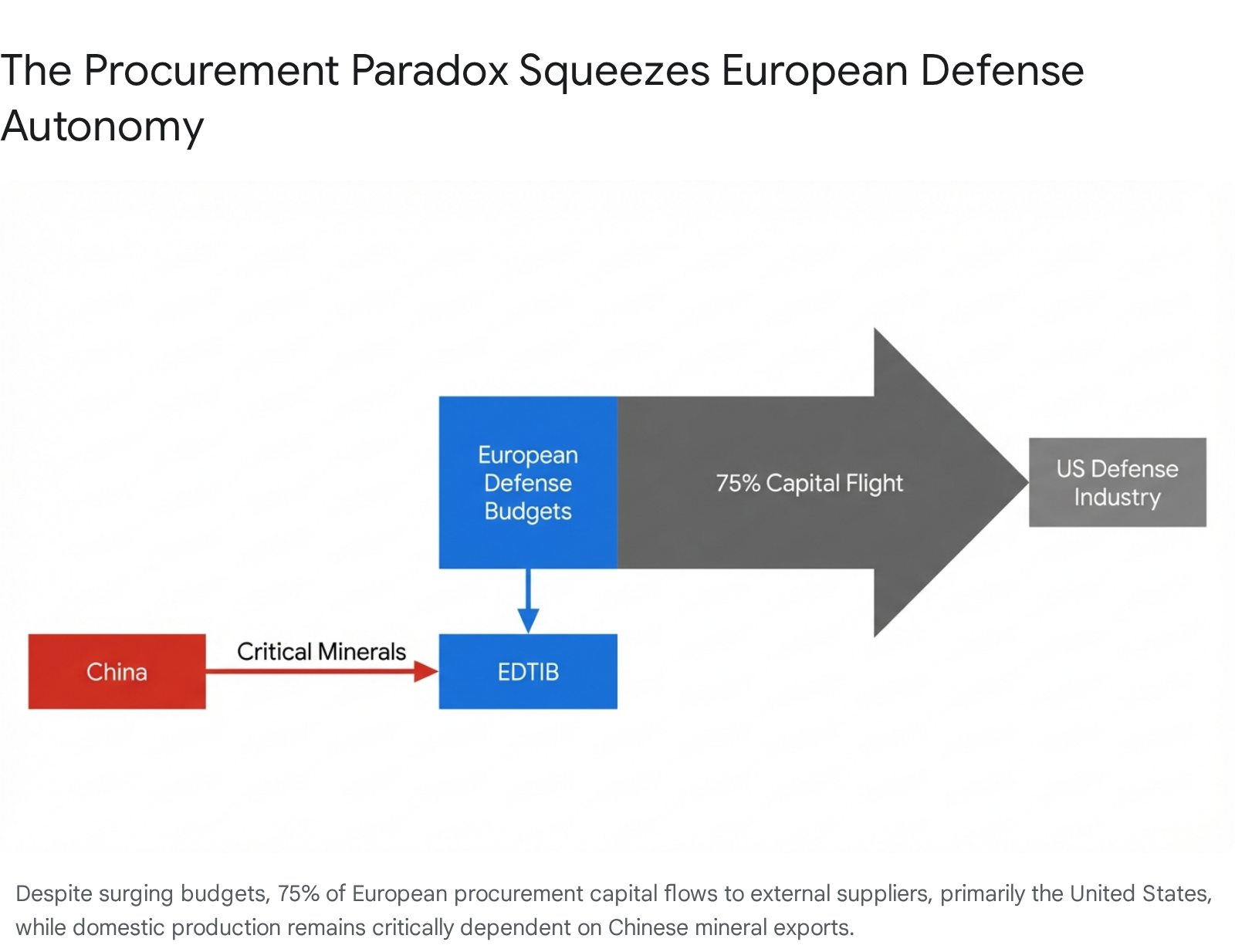
The data indicates that European defense spending has reached unprecedented levels, culminating in the highly ambitious 2025 Hague Summit pledge of dedicating 5% of Gross Domestic Product (GDP) to defense and security by 2035. Yet, this fiscal mobilization masks severe underlying capability gaps. A critical “Procurement Paradox” has emerged wherein approximately 75% of new European defense spending is flowing to extra-European suppliers—primarily the United States—thereby reinforcing transatlantic dependencies rather than cultivating indigenous European defense-industrial capacity. This attrition of the European Defence Technological and Industrial Base (EDTIB) is compounded by a profound reliance on the People’s Republic of China for critical minerals, an economic chokepoint that Beijing has increasingly weaponized in the geopolitical tech war.
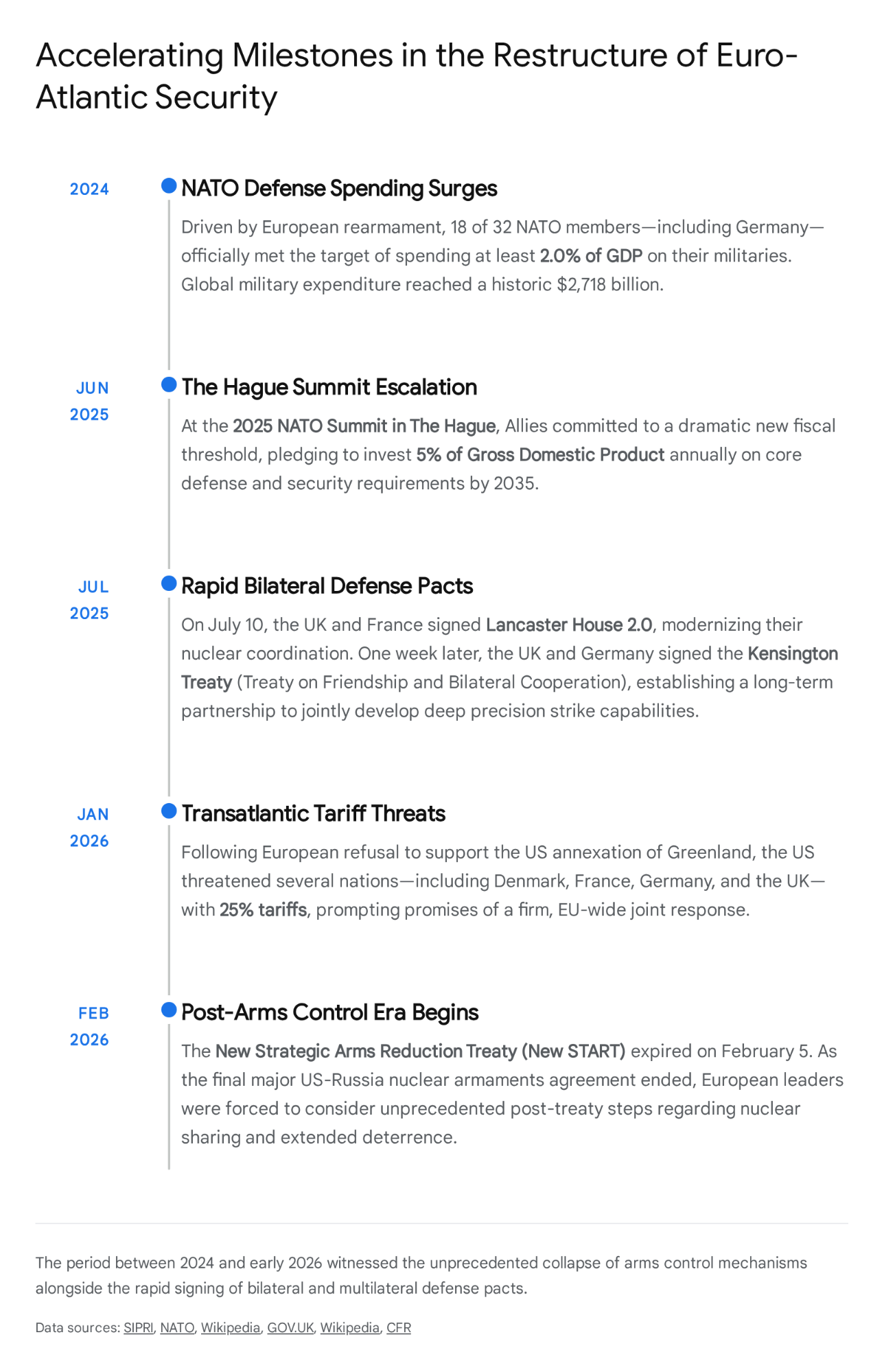
Simultaneously, the geopolitical posture of the United States under the current administration has fundamentally altered the foundational transatlantic bargain. A structural shift toward the Indo-Pacific, coupled with aggressive economic statecraft targeted directly at European allies—most notably exemplified by the January 2026 Greenland tariff crisis—has forced European capitals to rapidly accelerate their strategic hedging. This abrasive dynamic has catalyzed the rise of a new “European Quad” (comprising France, Germany, the United Kingdom, and Poland) and spurred a proliferation of robust bilateral defense treaties that increasingly bypass slower, consensus-driven multilateral institutions like the broader EU and NATO councils.
Furthermore, the expiration of the New Strategic Arms Reduction Treaty (New START) in February 2026 has introduced a highly dangerous arms control vacuum into the theater, forcing a rapid recalibration of European nuclear deterrence strategies. This is evidenced by the Franco-British Northwood Declaration and active Polish lobbying to integrate into the French strategic nuclear orbit. Finally, compounding these material, industrial, and strategic shifts is a severe and often overlooked demographic headwind. European militaries are facing an acute recruitment and retention crisis, raising the highly destabilizing prospect of generating “hollow forces” that possess next-generation hardware but lack the requisite personnel to sustain high-intensity conventional operations. The status quo has undeniably changed, but Europe finds itself in a perilous transitional phase, attempting to build a credible, autonomous defense pillar while navigating the unreliability of its primary security guarantor, domestic fiscal constraints, and the relentless pressure of a reconstituted Russian threat.
1. Introduction: The Strategic Reset and the Dispersal of Transatlantic Assumptions
For nearly three decades, the Euro-Atlantic security architecture rested upon a bedrock of unshakeable, foundational assumptions: the United States would serve as the ultimate and unwavering guarantor of European territorial integrity, NATO would remain the uncontested and preeminent vehicle for collective defense, and European nations could optimize their domestic economies by minimizing defense expenditures in favor of expansive social welfare states and civilian infrastructure. The events of the early 2020s, culminating in the protracted, high-intensity conflict in Ukraine, irreparably shattered these comfortable assumptions, proving that the prevailing status quo was entirely divorced from the realities of great power competition.1
The realization that the European security paradigm was fundamentally unsustainable did not arrive as a singular, sudden epiphany, but rather as a compounding series of strategic shocks that eroded the foundations of the post-Cold War order. The primary catalyst was the undeniable reality of Russian revanchism. The invasion demonstrated that Moscow possessed both the capability and the uncompromising intent to alter established European borders through the application of massive conventional military force.2 The second, equally destabilizing shock, originated from Washington. Driven by the overarching imperative to contain an ascendant China, a structural pivot toward the Indo-Pacific became the overriding U.S. strategic priority, fundamentally relegating Europe to a secondary theater of concern.1
In this unforgiving environment, the perspectives and strategic cultures of European nations have undergone a forced, rapid evolution. The internal diplomatic debate is no longer centered on whether Europe must assume a significantly greater share of responsibility for its own territorial defense, but rather how it will execute this mandate, and under what institutional framework.5 This urgency has reignited and sharpened the ideological friction between proponents of “European Strategic Autonomy,” a concept championed heavily by France, and advocates for a “European Pillar of NATO,” an approach heavily favored by Germany and the Eastern European frontline states.5 While the former seeks an eventual substitute for an increasingly unpredictable American security umbrella, the latter attempts to reformulate the transatlantic burden-sharing dynamic to keep the United States institutionally engaged while acknowledging its shifting global priorities.5
What many strategic observers and civilian policymakers overlook is that the transition from a highly U.S.-dependent security architecture to an autonomous, European-led capability is not merely a matter of summoning political will or reallocating financial resources. It is an immensely complex, multi-decade industrial, demographic, and bureaucratic undertaking.6 The persistent failure to anticipate the friction inherent in this transition has led to a highly uneven and vulnerable capability landscape across the continent.
2. The End of the Peace Dividend: Fiscal Mobilization and the 5% Paradigm
The most visible, easily quantifiable metric of Europe’s strategic reset has been the dramatic escalation in sovereign defense expenditure. For over a decade following the 2014 Russian annexation of Crimea, a significant portion of NATO allies consistently struggled to meet the baseline commitment of dedicating 2% of their national GDP to defense.8 By early 2026, the fiscal landscape has been entirely rewritten. Driven by the acute proximity of the threat environment and intense, sustained political pressure from the United States, European budgets have expanded at a rate not seen since the height of the Cold War.9
2.1 Trajectories in Continental Defense Expenditure
The historical data demonstrates a consistent upward trend that aggressively steepened following the outbreak of major hostilities in Eastern Europe. According to comprehensive data compiled by the Stockholm International Peace Research Institute (SIPRI), global military expenditure reached a historic, unprecedented high of $2,718 billion in 2024, marking the tenth consecutive year of global increases.11 Within this broader global surge, the European continent demonstrated the most aggressive relative growth. Total military spending in Europe rose by 17% in 2024 alone to reach $693 billion.11 Aggregate European defense spending demonstrates an exponential curve following the 2022 strategic shock, far outpacing the gradual, incremental increases seen between 2014 and 2021, with 2024 and 2025 exhibiting distinct, massive spikes in capitalization.9
The momentum established in the immediate aftermath of the invasion continued unabated into 2025, with European defense spending reaching nearly $563 billion in constant 2015 terms.9 This reflects a 12.6% real-term year-on-year increase, matching the record-setting uplifts seen in the preceding year.9 The distribution of this spending, however, highlights the shifting centers of strategic gravity within the alliance.
| Nation | Defense Spending Context (2024-2025) | Strategic Significance |
| Germany | Accounted for 25% of all European defense-spending growth over 2024-2025. Surpassed the 2% NATO target in 2024. | Traditionally a laggard, Germany’s Zeitenwende has positioned it as the primary financial engine of European rearmament, spending over €95 billion in 2025.9 |
| Poland | Defense expenditure rose by 46.6% year-on-year in 2023, reaching top spender status in NATO as a percentage of GDP. | Represents the radical mobilization of the Eastern flank, prioritizing massive land army expansion and rapid procurement of heavy armor.13 |
| Ukraine | Spent $64.8 billion in 2023, representing 34% of its GDP. | Demonstrates the absolute fiscal limit of a state in existential total war, heavily reliant on external macroeconomic support.11 |
| United States | Approached $1 trillion ($997 billion) in 2024. | Remains the dominant global spender, though 2025 saw subdued relative growth due to domestic budgetary battles and strategic reprioritization.9 |
2.2 The 2025 Hague Summit and the Escalation of Burden Sharing
The culmination of this unprecedented fiscal momentum occurred at the NATO Summit in The Hague in the summer of 2025. Acknowledging that the legacy 2% metric was entirely insufficient for the scale of industrial and conventional rearmament required to deter a mobilized Russian Federation, allied leaders committed to a revolutionary new target: investing 5% of GDP annually by 2035.8
This 5% pledge was structurally bifurcated to address the complexities of modern hybrid warfare and strategic competition. Under the agreement, 3.5% of GDP is strictly allocated to resourcing core defense requirements, capability targets, and traditional military formations.8 The additional 1.5% is uniquely mandated for whole-of-society security requirements: protecting civilian critical infrastructure against cyber and physical sabotage, defending telecommunications networks, ensuring civil preparedness, securing supply chains, and strengthening the defense industrial base.8
This new, expanded target represents a fundamental paradigm shift in how national security is conceptualized within the alliance, integrating societal resilience and industrial capacity directly into NATO’s formal burden-sharing metrics.15 It also serves as a highly potent political signal. Strategic analysts note that this unprecedented target—which was initially floated and aggressively demanded by the U.S. administration—was largely adopted by European states as a necessary diplomatic mechanism to mollify Washington.15 It acts as a grand gesture of burden-sharing designed to keep the United States anchored to the alliance amidst persistent threats of executive withdrawal or the imposition of punitive trade measures.15
2.3 Macroeconomic Constraints and Sociopolitical Blowback
However, the political ambition of the 5% target collides violently with European macroeconomic realities. Transitioning to a defense budget of this magnitude requires a permanent, structural expansion of state expenditure of a magnitude rarely observed outside of a total wartime economy.16 For many European states currently grappling with high post-pandemic debt-to-GDP ratios, sluggish economic growth, and aging populations, the fiscal sustainability of this target is highly questionable.15
Macroeconomic modeling utilizing the European Commission’s QUEST model indicates the severe tradeoffs required. The model estimates that a linear increase in defense spending by up to 1.5% of GDP could raise the EU government debt-to-GDP ratio by a full 2 percentage points by 2028, while providing only a marginal 0.5% boost to real GDP.17 Furthermore, the economic multiplier effect of defense spending in Europe has historically faded rapidly over the medium term. This is primarily due to historically low shares of domestic investment in Research and Development (R&D), which fell from 3.5% in 2001 to a mere 1.8% in 2023.18 Without a massive injection of R&D funding, defense spending acts as a fiscal drain rather than an engine for technological innovation and economic growth.18
Politically, this massive reallocation of capital represents a systemic risk to domestic stability. The inevitable fiscal trade-offs dictate that defense spending will progressively cut into deeply entrenched social welfare programs, healthcare, and civil infrastructure projects.19 By late 2025, over half the countries in the EU—including Germany, Poland, Finland, and Greece—had planned to trigger emergency clauses to allow defense spending to breach standard EU deficit limits.19
Intelligence assessments warn that this dynamic is fertile ground for civil unrest and severe political backlash. Euroskeptic and right-wing populist factions across the continent are already actively capitalizing on the economic anxiety generated by these fiscal shifts, arguing that domestic prosperity is being sacrificed to fuel an unwinnable arms race dictated by foreign powers.19 If the 5% defense target fractures domestic political cohesion and alienates the electorate, the resulting political instability may ultimately undermine the very societal deterrence the spending was intended to achieve.
3. Industrial Attrition and the Procurement Paradox
While European defense budgets are larger than at any point since the collapse of the Warsaw Pact, the specific allocation of these funds has revealed a critical strategic vulnerability. Europe is currently trapped in a deeply counterproductive “Procurement Paradox”: record-high military spending is actively failing to reinforce domestic industrial capacity, and is instead deepening the continent’s strategic dependence on external actors.7
3.1 The Extraterritorial Leakage of European Capital
In the immediate aftermath of the 2022 Russian invasion, European militaries faced severe, acute capability gaps across all domains. Driven by the overriding urgency to rearm quickly and supply the Ukrainian front, member states systematically prioritized the speed of delivery over the long-term cultivation of domestic industrial policy.7 Because the European Defence Technological and Industrial Base (EDTIB) was highly fragmented along national lines and lacked active, warm production lines capable of absorbing surge capacity, governments turned overwhelmingly to off-the-shelf foreign acquisitions.7
The resulting capital flight has been staggering. Data indicates that approximately 75% of recent defense procurement spending by EU nations has flowed directly to non-EU suppliers.7 The overwhelming majority of this capital—representing 63% of total acquisitions between 2022 and mid-2023—was directed into the United States defense-industrial complex.7 Urgent European capability gaps were filled by American systems such as F-35 fifth-generation fighter aircraft, Patriot integrated air and missile defense systems, HIMARS long-range artillery, and 155mm munitions.7
While these rapid acquisitions delivered immediate, tangible operational gains to NATO’s forward deployed forces, they carry profound, long-term strategic costs. First, they represent a massive hemorrhaging of capital, starving European defense firms of the predictable, multi-year, high-volume contracts required to capitalize the expansion of their own production lines.7 Without consolidated demand and guaranteed procurement volumes, European firms are trapped in a cycle of low-rate initial production.7 Collaborative European mechanisms, such as the Permanent Structured Cooperation (PESCO), have consequently faltered. Of the 83 PESCO projects launched since 2017, the vast majority remain stranded in the “design” or “execution” phases, unable to cross the “valley of death” into viable serial production.7
Second, this procurement dynamic ties European military readiness inextricably to American supply chains, proprietary sustainment networks, and the highly restrictive International Traffic in Arms Regulations (ITAR) framework, thereby severely curtailing any practical realization of European strategic autonomy.7
3.2 Strategic Vulnerabilities: Supply Chains and the Tech War 2.0
The industrial attrition is not merely a matter of final platform assembly; it extends deep into the foundational, multi-tier supply chains. Europe’s aerospace and defense market is experiencing unprecedented strain as the sudden surge in government demand vastly outpaces the manufacturing capacity of Tier 2 and Tier 3 suppliers, who are struggling to acquire necessary certifications and raw materials.21
More alarmingly, the European defense industrial base remains critically dependent on geopolitical adversaries for foundational material inputs. Europe relies heavily on the People’s Republic of China for critical minerals and rare-earth elements, which are physically indispensable for the manufacture of advanced electronics, sensor arrays, radar systems, and precision-guided munitions.22 By 2025, Beijing recognized this vulnerability and actively shifted the paradigm of its technological competition with the West. Moving away from a pure high-tech race—where the U.S. and Europe hold the advantage in semiconductor design—Beijing initiated “Tech War 2.0.” This strategy involves weaponizing its near-monopoly over low-value but vital components, instituting stringent, extraterritorial export controls on rare earths, germanium, gallium, and other critical materials.22
This strategic chokepoint has exposed European defense manufacturing to extreme, unmitigated risk. Intelligence assessments conclude that meaningful reductions in Europe’s dependence on Chinese critical minerals—whether through new extraction sites, synthetic substitution, or advanced recycling—will not materialize before the 2030s.22 Until that capacity is built, an emboldened China possesses the asymmetric capability to severely disrupt European defense production at will.24 This vulnerability deeply complicates Europe’s geopolitical hedging, forcing Brussels to balance its support for U.S. posture regarding Taiwan against the reality that Beijing can halt the production of European missile systems with a single export directive.22
3.3 The EDIP and Readiness 2030: Policy Ambition vs. Capital Reality
Recognizing these compounding, systemic failures, the European Commission introduced the comprehensive Readiness 2030 package and the European Defence Industry Programme (EDIP) in 2025.25 The EDIP aims to aggressively reduce industrial fragmentation by mandating that 50% of EU countries’ defense procurement comes directly from the EDTIB by 2030, and that at least 40% of all military equipment is procured collaboratively.27
To operationalize this ambition, the Readiness 2030 roadmap outlines four massive, continent-spanning “Flagship Projects” designed to unify fragmented national efforts into cohesive, interoperable systems:
| Flagship Project | Capability Focus | Target Timeline |
| Eastern Flank Watch | Comprehensive surveillance system to protect the EU’s eastern border, heavily integrating drone components and multi-domain sensors. | Operational by the end of 2028.27 |
| European Drone Wall | An EU-wide, interconnected drone network optimized for persistent border monitoring and early threat detection. | Fully operational by the end of 2027.27 |
| European Air Shield | An integrated, fully NATO-compatible European air and missile defense system to counter ballistic and cruise missile threats. | Accelerated build-up starting 2026.27 |
| European Defence Space Shield | A protection program aimed at securing European satellite constellations and critical space-based communication infrastructures. | Gradual implementation starting 2026.27 |
However, the financial backing provided to construct these ambitious policy architectures is grossly inadequate. The EDIP was allocated a mere €1.5 billion in direct grant funding for the 2026-2027 period.25 While the European Commission has proposed utilizing €150 billion in SAFE defense loans to promote investment, total capability requirements for the continent are reliably estimated at a staggering €400–€500 billion.7 Consequently, defense analysts view EDIP as a structuring framework rather than a financial panacea; it establishes the necessary regulatory architecture for future joint procurement but lacks the immediate, liquid capital required to reverse the ongoing industrial attrition before the end of the decade.29
4. The Transatlantic Schism: Coercive Statecraft, Posture, and Hedging
The evolution of Europe’s internal defense architecture cannot be accurately analyzed in isolation; it is deeply inextricably linked to the profound shifts occurring across the Atlantic. The United States in 2026 is projecting a fundamentally different global posture than it did a decade prior, decisively transitioning from the unquestioned, benevolent underwriter of global security to a highly pragmatic actor leveraging its alliances for transactional, overtly nationalistic aims.31
4.1 The Recalibration of American Forward Presence
Following the initial 2022 invasion of Ukraine, the United States surged approximately 20,000 additional personnel into the European theater, establishing heavy rotational Armored Brigade Combat Teams (ABCTs) along the eastern flank to assure allies and deter immediate escalation.33 However, the strategic utility, high financial cost, and long-term sustainability of these heavy rotational deployments are increasingly questioned within Washington defense circles.34
The 2026 U.S. National Defense Strategy explicitly ranks homeland defense and the conventional deterrence of the People’s Republic of China well above the defense of Europe in its hierarchy of vital interests.4 Consequently, senior U.S. policymakers are actively demanding that Europe assume the primary physical and financial burden for its own conventional territorial defense.35 In alignment with this shift, the U.S. European Command (EUCOM) posture is gradually transitioning away from frontline, heavy combat deployments. Future U.S. presence will increasingly favor logistical support, intelligence, surveillance, and reconnaissance (ISR) assets, and specialized sustainment forces designed to act as a secure defensive perimeter and enable U.S. power projection into the Middle East or Africa, rather than serving as the primary maneuver force against Russia.33
The notable, highly strategic exception to this drawdown is Poland. In early 2026, the U.S. and Poland convened the Enhanced Defense Cooperation Agreement (EDCA) Joint Commission to deepen their permanent defense partnership.36 Washington approved plans to invest over $500 million to expand and modernize four massive military bases in Poland—Drawsko Pomorskie, Powidz, Łask, and Wrocław.37 Furthermore, the operationalization of the Labor Implementing Arrangement (Labor IA) cemented the integration of the local Polish workforce into U.S. sustainment operations.36 This targeted investment indicates a clear U.S. preference for anchoring its residual, highly lethal European footprint in deeply aligned, high-spending nations on the immediate frontier, bypassing traditional hubs in Western Europe.37
4.2 Economic Coercion and Security Linkages: The 2026 Greenland Crisis
The most alarming development for Euro-Atlantic cohesion, however, has been the overt, unprecedented weaponization of U.S. economic policy against its closest security allies. The transatlantic relationship suffered a severe, near-fatal shock in January 2026 when the U.S. administration, seeking to leverage territorial and resource claims over Greenland, threatened devastating tariffs against multiple European states.39
President Trump threatened to impose a 10% tariff—escalating to 25% by June—on Denmark, Norway, Sweden, France, Germany, the United Kingdom, the Netherlands, and Finland unless they supported the U.S. acquisition of Greenland.39 Economic models predicted that a 25% tariff would cause a catastrophic 24% drop in imports from European partners, representing a major shock to the deeply integrated transatlantic economy.42 While a temporary framework deal brokered at the World Economic Forum in Davos managed to avert the immediate imposition of the tariffs—granting the U.S. rights over Greenland’s minerals and involvement in missile defense—the strategic damage to the alliance was profound and irreversible.41
The incident graphically demonstrated that Washington is entirely willing to link its sacred collective security guarantees and defense partnerships to coercive economic statecraft and raw resource acquisition.4 For European leaders, the “Greenland Crisis” was the definitive proof that the transatlantic bargain had shifted from a values-based alliance of democracies to a purely transactional arrangement where European economies could be held hostage.4 This incident drastically accelerated the political momentum behind European Strategic Autonomy, convincing even staunch Atlanticists that Europe must build robust resilience against economic and security coercion not only from Beijing and Moscow, but potentially from Washington as well.42
5. Institutional Architectures: The Pillar vs. Strategic Autonomy
As the industrial limitations and shifting U.S. geopolitical realities reshape the continent, the political and institutional architecture of European security is undergoing a parallel, highly contentious metamorphosis. The long-standing, theoretical debate over how Europe should organize its defense has polarized into two distinct camps, though the sheer weight of external threats is increasingly forcing pragmatic, hybrid compromises.
5.1 Ideological Divergence: Autonomization vs. Transatlantic Integration
The architectural debate is anchored by two differing, often competing concepts: “European Strategic Autonomy” (ESA) and the “European Pillar of NATO” (EPN).5
ESA, an official term heavily promoted by France and enshrined in EU documentation, envisions a Europe-centric defense apparatus that can, if necessary, operate completely independently of the United States. It relies heavily on the European Union’s institutional frameworks, such as the Common Security and Defence Policy (CSDP) and the EDIP, and views autonomy as a necessary substitute for an inevitably retreating or unpredictable American ally.5
Conversely, the EPN—an informally defined concept advocated by Germany, the UK, and Eastern European states—focuses on enhancing European military coordination strictly within the established NATO framework.5 This approach aims to strengthen the transatlantic link by proving to Washington that Europe is a capable, highly lethal partner, rather than a free-rider. The return of an aggressive “America First” posture in Washington in the mid-2020s has paradoxically accelerated both concepts simultaneously. While it deeply validates French warnings regarding U.S. unreliability, it also terrifies frontline states into desperately clinging to NATO command structures, fearing that any rapid decoupling to an untested EU command would leave them fatally vulnerable to Russian armored thrusts.5
5.2 Germany’s Zeitenwende and the ESSI Controversy
Germany’s Zeitenwende (strategic turning point) serves as the primary, highly visible test case for this architectural tension. Following the 2022 invasion, Berlin established a €100 billion special fund to radically modernize the depleted Bundeswehr, successfully meeting the 2% NATO spending target by 2024 and heavily anchoring its policy in the EPN philosophy.12
However, the specific implementation of the Zeitenwende has exacerbated inter-European friction. Driven by the urgent need to field credible capabilities immediately, the German Ministry of Defense allocated the bulk of its special fund to off-the-shelf procurements from the U.S. and Israel, severely undermining existing, long-term Franco-German joint defense programs like the Future Combat Air System (FCAS).20
This dynamic culminated in the German-led European Sky Shield Initiative (ESSI), a multi-layered air and missile defense project designed to rapidly close Europe’s vulnerability to Russian aerospace assets.35 By opting to procure American Patriot systems for the medium-range tier and Israeli Arrow-3 systems for the upper-tier exoatmospheric intercept role, Berlin prioritized immediate capability and interoperability within NATO’s Integrated Air and Missile Defence (IAMD) network over the cultivation of European industrial autonomy.35 This decision deeply alienated Paris, which argued that ESSI should have prioritized the European-built SAMP/T system. The ESSI saga perfectly encapsulates the persistent disconnect between the grand strategic ambition of European autonomy and the pragmatic industrial realities of rapid rearmament.43
5.3 Bridging the Gap: The EPG and ECOG Proposals
Recognizing that the 32-member North Atlantic Council is too unwieldy to manage the specific transition of European forces, and that EU mechanisms are too divorced from NATO’s military command, strategic planners have proposed new connective tissue.
One prominent proposal is the creation of a European Planning Group (EPG) embedded within NATO, explicitly modeled on NATO’s highly successful Nuclear Planning Group (NPG).4 The EPG would serve as a structured, non-binding consultative forum where European allies can systematically align their strategic priorities, reconcile industrial differences, and present a coherent, unified position to the United States regarding force generation and deployment.4
Similarly, to counter the relentless barrage of Russian hybrid warfare and disinformation campaigns, planners are advancing the concept of a European Cyber Operations Group (ECOG).49 Operating as a “coalition of the willing” under frameworks like the European Intervention Initiative, the ECOG aims to establish a posture of independent cyber compellence, recognizing that relying solely on the U.S. cyber umbrella is insufficient to deter gray-zone aggression targeted specifically at European civil cohesion.49
6. The Bilateral Phalanx and the Emergence of the European Quad
Frustrated by the agonizingly slow pace of EU consensus-building and the bureaucratic inertia inherent in a 32-member NATO, the most capable European military powers have increasingly turned to robust bilateral treaties to accelerate capability development.50 This trend marks a definitive shift away from a unified, pan-European multilateral architecture toward a highly lethal, interoperable “phalanx” of overlapping, ad hoc defense pacts.52
6.1 The Anchor Treaties: Lancaster House 2.0 and Kensington
This bilateralization is anchored by two landmark treaties signed in the summer of 2025, which functionally reorganize the center of gravity of European defense around the United Kingdom, France, and Germany.
| Feature | Lancaster House 2.0 (UK & France) | Kensington / Trinity House Treaty (UK & Germany) |
| Date Signed | July 10, 2025 53 | July 17, 2025 54 |
| Core Military Focus | Transformation of the Combined Joint Expeditionary Force (CJEF) into a Combined Joint Force (CJF) capable of commanding a full corps; advanced cyber and space integration.53 | Land systems interoperability (BOXER, RCH 155), undersea warfare (Sting Ray torpedoes, P-8A integration), and UAS coordination.54 |
| Industrial / Tech Focus | Entente Industrielle: Resumption of Storm Shadow/SCALP production, joint development of Future Cruise/Anti-Ship Weapons (FC/ASW), and AI-enabled precision strikes.56 | Deep Precision Strike capability within the European Long Range Strike Approach (ELSA); joint quantum and semiconductor R&D.54 |
| Strategic Significance | Binds Europe’s only two nuclear-armed, expeditionary powers into deep operational alignment.56 | Formalizes a deep defense partnership between Europe’s premier military power (UK) and its industrial/economic heavyweight (Germany) post-Brexit.59 |
These agreements clearly indicate that the United Kingdom, successfully navigating its post-Brexit posture, is aggressively anchoring itself as the indispensable mediator and technological engine of European defense.59 By firmly linking the continent’s preeminent expeditionary power (France) with its primary economic and logistical hub (Germany), London is functionally building the operational core of the European Pillar of NATO entirely outside of formal EU structures.61
6.2 The Formalization of the European Quad
The synthesis of these bilateral networks has led to the de facto emergence of a highly potent “European Quad” leadership group consisting of France, Germany, the United Kingdom, and Poland.61
This grouping effectively bridges the historical E3 format (UK, France, Germany) with the Weimar Triangle (France, Germany, Poland).63 Poland’s inclusion is a critical testament to its radical, unprecedented defense mobilization and its unassailable status as the strategic center of gravity on NATO’s eastern flank.38 With the strongest conventional land army in Europe and unparalleled credibility regarding the Russian threat, Warsaw ensures that the Quad’s strategic calculus remains sharply focused on territorial defense rather than distant expeditionary missions.64
The relevance of this Quad was starkly demonstrated in early 2026. Following highly disruptive comments regarding U.S. commitments from American officials at the Munich Security Conference, French President Macron immediately convened an extraordinary summit in Paris specifically drawing upon this core group to draw up a joint European strategy for Ukraine and continental defense.65 Furthermore, deep cross-party Polish parliamentary delegations to Paris have underscored Warsaw’s commitment to bypassing slow EU mechanisms in favor of direct, high-level alignment with French military planners.66 Intelligence assessments indicate that this European Quad, rather than the European Commission or the broader North Atlantic Council, is increasingly the primary, most effective forum for rapid crisis response, capability alignment, and high-level strategic planning regarding the containment of Russia.64
7. The Strategic Vacuum: Nuclear Deterrence Post-New START
Compounding the conventional, industrial, and economic uncertainties is a historic, potentially catastrophic deterioration of the global nuclear architecture. On February 5, 2026, the New Strategic Arms Reduction Treaty (New START)—the last remaining pillar of bilateral nuclear arms control between Washington and Moscow—expired without a replacement.68 This collapse removes vital transparency, verification, and predictability mechanisms, plunging the globe into a prolonged suspension of arms control and directly undermining the foundational tenets of strategic stability.68
Faced with a rapidly expanding, modernized Russian nuclear arsenal, highly explicit and frequent nuclear threats emanating from Moscow, and growing, profound doubts regarding the credibility and willingness of the United States to risk its homeland to extend its nuclear deterrent over Europe, the continent is confronting unprecedented strategic vulnerability.69
7.1 The Northwood Declaration and European Nuclear Coordination
This acute nuclear crisis is the primary driver behind the highly sensitive nuclear dimension of the Lancaster House 2.0 agreements, codified in the Northwood Declaration.56 By establishing a formal Nuclear Steering Group jointly led by the French Presidency and the UK Prime Minister’s Office, Paris and London have initiated an unprecedented level of coordination regarding their previously fiercely independent nuclear arsenals.56
While both nations emphatically stress that this coordination complements rather than replaces the U.S. extended deterrent, the Northwood Declaration functionally lays the initial operational groundwork for an independent European nuclear umbrella.72 It aligns policy, potential targeting capabilities, and deterrence operations, signaling to Moscow that European nuclear forces are acting in concert.56
7.2 Proliferation Anxiety and Poland’s Nuclear Ambitions
This development has triggered intense, highly sensitive debate across the continent regarding the viability of a purely European deterrent.69 Most notably, Poland has actively and publicly sought participation in an “advanced nuclear deterrence system”.74 In early 2026, Polish Prime Minister Donald Tusk confirmed that Warsaw was in active, advanced consultations with France to integrate into the French strategic nuclear orbit.74
This proposed integration could involve hosting French strategic aviation assets on Polish territory, participating in joint nuclear readiness exercises, and staging demonstrations of nuclear capability on the eastern flank.74 Warsaw’s aggressive push for nuclear sharing—born out of the stark conviction that frontline states cannot survive a potential U.S. withdrawal without a highly credible, localized deterrent—highlights the desperation and radical shifts occurring in European strategic doctrine. It also raises profound proliferation anxieties; if these European sharing mechanisms fail to materialize, nations like Poland may feel compelled to pursue independent nuclear capabilities to ensure their sovereign survival.68
8. The Overlooked Vulnerability: Demographic Headwinds and Military Mass
While geopolitical attention, media focus, and parliamentary debates are heavily fixated on hardware procurement, 5% budgetary targets, and high-level nuclear doctrine, arguably the most severe and immediate threat to European security is consistently overlooked: the collapse of human military mass. Europe is currently experiencing a severe, continent-wide recruitment and retention crisis that threatens to render its massive financial investments functionally moot.75
Despite highly ambitious force growth plans mandated by defense ministries, the vast majority of European militaries operating under voluntary recruitment models are consistently and severely failing to meet their intake targets.76 Furthermore, the attrition rates within active-duty, highly trained units are accelerating, as armed forces lose experienced non-commissioned officers and technical specialists to the private sector faster than they can replace them.77 This dynamic is generating the highly dangerous phenomenon of “hollow forces”—militaries that possess next-generation technological systems, advanced airframes, and high capital expenditure, but utterly lack the requisite personnel to deploy, operate, and sustain them in a high-intensity, protracted conventional conflict.76
The root causes of this personnel crisis are deeply structural and highly resistant to quick policy fixes. Demographic headwinds, characterized by rapidly aging populations and significantly shrinking cohorts of military-age youth across Europe, physically limit the available recruiting pool.76 Furthermore, decades of post-Cold War societal attitudes, shifting generational values regarding national service, and highly competitive, lucrative civilian labor markets make military service an increasingly difficult proposition in prosperous, democratic European societies.76
The stark inability to generate sufficient combat mass has prompted a radical, highly controversial reassessment of conscription models across the continent. Observing the brutal, personnel-heavy attrition rates in the Ukraine conflict and Israel’s reliance on vast, rapidly mobilizable reserves, European defense planners increasingly recognize that small, professional, standing voluntary armies are vastly insufficient for modern conventional war.78
Consequently, the Nordic and Baltic states have aggressively expanded their compulsory service models to generate required mass. Sweden successfully reintroduced conscription in 2018, selecting highly motivated recruits; Latvia and Lithuania have reintroduced conscription models specifically to expand their reserve pools; and in 2025, Denmark took the landmark step of extending its lottery-based conscription model to include women, recognizing that the male cohort alone was insufficient to meet personnel requirements.78 Even Germany, recognizing the hard limits of its heavily funded Zeitenwende without the personnel to man its new equipment, is deeply engaged in highly polarized domestic debates regarding the reintroduction of a national service model.78 Until Europe decisively resolves this fundamental human capital deficit, its 5% GDP defense targets and next-generation weapons programs will project a dangerous illusion of strength that masks profound operational fragility.
9. Expert Risk Convergence: The 2026 Threat Assessment
To contextualize these material and architectural shifts, it is vital to assess how the intelligence and policy communities perceive the imminent threat environment. In late 2025, the European Union Institute for Security Studies (EUISS) and the European University Institute (EUI) conducted a comprehensive survey of 501 leading European strategic experts to identify the most critical risks for 2026.75
The consensus paints a bleak, highly volatile picture. The top risks identified, in order of likelihood and impact, were:
- Disruptive attacks on EU critical infrastructure (reflecting the success of Russian gray-zone hybrid warfare).
- Russia’s continued, unabated aggression in Europe.
- The withdrawal of U.S. security guarantees to European allies.
- A military conflict between China and Taiwan.75
Notably, the assessment of a China-Taiwan conflict moved from a “Medium” to a “High Risk” event compared to the previous year, highlighting the deep anxiety in Europe regarding a Pacific contingency that would immediately draw U.S. assets away from the Atlantic.75
When comparing this European assessment with parallel surveys of U.S. experts (such as the Council on Foreign Relations survey), a distinct divergence in transatlantic focus emerges. While both sides agree on the gravity of the Russian threat and the Taiwan contingency, U.S. experts are becoming increasingly inward-looking and Middle East-focused.75 American analysts elevate U.S. domestic political violence and instability to a top-tier risk, alongside a regional war in the Middle East.75 This divergence underscores the European fear: the United States is increasingly distracted by its own severe domestic political turbulence and crises in the Levant, further diminishing its bandwidth and political will to manage European security, precisely at the moment Europe requires the most stability to manage its own complex transition.75
10. Executive Conclusions and Strategic Outlook
The intelligence, economic data, and strategic shifts reviewed in this report point to a singular, undeniable conclusion: the Euro-Atlantic security environment is not merely adapting; it has permanently fractured its previous equilibrium. The “wake-up call” initiated by the 2022 invasion of Ukraine was absolutely necessary, as it exposed an architecture entirely unsuited for peer-level conflict. However, that wake-up call has evolved into a grueling, systemic transition burdened by immense friction, exposing a reality that is far more complex and perilous than the initial rhetorical commitments suggested.
Based on the exhaustive synthesis of fiscal, industrial, and geopolitical indicators, several core insights define the outlook for Euro-Atlantic security in the latter half of the 2020s:
- The Fracture of the Multilateral Consensus: The traditional, post-war reliance on large, consensus-driven organizations is proving fatally slow for the current threat environment. Consequently, European security is increasingly being guaranteed by ad hoc, multi-speed bilateral architectures and the ascendance of the “European Quad” (UK, France, Germany, Poland). These smaller, highly capable, and heavily armed groupings will dictate the pace, direction, and operational reality of European defense strategy, functionally marginalizing the broader institutional bodies.
- The Inescapability of the Procurement Paradox: The intense political demand to field conventional military capabilities rapidly will continue to vastly outstrip the manufacturing capacity of the European defense industrial base. The resulting reliance on U.S. hardware and Chinese critical minerals means that “European Strategic Autonomy” will remain a largely rhetorical ambition over the next decade. True industrial resilience requires a massive consolidation of demand and an infusion of capital via mechanisms like the EDIP that currently lack sufficient political and financial backing.
- The Transactionalization of the Transatlantic Link: The U.S. approach to Europe has irrevocably shifted from unconditional deterrence and values-based partnership to highly transactional burden-sharing. Incidents like the Greenland tariff crisis demonstrate unequivocally that economic coercion will be utilized by Washington to enforce strategic alignment. European capitals must therefore calculate their defense postures under the hardened assumption that U.S. support is highly contingent, shifting the burden of conventional territorial defense almost entirely onto European shoulders.
- The Return of Nuclear Proliferation Anxiety: The collapse of New START, combined with perceived U.S. unreliability, introduces extreme volatility into the European theater. The Franco-British nuclear coordination represents the beginning of a localized European deterrent, but the aggressive desire of non-nuclear frontline states like Poland to enter nuclear-sharing arrangements will drastically escalate tensions with the Russian Federation and severely complicate regional stability.
- The Sovereign Debt and Social Cohesion Constraint: The NATO 5% GDP target represents a profound macroeconomic shock. The mathematical reality is that funding this level of defense requires drastic, highly unpopular cuts to social programs or massive, inflationary deficit spending. The primary threat to European rearmament may not ultimately be Russian physical disruption, but domestic political backlash as European citizens reject the severe socioeconomic costs of maintaining a war economy in peacetime.
In summary, Europe has awoken to the unavoidable necessity of hard power, but it is currently caught in the highly perilous, exposed gap between the realization of its vulnerability and the actual attainment of credible, autonomous capability. Bridging this dangerous gap requires navigating extreme industrial constraints, demographic shortages, and the unpredictable volatility of its closest ally, all while staring down a mobilized adversary on its eastern flank.
Please share the link on Facebook, Forums, with colleagues, etc. Your support is much appreciated and if you have any feedback, please email us in**@*********ps.com. If you’d like to request a report or order a reprint, please click here for the corresponding page to open in new tab.
Sources Used
- A New Transatlantic Bargain: The Case for Building a Strong …, accessed April 9, 2026, https://www.belfercenter.org/transatlantic-bargain
- Deterring Russia: U.S. Military Posture in Europe – CSIS, accessed April 9, 2026, https://www.csis.org/analysis/deterring-russia-us-military-posture-europe
- INTELLIGENCE OUTLOOK 2025, accessed April 9, 2026, https://www.fe-ddis.dk/globalassets/fe/dokumenter/2025/-fe-intelligenceoutlook-25-.pdf
- Laying the cornerstone of NATO’s European pillar, accessed April 9, 2026, https://www.epc.eu/publication/laying-the-cornerstone-of-natos-european-pillar/
- The European pillar of NATO – Institut Jacques Delors, accessed April 9, 2026, https://institutdelors.eu/content/uploads/2025/06/Note_de_consultance_Pilier_europeen_OTAN_Tardy_EN_2.pdf
- Progress and Shortfalls in Europe’s Defence – The International …, accessed April 9, 2026, https://www.iiss.org/globalassets/media-library—content–migration/files/publications—free-files/strategic-dossier/pds-2025/complete-file/iiss_strategic-dossier_progress-and-shortfalls-in-europes-defence-an-assessment_092025.pdf
- Industrial Attrition: Europe’s Defence Procurement Paradox | Atlas …, accessed April 9, 2026, https://atlasinstitute.org/industrial-attrition-europes-defence-procurement-paradox/
- Defence expenditures and NATO’s 5% commitment, accessed April 9, 2026, https://www.nato.int/en/what-we-do/introduction-to-nato/defence-expenditures-and-natos-5-commitment
- Global defence spending continues to grow amid geopolitical uncertainty, accessed April 9, 2026, https://www.iiss.org/online-analysis/military-balance/2026/02/global-defence-spending-continues-to-grow-amid-geopolitical-uncertainty/
- Defense Budgets in an Uncertain Security Environment – CSIS, accessed April 9, 2026, https://www.csis.org/analysis/chapter-13-defense-budgets-uncertain-security-environment
- Trends in World Military Expenditure, 2024 – SIPRI, accessed April 9, 2026, https://www.sipri.org/sites/default/files/2025-04/2504_fs_milex_2024.pdf
- Assessing the Zeitenwende: Implications for Germany, the United States, and Transatlantic Security – American-German Institute, accessed April 9, 2026, https://americangerman.institute/wp-content/uploads/2025/03/20250311_Deni-Rathke_Zeitenwende_Final.pdf
- Finance and economics annual statistical bulletin: international defence 2024 – GOV.UK, accessed April 9, 2026, https://www.gov.uk/government/publications/international-defence-expenditure-2024/finance-and-economics-annual-statistical-bulletin-international-defence-2024
- PRESS RELEASE | The Elements of an Alliance? NATO’s critical minerals imperative – EIES and SAFE host discussion on the sidelines of the Munich Security Conference, accessed April 9, 2026, https://secureenergy.org/pressrelease-elementsofanalliance-natoscriticalmineralsimperative/
- NATO’s new spending target: challenges and risks associated with a political signal | SIPRI, accessed April 9, 2026, https://www.sipri.org/commentary/essay/2025/natos-new-spending-target-challenges-and-risks-associated-political-signal
- Can Europe Deliver NATO’s Five Percent? – Intereconomics, accessed April 9, 2026, https://www.intereconomics.eu/contents/year/2026/number/2/article/can-europe-deliver-nato-s-five-percent.html
- The economic impact of higher defence spending – Economy and Finance – European Union, accessed April 9, 2026, https://economy-finance.ec.europa.eu/economic-forecast-and-surveys/economic-forecasts/spring-2025-economic-forecast-moderate-growth-amid-global-economic-uncertainty/economic-impact-higher-defence-spending_en
- Europe | An overview of the EU defense sector – BBVA Research, accessed April 9, 2026, https://www.bbvaresearch.com/en/publicaciones/europe-an-overview-of-the-eu-defense-sector/
- Europe Seeks to Rapidly Increase Defense Investment Amidst Strategic Realignment, accessed April 9, 2026, https://thesoufancenter.org/intelbrief-2025-may-2/
- Opportunities through consolidation in the European defense industry – McKinsey, accessed April 9, 2026, https://www.mckinsey.com/industries/aerospace-and-defense/our-insights/opportunities-through-consolidation-in-the-european-defense-industry
- Inside Europe’s Defense Boom: 5 Ways To Secure Supply Chains – Oliver Wyman, accessed April 9, 2026, https://www.oliverwyman.com/our-expertise/insights/2025/jun/5-strategies-avoid-european-aerospace-defense-supply-chain-strain.html
- The EU’s dependency on critical minerals from China, accessed April 9, 2026, https://www.iiss.org/publications/strategic-comments/2025/12/the-eus-dependency-on-critical-minerals-from-china/
- Leapfrogging China’s Critical Minerals Dominance – Council on Foreign Relations, accessed April 9, 2026, https://www.cfr.org/reports/leapfrogging-chinas-critical-minerals-dominance
- TECH WAR 2.0 – European Union Institute for Security Studies |, accessed April 9, 2026, https://www.iss.europa.eu/sites/default/files/2025-12/Brief_2025-30_Tech%20War%202.0.pdf
- EDIP Forging European Defence, accessed April 9, 2026, https://defence-industry-space.ec.europa.eu/eu-defence-industry/edip-forging-europes-defence_en
- EDIP: Commission adopts €1.5 billion work programme to boost European and Ukrainian defence industry, accessed April 9, 2026, https://defence-industry-space.ec.europa.eu/edip-commission-adopts-eu15-billion-work-programme-boost-european-and-ukrainian-defence-industry-2026-03-30_en
- EU Commission – Roadmap for European Defence Readiness – BDLI, accessed April 9, 2026, https://www.bdli.de/sites/default/files/2025-10/Defence%20Readiness-BDLI_EN.pdf
- The European defence industrial strategy: important, but raising many questions – Bruegel, accessed April 9, 2026, https://www.bruegel.org/analysis/european-defence-industrial-strategy-important-raising-many-questions
- The EU’s Defence Readiness 2030 Roadmap: Ambition and constraints, accessed April 9, 2026, https://www.cer.eu/insights/eu-defence-readiness-2030-roadmap-ambition-and-constraints
- The European Defence Industry Programme: The Last Piece of the EU Defence Puzzle? – IAI, accessed April 9, 2026, https://www.iai.it/en/publications/c41/european-defence-industry-programme-last-piece-eu-defence-puzzle
- To Ensure Its Security, Europe Needs a Stronger Hand in NATO | DGAP, accessed April 9, 2026, https://dgap.org/en/research/publications/ensure-its-security-europe-needs-stronger-hand-nato
- The Near-term Future of the Transatlantic Relationship – European Parliament, accessed April 9, 2026, https://www.europarl.europa.eu/RegData/etudes/STUD/2026/782657/EPRS_STU(2026)782657_EN.pdf
- Aligning global military posture with U.S. interests – Defense Priorities, accessed April 9, 2026, https://www.defensepriorities.org/explainers/aligning-global-military-posture-with-us-interests/
- Forward Presence at What Cost? Rethinking U.S. Armored Brigade Rotations in Europe, accessed April 9, 2026, https://www.armyupress.army.mil/Journals/Military-Review/English-Edition-Archives/March-April-2026/Forward-Presence/
- Europe Needs an ASAP Program for Air Defense – CSIS, accessed April 9, 2026, https://www.csis.org/analysis/europe-needs-asap-program-air-defense
- U.S., Poland Strengthen Defense Ties at EDCA Joint Commission – European Command, accessed April 9, 2026, https://www.eucom.mil/pressrelease/44269/us-poland-strengthen-defense-ties-at-edca-joint-commission
- US approves $500 mln expansion of military bases in Poland, funded by Warsaw, accessed April 9, 2026, https://tvpworld.com/90909003/us-approves-500-million-upgrade-of-four-polish-military-bases
- Next Steps in U.S.–Polish Strategic Cooperation | The Heritage Foundation, accessed April 9, 2026, https://www.heritage.org/global-politics/report/next-steps-us-polish-strategic-cooperation
- US Threat of Greenland Tariffs Raises European Geopolitical Risks – Fitch Ratings, accessed April 9, 2026, https://www.fitchratings.com/research/sovereigns/us-threat-of-greenland-tariffs-raises-european-geopolitical-risks-19-01-2026
- Greenland crisis – Wikipedia, accessed April 9, 2026, https://en.wikipedia.org/wiki/Greenland_crisis
- The future of Greenland and NATO after Trump’s Davos deal – Atlantic Council, accessed April 9, 2026, https://www.atlanticcouncil.org/content-series/fastthinking/the-future-of-greenland-and-nato-after-trumps-davos-deal/
- Why Economic Coercion Over Greenland Would Backfire – CSIS, accessed April 9, 2026, https://www.csis.org/analysis/why-economic-coercion-over-greenland-would-backfire
- The implementation and progress of Germany’s Zeitenwende (A French perspective) – IRIS, accessed April 9, 2026, https://www.iris-france.org/en/184041-the-implementation-and-progress-of-germanys-zeitenwende-a-french-perspective/
- Germany’s Zeitenwende and the consequences for German-Dutch defence cooperation – Clingendael, accessed April 9, 2026, https://docs.clingendael.org/sites/docs/files/2024-04/Zeitenwende%20%281%29.pdf
- ‘European Sky Shield Initiative | Capacities, Criticisms, and Türkiye’s Contribution’ – SETA, accessed April 9, 2026, https://media.setav.org/en/file/2025/02/european-sky-shield-initiative-capacities-criticisms-and-turkiyes-contribution.pdf
- UK defence in 2025: Integrated air and missile defence – The House of Commons Library, accessed April 9, 2026, https://commonslibrary.parliament.uk/research-briefings/cbp-10249/
- View of An Analysis of The European Sky Shield Initiative (ESSI) and Türkiye’s Role in Integrated Air and Missile Defence, accessed April 9, 2026, https://jdsi.org/defence-security-ind/article/view/22/11
- A Sky Shield for Europe – European Policy Centre (EPC), accessed April 9, 2026, https://www.epc.eu/publication/a-sky-shield-for-europe/
- Enter Europe’s Cyber Deterrence – CSIS, accessed April 9, 2026, https://www.csis.org/analysis/enter-europes-cyber-deterrence
- How Europe can strengthen its own defenses and rebalance transatlantic relations, accessed April 9, 2026, https://www.atlanticcouncil.org/dispatches/how-europe-can-strengthen-its-own-defenses-and-rebalance-transatlantic-relations/
- Role of Bilateral Defense Agreements in Maintaining the European Security Equilibrium, The – Scholarship@Cornell Law, accessed April 9, 2026, https://scholarship.law.cornell.edu/cgi/viewcontent.cgi?article=1269&context=cilj
- Böll EU Brief 05/2025 | Phalanx of defence pacts? | Heinrich Böll Stiftung | Brussels office, accessed April 9, 2026, https://eu.boell.org/en/defence-partnerships-europe
- Lancaster House Treaties – Wikipedia, accessed April 9, 2026, https://en.wikipedia.org/wiki/Lancaster_House_Treaties
- Friendship and Bilateral Cooperation Treaty: The 17 Projects the UK …, accessed April 9, 2026, https://www.gov.uk/government/news/friendship-and-bilateral-cooperation-treaty-the-17-projects-the-uk-and-germany-will-deliver-together
- Lancaster House 2.0: Declaration on Modernising UK-French …, accessed April 9, 2026, https://www.gov.uk/government/news/lancaster-house-20-declaration-on-modernising-uk-french-defence-and-security-cooperation
- France and the United Kingdom: the beginning of bilateral coordination of nuclear deterrence | OSW Centre for Eastern Studies, accessed April 9, 2026, https://www.osw.waw.pl/en/publikacje/analyses/2025-07-11/france-and-united-kingdom-beginning-bilateral-coordination-nuclear
- House of Lords – UK-Germany Treaty on Friendship and Bilateral Cooperation – International Agreements Committee – Parliament UK, accessed April 9, 2026, https://publications.parliament.uk/pa/ld5901/ldselect/ldintagr/264/26404.htm
- UK–France defence: a statement of entente for wider European security?, accessed April 9, 2026, https://www.iiss.org/online-analysis/military-balance/2025/07/ukfrance-defence-a-statement-of-entente-for-wider-european-security/
- The State Visit shaping a new Anglo-German bilateral era – Edelman Global Advisory, accessed April 9, 2026, https://www.edelmanglobaladvisory.com/insights/state-visit-shaping-new-anglo-german-bilateral-era
- Treaty between the United Kingdom of Great Britain and Northern Ireland and the Federal Republic of Germany on friendship and bilateral cooperation – GOV.UK, accessed April 9, 2026, https://www.gov.uk/government/news/treaty-between-the-united-kingdom-of-great-britain-and-northern-ireland-and-the-federal-republic-of-germany-on-friendship-and-bilateral-cooperation
- Making the U.S.-UK Special Relationship Fit for Purpose – CSIS, accessed April 9, 2026, https://www.csis.org/analysis/making-us-uk-special-relationship-fit-purpose
- The European archipelago: Building bridges in a post-Western Europe, accessed April 9, 2026, https://ecfr.eu/publication/the-european-archipelago-building-bridges-in-a-post-western-europe/
- The Future of the Euro-Atlantic Security Architecture | Royal United Services Institute – RUSI, accessed April 9, 2026, https://my.rusi.org/resource/the-future-of-the-euro-atlantic-security-architecture.html
- Taking the Pulse: Is the European Quad Obsolete? | Carnegie Endowment for International Peace, accessed April 9, 2026, https://carnegieendowment.org/europe/strategic-europe/2024/10/taking-the-pulse-is-the-european-quad-obsolete
- Big Opportunity and Big Responsibility: The Polish Presidency of the Council of the EU, accessed April 9, 2026, https://www.fpri.org/article/2025/03/big-opportunity-and-big-responsibility-the-polish-presidency-of-the-council-of-the-eu/
- Polish Cross-Party Delegation Deepens Relations with France – Warsaw Security Forum, accessed April 9, 2026, https://warsawsecurityforum.org/news/polish-cross-party-delegation-deepens-relations-with-france/
- France and Germany Are Staring Into the Abyss | Carnegie Endowment for International Peace, accessed April 9, 2026, https://carnegieendowment.org/europe/strategic-europe/2025/04/france-and-germany-are-staring-into-the-abyss
- After New START expires, Europe needs to step up on arms control | SIPRI, accessed April 9, 2026, https://www.sipri.org/commentary/essay/2026/after-new-start-expires-europe-needs-step-arms-control
- Europe Faces Uncertainty as New START Ends – Council on Foreign Relations, accessed April 9, 2026, https://www.cfr.org/articles/europe-faces-uncertainty-as-new-start-ends
- Russian Threats to NATO’s Eastern Flank: Scenarios, Strategy, and Policy for European Security | The Belfer Center for Science and International Affairs, accessed April 9, 2026, https://www.belfercenter.org/research-analysis/russia-nato-baltics-scenarios-europe-security
- The New START Treaty is expiring. Where does that leave Europe’s nuclear arsenal?, accessed April 9, 2026, https://armscontrolcenter.org/the-new-start-treaty-is-expiring-where-does-that-leave-europes-nuclear-arsenal/
- Northwood Declaration: The Future of European Deterrence? – CSIS, accessed April 9, 2026, https://www.csis.org/analysis/northwood-declaration-future-european-deterrence
- 2026 CSIS European Trilateral Track 2 Nuclear Dialogues, accessed April 9, 2026, https://nuclearnetwork.csis.org/csis-european-trilateral-track-2-nuclear-dialogues-4/
- Eight European nations invited into France’s nuclear orbit — Warsaw says it wants more than observer status – Euromaidan Press, accessed April 9, 2026, https://euromaidanpress.com/2026/03/04/eight-european-nations-invited-into-frances-nuclear-orbit-warsaw-says-it-wants-more-than-observer-status/
- Global Risks to the EU in 2026: What are the main conflict threats for Europe?, accessed April 9, 2026, https://www.iss.europa.eu/publications/commentary/global-risks-eu-2026-what-are-main-conflict-threats-europe
- Military Recruitment in Europe: A Continent Under Strain – Defence Matters, accessed April 9, 2026, https://defencematters.eu/military-recruitment-in-europe/
- Military retention crisis undermines Europe’s defence surge – European Policy Centre (EPC), accessed April 9, 2026, https://www.epc.eu/publication/military-retention-crisis-undermines-europes-defence-surge/
- Capability Vignette: Improving Recruitment, Retention and Mass – The International Institute for Strategic Studies, accessed April 9, 2026, https://www.iiss.org/publications/strategic-dossiers/progress-and-shortfalls-in-europes-defence-an-assessment/capability-vignette-improving-recruitment-retention-and-mass/