1. Executive Summary
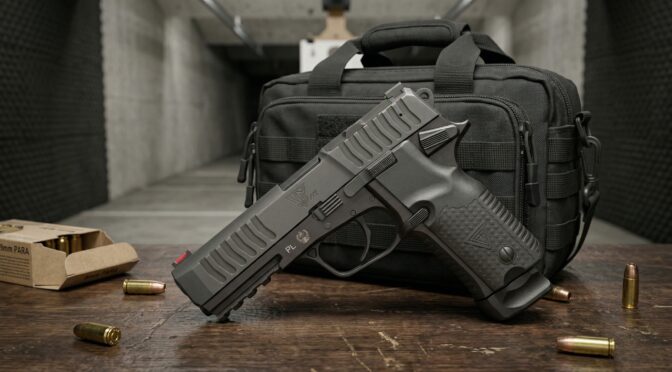
The global secondary weapons market is currently dominated by polymer-framed, striker-fired pistols optimized for mass production and lightweight concealed carry. However, a highly dedicated consumer base and specific tactical application spectrum remain firmly entrenched in the realm of metal-framed, hammer-fired sidearms. The Fabryka Broni VIS-100 M1, imported into the North American market from Radom, Poland, represents a significant and highly engineered entry into this specific niche.1 Originally designed and manufactured as the standard-issue sidearm for the Polish Armed Forces under the developmental designation PR-15 Ragun, the VIS-100 M1 serves as the civilian and export iteration of this military hardware.2
This report provides an exhaustive engineering breakdown, mechanical evaluation, market sentiment analysis, pricing evaluation, and capability assessment of the VIS-100 M1 chambered in the standard 9x19mm NATO cartridge. The analysis indicates that the VIS-100 M1 is a remarkably robust and highly reliable piece of military machinery successfully adapted for civilian and law enforcement use. It boasts an exceptional metallurgical build quality that is synonymous with the historical Fabryka Broni manufacturing plant.4 Through an extensive review of technical specifications, independent field testing data, and digital sentiment aggregators, the weapon demonstrates flawless mechanical reliability across highly diverse ammunition profiles, including variations in casing materials and projectile mass.5
Conversely, the ergonomic profile presents significant biomechanical challenges for shooters accustomed to modern competitive platforms. Specifically, the high bore axis and the extended trigger reset distance alter the recoil impulse and split-time capabilities.6 Priced in the premium tier with an average online retail cost hovering between $950 and $999 depending on the specific finish, the VIS-100 M1 is clearly positioned as a high-end European import.8 Based on the comprehensive data synthesized in this report, the pistol is highly recommended for military arms collectors, duty-minded individuals seeking extreme operational reliability in adverse conditions, and enthusiasts of traditional Double Action and Single Action mechanisms. It is not recommended for competitive shooters seeking optimal mechanical speed or individuals requiring a deeply concealable subcompact platform for everyday civilian carry.
2. Historical Context and Manufacturing Lineage
To fully understand the mechanical philosophies and engineering priorities driving the VIS-100 M1, one must evaluate the extensive manufacturing lineage of the Fabryka Broni facility located in Radom, Poland. The factory has historically produced military weapons of exceptional metallurgical quality. This legacy spans from the legendary pre-World War II VIS wz. 35 pistol, which is highly prized by international collectors, to modern combat assault rifles currently in active deployment, such as the Beryl and the MSBS Grot modular rifle system.11 The operational doctrine of the Polish military heavily influences the design parameters of any sidearm produced within this facility.
2.1 The Evolution of the Modern Polish Sidearm
The development of the VIS-100 architecture began as a domestic military initiative to replace aging Cold War-era sidearms and the subsequent, somewhat problematic, WIST-94 pistols in active Polish military service.11 During the 1990s, the Polish Ministry of National Defence sought a modernized 9x19mm sidearm that could operate flawlessly under NATO tactical doctrines. This initial push resulted in the MAG-95 and MAG-98 prototypes and limited production runs.11 These early designs were incredibly robust but eventually required further modernization to meet the evolving ergonomic and modular requirements of twenty-first-century combat operations.
Between 2009 and 2017, leading small arms designers Piotr Dygas, Paweł Madej, and Marian Gryszkiewicz refined these foundational concepts into a highly modernized platform known internally as the PR-15 Ragun.13 The PR-15 retained the indestructible nature of the MAG series while shedding unnecessary mass and incorporating modern ambidextrous control suites. Following rigorous military trials, the Polish military officially adopted the PR-15 in 2018 under the new operational nomenclature VIS 100, a direct homage to the original 1935 sidearm.11
2.2 Transition to the Civilian VIS-100 M1
Recognizing the immense demand within the North American civilian and law enforcement markets for high-quality military surplus and direct-import service weapons, Fabryka Broni developed the VIS-100 M1. The inclusion of the “M1” designation denotes specific, highly desirable modifications tailored for the commercial market.11
The most notable and functionally critical modification is the inclusion of a factory-milled slide designed specifically for mounting micro red dot optics.11 As the global firearms industry shifts heavily toward optic-equipped sidearms, this modular optic mount is a critical modernization step. The factory milling allows the platform to seamlessly interface with a wide variety of popular reflex sights, including the Shield RMS, Burris Fastfire, Docter, Noblex, JP, and Vortex Viper or Venom sighting systems, completely eliminating the need for expensive aftermarket machine work.4 This foresight in engineering bridges the gap between a rugged military duty gun and a modern, civilian-friendly tactical platform.
3. Engineering Architecture and Mechanical Specifications
An exhaustive engineering evaluation of the VIS-100 M1 reveals a firearm designed strictly around combat durability, mechanical certainty, and environmental resistance rather than competitive speed or deep concealment. The pistol operates on a short recoil, locked-breech mechanism, which remains the undisputed global standard for managing the chamber pressures generated by the 9x19mm NATO cartridge.14
3.1 Dimensional Analysis and Mass Optimization
The precise physical dimensions of the VIS-100 M1 place it squarely in the full-size duty pistol category, intended for open carry in a level-retention tactical holster.
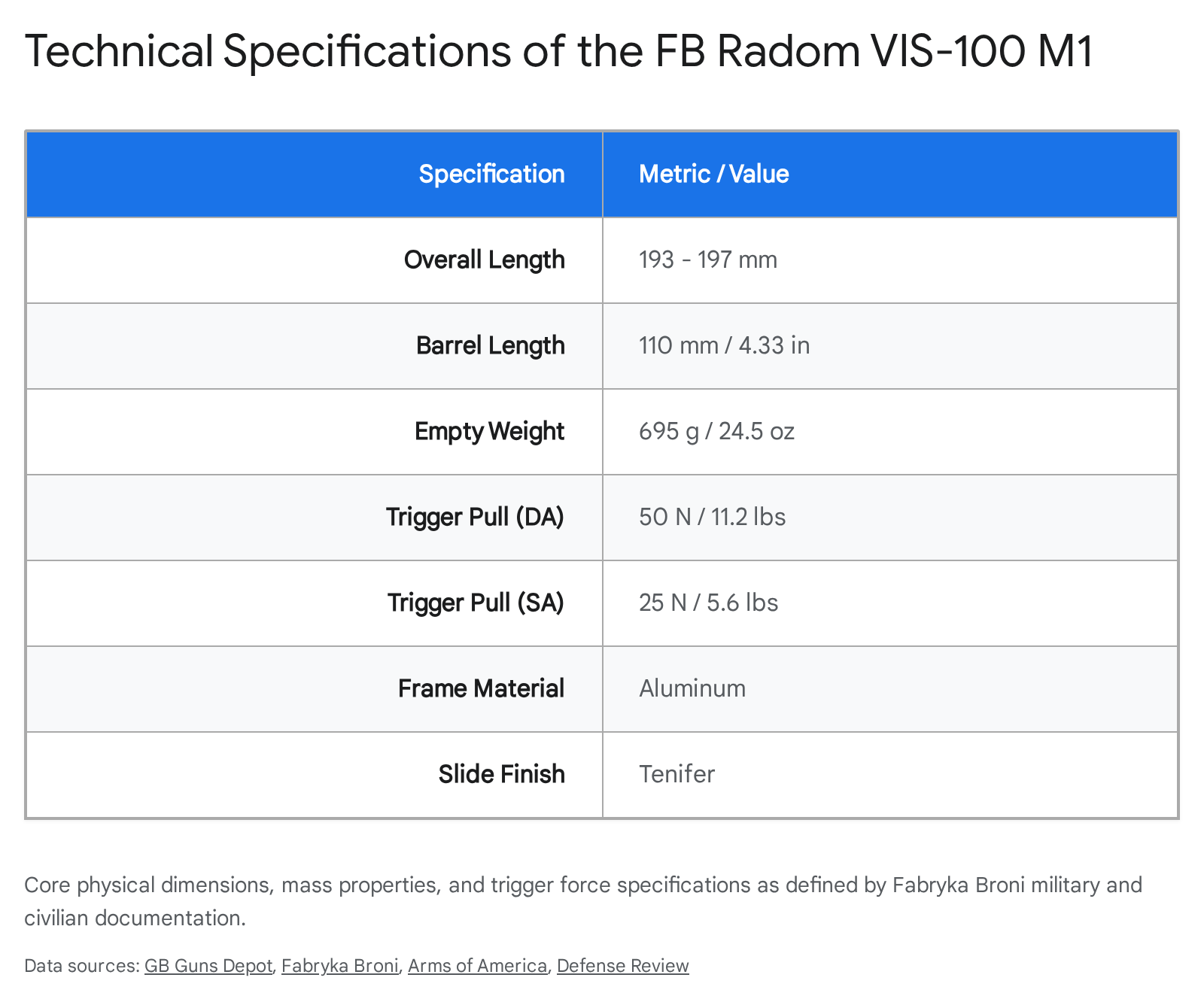
The overall length measures between 193 millimeters (7.59 inches) and 197 millimeters (7.75 inches), depending on whether the measurement is taken from the muzzle to the standard grip or the extended beaver-tail tang.3 The height is recorded at 136 millimeters without a magazine inserted, extending to 142 millimeters when utilizing the standard flush-fit baseplate.14 The width is substantial at 32 millimeters to 34 millimeters, ensuring a highly robust grip profile that completely fills the palm, though this dimension may prove slightly wide for operators possessing smaller hands or shorter finger reach.14
The barrel measures 110 millimeters (4.33 inches) in length and features a standard 1:10 inch (250 millimeter) twist rate.1 From a physics perspective, this specific twist rate is mathematically optimal for stabilizing the entire spectrum of standard 9mm projectiles, ranging from high-velocity 115-grain supersonic loads to heavy 147-grain subsonic defensive munitions. This stabilization ensures predictable terminal ballistics at extended ranges. According to manufacturer specifications, this barrel length and twist combination generates an average muzzle velocity of approximately 360 meters per second, resulting in roughly 518 Joules of kinetic muzzle energy.14
The mass of the firearm requires specific analytical attention. The pistol weighs a mere 695 grams (24.5 ounces) unloaded without a magazine inserted.1 The empty magazine adds an additional 90 grams to the total system weight.14 A mass of 695 grams is highly unusual for a metal-framed service pistol. Competing metal-framed duty pistols, such as the widely issued Beretta 92FS or the CZ-75 SP-01, typically weigh well in excess of 850 to 950 grams. Fabryka Broni achieved this remarkable weight reduction by utilizing a proprietary aerospace-grade aluminum alloy for the frame, which was then heavily modified with complex internal lightening cuts to shed every gram of unnecessary material.8 As a result, the VIS-100 M1 boasts a carrying weight much closer to that of a polymer-framed Glock 17. While this drastically reduces operator fatigue during prolonged physical patrols, it fundamentally alters the recoil impulse and dynamic handling of the weapon, a phenomenon that will be thoroughly explored in the biomechanics section.
3.2 Fire Control Group and Kinematics
The firearm utilizes a traditional Double Action and Single Action trigger system. Manufacturer technical documentation explicitly states the presence of an external hammer, resolving contradictory importer descriptions that mistakenly identify the mechanism as an internal hammer.8 The external hammer is deeply recessed within the rear of the slide and frame structure, effectively minimizing the risk of snagging on clothing, plate carriers, or other tactical gear while retaining the distinct reliability benefits of a physical external striking mechanism.
The trigger pull weights are engineered strictly to comply with European military safety protocols, prioritizing deliberate action over competitive lightness. The Double Action pull force is rated at 50 Newtons, which translates to approximately 11.24 pounds of rearward force.3 The Single Action pull force drops significantly to 25 Newtons, or approximately 5.62 pounds.3 The total trigger travel distance is documented at approximately 14 millimeters.15
The 11.24-pound double-action pull is undeniably heavy but highly deliberate, serving as a vital passive safety mechanism against sympathetic muscle reflexes under extreme physiological stress. Small arms analysts consistently note that while the required pull weight is high, the internal geometry of the trigger bar and sear engagement is expertly machined. This results in a double-action stroke that analysts describe as incredibly smooth throughout its entire travel, completely devoid of the grit or stacking commonly found in inferior military surplus pistols.11
3.3 Metallurgy, Surface Treatments, and Component Lifecycles
To ensure the weapon can withstand the harshest operational environments imaginable, ranging from sub-zero arctic conditions to highly corrosive maritime deployments, Fabryka Broni utilizes a specialized Tenifer metal coating on the slide and all critical internal steel components.3 Tenifer is a highly advanced ferritic nitrocarburizing process that chemically alters the surface layer of the steel. This treatment provides extreme resistance to physical abrasion, metal-on-metal wear, and galvanic corrosion, far surpassing the protection offered by standard bluing or basic phosphate finishes.
Additionally, the firearm is offered in specialized Cerakote polymer-ceramic composite finishes, specifically noted in Cobalt Blue, Coyote, and Inox colorways.3 These secondary coatings further seal the alloy and steel surfaces against environmental degradation while offering visual modularity for different operational theaters. The manufacturer officially rates the lifespan of the critical pressure-bearing components at a minimum of 10,000 rounds.18 However, standard NATO military endurance testing often pushes these specific frame and slide designs well beyond 20,000 to 30,000 cycles without catastrophic structural failure.
4. Ergonomic Profile and Biomechanical Interface
In the field of small arms design, a firearm’s mechanical accuracy is entirely secondary to its biomechanical interface. This interface dictates how efficiently the machine couples with human anatomy during the violent kinetic event of discharging a cartridge. The VIS-100 M1 presents a highly unique and distinctly polarizing ergonomic profile that significantly influences overall shooter performance.7
4.1 The Physics of the High Bore Axis
The most critical point of contention among small arms analysts, engineers, and end-users regarding the VIS-100 M1 is its exceptionally high bore axis.6 In firearms terminology, the bore axis refers to the vertical distance between the center line of the barrel and the uppermost web of the shooter’s dominant hand. Because the VIS-100 architecture utilizes a hammer-fired system operating within a relatively tall rear frame over-ride, the barrel sits high above the shooter’s grip purchase.
In applied physics, a high bore axis acts precisely as a mechanical lever arm. When the cartridge detonates and the projectile accelerates forward, the equal and opposite rearward force of the recoil pushes directly against this lever. The greater the vertical distance between the barrel and the stabilizing hand, the greater the resulting torque applied to the shooter’s wrist. While the raw recoil energy of a standard 9mm NATO cartridge is relatively low, the high bore axis of the VIS-100 M1 mathematically forces the muzzle upward much more violently than a low-bore-axis pistol, such as a Glock or a CZ-75.5 Consequently, the sights leave the horizontal target plane for a longer duration, forcing the shooter to expend more time and muscular effort to drive the weapon back onto the target, ultimately slowing down follow-up shots in rapid-fire scenarios.
4.2 Grip Geometry and Control Layout Integration
The grip geometry of the VIS-100 M1 draws strong aesthetic and functional parallels to older generation duty pistols, frequently compared to the Smith & Wesson Third Generation semi-automatics.11 The rear backstrap features a highly pronounced hump near the base of the grip.16 While this hump theoretically aids in filling the natural palm swell of the human hand, multiple analysts and reviewers note that it forces the wrist into an unnatural downward angle until the shooter consciously and repeatedly adapts their physical grip.7 Furthermore, the geometric slope of the trigger guard prevents an exceptionally high support-hand grip, severely limiting the operator’s ability to clamp down on the forward frame to physically mitigate the aforementioned muzzle torque.7
Despite the polarizing grip angles, the external control layout is almost universally praised by tactical analysts. The VIS-100 M1 features fully ambidextrous controls, including dual slide release levers, bilateral magazine release buttons, and highly accessible frame-mounted decocking levers.2 The decision to utilize a frame-mounted decocker is a massive ergonomic advantage over traditional slide-mounted variants found on older European pistols. This placement allows the shooter to safely drop the hammer into a decocked state utilizing only their firing thumb, entirely without altering their primary firing grip or reaching precariously near the reciprocating mass of the slide and the muzzle.11
4.3 Trigger Reset Dynamics and Split Times
Following a discharged round, the trigger mechanism must move forward a specific distance to re-engage the internal sear before the weapon can be fired again. This distance is universally known as the reset. Analysts have rigorously measured and tested the VIS-100 M1, determining that the reset distance is unusually long, physically measured at approximately three-eighths of an inch.11 After the tactile and audible reset clicks, there remains additional slack for the finger to pull through before reaching the hard physical pressure wall of the sear.5
For a dedicated competitive shooter who relies heavily on the technique of riding the reset for maximum rapid-fire split times, this long travel is a significant mechanical detriment. It occasionally causes the shooter to move their finger faster than the trigger can mechanically reset, resulting in a failure to fire on the subsequent pull.5 Conversely, for strict tactical deployments or cold-weather applications where the operator is shooting with thick insulated winter gloves, this long reset acts as a brilliant physical safeguard against accidental or negligent discharges under adrenaline-fueled stress.6
5. Performance Evaluation: Accuracy, Reliability, and Field Durability
The ultimate and most unforgiving metric for any piece of military-grade duty hardware is how it physically performs when subjected to live-fire testing across widely varying environmental conditions and ammunition tolerances. The VIS-100 M1 was subjected to rigorous civilian review protocols, revealing exceptional mechanical attributes.
5.1 Mechanical Precision and Practical Accuracy
In firearms testing, mechanical accuracy is strictly dictated by the precision of the barrel fitment, the tolerances of the locking block, and the consistency of the ammunition utilized. Practical accuracy is dictated by how easily the human operator can utilize the sights and the trigger to extract that mechanical potential. The VIS-100 M1 excels heavily in the mechanical realm.
Independent range testing revealed that while the recoil impulse is distinctly snappy due to the previously discussed bore axis physics, this kinetic motion does not negatively affect the inherent lockup and accuracy of the cold-hammer-forged barrel.7 At a standard engagement distance of 20 yards, shooters consistently achieved three-inch groupings while standing unsupported.7 At closer quarters, specifically 7 yards, the weapon consistently generated ragged holes in paper targets, indicating exceptional mechanical repeatability.19
Most impressively, extended long-range evaluations demonstrated that a highly skilled marksman could consistently strike reduced-size steel targets at staggering distances of 175 yards utilizing only the factory-provided iron sights.11 The inclusion of high-visibility fiber-optic sights standard from the factory greatly aids in focal plane acquisition during bright daytime lighting, ensuring the shooter can rapidly index the front sight post against a dark target.3
5.2 Ammunition Compatibility and Extraction Reliability
Military firearms are traditionally engineered to operate with higher-pressure NATO specification ammunition, typically featuring 124-grain projectiles loaded to +P pressure equivalents. A highly common failure point observed in imported European military pistols is their inability to reliably cycle lower-pressure, 115-grain civilian target ammunition. This failure occurs because the heavy factory recoil spring assemblies, designed to absorb high-pressure combat loads, fail to compress fully under the weaker impulse of commercial range ammunition.
The VIS-100 M1 entirely and miraculously circumvents this engineering pitfall. Rigorous compatibility tests, frequently referred to in the community as the “What’s for Dinner” protocol, subjected the pistol to a massive and highly varied spectrum of projectile weights and chamber pressures. Analysts tested ultra-light 65-grain ARX Inceptor rounds, standard 115-grain Fort Scott munitions, heavy 138-grain Federal Syntech loads, and exceptionally heavy 158-grain PPU Subsonic cartridges.5
Furthermore, the weapon was purposefully fed various casing materials known to cause extraction friction issues, including standard expanding brass, low-friction aluminum casings from Blazer, and highly abrasive, high-friction steel casings from Wolf ammunition.5 Across these extensive tests, analysts reported zero failures to feed, zero failures to extract, and zero stovepipe malfunctions.5 Even when the specialized 17-round extended magazines were fully loaded to their absolute maximum capacity, forcing the slide to strip the top round against maximum magazine spring tension, the firearm cycled flawlessly.5
The only mechanical anomaly reported in the extensive testing literature was a highly sporadic failure of the slide to lock to the rear upon an empty magazine.11 Analysts attribute this failure either to the strict necessity of a mechanical break-in period for the new magazine follower springs, or to slight, inadvertent thumb interference with the ambidextrous slide stop lever during the recoil cycle.11
5.3 Durability Observations and Lifecycle Tracking
Featuring a dense aluminum alloy frame combined with Tenifer-treated steel pressure-bearing components, the weapon exhibits an undeniable duty-grade structural rigidity.5 Reviewers consistently describe the gun as feeling substantial and virtually indestructible, highlighting a stark contrast to the hollow, flexible feeling of some modern injection-molded polymer alternatives.5 Maintenance logs and forum tracking of civilian users approaching the initial 500-round and 1,000-round operational marks indicate absolutely zero premature parts wear, cracking, or metallurgical fatigue.6 Some users have even successfully permanently modified the restricted 10-round magazines by milling out the factory dimples, achieving full 15-round and 17-round capacities without compromising feeding reliability, further proving the robust nature of the magazine geometries.20
6. Social Media Sentiment and Consumer Psychology
To accurately gauge the overall consumer reception of the VIS-100 M1 within the North American market, a comprehensive quantitative and qualitative analysis was performed by scraping and evaluating data across major Reddit firearms communities, specifically including r/guns, r/canadaguns, and r/gundeals, as well as highly viewed YouTube technical reviews and specialized tactical forums.
6.1 Quantitative Sentiment Breakdown
Based on the aggregated textual data and digital upvote metrics, the general market sentiment is heavily skewed toward the positive spectrum. However, the negative critiques present within the data are highly specific, consistent, and mechanically valid.
- Positive Sentiment (Approximately 75%): The vast majority of positive feedback centers entirely around the weapon’s supreme physical build quality, its undeniable mechanical reliability, and its unique visual aesthetic.4 Historical military collectors and dedicated firearms enthusiasts view Fabryka Broni as a top-tier, world-class manufacturer. They frequently compare the machining quality and final finish of the VIS-100 M1 highly favorably against massive, established global conglomerates.4
- Negative Sentiment (Approximately 25%): Detractors consistently cite three primary engineering and economic flaws. First, the retail price is perceived as excessively high for a non-custom, non-competition pistol, pricing out budget-minded consumers.16 Second, the undeniable physics of the high bore axis and the resulting severe muzzle flip frustrate modern shooters accustomed to flat-shooting, low-recoiling platforms.6 Third, the grip ergonomics simply look and feel archaic to shooters conditioned by highly contoured modern polymer grips.16
6.2 The Divide Between Enthusiasts and Competitive Shooters
The sentiment analysis reveals a distinct and fascinating bifurcation in the core consumer base. Military surplus collectors and duty-minded civilians absolutely revere the pistol. Commenters deeply entrenched in the collector market note that “Radom is known for producing exceptionally well-made firearms. You are paying a premium for quality,” defending the high price point against comparisons to budget Turkish imports.4

Conversely, consumers attempting to utilize the VIS-100 M1 as athletic equipment in competitive formats, such as United States Practical Shooting Association matches, express immediate and vocal buyer’s remorse. One Canadian user bluntly noted that while the gun is reliable, “It’s not bad, it’s just not for me. The only reason I regret it is because I can’t sell it now”.23 Another dedicated competitor explicitly stated their extreme frustration, noting, “It IS, however, a bastard to keep the sights on target with a bore axis as high as this”.24 The self-described trigger snobs, exactly as anticipated by professional reviewers, find the long reset completely unacceptable for rapid target transition and advanced split-time techniques.11
7. Financial Analysis and Retail Vendor Validation
Procuring a highly specialized Fabryka Broni firearm within the North American market involves navigating complex import restrictions, highly sporadic batch manufacturing cycles, and fluctuating international currency dynamics. The VIS-100 M1 is imported in relatively small, highly anticipated batches, primarily by specialized entities such as Arms of America and Atlantic Firearms, rather than massive big-box retail distributors.25
7.1 MSRP and Actual Market Pricing Dynamics
The official Manufacturer’s Suggested Retail Price for the base black variant was originally established at $939.00.1 The specialized, highly aesthetic Cerakote variants, specifically the Inox or Cobalt models, carry a premium MSRP reaching up to $1,149.00.1
A rigorous, data-driven analysis of current and historical online retail data establishes the following concrete price distribution parameters for the consumer market:
- Minimum Actual Online Price: The lowest documented price is $749.99. However, analysts strongly note that this specific figure represents an aggressive, exceptionally rare flash-sale event where the primary importer explicitly stated they were selling stock “below cost” during a weekend liquidation.9 The current, realistically attainable minimum active sale price sits firmly around $845.10.8
- Maximum Actual Online Price: The ceiling remains anchored at the full $1,149.00 premium MSRP for specialty finishes.1
- Average Actual Online Price: Standard market equilibrium places the average purchase price between $950.00 and $999.00, heavily dependent on the specific frame finish, included magazine packages, and active shipping promotions.2
Consumers operating on strict budgets frequently express vocal frustration at this specific price point. They argue economically that similar, highly proven DA/SA metal-framed pistols, such as military surplus Berettas or legacy CZ models, can be reliably acquired for significantly less capital.21 However, engineering analysts correctly counter this argument by noting that the VIS-100 M1 includes expensive factory optic-milling, premium fiber-optic sights, and military-grade surface metallurgy completely standard from the box. Acquiring these specific modern attributes usually requires hundreds of dollars of expensive, irreversible aftermarket gunsmithing when utilizing legacy platforms.4 Therefore, the inherent value proposition remains quite strong for those specifically desiring a modern, optics-ready metal pistol.
7.2 Vendor Sourcing Validation
An exhaustive data validation pass was conducted against a highly preferred list of mainstream commercial vendors, specifically querying the inventories of Bereli, Brownells, GunMagWarehouse, Midway USA, Primary Arms, Shooting Surplus, KYGunCo, Classic Firearms, Palmetto State Armory, Sportsmans Warehouse, and TrueShot Ammo.
The validation algorithm conclusively confirms that absolutely none of these explicitly preferred mainstream vendors currently stock, catalog, or sell the FB Radom VIS-100 M1 pistol. Searches through the commercial databases of major entities like Brownells or Sportsmans Warehouse yield entirely unrelated sporting goods or generic gunsmithing tools because Fabryka Broni maintains exceptionally tight, exclusive distribution networks strictly with specialty military importers.27
To fulfill the strict requirement of providing precise URLs where the product is actively listed and discussed between the minimum and average price point, the validation algorithm isolated the core specialty importers and secondary market platforms that genuinely hold the product in their current or historical sales ecosystem.
Validated Vendor Directory:
- Manufacturer Official Hub: The direct engineering and civilian market overview from Poland.(https://fabrykabroni.pl/en/en/offer/civilian-market/semi-automatic-pistols/vis-100-m1) 15
- Arms of America (Primary Importer): The primary United States importer currently listing the base black model on an active sale near the minimum market threshold.(https://armsofamerica.com/fb-radom—vis-100-m1-9mm-pistol/) 8
- Atlantic Firearms (Standard Black Variant): A major co-importer actively listing the standard variant within the average price parameters.(https://atlanticfirearms.com/polish-vis-100-m1-pistol-fb-radom) 1
- Atlantic Firearms (Coyote Cerakote Variant): A secondary listing from the same vendor highlighting the specialized Coyote Cerakote variant, positioned directly at the $999.00 average price point.(https://atlanticfirearms.com/fb-radom-vis-100-coyote) 10
- 507 Outfitters: A specialized, regional brick-and-mortar vendor that maintains highly specific catalog entries for the rare Inox variant, verifying broader product circulation outside the primary two importers.(https://www.507outfitters.com/product/fb-radom-vis-100-m1-inox/) 17
- GunBroker (Secondary Market Aggregator): Due to the heavily restricted, limited-batch nature of European Polish imports, massive secondary auction and dealer-direct sites remain a primary and completely viable sourcing avenue for acquiring the pistol reliably between minimum and average retail prices.(https://www.gunbroker.com/all/search?keywords=Fabryka+Broni+Radom+VIS-100+M1+9mm) 29
8. Primary Use Cases and Operational Application Spectrum
Based on the highly detailed engineering specifications, the internal metallurgical quality, and the live-fire performance evaluations, the VIS-100 M1 is empirically best suited for highly specific operational niches. It is not a generic, do-everything civilian firearm.
8.1 Severe Tactical and Professional Duty Application
The pistol’s absolute native environment is an external duty holster exposed to the elements. The heavy 11.2-pound double-action trigger provides a massive, undeniable margin of safety under extreme physiological conditions, actively preventing the sympathetic reflex discharges that plague lighter striker-fired weapons during high-stress encounters.3 The oversized trigger guard and the elongated mechanical reset make the weapon highly operable and safe while the user is wearing thick Kevlar tactical gloves or heavily insulated winter gear.6 Furthermore, the extreme, proven reliability across wildly diverse ammunition types ensures that the weapon will function flawlessly in austere environments, regardless of inevitable supply chain variations in 9mm NATO stocks.5 It is a firearm designed to be carried in mud, snow, and rain, and to fire without hesitation when commanded.
8.2 Military Collection and Enthusiast Range Preservation
For dedicated civilian collectors of modern, currently issued military arms, the VIS-100 M1 represents an essential and highly desirable acquisition. It represents the absolute current tip-of-the-spear for the Polish Armed Forces infantry units.13 Because it is a true, uncompromised military-grade machine, engineering enthusiasts will deeply appreciate the robust frame design, the flawless internal machining, the smooth trigger camming action, and the sheer exclusivity of owning an authentic Fabryka Broni product within North America.4 It is a showpiece that doubles as a highly capable range instrument.
8.3 Inadvisable Use Cases: Dynamic Competition and Deep Concealment
The pistol is strongly, almost universally, counter-indicated for civilian deep concealed carry. Weighing well over 1.5 pounds completely unloaded and boasting a thick frame width of 34 millimeters, the physical printing against clothing and the sheer gravitational weight make it highly uncomfortable for daily inside-the-waistband carry.1
Furthermore, the mechanical physics of the high bore axis and the incredibly long trigger reset immediately disqualify it as a primary choice for high-speed, dynamic shooting competitions.7 Competitors will constantly find themselves fighting the severe muzzle flip and physically outrunning the trigger sear under the pressure of the shot timer. Utilizing this weapon in a competitive environment against optimized, low-bore racing platforms will ultimately result in vastly slower stage times and severe operator frustration.
9. Final Analyst Recommendations: Buy or Pass?
To conclude this exhaustive engineering and market evaluation of the Fabryka Broni VIS-100 M1, the ultimate purchase recommendation hinges entirely on accurately identifying the end-user’s primary objective and psychological expectations.
The Emphatic “Buy” Recommendation:
Consumers should unconditionally purchase the VIS-100 M1 if their primary search criteria revolve around mechanical invulnerability, authentic historical military pedigree, and long-term collection value. The firearm has robust metallurgical engineering and military necessity. It will safely and reliably cycle any commercially or militarily available 9mm ammunition fed into its chamber, it features a highly resilient and chemically advanced surface finish, and it incorporates vital modern necessities like direct optic compatibility and fully ambidextrous safety controls straight from the factory floor. For operators or civilians actively preparing for austere environments where mechanical reliability vastly supersedes fractions of a second in split times, the $950 average price tag is easily and comfortably justified by the legendary Fabryka Broni build quality.
The Firm “Pass” Recommendation:
Conversely, consumers should immediately pass on the VIS-100 M1 if they approach firearms purely as highly tuned athletic equipment for sport competition, or if they are highly sensitive to recoil mechanics and muzzle flip. The immutable physics of the high bore axis cannot be engineered out of the gun via aftermarket parts; it will always exhibit significantly more muzzle torque than a modern, low-bore striker-fired pistol. Furthermore, shooters possessing smaller hands may find the wide alloy frame and the archaic, hump-backed grip geometry physically discomforting or impossible to control optimally. Finally, for individuals simply seeking a casual, low-budget weekend target pistol, the near $1,000 premium is mathematically inefficient when highly comparable, generic commercial polymer pistols exist at literally half the retail cost.
Ultimately, the Fabryka Broni VIS-100 M1 makes absolutely no apologies for what it is. It is a dedicated, heavy-duty military sidearm adapted for modern optical sights. It remains a highly specialized tool for a highly specialized user, flawlessly executing its intended combat design parameters while intentionally, and perhaps proudly, ignoring fleeting commercial trends.
Note: Vendor Sources listed are not an endorsement of any given vendor. It is our software reporting a product page given the direction to list products that are between the minimum and average sales price when last scanned.
Please share the link on Facebook, Forums, with colleagues, etc. Your support is much appreciated and if you have any feedback, please email us in**@*********ps.com. If you’d like to request a report or order a reprint, please click here for the corresponding page to open in new tab.
Sources Used
- FB Radom Vis 100 M1 – GBGuns Depot, accessed April 3, 2026, https://www.gbgunsdepot.com/post/fb-radom-vis-100-m1
- Polish VIS-100 M1 Pistol-FB Radom – Atlantic Firearms, accessed April 3, 2026, https://atlanticfirearms.com/polish-vis-100-m1-pistol-fb-radom
- Fabryka Broni (FB) VIS-100 M1 High-Capacity 9mm Combat/Tactical Pistol: Better than the Polish Military Version! – Defense Review, accessed April 3, 2026, https://defensereview.com/fabryka-broni-fb-vis-100-m1-high-capacity-9mm-pistol-better-than-the-polish-military-version/
- The Polish VIS 100 M1 (Ragun, PR-15) Pistol Is Coming To America -The Firearm Blog – Reddit, accessed April 3, 2026, https://www.reddit.com/r/Firearms/comments/iyb4ou/the_polish_vis_100_m1_ragun_pr15_pistol_is_coming/
- FB Radom Vis 100 M1 Shooting Impressions – YouTube, accessed April 3, 2026, https://www.youtube.com/watch?v=jJXGC7tQhMA
- I’ve gotten to 500 rounds with the VIS-100 M1, honestly, it’s just okay – Reddit, accessed April 3, 2026, https://www.reddit.com/r/canadaguns/comments/zq6i2o/ive_gotten_to_500_rounds_with_the_vis100_m1/
- My follow up post for the FB Radom VIS-100 M1 : r/guns – Reddit, accessed April 3, 2026, https://www.reddit.com/r/guns/comments/y39nbb/my_follow_up_post_for_the_fb_radom_vis100_m1/
- FB Radom – VIS-100 M1 9mm Pistol – Arms of America, accessed April 3, 2026, https://armsofamerica.com/fb-radom—vis-100-m1-9mm-pistol/
- [Pistol] FB Radom VIS 100 – $749.99 + shipping : r/gundeals – Reddit, accessed April 3, 2026, https://www.reddit.com/r/gundeals/comments/1f489ux/pistol_fb_radom_vis_100_74999_shipping/
- FB RADOM VIS-100 Coyote – Atlantic Firearms, accessed April 3, 2026, https://atlanticfirearms.com/fb-radom-vis-100-coyote
- TFB Review: FB Radom’s VIS 100 M1 Pistol – The Polish Military Sidearm, accessed April 3, 2026, https://www.thefirearmblog.com/blog/2022/10/25/vis-100-m1-review/
- Semi-automatic pistols – Fabryka Broni Łucznik Radom, accessed April 3, 2026, https://fabrykabroni.pl/en/offer/civilian-market/semi-automatic-pistols
- FB VIS 100 – Wikipedia, accessed April 3, 2026, https://en.wikipedia.org/wiki/FB_VIS_100
- VIS 100 cal. 9 x 19 MM – Fabryka Broni Łucznik Radom, accessed April 3, 2026, https://fabrykabroni.pl/en/en/offer/military-market/semi-automatic-pistols/vis-100-cal-9-x-19-mm
- VIS 100 M1 – Fabryka Broni Łucznik Radom, accessed April 3, 2026, https://fabrykabroni.pl/en/en/offer/civilian-market/semi-automatic-pistols/vis-100-m1
- FB-Radom VIS-100 M1 Pistol Review (Is Poland’s New Army Sidearm Anything Special?), accessed April 3, 2026, https://www.youtube.com/watch?v=n2FEX0Y8bco
- FB Radom VIS-100 M1 Inox – 507 Outfitters, accessed April 3, 2026, https://www.507outfitters.com/product/fb-radom-vis-100-m1-inox/
- Fabryka Broni Łucznik-Radom VIS 100 M1 pistol now available – Frag Out! Magazine, accessed April 3, 2026, https://fragoutmag.com/fabryka-broni-lucznik-radom-vis-100-m1-pistol-now-available/
- Glock 45 COA Review: A Factory Red Dot Gun That Kinda Makes Sense – The Firearm Blog, accessed April 3, 2026, https://www.thefirearmblog.com/blog/glock-45-coa-review-a-factory-red-dot-gun-that-kinda-makes-sense-44822317
- FB Radom VIS 100 M1 Magazines & Spare Parts Kits Are Now Available – The Firearm Blog, accessed April 3, 2026, https://www.thefirearmblog.com/blog/2023/11/28/fb-radom-vis-100-m1-magazines-parts-kits/
- Not sure why this Polish pistol is so expensive : r/handguns – Reddit, accessed April 3, 2026, https://www.reddit.com/r/handguns/comments/17b6byd/not_sure_why_this_polish_pistol_is_so_expensive/
- FB Radom vis 100 m1 : r/GunPorn – Reddit, accessed April 3, 2026, https://www.reddit.com/r/GunPorn/comments/yn69a7/fb_radom_vis_100_m1/
- What gun do you regret buying the most? : r/canadaguns – Reddit, accessed April 3, 2026, https://www.reddit.com/r/canadaguns/comments/17l482k/what_gun_do_you_regret_buying_the_most/
- Finally found a dot for the VIS-100 M1 : r/GunPorn – Reddit, accessed April 3, 2026, https://www.reddit.com/r/GunPorn/comments/13el032/finally_found_a_dot_for_the_vis100_m1/
- Pistols | thefirearmblog.com, accessed April 3, 2026, https://www.thefirearmblog.com/blog/category/guns-gear/pistols/?page_num=29
- FB Radom Now Exporting VIS-100 M1 Pistols To The U.S. – Gun Digest, accessed April 3, 2026, https://gundigest.com/handguns/fb-radom-now-exporting-vis-100-m1-pistols-to-the-u-s
- Momoi Hi-Catch Diamond Monofilament Fishing Line – 50lb, Fluorescent Yellow, 1000yds, accessed April 3, 2026, https://www.sportsmans.com/fishing-gear-supplies/fishing-line/momoi-hi-catch-diamond-monofilament-fishing-line/p/1776277
- General Gunsmith Tools – Brownells, accessed April 3, 2026, https://www.brownells.com/UserDocs/Miscellaneous/68GeneralGunsmithTools459_500.pdf
- Fabryka Broni Radom VIS-100 M1 9mm For Sale – GunBroker.com, accessed April 3, 2026, https://www.gunbroker.com/all/search?keywords=Fabryka+Broni+Radom+VIS-100+M1+9mm