1. Executive Summary
The United States Department of Defense (DoD) is currently executing a historic recapitalization of its tactical and strategic forces, pivoting heavily toward unmanned aircraft systems (UAS), attritable autonomous platforms, and multi-domain drone swarms. Initiatives such as the Replicator program aim to field autonomous systems at a scale of multiple thousands across various domains to counter the massed capabilities of near-peer adversaries.1 However, a critical vulnerability threatens the operational efficacy of this technological leap: the systemic misalignment of the human capital pipeline required to design, operate, maintain, and evolve these software-defined assets.
While the defense apparatus, the industrial base, and the public continually fixate on the physical technology of drones—airframes, payloads, and propulsion mechanisms—the strategic capability of UAS is entirely dependent on the digital fluency of the personnel operating them. The legacy aviation training pipelines, built over decades to produce stick-and-rudder pilots, do not align with the modern requirement for software-fluent systems managers, data scientists, and network engineers.4 The role of the UAS operator is shifting rapidly from manual flight control to the supervision of automated, data-rich intelligence nodes.5
Furthermore, the rigid, hierarchical personnel management and compensation models of the industrial-age military are failing to attract, retain, and promote the digital talent necessary to maintain these systems. Top-tier software engineers and artificial intelligence (AI) specialists are being heavily recruited by private-sector defense technology firms, which offer compensation packages and career autonomy that the military currently cannot match.7 Even when the DoD successfully recruits high-tier digital talent, legacy promotion boards inherently disadvantage technical specialists who forgo traditional command leadership roles to focus on technical mastery, resulting in severe retention bottlenecks.9
To employ drones effectively against sophisticated adversaries, DoD leadership must aggressively modernize personnel management. This requires establishing protected technical career tracks devoid of up-or-out command requirements, implementing flexible and competitive compensation models, and transitioning training pipelines to treat computer science and data analytics as core warfighting competencies. The following report provides an overview understanding of the systemic personnel requirements necessary to modernize the DoD’s approach to the digital workforce required for advanced unmanned operations.
2. The Strategic Evolution of Unmanned Aerial Systems in Modern Warfare
The conceptual framework of military aviation is undergoing a profound paradigm shift. Historically, aircraft were platforms that required human occupants to physically manipulate controls while simultaneously managing onboard sensor data and situational awareness. Early unmanned systems replicated this model remotely; operators manually flew the aircraft via direct radio-frequency links, effectively functioning as traditional pilots displaced to a ground control station. This paradigm is becoming obsolete.
2.1 The Transition to Attritable Autonomy
Modern drone integration relies heavily on autonomous data service providers, advanced algorithms, and artificial intelligence. With increasing levels of automation incorporated into UAS, the traditional, manual role of the pilot continues to decrease in favor of technological reliance.5 The DoD is moving away from the exquisite, human-intensive platforms of the past toward massed, AI-driven swarms.11
The Replicator initiative epitomizes this shift. Launched to overcome the quantitative advantages of adversaries, Replicator aims to deploy all-domain, attritable autonomous (ADA2) systems within highly compressed timeframes of 18 to 24 months.3 Operating these swarms requires personnel who understand network topology, algorithmic logic, and automated deconfliction, rather than manual flight mechanics. The operational environment has evolved to include beyond visual line of sight (BVLOS) operations, fiber-optic command links designed to bypass radio frequency jamming, and highly autonomous target acquisition sequences.5 The required skill set for operations has decisively transitioned from legacy stick-and-rudder aviation skills—reliant on manual flight control and direct radio links—to a modern competency profile dominated by software troubleshooting, network management, and data analysis.
The challenges to a successful landpower-focused Replicator initiative are numerous. A broad failure of imagination and conceptual rigidity prevents the continual adaptation of doctrine as the character of war changes.1 The prolonged DoD procurement processes, a restrictive development culture, and bureaucratic acquisition business practices limit rapid production at scale.1 Furthermore, as advanced capabilities transition to appropriate end-state users in the services, the military operations community must possess the technical acumen to deploy, update, and manage these systems securely.3
2.2 Intelligence, Surveillance, and Reconnaissance Data Integration
From the perspective of the Intelligence Community (IC) and the Office of the Director of National Intelligence (ODNI), drones are fundamentally dual-use assets: they serve simultaneously as kinetic platforms and high-fidelity intelligence sensors.14 Modern UAS and their accompanying ground ecosystems collect massive amounts of high-resolution imagery, mapping data, flight logs, radio telemetry, and acoustics.15 The modern drone operator must focus on the integrity, security, and dissemination of the data the airframe generates.
The IC Data Strategy explicitly demands that all collected and acquired data be interoperable and discoverable at speed to ensure decision advantage.6 To stay ahead of diverse, complex threats, the IC must embrace digital transformation and plan end-to-end data management from the point of collection to exploitation.6 Consequently, the human capital pipeline must produce data scientists and analysts capable of processing massive intakes of sensor data in real-time. Operators must possess the technical acumen to troubleshoot software interfaces on the fly, manage data egress architectures, and ensure that algorithms are functioning correctly under combat conditions.15
2.3 The Dual-Use Sensor Paradigm and Edge Computing
The integration of commercial off-the-shelf (COTS) technology and open-source data requires a cultural shift within the military intelligence apparatus.16 Training programs must become dynamic to address this. As observed in modern conflict zones, the most successful UAS operations occur when there is a continuous, rapid feedback loop between frontline operators and software developers, allowing for iterative updates to counter evolving electronic warfare threats.17
Adversaries are actively evolving their tactics. For example, while initial first-person view (FPV) drones were guided by trackable radio frequency signals, adversaries are now flying “dark drones” over fiber optics that cannot be detected or jammed using traditional methods.13 Countering such threats requires operators to utilize a litany of different sensors to triangulate and disable the drone, demanding an entirely different cognitive profile than scanning the sky visually.13 The DoD’s human capital pipeline must train personnel not just to operate fixed systems, but to actively participate in this rapid acquisition, development, and algorithmic adjustment cycle at the tactical edge.
3. The Paradigm Shift in Operator Skill Requirements
The assumption that a UAS operator is merely a pilot sitting in a different location is a fundamental misunderstanding of modern unmanned operations. The transition to software-defined warfare necessitates a thorough reevaluation of what constitutes operational competence in the unmanned domain.
3.1 Obsolescence of Manual Flight Mechanics
In the commercial sector, the Federal Aviation Administration (FAA) has recognized that centralized airman certification processes based on manned flight are impracticable for highly automated drones.5 Standard Part 107 certifications primarily address regulatory knowledge, airspace classifications, and basic visual flight rules, but they fail to cover software troubleshooting, automated safety management systems, and complex mission planning at scale.4 The proposed Part 108 regulations acknowledge that the UAS industry relies on technology rather than human interaction to ensure safe operation, driving the pilot’s role further away from manual control.5
Similarly, military training often shoehorns UAS operators into traditional pilot molds. When traditional pilots are placed in UAS roles, their extensive training in physiological flight responses, manual aerodynamics, and spatial disorientation is largely unutilized, while their potential lack of deep software fluency becomes a liability. The operator is no longer maneuvering an aircraft; they are managing a system of systems.
3.2 The Operator as Systems Manager and Network Engineer
The modern UAS operator acts as a systems manager. Their primary tasks include monitoring automated flight paths, managing payload data streams, deconflicting airspace digitally, and ensuring cryptographic security over command links. As operations scale across public safety, infrastructure, and enterprise sectors, the gap between hobby-level flying and professional aviation continues to widen.4 Standardized UAS training is essential for safety, regulatory readiness, and workforce development.4
Military operators require similar shifts. The Army’s 150U Tactical Unmanned Aerial Systems Operations Technician is tasked with integrating UAS into collection strategies, assisting all-source analysts, and leveraging network engineering, data analytics, and artificial intelligence to enhance effectiveness in multi-domain operations.18 However, identifying personnel capable of executing these high-level data functions within a pool of candidates originally recruited for basic mechanical or infantry tasks presents a profound human capital challenge.
3.3 Electronic Warfare and Edge Troubleshooting
The operational environment for drones is highly contested. Operators must be capable of understanding and mitigating electronic warfare (EW) and cyber threats in real-time. If a drone swarm fails to execute a coordinated search pattern, or if a single autonomous vehicle loses its GPS connection, the operator must possess the technical literacy to diagnose whether the failure is a mechanical defect, a software glitch, or a targeted EW jamming attack.
A gap analysis of UAS maintenance procedures revealed a stark deficiency in modern training: while large UAS have traditional technical manuals, small and mid-sized UAS suffer from a severe lack of maintenance guidance.20 More critically, the “maintenance” of a modern UAS is often a software engineering task rather than a mechanical one. Legacy aviation mechanics are trained to turn wrenches, replace physical actuators, and monitor hydraulic pressure. Modern UAS require technicians who can debug code, analyze failure modes in digital flight controllers, execute firmware flashes, and secure networks against cyber intrusion. The military requires a workforce that treats computer science as a core competency.21
4. Deficiencies in Legacy Aviation Training Pipelines
Despite the technological realities of modern UAS, the DoD’s training pipelines remain heavily anchored in legacy aviation models. This creates a profound gap between the skills taught in military schoolhouses and the skills required on the modern battlefield.
4.1 The Mismatch of Aeronautical Instruction
The Department of Defense has historically struggled to align its training minimums with operational realities. A Government Accountability Office (GAO) report highlighted that the Army experienced significant training shortfalls, with 61 of 73 UAS units flying fewer than half of the 340-flight-hour per unit annual minimum training goal.22 This shortfall points to a systemic inability to generate adequate training scenarios that match the operational tempo required.
Furthermore, the Air Force relies heavily on temporary assignments of manned-aircraft pilots to fill UAS positions. At one point, 37 percent of the personnel filling UAS pilot positions were temporarily assigned manned-aircraft pilots.22 This stopgap measure is highly inefficient; it risks losing accumulated specialized experience when those pilots return to manned airframes, and it fundamentally misunderstands the nature of the UAS role by assuming any trained pilot can effectively manage an uncrewed system’s digital architecture.22
4.2 Case Analysis: Air Force and Army Pilot Shortages
The Air Force has consistently lacked enough pilots and sensor operators to meet staffing targets for its remotely piloted aircraft (RPA).23 The branch has struggled to track its overall progress in accessing and retaining enough personnel to implement combat-to-dwell policies, which are intended to balance time spent in combat with non-combat activities.23 Because RPA pilots operate from bases in the United States and live at home, they experience combat alongside their personal lives, leading to unique psychological and working conditions that the Air Force has historically failed to manage effectively.24
The Army’s approach also reveals legacy constraints. The Army introduced the Unmanned Advanced Lethality Course to rapidly train soldiers on the lethal employment of small UAS, including FPV drone operations.25 While this represents a rapid adaptation, the broader career pathways for dedicated Army drone operators, such as the 15W (UAS Operator) or 150U (Warrant Officer), still require candidates to navigate rigid prerequisites that do not inherently select for software engineering or data analysis capabilities.18
4.3 Alternative Models: The Navy’s Warrant Officer Approach
The Navy has taken a notably progressive approach with the introduction of the MQ-25 Stingray and the MQ-4C Triton. To operate the MQ-25, the Navy established the 737X Air Vehicle Pilot (AVP) Warrant Officer designator.26 Unlike traditional Navy Chief Warrant Officers who convert from the enlisted ranks, 737X warrant officers are accessed directly through Navy recruiting, with civilian applications serving as the primary accession source.26
Crucially, these warrant officers do not go through the traditional, lengthy aviation pipeline designed for manned aircraft pilots. Instead, they complete a specialized 15-to-18-month curriculum focused entirely on safety of flight technical proficiency and in-flight automated refueling procedures.26 This model tacitly acknowledges that traditional manned pilot training is an inefficient and unnecessary prerequisite for generating dedicated, technical UAS specialists.
4.4 The Maintenance Gap: Mechanics versus Software Engineering
The structural deficiencies extend beyond the operators to the maintenance personnel. The Air Force has attempted to overhaul aircraft maintenance training by creating “technical tracks” for airmen to become “nose-to-tail cross-functional experts” on specific airframes.27 While beneficial for legacy manned platforms, the maintenance of attritable, autonomous drones requires a fundamentally different approach.
When commercial industries deploy drones, they face a high demand for hardware and software engineers with unique skills to analyze data gathered from a multitude of sensors, recognizing that ensuring airworthiness requires a “new breed of maintenance technicians”.28 The military must similarly pivot its maintenance pipelines. Technicians must be trained in network diagnostics, cybersecurity principles, and rapid algorithmic updates, transitioning from a purely mechanical focus to a hybrid electromechanical and digital engineering paradigm.
| Training Pipeline Component | Legacy Aviation Model | Modern UAS Requirement | Implication for DoD Human Capital |
| Primary Skill Focus | Aerodynamics, manual flight control, physiological response. | Systems management, network topology, automated deconfliction. | Extensive time and resources are wasted teaching mechanical flight to operators who will manage software. |
| Maintenance Profile | Mechanical repair, hydraulic systems, physical actuators. | Firmware flashing, network security, software debugging, sensor calibration. | Maintenance personnel must be recruited for IT and engineering capabilities rather than traditional mechanic aptitudes. |
| Operational Tempo | Discrete sorties, physical deployment, high per-unit cost. | Continuous edge computing, swarm management, attritable volume. | Operators require data science fluency to process continuous intelligence feeds rather than discrete post-flight debriefs. |
5. Systemic Retention Bottlenecks and Structural Misalignments
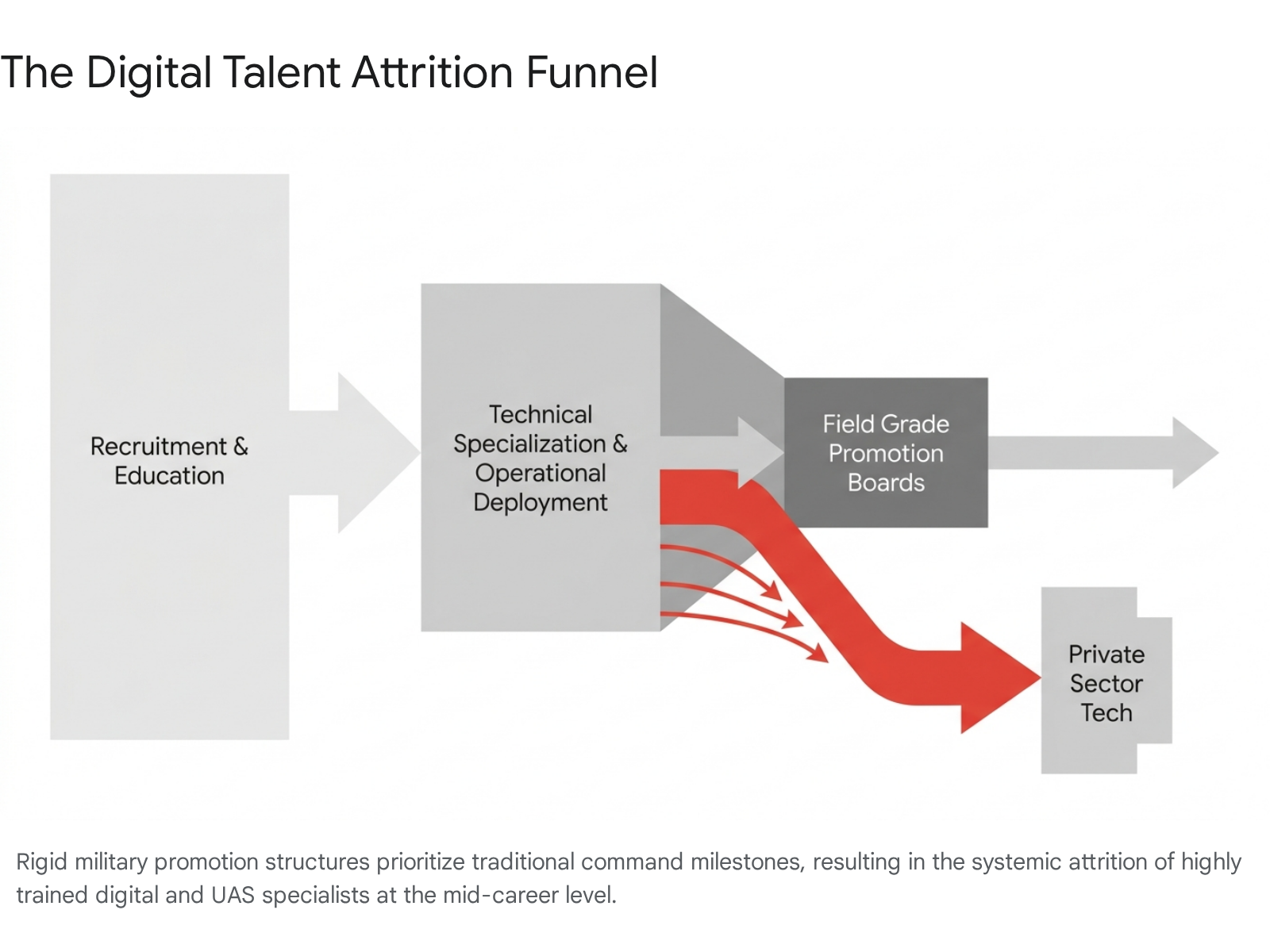
Even when the military successfully trains or recruits digital talent, its archaic talent management structures act as a powerful repellant. The military operates on an industrial-age “up-or-out” promotion system that mandates personnel continuously move into broader leadership and command roles to advance in rank. This system is fatal to the retention of deeply specialized technical experts.
5.1 The “Up-or-Out” Command Structure
The military promotion system generally assumes that the highest value an individual can provide to the organization is leading larger groups of people. Consequently, promotion boards heavily weight traditional command milestones—such as serving as a company commander or staff officer. Personnel who wish to remain “hands-on” technical experts are systematically disadvantaged. If an individual fails to promote on schedule, they are forced out of the service. This model is entirely misaligned with the digital era, where a single, highly skilled software engineer or data scientist can produce a disproportionate strategic impact without ever commanding a squad.
5.2 The “Glass Ceiling” for Dedicated UAS Pilots
The Air Force’s creation of the 18X career field for dedicated Remotely Piloted Aircraft (RPA) pilots was an attempt to professionalize the UAS force and reduce reliance on manned-aircraft pilots.29 This separate training pipeline reduced the cost per pilot by an estimated 95 percent compared to traditional training.29 However, this career field suffers from a systemic “glass ceiling.”
Because 18X officers spend the majority of their time in ground control stations executing continuous combat missions, they frequently miss the traditional career milestones—such as specific staff assignments, varied operational deployments, and traditional leadership roles—that promotion boards look for.9 Consequently, RPA pilots historically face persistently lower promotion rates to field-grade and flag ranks compared to their manned-aircraft peers.9 If a drone operator knows that their technical specialization will inherently limit their career trajectory and prevent them from reaching senior leadership, they are highly likely to exit the service for the private sector, draining the military of its most experienced UAS personnel.
5.3 The Artificial Intelligence and Machine Learning Talent Crisis
The structural misalignment is not limited to pilots; it extends directly to the software and data experts required to build and manage UAS networks and autonomous swarms. The Army recently established the 49B Artificial Intelligence and Machine Learning (AI/ML) Officer area of concentration to build a dedicated cadre of in-house experts capable of accelerating battlefield decision-making and integrating AI into warfighting functions.31
Yet, in its first measurable test, the promotion outcomes for this digital talent pipeline were disastrous. Only four of the seven highly educated Army AI Scholars were selected for on-time promotion to major, representing a sub-60 percent selection rate, which stands in sharp contrast to the broader force where more than 80 percent of captains promote on time.10 Not one of the scholars, nor any of the thirteen in the year group immediately behind them, was selected early.10
The Army invested over $350,000 per officer sending them to top-tier technical institutions such as MIT, Princeton, and Carnegie Mellon.10 However, because these officers were immersed in technical research, graduate school, and software development rather than commanding traditional line units, the legacy promotion boards viewed them as lacking requisite leadership experience and passed them over.10 This exemplifies a profound failure in talent management: the institution verbally demands digital innovation and funds extensive education, but procedurally punishes the officers who provide it by halting their careers.
6. The Compensation Challenge: Military vs. Private Sector Tech
The most immediate and quantifiable threat to the DoD’s UAS human capital pipeline is the vast disparity in compensation between the military and the private commercial sector. As UAS technology proliferates in civilian markets—spanning infrastructure inspection, agricultural analysis, public safety, and logistics—the demand for skilled operators, hardware engineers, and software developers has skyrocketed.33 Consequently, the DoD is competing directly with venture-backed defense startups, major tech conglomerates, and commercial drone operators for the exact same talent pool.
6.1 Total Compensation Disparities
While military advocates frequently point to Regular Military Compensation (RMC)—which includes base pay, untaxed housing allowances, and healthcare—as being competitive, this comparison breaks down rapidly when applied to high-end digital talent in the current market.36 The disparity is particularly acute in specialized fields like computer science, information science, and computer engineering.38
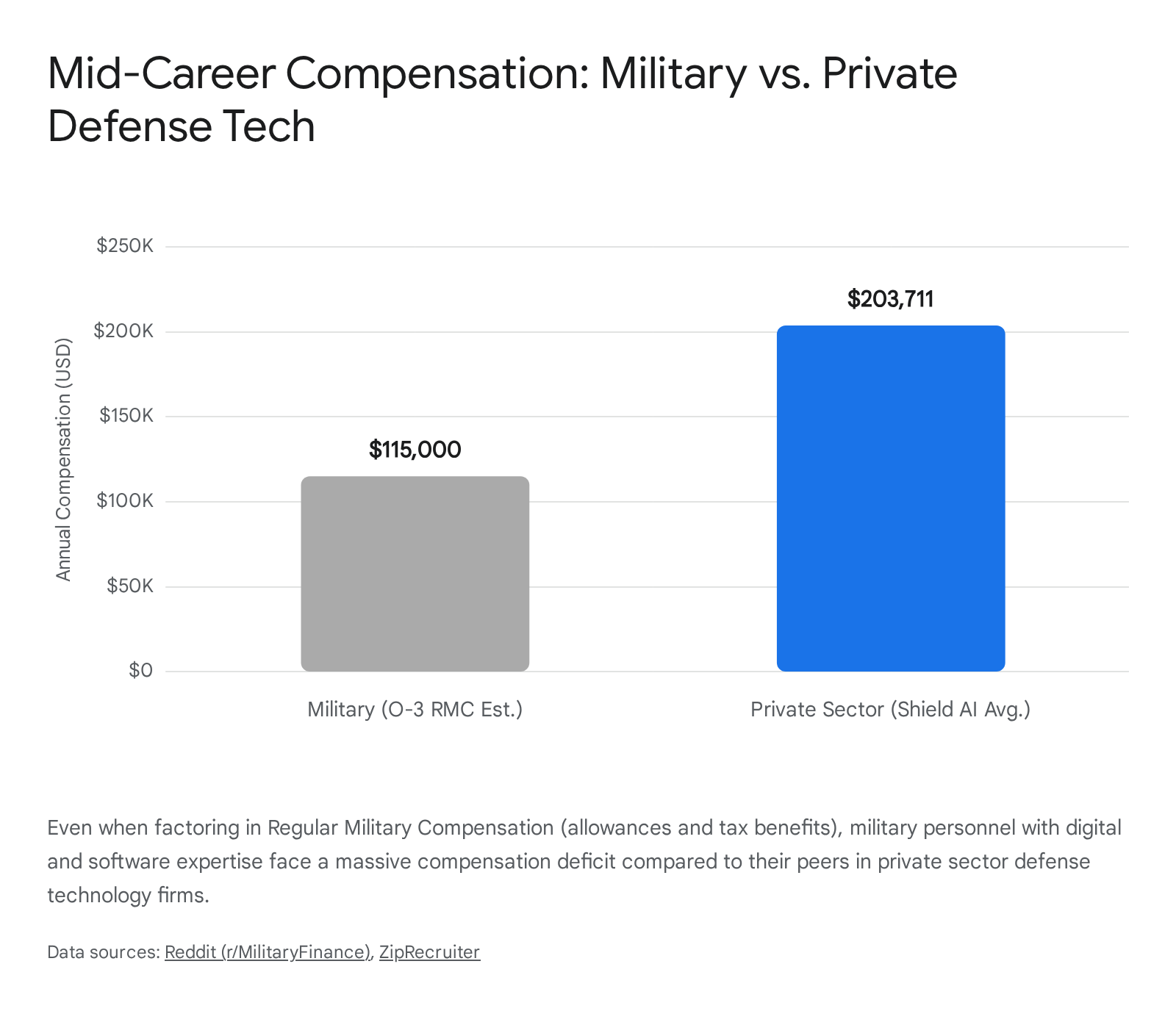
Private sector defense technology companies, such as Shield AI, Anduril, and Skydio, offer compensation packages that significantly outpace military salaries. For example, the average base salary for a software engineer at Shield AI in 2026 is reported at $203,711, with new graduates securing starting salaries around $121,000.7 Senior AI engineers and directors across the industry routinely clear $200,000 to $300,000 in total compensation when factoring in equity and performance bonuses.8
By contrast, an active-duty O-3 (Captain/Lieutenant) in the military, the rank where many critical mid-career retention decisions are made, earns a fraction of this amount, even when adjusting for the tax benefits of RMC.41 Enlisted operators and technicians face an even wider financial gap when evaluating private-sector opportunities. Data indicates that federal software engineers make on average $82,300 annually, which is significantly less than similar private sector positions.38 Furthermore, the Congressional Research Service noted that recent computer science graduates were paid thousands less in the federal government compared to private sector offers.38
| Career Level | Military / Federal Sector | Private Tech Sector (Defense/AI) | Disparity Context |
| Entry Level (New Grad) | O-1 / E-4: ~$60k – $94k (RMC) 41 Federal IT Grad: ~$34k – $42k 38 | Software Engineer: ~$121,000 39 | Private sector offers significantly higher starting base pay and signing bonuses. |
| Mid-Level | O-3 / E-6: ~$90k – $120k (RMC) 41 Federal Software Engineer: ~$82,300 38 | Software/AI Engineer: ~$150,000 – $203,000 7 | Military pay increases via standard step raises; private sector scales rapidly based on technical merit and market demand. |
| Senior Technical Expert | W-4 / O-5: ~$130k – $160k (RMC) | Principal Engineer / Director: $210,000 – $319,000+ 40 | Military caps pay based on rank constraints; private sector relies heavily on stock options and high-tier base salaries. |
Note: Military compensation varies by location and dependent status; private sector figures are based on reported industry averages for defense tech firms and engineering roles.
6.2 The Limitations of Special Incentive Pay
To stem the bleeding of essential talent, the DoD has increasingly utilized special incentive pay. The Government Accountability Office (GAO) reported that the military spent at least $160 million annually on cyber retention bonuses between fiscal years 2017 and 2021 in an attempt to keep highly sought-after experts on the digital front lines.42 The Office of Personnel Management allows agencies to establish group retention incentives of up to 10 percent of basic pay for defined groups of cybersecurity employees to combat private-sector poaching.43
While these bonuses are a necessary stopgap, they are fundamentally insufficient as a long-term strategy for talent retention. A retention bonus spread over several years cannot bridge an annual base salary gap that frequently exceeds $100,000. For instance, the cost to train some cyber professionals is estimated at $220,000 to $500,000 over one to three years, making the loss of these individuals a massive sunk cost for the DoD.44 Furthermore, military bonuses are generally tied to additional multi-year service obligations and rigid contractual terms, compounding the structural frustrations mentioned previously.
6.3 The Private Sector Value Proposition
The private sector offers a comprehensive value proposition that extends beyond raw compensation. Tech companies operate with flat hierarchies, offer at-will employment, provide remote work flexibility, and prioritize rapid vertical mobility based on output rather than time-in-service.
Veterans with UAS experience are highly sought after. Companies value the technical skills, discipline, and operational experience gained in the military, offering roles such as Drone Pilot, UAS Operations Technician, Drone Hardware Engineer, and Program Manager.33 When a military operator considers transitioning, they weigh the prospect of remaining in a rigid system that may cap their promotion potential against an industry desperate for their skills and willing to compensate them at top-of-market rates. Relying solely on financial incentives within a rigid compensation framework is a losing battle; the DoD must fundamentally restructure how it values, manages, and compensates technical expertise.
7. Strategic Imperatives for Modernizing Personnel Management
To fully realize the potential of massive UAS investments, DoD leadership must undertake a comprehensive modernization of its human capital strategy. The focus must shift from simply managing uniform personnel to aggressively cultivating and empowering digital talent across the enterprise.
7.1 Establishing Protected Technical Career Tracks
To operate software-defined UAS capabilities effectively, the DoD must decouple technical advancement from command leadership. The Defense Innovation Board (DIB) explicitly recommended establishing distinct career tracks for computer scientists and programmers to provide incentives for specialization and protect them from pressures to rotate into unrelated roles.21
Private-sector tech companies do not force their best senior software engineers to become human resources managers or administrative executives to receive a pay raise; they offer dual-track systems where individual contributors can achieve the equivalent rank and compensation of senior management based purely on technical value.45 The military must adopt a similar technical track for UAS operators, AI engineers, and cyber specialists, allowing them to promote, receive competitive compensation, and remain in their technical specialties for the duration of their careers.
7.2 Adopting the Space Force “Guardian Spirit” Model
The U.S. Space Force serves as a vital testbed for modern military talent management. Recognizing that it operates in a highly technical and rapidly evolving domain, the Space Force introduced the Core Enlisted Framework and the Guardian Ideal, intentionally stepping away from legacy industrial-age military models.46
The Space Force model emphasizes flexible, permeable career paths, allowing personnel to move between operational leadership and deep technical specialization without career penalties.48 By focusing on continuous feedback rather than rigid annual appraisals, and by not forcing every member into a generic leadership mold, the Space Force aims to maximize the retention of highly technical personnel who have aspirations outside of a traditional linear military career.48 The broader DoD must closely monitor and adopt these practices for its UAS, cyber, and data workforces, tailoring career progression to individual capabilities rather than mandated timelines.
7.3 Lateral Entry and the Expansion of the Digital Corps
To rapidly infuse the DoD with required digital talent, traditional entry-level recruitment is insufficient. The DoD must aggressively expand lateral entry programs, allowing experienced civilian software engineers, data scientists, and UAS program managers to enter the military or federal service at ranks commensurate with their technical expertise, bypassing the junior officer or enlisted phases.
Initiatives like the U.S. Digital Corps, which recruits early-career technologists into the federal government through the Pathways Recent Graduates program, are steps in the right direction but must be scaled dramatically.49 Furthermore, platforms like GigEagle, which matches skilled talent from across the DoD to solve specific technical challenges on-demand, represent the type of agile, project-based talent utilization that the private sector uses to maximize efficiency.50 Expanding these platforms allows the military to tap into hidden reservoirs of talent already residing within the force, ensuring that technical skills are utilized effectively regardless of an individual’s primary occupational specialty.
7.4 Implementing Defense Innovation Board Recommendations
The Defense Business Board (DBB) and the Defense Innovation Board (DIB) have provided comprehensive blueprints for this digital transformation. A central recommendation is the appointment of a DoD Chief Innovation Officer (CINO) to oversee capacity-building efforts, lead the Defense Innovation Network, and promote innovation within the workforce.21
Furthermore, the DBB emphasizes the necessity of aggressive retraining, partnering with academia to provide certifications, and ensuring that digital skill objectives are included in the performance evaluations of leaders at all levels.51 By holding commanders accountable for the digital readiness of their units, the DoD can combat the institutional inertia that currently stifles technological adoption. The DIB also recommends the creation of small, embedded software development teams at each major command—a “human cloud” of programmers—providing an organic resource capable of iterating software solutions directly alongside warfighters, drastically reducing the time required to update UAS capabilities in the field.21
8. Conclusion
The Department of Defense’s massive financial investments in advanced drone technology, autonomous swarms, and attritable systems will fail to yield decisive battlefield advantages if the personnel operating these systems are managed using twentieth-century paradigms. The persistent tendency to fixate on hardware acquisition while overlooking the human capital pipeline is a profound strategic vulnerability.
The integration of unmanned aerial systems is fundamentally a transition from manual mechanical operation to complex software and network management. To deter adversaries and maintain technological supremacy, the DoD must enact fundamental changes. Training pipelines for UAS operators must deprioritize traditional aerodynamic instruction in favor of network architecture, data analytics, software troubleshooting, and electronic warfare management. The military must eliminate the rigid “up-or-out” promotion policies for digital specialists, allowing personnel to achieve senior ranks based on technical mastery. Finally, compensation models must be modernized through lateral entry and flexible incentive structures that reflect the market value of technical skills. In the era of software-defined warfare, the military’s most critical weapon system is not the drone itself, but the digital fluency of the human operating it. Overhauling personnel management is no longer a supplementary administrative task; it is the core operational necessity of the twenty-first century.
Please share the link on Facebook, Forums, with colleagues, etc. Your support is much appreciated and if you have any feedback, please email us in**@*********ps.com. If you’d like to request a report or order a reprint, please click here for the corresponding page to open in new tab.
Sources Used
- The Replicator initiative is key to the Army’s modernization | Brookings, accessed April 24, 2026, https://www.brookings.edu/articles/the-replicator-initiative-is-key-to-the-armys-modernization/
- DOD’s Replicator Program:, accessed April 24, 2026, https://docs.house.gov/meetings/AS/AS35/20231019/116484/HHRG-118-AS35-Wstate-GreenwaltW-20231019.pdf
- DOD touts ‘successful transition’ for Replicator initiative — but questions linger, accessed April 24, 2026, https://defensescoop.com/2025/09/03/dod-replicator-drone-tech-transition-fielding-questions-linger/
- Why Standardized UAS Training Is Critical in 2026 – Unmanned Safety Institute, accessed April 24, 2026, https://www.flyusi.org/blog/why-standardized-uas-training-is-critical-in-2026
- The 2025 Drone integration Beyond Visual Line of Sight (BVLOS) – Federal Aviation Administration, accessed April 24, 2026, https://www.faa.gov/uas/resources/policy_library/Drone-Integration-Concept-of-Operations-May-2025.pdf
- IC Data Strategy 2023-2025, accessed April 24, 2026, https://www.dni.gov/files/ODNI/documents/IC-Data-Strategy-2023-2025.pdf
- Shield Ai Software Engineer Salary in USA Apr 2026 – ZipRecruiter, accessed April 24, 2026, https://www.ziprecruiter.com/co/shield-ai/Salaries/Software-Engineer-Salary
- AI Engineer Salary Guide 2026 | Pay by Role, City & Skill – KORE1, accessed April 24, 2026, https://www.kore1.com/ai-engineer-salary-guide/
- The Glass Ceiling for Remotely Piloted Aircraft – Air University, accessed April 24, 2026, https://www.airuniversity.af.edu/Portals/10/ASPJ/journals/Volume-27_Issue-4/V-Spinetta.pdf
- The Army Built an AI Talent Pipeline—But It’s Filled with Career …, accessed April 24, 2026, https://mwi.westpoint.edu/the-army-built-an-ai-talent-pipeline-but-its-filled-with-career-killing-roadblocks/
- Deep Dive: Pentagon’s Replicator Initiative Raises Questions | Inkstick, accessed April 24, 2026, https://inkstickmedia.com/deep-dive-pentagons-replicator-initiative-raises-questions/
- Is Replicator Replicable? | The Belfer Center for Science and International Affairs, accessed April 24, 2026, https://www.belfercenter.org/research-analysis/replicator-replicable
- C-UAS: Anticipating What’s Next, accessed April 24, 2026, https://uasmagazine.com/articles/c-uas-anticipating-whats-next
- Foreign-Produced UAS and Critical Components Added to FCC’s Covered List | Insights, accessed April 24, 2026, https://www.mayerbrown.com/en/insights/publications/2026/01/foreign-produced-uas-and-critical-components-added-to-fccs-covered-list
- How Federal Cyber Guidance Is Shaping the UAS/C-UAS Market, accessed April 24, 2026, https://insideunmannedsystems.com/how-federal-cyber-guidance-is-shaping-the-uas-c-uas-market/
- From Secrets to Sensors: Why Open Source Data Must Drive Modern Intelligence, accessed April 24, 2026, https://www.thecipherbrief.com/from-secrets-to-sensors-why-open-source-data-must-drive-modern-intelligence
- Closing the Loop: Enhancing U.S. Drone Capabilities through Real-World Testing – CSIS, accessed April 24, 2026, https://www.csis.org/analysis/closing-loop-enhancing-us-drone-capabilities-through-real-world-testing
- Tactical Unmanned Aerial Systems (TUAS) Operations Technician – Army National Guard, accessed April 24, 2026, https://nationalguard.com/150u-tactical-unmanned-aerial-systems-tuas-operations-technician
- 150U – Unmanned Aerial Systems (UAS) Operations Technician – U.S. Army Recruiting Command, accessed April 24, 2026, https://recruiting.army.mil/ISO/AWOR/150U/
- A.5 UAS Maintenance, Modification, Repair, Inspection, Training, and Certification Considerations – FAA’s ASSURE, accessed April 24, 2026, https://assureuas.org/wp-content/uploads/2021/06/A5-Final-Report.pdf
- UNCLASSIFIED 1 DEFENSE INNOVATION … – Department of War, accessed April 24, 2026, https://media.defense.gov/2017/Dec/18/2001857962/-1/-1/0/2017-2566-148525_RECOMMENDATION%2012_(2017-09-19-01-45-51).PDF
- UNMANNED AERIAL SYSTEMS Air Force and Army Should Improve Strategic Human Capital Planning for Pilot Workforces – Government Accountability Office (GAO), accessed April 24, 2026, https://www.gao.gov/assets/gao-17-53.pdf
- GAO-20-320, UNMANNED AERIAL SYSTEMS: Air Force Should Take Additional Steps to Improve Aircrew Staffing and Support, accessed April 24, 2026, https://www.gao.gov/assets/gao-20-320.pdf
- Air Force: Actions Needed to Strengthen Management of Unmanned Aerial System Pilots, accessed April 24, 2026, https://www.gao.gov/products/gao-14-316
- U.S. Army Aviation Center of Excellence Launches Unmanned Advanced Lethality Course to Equip Soldiers for Future Warfare – DVIDS, accessed April 24, 2026, https://www.dvidshub.net/news/545870/us-army-aviation-center-excellence-launches-unmanned-advanced-lethality-course-equip-soldiers-future-warfare
- Air Vehicle Pilot WOs – MyNavyHR, accessed April 24, 2026, https://www.mynavyhr.navy.mil/Portals/55/Career/OCM/Active/LDOCWO/737X_Fact_Sheet_Final.pdf
- Air Force Overhauls Aircraft Maintenance Training – IDGA, accessed April 24, 2026, https://www.idga.org/aviation/articles/air-force-overhauls-aircraft-maintenance-training
- The Drone Industry Offers Viable, Lucrative and Exciting Careers | NBAA, accessed April 24, 2026, https://nbaa.org/news/business-aviation-insider/2025-2026-student/the-drone-industry-offers-viable-lucrative-and-exciting-careers/
- Rethinking the Role of Remotely Crewed Systems in the Future Force – CSIS, accessed April 24, 2026, https://www.csis.org/analysis/rethinking-role-remotely-crewed-systems-future-force
- Incentive Pay for Remotely Piloted Aircraft Career Fields – DTIC, accessed April 24, 2026, https://apps.dtic.mil/sti/tr/pdf/ADA558160.pdf
- Army Establishes New AI and Machine Learning Career Path For Officers – HSToday, accessed April 24, 2026, https://www.hstoday.us/subject-matter-areas/ai-and-advanced-tech/army-establishes-new-ai-and-machine-learning-career-path-for-officers/
- Army establishes new AI, machine learning career path for officers | Article, accessed April 24, 2026, https://www.army.mil/article/289843/army_establishes_new_ai_machine_learning_career_path_for_officers
- From Training to Career: The Workforce Pathway of USI Fast Track Programs – FlyUSI.org, accessed April 24, 2026, https://www.flyusi.org/blog/from-training-to-career-the-workforce-pathway-of-usi-fast-track-programs
- 5 Careers With Drones: How to Start a Drone-Related Career | San Juan College, accessed April 24, 2026, https://www.sanjuancollege.edu/blog/careers-involving-drones/
- From Military to Civilian: Transitioning to UAV Careers | Drone Jobs, accessed April 24, 2026, https://uavjobs.co.uk/career-advice/from-military-to-civilian-transitioning-to-uav-careers
- Military Pay to Civilian Salary Conversion Guide, accessed April 24, 2026, https://bestmilitaryresume.com/blog/career-transition/military-pay-to-civilian-salary-conversion-guide
- A Review of the Military Basic Pay Table, accessed April 24, 2026, https://militarypay.defense.gov/Portals/3/Documents/QRMC-14-Vol_2_final_web.pdf?ver=q03w_3txYXqJ2QzyIZvyhw%3D%3D
- How salaries for federal software engineers stack up against the private sector, accessed April 24, 2026, https://www.federaltimes.com/management/career/2017/09/22/how-salaries-for-federal-software-engineers-stack-up-against-the-private-sector/
- Shield AI Salaries 2026 | $131k-$359k – 6figr.com, accessed April 24, 2026, https://6figr.com/us/salary/shield-ai
- Shield AI Careers, Jobs, and Salary Information – Ladders, accessed April 24, 2026, https://www.theladders.com/company/shieldai-jobs
- Officer vs Civilian Engineer Pay : r/MilitaryFinance – Reddit, accessed April 24, 2026, https://www.reddit.com/r/MilitaryFinance/comments/1goiqvy/officer_vs_civilian_engineer_pay/
- U.S. Military Offers Special Pay to Retain Top Cyber Talent – PSHRA, accessed April 24, 2026, https://pshra.org/u-s-military-offers-special-pay-to-retain-top-cyber-talent/
- Compensation Flexibilities to Recruit and Retain Cybersecurity Professionals – OPM, accessed April 24, 2026, https://www.opm.gov/policy-data-oversight/pay-leave/reference-materials/handbooks/compensation-flexibilities-to-recruit-and-retain-cybersecurity-professionals.pdf
- GAO: DoD Needs to Track Cyber Personnel in Retention Push – MeriTalk, accessed April 24, 2026, https://www.meritalk.com/articles/gao-dod-needs-to-track-cyber-personnel-in-retention-push/
- AF is so heavy on ‘be a leader.’ Not everyone wants to be the star QB making top 10 in highlights . : r/AirForce – Reddit, accessed April 24, 2026, https://www.reddit.com/r/AirForce/comments/1s928it/af_is_so_heavy_on_be_a_leader_not_everyone_wants/
- Space Force releases framework to forge future enlisted leaders, accessed April 24, 2026, https://www.spaceforce.mil/News/Article-Display/Article/4456351/space-force-releases-framework-to-forge-future-enlisted-leaders/
- Space Force unveils Guardian Spirit handbook, accessed April 24, 2026, https://www.spaceforce.mil/news/article/3351530/space-force-unveils-guardian-spirit-handbook/
- The Space Force’s Critical Lesson for the Rest of the Military – War on the Rocks, accessed April 24, 2026, https://warontherocks.com/the-military-should-develop-talent-not-just-manage-it/
- Application Process | U.S. Digital Corps – GSA, accessed April 24, 2026, https://digitalcorps.gsa.gov/process/
- Chief Digital and Artificial Intelligence Office > About > Resources > Pathway to AI Readiness > Workforce Talent, accessed April 24, 2026, https://www.ai.mil/About/Resources/Pathway-to-AI-Readiness/Workforce-Talent/
- Creating A Digital Ecosystem – Defense Business Board, accessed April 24, 2026, https://dbb.defense.gov/Portals/35/Documents/Reports/2024/FY24-03%20Digital%20Ecosystem%20-%20FINAL%20FOR%20PRINT%20with%20DOPSR%20Stamp%204-16-24.pdf