
1. Introduction to Modern Subsonic Ballistics
The tactical firearms market is currently undergoing a profound paradigm shift driven by the demand for acoustic signature reduction combined with overwhelming terminal performance. Historically, the pursuit of suppressed lethality was dominated by the .300 AAC Blackout, a cartridge that successfully demonstrated the viability of launching heavy, aerodynamically efficient projectiles at subsonic velocities from the compact AR-15 platform. However, the operational limitations of the .300 Blackout eventually became apparent to military personnel, law enforcement officers, and discerning civilian shooters. Restricted by the.30 caliber bore diameter and the dimensional constraints of the standard AR-15 magazine well, projectile weights hit a practical ceiling of approximately 220 to 260 grains. When velocity is physically capped by the speed of sound, which is roughly 1,125 feet per second at standard sea-level conditions, the only remaining variable available to increase linear kinetic energy is projectile mass.
This inescapable physical reality has catalyzed the development of a new tier of specialized heavy subsonic cartridges. By expanding the bore diameter to.338 inches, ballisticians have unlocked the ability to seat projectiles weighing 300 grains or more while maintaining high sectional density and superior ballistic coefficients. Two primary cartridges have recently emerged as the undisputed leaders in this new large-bore tactical segment. The 8.6 Blackout, heavily promoted by Q and formally standardized under the Sporting Arms and Ammunition Manufacturers’ Institute in January 2026, utilizes the larger AR-10 and short-action bolt rifle footprint.1 In direct competition is the Hornady 338 Advanced Rifle Cartridge, widely known as the 338 ARC, a specialized design engineered specifically to maximize subsonic performance within the smaller, more ubiquitous AR-15 platform.3
The purpose of this comprehensive report is to rigorously analyze the internal, external, and terminal ballistics of the 8.6 Blackout and the 338 ARC. The analysis explores the radical engineering approaches applied to barrel twist rates, the complex physics of rotational kinetic energy, and the resulting terminal performance on soft tissue and intermediate barriers. Furthermore, the report evaluates the specific firearm platforms from manufacturers such as Brügger & Thomet, CMMG, and Maxim Defense that are championing these calibers. This document provides a detailed market breakdown of product availability and pricing from leading online vendors to offer a complete overview of the current tactical landscape.
2. The Mathematical Physics of Subsonic Flight
To understand the necessity of these new calibers, one must first examine the physics governing suppressed firearms. The report of a firearm consists of two primary acoustic components: the muzzle blast created by expanding high-pressure gases and the sonic boom generated when a projectile breaks the sound barrier. A high-quality sound suppressor can effectively trap, cool, and disperse the expanding gases to mitigate the muzzle blast. However, a suppressor has absolutely no effect on the supersonic crack of the bullet itself in flight. To achieve true acoustic stealth, the projectile must travel below the speed of sound.
The mathematical equation for kinetic energy dictates that energy equals one-half of the mass multiplied by the velocity squared. In traditional supersonic rifle cartridges, velocity is the dominant factor in energy generation. A standard .223 Remington projectile weighing a mere 55 grains can generate immense kinetic energy because it travels at over 3,000 feet per second. However, when operators are forced to restrict velocity to a maximum of approximately 1,050 feet per second to remain comfortably subsonic across varying atmospheric conditions, the velocity variable is completely neutralized.1At that point, the kinetic energy equation becomes entirely dependent on mass.
A 220-grain .300 Blackout projectile traveling at 1,050 feet per second provides a certain baseline of energy, but tactical operators quickly realized this was often insufficient for rapid target incapacitation, especially at extended ranges. To increase the mass without creating a bullet that is too long to stabilize or chamber, engineers had to increase the bore diameter. Moving to a .338 caliber projectile allows manufacturers to pack 285 to 350 grains of mass into an aerodynamically efficient package.2This substantial increase in mass directly translates to a massive increase in retained kinetic energy downrange, overcoming the velocity limitations inherent in subsonic flight.
3. The Genesis and Case Architecture of the 8.6 Blackout
The 8.6 Blackout was engineered with a clear mandate to replicate the success of the .300 Blackout but scaled up for the AR-10 and conventional short-action bolt rifle platforms. Developed initially by the firearm manufacturer Q, the cartridge is fundamentally based on a 6.5 Creedmoor casing.1This parent case selection was highly strategic and incredibly practical for the firearms industry. Engineers shortened the 6.5 Creedmoor case slightly and expanded the neck to accept a larger .338 caliber bullet.1
This specific architecture provides immense logistical advantages. The 8.6 Blackout fits effortlessly into standard, unmodified .308 Winchester or 6.5 Creedmoor magazines without any reduction in standard capacity.2For owners of standard AR-10 rifles, transitioning to the 8.6 Blackout requires nothing more than a simple barrel swap.6The bolt carrier group, buffer system, lower receiver, and magazines remain entirely identical. Furthermore, handloaders can easily convert abundant and inexpensive 6.5 Creedmoor brass into 8.6 Blackout casings by bumping back the shoulder and trimming the neck, ensuring a steady supply of consumable components regardless of factory ammunition availability.6
4. Internal Ballistics: Dwell Time and Propellant Optimization
The internal ballistics of the 8.6 Blackout are meticulously optimized for exceptionally short barrels, typically ranging from 8 inches to 12 inches in length.6 Firing heavy projectiles from such brief barrels presents a unique internal ballistic challenge. If a manufacturer were to use traditional slow-burning rifle propellants, a significant portion of the powder would remain unburned by the time the bullet exited the muzzle. This unburned powder would combust in the atmosphere, creating a massive concussive fireball and overwhelming the baffle system of an attached suppressor.
To achieve a full, efficient powder burn in an incredibly short dwell time, the 8.6 Blackout utilizes fast-burning pistol and magnum pistol propellants. This specific propellant selection ensures that the internal chamber pressure curve peaks very rapidly and drops off steeply before the projectile exits the muzzle. Consequently, the volume of expanding gases that the suppressor must process is drastically reduced. This internal efficiency makes the 8.6 Blackout an exceptionally quiet cartridge when suppressed, generating significantly less blowback and port noise than traditional short-barreled rifle cartridges.
5. The Twist Rate Revolution: Centrifugal Forces and Stabilization
Perhaps the most intensely debated and revolutionary aspect of the 8.6 Blackout is its barrel twist rate. Traditional .338 caliber rifles, such as the widely issued .338 Lapua Magnum, utilize relatively slow twist rates around 1:10 or 1:11 to stabilize lightweight supersonic bullets. When the 8.6 Blackout was initially introduced to the market, it featured an astonishingly fast 1:3 barrel twist rate.1This metric means that the rifling grooves complete one full 360-degree rotation in just three inches of linear barrel length.
Because subsonic projectiles travel at relatively low linear velocities, this aggressive twist rate was initially implemented to guarantee gyroscopic stability for immensely long, heavy bullets.8 Without a rapid spin, a long 300-grain subsonic bullet would begin to yaw and tumble uncontrollably shortly after leaving the muzzle, destroying accuracy and risking devastating baffle strikes inside an attached suppressor.
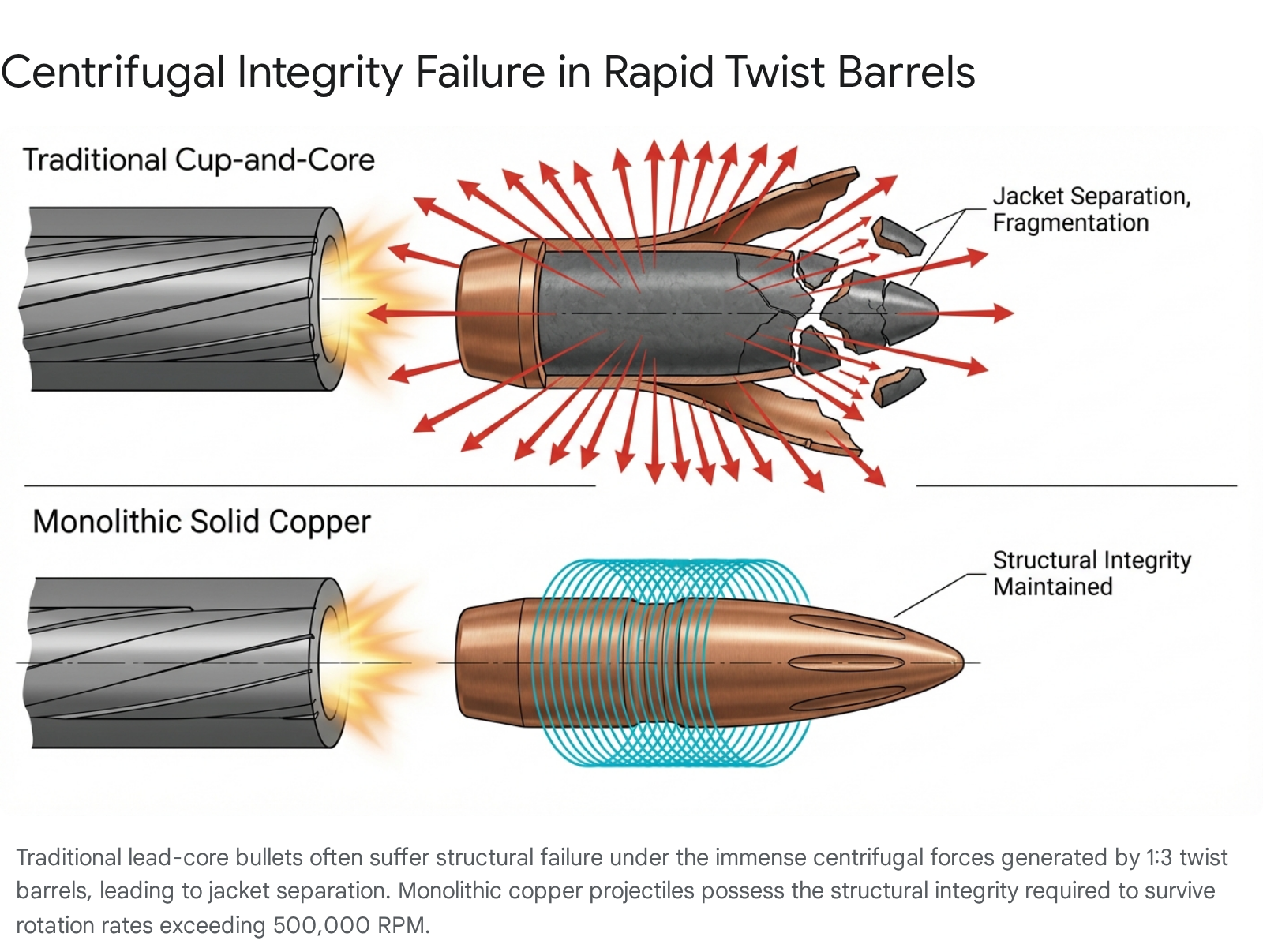
However, engineers quickly realized that this extreme twist rate offered benefits far beyond simple gyroscopic stability. It drastically altered the physics of energy delivery. Rotational speed is dictated by the velocity of the bullet as it leaves the barrel combined with the twist rate of the rifling.1 While subsonic velocity is strictly capped at approximately 1,050 feet per second, the 1:3 twist rate artificially accelerates the rotational velocity to unprecedented levels. A projectile fired from a 1:3 twist barrel at 1,050 feet per second achieves a spin rate exceeding 500,000 revolutions per minute.6 This astronomical angular velocity introduces a massive amount of rotational kinetic energy into the terminal ballistics equation, compensating for the lack of linear velocity.
6. SAAMI Standardization and Industry Divergence
The history of the 8.6 Blackout experienced a significant pivot in January 2026 when the Sporting Arms and Ammunition Manufacturers’ Institute formally standardized the cartridge. In a decision that surprised many industry observers who were intimately familiar with the cartridge’s origins, the published SAAMI specification recommended a 1:6 twist rate rather than the legendary 1:3 twist.1
This divergence highlights a critical engineering and metallurgical compromise. A 1:3 twist rate generates such immense centrifugal force that traditionally constructed cup-and-core lead bullets can experience catastrophic structural failure. The sheer physics of spinning a lead bullet with a thin copper jacket at 500,000 revolutions per minute often causes the jacket to tear apart, literally spinning the bullet into fragments in mid-air immediately after exiting the muzzle. By adopting a more conservative 1:6 twist rate, SAAMI provided a broadly compatible specification that reduces the likelihood of bullet integrity issues across a wide range of commercially available projectiles.1 This standardization avoids the need to introduce complex new manufacturing standards governing bullet construction or rotational limits, providing a specification that traditional ammunition manufacturers can safely follow.1
Despite this official standardization, the tactical market remains divided. Many premium manufacturers continue to produce 1:3 twist barrels, fully aware that operators must exclusively use solid monolithic copper projectiles to survive the violent rotational forces. These monolithic bullets are CNC-machined from solid brass or copper stock, possessing the structural integrity required to withstand extreme centrifugal stress.
7. The Hornady 338 ARC: Engineering a Platform-Specific Solution
While the 8.6 Blackout garnered immense media attention, the Hornady 338 Advanced Rifle Cartridge (ARC) was quietly undergoing rigorous development behind closed doors. According to Hornady ballisticians, the 338 ARC concept actually predates the 8.6 Blackout, with deep research and development initiating in 2017 following a direct request from the United States Department of Defense.4The military required superior subsonic accuracy and improved terminal performance that standard intermediate cartridges could not reliably provide.10After a brief pause in the defense sector, Hornady finalized the cartridge and released it to the commercial and tactical markets, branding it as the absolute epitome of subsonic perfection.4
The primary engineering distinction of the 338 ARC is its meticulous platform compatibility. Unlike the 8.6 Blackout, which necessitates the heavier, bulkier AR-10 receiver set, the 338 ARC is purpose-built to fit within the standard AR-15 platform and modern micro-bolt action rifles.3 This provides operators with a significantly lighter and more compact weapon system, crucial for extended patrols and close-quarters maneuverability. The cartridge utilizes a standard 6.5 Grendel bolt face, maximizing the internal volume of the cartridge case while strictly adhering to the dimensional limits of the AR-15 magazine well.12
This compatibility means that law enforcement agencies and civilian shooters can upgrade their existing AR-15 lower receivers simply by swapping the upper receiver group and purchasing specific magazines. The manual of arms remains identical, negating the need for extensive retraining programs while instantly upgrading the operator’s ballistic capability.
8. Dual-Pressure Loading and Subsonic Efficiency in the 338 ARC
Hornady engineered the 338 ARC with two entirely distinct loading profiles to ensure absolute reliability across the entire spectrum of tactical operations. The subsonic variant operates at a highly conservative internal pressure of 30,000 PSI, while the supersonic variant is loaded to a much higher 52,000 PSI.3 This deliberate pressure management strategy allows for consistent cycling in semi-automatic platforms without requiring the operator to manually adjust gas blocks when transitioning between subsonic and supersonic ammunition.3 This represents a massive operational advantage in high-stress environments where manipulating tiny gas block set screws is tactically unfeasible.
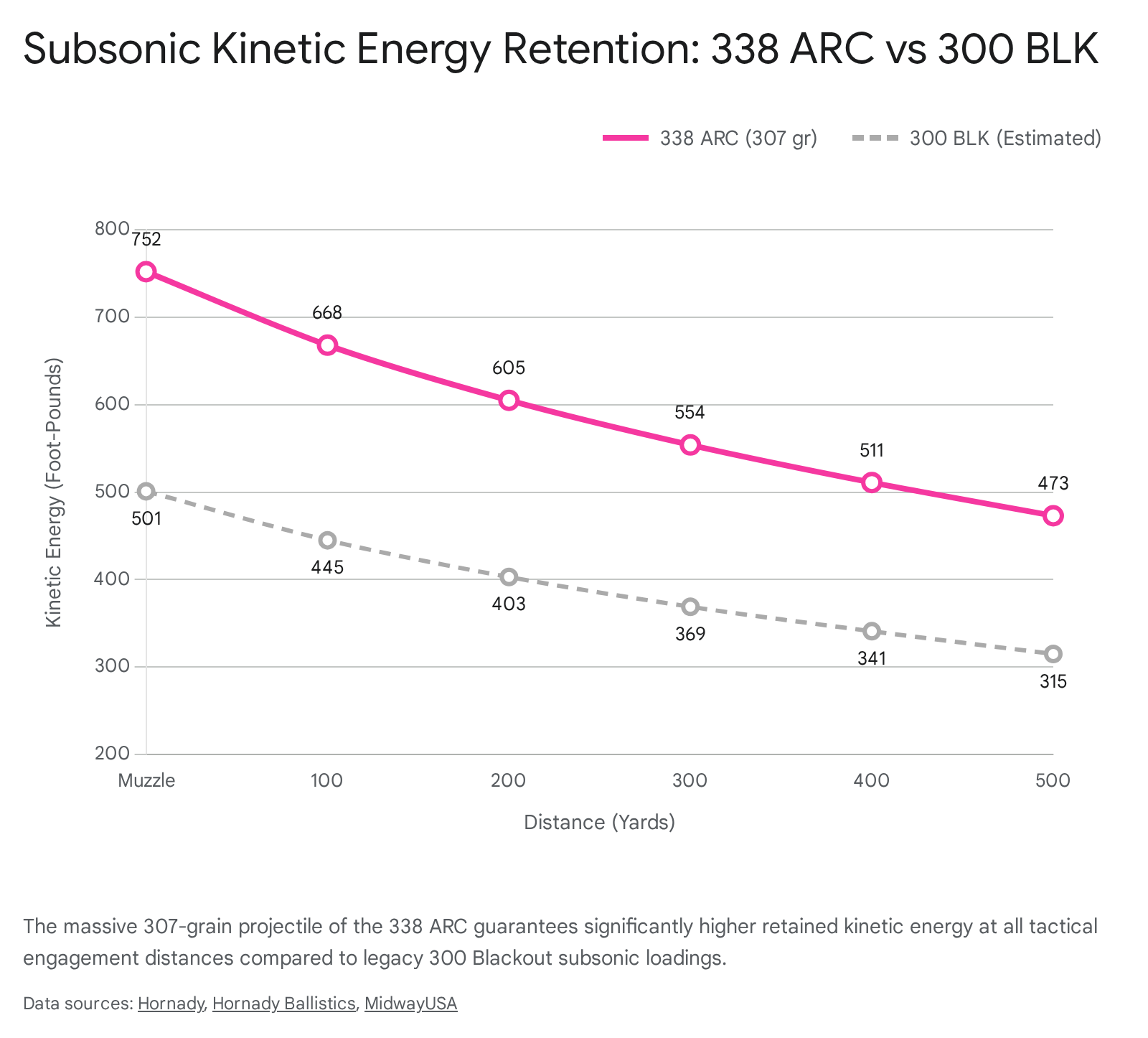
The external ballistics of the 338 ARC are highly impressive and heavily documented. The flagship subsonic load features a massive 307-grain SUB-X bullet achieving a consistent muzzle velocity of 1,050 feet per second from a standard 16-inch barrel.3 At this velocity, the cartridge delivers 751 foot-pounds of muzzle energy, which translates to exactly 1.5 times more kinetic energy than the industry-standard 300 Blackout Subsonic.11
For operations requiring extended reach, the cartridge also offers supersonic applications. The supersonic load drives a 175-grain hollow point at over 2,075 feet per second, providing excellent medium-range trajectory characteristics.3 The heavy 307-grain SUB-X bullet is explicitly designed to expand reliably at impact speeds much lower than a tactical operator will ever realistically encounter, maximizing energy deposit upon impact and making it highly effective for close-quarters defensive engagements.4
9. Comparative Terminal Performance: Subsonic Versus Supersonic
To fully appreciate the massive innovation behind these modern large-bore tactical rounds, one must rigorously analyze the mathematical and physiological realities of terminal ballistics. Traditional battle rifle cartridges, such as the widely issued.308 Winchester, rely heavily on the velocity component of the kinetic energy equation to impart catastrophic damage to biological targets. A standard supersonic.308 Winchester round traveling at 2,600 feet per second generates immense hydrostatic shock upon entering soft tissue. This shockwave creates a massive temporary stretch cavity that aggressively tears surrounding organs and blood vessels far beyond the actual physical path of the bullet itself.
While this velocity-dependent mechanism is highly effective for conventional infantry engagements out to 600 yards 14, supersonic ammunition is inherently and unavoidably loud. The miniature sonic boom generated by the bullet physically breaking the sound barrier cannot be masked or silenced by any suppressor design on the market, making supersonic fire entirely unsuitable for covert, low-signature operations where acoustic stealth is paramount.
When tactical requirements strictly dictate the use of a suppressor and subsonic ammunition, the velocity advantage is entirely neutralized. Because subsonic bullets travel slowly, they simply do not create the explosive hydrostatic shock associated with supersonic rifle fire. To compensate for this critical lack of temporary cavitation, specialized cartridges like the 8.6 Blackout rely on two entirely distinct physical mechanisms to destroy tissue. The first mechanism is sheer mass momentum, driving a heavy object deep into the target. The second mechanism, and arguably the most important innovation in modern ballistics, is extraordinary rotational kinetic energy.
10. The Blender Effect and Rotational Kinetic Energy Mechanics
As previously established, rotational speed is dictated by the velocity of the bullet combined with the twist rate of the rifling.1 By utilizing a radically fast 1:3 twist rate, the 8.6 Blackout imparts a spin rate exceeding 500,000 revolutions per minute to the projectile.6
When a heavy, rapidly spinning solid copper bullet enters soft tissue or ballistic gelatin, it does not simply punch a clean hole. Instead, it transfers its massive stored rotational kinetic energy laterally into the target. Industry ballisticians and marketing teams have colloquially termed this phenomenon the “blender effect”.1 Rather than pushing tissue aside like a traditional slow-spinning pistol bullet, the fast-twist rifle projectile acts exactly like an aggressive drill bit, actively tearing, cutting, and shredding biological structures upon contact.6
This rotational cutting mechanism allows modern subsonic rounds to produce massive, devastating permanent wound channels that successfully mimic the terminal authority of a supersonic rifle strike, despite moving at less than half the speed. To maximize this effect, specialized projectiles like the Solid Copper Spun bullets manufactured by Maxim Defense feature patented Tumble Upon Impact technology.5 These lead-free monolithic bullets are specifically CNC-machined to penetrate through hard barriers before aggressively yawing and tumbling within soft tissue, presenting their entire length to the target medium to create massive internal disruption.5
11. Overcoming Intermediate Barriers and Target Penetration
In modern tactical environments, targets are rarely standing in an open field. Large-frame platforms and heavy projectiles are historically selected when greater ballistic authority is required to forcefully defeat intermediate barriers.16 In realistic combat scenarios, adversaries are frequently obscured by auto glass, heavy winter clothing, interior walls, or light vehicle armor.
A lightweight 5.56 NATO or even a supersonic 300 Blackout projectile often fragments prematurely or deflects wildly when encountering these dense obstacles, failing to reach the primary target with sufficient lethal energy. Conversely, a 285-grain or 300-grain subsonic projectile fired from an 8.6 Blackout or a 338 ARC possesses immense sectional density and massive forward momentum. This unparalleled density allows the heavy bullet to punch cleanly through intermediate barriers with minimal deflection and negligible loss of kinetic energy. The US Army specifically defines ballistic overmatch as the capability to willfully and without prejudice defeat an adversary’s protective systems.16 The heavy subsonic.338 caliber projectiles achieve exactly this, imposing decisive terminal effects within realistic engagement distances while retaining enough performance margin to account for imperfect shot placement and environmental variables.16
12. Firearm Platforms: The Brügger & Thomet APR8.6 Sniper System
The transition from theoretical ballistics to practical tactical deployment requires highly engineered firearm platforms capable of safely harnessing the unique properties of these new heavy cartridges. Several top-tier tactical manufacturers have released dedicated weapons systems optimized specifically for the 8.6 Blackout and the 338 ARC.
Swiss manufacturer Brügger & Thomet, known globally as B&T, has established a dominant presence in the elite suppressed weapons market. Their Advanced Precision Rifle series, originally designed for police snipers and special forces target acquisition at extended ranges, has been entirely re-engineered for the 8.6 Blackout.17 Detailed product specifications can be sourced directly from the official manufacturer’s website at https://bt-usa.com/.
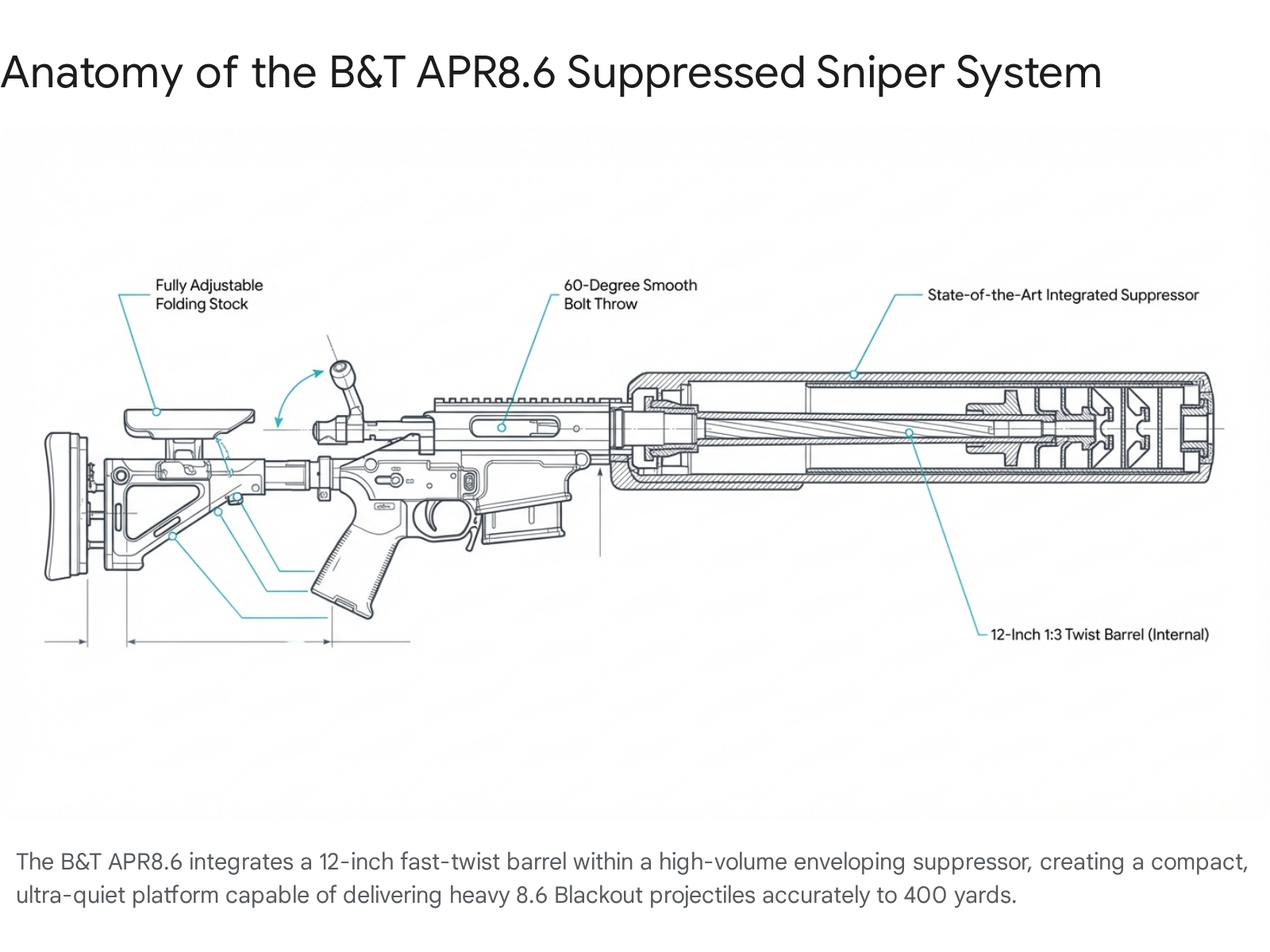
The resulting B&T APR8.6 is officially classified as a specialized hybrid suppressed sniper system.7 Built on a rigid precision bolt-action chassis, the APR8.6 features a highly compact 12-inch barrel equipped with the fast 1:3 twist rate to maximize the rotational kinetic energy of the 8.6 Blackout projectile.7 The defining engineering feature of the platform is its state-of-the-art integrated sound suppressor, which completely envelopes the barrel. This design blends the mid-range precision of the heavy APR series with the ultra-low acoustic signature of B&T’s renowned SPR300 PRO.7
Operating via a remarkably smooth 60-degree bolt throw, the rifle allows the sniper to cycle the action rapidly for fast follow-up shots without losing their sight picture. Weighing 13.45 pounds and featuring a fully adjustable folding stock and customizable cheek riser, the APR8.6 provides tier-one operators with a specialized tool for missions requiring a heavy-hitting projectile optimized for whisper-quiet precision out to 400 yards.7
The B&T APR8.6 is an ultra-premium, low-volume production item subject to strict National Firearms Act regulations due to its short barrel and integrated suppressor.20 As such, it is rarely stocked by standard high-volume retailers. The following table provides pricing and availability across five specialized alternative vendors.
| Vendor | Exact Product Link | Observed Price | Stock Status |
| Bauer Precision | (https://www.bauer-precision.com/b-t-apr8-6-advanced-precision-rifle-8-6-blk/) | $8,705.00 | In Stock |
| Xtreme Guns and Ammo | (https://xtremegunsandammo.com/shop/rifles-for-sale/b-t/bt-apr8-6s-sbr-w-ti-suppressor/) | $8,880.00 | In Stock |
| Palmetto State Armory | (https://palmettostatearmory.com/b-t-usa-apr-8-6-blackout-bolt-action-rifle-black.html) | Pricing Unavailable | Awaiting Restock |
| GrabAGun | (https://grabagun.com/b-t-apr8-6s-8-6-blackout-12-barrel-10-rounds-w-suppressor.html) | Pricing Unavailable | Awaiting Restock |
| Not Just Guns | (https://notjustguns.com/product/bt-bt-apr8.6-s-kit-apr8.6-rflw-suprss-1-of-2) | Pricing Unavailable | Awaiting Restock |
13. Firearm Platforms: CMMG Dissent Mk4 Series
Recognizing the massive potential of the 338 ARC within the AR-15 footprint, CMMG has embraced the caliber by integrating it directly into their highly innovative Dissent Mk4 lineup.12 Further details regarding CMMG’s entire product line can be accessed at https://cmmg.com/.
The Dissent series is famous within the industry for its proprietary compact action upper receiver, which entirely eliminates the need for a traditional AR-15 buffer tube assembly.22 By housing the recoil springs entirely within the upper receiver above the bolt carrier group, the firearms can be equipped with side-folding stabilizing braces or fully folding stocks. This drastically reduces the overall length of the weapon for transport inside vehicles and enhances maneuverability in tight, close-quarters environments.
The CMMG Dissent Mk4 in 338 ARC utilizes a highly refined direct impingement gas system and features barrel lengths of 6.5 inches, 10.5 inches, and 16.1 inches.12 Designed specifically with handloaders and broad projectile compatibility in mind, the CMMG barrels feature a slower 1:8 twist rate to safely accommodate a wider variety of traditionally constructed.338 caliber lead-core bullets.12 Utilizing a standard 6.5 Grendel bolt face, the Dissent platform brings serious large-bore versatility to the familiar AR-15 control footprint, making it an exceptional, lightweight choice for defense, hunting, or tactical applications.
Due to extremely high consumer demand following the release of the 338 ARC, many preferred retailers currently list the highly sought-after 10.5-inch configuration as awaiting restock, necessitating the inclusion of direct manufacturer and alternative retail options.
| Vendor | Exact Product Link | Observed Price | Stock Status |
| Midway USA | (https://www.midwayusa.com/product/1025410382) | $1,725.99 | Awaiting Restock |
| CMMG Direct | (https://cmmg.com/pistol-dissent-mk4-338-arc-10-5?variant=16030) | $1,849.95 | In Stock (Made to Order) |
| Palmetto State Armory | (https://palmettostatearmory.com/cmmg-dissent-mk4-338-arc-10-50-armor-black.html) | Pricing Unavailable | Awaiting Restock |
| Alexander’s Store | (https://alexandersstore.com/product/cmmg-dissent-mk4-338arc-10-5-10rd-ab/) | Pricing Unavailable | Awaiting Restock |
| Sportsmans Warehouse | (https://www.sportsmans.com/c/cat100003-hpf-338-arc-rifles) | Pricing Unavailable | Awaiting Restock |
14. Firearm Platforms: Maxim Defense Innovations
Maxim Defense has aggressively approached the large-bore tactical market from multiple angles, focusing heavily on both advanced ammunition engineering and high-end firearm development. Official product specifications can be verified at https://maximdefense.com/.
In the ammunition sector, the company produces highly specialized 8.6 Blackout ammunition utilizing their proprietary Tumble Upon Impact technology. Their 285-grain subsonic load and 235-grain short barrel supersonic load feature CNC-machined solid copper spun projectiles designed specifically to thrive in fast-twist barrels.5 These rounds deliver extreme, straight-line penetration through bone and dense tissue before creating massive wound channels via aggressive tumbling.
In addition to ammunition manufacturing, Maxim Defense is actively expanding its firearm portfolio to support these heavy calibers. Their flagship MD-11 series of SR-25 pattern rifles, which traditionally chambers 6.5 Creedmoor and.308 Winchester 25, represents a massive step forward in large-frame AR reliability. Furthermore, recent industry developments indicate Maxim Defense is collaborating heavily with Proof Research to release an all-new rifle platform natively chambered in 338 ARC.27 This upcoming system promises to cycle seamlessly between supersonic and subsonic loads directly from the magazine, offering fantastic ballistics in an extremely quiet, lightweight package.
To support the acoustic needs of these calibers, the company offers the highly capable PRS-338 suppressor. This unit is an incredibly lightweight silencer featuring a robust 7075 aluminum tube and a durable Grade 5 titanium thread insert, optimized specifically to keep weight down on hunting and precision semi-automatic rifles.28
15. Market Analysis: Hornady 338 ARC Subsonic Ammunition
The ammunition market is adapting rapidly to feed these new weapon systems. Hornady’s flagship subsonic load for the 338 ARC utilizes a patented Flex Tip XTP bullet design over brass-plated casings, engineered to perform flawlessly and expand reliably at 1,050 feet per second.13 As the primary manufacturer of the cartridge, Hornady has ensured wide distribution among major preferred online retailers, providing steady supply for consumers.
| Vendor | Exact Product Link | Observed Price | Stock Status |
| GunMagWarehouse | (https://gunmagwarehouse.com/hornady-subsonic-338-arc-ammo-307gr-sub-x-20-rounds.html) | $27.99 | In Stock |
| Midway USA | (https://www.midwayusa.com/product/1027758181) | $28.18 | In Stock |
| Brownells | (https://www.brownells.com/ammunition/rifle-ammunition/subsonic-338-arc-rifle-ammo/) | $32.99 | In Stock |
| Palmetto State Armory | (https://palmettostatearmory.com/hornady-subsonic-338-arc-307-gr-fthp-20rds.html) | $34.99 | In Stock |
| KYGunCo | (https://www.kygunco.com/product/hornady-338-arc-307gr-sub-x-20rd-ammo) | $34.99 | In Stock |
16. Future Outlook and Tactical Implications
The widespread adoption of the 8.6 Blackout and the 338 ARC signals a permanent, foundational evolution in close-quarters and intermediate-range tactical ballistics. The military and law enforcement sectors are increasingly prioritizing sound signature mitigation across all operations to protect operator hearing, significantly improve spatial and situational awareness, and reduce command-and-control communication disruptions during chaotic indoor operations. However, the operational compromise previously associated with traditional subsonic ammunition, specifically the severe lack of terminal lethality and poor barrier penetration, has now been definitively solved through massive metallurgical advances and fast-twist ballistic engineering.
Looking forward, the tactical market will likely see a continued, distinct divergence in bullet construction and barrel specification. Because SAAMI standardized the 8.6 Blackout with a conservative 1:6 twist rate to ensure commercial lead-core ammunition safety 1, operators running high-performance 1:3 twist barrels will remain entirely reliant on premium monolithic copper projectiles to prevent catastrophic jacket failure. Ammunition manufacturers will need to clearly label their products with twist-rate tolerances to prevent weapon damage and ensure optimal performance.
Meanwhile, the 338 ARC, with its native AR-15 compatibility and dual-pressure loads, is perfectly positioned to dominate the law enforcement patrol rifle segment, where weight savings and standard-issue platform familiarity are critical logistical requirements.3
17. Conclusion
The tireless pursuit of absolute ballistic overmatch in a truly suppressed package has successfully birthed a new era of heavy subsonic cartridges. The 8.6 Blackout and the Hornady 338 ARC represent distinct but equally devastating engineering solutions to the kinetic energy limitations of legacy intermediate calibers. By intelligently leveraging extraordinary rotational velocity and massive projectile weight, the 8.6 Blackout transforms solid copper projectiles into aggressive cutting tools that induce severe biological trauma without relying on traditional hydrostatic shock. Conversely, the 338 ARC offers unmatched modularity, bringing the undeniable stopping power of a.338 caliber projectile directly into the lightweight, highly adaptable AR-15 footprint without requiring complex gas system adjustments.
Championed by industry-leading manufacturers such as B&T, Maxim Defense, and CMMG, these platforms are no longer theoretical concepts but deployable, highly lethal realities. The ballistic evidence is clear. The ability to willfully defeat intermediate barriers while maintaining whisper-quiet operation provides a decisive tactical advantage in the modern operational environment. As the commercial and professional markets continue to embrace these specialized systems, the reliance on high-velocity, high-signature intermediate cartridges for short-range engagements will undoubtedly face intense doctrinal reevaluation.
Note: Vendor Sources listed are not an endorsement of any given vendor. It is our software reporting a product page given the direction to list products that are between the minimum and average sales price when last scanned.
Please share the link on Facebook, Forums, with colleagues, etc. Your support is much appreciated and if you have any feedback, please email us in**@*********ps.com. If you’d like to request a report or order a reprint, please click here for the corresponding page to open in new tab.
Sources Used
- An Honest Look at 8.6 Blackout | The Ballistic Assistant, accessed April 15, 2026, https://www.theballisticassistant.com/an-honest-look-at-8-6-blackout/
- 8.6mm Blackout – Wikipedia, accessed April 15, 2026, https://en.wikipedia.org/wiki/8.6mm_Blackout
- 338 ARC: Complete Guide to Hornady’s Advanced Rifle Cartridge – CMMG Resources, accessed April 15, 2026, https://resources.cmmg.com/338-arc-complete-guide-hornady-advanced-rifle-cartridge
- Hornady’s New 338 ARC: A CLOSE-RANGE SLEDGEHAMMER – Shooting Times, accessed April 15, 2026, https://www.shootingtimes.com/editorial/hornadys-new-338-arc-sledgehammer/524855
- 8.6 BLK – 285 GR. TUI SUBSONIC – Maxim Defense, accessed April 15, 2026, https://maximdefense.com/product/8-6-blk-285-gr-tui-subsonic/
- 8.6 Blackout: A complete ballistics profile (with pros and cons) – Backfire, accessed April 15, 2026, https://backfire.tv/8-6-blackout-a-complete-ballistics-profile-with-pros-and-cons/
- APR8.6 – B&T USA, accessed April 15, 2026, https://bt-usa.com/products/apr8-6/
- 8.6 Blackout Ballistics – The Lodge at AmmoToGo.com, accessed April 15, 2026, https://www.ammunitiontogo.com/lodge/8-6-blackout-ballistics/
- A Look at Twist Rates and Ballistic Performance – Phantom Defense, accessed April 15, 2026, https://phantomdefense.co/blog/a-look-at-twist-rates-and-ballistic-performance/
- Hornady .338 ARC: The New Standard for Subsonic Ammo?, accessed April 15, 2026, https://www.gunsandammo.com/editorial/hornady-338-arc-subsonic-ammo/525702
- 338 ARC ‑ Hornady Manufacturing, Inc, accessed April 15, 2026, https://www.hornady.com/338arc
- CMMG Dissent MK4 .338 ARC 10.50″, Armor Black | Palmetto State Armory, accessed April 15, 2026, https://palmettostatearmory.com/cmmg-dissent-mk4-338-arc-10-50-armor-black.html
- Hornady Subsonic 338 ARC Ammo 307 Grain Sub-X Polymer Tip Box of 20 – MidwayUSA, accessed April 15, 2026, https://www.midwayusa.com/product/1027758181
- 8.6 Blackout vs .308 : r/AR10 – Reddit, accessed April 15, 2026, https://www.reddit.com/r/AR10/comments/wkarhp/86_blackout_vs_308/
- 8.6 BLK – 235 GR. TUI SBA – Maxim Defense, accessed April 15, 2026, https://maximdefense.com/product/8-6-blk-235-gr-tui-sba/
- Viability of Supersonic 8.6 Blackout – Phantom Defense, accessed April 15, 2026, https://phantomdefense.co/blog/viability-of-supersonic-86-blackout/
- APR – B&T USA, accessed April 15, 2026, https://bt-usa.com/product-category/apr/
- B&T APR338 Bolt Action 27 in / 685mm 338 Lapua On Sale – Best Price – Botach LE, accessed April 15, 2026, https://pd.botach.com/b-t-apr338-bolt-action-27-in-685mm-338-lapua/
- Suppressed Rifle Concept in 338 ARC : r/BT_APC – Reddit, accessed April 15, 2026, https://www.reddit.com/r/BT_APC/comments/1innhvg/suppressed_rifle_concept_in_338_arc/
- BRUGGER & THOMET (B&T) USA APR8.6 8.6BLK INTEGRALLY SUPPRESSED BOLT ACTION SBR – 12.5 – Not Just Guns, accessed April 15, 2026, https://notjustguns.com/product/bt-bt-apr8.6-s-kit-apr8.6-rflw-suprss-1-of-2
- 338 ARC | CMMG – AR 15 and AR 10 Builds and Parts, accessed April 15, 2026, https://cmmg.com/338-arc
- CMMG Dissent MK4 .338 ARC 10.5″ 10+1 Black Cerakote – Alexander’s Store, accessed April 15, 2026, https://alexandersstore.com/product/cmmg-dissent-mk4-338arc-10-5-10rd-ab/
- Pistol, DISSENT, Mk4, 338 ARC, 6.5″ | CMMG – AR 15 and AR 10 Builds and Parts, accessed April 15, 2026, https://cmmg.com/pistol-dissent-mk4-338-arc-6-5
- Pistol, DISSENT, Mk4, 338 ARC, 10.5″ | CMMG – AR 15 and AR 10 Builds and Parts, accessed April 15, 2026, https://cmmg.com/pistol-dissent-mk4-338-arc-10-5
- MD:11 Series – Maxim Defense, accessed April 15, 2026, https://maximdefense.com/product-category/firearms/md11-series/
- Firearms – Maxim Defense, accessed April 15, 2026, https://maximdefense.com/product-category/firearms/
- Maxim Defense New Release at Shot show 2025 338Arc?! – YouTube, accessed April 15, 2026, https://www.youtube.com/watch?v=K5HivBZm1AM
- PRS:338 – Maxim Defense, accessed April 15, 2026, https://maximdefense.com/product/prs338/
- Hornady Subsonic .338 ARC Ammo 307gr Sub-X 20 Rounds, accessed April 15, 2026, https://gunmagwarehouse.com/hornady-subsonic-338-arc-ammo-307gr-sub-x-20-rounds.html