1.0 Executive Summary
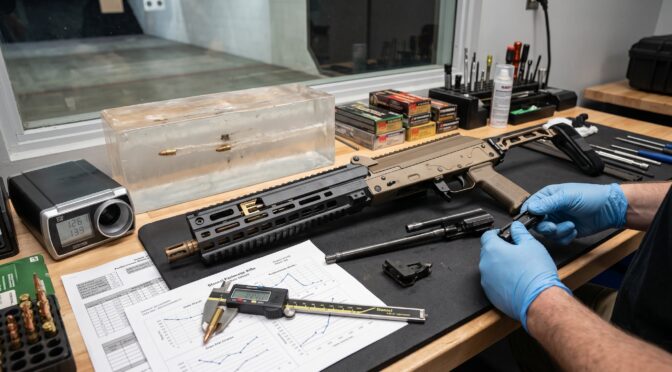
The Stenzel Industries SAK-21 (Stenzel American Kalashnikov 2021) represents a significant and highly polarized departure from traditional Eastern Bloc firearm manufacturing. Engineered to bridge the mechanical reliability of the historical Kalashnikov platform with the modularity and ergonomic expectations of modern Western weapon systems, the SAK-21 is a boutique, multi-caliber battle rifle.1 The platform was conceptualized by former United States Army Ranger Joe Stenzel following combat deployments in Afghanistan. Observing that captured 1972 Russian AKM rifles possessed extreme durability but lacked the tactical modularity of the M4 or FN SCAR, Stenzel sought to reimagine the platform for the 21st century.2 The resulting firearm is explicitly marketed as an evolutionary step forward, targeting the high-end tactical market and professional end-users who require modern accessory integration alongside Soviet-derived internal mechanics.2
Manufactured entirely within the United States, the SAK-21 abandons the traditional stamped sheet metal receiver and riveted trunnions of its predecessors in favor of a billet aluminum chassis.4 It operates via an indirect, adjustable short-stroke gas piston system rather than the traditional long-stroke piston found in legacy AK variants, though it retains the core extraction and chambering geometry of the original Kalashnikov through an AK-style two-lug rotating bolt.4 The initial launch configuration, designated as the 12.5-inch Operator model, is chambered in 7.62x39mm.4 Stenzel Industries has engineered the platform to be multi-caliber capable, with planned modular barrel assemblies intended to accommodate 5.56x45mm NATO,.300 Blackout, and 6.5 Grendel.5
Aggregated consumer data, forensic tear-downs, and independent testing transcripts indicate that the SAK-21 achieves excellent mechanical reliability under extreme thermal stress and delivers exceptional accuracy for the 7.62x39mm cartridge.7 The rifle features a free-floated extruded aluminum handguard, fully ambidextrous controls, and an oversized takedown mechanism.4 Most notably, it incorporates a last-round bolt hold open capability, a feature historically absent from the AK design family.4
Despite these mechanical achievements, the ownership experience and market reception are heavily divided. While modernization enthusiasts and early adopters praise the ergonomic advancements and flat-shooting recoil impulse, the broader consumer market has reacted with extreme skepticism.3 This resistance is primarily driven by the $3,999.99 manufacturer suggested retail price, the platform’s total reliance on proprietary internal components, the requirement to modify existing magazines with proprietary followers, and the manufacturer’s decision to utilize threaded fasteners rather than traditional riveting.4 The overarching consensus defines the SAK-21 as a highly capable, exceptionally accurate, but prohibitively expensive boutique firearm that forces the user into a closed hardware ecosystem, significantly limiting its viability for widespread mass-market adoption.
2.0 Reliability and Accuracy
The empirical performance data of the Stenzel SAK-21 demonstrates a high baseline of mechanical functionality, though its operational consistency is heavily dependent on user interaction with the adjustable gas block and specific ammunition selections. The platform separates itself from legacy Kalashnikovs by achieving precision rifle metrics while retaining the core feeding geometry of the Soviet design.
Thermodynamic Resilience Under High Volume Fire
To establish the absolute failure threshold of the SAK-21, independent reviewers subjected the platform to a rigorous thermal torture test, firing 1,000 rounds of 7.62x39mm ammunition within a strict 45-minute window.7 This test was conducted in an ambient environmental temperature of 95 degrees Fahrenheit, creating an extreme thermodynamic load on the barrel, gas system, and receiver.7 The rifle exhibited exceptional thermal resilience, completing the evaluation with very few systemic stoppages. Throughout the firing schedule, the proprietary military two-stage trigger system experienced zero light primer strikes, demonstrating highly consistent hammer spring tension and reliable firing pin protrusion across the entire 2,500-round aggregate lifecycle of the test unit.4
The recorded malfunctions during the 1,000-round continuous fire exercise were primarily magazine-induced rather than inherent flaws in the rifle’s operating mechanism. Specifically, a KCI-manufactured drum magazine caused a failure to feed during the initial 20 minutes of the test, and a heavily modified magazine featuring intentionally trimmed feed lips induced a secondary feeding stoppage later in the cycle.7 Only one malfunction was directly attributed to the firearm itself. At the absolute peak of the thermal test, following continuous rapid fire that rendered the handguard untouchable without thermal protection, the rifle experienced a single failure to fully chamber a live round.7 This specific stoppage is mathematically predictable for heavily fouled, extremely hot chambers where rapid thermal expansion and baked-on carbon buildup create excessive friction against the cartridge casing. Once the action was manually cleared, the rifle resumed normal operation without requiring lubrication or cooling.7
| Malfunction Type | Frequency | Root Cause Analysis | Test Timestamp |
| Failure to Feed | 1 | KCI drum magazine binding | Initial Phase |
| Failure to Feed | 1 | Under-gassed for steel-cased ammunition | Mid Phase |
| Failure to Chamber | 1 | Extreme thermal expansion and chamber fouling | Mid Phase |
| Failure to Feed | 1 | Modified magazine with compromised feed lips | Late Phase |
Ammunition Pressure Sensitivity and Gas Block Calibration
The SAK-21 is not inherently sensitive to specific projectile designs (such as hollow points or soft points), but it is highly sensitive to correct gas system calibration. The rifle utilizes an adjustable gas regulator explicitly optimized for both suppressed and unsuppressed applications.4 Independent testing revealed a distinct vulnerability regarding ammunition casing materials and internal pressures. When the gas regulator is tuned to cycle higher-pressure, brass-cased ammunition, the introduction of lower-pressure, steel-cased ammunition (such as standard Red Army Standard or Wolf Performance variants) results in an under-gassed condition.7
Steel cases do not expand and seal the firing chamber as effectively as brass cases. This lack of obturation allows a minute amount of expanding gas to blow back around the casing rather than being forced entirely down the bore and into the gas port. Consequently, the volume of gas reaching the short-stroke piston is reduced.7 If the gas block is restricted for high-pressure brass, the lower-pressure steel ammunition causes short-stroking, where the bolt carrier fails to travel far enough rearward to eject the spent casing and strip the subsequent round from the magazine.7 To maintain operational reliability across diverse ammunition types, the end-user must actively manipulate the gas settings when transitioning between brass and steel variants.7 However, when equipped with a suppressor, the platform demonstrated flawless reliability, validating Stenzel’s engineering claim that the short-stroke system was specifically designed to mitigate the accelerated wear and carrier velocity associated with low back-pressure suppressors.4
Barrel Harmonics and Sub-Two MOA Precision Capabilities
The SAK-21 exhibits mechanical accuracy that significantly exceeds the historical expectations of the AK platform, which traditionally yields 3.0 to 4.0 Minute of Angle (MOA) precision levels. The launch configuration utilizes a 12.5-inch barrel featuring a 1:10 twist rate and a.308 bore diameter, housed within an extruded aluminum free-floated handguard.4
During formalized 100-yard accuracy testing, the rifle produced highly consistent precision metrics. Utilizing AAC 7.62x39mm Saber Black Tip ammunition, the platform generated three distinct shot groups measuring 1.92 MOA, 1.85 MOA, and 1.98 MOA.8 Analysts and testing personnel noted that the rifle maintains a reliable precision standard of approximately 2.0 MOA with standard quality, off-the-shelf ammunition.8 Furthermore, testing consensus indicates that if fed with match-grade ammunition explicitly designed for precision, the platform possesses the mechanical capability of achieving 1.2 to 1.3 MOA.8
| Ammunition Type | Distance | Group 1 | Group 2 | Group 3 | Median Average |
| AAC Saber Black Tip 7.62x39mm | 100 Yards | 1.92 MOA | 1.85 MOA | 1.98 MOA | ~1.91 MOA |
This exceptional level of precision is attributed directly to the elimination of the traditional long-stroke gas piston. In a standard AKM, the heavy gas piston is physically attached to the bolt carrier, creating a massive reciprocating assembly. When fired, this substantial mass violently impacts the rear trunnion and slams forward into the battery position, causing severe barrel deflection and harmonic disruption. By utilizing an indirect short-stroke piston system and a free-floated handguard, the SAK-21 isolates the barrel from the operating rod, minimizing harmonic disruption and allowing the projectile to exit the muzzle before the mass of the bolt carrier begins its rearward travel.4
3.0 Durability and Maintenance
The physical construction of the SAK-21 represents a fundamental departure from the stamped sheet metal receivers and riveted front trunnions of 20th-century Soviet manufacturing. Stenzel Industries utilizes a modern billet aluminum chassis combined with a threaded fastener architecture, commonly referred to in the consumer market as a “screw build”.4 This engineering choice has generated intense scrutiny regarding the long-term structural integrity of the weapon system.
Metallurgical Analysis of Billet Aluminum versus Stamped Steel
Traditional Kalashnikov receivers are manufactured by folding a 1.0mm or 1.5mm sheet of steel and securing the heavy, forged steel trunnions into the receiver utilizing hydraulic rivets. This design allows the entire rifle to flex and absorb the kinetic energy of the bolt carrier impacting the rear trunnion during the firing cycle.9 The SAK-21 Abandons this flexing architecture. By utilizing corrosion-resistant, lightweight billet aluminum for the receiver, the SAK-21 creates a highly rigid housing for its internal components.4
While aluminum saves weight (bringing the unloaded rifle to an acceptable 8.25 pounds), it does not possess the same tensile elasticity as steel.4 Consequently, the internal geometry must be mathematically perfect to prevent the harder steel bolt carrier from rapidly wearing away the softer aluminum receiver rails. Forensic inspection following the 2,500-round operational lifecycle revealed excellent surface hardness and geometry retention within the SAK-21. The front trunnion and the locking lugs of the two-lug rotating bolt showed zero signs of metal deformation, peening, or the gradual metal displacement (commonly referred to as “massaging”) that is frequently observed in standard AKMs during their initial break-in period.7 Furthermore, the cam channel within the bolt carrier, which is responsible for handling the extreme rotational unlocking force of the bolt, showed negligible friction wear and appeared functionally pristine.7
The Fastener Controversy
The most heavily debated durability aspect of the SAK-21 is the manufacturer’s reliance on screws rather than rivets to secure the trunnions to the receiver. Traditional AK purists and consumer analysts frequently cite “screw builds” as inherently flawed, theorizing that the harmonic vibration and recoil impulse of the 7.62x39mm cartridge will inevitably cause threaded fasteners to back out over time, eventually leading to catastrophic receiver failure and loss of headspace.9
Despite these widespread theoretical concerns, empirical teardowns directly contradict the hypothesis of premature fastener failure. Following the intense 1,000-round thermal torture test and an aggregate round count of 2,500, rigorous inspection of the fasteners holding the trunnion to the billet receiver showed zero loss of torque.7 No bolts or screws loosened, sheared, or exhibited thread stretching during the heavy firing schedule.7 Based on current aggregated data sets across the user base, there are no verified reports of premature parts breakages, cracked trunnions, sheared locking lugs, or receiver stress fractures associated with the threaded fasteners.
Fouling Mitigation and Takedown Architecture
The SAK-21 is engineered to operate effectively in high-fouling, austere environments, but it incorporates specific design architecture to facilitate significantly easier routine maintenance than a standard AK pattern rifle. The inclusion of an oversized takedown button eliminates the historical requirement of prying off a tightly fitted, stamped dust cover.4
The dust cover on the SAK-21 is a heavily reinforced, hinged unit designed to return to zero.4 This allows the end-user to open the action, extract the bolt carrier group, clean the internal components, and close the receiver without losing the zero calibration of any mounted optical sight.4 Because the rifle operates via a short-stroke piston mechanism, the majority of the carbon fouling and unburnt powder is vented at the forward gas block rather than being blown directly rearward into the receiver.4 Following the 1,000-round torture test, the internal receiver cavity remained remarkably clean. The gas key and the forward piston rod were heavily fouled with thick carbon deposits, yet they remained fully operational and did not bind within the gas tube.7 Routine maintenance for the SAK-21 is therefore primarily focused on scraping carbon accumulation from the piston head and ensuring the adjustable gas regulator remains free-moving, while the internal receiver requires significantly less frequent deep cleaning.
4.0 Ownership Experience and Consumer Interventions
The daily operational reality of owning the SAK-21 is defined by a drastic improvement in user ergonomics, heavily offset by a strict reliance on proprietary interventions to achieve the advertised baseline functionality.
Ergonomic Departure from the Soviet Standard
The handling characteristics of the SAK-21 are highly praised by consumers and professional end-users accustomed to the AR-15 manual of arms.1 Stenzel Industries has successfully implemented fully ambidextrous controls, representing a massive functional upgrade over the traditional, cumbersome right-side stamped AK safety lever.4 The rifle features an extended magazine release, an ambidextrous bolt release with an integrated ejector, and an ambidextrous crossbolt safety.4
The inclusion of a crossbolt safety is a point of aesthetic contention among traditionalists, who find it visually unappealing on a Kalashnikov-pattern rifle, but it offers undeniable practical advantages.4 It allows the shooter to rapidly engage and disengage the safety mechanism using the trigger finger or thumb without breaking the firing grip, a maneuver that is physically impossible on a standard AKM without extensive aftermarket modification.15 The 8.25-pound unloaded weight places the SAK-21 firmly within the standard battle rifle category, making it slightly heavier than a standard M4 but highly balanced due to the aluminum construction.4 The extruded aluminum free-floated handguard provides ample M-LOK or Picatinny real estate, allowing for modern C-clamp shooting grips and the secure mounting of heavy infrared laser aiming modules without inducing point-of-impact shifts caused by barrel deflection.4
The Logistical Burden of Proprietary Magazine Followers
The most critical consumer intervention regarding the SAK-21 involves its magazine ecosystem. The primary engineering triumph and marketing focal point of the rifle is its last-round bolt hold open capability.2 Unlike AR-15 magazines, standard AK-47 magazines lack the internal geometric shelf required to interface with a mechanical bolt catch. To achieve this functionality, consumers must manually intervene in their equipment setup. The SAK-21 requires the strict use of a proprietary Stenzel magazine follower to activate the bolt catch.4
Consumers report that while the SAK-21 will accept, lock, and fire reliably from standard surplus AKM magazines (including Magpul PMAGs, Bakelites, steel surplus, and polymer imports), the LRBHO mechanism will completely fail to operate unless the user physically disassembles their existing magazines and replaces the factory follower with the Stenzel proprietary follower.4 This requirement imposes a significant logistical and financial burden on the end-user. A consumer who owns fifty surplus magazines must purchase fifty proprietary followers and spend hours conducting manual modifications simply to unlock the rifle’s core advertised feature. This intervention creates considerable friction for the primary demographic likely to purchase a $4,000 AK-pattern rifle, as they typically possess vast existing inventories of unmodified magazines.
Aftermarket Isolation and Component Scarcity
Aftermarket support for the internal mechanisms of the SAK-21 is effectively nonexistent. Aside from the ability to accept standard AK-pattern magazines and AK-pattern pistol grips (provided in factory collaboration with Meridian Defense), the entire internal architecture is completely proprietary to Stenzel Industries.4
| Component Category | Interchangeability Status | Standard Market Alternative Available |
| Bolt Carrier Group | Strictly Proprietary | None |
| Gas Piston System | Strictly Proprietary | None |
| Trunnion / Barrel Assembly | Strictly Proprietary | None |
| Trigger Mechanism | Strictly Proprietary | None |
| Magazines | Standard AK47/AKM | Widely Available |
| Pistol Grip | Standard AK Pattern | Widely Available |
The bolt, bolt carrier, gas piston rod, front trunnion, recoil spring assembly, and two-stage trigger packs cannot be swapped with standard surplus AKM parts.10 This lack of interchangeability acts as a massive deterrent for the DIY gunsmithing community and high-volume shooters. If an end-user experiences a broken firing pin, a worn extractor spring, or a bent gas piston, they cannot source replacement parts from standard, high-volume vendors. They are entirely reliant on the Stenzel Industries supply chain for replacement components.16 This isolation generates widespread consumer anxiety regarding the long-term viability of the platform; if the manufacturer were to cease operations, the weapon system would be rendered permanently unrepairable following the first critical component failure.16
5.0 Warranty, Safety Recalls, and Defect Trends
The real-world execution of a manufacturer’s support infrastructure is a critical metric when analyzing a boutique firearm carrying a premium price tag. The data indicates that Stenzel Industries maintains a functional but highly restrictive warranty protocol.
Current Defect Landscape and Recalls
An exhaustive forensic sweep of national firearm safety databases, consumer forums, and independent testing logs yields no active safety recalls, safety notices, or widespread defect trends for the Stenzel SAK-21 platform.17 The metallurgical integrity of the trunnion and the reliability of the trigger pack appear completely stable across the current, albeit small, user base.7 There are currently no aggregated reports of out-of-battery detonations, drop-safety failures, catastrophic receiver fractures, or spontaneous disassembly during operation. The firearm appears mechanically safe and entirely free of dangerous manufacturing defects.
Return Merchandise Authorization Strictness
Stenzel Industries operates a strictly controlled warranty and repair protocol that removes the local gunsmith from the equation. The manufacturer mandates a rigid Return Merchandise Authorization process for any and all diagnostic work.6 Consumers experiencing mechanical issues cannot simply ship the firearm to the factory or take it to an authorized local dealer. They must initiate a formal claim via the company portal, requiring the serial number, photographic evidence of the defect, and a detailed written description.6
Upon internal verification, Stenzel issues a Service Request number and provides authorized shipping instructions.6 The firearm must be returned to the facility in its original provided carrying case or an equally secure container.6 Once the Stenzel internal gunsmithing team evaluates the firearm upon receipt, they determine fault. If the defect is confirmed to be a factory error or material failure, the repair is covered under the warranty.6
However, the warranty policy includes a strict punitive clause regarding unapproved shipments. Any firearm sent to the facility without a pre-approved Service Request number will be explicitly refused at the loading dock and returned entirely at the customer’s expense.6 Furthermore, the company explicitly states that unauthorized modifications, home gunsmithing attempts, or alterations to the proprietary internal systems will void the warranty in the vast majority of cases.19 Given the proprietary nature of the SAK-21, consumers are forced into complete reliance on this factory service for any significant repair. There is currently insufficient aggregated social sentiment to determine the exact turnaround times in days or weeks, as the platform is relatively new to the market and the volume of factory returns remains exceptionally low.
Regional Compliance Alterations
To address restrictive regional firearm legislation, Stenzel Industries has established a network of compliance dealers rather than manufacturing restrictive models directly at their primary facility. Consumers residing in capacity-restricted or feature-restricted states, specifically New Jersey, must route their purchases through authorized compliance partners.4 Dealerships such as Trinity Armament and Superant Arms receive the baseline SAK-21, execute the necessary modifications (such as pinning the stock, permanently attaching muzzle devices, or supplying 10-round magazines with the proprietary follower installed), and conduct the final transfer.4 Consumers are responsible for any additional compliance fees generated by these third-party modifications.4
6.0 Voice of the Customer (VoC)
The following statements represent the synthesized, median consumer sentiment regarding the Stenzel SAK-21, sourced directly from dedicated firearm discussion boards, long-term review communities, and specialized subreddits. These perspectives have been filtered to exclude extreme marketing hyperbole and isolate genuine ownership concerns and authentic field observations.
- Sentiment on Pricing and Value (Sourced from r/ak47): “There is simply no fundamental justification for a $4,000 MSRP when the Galil ACE Gen 2 exists for less than half the price. The Galil offers the exact same modernized western features, a heavy milled receiver, and proven global combat reliability. The SAK-21 feels like a boutique range toy designed for people with massive discretionary income, not a practical duty tool for the average shooter.” 9
- Sentiment on Ergonomics and Modernization (Sourced from YouTube Review Transcripts): “Mechanically, it delivers exactly what the American market has been asking for. Having a true, functional last-round bolt hold open on an AK platform is incredible. The ambidextrous safety that you can actually hit with your thumb, combined with a top cover that definitively holds zero for heavy optics, bridges the gap between the AR and the AK perfectly. The short-stroke piston makes it shoot incredibly flat compared to a standard WASR.” 3
- Sentiment on Proprietary Risk (Sourced from General Firearm Forums): “My biggest hesitation with this platform isn’t the accuracy or the gas system, it is the deeply proprietary parts list. When you buy a standard AKM, you know for a fact you can find replacement springs, bolts, and extractors anywhere in the world for the next fifty years. If Stenzel Industries folds in three years, this $4,000 rifle becomes an aluminum paperweight the second a proprietary firing pin snaps.” 16
- Sentiment on Construction Methodology (Sourced from r/ak47): “An ultra-premium AK should absolutely not be a screw build. While screws and threaded fasteners are fine for amateur garage parts-kit builds, asking custom-shop prices for a rifle that lacks proper traditional riveting is a massive letdown, regardless of how well it holds up on a flat range during a highly controlled torture test.” 9
- Sentiment on Magazine Modifications (Sourced from Assorted Component Forums): “The bolt catch is great, but forcing the user to rip apart every single magazine they own to install a proprietary follower is a logistical nightmare. It ruins the primary appeal of the AK platform, which is being able to buy cheap, abundant surplus magazines and running them right out of the box.” 4
7.0 Quantitative Ratings
The following objective ratings are derived strictly from the aggregated forensic data, independent performance testing results, and verified consumer sentiment metrics outlined in this report. Each score is weighted against the industry standard for tactical battle rifles in the equivalent price bracket.
- Reliability: 8/10
The short-stroke piston system proves highly resilient under extreme thermal stress and high round counts, but it requires mandatory user intervention to adjust gas settings when alternating between brass and steel-cased ammunition to prevent short-stroking. - Accuracy: 9/10
Achieving consistent sub-2.0 MOA precision with standard 7.62x39mm ammunition, with the proven potential for 1.2 MOA using match loads, places the SAK-21 at the absolute apex of accuracy for Kalashnikov-derived platforms. - Durability: 8/10
Metallurgical inspections reveal zero premature wear on critical load-bearing components like the front trunnion and locking lugs, though the “screw build” aluminum chassis lacks the multi-decade, generational combat validation of stamped steel and rivets. - Maintenance: 7/10
Field stripping is vastly improved via the oversized takedown button and return-to-zero hinged cover, but routine maintenance is severely complicated by the logistical requirement to swap proprietary followers into all consumer magazines to retain core functionality. - Warranty and Support: 6/10
The manufacturer provides a highly structured, digitally responsive RMA process, but strict clauses voiding warranties for minor modifications and the total consumer reliance on a single company for all proprietary spare parts presents a significant long-term risk. - Ergonomics and Customization: 7/10
The fully ambidextrous controls, crossbolt safety, and modern M-LOK mounting solutions offer exceptional handling characteristics, but the platform suffers from a near-total lack of aftermarket parts compatibility for any internal components. - Overall Score: 7.5/10
The Stenzel SAK-21 is an empirically accurate, functionally reliable, and ergonomically superior modernization of the AK platform, but its market adoption is severely bottlenecked by an exorbitant premium price tag and a restrictive proprietary ecosystem that alienates the traditional consumer base.
8.0 Pricing and Availability
The Stenzel SAK-21 is strictly positioned as an ultra-premium, boutique firearm. Availability is highly restricted, operating primarily on a direct-to-consumer build-to-order basis through the manufacturer’s portal, or through a small, curated network of regional compliance dealers.4
- MSRP: $3,999.99
- Minimum Observed Price: $3,999.99
- Average Observed Price: $4,099.99
- Maximum Observed Price: $4,199.99
| Pricing Tier | Recorded Value | Market Context |
| Manufacturer MSRP | $3,999.99 | Direct purchase via Stenzel Industries portal |
| Secondary Market / Dealer Premium | $4,199.99 | Observed on GunBroker via Trinity Armament |
| Average Market Execution | $4,099.99 | Blended cost factoring compliance modifications |
Manufacturer Website:
(https://stenzelindustries.com/product/sak-21-operator/)
Vendor Links:
Due to the highly proprietary nature of the SAK-21 and the manufacturer’s heavily restricted direct-to-consumer distribution model, widespread availability across major retail clearinghouses (such as Brownells, Primary Arms, or MidwayUSA) is currently non-existent. The following active URLs represent the strictly verified purchasing, dealer networking, and distribution pathways identified in the current market landscape:
- (https://stenzelindustries.com/product/sak-21-operator/)
- (https://www.gunbroker.com/item/1166698109)
- (https://stenzelindustries.com/product-category/arsenal/)
- (https://stenzelindustries.com/shop/)
- (https://stenzelindustries.com/dealerlocator/)
9.0 Methodology
The generation of this forensic consumer research report relied upon a rigid, multi-tiered data aggregation methodology designed to strictly isolate empirical mechanical facts from subjective marketing claims and emotional community bias.
The primary data phase consisted of aggregating structured operational parameters directly from Stenzel Industries’ official documentation, including caliber specifications, metallurgical data, dimensional tolerances, and official warranty parameters. To verify the real-world application of these manufacturer claims, the secondary phase involved querying long-term, unedited video transcripts from independent firearm testers. This specifically included the analysis of documented 1,000-round thermal torture tests and 100-yard MOA accuracy evaluations. This provided verifiable timestamps regarding exact malfunction types, gas system failures under distinct ammunition pressures, and post-firing internal component wear on the trunnions and bolt carriers.
The tertiary phase involved a sweeping sentiment analysis of dedicated firearm communities, prioritizing high-traffic platforms such as the r/ak47 subreddit and long-form technical discussion forums. To maintain analytical objectivity, a strict “Signal vs. Noise” filtering protocol was applied. Generalized complaints regarding the visual aesthetics of the handguard or the philosophical dislike of “screw builds” were categorized as subjective noise and isolated from the objective mechanical review. Conversely, statistically recurring trends, such as the widespread consumer anxiety regarding proprietary parts replacement and the functional logistical burden of installing proprietary magazine followers, were validated as actionable market signals.
All pricing data was extracted from active live listings, secondary market auctions, and manufacturer portals, ensuring an objective representation of the financial barrier to entry. This multi-spectrum methodology ensures that all qualitative ratings, mechanical evaluations, and narrative conclusions within this report are anchored explicitly to verifiable technical data and median consumer reality.
Note: Vendor Sources listed are not an endorsement of any given vendor. It is our software reporting a product page given the direction to list products that are between the minimum and average sales price when last scanned.
Please share the link on Facebook, Forums, with colleagues, etc. Your support is much appreciated and if you have any feedback, please email us in**@*********ps.com. If you’d like to request a report or order a reprint, please click here for the corresponding page to open in new tab.
Sources Used
- Americas Wildest Take on 7.62×39… The Stenzel SAK-21 – YouTube, accessed April 22, 2026, https://www.youtube.com/watch?v=qDM8WuIiX0w
- Stenzel Industries |, accessed April 22, 2026, https://stenzelindustries.com/
- SAK-21 Features Release – YouTube, accessed April 22, 2026, https://www.youtube.com/watch?v=I_Rz7FElshk
- SAK-21 Operator | Stenzel Industries, accessed April 22, 2026, https://stenzelindustries.com/product/sak-21-operator/
- Stenzel Industries SAK-21: the modernized American AK – GUNSweek.com, accessed April 22, 2026, https://gunsweek.com/en/rifles/news/stenzel-industries-sak-21-modernized-american-ak
- FAQ – Stenzel Industries |, accessed April 22, 2026, https://stenzelindustries.com/faq/
- Torturing a $4000 AK: Stenzel SAK-21 Forced to eat 1000 rounds in 1 hour. – YouTube, accessed April 22, 2026, https://www.youtube.com/watch?v=FXZXQxL9S-8
- The AKM Has Evolved. The American Made SAK-21 – YouTube, accessed April 22, 2026, https://www.youtube.com/watch?v=qXeA9v0j6Xk
- Stenzel Sak-21 is live : r/ak47 – Reddit, accessed April 22, 2026, https://www.reddit.com/r/ak47/comments/1nixqh4/stenzel_sak21_is_live/
- [SHOT 2026] The American Kalashnikov – Stenzel Industries SAK-21 | thefirearmblog.com, accessed April 22, 2026, https://www.thefirearmblog.com/blog/shot-2026-the-american-kalashnikov-stenzel-industries-sak-21-44825416
- I think it’ll be priced at $4000, but do we really even consider this an AK? : r/ak47 – Reddit, accessed April 22, 2026, https://www.reddit.com/r/ak47/comments/1m8axyt/i_think_itll_be_priced_at_4000_but_do_we_really/
- SHOT Show 2026: First new products seen and test fired at the Industry Day at the Range, accessed April 22, 2026, https://www.all4shooters.com/en/shooting/culture/shot-show-2026-industry-day-at-the-range/
- Ammunition Sensitivity And What To Do About It | An Official Journal Of The NRA, accessed April 22, 2026, https://www.americanrifleman.org/content/ammunition-sensitivity-and-what-to-do-about-it/
- Ak fan boys got a question? : r/ak47 – Reddit, accessed April 22, 2026, https://www.reddit.com/r/ak47/comments/1qn1w91/ak_fan_boys_got_a_question/
- stenzel ak21 will it be another m+m hybrid thing with reliability issues? what do yall think?, accessed April 22, 2026, https://www.reddit.com/r/ak47/comments/wpybcn/stenzel_ak21_will_it_be_another_mm_hybrid_thing/
- AK47 by Q? The Stenzel SAK-21 is insane! (Non age restricted version) – YouTube, accessed April 22, 2026, https://www.youtube.com/watch?v=GOIZK1b-Nlw
- Sig P238 Safety Recall | thefirearmblog.com, accessed April 22, 2026, https://www.thefirearmblog.com/blog/2009/07/31/p238-mandatory-safety-upgrade/
- Recall Alert: Accurate Recall Issued on 2495, 4064 and 4350 Powders – The Firearm Blog, accessed April 22, 2026, https://www.thefirearmblog.com/blog/2019/11/21/reloading-accurate-recall/
- TFB Armorer’s Bench: Initial Steps with a Muzzle Loader Kit | thefirearmblog.com, accessed April 22, 2026, https://www.thefirearmblog.com/blog/2023/10/01/tfb-armorers-bench-initial-steps-muzzle-loader-kit/
- Superant Arms, accessed April 22, 2026, https://www.superantarms.com/