Executive Summary
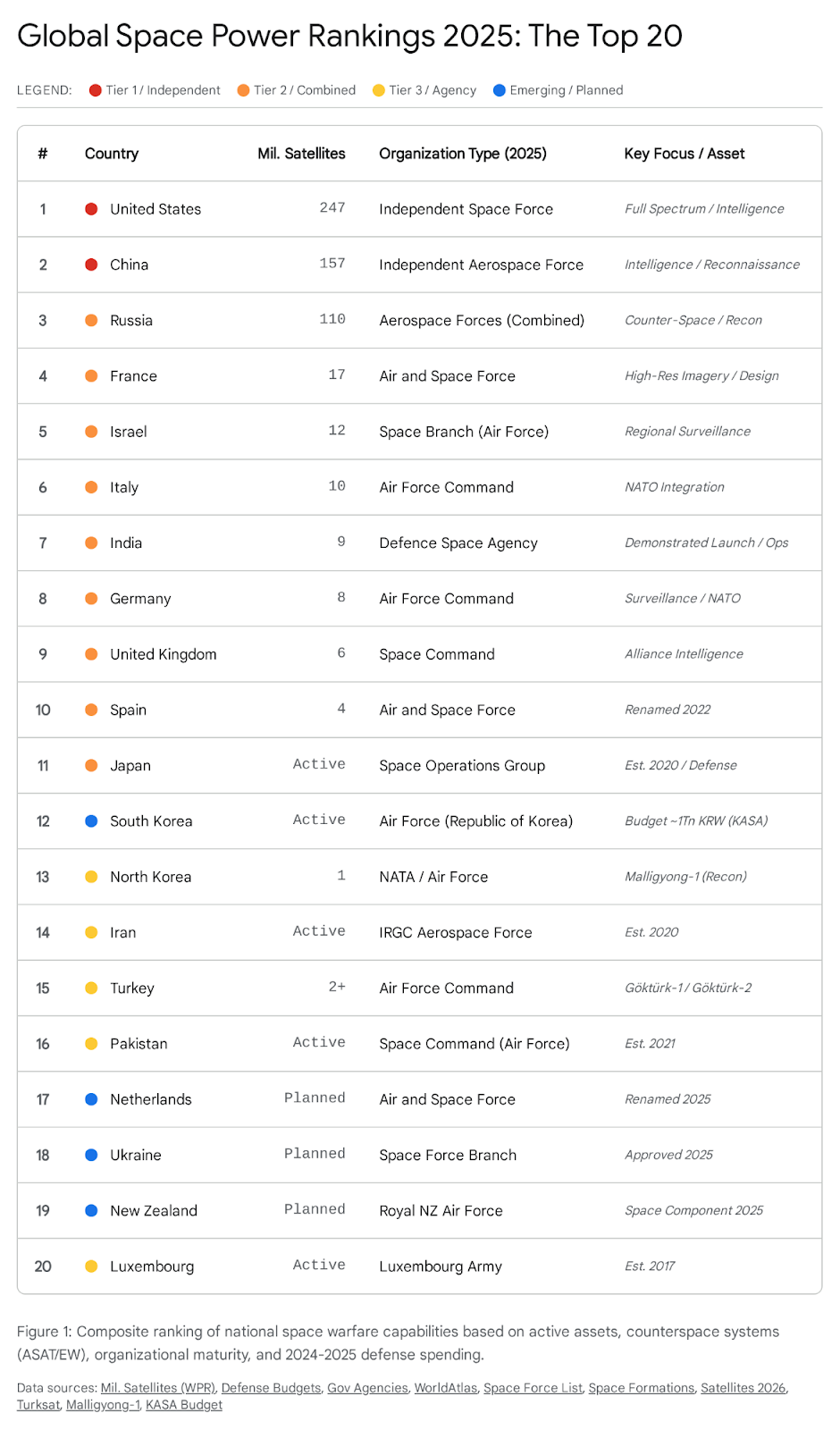
The transition of outer space from a benign operational sanctuary to an active domain of military conflict represents one of the most consequential shifts in modern strategic affairs. This comprehensive intelligence report evaluates the space warfare strategies, counterspace capabilities, and doctrinal postures of the world’s three preeminent space powers: the United States, the People’s Republic of China (PRC), and the Russian Federation. Based on open-source intelligence (OSINT) up to early 2026, this analysis assesses the relative strengths, vulnerabilities, and strategic trajectories of each nation to establish a definitive ranking of global space power.
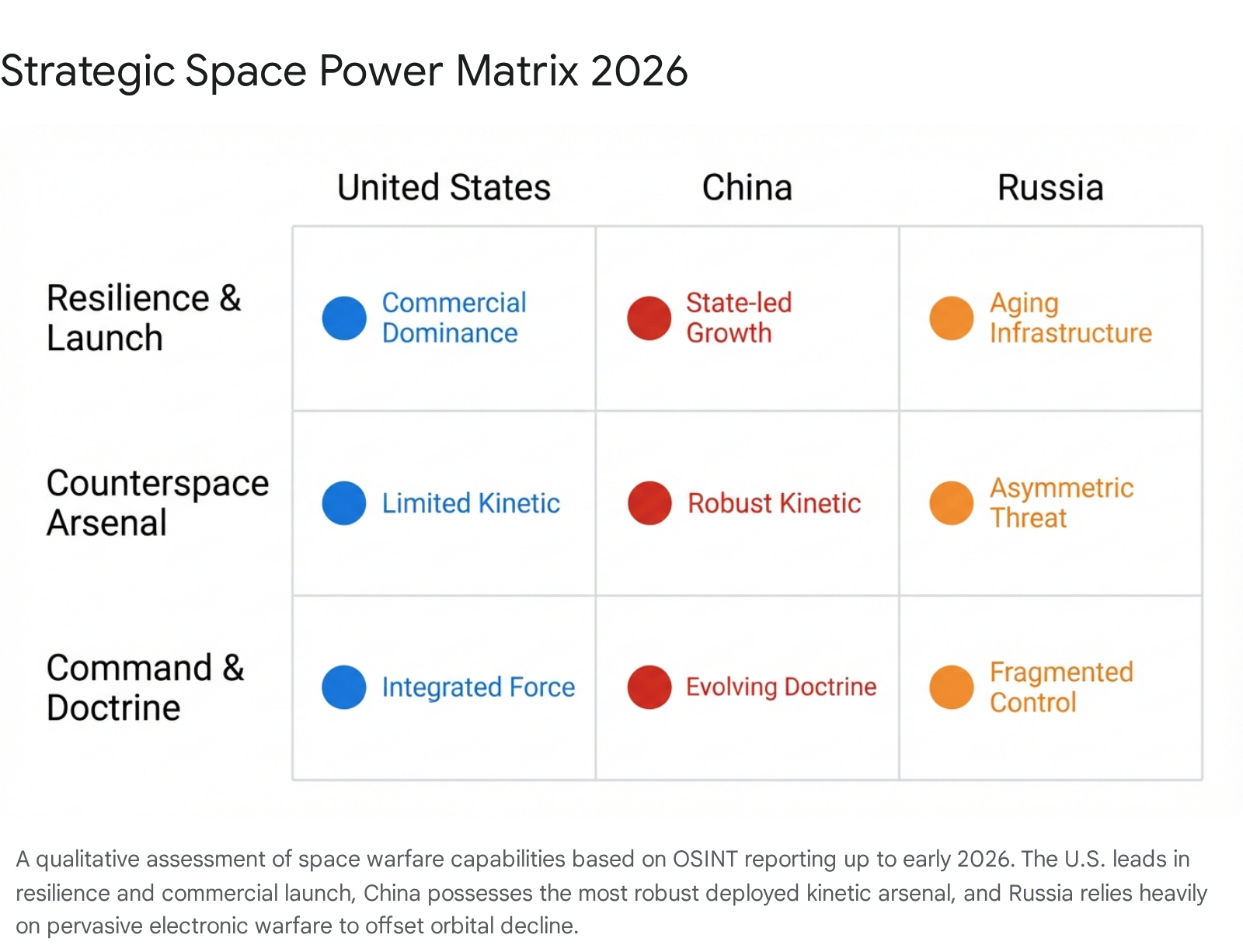
The central finding of this assessment is that global space competition is currently defined by a race between the proliferation of resilient orbital architectures and the development of asymmetric counterspace weapons. The United States maintains its position as the premier global space power (Rank 1), driven by an unmatched commercial space industrial base, a massive pivot toward proliferated low Earth orbit (pLEO) resilience, and the maturation of the United States Space Force (USSF) warfighting doctrine. The PRC occupies a rapidly accelerating second position (Rank 2). Following a pivotal 2024 military reorganization that dismantled the Strategic Support Force (SSF) and established the Aerospace Force (ASF), Beijing is executing a whole-of-nation strategy to field a wartime space architecture capable of denying United States space superiority in the Indo-Pacific region. The Russian Federation is ranked third (Rank 3). While Russia suffers from a decaying space industrial base and a historically low launch cadence, it remains a highly dangerous spoiler state. Moscow actively employs daily electronic warfare in terrestrial conflicts and is developing high-end, indiscriminate asymmetric weapons (such as a space-based nuclear anti-satellite system) to hold rival space architectures at risk.
The report concludes that the United States advantage relies heavily on the continued integration of commercial innovation to outpace the rapid, state-directed acquisition models of the PRC and the disruptive, norm-breaking behaviors of the Russian Federation. The future of space warfare will increasingly rely on non-kinetic, reversible effects such as cyber intrusions, electromagnetic jamming, and sophisticated rendezvous and proximity operations, necessitating a robust and adaptable deterrence framework.
1. Introduction and Strategic Context
The commercialization and militarization of space have fundamentally altered the calculus of global deterrence and military strategy. As national economies, civilian infrastructure, and military kill chains become entirely reliant on space-based positioning, navigation, timing (PNT), and intelligence, surveillance, and reconnaissance (ISR), the ability to protect these assets and deny them to adversaries has become a core requirement for national survival and power projection.1 The global commons framework that historically governed outer space, emphasizing universal access and non-appropriation, is being increasingly challenged by geopolitical rivalry.3
The 2025 Global Counterspace Capabilities Report highlights a rapid proliferation of offensive systems, noting that at least 12 countries are actively developing or researching counterspace technologies.1 These capabilities span a broad spectrum, including direct-ascent anti-satellite (DA-ASAT) missiles, co-orbital rendezvous and proximity operations (RPOs), directed energy weapons, electronic warfare (jamming and spoofing), and cyber operations targeting ground infrastructure.4 However, the strategic competition is overwhelmingly driven by the United States, China, and Russia. These three nations uniquely possess the comprehensive launch infrastructure, extensive orbital presence, and advanced counterspace arsenals required to unilaterally alter the balance of power in the space domain.1
The operational environment in 2026 is characterized by a high degree of instability and a blurring of the lines between peacetime competition and active conflict. In regions such as the Baltic Sea, the Middle East, and the Indo-Pacific, jamming and spoofing of Global Positioning System (GPS) signals have become daily occurrences, impacting both military operations and civilian aviation.7 Furthermore, the dual-use nature of many space technologies, such as satellite servicing and debris removal vehicles, creates inherent ambiguity. Behaviors intended for legitimate commercial or scientific purposes can easily be interpreted as hostile counterspace operations, raising the risk of miscalculation and unintended military escalation.9
This intelligence report provides a systematic and exhaustive comparison of the United States, the People’s Republic of China, and the Russian Federation. It evaluates their respective military doctrines, organizational structures, offensive and defensive counterspace capabilities, and launch reconstitution capacities to determine their relative strategic standing and the future trajectory of space warfare.
2. United States: Competitive Endurance and Commercial Resilience
The United States enters 2026 amid a profound doctrinal transformation. Recognizing that space superiority is a prerequisite for Joint Force success, the Department of Defense has shifted from viewing space primarily as a supportive utility environment to treating it unequivocally as a contested warfighting domain.11 This shift is underpinned by significant institutional growth and a heavy reliance on the commercial space sector to achieve architectural resilience.
2.1. Doctrinal Evolution and the Space Warfighting Framework
The strategic posture of the United States Space Force (USSF) is defined by the theory of “Competitive Endurance.” This foundational doctrine aims to avoid operational surprise, deny adversaries a first-mover advantage, and conduct responsible counterspace operations that secure national interests without generating long-lasting orbital debris.13
In April 2025, the USSF released a landmark doctrinal document titled “Space Warfighting: A Framework for Planners.” This framework explicitly established a common lexicon for offensive and defensive counterspace operations and codified the USSF’s shift toward full-spectrum warfighting.11 Chief of Space Operations General B. Chance Saltzman articulated that the formative purpose of the Space Force is to achieve space superiority, defined as ensuring freedom of movement for United States forces while actively denying that same freedom to adversaries.11
The framework mandates that the USSF must protect the Joint Force from space-enabled attacks, a significant doctrinal evolution that elevates space control and counterspace fires to core missions.11 The doctrine categorizes counterspace operations into three primary mission areas: orbital warfare, electromagnetic warfare, and cyberspace warfare.11 To align near-term operations with long-term strategic requirements, the USSF is also finalizing “Objective Force 2025,” a comprehensive 15-year strategic roadmap detailing the specific systems, infrastructure, and personnel required through the year 2040 to counter emerging peer threats.16
2.2. Space Capabilities and Offensive Counterspace
Historically, the United States has relied on the inherent technological superiority of its legacy satellite systems. However, these exquisite and expensive systems are highly vulnerable to asymmetric attacks. In response, the United States has accelerated the deployment of non-kinetic, reversible counterspace weapons designed to temporarily degrade adversary capabilities without causing permanent physical destruction.
The United States currently operates the Counter Communications System (CCS), a deployed ground-based electromagnetic jammer, and is in the process of fielding a second advanced system known as Meadowlands (also referred to as the RMT system).1 These electronic warfare tools allow the United States to disrupt adversary satellite communications and ISR data links during a conflict.6
In the orbital domain, the United States possesses highly advanced rendezvous and proximity operations (RPO) capabilities. Systems such as the Geosynchronous Space Situational Awareness Program (GSSAP), the X-37B orbital test vehicle, and various classified assets (including PAN, MENTOR, and LDPE-3A) allow the United States to conduct close inspections and characterizations of foreign satellites.1 Furthermore, the Tactically Responsive Space (TacRS) program, highlighted by upcoming missions like Victus Haze, demonstrates the intent to rapidly launch, maneuver, and deploy assets in direct response to dynamic on-orbit threats.18 Notably, the United States currently refrains from fielding destructive, ground-based kinetic anti-satellite (ASAT) missiles, largely to promote international norms of responsible behavior and avoid the catastrophic generation of space debris.6
2.3. Commercial Integration and Proliferated Architectures
The absolute greatest strength of the United States space strategy is its vibrant commercial space industrial base. Driven by companies like SpaceX, Rocket Lab, and others, the United States possesses a launch cadence that dwarfs all global competitors combined. In 2024, the United States conducted 145 orbital launch attempts, outpacing China by a massive margin.9
This unmatched launch capacity enables the strategic transition to proliferated low Earth orbit (pLEO) architectures. Programs such as the Space Development Agency’s Proliferated Warfighter Space Architecture (PWSA) and commercial mega-constellations like Starshield provide unprecedented redundancy for communications and missile tracking.9 By distributing capabilities across hundreds or thousands of small satellites, the United States achieves “deterrence by denial.” Kinetic attacks against a pLEO constellation become mathematically and economically unfeasible for an adversary, as the targeted satellites can be rapidly replaced via the commercial launch sector faster than the adversary can manufacture and launch expensive ASAT interceptors.22
2.4. Strategic Assessment: Pros and Cons
Pros: The United States maintains absolute global dominance in launch capability, launch reliability, and commercial space innovation.6 The integration of commercial pLEO architectures provides a level of orbital resilience that makes traditional kinetic attacks strategically ineffective. Furthermore, the United States excels in non-kinetic space control operations, possessing advanced RPO capabilities and localized jamming systems that offer flexible, reversible escalation options.4 The deep integration of space capabilities into terrestrial combatant commands ensures that space power acts as a massive force multiplier for the Joint Force.23
Cons: The primary vulnerability of the United States strategy is its overwhelming, systemic reliance on space. Global power projection, logistics, and precision strike capabilities are entirely dependent on orbital assets, making the space domain the ultimate center of gravity for the United States military.7 This deep reliance creates an exceptionally attractive target for adversaries. Furthermore, traditional Department of Defense acquisition cycles remain sluggish and bureaucratic compared to the rapid iteration seen in the commercial sector or the Chinese state-directed apparatus.6 Lastly, while pLEO architectures defeat direct-ascent kinetic ASATs, they remain highly vulnerable to widespread electronic warfare, persistent cyber intrusions targeting ground stations, or indiscriminate area-effect weapons such as high-altitude nuclear detonations.7
3. People’s Republic of China: Intelligentized Warfare and Rapid Proliferation
The People’s Republic of China views space dominance as a vital component of its national rejuvenation and a critical prerequisite for winning regional conflicts, particularly regarding a potential Taiwan contingency.27 Beijing’s space strategy is methodical, heavily state-directed, and overwhelmingly focused on achieving parity with, and eventually surpassing, the United States by fielding a wartime space architecture capable of denying United States space superiority.20
3.1. Organizational Restructuring: The Birth of the Aerospace Force
In a highly significant and previously unexpected move in April 2024, President Xi Jinping ordered the dissolution of the PLA Strategic Support Force (SSF).29 The SSF, created in 2015 to centralize space, cyber, and electronic warfare, apparently suffered from fragmented command structures, internal friction, and an inability to smoothly integrate its varied operational missions across theater commands.29
In its place, the PLA established three new independent arms: the Aerospace Force (ASF), the Cyberspace Force (CSF), and the Information Support Force (ISF).29 These forces now report directly to the Central Military Commission (CMC), effectively elevating their strategic prominence.29 The Aerospace Force commands all of the PLA’s space assets, launch sites, and orbital operations, while the Information Support Force focuses on network information systems and joint operations integration.27 This reorganization flattens the command hierarchy and is designed to directly improve the integration of space-based ISR and missile early warning data into joint theater operations, accelerating the PLA’s readiness for high-end, multi-domain conflict.27
3.2. Space Deterrence and Doctrinal Posture
Chinese military doctrine characterizes space as a “commanding height” of strategic competition.33 Under the concept of “intelligentized” warfare, the PLA believes that controlling information networks is the absolute key to modern victory.27 The PLA’s space deterrence strategy relies heavily on demonstrating the capability to hold United States space assets at risk, thereby restricting United States intervention in the Indo-Pacific.28
Unlike the United States, which emphasizes deterrence by denial through resilience, the Chinese strategy explicitly integrates space, cyber, and nuclear capabilities to control the intensity of escalation and achieve deterrence through the threat of punishment.27 Beijing is executing a whole-of-nation approach, leveraging military-civil fusion to ensure that every new space technology or commercial capability directly benefits the PLA’s operational edge.34
3.3. Counterspace Arsenal
China possesses the world’s most comprehensive, diversified, and operational counterspace arsenal.35 Beijing has fielded ground-based direct-ascent ASAT missiles capable of targeting LEO satellites, and the United States Defense Intelligence Agency assesses that China likely intends to develop ASAT weapons capable of reaching up to Geostationary Earth Orbit (GEO).36
Non-kinetically, the PLA operates multiple advanced ground-based laser systems designed to dazzle, degrade, or permanently blind satellite optical sensors.36 In orbit, China is highly active in conducting sophisticated RPOs. Satellites such as the SJ-21 have demonstrated the ability to grapple and move other objects into graveyard orbits. This represents a dual-use technology equally applicable to civil debris removal and offensive satellite capture.28 In 2025, United States military officials observed Chinese satellites conducting synchronized, multi-asset “dogfighting” maneuvers, indicating advanced tactical proficiency in orbital warfare.28 The PLA also regularly incorporates comprehensive electronic warfare jammers into its exercises, targeting satellite communications and navigation networks.36
3.4. Capability Proliferation and Megaconstellations
China has executed a breathtaking expansion of its orbital architecture. Since 2015, the Chinese on-orbit satellite presence has grown by over 660 percent, exceeding 1300 satellites by late 2025.36 Over 510 of these are ISR-capable platforms equipped with optical, multispectral, synthetic aperture radar (SAR), and radio-frequency sensors.37 This massive, persistent sensor web provides the PLA with the continuous surveillance necessary to track United States aircraft carriers and expeditionary forces, enabling the execution of long-range precision kill chains.27
To counter the United States Starshield advantage, China is rapidly deploying its own pLEO mega-constellations, primarily the state-owned Xingwang network and the commercially produced G60 (Qianfan) network, which aims to field up to 14,000 satellites by 2030.27 To support this immense proliferation, China is heavily investing in expanding its launch infrastructure, including the completion of new launch pads at the Hainan Commercial Launch Complex and the demonstration of sea-based launch platforms.27 Furthermore, Chinese aerospace companies are making significant strides in developing reusable space launch vehicles (SLVs) to increase cadence and lower costs.27 Beyond Earth orbit, China is aggressively pursuing cislunar dominance, successfully executing the Chang’e-6 far-side lunar sample return mission in 2024 (supported by the Queqiao-2 relay satellite) and advancing plans for the International Lunar Research Station (ILRS) in partnership with Russia.27
3.5. Strategic Assessment: Pros and Cons
Pros: China possesses operational counterspace weapons across multiple domains, including kinetic ground-launched missiles, directed energy systems, and co-orbital grappling capabilities. These systems are actively deployed and exercised, providing the PLA with diverse escalation options.6 The rapid, state-backed expansion of the Chinese space industrial base ensures a steady pipeline of advanced ISR satellites and the rapid deployment of redundant pLEO mega-constellations.20 The military-civil fusion strategy ensures that all commercial advancements are immediately available for military application, and the 2024 reorganization into the Aerospace Force centralizes command authority directly under the CMC.29
Cons: Despite its massive material gains and organizational restructuring, the PLA Aerospace Force remains untested in actual combat. The dissolution of the SSF indicates that the Chinese military previously struggled significantly with the complex command and control required for multi-domain operations, and it remains to be seen if the new arm structure resolves these systemic integration issues.31 Furthermore, as China proliferates its own orbital assets, it creates an asymmetric vulnerability. By mirroring the United States reliance on space for ISR and communications, China offers a target-rich environment that the United States and its allies can exploit during a conflict.28 Finally, the employment of China’s most capable kinetic ASAT weapons would generate massive debris clouds that would severely damage its own rapidly growing satellite fleets, potentially limiting their practical utility.22
4. Russian Federation: Asymmetric Cost Imposition and Shadow Warfare
Russia’s space warfare strategy is defined by a sharp and deepening dichotomy. While its traditional space industrial base is in terminal decline, its military has fully embraced space as a daily warfighting domain. Moscow utilizes space denial tools not merely as future deterrents, but as active, operational weapons on the modern battlefield, leveraging asymmetry to offset its conventional weaknesses.
4.1. Doctrinal Shifts and the Aerospace Forces (VKS)
Russian military strategy views the United States and NATO as existential threats. Recognizing its inability to match Western conventional forces or orbital resilience, Russian doctrine focuses on asymmetric cost imposition and subversive warfare.39 Russian space troops were integrated into the Aerospace Forces (VKS) in 2015 to theoretically synchronize air, missile, and space operations.36
However, the war in Ukraine has exposed severe flaws in Russian command and control. Russian military thinkers acknowledge that their forces struggle with tactical integration and lack the automated combat management systems required to fuse space-based ISR directly to front-line units.40 While attempting to adapt, the Russian military apparatus remains hampered by rigid hierarchies and an inability to rapidly disseminate satellite intelligence to the tactical edge.26
4.2. Electronic and Cyber Warfare Integration
Where Russia excels is in the brute-force application of electromagnetic and cyber warfare. Rooted in Soviet doctrine, Russian forces employ extensive electronic warfare (EW) to sever the link between space assets and terrestrial users.43 Throughout the war in Ukraine, Russia has systematically jammed and spoofed GNSS and SATCOM signals on a massive scale.7
This tactical denial has successfully degraded the effectiveness of Western-supplied precision munitions, such as HIMARS and Excalibur artillery rounds, forcing adversaries to adapt their kill chains.7 Russian EW activity regularly bleeds into international civilian sectors, causing massive disruptions to commercial aviation over the Baltic Sea and the Middle East.8 Concurrently, Russian intelligence agencies (such as the GRU’s Unit 26165, known as APT28 or Fancy Bear) execute persistent multi-vector cyber campaigns against satellite ground stations, logistics entities, and Western critical infrastructure.44 The Viasat hack at the onset of the Ukraine invasion demonstrated Russia’s capability and willingness to use cyber operations to achieve strategic space denial.44 Russia has clearly established a precedent for treating commercial space networks as legitimate military targets.36
4.3. High-End Asymmetry: The Nuclear ASAT Threat
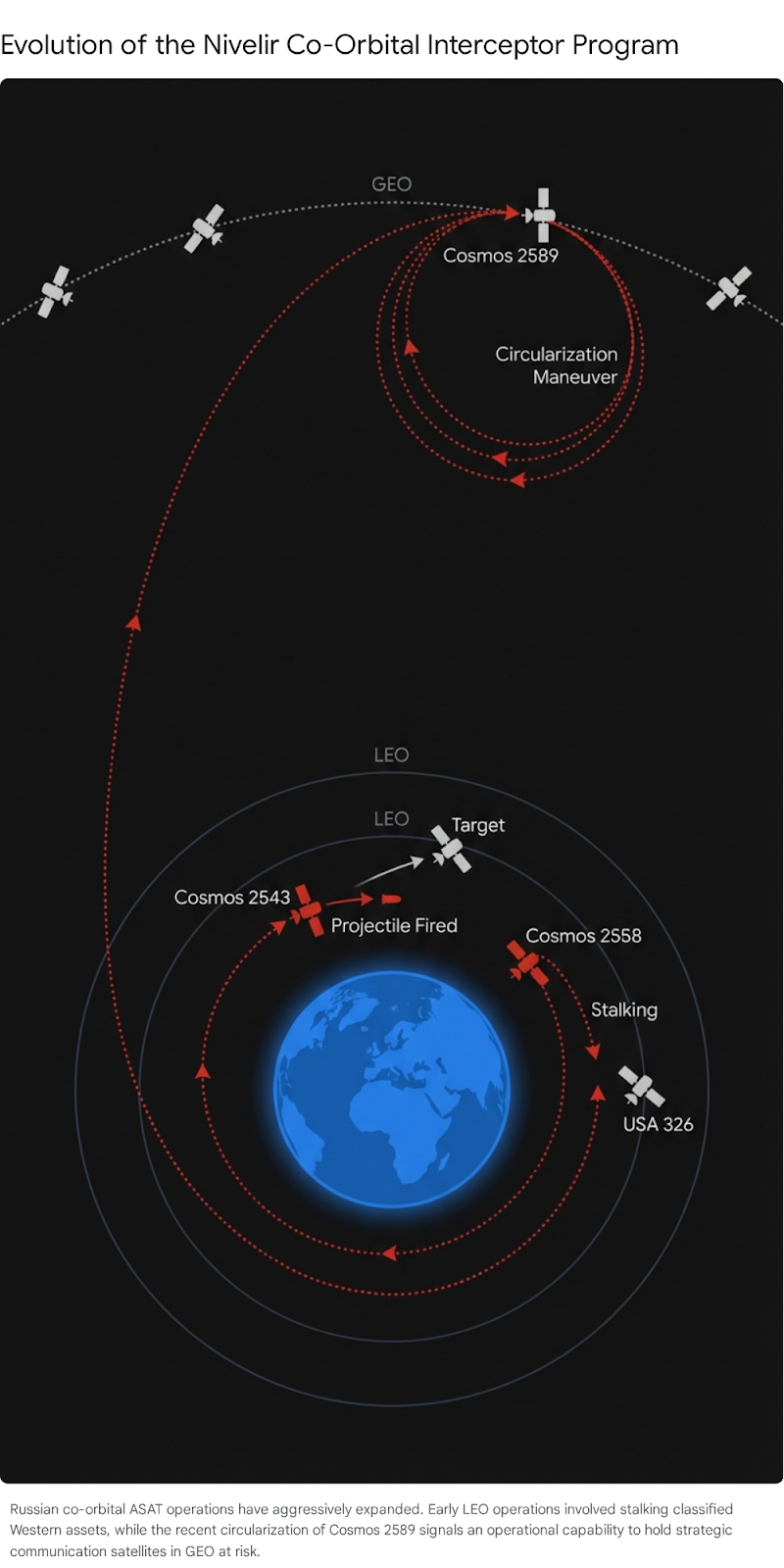
Russia’s most destabilizing strategic development is its suspected pursuit of a space-based nuclear weapon. United States intelligence indicates that Russia is developing an orbital system designed to carry a nuclear device.47 Specific attention has been drawn to the Russian satellite COSMOS-2553, operating in an unusual high-altitude low Earth orbit region characterized by higher radiation.49
A high-altitude nuclear detonation (HAND) would generate a massive electromagnetic pulse (EMP) and a severe, long-lasting radiation environment.7 This would indiscriminately disable or destroy unhardened satellites across entire orbital regimes.7 This capability represents a direct, asymmetric response to the United States deployment of pLEO mega-constellations. Because Russia cannot match the launch cadence required to build its own resilient networks, and lacks the inventory of kinetic missiles to shoot down thousands of Starlink satellites individually, a nuclear ASAT serves as an ultimate equalizer.47 It provides the Kremlin with a unique tool for strategic coercion, essentially holding the global digital economy hostage and demonstrating a willingness to violate the core tenets of the 1967 Outer Space Treaty.47
4.4. Industrial Decline and Launch Reconstitution
Despite its dangerous asymmetric arsenal, the Russian civil and military space program is hollowing out. Crushed by international sanctions, an embargo on advanced microelectronics, a massive brain drain, and the reallocation of funding to the war in Ukraine, the Russian space industrial base is struggling to sustain basic operations.51
Russia’s launch cadence has collapsed; it conducted only 17 launches in 2024, falling dramatically behind both the United States and China.36 Due to systemic failures in domestic satellite manufacturing and limited constellation sizes, the Russian military has been forced to procure critical tactical ISR imagery from commercial Chinese entities, such as Spacety, to support its ground operations in Ukraine.36 This growing technological and strategic dependence on Beijing risks reducing Russia to a junior partner in the bilateral relationship, relying on China to augment its failing orbital infrastructure.27
4.5. Strategic Assessment: Pros and Cons
Pros: Russia demonstrates an unmatched willingness to utilize broad-spectrum electronic and cyber warfare in daily combat operations, accepting high levels of collateral disruption.7 The integration of these capabilities creates significant tactical friction for adversaries. Furthermore, the development of extreme asymmetric weapons, such as a space-based nuclear ASAT, provides Russia with a potent strategic deterrent that circumvents the resilience of United States mega-constellations.47 Russia acts as a highly effective spoiler state, unconstrained by international norms.
Cons: The Russian space industrial base is in terminal decline, suffering from severe technological deficits and a collapsed launch cadence.36 Russia possesses effectively zero capacity to rapidly reconstitute a destroyed satellite architecture during a high-intensity conflict. Its military command structures struggle with the rapid integration of space data at the tactical level.26 Furthermore, Russia’s reliance on indiscriminate weapons like a nuclear ASAT limits its strategic flexibility; a nuclear detonation in space would destroy Russian and Chinese assets alongside United States assets, leaving it useful only as a weapon of ultimate desperation or last resort.7
5. Comparative Analysis of Global Space Warfare Strategies
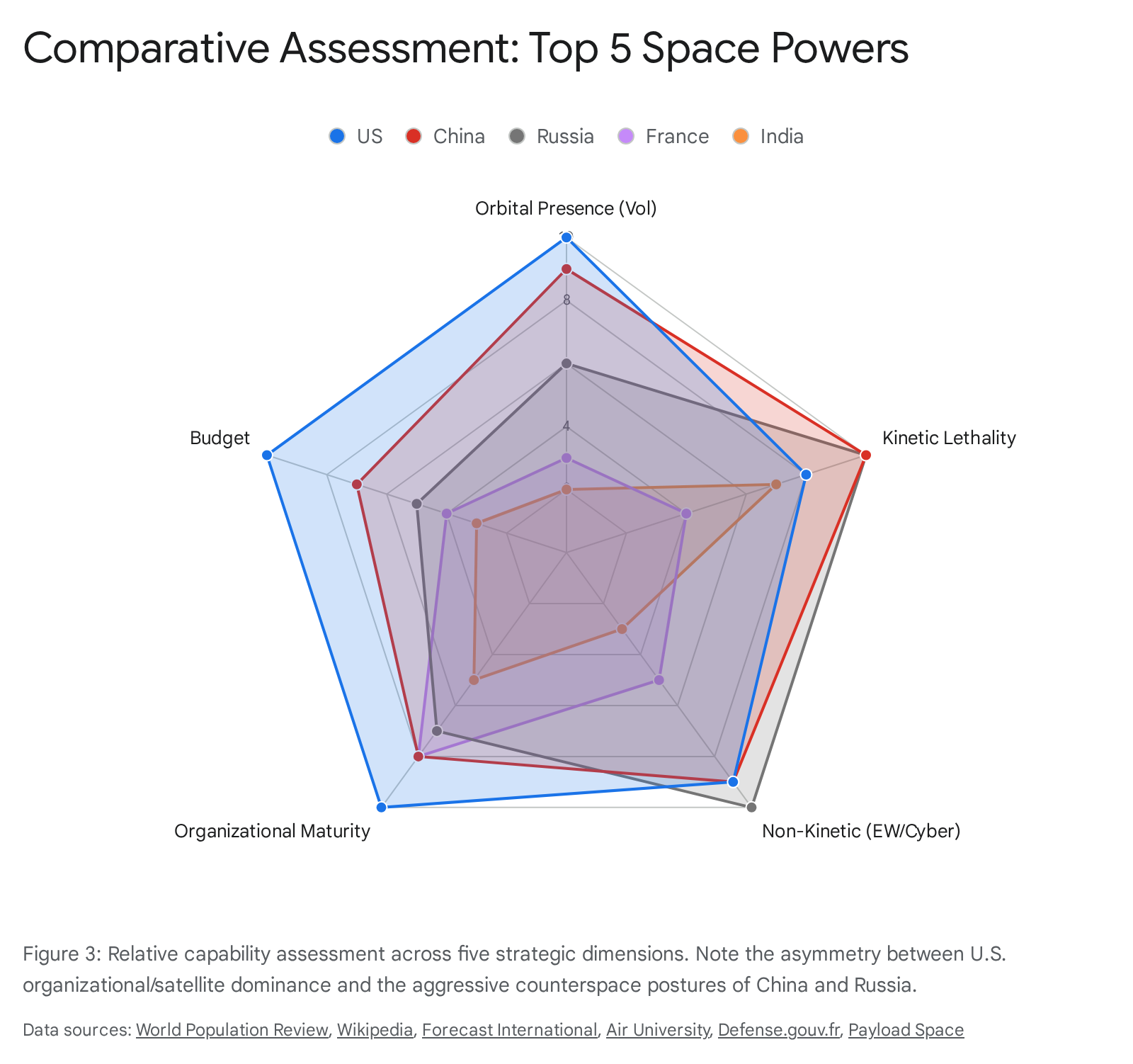
To accurately rank these three powers, it is necessary to compare their respective strategies across critical operational dimensions: integration and command architecture, counterspace arsenals, and orbital resilience.
5.1. Integration and Command Architecture
The ability to seamlessly integrate space capabilities into terrestrial military operations and manage complex multi-domain kill chains is the ultimate measure of space power effectiveness.
| Nation | Organizational Structure | Integration Effectiveness | Doctrinal Focus |
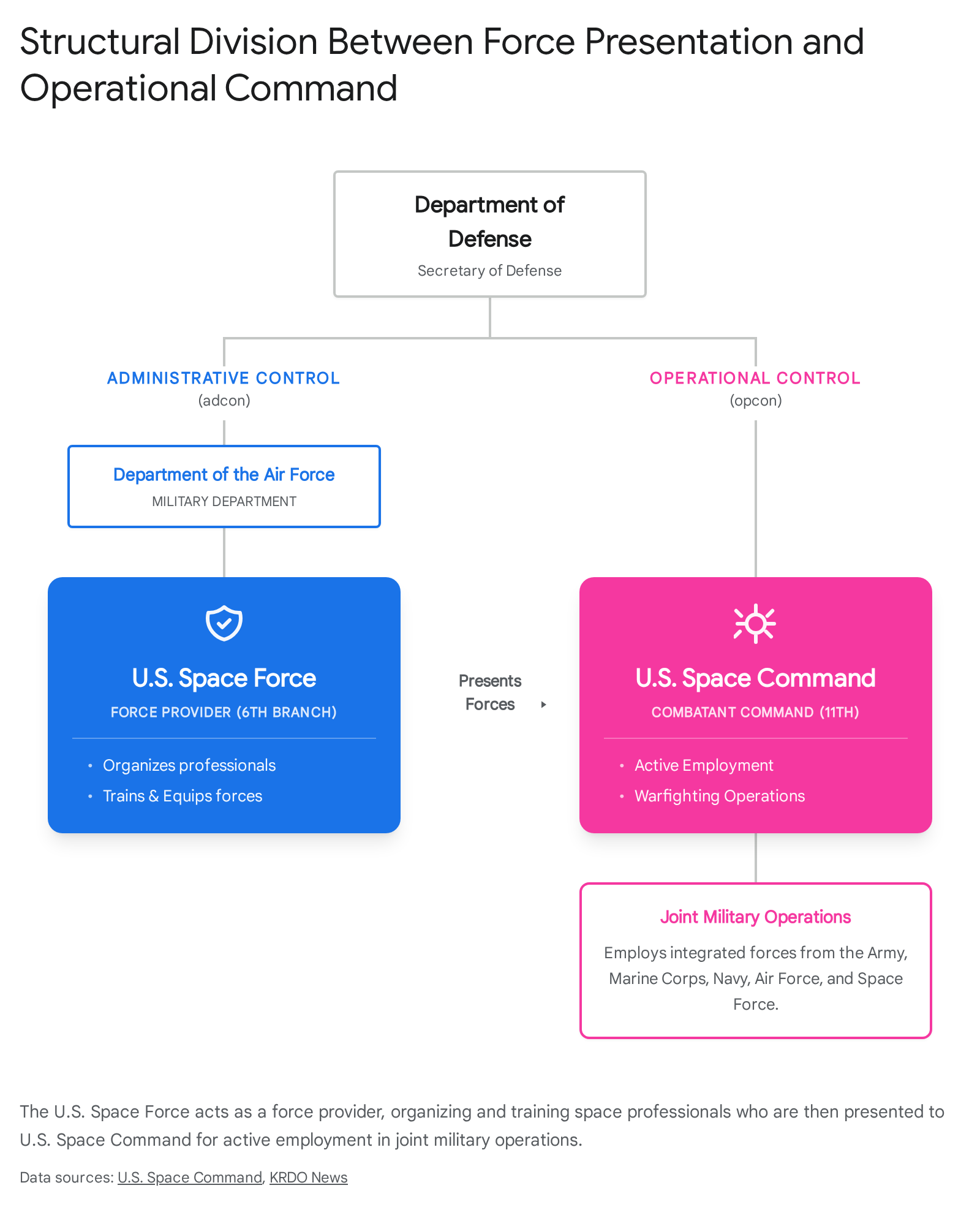
| United States | U.S. Space Force (USSF), unified under U.S. Space Command | Highly mature. Space effects are routinely integrated into tactical combatant commands. | Space Superiority, Competitive Endurance, Protection of Joint Force.11 |
| China | PLA Aerospace Force (ASF), reporting directly to the CMC | Developing rapidly. Centralized structure aims to resolve past fragmentation, but remains untested in combat.29 | Intelligentized Warfare, Information Dominance, Strategic Deterrence.27 |
| Russia | Aerospace Forces (VKS) | Poor tactical integration. Persistent C2 failures in Ukraine limit the tactical utility of strategic space assets.26 | Asymmetric Cost Imposition, Subversive Warfare, Tactical Electronic Denial.39 |
5.2. Counterspace Arsenals and Escalation Dynamics
The composition of a nation’s counterspace arsenal reveals its strategic intent and its risk calculus regarding escalation and debris generation.
| Nation | Kinetic Capabilities | Non-Kinetic / Electronic | Cyber & Asymmetric Threats |
| United States | Capable, but testing halted to establish norms.6 | Advanced RPO (GSSAP), deployed ground jammers (CCS, Meadowlands).1 | Highly advanced cyber capabilities; focuses on reversible, non-destructive effects. |
| China | Operational DA-ASATs (LEO to GEO potential); deployed ground lasers.36 | Advanced RPO (SJ-21, Shiyan-24); extensive jamming integration.36 | Deep military-civil fusion enabling comprehensive cyber espionage and data dominance.34 |
| Russia | Operational DA-ASATs (Nudol tested 2021).9 | Pervasive terrestrial EW (Tobol, Tirada); operational RPO (Luch series).1 | Development of nuclear space-based ASAT; aggressive cyber operations (APT28).44 |
5.3. Resilience and Launch Reconstitution
In a protracted conflict, the capacity to rapidly replace destroyed space assets and maintain unbroken service dictates operational endurance.
| Nation | Orbital Presence (Est.) | 2024 Launch Cadence | Reconstitution Strategy |
| United States | 7,000+ (Highly Commercial) | 145 Attempts | Absolute dominance via commercial pLEO (Starshield) and Tactically Responsive Space (TacRS).9 |
| China | 1,300+ (Highly Militarized) | 68 Attempts | Rapid state-backed deployment of mega-constellations (G60); developing reusable launch vehicles.20 |
| Russia | ~170 (Declining) | 17 Attempts | Systemic failure in launch volume; reliance on Chinese commercial providers for tactical augmentation.36 |
6. Strategic Rankings and Forward Outlook
Based on an exhaustive analysis of doctrine, operational capabilities, industrial capacity, and combat readiness derived from current open-source intelligence, the strategic ranking of the world’s premier space powers is definitively established as follows:
Rank 1: The United States
The United States firmly holds the premier position in global space warfare capabilities. While it faces an unprecedented, rapid challenge from China, the United States retains a decisive and currently insurmountable edge derived from its commercial space sector. The strategic transition to proliferated LEO architectures has fundamentally altered the deterrence calculus, rendering traditional kinetic ASAT weapons mathematically and strategically obsolete against United States networks. Furthermore, the maturation of the United States Space Force, codified by the 2025 Space Warfighting Framework, demonstrates a clear institutional alignment toward treating space as a contested domain. The United States capability for Tactically Responsive Space and localized, non-kinetic counterspace fires ensures a highly flexible and resilient posture. The primary ongoing challenge for the United States will be accelerating bureaucratic acquisition processes to fully leverage commercial innovation before adversaries close the technological gap.
Rank 2: The People’s Republic of China
The PRC is the absolute pacing threat and is rapidly closing the operational gap with the United States. China’s greatest structural strength is its whole-of-nation approach, seamlessly blending civil, commercial, and military space advancements. The pivotal April 2024 reorganization that established the Aerospace Force signals Beijing’s intent to resolve previous command-and-control bottlenecks, optimizing the PLA for integrated joint space operations. China possesses the most comprehensive, actively deployed arsenal of kinetic and non-kinetic counterspace weapons in the world. Additionally, its aggressive deployment of mega-constellations and massive expansion of its space-based ISR sensor web directly threaten United States terrestrial forces and regional power projection. While currently lacking the sheer launch volume of the United States commercial sector and remaining untested in actual high-intensity conflict, China’s trajectory suggests it could achieve near-parity in orbital resilience by the early 2030s.
Rank 3: The Russian Federation
Russia is a declining space power but remains an exceptionally dangerous strategic spoiler. Structurally, the Russian space program is failing. Crippled by international sanctions, an exodus of engineering talent, and an inability to domestically source modern microelectronics, Russia cannot compete with the United States or China in building resilient, proliferated orbital architectures. This profound weakness is evidenced by Moscow’s humiliating reliance on Chinese commercial imagery to sustain its ground operations in Ukraine. However, Russia compensates for this conventional weakness through aggressive, asymmetric cost imposition. Moscow’s pervasive use of Electronic Warfare demonstrates a high tolerance for collateral damage and a willingness to treat commercial space assets as legitimate military targets. Most alarmingly, Russia’s development of a space-based nuclear weapon serves as an ultimate, albeit desperate, deterrent. By threatening to indiscriminately irradiate low Earth orbit, Russia retains the ability to unilaterally deny space to everyone, ensuring it remains a critical and highly disruptive factor in global space security despite its industrial decay.
Forward Outlook and Conclusion
The space warfare landscape of 2026 is inherently unstable and accelerating toward higher friction. As the United States and China increasingly mirror each other’s push toward resilient mega-constellations, the utility of traditional direct-ascent kinetic interceptors is diminishing due to both tactical inefficiency and the unacceptable risk of self-harm through debris generation. Consequently, the future of space warfare will be dominated by reversible, non-kinetic effects: persistent cyber intrusions against ground infrastructure, widespread electromagnetic jamming, and highly sophisticated rendezvous and proximity operations. The greatest risk to global stability lies in the ambiguity of these non-kinetic operations, where the line between a routine commercial satellite inspection and a hostile military maneuver is virtually indistinguishable. This operational ambiguity significantly increases the potential for rapid, unintended military escalation in the orbital domain, requiring continuous refinement of deterrence frameworks by national intelligence and military planning apparatuses.
Please share the link on Facebook, Forums, with colleagues, etc. Your support is much appreciated and if you have any feedback, please email us in**@*********ps.com. If you’d like to request a report or order a reprint, please click here for the corresponding page to open in new tab.
Sources Used
- 2025 Global Counterspace Capabilities Report – Secure World Foundation, accessed March 15, 2026, https://www.swfound.org/publications-and-reports/2025-global-counterspace-capabilities-report
- The Militarization of Space: China and Russia vs. the United States – gfsis.org, accessed March 15, 2026, https://gfsis.org/en/the-militarization-of-space-china-and-russia-vs-the-united-states/
- The impact of US-China strategic competition on the idea of space as a “global commons”, accessed March 15, 2026, https://www.frontiersin.org/journals/space-technologies/articles/10.3389/frspt.2025.1664300/full
- Global Counterspace Capabilities | Key4biz, accessed March 15, 2026, https://www.key4biz.it/wp-content/uploads/2025/04/SWF_Global_Counterspace_Capabilities_2025-1.pdf
- SWF Announces the Release of the 2025 Global Counterspace Capabilities: An Open Source Assessment – Secure World Foundation, accessed March 15, 2026, https://www.swfound.org/news/swf-announces-the-release-of-the-2025-global-counterspace-capabilities-an-open-source-assessment
- Comparison of China and USA in Space Warfare – Global Defense News – gsdn.live, accessed March 15, 2026, https://gsdn.live/comparison-of-china-and-usa-in-space-warfare/
- Extending the Battlespace to Space – CSIS, accessed March 15, 2026, https://www.csis.org/analysis/chapter-8-extending-battlespace-space
- Space Threat Assessment 2025 – CSIS, accessed March 15, 2026, https://www.csis.org/analysis/space-threat-assessment-2025
- Maintaining the Space Edge: Strategic Reforms for U.S. Dominance in Low Earth Orbit, accessed March 15, 2026, https://www.csis.org/analysis/maintaining-space-edge-strategic-reforms-us-dominance-low-earth-orbit
- SPACE THREAT ASSESSMENT 2025, accessed March 15, 2026, https://csis-website-prod.s3.amazonaws.com/s3fs-public/2025-04/250425_Swope_Space_Threat.pdf
- U.S. Space Force defines path to space superiority in first Warfighting framework, accessed March 15, 2026, https://www.spaceforces-space.mil/Newsroom/Article/4160261/us-space-force-defines-path-to-space-superiority-in-first-warfighting-framework/
- Space warfare in 2026: A pivotal year for US readiness – Defense News, accessed March 15, 2026, https://www.defensenews.com/space/2026/01/05/space-warfare-in-2026-a-pivotal-year-for-us-readiness/
- Space Force’s Vector 2025 to Guide Service Transformation – ExecutiveGov, accessed March 15, 2026, https://www.executivegov.com/articles/ussf-vector-2025-guidance
- SPACE WARFIGHTING, accessed March 15, 2026, https://csps.aerospace.org/sites/default/files/2025-10/USSF%20Space_Warfighting_A%20Framework%20for%20Planners%20%28final_20250410%29.pdf
- Space Force’s new ‘warfighting framework’ says ‘space superiority’ is basis of US military power – Breaking Defense, accessed March 15, 2026, https://breakingdefense.com/2025/04/space-forces-new-warfighting-framework-says-space-superiority-is-basis-of-us-military-power/
- Space Force Starts Briefing Stakeholders on 15-Year Vision, accessed March 15, 2026, https://www.airandspaceforces.com/space-force-briefing-stakeholders-2040-15-year-vision/
- Space Force to Complete 15-Year Force Design in 2025, Publish in 2026 – MeriTalk, accessed March 15, 2026, https://www.meritalk.com/articles/space-force-to-complete-15-year-force-design-in-2025-publish-in-2026/
- Counterspace capabilities advancing around the globe: Secure World Foundation, accessed March 15, 2026, https://breakingdefense.com/2025/04/counterspace-capabilities-advancing-around-the-globe-secure-world-foundation/
- JUST IN: New Space Force Framework Brings Clarity to Unfamiliar Territory, Experts Say, accessed March 15, 2026, https://www.nationaldefensemagazine.org/articles/2025/8/13/just-in-new-space-framework-brings-clarity-to-unfamiliar-territory-experts-say
- Chapter 7 – The Final Frontier: China’s Ambitions to Dominate Space, accessed March 15, 2026, https://www.uscc.gov/sites/default/files/2025-11/Chapter_7–The_Final_Frontier_Chinas_Ambitions_to_Dominate_Space.pdf
- Space operations in 2025: intelligence, resilience and sustainability – Aerospace America, accessed March 15, 2026, https://aerospaceamerica.aiaa.org/year-in-review/space-operations-in-2025-intelligence-resilience-and-sustainability/
- Refresh or Reform: U.S. Space Strategy in 2025 – Center for Global Security Research, accessed March 15, 2026, https://cgsr.llnl.gov/sites/cgsr/files/2024-10/Space%20Workshop_Annotated%20Bibliography_Oct.2024.pdf
- SPACE SUPPORT, accessed March 15, 2026, https://csps.aerospace.org/sites/default/files/2025-10/USAF%20AFDP%203-14%20Space%20Support%20%281%20April%202025%29.pdf
- Bythewood highlights space superiority, integration at Spacepower 2025, accessed March 15, 2026, https://www.spacecom.mil/Newsroom/News/Article-Display/Article/4360044/bythewood-highlights-space-superiority-integration-at-spacepower-2025/
- OSIX Threat Analysis US/China/Russia Space Competition: Endangering the Future of Space Commerce – Space Intel Report, accessed March 15, 2026, https://www.spaceintelreport.com/osix-threat-analysis-us-china-russia-space-competition-endangering-the-future-of-space-commerce/
- Space Agenda 2025, accessed March 15, 2026, https://csps.aerospace.org/sites/default/files/2024-10/SpaceAgenda2025_Compilation_Web.pdf
- Annual Report to Congress: Military and Security Developments Involving the People’s Republic of China 2025 – War.gov, accessed March 15, 2026, https://media.defense.gov/2025/Dec/23/2003849070/-1/-1/1/ANNUAL-REPORT-TO-CONGRESS-MILITARY-AND-SECURITY-DEVELOPMENTS-INVOLVING-THE-PEOPLES-REPUBLIC-OF-CHINA-2025.PDF
- China’s Military Space Capabilities and Implications for the United States – Center for Global Security Research, accessed March 15, 2026, https://cgsr.llnl.gov/sites/cgsr/files/2025-09/Huntington_Paper_vFINAL.pdf
- China’s new Information Support Force – The International Institute for Strategic Studies, accessed March 15, 2026, https://www.iiss.org/online-analysis/online-analysis/2024/05/chinas-new-information-support-force/
- The Chinese Military’s New Information Support Force – CNA.org., accessed March 15, 2026, https://www.cna.org/our-media/indepth/2024/08/chinese-information-support-force
- Operationalizing Intelligentized Warfare: Xi Replaces the Strategic Support Force with Three New “Arms” – PLATracker, accessed March 15, 2026, https://www.platracker.com/post/operationalizing-intelligentized-warfare-xi-replaces-the-strategic-support-force-with-three-new-ar
- A New Step in China’s Military Reform – NDU Press, accessed March 15, 2026, https://ndupress.ndu.edu/Media/News/News-Article-View/Article/4157257/a-new-step-in-chinas-military-reform/
- The Arctic, outer space and influence-building: China and Russia join forces to expand in new strategic frontiers | Merics, accessed March 15, 2026, https://merics.org/en/report/arctic-outer-space-and-influence-building-china-and-russia-join-forces-expand-new-strategic
- Strategic Trajectories Assessing China’s Space Rise and the Risks to U.S. Leadership, accessed March 15, 2026, https://www.csis.org/analysis/strategic-trajectories-assessing-chinas-space-rise-and-risks-us-leadership
- China’s Counter Space Capabilities | CLAWS, accessed March 15, 2026, https://claws.co.in/wp-content/uploads/2025/01/IB-303_Chinas-Counter-Space-Capabilities-2-1.pdf
- Space Threat Fact Sheet, accessed March 15, 2026, https://www.spaceforce.mil/About-Us/Fact-Sheets/Fact-Sheet-Display/Article/4297159/space-threat-fact-sheet/
- The access to and use of space is of vital national interest. Intensifying strategic competition presents a serious threat, accessed March 15, 2026, https://nssaspace.org/wp-content/uploads/2025/05/20250516-S2-Space-Threat-Fact-Sheet-v8-RELEASE.pdf
- Military and Security Developments Involving the People’s Republic of China 2024 – War.gov, accessed March 15, 2026, https://media.defense.gov/2024/Dec/18/2003615520/-1/-1/0/MILITARY-AND-SECURITY-DEVELOPMENTS-INVOLVING-THE-PEOPLES-REPUBLIC-OF-CHINA-2024.PDF
- War Without End: Russia’s Shadow Warfare – CEPA, accessed March 15, 2026, https://cepa.org/comprehensive-reports/war-without-end-russias-shadow-warfare/
- Russia’s Strategy and Military Thinking: Evolving Discourse by 2025 – CEPA, accessed March 15, 2026, https://cepa.org/comprehensive-reports/russias-strategy-and-military-thinking-evolving-discourse-by-2025/
- Exploring Factors for U.S.-Russia Crisis Stability in Space – RAND, accessed March 15, 2026, https://www.rand.org/pubs/research_reports/RRA2313-3.html
- How Russia Is Reshaping Command and Control for AI-Enabled Warfare – CSIS, accessed March 15, 2026, https://www.csis.org/analysis/how-russia-reshaping-command-and-control-ai-enabled-warfare
- Russia’s Electronic Warfare Capabilities to 2025 – International Centre for Defence and Security, accessed March 15, 2026, https://icds.ee/wp-content/uploads/2018/ICDS_Report_Russias_Electronic_Warfare_to_2025.pdf
- A Comparative Study of Russian Offensive Cyber Capabilities from 2022 to 2025, accessed March 15, 2026, https://www.nksc.lt/doc/rkgc/A_Comparative_Study_of_Russian_Cyber_Offensive_Capabilities_from_2022_to_2025.pdf
- Russia State-Sponsored Cyber Threat: Advisories – CISA, accessed March 15, 2026, https://www.cisa.gov/topics/cyber-threats-and-advisories/nation-state-cyber-actors/russia/publications
- NSA and Others Publish Advisory Warning of Russian State-sponsored Cyber Campaign Targeting Western Logistics and Technology Entities, accessed March 15, 2026, https://www.nsa.gov/Press-Room/Press-Releases-Statements/Press-Release-View/Article/4193749/nsa-and-others-publish-advisory-warning-of-russian-state-sponsored-cyber-campai/
- Russia’s Space-Based, Nuclear-Armed Anti-Satellite Weapon: Implications and Response Options, accessed March 15, 2026, https://nssaspace.org/wp-content/uploads/2024/05/Russian-Nuclear-ASAT.pdf
- U.S. Warns of New Russian ASAT Program | Arms Control Association, accessed March 15, 2026, https://www.armscontrol.org/act/2024-03/news/us-warns-new-russian-asat-program
- FAQ: What We Know About Russia’s Alleged Nuclear Anti-Satellite Weapon, accessed March 15, 2026, https://www.swfound.org/publications-and-reports/faq-what-we-know-about-russias-alleged-nuclear-anti-satellite-weapon
- Averting ‘Day Zero’: Preventing a Space Arms Race – Nuclear Network, accessed March 15, 2026, https://nuclearnetwork.csis.org/averting-day-zero-preventing-a-space-arms-race/
- Russia’s Space Program After 2024 – Foreign Policy Research Institute, accessed March 15, 2026, https://www.fpri.org/article/2024/07/russias-space-program-after-2024/