
1.0 Executive Summary
The Space-Comm Expo Europe 2026, convened on March 4th and 5th, represented a watershed moment in the intersection of commercial aerospace innovation and national security imperatives.1 Organized by Hub Exhibitions in strategic partnership with Farnborough International and the ADS Group, the event brought together over 5,400 delegates, 250 exhibitors, and 200 speakers at the ExCeL London exhibition center.3 While Farnborough International played a pivotal organizing role, underscoring the event’s deep ties to the historic center of British aviation, the physical gathering in London served as the premier global forum for addressing the rapid militarization of the space domain.1
This year’s exposition unfolded against an unprecedented geopolitical backdrop: the active, high-intensity conflict known as Operation Epic Fury, a joint United States and Israeli military campaign directed against the Iranian regime that commenced on February 28, 2026.5 The realities of this ongoing war permeated every keynote address, panel discussion, and technological demonstration at the Expo. Operation Epic Fury has provided a live-fire validation of advanced space and cyber doctrines, demonstrating irrefutably that the space domain is no longer merely an enabling layer for terrestrial forces; it is the primary arena where the “first mover” advantages of modern warfare are secured and where the initial, decisive non-kinetic engagements are fought.7
In direct response to these evolving global threats, the United Kingdom utilized the Expo to announce a fundamental realignment of its national space strategy. Acknowledging the necessity for concentrated capital in a contested era, Space Minister Liz Lloyd outlined a departure from the previous policy of broadly funding seven disparate space subsectors.9 Instead, the UK will hyper-focus its resources on four critical pillars: Satellite Communications, Space Domain Awareness (SDA), In-Orbit Servicing, Assembly and Manufacturing (ISAM), and Assured Access to Space.9 This strategic pivot is underwritten by a newly announced £500 million public funding package dedicated to national space programs, designed to scale domestic capabilities and harden the UK’s sovereign space architecture.10
Simultaneously, the Ministry of Defence (MoD) articulated a demand for a radical cultural metamorphosis in defense procurement.12 Recognizing that traditional acquisition cycles are fatally sluggish compared to the velocity of commercial space innovation, defense leadership called for the eradication of bureaucratic romanticism surrounding legacy platforms, advocating for agile, rapid-fielding methodologies.12 This demand for speed was matched by commercial defense primes and specialized startups exhibiting on the floor. Announcements regarding advanced capabilities—most notably BAE Systems’ Azalea multi-sensor intelligence cluster, the operationalization of the National Space Operations Centre (NSpOC), and the deployment of ground-based optical tracking algorithms—demonstrated a clear industrial pivot toward resilient, tactical, and sovereign space architectures.13
For national security analysts, defense planners, and industry stakeholders unable to attend, this comprehensive report synthesizes the intelligence, strategic shifts, and critical lessons extracted from Space-Comm Expo 2026. The findings indicate a definitive transition: space technology is now universally recognized not merely as a theater of scientific exploration, but as the foundational layer of Critical National Infrastructure (CNI) upon which all modern economic stability and military lethality depend.16
2.0 The Crucible of Conflict: Operation Epic Fury and the Validation of Cyber-Space Doctrine
It is analytically impossible to contextualize the prevailing mood, the technological priorities, and the procurement urgency evident at Space-Comm Expo 2026 without thoroughly examining the shadow cast by Operation Epic Fury. The conflict has effectively functioned as an inescapable, real-world laboratory for multi-domain operations and “cyber-first” warfare doctrines that have been theoretically debated in defense circles for decades.8 The lessons extracted from the opening phases of this campaign dominated bilateral discussions and panel analyses throughout the event.
2.1 The Ascendancy of Cyber-Space as the “First Mover” Domain
Historically, military doctrine viewed cyber and space operations predominantly as supporting mechanisms—tools utilized for pre-strike intelligence gathering, secure communications, or post-strike battle damage assessment. Operation Epic Fury inverted this traditional paradigm entirely. According to statements delivered by General Dan Caine, Chairman of the Joint Chiefs of Staff, United States Cyber Command (USCYBERCOM) and United States Space Command (USSPACECOM) were the definitive “first movers” in the conflict against Iran.7 Before a single conventional aircraft penetrated Iranian airspace or a single kinetic munition was released, coordinated space and cyber operations were executed to layer paralyzing non-kinetic effects across the adversary’s battlespace.7
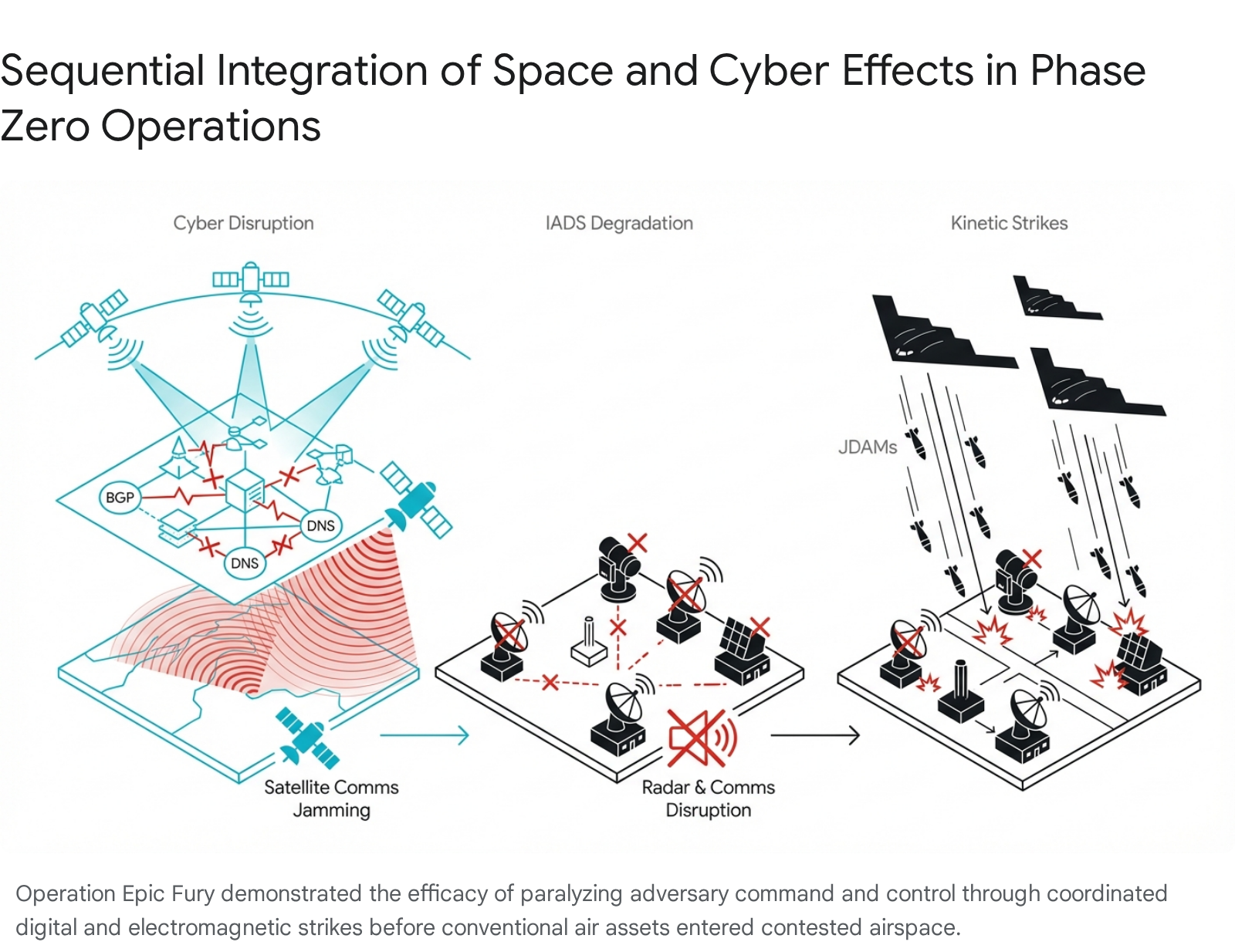
The operational mechanics involved in this cyber-first approach were sweeping in their scope. Military planners orchestrated attacks that directly targeted Iranian digital infrastructure, industrial control systems, and digital command platforms.8 Analysts tracking the conflict reported that initial cyber operations effectively disrupted routing systems, including the Border Gateway Protocol (BGP), and crippled domain name systems.8 This targeted interference reduced national internet functionality to minimal levels for critical hours, completely fracturing the communication links between central Iranian command nodes and their dispersed field units.8 This digital isolation severely degraded the regime’s Integrated Air Defense System (IADS), rendering radar systems and sensor networks incapable of coordinating a cohesive defensive response to incoming threats.7
Simultaneously in orbit, United States Space operators executed sophisticated, highly classified electronic warfare (EW) campaigns. While senior military officials cited operational security and declined to specify the exact nature of these contributions, defense experts and intelligence analysts confirmed that the U.S. military actively engaged in widespread jamming and spoofing of Iranian satellite communications.18 This capability is explicitly designed to degrade an adversary’s coordination without resorting to physical destruction.
2.2 The Invisible Geography of Electronic Warfare
A critical strategic lesson discussed extensively in closed-door sessions and high-level panels at the Expo is the covert and highly complex nature of these orbital EW effects. Unlike physical anti-satellite (ASAT) weapons—such as direct-ascent missiles that generate massive, easily trackable debris fields—electronic warfare effects are effectively invisible to standard orbital tracking data methodologies.19
The satellites that enable these jamming effects, as well as the adversary satellites being targeted, remain entirely trackable via standard Two-Line Element (TLE) feeds.19 However, the actual transmission of the jamming or spoofing signals does not manifest in any physical or orbital disturbance that can be charted by traditional Space Domain Awareness architectures.19 This phenomenon creates a highly advantageous “gray zone” in space warfare. Superiority can be achieved, and adversary command networks can be silenced, without leaving obvious, physical, or easily provable signatures. This affords the attacking force a significant degree of plausible deniability regarding the exact source and extent of the electromagnetic interference, complicating the adversary’s ability to justify a proportional response or rally international diplomatic condemnation.18 The realization that space dominance will increasingly be determined by invisible electromagnetic superiority rather than kinetic collisions represents a profound shift in how allied militaries must procure and deploy space assets.
2.3 Precision Munition Depletion and the Vulnerability of the Space Layer
The second major operational takeaway from Epic Fury that heavily influenced the discourse at Space-Comm Expo 2026 concerns the immense strain placed on logistical supply chains and the space-based architectures that enable modern precision strikes. During the initial phases of the conflict, the U.S. military rapidly transitioned from utilizing highly expensive, long-range standoff weapons—such as Tomahawk Land Attack Missiles (TLAMs) and advanced stealth cruise missiles—to high-volume “stand-in” precision-strike methods.5 Over the first ten days of the campaign alone, U.S. forces reportedly engaged an astonishing 5,000 targets.5
To maintain this unprecedented operational tempo, American and allied aircraft heavily relied on Joint Direct Attack Munitions (JDAMs).5 These systems convert unguided, conventional gravity bombs into highly accurate precision weapons by utilizing integrated inertial navigation systems (INS) and, crucially, Global Positioning System (GPS) guidance kits.5 While this transition allows for a vastly higher volume of strikes at a significantly lower financial cost per target, it introduces an absolute, structural dependency on uninterrupted space-based Position, Navigation, and Timing (PNT) support.19
| Operational Phase | Munition Strategy | Primary Dependency | Implication for Space Assets |
| Initial Salvo (Days 1-3) | Standoff Cruise Missiles, Long-Range Assets | Internal Terrain Contour Matching, Pre-programmed GPS | Moderate dependency on active space links; high cost limits volume. |
| Sustained Campaign (Days 4-10) | Stand-in Strikes, JDAMs, High-Volume Sorties | Continuous GPS/M-Code, Real-time Tactical ISR | Absolute dependency on PNT resilience; space architecture becomes the critical failure point. |
| Prolonged Attrition (Day 10+) | Interception of cheap adversary drones (Shahed) | Constant Early Warning Space Infrared tracking | Exposes cost-exchange vulnerabilities; necessitates space-based AI target discrimination. |
This dependency was a central theme among defense analysts at the Expo. The defense of the highly encrypted military M-code GPS signals against persistent adversary jamming attempts has become a paramount concern.21 As Lieutenant General Dennis Bythewood highlighted during a recent symposium, adversaries inherently seek to jam GPS signals to deny allied forces the ability to execute precision strikes.21 A degraded PNT environment would instantly neutralize the efficacy of the entire U.S. air campaign, reverting modern stealth bombers to the inaccurate saturation bombing tactics of the mid-twentieth century.
Furthermore, the implementation of the “45-second kill chain”—the rapid detection, processing, targeting, and striking of dynamic battlefield threats—relies exclusively on the continuous, uninterrupted flow of Intelligence, Surveillance, and Reconnaissance (ISR) data streaming down from orbital assets.22 Space forces are required to provide constant missile alerts to deliver timely warnings to theater troops operating in hostile environments.21
The exponential burn rate of these precision munitions in Iran has reached a staggering scale that defense analysts and logisticians believe fundamentally threatens long-term Western deterrence capacity.19 This depletion rate is forcing defense planners to push for supplemental budget requests for immediate production, treating it as a near-term necessity rather than a theoretical planning consideration.19 More critically for the attendees at Space-Comm, this high-tempo expenditure puts immense pressure on the underlying command architecture—specifically the space layer—that makes these weapons effective.19 If the space architecture degrades due to kinetic attack or electronic warfare, the terrestrial kill chain completely collapses, rendering stockpiles of smart munitions effectively useless.
3.0 The United Kingdom’s Strategic Realignment: The £500 Million Capital Injection
Recognizing the stark realities of modern contested environments vividly illustrated by Operation Epic Fury, the United Kingdom Government utilized the platform of Space-Comm Expo 2026 to announce a fundamental and necessary restructuring of its space industrial policy. The previous strategic model, which attempted to distribute funding broadly and equally across seven different subsectors of the space economy, was openly criticized by Space Minister Liz Lloyd during her keynote address as being “no longer sustainable”.9 To deliver true combat credibility and foster meaningful economic growth in an era of great power competition, capital must be aggressively concentrated.
3.1 Narrowing the Strategic Focus
In a decisive move to streamline its defense and commercial posture, the UK officially narrowed its primary strategic focus and public funding prioritization from seven broad categories down to four specific, highly critical pillars.9 This realignment ensures that public funds are focused sharply on areas that drive direct economic growth and immediate national security outcomes.10
- Satellite Communications: Ensuring secure, resilient, and unjammable data links for both commercial telecommunications and encrypted military command and control structures.9
- Space Domain Awareness (SDA): Developing sovereign, high-fidelity capabilities to constantly track spacecraft, monitor orbital debris, forecast space weather, and detect hostile orbital maneuvers or proximity operations.9
- In-Orbit Servicing, Assembly and Manufacturing (ISAM): Pioneering technologies for refueling, maintaining, and repairing satellites in orbit, as well as developing advanced manufacturing capabilities (such as the production of pharmaceuticals or semiconductors in microgravity). Crucially, from a defense perspective, ISAM is vital for orbital logistics and the reconstitution of degraded satellite networks.9
- Assured Access to Space (Launch): Maintaining and expanding sovereign or highly reliable allied launch capabilities to guarantee the ability to quickly replace destroyed or degraded assets in a conflict scenario, ensuring uninterrupted access to the domain.9
3.2 Analyzing the £500 Million Funding Allocation
To physically support this bolder, more aggressive strategy, the UK government announced a comprehensive package of over £500 million allocated specifically to national space programs.10 This domestic funding represents a targeted injection into the UK’s sovereign industrial base and serves as a vital supplement to the £1.7 billion that the UK previously committed to European Space Agency (ESA) programs.11
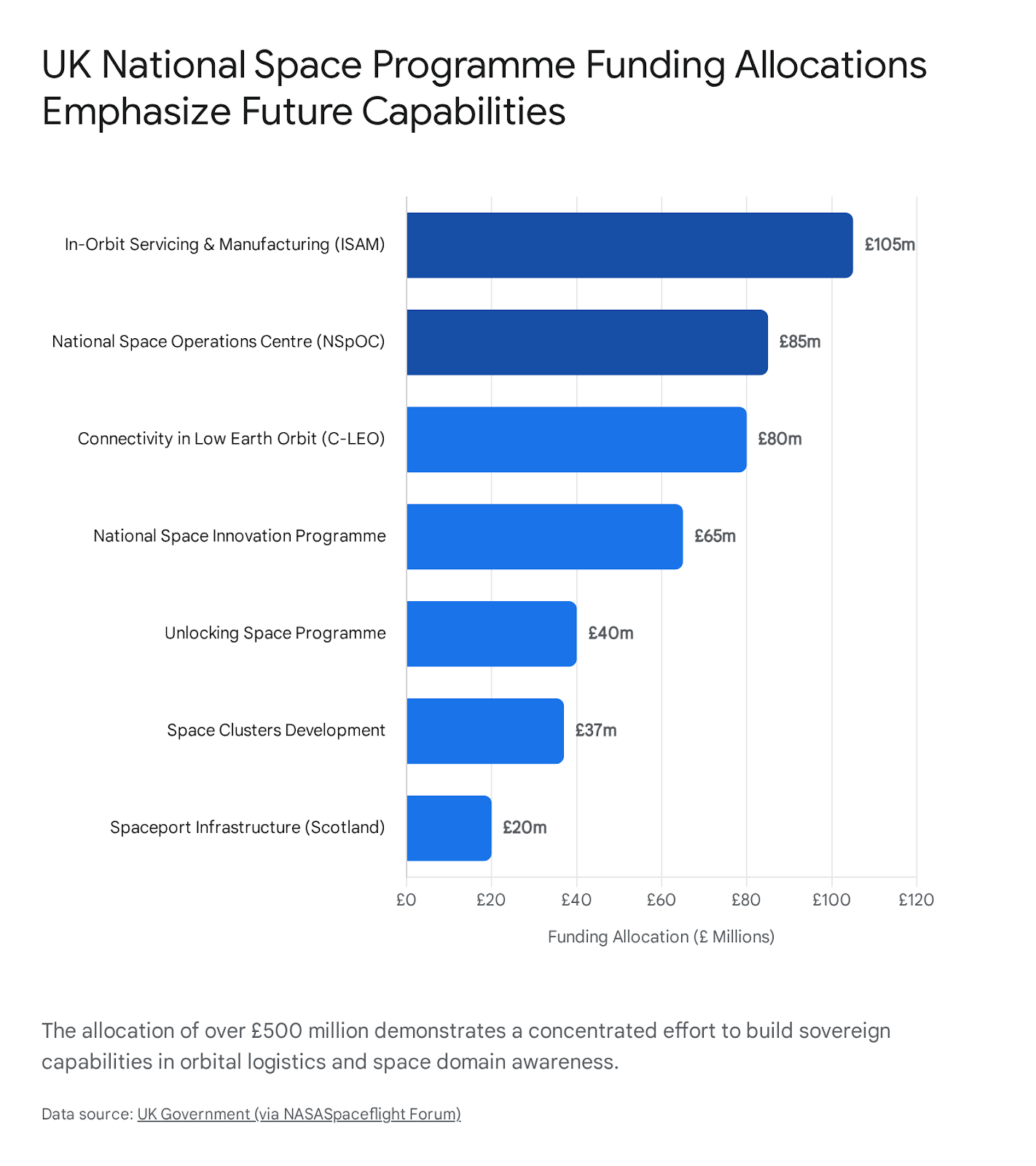
The granular breakdown of this funding portfolio reveals profound strategic intent and highlights how the UK is positioning itself as a leader in next-generation orbital infrastructure 11:
- £105 million dedicated to ISAM: This represents the largest single tranche of the newly announced funding. It is an explicit acknowledgment that the era of treating highly expensive, multi-ton satellites as disposable assets is over. As the burn rate of the Iranian conflict demonstrates regarding terrestrial munitions, replacing complex systems from the ground up is financially exorbitant and strategically slow. Developing the ability to refuel, maneuver, and repair satellites in orbit transforms static targets into dynamic, sustainable participants in orbital warfare, establishing a strong competitive edge for the UK in an emerging global market.10
- £85 million for the National Space Operations Centre (NSpOC): This critical joint civil-military hub combines the specialized capabilities of the UK Space Agency (UKSA), the Ministry of Defence (MoD), and the Met Office.23 Crucially, £40 million of this allocation is explicitly earmarked for the physical construction of a new, sovereign ground-based sensing network to support the 24/7 requirement to protect satellites in an increasingly congested space environment.9
- £80 million allocated to the Connectivity in Low Earth Orbit (C-LEO) program: This funding is aimed directly at developing smarter satellites, advanced hardware, and AI-enabled data delivery systems to ensure resilient, high-bandwidth communications.11
- £65 million for the National Space Innovation Programme: Focused on accelerating breakthrough technologies and bridging the “valley of death” between academic research and commercialization.11
- £40 million for the Unlocking Space Programme: Designed specifically to drive institutional market demand for space technology, develop overarching national security capabilities, and attract vital private investment to support the scale-up of British space firms.11
- £37 million for Space Clusters and £20 million for Spaceport Infrastructure: Aimed at geographically distributing the economic benefits of the space sector across the entirety of the UK and securing vital sovereign launch capabilities, particularly accelerating infrastructure development in Scotland.11
These calculated investments signal a mature, holistic understanding within the UK government that economic prosperity and national security in the space domain are inextricably linked. Rebecca Evernden, the recently appointed Director of the UK Space Agency, explicitly emphasized this dual mandate during her engagements at the Expo. She highlighted how carefully balancing prioritization between fostering commercial economic growth and hardening security applications will fundamentally shape which UK programs attract international and transatlantic partnerships over the coming decade.19
4.0 Cultural Metamorphosis in Defense Procurement
The impressive technological announcements at Space-Comm Expo 2026 were paralleled by urgent, forceful calls for systemic reform within the traditional military procurement structures. The legacy timelines for acquiring, testing, and fielding defense hardware are fundamentally incompatible with both the exponential speed of innovation within the commercial space sector and the immediate, unforgiving demands of modern warfare as witnessed in the Middle East.
Luke Pollard, the UK Minister for Defence Readiness and Industry, delivered a remarkably stark and uncompromising message regarding the absolute necessity for deep cultural change within the Ministry of Defence.12 Addressing defense officials, prime contractors, and agile startups, Pollard noted that delivering a modern “hybrid Navy” and maintaining a genuine warfighting-ready force across all domains requires drastically compressing procurement cycles.12 He explicitly stated that bureaucratic processes that currently consume two years must be aggressively reduced to one, and contract negotiations that traditionally drag on for a year must be executed in a matter of mere months.12
4.1 Eradicating the “Romanticism” of Legacy Platforms
A profound and controversial insight from Pollard’s address was his direct critique of what he termed the “romanticism” inherent in British defense culture.12 He described this as the institutional tendency to continuously polish, upgrade, and preserve aging, legacy platforms simply because they possess historical pedigree or have been part of the force structure for a long time.12 Pollard argued forcefully that assets must be retained and funded strictly based on the actual, measurable combat effect and deterrent value they deliver in a modern, multi-domain environment.12
In the specific context of space architecture and advanced missile defense, holding onto outdated, centralized, and slow-moving acquisition programs is not merely inefficient; it is strategically fatal. Adversaries are not bound by decades-old procurement regulations. As Lieutenant General Bythewood noted regarding Chinese advancements, competitors are developing space capabilities at a “staggering, breathtaking pace,” seamlessly integrating dual-use commercial technologies.21 An adversary might easily repurpose a commercial debris-removal platform as a highly effective, covert counter-space weapon.21 The UK and its NATO allies cannot afford a sluggish, risk-averse bureaucratic response to these rapidly evolving threats.
| Procurement Paradigm | Legacy Defense Acquisition | Modern Space Acquisition Imperative | Risk Factor Addressed |
| Development Cycle | 10–15 Years (Requirements to Fielding) | 12–24 Months (Iterative, Spiral Development) | Technological obsolescence before deployment. |
| System Architecture | Exquisite, Monolithic, Multi-Billion Dollar Assets | Proliferated, Disaggregated, Commercial-Off-The-Shelf (COTS) | Single point of failure via kinetic or EW attack. |
| Cultural Preference | Risk Aversion, Heavy Certification, “Romanticism” for familiar platforms | Risk Tolerance, Rapid Prototyping, Lethality-focused | Institutional paralysis against agile adversaries. |
To actively bridge the cavernous gap between commercial innovation speed and military application, the government used the Expo to announce the operationalization of a joint Space Ministerial Forum, co-chaired by the Department for Science, Innovation and Technology (DSIT) and the MoD.9 This “One Government” approach is deliberately designed to target common priorities, pool resources, and streamline government support.9 By breaking down the historical silos between civil space research and defense procurement, the UK aims to allow agile startups and established prime contractors to navigate the acquisition labyrinth with vastly greater speed and efficiency.9
5.0 Space Domain Awareness (SDA) as the Center of Gravity
If establishing space superiority is the absolute prerequisite for terrestrial military success, then Space Domain Awareness (SDA) is the absolute prerequisite for space superiority. A military force cannot protect an asset it cannot accurately see, nor can it deter an aggressive maneuver it cannot definitively attribute. The heavy, persistent emphasis on SDA technologies at Space-Comm Expo 2026 reflects a sober global realization that Low Earth Orbit (LEO) is becoming exponentially congested with commercial constellations and fiercely contested by rival state actors.
5.1 The NSpOC and the Integration of Civil-Military Telemetry
The formal launch, public endorsement, and massive funding infusion for the UK National Space Operations Centre (NSpOC), developed under the aegis of Project AETHER, represents a critical leap in sovereign capability.13 Co-located at RAF High Wycombe, NSpOC represents a paradigm shift in operations by physically integrating civil space analysts from the UK Space Agency with military analysts from UK Space Command, operating joint capabilities that feed directly into national defense and civil hazard prevention.13
The £85 million investment directed toward NSpOC over the current five-year funding period is largely focused on aggressively modernizing its core tracking systems.13 More importantly, it provides the capital necessary to establish a £40 million, wholly sovereign network of ground-based optical and radar sensors.9 This mitigates the historical reliance on United States-provided tracking data, granting the UK independent validation of orbital events.
5.2 The LOCI Network and the BOREALIS Algorithmic C2 System
At the Expo, the practical application of this massive SDA funding was highly visible through major, concrete contract announcements. Raytheon NORSS, a UK-based space domain awareness specialist operating under the RTX umbrella, was awarded a significant contract by the UK Space Agency.27 This contract mandates the provision of continuous Space Surveillance and Tracking (SST) services data focusing on Resident Space Objects (RSOs) in Low-Earth Orbit.27
To fulfill this mandate, Raytheon NORSS will utilize its proprietary Low-Earth Orbit Camera Installation (LOCI) sensors.27 LOCI comprises a globally distributed network of ground-based optical sensors—with installations across the United Kingdom, the United States, and Australia—that routinely and autonomously collect high-fidelity observation data on objects ranging from minute pieces of space debris to active commercial satellites and classified defense assets.27 This international expansion of the LOCI network is intended to provide the UK Space Agency and the MoD with the high-quality, timely, and assured data necessary to protect multi-million-pound orbital assets from collision or targeted fragmentation events.27
However, as SDA experts noted during technical workshops at the Expo, generating massive volumes of raw optical data is only half the battle; the true challenge lies in the complex processing, filtering, and optimization of that data. The high demand for observation in an increasingly crowded orbital regime creates a massive, continuous computational bottleneck.
To specifically address this processing challenge, the UK Space Agency awarded a highly specialized proof-of-concept contract to the Cambridge-based technology firm 4colors Research.14 Operating under the BOREALIS Algorithm Development program, funded via Innovate UK’s Contracts for Innovation scheme, 4colors is tasked with developing sophisticated, next-generation sensor scheduling and resource optimization algorithms.14
As Dr. Marcin Kaminski, CEO of 4colors Research, explained, NSpOC must continuously allocate its severely limited ground-sensor time across thousands of competing priorities.14 The system must autonomously decide whether to task a sensor with tracking a known piece of debris threatening a commercial satellite, or to pivot that same sensor to investigate a sudden, unannounced orbital maneuver by a foreign military satellite. Balancing these competing priorities, coordinating multiple dispersed sensor networks, and responding rapidly to emerging orbital events in real-time is a computationally demanding problem requiring algorithms capable of navigating vast solution spaces instantly.14
The seamless integration of Raytheon’s physical LOCI hardware with 4colors’ advanced optimization algorithms feeding into the centralized NSpOC BOREALIS Command and Control system represents a textbook example of fusing sovereign hardware and software to achieve decision superiority in the space domain.14
6.0 Sovereign Capabilities and Next-Generation Tactical ISR
A definitive thematic shift observed on the exhibition floor at Space-Comm 2026 was the transition away from strategic, multi-year, bespoke satellite builds toward tactical, responsive, and commercially derived constellations. The commercial sector is rapidly maturing to provide “Space as a Service,” allowing governments to leverage cutting-edge sovereign capabilities without bearing the entirety of the crushing Research & Development and launch costs.15
6.1 The Azalea Paradigm: Fusing RF and SAR in Low Earth Orbit
Arguably the most strategically significant product showcase at Space-Comm Expo 2026 was BAE Systems’ “Azalea” mission, prominently featured and detailed at Stand A69.15 Azalea is not a traditional monolithic satellite; rather, it is a multi-sensor satellite cluster operating in Low Earth Orbit, designed from the ground up to function as a single, highly intelligent, interconnected system.15
The architectural composition of the Azalea cluster is highly sophisticated and specifically designed to address critical, persistent gaps in current Intelligence, Surveillance, and Reconnaissance (ISR) gathering methodologies:
- The Cluster Formation: The system comprises four individual spacecraft flying in a tightly coordinated formation hundreds of kilometers above the Earth.15
- Radio Frequency (RF) Sensing: Three of the satellites within the cluster are equipped with highly advanced Radio Frequency sensing technology, powered by BAE Systems’ proprietary Azalea Enhanced Software Defined Radio.15 These sensors are designed to passively detect, precisely geolocate, and analyze complex electronic emissions emanating from the Earth’s surface—such as the active radar signatures of adversary air defense systems, or the encrypted transmissions of covert communication nodes.
- Synthetic Aperture Radar (SAR): The fourth satellite in the formation carries a powerful Synthetic Aperture Radar payload.15 Unlike traditional optical imaging satellites, which are rendered useless by cloud cover, atmospheric haze, or nighttime conditions, SAR technology can generate high-resolution imagery of the Earth’s surface regardless of weather conditions or the time of day.15 To rapidly field this capability, BAE Systems partnered with ICEYE, a global leader in SAR technology, to incorporate their satellite buses into the Azalea constellation.31
The true, revolutionary innovation of the Azalea mission lies in the automated synthesis of these disparate capabilities. Individually, RF mapping and SAR imaging are powerful tools. Together, linked by inter-satellite communications, they provide a multi-layered “power of perspective” that effectively defeats traditional adversary camouflage, concealment, and deception (CC&D) tactics.15
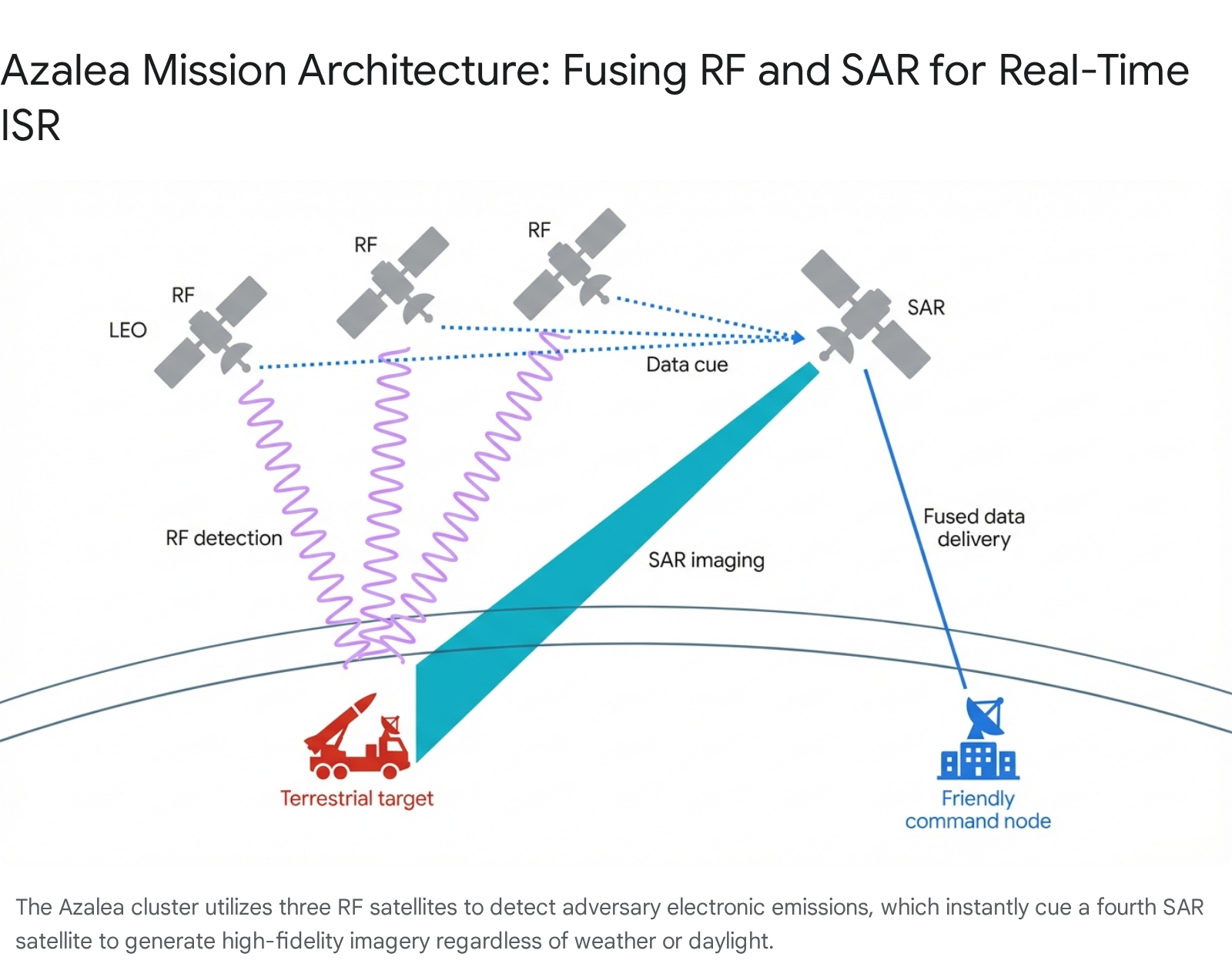
Consider a tactical combat scenario heavily reliant on the lessons of Operation Epic Fury: An adversary attempts to hide a highly valuable, mobile ballistic missile launcher under dense jungle canopy, heavy cloud cover, or advanced physical netting. Traditional optical satellites passing overhead would register nothing but vegetation or weather systems. However, as the Azalea cluster passes over the theater, the three RF sensors passively detect the faint electronic emissions of the missile launcher’s communication gear or active radar elements. Through triangulation, the RF satellites instantly generate a highly precise geolocation coordinate. Without requiring human intervention from a ground station, the cluster instantly “tips and cues” the accompanying ICEYE SAR satellite, instructing it to immediately image that exact coordinate. The SAR pulses penetrate the cloud cover and the physical netting, mapping the distinct physical geometry of the launcher underneath. This fused intelligence is then processed rapidly at the edge and securely delivered to terrestrial decision-makers in near real-time, drastically compressing the sensor-to-shooter loop and allowing for immediate targeting by allied strike aircraft.15
6.2 Proliferated Architectures and the Militarization of Orbit
While the UK focuses its industrial efforts on highly capable, sovereign ISR clusters like Azalea, parallel developments in the United States discussed heavily at the Expo underscore a broader Western push toward proliferated, deeply resilient architectures. At Space-Comm, the overarching defense dialogue continually referenced the United States Space Development Agency’s (SDA) aggressive execution of the Proliferated Warfighter Space Architecture (PWSA).32
The PWSA fundamentally shifts the U.S. military away from a legacy reliance on a handful of exquisite, multi-billion-dollar satellites—which serve as highly lucrative single points of failure for adversary ASAT weapons—toward a mesh network of hundreds of smaller, cheaper, interconnected nodes deployed across Low Earth Orbit. Recent acquisition announcements surrounding the SDA highlight the aggressive, commercial-like pace of this rollout. The agency recently issued requests for information for space-to-air optical communication terminals, aiming to link terrestrial combat aircraft directly into the resilient PWSA network via unjammable laser links.32 Furthermore, the SDA awarded a $30 million prototype agreement to AST SpaceMobile under the HALO Europa Track 2 solicitation to demonstrate commercial tactical satellite communications (TACSATCOM) capabilities, further blurring the lines between commercial providers and military operators.32
Simultaneously, the U.S. Space Force’s highly classified “Golden Dome” initiative is actively funding prototype contracts for space-based kinetic interceptors.33 These space-based weapons are explicitly designed to disable enemy ballistic and hypersonic missiles in their highly vulnerable boost phase, mere minutes after launch.33
These parallel initiatives represent the ultimate, perhaps inevitable, militarization of the space domain. Orbit is no longer just a serene vantage point providing data to execute terrestrial kill chains; space assets themselves are increasingly being designed to become the kinetic tip of the spear in high-intensity conflicts.
7.0 The Vulnerability of the Space Architecture: Logistics and Resiliency
The convergence of commercial innovation and urgent military necessity thoroughly documented at Space-Comm Expo ultimately funnels into a single, overriding, existential concern for defense planners: structural resilience. As the operational tempo and massive munitions consumption of conflicts like Operation Epic Fury demonstrably prove, high-intensity warfare consumes mass at an alarming, often unsustainable rate.19
7.1 Reconstitution and Orbital Reinforcement
During the Expo, highly attended defense panels focused intently on the operational concept of “Reconstitution and Reinforcement”.34 In any future conflict against a peer or near-peer adversary operating in a highly contested space domain, the baseline planning assumption must be that allied satellites will be degraded, jammed by EW, or kinetically destroyed. Consequently, the warfighter’s ability to rapidly reconstitute combat power and sensor coverage in orbit after taking losses is now recognized as a fundamental warfighting imperative.34
This grim operational reality directly explains the UK government’s massive £105 million financial commitment to In-Orbit Servicing, Assembly, and Manufacturing (ISAM).11 The technological ability to autonomously maneuver, refuel, and physically repair assets in orbit fundamentally transitions satellites from being static, helpless targets into dynamic, sustainable participants in orbital warfare. By extending the lifespan and maneuverability of existing assets, ISAM provides a critical logistical buffer. Furthermore, the parallel capacity to rapidly launch replacement satellites—enshrined in the UK’s focus on Assured Access to Space and spaceport infrastructure—ensures that an adversary cannot achieve a decisive victory by permanently blinding allied forces through an initial, overwhelming ASAT strike.10
7.2 Defending Critical National Infrastructure
The fundamental lesson articulated by industry leaders throughout the event is that space technology has transcended its origins as an abstract scientific endeavor; it is now the very backbone of Critical National Infrastructure (CNI).16 The global economy, global logistics networks, and global military operations are entirely, inextricably dependent upon it.
If the precise PNT signals and high-bandwidth satellite communication capabilities that the UK and its NATO allies rely upon were to suffer catastrophic failure or targeted disruption, the resulting economic losses would be staggering, easily measuring in the millions of pounds per day.16 More terrifyingly, terrestrial military forces—from carrier strike groups to infantry squads—would be rendered effectively deaf, dumb, and blind, entirely stripped of the informational overmatch that has defined Western military doctrine since the end of the Cold War.
| Emergent Space Defense Priority | Core Sub-Domain Focus | Key Technologies & Solutions Discussed at Space-Comm 2026 | Primary Sovereign & Allied Actors Involved |
| Space Domain Awareness (SDA) | LEO Surveillance, Debris Mitigation, Anomaly Detection | LOCI Optical Sensors, BOREALIS Algorithmic C2, NSpOC Ground Stations | UKSA, MoD Space Command, Raytheon NORSS, 4colors Research |
| Tactical ISR & Targeting | Real-time Geolocation, CC&D Defeat, Rapid Sensor-to-Shooter Links | RF Sensing, SAR Imaging, Fused Intelligence Clusters (Azalea) | MoD, BAE Systems, ICEYE |
| Orbital Logistics & Resiliency | Force Reconstitution, Asset Reinforcement, Maneuverability | ISAM, Orbital Refueling, Dynamic Space Operations | UK Government (DSIT/MoD), Commercial Space Sector |
| Data Transmission Security | Anti-Jamming, Cyber Defense, Uninterceptable Links | PWSA Optical Comms, LEO Constellations, M-Code Protection | US Space Development Agency, US CYBERCOM, UK C-LEO Program |
The deliberate integration of commercial capabilities into national security strategy—a major theme of the Expo—is therefore not merely a bureaucratic cost-saving measure; it is a vital survival strategy. The sheer, overwhelming volume of commercial satellites currently operating in orbit (a number that has remarkably quadrupled since 2021) provides an inherent, structural layer of resilience through massive redundancy.9 Planners recognize that while an adversary can shoot down ten exquisite military satellites, it is logistically impossible to shoot down five thousand commercial nodes simultaneously.
8.0 Strategic Outlook and Conclusion
The Space-Comm Expo Europe 2026 served as a definitive, unignorable inflection point for the global aerospace and defense industries. The lingering romanticism of peaceful space exploration has been permanently overshadowed by the stark pragmatism of space security and orbital warfare.
The analytical consensus derived from the sweeping government announcements, the deeply technical panel discussions, the unveiling of multi-sensor commercial hardware, and the overarching, omnipresent specter of Operation Epic Fury yields several critical, actionable conclusions for national security planners:
First, the Cyber-Space Nexus is definitively the new frontline of modern combat. Future conflicts will invariably be won or lost in “Phase Zero,” utilizing non-kinetic cyber incursions and advanced electronic warfare effects in space to completely dismantle adversary command and control nodes before traditional kinetic operations even commence. The inherent invisibility of these orbital EW effects to traditional tracking mechanisms presents severe, ongoing challenges for escalation management and incident attribution.
Second, maintaining true national sovereignty requires aggressive, highly targeted financial investment. The United Kingdom’s £500 million pivot away from broad, diluted funding toward hyper-focused investments in Space Domain Awareness, ISAM, and resilient Satellite Communications demonstrates a maturing, highly pragmatic industrial policy. Nations cannot afford to rely entirely on the architectures of larger allies; sovereign sensing capabilities (like the LOCI network) and sovereign tactical ISR platforms (like the Azalea cluster) are absolutely critical for independent action and deterrence.
Third, the speed of military acquisition is now, in itself, a lethal capability. The cultural transformation forcefully demanded by defense ministries—shifting rigid procurement cycles from decades and years down to months—is the only viable method to counter the rapid integration of dual-use commercial technologies by adversarial states. Bureaucratic sluggishness will be punished severely in the next conflict.
Finally, orbital logistics will determine longevity in combat. The incredible, sustained burn rate of precision munitions observed in Epic Fury, and the absolute reliance on the 45-second kill chain, underscore the fragility of the space architecture that enables modern war. In-Orbit Servicing, Assembly, and Manufacturing (ISAM) and rapid, assured launch capabilities are no longer science fiction; they are the essential logistical lifelines that will sustain prolonged engagements in contested environments.
Ultimately, the Farnborough-backed 2026 Expo at ExCeL London proved unequivocally that the space industry has completely transitioned from being a secondary, supporting infrastructure provider into the primary, indispensable architect of national security. As the orbital domain becomes increasingly congested with commercial traffic and fiercely contested by geopolitical rivals, the seamless integration of advanced commercial hardware, sophisticated algorithmic software, and decisive, aggressive military doctrine will dictate the balance of global power for the remainder of the century.
Please share the link on Facebook, Forums, with colleagues, etc. Your support is much appreciated and if you have any feedback, please email us in**@*********ps.com. If you’d like to request a report or order a reprint, please click here for the corresponding page to open in new tab.
Sources Used
- Space-Comm Expo Europe 2026 – GMV, accessed March 15, 2026, https://www.gmv.com/en-es/communication/events/space-comm-expo-europe-2026
- Space-Comm Expo, accessed March 15, 2026, https://space-comm.com/
- Space-Comm confirms plans for Europe’s most influential space industry event – UKspace, accessed March 15, 2026, https://www.ukspace.org/space-comm-confirms-plans-for-europes-most-influential-space-industry-event/
- Space-Comm Expo set to drive UK space sector growth – ADS Group, accessed March 15, 2026, https://www.adsgroup.org.uk/knowledge/space-comm-expo-set-to-drive-uk-space-sector-growth/
- Operation Epic Fury Situation Report | Battlefield Effects and Early Strategic Signals, accessed March 15, 2026, https://www.hudson.org/missile-defense/operation-epic-fury-situation-report-battlefield-effects-strategic-outcomes-can-kasapoglu
- U.S. Forces Launch Operation Epic Fury – centcom, accessed March 15, 2026, https://www.centcom.mil/MEDIA/PRESS-RELEASES/Press-Release-View/Article/4418396/us-forces-launch-operation-epic-fury/
- How Cyber Command contributed to Operation Epic Fury against Iran, accessed March 15, 2026, https://www.nextgov.com/cybersecurity/2026/03/how-cyber-command-contributed-operation-epic-fury-against-iran/411818/
- Cyber-First Warfare Redefined: Epic Fury’s Template for Future Conflicts – nycfpa, accessed March 15, 2026, https://nycfpa.org/03/12/cyber-first-warfare-redefined-epic-furys-template-for-future-conflicts/
- Minister Lloyd speech at Space-Comm Expo 2026 – GOV.UK, accessed March 15, 2026, https://www.gov.uk/government/speeches/minister-lloyd-speech-at-space-comm-expo-2026
- Space firms to scale-up and thrive in Britain with government backing for bolder strategy, accessed March 15, 2026, https://www.gov.uk/government/news/space-firms-to-scale-up-and-thrive-in-britain-with-government-backing-for-bolder-strategy
- Recent Posts – NASA Spaceflight Forum, accessed March 15, 2026, https://forum.nasaspaceflight.com/index.php?thememode=mobile;redirect=https%3A%2F%2Fforum.nasaspaceflight.com%2Findex.php%3FPHPSESSID%3Dq6d0u7jgm9fu6sl0kdk2l2a65q%3BPHPSESSID%3D3t7vc60p386jfajg19ec6ao6eo%3BPHPSESSID%3Dp2qp7kesrfk70bn4t6t6q28uio%3Baction%3Drecent
- Luke Pollard MP, Minister for Defence Readiness and Industry, Speech for Long War Conference – GOV.UK, accessed March 15, 2026, https://www.gov.uk/government/speeches/rt-hon-luke-pollard-mp-minister-for-defence-readiness-and-industry-speech-for-long-war-conference
- Government response to the House of Lords UK Engagement with Space Committee report, accessed March 15, 2026, https://assets.publishing.service.gov.uk/media/697b3053b28b2cc262572eeb/Government_response_to_the_UK_Engagement_with_Space_Committee_report__The_Space_Economy_Act_Now_or_Lose_Out___web-optimised_.pdf
- UK Space Agency Contract for Space Domain Awareness Optimisation – 4colors Research, accessed March 15, 2026, https://4colors-research.com/blog/uk-space-agency-press-release.html
- The view from space has never been more important – BAE Systems, accessed March 15, 2026, https://www.baesystems.com/en/insight/the-view-from-space-has-never-been-more-important
- Let’s talk about space sovereignty – BAE Systems, accessed March 15, 2026, https://www.baesystems.com/en/insight/lets-talk-about-space-sovereignty
- Twenty questions (and expert answers) about the Iran war – Atlantic Council, accessed March 15, 2026, https://www.atlanticcouncil.org/dispatches/twenty-questions-and-expert-answers-about-the-iran-war/
- How US military space operators are likely aiding the fight in Iran, accessed March 15, 2026, https://breakingdefense.com/2026/03/how-us-military-space-operators-are-likely-aiding-the-fight-in-iran/
- US Military Likely Jamming Iran Satellite Comms | KeepTrack Space Brief, accessed March 15, 2026, https://keeptrack.space/space-brief/space-brief-2026-03-14
- Operation Epic Fury | U.S. Department of War, accessed March 15, 2026, https://www.war.gov/Spotlights/Operation-Epic-Fury/
- JUST IN: Space Capabilities Underpinning Operation Epic Fury, Senior Leader Says, accessed March 15, 2026, https://www.nationaldefensemagazine.org/articles/2026/3/13/space-capabilities-underpin-operation-epic-fury
- Lessons from the 45-Second Kill Chain | RealClearDefense, accessed March 15, 2026, https://www.realcleardefense.com/2026/03/12/lessons_from_the_45-second_kill_chain_1170036.html
- UK underpins its ‘Plan for Space’ with £500m investment pledge – TelecomTV, accessed March 15, 2026, https://www.telecomtv.com/content/access-evolution/uk-underpins-its-plan-for-space-with-500m-investment-pledge-55059/
- Space-Comm Scotland: New Home Page, accessed March 15, 2026, https://space-comm-scotland.co.uk/
- Luke Pollard MP speech to Sea Power Conference – GOV.UK, accessed March 15, 2026, https://www.gov.uk/government/speeches/luke-pollard-mp-speech-to-sea-power-conference
- We’d like to use additional cookies to understand how you use the site and improve our services. – UK Parliament Committees, accessed March 15, 2026, https://committees.parliament.uk/writtenevidence/140526/html
- RTX to track UK space assets with Low Earth Orbit observation system – Aerospace Global News, accessed March 15, 2026, https://aerospaceglobalnews.com/news/rtx-to-track-uk-space-assets-with-low-earth-orbit-observation-system/?modal=yes
- RTX to track UK space assets with Low Earth Orbit observation …, accessed March 15, 2026, https://aerospaceglobalnews.com/news/rtx-to-track-uk-space-assets-with-low-earth-orbit-observation-system/
- National Space Operations Centre (NSpOC): Optical Sovereign Sensor Software (OSSS) – Find a Tender – GOV.UK, accessed March 15, 2026, https://www.find-tender.service.gov.uk/Notice/009326-2026
- National Space Operations Centre (NSpOC): Optical Sovereign Sensor Software (OSSS) – View notice – Sell2Wales, accessed March 15, 2026, https://www.sell2wales.gov.wales/search/show/search_view.aspx?ID=FEB584706
- ICEYE launches five new satellites, supporting additional customer missions – AeroMorning, accessed March 15, 2026, https://aeromorning.com/en/iceye-launches-five-new-satellites-supporting-additional-customer-missions/
- NEWS – Space Development Agency, accessed March 15, 2026, https://www.sda.mil/home/news/
- Space Force Awards First Contracts for Golden Dome Interceptors, accessed March 15, 2026, https://www.airandspaceforces.com/space-force-first-contracts-golden-dome-space-based-interceptors/
- Commercial Space Week 2026 – SpaceCom, accessed March 15, 2026, https://www.spacecomexpo.com/2026-schedule