If you’ve had trouble finding our articles or shop products through search engines recently, you aren’t alone. We want to be clear about what’s been happening at Ronin’s Grips, how we’re fixing it, and where we plan to go from here.
What Happened: The July 2026 Shift
In mid-July 2026, major search engines, notably Google, updated their core ranking systems. These updates prioritized AI-generated summaries while applying stricter automated filters to assess content quality across entire sites. As a result, our traffic volumes from search engines to the blog and online store dropped by about 93%.
Rather than evaluating pages individually, these algorithms calculate a site-wide quality rating. If an automated system flags a specific section, it lowers the overall score for the entire domain. Ironically, the very thing we wanted to accomplish, providing social media analytics in a more template-driven manner so you get data to make decisions instead of just our opinion, ended up being our undoing!
Unfortunately, this filter caught our extensive archive of product reviews and comparison guides. Because the search engines evaluate interconnected sections together, reduced visibility on our AI and template-driven blog posts ended up dragging down search rankings for our main store as well.
The Steps We Have Taken So Far
We won’t let automated algorithms compromise our store or the quality of our content. To restore our search visibility and help new customers find us, we’ve taken immediate technical steps.
To safeguard our domain’s overall rating, we added noindex tags to our legacy comparison reports and reviews. The pages are still fully accessible to you directly, but search crawlers are instructed to skip indexing them. This prevents older content from weighing down the main Ronin’s Grips storefront in search rankings.
Where We Go From Here: A Proposal for the Community
While adding noindex tags addresses the immediate search penalties, it prompts us to rethink how we publish in-depth technical guides moving forward. Publicly hosting detailed product comparisons without risking algorithmic downgrades has become increasingly challenging. We remain committed to delivering thorough reviews, but we need a format free from shifting search engine criteria.
That brings us to a new concept we’re exploring: A Private, Members-Only Community.
We’re considering a dedicated, non-indexed community space for Ronin’s Grips members. This private hub would host our data-driven social media analyses of small arms-related matters removed from public search crawlers.
Maintaining this platform independently of public search traffic requires dedicated effort, so we’re considering a small subscription model to support it. Before making any decisions, we want to hear your thoughts.
We would love your input on the following:
What are your thoughts on moving our deep-dive reviews and comparisons into a private, members-only section?
Would you be willing to pay a monthly fee to support this content?
If so, is a price point of $5/month acceptable to you for this level of detail and access?
Please share your thoughts in the comments below or contact us directly. Your support has built Ronin’s Grips from day one, and your feedback will help guide our next steps.
The rapid evolution of transnational threats, hybrid warfare, and asymmetric tactics has fundamentally dissolved the historical boundary between foreign military theaters and domestic law enforcement jurisdictions. State and federal law enforcement agencies (LEAs) are increasingly confronted with adversaries utilizing military-grade technologies—ranging from encrypted, decentralized communication networks to weaponized commercial drones. To maintain tactical superiority and secure the homeland, law enforcement intelligence, procurement, and operational commands must continuously evaluate the global defense and security market.
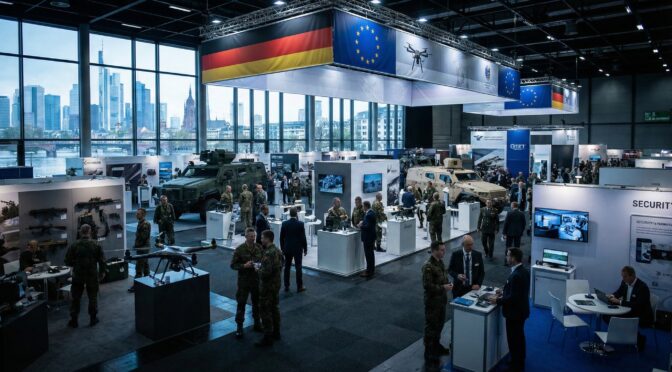
Enforce Tac 2026, the premier European trade fair for internal and external security, concluded today, February 25, 2026, at the Exhibition Centre Nuremberg in Germany.1 With over 1,300 international exhibitors and an excess of 20,000 trade visitors, the event served as a critical nexus for defense contractors, government agencies, and technology startups.3 Under the patronage of German Chancellor Friedrich Merz, the 2026 iteration expanded across seven exhibition halls, covering more than 60,000 square meters, reflecting a profound surge in international focus on domestic resilience and tactical capability enhancement.4 This exhaustive intelligence report details the primary themes, strategic discussions, and notable technological advancements unveiled at Enforce Tac 2026, translating these developments into actionable insights and procurement considerations for United States law enforcement agencies.
Macro Themes and Strategic Directives for the Security Apparatus
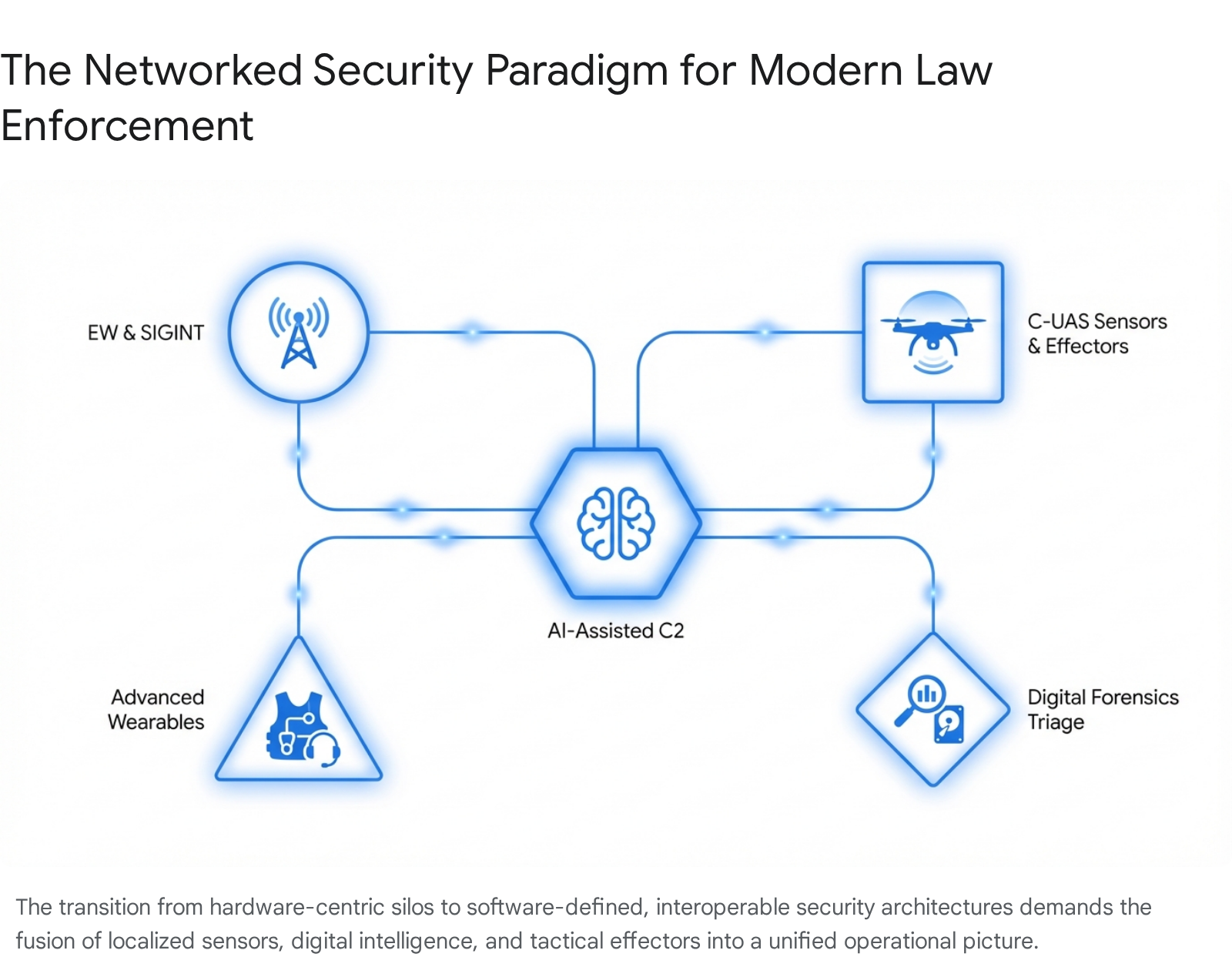
The overarching conceptual framework governing Enforce Tac 2026 was explicitly defined as “Networked Security”.2 This theme represents a systemic rejection of siloed capability development. Historically, law enforcement agencies have procured discrete solutions—a vehicle from one vendor, a radio from another, and a surveillance camera from a third—resulting in fragmented operational pictures. The contemporary threat landscape demands that human operators, sensors, artificial intelligence (AI) triage systems, and kinetic effectors function as a singular, interoperable nervous system capable of real-time data fusion.2
Software-Defined Defense and Open Architectures
A dominant technological philosophy explored extensively at the inaugural Enforce Tac Conference was “Software-Defined Defense”.6 Brigadier-General Dr. Volker Pötzsch of the German Ministry of Defence delivered a foundational keynote emphasizing that modern security forces require open architectures and modular platform approaches.1
For state and federal law enforcement, the implications of this shift are profound. Procurement strategies must pivot away from static, hardware-centric acquisitions toward systems that treat hardware merely as a vehicle for software capabilities. A software-defined approach allows agencies to receive over-the-air (OTA) updates, integrate third-party artificial intelligence algorithms, and dynamically reconfigure their communication protocols to counter emerging tactics, techniques, and procedures (TTPs) deployed by organized crime or domestic extremists.1 This mitigates vendor lock-in and dramatically reduces the latency between identifying a new threat and deploying a countermeasure.
During the conference, Alexander Philipp, Managing Director of Rohde & Schwarz Vertriebs GmbH, expanded on this during his address regarding the “Zeitenwende 2.0” (Turning Point 2.0).1 Philipp noted that as defense and security sectors gain exemption from traditional borrowing limits, agencies can secure long-term financial predictability. This predictability is essential for investing in cybersecurity, artificial intelligence, and autonomous systems, which require sustained funding for continuous software iteration rather than one-off capital expenditures.1
Critical Infrastructure Protection and the Whole-of-Society Approach
The defense of the domestic rear area was a critical focal point, conceptualized through legislative and strategic frameworks such as the Umbrella Act for Critical Infrastructure Protection (KRITIS-Dachgesetz) and Operation Plan Germany (OPLAN DEU).2 While these are European frameworks, they mirror the mandates of the US Cybersecurity and Infrastructure Security Agency (CISA) and the operational realities of state-level homeland security task forces.
The exhibition highlighted that critical infrastructure—encompassing power grids, water treatment facilities, and transportation hubs—can no longer be defended through passive physical perimeters alone. Modern law enforcement must integrate cyber resilience and electronic spectrum monitoring into their physical security paradigms.2 Professor Dr. Clemens Gause provided an extensive overview of the KRITIS law, emphasizing the new physical and digital requirements for operators of critical infrastructure and the necessity for law enforcement to seamlessly interface with private sector security apparatuses during a crisis.10
This integration was physically manifested on the trade show floor through the “it-sa Pavilion,” which specifically bridged conventional tactical defense with IT and software expertise.2 The pavilion underscored the growing importance of cybersecurity for physical systems, with an emphasis on secure communications, endpoint protection, and the mitigation of vulnerabilities within the information space.2
Simulation, Practical Validation, and the Enforce Tac Village
Theoretical architectures must survive contact with reality. Enforce Tac 2026 emphasized practical validation through the “Enforce Tac Village,” an immersive environment where products were tested in authentic, moderated scenarios developed by active and former military and police personnel.11 These live demonstrations showcased the interaction of protected communication, sensors, situation analysis, mobility, and deployment coordination during counter-terrorism operations and high-value target (HVT) raids.2 For LEA procurement officers, observing gear subjected to dynamic stress tests—complete with bodycam feeds broadcasted across the exhibition halls—provides a critical baseline for evaluating vendor claims.11
Furthermore, the integration of advanced simulation environments like “GhostPlay” was a major highlight on the Inno Stage.5 GhostPlay is an artificial intelligence-driven simulation platform utilized for the development and evaluation of cross-dimensional attack and defense tactics.12 For law enforcement tactical commanders, AI-assisted combat management and simulation represent the future of pre-mission planning. By inputting known variables regarding a target location, suspect behavior patterns, and structural blueprints, commanders can run thousands of simulated raid iterations to identify optimal entry points, line-of-sight vulnerabilities, and probability of success metrics before committing human operators to the field.12
The Unmanned Threat Vector and Counter-UAS (C-UAS) Capabilities
Perhaps the most acute operational vulnerability currently facing domestic law enforcement is the democratization of unmanned aerial systems (UAS). The proliferation of highly maneuverable First-Person View (FPV) drones, heavy-lift commercial platforms, and autonomous loitering munitions presents unprecedented challenges. Malicious actors routinely utilize these platforms for counter-surveillance during tactical deployments, smuggling contraband into correctional facilities, and executing targeted kinetic or incendiary attacks against critical infrastructure and armored vehicles.13
Traditional air defense radars and missile systems are prohibitively expensive for domestic law enforcement and largely ineffective against the immediate, close-in envelope where a commercial drone suddenly emerges from behind an urban structure or terrain feature.14 Consequently, Enforce Tac 2026 showcased a robust spectrum of scalable, affordable, and highly effective Counter-UAS solutions.
Mehler Protection: SCILT Close-Range C-UAS
In a groundbreaking development for armored vehicle survivability and SWAT team mobility, Mehler Protection unveiled the SCILT (System for Close-In Layered Threat Defeat) active protection system.14 SCILT is designed specifically to address the immediate close-in envelope where conventional mobile air-defense systems reach their detection and defeat limits.15 It acts as a dedicated final protective layer for individual vehicles, bridging the gap between passive vehicle armor and wider-area air defense.14
What makes SCILT particularly viable for law enforcement is its highly pragmatic and cost-effective defeat mechanism. Instead of utilizing costly radar arrays and guided interceptors, SCILT relies on standard 12-gauge shotgun shells integrated into effector modules mounted directly onto the vehicle.16 The system utilizes sophisticated dual-camera blocks (electro-optical sensors) that merge two images to determine the precise distance, angle, and trajectory of an incoming threat.16
The system underwent 48 extensive test campaigns over 18 months, encompassing external and terminal ballistics, temperature behavior, trigger reliability, and fragment-density measurements to optimize its effective range.15 Crucially for domestic deployment, SCILT features a deliberate “man-in-the-loop” architecture with three staged alert levels (detection, approach, and trigger), ensuring human verification before kinetic engagement.14 The system’s sector-based configuration allows operators to activate or deactivate individual firing directions depending on formation movement and the presence of civilian bystanders.14 SCILT is projected to be available commercially starting in the summer of 2026.15
Addressing the need for non-destructive, “soft-kill” kinetic neutralization, ParaZero Technologies exhibited its DefendAir counter-drone platform as part of the Israeli National Pavilion.13 DefendAir utilizes a patented net-launching technology designed to physically entangle and neutralize hostile drones with minimal collateral damage, a critical requirement for urban policing and crowd control environments.13
The company highlighted several variants highly relevant to state and federal LEAs:
Portable personal net guns: Designed for squad-level protection, allowing patrol officers or event security personnel to neutralize localized drone threats immediately.13
Drone-mounted interception systems: Engineered for the high-speed pursuit of evasive target drones, matching the mobility of the adversary.13
Stationary turrets: Providing 360-degree coverage for fixed-site defense, ideal for stadiums, airports, and power grids.13
ParaZero reported a 100% interception success rate during field trials against various drone typologies, including high-speed FPV attack variants and heavy-lift platforms.13
Rheinmetall: RCWS320-UAS
For scenarios demanding absolute perimeter denial, Rheinmetall showcased the RCWS320-UAS, a latest-generation remote-controlled weapon station designed as an effector against uncrewed aerial systems and fast-moving targets.21 The system integrates a Dillon Aero M134D electrically driven minigun, leveraging an extremely high rate of fire to establish a kinetic wall against aerial incursions.21
While a minigun-based system poses significant collateral damage concerns for standard municipal policing, federal agencies tasked with protecting high-value assets in remote or highly controlled environments (e.g., nuclear material transport, border outposts) require this level of overwhelming force. The RCWS320-UAS features sensor fusion, automated target engagement, and seamless integration with the SEOSS-320 vision system, ensuring high precision and first-hit probability.21 It complies with NATO Generic Vehicle Architecture (NGVA) standards, making it highly interoperable for agencies utilizing standardized command protocols.21
Software-Centric C-UAS: DroneShield and Hensoldt
Hardware effectors represent only the final stage of the kill chain; early detection relies entirely on software. DroneShield emphasized its agile, software-defined defense model by highlighting its quarterly software updates across its product line, including the RfPatrol system.22 These updates continuously expand the threat library, allowing LEAs to identify new, uncooperative drones utilizing atypical frequencies and cellular control mechanisms.8
Similarly, Hensoldt prominently featured its Elysion C-UAS Mission Core, a comprehensive suite of counter-UAS software.23 Hensoldt’s “Shelterised Asset Protection” and “Flexible Site Protection” configurations emphasize modular, deployable C-UAS command-and-control networks that can be erected temporarily to secure major public events, VIP movements, or political conventions against aerial surveillance or attack.23
Overview of Notable Counter-UAS Solutions Exhibited
Manufacturer / Developer
Product Name
Primary Mechanism
Key Law Enforcement Application
Further Information URL
Mehler Protection
SCILT
Hard-kill (12-gauge shotgun effectors)
Final-layer active protection for armored tactical vehicles (e.g., SWAT BearCats) against FPVs.
Digital Intelligence, Forensics, and Electronic Warfare (EW)
The domain of digital intelligence has irreversibly shifted from a purely post-incident forensic analysis role to a requirement for real-time, preventive tactical intelligence. The exponential growth in data volume, the ubiquity of advanced encryption, and the reliance of criminal enterprises on decentralized communication networks represent acute vulnerabilities for modern investigative units.
The Digital Evidentiary Bottleneck
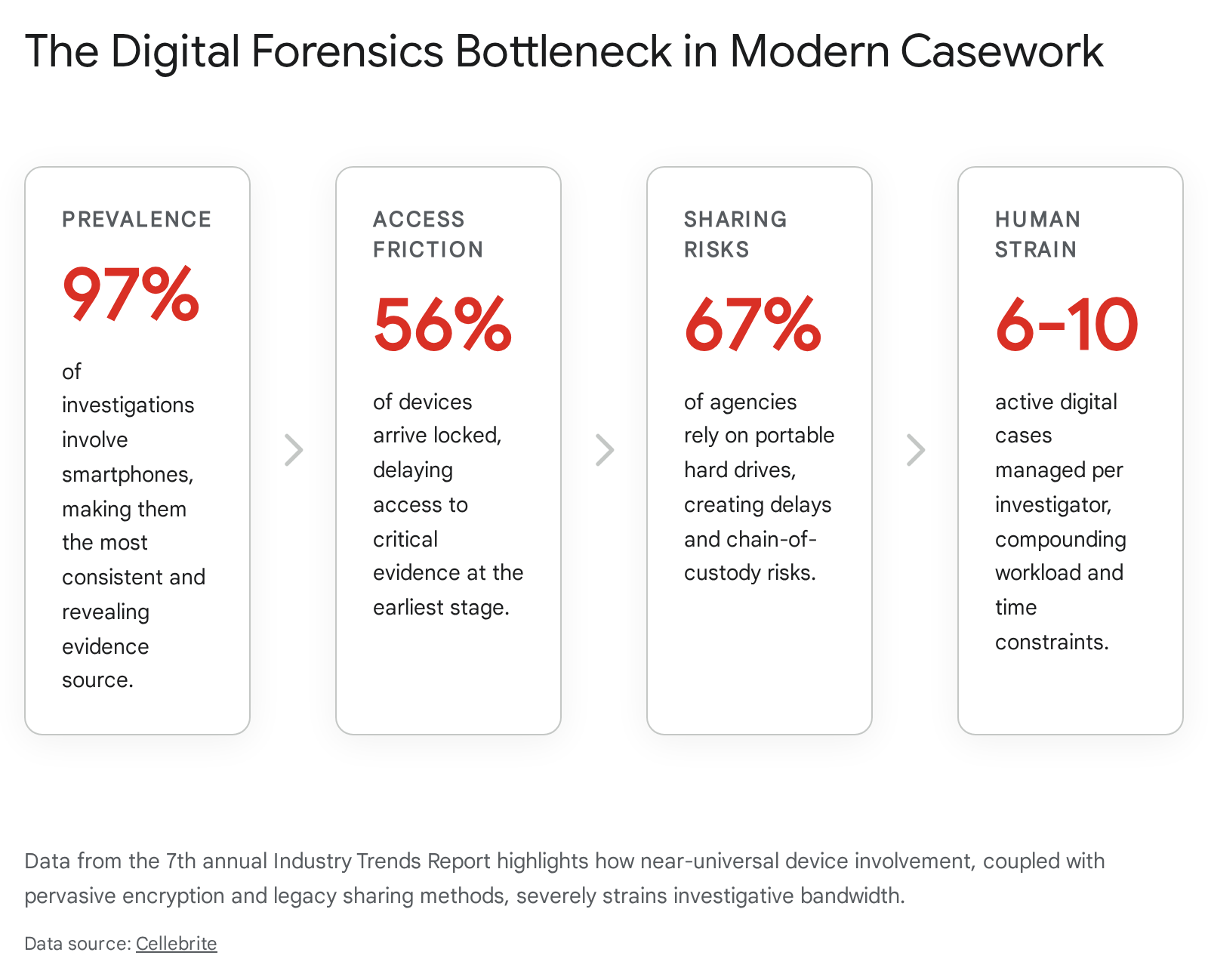
Cellebrite’s 7th annual Industry Trends Report, highlighted alongside the trade show context, quantifies the immense and growing pressure on digital forensic laboratories and field investigators.25 The data presents a stark operational reality:
Ubiquity of Digital Evidence: Smartphones now appear in a staggering 97% of all investigations, solidifying mobile forensics as the absolute cornerstone of modern law enforcement casework.25
Access Friction: More than half of devices (56%) arrive at the laboratory locked, instituting immediate, often critical delays in accessing time-sensitive evidence at the earliest stages of an investigation.25
Case Complexity: A single case now typically involves two to five devices, requiring complex data correlation and timeline reconstruction across multiple platforms.25
Systemic Inefficiencies: A startling 67% of agencies still rely on physical portable hard drives to share digital evidence. This archaic practice introduces severe chain-of-custody risks, potential data corruption, and massive operational latency.25
Human Strain: Investigators manage a crushing workload, handling a median of six to ten active digital cases simultaneously, compounding the risk of burnout and evidentiary oversight.25
AI-Driven Triage and Continuous Skill Enhancement
To combat this unsustainable bottleneck, the industry is pivoting toward artificial intelligence and advanced platform integration. Magnet Forensics highlighted its Magnet One platform, focusing on AI-enabled solutions designed to rapidly surface investigative insights and automatically generate leads.26 This transition from manual “data extraction” to automated “intelligence synthesis” is essential. By utilizing AI to parse millions of data artifacts and flag relevant communications or media, agencies can triage cases rapidly, allowing forensic examiners to focus their limited bandwidth on the most critical evidentiary elements.26
Simultaneously, MSAB promoted its focus on emerging technologies and practical skill refinement through its Digital Summit.27 Recognizing that advanced tools are only as effective as the operators wielding them, MSAB’s initiatives emphasize the necessity of continuous, rigorous training. Their inclusion of advanced Capture the Flag (CTF) showdowns, led by experts like Jessica Hyde, provides investigators with realistic, high-stakes environments to refine their skills against sophisticated evasion techniques and complex digital architectures.27
Spectrum Dominance and Tactical Electronic Warfare (EW)
Electronic Warfare (EW) and Signals Intelligence (SIGINT) are no longer disciplines confined to military intelligence units. Organized crime syndicates, cartels, and sophisticated domestic threat actors actively monitor police frequencies, utilize localized jamming equipment, and coordinate via encrypted mesh networks. Rohde & Schwarz dominated discussions at Enforce Tac regarding securing “Spectrum Dominance” and translating raw Radio Frequency (RF) data into actionable law enforcement intelligence.8
A highly critical presentation by S.E.A. Datentechnik GmbH, titled “Cellular, Wi-Fi and Bluetooth technology for military and law enforcement applications,” addressed the shifting paradigm of suspect tracking.29 Historically, call data records (CDRs) retrieved via subpoenas to centralized cellular network operators were the gold standard for investigations.29 However, criminals increasingly bypass cellular networks entirely, utilizing decentralized Wi-Fi communications and Bluetooth mesh networks. These communication points are variable in time and location, and critically, lack a central repository or corporate entity from which investigative agencies can easily retrieve historical data.29
During the conference, Martin Herzer of Rohde & Schwarz explained the vulnerabilities of traditional monitoring when adversaries utilize atypical frequencies and cellular control.8 Operational solutions showcased included tactical systems capable of actively assuring radio traces in 4G and 5G networks, and mapping decentralized Wi-Fi nodes and Bluetooth signatures during active manhunts or preventative operations.29
Furthermore, Rohde & Schwarz demonstrated how tactical SIGINT, Open Source Intelligence (OSINT), and multi-sensor fusion can be integrated using AI-assisted classification.8 This provides tactical commanders with a highly reliable, real-time operational picture of the electromagnetic spectrum within a given jurisdiction.8 Agencies can utilize these tools to track uncooperative drones, identify illicit communication hubs operating in urban environments, and secure their own tactical networks using heavily ruggedized routers and end-to-end disk encryption.8
Overview of Notable Digital Intelligence and Forensics Offerings
Vendor / Platform
Primary Capability Area
Strategic Law Enforcement Value
Further Information URL
Magnet Forensics (Magnet One)
AI-Enabled Forensic Triage
Automates the surfacing of investigative leads from massive data sets, reducing manual review time.
Advanced Ballistic Protection and Wearable Survivability
As the lethality of street-level weaponry escalates—specifically the proliferation of rifle-caliber ammunition, armor-piercing rounds, and improvised explosive devices (IEDs) encountered during high-risk warrant executions—the protective equipment issued to tactical officers must evolve. Enforce Tac 2026 featured significant advancements in modular, scalable ballistic protection that balances uncompromising safety with the ergonomic mobility required for dynamic entry and extended operations.
Rheinmetall: Modular Military Body Armor System
Rheinmetall debuted a newly developed, comprehensive body armor system designed to shield operators against high-velocity firearms, stabbing weapons, and explosive shrapnel.30 The primary operational advantage of this system for law enforcement is its extensive modularity, allowing for situation-specific configurations tailored to the precise threat profile of a given deployment.30
The baseline soft ballistic protection secures the front, back, and abdomen in accordance with the VPAM BSW Level 3 standard.30 For high-threat active shooter responses or barricaded suspect scenarios, officers can rapidly insert hard ballistic plates, upgrading the protective envelope to VPAM BSW stand-alone Levels 6 or 9.30
Crucially, the system addresses vulnerabilities frequently encountered in riot control or correctional facility operations by allowing the integration of stab protection compliant with VPAM KDIW Level K1.30 Furthermore, the system incorporates dedicated shrapnel protection for the upper arms, thighs, neck, and shoulders.30 Historically, these areas have been left exposed to preserve operator mobility; however, protecting major arterial pathways against explosive breaching blowback or localized IEDs represents a significant upgrade in overall operator survivability.30 The system also integrates a customizable chest rig, ammunition pouches, and transport bags, cementing Rheinmetall’s position as a provider of holistic survivability solutions.30
Mehler Protection: Omega Core and the Revolutionary Omega Jaw
Head trauma, particularly from high-powered rifles, remains one of the most catastrophic risks for SWAT operators during urban engagements. Mehler Protection introduced the Omega Core, a next-generation ultra-light combat helmet featuring a sophisticated ballistic construction.33 The helmet features an open rail architecture and modular interfaces designed to seamlessly accept night vision goggles (NVGs), specialized visors, communications headsets, and active hearing protection.33 Inside the shell, the Omega Core utilizes multi-chamber pads and adaptive anchoring points to minimize micro-movements under dynamic loads.33 This stability is critical for operators utilizing heavy dual-tube NVGs, ensuring optical alignment is maintained during rapid physical exertion.33 A continuously ventilated suspension net significantly reduces heat build-up during extended high-intensity activities.33
However, the most notable and operationally disruptive introduction in the wearables category was Mehler Protection’s “Omega Jaw”.33 Facial shots, specifically to the exposed lower face and mandible, represent an acute vulnerability when facing barricaded suspects firing from elevated or fortified positions. The Omega Jaw is billed as the first mandible guard engineered to offer verified, homogeneous head protection against the pervasive AK-47 Mild Steel Core (MSC) projectile, successfully meeting the rigorous VPAM 6 ballistic standard.35
The Omega Jaw integrates seamlessly into existing high-cut helmets without requiring any underlying design modifications.35 Its modular textile and plate concept allows for scalable protection and supports future material upgrades, while retaining crucial mounting options on Picatinny rails so users can attach tactical equipment without compromising their protective envelope.35 The system is designed to be quickly donned and doffed using robust hook-and-loop straps, allowing operators to scale their facial protection on the fly as the tactical situation dictates.35 This capability allows entry teams to confidently face high-powered rifle threats without suffering the traditional drawbacks of full-face protection: loss of peripheral vision, degraded communication clarity, or restricted head mobility.
Additional Wearable Innovations
Beyond ballistic plating, the exhibition featured crucial advancements in environmental and chemical protection. The NFM Group exhibited alongside its subsidiaries to showcase “Full Spectrum Protection,” highlighting their new EIR CBRN (Chemical, Biological, Radiological, and Nuclear) product line, essential for specialized hazardous material response teams.37 Additionally, advancements in Law Enforcement uniform technology were present, such as the new GORE-TEX PYRAD FR (Flame Resistant) uniforms, designed to protect officers from incendiary attacks (such as Molotov cocktails) frequently encountered during severe civil unrest.2
Overview of Notable Advanced Protection Systems
Manufacturer
Product Category
Specific Model
Key Protective Standard
Operational Capability / Feature
Further Information URL
Rheinmetall
Body Armor
Modular Body Armour System
VPAM BSW Lvl 3, 6, 9; VPAM KDIW Lvl K1
Highly scalable threat response; extensive shrapnel coverage for limbs and neck.
Next-Generation Optics, Optronics, and Small Arms Deployments
Precision engagement, superior situational awareness, and the effective management of the escalation of force continuum are heavily reliant on the quality and reliability of the hardware operators carry into the field. Enforce Tac 2026 served as a launchpad for next-generation optics and highly specialized kinetic tools.
Advanced Optics and Sensor Systems
The ability to accurately identify threats in degraded visual environments (low light, smoke, extreme distance) is non-negotiable for designated marksmen and surveillance units.
HENSOLDT: The renowned optics manufacturer showcased an expansive portfolio of specialized sensor and surveillance solutions.23 For snipers and tactical overwatch personnel, the ZF 3.5-26×56 telescopic sight, the ZF4-MKO, and the ZF4-R riflescopes were highlighted for unparalleled clarity in day and night operations.23 These were complemented by the Spotter 42 and Spotter 45/60 observation optics.23 Advanced, digitized target acquisition is facilitated by the TAROSS (Target Acquisition & Reconnaissance Optronical Sighting System).23 Furthermore, Hensoldt presented the “Ceretron” mission assistant for land vehicles, a system designed to drastically enhance situational awareness for mobile command posts by synthesizing external sensor data.23
EOTECH and Primary Arms: Spartanat reporting from the exhibition floor noted the introduction of the new EOTECH VUDU 4-12×36 FFP (First Focal Plane) scope, a compact optic highly compatible with ACOG mounts, offering versatile, rapid-adjustment magnification for designated marksmen operating in mixed-range urban environments.38 Primary Arms also displayed its highly capable 1.5-12×36 FFP RDB versatile riflescope.39
Steiner eOptics: Exhibiting a robust line of red dot sights, optronics, and laser aiming devices designed for close-quarters battle (CQB) reliability.40
Small Arms and Less-Lethal Solutions
Combined Systems, Inc. (CSI): Focusing intently on the non-lethal de-escalation of violence and crowd control, the US-based manufacturer exhibited its extensive range of less-lethal munitions and launchers.41 A major highlight was the Penn Arms PG640-LR, a highly reliable pump-lock multi-launcher.39 Capable of delivering a sustained barrage of tear gas, impact rounds, or marking munitions with high precision, the PG640-LR is an essential tool for riot control units and SWAT teams executing barricaded suspect resolutions.39
Rheinmetall Squad Support Weapon SSW40: Representing a massive leap in squad-level firepower, Rheinmetall showcased the SSW40, billed as the world’s first automatic, magazine-fed, shoulder-fired grenade launcher for 40mm ammunition.42 While heavily weaponized for military applications, the ability to automatically deliver 40mm less-lethal or chemical payloads with pinpoint accuracy offers profound tactical advantages for highly specialized law enforcement riot response units.42
Precision and Service Firearms: Notable small arms introductions included the CZ P13, which has been selected as the new service pistol for the German Army, indicating its high durability and reliability standards.39 The Arex AMG556 light machine gun was also prominently displayed.39 For precision rifle platforms, the Steyr SSG M1 represents the next generation of bolt-action sniper rifles, offering modularity and extreme accuracy for elite law enforcement marksmen.39 Additionally, expanded contracts were noted for the Colt Canada C8 MRR Carbines, a proven platform in use with allied forces.2
Overview of Notable Optics and Kinetic Systems
Manufacturer
Product / System
Category
Key Capability
Further Information URL
HENSOLDT
TAROSS / Ceretron
Optronics / Sensor Fusion
Advanced target acquisition and synthesized vehicle situational awareness.
Mobility and protected transport remain foundational to any tactical response. The newly established “Armored Forces Area” in Hall 11 created a structured environment dedicated to land-bound military capabilities, showcasing how protection, mobility, sensors, and leadership capabilities are operationally combined.2
Rheinmetall dominated the vehicular space with several key platforms. The company premiered the Fuchs JAGM armoured missile tank destroyer.30 While primarily a military asset, the underlying armored chassis technology represents the pinnacle of wheeled survivability. Highly relevant to law enforcement was the Caracal air assault vehicle, which meets all modern mobility requirements for rapid deployment of light forces, making it an ideal platform for border patrol or rugged terrain interdiction teams.42 Rheinmetall also showcased the Rapid Obscuring System (ROSY), a mechanism that protects land vehicles even when in motion through the spontaneous generation of a dense fog shield, effectively blinding incoming optically guided threats or masking tactical retreats.42
Other notable heavy platforms included the BAE Systems CV90 combat vehicle and the Rheinmetall CT-025 Turrets and Simulators designed specifically for the Luchs 2 system.2
The Innovation Stage (Inno Stage): Emerging Technologies
Looking toward the immediate horizon of security technology, Enforce Tac 2026 dedicated significant resources to the “Inno Stage,” an interactive platform where over 30 start-ups and innovative technology suppliers pitched solutions designed to revolutionize the security landscape.2
GhostPlay: AI-Assisted Combat Management
A standout presentation on the Inno Stage featured GhostPlay, a highly advanced simulation environment.5 GhostPlay utilizes sophisticated artificial intelligence to facilitate the development and evaluation of cross-dimensional specific attack and defense tactics.12
For law enforcement, an AI-driven simulation environment is an invaluable asset for pre-mission planning and training. Tactical commanders can input the precise parameters of a high-risk warrant execution, a hostage barricade within a known architectural layout, or a VIP protection route. The GhostPlay AI then simulates thousands of dynamic variables—including erratic suspect movements, civilian interference, optimal entry points, and complex line-of-sight calculations—ultimately recommending the most statistically successful tactical approach and identifying unforeseen vulnerabilities before operators are placed in harm’s way.5
MuQuaNet: Quantum-Secure Communications
A highly critical session titled “True Spectrum Dominance – From EW and Counter-UAS to Quantum-Secure Defense,” delivered by Michael Grundl of Rohde & Schwarz, highlighted the impending, catastrophic threat of quantum computing to current cryptographic standards.28 Complementing this was the presentation of the MuQuaNet project, developed in conjunction with the CODE research institute at the University of the Federal Armed Forces in Munich (Palladion Defence Accelerator).5 MuQuaNet aims to develop, build, and operate a quantum-secure communication network capable of seamless integration into today’s network architecture.43
State and federal law enforcement agencies regularly transmit highly classified intelligence, informant identities, and operational plans over encrypted networks. The current threat model involves adversarial intelligence services and highly funded transnational cartels intercepting and storing encrypted data today, intending to decrypt it tomorrow when quantum computing matures (the “Harvest Now, Decrypt Later” strategy).44 Technologies discussed at Enforce Tac, such as Quantum Key Distribution (QKD) and Post-Quantum Cryptography (PQC), implemented via crypto-agile Hardware Security Modules (HSMs), represent the only viable defense against this future-dated compromise.44 Transitioning LEA communication architectures to quantum-ready networks is no longer a theoretical academic exercise but a pressing strategic and budgetary necessity.
Supply Chain Resilience and Acoustics
Other notable presentations on the Inno Stage focused on the logistical realities of defense. Niclas Fritz of BatchOne GmbH delivered a lecture titled “From Concept to Scale,” emphasizing that in today’s contested environment, supply chain resilience is as decisive as tactical capability.45 If an agency cannot source, manufacture, or sustain systems under disruption, the product is effectively useless.45 This highlights the need for LEAs to verify the secondary sourcing options and domestic manufacturing capabilities of their vendors. Furthermore, innovative concepts like structure-borne sound analysis for rotating vehicle components were discussed, pointing toward a future of predictive maintenance for armored vehicle fleets, minimizing downtime and maximizing operational readiness.45
Open Source Intelligence (OSINT) and Human Capital
Technology is merely an enabler for human operators. Enforce Tac 2026 recognized this through dedicated Masterclasses and the Enforce Tac Job Zone.2
The Masterclasses, presented by the Carl-Cranz-Gesellschaft e.V., provided concise, practical knowledge on modern security issues.47 A highly relevant session for law enforcement intelligence analysts was “Open Source Intelligence – Theory and Practice for Security Agencies and Armed Forces,” led by Timo Keim and Floyd Mecklenburg of HENSOLDT.47 As criminals increasingly coordinate via public and semi-public digital forums, the mastery of OSINT is critical for identifying threats, tracking illicit funding, and building robust prosecutorial cases prior to executing physical warrants.47 Another critical Masterclass, led by Ulf Barth, focused specifically on the drone threat paradigm, educating operators on why traditional security measures are powerless against aerial incursions.47
Furthermore, the Enforce Tac Job Zone directly addressed the systemic shortage of skilled workers in the security sector.2 By connecting companies and agencies directly with qualified candidates, the trade fair acknowledged that the recruitment and retention of highly specialized personnel—specifically those capable of managing software-defined systems, digital forensics, and electronic warfare equipment—is the primary bottleneck restricting the modernization of law enforcement agencies globally.2
Strategic Imperatives and Procurement Recommendations
The technologies, methodologies, and strategic frameworks showcased at Enforce Tac 2026 demand a comprehensive reevaluation of how state and federal law enforcement agencies approach procurement, training, and operational doctrine. The profound convergence of military-grade technology with civilian policing environments dictates several immediate strategic imperatives:
Mandate Software-Defined Architectures: Agencies must systematically abandon rigid, single-use hardware procurement. Future requests for proposals (RFPs) for tactical vehicles, radios, and sensor networks must strictly mandate open, modular software architectures. The ability to push over-the-air updates to counter new drone control frequencies, or to rapidly update AI forensic triage algorithms, is the new baseline standard for operational agility and fiscal responsibility.
Deploy Multi-Layered C-UAS Protocols: The threat posed by weaponized and surveillance-capable commercial drones to domestic infrastructure and tactical teams is acute, immediate, and evolving rapidly. Agencies must implement layered, defense-in-depth strategies: utilizing software platforms like Hensoldt Elysion for wide-area RF detection and early warning, ParaZero DefendAir net systems for low-collateral public event mitigation, and advocating for the rapid evaluation and adoption of close-in kinetic systems like Mehler’s SCILT for armored rescue vehicle protection during high-risk deployments.
Modernize Digital Intelligence Triage: The current evidentiary bottleneck is unsustainable and actively degrades investigative success rates. Agencies must aggressively phase out the use of physical hard drives for evidence sharing, transitioning immediately to secure, encrypted, cloud-based investigative platforms. Furthermore, capital investments must pivot toward AI-assisted triage tools (such as Magnet One) that surface leads automatically, reserving manual, hex-level forensic examination for deep-dive evidentiary extraction where automated tools fall short.
Prioritize Spectrum Dominance and Quantum Readiness: Law enforcement must begin training technical officers to understand, monitor, and manipulate the electromagnetic spectrum. The capability to detect decentralized Wi-Fi and Bluetooth communication nodes is essential for disrupting modern, agile criminal networks. Concurrently, IT departments must immediately begin auditing current cryptographic standards and planning the complex transition path toward Post-Quantum Cryptography (PQC) to protect long-term intelligence assets from adversarial “Harvest Now, Decrypt Later” strategies.
Re-evaluate Ballistic Standards against Evolving Kinetic Threats: The widespread availability and utilization of high-velocity rifle platforms by domestic threat actors necessitates an immediate upgrade in standard-issue tactical armor. Procurement officers must evaluate advanced systems like the Mehler Omega Jaw to protect against catastrophic facial trauma from rounds such as the 7.62x39mm MSC. Furthermore, agencies should transition to highly modular body armor systems that provide scalable shrapnel and stab protection (VPAM KDIW Lvl K1), allowing operators to tailor their protective envelope depending on the specific operational deployment.
Enforce Tac 2026 clearly and unequivocally demonstrated that the future of security is interconnected, highly agile, software-driven, and fiercely contested within the digital and electromagnetic spectrums. State and federal law enforcement agencies that rapidly adopt this “Networked Security” paradigm will maintain tactical superiority and ensure the safety of the public and their operators. Those clinging to isolated, static hardware and legacy protocols will inevitably face systemic operational failures against modern, hybrid threats.
The designation of “elite” within the contemporary military landscape is frequently misconstrued as a mere superlative for physical prowess or advanced weaponry. From the perspective of a military analyst, however, elitism is a structural, psychological, and philosophical framework that enables a small cohort of operators to achieve strategic effects disproportionate to their numerical strength. The “best of the best” are defined not by their participation in high-risk missions, but by their adherence to a specialized set of foundational truths, a rigorous and scientifically validated selection process, and a unique organizational position that bridges the gap between tactical action and national policy. Special operations forces (SOF) represent a “strategic weapon system” where the human operator is the primary platform, and technology serves as a secondary enabler.1
The Philosophical Foundation: The Five SOF Truths
The operational effectiveness of special operations is governed by five foundational principles known as the SOF Truths. These truths are not merely slogans but are the governing logic of force generation and employment for organizations such as the United States Special Operations Command (USSOCOM), the British Special Air Service (SAS), and the Canadian Joint Task Force 2 (JTF 2).1 They dictate that elitism is a product of long-term investment, emphasizing that the capabilities required for high-stakes missions cannot be rapidly manufactured in response to a crisis.
SOF Truth
Operational and Strategic Implication
I: Humans are more important than hardware.
People, not equipment, make the critical difference. The right people can accomplish the mission with available gear, but the best gear cannot fix a lack of the right people.1
II: Quality is better than quantity.
A small number of carefully selected, well-trained, and well-led individuals is superior to a larger force that may be less capable.1
III: SOF cannot be mass produced.
High-level proficiency takes years of training; hastening the process degrades the ultimate capability of the unit.1
IV: Competent SOF cannot be created after emergencies.
Employment of fully capable SOF on short notice requires units that are highly trained and constantly available in peacetime.1
V: Most special operations require non-SOF support.
SOF effectiveness depends on integration with joint service partners, intelligence analysts, and technical specialists.1
The Primacy of the Human Variable
The first SOF truth—that humans are more important than hardware—serves as the cornerstone of elitism. In conventional military doctrine, “lethality” is often measured by platform numbers: the quantity of tanks, aircraft, or naval vessels. In special operations, the “center of gravity” shifts entirely to the individual soldier.2 This philosophy posits that properly prepared soldiers possess the unique ability to think, learn, reason, and adapt to changing conditions in ways that technological systems cannot emulate.2 Elitism, therefore, is defined by the quality of the relationships and the trust built within a team before a mission is ever greenlit.7 This “people-centric” focus allows SOF to navigate the “human domain,” shaping the battlespace through influence and rapport as much as through kinetic force.8
The Time-Threshold of Elitism
Truths III and IV establish that elitism is inherently time-bound. Unlike conventional infantry, which can be surged through accelerated training cycles during wartime, special operations units require years of institutional and unit-level training to reach operational proficiency.1 This constraint creates a natural “scarcity” of elite talent. Because the standards of units like Delta Force or the SAS are non-negotiable, the forces cannot be mass-produced without sacrificing the very precision that makes them effective.1 Consequently, the world’s best SOF units are those that have maintained a high state of readiness during periods of peace, ensuring that their unique skill sets are available to policymakers at the onset of a crisis rather than being developed as a reaction to one.1
The Filtering Mechanism: Selection and Assessment
What separates the elite from the conventional is the “filter” of Selection and Assessment (S&A). This process is designed to identify individuals who possess a specific blend of physical resilience, cognitive agility, and psychological stability. S&A is not a training course; it is an evaluation of an individual’s “trainability” and potential for long-term service in a high-stress environment.10
Comparative Selection Methodologies
Units like the British SAS and the U.S. Army Delta Force (1st SFOD-D) utilize selection processes that serve as the global gold standard for military elitism. The British SAS selection, founded in 1941, remains one of the world’s most demanding, focusing on long-distance endurance navigation, survival, and resistance to interrogation.9 Delta Force, founded in 1977 by Colonel Charles Beckwith, was heavily modeled on the SAS after Beckwith spent time as an exchange officer with the British unit.4
Selection Phase
British SAS
U.S. Army Delta Force
Duration
Several months (includes hills, jungle, and SERE).12
Individual performance under extreme stress, land navigation.13
Recruitment
All branches of the British military.9
Primarily U.S. Army Special Forces and 75th Ranger Regiment.13
Success Rates
Frequently below 10%; some cycles yield zero graduates.9
Highly secretive, but comparable to the SAS in exclusivity.9
The difference in selection philosophy often stems from the recruitment pool. Delta Force typically recruits “seasoned” candidates who are already special operations qualified (such as Green Berets or Rangers), meaning they have already passed significant physical and tactical filters.12 The SAS recruits from across the entire military, including conventional units, necessitating a longer selection process to bring candidates up to the required standard of specialized soldiering.12
Cognitive Benchmarks and Intelligence
The modern elite operator must be an “intellectual athlete.” Research into the Special Forces Assessment and Selection (SFAS) process demonstrates that cognitive ability (IQ) is one of the strongest predictors of success.10 High-tier SOF candidates must demonstrate superior problem-solving skills, working memory, and spatial ability.10 This “cognitive overmatch” is essential because operators must often work in small teams with minimal oversight, requiring them to process complex information and make high-stakes decisions under conditions of extreme fatigue and duress.15 In German KSK selection, for instance, officers are held to even higher cognitive performance standards in computer-based testing than enlisted personnel, reflecting the increased decision-making responsibility of leadership.11
The Psychological Profile of Elitism
Beyond IQ, elite status is defined by a specific personality configuration. Studies comparing special operations operators to civilian and conventional military groups show that elite commandos are significantly less neurotic, more conscientious, and often score higher on “grit” and “perseverance”.14
Emotional Regulation: The ability to remain calm and focused despite intense sensory overload (smells, sounds, and images of combat) is a primary differentiator.16
Adaptability: The capacity to adjust thinking and behavior in response to a fluid environment is ranked by operators themselves as one of the most crucial traits for professional functionality.18
Humility and Self-Control: Unlike the aggressive stereotype of “action movies,” real-world elite operators value humility—the ability to learn from mistakes—and self-control, which is necessary for the discriminate use of force in politically sensitive areas.17
Stubbornness: A relatively novel finding in research on UK special forces identifies “stubbornness” as a key factor; a refusal to quit even when every physical indicator suggests they should.17
Psychological assessments like the MMPI-2 are utilized to identify candidates who can most effectively integrate into these specialized subcultures. Findings suggest that scales related to energy level, risk-taking, and low anxiety are strongly correlated with graduation from high-tier qualification courses.10
Mission Profiles: The Scalpel vs. The Hammer
The capabilities that set elite forces apart are best understood through the dichotomy of the direct and indirect approaches to warfare. While most conventional units are designed for large-scale combat operations (LSCO), SOF are designed for precision effects and strategic influence.22
The Direct Approach: Surgical Precision
The direct approach is characterized by technologically enabled, small-unit precision lethality. These missions are typically brief, high-risk, and kinetic.22 Elite units like the Navy SEALs (specifically DEVGRU) and Delta Force are the primary practitioners of this approach.9
Hostage Rescue (HR): This is perhaps the most demanding SOF mission set. It requires perfect intelligence, extreme speed, and a level of marksmanship where operators must distinguish between a hostage and a captor in a fraction of a second.4
Counter-Terrorism (CT): Raids to capture or neutralize high-value targets (HVTs) are the staple of Tier 1 units. The Navy SEAL operation to recover hostages from Somali pirates is a classic example of this direct capability.22
Direct Action (DA): Short-duration strikes to seize or destroy enemy infrastructure. These operations often require specialized infiltration methods, such as HALO (High Altitude Low Opening) or combat diving.26
Delta Force is often described as the “scalpel” because of its emphasis on undercover tradecraft and its ability to blend into civilian populations to gather intelligence before striking.24 Navy SEALs are often seen as the “hammer,” particularly in maritime environments where their mastery of underwater demolition and coastal raids provides a unique infiltration advantage.24
The Indirect Approach: The Art of Influence
While the direct approach generates headlines, the indirect approach often generates long-term strategic results. This is the primary domain of U.S. Army Special Forces (the Green Berets).22
Unconventional Warfare (UW): Supporting a resistance movement or insurgency to disrupt or overthrow a hostile government or occupying power.23 This is arguably the most complex military mission, requiring operators to act as diplomats, trainers, and guerrilla leaders simultaneously.23
Foreign Internal Defense (FID): Training and advising the security forces of partner nations to handle their own internal threats. This “by, with, and through” approach minimizes the need for large-scale U.S. troop deployments.3
Civil Affairs (CA) and Military Information Support Operations (MISO): Shaping the human environment through infrastructure projects and persuasive communication. This “non-kinetic” side of special operations is essential for stabilizing volatile regions and countering violent extremism.3
Elitism in the indirect approach requires a high degree of Cultural Intelligence (CQ). An operator lacking CQ is considered a liability, as a single cultural misstep can undermine months of relationship-building with local tribal leaders or host-nation officials.31 High CQ allows operators to understand the “strategic culture” of their environment, identifying the triggers that might lead to violence or cooperation.31
Command, Control, and the Strategic Corporal
One of the most profound markers of elite status is the devolution of command responsibility to the lowest possible level. In special operations, the “Strategic Corporal” is a reality of the modern battlefield.32
The Three Block War
The “Three Block War” concept, introduced by Marine General Charles Krulak, describes a scenario where a small unit must simultaneously conduct humanitarian aid, peacekeeping, and high-intensity combat within a three-block radius.33 In such environments, the decision-making of a junior NCO can have immediate strategic and political consequences.32 Elite units are unique because they train their junior leaders to be “autonomous self-starters” who can interpret the commander’s intent and take independent action in the absence of orders.18
Decoupling the Chain of Command
Conventional forces often rely on a rigid, top-down hierarchy. Elite units, however, favor a “flattened” command structure. This is necessitated by the speed of modern conflict and the pervasive nature of media, where a single tactical action can be broadcast globally in minutes.32 The “strategic corporal” must be technically proficient with arms, but also sensitive to political and media optics.32 This requirement for “political and media sensitivity” is a key part of the professional development for elite units, distinguishing them from ordinary infantry.32
The Targeting Engine: F3EAD
Elite forces have revolutionized military intelligence through the integration of the F3EAD cycle: Find, Fix, Finish, Exploit, Analyze, and Disseminate.35 This model, pioneered by General Stanley McChrystal and the Joint Special Operations Command (JSOC) in Iraq, transformed counter-terrorism into a high-tempo, “industrialized” process.37
The Collaborative Warfare Model
In F3EAD, the “Finish” (the raid) is merely one part of a continuous loop. The real power of the cycle lies in “Exploitation” and “Analysis”.35
Phase
Description
Key Enablers
Find
Locating the target within a social or operational network.35
HUMINT, SIGINT, OSINT, and financial data.35
Fix
Tracking the target to a specific time and location.35
Geolocation, covert observation, and persistent surveillance.35
Finish
The kinetic operation (capture or kill).35
Tactical precision, speed, and surprise.36
Exploit
Gathering intelligence (documents, cell phones, laptops) from the site.35
Digital forensics and document exploitation (DOMEX).35
Analyze
Processing exploitation data to identify new target nodes.35
Fusion centers and interagency analysts.35
Disseminate
Sharing findings across the force to initiate the next cycle.35
Real-time digital networks and interagency task forces.35
By co-locating representatives from the CIA, NSA, FBI, and other agencies within SOF headquarters, these units eliminated the “organizational seams” that traditionally delayed intelligence sharing.37 This allowed JSOC to conduct a “wholesale attrition” of terrorist organizations, taking down dozens of targets in a single night based on intelligence gathered from the previous night’s raids.37 This “tempo of operations” is a hallmark of elitism, allowing SOF to operate inside an adversary’s decision cycle.35
Technological Overmatch and SOF-Peculiar Equipment
While the SOF Truths emphasize “humans over hardware,” elite forces maintain a technological edge through “SOF-peculiar” (SO-P) equipment—gear designed specifically for missions where conventional equipment is inadequate.1
Unique Acquisition Authorities
In the United States, elitism is underwritten by the Major Force Program 11 (MFP-11) budget.40 Unlike the military services (Army, Navy, Air Force) which buy “service-common” gear like C-130 cargo planes, USSOCOM has the authority to buy SO-P modifications, such as the targeting computers and howitzers that turn a C-130 into an AC-130 Ghostrider gunship.40 This authority allows elite units to:
Rapidly Prototype: Using Other Transaction Authorities (OTAs), SOF can move from a problem statement to an awarded contract in as little as 110 days.43
Adapt at Speed: Elite units often buy small quantities of five different versions of a tool to see which works best in the field, a “buy, try, and decide” approach that the larger military cannot replicate.41
Cutting-Edge Weaponry and Enablers
The equipment utilized by Tier 1 units provides a massive advantage in situational awareness and stealth.
Ground Panoramic Night Vision Goggles (GPNVG-18): Standard night vision offers a 40-degree field of view (FOV). The GPNVG-18 uses four tubes to provide a 97-degree FOV, allowing operators to see into their periphery without turning their heads. This drastically reduces “dead space” and increases reaction time in close-quarters combat.45
Black Hornet Nano-UAV: A 33-gram drone that fits in a pocket and is nearly silent. It provides squads with immediate “over-the-hill” or “around-the-corner” reconnaissance without alerting the enemy.46
Specialized Infiltration Tools: These include HALO/HAHO parachuting gear for high-altitude insertion and “rebreather” diving equipment for clandestine maritime approaches that leave no bubble trail on the surface.26
Case Studies in Global Elitism
To understand what makes these forces elite, one must examine how they compare across national borders.
The Special Air Service (SAS) and the British Model
The SAS is the template for modern special operations.4 Its motto, “Who Dares Wins,” reflects a culture that encourages initiative and independent thinking.9 The SAS is smaller than many of its counterparts (approx. 400-600 operators) but maintains an outsized reputation for long-range reconnaissance and “quiet professionalism”.9 During the Gulf War and operations in Northern Ireland, the SAS demonstrated an ability to operate deep behind enemy lines for extended periods with minimal support.4
Delta Force and the American Tier 1 Standard
The 1st Special Forces Operational Detachment-Delta is the U.S. Army’s answer to the SAS. While it shares the British unit’s roots, it has evolved into a force with significantly more funding and a primary focus on counter-terrorism and hostage rescue.9 Delta operators are masters of tradecraft, often operating in civilian clothes and utilizing specialized firearms like the MCX Spear-LT.24 Their selection process emphasizes the “hills phase” from the SAS but adds advanced psychological screening to ensure candidates can handle the extreme political sensitivity of national-level missions.9
JTF 2: Canada’s Quiet Professionals
The Canadian Joint Task Force 2 is frequently cited as one of the most capable units in the world, though it is among the most secretive.5 Created in 1993, JTF 2 gained international acclaim as part of Task Force K-Bar in Afghanistan, where they worked alongside U.S. Green Berets and the SAS.25 JTF 2 is known for its high-readiness and precision; in 2017, a JTF 2 sniper set a then-world record with a confirmed kill at 3,540 meters, highlighting the unit’s exceptional marksmanship.52
The KSK and GIGN: The European Perspective
KSK (Germany): Established in 1996 with SAS assistance, the KSK is a brigade-level unit responsible for hostage rescue and unconventional warfare.28 The unit is structured into specialized platoons for desert, jungle, mountain, and arctic environments.53
GIGN (France): Primarily a gendarmerie (police) unit with military status, GIGN is renowned for its hostage rescue capabilities and its training of foreign intervention units.53 It served as one of the models for the KSK alongside the SAS.53
The Future of Elitism: Great Power Competition
The role of special operations forces is currently undergoing a strategic shift. The “direct action” focus of the Global War on Terror is being balanced with a return to “irregular warfare” and “gray zone” competition against peer adversaries like Russia and China.23
Cyber and Space Integration
The future of elitism lies in the convergence of SOF with space and cyber capabilities.30 A SOF team might provide the physical access necessary for a cyber intrusion into a denied air-defense network.55 In future conflicts, the ability of SOF to support “Project Convergence” by providing early warning and flexible deterrent options will be a decisive factor in maintaining a national strategic advantage.30
AI-Driven Information Operations
Artificial Intelligence is fundamentally reshaping the “human domain.” Elite units are now embedding AI-driven capabilities—such as real-time sentiment analysis and deepfake counter-messaging—into their Military Information Support Operations (MISO).30 This allows SOF to achieve “cognitive superiority,” automated and amplified psychological effects at scale in contested environments.30
The Enduring Value of the Indirect Approach
Despite the rise of high-tech warfare, the ability to build relationships with indigenous populations remains the most unique SOF capability. In Great Power Competition, the indirect approach—building the capacity of allies to resist aggression—is more cost-effective than conventional intervention.3 Special Forces operators who are “regionally focused, foreign language qualified, and culturally sensitive” will continue to be the primary tool for shaping the strategic environment short of war.23
Conclusion: What Truly Makes Them Elite?
In summary, the elitism of the world’s best special operations forces is not defined by any single factor, but by the synergy of three core elements:
Selection of the Right Humans: The use of scientifically validated physical and psychological filters to identify individuals with the IQ, adaptability, and grit necessary for specialized warfare.10
Strategic Autonomy: The “Strategic Corporal” concept, which empowers junior leaders to make high-stakes decisions in ambiguous, politically sensitive environments.32
Collaborative Integration: The ability to fuse intelligence and operations through interagency teams and the F3EAD cycle, creating a tempo of operations that conventional forces cannot match.35
Elite forces represent a long-term investment by a nation. They are a “scalpel” used for surgical interventions where the “hammer” of conventional force is too blunt or too risky.22 As the battlefield expands into the digital and cognitive realms, the “best of the best” will continue to be defined by their ability to adapt, their commitment to “quality over quantity,” and their unwavering adherence to the principle that in special operations, the human is always the most important piece of hardware.1
The Roles of Perseverance, Cognitive Ability, and Physical Fitness in U.S. Army Special Forces Assessment and Selection – DTIC, accessed February 8, 2026, https://apps.dtic.mil/sti/tr/pdf/ADA525579.pdf
An Exploration of the Psychological Traits Deemed Crucial for Success in UK Special Forces Operators – PubMed, accessed February 8, 2026, https://pubmed.ncbi.nlm.nih.gov/41009224/
The period spanning 2021 through early 2026 marks one of the most transformative eras in the history of United States Special Operations Command (USSOCOM) small arms acquisition. Driven by the strategic imperative to reassert overmatch against near-peer adversaries in Great Power Competition (GPC), the Command has systematically dismantled its reliance on legacy NATO calibers—specifically 5.56x45mm and 7.62x51mm—in favor of optimized intermediate and precision cartridges. This report provides an exhaustive analysis of the contracting activities, requirements development, and industrial base maneuvers that have defined this modernization effort. The overarching theme of this half-decade is the pursuit of “lethality extension,” a doctrinal shift aimed at pushing the effective engagement envelope of the individual operator beyond the capabilities of peer competitors equipped with standard-issue weaponry.
From a contracting perspective, the last five years have been characterized by a distinct bifurcation in the industrial base. On one side, Sig Sauer has emerged as a “super-prime” supplier for the Command, securing dominance in the Personal Defense Weapon (PDW) sector, the Suppressed Upper Receiver Group (SURG) program, and the medium machine gun category. On the other side, USSOCOM has demonstrated a remarkable willingness to engage with agile, specialized manufacturers for its core infantry systems. This is best exemplified by the landmark selection of LMT Defense in August 2025 for the $92 million Medium Range Gas Gun-Assault (MRGG-A) contract, and the surprise selection of Sons of Liberty Gun Works (SOLGW) in November 2025 for the Combat Assault Rifle (CAR). These awards signal a departure from the “lowest price technically acceptable” model toward a “best value” approach that prizes technical superiority and manufacturing agility.
The modernization portfolio is anchored by the adoption of the 6.5mm Creedmoor (6.5 CM) as the primary cartridge for the next generation of assault and sniper support weapons. This ballistic transition was solidified by a $40 million ammunition contract awarded to Black Hills Ammunition in August 2025, ensuring that the logistical tail matches the operational tooth of the new weapon systems. Simultaneously, the contracting landscape has witnessed strategic recalibrations, most notably the abrupt cancellation of the Lightweight Machine Gun-Assault (LMG-A) prototyping effort in December 2025, a move that reflects the complex interplay between internal SOF requirements and the broader service pressures introduced by the U.S. Army’s Next Generation Squad Weapon (NGSW) program.
Critical enablers have not been neglected. Nightforce Optics secured a massive $17.6 million contract for the Precision-Variable Power Scope (P-VPS), cementing the shift toward high-magnification optics on standard infantry rifles. SureFire and Sig Sauer continue to dominate signature reduction, with suppression transitioning from a specialized capability to a universal requirement for all fielded systems. The following table summarizes the strategic timeline of these major acquisition milestones, illustrating the concurrent development of precision, maneuver, and support capabilities.
Timeframe
Program / Milestone
Contractor
Key Details
2021–2022
ASR Fielding
Barrett Firearms
Full Rate Production of MK22 (MRAD) commences.
Sep 2022
PDW Award
Sig Sauer
Award for MCX Rattler (.300 BLK). Initial $5M ceiling.
Selection of Mk1 Mod 0 (6.5 CM) for sniper support.
2023–2024
LMG-M Fielding
Sig Sauer
Operational fielding of MG 338 (.338 NM) via OTA.
Aug 2025
MRGG-Assault Award
LMT Defense
$92M IDIQ for 14.5″ 6.5 CM Carbine.
Aug 2025
6.5 CM Ammo Award
Black Hills Ammo
$40M IDIQ for match-grade combat ammunition.
Nov 2025
CAR Award
SOLGW
Selection of MK1 (5.56mm) for specialized assault role.
Dec 2025
LMG-A Cancellation
N/A
Prototyping effort canceled; responsibility shifted to Navy Crane.
This report details the technical specifications, contract mechanisms, and operational implications of each major award, offering a comprehensive view of the USSOCOM small arms arsenal as it stands in 2026.
1. Strategic Context: The Doctrine of Overmatch
To understand the procurement decisions of the last five years, one must first analyze the doctrinal vacuum they were designed to fill. For two decades, USSOCOM operations were defined by the Global War on Terror (GWOT), predominantly Close Quarters Battle (CQB) in urban environments against adversaries with limited ballistic protection and rudimentary small arms. In this environment, the Mk18 (10.3-inch 5.56mm carbine) and the MP7 (4.6mm PDW) were supreme. However, the 2018 National Defense Strategy signaled a pivot to Great Power Competition, placing US forces in potential conflict with near-peer state actors equipped with modern body armor and weapons capable of engaging effectively out to 600 meters and beyond.
1.1 The Ballistic Deficit
Analysis conducted by the US Army and USSOCOM identified a critical “ballistic deficit” in the standard 5.56mm NATO cartridge. While lethal at close range, the 5.56mm (specifically the M855A1) loses the ability to defeat Level IV ceramic body armor at relatively short distances. Furthermore, the maximum effective range of the M4A1 is generally cited as 500 meters for a point target. Adversary systems utilizing the 7.62x54R cartridge, particularly when modernized, allowed threat forces to out-range US operators, suppressing them from distances where return fire was ineffective.
The initial response to this was the Interim Combat Service Rifle (ICSR) program, a short-lived attempt to field a 7.62x51mm battle rifle. However, the 7.62 NATO round, while possessing greater range, imposes severe weight penalties on the operator and ammunition loadout, and its recoil impulse makes rapid follow-up shots in CQB difficult. USSOCOM required a “Goldilocks” solution: a cartridge with the recoil profile and weight closer to 5.56mm, but with terminal ballistics and effective range exceeding 7.62mm.
1.2 The Divergence from “Big Army”
It is critical to note that USSOCOM and the U.S. Army identified the same problem but arrived at fundamentally different solutions. The Army pursued the Next Generation Squad Weapon (NGSW), selecting the 6.8x51mm (.277 Fury) cartridge. This round utilizes a high-pressure, hybrid-metallic case to drive a projectile at extreme velocities to penetrate armor plates at distance. The trade-off is a heavier weapon, significantly higher chamber pressure (80,000 psi), and increased recoil.
USSOCOM, operating with different logistical constraints and mission profiles, prioritized precision and signature reduction over raw barrier penetration. The Command assessed that special operators rely on maneuver and accuracy to defeat threats rather than brute-force armor piercing. Consequently, USSOCOM selected the 6.5mm Creedmoor (6.5 CM). Originally a commercial precision rifle cartridge, the 6.5 CM offers an exceptionally high ballistic coefficient, allowing it to remain supersonic beyond 1,200 meters. It achieves this performance with standard chamber pressures compatible with existing AR-10/SR-25 platform architecture, allowing for lighter, more familiar weapons systems. This strategic divergence defines every major rifle contract awarded by USSOCOM between 2021 and 2026.
2. The Mid-Range Gas Gun (MRGG) Program
The flagship of USSOCOM’s modernization effort is the Mid-Range Gas Gun (MRGG) program. This initiative was not merely a rifle replacement; it was a conceptual restructuring of the sniper and designated marksman roles. The program was bifurcated into two distinct lines of effort: the MRGG-Sniper (MRGG-S) and the MRGG-Assault (MRGG-A). This bifurcation acknowledges that a single “one-size-fits-all” rifle, even with a versatile caliber like 6.5 CM, cannot optimally serve both the dedicated sniper team and the assaulting rifleman.
2.1 MRGG-Assault (MRGG-A): The LMT Defense Award
On August 20, 2025, the Department of Defense announced that Lewis Machine & Tool Company (LMT Defense) had secured the MRGG-A contract.1 The contract (H9240325DE003) is an Indefinite Delivery/Indefinite Quantity (IDIQ) vehicle with a maximum ceiling of $92,000,000, with an ordering period extending through August 2035.
Technical Analysis of the LMT Solution
The selection of LMT Defense validates the operational superiority of the Monolithic Rail Platform (MRP). Unlike standard AR-pattern rifles where the handguard is screwed onto the barrel nut, the LMT MRP upper receiver is forged and milled from a single piece of aerospace-grade aluminum. The handguard and receiver are one continuous unit. This architecture offers two distinct advantages critical to USSOCOM requirements:
Zero Retention for Enablers: Modern night fighting relies heavily on rail-mounted lasers (like the NGMC) and clip-on thermal imagers. Any flex or rotation in a traditional handguard shifts the aiming point of these devices. The monolithic upper is completely rigid, ensuring that the laser’s zero matches the barrel’s point of impact under all conditions.
Barrel Interchangeability: The MRP system allows the operator to change barrels in roughly one minute using a simple torque wrench, without losing the zero of the primary optic. This capability is central to the MRGG-A concept, which requires the rifle to convert between 6.5 CM (for combat) and 7.62x51mm (for training or indigenous ammunition compatibility).3
The MRGG-A features a 14.5-inch barrel, a length optimized to balance the ballistic potential of the 6.5 CM cartridge with the maneuverability required for CQB. It is a select-fire weapon, capable of fully automatic fire, distinguishing it from the semi-automatic-only sniper variants. The $92 million ceiling indicates that USSOCOM intends to field this weapon broadly across the Special Forces Groups, Ranger Regiment, and Naval Special Warfare elements, potentially replacing the Mk17 SCAR-H in the battle rifle role.
2.2 MRGG-Sniper (MRGG-S): The Geissele Automatics Award
While LMT secured the assault variant, the precision-focused MRGG-S contract was awarded to Geissele Automatics in late 2023.4 Designated the Mk1 Mod 0, this contract carries a value of approximately $29 million.
The Geissele MRGG-S differs from the LMT variant primarily in barrel length and gas system tuning. It features a 20-inch barrel to squeeze maximum velocity from the 6.5 CM cartridge, extending the supersonic transition range well beyond 1,200 meters. The weapon is designed to serve as a Sniper Support Rifle (SSR), replacing the Mk20 SSR and the M110 SASS.
A critical innovation in the Geissele submission was its “Endurance” barrel technology and gas system optimized for full-time suppressed fire. Traditionally, gas-operated precision rifles suffer from “gas blowback” and erratic bolt velocities when run with a suppressor 100% of the time. Geissele’s engineering focused on regulating this backpressure to ensure that the weapon cycles smoothly and maintains sub-MOA (Minute of Angle) accuracy even after high round counts, a notorious weak point of previous SASS platforms.
The coexistence of these two platforms creates a complementary ecosystem: the sniper team utilizes the 20-inch Geissele for extreme precision, while the assaulters and flankers utilize the 14.5-inch LMT for maneuver warfare, both sharing the same 6.5 CM ammunition supply chain.
3. Personal Defense Weapons and Specialized Carbines
While the MRGG program extends the reach of the operator, the Personal Defense Weapon (PDW) and Combat Assault Rifle (CAR) programs address the requirements for concealment and close-range dominance. These contracts highlight USSOCOM’s focus on “low-visibility” operations, where operators must blend into local environments or operate from non-standard vehicles without the overt signature of a full-sized rifle.
3.1 Personal Defense Weapon (PDW): The Sig Sauer Rattler
In September 2022, USSOCOM awarded Sig Sauer a five-year, firm-fixed-price IDIQ contract (H9240322D0005) for the PDW, later identified as the Reduced Signature Assault Rifle (RSAR).6 Initially valued at $5 million, the contract ceiling was subsequently increased to $17 million in July 2023.8
The selected platform is the Sig MCX Rattler, a derivative of the MCX Virtus system featuring a short-stroke gas piston and a monolithic upper receiver. The defining feature of the Rattler is its 5.5-inch barrel and folding stock, allowing the weapon to be concealed in a small backpack or under a jacket—a capability impossible with the buffer-tube dependent M4 architecture.
The contract specifies the delivery of weapons in both .300 AAC Blackout (.300 BLK) and 5.56x45mm. The.300 BLK is the primary operational cartridge; when paired with the specified Sig SL-series suppressors, it allows for subsonic fire that is quieter than an MP5SD but delivers significantly more terminal energy. The July 2023 modification notably added 7.62x39mm conversion kits to the contract.8 This addition is strategically revealing: it allows USSOCOM operators to utilize battlefield-captured ammunition (AK-47/AKM pattern) while retaining the ergonomics and optics readiness of a modern western platform, a critical capability for sustained operations behind enemy lines where resupply is impossible.
3.2 Combat Assault Rifle (CAR): The SOLGW Mk1
In a significant divergence from the trend of awarding contracts to large defense primes, USSOCOM selected Sons of Liberty Gun Works (SOLGW) for the Combat Assault Rifle (CAR) program in November 2025.9 The award followed a rigorous competitive evaluation that subjected candidate rifles to extreme environmental stress testing, including heat, cold, dust, mud, and saltwater immersion.
The selected weapon is the SOLGW MK1, a select-fire AR-15 platform featuring an 11.5-inch barrel. Unlike the piston-driven Sig Rattler or the monolithic LMT MRGG, the SOLGW MK1 utilizes a traditional Direct Impingement (DI) gas system. While piston systems are often touted for cleanliness, DI systems are lighter, have fewer moving parts, and typically offer a smoother recoil impulse which translates to faster follow-up shots.
The selection of SOLGW, a company known in the commercial market for its obsessive quality control and adherence to “Mil-Spec plus” standards, signals a shift in USSOCOM’s acquisition philosophy. It suggests that for the dedicated 5.56mm CQB role, the Command values the refined execution of a proven design (the AR-15) over novel operating mechanisms. The CAR is likely intended to supplement or replace the Mk18 Mod 1 in specific direct-action units that prefer the ergonomics and weight balance of a DI gun over the heavier piston alternatives.
4. Machine Guns: Innovation and Recalibration
The machine gun sector has witnessed the most dramatic highs and lows of the last five years, characterized by the successful fielding of a new medium-caliber capability and the abrupt cancellation of the light-caliber assault program.
The LMG-M program represents a successful effort to bridge the capability gap between the 7.62mm M240B/L and the.50 caliber M2HB. USSOCOM identified that existing medium machine guns lacked the effective range to engage targets beyond 1,100 meters, while heavy machine guns were too heavy for dismounted patrols. The solution was the .338 Norma Magnum (.338 NM) cartridge.
Sig Sauer has effectively monopolized this new category. Following safety certification in 2020, Sig began delivering the MG 338 (operational designation SL MAG) to USSOCOM under Other Transaction Agreements (OTAs) for combat evaluation and fielding.11 The MG 338 weighs approximately 21 pounds—lighter than the M240B—yet fires a projectile that remains supersonic past 1,500 meters and delivers significantly higher kinetic energy.
This program fundamentally alters the geometry of the infantry squad. A machine gunner equipped with an MG 338 can now effectively suppress or destroy light vehicles and structural targets at ranges previously requiring Javelin missiles or Close Air Support (CAS). The fielding of this system has continued through 2024 and 2025, with units integrating the weapon alongside the new 6.5 CM rifle fleet.
4.2 Lightweight Machine Gun-Assault (LMG-A): The Cancellation
In stark contrast to the success of the LMG-M, the Lightweight Machine Gun-Assault (LMG-A) program faced a sudden termination. On December 7, 2025, USSOCOM announced the cancellation of the LMG-A prototyping effort, stating that the SOF AT&L-KR office would no longer move forward with the project.13
The LMG-A was intended to replace the 5.56mm Mk46 and 7.62mm Mk48 belt-fed machine guns, which have been in service since the early years of the GWOT. The cancellation notice indicated that the effort would be transferred to the Navy Crane Contracting Office to be “restarted.”
This cancellation likely stems from two converging factors:
The Caliber Conundrum: The US Army’s adoption of the XM250 (Sig MG 6.8) in 6.8x51mm creates a logistical conflict. If USSOCOM were to adopt a new 6.5 CM belt-fed machine gun (as LMT and others proposed), it would further bifurcate the supply chain from the conventional Army. Pausing the program allows USSOCOM to evaluate the maturity of the Army’s XM250 and determine if a 6.5 CM conversion of that platform is more viable than a unique commercial solution.
Performance Margins: The existing Mk48 Mod 1 is a highly capable weapon. Industry analysts suggest that the submitted prototypes for the LMG-A may not have offered a sufficient leap in reliability or weight reduction to justify the cost of a full fleet replacement, particularly when funds were urgently needed for the MRGG and LMG-M programs.
5. Precision Sniper Systems: The Advanced Sniper Rifle (ASR)
While the MRGG-S handles the semi-automatic sniper support role, the dedicated bolt-action sniper capability has been consolidated under the Advanced Sniper Rifle (ASR) program. Awarded to Barrett Firearms for the MK22 (MRAD) system, this contract continues to see significant activity.
In early 2024, Barrett received a $14.2 million modification to its existing contract (H92403-19-D-0002) to produce MK22 systems and.338 barrel kits.15 The MK22 is a multi-caliber chassis system that allows the user to swap calibers at the user level. The primary operational calibers are:
.338 Norma Magnum: For anti-personnel and anti-materiel engagement out to 1,500+ meters.
.300 Norma Magnum: Optimized for extreme range anti-personnel precision.
7.62x51mm: For urban environments and low-cost training.
The ASR program has achieved Full Operational Capability (FOC) during this period. It represents a massive logistical simplification, replacing the M2010 (.300 Win Mag), the Mk13 (.300 Win Mag), and the M107 (.50 BMG) with a single air-transportable case.
6. Ammunition: The Vital Enabler
The introduction of the MRGG-A/S and LMG-M is predicated on the availability of high-quality ammunition. Unlike the 5.56mm/7.62mm stockpiles which are produced by the massive Lake City Army Ammunition Plant, the specialized SOF calibers require precision manufacturing.
On August 20, 2025, the same day as the LMT MRGG award, the Department of Defense awarded a $40,000,000 firm-fixed-price IDIQ contract to Black Hills Ammunition.16 This contract is specifically for the production of 6.5mm Creedmoor ammunition (DODIC AC58).
Black Hills is legendary in the special operations community for developing the Mk262 Mod 0/1 5.56mm cartridge, which significantly improved the lethality of the Mk12 SPR and M4A1. The award of the 6.5 CM contract to Black Hills rather than a mass-production entity like Olin/Winchester signals that USSOCOM views the 6.5 CM as a “match” cartridge that must maintain sniper-grade consistency (sub-MOA accuracy) even when fired from assault rifles. This contract ensures the ammunition supply will sustain the MRGG fleet through 2030.
7. Optics and Fire Control
The lethality of the new rifles is realized through advanced optics. The Miniature Aiming Systems – Day Optic (MAS-D) program has driven the acquisition of variable power scopes that combine the speed of a red dot with the magnification of a sniper scope.
In September 2022, Nightforce Optics (Lightforce USA) was awarded a $17.6 million IDIQ contract (H9240322D0009) for the Precision-Variable Power Scope (P-VPS).18 The selected optics are the ATACR 5-25x56mm F1 and ATACR 7-35x56mm F1. These are First Focal Plane (FFP) optics utilizing the Horus TREMOR3 reticle, which provides a grid for rapid wind and elevation holds without touching the turrets.
Simultaneously, the Squad-Variable Power Scope (S-VPS) component has fielded Low Power Variable Optics (LPVOs), primarily the Nightforce ATACR 1-8x, to operators equipped with the MRGG-A and legacy M4A1s. These optics allow for true 1x aiming for room clearing and immediate transition to 8x magnification for positive identification and engagement at 600 meters.
8. Suppression and Signature Reduction
The era of the “unsuppressed” rifle is effectively over in USSOCOM. The requirement for signature reduction is now integral to every small arms solicitation.
8.1 SureFire Dominance
SureFire remains the titan of the suppressor industry. Stemming from the massive $23.3 million Family of Muzzle Brake Suppressors (FMBS) contract (originally 2011, renewed/sustained through 2024), SureFire suppressors (SOCOM556-RC2 and SOCOM762-RC2) are the standard issue for legacy and new platforms.20 Their “Fast-Attach” mounting system is the NATO standard for durability and return-to-zero.
8.2 Sig Sauer SURG
For specialized applications, the Suppressed Upper Receiver Group (SURG) addresses the thermal and gas blowback issues inherent in retrofitting suppressors to M4s. Sig Sauer’s SURG contract, originally awarded in 2018 for $48 million, was extended in July 2023 for an additional five years.22 This system encapsulates the gas block and suppressor within a heat-shielded handguard, protecting the operator from burns and toxic fumes during sustained rates of fire.
9. Industrial Base Analysis
The contracting data from 2021–2026 reveals a distinct hierarchy and specialization within the small arms industrial base serving USSOCOM.
9.1 The “Super Prime”: Sig Sauer
Sig Sauer has effectively become the small arms prime integrator for the DoD. By securing the PDW, LMG-M, SURG, and the Army’s NGSW contracts, they have achieved a scale of production and R&D that few competitors can match. Their vertical integration—producing the gun, the suppressor, the optic (Electro-Optics division), and the ammunition—allows them to offer “turn-key” systems that reduce integration risk for the government.
9.2 The “Specialized Tier 1”: LMT, Geissele, Barrett, SOLGW
USSOCOM has resisted total consolidation by actively awarding its rifle contracts to specialized manufacturers. LMT Defense, Geissele Automatics, and SOLGW represent the pinnacle of the “AR-15 refinement” industry. These companies built their reputations in the high-end commercial and law enforcement markets. Their selection indicates that USSOCOM values the specific engineering nuances (monolithic rails, optimized gas systems, quality assurance) that these smaller, focused engineering firms provide over the mass-production capacity of legacy giants.
10. Conclusion
The period from 2021 to 2026 will be recorded as the era when USSOCOM severed its ballistic tether to the 20th century. By transitioning its primary infantry systems to 6.5 Creedmoor and.338 Norma Magnum, the Command has effectively doubled the lethality range of the individual operator.
This transition was achieved through a sophisticated acquisition strategy that leveraged the full spectrum of the industrial base. The awards to LMT Defense ($92M MRGG-A) and Geissele Automatics ($29M MRGG-S) provide a versatile, precision-capable rifle fleet. The Sig Sauer PDW ($17M) and SOLGW CAR contracts address the specialized needs of covert and direct action units. Backed by the logistical assurance of Black Hills Ammunition ($40M) and the targeting superiority of Nightforce Optics ($17.6M), USSOCOM has successfully fielded a small arms arsenal designed not just to fight the next war, but to dominate it through superior range, precision, and signature management. The cancellation of the LMG-A remains the only significant outlier in an otherwise cohesive modernization strategy, a gap that will likely be addressed as the relationship between USSOCOM requirements and the Army’s NGSW program matures in the coming years.
This report assesses the near-term (2025-2030) impacts of artificial intelligence (AI) on first-world Special Operations Forces (SOF). The central finding is that the next five years will be defined not by the invention of new AI, but by its migration from centralized, high-echelon intelligence platforms to the “tactical edge”.1 This decentralization is a strategic necessity, driven by SOF’s operational requirement to function in disconnected, disrupted, intermittent, or limited (DDIL) communications environments where reliance on cloud-based processing is not viable.2
The primary operational impact will be the creation of the “augmented operator.” This operator will leverage AI as both a sensor and a weapon, processed directly on-device. This will manifest as:
AI-Driven Situational Awareness (SA): Operator-worn systems will provide real-time, AI-generated overlays, identifying threats, “blue forces,” and navigational paths, even in GPS-denied environments.5
On-Device Human Interface: AI will enable offline, real-time language translation 8 and multi-modal biometric identification 9, revolutionizing Foreign Internal Defense (FID) and Unconventional Warfare (UW) missions.
Manned-Unmanned Teaming (MUM-T): Operators will move from controlling single drones to directing AI-coordinated swarms of loitering munitions 10 and, potentially, ground-controlled Collaborative Combat Aircraft (CCAs).12
This opportunity is mirrored by extreme, symmetric risk. The “democratization” of AI 14 means adversaries, including violent non-state actors (VNSAs), will leverage the same commercial-off-the-shelf (COTS) technologies against SOF.15 The most immediate threats are adversarial AI-powered drone swarms 16 and Generative AI (GenAI)-based deepfakes and propaganda designed to shatter trust in partner-force missions.18
The greatest dangers, however, are institutional and internal:
Cognitive Skill Atrophy: Over-reliance on AI planning tools (e.g., COA-GPT) risks the erosion of core staff planning and decision-making capabilities.21
The “Black Box” Problem: Fielding non-transparent AI for targeting creates catastrophic legal and ethical liabilities under the Law of Armed Conflict (LOAC).22
Accelerated, Flawed Targeting: The misuse of AI to “accelerate the kill chain” 24 at the expense of human judgment—as demonstrated in the 2021 Kabul drone strike 25—presents the single greatest risk for strategic failure and high-profile civilian harm (CIVHARM).
SOF leadership must immediately prioritize the procurement of explainable, decentralized “Edge AI” systems, mandate aggressive “Red Team” AI testing (including data poisoning) 27, and implement training protocols that actively combat skill atrophy and automation bias.
2.0. SUMMARY TABLE: AI IMPACT ON SOF CORE ACTIVITIES (2025-2030)
The following table maps projected AI impacts directly to the doctrinal core activities of first-world SOF.28
SOF Core Activity
Key AI Opportunity (Technology & Application)
Operational Impact (The “So What”)
Key Risk / Vulnerability
Relevant Technologies
Direct Action (DA)
AI-enabled loitering munitions (LMs) and autonomous swarms.
Provides scalable, overwhelming, and precise fires from a small-footprint team. A single operator can achieve the kinetic effect of a much larger unit.
Adversary VNSA COTS AI swarms overwhelm SOF C-UAS and base defenses.15
XTEND ACQME-DK 10, Rafael Spike family 32, Anduril YFQ-44A (CCA).33
Special Reconnaissance (SR)
On-device, AI-powered Automatic Target Recognition (ATR) and pattern-of-life (PoL) analysis on small UAS (sUAS) and wearable sensors.
Reduces operator cognitive load. Enables persistent, autonomous surveillance in DDIL environments. Fuses multi-sensor data into actionable intelligence at the edge.34
High risk of “black box” targeting logic.22 Misidentification based on flawed PoL analysis leads to catastrophic CIVHARM and mission failure.24
Dramatically enhances human interface. Allows operators to rapidly build rapport, vet partner forces, and identify insider threats without a network connection.9
Adversary use of COTS AI (translation, biometrics) for counter-intelligence, building databases of SOF operators and their local partners.20
Reveal-tech Identifi 9, Timekettle WT2 8, Meta Ray-Ban.8
Military Info. Support Ops (MISO)
Generative AI (LLMs) for high-speed audience analysis and content generation.
Overcomes MISO force capacity shortfalls.40 Enables rapid, culturally-resonant, and scalable influence campaigns to counter adversary propaganda in real time.41
Adversary “deepfakes” and GenAI-powered disinformation 18 are faster and more believable, shattering trust in SOF and partner forces.
AI-powered data-mining and sentiment analysis of local populations. LLMs for rapid generation of civil-affairs products (e.g., pamphlets, info-sheets).
Provides real-time understanding of “human terrain” needs, grievances, and key nodes of influence. Allows CA teams to rapidly meet information needs.43
AI hallucinations42 or biases in the training data lead to factually incorrect or culturally offensive products, causing catastrophic loss of trust.
Autonomous Unmanned Ground Vehicles (A-UGVs) or “robotic mules.”
Promise: Unburdens light SOF teams, provides autonomous “last-mile” resupply, and enables robotic CASEVAC.45
Reality: A-UGV mobility in “complex terrain” (e.g., non-permissive routes) is an unsolved R&D problem. Over-reliance will lead to mission failure.47
Rheinmetall Mission Master 45, Army S-MET.47
3.0. OPPORTUNITIES: AI INTEGRATION ACROSS SOF CORE ACTIVITIES
In the 2025-2030 timeframe, AI will not be a single technology but a new, pervasive layer of capability integrated across all SOF mission sets. Its primary value will be to compress decision cycles, augment operator perception, and scale operator effects.
3.1. Intelligence, Planning, and C5ISTAR: From “Big Data” to Decision Advantage
The core challenge for SOF intelligence is not data collection, but data sense-making. Operators and analysts are overwhelmed by fragmented feeds from sensors, ISR platforms, and electronic warfare (EW) systems.50 AI offers a direct solution to this cognitive burden by automating fusion and analysis.
AI-Driven Multi-Source Fusion
In the next five years, AI-driven data platforms will become the standard. Systems like Torch.AI’s ORCUS, which is “battle-proven” in over three dozen DoD deployments, are designed to break down information silos.37 This technology moves beyond simple data aggregation. It uses AI to autonomously integrate structured and unstructured data from multiple classified and unclassified sources—including ISR platforms, battlefield sensors, and cyber threats—in real time.37 For a SOF command, this means an intelligence analyst can receive a single, fused operational picture that correlates a SIGINT “hit,” a full-motion video (FMV) feed, and a human intelligence report, providing actionable intelligence rather than just more data.51
Predictive Analytics & Pattern-of-Life
This fused data layer enables the next step: predictive analytics. AI models, particularly machine learning and deep learning 54, excel at “pattern-of-life” (PoL) analysis.55 Where a human analyst team (e.g., in Project Maven 36) might manually tag FMV, an AI can process thousands of hours of multi-domain sensor data to identify and “learn” an adversary’s habits, schedules, and networks.57 This capability is migrating to the tactical edge.58 This will allow a SOF team to move from reacting to an HVT’s location to proactively anticipating the target’s next move, enabling threat mitigation and proactive strategy.59
Automated COA Generation
The Military Decision-Making Process (MDMP) is notoriously time- and resource-intensive, ill-suited for the “fleeting windows of opportunity” typical of SOF operations.60 AI-powered planning tools, such as the in-development Course of Action GPT (COA-GPT), promise to revolutionize this process.21 These tools leverage LLMs, military doctrine, and domain expertise to “swiftly develop valid COAs… in a matter of seconds”.61 A commander can input mission specifics (text and images) and receive multiple, strategically-aligned, and pre-wargamed COAs.61 This technology addresses a core weakness of manual MDMP, where staffs are often constrained to analyzing only the “most likely” and “most dangerous” enemy COAs.60 By using AI to generate a “broader spectrum of COAs” 60, commanders and staffs are freed from manual product generation and can focus on the higher-order cognitive tasks of analysis, comparison, and human judgment.21
3.2. Direct Action (DA) & Counter-Terrorism (CT): The AI-Enabled Kill Chain
In kinetic operations, AI will provide SOF teams with unprecedented, scalable precision and lethality. This will be most evident in the maturation of autonomous weapons systems.
Autonomous Swarms & Loitering Munitions (LMs)
This is the most significant near-term kinetic impact. The DoD is already moving to procure AI-enabled swarm systems, such as the XTEND ACQME-DK, specifically for “irregular warfare”.10 These systems are not just multiple drones; they are AI-coordinated “cohesive units”.62 AI manages the complex task delegation and swarm coordination 11, allowing a single SOF operator to deploy dozens of assets for tasks ranging from ISR and EW to overwhelming, precision strikes. This distributed, resilient approach is exceptionally difficult for an adversary to counter.64
Simultaneously, AI is enhancing individual loitering munitions. Current LMs are “man-in-the-loop.” The next generation, such as Israel’s Spike family 32 and MBDA’s Akeron 65, are “AI-in-the-loop.” These systems use onboard AI and machine learning to autonomously detect, track, and engage targets without continuous human guidance.32 This is a critical capability in a comms-denied or GPS-denied environment. The LM can be launched to “hunt” in a designated area, using its own AI to identify and engage a pre-defined target profile, immune to hostile electronic warfare.32
AI is the cognitive “brain” that makes true Manned-Unmanned Teaming (MUM-T) possible.68 MUM-T is defined as the “synchronized employment of soldier, manned and unmanned air and ground vehicles, robotics, and sensors” to enhance lethality and survivability.69
The most revolutionary development in this area is the Collaborative Combat Aircraft (CCA) program.68 These are AI-piloted, jet-powered “loyal wingmen”.68 While often viewed as an Air Force asset to support F-35s 33, the program’s development includes “ground control interfaces”.12 This implies a profound shift for SOF: a ground-based operator, such as a SOF-qualified JTAC, could soon exercise tactical control over a CCA like the Anduril YFQ-44A “Fury”.33
This capability would fundamentally change the battlefield for a SOF team. The team’s “air support” would no longer be a temporary asset on station; it would be a persistent, autonomous platform (a “loyal wingman”) that can be tasked directly by the ground element to perform autonomous ISR, provide EW screening, or conduct precision strikes.72 This integration of SOF C5ISTAR 77 with autonomous air assets represents an asymmetric leap in kinetic power, effectively giving a small SOF team the scalable kinetic effect of a much larger conventional force.
3.3. Military Information Support Operations (MISO): GenAI and the Influence Domain
The influence domain is perhaps the area most poised for immediate disruption by Generative AI (LLMs). The Army’s PSYOP (MISO) force is currently facing “structural and capacity challenges,” unable to meet growing global demand with an understaffed force.40 GenAI offers a direct solution to this “force multiplier” problem.
MISO planning is “extraordinarily difficult,” with a standard operation taking months.42 AI can compress this timeline to minutes.
Automated Audience & Sentiment Analysis: LLMs can “scrutinize” and “summarize” massive, multilingual datasets from the information environment (e.g., social media, local news) to extract an adversary’s “goals, tactics, and narrative frames”.41 This automates the most time-consuming phase of MISO (Target Audience Analysis), allowing planners to understand the information “battlespace” in real time.43
Hyper-Personalized Content Generation: Once an audience is analyzed, GenAI can “generate content, such as text and images, within seconds”.42 This capability moves MISO beyond generic products (like leaflets) to hyper-personalized digital campaigns. A MISO team can use AI to rapidly generate thousands of variants of a message, each tailored to a specific cultural or demographic sub-group, and disseminate them “at the speed of conflict”.42
This industrialization of MISO allows a small PSYOP team to conduct influence operations at a scale and speed that was previously impossible. The “human quality controller” 42 remains critical, not as a content creator, but as a final editor and arbiter to prevent AI “hallucinations” 42 from causing unintended diplomatic crises.
3.4. Unconventional Warfare (UW) & Foreign Internal Defense (FID): AI at the Human Edge
The core of SOF’s “by, with, and through” missions 79 is the human interface: building rapport with partner forces and “knowing the human terrain.” AI, particularly at the edge, will serve as a powerful enhancement to this human-to-human mission.
Real-Time Language Translation
A fundamental SF skill is language proficiency 79, but operators rarely speak all dialects in a region. Commercial-off-the-shelf (COTS) AI-powered translation devices are now viable tactical tools.81 Wearable earbuds like the Timekettle WT2 provide “bidirectional simultaneous translation” in 40+ languages.8 Crucially, they offer offline translation packages.8 This allows an ODA operator to conduct a negotiation, train a partner force, or de-escalate a situation in real time, without relying on a human translator who can be a security risk or a cultural barrier.
On-Device Biometric Identification
“Knowing the human terrain” 9 is paramount in UW (identifying resistance members) and FID (vetting partner forces). The single greatest threat in these environments is the “insider.” The Reveal-tech “Identifi” system, developed with USSOCOM operators, represents a paradigm shift in counter-intelligence and force protection.9
Identifi is an AI-driven, multi-modal biometric (face, iris, fingerprint, voice) platform that runs “entirely offline”.9 It executes all AI matching and analysis on-device, requiring no data connection.9 This allows a SOF team in an “austere environment” 83 to:
Enroll and vet partner forces, creating an “on-device watchlist”.9
Instantly identify individuals at checkpoints or key leader engagements.
Securely identify high-value targets (HVTs) or CI threats without transmitting sensitive biometric data over a network.
This capability to weaponize identity at the tactical edge, completely disconnected, is a revolutionary tool for securing the mission in complex human environments.
AR systems, suchab as Anduril’s EagleEye HMD, provide an “AI partner embedded in your display”.5 While designed for C2 and SA, this technology is a powerful training tool. In an FID context, a SOF advisor can use the AR system to create a “collaborative 3D sand table” 5 or overlay digital information (routes, objectives, threat locations) onto the partner force’s view of the real world.84 This “enhanced perception” 5 dramatically improves training effectiveness and shared operational understanding.
3.5. Autonomous Logistics & CASEVAC: The “Robotic Mule”
One of the most requested AI applications is for autonomous systems to perform the “dull, dirty, and dangerous” work of logistics. The vision is for Unmanned Ground Vehicles (UGVs) like the Rheinmetall Mission Master 45 or the Army’s Small Multipurpose Equipment Transport (S-MET) 47 to serve as “robotic mules.” These systems promise to unburden dismounted SOF teams by autonomously carrying heavy equipment, conducting “last-mile resupply” to contested outposts, and performing non-medical CASEVAC.45
However, this report must be candid: this capability is one of the least operationally mature for complex SOF missions. While aerial autonomy (drones, LMs, CCAs) is advancing rapidly, autonomous ground mobility in “complex natural terrain” 49 and urban environments 86 remains an unsolved research and development problem.48
Practical experiments have produced “mixed results”.47 A 2024 US Army trial with the S-MET concluded that the unit was “unable to overcome obstacles in rough terrain,” forcing the infantry squad to “deviate from its concealed route”.47 This is not just an inconvenience; it is a tactical failure that compromises concealment and mission success. Decades of research show that AI perception for UGVs still struggles to detect “below ground obstacles” (like ditches) or correctly characterize “foliage” density.49
Therefore, in the 2025-2030 timeframe, leaders should not bank on autonomous UGVs for high-risk, dismounted missions in complex terrain. Over-reliance on this unproven “mule” 47 will create a new and critical point of mission failure.
4.0. RISKS AND VULNERABILITIES: THE AI-ENABLED THREAT MATRIX
The proliferation of AI is not a one-sided advantage. It creates new, symmetric, and asymmetric vulnerabilities. These risks must be understood as both external (adversarial use) and internal (failures of our own adoption).
4.1. External Threat: Adversarial AI (Red Team)
SOF’s traditional technological overmatch is eroding as adversaries gain access to the same COTS AI tools.
Democratization of Asymmetric Threats (VNSAs)
Violent non-state actors (VNSAs) like Hamas and the Houthis have already “revolutionized modern warfare” 15 with cheap, COTS drones. The next, immediate evolution is the integration of COTS AI.14
Adversarial AI Swarms: An adversary no longer needs a state-sponsor to deploy an autonomous swarm. They can use open-source AI software to manage “swarm coordination” 63 for COTS drones, creating a low-cost, high-volume, “unmanageable threat” 17 that can saturate SOF C-UAS systems.16
AI-Guided IEDs (“Smart Mines”): Adversaries will adapt AI technology from commercial industries (e.g., “smart mining” 89) to create the next generation of IEDs. An AI-guided munition could be trained on open-source imagery to recognize SOF-specific vehicles or even US-pattern uniforms, remaining dormant until its AI sensor makes a positive target identification.
Peer adversaries (e.g., China, Russia) 91 will leverage AI for sophisticated counter-SOF operations.
GenAI Deception & Deepfakes: The greatest threat of GenAI in a UW/FID environment is deception.18 An adversary can use deepfake technology to create a realistic but false video of a SOF operator or partner force leader committing an atrocity, then use AI-driven information warfare 19 to “amplify” this message and destroy local trust, causing mission-failure.
COTS AI for Counter-Intelligence: This is a critical, under-appreciated threat. Adversaries can use the same COTS tools we plan to use. They can use AI-powered translation 20 to instantly analyze captured documents or radio intercepts. Most dangerously, they can use open-source AI biometric tools and “jailbroken” LLMs 38 to “scrape” public-facing internet and social media, building facial recognition databases of SOF operators and their families for targeting and blackmail.39
The most insidious threats are the ones we introduce ourselves through flawed technology and poor adoption.
Technical Vulnerabilities: Data Poisoning
AI systems are “highly vulnerable” 95 to data-centric attacks. The most significant threat is data poisoning.27 This is a “covert weapon” 27 where an adversary gains access to and manipulates the training data for an AI model.
Scenario: A peer adversary covertly “poisons” the training data for our AI-powered Automatic Target Recognition (ATR) system. They feed it thousands of images where friendly vehicles (e.g., an M-ATV) are mislabeled as hostile, or where hostile vehicles are mislabeled as civilian. The “poisoned” AI is deployed. In combat, this AI, which we trust, will be rendered “ineffective”.27 It will either autonomously identify friendly forces as targets, leading to catastrophic fratricide, or deliberately filter out real threats, providing a “false positive” of a safe environment.
Operational Over-Reliance & Skill Atrophy
The “Atrophy” Risk: This is the most profound institutional risk. President Dwight D. Eisenhower’s dictum “plans are worthless, but planning is everything” 21 highlights that the process of planning creates “experiential learning” and “shared understanding”.21 When we outsource core cognitive tasks—like COA development—to AI planning tools (e.g., COA-GPT) 21, our staffs lose that shared understanding. Their critical thinking and planning skills “atrophy”.98 This creates a brittle force of commanders who can select an AI’s COA but cannot create one when the AI fails, is unavailable, or is compromised.
Over-Reliance (Automation Bias): This is the tactical risk. Over-reliance occurs when operators “accept incorrect or incomplete AI outputs”.99 An operator wearing an AR HMD 5 that “highlights” a potential target may develop “tunnel vision,” ceasing to scan un-highlighted areas.101 This “automation bias” 102 means the operator misses the actual threat that the AI failed to classify, leading to a lethal surprise.
The “Black Box” Problem (LOAC & Ethics)
Un-explainable Decisions: Many advanced AI models are “black boxes”.22 They provide an output (e.g., “Target X is a 95% match”) but cannot explain the logic or data used to reach that conclusion.22 This is legally and ethically catastrophic. A commander who authorizes a strike based on an AI’s “black box” recommendation cannot legally justify that action under the Law of Armed Conflict (LOAC). They cannot prove distinction or proportionality if they cannot explain the “why” behind the strike.
Accelerating the Kill Chain (The “Lavender” Risk): AI is not a panacea for civilian harm (CIVHARM). In fact, evidence suggests it can increase it. Reports on the Israeli military’s alleged use of AI systems like “Lavender” (to identify militants) and “Where’s Daddy?” (to predict when they are home) 24 indicate a dangerous trend. By “accelerating the kill chain” 24, the AI reportedly generated 100 targets per day, giving human officers as little as “20 seconds to verify” the AI’s recommendation.24 This prioritization of speed over judgment leads to catastrophic errors. The infamous 2021 drone strike in Kabul that killed 10 civilians was a direct result of a flawed, eight-hour “pattern-of-life” analysis that “misinterpreted the target’s behavior”.25 This is the single greatest risk of AI targeting: it scales up bad decisions and flawed intelligence at machine speed.
5.0. STRATEGIC RECOMMENDATIONS FOR SOF LEADERSHIP
To harness AI’s opportunities while mitigating its profound risks, SOF leadership must immediately adopt a deliberate, clear-eyed, and candid approach.
Prioritize “Edge AI” & Operator Augmentation: Aggressively fund and field decentralized, on-device AI systems. The procurement priority must be on systems that are “ruggedized” 2 and proven to function in DDIL environments.2 Focus on:
Resilient Navigation (VIO/LIDAR) for GPS-denied environments.6
Invest in “Red Team” AI & C-AI: Establish a dedicated “Red Team” AI cell. This cell’s sole purpose must be to develop and test adversary AI TTPs against our own forces in exercises. This cell must be tasked with:
Weaponizing COTS AI and hardware 14 to test C-UAS and base defense protocols.
Conducting GenAI/Deepfake attacks 19 against our own partner-force missions (in training) to build MISO and CI resilience.
Actively attempting data poisoning attacks27 against all AI systems before they are fielded to test their security and resilience.
Mandate “Explainability” & “Glass Box” Targeting: Prohibit the fielding of “black box” kinetic AI systems.22
Mandate that all AI-assisted targeting systems be “explainable” (XAI). The system must be able to “show its work” 23 to the human operator and, crucially, to a legal reviewer. This is the only way to ensure compliance with LOAC.
Do not accept vendor claims of “AI magic.” Demand transparency in procurement.
Redefine the “Human-in-the-Loop”: The human operator must be more than a “clicker”.24
Training: Modify training protocols 101 to focus on combating automation bias.99 Operators must be rigorously trained when to distrust the AI.
Time: Prohibit AI-accelerated “kill chains” 24 that remove human judgment. Mandate minimum human decision-time for AI-generated targets. The “20-second” verification 24 is a “never-again” lesson. The human must be a veto-wielding critical thinker, not a rubber-stamping functionary.
Combat Skill Atrophy:Embrace AI planning tools (e.g., COA-GPT) 21 for speed, but retain analog planning for expertise.
Mandate that for every one AI-generated plan, the staff must manually produce one during training exercises.21
Use AI to generate options, but force humans to perform the “experiential learning” 21 of wargaming, analysis, and decision. The goal is an AI-augmented staff, not an AI-replaced staff.
Manage UGV Expectations: Be candid about UGV limitations.47 Do not procure “robotic mule” 47 systems at scale until they have been independently verified to navigate complex, “off-road” terrain 48 relevant to dismounted SOF operations. Focus near-term UGV investment on simple, proven tasks (e.g., static perimeter defense, “follow-me” on established routes).
APPENDIX: METHODOLOGY
This report was compiled using a structured analytical methodology designed to provide predictive, operationally-relevant insights for senior SOF leadership.
Doctrinal Scaffolding: The analysis framework was built upon the established Core Activities of first-world SOF (e.g., USSOCOM 28, NATO30, and UKSF 105). All technological opportunities and risks were mapped directly to these doctrinal functions to ensure operational relevance.
Cross-Correlated Data Synthesis: Research was clustered into key technological and thematic areas (e.g., “Edge AI,” “Autonomous Swarms,” “Generative AI,” “Operational Risks”). Insights were generated by synthesizing disparate data points, such as connecting a vendor’s technical promise for a UGV 45 with a candid field-trial failure report.47
Near-Term Horizon (5-Year Scope): The analysis excluded theoretical, long-term AI (e.g., Artificial General Intelligence). It focused on technologies in advanced R&D (e.g., DARPA107), active testing (e.g., CCA YFQ-44A 33), or existing/COTS deployment (e.g., Identifi 9, XTEND 10, GenAI 42).
Candid Risk Assessment: Per the requirement for an “objective, candid” report, the analysis actively sought out contradictions, documented failures, and ethical challenges. This included analyzing documented CIVHARM incidents 24, institutional risks 21, and technical vulnerabilities 27 to provide a balanced, non-biased assessment.
Second- and Third-Order Insight Generation: The methodology moved beyond descriptive analysis (what the technology does) to predictive and prescriptive analysis (what the operational implication is, and what leaders must do about it). This was achieved by identifying causal relationships and their strategic implications (e.g., The necessity of Edge AI in a DDIL environment implies the operator becomes a new C5ISTAR node, which implies a new signature vulnerability).
[2405.03688] Large Language Models Reveal Information Operation Goals, Tactics, and Narrative Frames – arXiv, accessed November 16, 2025, https://arxiv.org/abs/2405.03688
COA-GPT: Generative Pre-trained Transformers for Accelerated Course of Action Development in Military Operations This research was sponsored by the Army Research Laboratory and was accomplished under Cooperative Agreement Number W911NF-23-2-0072. The views and conclusions contained in this document are those of the authors and should not be interpreted as representing the – arXiv, accessed November 16, 2025, https://arxiv.org/html/2402.01786v1
The origins of Spain’s elite special operations forces are deeply rooted in the nation’s unique military history and the geopolitical realities of the Cold War. While Spain possesses a long and storied tradition of irregular warfare, dating back to the guerrilleros of the Peninsular War against Napoleon, the modern incarnation of its special forces was conceived in the mid-20th century. The formal proposal to create dedicated special operations units emerged in 1956, a decision influenced by the global proliferation of guerrilla conflicts and the examples set by established Western special forces, notably the United States Army’s Green Berets and the British Special Air Service (SAS).1
This initiative took concrete form in 1957 with the establishment of the first experimental “Aptitud para el Mando de Unidades Guerrilleras” (Aptitude for Command of Guerrilla Units) course at the prestigious Escuela Militar de Montaña (Military Mountain School – EMM) in Jaca.1 This venue was not incidental; it forged an inextricable link between high-altitude mountain warfare and special operations that would define the character of Spain’s elite soldiers for decades.
The First “Boinas Verdes”: From UOE to COE
By the end of 1961, the EMM had graduated a sufficient cadre of specialized officers and non-commissioned officers to form the first operational units. On an experimental basis, the Ministry of Defense ordered the creation of two Unidades de Operaciones Especiales (Special Operations Units – UOEs): UOE No. 71, based in Oviedo, and UOE No. 81, in Orense. These units were mandated to be fully organized by March 1, 1962.1 From their inception, these units were composed exclusively of volunteers who had to pass a stringent selection process. Their initial armament was the standard infantry issue of the day: the robust 7.62x51mm CETME assault rifle, a service pistol, and a combat knife.1 In December 1962, UOE No. 71 formally adopted the green beret (boina verde), which would become the iconic symbol of Spanish special forces.3
The success of these two experimental UOEs prompted a significant expansion. Between 1966 and 1969, the Spanish Army established a nationwide network of Compañías de Operaciones Especiales (Special Operations Companies – COEs). These company-sized formations were attached to the various Regiments of the Brigadas de Defensa Operativa del Territorio (Territorial Operational Defense Brigades – BRIDOT), a structure that firmly embedded their primary mission within a doctrine of national territorial defense against a potential Warsaw Pact invasion.3 At their peak in 1981, there were 25 distinct COEs spread across Spain’s military regions, each with a unique numerical designation and often a historical sobriquet honoring a famous Spanish guerrilla leader.3
Doctrine, Training, and the “Guerrillero Spirit”
The foundational doctrine of the COEs was guerrilla and counter-guerrilla warfare. Their personnel were universally known as guerrilleros, a title they embraced with pride.4 The training regimen was exceptionally arduous and designed to produce soldiers of unparalleled physical and mental resilience. The curriculum was remarkably comprehensive for its era, encompassing a wide array of skills essential for operating behind enemy lines in small, autonomous teams. Subjects included advanced topography and land navigation, demolitions and explosives, instinctive and combat shooting, survival and evasion techniques, rock climbing and rappelling, specialized winter and mountain warfare including skiing, and extensive waterborne operations such as river crossings and coastal reconnaissance.4
The culmination of this grueling training was the infamous prueba de la boina (beret test). This was a continuous, multi-day field exercise that pushed candidates to their absolute limits through sleep deprivation, constant physical exertion, and a series of high-stress tests, including live-fire exercises simulating movement under enemy fire and resistance to interrogation.4 Only those who successfully completed this ordeal earned the right to wear the green beret. This process cultivated a unique ethos—the “guerrillero spirit”—a mindset characterized by extreme self-sufficiency, unwavering determination, and the conviction that no obstacle was insurmountable.4
A crucial distinction must be made, however, between the development of the mainland COEs and the special operations units of the Spanish Legion. While the COEs were training for a hypothetical, future conflict, the Legion’s Secciones de Operaciones Especiales (SOEs) were being forged in the crucible of active combat. During the 1970s, these Legion SOEs were formed to conduct counter-insurgency operations in the Spanish Sahara, specifically heliborne patrols and ambushes to control the movements of the Polisario Front and Moroccan irregulars.1 The historical record is clear that these Legion units were the only Spanish special operations forces of the era to engage in sustained combat operations and suffer casualties in action.1 This created two distinct but convergent streams of experience within Spanish SOF: the COEs, whose culture was defined by surviving one of the toughest training regimes in the world, and the Legion SOEs, whose culture was hardened by the realities of a protracted, low-intensity war. This injection of combat-proven experience would later prove invaluable to the unified command.
The armament of these early units reflected their mission. The primary individual weapon was the Spanish-designed CETME assault rifle, initially the Model B, which was replaced by the improved Model C in 1971.1 The standard sidearm evolved from the Astra 400 to the Star Model B pistol.5 For close-quarters work, the reliable Star Z-70/B submachine gun was available.11 Support weapons included the formidable MG-42/58 (a post-war variant of the German MG 42 chambered in 7.62x51mm NATO) and the Spanish-made Instalaza C90 disposable rocket launcher.1
II. Transformation and Professionalization: The GOE Era and NATO Integration (1979-1997)
The late 1970s and 1980s marked a period of profound transformation for Spain and its armed forces. The transition to democracy and the strategic decision to join the North Atlantic Treaty Organization (NATO) in 1982 acted as a powerful catalyst for military modernization. This geopolitical shift rendered the foundational doctrine of the COEs—territorial defense against a conventional invasion—effectively obsolete.3 The new strategic imperative was interoperability and the ability to deploy professional, expeditionary forces capable of operating seamlessly alongside NATO allies.
This new reality was the primary forcing function behind a complete reorganization of Spanish special operations forces. The alliance’s operational standards and doctrinal frameworks demanded a move away from a singular focus on guerrilla warfare toward a more versatile and internationally recognized mission set. This necessitated a top-down revolution in the structure, training, and purpose of Spain’s boinas verdes.3
From Companies to Groups (COE to GOE)
The organizational solution to this new doctrinal requirement was the consolidation of the disparate, company-sized COEs into larger, more capable, battalion-sized formations known as Grupos de Operaciones Especiales (Special Operations Groups – GOEs). This process began in May 1979 with the establishment of the first such unit, GOE I “Órdenes Militares,” in Colmenar Viejo, which integrated the former COE 11 and COE 12.1
Over the next decade, this consolidation continued systematically. Throughout the mid-1980s, new GOEs were formed by merging existing COEs, while others were disbanded:
1984: GOE III “Valencia” was formed from COE 31 and 32.1
1985: GOE II “Santa Fé” was formed in Granada, and the Legion’s special operations unit in Ronda was formally established as the Bandera de Operaciones Especiales de la Legión (BOEL) XIX, absorbing personnel and material from the dissolved COEs 21, 22, 91, and 92.1
1986: GOE V “San Marcial” was created in Burgos from COE 61 and 62.1
1987: GOE IV “Almogávares” was formed in Barcelona from COE 41 and 42.1
1988: GOE VI “La Victoria” was established in La Coruña, incorporating the remaining COEs 71, 72, 81, and 82.1
This structural evolution from company to group provided significant advantages. It centralized command under higher-ranking officers (lieutenant colonels), streamlined logistical support, and greatly enhanced the capacity for independent operational planning and execution.1 The GOEs were structured into specialized operational teams, mirroring the organization of their NATO counterparts and facilitating easier integration into multinational command structures.6
The most fundamental change was doctrinal. The singular focus on guerrilla and counter-guerrilla tactics gave way to the standardized NATO SOF mission triad:
Direct Action (DA): Short-duration strikes and other small-scale offensive actions.
Special Reconnaissance (SR): Acquiring information concerning the capabilities, intentions, and activities of an enemy.
Military Assistance (MA): Training, advising, and otherwise assisting foreign military and paramilitary forces.
This doctrinal shift marked the birth of modern Spanish special operations forces, representing a deliberate and necessary break from the legacy of the territorial guerrilleros to create a professional, expeditionary force aligned with its new alliance commitments.6
Evolving Arsenal
This period of professionalization was also reflected in the force’s weaponry. While the Spanish-made CETME rifle remained in service, it underwent its own evolution with the adoption of the 5.56x45mm NATO caliber CETME Model L in the 1980s, replacing the older 7.62x51mm versions.15 More significantly, the GOEs began to acquire specialized weapon systems that were becoming the global standard for elite units. The most prominent of these was the Heckler & Koch MP5 submachine gun, particularly its suppressed variants, which offered unparalleled performance in close-quarters and counter-terrorism roles.1 The focus on NATO interoperability drove the adoption of standardized calibers and equipment interfaces, laying the groundwork for the highly advanced and modular arsenal that would be fielded in the 21st century.
III. A Unified Command: The Modern MOE (1997-Present)
The creation of the GOEs was a critical step in professionalizing Spain’s special operations capabilities, but a final piece of the command structure was needed to fully integrate these assets into the joint operational planning of the Spanish Armed Forces. To achieve this, the Mando de Operaciones Especiales (Special Operations Command – MOE) was officially created in October 1997 and became fully operational in July 1998.1
Establishment and Structure
The establishment of the MOE consolidated the remaining GOEs and the Legion’s elite BOEL under a single, unified command led by a Brigadier General. After an initial period headquartered in Jaca, the command was permanently established at the Alférez Rojas Navarrete barracks in Alicante.1 A further reorganization in 1996 had streamlined the force, dissolving GOEs I, II, V, and VI, leaving a core of highly professional units to form the new command.6
The modern structure of the MOE is lean and mission-focused, comprising:
Headquarters Group: Responsible for command, control, planning, and intelligence.
Grupo de Operaciones Especiales “Valencia” III (GOE III).
Grupo de Operaciones Especiales “Tercio del Ampurdán” IV (GOE IV).
Bandera de Operaciones Especiales “C. L. Maderal Oleaga” XIX (GOE XIX): The heir to the Legion’s combat-proven BOEL.
Logistics Unit: Provides dedicated logistical and maintenance support to the operational groups.3
The Modern Mission Set
The MOE fully embodies the modern, multi-faceted role of a top-tier NATO special operations force. While retaining the toughness and self-reliance of its guerrillero predecessors, its missions have evolved to meet the complex demands of contemporary conflict.20 The core tasks remain Direct Action, Special Reconnaissance, and Military Assistance, executed with surgical precision by small, highly trained operational teams.3
The MOE’s Direct Action capability was demonstrated most publicly in July 2002 during Operation Romeo-Sierra. In response to the occupation of the disputed Perejil Island by Moroccan forces, 23 operators from GOE III were inserted by helicopter, swiftly securing the island without a single shot fired and restoring Spanish sovereignty.3 This operation showcased the command’s ability to execute a high-stakes, politically sensitive mission with speed and precision.
Operational History in the Asymmetric Era
Since its formation, the MOE has been one of Spain’s most consistently deployed military assets, participating in nearly every major international mission undertaken by the Spanish Armed Forces. Operators have served in peacekeeping, stabilization, and counter-terrorism operations in Bosnia, Kosovo, Afghanistan, Iraq, Lebanon, and across the Sahel region of Africa.1
This extensive operational experience, particularly in the post-2003 asymmetric battlefields of Iraq and the Sahel, has shaped the command’s modern identity. While proficient in Direct Action, the MOE has cultivated a deep expertise in the “indirect approach” of Military Assistance. This “by, with, and through” methodology, where indigenous forces are trained and enabled to secure their own territory, has become a hallmark of modern Western SOF strategy.
In Iraq, as part of Operation Inherent Resolve, the MOE’s primary mission has been the training, advising, and assisting of the elite Iraqi Counter-Terrorism Service (CTS).23 Deployed to locations like Baghdad and Erbil, Spanish operators embed with CTS units, providing expert instruction and acting as a critical command-and-control link to the wider coalition. During CTS-led operations against Daesh remnants, the MOE’s Special Operations Task Group (SOTG) coordinates vital coalition support, including airpower, intelligence, surveillance, and reconnaissance (ISR) assets, and medical evacuation (MEDEVAC) capabilities.23 The depth of this partnership is exemplified by the fact that Iraqi K9 handlers have been trained to give their dogs commands in Spanish.23
Similarly, in the vast and unstable Sahel region, MOE teams have been instrumental in European Union and multinational training missions in countries like Mali, Mauritania, and the Central African Republic.1 In these austere environments, they work to build the capacity of local militaries to combat the spread of violent extremist organizations.25
This evolution reveals the MOE’s maturation into a sophisticated and strategically vital force. Its value to Spain and its allies is now defined as much by its ability to teach, advise, and build partner capacity as by its ability to conduct unilateral raids. This shift has profound implications for operator selection, training, and equipment, demanding skills in languages, cultural intelligence, and instruction alongside the traditional martial virtues of the commando.
IV. The Operator’s Toolkit: Contemporary Small Arms and Equipment of the MOE
The small arms inventory of the Mando de Operaciones Especiales reflects a procurement philosophy that is both pragmatic and aligned with the highest standards of modern special operations forces. The arsenal is characterized by its emphasis on proven reliability, logistical commonality with the broader Spanish Army where feasible, and complete interoperability with key NATO partners. This approach prioritizes performance and operator mastery over the adoption of unproven or niche systems. The result is a comprehensive toolkit of high-quality weapons sourced from premier European and American manufacturers, allowing MOE teams to configure their loadouts precisely for any given mission.
Sidearms
Heckler & Koch USP-SD: The standard-issue sidearm for the MOE is the Heckler & Koch Universelle Selbstladepistole (Universal Self-loading Pistol) in its “SD” configuration, chambered in 9x19mm Parabellum.1 This robust, polymer-framed pistol operates on a short-recoil, locked-breech principle and features a traditional double-action/single-action (DA/SA) trigger mechanism.28 The “SD” designation indicates that the barrel is extended and threaded, allowing for the direct attachment of a sound suppressor, a critical capability for clandestine operations.1 Renowned for its durability and reliability in harsh environments, the USP has served the command well for many years.
Submachine Guns & Personal Defense Weapons
Heckler & Koch MP5SD: For missions requiring maximum acoustic signature reduction, the MOE retains the legendary Heckler & Koch MP5SD.27 This variant of the MP5 family features an integral suppressor that is highly effective even with standard velocity 9x19mm ammunition. Its roller-delayed blowback action makes it an exceptionally smooth-shooting and accurate platform, ideal for stealthy close-quarters engagements, sentry elimination, and operations where discretion is paramount.1
Heckler & Koch MP7A1: A more recent addition to the inventory is the HK MP7A1 Personal Defense Weapon (PDW).1 Chambered for the high-velocity, armor-piercing 4.6x30mm cartridge, the MP7 bridges the gap between a traditional submachine gun and a carbine. Its compact, lightweight design and ability to defeat modern body armor make it an excellent choice for personal security details, vehicle crews, and close-quarters battle (CQB) scenarios where the over-penetration of a rifle round could be a liability.29
Assault Rifles & Carbines
Heckler & Koch G36 (K/C Variants): The primary individual weapon for most MOE operators is a variant of the Heckler & Koch G36, the standard-issue rifle of the Spanish Army.1 The MOE favors the shorter, more maneuverable G36K (Kurz/Short) and G36C (Compact) versions.1 These rifles are heavily customized to meet special operations requirements, featuring extensive MIL-STD-1913 Picatinny or similar rail systems (such as the HKey Slim Line handguard) to accommodate a full suite of mission-essential accessories, including advanced optics, laser aiming modules, and tactical lights.1 This commonality with the main army provides a significant logistical advantage, simplifying the supply of spare parts and ammunition during deployments.
Heckler & Koch HK416: The MOE also employs the HK416 assault rifle.1 This platform, which has become a benchmark for elite Western SOF, utilizes a short-stroke gas piston operating system. This system prevents hot propellant gases from entering the receiver, resulting in a cleaner, cooler-running weapon with enhanced reliability, particularly during suppressed fire or in austere environments like deserts or maritime settings. Its adoption ensures seamless interoperability with the most advanced NATO special operations units.
Battle Rifles & Designated Marksman Rifles (DMR)
Heckler & Koch G28: To provide operational teams with precision fire capability beyond the effective range of 5.56mm carbines, the MOE fields the Heckler & Koch G28.1 Based on the HK417 battle rifle, the G28 is a highly accurate semi-automatic platform chambered in the powerful 7.62x51mm NATO cartridge. It functions as a Designated Marksman Rifle (DMR), enabling a skilled shooter to rapidly engage targets out to 800 meters.31 The G28 is frequently equipped with high-magnification variable-power optics, such as the Schmidt & Bender 3-20×50 PMII, and has been documented in use as an aerial platform weapon, fired from the side doors of Spanish Army NH90 helicopters to provide precision overwatch.31
Sniper & Anti-Materiel Rifles
Accuracy International AXMC: For long-range anti-personnel engagements, the MOE’s primary precision weapon is the Accuracy International AXMC (AX Multi Caliber) bolt-action sniper rifle, chambered in.338 Lapua Magnum.1 This cartridge offers exceptional ballistic performance, allowing operators to accurately engage targets well beyond 1,500 meters.32 The AXMC is built on AI’s legendary chassis system, renowned for its accuracy, ruggedness, and modularity. It is typically paired with a world-class optic, such as the Schmidt & Bender 5-25×56 PMII, to maximize its extreme-range potential.1
Barrett M95 / M107A1: When the mission requires the engagement of hard targets, the MOE turns to the Barrett anti-materiel rifle, chambered in the formidable 12.7x99mm NATO (.50 BMG) cartridge.27 Both the bolt-action M95 and the semi-automatic M107A1 are in service.33 The role of this weapon is not anti-personnel, but rather the destruction of high-value enemy equipment, including light-skinned vehicles, communications arrays, radar installations, and ordnance, at ranges approaching 2,000 meters.33
Machine Guns
FN Minimi: For squad-level suppressive fire, the MOE utilizes the Belgian-designed FN Minimi light machine gun, chambered in 5.56x45mm NATO.35 This belt-fed weapon provides a high volume of fire in a relatively lightweight and portable package, allowing a small team to effectively suppress enemy positions.
Heckler & Koch MG5: The command is in the process of replacing its aging inventory of MG3 machine guns with the modern Heckler & Koch MG5.1 The MG5 is a general-purpose machine gun chambered in 7.62x51mm NATO. It offers significant advantages over its predecessor, including a more controllable, user-selectable rate of fire (640-800 rounds per minute), superior ergonomics, and an integrated Picatinny rail on the receiver cover for the mounting of modern optics, which greatly enhances its accuracy.36
Browning M2HB: For heavy, vehicle-mounted fire support, the MOE relies on the timeless Browning M2HB heavy machine gun. Chambered in.50 BMG, the M2 provides devastating firepower against both personnel and light materiel targets.1
Summary of Contemporary MOE Small Arms
Weapon System
Type
Origin
Caliber
Weight (Unloaded)
Length (Overall)
Feed System
Primary Role / Remarks
Heckler & Koch USP-SD
Semi-Automatic Pistol
Germany
9x19mm
0.72 kg 27
194 mm 27
15-round magazine 27
Standard issue sidearm; threaded barrel for suppressors.
Heckler & Koch MP5SD
Submachine Gun
Germany
9x19mm
3.4 kg 27
610 mm 27
30-round magazine 27
Integrally suppressed for clandestine CQB operations.
Heckler & Koch MP7A1
Personal Defense Weapon
Germany
4.6x30mm
< 2.0 kg 29
415 mm (stock collapsed)
20/30/40-round magazine 29
Armor-piercing capability in a compact platform.
Heckler & Koch G36K
Assault Carbine
Germany
5.56x45mm
3.40 kg 27
860 mm (stock extended) 30
30-round magazine 27
Primary individual weapon; shortened barrel for mobility.
Heckler & Koch HK416
Assault Rifle
Germany
5.56x45mm
~3.12 kg
~881 mm (14.5″ barrel)
30-round STANAG magazine
Piston-operated system for enhanced reliability; NATO SOF standard.
Heckler & Koch G28
Designated Marksman Rifle
Germany
7.62x51mm
~5.8 kg
965 mm 31
10/20-round magazine
Precision semi-automatic fire to 800 meters.
FN Minimi
Light Machine Gun
Belgium
5.56x45mm
~7.1 kg 35
1,040 mm 35
Belt-fed / STANAG magazine
Squad-level suppressive fire.
Heckler & Koch MG5
General-Purpose Machine Gun
Germany
7.62x51mm
~11.2 kg 36
1,160 mm 37
Belt-fed (M13 links)
Replacing the MG3; controllable rate of fire and optics-ready.
Accuracy Int’l AXMC
Sniper Rifle
United Kingdom
.338 Lapua Magnum
~6.8 kg
~1,250 mm
10-round magazine 1
Primary long-range anti-personnel system (>1500m).
Barrett M95 / M107A1
Anti-Materiel Rifle
USA
12.7x99mm (.50 BMG)
10.7 kg (M95) 34
1,143 mm (M95) 34
5/10-round magazine
Engagement of hard targets (vehicles, equipment) to 2000m.
Browning M2HB
Heavy Machine Gun
USA
12.7x99mm (.50 BMG)
~38 kg
~1,654 mm
Belt-fed (M2/M9 links)
Vehicle-mounted heavy fire support.
V. The Future Commando: MOE 2035 and Beyond
As the character of global conflict continues to evolve, the Spanish Mando de Operaciones Especiales is proactively shaping its future force structure, capabilities, and technology to maintain its edge. The command’s strategic vision is encapsulated in the “MOE-35” initiative, a comprehensive plan designed to ensure the unit is fully adapted to the multi-domain, technologically saturated battlefields of the coming decades.39
The “MOE-35” Initiative
Launched in 2020, MOE-35 is more than a simple modernization program; it is a fundamental rethinking of what a special operator is and what the command provides to the Spanish state. The plan calls for a significant expansion of the force, increasing its ranks from approximately 900 to 1,300 personnel by 2035.3 However, the core of the initiative is not merely quantitative growth but a qualitative evolution of its “human capital”.39
Recognizing that future conflicts will be won not just by kinetic force but also by influence and information, MOE-35 places a heavy emphasis on recruiting and developing operators with specialized non-kinetic skills. This includes creating teams of experts in communications, negotiation, and regional studies, possessing deep knowledge of the cultures, customs, and languages of potential operational areas.39 This focus is a direct lesson learned from the command’s extensive experience in Military Assistance missions in Iraq and the Sahel, where understanding the human terrain is as critical as mastering the physical terrain.
The Networked Operator and Future Technology
The future MOE operator will function as a fully integrated node within a networked battlespace. A key enabler of this vision is the Spanish Army’s “Future Soldier System” (SISCAP) program. This initiative aims to equip individual operators with a suite of advanced technologies, including a helmet-mounted vision system with augmented reality overlays. This will allow the operator to see real-time tactical data, the positions of friendly forces, and identified threats without looking down at a separate device.41
Furthermore, the system will integrate personal and weapon-mounted cameras (both visible and thermal), allowing an operator to share their perspective with the team and command elements. This also enables non-line-of-sight engagement, where an operator can point their weapon around a corner and use their helmet display to aim, minimizing their exposure to enemy fire.41 This constant flow of data transforms the operator from a simple combatant into a mobile sensor platform, contributing to a common operational picture shared across the force.
The integration of unmanned systems will also deepen. The command will expand its use of small, tactical Remotely Piloted Air Systems (RPAS) for organic, team-level intelligence and reconnaissance, as well as enhancing its cinology (military working dog) capabilities.21 Crucially, the MOE is developing its capacity to operate in the non-physical domains of conflict, integrating cyber and electronic warfare techniques to protect its own communications and disrupt those of its adversaries.18
Speculative Armament Evolution
While the MOE’s current arsenal is formidable, it will continue to evolve in line with technological advancements and emerging threats.
Sidearms: The venerable HK USP-SD, while reliable, lacks the features of more modern pistols. A future transition to a striker-fired, polymer-framed pistol with a modular optics system is highly probable. Platforms like the Glock 17 Gen5 MOS, which are becoming a de facto standard among many Western SOF units, offer superior ergonomics, trigger characteristics, and the ability to easily mount miniature red dot sights for faster target acquisition.42
Carbines: The 5.56x45mm cartridge, while effective, has known limitations in barrier penetration and performance against modern body armor. The MOE, along with other NATO SOF, will be closely observing the long-term results of the U.S. Army’s Next Generation Squad Weapon (NGSW) program and its adoption of the 6.8mm cartridge.45 While a complete caliber change represents a massive logistical challenge, a future adoption of a more powerful intermediate caliber for special operations use is a distinct possibility to ensure overmatch against peer adversaries.
Precision Weapons: The evolution in this domain will be driven by advancements in sensor and data processing technology. The integration of “smart scopes” with onboard ballistic computers, laser rangefinders, and atmospheric sensors will become standard, dramatically increasing the first-round hit probability at extreme ranges and reducing the cognitive load on the sniper.
Ultimately, the MOE-35 initiative and its associated technological programs point toward a future where the special operator is a hybrid warrior. This individual will be a master of the kinetic fight but also a sensor, a communicator, and a non-kinetic effector. They will be capable of processing vast amounts of data from the network, controlling multiple unmanned assets, and applying a precise effect—be it a rifle shot, an electronic warfare pulse, or a targeted influence message—to achieve strategic objectives. This vision ensures that the legacy of the adaptable and resilient guerrillero will continue to evolve, keeping the Mando de Operaciones Especiales at the cutting edge of modern warfare.
The creation of the Republic of Korea’s (ROK) 707th Special Mission Group, known unofficially as the “White Tigers,” was the product of a confluence of global and domestic pressures. Its origins lie in the international recognition of a new form of warfare—modern terrorism—and the volatile political landscape of South Korea during a period of authoritarian military rule. This dual impetus forged a unit designed from its inception to be both a national security instrument for external threats and a highly responsive asset for the state’s internal security concerns.
1.1 The Global Catalyst: The Munich Massacre and the Dawn of Modern Counter-Terrorism
The attack on the Israeli Olympic team at the 1972 Munich Games was a watershed moment in the history of special operations. The event, broadcast globally, demonstrated a new vulnerability for modern states and exposed the inadequacy of conventional police forces in responding to determined, well-armed terrorists.1 The botched rescue attempt by West German police, who lacked the specialized training, equipment, and doctrine for such a high-stakes hostage crisis, served as a stark lesson for governments worldwide.1
This failure created what analysts term a “critical juncture,” a pivotal event that fundamentally alters institutional development.1 For Western nations and their allies, Munich fused the concepts of counter-terrorism (CT) and military special operations forces (SOF), establishing a new “path dependency” in security doctrine.1 The emerging consensus was that such threats were not merely criminal matters but constituted a form of warfare requiring a military response characterized by surgical precision, advanced marksmanship, and sophisticated infiltration techniques. In the months and years following the massacre, numerous countries established elite military or gendarmerie units specifically for counter-terrorism and hostage rescue (HR) missions.1
For the South Korean government, this global shift in threat perception was particularly acute. With Seoul slated to host the 1986 Asian Games and, more importantly, the 1988 Summer Olympics, the possibility of a Munich-style attack on its own soil became a primary national security concern.4 The government recognized the urgent need to create a dedicated, world-class counter-terrorism unit capable of preventing or responding to such an incident, as well as countering the persistent threat of infiltration by North Korean special forces.4 This imperative, born directly from the tragedy in Munich, was the public and strategic rationale for the formation of the 707th.5
1.2 The Domestic Crucible: South Korea’s Political Instability and the Requirement for an Elite Presidential Asset
While the Munich Massacre provided the international impetus, the domestic political environment of South Korea provided a powerful, parallel motivation for the 707th’s creation. The unit was officially established by presidential executive order on April 17, 1981, a period of profound political upheaval.5 In October 1979, authoritarian President Park Chung Hee was assassinated, plunging the nation into a political vacuum.9 This was swiftly filled by Major General Chun Doo-hwan, head of the Defense Security Command, who seized control of the military in the Coup d’état of December 12, 1979.9
Chun consolidated his power with a second coup on May 17, 1980, extending martial law across the nation and suppressing political dissent.9 This act triggered the Gwangju Uprising, a pro-democracy movement that was violently crushed by ROK Army Special Warfare Command (ROK-SWC) paratroopers, resulting in hundreds of civilian deaths.10 This brutal event cemented the military’s control but also highlighted the role of special forces as instruments of state power. Within this context, the creation of a new, elite special forces unit directly under the ROK-SWC—a command whose leaders, including Chun himself, had proven political ambitions—carried significant internal implications.13
The 707th was structured from its inception to be the nation’s primary quick reaction force (QRF), noted for being the “fastest rapid response unit” and uniquely within the President’s immediate reach.5 This structure suggests a dual-purpose design. Publicly, it was the nation’s shield against terrorism for the upcoming Olympics. Internally, however, it was also a highly trained, politically reliable force available to the executive during a period of fragile authoritarian rule. This underlying purpose was starkly demonstrated decades later, on December 3, 2024, when President Yoon Suk Yeol declared martial law and deployed the 707th to the National Assembly to prevent lawmakers from overturning his decree.4 This event serves as a historical confirmation of the unit’s potential for political employment, a characteristic seemingly embedded in its organizational DNA from its founding during a military dictatorship.
1.3 Formation and Foundational Doctrine
The 707th Special Mission Battalion was officially activated under the ROK Army Special Warfare Command, an organization with its own deep history of U.S. Army Special Forces influence dating back to the Korean War and its formal establishment in 1969.4 The battalion’s initial, clearly defined missions were to provide security for the 1986 Asian Games and the 1988 Seoul Olympics, addressing the direct threat highlighted by the Munich massacre.4
The unit’s early tactical development was not conducted in isolation. A pivotal event occurred in 1984 when B Squadron of the U.S. Army’s 1st Special Forces Operational Detachment-Delta (Delta Force) traveled to South Korea to conduct training directly with the 707th.5 This engagement was more than a routine joint exercise; it represented a direct transference of doctrine and TTPs from the West’s most advanced and secretive special mission unit of the era. Delta Force had been established in the late 1970s, heavily influenced by the British Special Air Service (SAS), to provide the United States with a dedicated CT/HR capability.16
This direct mentorship from Delta Force was instrumental in shaping the 707th’s foundational doctrine. It is highly probable that this training covered the full spectrum of counter-terrorism operations, including advanced close-quarters battle (CQB) techniques, explosive breaching, sniper/observer employment, and hostage rescue planning methodologies. This established a doctrinal lineage that aligned the 707th with its U.S. counterpart from its earliest days, setting it on a developmental path to mirror the structure, standards, and operational philosophy of a Western Tier 1 unit. This foundational relationship explains why, decades later, the 707th is still frequently compared to the U.S. Army’s Combat Applications Group (the modern designation for Delta Force) and maintains its closest international ties with U.S. SOF.4
Section 2: Evolution into a Multi-Spectrum Force (1989-2018)
Following its successful role in securing the 1988 Seoul Olympics, the 707th Special Mission Battalion entered a period of significant evolution. The post-Cold War security environment presented new and diverse challenges, prompting the unit to expand its capabilities far beyond its original counter-terrorism mandate. This era saw the 707th mature from a single-mission domestic guardian into a versatile, multi-spectrum special operations force capable of operating globally, a transformation reflected in its mission set, organizational structure, and armament.
While counter-terrorism and hostage rescue remained a core competency, the 707th “morphed into a multipurpose unit capable of unconventional warfare and direct action” in both overt and covert capacities.4 The unit’s responsibilities grew to encompass the full range of special operations, including direct action raids against high-value targets, special reconnaissance, black operations, and serving as the ROK Army’s primary Quick Reaction Force for national-level emergencies.5
This expansion of the mission set was a natural development that mirrored a global trend among elite special mission units. The exceptional selection standards, intensive training, and advanced equipment required for high-stakes hostage rescue create a force with the inherent skills for other complex and dangerous operations. As the ROK government faced new security challenges—from threats to its nationals abroad to the need for a surgical strike capability against North Korean strategic assets—it logically turned to its most capable and trusted force.
The battalion’s internal structure reflected this diversification. Prior to its 2019 reorganization, the unit was organized into specialized teams, including not only a Counter-Terrorism Team but also a Maritime-Operations Team and an Air-Assault Team.5 The existence of these specialized elements is clear evidence of a mission set that had grown far beyond urban CT. A dedicated maritime team indicates a capability to conduct operations at sea, such as vessel takedowns (Visit, Board, Search, and Seizure – VBSS), while an air-assault team points to a focus on helicopter-borne infiltration for direct action raids, capabilities not strictly required for a purely domestic HR unit but essential for a multi-domain special mission force.
2.2 From Domestic Guardian to Global Trainer: The ‘Akh Unit’
A defining moment in the 707th’s evolution was its first major, long-term overseas deployment. Since 2011, the unit has maintained a continuous rotational presence in the United Arab Emirates (UAE) as a core component of the ROK Special Forces contingent known as the ‘Akh Unit’ (meaning ‘Brother’ in Arabic).5 The primary mission of this deployment is to train local UAE special forces, building partner capacity and strengthening the strategic relationship between the two nations.5
The Akh Unit deployment represents a significant maturation in South Korea’s use of its military as an instrument of foreign policy and defense diplomacy. It marks a strategic shift from using a Tier 1 SOF unit solely for kinetic operations to employing it for persistent, long-term engagement to achieve national objectives abroad. This “by, with, and through” approach, a cornerstone of U.S. SOF doctrine, allows South Korea to project influence, build strong alliances in a strategically vital region, and protect its economic interests, such as the security of commercial vessels navigating the Persian Gulf.4
Furthermore, the deployment provides the 707th with invaluable operational experience in a desert environment, a stark contrast to the mountainous and temperate climate of the Korean Peninsula. This long-term exposure to different operational conditions, cultures, and partner forces enhances the unit’s adaptability and global readiness, transforming it from a force focused solely on the Korean theater into one with proven expeditionary capabilities.
2.3 Organizational and Armament Shifts
The unit’s internal structure and equipment also evolved during this period to reflect its changing roles. An early, unique feature of the 707th was an all-female company, tasked with low-visibility operations and providing close protection for dignitaries.5 This company was deactivated in 2014, a move that suggests a doctrinal shift towards a more conventional SOF structure focused on standardized male-only direct action teams, aligning the unit more closely with its Western counterparts like Delta Force and the SAS.5
This period also marked the beginning of a critical divergence between the armament of the 707th and that of the conventional ROK Army. In its early years, the unit was armed with domestically produced Daewoo Precision Industries firearms, such as the K1A carbine (adopted in 1981) and the K2 assault rifle (adopted in 1985).20 These were robust and reliable weapons designed for a large conscript army, prioritizing ease of mass production and general-purpose utility.
However, as the 707th’s focus on specialized missions like CQB intensified, the limitations of these general-issue rifles became apparent. The unit began to procure foreign weapon systems better suited to its specific requirements. The Heckler & Koch MP5 submachine gun, with its controllable roller-delayed blowback action and compact size, became the global standard for CT units and was adopted by the 707th.23 This move signaled a fundamental recognition within the ROK defense establishment: the needs of a Tier 1 special mission unit are distinct from those of the general army, justifying the procurement of specialized, often foreign-made, equipment to ensure maximum operational effectiveness. This philosophy of prioritizing capability over domestic industrial preference would come to define the unit’s modern arsenal.
Section 3: The Modern 707th Special Mission Group (2019-Present)
The contemporary era for the 707th is defined by its elevation to a group-level command and an expansion of its strategic importance. This period has seen the unit solidify its role as a multi-purpose, Tier 1 asset central to South Korea’s national defense strategy. This enhanced status was underscored by its controversial involvement in the 2024 martial law crisis, an event that tested the unit’s professional identity and highlighted its unique position within the ROK’s power structure.
3.1 The 2019 Reorganization: A Strategic Expansion
On March 18, 2019, the 707th Special Mission Battalion was officially reorganized and expanded into the 707th Special Mission Group.4 This was a significant structural change, not merely an administrative redesignation. The Ministry of National Defence stated the reorganization was necessary to expand the unit’s manpower and capabilities in response to emerging threats.4 The expansion included additional personnel and equipment to ensure a higher state of readiness, and, critically, the unit’s command was elevated from a Lieutenant Colonel to a full Colonel.4
This upgrade from a battalion to a group signifies a fundamental shift in the unit’s role from a primarily tactical entity to a strategic national asset. In most military hierarchies, a battalion is a tactical formation, whereas a group or regiment often holds broader operational or strategic responsibilities. The promotion of the commander to Colonel grants the unit’s leader greater authority and influence, placing them on a more equal footing with commanders of conventional brigades and senior staff officers within the ROK-SWC and the Ministry of National Defence.
This formal expansion provided the necessary institutional framework to support the 707th’s diverse and demanding mission set, which had outgrown the capacity of its original 200-person battalion structure.5 The group structure is better suited to manage the complex requirements of maintaining readiness for counter-terrorism, direct action, overseas partner training via the Akh Unit, and its role in South Korea’s strategic deterrence plans, including potential “decapitation missions” against the North Korean leadership.10
3.2 Case Study: The 2024 Martial Law Incident
The 707th’s most prominent and controversial public appearance occurred on December 3, 2024. Following President Yoon Suk Yeol’s surprise declaration of martial law, he mobilized the 707th SMG to secure the National Assembly building in Seoul.4 The stated objective was to physically prevent lawmakers from convening to vote on a motion to overturn the martial law decree.4
Operators from the unit inserted by UH-60P Black Hawk helicopters and attempted to force their way into the main hall, leading to scuffles with legislators, their staff, and protestors who blocked their entry.4 A critical detail observed during the confrontation was that at least some of the operators were carrying rifles loaded with non-lethal simunition rounds rather than live ammunition.5 Ultimately, the National Assembly was able to convene and voted overwhelmingly to nullify the martial law decree. Following the vote, the 707th personnel withdrew from the premises, with some soldiers reportedly apologizing to citizens as they left.26 The unit’s commander, Colonel Kim Hyun-Tae, publicly assumed full responsibility for his unit’s actions.4
This incident placed the 707th at the center of a national constitutional crisis, forcing its operators into a mission for which they were never intended: the coercion of their own country’s democratic institutions. The deployment of a “surgical scalpel” of national security as a blunt instrument of political will represented a profound misapplication of the unit’s purpose.14 The decision by the chain of command to issue simunitions was pivotal; it suggests a desire to intimidate and obstruct without causing mass casualties, but it may also indicate a reluctance at some level—perhaps within the unit’s own leadership—to use lethal force against unarmed civilians and politicians. This internal conflict between following a legally dubious order and upholding democratic principles appears to be reflected in the soldiers’ reported apologies upon withdrawal. The 2024 incident has undoubtedly triggered a deep re-evaluation of the legal and ethical guardrails governing the domestic deployment of such an elite unit, with lasting implications for civil-military relations in South Korea.
3.3 Current Training Doctrine and Interoperability
To maintain its status as a Tier 1 force, the 707th employs one of the most demanding selection and training pipelines in any military. The initial selection process is exceptionally rigorous, with a 10-day evaluation that eliminates approximately 90% of all applicants.5 Candidates are drawn from volunteers across all branches of the ROK Armed Forces, with some being handpicked by their superiors for their potential.4
Those who pass selection undergo a grueling training regimen. All members must become qualified in both airborne operations (including advanced High Altitude, Low Opening [HALO] jumps) and combat diving (SCUBA), skills which are mandatory for a multi-domain SOF unit.4 The training is legendary for its difficulty, reportedly including daily calisthenics in snow and sub-zero temperatures and swimming in frozen lakes without thermal protection to build extreme physical and mental resilience.5
Crucially, the 707th’s doctrine is continuously refined through close relationships and interoperability drills with its most advanced allied counterparts. The unit maintains its strongest ties with U.S. SOF, particularly Delta Force and the 1st Special Forces Group (Airborne), but also trains with elite units like the Australian SASR and Singapore’s STAR.4 The 707th is a regular participant in large-scale combined ROK-U.S. exercises such as the annual Freedom Shield series, where its teams hone skills in direct action, special reconnaissance, and countering weapons of mass destruction alongside U.S. special operators.27 This constant, high-level engagement is not merely for diplomatic purposes; it is essential for ensuring that the 707th’s TTPs, communications protocols, and operational standards remain aligned with its most likely coalition partners in any future regional contingency, representing a critical force multiplier for the ROK-U.S. alliance.
Section 4: Technical Analysis of Current Small Arms Arsenal
The small arms inventory of the 707th Special Mission Group reflects a mature procurement philosophy that prioritizes mission-specific capability over logistical uniformity. The unit has largely eschewed standard-issue domestic firearms in favor of a diverse and highly specialized arsenal of best-in-class weapon systems sourced from premier international manufacturers. This approach is a hallmark of a well-funded, top-tier special mission unit with the autonomy to select the precise tools required to maintain a tactical edge.
4.1 Primary Carbines: A Trifecta of Western Excellence
The 707th’s primary individual weapon is the assault carbine, and the unit has been observed employing a trio of elite, foreign-made systems. This diverse inventory allows for continuous evaluation and fielding of the most advanced platforms available.
FN SCAR-L: For over a decade, the Belgian-made FN SCAR-L has been the dominant carbine within the unit.23 Chambered in 5.56x45mm NATO, its key feature is a short-stroke gas piston operating system. This mechanism prevents hot propellant gases from entering the receiver, resulting in a cleaner, cooler, and theoretically more reliable action under sustained fire compared to direct impingement systems. This high degree of reliability was a major factor in its adoption by USSOCOM and subsequently by many allied SOF units, including the 707th.31
Knight’s Armament Company (KAC) KS-3: A more recent and limited acquisition, the KAC KS-3 represents the pinnacle of the direct impingement AR-15/M4 platform.27 Manufactured in the United States, its standout feature is the proprietary E3.2 bolt. This advanced bolt design incorporates radiused lugs to reduce stress fractures, dual ejectors for more reliable ejection with short barrels and suppressors, and an improved extractor design, all of which significantly enhance durability and lifespan over a standard Mil-Spec bolt.33 The KS-3 offers exceptional ergonomics, accuracy, and modularity in a lightweight package.34
Noveske N4: Also seen in use is the Noveske N4, another high-end American AR-15 variant.4 Noveske Rifleworks is renowned in the industry for the quality and accuracy of its barrels, which are often considered among the best available. The N4 provides operators with a highly reliable and exceptionally accurate carbine, particularly in short-barreled configurations suited for CQB and vehicle operations.35
The concurrent use of these three distinct systems demonstrates a procurement strategy focused on capability above all else. It allows the unit to leverage the unique strengths of each platform while continuously evaluating the state-of-the-art in carbine technology, ensuring its operators are never at a material disadvantage.
4.2 Close Quarters Battle (CQB) Weaponry: Compact and Specialized
For operations in confined spaces where a carbine may be too cumbersome, the 707th employs a range of submachine guns (SMGs) and personal defense weapons (PDWs).
Brügger & Thomet (B&T) MP9 and APC9K Pro: The Swiss-made B&T MP9 is an extremely compact and lightweight machine pistol, weighing only 1.4 kg.23 Its small size makes it ideal for concealed carry in low-visibility roles or for use within vehicles. In 2023, the unit also adopted the B&T APC9K Pro, a slightly larger but still very compact SMG that has been selected by the U.S. Army for its Sub Compact Weapon program.38 This adoption demonstrates the unit’s commitment to continuous modernization of its CQB arsenal.
Heckler & Koch (H&K) MP7A1: The German H&K MP7 offers a unique capability. It fires a proprietary high-velocity, small-caliber 4.6x30mm cartridge designed to defeat modern body armor at close ranges—a task for which traditional 9mm SMGs are ill-suited.4 This makes the MP7 a critical tool for engaging near-peer adversaries who are likely to be equipped with personal armor.
Heckler & Koch MP5: While a legacy design, the H&K MP5 remains in the 707th’s inventory.4 Its roller-delayed blowback operating system is famously smooth, producing very little recoil and allowing for highly accurate and controllable fire, particularly in semi-automatic or short bursts.24 It continues to be a viable and effective tool for precision CQB engagements.
4.3 Sidearms: A Diverse Toolkit
The 707th employs a wide variety of 9x19mm Parabellum sidearms, suggesting a mix of legacy systems, mission-specific selections, and a degree of operator preference.
Striker-Fired: The Austrian Glock 17 is a primary sidearm, reflecting its global dominance as a reliable, simple, and effective striker-fired pistol.4
Hammer-Fired (DA/SA): A significant number of operators use traditional double-action/single-action (DA/SA) pistols. The German/Swiss SIG Sauer P226 is a legendary combat handgun, renowned for its accuracy, reliability, and adoption by units like the U.S. Navy SEALs.4 The German H&K USP is another robust, service-proven design known for its durability.4 Italian pistols, including the iconic Beretta 92FS (the former U.S. M9) and the more modern, polymer-framed Beretta Px4 Storm with its rotating barrel action, are also in use.4 The Israeli IWI Jericho 941, a design based on the venerable CZ-75 system, rounds out the inventory.4
To control the battlefield at extended ranges, 707th sniper teams are equipped with a modern, multi-caliber suite of precision rifles.
Knight’s Armament M110 SASS: For the semi-automatic sniper system (SASS) role, the unit uses the U.S.-made KAC M110.4 Chambered in 7.62x51mm NATO, this AR-10-based platform allows for rapid engagement of multiple targets at intermediate ranges (out to 800-1000 meters) and is often employed in a designated marksman or overwatch role.49
Accuracy International AWSM: For extreme long-range anti-personnel engagements, the 707th fields the British-made Accuracy International Arctic Warfare Super Magnum (AWSM).4 This bolt-action rifle is chambered in.338 Lapua Magnum, a specialized cartridge designed to provide accurate and effective fire on human-sized targets well beyond 1,500 meters.51
Barrett MRAD: The U.S.-made Barrett Multi-Role Adaptive Design (MRAD) rifle provides the unit with ultimate flexibility.4 This modern bolt-action platform features a user-changeable barrel system, allowing operators to quickly switch between various calibers (such as 7.62x51mm NATO,.300 Winchester Magnum, or.338 Lapua Magnum) in the field to best suit the mission requirements.53 This adaptability makes it an exceptionally versatile tool for a special mission unit.
Table 4.1: Current Small Arms of the 707th Special Mission Group
Weapon Category
Model Name
Country of Origin
Caliber
Action
Key Specifications (Weight / Barrel Length / Rate of Fire)
Section 5: The Future of the White Tigers: A Speculative Forecast
The future trajectory of the 707th Special Mission Group will be shaped by three primary drivers: the rapid modernization of South Korea’s defense capabilities, the evolving nature of the threat posed by North Korea, and the technological and doctrinal shifts occurring within its key ally, the United States. The unit will continue to serve as the tip of the spear for the ROK military, adopting new technologies and refining its tactics to address the complex challenges of the 21st-century battlefield.
5.1 Armament for 2030 and Beyond: Domestic Innovation and Allied Influence
The next generation of the 707th’s primary carbine is already being determined. The ROK military has initiated the “Special Operations Submachinegun Type I” program to find a modern replacement for the aging Daewoo K1A carbines used by its wider special forces community.56 The main competitors are two domestic firms: Dasan Machineries with its AR-15-derived DSAR-15PQ, and S&T Motiv (the successor to Daewoo) with its K13 carbine (also known as the STC-16).56 While the 707th currently uses foreign carbines, the outcome of this program will influence its future procurement, as it may be directed to adopt the winning domestic platform.
However, a far more significant strategic question looms: the U.S. Army’s adoption of the Next Generation Squad Weapon (NGSW) system.58 This program introduces a new, high-pressure 6.8mm common cartridge designed to defeat modern body armor at extended ranges, a paradigm shift away from the 5.56mm NATO standard that has defined the alliance for decades.60 The ROK-U.S. military alliance is the cornerstone of South Korean defense, and interoperability is paramount. The prospect of U.S. and ROK infantry forces using different standard rifle ammunition in a major conflict on the peninsula presents a significant logistical challenge.
This creates a powerful “interoperability dilemma” for Seoul. In the short term, adopting a new 5.56mm carbine from the domestic competition is the simplest path. In the long term, however, the pressure to align with the new U.S. standard will be immense, especially for a Tier 1 unit like the 707th that works more closely with U.S. SOF than any other ROK unit. South Korean industry is already anticipating this shift, with S&T Motiv having displayed a prototype 6.8mm rifle.62 It is therefore highly probable that by the 2030s, the 707th will be testing, if not actively fielding, a 6.8mm platform to ensure seamless integration with its American counterparts in a future conflict.
5.2 Force Modernization: The “Warrior Platform” and “Defense Innovation 4.0”
The individual 707th operator will be a key beneficiary of South Korea’s ambitious force modernization plans. The “Defense Innovation 4.0” initiative is a national strategy to leverage advanced technology—including artificial intelligence, robotics, and big data—to create a smaller, smarter, and more lethal military capable of offsetting the country’s declining population and shrinking pool of conscripts.63
For the individual soldier, this translates into the “Warrior Platform” program, an effort to equip troops with integrated high-tech gear such as advanced ballistic helmets, next-generation night vision devices, and networked communication and targeting systems.64 For the 707th, this means the operator of the future will evolve from being simply a highly skilled shooter into a networked sensor and effector on the battlefield. Their small arms will become integrated weapon systems, likely equipped with sophisticated fire control optics similar to the U.S. Army’s XM157.61 These devices integrate a variable-power optic with a laser rangefinder, ballistic computer, and atmospheric sensors, providing the operator with a calculated aiming point that dramatically increases first-round hit probability at all ranges.
Furthermore, the unit’s tactics will increasingly incorporate manned-unmanned teaming. Operators will not just infiltrate an objective; they will orchestrate an array of effects, using networked devices to direct swarms of small reconnaissance drones, command robotic platforms for breaching or clearing rooms, and designate targets for loitering munitions, all while maintaining cognitive overmatch through AI-assisted decision-making tools.66
5.3 Evolving Threat Scenarios and Future Roles
While the 707th will retain its capabilities for a range of contingencies, its primary focus will continue to be sharpened by the evolving threat from North Korea. Pyongyang maintains one of the world’s largest special operations forces, estimated at up to 200,000 personnel, and is actively modernizing its own tactics based on lessons from modern conflicts like the war in Ukraine.67 Plausible future war scenarios involve not just a conventional attack across the DMZ, but a simultaneous, massive infiltration of North Korean SOF into the South’s rear areas via tunnels, semi-submersibles, and other covert means to create a “second front” designed to paralyze the ROK’s command and control and logistical networks.68
In this context, the 707th’s future role will likely pivot towards two critical, high-stakes missions that transcend traditional counter-terrorism:
Counter-SOF Operations: The 707th will be the premier force tasked with hunting and neutralizing the most critical elements of a North Korean SOF incursion. This mission requires a higher level of skill, intelligence integration, and lethality than that of general-purpose forces, making the 707th the ideal tool to counter the most dangerous threats in the rear area.
Strategic Deterrence and Retaliation: The unit is a key component of South Korea’s “Korea Massive Punishment and Retaliation” (KMPR) strategy, a core pillar of the ROK’s “three-axis” system designed to deter North Korean aggression.25 The KMPR doctrine relies on the credible threat of surgical strikes against the North Korean leadership and its key command-and-control facilities in the event of a major attack. Executing these “decapitation missions” is arguably the most demanding and highest-risk direct action scenario conceivable. The 707th is the only ROK unit with the specialized training, advanced equipment, and deep interoperability with U.S. assets required to plausibly execute such a mission.
Therefore, the future development of the White Tigers—their training, procurement, and doctrine—will be increasingly optimized for success in these two vital national security roles. The unit has evolved far beyond its origins as an Olympic security force into an indispensable strategic asset, central to South Korea’s ability to deter and, if necessary, prevail in a future conflict on the Korean Peninsula.
South Korea’s Elite 707th Special Mission Group Counter-Terrorism Demonstration | June, 2019 – YouTube, accessed September 6, 2025, https://www.youtube.com/watch?v=BFhULsbTn0k
This report provides a comprehensive analysis of the Philippine Naval Special Operations Command (NAVSOCOM), documenting its evolution from a small, specialized unit into a command-level strategic asset for the Armed Forces of the Philippines (AFP). The command’s history is a direct reflection of the Philippines’ shifting national security priorities, beginning with a focus on maritime law enforcement and internal security, maturing through decades of intense counter-insurgency and counter-terrorism campaigns, and now pivoting towards external territorial defense.
Established in 1956 as the Underwater Operations Team (UOT), the unit’s initial mandate was limited to traditional combat diver and underwater demolition tasks. However, driven by the operational demands of persistent internal conflicts, its mission set, organizational structure, and capabilities expanded significantly over the subsequent decades. This culminated in its elevation to a full command in 2020, granting it co-equal status with major AFP units and formally recognizing its strategic importance. Throughout its history, NAVSOCOM’s doctrine, training, and equipment have been profoundly influenced by its close relationship with United States Naval Special Warfare, resulting in a high degree of interoperability with its U.S. Navy SEAL counterparts.
Today, NAVSOCOM stands as a battle-hardened, multi-mission special operations force and a key component of the AFP’s Joint Special Operations Command (JSOC). Its operators are equipped with a modern arsenal of specialized small arms, differentiating them from conventional forces. As the AFP implements its ambitious ‘Re-Horizon 3′ modernization program and the new Comprehensive Archipelagic Defense Concept (CADC), NAVSOCOM is poised for another significant transformation. Its future role is projected to expand beyond direct action and counter-terrorism to become a critical enabler for the Philippines’ archipelagic defense strategy, undertaking missions such as special reconnaissance, support to subsurface warfare, and anti-access/area denial (A2/AD) operations in a complex maritime environment.
Section 1: Genesis and Organizational Evolution (1956-Present)
The organizational development of the Philippine Naval Special Operations Command is a direct barometer of the nation’s security challenges. Its progression from a small team focused on basic maritime tasks to a full-fledged command mirrors the Philippines’ journey from post-war maritime policing to fighting prolonged internal insurgencies and, more recently, confronting state-based threats in its maritime domain.
1.1 The Underwater Operations Team: Forging a Capability in the Post-War Navy (1956-1960s)
The conceptual origins of NAVSOCOM lie in the operational imperatives of the newly formed Philippine Navy in the mid-1950s. The unit was conceived by then-Lieutenant Ramon N. Baluyot during naval operations in the Sulu Sea Frontier, a region rife with dissidence and piracy.1 This context highlights that the requirement was born from a tangible internal security and maritime law enforcement need.
Based on Headquarters Philippine Navy (HPN) General Orders No. 17, the Underwater Operations Team (UOT) was officially activated on November 5, 1956.1 The initial force was modest, comprising just one officer and six enlisted personnel.1 From its inception, the unit’s doctrinal foundation was uniquely hybrid. It was patterned after both the United States Navy’s Underwater Demolition Teams (UDT), the direct predecessors to the SEALs specializing in hydrographic reconnaissance and demolition, and Italy’s famed
Decima Flottiglia MAS, renowned for unconventional warfare and sabotage against naval targets.1 This dual influence suggests a foundational vision that was more ambitious than a simple combat diver team, establishing a conceptual framework that embraced both conventional support and asymmetric warfare. This foresight facilitated its later, seamless transition into a full-spectrum special operations force.
The UOT’s initial mission set was clearly defined, focusing on underwater operations in support of the fleet, including underwater explosive ordnance disposal (EOD), mine countermeasures, salvage operations, and search and rescue.2 An early indicator of the Navy’s commitment to this specialized capability was the procurement in 1961-62 of three Italian-made Cosmos CE2F/X60 Swimmer Delivery Vehicles (SDVs), a sophisticated technology for the era.1
1.2 A Period of Growth and Redesignation (1970s-2000s)
As the AFP became more deeply embroiled in combating the communist insurgency led by the New People’s Army (NPA) and the Islamic separatist movements in Mindanao, the UOT’s role and structure evolved to meet these expanding threats. This period was characterized by a series of redesignations that reflected the unit’s growing size and broadening mission scope beyond purely underwater tasks.
The key organizational changes were 1:
Underwater Operations Unit (UOU): Redesignated in 1959, marking an expansion from a team to a formal unit.
Underwater Operations Group (UOG): Evolved into a group-level organization in the years following 1964.
Special Warfare Group (SWAG): Renamed in 1983, a significant shift in nomenclature indicating a formal expansion into unconventional warfare.
Naval Special Warfare Group (NSWG): Adopted in the 1990s, aligning its designation more closely with its U.S. counterpart, the Naval Special Warfare Command.
Naval Special Operations Group (NAVSOG): Redesignated on May 30, 2005.
This progression of names is not merely administrative; it tracks the doctrinal shift from a specialized support element to a dedicated special operations force capable of operating across the domains of sea, air, and land—the core tenet of a SEAL unit.
1.3 The Birth of a Command: NAVSOCOM (2020-Present)
The most significant organizational milestone occurred on July 7, 2020, when the unit was elevated to the Naval Special Operations Command (NAVSOCOM).2 This was a landmark event, separating NAVSOCOM from the administrative control of the Philippine Fleet and establishing it as a regular combat support command. This structural change formally recognized the unit as a strategic asset for the entire AFP, capable of independent planning and operations across the full spectrum of conflict.
The current command structure is headquartered at Naval Base Heracleo Alano, Sangley Point, Cavite, and comprises six functional Type Groups 2:
SEAL Group (SEALG)
Special Boat Group (SBG)
Naval Diving Group (NDG)
Naval Explosive Ordnance Disposal Group (NEODG)
Combat Service Support Group (CSSG)
NAVSPECOPNS Training and Doctrine Center (NSOTDC)
Operationally, NAVSOCOM is a component of the AFP Joint Special Operations Command (JSOC). This places it within a unified structure alongside the AFP’s other elite units, including the Philippine Army’s Light Reaction Regiment, Special Forces Regiment, and 1st Scout Ranger Regiment, and the Philippine Marine Corps’ Marine Special Operations Group (MARSOG).2 This integration ensures that NAVSOCOM’s unique maritime and riverine capabilities can be effectively synchronized with the land-based expertise of its sister services during joint operations.
Section 2: The Evolution of Doctrine, Tactics, and Operations
NAVSOCOM’s tactical and operational history has been forged in the crucible of real-world combat, evolving from a niche support element to a versatile and decisive special operations force. Its doctrinal development has been shaped by decades of counter-insurgency, high-intensity urban counter-terrorism, and a deep, continuous partnership with U.S. Naval Special Warfare.
2.1 Early Engagements: From Underwater Demolition to Counter-Insurgency Support (1960s-1980s)
In its early years as the UOU, the unit’s primary tactical function was to support larger conventional amphibious operations conducted by the Philippine Marine Corps. This role was demonstrated in two key operations in 1973 against Moro insurgents. During Operation Pamukpok (July 1973) and Operation Batikus (September 1973), UOU teams were attached to Marine landing forces, tasked with conducting pre-assault reconnaissance and clearing underwater obstacles, textbook UDT missions.1
However, the unit quickly demonstrated its capacity for more complex direct-action missions. A notable example occurred on March 5, 1975, during an amphibious landing in Tuburan, Basilan. A UOU team led by Ensign Renato A. Caspillo was tasked with a deep penetration and reconnaissance mission up the Kandiis River to locate and destroy an enemy arms cache. After successfully completing the mission, the team came under heavy fire during withdrawal. Ensign Caspillo was wounded but continued to provide covering fire, ordering the recovery boat to “Recover all Divers, never mind me.” His actions, which saved his team at the cost of his own life, exemplified the combat leadership and direct-action capability that would become hallmarks of the unit.1
2.2 The Counter-Terrorism Crucible: Zamboanga and Marawi (1990s-2017)
The battles for Zamboanga City in 2013 and Marawi City in 2017 served as tactical and doctrinal inflection points for the command. These prolonged, high-intensity urban conflicts forced NAVSOCOM (then NAVSOG) to rapidly evolve beyond its traditional maritime skill set and develop proficiency in sustained urban warfare.
Zamboanga Siege (2013): When hundreds of Moro National Liberation Front (MNLF) fighters infiltrated and occupied coastal districts of Zamboanga City, NAVSOG was among the first elite units to respond. The initial engagement of the crisis was a sea encounter between rebels and operators from Naval Special Operations Unit Six (NAVSOU 6).7 Subsequently, four NAVSOG units were deployed to establish a naval blockade, preventing MNLF reinforcements from arriving by sea, and to engage in house-to-house fighting alongside the Army’s Light Reaction Battalion (LRB).7 Operating under the Joint Special Operations Group (JSOG), NAVSOG’s expertise in waterborne operations complemented the LRB’s premier close-quarters combat (CQC) skills, proving the value of joint SOF operations in a complex urban-littoral environment.9
Battle of Marawi (2017): The five-month siege of Marawi by thousands of ISIS-affiliated militants presented an even greater challenge. While Army and Marine units bore the brunt of the block-by-block clearing, NAVSOCOM provided a unique and strategically critical capability: control of Lake Lanao.2 Operators patrolled the lake, which bordered the main battle area, interdicting enemy fighters attempting to use the waterway to escape, resupply, or reinforce their positions.11 This proactive application of core maritime skills to solve a critical problem in a land-locked, urban campaign demonstrated remarkable adaptability. This experience created a valuable and rare doctrine for riverine and littoral control in support of large-scale urban combat, a capability few special operations forces in the world possess.
2.3 Modern Engagements: Maritime Security and Territorial Defense (2018-Present)
Following the conclusion of major combat operations in Marawi, NAVSOCOM’s focus began to pivot in alignment with the AFP’s broader shift from internal security to external territorial defense. This has led to the command’s employment in a new and strategically significant role: asserting Philippine sovereignty in the contested waters of the South China Sea.
This shift is most evident in the use of NAVSOCOM operators and their Rigid-Hulled Inflatable Boats (RHIBs) during resupply missions to the BRP Sierra Madre, the Philippine outpost at Second Thomas Shoal (Ayungin Shoal).13 Historically, such missions were conducted by civilian or Philippine Coast Guard vessels. The deliberate inclusion of naval special forces marks a militarization of the Philippine response to gray zone coercion tactics. This new mission is not a traditional special operation; it is a high-visibility sovereignty patrol where the primary objective is presence and resolve. This places operators in a high-stakes environment where tactical actions have immediate geopolitical consequences, requiring a different mindset focused on rules of engagement, de-escalation, and operating under intense international scrutiny. The high physical and political risks of this new role were underscored in a June 2024 incident where a NAVSOCOM operator was severely injured during a confrontation with the China Coast Guard.2
Concurrently, the command continues to refine its tactics for littoral interdiction and the protection of critical maritime infrastructure, such as offshore gas and oil platforms, a key component of national economic security.13
2.4 The U.S. Influence: Joint Training and Interoperability
The evolution of NAVSOCOM’s doctrine and tactics cannot be understood without acknowledging the profound and continuous influence of its U.S. counterparts. The unit is officially described as being “heavily influenced by the United States Navy SEALs”.2 This relationship is maintained and strengthened through a consistent tempo of advanced, bilateral training exercises.
Annual exercises such as Balikatan and more specialized Joint Combined Exchange Training (JCET) events are critical for honing advanced skills and ensuring interoperability.14 These engagements provide NAVSOCOM operators with opportunities to train alongside U.S. Navy SEALs in complex scenarios, including maritime counter-terrorism, advanced CQC, small unit tactics in jungle and maritime settings, and specialized tasks like Gas and Oil Platform (GOPLAT) recovery.14 The result of this decades-long partnership is a high degree of shared tactics, techniques, and procedures (TTPs), allowing for seamless integration during combined operations and ensuring that NAVSOCOM’s capabilities remain aligned with the highest international special operations standards.14
Section 3: Armament and Technology: From Frogman’s Kit to Tier 1 Arsenal
NAVSOCOM’s small arms inventory reflects its status as an elite special operations force, demonstrating a procurement philosophy that prioritizes best-in-class, specialized platforms over the standard-issue equipment of the wider AFP. This approach ensures a qualitative edge in high-risk operations and reflects the strong influence of its U.S. counterparts. The command’s arsenal has evolved from utilizing modified service rifles to fielding a suite of modern weapons comparable to those used by top-tier international SOF units.
3.1 Legacy Systems and the Shift to Modern Platforms
In its early days, the unit relied on specialized equipment like the Cosmos SDVs for clandestine underwater insertion.1 Its small arms were largely drawn from the standard AFP inventory, primarily the M16A1 rifle and the M14 battle rifle. A crucial early development, born out of operational need and fiscal constraints, was the creation of the Marine Scout Sniper Rifle (MSSR). This program took existing M16A1 receivers and heavily modified them with new barrels, triggers, and optics to create an effective 5.56mm designated marksman rifle, demonstrating an early drive for specialized precision firepower.17
3.2 Current Small Arms Inventory: A Detailed Analysis
NAVSOCOM’s current arsenal is a mix of high-end imported firearms and proven, indigenously adapted systems. This pragmatic approach provides operators with reliable, state-of-the-art tools tailored to their diverse mission set.
3.2.1 Primary Carbines
The command employs a two-tiered approach to its primary carbines. This allows it to field premier platforms for specialized tasks while maintaining logistical commonality with the broader AFP.
Heckler & Koch HK416: This is a primary assault rifle for NAVSOCOM SEAL teams.2 Manufactured in Germany, the HK416 is a 5.56x45mm NATO carbine that utilizes a short-stroke gas piston system, a design renowned for its high reliability, especially in maritime environments and when suppressed. Its adoption signifies a deliberate choice to align with premier SOF units like U.S. DEVGRU and Delta Force, which favor the platform. NAVSOCOM is known to use variants with both 11-inch and 14.5-inch barrels, allowing for optimization between maneuverability in CQC and effective range.19
Remington R4: This carbine, based on the M4A1 platform, is also in service with the unit.2 As a U.S.-made, direct impingement gas-operated rifle chambered in 5.56x45mm NATO, the R4 (specifically the R4A3 model) was part of a major AFP-wide acquisition to replace aging M16 rifles.23 NAVSOCOM’s use of this platform ensures interoperability and shared logistics with conventional forces, though their carbines are typically outfitted with a higher grade of accessories, including advanced optics, aiming lasers, and illuminators.
3.2.2 Sidearms
Glock 17 Gen4: The standard sidearm for NAVSOCOM is the Glock 17 Gen4.19 This Austrian-made, striker-fired pistol chambered in 9x19mm Luger was adopted as part of a large-scale, AFP-wide pistol acquisition project that replaced the venerable M1911.25 Its selection of a polymer-framed, high-capacity, and exceptionally reliable pistol aligns with global military and law enforcement standards.26
3.2.3 Support Weapons
M60E4/E6 General Purpose Machine Gun (GPMG): For squad-level suppressive fire, NAVSOCOM utilizes modernized variants of the American M60 machine gun, chambered in 7.62x51mm NATO.2 The M60E4 and the more recent M60E6 are significant improvements over the Vietnam-era design, featuring enhanced reliability, reduced weight, improved ergonomics, and integrated Picatinny rails for mounting optics and other accessories.29 This weapon provides operators with a proven and powerful medium machine gun capability that is lighter than the M240, the standard GPMG in U.S. service.
3.2.4 Precision Rifles
NAVSOCOM’s inventory of precision rifles demonstrates a sophisticated, multi-platform approach to long-range engagement, blending a high-end semi-automatic system with a versatile, locally-developed rifle.
Knight’s Armament Company M110A2 SASS: The M110A2 Semi-Automatic Sniper System is a key precision weapon for the command.2 This U.S.-made rifle is chambered in 7.62x51mm NATO and provides the ability to engage multiple targets or deliver rapid follow-up shots, a critical advantage in both urban combat and maritime interdiction scenarios where targets may be fleeting. The A2 is an improved variant of the standard M110 SASS.32
Marine Scout Sniper Rifle (MSSR): NAVSOCOM continues to use a specialized variant of the indigenously developed MSSR.17 While based on a modified M16A1 receiver, the rifle is a purpose-built precision weapon. The variant developed for NAVSOCOM features a 20-inch barrel, shorter than the 24-inch barrel of the Marine Corps version, optimizing it for maneuverability.17 Chambered in 5.56x45mm NATO, it provides a lightweight, cost-effective solution for designated marksman roles at intermediate ranges common in archipelagic and jungle environments. The Night Fighting Weapon System (NFWS), a derivative with an integral sound suppressor, was also developed for and issued to NAVSOCOM and Marine Force Recon units.18
3.3 Specialized Equipment: Enablers of Modern Naval Special Warfare
Beyond firearms, NAVSOCOM employs critical technology that acts as a force multiplier.
Night Vision Devices (NVDs): The ability to operate effectively at night is crucial. The command uses standard PVS-14 monoculars and PVS-31 binocular systems. Notably, some operators have been observed with advanced Elbit Systems XACT NVGs, indicating an effort to acquire and field cutting-edge night-fighting equipment.2
Watercraft: Mobility and insertion capability are provided by a fleet of specialized watercraft. The acquisition of 10 new fast boats in December 2020 significantly enhanced the capabilities of the Special Boat Group.2 These, along with RHIBs, are essential for missions ranging from coastal raids to the high-profile resupply operations in the South China Sea.13
Section 4: The Future of NAVSOCOM: Projections and Analysis
The Philippine Naval Special Operations Command is at a strategic crossroads. Driven by a fundamental shift in national defense policy and underwritten by the most ambitious military modernization program in the nation’s history, NAVSOCOM is poised to evolve from a force primarily focused on internal security to a critical instrument of external territorial defense. Its future roles, tactics, and technology will be shaped by the geopolitical realities of the Indo-Pacific and the specific requirements of safeguarding a vast archipelago.
4.1 The Impact of ‘Re-Horizon 3’ Modernization
In January 2024, the Philippine government approved “Re-Horizon 3,” a revamped and expanded 10-year modernization plan for the AFP with a budget of approximately US$35 billion.37 This program prioritizes the development of a credible defense posture and a self-reliant defense industry. While specific procurement lines for NAVSOCOM are not publicly detailed, the program’s overarching focus on acquiring advanced naval, air, and C4ISTAR (Command, Control, Communications, Computers, Intelligence, Surveillance, Target Acquisition, and Reconnaissance) capabilities will create a new operational ecosystem in which NAVSOCOM’s skills will be indispensable.39 The acquisition of new frigates, offshore patrol vessels, submarines, and shore-based anti-ship missile systems will fundamentally change how the AFP operates, and NAVSOCOM will be a key enabler for these new platforms.
4.2 Evolving Roles in Archipelagic Defense
The strategic guidance for this modernization is the new Comprehensive Archipelagic Defense Concept (CADC), which formally shifts the AFP’s focus from internal counter-insurgency to external defense of the nation’s territory and exclusive economic zone (EEZ).39 Within this framework, NAVSOCOM’s future missions are likely to expand and evolve significantly. The command is on a trajectory to transform from a primarily direct-action force into a critical enabler for the AFP’s joint, multi-domain A2/AD strategy. Its future value will be measured less by kinetic actions alone and more by its ability to provide clandestine access, intelligence, and targeting for other strategic assets.
Potential new and expanded roles include:
Maritime Special Reconnaissance (SR): NAVSOCOM is the ideal force to conduct clandestine surveillance and reconnaissance of contested maritime features and adversary naval movements within the Philippine archipelago. Its operators can be inserted stealthily via sea (diving, SDVs, fast boats) or air to establish observation posts, place unattended ground sensors, and provide real-time intelligence to the fleet and joint headquarters.15 This “eyes-on-target” capability will be vital for the effective employment of the Marines’ new shore-based BrahMos anti-ship missile batteries.
Support to Subsurface Warfare: The planned acquisition of a submarine force under Re-Horizon 3 will create a host of new requirements for which NAVSOCOM is uniquely suited.39 These missions could include submarine search and rescue, and clandestine insertion and extraction of personnel or equipment via submarine, a classic SEAL mission set.
Anti-Access/Area Denial (A2/AD) Operations: In a conflict scenario, NAVSOCOM could be tasked with conducting direct action against adversary assets to deny them freedom of movement within Philippine waters. This could include sabotage of naval platforms, seizure of key maritime infrastructure, and securing vital chokepoints and sea lanes of communication.40
4.3 Technological Integration and Future Challenges
To execute these future missions, NAVSOCOM will need to integrate emerging military technologies. Based on global special operations trends, this will likely include unmanned systems, such as small Unmanned Aerial Vehicles (UAVs) for team-level overwatch and Unmanned Surface Vessels (USVs) for reconnaissance and decoy operations.45 The integration of AI-driven tools for processing intelligence data gathered during SR missions will also be a key force multiplier.47
However, the realization of this future vision is not without significant challenges. The greatest threat to NAVSOCOM’s development is not a specific adversary, but the programmatic and budgetary risks inherent in the AFP modernization program. The program has a history of being delayed and underfunded due to shifting political priorities and national fiscal constraints.37 NAVSOCOM’s future roles are symbiotically linked to the success of the entire Re-Horizon 3 plan; it cannot provide support to a submarine force that is never procured or provide targeting data for missile systems that are not fielded. A failure in the broader program would risk relegating NAVSOCOM to its legacy counter-terrorism role, limiting its strategic potential.
Furthermore, as equipment becomes more technologically advanced, the human factor remains paramount. The command must continue to invest heavily in its rigorous selection and training pipeline to produce operators who not only possess the physical and mental toughness to be a SEAL but also the technical acumen to operate and maintain complex modern systems in high-stress environments.47
Conclusion
The Philippine Naval Special Operations Command has traversed a remarkable evolutionary path, from its humble origins as a seven-man Underwater Operations Team to its current status as a command-level component of the Armed Forces of the Philippines. Forged in the fires of decades-long internal conflicts and honed by a deep and enduring partnership with United States Naval Special Warfare, NAVSOCOM has proven itself to be a highly professional, combat-effective, and strategically vital asset for the Republic of the Philippines.
The command’s history of adaptation—from amphibious support to jungle warfare, and from high-intensity urban combat in Zamboanga and Marawi to gray zone confrontations in the South China Sea—demonstrates a culture of resilience and innovation. Its pragmatic approach to armament, blending top-tier imported weapons with effective, indigenously developed systems, further underscores its maturity as a special operations force.
Today, NAVSOCOM stands at the precipice of its most significant transformation. As the Philippines shifts its defense posture to address the challenges of external territorial security under the Comprehensive Archipelagic Defense Concept, NAVSOCOM will be central to this new strategy. Its future will be defined not only by its proven capacity for direct action but by its expanding role as a key enabler of joint, multi-domain operations, providing the critical intelligence, reconnaissance, and clandestine access required for the nation’s defense in the 21st century. The successful realization of this future will depend on sustained national commitment to modernizing the entire armed forces, ensuring that this elite unit has the strategic assets to support and the advanced tools to maintain its edge.
Appendix
Table 1: Current Known Small Arms of the Philippine Naval Special Operations Command (NAVSOCOM)
Weapon System
Type
Caliber
Country of Origin
Primary Role / Remarks
Heckler & Koch HK416
Assault Rifle / Carbine
5.56x45mm NATO
Germany
Standard primary weapon for SEAL teams. Gas-piston system offers high reliability in maritime environments. Used in 11″ and 14.5″ barrel configurations.19
Remington R4
Assault Rifle / Carbine
5.56x45mm NATO
United States
Secondary primary weapon, ensuring commonality with standard AFP forces. Based on the M4A1 platform with a direct impingement gas system.19
Glock 17 Gen4
Semi-Automatic Pistol
9x19mm Luger
Austria
Standard-issue sidearm for all operators. A high-capacity, striker-fired, polymer-framed pistol adopted across the AFP.19
M60E4/E6
General Purpose Machine Gun
7.62x51mm NATO
United States
Primary squad automatic weapon. Modernized variants of the M60 provide a relatively lightweight medium machine gun capability with improved reliability and ergonomics.2
KAC M110A2 SASS
Semi-Automatic Sniper System
7.62x51mm NATO
United States
Primary long-range precision rifle. Valued for its ability to deliver rapid, accurate follow-up shots against multiple or moving targets.2
Marine Scout Sniper Rifle (MSSR)
Designated Marksman Rifle
5.56x45mm NATO
Philippines
Indigenous precision rifle based on a modified M16A1. NAVSOCOM uses a variant with a 20″ barrel for intermediate-range engagements. The integrally suppressed NFWS variant is also used.17
Philippine Navy Maritime Situational Awareness System: Current Situation, Gaps, and Potential Role of Maritime Special Operation – DTIC, accessed September 6, 2025, https://apps.dtic.mil/sti/trecms/pdf/AD1126784.pdf
U.S. INFLUENCE Philippines Military Modernization aims to Deter CHINA’s AGGRESSION in Indo-Pacific – YouTube, accessed September 6, 2025, https://www.youtube.com/watch?v=edLlfZjGOOs