Category Archives: Special Operations Forces (SOF) / Special Mission Units (SMUs) Analytics

Dedicated to the Special Operations Foroces (SOF) / Special Mission Units (SMUs) around the world.

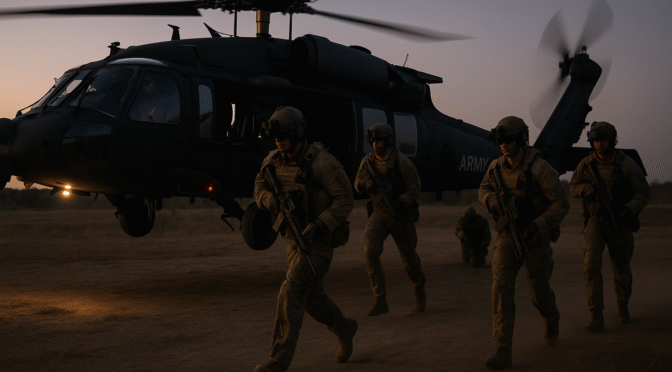
Forged in Failure, Perfected in Darkness: The Creation and Evolution of the 160th Special Operations Aviation Regiment (Airborne)

In the strategic calculus of the late 20th century, the capability for specialized, clandestine aviation support was a recognized but underdeveloped component of American military power. Operations requiring the precise, low-visibility insertion, support, and extraction of special operations forces (SOF) were typically resourced on an ad-hoc basis, with conventional units and crews temporarily assigned to missions for which they had neither the dedicated equipment nor the requisite training regimen.1 This approach introduced systemic risks, creating dependencies on personnel and platforms ill-suited for the unique rigors of special operations. The period following the U.S. withdrawal from Vietnam saw this capability gap widen significantly. A strategic reorientation toward large-scale, conventional conflict in Europe against the Soviet Union led to a deprioritization of SOF and their specialized requirements.2 The institutional focus on the Fulda Gap left the unique skill sets honed in the jungles of Southeast Asia to atrophy, creating a critical vulnerability in the U.S. military’s ability to respond to the emerging threats of terrorism, state-sponsored hostage-taking, and asymmetric warfare.

The 160th Special Operations Aviation Regiment (Airborne) represents one of the most successful and consequential institutional adaptations in modern U.S. military history. Born directly from the catastrophic, multi-faceted failures of Operation Eagle Claw, the regiment evolved over four decades of relentless innovation and trial-by-fire into the world’s premier special operations aviation force, becoming an indispensable instrument of national power. Its history is a masterclass in learning from failure, pioneering new technologies and doctrines, and cultivating a culture of absolute precision and reliability. The creation of this unit was not merely a response to a tactical deficiency; it was a fundamental rejection of the institutional mindset that led to the disaster in the Iranian desert and a commitment to building a permanent, professional capability to ensure such a failure would never be repeated.

Operation Eagle Claw: A Catalyst for Revolution (April 1980)

On April 24, 1980, the United States launched Operation Eagle Claw, a complex and daring mission to rescue 53 American diplomats and citizens held hostage in the U.S. Embassy in Tehran.4 The failure of this operation, broadcast to the world through images of burning wreckage in the Iranian desert, was a profound national humiliation and a watershed moment for the U.S. military. It exposed deep-seated institutional flaws and served as the direct catalyst for a revolution in American special operations, the first result of which was the creation of a dedicated special operations aviation unit.5

Operational Concept and Inherent Complexity

The plan for Operation Eagle Claw was exceptionally ambitious, a two-night operation that stretched the capabilities of both personnel and equipment to their absolute limits.8 The concept involved a multi-service force comprised of the U.S. Army’s newly formed Delta Force, Rangers, Air Force transport and gunship crews, and Navy and Marine Corps helicopter pilots.1 On the first night, a force of eight U.S. Navy RH-53D Sea Stallion helicopters would launch from the aircraft carrier USS

Nimitz in the Arabian Sea and fly over 600 miles to a clandestine rendezvous point deep inside Iran, a remote salt flat codenamed “Desert One”.4 Simultaneously, six Air Force C-130 aircraft (three MC-130 Combat Talons carrying the ground force and three EC-130s carrying fuel) would fly from Masirah Island, Oman, to the same location.12

At Desert One, the helicopters were to refuel from collapsible fuel bladders aboard the EC-130s. The ground force, consisting of approximately 120 Delta operators and a Ranger security element, would then board the helicopters and fly to a second hiding spot (“Desert Two”) closer to Tehran to wait out the next day.12 On the second night, the Delta Force operators would be driven into Tehran to assault the embassy compound, rescue the hostages, and transport them to a nearby soccer stadium or airfield. The helicopters would then extract the operators and former hostages, flying them to Manzariyeh Air Base, which would be seized by the Rangers. From there, Air Force C-141 Starlifter transports would fly everyone out of Iran.13 The plan was a cascade of interdependent actions, any one of which, if it failed, could cause the entire operation to unravel with tragic consequences.13

Systemic Aviation Failures at Desert One

The mission began to disintegrate almost as soon as the helicopters entered Iranian airspace. The failures were not the result of a single error but a confluence of systemic problems related to equipment, environmental factors, and a lack of joint training.

Equipment Unsuitability and Attrition

The choice of the RH-53D Sea Stallion was itself a compromise. The U.S. military did not possess a dedicated, long-range special operations helicopter. The RH-53D was a Navy platform designed for airborne mine-sweeping, not for clandestine, low-level penetration of hostile airspace over hundreds of miles of desert terrain.3 The mission’s success was predicated on these non-specialized aircraft performing at the absolute peak of their mechanical reliability.

Of the eight helicopters that launched from the USS Nimitz, the force immediately began to suffer an unsustainable rate of attrition. One helicopter was forced to abort and return to the carrier after encountering hydraulic problems.4 A second became disoriented in an unexpected dust storm and also returned to the

Nimitz.11 A third helicopter reached Desert One but was found to have a cracked rotor blade, rendering it non-operational.4 During the planning phase, commanders had determined that a minimum of six helicopters was required to carry the assault force and hostages. With only five helicopters remaining, the on-scene commander, U.S. Army Colonel Charles Beckwith, had no choice but to recommend the mission be aborted, a decision President Carter approved.4

Environmental Ignorance

A critical intelligence and planning failure was the lack of adequate preparation for the region’s weather phenomena. The helicopter formation flew into a series of localized, intense dust storms known as “haboobs”.2 These clouds of suspended, fine sand created near-zero visibility conditions, disoriented pilots, and clogged engine intakes.11 While Air Force meteorologists were aware of the potential for such storms, this critical information was not effectively disseminated to the Navy and Marine helicopter pilots. This failure was a direct result of the extreme compartmentalization of the planning process, which was intended to preserve operational security (OPSEC) but ultimately stovepiped vital information away from the personnel who needed it most.2 The pilots were unprepared for the conditions they encountered, contributing directly to the mission aborts and the significant delays for the helicopters that did make it to Desert One.2

Inadequate Joint Training

The most catastrophic failure stemmed from the lack of integrated, joint-service training. The various components of the task force—Army, Navy, Marine Corps, and Air Force—had trained extensively on their individual portions of the mission but had never conducted a full-dress rehearsal of the entire complex operation from start to finish.2 This lack of joint proficiency became tragically apparent as the force prepared to withdraw from Desert One.

In the darkness and confusion, with rotor wash kicking up immense clouds of dust, one of the remaining RH-53D helicopters drifted while repositioning and its main rotor collided with the fuselage of a parked EC-130 that was loaded with fuel and personnel.4 The resulting explosion and fire destroyed both aircraft and killed eight American servicemen: five Air Force crewmen on the EC-130 and three Marines on the RH-53D.4 In the ensuing chaos, the remaining helicopters were abandoned, their crews scrambling aboard the other C-130s to escape, leaving behind a scene of devastation, classified documents, and five intact helicopters for the Iranians to capture and display to the world.4

The Holloway Commission Report: A Blueprint for Change

The disaster at Desert One was a symptom of a deeper institutional malaise. The post-Vietnam military had allowed its special operations capabilities to atrophy, focusing almost exclusively on a potential conventional war in Europe.2 When a complex special operation was demanded, the services were forced to assemble an ad-hoc force from disparate, non-specialized units. The intense secrecy required for such a mission then prevented these units from training together, which in turn created fatal gaps in coordination, intelligence sharing, and operational proficiency.2 The result was a failure rooted in predictable mechanical issues, foreseeable environmental factors, and human error under pressure.

In the aftermath, President Carter appointed Admiral James L. Holloway, III, a former Chief of Naval Operations, to lead a special review group to investigate the failed raid.14 The resulting document, known as the Holloway Report, was a thorough and scathing assessment of the state of U.S. special operations.15 While the report concluded that the mission concept was feasible and the decision to execute was justified, it identified critical deficiencies in the execution.8 The commission highlighted several major issues: an insufficient number of backup helicopters, inadequate provisions for weather contingencies, a fragile command and control structure, and, most importantly, the lack of a comprehensive, full-scale training exercise.8

The report’s most crucial and enduring finding was that the U.S. military fundamentally “lacked aircraft and crews who were trained and prepared to perform these types of missions”.14 It was this stark conclusion that provided the undeniable impetus for change. The Pentagon was forced to confront the reality that the emerging threat landscape required a standing, professional, and permanently established SOF aviation capability. The Holloway Report became the blueprint for this change, directly leading to the creation of what would become the 160th SOAR and catalyzing broader reforms that would eventually result in the Goldwater-Nichols Act of 1986 and the establishment of the U.S. Special Operations Command (USSOCOM) in 1987.3

The Genesis of the Night Stalkers (1980-1986)

The ashes of Desert One became the seedbed for a new and revolutionary capability. The immediate requirement was to develop a credible aviation option for a second hostage rescue attempt, but Army leadership quickly recognized the long-term strategic value of a permanent, specialized aviation force. This period saw the rapid formation, training, and institutionalization of a unit that would become the world’s premier special operations aviation regiment.

The Interim Solution: Task Force 158 and Operation Honey Badger

Even as the Holloway Commission conducted its investigation, the Pentagon was actively planning a second, more robust rescue mission, codenamed Operation Honey Badger.14 To solve the critical aviation problem, the Army looked to its most experienced aviation formation: the 101st Airborne Division (Air Assault) at Fort Campbell, Kentucky.16 The division’s top pilots, particularly from the 158th and 229th Aviation Battalions and other supporting units, were selected to form a new, provisional unit.17

This unit was initially dubbed Task Force 158, taking its name from the 158th Aviation Battalion, which provided the bulk of the initial UH-60 Black Hawk pilots.18 These aviators, still wearing the distinctive “Screaming Eagle” patch of the 101st, were immediately plunged into an intensive and unprecedented training regimen.21 Their singular focus was to master the art of long-range, low-level, clandestine flight at night. This was a new frontier; the pilots were pioneers, developing the tactics, techniques, and procedures for night vision goggle (NVG) flight from the ground up, often through a process of trial and error.16 They trained for missions of up to 1,000 nautical miles, pushing the boundaries of both human and aircraft endurance.14

Official Establishment and Early Culture

On January 20, 1981, the day of President Ronald Reagan’s inauguration, Iran released the 53 American hostages, rendering Operation Honey Badger unnecessary.14 The aviators of Task Force 158 expected to be disbanded and returned to their parent units. However, senior Army leadership, recognizing the unique and invaluable capability that had been forged, made the crucial decision to make the unit permanent.14 The capability was deemed too useful to lose.21

The unit was consolidated and expanded, becoming Task Force 160. On October 16, 1981, in a ceremony at Fort Campbell, it was officially designated the 160th Aviation Battalion.14 This date is remembered by the unit’s founding members as “the day the Eagles came off,” a symbolic moment signifying their permanent separation from the 101st Airborne Division and their new, singular identity as the Army’s only special operations aviation force.18 From its inception, the unit’s culture was defined by the “triple volunteer” ethos: its members had volunteered first for the Army, second for Airborne training, and third for the immense challenges and risks of the regiment itself.1

Initial Airframes and Personnel

The newly formed 160th Aviation Battalion was structured to provide a range of capabilities. The initial organization consisted of a Headquarters and Service Company (HSC), a Light Assault Company equipped with MH-6 Little Bird helicopters, and a Light Attack Company with armed AH-6 Little Birds.14 These were complemented by two companies of the new UH-60A Black Hawk medium-lift helicopters and a company of CH-47 Chinook heavy-lift helicopters.14 The OH-6A Cayuse, a small observation helicopter from the Vietnam era, was identified as the ideal platform for the light assault role due to its small size, agility, and ease of transport aboard Air Force C-130s.14 These were modified into the MH-6 (for transport) and AH-6 (for attack) variants.14

The “Green Platoon”: Forging the Standard

The early days of the 160th were marked by intense, high-risk training that pushed the limits of safety. The relentless pace and the inherent dangers of developing night-flight doctrine took a heavy toll. Between March and October of 1983, the unit suffered a string of devastating accidents, losing four aircraft and sixteen personnel.14 These losses threatened the very existence of the nascent organization and prompted the Army to convene a Blue Ribbon Panel to assess its viability.14

This period of crisis proved to be a critical evolutionary step. The panel’s primary recommendation was the creation of a dedicated and standardized training program to properly screen, assess, and qualify personnel for the unique demands of the mission. This recommendation gave birth to what would become the Special Operations Aviation Training Company (SOATB), and its rigorous initial entry course became known as “Green Platoon”.14

The establishment of Green Platoon transformed the 160th from a collection of highly skilled individuals into a cohesive institution with a reproducible culture of excellence. It codified the hard-won lessons from early tragedies into a formal, centralized process. This ensured that the unit’s exacting standards would be maintained and would not degrade as the organization grew and personnel turned over. Raw talent, as the early accidents had proven, was insufficient. Green Platoon provided the essential pipeline to instill the specialized skills and, just as importantly, the mindset required to become a Night Stalker. Every new member—whether a commissioned officer, a warrant officer pilot, or an enlisted crew chief or support soldier—was required to pass through this crucible.21 The course instilled a common baseline of advanced combat skills—first responder medical training, land navigation, advanced marksmanship, and combatives—and indoctrinated every soldier into the unit’s unwavering cultural ethos, best encapsulated by its motto: “Night Stalkers Don’t Quit”.18

Trial by Fire: Early Combat Operations (1983-1989)

The 1980s served as the formative decade for the 160th, a period where the theories and doctrines developed in training were tested and refined in the unforgiving crucible of combat. Each deployment, from the Caribbean to the Persian Gulf, expanded the unit’s operational envelope, validated its specialized equipment, and solidified its reputation as an indispensable SOF asset. This era demonstrated a clear and rapid evolutionary cycle: from a raw proof of concept in Grenada, to a technological and doctrinal leap in the Persian Gulf, to a demonstration of mature, large-scale capability in Panama.

Baptism in Grenada (Operation Urgent Fury, 1983)

In October 1983, just two years after its official formation, Task Force 160 received its baptism by fire during Operation Urgent Fury, the U.S. invasion of Grenada.16 The operation was launched in response to a violent Marxist coup that endangered hundreds of American medical students on the island.19 The 160th was tasked with spearheading the initial SOF assaults, using its UH-60 Black Hawks and MH-6 Little Birds to insert Navy SEALs, Army Rangers, and Delta Force operators onto multiple, simultaneous objectives.19 Key targets included the rescue of Governor-General Sir Paul Scoon, the seizure of a radio transmitter, and an assault on Richmond Hill Prison, which was believed to house political prisoners and be heavily defended.29

The operation immediately ran into challenges that underscored the unit’s inexperience and the friction of real-world combat. A series of planning and logistical delays meant the insertions, originally scheduled for the pre-dawn hours to leverage the 160th’s night-flying expertise, were forced into daylight.19 This stripped the unit of its primary tactical advantage and exposed the helicopters to a prepared and unexpectedly determined enemy. As the Black Hawks approached their targets, they were met with intense anti-aircraft and small arms fire.29 The assault on Richmond Hill Prison proved untenable; facing a gauntlet of fire from the prison and nearby Fort Frederick, the Black Hawks sustained heavy damage, and the mission was aborted after one helicopter crashed, resulting in the unit’s first combat fatality, Captain Keith Lucas.16 Several other aircraft were so badly damaged they were forced to make emergency landings on the USS Guam offshore.29 Despite these significant setbacks, other missions, such as the insertion of SEALs at the Governor-General’s mansion, were successful.30 Operation Urgent Fury was a brutal introduction to combat, but it served as an invaluable, if costly, learning experience. It validated the core concept of a dedicated SOF aviation unit and proved the resilience of its airframes and crews under extreme pressure.19

Mastering the Maritime Domain (Operation Prime Chance, 1987-1989)

If Grenada was the test of the unit’s basic concept, Operation Prime Chance was the test of its technological and doctrinal edge. Conducted from 1987 to 1989, this was a clandestine sub-operation within the larger Operation Earnest Will, the U.S. effort to protect re-flagged Kuwaiti oil tankers from Iranian attacks in the Persian Gulf during the Iran-Iraq War.21 The 160th was tasked with a unique mission: to hunt and destroy Iranian forces laying mines and attacking shipping with small, fast gunboats, primarily at night.33

To accomplish this, the unit deployed its highly maneuverable AH-6 and MH-6 Little Birds, which operated from the decks of U.S. Navy frigates and two secretly converted mobile sea bases—large commercial barges named Hercules and Wimbrown 7.32 This operation marked a pivotal moment in military aviation: it was the

first successful combat employment of aviator night vision goggles and forward-looking infrared (FLIR) devices, particularly over the challenging maritime environment.16 The tactics developed were innovative and highly effective. Unarmed MH-6s, equipped with advanced sensors, would act as nocturnal scouts, patrolling the shipping lanes. Upon detecting a hostile Iranian vessel, the MH-6 would covertly track it and vector in the heavily armed AH-6 gunships, which would then engage and neutralize the threat with miniguns and rockets.33

A notable engagement was the attack on the Iranian minelayer Iran Ajr, which was spotted by an MH-6, subsequently disabled by AH-6s, and then boarded and captured by Navy SEALs.33 Operation Prime Chance was a resounding success, proving the 160th’s adaptability and cementing its role as the pioneer of modern night combat aviation.

Complex Assaults in Panama (Operation Just Cause, 1989)

By the end of the decade, the unit, redesignated in 1986 as the 160th Aviation Group (Airborne), had matured into a highly proficient force.1 Operation Just Cause, the December 1989 invasion of Panama to remove dictator Manuel Noriega, was the culmination of this decade of learning and the first major test of the newly formed U.S. Special Operations Command.35 The 160th was at the absolute forefront of the invasion, tasked with conducting a series of complex, simultaneous assaults on critical targets at H-hour.16

This operation represented the first large-scale, combat employment of NVGs by an entire aviation task force.37 Night Stalker helicopters—Little Birds, Black Hawks, and Chinooks—spearheaded the invasion. AH-6s provided fire support for the 75th Ranger Regiment’s seizure of Rio Hato airfield.38 MH-6s delivered a Delta Force team directly onto the roof of the Carcelo Modelo prison to rescue CIA operative Kurt Muse—a textbook hostage rescue mission executed with surgical precision.38 Other elements attacked the Panamanian Defense Forces (PDF) headquarters, known as La Comandancia, and assaulted key PDF leadership locations.38 The operation showcased the unit’s mastery of complex, multi-asset, time-sensitive night assaults. The precision and shock effect achieved were instrumental to the rapid success of the overall invasion. However, the success came at a cost; the intense fighting resulted in two Night Stalkers killed in action and two aircraft shot down, a stark reminder of the inherent risks of their mission.16 Operation Just Cause was a clear demonstration that the capability envisioned in the wake of Eagle Claw had not only been realized but had been perfected.

The Defining Moment: Somalia and the Decade of SOF (1990-2001)

The 1990s began with the 160th solidifying its organizational structure and validating its capabilities in the Persian Gulf War. In June 1990, the unit was officially activated as the 160th Special Operations Aviation Regiment (Airborne), a designation reflecting its growth from a single battalion into a multi-battalion force designed to meet the increasing global demand for elite aviation assets.1 During Operations Desert Shield and Desert Storm in 1991, the regiment performed critical combat search and rescue (CSAR) missions and inserted SOF teams deep into Iraq to hunt for SCUD missile launchers.16 However, it was a contingency operation in the Horn of Africa two years later that would become the regiment’s most defining moment, profoundly shaping its tactics, technology, and culture for a generation.

The Battle of Mogadishu (Operation Gothic Serpent, October 1993)

In August 1993, elements of the 160th’s 1st Battalion deployed to Mogadishu, Somalia, as part of Task Force Ranger. This joint special operations task force, comprising Army Rangers, Delta Force operators, and Air Force special tactics personnel, was charged with capturing the Somali warlord Mohamed Farrah Aidid and his key lieutenants.39 For weeks, the task force conducted a series of successful raids, but Aidid remained elusive.

The Raid of October 3rd

On the afternoon of October 3, 1993, Task Force Ranger launched its seventh mission, a daylight raid to capture two of Aidid’s top aides from a building near the Bakaara Market, a hostile area of the city.41 The operation, intended to last no more than an hour, began smoothly. A fleet of 19 aircraft, including MH-60L Black Hawks, AH-6 and MH-6 Little Birds, inserted the assault and security forces.41 The targets were quickly captured. However, as the ground convoy prepared to exfiltrate with the prisoners, the mission catastrophically unraveled.

At approximately 4:20 PM, an MH-60L Black Hawk, call sign Super 61, piloted by CW3 Cliff “Elvis” Wolcott, was struck in the tail rotor by a rocket-propelled grenade (RPG-7) and crashed deep within the city.42 The shootdown instantly changed the dynamic of the mission from a raid to a desperate rescue operation. As ground forces began to fight their way toward the first crash site, a second MH-60L, Super 64, piloted by CW3 Michael Durant, was also hit by an RPG and crashed about a mile away at 4:40 PM.42

The downing of the two helicopters triggered an 18-hour urban battle of an intensity not seen by U.S. forces since the Vietnam War.16 The Night Stalkers who remained airborne provided critical fire support with AH-6 Little Birds, while an MH-6, Star 41, bravely landed near the first crash site under intense fire to rescue two wounded crew chiefs.42 At the second crash site, with ground forces unable to reach the downed crew, two Delta Force snipers, MSG Gary Gordon and SFC Randy Shughart, volunteered to be inserted to protect the four wounded crewmen. They held off hundreds of Somali militiamen until they were killed and the sole survivor, pilot Michael Durant, was taken captive. Both were posthumously awarded the Medal of Honor.42

Losses and Aftermath

The Battle of Mogadishu was a tactical victory in that the original targets were captured and the U.S. force inflicted heavy casualties on the Somali militia. However, for the United States, it was a strategic shock. Task Force Ranger suffered 18 killed in action and 73 wounded.39 The 160th SOAR lost five of its own—the crews of Super 61 and three of the four crewmen of Super 64—and had eight aircraft destroyed or heavily damaged.16 The televised images of dead American soldiers being dragged through the streets of Mogadishu by Somali mobs prompted a political firestorm in the United States, leading to the withdrawal of U.S. forces from Somalia and a subsequent reluctance to intervene in similar conflicts, a phenomenon that became known as the “Somalia Syndrome”.42

The Battle of Mogadishu became a profound inflection point for the 160th and the entire U.S. SOF community. It shattered any post-Cold War sense of technological invincibility and forced a brutal reckoning with the realities of asymmetric urban warfare. The battle illustrated that technological superiority does not guarantee dominance in a complex, dense urban environment where a cheap, ubiquitous, and simple-to-operate weapon like an RPG can neutralize a sophisticated, multi-million-dollar helicopter.46 The U.S. forces entered the fight with a degree of overconfidence, underestimating the enemy’s training, weaponry, and will to fight.46 This lesson was paid for in blood. The denial of requests for heavier assets like AC-130 Spectre gunships and armored vehicles prior to the mission was seen in retrospect as a critical error that left the task force without the necessary firepower and protection once the situation deteriorated.46 The ghost of Mogadishu would hover over every subsequent SOF urban helicopter operation, driving a generation of doctrinal and technological change focused on mitigating this specific threat.

Technological and Tactical Evolution

The direct experience of Mogadishu spurred significant advancements in aircraft survivability and urban combat tactics. The vulnerability of the Black Hawks to RPGs led to accelerated investment in enhanced defensive suites, including improved missile warning systems, countermeasures, and ballistic protection for crews and critical components.

Furthermore, the battle solidified the requirement for a dedicated, organic, heavy fire support platform for SOF. This led to the continued development and refinement of the MH-60L Direct Action Penetrator (DAP).39 The DAP is an MH-60 Black Hawk configured purely as a gunship, foregoing any transport capability in favor of a formidable weapons loadout. It can be equipped with a mix of M134 miniguns, 2.75-inch rockets, and a 30mm chain gun similar to that on the AH-64 Apache, as well as Hellfire anti-tank missiles.39 The DAP provides SOF ground commanders with a responsive, high-endurance, and precise close air support asset flown by pilots who intimately understand special operations tactics—a capability that was sorely needed in the streets of Mogadishu.

The Global War on Terror: Two Decades at the Spear’s Tip (2001-2021)

The terrorist attacks of September 11, 2001, thrust the 160th SOAR into a new era of sustained, high-tempo combat operations on a global scale. For the next two decades, the regiment would be continuously deployed, serving as the indispensable aviation backbone for the Global War on Terror (GWOT). From the mountains of Afghanistan to the cities of Iraq and clandestine locations across the globe, the Night Stalkers were at the tip of the spear, enabling the nation’s most critical special operations missions.

Afghanistan (Operation Enduring Freedom)

The 160th SOAR was among the very first U.S. forces to take the fight to Al-Qaeda and the Taliban in Afghanistan.16 The initial entry of SOF into the country was a mission of unprecedented scope and risk, one that perfectly highlighted the unique capabilities the regiment had honed over the previous two decades.

Initial Insertion (October 2001)

On October 19, 2001, two MH-47E Chinooks from the 160th flew two 12-man U.S. Army Special Forces teams (Operational Detachment Alphas 555 and 595) from Karshi-Khanabad Air Base in Uzbekistan deep into northern Afghanistan.21 The mission required the helicopters to fly over the Hindu Kush mountains, with peaks reaching 16,000 feet, in zero-visibility conditions.21 The flight lasted over 11 hours and required three in-flight refuelings from Air Force MC-130 Combat Talons, setting a new world record for a combat rotorcraft mission.21 This daring, long-range infiltration delivered the “Horse Soldiers” who would link up with the Northern Alliance and, with the help of U.S. airpower, topple the Taliban regime in a matter of weeks.21

Objective Rhino/Gecko

Simultaneously, the 160th provided the aviation package for the first large-scale direct-action raids of the war. In a complex, coordinated operation, the regiment supported the 75th Ranger Regiment’s parachute assault to seize an airstrip codenamed Objective Rhino.50 This airstrip was then used as a Forward Arming and Refueling Point (FARP) for the 160th’s helicopters, which were simultaneously inserting a force of Delta Force operators and Rangers to raid Mullah Omar’s compound in Kandahar, codenamed Objective Gecko.30 These initial operations established the pattern of high-altitude, long-range, and surgically precise missions that would define the war in Afghanistan for the 160th. The theater’s extreme “hot and high” environment, which severely degrades helicopter performance, made the powerful, twin-rotor MH-47 Chinook the indispensable workhorse for SOF operations across the country.16

Iraq (Operation Iraqi Freedom)

In the spring of 2003, the 160th deployed its first assets for Operation Iraqi Freedom, where it would face a different but equally demanding set of challenges.16 In the opening days of the invasion, AH-6 Little Birds flew sorties along the western border, destroying Iraqi observation posts and clearing the way for the main coalition advance.30

As the conflict transitioned from conventional warfare to a counter-insurgency fight, the 160th’s operational tempo reached unprecedented levels. The regiment became the premier direct-action aviation element, conducting nightly raids to capture or kill high-value individuals and dismantle insurgent and terrorist networks.52 The urban and desert environments of Iraq presented constant risks. The high probability of having an aircraft downed by enemy fire or mechanical failure meant the regiment had to perfect its Downed Aircraft Recovery Team (DART) capabilities. A November 2006 mission near Lake Thar Thar exemplified this, where an AH-6 was shot down by an RPG, forcing the on-scene ground force to secure the crash site while the 160th organized and executed a complex aircraft recovery in the midst of a fierce firefight.52

The Apex of a Capability (Operation Neptune Spear, May 2011)

On May 2, 2011, the 160th SOAR executed what is arguably the most significant and consequential special operation in modern history: Operation Neptune Spear, the raid that killed Osama bin Laden.53 This mission represented the absolute zenith of the regiment’s 30-year evolution, a flawless synthesis of every lesson learned since the failure at Desert One. It required the long-range penetration of Eagle Claw, the technological supremacy pioneered in Prime Chance, the urban assault precision of Just Cause, and the risk mitigation learned from Gothic Serpent, all executed with a level of secrecy and technological sophistication previously unimaginable.

The Stealth Black Hawk

The mission’s central challenge was inserting a team of U.S. Navy SEALs from the Naval Special Warfare Development Group (DEVGRU) into a defended compound in Abbottabad, Pakistan, without alerting the Pakistani military.53 Pakistan was a nominal ally, but its integrated air defense network made a conventional, overt helicopter insertion impossible. To achieve total surprise, the 160th employed two radically modified, top-secret Black Hawk helicopters.53 These aircraft incorporated advanced low-observable (stealth) technology, including specialized radar-absorbent materials, sharp, faceted angles to deflect radar waves, and a redesigned, shrouded tail rotor and main rotor system to drastically reduce their acoustic signature.54 These modifications made the helicopters incredibly difficult to detect by radar and quiet enough to approach the target undetected.

The Crash and Execution

The two stealth Black Hawks, flying from a base in Jalalabad, Afghanistan, successfully penetrated Pakistani airspace and reached the bin Laden compound. However, during the insertion of the first team, the lead helicopter experienced an aerodynamic phenomenon known as a vortex ring state, exacerbated by the high walls of the compound trapping the rotor wash and higher-than-expected air temperatures.56 Despite the sudden loss of lift, the pilot’s extraordinary skill allowed him to execute a controlled hard landing, preventing any serious injuries to the SEALs or crew and saving the mission from failure.56 The assault force proceeded with the raid, while the crew of the downed helicopter destroyed it with explosives to protect its sensitive technology. The tail section, however, was left largely intact, providing the world with its first glimpse of this secret program.55 A conventional MH-47G Chinook, which had been prepositioned as a backup and quick reaction force, flew in to exfiltrate the assault team from the downed aircraft, while the second Black Hawk extracted the rest of the team and bin Laden’s body.57

The successful completion of Operation Neptune Spear, despite the loss of a highly classified aircraft, was the ultimate validation of the 30-year investment in the 160th SOAR. It demonstrated a mastery of long-range penetration, technological overmatch, surgical precision, and robust contingency planning—the very capabilities that were absent at Desert One. It was the definitive proof that the U.S. military had not only learned from its most painful failure but had used it as a foundation to build the most capable special operations aviation force in the world.

The Modern Night Stalkers: Organization, Technology, and Ethos

Today, the 160th Special Operations Aviation Regiment (Airborne) stands as a mature, globally responsive force, representing the pinnacle of rotary-wing aviation. Its structure, technology, and culture have been continuously refined over four decades of conflict, resulting in a unique national asset capable of executing the most demanding missions under any conditions.

Current Organizational Structure

The regiment is a key component of the U.S. Army Special Operations Aviation Command (USASOAC), an Army service component command established on March 25, 2011, to manage all Army special operations aviation assets.58 This command structure provides centralized oversight for manning, training, and equipping the force. The 160th SOAR itself is comprised of a Regimental Headquarters, four operational battalions, and the dedicated Special Operations Aviation Training Battalion (SOATB), which continues to run the “Green Platoon” assessment and other specialized courses.23 The battalions are strategically located across the United States to support global combatant commands:

  • 1st Battalion, 160th SOAR(A): Stationed at Fort Campbell, Kentucky, this battalion is the regiment’s light and medium assault force. It is uniquely equipped with the AH-6M and MH-6M Little Bird light attack and assault helicopters, as well as several companies of MH-60M Black Hawks, including the heavily armed Direct Action Penetrator (DAP) variant.1
  • 2nd Battalion, 160th SOAR(A): Also at Fort Campbell, this battalion operates the regiment’s heavy-lift MH-47G Chinooks and the MQ-1C Gray Eagle unmanned aircraft system (UAS), providing long-range insertion and persistent reconnaissance capabilities.59
  • 3rd Battalion, 160th SOAR(A): Based at Hunter Army Airfield, Georgia, this battalion provides heavy and medium assault capabilities with its fleet of MH-47G Chinooks and MH-60M Black Hawks, postured to support operations in the U.S. Southern and Central Commands.60
  • 4th Battalion, 160th SOAR(A): Located at Joint Base Lewis-McChord, Washington, this battalion mirrors the 3rd Battalion’s structure with MH-47G and MH-60M helicopters, primarily focused on supporting the U.S. Indo-Pacific Command.60

The Modern Fleet and Technological Edge

The regiment’s core advantage lies in its fleet of highly modified and meticulously maintained aircraft. While based on standard Army airframes, the helicopters of the 160th are packed with specialized mission equipment that sets them apart.7

  • Airframes: The primary platforms remain the A/MH-6M Little Bird, the MH-60M Black Hawk, and the MH-47G Chinook.21 These aircraft are constantly undergoing upgrades to maintain their technological edge.
  • Key Technologies: A modern Night Stalker helicopter is a complex system of integrated technologies designed for survivability and precision in denied environments.
  • Advanced Avionics: Cockpits are fully digitized (“glass cockpits”) with multi-function displays, digital moving maps, and redundant navigation systems that integrate GPS and inertial data for pinpoint accuracy.64
  • All-Weather/Night Sensors: The ability to “own the night” is central to the regiment’s doctrine. This is enabled by advanced Forward-Looking Infrared (FLIR) sensor turrets and sophisticated terrain-following/terrain-avoidance radar, such as the AN/APQ-187 Silent Knight. These systems allow pilots to fly at extremely low altitudes (nap-of-the-earth) at high speed, even in complete darkness and poor weather.64
  • Extended Range: Strategic reach is achieved through extendable in-flight refueling probes, which are standard equipment on the MH-60M and MH-47G. This allows the helicopters to self-deploy over vast distances or loiter for extended periods, supported by Air Force tankers.63
  • Survivability Suite: Learning the lessons of Mogadishu and two decades of war, the aircraft are equipped with a comprehensive suite of defensive systems. This includes sensors to detect missile launches, radar locks, and laser designation, which are tied to automated countermeasures dispensers that deploy chaff and flares. Newer systems like the Common Infrared Countermeasures (CIRCM) use directional lasers to actively jam the seekers of incoming heat-seeking missiles.64

The Enduring Ethos: “Plus or Minus 30 Seconds”

Beyond the technology and organizational charts, the true core of the 160th SOAR is its deeply ingrained culture of precision, reliability, and absolute commitment to the mission and the ground force it supports. This ethos is best captured by the regiment’s unofficial but universally understood time-on-target standard: arriving at the objective “plus or minus 30 seconds”.16 This is not merely a goal but an expectation that drives every aspect of mission planning and execution.

This culture is forged in the crucible of Green Platoon and sustained through a relentless “train as you fight” mentality.23 The regiment is exceptionally resourced for constant, realistic training in the world’s most demanding environments—from high-altitude mountains to deserts to dense jungles and maritime settings.23 Within the unit, there is an understanding that every member is a top performer; the standard is excellence, and the environment fosters intense professionalism and unwavering mutual trust.68 This culture, embodied by the motto “Night Stalkers Don’t Quit,” is the ultimate guarantee that the 160th SOAR will accomplish its mission, anytime, anywhere.26

Conclusion: A Legacy of Adaptation and Precision

The history of the 160th Special Operations Aviation Regiment (Airborne) is a powerful testament to the U.S. military’s capacity for institutional learning and adaptation. From the systemic failures and public humiliation of Operation Eagle Claw, the Department of Defense recognized a critical capability gap and committed to building a solution from the ground up. The result was a unit that did not just fill a niche but defined an entirely new standard of military aviation. The regiment’s journey was one of systematic problem-solving: the ad-hoc nature of Eagle Claw was replaced by a permanent, professional force; the lack of night-flying proficiency was solved by pioneering new doctrine and technology; the vulnerabilities exposed in combat were mitigated through relentless innovation in tactics and aircraft survivability.

The strategic value of this investment has been proven time and again over four decades of continuous combat operations. The 160th SOAR provides the National Command Authority and special operations commanders with a unique instrument of power, enabling surgical, clandestine reach into the world’s most denied and dangerous areas. It offers a range of options—from high-risk hostage rescue and counter-terrorism strikes to unconventional warfare support—that would otherwise be impossible to execute. The Night Stalkers have become the gold standard for aviation support, the trusted chariot for the nation’s most elite ground forces, and a strategic asset of unparalleled importance.

Table 1: Summary of Key 160th SOAR Combat Operations and Evolutionary Impact

Operation & DateKey Aircraft DeployedMission SynopsisKey Outcome / Evolutionary Impact for the 160th SOAR
Operation Eagle Claw (1980)RH-53D Sea StallionFailed hostage rescue in Iran.Catalyst for creation; exposed systemic lack of a dedicated SOF aviation capability.
Operation Urgent Fury (1983)UH-60A Black Hawk, MH/AH-6 Little BirdFirst combat deployment; multi-target SOF insertion in Grenada.Validated the core concept but highlighted extreme vulnerabilities in daylight operations.
Operation Prime Chance (1987-1989)MH/AH-6 Little BirdClandestine maritime security and anti-shipping in the Persian Gulf.First combat use of NVGs/FLIR; pioneered modern maritime night attack tactics and doctrine.
Operation Just Cause (1989)MH-60 Black Hawk, MH-47 Chinook, MH/AH-6 Little BirdSpearheaded large-scale invasion of Panama with simultaneous SOF assaults.Demonstrated mature, large-scale joint SOF capability and mastery of complex night operations.
Operation Gothic Serpent (1993)MH-60L Black Hawk, MH/AH-6 Little BirdHigh-Value Target capture raid in Mogadishu, Somalia.Exposed helicopter vulnerabilities in urban warfare; spurred development of the DAP gunship and major aircraft survivability upgrades.
OEF Initial Entry (2001)MH-47E ChinookDeep penetration of Afghanistan to insert first SOF teams.Set world record for combat rotorcraft flight; proved strategic reach and high-altitude infiltration capability.
Operation Neptune Spear (2011)Stealth-modified MH-60 Black Hawk, MH-47G ChinookClandestine raid to kill/capture Osama bin Laden in Pakistan.Apex of capability; successful employment of low-observable technology, validating 30 years of institutional development.

The future security environment, characterized by renewed great power competition and the proliferation of advanced anti-access/area denial (A2/AD) systems, will challenge the 160th’s dominance. Yet, the regiment’s legacy is one of constant evolution. It is already adapting, exploring hybrid-electric technology for enhanced acoustic stealth and planning for the integration of next-generation platforms from the Army’s Future Vertical Lift (FVL) program, which are expected to eventually replace portions of the legacy Black Hawk and Little Bird fleets.69 This forward-looking posture ensures that the Night Stalkers will continue to maintain their decisive edge. Forged in the failure of Desert One, the 160th SOAR’s enduring legacy is its ability to learn, adapt, and innovate faster than its adversaries, ensuring it can always answer the nation’s call to fly into the darkness.


Please share the link on Facebook, Forums, with colleagues, etc. Your support is much appreciated and if you have any feedback, please email us in**@*********ps.com. If you’d like to request a report or order a reprint, please click here for the corresponding page to open in new tab.


Sources Used

  1. 160th Special Operations Aviation Regiment – The Night Stalkers – WETSU Company, accessed September 9, 2025, https://wetsu.co/blogs/theairbornetimes/160th-special-operations-aviation-regiment-a-k-a-the-night-stalkers
  2. Was Operation Eagle Claw doomed from the start? : r/WarCollege – Reddit, accessed September 9, 2025, https://www.reddit.com/r/WarCollege/comments/1dzasnk/was_operation_eagle_claw_doomed_from_the_start/
  3. Operation Eagle Claw-Lessons Learned – DTIC, accessed September 9, 2025, https://apps.dtic.mil/sti/tr/pdf/ADA402471.pdf
  4. Operation Eagle Claw – Wikipedia, accessed September 9, 2025, https://en.wikipedia.org/wiki/Operation_Eagle_Claw
  5. Operation Eagle Claw – (US History – 1945 to Present) – Vocab, Definition, Explanations | Fiveable, accessed September 9, 2025, https://library.fiveable.me/key-terms/united-states-history-since-1945/operation-eagle-claw
  6. en.specwar.info, accessed September 9, 2025, http://en.specwar.info/special-forces/usa/160th-soar/#:~:text=The%20unit%20was%20created%20in,in%20the%20development%20of%20equipment.
  7. History | Learn Our Historic Legacy – Night Stalker Foundation, accessed September 9, 2025, https://www.nightstalkerfoundation.com/history
  8. Iran Hostage – Rescue Mission Report, accessed September 9, 2025, https://www.history.navy.mil/research/library/online-reading-room/title-list-alphabetically/i/iran-hostage-rescue-mission-report.html
  9. The report – The National Security Archive, accessed September 9, 2025, https://nsarchive2.gwu.edu/NSAEBB/NSAEBB63/doc8.pdf
  10. Operation Eagle Claw remembered 40 years later | Article | The United States Army, accessed September 9, 2025, https://www.army.mil/article/235436/operation_eagle_claw_remembered_40_years_later
  11. Operation Eagle Claw | ASOMF, accessed September 9, 2025, https://www.asomf.org/operation-eagle-claw/
  12. Operation Eagle Claw – DoDIG.mil., accessed September 9, 2025, https://www.dodig.mil/Portals/48/Summarized%20Operation%20Eagle%20Claw.pdf
  13. 1980 – Operation Eagle Claw > Air Force Historical Support Division …, accessed September 9, 2025, https://www.afhistory.af.mil/FAQs/Fact-Sheets/Article/458949/1980-operation-eagle-claw/
  14. 160th Special Operations Aviation Regiment (160th SOAR) – Specwar.info, accessed September 9, 2025, http://en.specwar.info/special-forces/usa/160th-soar/
  15. SOCOM at 25: The Battle for Capitol Hill | Defense Media Network, accessed September 9, 2025, https://www.defensemedianetwork.com/stories/socom-at-25-the-battle-for-capitol-hill/2/
  16. History of the 160th SOAR(A) | Oak Grove, Kentucky | – Night Stalker Association, accessed September 9, 2025, https://www.nsa160.com/history/
  17. Army Special Operations Aviation – Seeking Innovators, accessed September 9, 2025, https://armyaviationmagazine.com/army-special-operations-aviation-seeking-innovators/
  18. 160th SOAR (A): The Night Stalkers – Grey Dynamics, accessed September 9, 2025, https://greydynamics.com/160th-soar-a-the-night-stalkers/
  19. Task Force 160 in Operation URGENT FURY – ARSOF History, accessed September 9, 2025, https://arsof-history.org/articles/pdf/v2n2_tf160.pdf
  20. Joint task force – Wikipedia, accessed September 9, 2025, https://en.wikipedia.org/wiki/Joint_task_force
  21. 160th Special Operations Aviation Regiment (Airborne) – Wikipedia, accessed September 9, 2025, https://en.wikipedia.org/wiki/160th_Special_Operations_Aviation_Regiment_(Airborne)
  22. The Lords of Darkness: Modern Army Special Operations Aviation (ARSOA), accessed September 9, 2025, https://arsof-history.org/articles/v3n4_lords_darkness_page_1.html
  23. 160th Special Operations Aviation Regiment (Airborne) :: FORT CAMPBELL – Army Garrisons, accessed September 9, 2025, https://home.army.mil/campbell/160thSOAR
  24. MD Helicopters MH-6 Little Bird – Wikipedia, accessed September 9, 2025, https://en.wikipedia.org/wiki/MD_Helicopters_MH-6_Little_Bird
  25. Enlisted MOS Requirements – 160th SOAR, accessed September 9, 2025, https://go160thsoar.com/enlisted/
  26. Historical Handbook – ARSOF History, accessed September 9, 2025, https://arsof-history.org/pdf/handbook_160th.pdf
  27. 1983 – Operation Urgent Fury > Air Force Historical Support Division > Fact Sheets, accessed September 9, 2025, https://www.afhistory.af.mil/FAQs/Fact-Sheets/Article/458952/1983-operation-urgent-fury/
  28. Operation Urgent Fury: The planning and execution of joint operations in Grenada, 12 October-2 November 1983 by Ronald H. Cole, accessed September 9, 2025, https://www.jcs.mil/portals/36/documents/history/monographs/urgent_fury.pdf
  29. Task Force 160 in Operation URGENT FURY – ARSOF History, accessed September 9, 2025, https://arsof-history.org/articles/v2n2_tf160_page_1.html
  30. 160th SOAR – Operations – American Special Ops, accessed September 9, 2025, https://www.americanspecialops.com/night-stalkers/operations/
  31. Secret Mission of Urgent Fury | Naval History Magazine, accessed September 9, 2025, https://www.usni.org/magazines/naval-history-magazine/2021/october/secret-mission-urgent-fury
  32. Operation Prime Chance – Wikipedia, accessed September 9, 2025, https://en.wikipedia.org/wiki/Operation_Prime_Chance
  33. 160th SOAR – Operation Prime Chance – American Special Ops, accessed September 9, 2025, https://www.americanspecialops.com/night-stalkers/operations/prime-chance/
  34. Operation Prime Chance: “The Secret Debut of USSOCOM”, accessed September 9, 2025, https://specialops.org/operation-prime-chance-the-secret-debut-of-ussocom/
  35. Just Cause Foreword – Air Commando Association, accessed September 9, 2025, https://aircommando.org/just-cause-foreword/
  36. ACJ Vol 3/3 – Air Commando Association, accessed September 9, 2025, https://aircommando.org/acj-vol-3-3/
  37. Army Aviation in Operation Just Cause – DTIC, accessed September 9, 2025, https://apps.dtic.mil/sti/citations/ADA251409
  38. 160th SOAR – Operation Just Cause – American Special Ops, accessed September 9, 2025, https://www.americanspecialops.com/night-stalkers/operations/just-cause/
  39. Operation Gothic Serpent veterans reflect on ‘Black Hawk Down’ battle – Task & Purpose, accessed September 9, 2025, https://taskandpurpose.com/culture/operation-gothic-serpent-black-hawk-down/
  40. ‘Based on an Actual Event’: The Battle of Mogadishu in Popular Culture – ARSOF History, accessed September 9, 2025, https://arsof-history.org/articles/23sept_based_on_an_actual_event_page_1.html
  41. Operation Gothic Serpent – Wikipedia, accessed September 9, 2025, https://en.wikipedia.org/wiki/Operation_Gothic_Serpent
  42. Operation Gothic Serpent: Remembering The Battle of Mogadishu | ASOMF, accessed September 9, 2025, https://www.asomf.org/operation-gothic-serpent-the-battle-of-mogadishu/
  43. The Battle of Mogadishu | ASOMF – Airborne & Special Operations Museum, accessed September 9, 2025, https://www.asomf.org/the-battle-of-mogadishu/
  44. Families of Fallen Night Stalkers – Withum, accessed September 9, 2025, https://www.withum.com/resources/civic-warriors-families-of-fallen-night-stalkers/
  45. Night Stalkers Don’t Quit: The Battle of Mogadishu (Black Hawk Down) | Somalia, 1993, accessed September 9, 2025, https://www.youtube.com/watch?v=vJQG7e0sSV4
  46. Battle of Mogadishu – Army University Press, accessed September 9, 2025, https://www.armyupress.army.mil/Journals/NCO-Journal/Archives/2022/February/Battle-of-Mogadishu/
  47. 160th Special Operations Aviation Regiment (Airborne) – the Night Stalkers [2160×1471] : r/MilitaryPorn – Reddit, accessed September 9, 2025, https://www.reddit.com/r/MilitaryPorn/comments/1k0j042/160th_special_operations_aviation_regiment/
  48. Guns of the Elite: 160th SOAR Night Stalkers – Athlon Outdoors, accessed September 9, 2025, https://athlonoutdoors.com/article/guns-elite-160th-soar-night-stalkers/
  49. First to go: Green Berets remember earliest mission in Afghanistan | Article – U.S. Army, accessed September 9, 2025, https://www.army.mil/article/181582/first_to_go_green_berets_remember_earliest_mission_in_afghanistan
  50. Objectives Rhino and Gecko – American Special Ops, accessed September 9, 2025, https://www.americanspecialops.com/operations/rangers-delta-afghanistan-2001/
  51. Operation Rhino – Wikipedia, accessed September 9, 2025, https://en.wikipedia.org/wiki/Operation_Rhino
  52. VALIANT 41: 160th SOAR in Combat in Iraq – ARSOF History, accessed September 9, 2025, https://arsof-history.org/articles/v5n3_soar_combat_iraq_page_1.html
  53. Killing of Osama bin Laden – Wikipedia, accessed September 9, 2025, https://en.wikipedia.org/wiki/Killing_of_Osama_bin_Laden
  54. The origins of SOCOM’s stealth Black Hawk helicopters – Sandboxx, accessed September 9, 2025, https://www.sandboxx.us/news/airpower/the-origins-of-the-socoms-stealth-black-hawk-helicopters/
  55. How Did the Pentagon Build a Secret Stealth Helicopter Without Anyone Knowing?, accessed September 9, 2025, https://nationalinterest.org/blog/buzz/how-did-the-pentagon-build-a-secret-stealth-helicopter-without-anyone-knowing
  56. A Stealthhawk crashed during Operation Neptune Spear for the assassination on Osama Bin Laden. Was this an incident that any other helicopter would experience in the same circumstances or was this due to special Stealthhawk’s flight characteristics? – Reddit, accessed September 9, 2025, https://www.reddit.com/r/WarCollege/comments/1gu5xa1/a_stealthhawk_crashed_during_operation_neptune/
  57. Exclusive: Legendary special operations aviator reveals bin Laden mission details for the first time – Military Times, accessed September 9, 2025, https://www.militarytimes.com/news/your-military/2020/03/17/legendary-special-operations-aviator-reveals-bin-laden-mission-details-for-the-first-time/
  58. U.S. Army Special Operations Aviation Command – Wikipedia, accessed September 9, 2025, https://en.wikipedia.org/wiki/U.S._Army_Special_Operations_Aviation_Command
  59. U.S. Army Special Operations Aviation Command – welcome to the home of the reapers, accessed September 9, 2025, https://taskforcereaper.weebly.com/us-army-special-operations-aviation-command.html
  60. Elite Special Operations Forces – 160th SOAR (Abn), accessed September 9, 2025, https://go160thsoar.com/160th-soar-night-stalkers-service/
  61. FAQ – The 160th Special Operations Aviation Regiment, accessed September 9, 2025, https://go160thsoar.com/faq/
  62. 160th Organization :: FORT CAMPBELL – Army Garrisons, accessed September 9, 2025, https://home.army.mil/campbell/Go160thSOAR/160-closed/160th-organization
  63. 160th SOAR- Plus or minus 30 seconds | Article | The United States Army, accessed September 9, 2025, https://www.army.mil/article/29322/160th_soar_plus_or_minus_30_seconds
  64. Special Ops MH-60 Seen Absolutely Crammed With Modifications, accessed September 9, 2025, https://www.twz.com/night-stalker-mh-60-seen-absolutely-crammed-with-modifications
  65. MH-47G Chinook helicopter – American Special Ops, accessed September 9, 2025, https://www.americanspecialops.com/night-stalkers/helicopters/mh-47.php
  66. This Poster Shows For The First Time All The Aircraft Flown by The 160th SOAR (A) “Night Stalkers” From Its Origins To The Present – The Aviationist, accessed September 9, 2025, https://theaviationist.com/2020/08/15/this-poster-shows-for-the-first-time-all-the-aircraft-flown-by-the-160th-soar-a-night-stalkers-from-its-origins-to-the-present/
  67. SPECIAL OPERATIONS MH-47G CHINOOK 160th SOAR NIGHT STALKERS (AIRBORNE) USASOC • RAF MILDENHALL – YouTube, accessed September 9, 2025, https://www.youtube.com/watch?v=_fdwnDWqF_U
  68. Michael Athanasakis – Night Stalker Leadership: From Special Ops Pilot to Chick-fil-A Owner – YouTube, accessed September 9, 2025, https://m.youtube.com/watch?v=09hWhsSf604
  69. Half Of Night Stalker Black Hawks, Little Birds Replaced With High-Speed Types By 2030s, accessed September 9, 2025, https://www.twz.com/half-of-night-stalker-black-hawks-little-birds-replaced-with-high-speed-types-by-2030s

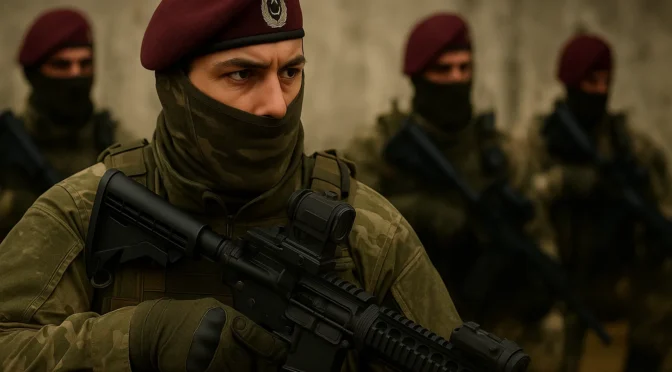
The Maroon Berets: An Analysis of the Evolution, Tactics, and Arsenal of the Turkish Special Forces Command

The Turkish Special Forces Command (Özel Kuvvetler Komutanlığı – ÖKK), known colloquially as the “Maroon Berets” (Bordo Bereliler), represents the apex of the Turkish Armed Forces’ (TAF) operational capabilities and a primary instrument of Turkish strategic power projection. This report provides a comprehensive analysis of the ÖKK’s evolution, from its clandestine Cold War origins to its current status as a battle-hardened, technologically advanced special operations force (SOF). The analysis demonstrates that the ÖKK’s development has been forged through decades of relentless conflict, most notably the counter-insurgency campaign against the Kurdistan Workers’ Party (PKK) and extensive expeditionary operations in Syria and Northern Iraq.

The unit’s genesis lies in a NATO “stay-behind” organization established in 1952, a foundation that instilled a unique and enduring culture of unconventional warfare, operational autonomy, and strategic thinking. This Cold War DNA proved uniquely suited to the asymmetric challenges that would define its future. Formally established as the ÖKK in 1992 to counter the escalating PKK insurgency, the Maroon Berets honed their skills in the mountainous terrain of Southeast Turkey and Northern Iraq, mastering long-range reconnaissance, intelligence-driven targeting, and high-value target capture, exemplified by the strategic capture of PKK founder Abdullah Öcalan in 1999.

The post-2015 era marked the most profound transformation in the unit’s history. The shift of the PKK conflict into dense urban environments forced a brutal but necessary evolution in tactics, from rural counter-insurgency to high-intensity urban warfare. The lessons learned were immediately applied in large-scale cross-border interventions in Syria, where the ÖKK evolved from a direct-action unit into the vanguard of complex, combined-arms operations, effectively employing the “by, with, and through” model with Syrian proxy forces. This period was also defined by a technological revolution, with the integration of indigenous armed drones and network-centric warfare capabilities fundamentally altering the ÖKK’s operational paradigm.

This evolution is mirrored in the unit’s arsenal. The ÖKK has pursued a sophisticated dual-track procurement strategy, equipping its operators with best-in-class Western systems like the Heckler & Koch HK416A5 rifle while simultaneously driving the development of and integrating advanced indigenous platforms from Turkish firms such as Sarsılmaz and Kale Kalıp. This approach ensures immediate Tier-1 capability while mitigating geopolitical risks and fostering national industrial independence.

Looking forward, the ÖKK is poised to expand its role beyond counter-terrorism into the broader spectrum of strategic competition, acting as the tip of the spear for Turkey’s “forward defense” doctrine. Its future will be characterized by deeper integration of artificial intelligence, autonomous systems, and man-unmanned teaming. However, the most critical variable in its long-term trajectory may be the human dimension, as the impact of post-2016 institutional reforms on the TAF’s officer corps will ultimately shape the culture and leadership of this elite force. The ÖKK’s journey from a clandestine cell to a strategic SOF is a direct reflection of Turkey’s own rise as a formidable regional military power, and it stands today as one of the world’s most experienced and capable special operations forces.

Section 1: Genesis and Cold War Origins (1952-1992)

The foundational identity of the Turkish Special Forces Command cannot be understood without first examining its origins within the clandestine architecture of the Cold War. Forged as an instrument of unconventional warfare in the face of a potential Soviet invasion, its early mandate, doctrine, and training established a unique culture of autonomy, deep infiltration, and strategic patience. This “Cold War DNA” would prove to be the critical enabler of its successful transformation decades later into a premier counter-insurgency and expeditionary force. Its initial purpose was not to conduct raids, but to organize and lead a national resistance from the shadows, a mission that required a fundamentally different mindset and skill set than conventional military operations.

1.1 The NATO Imperative: Formation of the Tactical Mobilization Group (STK)

The geopolitical landscape following the Second World War positioned Turkey as a critical frontline state against the Soviet Union. Its accession to the North Atlantic Treaty Organization (NATO) in 1952 was a strategic necessity, cementing its place within the Western security alliance.1 This new alignment, however, came with specific and often secret obligations. The primary threat was a large-scale Warsaw Pact invasion, a scenario for which conventional defense might not be sufficient. In this context, NATO strategists developed a “stay-behind” concept to ensure continued resistance even after a country was overrun.

On September 27, 1952, Turkey established the “Special and Auxiliary Combat Units” (Hususi ve Yardımcı Muharip Birlikleri), an organization that would soon be known as the Tactical Mobilization Group (Seferberlik Taktik Kurulu – STK).2 This unit was an integral part of NATO’s “Operation Gladio,” a continent-wide network of clandestine anti-communist organizations designed to form the nucleus of a resistance movement in the event of a Soviet occupation.4 The founding goal, as outlined in charters like that of the U.S. Office of Policy Coordination (OPC), was unambiguous: to conduct “propaganda, economic warfare; preventative direct action, including sabotage, anti-sabotage, demolition… [and] subversion against hostile states, including assistance to underground resistance movements, guerrillas and refugee liberations groups”.4 This mandate for unconventional warfare (UW), focused on organizing, training, and leading guerrilla forces, became the bedrock of the unit’s identity and its core doctrinal purpose for the next four decades.

1.2 Doctrine and Development: The Special Warfare Department (ÖHD)

The institutionalization of this special warfare capability continued to evolve. On December 14, 1970, the STK was formally reorganized and renamed the Special Warfare Department (Özel Harp Dairesi – ÖHD), placing it directly under the command of the Turkish General Staff.2 This change signified a more permanent and integrated role for special warfare within Turkey’s national defense posture.

The doctrinal and training lineage of the ÖHD was heavily influenced by the United States from its inception. The core of the unit was formed by a cadre of sixteen Turkish soldiers, including its founder Daniş Karabelen, who had been sent to the United States in 1948 for specialized training in special warfare.4 This early partnership established a direct link to the doctrine and methods of U.S. Army Special Forces, a relationship that would continue for decades, as evidenced by later U.S. military studies examining the application of American SOF assessment and selection models to their Turkish counterparts.10 The training provided by the U.S. was comprehensive, covering sabotage, subversion, and guerrilla leadership, with financial support provided under the Truman Doctrine.4

The operational doctrine of the ÖHD was fundamentally different from that of a direct-action or commando unit. Its primary mission was strategic and long-term. Operatives, mostly reserve officers, were recruited, inducted with an oath, and educated in clandestine methods. After their training, they were not formed into standing units but were returned to their civilian lives, forming a latent, cellular network of sleeper agents to be activated only in the event of an invasion.4 This methodology fostered a culture of extreme discretion, operational security, and the ability to work in small, autonomous teams without support or communication for extended periods.

Despite its primary “stay-behind” mission, the unit was not entirely dormant. Its operators were deployed to engage in counter-guerrilla operations on the Korean Peninsula during the Korean War.2 In November 1953, under the name Mobilized Reconnaissance Board, its personnel were sent to Cyprus. There, they undertook long-range reconnaissance and, critically, were tasked with arming and organizing the Turkish Resistance Organization (TMT) to counter the Greek Cypriot EOKA group.2 This early mission was a classic example of foreign internal defense and unconventional warfare, demonstrating a nascent capability to operate abroad to organize, train, and advise a partner force—a core SOF competency that would become central to its missions in the 21st century. The ÖHD’s activities in Cyprus, which included clandestine arms transfers and false flag operations to foster resistance, were a direct application of its special warfare training, proving its operational value long before it was formally re-roled to combat the PKK.8

The ÖHD’s foundational mission as a “stay-behind” force instilled a deep-seated culture of unconventional warfare, strategic thinking, and operational autonomy that distinguishes it from special forces units created purely for counter-terrorism or direct action. This legacy provided a ready-made skill set that proved directly applicable to the complex counter-insurgency challenges that would later define its primary role. The very nature of the Gladio program required operators who were not simply elite soldiers, but also intelligence operatives, political organizers, and trainers capable of building a resistance movement from scratch. This mission necessitated long-term planning, political acumen, and the ability to operate in completely denied areas without support, all of which are core UW competencies. When the primary threat to Turkish sovereignty shifted from a conventional Soviet invasion to a deeply entrenched domestic insurgency, these exact skills—operating in hostile territory, clandestine intelligence gathering, and working with local populations (in this case, the Village Guard system)—were precisely what was required. This inherent adaptability, born from its unique Cold War origins, explains the unit’s rapid and effective transition to the counter-PKK role after its 1992 reorganization.

Section 2: Forged in Conflict: The Counter-PKK Insurgency (1992-2015)

The collapse of the Soviet Union and the end of the Cold War rendered the ÖHD’s primary “stay-behind” mission obsolete. Simultaneously, a new and more immediate threat had reached a critical level: the insurgency waged by the Kurdistan Workers’ Party (PKK). In response, the Turkish high command undertook a strategic pivot, transforming its clandestine special warfare apparatus into a proactive and kinetic special operations force. The establishment of the Özel Kuvvetler Komutanlığı in 1992 marked the beginning of a new era. For nearly a quarter of a century, the ÖKK was forged in the crucible of relentless counter-insurgency warfare, an experience that shaped its doctrine, tested its limits, and ultimately established its reputation as one of the world’s most seasoned and effective special operations units.

2.1 Establishment of the ÖKK: A Strategic Pivot

The formal creation of the Special Forces Command on April 14, 1992, was a direct and calculated response to a dramatically altered security environment.2 The 1991 Gulf War had created a power vacuum in Northern Iraq, which the PKK exploited to establish a secure safe haven beyond the reach of conventional Turkish forces. The ongoing insurgency in Turkey’s southeast, which had begun in 1984, had proven to be a complex challenge that conventional military tactics struggled to contain.2 The Turkish General Staff recognized that this asymmetric threat required a specialized response.

The ÖHD was consequently restructured, expanded, and renamed the ÖKK, transitioning from a department to a brigade-level command.2 This reorganization was more than a name change; it represented a fundamental shift in mandate and operational tempo. The unit’s mission evolved from a latent anti-Soviet contingency role to an active, front-line counter-terrorism and unconventional warfare mandate, operating directly under the authority of the Turkish General Staff.2 Its designated task was to conduct special operations that “exceed the capabilities of other military units,” a clear acknowledgment of the unique demands of the counter-PKK fight.2 This decision marked the formal transition of Turkey’s special warfare capability from a strategic reserve held for a hypothetical war to a primary operational tool deployed in an active and ongoing conflict. It was a strategic admission by the military leadership that the PKK insurgency was not a conventional problem and required a specialized, unconventional solution.

2.2 The Asymmetric Battlefield: TTPs and Landmark Operations

Deployed immediately into the conflict, the ÖKK honed its tactics, techniques, and procedures (TTPs) in the rugged, mountainous terrain of Southeast Turkey and across the border in Northern Iraq. This environment became their primary training ground and operational theater. The unit specialized in deep reconnaissance, direct action raids on PKK training camps, and intelligence-driven operations to disrupt the insurgency’s command and logistics networks.2

The ÖKK quickly distinguished itself through its exceptional capability in high-value targeting (HVT) operations, which had strategic, rather than merely tactical, impacts on the conflict. In 1998, in a complex operation involving intelligence penetration and cooperation with Iraqi Kurdish Peshmerga forces, an ÖKK team captured senior PKK commander Şemdin Sakık in Dohuk, Northern Iraq.2 This was followed by their most significant achievement: the 1999 capture of PKK founder and leader Abdullah Öcalan. After an international manhunt, Öcalan was tracked to Nairobi, Kenya, where he was apprehended by an ÖKK team, reportedly with intelligence and technological assistance from international partners, and flown back to Turkey.2

These HVT captures were not just tactical victories; they were strategic psychological operations that demonstrated the long reach of the Turkish state and its intelligence dominance. The removal of the insurgency’s founder and a key military commander severely disrupted the PKK’s command structure, damaged its morale, and created internal divisions. These successes showcased the ÖKK’s ability to conduct operations with strategic, political-level effects, a hallmark of a Tier 1 special operations force.

The unit’s consistent success on the battlefield led to its formal expansion. In 2006, the ÖKK was upgraded from a brigade to a division-level command, with its leadership elevated from Major General to Lieutenant General. This expansion included the formation of new brigades and a planned doubling of its personnel from roughly 7,000 to 14,000 operators by 2009.2 The elite status of the Maroon Berets was cemented on the international stage in 2004, when they competed against twenty-six other elite units and ranked first at the World Special Forces Championship held in Germany.2

2.3 Armament of the Era: The Heckler & Koch Legacy

The small arms utilized by the ÖKK during the 1990s and into the early 2000s reflected the broader arsenal of the Turkish Land Forces, which was heavily influenced by German designs produced under license by the state-owned Mechanical and Chemical Industry Corporation (MKEK).

The primary individual weapon for ÖKK operators was the G3A7, a Turkish variant of the Heckler & Koch G3 battle rifle.21 Chambered in the powerful 7.62x51mm NATO cartridge, the G3 was a robust and reliable weapon well-suited to the long-range engagements common in the mountainous terrain of the conflict zone. Alongside the G3, the MKEK-produced HK33E, chambered in 5.56x45mm NATO, was also issued, offering a lighter platform with a higher magazine capacity for greater firepower in closer engagements.21

For suppressive fire, the standard squad automatic weapon was the MKEK-produced MG3, a modernized version of the German MG 42 machine gun, also chambered in 7.62x51mm NATO.22 In situations requiring a more compact weapon, such as vehicle operations or close-quarters battle (CQB), operators were equipped with variants of the Heckler & Koch MP5 submachine gun.21

While this inventory of weapons was dependable and effective, it was largely identical to that issued to conventional Turkish commando brigades. The rifles lacked the modularity of Picatinny rail systems, which were becoming standard for Western SOF units, limiting the easy attachment of advanced optics, lasers, and other accessories. This reliance on standard-issue infantry weapons, albeit of high quality, represented a technological and tactical gap when compared to their international counterparts. This gap would be comprehensively addressed in the subsequent decade as the nature of the ÖKK’s missions became even more complex and specialized.

Section 3: The Modern Battlefield: Syria, Urban Combat, and Proactive Defense (2015-Present)

The period from 2015 to the present marks the most profound and rapid transformation in the history of the Turkish Special Forces Command. The collapse of a two-and-a-half-year ceasefire with the PKK plunged the ÖKK into a new and brutal form of warfare: high-intensity urban combat within Turkish cities. The hard-won, costly lessons from this experience were immediately put to the test in a series of large-scale expeditionary operations in Syria. In this new theater, the ÖKK evolved from a counter-insurgency force into the vanguard of Turkey’s combined-arms military, mastering the art of advising and leading proxy forces while integrating revolutionary new technologies. This era cemented the Maroon Berets’ role as the primary tool for Turkey’s “forward defense” doctrine, projecting power far beyond its borders to shape regional security outcomes.

3.1 A New Kind of War: The Urban Conflict (2015-2016)

Following the breakdown of the ceasefire in July 2015, the nature of the conflict with the PKK underwent a dramatic shift.18 Instead of confining their operations to the rural, mountainous countryside, PKK-affiliated urban youth militias, known as the Civil Protection Units (YPS), moved the fight into the densely populated centers of cities in Southeast Turkey, such as Cizre, Sur (in Diyarbakır), and Nusaybin.25 These groups transformed neighborhoods into urban fortresses, employing tactics that included digging trenches, erecting barricades, and extensively using improvised explosive devices (IEDs) to channel security forces into kill zones. This strategy was augmented by the deployment of seasoned PKK snipers, who inflicted significant casualties on advancing troops.27

This new operational environment rendered many of the ÖKK’s traditional rural counter-insurgency skills obsolete and demanded a rapid and brutal adaptation. Long-range patrolling and mountain warfare tactics were replaced by the methodical, high-risk requirements of urban combat. Operators had to master Close Quarters Combat (CQC) and advanced building-clearing techniques, including the use of explosive breaching to overcome fortified positions.12 Crucially, they had to learn to integrate their operations seamlessly with conventional heavy assets, such as main battle tanks and artillery, which were brought in to reduce fortified structures.26 This period of intense urban warfare was the ÖKK’s “Fallujah moment”—a costly and bloody learning experience that forged the unit’s modern urban doctrine and created a deep reservoir of practical experience that would provide a distinct advantage in its subsequent operations in Syria.

3.2 The Syrian Interventions: From Advisors to Vanguards

The expertise gained in the cities of Southeast Turkey was almost immediately applied across the border. Beginning in 2016, Turkey launched a series of major military interventions into Northern Syria, with the ÖKK serving as the tip of the spear.

Operation Euphrates Shield (2016-2017): This was Turkey’s first major ground intervention in Syria, aimed at clearing the Islamic State (ISIS) from its border and preventing the Syrian-Kurdish YPG (which Turkey views as a PKK affiliate) from linking its territories.29 In the initial phases, ÖKK teams operated alongside Turkish armored units and elements of the Free Syrian Army (FSA), providing targeting expertise and direct-action capabilities. The protracted and difficult battle for the city of Al-Bab against a determined ISIS defense served as a critical post-graduate course in urban warfare. The heavy Turkish casualties sustained there highlighted initial challenges in effectively integrating SOF, conventional armor, and proxy infantry, providing invaluable lessons for future campaigns.32

Operation Olive Branch (2018): Applying the lessons from Al-Bab, this operation targeted the YPG-controlled enclave of Afrin. The campaign demonstrated a more refined operational model. It began with a massive and sustained air and artillery bombardment, utilizing 72 combat aircraft in the opening hours to systematically degrade YPG defenses, command posts, and subterranean tunnel networks.32 This was followed by a multi-pronged ground offensive led by ÖKK operators and Turkish commandos, who guided thousands of allied Syrian National Army (SNA) fighters through the mountainous approaches and into Afrin’s urban center.30

In these Syrian campaigns, the ÖKK fully matured into its role as a force multiplier. It executed the classic SOF “by, with, and through” doctrine, where a relatively small number of elite operators advise, assist, and accompany a much larger partner force. The ÖKK provided the critical command and control, intelligence fusion, precision fire support coordination, and elite strike capabilities that enabled the SNA to function as an effective ground-holding force.29 These interventions marked the ÖKK’s definitive graduation from a domestic and cross-border counter-terrorism unit to a true expeditionary special operations force, capable of planning and executing complex combined-arms operations as a primary instrument of Turkish foreign policy.

3.3 The Technology Revolution: Drones and Networked Warfare

The operational evolution of the ÖKK during this period was inextricably linked to a technological revolution within the Turkish military, most notably the widespread deployment of indigenously produced unmanned aerial vehicles (UAVs). The Bayraktar TB2 armed drone proved to be a genuine “game changer” in the fight against both the PKK and other adversaries.37 These platforms provided ÖKK teams on the ground with persistent, real-time intelligence, surveillance, and reconnaissance (ISR), allowing them to track enemy movements and identify targets with unprecedented clarity. More importantly, the TB2’s ability to deploy precision-guided munitions gave ground teams an immediate and highly accurate strike capability, enabling the targeting of high-level PKK cadres in previously inaccessible mountain hideouts and command posts in Northern Iraq.15

The culmination of this technological and doctrinal integration was showcased during Operation Spring Shield in Idlib, Syria, in early 2020. In response to a deadly airstrike on Turkish troops, the TAF launched a devastating counter-attack against Syrian Arab Army positions. This operation demonstrated a new level of sophistication in modern warfare. Turkish forces, with ÖKK elements likely providing forward observation and targeting, seamlessly combined the effects of armed drones, long-range artillery, and the KORAL electronic warfare system. This network-centric approach allowed them to systematically locate, jam, and destroy Syrian air defense systems, tanks, and artillery pieces with overwhelming speed and precision.29 It was a clear demonstration that the Turkish Armed Forces, with the ÖKK at the forefront of integrating new technologies, had mastered a mature form of multi-domain, networked warfare.

Section 4: The Current Arsenal of the ÖKK: A Detailed Small Arms Analysis

The contemporary small arms inventory of the Özel Kuvvetler Komutanlığı is a direct reflection of its operational evolution and its status as a Tier 1 special operations force. The arsenal is characterized by a sophisticated, multi-layered procurement strategy that prioritizes operator-level specialization, modularity, and a dual-track approach of acquiring best-in-class foreign systems while simultaneously fostering and integrating advanced domestically produced platforms. This strategy ensures immediate interoperability with NATO partners and access to the world’s most advanced weaponry, while also building Turkey’s defense industrial base and mitigating the geopolitical risks of arms embargoes. The result is a diverse and highly capable arsenal tailored to the full spectrum of special operations, from clandestine reconnaissance to high-intensity direct action.

4.1 Sidearms: Precision and Reliability

The sidearm is a critical secondary weapon for any special operator, valued for its reliability in close-quarters engagements and as a backup system. The ÖKK employs a range of high-quality pistols from both foreign and domestic manufacturers.

  • Glock 17 & 19: The Austrian-made Glock 17 (full-size) and Glock 19 (compact) pistols, chambered in 9x19mm Parabellum, are considered standard-issue sidearms for the ÖKK.2 Their worldwide adoption by military and law enforcement units is a testament to their exceptional reliability, simple design, and high-capacity magazines. The polymer frame makes them lightweight, and the vast aftermarket support allows for extensive customization to fit operator preference.40
  • Heckler & Koch USP: The German Heckler & Koch Universal Self-loading Pistol (USP) in.45 ACP is also in the ÖKK inventory.2 The choice of the larger.45 ACP caliber suggests a preference for greater stopping power in certain tactical scenarios. The USP is renowned for its durability and its proprietary recoil reduction system, which mitigates the recoil of the powerful cartridge.41
  • SIG Sauer P226 & P229: The Swiss/German SIG Sauer P226 and its more compact variant, the P229, are elite pistols used by numerous premier special operations forces globally, including the U.S. Navy SEALs.2 Chambered in calibers such as.40 S&W, these hammer-fired pistols are praised for their exceptional accuracy and ergonomics.43
  • Sarsılmaz SAR9 SP: Demonstrating the growing capability of Turkey’s domestic defense industry, the ÖKK has adopted the SAR9 SP, a specialized variant of the striker-fired SAR9 pistol produced by the Turkish firm Sarsılmaz.44 Developed specifically to meet the requirements of the Special Forces Command, its inclusion in the inventory signifies that domestic designs have achieved the high standards of reliability and performance demanded by elite units.44

4.2 Primary Carbines: The Elite Standard

The primary weapon of the ÖKK operator is the carbine, which must be accurate, reliable, and modular to adapt to diverse mission requirements. The ÖKK has largely moved away from the older generation of MKEK-produced rifles to adopt platforms that are the standard for top-tier international SOF.

  • Heckler & Koch HK416A5: The German HK416A5 is the principal assault rifle of the Maroon Berets.22 Chambered in 5.56x45mm NATO, it utilizes a short-stroke gas piston system derived from the H&K G36 rifle. This system prevents combustion gases from entering the receiver, which significantly increases reliability and reduces fouling compared to traditional direct impingement systems.48 The A5 variant features fully ambidextrous controls, a tool-less adjustable gas regulator for use with suppressors, and a high degree of modularity via its Picatinny rail system.49 Its adoption places the ÖKK’s primary weapon on par with units like U.S. Delta Force and the Norwegian Special Forces.
  • Colt M4A1: The American-made Colt M4A1 carbine, also in 5.56x45mm NATO, remains in use, particularly with Turkish Naval SOF units like the Su Altı Taarruz (SAT).2 The M4A1 is the baseline for modern military carbines, known for its light weight, compact size, and extensive combat record.51
  • Sarsılmaz SAR 56: In a significant development, the ÖKK has begun procuring the Turkish-made Sarsılmaz SAR 56 assault rifle to supplement and potentially eventually replace its HK416s.46 The SAR 56 is an AR-15 platform rifle that operates with a short-stroke gas piston system, similar to the HK416. It is available in multiple barrel lengths (7.5″, 11″, and 14.5″) to suit different roles, from CQB to standard infantry use.45 Its acquisition by the ÖKK indicates that the domestic rifle has successfully passed the rigorous testing and met the demanding standards required for special operations use.
  • Kale Kalıp KCR556: Another advanced domestic platform, the KCR556 from Kale Kalıp, is in limited use with Turkish Commando and Gendarmerie SOF units and has been combat-proven in operations like Olive Branch.21 Like the SAR 56, it is a short-stroke gas piston rifle based on the AR-15 architecture, available in various barrel lengths and featuring a high degree of modularity.53

4.3 Battle Rifles & Designated Marksman Rifles (DMRs)

For engagements requiring greater range and barrier penetration than 5.56x45mm ammunition can provide, ÖKK squads employ a variety of 7.62x51mm NATO weapon systems.

  • FN SCAR-H: The Belgian FN SCAR-H is a modern battle rifle used by the ÖKK.21 It is highly valued for its powerful 7.62x51mm cartridge, modular design allowing for quick barrel changes, and excellent ergonomics, including a folding stock and fully ambidextrous controls.
  • MKE MPT-76 / KNT-76: The MKE MPT-76 is Turkey’s national infantry rifle, designed to replace the G3.55 It is a short-stroke gas piston rifle heavily influenced by the HK417 design.55 The ÖKK employs the dedicated marksman rifle variant, the KNT-76. The KNT-76 features a longer, 20-inch barrel and a refined trigger, which improves its effective range to 800 meters and its accuracy to a consistent 1.5 Minutes of Angle (MOA), making it a capable semi-automatic precision platform.55
  • KAC M110 SASS: The American Knight’s Armament Company M110 Semi-Automatic Sniper System (SASS) is a key DMR in the ÖKK’s inventory.2 Based on the AR-10 platform, the M110 is renowned for its exceptional accuracy and allows the designated marksman to deliver rapid, precise follow-up shots at extended ranges.

4.4 Sniper Systems: Strategic Precision

Long-range precision fire is a critical SOF capability, used for reconnaissance, overwatch, and the elimination of high-value or strategic targets. The ÖKK employs a diverse and world-class inventory of bolt-action sniper rifles for both anti-personnel and anti-materiel roles.

Anti-Personnel Systems:

  • Sako TRG Series: The Finnish Sako TRG-22 (chambered in.308 Winchester/7.62x51mm) and the TRG-42 (chambered in the powerful.338 Lapua Magnum) are highly respected precision rifles used by the ÖKK.2 They are known for their “out-of-the-box” sub-MOA accuracy, fully adjustable stocks, and crisp two-stage triggers.56
  • Accuracy International AWM/AXMC: The British Accuracy International Arctic Warfare Magnum (AWM) and its successor, the AX Multi Caliber (AXMC), are legendary in the sniper community for their ruggedness and extreme accuracy.2 Chambered in.338 Lapua Magnum, these rifles provide the ability to engage targets well beyond 1,500 meters.61 The AXMC features a quick-change barrel system, allowing operators to switch calibers (e.g., to.300 Win Mag or.308 Win) in the field.61

Anti-Materiel Systems:

  • Barrett M82A1 & McMillan Tac-50: For engaging hard targets such as light vehicles, radar equipment, and enemy ordnance at extreme ranges, the ÖKK utilizes American-made.50 BMG (12.7x99mm NATO) rifles. These include the semi-automatic Barrett M82A1 and the bolt-action McMillan Tac-50, both of which are capable of effective fire out to 2,000 meters and beyond.2
  • Kale Kalıp KSR50: Complementing the foreign systems is the Turkish Kale Kalıp KSR50, a bolt-action.50 BMG sniper rifle.64 The adoption of the KSR50 by the ÖKK demonstrates that Turkey’s domestic industry can now produce high-caliber precision rifles that meet the stringent requirements of its most elite unit.64

4.5 Support & Specialized Weapons

To round out their capabilities, ÖKK teams are equipped with a range of specialized weapons for suppressive fire and close-quarters engagements.

  • Light Machine Guns (LMG): The primary squad support weapon is the Belgian FN Minimi, chambered in 5.56x45mm NATO.22 This belt-fed LMG provides a high volume of mobile, suppressive fire, essential for fire and maneuver tactics.66 Turkey’s Kale Kalıp has also developed the KMG556, a domestic LMG based on the Minimi design, which is being introduced into service.67
  • Submachine Guns (SMG) & Personal Defense Weapons (PDW): While largely supplanted by short-barreled carbines like the 11-inch HK416A5, traditional SMGs still have a niche. The H&K MP5 series (9x19mm) remains in the inventory for specific CQB or low-visibility missions where over-penetration is a concern.2 For defeating body armor in a compact platform, the ÖKK uses the H&K MP7A1 PDW, which fires a proprietary high-velocity 4.6x30mm round.2

4.6 Table: Current Small Arms of the Turkish Special Forces Command (ÖKK)

The following table summarizes the primary small arms currently in service with the ÖKK, reflecting the unit’s dual-track procurement strategy of utilizing both elite international and advanced domestic weapon systems.

Weapon TypeModelCaliberCountry of OriginRole/Notes
SidearmGlock 17 / 199×19mmAustriaStandard issue sidearm.
Heckler & Koch USP.45 ACPGermanySpecialized sidearm, valued for stopping power.
SIG Sauer P226 / P229.40 S&W / 9×19mmSwitzerland/GermanyElite sidearm, noted for accuracy.
Sarsılmaz SAR9 SP9×19mmTurkeyDomestically developed pistol for ÖKK.
Assault Rifle / CarbineHeckler & Koch HK416A55.56×45mmGermanyPrimary issue carbine; Tier-1 SOF standard.
Sarsılmaz SAR 565.56×45mmTurkeyDomestically produced rifle supplementing the HK416.
Colt M4A15.56×45mmUSAStandard NATO carbine, used by various units.
Kale Kalıp KCR5565.56×45mmTurkeyDomestically produced rifle in limited use.
Battle RifleFN SCAR-H7.62×51mmBelgiumModular battle rifle for increased firepower.
Designated Marksman RifleMKE KNT-767.62×51mmTurkeyStandard issue domestic DMR.
KAC M110 SASS7.62×51mmUSAHigh-precision semi-automatic sniper system.
Sniper Rifle (Anti-Personnel)Sako TRG-22.308 WinFinlandBolt-action precision rifle.
Sako TRG-42.338 Lapua MagnumFinlandLong-range bolt-action precision rifle.
Accuracy Int’l AWM/AXMC.338 Lapua MagnumUKPremier long-range anti-personnel system.
Sniper Rifle (Anti-Materiel)Barrett M82A1.50 BMGUSASemi-automatic anti-materiel rifle.
McMillan Tac-50.50 BMGUSABolt-action anti-materiel rifle.
Kale Kalıp KSR50.50 BMGTurkeyDomestically produced anti-materiel rifle.
Light Machine GunFN Minimi5.56×45mmBelgiumStandard issue squad automatic weapon.
Kale Kalıp KMG5565.56×45mmTurkeyDomestically produced LMG.
Submachine Gun / PDWHeckler & Koch MP5 Series9×19mmGermanyUsed for specialized CQB roles.
Heckler & Koch MP7A14.6×30mmGermanyPersonal Defense Weapon for defeating body armor.

Section 5: The Future of the Maroon Berets: A Speculative Outlook to 2035

Projecting the future of an elite special operations force like the ÖKK requires an analysis that synthesizes global trends in warfare, Turkey’s specific strategic ambitions, and the internal dynamics of its military-industrial complex and institutional structures. While counter-terrorism will undoubtedly remain a core competency, the ÖKK’s trajectory over the next decade will likely be defined by its expanding role in great power competition, its deep integration with autonomous systems and artificial intelligence, and the long-term effects of profound institutional reforms within the Turkish Armed Forces. The Maroon Berets of 2035 will be shaped as much by algorithms and geopolitics as by the battlefield experiences that have defined their past.

5.1 Evolving Geopolitical Roles: From COIN to Great Power Competition

The operational focus of U.S. and NATO special operations forces is shifting from the counter-terrorism-centric missions of the post-9/11 era toward the challenges of strategic competition with peer and near-peer adversaries.69 The ÖKK’s future missions will likely mirror this global trend. While the threat from the PKK or successor groups will necessitate a persistent counter-terrorism capability, the force will increasingly be leveraged as a tool of Turkish foreign policy in wider geopolitical arenas. This will involve an expansion of its irregular warfare, foreign internal defense (FID), and security force assistance (SFA) missions to build partnerships and project influence in regions of strategic importance to Turkey, such as Africa, the Caucasus, and Central Asia.

This evolution aligns perfectly with Turkey’s established “forward defense” doctrine, a strategic posture that seeks to confront and neutralize threats far beyond its borders before they can directly impact national security.71 The successful application of this doctrine in Syria and Northern Iraq, where the ÖKK was the central enabling force, has validated the concept. In the future, ÖKK teams will likely be deployed to train, advise, and potentially lead partner forces in these new theaters, creating strategic depth for Turkey and countering the influence of rival powers with a light, cost-effective, and politically discreet footprint.

5.2 Doctrinal and Technological Integration

The future battlefield will be dominated by information, with victory depending on the ability to collect, process, and act on data faster and more effectively than the adversary.74 The future ÖKK operator will evolve from being primarily a kinetic actor to a manager of information and a commander of autonomous systems. They will function as critical human nodes within a vast, AI-enabled battle network, leveraging advanced C4ISR (Command, Control, Communications, Computers, Intelligence, Surveillance, and Reconnaissance) systems to achieve information dominance and orchestrate effects across multiple domains.75

This will manifest in the widespread adoption of man-unmanned teaming (MUM-T). The ÖKK’s proven ability to effectively integrate armed drones like the Bayraktar TB2 into its ground operations is a precursor to this future.37 The next evolution in TTPs will see ÖKK teams moving beyond simply calling in airstrikes to directly controlling a suite of unmanned assets. This could include loyal wingman UCAVs like the Bayraktar Kızılelma, autonomous ground robotics for reconnaissance and breaching, and intelligent drone swarms for overwhelming enemy defenses.74 The operator’s primary value will shift from their skill with a carbine to their ability to command this network of robotic assets to achieve strategic objectives with a minimal physical signature.

5.3 The Human Dimension: The Impact of Institutional Reform

While technology will reshape the battlefield, the single most critical component of any special operations force is the quality of its personnel. In this regard, the most significant and uncertain variable for the ÖKK’s long-term future lies in the profound institutional reforms undertaken within the Turkish military following the 2016 coup attempt. The closure of the historic military academies and the centralization of all officer and NCO training under the newly established National Defense University (Milli Savunma Üniversitesi – MSÜ) represents a fundamental reshaping of the TAF’s leadership pipeline.78

As of 2025, a large percentage of the TAF officer corps are graduates of this new system, and within a few years, nearly every officer will have been educated under its curriculum.78 Since the ÖKK recruits its operators almost exclusively from the ranks of experienced officers and NCOs from the Land Forces, the character and quality of this recruitment pool will be determined by the MSÜ system.3 A critical question for the future is whether this new, centralized system—designed to ensure political loyalty to the government—will continue to foster the rigorous, meritocratic, and apolitical standards essential for producing the kind of highly intelligent, adaptable, and fiercely independent-minded leaders that define elite SOF units. Any degradation in the quality of officer candidates, or a cultural shift that prioritizes loyalty over battlefield merit, could, over a decade, alter the unique ethos that has made the Maroon Berets so effective.

5.4 Materiel Self-Sufficiency: The 2030 Vision

Turkey’s national “2030 Industry and Technology Strategy” explicitly aims for full independence and global leadership in critical technologies, with the defense sector being a primary focus.80 This national ambition will directly shape the ÖKK’s future arsenal. The current dual-track procurement strategy will likely transition to a “domestic-first” approach as Turkish industry matures.

By 2035, it is conceivable that the majority of the ÖKK’s equipment—from next-generation modular rifles and advanced optics to personal C4I systems, encrypted communications, and robotic platforms—will be of Turkish design and manufacture. The ÖKK will continue to serve as a key driver and end-user for this development, providing the Turkish defense industry with invaluable operational requirements and combat feedback to ensure that new indigenous systems are not just technologically advanced, but also practical, reliable, and battle-ready.76 This symbiotic relationship will accelerate innovation and ensure that the Maroon Berets are equipped with systems tailored specifically to their unique mission sets and Turkey’s strategic priorities.

Conclusion

The evolution of the Özel Kuvvetler Komutanlığı is a remarkable story of adaptation and transformation, mirroring the trajectory of the Turkish Republic itself in the 21st century. From its origins as a clandestine “stay-behind” unit created for a hypothetical Cold War conflict, the Maroon Berets have been forged into a premier special operations force through the unrelenting pressures of real-world combat. Their journey traces a clear and logical arc: a foundation in the principles of unconventional warfare provided the ideal skill set to confront the asymmetric challenge of the PKK insurgency. Decades of grueling counter-insurgency in the mountains of Anatolia and Iraq instilled a level of experience and resilience matched by few units worldwide.

This experience, in turn, became the bedrock for the unit’s most significant evolution. The brutal urban battles of 2015-2016 forced a doctrinal shift that prepared them for the complexities of modern hybrid warfare. In the subsequent expeditionary campaigns in Syria, the ÖKK demonstrated its maturity, leading large-scale combined-arms operations and mastering the integration of revolutionary drone technology. This progression transformed the unit from a national counter-terrorism asset into a vital instrument of regional power projection.

Today, the ÖKK’s diverse, world-class arsenal and its sophisticated, battle-tested doctrine place it firmly in the top tier of global special operations forces. Looking ahead, the force is poised to continue its evolution, embracing autonomous systems and expanding its role in strategic competition. As Turkey continues to chart an independent and assertive course in a volatile region, the Maroon Berets—embodying their motto, “The difficult we do immediately. The impossible takes a little longer“—will remain its sharpest and most indispensable strategic tool.


Please share the link on Facebook, Forums, with colleagues, etc. Your support is much appreciated and if you have any feedback, please email us in**@*********ps.com. If you’d like to request a report or order a reprint, please click here for the corresponding page to open in new tab.


Sources Used

  1. History – Kara Kuvvetleri Komutanlığı, accessed September 6, 2025, https://www.kkk.tsk.tr/en/kkksablonmaster/header/institutional/landforcescommand/history.aspx
  2. Special Forces Command (Turkey) – Wikipedia, accessed September 6, 2025, https://en.wikipedia.org/wiki/Special_Forces_Command_(Turkey)
  3. Special Forces Command (Turkey) – Wikiwand, accessed September 6, 2025, https://www.wikiwand.com/en/articles/Special_Forces_Command_(Turkey)
  4. Counter-Guerrilla – Wikipedia, accessed September 6, 2025, https://en.wikipedia.org/wiki/Counter-Guerrilla
  5. Özel Kuvvetler Komutanlığı – Wikiwand, accessed September 6, 2025, https://www.wikiwand.com/tr/articles/%C3%96zel_Kuvvetler_Komutanl%C4%B1%C4%9F%C4%B1
  6. tr.wikipedia.org, accessed September 6, 2025, https://tr.wikipedia.org/wiki/%C3%96zel_Harp_Dairesi#:~:text=%C4%B0lk%20olarak%201952%20y%C4%B1l%C4%B1nda%20%22Hususi,%C3%96zel%20Harp%20Dairesi%20ad%C4%B1n%C4%B1%20alm%C4%B1%C5%9Ft%C4%B1r.
  7. en.wikipedia.org, accessed September 6, 2025, https://en.wikipedia.org/wiki/Special_Forces_Command_(Turkey)#:~:text=On%2014%20December%201970%2C%20it,brigade%20transitioned%20to%20a%20division.
  8. Special Warfare Department – Wikipedia, accessed September 6, 2025, https://en.wikipedia.org/wiki/Special_Warfare_Department
  9. Özel Harp Dairesi – Vikipedi, accessed September 6, 2025, https://tr.wikipedia.org/wiki/%C3%96zel_Harp_Dairesi
  10. Assessment and Selection of Personnel for the Turkish Special Forces Command – DTIC, accessed September 6, 2025, https://apps.dtic.mil/sti/tr/pdf/ADA350142.pdf
  11. en.wikipedia.org, accessed September 6, 2025, https://en.wikipedia.org/wiki/Special_Forces_Command_(Turkey)#:~:text=The%20Special%20Forces%20Command%20(Turkish,under%20the%20Turkish%20General%20Staff.
  12. Özel Kuvvetler Komutanlığı – Vikipedi, accessed September 6, 2025, https://tr.wikipedia.org/wiki/%C3%96zel_Kuvvetler_Komutanl%C4%B1%C4%9F%C4%B1
  13. Assessment of the Turkish-Kurdish Conflict, 1984-1999 – Small Wars Journal, accessed September 6, 2025, https://smallwarsjournal.com/2024/06/19/assessment-turkish-kurdish-conflict-1984-1999/
  14. Türkiye – nato shape, accessed September 6, 2025, https://shape.nato.int/turkey
  15. Tackling the PKK: New Directions for Turkey’s Special Forces …, accessed September 6, 2025, https://jamestown.org/program/tackling-the-pkk-new-directions-for-turkeys-special-forces/
  16. About: Special Forces Command (Turkey) – DBpedia, accessed September 6, 2025, https://dbpedia.org/page/Special_Forces_Command_(Turkey)
  17. List of Turkish operations in northern Iraq – Wikipedia, accessed September 6, 2025, https://en.wikipedia.org/wiki/List_of_Turkish_operations_in_northern_Iraq
  18. Conflict Between Turkey and Armed Kurdish Groups | Global Conflict Tracker – Council on Foreign Relations, accessed September 6, 2025, https://www.cfr.org/global-conflict-tracker/conflict/conflict-between-turkey-and-armed-kurdish-groups
  19. “Bordo Bereliler”(Maroon Berets): Turkey’s Most Elite Military Special Forces Unit, accessed September 6, 2025, https://defencesecurityasia.com/en/bordo-berelilermaroon-berets-turkeys-most-elite-military-special-forces-unit/
  20. Kurdistan Workers’ Party insurgency – Wikipedia, accessed September 6, 2025, https://en.wikipedia.org/wiki/Kurdistan_Workers%27_Party_insurgency
  21. List of equipment of the Turkish Land Forces – Wikipedia, accessed September 6, 2025, https://en.wikipedia.org/wiki/List_of_equipment_of_the_Turkish_Land_Forces
  22. Turkish Armed Forces and Jandarma Weapons – Far East Tactical, accessed September 6, 2025, https://fareastmilsim.com/-page
  23. Heckler & Koch HK33 – Wikipedia, accessed September 6, 2025, https://en.wikipedia.org/wiki/Heckler_%26_Koch_HK33
  24. The HK33: A Legendary Battle Rifle From H&K – HKPARTS, accessed September 6, 2025, https://hkparts.net/blog/hk33-a-legendary-battle-rifle-from-heckler-koch/
  25. Türkiye’s PKK Conflict: A Visual Explainer | International Crisis Group, accessed September 6, 2025, https://www.crisisgroup.org/visual-explainers/turkiyes-pkk-conflict-visual-explainer
  26. Diyarbakir and the Turkish military offensive: The spoils of urban warfare | Qantara.de, accessed September 6, 2025, https://qantara.de/en/article/diyarbakir-and-turkish-military-offensive-spoils-urban-warfare
  27. The PKK’s Urban Warfare Tactics – Atlantic Council, accessed September 6, 2025, https://www.atlanticcouncil.org/blogs/menasource/the-pkk-s-urban-warfare-tactics/
  28. BORDO BERELİLER | ÖZEL KUVVETLER KOMUTANLIĞI KARARGAHI! – Asker TV | Askeri, Güvenlik ve Savunma Sanayii Sitesi, accessed September 6, 2025, https://www.askertv.com/bordo-bereliler-ozel-kuvvetler-komutanligi-karargahi.html
  29. Turkish involvement in the Syrian civil war – Wikipedia, accessed September 6, 2025, https://en.wikipedia.org/wiki/Turkish_involvement_in_the_Syrian_civil_war
  30. Turkey’s military operation in Syria and its impact on relations with …, accessed September 6, 2025, https://www.europarl.europa.eu/EPRS/EPRS-Briefing-642284-Turkeys-military-operation-Syria-FINAL.pdf
  31. Operation Euphrates Shield: Aims and Gains | Carnegie Endowment for International Peace, accessed September 6, 2025, https://carnegieendowment.org/posts/2017/01/operation-euphrates-shield-aims-and-gains?lang=en
  32. Operation Olive Branch: A Political Military Assessment | Carnegie Endowment for International Peace, accessed September 6, 2025, https://carnegieendowment.org/posts/2018/01/operation-olive-branch-a-political-military-assessment?lang=en
  33. Fighting ISIS in Syria: Operation Euphrates Shield and the lessons learned from the al-Bab Battle – IDEAS/RePEc, accessed September 6, 2025, https://ideas.repec.org/a/taf/fswixx/v33y2022i3p350-381.html
  34. Suriye’nin kuzeyindeki operasyonlarla 6 yılda yaklaşık 17 bin terörist etkisiz hale getirildi, accessed September 6, 2025, https://www.aa.com.tr/tr/gundem/suriyenin-kuzeyindeki-operasyonlarla-6-yilda-yaklasik-17-bin-terorist-etkisiz-hale-getirildi/2749677
  35. Operation Olive Branch: A Political – Military Assessment – Edam, accessed September 6, 2025, https://edam.org.tr/wp-content/uploads/2018/01/Operation-Olive-Branch-01.pdf
  36. Turkey ramps up military support for Syria – FDD’s Long War Journal, accessed September 6, 2025, https://www.longwarjournal.org/archives/2025/08/turkey-ramps-up-military-support-for-syria.php
  37. Turkey’s PKK Conflict: A Regional Battleground in Flux | International Crisis Group, accessed September 6, 2025, https://www.crisisgroup.org/europe-central-asia/western-europemediterranean/turkey/turkeys-pkk-conflict-regional-battleground-flux
  38. Irak’ın Kuzeyinde İcra Edilen “PENÇE-KİLİT OPERASYONU” Hakkında Açıklama MSB, accessed September 6, 2025, https://www.msb.gov.tr/SlaytHaber/1842022-23372
  39. Operation Spring Shield – Wikipedia, accessed September 6, 2025, https://en.wikipedia.org/wiki/Operation_Spring_Shield
  40. Why is the Glock 19 pistol the favorite of the world’s most elite forces? – Sandboxx, accessed September 6, 2025, https://www.sandboxx.us/news/why-is-the-glock-19-the-favorite-pistol-of-special-forces/
  41. Heckler & Koch USP – Wikipedia, accessed September 6, 2025, https://en.wikipedia.org/wiki/Heckler_%26_Koch_USP
  42. USP TACTICAL – HK USA, accessed September 6, 2025, https://hk-usa.com/product/usp-tactical/
  43. SIG Sauer P226 – Wikipedia, accessed September 6, 2025, https://en.wikipedia.org/wiki/SIG_Sauer_P226
  44. Turkish weapon SARSILMAZ becomes a police weapon in the US, accessed September 6, 2025, https://www.sarsilmaz.com/en/new_detail/turkish-weapon-sarsilmaz-becomes-a-police-weapon-in-the-us
  45. SARSILMAZ – Leading Brand of the Weapon Industry – Gun | Rifle …, accessed September 6, 2025, https://www.sarsilmaz.com/en
  46. Özel Kuvvetler Komutanlığına yerli saldırı tüfeği: SAR56 | DefenceTurk, accessed September 6, 2025, https://www.defenceturk.net/ozel-kuvvetler-komutanligina-yerli-saldiri-tufegi-sar56
  47. HK416A5 and HK USP using by Turkish SF ÖKK operators, and Turkish made infantary rifle MPT-76 [1079×1072] : r/MilitaryPorn – Reddit, accessed September 6, 2025, https://www.reddit.com/r/MilitaryPorn/comments/1aml7mh/hk416a5_and_hk_usp_using_by_turkish_sf_%C3%B6kk/
  48. Heckler & Koch HK416 – Wikipedia, accessed September 6, 2025, https://en.wikipedia.org/wiki/Heckler_%26_Koch_HK416
  49. HK416 – Heckler & Koch, accessed September 6, 2025, https://www.heckler-koch.com/en/Products/Military%20and%20Law%20Enforcement/Assault%20rifles/HK416
  50. M4A1 using by Turkish Navy SOF SAT operators [2252×4000] : r/MilitaryPorn – Reddit, accessed September 6, 2025, https://www.reddit.com/r/MilitaryPorn/comments/1afdyr9/m4a1_using_by_turkish_navy_sof_sat_operators/
  51. M4 carbine – Wikipedia, accessed September 6, 2025, https://en.wikipedia.org/wiki/M4_carbine
  52. Kale KCR – Wikipedia, accessed September 6, 2025, https://en.wikipedia.org/wiki/Kale_KCR
  53. KCR556 – KALE KALIP, accessed September 6, 2025, https://www.kalekalip.com.tr/products/kcr-556
  54. KCR556 7,5” PDW – KALE KALIP, accessed September 6, 2025, https://www.kalekalip.com.tr/products/kcr556/kcr556-7-5-pdw
  55. MKE MPT – Wikipedia, accessed September 6, 2025, https://en.wikipedia.org/wiki/MKE_MPT
  56. SAKO TRG-42 – Sniper Central, accessed September 6, 2025, https://snipercentral.com/sako-trg-42/
  57. Sako TRG 22/42, accessed September 6, 2025, https://www.sako.global/rifle/sako-trg-2242
  58. TECHNICAL SPECIFICATION SAKO TRG 22 / 42 – Outdoor Enterprise SA, accessed September 6, 2025, https://www.outdoor-enterprise.ch/TRG-42Techspecspdf-85adc300
  59. Sako TRG 22 A1 Bolt-Action Centerfire Rifle Review – RifleShooter, accessed September 6, 2025, https://www.rifleshootermag.com/editorial/sako-trg-22-a1-bolt-action-rifle-review/470943
  60. Accuracy International AWM – Wikipedia, accessed September 6, 2025, https://en.wikipedia.org/wiki/Accuracy_International_AWM
  61. ACCURACY AXMC SNIPER RIFLE – TR Equipement, accessed September 6, 2025, https://www.tr-equipement.com/en/our-products/armement/armes/28-accuracy-axmc-sniper-rifle.html
  62. Accuracy International Super Magnum – Sniper Central, accessed September 6, 2025, https://snipercentral.com/pm_sm.htm
  63. Barrett M82 – Wikipedia, accessed September 6, 2025, https://en.wikipedia.org/wiki/Barrett_M82
  64. Defence Turkey – KALE KALIP, accessed September 6, 2025, https://www.kalekalip.com.tr/newsroom/defence-turkey
  65. KSR50 – KALE KALIP, accessed September 6, 2025, https://www.kalekalip.com.tr/products/ksr50
  66. FN Minimi – Wikipedia, accessed September 6, 2025, https://en.wikipedia.org/wiki/FN_Minimi
  67. KALEKALIP MAK. VE KALIP SAN. A.Ş. – IDEF, accessed September 6, 2025, https://kalekalip-mak-ve-kalip-san-as.idef.com.tr/
  68. KMG556 – Turkish Minimis in Ukraine – The Armourers Bench, accessed September 6, 2025, https://armourersbench.com/2025/04/13/turkish-minimis-in-ukraine/
  69. The next decade of strategic competition: How the Pentagon can use special operations forces to better compete – Atlantic Council, accessed September 6, 2025, https://www.atlanticcouncil.org/in-depth-research-reports/report/the-next-decade-of-strategic-competition-how-the-pentagon-can-use-special-operations-forces-to-better-compete/
  70. Building Strategic Lethality: Special Operations Models for Joint Force Learning and Leader Development, accessed September 6, 2025, https://digitalcommons.ndu.edu/cgi/viewcontent.cgi?article=1306&context=joint-force-quarterly
  71. Turkey’s Military Operations in Syria and Iraq – Stiftung Wissenschaft …, accessed September 6, 2025, https://www.swp-berlin.org/10.18449/2022C37/
  72. Turkey’s Military Operations in Syria and Iraq – Stiftung Wissenschaft und Politik, accessed September 6, 2025, https://www.swp-berlin.org/publications/products/comments/2022C37_TurkeysOperations_Syria_Iraq.pdf
  73. A Shifting Centrality : The Evolution of Turkish Strategic Posture – ResearchGate, accessed September 6, 2025, https://www.researchgate.net/publication/374763286_A_Shifting_Centrality_The_Evolution_of_Turkish_Strategic_Posture
  74. The Future of the Battlefield – Office of the Director of National Intelligence – Global Trends, accessed September 6, 2025, https://www.dni.gov/index.php/gt2040-home/gt2040-deeper-looks/future-of-the-battlefield
  75. Battle Networks and the Future Force – CSIS, accessed September 6, 2025, https://www.csis.org/analysis/battle-networks-and-future-force-1
  76. The KAAN and beyond: Turkish defense firms highlight domestic capability, with eyes abroad, accessed September 6, 2025, https://breakingdefense.com/2025/09/the-kaan-and-beyond-turkish-defense-firms-highlight-domestic-capability-with-eyes-abroad/
  77. Senior Official Outlines Future Priorities for Special Ops – DoD, accessed September 6, 2025, https://www.defense.gov/News/News-Stories/Article/Article/4179258/senior-official-outlines-future-priorities-for-special-ops/
  78. 76 percent of Turkish army officers now graduates of Erdogan’s military schools – Nordic Monitor, accessed September 6, 2025, https://nordicmonitor.com/2025/09/two-thirds-of-turkish-army-now-graduates-of-erdogans-military-schools/
  79. Milli Savunma Üniversitesi, accessed September 6, 2025, https://www.msu.edu.tr/
  80. Turkey’s 2030 Industry And Technology Strategy – SETA, accessed September 6, 2025, https://www.setav.org/en/turkeys-2030-industry-and-technology-strategy
  81. President Erdoğan Unveils Türkiye’s 2030 Industry and Technology Strategy – invest.gov.tr, accessed September 6, 2025, https://www.invest.gov.tr/en/news/news-from-turkey/pages/president-erdogan-unveils-turkiye-2030-industry-technology-strategy.aspx
  82. 2030 Industry and Technology Strategy, accessed September 6, 2025, https://www.sanayi.gov.tr/assets/pdf/plan-program/2030IndustryAndTechnologyStrategyENG.pdf?1751241600107
  83. Defense industry of Turkey – Wikipedia, accessed September 6, 2025, https://en.wikipedia.org/wiki/Defense_industry_of_Turkey
  84. Turkey begins serial production of Altay tanks – Defence Blog, accessed September 6, 2025, https://defence-blog.com/turkey-begins-serial-production-of-altay-tanks/

Plus Esse Quam Simultatur: An Analysis of the Evolution, Doctrine, and Materiel of the Danish Jægerkorpset

This report provides a comprehensive analysis of the Danish Army’s Special Operations Force, the Jægerkorpset (JGK). It traces the unit’s lineage from its 18th-century origins and its modern re-establishment in 1961 as a Cold War Long-Range Reconnaissance Patrol (LRRP) unit. The analysis documents its critical transformation into a multi-spectrum Special Operations Force (SOF) in the post-Cold War era, a process forged in the conflicts in the Balkans, Afghanistan, and Iraq. The report details the corresponding evolution of the unit’s doctrine, tactics, and small arms, culminating in a technical assessment of its current arsenal. Finally, it offers a speculative analysis of the JGK’s future trajectory as it adapts to the strategic challenges of near-peer competition, hybrid warfare, and increased multinational integration within the NATO SOF framework.

I. Origins and Formation: From Hunters to Cold Warriors (1785-1961)

1.1 The Historical Precedent: The Jæger Ethos (1785)

The modern Jægerkorpset, while formally established in the 20th century, draws its name and ethos from a deep-rooted European military tradition. The unit’s first incarnation was the Jægercorpset i Sielland (The Hunter Corps of Zealand), formed on March 1, 1785, in response to emerging threats from regional powers like Sweden, Prussia, and Great Britain.1 This historical lineage is not merely ceremonial; it is foundational to the unit’s character and is symbolized by the hunting horn on its insignia.1

The 18th-century Jäger (German for “hunter”) units represented a significant tactical innovation. They were light infantrymen recruited from civilian hunters, gamekeepers, and foresters whose occupations made them uniquely suited for independent military operations.6 Unlike rigidly drilled line infantry, Jägers were selected for their initiative, marksmanship, and fieldcraft.6 They were typically armed with the first true rifles, which, while slower to load than smoothbore muskets, offered far greater range and accuracy.6 Their primary tactical roles were reconnaissance, skirmishing, and screening heavier troop formations, operating in dispersed pairs or small groups with a degree of autonomy unheard of in conventional units of the era.6

The decision to name the modern Danish special forces unit “Jægerkorpset” was a deliberate evocation of this specific military tradition. It signaled a commitment to the core attributes of the historical Jäger: self-reliance, precision marksmanship, adaptability, and the ability to operate effectively in small, independent teams far from direct command. This ethos aligns perfectly with the modern special operations creed of the “quiet professional” and the unit’s motto, Plus Esse Quam Simultatur—”Rather to be, than to seem”.2 This historical foundation provided a powerful cultural and doctrinal touchstone for the new unit, distinguishing it from the conventional forces it was designed to support.

1.2 The Cold War Imperative: Re-establishment (1961)

The Jægerkorpset in its current form was established on November 1, 1961, at a moment of acute geopolitical tension.2 The Berlin Wall had been erected just months earlier, and the ideological and military confrontation between NATO and the Warsaw Pact defined European security. The Danish government recognized the need for a specialized unit capable of operating in the ambiguous, high-stakes environment of a potential pre-war phase, termed the “Grey Period”.8 The primary mission envisioned for this new force was to gather critical intelligence deep behind enemy lines without triggering a full-scale conventional response.8

Upon its formation, the corps was briefly stationed at Hvorup Kaserne before being permanently relocated to Aalborg Air Base.2 This co-location with the Royal Danish Air Force was a strategic decision, providing the nascent unit with direct access to the air transport assets essential for its primary insertion method: parachuting.

1.3 Foundational Doctrine: The SAS and Ranger Influence

The architects of the modern Jægerkorpset did not create its doctrine in a vacuum. They deliberately synthesized the operational philosophies of two of the world’s most renowned special units: the British Special Air Service (SAS) and the U.S. Army Rangers.7 The first Danish officers to form the corps, including its first commander, Major P.B. Larsen (Jæger Nr. 1), and his executive officer, First Lieutenant Jørgen Lyng (Jæger Nr. 2), had completed the grueling U.S. Ranger School and supplemented this training with knowledge and doctrine gleaned from SAS courses.2

This dual influence provided the JGK with a uniquely versatile doctrinal foundation from its very inception. The British SAS model contributed the philosophy of small, highly autonomous teams conducting deep, covert reconnaissance and strategic sabotage—the quintessential Long-Range Reconnaissance Patrol (LRRP) mission. The U.S. Ranger model provided the framework for elite light infantry direct action, emphasizing aggressive raiding and seizure of key objectives. While the LRRP mission, with its emphasis on intelligence gathering, was the paramount task during the Cold War, the latent direct-action DNA inherited from the Rangers was a critical factor that enabled the unit’s seamless and successful pivot to counter-terrorism and direct-action missions in the post-9/11 era. This hybrid doctrinal potential, whether by design or fortunate circumstance, demonstrated remarkable foresight by its founders and proved to be a key element in the unit’s long-term evolution and success.

II. The LRRP Mission: A NATO Spearhead in the North (1961-1991)

2.1 Strategic Role: Deep Reconnaissance and “Stay-Behind” Operations

Throughout the three decades of the Cold War, the Jægerkorpset’s primary function was that of a Long-Range Reconnaissance Patrol unit.1 Its designated area of operations in the event of a conflict with the Warsaw Pact would have been deep behind enemy lines in Northern Europe. The core mission set included covert reconnaissance of enemy force dispositions, sabotage of high-value strategic targets such as command posts and logistical nodes, and potentially organizing and conducting guerrilla warfare.7

Within the broader NATO defense posture for the Baltic Approaches, the JGK served a vital strategic purpose. It was more than a tactical reconnaissance asset; it was a human-intelligence-based early warning system. In the tense “Grey Period” preceding a potential invasion, small, deniable JGK patrols could be inserted to provide verifiable, real-time intelligence on Warsaw Pact movements. This capability allowed NATO political and military leaders to gain situational awareness without the escalatory risk of deploying conventional forces. A tank column crossing the border is an unambiguous act of war; a six-man patrol being detected is, by contrast, politically deniable. This ability to operate below the threshold of conventional conflict made the JGK a key component of NATO’s tripwire defense, designed to confirm an invasion and provide critical targeting data for the initial response by allied air and land forces.11

2.2 Tactical Profile and Armament

The unit’s tactics were centered on stealth, endurance, and self-sufficiency. The primary method of insertion was parachuting, and the Jægers developed a wide renown for their expertise in airborne operations.1 Other insertion techniques included helicopter deployment and rappelling.7 Once on the ground, the core tactical skills were long-distance marching with heavy loads, precision day/night orienteering, survival in harsh conditions, and the establishment of covert observation posts.9

The unit’s armament during this period reflected its mission. While specific procurement records for the unit are not publicly detailed, its equipment would have aligned with, and likely exceeded, the standards of the broader Danish Army. From 1975 until 1995, the standard Danish service rifle was the Heckler & Koch G3, designated the Gevær M/75.13 Before 1975, the standard rifle was the M1 Garand.15 The G3, chambered for the full-power 7.62x51mm NATO cartridge, was exceptionally well-suited for the LRRP role. This caliber offered superior effective range, accuracy, and barrier penetration compared to the intermediate cartridges that were becoming common elsewhere.16 These characteristics were essential for a small team that might need to engage targets at distance or fire through the cover prevalent in the forests and plains of Northern Europe. For precision engagements, the Danish military had also adopted a sniper variant of the G3, the M/66, in 1966, which would have been a logical tool for Jæger teams.13 It is also plausible that the unit evaluated other specialized platforms during this period; for instance, small numbers of the Heckler & Koch G41 were acquired by Denmark in the 1980s.10

III. A New Paradigm: Transformation into a Special Operations Force (1992-2001)

3.1 The Post-Soviet Shift: Redefining the Mission

The dissolution of the Warsaw Pact and the end of the Cold War in 1991 rendered the Jægerkorpset’s primary mission—deep reconnaissance against a Soviet invasion—obsolete. Faced with strategic irrelevance, the Danish military leadership initiated a fundamental restructuring of the unit. Between 1992 and 1995, the JGK underwent a deliberate and comprehensive transformation from a specialized LRRP unit into a modern, multi-role Special Operations Force (SOF), a process designed to align its capabilities with the evolving security environment and new NATO standards.4

This transformation was not merely a change in name but a profound expansion of the unit’s mission set and skill base. While retaining its excellence in reconnaissance, the JGK’s training regimen was broadened to include proficiency in direct action (DA), counter-terrorism (CT), and operating in the complex, politically sensitive environments of international peace-support and stabilization operations.2

3.2 Baptism by Fire: The Balkans Deployments (1995-1999)

The newly transformed Jægerkorpset did not have to wait long for its first operational test. In 1995, the unit undertook its first-ever deployment, sending a six-man team to the besieged city of Sarajevo, Bosnia, as part of the United Nations Protection Force (UNPROFOR).1 Their specific mission was counter-sniper reconnaissance, a task that perfectly encapsulated the unit’s evolution. It demanded their legacy LRRP skills—patience, meticulous observation, fieldcraft, and precision marksmanship—but applied them to a modern, asymmetric conflict within a complex urban and political landscape. This mission served as a critical “bridging” experience, validating the JGK’s relevance in the post-Cold War world and proving its ability to adapt its core competencies to new challenges.

The Jægers remained active in the Balkans throughout the decade, participating in the subsequent NATO-led Stabilization Force (SFOR) in Bosnia and deploying to Kosovo in 1999 as part of the Kosovo Force (KFOR).2 These operations involved a range of SOF tasks, including intelligence gathering, providing security for other NATO contingents, and contributing to regional stabilization efforts.22 The experience gained in the Balkans was invaluable, hardening the unit and providing the practical experience necessary to transition from theoretical doctrine to proven operational capability.

3.3 Evolving Armament for a New Era

The doctrinal shift from a Cold War LRRP focus to a multi-role SOF capability was directly mirrored by a significant change in the unit’s primary small arms. In the mid-1990s, coinciding with their first deployments, the Danish Armed Forces began replacing the 7.62x51mm M/75 (G3) battle rifle with the 5.56x45mm family of weapons produced by Diemaco of Canada (now Colt Canada).14 The full-length rifle was designated the M/95 (C7), while the carbine variant was designated the M/96 (C8).25

This transition from a battle rifle to an assault rifle and carbine platform was a physical manifestation of the unit’s changing tactical reality. The G3 was an excellent weapon for potential long-range engagements in a conventional European war. The C8 carbine, however, is lighter, more compact, and better suited for the close-quarters battle (CQB), urban warfare, and vehicle-borne operations that characterized the conflict in the Balkans and would come to define the asymmetric battlefields of the next two decades. The change in primary weapon was not arbitrary; it was a direct and necessary adaptation to the evolving nature of modern conflict and the JGK’s new role within it.

IV. The Global War on Terror: Forging an Elite Reputation (2001-Present)

4.1 Afghanistan: Task Force K-Bar and the Path to Direct Action

The terrorist attacks of September 11, 2001, acted as a catalyst for another significant evolution within the Jægerkorpset, precipitating an intensified focus on counter-terrorism skills and direct-action capabilities.1 In 2002, Denmark deployed both the Jægerkorpset and its maritime counterpart, the Frømandskorpset (Frogman Corps), to Afghanistan as part of the U.S.-led Combined Joint Special Operations Task Force-South (CJSOTF-South), more commonly known as Task Force K-Bar.1 The total Danish SOF contribution to this task force numbered approximately 100 operators.26

Task Force K-Bar was a formidable coalition of Tier 1 SOF units from seven nations, operating under the command of U.S. Navy SEAL Captain (later Vice Admiral) Robert Harward.26 It included elements from U.S. Navy SEALs, German KSK, Canadian JTF2, and Norwegian special forces, among others.26 The task force was assigned responsibility for southern Afghanistan and was tasked with conducting special reconnaissance and direct-action missions against Taliban and al-Qaeda leadership, fighters, and infrastructure.26

For the Jægers, the deployment represented a rapid and demanding escalation of their operational tempo and mission complexity. Their initial tasks involved reconnaissance and de-mining operations, but their role quickly expanded to include the full spectrum of SOF missions: direct-action raids on enemy compounds, sensitive site exploitation, and the capture of high-value targets.1 JGK elements also participated in major conventional operations, such as Operation Anaconda in March 2002, where they provided critical special operations support.2

The unit’s performance in this demanding environment was exemplary. On December 7, 2004, the Jægerkorpset, as part of the TF K-Bar contingent, was awarded the Presidential Unit Citation by the United States—the highest unit award that can be bestowed and a rare and prestigious honor for a foreign military unit.1 This deployment was arguably the single most formative operational experience in the JGK’s modern history. It accelerated their full integration with the world’s most elite SOF partners, forcing the standardization of tactics, techniques, and procedures (TTPs) to the highest NATO levels. The Presidential Unit Citation was not merely a decoration; it was the official American acknowledgment of the Jægerkorpset’s arrival as a world-class, combat-proven Tier 1 SOF unit, on par with its more famous counterparts.

4.2 Iraq and Beyond: Counter-Insurgency and Intelligence Operations

Following their success in Afghanistan, the Jægerkorpset continued to be a key contributor to international security operations. The unit was deployed to Iraq from 2003 to 2008, where it conducted intelligence-gathering and direct-action missions against a complex and evolving insurgency.4 Some of these operations were detailed in the controversial 2009 memoir Jæger – i krig med eliten (Jaeger: At War with Denmark’s Elite Special Forces) by former operator Thomas Rathsack, the publication of which led to a major political and legal battle with the Danish Ministry of Defence over concerns of classified information disclosure.31

The unit has also been involved in operations in Africa and has contributed to the ongoing fight against ISIS as part of Operation Inherent Resolve.2 These deployments have further honed the JGK’s expertise in counter-insurgency, counter-terrorism, and working with and through local partner forces, solidifying its reputation as a versatile and highly capable special operations force.

V. The Modern Jaeger: Organization, Doctrine, and Contemporary Small Arms

5.1 Structure within SOKOM

The evolving demands on Danish special operations forces led to a significant organizational change. As part of the Danish Defence Agreement 2013-2017, the Jægerkorpset was officially transferred from the command of the Royal Danish Army to the newly established Danish Special Operations Command (SOKOM) on July 1, 2015.7

SOKOM was created to provide a unified, joint command structure for both of Denmark’s premier SOF units: the land-based Jægerkorpset and the maritime-focused Frømandskorpset.35 The stated mission of SOKOM is to “strengthen and develop the Armed Forces’ special operations capacity,” ensuring that Denmark can offer a credible special operations alternative to conventional military solutions and deploy headquarters elements to support SOF abroad.35 The Jægerkorpset, which specializes in air mobility, currently comprises approximately 150 highly trained personnel and remains based at Aalborg Air Base.2

5.2 Contemporary Arsenal: A Detailed Technical Analysis

The modern Jægerkorpset’s small arms inventory reflects a mature SOF philosophy emphasizing operator-level modularity, extreme reliability, and seamless interoperability with key NATO allies. The unit fields state-of-the-art platforms that are heavily customized with advanced optics, suppressors, and other accessories to meet the specific demands of any given mission.

Sidearm: The standard issue sidearm for all Danish Defence, including the JGK, is the SIG Sauer P320 X-Carry, chambered in 9x19mm NATO.37 Adopted in 2018 after a comprehensive trial that included the Glock 17 Gen 5 and Beretta APX, the P320 X-Carry was selected for its superior performance, modularity, and modern features.37 Key attributes for SOF use include its optics-ready slide, allowing for the direct mounting of miniature red-dot sights, and its threaded barrel capability for the attachment of sound suppressors—a critical feature for maintaining stealth during covert operations.37

Primary Carbine: The primary individual weapon system is the Colt Canada C8 IUR (Gevær M/10), chambered in 5.56x45mm NATO.38 The “IUR” (Integrated Upper Receiver) designation refers to its monolithic upper receiver, which provides a rigid, uninterrupted Picatinny rail for the stable mounting of optics and laser aiming modules.25 The platform features a cold-hammer-forged, free-floating barrel, which enhances mechanical accuracy. JGK operators utilize various barrel lengths, including shortened CQB versions for operations in confined spaces.41 In August 2025, the Danish military signed a major contract to procure 26,000 new

Colt Canada C8 MRR (Modular Rail Rifle) carbines, which will be designated Gevær M/25 and will eventually replace the M/10.25 The primary upgrade in the MRR is the replacement of the Picatinny handguard with a Magpul M-LOK system, which reduces weight and improves ergonomics while maintaining modularity.25

Designated Marksman Rifle (DMR): To provide precision fire at the squad level, the JGK uses the Colt Canada C20 DMR, chambered in 7.62x51mm NATO.41 This weapon replaced the Heckler & Koch HK417, a highly regarded gas-piston rifle that had been used by the unit and other NATO SOF for its ability to deliver accurate semi-automatic fire out to 800 meters.45 The C20 provides a similar capability in a more familiar direct-impingement AR-10 style platform, simplifying logistics and training.

Sniper Rifle: For long-range anti-personnel engagements, the primary system is the Finnish SAKO TRG-42 bolt-action rifle.10 Chambered in the powerful.338 Lapua Magnum (8.6x70mm) cartridge, this rifle provides precision fire at ranges well in excess of 1,500 meters. These rifles are typically paired with high-end variable-power optics from manufacturers such as Schmidt & Bender or Zeiss to maximize their long-range potential.50

Anti-Materiel Rifles: For engaging hardened targets such as light vehicles, communications equipment, and enemy ordnance at extreme ranges, the JGK employs rifles chambered in.50 BMG (12.7x99mm NATO). The inventory includes the semi-automatic Barrett M107A1 and the British-made Accuracy International AX50 bolt-action rifle.41 The AX50 is noted as the Danish snipers’ primary anti-materiel rifle, valued for its exceptional precision.41

Support Weapons: The standard-issue general-purpose machine gun for the Danish military is the U.S. Ordnance M60E6, designated LMG M/60.41 This platform is a significantly modernized and lightened version of the classic M60, re-engineered to Danish specifications to improve reliability and ergonomics. For squad-level automatic fire, platforms such as the FN Minimi (in both 5.56mm and 7.62mm) and the Heckler & Koch MG5 are also available within NATO inventories and likely accessible to the unit for specific missions or vehicle mounting.54

5.3 Summary Table: Current Small Arms of the Jægerkorpset

The following table provides a consolidated, quick-reference guide to the Jægerkorpset’s current primary small arms arsenal. It distills the detailed technical information from the preceding analysis into a standardized format, facilitating direct comparison and assessment of the unit’s materiel capabilities.

Weapon DesignationPlatform NameTypeCaliberCountry of OriginBarrel Length (mm)Weight (kg, Unloaded)Effective Range (m)
PISTOL M/18SIG Sauer P320 X-CarrySidearm9×19mm NATOGermany/USA990.7650
GEVÆR M/10Colt Canada C8 IURCarbine5.56×45mm NATOCanada295 – 401~3.0400-500
GEVÆR M/25Colt Canada C8 MRRCarbine5.56×45mm NATOCanada368 – 399~2.9400-500
FINSKYTTEGEVÆR, KORTColt Canada C20 DMRDMR7.62×51mm NATOCanada457~4.1800
FINSKYTTEVÅBEN M/04SAKO TRG-42Sniper Rifle.338 Lapua MagnumFinland6905.31,500+
FINSKYTTEGEVÆR, LANGAccuracy International AX50Anti-Materiel Rifle.50 BMGUnited Kingdom68612.51,800+
FINSKYTTEGEVÆR, TUNGBarrett M107A1Anti-Materiel Rifle.50 BMGUSA508 / 73712.4 / 13.01,800+
LET MASKINGEVÆR M/60U.S. Ordnance M60E6GPMG7.62×51mm NATOUSA/Denmark5609.351,100

VI. Speculative Analysis: The Future of the Jægerkorpset

6.1 The Return to Collective Defense: A Near-Peer Conflict Role

The contemporary geopolitical landscape, defined by Russia’s aggression in Europe and the return of great power competition, is forcing a strategic re-evaluation across the NATO alliance.11 Danish defence policy reflects this profound shift, with recent Defence Agreements mandating significant increases in spending and a renewed focus on collective defense and deterrence against near-peer adversaries.61 For the Jægerkorpset, this new era signals a potential revitalization of its original Cold War mission set, but augmented with the technology and experience gained over two decades of counter-insurgency.

In a hypothetical near-peer conflict, the JGK’s role would be critical. They would likely be among the first assets deployed to conduct deep reconnaissance and special reconnaissance, identifying and confirming the location of high-value strategic targets such as enemy command and control nodes, long-range missile systems, air defense batteries, and critical logistics hubs.64 Operating in small teams in electronically contested and physically denied areas where traditional intelligence, surveillance, and reconnaissance (ISR) assets like satellites and drones may be jammed or destroyed, JGK operators would provide terminal guidance for allied long-range precision fires. Furthermore, their skills in sabotage would be employed against critical infrastructure to disrupt and delay an adversary’s advance, buying valuable time for the mobilization of conventional NATO forces.

6.2 Adapting to New Domains: Hybrid Warfare, Cyber, and the Arctic

Future conflicts will not be confined to traditional physical domains. The concept of hybrid warfare—which blends conventional military action with cyber-attacks, disinformation campaigns, and economic pressure—is now a central element of near-peer adversary doctrine.63 To remain effective, the Jægerkorpset must continue to adapt. This will likely involve the deeper integration of cyber and electronic warfare (EW) specialists into its operational teams.68 These operators will be tasked with exploiting enemy networks for intelligence, defending the team’s own communications, and potentially conducting localized offensive cyber effects. The future Jaeger will need to be as proficient with a signals intelligence tablet as with a carbine.

Simultaneously, the strategic importance of the Arctic is growing, and as a nation with sovereign territory in Greenland, Denmark has a vital interest in the security of the High North.61 The Jægerkorpset’s established expertise in cold-weather and mountain operations makes it a natural choice for a primary SOF asset in this challenging environment. Future roles in the Arctic could include long-range reconnaissance of critical infrastructure, counter-SOF operations to detect and neutralize adversary special forces, and serving as a rapid-response force for crises in the region.69 The unit’s future is a synthesis of its past and present: it must blend its Cold War LRRP skills with its GWOT direct-action experience and apply this combined skillset to new domains and a new class of adversary.

6.3 Future Materiel and Multinational Integration

The Jægerkorpset will undoubtedly continue its policy of procuring best-in-class, NATO-interoperable equipment. The recent decision to adopt the Gevær M/25 (C8 MRR) demonstrates a commitment to keeping individual weapon systems at the cutting edge.25 Future acquisitions will likely focus on next-generation night vision and thermal optics, advanced secure communications systems, and signature management technologies to reduce their electronic and physical footprint. The proliferation of unmanned aerial systems (UAS) on the modern battlefield also means the JGK will need to field its own advanced reconnaissance and potentially loitering munition drones, while also being equipped to counter enemy systems.62

On a strategic level, multinational integration will deepen. For smaller nations like Denmark, pooling SOF resources with trusted allies is a force multiplier. The establishment of the Composite Special Operations Component Command (C-SOCC) with Belgium and the Netherlands is a clear template for this future.10 Such integrated commands allow member nations to field a more potent, sustainable, and strategically significant SOF capability, enhancing interoperability, standardizing procedures, and promoting burden-sharing within the NATO framework.70

Conclusion

The Jægerkorpset’s history is a masterclass in institutional adaptation. Over more than six decades, it has evolved from a niche Long-Range Reconnaissance Patrol unit, created to be a clandestine tripwire in the Cold War, into one of NATO’s most respected and combat-proven Tier 1 Special Operations Forces. This transformation was not accidental but a result of deliberate doctrinal shifts, forged in the crucible of real-world conflicts from the urban battlefields of the Balkans to the mountains and deserts of Afghanistan and Iraq.

Guided by its enduring ethos of Plus Esse Quam Simultatur, “Rather to be, than to seem,” the JGK has consistently demonstrated an ability to master new skills, integrate new technologies, and achieve mission success in the most demanding operational environments. As Denmark and the NATO alliance pivot to face the complex challenges of a new era of strategic competition, the Jægerkorpset stands as a critical national asset. It is a highly capable, adaptable, and integrated force, ready to operate at the tip of the spear and continue its legacy of quiet excellence.


Please share the link on Facebook, Forums, with colleagues, etc. Your support is much appreciated and if you have any feedback, please email us in**@*********ps.com. If you’d like to request a report or order a reprint, please click here for the corresponding page to open in new tab.


Sources Used

  1. Royal Danish Army Commando force’s ”Jægerkorpset” – Steam Community, accessed September 6, 2025, https://steamcommunity.com/sharedfiles/filedetails/?id=505615738
  2. Jaeger Corps (Denmark) – Wikipedia, accessed September 6, 2025, https://en.wikipedia.org/wiki/Jaeger_Corps_(Denmark)
  3. Jægerkorpset – Aalborg Forsvars- og Garnisonsmuseum, accessed September 6, 2025, https://forsvarsmuseum.dk/jaegerkorpset/
  4. Inside the Elite: A Comprehensive Guide to Danish Special Forces Operations and History, accessed September 6, 2025, https://tactical-medicine.com/blogs/news/inside-the-elite-a-comprehensive-guide-to-danish-special-forces-operations-and-history
  5. Huntsmen Corps: The FEARED unit of the Kingdom of Denmark – YouTube, accessed September 6, 2025, https://www.youtube.com/watch?v=aygZynVprOg
  6. Jäger (infantry) – Wikipedia, accessed September 6, 2025, https://en.wikipedia.org/wiki/J%C3%A4ger_(infantry)
  7. Jægerkorpset – Danmark under Den Kolde Krig, accessed September 6, 2025, https://koldkrig-online.dk/forsvaret/haeren/jaegerkorpset/
  8. Denmark | SpecialOperations.com, accessed September 6, 2025, https://specialoperations.com/category/coalition-sof/danish-sof/
  9. Danish Special Forces | The Jaeger Corps AKA The Huntsmen Corps – SOFREP, accessed September 6, 2025, https://sofrep.com/news/danish-special-forces-the-jaeger-corps-aka-the-huntsmen-corps/
  10. Danish Special Forces: The Huntsmen of Denmark – Grey Dynamics, accessed September 6, 2025, https://greydynamics.com/danish-special-forces-the-huntsmen-of-denmark/
  11. Full article: The military geographies of Denmark: a new place in a familiar landscape, accessed September 6, 2025, https://www.tandfonline.com/doi/full/10.1080/14702436.2022.2046470
  12. From Territorial Defence to Expeditionary Forces. Mastering International Relations and Coping with Different Cultures Has Become a Strategic Necessity for Danish Officers – Military Strategy Magazine, accessed September 6, 2025, https://www.militarystrategymagazine.com/article/from-territorial-defence-to-expeditionary-forces-mastering-international-relations-and-coping-with-different-cultures-has-become-a-strategic-necessity-for-danish-officers/
  13. Denmark’s m/75: A Lease-to-Own Rifle – YouTube, accessed September 6, 2025, https://www.youtube.com/watch?v=TwwOA6YYoeE
  14. Denmark’s m/75: A Lease-to-Own Rifle – Forgotten Weapons, accessed September 6, 2025, https://www.forgottenweapons.com/denmarks-m-75-a-lease-to-own-rifle/
  15. Snipers Before Infantry: the Danish m/66 Sniper – Forgotten Weapons, accessed September 6, 2025, https://www.forgottenweapons.com/snipers-before-infantry-the-danish-m-66-sniper/
  16. Small Arms of the Cold War: Battle Rifles of NATO – Book | The Armory Life Forum, accessed September 6, 2025, https://www.thearmorylife.com/forum/threads/small-arms-of-the-cold-war-battle-rifles-of-nato-book.22699/
  17. Heckler & Koch G3 – Wikipedia, accessed September 6, 2025, https://en.wikipedia.org/wiki/Heckler_%26_Koch_G3
  18. ​The H&K G3 Rifle: A Legacy of Durability, Precision, and Global Influence – AKOptions,LLC, accessed September 6, 2025, https://akoptionsllc.com/blogthe-hk-g3-rifle-a-legacy-of-durability-precision-and-global-influence/
  19. Heckler & Koch G3 – Weaponsystems.net, accessed September 6, 2025, https://weaponsystems.net/system/1025-Heckler+%26+Koch+G3
  20. Is This Germany’s ‘M16’? – Warrior Maven, accessed September 6, 2025, https://warriormaven.com/news/land/is-this-germany-s-m16
  21. Elite Special Forces in Denmark: A Closer Look – MED-TAC International, accessed September 6, 2025, https://tactical-medicine.com/blogs/news/elite-special-forces-in-denmark-a-closer-look
  22. Peace support operations in Bosnia and Herzegovina (1995-2004) – NATO, accessed September 6, 2025, https://www.nato.int/cps/en/natohq/topics_52122.htm
  23. Creating SOF networks : the role of NATO SOF as a testing ground, accessed September 6, 2025, https://calhoun.nps.edu/server/api/core/bitstreams/8499bd36-d9c2-4324-93cb-503862147d5f/content
  24. Bosnia and Kosovo: U.S. Military Operations – EveryCRSReport.com, accessed September 6, 2025, https://www.everycrsreport.com/reports/RL32282.html
  25. Denmark to modernize its infantry arsenal with 26000 Canadian-made C8 MMR 5.56 mm carbines. – Global Tenders, accessed September 6, 2025, https://global.tendernews.com/newsdetails.aspx?s=6606&t=Denmark-to-modernize-its-infantry-arsenal-with-26,000-Canadian-made-C8-MMR-5.56-mm-carbines.
  26. Task Force K-Bar – Wikipedia, accessed September 6, 2025, https://en.wikipedia.org/wiki/Task_Force_K-Bar
  27. AFGHAN COMBINED JOINT TASK FORCE K-BAR TASK FORCE SOUTH TF K-Bar vêlkrö 2-PC SET | eBay, accessed September 6, 2025, https://www.ebay.com/itm/315437673226
  28. TASK FORCE K-BAR – World history, accessed September 6, 2025, https://www.worldhistory.biz/sundries/16032-task-force-k-bar.html
  29. Operation Anaconda – Wikipedia, accessed September 6, 2025, https://en.wikipedia.org/wiki/Operation_Anaconda
  30. Danish Special Forces / Jægerkorpset & Frømandskorpset – YouTube, accessed September 6, 2025, https://www.youtube.com/watch?v=35EjT5NtfXU
  31. The Danish Delta Force (Jaeger Corps) – YouTube, accessed September 6, 2025, https://www.youtube.com/watch?v=e2qQWUJMzB0
  32. Jæger – i krig med eliten – Wikipedia, accessed September 6, 2025, https://en.wikipedia.org/wiki/J%C3%A6ger_%E2%80%93_i_krig_med_eliten
  33. About: Jæger – i krig med eliten – DBpedia, accessed September 6, 2025, https://dbpedia.org/page/J%C3%A6ger_%E2%80%93_i_krig_med_eliten
  34. Denmark deploys Army Special Forces to Syria, accessed September 6, 2025, https://limacharlienews.com/mena/denmark-deploys-army-special-forces-to-syria/
  35. Special Operations Command – Forsvaret, accessed September 6, 2025, https://www.forsvaret.dk/en/organisation/special-operations-command/
  36. Special Operations Command (Denmark) – Wikipedia, accessed September 6, 2025, https://en.wikipedia.org/wiki/Special_Operations_Command_(Denmark)
  37. SIG SAUER P320 X-Carry to Become the Standard Service Pistol for the Danish Ministry of Defense, accessed September 6, 2025, https://www.sigsauer.com/blog/sig-sauer-p320-x-carry-to-become-the-standard-service-pistol-for-the-danish-ministry-of-defense
  38. Frogman Corps (Denmark) – Wikipedia, accessed September 6, 2025, https://en.wikipedia.org/wiki/Frogman_Corps_(Denmark)
  39. The Army Loves It: Is Sig Sauer’s P-320 X-Carry Gun Really That Good?, accessed September 6, 2025, https://nationalinterest.org/blog/buzz/army-loves-it-sig-sauers-p-320-x-carry-gun-really-good-99087/
  40. Danish Armed Forces Choose the Sig Sauer P320 X-Carry – Omaha Outdoors, accessed September 6, 2025, https://www.omahaoutdoors.com/blog/danish-armed-forces-choose-sig-sauer-p320-x-carry/
  41. List of equipment of the Royal Danish Army – Wikipedia, accessed September 6, 2025, https://en.wikipedia.org/wiki/List_of_equipment_of_the_Royal_Danish_Army
  42. MRR – Colt Canada, accessed September 6, 2025, https://www.coltcanada.com/mrr/
  43. Jægerkorpset | laststandonzombieisland, accessed September 6, 2025, https://laststandonzombieisland.com/tag/jaegerkorpset/
  44. The MMR for Denmark – SPARTANAT.com, accessed September 6, 2025, https://spartanat.com/en/das-mmr-fuer-daenemark
  45. Heckler and Koch HK417 and suppressor – Australian Army, accessed September 6, 2025, https://www.army.gov.au/equipment/small-arms/heckler-koch-hk417-suppressor
  46. Heckler & Koch HK 417 – Weaponsystems.net, accessed September 6, 2025, https://weaponsystems.net/system/1688-Heckler%20&%20Koch%20HK%20417
  47. Heckler & Koch HK417 – Wikipedia, accessed September 6, 2025, https://en.wikipedia.org/wiki/Heckler_%26_Koch_HK417
  48. HK417 – Heckler & Koch, accessed September 6, 2025, https://www.heckler-koch.com/en/Products/Military%20and%20Law%20Enforcement/Assault%20rifles/HK417
  49. Danish Frogmen: Special Maritime Operators – Grey Dynamics, accessed September 6, 2025, https://greydynamics.com/danish-frogmen-special-maritime-operators/
  50. Sako TRG – Wikipedia, accessed September 6, 2025, https://en.wikipedia.org/wiki/Sako_TRG
  51. Sako TRG 22/42, accessed September 6, 2025, https://www.sako.global/rifle/sako-trg-22-42-b2b
  52. Barrett M82 – Wikipedia, accessed September 6, 2025, https://en.wikipedia.org/wiki/Barrett_M82
  53. M107A1® – Barrett Firearms, accessed September 6, 2025, https://barrett.net/products/firearms/m107a1/
  54. FN Minimi – Wikipedia, accessed September 6, 2025, https://en.wikipedia.org/wiki/FN_Minimi
  55. FN Minimi MK3 Belgian 5.56mm Light Machine Gun – OE Data Integration Network, accessed September 6, 2025, https://odin.tradoc.army.mil/WEG/Asset/09f0f99da5fd34db4343949d766590c8
  56. FN Minimi 7.62 – Weaponsystems.net, accessed September 6, 2025, https://weaponsystems.net/system/1300-FN+Minimi+7.62
  57. Heckler & Koch MG5 – Wikipedia, accessed September 6, 2025, https://en.wikipedia.org/wiki/Heckler_%26_Koch_MG5
  58. MG5 – Heckler & Koch, accessed September 6, 2025, https://www.heckler-koch.com/en/Products/Military%20and%20Law%20Enforcement/Machine%20guns/MG5
  59. Lightweight with Full Power Belt- Feds – Small Arms Defense Journal, accessed September 6, 2025, https://sadefensejournal.com/lightweight-with-full-power-belt-feds/
  60. Overstretched? Denmark’s security policy and armed forces in light of the new Defence Agreement – Ośrodek Studiów Wschodnich, accessed September 6, 2025, https://www.osw.waw.pl/en/publikacje/osw-commentary/2018-04-27/overstretched-denmarks-security-policy-and-armed-forces-light
  61. Danish Defence – Wikipedia, accessed September 6, 2025, https://en.wikipedia.org/wiki/Danish_Defence
  62. Danish acquisition programmes – European Security & Defence, accessed September 6, 2025, https://euro-sd.com/2025/07/articles/exclusive/45508/danish-acquisition-programmes/
  63. DANISH DEFENCE AGREEMENT 2024-2033, accessed September 6, 2025, https://www.fmn.dk/globalassets/fmn/dokumenter/forlig/-danish-defence-agreement-2024-2033-.pdf
  64. What would special forces do in a peer conflict? : r/WarCollege – Reddit, accessed September 6, 2025, https://www.reddit.com/r/WarCollege/comments/15hqnq7/what_would_special_forces_do_in_a_peer_conflict/
  65. Can be deleted if not allowed, but I’m interested in what kind of role American tier 1 units would play in a near peer conflict with China, Russia etc. once again delete if this is the wrong sub for this kind of question. : r/JSOCarchive – Reddit, accessed September 6, 2025, https://www.reddit.com/r/JSOCarchive/comments/1jvq86v/can_be_deleted_if_not_allowed_but_im_interested/
  66. The emergence of hybrid warfare | Bournemouth University, accessed September 6, 2025, https://www.bournemouth.ac.uk/research/projects/emergence-hybrid-warfare
  67. How to counter the hybrid threat | | Danish Security and Intelligence Service, accessed September 6, 2025, https://pet.dk/en/our-tasks/security-advisory-services/how-to-counter-the-hybrid-threat
  68. How Special Operations Forces Stay Ahead of the Fight – UF PRO, accessed September 6, 2025, https://ufpro.com/blog/special-operations-forces-future-training
  69. Space and Ice: Envisioning Special Operations Forces’ Role in Future Operational Environments – Irregular Warfare Initiative, accessed September 6, 2025, https://irregularwarfare.org/articles/space-and-ice-envisioning-special-operations-forces-role-in-future-operational-environments/
  70. Special Operations Command Europe leads Trojan Footprint 24: the premiere special operations forces exercise in Europe – DVIDS, accessed September 6, 2025, https://www.dvidshub.net/news/468092/special-operations-command-europe-leads-trojan-footprint-24-premiere-special-operations-forces-exercise-europe

On Time, On Target: An Analysis of the Evolution, Capabilities, and Strategic Role of U.S. Navy Special Warfare Combatant-craft Crewmen

This report provides a comprehensive analysis of the United States Navy’s Special Warfare Combatant-craft Crewmen (SWCC), a critical yet often overlooked component of the U.S. Special Operations Command (USSOCOM). It traces the complete evolutionary arc of this specialized force, from its conceptual and operational genesis in the riverine crucible of the Vietnam War to its current status as a globally deployable, technologically advanced, and professionally distinct community within Naval Special Warfare Command (NSWC). The analysis details the historical lineage, current organizational structure, the rigorous selection and training of its personnel, and the tiered fleet of advanced combatant craft and weapon systems they employ.

The SWCC community’s development has been characterized by a reactive adaptation to the pressing demands of conflict, forging a culture of profound adaptability, tactical innovation, and operational self-sufficiency. This legacy is evident today in a force structure that has matured from a geographically-based model to one organized around specific capabilities—littoral and riverine warfare—enabling tailored training and platform optimization. The modern SWCC operator is the direct professional descendant of the Vietnam-era Patrol Boat, Riverine (PBR) boat captain, selected and trained for extreme autonomy, accountability, and the capacity for measured aggression under immense pressure.

The force’s technological evolution mirrors its doctrinal maturation, having moved from a reliance on single, multi-purpose platforms to a sophisticated, tiered “toolkit” of combatant craft. This fleet, comprising the Combatant Craft Assault (CCA), Combatant Craft Medium (CCM), Combatant Craft Heavy (CCH), and Special Operations Craft-Riverine (SOC-R), provides commanders with a range of tailored options for missions across the spectrum of conflict. This report concludes that the SWCC community represents a unique and indispensable strategic asset. Their mastery of the world’s contested littorals and inland waterways provides U.S. decision-makers with asymmetric options, a capability of increasing importance in an era defined by great power competition and the complex challenges of coastal and maritime security.

Section 1: Historical Lineage: The “Brown Water” Genesis

The modern identity of the Special Warfare Combatant-craft Crewman is not the product of a single, linear development plan but rather the culmination of lessons learned from a series of disparate, mission-driven maritime units forged in the conflicts of the 20th century. The community’s ethos—characterized by speed, lethality, and the ability to operate small, heavily armed craft in denied areas—was born from operational necessity. Its evolution was fundamentally reactive, driven by the immediate, tangible demands of specific conflicts, which has cultivated a force that is exceptionally adaptable and has repeatedly proven its value in combat to justify its institutionalization.

1.1 Precursors to a Capability: From WWII PT Boats to Cold War Imperatives

The conceptual roots of modern SWCC can be traced to several specialized units of the Second World War that established the doctrine of using small, fast craft as platforms for special missions. The Patrol Torpedo (PT) Boat Squadrons, operating extensively in the South Pacific, conducted not only their primary anti-shipping strikes but also clandestine insertion and exfiltration of commandos and downed pilots, establishing a direct link to the core SWCC mission set.1 Concurrently, units like the Amphibious Scouts and Raiders and the Beach Jumpers pioneered coastal reconnaissance, raiding, and deception, using small boats as essential enablers for their operations. These units established the foundational relationship between special operations forces and the specialized boat crews required to deliver them to the target.1

Following the war, many of these specialized capabilities were demobilized. However, a renewed focus on counter-insurgency and unconventional warfare during the Eisenhower administration set the stage for their revival. This imperative led to the creation of Boat Support Units (BSUs) in the early 1960s, with BSU-1 formally established in February 1964 to operate fast patrol boats and provide dedicated support to the newly formed Navy SEAL (Sea, Air, and Land) teams.1

1.2 The Crucible: Vietnam and the River Patrol Force (Task Force 116)

The operational birth of the modern SWCC identity occurred in the riverine environment of Vietnam. The Mekong Delta, with its 3,000 miles of interconnected waterways, served as a vital logistical and infiltration artery for Viet Cong (VC) forces, presenting a strategic challenge that conventional blue-water naval forces were ill-equipped to handle.9 To counter this threat, the U.S. Navy created the “Brown Water Navy,” a riverine force designed to operate in the shallow, muddy waters of the delta. In March 1966, this effort was formalized as Task Force 116, under the codename “Operation Game Warden,” with the mission to interdict enemy supplies, enforce curfews, and deny the VC freedom of movement.11

The ubiquitous workhorse of this force was the Patrol Boat, Riverine (PBR). In a clear example of rapid, necessity-driven procurement, the PBR was based on a 31-foot commercial pleasure boat design from Hatteras Yachts.15 Its key features were a lightweight fiberglass hull and twin Jacuzzi Brothers water-jet drives, which gave it a top speed of over 28 knots and allowed it to operate in water as shallow as two feet, making it perfectly suited for the region’s canals and rivers.13

The PBR was typically manned by a four-man enlisted crew: a boat captain (often a First Class Petty Officer), a gunner’s mate, an engineman, and a seaman. Critically, each crewman was cross-trained in all other duties, ensuring operational continuity in the event of casualties—a practice that established the precedent for the small, highly proficient, and autonomous boat crews that are the hallmark of SWCC today.11 The PBRs were heavily armed for their size, typically mounting twin.50 caliber M2HB machine guns in a forward gun tub, a single.50 caliber machine gun aft, and pintle-mounted M60 machine guns or a Mk 18 grenade launcher amidships.9 This emphasis on mobile, overwhelming firepower remains a core tenet of SWCC tactical doctrine.

Most importantly, the PBR crews forged the foundational operational relationship that defines the SWCC community. They served as the primary platform for inserting, extracting, and providing direct fire support for Navy SEAL platoons operating deep within VC-controlled territory.11 This symbiotic relationship spurred the development of even more specialized craft, such as the Light and Medium SEAL Support Craft (LSSC and MSSC), which were operated by dedicated Mobile Support Teams from BSU-1.12 The intense, close-quarters combat experienced by these boat crews—who suffered a casualty rate of one in three killed or wounded—cemented their reputation as a formidable fighting force and became the bedrock of the SWCC legacy.13

1.3 Institutionalizing the Skillset: The Rise of Special Boat Units (1970s-1990s)

The proven value of the “Brown Water Navy” ensured its survival, albeit in a reorganized form, after the Vietnam War. The Navy sought to retain the hard-won expertise of its riverine sailors, leading to a series of command changes that institutionalized the special boat capability. In 1971, the Boat Support Units were reorganized into Coastal River Squadrons (CRS), broadening their mission to include coastal patrol and interdiction.1

A more significant step occurred in 1978 and 1979 when the CRSs were redesignated as Special Boat Squadrons (SBRONs). These new commands, SBRON-1 on the West Coast and SBRON-2 on the East Coast, were given administrative control over multiple operational Special Boat Units (SBUs).1 This created a distinct community within the Navy focused exclusively on supporting Naval Special Warfare (NSW) operations. Throughout this period, the SBUs demonstrated their value in conflicts beyond the riverine context. They participated in the 1983 invasion of Grenada and conducted operations during the Lebanese Civil War.8 During Operations Earnest Will and Prime Chance in the Persian Gulf from 1987 to 1988, SBUs were a key component of the U.S. response to Iranian threats against international shipping, and during Operation Desert Storm, they conducted reconnaissance, combat search and rescue, and direct action against Iraqi oil infrastructure.7 These deployments solidified the role of the SBUs as a versatile and essential component of U.S. maritime special operations.

Section 2: The Modern Force: Organization and Structure

The contemporary command and control architecture of the SWCC community is the product of a deliberate, decades-long effort to professionalize the force and fully integrate it into the U.S. Special Operations enterprise. This structure reflects a sophisticated, capability-based approach to organization, allowing for specialized training, procurement, and deployment that optimizes the force for its distinct operational environments in the littoral and riverine domains.

2.1 The Goldwater-Nichols Effect: Establishment of USSOCOM and NSWC

The 1986 Goldwater-Nichols Department of Defense Reorganization Act was a watershed moment for all U.S. special operations forces. It mandated the creation of the U.S. Special Operations Command (USSOCOM) as a unified combatant command with its own service-like authorities over budgeting and acquisition. In response to this, the U.S. Navy established the Naval Special Warfare Command (NSWC, or WARCOM) on April 16, 1987, at Naval Amphibious Base Coronado, California.4

NSWC was created to serve as the Navy’s component command to USSOCOM, providing a single, unified headquarters for all NSW forces, including the SEAL Teams and the Special Boat Units.16 This was a pivotal administrative change. It formally consolidated all NSW assets under a command focused exclusively on special operations, removing the SBUs from the direct control of the conventional Atlantic and Pacific Fleets and aligning their development, doctrine, and funding with the priorities of USSOCOM.8

2.2 Naval Special Warfare Group 4 (NSWG-4): The Home of the “Boat Guys”

As NSW continued to grow and restructure, a dedicated Echelon III Major Command was established to oversee the entire special boat community. In October 2002, Naval Special Warfare Group 4 (NSWG-4) was commissioned, with its headquarters at Joint Expeditionary Base Little Creek-Fort Story, Virginia.3 NSWG-4 exercises operational and administrative control over all active-duty Special Boat Teams. Its core function is to properly man, train, equip, and deploy SWCC forces worldwide to meet the requirements of geographic combatant commanders, theater special operations commands, and other SOF elements.17

2.3 The Special Boat Teams (SBTs): Structure and Areas of Responsibility

In October 2006, the Special Boat Units were officially redesignated as Special Boat Teams (SBTs), a change that mirrored the organizational structure of the SEAL Teams and signified the boat community’s co-equal status within NSW.8 Today, there are three active-duty SBTs, each commanded by a Navy Commander (O-5). While the force maintains its traditional East and West Coast presence, the structure is now organized by capability, with two teams focused on coastal/littoral operations and one dedicated to riverine warfare.3

  • Special Boat Team 12 (SBT-12): Based in Coronado, California, SBT-12 is responsible for maritime and coastal special operations in the Pacific and Middle East theaters. It deploys operational detachments, known as SPECBOATDETs, to support Naval Special Warfare Unit ONE (NSWU-1) in Guam and Naval Special Warfare Unit THREE (NSWU-3) in Bahrain.3
  • Special Boat Team 20 (SBT-20): Based in Little Creek, Virginia, SBT-20 is responsible for maritime and coastal special operations in the European, Mediterranean, and South American theaters. It deploys detachments to support Naval Special Warfare Unit TWO (NSWU-2) in Stuttgart, Germany.3
  • Special Boat Team 22 (SBT-22): Based at the John C. Stennis Space Center, Mississippi, SBT-22 is NSW’s designated subject matter expert for riverine warfare. Its area of responsibility is worldwide, focusing on operations in inland waterways and deltas. Its location, separate from the primary coastal hubs of NSW, underscores its unique mission and provides proximity to ideal training environments like the Mississippi River delta.16

2.4 Professionalization of the Force: The Special Warfare Boat Operator (SB) Rating

A landmark development in the history of the community occurred on October 1, 2006, with the formal establishment of the Special Warfare Boat Operator (SB) enlisted rating.3 This was the culmination of a long effort to create a dedicated, professional career path for SWCC operators. It replaced the previous model where sailors from conventional Navy ratings (such as Boatswain’s Mate or Gunner’s Mate) would serve a single tour with an SBU before rotating back to the “big Navy” fleet.

The creation of the SB rating allows operators to remain within the NSW community for their entire careers, fostering an unprecedented level of expertise, corporate knowledge, and professional identity.8 This was complemented by the establishment of a Chief Warrant Officer (CWO) program for the SWCC community in 2002. This initiative provided the force with its own organic commissioned leaders—veteran operators with deep tactical and technical knowledge—to serve in key leadership and advisory roles, further cementing the community’s professional standing within NSW.8

Section 3: The Operator: Selection, Training, and Core Competencies

The effectiveness of the SWCC community is rooted in the quality of its individual operators. The process of creating a SWCC is one of the most demanding in the U.S. military, designed not merely to impart technical skills but to select for a specific psychological profile: an operator capable of functioning with extreme autonomy, accountability, and measured aggression under severe stress. This profile is a direct legacy of the Vietnam-era PBR boat captain, who bore immense command responsibility with minimal direct oversight in a high-threat environment. The modern training pipeline is the institutionalized mechanism for identifying and forging this same type of warrior.

3.1 Forging the Warrior: The SWCC Selection and Training Pipeline

The path to earning the SWCC insignia is a grueling, multi-phase ordeal conducted at the Naval Special Warfare Center in Coronado, California.24

  • Prerequisites and Screening: A candidate must first meet a stringent set of entry requirements. These include being a U.S. citizen under the age of 31, being eligible for a secret security clearance, and achieving specific qualifying scores on the Armed Services Vocational Aptitude Battery (ASVAB).7 The most significant initial hurdle is the Physical Screening Test (PST), a rigorous assessment of a candidate’s physical preparedness. The PST consists of a 500-yard swim, maximum push-ups in two minutes, maximum sit-ups in two minutes, maximum pull-ups, and a 1.5-mile run.24 While minimum scores exist, prospective candidates are advised that competitive scores are substantially higher, as the physical demands of the pipeline far exceed those of the initial test.29
  • Phase 1: Naval Special Warfare Orientation (7 weeks): Upon arrival in Coronado, candidates enter an orientation phase designed to acclimate them to the NSW environment and further develop their physical and psychological readiness for the intense selection that follows.24
  • Phase 2: Basic Crewman Selection (BCS) (7 weeks): This is the crucible of the pipeline, where the majority of attrition occurs. BCS is designed to test candidates to their absolute limits. The curriculum relentlessly assesses physical conditioning, water competency, and mental fortitude under conditions of extreme fatigue and stress. Teamwork is paramount, as instructors seek to identify individuals who can perform while contributing to the success of their boat crew. The phase culminates in a grueling 51-hour evolution known as “The Tour,” which tests all skills learned up to that point—including navigation, boat tactics, and swimming—under continuous pressure.1
  • Phase 3: Crewman Qualification Training (CQT) (21 weeks): Candidates who successfully complete BCS move on to CQT, where they learn the foundational skills of a SWCC operator. This comprehensive phase transforms a selected candidate into a basic operator. The curriculum is extensive and includes 21:
  • Advanced Seamanship and Navigation: Long-range, over-the-horizon, coastal, and riverine navigation techniques.21
  • Weapons and Marksmanship: Mastery of all personal and crew-served weapon systems, tactical shooting, and close-quarters combat (CQC).21
  • Communications: Operation and maintenance of sophisticated tactical communications suites, including VHF, UHF, and SATCOM radios.21
  • Engineering and Maintenance: Small boat and engine maintenance and repair.35
  • Medical: Advanced first aid and Tactical Combat Casualty Care (TCCC).21
  • Survival: The curriculum includes Survival, Evasion, Resistance, and Escape (SERE) training.21
  • Insertion Methods: Basic static-line parachuting is taught as a standard insertion skill.25
  • Post-CQT and Specialization: Upon graduation from CQT, sailors are awarded the SWCC warfare insignia and officially receive the Special Warfare Boat Operator (SB) rating.32 They then report to their first Special Boat Team for further on-the-job training and can eventually pursue advanced qualifications in areas such as ordnance, communications, intelligence, tactical ground mobility, military freefall parachuting, and Joint Terminal Attack Controller (JTAC).21

3.2 Core Mission Profile: Insertion, Extraction, and Fire Support

The primary and defining mission of the SWCC community is the clandestine insertion and exfiltration of Navy SEALs and other special operations forces in maritime and riverine environments.5 This mission requires an exquisite blend of skills in high-speed navigation, low-visibility operations, and tactical boat handling. A critical component of this role is the ability to provide heavy, precise, and immediate direct-fire support for the SOF element during the vulnerable phases of insertion and extraction. This capability, honed in the vicious, close-range firefights on the rivers of Vietnam, remains a non-negotiable requirement for the force.13

3.3 Expanded Skillsets: A Multi-Mission Force

While SOF mobility is their cornerstone mission, SWCCs are trained and equipped to conduct a wide range of independent and supporting operations, making them a versatile tool for combatant commanders.

  • Maritime Interdiction Operations (MIO) / Visit, Board, Search, and Seizure (VBSS): SWCCs are experts in conducting MIO and VBSS against suspect vessels. This skill set is vital for counter-narcotics, counter-proliferation, and counter-piracy missions.3
  • Special Reconnaissance: SWCCs conduct coastal patrol and reconnaissance missions, gathering vital intelligence on enemy military installations, shipping traffic, and hydrographic conditions.21
  • Direct Action: SWCC units are capable of conducting direct action raids against enemy shipping, waterborne traffic, and critical infrastructure located in coastal or riverine areas.21
  • Foreign Internal Defense (FID): SWCC operators frequently deploy to train and advise the maritime special operations forces of partner nations, building capacity and strengthening key alliances.7

Section 4: Platforms and Technology: The SWCC Fleet

The technological evolution of the SWCC fleet provides a clear illustration of the community’s doctrinal maturation. The force has transitioned from a reliance on single, general-purpose platforms—first the PBR in Vietnam, then the Mark V Special Operations Craft—to a modern, tiered fleet of specialized vessels. This “toolkit” approach allows Naval Special Warfare to tailor the platform to the specific threat, environment, and mission profile, moving beyond a “one size fits all” strategy to a more nuanced and effective application of maritime SOF capabilities.

4.1 The Workhorses: NSW Rigid Hull Inflatable Boats (RHIB) and Combat Rubber Raiding Craft (CRRC)

These two platforms form the backbone of short-range, clandestine maritime mobility for all of NSW.

  • 11-meter NSW RHIB: This is a high-speed, high-buoyancy, extreme-weather craft used for short-to-medium range insertion and extraction, coastal patrol, and maritime interdiction. It is a staple platform for the coastal-focused SBT-12 and SBT-20.21 Its versatility is enhanced by its numerous deployment options: it can be launched from the well decks of amphibious ships, airlifted and inserted by helicopter via the Maritime External Air Transportation System (MEATS), or air-dropped by parachute from C-130 or C-17 aircraft using the Maritime Craft Aerial Deployment System (MCADS).36
  • Combat Rubber Raiding Craft (CRRC): The CRRC is a lightweight, inflatable boat powered by an outboard motor, designed for clandestine, over-the-horizon operations where stealth is paramount. It is employed by all three Special Boat Teams for missions requiring a minimal signature.21

4.2 The Riverine Predator: Special Operations Craft-Riverine (SOC-R)

The primary combatant craft of SBT-22, the 33-foot SOC-R is a purpose-built platform designed specifically for the unique demands of riverine warfare.21

  • Design and Maneuverability: Built by United States Marine, Inc. (USMI), the SOC-R features a durable aluminum hull and is propelled by twin Hamilton waterjets. This configuration provides exceptional agility in the confined and shallow waterways of a riverine environment, allowing the craft to perform a 180-degree turn or come to a full stop from maximum speed in little more than its own length.40
  • Firepower: The SOC-R is a mobile gun platform, designed to bring overwhelming firepower to bear in a 360-degree arc. It can be armed with a formidable array of crew-served weapons, including GAU-17 7.62mm miniguns, M2.50 caliber heavy machine guns, M240 medium machine guns, and Mk 19 40mm automatic grenade launchers.21 This allows a SOC-R detachment to lay down a devastating wall of suppressive fire during a “hot” extraction of a SOF team from a hostile riverbank.

4.3 The Modern Littoral Fleet: A Tiered Approach

The retirement of the Mark V SOC in 2013 created an opportunity to field a new generation of combatant craft. Instead of a single replacement, NSW opted for a family of complementary platforms, each optimized for a different segment of the operational spectrum.

  • Combatant Craft Assault (CCA): The smallest and most agile of the new fleet, the 41-foot CCA is operated by SBT-12 and SBT-20. Its primary roles include medium-range maritime interdiction and SOF insertion/extraction.21 The CCA’s defining strategic advantage is its transportability; it is light enough to be air-dropped by parachute from a C-17 Globemaster III aircraft, enabling its rapid deployment into any maritime theater in the world.41
  • Combatant Craft Medium (CCM) Mk 1: The 60-foot CCM is the multi-mission workhorse of the modern SWCC fleet and the spiritual successor to the Mark V SOC. It offers a balanced combination of speed (in excess of 50 knots), range (over 400 nautical miles), and payload (a crew of four plus up to 19 passengers).21 The CCM features a low-observable design, an enclosed cabin with shock-mitigating seats to reduce crew fatigue and injury, and a double aluminum hull resistant to small arms fire.45 While it can be transported by a C-17, it cannot be air-dropped.45 A CCM Mk 2 variant is currently in development, which will feature more powerful engines and an integrated launcher for loitering munitions, significantly enhancing the platform’s organic strike capabilities.47
  • Combatant Craft Heavy (CCH) “SEALION”: The largest and most specialized platform in the SWCC inventory is the approximately 80-foot CCH, known as the SEALION (Sea, Air, Land Insertion, Observation, and Neutralization). It is a low-profile, semi-submersible craft designed for long-range, clandestine insertion and extraction of SOF teams in medium-to-high threat environments where stealth is critical.21 The CCH features a climate-controlled interior, retractable sensor and communications masts, and a rear payload bay capable of launching and recovering smaller craft like CRRCs or personal watercraft.49

4.4 Legacy Platforms: The Mark V Special Operations Craft (MK V SOC)

Introduced in 1995, the 82-foot MK V SOC was the primary long-range, high-speed insertion platform for NSW for nearly two decades.52 Capable of speeds over 50 knots, it could transport a 16-man SEAL element over 500 nautical miles. The MK V was heavily armed and a formidable presence. However, its aluminum monohull design, while fast, subjected its five-man SWCC crew and passengers to extreme physical punishment from wave-slamming forces in high seas. This led to a high rate of chronic back, neck, and joint injuries among operators and was a primary factor in the craft’s retirement in 2013, paving the way for the development of the modern tiered fleet with its improved shock-mitigation features.52

Table 4-1: Comparative Specifications of Primary SWCC Combatant Craft

SpecificationSpecial Operations Craft-Riverine (SOC-R)Combatant Craft Assault (CCA)Combatant Craft Medium (CCM) Mk 1Combatant Craft Heavy (CCH) “SEALION”
Length10 m (33 ft)12.5 m (41 ft)18.5 m (60.6 ft)~24.4 m (80 ft)
Beam2.7 m (9 ft)TBC4.01 m (13.2 ft)4.4 m (14.5 ft)
Draft0.6 m (2 ft)TBC1 m (3.3 ft)TBC
PropulsionTwin Diesel / WaterjetsTwin DieselTwin Diesel / PropellersTwin Diesel / Waterjets
Max Speed40+ knotsTBC52+ knots40+ knots
RangeTBCTBC600 nm @ 40 ktsTBC (>400 nm)
Crew/Pax Capacity5 Crew / 8 PaxTBC4 Crew / 19 Pax7 Crew / 12 Pax
Primary RoleRiverine Fire Support & InsertionMedium-Range Interdiction & InsertionMulti-Mission Littoral Insertion & Fire SupportLong-Range Clandestine Insertion
TransportabilityAir Transportable (Trailer)Air-droppable (C-17), C-17 TransportC-17 Transport, Large Surface CraftC-17 Transport, Well Deck Amphibious Vessel
40

Section 5: Armament and Lethality

The tactical doctrine of SWCC units is built upon a foundation of mobile, overwhelming firepower. Their combatant craft are not merely transport vessels; they are heavily armed platforms designed to dominate their immediate environment, suppress threats, and provide decisive fire support for special operations forces. This lethality is delivered through a combination of personal defense weapons carried by the crew and a formidable array of craft-mounted, crew-served weapon systems.

5.1 Personal Defense Weapons: Standard Operator Loadout

In addition to being expert gunners on their craft-mounted weapons, every SWCC operator is highly proficient with a range of personal small arms for self-defense, VBSS operations, and missions that may require them to operate away from their boats.

  • Primary Weapon: The standard primary weapon for a SWCC operator is the M4A1 Carbine, chambered in 5.56x45mm NATO. It is frequently employed in its Close Quarters Battle Receiver (CQBR) configuration, which features a shorter 10.3-inch barrel for improved handling in the confined spaces of a boat or during boarding operations.54
  • Secondary Weapon: The typical sidearm carried by a SWCC operator is a 9x19mm pistol, most commonly the SIG Sauer P228 (designated M11 in U.S. military service) or the larger SIG Sauer P226 (Mk 25).54

5.2 Crew-Served Dominance: Craft-Mounted Weapon Systems

The defining combat characteristic of SWCC platforms is their heavy armament. Modern craft are designed with multiple, often modular, weapon stations that allow for a flexible and mission-tailored loadout.

  • Heavy Machine Guns: The Browning M2HB.50 Caliber heavy machine gun is the most ubiquitous weapon in the SWCC inventory. Its use dates back to the PBRs of Vietnam and continues today on nearly every platform, from the SOC-R to the CCM. It provides long-range, high-impact firepower effective against personnel, light vehicles, and other small craft.10
  • Medium Machine Guns: The 7.62x51mm NATO M240 is the standard medium machine gun, providing a high volume of accurate fire. It is commonly mounted on pintles at various positions on SWCC craft.36 The older M60 machine gun was also used extensively on earlier platforms.13
  • Miniguns: The M134 and GAU-17 are 7.62mm Gatling-style machine guns capable of firing at rates of 3,000 to 4,000 rounds per minute. This exceptionally high rate of fire makes them devastating suppressive fire weapons, ideal for covering SOF extractions from a hot landing zone. They are most prominently featured on the riverine SOC-R and were also used on the legacy Mark V SOC.36
  • Automatic Grenade Launchers: The Mk 19 40mm automatic grenade launcher provides SWCC crews with an area-denial capability, effective against entrenched personnel, groups of fighters, and light vehicles. It is a common armament option on most SWCC combatant craft.13

5.3 The Evolution of Firepower: From Pintle Mounts to Remote Weapon Stations

The method of employing these weapons has evolved alongside the platforms themselves. Early craft like the PBR relied on manually operated weapons in simple shielded gun tubs and on pintle mounts.10 While effective, this exposed the gunner to enemy fire. Modern platforms, such as the Combatant Craft Medium, incorporate advanced Remote Weapon Stations (RWS). An RWS allows an operator to aim and fire a bow-mounted.50 caliber machine gun from within the relative safety of the craft’s enclosed, armored cabin, using a display and joystick controls. This significantly enhances gunner survivability and firing accuracy.43

The next leap in SWCC lethality is already in development. The planned CCM Mk 2 will feature a retractable, integrated launcher capable of firing loitering munitions, such as the ALTIUS-700. This will provide a SWCC detachment with an organic, standoff precision strike capability, allowing them to engage targets on land or at sea from ranges far beyond that of direct-fire weapons—a transformational shift for a small boat unit.47

Table 5-1: SWCC Armament Inventory

Weapon SystemTypeCaliberTypical Platform / Application
M4A1 CQBRCarbine5.56x45mm NATOPersonal Defense Weapon (Primary)
SIG Sauer P226/P228Pistol9x19mm ParabellumPersonal Defense Weapon (Secondary)
M2HBHeavy Machine Gun.50 BMG (12.7x99mm)Craft-Mounted (SOC-R, CCA, CCM, CCH)
M240Medium Machine Gun7.62x51mm NATOCraft-Mounted (SOC-R, CCA, CCM)
GAU-17 / M134Gatling Gun (Minigun)7.62x51mm NATOCraft-Mounted (SOC-R)
Mk 19Automatic Grenade Launcher40mm GrenadeCraft-Mounted (SOC-R, CCA, CCM)
13

Section 6: Operational Employment and Strategic Impact

The operational history of the modern SWCC force, particularly in the post-9/11 era, highlights the community’s remarkable adaptability and its strategic value across a wide spectrum of conflict. From high-intensity conventional operations in the Persian Gulf to counter-insurgency in the Philippines and even unconventional land-based roles in Afghanistan, SWCCs have consistently demonstrated their ability to apply their unique skill set to diverse and evolving security challenges. This operational record also reveals a “capability paradox”: while their adaptability was a major asset during the land-centric Global War on Terror (GWOT), it may have risked the atrophy of their core high-end maritime skills. The current strategic pivot towards great power competition represents both a return to their foundational purpose and a significant challenge to re-hone competencies that were less emphasized for nearly two decades.

6.1 The Global War on Terror: Adapting to New Theaters

The conflicts following the September 11, 2001 attacks saw SWCC units deployed globally, often in roles that extended far beyond their traditional mission profile.

  • Operation Iraqi Freedom: SWCCs played a direct and critical role in the opening hours of the 2003 invasion of Iraq. Detachments from SBT-12 and SBT-20, employing MK V SOCs and RHIBs, were a key component of the Naval Task Group assigned to secure southern Iraq’s maritime infrastructure. They successfully assaulted and seized the Mina Al Bakr (MABOT) and Khor Al Amaya (KAAOT) offshore gas and oil platforms, preventing their potential destruction by Iraqi forces.21 Following this, they secured the Khor Al Abdullah and Khor Az Zubayar waterways, ensuring safe passage for coalition shipping into the vital port of Umm Qasr.21
  • Operation Enduring Freedom (Afghanistan): The deployment of SWCC operators to landlocked Afghanistan is perhaps the most striking example of their adaptability. Leveraging their deep expertise as expeditionary mechanics and masters of crew-served weapons, SWCCs were integrated into land-based mobility roles, driving armored vehicles and serving as mounted gunners in direct support of SEAL operations.7 While this demonstrated the high quality and flexible mindset of the individual operator, it was a significant deviation from their core maritime mission. The fact that some sources suggest the last dedicated SWCC maritime combat mission in Iraq occurred as early as 2005 points to a long period where the community’s primary function was not being practiced in a combat environment.62
  • Global Engagements: Throughout the GWOT, SWCC detachments were active in numerous other theaters:
  • The Philippines: In the archipelagic environment of the southern Philippines, SWCCs have been heavily engaged in counter-terrorism operations against the Abu Sayyaf group. They have employed a wide range of platforms, from the high-tech Mark V SOC to locally procured dugout canoes, to conduct maritime interdiction, reconnaissance, and support for Philippine and U.S. SOF.1
  • Horn of Africa: Operating from bases such as Camp Lemonnier in Djibouti, SWCCs have conducted missions targeting the al-Shabaab militant group in Somalia and have been an integral part of broader international counter-piracy efforts in the Gulf of Aden.8
  • Counter-Narcotics: SWCCs regularly deploy in support of counter-drug operations, primarily within the U.S. Southern Command’s area of responsibility. Their expertise in maritime interdiction and VBSS is leveraged to support U.S. and partner nation law enforcement agencies in stemming the flow of illicit narcotics.7

6.2 Future Outlook: SWCC’s Role in an Era of Great Power Competition

As U.S. national security strategy shifts from counter-terrorism to a focus on great power competition with peer and near-peer adversaries, the SWCC community’s core capabilities are becoming more relevant than ever.

  • Littoral Contestation: The strategic focus on the Indo-Pacific theater places a premium on the ability to operate effectively and clandestinely in contested littoral environments—the complex interface where land meets sea. The SWCC’s specialized skills and fleet of low-observable combatant craft are uniquely suited for this domain, which is characterized by island chains, shallow waters, and dense maritime traffic.
  • Enabling Distributed Maritime Operations: The SWCC fleet is a key enabler for the U.S. Navy’s overarching concept of Distributed Maritime Operations (DMO). By providing small, fast, lethal, and relatively low-cost platforms, SWCCs can conduct reconnaissance, deception, and precision strike missions that complicate an adversary’s targeting calculus and create asymmetric advantages for the joint force. The planned integration of loitering munitions onto the CCM Mk 2 is a prime example of this evolving role, transforming a tactical mobility asset into a distributed lethality platform.47
  • Comparison with other SOF Maritime Units: The SWCC community occupies a unique niche within the broader special operations ecosystem. While units like U.S. Marine Corps Force Reconnaissance also conduct amphibious reconnaissance and limited-scale raids 66, and the U.S. Coast Guard’s Maritime Security Response Team (MSRT) specializes in high-level counter-terrorism and VBSS 68, the SWCC’s primary focus remains the operation of specialized combatant craft for SOF mobility and fire support. They are the Navy’s premier experts in this domain, a role distinct from the broader remit of peer units like the UK’s Special Boat Service (SBS), which includes underwater sabotage and other missions.71 The investment in advanced platforms like the CCH and the upgraded CCM indicates that USSOCOM recognizes the critical need for this specialized maritime capability and is actively working to re-sharpen its edge for the challenges of a new strategic era.

Section 7: Conclusion: The Quiet Professionals of Maritime Special Operations

The evolution of the U.S. Navy’s Special Warfare Combatant-craft Crewmen is a testament to the enduring military principle that capability is often forged in the crucible of conflict. From the ad-hoc but essential “Brown Water Navy” that patrolled the rivers of Vietnam to the highly professionalized, technologically sophisticated force of today, the SWCC community has consistently proven its value as a critical enabler of U.S. national security objectives. Their journey reflects a deliberate and hard-won institutionalization of a unique skill set: the mastery of small, fast, and lethal craft in the world’s most dangerous maritime and riverine environments.

While often operating in the shadow of the Navy SEALs they so frequently support, the SWCC community is a distinct and indispensable component of Naval Special Warfare. The establishment of the dedicated Special Warfare Boat Operator (SB) rating and a supporting officer career path has solidified the community’s identity and ensured the retention of deep corporate knowledge. This professionalization is matched by a technological maturation, evidenced by the transition from single, general-purpose platforms to a tiered, modern fleet of combatant craft. This “toolkit” of specialized vessels provides combatant commanders with a flexible and potent range of options, tailored for missions from clandestine, high-threat insertion to open-ocean interdiction and riverine combat.

The SWCC operator remains the core of this capability—a quiet professional selected for autonomy, accountability, and the ability to deliver decisive action under pressure. In an era increasingly defined by strategic competition in the contested littorals of the Indo-Pacific and other key maritime chokepoints, the role of the SWCC community will only grow in importance. Their unique ability to project power, provide mobility, and achieve effects in these complex domains ensures that they will remain a vital and asymmetric asset for U.S. decision-makers across the full spectrum of conflict.

Image Source

Main image obtained from Wikipedia on October 11, 2025. FT. KNOX, Ky. (Aug. 25, 2007) – Special Warfare Combatant-craft Crewmen (SWCC) transit the Salt River in northern Kentucky during pre-deployment, live-fire training. SWCCs attached to Special Boat Team (SBT) 22 based in Stennis, Miss., employ the Special Operations Craft Riverine (SOC-R), which is specifically designed for the clandestine insertion and extraction of U.S. Navy SEALs and other special operations forces along shallow waterways and open water environments. U.S. Navy photo by Mass Communication Specialist 2nd Class Jayme Pastoric (RELEASED)

Sources Used

  1. Dirty Boat Guys: An Expansive History of Navy SWCC – Coffee or Die, accessed September 9, 2025, https://www.coffeeordie.com/article/swcc
  2. www.coffeeordie.com, accessed September 9, 2025, https://www.coffeeordie.com/article/swcc#:~:text=The%20WWII%20Units%20That%20Paved%20the%20Way%20for%20SWCC&text=The%20units%20from%20that%20era,invasions%20on%20Axis%2Dheld%20beachheads.
  3. Navy SWCC – The Navy’s Elite Boat Warriors – Navy SEALs, accessed September 9, 2025, https://navyseals.com/ns-overview/navy-swcc-the-navys-elite-boat-warriors/
  4. U.S. Naval Special Warfare Command: Navy SEALs and SWCC – Grey Dynamics, accessed September 9, 2025, https://greydynamics.com/u-s-naval-special-warfare-command-navy-seals-and-swcc/
  5. United States Naval Special Warfare Command – Wikipedia, accessed September 9, 2025, https://en.wikipedia.org/wiki/United_States_Naval_Special_Warfare_Command
  6. SEAL History: Origins of Naval Special Warfare-WWII – National Navy UDT-SEAL Museum, accessed September 9, 2025, https://www.navysealmuseum.org/naval-special-warfare/seal-history-origins-of-naval-special-warfare-wwii
  7. Special Warfare Combat Crewmen – Wikipedia, accessed September 9, 2025, https://en.wikipedia.org/wiki/Special_Warfare_Combat_Crewmen
  8. From the “Silent Ones” of Vietnam to Today’s SWCC – Naval Special Warfare Command, accessed September 9, 2025, https://www.nsw.navy.mil/PRESS-ROOM/News/News-Submitter/Article/3667856/from-the-silent-ones-of-vietnam-to-todays-swcc
  9. PBR’s – RiverVet, accessed September 9, 2025, https://www.rivervet.com/pbrs.htm
  10. The Essential Role of Navy PBR Boats in the Vietnam War – Warfare History Network, accessed September 9, 2025, https://warfarehistorynetwork.com/article/essential-role-navy-pbr-boats-vietnam-war/
  11. Patrol Boat, Riverine (PBR) – Naval History and Heritage Command, accessed September 9, 2025, https://www.history.navy.mil/content/history/museums/nmusn/explore/photography/ships-us/ships-usn-p/patrol-boat-riverine-pbr.html
  12. Patrol Boat Riverine – National Navy UDT-SEAL Museum, accessed September 9, 2025, https://www.navysealmuseum.org/exhibits/patrol-boat-riverine-pbr-for-brown-water-naval-operations-in-vietnam
  13. A Short History of the PBR, accessed September 9, 2025, https://www.pbr721.com/reconstruction/short-history-of-pbr/
  14. Brown Water Navy: Patrol Boat, Riverine (PBR) – Naval History and Heritage Command, accessed September 9, 2025, https://www.history.navy.mil/content/history/museums/nmusn/explore/photography/vietnam-war/brown-water-navy/patrol-boat-riverine-pbr.html
  15. Patrol Boat, River – Wikipedia, accessed September 9, 2025, https://en.wikipedia.org/wiki/Patrol_Boat,_River
  16. Structure | Navy SEALs, accessed September 9, 2025, https://navyseals.com/nsw/structure/
  17. US NAVAL SPECIAL OPERATIONS FORCES – Intelligence Resource Program, accessed September 9, 2025, https://irp.fas.org/agency/dod/socom/sof-ref-2-1/SOFREF_Ch4.htm
  18. Locator – Navy SEALs, accessed September 9, 2025, https://navyseals.com/ns-overview/locator/
  19. Naval Special Warfare Command – SOFREP, accessed September 9, 2025, https://sofrep.com/pages/nswc/
  20. NSW Group 4 – Naval Special Warfare Command – Navy.mil, accessed September 9, 2025, https://www.nsw.navy.mil/LINKS/NSW-Group-4
  21. Special Warfare Combatant-craft Crewman (SWCC), accessed September 9, 2025, https://www.americanspecialops.com/swcc/
  22. Stennis Space Center Major Units | MilitaryINSTALLATIONS, accessed September 9, 2025, https://installations.militaryonesource.mil/military-installation/stennis-space-center/base-essentials/major-units
  23. Navy Special Warfare Boat Operator Rating, accessed September 9, 2025, https://www.navycs.com/navy-jobs/special-warfare-boat-operator.html
  24. U.S. Navy Special Warfare Combat Crewman (SWCC) Careers, accessed September 9, 2025, https://www.navy.com/careers-benefits/careers/special-operations/special-warfare-combat-crewman
  25. SB – Special Warfare Boat Operator – Rating Information Card – Osd.mil, accessed September 9, 2025, https://www.cool.osd.mil/usn/rating_info_cards/sb.pdf
  26. Inside U.S. Navy SWCC Selection | Special Warfare Combatant-Craft Crewman. – YouTube, accessed September 9, 2025, https://www.youtube.com/watch?v=6et1RqI7UCg
  27. PHYSICAL SCREENING TEST: ADMINISTERED BY NAVAL SPECIAL WARFARE – Sealfit, accessed September 9, 2025, https://sealfit.com/screeningtest/
  28. milpersman 1220-410 – MyNavy HR – Navy.mil, accessed September 9, 2025, https://www.mynavyhr.navy.mil/Portals/55/Reference/MILPERSMAN/1000/1200Classification/1220-410.pdf
  29. What You Should Know About Navy SWCC Fitness Training – Military.com, accessed September 9, 2025, https://www.military.com/military-fitness/navy-special-operations/special-warfare-combatant-crewmember-fitness-training
  30. Physical Screening Tests – Navy SEALs, accessed September 9, 2025, https://navyseals.com/nsw/physical-screening-tests/
  31. Special Operations PST – Navy.com, accessed September 9, 2025, https://www.navy.com/joining/requirements/physical-screening-test
  32. www.mynavyhr.navy.mil, accessed September 9, 2025, https://www.mynavyhr.navy.mil/Career-Management/Community-Management/Enlisted/Special-Warfare/SWCC/#:~:text=All%20SWCCs%20attend%20Selection%20and,Operator%20(SB)%20Navy%20rating.
  33. SWCC – MyNavy HR, accessed September 9, 2025, https://www.mynavyhr.navy.mil/Career-Management/Community-Management/Enlisted/Special-Warfare/SWCC/
  34. Special Warfare Boat Operator (SB) – DoD COOL, accessed September 9, 2025, https://www.cool.osd.mil/usn/LaDR/sb_e7.pdf
  35. Special Warfare Boat Operator (SB) – DoD COOL, accessed September 9, 2025, https://www.cool.osd.mil/usn/LaDR/sb_e4_e9.pdf
  36. Special Warfare Combatant-craft Crewman (SWCC), accessed September 9, 2025, https://www.swcc.americanspecialops.com/
  37. SPECIAL WARFARE COMBATANT-CRAFT CREWMEN – Fleet Reserve Association, accessed September 9, 2025, https://www.fra.org/fra/Web/FRA_Docs/FRAToday/2021/JANUARY2021-PDF-SWCC.pdf
  38. SPECIAL WARFARE COMBATANT- CRAFT CREWMAN (SWCC) – Navy Recruiter eToolbox, accessed September 9, 2025, https://etoolbox.cnrc.navy.mil/assets/career/pdf/w11-0110.pdf
  39. Navy Special Warfare Combatant Craft Crew (SWCC) – Military.com, accessed September 9, 2025, https://www.military.com/special-operations/navy-special-warfare-combatant-craft-crew-swcc.html
  40. USMI PRODUCTS BROCHURE, accessed September 9, 2025, https://usmi.com/USMIBrochures2022_QRScan.pdf
  41. Combatant Craft Assault | CCA – American Special Ops, accessed September 9, 2025, https://www.americanspecialops.com/boats/combatant-craft-assault/
  42. USSOCOM Combat Craft Assault Photo Reveals Some Key Features – Naval News, accessed September 9, 2025, https://www.navalnews.com/naval-news/2020/12/ussocom-combat-craft-assault-photo-reveals-some-key-features/
  43. Combatant Craft Medium – Wikipedia, accessed September 9, 2025, https://en.wikipedia.org/wiki/Combatant_Craft_Medium
  44. Special Operations Command, Combatant Craft, Medium – Chuck Hill’s CG Blog, accessed September 9, 2025, https://chuckhillscgblog.net/2014/12/09/special-operations-command-combatant-craft-medium/
  45. Combatant Craft Medium | CCM Mk1 – American Special Ops, accessed September 9, 2025, https://www.americanspecialops.com/boats/combatant-craft-medium/
  46. Norway Procures 2 CCM Special Forces Boats from the US – Naval News, accessed September 9, 2025, https://www.navalnews.com/naval-news/2023/05/norway-procures-2-ccm-special-forces-boats-from-the-us/
  47. Stealthy Special Operations Speedboats Are Getting Kamikaze Drone Launchers, accessed September 9, 2025, https://www.twz.com/air/navy-special-ops-speedboats-getting-retractable-multiple-drone-launch-systems
  48. Industry Engagement – CCM MK2 – SAM.gov, accessed September 9, 2025, https://sam.gov/opp/0dc52bca275442eda05459709cf286e9/view
  49. Navy SEALs’ Third Heavy Combatant Craft Set for Summer Delivery – Seapower, accessed September 9, 2025, https://seapowermagazine.org/navy-seals-third-heavy-combatant-craft-set-for-summer-delivery/?print=pdf
  50. Combatant Craft Heavy | SEALION – American Special Ops, accessed September 9, 2025, https://www.americanspecialops.com/boats/cch-sealion/
  51. Stealth Boats | Hayden Island, accessed September 9, 2025, https://www.hayden-island.com/stealth-boats/
  52. Mark V Special Operations Craft – Wikipedia, accessed September 9, 2025, https://en.wikipedia.org/wiki/Mark_V_Special_Operations_Craft
  53. Mark V Special Operations Craft (SOC) – National Navy UDT-SEAL Museum, accessed September 9, 2025, https://www.navysealmuseum.org/markv
  54. SWCC – M4 Training – American Special Ops, accessed September 9, 2025, https://www.americanspecialops.com/photos/swcc/swcc-m4s.php
  55. Navy SEALS | Weapons – American Special Ops, accessed September 9, 2025, https://www.americanspecialops.com/navy-seals/weapons/
  56. Navy Weapons | Military.com, accessed September 9, 2025, https://www.military.com/equipment/navy-weapons
  57. America’s Eye on the Fleet: Crewserved Weapons Instructor Course – YouTube, accessed September 9, 2025, https://www.youtube.com/watch?v=krSrH4pvvn8
  58. SMALL ARMS – CREW SERVED WEAPONS (CSW) – YouTube, accessed September 9, 2025, https://www.youtube.com/watch?v=-D-ttH00ivk
  59. Special Boat Team 22 (SWCC) Naval Boat Docks Training Exercise – Marines.mil, accessed September 9, 2025, https://www.marines.mil/News/Marines-TV/videoid/667137/dvpTag/boat/
  60. United States Special Operations – Iraq – American Special Ops, accessed September 9, 2025, https://www.americanspecialops.com/operations/sof-iraq/naval-task-group.php
  61. Flying The First Night Of War In Iraq Without A Wingman And Two Polish Snipers In Back, accessed September 9, 2025, https://www.twz.com/31108/flying-the-first-night-of-war-in-iraq-without-a-wingman-and-two-polish-snipers-in-back
  62. What did swcc do during the GWOT : r/navyseals – Reddit, accessed September 9, 2025, https://www.reddit.com/r/navyseals/comments/1fc2gmp/what_did_swcc_do_during_the_gwot/
  63. US Navy SWCC operators simulate a casualty evacuation : r/SpecOpsArchive – Reddit, accessed September 9, 2025, https://www.reddit.com/r/SpecOpsArchive/comments/1au60oh/us_navy_swcc_operators_simulate_a_casualty/
  64. Operation Enduring Freedom – Horn of Africa – Wikipedia, accessed September 9, 2025, https://en.wikipedia.org/wiki/Operation_Enduring_Freedom_%E2%80%93_Horn_of_Africa
  65. What is the Combined Joint Task Force Horn of Africa? – DOD, accessed September 9, 2025, https://www.defense.gov/News/News-Stories/Article/Article/1819068/what-is-the-combined-joint-task-force-horn-of-africa/
  66. United States Marine Corps Force Reconnaissance – Wikipedia, accessed September 9, 2025, https://en.wikipedia.org/wiki/United_States_Marine_Corps_Force_Reconnaissance
  67. What It Takes To Be Recon – Marines.mil, accessed September 9, 2025, https://www.marines.mil/News/Marines-TV/videoid/674581/dvpTag/Recon/
  68. Deployable Specialized Forces (DSF) Safety Program | U.S. Coast Guard, accessed September 9, 2025, https://www.dcms.uscg.mil/Our-Organization/Assistant-Commandant-for-Human-Resources-CG-1/Health-Safety-and-Work-Life-CG-11/Safety-and-Environmental-Health/Safety/DSF/
  69. Every U.S. Coast Guard Special Operations Unit Explained – General Discharge, accessed September 9, 2025, https://gendischarge.com/blogs/news/coast-guard-special-operations
  70. Coast Guard MSRT West team members conduct counterterrorism exercise – DVIDS, accessed September 9, 2025, https://www.dvidshub.net/video/604946/coast-guard-msrt-west-team-members-conduct-counterterrorism-exercise
  71. SBS: The Royal Navy’s Special Boat Service – Grey Dynamics, accessed September 9, 2025, https://greydynamics.com/sbs-the-royal-navys-special-boat-service/
  72. Special Boat Service | SBS – Roles – Elite UK Forces, accessed September 9, 2025, https://www.eliteukforces.info/special-boat-service/roles/
  73. Special Boat Service – Wikipedia, accessed September 9, 2025, https://en.wikipedia.org/wiki/Special_Boat_Service

Directorate ‘A’: An Operational and Technical History of Russia’s Alpha Group

Directorate ‘A’ of the Federal Security Service’s (FSB) Special Purpose Center (TsSN), universally known as Alpha Group (Spetsgruppa “A”), stands as the Russian Federation’s premier Tier-One special operations unit with a primary domestic counter-terrorism (CT) mandate.1 The unit embodies a dual nature: it is both a highly specialized force for resolving hostage crises and neutralizing terrorist threats, and a potent, direct-action instrument of state power, employed in politically sensitive operations at the highest sanction of the Kremlin.2

This report provides a comprehensive, 50-year analysis of the unit’s evolution, from its inception within the Committee for State Security (KGB) of the Soviet Union to its present form within the FSB. The analysis is tripartite, examining the interconnected evolution of its operational employment, its tactical doctrine, and its small arms and technology. The methodology relies exclusively on verifiable, open-source information, explicitly excluding rumor, hearsay, and fictional portrayals.

The central argument of this report is that Alpha Group’s evolution is a direct reflection of the political and security crises faced by the Soviet Union and its successor, the Russian Federation. Its transformation from a narrowly focused anti-hijacking team into a versatile and formidable special operations force was forged in the crucibles of foreign intervention in Afghanistan, the internal political collapse of 1991 and 1993, and the brutal counter-insurgency campaigns in Chechnya. This history has produced a technologically sophisticated unit that remains doctrinally distinct from its Western counterparts, serving as the ultimate security tool of the Russian state.

Section 1: Genesis and the Soviet Crucible (1974–1991)

1.1. Forging the ‘Sword and Shield’ of the KGB

Directorate ‘A’ was formally established on July 28/29, 1974, by order of the Chairman of the KGB, Yuri Andropov.1 Its creation was a direct strategic response to the massacre of Israeli athletes by Black September terrorists at the 1972 Munich Olympics, an event that shocked the international community and spurred the formation of elite counter-terrorism units across the West, most notably West Germany’s Grenzschutzgruppe 9 (GSG 9).2 This reactive origin defined the unit’s initial mandate, which was narrowly focused on preventing and responding to high-stakes terrorist acts, with a particular emphasis on aircraft hijackings, which were a growing global concern.1 A critical secondary mission, reflecting the pervasive paranoia of the Cold War, was the protection of the senior Soviet leadership against potential attacks by enemy special forces in times of war or crisis.2

The initial cadre was a small, highly select group of 30 men drawn from existing KGB personnel.3 The selection criteria were exceptionally rigorous, demanding not only peak physical conditioning but also profound psychological stability and absolute fearlessness when confronted with extreme environments such as fire, water, or confined spaces.3 A high level of education was also a prerequisite, indicating that the KGB sought operators with analytical and problem-solving skills that went beyond simple combat prowess.3

The unit’s initial command structure provides a crucial window into its original intended purpose. Alpha was subordinated to the KGB’s Seventh Directorate, the department responsible for surveillance operations against Soviet citizens and foreign nationals within the USSR.7 This placement, rather than within a military-focused directorate like the Third (Armed Forces Counterintelligence) or the Ninth (Leadership Protection), demonstrates that Alpha was not conceived as a military commando unit. Instead, it was designed to be the ultimate enforcement arm of the KGB’s domestic security and surveillance apparatus. Its purpose was to be the surgical, kinetic tool applied when surveillance and political intimidation failed, making its primary function inherently political and internal. It was the final step in a counter-intelligence or state security operation, meant to neutralize threats the state was already monitoring.

This organizational structure, combined with its dual mandate, created a foundational tension within the unit from its inception. The counter-terrorism role, born from the lessons of Munich, demanded surgical precision, restraint, and a focus on hostage preservation. Conversely, the leadership protection mission was a pure “palace guard” function, implying a willingness to use overwhelming and decisive force for the preservation of the state and its leadership, with little regard for collateral concerns. This inherent doctrinal conflict between the imperatives to “rescue” and to “destroy” would later define the unit’s most difficult operational and moral choices during the political death throes of the Soviet Union.

1.2. From Hijackings to Palace Storming: The Afghanistan Proving Ground

While formed for domestic counter-terrorism, Alpha Group’s mission set rapidly expanded to include counter-intelligence support, direct action, and foreign intervention.6 The seminal event that defined this transformation was Operation Storm-333 on December 27, 1979, the opening act of the Soviet-Afghan War.11 A 25-man element from Alpha’s Grom (“Thunder”) unit, operating alongside 30 operators from the KGB’s Zenit group (the precursor to Directorate ‘V’ Vympel), formed the core of a combined-arms force that assaulted the heavily fortified Tajbeg Palace to assassinate the Afghan President, Hafizullah Amin.11

The operation was a textbook military special operation, not a police action. The tactics employed were deception, speed, and overwhelming violence. Alpha operators were disguised in Afghan army uniforms and embedded within a larger force that included a GRU Spetsnaz “Muslim Battalion” to create the illusion of a local military action.2 The assault itself was a brutal, close-quarters fight completed in approximately 40 minutes.11 While a stunning tactical success, it came at a high cost to the elite KGB contingent: five special forces officers were killed, including the overall KGB commander on site, and every surviving KGB participant was wounded.11 The use of early-generation body armor and helmets was noted as a critical factor in preventing even higher casualties.11 Following this decapitation strike, Alpha operators remained in Afghanistan for the next decade, conducting counter-insurgency and direct-action missions against the Mujahideen—a role far removed from their original charter.10

Operation Storm-333 was not counter-terrorism; it was a state-sanctioned assassination and regime-change mission. This event, occurring just five years after the unit’s founding, fundamentally and permanently altered Alpha’s identity and trajectory. It proved to the Soviet leadership that they had forged not just a domestic CT unit, but a versatile instrument of foreign policy and “liquid affairs,” capable of executing the most politically sensitive military special operations.10

The significant casualty rate among the elite KGB operators was a brutal lesson in the realities of direct action against a prepared, numerically superior force. This experience likely served as the catalyst for the first major evolution in their equipment and tactical doctrine. The high cost underscored the absolute necessity for better personal protective equipment (body armor, helmets), heavier organic support weapons, and more deeply integrated planning with conventional military forces (the full assault force included GRU Spetsnaz and VDV paratroopers).11 The Soviet military’s subsequent focus on mass-producing body armor during the Afghan war was a direct lesson learned from such costly early encounters.16 This marked the unit’s definitive shift from a force employing police-style SWAT tactics to one that had to master military special operations doctrine to survive.

1.3. Armament of the Cold War Operator (1974-1991)

During its formative years and through the Soviet-Afghan War, Alpha Group’s armament was largely drawn from the best available standard-issue equipment provided to elite Soviet forces, such as the VDV (Airborne Troops).1

The primary individual weapon was the AKS-74, the 5.45x39mm folding-stock variant of the newly adopted service rifle. Its compactness made it ideal for operations involving vehicles, helicopters, and close-quarters environments.1 The older 7.62x39mm AKMS, the folding-stock version of the AKM, also remained in service, valued for its heavier-hitting round and its compatibility with the effective PBS-1 suppressor for clandestine operations.21

Standard sidearms included the ubiquitous 9x18mm Makarov PM and the select-fire Stechkin APS machine pistol, the latter offering a high volume of fire in a compact package.2 For deep concealment, the ultra-thin 5.45x18mm PSM pistol, introduced in the late 1970s, was available to KGB personnel, though its terminal ballistics were limited.18 Squad-level fire support was provided by the reliable 7.62x54mmR PKM general-purpose machine gun and the SVD Dragunov designated marksman rifle.1

A significant technological and doctrinal leap occurred in the late 1980s with the introduction of specialized weapon systems developed by TsNIITochMash specifically for Spetsnaz clandestine operations. This development was a direct result of operational experience identifying a critical capability gap. While adapting existing weapons like the AKMS with suppressors was a workable solution, the proliferation of modern body armor by the 1980s rendered the subsonic 7.62x39mm round less effective.16 A new requirement emerged: a weapon system capable of defeating NATO body armor at ranges up to 400 meters with minimal acoustic signature.26 This led to the creation of the subsonic 9x39mm family of ammunition and two purpose-built platforms: the

AS Val integrally suppressed assault rifle and the VSS Vintorez integrally suppressed sniper rifle.26 The fielding of these systems marked a crucial maturation in Soviet special operations. It represented a move away from simply adapting standard military hardware to creating bespoke tools for specialized missions, signaling the increasing sophistication and unique requirements of units like Alpha.

Section 2: The Time of Troubles and Rebirth (1991–2000)

2.1. A Crisis of Loyalty: Navigating the Collapse

The political disintegration of the Soviet Union placed Alpha Group at the epicenter of the nation’s existential crises. The unit was deployed in January 1991 to Vilnius, Lithuania, to quell the secessionist movement, where its seizure of a television tower resulted in 14 civilian deaths and hundreds of injuries.6 This operation cast the unit as an instrument of political repression. However, its role was dramatically reversed during the August 1991 Soviet coup attempt. Ordered by the hardline coup plotters to storm the Russian White House and neutralize Boris Yeltsin, the operators of Alpha Group famously refused the order.3 This pivotal act of defiance, along with that of other military units, was a key factor in the coup’s collapse. Two years later, during the 1993 Russian constitutional crisis, the unit found itself in a symmetric but reversed position. This time, it was President Yeltsin ordering them to storm the same White House, now occupied by his parliamentary opponents. After initial refusals and tense negotiations, the unit eventually moved in but focused on securing the surrender of the parliamentarians rather than launching a full-scale, bloody assault, an action credited with preventing a massacre.28

The refusal to act as the armed wing of a political faction in 1991 was more than an act of defiance; it was a calculated decision for institutional self-preservation. Caught between a collapsing Soviet power structure and a rising Russian one, the operators chose to avoid perpetrating a civil massacre over blind obedience to their KGB commanders. This established an unwritten, pragmatic code: they were an instrument of the state, not of a particular political party or leader. This politically astute decision ensured the unit’s survival and relevance in the new Russia; had they obeyed the coup plotters, they would have been branded enemies of the new state and almost certainly disbanded.

This political turmoil was mirrored by organizational chaos. With the dissolution of the KGB in late 1991, its functions were fractured among several new agencies.29 A power struggle immediately ensued among the nascent Russian security services to gain control of the state’s most potent special operations asset. Alpha was shuffled from the new Main Guard Directorate (GUO) between 1991 and 1993, to the Ministry of Internal Affairs (MVD) from 1993 to 1995, before finally being placed under the command of the new Federal Security Service (FSB) in 1995.2 This constant reorganization reflected the political jockeying of the new agency heads. The unit’s eventual placement within the FSB was a decisive move that solidified the FSB’s primacy as the lead agency for internal security and counter-terrorism. It transformed the FSB from a pure intelligence and security service into an agency with its own elite military force, placing it at the apex of the Russian security hierarchy.

2.2. Forging a New Identity in Chechnya

The First Chechen War (1994-1996) was a brutal awakening for the entire Russian security apparatus, which was ill-prepared for a high-intensity counter-insurgency. The June 1995 Budyonnovsk hospital hostage crisis became a defining moment for Alpha Group and a national trauma for Russia. Chechen militants seized a hospital, taking over 1,500 hostages. Alpha Group participated in the disastrously failed attempts to storm the facility, which resulted in a high number of hostage casualties and a humiliating political settlement for Moscow.2

The failure at Budyonnovsk was a tactical and political catastrophe that directly forced Alpha’s institutional restructuring. It proved that the unit’s existing tactics were insufficient against a large, fanatical, and well-armed insurgent group in a complex urban environment. The political fallout led to the firing of the FSB director and the definitive transfer of Alpha Group into the FSB’s command structure.2 This was the catalyst for professionalization. In 1998, Alpha Group was formally integrated with its sister unit, Vympel, into the newly created FSB Special Purpose Center (TsSN), establishing a unified command for the FSB’s top-tier special operations units.2 This move was a direct response to the lessons of Budyonnovsk, an attempt to professionalize and centralize command, control, and training to prevent future failures. The brutal combat experience in Chechnya also validated the utility of specialized weapons like the AS Val and VSS Vintorez, whose effectiveness in urban combat and clandestine operations began to heavily influence the unit’s doctrine and equipment priorities.26

Section 3: The Modern Era – Trial by Fire (2000–Present)

3.1. The Crucible of Counter-Terrorism: Moscow and Beslan

The early 2000s saw Alpha Group confront two of the most horrific mass-hostage crises in modern history. These events would cement its reputation for lethality and reveal a core doctrinal tenet that starkly contrasts with Western approaches.

During the Moscow Theater Siege in October 2002, Chechen terrorists seized a crowded theater, taking over 800 hostages and rigging the main auditorium with explosives.31 After a multi-day standoff, operators from Alpha and Vympel resolved the crisis by pumping an aerosolized fentanyl-derivative chemical agent through the building’s ventilation system to incapacitate everyone inside before launching their assault.31 The tactic was successful in neutralizing the terrorists’ ability to detonate their explosives; all 40 were killed by the assault force. However, the operation resulted in the deaths of 132 hostages, primarily due to the toxic effects of the gas and a poorly coordinated and equipped medical response.31

The Beslan School Siege in September 2004 was an even more traumatic event. Militants took more than 1,100 hostages, including 777 children, in a school gymnasium that was heavily mined with improvised explosive devices (IEDs).24 The siege ended on the third day in a chaotic and apparently unplanned battle, triggered by explosions inside the gym. The responding force, including Alpha and Vympel, used overwhelming firepower to suppress the terrorists, employing heavy weapons such as T-72 tanks, armored personnel carriers, and RPO-A Shmel thermobaric rocket launchers.34 The outcome was catastrophic: 334 hostages, including 186 children, were killed. The special forces also suffered heavy losses, with ten operators killed, including Major Alexander Perov of Alpha Group.2

These two crises reveal a core tenet of Alpha’s modern counter-terrorism doctrine: the absolute prioritization of threat elimination over hostage survivability when faced with a non-negotiable, mass-casualty threat. The use of an incapacitating chemical weapon in one instance and heavy military ordnance in the other demonstrates a willingness to accept extreme collateral damage to guarantee the destruction of the terrorist cell and, crucially, to prevent the detonation of their primary explosive charges. This represents a significant doctrinal departure from the Western “hostage rescue” paradigm, which places a higher premium on minimizing harm to hostages, often accepting greater risk to the assault force. The Russian approach reflects a cold calculation that losing many hostages to friendly fire is a preferable outcome to losing all hostages to a terrorist-detonated bomb.

The traumatic outcomes of these events, despite the “successful” elimination of the terrorists in both cases, triggered the next major phase of Alpha’s evolution. The immense difficulty and high cost of resolving a large-scale, fortified hostage crisis after it has begun became painfully clear. This drove a doctrinal shift away from reactive siege-breaking and toward proactive, intelligence-led operations. The focus moved to identifying and eliminating terrorist cells before they could act, a transition from large-scale hostage rescue to the rapid, targeted raids that characterized Alpha’s operations in the North Caucasus for the next decade.37

3.2. The Post-Chechnya Operator: Modernization and Doctrine

The protracted counter-insurgency in the North Caucasus became the primary operational focus for Alpha Group throughout the 2000s and 2010s. This period involved a constant tempo of raids, ambushes, and targeted killings, providing the unit with invaluable combat experience.37 The hard lessons from the Chechen Wars spurred a broad modernization of Russian special operations forces, with a new emphasis on creating a more professional SOF capability, modeled in part on Western commands like USSOCOM.40

This period saw an acceleration in equipment modernization, with a focus on improving individual operator survivability and lethality. There was a notable adoption of Western-style gear and tactical concepts. Operators began to be seen with high-cut ballistic helmets, modern plate carriers, and a proliferation of Western-made optics (such as EOTech holographic sights and Aimpoint red dots) and laser aiming modules (like the AN/PEQ-15).3 This adoption of foreign technology signaled a tactical convergence with Western SOF doctrine, particularly in Close Quarters Battle (CQB). The use of red dot sights and lasers facilitates faster, more aggressive, and more precise shooting techniques that are the hallmark of modern CQB, suggesting a significant evolution from traditional Soviet marksmanship methods.

This convergence was most evident in their choice of sidearms. The Austrian Glock 17 pistol became a preferred weapon, prized for its reliability, high capacity, and superior ergonomics compared to the legacy Makarov PM.21 In some instances, operators have even been observed using American-made M4-pattern carbines, indicating a pragmatic willingness to adopt the best available tools for the job, regardless of origin.21

Section 4: Contemporary Armament and Technology

4.1. The Modern Operator’s Toolkit: Small Arms

The contemporary Alpha Group operator is equipped with a diverse and highly customized arsenal, blending modernized Russian platforms with Western accessories. This approach leverages the proven reliability of Russian designs while enhancing their performance with modern ergonomics and sighting systems.

  • Carbines: The primary individual weapon is the AK-105, a carbine-length version of the AK-74M chambered in 5.45x39mm.21 It is valued for its optimal balance of a compact overall length (824 mm extended) and a barrel (314 mm) long enough to maintain effective ballistics, making it a more versatile choice than the much shorter AKS-74U.46 These rifles are almost universally customized with aftermarket furniture (often from Russian manufacturer Zenitco), tactical lights, lasers, and modern optics.45
  • Submachine Guns (SMGs): For specialized CQB roles, the primary SMG is the PP-19-01 Vityaz-SN.21 Chambered in the common 9x19mm Parabellum, it is based on the AK-105 receiver, offering operators familiar ergonomics, controls, and manual of arms, which simplifies training and cross-platform proficiency.50
  • Special Purpose Rifles: For missions requiring stealth, the integrally suppressed 9x39mm weapon systems remain critical. The AS Val assault rifle and the more compact SR-3M Vikhr are used for quiet elimination of targets, particularly those wearing body armor, in urban and clandestine environments.21
  • Pistols: The Austrian Glock 17 and the compact Glock 19 have become the de facto standard sidearms for the unit.2 Their superior reliability, ergonomics, and trigger characteristics compared to Russian-designed pistols like the Yarygin PYa make them the preferred choice for a high-performance combat handgun.21
  • Sniper & Designated Marksman Rifles: The unit employs a multi-tiered system for precision fire. The 9x39mm VSS Vintorez is used for suppressed, short-to-medium range engagements.26 For standard military sniping, the bolt-action
    SV-98, chambered in 7.62x54mmR, is a common platform.56 For specialized long-range precision, Alpha Group is also known to utilize high-end Western rifles, such as those from Accuracy International and SAKO.43
  • Support Weapons: For sustained squad-level firepower, the primary weapon is the PKP Pecheneg general-purpose machine gun.21 A modernization of the venerable PKM, the Pecheneg features a fixed, forced-air-cooled heavy barrel, allowing it to fire hundreds of rounds in sustained bursts without needing a barrel change, a crucial advantage in intense firefights.60

4.2. Technological Integration and Force Multipliers

The modern Alpha operator functions as a systems-integrated soldier. Their effectiveness is derived not just from their individual weapon, but from the combination of their firearm, protective equipment, and electronic accessories. Operators are equipped with advanced Russian-made protective gear, such as FORT Defender 2 plate carriers and Altyn or Rys-T series high-cut ballistic helmets, which are designed to integrate with communications headsets.62

These Russian platforms are then heavily augmented with a mix of domestic and foreign accessories. Russian companies like Zenitco provide a wide range of railed handguards, stocks, and grips that dramatically improve the ergonomics of the AK platform.45 This is combined with the widespread use of Western optics like EOTech holographic sights and Aimpoint red dots, as well as laser aiming modules like the AN/PEQ-15.3 This hybrid approach creates a system that leverages the legendary reliability and simplicity of the Kalashnikov action with the enhanced speed, accuracy, and low-light capability afforded by modern Western accessories.

Table: Current Small Arms of Directorate ‘A’, TsSN FSB

Weapon SystemTypeCaliberCountry of OriginKey Characteristics / Tactical Rationale
AK-105Carbine5.45×39mmRussiaPrimary individual weapon. A compact version of the AK-74M, offering a balance of maneuverability for CQB and sufficient barrel length for effective range. Heavily customized with modern optics and accessories.45
PP-19-01 Vityaz-SNSubmachine Gun9×19mm ParabellumRussiaStandard SMG for CQB. Based on the AK platform, providing familiar ergonomics and controls. Uses common pistol ammunition, effective for close-range engagements with reduced over-penetration risk.50
AS ValSuppressed Assault Rifle9×39mmRussiaIntegrally suppressed weapon for clandestine operations. Fires heavy subsonic ammunition capable of defeating body armor at ranges up to 400m with a minimal sound signature.65
SR-3M VikhrCompact Assault Rifle9×39mmRussiaA compact version of the AS Val without the integral suppressor (though one can be attached). Designed for concealed carry and rapid deployment by VIP protection details or for CQB.53
Glock 17 / 19Semi-automatic Pistol9×19mm ParabellumAustriaPreferred sidearm. Valued for superior reliability, ergonomics, and higher magazine capacity compared to Russian counterparts. A global standard for elite units.43
VSS VintorezSuppressed Sniper Rifle9×39mmRussiaIntegrally suppressed designated marksman rifle for clandestine operations. Shares 70% parts commonality with the AS Val. Used for precise, silent elimination of targets at medium range.26
SV-98Bolt-Action Sniper Rifle7.62×54mmRRussiaStandard issue precision rifle for engaging targets at ranges up to 1,000 meters. A modern, bolt-action design replacing the semi-automatic SVD in the dedicated sniper role.59
PKP PechenegGeneral Purpose Machine Gun7.62×54mmRRussiaPrimary squad support weapon. A modernized PKM with a fixed, forced-air-cooled barrel, enabling high volumes of sustained suppressive fire without barrel changes.60

Section 5: The Future of Directorate ‘A’

5.1. Adapting to New Generation Warfare

The future operational environment for Directorate ‘A’ will be shaped by evolving Russian military thought and the hard lessons of modern conflict. Russian military strategists are focused on concepts of “New Generation Warfare,” which blurs the lines between peace and war, prioritizing non-military, information, psychological, and indirect actions to achieve strategic goals before the initiation of open hostilities.70 The war in Ukraine has brutally demonstrated the realities of the “transparent battlefield,” where ubiquitous intelligence, surveillance, and reconnaissance (ISR) capabilities and long-range precision fires make it nearly impossible for forces to concentrate for traditional offensive maneuvers without being detected and destroyed.72

For a direct-action unit like Alpha, this new reality presents a profound challenge. Its future role will likely expand into this “grey zone,” conducting clandestine, deniable, or plausibly deniable operations in support of broader information campaigns or to create disruptive effects during the “threatening period” preceding a conflict. On the transparent battlefield, the classic role of “kicking down the door” becomes increasingly suicidal against a peer or near-peer adversary. Consequently, Alpha’s tactical employment may evolve from being the primary assaulters to being the critical on-the-ground enablers for long-range precision strikes. Small, low-signature teams could be tasked with infiltrating contested areas to provide final target verification, laser designation, or post-strike battle damage assessment for strikes conducted by artillery, aircraft, or naval platforms. In this model, the unit’s value shifts from its own kinetic capacity to its ability to enable the precision effects of the broader combined arms force.

5.2. The Robotic and AI-Enabled Operator

The second major driver of future evolution is technology. Russia is aggressively pursuing military robotics and artificial intelligence (AI), a process massively accelerated by the war in Ukraine, which has become a laboratory for drone warfare and human-machine teaming.73 The current Russian approach emphasizes a “human-in-the-loop” system, where autonomous platforms enhance, rather than replace, the human decision-maker.76

In the near-term, this will manifest as the integration of organic unmanned systems at the squad level within Directorate ‘A’. This will include small reconnaissance unmanned aerial vehicles (UAVs) for immediate ISR and unmanned ground vehicles (UGVs) for high-risk tasks like breaching, route clearance, and initial entry into fortified structures. The use of such systems to conduct assaults and even secure the surrender of enemy troops without direct human involvement has already been demonstrated in Ukraine, providing a clear blueprint for future SOF tactics.78

In the long-term, this trend points toward a fundamental restructuring of the special operations team itself. A future Alpha “squad” may consist of fewer human operators who act as mission commanders for a suite of semi-autonomous aerial and ground systems. This requires a new type of soldier, one who is not only a master of fieldcraft and combat skills but also a skilled systems director capable of managing complex data flows and commanding robotic assets under extreme pressure. This aligns with a global trend in special operations, which sees the ideal operator evolving from the “warrior athlete” of the 20th century to the “cognitive operator” of the 21st, whose primary weapon is their ability to process information and make rapid, effective decisions on a networked battlefield.81

Conclusion

Over its 50-year history, Directorate ‘A’ of the TsSN FSB has evolved from a small, reactive anti-hijacking unit into a sophisticated, battle-hardened special operations force. Its history is a direct reflection of Russia’s own turbulent journey, with each major crisis—Afghanistan, the Soviet collapse, Chechnya, and the rise of global terrorism—acting as a catalyst for doctrinal and technological change. The unit has proven to be a pragmatic and adaptable organization, willing to adopt foreign technology and tactics when necessary, yet retaining a distinct operational doctrine forged in the brutal realities of its most difficult missions. This doctrine, particularly in mass-hostage scenarios, prioritizes the absolute elimination of the threat, accepting a level of collateral damage that is often unpalatable to its Western counterparts.

Today, the unit stands as a hybrid force, fielding the best of Russian and Western technology to create a highly effective operator system. However, Directorate ‘A’ now faces its greatest challenge: adapting its core competency of direct action to a future battlefield dominated by the transparency of persistent ISR, long-range precision fires, and the proliferation of AI-enabled unmanned systems. Its ability to transition from a force that storms the target to one that enables effects across domains, and to evolve its operators from pure warriors into human-machine team leaders, will determine its continued relevance and effectiveness as the Kremlin’s ultimate instrument of security and state power in the 21st century.


Please share the link on Facebook, Forums, with colleagues, etc. Your support is much appreciated and if you have any feedback, please email us in**@*********ps.com. If you’d like to request a report or order a reprint, please click here for the corresponding page to open in new tab.


Sources Used

  1. The Alpha Group – Russia’s Elite and Secretive Special Forces – SOFX Report, accessed September 6, 2025, https://www.sofx.com/the-alpha-group-russias-elite-and-secretive-special-forces/
  2. Alpha Group – Wikipedia, accessed September 6, 2025, https://en.wikipedia.org/wiki/Alpha_Group
  3. FSB Alpha Group: Russia’s Elite A Team – Grey Dynamics, accessed September 6, 2025, https://greydynamics.com/fsb-alpha-group-russias-elite-a-team/
  4. Today in History, July 29 – The Moscow Times, accessed September 6, 2025, https://www.themoscowtimes.com/archive/today-in-history-july-29
  5. Alpha Group (Ukraine) – Wikipedia, accessed September 6, 2025, https://en.wikipedia.org/wiki/Alpha_Group_(Ukraine)
  6. Moscow’s Alpha Group Is One of the World’s Most Vicious Commando Teams | by War Is Boring – Medium, accessed September 6, 2025, https://medium.com/war-is-boring/moscows-alpha-group-is-one-of-the-world-s-most-vicious-commando-teams-7f59d42793a4
  7. KGB Functions and Internal Organization – Russia / Soviet Intelligence Agencies, accessed September 6, 2025, https://irp.fas.org/world/russia/kgb/su0515.htm
  8. KGB: History, Structure and Operations – Grey Dynamics, accessed September 6, 2025, https://greydynamics.com/kgb-history-structure-and-operations/
  9. Spetsgruppa “A” also known as Alpha Group, Russia’s elite counter terrorism special task force is founded in 1974 on the orders of KGB Chairman Yuri Andropov, in response to the Munich massacre of Israeli athletes. : r/Russianhistory – Reddit, accessed September 6, 2025, https://www.reddit.com/r/Russianhistory/comments/w9yzcn/spetsgruppa_a_also_known_as_alpha_group_russias/
  10. The KGB’s Alpha Group left terrorists in fear of the Soviet Union – We Are The Mighty, accessed September 6, 2025, https://www.wearethemighty.com/articles/the-kgbs-alpha-group-left-terrorists-in-fear-of-the-soviet-union/
  11. Operation Storm-333 – Wikipedia, accessed September 6, 2025, https://en.wikipedia.org/wiki/Operation_Storm-333
  12. Storm-333: KGB and Spetsnaz seize Kabul, Soviet-Afghan War 1979, accessed September 6, 2025, https://inmoscowsshadows.wordpress.com/2021/03/18/storm-333-kgb-and-spetsnaz-seize-kabul-soviet-afghan-war-1979/
  13. What is Operation Storm-333, and how did Spetsnaz assassinate Afghan President Hafizullah Amin? – Quora, accessed September 6, 2025, https://www.quora.com/What-is-Operation-Storm-333-and-how-did-Spetsnaz-assassinate-Afghan-President-Hafizullah-Amin
  14. The history of the KGB and its legendary methods – Big Think, accessed September 6, 2025, https://bigthink.com/politics-current-affairs/kgb/
  15. Spetsnaz GRU – Wikipedia, accessed September 6, 2025, https://en.wikipedia.org/wiki/Spetsnaz_GRU
  16. Soviet KGB Alfa officers in Afghanistan (1980s) [4096×3292] : r/MilitaryPorn – Reddit, accessed September 6, 2025, https://www.reddit.com/r/MilitaryPorn/comments/1gzgbd7/soviet_kgb_alfa_officers_in_afghanistan_1980s/
  17. Top 7 weapons used by Soviet paratroopers during Soviet-Afghan war? – WW2 Weapons, accessed September 6, 2025, https://www.ww2-weapons.com/top-7-weapons-used-by-soviet-paratroopers-during-soviet-afghan-war/
  18. List of equipment of the Soviet Ground Forces – Wikipedia, accessed September 6, 2025, https://en.wikipedia.org/wiki/List_of_equipment_of_the_Soviet_Ground_Forces
  19. What was the standard weapon of a Russian soldier in Afghanistan? – Quora, accessed September 6, 2025, https://www.quora.com/What-was-the-standard-weapon-of-a-Russian-soldier-in-Afghanistan
  20. Russian Spetsnaz in the mountains during the Soviet – Afghan War, 1979 – 1989. (1764 x 1348) : r/MilitaryPorn – Reddit, accessed September 6, 2025, https://www.reddit.com/r/MilitaryPorn/comments/10t6ikq/russian_spetsnaz_in_the_mountains_during_the/
  21. Weapons of the Russian Special Forces | Navy SEALs, accessed September 6, 2025, https://navyseals.com/5283/weapons-of-the-russian-special-forces/
  22. Putting together a 1980’s Cold War kgb Spetsnaz inspired loutdout. Just waiting on my stuff from Russia to be cleared : r/airsoft – Reddit, accessed September 6, 2025, https://www.reddit.com/r/airsoft/comments/k857kq/putting_together_a_1980s_cold_war_kgb_spetsnaz/
  23. Soviet PSM Pistol History: Really a KGB Assassination Gun? – YouTube, accessed September 6, 2025, https://www.youtube.com/watch?v=XaMR66HRx30&pp=0gcJCf8Ao7VqN5tD
  24. Soviet PSM Pistol History: Really a KGB Assassination Gun? – Forgotten Weapons, accessed September 6, 2025, https://www.forgottenweapons.com/soviet-psm-pistol-history-really-a-kgb-assassination-gun/
  25. Guns of the Spetsnaz: Specially-Designed Silenced Long Guns – Small Arms Defense Journal, accessed September 6, 2025, https://sadefensejournal.com/guns-of-the-spetsnaz-specially-designed-silenced-long-guns/
  26. AS Val and VSS Vintorez – Wikipedia, accessed September 6, 2025, https://en.wikipedia.org/wiki/AS_Val_and_VSS_Vintorez
  27. Keeping Its Place in Russian Battle Space The AS Val 9×39 Special Purpose Assault Rifle, accessed September 6, 2025, https://sadefensejournal.com/keeping-its-place-in-russian-battle-space-the-as-val-9×39-special-purpose-assault-rifle/
  28. FSB “Alfa” member lay down their arms, refusing to fire on their countrymen, Russian Constitutional Crisis 1993 – Reddit, accessed September 6, 2025, https://www.reddit.com/r/MilitaryPorn/comments/cybpi0/fsb_alfa_member_lay_down_their_arms_refusing_to/
  29. KGB | Origins, Functions, Significance, Meaning, & Facts – Britannica, accessed September 6, 2025, https://www.britannica.com/topic/KGB
  30. KGB – Wikipedia, accessed September 6, 2025, https://en.wikipedia.org/wiki/KGB
  31. Moscow theater hostage crisis – Wikipedia, accessed September 6, 2025, https://en.wikipedia.org/wiki/Moscow_theater_hostage_crisis
  32. Moscow theater hostage crisis of 2002 | Description & Facts – Britannica, accessed September 6, 2025, https://www.britannica.com/event/Moscow-theater-hostage-crisis
  33. The Moscow Theater Hostage Crisis: The Perpetrators, their Tactics, and the Russian Response – ResearchGate, accessed September 6, 2025, https://www.researchgate.net/publication/233509130_The_Moscow_Theater_Hostage_Crisis_The_Perpetrators_their_Tactics_and_the_Russian_Response
  34. Beslan school siege – Wikipedia, accessed September 6, 2025, https://en.wikipedia.org/wiki/Beslan_school_siege
  35. Beslan: How Tragedy Unfolded At School No. 1 – RFE/RL, accessed September 6, 2025, https://www.rferl.org/a/beslan-massacre-tragedy-timeline/27218740.html
  36. Beslan school attack | Siege, Massacre, & Aftermath – Britannica, accessed September 6, 2025, https://www.britannica.com/event/Beslan-school-attack
  37. Second Chechen War – Wikipedia, accessed September 6, 2025, https://en.wikipedia.org/wiki/Second_Chechen_War
  38. What changes did the Russian army do between the first and second Chechen war? : r/WarCollege – Reddit, accessed September 6, 2025, https://www.reddit.com/r/WarCollege/comments/1023d1g/what_changes_did_the_russian_army_do_between_the/
  39. Spetsnaz: Operational Intelligence, Political Warfare, and Battlefield …, accessed September 6, 2025, https://www.marshallcenter.org/en/publications/security-insights/spetsnaz-operational-intelligence-political-warfare-and-battlefield-role-0
  40. The Fall from Grace of Russian SOF: The Danger of Forgetting …, accessed September 6, 2025, https://irregularwarfarecenter.org/wp-content/uploads/Insights_8_The-Fall-from-Grace-of-Russian-SOF.pdf
  41. FSB Vympel: Russia’s Secretive Unit – Grey Dynamics, accessed September 6, 2025, https://greydynamics.com/fsb-vympel-russias-secretive-unit/
  42. Dam Toys – Russian Spetsnaz FSB Alpha Group Classic Version – Urban Samurai Hobbies, accessed September 6, 2025, https://www.urbansamuraihobbies.com/dam-toys-russian-spetsnaz-fsb-alpha-group-classic-version/
  43. BANG: These are the Russian Military’s Favorite Guns – The National Interest, accessed September 6, 2025, https://nationalinterest.org/blog/reboot/bang-these-are-russian-militarys-favorite-guns-178428/
  44. Russian FSB Alpha Group Loadout : r/GhostRecon – Reddit, accessed September 6, 2025, https://www.reddit.com/r/GhostRecon/comments/95hhtw/russian_fsb_alpha_group_loadout/
  45. The AK-105. The Russian Alpha AK. – YouTube, accessed September 6, 2025, https://www.youtube.com/watch?v=ki_uE34Akl0
  46. AK105 capabilities || Kalashnikov Media, accessed September 6, 2025, https://en.kalashnikovgroup.ru/media/ttkh-2019/ttkh-ak-105
  47. AK-105 – Kalashnikov Group, accessed September 6, 2025, https://en.kalashnikovgroup.ru/catalog/boevoe-strelkovoe-oruzhie/avtomaty/avtomat-kalashnikova-ak105
  48. AK-105 – Wikipedia, accessed September 6, 2025, https://en.wikipedia.org/wiki/AK-105
  49. Scale Military Action Figures from BlackOpsToys, accessed September 6, 2025, https://www.blackopstoys.com/
  50. PP-19-01 Vityaz – Wikipedia, accessed September 6, 2025, https://en.wikipedia.org/wiki/PP-19-01_Vityaz
  51. PP-19 Submachine Gun – Kalashnikov Group, accessed September 6, 2025, https://en.kalashnikovgroup.ru/catalog/boevoe-strelkovoe-oruzhie/pistolety-pulemyety/pistolet-pulemet-pp-19-vityaz
  52. Vityaz | Weaponsystems.net, accessed September 6, 2025, https://weaponsystems.net/system/195-Vityaz
  53. SR-3 Vikhr – Wikipedia, accessed September 6, 2025, https://en.wikipedia.org/wiki/SR-3_Vikhr
  54. Glock 17 Review: Specification, Performance, and Price – Craft Holsters, accessed September 6, 2025, https://www.craftholsters.com/glock/guides/17
  55. Glock – Wikipedia, accessed September 6, 2025, https://en.wikipedia.org/wiki/Glock
  56. These Are the Small Arms Used by Russian Special Forces – 24/7 Wall St., accessed September 6, 2025, https://247wallst.com/special-report/2024/04/10/these-are-the-small-arms-used-by-russian-special-forces/
  57. russian sv-98 – Sniper Central, accessed September 6, 2025, https://snipercentral.com/russian-sv-98/
  58. SV-98 Sniper Rifle – Kalashnikov Group, accessed September 6, 2025, https://en.kalashnikovgroup.ru/catalog/boevoe-strelkovoe-oruzhie/neavtomaticheskie-vintovki/snayperskaya-vintovka-sv-98
  59. SV-98 – Wikipedia, accessed September 6, 2025, https://en.wikipedia.org/wiki/SV-98
  60. PKP Pecheneg machine gun – Wikipedia, accessed September 6, 2025, https://en.wikipedia.org/wiki/PKP_Pecheneg_machine_gun
  61. PKP Pecheneg Russian 7.62mm General-Purpose Machine Gun – ODIN, accessed September 6, 2025, https://odin.tradoc.army.mil/WEG/Asset/PKP_%20Pecheneg_Russian_7.62mm_General_Purpose_Machine_Gun
  62. The A-Group: History And Details Of The New Alpha Legendary Outfit | News – Caliber, accessed September 6, 2025, https://playcaliber.com/en/news/385/the-a-group-history-and-details-of-the-new-alpha-legendary-outfit/
  63. Fsb Russia – Etsy, accessed September 6, 2025, https://www.etsy.com/market/fsb_russia
  64. Russian Spetsnaz–FSB Alfa Group 3.0 (Black Version) – MC Toys 1/6 Scale Accessory Set, accessed September 6, 2025, https://www.timewalkertoys.com/Russian-Spetsnaz-FSB-Alfa-Group-3-0-Black-Versio-p/mcm-m069a.htm
  65. AS VaL Basic Information Guide, accessed September 6, 2025, https://omninesia.wordpress.com/2020/05/16/as-val-basic-information-guide/
  66. AS Val – Weaponsystems.net, accessed September 6, 2025, https://weaponsystems.net/system/373-AS+Val
  67. Guns of the Spetsnaz: Specially Designed CQB Rifles – Small Arms Defense Journal, accessed September 6, 2025, https://sadefensejournal.com/guns-of-the-spetsnaz-specially-designed-cqb-rifles/
  68. VSS Vintorez – Simple English Wikipedia, the free encyclopedia, accessed September 6, 2025, https://simple.wikipedia.org/wiki/VSS_Vintorez
  69. SV-98 Russian 7.62mm Sniper Rifle – ODIN, accessed September 6, 2025, https://odin.tradoc.army.mil/WEG/Asset/4a1628052f94de01def7d289a1c661c7
  70. New generation warfare – Wikipedia, accessed September 6, 2025, https://en.wikipedia.org/wiki/New_generation_warfare
  71. Russian Forecasts of Future War – Army University Press, accessed September 6, 2025, https://www.armyupress.army.mil/Journals/Military-Review/English-Edition-Archives/May-June-2019/Thomas-Russian-Forecast/
  72. Russian Concepts of Future Warfare Based on Lessons from the Ukraine War | CNA, accessed September 6, 2025, https://www.cna.org/analyses/2025/08/russian-concepts-of-future-warfare-based-on-lessons-from-the-ukraine-war
  73. The age of robotic warfare has arrived | Arab News, accessed September 6, 2025, https://www.arabnews.com/node/2613208/%7B%7B
  74. Russia Capitalizes on Development of Artificial Intelligence in Its Military Strategy, accessed September 6, 2025, https://jamestown.org/program/russia-capitalizes-on-development-of-artificial-intelligence-in-its-military-strategy/
  75. The Role of AI in Russia’s Confrontation with the West | CNAS, accessed September 6, 2025, https://www.cnas.org/publications/reports/the-role-of-ai-in-russias-confrontation-with-the-west
  76. Russian Military Robotics and Artificial Intelligence Developments: An Assessment – NSI, accessed September 6, 2025, https://nsiteam.com/social/russian-military-robotics-and-artificial-intelligence-developments-an-assessment/
  77. Russia’s Asymmetric Response to 21st Century Strategic Competition: Robotization of the Armed Forces – RAND, accessed September 6, 2025, https://www.rand.org/content/dam/rand/pubs/research_reports/RRA1200/RRA1233-5/RAND_RRA1233-5.pdf
  78. Ukraine Pulled Off the First Robotic Capture in Combat – YouTube, accessed September 6, 2025, https://www.youtube.com/watch?v=jnx31gmpoSM
  79. Ukraine’s Uncrewed Air And Ground Systems Teaming Marks A Watershed Moment | TRADOC G2 Operational Environment Enterprise, accessed September 6, 2025, https://oe.tradoc.army.mil/product/ukraines-uncrewed-air-and-ground-systems-teaming-marks-a-watershed-moment/
  80. Ukraine claims first capture of Russian troops with drones, robots; expert underscores unmanned systems’ roles in modern warfare – Global Times, accessed September 6, 2025, https://www.globaltimes.cn/page/202507/1338313.shtml
  81. How Special Operations Forces Stay Ahead of the Fight – UF PRO, accessed September 6, 2025, https://ufpro.com/blog/special-operations-forces-future-training
  82. Senior Official Outlines Future Priorities for Special Ops – DoD, accessed September 6, 2025, https://www.defense.gov/News/News-Stories/Article/Article/4179258/senior-official-outlines-future-priorities-for-special-ops/

Sua Sponte: An Analytical History of the 75th Ranger Regiment’s Evolution in Doctrine, Tactics, and Technology

The term “Ranger” occupies a unique and storied place in the lexicon of American military history, evoking images of rugged frontiersmen operating with autonomy and lethality far beyond the conventional battle lines. This legacy traces its origins to the colonial era, with figures like Captain Benjamin Church and Major Robert Rogers forming specialized companies to conduct unconventional warfare against Native American and French forces in the dense forests of North America.1 These early units eschewed rigid European tactics in favor of speed, stealth, and adaptability, principles codified in Rogers’ famed 19 Standing Orders, which continue to resonate within the modern Regiment.2 This tradition of irregular warfare was carried forward by units like Daniel Morgan’s Corps of Rangers during the Revolutionary War and Mosby’s Rangers in the Civil War, each adapting the Ranger ethos to the conflicts of their time.2

However, it is crucial to distinguish these historical antecedents from the direct lineage of the modern 75th Ranger Regiment. While the Regiment honors this deep heritage, its formal, unbroken lineage as a designated U.S. Army special operations force begins in the crucible of the Second World War.6 The activation of the 1st Ranger Battalion in 1942 marked the birth of the modern Ranger: a soldier selected for superior physical and mental toughness, trained for the most hazardous missions, and employed as a decisive tactical and operational asset.

Scope and Purpose of the Analysis

This report will provide a comprehensive analysis of the evolution of the U.S. Army’s 75th Ranger Regiment, from its inception during World War II to its current status as a premier special operations force and its speculative future. The analysis will focus on the critical interplay between three core elements: operational employment, tactical evolution, and technological adoption. It will examine how the demands of specific conflicts—from the beaches of Normandy and the jungles of Burma to the streets of Mogadishu and the mountains of Afghanistan—have shaped the Regiment’s mission set. In turn, it will detail how these evolving missions have driven the refinement of tactics, techniques, and procedures (TTPs) and spurred the adoption of specialized weaponry and equipment. This document is intended to serve as a definitive reference, tracing the doctrinal threads and technological advancements that have defined one of the world’s most elite military formations.

II. World War II: Two Theaters, Two Models of Ranger Warfare (1942-1945)

The Second World War saw the creation of two distinct types of Ranger units, each forged in a different theater of war and designed for a different purpose. In Europe and North Africa, Darby’s Rangers were conceived as elite commando-style assault troops, a spearhead to pry open Fortress Europe. In the Pacific, Merrill’s Marauders were envisioned as a long-range penetration force, operating for months deep behind enemy lines in the harshest jungle terrain on Earth. This doctrinal duality—the direct-action raider versus the deep reconnaissance specialist—established a fundamental tension over the role and purpose of Rangers that would influence the force’s development for decades.

A. Darby’s Rangers: Commando Raids and Spearhead Assaults in North Africa and Europe

Formation and Doctrine

With the United States’ entry into World War II, the U.S. Army lacked a dedicated unit capable of performing the specialized commando missions pioneered by the British.8 To fill this gap, on June 19, 1942, the 1st Ranger Battalion was activated in Carrickfergus, Northern Ireland, under the command of Major William Orlando Darby, a driven artillery officer hand-picked for the task.5 The unit was explicitly modeled on the British Commandos, and volunteers were solicited from the 34th Infantry and 1st Armored Divisions.11

The selection process was intensely rigorous, seeking volunteers of exceptional physical fitness, intelligence, and stamina.11 Those selected were sent to the formidable Commando Training Center at Achnacarry, Scotland, where they underwent a grueling training regimen designed to push them to their absolute limits. Under the tutelage of seasoned British instructors, the American volunteers were immersed in a world of punishing speed marches through the rugged Scottish highlands, amphibious landing drills on coastal islands, and advanced training in hand-to-hand combat, street fighting, and demolitions.11 A key feature of this training, and a radical departure from standard U.S. Army practice at the time, was the extensive use of live ammunition to instill realism and stress-inoculate the soldiers.15 The initial concept was for this highly trained battalion to serve as a temporary organization, a cadre whose members would eventually be dispersed to other units to disseminate their combat experience and commando skills throughout the Army.15

Operational Employment

The operational debut of Darby’s Rangers came swiftly. On August 19, 1942, just two months after activation, 50 Rangers participated in the ill-fated Canadian-led amphibious assault on Dieppe, France, becoming the first American ground soldiers to engage the Germans in occupied Europe.8 Their primary combat employment, however, was as a spearhead force for major Allied invasions. During Operation Torch, the invasion of North Africa in November 1942, the 1st Ranger Battalion conducted a daring night assault on the port of Arzew, Algeria. One force stealthily entered the inner harbor to seize a key fort, while Darby himself led another element to capture coastal batteries overlooking the landing beaches, securing them within 15 minutes.8

The success of the 1st Ranger Battalion led to the activation of the 3rd and 4th Ranger Battalions in North Africa in 1943.5 Together, these three units, known as the Ranger Force or “Darby’s Rangers,” spearheaded the American landings in Sicily during Operation Husky and again in mainland Italy during Operation Avalanche.8 Their tactical signature was the surprise assault on a critical coastal objective—a gun battery, a port, or a strategic pass—seizing it just ahead of the main amphibious landing to pave the way for conventional forces.8

The 2nd and 5th Ranger Battalions, activated in 1943, entered the war on D-Day, June 6, 1944.8 Their mission at Pointe du Hoc is one of the most legendary actions in U.S. military history. Three companies of the 2nd Battalion scaled 100-foot sheer cliffs under intense German fire to destroy a battery of 155mm guns that threatened the landings on Omaha Beach. The 5th Ranger Battalion landed on Omaha Beach itself and, amidst the chaos and carnage, broke through the German defenses. It was here that Brigadier General Norman Cota, seeing the stalled assault, famously turned to the men of the 5th and gave the order that would become the Ranger motto: “Rangers, lead the way!”.5

The Battle of Cisterna

The history of Darby’s Rangers is also marked by a devastating failure that provided a stark lesson on the improper employment of light infantry. During the Anzio campaign in Italy, on January 30, 1944, the 1st and 3rd Ranger Battalions were tasked with a night infiltration and raid on the town of Cisterna. Unbeknownst to Allied intelligence, the Germans had heavily reinforced the area with armored units. The lightly armed Rangers walked into a trap and were surrounded and cut off. Despite a valiant attempt by the 4th Ranger Battalion to break through, the 1st and 3rd Battalions were annihilated. Of the 767 Rangers who went into Cisterna, only six returned.8 The battle was a brutal demonstration of the fact that elite training and courage cannot overcome a fundamental mismatch in firepower. It underscored the critical vulnerability of Ranger units when deployed without adequate intelligence and without sufficient anti-armor and fire support against a prepared, mechanized enemy.

B. Merrill’s Marauders: Long-Range Penetration in the China-Burma-India Theater

Formation and Doctrine

While Darby’s Rangers were fighting in Europe, a different kind of Ranger unit was being formed for service in the jungles of Southeast Asia. At the Quebec Conference in August 1943, Allied leaders approved the creation of a U.S. Army long-range penetration unit modeled on the British “Chindits” led by Orde Wingate.19 The call went out for volunteers for a “dangerous and hazardous mission,” drawing approximately 3,000 soldiers, many of whom were combat veterans from campaigns in the Pacific.19

This unit was officially designated the 5307th Composite Unit (Provisional), codenamed “Galahad”.20 Commanded by Brigadier General Frank D. Merrill, they were quickly dubbed “Merrill’s Marauders” by the press.19 Their doctrine was fundamentally different from that of Darby’s Rangers. They were not a spearhead force for a larger army but a self-contained strategic unit designed to march deep into enemy-held territory, operate for extended periods with no lines of supply other than airdrops, and disrupt Japanese communications and logistics to support a broader offensive by Chinese forces.19 Organized into six combat teams, they relied on mule transport for their heavy equipment and were trained extensively in jungle warfare and survival.20 The modern 75th Ranger Regiment directly traces its lineage to Merrill’s Marauders, adopting the lineage of the 75th Infantry Regiment, which was first organized as the 475th Infantry, the successor unit to the 5307th.5

Operational Employment

In February 1944, the Marauders began an arduous 1,000-mile march over the Patkai mountain range and through the dense Burmese jungle.20 For five months, they engaged the veteran Japanese 18th Division in a series of major battles and countless smaller skirmishes.19 Their ultimate objective was the capture of the all-weather airfield at Myitkyina, the only one in northern Burma.19

The campaign was one of the most difficult fought by any American unit in the war. The Marauders were constantly outnumbered and outgunned, relying on maneuver and surprise to defeat superior Japanese forces.19 They faced not only a determined enemy but also the brutal environment itself. The soldiers were plagued by monsoon rains, leeches, and tropical diseases like malaria, typhus, and amoebic dysentery, which ultimately caused more casualties than the Japanese.19 When Myitkyina finally fell on August 3, 1944, only about 200 of the original 3,000 Marauders were still present and fit for duty. The unit had suffered over 80 percent casualties and was disbanded a week later on August 10.19 Despite its short and costly existence, the unit’s incredible endurance and success in disrupting a numerically superior enemy force cemented its legendary status and established the second archetype of the American Ranger: the deep penetration, special reconnaissance, and unconventional warfare specialist.

C. Initial Armament and Tactical Implications

The Ranger battalions of WWII were organized and equipped as elite light infantry. Their structure prioritized foot and amphibious mobility over administrative and logistical self-sufficiency.15 Their armament consisted of the standard-issue U.S. infantry weapons of the day: the M1 Garand rifle, the M1928/M1 Thompson submachine gun, the M1918 Browning Automatic Rifle (BAR), the M1919 Browning machine gun, and 60mm mortars.

A critical and recurring weakness was their lack of organic heavy firepower, particularly anti-tank weapons. At Gela, Sicily, Rangers were forced to engage an Italian armored column using their small arms and captured 37mm anti-tank guns.17 This experience was so jarring that Colonel Darby took the initiative to acquire four M3 Half-tracks, mounting 75mm guns on them to create a mobile fire support element known as the “Ranger Gun Trucks”.17 This ad-hoc solution highlights a core tactical problem for light infantry: how to defeat armored threats without sacrificing the mobility that is their primary advantage. This problem, tragically illustrated at Cisterna, would remain a central tactical consideration for the Ranger Regiment throughout its history.

III. The Interim Years: Ranger Companies in Korea and Vietnam (1950-1972)

Following the mass demobilization after World War II, all Ranger battalions were inactivated. The U.S. Army once again found itself without a dedicated special operations raiding force. This gap would be filled on an ad-hoc basis during the conflicts in Korea and Vietnam, but this period was marked by significant institutional uncertainty about the proper role and organization of Ranger units. The doctrinal duality of the WWII experience—the direct-action raider versus the long-range reconnaissance patrol—played out as the Army experimented with company-sized Ranger formations attached to larger divisions, a model that proved temporary and ultimately unsustainable. This era represents a critical “identity crisis” for the Rangers, where the Army valued the skills of the individual Ranger but struggled to commit to a permanent doctrine for a Ranger force.

A. The Korean War Experiment: Airborne Companies as a Divisional Asset

Formation and Doctrine

The outbreak of the Korean War in 1950 and the effective use of guerrilla infiltration tactics by the North Korean People’s Army (NKPA) behind U.N. lines created an urgent need for a specialized American counter-guerrilla force.26 In August 1950, the Eighth Army Ranger Company was formed in Japan under Second Lieutenant Ralph Puckett to serve as a prototype.27 Following this, Army Chief of Staff General J. Lawton Collins directed the formation of additional Ranger companies.26

Between 1950 and 1951, a total of 18 Ranger Infantry Companies were activated.29 This was a significant departure from the WWII model. Instead of independent, self-contained battalions, these were smaller, company-sized units (TO&E strength of 5 officers and 107 enlisted men) designed to be attached to conventional infantry divisions to serve as an organic special operations and reconnaissance asset.26 A key innovation of this era was that all Korean War Rangers were required to be airborne-qualified, adding airborne assault to their repertoire of skills.28 This period was also notable for the formation of the 2nd Ranger Infantry Company, the first and only all-black Ranger unit in U.S. history, which was formed before President Truman’s executive order to desegregate the military was fully implemented.29

Operational Employment and Dissolution

The Ranger companies arrived in Korea as the battlefield was highly fluid, a perfect environment for their specialized skills. They conducted daring night raids, deep patrols behind enemy lines, and reconnaissance missions.26 The 1st Rangers destroyed the 12th NKPA Division headquarters, and the 2nd and 4th Ranger Companies conducted a combat parachute assault near Munsan-ni with the 187th Airborne Regimental Combat Team in March 1951.26

However, the utility of these units proved to be tied to the nature of the conflict. When Communist Chinese Forces entered the war in late 1950, the front lines began to harden and eventually stabilize near the 38th Parallel. In this static, trench-warfare environment, opportunities for the deep raids and infiltration missions for which the Rangers were designed became scarce.26 Senior commanders gave mixed reviews on their effectiveness; while some division commanders praised their performance, others argued that suitable targets were lacking and that these elite soldiers would be better utilized as leaders in standard infantry units.26 This, combined with the pressing need to provide a manpower base for the newly forming U.S. Army Special Forces, led to the decision to disband the units. Beginning in March 1951, all Ranger companies were inactivated, with the last one standing down in December 1951.28 Though the units themselves were short-lived, their legacy endured. The rigorous six-week training program established at Fort Benning to train the companies became the foundation for the modern U.S. Army Ranger School, which would continue to train elite leaders for the rest of the Army.26

B. From LRRP to Ranger: Reconnaissance and Direct Action in Vietnam

Formation and Doctrine

The Vietnam War, with its jungle terrain, lack of defined front lines, and guerrilla-style warfare, once again created a demand for soldiers who could operate deep within enemy-controlled territory. Initially, this need was met by the formation of Long Range Reconnaissance Patrol (LRRP) units at the divisional and brigade level.6 These small teams, often just 4-6 men, were the eyes and ears of their parent commands, conducting clandestine reconnaissance, surveillance, and target acquisition missions.33

On February 1, 1969, in an effort to consolidate these elite reconnaissance assets and revive the Ranger lineage, the Department of the Army reflagged all existing LRRP and LRP units as official Ranger companies under the parentage of the 75th Infantry Regiment.24 A total of 15 Ranger companies were formed, 13 of which served in Vietnam.5 While they now carried the prestigious Ranger name, their primary mission remained largely unchanged from their LRRP origins. They were fundamentally a long-range reconnaissance force, echoing the model of Merrill’s Marauders rather than Darby’s Rangers. Their core tasks were trail watching, directing massive amounts of air and artillery fire, performing bomb damage assessments, and conducting selective ambushes.33

Tactics and Equipment

The tactics of the Ranger companies in Vietnam were dictated by their mission and the environment. Insertion was typically done by helicopter, often into small, remote clearings. Once on the ground, the small teams would move stealthily to an observation point overlooking an enemy trail or base area and remain concealed for days, reporting enemy activity via radio.33

Their armament reflected the need for high firepower in a small, lightweight package for sudden, violent close-quarters engagements. While the standard rifle was the M16A1, the shorter XM177E2 (CAR-15) was highly prized for its compactness in the dense jungle.35 To augment their firepower, teams often carried a mix of weapons, including M79 grenade launchers, shotguns, and sometimes even suppressed submachine guns or captured AK-47s for deception.35 As in Korea, the Ranger companies in Vietnam were not a permanent force. As their parent divisions were withdrawn from Vietnam, the corresponding Ranger companies were inactivated, with the last one standing down in August 1972.5 The constant cycle of activation for a specific conflict followed by deactivation demonstrated that while the Army recognized the value of Ranger skills, it had yet to embrace the concept of a permanent, standing Ranger force with a defined strategic purpose. This institutional indecisiveness was the very problem that General Creighton Abrams would decisively solve just two years later.

IV. The Modern Regiment Reborn: Forcible Entry and Special Operations (1974-1989)

The end of the Vietnam War and the transition to an all-volunteer force left the U.S. Army in a period of profound introspection. Out of this “hollow Army” era emerged a revitalized vision for the Rangers, one that would end the cycle of activation and deactivation and establish a permanent, elite force with a clear and vital strategic mission. This period saw the birth of the modern 75th Ranger Regiment, the codification of its forcible entry doctrine, and the validation of that doctrine in combat operations in Grenada and Panama.

A. General Abrams’ Charter: Creating the World’s Premier Light Infantry

In 1974, Army Chief of Staff General Creighton Abrams, a driving force behind the post-Vietnam rebuilding of the Army, made a landmark decision. He directed the activation of the 1st Battalion (Ranger), 75th Infantry, at Fort Stewart, Georgia, followed in October by the 2nd Battalion (Ranger), 75th Infantry, at Fort Lewis, Washington.4 For the first time in American history, Ranger units became a permanent part of the peacetime force structure.6

Abrams’ vision, known as the “Abrams Charter,” was unambiguous. He sought to create “the most proficient light infantry battalion in the world” and a unit that would serve as the standard-bearer of excellence for the entire Army.32 This decision also definitively resolved the doctrinal duality that had characterized the Rangers since World War II. The new Ranger battalions were not to be long-range reconnaissance units like their Vietnam-era predecessors. Instead, their doctrine was firmly rooted in the “Darby’s Rangers” model: large-scale special operations and direct action, with a specific focus on forcible entry.32 Their primary mission was to be the “tip of the spear,” capable of deploying anywhere in the world on short notice to seize key objectives, particularly airfields, thereby enabling the entry of heavier follow-on forces.32 This doctrine demanded a force that was airborne-qualified, highly trained in small-unit tactics, and capable of executing complex, violent operations with speed and precision.

B. Operation Urgent Fury (Grenada, 1983): The First Test

The first combat test of the modern Ranger battalions came on October 25, 1983. In response to a Marxist coup in the Caribbean nation of Grenada and concerns for the safety of American medical students, the 1st and 2nd Ranger Battalions were tasked to spearhead Operation Urgent Fury.37 Their mission was to conduct a parachute assault to seize the Point Salines airfield, rescue the students at the nearby True Blue campus, and neutralize Grenadian and Cuban military forces in the area.38

The operation was a high-risk forcible entry under combat conditions. Intelligence, later confirmed by an MC-130 Combat Talon aircraft, indicated that the runway was blocked by vehicles and construction equipment, precluding a planned airland insertion.40 The mission was changed in-flight to a mass parachute assault from a perilously low altitude of 500 feet to minimize the Rangers’ exposure time under canopy.40 As the Rangers descended, they came under heavy fire from Cuban and Grenadian forces armed with small arms and several ZU-23-2 and ZPU-4 anti-aircraft guns positioned on the high ground overlooking the airfield.38

Immediately upon landing, the lightly armed Rangers were confronted by Soviet-made BTR-60 armored personnel carriers maneuvering on the runway.38 In a validation of their heavy weapons training, Ranger anti-tank teams rapidly engaged and destroyed the BTRs using M67 90mm recoilless rifles, while AC-130 Spectre gunships provided critical fire support, suppressing the anti-aircraft positions.41 The Rangers successfully seized the airfield, secured the students, and conducted follow-on operations to eliminate remaining resistance.38 While the operation exposed significant flaws in joint communications and planning across the U.S. military, for the Ranger battalions, it was a successful, if costly, validation of their core doctrine.42

C. Operation Just Cause (Panama, 1989): Perfecting the Nighttime Airfield Seizure

Six years later, the Regiment was called upon to execute its mission on a much larger and more complex scale. On December 20, 1989, the entire 75th Ranger Regiment—now including the 3rd Ranger Battalion and a Regimental Headquarters, activated in 1984 and 1986, respectively—participated in Operation Just Cause, the invasion of Panama to depose dictator Manuel Noriega.4

The Rangers’ role was decisive. Task Force Red was assigned two primary objectives: a simultaneous nighttime parachute assault by the 1st Ranger Battalion and C Company, 3rd Battalion, onto Torrijos-Tocumen International Airport, and a parallel assault by the 2nd Ranger Battalion and A and B Companies, 3rd Battalion, onto the Rio Hato military airfield, where two of the Panamanian Defense Forces’ (PDF) elite rifle companies were garrisoned.45 The objectives were to neutralize the PDF, secure the airfields for follow-on forces from the 82nd Airborne Division, and prevent Noriega from escaping the country by air.47

The operation was a masterclass in the Regiment’s forcible entry doctrine. The parachute assaults were conducted at 0100 hours from a height of 500 feet, achieving near-total surprise despite the PDF being on a heightened state of alert.44 The low altitude and high speed of the aircraft (170 knots) resulted in a number of jump injuries, but it also drastically reduced the time the Rangers were vulnerable to effective ground fire.46 At both locations, the Rangers were on the ground and engaging the enemy within minutes. The assaults were supported by AC-130H Spectre gunships and AH-6 Little Bird attack helicopters, which suppressed key PDF positions just moments before the first parachutes opened.47 The fighting was intense, involving close-quarters battles to clear the terminal at Torrijos-Tocumen and ferocious room-to-room fighting to secure the barracks at Rio Hato.45 Within five hours, both airfields were secure, hundreds of PDF soldiers were captured, and the Regiment had successfully set the conditions for the success of the wider invasion.46 Operation Just Cause was the largest and most complex Ranger operation since World War II and served as the ultimate proof of concept for the doctrine established by General Abrams fifteen years earlier.

D. Armament of the Cold War Ranger

The equipment of the Ranger Regiment during this period evolved to support its specialized mission. The standard infantry rifle transitioned from the M16A1 of the early 1970s to the M16A2, which was adopted in the 1980s.51 The venerable M1911A1.45 caliber pistol was replaced as the standard sidearm by the 9mm Beretta M9 in the mid-1980s.52

In crew-served weapons, the M60 was the primary general-purpose machine gun.55 A significant enhancement to squad-level firepower came with the adoption of the 5.56mm M249 Squad Automatic Weapon (SAW) in the mid-1980s. The Rangers were among the first units to field the M249, which provided a lightweight, belt-fed machine gun within each rifle squad, a capability that proved invaluable for providing immediate suppressive fire upon landing during an airfield seizure.51 For anti-armor capability, Ranger anti-tank sections were equipped with the M47 Dragon wire-guided missile for engaging heavier threats and the M67 90mm recoilless rifle, a Vietnam-era weapon retained by the Rangers for its versatility and effectiveness against bunkers and light armor, as demonstrated in Grenada.41

V. The Mogadishu Crucible: Operation Gothic Serpent and its Aftermath (1993-2001)

While Grenada and Panama had validated the Ranger Regiment’s core forcible entry doctrine, a single, brutal engagement in 1993 would fundamentally reshape the unit’s tactics, equipment, and training for the next generation. The Battle of Mogadishu, while a tactical success in its initial objectives, devolved into a strategic setback that exposed a critical gap between the Rangers’ elite training and their largely conventional equipment. The lessons learned from this 15-hour firefight became the catalyst that transformed the Cold War-era Ranger into the modern, technologically advanced special operator who would dominate the battlefields of the Global War on Terrorism.

A. Tactical Breakdown of the Battle of Mogadishu (October 3-4, 1993)

In August 1993, elements of B Company, 3rd Battalion, 75th Ranger Regiment, deployed to Mogadishu, Somalia, as part of a joint special operations task force designated Task Force Ranger.58 The task force’s primary mission, under Operation Gothic Serpent, was to capture the Somali warlord Mohamed Farrah Aidid and his key lieutenants.59

On the afternoon of October 3, 1993, the task force launched its seventh raid, targeting two of Aidid’s senior leaders located in a building near the Bakaara Market, a hostile stronghold.58 The mission plan was standard for the task force: an assault element of Delta Force operators would fast-rope from MH-60 Black Hawk helicopters to raid the target building, while Ranger chalks would fast-rope onto the four street corners surrounding the building to establish a security cordon and prevent anyone from entering or leaving the objective area.58 A ground convoy of Humvees and 5-ton trucks was to move to the target building to extract the assault force and any captured personnel.63

The initial raid was executed with precision and speed; the targets were captured within minutes.61 However, the situation deteriorated rapidly. Somali militia, having observed the patterns of previous raids, responded with unexpected speed and ferocity.58 As the ground convoy was loading the prisoners, a Black Hawk helicopter, callsign Super 6-1, was struck by a rocket-propelled grenade (RPG) and crashed deep within the city.60 The mission instantly changed from a capture raid to a desperate rescue. Ranger elements on the ground began moving toward the crash site, while a combat search and rescue (CSAR) team was inserted by helicopter.58 Shortly thereafter, a second Black Hawk, Super 6-4, was also shot down by an RPG.64

Task Force Ranger was now split, with forces defending two separate crash sites, a main element pinned down at the target building, and a ground convoy fighting its way through a city that had erupted into a 360-degree ambush.58 The unarmored Humvees of the ground convoy were unable to withstand the heavy volume of RPG and small arms fire and could not reach the trapped soldiers.58 The Rangers and Delta operators fought for 15 hours, surrounded and outnumbered, until a multinational relief convoy of Malaysian and Pakistani armored personnel carriers, supported by U.S. troops, could finally break through and extract them the following morning.59 The battle resulted in 18 American deaths and 73 wounded, a brutal cost for a mission intended to last less than an hour.60

B. Lessons Learned: A Catalyst for Transformation

The Battle of Mogadishu provided a series of harsh, indelible lessons that triggered a sweeping modernization of the Ranger Regiment and U.S. Special Operations Forces as a whole.

  • Urban Warfare Readiness: The battle was a stark reminder of the unique complexities of high-intensity urban combat. The narrow streets became deadly funnels for ambushes, communications were difficult, and threats could emerge from any window, rooftop, or alleyway.58 The experience drove a massive new emphasis on Military Operations on Urbanized Terrain (MOUT) training across the special operations community.66
  • Equipment Deficiencies: The battle painfully exposed the inadequacy of the Rangers’ equipment for this type of fight. The standard-issue Ranger Body Armor (RBA) of the time featured a front ballistic plate but lacked a rear plate, a cost-saving measure that resulted in at least one fatal casualty.68 The PASGT-derived helmets were not designed to stop rifle rounds.69 Most Rangers were equipped with M16A2 rifles with iron sights, which were difficult to use effectively in the chaotic, fast-paced fighting, especially as night fell.70
  • Revolution in Battlefield Medicine: The high number of casualties, many of whom bled to death while awaiting evacuation, spurred a complete overhaul of military trauma care. The experience of the medics in Mogadishu was instrumental in the development and widespread adoption of Tactical Combat Casualty Care (TCCC). This new doctrine emphasized aggressive use of tourniquets to stop extremity hemorrhage, needle decompression for tension pneumothorax, and other life-saving interventions performed by all soldiers, not just medics, at the point of injury.69
  • The Need for Armor and Fire Support: The failure of the lightly armored Humvee convoy to punch through the Somali roadblocks demonstrated the absolute necessity of armored vehicles for any ground movement in a hostile urban environment. It also reinforced the value of overwhelming, precision air support, as the AH-6 Little Bird helicopters conducted continuous, danger-close gun runs throughout the night that were critical in preventing the trapped soldiers from being overrun.58

C. The Post-Mogadishu Ranger: A Force Modernized

The impact of these lessons was immediate and profound. The Ranger Regiment embarked on a rapid modernization effort that equipped its soldiers with the tools needed for the modern battlefield.

  • Equipment Overhaul: The RBA was immediately redesigned to include a rear plate carrier.68 Research and development into lighter, fully ballistic helmets was accelerated, leading directly to the Modular Integrated Communications Helmet (MICH) and its successors.69 The era of the iron-sighted rifle ended for special operations. The M4A1 carbine, with its Picatinny rail system, became the standard, allowing for the routine attachment of optics. The adoption of red dot sights like the Aimpoint CompM2 became widespread, facilitated by the Special Operations Peculiar Modification (SOPMOD) program, which provided a full suite of accessories including lasers, lights, and suppressors.69
  • Training Transformation: Ranger marksmanship training was completely revamped, evolving into a four-part program that emphasized stress firing, advanced accuracy, and proficiency in close-quarters battle (CQB).69 Explosive and shotgun breaching became a core competency for assault elements.69 The principles of TCCC became a fundamental part of every Ranger’s skill set.

In essence, the Ranger who entered Mogadishu in 1993 was an elite light infantryman. The Ranger who emerged was the prototype for the modern special operator, equipped with the armor, weapons, and medical skills that would become the standard across U.S. Special Operations Command and define the individual soldier for the next two decades of war.

VI. The Global War on Terrorism: The Regiment as a Direct-Action Raid Force (2001-Present)

The terrorist attacks of September 11, 2001, initiated an era of sustained combat unprecedented in the history of the modern Ranger Regiment. For the next two decades, the Regiment would be continuously deployed, transforming from a strategic contingency force designed for large-scale, short-duration operations into an operational-level weapon relentlessly employed in the fight against global terrorist networks. This period saw the perfection of the direct-action raid as the Regiment’s primary mission, which in turn drove significant organizational changes to sustain this high operational tempo.

A. Spearheading Invasions and a Shift in Mission

In the opening phases of the Global War on Terrorism (GWOT), the 75th Ranger Regiment executed its core forcible entry mission with textbook precision.

  • Operation Enduring Freedom (Afghanistan): On the night of October 19, 2001, elements of the 3rd Ranger Battalion conducted a low-level combat parachute assault onto a desert airstrip in southern Afghanistan, designated Objective Rhino.73 This classic airfield seizure was one of the first major U.S. ground operations of the war, securing a forward staging base for subsequent special operations missions.
  • Operation Iraqi Freedom (Iraq): In March 2003, the Regiment again led the way. Rangers from the 3rd Battalion conducted two more combat parachute jumps to seize the H1 and H2 airfields in the western Iraqi desert, establishing critical forward operating bases.73 Elements of the 2nd Ranger Battalion were the first American forces to have “boots on the ground” in Baghdad, and the Regiment famously conducted the raid that resulted in the rescue of Private First Class Jessica Lynch.39

While these operations showcased the Regiment’s mastery of its traditional mission, the nature of both conflicts quickly shifted from conventional invasion to protracted counter-insurgency (COIN) and counter-terrorism (CT) campaigns. In this new environment, the primary role of the Ranger Regiment evolved. The large-scale airfield seizure became a rarity, replaced by a new primary mission: the high-tempo, surgical direct-action raid to kill or capture high-value targets (HVTs).1 For nearly two decades, Ranger battalions would rotate continuously through Afghanistan and Iraq, conducting thousands of these raids, often on a nightly basis.39

B. The Evolution of the HVT Raid: Tactics, Techniques, and Procedures

The GWOT became the crucible in which the modern HVT raid was perfected. The typical Ranger mission involved a nighttime helicopter assault on a specific compound or target building to capture or kill a key insurgent or terrorist leader. These operations were characterized by speed, surprise, and violence of action. The tactical model was driven by the F3EAD targeting cycle: Find, Fix, Finish, Exploit, Analyze, and Disseminate.77

Ranger platoons and companies became masters of this cycle. Intelligence, often from signals intelligence (SIGINT) or unmanned aerial vehicle (UAV) surveillance, would “find” and “fix” the target. The Rangers would then “finish” the target through a rapid and violent raid. Immediately following the assault, on-site “exploit” teams would gather any available intelligence—cell phones, laptops, documents—which was then rapidly “analyzed” and “disseminated” to develop intelligence for the next target, often leading to follow-on raids the very next night. This relentless operational cycle became the hallmark of Ranger employment throughout the GWOT.

C. Organizational Maturation for Sustained Combat

The unprecedented demand for continuous combat deployments strained the Regiment’s existing structure, which was still largely designed around the short-term contingency model of the Cold War. To adapt and sustain this new reality, the Regiment underwent its most significant organizational transformation since its reactivation.

  • Regimental Special Troops Battalion (RSTB): Activated on July 17, 2006, the RSTB was created to provide the Regiment with organic, dedicated support capabilities that were previously cobbled together from small detachments.4 The battalion is comprised of four companies: the Ranger Reconnaissance Company (RRC), the Ranger Communications Company (RCC), the Military Intelligence Company (MICO), and the Ranger Operations Company (ROC), which runs the Ranger Assessment and Selection Program (RASP).78 The activation of the RSTB was a crucial step, transforming the Regiment from a force designed for short-term missions into an agile and sustainable organization capable of conducting continuous combat operations without degradation in lethality or flexibility.4
  • Regimental Military Intelligence Battalion (RMIB): As the nature of warfare continued to evolve, the Regiment further enhanced its capabilities by activating the RMIB around 2021. This battalion consolidated and expanded upon the MICO’s functions, providing advanced, multi-domain intelligence capabilities. A key component is the Cyber and Electromagnetic Activities (CEMA) Company, designed to integrate non-kinetic effects into Ranger operations, posturing the Regiment for future conflicts against near-peer adversaries in a multi-domain environment.77

D. The Role of the Regimental Reconnaissance Company (RRC)

The Regimental Reconnaissance Company is the 75th Ranger Regiment’s most elite and specialized element. Formerly known as the Regimental Reconnaissance Detachment (RRD), the unit was expanded to company size and, since 2005, has been a component of the secretive Joint Special Operations Command (JSOC).1

The RRC’s primary mission is special reconnaissance in support of the Ranger Regiment and the broader JSOC enterprise.82 Its small, highly trained teams are experts in clandestine insertion deep behind enemy lines via military free-fall (HALO/HAHO), SCUBA, or other means.80 Once in position, they conduct close-target reconnaissance, surveillance, and operational preparation of the environment. This can include emplacing unattended ground sensors, designating targets for precision strikes, and providing real-time intelligence to an assaulting force.82 RRC operators are masters of multiple intelligence disciplines, including Human Intelligence (HUMINT) and Signals Intelligence (SIGINT), making them a critical asset for developing the intelligence that drives the F3EAD cycle.82

VII. Current Armament of the 75th Ranger Regiment: A Technical Analysis

The small arms arsenal of the 75th Ranger Regiment is a reflection of its unique mission set, emphasizing modularity, reliability, and lethality. As a U.S. Special Operations Command (USSOCOM) unit, the Regiment has access to a wider and more advanced selection of weaponry than conventional forces, often serving as a testbed for new technologies. The current inventory is a product of decades of combat experience, with each weapon system filling a specific tactical niche.

A. Primary Carbines: M4A1 and FN SCAR Family

  • M4A1 Carbine with SOPMOD Kit: The M4A1 remains the standard-issue individual weapon for the majority of Rangers.84 It is a 5.56x45mm NATO, gas-operated carbine prized for its light weight, compact size, and effectiveness in the close-quarters battle (CQB) that has defined Ranger operations for two decades.85 The “A1” designation is critical; it signifies a full-auto trigger group, which provides a more consistent trigger pull and is considered superior for room clearing compared to the 3-round burst of the standard M4.86 The true strength of the Ranger M4A1 lies in its integration with the Special Operations Peculiar Modification (SOPMOD) kit. This kit provides a suite of accessories, allowing each Ranger to customize their weapon to the mission and personal preference. Key components used by the Regiment include the Daniel Defense RIS II free-float handguard, EOTech holographic weapon sights, ELCAN SpecterDR 1-4x variable optics, AN/PEQ-15 infrared aiming lasers/illuminators, Surefire weapon lights, and sound suppressors.85
  • FN SCAR-H / MK 17 MOD 0: The limitations of the 5.56mm cartridge in the long-range, mountainous terrain of Afghanistan led SOCOM to adopt the FN SCAR family of rifles. While the 5.56mm SCAR-L (MK 16) was trialed and ultimately rejected by the Rangers in favor of the highly refined M4A1 platform, the 7.62x51mm NATO SCAR-H (MK 17) was retained and has been widely used.91 The MK 17 is a short-stroke gas piston rifle known for its reliability, accuracy, and manageable recoil for its caliber.94 It provides Ranger squads with an organic capability to engage targets with greater energy and at ranges beyond the effective reach of the M4A1, making it an ideal weapon for designated marksmen or team leaders who may need to penetrate intermediate barriers or suppress targets at a distance.85

B. Squad Automatic Weapons and Machine Guns

  • MK 46 MOD 1: This is the primary light machine gun at the fire team level, providing a high volume of suppressive fire.84 The MK 46 is a lightweight, 5.56x45mm machine gun developed specifically for SOCOM as a variant of the M249 SAW. To save weight and increase reliability, it eliminates the M249’s magazine well, making it exclusively belt-fed.85 It also features improved Picatinny rails for mounting optics and accessories.
  • MK 48 MOD 1: For situations requiring greater power and range, Ranger platoons employ the MK 48. This 7.62x51mm machine gun is essentially a scaled-up version of the MK 46.84 It delivers the firepower and range of the much heavier M240 machine gun but in a lighter, more portable package that is manageable by a dismounted gunner, making it ideal for mobile operations.85
  • M240 Machine Gun: While largely supplanted by the MK 48 for dismounted patrols, the 7.62x51mm M240 (in both B and L variants) is still retained by the Regiment. It is primarily used in vehicle mounts on the Rangers’ Ground Mobility Vehicles (GMV-R) or for establishing static, planned support-by-fire positions where its heavier construction allows for more sustained, continuous fire.84

C. Sniper and Designated Marksman Systems

Ranger sniper sections employ a tiered system of precision rifles to cover a wide range of engagement scenarios.

  • MK 20 SSR (Sniper Support Rifle): This is a variant of the SCAR-H (MK 17) featuring a longer 20-inch barrel, an enhanced trigger, and a fixed, precision-adjustable stock.94 Chambered in 7.62x51mm, it serves as the primary semi-automatic sniper system, allowing for rapid follow-up shots.
  • M110A1 CSASS (Compact Semi-Automatic Sniper System): The Regiment is likely fielding the Army’s newest designated marksman rifle, the M110A1. Based on the Heckler & Koch G28, this 7.62x51mm rifle is lighter and more compact than its predecessor, the M110 SASS.97
  • MK 13 Mod 7: The primary bolt-action anti-personnel sniper rifle for USSOCOM, the MK 13 is chambered in the powerful.300 Winchester Magnum cartridge. This system provides Ranger snipers with the ability to engage targets with extreme precision at ranges well beyond 1,000 meters, replacing the older M24 and M2010 systems.97
  • Barrett M107: For anti-materiel and extreme long-range engagements, Ranger snipers utilize the M107, a semi-automatic rifle chambered in.50 BMG (12.7x99mm NATO). It is used to engage and destroy targets such as light vehicles, radar equipment, and enemy personnel behind cover or at distances approaching 2,000 meters.84

D. Sidearms, Anti-Armor, and Crew-Served Weapons

  • Glock 19: The Glock 19 has become the standard-issue sidearm for the Regiment, largely replacing the Beretta M9. The 9x19mm pistol is favored for its compact size, simple operation, extreme reliability, and higher magazine capacity in a smaller frame.84
  • Carl Gustaf 84mm Recoilless Rifle (RAAWS): Designated as the Ranger Anti-Armor/Anti-Personnel Weapon System (RAAWS), the 84mm Carl Gustaf is the Regiment’s primary reusable shoulder-fired weapon. It is a highly versatile system capable of firing a wide variety of ammunition, including high-explosive, anti-tank, anti-structure, and illumination rounds.85
  • M320 Grenade Launcher: The M320 has replaced the venerable M203 as the Regiment’s 40mm grenade launcher. It can be mounted under the barrel of an M4A1 or used in a standalone configuration with its own stock and grip, offering greater flexibility than its predecessor.96

E. Summary Table of Current Ranger Small Arms

The following table summarizes the key technical specifications of the primary small arms currently in service with the 75th Ranger Regiment.

Weapon SystemTypeCaliberWeight (Empty)Effective Range (Point Target)Notes
M4A1 SOPMODCarbine5.56×45mm≈2.9 kg (6.4 lbs)500 mHighly modular, full-auto capability. Primary individual weapon. 85
FN SCAR-H (MK 17)Battle Rifle7.62×51mm≈3.6 kg (7.9 lbs)600 mUsed for increased range/penetration. Short-stroke gas piston. 85
MK 46 LWMGLight Machine Gun5.56×45mm≈7.0 kg (15.5 lbs)800 m (Area)SOCOM variant of M249. Belt-fed only for increased reliability. 84
MK 48 LWMGLight Machine Gun7.62×51mm≈8.3 kg (18.4 lbs)800 m (Area)Scaled-up MK 46, provides M240 firepower in a lighter package. 84
M240B/LMedium Machine Gun7.62×51mm≈12.5 kg (27.6 lbs)800 m (Bipod)Primarily vehicle-mounted or for static defensive positions. 84
Glock 19Pistol9×19mm≈0.7 kg (1.5 lbs)50 mStandard issue sidearm, replacing the Beretta M9. 84
MK 20 SSRSniper Support Rifle7.62×51mm≈4.85 kg (10.7 lbs)800 m+SCAR-H based semi-automatic sniper system. 91
M110A1 CSASSDMR7.62×51mm≈4.1 kg (9 lbs)800 mHeckler & Koch G28-based designated marksman rifle. 97
MK 13 Mod 7Sniper Rifle.300 Win Mag≈6.8 kg (15 lbs)1200 m+Primary bolt-action anti-personnel sniper system. 97
Barrett M107Anti-Materiel Rifle.50 BMG≈13.0 kg (28.7 lbs)1800 m+Used against light vehicles, structures, and personnel at extreme range. 84

VIII. The Future Ranger: Great Power Competition and Multi-Domain Operations

After two decades focused almost exclusively on counter-insurgency and counter-terrorism, the U.S. military is undergoing a profound strategic pivot. The 2018 National Defense Strategy officially reoriented the Department of Defense away from the GWOT and toward an era of Great Power Competition (GPC) with near-peer adversaries, primarily China and Russia.77 This shift presents a new and complex set of challenges that will require the 75th Ranger Regiment to adapt its tactics, technology, and even its core mission set once again. The Regiment’s future will be defined by its ability to integrate into the Army’s new operational concept of Multi-Domain Operations (MDO) and to leverage revolutionary new small arms technology.

A. The Next Generation Squad Weapon (NGSW): A Leap in Lethality

At the forefront of the Army’s technological modernization for GPC is the Next Generation Squad Weapon program. The primary driver for this program is the recognition that the 5.56x45mm NATO cartridge, in service for over 60 years, is incapable of defeating the advanced body armor expected to be worn by near-peer adversaries at typical combat ranges.100

  • The System: In 2022, the Army selected SIG Sauer to produce the NGSW family of weapons. This includes the XM7 Rifle (based on the SIG MCX Spear) to replace the M4A1 carbine, and the XM250 Automatic Rifle (based on the SIG LMG-6.8) to replace the M249 SAW.100 Both weapons are chambered for a new, high-pressure 6.8x51mm common cartridge that delivers significantly greater energy and range than legacy ammunition.103 The system is completed by the XM157 Fire Control optic, an advanced computerized sight that integrates a laser rangefinder, ballistic computer, and environmental sensors to provide a disturbed reticle for drastically increased first-round hit probability.100
  • Ranger Involvement and Implications: The 75th Ranger Regiment has been a key player in the operational testing and evaluation of the NGSW systems.104 Feedback from Rangers has been positive regarding the system’s marked increase in lethality and effective range. One Ranger noted, “Stopping power with the 6.8 round is a big improvement,” while another stated, “Engaging targets at long distances feels effortless. It’s like having a cheat code”.107 However, this new capability comes with trade-offs. The XM7 rifle, with suppressor and optic, is significantly heavier than a similarly equipped M4A1, and its 20-round magazine represents a 33% reduction in capacity.106 Likewise, the XM250 gunner will carry fewer rounds than an M249 gunner.102

This presents a potential doctrinal paradox for the Regiment. The NGSW is a system optimized for longer-range engagements against well-protected adversaries, a scenario characteristic of a near-peer conflict. However, the Regiment has spent the last 20 years perfecting the art of close-quarters battle, a domain where weapon weight, maneuverability, and ammunition capacity are paramount. The increased weight, recoil, and lower magazine capacity of the XM7 may prove to be disadvantages in the tight confines of a building. This technological shift will force the Regiment to undertake a significant re-evaluation of its CQB tactics, techniques, and procedures, and may lead to a dual-fleet approach where mission dictates the weapon system—5.56mm for urban raids and 6.8mm for operations in more open terrain.

B. The Ranger Role in a Multi-Domain Battlespace

The U.S. Army’s capstone operational concept for confronting a near-peer adversary is Multi-Domain Operations (MDO). MDO posits that future conflicts will be fought simultaneously across all five domains—land, sea, air, space, and cyberspace—and that victory will require the seamless integration of effects across these domains to dis-integrate an enemy’s systems.98

The 75th Ranger Regiment is already at the leading edge of implementing MDO at the tactical level. The activation of the Regimental Military Intelligence Battalion, and specifically its CEMA company, is a clear indicator of this shift.77 The Regiment is actively training to integrate non-kinetic effects into its direct-action missions. For example, a future Ranger raid might be enabled by a CEMA team that conducts a localized electronic attack to jam enemy communications or a cyber-attack to disable a facility’s security systems moments before the assault force arrives.79 The Regiment’s role in MDO will be to serve as a human-in-the-loop sensor and effector, a rapidly deployable force that can penetrate denied areas to create windows of opportunity not just in the physical domain, but in the cyber and electromagnetic domains as well, enabling the wider joint force.77

C. Speculative Future Missions and Structures

In a GPC environment, the Regiment’s core forcible entry mission will remain critical. The ability to seize airfields, ports, or other key infrastructure inside an enemy’s anti-access/area denial (A2/AD) bubble will be an essential prerequisite for deploying larger forces. However, the nature of these missions will be more complex, requiring integration with long-range fires, cyber, and space-based assets.

The relentless pace of the GWOT forced the Regiment to innovate organizationally, leading to the creation of the RSTB and RMIB. The future challenges of MDO will likely spur further evolution. The Regiment’s internal innovation cell, “Project Galahad,” is already tasked with developing novel solutions for future warfighting challenges.113 Future structures could involve the permanent embedding of CEMA, signals intelligence, and human intelligence specialists directly into the rifle platoons and companies, creating truly multi-domain tactical formations. The Regiment will continue to serve as a testbed for new technologies, from small unmanned aerial systems (sUAS) and robotic ground vehicles to advanced networking and individual soldier systems. As it has throughout its history, the 75th Ranger Regiment will adapt, innovate, and continue to “lead the way” in defining the future of special operations warfare.

IX. Conclusion: Constants of an Evolving Force

The history of the 75th Ranger Regiment is a study in evolution, a continuous process of adaptation driven by the unforgiving demands of combat. From its dual origins in World War II as both a commando assault force and a long-range penetration unit, the Regiment has navigated decades of doctrinal uncertainty and institutional change. The interim years of Korea and Vietnam saw Ranger companies employed as temporary, specialized assets before the visionary charter of General Creighton Abrams in 1974 finally established a permanent Ranger force with a clear, strategic purpose: to be the nation’s premier forcible entry unit.

This doctrine was validated in the crucible of combat in Grenada and Panama, but it was the bloody streets of Mogadishu that served as the true catalyst for the Regiment’s transformation into a modern special operations force. The hard-won lessons of Operation Gothic Serpent drove a revolution in equipment, tactics, and medical care that directly prepared the Regiment for its next great challenge. For two decades in the Global War on Terrorism, the Regiment’s primary mission shifted from large-scale contingency operations to a relentless campaign of nightly direct-action raids, a change in operational employment so profound that it forced the Regiment to reorganize itself for sustained, continuous combat.

Today, the 75th Ranger Regiment stands at another inflection point. As the U.S. military pivots to face near-peer adversaries, the Regiment is once again adapting, integrating multi-domain capabilities and preparing to field a revolutionary new generation of small arms. Its missions, tactics, and technology continue to evolve.

Yet, throughout this 80-year journey of transformation, a set of core principles has remained constant. The unwavering commitment to selecting only the most physically and mentally resilient soldiers; the relentless pursuit of excellence in the fundamentals of marksmanship, small-unit tactics, and physical fitness; and the profound ethos of discipline and self-sacrifice embodied in the Ranger Creed. These constants are the bedrock upon which the Regiment is built. They are the reason that, no matter how the character of war may change, the 75th Ranger Regiment will continue to serve as the nation’s most lethal, agile, and responsive special operations force, always ready to answer the call and “lead the way.”


Please share the link on Facebook, Forums, with colleagues, etc. Your support is much appreciated and if you have any feedback, please email us in**@*********ps.com. If you’d like to request a report or order a reprint, please click here for the corresponding page to open in new tab.


Sources Used

  1. 75th Ranger Regiment – Wikipedia, accessed September 6, 2025, https://en.wikipedia.org/wiki/75th_Ranger_Regiment
  2. The History and Legacy of U.S. Army Rangers – Inside Safariland, accessed September 6, 2025, https://inside.safariland.com/blog/history-and-legacy-of-u-s-army-rangers/
  3. Always Out Front: The Story of the U.S. Army Rangers – mtntough, accessed September 6, 2025, https://mtntough.com/blogs/mtntough-blog/always-out-front-the-story-of-the-u-s-army-rangers
  4. 75th Ranger Regiment – Fort Benning, accessed September 6, 2025, https://www.benning.army.mil/tenant/75thranger/History.html
  5. U.S. Army Rangers – Overview, History, Best Ranger Competition, Army.mil, accessed September 6, 2025, https://www.army.mil/ranger/heritage.html
  6. US Army Ranger History: Tip of the Spear – SEALgrinderPT, accessed September 6, 2025, https://sealgrinderpt.com/military/us-army-ranger-history-tip-of-the-spear.html/
  7. US Army Rangers | The Complete Guide – SOFREP, accessed September 6, 2025, https://sofrep.com/specialoperations/the-army-rangers-the-complete-guide/
  8. The Rangers of WWII: Leading the way for future generations | Article – Army.mil, accessed September 6, 2025, https://www.army.mil/article/266709/the_rangers_of_wwii_leading_the_way_for_future_generations
  9. arsof-history.org, accessed September 6, 2025, https://arsof-history.org/articles/v2n3_rangers_wwii_page_1.html#:~:text=At%20the%20onset%20of%20the,the%20Pacific%20(the%20Philippines).
  10. William Orlando Darby – Wikipedia, accessed September 6, 2025, https://en.wikipedia.org/wiki/William_Orlando_Darby
  11. Leading the Way: William Orlando Darby’s Rangers in World War II, accessed September 6, 2025, https://warfarehistorynetwork.com/article/leading-the-way-william-orlando-darbys-rangers-world-war-ii/
  12. William Orlando Darby (1911–1945) – Encyclopedia of Arkansas, accessed September 6, 2025, https://encyclopediaofarkansas.net/entries/william-orlando-darby-2414/
  13. H.R. 3577, U.S. Army Rangers Veterans of World War II Congressional Gold Medal Act – Jason Crow, accessed September 6, 2025, https://crow.house.gov/sites/evo-subsites/crow.house.gov/files/evo-media-document/HR%203577%20-%20One%20Pager.pdf
  14. Our History – 6th Ranger Battalion, accessed September 6, 2025, https://wwiirangers.org/our-history/
  15. Rangers in WWII: Part I, The Formation and Early Days – ARSOF History, accessed September 6, 2025, https://arsof-history.org/articles/v2n3_rangers_wwii_page_1.html
  16. Brigadier General William O. Darby – ARSOF Icon, accessed September 6, 2025, https://arsof-history.org/icons/darby.html
  17. Rangers in World War II: Part II, Sicily and Italy – ARSOF History, accessed September 6, 2025, https://arsof-history.org/articles/v3n1_rangers_wwii_page_1.html
  18. Special Operations and the Grenada Campaign – DTIC, accessed September 6, 2025, https://apps.dtic.mil/sti/tr/pdf/ADA528140.pdf
  19. Merrill’s Marauders (5307th Composite Unit -Provisional) | Research Starters – EBSCO, accessed September 6, 2025, https://www.ebsco.com/research-starters/history/merrills-marauders-5307th-composite-unit-provisional
  20. Merrill’s Marauders – Wikipedia, accessed September 6, 2025, https://en.wikipedia.org/wiki/Merrill%27s_Marauders
  21. Merrill’s Marauders: Combined Operations in Northern Burma in 1944 – Army University Press, accessed September 6, 2025, https://www.armyupress.army.mil/Portals/7/combat-studies-institute/csi-books/bjorge.pdf
  22. From Ledo to Leeches: The 5307th Composite Unit (Provisional) – ARSOF History, accessed September 6, 2025, https://arsof-history.org/articles/v2n1_ledo_to_leeches_page_1.html
  23. Merrill’s Marauders – Go For Broke – National Education Center, accessed September 6, 2025, https://goforbroke.org/history/conflict-history/china-burma-india-theater/merrills-marauders/
  24. Vietnam – 75th Rangers, accessed September 6, 2025, https://75th-rgrs.tripod.com/vietnam.html
  25. Merrill’s Marauders | They Volunteered For This | Full Documentary – YouTube, accessed September 6, 2025, https://www.youtube.com/watch?v=XD3OcPK6TSI
  26. A Highly Praised Luxury: The Ranger Infantry Companies in Korea, 1950-1951, accessed September 6, 2025, https://arsof-history.org/articles/v6n2_highly_praised_luxury_page_1.html
  27. Eighth Army Ranger Company – Wikipedia, accessed September 6, 2025, https://en.wikipedia.org/wiki/Eighth_Army_Ranger_Company
  28. Rebirth of the U.S. Army Rangers – ARSOF History, accessed September 6, 2025, https://arsof-history.org/articles/v6n2_rebirth_of_rangers_page_1.html
  29. Korean War Ranger Companies – Wikipedia, accessed September 6, 2025, https://en.wikipedia.org/wiki/Korean_War_Ranger_Companies
  30. The US Army’s First, Last, and Only All-Black Rangers: The 2nd Ranger Infantry Company (Airborne) in the Korean War, 1950-1951 – Savas Beatie, accessed September 6, 2025, https://www.savasbeatie.com/the-us-armys-first-last-and-only-all-black-rangers-the-2nd-ranger-infantry-company-airborne-in-the-korean-war-1950-1951/
  31. The 2nd Ranger Infantry Company | ASOMF – Airborne & Special Operations Museum, accessed September 6, 2025, https://www.asomf.org/the-2nd-ranger-infantry-company/
  32. U.S. Army Rangers from WW II to the War on Terrorism, 1945-2001, accessed September 6, 2025, https://www.defensemedianetwork.com/stories/army-rangers-world-war-ii-to-war-on-terrorism/
  33. Company K Ranger | 75th Airborne Infantry Rangers Vietnam War, accessed September 6, 2025, https://www.k75ranger.com/history/
  34. 75th Infantry Regiment (Ranger) – Wikipedia, accessed September 6, 2025, https://en.wikipedia.org/wiki/75th_Infantry_Regiment_(Ranger)
  35. U.S. Army Airborne Inf. Ranger Company (1969) – Battle Order, accessed September 6, 2025, https://www.battleorder.org/usa-ranger-lrp-1969
  36. Wild Times With N Company, 75th Infantry Regiment: Serving With The 173rd In Vietnam, accessed September 6, 2025, https://www.westpointcoh.org/interviews/wild-times-with-n-company-75th-infantry-regiment-serving-with-the-173rd-in-vietnam
  37. United States invasion of Grenada – Wikipedia, accessed September 6, 2025, https://en.wikipedia.org/wiki/United_States_invasion_of_Grenada
  38. Operation Urgent Fury and Its Critics – Army University Press, accessed September 6, 2025, https://www.armyupress.army.mil/Journals/Military-Review/Directors-Select-Articles/Operation-Urgent-Fury/
  39. 2nd Battalion – 75th Ranger Regiment – Fort Benning | 75th Ranger …, accessed September 6, 2025, https://www.benning.army.mil/Tenant/75thRanger/2nd-Battalion.html
  40. UrgentFury – Sgt Mac’s Bar, accessed September 6, 2025, http://www.sgtmacsbar.com/Articles/UrgentFury/UrgentFury.html
  41. U.S. Invasion of Grenada — A Forgotten Armored Assault – The Armory Life, accessed September 6, 2025, https://www.thearmorylife.com/invasion-of-grenada/
  42. Operation Urgent Fury – Grenada – National Museum of the Marine Corps, accessed September 6, 2025, https://usmcmuseum.com/uploads/6/0/3/6/60364049/operation_urgent_fury.pdf
  43. Operation Urgent Fury: The planning and execution of joint operations in Grenada, 12 October-2 November 1983 by Ronald H. Cole, accessed September 6, 2025, https://www.jcs.mil/portals/36/documents/history/monographs/urgent_fury.pdf
  44. 30 Years Ago Today – Operation Just Cause – ShadowSpear Special Operations, accessed September 6, 2025, https://shadowspear.com/threads/30-years-ago-today-operation-just-cause.32359/
  45. Operation Just Cause: Untold Stories From the Army Rangers Who Invaded Panama, accessed September 6, 2025, https://www.coffeeordie.com/article/operation-just-cause-rangers
  46. Battle of Rio Hato Airfield – Wikipedia, accessed September 6, 2025, https://en.wikipedia.org/wiki/Battle_of_Rio_Hato_Airfield
  47. Panama – Mir Bahmanyar, accessed September 6, 2025, https://www.mirbahmanyar.com/panama
  48. Armed Forces Expeditions: Panama Campaign – U.S. Army Center of Military History, accessed September 6, 2025, https://history.army.mil/Research/Reference-Topics/Army-Campaigns/Brief-Summaries/Armed-Forces-Expeditions/Panama/
  49. Operation Just Cause: the Invasion of Panama, December 1989 …, accessed September 6, 2025, https://www.army.mil/article/14302/operation_just_cause_the_invasion_of_panama_december_1989
  50. First Fight: Special Tactics in Panama, 1989 – Air Commando Association, accessed September 6, 2025, https://aircommando.org/first-fight-special-tactics-in-panama-1989/
  51. U.S. Army Ranger Company (1986-1997) – Battle Order, accessed September 6, 2025, https://www.battleorder.org/usa-rangerco-1986
  52. M1911A1 .45 Caliber Automatic Pistol – Gary’s Place, accessed September 6, 2025, https://www.inetres.com/gp/military/infantry/pistol/M1911A1.html
  53. Beretta M9 Review: Serving With The Old Italian Warhorse – Gun University, accessed September 6, 2025, https://gununiversity.com/beretta-m9-review/
  54. M9 9mm Semiautomatic Pistol, accessed September 6, 2025, https://www.inetres.com/gp/military/infantry/pistol/M9.html
  55. M60 Machine Gun – Huey.co.uk, accessed September 6, 2025, https://www.huey.co.uk/m60.php
  56. M60 7.62mm General Purpose Machine Gun – Gary’s Place, accessed September 6, 2025, https://www.inetres.com/gp/military/infantry/mg/M60.html
  57. US Army Ranger Rifle Squad of the Ranger Battalion, 75th RR (2023) [1536×2048] – Reddit, accessed September 6, 2025, https://www.reddit.com/r/MilitaryPorn/comments/18lg9td/us_army_ranger_rifle_squad_of_the_ranger/
  58. Urban Warfare Project Case Study #9: The Battle of Mogadishu …, accessed September 6, 2025, https://mwi.westpoint.edu/urban-case-study-9-the-battle-of-mogadishu/
  59. Operation Gothic Serpent – Wikipedia, accessed September 6, 2025, https://en.wikipedia.org/wiki/Operation_Gothic_Serpent
  60. Mog Mile History — Three Rangers Foundation, accessed September 6, 2025, https://www.threerangersfoundation.org/mog-mile-history
  61. TASK FORCE RANGER OPERATIONS IN SOMALIA 3-4 OCTOBER 1993, accessed September 6, 2025, https://www.esd.whs.mil/Portals/54/Documents/FOID/Reading%20Room/International_Security_Affairs/07-A-2365_Task_Force_Ranger_Report_Operations_in_Somalia_1993.pdf
  62. www.threerangersfoundation.org, accessed September 6, 2025, https://www.threerangersfoundation.org/mog-mile-history#:~:text=In%20the%20late%20Summer%20of,3rd%20Battalion%2C%2075th%20Ranger%20Regiment.
  63. Soldiers reflect on Battle of Mogadishu | Article | The United States Army, accessed September 6, 2025, https://www.army.mil/article/135695/soldiers_reflect_on_battle_of_mogadishu
  64. Battle of Mogadishu – Army University Press – Army.mil, accessed September 6, 2025, https://www.armyupress.army.mil/Journals/NCO-Journal/Archives/2022/February/Battle-of-Mogadishu/
  65. What were the military lessons of the Battle of Mogadishu? : r/WarCollege – Reddit, accessed September 6, 2025, https://www.reddit.com/r/WarCollege/comments/ctv0dp/what_were_the_military_lessons_of_the_battle_of/
  66. ‘Based on an Actual Event’: The Battle of Mogadishu in Popular Culture – ARSOF History, accessed September 6, 2025, https://arsof-history.org/articles/23sept_based_on_an_actual_event_page_1.html
  67. Operation Gothic Serpent – Legacy Forged in the Streets of Mogadishu – Embleholics, accessed September 6, 2025, https://embleholics.com/operation-gothic-serpent-legacy/
  68. What lessons did America learn after losing the battle of Mogadishu ? : r/WarCollege, accessed September 6, 2025, https://www.reddit.com/r/WarCollege/comments/1dcr8n6/what_lessons_did_america_learn_after_losing_the/
  69. The Lessons of Mogadishu – Osprey – Osprey Publishing, accessed September 6, 2025, https://www.ospreypublishing.com/ca/osprey-blog/2018/the-lessons-of-mogadishu/
  70. In the Battle of Mogadishu (1993), why didn’t the Army Rangers use scoped rifles? – Reddit, accessed September 6, 2025, https://www.reddit.com/r/WarCollege/comments/gw922c/in_the_battle_of_mogadishu_1993_why_didnt_the/
  71. Black Hawk Down, 30 Years Later – DAV, accessed September 6, 2025, https://www.dav.org/learn-more/news/2023/echoes-of-urban-combat-black-hawk-down-30-years-later/
  72. History of SOPMOD, Part I – SWAT Survival | Weapons | Tactics, accessed September 6, 2025, https://www.swatmag.com/article/history-of-sopmod-part-i/
  73. 3rd Battalion – 75th Ranger Regiment – Fort Benning, accessed September 6, 2025, https://www.benning.army.mil/Tenant/75thRanger/3rd-Battalion.html
  74. The Jump at Objective Serpent: 3/75th U.S. Army Rangers in Iraq, accessed September 6, 2025, https://arsof-history.org/articles/v1n1_objective_serpent_page_1.html
  75. Honor Our Fallen | Army Ranger Fund Raising Events, accessed September 6, 2025, https://www.leadthewayfund.org/sgt-william-p-rudd/
  76. Abrams Charter in Effect at the AWG | Article | The United States Army, accessed September 6, 2025, https://www.army.mil/article/180709/abrams_charter_in_effect_at_the_awg
  77. The 75th Ranger Regiment Military Intelligence Battalion Modernizing for Multi-Domain Battle – Army University Press, accessed September 6, 2025, https://www.armyupress.army.mil/Journals/Military-Review/English-Edition-Archives/July-August-2018/Lushenko/
  78. 75th Ranger Regiment – Fort Benning, accessed September 6, 2025, https://www.benning.army.mil/tenant/75thRanger/RSTB.html
  79. 75th Ranger Regiment trains at Fort Huachuca MDO range | Article | The United States Army, accessed September 6, 2025, https://www.army.mil/article/265220/75th_ranger_regiment_trains_at_fort_huachuca_mdo_range
  80. Regimental Reconnaissance Company – Wikipedia, accessed September 6, 2025, https://en.wikipedia.org/wiki/Regimental_Reconnaissance_Company
  81. 75th Ranger Regiment: Elite Warriors Leading the Way – Grey Dynamics, accessed September 6, 2025, https://greydynamics.com/75th-ranger-regiment-elite-warriors-leading-the-way/
  82. The Regimental Reconnaissance Company (RRC): Hidden Eyes of …, accessed September 6, 2025, https://greydynamics.com/the-regimental-reconnaissance-company-rrc-hidden-eyes-of-the-rangers/
  83. Regimental Reconnaissance Company | RRC – American Special Ops, accessed September 6, 2025, https://www.americanspecialops.com/rangers/rrc/
  84. Weapons – 75th Ranger Regiment – American Special Ops, accessed September 6, 2025, https://www.americanspecialops.com/rangers/weapons/
  85. Army Rangers Weapons & Gear – Guns – SOFREP, accessed September 6, 2025, https://cms.sofrep.com/army-rangers/weapons-gear/
  86. M4 carbine – Wikipedia, accessed September 6, 2025, https://en.wikipedia.org/wiki/M4_carbine
  87. M4A1 | FN® Firearms, accessed September 6, 2025, https://fnamerica.com/products/rifles/fn-m4a1/
  88. M4A1 carbine – Weapons – American Special Ops, accessed September 6, 2025, https://www.americanspecialops.com/special-ops-weapons/m4a1-carbine.php
  89. SOPMOD – Wikipedia, accessed September 6, 2025, https://en.wikipedia.org/wiki/SOPMOD
  90. The Ultimate Guide to the B5 Systems AR-15 Enhanced SOPMOD Lower Build Kit, accessed September 6, 2025, https://ar15discounts.com/the-ultimate-guide-to-the-b5-systems-ar-15-enhanced-sopmod-lower-build-kit/
  91. FN SCAR – Warrior Lodge, accessed September 6, 2025, https://warriorlodge.com/pages/fn-scar
  92. Smooth Operator: A Brief History of the FN SCAR – NRA Blog, accessed September 6, 2025, https://www.nrablog.com/articles/2016/10/smooth-operator-a-brief-history-of-the-fn-scar/
  93. U.S. Army Rangers of the 75th Ranger Regiment conduct field training on Joint Base Lewis – McChord 2019 : r/SpecOpsArchive – Reddit, accessed September 6, 2025, https://www.reddit.com/r/SpecOpsArchive/comments/vs7xv5/us_army_rangers_of_the_75th_ranger_regiment/
  94. FN SCAR – Wikipedia, accessed September 6, 2025, https://en.wikipedia.org/wiki/FN_SCAR
  95. Mk17 Mod 0 SCAR: The Rifle U.S. Special Forces Soldiers Love – 19FortyFive, accessed September 6, 2025, https://www.19fortyfive.com/2024/12/mk17-mod-0-scar-the-rifle-u-s-special-forces-soldiers-love/
  96. United States Army Rangers equipped with the Mk 17 SCAR-H engage enemy combatants in Afghanistan. [2574 x 1389] – Reddit, accessed September 6, 2025, https://www.reddit.com/r/MilitaryPorn/comments/2ozmbp/united_states_army_rangers_equipped_with_the_mk/
  97. The Guns Used By the US Army Rangers – 24/7 Wall St., accessed September 6, 2025, https://247wallst.com/special-report/2023/08/10/the-guns-used-by-the-us-army-rangers/
  98. Defense Primer: Army Multi-Domain Operations (MDO) – Congress.gov, accessed September 6, 2025, https://www.congress.gov/crs-product/IF11409
  99. Adapting US Defense Strategy to Great-Power Competition – US Army War College – Publications, accessed September 6, 2025, https://publications.armywarcollege.edu/News/Display/Article/4129357/adapting-us-defense-strategy-to-great-power-competition/
  100. Next Generation Squad Weapon – Wikipedia, accessed September 6, 2025, https://en.wikipedia.org/wiki/Next_Generation_Squad_Weapon
  101. NGSW (Next Generation Squad Weapon) – Sig Sauer, accessed September 6, 2025, https://www.sigsauer.com/glossary/ngsw-next-generation-squad-weapon/
  102. Meet the XM250: The Army’s New Game-Changing Squad Weapon – 19FortyFive, accessed September 6, 2025, https://www.19fortyfive.com/2024/12/meet-the-xm250-the-armys-new-game-changing-squad-weapon/
  103. Next Generation Squad Weapons (NGSW) Program – PEO Soldier – Army.mil, accessed September 6, 2025, https://www.peosoldier.army.mil/Equipment/Equipment-Portfolio/Project-Manager-Soldier-Lethality-Portfolio/Next-Generation-Squad-Weapons-Program/
  104. Army moving forward with Next Generation Squad Weapon program | Article, accessed September 6, 2025, https://www.army.mil/article/264799/army_moving_forward_with_next_generation_squad_weapon_program
  105. NATO and the Next Generation Squad Weapon- NGSW – Wavell Room, accessed September 6, 2025, https://wavellroom.com/2024/09/17/nato-and-the-next-generation-squad-weapon-ngsw/
  106. M250 light machine gun – Wikipedia, accessed September 6, 2025, https://en.wikipedia.org/wiki/M250_light_machine_gun
  107. Next Generation Squad Weapons tested by Ft. Campbell infantry, Rangers – Army.mil, accessed September 6, 2025, https://www.army.mil/article/272170/next_generation_squad_weapons_tested_by_ft_campbell_infantry_rangers
  108. U.S. Army Rangers and Airborne Soldiers Test 6.8mm Next Generation Squad Weapons, accessed September 6, 2025, https://sadefensejournal.com/u-s-army-rangers-and-airborne-soldiers-test-6-8mm-next-generation-squad-weapons/
  109. M7 rifle – Wikipedia, accessed September 6, 2025, https://en.wikipedia.org/wiki/M7_rifle
  110. Unlocking Training Technology for Multi-Domain Operations – RAND, accessed September 6, 2025, https://www.rand.org/pubs/commentary/2023/01/unlocking-training-technology-for-multi-domain-operations.html
  111. People Who Know, Know MDO: Understanding Army Multi-Domain Operations as a Way to Make It Better | AUSA, accessed September 6, 2025, https://www.ausa.org/publications/people-who-know-know-mdo-understanding-army-multi-domain-operations-way-make-it-better
  112. The 75th Ranger Regiment Military Intelligence Battalion – Army University Press, accessed September 6, 2025, https://www.armyupress.army.mil/Portals/7/military-review/Archives/English/JA-18/Lushenko-Ranger-Regiment.pdf
  113. Full article: Designing at the Cutting Edge of Battle: The 75th Ranger Regiment’s Project Galahad – Taylor & Francis Online, accessed September 6, 2025, https://www.tandfonline.com/doi/full/10.1080/23296151.2021.1905224
  114. Inside Project Galahad: How the 75th Ranger Regiment Used ‘Creative Destruction’ To Prepare for the Modern Battlefield | Coffee or Die, accessed September 6, 2025, https://www.coffeeordie.com/project-galahad

JW GROM: An Analytical and Technical History of Poland’s Tier 1 Special Mission Unit

The emergence of Jednostka Wojskowa GROM (Military Unit GROM) was not an incidental outcome of Poland’s post-Soviet military reforms. It was a calculated and necessary response to a new class of transnational threats, born from a unique geopolitical moment. The unit’s creation marked a deliberate and radical pivot away from Warsaw Pact military doctrine and toward the operational philosophies of the West’s most elite special mission units. This foundational period established GROM as a strategic instrument of Polish statecraft, designed to protect national interests far beyond its borders and signal Poland’s irreversible commitment to a new security architecture.

1.1 The Strategic Imperative: “Operation Bridge” and the Birth of a Necessity

The immediate catalyst for GROM’s formation can be traced to the geopolitical landscape of 1989. As the Soviet Union began to fracture, it permitted the emigration of Soviet Jews to Israel. Poland, under its first non-communist government led by Prime Minister Tadeusz Mazowiecki, was one of the few nations that agreed to facilitate this mass movement, an effort codenamed “Operation Bridge” (Operacja Most).1 This humanitarian and diplomatic undertaking, however, placed Poland directly in the crosshairs of Middle Eastern terrorist organizations opposed to the emigration. The abstract threat became brutally concrete when two Polish diplomats were shot in Beirut.2 This attack starkly revealed Poland’s vulnerability to asymmetrical, global threats for which its conventional, Soviet-era military was neither trained nor equipped to handle.2

In response to this emergent danger, the Polish government dispatched Lieutenant Colonel Sławomir Petelicki, a seasoned intelligence officer with a background in reconnaissance and special operations, to secure Polish diplomatic outposts in the region.2 Witnessing the threat firsthand, Petelicki returned to Poland and presented a formal proposal to the Ministry of Interior for the creation of a new type of military unit: a professional, clandestine force trained in the full spectrum of special operations, capable of projecting power globally to defend Polish citizens and interests.2

Petelicki’s vision was a radical departure from the Polish military’s established structure, which had previously siloed its special units into either purely military tasks like sabotage or purely domestic counter-terrorist roles.2 His proposal for a versatile, multi-role unit was approved.

On July 13, 1990, Jednostka Wojskowa 2305 (JW 2305) was officially activated.2 Its initial subordination to the Ministry of Internal Affairs, rather than the Ministry of National Defence, underscored its primary conceived role as a high-end counter-terrorism and citizen-rescue force.2 This decision was a direct consequence of the events in Beirut and the security requirements of Operation Bridge.

1.2 Doctrinal DNA: A Hybrid of Western Expertise and Polish Heritage

From its inception, GROM’s development was characterized by a complete and deliberate rejection of Soviet Spetsnaz doctrine in favor of Western special operations philosophy. This was not merely a tactical choice but a profound strategic statement of Poland’s geopolitical reorientation. Lt. Col. Petelicki modeled his new unit directly on the world’s premier Tier 1 organizations: the United States Army’s 1st Special Forces Operational Detachment-Delta (Delta Force) and the British Army’s 22nd Special Air Service (SAS).2

To ensure this doctrinal transfer was absolute, the unit’s formative training was conducted by instructors from these elite Western units.6 The first cadre of 13 GROM operators, personally selected by Petelicki, was sent to the United States for an intensive period of unconventional warfare training.4 Subsequently, American and British trainers, including notable figures such as CIA paramilitary officer and sniper Larry Freedman, traveled to Poland to institutionalize these advanced tactics, techniques, and procedures (TTPs) within the nascent unit.4 This direct mentorship was instrumental, embedding a culture of professionalism, adaptability, and interoperability with NATO forces from the unit’s first day. The creation of GROM was thus a clear signal of Poland’s intent to become a credible security partner to the West, leveraging the development of an elite, interoperable SOF capability as a down payment on its future inclusion in the NATO alliance.

While GROM’s operational framework was imported from the West, Petelicki masterfully grounded its identity in a revered Polish warrior tradition: that of the Cichociemni (“The Silent Unseen”).1 These were elite Polish paratroopers trained in Great Britain by the Special Operations Executive (SOE) during World War II, who were dropped into occupied Poland to conduct resistance and sabotage operations.1

By linking his modern, Western-style unit to this heroic national legacy, Petelicki fostered a powerful and unique esprit de corps. The connection was formalized on August 4, 1995, following joint exercises with 22 SAS, when the unit officially received the honorary name “Cichociemni Paratroopers of the Home Army”.6 This hybrid identity—fusing the pragmatic, cutting-edge doctrine of Delta Force and the SAS with the deep-seated patriotic ethos of the Cichociemni—created a force that was both technically proficient and culturally resilient, preventing it from being a mere replica of its Western mentors.

1.3 Building the Machine: Selection and Initial Capabilities

To populate this new elite unit, recruitment was restricted to only professional soldiers from Poland’s most experienced formations. The initial candidates were drawn from the 1st Assault Battalion from Lubliniec (itself a respected special unit), the 6th Airborne Brigade, Polish Navy frogmen, and specialized police anti-terrorist units.2 This ensured that every candidate already possessed a high baseline of military skill, physical fitness, and psychological robustness.

The selection process itself was a direct import of the SAS/Delta model, designed to be a grueling test of both physical and mental endurance that would filter for attributes beyond simple strength.4 Candidates were subjected to punishing marches, sleep and food deprivation, and intense psychological evaluations designed to identify individuals with creativity, unwavering resolve, and the ability to function effectively under extreme stress.4 Only a small fraction of the highly qualified applicants—between 1 and 5 percent—successfully passed this crucible.2

Following two years of intensive training under American and British tutelage, JW GROM achieved its initial combat readiness on June 13, 1992.6 For the first several years of its existence, the unit remained completely secret, a “ghost” unit hidden from the public and even from much of the Polish military establishment. It was first mentioned in the press in 1992, but its existence and capabilities were only officially confirmed to the public in 1994, following its first major overseas deployment.2

Section 2: Operational Evolution: From Peacekeeping to Direct Action (1994 – Present)

The operational history of JW GROM is a story of deliberate, incremental maturation. Each deployment served as a crucible, testing the unit’s foundational training, forging new capabilities, and progressively elevating its status within the global special operations community. From its initial foray into peacekeeping and VIP protection, GROM evolved through complex law-enforcement-style missions before proving itself as a premier direct action and counter-terrorism force in the crucible of Iraq and Afghanistan. This journey transformed the unit from a promising but unproven entity into a globally respected Tier 1 peer.

2.1 Trial by Fire (Low-Intensity): Haiti (1994) and the Balkans (1996-2001)

GROM’s first overseas deployment was to Haiti in 1994 as part of the US-led Operation Uphold Democracy.6 Working alongside the United States Army Special Forces, the unit’s primary mission was the protection of high-level VIPs, including the UN’s special envoy.1 While not a direct combat role, this mission was a critical “proof of concept” for the new unit. It validated its ability to deploy and sustain itself in a challenging, non-European environment, tested its logistical chain, and provided the first real-world test of its interoperability with a key NATO partner.1 This deployment effectively served as GROM’s public debut, revealing Poland’s new strategic capability to the world.2

The unit’s next major challenge came in the former Yugoslavia, beginning in 1996 as part of the UNTAES mission in Eastern Slavonia.2 Here, GROM’s role evolved from simple protection to complex, intelligence-driven “police-style” special operations. Operating as the Polish Special Police Group, their tasks included intervening in crisis situations, protecting strategic sites, and, most significantly, hunting and apprehending indicted war criminals.1 The landmark success of this deployment was the capture of Slavko Dokmanović, the notorious “Butcher of Vukovar,” during Operation Little Flower.1 This high-stakes apprehension, conducted deep in hostile territory, earned GROM international acclaim and demonstrated a sophisticated capability for surgical capture operations. Over the course of their deployment in the Balkans, GROM operators would successfully apprehend at least six more war criminals, cementing their reputation for precision and effectiveness in this specialized mission set.2

2.2 The Crucible of Modern Warfare: The Persian Gulf and Iraq (2002-2008)

The global War on Terror following the September 11, 2001 attacks propelled GROM onto a larger stage, demanding a transition from specialized police actions to high-intensity combat operations. The unit’s maritime element, B Squadron, deployed to the Persian Gulf from 2002 to 2003 to conduct Maritime Interdiction Operations (MIO) in support of the UN embargo against Iraq.1 This mission honed their Visit, Board, Search, and Seizure (VBSS) skills and provided critical acclimatization to the operational environment that would soon become a full-scale battlefield.1

GROM’s performance during the 2003 invasion of Iraq was its defining moment, elevating the unit to the top tier of global special operations forces. Integrated as a core component of the Naval Special Operations Task Group, they operated alongside US Navy SEALs and British Royal Marines.1 Their key achievements in the opening phase of the war were strategically vital:

  • Seizure of Oil Terminals: On March 20, 2003, GROM operators, in conjunction with US Marines and SEALs, assaulted and seized the Khor al-Amaya (KAAOT) and Mina al-Bakr (MABOT) offshore oil terminals near the port of Umm Qasr.2 The operation was executed flawlessly, preventing Saddam Hussein’s regime from destroying the platforms, and GROM personnel were instrumental in locating and neutralizing explosives rigged for demolition.1
  • Capture of the Mukarayin Dam: In another joint operation, a combined force of 35 GROM operators and 20 US Navy SEALs from SEAL Team 5 seized the Mukarayin hydroelectric dam, a critical piece of infrastructure that, if destroyed, could have been used to flood Baghdad.4 The assault was conducted with such speed and surprise, delivered by US Air Force MH-53 Pave Low helicopters, that the Iraqi defenders surrendered without resistance.4

This string of early, high-profile successes demonstrated GROM’s exceptional competence and reliability to coalition commanders. This battlefield-proven trust led to GROM forming the backbone of a new direct action element, Task Unit Thunder, within the Combined Joint Special Operations Task Force-Arabian Peninsula (CJSOTF-AP).1 Throughout the subsequent insurgency, TU Thunder became one of the primary kinetic assets for the task force, conducting raids and counter-sniper missions, often alongside the newly formed US Marine Corps SOF detachment, Det One.1 GROM snipers were particularly valued by their American counterparts, reportedly due to a lower threshold for engagement under their rules of engagement, which allowed for highly effective targeting of insurgents.1

2.3 The Long War: Afghanistan (2002-2021)

GROM’s involvement in Afghanistan began as early as 2002 with reconnaissance and security missions, and evolved into a long-term commitment that spanned nearly two decades.2 The unit’s operations in this theater solidified its expertise in sustained counter-insurgency (COIN) and counter-terrorism campaigns in one of the world’s most challenging environments.

Operating as Task Force 49 (TF-49) in Ghazni province, and later deployed to the kinetic hub of Kandahar province under direct US command, GROM’s mission set was diverse and demanding.2 They conducted numerous direct action raids against high-value Taliban and Al-Qaeda targets, executed complex hostage rescue operations, and played a crucial role in training and mentoring elite units of the Afghan National Police.9 This long deployment demonstrated the unit’s maturation from a force capable of executing discrete, high-impact missions to one that could sustain a full-spectrum special operations campaign over many years, managing not just kinetic actions but also the vital elements of partnership and capacity building.

2.4 Contemporary Engagements and Evolving Threats (2022-Present)

In the current geopolitical climate, GROM has demonstrated its continued relevance by returning to one of its foundational skill sets in a new, high-threat context. Following Russia’s full-scale invasion of Ukraine in 2022, GROM operators were tasked with providing close protection for the Polish President, Andrzej Duda, during his high-stakes visits to Kyiv.1 Executing a VIP protection detail in an active warzone, under the constant threat of missile strikes and covert action, represents an extreme level of risk. The assignment of this mission to GROM showcases the Polish state’s ultimate confidence in the unit’s ability to operate with precision and discretion in the most complex and dangerous environments imaginable.

Section 3: Arsenal Evolution and Current Small Arms Systems

The evolution of JW GROM’s small arms inventory is a direct reflection of its doctrinal and operational journey. From its inception, the unit made a conscious and strategic decision to align its arsenal with its Western mentors, a choice that prioritized interoperability and performance over adherence to legacy Warsaw Pact systems. This trajectory has continued, with the unit consistently fielding state-of-the-art weaponry that mirrors, and in some cases pioneers, the choices of the world’s most elite special mission units.

3.1 Phase I: The NATO Pivot (1990s) – A Break from the Past

The foundational decision for GROM’s arsenal was to completely abandon Soviet-bloc weapons and calibers. This was a logistical necessity for a unit being trained by and designed to operate with US and UK forces, ensuring commonality of ammunition and equipment.6 The initial weapons procured were the gold standard for Western special operations and counter-terrorism units of the era.

The primary close-quarters battle (CQB) weapon was the Heckler & Koch MP5 submachine gun in various configurations.17 Its closed-bolt operation provided exceptional accuracy and its low recoil made it the premier choice for the hostage-rescue and counter-terrorism missions that were GROM’s initial focus. For sidearms, the unit adopted a suite of best-in-class 9x19mm pistols, including the highly reliable Glock 17, the famously accurate SIG Sauer P226 and its compact P228 variant, and the robust Heckler & Koch USP.1 The unit’s willingness to evaluate a wide range of systems was demonstrated by the presence of more niche weapons like the IMI Desert Eagle, likely used for evaluation or specialized barrier-penetration roles.1 This initial loadout mirrored that of units like the SAS and Delta Force, reflecting GROM’s core mission of counter-terrorism.

3.2 Phase II: The GWOT Alignment (2000s) – Standardization and Interoperability

The deployments to Iraq and Afghanistan necessitated a shift in the primary individual weapon from the submachine gun to the 5.56x45mm NATO carbine, which offered far greater range and terminal effectiveness for open-field combat. Driven by the need for absolute interoperability with its primary coalition partner, the United States, GROM adopted the Colt M4A1 carbine and its close variants from manufacturers like Bushmaster and Knight’s Armament Company (KAC).1

This move was strategically critical. It standardized not only ammunition but also magazines, spare parts, and, crucially, the MIL-STD-1913 Picatinny rail interface system. This allowed GROM operators to seamlessly integrate the same optics, lasers, lights, and other accessories used by their US counterparts, simplifying coalition logistics and ensuring tactical uniformity on the battlefield. The M4A1 was the weapon that cemented GROM’s reputation as a direct action force during the height of the Global War on Terror.

3.3 Phase III: The Modern Arsenal (Present Day) – Next-Generation Systems

Today, JW GROM’s arsenal reflects a unit that has moved beyond simple interoperability to a phase of optimization, selecting next-generation weapon platforms that solve the specific challenges encountered during two decades of continuous combat. Their current small arms are a suite of the most advanced and reliable systems available, demonstrating a mature, well-funded, and technically proficient procurement strategy.

3.3.1 Primary Carbine: Heckler & Koch HK416

The Heckler & Koch HK416 has replaced the M4A1 as the standard-issue carbine for JW GROM, a move that mirrors the adoption of this platform by many of the world’s most elite SOF units, including the US Joint Special Operations Command.1 The primary driver for this change was the superior reliability of the HK416’s short-stroke gas piston operating system compared to the M4’s direct impingement system.21 The piston system prevents hot, fouling combustion gases from being vented directly into the receiver, which results in a cooler, cleaner-running weapon. This significantly increases reliability, especially in short-barreled configurations and when firing with a suppressor, two conditions that are ubiquitous in special operations.22

  • Technical Specifications: The HK416 is a gas-operated rifle using a short-stroke piston and a rotating bolt, chambered in 5.56x45mm NATO. It features a cold hammer-forged barrel for exceptional accuracy and a service life of over 20,000 rounds.21 GROM is known to employ several variants, primarily the D10RS with a 10.4-inch barrel for CQB and maritime operations, and the D145RS with a 14.5-inch barrel for general-purpose use.18 More recent acquisitions include the HK416A5 variant, which features fully ambidextrous controls and a tool-less adjustable gas block, making it even better suited for suppressed use.24
  • Integrated System: GROM operators treat the HK416 not merely as a rifle but as the core of an integrated weapon system. It is commonly outfitted with a suite of advanced attachments, including EOTech holographic sights paired with magnifiers, Trijicon ACOG scopes with top-mounted red dots, AN/PEQ series laser aiming modules for use with night vision, tactical weapon lights, and sound suppressors from manufacturers like B&T.18

3.3.2 Submachine Gun / PDW: SIG Sauer MPX

Around 2019, GROM replaced its long-serving H&K MP5s with the modern SIG Sauer MPX.2 The MPX represents a generational leap in submachine gun design. It utilizes a short-stroke gas piston system with a rotating bolt, a feature rarely seen in a 9mm platform.28 This AR-15-derived operating system significantly reduces recoil and fouling compared to the MP5’s roller-delayed blowback or simpler blowback designs, resulting in a more controllable and reliable weapon, particularly when suppressed.28 Furthermore, its ergonomics, including the charging handle, safety selector, and magazine release, are nearly identical to the AR-15/HK416 platform, which simplifies training and allows for a seamless transition between an operator’s primary and secondary weapon systems.29 GROM likely employs the compact MPX-K variant with a 4.5-inch barrel for CQB and close protection roles.31

3.3.3 Standard Service Pistols: Glock 17 & SIG Sauer P226

GROM continues to field two of the world’s most proven service pistols, likely allowing for operator preference or mission-specific selection.

  • Glock 17: The quintessential modern duty pistol, the Glock 17 is a polymer-framed, striker-fired handgun chambered in 9x19mm.32 It is renowned for its exceptional reliability, simplicity of operation, and high-capacity 17-round standard magazine.32 The newer Gen5 models used by the unit feature improved ergonomics with the removal of finger grooves, a flared magwell for faster reloads, and an ambidextrous slide stop lever.34
  • SIG Sauer P226: An all-metal, hammer-fired pistol, the P226 operates with a traditional double-action/single-action (DA/SA) trigger mechanism.35 It has a legendary reputation for accuracy and reliability, having been the sidearm of choice for elite units like the US Navy SEALs for decades.37 Its robust construction and excellent single-action trigger pull make it a formidable combat handgun.

3.3.4 Squad Support Weapon: FN Minimi Para

For squad-level suppressive fire, GROM utilizes the FN Minimi light machine gun, specifically the Para variant.38 Chambered in 5.56x45mm NATO, the Minimi is a gas-actuated, open-bolt machine gun that provides a high volume of fire from a lightweight, man-portable platform.39 Its most significant tactical advantage is its dual-feed system, which allows it to be fed from standard disintegrating belts (typically from 100 or 200-round pouches) or, in an emergency, from the same STANAG magazines used in the HK416 carbines.38 The Para model is optimized for special operations, featuring a shorter 13.7-inch barrel and a collapsible stock to reduce its overall length and weight for improved mobility.40 The latest Mk3 variants feature improved ergonomics and multiple rail systems for mounting optics and other accessories.41

3.3.5 Precision & Anti-Materiel Systems

GROM’s sniper teams are equipped with a range of advanced precision weapon systems to cover multiple roles on the battlefield.

  • SAKO TRG M10: This is the unit’s primary bolt-action sniper rifle. The TRG M10 is a state-of-the-art, multi-caliber system, prized for its tactical flexibility.42 By swapping the barrel, bolt, and magazine, operators can configure the rifle to fire.308 Winchester (ideal for cost-effective training),.300 Winchester Magnum, or the potent.338 Lapua Magnum for long-range anti-personnel engagements beyond 1,500 meters.42
  • Knight’s Armament SR-25: As a semi-automatic Designated Marksman Rifle (DMR), the SR-25 provides rapid and precise fire at ranges beyond the effective reach of a 5.56mm carbine. Chambered in 7.62x51mm NATO, it allows a sniper or designated marksman to quickly engage multiple targets without breaking their position to cycle a bolt.18
  • Barrett M107: This semi-automatic anti-materiel rifle, chambered in the powerful.50 BMG (12.7x99mm) cartridge, provides the capability to engage and destroy high-value targets such as light armored vehicles, radar and communications arrays, parked aircraft, and enemy personnel behind significant cover at extreme ranges.2

Table 3.1: Current JW GROM Small Arms Inventory

Weapon SystemTypeManufacturerCaliberCountry of OriginPrimary Role in GROM
Heckler & Koch HK416A5Assault Rifle / CarbineHeckler & Koch5.56×45mm NATOGermanyStandard individual weapon for direct action and special reconnaissance.
SIG Sauer MPXSubmachine GunSIG Sauer9×19mm ParabellumUnited StatesClose Quarters Battle (CQB), VIP Protection, maritime operations.
Glock 17 (Gen5)Semi-Automatic PistolGlock Ges.m.b.H.9×19mm ParabellumAustriaStandard service sidearm; noted for reliability and simplicity.
SIG Sauer P226Semi-Automatic PistolSIG Sauer9×19mm ParabellumGermany / SwitzerlandStandard service sidearm; noted for accuracy and ergonomics.
FN Minimi Para Mk3Light Machine GunFN Herstal5.56×45mm NATOBelgiumSquad-level suppressive fire; Para variant optimized for SOF mobility.
SAKO TRG M10Sniper RifleSAKOMulti-Caliber (.338 LM,.300 WM,.308 Win)FinlandPrimary long-range anti-personnel precision weapon system.
Knight’s Armament SR-25Designated Marksman RifleKnight’s Armament Company7.62×51mm NATOUnited StatesRapid semi-automatic precision fire at extended ranges.
Barrett M107Anti-Materiel RifleBarrett Firearms.50 BMG (12.7×99mm)United StatesEngagement of light vehicles, equipment, and targets behind cover.

Section 4: The Future of GROM: A Force for the 21st Century

As Poland undertakes an unprecedented modernization and expansion of its armed forces, JW GROM is poised to evolve further, cementing its position as a cornerstone of both Polish and NATO security on the Eastern Flank. The unit’s future will be defined by deeper integration with advanced conventional assets, a mission focus shifted towards near-peer deterrence and hybrid warfare, and the adoption of next-generation technologies that will enhance its lethality and operational reach.

4.1 Integration into a Modernized Polish Armed Forces

Poland’s ambitious defense plan, which aims to create a 300,000-strong military by 2035 and involves defense spending projected to reach approximately 4.7% of GDP, will provide GROM with an unparalleled level of organic support.43 The unit will be able to leverage a host of new national-level strategic assets. The acquisition of dedicated Sikorsky S-70i Black Hawk helicopters for special operations provides GROM with its own organic, state-of-the-art aviation assets, akin to the US Army’s 160th SOAR.19 The introduction of F-35A fifth-generation fighters will offer advanced intelligence, surveillance, and reconnaissance (ISR) and close air support (CAS) capabilities that can be seamlessly integrated into GROM’s mission planning.47 Furthermore, new national assets like reconnaissance satellites and advanced C4ISTAR networks will provide the unit with a level of situational awareness and data fusion previously unavailable, enabling more complex and precise operations.43

In a potential near-peer conflict, GROM’s most crucial role may be as a “force enabler” for Poland’s massively expanded conventional army. As Poland fields hundreds of new Abrams and K2 main battle tanks, Borsuk infantry fighting vehicles, and long-range HIMARS and Chunmoo rocket artillery systems, these forces will require windows of opportunity to be effective against a sophisticated adversary’s anti-access/area denial (A2/AD) network.43 GROM will serve as the scalpel to create these openings. By conducting special reconnaissance deep behind enemy lines to identify critical targets—such as command and control nodes, air defense systems, and long-range artillery batteries—and then executing direct action missions to destroy them, GROM can effectively dismantle an enemy’s defensive network, creating corridors for Poland’s heavy armored formations and long-range fires to exploit.

4.2 Evolving Mission Sets in a New Geopolitical Era

The primary focus of GROM’s mission set is likely to shift from the counter-insurgency and counter-terrorism paradigms of the GWOT towards the challenges of near-peer competition and hybrid warfare. This will require an emphasis on a different set of core competencies:

  • Special Reconnaissance (SR): Deep penetration into politically sensitive or denied areas to provide strategic-level intelligence on an adversary’s capabilities, intentions, and movements will become a paramount mission.
  • Direct Action (DA): Missions will be focused on high-risk, high-payoff strikes against an adversary’s most critical strategic assets, including A2/AD systems, logistical hubs, and leadership targets.
  • Unconventional Warfare (UW): In the event of an invasion of allied territory, GROM possesses the doctrine and experience to train, advise, and potentially lead local resistance forces, a skill set harkening back to the legacy of the Cichociemni.
  • Counter-Hybrid Warfare: GROM will be a primary tool for responding to “gray-zone” aggression, including sabotage of critical infrastructure, covert actions by state-proxies, and other ambiguous threats designed to fall below the threshold of conventional war.

4.3 Technological Trajectory and Future Arsenal

GROM’s procurement will continue to track with the leading edge of global SOF technology. This will likely involve the evaluation and potential adoption of next-generation small arms, such as systems emerging from the US military’s NGSW program, which offer superior range and barrier penetration. The integration of advanced fire control optics that combine variable magnification, laser rangefinding, and ballistic computation into a single unit will become standard.

The most significant technological evolution will be the deeper integration of unmanned systems. While GROM already operates mini-UAVs for reconnaissance 19, its capabilities will likely expand to include organic loitering munitions (“kamikaze drones”) for precision strikes, and small, man-portable ground robots for reconnaissance, breaching, and clearing confined spaces. These technologies will enhance the unit’s “surgical” precision, allowing operators to identify and engage targets with greater accuracy and from safer distances, reducing risk while increasing lethality.

Having spent three decades absorbing the doctrine and TTPs of the world’s best SOF and proving its own mettle in over twenty years of continuous combat, GROM is now in a position to transition from being a partner to a regional leader. With its unparalleled experience on NATO’s Eastern Flank, the unit is uniquely qualified to mentor and lead the special operations forces of regional allies, such as the Baltic states. This would foster a network of highly interoperable, combat-credible SOF units, creating a cohesive special operations deterrent against shared threats and solidifying Poland’s role as a lynchpin of European security.

Section 5: Conclusion

From its inception as a necessary and urgent response to the novel threat of international terrorism in a newly liberated Poland, Jednostka Wojskowa GROM has undergone a remarkable and comprehensive evolution. Forged in the image of the West’s most elite units and spiritually anchored to the heroic legacy of the Cichociemni, the unit was designed from its first day to be a strategic asset capable of operating at the highest levels of modern warfare.

Through a series of demanding operational crucibles—from the tense peacekeeping of Haiti and the high-stakes manhunts in the Balkans to the intense, sustained combat of Iraq and Afghanistan—GROM systematically proved its capabilities. Each deployment served as a stepping stone, building a reputation for surgical precision, unwavering reliability, and seamless interoperability with its Tier 1 peers. This operational record is mirrored in the evolution of its arsenal, which has consistently tracked with the cutting edge of special operations technology, moving from a foundation of Western counter-terrorism standards to the fully integrated, next-generation weapon systems it fields today.

JW GROM now stands as far more than just Poland’s premier special mission unit. It is a combat-proven, strategically vital asset for the NATO alliance, possessing a depth of experience in high-intensity conflict that is rare among European special forces. As Poland assumes a greater leadership role in continental security, GROM is poised to be at the vanguard, equipped with the skills, technology, and hard-won wisdom to confront the complex challenges of the 21st-century battlefield.


Please share the link on Facebook, Forums, with colleagues, etc. Your support is much appreciated and if you have any feedback, please email us in**@*********ps.com. If you’d like to request a report or order a reprint, please click here for the corresponding page to open in new tab.


Sources Used

  1. Jednostka Wojskowa GROM (JW GROM): The Polish Surgeons – Grey Dynamics, accessed September 6, 2025, https://greydynamics.com/jednostka-wojskowa-grom-jw-grom-the-polish-surgeons/
  2. GROM Military Unit – Wikipedia, accessed September 6, 2025, https://en.wikipedia.org/wiki/GROM_Military_Unit
  3. From the history of J.W. GROM – GROM. STRENGTH AND HONOUR Foundation, accessed September 6, 2025, http://eng.fundacjagrom.org.pl/eng/from-the-history-of-j-w-grom/
  4. JW GROM: Poland’s Elite Special Operators – Grey Dynamics, accessed September 6, 2025, https://greydynamics.com/jw-grom-polands-elite-special-operators/
  5. Sławomir Petelicki – Wikipedia, accessed September 6, 2025, https://en.wikipedia.org/wiki/S%C5%82awomir_Petelicki
  6. HISTORY OF THE UNIT – Jednostka Wojskowa GROM, accessed September 6, 2025, https://grom.wp.mil.pl/en/about-us-2018-05-22-s/identity-2019-07-02-t/history-of-the-unit-2019-07-02-d/
  7. eng.fundacjagrom.org.pl, accessed September 6, 2025, http://eng.fundacjagrom.org.pl/eng/from-the-history-of-j-w-grom/#:~:text=GROM%20was%20the%20first%20armed,SAS)%20and%20SBS%20(Special%20Boat
  8. The Grom Factor | American Enterprise Institute – AEI, accessed September 6, 2025, https://www.aei.org/articles/the-grom-factor/
  9. Poland’s ELITE Special Forces Unit: JW GROM – YouTube, accessed September 6, 2025, https://www.youtube.com/watch?v=z6fPcNvISI0
  10. Traditions – JW GROM – Fundacja im. Cichociemnych Spadochroniarzy Armii Krajowej, accessed September 6, 2025, https://fundacjacichociemnych.pl/traditions-jw-grom/
  11. Grupa Reagowania Operacyjno-Manewrowego (GROM) – Specwar.info, accessed September 6, 2025, http://en.specwar.info/special-forces/poland/grom/
  12. COMBAT OPERATIONS – Jednostka Wojskowa GROM, accessed September 6, 2025, https://grom.wp.mil.pl/en/about-us-2018-05-22-s/tasks-2019-07-02-c/combat-operations-2019-07-02-1/
  13. GROM – – Naval Polska, accessed September 6, 2025, https://navalpolska.pl/en/grom-2/
  14. Ex JW GROM operator with his shooting skills. On every video he’s shooting single fire. : r/SpecOpsArchive – Reddit, accessed September 6, 2025, https://www.reddit.com/r/SpecOpsArchive/comments/surrlj/ex_jw_grom_operator_with_his_shooting_skills_on/
  15. Polish Special Forces: Wojska Specjalne – Grey Dynamics, accessed September 6, 2025, https://greydynamics.com/polish-special-forces-wojska-specjalne/
  16. Poland’s Secret Weapon: Inside the Elite GROM Unit – YouTube, accessed September 6, 2025, https://www.youtube.com/watch?v=im3PKATxtLs
  17. Some older pictures of the weapons used by JW Grom : r/ForgottenWeapons – Reddit, accessed September 6, 2025, https://www.reddit.com/r/ForgottenWeapons/comments/12yhaav/some_older_pictures_of_the_weapons_used_by_jw_grom/
  18. JW GROM sniper team before night mission in Afghanistan. Very interesting equipment, description in the comments. : r/SpecOpsArchive – Reddit, accessed September 6, 2025, https://www.reddit.com/r/SpecOpsArchive/comments/soq9cv/jw_grom_sniper_team_before_night_mission_in/
  19. Polish Special Forces – Wikipedia, accessed September 6, 2025, https://en.wikipedia.org/wiki/Polish_Special_Forces
  20. HK416 now officially in JW GROM | WMASG – Airsoft & Guns, accessed September 6, 2025, https://wmasg.com/en/news/view/20749
  21. Heckler & Koch HK416 – Wikipedia, accessed September 6, 2025, https://en.wikipedia.org/wiki/Heckler_%26_Koch_HK416
  22. TWO DECADES OF HK 416 – ON A LEGENDARY WEAPON – tercio este, accessed September 6, 2025, https://tercioeste.com/en/two-decades-of-hk-416-on-a-legendary-weapon/
  23. Polish Special Mission Unit GROM with HK416 (2021 vs 2013) [3261×3261] – Reddit, accessed September 6, 2025, https://www.reddit.com/r/MilitaryPorn/comments/w04a74/polish_special_mission_unit_grom_with_hk416_2021/
  24. HK416A5 – HK USA, accessed September 6, 2025, https://hk-usa.com/product/hk416a5/
  25. Hk416 – HAUS ARCHIVE, accessed September 6, 2025, https://hausarchive.com/hk416
  26. Breakdown of Polish GROM Gear : r/tacticalgear – Reddit, accessed September 6, 2025, https://www.reddit.com/r/tacticalgear/comments/13ek3fi/breakdown_of_polish_grom_gear/
  27. Polish Special Mission Unit GROM operator in Afghanistan, 2013 – gear description in comments [717×960] : r/MilitaryPorn – Reddit, accessed September 6, 2025, https://www.reddit.com/r/MilitaryPorn/comments/1c6ywjs/polish_special_mission_unit_grom_operator_in/
  28. SIG MPX – Wikipedia, accessed September 6, 2025, https://en.wikipedia.org/wiki/SIG_MPX
  29. Sig MPX Review – Harry’s Holsters, accessed September 6, 2025, https://harrysholsters.com/sig-mpx-review/
  30. Ultra-Compact SIG MPX SBR | Reliable and Adaptable Firearm, accessed September 6, 2025, https://www.sigsauer.com/firearms/rifles-pistols/sigmpx.html
  31. SIG MPX K, accessed September 6, 2025, https://www.sigsauer.com/sig-mpx-k.html
  32. Glock 17 Review: Specification, Performance, and Price – Craft Holsters, accessed September 6, 2025, https://www.craftholsters.com/glock/guides/17
  33. Discover the GLOCK G17 9mm Pistol, accessed September 6, 2025, https://us.glock.com/en/pistols/g17
  34. GLOCK G17 Gen5 9mm Pistol, accessed September 6, 2025, https://us.glock.com/en/pistols/g17-gen5-fs-us
  35. SIG Sauer P226 – Wikipedia, accessed September 6, 2025, https://en.wikipedia.org/wiki/SIG_Sauer_P226
  36. SIG-Sauer P226 – Cybershooters, accessed September 6, 2025, https://www.cybershooters.org/?page_id=552
  37. SIG Sauer P226 Handgun – rdctd, accessed September 6, 2025, https://rdctd.pro/sig-sauer-p226-firearm-review/
  38. FN Minimi – Wikipedia, accessed September 6, 2025, https://en.wikipedia.org/wiki/FN_Minimi
  39. FN Minimi Belgian 5.56mm Light Machine Gun – ODIN, accessed September 6, 2025, https://odin.tradoc.army.mil/WEG/Asset/0870bdd7256b895b1582bb1b324d19b6
  40. Minimi – British Military Weapons – Elite UK Forces, accessed September 6, 2025, https://www.eliteukforces.info/weapons/minimi/
  41. FN MINIMI® 5.56 MK3 – FN HERSTAL, accessed September 6, 2025, https://fnherstal.com/en/defence/portable-weapons/fn-minimi-556-mk3/
  42. More sniper rifles for GROM | WMASG – Airsoft & Guns, accessed September 6, 2025, https://wmasg.com/en/news/view/9007
  43. Modernization of the Polish Armed Forces – Wikipedia, accessed September 6, 2025, https://en.wikipedia.org/wiki/Modernization_of_the_Polish_Armed_Forces
  44. Polish Armed Forces – Wikipedia, accessed September 6, 2025, https://en.wikipedia.org/wiki/Polish_Armed_Forces
  45. Polish Armed Forces Modernization: A New Cornerstone of European Security? – RAND, accessed September 6, 2025, https://www.rand.org/content/dam/rand/pubs/research_reports/RRA2900/RRA2971-1/RAND_RRA2971-1.pdf
  46. A spectacular assault operation by Polish Special Forces in the Baltic Sea, accessed September 6, 2025, https://www.outono.net/elentir/2025/04/04/a-spectacular-assault-operation-by-polish-special-forces-in-the-baltic-sea/
  47. Modern military – safe Homeland – Ministry of National Defence – Gov.pl website, accessed September 6, 2025, https://www.gov.pl/web/national-defence/modern-military—safe-homeland
  48. Poland’s armed forces modernisation: SITREP – European Security & Defence, accessed September 6, 2025, https://euro-sd.com/2025/09/articles/armed-forces/46030/polands-armed-forces-modernisation-sitrep/

Fra Skyggene til Spydspissen: The Evolution of Norway’s Forsvarets Spesialkommando

Executive Summary: This report documents and analyzes the operational, tactical, and materiel evolution of the Norwegian Army’s special operations unit, Forsvarets Spesialkommando (FSK). It traces the unit’s lineage from its philosophical origins in World War II commando operations through its formal establishment as a domestic counter-terrorism (CT) asset during the Cold War, to its transformation into a globally recognized, combat-proven, full-spectrum Tier 1 special operations force. The key drivers of this evolution were the initial threat to Norway’s offshore energy infrastructure, the subsequent operational demands of post-Cold War deployments in the Balkans, and, most significantly, two decades of continuous combat and military assistance missions in Afghanistan. Today, FSK stands as a core component of the Norwegian Special Operations Command (NORSOCOM) and a critical asset for both national security and NATO’s collective defense, particularly in the strategically vital High North.

1.0 Genesis: Forging a Specialized Capability (1940–1982)

The formation of Forsvarets Spesialkommando in 1982 was not a singular event but rather the convergence of three distinct historical and strategic streams: the philosophical legacy of World War II unconventional warfare, the institutional development of elite ranger units within the post-war Norwegian Army, and the emergence of a new, specific geopolitical threat in the 1970s.

1.1 The Legacy of Kompani Linge: The WWII SOE Roots

The doctrinal foundation of all modern Norwegian special operations forces can be traced directly to the Second World War. During the German occupation of Norway, Norwegian volunteers served in the Norwegian Independent Company 1 (NOR.I.C.1), more famously known as Kompani Linge.1 Operating under the command of the British Special Operations Executive (SOE), these commandos demonstrated the profound strategic impact that small, highly trained, and motivated units could achieve through unconventional means.1

The most celebrated of these missions was Operation Gunnerside in 1943, the successful sabotage of the German heavy water production facility at Rjukan, which was critical to the Nazi atomic bomb program.1 This and other sabotage, reconnaissance, and resistance operations validated the core tenets of special operations: precision, strategic effect disproportionate to the size of the force, and the ability to operate deep within hostile territory.2 Despite this proven effectiveness, these specialized units were disbanded after the war. The concept of unconventional warfare was not formally re-evaluated until the 1950s, which led first to the establishment of a maritime special operations capability—the precursor to today’s Marinejegerkommandoen (MJK)—modeled on US Navy special forces.2

1.2 Post-War Realignment and the Rise of the Jegers

While the maritime component developed, the direct institutional lineage of FSK began to form within the Norwegian Army. In 1962, the Army established its parachute school, Hærens Fallskjermjegerskole.4 In 1972, this institution was renamed Hærens Jegerskole (HJS), or the Army Ranger School, reflecting a shift in focus toward Long-Range Reconnaissance Patrols (LRRP).6 The term Jeger, meaning “hunter,” became synonymous with elite light infantry and reconnaissance soldiers in the Norwegian military.

Throughout the Cold War, the main purpose of HJS was to train ranger platoons for intelligence gathering and reconnaissance deep behind enemy lines in the event of a Soviet invasion.7 This mission, central to NATO’s defense strategy for its Northern Flank, cultivated a pool of exceptionally fit, resilient, and skilled soldiers proficient in parachuting, survival, and small-unit tactics in Norway’s challenging arctic and mountain terrain.8 This school provided the institutional framework, selection criteria, and core skillsets from which FSK would later draw its founding members.

1.3 A New Threat, A New Unit: The 1979 Decision and 1982 Formation of FSK

The final catalyst for FSK’s creation was the emergence of a new, asymmetric threat in the 1970s. The rise of international terrorism, exemplified by events like the Munich Olympics massacre, combined with the discovery and development of vast oil and gas fields in the North Sea, presented the Norwegian government with a critical strategic vulnerability.7 These offshore platforms were high-value national assets, difficult to secure with conventional forces, and prime targets for terrorist attacks or hostage situations.13

Recognizing that neither the conventional military nor the police possessed the specialized capabilities for this complex maritime counter-terrorism (MCT) mission, the Norwegian government decided in 1979 to establish a dedicated armed forces CT unit.2 In 1982, this decision was formalized with the establishment of Forsvarets Spesialkommando (FSK) as an operational command within the structure of the Army Ranger School (Hærens Jegerskole).2 FSK was thus born from the imperative to apply the ranger skillset to the modern problem of counter-terrorism.

2.0 The Cold War Guardian: Doctrine and Development (1982–1999)

During its formative years, FSK developed as a doctrinal hybrid, balancing its primary, publicly mandated counter-terrorism role with a clandestine wartime mission. This duality was reflected in its tactics, training, and initial armament, which was heavily influenced by the standard equipment of the broader Norwegian Army.

2.1 Mission Profile: A Dual-Hatted Force

FSK’s primary and most visible mission was national counter-terrorism and hostage rescue.12 A particular emphasis was placed on protecting Norway’s offshore oil and gas installations, a mission that required advanced maritime interdiction and close-quarters combat (CQC) skills.7 In this capacity, the unit was a strategic asset to be used in support of the Norwegian Police in the most serious incidents.12

Concurrently, FSK maintained a wartime mission aligned with its Jeger roots and Norway’s role in NATO. In the event of a conflict with the Warsaw Pact, FSK would be tasked with conducting special operations behind enemy lines. These tasks would include special reconnaissance to gather intelligence on enemy movements, direct action against high-value strategic targets, and supporting other NATO forces operating on the Northern Flank.7

2.2 Armament and Tactics: The Battle Rifle Era

The unit’s initial armament reflected its position within the Norwegian Army’s logistical chain. The standard-issue rifle was the Automatgevær 3 (AG-3), a domestically produced licensed variant of the German Heckler & Koch G3 battle rifle chambered in the powerful 7.62x51mm NATO cartridge.15 FSK operators likely used both the standard fixed-stock version and the AG-3F1, which featured a collapsible stock better suited for operations in the confined spaces of vehicles or oil platforms.15 For a sidearm, FSK would have been issued the Glock 17, which the Norwegian Armed Forces adopted in 1985 under the designation P80.17

This choice of a full-power battle rifle for a unit with a primary CT mission was a significant doctrinal compromise. While the AG-3 was an excellent weapon for combat in the open, rugged terrain of Norway, it was far from ideal for hostage rescue scenarios. Compared to the H&K MP5 submachine guns and 5.56mm carbines used by peer units like the British SAS and German GSG 9, the AG-3 was heavier, longer, harder to control in automatic fire, and posed a significant risk of over-penetration in CQC environments. This indicates that FSK was initially equipped as an elite ranger unit with a CT mission added on, rather than a purpose-built CT unit from its inception. Its tactical doctrine was similarly split, combining LRRP and unconventional warfare skills from HJS with specialized CT techniques, for which it received assistance from the British SAS and Special Boat Service (SBS).7

2.3 From Clandestine to Acknowledged: A Gradual Unveiling

For the first decade of its existence, FSK operated in deep secrecy, with the Norwegian government officially denying its existence.7 Its establishment was briefly mentioned in a newspaper in 1983, and it was reportedly put on alert during a hijacking in 1985, though not deployed.7 The veil of secrecy began to lift in the 1990s. The first official acknowledgment of the unit by an armed forces representative occurred in connection with the hijacking of SAS Flight 347 at Gardermoen Airport in September 1993, an event that brought FSK into the public consciousness as a critical component of Norway’s national security apparatus.7

3.0 Trial by Fire: The Post-Cold War Deployments (1999–2021)

The end of the Cold War fundamentally altered the strategic landscape. For FSK, this meant a shift from preparing for a hypothetical invasion to deploying on complex, real-world operations abroad. These deployments, first in the Balkans and then for two decades in Afghanistan, would be the crucible that forged the modern FSK, transforming it from a specialized national asset into a full-spectrum, globally respected special operations force.

3.1 Kosovo (1999): A Proving Ground for Politico-Military Operations

FSK’s first major international test came during the Kosovo conflict in 1999. Operating in close cooperation with the British Special Air Service (SAS), FSK was the first special operations force to enter the capital city of Pristina.2 Their mission was not a conventional combat operation but one of immense political sensitivity: to “level the negotiating field between the belligerent parties” and facilitate the implementation of the peace agreement between Serbian authorities and the Kosovo Albanians.6 This required a sophisticated blend of reconnaissance, liaison, and subtle influence, demonstrating a high degree of operational maturity. The successful execution of this mission alongside the SAS solidified FSK’s reputation and accelerated its integration into the elite tier of NATO SOF.

3.2 Afghanistan (2001–2021): The Defining Conflict

No single experience has shaped FSK more than its 20-year deployment to Afghanistan. This long war can be divided into two distinct phases, each of which drove significant tactical, doctrinal, and organizational evolution.

3.2.1 Phase I – Direct Action Dominance (2001–2005)

In the initial stages of Operation Enduring Freedom, FSK was deployed as a direct action and special reconnaissance force.

  • Task Force K-Bar: From October 2001 to April 2002, FSK, alongside its naval counterpart MJK, formed a key component of the US-led Combined Joint Special Operations Task Force-South, known as Task Force K-Bar.19 In the harsh terrain and climate of southern Afghanistan, the Norwegian operators’ specialized expertise in mountain and arctic warfare proved invaluable to the entire coalition.19 Their skills in survival and mobility in extreme cold-weather environments directly enhanced the effectiveness of the multinational force.19 For its distinguished contributions, Task Force K-Bar, including its Norwegian contingent, was awarded the US Presidential Unit Citation, the highest honor that can be bestowed upon an allied military unit.2
  • Operation Anaconda: In March 2002, FSK participated in Operation Anaconda, the first major large-scale battle of the war.21 In the Shah-i-Kot Valley, FSK fought alongside conventional US forces and other SOF against entrenched Al-Qaeda and Taliban fighters.2 This experience tested the unit’s core combat skills under conditions of intense, sustained direct fire, far removed from the surgical nature of CT operations.

Following these initial operations, FSK continued to conduct the full spectrum of SOF tasks across southern Afghanistan, including direct action (DA), special reconnaissance (SR), and calling in precision airstrikes as Forward Air Controllers (FAC).2

3.2.2 Phase II – The Mentoring Mission (2007–2021)

As the war transitioned from a conventional fight to a long-term counter-insurgency, FSK’s role evolved. Beginning in 2007, the unit undertook a critical military assistance mission: training, advising, and mentoring the Afghan National Police’s elite Crisis Response Unit 222 (CRU 222) in Kabul.2 This long-term commitment, which continued under both the ISAF and Resolute Support missions, represented a strategic shift from unilateral operations to building host-nation capacity.2

This mentoring role was not a rear-echelon training job. FSK operators were embedded with CRU 222 during real-world operations, providing tactical advice and combat support during major terrorist attacks in the capital, such as the complex attacks in April 2012 and the assault on a maternity ward in May 2020.7 This required a different set of skills than direct action, emphasizing leadership, cross-cultural communication, and the ability to effectively advise a partner force in the midst of chaos.

3.2.3 Lessons in Blood and Steel: Tactical and Organizational Evolution

The crucible of Afghanistan forced FSK to adapt and innovate. The operational environment made the limitations of their legacy equipment clear. The 7.62mm AG-3 battle rifle, while powerful, was ill-suited for the dynamic, close-to-medium range engagements common in Afghanistan. This experience was a primary driver for the adoption of more modern, modular 5.56x45mm platforms: the Colt Canada C8 SFW and, subsequently, the Heckler & Koch HK416.2

Perhaps the most significant doctrinal innovation to emerge from this period was the creation of the Jegertroppen (Hunter Troop) in 2014.4 FSK operators identified an “operational need” for female soldiers who could engage with the female half of the Afghan population for intelligence gathering and relationship-building—a task that was culturally impossible for male soldiers.12 The establishment of this all-female special reconnaissance and direct action training pipeline was a groundbreaking development in the world of special operations, demonstrating the unit’s ability to adapt its structure to meet mission requirements.

By the end of its deployment, FSK had been transformed. It had entered the conflict as an elite unit with a strong reputation and specialized skills and emerged as a battle-hardened, full-spectrum force, capable of both high-end direct action and complex, long-term military assistance.

4.0 The Modern Force: NORSOCOM and Full-Spectrum Capability (2014–Present)

Building on the lessons of more than a decade of continuous deployments, the Norwegian Armed Forces undertook a major restructuring of its special operations capabilities, creating a unified command and ensuring its forces were equipped with state-of-the-art weaponry.

4.1 A Unified Command: The Establishment of NORSOCOM

On January 1, 2014, the Norwegian Special Operations Command (NORSOCOM), or Forsvarets Spesialstyrker (FS), was officially established.7 This landmark reform placed both the Army’s FSK and the Navy’s MJK under a single, joint two-star command.27 The primary rationale was to improve operational synergy and eliminate the command-and-control inefficiencies that had become apparent during deployments to Afghanistan, where both units often operated in the same theater with similar capabilities but under separate service command chains.4

The modern NORSOCOM structure is a fully integrated joint force. It consists of FSK as the land-centric component, MJK as the maritime component, and the 339 Special Operations Aviation Squadron (339 SOAS), a dedicated helicopter unit providing specialized tactical air mobility for both units.4 This structure provides the Norwegian Chief of Defence with a single, flexible, and highly capable instrument for special operations.

4.2 Contemporary Mission Set and NATO Role

Today, FSK is trained and equipped for the full spectrum of special operations missions. Its primary responsibilities include 7:

  • National Counter-Terrorism: Serving as the armed forces’ primary crisis response unit, ready to support the Norwegian Police in the most complex terrorist incidents, particularly in the maritime domain.
  • Direct Action (DA): Conducting short-duration strikes and small-scale offensive actions to seize, destroy, or capture enemy targets.
  • Special Reconnaissance (SR): Operating deep within hostile or denied areas to gather intelligence of strategic or operational value.
  • Military Assistance (MA): Training, advising, and assisting foreign security forces, a capability honed extensively in Afghanistan.

Through its proven performance and the unified structure of NORSOCOM, FSK is a highly sought-after partner within the NATO SOF community. The command provides a seamless point of integration with the NATO Special Operations Headquarters (NSHQ), ensuring full interoperability with allied forces.2

4.3 Armament and Technology of the Modern Spesialjeger

FSK’s current small arms inventory reflects a commitment to fielding the most reliable, effective, and modular weapon systems available. The lessons from Afghanistan directly influenced the transition away from legacy platforms to a suite of weapons optimized for modern special operations.

  • Primary Assault Rifles: The main rifle is the Heckler & Koch HK416, which the Norwegian military adopted in 2007.31 FSK uses several variants, including the standard rifle (HK416N) and carbine (HK416K).17 Its short-stroke gas piston operating system offers superior reliability in harsh environments compared to the direct impingement systems of standard AR-15/M4 platforms, a critical advantage in arctic or desert conditions.32 Alongside the HK416, the
    Colt Canada C8 SFW/CQB remains in service. Some operators reportedly favor the C8’s heavy barrel profile for its ability to maintain accuracy during sustained fire.25 Both platforms are chambered in 5.56x45mm NATO and feature extensive Picatinny rails for mounting optics, lasers, and other accessories.

  • Sidearms: The standard issue sidearm is the Glock 17, designated P80 in Norwegian service.17 This reliable 9x19mm Parabellum pistol has been in use since 1985, with current forces using modernized Gen4 versions.17 The Heckler & Koch USP is also listed in the unit’s inventory.2

  • Submachine Guns: For close-quarters work, the Heckler & Koch MP5 has been largely superseded by the Heckler & Koch MP7.17 Chambered in the high-velocity 4.6x30mm cartridge, the MP7 offers significantly better performance against body armor than traditional 9mm SMGs.7 The legacy
    MP5 is likely retained for specific roles where its suppressibility and low collateral damage risk are advantageous, such as certain maritime CT scenarios.2

  • Sniper & Precision Rifles: For long-range engagements, FSK employs a multi-tiered system. The Heckler & Koch HK417, the 7.62x51mm NATO counterpart to the HK416, serves as the Designated Marksman Rifle (DMR).17 For true long-range anti-personnel sniping, the unit fields the
    Barrett MRAD (Multi-Role Adaptive Design) rifle, chambered in the powerful.338 Lapua Magnum cartridge.2 This modern, modular platform allows for user-level caliber changes and exceptional precision at distances exceeding 1,500 meters.36 For anti-materiel tasks, such as engaging light vehicles or enemy equipment, FSK utilizes the
    Barrett M82 and the newer M107A1 rifles, chambered in.50 BMG (12.7x99mm NATO).17

  • Support Weapons: Squad-level fire support is provided by the FN Minimi light machine gun, used in both 5.56mm (Para variant) and 7.62mm (MK3) versions.17 The heavier
    Browning M2 machine gun is used in vehicle-mounted and static roles.7
  • Accessories: FSK rifles are typically outfitted with Aimpoint Micro T-2 red dot sights for fast target acquisition, often paired with magnifiers for longer-range shots.40 Variable-power optics like the Elcan SpecterDR are also employed.17 High-performance sound suppressors, such as those from Swiss manufacturer
    Brügger & Thomet (B&T), are standard issue to reduce the weapon’s signature and improve command and control.15

Table 4.1: Forsvarets Spesialkommando Current Small Arms Inventory

Weapon TypeDesignation(s)ManufacturerCaliberOriginNotes / Role
Assault RifleHK416N / HK416KHeckler & Koch5.56x45mm NATOGermanyStandard issue primary weapon. Short-stroke gas piston system enhances reliability. 17
Assault RifleC8 SFW / C8 CQBColt Canada5.56x45mm NATOCanadaIn service alongside HK416. Valued for heavy barrel profile and accuracy. 17
SidearmP80 (Glock 17)Glock9x19mm ParabellumAustriaStandard issue sidearm since 1985. Modernizing to Gen 4 standard. 17
Submachine GunMP7Heckler & Koch4.6x30mmGermanyPrimary PDW/SMG, offering superior armor penetration to 9mm. 7
Submachine GunMP5Heckler & Koch9x19mm ParabellumGermanyLegacy system, likely retained for specialized suppressed or maritime CT roles. 2
Designated Marksman RifleHK417Heckler & Koch7.62x51mm NATOGermanySquad-level precision rifle for engagements beyond the range of 5.56mm platforms. 7
Sniper RifleBarrett MRADBarrett Firearms.338 Lapua MagnumUSAPrimary long-range anti-personnel sniper system. 2
Anti-Materiel RifleM82 / M107A1Barrett Firearms.50 BMG (12.7x99mm)USAUsed for engaging hard targets (light vehicles, equipment) at extreme ranges. 17
Light Machine GunFN Minimi (Para/MK3)FN Herstal5.56x45mm / 7.62x51mmBelgiumSquad automatic weapon and general-purpose machine gun. 7
Heavy Machine GunM2 BrowningGeneral Dynamics / FN Herstal.50 BMG (12.7x99mm)USAVehicle-mounted and static fire support weapon. 7

5.0 The Future Operator: A Speculative Analysis (2025 and Beyond)

As Norway and NATO shift their strategic focus from counter-insurgency in distant theaters to collective defense and peer-level competition, FSK’s role is set to evolve once more. The unit’s future will be defined by a return to its original geographic focus, the need to balance a diverse set of threats, and an even deeper integration into allied defense structures.

5.1 The High North Imperative: Back to the Future

The primary strategic driver for the Norwegian Armed Forces, and by extension FSK, is the security of the High North.43 A resurgent Russia’s military buildup on the Kola Peninsula, combined with the opening of Arctic sea routes and resource competition due to climate change, has returned this region to the forefront of geopolitical competition.45 FSK’s decades of experience operating in arctic and mountain environments, a core competency since its inception, makes it one of NATO’s most vital assets in this theater.2

Paradoxically, the unit’s two decades in the mountains of Afghanistan served as an ideal, if unintended, rehearsal for this mission. The core tactical competencies required to operate effectively in the Hindu Kush—long-range mobility in harsh terrain, small-unit autonomy, logistical austerity, and the ability to conduct precision strikes—are directly transferable to the vast, unforgiving expanses of the Arctic. FSK returns to its original Cold War mission not as a legacy force, but as a combat-proven unit whose skills are uniquely tailored to the demands of modern conflict in the High North.

5.2 Evolving Threats and Capabilities: Balancing the Spectrum of Conflict

The future challenge for FSK and NORSOCOM will be to maintain readiness across the full spectrum of conflict. The unit must prepare for high-intensity warfare against a peer adversary while simultaneously retaining its world-class capabilities in counter-terrorism and crisis response.48 This will necessitate continued investment in advanced technology. Key areas for development will likely include:

  • Unmanned Systems: Deeper integration of small unmanned aerial systems (UAS) for organic reconnaissance, surveillance, and potentially strike capabilities.
  • Electronic Warfare: Enhanced signature management (reducing electronic and thermal footprints) and communications systems resilient to enemy jamming and interception.
  • Cyber Operations: Integration of cyber effects into tactical operations.

The doctrinal balance between direct action and military assistance will remain crucial. While the High North scenario emphasizes direct action and special reconnaissance, the ability to partner with and train allied forces remains a key strategic tool that FSK has mastered.48

5.3 The NATO Spearhead: Leadership and Integration

With the accession of Finland and Sweden to NATO, Nordic defense cooperation has been fundamentally strengthened.43 FSK is positioned to be a leader within this new northern European SOF bloc, fostering deeper integration and interoperability with its Finnish, Swedish, and Danish counterparts. Having proven itself a highly capable and reliable partner in the most demanding combat environments, FSK will likely assume greater leadership responsibilities within the wider NATO SOF community, particularly in developing doctrine and training standards for arctic and peer-level conflict.

6.0 Conclusion

The history of Forsvarets Spesialkommando is a testament to purposeful evolution. Born from the legacy of WWII commandos and forged to meet the specific threat of terrorism against national infrastructure, the unit spent its formative years as a clandestine, dual-purpose force. It was the operational crucible of the post-Cold War era, from the political complexities of the Balkans to the sustained, high-intensity combat of Afghanistan, that transformed FSK into the force it is today.

This journey forced a complete modernization of its equipment, a broadening of its tactical repertoire to include both direct action and military assistance, and organizational innovations like the Jegertroppen. The establishment of NORSOCOM institutionalized these lessons, creating a unified and more effective special operations capability for Norway. Today, FSK stands as a world-class unit, equipped with the finest small arms and technology. It is a force that has proven its mettle at every point on the spectrum of conflict and is now uniquely positioned to face its next great challenge: safeguarding Norwegian sovereignty and anchoring NATO’s collective defense in the strategic High North.


Please share the link on Facebook, Forums, with colleagues, etc. Your support is much appreciated and if you have any feedback, please email us in**@*********ps.com. If you’d like to request a report or order a reprint, please click here for the corresponding page to open in new tab.


Sources Used

  1. en.wikipedia.org, accessed September 6, 2025, https://en.wikipedia.org/wiki/Forsvarets_Spesialkommando#:~:text=the%20United%20States.-,History,heavy%20water%20plant%20at%20Rjukan.
  2. Forsvarets Spesialkommando: Norway’s Army SOF – Grey Dynamics, accessed September 6, 2025, https://greydynamics.com/forsvarets-spesialkommando-norways-army-sof/
  3. Forsvarets Spesialkommando: The most feared Norwegian hunters in the Arctic – YouTube, accessed September 6, 2025, https://www.youtube.com/watch?v=py0NAGiEhx8
  4. NORSOCOM: Norway’s Special Operations Command, accessed September 6, 2025, https://greydynamics.com/norsocom-norways-special-operations-command/
  5. en.wikipedia.org, accessed September 6, 2025, https://en.wikipedia.org/wiki/H%C3%A6rens_Jegerkommando#:~:text=The%20unit%20was%20established%20as,%2FHJK%20to%20simply%3B%20FSK.
  6. Hærens Jegerkommando – Wikipedia, accessed September 6, 2025, https://en.wikipedia.org/wiki/H%C3%A6rens_Jegerkommando
  7. Forsvarets Spesialkommando – Wikipedia, accessed September 6, 2025, https://en.wikipedia.org/wiki/Forsvarets_Spesialkommando
  8. Declassified: Norway and NATO – 1949 – NATO, accessed September 6, 2025, https://www.nato.int/cps/en/natohq/declassified_162353.htm
  9. Alliance Naval Strategies and Norway in the Final Years of the Cold War, accessed September 6, 2025, https://digital-commons.usnwc.edu/cgi/viewcontent.cgi?article=1534&context=nwc-review
  10. During the Cold War, What exact role were the US/British/Dutch Marines suppose to do in Norway to offset a Soviet invasion? Would they be under Norwegian command or would Norwegian armed forces be under their command? – Reddit, accessed September 6, 2025, https://www.reddit.com/r/Norway/comments/18q4c6g/during_the_cold_war_what_exact_role_were_the/
  11. Our history – Norwegian Armed Forces – Forsvaret, accessed September 6, 2025, https://www.forsvaret.no/en/about-us/our-history
  12. Norway’s Forsvarets Spesialkommando – SpecialOperations.com, accessed September 6, 2025, https://specialoperations.com/19077/norways-forsvarets-spesialkommando/
  13. 020mag.com Airsoft Magazine: Vikings: Special Forces from Norway, accessed September 6, 2025, https://www.020mag.com/en/news/129/vikings-special-forces-from-norway
  14. A Deeper Look Into the Norwegian Forsvarets Spesialkommando (FSK) – Army Warhog, accessed September 6, 2025, https://www.armywarhog.com/post/a-deeper-look-into-the-norwegian-forsvarets-spesialkommando-fsk
  15. Steal That Look: Norway in the Cold War – Dynamic Interests, accessed September 6, 2025, https://www.dynamic-interests.com/posts/cold-war-norway
  16. Heckler & Koch G3 – Wikipedia, accessed September 6, 2025, https://en.wikipedia.org/wiki/Heckler_%26_Koch_G3
  17. List of equipment of the Norwegian Army – Wikipedia, accessed September 6, 2025, https://en.wikipedia.org/wiki/List_of_equipment_of_the_Norwegian_Army
  18. Glock – Wikipedia, accessed September 6, 2025, https://en.wikipedia.org/wiki/Glock
  19. Task Force K-Bar – Wikipedia, accessed September 6, 2025, https://en.wikipedia.org/wiki/Task_Force_K-Bar
  20. AFGHAN COMBINED JOINT TASK FORCE K-BAR TASK FORCE SOUTH TF K-Bar vêlkrö 2-PC SET | eBay, accessed September 6, 2025, https://www.ebay.com/itm/315437673226
  21. Operation Anaconda – Wikipedia, accessed September 6, 2025, https://en.wikipedia.org/wiki/Operation_Anaconda
  22. Marinejegerkommandoen – Wikipedia, accessed September 6, 2025, https://en.wikipedia.org/wiki/Marinejegerkommandoen
  23. Untitled – state.gov, accessed September 6, 2025, https://2017-2021.state.gov/wp-content/uploads/2019/05/274112.pdf
  24. Norwegian FSK and Afghan counterterrorism operators (presumably CRU-222) at the scene of an attack on a maternity ward in Kabul on May 12, 2020. : r/SpecOpsArchive – Reddit, accessed September 6, 2025, https://www.reddit.com/r/SpecOpsArchive/comments/khbvc8/norwegian_fsk_and_afghan_counterterrorism/
  25. Colt Canada C7 – Wikipedia, accessed September 6, 2025, https://en.wikipedia.org/wiki/Colt_Canada_C7
  26. Forging Norwegian Special Operation Forces – DTIC, accessed September 6, 2025, https://apps.dtic.mil/sti/tr/pdf/ADA607622.pdf
  27. Organisation chart – Norwegian Armed Forces – Forsvaret, accessed September 6, 2025, https://www.forsvaret.no/en/organisation/organisation-chart
  28. Norwegian Special Forces (MJK, FSK) – YouTube, accessed September 6, 2025, https://www.youtube.com/watch?v=GGrCweoQ_zA
  29. Norwegian Special Forces: Their Role in Future Counterinsurgency Operations – DTIC, accessed September 6, 2025, https://apps.dtic.mil/sti/tr/pdf/ADA500574.pdf
  30. Topic: Allied Command Operations (ACO) – NATO, accessed September 6, 2025, https://www.nato.int/cps/en/natohq/topics_52091.htm
  31. HK416 Assult Rifles to the Norwegian Armed Forced – Heckler & Koch, accessed September 6, 2025, https://www.heckler-koch.com/en/News/Pressemitteilungen%20En/2019/HK416%20Assult%20Rifles%20to%20the%20Norwegian%20Armed%20Forced
  32. Heckler & Koch HK416 – Wikipedia, accessed September 6, 2025, https://en.wikipedia.org/wiki/Heckler_%26_Koch_HK416
  33. GLOCK P80 History – GLOCK Perfection, accessed September 6, 2025, https://eu.glock.com/en/GLOCK-P80-History
  34. Sharpshooter from the Norwegian FSK (Forsvarets spesialkommando) Demo. [3456×5184] : r/MilitaryPorn – Reddit, accessed September 6, 2025, https://www.reddit.com/r/MilitaryPorn/comments/gzrgh3/sharpshooter_from_the_norwegian_fsk_forsvarets/
  35. Norwegian FSK sniper with a Barrett MRAD. [2160×1728] : r/MilitaryPorn – Reddit, accessed September 6, 2025, https://www.reddit.com/r/MilitaryPorn/comments/1kcyty6/norwegian_fsk_sniper_with_a_barrett_mrad_21601728/
  36. Barrett MRAD 338 Lapua Magnum Gray Bolt Action Rifle – 26in – Sportsman’s Warehouse, accessed September 6, 2025, https://www.sportsmans.com/shooting-gear-gun-supplies/rifles/barrett-mrad-gray-bolt-action-rifle-338-lapua-magnum-26in/p/1774584
  37. Barrett MRAD – Wikipedia, accessed September 6, 2025, https://en.wikipedia.org/wiki/Barrett_MRAD
  38. Norway Selects Barrett M107A1 Rifles to Boost Sniper Arsenal – The Defense Post, accessed September 6, 2025, https://thedefensepost.com/2024/09/09/norway-barrett-sniper-rifles/
  39. FN Minimi – Wikipedia, accessed September 6, 2025, https://en.wikipedia.org/wiki/FN_Minimi
  40. Aimpoint® Micro® T-2™ Red Dot Reflex Sight – Standard Mount, accessed September 6, 2025, https://aimpoint.us/micro-t-2-2-moa-with-standard-mount/
  41. Micro™ T-2 2 MOA – Red dot reflex sight with standard mount for Weaver / Picatinny, accessed September 6, 2025, https://www.aimpoint.com/products/micro-t-2-2-moa-red-dot-reflex-sight-with-standard-mount-for-weaver-picatinny/
  42. B&T suppressors, accessed September 6, 2025, https://bt-ag.ch/en/products/bt-schalldaempfer/
  43. Norway in the High North – Arctic policy for a new reality – regjeringen.no, accessed September 6, 2025, https://www.regjeringen.no/en/aktuelt/norway-in-the-high-north-arctic-policy-for-a-new-reality/id3116990/
  44. Norway’s New High North Strategy: “A Serious Backdrop”, accessed September 6, 2025, https://www.highnorthnews.com/en/norways-new-high-north-strategy-serious-backdrop
  45. Canadian Arctic Defence and Foreign Policy: Recent Developments, accessed September 6, 2025, https://www.naadsn.ca/wp-content/uploads/2025/03/Cdn-Arctic-Def-For-Pol-Recent-Developments-PWL-mar2025.pdf
  46. Arctic Strategy: Deterrence and Détente – Defense.gov, accessed September 6, 2025, https://media.defense.gov/2022/Sep/28/2003087086/-1/-1/1/04%20FOLLAND_SR%20LDR%20PERSPECTIVE.PDF
  47. Centre of Excellence – Cold Weather Operations – Norwegian Armed Forces – Forsvaret, accessed September 6, 2025, https://www.forsvaret.no/en/organisation/centre-of-excellence-cold-weather-operations
  48. Making new ambitions work: the transformation of … – FHS Brage, accessed September 6, 2025, https://fhs.brage.unit.no/fhs-xmlui/handle/11250/99375