Institutional Leadership and the Cyprus Council Presidency
The transition into the 2026 legislative year has been defined by the commencement of the Cyprus Presidency of the Council of the European Union, which officially assumed its six-month mandate on January 1, 2026.1 Operating under the thematic banner of “An Autonomous Union: Open to the World,” the presidency has moved rapidly to articulate a vision of European integration that emphasizes internal resilience and strategic independence as precursors to global engagement.1 President Nikos Christodoulides has positioned the concept of “autonomy” not as a move toward isolationism, but as a necessary evolution of the European project in an era of acute geopolitical upheaval and unpredictability.1 This leadership transition comes at a moment when the Union is grappling with the pluralistic challenges of a shifting transatlantic relationship, a volatile energy market, and the complex implementation of the New Pact on Migration and Asylum.1
The operational focus of the Cyprus Presidency is structured across five primary pillars, each designed to address specific vulnerabilities within the Union’s architecture. Central to these is the push for autonomy through security, defense readiness, and preparedness.1 This involves a comprehensive review of the European defense industrial base and the acceleration of procurement processes to meet the demands of a continent facing an existential threat on its eastern flank.1 Minister of Defense Vasilis Palmas has outlined a program centered on simplifying defense procurement, strengthening the industrial base, and supporting innovative small and medium-sized enterprises (SMEs) that are critical to the supply chains of modern warfare.4 This focus extends to maritime security and the protection of humanitarian operations, reflecting Cyprus’s unique geographic position as a bridge between Europe, the Middle East, and North Africa.1
In the realm of competitiveness, the presidency is championing an “open but sovereign” EU, which seeks to boost the Single Market through the reduction of administrative burdens and the promotion of innovation.2 Minister of Energy, Commerce, and Industry Michael Damianos has underscored the importance of the 2030 consumer agenda and the protection of minors in the digital space, while Deputy Minister of Research, Innovation, and Digital Policy Nicodemos Damianou is tasked with progressing the “digital omnibus” files intended to streamline the Union’s regulatory framework for artificial intelligence and data management.4 These efforts are intrinsically linked to the presidency’s fourth pillar: the preservation of a “values-based Union” that emphasizes social cohesion and leaves no one behind.1 This includes a strong focus on gender equality, with Minister of Justice and Public Order Costas Fitiris highlighting the upcoming 2026–2030 EU gender equality strategy and the necessity of combating gender-based violence, both offline and in the digital sphere.6
Finally, the Cyprus Presidency is initiating the complex negotiations surrounding the post-2027 Multiannual Financial Framework (MFF).5 The goal is to ensure that the long-term budget is responsive to the current geopolitical landscape, reflecting both emerging security needs and longstanding requirements for solidarity and fairness across the member states.1 The presidency’s role as an “honest broker” will be tested as it navigates the competing demands of fiscal hawks and states seeking expanded investment in defense and the green transition.1
Cyprus Presidency Ministerial Priorities and Portfolios
| Minister/Official | Portfolio | Core Priorities for H1 2026 |
| Nikos Christodoulides | President of the Republic | Strategic autonomy, MFF negotiations, “Open to the World” doctrine |
| Marilena Raouna | Deputy Minister for EU Affairs | Institutional coordination, “honest broker” role in Council negotiations |
| Vasilis Palmas | Defense | Defense readiness, SME support, maritime security, SAFE implementation |
| Nicholas A. Ioannides | Migration & Protection | New Pact on Migration and Asylum, external border strengthening, returns |
| Costas Fitiris | Justice & Public Order | Gender equality (2026-2030), combating organized crime and cyber threats |
| Michael Damianos | Energy, Commerce, Industry | 2030 Consumer Agenda, Single Market simplification, digital protection |
| Maria Panayiotou | Agriculture & Environment | Common Fisheries Policy (CFP), sustainable fisheries with Mauritania/Morocco |
| Vasiliki Kassianidou | Culture | “Cultural Compass for Europe,” media literacy, protection of cultural goods |
| Alexis Vafeades | Transport | Air passenger rights, dual-use infrastructure, automotive package |
The 2026 Legislative Agenda: Europe’s Moment of Independence
The European Commission’s 2026 work programme, unveiled as “Europe’s Moment of Independence,” reflects a profound shift toward a more sovereign and independent Union.7 This program is framed by the reality of a world in which dependencies are frequently weaponized and imperial ambitions have returned to the global stage.9 President Ursula von der Leyen has characterized this period as a critical junction for the Union to protect its citizens and uphold its values while navigating a series of systemic risks to its economy and industry.7 The 2026 agenda is comprised of 38 new policy objectives and 47 legislative initiatives, more than half of which contain a significant “simplification” dimension intended to reduce administrative costs by over €8.6 billion annually.7
The pursuit of sustainable prosperity is anchored in the proposed “Industrial Accelerator Act,” which aims to bolster Europe’s industrial base through targeted support for strategic sectors.7 This is complemented by the “Circular Economy Act,” designed to foster demand for circular products and reduce the Union’s reliance on critical raw materials sourced from unstable or hostile third countries.7 To operationalize this, the Commission plans to establish a “Critical Raw Materials Centre” by Q2 2026, which will be tasked with monitoring supplies, conducting joint purchasing, and maintaining stockpiles for the automotive, defense, and digital industries.10 These measures represent an evolution from a purely market-driven approach to a more interventionist, security-oriented industrial policy.
The digital field has seen an exceptionally active start to 2026, headlined by the entry into force of the GDPR Procedural Regulation on January 1.11 This regulation seeks to resolve longstanding issues related to the cross-border enforcement of data protection rules by harmonizing complaint admissibility, simplifying cooperation between data protection authorities, and setting a 15-month timeframe for case resolution.11 Furthermore, the Commission is advancing a “Digital Omnibus” package, which includes two major pillars: the AI-focused Omnibus and the broader Digital Legislation Omnibus.11 These files are designed to streamline the implementation of the AI Act and resolve overlapping regulatory requirements that have previously hindered European tech firms.11 The European Data Protection Board (EDPB) and the European Data Protection Supervisor (EDPS) have expressed support for these initiatives, particularly the creation of EU-level AI sandboxes, though they remain vigilant about potential weakening of individual protections or high-risk system obligations.11
Key Commission Deliverables and Timelines for 2026
| Legislative Initiative | Pillar/Category | Expected Publication | Strategic Objective |
| Digital Omnibus on AI | Digital Sovereignty | Q1 2026 | Streamlining AI Act implementation and sandboxes |
| Industrial Accelerator Act | Competitiveness | Q1 2026 | Strengthening the strategic industrial base |
| European Innovation Act | Research & Innovation | Q1 2026 | Promoting the “fifth freedom” of knowledge |
| Critical Raw Materials Centre | Strategic Autonomy | Q2 2026 | Joint purchasing and stockpiling of minerals |
| Gender Equality Strategy | Democracy & Values | Q1 2026 | Addressing gender-based and online violence |
| Circular Economy Act | Sustainable Growth | Q3 2026 | Reducing resource dependency and waste |
| Ocean Act | Environment | Q4 2026 | Unified management of maritime space |
| Middle East Strategy | Global Engagement | Q2 2026 | Supporting transitions in Syria and Lebanon |
In addition to these new initiatives, the Commission is prioritizing the “28th Regime” for innovative companies, a proposed legal framework that would allow businesses to operate across the entire EU under a single set of rules.7 This initiative aims to deepen the Single Market by removing the fragmentation caused by differing national corporate laws.12 The European Parliament has also been active in debating a “Just Transition” framework to protect workers during the move toward a greener and more digital economy, calling for increased support in the post-2027 budget and the right to training during working hours.12
Transatlantic Security and the 2026 U.S. National Defense Strategy
The security environment of the European Union in late January 2026 is under exceptional strain, primarily due to a fundamental shift in the American approach to global security.13 The publication of the United States’ 2026 National Defense Strategy (NDS) on January 23 has confirmed what many European analysts feared: the move from “integrated deterrence” to a rigid hierarchy of priorities that ranks the defense of the U.S. homeland and the deterrence of China as the top missions, while demoting European security to a secondary, “enabling” role.13 This “Fortress America” doctrine revives a Monroe Doctrine-style approach, focusing on territorial control in the Western Hemisphere and demanding that allies handle regional threats independently.13
The implications for NATO are profound. While Washington remains a member and retains its nuclear deterrent role, it is no longer willing to underwrite Europe’s conventional defense by default.13 Influence within the alliance is increasingly measured by deliverable military output rather than political alignment, with the U.S. pushing for a 5% of GDP defense spending benchmark as the price for continued high-end enablers.13 Russia is described in the NDS as a “manageable” threat, not because the risk has diminished, but because the U.S. judges that a rich and capable Europe is responsible for carrying the primary burden of conventional deterrence.13
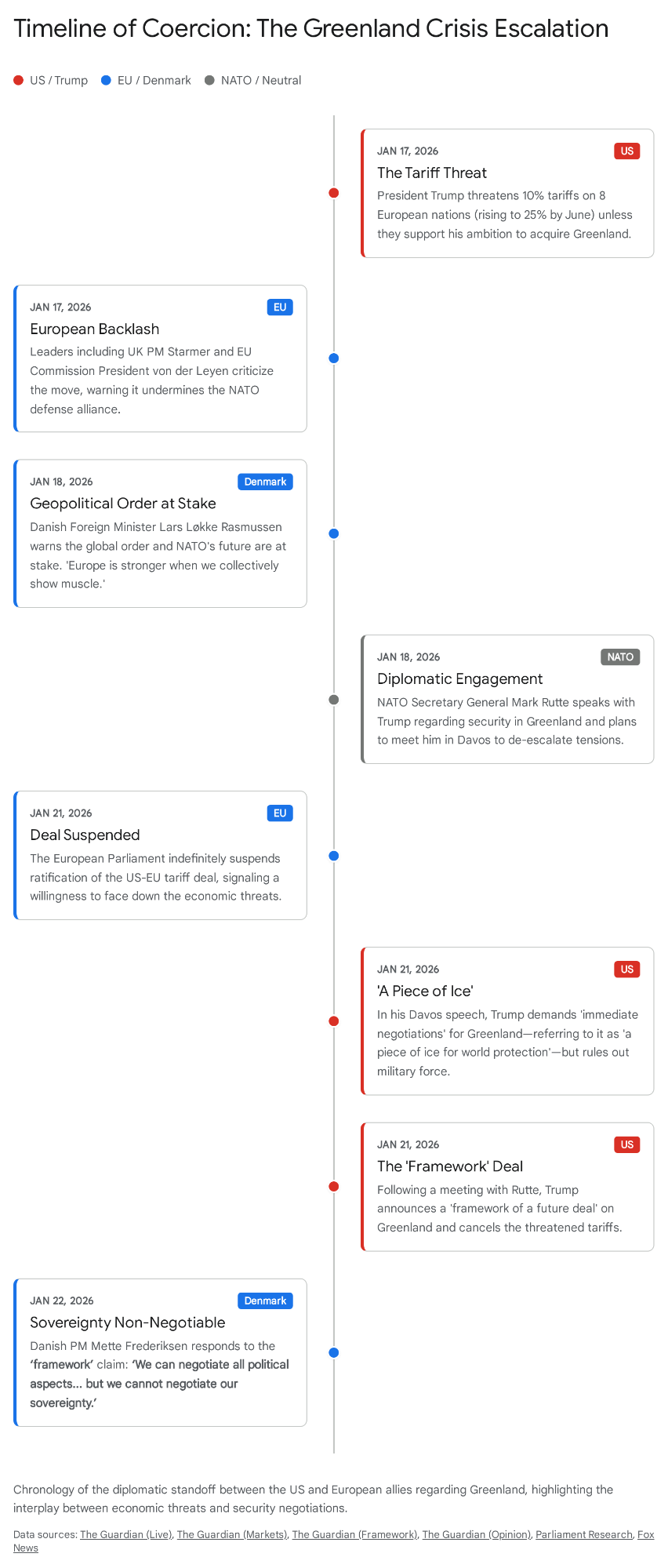
This strategic shift has manifest in a sharp territorial crisis involving Greenland.16 Since early January 2026, the Trump administration has moved from a transactional desire to purchase the island to a coercive demand for “full ownership,” using threats of punitive tariffs and the potential abandonment of NATO to pressure Denmark and its European allies.16 President Trump’s dismissal of a simple security agreement in favor of annexation has transformed the Arctic into a test of European sovereignty.16
In response, several European NATO members—led by Germany, Sweden, and Norway—have initiated “Operation Arctic Endurance,” deploying reconnaissance troops to Greenland to signal support for Danish sovereignty.17 This move is intended to demonstrate that Greenland’s security is a collective responsibility of the alliance, rather than a bilateral real estate negotiation.17 NATO Secretary General Mark Rutte has framed this collaboration as the irreplaceable foundation for shared security, even as the “Greenland for Ukraine” blackmail—the idea of ceding European territory to ensure continued U.S. support for Kyiv—is condemned by leaders like President Emmanuel Macron as a “toxic” threat to the political basis of any future guarantees.16
Comparison of U.S. NDS Priorities (2022 vs. 2026)
| Strategic Priority | 2022 National Defense Strategy | 2026 National Defense Strategy |
| Primary Focus | Strategic competition with China | Defense of U.S. Homeland (Fortress America) |
| European Theater | Core theater for integrated deterrence | Secondary theater; European allies responsible |
| Burden-Sharing | Encouraged and incentivized | Required; 5% GDP spending benchmark |
| China/Taiwan | Focus on Taiwan-centric aggression | Deterrence by denial along First Island Chain |
| Defense Base | Supporting infrastructure | Strategic asset to be mobilized for scale |
| Strategic Goal | Competition management and guardrails | Declarative realism and preventing hegemony |
The SAFE Programme: Institutionalizing Defense Readiness
To counter the eroding U.S. security guarantee and the persistent threat from Moscow, the European Union has operationalized the “Security Action for Europe” (SAFE) programme.17 Adopted in May 2025 and entering its critical execution phase in January 2026, SAFE is a €150 billion loan facility designed to catalyze over €800 billion in defense spending by the end of the decade.18 The program allows member states to access low-cost, long-maturity loans (up to 45 years) to finance large-scale procurement and industrial expansion.19
The SAFE mechanism marks a quiet but monumental shift in the Union’s financial architecture. By treating defense as a permanent macro-financial category rather than an exceptional budgetary deviation, the EU is effectively institutionalizing its role as a security provider.17 The program is structured to prioritize “frontline” states where the threat is most acute, rather than following a principle of egalitarian distribution.17 For example, Romania has been identified as the second-largest beneficiary, with an indicative plan of €16.6 billion, while Poland’s request exceeds €43 billion.18
On January 15 and January 26, the European Commission approved the first two batches of National Defense Investment Plans, unlocking funding for sixteen member states.18 These plans are not limited to traditional military hardware; they include strategic infrastructure intended to enhance military mobility across the continent.20
SAFE Funding Waves and Allocations (January 2026)
| Funding Batch | Approval Date | Member States Included | Key Focus Areas |
| Wave 1 | Jan 15, 2026 | BE, BG, DK, ES, HR, CY, PT, RO | Air defense, Black Sea deterrence, motorways |
| Wave 2 | Jan 26, 2026 | EE, EL, IT, LV, LT, PL, SK, FI | Border fortifications, drone swarms, Naval Strike |
Romania’s detailed plan provides a blueprint for how SAFE funds will be utilized to bridge the gap between national defense and EU-wide logistics.20 Approximately €4.2 billion of its allocation is earmarked for strategic sections of the A7 and A8 motorways in the north-east, which are critical for facilitating the movement of NATO reinforcements toward Ukraine and Moldova.20 In terms of materiel, the Romanian Ministry of Defense has prioritized 198 tracked infantry fighting vehicles (€2.98 billion), Mistral and IRIS-T air defense systems, and offshore patrol vessels.20
The program however faces controversy. A “European content” requirement mandates that at least 65% of the components in any funded system must originate from the EU, Ukraine, or EEA-EFTA countries.19 This has created friction with the United Kingdom, which remains excluded from full participation due to its unwillingness to accept these terms.22 Furthermore, the Commission’s use of emergency legislative procedures to bypass the European Parliament in the establishment of SAFE has drawn criticism from MEPs who warn of a “democratic deficit” in the Union’s remilitarization.19
The Eastern Theater: Ukraine and the Abu Dhabi Peace Process
As of the final week of January 2026, the war in Ukraine has entered a phase characterized by an “apparent pause” in hostilities and intensive trilateral negotiations in Abu Dhabi.23 This pause followed a personal request from U.S. President Trump to Russian President Putin to refrain from striking Ukrainian energy infrastructure until February 1—a request the Kremlin acknowledged and reportedly agreed to, though with the caveat that the measure would end on Sunday.23 President Zelenskyy has noted that while Russian forces have largely ceased strikes on cities and power grids, they have pivoted toward targeting Ukrainian logistics.25
The negotiations in the United Arab Emirates involve senior officials from Kyiv and Moscow, mediated by members of the Trump administration.23 According to U.S. Secretary of State Marco Rubio, the talks have narrowed to a “single central issue”: the territorial control of Donetsk Oblast.25 However, this characterization is disputed by the Kremlin, which insists that “many other issues remain” on the agenda and continues to set domestic information conditions to justify its refusal to make further concessions.25
Despite the public posturing, intelligence reports suggest that significant concessions have been mapped during the August 2025 Alaska Summit and subsequent rounds in Abu Dhabi 26:
- Russian Concessions: Moscow has reportedly agreed to drop its opposition to Ukraine’s accession to the European Union and has accepted the principle of a robust post-war Ukrainian domestic military (up to 800,000 troops).26 Furthermore, the Kremlin has parred down its territorial demands, expressing a willingness to freeze the front lines in Zaporizhzhia and Kherson.26
- Ukrainian Concessions: Kyiv has accepted the reality that it will not recapture eastern and southeastern territories in the immediate future and has agreed to a demilitarized zone in contested parts of Donetsk.26
The talks are however extremely fragile. Rising tensions between the United States and Iran have injected fresh uncertainty, with Zelenskyy expressing concern that a U.S. strike on Iranian targets could “scupper” the negotiations.23 The scheduled weekend meeting in Abu Dhabi faces potential delays, and U.S. envoys such as Steve Witkoff and Jared Kushner have reportedly withdrawn from the upcoming round to focus on the Middle East crisis.23
Within the European Union, the prospect of a “negotiated freeze” is causing internal fractures. Incoming Dutch Prime Minister Rob Jetten has pledged continued support for Kyiv and expressed opposition to some EU leaders’ suggestions that the bloc should reopen diplomatic channels with Russia.23 Conversely, Hungarian Prime Minister Viktor Orbán has increased his opposition to Ukraine’s EU membership by 2027, potentially creating a significant obstacle for any post-war integration plan.23
The Eurozone Economic and Energy Landscape
The Eurozone economy enters the final week of January 2026 on a seemingly stable footing, with the European Commission’s economic sentiment indicator rising to 98.2 from 97.0 in December.27 This cyclical upturn is most visible in the manufacturing sector, where production expectations have surpassed their long-term averages and inventory levels are at their lowest point in three years.27 France, in particular, saw a “spectacular” sentiment jump following the approval of its 2026 budget, which reduced significant political uncertainty.27
However, this macroeconomic stability is threatened by an acute crisis in the energy market. Natural gas prices have skyrocketed by 30% since the start of the year, driven by a global demand spike during a severe winter freeze and geopolitical tensions involving Iran and the U.S..28 More concerning is the status of European gas storage, which is at its lowest level since the winter of 2021-2022.28 This vulnerability is partly the result of a September 2025 regulatory change that lowered the binding minimum storage requirement from 90% to 75%.28
Eurozone Inflation and Economic Forecasts (2025-2028)
| Economic Metric | 2025 Actual/Est | 2026 Forecast | 2027 Forecast | 2028 Forecast |
| Headline Inflation (Avg) | 2.1% | 1.9% | 1.8% | 2.0% |
| Core Inflation (Avg) | 2.3% (Jan est) | 2.2% | 2.1% | 2.0% |
| GDP Growth (Eurozone) | 1.4% | 1.2% | 1.3% | 1.4% |
| Gas Import Bill (Power) | €32 Billion | €35 Billion (Est) | – | – |
| Gas Price (TTF Avg) | €28/MWh | €30/MWh | €29/MWh | €28/MWh |
While the European Central Bank (ECB) remains content with current policy settings and is expected to hold rates at 2% on February 5, consumer expectations have diverged from official forecasts.30 A January ECB poll showed that household expectations for inflation five years ahead have risen to a record 2.4%, implying that the public perceives a higher risk of structural price growth than the bank’s target pace.31 This is exacerbated by the “Big Repricing” of 2026 in the renewables market, where the success of wind and solar has introduced systemic volatility and “price cannibalization,” forcing a fundamental reappraisal of the commercial value of clean energy assets.32
The EU’s reliance on U.S. LNG is another significant risk factor. U.S. imports accounted for 27% of EU gas last year, and projections suggest this could rise to 40% by 2030.28 In the context of the Trump administration’s willingness to weaponize trade tools, this geographic concentration of supply gives Washington substantial leverage over European industrial costs.28
Intelligence Assessment: Cyber Sabotage and Hybrid Threats
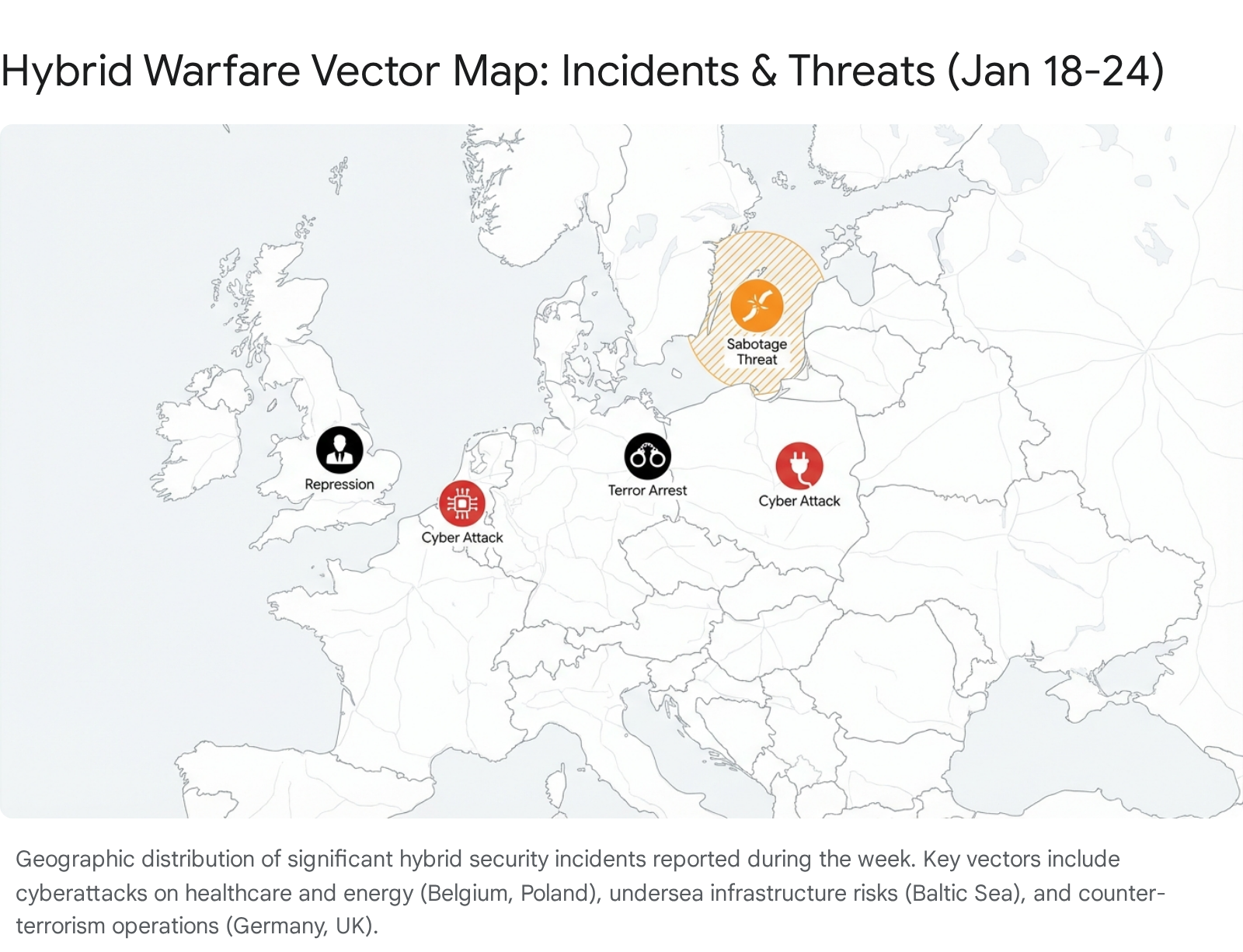
The security of European critical infrastructure has been compromised by a series of sophisticated hybrid operations in late January 2026, primarily attributed to Russian state actors.34 The most significant event was the coordinated sabotage of the Polish energy grid, directed against systems supporting both conventional power generation and renewable infrastructure.34
The attack, attributed to the Sandworm (APT44) unit of the GRU, utilized a new data-wiping malware strain known as “DynoWiper”.34 Unlike traditional cyber espionage, this operation was purely destructive, targeting the distributed edge of the grid—specifically 30 different sites using remote terminal units (RTUs).34 While the intrusion was contained before blackouts occurred, intelligence analysts from Eset and Dragos characterize the event as a “technical and institutional test” of the Union’s resilience.34 This has accelerated the debate in Europe over “Active Cyber Defense,” with Germany considering legal changes to allow defensive intervention within networks to neutralize malicious traffic before it impacts physical operations.34
Furthermore, the European Space Agency (ESA) suffered a massive data breach involving the theft of over 700GB of proprietary information, including mission documents and source code.36 The breach exposed supply chain details from aerospace giants like SpaceX and Airbus, highlighting the vulnerability of the European space sector to sophisticated persistent threats.36
Significant Cyber and Intelligence Events (January 20–31, 2026)
| Event | Target | Attributed Actor | Primary Impact |
| DynoWiper Attack | Polish Power Grid | Sandworm (Russia) | Coordination test, OT system compromise |
| ESA Data Breach | Space Infrastructure | Scattered Lapsus$ | 700GB of intellectual property stolen |
| Luxshare Hack | Tech Supply Chain | RansomHub | Theft of Apple/Tesla schematics |
| Sicarii Campaign | Corporate Finance | Sicarii RaaS | AES-GCM encryption of sensitive data |
| ESA/CBP Leak | U.S. Border Security | Insider / Unknown | Exposure of 4,500 employee records |
In the realm of counter-terrorism, the EU Foreign Affairs Council’s designation of Iran’s Islamic Revolutionary Guard Corps (IRGC) as a terrorist organization on January 29 marks a major policy shift.37 High Representative Kaja Kallas has emphasized that the designation is both a moral and operational step to disrupt the IRGC’s ability to operate and recruit within Europe’s financial and legal systems.37 This comes amid a broader intelligence warning regarding “salad bar” terrorism, where actors adopt non-ideological or composite violent extremist views, and the increasing migration of drone expertise from conflict zones like the Sahel to Western cities.39
Migration Patterns and Social Stability
The implementation of the New Pact on Migration and Asylum has created a complex landscape of falling overall numbers but increasing localized pressure.3 Irregular crossings into the EU fell by 26% in 2025, reaching approximately 178,000 detections—the lowest level since 2021.3 However, the Central Mediterranean remains the most active route, with arrivals from Libya towards Italy remaining almost unchanged from 2024 levels.40
Irregular Border Detections by Route (2025 Full Year Data)
| Migration Route | 2025 Detections | % Change vs 2024 | Primary Country of Departure |
| Central Mediterranean | 66,328 | -1% | Libya |
| Eastern Mediterranean | ~21,000 | -27% | Libya / Turkey |
| Western Balkans | ~14,000 | -46% | Various |
| Western Mediterranean | ~15,000 | +14% | Algeria |
| Western Africa | ~9,000 | -66% | Mauritania / Senegal |
The “half-empty glass” of this decline is the persistent pressure on frontline states. Six countries—Bulgaria, Czechia, Estonia, Croatia, Austria, and Poland—have formally applied for relief from the pact’s solidarity pool, citing the “cumulative pressures” of the last five years.41 These exemptions, if granted by the Council, could temporarily allow these states to opt-out of relocation requirements or financial contributions, potentially undermining the pact’s core principle of shared responsibility.41
Internal social stability is also being challenged by a wave of protests across the continent. In Slovakia, tens of thousands of citizens have mobilized against Prime Minister Robert Fico’s pro-Russia policies, with demonstrations in Bratislava drawing up to 40,000 participants.42 Similar pro-EU demonstrations continue in Georgia, where protesters have vowed to maintain nightly rallies in Tbilisi until the ruling party reconsiders its stance on EU accession.43
Industrial action is also on the rise. Belgium is facing a nationwide train strike through January 30, disrupting SNCB and Eurostar services, while major farmer protests in Toulouse, France, on January 27 signaled continued resistance to the EU-Mercosur free trade agreement and mandated cattle culls.44 In the United Kingdom, large right-wing protests are expected in London on January 31, with police rerouting the march to avoid clashes in high-migrant population areas.44
Global Engagement: The New Diplomatic Realism
The European Union’s foreign policy in late January 2026 is increasingly characterized by “New Diplomatic Realism,” as evidenced by the conclusion of a historic Free Trade Agreement (FTA) with India.45 High Representative Kaja Kallas has described this as a “landmark departure,” moving beyond trade to include an annual security and defense dialogue.45 The deal reflects a strategic pivot towards “predictable” partners at a time when superpowers are attempting to rewrite the multilateral order.45
Relations with China remain at an “inflection point”.46 While the EU pursues “de-risking,” it is also implementing harder measures to protect its internal market, such as the €3 customs duty on low-value parcels and the ongoing Foreign Subsidies Regulation probes into Chinese digital platforms.46 Conversely, the U.S. has begun to reverse some export controls, with the Trump administration allowing Nvidia to sell H200 accelerators to China, a move that could potentially undermine European tech sovereignty by giving Beijing access to high-end compute power that Brussels is still struggling to regulate.46
In the Middle East, the EU is preparing a new “Middle East Strategy” to be unveiled in Q2 2026, which will focus on supporting transitions in Syria and Lebanon and rolling out the “Pact for the Mediterranean”.7 This strategy is increasingly viewed as a counterweight to the U.S. administration’s shift toward opportunistic military operations, such as the early January 2026 U.S. strike on Venezuela and the continued rhetoric of regime change in the Americas.33
Strategic Outlook: February 2026 and Beyond
The Union enters February 2026 at a crossroad. The success of the SAFE programme and the implementation of the 2026 Commission work programme will determine whether “strategic autonomy” can move from a rhetorical aspiration to an operational reality. The immediate risks are centered on the volatility of the natural gas market and the potential collapse of the Abu Dhabi peace process, which could lead to a renewed escalation in Ukraine. Furthermore, the “Greenland Crisis” remains a significant threat to NATO unity, as European states are forced to choose between supporting a core ally’s territorial integrity and maintaining the primary security link with Washington.
The leadership of the Cyprus Presidency will be critical in navigating these tensions. As the first wave of SAFE funding begins to flow and the New Pact on Migration enters its final implementation phase, the Union must balance the demands for national flexibility with the necessity of collective action. The “Moment of Independence” has arrived, but it is accompanied by the highest level of geopolitical and economic risk the Union has faced in the 21st century.
Please share the link on Facebook, Forums, with colleagues, etc. Your support is much appreciated and if you have any feedback, please email us in**@*********ps.com. If you’d like to request a report or order a reprint, please click here for the corresponding page to open in new tab.
Sources Used
- The programme, priorities and logo of the Cyprus Presidency of the Council of the EU 2026 unveiled – Gov.cy, accessed January 31, 2026, https://www.gov.cy/en/president-of-the-republic-presidency/the-programme-priorities-and-logo-of-the-cyprus-presidency-of-the-council-of-the-eu-2026-unveiled/
- Cyprus takes over EU Council Presidency – ERA Portal Austria, accessed January 31, 2026, https://era.gv.at/news-items/cyprus-unveils-priorities-for-eu-council-presidency/
- Irregular border crossings down 26% in 2025, Europe must stay prepared – Frontex, accessed January 31, 2026, https://www.frontex.europa.eu/media-centre/news/news-release/frontex-irregular-border-crossings-down-26-in-2025-europe-must-stay-prepared-lyKpVb
- Cyprus Presidency debriefs European Parliament committees on priorities | Aktuelles | Europäisches Parlament, accessed January 31, 2026, https://www.europarl.europa.eu/news/de/press-room/20260126IPR32642/cyprus-presidency-debriefs-european-parliament-committees-on-priorities
- draft programme of the cyprus presidency of the council – Euractiv, accessed January 31, 2026, https://www.euractiv.com/content/uploads/sites/2/2025/10/CY-PRESIDENCY.pdf
- Cyprus Presidency debriefs European Parliament committees on …, accessed January 31, 2026, https://www.europarl.europa.eu/news/en/press-room/20260126IPR32642/
- Commission unveils 2026 work programme, accessed January 31, 2026, https://ec.europa.eu/commission/presscorner/detail/en/ip_25_2414
- EU Commission announced 2026 Work Programme – techUK, accessed January 31, 2026, https://www.techuk.org/resource/eu-commission-announced-2026-work-programme.html
- Commission work programme 2026, accessed January 31, 2026, https://commission.europa.eu/strategy-and-policy/strategy-documents/commission-work-programme/commission-work-programme-2026_en
- EU: Sustainability initiatives in the Commission 2026 Work Programme, accessed January 31, 2026, https://sustainablefutures.linklaters.com/post/102lrh5/eu-sustainability-initiatives-in-the-commission-2026-work-programme
- Notes from the IAPP Europe: No slow start to 2026 in Brussels | IAPP, accessed January 31, 2026, https://iapp.org/news/a/notes-from-the-iapp-europe-no-slow-start-to-2026-in-brussels
- European Parliament Plenary Session Janunary 2026 | Epthinktank, accessed January 31, 2026, https://epthinktank.eu/2026/01/15/european-parliament-plenary-session-janunary-2026/
- America’s new Defence Strategy and Europe’s moment of truth – European Policy Centre, accessed January 31, 2026, https://www.epc.eu/publication/americas-new-defence-strategy-and-europes-moment-of-truth/
- Global Risks to the EU in 2026: What are the main conflict threats for Europe?, accessed January 31, 2026, https://www.iss.europa.eu/publications/commentary/global-risks-eu-2026-what-are-main-conflict-threats-europe
- China & Taiwan Update, January 30, 2026 | ISW, accessed January 31, 2026, https://understandingwar.org/research/china-taiwan/china-taiwan-update-january-30-2026/
- Greenland: Three Scenarios for Europe Facing a Predatory Ally – Institut Jacques Delors, accessed January 31, 2026, https://institutdelors.eu/en/publications/greenland-three-scenarios-for-europe-facing-a-predatory-ally/
- Europe on the Brink: War, Defence and the New Security Order, accessed January 31, 2026, https://behorizon.org/w-a-r-on-the-horizon/
- SAFE | Security Action for Europe – European Commission – Defence Industry and Space, accessed January 31, 2026, https://defence-industry-space.ec.europa.eu/eu-defence-industry/safe-security-action-europe_en
- SAFE: Europe’s €150 billion bet on defence and industrial competitiveness, accessed January 31, 2026, https://euperspectives.eu/2025/07/safe-europe-defence/
- Romania details €16.6 billion SAFE investment plan with major defence procurements and strategic infrastructure projects, accessed January 31, 2026, https://defence-industry.eu/romania-details-e16-6-billion-safe-investment-plan-with-major-defence-procurements-and-strategic-infrastructure-projects/
- EU approves first wave of defence funding under SAFE programme, accessed January 31, 2026, https://www.openaccessgovernment.org/eu-approves-first-wave-of-defence-funding-under-safe-programme/203915/
- To Build European Defense Tech Champions, Political Challenges Must Be Overcome, accessed January 31, 2026, https://www.jdsupra.com/legalnews/to-build-european-defense-tech-5945210/
- Ukraine war briefing: Zelenskyy fears rising US-Iran tensions will …, accessed January 31, 2026, https://www.theguardian.com/world/2026/jan/31/ukraine-war-briefing-rising-us-iran-tensions-key-peace-talks-in-uae
- Zelenskyy says energy ceasefire in Ukraine discussed at Abu Dhabi peace talks, accessed January 31, 2026, https://www.aa.com.tr/en/russia-ukraine-war/zelenskyy-says-energy-ceasefire-in-ukraine-discussed-at-abu-dhabi-peace-talks/3814782
- Russian Offensive Campaign Assessment, January 30, 2026, accessed January 31, 2026, https://understandingwar.org/research/russia-ukraine/russian-offensive-campaign-assessment-january-30-2026/
- Frequently Asked Questions About the Russia–Ukraine Negotiations, accessed January 31, 2026, https://quincyinst.org/research/frequently-asked-questions-about-the-russia-ukraine-negotiations/
- Eurozone economy starts the year on a strong footing | snaps | ING …, accessed January 31, 2026, https://think.ing.com/snaps/the-eurozone-economy-starts-the-year-on-a-strong-footing/
- EU gas market under pressure: low storage and rising US dependence | Think Tank Europa, accessed January 31, 2026, https://thinkeuropa.dk/en/explainer/2026-01-eu-natural-gas-prices-and-storage-status
- Europe’s benchmark gas price climbs to its highest level in two months, accessed January 31, 2026, https://energiesmedia.com/europes-gas-price-climbs-to-two-month-high/
- Eurozone Inflation: What to Expect from January’s CPI Data, accessed January 31, 2026, https://global.morningstar.com/en-gb/economy/eurozone-inflation-what-expect-januarys-cpi-data
- Euro zone consumers up 5-year inflation forecast to record high, ECB poll shows By Reuters, accessed January 31, 2026, https://www.investing.com/news/economy-news/euro-zone-consumers-up-5year-inflation-forecast-to-record-high-ecb-poll-shows-4475253
- Renewables Pricing in Europe and US Set for Major Recalibration in 2026, accessed January 31, 2026, https://www.indexbox.io/blog/renewables-pricing-in-europe-and-us-set-for-major-recalibration-in-2026/
- Watching China in Europe—January 2026 | German Marshall Fund of the United States, accessed January 31, 2026, https://www.gmfus.org/news/watching-china-europe-january-2026
- Polish Grid Hack Underlines European Need for Active Defense, accessed January 31, 2026, https://www.bankinfosecurity.com/polish-grid-hack-underlines-european-need-for-active-defense-a-30651
- Weekly Intelligence Report – 30 January 2026 – CYFIRMA, accessed January 31, 2026, https://www.cyfirma.com/news/weekly-intelligence-report-30-january-2026/
- Cybersecurity Week in Review: January 20–January 26, 2026 – Senthorus Blog, accessed January 31, 2026, https://blog.senthorus.ch/posts/27_01_2026/
- EU Officially Designates Iran’s IRGC as a Terrorist Organization, accessed January 31, 2026, https://www.ncr-iran.org/en/news/terrorism-a-fundamentalism/eu-formally-designates-irans-irgc-as-a-terrorist-organization/
- European Union adds IRGC to terror list, expands sanctions – AL-Monitor, accessed January 31, 2026, https://www.al-monitor.com/originals/2026/01/european-union-adds-irgc-terror-list-expands-sanctions
- Trends in Terrorism: What’s on the Horizon in 2026?, accessed January 31, 2026, https://thesoufancenter.org/intelbrief-2026-january-8/
- Irregular entries into the EU fell 26 per cent in 2025, except on the Mediterranean route, accessed January 31, 2026, https://www.eunews.it/en/2026/01/15/irregular-entries-into-the-eu-fell-26-per-cent-in-2025-except-on-the-mediterranean-route/
- EU Migration Down 22% in 2025, but 6 Countries Seek Pact Relief – ETIAS.com, accessed January 31, 2026, https://etias.com/articles/eu-migration-down-22-in-2025,-but-6-countries-seek-pact-relief
- 2024–2026 Slovak protests – Wikipedia, accessed January 31, 2026, https://en.wikipedia.org/wiki/2024%E2%80%932026_Slovak_protests
- Georgia: One Year of Protests Over EU Ascension – OSAC, accessed January 31, 2026, https://www.osac.gov/Content/Report/0d9c9ccc-2fd6-496f-a29d-292928a14d3b
- The Week Ahead: January 26, 2026 – SafeAbroad, accessed January 31, 2026, https://safeabroad.com/the-week-ahead/the-week-ahead-january-26-2026/
- Historic India-EU deal signed: Kaja Kallas calls it a milestone for trade, security and cooperation, accessed January 31, 2026, https://timesofindia.indiatimes.com/business/india-business/historic-india-eu-deal-signed-kaja-kallas-calls-it-a-milestone-for-trade-security-and-cooperation/articleshow/127623197.cms
- CHOICE Newsletter: Why 2026 Will Test Europe’s China Strategy – chinaobservers, accessed January 31, 2026, https://chinaobservers.eu/choice-newsletter-why-2026-will-test-europes-china-strategy/
- China EU Trade Relations Face Critical Turning Point 2026 – Brussels Morning Newspaper, accessed January 31, 2026, https://brusselsmorning.com/china-eu-trade-relations-policy-2026/92998/
- European Commission’s work programme 2026 – DAAD Brüssel, accessed January 31, 2026, https://www.daad-brussels.eu/en/2025/10/28/european-commissions-work-programme-2026/