1. Executive Summary
The memorandum of understanding (MoU) finalized between the United States and the Islamic Republic of Iran in June 2026 represents a critical, albeit fragile, pivot from high-intensity kinetic conflict to transactional diplomacy.1 Brokered over several weeks through the primary mediation of Pakistan and Qatar, the 14-point framework agreement temporarily halts a three-and-a-half-month war.4 This conflict, triggered by the collapse of nuclear negotiations and the subsequent launch of “Operation Roaring Lion” by the United States and Israel in late February 2026, destabilized the Middle East and the global macroeconomic environment.1 The MoU institutes a 60-day ceasefire extension designed to facilitate multi-lateral negotiations on a final nuclear and regional security accord, while mandating the immediate reopening of the strategic Strait of Hormuz to commercial maritime traffic.4
For the Iranian regime, the agreement provides a strategic and economic pause. Despite enduring severe military degradation during the conflict—including the targeted elimination of Supreme Leader Ayatollah Ali Khamenei, senior negotiators, and critical military infrastructure—Tehran has secured tangible economic relief.2 This relief manifests through the lifting of the United States naval blockade, waivers permitting the resumption of oil exports, conditional access to roughly $24 billion in long-frozen sovereign assets, and the prospective establishment of a $300 billion private-sector Reconstruction and Development Fund.2 In exchange, the United States achieves the stabilization of global energy markets through the unblocking of the Strait of Hormuz, a temporary freeze on Iran’s highly enriched uranium (HEU) activities, and a cessation of hostilities across all regional fronts, theoretically including the Lebanese theater.2
However, intelligence analysis indicates a high probability of Iranian non-compliance, malicious compliance, or exploitation of the agreement’s ambiguous phrasing. Tehran has retained the core of its nuclear infrastructure and views the diplomatic framework as a strategic validation of its “mosaic defense” doctrine, demonstrating its ability to impact the global economy via asymmetric maritime disruption.1 The regime’s publicly stated intent to collect “maritime service fees” in the Strait of Hormuz—circumventing the explicit United States demand for toll-free transit—and its hardline interpretation that the ceasefire forces a unilateral Israeli withdrawal from Lebanon set the stage for volatile flashpoints.2 The ensuing 60-day negotiation period is likely to be utilized by Iran’s newly installed Supreme Leader, Mojtaba Khamenei, as a stalling mechanism.1 This period will likely be leveraged to consolidate domestic political power, pocket upfront sanctions relief, and reconstitute the Axis of Resistance, rather than to yield irreversible concessions regarding the country’s nuclear stockpiles or long-term enrichment capabilities.1
2. Strategic Background and the Collapse of Diplomacy
The geopolitical conditions necessitating the June 2026 MoU were forged in the collapse of the 2025 diplomatic track and the ensuing regional conflict. Understanding the current framework requires an analysis of the preceding negotiations, the diplomatic ultimatums, and the military realities that forced both state actors to seek an off-ramp.
2.1 The April 2025 Ultimatum and the “Maximum Pressure” Revival
In February 2025, United States President Donald Trump reinstated a “maximum pressure” campaign designed to force the Islamic Republic into a new, more restrictive nuclear deal, to permanently prevent its development of nuclear weapons, and to counter its regional proxy influence.7 The administration made it clear that it would not tolerate any latent Iranian nuclear weapons capability and kept all military options on the table.7
On April 12, 2025, a series of negotiations commenced in Muscat, Oman, following a direct letter from President Trump to then-Supreme Leader Ali Khamenei.7 President Trump established a strict 60-day deadline for Iran to agree to a final framework.7 The demands placed upon Tehran were maximalist in nature. The United States required that Iran temporarily lower its uranium enrichment to 3.67% in exchange for initial access to frozen financial assets and oil export authorizations.7 Ultimately, the United States demanded that Iran permanently halt high-level uranium enrichment, restore unhindered inspections by the International Atomic Energy Agency (IAEA), implement the Additional Protocol allowing for surprise inspections at undeclared sites, and transfer all existing stockpiles of highly enriched uranium to a third-party country.7
2.2 The Diplomatic Disconnect and the Failure in Geneva
The diplomatic effort was spearheaded by United States Special Envoy Steve Witkoff and Presidential Advisor Jared Kushner.15 Analysis of the negotiation dynamics reveals a disconnect between the United States approach and Iranian strategic imperatives. The United States delegation approached the negotiations with an investor-centric “pay to play” framework, offering significant economic incentives in exchange for the capitulation of Iran’s nuclear leverage.17
By late February 2026, during a third round of Omani-mediated talks in Geneva, the fundamental impasse became insurmountable.15 While Omani Foreign Minister Badr bin Hamad Al Busaidi assessed that “substantial progress” was being made, President Trump publicly expressed dissatisfaction with the pace and nature of the negotiations.15 Intelligence assessments and reports from the negotiation room suggest that Special Envoy Witkoff lacked the necessary technical expertise regarding nuclear physics and diplomatic nuance, leading to mischaracterizations of Iran’s nuclear posture that fed the administration’s impatience.15
A critical sticking point remained the disposition of Iran’s highly enriched uranium. While the United States insisted the material be shipped abroad to neutralize the breakout threat, Iranian negotiators intended to retain the stockpile within their sovereign borders.7 Furthermore, Iran sought binding, legal guarantees that the United States would not unilaterally withdraw from the new agreement—a direct response to the historical collapse of the 2015 Joint Comprehensive Plan of Action (JCPOA).7 When Iranian negotiators rejected an offer of free nuclear fuel in exchange for ending domestic enrichment, the United States delegation interpreted this as confirmation of an active weapons program, despite IAEA Director-General Rafael Mariano Grossi stating there was no sign of a “structured nuclear weapons program” at the time.16
2.3 The Transition from Diplomacy to Warfare
The expiration of the 60-day deadline without a verifiable agreement, coupled with the administration’s assessment that diplomatic avenues were being utilized by Tehran to stall and advance enrichment, precipitated a significant escalation.
The chronological progression from diplomatic maneuvering to warfare and the eventual economic necessity of a ceasefire is delineated in the following table, which charts the critical path to the Bürgenstock framework.1
| Date | Event Category | Headline Event | Strategic Details and Implications |
| April 12, 2025 | Diplomatic | Start of Muscat Negotiations | US President Donald Trump issues a 60-day ultimatum to Supreme Leader Ali Khamenei, demanding the transfer of HEU and permanent enrichment halts.7 |
| February 26, 2026 | Diplomatic | Geneva Talks Breakdown | Final round of pre-war talks led by Kushner and Witkoff stall over HEU disposition. Trump expresses severe dissatisfaction with the lack of progress.15 |
| February 28, 2026 | Military | Operation Roaring Lion Begins | US and Israel launch a preemptive kinetic campaign against Iranian nuclear, military, and leadership targets. Over 10,800 strikes are eventually conducted.7 |
| March 3, 2026 | Political | Succession of Mojtaba Khamenei | Following the assassination of Ali Khamenei, the IRGC forces an emergency session of the Assembly of Experts to install Mojtaba Khamenei as the new Supreme Leader.20 |
| March–April 2026 | Economic | Closure of the Strait of Hormuz | Iran implements a “mosaic defense,” effectively shutting down the Strait of Hormuz, trapping merchant vessels, and triggering a global macroeconomic energy crisis.5 |
| April 8, 2026 | Diplomatic | Initial Temporary Ceasefire | Mediated by Pakistan, a fragile two-week ceasefire is enacted, attempting to halt the spiraling regional war and stabilize global markets.7 |
| June 14-19, 2026 | Diplomatic | The Bürgenstock MoU | Driven by mutual economic exhaustion, the US and Iran finalize a 14-point MoU, exchanging blockade relief and a $300B fund promise for a 60-day nuclear freeze and Hormuz reopening.2 |
The historical data demonstrates a consistent upward trend of escalation, moving from unmet diplomatic ultimatums directly into systemic warfare, before the economic weight of the conflict forced a return to the negotiating table.
3. The Kinetic Phase: Analysis of Operation Roaring Lion
On February 28, 2026, the United States and the State of Israel initiated “Operation Roaring Lion,” a multi-domain military campaign designed to forcibly alter the strategic calculus of the Islamic Republic.7 The explicitly stated goals of the operation varied depending on the administration official speaking, ranging from the destruction of the nuclear program and the dismantling of the proxy network, to the outright removal of the Ayatollah regime.23
3.1 The Air Campaign and the Decapitation Strategy
The scale of Operation Roaring Lion was expansive relative to recent conflicts in the Middle East. The Israel Defense Forces (IDF), operating in coordination with United States Central Command, leveraged technological superiority to dismantle Iran’s anti-access/area denial (A2/AD) capabilities.1
Military assessments verify that over 8,500 aircraft sorties were conducted, resulting in approximately 10,800 precise strikes across strategic targets within Iranian territory.8 The campaign systematically dismantled around 250 Iranian air defense systems, blinding the regime’s early warning radars and achieving aerial dominance, particularly over the capital city of Tehran.8 In Tehran alone, the coalition conducted more than 2,100 aircraft sorties and over 4,600 strikes, targeting command-and-control centers, including the Tharallah Headquarters responsible for internal security and protest suppression.8
Furthermore, the operation neutralized an estimated 60% of Iran’s surface-to-surface ballistic missile launchers, significantly degrading the offensive capacity of the Islamic Revolutionary Guard Corps Aerospace Force.8
Crucially, the campaign prioritized a strategy of leadership decapitation aimed at disrupting command and control at the highest echelons of the Iranian state. Exactly 28 senior regime leaders were eliminated throughout the conflict, most notably Supreme Leader Ayatollah Ali Khamenei.8 The strikes also successfully targeted Ali Larijani, a key figure in the nuclear negotiations, and Gholamreza Soleimani, the chief of the Basij paramilitary force.7
3.2 The Iranian Response: The Doctrine of Mosaic Defense
Despite the technological overmatch and the loss of its apex leadership, the Iranian regime did not fracture. Instead, the IRGC implemented its doctrine of “mosaic defense”.11 This decentralized operational framework allows local, regional commanders to possess autonomy, resources, and authority to conduct defensive and retaliatory operations without requiring continuous, centralized directives from Tehran.11
This decentralized command structure proved resilient. Even as coalition aircraft operated over Tehran, localized IRGC units sustained ballistic and cruise missile strikes against Israel, United States military installations in Iraq, Kuwait, and the Gulf, and civilian infrastructure across the region.11 While at times appearing uncoordinated, the mosaic defense ensured that the regime maintained a retaliatory capability that prevented the United States from achieving a cost-free victory.11
Most significantly, the IRGC leveraged its geographic proximity to the Strait of Hormuz to implement an asymmetric economic counter-attack. By deploying naval mines, fast-attack craft, and anti-ship missiles, Iran closed the strategic waterway to commercial shipping.2 This action restricted hundreds of merchant vessels, contributed to an increase in global energy prices, and disrupted the global supply chain, demonstrating that while Iran could not defeat the United States in a conventional military engagement, it possessed the capacity to leverage the global economy.12
3.3 The Lebanon Theater and the Proxy War
Parallel to the strikes within Iran, the coalition opened a secondary front in Lebanon, targeting Hezbollah, Iran’s most capable and heavily armed proxy.8 Israel sought to leverage the broader regional war to degrade Hezbollah’s military infrastructure south of the Litani River and secure its northern border.1 The operational tempo in Lebanon was high: the IDF conducted over 2,500 aircraft sorties and approximately 14,900 artillery strikes, hitting more than 5,000 specific targets.8 Military officials reported the elimination of over 1,700 militants.8 However, Hezbollah absorbed the damage without capitulating, continuing to launch drone and rocket attacks into Israeli territory and tying down IDF ground forces in a war of attrition.4
4. Internal Iranian Dynamics and Leadership Succession
The assassination of Ayatollah Ali Khamenei on February 28, 2026, precipitated a severe leadership crisis within the Islamic Republic.7 The manner in which the regime handled this transition is indicative of the power structures that will dictate Iran’s behavior during the 60-day MoU period.
[Insert Image Here]
4.1 The Elevation of Mojtaba Khamenei
Prior to the outbreak of the war, Ali Khamenei had reportedly requested the Assembly of Experts to prepare for his succession.20 Intelligence reporting indicates that potential nominees included Gholam-Hossein Mohseni-Eje’i, Asghar Hijazi, and Hassan Khomeini.20 However, the reality of wartime decapitation altered the constitutional process.
Immediately following the assassination, commanders within the Islamic Revolutionary Guard Corps bypassed standard deliberative processes to ensure rapid continuity of government and prevent domestic unrest or factional infighting.20 Through a campaign of intense psychological and political pressure applied to members of the Assembly of Experts via an emergency online meeting on March 3, 2026, the IRGC engineered the swift elevation of Mojtaba Khamenei, the son of the late Ayatollah, to the position of Supreme Leader.14
4.2 Regime Stability and Future Trajectory
Mojtaba Khamenei’s immediate priority upon assuming power was to project strength. In his first public statement, delivered via a newsreader on state television, the new Supreme Leader pledged to continue the blockade of the Strait of Hormuz, directly challenging the primary strategic vulnerability of the Western coalition.29
Despite sustaining severe infrastructure damage during the active fighting, the regime emerges from the kinetic phase feeling internally stronger.1 It withstood the combined military might of the United States and Israel without collapsing.1 However, this survival does not erase long-term internal challenges. The state faces hundreds of billions of dollars in reconstruction costs, a worsening economic crisis, deep-seated public hostility toward the clerical leadership, and the potential for latent internal power struggles as Mojtaba Khamenei attempts to consolidate his authority independently of the IRGC apparatus that installed him.1
5. Anatomy of the June 2026 Memorandum of Understanding
Driven by mutual exhaustion—the United States facing domestic inflation and a global energy crisis, and Iran facing severe damage to its infrastructure—both parties sought a diplomatic off-ramp. Over several weeks, mediators from Pakistan and Qatar facilitated indirect negotiations that culminated in a formal Memorandum of Understanding.19
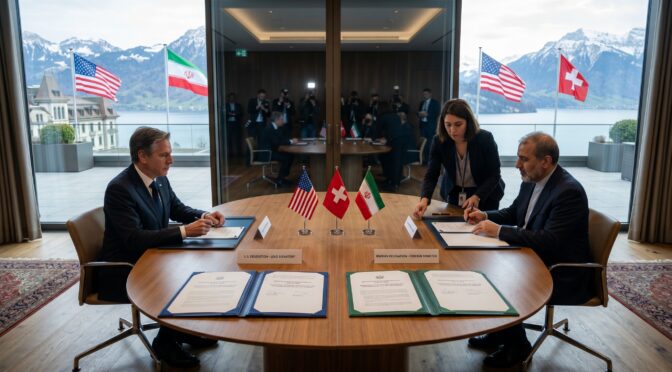
The signing ceremony for the agreement was scheduled for June 19, 2026, at the highly secure, luxury Bürgenstock resort situated on a mountaintop overlooking Lake Lucerne in the canton of Nidwalden, central Switzerland.32 The location, historically known for hosting high-level peace conferences including Ukraine talks, was selected due to its geographic isolation and ease of security.32 According to United States officials, the 14-point framework was electronically signed prior to the ceremony by President Donald Trump, Vice President JD Vance, and Iranian Parliament Speaker Mohammad Bagher Ghalibaf, with Vance and Ghalibaf slated to lead the in-person delegations in Switzerland.4 President Trump has also stated that he will send the finalized agreement to the United States Congress for a formal review process.47
5.1 The 60-Day Negotiation Window
The fundamental architecture of the MoU is the creation of a 60-day, extendable negotiation window.2 This period is designed to pause the violence and allow technical teams to hammer out the details of a permanent treaty regarding Iran’s nuclear program and regional behavior.
During these 60 days, both nations are obligated to maintain the strategic status quo.2 The United States has committed to halting the reinforcement of its military posture in the Middle East and refraining from the imposition of any new, punitive economic sanctions.2 Concurrently, the Islamic Republic has agreed to halt further advancements in its nuclear enrichment program, essentially freezing its activities at pre-MoU levels and reiterating a pledge never to acquire a nuclear weapon.2
5.2 The Cessation of Hostilities
The MoU includes a sweeping provision mandating an immediate and permanent termination of military operations “on all fronts”.2 This clause explicitly encompasses the territory of Lebanon, an inclusion driven by Iranian and Pakistani mediators, aimed at halting the Israeli campaign against Hezbollah.2
6. Strategic Concessions: What the Islamic Republic of Iran Gains
From a geopolitical and intelligence standpoint, the June 2026 MoU represents a favorable outcome for the Islamic Republic. By surviving the military campaign and leveraging its control over maritime chokepoints, Tehran successfully coerced Washington into providing economic relief without immediately surrendering its core strategic asset: its domestic nuclear infrastructure.1
6.1 Immediate Blockade Relief and Energy Export Waivers
The most critical immediate gain for Iran is the dismantling of the acute economic siege. Upon the signing of the agreement, the United States is obligated to lift its naval blockade on all Iranian ports.2 To facilitate an immediate influx of capital, Washington has issued an upfront sanctions waiver permitting Tehran to freely export its oil and related petrochemical services.2
The financial implications of this waiver are considerable. Iranian state media and economic analysts estimate that unfettered access to the global energy markets could generate up to $10 billion in direct revenue for the regime during the 60-day ceasefire window alone.2 This capital provides an immediate lifeline to the heavily sanctioned state, allowing it to stabilize its domestic currency and fund critical government operations.
6.2 The Unfreezing of Sovereign Assets
The MoU outlines a mechanism for Iran to regain access to approximately $24 billion in sovereign financial assets that had been frozen in international accounts due to secondary United States sanctions.4
The administration of these funds is a point of significant internal contention. United States officials state that the release of these funds is strictly conditional, tied directly to verified steps by Iran to eliminate its highly enriched uranium stockpiles.2 However, Iranian officials, including figures within the IRGC, are broadcasting that the state will receive at least half of these funds prior to the commencement of final negotiations, framing it as an unconditional victory.9 Regardless of the exact timeline, the MoU establishes a clear pathway for Iran to repatriate tens of billions of dollars.
6.3 The $300 Billion Reconstruction and Development Fund
The cornerstone of the long-term economic incentive package is the proposed creation of a $300 billion private-sector “Reconstruction and Development Fund”.4 A senior Iranian source indicated that Tehran originally sought $400 billion from the United States as compensation for war damages. Washington rejected this demand, leading to the alternative mechanism of the private-sector Reconstruction and Development Fund.38
This massive investment vehicle is designed to bypass the political toxicity of using United States taxpayer money to rebuild a designated state sponsor of terrorism.4 The fund relies entirely on private financing, and intelligence sources indicate that more than half of the $300 billion target has already been committed by multinational corporations based in the Gulf Arab states, South America, Africa, and Asia, including specific pledges from entities in South Korea, Japan, Singapore, and Malaysia.4
The strategic objective of the fund is to rebuild Iran’s war-shattered economy. The pledged investments are earmarked for critical infrastructure sectors, including energy, logistics, manufacturing, and transportation.4 Specific targets for reconstruction include heavily damaged refineries, civilian airports, and industrial hubs like the Mobarakeh Steel complex.4
While the actual disbursement of this $300 billion fund is strictly contingent upon Iran signing a final nuclear agreement that addresses the HEU stockpile and enrichment capabilities, the mere formalization of this economic blueprint represents a major diplomatic achievement for Tehran.2 It signals to the global community that Iran’s era of absolute economic isolation is concluding, incentivizing foreign actors to begin preparing for market entry.
6.4 Proxy Preservation and the Nuclear Status Quo
Strategically, the MoU allows Iran to emerge with its primary deterrence mechanisms intact. The agreement does not demand the immediate, verifiable destruction of Iran’s nuclear centrifuges or its enriched uranium; it merely requires a temporary freeze.1 Furthermore, by mandating a ceasefire across all fronts, the agreement attempts to shield Hezbollah from further degradation by the IDF, preserving Iran’s forward-deployed proxy force in the Levant.2
The regime has made its intentions clear regarding the incoming revenue. IRGC Commander Major General Ahmad Vahidi and Foreign Ministry Spokesperson Esmail Baghaei have publicly stated that released assets will not be restricted to civilian use, but will be channeled into the defense sector to reconstitute the country’s ballistic missile arrays, drone manufacturing capabilities, and the broader Axis of Resistance.2
7. Strategic Objectives: What the United States Secures
While the MoU grants Iran latitude, the Trump administration secured tactical victories that align with its domestic political imperatives and broader global macroeconomic stabilization goals.1
7.1 Stabilization of the Strait of Hormuz and Global Energy Markets
The paramount achievement for the United States is the de-escalation of the global energy crisis.1 The Strait of Hormuz is a vital strategic chokepoint through which approximately one-fifth of the world’s traded oil and liquefied natural gas passes daily.3 Iran’s effective closure of this waterway via naval mines and anti-ship missile threats restricted hundreds of merchant vessels, resulting in supply chain disruptions and a corresponding spike in global energy prices.12
By securing an agreement that mandates Iran take immediate steps to remove technical obstacles and restore commercial navigation to pre-war volumes within 30 days, the administration successfully eased the pressure on global markets.2 The announcement of the MoU triggered a positive reaction in the financial sector, with global equities rallying and Brent crude futures dropping nearly 5%.9 The free flow of oil mitigates domestic inflationary pressures within the United States and stabilizes the economies of key allies in Europe and Asia who are highly dependent on Gulf energy exports.5
7.2 Temporary Containment of the Nuclear Threat
Although the MoU does not reverse Iran’s nuclear progress, it imposes a verifiable pause on escalation.4 By compelling Tehran to maintain the nuclear status quo and preventing the further enrichment of uranium toward the 90% weapons-grade threshold, the United States and its allies gain a 60-day reprieve from the threat of an Iranian nuclear breakout.2 According to statements by Vice President Vance, the agreement also guarantees that IAEA inspectors, alongside United States personnel, will retain access to monitor the freeze, providing necessary intelligence visibility during the negotiation window.36
7.3 Extrication from an Expanding Regional Conflict
The agreement provides Washington with a politically marketable exit strategy from a multi-front Middle Eastern conflict.1 Following the initial strikes, the war threatened to expand, endangering thousands of United States service members stationed in Iraq, Syria, and the Gulf states who were subjected to retaliatory strikes by Iranian proxies.23 By brokering a ceasefire, the administration significantly reduces the immediate risk of casualties among forward-deployed forces and fulfills domestic political promises to avoid protracted foreign entanglements.1
http://googleusercontent.com/assisted_ui_content/2
8. Divergent Interpretations and Immediate Flashpoints
Intelligence assessments regarding the long-term viability of the MoU remain cautious. The text of the agreement is characterized by generalized, ambiguous language, which the Islamic Republic has a demonstrated historical propensity to exploit.2 Several immediate, critical flashpoints threaten to unravel the fragile ceasefire long before the 60-day negotiation window expires.
8.1 Maritime Ambiguity: “Toll-Free” Transit versus “Service Fees”
The most acute point of friction concerns the operational governance of the Strait of Hormuz. The United States administration, led by statements from Vice President Vance and President Trump, has assured domestic audiences and global energy markets that the strait will be “completely open” and “permanently toll-free”.4
However, the leaked text of the MoU does not explicitly prohibit Iran from “managing” the waterway; rather, it includes a standard diplomatic clause affirming mutual respect for sovereignty and territorial integrity.2 The Iranian Foreign Ministry has capitalized on this ambiguity. Tehran has publicly asserted that while it will not charge formal “tolls” for the initial 60 days, the agreement inherently allows them to charge “maritime service fees” on commercial vessels transiting through Iranian territorial waters.1
The IRGC Navy intends to enforce its illegal traffic separation scheme, extracting capital from international shipping conglomerates under the guise of providing navigational security and environmental services.2 If Iran actively boards, detains, or harasses commercial vessels that refuse to pay these arbitrary fees, the United States will face domestic and international pressure to reimpose the naval blockade, an action that would collapse the core economic pillar of the MoU.21
8.2 The Lebanese Disconnect: Israel’s Operational Independence
A second volatile flashpoint is the application of the ceasefire to the Lebanese theater. The MoU stipulates an immediate cessation of hostilities “on all fronts, including Lebanon”.2 The Iranian regime, alongside allied mediators, interprets this clause as a binding, non-negotiable requirement for the IDF to cease all offensive operations against Hezbollah and to execute a full withdrawal of its ground forces from southern Lebanese territory.2 Tehran views the preservation of Hezbollah as a vital national security imperative and has reportedly provided assurances to the proxy group that an Israeli withdrawal will be a central demand in the upcoming negotiations.2
Conversely, the Israeli government operates under a fundamentally different strategic paradigm. Jerusalem was largely excluded from the bilateral negotiations in Switzerland, creating a misalignment of strategic goals.1 Israeli defense officials have stated categorically that the State of Israel is not a signatory to the United States-Iran MoU and is therefore not bound by its provisions regarding Hezbollah.4 Israel views its campaign in Lebanon as distinct and necessary to secure its northern border following months of rocket attacks.28
This disconnect has generated friction between Washington and Jerusalem. President Trump has publicly criticized Prime Minister Benjamin Netanyahu, demanding that Israel behave “more responsibly in Lebanon” and characterizing the Israeli bombing campaign in Beirut as “vicious”.42 The diplomatic strain has become highly personalized, with President Trump recently characterizing Prime Minister Netanyahu as a “very difficult guy” during media engagements.43 If the IDF continues its campaign to systematically dismantle Hezbollah’s infrastructure, Iran is highly likely to claim a material breach of the MoU by a core United States ally, providing Tehran with a pretext to abandon its nuclear freeze commitments.1
8.3 The Improbability of Long-Term Nuclear Capitulation
The entire architecture of the 60-day framework is predicated on the assumption that temporary economic relief and the promise of the $300 billion Reconstruction and Development Fund will incentivize Iran to sign a permanent, highly restrictive accord that dismantles its HEU stockpile.2
Intelligence indicators, however, suggest this core assumption is flawed. Hardline decision-makers within Mojtaba Khamenei’s inner circle, including Major General Vahidi, have signaled zero willingness to surrender the country’s domestic uranium enrichment capabilities.2 Following the leadership losses during Operation Roaring Lion, the Iranian leadership views its latent nuclear capability as the ultimate, indispensable guarantor of regime survival.1
Critics of the current administration point out that this dynamic mirrors the fundamental flaws of the 2015 JCPOA, with former President Barack Obama noting that any new agreement is unlikely to be a significant improvement over the original deal that President Trump discarded.37 By securing immediate oil revenues, unfreezing assets, and forcing the United States to freeze its military posture upfront, Iran has successfully eroded Washington’s long-term negotiating leverage, making the extraction of permanent nuclear concessions improbable.2
9. Intelligence Prognosis: Compliance and Trajectory
Based on the strategic positioning of both state actors, the historical behavior of the Islamic Republic, and the structural ambiguities of the MoU, the subsequent 60 to 90 days will be characterized by diplomatic friction, asymmetric testing of operational boundaries, and a high likelihood of localized military escalation.
- Exploitation of the Negotiation Window: The Iranian regime will meticulously adhere to the absolute minimum technical requirements of the nuclear freeze. This calculated compliance is designed solely to ensure the continued flow of oil export revenues and to prevent the reimposition of the United States naval blockade.2 Concurrently, behind the veil of diplomacy, the newly acquired capital will be deployed to harden surviving nuclear facilities deep underground, replenish the IRGC’s depleted ballistic missile arsenals, and provide emergency financial and materiel funding to Hezbollah, the Houthis, and Iraqi militias.2
- Strait of Hormuz Brinkmanship: The IRGC Navy will aggressively implement its “maritime service fee” architecture. To avoid crossing Washington’s threshold for a resumption of full-scale warfare, the IRGC will likely refrain from targeting United States-flagged vessels or major Western military assets. Instead, they will target second-tier commercial vessels operating under flags of convenience, detaining them for fabricated “administrative” or “environmental” violations.1 This tactic is designed to establish a de facto precedent of sovereign Iranian control over the waterway while maintaining plausible deniability regarding the violation of the “toll-free” agreement.40
- The Devolution of Negotiations: The scheduled technical negotiations in Geneva will devolve into a protracted stalling mechanism orchestrated by Tehran.1 Iranian diplomats will present maximalist demands regarding the timeline for the disbursement of the $300 billion reconstruction fund and insist on legal security guarantees, while adamantly refusing United States requirements to export highly enriched uranium to a third country.7
- United States Domestic Framing and Tolerance: The Trump administration, highly invested in the political optics of the deal, will heavily publicize the reopening of the Strait of Hormuz, the corresponding drop in global gas prices, and the cessation of immediate, large-scale hostilities as a definitive foreign policy triumph.1 To protect this narrative, Washington will likely demonstrate a high tolerance for low-level Iranian transgressions—such as the collection of minor maritime fees, aggressive rhetoric, or continued proxy skirmishes in Lebanon—in order to avoid publicly admitting the collapse of the MoU and returning to an unpopular kinetic war.1
Ultimately, the June 2026 Memorandum of Understanding does not resolve the fundamental ideological or strategic conflict between the United States, the State of Israel, and the Islamic Republic of Iran. It functions as a tactical pause born of mutual exhaustion and global macroeconomic necessity. By preserving the clerical regime now led by Mojtaba Khamenei, lifting the economic siege, and leaving the core nuclear infrastructure functionally intact, the agreement virtually guarantees that the underlying geopolitical crisis will resurface once Iran has effectively utilized this diplomatic reprieve to reconstitute its asymmetric and conventional military capabilities.1
Please share the link on Facebook, Forums, with colleagues, etc. Your support is much appreciated and if you have any feedback, please email us in**@*********ps.com. If you’d like to request a report or order a reprint, please click here for the corresponding page to open in new tab.
Sources Used
- The Implications of the Emerging Agreement Between the United …, accessed June 17, 2026, https://www.inss.org.il/social_media/a-temporary-declaration-of-intent-or-a-breakthrough-the-implications-of-the-emerging-agreement-between-the-united-states-and-iran/
- Iran Update Evening Special Report, June 16, 2026 | ISW, accessed June 17, 2026, https://understandingwar.org/research/middle-east/iran-update-special-report-june-16-2026/
- Trump’s Iran Deal: What We Know, What’s Contested, and What Remains Unresolved, accessed June 17, 2026, https://www.cfr.org/articles/is-a-u-s-iran-deal-within-reach-six-key-issues-that-could-shape-a-ceasefire
- US-Iran deal said set to halt regional hostilities, including in …, accessed June 17, 2026, https://www.timesofisrael.com/us-iran-deal-said-set-to-halt-regional-hostilities-including-in-lebanon-lift-blockade/
- The United States and Iran Announce a Deal to End the War | State of Play, accessed June 17, 2026, https://www.csis.org/analysis/united-states-and-iran-announce-deal-end-war-state-play
- Swiss resort favoured by movie stars and world leaders brings serenity to US-Iran deal, accessed June 17, 2026, https://www.thenationalnews.com/news/mena/2026/06/16/swiss-resort-favoured-by-movie-stars-and-world-leaders-brings-serenity-to-us-iran-deal/
- 2025–2026 Iran–United States negotiations – Wikipedia, accessed June 17, 2026, https://en.wikipedia.org/wiki/2025%E2%80%932026_Iran%E2%80%93United_States_negotiations
- Iran-Israel War 2026 Operation Roaring Lion: The Numbers | IDF, accessed June 17, 2026, https://www.idf.il/en/mini-sites/iran-israel-war-2026/articles-iran-israel-war-2026/operation-roaring-lion-the-numbers/
- Iran, Israel voice caveats on deal ahead of expected signing ceremony, accessed June 17, 2026, https://www.cbsnews.com/live-updates/iran-war-us-trump-peace-deal-agreed-israel/
- Iran deal includes $300 billion fund, more than half of which already committed: Source, accessed June 17, 2026, https://english.alarabiya.net/amp/News/middle-east/2026/06/17/iran-deal-includes-300-billion-fund-more-than-half-of-which-already-committed-source
- Israel keeps eliminating Iran’s top leaders. How is it impacting the war? | CBC News, accessed June 17, 2026, https://www.cbc.ca/news/world/israel-eliminate-iran-leaders-mosaic-defence-9.7132896
- So is the US war with Iran over? In a word: no, accessed June 17, 2026, https://www.theguardian.com/commentisfree/2026/jun/16/iran-war-mohamad-bazzi
- US says Hormuz to be toll-free under Iran deal, accessed June 17, 2026, https://www.al-monitor.com/originals/2026/06/us-says-hormuz-be-toll-free-under-iran-deal
- FIRST LOOK of Iran’s Mojtaba Khamenei After Us-Iran Deal | What’s Next For Iran? – YouTube, accessed June 17, 2026, https://www.youtube.com/watch?v=vKLhjrVTft0
- U.S. Negotiators Were Ill-Prepared for Serious Nuclear Negotiations with Iran, accessed June 17, 2026, https://www.armscontrol.org/blog/2026-03-11/us-negotiators-were-ill-prepared-serious-nuclear-negotiations-iran
- Analysis: U.S. Negotiators Were Ill-Prepared for Serious Nuclear Talks With Iran, accessed June 17, 2026, https://www.armscontrol.org/act/2026-04/features/analysis-us-negotiators-were-ill-prepared-serious-nuclear-talks-iran
- How Jared Kushner used his position to hop in bed with autocrats, accessed June 17, 2026, https://www.motherjones.com/politics/2026/06/jared-kushner-affinity-partners-fund-saudi-arabia-qatar-uae-israel-middle-east-deals-nepotism-iran-war-gaza-peace-deal-diplomat-steve-witkoff-donald-ivanka-trump/
- Opinion | How the Trump administration built its exit ramp in Iran, accessed June 17, 2026, https://www.washingtonpost.com/opinions/2026/06/15/inside-iran-deal-zigzag-bargaining-final-framework/
- 2026 Iran war ceasefire – Wikipedia, accessed June 17, 2026, https://en.wikipedia.org/wiki/2026_Iran_war_ceasefire
- 2026 Iranian supreme leader election – Wikipedia, accessed June 17, 2026, https://en.wikipedia.org/wiki/2026_Iranian_supreme_leader_election
- Oil falls on US-Iran deal but Hormuz backlog may last weeks, accessed June 17, 2026, https://www.ft.com/content/c2d4e116-c49a-4f6b-9b2e-d10d37e4c2e8?syn-25a6b1a6=1
- Google Sports Data, accessed June 17, 2026, https://support.google.com/knowledgepanel/answer/9787176
- Goal of ‘Operation Roaring Lion’ is regime change – Israel & Jewish News – JNS, accessed June 17, 2026, https://www.jns.org/world/operation-roaring-lions-goal-is-regime-change
- Iran will reopen Strait of Hormuz and can sell oil freely under deal with US, according to leaks, accessed June 17, 2026, https://www.wsls.com/news/world/2026/06/17/iran-will-reopen-strait-of-hormuz-and-can-sell-oil-freely-under-deal-with-us-according-to-leaks/
- Operations Epic Fury and Roaring Lion: 3/2/26 Update – JINSA, accessed June 17, 2026, https://jinsa.org/wp-content/uploads/2026/03/Operations-Epic-Fury-and-Roaring-Lion-03-02-26-1.pdf
- List of Iranian officials killed during the 2026 Iran war – Wikipedia, accessed June 17, 2026, https://en.wikipedia.org/wiki/List_of_Iranian_officials_killed_during_the_2026_Iran_war
- US and Iran reach framework peace deal to end war, accessed June 17, 2026, https://www.theguardian.com/world/2026/jun/14/trump-calls-for-restraint-israel-airstrikes-beirut-us-iran-peace-deal
- White House talking points claim victories in Iran deal, but often don’t meet reality, accessed June 17, 2026, https://www.timesofisrael.com/white-house-talking-points-claim-victories-in-iran-deal-but-often-dont-meet-reality/
- What did Iran’s new supreme leader say in his first address? | BBC Newscast – YouTube, accessed June 17, 2026, https://www.youtube.com/watch?v=3XWAVy–r9k
- Switzerland confirms Friday signing for US-Iran deal – Bangkok Post, accessed June 17, 2026, https://www.bangkokpost.com/world/3271760/switzerland-confirms-friday-signing-for-usiran-deal
- US-Iran deal signing scheduled for Friday in Switzerland, accessed June 17, 2026, https://www.middleeasteye.net/live-blog/live-blog-update/us-iran-deal-signing-scheduled-friday-switzerland
- Switzerland confirms US-Iran deal will be signed at Burgenstock resort Friday, accessed June 17, 2026, https://www.timesofisrael.com/liveblog_entry/switzerland-confirms-us-iran-deal-will-be-signed-at-burgenstock-resort-friday/
- Switzerland to host US-Iran MOU signing at Bürgenstock on Friday, accessed June 17, 2026, https://sana.sy/en/international/2323818/
- US-Iran deal to be signed in Switzerland on Friday: Bern, accessed June 17, 2026, https://www.thestandard.com.hk/world/article/334847/US-Iran-deal-to-be-signed-in-Switzerland-on-Friday-Bern
- US and Iran reach deal to end war, Trump says Strait of Hormuz to open on Friday, accessed June 17, 2026, https://m.economictimes.com/news/defence/us-iran-reach-deal-to-end-war-signing-set-for-friday-hormuz-now-open/articleshow/131730676.cms
- US says Hormuz to be toll-free under Iran deal | Euractiv, accessed June 17, 2026, https://www.euractiv.com/news/us-says-hormuz-to-be-toll-free-under-iran-deal/
- Inside Trump’s Iran deal: The billions that could … – The Times of India, accessed June 17, 2026, https://timesofindia.indiatimes.com/world/us/inside-trumps-iran-deal-the-billions-that-could-soon-flow-to-tehran/articleshow/131784319.cms
- Iran deal includes $300 billion fund, more than half of which already committed, source says, accessed June 17, 2026, https://indianexpress.com/article/world/iran-deal-includes-300-billion-fund-more-than-half-of-which-already-committed-source-says-10743416/
- US-Iran framework includes $300B private investment fund: Report – Türkiye Today, accessed June 17, 2026, https://www.turkiyetoday.com/region/us-iran-framework-includes-300b-private-investment-fund-report-3222113
- With Iran deal, Trump told ships to ‘start your engines.’ That’s not happening yet, accessed June 17, 2026, https://www.capradio.org/news/npr/story?storyid=nx-s1-5860909
- Trump says US-Iran deal will keep Strait of Hormuz ‘permanently toll-free’; nuclear talks set for Friday in Switzerland, accessed June 17, 2026, https://m.economictimes.com/news/international/world-news/trump-says-us-iran-deal-will-keep-strait-of-hormuz-permanently-toll-free-nuclear-talks-set-for-friday-in-switzerland/articleshow/131731482.cms
- Iran’s top envoy says peace deal with US dependent on Israel’s withdrawal from Lebanon, accessed June 17, 2026, https://www.theguardian.com/world/2026/jun/16/irans-top-envoy-says-peace-deal-with-the-us-dependent-on-israels-withdrawal-from-lebanon
- Iran and US reach an initial deal to end the war and open the Strait of Hormuz but challenges remain, accessed June 17, 2026, https://www.ksat.com/news/world/2026/06/15/defense-minister-says-israel-wont-withdraw-from-land-seized-in-lebanon-syria-and-gaza/
- The JCPOA was flawed, but it bought time; a new deal should aim higher, accessed June 17, 2026, https://www.hoover.org/research/jcpoa-was-flawed-it-bought-time-new-deal-should-aim-higher
- We Need a Long-Term Strategy to Deal With Iran, accessed June 17, 2026, https://thedispatch.com/article/iran-regime-change-nuclear-deal-strait-of-hormuz/
- Obama vs Trump on Iran: Experts compare deal strategy, accessed June 17, 2026, https://www.youtube.com/watch?v=Tkoi059ucGg
- Middle East crisis live: Trump warns US will ‘go back to shooting’ if Iran ‘don’t behave’, as G7 leaders call for Lebanon ceasefire, accessed June 17, 2026, https://www.theguardian.com/world/live/2026/jun/17/middle-east-war-iran-israel-us-donald-trump-hezbollah-lebanon-peace-deal-netanyahu-latest-news-updated