Executive Summary
Following thirty-eight days of high-intensity conflict under Operations Epic Fury and Roaring Lion, the United States and the Islamic Republic of Iran entered a fragile, two-week ceasefire on April 8, 2026. This comprehensive analytical research report provides an exhaustive, multi-dimensional assessment of the Iranian state as of April 10, 2026. The scope of this assessment covers the immediate aftermath of the military campaign, the radical shifts within the Iranian power structure, the degradation of the national defense industrial base, the severe socioeconomic trauma inflicted upon the populace, and the strategic diplomatic maneuvers currently unfolding in Islamabad.
The military campaign inflicted catastrophic damage on Iran’s conventional military infrastructure. Assessments indicate the destruction of over 190 ballistic missile launchers, the loss of 155 naval vessels, and the functional neutralization of approximately 80 percent of the national air defense network.1 Direct economic damages are currently estimated at over $145 billion, a figure that is expected to rise as secondary economic effects materialize.1 However, the assumption that kinetic dominance equates to immediate state collapse is premature. The Islamic Republic has demonstrated a high degree of institutional resilience. Following the targeted assassination of Supreme Leader Ali Khamenei, the state rapidly executed a succession plan to install his son, Mojtaba Khamenei, projecting continuity during a moment of existential peril.1 Concurrently, the Islamic Revolutionary Guard Corps has capitalized on the wartime emergency to marginalize the civilian government, effectively establishing a hardline military autocracy that completely overrides the administration of President Masoud Pezeshkian.5
Militarily, Tehran has pivoted entirely to an asymmetric doctrine. With its conventional navy decimated, the Iranian Navy and the Islamic Revolutionary Guard Corps Navy have established a highly lucrative and coercive transit system in the Strait of Hormuz, leveraging mine warfare and the threat of drone swarms to control global energy transit and exact transit fees.6 Despite massive casualties, regional proxy networks, notably Hezbollah in Lebanon, remain operational and continue to engage Israeli forces in a theater explicitly excluded from the ceasefire by Jerusalem.8
Domestically, the state faces unprecedented challenges that threaten internal stability. Over 3.2 million civilians are internally displaced.11 The systemic targeting of the industrial base has triggered runaway inflation, currency collapse, and widespread environmental degradation.5 The combination of severe economic hardship, profound public trauma, and the state’s diversion of limited resources toward military reconstitution has ignited fresh protests across all 31 provinces, significantly heightening the probability of severe, nationwide domestic unrest.13
Diplomatically, Iran is actively leveraging its strategic partnerships with the Russian Federation and the People’s Republic of China to offset its regional isolation.15 As delegations meet in Islamabad for critical ceasefire negotiations, Tehran is utilizing its stranglehold on the Strait of Hormuz and its intact nuclear enrichment capabilities as primary leverage points against the United States.7 The current state of the Islamic Republic is characterized by profound internal vulnerability masked by an aggressive, asymmetric external posture.
1. Government and Leadership Dynamics
The prosecution of Operation Epic Fury fundamentally altered the internal power dynamics of the Islamic Republic of Iran. The most consequential outcome of the initial kinetic phase was the assassination of Supreme Leader Ali Khamenei, an event that triggered a rapid and highly orchestrated succession process designed to ensure regime survival.1 The wartime environment catalyzed the total eclipse of the civilian government by the military and intelligence apparatus.
1.1 The Rapid Succession of Mojtaba Khamenei
For decades, the clerical establishment actively sought to minimize public discourse regarding succession. The traditional rationale was to shield presumptive candidates from internal vulnerability and preserve the incumbent Supreme Leader’s absolute authority.18 However, escalating geopolitical tensions over the past two years forced a shift in this protocol. Following the border skirmishes of June 2025, the Assembly of Experts confirmed it was actively vetting prospective successors to blunt opportunism at a precarious moment.4
The wartime crisis facilitated the immediate elevation of Mojtaba Khamenei, the 56-year-old second son of the late Supreme Leader. Previously operating as a shadowy, behind-the-scenes coordinator within the Beyt, the official office of the Supreme Leader, Mojtaba Khamenei spent over two decades managing strategic directives between the clerical establishment and the Islamic Revolutionary Guard Corps.19 His ascension represents a convergence of religious and military authority that was traditionally considered improbable within Iran’s seminary culture. The concept of hereditary, father-to-son succession was historically frowned upon following the 1979 revolution that toppled the Pahlavi monarchy.19 The optics of this succession strongly resemble a monarchical transition, a vulnerability that domestic opposition figures are currently highlighting.19
Furthermore, Mojtaba Khamenei’s relatively low clerical rank of Hojatoleslam remains a point of deep theological contention. A news agency affiliated with Iran’s seminaries began referring to him as an Ayatollah in 2022 to lay the groundwork for his elevation, but he lacks the scholarly pedigree of his predecessors.19 Nevertheless, the Assembly of Experts fast-tracked his confirmation.4 His power is derived not from theological supremacy, but from his deeply entrenched networks within the intelligence apparatus and the Islamic Revolutionary Guard Corps.4 His installation is the logical outcome of a system engineered over four decades to prioritize regime survival above ideological purity.5
1.2 Consolidation of Hardline Power by the Islamic Revolutionary Guard Corps
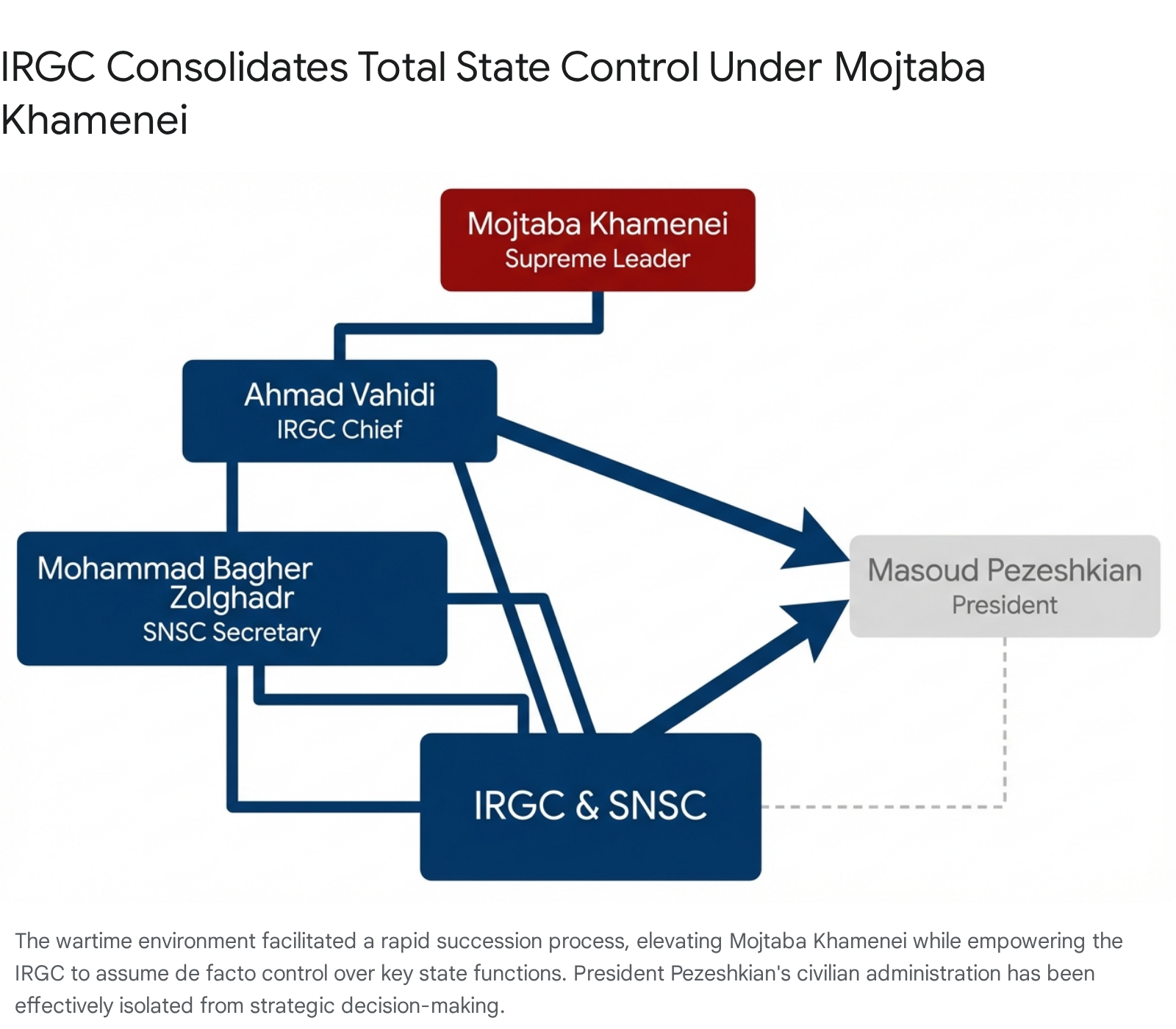
The wartime emergency facilitated a de facto soft coup by the Islamic Revolutionary Guard Corps, effectively neutralizing the civilian political establishment and assuming direct control over critical state functions.5 The marginalization of the civilian government is starkly evident in the current standing of President Masoud Pezeshkian. Elected in August 2024 on a reformist platform following the death of Ebrahim Raisi in a helicopter crash, Pezeshkian was initially expected to manage the domestic economy and seek diplomatic outreach to the West.21 As an ethnic Azerbaijani and a vocal critic of the government during the 2022 protests, he represented a glimmer of hope for civic reform.21
However, his presidency has been rendered entirely powerless. In early March 2026, Pezeshkian released a video message apologizing for the “fire at will” attacks by the armed forces, demanding a restoration of executive power and warning that the Iranian economy faced total collapse within weeks without a ceasefire.5 His demands were fiercely rejected by the military establishment. Islamic Revolutionary Guard Corps Chief-Commander Ahmad Vahidi publicly blamed the civilian government’s failure to implement structural economic reforms for the current crisis, entirely dismissing the President’s authority.5
The internal political deadlock culminated in Pezeshkian being forced, under direct pressure from Vahidi and other senior commanders, to appoint Mohammad Bagher Zolghadr as the secretary of Iran’s Supreme National Security Council.5 Zolghadr, a foundational figure and military insider, represents the acceleration of the hardline system and the complete subordination of civilian diplomacy to military imperatives.5 The hardline faction has also weaponized the wartime environment to target political rivals, labeling figures like former Foreign Minister Mohammad Javad Zarif as traitors for advocating diplomacy and urging the judiciary to arrest him.5
2. Military and Asymmetric Posture
Operation Epic Fury achieved significant success in degrading the conventional force projection capabilities of the Iranian state. The United States and Israel executed a parallel warfare strategy, treating the Iranian military as a complex system of systems and deliberately targeting the critical requirements of their air defense and ballistic missile networks to paralyze the adversary.3 Consequently, Iran has shifted entirely toward asymmetric operations, leveraging guerrilla tactics at sea and relying heavily on its battered but functional regional proxy network.
2.1 The Degradation of Conventional Military Forces
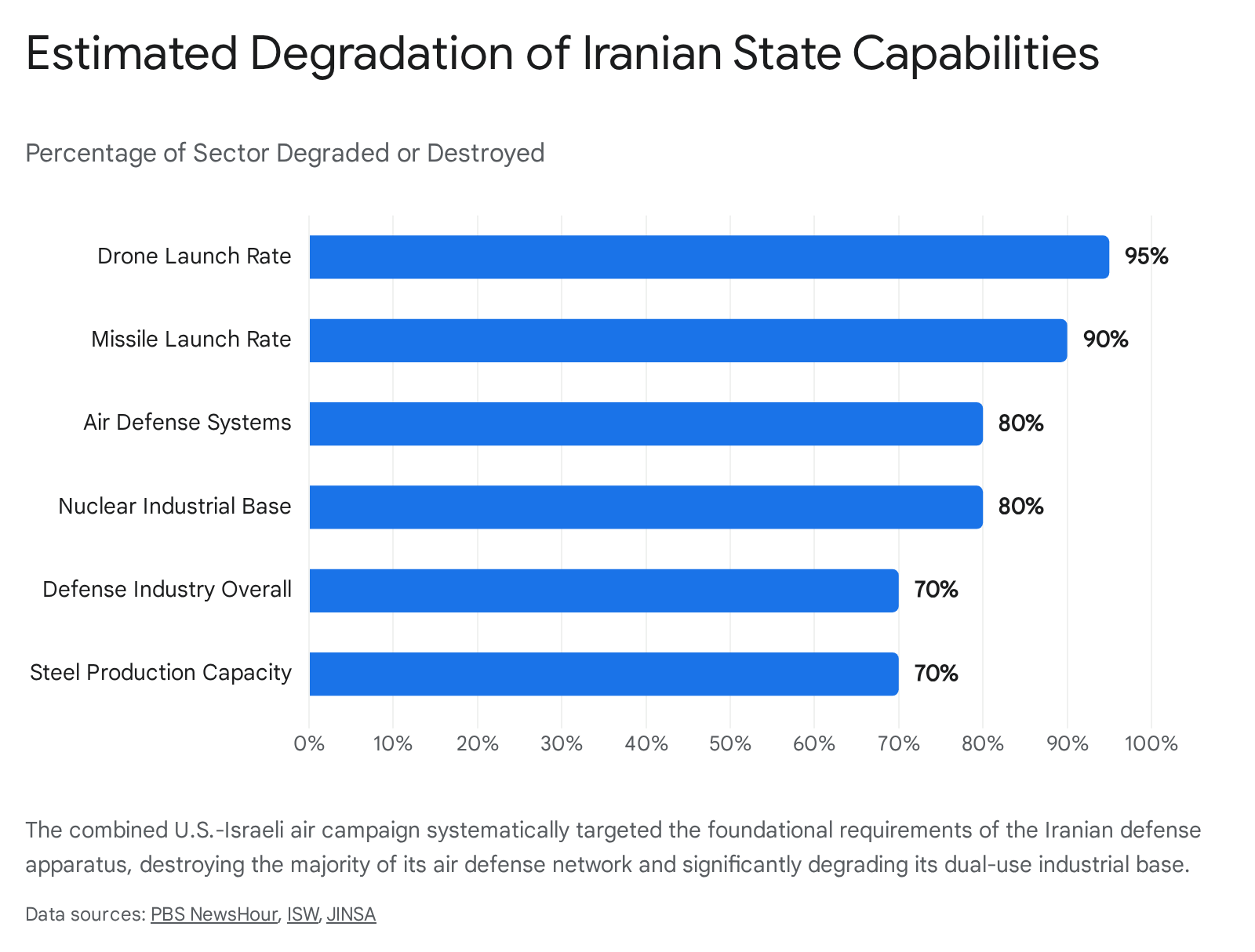
The material losses suffered by the Iranian armed forces over the 38-day kinetic campaign are staggering and will require years to reconstitute. Current assessments indicate that over 6,000 Iranian military personnel were killed and approximately 15,000 were wounded.1 The coalition forces executed targeted strikes that destroyed more than 190 ballistic missile launchers, 155 naval vessels, and an estimated 80 percent of Iran’s air defense systems.1 The systematic destruction of critical radar components, particularly the TOMBSTONE radars supporting the S-300 air defense batteries, rendered entire defensive networks combat ineffective.3
Furthermore, the operational tempo of the Iranian ballistic missile forces was severely curtailed. By the time the ceasefire was enacted, Iranian medium-range ballistic missile fire targeting Israel had been reduced by roughly 90 percent, and drone attacks had declined by 95 percent.3 Strikes on deeply buried tunnel entrances and at least five underground missile facilities trapped remaining launchers, rendering them practically useless even if they escaped direct physical destruction.3
The psychological toll on the armed forces has been profound. Airstrikes have led to widespread desertions, severe shortages of key technical personnel, and mounting frustration among senior leaders.3 Reports indicate that numerous ballistic missile units have outright refused to deploy to designated launch sites due to the omnipresent fear of loitering munitions and targeted strikes, while reserve forces are increasingly failing to report to regional military centers.3 This internal fracturing of unit cohesion severely limits Iran’s ability to sustain conventional, symmetric military operations.
| Military Sector | Estimated Losses and Degradation Status | Strategic Implication |
| Personnel | 6,000 KIA, 15,000 WIA. Widespread desertions reported among reserve units. | Severe reduction in combat readiness and operational continuity across all branches. |
| Ballistic Missile Force | 190+ launchers destroyed. 90% reduction in medium-range launch rates. | Inability to project sustained strategic deterrence against Israel or regional adversaries. |
| Air Defense Network | 80% destroyed, including critical TOMBSTONE radar systems for S-300 batteries. | Loss of airspace sovereignty, leaving critical infrastructure highly vulnerable to future strikes. |
| Naval Fleet | 155 vessels destroyed. Significant damage to over 20 production facilities. | Functional elimination of conventional blue-water capabilities and shift to littoral asymmetric tactics. |
| Drone Capabilities | 95% reduction in launch rates, though 50% of the stockpile is estimated to remain intact. | Reliance on remaining stockpiles for asymmetric harassment of Gulf infrastructure. |
2.2 Asymmetric Maritime Strategy in the Strait of Hormuz
Recognizing the decimation of its conventional naval capabilities, Iran has fully operationalized its asymmetric naval warfare doctrine. The Iranian Navy and the Islamic Revolutionary Guard Corps Navy are no match for the United States Navy in symmetrical combat.26 The sinking of major surface combatants, such as the IRIS Dena south of Sri Lanka, and the internment of the IRIS Bushehr in Sri Lanka and the IRIS Lavan in India, demonstrated the futility of deploying conventional assets outside the Persian Gulf.27 Consequently, Tehran has retreated to its littoral zones, relying on smaller, nimble craft, drone swarms, and extensive naval mine deployment to exert disproportionate influence over the Strait of Hormuz.26
Tehran has effectively closed the primary international shipping lanes in the Strait, citing the potential presence of naval mines as a legal and military pretense for rerouting global traffic.6 The Islamic Revolutionary Guard Corps designated alternative maritime routes, forcing all inbound traffic to travel northward from the Gulf of Oman and pass closely by Larak Island, while outbound traffic must pass south of the island.6 This rerouting forces vessels deep into Iranian territorial waters, creating a severe strategic bottleneck that favors small-boat swarm tactics.
Within this controlled zone, Iran has established a highly lucrative and coercive transit system, colloquially referred to by analysts as a “Tehran toll booth”.7 Vessels deemed neutral by the regime are permitted to transit only upon the payment of exorbitant transit fees, frequently reaching into the low millions of dollars per vessel.7 To circumvent Western financial sanctions and bolster foreign currency reserves, these tolls are exclusively processed in Chinese yuan or various cryptocurrencies.7
This strategy leverages calibrated legal ambiguity regarding the United Nations Convention on the Law of the Sea. Since Iran is not a party to the convention, it claims full sovereignty over its territorial sea, allowing it to extract revenue while holding global energy markets hostage without officially declaring an unconditional blockade.28 To enforce this control, Iran utilizes a combination of anti-ship missiles, drones, and small boats, and has already fired upon at least 23 ships in or near the Strait.7 As of April 8, overall ship traffic through the Strait remained down by more than 90 percent, leaving over 2,000 vessels and 20,000 mariners stranded within the Persian Gulf.7
2.3 The Operational Capacity of Regional Proxy Networks
The operational capacity of Iran’s regional proxy network, known as the Axis of Resistance, has been severely constrained by the conflict but remains highly lethal and politically disruptive. Hezbollah, the crown jewel of Iran’s expeditionary strategy, has absorbed massive blows. Israeli ground and air operations in Lebanon have killed over 1,400 Hezbollah fighters and heavily damaged the group’s command and control infrastructure.1 Significant strikes targeting intelligence headquarters, central command centers, and assets belonging to the elite Radwan Force and Aerial Unit 127 have degraded the group’s ability to coordinate complex offensives.30
Despite these losses, the command structures of these non-state armed groups exhibit high resilience. The April 8 ceasefire announcement immediately exposed severe strategic fault lines regarding the status of these proxies. While Iran and Pakistani mediators insisted that the ceasefire applied to all fronts, including Lebanon, the Israeli government explicitly rejected this interpretation.10 Prime Minister Benjamin Netanyahu authorized the continuation of aggressive strikes against Hezbollah, including operations in densely populated areas of central Beirut, stating that Israel will utilize every operational opportunity to strike the group.9 In retaliation, Hezbollah has resumed firing rockets into northern Israel, condemning the strikes and reserving the right to retaliate.33
The lack of control Tehran exercises over the tactical decisions of its proxies remains a critical vulnerability. Historically, while Iran shapes strategic options through capacity building and ideological alignment, it allows groups like Hezbollah significant operational autonomy.36 This dynamic creates a severe principal-agent problem. The 2006 Lebanon war and the current conflict highlight the vulnerabilities of this strategy; even if Tehran wishes to strictly observe the ceasefire to relieve domestic pressure, rogue actions by heavily battered proxy forces in Lebanon, Iraq, or Yemen could inadvertently shatter the fragile truce and invite further retaliation upon the Iranian homeland.36
3. Economy and Infrastructure
The sustained aerial bombardment of Iran has accelerated an existing, chronic economic crisis into a systemic, national collapse. The strategic targeting of the national industrial base, combined with the strangulation of trade routes and sweeping sanctions, has left the state economically paralyzed and desperate for leverage.
3.1 Domestic Economic Crisis and Industrial Base Degradation
The United States and Israeli campaign deliberately targeted the foundational requirements of Iran’s military-industrial complex to prevent rapid reconstitution.3 Assessments indicate that nearly 70 percent of Iran’s defense industry was systematically dismantled during the 38-day operation.3 Precision strikes severely damaged critical production nodes, including the primary facilities at Khojir, Shahroud, Parchin, and Hakimiyeh.3 These strikes eliminated vital research centers, solid-fuel production plants, and component testing infrastructure required to maintain the ballistic missile program.3
Furthermore, the coalition targeted dual-use industrial capacity essential for both military and civilian rebuilding efforts. Up to 70 percent of Iran’s steel production capacity, heavily concentrated in Esfahan Province, was destroyed, severely bottlenecking the raw materials necessary for rebuilding missile casings and naval vessels.3 Approximately 80 percent of the nuclear industrial base was also hit, significantly degrading Iran’s attempts to attain a nuclear weapon, although analysts warn that deeply buried enrichment sites like Fordow likely remain operational, incentivizing a push toward full weaponization as a final deterrent.2
The physical destruction of the industrial base is compounded by successful efforts in the United Arab Emirates to dismantle Iranian sanctions-evasion networks. The arrest of Islamic Revolutionary Guard Corps-linked money changers in Dubai has dealt a serious blow to Tehran’s primary trade lifeline, restricting its ability to import essential goods.5 The economic damages sustained by Iran are estimated at over $145 billion, crippling domestic livelihoods and destroying small businesses.1 Official data reflects surging, hyper-inflationary trends, with consumer prices fundamentally detached from the national currency.5 The emergence of an informal economy reliant entirely on foreign currency, colloquially noted by the rise of “dollar-pegged pizza” in Tehran, highlights the profound loss of faith in the Iranian rial and the complete failure of state monetary policy.5
3.2 Strategic Weaponization of Global Energy Markets
In response to its domestic economic ruin, Tehran has weaponized its geographic position to exert maximum economic pain on the global market. Geopolitical theory, notably Halford Mackinder’s concept of the “world-island,” positions Iran at the center of the strategic landmass, granting it immense leverage over global transit nodes.37 The disruption of the Strait of Hormuz has triggered what the International Energy Agency labels the largest supply disruption in the history of the global oil market.38
The restriction of the waterway, which handles approximately one-quarter of the world’s oil, one-fifth of its natural gas, and one-third of its fertilizer and helium supplies, has driven Brent crude prices near the $100 per barrel mark, introducing severe inflationary pressure into Western economies.7 Supply chains across Southeast Asia are facing acute fuel shortages, while Europe is confronting soaring energy costs that threaten long-term industrial activity.40
By maintaining a chokehold on the Strait, Iran is deliberately exporting its domestic economic crisis to the international community. This is not merely a military tactic, but a macroeconomic strategy to force political concessions.41 Tehran understands that sustained high oil prices threaten the political stability of Western governments, utilizing this pressure as its primary negotiating card in Islamabad.42 The International Monetary Fund has already warned that the conflict will permanently scar the global economy, resulting in growth downgrades even if a durable peace deal is reached.39
3.3 Asymmetric Threats to Regional Water and Power Infrastructure
Iran has expanded its campaign of economic warfare by targeting the critical infrastructure of neighboring Gulf states. Lacking the long-range conventional platforms to strike the continental United States or Europe, Tehran utilizes unmanned aerial systems and short-range ballistic missiles to strike vulnerable civilian targets in the immediate region, seeking to hold allied nations hostage to the conflict.43
The Gulf Cooperation Council relies heavily on large, open-air desalination complexes for freshwater. These linear facilities are highly susceptible to disruption; damage to specific components like high-pressure pumps or reverse osmosis membrane buildings can disable production for weeks, creating immediate humanitarian and economic crises.44 Throughout the conflict, Iran launched coordinated drone strikes against these facilities. Reports indicate that Iranian munitions successfully damaged the Fujairah F1 power and water complex in the United Arab Emirates, the Doha West station in Kuwait, and a major desalination center in Bahrain.44
Furthermore, Iran struck a pumping station on Saudi Arabia’s east-west pipeline, demonstrating its capability to threaten alternative crude routing that bypasses the Strait of Hormuz.7 These strikes carry a calculated message of deterrence. In response to threats from the United States to strike Iranian power grids and its own desalination plants on Qeshm Island, Tehran is demonstrating that any attempt to permanently dismantle Iran’s energy grid will be met with symmetrical destruction of the Arabian Peninsula’s fragile power and water lifelines.44
4. The Populace and Humanitarian Climate
The Iranian civilian population is currently enduring a catastrophic convergence of military trauma, economic deprivation, and environmental collapse. The societal fabric, already deeply strained by years of authoritarian repression and economic mismanagement, is rapidly fracturing under the immense weight of the war.
4.1 Mass Displacement and Severe Humanitarian Crisis
The 38-day kinetic campaign generated massive, unprecedented internal displacement within the country. The United Nations High Commissioner for Refugees reported that up to 3.2 million people have been internally displaced within Iran, fleeing major urban centers, military installations, and industrial zones targeted by coalition airstrikes.11 The strikes on civilian-adjacent infrastructure, where military assets were frequently positioned by state forces, have resulted in significant collateral damage, with current assessments indicating over 2,000 civilian fatalities across 26 of Iran’s 31 provinces.16
The humanitarian crisis is severely exacerbated by the systemic collapse of public infrastructure. Millions of Iranians currently live without reliable access to clean water, sanitation services, or electricity.47 Furthermore, the destruction of massive petrochemical facilities, fuel depots, and military production sites has unleashed hazardous pollutants onto densely populated areas. This has resulted in the phenomenon of toxic “black rain” pouring over Tehran and other major cities, causing immediate respiratory distress and contaminating local water tables.12
This environmental devastation highlights a broader reality regarding the state’s priorities. The regime’s deliberate prioritization of military fortification, such as the construction of vast underground missile tunnels, over environmental sustainability has pushed the country’s fragile ecosystems to the edge of collapse.47 The resulting pollutants and destruction of agricultural infrastructure guarantee long-term public health disasters that will long outlast the immediate military hostilities, representing a period of extreme “development in reverse” for the nation.12
4.2 The Potential for Domestic Unrest
The social climate within Iran is highly volatile, characterized by a deep and widening chasm between the octogenarian, patriarchal elite and a young, modernized, and profoundly traumatized society.14 The economic devastation has alienated even the remaining moderate and reformist bases, leading to widespread anger directed squarely at the regime’s foreign adventurism.48
In the months preceding the war, specifically late December 2025 and early January 2026, severe protests erupted across all 31 provinces, spurred initially by rising inflation and the collapse of the rial.13 These demonstrations, evoking the leaderless, grievance-driven nature of the 2022 Women, Life, Freedom movement, quickly evolved into outright calls for the replacement of the regime, driven by the merchant class whose livelihoods were destroyed by currency fluctuations.48 The state’s response was predictably brutal. The Islamic Revolutionary Guard Corps and state security forces met the protests with extreme violence, deploying shoot-to-kill orders, utilizing systematic sexual violence as a tool of repression, and implementing nationwide internet blackouts.5 Human rights monitors reported that dozens were killed and thousands arrested in the weeks leading up to the foreign intervention.13
While the immediate shock of the foreign military intervention and the ensuing humanitarian catastrophe temporarily forced the population into survival mode, the announcement of the ceasefire has provided breathing room for political dissent to resurface. The regime’s abject inability to provide basic necessities, coupled with widespread public trauma and the visible fractures within the military apparatus, creates an environment ripe for mass, violent civil unrest in the near term.14 However, this domestic opposition operates in isolation. Regional autocracies, fearing the contagion of democratic uprisings, have largely maintained a moral asymmetry, condemning the foreign strikes while remaining conspicuously silent on Tehran’s internal repression.49 The Iranian populace remains trapped between an oppressive domestic military autocracy and the devastating effects of external bombardment.
5. Diplomatic Posture and Strategic Alignment
As the two-week ceasefire holds tenuously, the focus of the conflict has shifted from the battlefield to the diplomatic theater in Islamabad, Pakistan. The negotiations, which commenced on April 10, 2026, represent a critical geopolitical juncture, though expectations for a permanent resolution remain exceedingly low due to the maximalist demands of both parties.
5.1 The Islamabad Ceasefire Negotiations
The peace talks in Islamabad feature delegations representing vastly divergent strategic imperatives, separated by deep mutual mistrust and competing regional visions. The United States delegation, led by Vice President JD Vance alongside special envoys Steve Witkoff and Jared Kushner, seeks to utilize the temporary pause to secure the immediate reopening of the Strait of Hormuz and force a comprehensive rollback of Iran’s nuclear and ballistic missile programs.33 The American position relies heavily on the threat of renewed military strikes, specifically targeting power plants and bridges, if negotiations fail.53
Conversely, the Iranian delegation, anticipated to be led by Foreign Minister Abbas Araghchi and Parliament Speaker Mohammad Bagher Ghalibaf, arrived with a maximalist 10-point proposal that contradicts the 15-point plan previously submitted by Washington.9 Iran’s non-negotiable demands include the lifting of all primary and secondary sanctions, international recognition of its right to enrich uranium to sovereign levels, the withdrawal of United States military forces from the region, and the establishment of a robust international fund to compensate for war damages.7 Crucially, Tehran demands the right to maintain control over maritime traffic in the Strait of Hormuz, effectively seeking international legitimization of its transit fee extortion model as a permanent fixture of Gulf security.9
A major point of contention threatening to collapse the talks entirely is the geographic scope of the ceasefire. Iran and Pakistani mediator Shehbaz Sharif maintain that the agreement strictly includes the cessation of hostilities in Lebanon, viewing the protection of Hezbollah as an essential condition for the truce.10 The United States and Israel vehemently deny this interpretation, viewing the operations against Hezbollah as a distinct conflict not covered by the bilateral US-Iran agreement.10 The failure to reconcile these competing frameworks, alongside continued Israeli strikes in Beirut, places the Islamabad talks on the precipice of failure.32 The realistic end state is likely an ambiguous accommodation, extending the temporary ceasefire without resolving the fundamental structural contradictions of the regime or the region.16
5.2 Strategic Intelligence Sharing and Alignment with Russia
Recognizing its diplomatic isolation within the immediate Middle East, Iran has aggressively deepened its strategic partnerships with great power competitors, specifically the Russian Federation, to offset the technological dominance of the United States.
The relationship with Moscow has evolved significantly from tactical cooperation in Syria into a formalized alliance structure. In October 2025, the Comprehensive Strategic Partnership Treaty between Iran and Russia entered into force.15 While this treaty explicitly lacks a mutual defense clause, ensuring Russia is not obligated to enter a direct kinetic war with the United States on Iran’s behalf, it mandates profound intelligence, security, and economic collaboration.15
Throughout Operation Epic Fury, Russia actively leveraged this partnership to assist Tehran. With Iran’s domestic sensor networks and radar installations largely destroyed, Moscow provided Iran with high-resolution satellite imagery detailing the locations, movements, and vulnerabilities of United States, Gulf, and Israeli military assets across the Middle East.61 This strategic intelligence sharing enabled Iran to accurately calibrate its asymmetric drone and missile strikes against regional infrastructure despite the loss of its own early warning and targeting systems.61 For Moscow, supporting Iran serves a clear geopolitical benefit: keeping the United States bogged down in a volatile Middle Eastern conflict serves as a strategic distraction from its own military operations in Eastern Europe and strains Western resources.2 Furthermore, Russia benefits economically from the high oil prices generated by the conflict.63
5.3 Diplomatic Isolation in the Middle East
While Iran enjoys support from Moscow and tacit economic alignment with Beijing, it remains deeply isolated within its own region. The weaponization of the Strait of Hormuz and the indiscriminate targeting of Gulf desalination and energy infrastructure have alienated neighboring Arab states. Gulf leaders have vilified Tehran for derailing years of patient diplomacy aimed at building regional stability, and the Arab League has issued strong condemnations regarding the conflict’s expansion.64
This isolation limits Iran’s diplomatic maneuvering space. While states like Qatar and Oman have historically served as backchannels, the sheer scale of the economic damage inflicted upon the region by Iran’s maritime blockade has hardened the determination of Gulf states to confront Tehran, with some reportedly considering recalibrating their security relations to ensure a permanent degradation of Iranian offensive capabilities.65 Iran’s current trajectory relies entirely on leveraging its great power alignments with Russia and China to survive the catastrophic damage inflicted by the coalition and secure a favorable outcome in Islamabad.
Appendix: Analytical Methodology
The findings in this report were synthesized using a robust, multi-disciplinary analytical framework designed to process fragmented data streams emerging from a heavily contested and information-denied conflict zone. The primary methodology relied on Open-Source Intelligence aggregation, utilizing commercial satellite imagery analysis, intercepted communications, state media broadcasts, and verified localized reporting to quantitatively assess the physical degradation of the Iranian defense industrial base and conventional military assets.
To evaluate the political shifts within the Iranian regime, the analysis employed elite network mapping, tracking the public statements, structural appointments, and movements of key figures within the Islamic Revolutionary Guard Corps, the Assembly of Experts, the Supreme National Security Council, and the civilian presidency. This approach allowed for the identification of the underlying power dynamics driving the rapid succession of Mojtaba Khamenei and the systematic marginalization of Masoud Pezeshkian.
Economic impact assessments were generated by cross-referencing global commodities pricing data, specifically Brent crude fluctuations, with maritime tracking data analyzing the volume, routing, and financial transactions of commercial vessels navigating the Strait of Hormuz. Humanitarian and domestic climate evaluations were derived from reports published by international monitoring agencies, regional non-governmental organizations, and anti-regime media outlets operating outside of Tehran’s domestic internet censorship apparatus. The synthesis of these qualitative and quantitative methodologies provides a high-confidence assessment of Iran’s internal vulnerabilities, its asymmetric operational capacity, and its diplomatic posture as of April 10, 2026.
Please share the link on Facebook, Forums, with colleagues, etc. Your support is much appreciated and if you have any feedback, please email us in**@*********ps.com. If you’d like to request a report or order a reprint, please click here for the corresponding page to open in new tab.
Sources Used
- 2026 Iran war – Wikipedia, accessed April 11, 2026, https://en.wikipedia.org/wiki/2026_Iran_war
- Fact-checking Trump and Hegseth’s claims of U.S. ‘victory’ in the Iran war, accessed April 11, 2026, https://www.pbs.org/newshour/politics/fact-checking-trump-and-hegseths-claims-of-u-s-victory-in-the-iran-war
- Iran Update, Special Report, April 3, 2026 | ISW, accessed April 11, 2026, https://understandingwar.org/research/middle-east/iran-update-special-report-april-3-2026/
- The Future of the Iranian Political System Following the Assassination of Khamenei, accessed April 11, 2026, https://rasanah-iiis.org/english/monitoring-and-translation/reports/the-future-of-the-iranian-political-system-following-the-assassination-of-khamenei/
- Rift deepens between Iran’s president and Guards chief over war …, accessed April 11, 2026, https://www.iranintl.com/en/202603288722
- Iran issues alternative transit routes in Strait of … – Anadolu Ajansı, accessed April 11, 2026, https://www.aa.com.tr/en/middle-east/iran-issues-alternative-transit-routes-in-strait-of-hormuz-amid-mine-fears/3899627
- With a Fragile Ceasefire under Threat, What Future for the Strait of Hormuz?, accessed April 11, 2026, https://www.crisisgroup.org/qna/global/iran-israelpalestine-united-states/fragile-ceasefire-under-threat-what-future-strait-hormuz
- Twenty questions (and expert answers) about the Iran war – Atlantic Council, accessed April 11, 2026, https://www.atlanticcouncil.org/dispatches/twenty-questions-and-expert-answers-about-the-iran-war/
- Iran Update Special Report, April 8, 2026, accessed April 11, 2026, https://understandingwar.org/research/middle-east/iran-update-special-report-april-8-2026/
- With all quiet, for now, on the Iran front, Israel turns its sights on Hezbollah, accessed April 11, 2026, https://www.timesofisrael.com/with-all-quiet-on-the-iran-front-israel-turns-its-sights-on-hezbollah/
- SITUATION UPDATE: IRAN APRIL 2026, accessed April 11, 2026, https://refugees.org/wp-content/uploads/2026/04/Iran-Situation-Update-April-7-2026.pdf
- The Human Dimension of the Iran War: The Intolerable Plight of Civilians, accessed April 11, 2026, https://thesoufancenter.org/intelbrief-2026-april-7/
- Iran: What challenges face the country in 2026? – The House of Commons Library, accessed April 11, 2026, https://commonslibrary.parliament.uk/research-briefings/cbp-10456/
- Iran Country Report 2026 – BTI Transformation Index, accessed April 11, 2026, https://bti-project.org/en/reports/country-report/IRN
- Comprehensive Strategic Partnership Treaty Between Iran Russia Enters into Force, accessed April 11, 2026, https://www.iranwatch.org/library/governments/iran/ministry-foreign-affairs/comprehensive-strategic-partnership-treaty-between-iran-russia-enters-force
- The Ceasefire Illusion – Middle East Forum, accessed April 11, 2026, https://www.meforum.org/mef-reports/the-ceasefire-illusion
- What to Know About Iran’s Ceasefire Proposal as Peace Talks Approach, accessed April 11, 2026, https://time.com/article/2026/04/08/iran-us-ceasefire-proposal-talks/
- After Khamenei: Planning for Iran’s Leadership Transition | Council on Foreign Relations, accessed April 11, 2026, https://www.cfr.org/reports/leadership-transition-in-iran
- Mojtaba Khamenei Follows In Father’s Footsteps As Iran’s New …, accessed April 11, 2026, https://www.rferl.org/a/iran-names-khamenei-supreme-leader-us-israel/33698945.html
- Who could succeed Ayatollah Ali Khamenei to lead Iran? | Explainer News | Al Jazeera, accessed April 11, 2026, https://www.aljazeera.com/news/2026/3/1/who-could-succeed-ayatollah-ali-khamenei-to-lead-iran
- The Islamic Revolutionary Guard Corps (IRGC) – Council on Foreign Relations, accessed April 11, 2026, https://www.cfr.org/backgrounders/irans-revolutionary-guards
- Iran’s 2024 presidential election | Masoud Pezeshkian, Candidates, Raisi Death, & Results, accessed April 11, 2026, https://www.britannica.com/event/Iranian-presidential-election-of-2024
- Iran: Freedom in the World 2025 Country Report, accessed April 11, 2026, https://freedomhouse.org/country/iran/freedom-world/2025
- IRGC pressured Pezeshkian to appoint Zolghadr as security chief | Iran International, accessed April 11, 2026, https://www.iranintl.com/en/202603250024
- Operations Epic Fury and Roaring Lion: 3/13/26 Update – JINSA, accessed April 11, 2026, https://jinsa.org/wp-content/uploads/2026/03/Operations-Epic-Fury-and-Roaring-Lion-03-13-26.pdf
- Strait of Hormuz | International Crisis Group, accessed April 11, 2026, https://www.crisisgroup.org/trigger-list/iran-usisrael-trigger-list/flashpoints/strait-hormuz
- Expert Q&A on Key Law of Naval Warfare Issues in the Conflict with Iran – Just Security, accessed April 11, 2026, https://www.justsecurity.org/133999/law-naval-warfare-iran-war/
- Iran’s Hormuz Gambit: The Strait as a Weapon of Jihadist Endurance, accessed April 11, 2026, https://jcfa.org/irans-hormuz-gambit-the-strait-as-a-weapon-of-jihadist-endurance/
- Strait of Hormuz not open, Abu Dhabi’s oil chief says as crude prices rise, accessed April 11, 2026, https://www.theguardian.com/business/2026/apr/09/oil-price-rises-as-markets-question-durability-of-middle-east-ceasefire-iran
- Daily Report: The Second Iran War – April 9, 2026 (18:00), accessed April 11, 2026, https://israel-alma.org/daily-report-the-second-iran-war-april-9-2026-1800/
- US Policy Toward Lebanon in a Time of War, accessed April 11, 2026, https://arabcenterdc.org/resource/us-policy-toward-lebanon-in-a-time-of-war/
- Ceasefire is threatened as Israel expands Lebanon strikes and Iran closes strait again – PBS, accessed April 11, 2026, https://www.pbs.org/newshour/amp/world/ceasefire-is-threatened-as-israel-expands-lebanon-strikes-and-iran-closes-strait-again
- Live Updates: U.S., Iran prepare for talks as shaky ceasefire holds, Strait of Hormuz traffic remains low, accessed April 11, 2026, https://www.cbsnews.com/live-updates/iran-war-trump-strait-of-hormuz-israel-ceasefire-talks/
- Iran Update Special Report, April 9, 2026 | ISW, accessed April 11, 2026, https://understandingwar.org/research/middle-east/iran-update-special-report-april-9-2026/
- The Latest: US, Israel and Iran agree to tentative ceasefire, even as the terms remain unclear – ClickOnDetroit, accessed April 11, 2026, https://www.clickondetroit.com/news/world/2026/04/08/the-latest-trump-pulls-back-on-threats-as-us-israel-and-iran-reach-a-2-week-ceasefire-deal/
- Iran’s proxy war paradox: strategic gains, control issues, and operational constraints, accessed April 11, 2026, https://www.tandfonline.com/doi/full/10.1080/09592318.2025.2512807
- These signals will make or break the Iran cease-fire – and oil prices | Morningstar, accessed April 11, 2026, https://www.morningstar.com/news/marketwatch/20260409164/these-signals-will-make-or-break-the-iran-cease-fire-and-oil-prices
- How the War in Iran is Impacting Global Energy Infrastructure | All About the Base – YouTube, accessed April 11, 2026, https://www.youtube.com/watch?v=ZGd7HnBANFk
- Oil rises and global stocks wobble amid worries over ‘fragile’ ceasefire deal in Middle East – as it happened | Business | The Guardian, accessed April 11, 2026, https://www.theguardian.com/business/live/2026/apr/09/oil-stocks-fall-fragile-ceasefire-middle-east-business-news
- How the Iran war could shift energy policies around the world, accessed April 11, 2026, https://www.atlanticcouncil.org/blogs/energysource/how-the-iran-war-could-shift-energy-policies-around-the-world/
- Base oil prices remain elevated since ceasefire | Latest Market News – Argus Media, accessed April 11, 2026, https://www.argusmedia.com/news-and-insights/latest-market-news/2812422-base-oil-prices-remain-elevated-since-ceasefire
- Trump pressures Iran as Islamabad talks aim to secure lasting Middle East truce, accessed April 11, 2026, https://www.marketpulse.com/markets/trump-pressures-iran-as-islamabad-talks-aim-to-secure-lasting-middle-east-truce/
- Iran Conflict Heightens Cyber Threats to U.S. Energy Infrastructure – CSIS, accessed April 11, 2026, https://www.csis.org/analysis/iran-conflict-heightens-cyber-threats-us-energy-infrastructure
- Could Iran Disrupt the Gulf Countries’ Desalinated Water Supplies? – CSIS, accessed April 11, 2026, https://www.csis.org/analysis/could-iran-disrupt-gulf-countries-desalinated-water-supplies
- Iran targets critical Gulf infrastructure after US strikes its water plant – YouTube, accessed April 11, 2026, https://www.youtube.com/watch?v=8PJo2ZDeRRo
- Attacking Iran’s energy and water infrastructure is not a winning strategy – Atlantic Council, accessed April 11, 2026, https://www.atlanticcouncil.org/dispatches/attacking-irans-energy-and-water-infrastructure-is-not-a-winning-strategy/
- Can Iran’s environment be saved?, accessed April 11, 2026, https://www.iranintl.com/en/202604071746
- Eruption of Iran Unrest Scrambles U.S. and Regional Calculations – The Soufan Center, accessed April 11, 2026, https://thesoufancenter.org/intelbrief-2026-january-7/
- Is Iran on the brink of change? – Brookings Institution, accessed April 11, 2026, https://www.brookings.edu/articles/is-iran-on-the-brink-of-change/
- 2025–2026 Iranian protests – Wikipedia, accessed April 11, 2026, https://en.wikipedia.org/wiki/2025%E2%80%932026_Iranian_protests
- Pakistan sets modest goal for US-Iran summit: A deal to keep talks going, accessed April 11, 2026, https://www.aljazeera.com/news/2026/4/10/pakistan-sets-modest-goal-for-us-iran-summit-a-deal-to-keep-talks-going
- Beyond the Ceasefire: Inside the Competing U.S. and Iranian Proposals, accessed April 11, 2026, https://www.egypttoday.com/Article/1/146255/Beyond-the-Ceasefire-Inside-the-Competing-U-S-and-Iranian
- U.S.-Iran Ceasefire: Assessment, Reactions, And Key Issues …, accessed April 11, 2026, https://www.eurasiareview.com/10042026-u-s-iran-ceasefire-assessment-reactions-and-key-issues-analysis/
- Talks to end Iran war appear to falter a day before Trump deadline, accessed April 11, 2026, https://www.theguardian.com/world/2026/apr/06/proposals-for-immediate-ceasefire-us-israel-iran-war
- Trump extends pause on striking Iranian energy plants; Witkoff floats 15-point peace proposal – CBS News, accessed April 11, 2026, https://www.cbsnews.com/live-updates/iran-war-trump-israel-tehran-denies-ceasefire-talks-strait-of-hormuz/
- What is in Iran’s 10-point ceasefire agreement plan?, accessed April 11, 2026, https://www.jpost.com/middle-east/iran-news/article-892384
- Temporary Ceasefire and Islamabad Negotiations During the Iran-US-Israel War (2026), accessed April 11, 2026, https://kureansiklopedi.com/en/detay/temporary-ceasefire-and-islamabad-negotiations-dur
- US military ‘loading up and resting,’ Trump says, as Iran tests ceasefire, accessed April 11, 2026, https://www.foxnews.com/live-news/trump-iran-ceasefire-israel-war-april-9
- Russia’s Stakes in the Iran War, With Thomas Graham | Council on Foreign Relations, accessed April 11, 2026, https://www.cfr.org/podcasts/presidents-inbox/russias-stakes-in-the-iran-war
- CSAG INFORMATION PAPER: “Vital, Sensitive & Strategic Cooperation Pact between Russia and Iran” – NESA-Center.org, accessed April 11, 2026, https://nesa-center.org/dev/wp-content/uploads/2025/03/2025-0221-Vital-Sensitive-Strategic-Cooperation-Pact-between-Russia-and-Iran.pdf
- Zelenskyy vents frustration over U.S. disinterest in evidence of Russia helping Iran, accessed April 11, 2026, https://www.ms.now/rachel-maddow-show/maddowblog/zelenskyy-vents-frustration-over-u-s-disinterest-in-evidence-of-russia-helping-iran
- Iran Update Special Report, April 7, 2026 | ISW, accessed April 11, 2026, https://understandingwar.org/research/middle-east/iran-update-special-report-april-7-2026/
- Market Outlook: U.S.-Iran ceasefire lowers oil prices as Hormuz reopens, accessed April 11, 2026, https://www.bnnbloomberg.ca/investing/market-outlook/2026/04/08/market-outlook-us-iran-ceasefire-lowers-oil-prices-as-hormuz-reopens/
- Ceasefire is threatened as Israel expands Lebanon strikes and Iran closes strait again – OPB, accessed April 11, 2026, https://www.opb.org/article/2026/04/08/ceasefire-is-threatened-as-israel-expands-lebanon-strikes-and-iran-closes-strait-again/
- Iran’s Missile and Drone Arsenal Remains Potent Despite Five Weeks of Intensive Strikes, accessed April 11, 2026, https://thesoufancenter.org/intelbrief-2026-april-6/