Tag Archives: Taiwan

Analysis of U.S. Deterrence and Chinese Strategic Calculus Regarding Taiwan – As of April 5, 2026

1.0 Executive Summary

The strategic calculus governing the Taiwan Strait represents the most critical geopolitical flashpoint of the twenty-first century. As of April 2026, the global security architecture is undergoing an unprecedented stress test. The United States is actively engaged in large-scale military operations in the Middle East—designated Operation Epic Fury—targeting the Iranian regime following major escalations.1 This ongoing conflict has necessitated the diversion of critical U.S. naval, air, and logistical assets from the Indo-Pacific Command (INDOPACOM) to the Central Command (CENTCOM), prompting profound questions regarding the viability of U.S. deterrence in the Western Pacific.3 Specifically, the geopolitical landscape invites a critical inquiry: With the United States actively expending resources in the Middle East, why has the People’s Republic of China (PRC) not seized the opportunity to initiate a military acquisition of Taiwan?

This report provides an exhaustive analysis of the intersecting military, economic, and political factors that inform China’s current strategic hesitation. The analysis concludes that the U.S. military remains a highly credible deterrent, not merely through forward-deployed mass, but through its demonstrated lethality, advanced targeting capabilities, and coalition-building power as evidenced in real-time combat.5 However, the primary factors preventing an immediate Chinese invasion extend far beyond the U.S. military presence alone.

China’s hesitation is fundamentally rooted in severe, enduring internal and operational constraints within the People’s Liberation Army (PLA). An amphibious invasion of Taiwan presents extreme logistical complexities that the PLA currently lacks the lift capacity, joint operational experience, and command stability to execute reliably.7 Furthermore, Beijing views the Iran conflict as a highly effective “structural asset”—a proxy engagement that systematically degrades U.S. strategic bandwidth, industrial capacity, and munitions stockpiles without requiring direct Chinese kinetic intervention or assuming the associated risks.9 Simultaneously, China is prioritizing its internal economic resilience, aggressively pursuing energy autonomy, and executing a domestic modernization agenda under the sweeping mandates of the 15th Five-Year Plan (2026–2030).11

By synthesizing open-source intelligence, military expenditure data, legislative developments, and strategic doctrine, this report dissects the anatomy of U.S. deterrence, the realities of PLA logistical constraints, the lessons Beijing has extracted from global conflicts, and the internal defense dynamics of Taiwan. The findings reveal a highly nuanced strategic environment where China’s restraint is not a permanent abandonment of its unification goals, but a calculated, multifaceted delay designed to let the United States overextend itself while the PLA mitigates its own critical vulnerabilities.

2.0 The Architecture of U.S. Deterrence in the Indo-Pacific

The efficacy of U.S. deterrence regarding Taiwan is a subject of intense debate among defense strategists and policymakers. Deterrence is traditionally composed of two central pillars: the capability to inflict unacceptable costs on an aggressor, and the credibility of the threat to actually do so. In the context of the Taiwan Strait, the U.S. deterrence framework has evolved significantly, transitioning from a posture of diplomatic ambiguity to an increasingly robust, operationally focused military doctrine.

2.1 Evolution of Strategic Posture: From Ambiguity to Denial

Historically, U.S. policy toward Taiwan has relied heavily on “strategic ambiguity,” a carefully calibrated diplomatic posture designed to deter Beijing from invading while simultaneously deterring Taipei from declaring formal, de jure independence. However, the rapid, historic expansion of China’s military capabilities has prompted a fundamental shift in U.S. defense planning toward a “Strategy of Denial”.13

This doctrine, heavily emphasized in recent strategic guidance, prioritizes the forward deployment of U.S. forces to prevent China from rapidly seizing Taiwanese territory and presenting the international community with a fait accompli.13 The primary objective of a denial defense is to ensure that the U.S. and allied militaries can intercept, disrupt, and degrade a Chinese amphibious assault force before it can establish a secure, sustainable lodgment on the island.14

The deterrence value of this strategy lies in forcing Beijing to acknowledge that an invasion would not be a swift, localized operation, but a protracted, high-casualty war against a global superpower. U.S. policymakers have underscored this by explicitly characterizing the defense of Taiwan as a cardinal responsibility, ensuring that U.S. military assets are laser-focused on defeating any bid for regional hegemony.13 The 2026 National Defense Strategy (NDS) reinforces this posture, explicitly characterizing China as the “most powerful state relative to us since the 19th century” and emphasizing a doctrine of “peace through strength” over previous administrations’ framing of mere “strategic competition”.15

2.2 Force Structure, Geopolitical Constraints, and A2/AD Realities

The credibility of the U.S. deterrent is constantly challenged by China’s relentless development of advanced Anti-Access/Area-Denial (A2/AD) capabilities. Over the past two decades, the PLA has built a formidable umbrella of ballistic missiles, cruise missiles, and integrated air defense systems designed specifically to push U.S. aircraft carriers and forward-deployed surface forces out of the First Island Chain.16

This shift in the regional balance of power has led some defense analysts to argue that U.S. deterrence is steadily eroding. Critics of the current posture—often termed accommodationists—suggest that in the event of a conflict, the United States would face a stark dilemma: either abandon Taiwan and fatally weaken the entire U.S. alliance network in Asia, or initiate a war where U.S. forces would likely incur severe losses, potentially resulting in a bloody, unwinnable stalemate.16 The geographic reality severely disadvantages the United States, which must project power thousands of miles across the Pacific Ocean, whereas Taiwan sits a mere 100 miles from the Chinese mainland, well within range of the PLA’s rocket artillery, helicopters, and paratroopers.18

Furthermore, U.S. force posture faces structural limitations. The Fiscal Year 2025 National Defense Authorization Act (NDAA) caps the Marine Corps at 172,300 active-duty personnel, creating a scenario where combatant commanders consistently demand more amphibious presence than the force can generate.20 Meeting the stated requirement of a 3.0 Marine Expeditionary Unit (MEU) presence is increasingly difficult amid global commitments.20

Despite these severe A2/AD challenges and force structure constraints, the U.S. military maintains significant asymmetric advantages, particularly in undersea warfare and long-range precision strike capabilities. U.S. nuclear-powered attack submarines are far less vulnerable to China’s A2/AD network than surface vessels and would play a decisive, disproportionate role in systematically dismantling a Chinese invasion fleet in the shallow waters of the Strait.21 The U.S. military’s capacity to leverage these assets ensures that any cross-strait invasion would result in catastrophic naval losses for the PLA, serving as a highly effective, tangible deterrent.

2.3 The Economic Toolkit and Coalition Dynamics

Military force is only one component of the broader deterrence toolkit; the threat of sweeping, coordinated economic sanctions represents a critical secondary deterrent against Chinese aggression. Defense planners and policy institutes continuously run scenarios to evaluate the effectiveness of restrictive economic measures, exploring both preemptive and reactive sanctions regimes aimed at crippling China’s export-reliant economy.22

However, the efficacy of economic deterrence is highly dependent on coalition unity. While the United States possesses the unilateral economic power to severely damage the Chinese financial system, the participation of key regional and global allies—such as Japan, Australia, and the United Kingdom—is paramount to sealing economic loopholes. Analyses indicate that allies are generally hesitant to implement preemptive economic measures without an existential threat to their immediate security interests, requiring intense, sustained U.S. diplomatic pressure to forge a cohesive sanctions block.22 For instance, assessments suggest Australia would likely seek to exhaust all other levels of national power before embracing preemptive economic deterrence tools.22

Nevertheless, the regional alliance system, particularly mechanisms like the AUKUS agreement and formal expressions of diplomatic support, serves as a vital structural deterrent. Defense of Taiwan is fundamentally viewed as both a strategic necessity and a moral imperative. As noted by defense officials, defending a successful democracy living on an island reinforces the entire premise of the Western security architecture; failing to do so would fatally undermine the credibility of U.S. defense guarantees to nations like Australia and Japan.16

3.0 Operation Epic Fury: The Crucible of U.S. Strategic Bandwidth

To accurately understand China’s current strategic hesitation, it is imperative to deeply analyze the ongoing U.S. military engagement in the Middle East. Initiated on February 28, 2026, Operation Epic Fury involves a massive, sustained U.S. and Israeli air and missile campaign against the Iranian regime.1 While this operation has demonstrated unparalleled U.S. lethality, it has concurrently exposed critical, systemic vulnerabilities in American strategic bandwidth and industrial capacity—factors that Beijing is monitoring with intense, calculated scrutiny.6

3.1 The Middle East Diversion: INDOPACOM vs. CENTCOM Reallocation

U.S. defense strategy over multiple administrations has consistently sought to pivot away from the Middle East to concentrate resources, planning, and procurement on the pacing threat of China in the Western Pacific.23 Operation Epic Fury has forced a direct, violent reversal of this carefully planned posture.

The operation has necessitated the deployment of immense naval and air assets to the CENTCOM area of responsibility. As of April 2026, the U.S. Navy has deployed three Carrier Strike Groups (CSGs)—including the USS George H.W. Bush, the USS Gerald R. Ford, and the USS Abraham Lincoln—along with multiple Amphibious Ready Groups (ARGs), such as the Tripoli ARG and Boxer ARG, to the Middle East.24 The Gerald R. Ford’s deployment has stretched toward an exhausting 11 months.6 In addition to naval assets, the Pentagon has surged extra fighter squadrons, advanced electronic warfare aircraft (such as the EA-37B Compass Call), and critical layered air defense systems to the region.4

This massive concentration of force effectively hollows out the surge capacity that would otherwise be available to INDOPACOM. By drawing critical assets, logistical capacity, and the entirety of Washington’s political attention away from the Pacific theater, the Iran conflict has resulted in a tangible, immediate weakening of U.S. defensive capabilities in the Western Pacific.3 For Beijing, this diversion represents an ideal, low-cost geopolitical environment; the United States is voluntarily engaged in a highly resource-intensive conflict, stretching its military forces thin globally and creating a potential strategic opening for regional adversaries.3

3.2 “Command of the Reload”: Munitions Consumption and Industrial Attrition

The most profound strategic consequence of Operation Epic Fury is not the geographic repositioning of ships, but the staggering consumption rate of highly advanced, difficult-to-replace precision munitions. In modern, high-end conflict, the decisive factor is no longer merely the ability to project power—dubbed the “Command of the Commons”—but the industrial capacity to sustain those strikes over time, known as the “Command of the Reload”.10

In the opening 96 hours of the campaign alone, the U.S.-led coalition expended an estimated 5,197 munitions across 35 different types, carrying a munitions-only replacement bill of $10 billion to $16 billion.10 This intense operational tempo has rapidly depleted critical, long-lead-time stockpiles. Most alarmingly, the U.S. Navy fired over 850 Tomahawk land-attack cruise missiles in the first month of the war.25 Given that the U.S. defense industrial base only produces an estimated 300 to 400 Tomahawks annually, the global supply—estimated at between 3,000 and 4,500 units prior to the conflict—is shrinking at a rate that is mathematically unsustainable for concurrent global contingencies.25

The financial burden of this attrition is immense and rapidly compounding. According to the Penn Wharton Budget Model, the direct costs of Operation Epic Fury reached $27 to $28 billion in just the first 32 days.26

Operation PhaseDates (2026)Estimated Daily RatePrimary Cost Drivers
Phase 1Feb 28 – Mar 5 (Days 1-6)~$2.1 Billion / dayHeavy reliance on Tomahawks, SM-3, SM-6, and AGM-154 glide bombs.26
Phase 2Mar 6 – Mar 23 (Days 7-24)~$601 Million / dayTransition to sustained air campaigns; replenishment logistics.26
Phase 3Mar 24 – Mar 31 (Days 25-32)~$500 Million / dayContinued targeted strikes; integration of specialized munitions.26
Phase 4 (Proj.)Apr 1 – Apr 30 (Days 33-62)$350–650 Million / dayProjected burn rate assuming sustained conflict.26

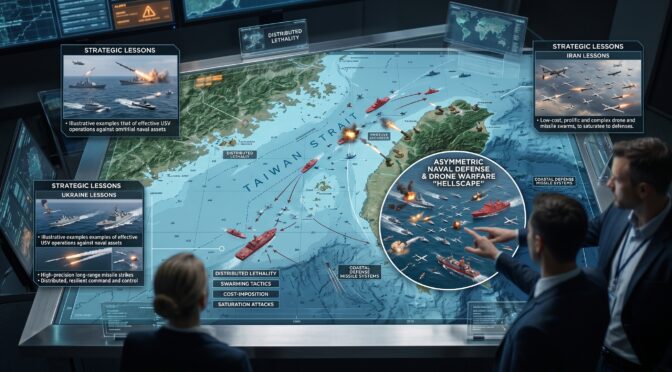
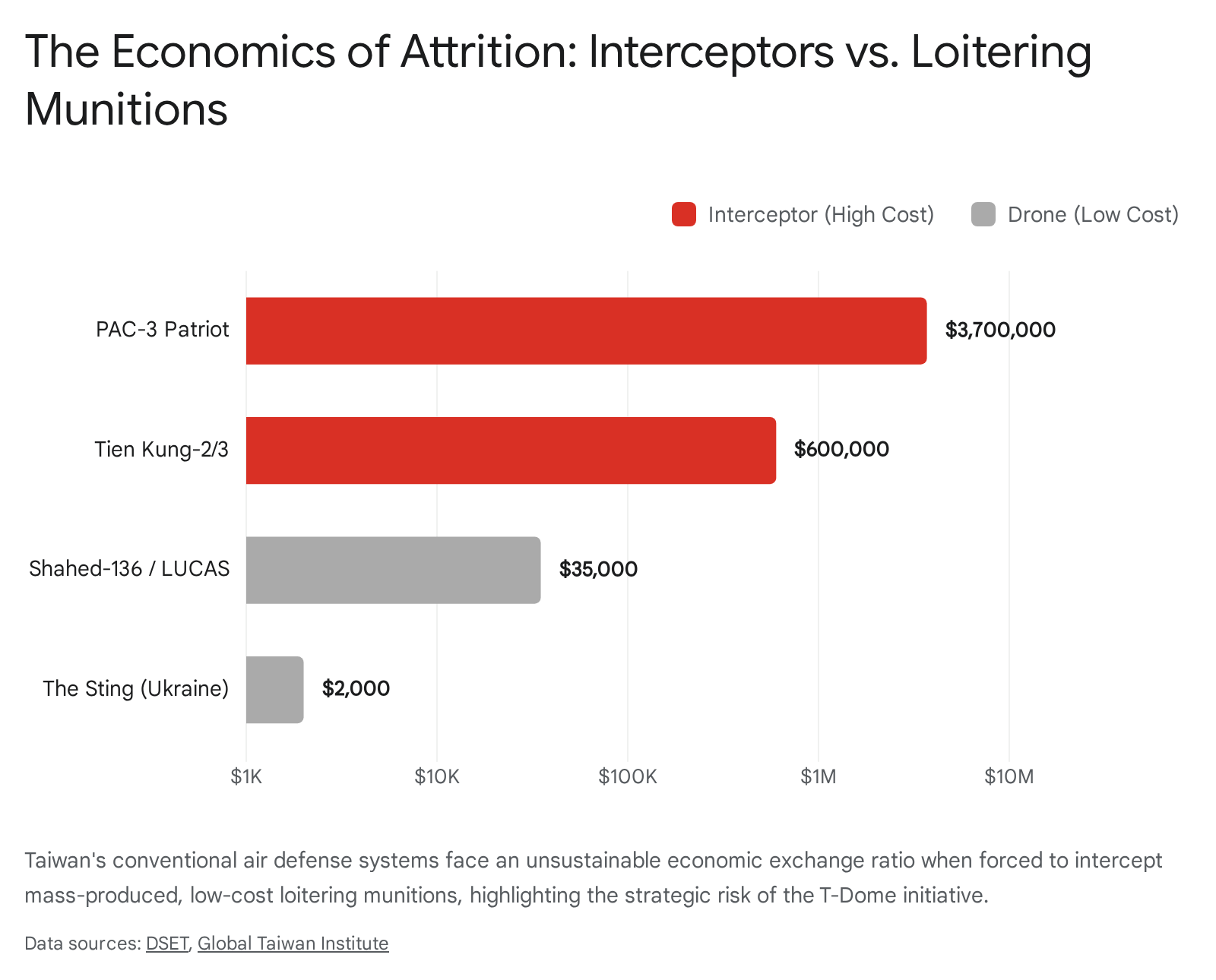
The high burn rate reflects the exorbitant cost structure of the opening salvo. The use of highly advanced interceptors—such as SM-3 and SM-6 missiles, costing upwards of $4 to $5 million each—against cheaper asymmetric drone and missile threats highlights a severe economic asymmetry.26 Both the PRC and INDOPACOM are acutely aware that the munitions currently being expended in the skies over Tehran are munitions that will definitively not be available to defend Taipei in a simultaneous contingency.6 The target sets in a conflict with China would range into the tens of thousands, requiring standoff munitions on a scale never before seen in history.25

3.3 Technological Lethality, Force Protection, and Asymmetric Retaliation

While the drain on resources is undeniably a strategic vulnerability, Operation Epic Fury also functions as a terrifying, real-world demonstration of U.S. military proficiency and technological dominance. The integration of advanced artificial intelligence into the kinetic kill chain has proven highly effective. U.S. forces have utilized AI systems, reportedly including Palantir’s Maven Smart System and advanced large language models like Anthropic’s Claude, to drastically accelerate targeting processes.5 According to CENTCOM Commander Adm. Brad Cooper, these AI tools help operators sift through vast amounts of data, turning targeting cycles that previously took hours or days into a matter of seconds.5 This AI-enabled lethality has allowed the U.S. coalition to hit over 5,500 targets with devastating precision.5

Furthermore, the conflict has seen the first confirmed combat deployment of the Long-Range Precision Strike Missile (PrSM), providing the U.S. Army with an unrivaled deep-strike capability.28 The sheer scale and success of these strikes—systematically obliterating Iranian command centers, air defenses, and naval assets including a key submarine—serve as a stark warning regarding the survivability of any adversary facing the full weight of the U.S. military.1 Secretary of War Pete Hegseth noted that the mission is “laser-focused” on ensuring the permanent destruction of Iran’s offensive capabilities.30

However, this lethality has not come without costs or retaliatory consequences. As of March 31, at least 348 U.S. military personnel have been wounded, necessitating massive force protection efforts.31 Hegseth detailed that the defense of U.S. troops is “maxed,” requiring rapid disbursement, bunker fortification, and continuous layered air defense combat air patrols to mitigate incoming fire.31

Moreover, Iran’s retaliation strategy has highlighted the vulnerabilities of regional partners. Termed the “Triple Betrayal” by regional analysts, Iran systematically targeted the physical emblems of Gulf modernity rather than solely focusing on U.S. bases.32 Strikes on Dubai International Airport, Jebel Ali Port, and QatarEnergy facilities have deeply unsettled U.S. allies.32 This demonstrates to Beijing that even if U.S. forces are resilient, the civilian and economic infrastructure of U.S. regional partners remains highly vulnerable to asymmetric missile strikes, potentially fracturing coalition unity during a crisis.32

4.0 China’s Strategic Calculus and the “Structural Asset” Proxy

Given the undeniable strain on U.S. resources, the massive expenditure of precision munitions, and the shifting of naval assets away from the Pacific, a superficial analysis might conclude that April 2026 presents the optimal, fleeting window for a Chinese invasion of Taiwan. However, Beijing operates on a fundamentally different strategic timeline, viewing the geopolitical landscape through a lens of long-term structural advantage rather than immediate, opportunistic aggression.

4.1 Iran as a Strategic Depletant

From Beijing’s perspective, the U.S. war against Iran is not a mere distraction to be rapidly exploited through kinetic action in Taiwan, but rather a strategic mechanism to be prolonged and optimized. For years, China has systematically cultivated Iran as a vital “structural asset” in the Middle East.9 By purchasing 80 to 90 percent of Iran’s exported crude oil via a complex, sanctions-evading “ghost fleet,” China has effectively kept the Iranian regime financially solvent.3 The 2021 25-Year Comprehensive Strategic Partnership committed China to an estimated $400 billion investment across Iran’s energy and infrastructure sectors.9 Furthermore, Beijing has heavily integrated its technology into Iran’s infrastructure, supplying advanced AI-enabled facial-recognition cameras and telecommunications networks from firms like Huawei and ZTE, which bolster the regime’s internal control.9

This massive investment yields strategic dividends that far outweigh the financial costs. Iran and its extensive proxy networks act as a highly efficient mechanism for American strategic attrition.9 Every U.S. carrier strike group deployed to the Persian Gulf, and every multi-million-dollar SM-6 interceptor fired, represents a tangible degradation of the U.S. military apparatus that China does not have to pay for with a single drop of PLA blood. Analysts note that China will likely continue to indirectly support Iran’s war effort by supplying critical intelligence, economic aid, and dual-use components—such as rocket parts—to ensure the conflict drags on.3 This continued support aims to perpetually drain U.S. resources and exacerbate Washington’s strategic overextension.3 Launching a war in Taiwan now would instantly unify U.S. political focus and military prioritization; keeping the U.S. bogged down in a protracted Middle Eastern quagmire is the superior strategic play.

4.2 Observations on the “Command of the Reload”

China is not merely watching the U.S. expend munitions in Iran; it is meticulously analyzing how the U.S. fights and sustains that fight. The PLA is observing the integration of AI in closing kill chains, the performance of novel weapon systems like PrSM, and the limits of the U.S. ability to sustain a high-intensity air campaign logistically.5

The lesson Beijing extracts is dual-faceted. First, the U.S. industrial base is fundamentally flawed and unable to replenish precision munitions at the speed of modern combat.10 Second, despite this logistical fragility, the tip of the American spear remains devastatingly sharp. An amphibious assault is the most vulnerable, slow-moving military maneuver possible. Exposing hundreds of thousands of PLA troops in densely packed transport vessels to the U.S. AI-driven targeting apparatus demonstrated in Operation Epic Fury would invite catastrophic casualties.5 China’s hesitation is partially a pragmatic acknowledgment that it has not yet developed the electronic warfare or kinetic countermeasures necessary to reliably blind or defeat the networked strike capabilities the U.S. military is currently demonstrating.

5.0 Enduring Vulnerabilities within the People’s Liberation Army (PLA)

Beyond macroeconomic factors and geopolitical proxy wars, the most immediate, tangible deterrent to a Chinese invasion of Taiwan is the physical and organizational limitation of the People’s Liberation Army itself. A cross-strait invasion—officially termed a “Joint Island Landing Campaign” in PLA doctrine—is an undertaking of extreme, unprecedented complexity, and the PLA currently faces severe logistical, capability, and leadership deficits that prevent a successful execution.7

5.1 The Amphibious Lift Deficit and Geographic Tyranny

The fundamental mathematics of a cross-strait invasion do not currently favor Beijing. Establishing and sustaining a beachhead against a highly entrenched, modernized defender requires the rapid movement of an unprecedented volume of personnel, heavy armor, and supplies. Estimates suggest a full-scale invasion could require landing between 300,000 and 2 million troops, necessitating the continuous movement of up to 30 million tonnes of food, fuel, and ammunition.8

The PLA Navy (PLAN) currently suffers from a profound shortfall in traditional amphibious lift capacity. Defense intelligence reports indicate that China has not invested adequately in the specialized tank landing ships (LSTs) and medium landing ships (LSMs) required for a massive, contested direct beach assault.34 OSINT assessments of China’s current dedicated amphibious assault ships—such as their 4 landing ship docks, which carry 28 helicopters each—suggest a capacity to land only 20,000 to 25,000 soldiers in the critical first wave.36 This is entirely insufficient to overwhelm Taiwanese defenses before U.S. and allied intervention.

Furthermore, the geography of Taiwan presents a logistical nightmare for an attacking force. The Taiwan Strait, historically referred to as the “Black Ditch,” is notorious for extreme weather. Strong winds, heavy wave swells, dense fog, and an average of six typhoons annually restrict the viable invasion window to just two months of the year—typically April and October.8 Even if PLA forces successfully cross the strait, Taiwan offers only 14 beaches suitable for amphibious landings.8 Almost all of these landing zones are flanked by urban jungles, cliffs, and mountainous terrain that heavily favor the defending forces, turning the beaches into pre-sighted kill zones.8 Once ashore, the flat coastal plains are characterized by water-intensive agricultural land and flooded rice paddies. Mechanized infantry and armor would be forced to rely on elevated highways; if Taiwanese defenders simply destroy key bridges and overpasses, PLA forces would become instantly bogged down in the mud, highly vulnerable to long-range artillery and missile strikes.37

5.2 Unconventional Logistics: RO-ROs and Special Barges

Logistics in contested amphibious operations are uniquely vulnerable to “friction.” Recent U.S. experiences vividly underscore this difficulty. In 2024, the U.S. military attempted a Joint Logistics Over The Shore (JLOTS) operation using a floating “Trident Pier” in Gaza to deliver humanitarian aid. Despite facing no active military resistance and operating in the relatively calm waters of the Mediterranean, the $230 million pier required nearly a month to assemble, suffered repeated structural damage from moderate waves, and was operational for less than half the time it was deployed, handling a mere 9,000 tonnes of supplies.8

The PLA faces a logistical requirement exponentially larger than the Gaza operation, in infinitely worse maritime weather, while under constant, devastating fire from Taiwanese anti-ship missiles, artillery, and sea drones.8 To mitigate this severe weakness in dedicated military lift, China has adopted a highly unconventional, civil-military fusion approach. The PLA is aggressively integrating civilian roll-on/roll-off (RO-RO) ferries and vehicle carriers into its strategic support fleets.34 Driven by China’s booming electric vehicle export market, the construction of massive RO-RO vessels—some capable of carrying 9,000 car equivalent units—provides the PLA with a massive dual-use armada.38 Exercises observed in late 2025 near Jiesheng beach demonstrated the PLA practicing delivering vehicles using these shallow-draft cargo ships to overwhelm defenders.39

However, standard large-capacity RO-RO vessels require deep-water ports to unload effectively; they cannot simply drive heavy armor onto a contested, unimproved beach.34 In response, Chinese shipyards—specifically the Guangzhou Shipyard International on Longxue Island—have recently begun mass-producing specialized, custom-built barges.40 At least five of these unique barges have been observed.40 They feature massive road spans extending over 120 meters from their bows and hydraulic “jack-up” pillars, designed specifically to act as improvised, stable piers linking offshore civilian RO-RO ferries directly to Taiwanese coastal roads.40

While this represents an innovative workaround to their LST deficit, relying on civilian ships and improvised floating piers during a high-intensity, multi-domain missile and drone barrage remains an extraordinarily fragile logistical foundation.8

5.3 Purging the “Diseased Trees”: Leadership Instability in the PLA

Operational capability is inextricably linked to leadership competence and organizational stability. Under the absolute direction of President Xi Jinping, the PLA has undergone a massive, systemic anti-corruption and political loyalty purge that continues to disrupt command structures.7 A January 2026 editorial in the PLA Daily explicitly mandated the precise removal of “diseased trees” to purify the military’s political ecosystem, asserting that operational competence cannot be separated from absolute political reliability.7

This purge has swept up the highest echelons of the Chinese military and defense industrial establishment. Notably, in early 2026, General Zhang Youxia—formerly the absolute top military leader under Xi—and General Liu Zhenli, the Chief of the Joint Staff Department, were removed and placed under formal investigation for severe disciplinary violations.7 Furthermore, key figures in the defense industry, such as Gu Jun of the China National Nuclear Corporation, and numerous flag officers like Vice Admiral Wang Zhongcai, have been abruptly dismissed.7

While Xi operates under the theory that this cycle of “removing rot and regenerating flesh” will ultimately forge a younger, hungrier, and more ruthlessly compliant fighting force capable of achieving the 2027 Centennial Military Building Goal, the short-term impacts on combat readiness are undeniably severe.7 A Joint Island Landing Campaign requires flawless, real-time joint coordination across naval, air, rocket, and cyber domains—an area where the PLA already suffers enduring constraints.7 Executing the most complex military maneuver in modern history while the upper echelons of command are paralyzed by political fear and sudden leadership vacuums introduces an unacceptable level of operational risk that acts as a profound internal deterrent.

6.0 Internal Resilience: The 15th Five-Year Plan (2026-2030)

China’s strategic timeline for Taiwan is heavily dictated by its overarching national strategy, which is currently laser-focused on domestic resilience. The recently drafted 15th Five-Year Plan (2026–2030) underscores a profound commitment to internal consolidation, technological self-reliance, and economic modernization over risky external kinetic adventurism.11 Beijing’s leadership acutely recognizes that a premature war over Taiwan would invite crippling global sanctions, shatter critical global supply chains, and completely derail its economic transition into advanced manufacturing and digital technologies.11

6.1 Energy Autonomy and Blockade Insulation

A paramount vulnerability for China in any protracted conflict is energy security. An invasion of Taiwan would almost certainly prompt a U.S. distant blockade of strategic chokepoints like the Malacca Strait, severing China’s access to vital Middle Eastern oil imports.14 Recognizing this existential threat, Beijing is utilizing the 15th Five-Year Plan to achieve rapid energy autonomy.

To insulate itself from a potential blockade, China has engaged in massive, unprecedented stockpiling. Between January and August 2025 alone, China added approximately 900,000 barrels per day to its strategic petroleum reserves, effectively removing barrels from the global market to build a war chest of fuel.42

Furthermore, the 15th Five-Year Plan heavily promotes the development of clean energy to permanently decouple the Chinese economy from vulnerable fossil fuel imports.12 The plan sets massive capacity targets, including reaching 100GW of offshore wind power and 110GW of nuclear power by 2030.43 It also mandates the development of “green” fuels, such as green ammonia and methanol derived from green hydrogen, to power heavy industry and maritime transport.43 To manage industrial emissions and energy consumption, the plan advocates the creation of 100 green industrial parks.44

Crucially, analysts note that the 15th Five-Year Plan conspicuously lacks absolute emission reduction targets, indicating that Beijing is willing to prioritize raw energy expansion and industrial output over strict climate commitments to ensure economic security.12 Until this massive energy transition and strategic stockpiling reach a critical mass capable of sustaining the nation through a multi-year blockade, China remains highly susceptible to coercion.14 Therefore, the timeline for a Taiwan contingency is dictated far more by China’s internal timeline for energy autonomy than by the momentary positioning of U.S. aircraft carriers in the Persian Gulf.

7.0 Taiwan’s Defense Posture and Internal Political Friction

While the United States provides the overarching, macro-level umbrella of deterrence, the frontline defense rests upon Taiwan’s ability to construct a credible “porcupine defense.” This military posture is designed to make the island so highly indigestible through asymmetric capabilities that an invasion becomes strategically unviable for the PLA.6 Taiwan has commendably increased its defense spending, moving from 2% of GDP in 2019 to 3.3% in 2026, with ambitious stated plans to reach 5% by 2030.6 However, the realization of this strategy is currently severely threatened by domestic political gridlock.

7.1 The Legislative Yuan Asymmetric Budget Deadlock

The rapid acquisition of asymmetric warfare systems is currently stalled by profound partisan friction within Taipei. As of April 2026, Taiwan’s Legislative Yuan (LY) is completely deadlocked over the passage of a critical Special Budget for Asymmetric War.21

The ruling Democratic Progressive Party (DPP) supports a comprehensive $40 billion package.21 This budget is specifically tailored to integrate the lessons of modern conflicts, including funding for the domestic production and procurement of 200,000 unmanned systems, and the development of a highly integrated air and missile defense (IAMD) network, known as the T-dome concept.21

Conversely, opposition parties—primarily the Kuomintang (KMT) and the Taiwan People’s Party (TPP)—have proposed drastically reduced budgets totaling approximately $12 billion.21 These opposition budgets prioritize the procurement of traditional, conventional platforms and explicitly omit the large-scale funding required for drone procurement and the IAMD systems.21 While there are signs of potential compromise—such as KMT Taichung Mayor Lu Shiow-yen suggesting a middle-ground budget of $25 billion to $31 billion (800 billion to 1 trillion NTD) to demonstrate defense commitment—the current impasse is highly damaging.21

This legislative deadlock prevents Taiwan from integrating the crucial lessons of Ukraine and the Middle East regarding the absolute necessity of cheap, mass-produced drones for maintaining battlefield transparency and conducting asymmetric strikes. Furthermore, the failure to pass the budget has severely delayed the acquisition of critical conventional systems already approved by Washington, including High Mobility Artillery Rocket Systems (HIMARS), M109A7 self-propelled howitzers, and TOW and Javelin anti-tank guided missiles.21 Due to these financial delays, the U.S. government was forced to approve a request from Taiwan to defer payments for these vital systems until May 2026.21 This internal friction exacerbates a pre-existing $21 billion backlog of U.S. arms deliveries, slowing Taiwan’s fortification at a critical juncture.6

7.2 The Drone Imperative and Replicator Synergies

To truly deter a Chinese amphibious assault, both the United States and Taiwan must rapidly scale their uncrewed systems capabilities to offset the PLA’s advantage in sheer mass. The U.S. Department of Defense’s Replicator initiative, launched to field thousands of all-domain attritable autonomous systems, is explicitly designed to address this operational challenge.46

While fully autonomous weapon systems optimized to operate in denied electromagnetic environments for a Taiwan contingency remain at least five years away from full operational maturity, the immediate deployment of semi-autonomous systems under Replicator 1 is on track.46 The initiative has already evolved; following the deadly drone strike on U.S. forces at Tower 22 in Jordan, Replicator 2 has pivoted to heavily focus on countering the threat posed by small uncrewed aerial systems (C-UAS) to critical installations.47

Recognizing Taiwan’s legislative hurdles and the overarching strategic need to reduce reliance on Chinese-sourced drone components, the U.S. Congress introduced the bipartisan “Blue Skies for Taiwan Act of 2026”.48 Introduced by Senators Ted Cruz, John Curtis, Jeff Merkley, and Andy Kim, this legislation aims to formally establish a “Blue UAS Working Group”.48 This group is designed to assess Taiwan’s drone production capacity, remove regulatory barriers under U.S. export controls, and integrate Taiwanese drone manufacturers directly into the U.S. defense supply chain.48 By creating a fast-track certification process, the U.S. aims to foster a cooperative framework to mass-produce the asymmetric weapons required to close the kill chain rapidly against a Chinese invasion force, effectively bypassing Taipei’s internal political delays to fortify the island’s defenses.18

8.0 Conclusion: The Realities of Deterrence and Future Outlook

When analyzing the intersecting dynamics of Taiwan, China, and the United States, the fundamental question remains: Is the United States still a real deterrent against a Chinese invasion? The analytical consensus, drawn from OSINT, strategic doctrine, and current operational realities, is an unequivocal yes.

While Operation Epic Fury has undeniably strained U.S. munitions stockpiles, exposed defense industrial base limitations, and forced the redirection of vital naval assets to the Middle East, it has concurrently served as a potent demonstration of deterrence. The U.S. military has showcased a terrifying capability for networked, AI-driven precision lethality that the PLA, having not fought a major war since 1979, cannot currently match or reliably counter.

However, U.S. military prowess is only one half of the equation preventing a cross-strait war. China’s hesitation is fundamentally rooted in its own profound, enduring vulnerabilities. The PLA lacks the amphibious lift capacity, the joint operational experience, and the stable, politically secure leadership structure required to successfully execute the most complex military campaign in modern history across the brutal geography of the Taiwan Strait.

Furthermore, Beijing’s strategic patience is a product of deliberate, pragmatic calculation. By utilizing conflicts like the Iran war as structural assets to continuously bleed U.S. industrial and financial resources, and by rigorously prioritizing its own 15th Five-Year Plan to achieve long-term energy autonomy and economic resilience, China is attempting to secure a position of unassailable structural advantage before ever initiating kinetic action.

Ultimately, the window of deterrence in the Taiwan Strait is sustained not by a static balance of power, but by a continuous, high-stakes arms race across multiple domains. The United States must urgently solve its “Command of the Reload” crisis, drastically expanding industrial capacity to replenish its precision munitions while untangling its global operational commitments. Simultaneously, Taiwan must resolve its internal political gridlock to rapidly field the asymmetric drone fleets and integrated defenses necessary for its survival. China is not attacking Taiwan today because the PLA is not operationally ready, and because the current state of global instability optimally serves Beijing’s long-term strategic interests. The vital objective for the U.S. and its regional allies is to ensure that Beijing’s calculus of risk remains unacceptably high in perpetuity.


Please share the link on Facebook, Forums, with colleagues, etc. Your support is much appreciated and if you have any feedback, please email us in**@*********ps.com. If you’d like to request a report or order a reprint, please click here for the corresponding page to open in new tab.


Sources Used

  1. The War Against Iran and Global Risks: “Tell Me How This Ends”, accessed April 4, 2026, https://gjia.georgetown.edu/2026/03/26/the-war-against-iran-and-global-risks-tell-me-how-this-ends/
  2. Operation Epic Fury, Regime Change, and the Collapse of Legal Constraint – CIP, accessed April 4, 2026, https://internationalpolicy.org/publications/epic-fury-international-law/
  3. The War Against Iran and Global Risks: “Tell Me How This Ends …, accessed April 4, 2026, https://gjia.georgetown.edu/conflict-security/the-war-against-iran-and-global-risks-tell-me-how-this-ends/
  4. How to fix the U.S. global military posture – Defense Priorities, accessed April 4, 2026, https://www.defensepriorities.org/qa/how-to-fix-the-u-s-global-military-posture/
  5. Centcom commander touts use of AI in fight against Iran during Operation Epic Fury | DefenseScoop, accessed April 4, 2026, https://defensescoop.com/2026/03/11/us-military-using-ai-against-iran-operation-epic-fury-adm-cooper/
  6. A Blueprint for Deterring War Over Taiwan — Global Security Review, accessed April 4, 2026, https://globalsecurityreview.com/a-blueprint-for-deterring-war-over-taiwan/
  7. Targeting Taiwan Under Xi: China’s Military Forest Flourishing …, accessed April 4, 2026, https://fairbank.fas.harvard.edu/research/blog/targeting-taiwan-under-xi-chinas-military-forest-flourishing-despite-toppling-trees/
  8. Floating piers and sinking hopes: China’s logistics challenge in …, accessed April 4, 2026, https://www.aspistrategist.org.au/floating-piers-and-sinking-hopes-chinas-logistics-challenge-in-invading-taiwan/
  9. The Iran Strike Is All About China | Hudson Institute, accessed April 4, 2026, https://www.hudson.org/national-security-defense/iran-strike-all-about-china-zineb-riboua
  10. Over 5,000 Munitions Shot in the First 96 Hours of the Iran War – Foreign Policy Research Institute, accessed April 4, 2026, https://www.fpri.org/article/2026/03/over-5000-munitions-shot-in-the-first-96-hours-of-the-iran-war/
  11. China’s 15th Five-Year Plan Recommendations – Key Takeaways for Foreign Businesses, accessed April 4, 2026, https://www.china-briefing.com/news/chinas-15th-five-year-plan-recommendations-key-takeaways-for-foreign-businesses/
  12. China’s 15th Five-Year Plan — Implications for climate and energy transition, accessed April 4, 2026, https://energyandcleanair.org/chinas-15th-five-year-plan-implications-for-climate-and-energy-transition/
  13. The Risks of Rushing to Denial in the Taiwan Strait – CSIS, accessed April 4, 2026, https://www.csis.org/analysis/risks-rushing-denial-taiwan-strait
  14. Giving Our “Paper Tiger” Real Teeth: Fixing the U.S. Military’s Plans for Contested Logistics Against China – NDU Press, accessed April 4, 2026, https://ndupress.ndu.edu/Media/News/News-Article-View/Article/3942161/giving-our-paper-tiger-real-teeth-fixing-the-us-militarys-plans-for-contested-l/
  15. The 2026 National Defense Strategy by the Numbers: Radical Changes, Moderate Changes, and Some Continuities – CSIS, accessed April 4, 2026, https://www.csis.org/analysis/2026-national-defense-strategy-numbers-radical-changes-moderate-changes-and-some
  16. Economic Deterrence in a China Contingency – RAND, accessed April 4, 2026, https://www.rand.org/content/dam/rand/pubs/research_reports/RRA4000/RRA4022-1/RAND_RRA4022-1.pdf
  17. China & Taiwan Update, March 6, 2026 | ISW, accessed April 4, 2026, https://understandingwar.org/research/china-taiwan/china-taiwan-update-march-6-2026/
  18. Swarms over the Strait – CNAS, accessed April 4, 2026, https://www.cnas.org/publications/reports/swarms-over-the-strait
  19. Target Taiwan: Prospects for a Chinese invasion – Defense Priorities, accessed April 4, 2026, https://www.defensepriorities.org/explainers/target-taiwan-prospects-for-a-chinese-invasion/
  20. An Assessment of US Military Power – The Heritage Foundation, accessed April 4, 2026, https://www.heritage.org/sites/default/files/2026-03/2026_IndexOfUSMilitaryStrength_ASSESSMENT_POWER_ALL.pdf
  21. China & Taiwan Update, April 3, 2026 | ISW, accessed April 4, 2026, https://understandingwar.org/research/china-taiwan/china-taiwan-update-april-3-2026/
  22. Economic Deterrence in a China Contingency | RAND, accessed April 4, 2026, https://www.rand.org/pubs/research_reports/RRA4022-1.html
  23. Why deploying U.S. Army in the Middle East can strengthen deterrence in the Western Pacific, accessed April 4, 2026, https://instituteofgeoeconomics.org/en/research/2025040904/
  24. Carrier Tracker As Of April 3, 2026 – The War Zone, accessed April 4, 2026, https://www.twz.com/sea/carrier-tracker-as-of-april-3-2026
  25. U.S. Is Burning Through Tomahawk Cruise Missile Stockpile At An Alarming Rate: Report, accessed April 4, 2026, https://www.twz.com/news-features/u-s-is-burning-through-tomahawk-cruise-missile-stockpile-at-a-alarming-rate-report
  26. Blog – Penn Wharton Budget Model, accessed April 4, 2026, https://budgetmodel.wharton.upenn.edu/blog/BE2026-2/
  27. Combatant commands poised to scale targeting capabilities via Palantir’s Maven system, accessed April 4, 2026, https://defensescoop.com/2024/05/30/combatant-commands-palantir-maven-scale-targeting-capabilities/
  28. “Precision Strike Missiles” (PrSMs) in Iran War: The U.S. Obligation to Conduct a Legal Review of New Weapons – Just Security, accessed April 4, 2026, https://www.justsecurity.org/135490/precision-strike-missile-iran-war-sports-hall/
  29. America’s Unstoppable Momentum in Operation Epic Fury – The White House, accessed April 4, 2026, https://www.whitehouse.gov/releases/2026/03/americas-unstoppable-momentum-in-operation-epic-fury/
  30. Operation Epic Fury | U.S. Department of War, accessed April 4, 2026, https://www.war.gov/Spotlights/Operation-Epic-Fury/
  31. Pentagon eyes ‘more and more bunkers’ and other tech to shield troops in Operation Epic Fury | DefenseScoop, accessed April 4, 2026, https://defensescoop.com/2026/03/31/iran-war-casualties-force-protection-operation-epic-fury/
  32. The Triple Betrayal: Operation Epic Fury, The Gulf’s Public Discourse, and U.S. Stakes, accessed April 4, 2026, https://jinsa.org/jinsa_report/the-triple-betrayal/
  33. Great Power Spillover from the Iran War: Implications for China, Russia, Turkey, and Europe, accessed April 4, 2026, https://www.washingtoninstitute.org/policy-analysis/great-power-spillover-iran-war-implications-china-russia-turkey-and-europe
  34. CMSI Note 18: “Flooding the Zone: The Use of Civilian Landing Craft (LCTs) in PLA Amphibious Operations” | Andrew S. Erickson, accessed April 4, 2026, https://www.andrewerickson.com/2026/01/cmsi-note-18-flooding-the-zone-the-use-of-civilian-landing-craft-lcts-in-pla-amphibious-operations/
  35. Civilian transportation capacity is evolving the capability of the Chinese military forces to invade Taiwan: centered on the evaluation of the US Annual Report | Article | 日米台安全保障研究(英), accessed April 4, 2026, https://www.spf.org/japan-us-taiwan-research/en/article/takei_01.html
  36. The load on PLA Navy Amphibious Assault Ships – The Dupuy Institute, accessed April 4, 2026, https://dupuyinstitute.org/2024/12/03/the-load-on-pla-navy-amphibious-assault-ships/
  37. Rethinking the Threat: Why China is Unlikely to Invade Taiwan – Stimson Center, accessed April 4, 2026, https://www.stimson.org/2025/rethinking-the-threat-why-china-is-unlikely-to-invade-taiwan/
  38. China Accelerates Construction of ‘Ro-Ro’ Vessels, with Potential Military Implications, accessed April 4, 2026, https://chinapower.csis.org/analysis/china-construct-ro-ro-vessels-military-implications/
  39. FEATURE: China works to expand amphibious capability – Taipei Times, accessed April 4, 2026, https://www.taipeitimes.com/News/taiwan/archives/2025/11/22/2003847644
  40. China Suddenly Building Fleet Of Special Barges Suitable For Taiwan Landings – Naval News, accessed April 4, 2026, https://www.navalnews.com/naval-news/2025/01/china-suddenly-building-fleet-of-special-barges-suitable-for-taiwan-landings/
  41. China’s Fifteenth Five-Year Plan: Stability, Modernization, and the Strategic Logic Behind Its Domestic Priorities – ICAS, accessed April 4, 2026, https://chinaus-icas.org/research/chinas-fifteenth-five-year-plan-stability-modernization-and-the-strategic-logic-behind-its-domestic-priorities/
  42. Expanding strategic oil stocks in China support crude oil prices – U.S. Energy Information Administration (EIA), accessed April 4, 2026, https://www.eia.gov/todayinenergy/detail.php?id=66319
  43. Q&A: What does China’s 15th ‘five-year plan’ mean for climate change? – Carbon Brief, accessed April 4, 2026, https://www.carbonbrief.org/qa-what-does-chinas-15th-five-year-plan-mean-for-climate-change/
  44. China’s 15th five-year plan 2026-2030 – a comprehensive analysis for China’s green transition in climate emissions, energy, industry, metals, and finance, accessed April 4, 2026, https://greenfdc.org/chinas-15th-five-year-plan-2026-2030-a-comprehensive-analysis-for-chinas-green-transition-in-climate-emissions-energy-industry-metals-and-finance/
  45. bets on its energy reserves with an eye on Taiwan – Veritas News, accessed April 4, 2026, https://veritas.enc.edu/news/bets-on-its-energy-reserves-with-an-eye-on-taiwan/
  46. The Autonomous Arsenal in Defense of Taiwan: Technology, Law, and Policy of the Replicator Initiative | The Belfer Center for Science and International Affairs, accessed April 4, 2026, https://www.belfercenter.org/replicator-autonomous-weapons-taiwan
  47. Pentagon’s Replicator Initiative Sets Sights on Counter-UAS – National Defense Magazine, accessed April 4, 2026, https://www.nationaldefensemagazine.org/articles/2024/12/16/pentagons-replicator-initiative-sets-sights-on-counteruas
  48. US senators introduce bill to boost Taiwan drone cooperation …, accessed April 4, 2026, https://www.taipeitimes.com/News/taiwan/archives/2026/04/03/2003854975

Small Arms Evolution: Taiwan’s Response to Modern Warfare

Executive Summary

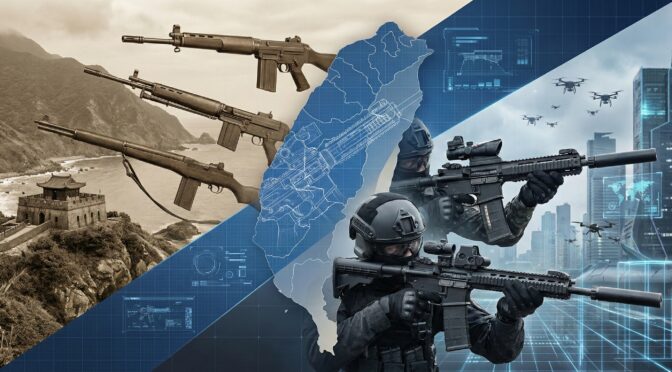
The Republic of China (ROC)/Taiwanese Armed Forces are currently navigating one of the most significant periods of modernization in the nation’s history, moving from a legacy of Western surplus toward a sophisticated “porcupine” defense posture characterized by indigenous technological advancement and specialized procurement. At the tactical level, this shift is manifested through the comprehensive overhaul of the small arms inventory across all service branches. The cornerstone of this transformation is the transition from the T91 combat rifle to the newly unveiled T112 assault rifle, a platform designed by the 205th Armory to address the specific ballistic and ergonomic requirements of modern, high-intensity urban and coastal warfare.1

The Republic of China Army (ROCA) has initiated a massive procurement cycle for over 86,000 T112 rifles, prioritizing enhanced barrel longevity and precision optics to offset the numerical advantages of the People’s Liberation Army (PLA).3 Simultaneously, the Republic of China Marine Corps (ROCMC) has leveraged Foreign Military Financing (FMF) to integrate U.S.-made M4A1 carbines for its newly formed security battalions, ensuring the protection of critical mobile missile assets like the Harpoon and Stinger systems.5 The Military Police (ROCMP) have doubled their manpower in key sectors to counter “decapitation” threats, equipping specialized units with high-performance submachine guns and anti-drone technologies.7

This report analyzes the technical specifications, doctrinal integration, and strategic rationale behind the small arms utilized by the Army, Navy, Marine Corps, Air Force, and Military Police. It details the role of the 205th Armory as the engine of self-sufficiency and explores the development of specialized equipment—including multi-caliber sniper systems and new ceramic-polyethylene body armor designed to defeat PLA 5.8x42mm steel-core ammunition.9 Through dense technical analysis and intelligence-driven insights, this document provides an exhaustive overview of the individual weaponry that forms the final, critical layer of Taiwan’s multi-domain defense.

PRC, POC and Taiwan: The term PRC refers to the People’s Republic of China, the communist government established in 1949 that governs mainland China. The ROC, or Republic of China, is the government that retreated to Taiwan in 1949 and continues to exercise jurisdiction over the island and its smaller territories. In modern diplomatic and everyday language, Taiwan is the common name used to describe the ROC, though its official status remains a subject of international sensitivity. Distinguishing between these terms is essential for navigating the complex political history and competing sovereignty claims involving the two sides of the Taiwan Strait. Click here to read more at the BBC.

The Geopolitical and Strategic Context of Small Arms Proliferation

The defense of Taiwan is predicated on the “Overall Defense Concept” (ODC), which emphasizes asymmetric warfare to deny an adversary the ability to achieve a rapid, decisive victory.10 Within this context, small arms are no longer viewed merely as secondary equipment but as essential tools for the decentralized, mobile units required to survive and fight in a contested information environment. The transition back to a one-year compulsory service period in 2024 underscores the need for a conscript force that is proficient in high-tech individual weaponry.12

The intelligence community observes that small arms procurement in Taiwan is currently bifurcated between two objectives: standardizing the general-purpose force with robust, indigenous platforms and equipping elite “counter-decapitation” units with specialized foreign systems.8 This dual-track approach ensures logistical sustainability through the 205th Armory while providing specialized units with the edge required for high-stakes urban interventions.

The 205th Armory: The Engine of Indigenous Capability

The 205th Armory of the Armaments Bureau serves as the primary research, development, and production hub for Taiwan’s small arms. Located in Kaohsiung, the armory’s strategic mission has evolved from licensed production to independent design, focusing on optimizing firearms for the unique environmental and tactical constraints of the Taiwan Strait.1

Historical Evolution and the Shift to 5.56mm NATO

The history of the 205th Armory reflects Taiwan’s broader strategic shift. After decades of relying on the .30-06 M1 Garand and the 7.62x51mm T57 (M14), the armory recognized the need for a lighter, higher-velocity cartridge suited for the rapid engagements of modern combat. The resulting T65 series was the first indigenous 5,56x45mm platform, blending the short-stroke gas piston system of the AR-18 with the ergonomics of the M16.15

Technical Progress and Current Manufacturing Capabilities

Today, the 205th Armory operates with high-precision CNC machinery and advanced metallurgical processes. The development of the T91 in the early 2000s marked a milestone in modularity, but the T112 represents a breakthrough in material science, particularly regarding barrel life and heat dissipation.1 The armory is also experimenting with new finishes, such as nickel-boron for bolt carriers, which allow for thousands of rounds to be fired without lubrication—a critical feature for sustained combat in the humid, salt-laden air of Taiwan’s coast.17

Republic of China Army (ROCA): Force-Wide Modernization

The ROCA is the largest user of small arms in the nation and is currently the focus of the T112 rollout. The procurement of 86,114 T112 rifles between 2025 and 2029 is a clear signal that the Army is prioritizing individual lethality as a deterrent.2

The T91 Combat Rifle: Current Operational Status

The T91 remains the most common rifle in active service. Developed from the T86 carbine, it utilizes a modular gas piston system that prevents fouling from entering the receiver, a design choice that has made it one of the most reliable mm platforms in its class.18 The T91’s 16-inch barrel and telescoping stock provide the mobility required for motorized infantry and urban operations.

The T112 Assault Rifle: Technical Deep-Dive

The T112, first unveiled as the XT112 in 2023, incorporates several features that significantly improve upon the T91. Its polygonal rifling provides a better gas seal behind the projectile, increasing muzzle velocity and extending barrel life to 10,000 rounds.1

FeatureT91 Combat RifleT112 Assault Rifle
Caliber5.56x45mm NATO5.56x45mm NATO 1
ActionShort-stroke pistonShort-stroke piston 1
Barrel Life6,000 rounds10,000 rounds 2
Accuracy (100m)14 cm spread9.8 cm spread 2
Effective Range400 m600 m 19
Select FireS, 1, 3, AS, 1, 2, A 2
Upper ReceiverM1913 RailFull-length M-LOK 1

The change from a three-round burst to a two-round burst on the T112 is a direct result of intelligence gathered from global combat theaters, which suggests that the second round in a burst is the most likely to achieve a follow-up hit, while the third often misses due to muzzle climb.2

Sniper Systems and Precision Fires

The ROCA has invested heavily in its marksman program, utilizing both indigenous and foreign systems. The T93 sniper rifle, patterned after the M24 Sniper Weapon System, is the standard for battalion-level sharpshooters. It features a floated barrel and an adjustable stock redesigned for Taiwanese soldier ergonomics.20

For anti-materiel roles, the Army utilizes the Barrett M107A1. This .50 BMG semi-automatic rifle allows teams to interdict enemy radar, light armored vehicles, and command structures at ranges up to 2,000 meters.13 The kinetic energy of the .50 BMG round (12.7x99mm) can be calculated as:

Black screen.

Where a standard 700-grain (45.36g) projectile traveling at 853 m/s generates approximately 16,500 Joules of energy, providing the destructive force necessary for asymmetric interdiction.21

Republic of China Marine Corps (ROCMC): Amphibious and Security Evolution

The ROCMC occupies a unique position as Taiwan’s primary counter-landing force. Its small arms procurement reflects the need for weapons that can withstand amphibious operations and provide high-volume fire during the defense of beachheads.22

The Transition to the M4A1 in Security Battalions

A significant intelligence update in late 2024 revealed that the Marine Corps’ First Security Battalion—established on November 14, 2024—has fully transitioned to the U.S.-made M4A1 carbine.5 This unit is responsible for the ground security of land-based mobile missile crews, such as those operating the Harpoon Coastal Defense System. The use of the M4A1, likely acquired via FMF, provides these security teams with a compact, standardized platform that is highly compatible with the ACOGs and laser aiming modules required for night-time security patrols.5

Marine Corps Specialized Small Arms Summary

ModelCategoryOriginUsage Note
M4A1CarbineUSAFirst Security Battalion 5
T91Assault RifleTaiwanStandard Marine Brigades 22
SIG MPXSMGUSAMarine Special Service Company 22
T75 LMGSAWTaiwanSquad-level fire support 25
AXMC / AX50SniperUKSpecial Forces precision fire 26
SSG-2000SniperSwitzerlandHigh-precision maritime marksman 27

Anti-Armor Integration

The ROCMC is also tasked with the initial defense against PLA amphibious armor. To this end, individual Marines are equipped with the Kestrel rocket launcher, a domestically developed 66mm disposable weapon designed for urban and anti-landing use.22 The Kestrel supplements the more powerful FGM-148 Javelin and BGM-71 TOW-2B systems, providing a layered anti-armor capability at the squad level.22

Republic of China Military Police (ROCMP): Counter-Decapitation Doctrine

The Military Police have seen a dramatic expansion in their strategic role. As the threat of PLA “decapitation” strikes—designed to eliminate leadership and disrupt command and control—has increased, the MP Command has responded by nearly doubling the manpower of the 202nd Command in Taipei.8

The Night Hawks: Military Police Special Services Company (MPSSC)

The MPSSC is Taiwan’s premier urban counter-terrorism and leadership protection unit. Their equipment is optimized for high-speed, close-quarters engagements. The MPSSC utilizes the Centurion Arms CM4, a high-end AR-15 derivative, as well as the Colt 9mm SMG and various Glock models.7

MPSSC Specialized Equipment

The MPSSC also operates specialized non-projectile anti-drone weapons to protect government buildings from small, commercial drones that could be used for reconnaissance or as improvised explosive devices.7 The integration of the T112 into Military Police units starting in 2025 will provide a significant upgrade in terms of integrated optics and night-vision compatibility.8

Republic of China Air Force (ROCAF) Ground Defense

The ROCAF’s ground component, the Air Defense and Missile Command, is responsible for the security of critical airbases and missile sites. These locations are high-priority targets for PLA special operations forces and airborne units.

Security of the Air Defense Umbrella

Ground units protecting Patriot PAC-3 and Sky Bow batteries have traditionally used the T65K2, but are now rapidly adopting the T91 to ensure tactical parity with the Army.15 The use of the T91, with its modular rails, allows these security units to mount thermal optics—essential for detecting intruders in the perimeter of a missile site at night.18

ROCAF Ground Security Arms Inventory

PlatformRoleCartridgeStatus
T91Standard Security5.56x45mmActive 30
T65K2Reserve Security5.56x45mmPhase-out 15
T75 LMGBase Defense5.56x45mmActive 25
T-75 CannonPerimeter AA/Ground20mmActive 31

Republic of China Navy (ROCN) Security and Vessel Protection

The ROCN’s small arms usage is divided between vessel-mounted systems for anti-personnel defense and ground security units protecting naval ports and dry docks.

Vessel Defense Systems

On major surface combatants and missile corvettes, the T75 light machine gun and T74 general-purpose machine gun are frequently mounted on pintle mounts for defense against “gray zone” incursions and small boat threats.25 The T75, based on the FN Minimi, provides a high rate of fire (up to 900 RPM) while being light enough for rapid deployment across a ship’s deck.25

Underwater Demolition Company (UDC)

The ROCN UDC, equivalent to the U.S. Navy SEALs, maintains an inventory of suppressed weapons and maritime-optimized carbines. These include the MP5A5 and specialized variants of the T91 with corrosion-resistant coatings.13 The UDC’s role in counter-sabotage and maritime reconnaissance requires a high degree of proficiency in both short-range SMGs and long-range precision rifles.

Special Operations Forces (SOF): The Specialized Arsenal

Taiwan’s Special Operations Forces, including the Army’s Aviation and Special Forces Command, represent the most technologically advanced segment of the military’s small arms users. These units often act as a testbed for new technologies before they are rolled out to the wider force.13

Precision Sniper Inventory

The diversity of the SOF sniper inventory is extensive, reflecting the multi-mission requirements of unconventional warfare.

ModelCaliberOriginPrimary Role
Accuracy International AXMCMulti-caliberUKMulti-mission precision 26
Sako TRG-227.62x51mmFinlandHigh-precision marksman 20
DSR-1 .308 WinGermanyBullpup urban sniper 13
HK PSG17.62x51mmGermanyCounter-terrorism / Semi-auto 13
Barrett M82A1 .50 BMGUSALong-range anti-materiel 30

The AXMC is particularly valued for its modularity, allowing operators to switch barrels between .338 Lapua Magnum and 7.62mm NATO depending on the mission’s range requirements.26

Submachine Guns and PDWs for Special Operations

For high-speed urban operations, SOF units utilize the FN P90 and the SIG Sauer MPX. The P90’s 5.7x28mm cartridge is designed specifically to penetrate soft body armor, making it an ideal choice for engagements with enemy special operations personnel who may be wearing lightweight protection.13

Ammunition, Optics, and Ballistic Protection

A firearm’s effectiveness is defined by its ammunition and the operator’s ability to hit a target. Taiwan has made significant strides in these “enabling” technologies, moving toward a more lethal and survivable force.3

Ammunition Types: TC74 and TC79

The 205th Armory produces several specialized 5.56mm rounds. The TC74 is an armor-piercing (AP) round with a hardened steel penetrator, designed to defeat light vehicles and personal armor at extended ranges.25 The TC79 is a tracer round used for target marking and fire correction during night-time engagements.25

The ESAPI Armor Program

A critical intelligence development in 2024 was the mass production of new ballistic plates designed specifically to counter the PLA’s 5.8x42mm round.3 These plates utilize a hybrid ceramic and polyethylene fiber construction. The 5.8mm DBP87 round fired by the PLA’s QBZ-95 is known for its high sectional density and penetration capabilities. The new Taiwanese plates, tested to U.S. ESAPI standards, are a direct response to this threat, ensuring that individual soldiers have a higher probability of surviving hits from standard PLA service rifles.9

Optics and Night Vision

The T112 procurement includes a massive investment in optical sights. For the first time, frontline infantry units will be issued with 4x magnified optics and red dot sights as standard equipment.3 This transition is designed to significantly increase the “first-round hit probability” (Ph), a critical metric in asymmetric defense where ammunition supplies may be limited.

Blank image. No content displayed.

Where the hit probability is the integral of the shot distribution function over the target area. By providing optics, the ROC Armed Forces are narrowing the variance in their shot distribution, effectively increasing the lethality of each individual soldier.4

Machine Guns and Support Weapons: The Foundation of the Squad

Taiwanese squad doctrine relies heavily on the “base of fire” provided by light and general-purpose machine guns. The 205th Armory has focused on ensuring these weapons are both reliable and locally sustainable.

The T75 Light Machine Gun (LMG)

The T75 LMG is a 5.56mm weapon that can be fed by 200-round disintegrating belts or standard 30-round STANAG magazines.25 This dual-feed capability is essential in the chaos of a coastal defense mission, where a gunner might need to borrow a magazine from a rifleman if belt ammunition is depleted. The T75 also utilizes a modified bipod and a shorter barrel variant for special forces (T75 SFAW), making it a highly versatile platform.25

The T74 General Purpose Machine Gun (GPMG)

The T74 is the standard 7.62x51mm machine gun for the ROC Armed Forces. It is heavily based on the FN MAG, one of the most successful GPMG designs in history. It is used in the infantry support role, mounted on CM-32/33 Clouded Leopard armored vehicles, and deployed in static defensive positions along the coastline.16

Support WeaponCaliberROF (RPM)Primary Role
T75 LMG5.56x45mm600 – 900Squad Automatic 25
T74 GPMG7.62x51mm650 – 1,000Platoon Fire Support 16
M2HB .50 BMG450 – 600Anti-personnel / Light Armor 33
Mk 1940mm325 – 375Area Suppression 22

Anti-Armor and MANPADS: The Individual’s Strategic Reach

In an asymmetric conflict, individual soldiers must be able to threaten high-value targets, including tanks and aircraft. The proliferation of man-portable systems has given the Taiwanese infantryman a reach that was previously reserved for heavy platforms.

The Stinger Missile and Harpoon Protection

The procurement of over 500 FIM-92 Stinger missiles—and the subsequent interest in 2,000 more—reflects the importance of Man-Portable Air Defense Systems (MANPADS).34 These systems are distributed among Army and Marine units to provide localized air defense against PLA helicopters and drones. The Marine Corps’ security battalions, equipped with M4A1s, are specifically tasked with protecting the mobile crews that operate these missiles, as well as the Harpoon coastal defense batteries.5

Javelin and Kestrel: Layered Anti-Armor

The ROC Armed Forces utilize the FGM-148 Javelin for long-range, top-attack interdiction of PLA main battle tanks. This is supplemented by the Kestrel, which provides every squad with the ability to engage light armor and fortified positions.22 The intelligence suggests that in a scenario where command and control is degraded, these man-portable systems allow small, autonomous units to continue inflicting high costs on an invading force.10

Strategic Challenges: The Backlog and Domestic Production

The U.S. arms sale backlog to Taiwan, currently valued at over $21 billion, has created significant strategic anxiety.34 While high-ticket items like F-16 Block 70 fighters and AGM-154C JSOWs have faced delays due to manufacturing bottlenecks, the small arms sector has been less affected thanks to the 205th Armory.34

The Role of Domestic Ammunition Production

The ability to produce millions of rounds of small arms ammunition domestically is a key strategic advantage. During the 2024-2025 period, there have been discussions in the Legislative Yuan about further amending the National Defense Act to allow for joint ventures with U.S. companies to produce 155mm shells and specialized small arms ammunition.37 This would not only secure Taiwan’s own supply but potentially offer a regional hub for U.S. requirements in the Asia-Pacific.37

Economic vs. Strategic Costs

Defense Minister Wellington Koo has cautioned that domestic production of even simple munitions can sometimes involve higher per-unit costs than overseas purchases.37 However, from an intelligence perspective, the “sovereignty premium”—the extra cost paid to ensure a secure, uninterruptible supply of ammunition—is considered a necessary expense for a nation facing potential blockade.14

Future Horizons: The 6.8mm Transition and AI Integration

The ROC Armed Forces are actively monitoring the U.S. Army’s transition to the 6.8x51mm NGSW program. In late 2024, it was announced that the 205th Armory has begun developing its own 6.8mm caliber rifle, with prototypes expected for evaluation in 2025.3

The 6.8mm Rationale

The shift to 6.8mm is driven by the increasing prevalence of advanced body armor, which can often defeat 5.56mm rounds at medium ranges. A 6.8mm projectile offers superior ballistic coefficients and terminal energy, allowing for effective engagements at ranges that exceed the capabilities of current 5.56mm platforms.

AI and Unmanned Systems Integration

The “All-Out Defense” strategy increasingly integrates small arms with unmanned systems. Units are being trained to use loitering munitions, such as the Switchblade 300 and the indigenous Chien Feng, alongside their traditional firearms.38 The goal is to provide a “system of systems” where a single soldier can act as a sensor and a shooter, utilizing a tablet to coordinate drone strikes while providing overwatch with a T112 rifle.11

Conclusion: Strategic Synthesis

The small arms inventory of the Republic of China Armed Forces is undergoing a profound metamorphosis. The transition from legacy platforms to the T112 represents more than a hardware upgrade; it is a fundamental shift toward a professionalized, optics-enabled, and domestically sustained force. By integrating specialized foreign systems for elite units and standardizing the general force with high-quality indigenous designs, Taiwan is building a layered defense that is both logistically viable and tactically formidable.

The role of the 205th Armory remains paramount. As the primary engine of Taiwan’s defense self-sufficiency, its ability to innovate—whether through the development of polygonal rifling or the transition to 6.8mm ballistics—ensures that the nation’s individual defenders remain lethal against an evolving threat. The strategic focus on “counter-decapitation” and the protection of critical asymmetric assets through specialized security battalions indicates a sophisticated understanding of the modern battlefield.

While the $21 billion backlog in major systems remains a concern, the revitalization of the individual soldier’s gear provides a vital, immediate enhancement to Taiwan’s deterrent posture. In the final analysis, the “porcupine strategy” is only as effective as the quills it possesses; through the modernization programs detailed in this report, those quills are becoming sharper, more resilient, and more numerous than ever before.


Please share the link on Facebook, Forums, with colleagues, etc. Your support is much appreciated and if you have any feedback, please email us in**@*********ps.com. If you’d like to request a report or order a reprint, please click here for the corresponding page to open in new tab.


Sources Used

  1. T112 assault rifle – Wikipedia, accessed January 31, 2026, https://en.wikipedia.org/wiki/T112_assault_rifle
  2. Taiwan unveils upgraded T112 assault rifle – TVC News, accessed January 31, 2026, https://www.tvcnews.tv/taiwan-unveils-upgraded-t112-assault-rifle-amid-escalating-tensions-with-china/
  3. Taiwan Army to receive over 80000 T112 rifles in 2025, accessed January 31, 2026, https://taiwannews.com.tw/news/5938399
  4. Military proposes budget for new T112 rifles – Taipei Times, accessed January 31, 2026, https://www.taipeitimes.com/News/front/archives/2025/10/17/2003845613
  5. Taiwan Marine Corps’ new unit equipped with U.S.-made M4A1 rifles: Source – OCAC.R.O.C.(TAIWAN) – News, accessed January 31, 2026, https://www.ocac.gov.tw/OCAC/Pages/Detail.aspx?nodeid=329&pid=82821654
  6. Taiwan Marine Corps’ new unit equipped with U.S.-made M4A1 rifles: Source, accessed January 31, 2026, https://focustaiwan.tw/politics/202601110004
  7. Republic of China Military Police Special Services Company – Wikipedia, accessed January 31, 2026, https://en.wikipedia.org/wiki/Republic_of_China_Military_Police_Special_Services_Company
  8. Taiwan boosts military police force to counter decapitation threats | Taiwan News | Jan. 18, 2026 14:51, accessed January 31, 2026, https://taiwannews.com.tw/en/news/6284891
  9. New capabilities of T112 rifles showcased – Taipei Times, accessed January 31, 2026, https://www.taipeitimes.com/News/front/archives/2024/10/10/2003825055
  10. The Porcupine Strategy: Taiwan’s Road to Self-Defense – chinaobservers, accessed January 31, 2026, https://chinaobservers.eu/the-porcupine-strategy-taiwans-road-to-self-defense/
  11. UNDERSTANDING CHINA’S ACTIVE-DEFENCE STRATEGY — IMPLICATIONS FOR INDIA AND TAIWAN – National Maritime Foundation, accessed January 31, 2026, https://maritimeindia.org/understanding-chinas-active-defence-strategy-implications-for-india-and-taiwan/
  12. Republic of China Armed Forces – Wikipedia, accessed January 31, 2026, https://en.wikipedia.org/wiki/Republic_of_China_Armed_Forces
  13. List of equipment of the Republic of China Army – Wikipedia, accessed January 31, 2026, https://en.wikipedia.org/wiki/List_of_equipment_of_the_Republic_of_China_Army
  14. Taiwan’s indigenous solutions for national defence – East Asia Forum, accessed January 31, 2026, https://eastasiaforum.org/2024/05/22/taiwans-indigenous-solutions-for-national-defence/
  15. T65 assault rifle – Wikipedia, accessed January 31, 2026, https://en.wikipedia.org/wiki/T65_assault_rifle
  16. T65 assault rifle – Military Wiki – Fandom, accessed January 31, 2026, https://military-history.fandom.com/wiki/T65_assault_rifle
  17. T91 assault rifle – ZambiaWiki – ZambiaFiles, accessed January 31, 2026, https://www.zambiafiles.com/wiki/T91_assault_rifle
  18. T91 assault rifle – Military Wiki – Fandom, accessed January 31, 2026, https://military-history.fandom.com/wiki/T91_assault_rifle
  19. Journalists test Taiwan’s new T112 rifle|Taiwan News – YouTube, accessed January 31, 2026, https://www.youtube.com/watch?v=AjN99GNkx7w
  20. T93 sniper rifle – Wikipedia, accessed January 31, 2026, https://en.wikipedia.org/wiki/T93_sniper_rifle
  21. M107 .50 caliber Sniper Rifle – LRSR – Military.com, accessed January 31, 2026, https://www.military.com/equipment/m107-50-caliber-sniper-rifle-lrsr
  22. Republic of China Marine Corps | Military Wiki | Fandom, accessed January 31, 2026, https://military-history.fandom.com/wiki/Republic_of_China_Marine_Corps
  23. Republic of China Marine Corps – Wikipedia, accessed January 31, 2026, https://en.wikipedia.org/wiki/Republic_of_China_Marine_Corps#Equipment
  24. Taiwan Marine Corps unit armed with US-made M4A1 rifles | Taiwan News | Jan. 12, 2026 15:29, accessed January 31, 2026, https://www.taiwannews.com.tw/news/6280765
  25. T75 light machine gun – Wikipedia, accessed January 31, 2026, https://en.wikipedia.org/wiki/T75_light_machine_gun
  26. The AXMC and AX50 sniper rifles used by Taiwan Marine Corps Special Forces (I’m not sure which one the preview image is) : r/ForgottenWeapons – Reddit, accessed January 31, 2026, https://www.reddit.com/r/ForgottenWeapons/comments/1idl8uo/the_axmc_and_ax50_sniper_rifles_used_by_taiwan/
  27. The SIG SSG2000 sniper rifle used by the Kaohsiung City Police Department SWAT in Taiwan (for some reason, there is not much information about the SSG2000 on the Internet) : r/ForgottenWeapons – Reddit, accessed January 31, 2026, https://www.reddit.com/r/ForgottenWeapons/comments/1lrjzc3/the_sig_ssg2000_sniper_rifle_used_by_the/
  28. Equipment used by the Taiwan Military Police Special Service in 1991 (mini Uzi/M16A1/Glock/1911) : r/ForgottenWeapons – Reddit, accessed January 31, 2026, https://www.reddit.com/r/ForgottenWeapons/comments/1ebujr5/equipment_used_by_the_taiwan_military_police/
  29. T112 Rifle to Replace T91 for Taiwan Armed Forces What You Need to Know – YouTube, accessed January 31, 2026, https://www.youtube.com/watch?v=gLsltzCDzEo
  30. List of equipment of the Republic of China Army | Military Wiki – Fandom, accessed January 31, 2026, https://military-history.fandom.com/wiki/List_of_equipment_of_the_Republic_of_China_Army
  31. Republic of China Air Force – Wikipedia, accessed January 31, 2026, https://en.wikipedia.org/wiki/Republic_of_China_Air_Force
  32. Sniper rifles used by Taiwan’s NSB snipers in October 2025. : r/ForgottenWeapons – Reddit, accessed January 31, 2026, https://www.reddit.com/r/ForgottenWeapons/comments/1o2rpee/sniper_rifles_used_by_taiwans_nsb_snipers_in/
  33. T75 Taiwanese 5.56mm Light Machine Gun – ODIN, accessed January 31, 2026, https://odin.tradoc.army.mil/WEG/Asset/d3b8969543b7c45e9a9391f262b0ad40
  34. Arms Sale Backlog – Taiwan Security Monitor, accessed January 31, 2026, https://tsm.schar.gmu.edu/wp-content/uploads/2025/06/Taiwan-Arms-Backlog-Data_April-2025-2.xlsx
  35. How Much Equipment Did the U.S. Deliver to the Republic of China Armed Forces in 2025?, accessed January 31, 2026, https://militarywatchmagazine.com/article/how-much-equipment-us-deliver-republic-china-2025
  36. Taiwan Arms Sale Backlog, November 2025 Update, accessed January 31, 2026, https://tsm.schar.gmu.edu/taiwan-arms-sale-backlog-november-2025-update/
  37. EDITORIAL: Expanding domestic arms production – Taipei Times, accessed January 31, 2026, https://www.taipeitimes.com/News/editorials/archives/2026/01/15/2003850613
  38. At Taiwan arms show, vendors bank on cheap weapons for big damage – Defense News, accessed January 31, 2026, https://www.defensenews.com/global/asia-pacific/2025/09/19/at-taiwan-arms-show-vendors-bank-on-cheap-weapons-for-big-damage/
  39. Taiwan Arms Sale Backlog, August 2025 Update, accessed January 31, 2026, https://tsm.schar.gmu.edu/taiwan-arms-sale-backlog-august-2025-update-altius-deliveries-and-2026-delivery-schedules/

Why China Hesitates to Invade Taiwan: Historical and Strategic Insights

The persistent autonomy of Taiwan remains the most significant unresolved legacy of the Chinese Civil War and a central tension in the contemporary international order. For over seven decades, the People’s Republic of China (PRC) has maintained that the “reunification” of the island is an inevitable historical necessity, yet it has never attempted a full-scale military invasion. This strategic holding back is not the result of a single deterrent but emerges from a complex, evolving matrix of military limitations, geographic barriers, economic interdependencies, and shifting geopolitical alignments. From the perspective of national security, foreign affairs, and intelligence analysts, the absence of a cross-Strait conflict is a testament to an elaborate architecture of deterrence that has successfully balanced China’s ideological ambitions against the catastrophic risks of failure. Understanding why China has never acted—and why it continues to exercise restraint despite rising tensions—requires a granular examination of historical impediments, current operational challenges, and the internal political calculus of the Chinese Communist Party (CCP).

The Historical Anomaly: Foundations of Failure and Early Constraints

The question of why China has “never” taken Taiwan back begins with the immediate aftermath of the CCP’s victory on the mainland in 1949. At the conclusion of the Chinese Civil War, the People’s Liberation Army (PLA) was a formidable land force but lacked the rudimentary naval and aerial assets required to project power across the 100-mile-wide Taiwan Strait.1 While the Nationalist Government under Chiang Kai-shek had fled to the island in a state of disarray, the PRC was similarly exhausted and possessed no specialized amphibious landing craft or long-range transport vessels.

The initial failure was largely a matter of timing and global geopolitical shifts. In early 1950, the Truman administration in the United States had signaled a posture of non-intervention, famously excluding Taiwan from the U.S. “defense perimeter” in the Western Pacific.1 However, the outbreak of the Korean War in June 1950 fundamentally altered the strategic landscape. Fearful that the conflict would expand and threaten the security of the Pacific, the United States deployed its Seventh Fleet to the Taiwan Strait to “neutralize” the waterway.1 This intervention effectively froze the conflict, forcing Mao Zedong to divert the massive invasion force gathered in Fujian province to the Korean front, where they would eventually engage U.S. forces in a bloody stalemate.2

The Era of Cold War Stalemate

Throughout the 1950s and 1960s, China’s ability to “take back” Taiwan was constrained by a formal U.S. security umbrella. The 1954 Sino-American Mutual Defense Treaty and the subsequent 1955 Formosa Resolution granted the U.S. President broad authority to use military force to defend the Republic of China (ROC).2 These documents were not mere rhetorical gestures; they were backed by the deployment of nuclear-capable assets and a permanent naval presence that the fledgling PLA Navy could not hope to challenge.1

Historical PeriodPrimary Strategic ConstraintPLA Capability LevelU.S. Policy Posture
1949–1950Lack of naval transport/air coverPrimitive amphibious capacityInitial non-intervention/disengagement 2
1950–1954Korean War/Seventh Fleet deploymentDiverted to land-based theaterStrategic containment 1
1954–1979U.S. Mutual Defense TreatyCoastal artillery/limited patrolFormal alliance with ROC 4
1979–1995Normalization and Economic ReformFocus on internal developmentStrategic Ambiguity (TRA) 6
1995–1996Third Strait Crisis/U.S. Carrier presenceEarly modernization/Missile testsActive deterrence/Carrier deployment 7

The two major crises of this era—the First (1954–1955) and Second (1958) Taiwan Strait Crises—demonstrated the PRC’s limited options. In both instances, the PLA resorted to heavy artillery bombardment of offshore islands like Jinmen (Quemoy) and Mazu but stopped short of an assault on Taiwan itself.2 These operations were intended as political signals and tests of U.S. resolve rather than serious attempts at territorial conquest. The CCP leadership understood that any attempt to cross the Strait would likely result in the total destruction of their nascent navy and possibly a nuclear exchange with the United States.2

The Diplomatic Architecture of Constraint: 1979 to the Present

The nature of the restraint shifted fundamentally in 1979 when the United States normalized relations with the PRC and terminated its formal defense treaty with Taiwan. To maintain regional stability, the U.S. Congress passed the Taiwan Relations Act (TRA), which replaced the formal alliance with a policy of “Strategic Ambiguity”.4 This framework was designed to deter Beijing from using force while simultaneously discouraging Taipei from declaring formal independence.5

The TRA established several critical barriers to invasion that persist to this day. It mandated that the United States provide Taiwan with “arms of a defensive character” and declared that any effort to determine Taiwan’s future by other than peaceful means would be a threat to the peace and security of the Western Pacific and of “grave concern” to the U.S..4 This created a “Goldilocks zone” of stability: China knew that an invasion would likely trigger a U.S. response, but it also knew that as long as Taiwan did not declare independence, it could focus on internal economic development without facing a permanent loss of the island.5

The 1996 Watershed and Modernization

The Third Taiwan Strait Crisis (1995–1996) served as a modern catalyst for China’s ongoing military modernization. Triggered by a visit of Taiwanese President Lee Teng-hui to the United States, the PRC conducted large-scale missile tests in the waters surrounding Taiwan to intimidate the electorate.3 The U.S. response—the deployment of two aircraft carrier strike groups, the USS Nimitz and the USS Independence—was a humiliating reminder of China’s military inferiority.1

Intelligence analysts suggest that this crisis convinced the CCP that it could never truly “resolve” the Taiwan issue until it possessed the capability to deny the U.S. Navy access to the Western Pacific.12 Since then, China has embarked on a decades-long modernization program focused on Anti-Access/Area Denial (A2/AD) systems, including quiet submarines, long-range anti-ship missiles, and advanced cyberwarfare capabilities.8 Yet, despite this massive buildup, the PLA continues to hold back, as the risks of failure remain prohibitively high.

Geographic Determinism: Why Terrain Favors the Defender

One of the most underappreciated reasons why China has never invaded is the sheer physical difficulty of the task. An invasion of Taiwan would likely be the largest and most complex military operation in human history, exceeding the difficulty of the 1944 D-Day landings.9 The geography of the Taiwan Strait and the island itself serves as a natural fortress.

The Taiwan Strait is a perilous environment for amphibious operations. It is roughly 70 to 110 nautical miles wide and subject to extreme weather, including typhoons and high seas, which limit the viable windows for an invasion to just two small periods each year (roughly April and October).1 Crossing this “moat” requires thousands of vessels that would be highly visible to modern satellite and aerial reconnaissance weeks before an attack began, eliminating the possibility of tactical surprise.9

The Barrier of the “Red Beaches” and the Rice Paddy Problem

Taiwan’s 770-mile-long coastline is remarkably unsuited for amphibious landings. Only a small number of “red beaches” are capable of supporting the heavy armor and high volumes of troops required for an invasion.9 These few viable landing sites are heavily fortified and backed by challenging terrain.

The western coast, where the most suitable beaches are located, is dominated by dense urban centers or vast, marshy rice paddies.9 Modern military vehicles, essential for a rapid breakout from a beachhead, cannot operate effectively in these flooded fields; they become mired in the mud (“tanks don’t go where the cattails grow”).9 This forces invading armor onto elevated highways and narrow surface roads, where they become easy targets for roadblocks, ambushes, and precision-guided munitions.9 Furthermore, if the lead vehicle in a column is destroyed, the rest of the unit is effectively trapped with no room to maneuver or bypass the wreckage.9

Terrain FeatureTactical Challenge for PLADefensive Advantage for Taiwan
Taiwan Strait (70–110nm)Perilous weather/High visibilityEarly warning/Missile interdiction 13
770-mile CoastlineLimited “Red Beaches”Concentrated coastal fortifications 9
Western Rice PaddiesMud/Inability to maneuver armorChanneling attackers onto highways 9
Central Mountain RangeHigh-altitude, rugged terrainNatural cover for guerrilla/protracted war 9
Dense Urban AreasHigh-casualty street fighting“Costly endeavor” for occupiers 9

The Amphibious Deficit: Sealift Capacity and Civilian Integration

Intelligence assessments consistently highlight a critical gap in the PLA’s ability to take Taiwan: a massive shortfall in organic sealift capacity. While the PLA Navy (PLAN) has expanded rapidly, its dedicated amphibious fleet is currently estimated to have the capacity to move only about 20,000 to 60,000 troops simultaneously. A successful invasion of a defended island of 23 million people would likely require between 300,000 and over one million troops in multiple waves of landings.

To bridge this “gap,” the PLA has increasingly experimented with the use of civilian vessels. In 2025, exercises featured civilian roll-on/roll-off (RORO) ferries and deck cargo ships unloading military vehicles directly onto beaches using specialized temporary pier systems and extendable bridge barges.16 However, national security analysts point out that these civilian platforms are highly vulnerable “soft targets.” They lack the structural hardening, damage control, and defensive systems of naval vessels, making them easy prey for Taiwan’s increasingly sophisticated arsenal of asymmetric weapons, such as swarming drones and mobile anti-ship missiles.16

The PLA’s reliance on civilian ships also introduces significant organizational friction. Coordinating a joint operation involving thousands of merchant sailors and diverse vessel types under combat conditions is a massive logistical challenge that has never been tested in a real-world conflict. If the initial wave of high-end naval assets were destroyed, the follow-on civilian waves would likely face unsustainable losses before even reaching the shore.16

Economic Interdependence and the “Silicon Shield”

For much of the 1980s through the 2010s, China was restrained by powerful economic incentives. This dynamic is often summarized by the “Silicon Shield”—the idea that Taiwan’s dominant role in the global semiconductor supply chain makes the costs of war prohibitively high for everyone, including Beijing.

Taiwan produces over 60 percent of the world’s semiconductors and over 90 percent of its most advanced logic chips. These components are the “brains” of the modern world, essential for everything from smartphones and automobiles to the most sophisticated artificial intelligence systems and military hardware.20 The Taiwan Semiconductor Manufacturing Company (TSMC) is not just a company; it is a strategic asset of global importance.

The Logic of Mutually Assured Economic Destruction (MAED)

The “Silicon Shield” acts as a deterrent because the facilities (fabs) required to produce these chips are incredibly fragile and integrated into a global supply chain that China cannot replicate or seize. In the event of a conflict, these fabs would likely be destroyed or rendered inoperable, either through physical combat, sabotage, or the evacuation of essential personnel to the United States or Europe.

The resulting disruption would trigger a global economic depression. Because China is more integrated into the global economy than any other major power—and is the world’s largest consumer of semiconductors—the impact on its own economy would be catastrophic. An invasion would not just mean a war with Taiwan and the United States; it would mean the total disruption of the global trade system that has fueled China’s “national rejuvenation” for four decades.

Chip Type/MarketTaiwan Market ShareGlobal SignificanceDeterrent Effect
All Semiconductors>60%Foundational to global GDPHigh; economic suicide to destroy 22
Advanced (<10nm)>90%Essential for AI/Defense/CloudAbsolute; no current alternatives 22
China’s Import Dependence~$400B/yearFuel for tech/manufacturing sectorRestrains aggressive decoupling 22

However, analysts warn that this shield is being eroded. As the United States pushes for “chip nationalism” and the onshoring of manufacturing (such as TSMC’s Arizona fabs), and as China pursues its “Digital China” strategy for self-sufficiency, the belief that “everyone loses” may slowly give way to a calculus where China believes it can weather the storm.

Xi Jinping’s Strategic Calculus: Why Hold Back Now?

If the historical and structural reasons for restraint are clear, the question of why China is holding back “now” is more complex. Under President Xi Jinping, China has become significantly more powerful and assertive. Xi has framed unification as a “core interest” that cannot be passed down from generation to generation and has reportedly instructed the PLA to be ready for a successful invasion by 2027.9

Despite this rhetoric, several immediate factors currently restrain Beijing as of January 2026:

1. The Risk of Military Failure and Regime Survival

The most potent restraint is the fear of failure. A failed invasion would be a humiliating and possibly career-ending experience for Xi Jinping and a potential existential threat to the CCP’s grip on power.8 For an army that has not fought a major war since 1979, an operation of this magnitude is a colossal gamble.8 The PLA’s military leadership and readiness have been called into question by a series of high-level purges continuing into late 2025 and January 2026, which saw the removal of senior generals within the Rocket Force and the Central Military Commission.26 These purges signal to the top leadership that internal reporting may be unreliable and that critical systems may be compromised by corruption.28

2. Economic Headwinds and Social Stability

China enters 2026 facing its own internal economic challenges, including a fragile property sector, high youth unemployment, and a declining population. The CCP’s legitimacy rests on its ability to deliver economic growth. A war over Taiwan would almost certainly trigger massive international sanctions, disrupt energy imports, and lead to domestic unrest. In the current environment, the leadership prioritizes regime stability over risky military adventurism.

3. The Failure of the “Hong Kong Model”

For years, Beijing hoped to “lure” Taiwan into unification using the “One Country, Two Systems” model.8 The 2020 clampdown in Hong Kong effectively killed this notion in Taiwan, uniting the Taiwanese public against any form of association with the mainland.8 With peaceful options failing, Beijing is forced to rely on coercion, yet it remains hesitant to pull the trigger because forced unification offers no clear path to a stable post-war Taiwan.26

Lessons from Modern Conflicts: Ukraine and the “Maduro” Factor

The PLA is a “learning military” that closely monitors global conflicts to refine its own doctrine. The ongoing war in Ukraine and the recent U.S. operations in Venezuela have provided critical “lessons learned” influencing China’s 2026 strategy.

The war in Ukraine has underscored the difficulty of a quick victory against a motivated defender supported by Western intelligence. Key takeaways for the PLA include:

  • The Drone Revolution: The effectiveness of cheap drones has led the PLA to accelerate its own drone carrier development, such as the Jiutian, which debuted in late 2025.19
  • Resilient Logistics: The failure of Russian logistics has prompted the PLA to invest in “intelligent” rail systems to protect sustainment lines.
  • C2 and Starlink: The role of Starlink has forced China to prioritize its own low-Earth orbit satellite constellations to prevent communication blackouts.

The Venezuela Lesson: Decapitation Operations

National security analysts have observed that China is taking operational lessons from the January 3, 2026 U.S. capture of former Venezuelan President Nicolas Maduro in Operation Absolute Resolve. The PRC has simulated “decapitation” strikes against Taiwan’s political leadership, believing that neutralizing key figures could lead to a collapse of resistance.32 However, the success of the U.S. surgical strike—which involved 150 aircraft and resulted in no U.S. deaths—highlights a technological gap between U.S. and Chinese precision capabilities, particularly against Taiwan’s U.S.-supplied air defenses.

Why They Don’t Give Up: The Ideology of National Rejuvenation

If the costs are so high and the risks so great, why does China not simply give up?

  1. Core National Interest: Taiwan is central to the CCP’s narrative of overturning the “Century of Humiliation”.5
  2. Geopolitical Imperative: Control of Taiwan would allow China to break the “First Island Chain,” giving the PLAN unrestricted access to the deep Pacific.15
  3. Ideological Threat: A successful, democratic Chinese society on Taiwan is a permanent challenge to the CCP’s authoritarian model.14

The Shift to Gray-Zone Coercion: Winning Without Fighting

Because the thresholds for an invasion are currently too high, China has pivoted to a strategy of “Gray-Zone” coercion designed to gradually erode Taiwan’s sovereignty.18

  • ADIZ and Median Line Violations: Frequent military sorties across the Taiwan Strait median line reached a peak during the “Justice Mission 2025” drills (late December 2025), where 130 PLA aircraft were detected in a single 24-hour period, with 90 crossing the median line.
  • Cognitive Warfare: China uses disinformation to polarize Taiwanese politics, exploiting recent constitutional crises and legislative gridlock.32
  • Undersea Cable Sabotage: Taiwan faced repeated incidents where cables were cut by Chinese-linked vessels, a test of the island’s communication redundancy.16
  • Salami-Slicing Sovereignty: The PLA flew a WZ-7 “Soaring Dragon” surveillance drone over Pratas (Dongsha) Island on January 17, 2026, the first such violation of territorial airspace in decades, designed to test Taiwan’s response limits.33
Gray-Zone TacticStrategic GoalImpact on Taiwan (2025–2026)
ADIZ/Median IncursionsForce fatigue/Erase buffers130 aircraft/90 crossings in 24 hrs
Cable CuttingCommunication vulnerabilityPeriodic internet/comms blackouts 16
Decapitation DrillsPsychological intimidation“Justice Mission 2025” exercises 32
Drone OverflightsNormalization of airspace violationWZ-7 flights over Pratas (Jan 2026) 33

Conclusion and Strategic Takeaways

The strategic stalemate in the Taiwan Strait is a result of a robust framework of deterrence. China has not invaded because the costs remain catastrophic. The “operational nightmare” of an amphibious assault, the “Silicon Shield,” and the certainty of international sanctions create a powerful incentive for patience.

Lessons for the Future

The lessons for 2026 are clear:

  1. Deterrence is Dynamic: Capability does not equal confidence. Internal purges in late 2025 highlight unresolved doubts about PLA readiness.28
  2. Geography is an Enduring Asset: Technology has not neutralized the defensive advantages of Taiwan’s terrain.9
  3. The “2027 Milestone” is a Capability Target: READY does not mean GO; the decision remains driven by Xi Jinping’s personal assessment of risk.13
  4. Gray-Zone Tactics are the Real Danger: The most probable scenario is a gradual collapse of political will through sustained gray-zone pressure rather than a “bolt from the blue” invasion.26

Please share the link on Facebook, Forums, with colleagues, etc. Your support is much appreciated and if you have any feedback, please email us in**@*********ps.com. If you’d like to request a report or order a reprint, please click here for the corresponding page to open in new tab.


Sources Used

  1. Crisis in the Taiwan Strait | Naval History – December 2024, Volume 38, Number 6, accessed January 31, 2026, https://www.usni.org/magazines/naval-history/2024/december/crisis-taiwan-strait
  2. The Taiwan Straits Crises: 1954–55 and 1958 – Office of the Historian, accessed January 31, 2026, https://history.state.gov/milestones/1953-1960/taiwan-strait-crises
  3. Taiwan Strait in the Shifting Geopolitical Landscape: Reviewing the Past, Paving the Path to Determine Better Future, accessed January 31, 2026, https://pacis.unpar.ac.id/can-money-buy-peoples-hearts-and-minds-review-of-cross-strait-economic-and-security-issues/
  4. Taiwan–United States relations – Wikipedia, accessed January 31, 2026, https://en.wikipedia.org/wiki/Taiwan%E2%80%93United_States_relations
  5. The Taiwan Strait Conflict – Origins osu.edu, accessed January 31, 2026, https://origins.osu.edu/read/taiwan-strait-conflict
  6. Taiwan: Relations with the United States – UK Parliament, accessed January 31, 2026, https://researchbriefings.files.parliament.uk/documents/CBP-9265/CBP-9265.pdf
  7. China’s Use of Force, 1950-96, and Taiwan – ResearchGate, accessed January 31, 2026, https://www.researchgate.net/publication/265897108_China’s_Use_of_Force_1950-96_and_Taiwan
  8. The Question Why Would China Not Invade Taiwan Now?, accessed January 31, 2026, https://www.armyupress.army.mil/Journals/Military-Review/English-Edition-Archives/September-October-2020/Wilsey-The-Question/
  9. Rethinking the Threat: Why China is Unlikely to Invade Taiwan …, accessed January 31, 2026, https://www.stimson.org/2025/rethinking-the-threat-why-china-is-unlikely-to-invade-taiwan/
  10. Taiwan Relations Act in a New Era of Security Cooperation, accessed January 31, 2026, https://www.fpri.org/article/2025/08/taiwan-relations-act-in-a-new-era-of-security-cooperation/
  11. Taiwan: Political and Security Issues – Congress.gov, accessed January 31, 2026, https://www.congress.gov/crs_external_products/IF/PDF/IF10275/IF10275.62.pdf
  12. TARGET TAIWAN: CHALLENGES FOR A US INTERVENTION | Defense Priorities, accessed January 31, 2026, https://www.defensepriorities.org/wp-content/uploads/2025/10/DEFP_Target_Taiwan_Challenges_for_a_US_intervention.pdf
  13. Report to Congress on Taiwan Defense, Military Issues – USNI News, accessed January 31, 2026, https://news.usni.org/2025/07/29/report-to-congress-on-taiwan-defense-military-issues-2
  14. Rethinking the Threat: Why China is Unlikely to Invade Taiwan | Stimson Center, accessed January 31, 2026, https://www.stimson.org/wp-content/uploads/2025/09/Taiwan-Invasion-Realities_PDF.pdf
  15. The Art of Protracted War: A Taiwanese Insurgency the Maoist Way and the US Department of Defense’s Role – Air University, accessed January 31, 2026, https://www.airuniversity.af.edu/JIPA/Display/Article/4169901/the-art-of-protracted-war-a-taiwanese-insurgency-the-maoist-way-and-the-us-depa/
  16. China & Taiwan Update, November 25, 2025 | ISW, accessed January 31, 2026, https://understandingwar.org/research/china-taiwan/china-taiwan-update-november-25-2025/
  17. China in the Taiwan Strait: January 2025 | Council on Foreign …, accessed January 31, 2026, https://www.cfr.org/articles/china-taiwan-strait-january-2025
  18. Xi’s Taiwan scorecard: why 2026 is not the year | The Strategist, accessed January 31, 2026, https://www.aspistrategist.org.au/xis-taiwan-scorecard-why-2026-is-not-the-year/
  19. China & Taiwan Update, December 19, 2025 | ISW, accessed January 31, 2026, https://understandingwar.org/research/china-taiwan/china-taiwan-update-december-19-2025/
  20. The geopolitics of AI: After Venezuela, if the US attacks Iran, China can politically justify taking Taiwan, and thereby decide who gets TSMC’s chips. : r/agi – Reddit, accessed January 31, 2026, https://www.reddit.com/r/agi/comments/1qlo9ws/the_geopolitics_of_ai_after_venezuela_if_the_us/
  21. Vol. 04 No. 01. July-September 2025 Advance Social Science Archive Journal ADVANCE SOCIAL SCIENCE ARCHIVE JOURNAL Available Onli, accessed January 31, 2026, https://www.assajournal.com/index.php/36/article/download/847/1254
  22. Will Taiwan’s Silicon Shield protect it from China? – GIS Reports, accessed January 31, 2026, https://www.gisreportsonline.com/r/china-taiwan-silicon-shield/
  23. The Dragon and the Clock—2027 as the Turning Point Year Between China and Taiwan, accessed January 31, 2026, https://www.inss.org.il/publication/china-taiwan-2027/
  24. China Accelerates Modernization by Applying Lessons From Russia-Ukraine War, accessed January 31, 2026, https://g2webcontent.z2.web.core.usgovcloudapi.net/OEE/TIP/TiP_China_Accelerates_Modernization_16SEP25_anonymous.pdf
  25. Effective Counters for a Manageable Chinese Threat to U.S. National Security, accessed January 31, 2026, https://www.independent.org/article/2026/01/29/chinese-threat-national-security/
  26. Cross-Strait Tensions in 2025: Why Escalation Remains Unlikely …, accessed January 31, 2026, https://www.egmontinstitute.be/cross-strait-tensions-in-2025-why-escalation-remains-unlikely/
  27. Xi’s Taiwan Scorecard: Why 2026 Is Not the Year | RealClearDefense, accessed January 31, 2026, https://www.realcleardefense.com/articles/2026/01/15/xis_taiwan_scorecard_why_2026_is_not_the_year_1158860.html
  28. Xi’s military purge probably cuts imminent Taiwan war risk. Probably …, accessed January 31, 2026, https://www.aspistrategist.org.au/xis-military-purge-probably-cuts-imminent-taiwan-war-risk-probably/
  29. Preventing War in the Taiwan Strait | International Crisis Group, accessed January 31, 2026, https://www.crisisgroup.org/rpt/asia/north-east-asia/taiwan-strait-china/333-preventing-war-taiwan-strait
  30. What constrains and restrains China on Taiwan? | Lowy Institute, accessed January 31, 2026, https://www.lowyinstitute.org/the-interpreter/what-constrains-restrains-china-taiwan
  31. Full article: Peaceful Reunification or Else: Untangling the China-Taiwan Gordian Knot, accessed January 31, 2026, https://www.tandfonline.com/doi/full/10.1080/10670564.2025.2564435
  32. China & Taiwan Update, January 9, 2026 | ISW, accessed January 31, 2026, https://understandingwar.org/research/china-taiwan/china-taiwan-update-january-9-2025/
  33. China & Taiwan Update, January 23, 2026 | ISW, accessed January 31, 2026, https://understandingwar.org/research/china-taiwan/china-taiwan-update-january-23-2026/
  34. The United States, China and Taiwan and the Role of Deterrence in Scenarios Short of War, accessed January 31, 2026, https://usa.embassy.gov.au/APCSS24

Taiwan’s Defense Strategies Against China’s Decapitation Threat – A Simulation

DATE: January 31, 2026

SUBJECT: Analysis of PLA “Zhan Shou” (Decapitation) Doctrine, Application of the Venezuela/Maduro Model, and Generation of the “Cognitive-Kinetic” Conflict Strategy.

SIMULATION:  This simulation is based on a proprietary conflict model created by Ronin’s Grips Analytics (RGA).  It is not a government report and is based on open source intelligence (OSINT). It uses three computerized personas representing a national security analyst, intelligence analyst and a warfare strategist that form what is referenced as the “Joint Security Council” (JSC) in the report. 

Begin Simulation

1. EXECUTIVE STRATEGIC PREAMBLE

The Joint Strategic Council (JSC) has convened to address a critical evolution in the threat landscape facing the Republic of China (Taiwan). For decades, defense planning has primarily focused on a full-scale amphibious invasion—a “D-Day” style event requiring the mass movement of the People’s Liberation Army (PLA) across the Taiwan Strait. However, recent intelligence, reinforced by the analysis of PLA “Joint Sword” exercises and doctrinal shifts following the US operations in Venezuela, indicates a dangerous pivot toward a “Decapitation” (Zhan Shou) strategy. This approach seeks to bypass the “hard shell” of Taiwan’s coastal defenses by striking directly at the “soft brain” of its political leadership, aiming to induce a collapse of command and control (C2) and political will before a general war can fully mobilize.

This report applies the Cognitive-Kinetic Continuum (CKC) methodology to this threat. The CKC posits that modern regime-change operations are not purely military (kinetic) nor purely psychological (cognitive), but a fused continuum where information warfare creates the permissiveness for special operations, and kinetic strikes reinforce psychological paralysis. The PLA’s adaptation of the “Maduro Model”—the attempt to surgically remove a hostile leader while limiting broader conflict—represents the operationalization of this continuum.

The following analysis is exhaustive, drawing upon signal intelligence, doctrinal publications, and observed exercises to construct a high-fidelity scenario of a PLA decapitation strike. It culminates in a 7-Phase Execution Matrix designed not merely to defend, but to checkmate the adversary through asymmetric escalation.

2. THE THREAT PARADIGM: THE “MADURO MODEL” AND PLA ADAPTATION

2.1 The Operational Case Study: From Caracas to Taipei

The PLA’s strategic community has engaged in a rigorous, almost obsessive, study of the United States’ efforts to dislodge Venezuelan President Nicolás Maduro, specifically analyzing the failures of “Operation Gideon” in 2020 and the broader pressure campaigns employed by Washington.1 While Western analysts often dismiss Operation Gideon as a farcical failure executed by mercenaries, PLA planners view it as a proof-of-concept for a “surgical” leadership removal that failed only due to a lack of state-level resources and synchronization.3

The Council’s INTEL Directorate assesses that Beijing views the “Maduro Model” through the lens of “Non-War Military Operations” (NWMO). The objective is to reframe an act of conquest as an act of law enforcement. Just as the US Department of Justice indicted Maduro on narcoterrorism charges to delegitimize his sovereignty 5, Beijing is constructing a legal framework to label Taiwanese leadership not as heads of state, but as “secessionist criminals” violating the Anti-Secession Law.7 This legal warfare, or “lawfare,” is critical to the Cognitive-Kinetic Continuum. By categorizing the decapitation strike as a domestic police action against a “criminal clique,” China aims to hesitate the international community, specifically exploiting the “gray zone” ambiguities in the US-Japan security guidelines.8

However, the PLA recognizes that a “Gideon-style” light footprint is insufficient for Taiwan’s hardened defenses. Consequently, the “Zhan Shou” doctrine effectively militarizes the Maduro model. It replaces mercenaries with the PLA’s elite Air Assault Brigades, fishing boats with Z-20 helicopters, and indictments with precision guided munitions.10 The goal remains the same: the rapid neutralization of the head of state to paralyze the body politic, rendering the massive conventional forces of the enemy irrelevant.

2.2 The “Zhan Shou” (Decapitation) Doctrine

The “Zhan Shou” doctrine is not merely a tactical raid; it is a strategic concept designed to achieve “assassin’s mace” effects—victory through a sudden, overwhelming blow that precludes effective resistance.

The Kinetic Component: Precision and Penetration The WAR Directorate identifies the primary assets assigned to this mission as the PLA’s expanding special operations and rocket forces. The PLA Rocket Force (PLARF) has specifically developed munitions to target Taiwan’s deep-buried command centers. The DF-15C and DF-11AZT variants are equipped with earth-penetrating warheads (“bunker busters”) designed to crack the hardened shell of facilities like the Hengshan Military Command Center.12 These kinetic assets are tasked with “blinding” the defense by destroying radar and communications nodes, while simultaneously burying the continuity-of-government (COG) leadership in their bunkers.

Parallel to the missile strikes, the PLA has invested heavily in air assault capabilities. The “Joint Sword-2024A” and “Justice Mission 2025” exercises demonstrated a new level of integration between the PLA Air Force (PLAAF) and SOF units.14 The utilization of the J-16 fighter for precision strikes, capable of carrying electronic warfare pods to suppress air defenses, mirrors the US usage of EA-18G Growlers, providing a corridor for helicopter-borne assault teams.11

The Cognitive Component: The Information Support Force The dissolution of the Strategic Support Force (SSF) and the creation of the Information Support Force (ISF) and Cyberspace Force (CSF) in 2024 signals a centralization of cognitive warfare capabilities.16 The NSA Directorate emphasizes that these new units are tasked with “information dominance”—ensuring that the narrative of the war is controlled by Beijing from the first second. This involves not only cyberattacks on Taiwan’s infrastructure but the deployment of “deepfake” technology to simulate the surrender or capture of Taiwanese leadership, thereby breaking the “will to fight” of the defending populace and military units.18

3. STRATEGIC ASSESSMENT: THE KINETIC VULNERABILITY VECTORS

3.1 The Tamsui River: The “Throat” of Taipei

The geography of Northern Taiwan presents a critical vulnerability that the PLA has focused on intensely: the Tamsui River. This waterway flows from the Taiwan Strait directly into the heart of the Taipei Basin, passing under the Guandu Bridge and terminating mere kilometers from the Presidential Office and other key government buildings.20

The WAR Directorate assesses that the Tamsui River serves as the optimal vector for a low-altitude heliborne assault. By flying Nap-of-the-Earth (NOE) above the water, Z-10 attack helicopters and Z-20 utility helicopters (loaded with SOF teams) can mask their approach from many land-based radars using the terrain and urban clutter.21 PLA drills at the Zhurihe Training Base in Inner Mongolia have replicated the Presidential Office and the surrounding road networks to practice this exact insertion profile.10

Schematic of China&#039;s theoretical &#039;Zhan Shou&#039; decapitation strike on Taiwan, targeting key locations.

Defense planners in Taipei are acutely aware of this “Trojan Horse” route. The 6th Army Corps, responsible for the defense of northern Taiwan, has integrated the 202 Military Police Command into a layered defense around the river mouth and the capital.11 Defensive measures include the deployment of the M3 Amphibious Rig—normally used for bridging—to act as a floating blockade, deploying chains of explosive oil drums across the river to deny passage to hovercraft and assault boats. Additionally, the proliferation of Stinger MANPADS (Man-Portable Air-Defense Systems) among MP battalions creates a “kill box” for any aircraft attempting to navigate the narrow river channel.11

3.2 The Drone Swarm Saturation Strategy

A key evolution in PLA tactics, observed in the “Joint Sword” series, is the integration of drone swarms to conduct Suppression of Enemy Air Defenses (SEAD).10 Taiwan relies on a dense network of high-end air defense systems, primarily the US-made Patriot PAC-3 and the indigenous Tien Kung III (Sky Bow).25 While these systems are formidable against traditional aircraft and ballistic missiles, they are economically and logistically ill-suited to counter massed swarms of cheap, expendable drones.

The PLA’s strategy is one of cost-imposition and magazine depletion. By launching hundreds of converted civilian drones or loitering munitions, the PLA aims to force Taiwan’s defenders to expend their limited stock of multi-million dollar interceptors on targets worth a few thousand dollars.24 Once the batteries are depleted or reloading, the “kill window” opens for the higher-value assets—the Z-10 helicopters and J-16 fighters—to strike the unprotected C2 nodes. The “Zhan Shou” doctrine relies on this saturation to ensure the survival of the decapitation force during its transit across the Strait and into the Taipei Basin.

3.3 The Hardened Target: Hengshan and C2 Resilience

The ultimate target of a kinetic decapitation strike is the command and control infrastructure that allows the Taiwanese government to coordinate a defense. The Hengshan Military Command Center, buried deep beneath a mountain in the Dazhi district of Taipei, serves as the nerve center for the President and the General Staff.27 This facility is hardened against conventional strikes, nuclear blasts, and High-Altitude Electromagnetic Pulse (HEMP) attacks, featuring six-sided double-layer zinc-plated steel shielding.27

However, the effectiveness of Hengshan relies on the leadership reaching it. The PLA’s “Zhan Shou” doctrine focuses on the “transit vulnerability”—striking the leadership at their residences, in transit, or at less hardened interim facilities before they can secure themselves in the complex. Furthermore, the PLA’s development of the aforementioned DF-15C earth-penetrating missiles poses a theoretical threat even to hardened facilities, necessitating a shift in Taiwan’s doctrine from “static defense” to “mobile continuity,” utilizing distributed command nodes rather than relying on a single, stationary bunker.1

4. STRATEGIC ASSESSMENT: THE COGNITIVE & CYBER DOMAINS

4.1 The “Red” Mind War: ISF and Deepfakes

The NSA Directorate identifies the cognitive domain as the battlespace where the PLA intends to win the war before the first boot hits the ground. The newly formed Information Support Force (ISF) has operationalized the concept of “Cognitive Warfare” (CW) to a degree not seen in previous conflicts.17 The objective is to hack the OODA loop (Observe-Orient-Decide-Act) of the Taiwanese leadership and public.

The most potent weapon in this arsenal is the weaponization of Deepfake technology. Intelligence indicates that the PLA has likely prepared high-fidelity, AI-generated video and audio content depicting President Lai Ching-te and other key leaders surrendering, fleeing, or issuing orders to stand down.18 In a “Zhan Shou” scenario, these deepfakes would be broadcast simultaneously with a kinetic attack on Taiwan’s legitimate media infrastructure. If the PLA can hijack the emergency broadcast system or flood social media with these fabrications while severing Taiwan’s connection to the outside world, they can create a “reality gap” where the defenders believe the war is lost while it is still winnable.18

4.2 Cyber-Siege: Undersea Cables and the “Digital Blockade”

To ensure the effectiveness of the cognitive campaign, the PLA must isolate Taiwan from the global internet. Taiwan’s digital connectivity relies heavily on a network of roughly 14 undersea cables.31 The NSA Directorate highlights the vulnerability of these cables to sabotage by the PLA’s “Maritime Militia”—fishing fleets equipped with cable-cutting gear—or specialized deep-sea sabotage vessels like those developed by the China Ship Scientific Research Centre.32

Recent incidents, such as the severing of cables to the Matsu Islands in 2023 by Chinese vessels, serve as a rehearsal for a total “Digital Blockade”.31 In a full-scale decapitation scenario, the PLA would likely cut the majority of international fiber-optic links while simultaneously employing heavy electronic jamming against satellite uplinks (including Starlink) to create an information vacuum.34 This isolation prevents the Taiwanese government from communicating its “Proof of Life” to the populace and from coordinating with allies like the US and Japan.

4.3 Lawfare: The “Police Action” Narrative

The INTEL Directorate emphasizes the critical role of “Lawfare” in the PLA’s strategy. By framing the conflict as a “Non-War Military Operation” (NWMO), Beijing aims to bypass the legal triggers for foreign intervention.8 The PLA will likely cite the “Anti-Secession Law” to label the operation as a domestic law enforcement action against “separatist criminals,” mimicking the language used by the US in its indictment of Maduro.5

This narrative is specifically designed to exploit the ambiguity in the US-Japan Security Treaty. If the conflict is framed as a “police action” rather than an “armed attack” or invasion, it complicates the political decision-making in Tokyo regarding whether the situation constitutes a “survival-threatening situation” that permits the mobilization of the Japan Self-Defense Forces (JSDF).35 This legal hesitation is a weapon; every hour of delay in allied decision-making is an hour the PLA gains to complete the decapitation.

5. WAR ROOM DEBATE TRANSCRIPT: JOINT STRATEGIC COUNCIL

LOG ID: JSC-EMERGENCY-013126

ATTENDEES:

  • NSA: Director of Cyber Command & Signals Intelligence
  • INTEL: Director of Strategic Intelligence & Analysis
  • WAR: Commander of Joint Operations & Kinetic Defense

SUBJECT: Assessment of Imminent PLA ‘Zhan Shou’ Indicators and Counter-Strategy Formulation.

NSA: “Gentlemen, we need to strip away the assumptions of the last decade. The reorganization of the SSF into the Information Support Force wasn’t administrative shuffling. It was a declaration of intent. They are preparing to blind us. My teams are seeing Starlink jamming simulations running 24/7 in their wargames. They aren’t just planning to cut the cables; they’re planning to put a digital dome over the island. If we can’t authenticate the President’s voice within five minutes of the first blackout, the war is lost in the cognitive domain before WAR even loads a magazine.”

WAR: “Respectfully, NSA, your algorithms won’t stop a Z-10 attack helicopter. The 202 Military Police Battalion is digging in at the Tamsui River, but let’s be realistic—they are light infantry. If the PLA commits to a saturation attack with drone swarms to drain our Patriot batteries, followed by a heavy heliborne lift, we have a simple physics problem: we run out of interceptors before they run out of drones. We need to talk about decentralization. We need ‘shoot and scoot’ authority for platoon-level commanders now, not when the comms go dead. The chain of command is too rigid. If the head is cut off, the body must know how to fight independently.”

INTEL: “You’re both focusing on the how, but missing the why and the when. The PLA doesn’t want a Stalingrad in Taipei. They want a Crimea. They want a quick fait accompli. My concern is the ‘Maduro’ narrative. They are building a legal case, not just a military one. Look at the ‘Joint Sword’ exercises. They practiced the blockade, yes, but they also practiced the police action—Coast Guard vessels operating alongside Navy ships. They are normalizing the idea that this is a law enforcement operation. If they launch a decapitation strike, they will frame it as an arrest warrant execution. Will Japan intervene for an ‘arrest’? Will the US? That hesitation is their weapon.”

NSA: “That’s exactly why the counter-strategy must be cognitive first. We need to ‘pre-bunk’ the deepfakes. We need a cryptographic ‘Proof of Life’ system for the leadership that doesn’t rely on the public internet. And we need to make sure the Japanese know that a ‘police action’ that involves ballistic missiles is an Article 5 trigger, regardless of what Beijing calls it.”

WAR: “Agreed on the Japanese coordination. But ‘pre-bunking’ doesn’t stop a bunker buster. I need the 6th Army Corps to move its command nodes now. The Hengshan Center is hardened, sure, but it’s a known coordinate. We need mobile command posts. We need to turn Taipei into a porcupine that swallows the snake. If they enter the Tamsui, they shouldn’t find a clear river; they should find a river of fire. We need to mine the estuary.”

INTEL: “There’s an internal dimension too. Xi has purged the PLA Rocket Force leadership. There is deep distrust within their ranks. If we can sow doubt in the loyalty of the invasion force commanders—make them fear a trap, or fear being purged if they fail—we can induce hesitation. The ‘Empty Fort’ strategy. We make them think we want them to come into Taipei because it’s a trap. We play on their paranoia.”

JSC CONSENSUS: The threat is imminent and multi-dimensional. The response must be an integrated Cognitive-Kinetic counter-offensive. We cannot just defend; we must make the attempt politically fatal for the CCP.

6. SCENARIO SIMULATION: “OPERATION RED ECLIPSE”

TIMELINE: SUMMER 2026

This scenario is constructed based on the convergence of PLA doctrine, recent exercises, and the assessed capabilities of both forces.

PHASE 1: THE BLINDFOLD (T-Minus 4 Hours)

  • Cyber & Space: The PLA Information Support Force (ISF) initiates a massive DDoS and malware attack targeting Taiwan’s power grid (Taipower) and telecommunications infrastructure.
  • Physical Sabotage: “Fishing vessels” (Maritime Militia) operating near Matsu and the Taiwan Strait “accidentally” sever the TPE and TPKM-3 undersea cables using deep-sea cutters.
  • Effect: Taiwan experiences a partial communications blackout. Confusion reigns as internet connectivity drops to near zero.

PHASE 2: THE COGNITIVE SHOCK (T-Minus 1 Hour)

  • Deepfake Injection: PLA cyber units hijack emergency broadcast frequencies. A realistic AI-generated video of President Lai Ching-te airs, stating that he is “negotiating a peace transfer” to avoid bloodshed and ordering the armed forces to stand down.
  • Lawfare Declaration: Beijing announces a “Special Law Enforcement Operation” to detain “secessionist criminals,” warning foreign powers that interference constitutes an act of war against Chinese sovereignty.

PHASE 3: THE KINETIC BREACH (H-Hour)

  • The Drone Wave: Thousands of converted civilian drones launch from the mainland and ships in the Strait. Their target is saturation—forcing Taiwan’s Patriot and Tien Kung radars to light up and expend missiles.
  • The Missile Strike: Once air defense batteries are overwhelmed, PLARF launches DF-16 and DF-15C precision missiles. Targets are specific C2 nodes: Hengshan Command Center inputs, radar stations, and air base runways.

PHASE 4: THE DECAPITATION (H+1 to H+4 Hours)

  • The Tamsui Vector: Under the cover of the missile barrage, low-flying Z-10 and Z-20 helicopter squadrons enter the Tamsui River estuary. They fly below radar, navigating the river valley toward the Presidential Office.
  • SOF Insertion: PLA Special Operations Forces fast-rope onto government buildings. Their mission is to locate, capture, or kill the leadership core before they can reach the hardened bunkers.
  • Fifth Column: Sleeper agents and compromised local actors attempt to sabotage logistical routes and create chaos in Taipei streets to impede 202 MP reinforcement.

PHASE 5: THE CHECKMATE OR THE QUAGMIRE (H+12 Hours)

  • Success Scenario (PLA View): Leadership is captured. The “Surrender” is ratified. The world is presented with a fait accompli.
  • Failure Scenario (JSC View): The President is evacuated to a mobile command post. The 202 MP Battalion detonates the Tamsui bridges and mines the river. The “Deepfake” is exposed via secure channels. The war becomes a grinding urban conflict.

7. THE 7-PHASE EXECUTION MATRIX (COUNTER-STRATEGY)

To counter “Operation Red Eclipse,” the Joint Strategic Council authorizes the following 7-Phase Asymmetric Defense Strategy. This matrix integrates the Cognitive and Kinetic domains to ensure regime survival.

Taiwan&#039;s 7-phase counter-decapitation strategy execution matrix, showing cognitive and kinetic responses over time.

Table 7.1: Detailed Phase Breakdown

PhaseOperational CodeDomain FocusStrategic ObjectiveKey Actions (Cognitive & Kinetic)
0PRE-EMPTIONCognitive / IntelVaccinate & ExposeCog: “Pre-bunking” campaign releasing verified “Proof of Life” protocols. Public education on deepfakes.
Kin: Deployment of acoustic sensors and sea mines in Tamsui estuary. Pre-deployment of MANPADS to 202 MP.
1DETECTIONCyber / SpacePierce the FogCog: Activate redundant LEO satellite links (Starlink/OneWeb) to bypass cable cuts.37
Kin: Real-time satellite tracking of PLA “Training” fleets turning into assault formations.
2ABSORPTIONDefensiveSurvive the VolleyCog: Maintain radio silence on key nodes to deny SIGINT.
Kin: “Turtle Strategy” for air defense—hold fire on cheap drones, engage only high-value aircraft. Disperse leadership to mobile, nondescript command vehicles.
3DENIALA2/ADClose the GatesKin: Detonate Tamsui river blocks (explosive barges). Activate “Volcano” mine systems on beaches. Launch “Hsiung Feng” anti-ship missiles at amphibious transport ships.
4RESILIENCEInfrastructureKeep the Lights OnKin: Ration LNG immediately to military-only grids. Activate emergency coal reserves.38 Repair teams prioritize military fiber optics.
5COUNTER-PUNCHAsymmetricStrike the ArchersKin: Use mass-produced suicide drones (Taiwan’s “Altius” equivalent) to strike PLA staging ports across the strait. Target the launchers, not the missiles.
6SIGNALINGGeopoliticalTrigger the AllianceCog: Broadcast evidence of missile strikes to Tokyo to trigger the “Survival-Threatening Situation” clause.35 Formally declare the event an “Armed Attack.”
7STABILIZATIONContinuityThe Long WarCog: President addresses the nation from a secure, verifiable location. Mobilize reserves.
Kin: Transition from anti-decapitation to anti-invasion urban guerrilla warfare.

8. DEEP DIVE: CRITICAL INFRASTRUCTURE AND RESILIENCE

8.1 The Energy Cliff: LNG Vulnerability

The Council identifies energy security as the single greatest non-kinetic threat to Taiwan’s defense sustainability. Taiwan imports approximately 97% of its energy needs.38 The most critical bottleneck is Liquefied Natural Gas (LNG). Unlike coal or oil, which can be stockpiled for months, LNG requires constant resupply and specialized cryogenic storage, which Taiwan lacks in sufficient volume.

Current estimates place Taiwan’s LNG reserves at approximately 11 days of supply.39 In a blockade scenario, even without direct kinetic strikes on the receiving terminals at Yung-An and Taichung, the power grid would face collapse within two weeks. This “Energy Cliff” creates a hard time limit on Taiwan’s ability to resist before societal collapse begins.

While coal reserves are more robust (approx. 40 days) and oil reserves are mandated at 90 days, the reliance on gas for peak load generation means that the loss of LNG would force immediate, draconian rationing.40 The Council recommends the immediate preparation of a “War Economy Grid” plan, which would cut civilian consumption by up to 70% to preserve power for military radars, hospitals, and command centers.

8.2 The Silicon Shield: Deterrent or Magnet?

The strategic debate regarding Taiwan Semiconductor Manufacturing Company (TSMC)—the producer of over 90% of the world’s advanced chips—is central to the conflict calculus. The “Silicon Shield” theory suggests that the global economic indispensability of TSMC protects Taiwan. However, the Council assesses that in a “Decapitation” scenario, this shield may degrade into a “Silicon Magnet” or a “Scorched Earth” liability.

Some strategic analysis suggests that if China believes it cannot capture TSMC intact, or if the US believes China is about to capture it, the facilities might be targeted for destruction to prevent the transfer of capabilities.41 The destruction of these fabs would trigger a global economic depression estimated at $10 trillion, far exceeding the impact of the 2008 financial crisis or the COVID-19 pandemic.42 This “Mutually Assured Economic Destruction” is the true deterrent, but it relies on rational actors. In an ideological conflict driven by nationalism, rationality is not guaranteed.

9. SUN TZU CHECKMATE: ASYMMETRIC RESPONSES

Strategic Insight: Turning Strength into Weakness

Sun Tzu teaches: “Appear weak when you are strong, and strong when you are weak.” The PLA’s strength is its overwhelming mass and firepower. Its weakness is its political fragility and the absolute necessity of a quick, clean victory to maintain CCP legitimacy.

The Strategy: “The Poisoned Chalice”

The Council proposes a strategy that makes the successful capture of Taiwan more dangerous to the CCP than failure.

  1. The Silicon Kill Switch: Taiwan must credibly signal that it has the capability and will to remotely disable or destroy the critical EUV (Extreme Ultraviolet Lithography) machinery at TSMC fabs in the event of an invasion. This removes the economic prize of the conquest and ensures that China inherits a “silicon graveyard” rather than a technological crown jewel.41
  2. The “Empty Fort” Urban Trap: Instead of a static defense at the coastline, which can be overwhelmed, Taiwan should transform the “Bo’ai Special Zone” (Presidential district) into a pre-surveyed artillery kill zone. If SOF units land, they should not be met with static guards who can be eliminated, but with pre-sighted artillery and drone strikes from the surrounding mountains. We invite the “decapitation” force in, only to trap it in a lethal urban quagmire.
  3. The “Deep Truth” Counter-Offensive: If the PLA attempts a deepfake surrender, Taiwan must counter with a “Deep Truth” campaign—flooding the Chinese mainland intranet (breaching the Great Firewall) with high-definition footage of PLA casualties and destroyed equipment. The goal is to pierce the domestic information bubble in China, turning nationalist fervor into fear of a “Vietnam-style” quagmire, thereby destabilizing the CCP regime from within.

10. CONCLUSION

The “Venezuela Model,” while failed in its original context, has been successfully weaponized and industrialized by the People’s Liberation Army. The threat of a decapitation strike against Taiwan is not a theoretical exercise but a present operational capability, rehearsed in “Joint Sword” exercises and enabled by the new Information Support Force.

The survival of the Republic of China depends on shedding the illusion of safety provided by the Taiwan Strait. The defense must be Cognitively Hardened to resist the fake surrender, Kinetically Distributed to fight without a centralized head, and Strategically Asymmetric to convince Beijing that the cost of pulling the trigger is the regime’s own survival.

End of Simulation


Please share the link on Facebook, Forums, with colleagues, etc. Your support is much appreciated and if you have any feedback, please email us in**@*********ps.com. If you’d like to request a report or order a reprint, please click here for the corresponding page to open in new tab.


Sources Used

  1. Are U.S. Operations in Venezuela a Blueprint for China for Taiwan? – CSIS, accessed January 31, 2026, https://www.csis.org/analysis/are-us-operations-venezuela-blueprint-china-taiwan
  2. Operation Gideon (2020) – Wikipedia, accessed January 31, 2026, https://en.wikipedia.org/wiki/Operation_Gideon_(2020)
  3. Untangling Operation Gideon – Venezuelanalysis, accessed January 31, 2026, https://venezuelanalysis.com/analysis/14888/
  4. ‘His head wasn’t in the world of reality’: how the plot to invade Venezuela fell apart, accessed January 31, 2026, https://www.theguardian.com/world/2020/may/08/his-head-wasnt-in-the-world-of-reality-how-the-plot-to-invade-venezuela-fell-apart
  5. All Elements in Place for a US Strike on Venezuela – Venezuelanalysis, accessed January 31, 2026, https://venezuelanalysis.com/opinion/all-elements-in-place-for-a-us-decapitation-strike-on-venezuela/
  6. Democracy, drugs or oil? Why Trump is gunning for Venezuela’s Maduro – explained, accessed January 31, 2026, https://timesofindia.indiatimes.com/world/us/democracy-drugs-or-oil-why-trump-is-gunning-for-venezuelas-maduro-explained/articleshow/125722026.cms
  7. The Official Position of the Republic of China (Taiwan) on the People’s Republic of China’s Anti-Secession (Anti-Separation) Law, accessed January 31, 2026, https://www.mac.gov.tw/en/News_Content.aspx?n=8A319E37A32E01EA&sms=2413CFE1BCE87E0E&s=D1B0D66D5788F2DE
  8. China’s Taiwan-related legal initiatives: actors and strategic implications, accessed January 31, 2026, https://www.iiss.org/online-analysis/charting-china/2025/01/chinas-taiwan-related-legal-initiatives-actors-and-strategic-implications/
  9. Military Operations Other Than War in China’s Foreign Policy – Stimson Center, accessed January 31, 2026, https://www.stimson.org/2022/military-operations-other-than-war-and-chinas-foreign-policy/
  10. PLA Special Operations Threat to Taiwan, accessed January 31, 2026, https://globaltaiwan.org/2017/11/pla-special-operations-threat-to-taiwan/
  11. China & Taiwan Update, January 23, 2026 | ISW, accessed January 31, 2026, https://understandingwar.org/research/china-taiwan/china-taiwan-update-january-23-2026/
  12. Understanding the People’s Liberation Army Rocket Force, accessed January 31, 2026, https://www.armyupress.army.mil/Portals/7/military-review/Archives/English/JA-21/Mihal-PLA-Rocket-Force-v1.pdf
  13. Cratering Effects: Chinese Missile Threats to US Air Bases in the Indo-Pacific, accessed January 31, 2026, https://www.stimson.org/2024/cratering-effects-chinese-missile-threats-to-us-air-bases-in-the-indo-pacific/
  14. Annual Report to Congress: Military and Security Developments Involving the People’s Republic of China 2025 – DoD, accessed January 31, 2026, https://media.defense.gov/2025/Dec/23/2003849070/-1/-1/1/ANNUAL-REPORT-TO-CONGRESS-MILITARY-AND-SECURITY-DEVELOPMENTS-INVOLVING-THE-PEOPLES-REPUBLIC-OF-CHINA-2025.PDF
  15. Special Report: Surprise PRC Military Exercise Around Taiwan | ISW, accessed January 31, 2026, https://understandingwar.org/research/china-taiwan/china-taiwan-special-report-december-31-2025/
  16. People’s Liberation Army Strategic Support Force – Wikipedia, accessed January 31, 2026, https://en.wikipedia.org/wiki/People%27s_Liberation_Army_Strategic_Support_Force
  17. A New Step in China’s Military Reform – NDU Press, accessed January 31, 2026, https://ndupress.ndu.edu/Media/News/News-Article-View/Article/4157257/a-new-step-in-chinas-military-reform/
  18. China Seeks to Shape the Cross-Strait Battlefield Through Cognitive Warfare, accessed January 31, 2026, https://dominotheory.com/china-seeks-to-shape-the-cross-strait-battlefield-through-cognitive-warfare/
  19. The Malicious Exploitation of Deepfake Technology: Political Manipulation, Disinformation, and Privacy Violations in Taiwan, accessed January 31, 2026, https://globaltaiwan.org/2025/05/the-malicious-exploitation-of-deepfake-technology/
  20. Military conducts defense drills in New Taipei amid Chinese exercises – Focus Taiwan, accessed January 31, 2026, https://focustaiwan.tw/politics/202512300020
  21. China Maritime Report No. 19: The PLA Airborne Corps in a Joint Island Landing Campaign, accessed January 31, 2026, https://digital-commons.usnwc.edu/cgi/viewcontent.cgi?article=1018&context=cmsi-maritime-reports
  22. Report outlines possible PLA attacks – Taipei Times, accessed January 31, 2026, https://www.taipeitimes.com/News/front/archives/2015/09/01/2003626656
  23. China Rehearsing Possible Taiwan Decapitation Operation – T2COM G2, accessed January 31, 2026, https://oe.t2com.army.mil/product/china-rehearsing-possible-taiwan-decapitation-operation/
  24. Military eyeing defense against ‘drone swarm’ – Taipei Times, accessed January 31, 2026, https://www.taipeitimes.com/News/taiwan/archives/2020/07/27/2003740631
  25. An Assessment of Relative Costs and Operational BAir Defense Options for Taiwan – RAND, accessed January 31, 2026, https://www.rand.org/content/dam/rand/pubs/research_reports/RR1000/RR1051/RAND_RR1051.pdf
  26. Missile tests demonstrate fresh capabilities: expert – Taipei Times, accessed January 31, 2026, https://www.taipeitimes.com/News/front/archives/2025/11/23/2003847672
  27. Defense ministry confirms New Taipei Naval base hardened against nuclear electromagnetic pulse attack | Taiwan News | Oct. 30, 2023 18:26, accessed January 31, 2026, https://taiwannews.com.tw/news/5030076
  28. This Is How Taiwan’s Military Would Go To War With China – The War Zone, accessed January 31, 2026, https://www.twz.com/this-is-how-taiwans-military-would-go-to-war-with-china
  29. The Challenges Taiwan Faces in Cognitive Warfare and Its Impact on US–Taiwan Relations, accessed January 31, 2026, https://www.airuniversity.af.edu/JIPA/Display/Article/4171199/the-challenges-taiwan-faces-in-cognitive-warfare-and-its-impact-on-ustaiwan-rel/
  30. The Challenges Taiwan Faces in Cognitive Warfare and Its Impact on US–Taiwan Relations, accessed January 31, 2026, https://media.defense.gov/2025/May/01/2003702343/-1/-1/1/VIEW%20-%20CHEN%20DISCLAIMER.PDF
  31. China’s Undersea Cable Sabotage and Taiwan’s Digital Vulnerabilities, accessed January 31, 2026, https://globaltaiwan.org/2025/06/taiwans-digital-vulnerabilities/
  32. China Unveils Deep-Sea Cable Cutter, Sparking Global Security Fears – YouTube, accessed January 31, 2026, https://www.youtube.com/watch?v=EU2Dzx0U68E
  33. China’s New Deep-Sea Cable Cutter and its Security Implications, accessed January 31, 2026, https://bisi.org.uk/reports/chinas-new-deep-sea-cable-cutter-and-its-security-implications
  34. China Simulates Starlink Jamming over Taiwan with Balloons and UAVs – Militarnyi, accessed January 31, 2026, https://militarnyi.com/en/news/china-simulates-starlink-jamming-over-taiwan-with-balloons-and-uavs/
  35. Japan’s Dangerous Statements Pose Regional Security Risks, accessed January 31, 2026, http://its.taiwan.cssn.cn/cgzs/zyhd_148669/202512/t20251212_5955512.shtml
  36. Enhancing U.S.-Japan Coordination for a Taiwan Conflict – Council on Foreign Relations, accessed January 31, 2026, https://cdn.cfr.org/sites/default/files/report_pdf/Enhancing%20U.S.-Japan%20Coordination%20for%20a%20Taiwan%20Conflict_DP_1.pdf
  37. Building Resilience in Taiwan’s Internet Infrastructure from Geopolitical Threats, accessed January 31, 2026, https://jsis.washington.edu/news/building-resilience-in-taiwans-internet-infrastructure-from-geopolitical-threats/
  38. Losing the Buffer: What a Less Diverse Energy Mix Means for Taiwan’s Security, accessed January 31, 2026, https://globaltaiwan.org/2025/11/less-diverse-energy-mix-taiwans-security/
  39. Renewable Energy Strategy – TCAN 台灣氣候行動網絡, accessed January 31, 2026, https://tcan2050.org.tw/en/project/renewable-energy-strategy-en/
  40. How Long Taiwan Can Keep Its Lights On – Chung-Hua Institution for Economic Research, accessed January 31, 2026, https://www.cier.edu.tw/en/institution-en/29418/
  41. TSMC Risk – Stratechery by Ben Thompson, accessed January 31, 2026, https://stratechery.com/2026/tsmc-risk/
  42. The World’s Growing Reliance on Taiwan’s Semiconductor Industry – Vision of Humanity, accessed January 31, 2026, https://www.visionofhumanity.org/the-worlds-dependency-on-taiwans-semiconductor-industry-is-increasing/
  43. Losing Taiwan’s Semiconductors Would Devastate the US Economy | Hudson Institute, accessed January 31, 2026, https://www.hudson.org/technology/losing-taiwan-semiconductor-would-devastate-us-economy-riley-walters

From the Littoral Fringe to the Asymmetric Edge: A Comprehensive Analysis of Taiwan’s Amphibious Reconnaissance and Patrol Unit

The Amphibious Reconnaissance and Patrol Unit (ARPU), known colloquially as the “Frogmen,” constitutes a Tier 1 special operations force within the Republic of China Marine Corps (ROCMC).1 This unit stands as a critical instrument of the Republic of China’s (ROC) national defense policy, and its development serves as a direct reflection of Taiwan’s shifting geopolitical and military realities. The ARPU’s history charts a course from a force posture centered on the strategic objective of mainland recovery to its current role as a linchpin of determined asymmetric defense against the formidable and ever-modernizing People’s Liberation Army (PLA).4

This report will demonstrate that the ARPU has evolved from a conventional amphibious reconnaissance unit, heavily influenced by American Cold War-era formations, into a multi-domain special operations force optimized for sea denial, counter-invasion, and asymmetric warfare. This transformation has made it a pivotal component of Taiwan’s overarching “Overall Defense Concept” (ODC).7 The unit’s continuous adaptation in tactics, organization, and equipment—driven by the escalating threat across the Taiwan Strait and a deepening, albeit unofficial, security partnership with the United States—is the central theme of this analysis.

2.0 Genesis and Formative Years (1950–1996): Forging a Littoral Reconnaissance Capability

2.1 Post-War Origins and American Doctrinal Influence

The genesis of the ARPU lies in the turbulent period between 1950 and 1955, a direct consequence of the Nationalist government’s retreat to Taiwan and the immediate, existential need to develop a specialized amphibious warfare capability.1 Following the passage of the U.S. Mutual Security Act of 1951, American military advisory presence and aid became a cornerstone of Taiwan’s defense structure.3 It was within this context of close U.S.-ROC military cooperation that the ROCMC Command, with guidance from American advisors, established its first formal reconnaissance element.3

From its inception, the unit’s doctrine was a unique and deliberate hybrid. While its organizational structure was patterned after the United States Marine Corps Amphibious Reconnaissance Battalion, its core training philosophy and skillset were explicitly modeled on the U.S. Navy’s Underwater Demolition Teams (UDTs)—the direct predecessors of the modern Navy SEALs.1 This fusion was not an arbitrary choice but a strategic necessity. The ROC’s primary strategic objective of the era was a potential amphibious counter-attack on mainland China. A pure reconnaissance force could identify landing sites, while a pure demolition unit could clear them. Facing the monumental task of an opposed landing with finite resources, the ROCMC required a single, elite formation capable of performing both functions sequentially: to clandestinely reconnoiter a potential beachhead and then clear it of obstacles for the main landing force. This created a potent “force multiplier” unit possessing a broader, more direct-action-oriented skillset than a standard reconnaissance formation, a flexibility that would prove invaluable decades later as its mission pivoted from offense to defense.

Initial missions were aligned with this offensive posture, focusing on clandestine intelligence gathering, pre-invasion hydrographic surveys, beach obstacle clearance, and identifying enemy fortifications.15 Early operators reportedly conducted covert infiltrations of PRC-held coastal areas to gather critical intelligence.15 The selection pool for this arduous duty was limited to enlisted Marines holding the rank of Sergeant or below, who were subjected to a grueling, year-long training course.1 By 1955, after the first three classes had successfully graduated, the unit had cultivated a sufficient cadre of experienced operators and instructors to become self-sufficient in its training pipeline.1

2.2 A Fragmented Organizational Evolution

During its formative decades, the unit’s structure was fluid and subordinate to the larger conventional echelons of the ROCMC. It began as a reconnaissance team directly under the Marine Corps Headquarters before being broken down into smaller detachments (偵察分隊) and assigned to the Marine Brigades.9 With the establishment of the 1st Marine Division in 1955, the unit was formalized as an Amphibious Reconnaissance Company (兩棲偵察連).9 A second company was stood up in 1966 with the formation of the 2nd Marine Division.10

A significant consolidation occurred in 1969 when the division-level reconnaissance companies were merged with the reconnaissance platoons organic to the infantry regiments. This created larger, more capable division-level Reconnaissance and Search Battalions (偵察搜索營), which centralized command and control of these specialized assets within each division.10 This period saw further organizational flux that mirrored broader changes in the ROCMC force structure, such as the creation of a reconnaissance company for the newly formed 77th Marine Division in 1979 and its subsequent disbandment in 1984.10

This long period of subordination to conventional division commands likely constrained the unit’s development as a true special operations force. As a division-level asset, its primary function was to support the division’s amphibious landing mission, not to conduct independent, strategic-level special operations. This structure would have limited its access to the specialized equipment, transportation, and intelligence assets available only at the highest levels of command. The constant reorganizations tied to the fate of its parent divisions indicate that the unit was viewed more as a specialized component of a conventional force rather than a strategic asset in its own right. This institutional mindset would have to be fundamentally overcome for the ARPU to evolve into its modern form.

3.0 The Modern Era (1997–Present): Consolidation and Doctrinal Realignment

3.1 Unification and Creation of a Strategic Asset

The year 1997 marks the birth of the modern Amphibious Reconnaissance and Patrol Unit (海軍陸戰隊兩棲偵搜大隊).3 In a pivotal reorganization, disparate special-purpose units within the ROC Navy and Marine Corps were consolidated into a single, brigade-level command reporting directly to the ROCMC Headquarters.10 This consolidation was the most critical transformation in the unit’s history, elevating it from a collection of tactical-level assets into a strategic special operations command.

The new ARPU merged the existing Amphibious Reconnaissance and Search Battalion with the 66th Division’s Reconnaissance Company and, significantly, the Marine Corps Political Warfare Company.10 The unit’s capabilities were further enhanced by absorbing the 99th Division’s Reconnaissance Company in 2001, the elite Marine Corps Special Service Company (CMC.SSC)—colloquially known as the “Black Outfit Unit”—in 2004, and finally, the Navy’s own Underwater Demolition Group in 2005.1 Before this period, reconnaissance, direct action, and UDT capabilities were stove-piped in different units with separate command chains, creating significant friction in planning and executing complex operations. By merging these elements, the ROCMC created a single command with a full-spectrum maritime special operations capability, encompassing reconnaissance, direct action, underwater operations, and unconventional warfare. This unified structure allows for streamlined command, integrated training, and the ability to tailor force packages for specific missions—a hallmark of modern SOF commands worldwide.

Time PeriodUnit Designation(s)Parent CommandKey Changes/Events
1950–1955Reconnaissance Team (偵察隊), Reconnaissance Detachment (偵察分隊)ROCMC HQ, later Marine BrigadesEstablishment with U.S. advisory input; training modeled on U.S. Navy UDTs.10
1955–1968Amphibious Reconnaissance Company (兩棲偵察連)1st & 2nd Marine DivisionsFormalized as company-sized elements organic to the newly formed Marine Divisions.10
1969–1996Reconnaissance and Search Battalion (偵察搜索營)Marine DivisionsRecon companies and regimental recon platoons merged into larger, division-level battalions.10
1997–PresentAmphibious Reconnaissance and Patrol Unit (兩棲偵搜大隊)ROCMC HeadquartersConsolidated into a single, brigade-level strategic command.10
2001Integration of 99th Division Recon CompanyARPUFurther consolidation as the 99th Division is disbanded.10
2004Integration of Marine Corps Special Service Company (CMC.SSC)ARPUUnit absorbs the ROCMC’s top-tier direct action/counter-terrorism unit.1
2005Integration of Navy Underwater Demolition GroupARPUAll primary naval special warfare capabilities unified under the ARPU command.10

3.2 The Crucible: Selection and Training

The modern pathway to becoming a Frogman is a grueling 10-week basic training course conducted at the Zuoying Naval Base in Kaohsiung.1 The course is open only to volunteers from within the ROCMC and is designed for extreme physical and psychological attrition, with a completion rate that hovers between 48% and 50%.1 The curriculum pushes candidates to their limits with endless long-distance runs, punishing calisthenics, swimming in full combat gear, small boat handling, demolitions, and guerrilla warfare tactics.15

The training regimen culminates in the “Comprehensive Test Week,” more commonly known as “Hell Week” (克難週).10 This is a six-day, five-night ordeal of continuous physical activity, with candidates permitted only one hour of rest for every six hours of exertion, pushing them to the brink of collapse.17

The final test is the iconic “Road to Heaven” (天堂路), a 50-meter crawl over a path of sharp coral rock that candidates, clad only in shorts, must traverse while performing a series of prescribed exercises.1 Instructors loom over them, shouting orders and sometimes pouring salt water onto their open wounds to amplify the pain and test their resolve.1 This highly public and brutal ritual serves a dual purpose beyond mere physical selection. It is a powerful tool for psychological conditioning and a public display of national resolve. By enduring extreme, seemingly arbitrary pain under the watchful eyes of instructors and, uniquely, their own families, candidates demonstrate an unwavering commitment that transcends physical toughness.1 This public spectacle serves as a form of strategic communication: to a domestic audience, it showcases the military’s elite standards, and to a potential adversary, it sends an unmistakable signal of the fanatical resistance an invading force would face. Upon completing the crawl, graduates are officially certified as ARPU Frogmen.1

3.3 The Shift to Asymmetric Operations and the “Overall Defense Concept”

With the formal abandonment of the strategic goal to retake mainland China, the ARPU’s mission has been completely reoriented toward the defense of Taiwan.6 This doctrinal shift aligns the unit with Taiwan’s “Overall Defense Concept” (ODC), a strategy that de-emphasizes matching the PLA symmetrically and instead focuses on leveraging the advantages of defense, ensuring survivability, and destroying an invading force in the littoral zone and on the beaches.5

The ARPU’s modern tactical employment directly reflects this new reality. Its core missions now include:

  • Sea Denial: In a conflict, ARPU teams would likely be tasked with covertly deploying from small boats under the cover of darkness to conduct reconnaissance on PLA naval formations, acting as forward observers to call in precision strikes from Taiwan’s formidable shore-based anti-ship missile batteries.17
  • Counter-Infiltration and Guerrilla Warfare: The unit serves as a high-readiness rapid reaction force, prepared to counter PLA special forces attempting to seize critical infrastructure or establish a lodgment ahead of a main invasion force.15
  • Critical Infrastructure Defense: Reflecting a shift toward homeland defense, the ARPU has been specifically tasked with defending the Tamsui River and the Port of Taipei. These are key strategic entry points to the capital, and the ARPU is expected to work in concert with the Guandu Area Command and the Coast Guard to secure them against a riverine or port assault.20
  • Joint Operations and Training: The ARPU serves as a center of excellence for special tactics within Taiwan’s security apparatus. It provides advanced training to other elite units, including the Coast Guard’s Special Task Unit (STU) and the Military Police Special Services Company (MPSSC).1

4.0 The Operator’s Arsenal: An Evolution in Small Arms

The evolution of the ARPU’s small arms is a direct reflection of Taiwan’s strategic journey from near-total dependence on the United States to a robust indigenous defense industry, and finally to a sophisticated procurement strategy that blends domestic production with best-in-class foreign systems for specialized roles.

4.1 The American Legacy (1950s–1970s): Equipping for a Counter-Invasion

In the decades following the ROC’s retreat to Taiwan, its armed forces were almost entirely equipped through U.S. military aid programs established under the Mutual Defense Treaty and later the Taiwan Relations Act.3 The standard-issue rifle for the ROCMC, and by extension its nascent frogman units, was the U.S. M1 Garand, chambered in.30-06 Springfield.23 Taiwan received well over 100,000 of these powerful and reliable semi-automatic rifles.26 The primary sidearm was the venerable Colt M1911A1 pistol in.45 ACP, the standard U.S. military sidearm of the era.26 It is important to note, however, that the ARPU’s doctrinal predecessors, the U.S. UDTs, often operated with minimal armament during pure demolition and reconnaissance missions, prioritizing stealth and explosives over firepower. Their primary tools were often a Ka-Bar combat knife and haversacks of demolition charges.28 It is highly probable that the early ROCMC frogmen adopted a similar minimalist loadout for certain mission profiles, relying on standard infantry arms only when direct combat was anticipated.

4.2 The Indigenous Drive (1970s–2000s): Forging Self-Sufficiency

The geopolitical shifts of the 1970s, particularly the U.S. normalization of relations with the People’s Republic of China, injected a profound sense of uncertainty into Taiwan’s defense planning. This spurred a national effort to develop an indigenous defense industry capable of achieving self-sufficiency in critical weapons systems.30 This period saw the development of the T65 assault rifle series by Taiwan’s 205th Armory. Finalized in 1976 and chambered in 5.56x45mm NATO, the T65 was heavily influenced by the AR-15/M16 platform but incorporated a more robust short-stroke gas piston system derived from the AR-18, a design choice that prioritized reliability.31 The T65K2 variant became the standard-issue rifle for the ROC Army and Marine Corps, and ARPU operators would have transitioned to this platform during this period.31 To replace the aging fleet of M1911A1 pistols, the 205th Armory also developed the T75 pistol, a domestic copy of the Beretta 92F chambered in 9x19mm Parabellum.35

4.3 The Contemporary ARPU Armory: A Detailed Technical Assessment

The current ARPU arsenal represents a mature and sophisticated procurement strategy. It combines advanced, cost-effective indigenous systems for general issue with carefully selected, high-performance foreign weapons for specialized special operations requirements.

4.3.1 Primary Weapon System: T91 Assault Rifle

The T91 is the standard-issue rifle for all branches of the ROC Armed Forces, including the ARPU. Adopted in 2003 to replace the T65 series, it is a modern assault rifle built around a short-stroke gas piston system that offers enhanced reliability in harsh maritime environments while retaining the familiar ergonomics and controls of the AR-15/M16 platform.38 The rifle features an integrated MIL-STD-1913 Picatinny rail on the receiver for mounting optics, a 4-position selector switch (safe, semi-auto, 3-round burst, full-auto), and a telescoping stock modeled after the M4 carbine.39 Due to the nature of their missions, ARPU operators likely make extensive use of the T91CQC variant, which features a shorter 349 mm (13.7 in) barrel for improved maneuverability in the close confines of ship-boarding or urban combat scenarios.39

4.3.2 Sidearms: T75K3 and Glock Series

The standard-issue sidearm for the ARPU is the indigenously produced T75K3 pistol.35 This is the latest evolution of the T75 (Beretta 92 clone) and features improved ergonomics and a polygonally rifled barrel, which enhances both accuracy and service life.35 In line with global special operations trends, ARPU operators also utilize Glock 17 and 19 pistols.26 The Glock 19, in particular, is a worldwide favorite among elite units for its exceptional reliability, compact size, and vast ecosystem of aftermarket support, allowing for extensive customization.42

4.3.3 Close Quarters Battle (CQB) Systems: HK MP5

Despite its age, the German-made Heckler & Koch MP5 submachine gun remains a key tool in the ARPU’s arsenal for specialized CQB roles.26 Its continued use is not a sign of obsolescence but a testament to its superior performance in its intended niche. The MP5’s roller-delayed blowback, closed-bolt action provides a level of accuracy and control in full-automatic fire that is unmatched by simpler open-bolt designs.45 For surgical precision in hostage-rescue or maritime counter-terrorism scenarios, where over-penetration is a major concern, the 9mm MP5 remains an optimal weapon system.

4.3.4 Squad Support Weapons: T75 Light Machine Gun

For squad-level suppressive fire, the ARPU employs the T75 Light Machine Gun.26 This weapon, based on the highly successful Belgian FN Minimi, is produced in Taiwan and provides a high volume of 5.56mm fire.48 It is gas-operated, fires from an open bolt, and features the crucial ability to feed from both 200-round disintegrating belts and standard 30-round T91 rifle magazines, providing critical ammunition interoperability in a firefight.48

4.3.5 Precision Engagement Platforms

The ARPU fields a sophisticated and layered inventory of sniper systems for long-range precision engagement:

  • T93 Sniper Rifle: This is the standard-issue, domestically produced bolt-action sniper rifle, chambered in 7.62×51mm NATO and closely patterned after the U.S. M24 Sniper Weapon System.50 The ROCMC was a primary customer for this rifle, ordering 179 units beginning in 2009. The rifle has an effective range of over 800 meters, and an improved T93K1 variant features a 10-round detachable box magazine for faster follow-up shots.50
  • T112 Heavy Sniper Rifle: A new indigenous anti-materiel rifle scheduled for delivery in 2025.51 Chambered in 12.7×99mm NATO (.50 BMG), this weapon will provide ARPU teams with the capability to engage and destroy high-value targets such as light armored vehicles, radar installations, and small watercraft at an effective range of 2,000 meters.51
  • Accuracy International AXMC/AX50: For the most demanding missions, the Taiwan Marine Corps Special Forces have procured top-tier sniper systems from the British firm Accuracy International.52 The
    AXMC is a multi-caliber platform, likely used in.338 Lapua Magnum for extreme-range anti-personnel work, while the AX50 is a.50 BMG anti-materiel rifle. The acquisition of these world-class systems demonstrates a commitment to providing ARPU snipers with a qualitative edge on the battlefield.
Weapon TypeModel(s)OriginCaliberActionRole
Assault RifleT91 / T91CQCTaiwan5.56×45mm NATOGas-operated, short-stroke pistonStandard issue primary weapon; CQC variant for close-quarters
PistolT75K3Taiwan9×19mm ParabellumShort recoil, DA/SAStandard issue sidearm
PistolGlock 17 / 19Austria9×19mm ParabellumStriker-firedSpecial operations sidearm
Submachine GunHK MP5A5Germany9×19mm ParabellumRoller-delayed blowbackClose Quarters Battle (CQB), Maritime Counter-Terrorism
Light Machine GunT75 LMGTaiwan5.56×45mm NATOGas-operated, open boltSquad-level suppressive fire
Sniper RifleT93 / T93K1Taiwan7.62×51mm NATOBolt-actionDesignated marksman / Sniper rifle
Heavy Sniper RifleT112Taiwan12.7×99mm NATOBolt-actionAnti-materiel, extreme long-range engagement
Sniper RifleAccuracy International AXMCUKMulti-caliber (e.g.,.338 LM)Bolt-actionSpecialized long-range anti-personnel
Heavy Sniper RifleAccuracy International AX50UK12.7×99mm NATOBolt-actionSpecialized anti-materiel

5.0 The Future Frogman: A Speculative Outlook

5.1 Deepening Integration with U.S. Special Operations Forces

The most significant factor shaping the ARPU’s future is the recently confirmed permanent stationing of U.S. Army Special Forces (Green Berets) in Taiwan for training and advisory missions.53 This deployment, authorized under the U.S. National Defense Authorization Act, represents a fundamental shift in U.S. policy, which for decades avoided a permanent military presence on the island to maintain strategic ambiguity.53 The placement of U.S. SOF on outlying islands like Kinmen, just miles from the mainland, transcends simple tactical instruction; it serves as a powerful geopolitical signal. This deployment creates a “tripwire” force, where any PLA action against these islands now carries the direct risk of causing U.S. casualties, an event that would dramatically increase the likelihood of a direct American military response and thus complicates Beijing’s invasion calculus.

For the ARPU, this “train the trainer” approach will instill the latest SOF tactics, techniques, and procedures (TTPs), particularly in areas like Joint All-Domain Command and Control (JADC2) and decentralized operations—areas where Taiwan’s traditionally hierarchical command structure has been identified as a weakness.4 This will enhance interoperability, allowing ARPU teams to seamlessly integrate with U.S. or allied forces in a conflict.

5.2 The Technological Battlespace and Asymmetric Armaments

The future ARPU operator will be equipped to maximize the lethality and survivability of small, distributed teams. This will involve the widespread adoption of advanced optics, night vision, and laser designators as standard issue. The focus will shift heavily toward man-portable asymmetric systems that allow small teams to neutralize high-value targets. This includes loitering munitions (suicide drones), such as the indigenous Flyingfish system, and advanced anti-armor missiles like the Javelin and Kestrel, which can be used to destroy landing craft, armored vehicles, and command posts.3 Furthermore, the integration of micro-UAVs like the Black Hornet Nano at the squad level will become standard, providing teams with an organic and immediate intelligence, surveillance, and reconnaissance (ISR) capability, reducing their dependence on higher-echelon assets.57

5.3 The Evolving Role in Cross-Strait Deterrence: The “Stand-In Force” Concept

In a potential conflict, the ARPU’s role will align closely with the U.S. Marine Corps’ emerging concept of “Stand-In Forces” (SIF).58 These are small, low-signature, highly mobile units designed to operate

inside the enemy’s anti-access/area denial (A2/AD) bubble.59 The ARPU’s mission will be to survive the PLA’s initial missile and air bombardment and then conduct sea denial and disruption operations along Taiwan’s coastline and outlying islands.

This represents a fundamental shift in the unit’s purpose. Historically, the ARPU was a “spearhead” intended to lead an offensive amphibious assault.15 In the future, it will function as the distributed “nervous system” of Taiwan’s defense. The “porcupine” strategy relies on a network of mobile, concealed weapon systems (like anti-ship missiles) to attrite an invading fleet.5 The primary challenge for this strategy is finding and tracking the targets amidst the chaos and electronic warfare of an invasion. ARPU teams, with their stealth, mobility, and organic ISR capabilities, are perfectly suited to act as the forward sensor nodes of this defensive network. Their future value will be measured less by the number of enemies they eliminate directly and more by the number of high-value targets—ships, command centers, logistics hubs—they enable the larger joint force to destroy. They are evolving from a kinetic tool into a critical Command, Control, Communications, Computers, Intelligence, Surveillance, and Reconnaissance (C4ISR) enabler, making them indispensable to the success of the Overall Defense Concept.

6.0 Conclusion

The evolutionary arc of the Amphibious Reconnaissance and Patrol Unit is a microcosm of Taiwan’s larger strategic transformation. From its origins as a U.S.-modeled reconnaissance force postured for an offensive mission that would never materialize, it has been forged by geopolitical necessity into a consolidated, multi-mission special operations command. Through a crucible of brutal selection and a pragmatic approach to armament, the ARPU has become a highly capable and professional force.

Today, the ARPU stands as a cornerstone of Taiwan’s asymmetric defense strategy. No longer a simple spearhead, its evolving doctrine positions it as a vital sensing and targeting network, designed to operate inside an enemy’s weapon engagement zone to enable the destruction of an amphibious invasion force. The unit’s advanced training, specialized equipment, and deepening integration with U.S. Special Operations Forces make it one of the most credible deterrents to a successful PLA amphibious assault. The continued modernization and effectiveness of these “Frogmen” will remain a key factor in maintaining stability in the Taiwan Strait and ensuring the defense of the Republic of China.


Please share the link on Facebook, Forums, with colleagues, etc. Your support is much appreciated and if you have any feedback, please email us in**@*********ps.com. If you’d like to request a report or order a reprint, please click here for the corresponding page to open in new tab.


Sources Used

  1. Amphibious Reconnaissance and Patrol Unit – Wikipedia, accessed September 7, 2025, https://en.wikipedia.org/wiki/Amphibious_Reconnaissance_and_Patrol_Unit
  2. Special Forces: Taiwan Amphibious Recon Unit – YouTube, accessed September 7, 2025, https://www.youtube.com/watch?v=RJQPSxJyz1E
  3. Republic of China Marine Corps – Wikipedia, accessed September 7, 2025, https://en.wikipedia.org/wiki/Republic_of_China_Marine_Corps
  4. Taiwan’s Defense Policies in Evolution, accessed September 7, 2025, https://media.defense.gov/2025/Apr/24/2003696549/-1/-1/1/FEAT-JIPA-DOTSON.PDF
  5. Taiwan’s Defense Policies in Evolution – Air University, accessed September 7, 2025, https://www.airuniversity.af.edu/JIPA/Display/Article/4164821/taiwans-defense-policies-in-evolution/
  6. Republic of China Armed Forces – Wikipedia, accessed September 7, 2025, https://en.wikipedia.org/wiki/Republic_of_China_Armed_Forces
  7. The Republic of China (ROC) Marine Corps future role in Overall Defense Concept (ODC) under the threat of the PRC/PLA. – DTIC, accessed September 7, 2025, https://apps.dtic.mil/sti/pdfs/AD1177947.pdf
  8. Unveiling Taiwan’s Military Power: The Secret Tanks That震撼全球 – Cyber Innovation Hub, accessed September 7, 2025, https://6857blakley.csail.mit.edu/tanks-taiwan
  9. 兩棲偵搜大隊- 政府資訊公開- 中華民國海軍, accessed September 7, 2025, https://navy.mnd.gov.tw/policyroom/Policy_Info.aspx?ID=7&CID=30243&PID=124
  10. 中華民國海軍陸戰隊兩棲偵搜大隊- 維基百科,自由的百科全書, accessed September 7, 2025, https://zh.wikipedia.org/zh-tw/%E4%B8%AD%E8%8F%AF%E6%B0%91%E5%9C%8B%E6%B5%B7%E8%BB%8D%E9%99%B8%E6%88%B0%E9%9A%8A%E5%85%A9%E6%A3%B2%E5%81%B5%E6%90%9C%E5%A4%A7%E9%9A%8A
  11. Foreign Relations of the United States, 1955–1957, China, Volume III – Historical Documents – Office of the Historian, accessed September 7, 2025, https://history.state.gov/historicaldocuments/frus1955-57v03/d191
  12. Foreign Relations of the United States, 1952–1954, China and Japan, Volume XIV, Part 1 – Historical Documents – Office of the Historian, accessed September 7, 2025, https://history.state.gov/historicaldocuments/frus1952-54v14p1/d295
  13. 海軍陸戰隊兩棲偵搜大隊簡史- 遨翔寰宇神采飛揚 – Udn 部落格, accessed September 7, 2025, https://classic-blog.udn.com/Luke822/1523882
  14. A Brief History of Frogmen, UDTs and Navy SEALs – Zeagle, accessed September 7, 2025, https://www.zeagle.com/a-brief-history-of-frogmen-udts-and-navy-seals/
  15. Frogmen–Their Exploits Are Legend – Taiwan Panorama, accessed September 7, 2025, https://www.taiwan-panorama.com/en/Articles/Details?Guid=7eaf0f9c-4d6e-4a63-bfb3-3627c1a1d311&CatId=11&postname=Frogmen–Their%20Exploits%20Are%20Legend
  16. 中华民国海军陆战队两栖侦搜大队 – 维基百科, accessed September 7, 2025, https://wiki.zyhorg.ac.cn/wiki/%E4%B8%AD%E8%8F%AF%E6%B0%91%E5%9C%8B%E6%B5%B7%E8%BB%8D%E9%99%B8%E6%88%B0%E9%9A%8A%E5%85%A9%E6%A3%B2%E5%81%B5%E6%90%9C%E5%A4%A7%E9%9A%8A
  17. A Look Inside Taiwan’s Brutal ARP Navy Frogman Program – gCaptain, accessed September 7, 2025, https://gcaptain.com/a-look-inside-taiwans-brutal-arp-navy-frogman-program/
  18. A Test of Will: Taiwan’s Frogman Training, accessed September 7, 2025, https://www.taiwan-panorama.com/en/Articles/Details?Guid=8eb766d9-7203-4a35-96cd-bab64f2dcf47&CatId=7&postname=A%20Test%20of%20Will%3A%20Taiwan%E2%80%99s%20Frogman%20Training-Taiwan%E2%80%99s%20Frogman%20Training
  19. Inside Taiwan’s brutal navy frogmen bootcamp – YouTube, accessed September 7, 2025, https://www.youtube.com/watch?v=5XHUm10QDsQ
  20. Defense ministry deploys marines to Taipei area, accessed September 7, 2025, https://www.taipeitimes.com/News/taiwan/archives/2025/01/25/2003830818
  21. Taiwan: Major U.S. Arms Sales Since 1990 – FAS Project on Government Secrecy, accessed September 7, 2025, https://sgp.fas.org/crs/weapons/RL30957.pdf
  22. Delayed US Arms Transfers to Taiwan: Déjà Vu? – The Diplomat, accessed September 7, 2025, https://thediplomat.com/2024/07/delayed-us-arms-transfers-to-taiwan-deja-vu/
  23. Marine Corps World War II Weapons: Description, accessed September 7, 2025, https://www.usmcmuseum.com/uploads/6/0/3/6/60364049/marine_corps_weapon_descriptions.pdf
  24. M1 Garand – Wikipedia, accessed September 7, 2025, https://en.wikipedia.org/wiki/M1_Garand
  25. the M1 Garand collection – usmcweaponry.com, accessed September 7, 2025, https://usmcweaponry.com/m1-garand/
  26. List of equipment of the Republic of China Army – Wikipedia, accessed September 7, 2025, https://en.wikipedia.org/wiki/List_of_equipment_of_the_Republic_of_China_Army
  27. My M1 Garand : r/M1Rifles – Reddit, accessed September 7, 2025, https://www.reddit.com/r/M1Rifles/comments/1ktwh86/my_m1_garand/
  28. Frogmen Were the First on Iwo Jima – VFW, accessed September 7, 2025, https://www.vfw.org/media-and-events/latest-releases/archives/2020/2/frogmen-were-the-first-on-iwo-jima
  29. What weapons did the original Frogman UDTs use during WW2? : r/navyseals – Reddit, accessed September 7, 2025, https://www.reddit.com/r/navyseals/comments/6ydecl/what_weapons_did_the_original_frogman_udts_use/
  30. Defense industry of Taiwan – Wikipedia, accessed September 7, 2025, https://en.wikipedia.org/wiki/Defense_industry_of_Taiwan
  31. T65 assault rifle – Wikipedia, accessed September 7, 2025, https://en.wikipedia.org/wiki/T65_assault_rifle
  32. Taiwan’s Retro Gas Piston AR: the Type 65 – Forgotten Weapons, accessed September 7, 2025, https://www.forgottenweapons.com/taiwans-retro-gas-piston-ar-the-type-65/
  33. Taiwan’s Retro Gas Piston AR: the Type 65 – YouTube, accessed September 7, 2025, https://www.youtube.com/watch?v=Iap1d47knmI
  34. Republic of China (Taiwan) Weapons – Far East Tactical, accessed September 7, 2025, https://fareastmilsim.com/rocweapons
  35. T75 pistol – Wikipedia, accessed September 7, 2025, https://en.wikipedia.org/wiki/T75_pistol
  36. The Taiwan Army Artillery Corps uses T75 pistols (imitations of the Beretta 92 series) for shooting training. : r/ForgottenWeapons – Reddit, accessed September 7, 2025, https://www.reddit.com/r/ForgottenWeapons/comments/1j44o3f/the_taiwan_army_artillery_corps_uses_t75_pistols/
  37. Taiwan Coast Guard’s T75 pistol (a local imitation of the Beretta 92 family). – Reddit, accessed September 7, 2025, https://www.reddit.com/r/ForgottenWeapons/comments/1fgpm8g/taiwan_coast_guards_t75_pistol_a_local_imitation/
  38. T91: Taiwan’s Short-Stroke AR – YouTube, accessed September 7, 2025, https://www.youtube.com/watch?v=M3G2aKG4-5Y&pp=0gcJCfwAo7VqN5tD
  39. T91 assault rifle – Wikipedia, accessed September 7, 2025, https://en.wikipedia.org/wiki/T91_assault_rifle
  40. T91 Taiwanese 5.56mm Assault Rifle – ODIN, accessed September 7, 2025, https://odin.tradoc.army.mil/WEG/Asset/123bea4095eedd25096b5d11283d1783
  41. Military to produce more T75K3 pistols for Navy, Air Force – 僑務電子報, accessed September 7, 2025, https://ocacnews.net/article/315696
  42. Top U.S. General In Afghanistan Is Carrying A Heavily-Modified Glock With A Compensator Attached – The War Zone, accessed September 7, 2025, https://www.twz.com/39894/top-u-s-general-in-afghanistan-is-carrying-a-heavily-modified-glock-with-a-compensator-attached
  43. How Army Special Forces Worked the System to Get Glock Pistols | Coffee or Die, accessed September 7, 2025, https://www.coffeeordie.com/article/special-forces-glock-pistols
  44. Why is the Glock 19 pistol the favorite of the world’s most elite forces? – Sandboxx, accessed September 7, 2025, https://www.sandboxx.us/news/why-is-the-glock-19-the-favorite-pistol-of-special-forces/
  45. MP5 – Heckler & Koch, accessed September 7, 2025, https://www.heckler-koch.com/en/Products/Military%20and%20Law%20Enforcement/Submachine%20guns/MP5
  46. Heckler & Koch MP5 – Wikipedia, accessed September 7, 2025, https://en.wikipedia.org/wiki/Heckler_%26_Koch_MP5
  47. Was the H&K MP5 really that special of a submachine gun of its time? Or is it special because of the SAS? – Reddit, accessed September 7, 2025, https://www.reddit.com/r/WarCollege/comments/1mt4mgb/was_the_hk_mp5_really_that_special_of_a/
  48. T75 light machine gun – Wikipedia, accessed September 7, 2025, https://en.wikipedia.org/wiki/T75_light_machine_gun
  49. T75 Taiwanese 5.56mm Light Machine Gun – ODIN – OE Data Integration Network, accessed September 7, 2025, https://odin.tradoc.army.mil/WEG/Asset/d3b8969543b7c45e9a9391f262b0ad40
  50. T93 sniper rifle – Wikipedia, accessed September 7, 2025, https://en.wikipedia.org/wiki/T93_sniper_rifle
  51. Taiwan military to receive heavy sniper rifles in June | Taiwan News …, accessed September 7, 2025, https://taiwannews.com.tw/news/6024029
  52. The AXMC and AX50 sniper rifles used by Taiwan Marine Corps …, accessed September 7, 2025, https://www.reddit.com/r/ForgottenWeapons/comments/1idl8uo/the_axmc_and_ax50_sniper_rifles_used_by_taiwan/
  53. Breaking a Seven-Decade Taboo: The Deployment of US Special Forces to Kinmen, accessed September 7, 2025, https://www.hudson.org/security-alliances/breaking-seven-decade-taboo-deployment-us-special-forces-kinmen-miles-yu
  54. US Army Special Forces Train Taiwan Troops Near China’s Coast – Newsweek, accessed September 7, 2025, https://www.newsweek.com/american-special-forces-train-taiwan-soldiers-penghu-kinmen-china-coast-1868009
  55. Presence of U.S. Army Special Forces on outlying islands confirmed – Focus Taiwan, accessed September 7, 2025, https://focustaiwan.tw/politics/202403140016
  56. Analysis: Joint U.S.-Taiwan Training Needed for Incoming Weapons Systems – YouTube, accessed September 7, 2025, https://www.youtube.com/watch?v=ljH2TODfPhQ
  57. US Army Special Forces To Be Deployed on Taiwanese Island Six Miles From Mainland China | SOFREP, accessed September 7, 2025, https://sofrep.com/news/us-army-special-forces-to-be-deployed-on-taiwanese-island-six-miles-from-mainland-china/
  58. Recommendations for Improving the US Marine Corps’ Force Design, accessed September 7, 2025, https://www.usmcu.edu/Outreach/Marine-Corps-University-Press/Expeditions-with-MCUP-digital-journal/Improving-the-US-Marine-Corps-Force-Design/
  59. Marine Corps and Space Force Integration, accessed September 7, 2025, https://www.usmcu.edu/Outreach/Marine-Corps-University-Press/MCU-Journal/JAMS-vol-15-no-1/Marine-Corps-and-Space-Force-Integration/