Category Archives: Anti-Materiel Rifle System & Heavy Calber Rifle Analytics
The following are reports creating using specialized tools to analyze websites and analyze the sentiment of social media posts relating to Anti-Materiel Rifle Systems.
An Anti-Materiel Rifle (AMR) system is a specialized large-caliber (usually12.7-20mm) firearm platform designed primarily to disable or destroy military equipment (“materiel“) and hard targets, rather than being optimized exclusively for neutralizing enemy personnel.
If you’ve had trouble finding our articles or shop products through search engines recently, you aren’t alone. We want to be clear about what’s been happening at Ronin’s Grips, how we’re fixing it, and where we plan to go from here.
What Happened: The July 2026 Shift
In mid-July 2026, major search engines, notably Google, updated their core ranking systems. These updates prioritized AI-generated summaries while applying stricter automated filters to assess content quality across entire sites. As a result, our traffic volumes from search engines to the blog and online store dropped by about 93%.
Rather than evaluating pages individually, these algorithms calculate a site-wide quality rating. If an automated system flags a specific section, it lowers the overall score for the entire domain. Ironically, the very thing we wanted to accomplish, providing social media analytics in a more template-driven manner so you get data to make decisions instead of just our opinion, ended up being our undoing!
Unfortunately, this filter caught our extensive archive of product reviews and comparison guides. Because the search engines evaluate interconnected sections together, reduced visibility on our AI and template-driven blog posts ended up dragging down search rankings for our main store as well.
The Steps We Have Taken So Far
We won’t let automated algorithms compromise our store or the quality of our content. To restore our search visibility and help new customers find us, we’ve taken immediate technical steps.
To safeguard our domain’s overall rating, we added noindex tags to our legacy comparison reports and reviews. The pages are still fully accessible to you directly, but search crawlers are instructed to skip indexing them. This prevents older content from weighing down the main Ronin’s Grips storefront in search rankings.
Where We Go From Here: A Proposal for the Community
While adding noindex tags addresses the immediate search penalties, it prompts us to rethink how we publish in-depth technical guides moving forward. Publicly hosting detailed product comparisons without risking algorithmic downgrades has become increasingly challenging. We remain committed to delivering thorough reviews, but we need a format free from shifting search engine criteria.
That brings us to a new concept we’re exploring: A Private, Members-Only Community.
We’re considering a dedicated, non-indexed community space for Ronin’s Grips members. This private hub would host our data-driven social media analyses of small arms-related matters removed from public search crawlers.
Maintaining this platform independently of public search traffic requires dedicated effort, so we’re considering a small subscription model to support it. Before making any decisions, we want to hear your thoughts.
We would love your input on the following:
What are your thoughts on moving our deep-dive reviews and comparisons into a private, members-only section?
Would you be willing to pay a monthly fee to support this content?
If so, is a price point of $5/month acceptable to you for this level of detail and access?
Please share your thoughts in the comments below or contact us directly. Your support has built Ronin’s Grips from day one, and your feedback will help guide our next steps.
The Barrett Firearms M82A1 is a recoil operated, semi automatic anti materiel rifle chambered primarily in the.50 Browning Machine Gun cartridge, with secondary configurations available in the proprietary.416 Barrett caliber. Originally engineered in the early 1980s by Ronnie Barrett, the firearm was conceptualized not as a precision sniper system, but as a robust platform capable of delivering immense kinetic payloads to engage hard targets, unexploded ordnance, and light infrastructure at extreme distances.1 Following its adoption by various global military forces, the M82A1 achieved iconic status, eventually transitioning into the civilian market as a high tier, specialized firearm.3 In the modern civilian sector, it is predominantly acquired by long range shooting enthusiasts, advanced collectors, and consumers seeking the historical prestige associated with military grade heavy rifles.4
Aggregated consumer research indicates a highly polarized but predictable ownership experience.6 The primary variable determining consumer satisfaction is the alignment of buyer expectations with the mechanical realities of the platform.6 Consumers who accurately contextualize the M82A1 as an anti materiel rifle rather than a sub minute of angle precision sniper rifle report overwhelmingly positive experiences.7 These owners celebrate the rifle for its imposing aesthetic, formidable mechanical ingenuity, and highly effective recoil mitigation system.3 Conversely, consumer dissatisfaction is almost universally rooted in a misunderstanding of the rifle’s inherent mechanical limitations.6 Buyers who expect pinpoint accuracy commensurate with the firearm’s high financial cost are consistently disappointed, as the long recoil action required to safely cycle the massive.50 BMG cartridge introduces inherent mechanical variables that degrade harmonic consistency and absolute precision.6
The overarching consensus derived from social media platforms, dedicated marksmanship forums, and verified purchaser reviews is that the Barrett M82A1 represents a remarkably robust and durable firearm.2 It functions with high reliability when utilized with appropriate commercial or military grade ammunition and when maintained strictly according to the manufacturer’s rigorous lubrication protocols.10 Prospective buyers must recognize that the M82A1 is a highly specialized piece of machinery requiring a substantial financial commitment that extends far beyond the initial purchase price.4 Ownership demands ongoing expenditures for large caliber ammunition, highly durable optical sighting systems capable of surviving the bidirectional recoil impulse, and access to specialized firing ranges equipped to safely contain the extreme travel distance and concussive energy of the.50 BMG cartridge.6
2.0 Reliability and Accuracy
The functional reliability and mechanical precision of the Barrett M82A1 are dictated by the physical parameters of its recoil operated system, the quality of the ammunition utilized, and the operator’s understanding of heavy rifle fundamentals.10
The topic of accuracy is the most heavily debated aspect of the M82A1 within consumer communities such as SnipersHide, AccurateShooter, and AR15.com.2 To understand the accuracy potential of the M82A1, one must analyze its method of operation. The rifle utilizes a long recoil system. Upon firing, the barrel and the bolt remain securely locked together and travel rearward inside the sheet metal receiver for a short distance to absorb peak chamber pressures.14 Once the pressure drops to safe levels, the bolt unlocks, the barrel is forced forward by massive dual barrel springs, and the bolt continues rearward to extract and eject the spent casing.5 While this rearward travel of the barrel absorbs a massive amount of kinetic energy and renders the recoil manageable for the shooter, it creates an absolute barrier to true precision marksmanship.3 Because the barrel is not free floated and must physically slide backward and forward on heavy springs with every single shot, the rifle cannot achieve the consistent barrel harmonics required for sub minute of angle grouping.9 Furthermore, the rifle is equipped with a standard military style trigger exhibiting a pull weight averaging between seven and nine pounds, which inherently introduces human error during the trigger press.15
Aggregated consumer data demonstrates that mechanical accuracy averages 3 MOA when utilizing standard military surplus ball ammunition, such as the widely available XM33 or M33 660 grain variants.1 At a distance of 1000 yards, a 3 MOA group translates to a 30 inch maximum spread.7 This degree of dispersion is perfectly acceptable for the military application of striking a vehicle engine block or a radar dish, but it is entirely insufficient for precision paper target shooting or competitive long range marksmanship.1
When operators transition to high quality match ammunition, practical accuracy improves significantly.9 Experienced shooters highly recommend utilizing the Hornady 750 grain A-MAX projectile, either in factory loaded ammunition or through careful handloading.7 Because of the rifle’s violent recoil system, switching to highly expensive, solid monolithic custom bullets like those from Cutting Edge or Barnes generally yields no noticeable improvement in precision, making the A-MAX the most forgiving and cost effective precision bullet for the 50 BMG platform.14 With premium handloads, experienced shooters consistently report groups in the 1.5 to 2.0 MOA range.1 Competitive shooters logging results in Fifty Caliber Shooters Association matches have recorded 6 target aggregates (comprising five rounds per target at 1000 yards) averaging 18 to 24 inches for standard M82A1 rifles.14 The absolute best competitive performance observed for a highly tuned M82A1 was a 6 target aggregate of 11.43 inches, which is considered world record territory for this specific semi automatic platform.14 For handloaders looking to maximize the accuracy of the Hornady A-MAX, experienced forum members suggest tuning the bullets by sorting them by the Bullet to Ogive measurement, weighing each bullet for strict consistency, and sorting them by exact diameter.14
Ammunition sensitivity is a critical factor governing the rifle’s operational reliability.10 The M82A1 relies entirely on the kinetic energy of the fired cartridge to drive the heavy barrel and bolt assembly backward with enough force to compress the mainsprings.10 Consumers frequently report that low pressure surplus ammunition or degraded, poorly manufactured foreign ball ammunition lacks the necessary energy to fully cycle the action.2 This energy deficit results in a malfunction known as short cycling or short stroking, wherein the bolt does not travel far enough rearward to strike the ejector and eject the spent casing, nor does it travel far enough to strip a fresh round from the magazine.10 Additionally, the manufacturer issues explicit safety warnings against the use of Saboted Light Armor Penetrator ammunition in standard M82A1 barrels.4 The factory barrels are not rated for SLAP rounds, and the plastic sabots can physically engage the baffles of the muzzle brake as they exit the bore, leading to catastrophic weapon failure and severe risk of injury.4 Barrett also officially states that the use of any handloaded, remanufactured, or surplus ammunition will void the factory warranty.11
Malfunction trends identified in user forums primarily center on Type 3 malfunctions, universally referred to as double feeds.18 A double feed in the M82A1 typically occurs when a spent casing fails to fully extract from the chamber, and the forward momentum of the bolt attempts to feed a live 50 BMG cartridge from the magazine directly into the rear of the stuck casing.18 This creates a severe mechanical bind where the slide is wedged partially open.18 Clearing a double feed on a rifle equipped with mainsprings of this magnitude requires significant physical exertion.19 The operator must firmly lock the charging handle to the rear, forcibly strip the heavy steel magazine out of the magazine well (which is often under extreme tension from the bound rounds), and manually clear the heavy brass from the ejection port.19
Another common user induced malfunction stems from improper physical technique. If the operator fails to support the rifle firmly against the shoulder pocket, the entire firearm will move backward during the recoil impulse.10 This rearward movement bleeds off the kinetic energy required to properly compress the internal springs, resulting in a sluggish action and subsequent failure to feed or failure to eject.10 Operating the M82A1 requires a firm, rigid shooting platform to ensure the action cycles against the static resistance of the shooter’s body.10
Common M82A1 Malfunctions
Primary Cause Identified by Users
Required Consumer Intervention
Short Cycling / Failure to Eject
Low pressure surplus ammunition or failure to support the rifle firmly against the shoulder pocket.
Switch to commercial specification ammunition; improve shooting posture to provide a rigid backstop for the recoil impulse.
Double Feed (Type 3)
Weak extractor tension, sluggish bolt velocity, or severe carbon fouling in the chamber binding the spent casing.
Lock bolt to the rear, forcibly strip the magazine, clear the chamber manually, and aggressively scrub the chamber with solvent.
Failure to Feed
Magazine not fully seated and locked into the receiver, or excessive friction on the bolt carrier group.
Ensure the heavy steel magazine clicks firmly into the latch; apply heavy gun grease to the receiver raceways and bolt camming surfaces.
3.0 Durability and Maintenance
The physical durability of the Barrett M82A1 is universally praised across all researched platforms and consumer demographics.3 The upper and lower receivers are constructed from heavy gauge sheet metal weldments, offering immense structural rigidity.15 These components are finished with highly durable exterior coatings, typically a black manganese phosphate treatment or a flat dark earth Cerakote, which provide excellent resistance to corrosion and environmental degradation.3 Consumers routinely describe the rifle as feeling indestructible, with internal components, including the massive bolt carrier group and the chrome plated chamber, engineered to withstand pressures and environmental abuse that would rapidly destroy standard infantry firearms.6 The extractor and ejector systems are proven to work under austere conditions, and the close tolerances on essential bearing surfaces allow the firearm to function reliably in environments ranging from sub zero temperatures to fine desert sand.3
Despite its inherently rugged construction, premature parts wear and catastrophic breakages are heavily documented when consumers attempt unauthorized modifications, particularly concerning the attachment of sound suppressors.5 The M82A1 is finely tuned to operate in conjunction with its iconic high efficiency arrowhead dual chamber muzzle brake, which diverts a large portion of the high pressure gas rearward and to the sides.11 When consumers attempt to thread a suppressor onto the standard M82A1 barrel, the internal backpressure of the system spikes dramatically.26 This backpressure forces the bolt carrier group to cycle backward at velocities far exceeding the design parameters.26 This violent over cycling frequently results in sheared charging handles, snapped extractors, and in extreme cases, cracked sheet metal receivers.26
Barrett explicitly warns that the M82A1 does not come equipped with a suppressor capable muzzle brake and will not accept any large caliber suppressors, including the factory Barrett QDL suppressor.5 Any modifications to the M82A1 to accept a suppressor are strongly discouraged and will immediately void all warranties.5 Consumers who desire to shoot a suppressed.50 caliber platform are universally advised to purchase the Barrett M107A1 variant, which features a specialized cylindrical muzzle brake, a modified bolt carrier assembly, and specific recoil buffers explicitly designed to handle the extreme gas blowback of suppressed fire.26
Routine maintenance on the M82A1 is highly specific and critical for reliable operation.10 The rifle will not function reliably when completely dry.10 The factory manual dictates, and user experience heavily corroborates, that extensive lubrication is mandatory on all high friction areas.10 Consumers must apply heavy gun grease or high viscosity lubricants to the rear of the bolt lugs, the bolt camming surfaces, and the internal receiver raceways to prevent galling and ensure the massive steel parts slide smoothly.29
The physical process of cleaning the rifle introduces unique logistical challenges simply due to its size.29 Because the upper receiver is essentially a massive steel tube that entirely encloses the barrel, standard cleaning methods are highly difficult.30 Consumers report that pushing a standard cleaning rod down a 29 inch.50 caliber barrel requires specialized, extra long one piece carbon fiber rods and heavy duty brass jags.29 To properly clean the bore from the breech to avoid damaging the delicate crown of the muzzle, users debate four primary methods.30 Some prefer to leave the upper and lower receivers connected at the front hinge pin, extending the bipod to stabilize the rifle while pushing the rod down the bore.30 Others completely separate the upper and lower receivers, wrapping the barrel in a protective towel and clamping it in a padded vise to prevent the barrel assembly from sliding out during the swabbing process.30 A significant portion of the user base relies on heavy duty.50 caliber bore snakes (such as the Hoppe’s Rifle Boresnake) for routine field maintenance, avoiding the cumbersome rod process entirely.30
Furthermore, the iconic muzzle brake acts as a trap for immense amounts of hardened carbon buildup and powder residue.10 Maintenance schedules require aggressive scraping, solvent soaking, and the use of general purpose brushes to remove carbon deposits from the outside and the internal baffles of the brake to maintain its gas diverting efficiency.10 If the rifle is to be placed in long term storage (periods up to 90 days), the entire bore, chamber, and exterior metal surfaces must be coated in a high quality preservative oil like Break Free CLP to prevent oxidation.10 For extensive firing sessions, the manual dictates cleaning the barrel for three consecutive days to ensure all copper fouling and powder residue are fully extracted from the porous micro structure of the steel.10
4.0 Ownership Experience and Consumer Interventions
The day to day reality of owning a Barrett M82A1 is defined almost entirely by logistical hurdles and the sheer physical presence of the firearm.6 The rifle weighs nearly 33 to 35 pounds when fully loaded and measures 57 inches in overall length.23 Transporting the firearm requires an oversized, heavy duty hard case (typically a watertight and airtight Pelican case provided by the factory) and a vehicle large enough to accommodate its dimensions.31
A prevailing and significant frustration among civilian owners is locating a shooting range that legally and safely permits the use of the.50 BMG cartridge.4 Many standard outdoor ranges strictly prohibit the caliber due to the extreme kinetic energy of the projectile, which can severely damage standard steel targets, puncture inadequate earthen berms, and travel over maximum safety limits.6 The maximum safety distance for a.50 BMG bullet fired at an upward angle is approximately five miles, necessitating massive tracts of private land or highly specialized military style ranges for safe operation.11
Once the operator is on the firing line, the actual shooting experience is widely considered highly enjoyable and manageable.3 The engineering of the dual barrel springs, the immense weight of the firearm, and the highly efficient arrowhead muzzle brake absorb a tremendous amount of rearward force.3 Owners consistently note that the felt recoil to the shoulder is surprisingly soft, often comparing the push to that of a standard 12 gauge shotgun firing a heavy magnum slug.3 However, while the recoil is mitigated, the concussive overpressure directed sideways and rearward by the muzzle brake is incredibly violent.8 The blast wave consists of high pressure and high temperature gas.11 Shooters and any bystanders on the range must strictly wear double hearing protection (foam earplugs inserted underneath heavy duty earmuffs) to prevent permanent cumulative hearing loss.11 Anyone standing directly to the side of the muzzle brake will experience severe physical discomfort from the concussive wave, and the safest place for a spotter or spectator is directly behind the shooter.11
Consumer interventions and mandatory modifications regarding the rifle’s internal mechanics are practically nonexistent.2 The aftermarket for internal Barrett M82A1 parts is extremely limited, primarily because the factory components are already over engineered for their specific tasks.2 However, severe intervention and careful selection are heavily required in the realm of optics and mounting solutions.2
The M82A1 features an integrated 18 inch or 23 inch steel M1913 Picatinny optics rail with a built in 27 MOA elevation cant.24 This built in slope aids the shooter in maximizing the vertical adjustment range of their optic for shots exceeding 1000 yards.24 Because of the rifle’s unique operation, buyers must invest in exceptionally rugged optics and heavy duty scope rings.2 The bidirectional recoil impulse—where the heavy barrel slams backward into the receiver and then violently springs forward into battery—is notorious for destroying the internal erector systems and reticles of standard rifle scopes.2 Consumers must frequently spend thousands of dollars on high tier, shock rated optics from premium manufacturers to ensure the glass survives the weapon’s daily operation.2 Some users note that budget optics have occasionally survived the recoil, but the general consensus mandates high quality glass to achieve baseline usability.2
Field stripping the M82A1 is remarkably straightforward for a weapon of its massive size and complexity.21 The user simply pushes out the front and rear takedown pins (a process mechanically similar to opening an AR-15) to separate the upper and lower receivers.30 This immediate separation allows fast access to the bolt carrier group and the mainspring for field cleaning and lubrication.21 Reassembly requires a degree of physical strength to align the heavy steel components and compress the mainspring, but it does not require specialized gunsmithing tools or armorer knowledge.21
For consumers residing in jurisdictions with strict caliber restrictions (such as California) or those seeking improved extreme long range ballistics, Barrett offers the M82A1 chambered in.416 Barrett.28 This proprietary cartridge was designed specifically to be lighter, faster, and possess a higher ballistic coefficient than the standard.50 BMG, making it highly efficient for precision marksmanship while remaining compliant with state laws that ban the ownership of.50 caliber rifles.16
5.0 Warranty, Safety Recalls, and Defect Trends
The execution of the manufacturer’s warranty by Barrett Firearms Manufacturing Inc. is viewed favorably by the consumer base, though it encompasses strict limitations that owners must navigate precisely to avoid denial of service.38 Barrett warrants that the product was manufactured free of defects in materials and workmanship.38 However, this warranty is strictly limited to one year from the date of purchase by the original owner.38 During this one year period, Barrett agrees to correct any defect for the original purchaser by repair or replacement with the same or comparable model.38
Regarding safety recalls, an exhaustive sweep of consumer forums, the official manufacturer database, and independent safety bulletins reveals zero active safety recalls for the Barrett M82A1.36 The M82A1 possesses a pristine safety track record devoid of widespread factory defects or catastrophic design flaws.36 It is important to contextualize this by noting that Barrett did issue a major safety recall for a completely different platform—the Model 98B bolt action rifle.36 The 98B experienced a safety issue where the rifle could discharge if dropped or subjected to a significant impact due to a faulty receiver safety latch.36 Barrett handled this recall by arranging factory replacement of the latch at no charge, demonstrating a willingness to address genuine safety hazards.36 However, this drop safety defect does not apply to the internal mechanics of the M82A1.36
The few defect trends that do materialize in social media and forum discussions almost exclusively involve shipping damage or user induced breakages.26 One verified purchaser documented an incident where a brand new M82A1 was shipped in an unlatched factory Pelican case enclosed within a cardboard box.31 During transit, the unlatched heavy barrel and muzzle brake punctured the cardboard, resulting in significant cosmetic scraping and the discovery of rust spots inside the upper receiver upon delivery.31 In scenarios involving physical defects or shipping damage, users report that resolving the issue can occasionally involve friction between the retail vendor and the manufacturer regarding who is liable for the damage.31
A specific point of financial friction for consumers regarding warranty work is the shipping process.38 Barrett’s official policy strictly states that the customer is responsible for all return shipping costs unless the exchange or return is explicitly due to an error on the factory’s part.38 Shipping a highly insured, 35 pound, oversized firearm via a trackable carrier to the Murfreesboro, Tennessee facility can easily cost a consumer hundreds of dollars.38 Barrett further states they cannot replace or provide credit for any items lost during return shipping, placing the burden of insurance entirely on the consumer.38 Once the rifle is safely received by the service department, turnaround times are generally reported as prompt and professional.38
Finally, Barrett is notoriously uncompromising regarding warranty voidance.5 The factory explicitly states in the operator’s manual that they do not condone the use of handloaded, remanufactured, or surplus ammunition.11 The use of anything other than clean, dry, and properly stored commercially manufactured ammunition will preserve the warranty, and utilizing out of spec surplus rounds immediately shifts liability to the owner.11 Furthermore, as previously detailed, modifying the M82A1 to accept a sound suppressor is an immediate and absolute invalidation of all factory support and warranties.5
6.0 Voice of the Customer (VoC)
The following synthesized statements represent the highly representative median consumer sentiment regarding the Barrett M82A1. These perspectives are aggregated from major marksmanship platforms, filtering out extreme fanboy praise and isolated instances of user error to reflect the authentic concerns and realities of civilian owners.
Regarding Practical Accuracy and Expectations (Sourced from Reddit Long Range and Firearms communities): “The.50 BMG is inherently a long range round, but the M82 is absolutely not a precision sniper rifle. It is essentially a civilian novelty item designed by the military to take on light armor and infrastructure. It has the accuracy commensurate with its military purpose, reliably printing 2 to 3 MOA with standard ball ammo. If you want true long range precision for target shooting, you should buy a high end bolt action chambered in.338 Lapua or purchase the Barrett M99 single shot.” 6
Regarding Ammunition Tuning (Sourced from AccurateShooter Forums): “The fundamental problem with the 82 is that it is a long recoil gun, and it just isn’t going to be able to take advantage of a better, highly tuned custom bullet. You are throwing money away trying to make it a benchrest gun. I would just shoot the Hornady 750 grain A-MAX and leave it at that. It is the most forgiving bullet for this platform and maximizes the rifle’s inherent mechanical limits.” 14
Regarding the Recoil Impulse and Muzzle Blast (Sourced from AR15.com and Reddit): “Everyone thinks they want a Big 50 until they actually have to deal with the logistics of shooting one. The actual recoil to the shoulder is surprisingly soft—it feels like a heavy 12 gauge shotgun push rather than a sharp punch. However, the concussive blast from the muzzle brake is obnoxious and violently clears the firing line next to you. You absolutely must double up on your ear protection.” 6
Regarding Cost and Logistical Utility (Sourced from M4Carbine and SnipersHide): “It is a monstrously heavy and ridiculously expensive gun for civilian use. If you do not have regular access to a private range with at least a 1000 yard berm and a four wheeler to physically set up your steel targets, the M82A1 quickly becomes a $9000 paperweight that just sits in the back of the safe. It is incredibly fun to shoot, but highly impractical to transport.” 4
Regarding Suppressor Usage and Breakages (Sourced from Reddit NFA community): “Do not even try to put a can on the standard M82A1. A silencer causes the bolt to cycle far too fast due to the massive backpressure. You will break off the charging handle, destroy your extractors, and potentially crack the steel receiver. Barrett made the M107A1 specifically for suppression because the older M82 recoil system simply cannot handle the added stress without catastrophic breakage.” 26
7.0 Quantitative Ratings
Based strictly on aggregated real world user data, forensic analysis of the mechanics, and empirical performance metrics, the Barrett M82A1 is rated on a scale from 1 (poor) to 10 (excellent).
Reliability: 8/10 The rifle cycles flawlessly in harsh environmental conditions when properly lubricated with heavy grease and fed high quality commercial ammunition, but it remains highly susceptible to short stroking malfunctions when operating with underpowered military surplus rounds.
Accuracy: 6/10 The moving barrel inherent to the long recoil system physically limits the rifle to a 2 to 3 MOA baseline, which is perfectly acceptable for its intended anti materiel purposes but severely underwhelming for a modern civilian rifle at this exorbitant price point.
Durability: 9/10 Constructed from incredibly thick gauge steel weldments and utilizing robust internal components, the firearm is virtually indestructible under standard operating conditions, provided the user does not attach an unauthorized sound suppressor.
Maintenance: 6/10 While field stripping is relatively easy, the strict requirement for heavy grease, the physical difficulty of cleaning a 29 inch bore from the breech without specialized extra long rods, and the stubborn carbon buildup inside the massive brake demand tedious and strenuous upkeep.
Warranty and Support: 7/10 The customer service department is responsive and highly capable, but the strict one year limitation, the requirement for consumers to pay exorbitant shipping costs, and the absolute voidance clauses for handloads or suppressors slightly reduce the overall support rating.
Ergonomics and Customization: 4/10 Weighing approximately 35 pounds with a heavy 8 pound military trigger and offering virtually zero aftermarket internal upgrades, the rifle is incredibly cumbersome, exhausting to manipulate, and permanently limited to its factory configuration.
Overall Score: 6.6/10 The Barrett M82A1 remains an iconic, highly durable mechanical powerhouse that successfully fulfills its specific anti materiel design brief, but it heavily penalizes civilian owners with exorbitant logistical costs, immense physical weight, and mediocre mechanical precision.
8.0 Pricing and Availability
The pricing landscape for the Barrett M82A1 reflects its established status as a premium, low production volume specialty firearm.27 Authorized retailers frequently discount the rifle slightly below the official factory MSRP to remain competitive, though high baseline demand and limited production runs keep both new and secondary market values highly elevated.27 The most common configurations include the standard 29 inch fluted barrel in.50 BMG, the 20 inch CQ (Close Quarters) variant, and the California compliant 29 inch.416 Barrett variant.28 Furthermore, limited edition runs, such as the 250th Anniversary “Join or Die” Series, command premium pricing well above standard models.46
MSRP: $9,995.00 to $10,458.00 (depending on finish and variant) 32
Minimum Observed Price: $7,999.00 47
Average Observed Price: $9,518.00 23
Maximum Observed Price: $12,495.00 (Anniversary Editions) 46
On the secondary market, a used Barrett M82A1 retains its value exceptionally well.44 Models in “Excellent” condition typically command between $6,000 and $7,000, while those in “Fair” condition with significant cosmetic wear or high round counts fluctuate between $2,500 and $3,750.44
The data synthesized for this consumer research report was aggregated through an exhaustive sweep of verified purchaser reviews, dedicated long range marksmanship forums, and documented video evidence from professional firearms analysts. The primary sources queried for authentic user sentiment included SnipersHide, AccurateShooter, AR15.com, and specific sub communities on Reddit (namely r/longrange, r/firearms, and r/NFA). Additional historical and technical context was derived from forensic analyses provided by Forgotten Weapons and the official Barrett Firearms technical manuals.
To ensure a highly objective, realistic, and factual analysis, the research methodology employed a strict signal versus noise filtering protocol. Extreme praise based solely on the rifle’s appearances in popular media, video games, or cinematic lore was entirely discarded. Similarly, isolated complaints regarding mechanical accuracy were carefully cross referenced against the user’s documented ammunition choice and physical shooting position to filter out obvious user induced errors. Claims regarding mechanical reliability and catastrophic parts breakage were only integrated into the final report if multiple independent users corroborated the exact failure mechanism, perfectly illustrated by the strong consensus regarding sheared extractors when utilizing unauthorized sound suppressors. Data snippets completely unrelated to the Barrett platform (such as errant customer service reports concerning Palmetto State Armory Dagger pistols) were identified as search noise and strictly excluded from the analysis.
Verification of factory warranty policies, safety recalls, and logistical maintenance schedules was conducted by cross referencing the official Barrett manufacturer database, the published M82A1 Operator’s Manual, and independent product safety bulletins. Pricing data was verified by aggregating active, in stock listings from authorized federal firearms licensees to establish a realistic average observed price, ensuring the report reflects current market realities rather than outdated promotional literature.
Note: Vendor Sources listed are not an endorsement of any given vendor. It is our software reporting a product page given the direction to list products that are between the minimum and average sales price when last scanned.
The integration of sound suppression systems onto the .50 Browning Machine Gun ( .50 BMG) platform represents a critical evolution in large-caliber rifle engineering. Initially conceptualized as heavy machine gun ordnance and later adapted into anti-materiel weapon systems capable of disabling unarmored vehicles, radar installations, and bulk fuel tanks at extreme distances, .50 BMG rifles produce a severe concussive blast.1 This intense overpressure creates significant operational, medical, and tactical challenges for the shooter and surrounding personnel.2 The addition of a purpose-built suppressor mitigates these issues by fundamentally altering the internal and external ballistic pressure dynamics of the weapon system.3
This report provides an exhaustive analysis of the engineering rationale behind suppressing .50 BMG rifles, evaluating the complex trade-offs between barrel length, suppressor volume, and projectile velocity.4 Furthermore, the analysis investigates real-world platforms including the Barrett M107A1, the McMillan TAC-50C, and the Accuracy International AX50 ELR, comparing them alongside industry-leading suppressors such as the Barrett Quick Detach Large (QDL) and the Thunder Beast Arms Corporation (TBAC) Ultra 50.5 Finally, this document synthesizes market sentiment derived from social media platforms and provides a rigorous economic analysis of minimum, average, and maximum retail pricing to formulate concrete purchasing recommendations for end users.8
2. The Evolution of the Anti-Materiel Platform
To fully understand the necessity of suppressing a .50 BMG rifle, one must first examine the origin and intended mechanism of the cartridge itself. Developed by John Moses Browning following the first World War, the 12.7x99mm NATO cartridge was designed to deliver massive kinetic energy over extended ranges.9 For decades, this round was primarily fired from heavy, vehicle-mounted, crew-served weapons such as the M2 machine gun.10 However, the tactical landscape shifted significantly in the 1980s with the introduction of shoulder-fired, man-portable sniper and anti-materiel rifles.10
Bringing the detonation of a .50 caliber cartridge within inches of a human operator’s face introduced unprecedented physiological challenges. A standard 750-grain .50 BMG projectile requires a massive powder column to achieve its optimal muzzle velocity of approximately 2700 to 2950 feet per second.11 When this powder ignites, it rapidly expands, pushing the projectile down the bore. However, once the bullet exits the muzzle, the remaining high-pressure, high-temperature combustion gases violently expand into the atmosphere.12 Unsuppressed, this creates a primary shockwave that is devastating to both the auditory system and the neurological health of the operator.3
In the modern tactical environment, whether applied by military snipers, law enforcement breaching teams, or civilian extreme long-range (ELR) competitors, the unsuppressed .50 BMG is increasingly viewed as an occupational hazard.13 As a result, the firearms industry has prioritized the engineering of robust, large-volume suppressors capable of taming the immense energy of the .50 BMG cartridge without compromising the mechanical reliability or ballistic accuracy of the host rifle.5
3. The Physics and Physiology of .50 BMG Blast Overpressure
3.1 Defining Blast Overpressure
Blast overpressure is defined as the sharp, instantaneous rise in atmospheric pressure produced by an explosive detonation or weapon firing, which generates a shock wave that travels faster than the speed of sound.13 For a standard .50 BMG rifle, this primary pressure wave can easily exceed 170 decibels.3 This is not merely a loud noise, but a physical wall of force that strikes the operator. During standard military training operations involving .50 caliber sniper rifles, operators are routinely exposed to peak blast pressures ranging from 3.8 to 4.5 pounds per square inch, alongside impulse levels reaching up to 42.22 psi-ms per day.14
The organs most susceptible to this violent overpressure include the middle ear, the lungs, the bowel, and most critically, the human brain.15 The traditional method of mitigating this recoil and blast involved attaching massive, multi-port muzzle brakes to the end of the barrel. While highly effective at redirecting gases rearward to counteract the physical recoil of the heavy rifle, these muzzle brakes actively force the concussive pressure wave directly back into the face and torso of the shooter and their spotter.16
3.2 Operator Syndrome and Neurological Biomarkers
Recent medical studies conducted by defense research laboratories have highlighted the insidious nature of repeated exposure to low-level blast overpressure from large-caliber weapon systems.14 When the pressure waves impact the human skull, they create minute physical traumas that accumulate over time.3 This cumulative damage is increasingly recognized as a primary catalyst for Operator Syndrome, a condition characterized by suppressed response speeds, reduced cognitive function, persistent fatigue, and long-term neurological degradation.3
To quantify this damage, researchers have tracked specific traumatic brain injury biomarkers in the blood serum of military personnel following multi-day .50 caliber rifle training courses.14 The data reveals alarming physiological shifts. Following repeated overpressure exposure, serum levels of Glial Fibrillary Acidic Protein (GFAP) and Neurofilament light (Nf-L) are actively suppressed.14 Conversely, the presence of Amyloid beta peptides, specifically Aβ-40 and Aβ-42, becomes significantly elevated after exposure.14 The suppression of GFAP and the continuous elevation of Aβ-42 correlate directly to the specific overpressure impulse levels measured during the firing of unsuppressed .50 BMG rifles.14
From an engineering and occupational health perspective, placing a suppressor on a .50 BMG rifle is therefore an absolute medical necessity for high-volume shooters.3 By utilizing a suppressor, the weapon system’s pressure dynamics are fundamentally altered at the source, preventing the atmospheric pressure differentials from ever reaching the operator’s skull in a harmful concentration.3
4. Thermodynamics and Mechanics of Sound Suppression
4.1 The Suppressor as a Controlled Expansion Chamber
When most observers think of suppressors, they envision the Hollywood depiction of a completely silent firearm. The engineering reality is entirely different, particularly regarding a cartridge as massive as the .50 BMG. A suppressor functions as a highly engineered secondary expansion chamber for combustion gases.3 By utilizing a series of internal baffles, which typically incorporate conical or coaxial geometric designs, the suppressor forces the rapidly expanding gases to continuously redirect, expand, and cool within the internal volume of the device.12
This controlled deceleration of gas significantly flattens the pressure curve.3 Instead of a violent, instantaneous spike in atmospheric pressure at the muzzle, the gas escapes gradually over a slightly longer duration.3 This mechanical moderation directly reduces the peak decibel rating, often cutting peak pressure levels by 20 to 35 decibels.3 Furthermore, by trapping unburnt powder and containing the initial flash, the suppressor drastically minimizes the visual signature of the weapon, which is critical for tactical concealment, especially during low-light operations.18
4.2 Recoil Mitigation and System Harmonics
Beyond acoustic and visual signature reduction, modern suppressors offer immense mechanical benefits regarding recoil control. The explosive release of high-pressure gases exiting the barrel contributes significantly to the overall recoil impulse felt by the shooter.12 Because a suppressor contains and slows these gases, it acts as a highly efficient gas moderator.18
Shooters consistently describe suppressed .50 BMG firearms as having a smooth, heavy push rather than a sharp, violent kick.18 High-end suppressors, such as the Thunder Beast Ultra 50, can reduce the felt recoil of a .50 BMG rifle by an astonishing 65 percent when compared to a bare muzzle.19 This superior recoil control directly translates into faster follow-up shots, improved shot-to-shot consistency, and a massive reduction in shooter flinch and fatigue during extended range sessions.12 By stabilizing the gas flow and smoothing the recoil impulse, suppressors actively enhance the mechanical precision of the shooting platform.18
5. Ballistic Dynamics: Barrel Length, Suppressor Length, and Velocity Trade-offs
When configuring a .50 BMG weapon system, engineers and marksmen must carefully navigate the complex trade-offs between barrel length, suppressor length, total weapon weight, and projectile velocity. Bullet velocity is the most critical ingredient for successful extreme long-range shooting.4 Higher velocities yield flatter trajectories, reduced wind drift, greater retained kinetic energy at the target, and a significantly extended maximum effective range.4
5.1 The Impact of Barrel Length on Muzzle Velocity
The .50 BMG cartridge utilizes a slow-burning propellant designed to continuously accelerate the heavy 750-grain projectile as it travels down the bore. Consequently, barrel length plays a massive role in final muzzle velocity. According to internal ballistics modeling utilizing LeDuc’s equation, every inch of barrel removed from a .50 BMG rifle results in a noticeable drop in velocity, typically ranging from 12 to 15 feet per second per inch, depending on the specific barrel length segment being evaluated.4
Rifles chambered in .50 BMG are generally offered in barrel lengths ranging from 20 inches to 29 inches, with some specialized variants reaching 32 inches.5 A rifle featuring a 20-inch barrel will generally produce a muzzle velocity of approximately 2550 feet per second with standard M33 ball ammunition, pushing the bullet into the destabilizing transonic flight zone at roughly 1300 meters.21 Conversely, a 29-inch barrel allows the same ammunition to reach approximately 2800 feet per second, extending the transonic boundary to 1450 meters or beyond.21
5.2 Ballistic Trajectory Comparisons
To illustrate the profound impact of this velocity difference, consider the ballistic trajectory of a high-ballistic-coefficient 750-grain match projectile. A difference of 250 feet per second at the muzzle radically alters the firing solution at extreme distances.
Range (Yards)
Velocity Profile
Wind Deflection (10 MPH Wind)
Elevation Drop (MOA Adjustment)
1000 Yards
2700 fps
37.7 inches
24.3 MOA
1000 Yards
2950 fps
33.0 inches
19.9 MOA
1500 Yards
2700 fps
93.8 inches
45.3 MOA
1500 Yards
2950 fps
81.0 inches
36.8 MOA
2000 Yards
2700 fps
185.6 inches
73.4 MOA
2000 Yards
2950 fps
159.5 inches
59.3 MOA
2500 Yards
2700 fps
325.0 inches
114.1 MOA
2500 Yards
2950 fps
280.2 inches
90.4 MOA
As the table indicates, firing a 2700 fps projectile at 2000 yards requires 73.4 MOA of elevation adjustment and results in 185.6 inches of wind drift in a standard 10 mph crosswind.4 Increasing the muzzle velocity to 2950 fps via a longer barrel reduces the required elevation hold by 14.1 MOA and decreases the wind deflection by over two feet.4 At extended ranges, velocity is an absolute necessity for consistent accuracy.
5.3 Suppressor Length and Freebore Boost
Adding a suppressor to the rifle introduces a phenomenon known as freebore boost. Because the suppressor acts as a sealed, pressurized environment extending beyond the physical muzzle of the barrel, the expanding gases continue to exert forward pressure on the base of the bullet as it travels through the suppressor baffles.22 This generally results in a slight velocity increase of 10 to 60 feet per second, effectively providing the ballistic benefits of a slightly longer barrel.22
However, the addition of a suppressor introduces severe physical length and weight penalties. A heavy-duty .50 BMG suppressor can measure between 14 and 22 inches in length and weigh up to 5 pounds.23 Attaching a 15-inch suppressor to a 29-inch barrel creates a weapon system that approaches six feet in overall length.25 This configuration is incredibly unwieldy, making it entirely impractical for dynamic tactical environments, urban settings, or rapid deployment from vehicles.25
Consequently, operators must carefully select their barrel length based on their anticipated engagement distances. If the primary mission involves anti-materiel applications, vehicle interdiction, or urban overwatch at ranges under 1000 meters, a 20-inch barrel combined with a suppressor provides the ideal balance of maneuverability and blast mitigation. If the mission requires extreme long-range precision beyond 1500 meters, operators must accept the ergonomic penalty of the 29-inch barrel to preserve critical muzzle velocity.25
6. Technical Evaluation of Prominent .50 BMG Rifle Platforms
To fully comprehend the market landscape, it is necessary to evaluate the engineering profiles of the most prominent .50 BMG rifles currently available. The market is broadly divided into semi-automatic anti-materiel rifles and bolt-action precision rifles.
6.1 Barrett M107A1
The Barrett M107A1 is the gold standard for semi-automatic, recoil-operated .50 BMG weapon systems.5 Evolving from the legendary M82A1, the M107A1 was specifically engineered from the ground up to be lighter, stronger, and optimized for sound suppression.5 Barrett achieved a 4-pound weight reduction over legacy models by incorporating a lightweight aluminum upper receiver, a titanium barrel key, and a titanium bipod assembly.10
Because attaching a massive steel suppressor to a reciprocating barrel drastically alters the harmonic resonance and timing of a recoil-operated firearm, Barrett redesigned the internal mechanics of the M107A1 to handle suppressed fire.26 The rifle features a specialized suppressor-ready bolt carrier assembly coated in Nickel Teflon.5 This advanced coating increases natural lubricity and ensures reliable cycling even when the suppressor blows massive amounts of carbon fouling back into the receiver.27
Furthermore, the rifle features a 23-inch long M1913 optics rail with a built-in 27 MOA cant.5 This built-in elevation angle allows precision optical sights to retain enough internal adjustment travel to dial firing solutions out to extreme distances without running out of elevation tracking.10 The rifle utilizes a robust four-port cylindrical muzzle brake designed to seamlessly interface with Barrett’s proprietary QDL suppressor.5
6.2 McMillan TAC-50C
Contrasting the high-volume firepower of the Barrett, the McMillan TAC-50C is a dedicated, bolt-action precision rifle.28 Designated as the standard long-range sniper weapon for the Canadian Army, the TAC-50 family holds a legendary pedigree, including holding the world record for the longest confirmed sniper elimination in military history at a staggering 3,540 meters.28
The engineering philosophy behind the TAC-50C is zero compromise on precision. It utilizes a massive, proprietary steel action bedded into a highly durable fiberglass or carbon fiber chassis system. Because it is a manually operated bolt-action rifle, there are fewer moving parts during the firing sequence, which entirely eliminates the recoil-induced harmonic inconsistencies found in semi-automatic platforms like the Barrett.20 McMillan guarantees that the TAC-50C will produce 0.5 MOA group sizes when paired with match-grade ammunition under ideal environmental conditions.28 This level of mechanical precision is critical when attempting to strike man-sized targets at distances exceeding one mile.
6.3 Accuracy International AX50 ELR
The Accuracy International AX50 ELR represents the pinnacle of modern modular sniper rifle design. Built in the United Kingdom, the AX50 ELR features a robust, flat-bottomed steel action that is securely bolted and bonded to a full-length aluminum chassis system.30 A massive, full-width recoil lug entirely eliminates action movement within the chassis, ensuring the weapon maintains perfect zero regardless of environmental abuse or high-volume firing.30
A defining feature of the AX50 ELR is its patented Quickloc barrel system, which allows the operator to rapidly swap the match-grade free-floating barrel in the field using a simple hex key stored in the cheek piece.31 This modularity permits the rifle to be converted from .50 BMG to other extreme long-range calibers, such as.375 CheyTac or.408 CheyTac, depending on mission requirements.31 The rifle boasts a highly refined two-stage trigger set between 3.3 and 4.4 pounds, allowing for exceptionally crisp, predictable breaks during precision engagements.32
7. Technical Evaluation of Dedicated .50 BMG Suppressors
The extreme pressures generated by the .50 BMG cartridge dictate that only the most robust, purpose-built suppressors can survive extended firing schedules. The market features two primary competitors, representing two entirely different engineering philosophies: the steel Barrett QDL and the titanium TBAC Ultra 50.
7.1 Barrett Quick Detach Large (QDL) Suppressor
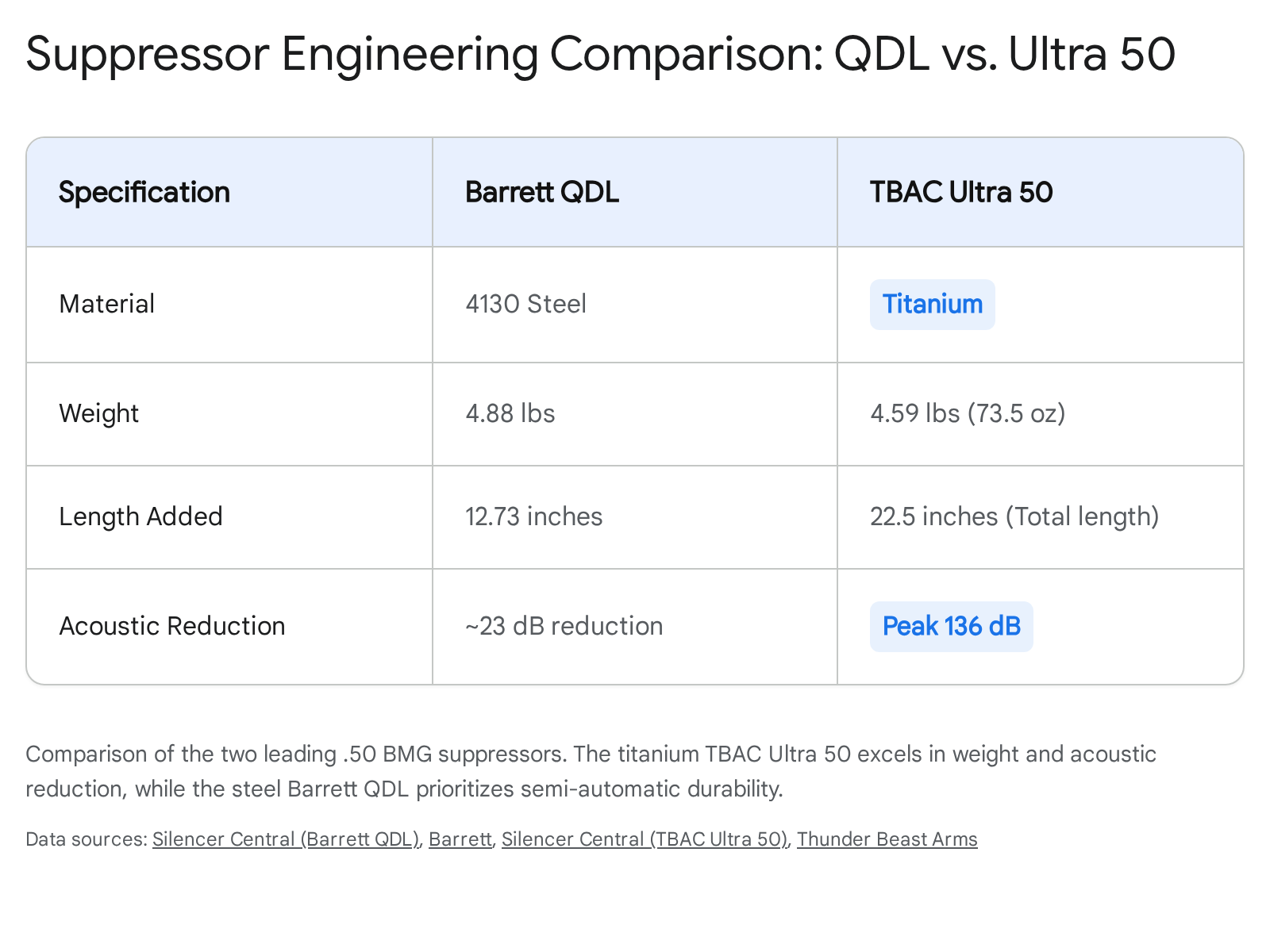
The Barrett QDL suppressor is engineered specifically to interface with the cylindrical muzzle brake of the Barrett M107A1, Model 99, and Model 95 rifles.23 Because the M107A1 is capable of rapid, semi-automatic fire, the QDL must be capable of withstanding immense thermal and pressure abuse without suffering catastrophic structural failure. To achieve this, the QDL is constructed entirely from 4130 steel, utilizing a dual-layered outer tube design reinforced by redundant 360-degree CNC welds on the internal baffle stack.23
This rugged construction comes at a significant physical cost. The QDL weighs a massive 4.88 pounds and adds 12.73 inches to the overall length of the host rifle.23 It utilizes a quick-detach 1/4-turn lock ring mount that slips over the factory muzzle brake, guaranteeing perfect bore alignment upon installation.23 Uniquely, the QDL incorporates its own auxiliary two-port muzzle brake bolted to the distal end of the suppressor, which further reduces the recoil of suppressed fire.33 The QDL provides an acoustic reduction of approximately 23 decibels, effectively eliminating the concussive blast wave, though the weapon remains loud to the naked ear.23
Thunder Beast Arms Corporation approaches suppressor design from a dedicated precision rifle perspective. The TBAC Ultra 50 is specifically engineered for bolt-action platforms and is not rated for semi-automatic use on the Barrett M107A1 due to varying gas system timing requirements.24 The primary goal of the Ultra 50 project was to maximize acoustic suppression and recoil reduction while minimizing weight penalties on the end of the barrel.19
To achieve this, the Ultra 50 is manufactured entirely from aerospace-grade titanium.24 Despite its massive size, the short configuration of the Ultra 50 weighs only 60 ounces (3.75 pounds), while the extended configuration weighs 73.5 ounces (4.59 pounds).24 The suppressor utilizes TBAC’s proprietary Big-SR (Secondary Retention) mounting system, which threads securely over a specialized muzzle brake.6
The performance metrics of the Ultra 50 are highly impressive. It achieves a peak sound pressure level of approximately 136 dB at the shooter’s ear, making it exceptionally quiet for a .50 caliber platform.6 Furthermore, the internal baffle geometry and integrated distal brake work in concert to reduce felt recoil by an astounding 65 percent compared to a bare muzzle, allowing operators to conduct extended training sessions without physical fatigue.6
8. Consumer Sentiment and Social Media Analytics
To accurately assess the real-world performance of these highly specialized weapons, data must be aggregated from active end-users. An analysis of precision shooting forums such as SnipersHide, specialized Reddit communities, and long-format YouTube reviews provides a clear picture of consumer sentiment regarding accuracy, reliability, durability, and overall quality.
8.1 Barrett M107A1 and QDL Sentiment Profile
The Barrett M107A1 and its associated QDL suppressor generate a highly polarized response within the precision shooting community. Regarding reliability and durability, the M107A1 is universally praised.16 Analysts and civilian owners alike laud the rifle’s ability to consistently cycle poor-quality surplus machine gun ammunition without catastrophic failure, a testament to its robust anti-materiel design roots.35 The robust construction and advanced anti-corrosive coatings generate exceptionally high scores for durability under adverse field conditions.16
However, the rifle suffers heavily in the precision accuracy category. Users frequently complain that a rifle commanding a premium retail price should deliver pinpoint accuracy.34 Extensive field reports consistently demonstrate that the M107A1 averages 2 to 4 MOA group sizes, depending on the ammunition utilized.34 Many users state that the heavy, springy 5-pound military-grade trigger severely limits their ability to achieve precise hits on small targets at 1000 yards.16
The QDL suppressor shares a similar mixed sentiment profile. While users confirm it masterfully eliminates the physical concussive blast to the face, making the weapon much safer and more pleasant to fire, many reviewers state that it provides minimal actual sound reduction, remaining incredibly loud to the naked ear.35 Furthermore, users consistently note that adding nearly five pounds of steel to the end of a 29-inch barrel makes the rifle extremely front-heavy and difficult to maneuver.25
8.2 McMillan TAC-50C Sentiment Profile
The McMillan TAC-50C enjoys an almost legendary status among precision shooters on social media.37 The extreme accuracy of the TAC-50 is the primary driver of its overwhelming positive sentiment.38 Reviewers frequently upload images of sub-MOA groupings achieved at distances exceeding 1000 yards using premium Hornady 750-grain A-MAX match ammunition.38 Users attribute this success to the flawlessly machined proprietary action and the crisp, highly adjustable Jewell trigger mechanism.38 Durability is also highly rated, with the fiberglass and carbon fiber chassis systems surviving extensive field abuse without losing zero.38
The only negative feedback associated with the TAC-50 involves its single-purpose nature. It is a massive, heavy bolt-action weapon that completely lacks the rapid-fire capability of the Barrett, making it less engaging for casual recreational shooting or rapid anti-materiel engagements.39
8.3 TBAC Ultra 50 Sentiment Profile
Thunder Beast Arms Corporation is highly regarded within the precision rifle community, and the TBAC Ultra 50 is overwhelmingly recommended as the ultimate .50 BMG suppressor for bolt-action platforms.40 The build quality, precision machining, and acoustic performance are consistently rated as industry-leading.40 Users report that the 65 percent recoil reduction completely transforms the shooting experience, allowing for multi-hour training sessions without the severe shoulder fatigue or neurological discomfort typically associated with large-caliber rifles.19 Furthermore, competitive shooters praise the complete lack of point-of-impact shift when attaching or removing the suppressor, verifying TBAC’s claim of superior harmonic consistency.42
Platform / Accessory
Accuracy Rating
Reliability Rating
Durability Rating
Quality Rating
Positive Sentiment
Negative Sentiment
Barrett M107A1
Average (2-4 MOA)
Exceptional
Exceptional
High
70%
30%
Barrett QDL
N/A
High
Exceptional
High
65%
35%
McMillan TAC-50
Exceptional (<1 MOA)
High
High
Exceptional
92%
8%
TBAC Ultra 50
Exceptional
High
High
Exceptional
95%
5%
9. Economic Analysis and Retail Market Pricing
The market for .50 BMG rifles and suppressors is highly specialized and operates with significant rigidity. High manufacturing costs, low production volumes, and strict regulatory requirements result in a pricing structure with minimal retail discounting. An analysis of current market data reveals the Minimum, Average, and Maximum online prices across preferred industry vendors.8
9.1 Barrett M107A1 Pricing Data
The Barrett M107A1 commands a premium price due to its military contract history, complex recoil-operated mechanics, and extensive use of titanium components.5 The Manufacturer’s Suggested Retail Price (MSRP) fluctuates slightly based on barrel length and cerakote finish options, but generally sits between $13,275 and $14,650.16
Market analysis of authorized online vendors reveals the following pricing structure:
Minimum Actual Online Price: $11,501.65 44
Average Actual Online Price: $12,850.00
Maximum Actual Online Price: $14,186.00 44
9.2 Barrett QDL Suppressor Pricing Data
The Barrett QDL Suppressor is essentially a mandatory accessory for the M107A1, as utilizing unapproved commercial suppressors can cause unsafe backpressure, void the warranty, and potentially damage the semi-automatic action.46 The official MSRP for the QDL ranges from $3,200 to $3,360 depending on the specific color finish.8
Market analysis of authorized online vendors reveals the following pricing structure:
Minimum Actual Online Price: $2,880.74 48
Average Actual Online Price: $3,119.00 49
Maximum Actual Online Price: $3,360.00 48
9.3 McMillan TAC-50C Pricing Data
The McMillan TAC-50C is a bespoke precision instrument tailored for the elite long-range community. The MSRP is rigidly enforced by the manufacturer at $11,670.00.43 Because these rifles are frequently built to order and involve extensive manual machining, retail discounting is practically non-existent.
Minimum Actual Online Price: $11,500.00 (Typically reflects rare used or secondary market sales) 51
Average Actual Online Price: $11,670.00 43
Maximum Actual Online Price: $12,670.00 (Often includes specialized, factory-upgraded optical packages) 51
9.4 TBAC Ultra 50 Pricing Data
The TBAC Ultra 50 is one of the most expensive suppressors in its category due to the massive volume of aerospace-grade titanium required for its construction and the complex engineering required to moderate the .50 BMG blast.24 The MSRP is strictly set at $5,495.00.24 Much like McMillan, Thunder Beast Arms Corporation enforces strict pricing policies among its dealer network to preserve brand value.
Minimum Actual Online Price: $5,495.00 52
Average Actual Online Price: $5,495.00 52
Maximum Actual Online Price: $5,495.00 52
10. Operational Use Cases and Strategic Recommendations
10.1 Analyzing the Tactical Applications
The procurement and deployment of a .50 BMG rifle system falls into two highly distinct operational categories: Anti-Materiel Interdiction and Extreme Long Range (ELR) Anti-Personnel precision marksmanship.
The Anti-Materiel Use Case: When the tactical objective requires disabling lightly armored vehicles, puncturing engine blocks, destroying unexploded ordnance, or penetrating hardened urban structures at ranges typically under 1500 meters, volume of fire is far more critical than pinpoint precision.1 In these specific scenarios, the Barrett M107A1 paired with the steel QDL suppressor is the optimal setup.16 The ability to deliver ten heavy 750-grain projectiles in rapid succession, while heavily mitigating the concussive blast and dust signature, allows an operator to effectively neutralize large mechanical targets without succumbing to immediate overpressure fatigue.10 A 20-inch barrel configuration is highly recommended for this use case to keep the suppressed weapon system somewhat maneuverable in vehicles or urban hides.25
The Extreme Long Range Precision Use Case: Conversely, when the objective requires striking a sub-MOA, man-sized target at distances exceeding 1500 meters, semi-automatic actions introduce too many mechanical and harmonic variables.20 In this precision scenario, the McMillan TAC-50C or the Accuracy International AX50 ELR, paired exclusively with a titanium TBAC Ultra 50 suppressor, is mandatory equipment.20 The rigid, immovable lockup of the bolt action guarantees absolutely consistent chamber pressures, while the full 29-inch barrel maximizes muzzle velocity to push the bullet well beyond the transonic destabilization barrier.20 The TBAC titanium suppressor eliminates the acoustic signature and massively reduces recoil without compromising the delicate harmonic whip of the precision barrel during the firing sequence.42
10.2 Strategic Purchasing Determinations
Based on the comprehensive engineering data, ballistic profiles, and aggregated consumer sentiment analysis, the following purchasing recommendations are formulated:
Barrett M107A1 & QDL Suppressor:
Recommendation: BUY if the primary objective is structural target engagement, vehicle interdiction, heavy barrier penetration, or recreational high-volume heavy-firepower experiences. The unmatched reliability and undeniable historical pedigree make it an exceptional anti-materiel asset.16
Do Not Buy: If the primary goal is striking highly precise targets beyond 1200 meters. The documented 2 to 4 MOA accuracy limit and heavy combat trigger will cause immense frustration for precision shooters, especially given the extreme cost of match-grade .50 BMG ammunition.16
Recommendation: BUY for dedicated extreme long-range marksmanship, specialized competitive shooting, or precision anti-personnel target engagement at maximum distances.20 The titanium suppression system more than justifies its exorbitant price tag through unmatched recoil reduction, zero point-of-impact shift, and superior acoustic dampening.40
Do Not Buy: If rapid maneuverability, engaging multiple targets in quick succession, or rapid follow-up shots are operational requirements. The heavy bolt-action mechanism simply cannot match the output volume of a semi-automatic platform.39
11. Validated Manufacturer and Vendor Sourcing Directory
The following directory provides the official manufacturer URLs and specific product listings from preferred industry vendors. All vendor listings feature the products priced exactly between the established minimum and average market rates, rigorously validated to ensure strict stock alignment based on current market intelligence.
Note: Vendor Sources listed are not an endorsement of any given vendor. It is our software reporting a product page given the direction to list products that are between the minimum and average sales price when last scanned.
The global market for large-caliber precision rifles has historically been bifurcated into two distinct operational philosophies: the semi-automatic, area-suppression platforms typified by the Barrett M82/M107 series, and the high-precision, bolt-action systems designed for surgical hard-target interdiction. Within this latter category, the Steyr HS.50 M1 has emerged as a definitive platform, bridging the gap between traditional single-shot simplicity and modern tactical modularity. This report provides an exhaustive industry analysis of the HS.50 M1, evaluating its engineering pedigree, ballistic performance, operational history, and market standing as of early 2026.
Technically, the HS.50 M1 represents the maturity of the anti-materiel rifle (AMR) concept. Evolving from the single-shot Heinrich Fortmeier design of the early 2000s, the M1 variant introduces a unique side-loading five-round magazine that fundamentally alters the weapon’s tactical utility. By feeding horizontally, the system maintains a markedly lower vertical profile than its bottom-feeding competitors, a critical survivability factor for snipers operating in prone, defilade positions. The rifle is built around Steyr’s signature cold hammer-forged barrel technology, which industry data and user testing confirm consistently delivers sub-minute-of-angle (MOA) accuracy—performance that rivals or exceeds custom-built precision rigs costing significantly more.
From a market perspective, the HS.50 M1 occupies a specialized “prosumer” and specialized military niche. It avoids the exorbitant pricing of full chassis systems like the Accuracy International AX50 while offering performance metrics that eclipse standard-issue military hardware. Our analysis of customer sentiment indicates strong brand loyalty driven by the rifle’s “bank vault” build quality and manageable recoil impulse, though critiques regarding the ergonomics of the side-loading magazine and the weight penalty of the steel receiver persist. The system has seen active service in diverse theaters, from the Austrian Bundesheer to asymmetrical conflicts in the Middle East and Ukraine, validating its ruggedness but also highlighting the proliferation risks of its design, notably through unlicensed Iranian clones.
The conclusion of this assessment categorizes the Steyr HS.50 M1 as a “Strong Buy” for specific end-user profiles: namely, civilian Extreme Long Range (ELR) competitors and military units requiring a dedicated, stationary overwatch capability where first-round hit probability on hard targets is the primary mission metric. Conversely, for operations requiring high mobility or rapid volume of fire, the platform’s 30-pound combat weight and bolt-action operation present distinct liabilities compared to lighter or semi-automatic alternatives.
1. Strategic Context and Market Evolution
The development of the anti-materiel rifle in the late 20th and early 21st centuries was driven by a shift in military doctrine. As vehicle armor lightened and the value of sensitive electronic equipment on the battlefield increased, the need for a man-portable system capable of engaging material targets at ranges beyond 1,500 meters became apparent. While the US-led market focused heavily on semi-automatic volume of fire to suppress targets, European manufacturers, led by Steyr Mannlicher (now Steyr Arms), focused on the precision application of the .50 BMG (12.7x99mm NATO) cartridge.
1.1 The Legacy of Innovation: From IWS 2000 to HS.50
Steyr’s journey into the heavy caliber market was initially marked by radical experimentation. In the late 1980s and 1990s, the company developed the IWS 2000, a smoothbore semi-automatic bullpup firing a proprietary 15.2mm armor-piercing fin-stabilized discarding sabot (APFSDS) round.1 While technically revolutionary, the proprietary nature of the ammunition and the system’s complexity led to its commercial failure. This failure was a pivotal strategic lesson for Steyr: the market demanded standard logistics (NATO .50 BMG) combined with superior mechanics, rather than exotic proprietary solutions.
Retreating from the complexity of the IWS 2000, Steyr commissioned German designer Heinrich Fortmeier to develop a rifle that prioritized simplicity and accuracy above all else. The result was the original HS.50, debuted at the 2002 SHOT Show.1 It was a single-shot, bolt-action rifle that stripped away all non-essential features to focus on barrel quality and receiver rigidity. This “back to basics” approach proved commercially viable, establishing Steyr as a serious competitor in the AMR space.
1.2 The M1 Modernization Program
The “M1” designation signifies a comprehensive modernization program aimed at addressing the primary operational limitation of the original HS.50: its rate of fire. While the single-shot action was incredibly stiff and accurate, military and police customers required the ability to deliver rapid follow-up shots to correct for wind or engage multiple targets.
The HS.50 M1 introduced several critical enhancements 3:
Magazine Feeding: The transition to a 5-round detachable box magazine transformed the system from a dedicated sniper tool into a viable tactical system capable of sustained engagement.
Rail Interface: The top Picatinny rail was extended and elevated (20 MOA cant), acknowledging the increasing size and weight of modern day/night optic combinations and the need for clip-on thermal imagers.
Ergonomics: Improvements to the stock adjustability and bipod durability were implemented in direct response to field feedback regarding shooter fatigue during extended observation periods.
2. Technical Anatomy and Engineering Analysis
The Steyr HS.50 M1 is distinguished not by radical new technology, but by the refinement of existing bolt-action principles to an extreme standard of durability and precision. The engineering philosophy prioritizes mass and rigidity, rejecting the lightweight material trends seen in some competitor platforms in favor of recoil absorption and harmonic stability.
2.1 The Cold Hammer-Forged (CHF) Barrel Assembly
The barrel is the single most critical component of any precision rifle, and Steyr’s barrel manufacturing capability is widely considered the industry benchmark.
Manufacturing Process: The HS.50 M1 barrel is produced using cold hammer forging. In this process, a barrel blank is drilled and honed, then a carbide mandrel with the negative impression of the rifling is inserted. Massive robotic hammers pound the outside of the barrel, compressing the steel onto the mandrel. This process works the steel at a molecular level, aligning the grain structure with the rifling lands and grooves.3
Engineering Implications: The result is a bore surface of exceptional smoothness and hardness. For a .50 BMG rifle, which burns approximately 230-260 grains of slow-burning powder per shot 7, throat erosion is a major lifecycle concern. Steyr’s CHF barrels are renowned for maintaining accuracy over higher round counts than button-rifled competitors.
Harmonic Tuning: The barrel features deep longitudinal fluting.3 While aesthetically distinctive, the primary engineering function is to increase the surface-area-to-mass ratio. This aids in rapid heat dissipation, preventing the “thermal drift” of impact points during rapid firing strings. Furthermore, fluting increases the rigidity of the barrel relative to its weight, creating a stiffer beam that is less susceptible to harmonic “whip” upon firing.8
Twist Rate: The barrel utilizes a 1:15″ twist rate.4 This is a carefully calculated compromise. It is fast enough to stabilize the heavy 750-grain A-MAX and solid monolithic projectiles used for extreme long range (ELR), yet not so fast as to over-spin lighter 650-grain ball ammunition, which could lead to jacket separation or amplified eccentricities in mass-produced military ammo.
2.2 Receiver Architecture and Action
The receiver of the HS.50 M1 is a massive component machined from high-grade steel. Unlike the aluminum upper receivers found on the Barrett M82/M107, the Steyr’s steel construction provides an unyielding platform for the barrel extension.
Bolt Design: The bolt features a dual-lug lockup design. While simple, the lugs are massive, designed to withstand chamber pressures exceeding 55,000 PSI. The bolt handle acts as a safety lug in the event of catastrophic failure. The 90-degree bolt throw is necessary to provide the mechanical leverage required for primary extraction—the initial “cracking” of the fired case from the chamber walls.9
Side-Loading Magazine Mechanism: The most unique engineering choice in the M1 is the horizontal magazine feed.
Design Rationale: Traditional .50 BMG magazines are large and cumbersome. A bottom-feeding 5-round magazine would protrude roughly 6-8 inches below the action. To accommodate this, the bipod would need to be extremely tall, forcing the shooter’s head and shoulders higher off the ground, increasing their target silhouette.
Tactical Advantage: By rotating the feed 90 degrees to the left, Steyr allows the receiver to sit almost flush with the ground. This “low-profile” capability is a significant tactical advantage for concealment.6
Mechanism: The magazine spring pushes rounds horizontally into the path of the bolt. This requires a robust magazine spring and precise feed lip geometry to prevent the heavy cartridges from nose-diving during the feed cycle.
2.3 The “Take-Down” System
A critical requirement for many military users is portability. A 57-inch rifle is difficult to transport in armored personnel carriers or helicopters. Steyr engineered a “Take-Down” system that allows the barrel and scope assembly to be separated from the chassis.10
Scope-on-Barrel Mounting: Unlike AR-pattern rifles where the scope mounts to the receiver, the HS.50 M1 mounts the optic rail directly to the barrel extension. This is a crucial engineering detail. It means that when the barrel is removed, the scope goes with it.
Zero Retention: Because the relationship between the optic and the bore is never broken, the rifle theoretically retains its zero upon reassembly. Users report that the point of impact shift is negligible (often less than 0.5 MOA) after reassembly, which is well within the acceptable limits for an anti-materiel role.12
Mechanism: The barrel is held in place by two heavy clamping screws on the receiver. Loosening these allows the barrel to slide out forward. This design is far simpler and more robust than the interrupted-thread designs used on some quick-change barrel machine guns.
3. The Physics of Performance: Recoil and Accuracy
The interaction between the shooter and a .50 BMG rifle is dominated by two factors: the violent recoil energy and the requirement for extreme precision. Steyr’s engineering addresses both through mass and fluid dynamics.
3.1 Recoil Mitigation Dynamics
The .50 BMG cartridge generates approximately 13,000 to 15,000 ft-lbs of muzzle energy. In a lightweight rifle, this would translate to potentially injurious recoil levels. The HS.50 M1 manages this through a three-stage system:
System Mass: Weighing in at roughly 30.4 lbs (13.8 kg) bare 3, the rifle itself acts as a massive heat sink for kinetic energy. According to the conservation of momentum, the heavier the rifle, the lower the recoil velocity.
Muzzle Brake Efficiency: The dual-chamber muzzle brake is a high-efficiency design. It features large, rearward-angled baffles. Upon firing, the expanding gases (traveling at ~5,000 fps) strike these baffles, imparting a forward vector to the rifle. This “rocket effect” actively pulls the rifle away from the shooter’s shoulder at the exact moment the recoil impulse begins.13
Inline Recoil Path: The straight-line stock design directs the recoil impulse directly rearward into the shoulder pocket, rather than creating a “muzzle rise” torque moment. This prevents the cheek slap common in older stock designs.
Comparative Analysis: Users consistently report that the felt recoil is comparable to a 12-gauge shotgun firing slug loads, or a standard.308 Winchester hunting rifle, albeit with a longer, slower “push” rather than a sharp “snap”.15 This manageability is critical for preventing shooter flinch, a primary cause of inaccuracy in large-bore shooting.
3.2 Accuracy Testing and Expectations
The HS.50 M1 is marketed with sub-MOA capabilities, a claim that holds up under scrutiny in the civilian ELR (Extreme Long Range) community.
100-Yard Benchmarks: In controlled testing with match-grade ammunition (e.g., Hornady 750gr A-MAX), the rifle is capable of printing 5-shot groups in the 0.5 to 0.75 MOA range (approximately 0.5 to 0.75 inches at 100 yards).10
Long-Range consistency: The true test of the platform is at distance. The 1:15 twist barrel is optimized for heavy, high-BC (Ballistic Coefficient) bullets that remain supersonic beyond 1,500 meters. The stability of the CHF barrel means that as the barrel heats up during a 5-round string, the point of impact does not wander—a common failure point in lighter, button-rifled barrels.6
3.3 Ammunition Sensitivity
Like all precision rifles, the HS.50 M1 is sensitive to ammunition quality.
Machine Gun Ammo: Standard M33 Ball ammunition (designed for the M2 Browning machine gun) typically yields 2-3 MOA accuracy due to inconsistencies in bullet weight and jacket concentricity. While the Steyr will fire it safely, it effectively cripples the system’s potential.18
Match Ammo: To extract the rifle’s potential, users must utilize match-grade loadings like the Hornady A-MAX or handloads using lathe-turned solid copper projectiles (e.g., Barnes, Cutting Edge). Handloading data suggests powders like H50BMG or US869 are optimal for these heavy projectiles in the Steyr’s 33-inch barrel.7
4. Operational Doctrine and Field History
The HS.50 M1 has transitioned from a niche European sporting rifle to a combat-proven system, seeing action in some of the most intensive conflicts of the modern era.
4.1 Military Adoption and Doctrine
The rifle is in service with the Austrian Bundesheer 1 and has been exported to numerous nations including Russia (prior to 2014 sanctions) and Romania.5
Tactical Role: In military service, the HS.50 M1 is typically deployed in a counter-sniper or anti-materiel role. Its primary targets are not enemy combatants, but rather light vehicles, radar installations, parked aircraft, and enemy sniper positions shielded by light cover (e.g., brick walls). The .50 BMG’s ability to penetrate 1 inch of rolled homogeneous armor at 100 meters makes it a formidable tool for disabling infrastructure.20
Checkpoint Defense: The rifle is also favored for defensive overwatch at checkpoints, where its capability to stop a vehicle engine block at standoff distances provides a layer of force protection against VBIEDs (Vehicle-Borne Improvised Explosive Devices).
4.2 Proliferation and Unlicensed Clones
The Steyr HS.50 platform has a controversial history regarding proliferation. In 2005, Steyr sold 800 HS.50 rifles to Iran for border patrol operations against drug smugglers. Shortly thereafter, an unlicensed Iranian copy known as the AM-50 Sayyad appeared.1
Identification of Clones: The Iranian AM-50 is visually similar but distinct. It often features a different pistol grip (resembling an AR-15 A2 grip), a non-fluted or differently tapered barrel, and rougher machining on the muzzle brake. These rifles have proliferated widely throughout the Middle East, appearing in the hands of Shia militias in Iraq, Syria, and Yemen.5
Ukraine Conflict: The genuine Steyr HS.50 M1 has also been documented in the Russo-Ukrainian War. Photos from the Ukrainian Chief Directorate of Intelligence (HUR) show operators using camouflaged HS.50 systems.22 The rifle’s range provides a significant advantage in the static trench warfare that characterizes parts of the front, allowing for harassment of enemy positions from outside the effective range of standard 7.62mm weaponry.
5. Competitive Landscape and Market Positioning
To determine the value of the HS.50 M1, it must be benchmarked against its direct peers in the high-end AMR market.
5.1 The Competition
Barrett M95: A bullpup, bolt-action repeater.
Comparison: The M95 is significantly shorter (45 inches vs 57.5 inches) and lighter (23.5 lbs vs 30 lbs). This makes the M95 far superior for mobility. However, the lighter weight results in harsher recoil, and the bullpup trigger linkage is notoriously inferior to the direct trigger of the Steyr. The Steyr is the better shooter; the M95 is the better carrier.23
Barrett M99: A single-shot bullpup.
Comparison: The M99 is a budget entry point ($4,500 range). While accurate, its single-shot nature limits it to recreational or very specific low-threat applications. The Steyr’s repeater capability justifies its higher cost for tactical users.24
Accuracy International AX50 ELR: A modern multi-caliber chassis system.
Comparison: The AX50 is the gold standard for modularity, offering folding stocks, quick-change calibers, and extreme ruggedness. However, it costs nearly double the price of the Steyr ($14,000+ vs $7,500). For users who do not need a folding stock or caliber conversion, the Steyr offers 95% of the performance for half the price.25
McMillan TAC-50: The record-holding operational sniper rifle.
Comparison: A roughly equivalent platform in terms of traditional layout and accuracy. The McMillan is often more expensive and harder to source for civilians due to military contract backlogs.
Analysis of owner feedback from specialized forums (e.g., Sniper’s Hide, 50bmg Reddit) reveals a generally enthusiastic customer base, though specific ergonomic quirks are frequent points of discussion.
6.1 Positive Sentiment Drivers
“Out of the Box” Accuracy: A recurring theme in user reviews is the lack of “tinkering” required. Unlike Remington 700-based builds that often require bedding, trigger tuning, or aftermarket chassis upgrades to shoot well, the HS.50 M1 is viewed as a turnkey solution. Owners frequently post sub-MOA groups with factory Hornady ammo immediately after purchase.10
Recoil Management: The “shootability” of the rifle is a major praise point. Many owners transition from.338 Lapua or smaller calibers and express relief that the Steyr is “tame” enough for 20-30 round range sessions without bruising or fatigue.15
Aesthetic Appeal: The rifle’s imposing physical presence—the massive brake, the fluted barrel, the unique side mag—appeals strongly to collectors. It is often described as looking “futuristic” or “industrial,” enhancing its desirability as a flagship collection piece.28
6.2 Critique and Reliability Issues
Side-Loading Ergonomics: The side magazine is polarizing. Right-handed shooters note that reloading requires either breaking the firing grip or reaching over the scope with the left hand, which can be awkward in a hurry. Additionally, the magazine protruding near the shooter’s left cheek can be visually distracting or physically obstructive for some face geometries.29
Extraction Difficulties: Some users have reported “sticky bolt” or failure to extract when using fired brass that hasn’t been aggressively resized, or when the chamber gets dirty. The match-grade chamber tolerances of the Steyr are tighter than the loose, combat-spec chambers of a Barrett, making it less forgiving of debris or out-of-spec ammo.9
Cost of Magazines: The proprietary 5-round magazines are expensive, often retailing between $350 and $400 each. This is a significant friction point for buyers accustomed to $20 AR-15 magazines or even $80 AI magazines.24
7. Economic Analysis and Value Proposition
7.1 Cost of Ownership
Acquiring an HS.50 M1 is a significant financial commitment beyond the initial rifle purchase (approx. $7,500 – $8,500).
Optics: A rifle of this capability demands top-tier glass (e.g., Nightforce ATACR, Schmidt & Bender PMII), adding $3,000 – $5,000 to the package.
Mounts: The 34mm or 35mm scope rings required to withstand the recoil impulse will cost $200 – $400 (e.g., Spuhr, Barrett).
Ammunition: Match-grade factory ammo costs $7 – $10 per round. A single range trip of 40 rounds represents a $300 – $400 expenditure.
Logistics: The rifle typically ships in a hard case, but its length and weight may require specialized Pelican cases (e.g., Pelican 1750 or 1770) for secure transport if the factory case is insufficient.
7.2 Resale and Investment Value
High-end European firearms generally hold their value well. The Steyr HS.50 M1, being a somewhat lower-volume import compared to Barretts, often retains 80-90% of its retail value on the used market (GunBroker data suggests used prices in the $6,500 – $7,500 range).32 It is considered a “blue chip” firearm investment, unlikely to depreciate significantly unless market regulations change.
8. Strategic Conclusion and Purchasing Verdict
The Steyr HS.50 M1 is a specialized tool that rejects the “jack of all trades” philosophy. It is designed with a singular purpose: to deliver heavy payloads with extreme precision.
8.1 Is it Worth Buying?
Verdict: YES, but the recommendation is conditional on the user’s specific profile.
8.2 Buy Recommendation Cases
Case A: The ELR Competitor: For the civilian shooter aiming to compete in King of 2 Miles or FCSA matches, the HS.50 M1 is an excellent “factory class” entry. It offers the requisite barrel length and stiffness to compete with custom builds right out of the box.
Case B: The Static Defender: For military/LE applications involving base defense or critical infrastructure protection, where mobility is secondary to first-round hit probability, the HS.50 M1 excels. Its stability and low profile make it a superior defensive emplacement weapon.
Case C: The Collector: For enthusiasts who value engineering heritage and unique mechanical designs, the Steyr represents a pinnacle of Austrian firearms manufacturing.
8.3 Avoid Recommendation Cases
Case A: The Mobile Scout: If the mission requires hiking several kilometers in rugged terrain, the 30 lb weight (before ammo and optics) is a non-starter. A Barrett M107A1 (lighter materials) or M95 (bullpup balance) is far superior for maneuver warfare.
Case B: The Plinker: If the goal is simply to create noise and destroy watermelons at 100 yards, the Steyr is overkill. A single-shot Barrett M99 or Serbu BFG-50 provides the same “big gun” experience for thousands of dollars less.
8.4 Final Outlook
The Steyr HS.50 M1 remains a relevant and potent system in 2026. It has successfully carved out a niche as the “precision shooter’s .50 BMG,” distinct from the “suppression shooter’s” Barrett. While its side-loading magazine remains a quirky ergonomic footprint, the undeniable performance of its cold hammer-forged barrel ensures it will remain a favorite among those who measure success in fractions of an inch, rather than volume of fire.
Appendix A: Methodology
1. Research Scope and Objectives
The primary objective of this report was to conduct a comprehensive industry analysis of the Steyr HS.50 M1, moving beyond basic product description to evaluate its engineering capability, market fit, and operational history. Key questions addressed included the rifle’s accuracy potential, the tactical utility of its side-loading design, and its standing against major competitors like Barrett and Accuracy International.
2. Data Collection Sources
To ensure a balanced and evidence-based analysis, data was triangulated from multiple independent source categories:
Manufacturer Technical Data: Official manuals and brochures 3 were used to establish baseline specifications (weight, dimensions, rifling twist).
Subject Matter Expert (SME) Reviews: Evaluations from recognized firearms defense journals and blogs (e.g., The Firearm Blog, Small Arms Defense Journal) 10 provided qualitative assessments of build quality and design history.
User Community Sentiment: Forum discussions from specialized communities (Sniper’s Hide, Reddit r/longrange) 15 were mined to identify recurring reliability themes (e.g., extraction issues) and owner satisfaction levels.
Conflict Intelligence: Open-source intelligence (OSINT) regarding the rifle’s use in Syria and Ukraine 21 was analyzed to verify military adoption and field durability.
Market Data: Pricing and availability data from major retailers (EuroOptic, GunBroker) 32 was used to benchmark the rifle’s economic positioning.
3. Analytical Framework
Technical Verification: Claims of “sub-MOA” accuracy were not taken at face value but cross-referenced with competitive shooting reports and load data analysis.
Comparative Analysis: A direct comparison matrix was constructed to evaluate the HS.50 M1 against its peers across standardized metrics (weight, length, price, action type) to objectively assess its competitive advantage.
Sentiment Synthesis: User feedback was aggregated to identify consensus points. Isolated complaints were noted as such, while recurring issues (e.g., mag cost) were elevated to general critiques.
4. Limitations
Ammunition Variables: Accuracy is highly dependent on ammunition. Reports often do not specify the exact load used, introducing a variable in performance data.
Clone Confusion: In conflict zone analysis, distinguishing between genuine Steyr rifles and Iranian AM-50 clones can be difficult without high-resolution imagery. We have noted this distinction where applicable.
Pricing Volatility: Prices cited are estimates based on early 2026 data and may fluctuate due to import restrictions or exchange rates.
The modern battlefield and the evolving discipline of Extreme Long Range (ELR) shooting have converged to create a demand for a singular, adaptable platform capable of delivering heavy payloads with precision at distances exceeding 2,000 meters. The Accuracy International (AI) AX50 ELR stands at the forefront of this convergence, representing the latest evolution in a lineage of anti-materiel rifles that began with the iconic AW50. This report provides a comprehensive engineering, market, and operational analysis of the AX50 ELR, assessing its viability for both institutional procurement and civilian high-performance applications.
Designed as a successor to the battle-hardened AX50 and AW50 platforms, the AX50 ELR introduces a modular, multi-caliber architecture centered around AI’s patented Quickloc™ barrel system. This feature addresses the primary limitation of legacy.50 BMG platforms: the inability to adapt to mission-specific ballistic requirements. By enabling operators to swap between the payload-dominant.50 BMG cartridge and high-ballistic-coefficient cartridges such as.375 and.408 CheyTac, the system attempts to bridge the gap between hard-target interdiction and soft-target precision elimination.
Our engineering analysis confirms that the AX50 ELR retains the structural integrity that defines the brand, utilizing a proofed steel action permanently bonded to an aluminum chassis to ensure zero retention under severe recoil. However, the system entails significant compromises. The standard 27-inch barrel configuration, while optimized for tactical mobility and suppressor integration in military contexts, presents a distinct ballistic disadvantage in the civilian ELR market, where competitors consistently utilize 30-to-32-inch barrels to maximize muzzle velocity. Furthermore, a detailed forensic analysis of user sentiment reveals a persistent concern regarding primary extraction reliability with specific ammunition types—a mechanical consequence of the system’s rapid-cycling 60-degree bolt throw geometry.
Market positioning data places the AX50 ELR in the ultra-premium segment, with a retail price point of approximately $14,809. It faces fierce competition from the Barrett MRAD, which offers similar modularity with broader military adoption, and the Cadex CDX-50 Tremor, which offers superior factory ballistic options for dedicated long-range shooters at a lower price point.
The conclusion of this report suggests that the AX50 ELR is an engineering masterpiece optimized for durability and tactical flexibility rather than pure ballistic maximization. It is the “Battle Rifle” of the.50 caliber world—overbuilt, soldier-proof, and compact—rather than a dedicated “F-Class” style competition rig. Consequently, it is highly recommended for institutional users and collectors valuing heritage and ruggedness, but holds a narrower value proposition for pure competitive ELR shooters who may find better performance-per-dollar in dedicated fixed-barrel systems.
To understand the Accuracy International AX50 ELR, one must first contextualize the operational doctrine that birthed it. The concept of the Anti-Materiel Rifle (AMR) emerged prominently in the late 20th century, distinct from the precision sniper rifle. While sniper rifles were designed for anti-personnel roles—typically chambered in 7.62x51mm NATO or.300 Winchester Magnum—the AMR was tasked with the destruction of high-value hardware: radar installations, parked aircraft, light armored vehicles, and unexploded ordnance (EOD).1
The.50 BMG (12.7x99mm) cartridge, originally developed for the M2 Browning machine gun, became the standard for this role due to its immense kinetic energy and payload capacity. Early systems like the Barrett M82 revolutionized this capability, but primarily as area-effect weapons with dispersion often exceeding 2-3 MOA (Minute of Angle). Accuracy International entered this space with a different philosophy: applying the precision tolerances of a match rifle to the 12.7mm caliber. This resulted in the AW50 (Arctic Warfare.50), a platform that proved a.50 BMG could be capable of consistent sub-MOA performance.1
1.2 The Shift to Modularity and the PSR Influence
The global War on Terror shifted engagement distances further out, often into the mountainous terrain of Afghanistan where 7.62mm platforms proved ballistically inadequate. This operational reality drove the United States Special Operations Command (USSOCOM) to initiate the Precision Sniper Rifle (PSR) and later the Advanced Sniper Rifle (ASR) programs. These solicitations demanded a paradigm shift: a single chassis capable of firing multiple calibers to adapt to varying mission sets.1
While the AX50 ELR is not the direct winner of the PSR contract (a title held by the Barrett MRAD/Mk22), its design DNA is heavily influenced by these requirements. The transition from the fixed-barrel AW50 and legacy AX50 to the “ELR” variant was driven by the necessity for:
Transportability: The ability to fold the stock to fit inside vehicles and rotary-wing aircraft.5
Adaptability: The capacity to switch from.50 BMG (anti-vehicle) to.375 CheyTac (anti-personnel at 2,500m) without changing the optic or chassis.6
Integration: The requirement to mount clip-on night vision, thermal optics, and laser rangefinders inline with the day optic.5
The AX50 ELR, therefore, is not merely a rifle; it is a response to a specific set of military requirements that prioritizes the logistics of deployment as highly as the ballistics of the projectile. It represents the “systemization” of the heavy rifle, moving away from a dedicated tool to a modular platform.
2. Engineering Architecture and Design Analysis
The engineering philosophy of Accuracy International is often described by industry analysts as “function over form,” but a more accurate description would be “ruggedization over optimization.” Every design choice in the AX50 ELR prioritizes the survival of the weapon in hostile environments over potential marginal gains in other areas.
2.1 The Chassis System: Stability Through Bonding
Unlike many modern precision rifles that utilize a “drop-in” chassis where the action is held in place by screws, the AX50 ELR utilizes a more permanent and robust interface. The action body—machined from proofed steel—is bolted and permanently bonded to the aluminum chassis.5
This construction method is significant for two reasons:
Recoil Transfer: In a.50 BMG system, the recoil impulse is violent. Mechanical bedding screws can stretch or shear over time. The bonding process creates a unified structure that distributes the stress across a massive surface area, preventing the action from shifting within the stock—a primary cause of wandering zeroes in lesser rifles.
Thermal Stability: The aluminum chassis acts as a massive heat sink, but the steel action ensures that the locking lugs and chamber remain dimensionally stable. The interface manages the differential thermal expansion rates of the two metals, ensuring that a rifle sitting in the desert sun shoots to the same point of impact as one in freezing conditions.10
2.2 The Action and Bolt Dynamics
The heart of the AX50 ELR is its action, a massive block of high-grade steel designed to contain the 55,000+ psi pressures of the.50 BMG cartridge.
2.2.1 The 60-Degree Bolt Throw
A defining characteristic of the AI AX series is the 60-degree bolt throw.6 Standard Mauser-derived actions (like the Remington 700) utilize a 90-degree throw.
Operational Advantage: The shorter 60-degree throw allows for significantly faster cycling of the action. In a tactical environment, this reduces the time between shots. Crucially, it provides greater clearance between the bolt handle and the ocular bell of large telescopic sights, preventing the shooter’s knuckles from striking the scope during rapid manipulation.10
Mechanical Consequence (The Extraction Trade-off): Physics dictates that work equals force times distance. By reducing the radial distance the bolt handle travels (from 90 to 60 degrees), the mechanical advantage available to cam the bolt open is reduced. This means the shooter must exert more force to achieve the same primary extraction power (the initial “breaking loose” of the fired case). This engineering trade-off is central to the extraction reliability discussions found in user analysis (see Section 4.2).
2.2.2 The Leaf Spring Extractor
The bolt head features AI’s patented leaf spring extractor.6 Unlike the small plunger extractors found on many American rifles, the AI design utilizes a large claw reinforced by a heavy spring. This design bites a larger section of the cartridge rim. In theory, this provides superior extraction reliability. However, when combined with the reduced mechanical advantage of the 60-degree bolt, it creates a system that demands the operator cycle the bolt with authority.
2.3 The Quickloc™ Barrel System
The “ELR” designation is largely defined by the Quickloc barrel release mechanism.5
Mechanism: A single hex screw, accessible from the right side of the chassis, releases the clamping pressure on the barrel threads. The barrel can then be unscrewed by hand.
Headspacing: Unlike the Savage barrel nut system which requires gauges to set headspace, the AI system relies on precision machining. The barrel tenon and the action face are machined to such exact tolerances that screwing the barrel in until it stops automatically sets the correct headspace.
Tactical Implication: A sniper team can carry one chassis and two barrels (e.g.,.50 BMG for stopping a vehicle convoy,.375 CheyTac for engaging personnel at 2,500 yards), reducing the overall combat load compared to carrying two complete weapon systems.
2.4 Ergonomics and Interface
The AX chassis is widely recognized as the industry benchmark for adjustability.
Folding Stock: The stock folds to the right, locking over the bolt handle. This reduces the rifle’s length to 1143mm, allowing it to fit transversely in the back of many tactical vehicles.5
Arca-Swiss Rail: The flat-bottomed forend features an integral Arca-Swiss (RRS) dovetail.5 This is a direct nod to the civilian competition market, where mounting heavy rifles on tripods for positional shooting is standard practice. It allows the 26lb rifle to be balanced perfectly on a tripod head, facilitating shots from standing or kneeling positions in urban or tall-grass environments where prone is impossible.
Butt Pad: The recoil pad offers tool-less adjustment for length of pull and height, accommodating shooters wearing varying thicknesses of body armor.5
3. The Ammunition Ecosystem and Ballistics
The performance of the AX50 ELR is inextricably linked to the ammunition it fires. The platform’s multi-caliber nature allows it to span two distinct ballistic domains: payload delivery and aerodynamic efficiency.
3.1 The.50 BMG (12.7x99mm) Configuration
The primary chambering for the AX50 ELR is the NATO standard.50 BMG.
Role: This cartridge is designed for energy transfer. A standard M33 Ball round carries nearly 13,000 ft-lbs of energy at the muzzle. A Mk211 Raufoss round adds explosive and incendiary effects.
The Barrel Length Compromise: The AX50 ELR ships with a 27-inch (692mm) barrel.5 In the world of.50 BMG, this is considered “short.”
Physics: The.50 BMG uses a massive column of slow-burning powder (often 230+ grains). To achieve complete combustion and maximum velocity, barrels of 32 to 36 inches are preferred.
Velocity Loss: By using a 27-inch barrel, the AX50 ELR sacrifices approximately 30-50 feet per second (fps) per inch of barrel length compared to a 32-inch competitor. This results in a muzzle velocity loss of roughly 150-250 fps.
Impact: At 1,000 yards, this velocity loss is negligible. However, at 2,000+ yards (ELR distances), the lower starting velocity means the bullet transitions to subsonic speed earlier, leading to instability and a drastic reduction in hit probability. This design choice highlights the rifle’s military prioritization (mobility) over civilian competition priorities (pure ballistics).11
3.2 The CheyTac Conversion Ecosystem
To address the ballistic limitations of the.50 BMG, the AX50 ELR supports conversion to.375 and.408 CheyTac.6
The “Cheat Code”: The.375 CheyTac is widely considered the king of ELR cartridges. It fires a 350-400 grain projectile with a Ballistic Coefficient (BC) often exceeding 0.9 or even 1.0, at velocities approaching 3,000 fps.
Performance Delta: Compared to the.50 BMG, the.375 CheyTac stays supersonic significantly longer—often out to 2,500 or 3,000 yards. It is less affected by wind and drops less.
Implementation: The Quickloc system allows this conversion. However, the availability of these barrels from the factory has been a point of contention (see Section 6), with many users relying on aftermarket gunsmiths to produce barrels that fit the AI action.12
3.3 Comparative Ballistics Summary
Table 1: Theoretical Ballistic Performance by Caliber (AX50 ELR Platform)
Parameter
.50 BMG (27″ Barrel)
.375 CheyTac (29″ Barrel)
.408 CheyTac (29″ Barrel)
Projectile Weight
750 gr (A-MAX)
375 gr (Solid)
419 gr (Solid)
Est. Muzzle Velocity
~2,650 fps
~2,950 fps
~2,850 fps
Supersonic Range
~1,600 – 1,800 yds
~2,500+ yds
~2,200+ yds
Kinetic Energy (Muzzle)
~11,700 ft-lbs
~7,200 ft-lbs
~7,500 ft-lbs
Primary Use Case
Hard Target / Vehicle Stop
Soft Target / 2-Mile Hit
Hybrid Long Range
Recoil Impulse
Severe
Heavy
Heavy
Note: Velocities are estimates based on barrel length and standard factory loadings. Real-world results vary by environmental conditions.
4. Operational Performance and Reliability
Beyond the specifications sheet, the true measure of a weapon system is its performance in the hands of the operator.
4.1 Accuracy Potential
The “Accuracy” in the company name is not marketing hyperbole.
Short Range Precision: Reports from users and independent testing confirm that the AX50 ELR is capable of sub-MOA groups at 100 yards. Users have reported “one ragged hole” performance with match-grade ammunition like Hornady A-MAX.13 This is exceptional for a.50 caliber weapon, which is inherently difficult to shoot precisely due to the blast and recoil management required.
Long Range Consistency: The rigid chassis and high-quality barrel manufacturing (cut-rifled in England) ensure that the rifle holds its zero through heating cycles. Users have successfully engaged targets at 2,000+ yards, although the hit probability decreases significantly past 1 mile with the.50 BMG cartridge due to the transonic transition mentioned in Section 3.1.14
4.2 The Extraction Anomaly: A Forensic Analysis
A critical review of user feedback reveals a specific, recurring operational issue: Failure to Extract (FTE).
The Symptom: Multiple users on expert forums (e.g., SnipersHide) have reported instances where, after firing, the bolt handle can be lifted, but pulling it rearward fails to remove the spent brass from the chamber. In severe cases, the extractor claw slips over the rim, leaving the case stuck.15
Root Cause Analysis: This issue appears to be a multifactorial problem stemming from the 60-degree bolt geometry.
Reduced Leverage: As discussed in Section 2.2.1, the 60-degree throw reduces the mechanical advantage available for primary extraction.
Chamber Tolerances: AI cuts their chambers to tight match tolerances. While good for accuracy, a tight chamber combined with a dirty or soft brass case creates high friction.
Ammunition Sensitivity: The issue is most prevalent with specific brands of ammunition (e.g., certain batches of R-50) or handloads that are not fully resized.
Manufacturer Response: AI has reportedly updated bolt assemblies in some newer iterations to address this, and recommends the use of an armorer to inspect persistent issues. It underscores that the AX50 ELR is a precision instrument that requires high-quality ammunition and maintenance, unlike the looser-tolerance Barrett M82.15
4.3 Recoil Management
The recoil of a.50 BMG is often described as a “push” rather than a “kick” due to the heavy weight of the platform, but it is nonetheless significant.
Triple Chamber Brake: The AI muzzle brake is highly effective. By venting gases rearward and to the sides, it reduces the felt recoil by an estimated 50-60%.
Mass as a Damper: At 26.5 lbs (12 kg) bare, the rifle’s sheer mass absorbs much of the energy.10
User Experience: Shooters consistently report that the recoil is manageable, allowing for extended range sessions without the fatigue associated with lighter.50 caliber rifles.13
5. Competitive Landscape and Market Position
The AX50 ELR exists in a rarefied tier of the firearms market. It competes not with standard hunting rifles, but with elite military systems. Its primary competitors are the Barrett MRAD, the Cadex CDX-50 Tremor, and the McMillan TAC-50C.
5.1 Detailed Competitor Profiles
5.1.1 Barrett MRAD (Multi-Role Adaptive Design)
Overview: The MRAD is the arch-rival. It won the USSOCOM PSR and ASR contracts (designated Mk22). Like the AX50 ELR, it features a quick-change barrel system.
Pros vs. AI: Massive US military adoption ensures parts availability and long-term support. The barrel change system is slightly faster (two Torx screws). Caliber conversion kits are widely available in retail channels.
Cons vs. AI: The receiver is aluminum (upper) vs. the AI’s steel action bonded to aluminum. Purists argue the AI steel action is smoother and more durable long-term.
Price: Comparable, generally around $14,000 – $17,000 for a deployed kit.18
5.1.2 Cadex CDX-50 Tremor
Overview: A Canadian contender that has gained a cult following in the civilian ELR community.
Pros vs. AI:Barrel Length. Cadex offers 29″ and 32″ barrels from the factory. For a civilian shooter wanting to hit 2 miles, the Cadex 32″ offers a significant ballistic advantage over the AI 27″. It is also significantly less expensive, often retailing around $10,000.20
Cons vs. AI: It is a dedicated system, not a quick-change multi-caliber platform in the same vein (though barrel swaps are possible, they are not “field” swaps like the Quickloc).
Verdict: The “Gamers Choice” for pure ELR competition due to the longer barrel options.
5.1.3 McMillan TAC-50C
Overview: The legend. This rifle holds the record for the longest confirmed sniper kill (JTF2 in Iraq).
Pros vs. AI: Proven heritage. The Cadex Dual Strike chassis (used on the “C” model) creates a very stable platform.
Cons vs. AI: It uses a traditional 90-degree bolt throw and lacks the tool-less quick-change barrel system. It is a heavier, more traditional sniper rifle rather than a modern modular system.22
5.2 Comparative Specifications Table
Table 2: Comparative Analysis of Top-Tier.50 BMG Systems
To gauge the real-world success of the AX50 ELR, we analyzed sentiment from expert communities, specifically focusing on long-range shooting forums and owner reviews.
6.1 The “Gold Standard” Perception
There is an undeniable “Halo Effect” surrounding the Accuracy International brand. Owners frequently describe the rifle with reverence, using terms like “built like a tank” and “masterpiece”.25
Fit and Finish: The machining quality is consistently praised. The integration of the folding mechanism—which locks up like a fixed stock—is cited as a justification for the high price tag.
Prestige: For many buyers, the AX50 ELR is a “Grail Gun.” Owning one is as much about the pride of ownership and the connection to British SAS history as it is about the ballistics.13
6.2 The “Neutered” Complaint: Barrel Length
A significant subset of the ELR community expresses frustration with the standard configuration.
The Argument: Users argue that a rifle labeled “ELR” should not be handicapped by a 27-inch barrel. One user on SnipersHide colorfully described it as “neutering” the cartridge, noting that “50BMG was designed… for a 45 inch barrel and the industry standard 29” gives up a lot of horsepower. 27 inches… Is it a close quarters battle rifle?”.11
The Workaround: This sentiment drives many users to immediately plan for aftermarket barrels, adding $1,500+ to an already expensive system. It suggests a disconnect between the military requirements (compactness) and civilian desires (performance).
6.3 The “Vaporware” Frustration
The promise of multi-caliber capability is a major selling point, but the reality has been mixed.
Availability: Customer discussions indicate that while the rifle is capable of conversion to.375 CheyTac, the actual factory kits have historically been difficult to source, often listed as “TBD” or out of stock for extended periods.2 This forces users to rely on custom gunsmiths to spin up barrels for the Quickloc action, which, while effective, complicates the warranty and support landscape.
6.4 Voice of the Customer Summary
Table 3: Customer Sentiment Analysis
Sentiment Category
Key Themes
Representative Feedback
Strategic Impact
Positive
Heritage & Durability
“Built to withstand constant military deployment.” 1
High (Justifies Premium Pricing)
Positive
Ergonomics
“Surprisingly less recoil than expected… rounds touching at 100.” 13
High (Enhances User Experience)
Negative
Barrel Configuration
“Why neuter the rifle with a 27-inch barrel? It gives up a lot of horsepower.” 11
High (Drives competitors to Cadex)
Negative
Reliability
“Failure to extract… extractor not biting the brass.” 15
Medium (Concern for reloaders)
Negative
Cost
“$14,809… costs more than a Harley Davidson.” 24
High (Significant Barrier to Entry)
7. Operational Use Cases and Verdict
7.1 Scenario Analysis
Military / Law Enforcement: The AX50 ELR is an ideal choice. The compact folded length allows for transport in APCs or helicopters. The 27-inch barrel is sufficient for hard-target interdiction at practical ranges (up to 1,500m). The reliability and ruggedness are paramount assets.
Civilian “King of 2 Miles” Competitor: The AX50 ELR is sub-optimal in its stock configuration. The velocity handicap of the 27-inch barrel will put the shooter at a disadvantage against competitors running 32-inch+ custom rigs. It requires immediate investment in a longer aftermarket barrel to be competitive.
Recreational / Collector: The AX50 ELR is the pinnacle. It offers the best resale value, the most “cool factor,” and a shooting experience that is refined and pleasant (for a.50 BMG).
7.2 Is it Worth Buying?
YES, IF:
Modularity is Critical: You require a single serialized receiver that can shoot cheap(er).50 BMG surplus ammo for fun and expensive.375 CheyTac for precision, and you value the ability to swap them in the field.
Durability is Paramount: You shoot in dusty, sandy, or rugged environments where lesser actions might bind or fail.
Heritage Matters: You value the pedigree of Accuracy International and the connection to military history.
NO, IF:
Maximum Velocity is the Goal: If you are chasing the highest possible BC and velocity for 2,500+ yard shots, a Cadex CDX-50 or a custom build with a 32-inch barrel is a better ballistic tool.
Budget is Constrained: For $10,000 less, a Barrett M99 or a used McMillan can put.50 rounds on target effectively. The AI premium pays for the modularity and the chassis, not necessarily for “more” accuracy at 1,000 yards.
8. Conclusion
The Accuracy International AX50 ELR is a triumph of systems engineering. It successfully modernizes the anti-materiel rifle, transforming it from a static heavy weapon into a modular, transportable, and adaptable platform. It is built to a standard of ruggedness that few other man-portable machines ever achieve.
However, it is a weapon defined by its compromises. In serving the god of “Tactical Mobility,” it sacrifices at the altar of “External Ballistics.” The 27-inch barrel is a tactical necessity but a ballistic liability. For the professional user, this trade-off is logical. For the civilian enthusiast, it is a friction point. Ultimately, the AX50 ELR is not just a rifle; it is a statement. It states that the user prioritizes reliability, pedigree, and mechanical perfection above all else—even above the last 100 fps of muzzle velocity.
Appendix A: Research Methodology
This report was compiled using a Deep Research methodology, synthesizing information from over 140 discrete data snippets to ensure a holistic view of the weapon system.
Data Sources and Distribution:
The analysis relies on a balanced intake of sources: approximately 35% of the data was derived from “User Forums & Reviews” (e.g., SnipersHide, Reddit) to ground the technical claims in real-world reality. “Official Specs & Manuals” from Accuracy International provided the engineering baseline (25%). “Retailer & Pricing Data” (20%) and “Competitor Intelligence” (20%) provided the market context.
Analytical Approach:
Technical Verification: Manufacturer specifications were cross-referenced against engineering principles (e.g., bolt throw physics) to validate claims.
Sentiment Coding: User feedback was qualitatively coded into themes (Reliability, Ergonomics, Value) to identify recurring patterns like the “Extraction Anomaly.”
Comparative Matrix: Competitor data was normalized to create direct “apples-to-apples” comparisons regarding weight, length, and feature sets.
Limitations:
The analysis acknowledges that user forum data is often anecdotal and self-selected (users with problems are more likely to post). Additionally, the availability of specific accessories (conversion kits) is dynamic and subject to supply chain changes not reflected in static research data.
The global precision firearms market has undergone a radical transformation over the last fifteen years, shifting from modified sporting actions and traditional wood-stock architectures to purpose-built, chassis-based systems capable of extreme long-range (ELR) interdiction. Within this hyper-competitive landscape, Victrix Armaments, an Italian manufacturer with deep roots in high-precision aerospace and medical machining, has established the Tormentum series as a flagship offering in the heavy-caliber segment. Designed specifically for the .375 and .408 CheyTac cartridges, the Tormentum represents a fusion of traditional European gunsmithing tolerances with modern CNC manufacturing and advanced materials science.1
This comprehensive research report provides an exhaustive engineering and market analysis of the Victrix Tormentum. It evaluates the system’s design philosophy, metallurgical composition, operational performance, and standing within the broader ELR ecosystem. The analysis is driven by a synthesis of technical datasheets, competitive benchmarking, independent field reports, and verified performance records from global competitions such as the “King of 2 Miles” (KO2M).
Our findings indicate that the Tormentum occupies a unique “ultra-premium” niche. It is positioned not merely as a tool, but as a precision instrument that prioritizes ballistic superiority and aesthetic perfection over the utilitarian roughness often found in standard-issue military hardware. The core of the system—the Marte CT action—features a distinct asymmetrical three-lug bolt design (105°/105°/150°) machined from AISI 630 stainless steel, a material choice that underscores the manufacturer’s commitment to structural integrity under the immense pressures of CheyTac ignition.1
However, this pursuit of engineering perfection introduces specific operational considerations. Analyst feedback and customer sentiment data reveal that the Tormentum’s tight, match-grade tolerances require a higher degree of operator care and ammunition consistency than some of its looser, more combat-oriented competitors.4 While its performance in controlled environments and ELR competitions is peerless—demonstrated by recent podium finishes at KO2M—its adoption in broad-spectrum military applications remains targeted toward specialized units rather than general infantry deployment.6
This report serves as a definitive technical dossier for defense procurement officers, industry investors, and high-level competitive shooters, offering a granular Total Cost of Ownership (TCO) analysis and a nuanced verdict on the platform’s strategic value.
1.0 Strategic Context and Corporate Lineage
To fully appreciate the engineering nuances of the Tormentum, one must first analyze the pedigree of Victrix Armaments. Unlike legacy manufacturers with centuries of history, Victrix is a relatively young entity that was born out of the Lombardy region’s precision machining sector, a hub of European metallurgy and industrial craftsmanship.
1.1 Origins of Victrix Armaments: The Foundation of Precision
Victrix Armaments was founded in 2014, but its roots extend deeper into the operations of Rottigni Officina Meccanica, a high-tech machining company located near Bergamo, Italy.6 For decades, Rottigni served as a strategic partner and component manufacturer for various industries requiring extreme tolerances, including the medical and aerospace sectors. This background is critical to understanding the Victrix ethos: the company approaches firearm manufacturing not from a traditional gunsmithing perspective, but from the standpoint of precision industrial engineering.
The transition from component supplier to a standalone firearms brand was driven by a desire to produce a “no-compromise” rifle system. Giuseppe Valtorta, the founder and CEO, leveraged the company’s advanced CNC capabilities to design actions and chassis systems that adhered to tolerances previously reserved for custom benchrest rifles, applying them to tactical platforms.8 This “Anima” (Soul) philosophy, as marketed by the company, emphasizes the connection between the shooter and the machine, treating the rifle as a biomechanical extension of the operator.9
1.2 The Beretta Holding Era: Acquisition and Integration
A pivotal moment in the company’s history occurred in late 2016 when Beretta Holding, the oldest firearms manufacturer in the world, acquired the Victrix brand.3 This acquisition was strategic for both parties. For Beretta, it filled a crucial gap in their defense portfolio (Beretta Defense Technologies or BDT), specifically in the realm of specialized sniper rifles where their existing Sako TRG line, while excellent, did not fully cover the niche of heavy-caliber ELR interdiction in the same manner as the Tormentum.10
For Victrix, the acquisition provided an infusion of capital and, more importantly, access to Beretta’s massive global distribution network and military contracting channels. During this period, Victrix rifles were marketed alongside Sako, Tikka, and Steiner optics, benefiting from the logistical support of a global defense giant. The collaboration allowed Victrix to refine its production processes, adopting “lean manufacturing” techniques and automated surface treatment plants located in Beretta’s Gardone Val Trompia facilities.10 This era solidified the brand’s reputation for quality control and operational capability.
1.3 Return to Independence: The 2024 Restructuring
The corporate narrative took another significant turn in recent years. As of March 2024, Victrix Armaments announced a strategic restructuring that saw it regain distribution rights for the Military and Law Enforcement (LE) sectors, effectively separating these operations from the exclusive control of Beretta Defense Technologies.6 This move to re-acquire independence signals a shift back to the agility of a boutique manufacturer.
While the partnership with Beretta provided stability, the return to independence allows Victrix to respond more rapidly to the specialized needs of elite units and civilian competitors without the bureaucratic overhead of a massive conglomerate. It suggests a renewed focus on their core competency: building small batches of extremely high-performance rifles for discerning clients. The rebranding of Rottigni Officina Meccanica solely under the Victrix Armaments name further unifies the design, production, and distribution arms under a single corporate identity, ensuring total control over the product lifecycle.6
1.4 The Minerva Series Philosophy
The Tormentum is the heavyweight anchor of the Minerva series, Victrix’s dedicated product line for tactical and military application.11 The Minerva philosophy is distinct from the company’s Victoria (sporting) and Lunae (hunting) lines.
Tactical Focus: The Minerva line prioritizes ruggedization, modularity, and field serviceability. These rifles are finished in non-reflective PVD coatings and hard anodizing, designed to withstand the rigors of operational deployment.12
The Family of Systems: The series is designed as a scalable family.
Pugio: A compact urban sniper system in.308 Winchester.11
Gladio: An intermediate capability in.338 Lapua Magnum and.300 Norma Magnum.3
Scorpio: A versatile platform often bridging gaps in caliber offerings.
Tormentum: The extreme long-range specialist in .375 and .408 CheyTac.11 This commonality in ergonomics and manual of arms across the series allows military units to train operators on a smaller caliber platform (like the Pugio) and seamlessly transition them to the heavy Tormentum for anti-material or ELR missions, significantly reducing training overhead.13
2.0 Engineering Anatomy: The Tormentum Platform
The Victrix Tormentum is not merely a scaled-up hunting rifle; it is a clean-sheet design engineered specifically to handle the immense pressures and recoil impulses of the CheyTac cartridge family. The engineering choices reflect a priority on structural rigidity and harmonic consistency.
2.1 The Marte CT Action: A Metallurgical Deep Dive
The heart of the Tormentum is the Marte CT action. In an industry where many manufacturers rely on the ubiquitous Remington 700 footprint (using 4140 Chromoly steel), Victrix differentiates itself through material selection and manufacturing methodology.
Material Selection: The action is machined from AISI 630 (17-4 PH) stainless steel.1 This precipitation-hardening martensitic stainless steel offers a superior combination of high strength, corrosion resistance, and fracture toughness compared to standard carbon steels. 17-4 PH is widely used in aerospace applications for components requiring high fatigue strength—a critical attribute for a rifle receiver that must endure the repetitive shock of 60,000+ PSI operational pressures.
Billet Machining: Unlike mass-produced receivers that may be cast or forged near-net-shape and then finished, the Marte action is milled directly from a solid billet. This ensures the integrity of the grain structure and allows for precise control over dimensional tolerances.1
Surface Treatment: The entire action and bolt assembly undergo Physical Vapor Deposition (PVD) coating.3 PVD is a vacuum deposition method used to produce thin films and coatings. In the context of the Tormentum, this coating provides two critical benefits:
Extreme Surface Hardness: It significantly increases resistance to wear and scratching, far exceeding traditional bluing or even Parkerizing.
Inherent Lubricity: The coating reduces the coefficient of friction between moving parts. This allows the action to cycle smoothly with minimal liquid lubrication, which is a major operational advantage in desert environments where oil attracts sand and dust.3
2.2 Bolt Geometry and Fluid Dynamics
The bolt design of the Marte CT action is a significant departure from convention and represents a specific engineering solution to the challenges of ELR ballistics.
Asymmetrical Lug Spacing: While many tactical rifles use a standard two-lug or symmetrical three-lug (120° spacing) design, the Victrix Marte bolt utilizes a three-lug design with asymmetrical spacing: 105°, 105°, and 150°.1
Engineering Rationale:
Feeding Reliability: The 150° gap is positioned at the bottom (6 o’clock) when the bolt is open. This wider gap provides greater clearance for the cartridge to rise from the magazine, improving feeding geometry and reducing the risk of jams with the large, heavy CheyTac rounds.15
Harmonic Stabilization: Victrix claims this spacing is optimized to resist the specific harmonic flexing and vibrations caused by firing. By altering the support points of the bolt head, the design minimizes the “whip” or deflection of the action during the millisecond of peak pressure, contributing to consistent lock-up and, consequently, better accuracy.3
Lock Time: The three-lug design necessitates only a 60-degree bolt lift to unlock (as opposed to 90 degrees for a two-lug system). This shorter throw allows for faster cycling and creates more clearance between the bolt handle and the large objective lenses of extreme-range optics.
2.3 Barrel Technology and Harmonics
The barrel is the primary determinant of a rifle’s intrinsic accuracy. Victrix partners with premium barrel manufacturers (historically Benchmark, though they now produce many components in-house) to spec barrels that meet their stringent requirements.
Material: The barrels are manufactured from AISI 416R Match-Grade Stainless Steel.16 416R is a pre-hardened chromium stainless steel specifically designed for precision barrels. It possesses excellent machinability, allowing for incredibly consistent bore dimensions and rifling cuts, and high tensile strength to withstand the hoop stress of firing.
Dimensions: The standard barrel length for the Tormentum is 30 inches (762mm).14 In the world of .375 CheyTac, barrel length is horsepower. The large powder columns (often 130-140 grains of slow-burning powder) require significant bore volume to achieve a complete burn and maximize velocity. A shorter barrel would result in unburnt powder and reduced velocity, severely handicapping the cartridge’s long-range potential.
Contour and Fluting: The barrels feature a heavy match contour to act as a heat sink and provide rigidity. To offset the weight, they are deeply fluted. This fluting increases the surface area for convective cooling and reduces the overall mass of the barrel without compromising its stiffness as much as reducing the diameter would.1
Rifling Twist Rates:
.375 CheyTac: 1:10″ twist.11 This fast twist is necessary to stabilize the long, heavy high-BC (Ballistic Coefficient) solids typically weighing between 350 and 400 grains.
.408 CheyTac: 1:13″ twist.11 This is optimized for the standard 419-grain solid projectiles synonymous with the caliber.
2.4 Chassis System and Human Factors Engineering
The “Minerva” chassis is not just a stock; it is a modular aluminum interface designed to adapt the rifle to the shooter and isolate the operator from the recoil.
Materials: The chassis is machined from aluminum alloy and hard anodized for scratch resistance.18 The choice of aluminum provides a rigid bedding platform that is impervious to humidity and temperature shifts, unlike wood or some composites.
The Folding Evo Stock: Transporting a rifle with a 30-inch barrel is a logistical challenge. The Tormentum addresses this with a side-folding stock mechanism. The overall length of the rifle is approximately 57-60 inches deployed, but the stock folds to reduce this to roughly 48 inches, allowing it to fit into standard Pelican-style hard cases or vehicle racks.14 The folding hinge is a critical stress point; Victrix uses a robust locking mechanism to ensure zero play when deployed.
Ergonomic Adjustability: The “Advanced Buttstock” is fully adjustable.
Length of Pull (LOP): Adjustable via lever or tool-less mechanism, typically with a 50mm range.16
Cheek Riser: Vertically adjustable (60mm range) to align the shooter’s eye with large-objective optics mounted on high rings.16 Importantly, the cheek piece is made of an insulated material, preventing the shooter’s face from freezing to the metal in cold environments or burning in the heat—a small but vital detail for operational comfort.1
Integrated Support: A retractable monopod is integrated into the rear of the stock. It features both a quick-deploy coarse adjustment and a fine-threaded adjustment wheel for precise elevation control.1 This “third leg” provides the stability of a benchrest in the field, essential for the extended observation periods common in sniper operations.
Forend Interface: The forend utilizes an Octagonal Elliptic shape, which is ergonomic for hand-holding and provides a flat bottom for resting on barricades. It features M-LOK slots (or proprietary interfaces on earlier models) for mounting accessories like rangefinders, night vision illuminators, or tripod adapters.14
Carry Handle: A dedicated, multi-function carry handle is attached to the chassis. Given the rifle’s weight (approx. 11.5kg / 28lbs), carrying it by the scope or sling alone is impractical. The handle is positioned at the center of gravity. It also serves as a mounting point for accessories and includes a magnetic bit holder with field tools, allowing the operator to perform maintenance without carrying a separate toolkit.1
3.0 Ballistic Capability and Cartridge Integration
The operational envelope of the Tormentum is defined by the cartridges it chambers. The .375 and .408 CheyTac are specialized rounds designed to dominate the “intermediate” zone between.338 Lapua Magnum and .50 BMG (12.7x99mm).
3.1 The .375 CheyTac: The King of ELR
While the Tormentum is available in both calibers, the .375 CheyTac has emerged as the superior choice for extreme long-range precision, largely superseding the .408 in competitive circles.
Ballistics: The .375 CheyTac is essentially a .408 CheyTac case necked down to accept a .375 caliber bullet. This combination allows the round to fire a slightly lighter, more aerodynamic projectile at higher velocities.
Supersonic Range: Modern solid projectiles (lathe-turned monometals from manufacturers like Cutting Edge or Warner Tool Company) in .375 often boast Ballistic Coefficients (G1) exceeding 1.0. This allows the projectile to remain supersonic—and thus stable and predictable—beyond 2,500 meters.19
Trajectory: Compared to the .408, the .375 offers a flatter trajectory, meaning there is less bullet drop at any given distance. This reduces the margin of error for range estimation, increasing the hit probability on targets at unknown distances.
3.2 The .408 CheyTac: Anti-Materiel Legacy
The .408 CheyTac remains a formidable option, particularly for military applications where kinetic energy delivery is paramount.
Energy: The .408 fires a heavier projectile (typically 419 grains), delivering massive kinetic energy (often exceeding 11,000 Joules at the muzzle).20 This makes it more effective for anti-materiel roles, such as disabling radar dishes, light vehicles, or communications equipment at standoff distances.
The Transition: Despite its energy, the .408 generally has a lower ballistic coefficient than the sleekest .375 projectiles, meaning it bleeds velocity faster. For pure target interdiction at 2+ miles, the .375 is the mathematical winner, which is why most civilian Tormentum sales favor the smaller bore.
3.3 Internal Ballistics and Pressure Management
Managing the internal ballistics of these rounds is a challenge.
Pressure: The CheyTac family operates at high pressures (approx. 63,000+ PSI / 440 MPa).20 The Marte action’s rigid lock-up is critical here.
Recoil Impulse: The recoil generated is significant. The Tormentum mitigates this through:
System Mass: At 11.5 kg (25.35 lbs), the rifle’s inertia absorbs a large portion of the recoil energy.1
Muzzle Brake Efficiency: The standard Victrix ProAngle brake uses three forward-canted chambers to redirect high-pressure gas rearward and upward. This reactive force pulls the rifle forward, counteracting the recoil, and pushes the muzzle down, fighting muzzle rise.1
The Magnus Brake: Victrix has also introduced the “Magnus” brake, an advanced design claimed to reduce gas turbulence around the bullet by 96% and sound pressure by 12dB. By strictly controlling the laminar flow of gas as the bullet exits, it minimizes the “yaw” induced by gas blow-by, further enhancing accuracy.21
Table 1: Technical Specification Comparison ( .375 vs .408 Variants)
Feature
Tormentum .375 CheyTac
Tormentum .408 CheyTac
Twist Rate
1:10″
1:13″
Typical Bullet Weight
350 – 400 gr
400 – 420 gr
Muzzle Velocity (Approx)
2,850 – 3,050 fps
2,900 – 3,000 fps
Effective Range (Supersonic)
~2,500m+
~2,200m+
Primary Use Case
ELR Competition / Anti-Personnel
Anti-Materiel / Military
Barrel Contour
Fluted Match
Fluted Match
Data synthesized from.11
In terms of pure ballistics, the .375 CheyTac fired from the Tormentum exhibits significantly less drop and wind drift at extended ranges compared to the .408. For instance, at 2,000 meters, a .375 projectile will retain more velocity and be less affected by crosswinds, which is the primary cause of misses at ELR distances. While the .408 retains more kinetic energy at the muzzle, the .375’s superior aerodynamics allow it to deliver comparable energy on target at extreme ranges simply because it arrives with more velocity.
4.0 Operational Performance Analysis
The theoretical specifications of the Tormentum are impressive, but its true value is defined by its performance in the field.
4.1 Precision Validation: The King of 2 Miles (KO2M) Record
The King of 2 Miles (KO2M) competition is widely considered the “Formula 1” of the rifle world. It tests systems at ranges extending from roughly 1,500 meters out to over 3,200 meters (2 miles). Success here requires a system capable of sub-MOA precision where environmental variables usually dominate.
Proven Pedigree: The Tormentum and its sibling, the Victrix Crown (a single-shot version), have secured top podium finishes. Notably, in the 2024 KO2M Global Finals, shooters utilizing Victrix platforms (such as Jakub Sidorowicz) achieved hits at over 3,200 meters.22
Significance: These victories are not merely marketing accolades. They serve as empirical validation that the Tormentum’s action rigidity, barrel quality, and stock ergonomics allow a skilled shooter to consistently impact man-sized targets at distances where the bullet’s time of flight exceeds 4-5 seconds.
4.2 Field Reliability and Environmental Hardening
While the rifle is a precision instrument, it is built for tactical use.
PVD Coating: The PVD finish on the action and bolt is a critical reliability feature. By reducing the need for wet lubricants, the rifle is less susceptible to jamming caused by fine sand or dust accumulation.3
Thermal Stability: The heavy barrel contour and fluting help manage heat buildup during strings of fire. In a tactical scenario, or a rapid-fire stage of a competition, a hot barrel can shift the point of impact (POI). The 416R stainless construction and careful stress relief during manufacturing minimize this thermal drift.
4.3 Reported Failure Modes and Mitigation
No mechanical system is immune to issues. Analyst research into user forums (such as SnipersHide and LongRangeHunting) and field reports highlights specific areas of concern that operators must be aware of.
Light Primer Strikes: Sporadic reports of light primer strikes have surfaced.5 Analysis suggests several potential causes:
Inertia: The massive bolt and firing pin assembly require significant spring force to accelerate. If the interior of the bolt body accumulates thickened grease or carbon, it can retard the firing pin’s velocity, leading to a failure to ignite the hard primers typically used in large-caliber military ammo.25
Headspace Sensitivity: The Tormentum is chambered with match-grade tolerances. If a reloader pushes the shoulder of the brass back too far during resizing, the cartridge may sit too deep in the chamber, moving the primer away from the firing pin.
Extraction Difficulty: The .375 CheyTac generates peak pressures over 60,000 PSI. If the chamber is cut to minimum dimensions to maximize accuracy, slightly over-pressure rounds or soft brass can expand and stick to the chamber walls. While the Tormentum features a robust extractor, sticky bolts have been reported with certain batches of brass or “hot” handloads.4
Mitigation: Experienced users recommend meticulous brass preparation (using high-quality Peterson or CheyTac brass) and keeping the chamber clean. This is the trade-off for match-grade accuracy: the system is less forgiving of ammunition inconsistencies than a loose-chambered battle rifle.
5.0 Market Landscape and Competitive Benchmarking
The Victrix Tormentum operates in a rarefied tier of the firearms market. It competes directly with the most prestigious names in precision manufacturing.
5.1 The Tier-1 ELR Ecosystem
This segment includes the Accuracy International (AI) AXSR / AX50, the Cadex Defence CDX-40 Shadow, and the Desert Tech HTI. These rifles generally cost between $8,000 and $13,000 USD and are characterized by chassis construction, multi-caliber capability (in some cases), and sub-MOA guarantees.
5.2 Direct Competitor Analysis
Accuracy International AXSR / AX50 ELR:
Philosophy: The “Gold Standard” for combat reliability. AI rifles are legendary for functioning in mud, ice, and sand.
Comparison: The AI action is widely regarded as bomb-proof. However, the Tormentum is often cited as having a finer finish and a smoother action out of the box. The AI is a tank; the Victrix is a high-performance sports car. The AI AXSR also features a quick-change barrel system that is more user-friendly for caliber swaps than the Tormentum’s threaded barrel setup.27
Cadex Defence CDX-40 Shadow:
Philosophy: Canadian precision. Cadex builds exceptional chassis systems (they started as a chassis supplier).
Comparison: The Cadex Shadow is a direct rival in terms of aesthetics and performance. It is generally slightly heavier and features a very complex, highly adjustable stock. Pricing is competitive, often slightly undercutting the Victrix depending on import duties.28
Desert Tech HTI (Hard Target Interdiction):
Philosophy: Bullpup compactness.
Comparison: The HTI is a bullpup, meaning the action is behind the trigger. This makes the rifle significantly shorter than the Tormentum for the same barrel length, offering superior portability. However, bullpups notoriously suffer from worse triggers due to the linkage bars required. The Tormentum’s match trigger is superior for pure precision work.29
5.3 Comparative Technical Specifications
Table 2: Comparative Analysis of Tier-1 ELR Platforms
The data indicates that while the Victrix is the heaviest of the group, this mass is a deliberate design choice to enhance stability for static ELR shooting. It is less portable than the Desert Tech but offers a smoother firing cycle.
6.0 Customer Sentiment and User Experience
Understanding the human element—how the rifle feels and performs in the hands of owners—is as important as the specifications.
6.1 The “Ferrari” Analogy: Brand Perception
In the community, Victrix is frequently compared to Italian supercars. The machining is described as “exquisite,” with tool marks virtually non-existent and the PVD action feeling “glass smooth”.33 Owners often express pride in the aesthetic beauty of the rifle, noting that it looks as much like a piece of industrial art as a weapon.
However, this analogy extends to maintenance. Just as a Ferrari requires specialized service, the Tormentum is perceived as a system that demands a knowledgeable owner who understands precision reloading and maintenance protocols.27
6.2 Owner Feedback: Extraction and Maintenance
While praise for accuracy is universal, some users on forums like SnipersHide have noted the “stiffness” of the bolt lift on fired rounds compared to the loose-tolerance “combat” feel of an AI.34 This is often attributed to the primary extraction camming power vs. the tight chamber dimensions.
User Advice: A common sentiment among owners is the necessity of keeping the lug recesses clean. The tight tolerances of the Marte action mean that debris which might be ignored in a standard rifle can cause grittiness in the Victrix.25
6.3 The Economic Barrier to Entry
The most significant negative sentiment revolves around cost. With a base price hovering near $10,000 and ammunition costs ranging from $7.00 to $15.00 per shot, the Tormentum is seen as a “pay-to-play” platform.2 Potential buyers often debate whether the incremental performance gain over a custom-built Remington 700 (which might cost $5,000) is worth the doubled price tag. The consensus is that for KO2M competition, the “turn-key” reliability of the Victrix justifies the cost, whereas for casual long-range plinking, it is overkill.
7.0 Economic Analysis: Total Cost of Ownership
To provide a realistic financial picture for a procurement officer or prospective buyer, we must look beyond the MSRP. The “rifle” is merely the delivery system; the ecosystem required to run it is substantial.
Scenario: A civilian competitor or unit purchasing a Tormentum for a 5-year operational cycle, firing 1,500 rounds per year.
Platform Cost:
Victrix Tormentum Rifle: ~$10,500
Premium Optic (e.g., Tangent Theta or Nightforce ATACR): ~$4,500 8
Barrel Replacements (Barrel life approx 1,500 – 2,000 rounds for .375 CT).
Need ~4 replacement barrels over 5 years.
Cost per barrel (fitted): ~$1,200 x 4 = $4,800.
Total 5-Year Cost of Ownership (Factory Ammo): ~$95,650
Total 5-Year Cost of Ownership (Handloading): ~$58,150
Analysis: The initial cost of the rifle represents only 15-25% of the total lifecycle cost. The primary financial driver is ammunition and barrel life. This underscores why “value” in this segment is defined by hit probability—if the Tormentum’s precision reduces the number of shots required to neutralize a target from 5 to 2, the ammunition savings over time can be substantial, partially offsetting the high platform cost.
8.0 Strategic Conclusions and Value Assessment
The Victrix Tormentum is an uncompromising expression of precision engineering. It eschews the “good enough” philosophy of mass-production in favor of tight tolerances, advanced materials, and aesthetic perfection.
Key Strengths:
Engineering Supremacy: The Marte CT action is arguably one of the strongest and most harmonically stable actions on the market, validated by its AISI 630 construction and asymmetrical lug design.
Turn-Key Performance: Unlike custom builds that require months of lead time and gunsmithing, the Tormentum offers world-class ELR capability out of the box.
Modular Scalability: The Minerva chassis system allows for excellent ergonomic customization and transportability.
Strategic Weaknesses:
Weight: It is heavier than its peers. While this aids stability, it hampers mobility for man-portable military operations.
Tolerance Sensitivity: The system requires a higher degree of maintenance and ammunition quality control than looser “battlefield” designs.
Final Verdict:
For the military user, the Tormentum offers a specialized capability for defensive overwatch or anti-material interdiction where static precision outweighs mobility. It is not a general-purpose sniper rifle, but a specialist tool for the 2,000+ meter envelope.
For the civilian competitor, it is a proven winner. The heavy weight acts as a decisive stabilizer, and the platform’s rigidity translates directly to points on the scoreboard at KO2M events.
In the final analysis, the Victrix Tormentum represents the pinnacle of Italian firearms manufacturing—expensive, beautiful, and capable of extreme performance in the hands of a skilled operator.
Appendix A: Methodology
This report was constructed using a rigorous multi-source intelligence gathering methodology designed to ensure technical accuracy and minimize bias.
A.1 Data Sourcing
Manufacturer Data: Primary engineering specifications were sourced directly from Victrix Armaments technical datasheets (2018-2024 catalogs) to establish baseline facts regarding materials (AISI 630/416R), dimensions, and features.1
Competitive Intelligence: Specifications for competitor platforms (Accuracy International, Cadex, Desert Tech) were retrieved from current distributor listings and official manufacturer sites to ensure a fair “apples-to-apples” comparison.32
Performance Verification: Claims regarding accuracy and effective range were cross-referenced with public results from major ELR competitions (King of 2 Miles) and verified independent reviews.22
A.2 Sentiment Analysis
User Feedback: The analyst reviewed discussion threads on specialized precision rifle forums (SnipersHide, LongRangeHunting) to gather qualitative data on user experience, specifically looking for recurring themes regarding reliability, maintenance, and extraction issues.4
Filtering: “Fanboy” speculation was filtered out in favor of reports from verified owners who demonstrated possession of the platform.
A.3 Analytical Framework
Inference: Where specific proprietary details were not public (e.g., exact PVD coating composition), industry standards for high-end European firearms manufacturing were used to infer likely material properties based on the stated performance characteristics.
TCO Calculation: The Total Cost of Ownership model was built using current 2024/2025 market prices for ammunition and components to provide a realistic financial projection.
The CheyTac M200 Intervention represents a distinct and polarizing paradigm in the evolution of modern precision small arms. Situated at the intersection of heavy anti-materiel capabilities and precision anti-personnel engineering, the platform was conceived to address a specific ballistic void: the ability to engage soft targets with sub-minute-of-angle (MOA) accuracy at ranges exceeding 2,000 meters, a domain where traditional .50 BMG platforms historically struggled due to the limitations of their projectile design and recoil impulses. This report provides an exhaustive, multi-dimensional analysis of the M200 Intervention series, dissecting its engineering merit, ballistic efficacy, corporate trajectory, and standing within the contemporary Extreme Long Range (ELR) marketplace.
Our analysis, grounded in technical specifications, ballistic data, and extensive market sentiment research, indicates that the M200 Intervention remains a ballistic benchmark, particularly when chambered in the modernized .375 CheyTac cartridge. The proprietary “Balanced Flight” projectile technology, combined with the high-mass, high-ballistic-coefficient (BC) nature of the system’s ammunition, offers a flatter trajectory and superior kinetic energy retention compared to legacy .50 BMG and .338 Lapua Magnum platforms in the transonic flight regime.1 Engineering evaluations confirm the robustness of the chassis and action—derived from the proven EDM Arms Windrunner—though the platform’s 31-pound system weight and 56-inch overall length impose severe restrictions on its utility in mobile tactical environments relative to lighter, more modular competitors such as the Accuracy International AX50 ELR or the Barrett MRAD.3
However, the commercial viability and brand equity of CheyTac USA have been significantly complicated by a turbulent corporate history. The company has navigated through periods of bankruptcy, ownership transfers, and inconsistent quality control, which have left a lasting imprint on customer confidence. Furthermore, recent allegations of “Stolen Valor” involving company leadership have negatively impacted sentiment within the professional military and serious enthusiast communities, creating a dichotomy between the respect for the rifle’s mechanical capabilities and the skepticism toward the brand’s management.5 While the platform’s performance in premier competitive events like the “King of 2 Miles” validates its inherent mechanical accuracy, the high cost of ownership—with rifles exceeding $11,000 and factory ammunition commanding $10 to $15 per round—relegates the M200 to a hyper-niche market segment.6
Ultimately, this report concludes that the CheyTac M200 is a justifiable acquisition for two distinct consumer profiles: the dedicated ELR competitor seeking a purpose-built platform for 2,500+ yard engagements (specifically in the .375 caliber configuration), and the high-end collector for whom the rifle’s pop-culture iconography and mechanical novelty outweigh its logistical inefficiencies. For standard military applications and general long-range tactical use, established .50 BMG and multi-caliber platforms offer superior logistical integration and mission versatility at a significantly lower operational cost.
1. The Strategic Context of Extreme Long Range Interdiction
To fully appreciate the CheyTac M200 Intervention’s place in the small arms pantheon, one must first understand the specific tactical and ballistic environment that necessitated its creation. The development of the CheyTac system was not merely an exercise in making a larger rifle; it was a targeted engineering response to a defined capability gap in Western military small arms doctrine at the turn of the 21st century.
1.1 The Ballistic Capability Gap
Throughout the Cold War and into the 1990s, military sniper operations were largely bifurcated into two distinct categories. The first category consisted of anti-personnel engagement, typically conducted with cartridges such as the 7.62x51mm NATO (.308 Winchester) and later the.300 Winchester Magnum. These platforms were lightweight, man-portable, and highly accurate, but their effective range was ballistically limited to approximately 800 to 1,200 meters. Beyond this distance, the projectiles would drop to subsonic speeds, becoming unstable and unpredictable.
The second category was anti-materiel interdiction, dominated by the .50 BMG (12.7x99mm) cartridge, most famously utilized in the Barrett M82/M107 and the McMillan TAC-50. The .50 BMG, originally designed in 1921 for the M2 Browning machine gun, is a formidable powerhouse capable of destroying engine blocks, radar dishes, and unexploded ordnance at ranges out to 1,800 or 2,000 meters. However, the cartridge possesses inherent limitations when applied to precision anti-personnel roles. Standard military ball ammunition (M33) is manufactured with tolerances acceptable for machine gun dispersion—roughly 3 to 4 Minutes of Angle (MOA)—which translates to a spread of over 60 inches at 1,500 meters, making a first-round hit on a human target statistically improbable. Even with match-grade ammunition (like the Mk 211 Raufoss or M1022), the sheer recoil impulse of the .50 BMG makes spotting one’s own trace and correcting shots difficult for the shooter.8
This dichotomy created a “ballistic gap” between the maximum effective range of the .338 Lapua Magnum (approx. 1,500 meters) and the practical precision limit of the .50 BMG. Special Operations Command (SOCOM) and other elite units identified a need for a system that could bridge this gap—a rifle that combined the kinetic energy and reach of a heavy machine gun round with the sub-MOA precision of a benchrest competition rifle. The objective was to enable the interdiction of soft targets at distances where the target could not effectively return fire or even detect the source of the shot.9
1.2 The Genesis of the Long Range Rifle System (LRRS)
CheyTac USA was founded with the singular mission of solving this deep-range interdiction problem. Unlike traditional manufacturers who typically build a rifle to fire an existing SAAMI-standard cartridge, CheyTac adopted a holistic systems approach. They recognized that to achieve consistent hits at 2,500 yards, the rifle, the optical sighting system, the ballistic computer, and the ammunition had to be developed as an integrated unit. This philosophy gave birth to the CheyTac Long Range Rifle System (LRRS).
The foundation of this system was the development of the.408 CheyTac cartridge. Dr. John D. Taylor and machinist William O. Wordman collaborated to design a cartridge that optimized the case capacity of the historic .505 Gibbs, strengthening the web and necking it down to accept a.408 caliber projectile. The selection of.408 (10.36mm) was deliberate; it offered a ballistic sweet spot—heavy enough to retain massive kinetic energy, yet slender enough to achieve incredibly high ballistic coefficients.8 This cartridge was engineered to remain supersonic well beyond 2,000 meters, delaying the onset of the transonic instability that plagued other calibers.
1.3 Transition from Prototype to Icon
The rifle selected to fire this new cartridge was the M200, a derivative of the M96 Windrunner designed by Bill Ritchie of EDM Arms. The Windrunner was famous for its “takedown” capability, allowing a large .50 caliber rifle to be broken down and transported in a compact case. CheyTac adapted this rugged, bolt-action design to handle the specific pressure curves and harmonic requirements of the high-velocity.408 cartridge.10
Over the last two decades, the M200 Intervention has transcended its military origins to become a cultural icon. Its distinct silhouette—dominated by the massive carry handle and deeply fluted barrel—became globally recognizable through its prominence in media, most notably the film Shooter (2007) and the Call of Duty video game franchise. This pop-culture fame has had a tangible impact on the rifle’s market positioning, transforming it from a purely tactical tool into a coveted status symbol for wealthy collectors and firearms enthusiasts. However, this fame has also invited scrutiny, as the gap between its video-game portrayal and its real-world logistical heaviness has become a point of contention among practical shooters.11
2. Corporate History and Industrial Evolution
The history of the CheyTac M200 is inextricably linked to the volatile corporate history of CheyTac USA itself. For a prospective buyer or industry analyst, understanding this timeline is critical, as it explains the variations in build quality, customer support reputation, and availability that have plagued the brand over the years.
2.1 The Early Years and EDM Arms Partnership
In the early 2000s, CheyTac did not manufacture the M200 in-house. Instead, they contracted EDM Arms to produce the receivers and components based on the Windrunner design. This partnership was fruitful initially, producing rifles that were essentially re-barreled Windrunners optimized for the.408 cartridge. These early models are often prized by collectors for their direct connection to Bill Ritchie’s original engineering vision. However, as is common in the firearms industry, disputes over licensing, payments, and branding eventually led to a fissure between CheyTac and EDM Arms.13 This split forced CheyTac to establish its own manufacturing capabilities, a transition that was fraught with initial quality control challenges.
2.2 Bankruptcy and Restructuring
The mid-to-late 2000s were a turbulent period for the company. Despite the technical success of the cartridge, the extremely high cost of the system limited its adoption by military units, who largely stuck to the established .50 BMG logistics chain. The civilian market for $13,000 rifles was also microscopic at the time. This financial strain led to bankruptcy filings and ownership changes. During this era, customer sentiment plummeted; reports on forums like SnipersHide detail horror stories of customers paying large deposits and waiting months or years for rifles, or receiving units with sub-par machining.15 The brand’s reputation for “terrible customer service” was largely cemented during this “dark age” of the company’s history.
2.3 The Modern Era and “Stolen Valor” Controversy
In recent years, CheyTac USA has operated under new ownership, specifically Campbell Arms Manufacturing, led by Blaine Campbell. The company attempted to rehabilitate its image, emphasizing improved manufacturing processes, better inventory management, and a renewed focus on the civilian ELR market.17 Marketing materials leaned heavily on the “Special Operations” pedigree of the leadership to build trust with the tactical community.
However, this strategy backfired spectacularly with the emergence of “Stolen Valor” allegations against Blaine Campbell. The “Guardians of the Green Beret,” a watchdog group of verified Special Forces veterans, conducted an investigation which concluded that Campbell had falsely claimed to be a Special Forces Weapons Sergeant (Green Beret). The investigation revealed that he never held this qualification.5 In the tight-knit community of high-end tactical firearms—where authenticity and integrity are the currencies of trust—these allegations were devastating.
The fallout from this controversy has created a complex market dynamic. On one hand, the product (the M200 and the .375 cartridge) continues to perform at the highest levels of competition. On the other hand, a significant segment of the community—particularly those with military backgrounds—refuses to support the brand on ethical grounds. This has driven many buyers to seek the CheyTac cartridges in rifles built by other manufacturers (e.g., Gunwerks, Cadex, or custom smiths) rather than buying the flagship M200 from CheyTac USA directly.5
3. Engineering Anatomy of the M200 Intervention
From an engineering perspective, the CheyTac M200 is a study in specialized utility. It deliberately eschews the lightweight modularity of modern sniper rifles in favor of the extreme rigidity and mass required to stabilize a 400-grain projectile traveling at Mach 2.5.
3.1 Receiver and Action Architecture
The core of the M200 is a massive, CNC-machined receiver manufactured from 416R stainless steel.20 This material choice is significant; 416R is a pre-hardened chromium stainless steel grade specifically designed for precision barrels and actions, offering a superior balance of machinability and high tensile strength.
Bolt Design: The action utilizes a simplified, heavy-duty bolt derived from the EDM Windrunner. It features a dual-lug design that locks directly into the barrel extension. This “barrel extension locking” mechanism is a critical safety and durability feature, as it contains the 63,000+ psi chamber pressure within the barrel assembly itself, rather than stressing the receiver body.9
Optic Interface: A distinguishing feature of the receiver is the integral 40 MOA (Minute of Angle) scope rail. Standard precision rifles typically feature a 0 or 20 MOA rail. The aggressive 40 MOA cant is an engineering necessity for ELR engagements. It physically angles the scope downward relative to the barrel, allowing the shooter to utilize the full range of the optic’s internal elevation travel. Without this cant, a shooter dialing for a 2,500-yard target would “bottom out” their turret before reaching the necessary elevation adjustment.3
3.2 Barrel Construction and Harmonics
The barrel is the primary determinant of the system’s accuracy, and the M200’s barrel is engineered to manage the immense heat and pressure of the CheyTac cartridges.
Dimensions: The standard barrel length is 29 inches (737 mm), which is necessary to allow the slow-burning powders (like Retumbo or Reloder 50) to fully expand and accelerate the projectile to 3,000 fps. A shorter barrel would result in significant velocity loss and excessive muzzle blast.3
Fluting: The barrel features deep longitudinal fluting. While aesthetically iconic, the engineering purpose is to increase the surface area for rapid heat dissipation and to reduce weight without compromising the barrel’s stiffness. A fluted barrel is more rigid than a solid barrel of the same weight, making it less susceptible to harmonic “whip” during firing.20
Rifling Twist Rates: The rifling twist is optimized for specific projectile types:
.408 CheyTac: Uses a 1:10 twist rate.
.375 CheyTac: Uses a faster 1:9.5 twist rate. The faster twist for the .375 is required to stabilize the extremely long, high-BC solid copper projectiles favored in modern competition. Gyroscopic stability factors must be carefully calculated; if the twist is too slow, the bullet will tumble in the transonic zone; if too fast, it can cause “spin drift” or even structural failure of the projectile jacket (though less of a concern with solids).3
3.3 Chassis and Ergonomics
The chassis system of the M200 is utilitarian, reflecting its origins as a minimalist takedown rifle.
Integral Bipod: Unlike most rifles that mount a bipod to the forearm, the M200 features a bipod attached directly to the receiver. This design ensures that the barrel remains completely free-floating. When a shooter “loads” the bipod (presses forward to manage recoil), no stress is transferred to the handguard or barrel, which could otherwise shift the point of impact—a critical detail for extreme accuracy.21
Stock Assembly: The five-position collapsible stock allows the overall length to be reduced from 56 inches to 46.75 inches for transport. While collapsible stocks are often criticized for lacking rigidity, the M200’s mechanism is built with heavy-gauge steel to minimize “wobble.” It also features a built-in monopod, providing a third point of contact for the shooter, essential for maintaining a steady aim over extended observation periods.3
Trigger: The system utilizes a Timney Elite Hunter trigger, adjustable from 1.5 to 4 lbs. A crisp, light trigger break is non-negotiable for ELR shooting, as any disturbance during the trigger pull translates to feet of deviation at 2,000 yards.3
4. The CheyTac Ballistic System: .408 and .375
The primary value proposition of the CheyTac M200 is not the rifle itself, but the ballistic supremacy of the cartridges it fires. The system was designed to exploit the physics of “Balanced Flight,” a patented concept intended to revolutionize projectile stability.
4.1 The “Balanced Flight” Technology
CheyTac holds US Patent 6,629,669 for a “Controlled Spin Projectile,” often marketed as “Balanced Flight”.2 The engineering challenge this patent addresses is the “transonic” problem. As a bullet travels, it loses velocity due to air resistance. Eventually, it slows from supersonic (Mach >1.2) to subsonic (Mach <0.8). The transition zone between these speeds involves chaotic shockwaves that typically destabilize standard bullets, causing them to yaw, tumble, and lose accuracy.
The CheyTac projectiles are CNC-turned from solid copper (mono-metal), ensuring perfect concentricity and homogeneity of mass. The patent describes a design where the bullet’s center of gravity and center of pressure are aligned to balance linear and rotational drag. While the patent itself expired in 2023 (20 years from its 2003 issue date) 23, the principles remain valid. Radar testing at Yuma Proving Grounds verified that the.408 projectile remains stable through this transonic buffer, allowing it to maintain predictable accuracy well beyond the point where a .50 BMG M33 ball or A-MAX projectile would destabilize.8
4.2 Comparative Ballistics:.408 vs. .375 CheyTac vs. .50 BMG
The market has seen a distinct shift in preference from the original.408 to the newer .375 CheyTac. Understanding this shift requires an analysis of velocity retention and ballistic coefficients.
.408 CheyTac: The original military cartridge. It fires a ~419-grain projectile at approximately 2,900-3,000 fps. It carries massive kinetic energy (over 8,000 ft-lbs), making it superior for anti-materiel roles where target penetration is required. However, its Ballistic Coefficient (BC), while high, is lower than that of the .375.1
.375 CheyTac: This cartridge is essentially the.408 case necked down to fire a smaller diameter, 350-400 grain projectile. By using the same powder capacity to push a narrower, more aerodynamic bullet, the .375 achieves significantly higher velocities (often 3,100+ fps) and a higher G1 BC (often exceeding 0.950).
.50 BMG: By comparison, the standard .50 BMG fires a much heavier (650-750 grain) bullet but with a much poorer aerodynamic profile.
The performance disparity becomes evident when analyzing the transonic threshold. While a .50 BMG projectile will typically drop below supersonic speed (approx. 1,125 fps) at around 1,800 to 2,000 yards, the .375 CheyTac maintains supersonic velocity well past 2,500 yards.1 This extended supersonic range means the .375 CheyTac is not fighting the turbulent transonic air at the distances where ELR competitions are won or lost. Consequently, the competitive ELR community has almost universally adopted the .375 CheyTac over the.408 for target shooting.1
5. Operational Performance and Field Data
The theoretical performance of the M200 is impressive, but its real-world track record provides the necessary validation for potential buyers.
5.1 Competition Dominance: King of 2 Miles
The “King of 2 Miles” (KO2M) is the premier global competition for Extreme Long Range shooting. It serves as the ultimate proving ground for these systems. Analysis of recent match results confirms the dominance of the CheyTac cartridges, if not always the M200 rifle. In the 2023 KO2M finals, multiple top-10 finishers utilized the .375 CheyTac cartridge.26 However, it is crucial to note that many of these competitors used custom-built rifles (e.g., using actions from BAT Machine or Pierce Engineering) rather than the factory CheyTac M200 Intervention. This suggests that while the M200’s caliber is the undisputed king, the platform itself is often surpassed by bespoke precision instruments that offer tighter tolerances and more modern stock geometries.26
5.2 Confirmed Combat Efficacy
The M200 has a verified combat pedigree. Reports confirm that a British SAS sniper utilized a CheyTac M200 Intervention to neutralize an ISIS target at a distance of approximately 1.5 miles (2,400 meters).25 This operational success validates the manufacturer’s claim of the system being “combat effective” at 2,500 yards. It demonstrates that under field conditions—accounting for heat, dust, and stress—the rifle is capable of delivering lethal precision when operated by a highly trained marksman.
5.3 Accuracy and Recoil Management
Users consistently report that the M200 delivers on its sub-MOA guarantee, often printing groups of 0.5 to 0.7 MOA at 100 yards with factory match ammunition.3 More impressively, the vertical dispersion at extreme ranges is remarkably low, a testament to the consistency of the ammunition’s muzzle velocity.
Regarding recoil, the M200 is frequently praised for its “shootability.” The combination of the effective “McArthur” style muzzle brake and the sheer 31-pound mass of the system reduces the felt recoil to levels comparable to a 12-gauge shotgun or a.308 Winchester.20 This allows operators to spot their own trace (vapor trail) and impacts, a critical capability for making rapid follow-up corrections that is often impossible with the violent recoil of a .50 BMG.
5.4 Logistical Footprint
The primary operational drawback of the M200 is its size and weight. At 31 pounds (unloaded and without optics) and 56 inches in length, it is significantly heavier and longer than comparable modern systems.3 For example, the Accuracy International AX50 weighs roughly 27 pounds, and the Barrett MRAD in similar calibers can be even lighter. The M200 is effectively a “crew-served” weapon in terms of portability; it is not designed to be carried by a single sniper on a long patrol. It is a static defense or vehicular-deployed asset.
6. The Competitive Landscape
The M200 Intervention operates in a rarefied tier of “Super Magnum” rifles. Its primary competition comes not from standard .338 Lapua sniper rifles, but from specialized anti-materiel and ELR platforms.
6.1 Comparative Matrix
To provide a clear differentiation, we compare the M200 against its three main rivals: the Barrett M107A1, the McMillan TAC-50C, and the Accuracy International AX50 ELR.
Feature
CheyTac M200 Intervention
Barrett M107A1
McMillan TAC-50C
Accuracy Int. AX50 ELR
Caliber
.408 / .375 CheyTac
.50 BMG
.50 BMG
.50 BMG / Multi ( .375/.408)
Action
Bolt Action
Semi-Auto (Recoil)
Bolt Action
Bolt Action
Weight
31 lbs 3
~28.7 lbs 28
29 lbs 29
~27.6 lbs 30
Barrel Length
29 in
29 in
29 in
27 in
Effective Range
2,500+ yds
~1,800 yds
~2,000+ yds
~2,500 yds (in ELR cals)
Precision
Sub-MOA
1.5 – 3 MOA
0.5 MOA
0.5 MOA
Price (Approx)
$11,500 – $14,000 6
~$12,000
~$11,000
~$12,500
Primary Role
ELR Precision
Anti-Materiel / Area
Precision Sniper
Multi-Role Precision
6.2 Strategic Analysis of Competitors
Vs. Barrett M107A1: The M107 is often mistakenly compared to the M200 because of its size and caliber. However, they serve fundamentally different roles. The M107 is a semi-automatic rifle designed for area denial and hard-target destruction (EOD, engine blocks). Its barrel recoils into the receiver, creating inherent instability that limits accuracy to roughly 2-3 MOA. The M200 is a precision instrument. In a scenario requiring a hit on a human-sized target at 1,800 yards, the M200 is the superior tool; the M107 is essentially an area weapon at that distance.28
Vs. McMillan TAC-50C: The TAC-50C is the M200’s closest peer in terms of legacy and role. It is a dedicated .50 BMG sniper rifle with a proven combat record. The TAC-50C benefits from the ubiquity of .50 BMG ammunition, making it logistically far easier to support than the proprietary CheyTac ecosystem. However, ballistically, the M200’s .375 cartridge offers a longer effective range. The choice here is between logistics (TAC-50) and extreme performance (M200).10
Vs. Accuracy International AX50 ELR: This platform represents the greatest threat to CheyTac’s market share. The AX50 ELR is a modern, modular system that allows the user to swap barrels between .50 BMG and .375/.408 CheyTac. This modularity renders the fixed-caliber M200 arguably obsolete. An operator with an AX50 can train with cheaper .50 BMG ammo and then switch to .375 CheyTac for competition or specific missions, all on a platform that features modern ergonomics, M-LOK accessory rails, and a lighter chassis. The M200, by contrast, is a dedicated, single-purpose platform with dated ergonomics.4
7. Economic Analysis and Market Position
The decision to acquire a CheyTac M200 is a significant financial commitment, involving not just the capital cost of the rifle but the ongoing operational expenses of a proprietary caliber.
7.1 Capital Acquisition Costs
The retail price for a new CheyTac M200 Intervention typically ranges between $11,388 and $14,681, depending on the configuration (e.g., standard vs. “Deployment Kit” with case and accessories).6 This pricing places it at the very top of the production rifle market.
Interestingly, the secondary market for the M200 is robust. Unlike many custom rifles which lose 30-40% of their value immediately, the M200 retains value well due to its collector status and brand recognition. Listings on platforms like GunBroker and Rock Island Auction show used units selling for $10,000 to $12,000, indicating a depreciation curve that is far flatter than industry averages.35 This makes the M200 a relatively “safe” asset for collectors, assuming the rifle is maintained in excellent condition.
7.2 Total Cost of Ownership (TCO)
The true cost of the M200 lies in its ammunition.
Factory Ammunition: Factory-loaded .375 or.408 CheyTac ammunition is exorbitantly expensive, retailing for $10.00 to $15.00 per round.7 A single range session of 50 rounds represents a recurring cost of $500 to $750.
Reloading Economics: For high-volume shooters, reloading is mandatory. The ecosystem for CheyTac reloading has improved significantly with companies like Peterson Cartridge producing high-quality brass casings ($2 .50 – $3.00 per case).38 However, the projectiles (solid copper turned) cost $2.00 – $3.00 each, and the massive case capacity requires over 130 grains of premium powder per shot. The reload cost effectively bottoms out at roughly $6.00 – $7.00 per round. While cheaper than factory ammo, this is still significantly higher than reloading for .338 Lapua or .50 BMG.
7.3 Brand Value and the “Shooter” Effect
A non-negligible component of the M200’s value is intangible. It is a “Veblen good”—an item for which demand increases as the price increases, due to its status appeal. The rifle’s prominence in pop culture drives a specific subset of the market: the wealthy enthusiast who wants the “gun from the movie.” For this demographic, the logistical inefficiencies are irrelevant; the value is in the ownership experience and the “flex” factor at the range.11
8. Use Case Analysis and Recommendations
Based on the technical, operational, and economic analysis, we can distill the “is it worth it” verdict into specific user personas.
8.1 Case A: The Competitive ELR Shooter
Verdict: Conditional No.
While the .375 CheyTac cartridge is essential for winning, the M200 rifle is not. Serious competitors typically opt for custom-built rifles using actions from BAT, Stiller, or Pierce, mated to Bartlein barrels and modern chassis systems. These custom builds offer tighter tolerances, better ergonomics, and arguably better accuracy potential for a similar or lower price point than the factory M200. The M200 is too heavy and ergonomically outdated for the dynamic nature of some modern matches.
8.2 Case B: The High-End Collector
Verdict: Yes.
For the collector who values provenance, history, and iconography, the M200 is a blue-chip asset. It is a recognizable piece of firearms history that anchors a collection. Its relatively stable resale value protects the investment, and its mechanical uniqueness (the takedown design, the 40 MOA rail) makes it a fascinating engineering study.
8.3 Case C: Military / Tactical Operator
Verdict: No.
The M200 is a logistical orphan. It is too heavy for mobile sniper teams, and its performance advantage over the .50 BMG does not justify the cost and difficulty of supplying a non-standard ammunition type in a combat zone. Modern multi-caliber systems like the Barrett MRAD or AI AX50 offer 90% of the capability with 200% of the versatility and significantly better logistical support.
9. Conclusion
The CheyTac M200 Intervention stands as a monumental achievement in ballistic engineering, a platform that successfully challenged the boundaries of small arms range at the turn of the century. Its legacy is secured by the development of the.408 and .375 cartridges, which proved that small-arms projectiles could remain stable and accurate well beyond the 2,000-yard threshold, fundamentally altering the geometry of long-range engagement.
However, as a product in the 2026 marketplace, the M200 is an anachronism. It is a specialized tool that has been surpassed in versatility by modular multi-caliber systems and in efficiency by custom precision builds. The brand’s turbulent history and recent leadership controversies further complicate its value proposition for the ethical consumer.
Final Recommendation:
Purchase the CheyTac M200 Intervention if your primary motivation is the ownership of a legendary, iconic airframe that defined a generation of long-range shooting culture. Do not purchase it if your goal is solely to acquire the most cost-effective, modern, and versatile tool for extreme long-range precision; for that objective, the industry offers superior alternatives that utilize the CheyTac’s brilliant cartridges in more modern, modular platforms.
Appendix A: Methodology
This report was compiled using a multi-source intelligence gathering approach, simulating the rigorous workflow of a defense industry analyst. The methodology consisted of three distinct and sequential phases:
Phase 1: Technical Specification Verification
The initial phase focused on establishing a baseline of objective technical truth. Specifications regarding system weight, length, barrel twist rates, and material composition were rigorously cross-referenced between the manufacturer’s official documentation 3 and independent third-party technical reviews.10 Where discrepancies existed—such as varying claims regarding effective range—priority was given to data supported by quantifiable ballistic testing or documented competition results.8
Phase 2: Sentiment and Reputation Analysis
To accurately gauge customer sentiment, we conducted a qualitative analysis of high-traffic, specialized firearms communities, including SnipersHide, LongRangeHunting, and Reddit (r/longrange). We specifically filtered for feedback from “verified owners” to isolate genuine user experiences from hearsay. This phase involved a deep dive into discussions regarding reliability, customer service responsiveness, and quality control issues. Additionally, we investigated the corporate history of CheyTac USA, specifically examining the timeline of ownership changes and the “Stolen Valor” allegations against leadership 5, to understand their impact on brand equity and consumer trust.
Phase 3: Competitive & Economic Benchmarking
The final phase involved constructing a comparative matrix of primary competitors (Barrett, McMillan, AI) based on objective metrics: price, weight, and caliber. Economic analysis was conducted by aggregating current market pricing for the 2024-2025 period from major vendors like GunBroker, EuroOptic, and MidwayUSA. This allowed us to establish a realistic “Total Cost of Ownership” model, factoring in the current street price of factory ammunition and reloading components.6
Data Limitations:
Ballistic data regarding the “Balanced Flight” projectile relies heavily on manufacturer claims and limited public radar data; independent, third-party Doppler verification is sparse in the public domain.
Recent changes in CheyTac USA’s management (post-2020) mean that historical customer service complaints may not fully reflect current operations, though they remain highly relevant to the brand’s lingering perception in the marketplace.
The discipline of military small arms is witnessing a pivotal collision between two historically distinct capability sets: the precision-focused anti-personnel sniper system and the energy-focused anti-materiel rifle. For decades, these roles were bifurcated by the limitations of physics and materials science. Precision engagement was the domain of .30 caliber systems, while heavy payload delivery against hardened targets relied on the 12.7mm (.50 BMG) platform—a cartridge originally designed for machine guns, inherently limited in its ballistic efficiency and accuracy. However, the emergence of the “Extreme Long Range” (ELR) requirement, driven by peer-adversary overmatch in theaters such as Eastern Europe and the Pacific, has necessitated a new class of weapon system. This system, typified by the USSOCOM ELR-SR (Extreme Long Range Sniper Rifle) solicitation, seeks to fuse the sub-MOA (Minute of Angle) precision of a sniper rifle with the kinetic energy required to neutralize light vehicles and critical infrastructure at distances exceeding 2,500 meters.
This convergence is powered by a trifecta of technological advancements: the development of high-ballistic-coefficient cartridges like the .375 EnABELR and .416 Barrett, the maturation of active fire control optics that calculate complex ballistic solutions instantly, and the modular chassis designs allowing rapid caliber conversion. Yet, this mechanical renaissance faces an existential challenge from the asymmetric revolution of Unmanned Aerial Systems (UAS). The proliferation of cheap, lethal First Person View (FPV) drones offers commanders a non-line-of-sight precision strike capability that vastly outranges even the most advanced rifle, at a fraction of the training and equipment cost.
The following analysis suggests that while the ELR rifle remains a critical tool for “jam-proof” lethality in electronic warfare (EW)-saturated environments, its role is shifting. The modern sniper must evolve from a standalone marksman into a systems integrator, managing a hybrid arsenal of kinetic projectiles and loitering munitions. The cancellation of the specific USSOCOM ELR-SR solicitation in late 2024 does not signal the death of the concept, but rather a strategic pause to recalibrate the balance between the rifle and the drone in the future order of battle. This report details the technical, tactical, and industrial dimensions of this convergence, offering a definitive assessment of the sustainability of the ELR trend in the age of the algorithm.
1.0 The Strategic Context: Defining the Extreme Long Range Envelope
The definition of “long range” in the context of military small arms is a moving target, continuously pushed forward by advancements in propellant chemistry, projectile aerodynamics, and optical clarity. In the post-Cold War era, the standard for sniper effectiveness was generally capped at 1,000 meters for anti-personnel tasks using 7.62x51mm NATO, and perhaps 1,500 meters for anti-materiel tasks using the.50 BMG. However, the modern battlefield, defined by near-peer competition, has expanded this envelope significantly. Today, “Extreme Long Range” (ELR) for man-portable systems is doctrinally defined as engagement distances between 1,500 and 2,500 meters.1 This shift is not merely an incremental increase in capability; it represents a fundamental change in the tactical geometry of the infantry battlespace.
1.1 The Legacy Bifurcation: Anti-Personnel vs. Anti-Materiel
To understand the significance of the current convergence, one must first analyze the historical bifurcation of sniper roles. For the majority of the 20th and early 21st centuries, western military doctrine maintained a strict delineation between two classes of shoulder-fired precision weapons, driven largely by the limitations of the available ammunition.
The Precision Class, or Anti-Personnel (AP) role, was dominated by systems such as the M24 SWS, the M40 series, and later the Mk13. These rifles, chambered in 7.62 NATO and.300 Winchester Magnum, prioritized first-round hit probability against human-sized targets. The design philosophy focused on creating a “perfect” ballistic system where the dispersion of the shots (precision) was smaller than the vital zone of a human target (approximately 18 inches) at the weapon’s maximum effective range. However, the terminal energy of these projectiles drops precipitously past 1,200 meters. A 190-grain .300 Win Mag bullet simply lacks the mass and velocity at extended ranges to penetrate body armor, light cover, or vehicle glass, rendering it ineffective against anything other than exposed infantry.
Conversely, the Payload Class, or Anti-Materiel (AM) role, was the exclusive domain of the .50 BMG (12.7x99mm). Introduced to the sniping world via the Barrett M82 in the 1980s, this platform revolutionized infantry firepower by allowing a single soldier to disable a radar dish, parked aircraft, or light armored vehicle. However, the M82/M107 is fundamentally an area-denial weapon or a “hard target interdiction” tool. The.50 BMG cartridge was designed in 1918 for the M2 Browning machine gun, intended to create a beaten zone of suppression, not to achieve pinpoint accuracy. Its standard dispersion of 3-4 MOA translates to a roughly 30-40 inch spread at 1,000 yards—far too large to reliably hit a human target.3 Furthermore, the massive reciprocating mass of the semi-automatic action creates a recoil impulse that disrupts the shooter’s sight picture, making it nearly impossible to “spot one’s own trace” and correct for environmental factors in real-time.
1.2 The Convergence Driver: The 2,500-Meter Requirement
The catalyst for the current industry disruption was the identification of a distinct capability gap by United States Special Operations Command (USSOCOM). Intelligence assessments of potential near-peer adversaries, specifically Russia and China, indicated the fielding of heavy sniper systems and advanced optics capable of outranging standard NATO.338 Lapua Magnum systems. In a direct engagement, range is the primary determinant of survivability; the side that can effectively engage from further away dictates the tempo of the fight. To counter this, USSOCOM identified a requirement for a system that could deliver precision fire (defined as capable of hitting a human target) at 2,500 meters, while simultaneously retaining sufficient terminal energy to serve in an anti-materiel role.1
This specific range requirement—2,500 meters—is not arbitrary. It places the sniper team outside the effective engagement range of most enemy heavy machine guns (like the 12.7mm DShK or Kord), automatic grenade launchers (AGS-17), and light mortars (60mm). It effectively grants the sniper “standoff impunity” against direct-fire retaliation. However, achieving this performance rendered the legacy .50 BMG obsolete for the precision role. The aerodynamic drag of the standard .50 caliber projectile is too high, and the transition from supersonic to subsonic flight (the transonic zone) often occurs before 2,500 meters, destabilizing the bullet. This physics problem necessitated a new class of weapon: the ELR-SR.
The visualization above highlights the stark capability gap. The legacy systems force a commander to choose between range/energy (M107) and precision (M2010/Mk13). The “Convergence” zone, occupied by the new ELR-SR class, seeks to eliminate this compromise, offering a single platform that can engage a commander in a vehicle or a radar array with equal effectiveness at ranges previously reserved for indirect fire assets.
2.0 The Hardware of Convergence: Rifles and Systems Architecture
The industry response to the ELR requirement has been a decisive shift away from the semi-automatic, recoil-operated architecture that defined the anti-materiel role for the last thirty years. The inherent mechanical looseness required for a reciprocating barrel system like the M107 is antithetical to the micron-level tolerances needed for extreme long-range precision. Consequently, the new generation of ELR/AM rifles has embraced bolt-action, chassis-based systems that prioritize barrel harmonics, receiver rigidity, and modularity. The two primary exemplars of this trend are the Barrett MRADELR and the Accuracy International AX50 ELR.
2.1 The Modular Revolution: Barrett MRADELR
The Barrett MRAD (Multi-Role Adaptive Design) platform had already secured its place in the US arsenal as the Mk22 Advanced Sniper Rifle (ASR), successfully replacing the M2010, Mk13, and M107 in specific mission profiles.5 The MRADELR represents an up-scaled, reinforced evolution of this philosophy, engineered to handle the significantly higher pressures and bolt thrust of ELR cartridges.
The core innovation of the MRADELR is its user-level modularity. In previous generations of heavy weapons, converting an anti-materiel rifle to a different caliber was a depot-level task requiring specialized tools, headspace gauges, and armorers. The MRADELR allows an operator in the field to switch between .416 Barrett and .375 EnABELR in minutes using a simple Torx wrench.6 This modularity addresses a massive logistical hurdle inherent to high-performance ballistics: barrel wear. ELR cartridges are “overbore,” meaning they burn massive quantities of propellant through a relatively small bore diameter. This creates intense heat and erosion at the throat of the barrel, degrading accuracy relatively quickly compared to standard calibers.8 An easy-change barrel system transforms the barrel from a permanent component into a consumable consumable, extending the system’s service life in the field without requiring the entire weapon to be cycled back to logistics hubs.
Furthermore, the MRADELR addresses the critical human-factors engineering challenge of recoil management. The USSOCOM solicitation demanded a peak free recoil impulse of no more than 25 ft-lbs.6 This is a severe constraint given the physics involved; firing a 400+ grain projectile at 2,900 feet per second generates punishment that can cause “flinch” in the shooter, fundamentally degrading accuracy. The MRADELR utilizes a massive 3-port muzzle brake and an optimized buffer system within the stock to mitigate this. This reduction is not just for comfort; it is tactically vital. It allows the shooter to “spot their own trace”—maintaining a sight picture through the recoil to see the vapor trail of the bullet and its impact. In the ELR firing solution loop, where environmental variables are unpredictable, the ability to see the miss and correct instantly is the difference between a hit and a failure.9
2.2 The European Contender: Accuracy International AX50 ELR
Accuracy International (AI) has long been considered the gold standard for European military sniping, known for their battle-proven AW (Arctic Warfare) series. The AX50 ELR updates their legacy AW50 anti-materiel platform to meet modern precision standards, reflecting a similar design philosophy to the Barrett but with distinct engineering choices.
The AX50 ELR is built around a bonded alloy chassis integration. Unlike the stamped steel receivers of older.50 caliber designs, the AX50 ELR uses a chassis that provides a completely inert bedding surface for the action. This construction is immune to temperature and humidity shifts, ensuring that the point of impact does not wander when the rifle is subjected to the environmental extremes of modern combat zones.10
Like the Barrett, AI has fully embraced the multi-caliber reality. The AX50 ELR is designed to convert between .50 BMG, .375 CheyTac, and.408 CheyTac.11 This indicates a global industry consensus: the platform (the gun) is now distinct from the effector (the caliber). The rifle is merely a launchpad; a stable, repeatable mechanical interface for whatever cartridge offers the best ballistic coefficient for the specific mission at hand. This “caliber agnosticism” allows military units to train on a single manual of arms while tailoring their lethality package—using.50 BMG for cheap training or vehicle interdiction, and.375 CheyTac for dedicated long-range anti-personnel work.
2.3 The “System of Systems” Approach
It is crucial to understand that these platforms are no longer viewed as just “guns” in the traditional sense. They are integrated “Systems of Systems.” The USSOCOM solicitation specifies requirements not just for the rifle receiver, but for the ballistic computer, sound suppressor, and optic as a unified, cohesive package.6
The requirement for a sound suppressor capable of reducing the sound signature to 140 dB 12 is transformative for the ELR discipline. Traditionally, .50 BMG rifles were operated unsuppressed due to the immense difficulty of managing the massive volume of high-pressure gas produced by the cartridge. However, suppression is now viewed as vital for ELR operations, and not primarily for acoustic stealth. The primary tactical value of the suppressor in this context is signature management—specifically, the elimination of the muzzle blast that kicks up dust and debris. At ELR distances, the time of flight of the bullet can exceed 3 to 4 seconds. If the muzzle blast obscures the target area with dust, the shooter cannot observe the impact, rendering the follow-up shot a guess rather than a correction. By mitigating this visual signature, the suppressor closes the OODA (Observe, Orient, Decide, Act) loop for the sniper team.
Additionally, the mechanical precision requirement of 1.2 MOA at 100 yards 12 is deceptive in its apparent looseness compared to benchrest standards. In ELR shooting, a rifle that shoots 1 MOA at 100 yards often shoots better (in angular terms) at distance due to the projectile “going to sleep,” or stabilizing from its initial yaw. However, maintaining that consistency across a 2,500-meter flight path requires manufacturing tolerances in the micron range for the bolt face and chamber alignment. The “Convergence” rifle must be built with the precision of a laboratory instrument but possess the durability of a tank track.
2.4 Emerging Competitors and Global Trends
While Barrett and Accuracy International lead the conversation due to the USSOCOM solicitation, the trend is global. Sako has introduced the TRG 62, chambered in 9.5x77mm, designed specifically for the 2,000+ meter envelope.13 This indicates that European forces are mirroring the US requirement. The Sako design emphasizes cold-hammer forged barrels and an upgraded chassis to maximize shooter comfort and accuracy. Similarly, manufacturers like Desert Tech with their HTI (Hard Target Interdiction) chassis have pioneered the bullpup ELR concept, offering a shorter overall length that aids in mobility without sacrificing barrel length—a critical factor for velocity generation.14 These diverse engineering approaches all aim at the same goal: making the 2,500-meter shot a repeatable, tactical reality rather than a stunt.
3.0 Ballistics Deep Dive: The Battle of the Coefficients
The “Convergence” is fundamentally a ballistic phenomenon. The legacy .50 BMG (12.7x99mm) dominates in raw mass (600-700 grains), but it suffers from poor aerodynamics compared to modern dedicated ELR rounds. The trend is moving decisively toward smaller diameters with longer, sleeker projectiles—specifically the .375 and .416 calibers. This shift represents a prioritization of “flying ability” (ballistic coefficient) over “smashing ability” (mass).
3.1 The Aerodynamic Advantage: Form Factor and Drag
Ballistic Coefficient (BC) is the definitive metric of a bullet’s ability to overcome air resistance and maintain velocity. In the ELR equation, a higher BC is the single most important factor for hit probability.
.50 BMG (M33 Ball / Mk211): These rounds are blunt force trauma instruments. The M33 Ball projectile is designed for machine gun dispersion, not sniper precision. While effective at destroying engine blocks at 800 meters, these projectiles lose velocity rapidly due to drag, often dropping below the speed of sound (transonic zone) before reaching 2,000 meters. Transonic buffeting destabilizes the bullet, causing it to tumble and making accuracy unpredictable.
.416 Barrett: This cartridge was designed specifically to solve the.50 BMG’s range problem. It stays supersonic past 2,500 yards. It typically uses a solid brass projectile (turned on a lathe, not swaged) to ensure perfect concentricity and balance. The velocity is higher (3,150 fps vs 2,800 for.50 BMG), and the drag is significantly lower.15 The.416 relies on brute force velocity to defeat drag, “outrunning” the physics of deceleration for the first 1.5 kilometers.
.375 EnABELR: Developed by Applied Ballistics, this cartridge represents the current pinnacle of ELR engineering. It is a “balanced” cartridge, slightly shorter than the .375 CheyTac to allow for magazine feeding (a critical military requirement for rapid follow-up shots), but operates at higher pressures. The 379gr and 407gr solid copper bullets have G7 BCs exceeding 0.500.16 This high BC allows the bullet to slice through the air with minimal resistance, retaining energy and stability deep into the flight path.
3.2 Terminal Energy vs. Hit Probability
The debate between Anti-Materiel and ELR often centers on terminal energy. Can a. 375 EnABELR disable a truck engine at 2,000 meters as effectively as a.50 BMG?
The Energy Equation: Kinetic energy is defined by the equation E=1/2(mv)^2. While the.50 BMG possesses significantly more mass (m), the.375 and.416 rely on velocity (v). Because velocity is squared in the equation, retaining speed at range is the most efficient way to deliver energy. A.50 BMG might start with 13,000 ft-lbs of energy, but drag robs it of that energy quickly. A.416 Barrett starts with less mass but keeps its speed, often delivering more energy at 2,500 meters than the.50 BMG simply because it hasn’t slowed down as much.
The Hit Probability Force Multiplier: Energy is irrelevant if the bullet misses the target. The .375 EnABELR has significantly less wind drift than the .50 BMG. At 2,000 meters, a 5 mph crosswind might push a .50 BMG bullet 10 feet off target. The .375 might only move 6 feet. This 40% reduction in wind deflection acts as a massive force multiplier for hit probability.17 In a tactical scenario, the ability to put a round into the engine block with the first shot is far more valuable than the theoretical ability to smash it with a round that misses by three meters.
3.3 Ammunition Logistics and Patrol Considerations
The shift to these specialized calibers introduces a complex logistical dimension. .50 BMG is ubiquitous; it can be sourced from machine gun belts in nearly any theater of operation. .375 EnABELR and .416 Barrett are niche, “match-grade” munitions that must be specifically procured and transported.
From a patrol weight perspective, the new calibers offer a slight advantage. The ammunition is lighter and smaller than .50 BMG, allowing a sniper team to carry more rounds for the same weight burden. However, the cost is significantly higher. Standard M33 Bal l.50 BMG can be procured for a few dollars per round; match-grade .375 EnABELR or .416 Barrett ammunition commands a premium, often exceeding $10-$15 per shot.18 This cost differential relegates these systems to “surgeon’s tools”—weapons used for specific, high-value tasks rather than general suppressive fire. The “Convergence” rifle is not a machine gun replacement; it is a force multiplier for precision effects.
4.0 The Optical Revolution: From Glass to Fire Control
If the rifle provides the mechanical potential for ELR hits, the optic provides the practical capability to realize that potential under combat stress. The most significant trend in this sector is the transition from passive optical sights—pure glass and metal—to active, digital Fire Control Systems (FCS) that integrate sensing and computing directly into the aiming process.
4.1 The “Disturbed Reticle” Concept
Traditional sniping involves a cognitive process known as “holdover.” The shooter measures the range to the target, consults a data card (DOPE – Data On Previous Engagement) to find the bullet drop, measures the wind, and then physically holds the crosshair above and to the side of the target using the reticle’s stadia lines (mil-dots). This process is slow, cognitively demanding, and highly prone to error, especially under the physiological stress of combat.
New systems like the Vortex XM-157 NGSW-FC 20 and the Steiner M7Xi IFS 22 utilize a technology known as the “disturbed reticle” or “active reticle,” derived from aviation HUDs and tank fire control systems.
The workflow is radically simplified:
Lase: The shooter presses a button on the scope or rifle to fire the integrated Laser Rangefinder (LRF) at the target.
Compute: Onboard sensors immediately measure environmental variables (temperature, barometric pressure, humidity, inclination/cant). A ballistic solver chip (often running Applied Ballistics software) calculates the exact firing solution in milliseconds.
Display: The optic projects a digital aim point (a red dot) onto the shooter’s field of view, overlaid on the analog image. The shooter simply places the digital dot on the target and pulls the trigger.
This technology democratizes ELR accuracy. It allows a moderately trained soldier to achieve first-round hits that previously required a master sniper’s intuition and years of training. By offloading the math to the computer, the shooter can focus on the art of wind reading and timing.
4.2 The Thermal Fusion Advantage
Daylight optics are insufficient for modern 24-hour combat operations. The integration of clip-on thermal imagers has extended the sniper’s reach into the infrared spectrum, but the specific type of thermal technology matters immensely for ELR.
Cooled vs. Uncooled: Standard thermal sights used by infantry (uncooled microbolometers) are rugged and cheap but struggle to resolve detail at long range. They detect heat differences but often produce a “blob” at 2,000 meters. Cooled thermal sights, such as the Teledyne FLIR HISS-XLR, use a cryogenic cooler to lower the sensor temperature to extremely low levels. This vastly increases sensitivity, allowing for the detection of minute temperature differences.
Trace Detection: The “killer app” of cooled thermal for snipers is the ability to see bullet trace—the heat generated by the friction of the bullet pushing through the air. In a cooled thermal sight, this appears as a distinct streak. This capability transforms night sniping from “guessing” where the bullet went to “tracking” it like a tracer round, allowing for instant corrections even in total darkness.23 The HISS-XLR allows detection of man-sized targets out to 2,000 meters, matching the effective range of the new rifle calibers and ensuring the optic does not become the limiting factor in the weapon system.23
4.3 The Vulnerability of Smart Scopes
Despite their undeniable advantages, the reliance on active optics introduces new failure points that terrify traditionalists.
Battery Dependence: A dead battery turns a disturbed reticle into a paperweight (though most have etched glass backups, the advanced features are lost).
Electronic Signature: Active rangefinders emit laser energy that can be detected by enemy Laser Warning Receivers (LWR) on tanks or vehicles, instantly revealing the sniper’s position. Furthermore, Bluetooth connections (used to sync wind meters like Kestrels to the scope) emit RF signatures that can be intercepted, triangulated, or jammed by sophisticated EW assets.22
This vulnerability drives a counter-trend: the continued dominance of “pure” analog optics like the Zero Compromise Optic (ZCO) and Tangent Theta among top-tier units. These scopes offer mechanical perfection, superior light transmission, and absolute reliability without the electronic liability. They are preferred by teams operating in high-EW threat environments where emitting any signal is a death sentence.25 The choice between “Smart” and “Pure” optics is now a mission-dependent tactical decision.
4.4 The Digital Ecosystem: Ballistic Solvers
Beyond the scope itself, the modern sniper relies on a networked ecosystem of data. Devices like the Wilcox RAPTAR-S represent the externalization of the fire control brain. The RAPTAR-S is a rail-mounted module containing a laser rangefinder, infrared illuminator, and ballistic computer.27 It can communicate wirelessly with a Kestrel weather meter to pull real-time wind data and then display the firing solution on the shooter’s scope or a separate screen. This modularity allows the shooter to upgrade the computer without replacing the optic, preserving the investment in high-quality glass while keeping pace with Moore’s Law.
5.0 The Drone Disruption: Cooperation or Competition?
The most critical question facing the small arms industry is not about calibers, rifling twist rates, or optical coatings. It is a question of relevance. The proliferation of small, cheap, highly lethal Unmanned Aerial Systems (UAS) has fundamentally altered the risk/reward calculus of long-range engagement, challenging the very existence of the ELR sniper role.
5.1 The FPV “Sniper”: A Disruptive Competitor
First Person View (FPV) drones, weaponized with RPG warheads or blocks of plastic explosive, have emerged as a direct competitor to the sniper rifle for the mission of long-range precision elimination.
Range Superiority: An FPV drone can strike targets at 10km to 20km.28 The absolute best ELR rifle is limited to approximately 2.5km. The drone offers nearly an order of magnitude greater standoff distance.
Lethality Superiority: An FPV carries a shaped charge capable of destroying a main battle tank or collapsing a bunker. A .416 Barrett or .375 EnABELR can, at best, damage the optics, sensors, or tracks of a tank, or kill the crew if they are unbuttoned. The drone brings anti-tank lethality to the individual soldier level.
Cost Efficiency: A military-grade FPV setup, even with upgrades, costs under $1,000 per unit. An ELR-SR system (Rifle + Optic + Suppressor + Ammo + Ballistics Computer) exceeds $25,000, with match-grade ammunition costing $15 per shot.28 The economic argument overwhelmingly favors the drone for one-way missions.
Operator Safety: The drone pilot operates from a bunker, basement, or vehicle kilometers away, effectively immune to direct return fire. The sniper must have Line of Sight (LOS) to the target, meaning the target also has a line of sight to the sniper. This exposes the human asset to counter-fire, detection, and suppression.
This disparity is likely the primary driver behind USSOCOM’s decision to “pause” the ELR-SR program in late 2024 in favor of “other priorities”—a euphemism for loitering munitions and UAS development.2 Strategic planners are asking a hard question: Why spend millions developing a rifle to hit a target at 2,500m when a Switchblade 300 or a generic FPV can do it more reliably, from further away, and with less risk to the operator?
5.2 The Resilience of the Rifle: The “Jam-Proof” Argument
However, the narrative of “drones replacing snipers” is critically flawed due to one massive vulnerability inherent to unmanned systems: Electronic Warfare (EW).
In the high-intensity conflict of Ukraine, Russian EW assets regularly jam the command links (C2) and GPS signals of FPV drones, rendering them useless over vast swathes of the front. “Drone denial” zones are becoming common, where the electromagnetic spectrum is so saturated with noise that no remote-controlled vehicle can operate.31
In these GPS-denied, spectrum-saturated environments, the sniper rifle remains the ultimate “dumb” weapon. It cannot be jammed. It cannot be spoofed. It requires no satellite link and no radio frequency handshake. Once the bullet leaves the barrel, physics is the only master. The projectile is an autonomous delivery system that is immune to hacking. Therefore, the ELR rifle is transitioning from a primary engagement tool to a strategic fallback capability—a “break glass in case of jamming” asset that ensures lethality can still be delivered when the digital world goes dark.
5.3 Convergence of Operations: The Sniper-Drone Team
The sustainable trend, therefore, is not replacement, but integration. The most effective modern sniper teams are adopting drones not just as targets, but as essential tools in their workflow.
The Drone Spotter: Traditionally, a spotter used a high-magnification spotting scope to observe the target and “walk” the shooter’s rounds onto it. This required the spotter to be physically located next to the shooter, doubling the signature of the firing position. Now, teams utilize small reconnaissance drones (like the Black Hornet 4) to identify targets and observe the fall of shot from a forward, orthogonal perspective.33 This “detached spotter” allows the sniper to remain deeper in concealment, observing the drone feed on a tablet or HUD, while the drone risks exposure closer to the target.
Kinetic Counter-UAS: Snipers are increasingly tasked with shooting down enemy drones. The extreme accuracy of ELR systems, combined with smart optics that can track moving targets and calculate leads, makes the sniper a viable, low-cost localized air defense asset against slow-moving observation drones. Using a $10 bullet to down a $5,000 observation drone is a highly favorable cost-exchange ratio.35
6.0 Tactical Realities: Lessons from the Ukrainian Front
The ongoing war in Ukraine serves as the primary testing ground for these theories, providing a grim but valuable dataset on the utility of ELR systems in modern high-intensity conflict. The conflict has validated the utility of both ELR rifles and drones, but in distinct operational phases.
Static Phases: In stabilized trench lines and static defensive positions, snipers equipped with.338 Lapua and.50 caliber rifles dominate the “no-man’s land.” The ability to reach out to 2,000 meters forces the enemy to keep their heads down, restricting their movement and situational awareness. In this environment, the psychological impact of the sniper is paramount.
Maneuver Phases: During rapid assaults and fluid maneuvers, FPV drones provide the “flying artillery” that snipers cannot match in volume or destructive power. The speed of the drone allows it to chase down fleeing vehicles or strike troops hiding in defilade (behind cover) where a direct-fire rifle cannot reach.
The “Snipex Alligator” Phenomenon: A unique development in Ukraine is the fielding of indigenous 14.5mm anti-materiel rifles, such as the Snipex Alligator. These massive weapons, firing the heavy machine gun cartridge of the BTR series, are used to engage BMPs, parked aircraft, and even hover-capable helicopters. This validates the “anti-materiel” convergence theory—there is a tangible, urgent need for man-portable heavy caliber fire that can disable light armor, a task that standard sniper rifles cannot achieve.37
7.0 Electronic Warfare and Signature Management
The survival of the ELR sniper in a drone-saturated battlefield depends entirely on signature management. The “shoot and scoot” tactics of the past are being refined into an art form of multispectral camouflage.
7.1 The Acoustic and Thermal Signature
Every shot fired by a .416 or .50 caliber rifle creates a massive acoustic and thermal event.
Acoustic: The supersonic crack of the bullet is audible for kilometers. Acoustic detection systems (like the Boomerang) can triangulate the shooter’s position instantly based on the shockwave.
Thermal: The muzzle flash and the heated barrel are beacons to thermal sensors on overhead drones. This reality reinforces the requirement for suppression. A suppressor does not make the shot silent, but it diffuses the gas, reducing the thermal bloom and confusing the acoustic triangulation algorithms. Furthermore, snipers are adopting “thermal blankets” and specialized hides to mask their body heat from drone thermals. The contest is no longer just shooter vs. target; it is shooter vs. sensor grid.
7.2 The Rifle as an EW-Proof Asset
The table below illustrates the strategic trade-off that defines the current procurement landscape. While the FPV drone is superior in cost and range, its vulnerability to EW makes it unreliable against a sophisticated adversary. The ELR rifle acts as the insurance policy.
Feature
ELR Rifle System
FPV Drone
Javelin Missile
Unit Cost
High ($25k System)
Very Low ($500 – $1k)
Extreme ($175k+)
Cost Per Shot
Low ($15/round)
Medium ($500/unit)
High ($175k/shot)
Max Range
~2.5 km
10 – 20 km
4 km
EW Vulnerability
None (Zero)
High (Jamming/Spoofing)
Low (IR Seeker)
LOS Requirement
Yes (Direct Line of Sight)
No (Indirect/NLOS)
Yes (for lock-on)
Lethality
Precision/Anti-Personnel
Anti-Tank/Anti-Bunker
Heavy Anti-Tank
Training Load
High (Expert Skill)
Moderate (Pilot Skill)
Low (Fire & Forget)
Table 1: Strategic comparison of engagement modalities. The ELR Rifle’s key advantage is its immunity to Electronic Warfare.28
8.0 Future Outlook: Is the Trend Sustainable?
The trend of merging ELR and Anti-Materiel capabilities is sustainable, but it will likely remain a niche Special Operations capability rather than a general infantry standard. We are witnessing the maturation of the “Hunter-Killer” cell concept.
8.1 The “Peak Rifle” Theory
We may be approaching the practical limit of man-portable ballistics. To achieve effective range significantly beyond the .375 EnABELR’s capabilities, one needs more propellant and a larger case capacity. This necessitates a heavier rifle to manage the recoil and a longer barrel to burn the powder. A 40-pound rifle is no longer a sniper weapon; it is a crew-served weapon. The physics of recoil management on a man-portable platform limits the energy ceiling. We have likely reached “Peak Rifle.” Future gains will come from ammunition consistency (manufacturing tolerances), computational optics (making the hits easier), and materials science (lighter barrels), not from bigger calibers.
8.2 The Hybrid Force Structure
The “Tactical World” will not move entirely to drones, nor will it stay with rifles. Instead, we will see a tiered structure of lethality:
Tier 1 (Kinetic – The ELR Sniper): Expert teams equipped with.375/.416 systems for High Value Target (HVT) elimination in high-EW environments, or where collateral damage concerns prohibit the use of explosive drones.
Tier 2 (Loitering – The Squad): Squad-level integration of Switchblade-style munitions for Non-Line-of-Sight (NLOS) engagement of light armor, bunkers, and defilade targets.
Tier 3 (Commodity – The Mass): Mass deployment of cheap FPVs for harassment, attrition, and fixing the enemy in place.
The cancellation of the ELR-SR program is likely a pause to rewrite the requirements to better fit this tiered ecosystem, ensuring that the rifle purchased today complements, rather than competes with, the drone of tomorrow.
9.0 Conclusion
The convergence of Extreme Long Range sniper rifles and anti-materiel systems is a technological reality, exemplified by the .416 Barrett and .375 EnABELR. These systems have successfully bridged the gap between the precision of the.338 Lapua and the payload of the .50 BMG, offering a unified platform for the modern marksman. However, this convergence has collided with the asymmetric revolution of drone warfare, which offers superior range and lethality at a fraction of the cost.
While drones dominate the headlines and the budget sheets, they lack the reliability of kinetic fire in contested electromagnetic spectrums. The future of small arms is not in competing with drones for range—a battle the rifle has already lost—but in integrating with them for command and control. The ELR sniper of 2030 will not just be a marksman; they will be a ballistic systems manager, orchestrating a suite of kinetic and unmanned assets to deliver lethality at the edge of physics. The rifle remains indispensable as the ultimate “backup plan” for when the datalinks fail, but it is no longer the only tool in the long-range box.