Tag Archives: HRO

Chemical Compatibility of Ronin’s Grips High Reliability Oil (HRO) with Modern Firearm Polymers

Introduction

Over the last decade, the world of small arms has changed significantly. With the rise of short-barreled rifles (SBRs), high-intensity training, and the common use of suppressors, firearms now face much higher levels of heat and pressure than they used to1. At the same time, manufacturers have moved away from all-steel designs toward polymer-based systems. Today, glass-reinforced nylon is the foundation for everything from modern handgun frames to rifle furniture4.

In these punishing environments, old-fashioned mineral oils and legacy military lubricants are struggling to keep up, often failing both chemically and mechanically1. This has led to the development of advanced lubricants like Ronin’s Grips High Reliability Oil (HRO), which uses ultra-pure Gas-to-Liquid (GTL) synthetic fluids designed for maximum protection1.

This report explores a critical question for modern shooters: Is HRO safe to use on polymer frames and receivers? By looking at the chemistry of these materials, we can confirm that HRO is exceptionally safe for structural polyamides (like PA66-GF30) and avoids the health and safety risks found in older lubricants.

1. The Challenges of Modern Suppression

To understand how a lubricant affects a polymer frame, we first have to look at the environment inside the gun. Using a suppressor keeps gas in the system longer, forcing superheated gases, carbon, and unburned powder back into the action2.

1.1 Extreme Heat and Stress

In a direct-impingement AR-15, this extra pressure makes the bolt carrier group move faster, increasing wear on parts like the cam pin3. Temperatures also skyrocket. A suppressed rifle can reach over 500°F during rapid fire, with the gases entering the action reaching even higher peaks1.

1.2 Why Traditional Oils Fail

Standard military-grade lubricants (CLPs) are often too thin for these conditions. They are designed to act like cleaners, which means they have low flash points—sometimes as low as 149°F2. When things get hot, these oils simply evaporate or break down.

This breakdown creates a “sludge” when mixed with carbon, which acts like sandpaper inside your gun1. Worse, as the oil disappears, more heat and vibration are transferred directly into the polymer frame, which can lead to cracks and mechanical failure over time.

2. The Science Behind Ronin’s Grips HRO

To ensure polymer safety, Ronin’s Grips HRO was built differently. Instead of using refined crude oil, it uses a synthetic Gas-to-Liquid (GTL) base equivalent to a 10W-30 oil1.

2.1 Pure Molecules for Better Performance

Standard oils are refined from crude oil, meaning their molecules are all different sizes and shapes1. They also contain impurities like sulfur and nitrogen that cause the oil to oxidize and break down when it gets hot1.

HRO uses a revolutionary GTL process that builds the oil from scratch using natural gas1. This creates a synthetic fluid that is 99.5% pure1.

Because these molecules are uniform in size, they act like millions of perfect ball bearings1. This reduces friction, stays on vertical surfaces better, and creates a stronger protective layer for your firearm’s parts1.

2.2 Rheological and Thermal Superiority Metrics

The absolute molecular uniformity of HRO gives it extraordinary thermal stability and shear resistance, which means it can protect nearby polymer structures from heat transfer. While conventional mineral-based CLPs experience massive evaporative loss under thermal stress, HRO’s precise engineering offers profound burn-off resistance.

Ronin's HRO vs. Legacy CLP: Base Fluid Purity & Thermal Resistance
Technical MetricLegacy Crude-Derived CLP (MIL-SPEC Base)Ronin’s Grips HRO (GTL Synthetic Base)Operational Impact
Base Fluid Purity~85% (Contains Aromatics, sulfur, and Nitrogen)99.5% (Pure Isoparaffin)Eliminates chemical attack vectors on polymers; prevents sludge polymerization.
NOACK Volatility> 15% Mass Loss4.7% Mass LossEnsures 95% of fluid remains on hot components, maintaining a thermal boundary.
Flash Point149°F (65°C) Minimum>435°F (224°C)Prevents instant vaporization and toxic aerosolization under suppressed fire.
Pour PointVariable, sluggish due to crude wax-60°F (-48°C)Eliminates cold-weather failure-to-return-to-battery malfunctions.

The difference is clear. When a gun gets hot, HRO’s low volatility ensures it stays liquid and keeps working, while its -60°F pour point means it won’t get sluggish in the cold1.

3. Understanding Firearm Polymers

To evaluate compatibility, we have to look at what modern firearms are actually made of. Manufacturers today use advanced composites designed to handle heavy recoil and high temperatures, not generic plastics6.

Most pistol frames and lower receivers—from Glocks to the FN 509/510 and Springfield Echelon—are made from Polyamide 66, or Nylon 664. To make it strong enough for a firearm, it is reinforced with glass fibers (PA66-GF30)10.

This material has a very high melting point and can handle environments well over 300°F without losing its strength. It is even used for rifle furniture, such as the polymer stocks on a Zastava M70 or durable AK-74 magazines7.

Is HRO safe for these frames? The answer is a scientifically backed yes. Its safety comes down to how its molecules interact with the polymer.

Nylon 66 is famous for resisting chemicals like oils and hydraulic fluids10. Since Ronin’s Grips HRO is an ultra-pure GTL synthetic, it contains no aggressive impurities like toluene or benzene often found in harsh cleaners1, 14. This means it won’t dissolve, swell, or weaken your firearm’s frame, even if it stays on the surface for a long time27.

Polymer SubstrateGTL Isoparaffins (Ronin’s Grips HRO)Aromatic Solvents (Aggressive CLPs/Bore Cleaners)Mineral Oils (Crude-Derived)
PA66-GF30 (Standard Frames)Excellent (Inert) – No swelling or structural degradation.Fair to Good – General resistance, but susceptible to specific highly concentrated aromatics.Good – Resists breakdown, but impurities may cause long-term staining.
Polycarbonate (Clear Magazines)Good – Low solvency prevents rapid attack, though caution is advised with any surface-active fluid.Severe Risk – High probability of inducing crazing and Environmental Stress Cracking (ESC).Fair – Moderate risk depending on additive packages and impurities.
Elastomers (FKM / Viton O-Rings)Excellent – Maintains dimensional stability when properly balanced with ester seal swell agents.Severe Risk – Causes aggressive swelling, leading to seal shredding and binding.Variable – Often causes unpredictable swelling or shrinkage based on sulfur/aromatic content.

Whether you are using a Polymer80, a Glock, or an FN 510, HRO provides excellent protection without any risk of chemical damage1, 10.

HRO doesn’t just sit on the surface; it actively protects the polymer frame by managing heat and shock. Most polymer frames fail from physical stress long before they fail from chemical exposure.

Take the FN 510 in 10mm Auto. This powerful round creates huge pressure and slide velocity5, 8. That energy is transferred through the steel locking block into the polymer frame. If a thin oil evaporates, the metal runs dry, increasing friction and shock that can cause the frame to crack1.

HRO prevents this by creating a thick, clinging boundary layer that acts like a microscopic shock absorber1. It refuses to vaporize even under high heat, keeping the system lubricated and protecting your frame from the kinetic shock that leads to failure.

While HRO is safe for frames, we must be careful with clear or translucent magazines. These are often made of Polycarbonate (PC), which is more sensitive than the nylon used in frames16, 18.

Polycarbonate can suffer from “stress cracking” when exposed to certain fluids while under tension from a magazine spring19. Although HRO is much safer than aromatic solvents, as a general rule, you should avoid getting any liquid lubricant on clear magazines to prevent the risk of cracking over time.

HRO also includes advanced additives like ZDDP for extreme-pressure protection and cleansing agents to keep carbon from sticking1, 2. These stay dormant against polymer frames, only “activating” when they hit high-heat metal-on-metal areas where they are needed1, 34.

Diagram comparing steel-on-steel activation with zinc polyphosphate glass to steel-on-polymer inertia with ZDDP and PA66.

Finally, HRO is completely free of PTFE (Teflon)1. Older lubricants often used Teflon, but when it gets hot—as it does in suppressed firearms—it can break down into toxic gases40. By avoiding Teflon, HRO ensures a safer shooting experience for you and prevents corrosion inside your firearm1, 44.

Ronin’s Grips HRO is an advanced solution for modern shooters. It provides elite protection for metal parts while being completely safe for your polymer frame, helping your firearm last longer and run more reliably in any condition.

In conclusion, Ronin’s Grips HRO is a highly advanced tribological solution that matches the material parameters of modern polymer-framed firearms. By abandoning dirty crude-oil refining methodologies that introduce aggressive aromatic impurities, HRO delivers a bespoke, chemically inert, and thermally superior boundary layer that enhances both the reliability of the weapon and the structural longevity of its polymer substrates.


Please share the link on Facebook, Forums, with colleagues, etc. Your support is much appreciated and if you have any feedback, please email us in**@*********ps.com. If you’d like to request a report or order a reprint, please click here for the corresponding page to open in new tab.


Sources Used

  1. Ronin’s Grips High Reliability Oil (HRO): Technical Marketing Brief, https://blog.roninsgrips.com/ronins-grips-high-reliability-oil-hro-technical-marketing-brief/
  2. Revolutionizing Suppressed Firearm Lubrication with HRO – Ronin’s Grips, https://blog.roninsgrips.com/revolutionizing-suppressed-firearm-lubrication-with-hro/
  3. Comparing Firearm Lubricants: Ronin’s Grips HRO vs. Lucas Extreme Duty Gun Oil, https://blog.roninsgrips.com/comparing-firearm-lubricants-ronins-grips-hro-vs-lucas-extreme-duty-gun-oil/
  4. Removed
  5. FN 510 Series Technical Analysis and Market Evaluation Report – Ronin’s Grips, https://blog.roninsgrips.com/fn-510-series-technical-analysis-and-market-evaluation-report/
  6. Analysis of the Echelon: A Next-Gen Modular Pistol – Ronin’s Grips, https://blog.roninsgrips.com/analysis-of-the-springfield-armory-echelon-a-next-gen-modular-pistol/
  7. Looking at a ZPAP M70 With Polymer Furniture Out Of The Box – Ronin’s Grips, https://blog.roninsgrips.com/looking-at-a-zpap-m70-with-polymer-furniture-out-of-the-box/
  8. Revolutionizing Full Auto Machine Gun Lubrication with Ronin’s HRO, https://blog.roninsgrips.com/revolutionizing-full-auto-machine-gun-lubrication-with-ronins-hro/
  9. Unconventional base oils and their effects on the elastomer compatibility of lubricants, https://www.researchgate.net/publication/298221978_Unconventional_base_oils_and_their_effects_on_the_elastomer_compatibility_of_lubricants
  10. Nylon 66 Properties and Uses: A Technical Guide for Manufacturing Professionals, https://shanghaiyunshanplastics.goldsupplier.com/blog/37859.html
  11. Nylon Melting Point: Essential Guide for Manufacturers – Sales Plastics, https://salesplastics.com/nylon-melting-point/
  12. Types and Classification of Nylon – Hony Engineering Plastics Limited, https://www.honyplastic.com/news/types-and-classification-of-nylon-334244.html
  13. Glass filled polyamides (PA GF) – Ensinger, https://www.ensingerplastics.com/en-us/thermoplastic-materials/modified-plastics/glass-filled-polyamides
  14. Glass Fiber Carbon Fiber Nylon – Custom Plastic Manufacturing & Injection Molding, https://ru.nylonplastic.com/glass-fiber-vs-carbon-fiber-nylon-overview/
  15. Video: Forgotten Weapons Reviews Soviet AK Magazines – Ronin’s Grips, https://blog.roninsgrips.com/video-forgotten-weapons-reviews-soviet-ak-magazines/
  16. Several magazines cracked : r/Springfield_KUNA – Reddit, https://www.reddit.com/r/Springfield_KUNA/comments/1ruapyb/several_magazines_cracked/
  17. US10030923B1 – Ammunition magazine – Google Patents, https://patents.google.com/patent/US10030923B1/en
  18. Polycarbonate – Wikipedia, https://en.wikipedia.org/wiki/Polycarbonate
  19. Polycarbonate/Titania Composites Incorporating TiO2 with Different Nanoscale Morphologies for Enhanced Environmental Stress Cracking Resistance in Dioctyl Phthalate – PMC, https://pmc.ncbi.nlm.nih.gov/articles/PMC9460384/
  20. The degradation of mechanical properties in polymer nano-composites exposed to liquid media – a review – The Royal Society of Chemistry, https://pubs.rsc.org/en/content/articlehtml/2016/ra/c5ra22620a
  21. GLASS FILLED POLYAMIDE 66 – Inference Group, http://www.inference.org.uk/sustainable/LCA/elcd/external_docs/n66g_311147f9-fabd-11da-974d-0800200c9a66.pdf
  22. Nylon 66 vs PEI: Resistance to Organic Solvents – Patsnap Eureka, https://eureka.patsnap.com/report-comparative-analysis-of-nylon-66-and-pei-resistance-to-organic-solvents
  23. Polyamide (Nylon): Guide to PA6, PA66, PA11, PA12 Variants – SpecialChem, https://www.specialchem.com/plastics/guide/polyamide-pa-nylon
  24. Mineral, Silicone, Fluorinated Oils – Chemical Compatibility Chart, https://blog.darwin-microfluidics.com/mineral-silicone-fluorinated-oils-chemical-compatibility-chart/
  25. Nylon Chemical Compatibility: PA6, PA66, Oils & Solvents – 나일론 플라스틱, https://ko.nylonplastic.com/nylon-chemical-compatibility-chart-pa6-pa66-oils-fuels-solvents/
  26. GTL Isoparaffins – RenkertOil, https://renkertoil.com/products/gtl-oil-shell-isoparaffins/
  27. CA2993647A1 – Seal swell agents for lubricating compositions – Google Patents, https://patents.google.com/patent/CA2993647A1/en
  28. CN108026468B – Seal Swelling Agents for Lubricating Compositions – Google Patents, https://patents.google.com/patent/CN108026468B/en
  29. Elastomer O-Ring Seal Swell Measurements for Sustainable Aviation Fuel Material Compatibility – eCommons, https://ecommons.udayton.edu/cgi/viewcontent.cgi?article=1380&context=uhp_theses
  30. Chemical Compatibility Selection Guide- Material Selection, https://www.proautocon.com/media/download/Spartan_Scientific_Chemical_Compatibility_Chart.pdf
  31. DEVELOPMENT OF LUBRICATING OILS AND THEIR INFLUENCE ON THE SEALS, https://hrcak.srce.hr/file/188896
  32. Compatibility of Different Automotive Elastomers in Paraffinic Diesel Fuel – MDPI, https://www.mdpi.com/2076-3417/11/23/11312
  33. Why the Sig P211 Series Redefines Tactical and Competition 2011 Pistols – Ronin’s Grips, https://blog.roninsgrips.com/why-the-sig-p211seriies-redefines-tactical-and-competition-2011-pistols/
  34. (PDF) Applications of dry film lubricants for polymer gears – ResearchGate, https://www.researchgate.net/publication/256913559_Applications_of_dry_film_lubricants_for_polymer_gears
  35. Elastomer Fluid & Rubber Chemical Compatibility – Hallite Seals, https://hallite.com/us/knowledge-bank/fluid-compatibility-us/
  36. Elastomer compatibility in turbine engine oils – Shell Global, https://www.shell.com/business-customers/aviation/aeroshell/knowledge-centre/technical-talk/elastomer-compatibility.html
  37. Silmid – Elastomer Compatibility, https://www.silmid.com/Documents/SHELL_Aviation_TEO_Elastomer_Compatibility_Whitepaper.pdf
  38. Base Oil Groups I–V Explained — API 1509, PAO & Esters – Lubechem Consultant, https://lubechemconsultant.in/base-oil-groups-i-to-v/
  39. Synthetic Ester Base Oils – Zhengzhou Chorus Lubricant Additive Co., Ltd, https://www.cnlubricantadditive.com/synthetic-ester/
  40. Polytetrafluoroethylene (PTFE) – Wanplas, https://wanplas.com/industry-knowledge/plastic-materials/polytetrafluoroethylene-ptfe/
  41. Influence of heating temperature and time on mechanical-degradation, microstructures and corrosion performances of Teflon/granite coated aluminum alloys used for non-stick cookware – PMC, https://pmc.ncbi.nlm.nih.gov/articles/PMC11324993/
  42. PTFE-The Ultimate Guide for Beginner and Expert – Hansa, https://hansaplas.com/de/ptfe-the-ultimate-guide/
  43. Safety Assessment of Fluoropolymers as Used in Cosmetics, https://www.cir-safety.org/sites/default/files/fluoro032017slr.pdf
  44. Perfluoroelastomer and Fluoroelastomer Seals for Photovoltaic Cell Manufacturing Processes, https://daemar.com/wp-content/uploads/2019/05/Perfluoroelastomer-and-Fluoroelastomer-Seals-for-Photovoltaic-Cell-Manufacturing-Processes.pdf
  45. Fluorinated polymers in a low carbon, circular and toxic-free economy Technical report, https://www.eionet.europa.eu/etcs/etc-cm/products/etc-cme-and-etc-wmge-report-9-2021-fluorinated-polymers-in-a-low-carbon-circular-and-toxic-free-economy/@@download/file/EEA%20task%20on%20fluoropolymers_Full%20report_December%2014%202021%20(1).pdf
  46. Research and Regulatory Advancements on Remediation and Degradation of Fluorinated Polymer Compounds – MDPI, https://www.mdpi.com/2076-3417/10/19/6921

Understanding Firearm Lubrication: Why Petroleum Oil is Obsolete

The Science of Firearm Friction and Wear

The reliability of a firearm depends on its tribology, the study of interacting surfaces in motion, including friction, wear, and lubrication. Modern firearms, especially gas-operated systems, work in harsh environments defined by extreme heat, rapid cycling, and heavy carbon contamination1. When a cartridge fires, propellant gases create intense pressure and heat, driving the bolt carrier group or slide back at high speed3. Critical contact points, such as locking lugs and slide rails, face severe mechanical stress and rely on microscopic layers of lubricant to prevent mechanical failure1.

In these high-stress situations, lubrication must work across different stages. In ideal “hydrodynamic” lubrication, a continuous fluid film separates the metal surfaces to eliminate wear1. However, during rapid firing, immense pressure often squeezes this fluid out of the contact zone, forcing the system into “boundary” lubrication1. At this stage, the fluid alone cannot protect the metal; instead, the weapon relies on chemical additives, extreme pressure and anti-wear agents, to react with the steel and form a protective barrier1.

Firearm lubrication has evolved alongside industrial lubricants. Since the first commercial oil well in 1859, petroleum-based oils replaced animal fats to become the standard for weaponry8. While refined crude oil met needs for decades, modern tactical environments are more demanding. Sound suppressors, high-cadence automatic fire, and very hot or very cold weather have pushed traditional petroleum lubricants past their limits.

This evolution requires an analysis of whether petroleum-based oils are still sufficient and why advanced synthetic formulations, specifically Gas-to-Liquid-synthesized High Reliability Oils, are now seen as the superior solution for modern weapons.

The Chemistry and Utility of Petroleum-Based Lubricants

The American Petroleum Institute divides petroleum base oils into three groups: I, II, and III. Groups I and II are processed to remove basic impurities11. Group III oils undergo “hydrocracking,” where the oil is heated to roughly 1,000°F under high pressure and treated with hydrogen to break down impurities and improve molecular stability12.

Petroleum oils remain useful because of their strong natural solvency13. Since they are refined from a varied mixture of crude oil, their irregular molecular structure gives them an aggressive ability to dissolve and carry away carbon fouling and powder residue13.

Additionally, the industry has developed effective additive packages for petroleum stocks over the last century13. When mixed with corrosion inhibitors and anti-wear agents, petroleum oils provide reliable lubrication and rust protection at a low cost8. For casual shooting, range practice, or bolt-action hunting in moderate weather, a high-quality petroleum oil is a safe and cost-effective choice5.

Base Oil TypeSource OriginMolecular StructureNatural SolvencyCost Profile
Petroleum (Mineral)Refined Crude OilVaried, irregular shapes/sizesExceptionally HighLow / Economical
PAO (Group IV)Synthesized EthyleneUniform, consistentLow (Requires Esters)High / Premium
GTL (Group III+)Synthesized Natural GasHighly uniform iso-paraffinsModerate to HighPremium

Thermodynamic Limitations and Molecular Variance

Despite their history, petroleum oils struggle under the intense heat and mechanical stress of modern tactical firearms. This is due to their origin; crude oil is a complex mixture with irregular molecules and contaminants like sulfur, nitrogen, and natural waxes1. Even highly refined mineral oils contain molecules that vary widely in size and structure13.

This lack of uniformity is a vulnerability. Under extreme heat, such as the rapid temperature spikes in a receiver during fast firing, the varied molecular structure begins to break apart14. Smaller molecules evaporate quickly, a trait known as volatility15. As these molecules vanish, the remaining oil thickens uncontrollably, significantly changing its viscosity and effectiveness15.

At the same time, impurities in the oil react with oxygen to form corrosive acids, a process called oxidation18. This combination of evaporation and oxidation causes the oil to bake onto hot metal surfaces, leaving behind sticky sludge and varnish14. This residue attracts dust and carbon, forming an abrasive paste that slows down the action and leads to malfunctions like failure to feed or extract1.

Additionally, natural waxes in petroleum oils can congeal in freezing temperatures, hindering performance in cold climates. While some basic oils fail in the cold, modern, highly refined mineral oils, like GNP Defend, can remain reliable down to -35°C by using advanced refinement to prevent thickening13.

The Catalyst for Change: Suppressed Fire and Extreme Gas Dynamics

The limitations of petroleum oils became more apparent with the widespread use of sound suppressors. Adding a suppressor does not just reduce noise; it drastically changes the weapon’s internal pressure and heat2.

Suppressors work by trapping and cooling propellant gases before they exit the muzzle2. This creates intense backpressure, forcing superheated gas and abrasive carbon fouling back into the receiver2. In rifles like the AR-15, this fouling vents directly onto the bolt carrier group.

This environment is punishing. Internal temperatures can jump from 300°F to over 850°F in minutes, and sustained fire can exceed 1,200°F1. The weapon also cycles faster, increasing mechanical wear3. The combination of heat and fouling causes “carbon lock,” where hardened residue chokes the action until it stops functioning entirely21.

In suppressed weapons, petroleum lubricants often fail. Intense heat vaporizes the oil, creating clouds of toxic smoke that blow into the operator’s face1. The remaining oil turns into a varnish that traps carbon blowback1. Because of this, using standard petroleum oil in suppressed firearms harms reliability and longevity. Modern suppression requires fluids engineered for high thermal stability.

Petroleum vs. GTL synthetic oils: evaporative mass loss and structural/thermal profiles.

The Synthetic Evolution: From PAO to Gas-to-Liquid (GTL) Technology

To solve these issues, the industry developed synthetic lubricants. Unlike petroleum oils, which are cleaned-up crude, synthetics are built from the ground up13. Polyalphaolefins (PAOs) are the most common synthetics used in firearms8.

Since synthetics are lab-built, their molecular structure is uniform13. This makes them more stable: they thin out less in extreme heat, thicken less in arctic cold, and resist oxidation longer13. One downside of traditional PAOs is weak natural solvency; they struggle to dissolve carbon fouling on their own and often require extra additives to help13.

The Pinnacle of Tribology: Gas-to-Liquid Synthesis

Gas-to-Liquid (GTL) technology represents the latest leap in firearm lubrication. These ultra-pure fluids are a major upgrade over both petroleum and standard synthetics11.

The GTL process avoids liquid crude oil entirely, starting instead with pure natural gas26. Through chemical reactions, the gas is restructured into long-chain, ultra-pure liquid hydrocarbons26.

The resulting GTL fluid is crystal-clear and 99.5% pure1. It contains no sulfur, nitrogen, or waxes, the components that cause sludge and varnish in petroleum oils14. While petroleum oil is like a random pile of sticks, GTL oil is like a perfectly aligned stack of identical bricks1.

High Reliability Oil (HRO): A Comparative Engineering Analysis

For small arms, GTL technology creates High Reliability Oil (HRO). Comparing the metrics of HRO against petroleum oils shows why GTL chemistry is better for modern firearms.

Volatility and Evaporative Mass Loss (ASTM D5800)

The Noack Volatility Test (ASTM D5800) measures how well an oil survives heat15. A sample is held at 482°F for one hour to simulate extreme use17.

Petroleum oils often lose over 15% of their mass to evaporation in this test1. Even “extreme duty” oils like Lucas Extreme Duty can see their base molecules boil away, leaving thick residues that bind with carbon1.

In contrast, GTL-based HRO loses only 4.7% of its mass1. With a flash point often over 435°F, HRO stays where it is applied and produces very little smoke. This protects the operator from the toxic vapor clouds common with legacy lubricants1.

Low-Temperature Viscosity and Pour Point Dynamics

Lubricants must also work in freezing conditions. While mineral oils are generally reliable, heavy petroleum blends can freeze solid below -38°F1. Since GTL synthetics contain no wax, they stay liquid down to -60°F, ensuring the weapon cycles freely in the coldest environments1.

Advanced Additive Chemistry: Mechanochemical Shielding

The base oil provides stability, but the additive package provides real protection. GTL-based HROs use their high purity to make additives more efficient, outperforming petroleum oils that are often hindered by sludge.

Zinc Dialkyldithiophosphate (ZDDP) Activation

To protect metal under heavy pressure, like on an AR-15 cam pin, HRO uses Zinc Dialkyldithiophosphate (ZDDP)1. ZDDP stays dormant until it senses high friction and heat1.

When parts move rapidly, ZDDP reacts to form a microscopic, sacrificial barrier on the steel1. This shield absorbs wear so the steel stays pristine. In a pure GTL oil, ZDDP works at maximum efficiency, unhindered by the impurities found in petroleum1.

Modern HROs also avoid Polytetrafluoroethylene (PTFE), or Teflon. PTFE breaks down at temperatures over 500°F, easily reached in suppressed fire, releasing toxic gases that cause “polymer fume fever”1. HRO provides elite protection without these health risks1.

ZDDP barrier protects against carbon soot by suspending it with polar headgroups.

Carbon Fouling Management via PIBSI Dispersants

Managing carbon soot is also critical. HRO uses Polyisobutylene Succinimide (PIBSI) dispersants as “cleansing agents”1.

PIBSI molecules have a polar head that bonds to carbon particles and a tail that stays in the oil1. This process, called micellization, keeps carbon particles suspended in the fluid1.

Because soot is suspended, it cannot clump into gritty paste. This makes the firearm “self-cleaning,” as carbon can be easily wiped away without harsh scrubbing1. Petroleum oils lacking these dispersants trap carbon in a sticky sludge that accelerates wear2.

Validation Through Stringent Military Specifications

The benefits of GTL lubricants are proven by U.S. military testing. The governing specification is MIL-PRF-63460G, which sets requirements for Cleaner, Lubricant, and Preservative (CLP)30.

To qualify, a lubricant must pass extreme environmental and live-fire tests31.

The ASTM Tribology Suite

The Four-Ball Wear Test (ASTM D4172) evaluates protection under pressure. Steel balls are rotated under load in the lubricant at high heat for an hour7. The resulting wear scars are measured under a microscope; to pass, the scar must be smaller than 0.8 millimeters31.

ASTM D4172 Wear Scar DiameterLubricant Performance Interpretation
0.30 mm – 0.40 mmExcellent anti-wear protection
0.40 mm – 0.50 mmGood anti-wear protection
0.50 mm – 0.60 mmModerate protection
> 0.60 mm (Up to 0.8 mm max)Passing military threshold, indicating acceptable boundary film strength
> 0.80 mmComplete failure; poor wear protection leading to rapid part degradation

Extreme pressure limits are also tested. A qualifying lubricant must sustain a load of 500 pounds without the parts seizing or glowing from friction31.

Environmental and Kinetic Validation

Corrosion protection is tested using the Salt Spray Test (ASTM B117). Coated metal panels are exposed to salt fog for 100 hours35. To pass, there must be almost no visible corrosion35.

Finally, the lubricant is tested in live fire using the M249 Squad Automatic Weapon. It must maintain a firing rate of at least 650 rounds per minute after being frozen at -60°F or exposed to blowing dust31. Advanced GTL formulations easily meet these requirements across the full temperature range needed by the military30.

Strategic Maintenance Applications: The Oil vs. Grease Dichotomy

While GTL/HRO is superior, proper maintenance also requires using the right type of lubricant, oil or grease, on the right parts.

Military manuals once required specific oils for different temperatures40. Today, with synthetic fluids that work in broad temperature ranges, the choice is based on mechanical stress and part geometry.

Synthetic gun oil, like HRO, is best for large surfaces, complex mechanisms, and rust prevention5. Its fluid nature lets it penetrate tight spots and lift fouling away5.

Gun grease is thicker and designed for heavy loads. It should be used on sliding parts that experience high impact, such as locking lugs and slide rails13. Unlike oil, which can be squeezed out under pressure, grease stays in place to provide a cushion under recoil43.

The rule for maintenance is simple: if it slides or slams, use grease; if it spins or just needs rust protection, use oil13. Using HRO for general lubrication and synthetic grease on high-shear points ensures a weapon survives the toughest conditions5.

Conclusion

From an engineering perspective, crude-derived petroleum oils are largely obsolete for high-performance firearms. While they are cost-effective for casual use, their irregular structure makes them unfit for modern tactical environments2. Under the heat and pressure of suppressed fire, petroleum oils evaporate, produce toxic smoke, and degrade into sticky residue that causes malfunctions1.

The future of firearm lubrication is Gas-to-Liquid chemistry. By building a pure, uniform fluid from natural gas, High Reliability Oils offer superior stability and performance that exceeds military standards1. When paired with advanced additives to protect against wear and keep the action clean, the result is a lubricant that not only protects the weapon but actively improves its reliability. For professional operators, shifting to GTL synthetic lubrication is a mandatory step to ensure the longevity of modern weapons systems.


Please share the link on Facebook, Forums, with colleagues, etc. Your support is much appreciated and if you have any feedback, please email us in**@*********ps.com. If you’d like to request a report or order a reprint, please click here for the corresponding page to open in new tab.


Sources Used

  1. Comparing Firearm Lubricants: Ronin’s Grips HRO vs. Lucas Extreme Duty Gun Oil, https://blog.roninsgrips.com/comparing-firearm-lubricants-ronins-grips-hro-vs-lucas-extreme-duty-gun-oil/
  2. Best Gun Lube for Firearms with Suppressors – Silent AF, https://silentaf.us/blogs/best-gun-lube-for-firearms-with-suppressors
  3. Suppressed AR Gas Blowback: Why It Happens & How to Fix It – Redleg Company, https://www.redlegguns.com/post/my-eyes-are-burning-suppressed-ar-gas-blowback
  4. Direct Impingement vs. Gas Piston: Understanding How They Impact Recoi – Sightmark.com, https://www.sightmark.com/blogs/field-guide/direct-impingement-vs-gas-piston-understanding-how-they-impact-recoil
  5. Best Gun Lubricant: Oil, Grease & CLP Compared (2026) | GNP Defend, https://gnpdefend.com/blogs/news/best-gun-lubricant-for-everyday-firearm-owners-one-product-for-all-your-guns
  6. FALEX Four-Ball Extreme Pressure Test Machine, https://eu.falex.com/wp-content/uploads/sites/3/2016/12/FalexFourBallEP.pdf
  7. Standard Test Method For Wear Preventive Characteristics Of Lubricating Fluid-four-ball Method – Shanghai Minglan Chemical, https://minglanchem.com/standard-test-method-for-wear-preventive-characteristics-of-lubricating-fluid-four-ball-method/
  8. The Complete Guide to Petroleum-Based vs. Synthetic Lubricants, https://barnespetroleumproducts.com/petroleum-vs-synthetic-lubricants/
  9. (PDF) The History of Lubricants since Ancient Times – ResearchGate, https://www.researchgate.net/publication/372453408_The_History_of_Lubricants_since_Ancient_Times
  10. Do Suppressors Wear Out? – Silent AF, https://silentaf.us/blogs/do-suppressors-wear-out/
  11. Are All Oil Groups the Same? ‘Oil Differences 101’ for Service and Parts Professionals, https://www.motor.com/2022/03/are-all-oil-groups-the-same-oil-differences-101-for-service-and-parts-professionals/
  12. PAO Vs Hydrocracked both synthetic oil’s but very different, types of Synthetic Engine oil Explained – YouTube, https://www.youtube.com/watch?v=7T9rqkMISWY
  13. Synthetic vs Petroleum Gun Oil: What Really Matters – GNP Defend, https://gnpdefend.com/blogs/news/synthetic-vs-petroleum-gun-oil
  14. GTL Synthetic Oil Guide: Gas-to-Liquid Power vs. Crude – Ge for Trading, https://www.getradingeg.com/blog/master-blog-9/unlocking-the-future-of-lubrication-the-power-of-gtl-gas-to-liquid-synthetic-base-oils-287
  15. Noack volatility test – Wikipedia, https://en.wikipedia.org/wiki/Noack_volatility_test
  16. ASTM D5800: The Noack Volatility Test – Oil Standards – Vyscocity, https://vyscocity.com/oil-standards/astm-d5800/
  17. Lab Q&A: NOACK – BG Products, Inc., https://www.bgprod.com/blog/lab-qa-noack/
  18. Oxidation and thermal degradation: causes, effects and how to control them – Interflon, https://interflon.com/us/news/oxidation-and-thermal-degradation-causes-effects-and-how-to-control-them
  19. Varnish Formation and Removal in Lubrication Systems: A Review – PMC, https://pmc.ncbi.nlm.nih.gov/articles/PMC10222146/
  20. Vanquishing varnish | Mobil™, https://www.mobil.com/en/lubricants/for-businesses/industrial/lubricant-expertise/resources/vanquishing-varnish
  21. Suppressor Maintenance to Prevent Carbon Lock – Bang Butter, https://bangbutter.com/blogs/news/suppressor-maintenance-prevent-carbon-lock
  22. Do suppressors affect accuracy? – Creedmoor Sports, Inc., https://www.creedmoorsports.com/do-suppressors-affect-accuracy/
  23. US10458737B2 – Firearm suppressor including thermal energy absorbing elements manufactured from porous metal – Google Patents, https://patents.google.com/patent/US10458737B2/en
  24. GREVEN INSIGHTS LUBRICANTS: Sealing Compatibility, https://www.peter-greven.de/en/news-details/greven-insights-lubricants-sealing-compatibility
  25. Energy benefits from GTL base oils – Cerilon, https://www.cerilon.com/energy-transition-benefits-from-gtl-base-oils/
  26. What’s That: GTL Drilling Fluids – Mansfield Service Partners, https://msp.energy/whats-that-gtl-drilling-fluids/
  27. Gas To Liquids | Business – Shell, https://www.shell.us/business/fuels-and-lubricants/lubricants-for-business/sector-expertise/power-industry/natural-gas-compression-transmission/gas-to-liquids.html
  28. Why Shell’s Gas-To-Liquid base oils change the game | techtalk.ie, https://www.techtalk.ie/why-shells-gas-to-liquid-base-oils-change-the-game/
  29. 871274 : Relation Between Molecular Structure of Succinimide Dispersants and Dispersancy of Soot in a Carbon Black Dispersancy Test – SAE International, https://www.sae.org/papers/relation-molecular-structure-succinimide-dispersants-dispersancy-soot-a-carbon-black-dispersancy-test-871274
  30. ` MIL-PRF-63460G 30 November 2023 SUPERSEDING MIL-PRF-63460F 26 March 2017 PERFORMANCE SPECIFICATION CLEANER, LUBRICANT, AND PRE, https://img.antpedia.com/standard/files/pdfs_ora/20240203/MIL-PRF-63460G-2023.pdf
  31. MIL-PRF-63460G – ASSIST Quick Search, https://quicksearch.dla.mil/WMX/Default.aspx?token=5785528
  32. MIL-PRF-63460 – ASSIST-QuickSearch Document Details, https://quicksearch.dla.mil/qsDocDetails.aspx?ident_number=31359
  33. MIL-PRF-63460E 15 March 2006 SUPERSEDING MIL-PRF-63460D 5 August 1985 PERFORMANCE SPECIFICATION LUBRICANT, CLEANER AND PRESERVAT, https://img.antpedia.com/standard/files/pdfs_ora/20220402/MIL-PRF-63460E.PDF
  34. ASTM D4172 – Clark Testing, https://clarktesting.com/testing-standard/astm-d4172/
  35. MIL-PRF-63460E – ASSIST Quick Search, https://quicksearch.dla.mil/WMX/Default.aspx?token=907358
  36. Falex Pin & Vee Block, https://www.falex.com/product/falex-pin-vee-block/
  37. ASTM B-117 Salt Spray / Salt Fog Testing – Keystone Compliance, https://keystonecompliance.com/astm-b-117-salt-spray-salt-fog/
  38. MIL-PRF-63460 Test Specimens – Metaspec, https://www.metaspec.com/post/mil-prf-63460-test-specimens
  39. RADCOLUBE® CLP – Volber Pazarlama, https://www.volber.com.tr/product/radcolube-clp/
  40. M16 and M4 Maintenance Manual | PDF – Scribd, https://www.scribd.com/doc/100878267/TM-9-1005-319-23-p-M16-Organizational-Maint-With-Repair-Parts-and-Special-Tools
  41. Full text of “OPERATOR’S MANUAL FOR RIFLE, 5.56 MM, M16A2 (NSN 1005-01-128-9936), (EIC – Internet Archive, https://archive.org/stream/operators-manual-for-rifle-5.56-mm/TM_9-1005-319-10_djvu.txt
  42. M16 Maintenance Manual TM9-1005-319-23.pdf – CombatRifle.net, https://www.yumpu.com/en/document/view/54182473/m16-maintenance-manual-tm9-1005-319-23pdf-combatriflenet
  43. The Beginner’s Guide to Choosing the Right Gun Lubricant – GritrSports.com, https://gritrsports.com/guides-tutorials/the-beginners-guide-to-choosing-the-right-gun-lubricant/

Comparing Firearm Lubricants: Ronin’s Grips HRO vs. Lucas Extreme Duty Gun Oil

Understanding Modern Firearm Lubrication and Suppressors

The way we use modern firearms has changed dramatically over the last twenty years. The heat and mechanical stress inside these weapons now far exceed what their original designs anticipated, due to the rise of short-barreled rifles (SBRs), intense training schedules, and the common use of suppressors. Older, standard lubricants—like those meeting the military’s MIL-PRF-63460F specification for CLP—often fail to protect a gun under these harsh conditions3. Because today’s shooters deal with high backpressure, extreme heat, and heavy carbon buildup, we need to rethink how we lubricate our weapons1.

To understand why traditional oils fail and how advanced options like Ronin’s Grips High Reliability Oil (HRO) and Lucas Extreme Duty Gun Oil help, we have to look at what happens inside a suppressed firearm. Adding a suppressor does more than just quiet the shot; it changes the gas pressure, heat, and speed of the moving parts2. In a standard AR-15, the suppressor blocks gas from escaping quickly, forcing a much higher volume of hot gas back into the bolt carrier group (BCG)2.

This extra gas creates a domino effect. The BCG is slammed backward much faster than intended, which puts extreme pressure on the bolt as it unlocks1. The cam pin and locking lugs are forced to move while chamber pressures are still very high2. This creates so much friction that the protective layer of oil is often squeezed out, leaving metal to grind against metal2.

At the same time, the weapon gets incredibly hot. A suppressor can heat up from 300°F to over 850°F in just a few minutes of rapid shooting1. After 200 rounds of continuous fire, it can even reach 1,200°F1. This heat, combined with abrasive carbon and unburnt powder being blown back into the receiver, creates a brutal environment2, 4. In these conditions, the quality of your lubricant determines whether your gun keeps running or locks up completely.

The Impact of Suppressors on Lubrication

Using a suppressor makes lubricating a firearm even more difficult. Suppressors are essentially metal cans with internal walls, or baffles, that trap and slow down expanding gases to reduce noise5. Whether they are made of stacked cones or machined from a single block of titanium, they all face the same challenges5.

When you fire that first shot, the oxygen inside the suppressor can cause a mini-explosion of unburnt powder, leading to sudden heat spikes6. This heat and carbon buildup can actually cause the suppressor to “carbon lock” to the barrel, making it almost impossible to remove1. While some designs are easier to clean than others, all are at risk of seizing up if not properly maintained6.

Many shooters try to fix the issue by using heavy grease or anti-seize on the threads7. However, standard oils often evaporate instantly, leaving behind a sticky sludge that makes the problem worse. A truly effective lubricant needs to handle temperatures over 800°F without turning into glue7. The ability to keep carbon from baking onto metal surfaces is what separates modern, purpose-built oils from the older alternatives10.

The Foundation: What’s in the Bottle?

Most of what is in a bottle of gun oil (about 75% to 90%) is the “base stock.” How this base oil handles heat and stress determines how well the lubricant works overall. The differences between Lucas Extreme Duty and Ronin’s Grips HRO start right here at the molecular level.

Lucas Extreme Duty: Petroleum-Based Strength

Lucas Extreme Duty Gun Oil is made from highly refined mineral and petroleum oils11. While modern refining techniques have made these oils much better than they used to be, they still contain tiny amounts of impurities like sulfur and nitrogen1. These mineral bases aren’t perfectly uniform because they are extracted from crude oil.

Because these molecules vary in size and shape, they can break down under the extreme heat of a suppressed weapon2, 3. When the inside of your gun gets hotter than 500°F, the impurities in petroleum oils can oxidize and thicken2. When this process happens and mixes with carbon fouling, it creates a thick, baked-on sludge that slows down the moving parts of your rifle2.

To solve this, Lucas makes their oil exceptionally thick and “tacky” using a special polymer technology9. This high viscosity helps the oil stick to the metal surfaces and resist being blown off by the gas pressure of a suppressed AR-157. Essentially, Lucas uses a thick physical layer to ensure protection remains even if the oil begins to degrade.

Ronin’s Grips HRO: Synthetic Gas-to-Liquid Precision

Ronin’s Grips High Reliability Oil (HRO) takes a different approach by using a Gas-to-Liquid (GTL) synthetic base1. This high-tech chemistry results in a base oil that is 99.5% pure3.

Instead of trying to clean up dirty crude oil, the GTL process takes pure natural gas and builds the oil molecules from scratch4. This means every molecule is exactly the same size and shape3. Imagine the difference between a pile of random sticks (crude oil) versus a stack of identical bricks (GTL synthetic). The uniform “bricks” in HRO stay strong and won’t break down under pressure like petroleum oils do3.

Crude refining vs. GTL synthesis: Molecular architecture comparison showing impurities in petroleum vs. uniform chains in GTL.

Because these molecules are so uniform, they handle extreme heat and stress exceptionally well4. HRO doesn’t fracture, even when hot gas blasts your bolt carrier during rapid fire. It’s free from the impurities that cause sludge, so the oil stays slick and keeps working long after traditional oils would have failed3.

Thermodynamics, Burn-Off Resistance, and Volatility

The true test of a gun oil is how it handles heat. When your firearm gets hotter than 500°F, cheap oils simply evaporate or “burn off.” This leaves the moving parts dry and unprotected, leading to rapid wear or a jammed gun.

Flash Point and High-Temperature Survival

A lubricant’s “flash point” is the temperature at which it starts to turn into a vapor that can catch fire. It’s a useful way to see how much heat an oil can handle. While the military’s minimum standard is only 149°F, both Lucas and Ronin’s Grips HRO far exceed that, offering much better protection1.

Lucas Extreme Duty has a high flash point of 415°F15. This means it won’t smoke or evaporate easily during heavy shooting13. Its thick polymers keep the oil in place on the bolt carrier group even when things get very hot9.

Ronin’s Grips HRO goes even further with a flash point over 435°F3. This high limit makes it very resistant to burning off. HRO is also designed to be “low-smoke.” It won’t create a thick cloud of toxic smoke when you’re shooting with a suppressor, which is a huge advantage if you are shooting in enclosed spaces3.

NOACK Volatility and Evaporative Mass Loss

While flash point is about fire risk, “NOACK Volatility” is the real test of how much oil physically boils away under heat4. In this test, oil is heated to 482°F for an hour, and scientists measure how much of the oil was lost to evaporation4.

Traditional firearm oils often lose more than 15% of their mass in this test4. However, Ronin’s Grips HRO loses only 4.7%3. This means that even when your gun is superheated, the oil stays on the parts to protect them4. It also won’t evaporate while sitting in your safe, so your gun is ready to go even years later3.

Lucas Oil relies on its thickness to stay in place. While its heavy formula resists evaporation better than thin oils, some of the petroleum will still boil away under intense heat. This leaves behind the heavier polymers, which still offer protection but change how the oil feels during long shooting sessions.

Flash point vs. extreme heat: Ronin's HRO and Lucas Extreme Duty outperform MIL-SPEC CLPs.

Boundary Lubrication and Mechanochemical Shielding

Inside a gun, the parts move back and forth so violently that oil can be physically squeezed out from between them. When this happens, the microscopic bumps on the metal surfaces grind against each other2. To prevent wear and jamming, advanced oils use special chemical additives that bond directly to the steel.

The system instantly enters the boundary lubrication regime, a state where the microscopic peaks and valleys of the metal (asperities) come into direct, violent contact2. To prevent catastrophic metal-to-metal galling, accelerated wear, and mechanical binding, advanced lubricants cannot rely on fluid film thickness alone; they must deploy highly reactive anti-wear (AW) and extreme pressure (EP) chemical additives that bond directly to the steel surface.

The Mechanochemistry of Zinc Dialkyldithiophosphate (ZDDP)

Both HRO and Lucas use Zinc Dialkyldithiophosphate (ZDDP), a highly effective additive that has been around since the 1940s4, 16. ZDDP is unique because it only activates when it feels heat and pressure.

When a suppressed weapon is fired, the extreme contact pressure and localized flash temperatures at the rubbing metal asperities cause the ZDDP molecules suspended in the oil to chemically decompose16. Before the formation of the final protective film, ZDDP decomposes to form intermediate zinc sulfide and iron sulfide species, which are mechanically mixed into the iron oxides on the rubbing steel surfaces19.

When you fire your gun, the friction and heat cause the ZDDP to react and form a thin, glassy protective layer on the metal16, 19. This layer acts as a sacrificial shield. Instead of the steel parts grinding together, these microscopic glassy layers take the hit, slowly wearing away and then reforming from the oil as you keep shooting19, 22.

This means that the more you shoot, the more these oils work to protect your gun’s cam pin, rails, and gas rings. Lucas Oil contains about 15% of this additive, giving it a massive reserve for protection17. HRO uses its pure GTL base to let the ZDDP work even more efficiently, ensuring it doesn’t waste its strength on a degrading base oil3.

The Polytetrafluoroethylene (PTFE) Hazard in High-Heat Environments

Some lubricants use Polytetrafluoroethylene (PTFE), or Teflon, to reduce friction. While this works well for sliding doors or at room temperature, it can be dangerous in a suppressed rifle1.

When Teflon gets hotter than 500°F, it breaks down and releases toxic gases that are harmful to breathe1. This can cause “polymer fume fever,” with symptoms like chest tightness and flu-like aches.

Ronin’s Grips HRO is 100% free of PTFE and other hazardous aerosols3. Lucas Extreme Duty also avoids using PTFE, relying instead on high-quality oil and ZDDP to protect your firearm safely.

Managing Carbon Fouling

Cleaning carbon is one of the most frustrating parts of owning a suppressed firearm. The backpressure from a suppressor drives abrasive soot and lead deep into the gun’s action2. How your oil interacts with this carbon determines how long you can shoot before your gun needs a deep clean.

Polyisobutylene Succinimide (PIBSI) Dispersants in HRO

Ronin’s Grips HRO uses specialized “Active Cleansing Agents” to manage carbon1, 3. These agents, called PIBSI dispersants, act like tiny magnets for carbon particles25, 26.

The inclusion of PIBSI represents a masterclass in organic chemistry applied to small arms tribology. PIBSI is made by reacting polyisobutylene succinic anhydride (PIBSA) with polyalkylene polyamines, creating a molecule with very distinct functional zones. It consists of a long, oil-soluble, hydrophobic polyisobutylene (PIB) tail and a highly polar polyamine headgroup26.

When carbon soot enters the receiver, the polar amine headgroup of the PIBSI molecule is immediately attracted to the highly charged surface of the soot particles26. Through strong dipole-dipole and acid-base interactions, the polar heads anchor themselves firmly to the carbon26. The long, hydrophobic PIB chains then extend outward into the surrounding synthetic oil phase27.

When carbon enters the gun, these dispersants surround each particle, keeping them separated so they can’t clump together into a gritty paste24, 26, 27. This keeps the carbon floating in the oil rather than sticking to your gun’s parts2. This makes the weapon essentially “self-cleaning” because you can simply wipe away the dirty oil without having to scrape off baked-on carbon2.

Carbon suspension mechanism: Polyisobutylene succinimide dispersants prevent carbon agglomeration.

Polymeric Film Technology in Lucas Extreme Duty

Lucas Extreme Duty uses its thick polymer film to protect surfaces13. This sticky film creates a tough physical barrier that blocks out rust and moisture while staying in place even during intense movement7.

This film exhibits incredibly high tackiness and resilience to mechanical shock. In a direct-impingement weapon, expanding gas inevitably attempts to blow the lubricant out of the ejection port. Lucas Oil’s heavy polymeric film resists this violent blowback, keeping the oil exactly where it is applied on the BCG and severely reducing the amount of fluid migrating into the operator’s face or safety glasses9.

However, this stickiness is a trade-off. While it stays on your gun well, it also attracts dust and carbon29. Over many shots, the residue can turn into a thick, dark paste30. While the gun will still cycle reliably, it usually requires a more thorough cleaning with strong solvents to get all that paste out of the action compared to the HRO29.

Rheology, Viscosity Index, and Environmental Operating Windows

Rheology—the study of the deformation and flow of matter—is a critical factor in small arms lubrication. A lubricant must possess low enough viscosity to penetrate microscopic surface pores and flow smoothly into the tight, exacting tolerances of gas rings, yet high enough viscosity (film strength) to form a tenacious, clinging boundary cushion on the highly loaded cam channel and receiver rails3.

Viscosity Profiles and High-Speed Mechanisms

Ronin’s Grips HRO is designed to thicken similar to 10W-30 motor oil3. It has a high “Viscosity Index,” which means it stays stable regardless of the temperature3. It won’t get too thin when hot or too thick when freezing, keeping your gun cycling at the right speed in any environment3.

Lucas Extreme Duty is a much thicker oil, closer to a 40 or 50 weight oil15. This thickness is what keeps it in place and makes it a favorite among gunners9. It provides a massive cushion against wear, though it might feel a bit more “sluggish” than the thinner HRO.

Arctic Operations and Pour Points

The pour point (evaluated via ASTM D97) of a lubricant determines its fundamental viability in extreme cold-weather operations. Standard crude-derived mineral oils contain inherent wax impurities that begin to crystallize and interlock at sub-zero temperatures, causing the entire fluid matrix to congeal. This induces severe cold-weather sluggishness, dramatically reduces cyclic rates, and directly causes failure-to-return-to-battery malfunctions as the buffer spring struggles to overcome the frozen fluid drag3.

Lucas Extreme Duty works down to -38°F, which is plenty for almost anyone shooting in the winter15.

However, Ronin’s Grips HRO is the champion of cold weather. Because it is a pure synthetic with zero wax, it stays liquid down to -60°F3. This makes it the best choice for extreme arctic conditions, where other oils would freeze solid3.

Corrosion Resistance and Long-Term Preservation

Beyond kinematic lubrication, a weapons oil must serve as an impenetrable barrier against oxidation, galvanic corrosion, and pitting. The industry standard for evaluating corrosion resistance is the ASTM B117 salt spray test, which subjects treated steel to a continuous brine fog at elevated temperatures to measure the hours until red rust appears31.

Lucas Extreme Duty is fantastic at preventing rust7, 32. Its thick, tacky film locks out moisture and salt from your hands7. If you are storing a gun for a long time in a humid basement or near the ocean, Lucas is an elite choice for keeping it rust-free12.

HRO also protects against rust and won’t evaporate over time, but it doesn’t have the same thick, “greasy” feel as Lucas3. Most shooters find it excellent for general storage, but Lucas remains the king of heavy-duty rust prevention.

Packaging, Distribution, and Market Economics

You can find Lucas Extreme Duty almost anywhere—sporting goods stores, auto parts stores, and online33. It also comes in a great 1-ounce bottle with a precision needle tip, which makes it easy to put oil exactly where you need it28. It’s also very affordable, usually under $10 for a small bottle34.

Ronin’s Grips HRO is more of a specialty product3. Because it uses expensive synthetic bases and dispersants, it’s mostly bought by professional users and serious shooters who want the best possible performance. You can buy it directly from the Ronin’s Grips store.

Comprehensive Feature Comparison

To distill the engineering data, the following table maps the critical technical properties and operational features of both fluids.

Technical Metric / FeatureRonin’s Grips HRO (High Reliability Oil)Lucas Extreme Duty Gun Oil
Base Stock Architecture99.5% Pure Gas-to-Liquid (GTL) Synthetic3Highly Refined Petroleum/Mineral Oil Blend11
Flash Point (Burn-off Resistance)> 435°F (224°C)3415°F (212°C)15
Pour Point (Arctic Operation)-60°F (-48°C)3-38°F (-39°C)15
Viscosity Profile10W-30 Equivalent (60.5 cSt @ 40°C)3Heavy Viscosity (15.0 cSt @ 100°C)15
Anti-Wear Additive ShieldZinc Dialkyldithiophosphate (ZDDP)4Zinc Alkyldithiophosphate (~15%)17
Carbon Management StrategyPolyisobutylene succinimide (PIBSI) Dispersants1Heavy Polymeric Adhesion Film13
Polytetrafluoroethylene (PTFE)0% (Eliminates toxic off-gassing)10% (Uses heavy oil/ZDDP instead)17
Volatility (NOACK Evaporative Loss)4.7% (Extreme stability)3Unpublished (Mitigated by heavy viscosity)13

Synthesis of Pros and Cons

Lucas Extreme Duty Gun Oil The primary advantage of Lucas Extreme Duty is its exceptional film strength. The heavy viscosity and proprietary polymeric film technology ensure the oil clings aggressively to metal, preventing dry starts even after long periods of storage in unconditioned environments12. This heavy weight provides immense blowback resistance; it significantly reduces the amount of fluid migrating off the bolt carrier and into the operator’s face during suppressed fire, maintaining clear vision12. Furthermore, it serves as a tier-one preservative, neutralizing acids from human hands and locking out moisture12. Packaged in an excellent precision needle oiler, it is highly accessible and cost-effective12.

Conversely, the primary drawback of Lucas Extreme Duty is its propensity for debris attraction. The thick, petroleum-based polymeric film is inherently sticky. While it protects the underlying metal flawlessly, it aggressively attracts environmental dust, lint, and heavy carbon blowback29. Over hundreds of suppressed rounds, this forms a thick paste that requires heavier, solvent-intensive cleaning regimens30. Additionally, while a -38°F pour point is highly effective for general use, it cannot match the deep-arctic fluidity of a pure GTL synthetic3.

Ronin’s Grips High Reliability Oil (HRO) The overwhelming advantage of HRO is its unmatched thermal stability and purity. The 99.5% pure GTL base and minimal 4.7% NOACK volatility rating ensure that the fluid refuses to evaporate or burn off under rapid-fire conditions, fundamentally preventing the formation of crude-based sludge3. Its active carbon suspension is unparalleled; the integration of PIBSI dispersants micellizes carbon soot via steric hindrance, keeping it in fluid suspension and rendering the weapon essentially self-cleaning2. Furthermore, the lack of volatile petroleum impurities guarantees a low-smoke profile, preventing blinding, toxic smoke from obscuring the operator’s vision during suppressed mag-dumps1. Finally, the extreme temperature operating window enables flawless kinematic cycling, ranging from -60°F to receiver temperatures exceeding 500°F.

The limitations of HRO lie primarily in its market presence and physical feel. As a specialized, boutique synthetic, it lacks the ubiquitous retail availability of Lucas and requires targeted procurement3. Additionally, while possessing an elite viscosity index for high-speed parts, it operates closer to a 10W-30 equivalent3. Operators accustomed to the ultra-thick, sticky, shock-absorbing feel of heavy polymeric grease or oil may find HRO’s thinner film build to feel less substantial, even though the chemical ZDDP barrier provides equal or superior microscopic protection against wear.

Final Engineering Verdict

Choosing between these two oils depends entirely on how you use your gun.

If you want a reliable, heavy-duty oil that is easy to find and great for preventing rust during storage, Lucas Extreme Duty Gun Oil is a fantastic choice. It sticks to parts well and provides a thick cushion for your gun’s action. It’s perfect for the average shooter who wants great protection at a good price, though it might take a little more work to clean up afterward.

If you shoot suppressed, use full-auto, or shoot in extreme cold, Ronin’s Grips High Reliability Oil (HRO) is the clear winner. Its synthetic formula won’t burn off or turn into sludge under heat. It keeps carbon floating so you can just wipe your gun clean, and it won’t smoke you out of a room. It is a high-end solution for shooters who demand absolute reliability from their gear.


Please share the link on Facebook, Forums, with colleagues, etc. Your support is much appreciated and if you have any feedback, please email us in**@*********ps.com. If you’d like to request a report or order a reprint, please click here for the corresponding page to open in new tab.


Sources Used

  1. Revolutionizing Suppressed Firearm Lubrication with HRO – Ronin’s Grips, https://blog.roninsgrips.com/revolutionizing-suppressed-firearm-lubrication-with-hro/
  2. Suppressor Analytics Archives – Ronin’s Grips, https://blog.roninsgrips.com/category/analytics-and-reports/suppressor-analytics/
  3. Ronin’s Grips High Reliability Oil (HRO): Technical Marketing Brief, https://blog.roninsgrips.com/ronins-grips-high-reliability-oil-hro-technical-marketing-brief/
  4. Revolutionizing Full Auto Machine Gun Lubrication with Ronin’s HRO, https://blog.roninsgrips.com/revolutionizing-full-auto-machine-gun-lubrication-with-ronins-hro/
  5. The Suppressor: How It’s Made, How It Works And How To Buy One – Gun Digest, https://gundigest.com/gear-ammo/suppressors/suppressors-work-made
  6. The Battle of the Baffles | The Best Suppressor Baffle Design – The Gear Bunker, https://www.thegearbunker.com/the-battle-of-the-baffles-the-best-suppressor-baffle-design/
  7. Extreme Duty Gun Oil – Lucas Oil Products, Inc., https://www.lucasoil.com/product/extreme-duty-gun-oil/
  8. for all you Banish 30 owners | Long Range Hunting Forum, https://www.longrangehunting.com/threads/for-all-you-banish-30-owners.283763/
  9. Reviews & Ratings on EXTREME DUTY GUN OIL – Brownells, https://www.brownells.com/product-reviews/?product=extreme-duty-gun-oil
  10. Shooter Lube Solvent Test. This GM9 has siezed shut multiple times. Already been sent back to gemtech 3x. Today I decided to try and soak and shake it in shooter lube gun cleaning solvent.. ive tried ATF/Mineral spirits mix, Kroil, and Clp before. Ill see how the results are tomorrow evening. : – Reddit, https://www.reddit.com/r/NFA/comments/mtqizr/shooter_lube_solvent_test_this_gm9_has_siezed/
  11. Cuff Cleaner, https://cuffcleaner.com/
  12. Lucas Oil® Extreme Duty Gun Oil 1oz. – Springfield Armory, https://store.springfield-armory.com/lucas-oil-extreme-duty-gun-oil-1oz/
  13. Lucas Oil Products Catalog | PDF | Motor Oil | Gasoline – Scribd, https://www.scribd.com/document/663325986/lucas-oil-products-catalog
  14. LUCAS Extreme Duty Gun Oil, 1 Ounce (30 ml), Each – VPW Australia, https://www.vpw.com.au/parts/LUS-10875
  15. Lucas Oil Extreme Duty Gun Oil Technical Data Sheet – OpticsPlanet, https://www.opticsplanet.com/i/pdf/opplanet-lucas-oil-extreme-duty-gun-oil-technical-data-sheet-pdf.pdf
  16. On the mechanism of ZDDP antiwear film formation – Spiral, https://spiral.imperial.ac.uk/server/api/core/bitstreams/b274eb01-fa68-4a96-92c4-0f02d092eb8c/content
  17. SAFETY DATA SHEET – Googleapis.com, https://storage.googleapis.com/wilsoncombat/msds/lucas_extreme_duty_gun_oil_10901.pdf
  18. Ionic liquids as boundary additives in water-based and PAO lubricants – SciOpen, https://www.sciopen.com/article/10.1007/s40544-021-0550-0
  19. On the Transient Decomposition and Reaction Kinetics of Zinc Dialkyldithiophosphate, https://pubs.acs.org/doi/10.1021/acsami.8b08293
  20. Experimental Observation of Zinc Dialkyl DithioPhosphate (ZDDP)-Induced Iron Sulphide Formation – White Rose Research Online, https://eprints.whiterose.ac.uk/id/eprint/114858/1/1-s2.0-S0169433217310280-main.pdf
  21. Nano- and Micro-Tribological Investigations of Boundary Layers on Axial Bearing Washers Tested under WEC Critical Conditions – MDPI, https://www.mdpi.com/2075-4442/10/8/198
  22. Revealing the interface nature of ZDDP tribofilm by X-ray photoelectron spectroscopy and atom probe tomography | Industrial Lubrication and Tribology – Emerald Insight, https://www.emerald.com/ilt/article-split/72/7/923/171401/Revealing-the-interface-nature-of-ZDDP-tribofilm
  23. Untitled – ArTS – UniTS, https://arts.units.it/retrieve/e2913fde-66e4-f688-e053-3705fe0a67e0/PhD_Thesis_Matteo%20Cibinel_Definitiva.pdf
  24. JRM | Free Full-Text | Effect of Polyisobutylene Succinimide on the Physical Stability of an Environmentally Friendly Pesticide Oil Dispersion Suspension – Tech Science Press, https://www.techscience.com/jrm/v11n6/52476/html
  25. Polyisobutylene Succinic Anhydride (PIBSA) As Engine Oil Additive: Molecular Design, Synthesis Routes, And Performance Optimization For Advanced Lubrication Systems – Patsnap Eureka, https://eureka.patsnap.com/materials/pibsa-engine-oil-additive
  26. “Adsorption of Polyisobutylene-Based Dispersants onto Carbon Black” by Travis Paul Holbrook – The Aquila Digital Community, https://aquila.usm.edu/dissertations/1718/
  27. The Role of Polyisobutylene-Bis-Succinimide (PIBSI) Dispersants in Lubricant Oils on the Deposit Control Mechanism – PMC, https://pmc.ncbi.nlm.nih.gov/articles/PMC12030718/
  28. Lucas Oil 10875 Extreme Duty Gun Oil 1 Ounce | Desertcart Suriname, https://suriname.desertcart.com/products/39411961-extreme-duty-gun-oil-each
  29. Top 5 Gun Lubricants – Which is the Best? – Slip 2000, https://slip2000.com/blogs/news/top-5-gun-lubricants-which-is-the-best
  30. What oil are you all running? : r/ar15 – Reddit, https://www.reddit.com/r/ar15/comments/wzgtor/what_oil_are_you_all_running/
  31. Ultimate Rust Prevention Guide: Best Paints & Coatings to Combat Corrosion (2026 Guide), https://xionlab.com/ultimate-rust-prevention-guide-combat-rust-and-corrosion-with-effective-paints-and-coatings/
  32. Rust Preventive Oils | VCI Gear Oil Additives, https://vciandlubricants.com/Rust-preventative-oils.html
  33. Lucas Oil Products 1 Ounce Gun Oil 10875 | O’Reilly Auto Parts, https://www.oreillyauto.com/detail/c/lucas-oil-products/lucas-oil-products-1-ounce-gun-oil/luc0/10875
  34. Lucas Oil Extreme Duty Gun Oil 1 Oz Needle Oiler Bottle 10875 49807108755| eBay, https://www.ebay.com/itm/273860174599
  35. Lucas Oil Extreme Duty Gun Oil 4oz Liquid – MidwayUSA, https://www.midwayusa.com/product/1094232227234
  36. Are You Looking For A Lubricant That Performs Better Than CLP? Check Out Kentuckiana Gun Works – Enhanced Reliability Oil – Ronin’s Grips, https://blog.roninsgrips.com/kentuckiana-gun-works-enhanced-reliability-oil/

Revolutionizing Suppressed Firearm Lubrication with HRO

The operational parameters for modern small arms have undergone a radical transformation over the last decade. The integration of sound suppressors has changed from a specialized need to a common standard because of improvements in tactical doctrine and the widespread use of short-barreled rifles (SBRs). Concurrently, professional training mandates high-volume, rapid-fire drills that generate unprecedented thermal and mechanical stress profiles. These shifting paradigms have pushed the internal thermodynamics and tribological loads of direct-impingement and short-stroke piston systems far beyond their original engineering specifications.

Traditional firearms lubricants, often anchored in legacy military specifications and outdated crude-oil refining methods, consistently fail to protect weapon systems under these extreme modern conditions. The intersection of severe backpressure, extreme thermal saturation, and aggressive carbon fouling necessitates a fundamental reevaluation of weapon tribology. This analysis investigates the mechanical realities of suppressed weapon operation and deconstructs the chemical architecture of Ronin’s Grips High Reliability Oil (HRO)—a custom, ultra-premium fluid formulated from a proprietary, advanced 10W-30 equivalent synthetic architecture. By examining its Gas-to-Liquid (GTL) base stock, advanced additive package, and mechanochemical activation properties, this report provides a scientifically rigorous framework to position HRO as the definitive, validated solution for suppressed weapon reliability.

Click here to open a new browser tab or window and go to our store’s High Reliability Oil section.

Part I: The Hostile Environment of the Suppressed Weapon System

To comprehend the failure mechanisms of traditional lubricants, we must conduct an exhaustive analysis of the operating environment within a suppressed direct-impingement (DI) firearm, such as the AR-15 platform. The addition of a suppressor does not merely alter the acoustic signature; it fundamentally disrupts the gas dynamics, thermal equilibrium, and mechanical velocity of reciprocating components.

1.1 Gas Dynamics, Backpressure, and Kinematic Stress

A sound suppressor functions by stripping, trapping, and delaying the expansion of high-pressure propellant gases through a complex series of internal baffles1. While highly effective at reducing acoustic and visual signatures, this impedance creates severe residual backpressure within the bore. Because the expanding gas cannot rapidly escape the muzzle, it seeks the path of least resistance. In the AR-15 system, this results in a significantly higher volume and pressure of gas driven rearward through the gas tube and directly into the internal expansion chamber of the bolt carrier group (BCG)1.
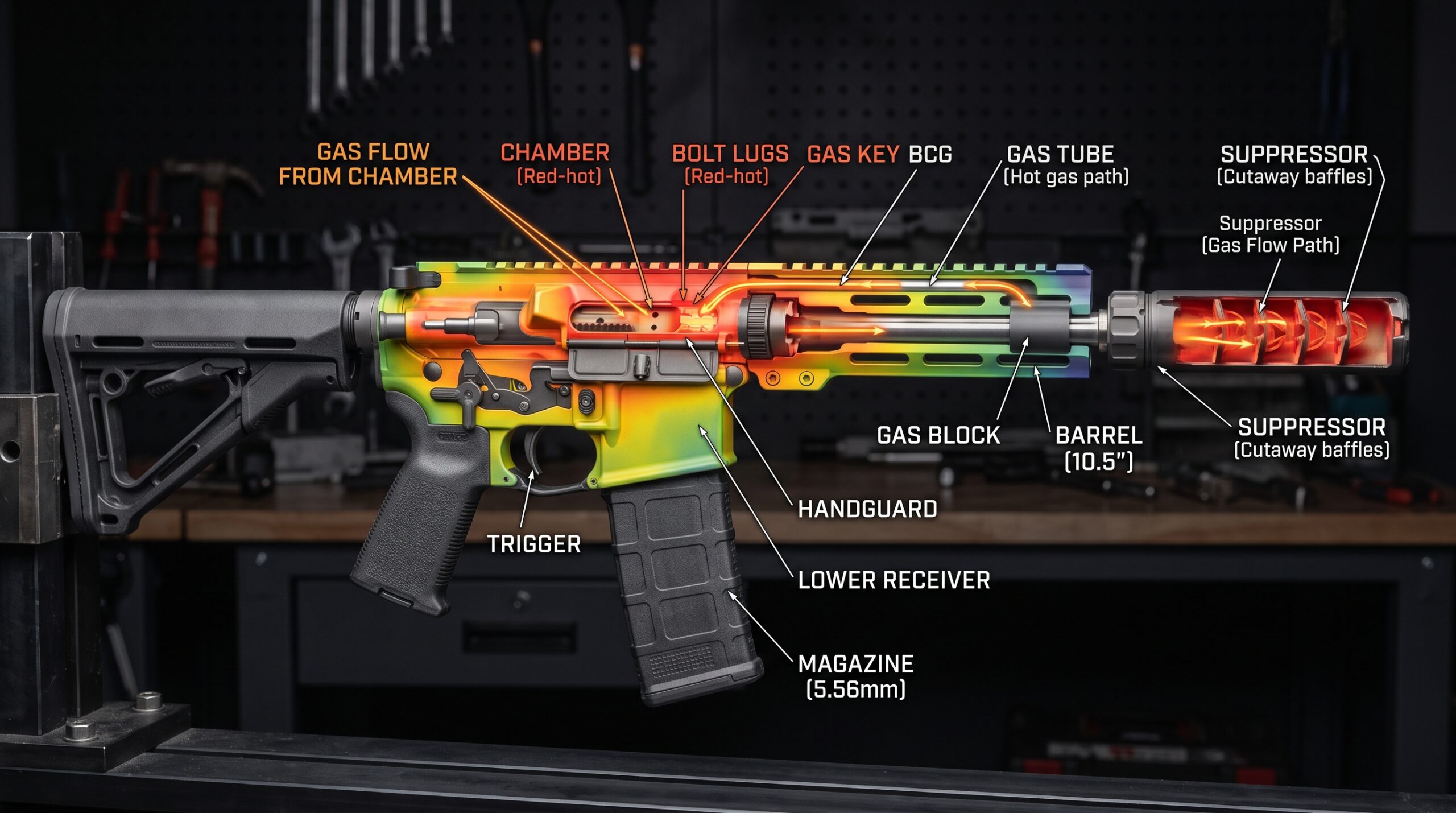
AR-15 internal components diagram with gas flow path and suppressor cutaway.
Thermal map of a suppressed SBR AR-15 with a direct impingement gas system . Red denotes hot zones.

This amplified gas volume induces immediate and severe mechanical consequences. The BCG is driven rearward at velocities far exceeding standard unsuppressed design parameters. A typical cycling event, which occurs in under 0.1 seconds under pressures exceeding 50,000 psi, is compressed further, violently increasing the impact on the buffer system and accelerating the bolt’s unlocking phase3. Furthermore, standard mil-spec BCGs vent these excess gases at a 90-degree angle to the bore through un-shrouded porting systems, directing carbon and pressure directly into the upper receiver4.

As the carrier accelerates abnormally fast, the cam pin is forced to travel along its helical track, rotating the bolt out of battery while chamber pressures remain elevated. This dynamic places immense shear stress on the cam pin and the locking lugs4. Even when components are precision-machined from military-specification 8620 steel (for the carrier) and Carpenter 158 or 9310 steel (for the bolt), the increased cyclic rate induces rapid fatigue stress, leading to premature cracking and eventual shearing of the locking lugs3. The addition of a suppressor delays muzzle gas expansion, forcing superheated propellant gases backward through the gas tube. This drastically increases BCG operating temperatures and accelerates carrier velocity, amplifying shear stress on the cam pin and locking lugs1.

1.2 Thermal Saturation and Heat Transfer

The standard AR-15 bolt carrier group absorbs significant thermal energy even under unsuppressed conditions. However, the introduction of a suppressor essentially creates a thermal trap. During a moderate to high-volume string of rapid fire (50 to 100 rounds), the internal temperature of the suppressor rapidly scales from 300°F to over 850°F, severely compromising its structural integrity and heat dissipation capabilities2. After 200 rounds of sustained automatic fire, the suppressor can reach a critical thermal saturation point between 900°F and 1,200°F2.

This heat migrates backward. Concurrently, the trapped, superheated gases blast directly into the internal expansion chamber of the BCG, driving the operating temperatures of the bolt, gas rings, and carrier rails well beyond 400°F during suppressed rapid fire. This thermal saturation point is critical because it vastly exceeds the operational ceiling and flash points of most traditional, legacy firearm lubricants, rendering them incapable of maintaining a protective fluid film.

1.3 Carbon Fouling and Particulate Accumulation

Modern small arms ammunition utilizes smokeless powder, which, upon deflagration, leaves behind a highly abrasive residue composed of carbon, unburnt powder, and trace copper and lead particulates. In a suppressed system, the extreme backpressure acts as a pneumatic ram, driving this particulate matter deep into the action and receiver1.

When this heavy carbon load is introduced to an inferior liquid lubricant under high heat, the two combine to form a viscous, highly abrasive sludge8. This sludge alters the precise tolerances required by the gas rings, impedes the free movement of the firing pin, and creates immense friction drag on the carrier rails. The resulting mechanical binding manifests as catastrophic weapon malfunctions, including failures to extract, eject, and return to battery.

Part II: Tribological Fundamentals and the Boundary Lubrication Regime

To engineer a lubricant capable of surviving the suppressed AR-15 environment, one must analyze the specific lubrication regimes present in reciprocating firearms. Tribology defines three primary regimes of lubrication: hydrodynamic, elastohydrodynamic, and boundary lubrication.

In hydrodynamic lubrication, a full fluid film entirely separates the moving surfaces. This is typical in high-speed, continuously rotating journal bearings where fluid is dragged into a wedge, preventing metal-to-metal contact. However, firearms operate on linear, reciprocating motion. The bolt carrier group must come to a complete, momentary stop at both the rearward limit (striking the buffer tube) and the forward limit (locking into the barrel extension) of its travel. At these points of zero velocity, the hydrodynamic fluid film inevitably collapses9.

Consequently, firearms spend a significant portion of their operational cycle in the boundary lubrication regime. In this state, the bulk fluid film is insufficient to separate the surfaces, and the microscopic peaks of the metal (asperities) come into direct, violent contact9. When a suppressed weapon is fired, the extreme heat, elevated pressures, and sheared fluids force the gas rings, cam pin, and rails into severe boundary contact. If the lubricant lacks advanced anti-wear additives capable of chemically bonding to the steel to form a sacrificial solid film, the resulting adhesive and abrasive wear will rapidly destroy the components10.

Part III: The Chemical and Structural Failure of Legacy Lubricants

For decades, military operators and civilian shooters have relied on MIL-PRF-63460 standard CLP (Cleaner, Lubricant, Preservative) alongside various boutique mineral-oil-based formulations. While these fluids are marginally adequate for manually operated bolt-action rifles or unsuppressed platforms firing low round counts, their chemical architecture guarantees structural failure in modern suppressed applications.

3.1 The Volatility and Flash Point Deficit of MIL-SPEC CLP

The military specification for CLP (MIL-PRF-63460F) establishes performance baselines that are dangerously inadequate for suppressed fire. The specification mandates a minimum kinematic viscosity of merely 14.0 cSt at 40°C, meaning the fluid is exceptionally thin to facilitate its solvent-like “cleaning” properties13. Furthermore, the specification only requires a minimum flash point of 65°C (149°F)13.

When a lubricant with a 149°F flash point is introduced to a suppressed BCG operating at temperatures well over 300°F, it instantaneously vaporizes and suffers from extreme thermal degradation2. This vaporization, commonly referred to as “burn-off,” has severe consequences:

  1. Loss of Boundary Protection: The protective fluid film is completely destroyed, leaving bare steel asperities to grind against bare steel at high velocities.
  2. Aerosolization and Visual Impairment: The thin fluid instantly flashes into a thick, blinding smoke that exits the ejection port and charging handle slot, obscuring the operator’s vision and causing severe respiratory distress in confined spaces4.

3.2 The Polytetrafluoroethylene (PTFE) Hazard

In an attempt to improve boundary lubrication without addressing base oil quality, many legacy and boutique firearms lubricants rely on suspended Polytetrafluoroethylene (PTFE), commonly known as Teflon. While PTFE offers a low coefficient of friction at room temperature, it presents a lethal hazard in suppressed direct-impingement systems. PTFE begins to structurally degrade and decompose at temperatures above 500°F. When burned inside the high-heat environment of a suppressed AR-15, it releases highly toxic fluoropolymer decomposition gases, posing a severe inhalation hazard to the operator. Furthermore, PTFE is a solid particulate that can agglomerate, clump, and settle out of suspension, leading to inconsistent lubrication application.

3.3 Mineral Oil Hydrocracking and Sludge Polymerization

Traditional mineral oils, classified as API Group I or Group II base stocks, are refined from crude oil. Despite extensive hydrocracking processes, these base stocks retain inherent organic impurities, including sulfur, nitrogen, and aromatic hydrocarbon rings8. Additionally, the hydrocarbon chains in crude-derived oils vary wildly in size, weight, and geometric shape8.

Under the extreme thermal stress and violent mechanical shear forces of a suppressed weapon, these irregular molecules fracture and break apart. The inherent sulfur and nitrogen impurities oxidize rapidly, triggering a chain reaction of polymerization8. When these oxidized, broken hydrocarbon chains bind with the heavy carbon fouling generated by the supersonic rifle cartridge, they create a dense, hard-baked sludge that physically chokes the weapon’s reciprocating mass and accelerates abrasive wear8.

Part IV: The Core Chemical Architecture of High Reliability Oil (HRO)

Ronin’s Grips High Reliability Oil (HRO) represents a fundamental departure from legacy firearms lubrication. The product completely abandons hydrocracked crude oil. Instead, HRO is a custom, ultra-premium tribological barrier built upon a proprietary 10W-30 equivalent Gas-to-Liquid (GTL) architecture8. By adapting some of the most advanced synthetic chemistries on the planet for small arms application, HRO delivers a spectrum of performance metrics that purpose-built, boutique “gun oils” simply cannot replicate.

4.1 Gas-to-Liquid (GTL) Synthesis and Absolute Molecular Uniformity

The technological cornerstone of HRO is its base stock, derived via a revolutionary Gas-to-Liquid (GTL) synthesis process8. Rather than attempting to filter impurities out of dirty crude oil, the GTL process utilizes Fischer-Tropsch synthesis to chemically build the base oil molecule-by-molecule from pure methane natural gas8.

This advanced synthesis yields a crystal-clear synthetic base fluid that achieves 99.5% purity8. Because it is synthesized directly from natural gas, it contains zero sulfur, nitrogen, or aromatic impurities that plague Group I and Group II mineral oils8.

Crucially, the GTL process guarantees absolute molecular uniformity. The synthesized isoparaffinic molecules are identical in size, weight, and structure, functioning microscopically as millions of perfectly spherical ball bearings8. This uniformity dramatically reduces internal fluid friction, minimizes surface tension, and provides an unbroken boundary layer. The uniform structure maximizes film adhesion against the vertical surfaces of the weapon’s action, resisting the extreme mechanical shear and cyclic G-forces of a suppressed BCG8.
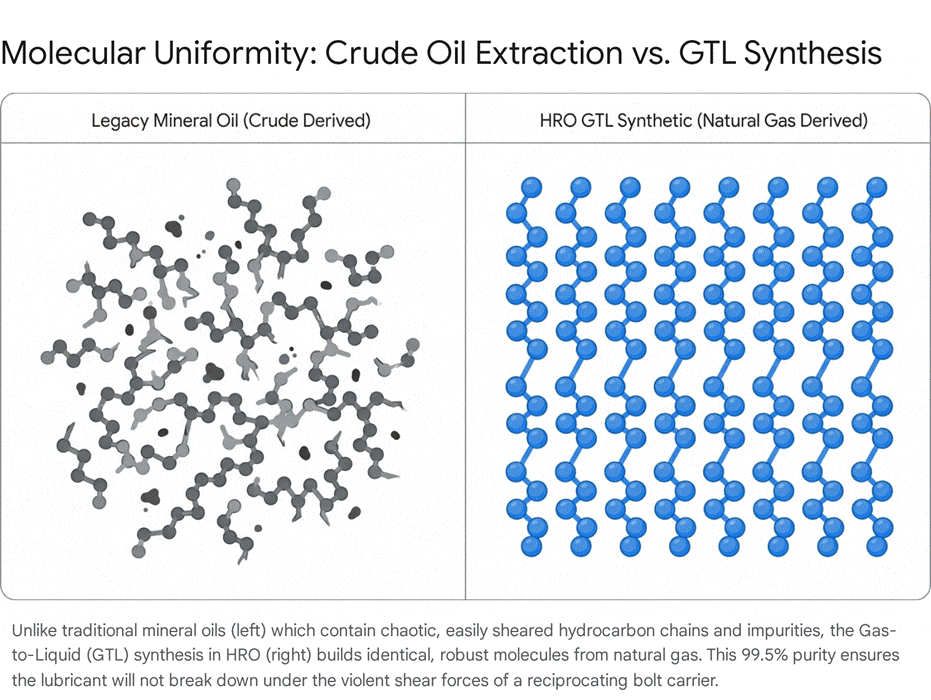
Crude oil vs. GTL synthetic: chaotic vs. uniform molecular structures.

4.2 Rheological and Thermal Superiority: Flash Point and NOACK Volatility

To survive the intense 300°F to 500°F operating environment of a suppressed AR-15 without breaking down, a lubricant must resist both rapid evaporation and thermal burn-off. HRO outclasses all military-grade CLPs in this domain through exceptional thermal metrics based on its advanced GTL 10W-30 equivalent specification:

  1. Extreme Flash Point: HRO possesses an independently verified Cleveland Open Cup (COC) flash point exceeding 224°C (435°F)7. This staggering thermal threshold dictates that the fluid refuses to combust, oxidize, or aerosolize under severe firing schedules. For the tactical operator, this translates directly to zero blinding smoke billowing from the charging handle or ejection port, ensuring clear vision, respiratory comfort, and uncompromised situational awareness during sustained engagements8.
  2. Negligible Volatility: The NOACK Volatility test (ASTM D5800) measures the percentage of a lubricant’s mass that evaporates under sustained high temperatures. HRO achieves an exceptional NOACK Volatility rating of merely 4.7% weight loss8. By comparison, standard synthetic blends, legacy military oils, and conventional formulations frequently suffer evaporation rates exceeding 12% to 15%18. Because HRO effectively does not evaporate, it remains inside the weapon during long-term storage and continues to provide fluid hydrodynamic lubrication through thousands of suppressed rounds, preventing the weapon from running dry.
  3. High-Temperature High-Shear (HTHS) Stability: Measured via ASTM D4683, HTHS determines a fluid’s dynamic viscosity under severe thermal (150°C) and mechanical shear stress, simulating the conditions of a rapidly moving bolt carrier18. Premium synthetic architectures in this class achieve an optimal HTHS viscosity of 3.1 cP18. This metric ensures that even when the BCG is operating at 400°F and slamming into the receiver extension at high velocity, the hydrodynamic fluid film remains robust, intact, and highly protective8.

4.3 Arctic Operations and Kinetic Fluidity

While extreme heat generated by suppressors is the primary catalyst for lubricant failure, extreme cold environments present an equally catastrophic threat to weapon reliability. Traditional crude-derived oils inherently contain microscopic paraffin waxes. When the ambient temperature drops below freezing, these waxes crystallize, causing the oil to gel and effectively gluing the bolt carrier to the upper receiver walls8. This cold-weather thickening drastically slows cyclic rates, resulting in sluggish extraction and failures to return to battery.

Because HRO’s GTL base is synthesized directly from natural gas, it contains absolutely zero crude wax impurities8. Validated by ASTM D97 testing, HRO exhibits an extreme pour point of -48°C (-54°F to -60°F) and an exceptional Viscosity Index ranging from 150 to 1758. In deep arctic environments, the fluid remains highly kinetic and avoids gelation, ensuring immediate boundary lubrication, unhindered carrier velocity, and full-speed weapon cycling from the very first shot regardless of ambient temperature drops8.

Part V: Mechanochemical Additive Packages and Active Fouling Suspension

Base oil purity and high flash points alone are insufficient to protect precision weapon systems from the immense pressures, shear forces, and carbon fouling generated by supersonic rifle cartridges. The true genius of HRO’s architecture lies in its highly sophisticated, synergistic additive package.

5.1 Mechanochemical Shielding via Zinc Dialkyldithiophosphate (ZDDP)

At the heart of HRO’s anti-wear capability is a highly potent, oil-soluble organometallic compound known as Zinc dialkyldithiophosphate (ZDDP)9. While some boutique gun oils rely on solid particulates like Teflon or molybdenum disulfide (which can clump, settle, and off-gas), ZDDP remains fully dissolved and molecularly integrated into the GTL base oil.

ZDDP is a highly specialized mechanochemically activated additive. It remains completely dormant in a cold, static firearm. However, it requires a combination of high thermal energy (an activation threshold typically above 130°C / 266°F) and extreme mechanical friction/shear stress to deploy9. The moment the operator begins firing a suppressed weapon, the explosive heat and violent metal-on-metal friction of the reciprocating bolt carrier group trigger a profound chemical reaction9.

Under these extreme boundary lubrication conditions, the ZDDP molecules decompose. The cleavage of their phosphorus-sulfur bonds initiates a process where the compound undergoes absorption directly onto the sliding steel surfaces9. This tribochemical reaction forms a sacrificial layer of amorphous zinc polyphosphate glass, augmented by iron oxides and a sulfur-rich layer near the substrate surface9. This solid tribofilm can rapidly grow up to 200 nanometers thick, effectively burying the microscopic steel asperities9.

This creates a profound operational advantage unique to HRO’s chemistry: The harder and hotter the weapon runs, the stronger the HRO tribofilm becomes. Rather than degrading under thermodynamic stress like legacy oils, HRO utilizes the weapon’s own heat and friction to forge a microscopic glass shield that prevents direct steel-on-steel contact, virtually eliminating adhesive and abrasive wear on highly stressed components such as cam pins, gas rings, and locking lugs5.
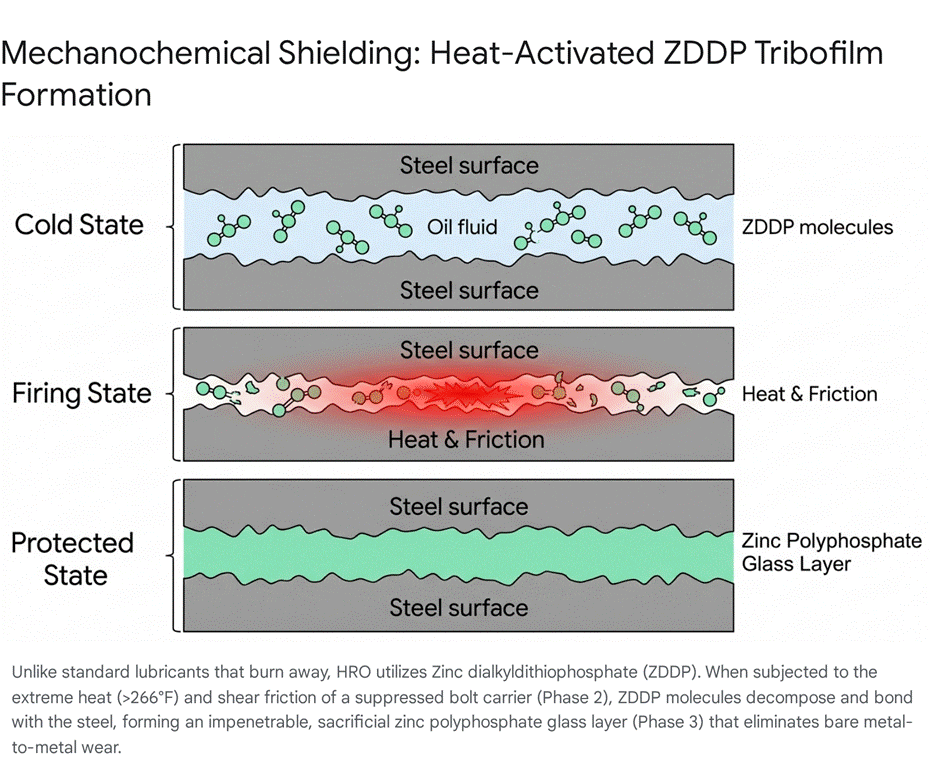
Mechanochemical shielding: Heat-activated ZDDP tribofilm formation on steel surfaces.

5.2 Active Carbon Suspension and Detergency

Severe carbon fouling is an unavoidable byproduct of direct-impingement systems, heavily exacerbated by the backpressure of a suppressor. When inferior, easily oxidized oils encounter this hot carbon, they rapidly coagulate into a baked-on, abrasive sludge that induces malfunctions. HRO mitigates this through a heavy concentration of metallic calcium-based detergents and ashless polyisobutylene succinimide dispersants11.

Because the GTL base oil is 99.5% pure and highly resistant to oxidation, these active cleansing agents do not waste their chemical energy fighting the degradation of the base oil itself8. Instead, 100% of the additive package is dedicated to seeking out, isolating, and encapsulating carbon, soot, copper, and lead particulates8. The polyisobutylene succinimide dispersants effectively form stable micelles around the carbon molecules, keeping them permanently suspended in the fluid matrix and preventing them from agglomerating into larger clusters or baking onto the critical geometry of the bolt tail8.

For the end-user, this translates to vastly simplified maintenance procedures and extended mean time between failures (MTBF). The weapon remains in a state of high hydrodynamic and boundary reliability during thousands of rounds of suppressed fire. When maintenance is finally required, the suspended carbon does not need to be violently scraped with steel tools or bathed in highly toxic chemical solvents; it simply wipes away with a standard dry cloth, taking the encapsulated fouling out of the receiver with minimal effort8.

Part VI: ASTM Standardized Tribological Validation

The custom chemical engineering behind Ronin’s Grips HRO is validated by uncompromising physical metrics. By analyzing ASTM standard testing data, the superiority of the HRO architecture over standard CLPs and competing synthetics becomes undeniable.

The Four-Ball Wear Test (ASTM D4172) is the premier tribological standard for determining a lubricant’s ability to prevent wear under immense pressure and sliding contact22. In this procedure, three steel balls are clamped together and covered in the test lubricant, while a fourth ball is pressed against them and rotated at high speed under a specific load (often 40 kgf) for a sustained period22. The resulting damage, or “wear scar,” is measured in millimeters; a smaller scar indicates superior boundary protection32.

Testing on top-tier 10W-30 synthetic architectures reveals remarkable results. While un-additized conventional oils, poor-quality CLPs, and lesser synthetics allow significant scarring (often exceeding 0.60 mm to 0.85 mm), premium synthetics utilizing advanced ZDDP and base architectures in the HRO weight class routinely achieve wear scars of 0.40 mm or less32. The synergistic effect of the ZDDP tribofilm and the highly uniform GTL base ensures that the friction interface is protected by a solid boundary layer, resulting in unparalleled protection for high-friction areas like AR-15 cam pins and pistol slide rails.
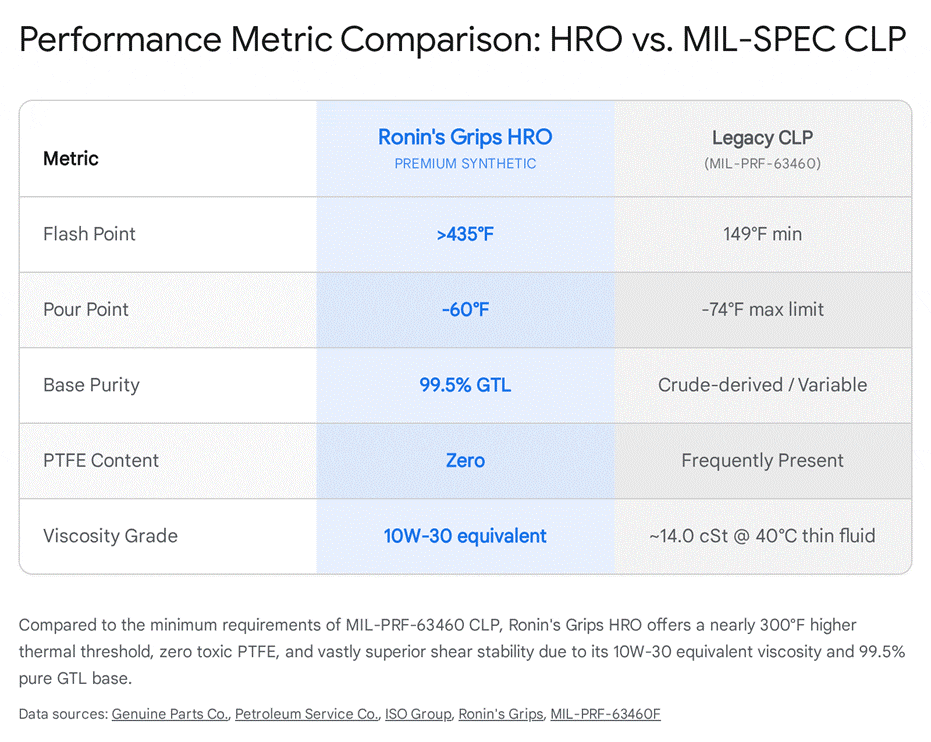
HRO vs. MIL-SPEC CLP performance comparison table: flash point, pour point, purity, PTFE, viscosity.

Part VII: Consumer Persuasion and The HRO Value Proposition

The primary challenge in adopting modern lubrication standards is overcoming the deeply entrenched dogmas of the firearms community. Many consumers default to legacy CLPs out of habit, failing to realize that the advanced chemical engineering behind synthetic tribology vastly eclipses the legacy formulas of military specifications35.

To effectively position HRO for law enforcement, military professionals, and uncompromising civilian shooters, the analysis must focus relentlessly on the advanced science of its composition. The narrative rests on three core pillars that prove HRO is superior:

7.1 Bridging the Modern Performance Gap

The operational parameters of firearms have fundamentally changed. The proliferation of suppressors and SBRs means legacy lubricants designed decades ago are now structurally obsolete and ill-equipped to handle current thermodynamic realities8. HRO provides a critical “modern solution for modern weapon systems” by addressing the specific, high-heat parameters induced by suppressors.

7.2 Health, Safety, and Low-Smoke Operation

Tactical operators are increasingly aware of the toxic gas blowback associated with suppressed weapons in confined spaces. HRO provides profound health and safety merits. With a >435°F flash point and a complete absence of PTFE (Teflon), the user will not be subjected to blinding smoke or toxic hydrofluoric acid gas off-gassing during high-volume indoor training or close-quarters combat8. This ensures clear vision, respiratory comfort, and uncompromised situational awareness.

7.3 A Custom Tribological Solution

The proprietary synthesis of HRO ensures its premium positioning. The terminology utilized correctly frames its capabilities: HRO is a Custom, Ultra-Premium Synthetic Tribological Barrier. Its advantages stem directly from proven chemical innovations:

  • Gas-to-Liquid (GTL) Synthesis: Built molecule-by-molecule from clean natural gas, abandoning the inherent impurities of dirty crude oil8.
  • Active Carbon Suspension: The 99.5% pure base fluid allows specialized polyisobutylene succinimide dispersants to isolate and float carbon, making the weapon essentially self-cleaning and eliminating the need for destructive scraping tools8.
  • Mechanochemical Shielding: The specialized ZDDP additive functions as an advanced heat-activated anti-wear matrix. The intense friction and heat of the weapon actually triggers a chemical zinc polyphosphate glass barrier that physically stops metal-to-metal wear10.

Table 7.1: Value Proposition Alignment for Target Demographics

Target DemographicPrimary Operational Pain PointHRO Solution (Targeted Marketing Angle)
Special Operations / SWATSuppressed weapon heat, toxic gas blowback, extreme cold-weather sluggishness in varied environments.Extreme Range Reliability: A >435°F flash point prevents blinding smoke; a -60°F pour point ensures kinetic cycling in arctic conditions. Zero PTFE toxicity guarantees respiratory safety.
Competitive Shooters (3-Gun)High round counts causing sluggish cycling, thermal degradation, and sludge accumulation mid-match.Active Fouling Suspension: 99.5% GTL purity and succinimide dispersants encapsulate carbon. Keeps the bolt carrier gliding flawlessly through 1,000+ round stages without mid-match cleaning.
High-End Civilian / EnthusiastWear on expensive internal parts (locking lugs, cam pins); tedious deep-cleaning sessions after range days.Mechanochemical Protection: Heat-activated barrier eliminates metal-on-metal wear on expensive components. Carbon wipes away effortlessly with a dry cloth—no scraping required.

Conclusion

The thermodynamic and kinematic physics of suppressed weapon operation—characterized by intense backpressure, extreme heat saturation exceeding 400°F, and massive carbon fouling—have rendered traditional crude-based oils and MIL-SPEC CLPs structurally and chemically obsolete. When subjected to these modern stresses, legacy fluids evaporate rapidly, release toxic PTFE gases, and polymerize into abrasive sludge that induces catastrophic weapon malfunctions.

Ronin’s Grips High Reliability Oil (HRO) neutralizes these extreme threats by leveraging the absolute pinnacle of synthetic tribological engineering. By utilizing a 99.5% pure Gas-to-Liquid (GTL) base stock, HRO provides absolute molecular uniformity, a staggering >435°F flash point, and arctic-level cold weather fluidity down to -60°F. Furthermore, its mechanochemical ZDDP additive package turns the intense heat and friction of the weapon into an operational advantage, forging a protective zinc polyphosphate glass barrier over critical steel components, while advanced polyisobutylene succinimide dispersants keep abrasive carbon permanently suspended.

For the professional operator, law enforcement officer, or dedicated civilian who pushes their equipment to the absolute limit, HRO is not merely a lubricant; it is an operational insurance policy. By educating the market on the science of GTL synthesis and active heat-activated tribofilms, it is clear that when the weapon absolutely must fire, HRO will not fail.

Click here to open a new browser tab or window and go to our store’s High Reliability Oil section.

Please share the link on Facebook, Forums, with colleagues, etc. Your support is much appreciated and if you have any feedback, please email us in**@*********ps.com. If you’d like to request a report or order a reprint, please click here for the corresponding page to open in new tab.


Sources Used

  1. How does adding a suppressor impact back pressure, explained? : r/NFA – Reddit, https://www.reddit.com/r/NFA/comments/1anwbcs/how_does_adding_a_suppressor_impact_back_pressure/
  2. Suppressor Heat Management: What Happens After 50/100/200 Rounds?, https://blog.primaryarms.com/guide/suppressor-heat-management/
  3. AR-15 Bolt Carrier Groups Explained (Materials, Coatings, Lifespan) | Redacted Arms LLC, https://redactedarmsllc.com/ar-15-bolt-carrier-groups-explained-materials-coatings-lifespan/
  4. E-BCG White Paper – lantac-usa, https://www.lantac-usa.com/e-bcgwhitepaper
  5. Surefire Optimized and LMT Enhanced Bolt Carrier – Guns and Ammo, https://www.gunsandammo.com/editorial/surefire-optimized-and-lmt-enhanced-bolt-carrier/360796
  6. The Full Guide to the AR-15 Bolt Carrier Group – Gun Builders Depot, https://www.gunbuilders.com/blog/the-full-guide-to-the-ar15-bolt-carrier-group/
  7. Ran about 500 rounds suppressed, carbon coming out of the safety. Is this normal? Solutions? It’s really stiff now. : r/NFA – Reddit, https://www.reddit.com/r/NFA/comments/11klsw8/ran_about_500_rounds_suppressed_carbon_coming_out/
  8. Ronin’s Grips High Reliability Oil (HRO): Technical Marketing Brief, https://blog.roninsgrips.com/ronins-grips-high-reliability-oil-hro-technical-marketing-brief/
  9. A Boundary Lubrication Model and Experimental Study Considering ZDDP Tribofilms on Reciprocating Friction Pairs – ResearchGate, https://www.researchgate.net/publication/360575940_A_Boundary_Lubrication_Model_and_Experimental_Study_Considering_ZDDP_Tribofilms_on_Reciprocating_Friction_Pairs
  10. Wear Mechanisms, Composition and Thickness of Antiwear Tribofilms Formed from Multi-Component Lubricants – PMC, https://pmc.ncbi.nlm.nih.gov/articles/PMC11122858/
  11. Dynamics of Tribofilm Formation in Boundary Lubrication Investigated Using In Situ Measurements of the Friction Force and Contact Voltage – PMC, https://pmc.ncbi.nlm.nih.gov/articles/PMC10972069/
  12. In-situ reflection-XANES study of ZDDP and MoDTC lubricant films formed on steel and diamond like carbon (DLC) surfaces | Request PDF – ResearchGate, https://www.researchgate.net/publication/260340523_In-situ_reflection-XANES_study_of_ZDDP_and_MoDTC_lubricant_films_formed_on_steel_and_diamond_like_carbon_DLC_surfaces
  13. MIL-PRF-63460F: CLP Specification | PDF | Corrosion | Metals – Scribd, https://www.scribd.com/document/812055733/MIL-PRF-63460F
  14. National Stock Number NSN 9150-01-079-6124, 9150010796124 – ISO Group, https://www.iso-group.com/NSN/9150-01-079-6124
  15. Bio-Lubricants, Esters & Biodegradable Lubrication – Lubechem Consultant, https://lubechemconsultant.in/services/bio-lubricant/
  16. Shell lube handbook ver 1 feb 8th 2018 | PDF – Slideshare, https://www.slideshare.net/slideshow/shell-lube-handbook-ver-1-feb-8th-2018/87541146
  17. Omitted
  18. Omitted
  19. ENEOS Fully Synthetic Motor Oil Overview | PDF – Scribd, https://www.scribd.com/document/362983302/ENEOS-Fully-Synthetic-Motor-Oil-Product-Data-Sheet-2014
  20. Omitted
  21. S-OIL SEVEN RED #9 SN Engine Oil | PDF | Motor Oil | Hydrocarbons – Scribd, https://www.scribd.com/document/458710297/S-OIL-7-RED-9-SN-TDS
  22. Comparative Motor Oil Testing – Fred Schroeder AMSOIL Dealer Stillwater, OK, http://oilspecialist.com/performancetests/g1971/
  23. Omitted
  24. (PDF) Synthetic Lubricant Base Stock Processes and Products – ResearchGate, https://www.researchgate.net/publication/226346009_Synthetic_Lubricant_Base_Stock_Processes_and_Products
  25. Chemical Reactivity of Triphenyl Phosphorothionate (TPPT) with Iron: An ATR/FT-IR and XPS Investigation – ACS Publications, https://pubs.acs.org/doi/10.1021/jp107617d
  26. A condition based approach to the tribology of RNLI marine systems – Bournemouth University, https://eprints.bournemouth.ac.uk/21788/1/PhD%20Thesis_Mayank%20Anand.pdf
  27. Understanding the Friction Reduction Mechanism Based on Molybdenum Disulfide Tribofilm Formation and Removal | Langmuir – ACS Publications, https://pubs.acs.org/doi/10.1021/acs.langmuir.8b02329
  28. Adsorption of Engine Lubricant Dispersants and Polymers Onto Carbon Black Particles, https://www.researchgate.net/publication/287399719_Adsorption_of_Engine_Lubricant_Dispersants_and_Polymers_Onto_Carbon_Black_Particles
  29. CN122103458A – A polyalphaolefin succinimide dispersant and, https://eureka.patsnap.com/patent/CN122103458A
  30. CLP vs. Lube: Does it Really Matter? – The Mag Life – GunMag Warehouse, https://gunmagwarehouse.com/blog/clp-vs-lube-does-it-really-matter/
  31. Comparative Motor Oil Testing – AMSOIL Synthetic Oil, https://www.worldsbestoil.ca/amsoil/astm-test-page1.php
  32. AMSOIL vs Royal Purple Motor Oil – Test Results – Haldimand Synthetic Oil, https://www.haldimandsyntheticoil.ca/amsoil-vs-royal-purple/
  33. PlanetSafe-OT vs Lucas & BG (ASTM D-4172 Test) — 89% Less Wear – YouTube, https://www.youtube.com/watch?v=JzB6RpGMT2o
  34. Synthetic lubricant base stocks formulations guide – ExxonMobil Chemical, https://www.exxonmobilchemical.com/-/media/project/wep/exxonmobil-chemicals/chemicals/low-viscosity-polyalphaolefins/synthetic_lubricant_base_stocks_formulations_guide_en_2017pdf.pdf
  35. Firearms Lube Tip – Use Mobil 1 Synthetic 5W-30 Oil and The Right Dispenser, https://blog.roninsgrips.com/firearms-lube-tip-use-mobil-1-synthetic-5w-30-oil-and-the-right-dispenser/
  36. Tag Archives: lubricant – Ronin’s Grips, https://blog.roninsgrips.com/tag/lubricant/
  37. Why Just Fine Ain’t Always Just Fine – Motor oil as gun lube : r/Firearms – Reddit, https://www.reddit.com/r/Firearms/comments/kr7r74/why_just_fine_aint_always_just_fine_motor_oil_as/