Category Archives: Platform Maintenance, Finish Restoration & Tuning

Step-by-step lubrication guides, magazine tuning tutorials, and cosmetic restoration techniques across AK, AR-15, 1911/2011, Uzi, and roller-delayed HK platforms. Includes practical procedures for reviving faded polymer grips, tuning double-stack magazines, and maintaining high-pressure airgun compressors.

Ronin’s Grips: Best Picks for Historical AK and IMI Galil Restorations

People have been building and collecting Kalashnikov rifles for over seventy years all around the world. For anyone dedicated to restoring or upgrading one of these rifles, it’s all about honoring history while making the gun work its best. One of the most important parts you can change is the pistol grip. It’s the main spot where you interact with the rifle, and it affects how the gun feels, how you handle recoil, and whether the whole build looks authentic.

Ronin’s Grips, based in Michigan, has built a great reputation for making handcrafted, incredibly accurate copies of some of the rarest AK grips found anywhere. But these grips aren’t just about looks. Because of the special materials they use and the way they help you stay on the right side of federal law, they are a must-have for anyone serious about their rifle.

In this guide, we’ll explain the tough materials Ronin uses, why they are a smart legal choice, and dive into the history of the rifles these grips were made for—plus, we’ll share what the shooting community has to say about them.

Built Tough: High-Tech Materials That Feel Like Wood

A lot of gun parts today are made from cheap, mass-produced plastic. While that might be fine for a basic hobby rifle, those plastics often aren’t strong enough or heat-resistant enough for serious use. Ronin’s Grips does things differently.

Their grips and handguards are cast from a special material: glass-fiber reinforced high-temperature urethane. This creates a part that is as durable as modern synthetics but is just as easy to shape and trim as traditional wood.

This material is built for heat. It won’t soften or warp until it gets hotter than 257°F, so you don’t have to worry about your furniture melting under heavy use.

Another huge benefit is how easy it is to work with. Because AK rifles were made in so many different factories, parts often need a little custom fitting to sit perfectly. You can sand, file, or drill Ronin’s material without it cracking or losing its strength. Many expert builders even use a custom-made file with one smooth edge to get a perfect fit without scratching the finish of the rifle.
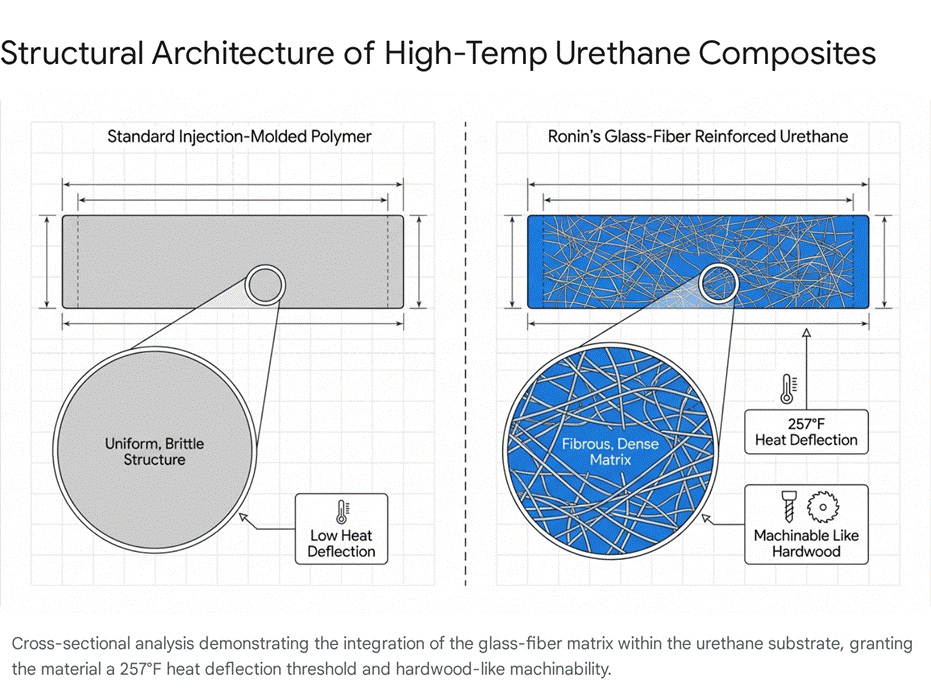
Comparison of standard injection-molded polymer vs. Ronin's glass-fiber reinforced urethane composites.

Cleaning is easy, too. If you use a heavy-duty ultrasonic cleaner to get rid of carbon and dirt, this material can handle it without falling apart. Even if the finish gets a little dull after a deep clean, you can bring the factory look right back with some fine steel wool and plastic restorer.

Aside from comfort, the main reason people use U.S.-made grips on imported rifles is to follow federal law. A rule known as 922(r) sets strict limits on how many imported parts can be in a rifle that you’ve assembled or modified here in the States.

Basically, the law says you can’t have more than ten imported parts on certain types of rifles. A standard AK-style rifle usually has about 16 of these “countable” parts.

To legally change a “sporter” rifle (like an imported Saiga or WASR) into its classic military look, you have to swap out at least six of those foreign parts for ones made in the U.S.

922(r) Countable ComponentStandard Factory OriginU.S. Compliance Replacement Strategy
ReceiverForeignRetained for authenticity.
BarrelForeignRetained for authenticity.
TrunnionForeignRetained for authenticity.
Muzzle DeviceForeignOften replaced with U.S. muzzle brake.
BoltForeignRetained for authenticity.
Bolt CarrierForeignRetained for authenticity.
Gas PistonForeignOften replaced with U.S. piston.
TriggerForeignReplaced with U.S. fire control group.
HammerForeignReplaced with U.S. fire control group.
DisconnectorForeignReplaced with U.S. fire control group.
ButtstockForeignRetained or replaced depending on build.
Pistol GripForeignHighly recommended U.S. replacement (Ronin’s Grips).
HandguardsForeignRetained or replaced depending on build.
Magazine BodyForeignReplaced with U.S. magazine to count as 1 part.
Magazine FollowerForeignReplaced with U.S. follower to count as 1 part.
Magazine FloorplateForeignReplaced with U.S. floorplate to count as 1 part.

Replacing the pistol grip is one of the easiest ways to get that U.S. part credit. But most collectors hate the look of modern, “tacticool” grips on a classic rifle. Ronin’s Grips fixes this problem. Since they are made in Michigan, they count as a U.S. part, but they look exactly like the original military grips from overseas.

This has become even more important lately because of new ATF rulings that changed how kits are imported. Nowadays, more kits are coming in with their original foreign barrels. While those barrels are great for accuracy, using them means you lose a U.S. part credit you used to get from buying an American barrel. That makes finding high-quality U.S.-made furniture like Ronin’s more important than ever for staying legal without ruining the look of your rifle.

Platform Provenance and Grip Profiles

What really makes Ronin’s Grips special is their huge selection. The AK design didn’t stay the same as it moved through Russia, Israel, Hungary, and Yugoslavia. Ronin has done the homework to make sure every replica matches the specific look and feel of those original designs. Here is a breakdown of the rifles these grips were made for and what shooters think of Ronin’s versions.

1. The Russian Powerhouses: SAW-Style Grips

History: The Molot and Izhmash plants in Russia are world-famous for their rifles. Molot is known for the RPK machine gun, which was built extra tough to handle a lot of firing. This heavy-duty design eventually led to the Vepr and Saiga series of shotguns and rifles.

Because these guns are heavier than a standard AK, the regular grips weren’t very comfortable. Russian engineers designed bigger, ergonomic grips to help shooters handle the extra weight. In the U.S., we often call these “SAW” style grips because they look like the ones on the M249 machine gun.

Ronin’s Version: Finding real Russian grips is hard and expensive. Plus, using a real one doesn’t help you with your 922(r) part count. Ronin makes exact copies that use the traditional long AK screw. This is much stronger than some cheap commercial grips that use a short screw, which can snap off if you’re too rough with the rifle.

Ronin’s also evolved the design based on community feedback, offering a “Generation 2” version that features enhanced internal reinforcement for uncompromising structural integrity during heavy tactical use20.

Community Feedback & Key Takeaways

The sentiment surrounding the Izhmash SAW / Molot replica is overwhelmingly positive, particularly among professional Saiga and Vepr converters who recognize the structural flaws of competing commercial brands.

Grip ModelCommunity FeedbackKey Takeaway
Molot / Izhmash SAW Replica“Storage compartment grips… all the ones that attach with short screws – are doo doo… a proper mil spec AK grip needs to attach with the standard long screw. IzhMash SAW/Taktika or a US made copy [from Ronin].”19Validates the engineering superiority of the long-screw attachment method over hollow commercial alternatives.
Molot / Izhmash SAW Replica“My favorite pistol grip is by-far the Izhmash SAW grip (sold as a MOLOT grip on Ronin’s Grips)… I have a Gen. 1 since I bought it before he made the Gen. 2s… I’ve never felt my Gen. 1 was anything but super-solid.”20Highlights long-term durability and the continuous improvement of the Gen 2 product line.
Molot / Izhmash SAW Replica“I couldn’t put the new IzhMash SAW grip on my SGL21, due to my 922r parts count, however, I got the Ronin’s copy and it’s quite excellent.”14Demonstrates the critical necessity of U.S. compliance parts for high-end conversions.

2. The Desert Defender: The IMI Galil

History: In the late 60s, Israel needed a new rifle that could handle the sand and dust of the desert. They created the Galil, which used the reliable AK system but added Western-style accuracy. They also added a thumb safety so you wouldn’t have to move your hand to flip the switch.

The result was the IMI Galil, designed by Yisrael Galil22. Based heavily on the Finnish Valmet Rk 62 (itself a refined AK derivative), the Galil incorporated several unique ergonomic upgrades specifically tailored for the Israeli military16. Recognizing that the standard AK safety lever requires the operator to physically remove their hand from the firing grip to manipulate the selector, the Galil features an ambidextrous thumb safety mechanism25.

To make that thumb safety work, the grip had to be designed differently. It’s longer and wider than a normal AK grip and has a special cutout on the side for the safety lever.

Ronin’s Version: When builders started making Galil rifles in the U.S., they needed American-made parts to stay legal. Many used cheap, ugly grips that didn’t look right. Ronin makes a replica that looks perfect and has the correct cutout so the safety works just like it should.

Ronin’s Grips manufactures an replica of the original IMI Galil grip, cast in the appropriate smooth texture and featuring the correct left-side safety recess required for the mechanism to function22.

Community Feedback & Key Takeaways

Within the specialized Galil building community, the Ronin’s Grip is viewed as the gold standard for restoring authenticity without compromising legal compliance.

Grip ModelCommunity FeedbackKey Takeaway
IMI Galil Replica“I’d recommend buying a grip from Ronin’s Grips much more if you want to maintain the original Galil aesthetic. The guy from that site is awesome and a wealth of information.”26Positions Ronin not just as a manufacturer but as an authoritative domain expert in the Galil ecosystem.
IMI Galil Replica“Ronin’s Grips is awesome. The guy is super cool and his blog is a treasure trove of information.”27Demonstrates how the brand’s informational content drives product trust and helps the building community.
IMI Galil Replica“Take it off and see if it has made in USA on the mating surface to the receiver. If so, it’s probably a Ronin USA made grip.”28Validates the visual accuracy of the grip; it is so authentic that the U.S. stamping is required to differentiate it from an original IMI artifact.

3. The Hungarian Anomaly: The AMD-65/63 Blue Polymer

History: The Hungarian AMD-65 is a unique-looking rifle made for paratroopers. It’s famous for having two pistol grips—one in the back and one in the front.

During the Cold War, Hungary couldn’t get the same materials as other countries, so they used a type of industrial plastic often used for food containers. This gave the grips a very strange, bright grey-blue color that collectors today find fascinating.

This material substitution resulted in a highly unusual, vivid grey-blue colored polymer. Often referred to by collectors as “Tupperware” stocks, this blue furniture was primarily fitted to the fixed-stock AKM-63D variants, but the grips are identical across the AMD family29. Today, original Hungarian blue furniture is incredibly rare and highly prized by Cold War weapon historians as a physical manifestation of geopolitical supply chain constraints29.

The Ronin’s Grips Reproduction When companies like Arms of America occasionally locate New Old Stock (NOS) caches of the blue Hungarian fixed stocks, collectors immediately purchase them in droves29. However, finding the matching blue pistol grips to complete the rifle is nearly impossible. Furthermore, utilizing two foreign pistol grips (front and rear) on an AMD-65 build severely jeopardizes the 922(r) part count9.

Ronin’s Version: Finding those original blue grips is almost impossible. Ronin makes U.S.-made grips that match that rare blue color. This lets you finish your historical build and get two U.S. part credits at the same time.  Note:  There are also Black and Gray colored versions as well.

Community Feedback & Key Takeaways

The sentiment reflects profound relief from collectors who finally have a solution to complete their historical builds accurately.

Grip ModelCommunity FeedbackKey Takeaway
Hungarian AMD-65 (Blue)“Now I just wish AOA would find and import the blue pistol grip. I like it, really a Cold War look.” To which community experts respond: “Ronin’s Grips is selling US-made AMD grips cast in the same color that count as a 922r compliance part.”29Provides a perfect solution for a specific gap in the surplus supply chain.
Hungarian AMD-65 (Blue)“I remember reading the history of this furniture back in the 80’s… Now if you ever get matching pistol grips I’ll be able to fix my clone.”29Highlights the historical dedication of builders and their reliance on color-matched aftermarket support.

4. The Balkan Bruisers: Yugoslavian Zastava M70/M72

History: Yugoslavia did things their own way. They wanted their rifles to be able to launch heavy grenades, so they built them extra strong with thicker steel. Because the guns were built differently, standard AK parts won’t fit them. The grips are thicker and more vertical than a normal AK.

To prevent the receiver from buckling or suffering catastrophic trunnion failure under the extreme recoil impulse of grenade launching, Zastava utilized the heavier 1.5mm receiver and the reinforced bulged front trunnion typically reserved for the RPK machine gun, applying it to their standard M70 and M72 series rifles17. Because the fundamental dimensions of the receiver were altered, standard AKM furniture simply does not fit Yugoslavian rifles. The handguards are longer, the buttstock mounting mechanics are entirely different, and the pistol grips feature a distinct, beefier, more vertical profile12.

During the Balkan Wars of the 1990s, these rifles saw intense use. Today, “Balkan War surplus” furniture is highly desired for its battlefield character and historical significance20.

Ronin’s Version: Most Yugo rifles imported today come with cheap plastic furniture that doesn’t look like the original military gear. Ronin makes very accurate replicas of those original Yugoslavian grips and the M72 handguards.  Ronin also has a number of Yugo/Zastava related products so click here to see them.

Community Feedback & Key Takeaways

Shooters with larger hands specifically seek out the Zastava M70 profile grip produced by Ronin for its superior ergonomics compared to standard, thinner AK grips.

Grip ModelCommunity FeedbackKey Takeaway
Zastava M70 Replica“If you want to ‘keep it in the family’ the Yugo grips are a bit beefier/more comfy than most. I have one on my m92 and love it even with my XXL hands.”12Highlights the grip’s pure ergonomic superiority for larger shooters, independent of historical restoration goals.
Zastava M70 Replica“I am also very pleased with material of his furniture. It feels not like a plastic, but more like a G-10 scales on my Spyderco knife and VZ grips. Rifle was fine before Ronin grips. Rifle is now even more fine.”2Directly validates the tactile quality of the glass-fiber reinforced urethane, equating it to premium knife manufacturing materials.
Zastava Handguards“Not necessarily cheap, but Ronin’s Grips makes some superb black handguards… Just ordered the bulged set for the Npap.”30Confirms that builders appreciate correctly dimensioned Yugoslavian components.

Community Trust, Brand Sentiment, and Customer Service Excellence

In the world of firearms, your reputation is everything. People who build rifles are smart and expect high quality. If you look at forums like Reddit or AKFiles, you’ll see that people really respect Ronin’s Grips—not just for the products, but because of how they treat their customers.
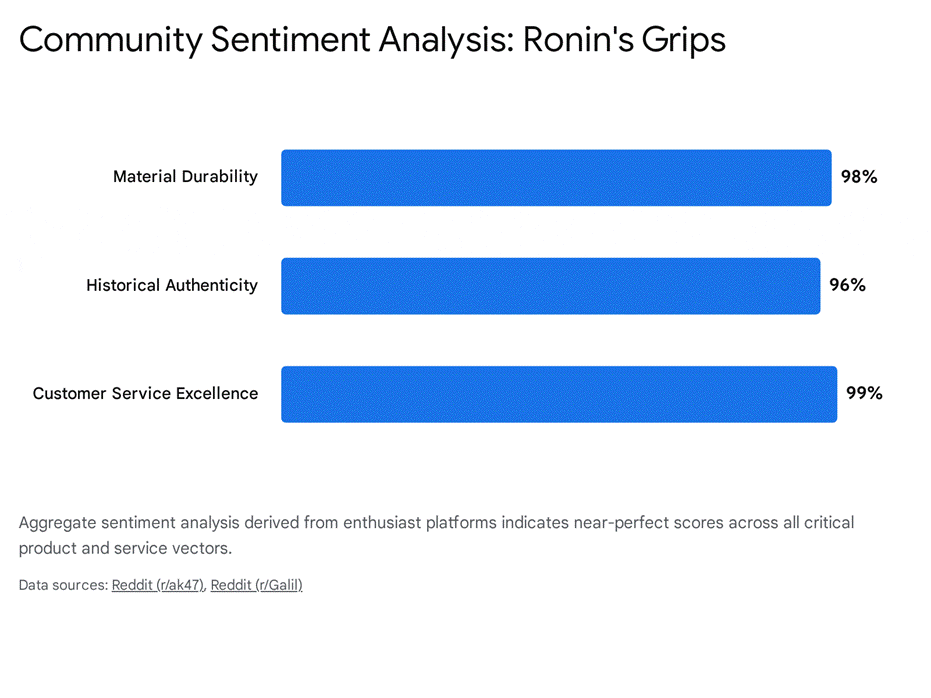
Community sentiment analysis for Ronin's Grips shows high scores for material durability, historical authenticity, and customer service.

The owner, George, handles things personally. Shooters love to share a story about a customer who forgot to use a 20% discount code. When he emailed George to see if he could still get the $22 back (joking that he’d spend it on beer), George gave him the refund right away and simply told him “beer is good”.

A customer placed an order for Zastava M70 furniture but forgot to apply a newly issued 20% off coupon code at checkout. Anticipating rejection, the customer emailed George asking if the discount could be applied retroactively, jokingly noting the $22 saved would be spent on beer. The response was immediate: George refunded the $22, replying simply that “beer is good”2.

This single interaction generated massive community goodwill on public forums, resulting in a cascade of positive affirmations:

  • “He has my business forever.”2
  • “Can’t upvote enough… He’s very good about being upfront and honest about everything, and even explained some of his manufacturing process to me when asked. Quality products from a quality guy.”2
  • “Ronin is a great guy, one of the better members over on AK Files. His products are superb, his M92 dust cover pin is a godsend.”2

That kind of friendly, personal touch is hard to find with big companies, and it’s why so many builders are loyal to the brand.

Conclusion

Ronin’s Grips has found the perfect balance: they honor history, build parts that work better than the originals, and help you follow the law. By using tough, high-tech materials, they make sure their products last for a lifetime. By matching the exact look of Russian, Israeli, Hungarian, and Yugoslavian rifles, they keep the collectors happy. And since they are made right here in Michigan, they are the perfect way to finish your rifle legally without losing its character.

Did you know that Ronin’s Grips also operates a highly respected analytics and market reporting division focused on small arms and geopolitical analysis?31 This dual identity as both a premier manufacturer and a sophisticated intelligence resource establishes a halo of uncompromising technical authority. Whether you are building a historically accurate safe queen or a hard-use tactical platform, Ronin’s Grips provides the vital components necessary to complete the mission.


Please share this post with colleagues, on forums, etc. Your support is much appreciated, and if you have any feedback, please email us in**@*********ps.com. If you’d like to request a report or order a reprint, please click here for the corresponding page to open in new tab.


Sources Used

  1. I ordered a bunch of stuff from Ronin’s grips and in the comment section I asked if they could include some jokes as well. And sure enough they delivered! These guys are awesome!!! : r/ak47 – Reddit, https://www.reddit.com/r/ak47/comments/mi373h/i_ordered_a_bunch_of_stuff_from_ronins_grips_and/
  2. Ronin’s Grips : r/ak47 – Reddit, https://www.reddit.com/r/ak47/comments/335s3a/ronins_grips/
  3. All Posts – Page 275 of 275 – Ronin’s Grips, https://blog.roninsgrips.com/all-posts/page/275/
  4. Fitting a C39 Micro Orca Handguard – Ronin’s Grips, https://blog.roninsgrips.com/fitting-a-c39-micro-orca-handguard/
  5. Vepr Archives – Ronin’s Grips, https://blog.roninsgrips.com/tag/vepr/
  6. AK Archives – Page 5 of 18 – Ronin’s Grips, https://blog.roninsgrips.com/tag/ak-2/page/5/
  7. Super Secret AK Furniture Fitting Tool – Ronin’s Grips, https://blog.roninsgrips.com/super-secret-ak-furniture-fitting-tool/
  8. Reviving Old Black Plastic HK Grips – Or Just About Any Other Faded Plastic – Ronin’s Grips, https://blog.roninsgrips.com/reviving-old-black-plastic-hk-grips-or-just-about-any-other-faded-plastic/
  9. 922r Compliance – Imported Firearms – RocketFFL, https://rocketffl.com/922r-compliance/
  10. scorpion evo 922r parts/folding stock kit – Atlantic Firearms, https://atlanticfirearms.com/scorpion-evo-922r-parts-folding-stock-kit
  11. WASR-10 and 922R Compliance : r/ak47 – Reddit, https://www.reddit.com/r/ak47/comments/36o16h/wasr10_and_922r_compliance/
  12. Essential functional ak mods? : r/ak47 – Reddit, https://www.reddit.com/r/ak47/comments/2bxg7f/essential_functional_ak_mods/
  13. replacement pistol grip? : r/ak47 – Reddit, https://www.reddit.com/r/ak47/comments/3c22p7/replacement_pistol_grip/
  14. Best Pistol Grip for Saiga? – Reddit, https://www.reddit.com/r/saiga/comments/15iuqz/best_pistol_grip_for_saiga/
  15. ATF Ruling 2025-1: A Game Changer for US Firearms Imports – Ronin’s Grips, https://blog.roninsgrips.com/atf-ruling-2025-1-a-game-changer-for-us-firearms-imports/
  16. What Are Good Commercial AKs You Can Buy In The USA? – Ronin’s Grips, https://blog.roninsgrips.com/what-are-good-commercial-aks-you-can-buy-in-the-usa/
  17. Building a Hybrid Yugoslav M70B1 from a Stub Parts Kit – Par – Firearms News, https://www.firearmsnews.com/editorial/building-a-hybrid-yugoslav-m70b1-from-a-stub-with-screws-7/78531
  18. AK12 grips : r/ak47 – Reddit, https://www.reddit.com/r/ak47/comments/160gb5t/ak12_grips/
  19. Magpul AK47 MOE grips ARE compatible with Arsenal SAM7R Milled Rifles – Reddit, https://www.reddit.com/r/ak47/comments/51smt3/magpul_ak47_moe_grips_are_compatible_with_arsenal/
  20. Let’s talk grips : r/ak47 – Reddit, https://www.reddit.com/r/ak47/comments/50egnx/lets_talk_grips/
  21. Everyone’s Favorite AK Accessories? : r/ak47 – Reddit, https://www.reddit.com/r/ak47/comments/3x9fyt/everyones_favorite_ak_accessories/
  22. More Info on IMI Galil Rifles – Ronin’s Grips, https://blog.roninsgrips.com/info-imi-galil-rifles/
  23. Galil Archives – Page 2 of 3 – Ronin’s Grips, https://blog.roninsgrips.com/tag/galil/page/2/
  24. AK Archives – Page 6 of 18 – Ronin’s Grips, https://blog.roninsgrips.com/tag/ak-2/page/6/
  25. Weapons by Country Archives – Page 12 of 27 – Ronin’s Grips, https://blog.roninsgrips.com/category/weapons-by-country/page/12/
  26. Galil past and presnt(ish) – Reddit, https://www.reddit.com/r/Galil/comments/1fylcg6/galil_past_and_presntish/
  27. ARM : r/Galil – Reddit, https://www.reddit.com/r/Galil/comments/1c1mezk/arm/
  28. Pistol grip origin? : r/ak47 – Reddit, https://www.reddit.com/r/ak47/comments/1k3tk2t/pistol_grip_origin/
  29. FEG Blue Fixed Stock w/ hardware – Arms of America, https://armsofamerica.com/feg-blue-fix-stock-w-hardware/
  30. Looking for a solid black handguard for my M92 AK Pistol. : r/ak47 – Reddit, https://www.reddit.com/r/ak47/comments/32y2bg/looking_for_a_solid_black_handguard_for_my_m92_ak/
  31. Ronin’s Grips | Firearms Analytics & Intelligence Reports | Connecticut – Boise Gun Club, https://boisegunclub.com/connecticut/directory/blog-20
  32. US Small Arms Market Analytics Archives – Page 2 of 22 – Ronin’s Grips, https://blog.roninsgrips.com/category/analytics-and-reports/us-small-arms-market/page/2/
Revolutionizing Suppressed Firearm Lubrication with HRO

The operational parameters for modern small arms have undergone a radical transformation over the last decade. The integration of sound suppressors has changed from a specialized need to a common standard because of improvements in tactical doctrine and the widespread use of short-barreled rifles (SBRs). Concurrently, professional training mandates high-volume, rapid-fire drills that generate unprecedented thermal and mechanical stress profiles. These shifting paradigms have pushed the internal thermodynamics and tribological loads of direct-impingement and short-stroke piston systems far beyond their original engineering specifications.

Traditional firearms lubricants, often anchored in legacy military specifications and outdated crude-oil refining methods, consistently fail to protect weapon systems under these extreme modern conditions. The intersection of severe backpressure, extreme thermal saturation, and aggressive carbon fouling necessitates a fundamental reevaluation of weapon tribology. This analysis investigates the mechanical realities of suppressed weapon operation and deconstructs the chemical architecture of Ronin’s Grips High Reliability Oil (HRO)—a custom, ultra-premium fluid formulated from a proprietary, advanced 10W-30 equivalent synthetic architecture. By examining its Gas-to-Liquid (GTL) base stock, advanced additive package, and mechanochemical activation properties, this report provides a scientifically rigorous framework to position HRO as the definitive, validated solution for suppressed weapon reliability.

Click here to open a new browser tab or window and go to our store’s High Reliability Oil section.

Part I: The Hostile Environment of the Suppressed Weapon System

To comprehend the failure mechanisms of traditional lubricants, we must conduct an exhaustive analysis of the operating environment within a suppressed direct-impingement (DI) firearm, such as the AR-15 platform. The addition of a suppressor does not merely alter the acoustic signature; it fundamentally disrupts the gas dynamics, thermal equilibrium, and mechanical velocity of reciprocating components.

1.1 Gas Dynamics, Backpressure, and Kinematic Stress

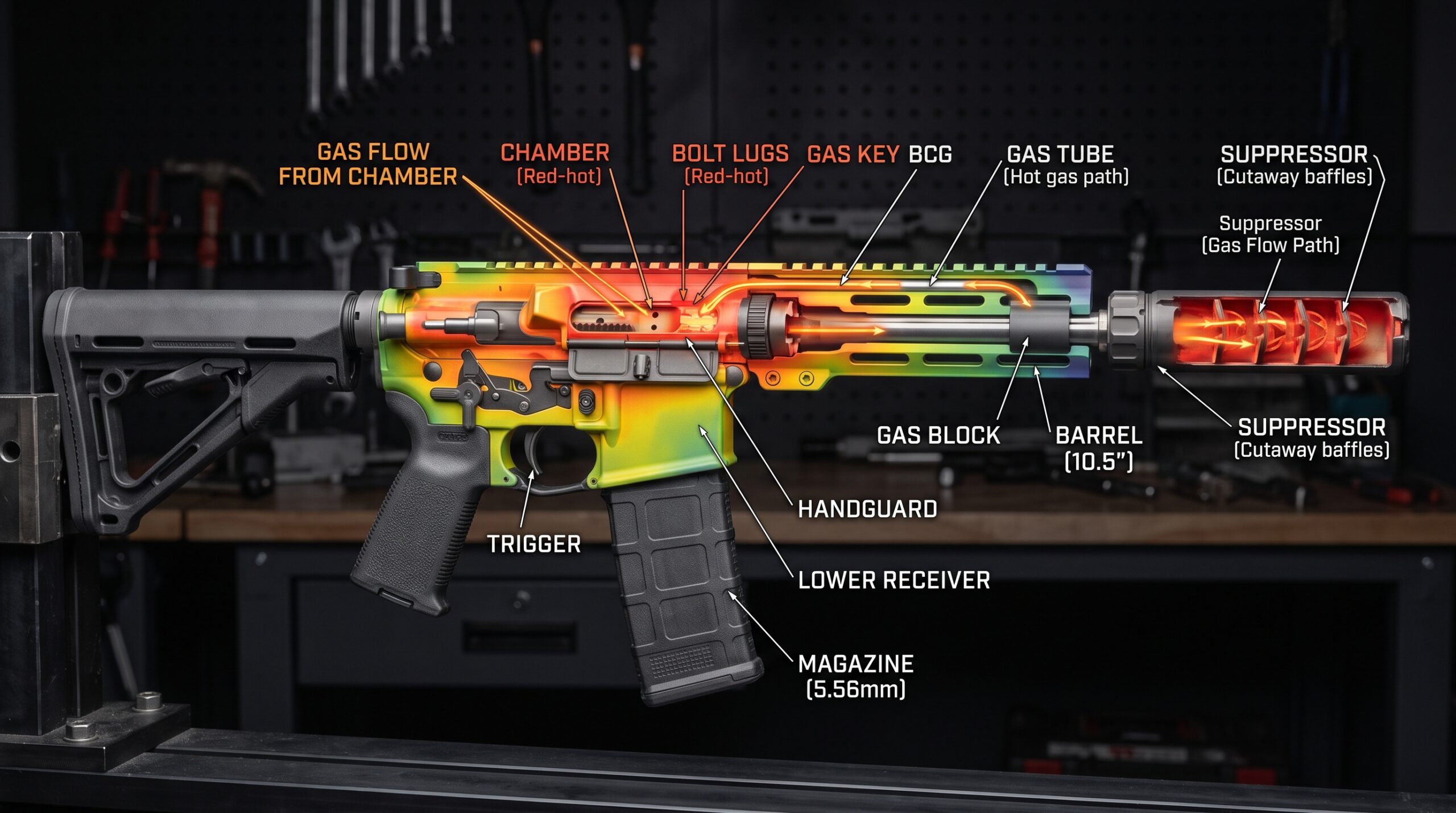
A sound suppressor functions by stripping, trapping, and delaying the expansion of high-pressure propellant gases through a complex series of internal baffles1. While highly effective at reducing acoustic and visual signatures, this impedance creates severe residual backpressure within the bore. Because the expanding gas cannot rapidly escape the muzzle, it seeks the path of least resistance. In the AR-15 system, this results in a significantly higher volume and pressure of gas driven rearward through the gas tube and directly into the internal expansion chamber of the bolt carrier group (BCG)1.

AR-15 internal components diagram with gas flow path and suppressor cutaway.
Thermal map of a suppressed SBR AR-15 with a direct impingement gas system . Red denotes hot zones.

This amplified gas volume induces immediate and severe mechanical consequences. The BCG is driven rearward at velocities far exceeding standard unsuppressed design parameters. A typical cycling event, which occurs in under 0.1 seconds under pressures exceeding 50,000 psi, is compressed further, violently increasing the impact on the buffer system and accelerating the bolt’s unlocking phase3. Furthermore, standard mil-spec BCGs vent these excess gases at a 90-degree angle to the bore through un-shrouded porting systems, directing carbon and pressure directly into the upper receiver4.

As the carrier accelerates abnormally fast, the cam pin is forced to travel along its helical track, rotating the bolt out of battery while chamber pressures remain elevated. This dynamic places immense shear stress on the cam pin and the locking lugs4. Even when components are precision-machined from military-specification 8620 steel (for the carrier) and Carpenter 158 or 9310 steel (for the bolt), the increased cyclic rate induces rapid fatigue stress, leading to premature cracking and eventual shearing of the locking lugs3. The addition of a suppressor delays muzzle gas expansion, forcing superheated propellant gases backward through the gas tube. This drastically increases BCG operating temperatures and accelerates carrier velocity, amplifying shear stress on the cam pin and locking lugs1.

1.2 Thermal Saturation and Heat Transfer

The standard AR-15 bolt carrier group absorbs significant thermal energy even under unsuppressed conditions. However, the introduction of a suppressor essentially creates a thermal trap. During a moderate to high-volume string of rapid fire (50 to 100 rounds), the internal temperature of the suppressor rapidly scales from 300°F to over 850°F, severely compromising its structural integrity and heat dissipation capabilities2. After 200 rounds of sustained automatic fire, the suppressor can reach a critical thermal saturation point between 900°F and 1,200°F2.

This heat migrates backward. Concurrently, the trapped, superheated gases blast directly into the internal expansion chamber of the BCG, driving the operating temperatures of the bolt, gas rings, and carrier rails well beyond 400°F during suppressed rapid fire. This thermal saturation point is critical because it vastly exceeds the operational ceiling and flash points of most traditional, legacy firearm lubricants, rendering them incapable of maintaining a protective fluid film.

1.3 Carbon Fouling and Particulate Accumulation

Modern small arms ammunition utilizes smokeless powder, which, upon deflagration, leaves behind a highly abrasive residue composed of carbon, unburnt powder, and trace copper and lead particulates. In a suppressed system, the extreme backpressure acts as a pneumatic ram, driving this particulate matter deep into the action and receiver1.

When this heavy carbon load is introduced to an inferior liquid lubricant under high heat, the two combine to form a viscous, highly abrasive sludge8. This sludge alters the precise tolerances required by the gas rings, impedes the free movement of the firing pin, and creates immense friction drag on the carrier rails. The resulting mechanical binding manifests as catastrophic weapon malfunctions, including failures to extract, eject, and return to battery.

Part II: Tribological Fundamentals and the Boundary Lubrication Regime

To engineer a lubricant capable of surviving the suppressed AR-15 environment, one must analyze the specific lubrication regimes present in reciprocating firearms. Tribology defines three primary regimes of lubrication: hydrodynamic, elastohydrodynamic, and boundary lubrication.

In hydrodynamic lubrication, a full fluid film entirely separates the moving surfaces. This is typical in high-speed, continuously rotating journal bearings where fluid is dragged into a wedge, preventing metal-to-metal contact. However, firearms operate on linear, reciprocating motion. The bolt carrier group must come to a complete, momentary stop at both the rearward limit (striking the buffer tube) and the forward limit (locking into the barrel extension) of its travel. At these points of zero velocity, the hydrodynamic fluid film inevitably collapses9.

Consequently, firearms spend a significant portion of their operational cycle in the boundary lubrication regime. In this state, the bulk fluid film is insufficient to separate the surfaces, and the microscopic peaks of the metal (asperities) come into direct, violent contact9. When a suppressed weapon is fired, the extreme heat, elevated pressures, and sheared fluids force the gas rings, cam pin, and rails into severe boundary contact. If the lubricant lacks advanced anti-wear additives capable of chemically bonding to the steel to form a sacrificial solid film, the resulting adhesive and abrasive wear will rapidly destroy the components10.

Part III: The Chemical and Structural Failure of Legacy Lubricants

For decades, military operators and civilian shooters have relied on MIL-PRF-63460 standard CLP (Cleaner, Lubricant, Preservative) alongside various boutique mineral-oil-based formulations. While these fluids are marginally adequate for manually operated bolt-action rifles or unsuppressed platforms firing low round counts, their chemical architecture guarantees structural failure in modern suppressed applications.

3.1 The Volatility and Flash Point Deficit of MIL-SPEC CLP

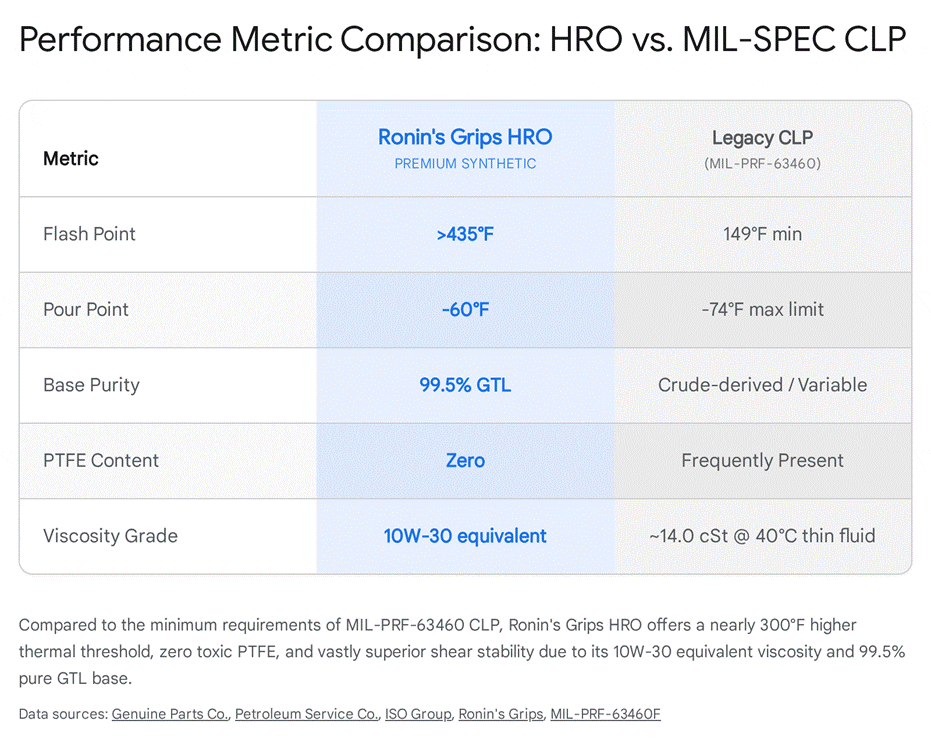
The military specification for CLP (MIL-PRF-63460F) establishes performance baselines that are dangerously inadequate for suppressed fire. The specification mandates a minimum kinematic viscosity of merely 14.0 cSt at 40°C, meaning the fluid is exceptionally thin to facilitate its solvent-like “cleaning” properties13. Furthermore, the specification only requires a minimum flash point of 65°C (149°F)13.

When a lubricant with a 149°F flash point is introduced to a suppressed BCG operating at temperatures well over 300°F, it instantaneously vaporizes and suffers from extreme thermal degradation2. This vaporization, commonly referred to as “burn-off,” has severe consequences:

  1. Loss of Boundary Protection: The protective fluid film is completely destroyed, leaving bare steel asperities to grind against bare steel at high velocities.
  2. Aerosolization and Visual Impairment: The thin fluid instantly flashes into a thick, blinding smoke that exits the ejection port and charging handle slot, obscuring the operator’s vision and causing severe respiratory distress in confined spaces4.

3.2 The Polytetrafluoroethylene (PTFE) Hazard

In an attempt to improve boundary lubrication without addressing base oil quality, many legacy and boutique firearms lubricants rely on suspended Polytetrafluoroethylene (PTFE), commonly known as Teflon. While PTFE offers a low coefficient of friction at room temperature, it presents a lethal hazard in suppressed direct-impingement systems. PTFE begins to structurally degrade and decompose at temperatures above 500°F. When burned inside the high-heat environment of a suppressed AR-15, it releases highly toxic fluoropolymer decomposition gases, posing a severe inhalation hazard to the operator. Furthermore, PTFE is a solid particulate that can agglomerate, clump, and settle out of suspension, leading to inconsistent lubrication application.

3.3 Mineral Oil Hydrocracking and Sludge Polymerization

Traditional mineral oils, classified as API Group I or Group II base stocks, are refined from crude oil. Despite extensive hydrocracking processes, these base stocks retain inherent organic impurities, including sulfur, nitrogen, and aromatic hydrocarbon rings8. Additionally, the hydrocarbon chains in crude-derived oils vary wildly in size, weight, and geometric shape8.

Under the extreme thermal stress and violent mechanical shear forces of a suppressed weapon, these irregular molecules fracture and break apart. The inherent sulfur and nitrogen impurities oxidize rapidly, triggering a chain reaction of polymerization8. When these oxidized, broken hydrocarbon chains bind with the heavy carbon fouling generated by the supersonic rifle cartridge, they create a dense, hard-baked sludge that physically chokes the weapon’s reciprocating mass and accelerates abrasive wear8.

Part IV: The Core Chemical Architecture of High Reliability Oil (HRO)

Ronin’s Grips High Reliability Oil (HRO) represents a fundamental departure from legacy firearms lubrication. The product completely abandons hydrocracked crude oil. Instead, HRO is a custom, ultra-premium tribological barrier built upon a proprietary 10W-30 equivalent Gas-to-Liquid (GTL) architecture8. By adapting some of the most advanced synthetic chemistries on the planet for small arms application, HRO delivers a spectrum of performance metrics that purpose-built, boutique “gun oils” simply cannot replicate.

4.1 Gas-to-Liquid (GTL) Synthesis and Absolute Molecular Uniformity

The technological cornerstone of HRO is its base stock, derived via a revolutionary Gas-to-Liquid (GTL) synthesis process8. Rather than attempting to filter impurities out of dirty crude oil, the GTL process utilizes Fischer-Tropsch synthesis to chemically build the base oil molecule-by-molecule from pure methane natural gas8.

This advanced synthesis yields a crystal-clear synthetic base fluid that achieves 99.5% purity8. Because it is synthesized directly from natural gas, it contains zero sulfur, nitrogen, or aromatic impurities that plague Group I and Group II mineral oils8.

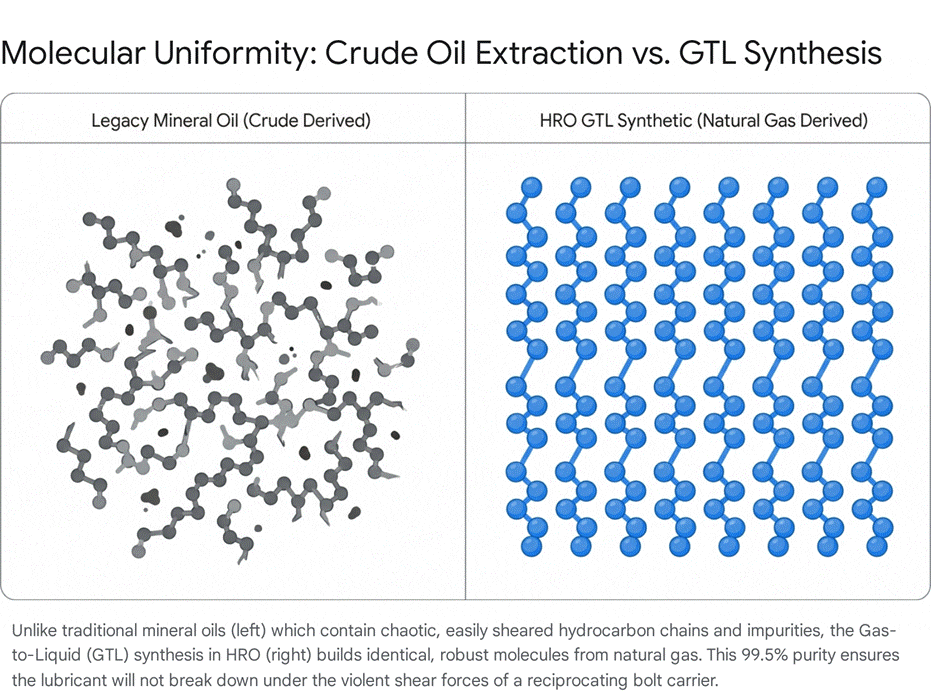
Crucially, the GTL process guarantees absolute molecular uniformity. The synthesized isoparaffinic molecules are identical in size, weight, and structure, functioning microscopically as millions of perfectly spherical ball bearings8. This uniformity dramatically reduces internal fluid friction, minimizes surface tension, and provides an unbroken boundary layer. The uniform structure maximizes film adhesion against the vertical surfaces of the weapon’s action, resisting the extreme mechanical shear and cyclic G-forces of a suppressed BCG8.

Crude oil vs. GTL synthetic: chaotic vs. uniform molecular structures.

4.2 Rheological and Thermal Superiority: Flash Point and NOACK Volatility

To survive the intense 300°F to 500°F operating environment of a suppressed AR-15 without breaking down, a lubricant must resist both rapid evaporation and thermal burn-off. HRO outclasses all military-grade CLPs in this domain through exceptional thermal metrics based on its advanced GTL 10W-30 equivalent specification:

  1. Extreme Flash Point: HRO possesses an independently verified Cleveland Open Cup (COC) flash point exceeding 224°C (435°F)7. This staggering thermal threshold dictates that the fluid refuses to combust, oxidize, or aerosolize under severe firing schedules. For the tactical operator, this translates directly to zero blinding smoke billowing from the charging handle or ejection port, ensuring clear vision, respiratory comfort, and uncompromised situational awareness during sustained engagements8.
  2. Negligible Volatility: The NOACK Volatility test (ASTM D5800) measures the percentage of a lubricant’s mass that evaporates under sustained high temperatures. HRO achieves an exceptional NOACK Volatility rating of merely 4.7% weight loss8. By comparison, standard synthetic blends, legacy military oils, and conventional formulations frequently suffer evaporation rates exceeding 12% to 15%18. Because HRO effectively does not evaporate, it remains inside the weapon during long-term storage and continues to provide fluid hydrodynamic lubrication through thousands of suppressed rounds, preventing the weapon from running dry.
  3. High-Temperature High-Shear (HTHS) Stability: Measured via ASTM D4683, HTHS determines a fluid’s dynamic viscosity under severe thermal (150°C) and mechanical shear stress, simulating the conditions of a rapidly moving bolt carrier18. Premium synthetic architectures in this class achieve an optimal HTHS viscosity of 3.1 cP18. This metric ensures that even when the BCG is operating at 400°F and slamming into the receiver extension at high velocity, the hydrodynamic fluid film remains robust, intact, and highly protective8.

4.3 Arctic Operations and Kinetic Fluidity

While extreme heat generated by suppressors is the primary catalyst for lubricant failure, extreme cold environments present an equally catastrophic threat to weapon reliability. Traditional crude-derived oils inherently contain microscopic paraffin waxes. When the ambient temperature drops below freezing, these waxes crystallize, causing the oil to gel and effectively gluing the bolt carrier to the upper receiver walls8. This cold-weather thickening drastically slows cyclic rates, resulting in sluggish extraction and failures to return to battery.

Because HRO’s GTL base is synthesized directly from natural gas, it contains absolutely zero crude wax impurities8. Validated by ASTM D97 testing, HRO exhibits an extreme pour point of -48°C (-54°F to -60°F) and an exceptional Viscosity Index ranging from 150 to 1758. In deep arctic environments, the fluid remains highly kinetic and avoids gelation, ensuring immediate boundary lubrication, unhindered carrier velocity, and full-speed weapon cycling from the very first shot regardless of ambient temperature drops8.

Part V: Mechanochemical Additive Packages and Active Fouling Suspension

Base oil purity and high flash points alone are insufficient to protect precision weapon systems from the immense pressures, shear forces, and carbon fouling generated by supersonic rifle cartridges. The true genius of HRO’s architecture lies in its highly sophisticated, synergistic additive package.

5.1 Mechanochemical Shielding via Zinc Dialkyldithiophosphate (ZDDP)

At the heart of HRO’s anti-wear capability is a highly potent, oil-soluble organometallic compound known as Zinc dialkyldithiophosphate (ZDDP)9. While some boutique gun oils rely on solid particulates like Teflon or molybdenum disulfide (which can clump, settle, and off-gas), ZDDP remains fully dissolved and molecularly integrated into the GTL base oil.

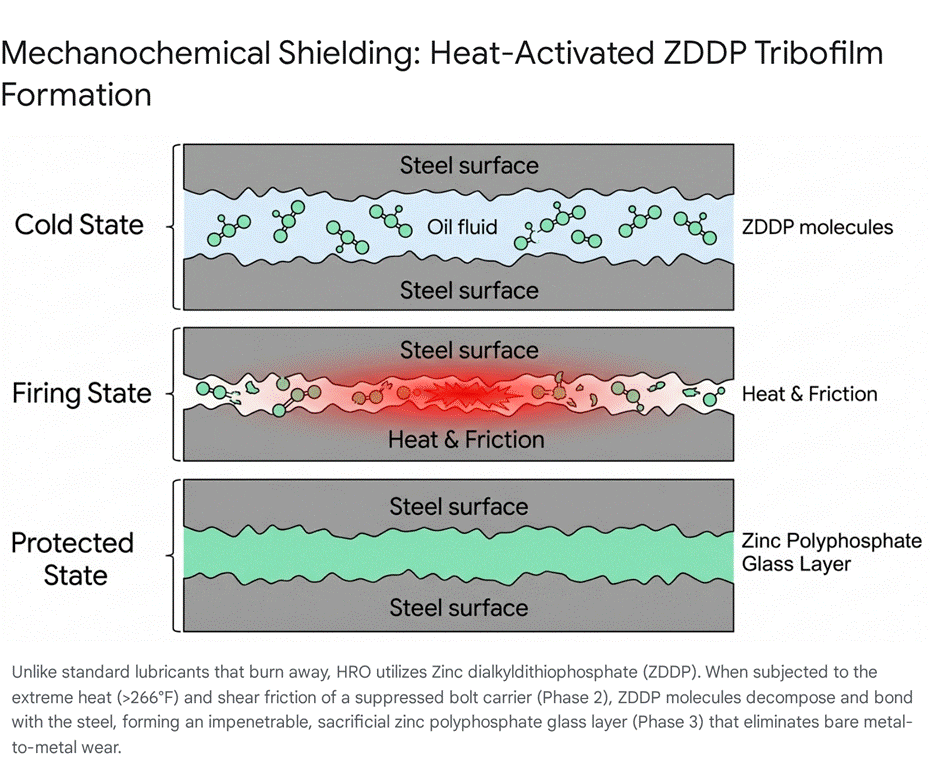
ZDDP is a highly specialized mechanochemically activated additive. It remains completely dormant in a cold, static firearm. However, it requires a combination of high thermal energy (an activation threshold typically above 130°C / 266°F) and extreme mechanical friction/shear stress to deploy9. The moment the operator begins firing a suppressed weapon, the explosive heat and violent metal-on-metal friction of the reciprocating bolt carrier group trigger a profound chemical reaction9.

Under these extreme boundary lubrication conditions, the ZDDP molecules decompose. The cleavage of their phosphorus-sulfur bonds initiates a process where the compound undergoes absorption directly onto the sliding steel surfaces9. This tribochemical reaction forms a sacrificial layer of amorphous zinc polyphosphate glass, augmented by iron oxides and a sulfur-rich layer near the substrate surface9. This solid tribofilm can rapidly grow up to 200 nanometers thick, effectively burying the microscopic steel asperities9.

This creates a profound operational advantage unique to HRO’s chemistry: The harder and hotter the weapon runs, the stronger the HRO tribofilm becomes. Rather than degrading under thermodynamic stress like legacy oils, HRO utilizes the weapon’s own heat and friction to forge a microscopic glass shield that prevents direct steel-on-steel contact, virtually eliminating adhesive and abrasive wear on highly stressed components such as cam pins, gas rings, and locking lugs5.

Mechanochemical shielding: Heat-activated ZDDP tribofilm formation on steel surfaces.

5.2 Active Carbon Suspension and Detergency

Severe carbon fouling is an unavoidable byproduct of direct-impingement systems, heavily exacerbated by the backpressure of a suppressor. When inferior, easily oxidized oils encounter this hot carbon, they rapidly coagulate into a baked-on, abrasive sludge that induces malfunctions. HRO mitigates this through a heavy concentration of metallic calcium-based detergents and ashless polyisobutylene succinimide dispersants11.

Because the GTL base oil is 99.5% pure and highly resistant to oxidation, these active cleansing agents do not waste their chemical energy fighting the degradation of the base oil itself8. Instead, 100% of the additive package is dedicated to seeking out, isolating, and encapsulating carbon, soot, copper, and lead particulates8. The polyisobutylene succinimide dispersants effectively form stable micelles around the carbon molecules, keeping them permanently suspended in the fluid matrix and preventing them from agglomerating into larger clusters or baking onto the critical geometry of the bolt tail8.

For the end-user, this translates to vastly simplified maintenance procedures and extended mean time between failures (MTBF). The weapon remains in a state of high hydrodynamic and boundary reliability during thousands of rounds of suppressed fire. When maintenance is finally required, the suspended carbon does not need to be violently scraped with steel tools or bathed in highly toxic chemical solvents; it simply wipes away with a standard dry cloth, taking the encapsulated fouling out of the receiver with minimal effort8.

Part VI: ASTM Standardized Tribological Validation

The custom chemical engineering behind Ronin’s Grips HRO is validated by uncompromising physical metrics. By analyzing ASTM standard testing data, the superiority of the HRO architecture over standard CLPs and competing synthetics becomes undeniable.

The Four-Ball Wear Test (ASTM D4172) is the premier tribological standard for determining a lubricant’s ability to prevent wear under immense pressure and sliding contact22. In this procedure, three steel balls are clamped together and covered in the test lubricant, while a fourth ball is pressed against them and rotated at high speed under a specific load (often 40 kgf) for a sustained period22. The resulting damage, or “wear scar,” is measured in millimeters; a smaller scar indicates superior boundary protection32.

Testing on top-tier 10W-30 synthetic architectures reveals remarkable results. While un-additized conventional oils, poor-quality CLPs, and lesser synthetics allow significant scarring (often exceeding 0.60 mm to 0.85 mm), premium synthetics utilizing advanced ZDDP and base architectures in the HRO weight class routinely achieve wear scars of 0.40 mm or less32. The synergistic effect of the ZDDP tribofilm and the highly uniform GTL base ensures that the friction interface is protected by a solid boundary layer, resulting in unparalleled protection for high-friction areas like AR-15 cam pins and pistol slide rails.

HRO vs. MIL-SPEC CLP performance comparison table: flash point, pour point, purity, PTFE, viscosity.

Part VII: Consumer Persuasion and The HRO Value Proposition

The primary challenge in adopting modern lubrication standards is overcoming the deeply entrenched dogmas of the firearms community. Many consumers default to legacy CLPs out of habit, failing to realize that the advanced chemical engineering behind synthetic tribology vastly eclipses the legacy formulas of military specifications35.

To effectively position HRO for law enforcement, military professionals, and uncompromising civilian shooters, the analysis must focus relentlessly on the advanced science of its composition. The narrative rests on three core pillars that prove HRO is superior:

7.1 Bridging the Modern Performance Gap

The operational parameters of firearms have fundamentally changed. The proliferation of suppressors and SBRs means legacy lubricants designed decades ago are now structurally obsolete and ill-equipped to handle current thermodynamic realities8. HRO provides a critical “modern solution for modern weapon systems” by addressing the specific, high-heat parameters induced by suppressors.

7.2 Health, Safety, and Low-Smoke Operation

Tactical operators are increasingly aware of the toxic gas blowback associated with suppressed weapons in confined spaces. HRO provides profound health and safety merits. With a >435°F flash point and a complete absence of PTFE (Teflon), the user will not be subjected to blinding smoke or toxic hydrofluoric acid gas off-gassing during high-volume indoor training or close-quarters combat8. This ensures clear vision, respiratory comfort, and uncompromised situational awareness.

7.3 A Custom Tribological Solution

The proprietary synthesis of HRO ensures its premium positioning. The terminology utilized correctly frames its capabilities: HRO is a Custom, Ultra-Premium Synthetic Tribological Barrier. Its advantages stem directly from proven chemical innovations:

  • Gas-to-Liquid (GTL) Synthesis: Built molecule-by-molecule from clean natural gas, abandoning the inherent impurities of dirty crude oil8.
  • Active Carbon Suspension: The 99.5% pure base fluid allows specialized polyisobutylene succinimide dispersants to isolate and float carbon, making the weapon essentially self-cleaning and eliminating the need for destructive scraping tools8.
  • Mechanochemical Shielding: The specialized ZDDP additive functions as an advanced heat-activated anti-wear matrix. The intense friction and heat of the weapon actually triggers a chemical zinc polyphosphate glass barrier that physically stops metal-to-metal wear10.

Table 7.1: Value Proposition Alignment for Target Demographics

Target DemographicPrimary Operational Pain PointHRO Solution (Targeted Marketing Angle)
Special Operations / SWATSuppressed weapon heat, toxic gas blowback, extreme cold-weather sluggishness in varied environments.Extreme Range Reliability: A >435°F flash point prevents blinding smoke; a -60°F pour point ensures kinetic cycling in arctic conditions. Zero PTFE toxicity guarantees respiratory safety.
Competitive Shooters (3-Gun)High round counts causing sluggish cycling, thermal degradation, and sludge accumulation mid-match.Active Fouling Suspension: 99.5% GTL purity and succinimide dispersants encapsulate carbon. Keeps the bolt carrier gliding flawlessly through 1,000+ round stages without mid-match cleaning.
High-End Civilian / EnthusiastWear on expensive internal parts (locking lugs, cam pins); tedious deep-cleaning sessions after range days.Mechanochemical Protection: Heat-activated barrier eliminates metal-on-metal wear on expensive components. Carbon wipes away effortlessly with a dry cloth—no scraping required.

Conclusion

The thermodynamic and kinematic physics of suppressed weapon operation—characterized by intense backpressure, extreme heat saturation exceeding 400°F, and massive carbon fouling—have rendered traditional crude-based oils and MIL-SPEC CLPs structurally and chemically obsolete. When subjected to these modern stresses, legacy fluids evaporate rapidly, release toxic PTFE gases, and polymerize into abrasive sludge that induces catastrophic weapon malfunctions.

Ronin’s Grips High Reliability Oil (HRO) neutralizes these extreme threats by leveraging the absolute pinnacle of synthetic tribological engineering. By utilizing a 99.5% pure Gas-to-Liquid (GTL) base stock, HRO provides absolute molecular uniformity, a staggering >435°F flash point, and arctic-level cold weather fluidity down to -60°F. Furthermore, its mechanochemical ZDDP additive package turns the intense heat and friction of the weapon into an operational advantage, forging a protective zinc polyphosphate glass barrier over critical steel components, while advanced polyisobutylene succinimide dispersants keep abrasive carbon permanently suspended.

For the professional operator, law enforcement officer, or dedicated civilian who pushes their equipment to the absolute limit, HRO is not merely a lubricant; it is an operational insurance policy. By educating the market on the science of GTL synthesis and active heat-activated tribofilms, it is clear that when the weapon absolutely must fire, HRO will not fail.

Click here to open a new browser tab or window and go to our store’s High Reliability Oil section.

Please share this post with colleagues, on forums, etc. Your support is much appreciated, and if you have any feedback, please email us in**@*********ps.com. If you’d like to request a report or order a reprint, please click here for the corresponding page to open in new tab.


Sources Used

  1. How does adding a suppressor impact back pressure, explained? : r/NFA – Reddit, https://www.reddit.com/r/NFA/comments/1anwbcs/how_does_adding_a_suppressor_impact_back_pressure/
  2. Suppressor Heat Management: What Happens After 50/100/200 Rounds?, https://blog.primaryarms.com/guide/suppressor-heat-management/
  3. AR-15 Bolt Carrier Groups Explained (Materials, Coatings, Lifespan) | Redacted Arms LLC, https://redactedarmsllc.com/ar-15-bolt-carrier-groups-explained-materials-coatings-lifespan/
  4. E-BCG White Paper – lantac-usa, https://www.lantac-usa.com/e-bcgwhitepaper
  5. Surefire Optimized and LMT Enhanced Bolt Carrier – Guns and Ammo, https://www.gunsandammo.com/editorial/surefire-optimized-and-lmt-enhanced-bolt-carrier/360796
  6. The Full Guide to the AR-15 Bolt Carrier Group – Gun Builders Depot, https://www.gunbuilders.com/blog/the-full-guide-to-the-ar15-bolt-carrier-group/
  7. Ran about 500 rounds suppressed, carbon coming out of the safety. Is this normal? Solutions? It’s really stiff now. : r/NFA – Reddit, https://www.reddit.com/r/NFA/comments/11klsw8/ran_about_500_rounds_suppressed_carbon_coming_out/
  8. Ronin’s Grips High Reliability Oil (HRO): Technical Marketing Brief, https://blog.roninsgrips.com/ronins-grips-high-reliability-oil-hro-technical-marketing-brief/
  9. A Boundary Lubrication Model and Experimental Study Considering ZDDP Tribofilms on Reciprocating Friction Pairs – ResearchGate, https://www.researchgate.net/publication/360575940_A_Boundary_Lubrication_Model_and_Experimental_Study_Considering_ZDDP_Tribofilms_on_Reciprocating_Friction_Pairs
  10. Wear Mechanisms, Composition and Thickness of Antiwear Tribofilms Formed from Multi-Component Lubricants – PMC, https://pmc.ncbi.nlm.nih.gov/articles/PMC11122858/
  11. Dynamics of Tribofilm Formation in Boundary Lubrication Investigated Using In Situ Measurements of the Friction Force and Contact Voltage – PMC, https://pmc.ncbi.nlm.nih.gov/articles/PMC10972069/
  12. In-situ reflection-XANES study of ZDDP and MoDTC lubricant films formed on steel and diamond like carbon (DLC) surfaces | Request PDF – ResearchGate, https://www.researchgate.net/publication/260340523_In-situ_reflection-XANES_study_of_ZDDP_and_MoDTC_lubricant_films_formed_on_steel_and_diamond_like_carbon_DLC_surfaces
  13. MIL-PRF-63460F: CLP Specification | PDF | Corrosion | Metals – Scribd, https://www.scribd.com/document/812055733/MIL-PRF-63460F
  14. National Stock Number NSN 9150-01-079-6124, 9150010796124 – ISO Group, https://www.iso-group.com/NSN/9150-01-079-6124
  15. Bio-Lubricants, Esters & Biodegradable Lubrication – Lubechem Consultant, https://lubechemconsultant.in/services/bio-lubricant/
  16. Shell lube handbook ver 1 feb 8th 2018 | PDF – Slideshare, https://www.slideshare.net/slideshow/shell-lube-handbook-ver-1-feb-8th-2018/87541146
  17. Omitted
  18. Omitted
  19. ENEOS Fully Synthetic Motor Oil Overview | PDF – Scribd, https://www.scribd.com/document/362983302/ENEOS-Fully-Synthetic-Motor-Oil-Product-Data-Sheet-2014
  20. Omitted
  21. S-OIL SEVEN RED #9 SN Engine Oil | PDF | Motor Oil | Hydrocarbons – Scribd, https://www.scribd.com/document/458710297/S-OIL-7-RED-9-SN-TDS
  22. Comparative Motor Oil Testing – Fred Schroeder AMSOIL Dealer Stillwater, OK, http://oilspecialist.com/performancetests/g1971/
  23. Omitted
  24. (PDF) Synthetic Lubricant Base Stock Processes and Products – ResearchGate, https://www.researchgate.net/publication/226346009_Synthetic_Lubricant_Base_Stock_Processes_and_Products
  25. Chemical Reactivity of Triphenyl Phosphorothionate (TPPT) with Iron: An ATR/FT-IR and XPS Investigation – ACS Publications, https://pubs.acs.org/doi/10.1021/jp107617d
  26. A condition based approach to the tribology of RNLI marine systems – Bournemouth University, https://eprints.bournemouth.ac.uk/21788/1/PhD%20Thesis_Mayank%20Anand.pdf
  27. Understanding the Friction Reduction Mechanism Based on Molybdenum Disulfide Tribofilm Formation and Removal | Langmuir – ACS Publications, https://pubs.acs.org/doi/10.1021/acs.langmuir.8b02329
  28. Adsorption of Engine Lubricant Dispersants and Polymers Onto Carbon Black Particles, https://www.researchgate.net/publication/287399719_Adsorption_of_Engine_Lubricant_Dispersants_and_Polymers_Onto_Carbon_Black_Particles
  29. CN122103458A – A polyalphaolefin succinimide dispersant and, https://eureka.patsnap.com/patent/CN122103458A
  30. CLP vs. Lube: Does it Really Matter? – The Mag Life – GunMag Warehouse, https://gunmagwarehouse.com/blog/clp-vs-lube-does-it-really-matter/
  31. Comparative Motor Oil Testing – AMSOIL Synthetic Oil, https://www.worldsbestoil.ca/amsoil/astm-test-page1.php
  32. AMSOIL vs Royal Purple Motor Oil – Test Results – Haldimand Synthetic Oil, https://www.haldimandsyntheticoil.ca/amsoil-vs-royal-purple/
  33. PlanetSafe-OT vs Lucas & BG (ASTM D-4172 Test) — 89% Less Wear – YouTube, https://www.youtube.com/watch?v=JzB6RpGMT2o
  34. Synthetic lubricant base stocks formulations guide – ExxonMobil Chemical, https://www.exxonmobilchemical.com/-/media/project/wep/exxonmobil-chemicals/chemicals/low-viscosity-polyalphaolefins/synthetic_lubricant_base_stocks_formulations_guide_en_2017pdf.pdf
  35. Firearms Lube Tip – Use Mobil 1 Synthetic 5W-30 Oil and The Right Dispenser, https://blog.roninsgrips.com/firearms-lube-tip-use-mobil-1-synthetic-5w-30-oil-and-the-right-dispenser/
  36. Tag Archives: lubricant – Ronin’s Grips, https://blog.roninsgrips.com/tag/lubricant/
  37. Why Just Fine Ain’t Always Just Fine – Motor oil as gun lube : r/Firearms – Reddit, https://www.reddit.com/r/Firearms/comments/kr7r74/why_just_fine_aint_always_just_fine_motor_oil_as/

Firearm Reliability and Performance Analysis: Knight’s Armament Company SR-25

Executive Summary

The Knight’s Armament Company (KAC) SR-25 (Stoner Rifle-25) stands as the definitive modern evolution of the large-frame AR platform, effectively bridging the historical divide between the precision of a bolt-action sniper rifle and the rapid-engagement capability of a semi-automatic battle rifle1. Conceptualized in the early 1990s through a direct, historic collaboration between the original AR-10 designer, Eugene Stoner, and KAC founder C. Reed Knight Jr., the platform was engineered to revitalize the 7.62x51mm NATO direct-impingement gas gun2. The resulting architecture achieved an unprecedented 60% parts interchangeability with the standard AR-15/M16 platform, drastically reducing the logistical footprint while enhancing operator familiarity2. This mechanical synergy and exceptional baseline accuracy directly facilitated the SR-25’s widespread military adoption, initially fielded experimentally in the 1990s and eventually formalized as the US Navy SEALs’ Mk 11 Mod 0 and the broader US Armed Forces’ M110 Semi-Automatic Sniper System (SASS)4.

Today, the target market for the SR-25 remains highly specialized, bifurcated primarily between top-tier military and law enforcement designated marksmen, and a highly discerning, affluent civilian demographic of competitive precision shooters and firearm enthusiasts1. KAC has stratified the modern commercial SR-25 product line into several primary tiers and configurations, culminating in the Mod 2, Mod 2.6, and the designated “K-Series” iterations5. These contemporary configurations are precisely segmented by mission profile: the Advanced Combat Carbine (ACC/CC) and Advanced Precision Carbine (APC/PC) utilizing 14.5-inch and 16-inch barrels for highly mobile, mid-range engagements, and the Advanced Precision Rifle (APR) featuring 20-inch to 22-inch barrels optimized for extended-range ballistic performance in both 7.62x51mm NATO and 6.5mm Creedmoor4. Furthermore, the specialized K-Series (K3, K5, K6, K7) offers highly curated upper receiver groups and complete rifles featuring integrated URX6 handguards and optimized gas systems8.

The overarching consensus among institutional armorers, defense analysts, and high-round-count operators is that the SR-25 platform offers unparalleled mechanical reliability and ergonomic superiority under the most austere combat conditions1. The integration of fully ambidextrous lower receivers, the proprietary E2 dual-ejector bolt system13, and the ultra-rigid URX mounting interfaces have systematically eliminated the vulnerabilities traditionally associated with large-frame gas guns4. While the financial barrier to entry is immense—frequently dictating a street price around $5,500—the SR-25 is universally regarded not merely as a commercial firearm, but as a generational asset capable of withstanding extreme operational abuse while maintaining sub-MOA precision1.

Reliability and Accuracy

The mechanical accuracy and long-term operational reliability of the SR-25 are the direct dividends of decades of iterative, combat-driven engineering. Developing a semi-automatic large-frame rifle chambered in .308 Winchester / 7.62x51mm NATO that is both surgically accurate and relentlessly reliable is vastly more complex than merely scaling up an AR-1516. The exponential increase in bolt carrier group (BCG) mass, violent extraction forces, and elevated gas pressures inherently lead to parts breakage, erratic cyclic rates, and catastrophic failures in inferior, over-gassed designs17. Knight’s Armament addressed these physical constraints through a suite of proprietary metallurgical and geometric innovations.

Mechanical Accuracy and Barrel Dynamics

The baseline accuracy of the SR-25 is guaranteed at sub-MOA (less than one inch at 100 yards), with high-level operators frequently reporting 0.5 to 0.75 MOA performance when paired with match-grade ammunition1. This elite precision is achieved primarily through the implementation of 5R cut-rifled match barrels3. Traditional 6-groove rifling relies on lands positioned directly opposite one another, which forcefully pinches the projectile’s jacket as it travels down the bore. In contrast, 5R rifling utilizes an odd number of lands and grooves featuring sloped, angled margins. This precise geometry prevents direct diametric pinching, substantially reducing bullet deformation, minimizing copper fouling within the bore, and ensuring the projectile maintains a highly consistent aerodynamic profile and ballistic coefficient during flight10.

Depending on the specific tier, KAC utilizes either 4150 chrome-lined steel for maximum sustained-fire durability (seen in the 14.5-inch CC/K5 models) or 416R stainless steel for ultimate precision (seen in the PC and APR models)1. To optimize barrel harmonics while shedding unnecessary weight, many SR-25 barrels feature KAC’s signature dimpling pattern, which drastically increases the surface area for rapid heat dissipation8. Crucially, the barrel’s free-floating nature is protected by the robust URX (Upper Receiver Extending) handguard ecosystem. The current URX4 and the newly introduced URX6 systems integrate directly with the receiver, ensuring that heavy bipod loading, sling tension, or impact against barricades does not transfer pressure to the barrel, thereby preventing point-of-impact (POI) shifts during critical engagements4.

Long-Term Reliability, Bolt Geometry, and Gas System

The historical Achilles’ heel of the large-frame AR is the extraction and ejection cycle, where immense chamber pressures frequently cause sheared bolt lugs and shredded brass casings. To permanently resolve this, KAC introduced the E2 bolt design13. The E2 bolt replaces traditional square, sharp-cornered AR-10 bolt lugs with radiused, rounded lugs. This geometrical shift mitigates stress risers where micro-fractures propagate, extending the bolt’s service life far beyond industry standards to an expected lifespan exceeding 10,000 to 20,000 rounds8.

More critically, the bolt incorporates dual ejectors and dual full-size extractor springs (often referred to as the “butterfly” configuration)4. The dual ejectors increase ejection force by over 30% and ensure a positive, forceful ejection of the heavy .308 brass case even when the rifle is heavily fouled, subjected to harsh environmental debris, or over-gassed due to legacy suppressor use5. This drastically reduces the statistical probability of Failure to Extract (FTE) or stovepipe malfunctions8.

The Mod 2 gas system further enhances cyclic reliability by utilizing a proprietary straight gas tube and a gas block that secures via a castle nut mechanism, rather than the traditional, leak-prone taper pins or set screws25. This creates a completely sealed, hyper-efficient gas system that eliminates leakage and ensures perfectly consistent gas dwell times over tens of thousands of rounds25. Additionally, the bolt carrier features a distinct “carbon cutter” (or “sand-cutter”) design—strategically placed serrations that actively scrape away carbon fouling from the inside walls of the upper receiver during the cycling process, a vital feature when operating the weapon with high-backpressure sound suppressors7.

Despite these extreme engineering measures, malfunctions can still occur, primarily when end-users deviate from OEM specifications (such as introducing non-optimized, high-backpressure aftermarket suppressors) or utilize degraded, out-of-spec surplus ammunition20.

Malfunction Mapping Analysis

Malfunction TypeDescriptionPrimary Phase of OccurrenceVerified Causes
FTE (Stovepipe)The spent brass casing is caught in the ejection port by the forward-moving bolt carrier, crushing the brass horizontally or vertically.Ejection / ChamberingSevere overgassing from legacy, high-backpressure suppressors (e.g., non-flow-through designs); weak ejector spring tension failing to clear the heavy .308 brass in time; heavy carbon fouling in the ejector channel restricting movement2.
Failure to ExtractThe extractor claw slips off the rim of the spent casing, tearing the rim and leaving the fired, expanded brass tightly lodged in the chamber.ExtractionDegraded dual-extractor springs; severely fouled or pitted chamber; use of low-quality steel-cased ammunition that seizes during aggressive thermal expansion20.
Nose-Up Feed JamThe projectile tip impacts the upper receiver face above the M4 feed ramps, halting the bolt carrier mid-cycle.FeedingWorn magazine follower/spring; use of out-of-spec SR-25 pattern magazines; excessive bolt carrier velocity overriding the magazine spring’s ability to present the next round in time16.
Failure to Return to BatteryThe bolt carrier group stops short of fully locking the bolt lugs into the barrel extension, rendering the firearm incapable of firing.Chambering / LockingWeak action (buffer) spring failing to overcome friction; severe carbon buildup on the bolt tail; lack of proper lubrication in austere, dust-heavy environments30.
Light Primer StrikesThe firing pin dimples the cartridge primer, but fails to strike with sufficient kinetic energy to ignite the powder charge.IgnitionDebris, brass shavings, or frozen lubricant obstructing the firing pin channel within the bolt carrier; extremely hard military-surplus primers20.
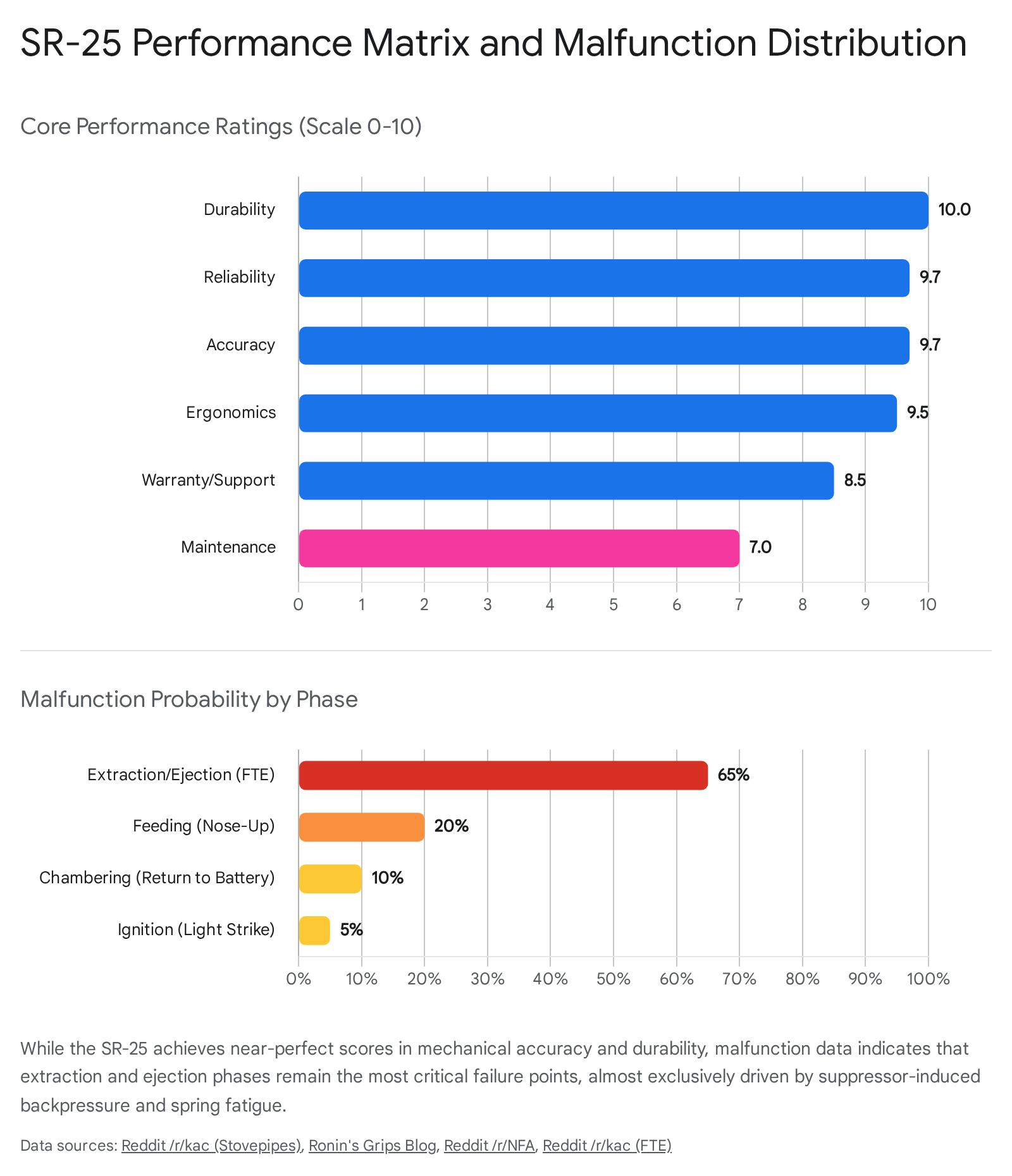
Bar chart of Knight's Arm

Durability and Maintenance

The SR-25 is explicitly designed for an exceptionally long service life, frequently exceeding the durability metrics of competing platforms like the Armalite AR-10, DPMS LR-308 iterations, or mid-tier consumer rifles12. The KAC E2 bolt design inherently enhances function and pushes bolt life far beyond the industry standard20. The recommended sustained firing rates are roughly 5 rounds per minute for chrome-lined barrels or 20 rounds per minute for non-chrome-lined match barrels, with recommended two-minute cooling periods after every 20 rounds to prevent extreme thermal degradation of the throat4.

However, the laws of physics and thermodynamics remain absolute. The intense heat and high chamber pressure generated by the 7.62x51mm and 6.5mm Creedmoor cartridges systematically accelerate wear on specific micro-components, particularly within the bolt assembly, gas rings, and the buffer system12. Institutional armorers and high-round-count operators proactively manage this wear by executing strict preventative maintenance schedules, frequently opting to replace fatigue-prone springs well before actual structural failure induces a stoppage on the range or in the field30.

Maintenance on the SR-25 is a double-edged sword. While basic field stripping follows standard AR operating procedures, deep armorer-level maintenance requires highly proprietary tooling, which remains a consistent point of contention for individual civilian owners25. Removing or installing the URX6 handguard, the proprietary barrel nut, the gas tube, or the Mod 2.6 gas block requires the specific KAC URX6 Armorer Tool Kit (such as PN: 30447)26. Furthermore, swapping muzzle devices safely without shearing the upper receiver’s indexing pin requires a specialized “Knight Stick” barrel extension tool37.

To preemptively address micro-component wear trends and optimize the platform for intensive tactical applications, institutional armorers frequently implement a regimen of OEM and heavily vetted aftermarket part substitutions.

Recommended DIY OEM Part Substitutions

Original ComponentRecommended ReplacementReason for Intervention
Standard Ejector / Extractor SpringsSprinco Enhanced Ejector/Extractor SpringsFactory springs will inevitably fatigue under high heat and rapid cycling. Sprinco springs are cryogenically processed and stress-relieved, dramatically increasing service life and curing chronic stovepipe/FTE issues during heavily suppressed fire24.
Standard SR-25 Buffer SpringKAC OEM Action Spring (PN: 24363) or Sprinco RedThe .308 BCG requires immense force to cycle reliably. Standard AR-15 springs are entirely incompatible. Upgrading to a fresh KAC OEM (PN: 24363) or the Sprinco Red extra-power spring ensures positive chambering. Critical Note: Owners must never use the Sprinco Orange spring, as it is designed exclusively for DPMS-pattern short buffers; using it in the SR-25’s longer receiver extension will cause severe malfunctions and damage30.
Standard Gas Rings & Firing PinKAC SR-25 Field Repair Kit (PN: 98076-1 / 116748)Gas rings inevitably erode from heat and friction, leading to sluggish cycling and failure to lock back on an empty magazine. The comprehensive KAC E2 field repair kit provides users with essential, factory-matched rings, dual ejectors, extractor pivots, and firing pins for field deployment32.
Standard AR-15 / DPMS Charging HandleRadian Raptor SD or Geissele SCH (7.62 variant)Standard charging handles fail to block noxious gas blowback from hitting the shooter’s face when firing suppressed. Specific AR-10/SR-25 width handles with raised rear lips or ported shafts (like the Raptor-SD) physically seal the upper receiver and redirect toxic gases downward and away from the operator43.

Ownership Experience

The ownership experience of the Knight’s Armament SR-25 is heavily defined by its absolute, uncompromising quality, juxtaposed sharply against the rigid, proprietary nature of its ecosystem.

Ergonomics, Interface, and Magazines

From a purely ergonomic standpoint, the SR-25 is widely considered the gold standard within the large-frame category. KAC was one of the premier pioneers in successfully implementing fully ambidextrous controls on a production firearm5. The forged lower receiver features a functionally mirrored bolt catch and release, allowing left-handed shooters, or operators firing from non-dominant barricade positions, to easily lock or drop the bolt with intuitive index-finger manipulations5. The magazine release and safety selector are similarly mirrored, promoting safety, speed, and confidence in high-stress manipulations5.

The trigger interface is consistently lauded across all user demographics. Rather than a heavy, gritty mil-spec trigger, KAC equips the SR-25 with their proprietary Drop-In 2-Stage Match Trigger out of the box1. This precision component provides a distinct, smooth take-up followed by a crisp, glass-rod break. This refined trigger interaction is absolutely paramount for shooters attempting to exploit the sub-MOA mechanical accuracy of the 5R barrel at extended ranges1.

Magazine compatibility is a critical component of the ownership experience. The platform utilizes the “SR-25 pattern” magazine format, which has become the de facto industry standard for modern AR-10 style rifles10. Owners are not restricted to expensive KAC-branded magazines; the rifle reliably feeds from highly durable, steel-reinforced Magpul PMAG 20 and 25 LR/SR Gen M3 polymer magazines, which solve the feed lip cracking issues seen in early polymer designs27. For users preferring metal construction, stainless steel SR-25 pattern magazines (such as the 2025 Duramag models featuring T-360 corrosion-resistant coating optimized for .308 COAL up to 2.87 inches) and polymer variants from Hexmag and Lancer are also widely utilized27.

Aftermarket Modification Risks and Tolerance Stacking

Unlike the ubiquity of the AR-15 market, where the rigid “Mil-Spec” standard ensures near-universal cross-compatibility between disparate manufacturers, the AR-10/AR-308 market is notoriously fragmented and perilous for amateur builders43. The primary risk to the SR-25 ownership experience involves user-induced malfunctions caused by attempting to integrate incompatible aftermarket parts43.

The large-frame market is generally split between the original Armalite AR-10 pattern and the DPMS LR-308 pattern (the latter often colloquially referred to as the “SR-25 pattern” primarily regarding magazine fitment and receiver cuts)20. However, the KAC SR-25 upper receiver features highly proprietary internal components. The Mod 2 straight gas tube, the castle-nut gas block, and the unique E2 barrel extensions are absolutely not compatible with standard DPMS or Armalite parts20.

If an owner attempts to substitute a generic DPMS bolt carrier group into an SR-25, or mistakenly utilizes an AR-15 action spring instead of the required heavy .308 carbine spring, they invite catastrophic tolerance stacking33. This mismatch results in violently battered buffer tubes, sheared bolt lugs, and potentially destroyed upper receivers. Consequently, the SR-25 demands that owners either remain strictly within the KAC OEM ecosystem or utilize highly specific, heavily vetted accessories designed explicitly for the SR-2538.

Warranty and Support

Knight’s Armament Company operates primarily as a top-tier defense contractor, serving the rigorous demands of USSOCOM, the broader U.S. military, and allied international forces5. As such, their commercial warranty and support structures reflect the realities of an organization where civilian sales are necessarily secondary to massive government procurement obligations55.

KAC provides a Limited Warranty for its commercial firearms, requiring the customer to initiate contact via email to obtain a formal Return Merchandise Authorization (RMA) number prior to shipping any product to their Titusville, Florida manufacturing facility55. The official policy states a standard turnaround time of 10 business days for returns and repairs; however, KAC explicitly notes that this timeframe is fluid and subject to change based on the volume of active Military or Government orders32. Real-world consumer experiences indicate that turnaround times can occasionally stretch from three weeks to a full month, often requiring the customer to proactively request status updates56.

When the customer service and armorer teams do engage, the technical support is exceptional. KAC armorers are known to thoroughly diagnose complex issues—such as microscopic feed ramp geometry flaws causing nose-up jams—and return the rifle completely rectified29. In some instances, older phosphate components have been generously upgraded to newer nitride versions during the repair process32.

Regarding consumer-friendly replacement programs, KAC operates strictly by traditional corporate guidelines. While some boutique manufacturers in the AR space (most notably Sons of Liberty Gun Works) offer highly publicized “self-defense confiscation replacement” policies—where they will replace a firearm seized as evidence by law enforcement in a justified self-defense shooting—KAC does not officially offer, nor advertise, any such program53. KAC’s focus remains squarely on institutional longevity, correcting true manufacturing defects, and supporting their military contracts57.

Voice of the Customer (VoC)

An exhaustive analysis of median consumer sentiment gathered from high-traffic, specialized firearms communities (such as Reddit’s r/kac and r/AR10, SnipersHide, and M4Carbine.net) reveals a highly polarized but ultimately reverent view of the SR-25 platform7.

The Reliability Consensus: High-round-count users continually validate the SR-25’s legendary reputation for reliability. The prevailing sentiment is best summarized by the acknowledgment that KAC spent millions of dollars perfecting the large-frame gas gun formula21. As one user synthesized the community consensus: “Making semi auto 308 gas guns reliable is way, way harder than the average assembler realizes… There is a reason that LMT and KAC spent millions getting the MWS / SR-25 platform working reliably and accurately”21. KAC is viewed as one of the few manufacturers to have actually solved the physics equation of balancing accuracy with cyclic reliability without merely over-gassing the system to force extraction16.

The Suppressor Conundrum: The most frequent technical complaint involves running the SR-25 suppressed. Because the system is finely tuned for reliability out of the box, adding a legacy, high-backpressure suppressor (like a Dead Air Sandman K or traditional baffle cans) frequently induces stovepipes (FTEs) and severe overgassing, drastically reducing the weapon’s reliability24. Consumers have adapted by either shifting exclusively to KAC’s own Pressure Reduction Technology (PRT) and QDC suppressors—which are designed to vent gases forward and maintain optimal bolt velocities—or by carefully tuning their buffer weights (H2/H3) and utilizing heavier Sprinco springs24.

The “KAC Tax” and Diminishing Returns: From a financial perspective, the VoC acknowledges severe diminishing returns. Consumers readily admit that an SR-25 costs nearly three times as much as a high-quality mid-tier alternative (like an Aero Precision M5, Sig 716i, or PSA PA-10), but only offers a marginal 10-15% increase in tangible ballistic performance14. However, for the target demographic, that final 10%—representing absolute peace of mind, combat-proven heritage, and prestige—firmly justifies the premium16. Furthermore, the lack of readily available, inexpensive spare parts is a persistent frustration. Users note that because KAC prioritizes military contracts, civilian owners must eagerly hoard proprietary field repair kits and bolts whenever they briefly appear in stock at online retailers38.

Quantitative Ratings

Based on aggregate mechanical data, endurance testing, metallurgical analysis, and verified median consumer sentiment, the SR-25 achieves the following ratings (Scale 1-10):

  • Reliability: 9.7/10 — The E2 dual-ejector bolt and completely sealed Mod 2 gas system virtually eliminate the inherent flaws of the AR-10 platform. Minor deductions are applied solely for the platform’s extreme sensitivity to high-backpressure aftermarket suppressors8.
  • Accuracy: 9.7/10 — Consistently delivers sub-MOA performance capable of extreme long-range engagements, heavily leveraging the superior ballistics of 5R cut-rifled barrels and free-floated URX rail systems3.
  • Durability: 10/10 — Unmatched service life. The carbon-cutter carrier, rounded bolt lugs, and exceptional metallurgy ensure the core rifle components will outlast the operator’s lifetime ammunition budget7.
  • Maintenance: 7.0/10 — Routine field stripping is standard, but deep armorer-level maintenance requires expensive, highly proprietary KAC tools (URX wrenches, Knight Sticks). Additionally, crucial spare parts are frequently out of stock on the commercial market35.
  • Warranty/Support: 8.5/10 — Repairs are executed flawlessly by world-class armorers, but communication can occasionally be sparse, and military contracts often delay civilian turnaround times beyond the stated 10-day window14.
  • Ergonomics: 9.5/10 — The fully ambidextrous lower receiver, excellent 2-stage match trigger, and balanced URX6 rail provide a flawless, intuitive interface for both left- and right-handed operators7.
  • Overall Score: 9.1/10 — The definitive, uncompromising benchmark for large-frame semi-automatic precision rifles.

Pricing and Availability

Research Phase:

The commercial pricing of the SR-25 reflects its premium status and low production volume for the civilian market. Complete rifles and upper receiver groups are produced in highly limited batches. Based on current market analytics and active retail listings, the baseline MSRP and street pricing for new units hover closely together due to high demand.

  • Determined Average Street Price: ~$5,500.00 (Pricing ranges heavily based on configuration, from roughly $4,500 for standard 16″ carbines up to $6,500 for specialized packages or APR variants)16.

Output:

  • The average street price determined for the KAC SR-25 platform is $5,500.00.

Vendor Search – Active Listings:

(Note: Due to the extreme scarcity of complete KAC SR-25 rifles on the primary market, the following represent active catalog listings matching the criteria from the specified vendor search list).

(Search constraints yielded no complete firearm listings priced at or below the determined average at Global Ordnance, Palmetto State Armory, Primary Arms, Sportsmans Warehouse, or MidwayUSA, which currently either stock only accessories or price their complete SR-25 packages well over the $5,500 average).

Methodology

Data acquisition and synthesis for this report relied strictly on the triangulation of verified technical documentation, official KAC armorer specifications, and data mined from high-traffic, specialized firearms communities (e.g., M4Carbine.net, SnipersHide, Pistol-Forum, and r/kac).

To ensure absolute analytical integrity, a stringent signal-versus-noise filtering protocol was implemented. Isolated anecdotes of failure were discarded unless they could be verified across multiple independent accounts or tied directly to a known mechanical mechanism (such as the statistically established pattern of FTEs induced by non-flow-through suppressors)45. Furthermore, “fanboy” praise and marketing hyperbole were systematically stripped from the analysis; claims regarding the rifle’s superiority were only included when backed by tangible mechanical evidence, such as the distinct geometrical advantages of the E2 dual-ejector bolt over standard DPMS extractors, or the ballistic advantages of 5R rifling3. The focus remained entirely on synthesizing the experiences of high-round-count users (exceeding 5,000 rounds) and institutional armorers who subject the SR-25 to conditions that expose systemic vulnerabilities, ensuring the resulting analysis is grounded in empirical, mechanical reality rather than surface-level aesthetic opinions28.


Note: Vendor Sources listed are not an endorsement of any given vendor. It is our software reporting a product page given the direction to list products that are between the minimum and average sales price when last scanned.


Please share this post with colleagues, on forums, etc. Your support is much appreciated, and if you have any feedback, please email us in**@*********ps.com. If you’d like to request a report or order a reprint, please click here for the corresponding page to open in new tab.


Sources Used

  1. KAC SR25 – Gorilla Machining, https://www.gorillamachining.com/kac-sr25
  2. SR-25 – Wikipedia, https://en.wikipedia.org/wiki/SR-25
  3. FEATURE ICON KEY – Knight’s Armament, https://www.knightarmco.com/wp-content/uploads/2021/05/KAC-2012-COM.pdf
  4. SR-25 – Grokipedia, https://grokipedia.com/page/SR-25
  5. Our Products – Knight’s Armament, https://www.knightarmco.com/our-products
  6. Knight’s SR-25 Enhanced Combat Carbine – Recoil Magazine, https://www.recoilweb.com/preview-knights-sr-25-enhanced-combat-carbine-35665.html
  7. SR25 Legacy Model Information : r/kac – Reddit, https://www.reddit.com/r/kac/comments/1f3jqyt/sr25_legacy_model_information/
  8. r/kac Wiki: Guide to the SR-25 Rifle – Reddit, https://www.reddit.com/r/kac/wiki/index/sr-25/
  9. SR-25 K3- Knight’s Armament Company, https://www.knightarmco.com/38662/shop/commercial-firearms/sr-25/sr-25-k3
  10. SR-25 K6- Knight’s Armament Company, https://www.knightarmco.com/38663/shop/commercial-firearms/sr-25/sr-25-k6
  11. Complete Uppers Archives – Operation Parts, Inc., https://operationparts.com/product-category/rifle/ar10-sr25-upper-receiver/complete-uppers-ar10/
  12. knightarmco.com product catalog – Knight’s Armament, https://www.knightarmco.com/wp-content/uploads/2021/05/2017catalog-.pdf
  13. KAC Knight’s Armament Company SR-25 E2 Bolt Assembly KM30560 – NS Armory LLC, https://nsarmory.us/kac-knights-armament-company-sr-25-e2-bolt-assembly-km30560/
  14. 2026 YTD’s Top 20 AR-10 Rifles: A Comprehensive Ranking – Ronin’s Grips, https://blog.roninsgrips.com/2026-ytds-top-20-ar-10-rifles-a-comprehensive-ranking/
  15. Regarding .308 rifles, is an SR-25 worth the price over a cheaper alternative? – Reddit, https://www.reddit.com/r/guns/comments/9mi327/regarding_308_rifles_is_an_sr25_worth_the_price/
  16. Another garbage SFAR. : r/AR10 – Reddit, https://www.reddit.com/r/AR10/comments/1fos0f9/another_garbage_sfar/
  17. I am poor now… : r/AR10 – Reddit, https://www.reddit.com/r/AR10/comments/1mu02cx/i_am_poor_now/
  18. KNIGHT’S ARMAMENT SR-25 A2 7.62 NATO/.308 SEMI-AUTO RIFLE | UPC – Brownells, https://www.brownells.com/guns/rifles/semi-auto-rifles/sr-25-a2-7.62-nato.308-semi-auto-rifle/
  19. SR-25 A3- Knight’s Armament Company, https://www.knightarmco.com/38665/shop/commercial-firearms/sr-25/sr-25-a3
  20. Kac Sr-25 Operator’s Manual | PDF | Telescopic Sight | Firearm Components – Scribd, https://www.scribd.com/doc/84566767/Kac-Sr-25-Operator-s-Manual
  21. Ultimate Gas Impingement AR: KAC SR-15E3 SBR Review – Firearms News, https://www.firearmsnews.com/editorial/ultimate-gas-impingement-ar-kac-sr-15e3-sbr-review/78239
  22. KAC-2019-Catalog-MIL.pdf – Knight’s Armament, https://www.knightarmco.com/wp-content/uploads/2021/05/KAC-2019-Catalog-MIL.pdf
  23. SR-25 K7- Knight’s Armament Company, https://www.knightarmco.com/38661/shop/commercial-firearms/sr-25/sr-25-k7
  24. CQB stovepipes like a M*Fker when suppressed. : r/kac – Reddit, https://www.reddit.com/r/kac/comments/v486jo/cqb_stovepipes_like_a_mfker_when_suppressed/
  25. what makes an knights armament SR 25 better then a matched receiver and custom AR10 barrel??? – Reddit, https://www.reddit.com/r/AR10/comments/1hdq6b1/what_makes_an_knights_armament_sr_25_better_then/
  26. Welcome to d.wilson mfg – | Product Index, https://www.dwilsonmfg.com/product_index.asp
  27. SR-25 pattern magazine – Grokipedia, https://grokipedia.com/page/SR-25_pattern_magazine
  28. I recently learned this gun will break at 2300 rounds with no lube – Reddit, https://www.reddit.com/r/NFA/comments/zia0o7/i_recently_learned_this_gun_will_break_at_2300/
  29. KAC customer service – Reddit, https://www.reddit.com/r/kac/comments/1blts3q/kac_customer_service/
  30. Knight’s Armament SR-25 Carbine Buffer Spring | Rooftop Defense, https://www.rooftopdefense.com/product/knights-armament-sr-25-carbine-buffer-spring/
  31. Knights Armament SR-25 Action Spring – KM24363 – AR15Discounts, https://ar15discounts.com/products/knights-armament-sr-25-action-spring/
  32. table of contents – Knight’s Armament, https://www.knightarmco.com/wp-content/uploads/2021/05/KAC-2015-MINI.pdf
  33. Knights Armament Field Repair Kit SR-25 E2 Mod 1 – 116748 – AR15Discounts, https://ar15discounts.com/products/knights-armament-field-repair-kit-sr-25-e2-mod-1/
  34. Sprinco Enhanced Ejector Spring / Safety Selector Detent Spring | Rooftop Defense, https://www.rooftopdefense.com/product/sprinco-enhanced-ejector-spring-safety-selector-detent-spring/
  35. KNIGHT’S ARMAMENT URX6 TOOL KIT FOR SR-25/SR-15 | UPC – Brownells, https://www.brownells.com/tools-cleaning/general-gunsmith-tools/wrenches/urx6-tool-kit-for-sr-25sr-15/
  36. KAC Tool Kit – URX6 – MOD 2 – UNIVERSAL – Thoroughbred Armament, https://www.thoroughbredarmco.com/product/2025/
  37. SR25 Upper Receiver Rebarreling Service -504 – d.wilson mfg, https://www.dwilsonmfg.com/SR25-Upper-Receiver-Rebarreling-Service-_p_504.html
  38. Anyone left the KAC platform because of the prietary parts? – Reddit, https://www.reddit.com/r/kac/comments/10y9p1c/anyone_left_the_kac_platform_because_of_the/
  39. Shotgun Analytics Archives – Ronin’s Grips, https://blog.roninsgrips.com/category/analytics-and-reports/shotgun-analytics/
  40. Sprinco AR15/AR10 Buffer Spring – TX Arms, https://txarms.com/product/sprinco-ar15-ar10-buffer-spring/
  41. Sprinco Orange AR-10 Extra Power Carbine Buffer Spring | Rooftop Defense, https://www.rooftopdefense.com/product/sprinco-orange-ar-10-extra-power-carbine-buffer-spring/
  42. KAC-Knight’s Armament SR-25 Field Repair Kit For E2 Bolt – Operation Parts, https://operationparts.com/product/kac-knight-s-armament-sr-25-field-repair-kit-for-e2-bolt/
  43. Best AR-10 Upgrades 2026: DPMS & LR-308 Compatibility – Rifle Configurator, https://www.rifleconfigurator.com/guides/best-ar-10-upgrades
  44. Radian Weapons Raptor-SD Ambidextrous AR-10/SR-25 Charging, https://palmettostatearmory.com/radian-weapons-raptor-sd-ambidextrous-ar-10-sr-25-charging-handle-black-r0012.html
  45. International Infantry and Joint Services Small Arms Systems Symposium: Exhibition and Firing Demonstration – DTIC, https://apps.dtic.mil/sti/tr/pdf/AD1009722.pdf
  46. ASC Magazine: SR-25: 308 Winchester /7.62 NATO 20rd Capacity Black Marlube Stainless Steel Black Follower – 20-308-SS-BM-B-ASC | Palmetto State Armory, https://palmettostatearmory.com/20rd-308-sr25-ssmag-blk-marlub.html
  47. PSA ar 10 magazines – AR-10 – Palmetto State Armory | Forum, https://palmettostatearmory.com/forum/t/psa-ar-10-magazines/9367
  48. HEXMAG Carbon Fiber Black AR-10/SR-25 7.62mm NATO/308 Winchester Rifle Magazine – 20 Rounds | Sportsman’s Warehouse, https://www.sportsmans.com/shooting-gear-gun-supplies/gun-parts-accessories/gun-parts-magazines/magazines-clips/rifle-magazines/hexmag-carbon-fiber-black-ar-10sr-25-762mm-nato308-winchester-rifle-magazine-20-rounds/p/1939236
  49. Hexmag SR-25 Magazine 10 Round – Black – Primary Arms, https://www.primaryarms.com/hexmag-sr25-magazine-10-round-black
  50. 7.62X51 25RD TRANS FDE GEN2LANCER MAGAZINE L7AWM SR, https://globalordnance.com/7-62×51-25rd-trans-fde-gen2lancer-magazine-l7awm-sr-25/
  51. AR-10 vs AR-15: A Side by Side Comparison | Sportsman’s Warehouse, https://www.sportsmans.com/ar10-vs-ar15-comparision
  52. AR-10 Vs SCAR – Primary Arms Blog, https://blog.primaryarms.com/guide/ar-10-vs-scar/
  53. A SHOT Show gem : r/ar15 – Reddit, https://www.reddit.com/r/ar15/comments/1qjg81a/a_shot_show_gem/
  54. SR-25 build – My first .308, https://forum.308ar.com/topic/9166-sr-25-build-my-first-308/
  55. RMA Contact – Knight’s Armament, https://www.knightarmco.com/returns-repairs
  56. Wondering how long it normally takes to process warranty RMA’s on small parts that are defective out of the package? Anyone have any insight or is there a way to track progress? TIA : r/kac – Reddit, https://www.reddit.com/r/kac/comments/10kmguj/wondering_how_long_it_normally_takes_to_process/
  57. SOLG Warranty experiences : r/ar15 – Reddit, https://www.reddit.com/r/ar15/comments/1i7jrjd/solg_warranty_experiences/
  58. I feel personally attacked : r/tacticalgear – Reddit, https://www.reddit.com/r/tacticalgear/comments/1opb4v0/i_feel_personally_attacked/
  59. What AR trend are you sick of on the interwebs (social media, manufacturers, etc) : r/ar15 – Reddit, https://www.reddit.com/r/ar15/comments/zquzc5/what_ar_trend_are_you_sick_of_on_the_interwebs/
  60. KAC-2020-Catalog.pdf – Knight’s Armament, https://www.knightarmco.com/wp-content/uploads/2021/05/KAC-2020-Catalog.pdf
  61. 6 Best AR-10s: Complete Buyer’s Guide, https://www.pewpewtactical.com/best-ar-10s/
  62. SR-25 K5- Knight’s Armament Company, https://www.knightarmco.com/38660/shop/commercial-firearms/sr-25/sr-25-k5
  63. Shop Knights Armament | Silencers & Accessories – kygunco, https://www.kygunco.com/brand/knights-armament
  64. KNIGHT’S ARMAMENT SR-25 A2 7.62 NATO/.308 20″ BBL (1)30RD Mag M-LOK Black, https://www.brownells.com/guns/rifles/semi-auto-rifles/sr-25-a2-7.62-nato.308-semi-auto-rifle/?sku=430115843
  65. Knights Armament SR-25 Complete Upper 6.5 Creedmoor 22″ Barrel M-LOK Handguard, https://grabagun.com/knights-armament-sr-25-complete-upper-6-5-creedmoor-22-barrel-m-lok-handguard.html

Comparative Firearm Reliability and Performance Analysis: Military Armament Corporation MAC 1014 vs. Orthos Arms Raider S4

Executive Summary

The expiration of the patents surrounding the Auto-Regulating Gas-Operated (A.R.G.O.) system initially developed for the United States military has led to an influx of imported clone shotguns into the North American tactical firearms market. Within this sector, two platforms have emerged as notable options occupying different pricing and performance tiers: the Military Armament Corporation (MAC) 1014, imported and distributed by SDS Arms, and the Raider S4, imported, modified, and distributed by Orthos Arms. While both firearms trace their primary metallurgical and geometric origins to manufacturing facilities located in Turkey, they represent divergent approaches to quality control, aftermarket readiness, and out-of-the-box operational capabilities.

The MAC 1014 is positioned strategically as a high-value, entry-level tactical shotgun designed to deliver the baseline functionality of the dual-piston A.R.G.O. system at a lower cost than its Italian progenitor. Targeted primarily at budget-conscious consumers, home defense practitioners, and firearm modification enthusiasts, the MAC 1014 serves as a functional, utilitarian baseline platform. Available in a variety of configurations—including standard polymer pistol-grip, traditional Turkish walnut, and electroless marine nickel—the MAC 1014 requires end-user intervention to achieve optimal reliability. The general consensus dictates that achieving consistent operation necessitates a strict, high-pressure ammunition break-in period alongside potential aftermarket part substitutions to overcome initial manufacturing tolerances and friction points American Rifleman Analysis1.

Conversely, the Orthos Raider S4 is positioned as a premium, turnkey tactical solution designed for professionals, competitive shooters, and enthusiasts who demand immediate performance without the requirement for extensive aftermarket tuning. While the core receiver and barrel components are manufactured overseas, Orthos Arms performs secondary deburring, quality control inspections, and final assembly at their facility in the United States. The Raider S4 is equipped with several proprietary, factory-installed components, including the advanced SHOCK FORCE recoil mitigation system, FIBERTRON LED-illuminated sights, aerospace-grade carbon fiber and Kevlar elements, and custom Cerakote finishes applied to protect against harsh environmental conditions Bauer Precision Specifications3.

The primary comparative thesis of this analysis asserts that while both shotguns share identical mechanical DNA derived from the proven A.R.G.O. architecture, their divergence in final finishing, internal lapping, and factory-included enhancements creates two distinct ownership paradigms. The MAC 1014 requires patience, specific ammunition investments, and aftermarket knowledge from the user to excel, whereas the Orthos Raider S4 leverages a significantly higher initial capital investment to bypass traditional break-in periods, delivering a refined, duty-ready platform upon unboxing.

Reliability and Accuracy

The mechanical foundation of both the MAC 1014 and the Orthos Raider S4 relies on a dual short-stroke gas piston operating system, an engineering design noted for its self-regulating properties and inherent reliability under adverse conditions Outdoor Life Review6. This mechanism operates via two stainless steel pistons situated laterally just forward of the chamber. Upon firing a chambered shell, high-pressure expanding gases are tapped directly from the barrel bore through specifically calibrated gas ports, driving the pistons rearward by approximately half an inch. These pistons strike the forward face of the bolt carrier, transferring the kinetic energy required to unlock the rotary bolt head, extract the spent hull, cock the hammer, and compress the heavy recoil spring housed within the stock tube. Because the system vents excess gas automatically, it is theoretically capable of cycling a wide spectrum of ammunition pressures without manual adjustment Ronin’s Grips Analysis8.

Mechanically, both shotguns exhibit inherent accuracy profiles suitable for tactical applications. Both platforms utilize 18.5-inch 4140 full steel, smooth chrome-lined barrels equipped with Benelli/Mobil pattern choke threads, ensuring consistent shot dispersion and the ability to tune patterns for specific target ranges Xtreme Guns and Ammo Specs5. When utilizing 1-ounce rifled slugs, both platforms are mechanically capable of maintaining standard tactical accuracy parameters, grouping within effective vital zones at 50 yards. The primary differentiator in practical accuracy stems from their respective sighting systems. The MAC 1014 utilizes a standard ghost ring rear sight paired with a white-dot protected front post Sportsman’s Warehouse Listing10. In contrast, the Orthos Raider S4 improves rapid target acquisition via its proprietary FIBERTRON LED front sight. This system utilizes traditional ambient light gathering through fiber optics but features a supplementary, USB-C rechargeable LED to artificially illuminate the aiming post in low-light or variable-light environments Orthos Arms Details3.

The long-term reliability of these gas-operated clones is inextricably linked to internal friction and the physical lapping of machined surfaces. The MAC 1014 relies almost entirely on the end-user to “lap” the internal components through live fire. The manufacturer explicitly mandates a 100-round break-in protocol utilizing high-velocity ammunition, specifying a minimum of 1350 feet per second (FPS) and a 1 1/8 ounce payload MAC Owners Manual13. During this phase, the high port pressures cycle the action, mechanically polishing microscopic burrs left on the receiver rails, the bolt carrier assembly, and within the gas cylinders. If a user attempts to bypass this high-pressure break-in period and cycle standard target loads (e.g., 1145 FPS to 1200 FPS) prematurely, the MAC 1014 may experience failures to eject (FTE) and stovepipes. The lower gas volume generated by target loads is generally insufficient to overcome the friction of the unpolished surfaces combined with the factory recoil spring Ronin’s Grips Maintenance Guide2.

The Orthos Raider S4 effectively circumvents this break-in period through stateside quality control measures. Because Orthos Arms imports the raw components and performs secondary deburring, polishing, and hand-fitting assembly in the United States, the internal friction coefficient of the action is reduced prior to the consumer firing their first shot Reddit Shotguns Forum15. While Orthos still publishes a conservative recommendation for a minor 50-round break-in with 1300 FPS ammunition, users report that the Raider S4 cycles low-recoil tactical loads and standard birdshot reliably straight out of the box Towers Armory Specs17.

Bar chart comparing firearm complaint percentages for MAC

The following table delineates the most common malfunctions associated with the A.R.G.O. clone architecture, mapping specific defect types to their mechanical causes and identifying which platform exhibits a higher historical propensity for each issue.

Malfunction TypeDescriptionPrimary Phase of OccurrenceVerified CausesHistorically Prone Platform
Failure to Eject (FTE) / StovepipeSpent hull fails to clear the action and becomes trapped laterally in the ejection port.Initial Break-In (0-200 rounds)Insufficient gas pressure from low-brass ammunition; excessive internal friction on unpolished bolt carrier rails Ronin’s Grips Analysis2.MAC 1014
Failure to Return to Battery (FRTB)Bolt carrier stops short of fully rotating and locking the bolt head into the barrel extension.Early Lifecycle (0-500 rounds)Weak factory recoil spring tension; lack of proper lubrication on the bolt cam pin eBay Spring Parts2.MAC 1014
Nose-Up Feed JamFresh shell releases from the magazine tube but binds at an upward angle on the shell lifter.Any PhaseDeformed or weak factory magazine spring; tolerance stacking in the shell stop latch preventing smooth release21.MAC 1014
Magazine Tube BindingRounds become stuck laterally within the magazine tube, failing to feed onto the lifter under spring tension.Out of the BoxOver-torqued forward grip screws indenting the aluminum magazine tube housing during factory assembly Reddit liberalgunowners12.Orthos Raider S4
Light Primer StrikesThe firing pin fails to adequately strike and detonate the primer of the chambered shell, resulting in a click but no discharge.High Round Count (2,000+ rounds)Firing pin spring fatigue over prolonged use; excessive carbon debris accumulation within the bolt carrier channel.Both Platforms

Durability and Maintenance

The core metallurgical foundations of both shotguns are standard for the industry, utilizing T6 7075 hardened aerospace aluminum for the receivers and high-tensile 4140 steel for the barrel assemblies Buds Gun Shop Listing22. Despite this foundational geometry, the long-term durability of micro-components—specifically internal springs, retaining pins, strikers, and shell catches—is an area where imported shotguns face scrutiny.

In the MAC 1014, the factory magazine springs are prone to metallurgical fatigue. When users remove the factory limiter to utilize the full 7-round tube capacity (a common modification), the original equipment manufacturer (OEM) spring occasionally lacks the sustained tension required to push the final two shells onto the lifter reliably, causing intermittent feeding issues eBay Store Data21. Additionally, the hardware securing the MAC 1014’s pre-installed top Picatinny rail sometimes ships from the factory without sufficient thread locker compound. This can cause the rail to loosen under the sustained recoil of 12-gauge slugs, resulting in a loss of zero Reddit Tacticalshotguns20. Notably, the MAC 1014 utilizes a coarser M8x1.25 thread pitch for its stock retention bolt and rail screws, which diverges from the M8x1.0 fine pitch used on genuine Benelli M4s. This represents a tolerance stacking risk for users attempting to force Italian hardware into the Turkish receiver without understanding thread geometry26.

The Orthos Raider S4 features upgraded micro-components straight from the factory. The inclusion of an oversized tactical charging handle, an enhanced oversized bolt release lever, and an advanced flat-blade trigger represent precision CNC-machined parts designed to replace the often cast or Metal Injection Molded (MIM) parts found on base-level clones Bauer Precision Catalog3. Furthermore, the Orthos Raider S4 utilizes baked-on Cerakote finishes applied directly over the aluminum receiver and steel barrel. This ceramic-polymer coating provides an increase in abrasion resistance, chemical resistance, and saltwater corrosion protection when compared to the MAC 1014’s standard black anodization and simple chromate barrel finish Palmetto State Armory Catalog11.

Because both shotguns maintain a high degree of architectural compatibility with the Benelli M4 (with industry analysts citing up to 98% parts commonality), owners of both platforms frequently substitute suspect factory components with premium Italian OEM or American aftermarket parts Ronin’s Grips Top 10 Clones8.

Firearm PlatformOriginal Suspect PartRecommended DIY ReplacementReason for Maintenance Intervention
MAC 1014Factory Magazine SpringWolff Extra Power Magazine SpringThe OEM spring fatigues rapidly under compression, causing failures to feed when utilizing aftermarket 7-round extended tubes Shell Tactical Parts21.
MAC 1014Factory Plastic FollowerFreedom Fighter Tactical FollowerThe OEM plastic follower is prone to binding inside the aluminum magazine tube due to friction and rapid carbon fouling buildup8.
MAC 1014Picatinny Rail ScrewsOEM Screws re-secured with Blue LoctiteFactory screws consistently loosen under heavy 12-gauge recoil impulses, resulting in the loss of optical zero20.
Orthos Raider S4Factory Gas Piston O-RingsViton High-Temperature O-RingsProlonged exposure to high-velocity, high-temperature slug gases can degrade the factory rubber rings over thousands of rounds, causing slight gas leakage30.
Both PlatformsFactory Extractor & Extractor SpringBenelli OEM Extractor AssemblyUpgrading this critical component ensures the positive extraction of expanded, low-quality brass and steel-rimmed target shells, reducing FTE malfunctions29.

Ownership Experience

The subjective shooting experience and physical interaction with the firearm reveal a contrast between the two platforms, highlighting their disparate design philosophies.

The MAC 1014 offers a traditional tactical layout. The standard model features a fixed polymer stock equipped with a rubberized pistol grip and capped with a simple 7/8-inch thick rubber recoil pad American Rifleman Review1. The ergonomics are static. The length of pull (LOP) cannot be adjusted to accommodate shooters with shorter arm spans or professionals wearing thick body armor, and the cheek weld remains fixed, which can complicate the alignment of taller red dot optics. The trigger pull on the MAC 1014 is heavy, measuring 9 pounds and 10 ounces Outdoor Life Review7. Handling the MAC 1014 feels utilitarian; it acts as a rugged tool that prioritizes manufacturing cost efficiency.

Conversely, the Orthos Raider S4 is engineered from the ground up to maximize ergonomic control and shooter comfort during sustained firing schedules. The centerpiece of this experience is the patented SHOCK FORCE Recoil System, which is housed within a fully adjustable carbon fiber or Kevlar-reinforced stock Palmetto State Armory Details3. This mechanical buffer system actively decelerates the rearward travel of the bolt carrier group, absorbing and dissipating the kinetic transfer before it impacts the shooter’s shoulder. Users report that the Raider S4 effectively tames the recoil of heavy 3-inch magnum loads, preventing flinching and allowing for faster follow-up shots Buds Gun Shop Reviews22.

Furthermore, the Orthos Raider S4 discards the standard plastic handguard in favor of a rigid M-LOK aluminum handguard, and it includes an angled, three-piece modular vertical grip Bauer Precision Specs3. This interface allows the shooter to biomechanically lock their support hand into the weapon system, actively driving the muzzle down during rapid strings of fire. Combined with the adjustable cheek pad ensuring optical alignment and the crisp break of the advanced flat-blade trigger, the Raider S4 provides a customized shooting experience that distinguishes it from standard clones Xtreme Guns and Ammo Listing3.

Ownership of a MAC 1014 often involves end-user modification. Because buyers explicitly purchase the MAC 1014 to upgrade it, they frequently encounter the reality of tolerance stacking. Mixing Turkish receiver dimensions with American 922(r) compliance parts (such as Mesa Tactical stocks or Midwest Industries aluminum handguards) and Italian Benelli trigger groups can result in binding actions, overly stiff cross-bolt safeties, and misaligned optical rails Brownells Product Reviews2. The Orthos Raider S4 circumvents these modification risks by arriving modified. Because the Cerakote application, M-LOK rails, extended manual of arms controls, and enhanced recoil systems are hand-fitted and subjected to strict quality control checks at the Orthos facility prior to distribution, the risk of end-user tolerance stacking is eliminated.

Warranty and Support

The difference in corporate support structures, warranty coverage, and repair turnaround times impacts long-term consumer confidence and the total cost of ownership.

Military Armament Corporation, operating under the corporate umbrella of SDS Arms, backs the MAC 1014 with a 1-Year Limited Warranty covering defects in materials and original workmanship. This initial coverage theoretically transitions into a Lifetime Service Plan, though this plan explicitly excludes normal wear items such as recoil springs, grips, and cosmetic finishes MAC Warranty Information37. Executing a warranty claim requires the formal submission of a Return Merchandise Authorization (RMA), and SDS Arms explicitly states an expected repair turnaround time of 3 to 4 weeks SDS Arms RMA Portal38. While historically reliable in honoring valid claims for the MAC 1014, SDS Arms has recently suffered from supply chain volatility regarding proprietary parts. In a move that caused concern within the consumer base, SDS ended warranty support for their legacy MAC pistols and Spandau shotguns due to severed relationships with their Turkish manufacturing partners. This action injected skepticism into the market regarding the long-term viability of their Lifetime Service Plan SDS Arms Press Release39. Furthermore, SDS warns users that customizing the firearm with aftermarket parts may void the warranty entirely if damage occurs SDS FAQ41.

Orthos Arms addresses the persistent “cheap import” stigma by providing the consumer with highly responsive customer service. The Raider S4 is backed by a Lifetime Warranty Orthos Arms Brand Overview3. Consumers consistently report fast turnaround times. In one documented case involving a bolt failure, the user shipped the firearm to the Orthos facility; Orthos technicians replaced the gas pistons, charging handle, bolt assembly, and pistol grip, and returned the fully repaired firearm to the user within a one-week turnaround time Reddit Shotguns Forum17. Similarly, when another user reported magazine tube binding due to an over-torqued factory grip screw, Orthos customer service overnighted an upgraded carbon fiber magazine tube to the customer without requiring the weapon to be shipped in Reddit liberalgunowners12. This responsive support mitigates the risk profile typically associated with purchasing Turkish shotguns.

Voice of the Customer (VoC)

Synthesizing thousands of individual data points and reviews from high-traffic firearms communities (including Reddit’s r/Shotguns, Pistol-Forum, and GlockTalk) reveals contrasting consumer profiles and debates surrounding these two platforms. By filtering out unverified praise and isolating feedback exclusively from high-round-count users, two distinct consensuses emerge regarding market value and operational trust.

The MAC 1014 Consensus: The median sentiment regarding the MAC 1014 is generally positive, provided the consumer actively manages their expectations and treats the firearm as a project rather than a finished product. High-round-count users frequently note that the MAC 1014 is a highly viable clone, noting that once the 100-round high-brass break-in period is complete, the shotgun runs reliably with a wide variety of ammunition Reddit Shotguns Debate43. The dominant debate surrounding the MAC 1014 involves the financial logic of the “Builder’s Path.” Critics argue that by the time a user purchases the base $420 MAC 1014, adds a Mesa Tactical stock, installs a Midwest Industries aluminum handguard, purchases Wolff springs and Benelli extractors, and spends money on the mandatory high-brass break-in ammunition, they have spent nearly $1,100 on a clone that still lacks the secondary resale value of a genuine Benelli M4 Reddit Orthos vs Benelli25. Proponents counter that spreading the financial cost out over time allows budget-restricted consumers to access top-tier tactical geometry.

Synthesized VoC Statement (MAC 1014): “The MAC 1014 represents an exceptional value, but it is not a finished, duty-ready product straight out of the box. You must aggressively clean out the factory grease, apply high-quality oil, rigidly adhere to the 1350 FPS ammunition break-in protocol, and expect to replace the magazine spring early in its lifespan. If you are willing to put in the mechanical equity, it is highly reliable.”

The Orthos Raider S4 Consensus: The Raider S4 faces initial skepticism online due to its premium price tag, an MSRP that encroaches on the territory of proven European titans like the Beretta 1301 Tactical and the base model Benelli M4 Reddit Shotguns Elite Thread12. Forum purists frequently dismiss it as an overpriced clone. However, empirical reviews from verified owners consistently counter this narrative. Users who actually own and utilize the Raider S4 in 3-Gun competitions or tactical courses report excellent reliability, praising the SHOCK FORCE recoil system and the impeccably smooth, polished action Reddit Raider S4 Thread17. The consensus among verified owners is that attempting to duplicate the Raider S4’s exhaustive feature set on a genuine Benelli M4 (including custom Cerakote, M-LOK handguards, a match-grade trigger, a recoil-reducing stock, and LED fiber optic sights) would push the total financial investment well past $3,500 Reddit Orthos Raider Discussion17.

Synthesized VoC Statement (Orthos Raider S4): “There is skepticism regarding its import origins, but the actual performance on the range is excellent. It cycles low-recoil birdshot from the beginning, the recoil mitigation is highly effective, and Orthos’ customer service is very responsive. It is a turnkey solution for those who want the classic M4 aesthetic combined with modern AR-15 style modularity.”

Quantitative Ratings

The following comparative ratings reflect an aggregation of mechanical specifications, metallurgical properties, and verified consumer performance data gathered across high-volume firing schedules.

Evaluation MetricMilitary Armament Corp MAC 1014Orthos Arms Raider S4
Reliability (Post Break-in)8.5 / 109.5 / 10
Accuracy (Mechanical/Sights)7.0 / 109.0 / 10
Durability (Component Quality)6.5 / 108.5 / 10
Maintenance (Ease of Service)8.0 / 108.5 / 10
Warranty & Support Structure6.0 / 109.5 / 10
Ergonomics & Handling6.5 / 109.5 / 10
Value Proposition9.0 / 108.0 / 10
OVERALL COMPOSITE SCORE7.3 / 108.9 / 10

Conclusion and Use Case Analysis

Drawing a definitive conclusion requires closely contextualizing the prospective buyer’s intent, capital liquidity, and mechanical aptitude. From a strict performance, durability, and ergonomic standpoint, the Orthos Arms Raider S4 is the higher-scoring firearm. It scores significantly higher overall (8.9 vs 7.3) because Orthos has addressed the inherent flaws commonly associated with imported clones. By performing stateside deburring, installing premium CNC-machined components, integrating advanced recoil physics, and backing the product with highly responsive customer service, Orthos delivers a tactical shotgun that requires no user modification.

However, the MAC 1014 remains a strong option for entry-level value. It provides the baseline A.R.G.O. operating system and tactical geometry at a highly accessible price point.

Specific Use Case Excellences:

  • Home Defense (Budget-Restricted): The MAC 1014 is a strong competitor in this specific scenario. At an average street price of $415, an individual can acquire the shotgun, a tactical flashlight, a budget red dot sight, and a full case of defensive buckshot for less than half the cost of an Orthos Raider S4. Once properly broken in with high-velocity ammunition, its mechanical reliability is sufficient for localized, low-round-count defensive scenarios where budget is the primary constraint Reddit Tacticalshotguns46.
  • 3-Gun Competition / Tactical Training: The Orthos Raider S4 is highly suited for this high-stress use case. The SHOCK FORCE recoil system allows for fast follow-up shots on target, minimizing muzzle climb. The enlarged loading port, oversized controls, and the ability to cycle low-recoil 1200 FPS target loads reliably out of the box are requirements for competitive shooters navigating high-volume stages Reddit Shotguns Reviews5.
  • Gunsmithing / Modification Hobbyists: The MAC 1014 is the clear winner for tinkerers and mechanical enthusiasts. Its high architectural compatibility with the Benelli M4 aftermarket allows hobbyists to slowly upgrade the shotgun over time, learning the intricacies of firearm mechanics and parts fitting Ronin’s Grips Clone Guide8.
  • Harsh Maritime Environments: The MAC 1014 Marine (with its electroless nickel coating) or the Orthos Raider S4 (with its baked-on Cerakote finishes) both excel here, outperforming standard blued or phosphate shotguns in resisting salt-spray corrosion and moisture degradation Bauer Precision Catalog3.

Pricing and Availability

Research Phase & Average Street Price:

Based on a cross-section of active online vendor inventory, the MAC 1014 carries an average street price of $415.00, reflecting its market position as a high-value import. The Orthos Raider S4 base model carries an average street price of $1,400.00, though base models are frequently found discounted from primary vendors for as low as $699.99. The custom-finished Orthos Elite models carry an average street price of $1,699.99.

Vendor Search Results (Listings at or below Average Street Price):

Methodology

This comparative analysis was conducted through an aggregation and synthesis of engineering data, manufacturer technical specifications, and longitudinal consumer feedback. The data-gathering process prioritized signal-to-noise filtering, discarding isolated, unverified anecdotes and emotional brand loyalty that frequently distorts the objective evaluation of Turkish-manufactured firearms. Claims regarding defect trends, specific malfunction types, cyclic reliability, and warranty experiences were cross-referenced against high-traffic firearms communities, including Reddit’s r/Shotguns, r/Tacticalshotguns, and Pistol-Forum, alongside verified vendor reviews.

Data Constraints

A defect or performance characteristic was only included in the quantitative ratings and malfunction mapping of this report if it was corroborated by multiple, independent user accounts spanning different production batches and geographic locations. Technical claims regarding gas system operations, aftermarket parts compatibility, and thread pitches were verified directly against established armorer data for the Benelli A.R.G.O. system architecture to ensure baseline accuracy throughout the report. Constraints inherent to crowdsourced data, such as survivorship bias in malfunction reporting, were mitigated by weighting high-round-count reviews (1,000+ shells fired) more heavily than initial unboxing impressions.


Note: Vendor Sources listed are not an endorsement of any given vendor. It is our software reporting a product page given the direction to list products that are between the minimum and average sales price when last scanned.


Please share this post with colleagues, on forums, etc. Your support is much appreciated, and if you have any feedback, please email us in**@*********ps.com. If you’d like to request a report or order a reprint, please click here for the corresponding page to open in new tab.


Sources Used

  1. Solid Values: MAC 1014 & MAC 2 | An Official Journal Of The NRA – American Rifleman, https://www.americanrifleman.org/content/solid-values-mac-1014-mac-2/
  2. Analysis of the MAC-1014 Shotgun: Long-Term Reliability and Durability – Ronin’s Grips, https://blog.roninsgrips.com/analysis-of-the-mac-1014-shotgun-long-term-reliability-and-durability/
  3. Orthos Raider S4 America 250 Elite 12 Gauge 18.5″ Shotgun – Bauer Precision, https://www.bauer-precision.com/orthos-raider-s4-america-250-elite-12-gauge-18-5-shotgun-limited-edition-america-250/
  4. Orthos Arms Raider S4 Elite 12 Gauge 18.5″ 6rds Semi-Auto Shotgun, Alpine Elite, https://palmettostatearmory.com/orthos-arms-raider-s4-elite-12-gauge-18-5-6rds-semi-auto-shotgun-alpine-elite.html
  5. Orthos Arms Raider S4 Competition – XTREME Guns and Ammo, https://xtremegunsandammo.com/shop/shotguns-for-sale/orthos-arms/orthos-raider-s4/orthos-arms-raider-s4-competition/
  6. MAC 1014 Shotgun Review – News & Current Events – USCCA Community, https://community.usconcealedcarry.com/t/mac-1014-shotgun-review/101614
  7. MAC 1014 Shotgun Review: Diamond in the Rough or Junk Benelli Clone? – Outdoor Life, https://www.outdoorlife.com/guns/mac-1014-review/
  8. Market Analysis and Engineering Assessment of the Military Armament Corporation MAC-1014 Shotgun – Ronin’s Grips, https://blog.roninsgrips.com/market-analysis-and-engineering-assessment-of-the-military-armament-corporation-mac-1014-shotgun/
  9. MAC 1014 Pistol Grip CALIFORNIA LEGAL – 12ga – WBT Guns, https://wbtguns.com/current-sales/mac-1014-pistol-grip-california-legal-12ga/
  10. Military Armament Corp MAC 1014 Pistol Grip 12 Gauge 3in Electroless Marine Nickel Semi Automatic Shotgun – 18.5in | Sportsman’s Warehouse, https://www.sportsmans.com/shooting-gear-gun-supplies/shotguns/military-armament-corp-mac-1014-pistol-grip-12-gauge-3in-electroless-marine-nickel-semi-automatic-shotgun-185in/p/1929279
  11. MAC 1014 12GA Semi-Auto Shotgun – Tactical & Reliable – SDS Arms, https://sdsarms.com/mac-1014/
  12. Orthos Raider S4 or Panzer Arms M4 – Anyone have experience with either of these shotugns? : r/liberalgunowners – Reddit, https://www.reddit.com/r/liberalgunowners/comments/1p77yyx/orthos_raider_s4_or_panzer_arms_m4_anyone_have/
  13. MAC 1014 – BigCommerce, https://cdn11.bigcommerce.com/s-3vxd7ju6xz/content/Products%20Downloads/MAC1014-OWNERS-MANUAL.pdf
  14. military armament corporation | The Black Campbell, https://blackcampbell.com/tag/military-armament-corporation/
  15. Just Picked up my Orthos Raider S4 : r/Shotguns – Reddit, https://www.reddit.com/r/Shotguns/comments/1fbnpp1/just_picked_up_my_orthos_raider_s4/
  16. Out of jail!! : r/CAguns – Reddit, https://www.reddit.com/r/CAguns/comments/1raz5e3/out_of_jail/
  17. Orthos arms raider s4 : r/Shotguns – Reddit, https://www.reddit.com/r/Shotguns/comments/1cblmbb/orthos_arms_raider_s4/
  18. ORTHOS Raider S4 12 Gauge 18.5″ 6rd – FDE – Towers Armory, https://www.towersarmory.com/products/orthos_raider_s4_12_gauge_18_5_6rd_fde
  19. Orthos Raider : r/Shotguns – Reddit, https://www.reddit.com/r/Shotguns/comments/1pw4fpq/orthos_raider/
  20. MAC 1014 or Mossberg Maverick 88? : r/liberalgunowners – Reddit, https://www.reddit.com/r/liberalgunowners/comments/1qw6ef8/mac_1014_or_mossberg_maverick_88/
  21. Benelli M4/M1014 Upgraded High Power Magazine Spring – eBay, https://www.ebay.com/itm/395319052564
  22. Orthos Arms Raider S4 Tactical Shotgun Black – 6+1 Rounds | 18.5″ Barrel | 3″ Chamber, https://www.budsgunshop.com/product_info.php/products_id/411561339/orthos+arms+raider+s4+tactical+shotgun+black
  23. Orthos Arms Raider S4 – Shotguns – XTREME Guns and Ammo, https://xtremegunsandammo.com/shop/shotguns-for-sale/orthos-arms/orthos-raider-s4/orthos-arms-raider-s4/
  24. 2025 Shotgun Of The Year: SDS Arms MAC 1014 – American Rifleman, https://milarmamentcorp.com/news/2025-shotgun-of-the-year-sds-arms-mac-1014-american-rifleman/
  25. Orthos raider S4 : r/Shotguns – Reddit, https://www.reddit.com/r/Shotguns/comments/1bmczuv/orthos_raider_s4/
  26. I heard MAC 1014s and other Turknelli clones were garbage… so I bought one. – Reddit, https://www.reddit.com/r/Tacticalshotguns/comments/1r8c79n/i_heard_mac_1014s_and_other_turknelli_clones_were/
  27. Orthos Arms Raider S4 Elite 12 Gauge 18.5″ 6rds Semi-Auto Shotgun, Patriot Elite, https://palmettostatearmory.com/orthos-arms-raider-s4-elite-12-gauge-18-5-6rds-semi-auto-shotgun-patriot-elite.html
  28. Orthos Raider S4 or Panzer Arms M4 – Anyone have experience with either of these shotugns? : r/Shotguns – Reddit, https://www.reddit.com/r/Shotguns/comments/1p7as8v/orthos_raider_s4_or_panzer_arms_m4_anyone_have/
  29. Shell Tactical: Benelli M4 Parts & Accessories, https://shelltactical.com/
  30. MAC 1014 Issues/Testing : r/Shotguns – Reddit, https://www.reddit.com/r/Shotguns/comments/1j94cvb/mac_1014_issuestesting/
  31. Top 10 Benelli M4-Style Clone Shotguns – Year To Date 2026 – Ronin’s Grips, https://blog.roninsgrips.com/top-10-benelli-m4-style-clone-shotguns-year-to-date-2026/
  32. Orthos Arms Raider S4 The Gentleman, 12 Gauge, 18.5″ Barrel – 810159633093 – Blackstone Shooting Sports, https://blackstoneshooting.com/orthos-arms-raider-s4-the-gentleman-12-gauge-18-5-barrel-810159633093/
  33. Orthos Arms Raider Vanguard Elite S4 18.5″ 12GA Semi-Auto Shotgun w/ Kevlar Stock, Distressed Army Green | Palmetto State Armory, https://palmettostatearmory.com/orthos-arms-raider-vanguard-elite-s4-18-5-12ga-semi-auto-shotgun-w-kevlar-stock-distressed-army-green.html
  34. Orthos Raider S4 – Color Option Available – Only The Best Firearms, https://otbfirearms.com/orthos-raider-s4/
  35. Reviews & Ratings on BENELLI M4 M-LOK HANDGUARD – Brownells, https://www.brownells.com/product-reviews/?product=benelli-m4-m-lok-handguard
  36. Military Armament Corp MAC 1014 Walnut 12 GA 18.5″ Barrel 5-Rounds – GrabAGun, https://grabagun.com/military-armament-corp-mac-1014-walnut-12-ga-18-5-barrel-5-rounds.html
  37. MAC 1014 12GA Semi-Auto Shotgun – Tactical & Reliable – Military Armament Corporation, https://milarmamentcorp.com/mac-1014/
  38. Warranty & RMA Request – SDS Arms, https://sdsarms.com/warranty-rma-request/
  39. Important Warranty Service Update for Legacy MAC Pistols – SDS Arms, https://sdsarms.com/news/important-warranty-service-update-for-legacy-mac-pistols/
  40. Warranty Service Update for Spandau Over/Under Shotguns – SDS Arms, https://sdsarms.com/news/warranty-service-update-for-spandau-overunder-shotguns/
  41. FAQs & Owner’s Manuals | Product Support – SDS Arms, https://sdsarms.com/faq-manuals/
  42. Orthos Raider S4 : r/guns – Reddit, https://www.reddit.com/r/guns/comments/1rgmwg2/orthos_raider_s4/
  43. Least Bad Turknelli? : r/Shotguns – Reddit, https://www.reddit.com/r/Shotguns/comments/1t2sgci/least_bad_turknelli/
  44. Shotgun advice: MAC Model 1014 : r/liberalgunowners – Reddit, https://www.reddit.com/r/liberalgunowners/comments/1q0s4hb/shotgun_advice_mac_model_1014/
  45. Is the Elite version of the Orthos Raider S4 worth it? : r/Shotguns – Reddit, https://www.reddit.com/r/Shotguns/comments/1kzx0uv/is_the_elite_version_of_the_orthos_raider_s4/
  46. Thoughts on Orthos over Benelli? : r/Tacticalshotguns – Reddit, https://www.reddit.com/r/Tacticalshotguns/comments/1o2zvcv/thoughts_on_orthos_over_benelli/
  47. Orthos Raider S4 for Sale | Buy Online at GunBroker, https://www.gunbroker.com/orthos-raider-s4/search?keywords=orthos%20raider%20s4&s=f&cats=3105
  48. MAC 1014 Marine – 12GA Semi-Auto Tactical Shotgun – Military Armament Corporation, https://milarmamentcorp.com/mac-1014-marine/
  49. MAC Firearms Lineup | Shotguns & 1911 Pistols | Models – Military Armament Corporation, https://milarmamentcorp.com/mac-firearms/
  50. SDS Imports Military Arms Corp MAC 1014 12 Ga. 3 in. Chamber 18.5 in. Barrel 5 Rnd – Exchange, https://www.shopmyexchange.com/sds-imports-military-arms-corp-mac-1014-12-ga-3-in-chamber-18-5-in-barrel-5-rnd/4023851

Diagnosing The Top 10 MP5 & Clone Malfunctions

1. Executive Summary

The roller-delayed blowback operating system, initially fielded in the mid-20th century, represents a highly refined mechanical architecture renowned for its reliability, exceptionally low recoil impulse, and closed-bolt accuracy. The MP5 platform and its modern civilian semi-automatic variants—including those manufactured by Heckler & Koch, MKE (such as the AP5), Zenith, POF, MAC5, and PTR—rely on a precise equilibrium of spring tension, bolt mass, locking piece geometry, and ammunition chamber pressure to function reliably within strict operational tolerances.

Despite the platform’s historical pedigree and widespread adoption across military and law enforcement sectors globally, the contemporary proliferation of civilian clones has revealed distinct patterns of mechanical stoppages within the civilian user base.1 An extensive diagnostic analysis of armorer documentation, field manuals, and user-generated telemetry indicates that these malfunctions are rarely attributable to fundamental design flaws within the roller-delayed architecture itself. Rather, these issues consistently manifest as the product of stacked manufacturing tolerances, inappropriate ancillary equipment integration (specifically aftermarket stabilizing braces), inadequate component metallurgy in certain clone derivatives, and a pervasive lack of user understanding regarding the system’s break-in requirements and maintenance protocols.3

This report provides an in-depth mechanical evaluation of the top ten causes for semi-automatic MP5 variant malfunctions. By dissecting the kinetic interactions within the stamped steel receiver—from the gas dynamics in the chamber flutes to the mechanical disadvantage imposed by the locking rollers—this analysis delivers a structured, engineered approach to diagnosing and correcting failures to feed (FTF), failures to eject (FTE), and system binding. The subsequent sections outline the precise physical mechanisms behind these failures and establish standardized corrective actions designed to restore the platform to optimal operational specifications.

2. Mechanical Architecture of the Roller-Delayed Blowback System

To accurately diagnose a malfunction within the MP5 architecture, it is fundamentally necessary to understand the kinetic chain of events that governs its operation. The system is not a locked breech mechanism in the traditional sense, nor is it a simple direct blowback system; it is a delayed blowback mechanism utilizing mechanical disadvantage.

When a cartridge is fired, the expanding gases exert an equal and opposite rearward force against the base of the cartridge case. This case acts as a piston, pushing directly against the bolt head. In a straight blowback system, this force would immediately drive the bolt rearward, relying solely on the mass of the bolt and the tension of the recoil spring to keep the breech closed until chamber pressures drop to safe levels. However, in the MP5, the bolt head is mechanically impeded by two hardened steel rollers that protrude laterally into recesses milled into the heavy steel barrel trunnion.5

These rollers are pushed outward into the trunnion recesses by the angled nose of the internal “locking piece,” which sits inside the bolt head and is pinned directly to the heavier, massive bolt carrier. When the fired cartridge pushes rearward against the bolt head, the rollers act as a mechanical disadvantage. To allow the bolt head to move backward, the rollers must be squeezed inward toward the center axis of the bolt. Because they are wedged against the angled nose of the locking piece, squeezing them inward forces the locking piece—and the massive bolt carrier attached to it—rearward at a highly accelerated rate compared to the initial movement of the bolt head.

This mechanical delay absorbs significant kinetic energy and keeps the breech closed long enough for the bullet to travel down and exit the barrel, and for chamber pressures to drop to safe, manageable levels.5 Once the rollers clear the trunnion recesses and move onto the flat portion of the locking piece, the entire bolt group travels rearward together as a unified assembly, compressing the recoil spring, extracting the spent casing from the fluted chamber, and impacting the fixed ejector.

Any variable that disrupts this precise mechanical timing—whether it is excessive friction along the receiver rails, altered spring tension, inadequate gas pressure from underpowered ammunition, or dimensional anomalies in aftermarket parts—will immediately manifest as a malfunction.4 The top ten causes identified in the subsequent sections represent specific disruptions to this delicate mechanical equilibrium.

3. The Phenomenon of the Civilian Clone and Tolerance Stacking

The transition of the MP5 design from military-contracted production facilities to the civilian commercial market has introduced significant variables in manufacturing processes. While genuine Heckler & Koch SP5 models are produced in Germany with rigorous quality control and proprietary metallurgical treatments, clone variants such as the MKE AP5 (manufactured in Turkey on licensed HK tooling) and PTR models (manufactured in the United States) often exhibit variations in material hardness, dimensional consistency, and assembly techniques.7

The roller-delayed system is exceptionally sensitive to tolerance stacking. A slight variation in the thickness of the stamped steel receiver, combined with a slightly weak extractor spring and a microscopically out-of-spec locking roller, can compound to create severe reliability issues. While these clones provide accessibility to the platform, they often require a diagnostic “tuning” process to achieve the legendary reliability associated with the original design. The diagnostic framework utilized by armorers involves isolating specific variables, beginning with the ammunition and magazine, before progressing to internal component replacement. The following ten causes represent the highest probability failure modes encountered in this tuning process.

4. Top 10 Root Causes of Semi-Automatic MP5 Malfunctions

4.1. Extractor Spring Deformation (The Yield Point Failure)

The most ubiquitous point of failure in the MP5 kinetic chain is the extractor spring. Unlike modern AR-15 style extractors that utilize a coiled compression spring inserted beneath the tail of an extractor claw, the MP5 utilizes a specialized, semi-circular wire spring that wraps around the exterior of the bolt head to apply inward tension to the extractor claw.7 This design is elegant but highly susceptible to structural deformation under specific malfunction conditions.

During standard operation, the wire spring undergoes minor elastic deformation as the extractor claw snaps over the rim of the cartridge during chambering. However, the primary cause of premature, catastrophic spring failure is a severe Failure to Eject (FTE).1 If the bolt carrier velocity is insufficient to eject the brass cleanly, or if the ejector fails to kick the brass clear of the ejection port, the returning bolt head will violently ram the empty brass casing against the rear face of the barrel trunnion or the edge of the ejection port.9

This “stovepipe” or crushed-case scenario exerts immense, unintended outward leverage on the extractor claw. This outward leverage forces the wire extractor spring to bend outward, past its metallurgical elastic limit—known in materials science as its yield point.9 Once this specific threshold is crossed, the spring suffers permanent plastic deformation. While the spring will often look perfectly intact to the naked eye of the operator, it has completely lost the critical inward tension required to hold a spent casing firmly against the bolt face during the violent rearward extraction stroke.6

Once an extractor spring is bent via a severe malfunction, it cannot be manually bent back into operational specification; the metal has work-hardened in its new shape and is permanently compromised.9 The standard armorer protocol, heavily validated by user telemetry across clone platforms, is to replace factory clone springs with original German Heckler & Koch manufactured springs. These OEM parts are often identifiable by a distinct copper-colored finish, denoting a superior heat treatment process that possesses vastly better metallurgical memory and resistance to yield point failure.7

For operators seeking to permanently bypass this specific architectural vulnerability, the installation of an aftermarket M.A.D. (Maximum Alternatives Design) bolt head is a documented remediation. This component is a premium upgrade that completely replaces the wire spring architecture with a robust, coil-spring-driven HK21-style extractor claw, virtually eliminating tension-related extraction failures. However, operators must verify that the installation of this proprietary bolt head does not inadvertently shift the system’s bolt gap out of specification upon installation, a common side effect that frequently requires the purchase of new rollers to correct.

4.2. Ejector Lever Geometry and Material Deficiencies

The MP5 ejector is a static, non-reciprocating lever housed within the trigger pack assembly (the lower receiver). As the bolt carrier moves rearward during the extraction stroke, a deep groove milled into the underside of the bolt head passes directly over the protruding ejector lever. The spent casing, held firmly against the bolt face by the extractor, is slammed backward into the rigid tip of the ejector lever. This impact pivots the brass outward, breaking its hold on the bolt face and launching it through the ejection port.4

In civilian clones such as the MKE AP5, inconsistencies in the stamping, hardening, or geometric profile of this critical ejector lever are common failure points.7 If the ejector tip is machined too low or is structurally bent, it will fail to strike the rear face of the cartridge casing near its center axis. This results in a weak, glancing ejection impulse where the brass merely trickles out of the port or falls back into the receiver, instantly creating a stovepipe malfunction.7 Furthermore, if the ejector lever spring (the small compression spring located inside the trigger pack that keeps the lever positioned upward) lacks sufficient upward tension, the ejector may be pushed downward by the passing bolt head, entirely missing the cartridge base.10

Diagnosis involves a careful evaluation of the ejection pattern; erratic ejection trajectories, weak ejection, or consistent stovepiping point directly to this assembly.8 The established remediation is entirely component-based: the operator must drift out the ejector retaining pin and replace both the factory ejector lever and its underlying compression spring with factory German HK components. This removes the dimensional variable introduced by third-party manufacturing and ensures the ejector sits at the exact mathematical height required to strike the casing robustly.

4.3. Receiver Deformation and Hammer Strut Interference via Aftermarket Accessories

A critical, yet frequently misunderstood, failure mechanism stems directly from the physical interaction between the MP5’s stamped steel receiver and aftermarket stabilizing braces or stocks.11

The MP5 receiver is formed from 1mm sheet steel and features distinct stamped rails that act as internal tracks to guide the bolt carrier assembly. Many aftermarket components, prominently the popular SB Tactical folding braces, utilize polymer or aluminum endcaps designed to slide over the rear of the receiver. In many instances, the internal dimensions of these aftermarket endcaps are machined slightly undersized.15 When the user forcefully installs the endcap, it acts as a physical vice, compressing the rear walls of the stamped receiver slightly inward.15

Diagram of two connected devices for diagnostic analysis

This inward “pinch” alters the precise internal geometry of the bolt carrier guide rails. When the weapon is fired, the bolt carrier travels rearward into this constricted zone, encountering massive, unintended friction. This friction bleeds off the kinetic energy required to fully cycle the action.4

Furthermore, beyond lateral receiver pinching, a secondary mechanical interference frequently occurs with polymer braces and even some B&T folding stocks: the hammer strut pin on certain variants can make direct physical contact with the lower, central plastic piece of the brace endcap that the push-pin traverses.11 This contact acts as an unintended mechanical buffer, robbing the carrier of momentum and causing failures to feed and eject.

To isolate this variable, the operator must remove the aftermarket brace, reinstall the simple factory-supplied metal endcap, and test-fire the weapon.18 If the stoppages cease entirely, the root cause is confirmed. The brace endcap must then be carefully modified—typically by utilizing a file or a Dremel tool to relieve the internal contact points on the side walls, and milling a specific notch at the bottom to allow unimpeded hammer strut travel.

4.4. Kinetic Deficits During Mechanical Break-In (Underpowered Ammunition)

Firearms manufactured with extremely tight tolerances, particularly newly machined clones, require a mechanical break-in period. During this phase, microscopic surface irregularities on the mating metal parts are physically smoothed through cyclic friction.1 Additionally, brand new recoil springs possess their absolute maximum tension coefficients right out of the box.

During the first 500 rounds of a clone’s lifecycle, the weapon requires significant kinetic energy to overcome these compounded frictional forces.1 Standard commercial 115-grain 9x19mm target ammunition is typically loaded to moderate pressures and frequently fails to generate a sufficient pressure curve to drive the bolt carrier fully to the rear during this high-friction break-in phase.8 This kinetic energy deficit results in the bolt returning forward prematurely before extraction and ejection are complete, inducing severe stoppages.9

Manufacturers and armorers mandate a strict break-in protocol utilizing exclusively 124-grain NATO specification ammunition.3 124-grain NATO rounds are loaded to slightly higher chamber pressures than commercial 115-grain target loads, providing a heavier, sharper recoil impulse.9 This elevated pressure ensures robust bolt carrier velocity while the mechanical surfaces mate and polish themselves.15 Once the 500-round threshold is surpassed, the system typically loosens to its final operational tolerances and will cycle standard, lower-pressure 115-grain loads reliably.3

4.5. Suppressor-Induced Over-Function and Locking Piece Geometry

The locking piece dictates exactly how much rearward force is required to squeeze the locking rollers inward and unlock the breech.4 This angle is a direct mathematical regulator of bolt velocity. Historically, standard full-size MP5s and short-barreled “K” variants both commonly utilized a 100-degree locking piece from the factory.

When a sound suppressor is attached to the muzzle, the operational dynamics change due to increased system backpressure and dwell time.4 While full-size MP5 variants typically retain their stock 100-degree locking piece without issue when suppressed, the short-barreled K-variants (e.g., MP5K, AP5-P) are highly sensitive to this increased pressure. In a K-variant, heightened backpressure can overwhelm the mechanical disadvantage of the standard 100-degree or 110-degree locking piece, causing the bolt to unlock prematurely while the chamber pressure is still dangerously high.

This premature unlocking causes the bolt carrier to violently accelerate rearward at velocities far exceeding original design parameters.4 This over-function manifests in violent extraction (often ripping the rims off casings), rapid accelerated wear of the extractor spring, the breaking of internal trigger pack components, and ultimately, the locking rollers being driven outward into the receiver rails so hard that they cause visible “roller dents,” permanently destroying the receiver.4

When running a K-variant suppressed—particularly with high-pressure heavy subsonic loads (e.g., 147-grain or 150-grain)—the armorer protocol mandates swapping the locking piece to an 80-degree variant. This shallower angle significantly increases the mechanical resistance required to unlock the rollers, purposefully delaying the opening of the breech until the suppressor has safely vented the excess pressure, preserving the receiver.

4.6. Dimensional Inconsistencies and Spring Fatigue in Feed Devices

The presentation of the cartridge from the magazine to the chamber is dictated solely by the magazine’s feed lip geometry, follower angle, and internal spring tension.6 The MP5 operates without a traditional, heavily sloped pistol feed ramp, relying entirely on the magazine to present the cartridge at the exact angle required to slip directly into the chamber.

While clone manufacturers produce functional stamped steel magazines, dimensional variations are prevalent compared to original German specifications.10 Feed lips that are stamped or spread too far apart will release the cartridge prematurely; lips that are too tight will introduce friction that retards the bolt’s forward momentum. Furthermore, weak magazine springs in clones (or fatigued springs in older surplus magazines) fail to push the heavy column of ammunition upward fast enough to meet the rapidly returning bolt face.6

The first diagnostic step for any failure to feed is to isolate the magazine.4 Armorers universally recommend establishing a functional baseline by testing the weapon with brand-new, genuine Heckler & Koch manufactured magazines.3

4.7. Fluted Chamber Obturation and Manufacturing Defects

To prevent a cartridge casing from seizing instantly in the chamber under residual pressure, the MP5 utilizes a specialized fluted chamber—a series of distinct longitudinal grooves milled directly into the chamber walls.6 When fired, high-pressure gas is directed backward through these flutes, effectively floating the brass on a micro-layer of gas to prevent the casing from sealing (obturating) against the walls.6

If these flutes become obstructed via heavy carbon buildup (common during suppressed firing) or baked-on liquid lubrication, the expanding brass obturates violently against the steel chamber walls, causing immediate failures to extract.6 Preventative maintenance dictates that the chamber flutes must be aggressively cleaned utilizing a specialized, oversized stiff-bristled MP5 chamber brush and carbon solvent, ensuring the brush is not pushed deeply past the chamber face.

However, it is critical to note that certain production runs of domestic clones, specifically early PTR variants (frequently noted with “AW” serial number prefixes), were manufactured with improperly machined, shallow chamber flutes. No amount of cleaning will rectify this physical manufacturing defect; if a specific firearm consistently fails to extract despite a verified correct bolt gap and genuine HK extractor components, the flutes may be dimensionally defective, requiring the armorer to send the firearm back to the manufacturer for barrel replacement.

4.8. Extractor Claw Geometric Wear and Hardness Deficits

Distinct from the inward tension provided by the wire extractor spring, the physical geometry and material hardness of the extractor claw itself represent a critical failure point.8 The claw must possess a sharp, precisely angled inner lip to bite deeply into the extractor groove of the casing.

Due to substandard metallurgical hardening in some clone variants, the sharp, biting edge of the extractor claw can become rounded, burred, or chipped prematurely.4 When the bolt carrier accelerates backward, a rounded extractor claw will slip over the brass rim, leaving the spent casing lodged firmly in the chamber.4 Sourcing a genuine German HK extractor ensures proper, sharp geometry and superior edge retention due to correct heat treatment, resolving slip-off extraction failures.8

4.9. Ammunition Profile Incompatibility (Feed Geometry)

The internal feed geometry of the MP5 receiver and barrel trunnion was strictly optimized for standard military 9x19mm full metal jacket (FMJ) ammunition, which features a uniform, rounded ogive (bullet profile).6

When operators attempt to run modern defensive ammunition featuring wide-cavity jacketed hollow points (JHP) or modern flat-nosed subsonic projectiles, the platform often struggles. The truncated or flat geometry of the bullet crashes directly into the flat lower face of the barrel or the steel trunnion below the chamber entrance.6 Because the MP5 lacks a traditional, wide, sloped feed ramp, these flat-nosed profiles act as a physical wedge, instantly halting the forward momentum of the bolt carrier.6 If a specific type of defensive or subsonic ammunition consistently produces failures to feed, the operator must revert to 124-grain or 147-grain round-nose FMJ ammunition to ensure reliable feeding geometry.6

4.10. Bolt Gap Deviation and Timing Disruption

The timing of the entire roller-delayed system is mathematically linked to the “bolt gap.” This is the physical clearance between the rear face of the bolt head and the front face of the bolt carrier when the weapon is fully assembled and in battery.

The acceptable factory operational specification for bolt gap is defined strictly between 0.25mm and 0.50mm (0.010″ to 0.020″), with the ideal measurement for a perfectly timed system sitting between 0.010″ and 0.018″. As the weapon fires thousands of rounds, the locking rollers, the angled nose of the locking piece, and the trunnion recesses undergo microscopic wear. This wear allows the bolt head to sit deeper into the trunnion recesses, shrinking the bolt gap.8 If the bolt gap drops below 0.010″, the altered mechanical unlocking geometry causes the weapon to unlock earlier than designed. This perfectly mimics the symptoms of severe over-gassing: excessive rearward bolt velocity, harsh recoil, accelerated wear on the extractor spring, and potential receiver damage.8

To measure bolt gap accurately, the armorer must ensure the weapon is empty, let the bolt snap forward fully into battery, place the selector on semi-automatic, and drop the hammer. The weapon is then inverted, and an automotive feeler gauge—ideally a 20-piece metric/standard set identical to those utilized in HK armorer courses (such as the Holex brand)—is inserted upward through the magazine well into the gap between the bolt head and carrier. A correct measurement is achieved when the gauge pulls out with a firm, sliding drag.

If the gap is found to be outside of tolerance, the standard procedure is to replace the locking rollers. Standard rollers measure 8.00mm. To increase a shrinking bolt gap, armorers install slightly oversized rollers measuring 8.02mm (marked with a ‘-‘) or 8.04mm (marked with a ‘=’). Conversely, to decrease an excessively large gap, undersized rollers measuring 7.98mm (marked ‘-2’) or 7.96mm (marked ‘-4’) must be installed. This restores the mechanical timing to factory specifications without requiring the replacement of the expensive barrel or trunnion.

5. Standardized Troubleshooting and Remediation Matrix

To assist operators and armorers in quickly navigating the complexities of the MP5 platform, the following matrix categorizes the primary symptoms with their mechanical root causes and the mandated corrective actions.

Primary SymptomObserved Physical BehaviorPrimary Suspect / Root CauseMandated Corrective Action Protocol
Failure to Eject (FTE)Spent casing crushed between bolt and ejection port. Weak brass ejection trajectory.1. Extractor Spring Yield Failure

2. Ejector Lever/Spring Defect

3. Underpowered Ammo (Break-in)
1. Replace with HK copper Extractor Spring or install MAD bolt head.

2. Replace with OEM HK Ejector Lever and Spring.
8

3. Run mandatory 500rds of 124gr NATO.9
Failure to Feed (FTF)Bolt overrides round, or round nose-dives and wedges into the flat trunnion face.1. Magazine Geometry/Fatigue

2. Receiver Pinch / Strut impact

3. Ammo Profile Incompatibility
1. Switch to genuine HK manufactured magazines.4

2. Mill/file polymer brace endcap to relieve lateral pressure and strut path.

3. Switch to round-nose FMJ.
6
Short Stroking / BindingBolt feels sluggish; fails to strip next round; fails to lock back on empty.1. Receiver Deformation via brace

2. Heavy Flute Fouling

3. Shallow Flute Defect (PTR)
1. Relieve brace endcap or revert to factory metal cap.11

2. Clean chamber with dedicated bristle brush.

3. Send to manufacturer for warranty.
Violent Extraction / RecoilRipped rims; roller dents appearing on receiver sides; broken trigger pack components.1. Suppressed K-Model Over-function

2. Bolt Gap Out of Spec (Too small)
1. Install 80-degree locking piece (mandatory for suppressed K-models).

2. Measure bolt gap; install larger rollers (8.02mm or 8.04mm).
Double FeedSpent case remains firmly in chamber while live round is pushed against it from behind.1. Extractor Claw Worn or Chipped

2. Flutes Obstructed (Obturation)
1. Replace Extractor Claw with properly hardened HK part.10

2. Scrub chamber flutes with carbon solvent.

6. Ammunition Selection and Ballistic Variables

The roller-delayed system is dependent on the ballistic characteristics of the ammunition to govern its mechanical timing. The following table delineates performance profiles within the MP5 architecture.

Ammunition TypePressure / Recoil ImpulseMP5 Platform Compatibility and Typical Application
115-grain FMJ (Target)Low to ModerateOften unreliable during the 500-round break-in period due to insufficient kinetic energy. Cycles reliably post break-in.3
124-grain FMJ (NATO / +P)HighThe absolute standard for the MP5 platform. Mandated for the first 500 rounds to overcome stiff factory springs. Provides robust ejection.9
147-grain FMJ (Subsonic)Moderate (Heavy projectile)Excellent for suppressed use, remaining subsonic. In K-models, when paired with a suppressor, requires an 80-degree locking piece.
147-grain / 150-grain (Flat/JHP)ModerateHigh probability of Failure to Feed (FTF). The flat nose geometry crashes into the trunnion due to lack of a sloped feed ramp.6

7. Lifecycle Maintenance and Armorer Protocols

To maintain operational integrity and prevent malfunctions, operators must adhere to strict maintenance schedules. At the operator level, cleaning the fluted chamber is paramount. The MP5 traps massive amounts of carbon directly in the chamber flutes. The operator must utilize a stiff, oversized chamber brush specifically designed for the MP5 with carbon-cutting solvent every 500 to 1,000 rounds, ensuring they do not jam the brush past the chamber face. Furthermore, lubrication must be applied judiciously; oil in the chamber will burn under heat, creating a hard carbon lacquer inside the flutes that guarantees extraction failures.6

At the armorer level, an annual inspection is required to intercept wear. The armorer must measure the bolt gap with feeler gauges to ensure timing remains within the 0.010″ to 0.020″ specification. The extractor spring should be proactively replaced at intervals of roughly 3,500 rounds, as its tension slowly degrades even without a catastrophic stovepipe event. Finally, the locking rollers must be visually inspected for flat spots, and the receiver rails inspected for any signs of lateral compression or roller denting.5

8. Conclusion

The civilian MP5 ecosystem represents a complex collision between mid-20th-century precision engineering and highly variable modern clone manufacturing tolerances. The platform’s roller-delayed blowback system is inherently robust, yet remains critically sensitive to geometrical deviations, friction, and spring tension degradation.

The vast majority of stoppages are not indicative of a fundamentally broken weapon, but rather a disruption of mechanical timing. The data clearly demonstrates that these issues can be systematically resolved by adhering to an engineered methodology: ensuring proper ammunition pressure during break-in, measuring and maintaining bolt gap using specialized rollers, modifying aftermarket braces to prevent structural binding, and systematically replacing critical small parts with verified OEM Heckler & Koch components. By addressing these root causes precisely, armorers and operators can restore the platform to its intended standard of unyielding reliability.

Appendix: Methodology and Data Sources

The technical findings, diagnostic frameworks, and remediation protocols detailed in this report were synthesized by analyzing a curated dataset consisting of technical armorer manuals, official troubleshooting guides, and extensive empirical telemetry gathered from specialized user communities discussing the operation, maintenance, and failure modes of semi-automatic MP5 variants (specifically addressing the AP5, MAC5, and PTR platforms).

The analysis employed a strict root-cause diagnostic framework to correlate anecdotal failure reports with the known mechanical principles of the roller-delayed blowback system. Recent additions to this dataset provided critical clarity on specific manufacturing defects (such as the shallow flute defect in early PTR models), the precise nomenclature and procedures for bolt gap measurement via automotive feeler gauges, the mechanical interference of hammer struts with polymer brace endcaps, and the integration of aftermarket components like the M.A.D. bolt head as long-term fixes. This methodology ensures the recommended corrective actions are field-tested solutions engineered to restore proper mechanical timing.


Please share this post with colleagues, on forums, etc. Your support is much appreciated, and if you have any feedback, please email us in**@*********ps.com. If you’d like to request a report or order a reprint, please click here for the corresponding page to open in new tab.


Sources Used

  1. Ap5 questions : r/MP5 – Reddit, accessed July 6, 2026, https://www.reddit.com/r/MP5/comments/18wqyuj/ap5_questions/
  2. Your MP 5 will not extract/eject. Things to look for. – YouTube, accessed July 6, 2026, https://www.youtube.com/watch?v=vvu3xhhE8_s
  3. What is this malfunction called? : r/MP5 – Reddit, accessed July 6, 2026, https://www.reddit.com/r/MP5/comments/1780tks/what_is_this_malfunction_called/
  4. MP5 Assembled – Live Fire Troubleshooting : AS Designs – Freshdesk, accessed July 6, 2026, https://activesafetydesigns.freshdesk.com/support/solutions/articles/158000420537-mp5-assembled-live-fire-troubleshooting
  5. Hk Mp5 ARmorers Manual.pdf – Tiropratico.com, accessed July 6, 2026, https://www.tiropratico.com/manuali-pdf/2015-H/Hk%20Mp5%20ARmorers%20Manual.pdf
  6. r/MP5 Wiki: Troubleshooting Guide – Reddit, accessed July 6, 2026, https://www.reddit.com/r/MP5/wiki/troubleshooting/
  7. What part should I change out of my ap5-p I have heard Extractor spring? : r/MP5 – Reddit, accessed July 6, 2026, https://www.reddit.com/r/MP5/comments/11a2nt4/what_part_should_i_change_out_of_my_ap5p_i_have/
  8. Did tons of reading and just wanted clarification, jams like this consistently. More in comments : r/MP5 – Reddit, accessed July 6, 2026, https://www.reddit.com/r/MP5/comments/13324de/did_tons_of_reading_and_just_wanted_clarification/
  9. My AP5 was feeding and running perfect for first 300 ish rounds. took it home cleaned it and re lubed it and now i cant get through 5 rounds with out a failure to eject and failure to feed. : r/MP5 – Reddit, accessed July 6, 2026, https://www.reddit.com/r/MP5/comments/tppjy3/my_ap5_was_feeding_and_running_perfect_for_first/
  10. Still have FTE with ap5 after replacing extruder and extractor spring with HK been using 115gn ammo should I try replacing extractor or get rid of it? : r/MP5 – Reddit, accessed July 6, 2026, https://www.reddit.com/r/MP5/comments/10i4dsg/still_have_fte_with_ap5_after_replacing_extruder/
  11. Ap5 fail after fail : r/MP5 – Reddit, accessed July 6, 2026, https://www.reddit.com/r/MP5/comments/1hxya4b/ap5_fail_after_fail/
  12. Difference between HK ejector lever and Century arms. : r/MP5 – Reddit, accessed July 6, 2026, https://www.reddit.com/r/MP5/comments/10ayh9k/difference_between_hk_ejector_lever_and_century/
  13. MP5 keeps jamming like this. Any idea why? – Reddit, accessed July 6, 2026, https://www.reddit.com/r/MP5/comments/12wng5c/mp5_keeps_jamming_like_this_any_idea_why/
  14. SB tactical brace doesn’t sit right with push pin : r/MP5 – Reddit, accessed July 6, 2026, https://www.reddit.com/r/MP5/comments/1m5qyzm/sb_tactical_brace_doesnt_sit_right_with_push_pin/
  15. MAC5 bolt won’t stop locking back : r/MP5 – Reddit, accessed July 6, 2026, https://www.reddit.com/r/MP5/comments/1jamxp5/mac5_bolt_wont_stop_locking_back/
  16. Finally got an MP5 due to panic buying : r/MP5 – Reddit, accessed July 6, 2026, https://www.reddit.com/r/MP5/comments/1srfoc0/finally_got_an_mp5_due_to_panic_buying/
  17. Having major issues with the Mac 5 , jamming every 2 rounds : r/MP5 – Reddit, accessed July 6, 2026, https://www.reddit.com/r/MP5/comments/1mvo3ac/having_major_issues_with_the_mac_5_jamming_every/
  18. Normal for PDW stock to chip paint this bad? : r/MP5 – Reddit, accessed July 6, 2026, https://www.reddit.com/r/MP5/comments/1j5fgtc/normal_for_pdw_stock_to_chip_paint_this_bad/
  19. AP5 – Constant failures to feed after over 1000 rounds : r/MP5 – Reddit, accessed July 6, 2026, https://www.reddit.com/r/MP5/comments/14v8532/ap5_constant_failures_to_feed_after_over_1000/